1. Introduction
Maize (
Zea mays L.) is one of the world’s most produced crops, used for feed, food, fodder and industrial purposes [
1]. By 2020, it was reported that a third of the world’s farms produced maize, and an increase of 5% is projected by 2030 [
2]. In 2024, Europe cultivated 17.1 million hectares of maize, producing approximately 109 million tonnes and establishing itself as the fourth-largest producer worldwide [
3]. In Bosnia and Herzegovina (BH), where a predominantly humid temperate climate supports rainfed production, maize remains the most prevalent and strategically important crop [
4,
5], particularly in the northern and eastern regions of the country [
6]. According to the latest available data from 2024, BH contributes approximately 0.7% to total European maize production. During the 2024 growing season, maize grain accounted for approximately 54% of the national cereal area; however, due to climate variability and low technology inputs [
4,
7], the average yield was approximately 6.25 t ha
−1 [
3].
BH lies within the transitional zone of south-eastern Europe (SEE), where pronounced inter-seasonal variations in air temperature and precipitation are common [
8,
9]. This makes the region particularly susceptible to climate change (CC) impacts [
10,
11,
12]. CC has been linked to a global rise in temperatures and increased precipitation variability [
11,
13]. However, precipitation trends in BH remain inconsistent, with contrasting findings reported [
7]. These contrasting findings are largely related to seasonal and regional differences. For example, in East Herzegovina (1961–2016), annual precipitation shows a downward trend, with the strongest negative trends observed in summer, whereas autumn precipitation increased across most of the region; at the national level, annual totals do not always show a consistent decreasing trend, while summer precipitation deficits are more pronounced, particularly in southern BH [
14,
15]. However, most studies agree that rainfall tends to decline during summer months [
7,
16,
17], leading to increased aridity and water shortages during the critical spring–summer growing season when maize is cultivated [
18].
Furthermore, CC is often linked to an increased frequency and intensity of extreme events such as droughts, frosts, and floods [
11,
19]. Standardised drought indices (e.g., SPI and SPEI), reported in previous studies, suggest that there has been a clear shift toward more frequent moderate-to-severe agricultural droughts in BH since the early 2000s, particularly during the period April–September [
7,
20]. BH’s most vulnerable areas to CC are primarily located in the north of the country, where agriculture is predominant, with vulnerability gradually decreasing toward the central, southern, and eastern regions [
21,
22].
Consequently, CC has a direct impact on the agricultural sector. Higher temperatures could potentially extend the growing season, benefiting multicropping systems [
7,
23,
24,
25]. However, reduced summer precipitation means that supplemental irrigation is needed to sustain adequate maize yields [
4,
5,
7]. Soil water balance models such as SIMDualKc [
7,
26,
27], ISAREG [
28,
29,
30], and MOPECO [
31,
32] are commonly used to estimate crop irrigation requirements (CIRs) and design irrigation schedules. Within these, the ISAREG model [
33] has been widely used and validated for various crops and locations (e.g., refs. [
34,
35,
36]); additionally, it has been used to evaluate the effects of climate variability and CC on CIRs. This has been assessed in studies on maize in Bulgaria [
37], as well as in studies addressing various crops in Portugal [
36,
38,
39,
40]. Recently, the model was also applied in the Mediterranean area to predict CIR and crop growth cycle using seasonal weather forecasts [
41]. These applications demonstrate the model’s robustness and adaptability in evaluating the effects of CC on CIR demand in different climatic and agricultural contexts.
Bioclimatic indicators are valuable tools for assessing climate variability, CC, and extremes [
42,
43,
44,
45], providing important information on the suitability of regions for crop production [
25,
46], i.e., agroclimatic zoning [
47,
48]. A wide range of global climate datasets, including WorldClim [
49], CliMond [
50], ENVIREM [
51], and BIOCLIMATE_1km_CMIP5 [
52], provide such indicators at a high spatial resolution and cover both historical and projected periods based on different generations of global climate models (GCMs). The WorldClim dataset provides 19 bioclimatic indicators derived from monthly temperature and precipitation variables, using nine GCMs from the CMIP6 initiative and incorporating the latest Shared Socioeconomic Pathways (SSPs) [
49,
53,
54]. In contrast, the CliMond and ENVIREM datasets rely only on two and three GCMs, respectively [
50,
51]. The BIOCLIMATE_1km_CMIP5 dataset offers a more comprehensive suite of 76 bioclimatic indicators derived from ten GCMs under the widely used Representative Concentration Pathways (RCPs). This dataset integrates the ERA5 reanalysis [
55], which has demonstrated agreement well with in situ observations [
56,
57,
58,
59], and the CMIP5 models developed by research institutions worldwide [
11]. Bioclimatic indicators such as frost days (FDs), summer days (SDs), dry days (DDs), the aridity index (AI), growing degree days (GDDs), and dry spells (DSs) are widely used in agroclimatic studies to support regional and national agricultural planning and decision-making processes [
25,
46,
53]. Some datasets also consider potential evaporation (PET), which represents the climatic demand conditions, as a bioclimatic indicator. PET is calculated using either the Hargreaves–Samani [
60] equation or the Thornthwaite [
61] approach [
62].
Although some studies use these indicators to evaluate the agricultural potential of a certain region to grow diverse crops [
63,
64,
65], many focus on specific crops, such as vineyards [
47,
66] and orchards [
46,
53,
67]. As maize is an important crop worldwide, numerous global studies have applied these indicators to evaluate the impacts of CC and the crop’s potential for adaptation. Studies conducted in various regions indicate that favourable thermal conditions could expand the areas suitable for maize cultivation, enabling production in regions that are currently less suitable [
25,
68,
69]. For instance, the Balkan region is projected to experience longer frost-free periods, enabling maize cultivation at higher altitudes [
70] and earlier sowing in already cultivated regions. However, rising heat stress, particularly during the flowering period, could introduce new vulnerabilities (e.g., refs. [
71,
72,
73,
74]). Although agroclimatic indicators are increasingly used in regional suitability assessments, areas where maize is produced in BH remain understudied. This reveals a critical need for high-resolution agroclimatic analyses to support future national planning.
This study aims to explore existing knowledge gaps concerning the viability of maize production in BH under current and projected climate change conditions, focusing particularly on agroclimatic suitability and water constraints. Thus, the study aims to support informed decision-making by stakeholders, including farmers and policymakers. The specific objectives are as follow: (1) characterising the country in terms of historical and projected climate; (2) identifying a set of bioclimatic indicators that effectively represent maize suitability (i.e., agroclimatic indicators) allowing the assessment of climatic shifts and identifying both emerging opportunities and increasing constraints under climate change conditions; (3) producing very high-resolution maps of these indicators for past, present, and future climatic conditions; and (4) estimating the relative evapotranspiration deficit and relative yield losses under rainfed conditions, as well as maize irrigation requirements under climate change conditions, for a representative maize-producing area, considering local soil water-holding properties. The outcomes of this study will support climate-resilient planning strategies, enabling farmers and policymakers to anticipate changes in regional suitability and implement timely adaptation measures. These measures could include adjusting crop calendars or planning the implementation of irrigation systems, which would contribute to yield stability and improve farmers’ income.
2. Materials and Methods
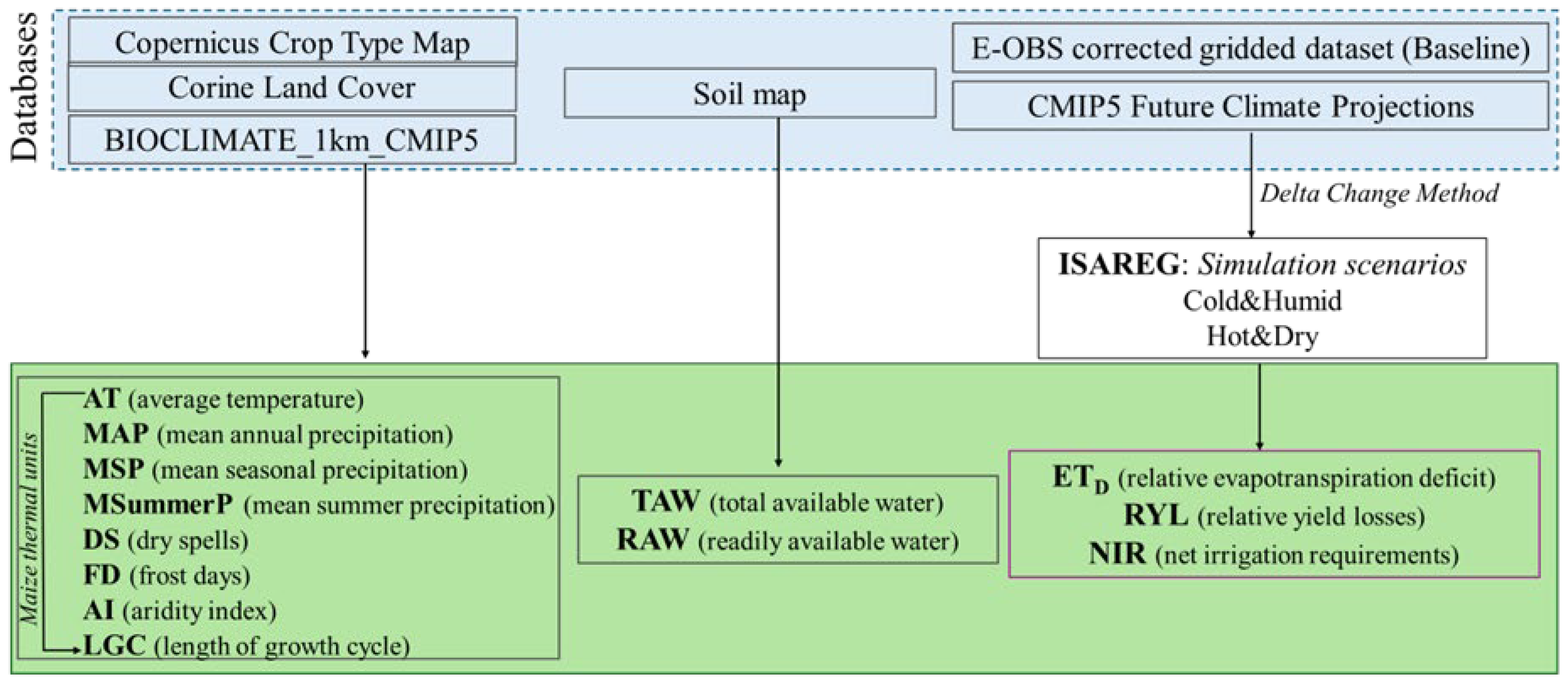
Figure 1 illustrates the methodological framework adopted in this study. The current research combines two complementary approaches: (i) a country-scale agroclimatic zoning analysis and (ii) a detailed case study for the Gradiška region focusing on climate change impacts on maize production. The Gradiška region was selected as a representative case study due to the availability of detailed field-based crop and soil data (including phenology and growing degree days, GDD), as well as its relevance as a typical lowland maize production system in northern BH. In addition, the site has been previously investigated within regional studies and projects (e.g., SMARTWATER), ensuring data consistency and methodological robustness for the application of the ISAREG model.
The country-scale analysis aims to determine the spatial distribution of agroclimatic conditions for maize growth across BH. This is achieved by using a set of eight indicators specifically tailored to maize requirements. It should be noted that the agroclimatic maps represent spatial indicators of suitability and do not correspond to direct yield or yield-loss estimates.
In contrast, indicators related to soil water balance and crop productivity are derived exclusively from the ISAREG modelling tool and are applied only to the Gradiška case study. Using an ensemble range approach of climate projections as input, the ISAREG model is used to estimate relative evapotranspiration deficit (ETD), relative yield losses (RYL) under rainfed systems, and net irrigation requirements (NIRs) under irrigated conditions. These indicators are not spatially extrapolated at the national scale.
Together, these two components provide a framework for assessing maize suitability and climate change impacts: the agroclimatic indicators define spatial suitability patterns for maize cultivation across BH, while the ISAREG-based indicators quantify site-specific impacts of climate variability and change on maize production.
2.1. Regional Characterisation of BH
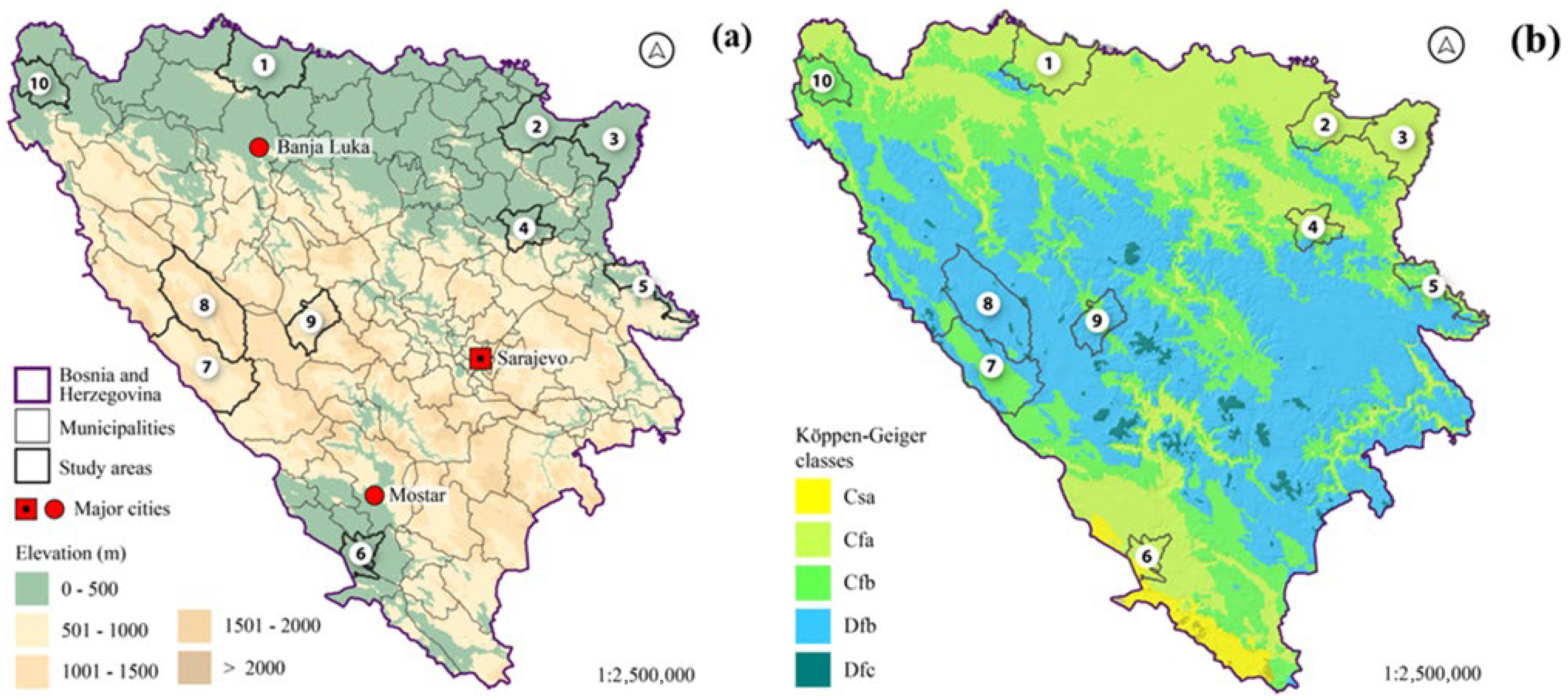
Bosnia and Herzegovina (BH) is located in south-eastern Europe at approximately 43°52′ N and 18°25′ E. The country covers an area of around 51,129 km
2. It is predominantly mountainous, with an average elevation of around 500 m, and its highest peak reaches 2386 m (
Figure 2). According to the Köppen–Geiger classification system [
75], the country is characterised primarily by a temperate, warm and humid climate (Cf; 64.6%), with regions also experiencing a humid boreal climate (Df; 24.5%) and a Mediterranean climate (Cs; 10.7%) [
76]. Ten municipalities with the highest and most representative maize production were selected for further analysis based on the spatial distribution and relative extent of maize cultivation derived from the Copernicus Land Monitoring Service Crop Type Map [
77], which has a Sentinel-2-based resolution of 10 m and covers the period 2017–2021 (
Figure S1). This was done together with consideration of prevailing climate type (
Figure 2), elevation range (
Figure 2), geographical location, and dominant soil characteristics.
2.2. Indicators
2.2.1. Agroclimatic Indicators
In the current study, the “BIOCLIMATE_1km_CMIP5” dataset, which was developed by the Copernicus Climate Change Service [
52] (C3S), was considered. This dataset covers Central Africa, Europe, and Northern Brazil. It is derived from ERA5 gridded reanalysis data [
55] and CMIP5 climate projections under two Representative Concentration Pathways: RCP4.5 and RCP8.5. RCP4.5 represents a medium-emissions pathway, while RCP8.5 corresponds to a high-emissions scenario, involving an increase in radiative forcing of approximately 8.5 W m
−2.
Seven agroclimatic indicators were selected from those available in the dataset (
Table 1). An additional agroclimatic indicator, the length of the crop growth cycle (LGC), was estimated using the downloaded daily Average Temperature (AT) indicator and following the Maize Thermal Unit (MTU) or Growing Degree Days (GDD) approach [
25], using a base temperature of 10 °C and an upper threshold of 32 °C as defined in
Table 1. The LGC indicator was calculated by considering three possible maize varieties—short-season cycle (SSC, 1000 °C MTU, FAO100-200), medium-season cycle (MSC, 1500 °C MTU, FAO400-600) and long-season cycle (LSC, 2000 °C MTU, FAO700)—sing the traditional sowing date in BH (15 April). Traditionally, short-season cycles are used across the country. However, the study of both medium- and long-season cycles is justified by the predicted high thermal accumulation under climate change conditions.
Table 1 presents each agroclimatic indicator alongside its description, temporal scope and the calculation equation [
25,
52]. Most of the indicators were calculated for the period April–October, which reflects the main maize-growing season in the country [
5].
T(m) is the monthly average temperature (°C); Tdaymeani is the daily mean temperature (°C); P(m) is the monthly mean accumulated precipitation (mm) over each 30-year study period; CDD5i is the cumulative sum of dry days for dry spells lasting at least 5 days; and DSyearsum corresponds to the cumulative number of dry spells lasting at least 5 days a year. Tdaymini is the daily minimum temperature (°C); PET is the potential evaporation (mm); Tbase is the base temperature (10 °C); and Tupper is the upper temperature threshold (32 °C).
Three General Circulation Models (GCMs) from the C3S were chosen to form an ensemble, thereby reducing the uncertainties associated with individual models, as noted by several authors [
25,
78,
79]. The models used in the current study, along with their respective institutes, are listed in
Table 2.
The bioclimatic indicators selected for maize agroclimatic zoning (
Table 1) were analysed across the following periods: baseline (1971–2000), near-term future (2011–2040), medium-term future (2041–2070), and long-term future (2071–2100).
Data from the three GCMs were obtained from the “BIOCLIMATE_1km_CMIP5” database in netCDF4 format for each period and each RCP scenario. These files were spatially clipped to the mainland territory of Bosnia and Herzegovina in a Python environment (v3.10.0). The climate data from the selected GCMs were then merged, and the ensemble median was calculated for each indicator and location. All indicators were then integrated into a georeferenced database using QGIS (v3.38.5), which enabled raster data visualisation and the creation of the maize climate suitability maps.
Although SSP-based scenarios (Shared Socioeconomic Pathways) represent the newer generation of climate projections, the agroclimatic zoning in this study was based on the Copernicus BIOCLIMATE_1km_CMIP5 dataset, which provides 1 km × 1 km resolution indicators derived from CMIP5/RCP projections. Given the strong climatic and topographic heterogeneity of BH, high spatial resolution was prioritised, and RCP-based projections were therefore retained. Future work may incorporate SSP-based datasets when equivalent high-resolution products become available.
2.2.2. Soil Indicators
For each municipality, land used, or potentially suitable for agriculture, was identified using the 2018 CORINE Land Cover (CLC) dataset [
80] by selecting all agricultural land-use categories (classes: 211, 212, 213, 221, 222, 223, 231, 241, 242, 243). The agricultural mask was then intersected with the Soil Map of Bosnia and Herzegovina at a scale of 1:50,000 (FAI, 1968–1985) to identify soil types within cultivated areas. Within each selected municipality, up to five dominant soil types were chosen according to their proportional areal coverage and agronomic relevance, paying particular attention to those supporting maize production under predominantly rainfed conditions. Representative soil profiles were then identified for each dominant soil type using the official pedological map manuals of Bosnia and Herzegovina [
81], which provide detailed descriptions of each soil horizon. This ensured consistency with the national soil classification system and enabled harmonised linkage to correspond to WRB soil groups [
82].
For each representative soil profile, all available measured soil properties were compiled by horizon. This included soil depth and horizon thickness (cm); soil texture fractions (%): clay (<0.002 mm), silt (0.002–0.05 mm), and sand (0.05–2.0 mm), together with the corresponding USDA textural class; bulk density (BD, g cm
−3); organic matter content (OM, %); and soil chemical properties, namely pH (H
2O and KCl) and CaCO
3 (%). These latter parameters were used for soil characterisation purposes only and were not directly involved in the soil water retention calculations. For soil profiles exceeding the assumed effective rooting depth, calculations were restricted to the corresponding maximum rooting depth. The missing hydraulic parameters were estimated using the pedotransfer functions (PTFs) developed by Saxton and Rawls [
83], which relate soil texture and organic matter content to volumetric soil water contents at specific matric potentials. These PTFs are widely applied in hydrological and agroclimatic modelling and are particularly suitable for large-scale assessments where direct measurements are unavailable [
84,
85]. The following soil hydraulic properties were estimated for each soil horizon: soil water content at the permanent wilting point (θ
WP, vol.%) at a suction pressure of 1500 kPa, soil water content at field capacity (θ
FC, vol.%) at a suction pressure of 33 kPa, saturation water content (θ
SAT, vol.%), and saturated hydraulic conductivity (K
s, mm h
−1). Both soil water content at field capacity and at the wilting point were used as input data in the ISAREG model (see
Section 2.3.2).
The total available water (TAW) was then calculated for each soil horizon and summed over the effective root zone [
86]:
where θ
FC, i is the volumetric water content at field capacity (vol.%) of horizon i; θ
WP, i is the volumetric water content at permanent wilting point (vol.%) of horizon I; and Z
i is the thickness of horizon i (mm).
The readily available water (RAW), defined as the fraction of TAW that can be depleted from the root zone before crop water stress occurs, was calculated following the FAO56 methodology [
86]:
where p is the soil water depletion fraction dependent on crop type and climatic conditions. For maize, a value of p = 0.50 was adopted [
87].
Both TAW and RAW values were subsequently used to characterise each location under study (see
Section 3.3).
2.3. Case Study: Gradiška Region
As previously mentioned, the Gradiška region was selected for a more detailed evaluation of its projected suitability for maize production. This section outlines the methodology used to simulate the soil water balance (SWB) for rainfed and irrigated conditions and determine the ETD, RYL and NIR under climate change scenarios.
2.3.1. Climate Change Projections and Bias Correction
The E-OBS observational gridded dataset (version v28.0e; [
88]) was used as the source of daily baseline climate data (1971–2000), following prior quality assurance and quality control (QAQC) procedures. The gridded dataset was assessed for quality using ground truth data from the Banja Luka weather station (44°79′ N; 17°20′ E; 153 m a.s.l.), which is operated by the Republic Hydrometeorological Institute of Republika Srpska (RHMZRS). Bias correction was performed for both the temperature and precipitation when the error relative to the Banja Luka weather station exceeded 5% (0.95 ≤ regression coefficient ≤ 1.05), using the linear-scaling approach. This method is the simplest bias correction technique, which uses additive correction for temperature and multiplicative correction for precipitation [
89,
90]. Concerning precipitation, correction factors were estimated for Spring, Summer, Autumn, and Winter as suggested by Garbanzo León et al. [
58].
After proper bias correction, the mean temperature was used to estimate the crop growth cycles using the MTU approach.
The Delta Change method [
89] was applied to bias-correct and generate future climate data series, due to its simplicity and robustness. Future daily climate series for RCP4.5 and RCP8.5, and time horizons (medium-term: 2041–2070; long-term: 2071–2100), were produced by perturbing the corrected baseline data series (1971–2000) with the corresponding future climate anomalies. Therefore, future climate anomalies were derived by combining outputs from General Circulation Models (GCMs) and Regional Climate Models (RCMs) under two emission scenarios. To improve the ensemble representativeness and reduce the uncertainties associated with single-model projections [
91,
92,
93], three GCM–RCM combinations were carefully selected (
Table 3). An ensemble range approach was applied to this set, whereby the minimum and maximum anomalies of each variable (temperature and precipitation) were extracted. Consequently, for each RCP and time horizon, four perturbed climate series were developed: (1) the Cold, (2) the Hot, (3) the Dry, and (4) the Humid series. These series correspond to the minimum temperature anomaly, maximum temperature anomaly, minimum precipitation anomaly, and maximum precipitation anomaly, respectively.
The baseline and future projected ET
o (reference evapotranspiration) were estimated using a simplified approach based on the Hargreaves–Samani equation [
60]. The ET
o estimates for both baseline and the future climate scenarios were calculated as follows:
where k
Rs is the empirical radiation adjustment coefficient (°C
−0.5), Ra is the extraterrestrial radiation (MJ m
−2 d
−1),
is the latent heat of vaporization (2.45 MJ kg
−1), T
max, T
min and T
mean (°C) are respectively the maximum, minimum and mean temperature, 0.0135 is the factor for conversion of units from the American to the International System, and 17.8 is an empirical factor related to temperature units used in the original formulations.
The Hargreaves–Samani equation is widely used to accurately estimate ET
o, particularly when adapted to local conditions [
94,
95,
96,
97]. Therefore, based on the previous regional calibration [
98], kRs was assumed to be 0.13 °C
−0.5.
2.3.2. Crop Evapotranspiration and Irrigation Requirements Estimation
The ISAREG model is based on the FAO single crop coefficient methodology [
86,
87]. According to this methodology, crop evapotranspiration (ET
c) is calculated as the product of the crop coefficient (K
c) and ET
o. This approach is well-suited for crops that provide full ground cover, such as maize. To simulate the soil water balance (SWB), the model requires the following input data:
Meteorological data: To simulate extreme conditions, the ‘Cold & Humid’ series were combined, as were the ‘Hot & Dry’ series (see
Section 2.3.1). The ‘Hot & Dry’ scenario represents a stress-condition envelope rather than an average projection and is used to assess the upper bounds of potential climate impacts on maize production, while the ‘Cold & Humid’ represents the lower bounds. The resulting precipitation and ET
o values were then used as inputs in the simulations.
Crop characteristics: These include the dates of the crop growth stages; the crop coefficients for the initial (K
c ini), mid-season (K
c mid) and end-season (K
c end); the root depth (Z
r, m); and the soil water depletion fractions under no stress (p) (
Table 4). The length of each growth stage and its respective date were derived from observations in a field experiment, conducted in the Banja Luka region, under fully irrigated conditions [
5], when adopting an FAO400 variety. The accumulated GDD were then derived using a T
base of 10 °C and a T
upper of 32 °C [
99]. Then, the dates for each ‘Cold & Humid’ and ‘Hot & Dry’ series (
Figure S2) were derived and used in the SWB simulations. The standard K
c mid value (
Table 4) was adjusted to reflect the actual weather conditions (u
2 and HR
min) for each series, considering the methodology detailed in [
87]. To do this, the regional average u
2 value obtained from the E-OBS dataset was used. Thus, an average u
2 of 1.71 m s
−1 was assumed. The mid-season average value of RH
min was estimated using the approach described by [
86] and the temperature daily maximum and minimum values.
Soil water-holding characteristics for different layers (
Table 5) were not directly obtained in situ but estimated using the PTF curves described in
Section 2.2.2. The soil used for the simulations was stagnic luvisol, as it is the most prevalent soil type in the region (covering 7906 hectares, which represents 16% of the total area) and is extensively cultivated with maize.
The initial soil moisture condition was assumed (not measured) to be at 100% of TAW, representing near-field capacity conditions at the beginning of the simulation period. This is consistent with the humid climate regime of BH, where low ET
o and high precipitation during the winter and early spring periods typically allow the soil to reach or remain near field capacity by the start of the maize-growing season in mid-April. This approach has been widely adopted in soil water balance and irrigation requirement studies conducted in the region [
12,
100,
101].
In the current study, two scenarios were assessed: one in which rainfed maize was prevalent and the other in which supplemental irrigation was used as an adaptation measure to cope with climate change. Therefore, to account for differences in root development under contrasting water management regimes, soil water availability indicators were calculated separately for rainfed and irrigated maize systems. For rainfed conditions, a maximum effective rooting depth of 1.20 m was assumed, reflecting full root development under non-irrigated conditions. For irrigated systems, a reduced effective rooting depth of 0.60 m was applied, consistent with shallower root distribution under frequent water supply. In soils with shallower effective depth than the assumed rooting depth, calculations were limited to the actual soil depth.
The daily irrigation requirements are estimated by simulating the SWB for the rooting depth according to the following equation:
where ΔS is the variation in the soil water storage (mm), P is precipitation (mm), ET
c is the crop evapotranspiration (mm), Ir is irrigation depth (mm), R
o is surface runoff (mm), CR is the capillary rise (mm), and DP is deep percolation (mm).
The seasonal relative evapotranspiration deficit (ET
D, %) is calculated as:
where ET
c act is the crop evapotranspiration under actual conditions, thus considering possible water deficits. ET
c act is the product of ET
o, and the K
c adjusted for the water stress conditions with the water stress coefficient (K
s). K
s ranges from 0 to 1, with values lower than one when the soil water depletion exceeds the readily available water (RAW) [
86].
The relative yield losses (RYL, %) are calculated according to the global Stewart model [
102], as follows:
where the K
y is the yield response factor. A value of 1.2 was assumed for K
y [
35,
103,
104]. It should be noted that RYL represents a model-based estimate of relative yield reduction due exclusively to water stress. It does not represent observed yield data, nor does it account for other yield-limiting factors such as nutrient availability, pests, or management practices.
In the current study, the main objective of using the ISAREG model was to determine the ETD and RYL that would occur when the crop is produced under rainfed conditions, as well as to estimate the net irrigation requirements (NIRs) of maize as a possible agronomic adaptation measure to cope with CC in the Gradiška case study area. These results are site-specific and are not spatially extrapolated to the national scale.
3. Results and Discussion
3.1. Historical Maize-Producing Regions
The multi-criteria approach supported the selection of ten municipalities representing the full range of current and climatically potential maize-growing environments in the country (
Figure S1). These municipalities are (
Figure 2): Gradiška (1), Brčko District (2), Bijeljina (3), Živinice (4), Bratunac (5), Čapljina (6), Livno (7), Glamoč (8), Bugojno (9), and Cazin (10). Different systems can be found in BH, from lowland intensive systems to hilly and mountainous marginal areas, grouped into five agropedological zones: (i) northern alluvial lowlands (including Gradiška, Brčko District and Bijeljina), (ii) eastern peripannonian hilly zones (Živinice, Bratunac), (iii) northwestern peripannonian hilly zone (Cazin), (iv) southern Mediterranean-influenced karst lowlands (Čapljina), and (v) high-altitude mountainous systems (Livno, Glamoč, Bugojno). These municipalities are particularly relevant because of their current contribution to national maize production and their contrasting sensitivities to projected climate-driven changes in temperature, climatic demand, and growing-season length, as stated by Charalampopoulos et al. [
70]. The characterisation of each agropedological zone is presented below. A detailed region characterisation is provided in the
Supplementary Material (Tables S1 and S2).
The northern alluvial lowlands (Bijeljina, Gradiška, and the Brčko District) are characterised by very gentle relief and low elevations. 75–98% of the agricultural land lies below 200 m a.s.l., with negligible mountainous areas (
Table S2). The dominant climate is humid subtropical (Cfa), locally transitioning to temperate oceanic (marine west coast; Cfb) and warm-summer humid continental (Dfb) climates. ET
o ranges from 687 to 787 mm and mean annual precipitation ranges from 748 to 1048 mm [
105], which provide favourable conditions for rainfed maize production. In these regions, extensive maize cultivation represents a core component of regional arable production, with Copernicus-derived maize areas accounting for 21–34% of total agricultural land.
The eastern peripannonian hilly zone (which includes Bratunac and Živinice locations) exhibits increased topographic complexity. Between 79% and 87% of agricultural land is located within the 200–600 m elevation band, with more than 11% above 600 m a.s.l. The climate is transitional (Cfa–Cfb–Dfb) and annual ET
o values are among the lowest observed in the country (ranging from 679 to 732 mm), reflecting cooler conditions. Mean annual precipitation ranges from 837 to 907 mm. Elevation gradients and interannual climate variability strongly influence yield stability. Maize cultivation is more limited in these areas, accounting for only 7–8% of agricultural land, reflecting topographic constraints and a smaller proportion of arable land (
Table S1).
The northwestern peripannonian hilly zone (Cazin) is entirely located within the 200–600 m a.s.l. elevation range, with agricultural land characterised by an average slope of approximately 8%. The climate is transitional (Cfa–Cfb–Dfb), and annual reference evapotranspiration reaches about 777 mm, while precipitation reaches 1047 mm, showing behaviour like that of the eastern peripannonian hilly zone. Maize cultivation is limited in this region, accounting for approximately 7% of the agricultural land.
The southern Mediterranean karst lowland zone (Čapljina) presents low elevations, with more than 70% of agricultural land below 200 m a.s.l. The area is influenced by Cfa and hot-summer Mediterranean (Csa) climates, resulting in the highest mean annual ET
o (928 mm) among all studied municipalities. This indicates a strong water demand. Alongside this, the mean annual precipitation of 1093 mm shows a critical need for irrigation to ensure yield stability. Čapljina represents the broader Mediterranean-influenced maize-growing zone of southern BH, where future climate change is expected to intensify water stress rather than limit thermal suitability primarily. Maize occupies a negligible share of agricultural land (2.2 km
2 based on Copernicus dataset, meaning 2% of agricultural land) compared with perennial crops such as grapevine, olive, fig, peach, nectarine and cherry [
106], which dominate agricultural production in the area.
The high-altitude mountainous systems of BH include the western mountainous (Livno, Glamoč) and the central mountainous zones (Bugojno). In the western mountainous zone, agricultural land is entirely located above 600 m a.s.l., with climates dominated by Cfb, Dfb, and locally subarctic (cool summer; Dfc) classes. ET
o ranges from 699 to 804 mm while mean annual precipitation ranges from 1151 to 1394 mm. Maize cultivation is marginal and spatially restricted, covering only 1.2 km
2 and 1.7 km
2 in Livno and Glamoč, respectively (0–1% of agricultural land), reflecting the very limited arable land base (
Table S1).
Finally, the central mountainous zone, approximately 90% of agricultural land lies above 600 m a.s.l., with steep slopes. The prevailing climates are Cfb and Dfb, and ETo reaches approximately 764 mm and precipitation averages 834 mm. Bugojno represents a typical central Bosnian mountainous agro-ecosystem, with agroclimatic characteristics comparable to those of the Sarajevo–Zenica Basin and other central BH locations. Maize cultivation is limited, covering only 2.1 km2, corresponding to approximately 2% of agricultural land. Overall, agroclimatic conditions in high-altitude mountainous systems result in a shortened and climatically constrained maize growing season, where elevation and slope constitute the primary limiting factors rather than evapotranspiration demand.
3.2. Country-Level Agroclimatic Indicators
This section details the results of the agroclimatic zoning for maize production in the baseline and future climatic conditions, using the selected agroclimatic indicators across the country. The presented maps illustrate agroclimatic suitability patterns across BH and should not be interpreted as direct yield or yield-loss estimates, which are addressed separately through the Gradiška case study (
Section 3.4).
3.2.1. Average Temperature
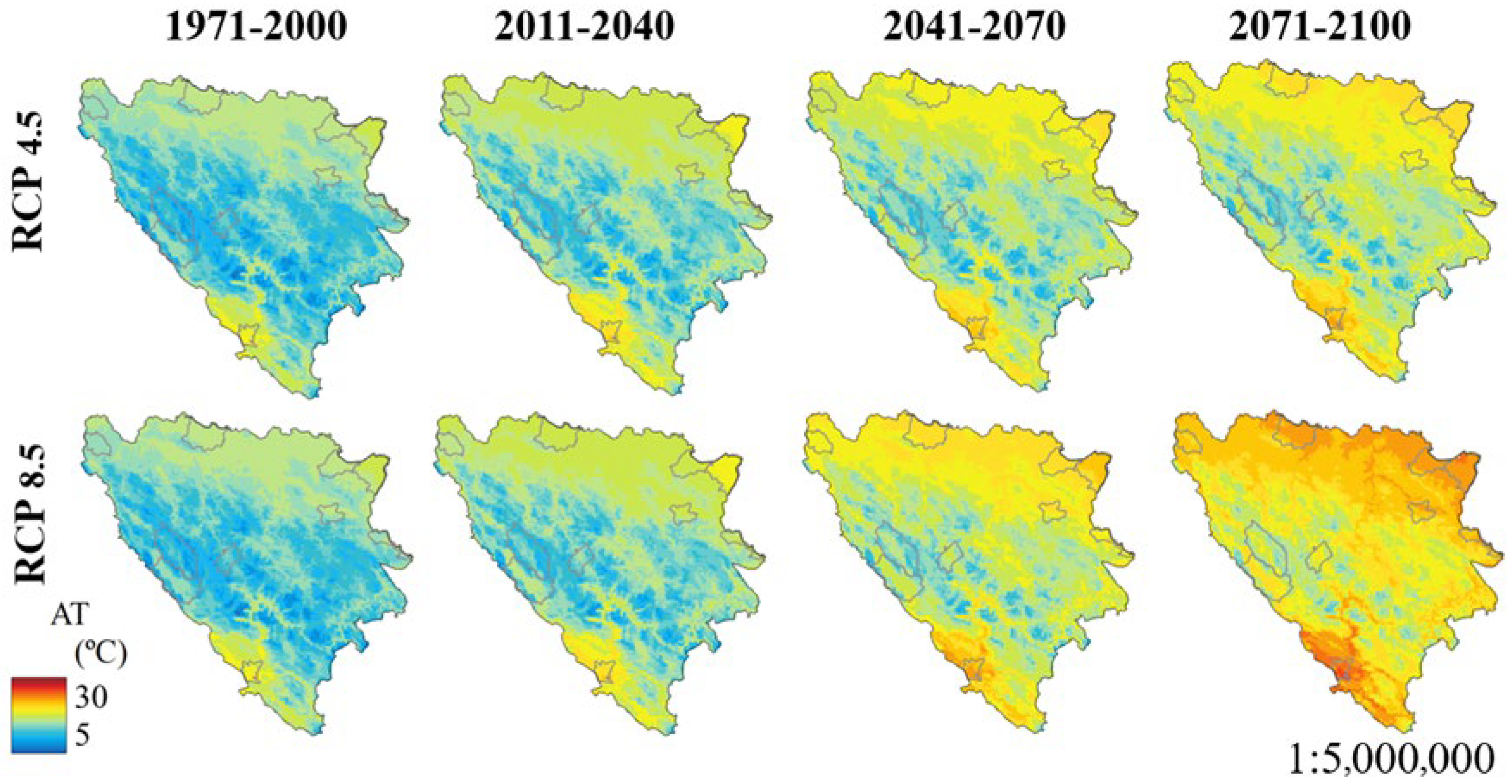
The average temperature (AT) during the maize-growing season was analysed for both the baseline and future periods (
Figure 3). During the baseline period, the AT ranged from 12.6 °C to 17.2 °C across BH. The coldest areas were located in the central part of the country, reflecting the influence of higher altitudes and more continental conditions. In contrast, the warmest regions are found in the southwest and northeast (16.5–17.2 °C).
Future projections indicate a consistent increase in temperature throughout the maize-growing season. Under the RCP4.5 and RCP8.5 scenarios, AT anomalies are expected to rise by 1.4–1.6 °C in the near-term, 2.5–4.2 °C in the medium-term, and 3.1–6.7 °C in the long-term. While these results are broadly consistent with those reported by IPCC [
11], for the medium- and long-term periods under RCP8.5, the current study projected anomalies slightly exceed the IPCC estimates of 3.0 °C and 5.7 °C, respectively. Nevertheless, the findings are consistent with a study conducted in Montenegro, which reported increases exceeding 2 °C across all considered climate scenarios (SSP1-2.6, SSP3-7.0, and SSP5-8.5) for the medium-term future [
54]. The results are also consistent with those of other research studies conducted in BH, which indicate summer temperature increases of around 5.2–6.0 °C for the medium- and long-term projections [
107].
Furthermore, in the long term, AT increases could reach up to 48% in the east-central part of the country under the RCP8.5 scenario, compared to the baseline. The southwestern and northeastern regions already experience the highest temperatures, and this spatial pattern is projected to continue and worsen under future climate conditions.
These changes correspond to an average increase of approximately 8–13% in the near-term, 13–29% in the medium-term, and 17–48% in the long-term, depending on the location. The largest relative increases are projected for Glamoč (up to 48%), followed by Bugojno in central BH (up to 45%), and Bratunac and Živinice in the east (up to 42%). In contrast, Čapljina, in the long-term period, exhibits the lowest projected increase (31%), under the long-term RCP8.5 scenario (
Figure S3), despite being the hottest location.
3.2.2. Mean Precipitation
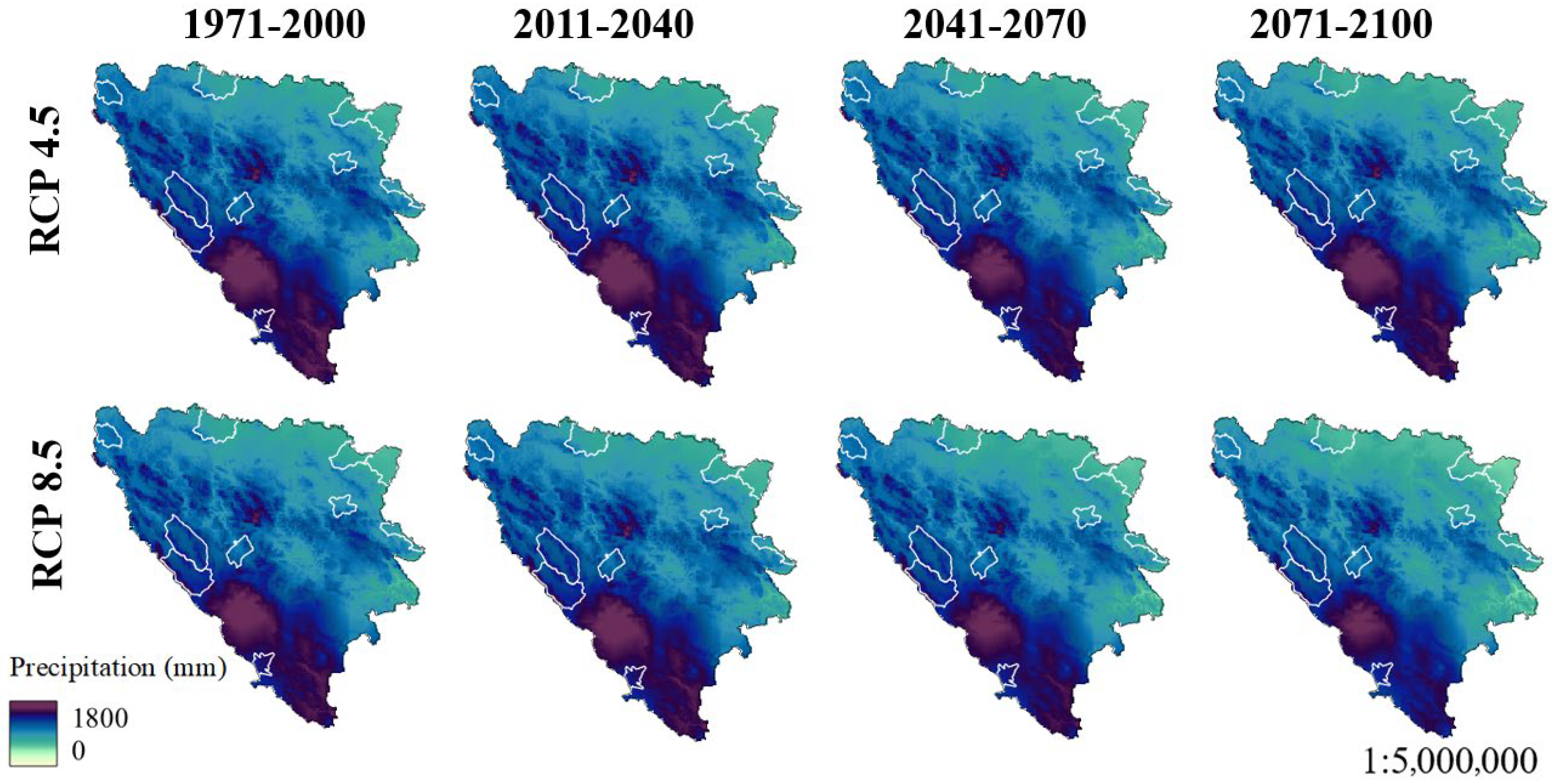
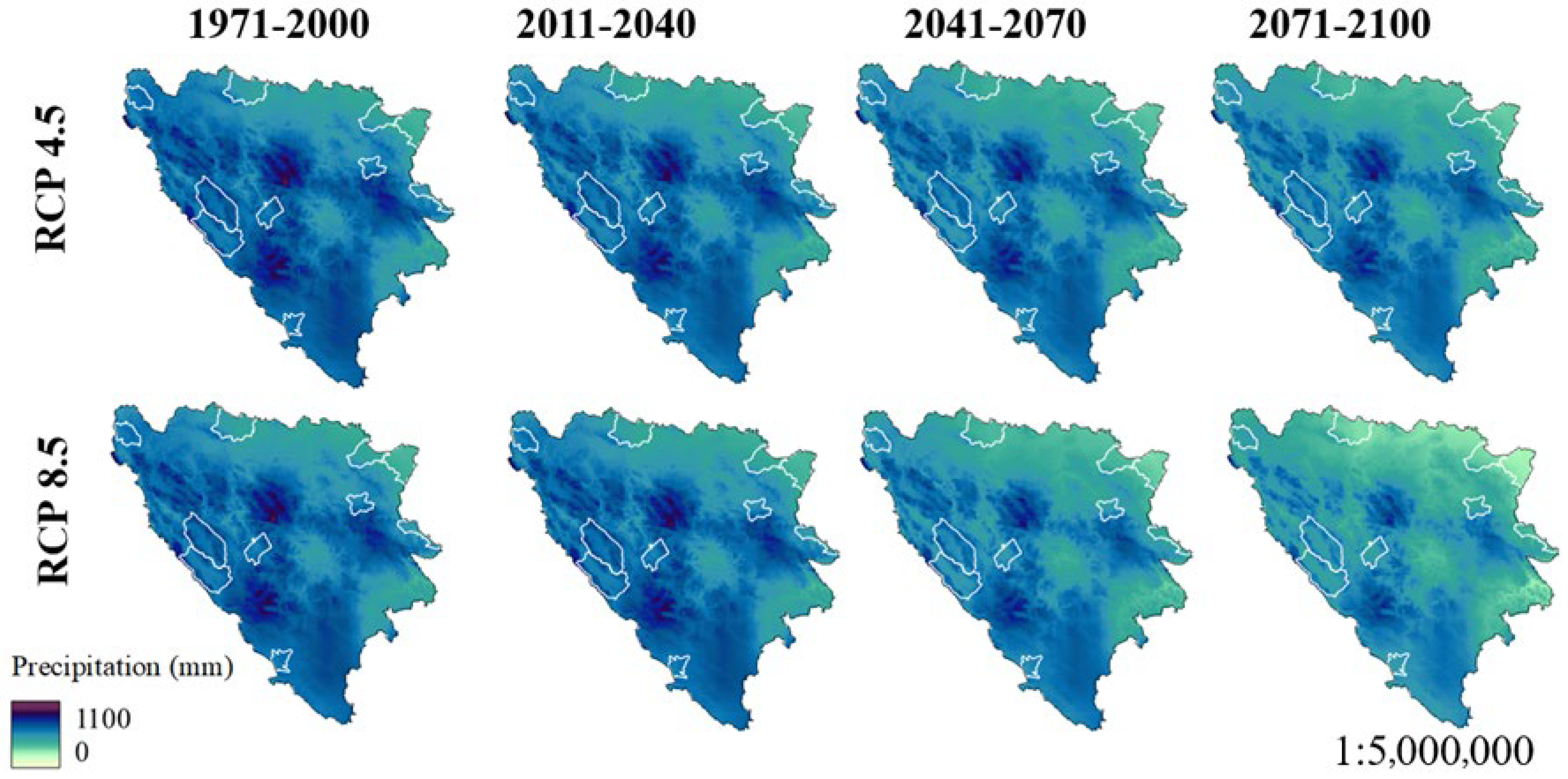
The mean annual accumulated precipitation (MAP) and the mean seasonal accumulated precipitation (MSP) were analysed for baseline and future climate projections (
Figure 4 and
Figure 5, respectively). During the baseline period, MAP ranged from 700 ± 144 mm to 1570 ± 231 mm in the northeast and southwest, respectively. While only minor temporal variations are projected under RCP4.5, a more important decline in MAP is anticipated under RCP8.5, particularly in the northern and northeastern regions by the end of the century. The regions located in the northeast experience the highest decrease, with reductions corresponding to 15%, compared to the baseline. These results are consistent with those reported by Tiro et al. [
15], who reported decreases from 4% to 15% across the BH (RCP8.5) by the end of the century.
As the south–north gradient in precipitation remains dominant and stable across all scenarios and periods, Posavina Canton (in the northeast) is projected to experience the least MAP (575 ± 119 mm). By contrast, West Herzegovina Canton (in the southwest) is expected to receive the most precipitation (1515 ± 225 mm) in the long-term under the RCP8.5 scenario.
Figure 5 shows the MSP throughout the maize growing cycle in the BH. Further information focusing on the ten regions is shown in
Figure S4. During the baseline period, the lowest seasonal totals were observed in the north, followed by the east. By contrast, the highest precipitation values were recorded in the high-altitude mountainous system. Future climate projections indicate a decline in MSP, particularly in regions currently experiencing the lowest seasonal totals (e.g., Bijeljina and Brčko District), with reductions varying by timeframe. In the regions currently experiencing the highest levels of precipitation (Bugojno, Livno and Glamoč), a moderate decrease is projected under both emission scenarios: 0–4% in the near-term, 9–11% in the medium-term, and 11–19% in the long-term period. Further information on MSP can be found in
Supplemental Material (Figure S3 and Table S3). Decreases in MSP were also reported by Müller and Hofmann [
108] in BH and by Fernandes et al. [
54] in Montenegro.
Focusing on MSummerP (
Table S4), the projections suggest an even greater decrease. The lowest summer precipitation (243 mm) is projected for the Čapljina region (Mediterranean climate in the south), while the highest is projected for Glamoč (west), Bugojno (central BH), and Živinice (east). In the long-term period, the summer totals in the RCP4.5 scenario are expected to decrease significantly in Čapljina (56%), but to decrease only slightly in the near and medium-term (1% and 11%, respectively). As expected, higher decreases in MSummerP in Čapljina are projected for the RCP8.5 scenario (decreases of 5%, 18% and 64% in the near-, medium- and long-term periods, respectively). These results suggest stronger regional reductions, particularly in southern BH, than those reported by Trbic et al. [
107], who observed decreases of about 40% in southern BH during the long-term period (RCP8.5). In locations with higher baseline MSummerP, projections indicate reductions of 1–4% in the near-term, 7–17% in the medium-term, and 54–62% in the long-term under both emission scenarios. Similar results, with broader regional findings, were reported by Vuković and Vujadinović [
109] in Serbia, reporting significant reductions in summer precipitation under future CC scenarios. Furthermore, another study conducted in Serbia [
110] identified marked reductions in summer precipitation and an increased tendency towards aridity.
The findings of the current study further strengthen confidence in the projected tendency for summer drying in the Western Balkans. Notably, these decreases will occur during the maize flowering stage, suggesting that water availability during critical growth periods will be greatly impacted, which could restrict crop development and yields in rainfed maize systems. Therefore, supplemental irrigation could be considered as an adaptation measure (see
Section 3.4.2).
3.2.3. Dry Spells
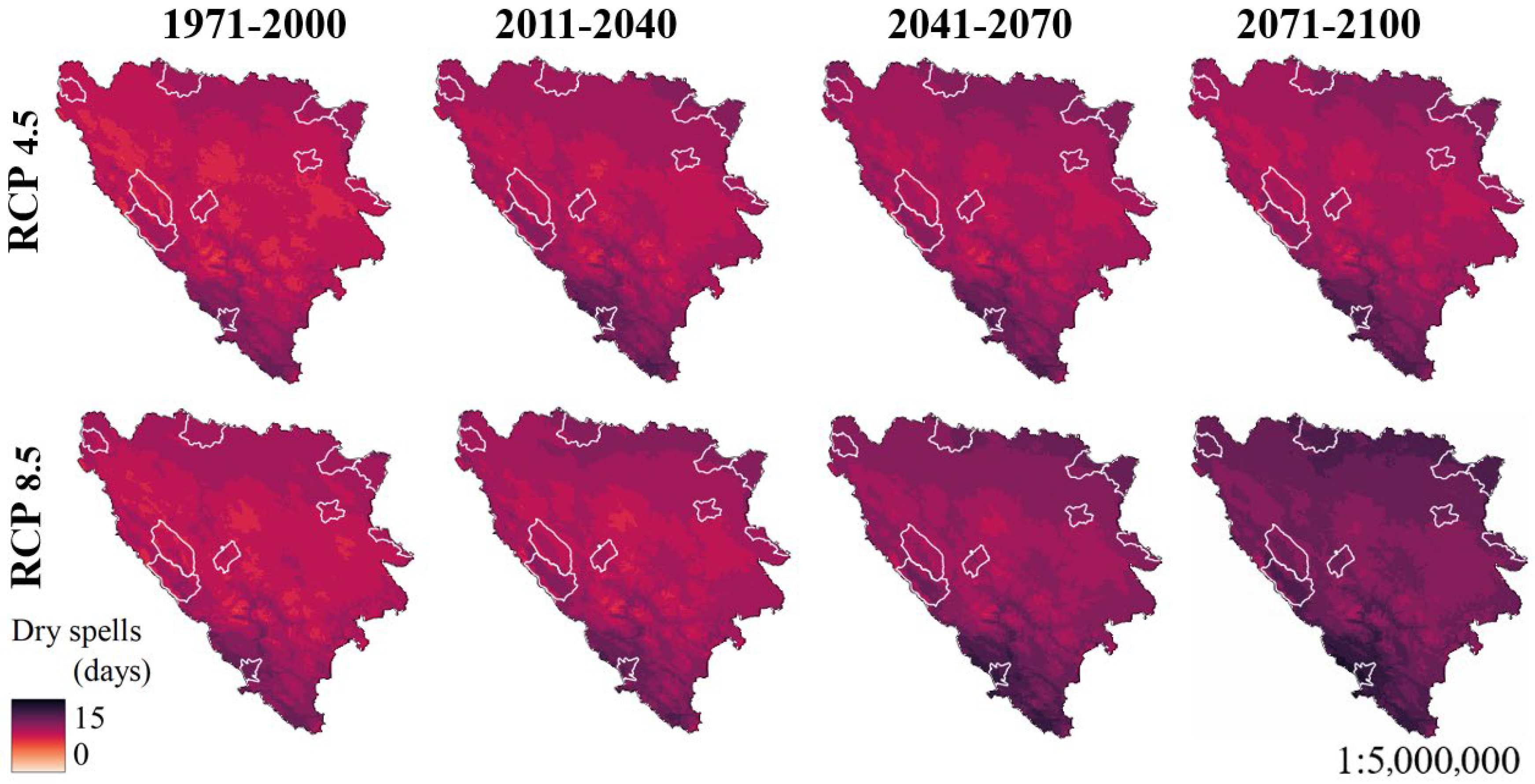
During the baseline period, Central BH had the lowest DS values nationwide (7 ± 1 days), while the southwest and northeast had the highest (9 ± 1 days) (
Figure 6). Looking to the future, an increase in DSs is expected. By the end of the century, Central BH, particularly Central Bosnia and Sarajevo Canton, will continue to have low DS values (approximately 10 ± 1 days, under the RCP8.5 scenario), while higher values will be exhibited in the southwest, south, and northeast (approximately 12 ± 2 days under the RCP8.5 scenario). This projected increase is consistent with broader regional patterns reported in studies conducted across the Balkans [
111,
112]. These studies indicated that the number of very long dry spell events would rise by the end of the twenty-first century, particularly under RCP8.5.
Results focusing on the selected maize-producing regions show that, during the baseline period, DSs ranged from 8 to 11 days across the different regions, with Čapljina exhibiting the highest DS (
Figure S5). Projections of percentage changes in DSs indicate no increase for Bratunac in any of the periods, when considering RCP4.5, but an increasing tendency when considering RCP8.5, with respective increases of up to 4%, 14%, and 26% for the near-, medium-, and long-term periods. For RCP4.5 in the near-term, for example, in Gradiška (north), there is no noticeable increase, indicating minimal change under such conditions.
Most of the analysed locations are projected to be significantly impacted in the long-term under RCP8.5, with increases in DSs ranging from 30% to 32%. Čapljina appears to be the most affected site in absolute terms, experiencing up to 13 DS days. However, Čapljina, Bratunac and Cazin, and Brčko District are the only locations projected to exhibit increases in DSs below 30%, with relative changes ranging between 24% and 27%. Further information on DS days is provided in
Figure S5.
3.2.4. Aridity Index
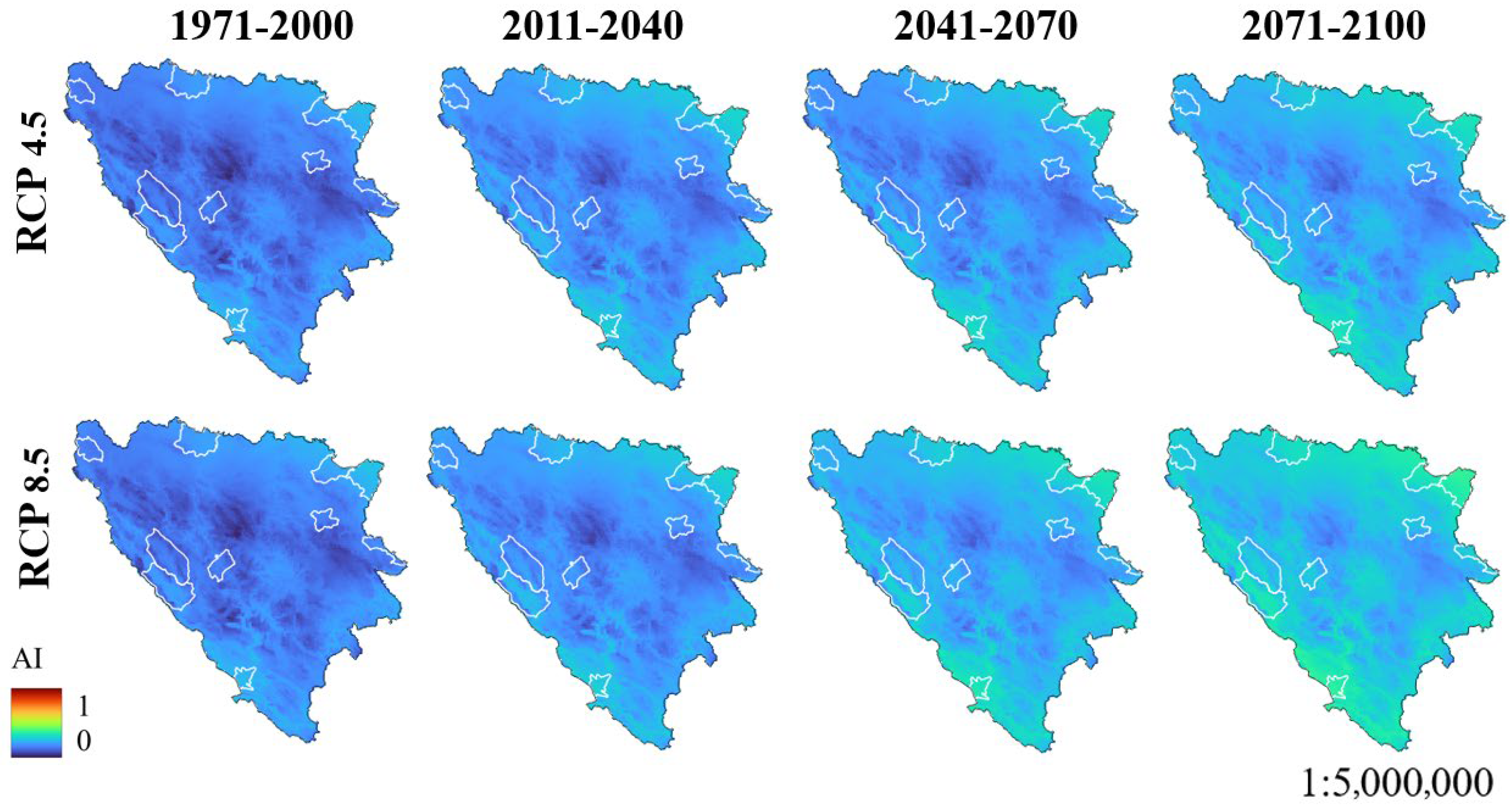
Analysis of the AI results (
Figure 7) reveals a clear tendency toward increasing aridity across BH. This is evident in the increase in AI values, particularly under the RCP8.5 scenario, as expected. The northern and northeastern regions experienced the most pronounced changes, with an increase from 0.23 during the baseline period to 0.35 by the end of the century. This made them the most arid locations in the country. Upward trends are observed in the northeast and southwest (0.33 and 0.31, respectively, under RCP8.5 in the long-term). By contrast, while regions located in Central BH also show gradual increases in AI over time, they remain among the most humid areas. Their projected end-of-century AI remains below 0.25 (RCP8.5), which reinforces their status as the more humid regions of the country. Although the precipitation analysis revealed a south–north gradient, AI suggests that the most humid conditions may persist in central regions of BH. These results are consistent with those reported by Srdić et al. [
113], who identified locations such as Jajce, Sarajevo, Bugojno, and Zenica as moist sub-humid areas.
Results show that Glamoč, Živinice, and Bugojno were the most humid locations during the baseline period (AI ca. 0.14). Conversely, Čapljina and Bijeljina were the driest locations (AI ca. 0.24). In the future, AI is expected to increase, ranging between 0.17 and 0.28 in the near-term, 0.18 and 0.32 in the medium-term, and 0.21 and 0.36 in the long-term, for the RCP4.5 and RCP8.5 scenarios, respectively. While the pattern of humid and drier regions remains consistent with the baseline, the greatest increase is seen in Livno and Glamoč by the end of the century (RCP8.5).
3.2.5. Frost Days
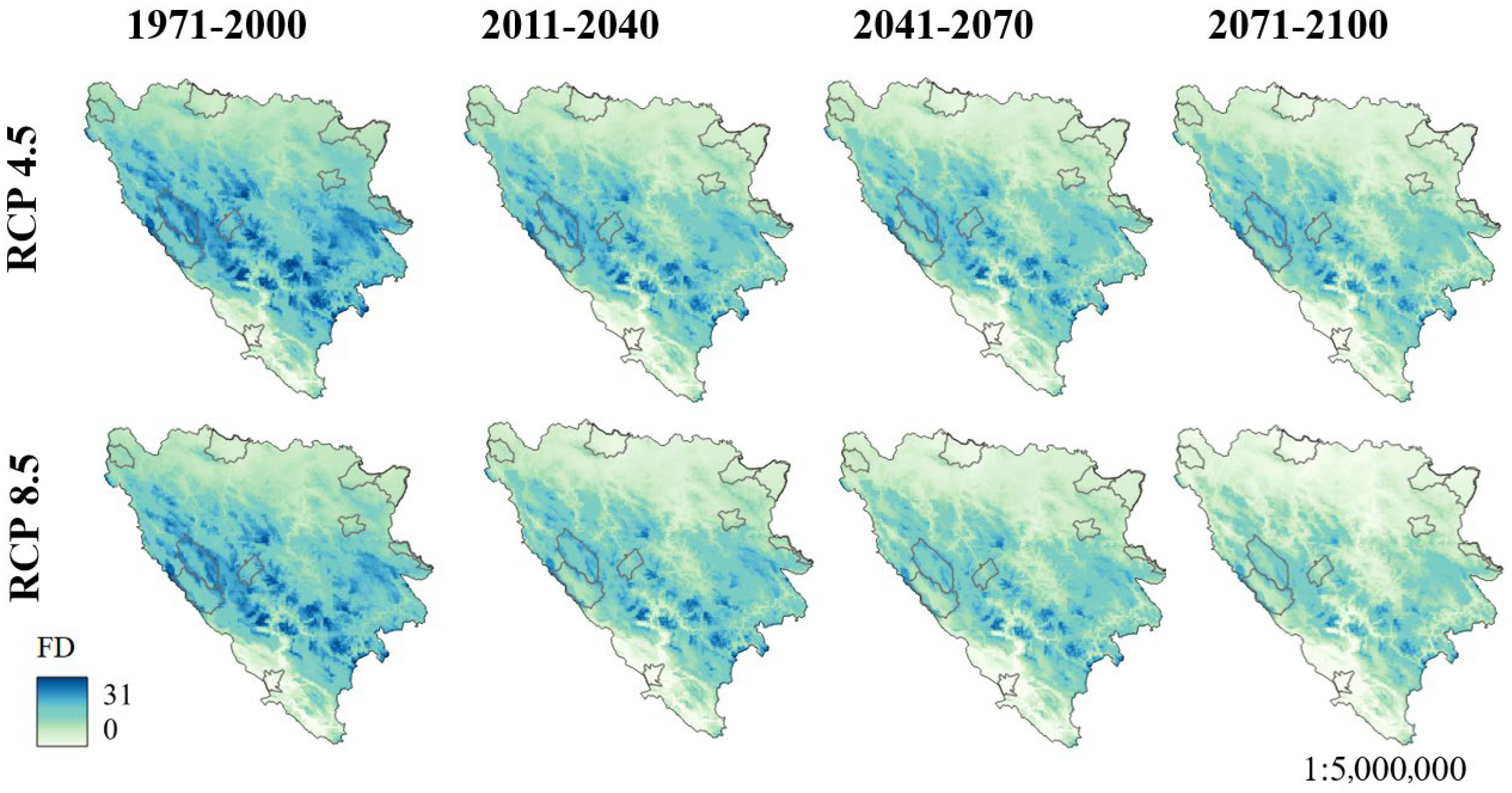
Figure 8 shows the number of frost days (FDs) for March, for both emission scenarios and study periods. Similar results were found for April (
Figure S6), while results for May were consistently zero across all scenarios and periods, meaning that FDs are no longer a constraint for sowing maize.
The results for the baseline period show that Čapljina is the region with the fewest number of frost days in March (probability of occurrence ca. 7%), by contrast with regions located in high-altitude mountainous (60–73%). This explains why anticipating sowing is not common practice in these regions.
FDs are expected to decrease across all future periods due to the projected increase in air temperature. Despite experiencing notable reductions in FDs, the traditionally colder regions will still have relatively high FD values by the end of the century. For example, Glamoč may still have a 60% probability of occurrence under RCP4.5 and a 48% probability under RCP8.5. This represents a persistent risk for early sowing. Similar behaviour is found for Livno and Bugojno. By contrast, regions in the northern alluvial lowlands show more pronounced reductions, reaching very low FD values projected by the end of the century (RCP8.5, corresponding to probabilities of occurrence between 3% and 10%).
These decreases suggest that earlier spring sowing will become a probable adaptation measure. The Čapljina location is projected to reach no FDs, meaning that March sowing is expected to become an option for farmers.
By April, FDs decrease substantially compared to March across all locations (
Figure S6). Regions such as Čapljina, Brčko D., Bijeljina, and Gradiška already show 0 FDs for most scenarios, indicating that FDs are no longer a limiting factor. Higher-altitude areas still experience some FDs, though the values are lower than in March, suggesting a reduced risk for sowing.
In summary, although the increase in average air temperature significantly reduces the likelihood of FDs in March, enabling earlier sowing in some regions, there are remaining areas where frost risk continues to be relevant. Therefore, region-specific adaptation strategies are needed to ensure the safe and productive cultivation of maize in the future.
The results of the current study are consistent with the findings of Müller and Hofmann [
108] for the Western Balkans, who report that FDs will decrease and become increasingly confined to the period from December to February, with such events becoming less likely in November and March. In addition, results from a study conducted in Southeastern Europe show that the central region of BH exhibits the largest reductions, with values exceeding 20 FDs per year [
114].
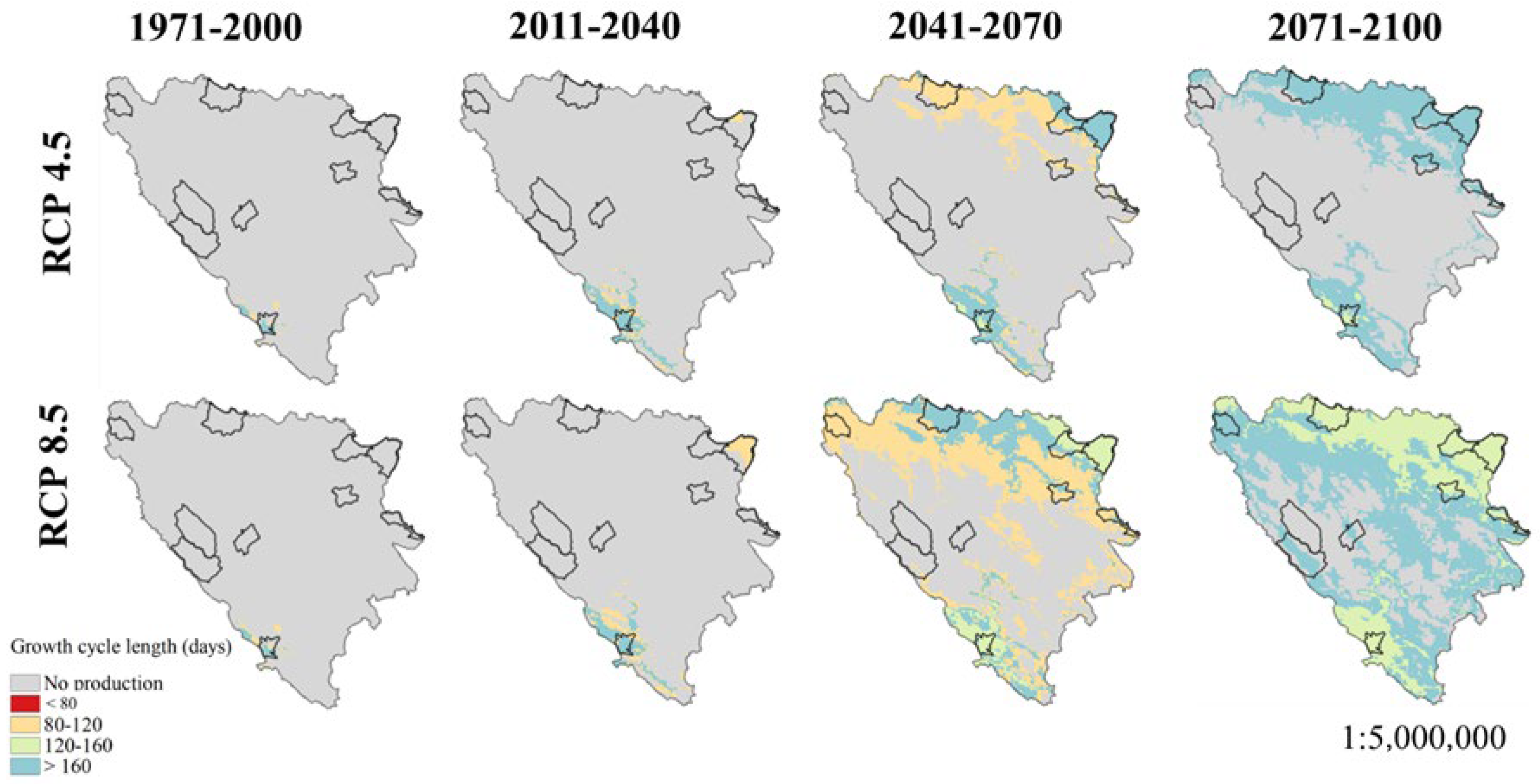
3.2.6. Length of Maize Growth Cycle
The length of the growth cycle (LGC) was estimated using the thermal units approach for three groups of maize varieties—short season cycle, medium-season cycle and long-season cycle—with 15 April taken as the sowing date. The results are presented below according to each variety type.
Short-season varieties
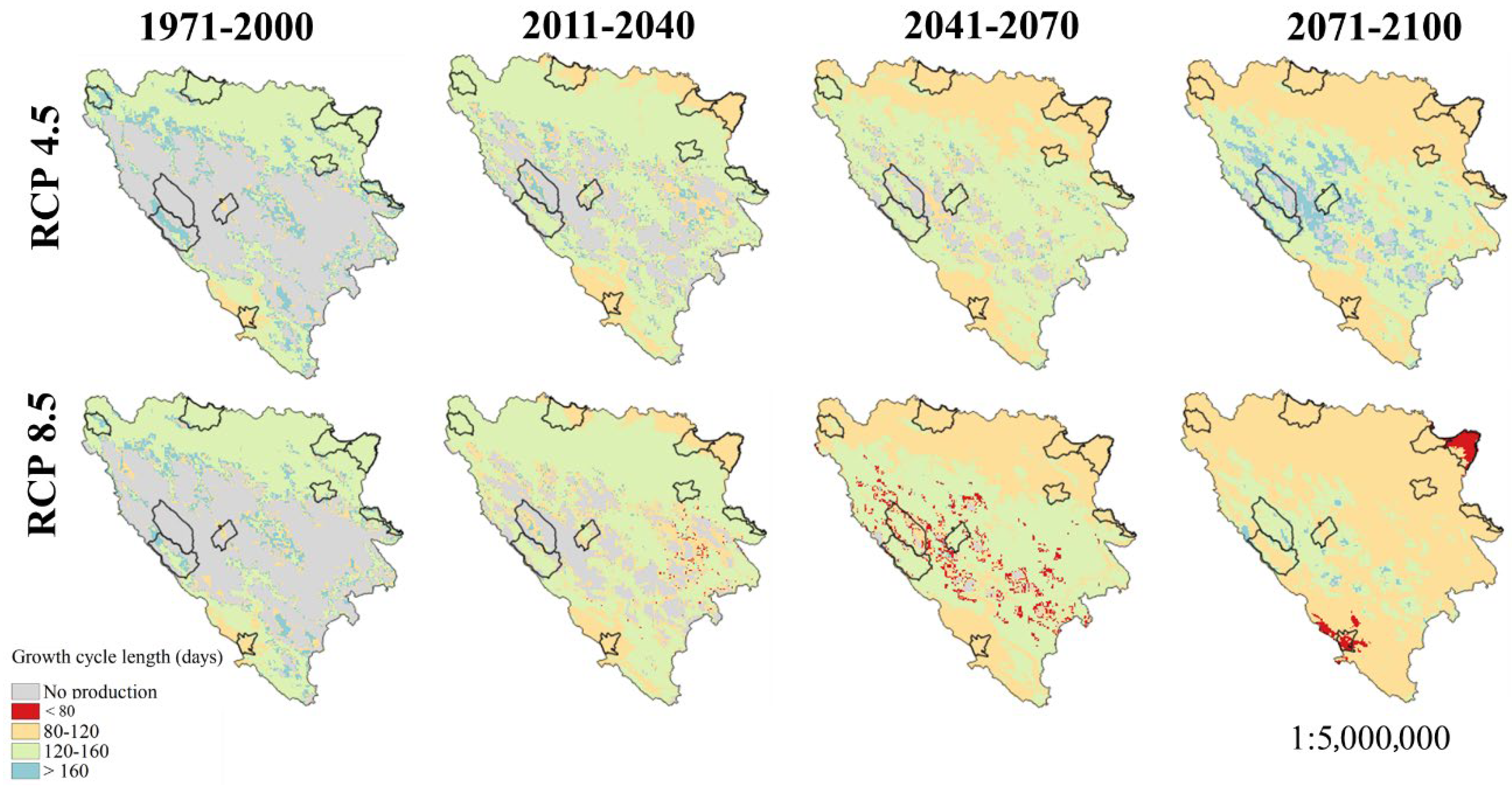
Short-season varieties (
Figure 9) are traditionally used due to the country’s thermal conditions. The results show that, with increasing air temperature, most regions that are currently unable to produce maize will become suitable in the future, while regions that are already able to produce short and medium-season varieties will experience a consistent reduction in LGC. These results are consistent with those of other studies conducted in various regions around the world [
25,
68,
69,
115], including the Balkans [
70].
Analysing extremes (minimum and maximum LGC values) for short-season varieties reveals marked spatial contrasts across BH. In Glamoč, the combination of high altitude and low temperatures indicates that the crop will not reach maturity within this region (
Figure 9). In contrast, Bugojno, Livno, and Cazin show strong internal variability: in Bugojno, for example, the LGC ranges from a lack of thermal accumulation (during the baseline) to the fixed period of 126–139 days (long-term period, RCP8.5); in Livno, from no thermal accumulation (during the baseline period) to the period 123–124 days (long-term period, RCP8.5). This wide internal range highlights the presence of micro-climatic and topographical heterogeneity, enabling maize production in certain areas but not in others, emphasising the importance of localised adaptation strategies.
Across all regions currently suitable for maize cultivation, results show a substantial decline in LGC over time due to rising air temperatures. During the baseline period, the LGC is, on average, 155 days in cold locations and 115 days in the warmest locations. Under the long-term RCP 8.5 scenario, this averages 130 days in the coldest locations and 102 days in the warmest areas. These decreases in LGC are higher than those reported in a study conducted in Poland [
116], which reported a decrease of 15–25 days (RCP 8.5) by the end of the century, likely due to methodological differences. In contrast, a study in central Portugal [
117] reported LGC decreases of 27–35% under the same scenario, which is comparable to the values obtained in the present study.
These projected changes become agronomically meaningful when translated into approximate harvest dates. In Bijeljina, for example, the harvest date shifts from 1 September (baseline) to 2 August and 7 July in the long-term period (RCP4.5 and RCP8.5, respectively). This potentially allows for the sowing of a second crop, which is a practice traditionally associated with Mediterranean agroclimatic conditions. In Cazin, the results also show an anticipation in the harvest time, moving from 16 September (baseline) to 1 August and 31 July in the long-term period (RCP4.5 and RCP8.5, respectively). A similar anticipation trend is projected for Bratunac, where the harvest time shifts from 5 September (baseline) to 1 August and 31 July. Conversely, colder regions such as Glamoč and Livno, initially exhibiting limited or irregular production, have a harvest date between 18 and 31 August (RCP 8.5, long-term). These results highlight that the projected increase in air temperature will shorten the LGC, which could affect yield and crop quality. However, they also indicate potential opportunities to adopt later-maturing varieties, which could increase maize productivity in the country, or to implement double-cropping systems in favourable areas. This approach has been suggested by several authors [
24,
25,
118]. Nevertheless, the feasibility of such systems depends on water availability and interannual climate variability, both of which should be assessed alongside thermal suitability.
Medium-season varieties
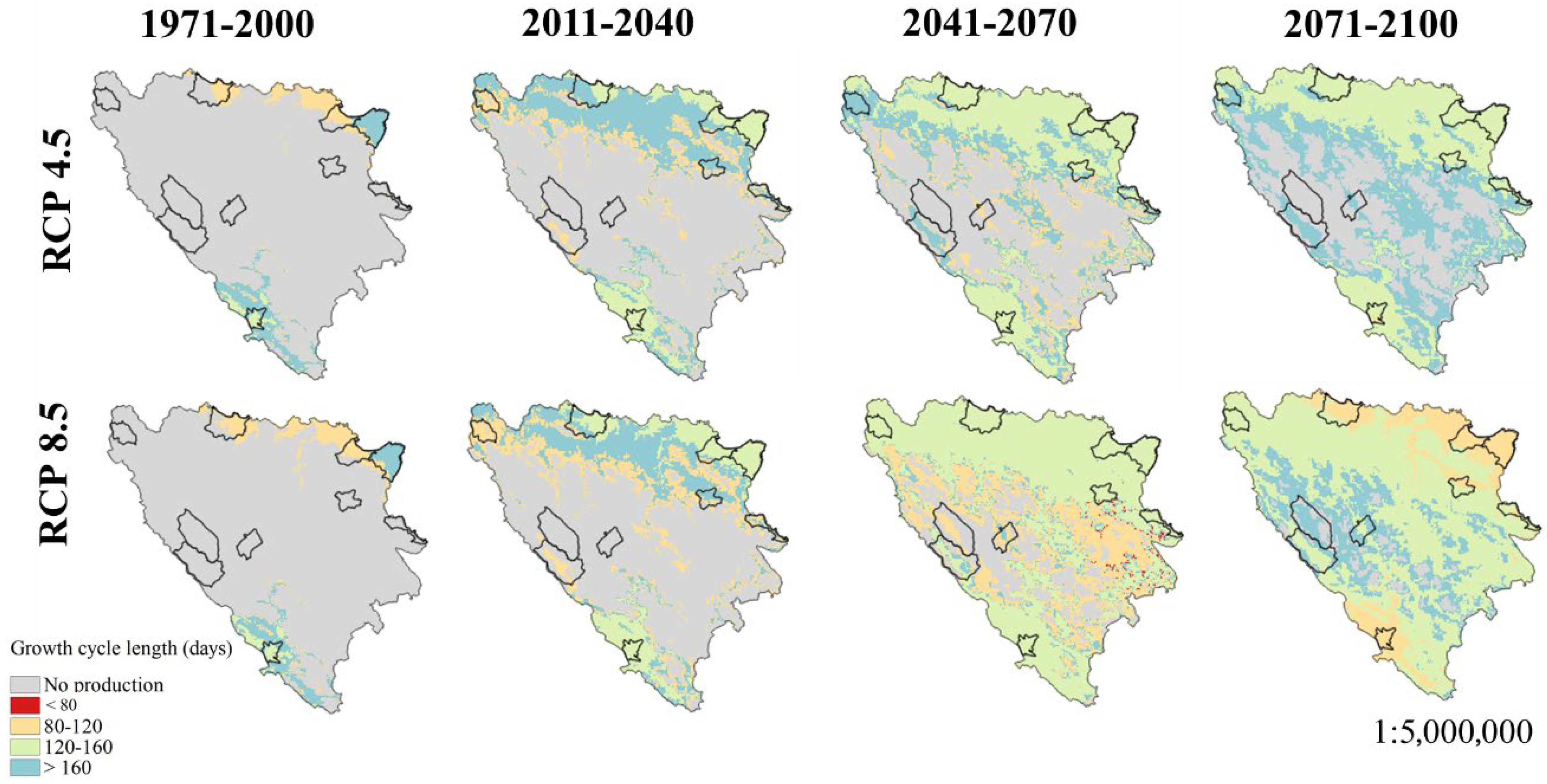
Medium-season varieties can be used as an adaptation measure to increase maize productivity (
Figure 10). However, a considerable portion of the country currently remains unsuitable for these varieties, due to insufficient thermal accumulation within the fixed growing period (April–October). For example, when considering the RCP 4.5 scenario, maize medium-season varieties are projected to be unable to reach the required GDD for maturity in any of the study periods in Glamoč (cold location). Under RCP 8.5, maize production will only be possible in the medium- and long-term, highlighting the strong constraints imposed by temperature limitations driven by altitude. In contrast, in warmer locations such as Čapljina and Bijeljina, maize cultivation of medium-season varieties is already feasible during the baseline period (LGCs spanning 152 and 172 days, respectively).
Over the long-term period under RCP 8.5, the LGC is expected to converge to around 139–200 days in the coldest areas and 108–139 days in the warmest regions, corresponding to different harvest windows (1 September to 1 November in cold regions and 1 August to 1 September in hot locations). Compared with locations that supported medium-season varieties during the baseline period, the shortening of the LGC is projected to range from 28% in Čapljina to 38% in Bijeljina.
These results suggest that while not all regions of the country allow the cultivation of these medium-season varieties, the north and south (especially Brčko D., Bijeljina and Čapljina) could do so as an adaptation measure to cope with CC. However, these varieties remain unsuitable for high-altitude or cooler regions.
Long-season varieties
The suitability of long-season varieties (
Figure 11) is substantially restricted under baseline climate conditions, since weather conditions inhibit the completion of the grain maize cycle. It is only under future warming, particularly in the medium- and long-term periods, that some regions begin to show LGC values compatible with completing the full cycle. In the long-term period, the suitability of these varieties increases considerably under RCP8.5 (
Figure 11). Regions in the north and east reach the 2000 °C required to complete their growth cycle by the beginning of September, while maturity is reached in Cazin by the beginning of October. In contrast, Glamoč and, to a lesser extent, Livno (high-altitude mountainous systems) remain unsuitable or only marginally suitable, with insufficient thermal accumulation for long-season varieties within the fixed period.
These patterns underline the importance of elevation and local temperature regimes in determining the potential for future maize production, particularly the key role of temperature thresholds and elevation in determining the future viability of late-maturing maize varieties.
Maize production is likely to increase in central BH and at higher altitudes due to climate change, driven by shifts in the timing and duration of the growing season. Similar findings have been reported in other regions of the Western Balkans [
70].
3.2.7. Readily Available Soil Water for Maize
RAW was considered to represent the soil water reservoir available for maize production.
Table 6 summarises the resulting TAW and RAW values for the maize root zone, for each chosen soil type and its effective profile depth. It also shows the mapped surface area of each soil unit. It was assumed that the effective root depth was up to 1.20 m, as rainfed maize tends to develop an extensive root system.
Figure S7 shows the main agricultural soils in each selected municipality.
The northern alluvial lowlands (Bijeljina, Brčko and District Gradiška), are characterised by deep Luvisols and Gleysols with high soil water-holding capacity (
Table 6). These soils therefore provide the most favourable conditions for rainfed maize production in BH, as RAW value is high. In contrast, shallow soils, such as Skeletic Cambisols in Gradiška, show low TAW and RAW values due to their limited effective depth, indicating high sensitivity to drought conditions.
In the peripannonian hilly zones of eastern BH (Bratunac, Živinice), soil water availability is strongly controlled by relief and effective soil depth, resulting in pronounced spatial variability. TAW ranges from very low values in shallow Leptic Cambisols (79 mm) to high values exceeding 220 mm in deep Stagnic Luvisols (
Table 6). In shallow Cambisols, TAW and RAW values are limited by soil depth. The Živinice area is dominated by deep Stagnic Luvisols, which provide high soil water storage. In contrast, Bratunac is characterised by shallower Cambisols with moderate to low RAW values. Consequently, rainfed maize production is considerably more vulnerable to drought conditions in Bratunac than in Živinice, despite similar climate conditions.
In the central mountainous zone (in the Central BH), represented by Bugojno, soil water availability is moderate and highly variable, reflecting strong control by relief, bedrock, and soil depth. The limited water storage of shallow Dystric Leptosols and Skeletic soils highlights soil depth as the primary constraint for maize production.
In the Mediterranean karst lowlands of southern BH (Čapljina), soil water availability is generally low. RAW values reflect shallow profiles and skeletal soils developed on calcareous parent material. In several dominant soil types, including Calcaric Fluvisols and Chromic Cambisols, TAW and RAW values are limited by their effective depth. These results highlight the structural limitation of rainfed maize production in Mediterranean karst environments, where low soil water storage, combined with high evaporative demand, makes maize highly sensitive to drought conditions.
In the high-altitude mountainous systems of western BH (Livno, Glamoč), soil water availability shows the widest range among all zones. TAW values range from less than 70 mm in shallow Gleysols and Cambisols to more than 250 mm in deep Rendzic Leptosols and Cambisols. Although cooler climatic conditions partly compensate for soil limitations by reducing evaporative demand, rainfed maize production remains constrained by shallow soils and short growing seasons, restricting cultivation mainly to early-maturing varieties and favourable local settings.
In the north-western peripannonian zone (NW), represented by Cazin, deep Gleysols and Dystric Cambisols dominate agricultural land and provide high soil water-holding capacity.
Regions dominated by deep Luvisols, Cambisols, and Gleysols, particularly the northern alluvial lowlands (N) and the northwestern peripannonian zone (NW), are the most suitable for rainfed maize production as they have the highest RAW. In contrast, Mediterranean karst regions and high-altitude mountainous regions remain structurally constrained by low soil water storage.
3.3. Agroclimatic Zoning
Of the analysed regions, Živinice and Cazin stand out as having the greatest potential for rainfed maize production under both baseline conditions and future climate projections. These areas have favourable average temperatures and high precipitation totals during the maize growing season. Soil water-holding capacity is high (generally RAW ≥ 100 mm in the dominant soil units,
Table 6), enabling crops to develop without stress. These regions have sufficient thermal accumulation to support the full development of short-, medium- and long-season cycles in the future. These results suggest that maize production could be improved in the future, particularly in terms of yield, if longer cycles are considered.
Despite the projected reduction in precipitation, the northern locations of Gradiška, Brčko D. and Bijeljina also show high potential for maize production in the future. These soils are the most suitable for rainfed maize production due to high TAW and RAW. However, relative yield losses could occur, especially in dry years. Thus, supplemental irrigation should be considered during the critical growth stages to stabilise yield.
In contrast, other regions, such as Bratunac and Čapljina, although meeting the thermal requirements for all maize varieties considered in this study, face specific limitations, particularly related to soil water storage capacity. In Čapljina, which is characterised by a Mediterranean climate, a pronounced decrease in summer precipitation is also a constraint. Practices that enhance soil water retention, such as cover cropping and mulching, could be particularly beneficial given the low RAW. On-farm rainwater harvesting for irrigation may also represent an effective strategy to mitigate water scarcity. These results show that, when considering irrigation, both locations could increase their productivity by using longer varieties or practising double cropping, given the favourable projected conditions.
Finally, higher-altitude regions such as Livno, Glamoč, and Bugojno are suitable for short-season cycles, but constrained by lower RAW in some areas and insufficient thermal accumulation for longer-cycle varieties, thereby limiting their potential for future maize production.
3.4. Gradiška Case Study
3.4.1. Suitability of Rainfed Maize
The agroclimatic indicators for the Gradiška region reveal substantial changes between the baseline period and future climate projections (
Table 7). During the maize growing season, the AT is projected to increase by around 1.5 °C in 2011–2040, by 2.4–4.0 °C in 2041–2070 and 3.5–6.4 °C in 2071–2100 (RCP4.5 and RCP8.5, respectively, relative to the baseline average).
MSP is projected to decline between 4–7% in the near-term, 10–18% in the medium-term and 17–34% in the long-term (RCP4.5 and RCP8.5, respectively, relative to the baseline average). During the summer months, MSummperP decline is even more pronounced, with decreases of approximately 61% and 71% (RCP4.5 and RCP8.5, respectively) by the end of the century. This demonstrates the high variability of precipitation, which has a substantial impact on the projected sustainability of rainfed maize.
DS is also projected to increase, rising around 11% in the near-term (2011–2040) and reaching 33% by the end of the century (RCP8.5). Similarly, AI is projected to rise from 0.19 in the baseline to between 0.26 and 0.31 by 2100, indicating a progressively drier climate.
The projected changes in temperature significantly influence the length of the growing cycle (LGC) (
Table 7). For short-season cycle (SSC), the LGC is projected to decrease 22–23% in the long-term, reflecting the accelerated physiological development driven by warmer conditions. For medium-season cycle (MSC), the initial LGC in the baseline is not specified due to regional production constraints, but near-term projections show full production is feasible for both RCPs, while long-term values decrease further, particularly under RCP8.5. The long-season cycle (LSC) shows the most pronounced decrease with the rise in temperature. Baseline and near-term conditions do not support LSC production in the region. However, long-term projections under RCP8.5 show feasibility. Overall, these results indicate potential implications for yield, water management, and adaptation strategies. Early varieties, due to their shorter growing season, will allow for double cropping, while MSC and LSC may require adaptation measures, including drought-resistant cultivars or modified sowing dates and supplemental irrigation, to maintain production.
At the Gradiška site, Stagnic Luvisols and Haplic Cambisols dominate, providing very high-water availability in the maize root zone under the rainfed systems (
Table 6). Gleysols also have a high capacity to retain water, but slower drainage and occasional seasonal waterlogging may occur in some horizons due to lower saturated hydraulic conductivity (between 0.07 and 0.39 mm h
−1). Given the projected reductions in MSummerP already discussed, irrigation may be necessary to stabilise yields, although the dominant soils’ good water-holding capacity offers reassurance.
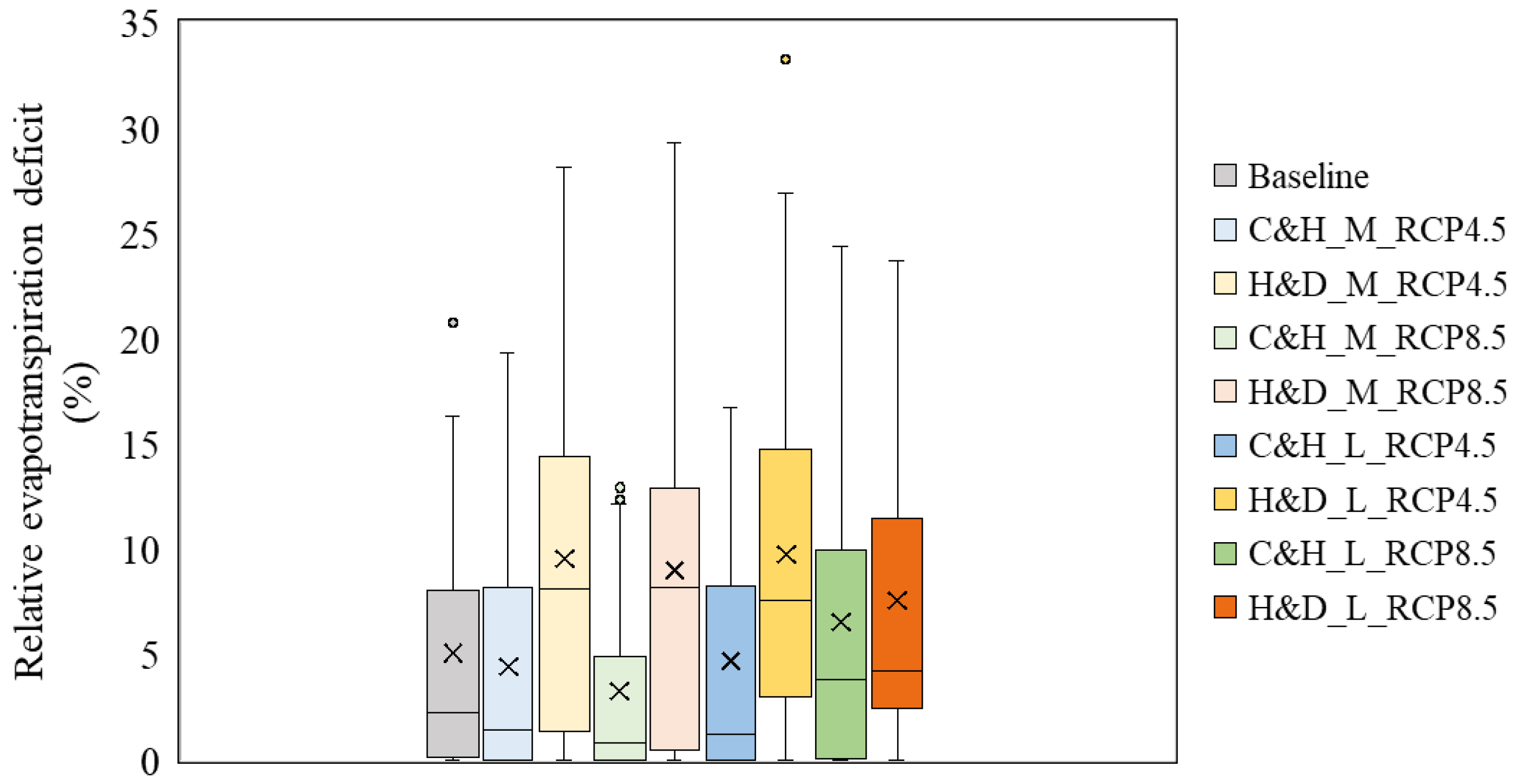
The simulated variability of the relative evapotranspiration deficit (ET
D) is presented in
Figure 12. During the baseline period, ET
D values are generally low, with an average of approximately 5% and a median of around 2%. Nevertheless, substantial interannual variability is observed, with some years exhibiting minor deficits and others reaching values above 20% in more extreme conditions. In the medium-term future, the average ET
D is projected to range from around 4% to 10%, depending on the climate scenario. Under ‘Cold & Humid’ conditions, ET
D decreases relative to the baseline for both RCP scenarios, due to high and well-distributed precipitation. In contrast, under ‘Hot & Dry’ conditions, the combination of higher atmospheric evaporative demand and reduced precipitation enhances soil moisture depletion. This leads to higher average ET
D values and a greater frequency of considerable deficits, as indicated by higher maximum values and wider interquartile ranges. Median values for the medium-term period range from 1% to 8%, for ‘Cold & Humid’ and ‘Hot & Dry’ conditions, respectively. For the long-term period, the overall range of ET
D remains comparable to that of the medium-term projections, with averages varying from 5% to 10%, although the contrast between climate conditions becomes more pronounced. Reductions in ET
D are mainly associated with ‘Cold & Humid’ conditions (RCP 4.5), whereas ‘Hot & Dry’ conditions continue to drive increases for both RCP scenarios, compared with the baseline average. Interestingly, under RCP 8.5, ‘Cold & Humid’ conditions also present a tendency to increase ET
D relative to the baseline, achieving an average of 7%. This counterintuitive result may be because, although total precipitation increases under this scenario, it is insufficient to compensate for the higher evapotranspiration caused by elevated temperatures during the most water-demanding stages of maize growth, particularly during the mid-stage, especially around flowering and early grain filling (
Figure S2). The longer the cycle (151 days; see
Figure S2), the greater the number of periods of relative ET
D that the crop experiences, particularly in summer months. The ‘Hot & Dry’ conditions will lead to a greater frequency of ET
D extreme events exceeding 30% in some years in both RCPs considered.
These results suggest an increased risk of water stress events for rainfed maize in warmer and drier future climates. Such events are associated with relative yield losses (RYL), and irrigation can be adopted as an adaptation measure, particularly in years with low rainfall, to maintain yield stability. During the baseline period, RYL averaged 6% (ranging from 0 to 25%). In the medium-term future, RYL ranges from 0% to 35%, while in the long-term, it ranges from 0% to 40%, both averaging 8% (
Figure S8). These results demonstrate an intensification of the effects of CC on rainfed maize yields; nonetheless, the average values can be considered low. These results are consistent with those reported by Stričević et al. [
8] for the same region, who report changes in actual yield ranging from −14% to +8%. Furthermore, Tiro et al. [
15] report that projections indicate a reduction in maize yields ranging from 10% to 25% in the northern part of BH, where Gradiška is located.
3.4.2. Irrigated Maize Production as an Adaptation Measure
Maize rainfed systems are expected to encounter challenges due to climate variability and climate demand conditions. Thus, CC will induce changes in agricultural practices. Therefore, in the Gradiška area, irrigation may be considered an adaptation measure to stabilise yield. Under irrigated conditions, the available soil reservoir for maize will decrease, as rooting depths also tend to decrease (
Table 8). Thus, stagnic luvisol, haplic cambisol, as well as gleysol, due to high TAW and RAW values, will need less frequent irrigation events than skeletic cambisol areas.
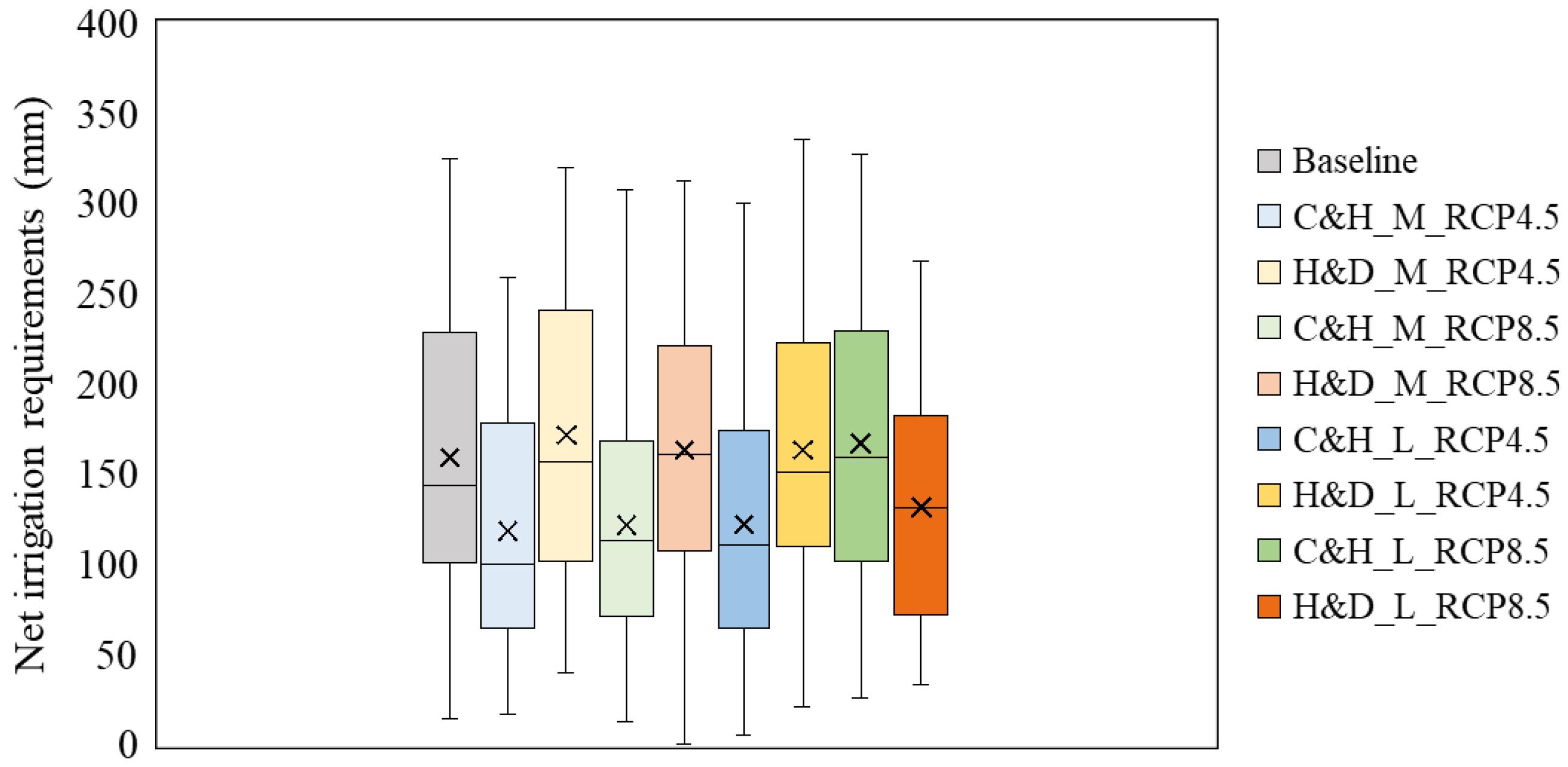
The net irrigation requirements (NIRs) were simulated and analysed (
Figure 13) for both baseline and future climate projections. When irrigation is applied, ET
D becomes negligible, and yields are potentialized. Results show an average NIR during the baseline period of 159 ± 80 mm (ranging from 14 to 325 mm, depending on the year). This value is close to 107 mm reported by Stričević et al. [
8], for the reference period of 1961–1990.
For the medium-term future, NIR averages range from −26% to +8% (118 ± 69 mm to 171 ± 81 mm) relative to the baseline average, depending on the simulation scenario considered. The most pronounced decrease is projected for the ‘Cold & Humid’ series under RCP4.5 (−26%), followed by the RCP8.5 (−23%), consistent with the series exhibiting the highest precipitation amounts and lowest crop water demand. In contrast, an increase is projected for the ‘Hot & Dry’ series, with +7% and +2%, for RCP4.5 and RCP8.5, respectively. This increase may be attributed to higher crop water demand combined with the low precipitation amounts, despite the decrease in crop growth cycles.
In the long-term period, average NIR values are projected to range between −23% to +5% (122 ± 75 mm and 167 ± 86 mm) relative to the baseline. In contrast to the medium-term period, reductions are projected under ‘Cold & Humid’ conditions (RCP4.5) as well as under ‘Hot & Dry’ conditions (RCP8.5), about −23 and −17%, respectively. The projected decreases can be explained under ‘Cold & Humid’ conditions, as crop water requirements are more frequently met by precipitation, i.e., more even precipitation, leading to reduced NIRs. Conversely, under ‘Hot & Dry’ conditions in RCP8.5, the maize growth cycle is substantially shortened, particularly during the mid-season, resulting in a total growing period approximately 29% shorter than the baseline (124 vs. 171 days). This shortens the duration of exposure to critical irrigation water demand periods, such as flowering and grain filling. Contrarily, increases in NIR are projected under ‘Hot & Dry’ conditions in RCP4.5 (+3% relative to the baseline average) and under ‘Cold & Humid’ conditions in RCP8.5 (+5% relative to the baseline average). This apparent contrast can be attributed to several factors: (i) although ‘Hot & Dry’ conditions shorten the crop cycle, this effect is less pronounced under RCP4.5 (approximately 138 days) due to moderate climatic forcing; thus, the reduction in precipitation has a greater impact on irrigation demand than the shortened cycle; and (ii) under ‘Cold & Humid’ conditions in RCP8.5, despite higher total precipitation, rainfall is unevenly distributed throughout the growing season and does not coincide with critical maize growth stages. Most rainfall occurs outside the peak water-demand months of July and August, while a longer crop cycle (about 150 days) under ‘Cold & Humid’ conditions would further increase cumulative water requirements.
NIR results obtained in the present study are lower than those reported by Čereković et al. [
5] for the Aleksandrovac site, located near the simulated case-study area. In this two-year experimental study (2021–2022), irrigation was 430 mm under full irrigation (drip irrigation, high distribution efficiency). However, the findings of the current study are consistent with simulations by Stričević et al. [
8] using the AquaCrop model, who reported NIRs ranging between 0 and 300 mm under projected future climatic conditions, even if increases in NIRs are always present, in contrast to our study.
Medians across the simulation results suggest that baseline irrigation conditions are largely preserved under future climate scenarios. Differences in NIRs are mainly driven by a few years with extreme evapotranspiration deficits or surpluses rather than by a systematic increase in irrigation demand. In other words, future climate scenarios do not notably worsen production conditions, and irrigation demand remains highly year-dependent. Targeted supplemental irrigation is still important during the hottest and driest years to maintain stable crop yields, but the overall variability is comparable to current baseline conditions (standard deviations across scenarios range from 70 to 86 mm).
Overall, ensemble projections indicate that the near-term NIR anomaly ranges from −26% to +8%, while the long-term anomaly ranges from −23% to +5%, suggesting a general reduction in water demand for the agricultural practices considered.
4. Conclusions
The present study addresses maize production in Bosnia and Herzegovina by analysing both baseline and future projections under different climate change scenarios, using a set of agroclimatic indicators to show that an integrated overview of these indicators is essential to reliably assess the suitability of rainfed maize cultivation.
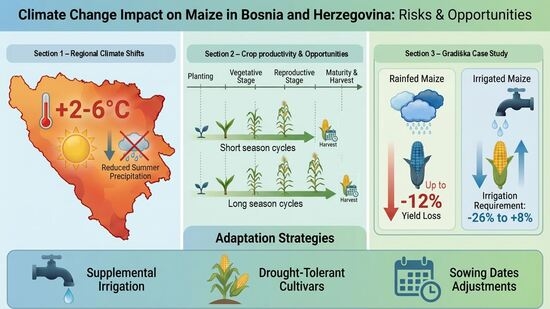
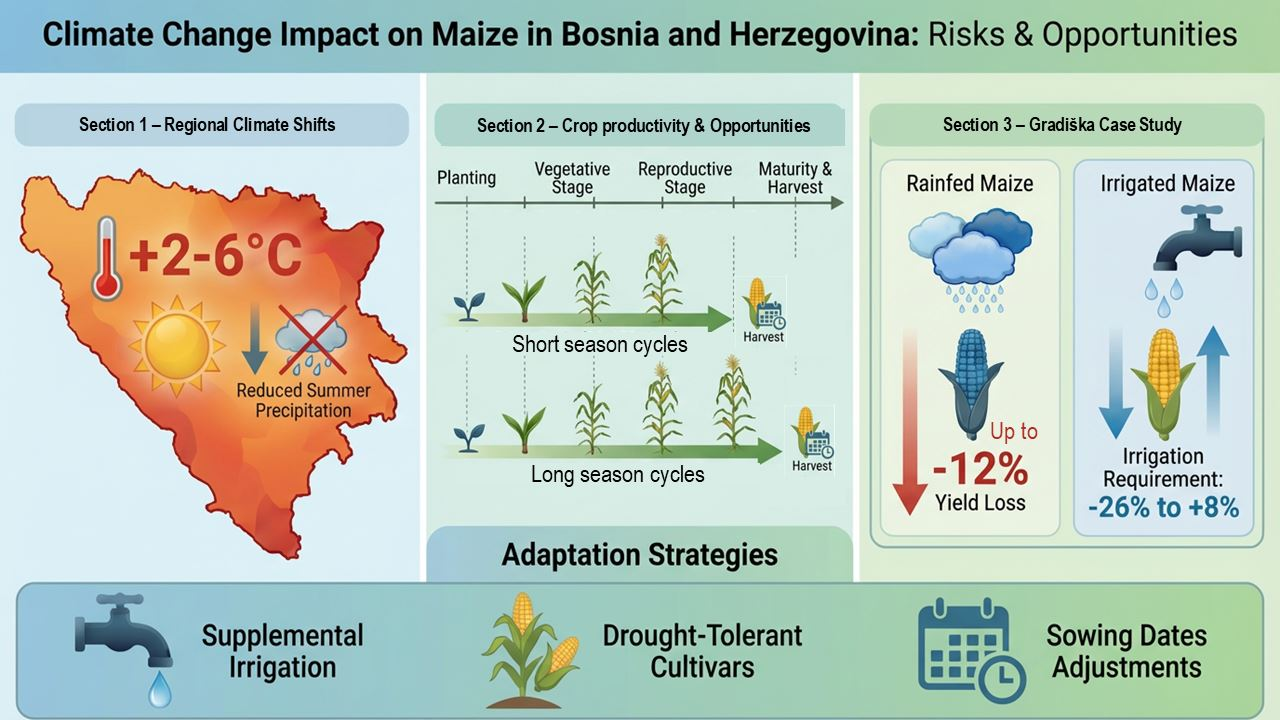
Overall results show that average temperatures during the maize growing season are projected to increase under both RCP scenarios, while seasonal precipitation (MSP) is projected to decrease by up to 34% in northeastern regions and summer precipitation (MSummerP) by up to 64% in southern regions such as Čapljina. These changes are particularly critical as they coincide with key crop growth stages, especially flowering, thereby increasing the risk of water stress in rainfed maize systems. The reduction in thermal constraints will allow maize cultivation to expand into regions that have traditionally been too cold or thermally marginal for maize production, thereby shifting the current geographical limits of the crop. At the same time, higher temperatures create new production opportunities, as short-season cycles may allow double cropping, while medium-season varieties are expected to become feasible in several regions, particularly in northern and southern lowland areas of BH (Brčko D., Bijeljina and Čapljina). Long-season cycles may only be viable under RCP8.5 in the long-term period, except in high-altitude regions where thermal accumulation remains limiting.
Soil water availability, together with precipitation, plays a decisive role in shaping rainfed maize resilience to CC. Regions dominated by deep Luvisols, Cambisols, and Gleysols exhibit high soil water-holding capacity, providing a buffer against increasing climatic variability, being particularly important in rainfed maize. Živinice (in the east) and Cazin (in the northwest) seem to be the areas with the highest potential for rainfed maize in the future. In contrast, in locations with limited water storage, followed by a reduction in precipitation, especially in Mediterranean karst (Čapljina) and mountainous regions, rainfed production will be compromised. These results highlight that future maize suitability depends not only on climate but also on soil water availability, underscoring the need for soil-specific adaptation strategies.
Soil water balance simulations for Gradiška suggest that there is an increased risk of water stress for rainfed maize, especially in ‘Hot & Dry’ conditions. Even considering an average of 8%, in extreme years, relative evapotranspiration deficits exceed 30%, resulting in relative yield losses of up to 40%, for the current agricultural practises. Although shorter crop cycles under warmer conditions may reduce exposure to water stress to some extent, interannual variability in relative evapotranspiration deficits is projected to increase. When irrigation is considered, depending on the scenario, it could vary from −26% to +8%. However, irrigation demand is characterised by substantial year-to-year variability (from 0 to 335 mm), mainly driven by climatic extremes and precipitation timing rather than irrigation requirements.
In order to sustain maize production in Bosnia and Herzegovina and take advantage of the increase in air temperature under future climates, it is essential to implement agronomic adaptation measures. These include supplemental irrigation under ‘Hot & Dry’ conditions to guarantee adequate yield, adjusting sowing dates in response to reduced frost risk as indicated by the projected changes in frost days indicator, using medium-season cycles, and employing soil management practices that enhance water retention, such as mulching and cover cropping.




 ,
,