1. Introduction
A persistent challenge in agricultural economics is the accurate measurement of farm-level technical efficiency, as efficiency gains represent one of the most immediate pathways to increasing output without additional input use. This issue is particularly relevant in many rice-producing countries, where government support programs absorb substantial fiscal resources each year, yet farmers’ productivity remains comparatively low and highly variable. Understanding whether such programs genuinely improve efficiency, or merely provide temporary financial relief, remains an open and policy-relevant question.
To analyze the efficiency impact of government programs, the econometric framework must not only estimate production elasticities but also capture how policy participation reshapes the distribution of inefficiency under realistic production conditions. This requirement exposes a weakness of the widely used two-step procedure, where efficiency scores are first estimated and subsequently regressed on socioeconomic or policy variables. Wang and Schmidt [
1] emphasized that such approaches treat efficiency scores as observed rather than latent variables, leading to biased coefficients and incorrect standard errors. Paul and Shankar [
2] highlighted the same concern, showing that two-step estimation produces inconsistent inferences about the role of explanatory factors. Recent advances in stochastic frontier analysis further emphasize the importance of model specification and flexibility in capturing efficiency dynamics. For example, Obalola et al. [
3] demonstrated that alternative functional forms, such as Cobb–Douglas and translog specifications, can lead to substantially different efficiency estimates, while Skevas [
4] highlighted the need for more flexible frontier structures that incorporate multiple dimensions of inefficiency, including environmental factors. These developments suggest that conventional frontier models may be too restrictive for capturing complex production environments.
To address these limitations, this study proposes a Copula-based Stochastic Frontier Efficiency Effects model that simultaneously estimates the production frontier and inefficiency determinants within a unified likelihood framework. This approach extends the efficiency-effects model of Paul and Shankar [
2] by allowing explicit dependence between the inefficiency component (
) and the stochastic noise term (
) through copula functions, thereby capturing more realistic stochastic structures [
5]. Copula-based stochastic frontier models provide a flexible framework for modeling the joint distribution of the stochastic error and inefficiency terms [
6]. By allowing asymmetric and tail dependence, this approach can better capture the interaction between production risk and managerial performance [
7].
Such dependence is particularly relevant in agricultural production, where outcomes are jointly shaped by climatic variability, market volatility, and financial constraints. For instance, irregular rainfall or pest outbreaks may simultaneously reduce output through random disturbances while also impairing managerial performance or labor productivity, thereby increasing inefficiency [
8,
9,
10]. Likewise, indebtedness can limit farmers’ capacity to invest in yield-enhancing technologies while increasing exposure to production risk [
9,
10]. Recent empirical evidence also underscores the role of technology and agronomic efficiency in shaping farm performance; for instance, Mdoda et al. [
11] showed that improved crop technologies significantly enhance technical efficiency, while Yu et al. [
12] highlighted the importance of agronomic efficiency in improving rice productivity among smallholder farmers in Northern Thailand. In such environments, the conventional independence assumption between the noise term and inefficiency component may be restrictive, potentially distorting technical efficiency estimates and weakening policy inference. When combined with a single-step efficiency effects specification, the model enables the simultaneous evaluation of policy participation and stochastic dependence, thereby improving the internal consistency of efficiency estimation. Thailand provides a relevant case study for examining these issues. Despite its position as the world’s second-largest rice exporter, average technical efficiency levels of rice farmers are often reported at less than 60 per cent, suggesting substantial unrealized productivity potential [
8,
13,
14,
15,
16,
17]. Sticky (glutinous) rice production, concentrated in Northern Thailand, is especially vulnerable: yields have stagnated, production costs continue to rise, and farmer incomes remain precarious [
18,
19]. These persistent inefficiencies raise important policy questions about the effectiveness of government programs such as the “1000 Baht per Rai” subsidy, cost-reduction initiatives, and debt moratorium schemes.
Based on the above discussion, a key limitation of existing empirical studies evaluating agricultural policies within stochastic frontier frameworks is the implicit assumption of independence between stochastic shocks and inefficiency. In agricultural production, however, risk and managerial performance are often jointly determined, implying that policy effects may be misestimated when this dependence is ignored. This issue is particularly relevant in settings characterized by production uncertainty, where shocks and inefficiency may interact in shaping observed outcomes. To address this limitation, this study introduces a copula-based efficiency effects model that allows for flexible dependence between noise and inefficiency. By relaxing the independence assumption, the proposed framework provides a more reliable basis for identifying and interpreting the effects of policy interventions on farm-level efficiency, as ignoring such dependence may lead to biased efficiency estimates and misleading policy inferences.
Accordingly, this paper makes three contributions. First, from a methodological perspective, it integrates a copula-based dependence structure with the efficiency-effects stochastic frontier model in a unified framework. While previous studies have applied these approaches separately, their combination allows for the simultaneous modeling of inefficiency determinants and stochastic dependence between noise and inefficiency, thereby improving identification and inference in risk-prone agricultural environments. Second, from an empirical perspective, this study provides one of the first disaggregated evaluations of agricultural support programs within a stochastic frontier framework. Unlike existing studies that treat policy support as a single aggregate measure, we explicitly distinguish between income transfers, debt relief, and cost-reduction programs, allowing for a clearer identification of heterogeneous policy effects on technical efficiency. Third, from a policy perspective, the study shifts the focus from welfare outcomes to productivity performance. By linking specific policy instruments to technical efficiency through clearly defined economic mechanisms, the analysis provides new insights into how different forms of government intervention affect farm-level performance in developing-country agriculture.
The remainder of this paper is structured as follows.
Section 2 reviews the relevant literature on rice production efficiency and government interventions in Thailand and beyond.
Section 3 presents the methodological framework, highlighting the Copula-based Stochastic Frontier Efficiency Effects model, and describes the survey data.
Section 4 reports the empirical results, including model comparison, determinants of efficiency, and the impact of government programs.
Section 5 concludes by summarizing the main findings and drawing policy implications for improving efficiency in the Thai rice sector.
2. Literature Review and Background
2.1. Rice Production in Northern Thailand
Northern Thailand consists of eight provinces, Chiang Mai, Chiang Rai, Lamphun, Mae Hong Son, Phayao, Phrae, Lampang, and Nan, where agriculture remains the primary livelihood. Among crops, rice plays a central role, with sticky (glutinous) rice being the dominant variety. According to the Department of Rice, sticky rice accounts for nearly three-quarters of the total rice cultivation area in the region. In Chiang Rai province alone, 451,453 rai (approximately 72,232 hectares) were planted with non-photosensitive sticky rice in 2022, making it the leading producer in the upper North. Although the cultivation area is smaller than that in the Northeast, sticky rice carries high economic and cultural significance. It is embedded in integrated farming systems that combine rice with livestock and horticulture, contributing not only to household consumption but also to local market supply [
18].
Despite this importance, sticky rice farmers in Northern Thailand face several structural challenges. Water availability is highly variable due to climate fluctuations, while access to high-quality inputs such as fertilizers and machinery remains limited. Labor shortages have become more acute with the rising age of farmers. Moreover, agricultural policies in Thailand tend to emphasize jasmine rice production and exports, often overlooking sticky rice as a local subsistence and commercial crop. These constraints have been compounded by climate change impacts, particularly El Niño-induced droughts in 2023–2025, which reduced yields and further exposed the vulnerability of sticky rice farmers.
2.2. Determinants of Rice Production Efficiency
A considerable body of empirical research has examined the efficiency of rice production in Thailand and other developing countries, producing a range of insights on the determinants of technical efficiency. One of the early contributions in the Thai context was provided by Chaovanapoonphol, Battese, and Chang [
20], who applied stochastic frontier analysis (SFA) to farmers in the upper North and identified land and labor as the principal drivers of efficiency. Interestingly, their study also suggested that access to credit may reduce efficiency when borrowed funds are misallocated or used for purposes other than productive investment. This result resonates with Abur [
21], who reported a similar negative relationship between credit and efficiency for rice farmers in Nigeria. However, the evidence is not uniform. Jimi, Nikolov, Malek, and Kumbhakar [
22], using a decomposition framework that distinguishes between technological change and efficiency change, showed that credit access can in fact enhance efficiency when loans are directed toward technology adoption and productivity-improving inputs. Together, these findings highlight the importance of how credit is utilized, rather than its availability per se, in determining production efficiency.
Beyond Thailand, comparative studies shed further light on the role of institutional and farm-level factors. Ebers, Nguyen, and Grote [
18] compared rice farms in Ubon Ratchathani, Thailand, and Stung Treng, Cambodia, and reported average technical efficiency levels of 72 and 64 percent, respectively. Their analysis underscored the importance of farm size, credit access, and household income in explaining efficiency differentials across locations. Similar themes emerge in other regional contexts. Thapa and Dhakal [
19], examining rice seed production in Nepal with a one-step SFA, found that efficiency was strongly influenced by education, seed quality, and irrigation, confirming the role of technology and human capital in shaping productivity. In Bangladesh, Salam, Sarker, and Sharmin [
23] provided evidence that organic fertilizer adoption increased both yields and efficiency, underscoring how sustainable input choices can complement traditional efficiency drivers. In Sub-Saharan Africa, Manda et al. [
24] demonstrated that adoption of sustainable agricultural practices significantly improved maize yields and farm efficiency in Zambia, further reinforcing the conclusion that technology adoption and institutional support are critical for enhancing efficiency across diverse farming systems.
Recent contributions have also examined the effects of policies and certification schemes. Suwanmaneepong et al. [
25] compared GAP-certified and non-GAP rice farmers in suburban Bangkok and found that while yields were not significantly different between groups, GAP adoption substantially reduced costs and increased net income. This finding highlights how certification influences efficiency primarily through cost structures rather than direct yield gains. On the policy side, Minviel and Latruffe [
13], in their meta-analysis of farm subsidies, concluded that public support programs have heterogeneous effects on efficiency depending on their design and targeting. For Thailand, Lathaporn and Chantarat [
26] evaluated agricultural debt moratoriums and revealed highly heterogeneous impacts on rural households, with some benefiting from financial relief while others experienced reduced productivity incentives. Their findings raise important questions about whether debt moratoriums can sustainably improve farmer efficiency.
Despite the substantial body of evidence on rice production efficiency, important empirical gaps remain. Existing studies have identified credit access, farm characteristics, and technology adoption as key determinants of efficiency, yet relatively little attention has been given to the differentiated effects of specific government programs operating through distinct policy instruments. Public support measures are often examined in aggregate form or through single-program evaluations, without clearly distinguishing between income-transfer schemes, debt-relief initiatives, and structural cost-reduction programs, leaving their underlying efficiency mechanisms insufficiently clarified. Moreover, most Thai studies focus on jasmine or aggregated rice production, while sticky rice in Northern Thailand, despite its economic and cultural importance and its predominance of smallholder farmers, has received limited dedicated analysis. Finally, policy-oriented research in Thailand has largely emphasized welfare and income outcomes rather than examining whether government interventions translate into measurable improvements in farm-level technical efficiency. This study addresses these empirical gaps by evaluating the distinct efficiency effects of major government programs in the sticky rice sector of Northern Thailand.
2.3. Stochastic Frontier Analysis and Efficiency Effects Models
Conventional stochastic frontier analysis (SFA) remains widely applied in agricultural efficiency studies. A central assumption in the standard model is the statistical independence between the random error term (
) and the inefficiency component (
). Smith [
21] questioned this assumption and demonstrated that ignoring potential dependence between
and
may lead to inconsistent parameter estimates and distorted efficiency scores. In agricultural production, where exogenous shocks such as rainfall variability, pest outbreaks, and price fluctuations may interact with farmers’ managerial performance, the independence assumption may be particularly restrictive.
To address this limitation, copula-based stochastic frontier models have been developed to allow flexible dependence structures between
and
while preserving their marginal distributions [
26]. Applications in agriculture include intercrop coffee production in Northern Thailand [
9], rice production in Northern Thailand [
2], and jasmine rice farming in the Northeast [
27]. Chaovanapoonphol, Singvejsakul, and Sriboonchitta [
17] further extended this approach by incorporating clustering techniques to capture heterogeneity among rice farmers. These studies demonstrate that copula-based SFA can accommodate asymmetric and tail dependence between stochastic noise and inefficiency, which is particularly relevant in agricultural settings characterized by production risk.
A parallel strand of literature focuses on modeling the determinants of inefficiency within the frontier framework. The efficiency effects model [
1,
28] enables one-step estimation of the production frontier and the factors influencing inefficiency, thereby avoiding the potential bias associated with traditional two-step procedures in which estimated efficiency scores are regressed on explanatory variables in a second stage. Recent contributions, such as Paul and Shankar [
2], further formalize the statistical advantages of jointly estimating inefficiency determinants within the likelihood function.
Although both copula-based SFA and one-step efficiency effects models are well established, these approaches have largely been applied separately. Copula-based frontier models typically emphasize dependence between and , whereas efficiency effects models commonly retain the conventional independence assumption. Integrating a flexible copula-based dependence structure with a one-step efficiency effects specification provides a unified framework that simultaneously accounts for stochastic dependence and observable determinants of inefficiency.
Empirically, studies on rice efficiency in Thailand have predominantly focused on jasmine rice or aggregate rice production. Sticky rice, despite its significant share of cultivated area and its cultural and economic importance in Northern Thailand, has received comparatively limited attention [
15,
29]. Furthermore, much of the broader Thai rice efficiency literature continues to rely on conventional SFA frameworks that impose independence between noise and inefficiency.
This study contributes to the literature by applying a copula-based stochastic frontier model with an embedded efficiency effects specification to sticky rice farmers in Northern Thailand. The model jointly allows for dependence between and and incorporates participation in government programs directly into the inefficiency equation within a single-step estimation framework. Specifically, the analysis evaluates the impact of three policy interventions, the rice subsidy (“1000 Baht per Rai”), the cost-reduction scheme, and the debt moratorium, on technical efficiency. By combining an integrated modeling framework with policy evaluation in an underexamined production context, the study provides a more internally consistent assessment of efficiency and government program effectiveness.
2.4. Mechanism of Government Programs
Understanding whether government interventions enhance farm-level technical efficiency requires more than estimating average treatment effects; it demands a clear articulation of the mechanisms through which policy instruments influence production behavior [
1,
27]. In the context of sticky rice farming in Northern Thailand, the three major programs examined in this study, the “1000 Baht per Rai” subsidy, the debt moratorium scheme, and the cost-reduction (large-plot) program, operate through fundamentally different economic channels. These channels may generate heterogeneous and even opposing effects on technical efficiency [
1].
Technical efficiency reflects a farmer’s ability to maximize output given a set of inputs and available technology. Policy interventions can affect TE not only by relaxing constraints but also by altering incentives, risk attitudes, and resource allocation decisions. Drawing on the efficiency-effects literature [
1,
27] and studies on subsidies and farm performance [
13], we distinguish three primary mechanisms: (i) income-transfer effects, (ii) liquidity-constraint relaxation, and (iii) coordination and scale effects.
First, the “1000 Baht per Rai” program is an area-based income transfer that provides unconditional financial support tied to cultivated land. Such transfers may stabilize household income and reduce short-term vulnerability. However, economic theory suggests that unconditional subsidies can soften budget constraints and reduce incentives to improve productivity [
28]. When income support is not explicitly linked to technology adoption or performance targets, farmers may perceive it as a guaranteed safety net rather than as a stimulus for efficiency-enhancing investment. Empirical evidence from agricultural subsidy programs indicates that area-based payments often have neutral or negative effects on technical efficiency, particularly when they are broadly distributed and weakly targeted [
13]. In the sticky rice context—where production is frequently oriented toward subsistence and local markets—such subsidies may reinforce status quo practices rather than promote structural transformation.
Second, the debt moratorium program operates through a liquidity channel. Many smallholder farmers in Northern Thailand face high indebtedness and limited access to formal credit. Liquidity constraints can lead to suboptimal input use, delayed planting, and underinvestment in fertilizer, pest control, or mechanization. By temporarily suspending repayment obligations, the debt moratorium reduces immediate financial pressure and may enable farmers to allocate resources more efficiently during the production cycle. Theoretical and empirical studies on credit access suggest that relieving financial constraints can enhance productivity when resources are redirected toward productive uses [
22]. In this framework, the debt moratorium is expected to improve TE insofar as it alleviates binding liquidity constraints and reduces forced cost-cutting that compromises output.
Third, the cost-reduction program, often implemented under the “large-plot” scheme, aims to lower input costs through collective procurement, mechanization, and coordination among farmers. The underlying mechanism is based on economies of scale and improved managerial coordination. In principle, collective action can enhance efficiency by reducing transaction costs, improving bargaining power, and facilitating technology diffusion. However, the effectiveness of such programs depends critically on implementation quality, group cohesion, and compatibility with local production conditions. In fragmented or mountainous areas typical of Northern Thailand, mechanization and scale economies may be limited. If the program merely reduces input prices without upgrading production technology or management practices, its impact on TE may be modest.
Table 1 summarizes this theory-of-change framework by mapping each program to its primary mechanism, expected efficiency effect, and potential adverse consequences. Importantly, the three programs are not substitutes but operate through distinct structural channels. The subsidy primarily affects incentives; the debt moratorium addresses financial constraints; and the cost-reduction program targets coordination and scale inefficiencies. Their effects on TE are therefore theoretically ambiguous and must be evaluated empirically.
Based on
Table 1, we propose the following hypotheses:
H1. The 1000-baht-per-rai subsidy is expected to have a negative effect on technical efficiency.
H2. The debt moratorium program is expected to have a positive effect on technical efficiency.
H3. The cost-reduction program is expected to have a positive effect on technical efficiency.
3. Methodology and Data
3.1. Methodology
3.1.1. Efficiency-Effects Stochastic Production Frontier
We evaluate individual-level production using a stochastic frontier where technical efficiency (TE) multiplicatively shifts the mean frontier. Following the efficiency-effects formulation [
1,
2,
27], output for farm
is
where
is the deterministic production frontier,
∈ (0,1) is the efficiency level, and
captures mean-zero statistical noise (weather, measurement error, etc.). We use a Cobb–Douglas form,
so that TE appears additively in logs as
. To ensure
, we link a latent efficiency index
to TE via a probit link [
2], thus
where
the standard normal cumulative distribution function.
contains production inputs (e.g., labor, fertilizer, chemicals), and
collects inefficiency-effects variables (age, education, experience, farm size, loan, cultivation type, technology index, and gender), as well as indicators for the three government programs. These variables are included to capture the policy mechanisms discussed in
Section 2.4, and their impacts on technical efficiency are identified through their estimated coefficients in the inefficiency equation. The probit link guarantees TE in (0,1) and lets policy/socioeconomic covariates shift efficiency directly through
. Note that as
enters additively with the production frontier, we follow Paul and Shankar [
2] in including a constant in the production frontier and allowing
to capture only deviations from this mean. In practice, we center the covariates in
to reduce collinearity and ensure stable identification. The nonlinearity of the probit link further guarantees that the efficiency effects are separately identified from the frontier parameters.
Unlike the conventional stochastic frontier model where technical efficiency is defined as
, this study adopts the probit-based specification proposed by Paul and Shankar [
2], where efficiency is modeled as
. This formulation ensures that technical efficiency is strictly bounded between 0 and 1 while allowing a flexible and nonlinear mapping between covariates and efficiency.
Importantly, this specification enables direct interpretation of efficiency as the probability of operating close to the production frontier, which is particularly suitable when incorporating policy variables into the inefficiency equation. While less commonly used than the exponential form, this approach has been shown to provide consistent and interpretable estimates within the efficiency-effects framework.
3.1.2. Dependence via a Copula
A major limitation of the classical SFM is the assumption that two errors are independent. In practice, this assumption is often violated in agricultural production, where weather shocks, price fluctuations, or resource constraints may simultaneously influence both random output variability and efficiency. Ignoring such dependence can bias estimates of technology parameters and efficiency scores [
8,
9,
32].
To address this, we introduce a copula-based structure that explicitly models the joint distribution of the two error components. Sklar [
6] shows that any multivariate joint distribution can be decomposed into its marginal distributions and a copula function that captures their dependence structure. This result provides the theoretical foundation for specifying flexible dependence between the noise term and the inefficiency term. A detailed treatment of copula theory is provided in Nelsen [
33]. Denoting
, the joint cumulative distribution function of
is
where
and
are marginal distributions of
and, respectively,
is the copula dependence parameter and
is copula function. Differentiating with respect to both arguments yields the corresponding joint probability density function:
where
and
denote the marginal densities and
is the copula density. To ensure flexibility, we consider six well-established copula families: Gaussian, Student-
t, Frank, Joe, Gumbel, and Clayton, which together span symmetric as well as asymmetric and tail-dependent dependence structures [
33]. The Gaussian and Student-
t copulas capture elliptical dependence, while the Archimedean families (Clayton, Gumbel, Joe) allow for asymmetric lower- or upper-tail dependence, and the Frank copula provides a symmetric but non-tail-dependent alternative. Importantly, setting
reduces the specification to the standard independence case, ensuring that the conventional Efficiency-effects stochastic production frontier is obtained as a nested model.
3.1.3. Likelihood and Estimation
Let the residual be defined as
The marginal density of
is obtained by integrating out the unobserved log-efficiency component
:
The sample log-likelihood function is then
Parameter estimation proceeds via maximum likelihood. Model selection across competing copula families is based on the Akaike Information Criterion (AIC) and Bayesian Information Criterion (BIC). This ensures that the chosen specification not only fits the data well but also appropriately captures dependence between efficiency and noise, yielding unbiased efficiency estimates and consistent inference on the impact of government programs and farmer characteristics.
All empirical estimations were conducted using Stata (version 17, StataCorp LLC, College Station, TX, USA) and R (version 4.3.0, R Foundation for Statistical Computing, Vienna, Austria).
3.2. Data
This study relies on primary data obtained through a structured survey conducted in 2025 among sticky rice farmers in five provinces of Northern Thailand: Chiang Mai (144 respondents), Chiang Rai (60), Lampang (109), Phrae (55), and Nan (61). The survey design followed a stratified random sampling approach to ensure adequate coverage of major rice-growing areas in the upper North. Districts and villages were first stratified by rice production intensity, after which farm households were randomly selected from official farmer lists provided by local agricultural extension offices. Farmers were then contacted and interviewed directly during scheduled meetings arranged through these local agricultural extension offices, which facilitated access to respondents and improved response accuracy. In total, 450 questionnaires were distributed, of which 429 were deemed valid after data cleaning, resulting in a response rate of 95.3 percent.
The questionnaire was developed in consultation with local agricultural experts and piloted with 20 farmers to refine question wording, ensure clarity, and minimize recall bias. It included sections on (i) household and demographic characteristics, (ii) farm-level production practices and input use, (iii) yields and costs, (iv) access to credit and institutional support, and (v) participation in government programs. Data were collected through face-to-face interviews administered by trained enumerators, thereby reducing the risk of misreporting and nonresponse bias. The use of survey data is particularly appropriate in this context because official statistics often aggregate rice data without distinguishing between sticky rice and non-glutinous varieties, despite their distinct production systems and market roles. Furthermore, survey-based measures allow the inclusion of farmer perceptions and behavioral factors, such as technology adoption and credit use, that are not captured in secondary datasets. By combining production, socioeconomic, and policy-related information at the household level, the survey provides a rich dataset for estimating production frontiers and analyzing the determinants of technical efficiency.
The dependent variable is defined as rice output, measured in kilograms per rai. The production frontier incorporates conventional inputs, including labor (number of workers), fertilizer expenditure (baht per rai, encompassing both organic and chemical fertilizers), and chemical expenditure (baht per rai, including pesticides, herbicides, and plant hormones). These input variables are widely adopted in prior efficiency studies (e.g., [
18,
20]).
In the inefficiency effects specification, several socioeconomic and institutional variables are included to explain variation in technical efficiency. Farmer-specific characteristics consist of age, gender, education, and farming experience, as these have been shown to influence knowledge, risk preferences, and resource allocation [
22,
34]. Financial and structural conditions are represented by borrowing levels, farm size, and cultivation type (transplanted versus broadcast). The loan variable exhibits a highly skewed distribution, with a small number of observations reporting very large values. To mitigate the influence of extreme observations, we apply a logarithmic transformation, ln(Loan + 1), which reduces skewness while preserving zero values and improving the robustness of the estimation.
Policy interventions are captured through three binary indicators reflecting farmer participation in major government programs: (i) the rice subsidy scheme (1000 baht per rai), (ii) the debt moratorium program, and (iii) the cost-reduction program. Evaluating these programs within the stochastic frontier framework allows us to assess whether public support has been translated into tangible efficiency gains [
26]. Technology adoption is incorporated through a composite index constructed using Principal Component Analysis (PCA), based on responses regarding the use of modern agricultural technologies such as automatic seeders, agricultural drones, combine harvesters, moisture and water sensors, and digital platforms. This approach follows prior work emphasizing the multidimensional nature of technology adoption [
18,
25,
35] and provides a parsimonious measure of farmers’ technological readiness. While the use of binary indicators allows for consistent identification of program participation across farmers, it does not capture variation in policy intensity, duration, or implementation quality. Therefore, the estimated coefficients should be interpreted as reflecting differences in access to policy interventions rather than the magnitude of policy exposure. This simplification may also lead to attenuation bias, potentially underestimating the true effects of government programs.
Descriptive statistics for all variables, including mean values, standard deviations, and ranges, are presented in
Table 2 to illustrate heterogeneity in farm characteristics and production practices. These statistics highlight considerable variation across provinces, providing a robust basis for subsequent econometric estimation.
Since some input expenditure variables (e.g., fertilizer and chemical costs) include zero observations, logarithmic transformations were implemented using the transformation ln(x + 1). This approach preserves zero values while allowing consistent estimation within the Cobb–Douglas specification and avoids the loss of observations that would arise from excluding zero expenditures.
Table 2 presents descriptive statistics of the variables used in this study. On average, sticky rice yield was 791.83 kg per rai, with a wide range from 300 to 2429 kg, reflecting substantial heterogeneity in production outcomes across farms. The mean labor input was 2.46 workers, although the distribution was highly skewed, with some farms relying solely on household labor and others employing as many as 31 workers. Fertilizer and chemical expenditures averaged 943.02 and 400.31 baht per rai, respectively, but both exhibited large variation, with several farmers reporting zero chemical costs, consistent with partial reliance on home-produced or alternative inputs.
Farmer characteristics indicate that 57 percent of the sample were male, with an average age of 61.8 years, confirming the predominance of older farmers in the sticky rice sector. Education levels averaged 3.51, corresponding roughly to completion of primary school, though a small proportion of respondents reported postgraduate attainment. Borrowing behavior varied considerably: while the average loan was 23,538 baht, some farmers reported no borrowing and others reported debts exceeding 800,000 baht. Landholding size averaged 11.1 rai but ranged from 0.25 to 100 rai, again reflecting strong heterogeneity in resource endowment. Nearly half of the farmers (48 percent) cultivated transplanted paddy, while the remainder relied on broadcasting methods.
Government program participation was uneven. Almost all farmers (93 percent) reported receiving the “1000 baht per rai” subsidy, but participation in the debt moratorium (25 percent) and cost-reduction program (29 percent) was much lower. Finally, the index of advanced technology adoption averaged 0.64, suggesting moderate uptake of modern tools such as drones, automatic seeders, and digital platforms, though with substantial variation between adopters and non-adopters.
Ethical Considerations: This study followed standard ethical guidelines for research involving human participants. Participation was voluntary, and informed consent was obtained from all respondents prior to data collection. All responses were kept confidential and anonymized, and no personally identifiable information was recorded.
4. Results
4.1. Copula Comparison
Before presenting the main estimation results, we first compare the performance of different copula-based specifications against the benchmark stochastic frontier models of Battese and Coelli [
27] and Paul and Shankar [
2]. The Battese–Coelli efficiency effects model assumes that inefficiency follows a truncated normal distribution, while the Paul–Shankar probit specification assumes that efficiency is modeled through a cumulative normal distribution. Model selection is based on the AIC and the BIC, with lower values indicating superior fit.
Table 3 reports on the comparative results.
According to
Table 3, the results clearly show that the Gaussian copula provides the best fit, with the lowest AIC (108.4189) and BIC (129.1523). This indicates that dependence between the noise term and efficiency component is best captured by a symmetric, linear dependence structure. Importantly, the Gaussian copula outperforms both the traditional Battese–Coelli [
27] model and the probit-based specification of Paul and Shankar [
2], demonstrating the value of explicitly modeling dependence between the error components.
4.2. Efficiency Effects and the Impact of Government Programs
Table 4 reports the estimation results from the copula-based stochastic frontier models. Four specifications are presented, each including a different government support program to avoid multicollinearity, since many farmers simultaneously participate in more than one intervention. Model 1 includes the 1000-baht/rai subsidy program (Gbud), Model 2 includes the debt moratorium program (Gdebt), Model 3 includes the cost-reduction program (Gcost), and Model 4 jointly includes all three programs.
A first notable result is that the estimated copula dependence parameter (
) is positive and significant across all models, ranging from 0.33 to 0.73. This indicates a significant dependence between the noise term and the inefficiency component, thereby rejecting the conventional independence assumption of standard stochastic frontier models. For the Gaussian copula, these estimates correspond to moderate positive dependence, with Kendall’s
ranging from approximately 0.21 to 0.52 across specifications. This suggests a non-negligible association between random shocks and inefficiency, consistent with the presence of production environments where exogenous shocks and managerial performance are jointly determined. This finding is in line with recent applications of copula-based stochastic frontier models in agricultural settings [
17,
36], and is also consistent with recent advances emphasizing more flexible representations of inefficiency in frontier models [
4].
Turning to the production frontier, the results show that all key inputs, labor, fertilizer, and chemicals, have strong and statistically significant effects on sticky rice output. Labor input is positive across all four models, with elasticities ranging from 0.14 to 0.17, confirming the labor-intensive nature of sticky rice farming and supporting prior evidence on the central role of labor in rice production [
37]. Fertilizer expenditure exhibits the largest contribution, with coefficients between 0.61 and 0.72; in Model 1, for example, a 1% increase in fertilizer spending raises output by 0.67%. Chemical inputs also display robust positive effects, with elasticities of 0.33–0.57, consistent with the findings of Salam et al. [
23] on fertilizer use and Ogundari [
38] on the yield-enhancing role of pesticides and herbicides.
The sum of input elasticities is 1.1398 (0.141 + 0.6664 + 0.3324), indicating increasing returns to scale in sticky rice production. This suggests that a proportional increase in all inputs would lead to a more than proportional increase in output. While fertilizer emerges as the most influential individual input, the presence of increasing returns to scale implies that productivity gains are driven by the combined intensification of inputs rather than any single factor alone. Overall, these results highlight that input intensification plays a central role in shaping productivity, while also pointing to the potential benefits of coordinated input expansion and improved resource allocation in sticky rice farming systems.
Regarding efficiency effects, the results for the three government programs provide informative evidence on the relationship between policy participation and technical efficiency among sticky rice farmers in Northern Thailand. We find that the 1000-baht/rai subsidy program (Gbud) is negatively and significantly associated with efficiency, with coefficients of −0.0575 and −0.7532 across different model specifications. This pattern suggests that, although the program provides immediate income support, it may be linked to weaker incentives for efficient resource allocation. In line with the income-transfer mechanism discussed earlier, unconditional subsidies may soften budget constraints and reduce the need for productivity-enhancing adjustments. Historically, Thailand has relied heavily on price support and subsidy schemes to stabilize farmer incomes; however, such broad-based transfers may be associated with limited improvements in production efficiency, particularly when they are not tied to technology adoption or performance targets.
The negative association between the 1000-baht-per-rai subsidy and technical efficiency is consistent with the argument that area-based transfers may soften budget constraints and weaken incentives for efficiency-enhancing behavior. This result aligns with Minviel and Latruffe [
11], who showed that such subsidies can reduce efficiency by lowering the pressure to optimize input use. In the Thai context, where sticky rice production is largely oriented toward subsistence and local consumption rather than export markets, subsidies may be perceived as a guaranteed safety net, further reducing incentives to modernize cultivation practices. However, this relationship should be interpreted with caution, as it may also reflect unobserved heterogeneity, for example, less efficient farmers may be more likely to rely on subsidy programs, which could partially drive the observed negative association.
By contrast, the debt moratorium program (Gdebt) is positively and significantly associated with technical efficiency. This pattern is consistent with the presence of binding liquidity constraints, whereby temporary relief from debt obligations allows farmers to allocate inputs more effectively and smooth production decisions. This finding is particularly relevant in Northern Thailand, where high household indebtedness has historically constrained smallholder farmers’ ability to invest in productivity-enhancing inputs. The result is in line with Lathaporn and Chantarat [
22] and Mdoda et al. [
11], who documented generally positive welfare effects of debt moratoria among vulnerable rural households. Nevertheless, alternative explanations should be considered. Participation in such programs may be correlated with access to formal financial institutions or other unobserved characteristics, implying that the estimated effect may capture both liquidity relief and selection effects rather than a purely causal mechanism.
In terms of the cost-reduction program (Gcost), it yields a positive but statistically insignificant coefficient. While this suggests some potential to lower input costs, the absence of a measurable association with efficiency highlights important limitations in program design and implementation. One possible explanation is that the magnitude of cost savings is relatively small compared to total production costs, limiting its impact on efficiency. Another explanation is that cost-reduction measures may not address the core constraints faced by farmers, such as access to technology, labor shortages, or production risk. This finding also suggests that input-focused interventions alone may be insufficient to generate efficiency gains without complementary improvements in management practices or technological adoption. More broadly, the null result underscores the importance of aligning policy design with the underlying drivers of inefficiency rather than focusing narrowly on cost reduction.
Beyond government programs, several structural and socioeconomic factors are found to be associated with technical efficiency, often in ways that challenge conventional expectations. Farming experience exhibits a consistently negative association with efficiency, suggesting that reliance on traditional practices may hinder the adoption of more productive techniques. This reflects the phenomenon of “technological inertia,” where accumulated experience reinforces existing practices rather than promoting innovation. A similar pattern is observed for age, which may capture both physical constraints and lower adaptability to new technologies. The negative coefficient on education may appear counterintuitive, but it should be interpreted cautiously. In the context of sticky rice farming, formal education does not necessarily translate into farm-specific managerial skills, as productivity often depends on localized knowledge and practical experience. This interpretation is consistent with studies emphasizing the role of context-specific learning in traditional agricultural systems [
30]. At the same time, it is possible that more educated individuals allocate effort away from farming toward off-farm activities, which may also contribute to the observed relationship.
Financial variables provide further insights into structural constraints. Loan amounts are negatively associated with efficiency, but this relationship should not be interpreted as evidence that credit reduces productivity. Rather, it likely reflects underlying financial stress or inefficient allocation of borrowed funds, particularly when loans are used for consumption rather than productive investment. The lack of distinction between formal and informal credit sources further complicates interpretation, suggesting that the estimated coefficient captures a broad association between indebtedness and efficiency rather than a specific causal effect. This finding is consistent with Chaovanapoonphol et al. [
9] and Abur [
10], while differing from studies that link credit more directly to productive investment [
18].
Technological factors, by contrast, show a clear and robust association with efficiency. The technology adoption index (Tec) is strongly positive across all specifications, indicating that access to machinery and digital tools significantly enhances production performance. This supports prior evidences from Manda et al. [
20] and Mdoda et al. [
11] on the role of mechanization and precision agriculture in improving efficiency among smallholder farmers. Similarly, the cultivation method (TC) reveals that transplanting outperforms broadcasting, consistent with findings by Kumar and Ladha [
35] and Pandey et al. [
36], who emphasized the benefits of improved crop management and resilience under controlled planting conditions. Finally, gender differences emerge as a notable factor, with female farmers exhibiting higher efficiency than male farmers. This result is consistent with Salam et al. [
19], who highlighted women’s effectiveness in input management and resource allocation. However, this finding may also reflect differences in production roles, crop management responsibilities, or household labor allocation, suggesting that gender effects should be interpreted within a broader socio-economic context.
More broadly, these findings highlight that the relationship between policy interventions and technical efficiency is complex and shaped by multiple, overlapping factors, including farmer heterogeneity, local production conditions, and access to complementary resources. As such, the estimated relationships should be interpreted as reduced-form associations that are consistent with the proposed mechanisms but do not fully disentangle the underlying channels through which policy interventions affect efficiency.
4.3. Technical Efficiency of Thai Rice Production
Table 5 reports the descriptive statistics of TE across the five northern provinces. The overall mean TE is 0.4578, with a standard deviation of 0.3634, ranging from 0.0058 to 0.8782. This implies that sticky rice farmers in Northern Thailand could, on average, increase their output by up to 54.22% with the existing technology and resources.
At the provincial level, Chiang Mai exhibits the highest mean efficiency (0.5405), followed by Phrae (0.5336) and Chiang Rai (0.4390). These results are broadly consistent with Chaovanapoonphol et al. [
20], who reported average TE levels of around 57.9% for farmers in Chiang Mai and Chiang Rai. By contrast, Nan records the lowest mean efficiency at 0.2558, suggesting that farmers in this province could potentially increase output by 74.42%. The relatively low efficiency in Nan likely reflects structural constraints such as mountainous topography, remoteness, weak infrastructure, and limited access to modern technology. Interestingly, despite Nan’s low average, some farmers in the province achieve efficiency levels as high as 0.8782, indicating that targeted adoption of advanced technologies and collective action (e.g., farmer groups) can substantially mitigate local disadvantages. At the lower tail, minimum TE values fall below 0.01 across several provinces, highlighting the existence of highly vulnerable farmers, often smallholders, older farmers, or households with limited technical knowledge, who may require specific policy support.
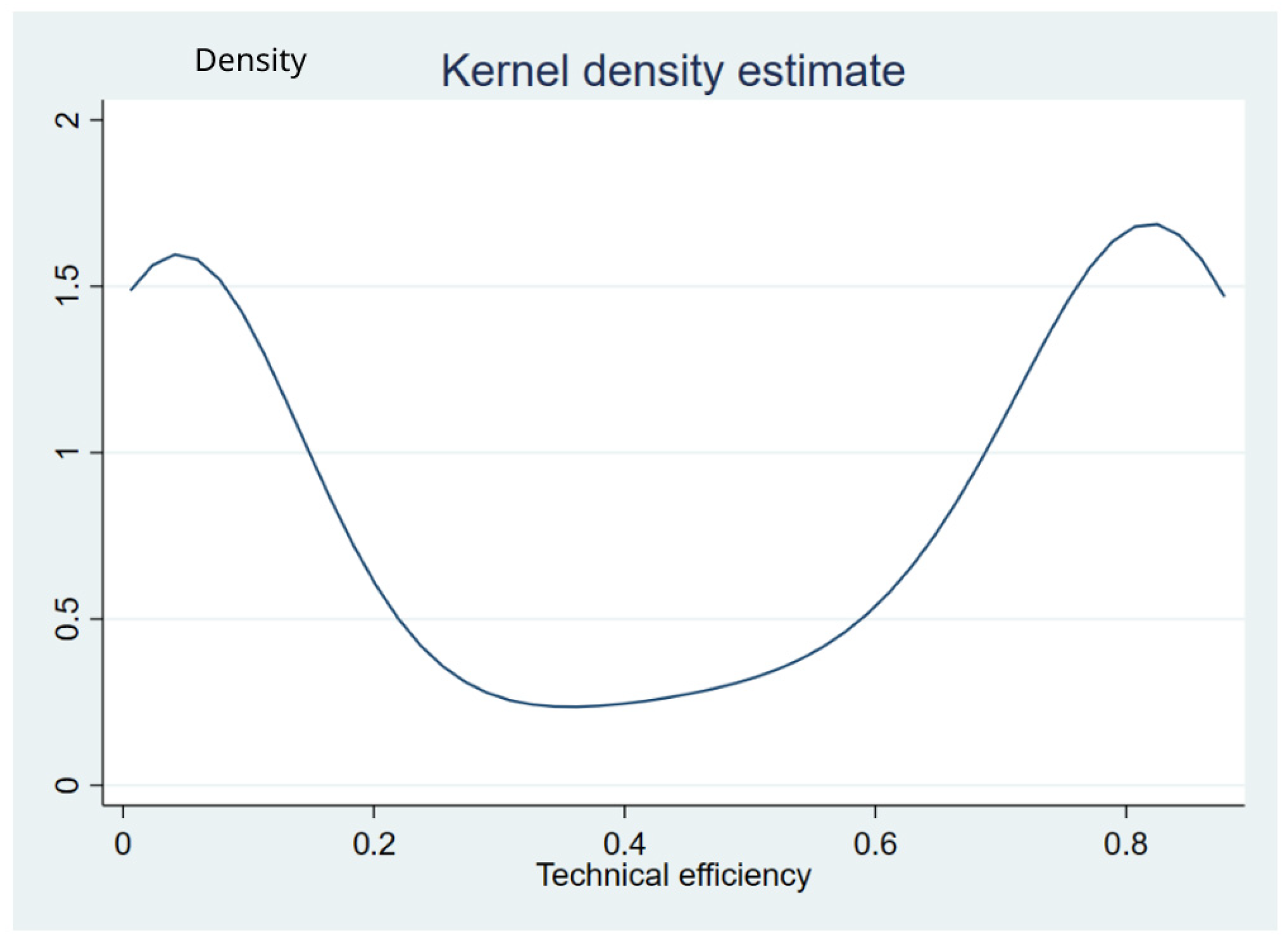
Table 6 reports the distribution of technical efficiency (TE) among sticky rice farmers in Northern Thailand. The results indicate a highly uneven distribution, with a large concentration of farmers at both low and high efficiency levels. Nearly half of the sample (184 out of 429, or 42.9%) falls into the lowest efficiency group (TE < 0.30), while a substantial share (32%) achieves high efficiency (TE > 0.80). This pattern suggests a concentration of farmers at both low and high efficiency levels, with relatively few in the intermediate range. However, it is important to note that this observation is based on descriptive evidence rather than formal statistical testing of mixture distributions or clustering structures.
The observed heterogeneity may reflect differences in resource endowments, access to technology, and farm management practices across farmers in Northern Thailand. In particular, variation in access to agricultural extension services, credit through institutions such as the Bank for Agriculture and Agricultural Cooperatives (BAAC), and the adoption of modern inputs may contribute to disparities in production performance. However, these mechanisms are not directly examined in this section.
Figure 1 confirm this pattern, showing two distinct density peaks: one concentrated at very low technical efficiency (TE) levels (0–0.15) and another at higher TE values (0.75–0.85), with relatively limited mass in the intermediate range. This indicates a concentration of farmers at both low and high efficiency levels.
Table 7 presents the five most and least efficient farmers in the sample, highlighting the substantial heterogeneity in TE across Northern Thailand. At the upper end, the most efficient farmers achieve TE scores above 0.875, approaching the maximum efficiency frontier (TE = 1). These include farmers from Nan (TE = 0.8782), Phrae (0.8768), Chiang Rai (0.8766), Lampang (0.8765), and Chiang Mai (0.8758). Such farmers exemplify best practices in resource management, demonstrating the ability to convert available inputs into outputs at near-optimal levels. Their performance likely reflects superior access to technology, better production knowledge, efficient farm management, or well-targeted government and institutional support.
These cases serve as benchmarks, indicating what is achievable under favorable conditions. By contrast, the five least efficient farmers have TE scores below 0.01, suggesting that more than 99% of their productive potential remains unrealized. These farmers are located in Lampang (TE = 0.0081 and 0.0065), Nan (0.0080 and 0.0059), and Chiang Mai (0.0058). Such extremely low scores reveal severe structural inefficiencies. Farmers in this group may face multiple constraints, including limited access to extension services and modern inputs, weak farm management skills, or chronic shortages of resources such as credit, fertilizer, or skilled labor. Their situation underscores the persistence of vulnerability among smallholders and the urgent need for targeted interventions to lift the bottom tail of the distribution.
The juxtaposition of the “best practice” and “worst practice” farmers highlight the dual structure of sticky rice production in Northern Thailand. On the one hand, a subset of farmers is already operating close to the frontier, demonstrating that high efficiency is feasible under existing technological and institutional conditions. On the other, a significant minority remains trapped in deep inefficiency, reinforcing the evidence of a bimodal distribution of TE reported earlier. This polarization underscores the importance of designing differentiated policy measures: while efficient farmers may benefit most from innovation-driven programs, low-efficiency farmers require foundational support, including training, technology transfer, and financial assistance, to catch up with the frontier.
4.4. Robustness Check
A key concern in this study is the potential endogeneity of government program participation (subsidy, debt moratorium, and cost-reduction schemes), as well as the risk of sample selection bias. Participation in such programs is unlikely to be random: farmers may self-select based on unobservable characteristics, such as managerial ability, risk preferences, or expectations about productivity, that are also correlated with technical efficiency. In addition, reverse causality may arise if more efficient farmers are more likely to participate in government programs. Ignoring these issues may lead to biased and inconsistent estimates of program effects. To address these concerns, we adopt two complementary strategies following Ragasa and Mazunda [
39], Hazrana and Mishra [
40] and Maneejuk and Yamaka [
39]: (i) an instrumental variable (IV) approach that exploits exogenous variation in program participation, and (ii) a sample selection correction that accounts for non-random participation decisions.
- (1)
Instrumental Variable (IV) Regression
The IV approach is implemented using a two-step procedure. In the first step, a Probit model is estimated to predict the probability of program participation based on household and farm characteristics, along with exclusion restrictions that affect participation but not efficiency directly. From this model, we obtain fitted probabilities of participation. In the second step, these predicted probabilities are used in place of the actual participation dummies within the efficiency-effects stochastic production frontier framework. This two-step estimation corrects for the correlation between program participation and unobserved determinants of efficiency, providing consistent estimates of the causal impact of government programs.
Let
denote participation of farmer
i in program
. Estimate, for each program
j, our probit selection equation can be written as
where
denotes control variables (e.g., age, education, experience, farm size, loan, cultivation type, technology index, gender), and
represents instrumental variables that generate exogenous variation in program participation.
We employ two instruments: (i) the presence of a local agricultural supply depot in the village (Supply), and (ii) the distance from the household to the nearest BAAC branch (Dist). These variables influence participation by affecting transaction costs and access to information. Supply depots act as distribution points for subsidized inputs and cost-reduction technologies, thereby facilitating enrollment. Similarly, BAAC branches serve as the primary administrative channel for most government support programs; greater distance increases participation costs and reduces program take-up.
While these variables may be related to input access, we argue that, conditional on observed input use (labor, fertilizer, and chemicals), household characteristics, and geographic fixed effects, their direct effect on technical efficiency is limited. Instead, their primary influence operates through program participation.
From the Probit model, we obtain the predicted probability of participation
In the second stage, the predicted probability
is incorporated into the inefficiency equation of the stochastic frontier model as a control function. Specifically, the efficiency component is specified as
where
denotes the efficiency link function consistent with the probit-based specification, and
includes the inefficiency determinants. The inclusion of
helps mitigate bias arising from the correlation between program participation and unobserved determinants of efficiency. We interpret the results as associations that are robust to endogeneity concerns rather than strictly causal effects.
- (2)
Sample selection model
Another concern is the possibility of sample selection bias: farmers may self-select into government programs (subsidy, debt moratorium, cost-reduction) based on unobservable factors such as managerial ability, risk preferences, or access to information. These unobserved characteristics may also affect production efficiency, leading to biased estimates if not properly addressed. To account for this issue, we follow the sample selection approach of Heckman [
38] and incorporate a correction term into the efficiency-effects stochastic frontier. In the first stage, we estimate program participation using the Probit model specified in Equation (11). From this model, we compute the inverse Mills ratio (IMR), which captures the expected value of the selection error conditional on participation. The inclusion of the IMR in the inefficiency equation allows us to control for non-random participation and reduce bias arising from unobserved heterogeneity.
In the first stage, we estimate program participation using the Probit model specified in Equation (11). From this Probit, we compute the inverse Mills ratio (IMR), which captures the expected value of the selection error conditional on participation:
where
and
are the standard normal probability density function and cdf.
We then incorporate the IMR into the efficiency-effects stochastic frontier as
We would like to note that since participation decisions for the subsidy, debt moratorium, and cost-reduction programs are not independent, including multiple IMRs simultaneously in the inefficiency equation may introduce multicollinearity and estimation instability. To address this issue, we adopt a program-by-program correction strategy. Specifically, for each program, we estimate a separate Probit participation model and compute its corresponding IMR, which is then included in the efficiency-effects stochastic frontier as a robustness check. This approach does not eliminate multicollinearity per se but allows us to isolate the potential selection bias associated with each program while maintaining stable estimation and facilitating clearer interpretation of program-specific effects.
Table 8 reports the first-stage Probit estimates of farmers’ participation in the cost-reduction, debt moratorium, and subsidy programs. Across all specifications, the presence of a local supply depot significantly raises the probability of program take-up, whereas greater distance to the nearest BAAC branch consistently lowers participation. The instruments are jointly strong, with F-statistics well above conventional thresholds in nearly all cases, confirming their relevance. Program-specific patterns also emerge: participation in the debt moratorium is strongly and positively associated with loan size, consistent with its targeting of indebted farmers; cost-reduction programs attract more educated and technologically oriented farmers; and subsidy enrollment is linked to cultivation practices.
Table 9 and
Table 10 present the results from the IV estimation and the sample-selection correction. In both specifications, the predicted probability of subsidy participation enters the inefficiency equation with a negative and statistically significant coefficient, indicating that the direction of the subsidy effect remains negative even after accounting for potential endogeneity. For the debt moratorium program, the coefficients are positive and significant across both models, while the cost-reduction program continues to show positive but statistically insignificant coefficients. These results suggest that the estimated effects of all three programs are generally stable in sign under the alternative specifications. The instrumental variables (Supply and Dist) are statistically significant predictors of program participation across all specifications. A Wald test of joint significance confirms that the instruments are jointly significant, supporting the relevance of the instruments.
In addition, across all models, the IMR terms are statistically insignificant, indicating no evidence of selection bias in program participation. Thus, these robust checks do not materially alter the qualitative conclusions derived from the main copula-based stochastic frontier model, although some differences in magnitude are observed. Overall, the results appear stable across correction methods, supporting the reliability of the main findings.
4.5. Descriptive Patterns of Technical Efficiency
4.5.1. Technical Efficiency and Farmer Characteristics
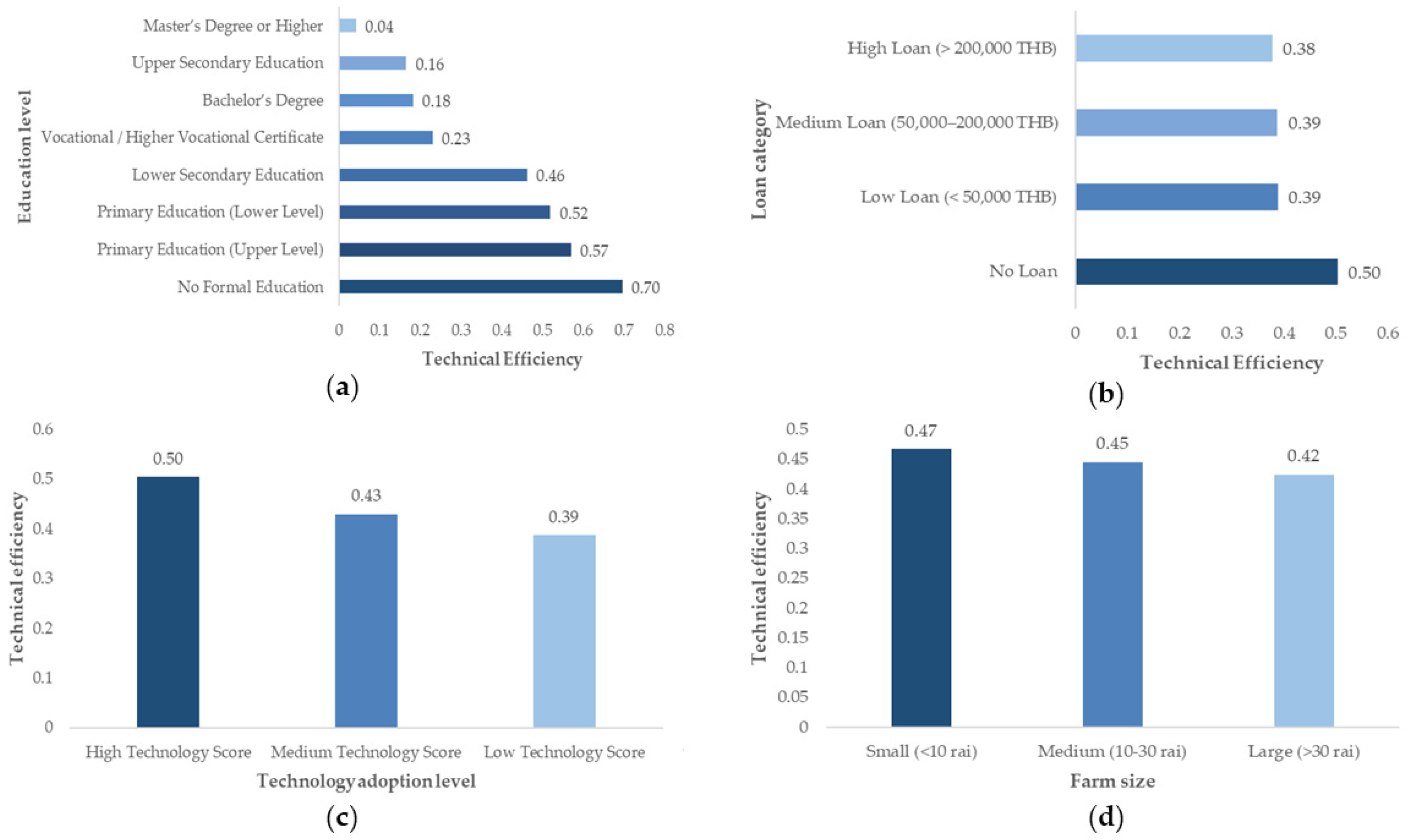
Figure 2 illustrates the heterogeneity in technical efficiency (TE) across key farmer characteristics, including education level, loan size, technology adoption, and farm size. The reported values represent the mean TE within each subgroup.
Figure 2a shows that farmers with lower formal education exhibit higher TE, with those having no formal education achieving the highest efficiency (0.70). In contrast, farmers with bachelor’s or master’s degrees display much lower TE. This is consistent with the regression results, where education negatively affects efficiency, suggesting that practical farming experience may be more relevant than formal schooling in sticky rice production [
34].
Figure 2b indicates that farmers without loans have higher TE (0.50) than those with low, medium, or high loan levels (around 0.38–0.39). This supports the negative relationship between indebtedness and efficiency found in the model and aligns with the Theory of Change: financial pressure can distort input allocation, while debt relief helps ease liquidity constraints.
Figure 2c shows a clear positive relationship between technology adoption and technical efficiency. Farmers with high technology scores achieve the highest TE (0.50), followed by those with medium (0.43) and low (0.39) technology levels. This pattern is consistent with the main estimation results, where the technology index (Tec) carries a positive and highly significant coefficient across all model specifications. The finding also aligns with previous empirical studies, such as Manda et al. [
24] and Suwanmaneepong et al. [
25], which document that mechanization, improved input management, and adoption of modern agricultural practices significantly enhance farm-level efficiency. Overall, the evidence suggests that access to and effective use of technology play a central role in moving farmers closer to the production frontier.
Figure 2d suggests slightly higher TE among small farms compared to large farms, reflecting the limited scale economies in Northern Thailand’s fragmented terrain and explaining why large-plot cost-reduction programs show limited efficiency gains.
Overall, the figure reinforces the main findings: efficiency improvements are more strongly linked to structural factors, especially technology adoption and financial conditions, than to broad-based subsidies.
4.5.2. Technical Efficiency and Government Program Participation
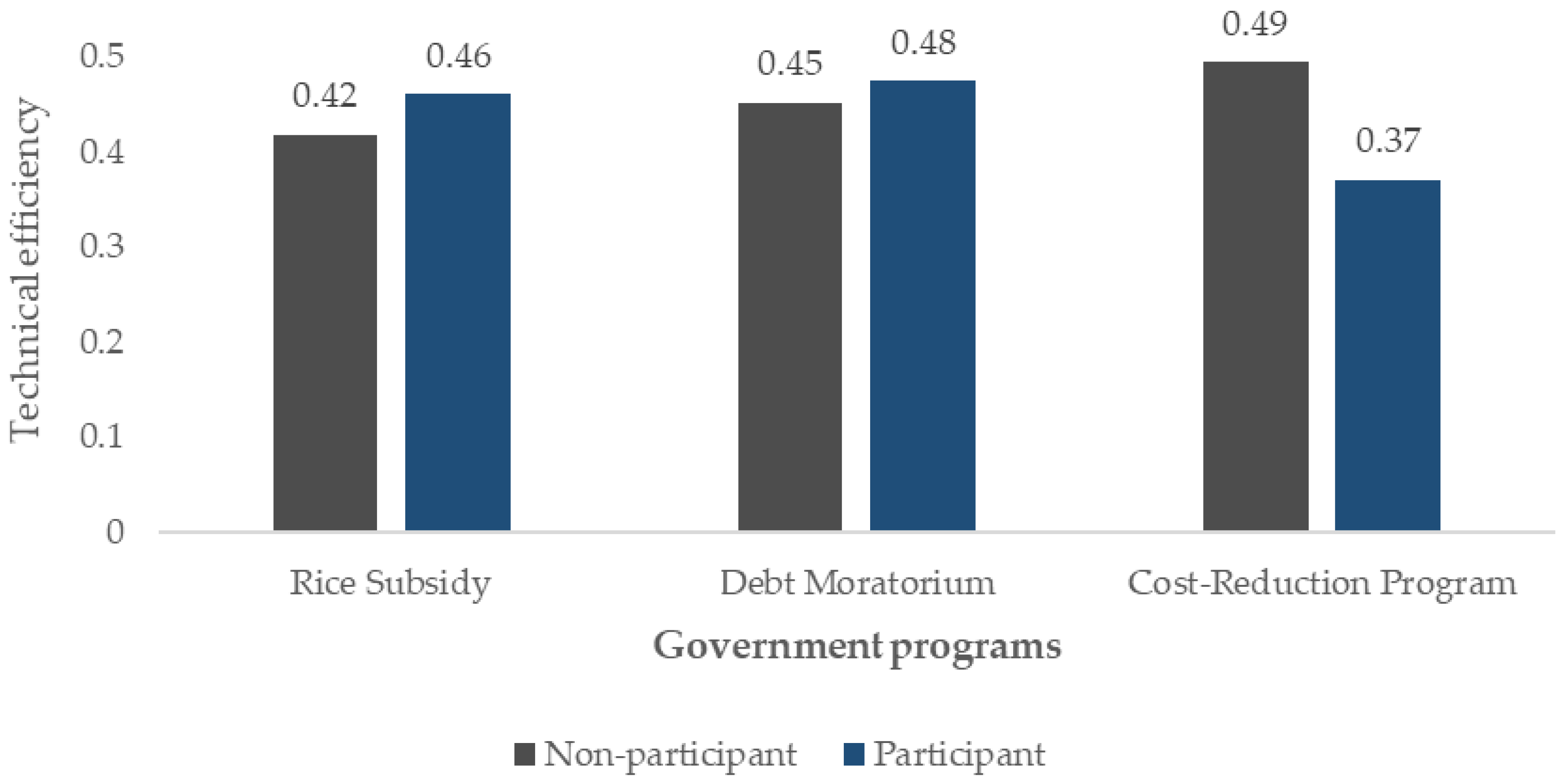
Figure 3 compares the average technical efficiency (TE) between participants and non-participants in the three major government programs. For the rice subsidy (1000 baht/rai), participants exhibit slightly higher TE (0.46) than non-participants (0.42). However, the difference is modest, consistent with the Theory of Change framework (
Table 1), which suggests that unconditional income transfers are unlikely to generate substantial efficiency gains and may soften productivity incentives [
13,
28]. This pattern aligns with the regression results, where the subsidy shows a negative or weak association with efficiency once other factors are controlled for.
In the case of the debt moratorium, participants display higher TE (0.48) compared to non-participants (0.45). This descriptive evidence supports the liquidity-constraint channel described in
Table 1 by temporarily relieving repayment pressure; the program may allow farmers to allocate inputs more effectively. This finding is consistent with Feder et al. [
29] and Jimi et al. [
22], who document that easing financial constraints can enhance productivity when resources are redirected toward productive activities.
By contrast, for the cost-reduction program, participants show lower TE (0.37) than non-participants (0.49). This suggests that participation does not automatically translate into efficiency gains and may reflect implementation challenges or selection of less efficient farmers into the program. The Theory of Change (
Table 1) notes that coordination and scale effects depend heavily on effective implementation and local conditions. Prior studies such as Coelli & Rao [
31] and Manda et al. [
24] emphasize that cost reduction alone is insufficient unless accompanied by genuine technological upgrading or managerial improvements.
Overall,
Figure 3 provides clear visual evidence of heterogeneous effects across policy interventions by directly comparing participants and non-participants. The results indicate that government programs do not uniformly improve technical efficiency, and their effectiveness depends on the specific mechanisms through which they operate. This highlights the importance of designing targeted and context-specific policy interventions rather than relying on uniform support measures.
5. Conclusions
Thailand’s rice sector faces a persistent paradox. Despite the country’s global reputation as one of the world’s leading rice exporters, production efficiency among smallholder farmers remains modest, undermining competitiveness and threatening long-term sustainability. This problem is especially pronounced in the sticky rice subsector in Northern Thailand, which is central to local consumption, rural livelihoods, and cultural identity but has received comparatively little policy and research attention. Addressing inefficiency in this subsector is crucial, as closing efficiency gaps represents one of the most direct ways to raise output, reduce costs, and enhance resilience without expanding cultivated land.
The empirical findings reveal several important patterns. Most notably, the relationship between government program participation and technical efficiency appears heterogeneous across policy instruments. The widely implemented 1000-baht/rai subsidy program is negatively associated with efficiency, suggesting that unconditional transfers may be linked to weaker incentives for productivity-enhancing adjustments and may not effectively address underlying structural constraints. By contrast, participation in the debt moratorium program is positively and significantly associated with efficiency, which is consistent with the liquidity-constraint mechanism discussed earlier. This pattern suggests that easing short-term financial pressure may allow farmers to allocate inputs more effectively during the production cycle. The cost-reduction program, in turn, exhibits a positive but statistically insignificant association with efficiency, indicating that its effects may be limited or highly context-dependent. Our results suggest that different policy instruments are associated with distinct efficiency outcomes, and that programs targeting structural constraints, particularly financial constraints, may be more closely linked to higher efficiency than broad-based income transfers.
Beyond policy participation, the results also highlight broader structural factors associated with technical efficiency. Age, experience, education, and indebtedness are negatively associated with efficiency, suggesting the presence of technological inertia, physical constraints, and financial vulnerability. In contrast, technology adoption is strongly positively associated with efficiency, reinforcing the importance of mechanization and digital tools in enhancing production performance. Provincial disparities further underscore uneven access to resources, with Chiang Mai exhibiting relatively higher efficiency levels compared to lagging regions.
Based on the empirical findings, this study proposes four policy recommendations.
First, the positive and robust association between the debt moratorium program and technical efficiency suggests that short-term liquidity constraints remain a central friction in sticky rice production. When repayment pressure is temporarily reduced, farmers appear better able to maintain input intensity and avoid suboptimal adjustments such as delayed planting or reduced fertilizer use. This implies that the effectiveness of the program lies not in debt relief per se, but in its timing, specifically, its ability to stabilize cash flow during critical production periods. From a policy standpoint, this suggests that interventions aimed at smoothing liquidity, such as seasonal credit lines, input-linked financing, or repayment schedules aligned with harvest cycles, may be more effective than one-off financial relief measures.
Second, the negative association observed for the 1000-baht-per-rai subsidy indicates that broad, area-based transfers are not closely aligned with production efficiency. Given that participation in this program is nearly universal in the sample, the result is unlikely to reflect access constraints, but rather the nature of the instrument itself. Because the subsidy is decoupled from production decisions, it does not appear to influence how inputs are allocated or how farms are managed. This suggests that expanding such transfers is unlikely to generate efficiency gains. A more effective approach would be to partially re-link support to production-related activities, for example, conditioning a portion of payments on input use, crop management practices, or participation in technology adoption programs, so that transfers reinforce, rather than substitute for, productivity-enhancing behavior.
Third, the absence of a statistically significant effect for the cost-reduction program indicates that lowering input costs alone is not sufficient to improve efficiency. This finding is consistent with the view that input price support does not necessarily translate into effective input use. In the context of Northern Thailand, where production is constrained by timing, access, and local conditions, the impact of cost reduction may be limited if inputs are not delivered at the appropriate stage of the production cycle or are not well matched to farm-specific needs. This suggests that policy attention should shift from subsidizing input prices to improving input delivery systems, extension services, and coordination mechanisms that ensure inputs are both accessible and used effectively.
Finally, the distribution of technical efficiency reveals a pronounced dual structure, with a large share of farmers clustered at very low efficiency levels alongside a group operating close to the frontier. This heterogeneity implies that uniform policy interventions are unlikely to be effective. Farmers at the lower end of the distribution are likely constrained by multiple, overlapping factors, including limited access to technology, weak managerial capacity, and financial stress, and may require integrated support combining credit access, training, and technology transfer. In contrast, farmers already operating near the frontier are more likely to benefit from innovation-oriented policies, such as precision agriculture, digital tools, or advanced mechanization.
This study is subject to several limitations. First, the use of cross-sectional survey data restricts the ability to capture dynamic changes in efficiency, including lagged effects, adjustment processes, and persistence over time. Accordingly, the findings should be interpreted as short-run associations rather than long-term effects of government programs. Future research using panel data would allow for a more comprehensive analysis of efficiency dynamics. Second, while the copula-based stochastic frontier model relaxes the independence assumption between noise and inefficiency, the choice of copula family may influence results; further work could explore alternative dependence structures. Third, the focus on five provinces in Northern Thailand limits generalizability, and comparative studies across regions and rice types would broaden the scope. Finally, the use of survey-based data introduces potential measurement error, including recall and reporting bias in self-reported inputs and outputs. Program participation may also reflect unobserved characteristics, raising concerns about endogeneity. In addition, while the analysis links each program to a dominant mechanism, the estimated effects should be interpreted as reduced-form associations, as multiple channels, such as liquidity, knowledge access, and coordination, may operate simultaneously and cannot be fully disentangled with the available data. Although instrumental variables and sample selection corrections help mitigate these issues, they may not fully eliminate bias, and the results should therefore be interpreted with appropriate caution.





 ,
,