Author Contributions
All authors contributed to the conception and design of this study. Conceptualization, S.S. and Q.L.; methodology, S.S.; software, S.S.; validation, S.S., Q.L. and Z.Y.; formal analysis, S.S.; investigation, S.S.; resources, Q.L. and Z.Y.; data curation, S.S.; writing—original draft preparation, S.S.; writing—review and editing, Q.L. and Z.Y.; visualization, S.S.; supervision, Q.L. and Z.Y.; project administration, Q.L.; funding acquisition, Q.L. All authors have read and agreed to the published version of the manuscript.
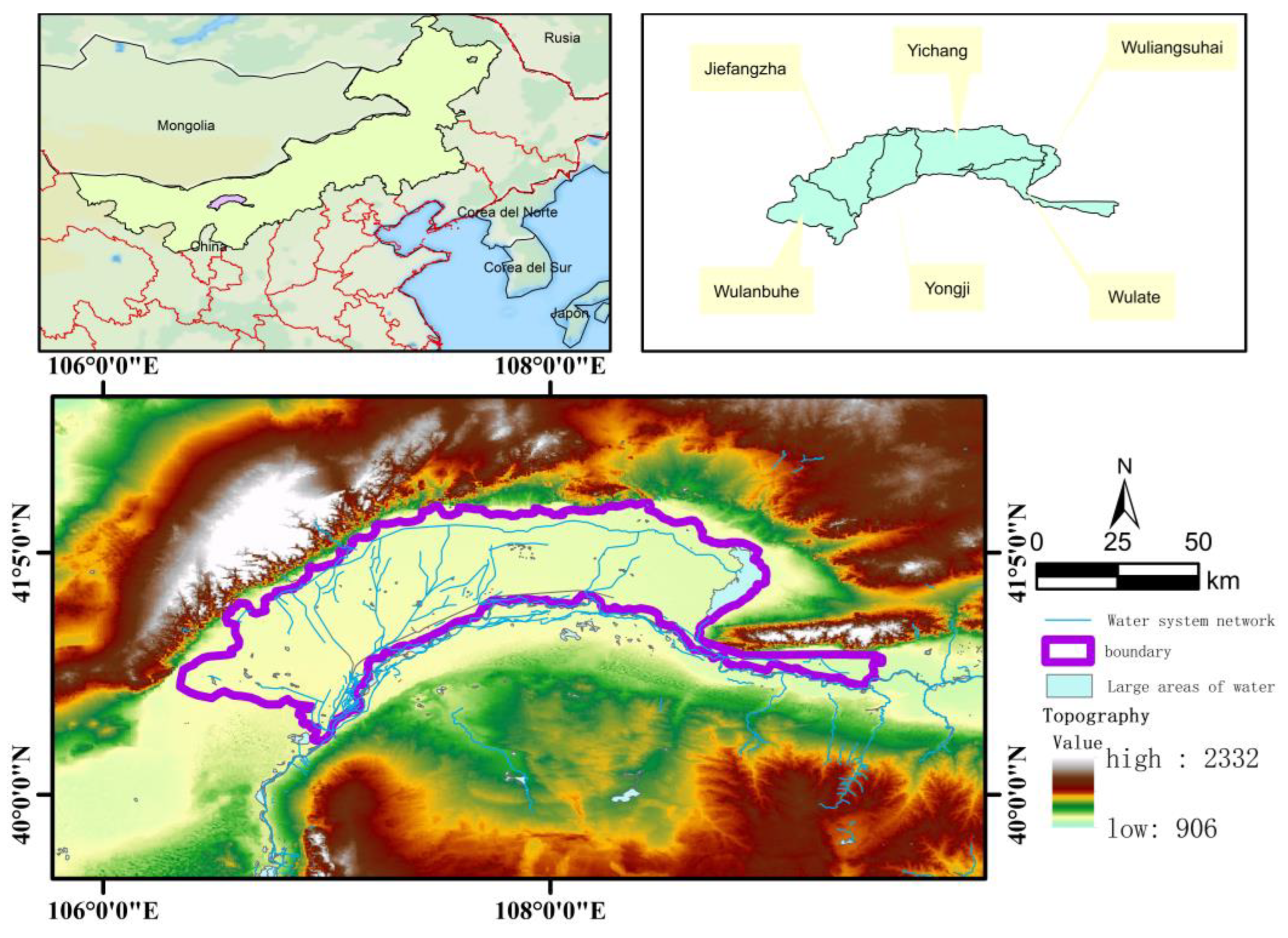
Figure 1.
Schematic map of the geographical location of the Hetao Irrigation District.
Figure 1.
Schematic map of the geographical location of the Hetao Irrigation District.
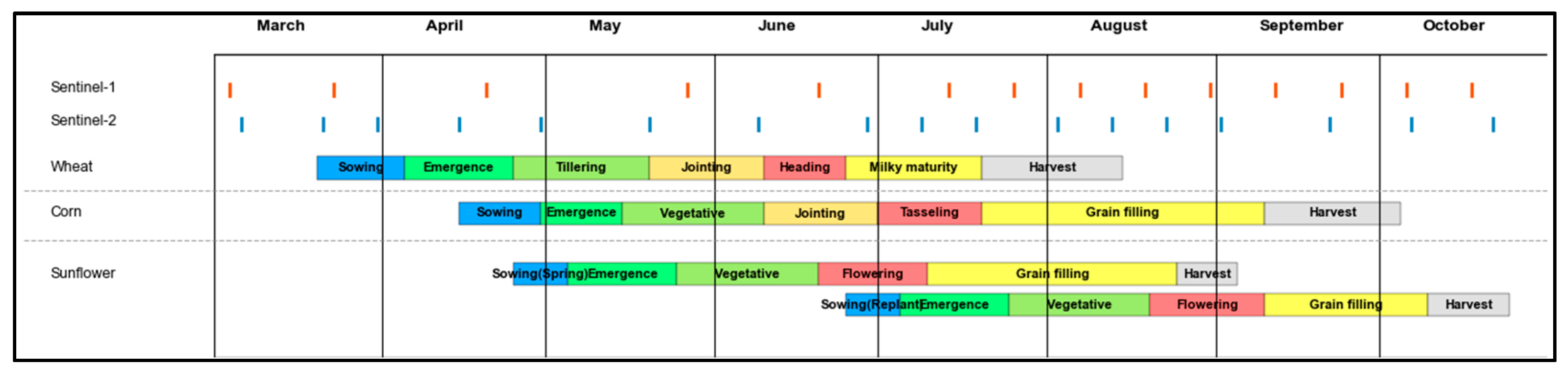
Figure 2.
Crop growth periods and acquisition dates of Sentinel-2 and Sentinel-1 imagery.
Figure 2.
Crop growth periods and acquisition dates of Sentinel-2 and Sentinel-1 imagery.
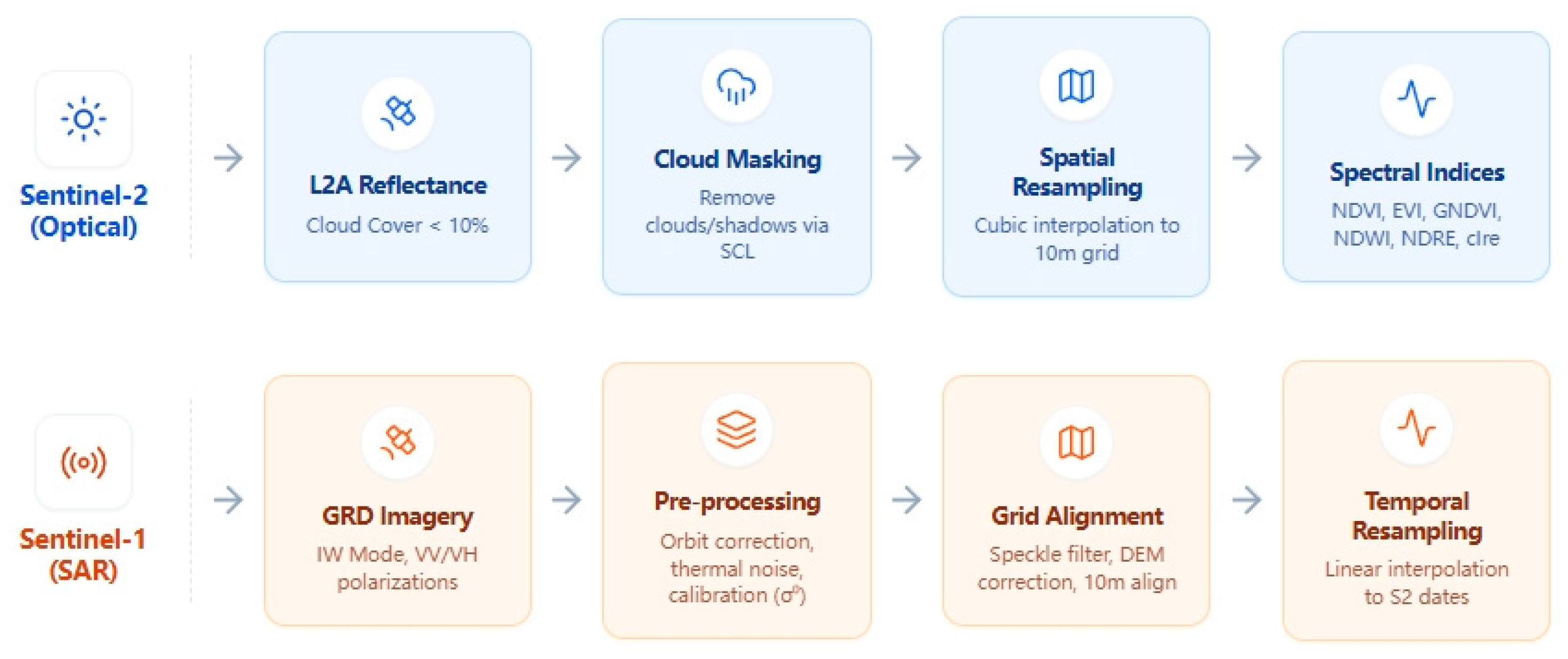
Figure 3.
Integrated preprocessing workflow of Sentinel-2 and Sentinel-1 data.
Figure 3.
Integrated preprocessing workflow of Sentinel-2 and Sentinel-1 data.
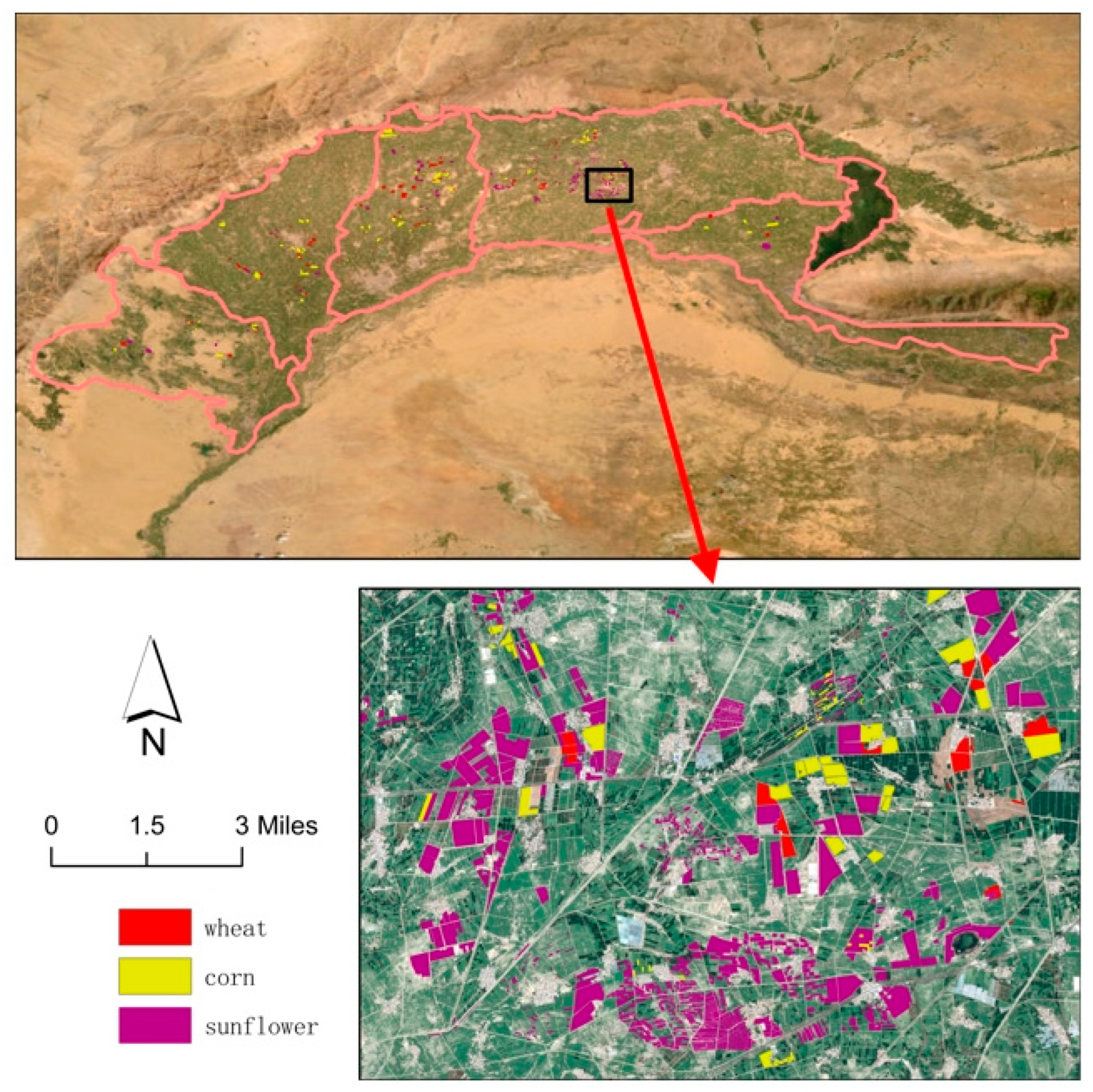
Figure 4.
Ground samples and local zoomed-in view.
Figure 4.
Ground samples and local zoomed-in view.
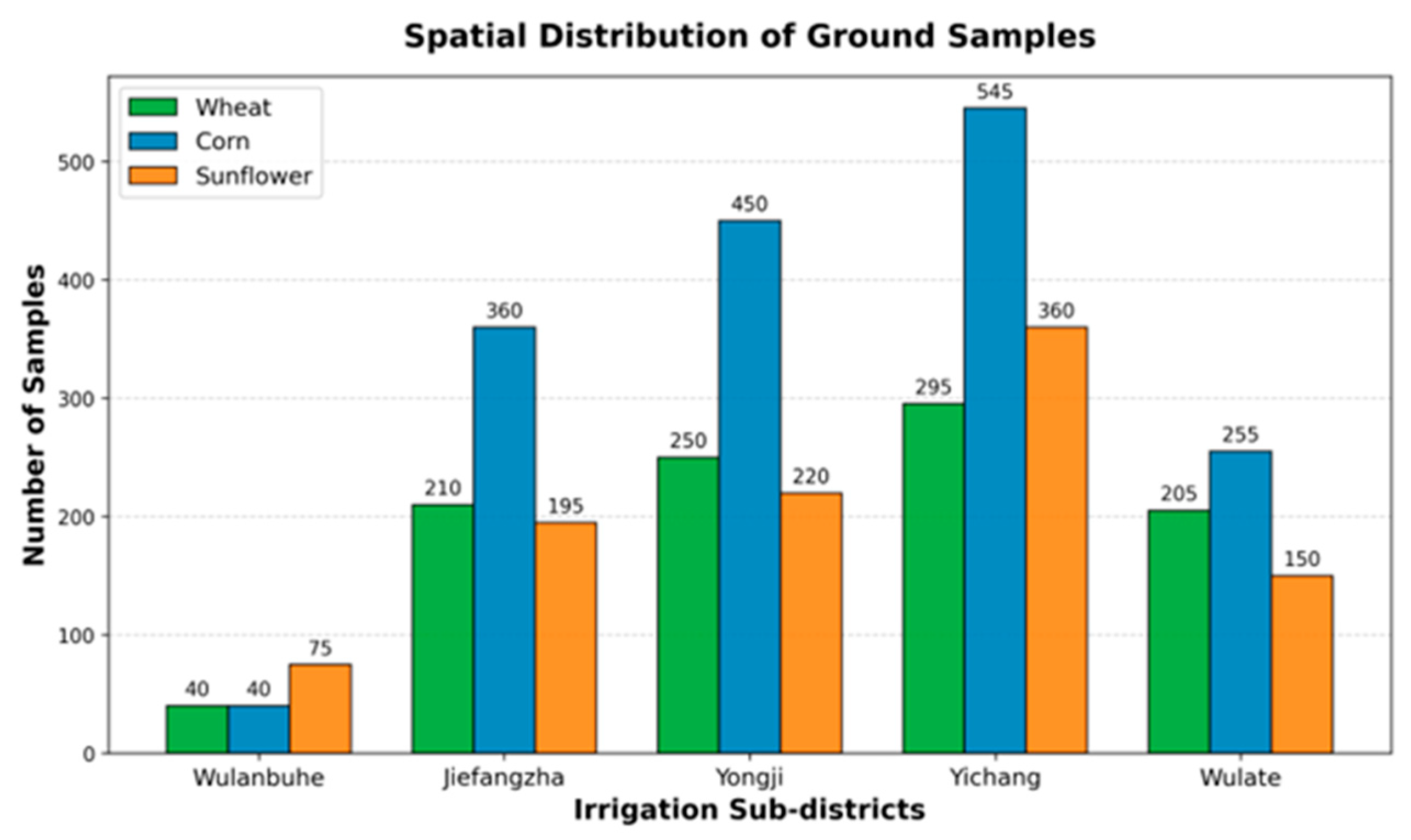
Figure 5.
Spatial distribution of the ground samples in the irrigation district.
Figure 5.
Spatial distribution of the ground samples in the irrigation district.
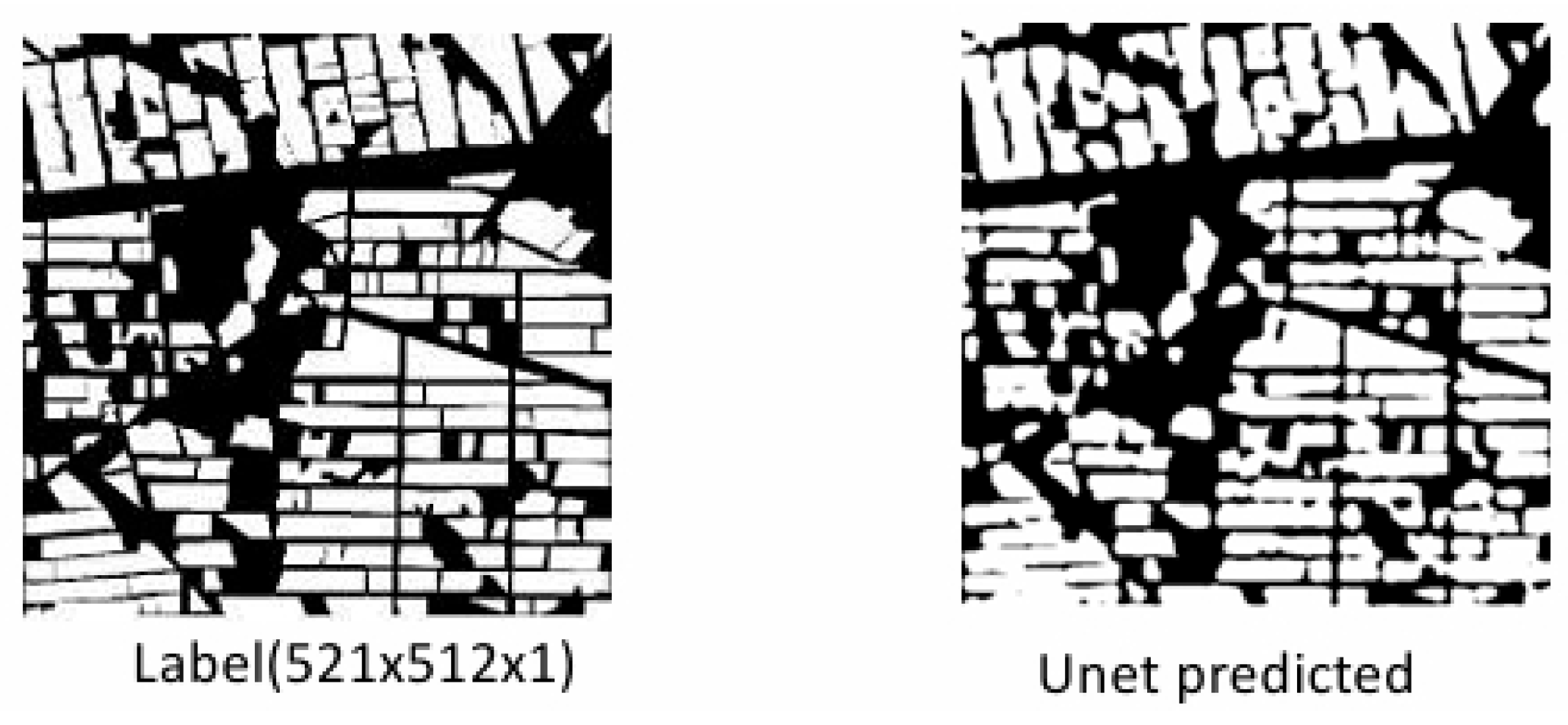
Figure 6.
Land parcel extraction based on U-Net.
Figure 6.
Land parcel extraction based on U-Net.
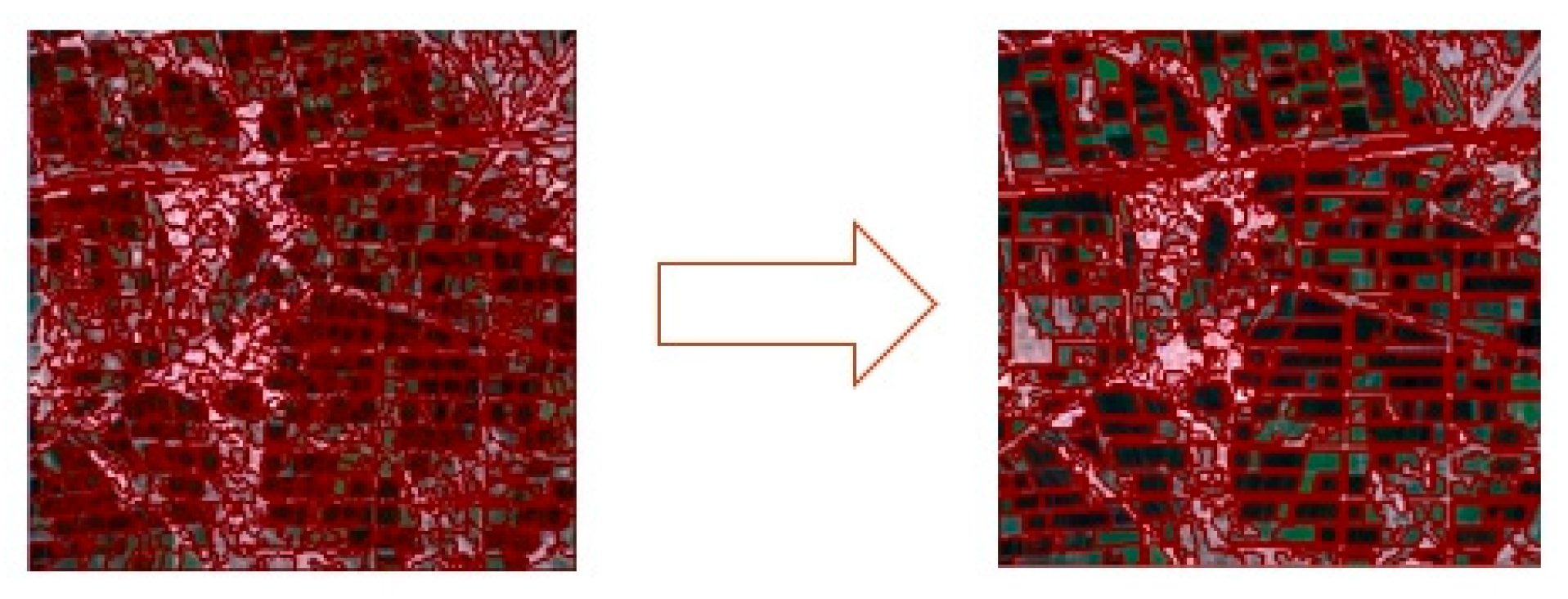
Figure 7.
Changes in parcels after merging and filtering.
Figure 7.
Changes in parcels after merging and filtering.
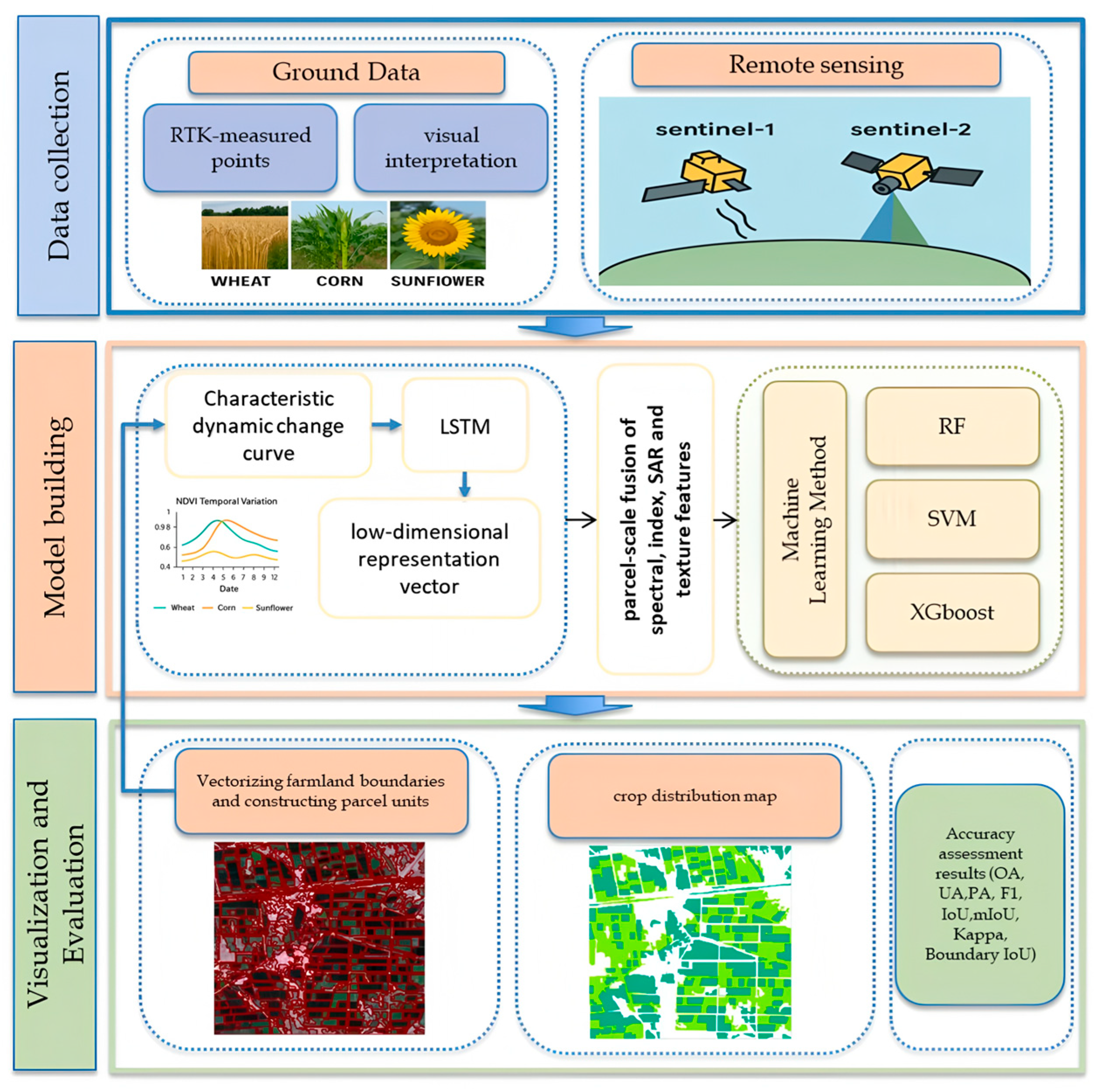
Figure 8.
Technical workflow of the proposed parcel-scale crop classification framework.
Figure 8.
Technical workflow of the proposed parcel-scale crop classification framework.
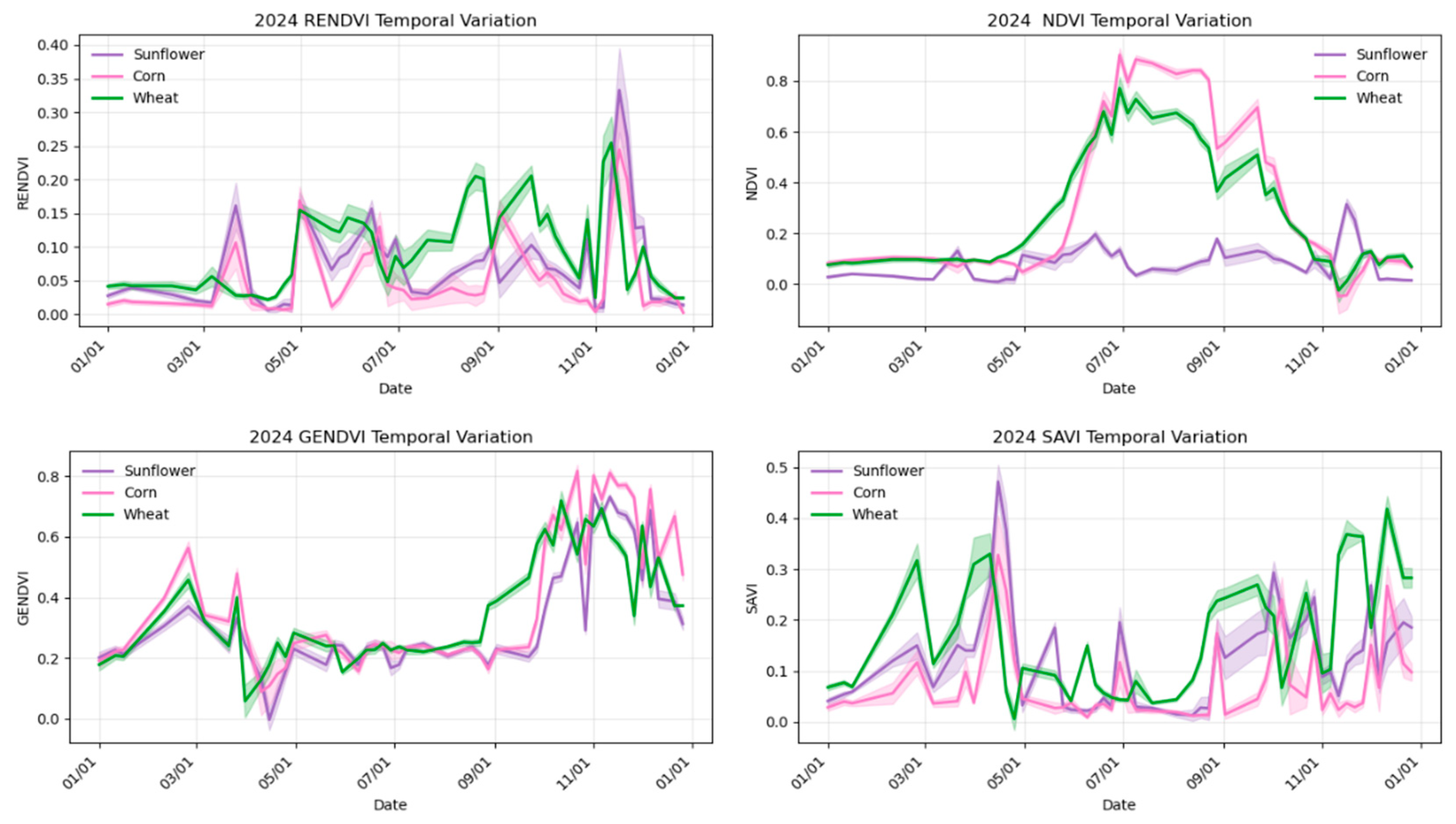
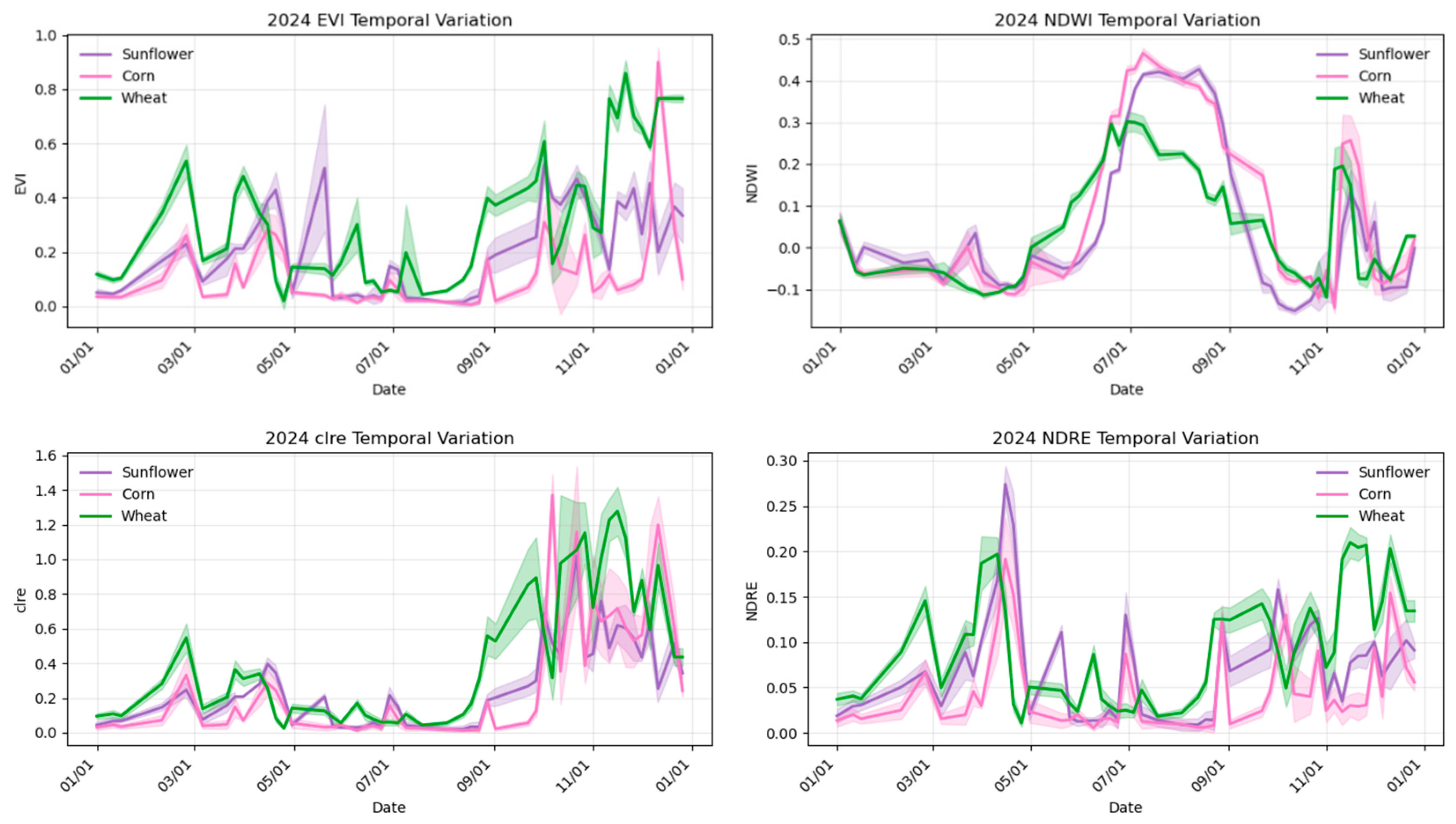
Figure 9.
Time-series curves of typical optical phenological indices, including NDVI, EVI, GNDVI, SAVI, NDWI, and RENDVI. Shaded areas represent the standard deviation.
Figure 9.
Time-series curves of typical optical phenological indices, including NDVI, EVI, GNDVI, SAVI, NDWI, and RENDVI. Shaded areas represent the standard deviation.
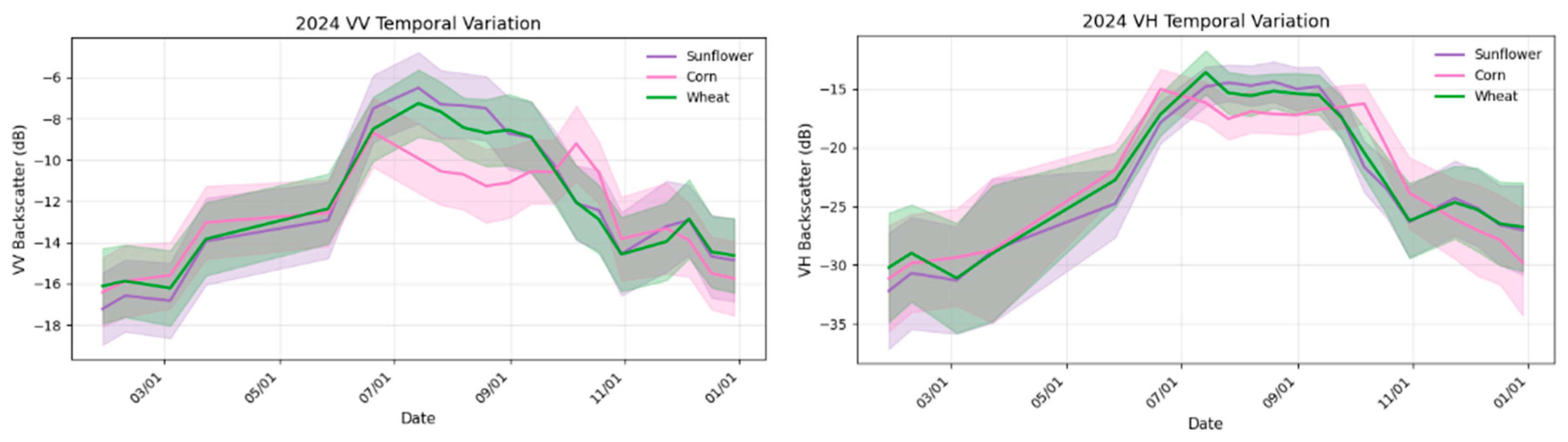
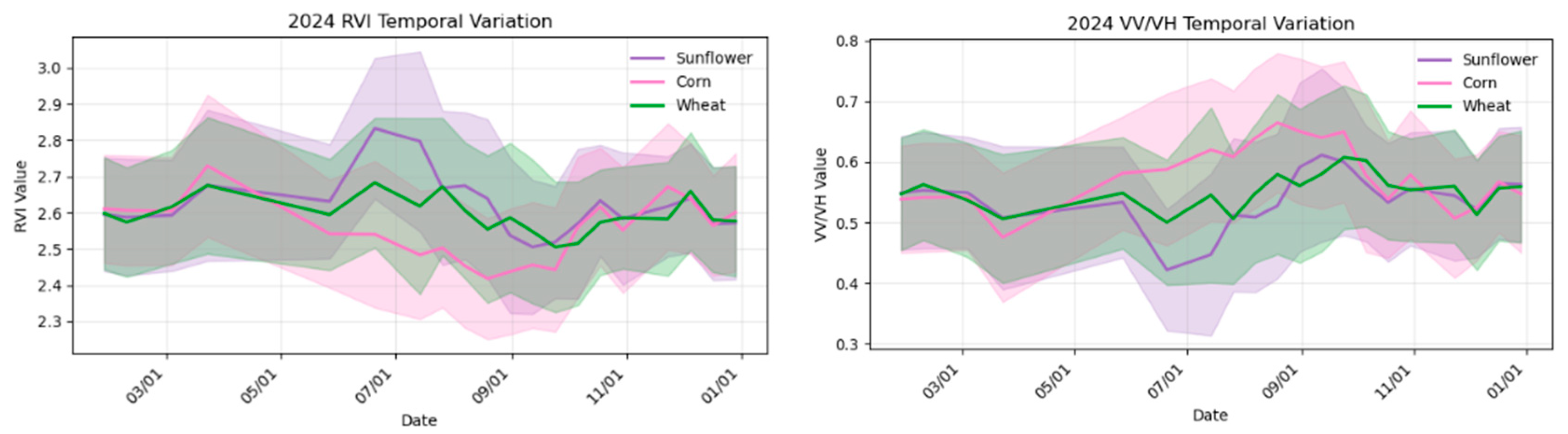
Figure 10.
Time-series curves of VH and VV backscattering coefficients, RVI, and VV/VH. Shaded areas represent the standard deviation.
Figure 10.
Time-series curves of VH and VV backscattering coefficients, RVI, and VV/VH. Shaded areas represent the standard deviation.
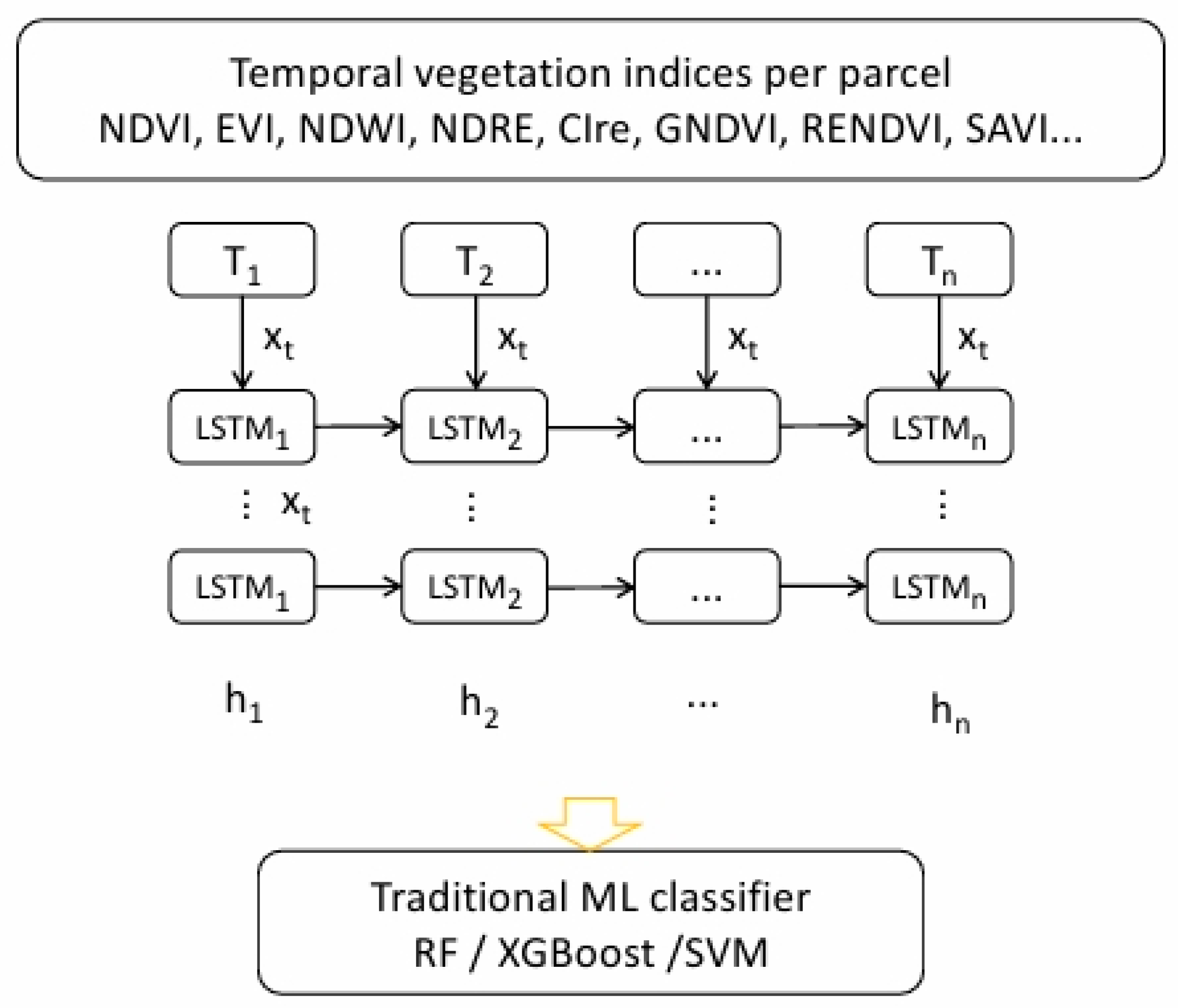
Figure 11.
LSTM model architecture and outputs.
Figure 11.
LSTM model architecture and outputs.
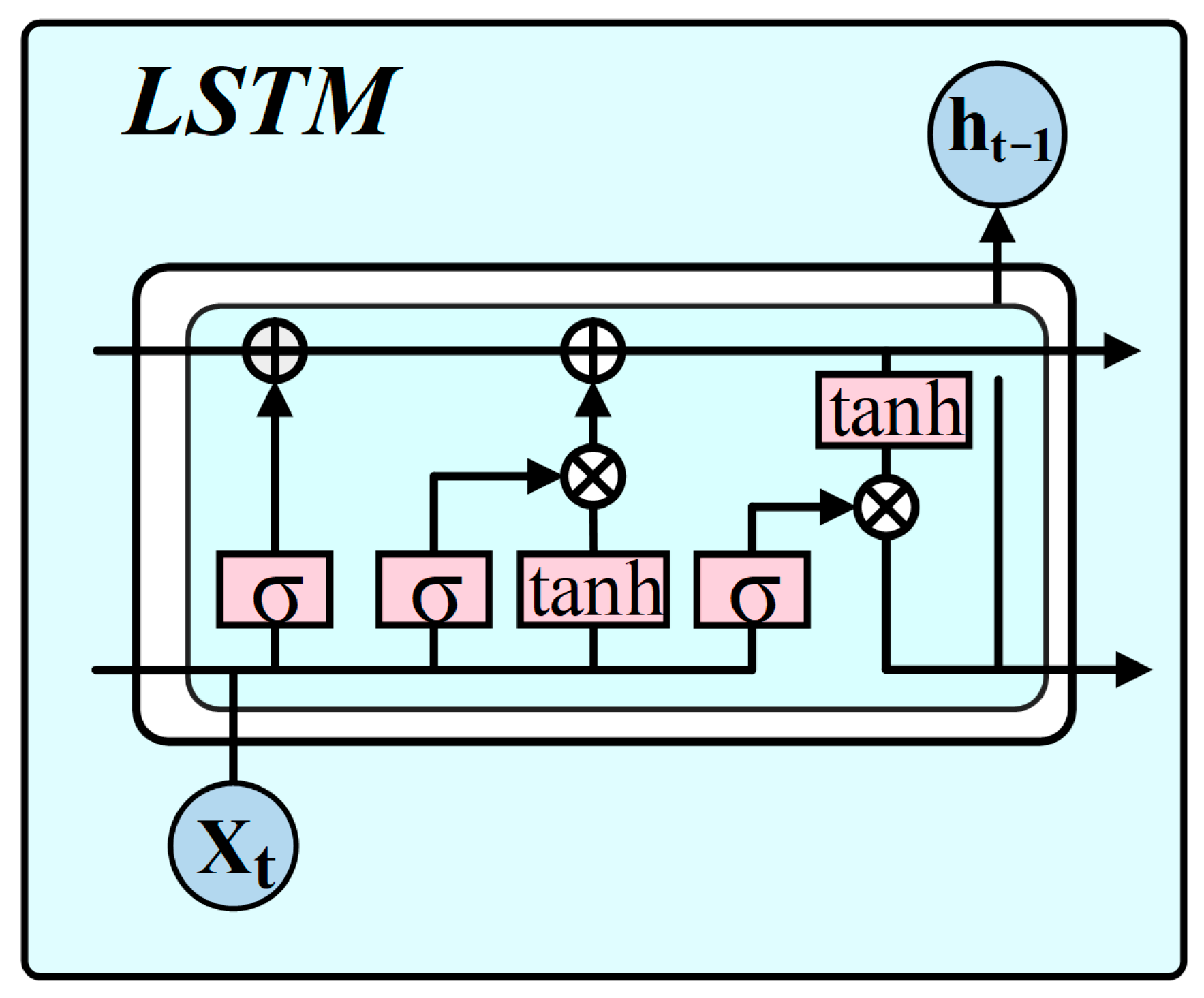
Figure 12.
Schematic diagram of a single LSTM unit.
Figure 12.
Schematic diagram of a single LSTM unit.
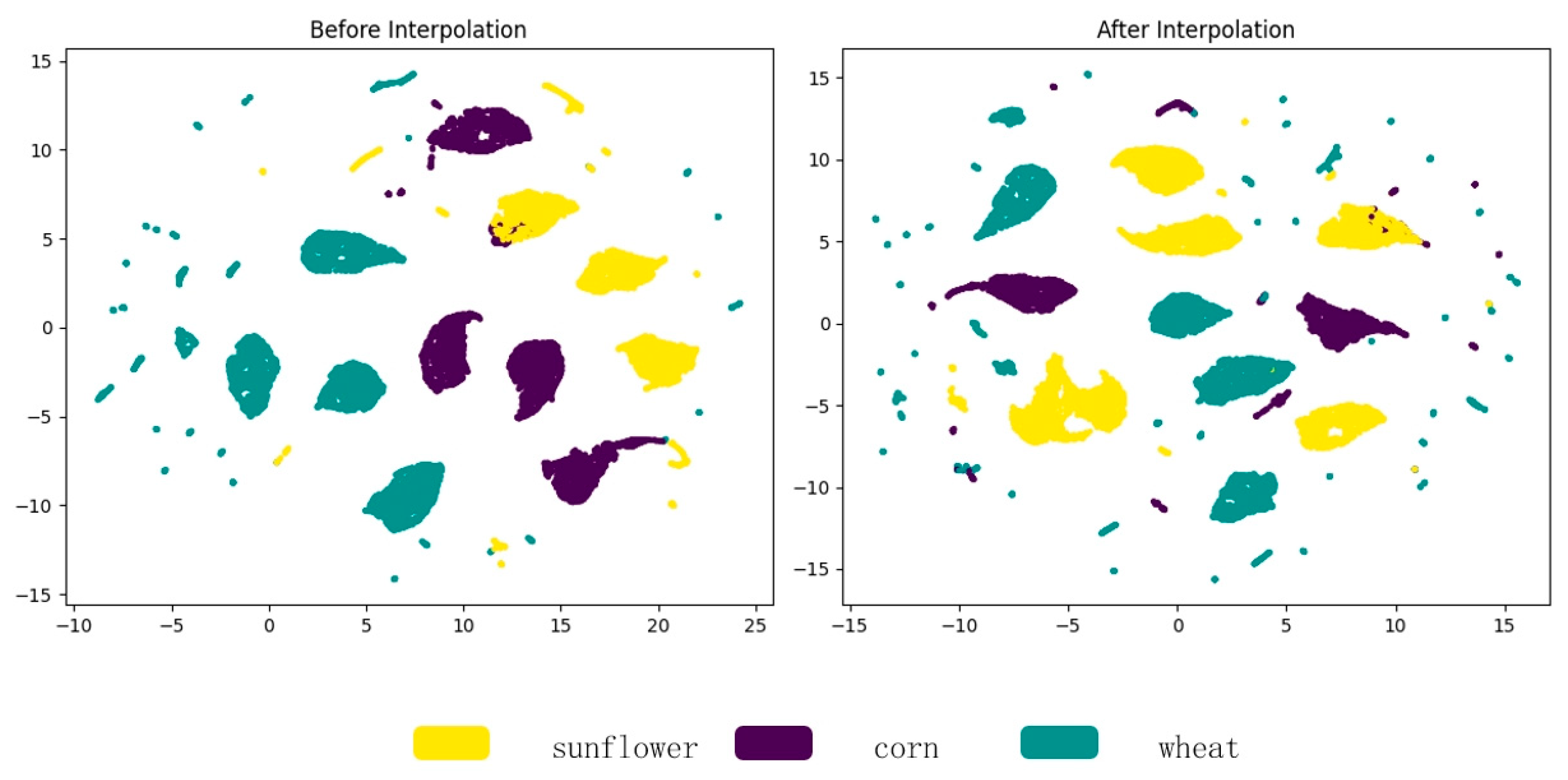
Figure 13.
t-SNE visualization of the learned temporal embeddings derived from the LSTM network. The embeddings integrate multi-temporal Sentinel-1 and Sentinel-2 observations and compress the annual time-series information into a low-dimensional representation space. Different colors represent different crop types.
Figure 13.
t-SNE visualization of the learned temporal embeddings derived from the LSTM network. The embeddings integrate multi-temporal Sentinel-1 and Sentinel-2 observations and compress the annual time-series information into a low-dimensional representation space. Different colors represent different crop types.
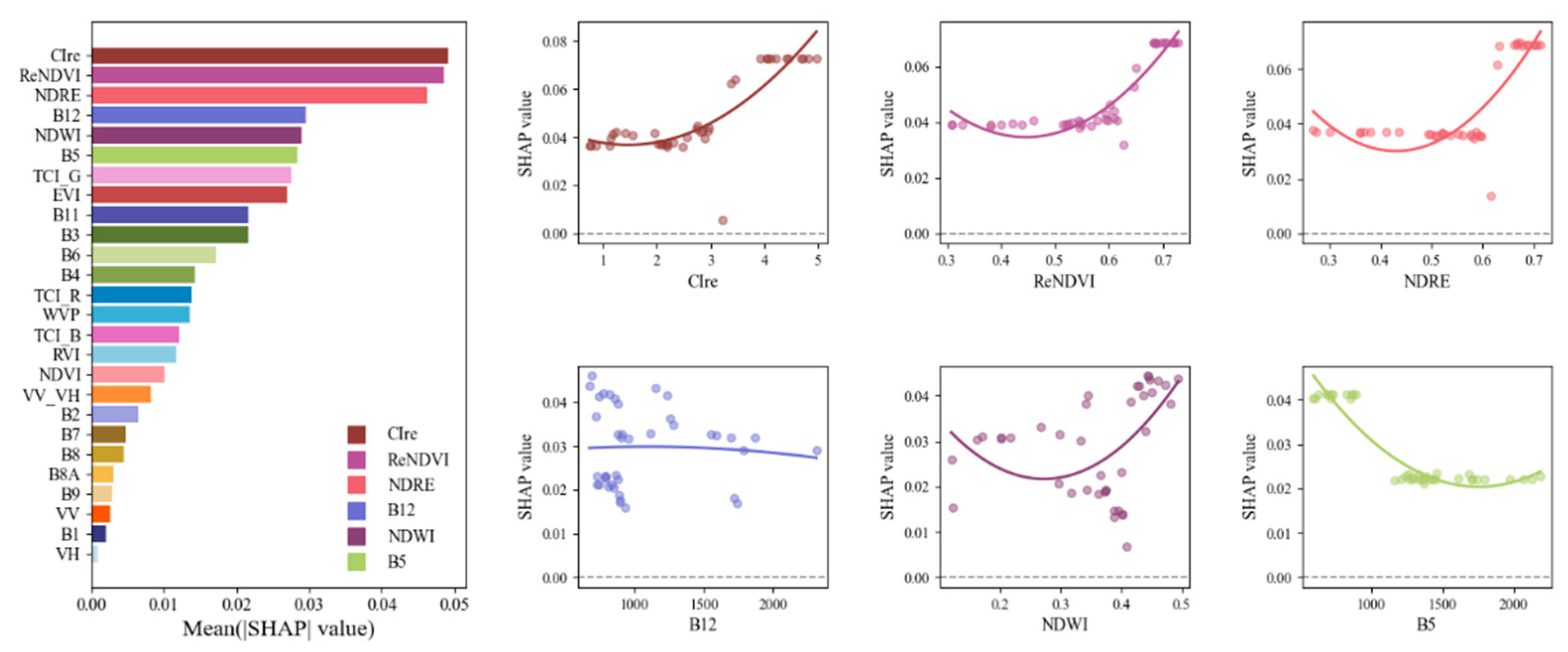
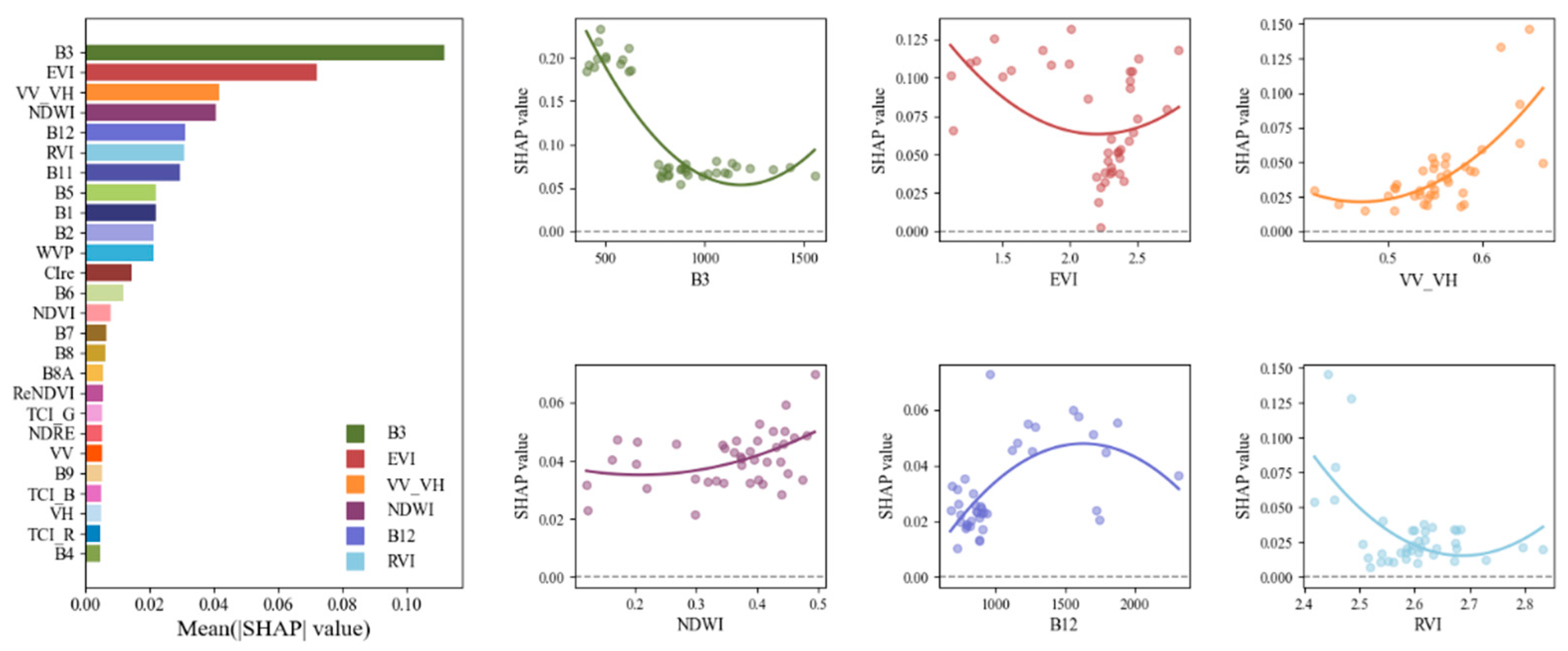
Figure 14.
SHAP-based interpretation of the XGBoost model.
Figure 14.
SHAP-based interpretation of the XGBoost model.
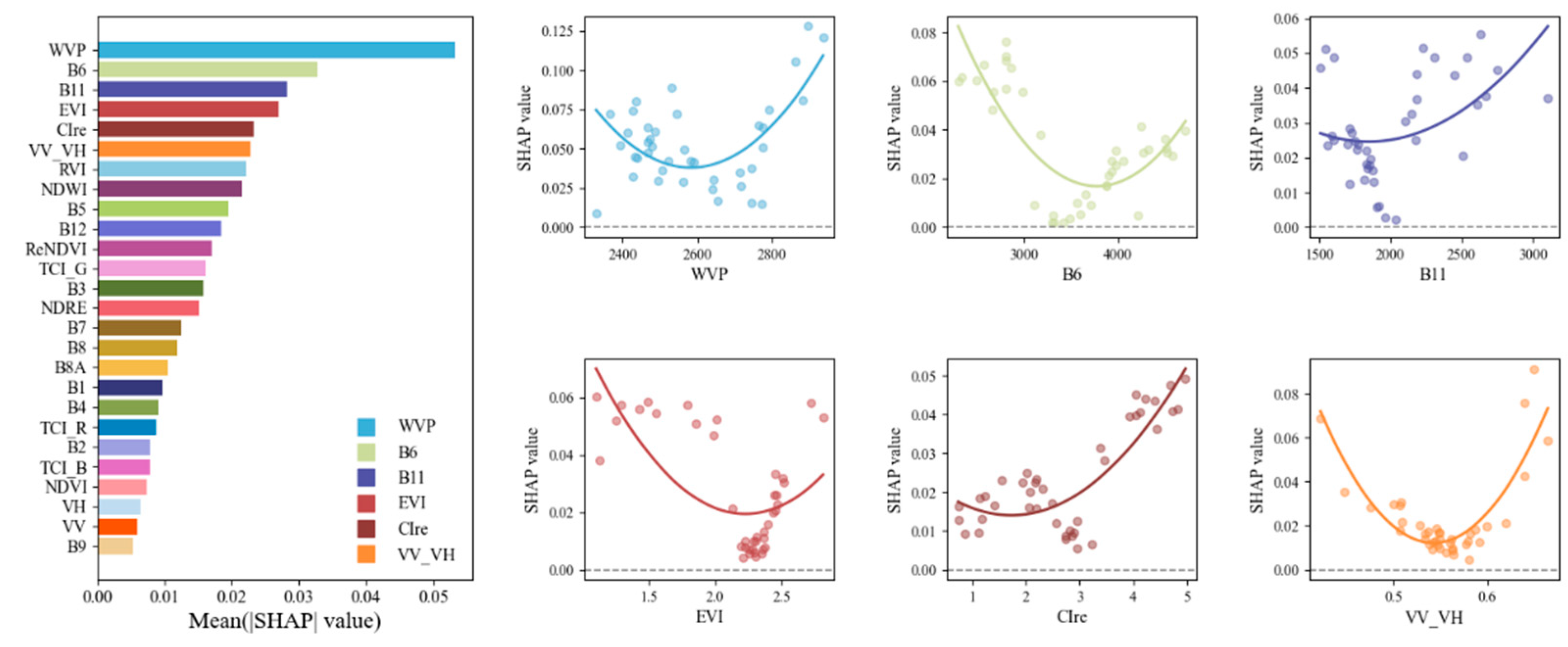
Figure 15.
SHAP-based interpretation of the SVM model.
Figure 15.
SHAP-based interpretation of the SVM model.
Figure 16.
SHAP-based interpretation of the RF model.
Figure 16.
SHAP-based interpretation of the RF model.
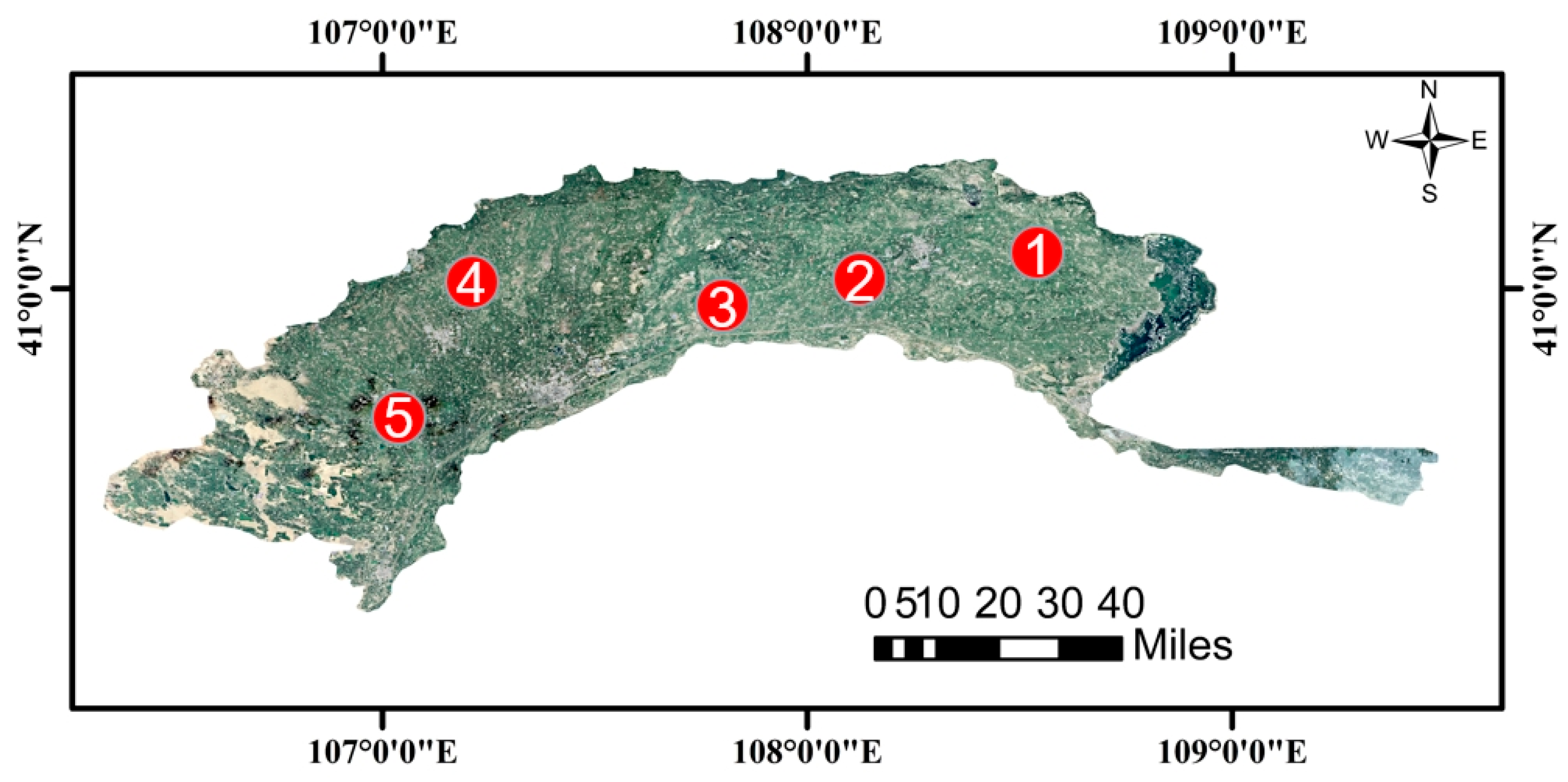
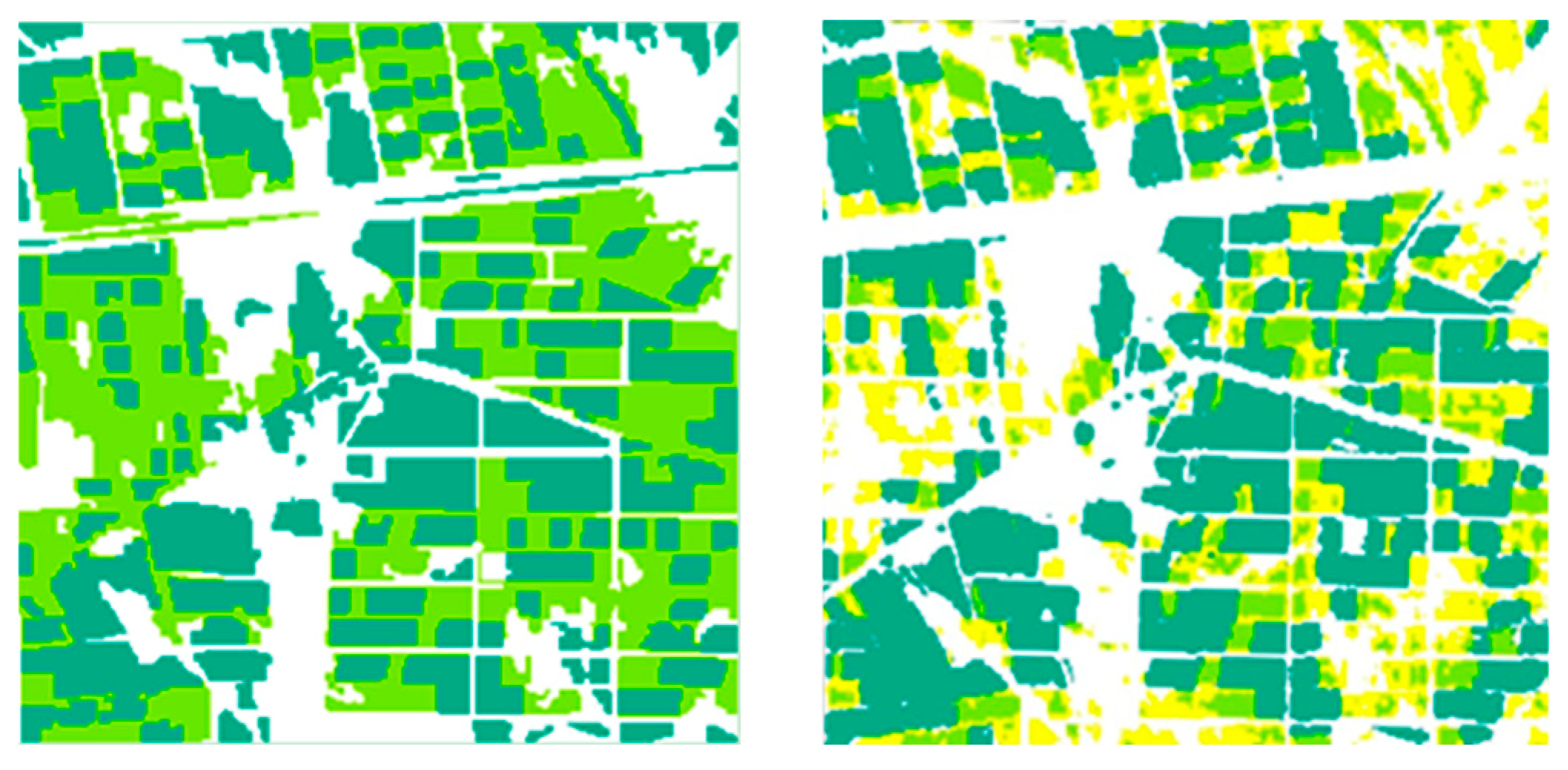
Figure 17.
Five example distribution charts of three classification models. The numbers 1-5 in the figure correspond respectively to the numbers 1–5 in
Table 6.
Figure 17.
Five example distribution charts of three classification models. The numbers 1-5 in the figure correspond respectively to the numbers 1–5 in
Table 6.
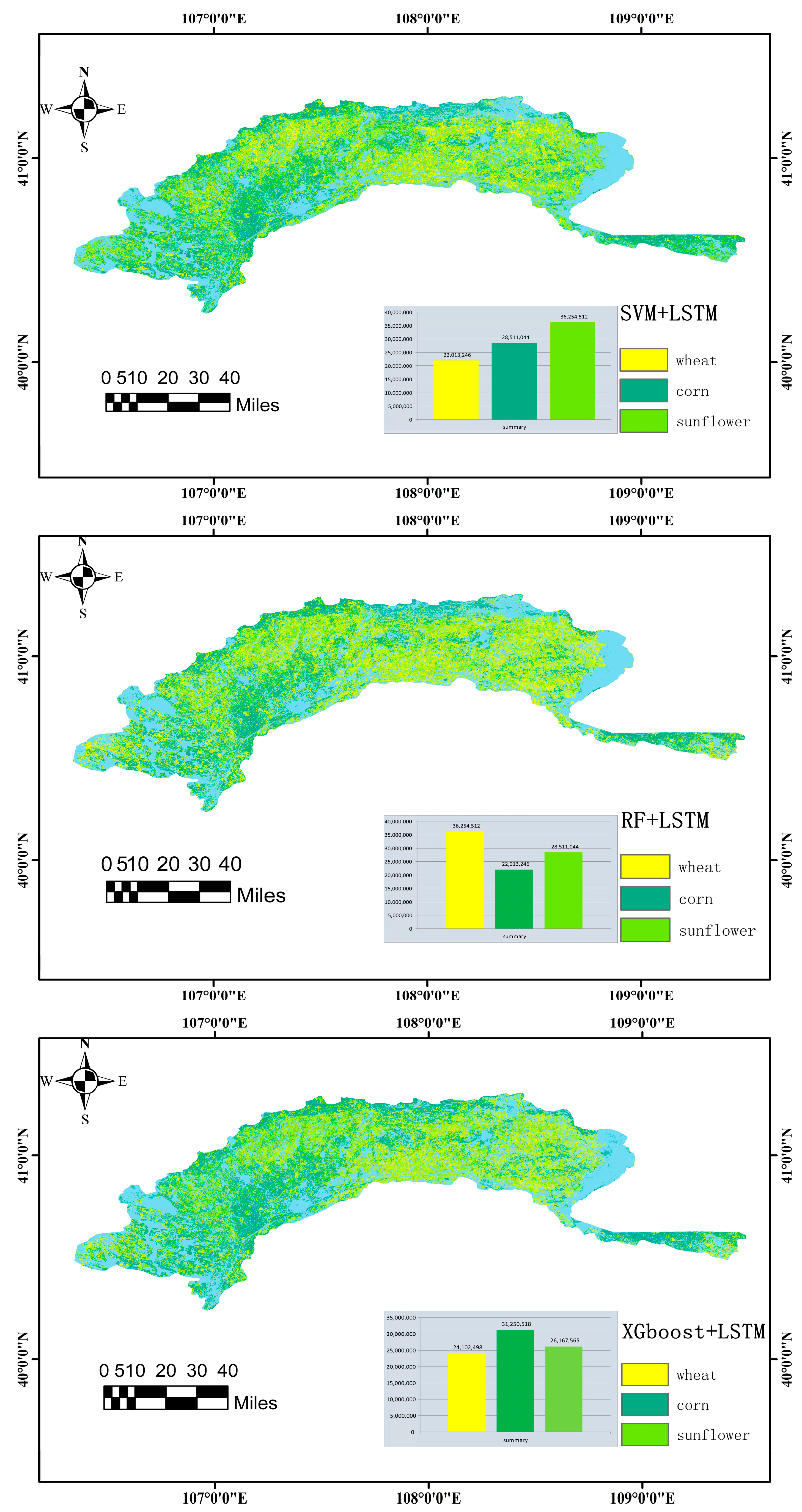
Figure 18.
Large-scale mapping results of the three methods and corresponding parcel-level statistical values.
Figure 18.
Large-scale mapping results of the three methods and corresponding parcel-level statistical values.
Figure 19.
Representative visual comparison between pixel-based and parcel-based classification results. The pixel-based approach shows evident salt-and-pepper noise and more ambiguous field boundaries, whereas the parcel-based framework produces more homogeneous within-parcel patterns and clearer spatial continuity. Although some parcel borders may be narrower than the spatial resolution of the input imagery, parcel-level aggregation still helps reduce local mixed-pixel noise and improves the overall coherence of field-scale crop maps.
Figure 19.
Representative visual comparison between pixel-based and parcel-based classification results. The pixel-based approach shows evident salt-and-pepper noise and more ambiguous field boundaries, whereas the parcel-based framework produces more homogeneous within-parcel patterns and clearer spatial continuity. Although some parcel borders may be narrower than the spatial resolution of the input imagery, parcel-level aggregation still helps reduce local mixed-pixel noise and improves the overall coherence of field-scale crop maps.
Table 1.
Summary of Sentinel-1 and Sentinel-2 data used in this study.
Table 1.
Summary of Sentinel-1 and Sentinel-2 data used in this study.
| Data Source | Acquisition Period | Source | Acquisition Mode | Type | Polarisation Channels | Number of Scenes |
|---|
| Sentinel-1 | 1 March 2024 to 12 October 2024 | Copernicus BROWSER | IW | GRD | VV + VH | 8 |
| Data source | Acquisition period | source | Cloud threshold | processing level | Tile ID | Number of scenes |
| Sentinel-2 | 1 March 2024 to 30 October 2024 | Copernicus BROWSER | ˂10% | L2A | T48TYL | 66 |
Table 2.
Band information and feature definitions of Sentinel-2 (S2) and Sentinel-1 (S1).
Table 2.
Band information and feature definitions of Sentinel-2 (S2) and Sentinel-1 (S1).
| Band and Feature Calculation Formula |
|---|
| S2 | Blue | B2 496.6 nm (S2A)/492.1 nm (S2B) |
| Green | B3 560 nm (S2A)/559 nm (S2B) |
| Red | B4 664.5 nm (S2A)/665 nm (S2B) |
| NIR | B8 835.1 nm (S2A)/833 nm (S2B) |
| SWIR-1 | B11 1613.7 nm (S2A)/1610.4 nm (S2B) |
| SWIR-2 | B12 2202.4 nm (S2A)/2185.7 nm (S2B) |
| RENDVI | (B8 − B7)/(B8 + B7) |
| GNDVI | (B8 − B3)/(B8 + B3) |
| NDVI | (B8 − B4)/(B8 + B4) |
| EVI | 2.5 × (B8 − B4)/(B8 + 6 × B4 − 7.5 × B2 + 1) |
| NDRE | (B8 − B5)/(B8 + B5) |
| cIre | B8/B5 − 1 |
| NDWI | (B8 − B11)/(B8 + B11) |
| SAVI | 1.5(B8 − B4)/(B8 + B4 + 0.5) |
| S1 | Backscattering coefficient under VV polarization | σ0_VV |
| Backscattering coefficient under VH polarization | σ0_VH |
| Backscattering coefficient ratio | VV/VH |
| RVI | 4 × VH/(VV + VH) |
Table 3.
Quantitative Comparison of Parcel Extraction Methods.
Table 3.
Quantitative Comparison of Parcel Extraction Methods.
| Extraction Method | Boundary IoU | Remarks |
|---|
| U-Net (Baseline) | 63.21% | Suffers from severe parcel adhesion; spectral and phenological signals of different crop types are frequently mixed. |
| SNIC (Proposed) | 77.34% | Effectively suppresses “salt-and-pepper” noise while maintaining high within-parcel spatial homogeneity. |
Table 4.
Preliminary sensitivity analysis for selecting SNIC parameter settings.
Table 4.
Preliminary sensitivity analysis for selecting SNIC parameter settings.
| Model | Seed Spacing (Pixels) | Compactness | Overall Accuracy (OA) | mIoU | Kappa |
|---|
| XGBoost + LSTM | 8 | 20 | 93.42% | 87.15% | 91.35% |
| XGBoost + LSTM | 10 | 20 | 93.61% | 87.41% | 91.66% |
| XGBoost + LSTM | 15 | 20 | 92.85% | 86.20% | 90.50% |
| XGBoost + LSTM | 10 | 10 | 93.15% | 86.80% | 91.02% |
| XGBoost + LSTM | 10 | 30 | 93.50% | 87.00% | 91.40% |
Table 5.
Ablation study on the impact of feature selection (using the XGBoost + LSTM model).
Table 5.
Ablation study on the impact of feature selection (using the XGBoost + LSTM model).
| Feature Strategy | Overall Accuracy (OA) | mIoU | Kappa |
|---|
| Reduced Feature Set (After explicit feature selection via RFE) | 93.35% | 86.92% | 0.90 |
| Full Feature Set (No explicit feature removal) | 93.61% | 87.41% | 0.91 |
Table 7.
Validation results of different crops for the three models.
Table 7.
Validation results of different crops for the three models.
| Model | RF + LSTM | SVM + LSTM | XGBoost + LSTM |
|---|
| Crop Types | Wheat | Corn | Sunflower | Wheat | Corn | Sunflower | Wheat | Corn | Sunflower |
|---|
| F1 | 81.35% | 93.33% | 90.9% | 70.83% | 85.71% | 76.9% | 85.61% | 97.22% | 87.27% |
| UA | 80% | 96.55% | 92.1% | 73.91% | 80.76% | 78.12% | 87.20% | 96.80% | 89.10% |
| PA | 82.76% | 90.32% | 89.74% | 68% | 91.35% | 75.66% | 84.08% | 97.64% | 85.51% |
| IoU | 68.57% | 87.5% | 83.33% | 54.84% | 75% | 62.47% | 74.84% | 94.59% | 77.41% |
Table 8.
Results of the ablation experiments.
Table 8.
Results of the ablation experiments.
| Model | RF | RF + LSTM | SVM | SVM + LSTM | XGBoost | XGBoost + LSTM |
|---|
| OA | 84.67% | 90.78% | 78.83% | 82.81% | 85.4% | 93.61% |
| kappa | 0.80 | 0.88 | 0.72 | 0.81 | 0.81 | 0.92 |
| mIoU | 72.8% | 81.34% | 61.85% | 70.46% | 73.23% | 87.41% |
Table 9.
Comparison of classification performance before and after Sentinel-1 linear interpolation (using the XGBoost + LSTM model).
Table 9.
Comparison of classification performance before and after Sentinel-1 linear interpolation (using the XGBoost + LSTM model).
| Data Processing Strategy | Overall Accuracy (OA) | mIoU | Kappa |
|---|
| Without Interpolation (Nearest-neighbor temporal matching) | 93.18% | 86.82% | 0.91 |
| With Linear Interpolation (Synchronized to 15-day intervals) | 93.61% | 87.41% | 0.92 |
Table 10.
Comparison of optical-only, SAR-only, and multi-source classification performance.
Table 10.
Comparison of optical-only, SAR-only, and multi-source classification performance.
| Feature Source | OA | Kappa | mIoU |
|---|
| Optical only | 91.24% | 0.88 | 83.92% |
| SAR only | 84.31% | 0.79 | 72.46% |
| Optical + SAR | 93.61% | 0.92 | 87.41% |
Table 11.
Pixel-based vs. parcel-based classification comparison.
Table 11.
Pixel-based vs. parcel-based classification comparison.
| Method | OA | Kappa | mIoU |
|---|
| Pixel-based RF | 88.42% | 0.85 | 75.31% |
| Parcel-based RF | 90.78% | 0.88 | 81.34% |
| Pixel-based XGBoost | 89.57% | 0.87 | 77.18% |
| Parcel-based XGBoost | 93.61% | 0.91 | 87.41% |
| Pixel-based SVM | 79.57% | 0.77 | 67.44% |
| Parcel-based SVM | 82.81% | 0.81 | 70.46% |