Review

On-Site Devices for Precision Agriculture Applications: A Review of Soil and Plant Sensors

by
Nataša Ljubičić
1,*,†,
Federico Figueredo
2,†,
Irena Miler
1,
Lucas Rodrigues Sousa
2,
Tijana Barošević
1,
Máximo Tuccillo
2,
Maša Buđen
1,
Nevena Stevanović
1,
Nikola Stanković
1,
Victor David Gimenez
3,
Eduardo Corton
2 and
Ivana Gadjanski
1,4,*,†
1
Center for Biosystems, BioSense Institute, University of Novi Sad, Dr Zorana Djindjica 1, 21000 Novi Sad, Serbia
2
Laboratorio de Biosensores y Bioanálisis (LABB), Departamento de Química Biológica e IQUIBICEN-CONICET, Facultad de Ciencias Exactas y Naturales, Universidad de Buenos Aires (UBA), Pabellón 2, Ciudad Universitaria, Buenos Aires C1043AAZ, Argentina
3
Departamento de Producción Vegetal, Facultad de Agronomía, Universidad de Buenos Aires, Cátedra de Cerealicultura, Av. San Martín 4453, Buenos Aires C1417DSE, Argentina
4
Department of Experimental Oncology, Institute for Oncology and Radiology of Serbia, Pasterova 14, 11000 Belgrade, Serbia
*
Authors to whom correspondence should be addressed.
These authors contributed equally to this work.
Agriculture 2026, 16(8), 883; https://doi.org/10.3390/agriculture16080883
Submission received: 20 February 2026 / Revised: 27 March 2026 / Accepted: 7 April 2026 / Published: 16 April 2026
(This article belongs to the Section Artificial Intelligence and Digital Agriculture)

Abstract

Agriculture, as a basis of sustainable development, faces increasing pressure to meet rising global food demands while confronting the increasing impacts of climate change. Precision agriculture offers a data-driven approach to address these challenges by optimizing input use, improving productivity, and reducing environmental impacts. Sensor technologies play a critical role in smart and precision agriculture, offering high-resolution spatial and temporal insights into soil conditions, plant development and environmental conditions. This review highlights the current state and future potential of various sensor and imaging systems, particularly their role in monitoring soil properties, crop nutrition, plant health and detecting biotic and abiotic stressors. Special attention is given to accessible paper-based and printed electrochemical devices for on-site soil and plant analysis, as well as active handheld multispectral sensors designed for real-time canopy assessment. The integration of sensor-derived data with predictive models, IoT networks and decision-support tools enables more precise, site-specific management, improves input efficiency and supports climate-resilient agricultural practices. By examining the capabilities, limitations and future potential of these sensing platforms, this review highlights their growing importance in advancing sustainable intensification and strengthening crop production.

1. Introduction

Given that the global population is projected to increase by approximately 35% over the next 40 years, a significant rise in agricultural output will be necessary to meet the resulting growing demand [1]. On the other hand, agriculture is facing even more uncertainties and potential risks due to unpredictable environmental conditions and climate change. Abiotic stresses such as drought and heat, as well as biotic stresses including pests and diseases, are expected to intensify due to climate change, posing a serious threat to global crop productivity [2,3]. In this context, optimizing agricultural operations becomes essential to ensure the long-term sustainability of food production systems [4]. Conventional agriculture, defined by uniform practices, techniques and processes applied across large areas, often results in inefficiencies and the excessive use of key inputs such as pesticides, fertilizers and water resources. Conventional laboratory techniques for assessing plant health status and soil nutrient levels are accurate and reliable. However, such laboratory-based estimations are often laborious, time-consuming and inaccessible to small-scale crop producers or field researchers. A comprehensive assessment of plant and soil quality usually involves measuring various biological, chemical and physical parameters. This practice is frequently constrained by the high cost and complexity of laboratory analyses, which often require hazardous chemicals and may be destructive [5,6]. Hence, there is a need not only for on-site detection methods but also for integrated evaluation of their relative strengths, limitations and application across various crop types and growth stages. This review does not simply catalog sensing devices but aims to provide a critical synthesis highlighting technological gaps, comparative advantages and areas where further development is needed to bridge research and field application. Therefore, it is crucial to develop affordable and user-friendly methodologies that enable in-field detection and identification of early crop stress, together with the evaluation of soil nutrient availability and fertility, before visible symptoms or significant damage occur, to support timely management decisions and minimize negative impacts on crop development and yield [2]. Precision agriculture, as a component of the broader concept of smart agriculture, is a management strategy that reduces chemical inputs, optimizes crop performance, protects plant health, and improves yields and environmental health. Precision agriculture uses technology to measure and analyze field variability, enabling more accurate crop management decisions. Smart farming extends this concept by integrating advanced technologies such as the Internet of Things (IoT), artificial intelligence (AI) and robotics to support autonomous and intelligent practices. These innovations improve productivity and profitability while promoting environmental sustainability and better decision making [7,8]. To date, precision agriculture has primarily involved variable rate technologies (VRTs), field mapping, yield monitors and guidance systems [9]. Numerous cutting-edge technologies, such as remote sensing, the Global Positioning System (GPS), geographic information systems (GISs), big data analysis, the Internet of Things (IoT) and artificial intelligence (AI), have contributed to the ongoing technological revolution in agriculture by providing solutions to optimize inputs, increase productivity and reduce the adverse effects on the environment [10,11,12]. However, the comparative estimation of these technologies, particularly in terms of resolution, operational cost, ease of application and integration into farm management systems, remains underexplored. Highlighting these comparative aspects allows identifying which tools are most suitable for different scales and conditions, as well as technological gaps that need attention. Recent developments in agricultural technologies have made available for use by farmers a variety of sensors and sensing services [13]. Although numerous sensors perform well under controlled laboratory conditions, their practical utility performance and applicability in real field conditions remain variable and often limited. The development of new analytical systems and sensor devices has made a significant contribution to precision and smart agriculture by enhancing plant production. Sensor technologies are gaining increasing importance, as they produce real-time data for site-specific management and continuous crop monitoring throughout the growing season [14,15]. These sensors measure various crop parameters, including crop status, moisture levels, nitrogen content and vegetation health, among others. This information supports informed decision making regarding input application and overall field management [16,17]. The IoT is a system of connected devices and sensors that collect and share data. In precision agriculture, these sensors and analytical devices not only gather information but are also connected to networks capable of transmitting and processing the data in real time [15,18]. To date, IoT sensors for agriculture applications include soil strength sensors [19], soil moisture sensors [10], flow control and variable rate sensors for irrigation and fertilization [20], climate sensors integrated into IoT-enabled weather stations [21] and crop health optical sensors also coupled to unmanned aerial vehicles (UAVs or drones) to cover huge areas, providing accurate crop monitoring with high-resolution images and data [18]. Among the numerous innovative technologies that have increased the rise of precision agriculture, contemporary optical sensing emerges and stands out as a transformative tool. Optical sensing technologies operate on the principle of light interacting with agricultural traits, providing important insights into plant health, soil properties and environmental conditions [22,23,24]. As one of the many technologies, optical multispectral sensors are increasingly used in precision agriculture, phenotyping and environment monitoring. Optical multispectral sensors measure plant reflectance in different selected spectral bands (e.g., red, blue, green, red-edge, near-infrared, i.e., NIR) to calculate different vegetation indices (VIs) such as the normalized vegetation index (NDVI), enabling efficient monitoring of plant health, nutrition, plant biomass and plant stress responses [25]. Reliable data requires appropriate radiometric calibration utilizing integrated light sensors or reflectance panels. Optical multispectral sensors are widely used in vegetation classification and cover estimation, crop vigor assessment, stress detection and phenotyping, temporal monitoring and trend analysis, as well as in assessing plant food quality, maturity prediction, detecting changes and monitoring postharvest stress in fruits, cereals, etc. [26]. Many vegetation indices saturate in dense canopies, reducing sensitivity to changes in high-biomass conditions. Vegetation indices, such as the NDVI, soil-adjusted vegetation index (SAVI) and red-edge indices, have certain disadvantages as they may get saturated under dense vegetation but are sensitive to canopy structure and chlorophyll [27]. Despite their usefulness, limitations include saturation, geolocation errors and sensitivity to lighting conditions. In order to overcome these limitations, emerging solutions involve real-time reflectance correction and data fusion with various sensors [28].
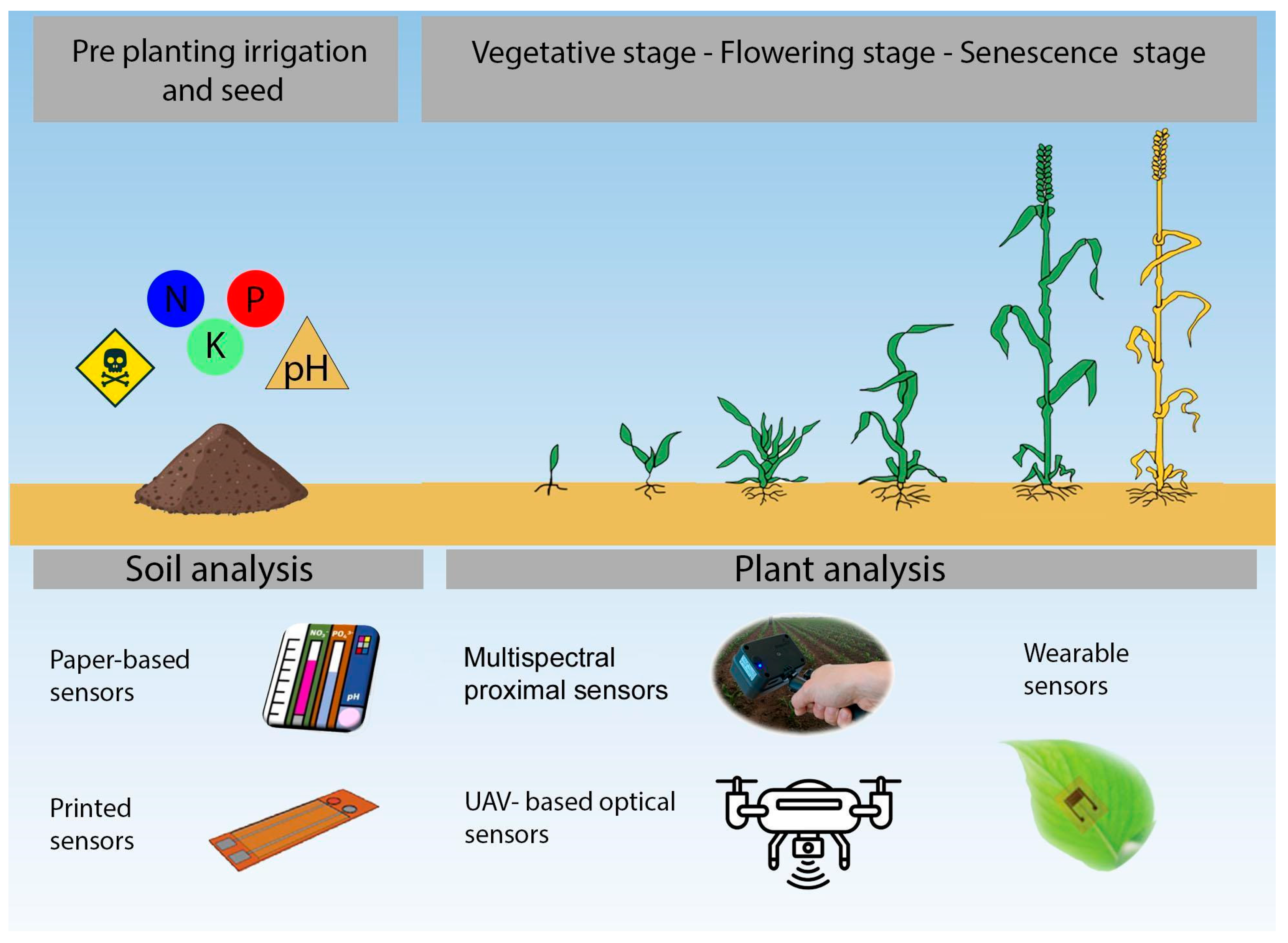
Paper-based analytical devices (PADs) and printed electrochemical devices have emerged as promising alternatives for rapid, low-cost, and affordable on-site detection platforms. A comparison of PADs and printed electrochemical devices shows that PADs are user-friendly and allow rapid nutrient measurements, whereas printed electrochemical devices offer broader analytical functions and multiplexing potential, yet their practical use is limited by equipment dependencies and standardization challenges. They are designed as disposable, single-use sensors, enabling mass production, easy transportation, and widespread use. Although initially developed for clinical diagnostics, the versatility of PADs and printed electrochemical devices has led to their growing popularity in other fields such as pharmaceutical settings, environmental monitoring, agricultural and food quality applications, biotechnology and petrochemistry. In recent years, PADs and printed electrochemical devices have been increasingly explored for both soil and plant analysis, offering the potential to integrate multiple detection capabilities for comprehensive crop management. PADs are mostly colorimetric devices, capable of detecting soil nutrients, enabling on-site analyses without the need for complex instrumentation. In contrast, printed electrochemical devices require the use of instrumentation (potentiostats) to perform the analysis. However, in the last few years, several companies have offered portable and battery-based potentiostats, allowing them to perform in field determinations. Printed electrochemical devices have been developed for soil and plant analysis. Particularly, flexible sensors have been used as plant wearable devices, enabling the detection of a wide range of biomarkers. This review is structured as a narrative review, aiming to synthesize and critically discuss recent advances in sensing technologies for precision agriculture rather than to provide a systematic or reproducible meta-analysis. The literature was selected based on relevance to key sensing technologies, including proximal and remote sensing systems, optical sensors, electrochemical devices and laser-based imaging techniques, with a focus on studies published between 2000 and 2025. Although a formal systematic review protocol was not applied, the selection of literature was guided by the objective of covering representative and widely used technologies, as well as emerging approaches relevant to crop and soil monitoring. This approach allows for a comprehensive and integrative discussion of technological developments, their advantages, limitations and potential applications in precision agriculture. This review provides an overview of recent advances in sensing technologies applied to precision agriculture, with a particular emphasis on soil and crop monitoring and considering all crop stages. As can be seen in Figure 1, PADs and printed electrochemical devices can be used for on-site analysis of soil parameters before seeding, while optical and wearable sensors are planned to be used for the vegetative, flowering and senescence stages. Herein, we examine the advantages and limitations of all these sensing platforms and highlight their integration into modern agricultural practices aimed at improving crop productivity and supporting sustainable intensification. A comprehensive literature survey was conducted on proximal and remote sensing technologies, PADs, printed devices and laser-scanning methods relevant to crop production.
The article is organized as follows: Section 3.1 discusses the advantages and disadvantages of proximal sensing systems. Section 3.2 presents key applications of remote sensing technologies. Section 3.3 focuses on PADs and printed electrochemical devices, while Section 3.4 addresses laser-scanning approaches, including imaging techniques for plant disease detection and image processing workflows.

2. Methodology of the Literature Review

This review provides a comprehensive synthesis of peer-reviewed scientific literature on soil and plant sensors published from 2000 to 2025. The literature included in this review was identified through a comprehensive search of the Web of Science, Scopus, PubMed, IEEE Xplore, Research Gate and Google Scholar databases. The search strategy applied combinations of keywords within field area including proximal sensing, active optical sensor, multispectral sensor, vegetation indices, NDVI, phenotyping, crop stress detection, precision agriculture, UAV, multispectral imaging, paper-based analytical devices, printed devices and optical imaging. To ensure relevance to applied agricultural research, the search explicitly targeted studies addressing key application domains, namely crop stress detection, soil fertility assessment, soil nutrient monitoring, precision phenotyping, and plant status assessment. Additional literature was identified through screening the reference lists of key publications. Only articles published in English were considered. All collected references were reviewed after duplicates had been removed. Titles and abstracts were assessed for relevance, followed by full-text evaluation based on predefined inclusion and exclusion criteria. Studies were included if they addressed portable or proximal sensing devices, UAV-based multispectral platforms, paper-based analytical devices or advanced optical imaging techniques applied to agriculture and reported experimental or field-based results related to crop monitoring, phenotyping, yield prediction, nutrient management or stress detection. Exclusion criteria comprised conference abstracts without data and studies with insufficient methodological description. The final set of selected publications formed the basis of the qualitative synthesis presented in this review, with particular emphasis on the development, validation and field application of various sensors and complementary sensing approaches.

3. Multimodal Approaches for Crop Monitoring and Agricultural Analysis

In recent years, rapid developments in sensing technologies have given rise to a broad spectrum of monitoring platforms. Today, the most commonly used systems include ground-based remote sensing, UAV-based remote sensing, paper-based and printed sensing devices, and multiphoton laser scanning microscopy (MLSM). Each of these platforms contributes uniquely to the assessment of crop status and the detection of both abiotic and biotic stresses.

3.1. Active Multispectral Proximal Sensors in Agriculture

Multispectral sensors used in crop monitoring offer detailed spatial and temporal resolution, supporting precision agriculture through continuous assessment of crop development. The resulting data streams enable early detection of both biotic and abiotic stress factors, such as diseases, water limitations and nutrient deficiencies, which can improve resource use efficiency (such as an optimized nitrogen application) and reduce environmental impact through targeted interventions. This allows for informed and timely management interventions that contribute to improved crop performance and optimized yields [29,30]. By leveraging various proximal and remote optical sensing platforms, spectral data have been effectively used to monitor canopy structure and plant growth dynamics, enhancing our understanding of plant development and nutrient assimilation [30,31]. Numerous ground-based sensors, operating in either passive or active modes, have been employed to generate VIs for assessing photosynthetic activity and other biophysical characteristics of crop vegetation [32]. Passive sensors rely on ambient sunlight and therefore they are sensitive to changing illumination conditions, whereas active sensors use their own light source (typically in specific bands), enabling more stable and repeatable measurements under variable field conditions. In practice, the selection and choice between active and passive sensors depend on the specific application, required accuracy and environmental conditions. For consistent, on-the-go field measurements, active sensors may offer a better balance between usability and accuracy, particularly as sensor technologies continue to advance [33].
Proximal sensing, as opposed to remote sensing platforms like drones or satellites, refers to sensor technologies that operate in close proximity, typically within a few meters or in direct contact with plants, soil, or surfaces, to collect high-resolution local data. In agricultural applications, handheld sensors offer flexibility and on-demand data acquisition, making them a practical and accessible solution for growers [34]. Handheld proximal multispectral sensors are portable devices that capture crop or leaf reflectance across specific wavebands within the visible, red-edge and NIR spectral ranges [35]. Typically, such devices operate using a limited number of independent wavelengths (from two to six bands), yet they can be used to calculate dozens of vegetation indices (frequently more than 30), depending on band combinations and application requirements. These tools serve as a bridge between traditional remote sensing (e.g., UAVs and satellites) and laboratory-based measurements, enabling real-time, in-field assessment of plant traits such as biomass, nitrogen content, chlorophyll concentration and stress indicators. Their use is often considered cost-effective due to reduced requirements for laboratory analyses and more efficient input management. They have become essential tools in precision agriculture, plant phenotyping and non-destructive crop monitoring [36].
Canopy reflectance sensors measure reflectance within the visible and NIR spectra and express outputs as vegetation indices (e.g., NDVI), which are used to assess parameters like canopy temperature, chlorophyll content, and overall crop vitality [11,37]. Most spectral sensors are designed to detect reflected light that can be detected in the visible (VIS which is approximately 400–700 nm) and near-infrared (NIR, which is around 700–2500 nm) spectral regions. The reflectance of plants, determined by their light absorption, transmission or reflection, is linked to the crop’s physiological condition and developmental characteristic [33]. Widely adopted commercial multispectral sensor products include: CropCircle (Holland Scientific, Lincoln, NE, USA), N-sensor ALS (Yara International ASA, Oslo, Norway), ASD FieldSpec (Analytical Spectral Devices, Boulder, CO, USA), GreenSeeker (Trimble Inc., Sunnyvale, CA, USA) [38]. Handheld sensors such as GreenSeeker and CropCircle, along with chlorophyll meters like the SPAD 502 Plus (Konica Minolta, Tokyo, Japan) and atLEAF (FT Green LLC, Wilmington, DE, USA), are widely available, including in developing regions, where they support site-specific nitrogen management strategies [39]. Other notable active proximal sensors, besides POM, include GreenSeeker, CropCircle and SPAD/atLEAF, which collectively illustrate the diversity of commercially available tools for real-time plant trait assessment. This broader coverage ensures that the review reflects the spectrum of sensor options rather than emphasizing a single device excessively. Compared to high-end hyperspectral systems, these sensors are generally more affordable and easier to operate, contributing to their wider adoption.
Beyond their use in precision agriculture, proximal sensors have become increasingly important tools in plant phenotyping. Their ability to non-destructively quantify plant traits, such as leaf chlorophyll content, canopy architecture and stress responses, makes them indispensable for high-throughput phenotyping efforts aimed at improving crop varieties [40]. Plant phenotyping plays a crucial role in bridging the genotype-to-phenotype gap by providing measurable indicators of plant performance under varying environmental conditions [41,42,43,44]. The integration of proximal sensing in phenotyping platforms enables rapid, scalable, and accurate trait assessment, accelerating breeding programs and enhancing crop resilience in the face of climate variability [43,44,45]. The Plant-O-Meter (POM) is presented as one illustrative example of an active multispectral proximal sensor. It integrates active lighting with a portable design and an Android application for georeferenced vegetation index mapping. POM demonstrates the principles and potential of active sensors but is not emphasized over other commercially available devices. Its inclusion serves to contextualize proximal sensing applications rather than prioritize a single technology [46,47,48,49,50,51,52,53].
The main advantages of using spectral bands in the VIS, red-edge and NIR regions are vegetation indices (VIs). VIs are spectral indices computed using spectral bands in the visible, red-edge and NIR regions [39]. To date, numerous vegetation indices have been studied, each tailored to specific applications such as biomass estimation, nitrogen and water status or stress detection. They have been widely applied in biological, agricultural and environmental investigations. VIs can help assess soil properties by detecting non-vegetated surfaces or indirectly analyzing deeper layers through plant responses. The number of spectral indices developed to date exceeds several hundred and continues to expand in response to ongoing scientific advancements and emerging research findings [25]. This variety of indices allows flexible, application-specific analysis while maintaining relatively low data acquisition costs when compared to more complex sensing approaches. Active multispectral proximal sensors have many disadvantages despite their numerous advantages, including adaptability, real-time operation and independence from ambient light. Common limitations affecting all active sensors include high energy requirements, limited spectral resolution, device cost, ergonomics and scalability for large fields, which are considered in relation to multiple devices, not only the POM [30]. Comparative studies indicate that passive and active sensors each have situational advantages: passive sensors may offer higher sensitivity under optimal lighting, while active sensors provide robust measurements under variable field conditions [33]. By considering a variety of sensors (GreenSeeker, CropCircle, SPAD/atLEAF, and POM), this review ensures a balanced discussion across technology classes, highlighting their relative strengths, limitations, and field applications without overemphasizing a single device. A variety of working, financial and technical challenges need to be considered when incorporating these kinds of systems into agricultural monitoring programs [30]. These comprise:
  • High energy requirements. Active sensors transmit light towards plant surfaces using internal light sources, usually light-emitting diodes (LEDs). In outdoor situations, maintaining this artificial illumination requires a steady and significant power source. This reduces the operating time of portable and handheld systems and may require regular battery replacement or recharging, especially in far away or large-scale field settings [33]. However, despite these recognized limitations, the available literature still lacks quantitative data regarding battery life and actual power consumption under field conditions, specifically for devices such as the Plantometer (BioSense). The absence of such data makes it difficult to accurately assess operational efficiency, long-term deployment potential, and overall energy sustainability in practical agricultural applications.
  • Insufficient spectral resolution. Active multispectral sensors usually work within a few separate wavebands, in contrast to passive hyperspectral sensors, which may detect continuous reflectance across hundreds of narrow bands. This limits the range of VIs that can be produced and reduces their capacity to identify small changes in crop physiology [54].
  • Less sensitivity in optimal lighting. Studies have indicated that passive sensors may work better in adequately illuminated surroundings than active sensors, even while active sensors perform better in changeable or low-light conditions. To measure crop traits like chlorophyll or pigment composition, passive sensors can use full-spectrum sunlight to detect small spectral variations, increasing sensitivity [33].
  • Cost and availability. Even though they are becoming increasingly cost-effective, many high-precision active sensors are still too expensive for smallholder farmers and institutions in developing countries, especially the sensors with wireless or integrated processing capabilities. The requirement for calibration, maintenance and even sensor replacement increases costs significantly [34,39].
  • Interpreting limited data without expertise. Accurate interpretation of the reflectance data generated by active sensors requires the use of calibration graphs or agronomic modeling. Inaccurate predictions regarding plant health or nutrient requirements may result from incorrect interpretation. Adoption by non-specialist users may be restricted in the absence of adequate education or assistance tools [31,34].
  • Size and ergonomics of the device. Some active multispectral sensors, particularly those with integrated computing units or battery packs, might be heavy or difficult for continuous field use, while being promoted as handheld and portable. This can reduce measurement efficiency and operator comfort during long sampling sessions [55].
  • Limited scalability for monitoring at large scales. Active handheld sensors’ proximate nature and requirement for immediate contact or near-range measurements make them unsuitable for rapid data gathering over varied fields or for monitoring wide areas. Systems based on satellites or UAVs might provide greater scalability for these kinds of applications [56].
A study by Erdle et al. [33] compared the effectiveness of active and passive spectral sensors in assessing biomass and nitrogen levels in various wheat cultivars under field conditions. The active GreenSeeker NDVI sensor (NTech Industries Inc., Ukiah, CA, USA), which uses its own light source, was evaluated alongside the passive FieldSpec Pro spectroradiometer (Analytical Spectral Devices Inc., Boulder, CO, USA), which relies on ambient sunlight. Findings indicated that both sensor types are valuable for estimating key physiological traits. Passive sensors showed greater sensitivity under optimal light, while active sensors offered more robust operation in variable conditions. However, a key limitation of active sensors remains their requirement for substantial energy to power their light-emitting systems. However, the use of spectral indices can present numerous challenges that are still not fully investigated. Chief among these is the sheer quantity of available indices, which makes it difficult to identify the most suitable and effective ones for specific applications. In addition, inconsistencies in naming can lead to misinterpretation, while overlapping definitions may introduce unnecessary redundancy. Moreover, even when the same index is applied, outcomes may differ depending on the sensors and correction techniques used, thereby reducing the consistency and interpretability of findings across different studies [57].
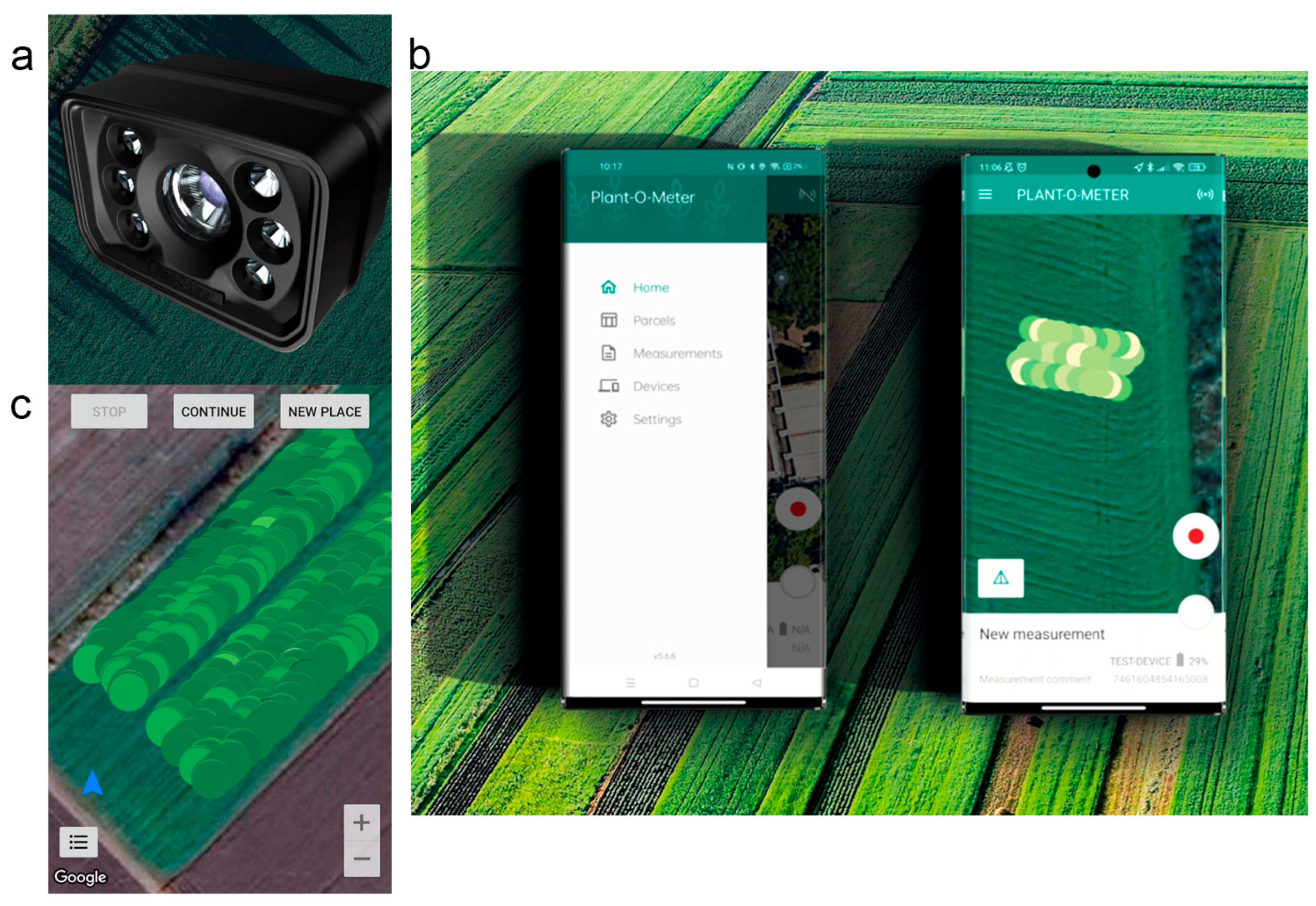
The evolution of proximal sensing has improved monitoring of crop growth, health, and stress under field conditions. Traditional methods relied on ambient light or complex setups, limiting field applicability. Advances in optical sensors have enabled tools that bridge laboratory diagnostics and real-time field monitoring [58]. A notable example is the Plant-O-Meter (POM) (Figure 2), an active proximal multispectral sensor used in precision agriculture and phenotyping [46,47].
Kitić et al. [47] developed the POM as a portable, low-cost sensor with an Android application supporting stationary and continuous modes for real-time georeferenced vegetation index (VI) mapping. The POM is an active multispectral sensor that operates using multiple narrow band light-emitting diodes (LEDs) covering selected wavelengths in the visible and near-infrared (NIR) regions (e.g., blue, green, red, red-edge and NIR) combined with a photodetector that measures canopy reflectance.
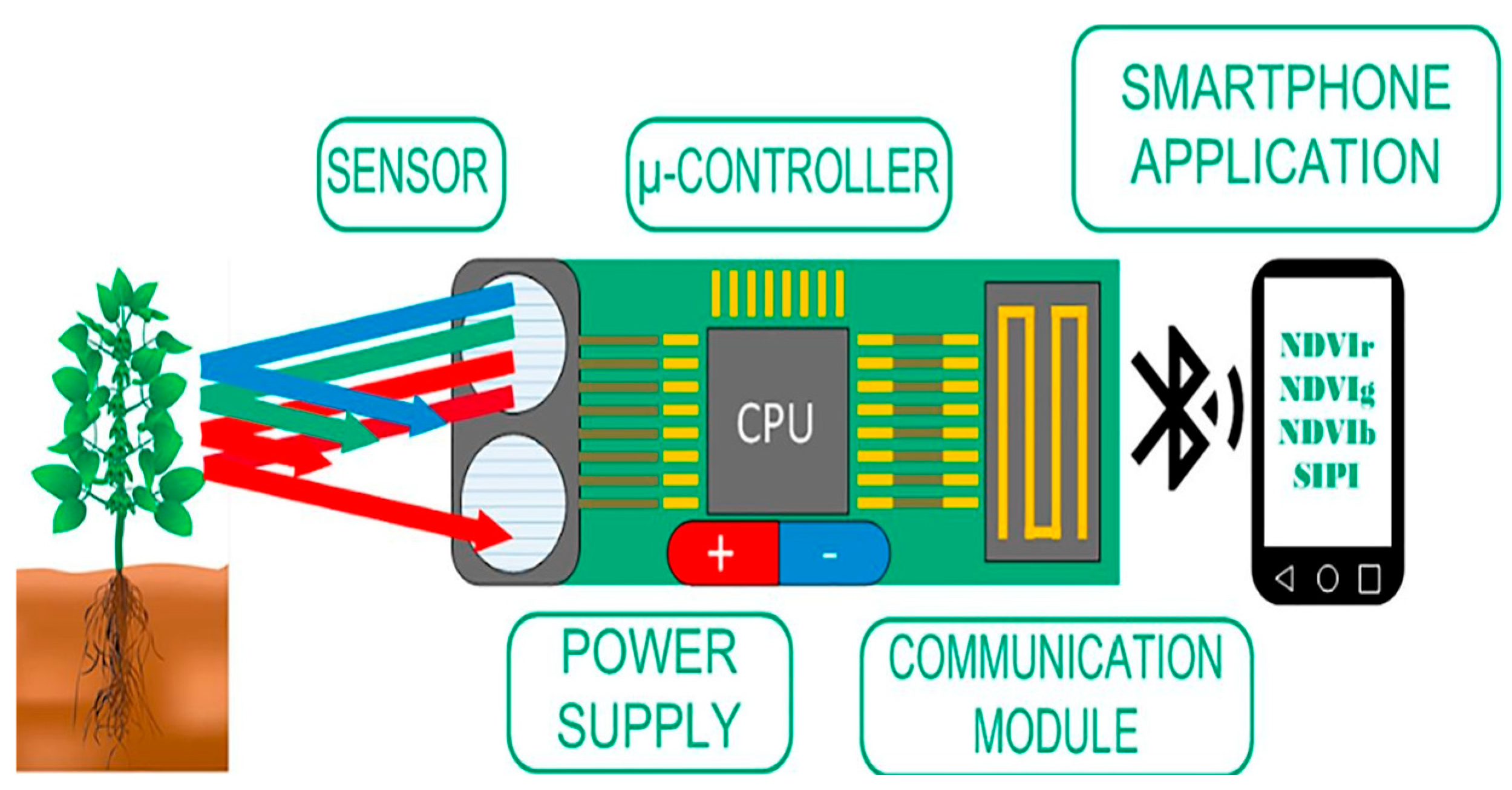
This device integrates active lighting and portability, enabling non-destructive, high-throughput monitoring of plant traits such as chlorophyll content, stress indicators, and canopy variability [48,49]. Strong correlations between NDVI and grain yield at early and middle growth stages highlight its potential for early productivity and nitrogen assessment [50]. The POM provides real-time data and ease of use, making it suitable for small-scale research and farming. It supports rapid, georeferenced data collection across large plots and has shown promising integration with machine learning for yield prediction and trait selection [52]. It is effective in detecting abiotic and biotic stress, including drought and nutrient deficiencies, allowing timely field interventions [53]. Field studies demonstrate strong correlations with biomass and nitrogen in crops such as wheat and maize [48,49,51]. The system uses a multispectral light source with sequential illumination and a detector capturing reflected signals, transmitting data via Bluetooth to an Android device for processing and visualization. The system operates through sequential LED illumination combined with synchronized detection of reflected signals, which are then transmitted via Bluetooth to a mobile device for processing, visualization and calculation of VIs.
This approach enables calculation of over 30 vegetation indices while maintaining simple hardware [47] (Figure 3).
Unlike passive sensors, which depend on ambient light [27], active sensors like POM provide consistent measurements under varying light conditions [33]. Using six LED wavelengths, POM reliably assesses plant height, biomass, chlorophyll, and nitrogen status, with high correlations in major crops [48,51]. It is also applied in phenotyping, stress detection, and machine-learning-based predictions [52,53].
Field trials confirm POM as a reliable tool for crop monitoring, showing strong agreement with biomass, yield, and other traits and comparable performance to systems like GreenSeeker and Sentinel-2 [46,50,59,60,61,62,63,64]. Integration with UAV data enhances yield prediction and crop assessment, while applications in stress detection further demonstrate its versatility [51,63,64,65].
In summary, the POM is a practical, cost-effective tool for real-time crop monitoring, particularly suited for research and small-scale farming. While limited in large-scale applications due to manual operation, it provides accurate and robust multispectral sensing for precision agriculture.

3.2. Remote Passive Unmanned Aerial Vehicle (UAV) Crop Monitoring

For adequate and sustainable crop production, crop stress detection and monitoring are essential. New developments in UAV technology offer an acceptable technique for monitoring important crop traits that are indicative of stress [2]. From the data acquisition platform view, unmanned aerial vehicles (UAVs) provide high flexibility, ease of operation, high spatial resolution and the ability to acquire demanded data, making them highly suitable for field-based crop monitoring applications [66].
In recent years, UAVs have gained increasing prominence due to their advantages, such as high flexibility, ease of operation, high spatial resolution, and the ability to acquire data on demand. As a result, UAVs offer a valuable tool for rapidly and non-destructively extracting phenotypic information of crops in the field [66].
The utilization of drones in agriculture provides significant advantages, including enhanced precision in crop management through high-resolution and real-time data acquisition, optimization of irrigation, fertilization, and pest control practices, reduction of labor intensity and operational costs, improved accessibility of otherwise unreachable areas, promotion of environmentally sustainable production, and increased safety for farmers, collectively contributing to greater efficiency, productivity, and sustainability of agricultural systems [67]. UAVs used for remote sensing in agriculture are equipped with passive multispectral cameras, which are responsible for capturing spectral information. Multispectral imaging is a technique used to inspect materials properties [68]. This camera captures images in multiple wavelength bands, enabling detailed analysis beyond the image seen by the human eye or a standard color (RGB) camera. It captures several distant special bands by using specialized optical filters, filter arrays, or other optical elements that separate incoming light into different wavelength bands. Those bands are usually bands from the visible (~400–700 nm) part of the spectrum, such as standard red, green, blue (RGB), and a few bands beyond these spectral points such as near-infrared (~700–1000 nm), often including the red-edge band (710 nm) [69]. Each pixel in an image acquired by a multispectral camera contains digital values (digital numbers or reflectance values) corresponding to the intensity of light recorded in each spectral band of the sensor. In other words, every pixel stores a set of numerical measurements—one per band (e.g., blue, green, red, red-edge, NIR)—that together form the spectral signature of the observed surface. These values can be used to calculate vegetation indices or other spectral metrics relevant for crop monitoring and precision agriculture.
Multispectral cameras can acquire multiple spectral bands through different optical designs. One approach uses a filter wheel—a rotating assembly of band-pass filters placed in front of a single sensor—to sequentially capture images at distinct wavelengths [68]. Another method employs multispectral filter arrays (MSFAs), in which narrow-band filters are integrated directly onto the sensor, enabling single-shot acquisition of multiple bands without moving parts [70]. Alternatively, some systems consist of multiple discrete cameras, each dedicated to a specific band, capturing all bands simultaneously to ensure precise pixel co-registration and minimal geometric distortion even during UAV motion [71]. The main limitation associated specifically with multispectral (passive) sensors is their dependence on solar illumination. As multispectral cameras on UAV platforms operate in outdoor environments, rigorous radiometric calibration is required to transform raw image data into meaningful reflectance values. Such calibration compensates for illumination variability caused by fluctuations in solar intensity, changes in the sun’s angle, and transient atmospheric conditions during image acquisition. To address these factors, many drone-based systems incorporate onboard sunlight sensors that continuously log incident irradiance during flight, enabling dynamic correction of each image’s brightness and improving radiometric consistency even under patchy cloud conditions [72]. In addition to in-flight irradiance measurements, calibration often includes imaging standardized reflectance panels of known spectral properties before and/or after each flight [73]. This dual approach ensures that recorded pixel values can be accurately normalized, facilitating reliable temporal and spatial comparisons in agricultural monitoring. For leveraging multispectral imaging in agriculture, we need to understand spectral characteristics of crops. Each crop has its own spectral signature due to differences in leaf structure, different pigment concentrations, water content and canopy architecture. Healthy green plants usually reflect more NIR and green light, while absorbing more red and blue light for photosynthesis (chlorophyll a/b) [74]. The abrupt rise in reflectance between red and NIR—the red edge (~680–750 nm)—marks the transition from chlorophyll absorption to internal leaf scattering [75] and chlorophyll content, enabling early detection of plant stress. These characteristics are used to calculate vegetational indices such as NDVI [76,77,78]. Plant spectral signatures are widely exploited for crop classification and mapping [78], yield estimation [76], diverse precision agriculture applications, and a broad range of other agronomic and environmental assessments. UAV imagery and photogrammetric products enable rapid and convenient acquisition of precise crop measurements, identification of various crop characteristics, and effective management of crop conditions [79]. Remote sensing techniques based on VIs have proven effective for accurate and timely monitoring of various crops. This monitoring supports improved on-farm management decisions, informed crop marketing strategies and evidence-based policy making [80]. VIs derived from remotely sensed canopy data are simple yet highly effective tools for both quantitative and qualitative assessments of vegetation cover, vigor, and growth dynamics, among other applications. Such information is primarily extracted from differences and variations in the spectral characteristics of green leaves and plant canopies. Validation is carried out by establishing direct or indirect correlations between the remotely obtained VIs and in situ measurements of vegetation attributes, such as canopy cover, leaf area index (LAI), biomass, growth and vigor [29]. The NDVI is the most widely used and easily calculated tool for assessing vegetation status and attributes, effectively leveraging differences in red and near-infrared reflectance to provide valuable information on vigor, coverage, biomass, and other characteristics of green vegetation [81,82]. In addition to the NDVI, several other vegetation indices are commonly employed in precision agriculture. These include the enhanced vegetation index (EVI), which mitigates soil and atmospheric effects and incorporates the blue spectral band for a more robust assessment of vegetation; the GNDVI, which is particularly suitable for detecting changes induced by stress, disease, or nutrient deficiencies; the soil-adjusted vegetation index (SAVI) and the optimized soil-adjusted vegetation index (OSAVI), both designed to minimize the influence of soil background; the simple ratio (SR); the normalized difference red-edge index (NDRE); and the global environmental monitoring index (GEMI) [83]. Collectively, these vegetation indices enable precise and adaptable monitoring of crop condition and health across diverse agroecological environments. They are strongly correlated with key vegetation traits, such as leaf area index, canopy chlorophyll content, fraction of absorbed photosynthetically active radiation, and gross primary productivity, reflecting their sensitivity to both canopy structure and leaf-level physiological processes and supporting comprehensive assessment of vegetation status and function [84,85,86]. Crop monitoring using UAVs has gained significant application in precision agriculture due to its potential to provide high-resolution, real-time data on crop health. However, despite the notable advantages, such as rapid, non-destructive, and spatially detailed data acquisition, it is necessary to clearly define several limitations and integration potentials to ensure the effective application of these technologies in agriculture. One of the fundamental limitations arises from reliance on solar illumination, as passive sensors depend on natural light for spectral measurements. This dependency restricts operations to daylight hours and introduces variability in data quality due to changing cloud cover, variations in the solar zenith angle, and atmospheric scattering effects [87]. Additionally, atmospheric particles such as aerosols, water vapor, and dust can alter spectral signals, requiring robust atmospheric correction algorithms and spectral calibration protocols [66]. In contrast, proximal sensors, such as handheld spectroradiometers or devices like the POM, operate close above the canopy to capture high-fidelity spectral measurements over small, localized areas with minimal atmospheric interference [51]. From an operational perspective, UAV platform endurance, regulatory restrictions, and the need for trained operators represent additional barriers to wider adoption. Data processing remains computationally demanding, especially when integrating multispectral data over large agricultural areas, necessitating robust workflows and expertise in analyzing the acquired data. Nevertheless, the potential for integration into precision agriculture systems is significant. In combination with active technologies, proximal sensors and in-field agroecological measurements, UAV-based monitoring can provide a comprehensive dataset for advanced crop analysis. UAV platforms offer rapid, high-resolution crop monitoring; however, their limited flight time and regulatory constraints represent platform-specific challenges, while reliance on sunlight and sensitivity to atmospheric conditions are limitations of passive sensors and data processing demands relate to the architecture of the monitoring system.
Overall, UAV platforms and multispectral sensors should be considered as complementary components of a single system: UAVs provide efficient spatial data acquisition, while sensors determine the quality and type of spectral information. Clear separation of these roles is essential for proper system evaluation and application in precision agriculture.

3.3. Paper-Based Analytical Devices and Printed Electrochemical Devices as Powerful Tools for On-Site Monitoring in Agricultural Settings

In recent years, paper-based analytical devices (PADs) have gained increasing attention in agricultural research, particularly for soil nutrient detection and quantification. PADs first evolved for clinical applications, resulting in the development of portable technologies able to determine a wide variety of biomarkers and even diseases [88]. Early applications for soil analysis took longer to emerge and were initially focused on detecting nutrients in treated soil samples. One of the first studies, by Jayawardane et al. [89], demonstrated the feasibility of using PADs to measure reactive phosphate in soil. A year later, the same author reported for the first time the analysis of soil wastewater samples and introduced the first gas-diffusion PAD for ammonia determination [90]. Since then, multiple PAD configurations and sensing modalities, including colorimetric and electrochemical methods, have been established for soil diagnosis, food control [91], herbicide and pesticide detection [92], plant growth monitoring [93,94] and pathogen detection [95], enabling more practical and sustainable solutions for research applications as well as in situ monitoring in agriculture settings.
Colorimetric detection marked the beginning of PADs, and it is currently the most widely used technique. One major advantage of colorimetric systems is the simplicity of data transduction, as they reflect a straightforward parameter: the color intensity or pattern generated by a colorimetric reaction with the target analyte and its corresponding concentration. Although electrochemical detection is more expensive than colorimetric methods, it offers the advantage of higher sensitivity. As previously mentioned, most paper-based electrochemical sensors i.e., ePADs, are fabricated using screen-printing or inkjet-printing techniques, highlighting the advantage of mass production and low-cost fabrication. The modifiable nature of paper means that the electrodes can be further functionalized to meet the analytical requirements of specific substances, thereby expanding the range of substances that can be detected.
Monitoring soil conditions is of great interest since the data obtained can be used to improve and maximize farming productivity while minimizing resources and the environmental impacts. Moreover, the combination of soil monitoring techniques with plant growth status will give spatial–temporal data that provide essential information to make crucial decisions and adjust crop models. This section discusses recent advances in the use of paper-based and printed devices used for soil and plant analysis for precision agriculture, highlighting the main limitations and future recommendations.

3.3.1. Soil Analysis

Traditionally, soil nutrients and other physicochemical parameters are measured in laboratory analysis facilities after soil samples have been collected and transported. While laboratory methods are currently considered the gold standard for soil analysis, they are being replaced by portable and affordable tools and devices. For precision agriculture, sensors and analytical devices that are robust, easy-to-read, mass-producible and require low-cost manufacture procedures are highly required. While portable tools for the potentiometric, spectrophotometric and colorimetric detection of multiple ions are being commercialized [96], they require specific equipment for measurements and need to perform dedicated calibration steps before measuring, limiting their implementation for precision agriculture outside laboratory facilities.
Paper-based devices are affordable tools, optimized for the detection of specific analytes, and compatible with electrochemical or colorimetric detection techniques. Paper-based devices represent a promising alternative to conventional nutrient analysis methods, offering portability, minimal reagent consumption, as well as the potential for on-site applications. Several studies have leveraged the advantages of paper-based sensors for rapid and low-cost detection of an assortment of soil nutrients [97], toxic compounds, pH levels, and other important parameters. Table 1 provides an overview of laboratory-based technologies used for soil analysis and includes a comparison with PADs and printed devices.
Nitrogen is an essential macronutrient for plant growth and development, as it plays a key role in the synthesis of proteins and nucleic acids. Plants can take up nitrogen for their basic metabolic needs by assimilating primary nitrate and ammonium from the soil. Therefore, given the importance of nitrogen availability in soils, accurate and accessible methods for detecting compounds involved in the nitrogen cycle are essential for monitoring soil fertility. Nitrate is one of the most abundant inorganic nitrogen forms available in soil. The amount of nitrate nitrogen in unfertilized soil can be less than 10 mg/kg, while for moderately and intensive fertilized soil it can be 10–40 and 40–150 mg/kg, respectively [109]. Total nitrogen in soils is commonly measured by the Kjeldahl method, which converts organic nitrogen into ammonium through acid digestion, followed by distillation and acid–base titration. For soil fertility assessment, however, nitrate nitrogen is often preferred, as it can be determined more rapidly and with simpler procedures than Kjeldahl nitrogen. Nitrate detection in laboratory facilities is often performed by using ion chromatography methods, as they are highly accurate but expensive and labor-intensive. Colorimetric methods based on the Griess reaction are most used for nitrate detection, as the reaction is widely used for quantifying nitrite in samples. For nitrate analysis, it is essential to reduce nitrate to nitrite using reducing agents. The colorimetric reaction involves the formation of a diazo pigment when the Griess reagents react with nitrite, which can be quantified through colorimetric and visual methods, enabling the correlation of color intensity with the concentration of the analyte (nitrite) within a defined linear range. Previous reports in the literature used this method in conjunction with an automated flow system to analyze nitrate after it is reduced to nitrite, for the later spectrophotometric detection, reporting a limit of detection (LOD) as low as 0.013 mg/L [107]. In theory, the LOD value reported could be extrapolated to 0.065 mg/kg of nitrate in soil considering a typical 1:5 soil to solution ratio. This is one example of a very sensitive laboratory method that cannot be performed in the field.
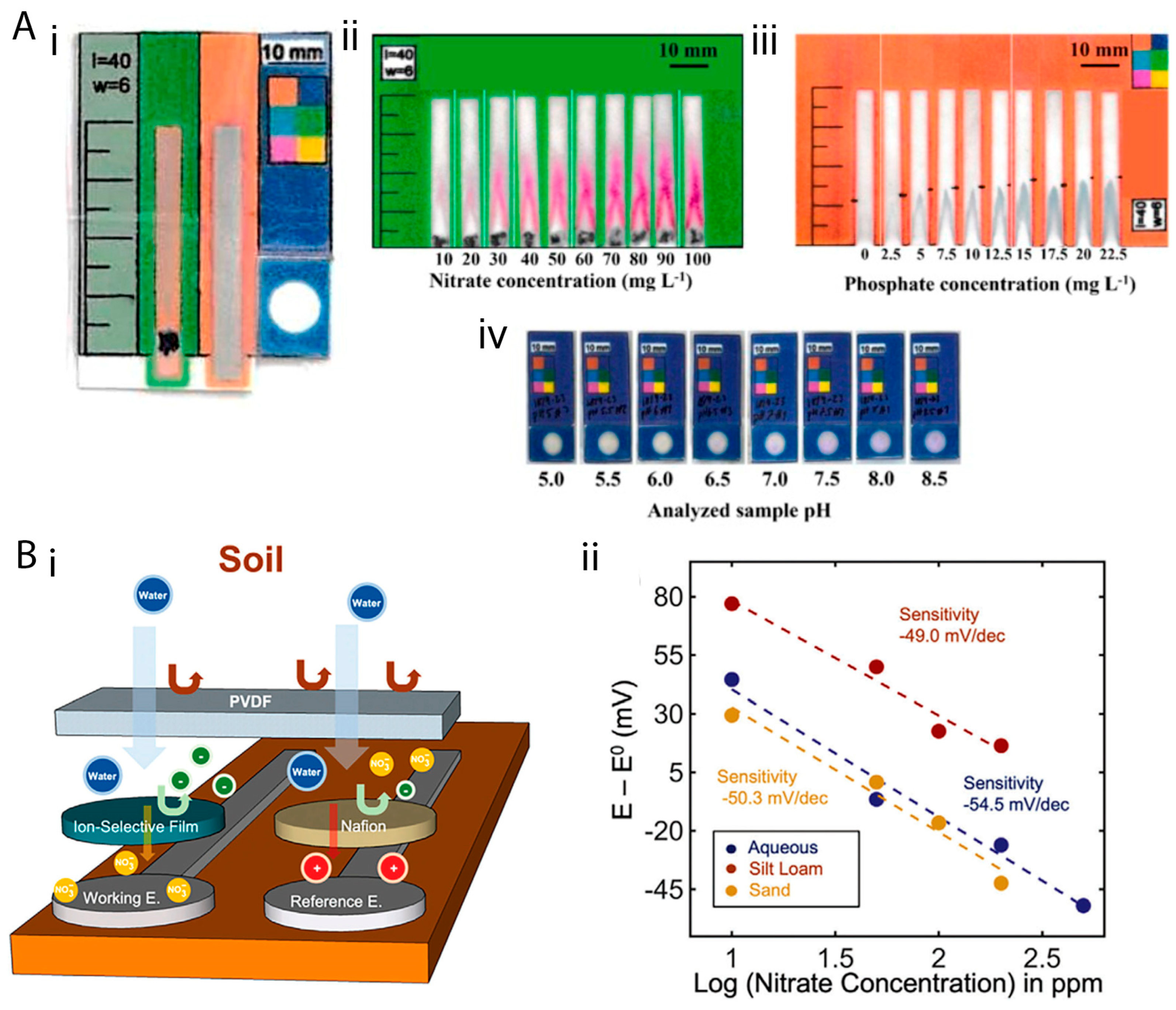
Giménez-Gómez et al. [98] presented a simple and affordable way to detect nitrate, phosphate and pH in soil samples using a French press and a PAD. For nitrate analysis in soil, they used a distance-based method based on the Griess reaction coupled with a reduction step within the device using zinc microparticles. It has been shown that the use of PADs provides a way of detecting nitrate after its reduction to nitrite and the later detection using the abovementioned Griess reaction [110]. For nitrate, the linear range of detection calculated from the soil extracted solution is between 10 and 100 mg/L and, considering the optimized extraction protocol with a 1:20 soil-to-solution ratio, the linear range expressed for soil is between 200 and 2000 mg/kg, limiting the applicability for precision agriculture where the range of nitrate oscillates between 10 and 150 mg/kg (Figure 4A). While most of the developed PADs were designed for water or food analysis [111], only a few were thought to be potentially implemented for soil nutrient analysis. A recent study shows that, using a PAD, it is possible to determine nitrate concentrations in solutions from 31–620 mg/L with a LOD of 14.19 mg/L. The authors did not perform any soil analysis but it is important to remark that they designed a multiparametric device capable of determining nitrate, ammonium and calcium in a single step, highlighting the potential applicability of PADs.
Electrochemical methods based on the use of potentiometric techniques have been applied for the determination of NPK, pH and other essential soil parameters. Potentiometric sensors’ measurement principle is based on the potential variation of an ion-selective membrane which is proportional to the ion concentration in solution. While potentiometric sensing techniques can be performed in situ after a conventional soil extraction technique, commercially available electrodes are not entirely made for these purposes. Commercial glass ISEs need to be carefully maintained due to the need to use inner filling solutions and require calibration steps before each use to ensure good reproducibility. Printed and single-use solid-state ion-selective electrodes have emerged as a promising alternative as they use solid contact, avoiding the need for inner solution. In this way, the solid-state ISE brings important advantages such as compatibility to printing fabrication technologies, easy storage, portability and miniaturization. These types of sensors are mostly prepared with an ionophore, an ion-sensitive compound that reacts with the target analyte, producing a change in the measured potential. In recent years, different ion-selective electrodes were developed for nitrate detection [102,112,113,114,115,116]. One of the most particular characteristics of ISEs is their wide linear range of detection. Solid-state ISEs can measure nitrate in a wide linear range as was recently reported from 0.6 to 6200 mg/L [102,115]. Considering a 1:5 soil-to-solution extraction, these electrodes are capable of detecting nitrate concentrations as low as 3.5 mg/kg, underscoring their potential for application as soil nitrate sensors. However, ISEs commonly experience significant interference from other ions, temperature and salinity, which can compromise measurement accuracy (Figure 4B).
Figure 4. (A) Colorimetric paper-based analytical device for soil analysis. (i) Device scheme showing the main characteristics and results obtained for (ii) nitrate, (iii) phosphate and (iv) pH calibrations [98]. (B) Printed solid-state ion-selective electrode for soil analysis. (i) Sensor’s scheme showing the materials used for the fabrication of reference and the working electrode for nitrate detection. (ii) Response of the nitrate sensor using different types of soil samples [115].
Agriculture 16 00883 g004
Ammonium determination in soil is equally as important as nitrate quantification, since plants take up nitrogen in both forms. Nevertheless, nitrate is generally regarded as the primary indicator of nitrogen sufficiency or deficiency in crops. Ammonium detection in laboratory facilities is performed using the Berthelot reaction which produces a blue-green chromophore that can be detected colorimetrically. Paper-based analytical devices (PADs) have been employed for the quantification of ammonium in soil samples using the colorimetric Berthelot reaction [99]. The authors reported a limit of detection (LOD) of 0.5 mg/L and a linear range of 10–100 mg/L. Considering a 1:5 soil-to-solution extraction, the method enabled the detection of ammonium concentrations as low as 2.5 mg/kg in soil. In order for the color to be analyzed, a color image scanner was used, but more recent studies report the use of smartphones for image acquisition and analysis [117]. When thinking about agricultural research, smartphones have the advantage of enabling on-site analysis, reducing the need for complex instrumentation, and facilitating rapid decision making in the field. Real-time determination of nutrients in soil is still a challenge due to the inconvenience of the soil matrix.
Yupiter et al. (2023) developed a continuous system capable of collecting soil pore water and further analyzing it for ammonium determination [118]. This new monitoring approach was validated for ammonium using laboratory equipment but it is still interesting to note the potential application for other soil nutrients’ determination using portable and disposable sensors, allowing omission of the soil extraction steps in the field. Eldeeb et al. (2024) presented the use of a solid-state ISE for the real-time monitoring of soil ammonium [103]. The proposed sensor was calibrated using different types of soil samples (sandy loam, clay and loamy clay soil) spiked with ammonium, showing a linear response. Then, a temporal study using a bucket filled with soil was performed for 16 days, showing promising results for field applications.
Phosphorus is another essential macronutrient that is commonly present in soils in the form of hydrogen phosphate (HPO42−) or dihydrogen phosphate (H2PO4), being the primary available form for plant uptake. Its detection classically involves the molybdenum blue method, that consists of its coupling with ammonium molybdate in acid media to form the phosphomolybdic complex which has a characteristic blue color. Extractable phosphorus is the form of phosphorus that meets agronomic requirements for assessing soil fertility. Extractable phosphorus is the fraction of soil phosphorus that can be released into solution by a standardized chemical extractant such as Olsen, Bray or Mehlich-3, the last one being the most used. The typical values of Mehlich-3-extracted phosphorus for unfertilized soil can be less than 25 mg/kg, while for moderately and intensive fertilized soil the values can be 25–50 and 50–100 mg/kg, respectively [109]. Extractable phosphorus detected in laboratory facilities using the molybdenum blue method can be performed with a LOD of 0.1–0.5 mg/kg considering a soil-to-solution extraction of 1:10.
In recent years, different PADs were developed for the colorimetric detection of phosphate, primarily for water samples [119,120,121,122]. The use of a multilayer PAD stacked with magnetic sheets was reported for the detection of phosphate from 0.5 to 40 mg/L in soil extracts, showing the potential application for in-field measurements [100]. Another study showed the use of a preconcentration step that involves a solid-phase extraction channel that allows the detection of phosphate in a range from 0.05 and 1 mg/L [123]. Electrochemical paper-based alternatives for phosphate detection have also been explored recently [106]. In the study, the reactants for phosphate detection were impregnated on paper electrodes, where the phosphate ions would be extracted and detected with cyclic voltammetry. Another potential strategy for soil analysis could be the use of carbon electrodes modified with tetrabutyl ammonium octamolybdate for orthophosphate analysis at nanomolar levels, as was previously shown for sea water samples [124]. These methods offer the possibility for on-site detection and quantification and facilitate simpler and more straightforward sample preparation procedures, yielding results that remain pertinent for agronomic measurements. Furthermore, these devices facilitate the direct deposition of essential reactants onto the paper surface, thereby reducing preparation time and offering a lightweight alternative to conventional methodologies. A notable example of a three-dimensional PAD is its ability to integrate multiple analytical steps within a single device, enabling more efficient, rapid and cost-effective field-based diagnostics.
While the previously reported methods have been proposed for detecting phosphate in soil, they still need to be adapted to measure extractable phosphorus following one of the standardized extraction methods. The authors of [106] developed a paper-based electrochemical sensor that combines both extraction and detection of extractable phosphorus in soil samples using a single reagent-impregnated filter paper (ERR IFP). The filter was preloaded with a combined extraction–reaction reagent composed of acidic molybdate and concentrated Mehlich-3 solution. Upon contact with a small soil sample and deionized water, the ERR was gradually released from the paper, enabling simultaneous extraction of plant-available phosphorus and its conversion into an electroactive complex [106].
As the third major macronutrient, potassium complements nitrogen and phosphorus in supporting plant metabolic functions. In unfertilized soils, exchangeable potassium typically measures below 100 mg/kg, while in moderately and highly fertilized soils it usually ranges from 100–200 mg/kg and 200–300 mg/kg, respectively [109]. Exchangeable potassium, which represents the plant-available fraction of soil potassium, is commonly extracted from the soil prior to its determination. Conventional quantification methods include atomic absorption and flame photometry, with detection limits as low as 5 μg/L and 0.5 μg/L, respectively [108]. Electrochemical detection of potassium ions has also been studied in different electrode surfaces [104], and some studies such as the one conducted by McCole et al. (2023) [125] detect potassium in soil samples with a LOD of 1.1 mg/L, utilizing much more portable equipment than that used in the previously stated methods. A recent study examined the efficacy of paper-based electrochemical detection for potassium utilizing screen-printed electrodes, yielding a LOD of 39.88 μg/L [105], demonstrating potential for trace-level detection in soil analysis and serving as a portable and cost-effective alternative. Once again, colorimetric detection and quantification of soil potassium are possible in paper [100], achieving detection of 5.41 mg/L. In this case, the paper serves as a platform for depositing the colored compound obtained by previously extracting and adding the respective reactants. Therefore, the reaction itself does not occur in the paper as it does in the case of PADs. Despite these limits being far higher than the ones obtained by the atomic absorption and flame photometry techniques, they still serve as a rapid soil analysis methodology, even addressing the range that is of interest for agricultural activity. However, the potential exists for the exploration of additional paper-based alternatives for the detection of potassium, with the objective of addressing the challenges associated with its reaction and colorimetric detection on paper.
In addition to macronutrients, certain soil parameters play a vital role in the agricultural scene. One of these parameters is pH, which is normally obtained by electrochemical methods such as potentiometry and by colorimetric methods, involving weak acids or weak bases, that show color change when in their undissociated or dissociated forms. This last principle is used in commercial pH strips that offer semi-quantitative pH determination, and it has been replicated in PADs. Mobile systems featuring the use of smartphones for pH detection have been recently developed [101], integrating two colorimetric pH indicators in a PAD design and a machine learning model trained on these indicators. Singh et al. (2020) [126] were the first to demonstrate the application of electrodes printed on hydrophobic paper for measuring soil pH. They proposed a three-electrode platform using a carbon paste modified with alizarin, a pH-sensitive redox compound, as the innovative element of the sensor. The portability of classical, but semi-quantitative, pH detection technologies, such as commercial strips, and the recent development of on-site colorimetric analysis of paper-based systems, suggest a favorable trajectory for adoption in modern agriculture.

3.3.2. Plant Analysis

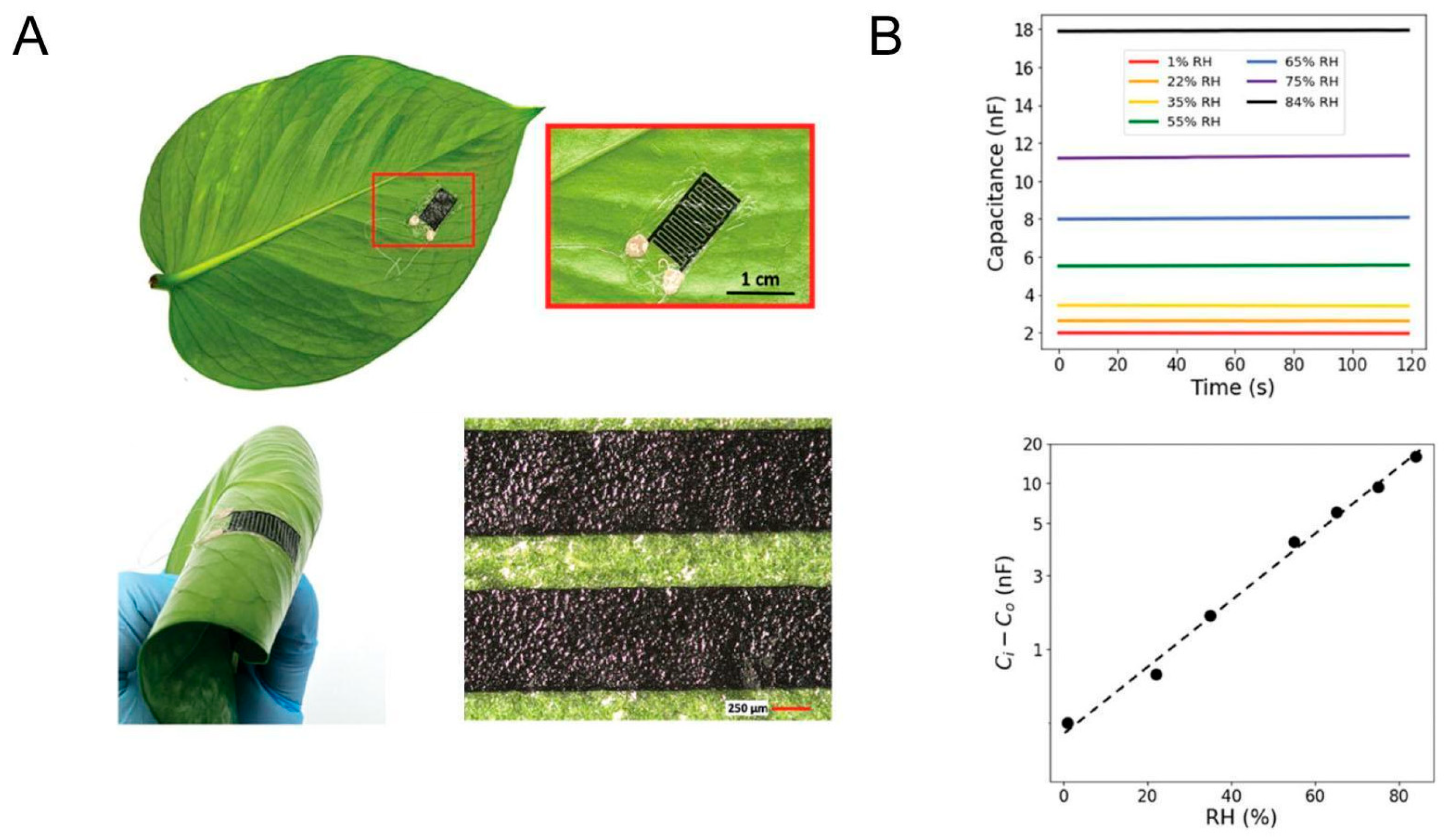
The concept of acquiring real-time crop information through network-connected wearable plant devices is becoming increasingly prominent [127,128,129,130,131,132,133,134,135,136]. This enables the continuous, real-time monitoring of physiological and microclimatic parameters promoting active crop management and facilitating their application in smart agriculture. Electrical and electrochemical wearable sensors/biosensors are often preferred as they can be miniaturized and easily attached to the surface of leaves, stems, fruits and roots if they are prepared with flexible materials (Figure 5). The proposed devices are often composed of a three-electrode system, printed over a flexible material that is in direct contact with the plant tissue or through membranes [137], microneedles [138], suction ports [139] and hydrogels [140]. While the immediate application of this technology could be related to agrochemical monitoring, as they are spread on the plants’ surface, other wearables devices were designed and proposed for the detection of stress biomarkers, growth biomarkers, and signaling molecules. In the context of climate change, abiotic stress biomarker detection is becoming a great interest because it is limiting agricultural productivity globally.
Pesticide detection in fruits and other plant products is of great interest due to their inherent toxicity. In recent years, the use of wearable electrochemical sensors for pesticide detection has become of great interest [141,142,143]. Two different studies show the use of electrochemical sensors for the direct detection of carbenzadim [142], as well as carbenzadim and diquat [144], on the skin of apples and cabbages. To test the sensors in a real scenario application, after performing the characteristic calibrations, the apples and cabbages were sprayed with a 100 μM solution of the pesticide and later washed with buffer solution to simulate a possible environmental scenario. The amount of carbenzadim detected in apples and cabbages was found to be in the micromolar range and interestingly, no interference from other agrochemicals such as glyphosate, paraquat, thiram and fenitrothion was established, highlighting the potential application. Another study used electrochemical sensors attached to the surface of lettuce and tomato and successfully detected carbenzadim and paraquat [143]. While these devices cannot be implemented for continuous monitoring, the electrodes can be attached to the fruit for a long period and the analysis could be performed when harvesting or at any other moment. Other devices which detect pesticides by using enzymes were recently reported [139]. Enzymatic biosensors are more selective than electrochemical sensors, but they need to be carefully maintained before measuring as the enzymes are sensitive to weather conditions happening in the agricultural environment, so the use of this electroanalytical system for continuous monitoring is still a challenge.
Figure 5. Plant wearables sensors. (A) Digital picture showing the interdigitated printed electrodes for humidity sensing on the leaf. (B) Capacitance response towards humidity changes on the leaf [145].
Agriculture 16 00883 g005
Plant hormone detection and monitoring provide a dynamic view of plant physiological status. In the agricultural system, the use of sensors could help growers to identify stress responses and metabolic changes before symptoms appear. Endogenous accumulation of salicylic acid (SA) has been associated with enhanced tolerance to abiotic stresses in plants. SA contributes to the induction of enzymatic and non-enzymatic antioxidant systems, which efficiently neutralize reactive oxygen species (ROS) and mitigate oxidative damage [146].
Sandwich devices for SA detection in tomato plant leaves were developed [137]. The authors made a 1.5 mm diameter hole in the leaf to let the sample flow to the electrode to perform the analysis. They detected SA with a LOD of 0.05 μM (6.9 μg/L), which is close to the concentration of SA found in healthy plants (10 μg/L) [147]. Other devices involve the use of iontophoretic methods to extract liquid samples from tomato leaves in a non-invasive manner to later detect SA [148] or glucose [149]. They use two electrodes to apply current between them and extract SA from leaves. The detection was performed with the typical three electrochemical cells and salicylic acid was detected in a linear range between 10 and 1000 μM. Other studies used similar extraction devices for salicylic acid in cucumber [150] and determined SA levels. Plant guttation fluid, the fluid released by specialized structures called hydathodes, usually found at the edges or tips of leaves can be used to look for SA. Liu et al. (2025) used flexible electrodes modified with molecularly imprinted polymers to detect indole-3-acetic acid and SA simultaneously in strawberry leaves [151]. An alternative way to do an in vivo analysis of plants is the use of microneedles. Parrilla et al. (2024) [138], developed an electrochemical device for plant health monitoring using hollow microneedles fabricated via 3D printing, coupled with a paper-based sampling strategy. This combination enabled the in situ detection of relevant biomarkers such as H2O2, glucose, and pH directly on the leaves of five different plant species, following the trend of wearable sensors applied to plants.
Glycine betaine is present in a variety of plants and participates in plant defense against environmental stress [152]. Glycine betaine accumulates in plants after they are exposed to environmental stress such as salt exposure, drought and low temperature. Ai et al. (2024) showed how to use a screen-printed electrode modified with molecularly imprinted polymer to perform in vivo measurements of glycine betaine in cucumber leaves, showing promising results [153]. Plants release a wide range of volatile organic compounds (VOCs) that serve as signals for insect defense, pollinator attraction, communication with other plants, adaptation to environmental stress, and protection from herbivores. VOC production can also be triggered by nutrient shortages, mineral imbalances, low or high levels of soil moisture, and the improper application of agrochemicals [154]. Ibrahim et al. (2022) [155] developed an electrochemical sensor capable of sensing the methanol produced by the plant leaf. The sensor was mounted with a gas collection chamber and attached to the leaf with double-sided tape. The results showed that the sensor works in a wide dynamic range (0.5–500 mg/L) with high selectivity due to the high catalytic activity of Pt nanoparticles covering the sensor surface. The authors propose the use of these sensors to produce plant fingerprints, providing more detailed information in the field.
Other parameters, such as relative humidity in the plant microenvironment, could be determined using capacitive sensors that interestingly are tattooed or screen-printed on the plant surface. Strand et al. (2025) [145] presented ultrathin and wearable capacitive sensors for environmental monitoring in plants, using carbon microparticle ink printed via screen printing on temporary tattoo paper directly on the leaves. The “sandwich”-type capacitor structure used in this device significantly increased the sensor’s capacitance and sensitivity, making it an effective, lightweight, and scalable alternative for real-time relative humidity monitoring applications.

3.4. Multiphoton Laser Scanning Microscopy (MLSM)—A Powerful Tool for Monitoring Plant Physiology

Monitoring plant physiology at its earliest stages is essential for sustainable production [156]. Recent advances in optical imaging, particularly multiphoton laser scanning microscopy (MLSM), provide powerful, non-invasive tools for examining plant responses to biotic and abiotic stress [157], offering new perspectives for both fundamental research and agricultural applications. Within MLSM, label-free modalities such as two-photon excited fluorescence (TPEF) and second harmonic generation (SHG) have emerged as highly effective techniques. These approaches provide high-resolution, deep, and non-destructive insights into the structural and biochemical properties of plant tissues [158]. TPEF enables live imaging of intact specimens, with near-infrared (NIR) pulsed lasers confining excitation to the focal volume, reducing out-of-focus autofluorescence and improving signal-to-noise ratios compared to confocal microscopy [159]. Deep tissue imaging is often hindered by chlorophyll autofluorescence and scattering in dense tissues [160], yet Ti:sapphire NIR lasers (690–1050 nm) minimize these effects while reducing phototoxicity.
TPEF also supports simultaneous multicolor imaging, leveraging blue-shifted two-photon absorption spectra of common fluorophores such as fluorescein and rhodamine and endogenous autofluorescence from lignin, flavonoids, and phenolic compounds, enabling detailed mapping of biochemical composition without external labels [161,162]. Longer-wavelength fluorescent proteins further enhance live imaging [163]. Femtosecond pulsed lasers additionally allow precise optical manipulation at the cellular and subcellular level, facilitating studies of intercellular communication and dynamic physiological processes [158,164]. Two-photon excitation also enables chromophore-assisted light inactivation (CALI), providing high spatiotemporal control for inactivating specific proteins via photosensitizers such as KillerRed [165]. Combined with fluorescence recovery after photobleaching (FRAP), these approaches allow investigation of protein mobility, metabolism, and loss-of-function studies in plant cells [158,166]. SHG complements TPEF by visualizing highly ordered, non-centrosymmetric structures such as starch granules and cellulose microfibrils, revealing structural organization and anisotropy in plant cell walls [167,168]. The integration of SHG with polarization-resolved detection allows quantitative assessment of microfibril orientation, analogous to collagen imaging [162,169].
By combining SHG and TPEF, researchers can simultaneously capture structural and biochemical information, enabling studies of tissue differentiation, senescence, stress responses, cell wall remodeling and lignification, as well as real-time tracking of physiological processes during the growing season across developmental stages and various genetic backgrounds. Therefore, MLSM can be used to monitor early plant stress responses, growth dynamics and biochemical changes in crops primarily in controlled environments, providing data that support management decisions and specific interventions. Multimodal approaches incorporating coherent anti-Stokes Raman scattering (CARS), sum-frequency mixing (SFM), fluorescence lifetime imaging (FLIM), and time-gated CARS (TG-CARS) further expand the capabilities of MLSM, allowing high-contrast, label-free visualization of root–microbe–soil interactions in three dimensions [170].
Coupling SHG and TPEF with Raman-based modalities enables comprehensive tissue characterization, distinguishing distinct anatomical regions, mapping cellulose microfibril orientation, and visualizing lignification patterns, as demonstrated in Sorghum bicolor roots and leaves [162].
Despite its significant advantages for deep, high-resolution and live imaging, multiphoton (two-photon) microscopy in plant studies remains subject to several important limitations. Although imaging depth exceeds confocal microscopy, it is still constrained by strong light scattering from rigid cell walls, intercellular air spaces, and heterogeneous refractive indices inherent to plant tissues, typically limiting penetration to a few hundred micrometers. Plant-specific autofluorescence, particularly from chlorophyll and phenolic compounds, can substantially reduce image contrast even under near-infrared excitation, necessitating careful selection of excitation wavelengths and preferably fluorophores with red-shifted emission. Achieving greater imaging depths often requires increased laser power, which may induce localized photothermal or photochemical damage and potentially alter physiological processes in living plant cells, similar to safety concerns reported in biomedical applications of multiphoton microscopy [171]. In addition, relatively slow image acquisition renders multiphoton imaging sensitive to motion artifacts arising from growth dynamics, turgor-driven movements, or environmental fluctuations during long-term observations. The technique also relies on weak endogenous fluorescence signals, frequently resulting in low signal-to-noise ratios and requiring highly sensitive detectors.
Furthermore, the high cost, technical complexity and operational requirements of femtosecond laser systems currently limit routine use during the growing season, particularly in field conditions, although greenhouse and controlled-environment applications are feasible.
Although MLSM systems are commercially available and technologically developed for laboratory conditions, their application in agriculture remains largely limited to research and controlled environments due to high cost, technical complexity and limited field usability. Therefore, the technology should be considered as having a high technology readiness level (TRL) in laboratory conditions but a significantly lower level of operational readiness for routine in-field agricultural applications. In conclusion, multiphoton imaging represents a powerful and non-invasive platform for high-resolution structural and biochemical analysis of plant tissues, integrating TPEF, SHG, and Raman-based techniques with NIR femtosecond lasers to enable optical sectioning, subcellular resolution, and deeper tissue imaging than conventional optical microscopy. Nevertheless, in precision agriculture its role is mainly supportive for better understanding plant processes and for improving calibration, validation and interpretation of field-based sensors, rather than being used as an independent tool for on-site monitoring. In case of application during the growing season, MLSM can provide early insights into plant stress, development and physiology, complementing field-based monitoring technologies and supporting timely, research-informed interventions. Although its technological development is high in controlled environments, its practical application in agricultural and plant research is still limited, due to intrinsic tissue scattering, autofluorescence, restricted penetration depth, potential photodamage and technical complexity, rapid advances in laser technology, detection sensitivity and imaging strategies are gradually overcoming these challenges. Consequently, multiphoton imaging is expected to play an increasingly important role in advancing fundamental plant biology and applied plant science, particularly in studies of plant physiology, development, stress responses and in complementing emerging plant sensing approaches.

4. Discussion

4.1. Potential and Limitations of Sensor-Driven Monitoring Systems in Agriculture

Modern crop, soil, abiotic and biotic stress monitoring has become increasingly diversified, with ground-based and UAV remote sensing, multiphoton laser scanning microscopy, PADs and printed electrochemical devices, each contributing essential information. Widespread abiotic and biotic stress outbreaks in crops threaten food security and lead to major economic losses, making single-platform monitoring approaches inadequate for the needs of precision agriculture. To address these challenges, integrated “space–air–ground” or “soil–plant–air” monitoring frameworks are essential, combining complementary strengths of multiple sensor modalities. Satellite observations provide large-scale, periodic assessments of regional outbreak patterns, UAVs enable high-resolution monitoring of critical areas at the field scale and ground-based multispectral and printed electrochemical devices, as well as laser scanning, support continuous, high-accuracy measurements of key physiological and biochemical parameters. The integration of these multisource data through data fusion and intelligent assimilation creates a comprehensive spatiotemporal monitoring framework for crop status, pests and diseases. Despite the considerable potential highlighted by the sensor technologies presented in Section 3.1, Section 3.2, Section 3.3 and Section 3.4, their practical implementation in precision agriculture remains constrained by several important limitations. For instance, UAV-based systems require significant initial investment and operational expertise, while proximal and active sensors (Section 3.1) may be limited by spatial coverage and scalability. Similarly, MLSM (Section 3.4), although providing valuable insights, is associated with high costs and is primarily restricted to controlled environments. PADs and printed electrochemical devices (Section 3.3) offer portability and low cost but may require further validation and standardization for large-scale field applications.
One of the key obstacles is the high initial investment cost, since small and medium-sized farms frequently cannot afford modern sensor systems, UAV platforms, variable-rate equipment and data-management software. Furthermore, the complexity of modern digital technology requires that farmers have certain expertise in data collection, processing and interpretation—a skill that many users still miss, lack and need. Precision agriculture also generates large volumes of spatial and temporal data, creating data-management challenges and increasing reliance on decision-support systems whose improper use may lead to suboptimal agronomic decisions. The effectiveness of these technologies further depends on reliable infrastructure, including internet connectivity, power supply and GNSS coverage, resources that are often limited in rural environments. Adoption is additionally constrained by the lack of interoperability between equipment and software from different manufacturers, complicated system integration and increasing operational complexity. Moreover, economic returns are not always immediate or guaranteed, as benefits depend on crop type, farm size and environmental conditions. Precision systems also require regular maintenance, calibration and technical support to ensure measurement accuracy, increasing long-term operational costs. Finally, concerns about data privacy and security persist, as farmers are often uncertain about ownership, storage and potential misuse of their production data. Together, these factors represent significant barriers that must be addressed to facilitate broader and more effective use of precision agriculture technologies.
Optical sensors have transformed the field of precision agriculture by enabling accurate, real-time data acquisition from crops through a wide range of sensing technologies. In this review, we have examined multispectral proximal sensors and remote passive UAV-based sensors commonly used for in-field analysis. While MLSM and related non-linear imaging techniques are primarily applied in laboratory environments, they can complement in-field detection methods by providing high-resolution structural and biochemical information on plant tissues, which, when integrated with other sensor modalities, improve the overall evaluation of plant health and stress responses.
The advantages and limitations of these sensor and imaging technologies have been discussed throughout the article and are summarized in Table 2. Passive sensors are well-established solutions for natural daily light-based monitoring but can be affected by variable weather and light conditions. Conversely, active sensors provide consistent measurements independent of ambient illumination. UAV platforms enable high-resolution spatial monitoring but are constrained by flight time, regulatory issues, and data processing requirements. The integration of these technologies into a multisource workflow allows each modality to contribute uniquely: satellites provide regional context, UAVs capture field-level variability, proximal sensors measure real-time physiological traits, and PADs/electrochemical devices monitor soil and chemical factors. Table 2 presents a systematic synthesis linking sensor evidence to applications in decision support, yield prediction, and stress management. Within this context, the POM is highlighted as a valuable tool for agricultural monitoring. It offers real-time data acquisition, ease of use and flexibility under diverse lighting conditions. Its affordability makes it particularly suitable for research settings and small-scale farming operations, such as smallholder farms and small experimental plots. Nonetheless, while active sensors like the POM offer greater flexibility in measurement timing and lighting, their handheld nature poses challenges when applied to large-scale fields. Looking ahead, future research, particularly in plant breeding and crop management, will demand high-resolution spectral data across multiple wavelengths and large spatial scales. Currently, such capabilities are best provided by passive spectrometers, though these may eventually be adapted for integration into active sensing systems. Additionally, it is important to note that the optical sensors reviewed in this article are primarily designed for use with standing crops. As such, they have limited capability to analyze soil characteristics or to detect and monitor chemical agents such as pesticides or herbicides when required. In this context, PADs and printed electrochemical devices offer potential not only for soil diagnostic analysis but also for detecting the presence of various chemical agents in the field. Their high portability and acceptability make them particularly valuable for soil nutrient monitoring. For a comprehensive sensor technology solution covering all crop growth stages, it is essential to consider that PADs and printed electrochemical devices are necessary for soil analysis, completing the integrated “soil–plant–air” monitoring workflow, as they are among the few technologies with the potential to replace traditional laboratory soil nutrient testing. Once crops reach maturity, a variety of optical sensor technologies can be employed, as summarized in Table 2.

4.2. Methods for Developing Monitoring and Forecasting Models for Soil–Plant Status and Abiotic and Biotic Stresses in Crops

4.2.1. Statistical Analysis Models

Despite the growing volume of sensor data from farming operations, suitable statistical methods for combining this information with process-level understanding remain limited. In the context of sensor-driven monitoring systems, statistical models are crucial for uncovering significant relationships among measured spectral, physiological and environmental data and variables. A key challenge now lies in adapting statistical modeling and optimization methods to harness the data produced by emerging sensor networks for precision agriculture applications, decision making and optimization [172]. Statistical analysis models are widely used due to their simple theoretical basis and computational efficiency. However, they require large, high-quality datasets and show limited generalizability. Methods such as partial least squares, stepwise regression, analysis of variance, correlation analysis, principal component regression and minimum norm estimation have been applied to monitor plant status frequently in maize, wheat, and soybean, often achieving moderate to high accuracy [173], Tagarakis et al. (2022). Hyperspectral preprocessing, including derivative transformations, strongly affects model performance, with derivative-based processing generally providing the best results. Multivariate approaches, particularly SVM, further could improve predictions, reaching higher calibration. Despite these strengths, statistical models are sensitive to noise, highly dependent on preprocessing and less versatile in complex environmental scenarios. They struggle to capture non-linear, high-dimensional relationships inherent in hyperspectral data, which are commonly generated by UAV and proximal sensing systems, highlighting the need to adopt machine learning approaches that offer automated feature extraction, better handling of small datasets and non-linear modeling capabilities.

4.2.2. Machine Learning Models

Integrating soil and plant status, stress factors and sensor data into crop models, along with machine-learning-based yield forecasting, can improve practical applications and support stable, higher agricultural yields. Machine learning methods are particularly adapted for handling the heterogeneous and multisource datasets generated by UAVs, proximal sensors, MLSM and electrochemical devices. Classic machine learning models, including random forest (RF), support vector machine (SVM) and decision trees, are widely used for crop status detection [174]. They showed high accuracy when combined with feature selection methods such as principal component analysis (PCA), competitive adaptive reweighted sampling (CARS) or the successive projections algorithm (SPA). However, these models rely on handcrafted features, which can introduce bias and have limited capacity to capture complex non-linear relationships. Deep learning models like convolutional neural networks (CNNs) and long short-term memory networks (LSTMs) achieve over 90% accuracy in yield crop prediction and enable segmentation and prediction but mainly rely on external features [175]. Machine learning models enable high-accuracy prediction of crop growth, yield, and quality based on collected data [176]. Their integration with sensor technologies enables advanced data fusion, merging and combining spatial UAVs and proximal and physiological measurements into comprehensive predictive models. Combining them with physiological and biochemical sensing could provide multimodal, multiscale crop monitoring for earlier and more comprehensive diagnosis. Exploring additional crop models that incorporate soil and plant status, the influence of abiotic and biotic stress and sensor data would be beneficial for receiving and adopting practical applications. Future studies should also investigate yield forecasting using advanced methods such as machine learning and data-driven algorithms. Expanding the analysis to include a longer time series of data would enhance practical implementation, while incorporating factors like soil characteristics would provide a more comprehensive understanding of yield determinants. Although statistical models have shown good accuracy in monitoring crop status, stress, yield and soil properties, their reliance on single data sources limits performance in complex, real-field conditions. Addressing this limitation requires integrated methods that combine information from diverse sensor sources. Future models should integrate physiological, environmental and agronomic information to better capture crop variability. Combining multiple modeling approaches, especially with data-driven methods, can improve both interpretability and predictive accuracy. Precision services should integrate IoT and cloud computing to build a closed-loop system for monitoring, early warning and control, with continuously updated models and strengthened technology transfer to support food security and sustainable agriculture.

5. Conclusions

Herein, a comprehensive investigation of developing precision agriculture devices was conducted, characterized by the incorporation of cutting-edge technology and smart sensors. This review systematically evaluated UAV-based remote sensing, proximal and active sensors, multiphoton laser scanning microscopy (MLSM) and paper-based and printed electrochemical devices, clearly defining their specific roles in monitoring spatial variability, plant physiological responses and soil chemical properties. Review-based articles demonstrated the potential of precision agriculture to significantly enhance crop management, optimize resource utilization and improve overall sustainability. Evidence from the reviewed literature indicated that precision agriculture can increase input-use efficiency by approximately 10–30%, increase crop yields by 5–20% and reduce environmental impacts such as nutrient losses and greenhouse gas emissions, depending on crop type, management practices, and environmental conditions. The analysis showed that passive UAV-based systems enable high-resolution spatial monitoring at the field scale but are constrained by environmental conditions (e.g., illumination, atmosphere) and operational limitations (e.g., flight time, regulations). On the other side, active proximal sensors provide consistent, real-time measurements independent of daily light conditions, although their applicability is limited to smaller fields. MLSM provides high-resolution physiological and biochemical insights at the tissue level, although its use remains largely restricted to controlled laboratory environments due to high cost, technical complexity and limited throughput. In contrast, electrochemical sensors enable rapid, in situ and cost-effective detection of soil nutrients and agrochemical analysis supporting field-based chemical analysis. These results demonstrated that each sensing technology captures distinct types of information (spatial, physiological or chemical) at different scales and that a single platform is not sufficient for comprehensive crop and soil monitoring under real-field conditions. The synergy between different sensors, advanced analytics and sustainable farming practices, as presented by the reviewed articles, is the key to overcoming current limitations in agriculture and achieving efficient agricultural production and plant breeding programs. Overall, currently, a variety of platforms are used to monitor the condition and status of plants and soil, including UAV-based remote sensing, proximal sensing, the application of plant sensors and laser scanning. Large-scale impacts of abiotic and biotic stress pose a serious threat to food security and cause significant economic losses and a single monitoring platform is not sufficient for precise assessment. Therefore, this review highlighted the importance of implementing an integrated multiplatform “air–plant–soil” monitoring system, in which UAVs provide spatial coverage, proximal and in-field sensors deliver high-frequency measurements and laboratory or advanced imaging techniques ensure detailed physiological and biochemical validation. Such a system should combine UAV-based observations for spatial variability, proximal and in-field sensors for high-frequency measurements and laboratory or advanced imaging techniques for detailed physiological and biochemical validation. Although statistical models are accurate, their dependence on single-source data limits their performance under various and heterogenic field conditions. The integration of physiological, environmental and agronomic data using machine learning and data fusion approaches significantly improves predictive accuracy and model robustness. The application of statistical and machine learning models is essential for processing various heterogeneous, multisource sensor data and enabling reliable prediction of crop status, stress and yield. In particular, data fusion approaches facilitate the integration of multiscale datasets into coherent predictive models, enabling real-time, data-driven decision making in precision agriculture. Through the integration and fusion of multisource data, combined with meteorological and other data, a continuous database should be developed to enable precise identification and effective prevention of the impacts of abiotic and biotic stresses in crop production. Based on all the above, it can be concluded that the limitations and challenges associated with proximal, UAV-based, plant-based and laser sensing technologies, as well as data processing, can be effectively addressed through the development of an integrated “soil–plant–air” monitoring framework based on multisource data fusion and standardized analytical methods. This approach represents a shift from individual, single-source measurements to integrated, data-driven crop monitoring systems, improving decision support, productivity, resource efficiency and agricultural sustainability.

Author Contributions

Conceptualization, I.G., N.L., F.F. and E.C.; methodology, I.G., E.C., F.F. and N.L.; software, M.T.; validation, I.M., N.S. (Nikola Stanković) and M.B.; formal analysis, N.S. (Nevena Stevanović), M.B. and V.D.G.; resources, I.G.; data curation, M.T.; writing—original draft preparation, F.F., N.L., I.M., I.G., L.R.S. and T.B.; writing—review and editing, I.G., E.C., F.F., N.L. and I.M.; visualization, L.R.S.; supervision, I.G. and E.C.; project administration, I.G. and E.C.; funding acquisition, I.G. All authors have read and agreed to the published version of the manuscript.

Funding

This work was supported by the IPANEMA project, which received funding from the European Union’s Horizon 2020 research and innovation program under grant agreement N° 872662 and the Ministry of Science, Technological Development and Innovation of the Republic of Serbia (Grants No. 451-03-136/2025-03/200358).

Institutional Review Board Statement

Not applicable.

Data Availability Statement

The original contributions presented in this study are included in the article. Further inquiries can be directed to the corresponding authors.

Acknowledgments

This research was supported by the European Commission and the Ministry of Science, Technological Development and Innovation of the Republic of Serbia. We thank the reviewers for their valuable feedback. This work was carried out under the IPANEMA project, funded by the EU Horizon 2020 program (Grant No. 872662) and the Ministry of Science, Technological Development and Innovation of Serbia (Grants No. 451-03-136/2025-03/200358).

Conflicts of Interest

The authors declare no conflicts of interest.

References

  1. Penuelas, J.; Coello, F.; Sardans, J. A Better Use of Fertilizers Is Needed for Global Food Security and Environmental Sustainability. Agric. Food Secur. 2023, 12, 5. [Google Scholar] [CrossRef]
  2. Chakhvashvili, E.; Machwitz, M.; Antala, M.; Rozenstein, O.; Prikaziuk, E.; Schlerf, M.; Naethe, P.; Wan, Q.; Komárek, J.; Klouek, T.; et al. Crop Stress Detection from UAVs: Best Practices and Lessons Learned for Exploiting Sensor Synergies. Precis. Agric. 2024, 25, 2614–2642. [Google Scholar] [CrossRef]
  3. Bevacqua, E.; De Michele, C.; Manning, C.; Couasnon, A.; Ribeiro, A.F.S.; Ramos, A.M.; Vignotto, E.; Bastos, A.; Blesić, S.; Durante, F.; et al. Guidelines for Studying Diverse Types of Compound Weather and Climate Events. Earth’s Future 2021, 9, e2021EF002340. [Google Scholar] [CrossRef]
  4. Aarif, M.; Alam, A.; Hotak, Y. Smart Sensor Technologies Shaping the Future of Precision Agriculture: Recent Advances and Future Outlooks. J. Sens. 2025, 2025, 2460098. [Google Scholar] [CrossRef]
  5. Chabrillat, S.; Ben-Dor, E.; Rossel, R.A.V.; Demattê, J.A.M. Quantitative Soil Spectroscopy. Appl. Environ. Soil Sci. 2013, 2013, 616578. [Google Scholar] [CrossRef]
  6. Chaudhry, H.; Vasava, H.B.; Chen, S.; Saurette, D.; Beri, A.; Gillespie, A.; Biswas, A. Evaluating the Soil Quality Index Using Three Methods to Assess Soil Fertility. Sensors 2024, 24, 864. [Google Scholar] [CrossRef]
  7. Kumar, P.; Srimathi, K.; Gulaiya, S.; Ojha, R. Precision Agriculture and Smart Farming. In Recent Trends in Agriculture; Integrated Publications: Delhi, India, 2024; ISBN 978-81-964973-3-0. [Google Scholar]
  8. Toselli, M.; Baldi, E.; Ferro, F.; Rossi, S.; Cillis, D. Smart Farming Tool for Monitoring Nutrients in Soil and Plants for Precise Fertilization. Horticulturae 2023, 9, 1011. [Google Scholar] [CrossRef]
  9. Karunathilake, E.M.B.M.; Le, A.T.; Heo, S.; Chung, Y.S.; Mansoor, S. The Path to Smart Farming: Innovations and Opportunities in Precision Agriculture. Agriculture 2023, 13, 1593. [Google Scholar] [CrossRef]
  10. Abioye, E.A.; Abidin, M.S.Z.; Mahmud, M.S.A.; Buyamin, S.; Ishak, M.H.I.; Rahman, M.K.I.A.; Otuoze, A.O.; Onotu, P.; Ramli, M.S.A. A Review on Monitoring and Advanced Control Strategies for Precision Irrigation. Comput. Electron. Agric. 2020, 173, 105441. [Google Scholar] [CrossRef]
  11. Soussi, A.; Zero, E.; Sacile, R.; Trinchero, D.; Fossa, M. Smart Sensors and Smart Data for Precision Agriculture: A Review. Sensors 2024, 24, 2647. [Google Scholar] [CrossRef]
  12. Koksal, O.; Tekinerdogan, B. Feature-Driven Domain Analysis of Session Layer Protocols of Internet of Things. In Proceedings of the 2017 IEEE International Congress on Internet of Things (ICIOT), Honolulu, HI, USA, 25–30 June 2017; pp. 105–112. [Google Scholar] [CrossRef]
  13. Tagarakis, A.C.; Tsotsolas, N.; Kateris, D.; Koidis, C.; Koutsouraki, E.; Bochtis, D. The Concept for an Integrated IoT-Based Traceability Platform. Int. J. Sustain. Agric. Manag. Inform. 2022, 8, 25–39. [Google Scholar] [CrossRef]
  14. Chaudhari, S.K.; Patra, A.; Dey, P.; Bal, S.K.; Gorantiwar, S.; Parsad, R. Sensor Based Monitoring for Improving Agricultural Productivity and Sustainability—A Review. J. Indian Soc. Soil. Sci. 2022, 70, 121–141. [Google Scholar] [CrossRef]
  15. Mansoor, S.; Iqbal, S.; Popescu, S.M.; Kim, S.L.; Chung, Y.S.; Baek, J.H. Integration of Smart Sensors and IOT in Precision Agriculture: Trends, Challenges and Future Prospectives. Front. Plant Sci. 2025, 16, 1587869. [Google Scholar] [CrossRef]
  16. Alahmad, T.; Neményi, M.; Nyéki, A. Applying IoT Sensors and Big Data to Improve Precision Crop Production: A Review. Agronomy 2023, 13, 2603. [Google Scholar] [CrossRef]
  17. Shafi, U.; Mumtaz, R.; García-Nieto, J.; Hassan, S.A.; Ali, S.; Zaidi, R.; Iqbal, N. Precision Agriculture Techniques and Practices: From Considerations to Applications. Sensors 2019, 19, 3796. [Google Scholar] [CrossRef]
  18. Padhiary, M.; Kumar, A.; Sethi, L.N. Emerging Technologies for Smart and Sustainable Precision Agriculture. Discov. Robot. 2025, 1, 6. [Google Scholar] [CrossRef]
  19. Sanjeevi, P.; Prasanna, S.; Siva Kumar, B.; Gunasekaran, G.; Alagiri, I.; Vijay Anand, R. Precision Agriculture and Farming Using Internet of Things Based on Wireless Sensor Network. Trans. Emerg. Telecommun. Technol. 2020, 31, e3978. [Google Scholar] [CrossRef]
  20. Morchid, A.; El Alami, R.; Raezah, A.A.; Sabbar, Y. Applications of Internet of Things (IoT) and Sensors Technology to Increase Food Security and Agricultural Sustainability: Benefits and Challenges. Ain Shams Eng. J. 2024, 15, 102509. [Google Scholar] [CrossRef]
  21. Vikranth, K.; Karani, K.P. An Implementation of IoT and Data Analytics in Smart Agricultural System—A Systematic Literature Review. Int. J. Manag. Technol. Soc. Sci. 2021, 6, 41–70. [Google Scholar] [CrossRef]
  22. Hrustek, L. Sustainability Driven by Agriculture through Digital Transformation. Sustainability 2020, 12, 8596. [Google Scholar] [CrossRef]
  23. Sheetanshu, G.; Dhirendra, K.; Ahmed, A.; Mohamed, A.E.A.; Costanza, F.; Paola, D.; Ali, R.A.M. Modern Optical Sensing Technologies and Their Applications in Agriculture. Afr. J. Agric. Res. 2024, 20, 896–909. [Google Scholar] [CrossRef]
  24. Abhilash, C.; Kalogiannidis, S.; Kalfas, D.; Chatzitheodoridis, F.; Papaevangelou, O. Role of Crop-Protection Technologies in Sustainable Agricultural Productivity and Management. Land 2022, 11, 1680. [Google Scholar] [CrossRef]
  25. Chen, Q.; Vaudour, E.; Richer-de-Forges, A.C.; Arrouays, D. Spectral Indices in Remote Sensing of Soil: Definition, Popularity, and Issues. A Critical Overview. Remote Sens. Environ. 2025, 329, 114918. [Google Scholar] [CrossRef]
  26. Terentev, A.; Dolzhenko, V.; Fedotov, A.; Eremenko, D. Current State of Hyperspectral Remote Sensing for Early Plant Disease Detection: A Review. Sensors 2022, 22, 757. [Google Scholar] [CrossRef]
  27. Assmann, J.J.; Myers-Smith, I.H.; Kerby, J.T.; Cunliffe, A.M.; Daskalova, G.N. Drone Data Reveal Heterogeneity in Tundra Greenness and Phenology Not Captured by Satellites. Environ. Res. Lett. 2020, 15, 125002. [Google Scholar] [CrossRef]
  28. Lu, Q.; Xie, Y.; Wei, L.; Wei, Z.; Tian, S.; Liu, H.; Cao, L. Extended Attribute Profiles for Precise Crop Classification in UAV-Borne Hyperspectral Imagery. IEEE Geosci. Remote Sens. Lett. 2024, 21, 2500805. [Google Scholar] [CrossRef]
  29. Xue, J.; Su, B. Significant Remote Sensing Vegetation Indices: A Review of Developments and Applications. J. Sens. 2017, 2017, 1353691. [Google Scholar] [CrossRef]
  30. Argento, F.; Merz, Q.; Perich, G.; Anken, T.; Walter, A.; Liebisch, F. A Comparison of Proximal and Remote Optical Sensor Platforms for N Status Estimation in Winter Wheat. Comput. Electron. Agric. 2025, 232, 110110. [Google Scholar] [CrossRef]
  31. Biswas, A.; Cândido, B.; Mindala, U.; Ebrahimy, H.; Zhang, Z.; Kallenbach, R. Integrating Proximal and Remote Sensing with Machine Learning for Pasture Biomass Estimation. Sensors 2025, 25, 1987. [Google Scholar] [CrossRef]
  32. Thenkabail, P.S.; Smith, R.B.; De Pauw, E. Hyperspectral Vegetation Indices and Their Relationships with Agricultural Crop Characteristics. Remote Sens. Environ. 2000, 71, 158–182. [Google Scholar] [CrossRef]
  33. Erdle, K.; Mistele, B.; Schmidhalter, U. Comparison of Active and Passive Spectral Sensors in Discriminating Biomass Parameters and Nitrogen Status in Wheat Cultivars. Field Crops Res. 2011, 124, 74–84. [Google Scholar] [CrossRef]
  34. Alexopoulos, A.; Koutras, K.; Ali, S.B.; Puccio, S.; Carella, A.; Ottaviano, R.; Kalogeras, A. Complementary Use of Ground-Based Proximal Sensing and Airborne/Spaceborne Remote Sensing Techniques in Precision Agriculture: A Systematic Review. Agronomy 2023, 13, 1942. [Google Scholar] [CrossRef]
  35. Singh, B.-; Ali, A.M. Using Hand-Held Chlorophyll Meters and Canopy Reflectance Sensors for Fertilizer Nitrogen Management in Cereals in Small Farms in Developing Countries. Sensors 2020, 20, 1127. [Google Scholar] [CrossRef]
  36. Busemeyer, L.; Mentrup, D.; Möller, K.; Wunder, E.; Alheit, K.; Hahn, V.; Maurer, H.P.; Reif, J.C.; Würschum, T.; Müller, J.; et al. BreedVision—A Multi-Sensor Platform for Non-Destructive Field-Based Phenotyping in Plant Breeding. Sensors 2013, 13, 2830–2847. [Google Scholar] [CrossRef]
  37. Tripodi, P.; Massa, D.; Venezia, A.; Cardi, T. Sensing Technologies for Precision Phenotyping in Vegetable Crops: Current Status and Future Challenges. Agronomy 2018, 8, 57. [Google Scholar] [CrossRef]
  38. Mazzetto, F.; Calcante, A.; Mena, A. Comparing commercial optical sensors for crop monitoring tasks in precision viticulture. J. Agric. Eng. 2009, 40, 11. [Google Scholar] [CrossRef]
  39. Ali, A.M.; Saudi, A.M.; El-Sadek, A.N. Bijay-Singh Developing a Nitrogen Fertilizer Management Model for Wheat in Calcareous Soils Using the Critical Nitrogen Dilution Curve. Nutr. Cycl. Agroecosyst. 2023, 125, 379–392. [Google Scholar] [CrossRef]
  40. Zhang, H.; Wang, L.; Jin, X.; Bian, L.; Ge, Y. High-Throughput Phenotyping of Plant Leaf Morphological, Physiological, and Biochemical Traits on Multiple Scales Using Optical Sensing. Crop J. 2023, 11, 1303–1318. [Google Scholar] [CrossRef]
  41. Pieruschka, R.; Schurr, U. Plant Phenotyping: Past, Present, and Future. Plant Phenomics 2019, 2019, 7507131. [Google Scholar] [CrossRef]
  42. Bian, L.; Zhang, H.; Ge, Y.; Čepl, J.; Stejskal, J.; EL-Kassaby, Y.A. Closing the Gap between Phenotyping and Genotyping: Review of Advanced, Image-Based Phenotyping Technologies in Forestry. Ann. Sci. 2022, 79, 22. [Google Scholar] [CrossRef]
  43. Mansoor, S.; Chung, Y.S. Functional Phenotyping: Understanding the Dynamic Response of Plants to Drought Stress. Curr. Plant Biol. 2024, 38, 100331. [Google Scholar] [CrossRef]
  44. Pandey, A.K.; Jiang, L.; Moshelion, M.; Gosa, S.C.; Sun, T.; Lin, Q.; Wu, R.; Xu, P. Functional Physiological Phenotyping with Functional Mapping: A General Framework to Bridge the Phenotype-Genotype Gap in Plant Physiology. iScience 2021, 24, 102846. [Google Scholar] [CrossRef]
  45. Shendekar, S.; Phule, M.; Vidyapeeth, K. Bridging the Gap Between Phenotype and Genotype through High-Throughput Phenotyping Dnyaneshwar Raut. In Plant Genetics Redefined; Bright Sky Publications: Delhi, India, 2003; ISBN 9789392804823. [Google Scholar]
  46. Marko, O.; Pandžić, M.; Tagarakis, A.C.; Radonić, V.; Kitić, G.; Panić, M.; Ljubičić, N. Novel proximal and remote sensing approaches for deriving vegetation indices: A case study comparing plant-O-meter and Sentinel-2 data. Digitizing Agriculture. In Proceedings of the European Federation for Information Technology in Agriculture, Food and the Environment (EFITA), Rhodes, Greece, 27–29 June 2019. [Google Scholar] [CrossRef]
  47. Kitić, G.; Tagarakis, A.; Cselyuszka, N.; Panić, M.; Birgermajer, S.; Sakulski, D.; Matović, J. A New Low-Cost Portable Multispectral Optical Device for Precise Plant Status Assessment. Comput. Electron. Agric. 2019, 162, 300–308. [Google Scholar] [CrossRef]
  48. Kostić, M.M.; Ljubičić, N.; Aćin, V.; Mirosavljević, M.; Budjen, M.; Rajković, M.; Dedović, N. An Active-Optical Reflectance Sensor in-Field Testing for the Prediction of Winter Wheat Harvest Metrics. J. Agric. Eng. 2024, 55, 1559. [Google Scholar] [CrossRef]
  49. Dickerson, J.A.; Welti, R.; Chen, J.; Cheng, J.; Stavness, I.; Ubbens, J.R. Deep Plant Phenomics: A Deep Learning Platform for Complex Plant Phenotyping Tasks. Front. Plant Sci. 2017, 8, 1190. [Google Scholar] [CrossRef]
  50. Stanković, N.; Kostić, M.; Ljubičić, N.; Kitić, G.; Stevanović, N.; Buđen, M. Potential of Optical Sensors for Predicting Winter Wheat Yield Through Variable-Rate Nitrogen Application. Contemp. Agric. 2024, 73, 181–191. [Google Scholar] [CrossRef]
  51. Grbović, Ž.; Ivošević, B.; Budjen, M.; Waqar, R.; Pajević, N.; Ljubičić, N.; Kandić, V.; Pajić, M.; Panić, M. Integrating UAV Multispectral Imaging and Proximal Sensing for High-Precision Cereal Crop Monitoring. PLoS ONE 2025, 20, e0322712. [Google Scholar]
  52. Li, Q.; Jin, S.; Zang, J.; Wang, X.; Sun, Z.; Li, Z.; Xu, S.; Ma, Q.; Su, Y.; Guo, Q.; et al. Deciphering the Contributions of Spectral and Structural Data to Wheat Yield Estimation from Proximal Sensing. Crop J. 2022, 10, 1334–1345. [Google Scholar] [CrossRef]
  53. Sanaeifar, A.; Yang, C.; de la Guardia, M.; Zhang, W.; Li, X.; He, Y. Proximal Hyperspectral Sensing of Abiotic Stresses in Plants. Sci. Total Environ. 2023, 861, 160652. [Google Scholar] [CrossRef]
  54. Broge, N.H.; Leblanc, E. Comparing Prediction Power and Stability of Broadband and Hyperspectral Vegetation Indices for Estimation of Green Leaf Area Index and Canopy Chlorophyll Density. Remote Sens. Environ. 2001, 76, 156–172. [Google Scholar] [CrossRef]
  55. Moinard, S.; Brunel, G.; Ducanchez, A.; Crestey, T.; Rousseau, J.; Tisseyre, B. 49. Testing the Potential of a New Low-Cost Multispectral Sensor for Decision Support in Agriculture. In Precision Agriculture ’21; Brill|Wageningen Academic: Wageningen, The Netherlands, 2021; pp. 411–418. [Google Scholar]
  56. Schirpke, U.; Ghermandi, A.; Sinclair, M.; Van Berkel, D.; Fox, N.; Vargas, L.; Willemen, L. Emerging Technologies for Assessing Ecosystem Services: A Synthesis of Opportunities and Challenges. Ecosyst. Serv. 2023, 63, 101558. [Google Scholar] [CrossRef]
  57. Kim, Y.; Associate, R.; Glenn, D.M.; Park, J.; Ngugi, H.K.; Lehman, B.L.; Lawrence, D.L. Active Spectral Sensor Evaluation Under Varying Conditions. Presentation at the 2010 ASABE Annual International Meeting Sponsored by ASABE, Pittsburgh, PA, USA, 20–23 June 2010. [Google Scholar]
  58. Karmakar, P.; Teng, S.W.; Murshed, M.; Pang, S.; Li, Y.; Lin, H. Crop Monitoring by Multimodal Remote Sensing: A Review. Remote Sens. Appl. 2024, 33, 101093. [Google Scholar] [CrossRef]
  59. Ljubičić, N.D.; Kostić, M.; Marko, O.; Panić, M. Estimation of Aboveground Biomass and Grain Yield of Winter Wheat Using NDVI Measurements. In Book of Proceedings, 9th International Scientific Agriculture Symposium “Agrosym 2018”, Jahorina, Bosnia and Herzegovina, 4–7 October 2018; University of East Sarajevo: East Sarajevo, Bosnia and Herzegovina, 2018; pp. 390–397. [Google Scholar]
  60. Ljubičić, N.; Radović, M.; Kostić, M.; Popović, V.; Radulović, M.; Blagojević, D.; Ivošević, B. The Impact of Zno Nanoparticles Application on Yield Components of Different Wheat Genotypes. Agric. For. 2020, 66, 217–227. [Google Scholar] [CrossRef]
  61. Ljubičić, N.; Popović, V.; Vasileva, V.; Kostić, M.; Stevanović, N.; Stanković, N. Alternative NDVI Combination in Maize Grain Yield Estimation. Bulg. J. Crop Sci. 2025, 62, 98–105. [Google Scholar] [CrossRef]
  62. Ljubicic, N.D.; Popovic, V.M.; Kostić, M. The normalized difference red edge index (NDRE) in grain yield and biomass estimation in maize (Zea mays L.). In Proceedings of the Agrosym 2024, Jahorina, Bosnia and Herzegovina, 10–13 October 2024; pp. 373–378. [Google Scholar]
  63. Kostić, M.M.; Aćin, V.; Mirosavljević, M.; Stamenković, Z.; Kešelj, K.; Ljubičić, N.; Scarfone, A.; Stanković, N.; Kovačević, D.B. Comparative Assessment of Remote and Proximal NDVI Sensing for Predicting Wheat Agronomic Traits. Drones 2025, 9, 641. [Google Scholar] [CrossRef]
  64. Stevanović, N.; Stanković, N.; Ljubičić, N.; Vukosavljev, M.; Lipovac, A.; Marina, I.; Stričević, R. Using a Manual Multispectral Sensor and UAV in Monitoring Soybean Development and Productivity Under Rainfed Conditions. Zemlj. I Biljka 2024, 73, 53–75. [Google Scholar] [CrossRef]
  65. Danojević, D.; Medić-Pap, S.; Ljubičić, N.; Glogovac, S.; Ivošević, B. Evaluation of Bacterial Leaf Spot on Sweet Pepper with Visual Assessment and Multispectral Sensor Device. Ratar. I Povrt. 2025, 62, 41–53. [Google Scholar] [CrossRef]
  66. Deng, L.; Mao, Z.; Li, X.; Hu, Z.; Duan, F.; Yan, Y. UAV-Based Multispectral Remote Sensing for Precision Agriculture: A Comparison between Different Cameras. ISPRS J. Photogramm. Remote Sens. 2018, 146, 124–136. [Google Scholar] [CrossRef]
  67. Nunes, E.C. Employing Drones in Agriculture: An Exploration of Various Drone Types and Key Advantages. arXiv 2023, arXiv:2307.04037. [Google Scholar] [CrossRef]
  68. Scutelnic, D.; Muradore, R.; Daffara, C. A Multispectral Camera in the VIS–NIR Equipped with Thermal Imaging and Environmental Sensors for Non-Invasive Analysis in Precision Agriculture. HardwareX 2024, 20, e00596. [Google Scholar] [CrossRef]
  69. Venkata Sai Chakradhar Reddy, D.; Sahoo, R.N.; Kondraju, T.; Rejith, R.G.; Ranjan, R.; Bhandari, A.; Moursy, A.; Tripathi, S.C.; Kumar, N. Drone-Based Multispectral Imaging for Precision Monitoring of Crop Growth Variables. Biol. Life Sci. Forum 2025, 41, 10. [Google Scholar] [CrossRef]
  70. Mohammadi, V.; Gouton, P.; Rossé, M.; Katakpe, K.K. Design and Development of Large-Band Dual-MSFA Sensor Camera for Precision Agriculture. Sensors 2024, 24, 64. [Google Scholar] [CrossRef]
  71. Stamford, J.D.; Vialet-Chabrand, S.; Cameron, I.; Lawson, T. Development of an Accurate Low Cost NDVI Imaging System for Assessing Plant Health. Plant Methods 2023, 19, 9. [Google Scholar] [CrossRef]
  72. Swaminathan, V.; Thomasson, J.A.; Hardin, R.G.; Rajan, N.; Raman, R. Radiometric Calibration of UAV Multispectral Images under Changing Illumination Conditions with a Downwelling Light Sensor. Plant Phenome J. 2024, 7, e70005. [Google Scholar] [CrossRef]
  73. Wang, Y.; Kootstra, G.; Yang, Z.; Khan, H.A. UAV Multispectral Remote Sensing for Agriculture: A Comparative Study of Radiometric Correction Methods under Varying Illumination Conditions. Biosyst. Eng. 2024, 248, 240–254. [Google Scholar] [CrossRef]
  74. Szabó, A.; Tamás, J.; Nagy, A. Spectral Estimation of Chlorophyll for Non-Invasive Assessment in Apple Orchards. Horticulturae 2024, 10, 1266. [Google Scholar] [CrossRef]
  75. Imran, H.A.; Gianelle, D.; Rocchini, D.; Dalponte, M.; Martín, M.P.; Sakowska, K.; Wohlfahrt, G.; Vescovo, L. VIS-NIR, Red-Edge and NIR-Shoulder Based Normalized Vegetation Indices Response to Co-Varying Leaf and Canopy Structural Traits in Heterogeneous Grasslands. Remote Sens. 2020, 12, 2254. [Google Scholar] [CrossRef]
  76. Pazhanivelan, S.; Kumaraperumal, R.; Shanmugapriya, P.; Sudarmanian, N.S.; Sivamurugan, A.P.; Satheesh, S. Quantification of Biophysical Parameters and Economic Yield in Cotton and Rice Using Drone Technology. Agriculture 2023, 13, 1668. [Google Scholar] [CrossRef]
  77. Stoyanova, M.; Kandilarov, A.; Koutev, V.; Nitcheva, O.; Dobreva, P. Unmanned Drone Multispectral Imaging for Assessment of Wheat and Oilseed Rape Habitus. Bulg. J. Agric. Sci. 2021, 27, 875–879. [Google Scholar]
  78. Nitu, A.; Florea, C.; Ivanovici, M. Quantitative Analysis of Vegetation Indices as Discriminators Between Different Crop Categories. In Proceedings of the 2024 International Symposium on Electronics and Telecommunications (ISETC), Timisoara, Romania, 7–8 November 2024; pp. 1–4. [Google Scholar] [CrossRef]
  79. Candiago, S.; Remondino, F.; De Giglio, M.; Dubbini, M.; Gattelli, M. Evaluating Multispectral Images and Vegetation Indices for Precision Farming Applications from UAV Images. Remote Sens. 2015, 7, 4026–4047. [Google Scholar] [CrossRef]
  80. da Silva, E.E.; Rojo Baio, F.H.; Ribeiro Teodoro, L.P.; da Silva Junior, C.A.; Borges, R.S.; Teodoro, P.E. UAV-Multispectral and Vegetation Indices in Soybean Grain Yield Prediction Based on In Situ Observation. Remote Sens. Appl. 2020, 18, 100318. [Google Scholar] [CrossRef]
  81. Huang, S.; Tang, L.; Hupy, J.P.; Wang, Y.; Shao, G. A Commentary Review on the Use of Normalized Difference Vegetation Index (NDVI) in the Era of Popular Remote Sensing. J. For. Res. 2021, 32, 1–6. [Google Scholar] [CrossRef]
  82. Zhao, Q.; Qu, Y. The Retrieval of Ground NDVI (Normalized Difference Vegetation Index) Data Consistent with Remote-Sensing Observations. Remote Sens. 2024, 16, 1212. [Google Scholar] [CrossRef]
  83. Radočaj, D.; Šiljeg, A.; Marinović, R.; Jurišić, M. State of Major Vegetation Indices in Precision Agriculture Studies Indexed in Web of Science: A Review. Agriculture 2023, 13, 707. [Google Scholar] [CrossRef]
  84. Hinojo-Hinojo, C.; Goulden, M.L. Plant Traits Help Explain the Tight Relationship between Vegetation Indices and Gross Primary Production. Remote Sens. 2020, 12, 1405. [Google Scholar] [CrossRef]
  85. Camps-Valls, G.; Campos-Taberner, M.; Moreno-Martínez, Á.; Walther, S.; Duveiller, G.; Cescatti, A.; Mahecha, M.D.; Muñoz-Marí, J.; García-Haro, F.J.; Guanter, L.; et al. A Unified Vegetation Index for Quantifying the Terrestrial Biosphere. Sci. Adv. 2021, 7, eabc7447. [Google Scholar] [CrossRef]
  86. Wang, Y.; An, J.; Wu, J.; Shao, M.; Wang, J.; Yao, X.; Zhang, X.; Jiang, C.; Tian, Y.; Cao, W.; et al. Design and Implementation of a Portable Snapshot Multispectral Imaging Crop-Growth Sensor. Front. Plant Sci. 2024, 15, 1416221. [Google Scholar] [CrossRef]
  87. Hakala, T.; Honkavaara, E.; Saari, H.; Mäkynen, J.; Kaivosoja, J.; Pesonen, L.; Pölönen, I. Spectral imaging from UAVS under varying illumination conditions. Int. Arch. Photogramm. Remote Sens. Spat. Inf. Sci. 2013, XL-1/W2, 189–194. [Google Scholar] [CrossRef]
  88. Isa, A.; Gharibi, M.; Cetinkaya, A.; Ozkan, S.A. Sustainable and Scalable Detection: Paper-Based Analytical Devices and Miniaturized Detection Systems for Modern Diagnostics. Microchem. J. 2025, 212, 113210. [Google Scholar] [CrossRef]
  89. Jayawardane, B.M.; Wongwilai, W.; Grudpan, K.; Kolev, S.D.; Heaven, M.W.; Nash, D.M.; McKelvie, I.D. Evaluation and Application of a Paper-Based Device for the Determination of Reactive Phosphate in Soil Solution. J. Environ. Qual. 2014, 43, 1081–1085. [Google Scholar] [CrossRef]
  90. Jayawardane, B.M.; McKelvie, I.D.; Kolev, S.D. Development of a Gas-Diffusion Microfluidic Paper-Based Analytical Device (ΜPAD) for the Determination of Ammonia in Wastewater Samples. Anal. Chem. 2015, 87, 4621–4626. [Google Scholar] [CrossRef]
  91. Mitrogiannopoulou, A.M.; Tselepi, V.; Ellinas, K. Polymeric and Paper-Based Lab-on-a-Chip Devices in Food Safety: A Review. Micromachines 2023, 14, 986. [Google Scholar] [CrossRef]
  92. Rao, R.; Prasad, D.; Sharma, V.; Mani, N.K. Lab-on-Paper for Point-of-Care Detection of Pesticides: A Review. Microchem. J. 2025, 215, 114487. [Google Scholar] [CrossRef]
  93. Muthumalai, K.; Gokila, N.; Haldorai, Y.; Rajendra Kumar, R.T. Advanced Wearable Sensing Technologies for Sustainable Precision Agriculture—A Review on Chemical Sensors. Adv. Sens. Res. 2024, 3, 2300107. [Google Scholar] [CrossRef]
  94. Zhang, Q.; Ying, Y.; Ping, J. Recent Advances in Plant Nanoscience. Adv. Sci. 2022, 9, e2103414. [Google Scholar] [CrossRef]
  95. Li, W.; Ma, X.; Yong, Y.C.; Liu, G.; Yang, Z. Review of Paper-Based Microfluidic Analytical Devices for in-Field Testing of Pathogens. Anal. Chim. Acta 2023, 1278, 341614. [Google Scholar] [CrossRef]
  96. Tkachenko, Y.; Niedzielski, P. FTIR as a Method for Qualitative Assessment of Solid Samples in Geochemical Research: A Review. Molecules 2022, 27, 8846. [Google Scholar] [CrossRef]
  97. Albuquerque, J.R.P.; Makara, C.N.; Ferreira, V.G.; Brazaca, L.C.; Carrilho, E. Low-Cost Precision Agriculture for Sustainable Farming Using Paper-Based Analytical Devices. RSC Adv. 2024, 32, 23392–23403. [Google Scholar] [CrossRef]
  98. Giménez-Gómez, P.; Priem, N.; Richardson, S.; Pamme, N. A Paper-Based Analytical Device for the on-Site Multiplexed Monitoring of Soil Nutrients Extracted with a Cafetière. Sens. Actuators B Chem. 2025, 424, 136881. [Google Scholar] [CrossRef]
  99. Thongkam, T.; Rungsirisakun, R.; Hemavibool, K. A Simple Paper-Based Analytical Device Using UV Resin Screen-Printing for the Determination of Ammonium in Soil. Anal. Methods 2020, 12, 4649–4656. [Google Scholar] [CrossRef]
  100. Thongkam, T.; Hemavibool, K. A Simple Epoxy Resin Screen-Printed Paper-Based Analytical Device for Detection of Phosphate in Soil. Anal. Methods 2022, 14, 1069–1076. [Google Scholar] [CrossRef]
  101. Ferreira Da Silva, A.; Luis Ohta, R.; Tirapu, J.; Id, A.; Ferreira, M.E.; Vitor, D.; Al, M.; Botelho, A.; Coppola, T.; Flavio, A.; et al. AI Enabled, Mobile Soil PH Classification with Colorimetric Paper Sensors for Sustainable Agriculture. PLoS ONE 2025, 20, e0317739. [Google Scholar] [CrossRef]
  102. Onder, A.; Begar, F.; Kibris, E.; Buyukcakir, O.; Yildiz, U.H. Nitrate Sensing with Molecular Cage Ionophores: A Potentiometric Approach. Sens. Diagn. 2025, 4, 432–442. [Google Scholar] [CrossRef]
  103. Eldeeb, M.A.; Dhamu, V.N.; Paul, A.; Alam, F.M.; Burgos, E.N.; Muthukumar, S.; Prasad, S. ASSERT: A Platform Technology for Rapid Electrochemical Sensing of Soil Ammonium. ACS Omega 2024, 9, 33928–33934. [Google Scholar] [CrossRef]
  104. Hossain, M.I.; Khaleque, M.A.; Ali, M.R.; Bacchu, M.S.; Hossain, M.S.; Shahed, S.M.F.; Saad Aly, M.A.; Khan, M.Z.H. Development of Electrochemical Sensors for Quick Detection of Environmental (Soil and Water) NPK Ions. RSC Adv. 2024, 14, 9137–9158. [Google Scholar] [CrossRef]
  105. Pranjale, G.S.; Rayudu, G.P.; Patil, G.C. Analysis and Fabrication of Paper Based Screen-Printed Soil Potassium Sensor. J. Indian Chem. Soc. 2024, 101, 101492. [Google Scholar] [CrossRef]
  106. Zeitoun, R.; Adamchuk, V.; Biswas, A. A Novel Paper-Based Reagentless Dual Functional Soil Test to Instantly Detect Phosphate Infield. Sensors 2022, 22, 8803. [Google Scholar] [CrossRef]
  107. López Pasquali, C.E.; Fernández Hernando, P.; Durand Alegría, J.S. Spectrophotometric Simultaneous Determination of Nitrite, Nitrate and Ammonium in Soils by Flow Injection Analysis. Anal. Chim. Acta 2007, 600, 177–182. [Google Scholar] [CrossRef]
  108. Page, A.L. (Ed.) Methods of Soil Analysis. Part 2. Chemical and Microbiological Properties; American Society of Agronomy, Soil Science Society of America: Madison, WI, USA, 1982; 1159p. [Google Scholar]
  109. Weil, R.R.; Brady, N.C. The Nature and Properties of Soils; Pearson: Hong Kong, China, 2017; ISBN 0133254488. [Google Scholar]
  110. Sousa, L.R.; Moreira, N.S.; Guinati, B.G.S.; Coltro, W.K.T.; Cortón, E.; Figueredo, F. Improved Sensitivity in Paper-Based Microfluidic Analytical Devices Using a PH-Responsive Valve for Nitrate Analysis. Talanta 2024, 277, 126361. [Google Scholar] [CrossRef] [PubMed]
  111. Charbaji, A.; Heidari-Bafroui, H.; Anagnostopoulos, C.; Faghri, M. A New Paper-Based Microfluidic Device for Improved Detection of Nitrate in Water. Sensors 2021, 21, 102. [Google Scholar] [CrossRef] [PubMed]
  112. Muhtasim, S.; Chen, K.Y.; Andrews, J. Inkjet-Printed Nafion Films on Ag/AgCl Reference Electrodes for Enhanced Stability in Potentiometric Sensing of Nitrates. Flex. Print. Electron. 2025, 10, 035019. [Google Scholar] [CrossRef]
  113. Chen, M.; Zhang, M.; Wang, X.; Yang, Q.; Wang, M.; Liu, G.; Yao, L. An All-Solid-State Nitrate Ion-Selective Electrode with Nanohybrids Composite Films for In-Situ Soil Nutrient Monitoring. Sensors 2020, 20, 2270. [Google Scholar] [CrossRef] [PubMed]
  114. Eldeeb, M.A.; Dhamu, V.N.; Paul, A.; Muthukumar, S.; Prasad, S. Electrochemical Soil Nitrate Sensor for In Situ Real-Time Monitoring. Micromachines 2023, 14, 1314. [Google Scholar] [CrossRef] [PubMed]
  115. Baumbauer, C.L.; Goodrich, P.J.; Payne, M.E.; Anthony, T.; Beckstoffer, C.; Toor, A.; Silver, W.; Arias, A.C. Printed Potentiometric Nitrate Sensors for Use in Soil. Sensors 2022, 22, 4095. [Google Scholar] [CrossRef] [PubMed]
  116. Su, R.; Wu, J.; Hu, J.; Ma, L.; Ahmed, S.; Zhang, Y.; Abdulraheem, M.I.; Birech, Z.; Li, L.; Li, C.; et al. Minimalizing Non-Point Source Pollution Using a Cooperative Ion-Selective Electrode System for Estimating Nitrate Nitrogen in Soil. Front. Plant Sci. 2022, 12, 810214. [Google Scholar] [CrossRef]
  117. Patel, P.; Toley, B. A Paper-Based Device for On-Farm Colorimetric Detection of Soil Macronutrients. ChemRxiv 2024. Available online: https://chemrxiv.org/engage/chemrxiv/article-details/662b844e91aefa6ce17e2ac8 (accessed on 15 October 2025). [CrossRef]
  118. Yupiter, R.; Arnon, S.; Yeshno, E.; Visoly-Fisher, I.; Dahan, O. Real-Time Detection of Ammonium in Soil Pore Water. NPJ Clean. Water 2023, 6, 25. [Google Scholar] [CrossRef]
  119. Choudhary, V.; Philip, L. Stable Paper-Based Colorimetric Sensor for Selective Detection of Phosphate Ion in Aqueous Phase. Microchem. J. 2021, 171, 106809. [Google Scholar] [CrossRef]
  120. Racicot, J.M.; Mako, T.L.; Olivelli, A.; Levine, M. A Paper-Based Device for Ultrasensitive, Colorimetric Phosphate Detection in Seawater. Sensors 2020, 20, 2766. [Google Scholar] [CrossRef]
  121. Richardson, S.; Iles, A.; Rotchell, J.M.; Charlson, T.; Hanson, A.; Lorchid, M.; Pamme, N. Citizen-Led Sampling to Monitor Phosphate Levels in Freshwater Environments Using a Simple Paper Microfluidic Device. PLoS ONE 2021, 16, e0260102. [Google Scholar] [CrossRef]
  122. Heidari-Bafroui, H.; Charbaji, A.; Anagnostopoulos, C.; Faghri, M. A Colorimetric Dip Strip Assay for Detection of Low Concentrations of Phosphate in Seawater. Sensors 2021, 21, 3125. [Google Scholar] [CrossRef]
  123. Danchana, K.; Namba, H.; Kaneta, T. Using a Microfluidic Paper-Based Analytical Device and Solid-Phase Extraction to Determine Phosphate Concentration. Talanta 2025, 295, 128303. [Google Scholar] [CrossRef] [PubMed]
  124. Figueredo, F.; Girolametti, F.; Aneggi, E.; Lekka, M.; Annibaldi, A.; Susmel, S. Plastic Electrode Decorated with Polyhedral Anion Tetrabutylammonium Octamolybdate [N(C4H9)4]4 Mo8O26 for NM Phosphate Electrochemical Detection. Anal. Chim. Acta 2021, 1161, 338469. [Google Scholar] [CrossRef]
  125. McCole, M.; Bradley, M.; McCaul, M.; McCrudden, D. A Low-Cost Portable System for on-Site Detection of Soil PH and Potassium Levels Using 3D Printed Sensors. Results Eng. 2023, 20, 101564. [Google Scholar] [CrossRef]
  126. Singh, M.; Patkar, R.S.; Vinchurkar, M.; Baghini, M.S. Cost Effective Soil PH Sensor Using Carbon-Based Screen-Printed Electrodes. IEEE Sens. J. 2020, 20, 47–54. [Google Scholar] [CrossRef]
  127. Kuruppuarachchi, C.; Kulsoom, F.; Ibrahim, H.; Khan, H.; Zahid, A.; Sher, M. Advancements in Plant Wearable Sensors. Comput. Electron. Agric. 2025, 229, 109778. [Google Scholar] [CrossRef]
  128. Liu, W.; Zhang, Z.; Geng, X.; Tan, R.; Xu, S.; Sun, L. Electrochemical Sensors for Plant Signaling Molecules. Biosens. Bioelectron. 2025, 267, 116757. [Google Scholar] [CrossRef]
  129. Faqir, Y.; Qayoom, A.; Erasmus, E.; Schutte-Smith, M.; Visser, H.G. A Review on the Application of Advanced Soil and Plant Sensors in the Agriculture Sector. Comput. Electron. Agric. 2024, 226, 109385. [Google Scholar] [CrossRef]
  130. Ikram, M.; Ameer, S.; Kulsoom, F.; Sher, M.; Ahmad, A.; Zahid, A.; Chang, Y. Flexible Temperature and Humidity Sensors of Plants for Precision Agriculture: Current Challenges and Future Roadmap. Comput. Electron. Agric. 2024, 226, 109449. [Google Scholar] [CrossRef]
  131. Zhou, S.; Zhou, J.; Pan, Y.; Wu, Q.; Ping, J. Wearable Electrochemical Sensors for Plant Small-Molecule Detection. Trends Plant Sci. 2024, 29, 219–231. [Google Scholar] [CrossRef] [PubMed]
  132. Naqvi, S.M.Z.A.; Zhang, Y.; Tahir, M.N.; Ullah, Z.; Ahmed, S.; Wu, J.; Raghavan, V.; Abdulraheem, M.I.; Ping, J.; Hu, X.; et al. Advanced Strategies of the In-Vivo Plant Hormone Detection. TrAC Trends Anal. Chem. 2023, 166, 117186. [Google Scholar] [CrossRef]
  133. Lu, Y.; Yang, G.; Shen, Y.; Yang, H.; Xu, K. Multifunctional Flexible Humidity Sensor Systems Towards Noncontact Wearable Electronics. Nano-Micro Lett. 2022, 14, 150. [Google Scholar] [CrossRef] [PubMed]
  134. Mohammad-Razdari, A.; Rousseau, D.; Bakhshipour, A.; Taylor, S.; Poveda, J.; Kiani, H. Recent Advances in E-Monitoring of Plant Diseases. Biosens. Bioelectron. 2022, 201, 113953. [Google Scholar] [CrossRef]
  135. Chua, N.-H.; Vishwakarma, K.; Lew, T.T.S.; Ang, M.C.-Y. Non-Destructive Technologies for Plant Health Diagnosis. Front. Plant Sci. 2022, 13, 884454. [Google Scholar] [CrossRef] [PubMed]
  136. Li, Z.; Zhou, J.; Dong, T.; Xu, Y.; Shang, Y. Application of Electrochemical Methods for the Detection of Abiotic Stress Biomarkers in Plants. Biosens. Bioelectron. 2021, 182, 113105. [Google Scholar] [CrossRef]
  137. Sun, L.J.; Feng, Q.M.; Yan, Y.F.; Pan, Z.Q.; Li, X.H.; Song, F.M.; Yang, H.; Xu, J.J.; Bao, N.; Gu, H.Y. Paper-Based Electroanalytical Devices for in Situ Determination of Salicylic Acid in Living Tomato Leaves. Biosens. Bioelectron. 2014, 60, 154–160. [Google Scholar] [CrossRef]
  138. Parrilla, M.; Sena-Torralba, A.; Steijlen, A.; Morais, S.; Maquieira, Á.; De Wael, K. A 3D-Printed Hollow Microneedle-Based Electrochemical Sensing Device for in Situ Plant Health Monitoring. Biosens. Bioelectron. 2024, 251, 116131. [Google Scholar] [CrossRef]
  139. Zhang, Q.; Ma, S.; Meng, W.; Zheng, Y.; Yin, L.; Wang, H.; Shi, H.; Zhang, K.; Su, S. Smartphone-Based Plant-Wearable Microfluidic Sensor with Self Driven Electrolyte for In-Situ Detection of Methyl Parathion. Sens. Actuators B Chem. 2024, 418, 136254. [Google Scholar] [CrossRef]
  140. Bukhamsin, A.; Ait Lahcen, A.; Filho, J.D.O.; Shetty, S.; Blilou, I.; Kosel, J.; Salama, K.N. Minimally-Invasive, Real-Time, Non-Destructive, Species-Independent Phytohormone Biosensor for Precision Farming. Biosens. Bioelectron. 2022, 214, 114515. [Google Scholar] [CrossRef]
  141. Ferreira, D.M.; Paschoarelli, M.V.; de Lima, L.F.; de Araujo, W.R. Paper-Based Laser-Scribed Graphene towards Wearable Plant Sensor: A Portable Electrochemical Platform for Precision Agriculture. Talanta 2025, 295, 128212. [Google Scholar] [CrossRef]
  142. Martins, T.S.; Machado, S.A.S.; Oliveira, O.N.; Bott-Neto, J.L. Optimized Paper-Based Electrochemical Sensors Treated in Acidic Media to Detect Carbendazim on the Skin of Apple and Cabbage. Food Chem. 2023, 410, 135429. [Google Scholar] [CrossRef] [PubMed]
  143. Teixeira, S.C.; Gomes, N.O.; Calegaro, M.L.; Machado, S.A.S.; de Oliveira, T.V.; de Fátima Ferreira Soares, N.; Raymundo-Pereira, P.A. Sustainable Plant-Wearable Sensors for on-Site, Rapid Decentralized Detection of Pesticides toward Precision Agriculture and Food Safety. Biomater. Adv. 2023, 155, 213676. [Google Scholar] [CrossRef]
  144. Paschoalin, R.T.; Gomes, N.O.; Almeida, G.F.; Bilatto, S.; Farinas, C.S.; Machado, S.A.S.; Mattoso, L.H.C.; Oliveira, O.N.; Raymundo-Pereira, P.A. Wearable Sensors Made with Solution-Blow Spinning Poly(Lactic Acid) for Non-Enzymatic Pesticide Detection in Agriculture and Food Safety. Biosens. Bioelectron. 2022, 199, 113875. [Google Scholar] [CrossRef]
  145. Strand, E.J.; Gopalakrishnan, A.; Crichton, C.A.; Palizzi, M.J.; Lee, O.; Borsa, T.; Bihar, E.; Goodrich, P.; Arias, A.C.; Shaheen, S.E.; et al. Ultrathin Screen-Printed Plant Wearable Capacitive Sensors for Environmental Monitoring. Adv. Sens. Res. 2025, 4, 2400177. [Google Scholar] [CrossRef]
  146. Salinas, P.; Velozo, S.; Herrera-Vásquez, A. Salicylic Acid Accumulation: Emerging Molecular Players and Novel Perspectives on Plant Development and Nutrition. J. Exp. Bot. 2025, 76, 1950–1969. [Google Scholar] [CrossRef] [PubMed]
  147. Klessig, D.F.; Tian, M.; Choi, H.W. Multiple Targets of Salicylic Acid and Its Derivatives in Plants and Animals. Front. Immunol. 2016, 7, 206. [Google Scholar] [CrossRef] [PubMed]
  148. Perdomo, S.A.; Valencia, D.P.; Velez, G.E.; Jaramillo-Botero, A. Advancing Abiotic Stress Monitoring in Plants with a Wearable Non-Destructive Real-Time Salicylic Acid Laser-Induced-Graphene Sensor. Biosens. Bioelectron. 2024, 255, 116261. [Google Scholar] [CrossRef] [PubMed]
  149. Perdomo, S.A.; De la Paz, E.; Del Caño, R.; Seker, S.; Saha, T.; Wang, J.; Jaramillo-Botero, A. Non-Invasive in-Vivo Glucose-Based Stress Monitoring in Plants. Biosens. Bioelectron. 2023, 231, 115300. [Google Scholar] [CrossRef]
  150. Liu, D.; Li, M.; Li, H.; Li, C.; Wang, G.; Li, P.; Yang, B. Core-Shell Au@Cu2O-Graphene-Polydopamine Interdigitated Microelectrode Array Sensor for in Situ Determination of Salicylic Acid in Cucumber Leaves. Sens. Actuators B Chem. 2021, 341, 130027. [Google Scholar] [CrossRef]
  151. Liu, K.; Hou, P.; Pan, D.; Zhou, Y.; Luo, B.; Chen, L.; Zhao, C.; Li, A. Flexible Sensor Based on Molecular Imprinting for Simultaneous in Situ Detection of Indole-3-Acetic Acid and Salicylic Acid in Plants. Talanta 2025, 294, 128226. [Google Scholar] [CrossRef]
  152. Jia, K.-H.; Shad, M.I.; Zhu, P.H.; Sheteiwy, M.S.; Basit, F.; Alyafei, M.; Hayat, F.; Al-Zayadneh, W.; El-Keblawy, A.; Sulieman, S. Deciphering the Role of Glycine Betaine in Enhancing Plant Performance and Defense Mechanisms against Environmental Stresses. Front. Plant Sci. 2025, 16, 1582332. [Google Scholar] [CrossRef]
  153. Ai, G.; Zhou, Y.; Zhang, H.; Wei, Q.; Luo, B.; Xie, Y.; Wang, C.; Xue, X.; Li, A. Ultrasensitive Molecular Imprinted Electrochemical Sensor for in Vivo Determination of Glycine Betaine in Plants. Food Chem. 2024, 435, 137554. [Google Scholar] [CrossRef]
  154. Rohloff, J.; Lionetti, V.; Bisceglia, N.G.; Dorokhov, Y.L.; Sheshukova, E.V.; Komarova, T.V. Methanol in Plant Life. Front. Plant Sci. 2018, 9, 1623. [Google Scholar] [CrossRef]
  155. Ibrahim, H.; Moru, S.; Schnable, P.S.; Dong, L. Wearable Plant Sensor for In Situ Monitoring of Volatile Organic Compound Emissions from Crops. ACS Sens. 2022, 7, 2293–2302. [Google Scholar] [CrossRef] [PubMed]
  156. Singh, V.; Sharma, N.; Singh, S. A Review of Imaging Techniques for Plant Disease Detection. Artif. Intell. Agric. 2020, 4, 229–242. [Google Scholar] [CrossRef]
  157. Moustaka, J.; Moustakas, M. Early-Stage Detection of Biotic and Abiotic Stress on Plants by Chlorophyll Fluorescence Imaging Analysis. Biosensors 2023, 13, 796. [Google Scholar] [CrossRef] [PubMed]
  158. Mizuta, Y. Advances in Two-Photon Imaging in Plants. Plant Cell Physiol. 2021, 62, 1224–1230. [Google Scholar] [CrossRef]
  159. Benninger, R.K.P.; Piston, D.W. Two-Photon Excitation Microscopy for Unit 4.11 the Study of Living Cells and Tissues. Curr. Protoc. Cell Biol. 2013, 59, 4.11.1–4.11.24. [Google Scholar] [CrossRef]
  160. Donaldson, L. Autofluorescence in Plants. Molecules 2020, 25, 2393. [Google Scholar] [CrossRef]
  161. Mizuta, Y.; Kurihara, D.; Higashiyama, T. Two-Photon Imaging with Longer Wavelength Excitation in Intact Arabidopsis Tissues. Protoplasma 2015, 252, 1231–1240. [Google Scholar] [CrossRef]
  162. Heiner, Z.; Zeise, I.; Elbaum, R.; Kneipp, J. Insight into Plant Cell Wall Chemistry and Structure by Combination of Multiphoton Microscopy with Raman Imaging. J. Biophotonics 2018, 11, e201700164. [Google Scholar] [CrossRef]
  163. Shen, Y.; Lai, T.; Campbell, R.E. Red Fluorescent Proteins (RFPs) and RFP-Based Biosensors for Neuronal Imaging Applications. Neurophotonics 2015, 2, 031203. [Google Scholar] [CrossRef]
  164. Watanabe, W.; Shimada, T.; Itoh, K.; Matsunaga, S.; Fukui, K. Femtosecond Laser Manipulation of Subcellular Organelles in Living Cells; Optica Publishing Group: Washington, DC, USA, 2005. [Google Scholar]
  165. Zhou, L.; Na, J.; Liu, X.; Wu, P. Chromophore-Assisted Light Inactivation for Protein Degradation and Its Application in Biomedicine. Bioengineering 2024, 11, 651. [Google Scholar] [CrossRef]
  166. Sano, Y.; Watanabe, W.; Matsunaga, S. Chromophore-Assisted Laser Inactivation—Towards a Spatiotemporal-Functional Analysis of Proteins, and the Ablation of Chromatin, Organelle and Cell Function. J. Cell Sci. 2014, 127, 1621–1629. [Google Scholar] [CrossRef]
  167. Aghigh, A.; Bancelin, S.; Rivard, M.; Pinsard, M.; Ibrahim, H.; Légaré, F. Second Harmonic Generation Microscopy: A Powerful Tool for Bio-Imaging. Biophys. Rev. 2023, 15, 43–70. [Google Scholar] [CrossRef]
  168. Dal Fovo, A.; Mattana, S.; Marchetti, M.; Anichini, M.; Giovannelli, A.; Baria, E.; Fontana, R.; Cicchi, R. Combined TPEF and SHG Imaging for the Microstructural Characterization of Different Wood Species Used in Artworks. Photonics 2022, 9, 170. [Google Scholar] [CrossRef]
  169. Miler, I.; Rabasovic, M.D.; Aleksic, M.; Krmpot, A.J.; Kalezic, A.; Jankovic, A.; Korac, B.; Korac, A. Polarization-Resolved SHG Imaging as a Fast Screening Method for Collagen Alterations during Aging: Comparison with Light and Electron Microscopy. J. Biophotonics 2021, 14, e202000362. [Google Scholar] [CrossRef] [PubMed]
  170. Lee, J.; Hestrin, R.; Nuccio, E.E.; Morrison, K.D.; Ramon, C.E.; Samo, T.J.; Pett-Ridge, J.; Ly, S.S.; Laurence, T.A.; Weber, P.K. Label-Free Multiphoton Imaging of Microbes in Root, Mineral, and Soil Matrices with Time-Gated Coherent Raman and Fluorescence Lifetime Imaging. Environ. Sci. Technol. 2022, 56, 1994–2008. [Google Scholar] [CrossRef]
  171. Paoli, J.; Smedh, M.; Ericson, M.B. Multiphoton Laser Scanning Microscopy—A Novel Diagnostic Method for Superficial Skin Cancers. Semin. Cutan. Med. Surg. 2009, 28, 190–195. [Google Scholar] [CrossRef]
  172. Panayi, E.; Peters, G.W.; Kyriakides, G. Statistical Modelling for Precision Agriculture: A Case Study in Optimal Environmental Schedules for Agaricus bisporus Production via Variable Domain Functional Regression. PLoS ONE 2017, 12, e0181921. [Google Scholar] [CrossRef] [PubMed]
  173. Tagarakis, A.C.; Kostić, M.; Ljubičić, N.; Ivošević, B.; Kitić, G.; Pandžić, M. In-field Experiments for Performance Evaluation of a New Low-Cost Active Multispectral Crop Sensor. In Information and Communication Technologies for Agriculture—Theme I: Sensors; Bochtis, D.D., Lampridi, M., Petropoulos, G.P., Ampatzidis, Y., Pardalos, P., Eds.; Springer Optimization and Its Applications; Springer: Cham, Switzerland, 2022; Volume 182. [Google Scholar] [CrossRef]
  174. Ali, I.; Cawkwell, F.; Dwyer, E.; Green, S. Modeling Managed Grassland Biomass Estimation by Using Multitemporal Remote Sensing Data—A Machine Learning Approach. IEEE J. Sel. Top. Appl. Earth Obs. Remote Sens. 2017, 10, 3254–3264. [Google Scholar] [CrossRef]
  175. Elbasi, E.; Zaki, C.; Topcu, A.E.; Abdelbaki, W.; Zreikat, A.I.; Cina, E.; Shdefat, A.; Saker, L. Crop Prediction Model Using Machine Learning Algorithms. Appl. Sci. 2023, 13, 9288. [Google Scholar] [CrossRef]
  176. Ayoub Shaikh, T.; Rasool, T.; Rasheed Lone, F. Towards Leveraging the Role of Machine Learning and Artificial Intelligence in Precision Agriculture and Smart Farming. Comput. Electron. Agric. 2022, 198, 107119. [Google Scholar] [CrossRef]
Figure 1. Schematic representation of soil and plant sensors proposed for application in precision agriculture and discussed in this review article.
Agriculture 16 00883 g001
Figure 2. POM multispectral crop sensor. (a) POM multispectral crop sensor with integrated GPS antenna connected to smartphone via Bluetooth connection, (b) display of the phone application and (c) mapping mode (source by field measurement). Source: https://www.plant-o-meter.com/ (accessed on 1 January 2026).
Agriculture 16 00883 g002
Figure 3. Operating principle of the POM sensor device (Figure source Kitić et al. [47]).
Agriculture 16 00883 g003
Table 1. Comparison between different technologies and smart sensors described for soil analysis showing advantages and limitations.
TechnologyMeasured VariablesAdvantagesLimitationsRef.
PADsNO3, NH4+, PO43−, pHPortable, low-cost, on-site analysisHigh LOD and low precision[98,99,100,101]
Printed devices: Potentiometric sensorsNO3, NH4+, K+Rapid, selectiveCalibration required, ion interference, temperature, and salinity effects[102,103,104,105]
Printed devices: Amperometric sensorsPO43−High sensitivity and adaptable to portable systemsRequires potentiostats and electrode modification, could be susceptible to interference[106]
UV-Vis spectrophotometryNO3, PO43−High sensitivityRequires laboratory facilities, expensive and labor intensive[107]
Atomic absorption spectroscopyK+Very high sensitivity and high accuracyRequires expensive instrumentation, needs skilled personnel and laboratory facilities[108]
Flame photometryK+Simple operation, cost-effectiveLimited to specific elements, requires calibration and laboratory facilities[108]
Table 2. Comparison between different smart sensors used and proposed for precision agriculture applications.
ParameterActive Multispectral Proximal SensorsPassive Multispectral Proximal SensorsPassive Multispectral UAV SensorsPaper-Based and Printed Electrochemical Soil SensorsWearable Electrochemical Plant SensorsMultiphoton Scanning Spectroscopy
Typical applicationVariable rate fertilizationField samplingPrecision agricultureSoil nutrientsStress, metabolitesCellular plant biology
Data outputVegetation indicesReflectance/indicesRaster imagesColor/current/potentialCurrent/potential3D images
Illumination source/dependencyArtificial (LED/laser)/lowEnvironment/highEnvironment/highArtificial (LED) for colorimetric sensors/high for colorimetric sensorsn.a.Pulsed laser/none
Measurement typePoint reflectancePoint reflectanceMultispectral imagingColorimetric and electrochemical signalsElectrochemical signalsVolumetric fluorescence imaging
Spatial scalePlant/patchPlant/patchPlot/fieldSoil sample (a few grams)Plant leaf/fruitCellular/tissue
Spatial resolutionFootprint (0.2–0.5 m diameter)Footprint (0.5–1.0 m2)3–10 cm/pixelLocal point (15 to 30 cm depth)Local point
(1 cm2)
0.3–0.5 um (lateral)
Spectral resolution2–5 discrete bands5–16 bands4–10 bandsn.a.n.a.Fluorophore-dependent
Typical distance/height0.4–1.2 m0.5–2 m30–120 mDirect contactDirect contact˂1 mm
LODn.a.n.a.n.a.0.1 to 5 mg for nutrients, lower for pesticidesFrom nM to µM concentrationsn.a.
Temporal samplingHigh (Hz)Medium (seconds)Low (minutes)Low (minutes)Low (minutes)Low (minutes)
Technology readiness levelHigh (TRL 8–9)High (TRL 7–9)High (TRL 8–9)Low (TRL 3–4)Low (TRL 3–4)Very high (TRL 9)
Main advantagesReal-time data; accurate canopy measurementsLower cost than active sensorsHigh spatial resolution; fast, large-area data collectionDisposable; minimal reagent use; field-deployable; high selectivityDisposable; minimal reagent use; field-deployable; high selectivity
Physical contact is required
High-resolution 3D imaging; deep optical penetration into tissues
LimitationsLow spatial coverageDependent on sunlight and weather conditionsAffected by light conditions; requires flight operationLower accuracy than laboratory tests; limited analyte rangeSensitive to environmental conditions
Physical contact is required
High cost; not field-deployable
Disclaimer/Publisher’s Note: The statements, opinions and data contained in all publications are solely those of the individual author(s) and contributor(s) and not of MDPI and/or the editor(s). MDPI and/or the editor(s) disclaim responsibility for any injury to people or property resulting from any ideas, methods, instructions or products referred to in the content.