1. Introduction
Oats belong to the small-grain cereals, a group of crops that also includes wheat, rye, and barley. Oats are mostly cultivated in Northern Europe and North America and are valued for the quality of their grain characteristics and low soil and temperature requirements. This crop species is popular among organic farmers. The spread of different fungal diseases in oats can negatively affect grain yield and quality. The spread of Fusarium head blight (FHB) caused by fungi of the genus
Fusarium results in crop losses and quality reductions, and the production of mycotoxins in the grain, which at high concentrations are toxic to both humans and farm animals [
1].
The development of an effective, reliable, and easily accessible method for crop disease diagnosis remains a challenge. There are three main methods for the detection of crop diseases: (i) visual estimation by agronomists or plant pathologists; (ii) pathogen identification based on morphological features, which includes pathogen isolation on growth medium and microscopy; and (iii) different molecular and serological methods such as enzyme-linked immunosorbent assay (ELISA) and polymerase chain reaction (PCR) [
2,
3]. Visual disease assessment by an agronomist or plant pathologist is commonly employed in everyday farming, especially on small-scale farms. Although it offers benefits such as low cost, quick results, the ability to assess infection levels, and no requirement for costly infrastructure, it also has crucial limitations, including high variability in results caused by differences in individual expertise and experience, human errors, and the challenge or impossibility of accurately monitoring large areas of crop fields [
4,
5]. Furthermore, the early stages of most fungal diseases are asymptomatic, so visual assessment is ineffective at this point [
6]. Pathogen identification based on morphological traits generally requires isolating fungal pathogens on agar medium and examining their cultural features, such as colony appearance, color, and asexual structures, such as sporangia, conidia, chlamydospores, and sclerotia, using light microscopy [
7]. This method has a higher accuracy than visual evaluation; however, it requires costly infrastructure, is limited to large-scale use, and the in vitro cultivation process is time-consuming [
7]. Molecular and serological techniques primarily include polymerase chain reaction (PCR), hybridization, and biochemical tests. While these methods are highly accurate, sensitive, and relatively less time-consuming, their use is limited to large-scale applications because of their complexity and high costs [
3,
5].
The agricultural applications of remote sensing methods are based on measuring the reflected radiation of the object, which can be a plant or soil. It involves non-contact observation of radiation that is reflected or emitted from agricultural fields [
8]. Remote sensing in agriculture has been primarily used to monitor crop yield and biomass [
9], as well as crop nutrients and water stress [
10,
11], detect infestations of weeds [
12], insects, and plant diseases [
6], and assess soil characteristics such as organic matter, moisture, clay content, pH, and salinity [
13,
14].
Hyperspectral (HS) analysis is a remote sensing option in which reflectance data are collected at small spectral increments across a broad spectral range (most commonly 400–2500 nm) [
8]. HS data can indicate a link between the spectral reflectance properties and structural traits of plants, such as pigment concentrations, water levels, and accumulation of specific substances, which are significantly influenced by biotic stress [
2]. HS sensors analyze up to several hundred bands of the electromagnetic spectrum, including visible (400–700 nm), near-infrared (700–1000 nm), and short-wave infrared (1000–2500 nm) wavelengths [
15,
16]. Each pixel in an HS image contains a unique set of information about the reflectance at each spectral band, and the sum of this information is known as a spectral signature or profile [
16]. A three-dimensional HS data cube with two spatial dimensions (x, y) and one spectral dimension (wavelength) is typically used to visualize this data [
8]. Each HS image contains a large amount of spectral data, making it challenging to extract useful information; therefore, advanced data analysis is required for effective operation with HS sensors [
16]. Typically, data analysis starts with preprocessing procedures, which include calibration, atmospheric correction (for images taken from high altitude), noise reduction, and replacing any known faulty datapoints. In some cases, spectral and/or spatial subsetting can be used [
4]. Further data analysis is mostly based on two basic approaches: (i) the use of spectral vegetation indices or (ii) the use of computer vision, machine learning, and deep learning methods [
17].
From a future perspective, HS analysis has the potential to provide a scalable and effective solution for assessing crop fungal diseases in everyday farming. HS analysis is a non-invasive, indirect detection method that uses the plant’s reaction to biotic stress and fungal development features as indicators of disease [
3,
18]. FHB induces various physiological changes in plants, primarily due to significant water loss and the breakdown of chlorophyll. These modifications cause noticeable differences in the spectral characteristics of diseased grains and entire ears; thus, it is possible to detect FHB using spectral analysis, and in particular, spectral imaging [
19]. According to the HS image analysis, the 350–1000 nm band range is where the biggest spectral variations between healthy and diseased tissue are observed, with the red and green bands showing the most significant variances [
20]. As an alternative to complex machine learning, deep learning, computer vision, or similar methods, different vegetation indices can be used, such as the head blight index (HBI), which is based on spectral differences in the 550–560 nm and 665–675 nm ranges. In previous studies, the HBI proved to be highly accurate in the classification of diseased and healthy wheat ears under field conditions. However, its application is mostly effective in the time period between cereal flowering and ripening stages (BBCH 65–89); outside these developmental stages, the accuracy of disease classification decreases significantly [
21].
According to data from oat field monitoring in Latvia in 2020 and 2021, the occurrence of
Fusarium avenaceum,
F. culmorum,
F. graminearum,
F. oxysporum,
F. poae,
R. redolens, and
F. sporotrichioides exceeds 5% among the collected samples (seedlings and panicles) [
22]. These results generally correspond with the results of other Baltic states [
23,
24] or the Northern region of Europe [
25]. Each
Fusarium species is responsible for specific toxin production; among the mentioned species,
F. poae produces nivalenol (NIV) and beauvericin (BEA) [
26], and
F. sporotrichioides is associated with T-2 and HT-2 toxins [
27], while
F. graminearum and
F. culmorum mostly produce deoxynivalenol (DON) and zearalenone (ZEA) [
28,
29]. However, there is little correlation between climatic or agronomic data and the variation in DON levels on oats in Scandinavia [
30]. While a number of models have been created for wheat to forecast DON contamination based on agronomic parameters and meteorological data, this appears to be more challenging for oats.
Unlike wheat, few studies have applied HS analysis to assess FHB in oats. In previous studies, HS imaging was applied to individual oat kernels to analyze the feasibility of determining mycotoxin content [
31,
32]. To the best of our knowledge, no studies have used HBI to detect FHB in oats with a possible correlative linkage between disease severity and mycotoxin content in kernels. At specific developmental stages of FHB, hyperspectral (multispectral) analysis can be used for field monitoring to evaluate disease severity and potential crop contamination with mycotoxins before harvest. The aim of this study is to evaluate the effectiveness of a simple HS data analysis method based on the HBI for detecting FHB disease severity in comparison to visual assessment and mycotoxin content in grains. This is the first step in developing a UAV-based technology for the field monitoring of FHB of small-grain cereals.
2. Materials and Methods
2.1. Plant Material and Inoculation with Spores
Greenhouse trials were conducted on three different oat cultivars: ‘Husky’, ‘Ivory’, and ‘Lelde’. Plants were cultivated in pots (0.28 m × 0.28 m, volume 15 L) in substrate consisting of peat and sand in a proportion of 6:1. Ten seeds were sown in each pot, with four pots per control and inoculated treatment. To eliminate other pathogens, all seeds were surface sterilized in 1.5% NaOCl solution for 2 min and rinsed three times with sterile deionized water. In the greenhouse, the pots were arranged randomly with periodic rearrangement of pots, a cultivation temperature of 20 ± 3 °C, humidity of 70 ± 5%, and natural lighting conditions (May–September 2025). Every second week, plants were treated with: (i) YaraTera KRISTALON GREEN LB (Yara Vlaardingen B. V., Vlaardingen, The Netherlands) containing a 18-18-18 (N-P-K) + microelements (B, Cu, Fe, Mn, Mo and Zn) ratio applied at a rate of 2 g L
−1 (0.2–0.3 L per pot) from end of tillering to end of inflorescence emergence stages; (ii) YaraTera KRISTALON YELLOW (Yara Vlaardingen B. V., Vlaardingen, The Netherlands) containing a 13-40-13 (N-P-K) + microelements (B, Cu, Fe, Mn, Mo and Zn) ratio applied at a rate of 2 g L
−1 (0.2–0.3 L per pot) during the flowering stage; and (iii) YaraTera KRISTALON ORANGE (Yara Vlaardingen B. V., Vlaardingen, The Netherlands) containing a 6-12-36 (N-P-K) + microelements (B, Cu, Fe, Mn, Mo and Zn) ratio applied at a rate of 2 g L
−1 (0.2–0.3 L per pot) during the fruit development stage. The experimental pattern included two treatment options: (i) seeds inoculated with
Fusarium spp. spore material, and (ii) plant heads inoculated at the mid-flowering stage (BBCH 65) with
Fusarium spp. spore material and control plants (
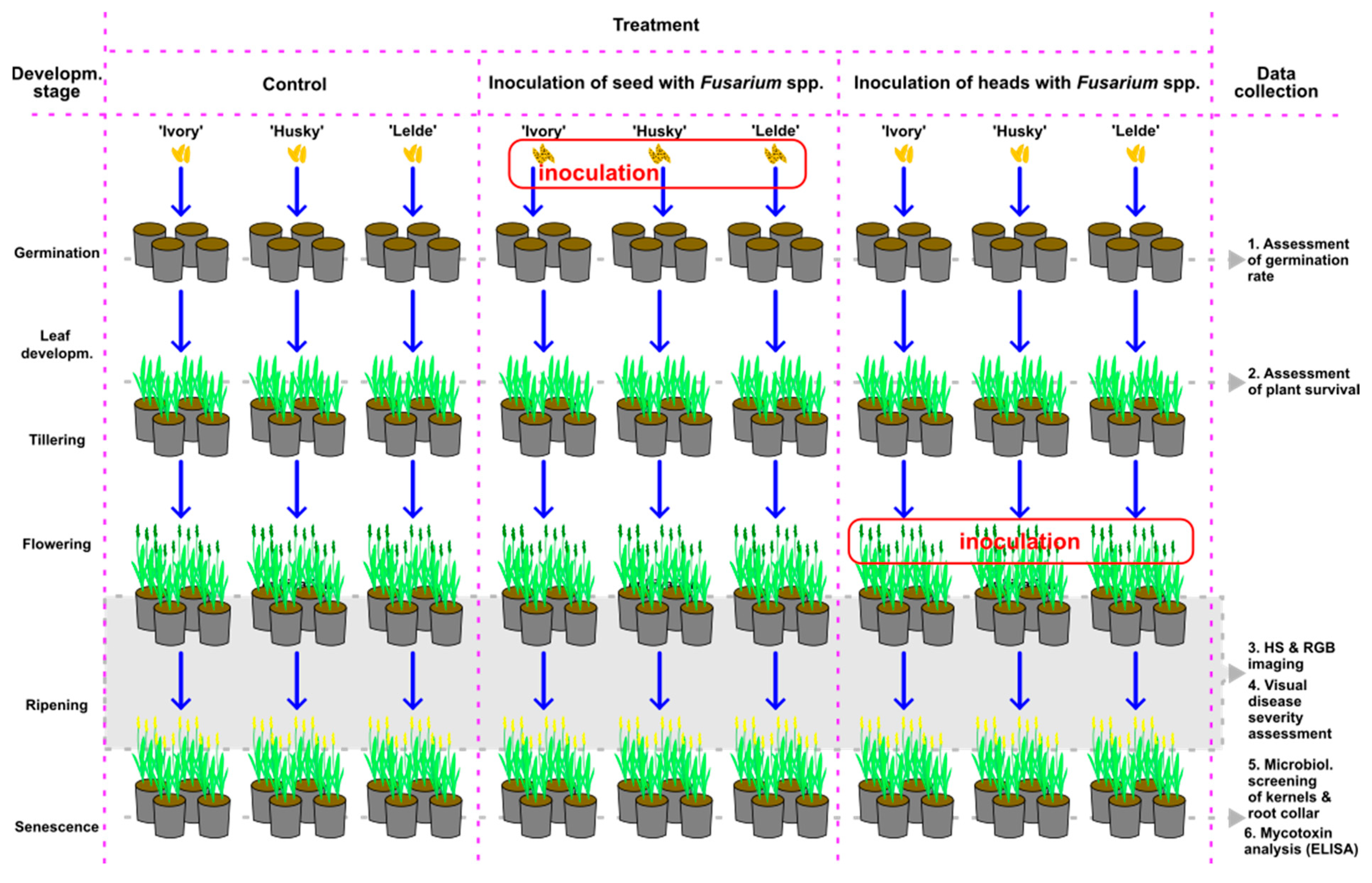
Figure 1). For each variety in each treatment option and control, there were four replicates (four pots), with a maximum of 40 plants if all seeds germinated and developed.
In both treatments, Fusarium spp. spore material contained a mix of F. graminearum, F. culmorum, F. oxysporum, F. sporotrichioides, and F. poae spores (volume proportions 1:1:1:1:1) at a total concentration of 5 × 10⁵ mL−1. For seed inoculation, seeds were immersed in 10 mL of spore suspension, vortexed for 2 min, dried on filter paper, and sown in pots. For head inoculation, a hand sprayer was used; each pot (8–10 plants) was sprayed with approximately 80 mL of spore suspension. After inoculation, the plants were dried for 30 min and covered with plastic bags for 48 h to increase humidity. For the propagation of the inoculum, Fusarium spp. isolates were cultivated on potato dextrose agar (PDA) 39 g L−1 medium with additional agar 4 g L−1 under natural light conditions (Fusarium graminearum under UV-B 16 h illumination) at 22 ± 2 °C. After sowing oat seeds in pots and transferring them to the greenhouse, further growth and development assessments included (i) estimation of germination percentage, (ii) estimation of seedling viability (counting of pathogen-induced decay during early developmental stages), and (iii) regular monitoring of the plant’s overall vitality.
2.2. Visual Disease Symptom Evaluation and Hyperspectral Imaging
Visual assessment of FHB disease severity was repeated three times: (i) at the end flowering stage (BBCH 69), (ii) at the early–middle milk stage (BBCH 73–75), and (iii) at the early–middle ripe stage (BBCH 83–85). FHB disease severity or the percentage of blighted or partly blighted spikelets on each panicle was visually estimated by a plant pathologist. Visual assessment of each oat panicle was estimated in steps of 1%, 3%, 5%, 10%, and between 10% and 100%, in 10% steps (adopted from [
21]). Disease severity was visually scored on three plants per pot, which were the same plants that were imaged with the HS camera. The mean disease severity per pot was derived from separate measurements of three individual plants. To track the dynamics of disease development, the plants were numbered, and the same panicles were evaluated repeatedly.
HS imaging of the inoculated and control plants was conducted in parallel with the visual assessment. Images were captured three times from the end of flowering until the early–middle ripe stage of the seeds. The plants were positioned such that the distance from the HS camera to the panicle was 0.25–0.35 m. For imaging, the oat panicles were mounted on a black pad to avoid vibration and minimize the negative background lighting effect. Three plants (panicles) from each pot were imaged in each session. During HS image analysis, the mean value of disease severity per pot was calculated based on three measurements. To track the dynamics of disease development and compare the results with visual disease severity assessment, the plants were numbered, and the same panicles were imaged repeatedly.
To confirm that the visual disease symptoms on panicles were caused by
Fusarium spp. pathogens, an agar plate culturing method was applied. Three kernels per panicle were collected from the same panicles that were HS imaged and visually assessed. The kernels were then sterilized for 2 min in 1.5% NaOCl solution, followed by rinsing with sterile deionized water. For explant cultivation, potato dextrose agar (PDA) 39 g L
−1 medium was used with additional agar 4 g L
−1 and antibiotic streptomycin 50 µg mL
−1. The same medium was used for the subcultivation of pure fungal pathogen isolates without antibiotics. After 2–4 weeks (depending on the
Fusarium species), pure fungal pathogen isolates were examined under a light microscope (Carl Zeiss Microscopy GmbH, Oberkochen, Germany). Taxonomic identification of
Fusarium spp. was based on species-specific characteristics, such as conidia, chlamydospores, and the morphology of mycelia [
33]. To screen for fungal endophyte content in vascular tissues, the root collar of each HS-imaged plant was also sterilized and placed on agar medium at the end of the greenhouse trials or after the death of the seedling (if it was suspected to be caused by FHB). The same sterilization and cultivation conditions and identification methodology used for kernel pathogen screening were used, except that the sterilization time was one minute.
Deoxynivalenol (DON), T-2/TH-2, and zearalenone (ZEN) mycotoxins were measured using enzyme-linked immunosorbent assay (ELISA). The following ELISA kits were used: (i) RIDASCREEN®FAST DON; (ii) RIDASCREEN® Zearalenon; and (iii) RIDASCREEN® T-2/HT-2 Toxin (R-Biopharm AG, Darmstadt, Germany). Sample preparation differed depending on the specific mycotoxin ELISA kit used. In all cases, 5 g of the ground sample was mixed with (i) 100 mL of distilled water (for DON), (ii) 25 mL of ready-to-use extraction (for T2/TH2), or (iii) 25 mL of methanol/water (70/30) solution (for ZEN), followed by shaking and filtration of the samples or centrifugation and dilution of the supernatant. Further ELISA test implementation steps were performed according to the manufacturer’s instructions. The Multiskan Sky Microplate Spectrophotometre (Thermo Fisher Scientific Ltd., Waltham, MA, USA) was used to read the results at an absorbance of 450 nm. Mycotoxin concentration calculations were conducted on RIDASOFT Win.Net Food & Feed software (version 1.8.1). For each cultivar and treatment, seeds were pooled from all pots, and after extraction, three technical replicates were analyzed, and the mean concentration of each mycotoxin was calculated.
2.3. Hyperspectral Measurement System
A hyperspectral camera (Specim IQ, Specim Spectral Imaging Ltd., Oulu, Finland) was used to obtain HS images. The camera captures reflectance light at a wavelength range of 400–1000 nm, a mean spectral resolution of 7 nm, an image resolution of 512 × 512 pixels, and 204 spectral bands. HS imaging was performed at natural light conditions, on sunny days between 12:00 and 16:00. Oat panicles were positioned at a 60–80 degree angle to the sun by mounting them on a black pad. A standard white reference was included in each image; the exposure time (integration time) was changed according to the light intensity, and the camera was manually focused. Cameras provide automatic image calibration according to white and dark reference. Additionally, a white reference was also used to check the reflectance intensity across the entire spectrum. Underexposed and overexposed images were rejected by the camera settings. Specim IQ Studio software was used for HS data collection and arrangement. Each individual scan was captured as a 16-bit unsigned integer cube of 204 × 512 × 512 pixels (102 MB binary file). The results were stored as a 32-bit floating-point number cube of a similar shape (204 MB binary file). In total, each individual scan resulted in approximately 310 MB, including dark and white references and additional metadata.
2.4. Hyperspectral Data Analysis
After HS data collection, arrangement, and selection of images of appropriate quality, minor data preprocessing was performed. Spatial subsetting was performed using Python-based software (Python version 3.8.12), and only regions with panicles on a black background were used for further data analysis. FHB disease severity was evaluated based on the HBI, which uses spectral differences between diseased and healthy panicles in the ranges of 550–560 and 665–675 nm. As mentioned before, most spectral reflectance differences between healthy and diseased ears are observed in the 350–1000 nm range, with the red and green bands showing the most significant variance [
20]. The HBI was chosen because it incorporates only two narrow and, at the same time, disease-representative spectral ranges, thus avoiding the noisy region above 750 nm. The index also proved its efficiency in classifying wheat FHB [
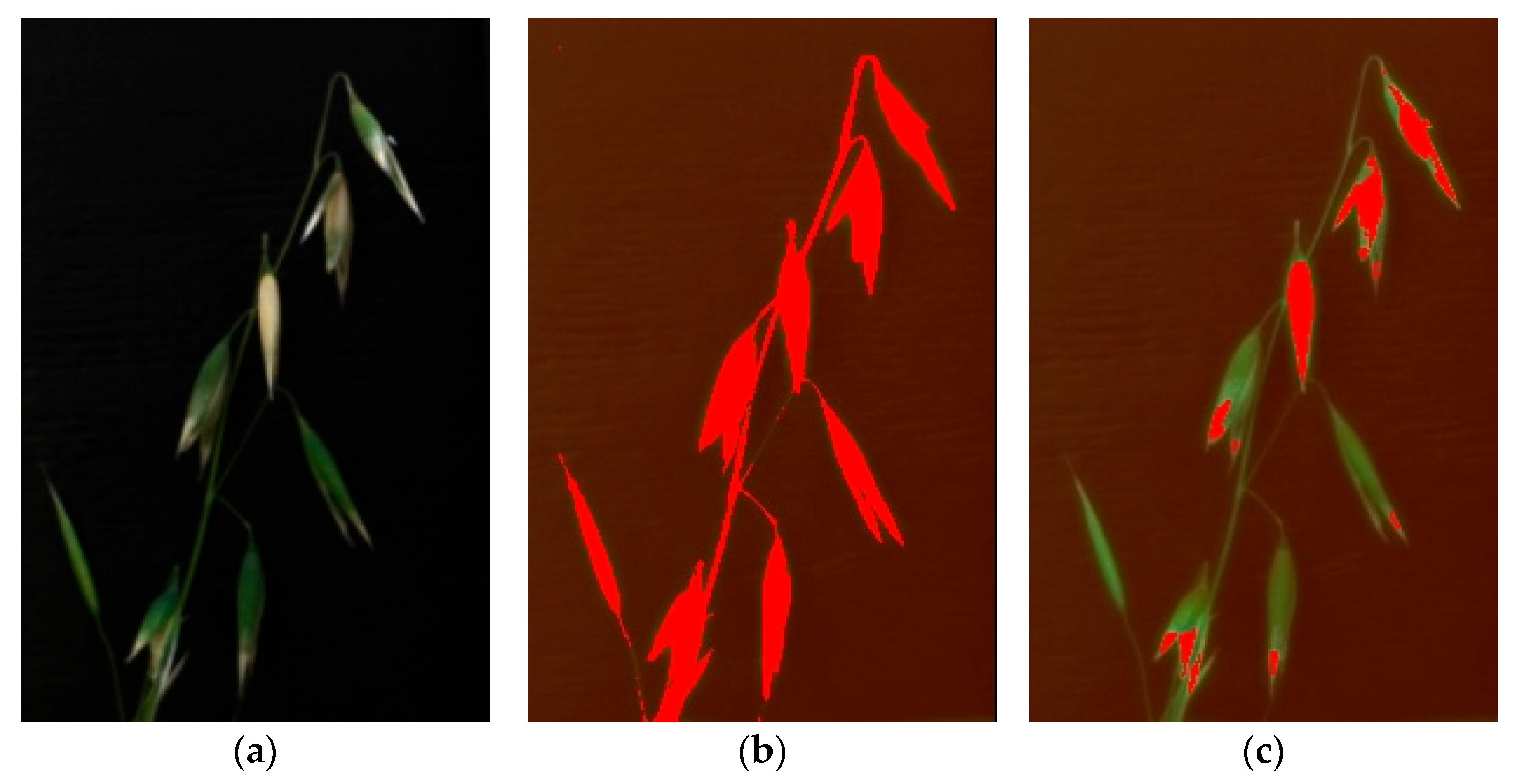
21]. For the purposes of this study, we developed a Python-based software tool that extracts a single spectral band corresponding to a selected wavelength range from a hyperspectral data cube. The extracted band was normalized to an 8-bit intensity range (0–255) per image. The heatmap visualization was generated by linearly blending the wavelength-specific single-band image with the corresponding RGB reference image. The displayed image was computed using a linear blending model:
where I reflects the intensity and α controls the visual dominance of the selected wavelength (for all HS data analysis, α = 0.45 was used). This operation does not modify or distort the spectral measurements. At any time, only a single wavelength was used to generate the heatmap, ensuring a direct and unambiguous correspondence between the displayed image and the selected spectral band. After the extraction of the selected wavelength, all pixels were assigned to one of three classes: (i) diseased; (ii) all plant pixels; and (iii) background. To differentiate diseased pixels from healthy and the background, segmentation was performed on rendered heatmap images of selected wavelength ranges (550–560 and 665–675 nm) with the threshold set at 50% saturation for diseased pixels and 75% for all plant (panicle) pixels (
Figure 2). HSB (Hue, Saturation, and Brightness) color space was used to apply a threshold on the saturation component, and RGB to HSL conversion was performed according to the commonly used denotation [
34]. To determine the segmentation threshold for identifying diseased panicles, 30 images containing a mixture of healthy and diseased panicles were processed empirically under the supervision of a plant pathologist. An optimal threshold value of 50% HSB saturation (8-bit scale) was found under the camera and image acquisition settings of this study; this value produced minimally possible mask pixels on healthy panicles while maximally accurately masking visibly infected panicles. Adjusting the threshold by ±2% resulted in either the omission of diseased regions or false-positive masking of healthy tissue. Therefore, the chosen threshold is specific to the greenhouse setup and normalization/calibration procedures used here and may differ under other imaging conditions. Finally, the threshold was validated using a control set of healthy plant images to confirm the absence of mask pixels on healthy panicles. The HBI was calculated using the following calculation: for every HS image, the number of pixels with disease class was divided by the number of all plant pixels in each individual spectral range (550–560 and 665–675 nm) and multiplied by 100. To assess the accuracy of this approach, the results were compared with the visual disease severity assessment performed by a plant pathologist on the same day. The absolute difference in percentage points between the two assessment methods was calculated for each pot separately.
2.5. Statistical Analysis
The data obtained during the trials were maintained in Microsoft Excel (Microsoft Office Professional Plus 2019, Microsoft Corporation, Redmond, WA, USA). To find statistically significant differences between treatments and cultivars for (i) germination, (ii) seedling viability, (iii) disease severity assessed visually or (iv) by HS analysis, and (v) microbiological test results, a two-way analysis of variance (ANOVA) was used. Repeated measures correlation coefficient was calculated to examine the relationship between disease severity values assessed visually and by HS analysis (each datapoint is the mean result of three plant visual assessments and HS analysis from each pot). Pearson’s correlation coefficients were calculated to examine the relationship between disease severity values assessed by HS analysis (obtained at the early–middle ripe stage) and T2 and TH-2 contents in the kernels. In both statistical methods, a
p-value ≤ 0.05 was deemed significant. Statistical analysis was performed in RStudio (version 2025.09.1, Integrated Development Environment for R. Posit Software, PBC, Boston, MA, USA) statistical software [
35] with the following packages: (i) Readxl [
36]; (ii) tidyverse [
37]; (iii) dplyr [
38]; (iv) cowplot [
39]; and (v) rmcorr [
40], and for data visualization, the (vi) ggplot2 package was used [
41].
3. Results
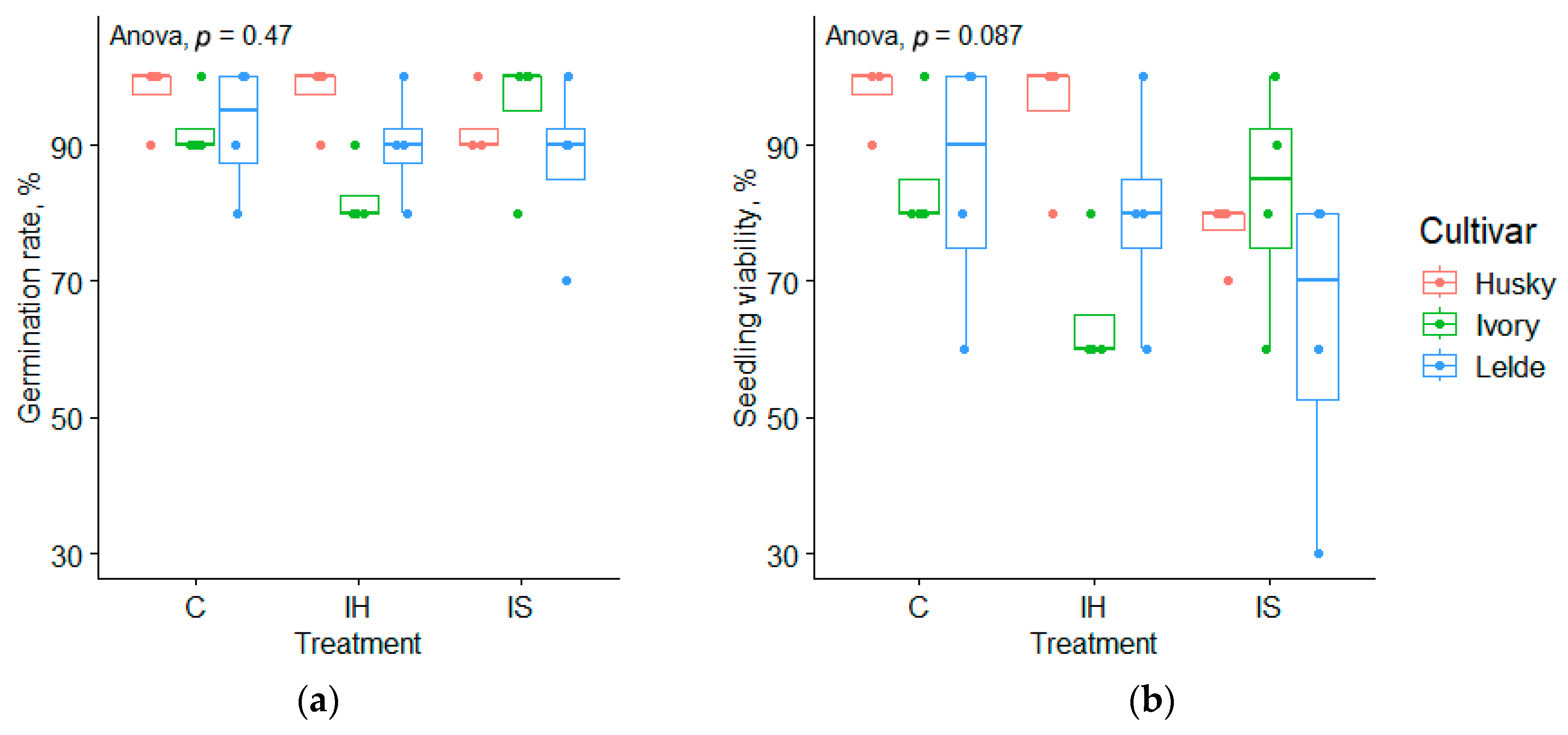
The seed germination percentages and seedling viability are summarized in
Figure 3. Statistical analysis showed no significant differences between the treatments, although there was a tendency towards higher germination and viability rates in the control plants. No statistically significant differences were observed between the cultivars. ‘Husky’ showed the highest germination percentage and seedling viability, whereas the other two cultivars showed similar results. A possible explanation for the lack of a statistically significant difference in the comparisons could be the wide dispersion of data and the small number of replicates.
Visual symptoms of FHB were only observed on panicles, similar to the results of other studies [
42,
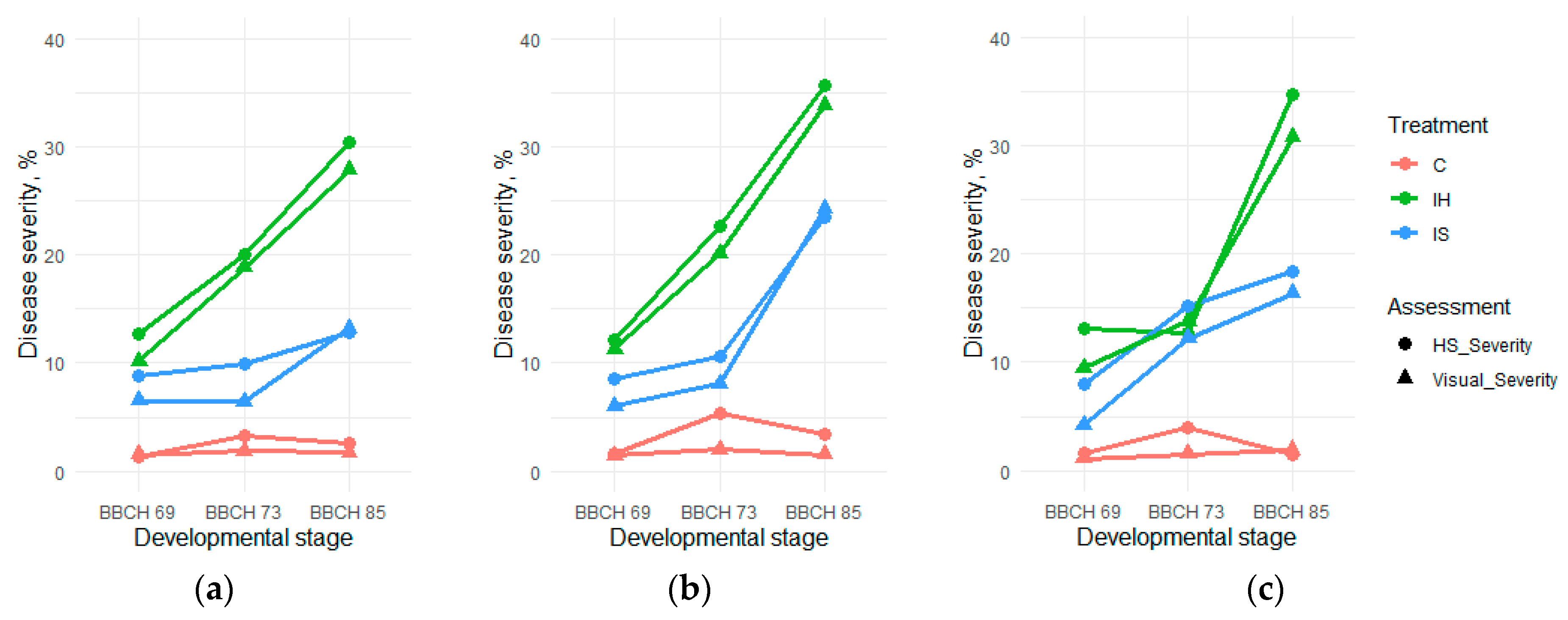
43]. From the first visual assessment to the last assessment, 19 days passed during which the disease progressed in the plants after both inoculation treatments, but not in the control plants (
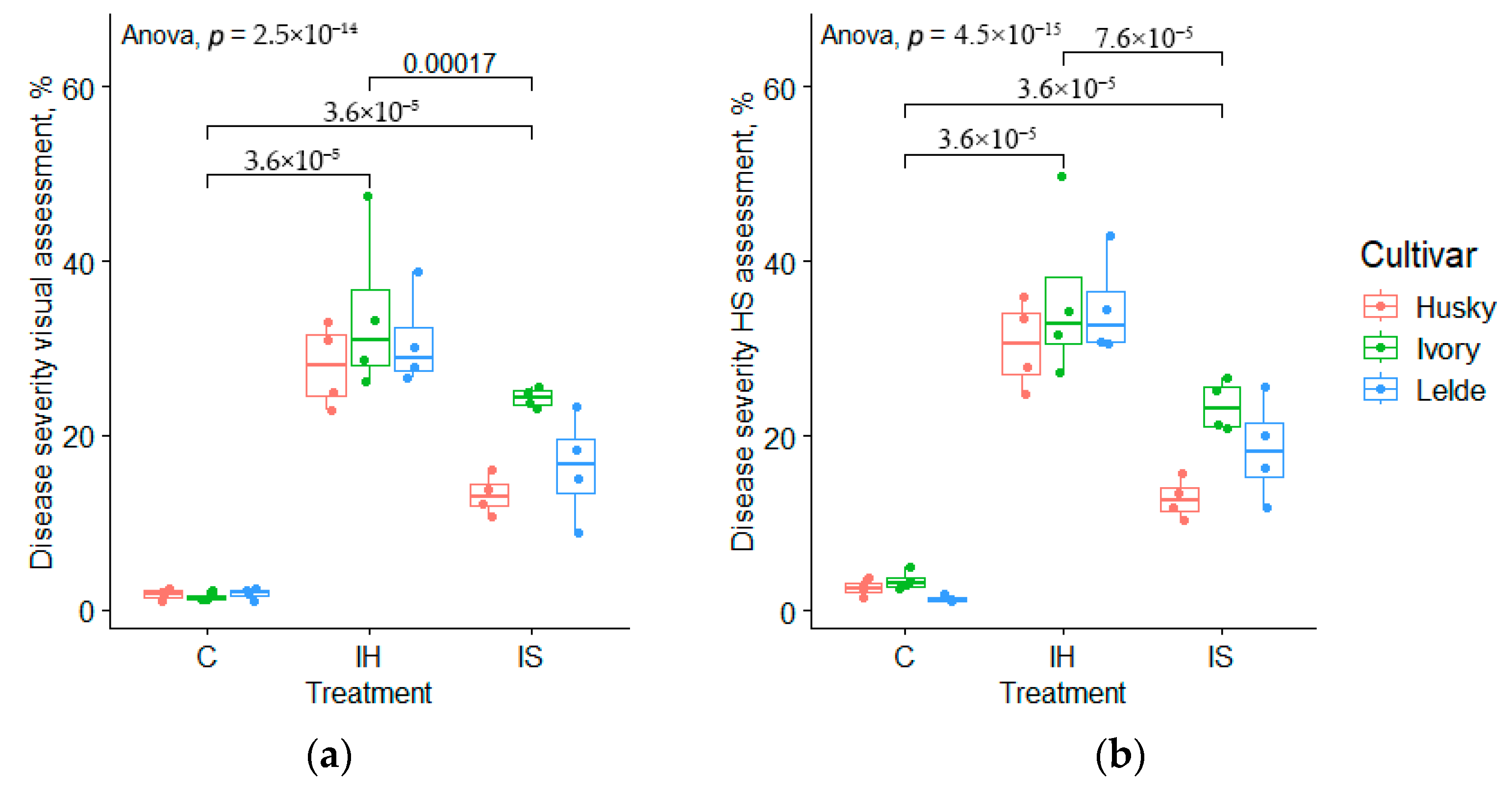
Figure 4). A comparison of the visual assessments confirmed statistically significant differences in disease severity among all treatments. The results of the last visual assessment run conducted at the early–middle ripe stage (BBCH 83–85) are summarized in
Figure 5.
The FHB severity was 33.9% (±9.53%) for cultivar ‘Ivory’ when the heads were inoculated, while it was 30.8% (±5.47%) for cultivar ‘Lelde’ in the same treatment, and 27.9% (±4.84%) for ‘Husky.’ In the treatment where seeds were inoculated, disease severity for cultivar ‘Ivory’ was 24.3% (±1.16%), followed by ‘Lelde’ at 16.4% (±6.12%) and ‘Husky’ at 13.2% (±2.34%). Despite the surface sterilization of seeds, disease symptoms were observed in control plants, although the severity was low. Severity rates in the control plants were: ‘Lelde’: 1.9% (±0.65%), ‘Husky’: 1.8% (±0.65%), and ‘Ivory’: 1.5% (±0.52%). Since there was no possibility for disease spores to enter, it is most likely that the disease symptoms were caused by other abiotic factors.
The evaluation of disease severity using HS analysis was well-aligned with the visual assessment (
Figure 4). Statistical analysis confirmed that both inoculation treatments caused significantly higher disease severity compared to control plants, and there was a significant difference between the treatments (
Figure 5). The last HS disease severity assessment results for inoculated head treatment for cultivar ‘Ivory’ was 35.7% (±9.81%), for ‘Lelde’ 34.7% (±5.75%), and for ‘Husky’ 30.5% (±5.04%). For inoculated seed treatment, cultivar ‘Ivory’ was 23.5% (±2.92%), ‘Lelde’ 18.4% (±5.84%), and ‘Husky’ 12.9% (±2.36%). In control plants, disease severity was ‘Ivory’: 3.4% (±1.02%), ‘Husky’: 2.6% (±0.93%), and ‘Lelde’: 1.4% (±0.32%).
Comparing the disease severity between cultivars, there were no statistically significant differences (α > 0.05), either when evaluation was based on visual symptoms or HS image analysis, although the cultivar ‘Husky’ tended to be more resistant than the other two cultivars.
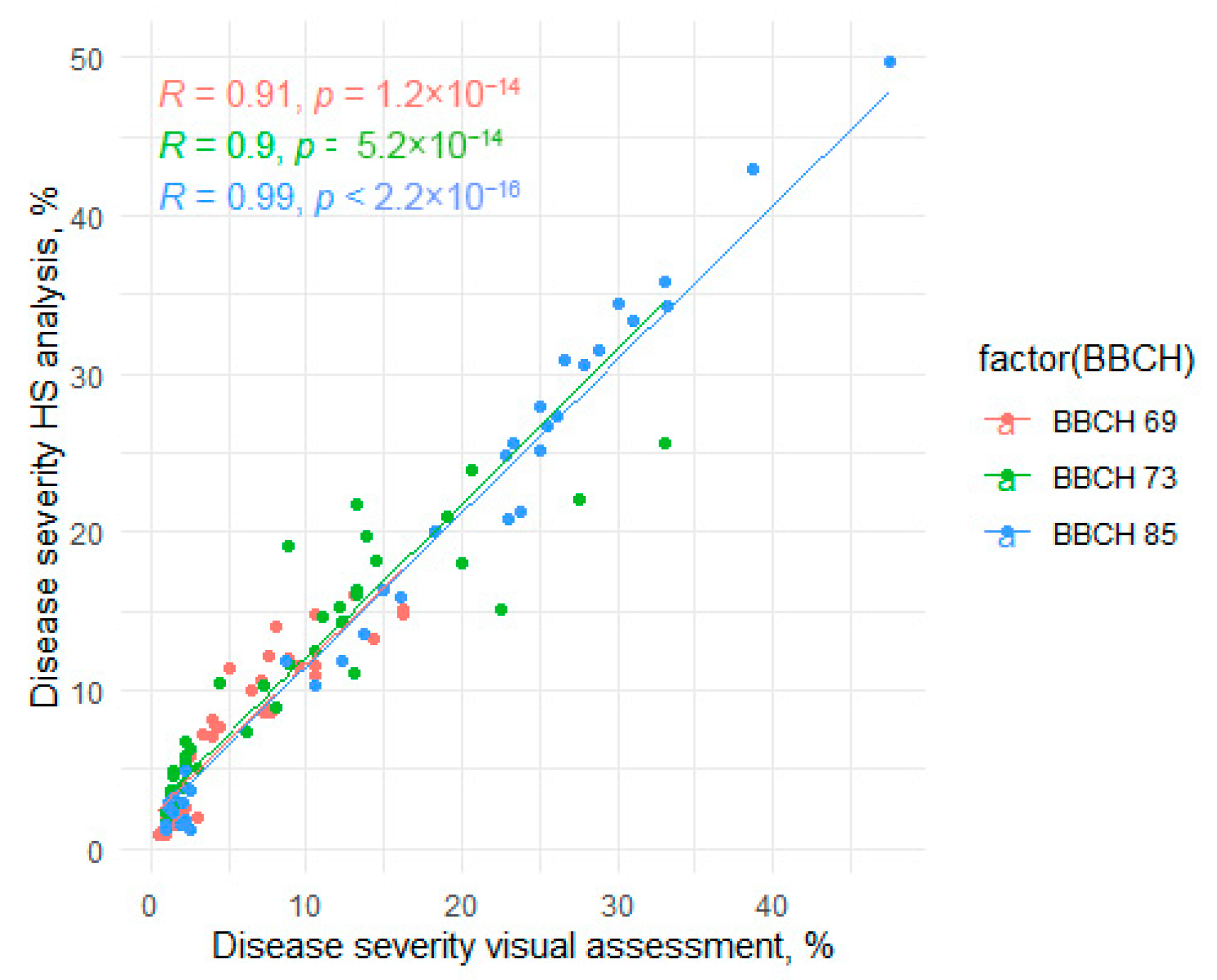
Repeated measures correlation analysis was performed to determine the correlation between the results of FHB disease severity assessed visually and by HS analysis. A strong positive correlation was observed (total correlation coefficient of 0.962) (
Figure 6). If individual visual disease severity assessment results were compared with the corresponding HS results (of the same pot on the same measurement date), the absolute difference in percentage points would range from 0.03 to 10.14, with an average absolute difference of 2.41 percentage points among all treatments and cultivars tested. Between treatments, the absolute difference in percentage points was: (i) 0.03 to 4.59 with an average of 1.30 for control plants, (ii) 0.2 to 6.6 with an average of 2.39 for inoculated seed treatment, and (iii) 0.82 to 10.14 with an average of 3.54 for inoculated head treatment.
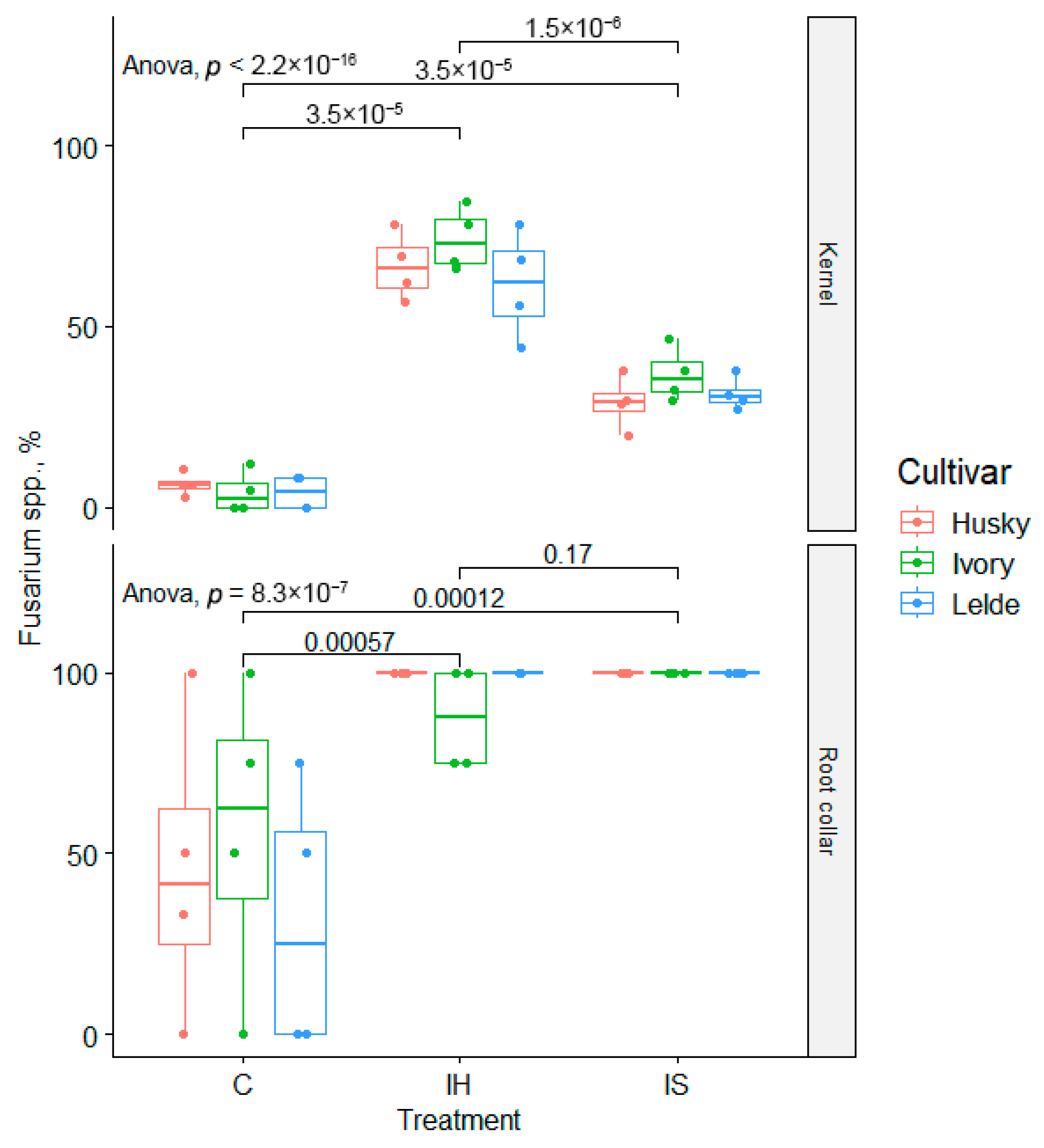
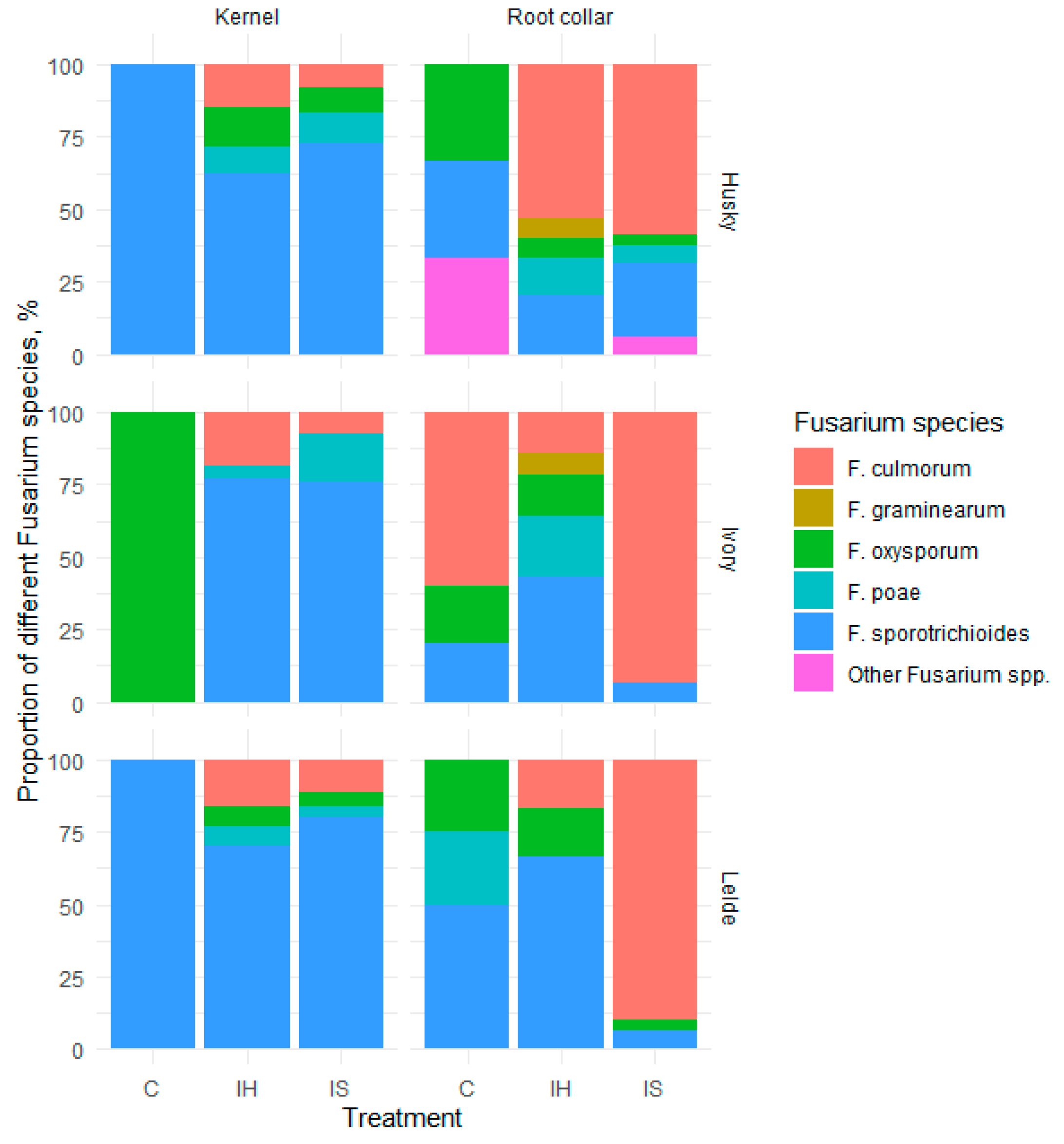
The results of the microbiological test of the root collars and kernels are summarized as follows: (i) the distribution of
Fusarium spp. among all isolated explants (
Figure 7) and (ii) the proportion of individual
Fusarium species within each cultivar and treatment (
Figure 8). The aim of the test was to verify that the disease symptoms were caused by
Fusarium spp., although it was not possible to determine a quantitative relationship between the severity of the disease and the prevalence of specific pathogens. There were statistically significant differences in the distribution of
Fusarium spp. among the treatments. Since only a low background of
Fusarium spp. pathogens was detected in control plants (on average 4–6.5% between different cultivars), it can be suggested that some degree of the early yellowing of grains before the late ripening stage was caused by other, most likely abiotic, factors. The percentage of
Fusarium spp. occurrence in the inoculated seed treatment varied on average from 28.9 to 36.7% among the cultivars, and for inoculated heads, on average, from 61.7 to 74.2% (
Figure 7). These results indicate that FHB symptoms were caused by
Fusarium spp. pathogens as the disease severity results assessed visually or using HS analysis were also higher for the same treatments with similar proportional differences between treatments (
Figure 4 and
Figure 5). Simultaneously, the microbiological test of root collar explants showed a different distribution of
Fusarium spp. among all treatments, which was significantly higher than that in the kernel tests. In the control plants, occurrence reached 31.3–45.8% among the cultivars, but in both inoculation treatments, it reached 87.5–100%. There was a significant difference between the inoculated and control plants, but not between the inoculation treatments (
Figure 7). As shown in
Figure 8, the proportion of individual species (%) in all
Fusarium spp. isolates differed depending on the type of explant, with
F. culmorum slightly dominating in root collars, while
F. sporotrichioides was strongly dominant in kernels.
The results of the mycotoxin analyses are summarized in
Table 1. DON was found at low concentrations only in the inoculated head treatment, ZEN was not recorded, and T-2 and HT-2 were present in both the inoculated seed and head treatments. The mycotoxin data obtained corresponded to the results of the microbiological tests. As
F. sporotrichioides dominated the kernel explants, this pathogen is likely responsible for the high content of T-2 and HT-2 mycotoxins [
44,
45], whereas
F. culmorum and
F. graminearum, which produce DON and ZEN [
43], were present in much smaller proportions or were completely absent.
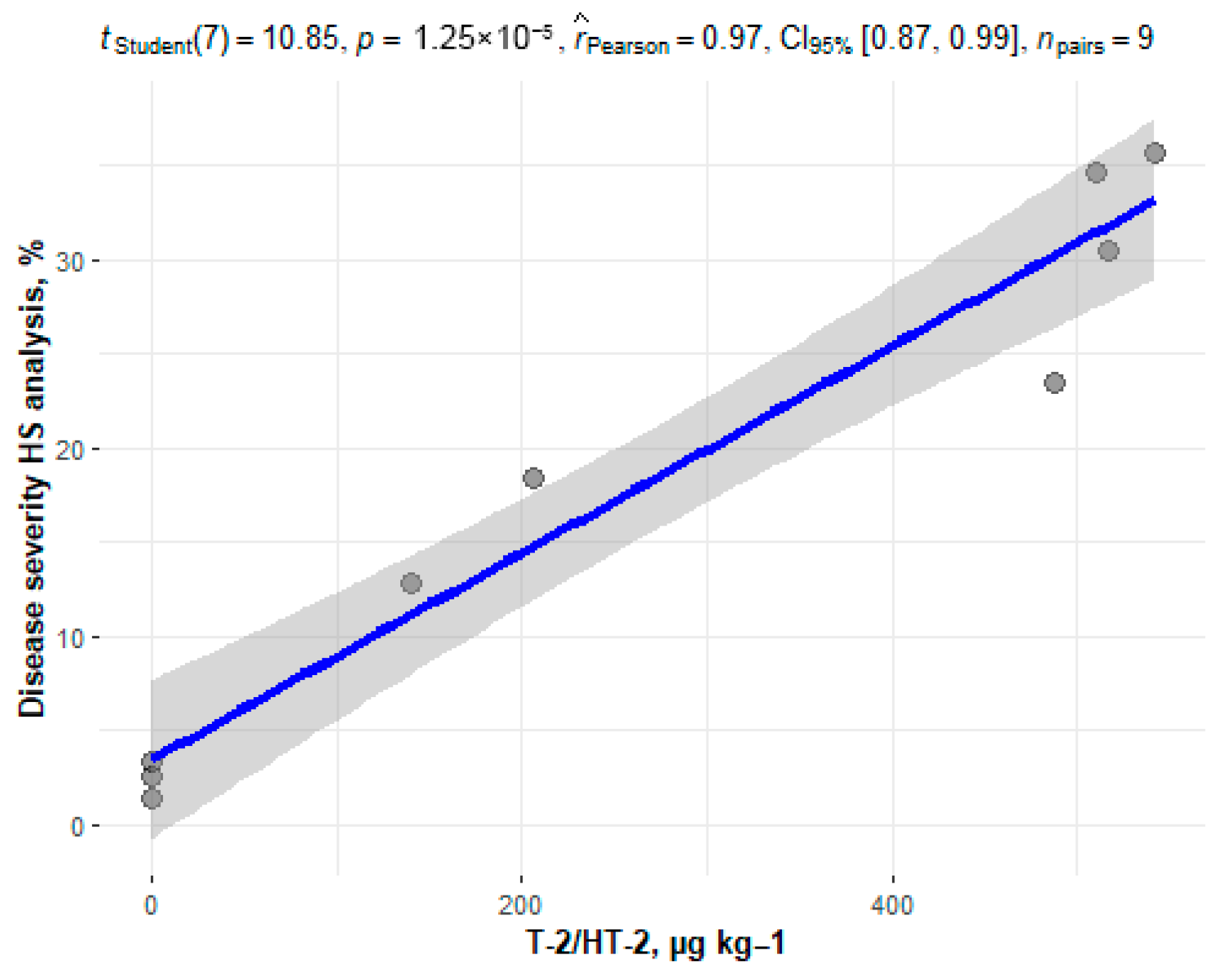
From the results of mycotoxin analysis in kernels (
Table 1), it can be seen that the highest content was for T-2/HT-2; in addition, it was also the only mycotoxin found in both inoculation treatments. Therefore, the Pearson correlation coefficient was calculated only between T-2/HT-2 content and disease severity based on HS analysis. The obtained correlation coefficient of 0.971 (
Figure 9) indicates a very strong correlation, despite the arguable accuracy of the HS analysis of disease severity.
4. Discussion
The disease severity results obtained in the greenhouse trials generally correspond with those reported in other studies. The disease severity results obtained in the head inoculation treatment ranged from 27.9% to 33.9% when visual assessment was used, and 30.5–35.7% when HS analysis was applied. These results are consistent with those of other studies. For example, Xue et al. [
46] in their study with different oat cultivars used the same inoculation timing and reported 30–74% of inoculated spikelets. The reason for the slightly higher results could be explained by the different disease assessment approaches, other oat cultivars used in the trial, and the inoculation material. Similar but slightly higher disease severity results for FHB were obtained in wheat in a study where inoculation was conducted at the same plant developmental stage, and disease severity was assessed using HBI [
21]. Although seed-borne spread is not typical of FHB, the disease severity was higher than that in the control plants in the seed inoculation treatment. The high spore concentration in the inoculation solution likely resulted in both a decrease in seedling viability and further spread of the disease through vascular tissues.
Comparing the cultivars used in the greenhouse trials by FHB disease severity, both visual assessment and HS image analysis results did not show statistically significant differences. On the other hand, there was an unvarying tendency that disease severity for ‘Ivory’ was higher, followed by ‘Lelde’ and finally ‘Husky’ for both treatments and assessment approaches. Increasing the number of replicates (number of pots per treatment) would potentially decrease data dispersion, which could possibly turn into statistically significant differences between cultivars. Field trials by other authors have shown that the oat cultivar ‘Husky’ is intermediately susceptible to FHB, with high levels of toxin accumulation and comparable levels of fungal colonization when compared to other cultivars; however, environmental conditions have a significant impact on the outcome [
26,
47]. In general, cultivar ‘Husky’ is not particularly resistant; it is not always the most susceptible, exhibiting a range of reactions to various
Fusarium species and environmental factors [
26]. In contrast, the cultivar ‘Ivory’ is considered to have a high susceptibility to FHB, which has been confirmed in different field trials.
Fusarium spp. infection in the cultivar ‘Ivory’ results in both decreased plant vitality and yield loss, as well as the accumulation of mycotoxins in grains [
48]. The susceptibility of the oat cultivar ‘Lelde’ to FHB is not known, and our results suggest that this cultivar, bred in Latvia, has a similar susceptibility to FHB as ‘Ivory’; further field trials must be applied for conclusive results. In this study, the widely spread
Fusarium species in Latvia, which were confirmed by field monitoring results in 2020/2021 [
22], were selected for inoculation. Due to the limitations of the greenhouse area, we were unable to conduct inoculation with each selected
Fusarium species separately; therefore, an inoculation solution containing five different species was used (see
Section 2.1). Discussions may be raised because the specific pathogen causing FHB visual symptoms is not known in each case. To mitigate this limitation, a complex study approach was used, which also included microbiological tests of kernels to detect particular
Fusarium species. Other studies assure that visual symptoms of FHB on oats are rather variable characteristics, and no specific relationship has been found between the features of the disease symptoms and a particular
Fusarium species [
49,
50], which could also be applied to HS analysis at visible and near-infrared (NIR) spectra. Pathogenicity field trials include more stable pathogen species-specific characteristics, such as germination capacity and analysis of specific mycotoxin content [
47,
48]. Microbiological tests of kernels showed that
F.
sporotrichioides was the most aggressive species (
Figure 8), which was also confirmed by mycotoxin analysis results.
The assessment of FHB severity based on HS image analysis was compared with the visual assessment. As described in
Section 3, there was a strong positive correlation between the disease severity results obtained by HS analysis and visual assessment (
Figure 6). The absolute difference in percentage points between individual disease measurements (when comparing visual disease severity assessment results with the corresponding HS results) ranged from 0.03 to 10.14, with an average absolute difference of 2.41 percentage points. The highest absolute difference in percentage points was observed for the inoculated heads treatment, where the disease severity was the highest, whereas the lowest absolute difference in percentage points was observed for the control plants, where the disease severity was the lowest. As previously noted, the visual assessment was based on the symptoms of the disease in panicles. To reduce assessment error, only one evaluator performed the visual scoring, and the assessment was performed under the same conditions. At the same time, no blinding was used, so this aspect should be noted as one of the limitations of the visual assessment of disease severity. Furthermore, visual assessment is spikelet-based rather than pixel-based; therefore, larger spikelets had a greater impact on the severity calculation and may have contributed to disparities in visual severity estimations [
51]. Another aspect is that the result of the visual assessment of disease severity depends on the symptoms; however, if other factors (e.g., abiotic) have a similar symptomatic influence, this can lead to inaccurate results [
52]. The differences between the visual and HS analysis assessments of disease severity could be explained by both the above-mentioned factors: (i) variations in the visual assessment and (ii) the influence of abiotic factors, which could be particularly evident in the control treatment. As the differences increased with higher disease severity, it seems that a threshold level of 50 ± 2% saturation for distinguishing between healthy and diseased pixels showed reduced accuracy at high disease severities. To improve threshold stability, larger HS image datasets should be used, and an additional HS data normalization method may need to be implemented.
As was mentioned previously, the HS image analysis used in this study was based on HBI, which was adopted from the wheat FHB study [
21]. In general, the reflectance spectra of healthy and diseased panicles or ears of both crops are similar. HBI calculation uses only two spectral ranges of 10 nm width (665–675 and 550–560 nm); these two ranges effectively show physiological damage caused by
Fusarium spp. regardless of the specific species, and represent variations in the major photosynthetic pigments (carotenoids and chlorophylls). Consequently, both ranges exhibit the spectral signature’s most noticeable variation [
21]. The main differences between the panicles and ears of both crops are in morphology and anatomy, which ensure slightly different initial inoculation and further spread of the pathogen into host tissues [
53,
54]; unfortunately, these differences cannot be captured using a segmentation approach of HS images.
Analyzing the obtained mycotoxin results, it is important to note that toxin concentration is not always associated with infection incidence, severity, or reduced germination potential. In particular, late infections, which frequently cause hull infections and seldom produce toxins, can impair germination potential through seedling blight [
55]. Simultaneously, the near-infrared HS imaging approach has been successfully applied to oats for
Fusarium detection, with models correlating spectral features with DON content [
31]. We demonstrated that the visible spectrum is effective for detecting FHB in oats. In this study, we determined the prevalence of pathogenic
Fusarium fungi that produce mycotoxins other than DON in oat kernels. Further research is required to elucidate why different fungal pathogens colonize plant parts in different proportions. Seeds of different cultivars produced under identical conditions would allow for a precise comparison of cultivar specificity. A high correlation obtained in this study between FHB disease severity assessment results based on HS analysis and mycotoxin (T-2/HT-2) content in kernels is one of the main findings (
Figure 9). This finding potentially could also be applied to other widely spread
Fusarium species, which are characterized by reasonably high mycotoxin production in kernels; however, a larger sample size is needed for conclusive conclusions. In another study, the detection of T-2/HT-2 toxins in unground and ground oat samples was measured based on HS analysis and compared with ELISA results. Also, a high correlation coefficient (r = 0.80) was obtained, but in this research, an HS camera with a spectral range of 900–1700 nm was used [
32].
Despite the close correlation, the HS data analysis approach used in this study is not well-suited for adaptation to field conditions. Limited time and other resources determined the choice of a relatively simple HS data analysis method based on automated segmentation. The primary objective of this study was to verify whether HS analysis based on HBI can effectively assess FHB disease severity, as it has proven effective in wheat [
21]. For this reason, greenhouse trials were used as they allow us to exclude unwanted field factors such as other diseases, abiotic factors, etc. For planning future research for the development of a UAV-based mycotoxin monitoring method in oat fields using an HS/MS camera, methodological enhancements should be considered. First, experiments should be conducted under field conditions to achieve a high level of reliability and practical relevance of the proposed solution. Second,
Fusarium species should be inoculated separately to enable the production and characterization of distinct mycotoxins in oat kernels in future studies. Third, inoculation strategies should be designed to induce different degrees of disease severity in plants. Fourth, preprocessing should be optimized to reduce variability caused by natural illumination and to remove excessively noisy spectral bands. Finally, disease detection models should integrate spectral, textural, and color features, with classification performed using a random forest-based data fusion framework.
For farmers, it would be very useful to know the potential level of mycotoxins in the crop before harvest, as this would allow them to avoid or minimize expensive and complex chemical mycotoxin analyses or plan appropriate actions if the level of contamination is too high for use in food or feed. Therefore, HS analysis can be used to monitor FHB in cereal crop fields. For this purpose, a UAV (Unmanned Aerial Vehicle) with a mounted HS or MS (multispectral) camera may be used. However, it is important to emphasize the potential of a rapid monitoring method given the narrow window of monitoring time (from the flowering stage to the ripe stage) suitable for the detection of FHB, since the method is based on visual symptoms of the disease, which are similar to signs of grain ripening. Although many laboratory- and greenhouse-scale solutions have been developed, the field-scale validation and adoption of HS image analysis methods remain challenging. The technical challenges include sensor calibration, high data dimensionality, and complex data processing requirements [
56,
57,
58]. Environmental factors, such as variable lighting, atmospheric disturbances, and heterogeneous background interference, affect spectral signatures [
59,
60,
61,
62]. The increased availability of large datasets for machine learning, computational capacity, and the development of cost-effective solutions will be required for further progress towards the development of scalable methods for disease detection. An intrinsic challenge is the distinction between abiotic and biotic stresses, which cause similar symptoms [
63].