Review

Challenges in Remediation of Hg-Contaminated Agricultural Soils: A Literature Review

Research Institute for Analytical Instrumentation Subsidiary, National Institute for Research and Development of Optoelectronics Bucharest INOE 2000, 67 Donath Street, 400293 Cluj-Napoca, Romania
*
Author to whom correspondence should be addressed.
Agriculture 2026, 16(8), 849; https://doi.org/10.3390/agriculture16080849
Submission received: 17 March 2026 / Revised: 4 April 2026 / Accepted: 10 April 2026 / Published: 11 April 2026

Abstract

Mercury (Hg) is a ubiquitous element in the environment that may pose a threat to human health due to its toxicity, high mobility through the food chain, and long-lasting persistence. Organic Hg compounds, particularly methylmercury, are more toxic than inorganic mercury due to their easy absorption and persistent retention within the organism. Although natural attenuation can occur in soil through various processes, excessive levels of Hg cause pollution that can adversely affect agricultural soil, making remediation necessary to either remove or stabilize Hg within the soil. This review primarily aims to summarize key remediation strategies—chemical, biological, and physical—developed in recent years for agricultural soil remediation. It discusses the influencing factors, advantages, limitations, mechanisms, and practical applications of these soil remediation technologies. The published literature focuses on identifying plant species and microorganisms capable of remediating Hg-contaminated soils. Emerging amendments, such as biochar and nanomaterials, have been tested for treating mercury (Hg)-polluted soils primarily by immobilizing mercury and reducing its bioavailability and methylation. Ex situ remediation technologies are effective for Hg-contaminated soils but are often costly, labor-intensive, detrimental to soil quality, and generate hazardous secondary waste. In contrast, in situ technologies treat Hg directly within the soil, preserving the soil matrix and its biota. According to the literature, remediation of Hg-contaminated agricultural soils can be compatible with food crop production only if the bioavailable Hg fraction is sufficiently reduced and crop uptake remains below food safety limits. The gap between laboratory trials and actual field applications in Hg-contaminated soil remediation mainly arises from differences in scale, complexity, and the uncertainty of real-world conditions, which often reduce the efficiency and predictability of treatments. This review aims to provide a practical reference for improving the effective remediation of Hg-contaminated soils in the future.

1. Introduction

Mercury (Hg) is a widespread element that naturally occurs in the Earth’s geological formations. In agricultural soils, organic-rich horizons with high organic carbon (OC) content and Fe/Al–humus complexes typically bind Hg strongly, reducing its mobility but creating long-term Hg reservoirs [1]. In general, the background concentration of Hg in soil is low, ranging from 0.03 to 0.1 mg kg−1 with an average value of around 0.06 mg kg−1 [2,3]. Mercury pollution occurs to varying degrees worldwide due to emissions from a combination of natural sources (such as volcanoes, oceans, and soils), human activities (including the chemical industry, mining, coal burning, and agricultural practices), and re-released sources (contamination previously present in soil, water, and rocks) [4,5]. The historical use of organomercurial pesticides and fungicides, such as methylmercury and phenylmercury compounds, has been a significant source of Hg contamination, particularly in agricultural soils [6]. According to the United Nations Environment Programme (UNEP), global Hg emissions to the atmosphere in 2015 were approximately 2220 tons. Two main pathways constitute the principal route by which Hg from the atmosphere enters and accumulates in soil: dry and wet deposition. Wet deposition transports soluble Hg2+ and particulate-bound Hg via rain, snow, and fog, transferring Hg directly to the land surface [7]. Dry deposition consists of the direct settling of gaseous elemental mercury and reactive gaseous mercury onto soil, vegetation, and other surfaces [8]. Current atmospheric Hg concentrations are estimated to be 5.5 to 7.6 times higher than pre-anthropogenic levels [5].
Elemental mercury (Hg0 vapor) is the most common form in the atmosphere, where it can stay airborne or become oxidized and subsequently settle into water or soil. Because of its high volatility, low solubility, and low chemical reactivity, elemental Hg is readily transported through the atmosphere as a gas. It has a prolonged atmospheric residence time of six months to two years, allowing it to reach even the most remote regions across the globe [6,9]. Once on land, Hg binds to soil in several forms. In the soil matrix, pH and organic matter (OM) play pivotal roles in controlling the adsorption and desorption of Hg, primarily by determining which Hg species predominate and how strongly they bind to the soil solid phase. High OM content increases Hg adsorption due to the abundance of phenolic, carboxyl, and thiol functional groups. However, dissolved organic carbon (DOC) can form Hg–DOC complexes that enhance Hg mobility [10]. Sulfate- and iron-reducing bacteria can methylate Hg2+ into methylmercury (MeHg), which can bioaccumulate and biomagnify in food chains [11,12,13,14]. After entering the food chain, it may adversely impact human health. MeHg is highly neurotoxic and readily crosses the blood–brain barrier, which justifies its special relevance within the food chain [15]. Mercury is one of the most dangerous pollutants and ranks third on the Agency for Toxic Substances and Disease Registry’s priority list (ATSDR) [16,17,18]. Mercury, akin to cadmium and lead, exhibits high toxicity at even minimal concentrations and possesses no identified physiological function [19,20]. Moreover, inorganic Hg (Hg2+) and MeHg, although both toxics, differ significantly in their target organs, kinetics, and overall risk profile. Hg2+ is, in general, more reactive and tends to damage local tissues (e.g., in kidneys and endothelial cells) [21]. MeHg is less acutely cytotoxic at high doses but is extremely neurotoxic because it crosses membranes easily and accumulates in the central nervous system, disrupting neurons, mitochondria, and redox balance. It has teratogenic effects on fetal development and efficiently passes from mother to fetus [22].
Mercury primarily affects the kidneys and can cause hemorrhagic gastritis, colitis, and benign tumors. It alters cell membrane permeability, disrupts macromolecular structures, impairs mitochondrial function, and increases ROS formation, resulting in irreversible oxidative damage [23]. Its toxicity arises from a strong affinity for SH groups, particularly cysteines, disrupting protein structure and function [24]. Acute exposure to Hg leads to skin illness like dermatitis, nail discolouration, and mucous membrane burns. Chronic exposure may lead to acrodynia, anorexia, fatigue, irritability, apathy, photophobia, polydipsia, and other hypersensitivity reactions [25].
Although Hg use has declined in recent years, abandoned mines and chlor-alkali plants continue to release toxic waste, vapor, and organomercurial compounds [26,27,28]. Awareness of Hg as a global pollutant is increasing, highlighting the urgent need for solutions to protect the environment and human health [29]. Natural attenuation occurs through processes such as biodegradation, dilution, dispersion, sorption, reductive decay, stabilization, and contaminant conversion. While soil can naturally reduce Hg content, excessive levels lead to pollution. Two key concepts for remediation in agricultural soil, where the objective is to prevent Hg transfer to plants, are mobility and bioavailability. Mobility refers to the tendency of Hg species (mainly Hg2+ or Hg0) to leach into soil pore water, groundwater, or runoff, a process often influenced by soil characteristics such as pH, organic matter (OM), and binding to soil particles. In contrast, bioavailability denotes the fraction of Hg that plants can absorb [30]. Remediation is necessary to either remove Hg or stabilize it in less toxic or less mobile forms within the soil [31,32,33]. Mercury reduces bacterial diversity and inhibits both soil respiration and nitrification potential [11]. Therefore, there is a pressing need to establish effective strategies for the remediation of Hg from soil. The primary methods for removing Hg include physical and chemical remediation, as well as bioremediation techniques [6]. Physical remediation includes soil replacement, thermal treatment, electro-dialysis, stabilization/solidification, and vitrification; chemical remediation covers soil leaching and stabilization; biological remediation involves plants, animals, and microbes [34]. These remediation technologies can be performed ex situ or in situ.
Ex situ treatment technologies, such as chemical washing, thermal treatment, and electro-dialysis, are well-known methods for the remediation of soils contaminated by Hg. These methods are often expensive, labor-intensive, can harm soil quality, require specific substrates or pretreatment, and generate hazardous secondary waste that is difficult to recycle and demands further processing before disposal. Also, transporting contaminated soil in ex situ technologies introduces major logistical hurdles and risks of contaminant dispersion. These challenges often outweigh the benefits for large sites. Therefore, these technologies are limited to treating small areas, while Hg pollution can spread up to 50 km from its source, impacting large populated and agricultural regions [35]. On the other hand, ex situ technologies have the advantage of rapid site remediation, achieved with minimal dependence on the geological characteristics of the site. Unlike ex situ methods, in situ technologies allow for the treatment of contaminants like Hg within the substrate itself, without harming the soil or its living organisms. Bioremediation is the process of using living organisms, such as microorganisms and plants, to decrease, change, immobilize, or eliminate contaminants like Hg from the soil. This natural method is often seen as more sustainable, affordable, and less intrusive than many traditional physicochemical approaches [36,37].
As remediation technologies for soil contaminated with Hg advance rapidly, certain methods have reached a high level of maturity. Researchers are now conducting more detailed studies on how these technologies work and the factors influencing their effectiveness. Although several prior review articles have addressed the remediation of Hg-contaminated soils, this review provides an updated synthesis of recent advances in the field, with a particular focus on agricultural soils. It addresses critical gaps in the broader literature, which often emphasizes industrial sites rather than farmlands vital for food security, since Hg bioaccumulation in crops poses direct health threats via the food chain. This review specifically targets practitioners working with Hg contamination in agricultural contexts and summarizes key remediation strategies—chemical, biological, and physical approaches. It discusses the influencing factors, advantages, limitations, mechanisms, and practical applications of soil remediation technologies, while highlighting prospects. The goal is to support the selection and advancement of effective methods for remediating Hg-contaminated agricultural sites. In this context, this review was conducted to systematically present the latest progress in the remediation of Hg-contaminated agricultural soils, selecting peer-reviewed studies published primarily within the past ten years.

2. Materials and Methods

To identify trends in the remediation of agricultural soils contaminated with Hg, a bibliometric analysis was conducted using publications found in the Web of Science (WoS) and Scopus academic databases, which have long been regarded as the primary sources for such bibliometric studies [18]. Both databases were searched by subject, including article titles, abstracts, and keywords, and the papers published within 2016 to 2026 were considered. The queries used were “mercury or Hg” and “contaminated soil” and “agriculture” and “remediation”. For each article, the title and abstract were read to assess whether it fit the topic of the review. After this preliminary evaluation, the documents that did not comply with the thematic work were eliminated.

3. Global Mercury Levels in Agricultural Soils and Main Remediation Methods

Mercury in soil predominantly exists in inorganic forms, including elemental or metallic mercury (Hg0), mercurous (Hg1+), and mercuric (Hg2+) species, or in organic forms, primarily as methylmercury (MeHg) [38]. Both abiotic factors and microbial activity, including methylation and demethylation, oxidation and reduction, and adsorption and complexation, drive the transformation between these species.
Methylmercury is the most significant organic form of mercury. It is primarily produced by microorganisms found in wetlands, sediments, and flooded soils. Although methylmercury typically constitutes less than 10% of the total mercury concentration in soil, it exhibits significantly high toxicity and bioavailability [39].
Volatilization occurs only when Hg2+ is reduced to Hg0, representing a minor fraction of the total Hg in soil. Otherwise, substantial quantities of Hg2+ accumulate in the soil and bind to particulates, which can be mobilized during erosion and transported to bottomlands and rivers. In these environments, Hg can undergo methylation, move through trophic levels, and subsequently contaminate the food chain. Irrigation and leaching act as key vectors for Hg transport from contaminated agricultural soils to aquifers, especially in flooded systems like rice paddies. These processes mobilize both inorganic Hg and MeHg through water percolation. Flooded conditions promote MeHg production by anaerobic microbes, which then leach with percolating water; high soil moisture, organic matter, and recycled irrigation amplify this. Higher soil pH can increase mercury mobility by leaching organic matter-bound mercury into the soil solution, thereby increasing the concentration of mercury complexes in solution [40,41].
Mercury’s bioaccumulation concern is most acute in its methylmercury form, the organic form produced by sulfate-reducing bacteria in anaerobic environments (like waterlogged soils or sediments). Inorganic mercury in soil is concerning, but it’s the methylation step that dramatically amplifies ecological risk [42].
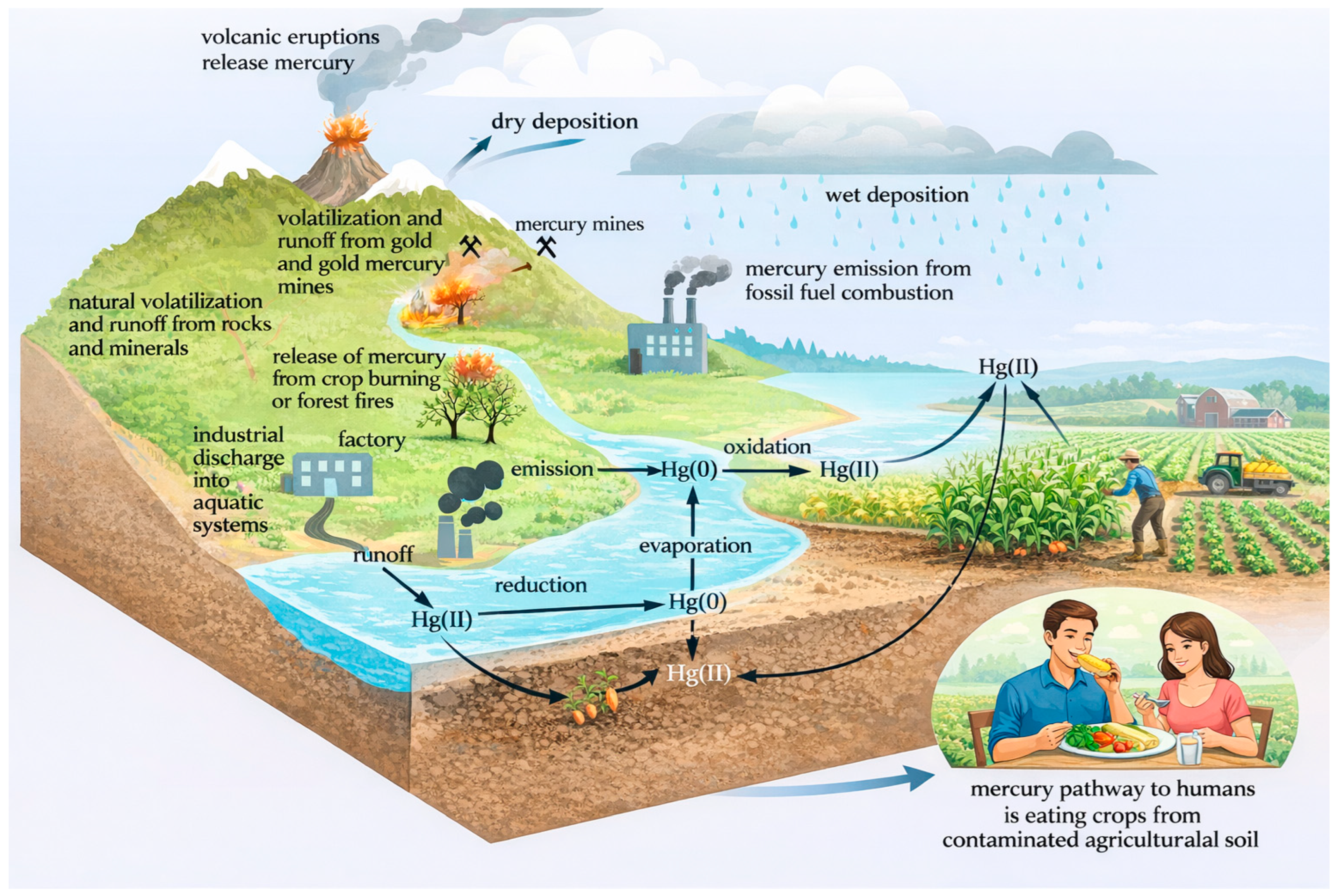
Different to organic contaminants, Hg cannot undergo mineralization. Consequently, reducing Hg bioavailability or converting toxic ionic and organic mercury species into less harmful or less reactive forms, such as elemental Hg or Hg sulfides, which are not transferred through the food chain, has become a critical strategy for remediating sites contaminated with Hg. Figure 1 presents the cycle of Hg, its sources, deposition, plant uptake, bioaccumulation and biomagnification in food chains in various forms [6].
The fate of Hg is significantly influenced by the physical and chemical properties of soil, including pH, texture, and organic matter content. These factors play an important role in determining Hg speciation and its bioavailability within soils [43,44]. Factors such as plant species, growth stage, and soil characteristics (pH, clay content) determine the extent of mercury transfer from the soil into the vegetable biomass.
Even if the background level of Hg in soil is low in general, due to anthropogenic activities, its levels vary greatly in different areas in the world. A selection of studies reporting total Hg content in agricultural soil all over the world is presented in Table 1.
As shown in Table 1, the Hg content varies significantly across different studies conducted worldwide. The physical and chemical characteristics of the soil, along with the content and species of Hg, play crucial roles in determining the effectiveness of remediation efforts. The selection of suitable remediation technologies should be based on the soil’s properties and the specific forms of Hg present. In summary, there are two main approaches to remediating soils: (i) extracting Hg from the soil to lower its overall concentration and (ii) altering the mobility and bioavailability of Hg within the soil to minimize pollution risks [6].
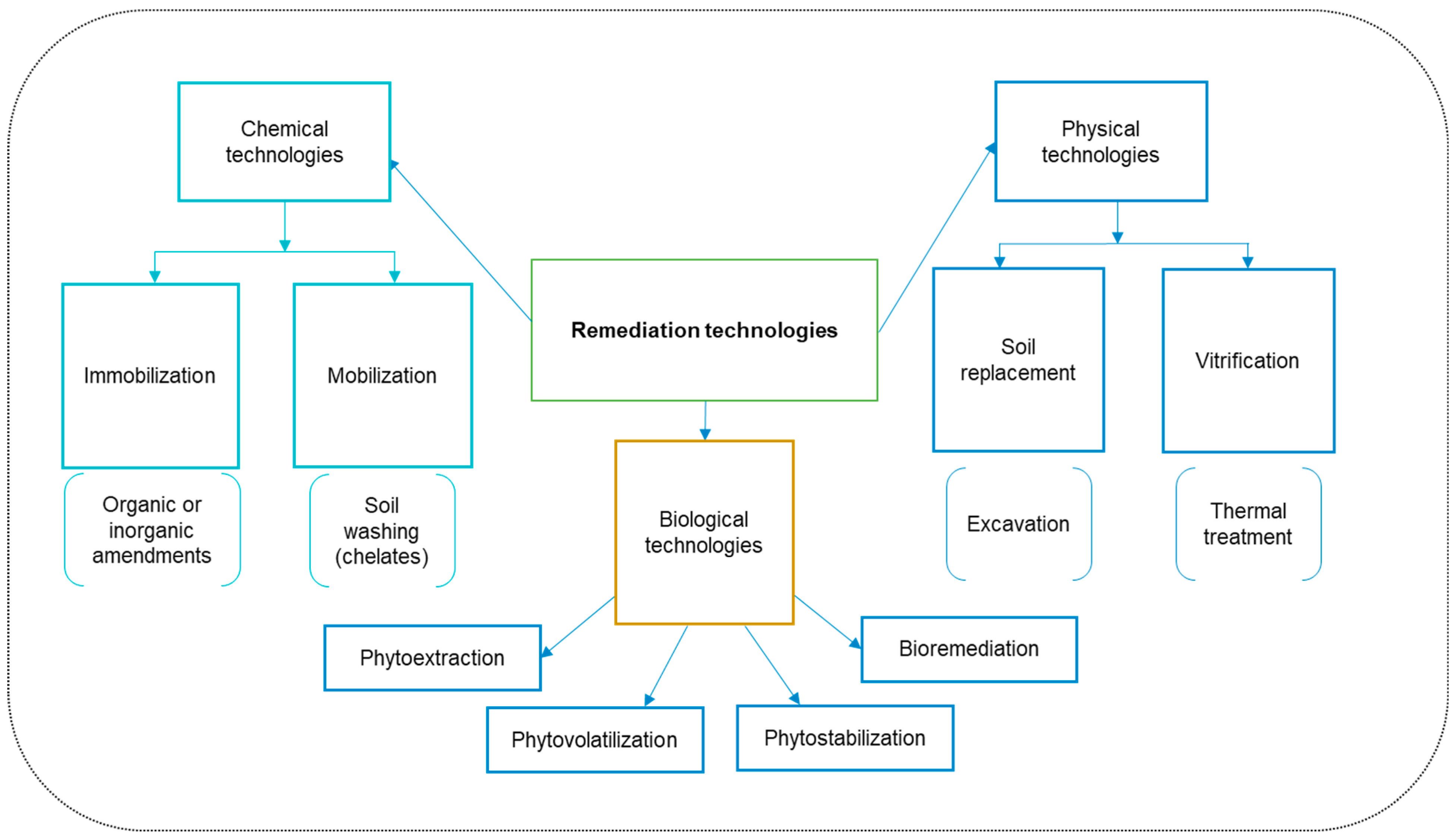
Traditional methods for removing heavy metals from polluted soils rely on physical, chemical, and biological approaches, which can be combined to treat contaminated areas. Although these methods are generally effective, most are expensive, environmentally harmful, and time intensive. The financial costs, technical difficulties, and complexities involved make soil remediation a challenging process. Additionally, applying these conventional soil cleanup techniques in practice has several limitations and may pose certain risks [6]. A schematic representation of remediation technologies of contaminated soils is presented in Figure 2.
The main groups of soil remediation technologies comprise physical remediation, chemical remediation, and biological remediation. Chemical remediation involves inserting chemical agents into the soil to modify the toxicity, mobility, and bioavailability of Hg. This is achieved through processes such as precipitation, adsorption, reduction, oxidation, and complexation. The aim of these technologies is to lower the amount of Hg accessible for plant uptake [29].
Biological remediation is based on two main approaches: use of plants for phytoremediation (mainly for phytoextraction, phytovolatilization, and phytostabilization), and bioremediation using microorganisms. Also, a combination of phytoremediation and remediation using microorganisms, to enhance remediation effectiveness, is reported in the literature [37]. Considering the complexity of chemical and biological remediation, as well as their significant advancements in recent years, this review provides a detailed discussion of these two primary approaches. Hybrid methods or treatment trains are also presented. Physical remediation methods, primarily involving soil replacement and vitrification via thermal treatment, detailed in previous studies on this subject [6,36], are presented here in terms of their major challenges in agriculture.

4. Factors Influencing Hg Mobility in Soil

4.1. Soil Physicochemical Properties

The texture and mineral composition of soil play a crucial role in retaining Hg. Soils with fine particles, such as clays and silts, which have larger specific surface areas, tend to adsorb more Hg compared to sandy soils. Amorphous iron hydroxides, like ferrihydrite, exhibit a higher affinity for Hg2+ than crystalline phases due to greater surface area and reactivity. This difference also influences Hg2+ retention in soil. Clay minerals and Fe or Mn oxides offer sites for Hg to bind, thereby limiting its movement [65,66]. Solid organic matter in the soil creates stable complexes with Hg through thiol and carboxyl groups, which reduces Hg mobility but may enhance its long-term retention. In contrast, dissolved organic matter regularly mobilizes Hg by forming soluble complexes, increasing desorption from soils, and accelerating transport to deeper horizons [67,68,69].

4.2. Soil pH

In highly acidic soils, Hg mobility increases as H+ ions compete with Hg2+ for sorption sites on mineral surfaces like iron oxides and clay edges, reducing retention. Protonation of surface hydroxyl groups (e.g., FeOH → FeOH2+) at low pH reduces electrostatic attraction for cationic Hg2+ and blocks ligand exchange sites [70].
Reducing conditions promote the creation of insoluble Hg sulfide (cinnabar) and microbial conversion to methylmercury (MeHg), a form that is highly mobile and easily absorbed by organisms [71,72].

4.3. Microbial Activity

Microbial communities in soil play a key role in both the methylation and demethylation of Hg. Sulfate-reducing bacteria (SRB) promote methylation, which enhances mercury’s mobility and toxicity. Iron-reducing bacteria (FRB), like Geobacter species, and methanogenic archaea also play crucial roles in Hg methylation, converting Hg2+ to MeHg under anaerobic conditions prevalent in waterlogged agricultural soils [73]. On the other hand, certain microbial processes can break down MeHg, decreasing its mobility. These biological transformations are influenced by environmental factors such as the availability of organic matter, temperature, and redox conditions [74,75].

4.4. Presence of Competing Ions and Ligands

Other anions like chloride and phosphate, as well as ligands such as dissolved organic carbon, affect Hg complexation. Common phosphate fertilizers like monoammonium phosphate (MAP) or diammonium phosphate (DAP) introduce competing cations, primarily ammonium, but also Ca2+ in some formulations, that occupy exchange sites on soil colloids, potentially displacing Hg2+ and increasing its mobility [76].
Chloride creates soluble Hg–chloride complexes that enhance Hg’s mobility, whereas sulfide leads to the formation of insoluble Hg sulfide, which decreases mobility. Additionally, elevated levels of competing cations (NH4+, Ca2+, Mg2+, H+) can cause Hg to be displaced from sorption sites [77].

4.5. Other Environmental Factors

The movement of Hg in soil is also influenced by temperature, moisture levels, and seasonal changes. In farming systems, evapotranspiration, mainly plant transpiration, creates advective water flow that carries dissolved Hg from soil or surface water upward or toward the rhizosphere. This process dominates over diffusion in plant roots beyond the topsoil, increasing Hg bioavailability in the rhizosphere [78]. Higher temperatures and increased moisture can boost microbial activity and chemical processes, facilitating the transformation and movement of Hg. Surface runoff and irrigation management distribute Hg across agricultural landscapes, often increasing downstream contamination risks. These processes mobilize Hg from soils and fields into water bodies, with fallow seasons and recycled water use amplifying exports [41]. Additionally, freeze–thaw cycles can break down soil structure and cause the release of Hg that was previously bound [79,80,81].

5. Phytoremediation

Phytoremediation is regarded as a straightforward, natural method that employs plants to decrease, remove, transform, or stabilize contaminants (in this case, Hg) existing in soils. Phytoremediation is mainly divided into phytoextraction, phytostabilization, and phytovolatilization. Phytoextraction refers to the uptake of Hg by plant roots, followed by its translocation to the aerial parts of the plant, such as the shoots, which can subsequently be harvested and incinerated [30]. Still, the risk of secondary contamination exists since incineration of Hg hyperaccumulators from phytoremediation can lead to air pollution via Hg volatilization. Post-incineration residues retain higher HM concentrations if volatilization is incomplete, risking leaching into soil or water during landfilling [41]. Phytostabilization refers to the immobilization of Hg in soil by facilitating its accumulation within plant roots or by promoting Hg precipitation in the rhizosphere [82]. Phytovolatilization represents a remediation approach unique to Hg based on its high volatility. Mercury absorbed by plant tissues from soil is emitted into the atmosphere [30].
In practice, the selection of phytoremediation technology should be based on the types of soil and plants, the role of roots exudates in the mobilization of Hg to the plants, the structure of rhizosphere microorganisms, and the complex coupling between the geochemical forms of pollutants [83]. Choosing a phytoremediation method should consider the soil and plant types and the intricate interactions among the geochemical forms of a contaminant.
An effective phytoremediation system should facilitate direct interaction with the Hg and modulate this interaction to enhance its absorption. Consequently, many studies on Hg-polluted soil phytoremediation have concentrated on identifying Hg accumulator or hyperaccumulator plants. These plants can store Hg at levels 10 to 100 times greater than non-hyperaccumulator plants [84,85,86]. The threshold for Hg hyperaccumulation in plant shoots is estimated to be around 10 mg/kg, although this limit requires further clarification [87]. An important aspect is that most reported Hg hyperaccumulators are herbaceous or small herbaceous plants with limited biomass, restricting their scalability for phytoremediation over large agricultural fields, representing a practical limitation [88]. Another significant aspect is that plants take up Hg through two distinct pathways: root–stem translocation from soil and foliar adsorption of gaseous Hg0 from the atmosphere. Root–stem translocation comprises soil Hg solubilization, root uptake, and vascular transport to stems, while foliar adsorption captures Hg0 directly on leaf surfaces or through stomata [89]. Consequently, the identification of Hg hyperaccumulators and their practical use has become an important area of research [71].
A summary of research on Hg phytoremediation potential of Hg (hyper)accumulator species is presented in Table 2.
Fernández et al. [95] studied native plants growing in an abandoned mining area to identify their potential for phytoextraction or phytostabilization. Among the studied plants, Salix atrocinerea showed high soil to plant TFs for Hg, Cd, and Zn. In a recent study, a native plant, Piper marginatum, was tested for the phytoremediation potential of soils contaminated with Hg. An experimental lot was located in the municipality of Ayapel, an area affected by artisanal and small-scale gold mining activities. Seedlings of Piper marginatum were planted and grown in situ for a duration of 6 months. Subsequently, the plant biomass was harvested, and a final soil sampling was conducted to analyze total Hg content and to quantify the overall percentage of Hg removal. The authors reported a 37.3% reduction in total Hg concentrations within the plots cultivated with Piper marginatum, a decrease that exceeded that observed in the control pots [99]. Future research is needed to identify appropriate management strategies for contaminated biomass after harvesting, to enable a comprehensive evaluation of the method’s viability.
Sahito et al. [100] investigated the ability of oilseed sunflowers to absorb Hg and As from contaminated soil, while simultaneously integrating soil phytoremediation with the production of oil and bioenergy. The maximum concentrations detected in the aerial parts of plants were 14.08 mg/kg for As and 0.40 mg/kg for Hg, respectively. The findings of the study indicate that oilseed sunflower cultivars may be utilized for the efficient remediation of soils, while simultaneously supporting agricultural production. Still, the authors recommended further investigations on scaling-up and Life Cycle Analysis to evaluate the possibility of using metal-contaminated biomass to produce oil and second-generation biofuel.
Ramie (Boehmeria nivea L.) supported with poly-γ-glutamic acid (γ-PGA) amendment was used for phytoremediation of the Hg-contaminated soil [102]. γ-PGA amendment increased Hg content in leaf by 4.4-fold and increased the translocation factor value to 3.5, suggesting that γ-PGA can significantly improve the translocation of Hg from root to leaf. Additionally, γ-PGA may facilitate the conversion of potentially available Hg into forms that are accessible. γ-PGA greatly enhanced the removal of Hg from soil, leading to its movement into the soil porewater and subsequent uptake by plant roots. High Hg levels can reduce photosynthesis and growth, limiting phytoremediation efficiency.
Energy crops serve dual purposes in phytoremediation, cleaning polluted soil and producing biomass. It was investigated how cultivation practices in contaminated soil influence the biomass of Miscanthus × giganteus used as a solid biofuel when used. Alternatively, plants such as Miscanthus × giganteus are suitable for phytostabilizing Hg in moderately contaminated soils because they absorb very little Hg. Additionally, the resulting biomass exhibits a very low Hg concentration, making it suitable for application as a biofuel [82]. Energy crops benefit from soil carbon sequestration and fossil fuel substitution, but combustion traps Hg primarily in fly ash, requiring careful ash management to avoid re-release [104].
An integrated Life Cycle Analysis (LCA)–fuzzy synthetic evaluation (FSE) framework has been developed to assess remediation strategies for chemical industrial wastelands. The LCA module measures environmental impacts, while the FSE module combines these results with other indicators to help select the best remediation plan [105].

6. Microbial Bioremediation

Bacterial species that are resistant to Hg possess a cytoplasmic enzyme called mercuric reductase, which is encoded by the mer operon. This enzyme converts soluble Hg2+ ions into insoluble elemental Hg0, allowing the Hg to diffuse out of the cell. It is important to note that the elemental mercury produced is highly volatile and does not remain in the cell as an insoluble substance, which would be practically essential for in situ remediation via immobilization, but rather is rapidly released as vapor into the gaseous compartment, diffusing out of the cell and potentially into the atmosphere. While this volatilization effectively detoxifies the bacterial cell, it represents a limitation for bioremediation strategies that aim to sequester mercury in soil or sediment rather than release it to the atmosphere [75].
The volatilization of Hg from bacterial cells is a well-established resistance mechanism linked to the genetic mer operon. The mer operon occurs in various Gram-negative and Gram-positive bacteria. The mer operon is most commonly located on plasmids, which facilitate horizontal gene transfer among bacteria and contribute to the spread of mercury resistance. In some cases, it may also be found on transposons or integrated into the bacterial chromosome [106]. Through advances in the understanding of mer operon mechanisms, several strategies have been developed that utilize Hg-resistant microorganisms and cloned mer genes to varying extents of success. Genes involved in the mer operon of Hg-resistant bacteria include merA, merB, merT, merP, merC, merR, merF, merG, merE and merD. MerB is located in the cytoplasm and is responsible for the lysis of C-Hg+ bonds. MerP transfers Hg2+ to an integral membrane protein, while merT facilitates the transport of mercuric ions. MerC and merF also participate in the transport of mercuric ions. The merD gene is a regulatory component of the mer operon, which confers Hg resistance in bacteria by downregulating operon expression. Located at the distal end of the operon, merD encodes a transcriptional regulator protein that binds to the mer promoter/operator region to modulate transcription, functioning as a coregulator alongside the primary activator, merR [106].
Microorganisms such as bacteria and fungi can withstand high levels of Hg, and their biotic processes drive certain Hg transformations. They play an important part in the Hg cycle, owing to tolerance mechanisms evolved [107].
One approach to mitigating Hg toxicity is to limit the cellular uptake of Hg from contaminated soils. Currently, there are no efflux-mediated mechanisms for maintaining Hg homeostasis that are known, although such systems exist for other heavy metals in microbial processes. In contrast, efflux-mediated resistance is well documented for other metals, and resistance-nodulation-division (RND) transporters can contribute to cross-resistance in multi-metal environments [108]. Nevertheless, the co-occurrence of the mer operon, responsible for Hg tolerance traits, can enhance microbial resistance to Hg. Biosorption is a process that allows Hg to be trapped outside bacterial cells on their membranes. This happens because sulfide and organosulfur compounds found on the outer membrane attract Hg strongly. Additionally, certain microorganisms can generate extracellular polymeric substances, which also capture Hg [25]. Many recent studies have discussed bioremediation methods that use microorganisms to remove Hg from polluted soils. The fate and transport of Hg are separated into three categories: atmosphere, terrestrial ecosystem, and aquatic ecosystem. Bacterial volatilization of Hg2+ to Hg0 can reduce mercury concentrations in soil; however, in open field systems, the volatilized mercury is released into the atmosphere. Therefore, this process should be regarded as a form of removal from the local environment rather than complete mercury destruction, since atmospheric Hg0 can undergo long-range transport and subsequent redeposition [108].
Some Hg produced by human activities comes from sources like chlor-alkali plants, power plants, fluorescent lamps, and medical waste such as broken thermometers, barometers, and sphygmomanometers. Tarekegn et al. [109] provide a comprehensive synthesis of microbial remediation, demonstrating that biological agents like bacteria and algae offer a high-efficiency (up to 99.6%), low-cost alternative to traditional chemical methods for treating heavy metal pollution. Bacteria are more stable and survive better when they are in mixed cultures. The limiting factors for the survival of the inoculated strains against the native soil microbiota include: biotic factors with native microbiota (competition for nutrient and space, predation and parasitism, antagonistic interaction and restructuring of soil microbiome), abiotic soil (pH, temperature, oxygen availability, soil texture, and structure) and physiological state of inoculum (adaptation period, loss of functionality) [110].
Several bacterial species are utilized for soil decontamination, employing mechanisms such as Hg reduction via the mer operon, bioaccumulation, or volatilisation to less toxic forms. Notable examples include Pseudomonas moraviensis, Bacillus toyonensis, Pseudomonas baetica, Brevibacterium frigoritolerans, Cupriavidus metallidurans, and Glutamicibacter sp. Bacillus sp., Planomicrobium sp., Fusobacterium aquatile, Brevundimonas vesicularis, Cytobacillus firmus, Paenibacillus massiliensis, Pseudomonas veronii, Sphingobium, Pseudomonas alkylphenolica, etc. Cupriavidus metallidurans is a heavy-metal-resistant bacterium used for Hg decontamination, particularly the MSR33 strain. This strain, derived from the wild-type CH34 with the addition of plasmid pTP6, gains broad-spectrum resistance to both inorganic mercury (Hg2+) and organic mercury compounds such as MeHg. It expresses genes from the mer operon genes (merA for Hg2+ reductase, merB for organomercurial lyase), cleaving organic Hg to Hg2+ and subsequently reducing it to volatile, less toxic Hg0. Bravo et al. [111] found that bioaugmentation using Cupriavidus metallidurans MSR33 in a rotary drum bioreactor effectively removes Hg from agricultural soils and also restores important microbial functions related to nitrogen cycling. Bioremediation eliminated 82% of Hg from the soil. Mercury contamination significantly lowers the copy numbers of the nifH (nitrogen fixation) and amoA (nitrification) genes, as shown by qPCR analysis. After bioremediation, these genes become more abundant, improving soil fertility for agriculture [111]. The soil phosphorus cycle is governed by closely linked physical, chemical, and biological interactions, with the mineralization of organic phosphorus relying heavily on phosphatase enzymes. Hg contamination can disrupt the phosphorus cycle by inhibiting phosphatase activity, thereby reducing the mineralization of organic phosphorus and decreasing phosphorus availability in the soil. Hg can affect the phosphorus cycle by interfering with the enzymes that release phosphate from organic matter, especially acid and alkaline phosphatases. These enzymes are important because they convert organic phosphorus into inorganic forms that plants and microbes can use [112].
Chang et al. [113] present the first evidence of Hg detoxification and volatilization mediated by a Penicillium spp. isolate, highlighting fungi’s role in Hg resistance and potential for bioremediation. The Penicillium spp. DC-F11 strain, obtained from Hg-contaminated soil, effectively lowers phytotoxicity, total Hg, and exchangeable Hg levels. These fungi predominantly convert mercury ions (Hg2+) into the less toxic elemental mercury (Hg0) via biosorption (a passive physical-chemical retention process) and bioaccumulation, thereby decreasing soil bioavailability. Penicillium demonstrates a strong capacity for Hg accumulation, and this trait enhances bacterial contributions to mycoremediation processes, particularly when coupled with bacterial activity involving specific enzymes such as mercuric reductase (merA) and organomercury lyase (merB), which catalyze the reduction and detoxification of mercury compounds.
Mercury-tolerant Ensifer medicae strains found in contaminated soils display high merA (mercuric reductase) activity, allowing them to efficiently convert toxic Hg2+ into less harmful elemental mercury (Hg0). These tolerant strains have increased merA gene expression both in free-living cells and in the nodules of Medicago truncatula. Mercury-adapted rhizobia help legumes tolerate contamination by maintaining nitrogenase activity under Hg stress, unlike sensitive strains whose activity declines sharply. These rhizobia support plant growth and detoxify Hg, making them valuable for restoring polluted agricultural land through bioaugmentation. In the legume–rhizobium interaction, nod factors (NFs) induce symbiotic responses in the host roots, including depolarization of the root hair membrane potential, cytoplasmic rearrangement, and reactivation of cell division in cortical root cells. Legume roots release flavonoids that stimulate rhizobia to produce nod factors, which are then recognized by a root receptor complex comprising nod factor perception (NFP), LysM domain receptor-like kinase 3 (LYK3), and the co-receptor DMI2. This recognition activates downstream signaling pathways, including ROP-GTPases and a reactive oxygen species (ROS) burst, to initiate symbiosis [114].
Unlike Cupriavidus metallidurans MSR33 [111], these rhizobial strains confer symbiotic advantages to plants while also reducing Hg toxicity [115]. Mercury-resistant bacteria such as Fusobacterium aquatile, Brevundimonas vesicularis, Nitrococcus mobilis, and Fusobacterium necrogenes have been found in gold mine tailings in West Lombok, Indonesia. These bacteria show strong potential for Hg bioremediation in polluted soils. In tests with gold mine tailings, F. aquatile removed 76.1% of Hg, and B. vesicularis removed 75.6% after one to four weeks. Nitrococcus mobilis and Fusobacterium necrogenes accumulated under 74% Hg, likely due to Hg resistance from the mer operon [116].
Ghosh et al. [117] found that a consortium of Gram-positive bacteria (Cytobacillus firmus and Paenibacillus massiliensis) improved cadmium and Hg biosorption compared to single strains in contaminated soil, suggesting its promise for multi-metal bioremediation. The consortium’s strong adsorption capacity enables its use in large-scale industrial settings like wastewater treatment for mining or contaminated sites, especially using Hg-resistant strains.
Using ammonium thiosulfate along with native plant growth-promoting bacteria makes Hg and arsenic more available and easier for plants to absorb from soil contaminated by both metals. Thiosulfate enhances phytoextraction in small-scale studies, increasing plant arsenic uptake by 85% and Hg by 45%. Combining thiosulfate with a growth-promoting bacterial consortium improves metal accumulation and plant health, accelerating remediation and lowering costs by boosting extraction and productivity [118]. Increasing the mobility of arsenic and mercury through the application of ammonium thiosulfate (ATS) can significantly increase the risk of leaching into groundwater. ATS forms soluble thio-complexes that enhance the dissolved fractions of these contaminants while reducing their sorption to soil minerals, thereby facilitating their transport in the subsurface environment [119].
Giovanella et al. [120] reported that Pseudomonas sp. B50D, resistant to multiple metals, efficiently removed Hg amid Cd, Ni, and Pb co-contaminants. The strain eliminated 60% of Cd, 15% of Ni, and 85% of Pb from mixed metal media, but was less effective for these metals in industrial effluent. These results highlight how effective it could be for the bioremediation of complex industrial wastewater. Hg is removed using several processes, including reduction, biosorption, biofilm formation, and siderophore production, even when other pollutants are present. The siderophores act as extracellular ligands that sequester from the surrounding matrix. Crucially, the secretion of siderophores facilitates this process by forming stable, soluble complexes with Hg2+, which prevents its sequestration by the mineral phase and ensures efficient delivery to the intracellular merA enzymatic pathway [121].
The use of Pseudomonas veronii together with zeolite for Hg remediation has been reported. McCarthy et al. [122] developed an innovative bioremediation method using P. veronii immobilized on zeolite to treat Hg-contaminated soils from industrial mining. This approach involves encapsulating stationary-phase P. veronii cells in a xanthan gum biopolymer, coating them onto zeolite granules, and enhancing Hg volatilization through microbial reduction to gaseous elemental Hg. This system significantly enhances Hg volatilization rates, achieving up to 95% removal in specific industrial contexts while maintaining microbial viability during long-distance intercontinental transport. This advancement effectively addresses the logistical challenges associated with large-scale deployment. Natural zeolite costs only $100–400 per ton and requires approximately 500 kg per hectare (about $50–200 per hectare for the material alone). This makes the bioremediation approach economically viable for scaling to agricultural soils, not just industrial sites.
Guo et al.’s [123] review highlights the absence of identified molecular pathways for Hg uptake in plants, proposing a theoretical framework drawn from arbuscular mycorrhizal (AM) fungi-regulated transporters for Zn and Cd. This model addresses gaps in Hg-specific mechanisms, suggesting that targeted studies on AM-enhanced plants could facilitate efficient and sustainable soil remediation. It complements microbial strategies, such as those involving Pseudomonas sp. B50D and zeolite systems, to enable integrated bioremediation. The same findings were reported by Shi et al. [124], demonstrating that Pseudomonas alkylphenolica KL28 serves as a potent dual-action bioremediation agent capable of both immobilizing soil Hg and protecting crop photosynthetic health. This offers a viable strategy for enhancing food safety in contaminated agricultural zones.
Recent research shows that rhizospheric bacteria boost plant growth and help detoxify heavy metals, serving both phytoremediation and soil health [125]. Endophytes, microorganisms that live inside plant tissues, also play a critical role in Hg detoxification by sequestering mercury within the plant, reducing its translocation to edible parts, and enhancing the plant’s tolerance to Hg stress. This process complements rhizospheric strategies aimed at safer crop production in contaminated soils.
Kou et al. [126] found that variations in heavy metal levels and soil organic matter across different regions have a major impact on how bacterial communities are formed and how resilient they are in coal gangue waste sites. Their research underscores how contamination gradients play a selective role in shaping microbial ecology. Mycoremediation using various fungi offers a biological way to manage organic and inorganic soil pollutants in sustainable agriculture [127].
A recent review explores how Hg contamination disrupts soil microbes and proposes “microbiome stewardship,” managing resilient core microbes to help restore polluted ecosystems [4]. Lupinus albus (white lupin), a metal-tolerant legume, pairs effectively with Hg-resistant Bradyrhizobium strains for phytoremediation of Hg-contaminated soils via rhizoremediation and phytostabilization. These symbiotic rhizobia enhance plant tolerance, growth, and Hg retention primarily in roots and nodules, minimizing translocation to edible parts. Inoculation boosts biomass, reduces oxidative stress, and limits Hg bioaccumulation compared to non-inoculated plants. The reduction in oxidative stress is likely attributable to the combined action of two mechanisms, and distinguishing between them requires specific experimental evidence: direct antioxidant production by rhizobia and reduction in metal load (an indirect mechanism). These antioxidants may be secreted into the rhizosphere or transferred to plant cells, where they directly scavenge reactive oxygen species (ROS) before metal uptake occurs [128].
Hg tolerance in Bradyrhizobium strains primarily depends on the Mer operon, especially the merA gene, which encodes mercuric reductase. This enzyme reduces toxic Hg2+ to volatile, less harmful Hg0; however, the level of activity varies among strains [129].
Aspergillus flavus is a ubiquitous filamentous fungus commonly isolated from soils, including forest environments, and shows remarkable tolerance to Hg contamination. Strain KRP1 excels in tolerating and removing Hg2+ from contaminated media, positioning it as a strong bioremediation candidate for aqueous systems. Optimal growth occurs at pH 5.5–7 and 25–35 °C, with tolerance up to 100 mg/L Hg2+, though higher concentrations delay the lag phase and mycelial development [130]. Introducing Aspergillus flavus into agricultural soils used for food production poses a significant risk because A. flavus is a known pathogen that produces aflatoxins. These toxins can contaminate crops and enter the chain. Therefore, its use should be restricted to non-food environments, contained aqueous systems, or limited to rigorously tested non-toxigenic strains.
Yao et al. [131] demonstrate that the Bacillus strain LBA119, isolated from mining soils, serves as a highly efficient agent for Hg bioremediation through a combined mechanism of volatilization and biosorption. The fate of Hg after biosorption by Bacillus LBA119 biomass is not detailed in this study, and this omission is critical for understanding long-term remediation. According to the study, biosorption accounts for only 8.24% of total Hg removal, while volatilization contributes 89.08%. However, for the small fraction of Hg that is biosorbed and bound to cell walls via functional groups such as carboxyl, phosphate, and amine groups, the mercury remains within the biomass. True remediation requires the physical removal of Hg from the site. Biosorption simply moves Hg from soil solution to bacteria, but when these cells die, the Hg is released. Therefore, the successful application of Bacillus LBA119 for biosorption necessitates coupling biosorption with systematic biomass recovery.
Ustiatik et al. [132] demonstrated that indigenous Hg-resistant endophytic bacteria, specifically Jeotgalicoccus huakuii and Bacillus amyloliquefaciens, provide an effective biological approach to enhance phytoremediation under Hg stress through the production of hydroxamate siderophores. The mechanism involves siderophores chelating Fe3+ ions while simultaneously binding Hg2+ ions through their hydroxamate functional groups. This process reduces the bioavailability of free Hg2+ in the rhizosphere, limits mercury uptake into plant tissues, and alleviates Hg-induced oxidative stress. Additionally, siderophore-mediated iron acquisition enhances plant nutrition and growth under metal stress. Endophytic colonization facilitates the direct delivery of these protective effects within plant tissues, thereby improving overall plant tolerance and promoting greater Hg accumulation in the roots. This accumulation reduces translocation to edible parts, making phytoremediation more effective. Indole-3-acetic acid (IAA) stimulates root proliferation and branching, which enhances the surface area available for metal uptake. However, this growth promotion can inadvertently enhance the flux of metals into the xylem, facilitating their transport to shoots and leaves. This process may raise metal concentrations in edible plant tissues, potentially compromising food safety in agricultural settings. Therefore, although IAA-producing bacteria enhance phytoremediation potential by increasing biomass, their application requires careful monitoring to balance improved metal extraction with the risk of unsafe metal accumulation in harvestable crop parts [133].
In addition, Imran et al. [134] reported that the deliberate construction of microbial consortia, particularly those generating phytohormones such as Indole-3-Acetic Acid, markedly improves the capacity of Helianthus annuus for remediating mixed heavy metal contamination in agricultural soils. Their findings substantiate the practical efficacy of employing targeted hormone-producing microbial consortia alongside sunflowers for the restoration of agricultural soils affected by mixed heavy metals.
Tan et al. [135] demonstrated that these anaerobic Clostridium strains not only tolerate high concentrations of heavy metals but also facilitate the biotransformation of ionic Hg into volatile elemental Hg through microbial-mediated reduction, effectively decreasing Hg bioavailability and lowering ecological risk in polymetallic mining soils. Clostridium LTC105 was isolated from Mo-Pb mining soil, achieving 97% Hg2+ removal (90% volatilization), reducing ecological risk by 62% in spiked soils-ideal for anaerobic, multi-metal remediation.
Filamentous fungi isolated from the rhizosphere of plants growing on highly Hg-contaminated substrates were evaluated for their resistance to multiple heavy metals and their capacity to remediate Hg-polluted environments. Several Ascomycota species—including Cladosporium sp., Didymella glomerata, Fusarium oxysporum, Phoma costaricensis, and Sarocladium kiliense—exhibited exceptionally high tolerance to Hg and other metals. These highly resistant isolates demonstrated strong Hg biosorption capacities (33.8–54.9 mg/g dry weight), achieving up to 97% removal from aqueous solutions. The results highlight the significant potential of native filamentous fungi as effective bioremediators for environments with extreme Hg contamination. Field-scale extrapolation of these laboratory results reveals significant practical limitations. Applying 1000–5000 kg of fungal biomass per hectare would remove only 34–275 kg Hg/ha, representing less than 3–28% of the total Hg burden in moderately contaminated agricultural soils (1–5 mg/kg). Furthermore, without harvesting and physically removing the mercury-laden biomass, the sorbed mercury remains in the soil system and is vulnerable to re-release following fungal senescence and lysis, thereby undermining long-term remediation efforts. Consequently, although these fungi show promise for aqueous applications or soils with low contamination levels (<0.5 mg/kg), effective field deployment requires coupling biosorption with systematic biomass recovery and, in most cases, integrating complementary strategies such as volatilization or phytoextraction to achieve economically viable large-scale remediation [136].
González et al. [137] introduce the Bio-Mercury Remediation Suitability Index (BMRSI) for selecting Hg-tolerant PGPR strains, and related work by the same group shows that PGPR inoculation enhances seedling growth of plants like Lupinus albus in high-Hg soils, supporting the potential basis for future in situ phytorhizoremediation strategies. Zhang et al. [138] demonstrated that soil amendments reduce cadmium and Hg accumulation in wheat by lowering soil metal bioavailability and reshaping the rhizosphere microbial community, enriching bacterial taxa whose presence is associated with decreased heavy metal uptake. This study utilized the following amendments: Si-Ca-Mg conditioner (SCM), attapulgite (AT), organic fertilizer (OM), and biochar (BC). The incorporation of biochar into the soil matrix significantly modifies its thermal dynamics by reducing both thermal conductivity and diffusivity. This reduction, largely attributed to biochar’s high porosity and low bulk density, serves to buffer the soil profile against extreme diurnal and seasonal temperature fluctuations. Furthermore, although biochar is inherently a low-conductivity material, its impact on soil strength is complex and varies depending on the soil type. It may enhance the unconfined compressive strength in certain clay-rich soils; however, it can reduce shear and tensile strength in other soils due to its high compressibility and density-reducing effects [139].
The concentrations of Cd and Hg decreased by 38.25–45.78% and 42.96–51.52%, respectively. AT was most effective in reducing Cd enrichment, while SCM and BC were superior for Hg control. The amendments decreased the concentrations of Cd and Hg depending on pH by promoting precipitation and altering microbial communities in the rhizosphere [138]. Over time, precipitated Hg may become bioavailable again if the soil’s redox conditions change. Specifically, environmental shifts, such as transitions to flooded or anaerobic states, can reduce the adsorption capacity of biochar, as micropores become blocked and functional groups degrade. Initially, mercury forms soluble or colloidal Hg–O-like unstable species in amended soils before potentially being immobilized as more stable HgS. If redox potentials fluctuate before this stabilization is complete, these unstable forms can be readily remobilized into the soil solution [140].
Tejaswini and Zia [141] provide a transformative framework for Hg detoxification by shifting the focus from sensitive conventional microbes to extremophilic ‘microfactories.’ Their review establishes that microorganisms adapted to harsh physicochemical conditions (extreme pH, salinity, and temperature) possess unique enzymatic systems and omics-driven genetic determinants that allow for high-efficiency Hg remediation in geochemically complex environments where traditional methods typically fail. Specifically, the technical superiority of these microfactories is anchored in specialized versions of the mercuric reductase and organomercurial lyase enzymes. For instance, merA isolated from thermophilic bacteria, such as Gelidibacter salicanalis, exhibits optimal catalytic activity at temperatures as high as 60 °C, maintaining structural integrity through specific residue configurations (e.g., Tyr437′ and Asp47) that facilitate metal transfer even under thermal stress. Furthermore, extremophilic variants like ATII-LCL merA, sourced from the Red Sea brine pools, demonstrate simultaneous thermostability and halophilicity, functioning effectively in environments with 26% salinity and temperatures of 68 °C [142]. These enzymes utilize unique evolutionary adaptations, such as the lack of selenocysteine in associated oxidoreductases like ATII-TrxR, to bypass common inhibition pathways that neutralize mesophilic enzymes. By integrating both merA and merB genes, these extremophilic systems can achieve near-complete volatilization (up to 99.9%) of both inorganic and organic mercury in hypersaline and high-temperature industrial effluents where standard bioremediation consortia denature [143].
Diverse bioremediation strategies offer promising approaches for mitigating heavy metal contamination in agricultural soils. Yasmin et al. [144] highlight Pseudomonas sp. RY12, an indigenous rhizobacterium capable of removing 89% of zinc, enabling cost-effective restoration that prevents toxic metals from entering the food chain. Complementing this, Ashraf et al. [145] demonstrate that Conocarpus erectus outperforms Eucalyptus camaldulensis in cadmium phytostabilization through enhanced root sequestration and increased stress tolerance. Both Conocarpus and Eucalyptus can deplete water resources in agricultural areas. Eucalyptus camaldulensis is a fast-growing species frequently associated with significant soil moisture depletion and high-water requirements, which can trigger water shortages in drought-prone regions. In arid and semi-arid environments, the introduction of these non-native wood species for phytoremediation can lead to a marked reduction in groundwater recharge and surface water runoff, potentially compromising the hydrological stability required for food crop irrigation [146].
Tayang and Songachan [147] synthesize microbial resistance mechanisms, providing a genetic foundation for deploying natural microbes in detoxification efforts for cadmium contamination in paddy fields. Meanwhile, Zheng et al. [148] reveals that Hg induces soil-specific microbial impacts, driven by pH shifts that favor tolerant fungi over sensitive bacteria. Integrating these approaches, microbial biosorbents, tolerant plants, and physicochemical insights enhance sustainable soil remediation by reducing metal bioavailability and uptake in crops such as wheat. A comparative approach of bacteria species used for remediation of soil is presented in Table 3.
Recent research indicates that many Fusobacterium species are not strictly anaerobic; rather, they are microaerotolerant or capable of adapting to oxidative stress. Fusobacterium, notably F. nucleatum, utilizes enzymes such as peroxiredoxins, methionine sulfoxide reductases, and rubrerythrin to mitigate oxidative damage. Some strains possess a multicomponent enzyme, butyryl-CoA oxygen oxidoreductase, which enables them to exploit molecular oxygen for energy conservation, allowing survival in fluctuating oxygen environments [149].
The majority of the existing remediation technologies have limitations, particularly due to their negative impact on soil characteristics, which can greatly influence soil fertility, water retention, and biodiversity. Gaining a thorough understanding of microbial communities is crucial for supporting a sustainable ecosystem and guiding approaches to Hg remediation. To create successful bioremediation methods, it’s necessary to explore how entire communities respond. Microbial remediation of mercury-contaminated soil relies on mercury-resistant microorganisms that immobilize, adsorb, or enzymatically detoxify mercury, primarily through mediated reduction and plant–microbe interactions. This process effectively reduces metal mobility and toxicity in agricultural soils. The persistence of Hg-transforming microbes in agricultural settings directly impacts the human food chain. Current regulatory guidelines often focus on total Hg rather than the more toxic MeHg, leading to potential oversights in soil safety assessments. The success of microbial bioremediation requires a proper soil microbiome to ensure that introduced microbes do not become persistent pathogens [150].

7. Chemical Amendments

Chemical amendments are widely used for the in situ remediation of Hg-contaminated soils, primarily aiming to immobilize Hg, reduce its bioavailability, and limit the formation of methyl-Hg. The methods include the use of materials rich in sulfur, thiols, phosphates, biochar, lime, iron, and manganese oxides, as well as various organic and inorganic sorbents (activated carbon, fly ash, or digestate). These materials utilize different mechanisms, such as adsorption, surface complexation, precipitation, pH adjustment, and modification of redox conditions, to reduce dissolved Hg and its uptake by plants and soil biota [151].
Some amendments, such as fly ash, a by-product of coal combustion, can contain potentially hazardous heavy metals and therefore require careful screening before application to soil. Fly ash may contain heavy metals including cadmium, lead, zinc, chromium, and other trace elements. Similarly, digestate, derived from anaerobic digestion, can contain contaminants such as metals, inorganic, and organic impurities, microplastics, and other substances. These compounds can be toxic, leach into the ground, and enter the food chain. The potential for amendments to introduce heavy metals that could interact with mercury-transforming microbial pathways or simply increase the contaminant load underscores the need for comprehensive pre-treatment assessments and continuous monitoring [152].
Amendments are mixed with contaminated soil depending on the factors like pH, organic matter, Hg speciation, and dosage. The long-term stability and potential reversibility of Hg immobilization by amendments are critical considerations, as sequestered Hg may be remobilized under changing environmental conditions. The persistence of Hg sequestration depends on the amendment’s resistance to environmental factors, such as permanent sequestration and aging risks. The immobilization of Hg depends on pH, depending on stability at low pH and release potential. In some cases, a drop in pH can decrease Hg mobility by promoting changes in the structure of humic acids, causing Hg–humic complexes to become part of the unavailable soil fraction [153].
Biochar, a carbon-rich and low-cost material produced through biomass pyrolysis, has gained considerable attention for its ability to enhance organic carbon levels and remediate contaminated soils. These benefits arise from its liming properties, high cation exchange capacity, and large specific surface area [154].
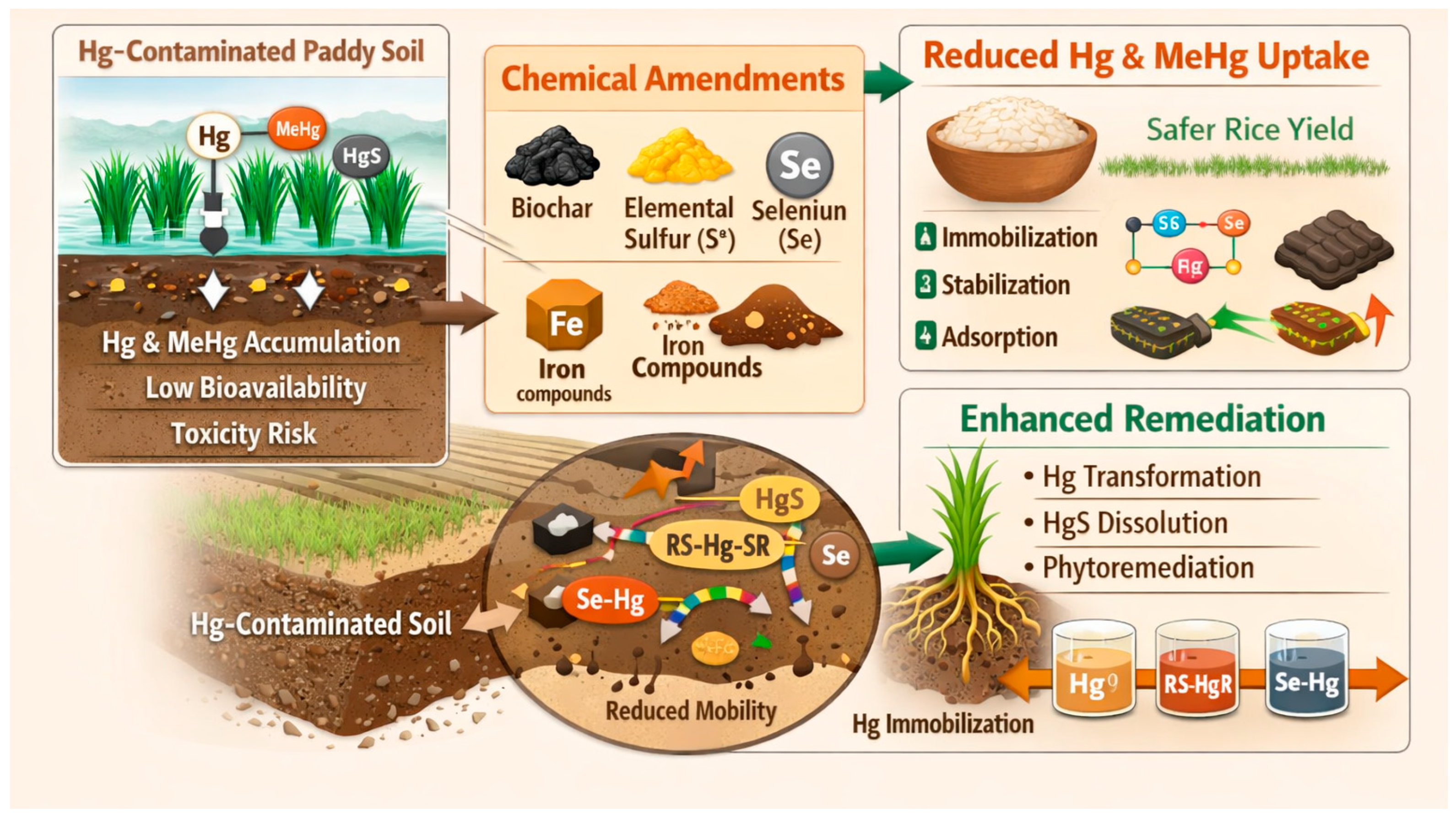
The thermal conditions during pyrolysis, typically ranging from 300 °C to 700 °C, influence the physical and chemical characteristics of the resulting biochar, including specific surface area, porosity, pH, cation exchange capacity, and functional group composition. High-temperature biochars are preferred for their long-term stability and enhanced physical adsorption, whereas low-temperature biochars offer better stabilization through surface complexation [155]. A schematic representation of Hg-contaminated soil remediation using chemical amendments is presented in Figure 3.
Biochar offers some advantages such as enhanced carbon sequestration, improved soil fertility, better soil structure, reduced greenhouse emissions, immobilization of heavy metals, pH regulation, microbial stimulation, etc. Additionally, it contributes to the immobilization of heavy metals and toxic elements through adsorption, complexation, and precipitation mechanisms, thereby decreasing their bioavailability and uptake by plants. Biochar helps regulate soil pH, especially in acidic soils, improving nutrient availability and overall soil chemical balance. Furthermore, it stimulates beneficial soil microbial communities, enhances nutrient retention and cycling, and promotes plant growth and productivity. These combined properties make biochar a promising amendment for sustainable agriculture, soil restoration, and the remediation of contaminated soils.
Biochar can reduce the concentration of various contaminants in soil due to its unique physical, chemical, and biological properties. The key physical properties of biochar include being fine-grained, having high porosity, a large surface area, and strong adsorption capacity. Chemically, biochar is alkaline, contains a high aromatic carbon content, exhibits high cation exchange capacity, and demonstrates high stability. Its biological properties include promoting microbial colonization, enhancing nutrient cycling, and increasing soil enzyme activities [156].
Biochar may alter the composition and give carbon sources and nutrients. The pore of biochar can serve as a habitat for microorganisms. Biochar has enhanced soil microbial community; facilitates biochemical cycling; causes contaminant degradation; transforms into a less toxic form by oxidation, reduction, and hydrolysis; and promotes plants. Biochar can act as both an electron donor and acceptor, facilitating electron transfer to promote the reduction and oxidation of redox-sensitive elements. This process could enhance the microbial reduction of Hg2+ to MeHg if the microbial community is not properly controlled. Thus, biochar is a beneficial soil amendment for remediation; however, redox activities must be carefully evaluated [154,157].
Bai and Lan [158] reported that biochar significantly enhances the immobilization of heavy metals in contaminated soils, particularly by improving soil physicochemical properties and reducing metal bioavailability. They use pig manure, steel slag, and bentonite in combination with biochar to evaluate heavy metal content, antioxidant capacity, and wheat growth. Nine experimental treatments were conducted, each consisting of 4 kg of soil amended with 40 g of biochar and 40 g of pig manure.
Biochar effectively reduced the bioavailability of Hg and cadmium in soil, limiting their uptake by wheat. When combined with bentonite or pig manure, its benefits were amplified, leading to greater reductions in metal accumulation and improved plant growth. These results indicate that biochar, particularly when paired with bentonite or pig manure, offers a promising approach for managing Hg-cadmium co-contaminated soils while supporting healthy crop production [158]. Another study demonstrates the use of straw-derived biochar amendment for Hg-contaminated paddy soil. The results indicate that the presence of biochar promotes the transformation of proteins and lipids into tannins, thereby enhancing carbon sequestration. In contrast, the presence of straw favors the conversion of amino sugars and carbohydrates into lignin but does not increase carbon storage. Biochar decreases Hg ethylation, whereas straw increases Hg methylation. Overall, biochar provides significant environmental benefits by simultaneously enhancing carbon sequestration and limiting Hg alkylation. Biochar alters the soil biochemical environment in several mutually reinforcing ways that inhibit Hg-alkylating microorganisms: adsorption of labile dissolved organic carbon, increase in soil pH and redox buffering, surface complexation of Hg2+, and suppression of anaerobic microbial guilds. By reducing DOC availability and increasing redox potential, biochar selectively suppresses sulfate-reducing bacteria (SRB) and iron-reducing bacteria (FeRB)—the primary microbial groups responsible for Hg ethylation. Biochar creates a more oxidized, carbon-limited environment with reduced microbial activity and lower Hg bioavailability, leading to decreased Hg ethylation, whereas straw creates a carbon-rich, strongly reducing environment that stimulates anaerobic microbial metabolism and increases the pool of bioavailable Hg, resulting in enhanced Hg methylation [157].
Reduction in Hg from soil by using thiol-modified biochar amendment was reported by Huang et al. [159], who conducted experiments that demonstrated a decrease in Hg levels from 184.7 µg/L to 100 µg/L after 32 days of treatment. With extended treatment for up to 198 days, Hg levels decreased by 79.8% to 98.2%, and MeHg was reduced by 50%. Additionally, thiol-modified biochar promotes the transformation of Hg species into stable forms through various processes such as complexation and precipitation. Thiol-modified biochar reduces Hg and MeHg by forming highly stable Hg–S complexes, promoting Hg-S precipitation, decreasing Hg bioavailability, and suppressing the microbial pathways responsible for Hg methylation. Thiol-modified biochar alters soil biogeochemistry in ways that inhibit hgcA/hgcB-carrying microorganisms [159].
Guo et al. [160] reported the use of biochar modified with selenium and chitosan to reduce MeHg in the rice rhizosphere and seeds, achieving reductions of 85.83% and 63.90% in the rhizosphere and 86.37% and 75.8% in the seeds, respectively. Both types of modified biochar increased Hg resistance in Bacillus, a resistant microbe found in the rhizosphere [160]. Man et al. [161] also reported that biochar is an environmentally friendly treatment that reduces MeHg in rice soil from the Wanshan mining area. In Hg-polluted soil (78.3 mg/kg) from the Wanshan mining area, rice hull biochar (RHB) at 0.6–3% and wheat–rice straw biochar (RWB) increased rice biomass by up to 119%, reduced the total bioavailable Hg (soluble, exchangeable, and sorbed) by 55–72%, and decreased MeHg in rice grains by 55–85%. RHB decreased soil MeHg levels, while RWB (especially at 3%) increased them via methylation microbes (e.g., Geobacter and Nitrospira). Both treatments lowered the probable daily MeHg intake from 0.26 μg kg−1 bw d−1 to below 0.1 μg kg−1 bw d−1, enabling sustainable Hg soil management. RHB contains more aromatic carbon, higher pH, and stronger sorption capacity, which immobilize Hg2+, reduce dissolved organic carbon, and suppress the activity of hgcA/hgcB-carrying methylators. This limits microbial access to Hg and decreases MeHg formation. The amendment’s effectiveness is constrained by its saturation limit, as the finite number of reactive functional groups on biochar surfaces (e.g., thiols, carboxyls, phenolics, and aromatic sites) can become progressively occupied by Hg and competing solutes, after which sorption capacity declines and immobilization efficiency decreases [161].
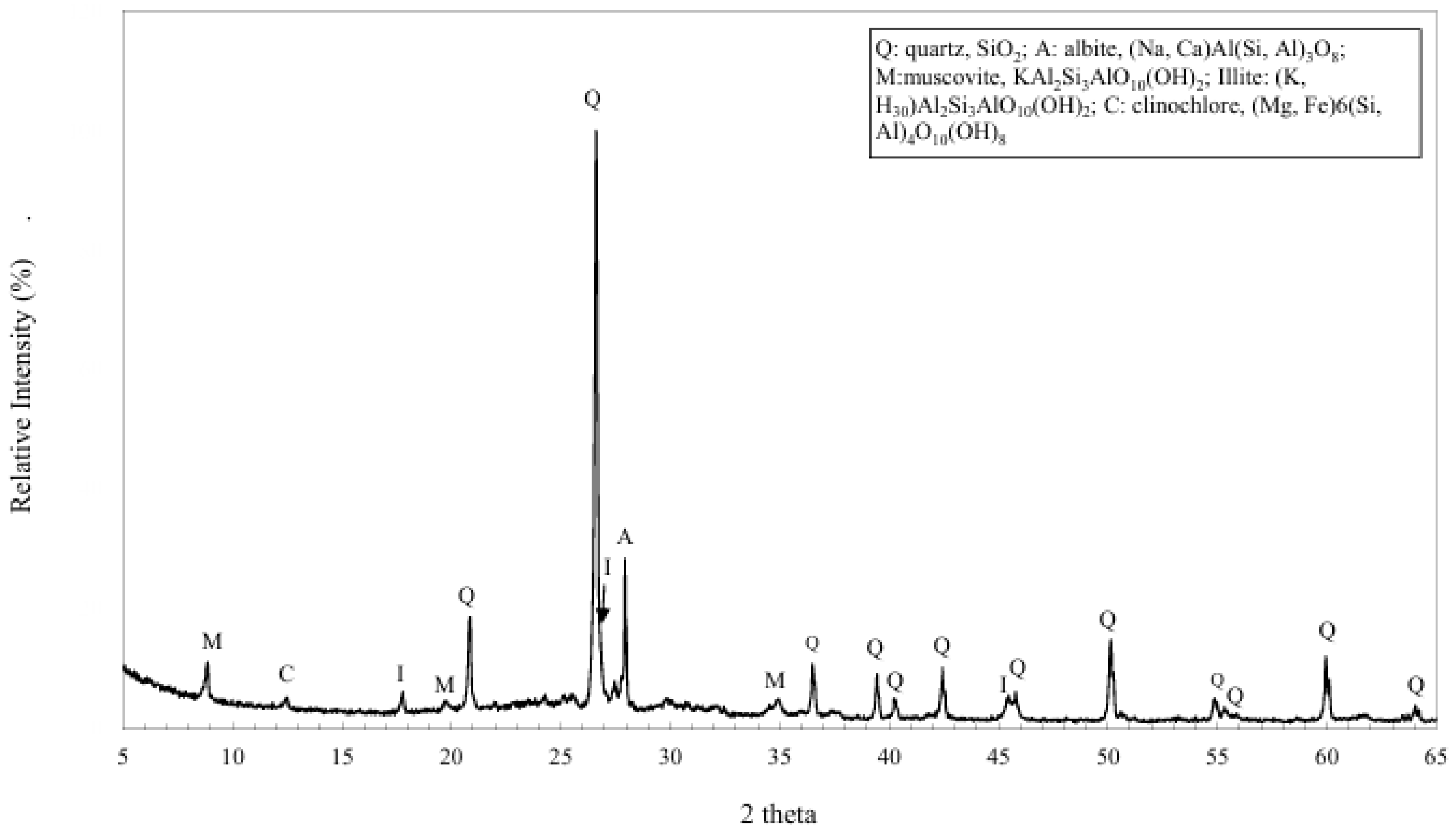
Dissolved organic carbon has great importance in Hg release. The labile organic fractions (carbohydrates and proteins) can be degraded. Each method has advantages and disadvantages: fertilizers containing phosphate and sulfates can precipitate Hg as a slowly soluble compound, while Fe-based nanocomposites can immobilize Hg through reduction and co-precipitation. Above all, zeolite is an aluminosilicate with a porous three-dimensional structure formed from interconnected SiO4 and AlO4 tetrahedra. According to X-ray diffraction (XRD) analysis, the zeolite used contains clinoptilolite as the major phase (approximately 65–70%), accompanied by trace minerals such as albite, muscovite, quartz, and montmorillonite. It has a specific surface area of 76 m2/g, which facilitates efficient adsorption of Hg through ion exchange, surface complexation, and precipitation. According to Borges et al. [162], zeolite modified with potassium was applied to Hg-contaminated soil, reducing the exchangeable Hg fraction by 30%. The zeolites used were K-chabazite (CHB-K) and Linde Type F (LTF). LTF exhibited stronger electrostatic and complexation interactions than CHB-K, enhancing Hg2+ retention and stability [162].
The co-application of low doses of biochar and selenium can significantly reduce the accumulation of Hg and MeHg in rice grown in slightly contaminated soils. While each amendment alone decreases Hg uptake, their combined use is far more effective, reducing grain Hg by nearly half and MeHg by up to 91%. This improvement results from biochar’s strong Hg adsorption, decreased Hg availability through organic complexation, the formation of stable HgSe compounds, and the promotion of MeHg reduction in soil by both amendments. Overall, the combined use of low-dose biochar and selenium is a promising strategy for safer rice production in mildly Hg-polluted fields [163].
Li et al. [164] reported a study on sulfur amendment that reduces MeHg accumulation in rice grown in soil polluted with Hg. Sulfur is an essential element that promotes plant growth. Sulfur-containing amendments are used to address deficiencies caused by fertilizer use. This study examined the effects of elemental sulfur (S0) amendment on MeHg accumulation in rice and the chemical speciation of Hg in the rhizosphere of waterlogged, Hg-contaminated soils dominated by HgS-like forms (~70%). Increasing S0 application enhanced MeHg concentrations in rice. Sequential extraction revealed that S0 addition shifted Hg speciation by increasing organic-bound Hg and reducing residual Hg fractions. Hg LIII-edge XANES analysis confirmed that S0 promoted the transformation of stable HgS into more reactive RS-Hg-SR complexes, suggesting reactivation of previously non-bioavailable Hg and stimulation of net Hg methylation. These findings indicate that S-based fertilizers may elevate MeHg levels in edible crop tissues, posing potential health risks. Nevertheless, S0 application may also facilitate phytoremediation by mobilizing insoluble Hg in contaminated paddy soils [164].
Activated carbon is another material that can be used for Hg decontamination. Mercury bound in soil requires different temperatures to be released from soil matrices. Usually, the residual Hg requires temperatures above 600 °C. A microwave-induced thermal treatment operating at 300–350 °C was developed to remediate highly Hg-contaminated soil while avoiding the high energy consumption soil damage typical of conventional thermal desorption. Heating soil to approximately 350 °C completely sterilizes the substrate, destroying microbial communities, soil fauna, enzymes, and organic matter; as a result, the land temporarily loses its biological function and agricultural value, since recolonization and restoration of soil structure requires substantial time. Adding granular activated carbon (GAC) greatly improved heating efficiency and Hg decomposition, achieving up to 86.9% total Hg removal under 400 W irradiation for 40 min. The process shifted Hg toward more inert fractions (from 88.1% to 96.1%), reducing environmental risk. GAC facilitated localized high-temperature discharges and remained stable throughout treatment, and increasing soil mass did not hinder heating. Overall, this method offers a promising, energy-efficient, and scalable low-temperature approach for Hg-contaminated soils [165].
Mercury pollution and the addition of organic amendments (OAs) alter the properties of paddy soil. In this study, various experiments were conducted to evaluate microbial contamination in Hg-contaminated soil treated with different organic amendments, including food waste compost, humic acid, and fulvic acid. The results indicate that organic amendments increase both organic carbon and dissolved organic carbon, thereby promoting bacterial growth. Additionally, humic acid and fulvic acid reduce microbial contamination and increase water-soluble Hg by complexing dissolved organic carbon with Hg [166].
Thermal treatment was applied for the remediation of Hg from soil. Typically, high temperatures ranging from 600 to 800 °C are used to vaporize Hg (boiling point approximately 357 °C) during soil remediation. This process can be conducted either in situ or ex situ, reducing Hg concentrations to levels as low as 2 mg/kg. However, Ma et al. [167] reported the use of thermal technology at a lower temperature of 400 °C, combined with FeCl3 at an optimal FeCl3:Hg ratio of 100:1. Treatment for 60 min reduced soil Hg concentration to 0.8 mg/kg. Compared with passive chemical amendments, thermal remediation methods exhibit a substantially higher energy demand and carbon footprint. Even microwave-assisted heating, though more energy efficient, relies on intensive power consumption and produces a considerable thermal footprint. In contrast, passive amendments operate at ambient temperatures and require no external energy input during the remediation phase. Therefore, their carbon footprint is markedly lower. Consequently, although thermal treatments can rapidly remove Hg, their energy intensity and associated greenhouse gas emissions make passive chemical amendments a more sustainable option for the long-term management of Hg-contaminated agricultural soils [168].
The use of starfish for stabilizing Hg concentration in soil was reported by Moon et al. [169]. Two types of starfish, Asterias amurensis (ASF) and Asterina pectinifera (PSF), both natural and calcified, were used, resulting in a 79% reduction in Hg concentration due to the formation of mercury sulfide (HgS) and pozzolanic reactions, as confirmed by SEM analyses [169]. The practical use of starfish-derived amendments also depends on their logistical availability, as large and consistent quantities of marine biomass are required for field-scale applications. In addition, starfish and other marine wastes contain substantial amounts of sodium, which may increase soil salinity when applied to agricultural land. This potential salinization effect must be carefully evaluated, as elevated sodium levels can impair soil structure, reduce crop productivity, and limit the suitability of starfish-based materials for long-term agricultural use. An example of XRPD pattern of Hg-contaminated soil is presented in Figure 4.
The use of sulfur-modified rice husk biochar was used as a green method for the remediation of soil polluted with Hg. Sulfur-modified rice husk biochar (S content boosted from 0.2% to 13.04% via deposition/pore-filling) enhanced Hg2+ adsorption capacity by ~73% to 67.11 mg/g, outperforming costly/toxic alternatives like thiol-GAC. The pore deposition/filling process involves a series of diffusion, precipitation, and surface reaction steps that introduce sulfur species into the biochar matrix, increasing the density of reactive sulfur functional groups. During thermal or chemical treatment, dissolved or molten sulfur species diffuse into the micro- and mesoporous structures of the biochar. Elevated temperatures enhance molecular mobility, enabling sulfur to penetrate deeper into the pore walls. As the temperature changes or as the sulfur species react with the carbon matrix, they precipitate inside the pores. This results in the formation of solid sulfur deposits or sulfur-rich phases that partially or entirely fill the pore spaces. These deposits increase the local concentration of reactive sulfur sites. Sulfur species react with oxygen-containing groups on the biochar surface, forming C–S, C–S–C, or thiol-like structures. These reactions anchor sulfur to the carbon matrix, creating strong Hg binding sites [169].
When applied at 1–5% to 1000 mg/kg Hg2+ soil, it reduced TCLP-leachate Hg by 95.4–99.3%, offering a sustainable, low-impact alternative to traditional sorbents for protecting health and the environment [170].
The application of mercaptomontmorillonite for the immobilization of Hg in soil is effective due to the high affinity between the thiol (–SH) functional groups and Hg ions. This enables the formation of stable Hg-S complexes, thereby reducing the mobility and bioavailability of Hg in soil systems.
The pH sensitivity of Hg–mercapto complexes is primarily governed by thiol protonation. At low pH, –SH groups are more protonated and bind Hg(II) less effectively, whereas at neutral to alkaline pH, the deprotonated thiolate form (–S) promotes stronger Hg–S complexation. Literature reports indicate that Hg(SR)22− is the dominant species below approximately pH 7 in some systems; however, higher-coordination thiolate complexes can form at neutral and alkaline pH. Generally, Hg–thiol complexes are considered more stable at neutral to alkaline pH rather than under acidic conditions [171].
Incorporating these functionalized clay minerals into contaminated soils promotes the transformation of Hg from labile forms, such as exchangeable or carbonate-bound, into stable organic- or sulfide-bound forms. Consequently, the environmental risk associated with Hg leaching and plant uptake can be substantially reduced. Additionally, mercapto-modified montmorillonites may influence soil physicochemical properties and microbial activity, which can affect Hg stabilization processes [172]. In 2024, the same authors reported the use of thiol-functionalized montmorillonites for the remediation of Hg-contaminated paddy soil. Two types of thiol-functionalized montmorillonites, covalently grafted (CG-Mt) and mechanochemically grafted (MG-Mt), were applied as soil amendments (0.1–1% m/m) to remediate Hg-polluted paddy soil. The experiments showed reductions in total Hg by 40.3–61.9% and MeHg by 43.9–62.3%. Application of CG-Mt and MG-Mt significantly decreased bioavailable Hg and MeHg in the soil by 14.6% to 95.4% and 19.4% to 71.1%, respectively, effects attributed to altered expression of Hg methylation and demethylation genes (hgcAB, merB, merA). MG-Mt outperformed CG-Mt by maintaining stable soil pH, enhancing enzyme activities, and causing minimal shifts in soil bacterial communities, positioning it as the preferred amendment for safe rice production from contaminated paddy soils. Both amendments altered the expression of the hgcAB genes associated with mercury methylation, thereby suppressing microbial conversion of inorganic Hg to MeHg and contributing to lower MeHg accumulation in the soil [173]. Ingestion of vegetables grown in soil contaminated with Hg can pose numerous carcinogenic risks. The use of montmorillonite (Mt) and thiol-modified amendments can reduce Hg levels by 68–74%. Soil treated with HCl and Na2S2O3 combined with montmorillonite amendments can reduce Hg by 58.4–66.34%. The use of HCl as a pretreatment agent may pose a risk of chloride phytotoxicity, as residual chloride can accumulate in plant tissues and induce growth inhibition, leaf injury, and nutrient imbalance. These amendments serve two purposes: promoting plant growth and improving soil quality [174]. The main advantages and disadvantages of chemical amendments for Hg remediation from soil are presented in Table 4.
Soil polluted with Hg has a significant risk of disrupting growth and metabolism. He has an effect on plants, animals, and microorganisms. Among the various remediation strategies for Hg-contaminated agricultural soils, in situ immobilization currently appears to be the most promising option in the context of food security. By reducing Hg mobility and bioavailability, this approach helps limit plant uptake and transfer into the food chain while preserving soil structure and maintaining agricultural productivity. Thiol- and sulfur-based amendments show strong potential due to their high affinity for Hg and their ability to form stable, less bioavailable species. However, their long-term effectiveness, potential impacts on soil chemistry and biology, and field-scale applicability still require further evaluation. Overall, the most suitable strategy for agricultural soils is likely to be a balanced, site-specific approach that prioritizes crop safety, soil functionality, and sustainable food production.

8. Physical Methods

Physical remediation includes mainly soil replacement and vitrification via thermal treatment. Soil replacement entails substituting uncontaminated soil for contaminated soil to mitigate Hg concentrations within the affected area. Soil remediation mainly involves several approaches: complete soil replacement, replacing only the topsoil with subsoil, partial soil exchange, and covering contaminated soil with new soil to lower pollutant concentrations [22,175]. Soil substitution involves removing contaminated soil and mixing it with other soils. This approach works best for small areas affected by contamination. Deep extraction is effective for treating pollutants in deep soil, but not suitable for shallow layers. Enhanced purified soil must be added to imported soil. Selection should consider the physicochemical properties of both clean and contaminated soil. The ratio of clean to contaminated soil affects clay content, powder content, and organic matter [176].
Soil replacement is challenging for Hg-contaminated agricultural land because it is expensive, disruptive, and often impractical at the field scale. Transporting contaminated soil introduces major logistical difficulties and risks of contaminant dispersion. Mercury contamination is not limited to the top layer of soil, and simply removing surface soil may not eliminate deeper contamination or reduce the risk of mercury moving through the soil–plant system. Also, this technique implies major disturbance to farmland structure, fertility, and microbial life [31,177].
Another limitation of this method is that Hg in soil is strongly affected by its chemical form and by soil properties such as pH, OM, and others, so the contamination is rarely uniform. Thermal desorption separates pollutants from soil by direct or indirect heating, using their low boiling points [6]. It offers short treatment times, high efficiency, safety, and no secondary pollution and allows recycling of soil and pollutants [178].
Mercury is unique among heavy metals for being a liquid at room temperature. Its melting point is 38.8 °C, boiling point is 356.7 °C, and vapor pressure measures 0.18 Pa, indicating that mercury easily vaporizes. Higher temperatures accelerate this evaporation. As a result, thermal desorption, using heat to turn soil-bound mercury into gas so it can be collected, is an effective method for cleaning up Hg-contaminated soil. Hg and its compounds can be removed from soil by thermal desorption at 873 K, while Hg alone (excluding Hg oxide) requires only 523 K. Typical thermal desorption devices for mercury operate between 320–700 °C [6].
While experiments demonstrate that high temperatures help volatilise Hg from soil, excessive heat can damage soil organic matter. On farmland, heating the soil too much through thermal desorption eliminates its agricultural utility. Therefore, preserving both soil quality and effective Hg removal remains crucial for future agricultural use [178].
Thermal desorption is typically unsuitable for agricultural soils because it is a high-energy, intensive process that can harm essential soil functions like structure, moisture retention, and biological activity—each vital for farming. The method also involves excavation and soil handling and generally requires a large area for treatment, making it both disruptive and expensive for active farmland [179].
Research indicates that heating soil to 280 °C prevents permanent loss of soil quality and reduces bioavailable Hg, thereby remediating pollution [180]. Although thermal desorption can volatilize Hg, this process does not necessarily render the method suitable for cropland remediation. The primary objective is not solely the removal of contaminants, but also the restoration of soil health. For agricultural land, approaches that immobilize Hg or decrease its bioavailability are typically more effective than comprehensive thermal treatments. Thermal desorption is generally not ideal for agricultural soil because it is expensive, energy-intensive, and disruptive to soil structure and biology [31]. A comparative analysis for Hg remediation methods is presented in Table 5.
The selection of these technologies requires balancing speed and cost. Physical and chemical methods deliver rapid results but incur higher financial and environmental expenses. Biological methods are more sustainable and cost-effective, although they take significantly more time. Modern remediation strategies often favor integrated models that combine these approaches, leveraging their respective strengths while minimizing their limitations.

9. Conclusions and Perspectives

The principal approaches for the removal of Hg encompass physical and chemical remediation processes as well as bioremediation strategies. Ex situ methods like chemical washing, thermal treatment, and electro-dialysis are commonly used for Hg-contaminated soil remediation. However, they tend to be costly, labor-intensive, harmful to soil quality, require special substrates or pretreatment, and produce hazardous secondary waste needing further processing before disposal. In situ technologies enable contaminants such as Hg to be treated directly within the soil, preserving both the substrate and its living organisms. Bioremediation uses living things—like microbes and plants—to reduce, transform, immobilize, or remove pollutants like Hg from the ground. This environmentally friendly method is generally considered more sustainable, cost-effective, and less disruptive than conventional physicochemical treatments.
Phytoremediation is a cost-effective, eco-friendly method for cleaning agricultural soil and works well over large areas. For Hg-contaminated sites, it aims to extract, stabilize, or volatilize Hg. Research should identify molecular mechanisms of Hg uptake, distribution, and fate in plants. Integrating genes for Hg handling proteins under root- or tissue-specific promoters could improve phytostabilization, accelerating phytoremediation.
Bioremediation is viewed as a more environmentally friendly and cost-effective method for removing Hg from contaminated areas. While several attempts have been made to use bioremediation in treating polluted water, there are still insufficient results supporting the use of bacteria to clean up agricultural soils affected by Hg pollution. Future studies should apply Hg-resistant microbes to remove or immobilize Hg in soil. Because each site is unique, thorough evaluation and risk assessment are required before bioremediation.
Chemical remediation enables fast and large-scale soil treatment, but improvements are needed to minimise secondary pollution and identify more efficient, cost-effective materials. Integrating technologies enhances strengths, minimizes weaknesses, and calls for more large-scale development.
Ex situ remediation methods may significantly reduce soil productivity because they often involve excavation, soil removal, or intensive treatment that disrupts soil structure, nutrient cycling, and native microbial communities. By contrast, in situ technologies preserve the soil matrix, but are generally more difficult to monitor and control, as their performance depends on site-specific and time-varying factors such as pH, redox conditions, moisture, organic matter, and mercury speciation. Biological remediation approaches also face significant practical limitations, including the logistical challenge of safely managing contaminated biomass generated during phytoremediation and the generally low survival and persistence of inoculated microbial strains under field conditions compared to the native microbiota. These constraints underscore the necessity for remediation strategies that strike a balance between effectiveness, long-term stability, agronomic viability, and operational feasibility in agricultural soils.
Mercury pollution exhibits partial chemical reversibility influenced by climate change, primarily through processes like photodemethylation of toxic MeHg. Overall, climate stressors create synergisms favoring demethylation over methylation in marine systems, though terrestrial risks grow. The Minamata Convention on Mercury links directly to Hg cycling findings by mandating reductions in emissions and releases. The Convention, effective since 2017, targets the full mercury lifecycle, covering supply, use in products/processes, and releases to the environment, aligning with climate impacts that enhance surface ocean demethylation but risk subsurface increase. Key safety limits include 1.6 µg/kg body weight/week for MeHg and 4 µg/kg body weight/week for Hg.
Future research needs to concentrate on applying various remediation methods in real-world settings. Because every Hg-contaminated site has its own characteristics, it is essential to conduct a thorough evaluation before choosing and using any technique. This approach allows for targeted adjustments and enhancements to the remediation strategies mentioned above.

Author Contributions

Conceptualization, M.S.; methodology, M.S. and C.B.; validation, M.S. and L.S.; formal analysis, M.S. and L.S.; investigation, M.S. and L.S.; resources, M.S. and L.S.; data curation, C.B.; writing—original draft preparation, M.S., L.S. and C.B.; writing—review and editing, M.S., L.S. and C.B.; project administration, M.S. All authors have read and agreed to the published version of the manuscript.

Funding

This research was funded by the European Union NextGeneration EU through the National Recovery and Resilience Plan, Component 9. I8., grant number 760104/23 May 2023, code CF 245/29, November 2022. This work was supported by the project “Sensing, Mapping, Interconnecting: Tools for soil functions and services evaluation” supported by the Romanian Government, Ministry of the Innovation and Digitization through the National Recovery and Resilience Plan (PNRR) PNRR-III-C9-2022-I8, contract no. CF245/29.11.2022.

Institutional Review Board Statement

Not applicable.

Data Availability Statement

No new data were created or analyzed in this study. Data sharing is not applicable to this article.

Conflicts of Interest

The authors declare no conflicts of interest. The funders had no role in the design of the study; in the collection, analyses, or interpretation of data; in the writing of the manuscript, or in the decision to publish the results.

Abbreviations

The following abbreviations are used in this manuscript:
HgMercury
UNEPUnited Nations Environment Programme
MeHgMethylmercury
WoSWeb Of Science
SRBSulfate-Reducing Bacteria
γ-PGAPoly-Γ-Glutamic Acid
LCALife Cycle Analysis
FSEFuzzy Synthetic Evaluation
nifHNitrogen Fixation
moANitrification
AMArbuscular Mycorrhizal
BMRSIBio-Mercury Remediation Suitability Index
SCMSi-Ca-Mg Conditioner
ATAttapulgite
OMOrganic Fertilizer
BCBiochar
RHBRice Hull Biochar
RWBRice Straw Biochar
XRDX-Ray Diffraction
CHB-KK-Chabazite
LTFLinde Type F
GACGranular Activated Carbon
OAsOrganic Amendments
ASFAsterias amurensis
PSFAsterina pectinifera
CG-MtCovalently Grafted
MtMontmorillonite

References

  1. Gómez-Armesto, A.; Méndez-López, M.; Pontevedra-Pombal, X.; García-Rodeja, E.; Alonso-Vega, F.; Arias-Estévez, M.; Nóvoa-Muñoz, J.C. Soil properties influencing Hg vertical pattern in temperate forest podzols. Environ. Res. 2021, 193, 110552. [Google Scholar] [CrossRef]
  2. González-Reguero, D.; Robas-Mora, M.; Probanza, A.; Lucas, R.; Ramos, B. Bioremediation of environments contaminated with mercury. Present and perspectives. Environ. Res. 2023, 216, 114718. [Google Scholar] [CrossRef]
  3. Meloni, F.; Farieri, A.; Higueras, P.; Lattanzi, P. Mercury distribution in plants and soils from the former mining area of Abbadia San Salvatore. Environ. Geochem. Health 2023, 45, 3179–3195. [Google Scholar] [CrossRef]
  4. Lang, T.; Hussain, M.; Ishfaq, M.; Shakoor, N.; Tam, N.F.-Y.; Li, X.; Pan, M.; Zhu, Z.; Xin, S.; Zhou, H. Mercury-induced alterations in soil microbiome: A potential for microbiome stewardship to remediate contaminated soils. J. Clean. Prod. 2025, 512, 145717. [Google Scholar] [CrossRef]
  5. AMAP; UN Environment. Technical Background Report to the Global Mercury Assessment 2018; Arctic Monitoring and Assessment Programme: Oslo, Norway; UN Environment Programme: Geneva, Switzerland, 2019. [Google Scholar]
  6. Teng, D.; Mao, K.; Ali, W.; Xu, G.; Huang, G.; Niazi, N.K.; Feng, X.; Zhang, H. Describing the toxicity and sources and the remediation technologies for mercury-contaminated soil. RSC Adv. 2020, 10, 23221–23232. [Google Scholar] [CrossRef] [PubMed]
  7. Li, F.; Ma, C.; Zhang, P. Mercury Deposition, Climate Change and Anthropogenic Activities: A Review. Front. Earth Sci. 2020, 8, 316. [Google Scholar] [CrossRef]
  8. Obrist, D.; Roy, E.M.; Harrison, J.L.; Kwong, C.F.; Munger, J.W.; Moosmüller, H.; Romero, C.D.; Sun, S.; Zhou, J.; Commane, R. Previously unaccounted atmospheric mercury deposition in a midlatitude deciduous forest. Proc. Natl. Acad. Sci. USA 2021, 118, e2105477118. [Google Scholar] [CrossRef] [PubMed]
  9. Chaverra, L.M.; Cuervo, D.P.; Gutiérrez, A.L. Mercury accumulator plants with phytoremediation potential in a region of northwestern Colombia. Environ. Sci. Pollut. Res. 2025, 32, 25353–25371. [Google Scholar] [CrossRef] [PubMed]
  10. Qu, R.; Han, G.; Liu, M.; Li, X. The Mercury Behavior and Contamination in Soil Profiles in Mun River Basin, Northeast Thailand. Int. J. Environ. Res. Public Health 2019, 16, 4131. [Google Scholar] [CrossRef]
  11. Fernandes, I.O.; Gomes, L.F.; Monteiro, L.C.; Dórea, J.G.; Bernardi, J.V.E. A Scientometric Analysis of Research on World Mercury (Hg) in Soil (1991–2020). Water Air Soil Pollut. 2021, 232, 254. [Google Scholar] [CrossRef]
  12. Rimmer, C.C.; Miller, E.K.; McFarland, K.P.; Taylor, R.J.; Faccio, S.D. Mercury bioaccumulation and trophic transfer in the terrestrial food web of a montane forest. Ecotoxicology 2010, 19, 697–709. [Google Scholar] [CrossRef]
  13. Rodenhouse, N.L.; Lowe, W.H.; Gebauer, R.L.E.; McFarland, K.P.; Bank, M.S. Mercury bioaccumulation in temperate forest food webs associated with headwater streams. Sci. Total Environ. 2019, 665, 1125–1134. [Google Scholar] [CrossRef]
  14. Covaci, E.; Senila, M.; Ponta, M.; Darvasi, E.; Petreus, D.; Frentiu, M.; Frentiu, T. Methylmercury determination in seafood by photochemical vapor generation capacitively coupled plasma microtorch optical emission spectrometry. Talanta 2017, 170, 464–472. [Google Scholar] [CrossRef] [PubMed]
  15. Takahashi, T.; Fujimura, M.; Koyama, M.; Kanazawa, M.; Usuki, F.; Nishizawa, M.; Itai, K.; Toyama, T.; Yoshida, M.; Fujimaki, K.; et al. Methylmercury Causes Blood-Brain Barrier Damage in Rats via Upregulation of Vascular Endothelial Growth Factor Expression. PLoS ONE 2017, 12, e0170623. [Google Scholar] [CrossRef]
  16. Agency for Toxic Substances and Disease Registry (ATSDR). Substance Priority List. Available online: https://www.atsdr.cdc.gov/programs/substance-priority-list.html (accessed on 1 March 2026).
  17. Covaci, E.; Angyus, S.B.; Senila, M.; Ponta, M.; Darvasi, E.; Frentiu, M.; Frentiu, T. Eco-scale non-chromatographic method for mercury speciation in fish using formic acid extraction and UV-Vis photochemical vapor generation capacitively coupled plasma microtorch optical emission spectrometry. Microchem. J. 2018, 141, 155–162. [Google Scholar] [CrossRef]
  18. Chaverra, M.L.; Paredes Cuervo, D.; López Gutiérrez, A.; Arias, C.A.; Carvalho, P.N. Phytoremediation of Mercury Contamination: Bibliometric Analysis. Sustainability 2024, 16, 9408. [Google Scholar] [CrossRef]
  19. Senila, M.; Covaci, E.; Cadar, O.; Ponta, M.; Frentiu, M.; Frentiu, T. Mercury speciation in fish tissue by eco-scale thermal decomposition atomic absorption spectrometry: Method validation and risk exposure to methylmercury. Chem. Pap. 2018, 72, 441–448. [Google Scholar] [CrossRef]
  20. Adnan, M.; Xiao, B.; Xiao, P.; Zhao, P.; Li, R.; Bibi, S. Research Progress on Heavy Metals Pollution in the Soil of Smelting Sites in China. Toxics 2022, 10, 231. [Google Scholar] [CrossRef]
  21. Liu, S.; Tsui, M.T.K.; Lee, E.; Wu, H.; Li, M.H.; Liu, X.; Liang, P.; Chen, H.; Jin, L.; Lu, G.; et al. Uptake, efflux, and toxicity of inorganic and methyl mercury in the endothelial cells (EA.hy926). Sci. Rep. 2020, 10, 9023. [Google Scholar] [CrossRef]
  22. Mandana, M. Methylmercury and Human Embryonic Development. In Embryo Project Encyclopedia; Arizona Board of Regents: Phoenix, AZ, USA, 2016; Available online: https://hdl.handle.net/10776/11335 (accessed on 1 April 2026).
  23. Rice, K.M.; Walker, E.M.; Wu, M.; Gillette, C.; Blough, E.R. Environmental Mercury and Its Toxic Effects. J. Prev. Med. Public Health 2014, 47, 74–83. [Google Scholar] [CrossRef] [PubMed]
  24. Safari, F.; Akramian, M.; Salehi-Arjmand, H.; Khadivi, A. Physiological and molecular mechanisms underlying salicylic acid-mitigated mercury toxicity in lemon balm (Melissa officinalis L.). Ecotoxicol. Environ. Saf. 2019, 183, 109542. [Google Scholar] [CrossRef] [PubMed]
  25. Meyer, L.; Guyot, S.; Chalot, M.; Capelli, N. The potential of microorganisms as biomonitoring and bioremediation tools for mercury-contaminated soils. Ecotoxicol. Environ. Saf. 2023, 262, 115185. [Google Scholar] [CrossRef] [PubMed]
  26. Zhao, B.; O’Connor, D.; Zhang, H.; Jin, Y.; Wang, Y.; Yang, X.; Hou, R.; Hou, D. Assessing mercury pollution at a primary ore site with both ancient and industrial mining and smelting activities. Environ. Pollut. 2023, 336, 122413. [Google Scholar] [CrossRef]
  27. Senila, M.; Varaticeanu, C.; Costiug, S.; Todor-Boer, O. An Evaluation of Mercury Accumulation Dynamics in Tree Leaves Growing in a Contaminated Area as Part of the Ecosystem Services: A Case Study of Turda, Romania. Land 2025, 14, 1529. [Google Scholar] [CrossRef]
  28. Li, Y.; Guan, S.; Pei, G.; Zhang, X.; Zhang, Y.; Huang, J.; Lv, Y.; Li, H. Ecological Responses of Mercury to Selenium in Farmland: Insights from Metal Transport in Crops, Soil Properties, Enzyme Activities, and Microbiome. Agriculture 2025, 15, 1753. [Google Scholar] [CrossRef]
  29. Fernández-Martínez, R.; Esbrí, J.M.; Higueras, P.; Rucandio, I. Comparison of mercury distribution and mobility in soils affected by anthropogenic pollution around chloralkali plants and ancient mining sites. Sci. Total Environ. 2019, 671, 1066–1076. [Google Scholar] [CrossRef]
  30. Ridošková, A.; Pelfrêne, A.; Douay, F.; Pelcová, P.; Smolíková, V.; Adam, V. Bioavailability of mercury in contaminated soils assessed by the diffusive gradient in thin film technique in relation to uptake by Miscanthus × giganteus. Environ. Toxicol. Chem. 2019, 38, 321–328. [Google Scholar] [CrossRef]
  31. Mpelwa, M. Remediation of mercury-contaminated soil: Conventional approaches and their limitations. Green Energy Environ. Technol. 2025, 4, 1–23. [Google Scholar] [CrossRef]
  32. Leska, A.; Nowak, A.; Nowak, I.; Górczyńska, A. Environmental Availability of Trace Metals in Soils from the Abandoned Mine Area of Merník. Molecules 2021, 26, 5080. [Google Scholar] [CrossRef]
  33. Senila, M.; Levei, E.; Miclean, M.; Senila, L.; Stefanescu, L.; Mărginean, S.; Ozunu, A.; Roman, C. Influence of pollution level on heavy metals mobility in soil from NW Romania. Environ. Eng. Manag. J. 2011, 10, 59–64. [Google Scholar] [CrossRef]
  34. Liu, Z.; Chen, B.; Wang, L.; Urbanovich, O.; Nagorskaya, L.; Li, X.; Tang, L. A review on phytoremediation of mercury contaminated soils. J. Hazard. Mater. 2020, 400, 123138. [Google Scholar] [CrossRef]
  35. Raj, D.; Maiti, S.K. Sources, toxicity, and remediation of mercury: An essence review. Environ. Monit. Assess. 2019, 191, 566. [Google Scholar] [CrossRef]
  36. Song, P.; Xu, D.; Yue, J.; Ma, Y.; Dong, S.; Feng, J. Recent advances in soil remediation technology for heavy metal contaminated sites: A critical review. Sci. Total Environ. 2022, 838, 156417. [Google Scholar] [CrossRef]
  37. Tiodar, E.D.; Văcar, C.L.; Podar, D. Phytoremediation and Microorganisms-Assisted Phytoremediation of Mercury-Contaminated Soils: Challenges and Perspectives. Int. J. Environ. Res. Public Health 2021, 18, 2435. [Google Scholar] [CrossRef]
  38. Zhang, L.; Wang, S.; Li, G.; Jiang, J.; Zhang, Y. Remediation Technologies for Mercury-Contaminated Soils: Recent Advances and Future Perspectives. J. Hazard. Mater. 2021, 403, 123605. [Google Scholar] [CrossRef]
  39. Wu, Y.-S.; Osman, A.I.; Hosny, M.; Elgarahy, A.M.; Eltaweil, A.S.; Rooney, D.W.; Chen, Z.; Rahim, N.S.; Sekar, M.; Gopinath, S.C.B.; et al. The Toxicity of Mercury and Its Chemical Compounds: Molecular Mechanisms and Environmental and Human Health Implications: A Comprehensive Review. ACS Omega 2024, 9, 5100–5126. [Google Scholar] [CrossRef] [PubMed]
  40. Zhou, J.; Feng, X.; Zhang, L.; Meng, B.; Jiang, H. Mercury Distribution and Transformation in Soil Profiles of Contaminated Sites: Implications for Mobility and Bioavailability. Sci. Total Environ. 2019, 650, 115–123. [Google Scholar] [CrossRef]
  41. Salvato, L.A.; Marvin-DiPasquale, M.; Fleck, J.A.; McCord, S.A.; Linquist, B.A. Influence of irrigation water and soil on annual mercury dynamics in Sacramento Valley rice fields. J. Environ. Qual. 2024, 53, 327–339. [Google Scholar] [CrossRef]
  42. Zhang, Y.; Li, P.; Wang, X.; Chen, J.; Liu, S. Mercury Speciation, Transport, and Transformation in River–Groundwater Interaction Zones. J. Hazard. Mater. 2023, 452, 131204. [Google Scholar] [CrossRef]
  43. Liu, J.; Li, Y.; Duan, D.; Peng, G.; Li, P.; Lei, P.; Zhong, H.; Tsui, M.T.-K.; Pan, K. Effects and mechanisms of organic matter regulating the methylmercury dynamics in mangrove sediments. J. Hazard. Mater. 2022, 432, 128690. [Google Scholar] [CrossRef]
  44. Senila, M.; Levei, E.A.; Frentiu, T.; Mihali, C.; Angyus, S.B. Assessment of mercury bioavailability in garden soils around a former nonferrous metal mining area using DGT, accumulation in vegetables, and implications for health risk. Environ. Monit. Assess. 2023, 195, 1554. [Google Scholar] [CrossRef] [PubMed]
  45. Wang, S.; Zhong, T.; Chen, D.; Zhang, X. Spatial Distribution of Mercury (Hg) Concentration in Agricultural Soil and Its Risk Assessment on Food Safety in China. Sustainability 2016, 8, 795. [Google Scholar] [CrossRef]
  46. Song, W.; Chen, B.M.; Liu, L. Soil heavy metal pollution of cultivated land in China. Res. Soil Water Conserv. 2013, 20, 293–298. [Google Scholar]
  47. Tipping, E.; Poskitt, J.M.; Lawlor, A.J.; Wadsworth, R.A.; Norris, D.A.; Hall, J.R. Mercury in United Kingdom topsoils; concentrations, pools, and critical limit exceedances. Environ. Pollut. 2011, 159, 3721–3729. [Google Scholar] [CrossRef]
  48. Tack, F.M.G.; Vanhaesebroeck, T.; Verloo, M.G.; Rompaey, K.V.; Ranst, E.V. Mercury baseline levels in flemish soils (Belgium). Environ. Pollut. 2005, 134, 173–179. [Google Scholar] [CrossRef] [PubMed]
  49. Smith, D.B.; Cannon, W.F.; Woodruff, L.G.; Solano, F.; Kilburn, J.E.; Fey, D.L. Geochemical and Mineralogical Data for Soils of the Conterminous United States; Center for Integrated Data Analytics Wisconsin Science Center: Madison, WI, USA, 2013. [Google Scholar]
  50. Zarcinas, B.A.; Pongsakul, P.; McLaughlin, M.J.; Cozens, G. Heavy metals in soils and crops in Southeast Asia 2. Thailand. Environ. Geochem. Health 2004, 26, 359–371. [Google Scholar] [CrossRef]
  51. Zarcinas, B.A.; Ishak, C.F.; McLaughlin, M.J.; Cozens, G. Heavy metals in soils and crops in Southeast Asia 1. Peninsular Malaysia. Environ. Geochem. Health 2004, 26, 343–357. [Google Scholar] [CrossRef]
  52. Ottesen, R.T.; Birke, M.; Finne, T.E.; Gosar, M.; Locutura, J.; Reimann, C.; Tarvainen, T.; GEMAS Project Team. Mercury in European agricultural and grazing land soils. Appl. Geochem. 2013, 33, 1–12. [Google Scholar] [CrossRef]
  53. Ninkov, J.; Marković, S.; Banjac, D.; Vasin, J.; Milić, S.; Banjac, B.; Mihailović, A. Mercury content in agricultural soils (Vojvodina Province, Serbia). Environ. Sci. Pollut. Res. 2017, 24, 10966–10975. [Google Scholar] [CrossRef] [PubMed]
  54. Zhao, B.; O’Connor, D.; Huang, Y.; Hou, R.; Cai, L.; Jin, Y.; Wang, P.; Zhang, H. An integrated framework for source apportionment and spatial distribution of mercury in agricultural soil near a primary ore mining site. Chemosphere 2024, 353, 141556. [Google Scholar] [CrossRef]
  55. Fei, X.; Lou, Z.; Xiao, R.; Ren, Z.; Lv, X. Contamination assessment and source apportionment of heavy metals in agricultural soil through the synthesis of PMF and GeogDetector models. Sci. Total Environ. 2020, 747, 141293. [Google Scholar] [CrossRef] [PubMed]
  56. Sanga, O.; Sthiannopkao, S.; Kim, K.W. Impact of artisanal and small-scale gold mining on mercury contamination in soil and sediment: A case study from Tanzania. Environ. Chall. 2023, 11, 100697. [Google Scholar] [CrossRef]
  57. Gredilla, A.; Fdez-Ortiz de Vallejuelo, S.; Rodriguez-Iruretagoiena, A.; Gomez, L.; Oliveira, M.L.S.; Arana, G.; de Diego, A.; Madariaga, J.M.; Silva, L.F.O. Evidence of Mercury Sequestration by Carbon Nanotubes and Nanominerals Present in Agricultural Soils from a Coal Fired Power Plant Exhaust. J. Hazard. Mater. 2019, 378, 120747. [Google Scholar] [CrossRef] [PubMed]
  58. Zhou, J.; Wang, Z.; Sun, T.; Zhang, H.; Lyu, W. Mercury in the topsoil of the world’s largest coal-based energy manufacturing base. Environ. Pollut. 2018, 236, 333–341. [Google Scholar] [CrossRef]
  59. Gaspéri, J.; Ayrault, S.; Moreau-Guigon, E.; Alligier, S.; Budzinski, H.; Chevreuil, M. Contamination of soils by metals and organic micropollutants: Case study of the Parisian conurbation. Environ. Sci. Pollut. Res. 2018, 25, 23559–23573. [Google Scholar] [CrossRef]
  60. Reis, A.P.; Ferreira da Silva, E.; Sousa, A.J.; Patinha, C.; Dias, A.C.; Cavalheiro, J. Assessment of the bioavailability of mercury in soils from an abandoned gold mining area (Northern Portugal). Geoderma 2015, 259–260, 20–30. [Google Scholar] [CrossRef]
  61. Rodriguez-Pascual, M.J.; Vega, C.; Andrade, N.; Fernandez, L.E.; Cheng, S.H.; Kjellerup, B.; Torrents, A. Effects of mercury exposure in three Amazonian agricultural plant species and the impact on bacterial population in soil. Environ. Res. 2025, 285, 122469. [Google Scholar] [CrossRef]
  62. Gerson, J.R.; Driscoll, C.T.; Hsu-Kim, H.; Bernhardt, E.S. Senegalese artisanal gold mining leads to elevated total mercury and methylmercury concentrations in soils, sediments, and rivers. Elem. Sci. Anthr. 2018, 6, 11. [Google Scholar] [CrossRef]
  63. Adewumi, A.J.; Laniyan, T.A. Contamination, sources and risk assessments of metals in media from Anka artisanal gold mining area, Northwest Nigeria. Sci. Total Environ. 2020, 718, 137235. [Google Scholar] [CrossRef] [PubMed]
  64. Cudjoe, K.; Nyantakyi, E.K.; Borkloe, J.K.; Adjei, E.A.; Siabi, E.K.; Ackerson, N.O.B.; Yeboah, S.I.I.K.; Domfeh, M.K.; Wezenamo, C.A.; Owusu, M.; et al. Assessing livelihood and environmental implications of artisanal and small-scale mining: A case of Akango mining, Nzema East Municipality, Western Region, Ghana. Environ. Dev. Sustain. 2025, 27, 10967–10994. [Google Scholar] [CrossRef]
  65. Ashkanani, Z.; Mohtar, R.; Al-Enezi, S.; Smith, P.K.; Calabrese, S.; Ma, X.; Abdullah, M. AI-assisted systematic review on remediation of contaminated soils with PAHs and heavy metals. J. Hazard. Mater. 2024, 468, 133813. [Google Scholar] [CrossRef] [PubMed]
  66. Kobierski, M.; Piekarczyk, M.; Kawałko, D.; García-Fernández, G. River transport of Hg as a potential contamination pathway for sediments, soils and vegetation: Management practices. J. Environ. Manag. 2025, 393, 127133. [Google Scholar] [CrossRef]
  67. Luchian, C.E.; Motrescu, I.; Dumitrașcu, A.I.; Scutarașu, E.C.; Cara, I.G.; Colibaba, L.C.; Cotea, V.V.; Jităreanu, G. Comprehensive Assessment of Soil Heavy Metal Contamination in Agricultural and Protected Areas: A Case Study from Iași County, Romania. Agriculture 2025, 15, 1070. [Google Scholar] [CrossRef]
  68. Qin, A.; Ran, S.; He, T.; Yin, D.; Xu, Y. The Effects of Different Soil Component Couplings on the Methylation and Bioavailability of Mercury in Soil. Toxics 2023, 11, 942. [Google Scholar] [CrossRef]
  69. Gyamfi, O. Modelling Mercury Dynamics in Soils Impacted by Mercury Emission from Artisanal and Small-Scale Mining Activities. Soil Sediment Contam. Int. J. 2025, 34, 142–152. [Google Scholar] [CrossRef]
  70. Zhang, Y.; Wang, X.; Yang, Y.; Huang, Y.; Li, X.; Hu, S.; Liu, K.; Pang, Y.; Liu, T.; Li, F. Retention and transformation of exogenous Hg in acidic paddy soil under alternating anoxic and oxic conditions: Kinetic and mechanistic insights. Environ. Pollut. 2023, 323, 121335. [Google Scholar] [CrossRef]
  71. Gilli, R.S.; Karlen, C.; Weber, M.; Rüegg, J.; Barmettler, K.; Biester, H.; Boivin, P.; Kretzschmar, R. Speciation and Mobility of Mercury in Soils Contaminated by Legacy Emissions from a Chemical Factory in the Rhône Valley in Canton of Valais, Switzerland. Soil Syst. 2018, 2, 44. [Google Scholar] [CrossRef]
  72. Becher, M.; Kobierski, M.; Pakuła, K.; Jaremko, D. Distribution of Mercury in Drained Peatlands as the Effect of Secondary Transformation of Soil Organic Matter. Agriculture 2023, 13, 995. [Google Scholar] [CrossRef]
  73. Bravo, A.G.; Peura, S.; Buck, M.; Ahmed, O.; Mateos-Rivera, A.; Ortega, S.H.; Schaefer, J.K.; Bouchet, S.; Tolu, J.; Björn, E.; et al. Methanogens and iron-reducing bacteria: The overlooked members of the mercury methylating microbial community in boreal lake sediments. Appl. Environ. Microbiol. 2018, 84, e01774-18. [Google Scholar] [CrossRef]
  74. Hu, H.; Gao, Y.; Yu, H.; Xiao, H.; Chen, S.; Tan, W.; Tang, J.; Xi, B. Mechanisms and biological effects of organic amendments on mercury speciation in soil-rice systems: A review. Ecotoxicol. Environ. Saf. 2023, 251, 114516. [Google Scholar] [CrossRef]
  75. Li, P.; Xu, M.; Xu, Y.; Zhao, W.; Miao, L.; Zhou, J. Research progress on biot-mercury interactions in the periphyton: Environmental processes, ecological effects and restoration applications. Front. Environ. Sci. 2026, 13, 1693766. [Google Scholar] [CrossRef]
  76. Paltseva, A. How Do Cations Exchange in the Soil? In The Urban Soil Guide; Springer: Cham, Switzerland, 2024. [Google Scholar] [CrossRef]
  77. Chen, C.; Ting, Y.; Ch’ng, B.L.; Huang, C.P.; Tsai, H.J. Influence of sulfide, chloride and dissolved organic matter on mercury adsorption by activated carbon in aqueous system. Sustain. Environ. Res. 2020, 30, 22. [Google Scholar] [CrossRef]
  78. Sarma, H.H.; Das, O.; Saikia, A.; Talukdar, N. Impact of mercury contamination in soil and crop ecosystem with advanced approaches of mitigation: A review. Plant Arch. 2024, 24, 595–608. [Google Scholar] [CrossRef]
  79. Sun, Y.; Zhang, Z.; Zhang, G.; Zong, J.; Zhang, H.; Deng, Y.; Yang, K.; Wang, Z.; Cui, D.; Yang, C. Characteristics of Mercury Fluxes between Soil and Air in the Farming-Pastoral Ecotone of Songnen Grassland. Sustainability 2023, 15, 5416. [Google Scholar] [CrossRef]
  80. Cheng, Y.; Liu, M.; Zhang, Y.; Hao, S.; Dang, X.; Wang, Z. Effects of Freeze-Thaw Cycles on Soil Aggregate Stability and Organic Carbon Distribution Under Different Land Uses. Agriculture 2025, 15, 2369. [Google Scholar] [CrossRef]
  81. Lodygin, E. Spatial Patterns of Mercury and Geochemical Baseline Values in Arctic Soils. Soil Syst. 2026, 10, 14. [Google Scholar] [CrossRef]
  82. Zgorelec, Z.; Bilandzija, N.; Knez, K.; Ivancevic, M.; Zuzul, S. Cadmium and Mercury Phytostabilization from Soil Using Miscanthus × giganteus. Sci. Rep. 2020, 10, 6685. [Google Scholar] [CrossRef]
  83. Wang, Y.; Luo, Y.; Zeng, G.; Wu, X.; Wu, B.; Li, X.; Xu, H. Characteristics and in situ remediation effects of heavy metal immobilizing bacteria on cadmium and nickel co-contaminated soil. Ecotoxicol. Environ. Saf. 2020, 192, 110294. [Google Scholar] [CrossRef] [PubMed]
  84. Li, Y.; Wang, L.; Zhang, W.; Chen, X.; Wang, H. Advances in Phytoremediation of Mercury-Contaminated Soils: Mechanisms, Plant Species, and Emerging Strategies. J. Hazard. Mater. 2021, 416, 125854. [Google Scholar] [CrossRef]
  85. Qian, X.; Wu, Y.; Zhou, H.; Xu, X.; Xu, Z.; Shang, L.; Qiu, G. Total mercury and methylmercury accumulation in wild plants grown at wastelands composed of mine tailings: Insights into potential candidates for phytoremediation. Environ. Pollut. 2018, 239, 757–767. [Google Scholar] [CrossRef] [PubMed]
  86. Zhang, X.; Li, T.; Huang, H.; Zhao, Z.; Yang, X. Influence of Soil pH on Heavy Metal Uptake, Translocation, and Accumulation in Hyperaccumulator Plants: A Comprehensive Assessment. Environ. Pollut. 2020, 261, 114223. [Google Scholar] [CrossRef]
  87. Chamba-Eras, I.; Griffith, D.M.; Kalinhoff, C.; Ramírez, J.; Gázquez, M.J. Native Hyperaccumulator Plants with Differential Phytoremediation Potential in an Artisanal Gold Mine of the Ecuadorian Amazon. Plants 2022, 11, 1186. [Google Scholar] [CrossRef]
  88. Muryani, E.; Sajidan; Budiastuti, M.T.S.; Pranoto. Diversity and potential of herbaceous plants as mercury (Hg) hyperaccumulators in small-scale gold mining sites in Pancurendang, Banyumas, Indonesia. Biodiversitas J. Biol. Divers. 2023, 24, 3364–3372. [Google Scholar] [CrossRef]
  89. Wohlgemuth, L.; Rautio, P.; Ahrends, B.; Russ, A.; Vesterdal, L.; Waldner, P.; Timmermann, V.; Eickenscheidt, N.; Fürst, A.; Greve, M.; et al. Physiological and climate controls on foliar mercury uptake by European tree species. Biogeosciences 2022, 19, 1335–1353. [Google Scholar] [CrossRef]
  90. dos Santos Soares, C.; Lopes, V.J.S.; de Freitas, F.; Córdova, M.O.; Cavalheiro, L.; Battirola, L.D.; de Andrade, R.L.T. Characterizing pioneer plants for phytoremediation of mercury-contaminated urban soils. Int. J. Environ. Sci. Technol. 2025, 22, 10129–10144. [Google Scholar] [CrossRef]
  91. Bilandžija, N.; Zgorelec, Ž.; Pezo, L.; Grubor, M.; Velaga, A.G.; Krička, T. Solid biofuels properties of Miscanthus × giganteus cultivated on contaminated soil after phytoremediation process. J. Energy Inst. 2022, 101, 131–139. [Google Scholar] [CrossRef]
  92. Li, X.; Wang, X.; Zhao, L.; Wang, Z.; Teng, Y.; Luo, Y. Mercury Enrichment Characteristics and Rhizosphere Bacterial Community of Ramie (Boehmeria nivea L. Gaud.) in Mercury-Contaminated Soil. Sustainability 2023, 15, 6009. [Google Scholar] [CrossRef]
  93. Marrugo-Negrete, J.; Durango-Hernández, J.; Díaz-Fernández, L.; Urango-Cárdenas, I.; Araméndiz-Tatis, H.; Vergara-Flórez, V.; Bravo, A.G.; Díez, S. Transfer and bioaccumulation of mercury from soil in cowpea in gold mining sites. Chemosphere 2020, 250, 126142. [Google Scholar] [CrossRef] [PubMed]
  94. Umlaufová, M.; Száková, J.; Najmanová, J.; Sysalová, J.; Tlustoš, P. The soil-plant transfer of risk elements within the area of an abandoned gold mine in Libčice, Czech Republic. J. Environ. Sci. Health Part A 2018, 53, 1267–1276. [Google Scholar] [CrossRef]
  95. Fernández, S.; Poschenrieder, C.; Marcenò, C.; Gallego, J.R.; Jiménez-Gámez, D.; Bueno, A.; Afif, E. Phytoremediation capability of native plant species living on Pb-Zn and Hg-As mining wastes in the Cantabrian range, north of Spain. J. Geochem. Explor. 2017, 174, 10–20. [Google Scholar] [CrossRef]
  96. Matanzas, N.; Afif, E.; Díaz, T.E.; Gallego, J.L.R. Screening of Pioneer Metallophyte Plant Species with Phytoremediation Potential at a Severely Contaminated Hg and As Mining Site. Environments 2021, 8, 63. [Google Scholar] [CrossRef]
  97. Morelli, G.; Ciani, F.; Cocozza, C.; Costagliola, P.; Fagotti, C.; Friani, R.; Lattanzi, P.; Manca, R.; Monnanni, A.; Nannoni, A.; et al. Riparian trees in mercury contaminated riverbanks: An important resource for sustainable remediation management. Environ. Res. 2024, 257, 119373. [Google Scholar] [CrossRef] [PubMed]
  98. Rivenbark, K.J.; Fawkes, L.S.; Nikkhah, H.; Wang, M.; Sansom, G.T.; Beykal, B.; Wade, T.L.; Phillips, T.D. Using L. minor and C. elegans to assess the ecotoxicity of real-life contaminated soil samples and their remediation by clay- and carbon-based sorbents. Environ. Pollut. 2024, 347, 123762. [Google Scholar] [CrossRef] [PubMed]
  99. De la Rosa-Mendoza, M.; Viña-Pico, M.; Marrugo-Negrete, J. Phytoremediation of Soils Contaminated with Mercury Using Piper marginatum in Ayapel, Colombia. Soil Syst. 2025, 9, 68. [Google Scholar] [CrossRef]
  100. Sahito, Z.A.; Zehra, A.; Tang, L.; Ali, Z.; Hashmi, M.L.u.R.; Bano, N.; Ullah, M.A.; He, Z.; Yang, X. Arsenic and mercury uptake and accumulation in oilseed sunflower accessions selected to mitigate co-contaminated soil coupled with oil and bioenergy production. J. Clean. Prod. 2021, 291, 125226. [Google Scholar] [CrossRef]
  101. Vargas, A.; López, J.E.; Jaimes, A.; Saldarriaga, J.F. Phytoremediation of Hg and chlorpyrifos contaminated soils using Phaseolus vulgaris L. with biochar, mycorrhizae, and compost amendments. Environ. Geochem. Health 2024, 46, 478. [Google Scholar] [CrossRef]
  102. Xu, J.; Xing, Y.; Wang, J.; Yang, Y.; Ye, C.; Sun, R. Effect of poly-γ-glutamic acid on the phytoremediation of ramie (Boehmeria nivea L.) in the Hg-contaminated soil. Chemosphere 2023, 312, 137280. [Google Scholar] [CrossRef]
  103. Zhao, A.; Gao, L.; Chen, B.; Feng, L. Phytoremediation potential of Miscanthus sinensis for mercury-polluted sites and its impacts on soil microbial community. Environ. Sci. Pollut. Res. 2019, 26, 34818–34829. [Google Scholar] [CrossRef]
  104. Lee, S.-S.; Wilcox, J. Behavior of mercury emitted from the combustion of coal and dried sewage sludge: The effect of unburned carbon, Cl, Cu and Fe. Fuel 2017, 203, 749–756. [Google Scholar] [CrossRef]
  105. Hu, G.; Liu, H.; Chen, C.; He, P.; Li, J.; Hou, H. Selection of green remediation alternatives for chemical industrial sites: An integrated life cycle assessment and fuzzy synthetic evaluation approach. Sci. Total Environ. 2022, 845, 157211. [Google Scholar] [CrossRef]
  106. Wang, Y.; Li, H.; Zhang, J.; Chen, L.; Wang, Q. Advances in Microbial Mercury Resistance and Bioremediation: Roles of mer Operon, Detoxification Pathways, and Environmental Applications. J. Hazard. Mater. 2021, 416, 126202. [Google Scholar] [CrossRef]
  107. Durand, A.; Maillard, F.; Foulon, J.; Chalot, M. Interactions between Hg and soil microbes: Microbial diversity and mechanisms, with an emphasis on fungal processes. Appl. Microbiol. Biotechnol. 2020, 104, 9855–9876. [Google Scholar] [CrossRef]
  108. Zhang, L.; Wang, Y.; Chen, X.; Li, J.; Huang, Q. Microbial Metal Resistance Genes: Diversity, Mechanisms, and Applications in Bioremediation of Heavy Metal–Contaminated Environments. J. Hazard. Mater. 2022, 424, 127593. [Google Scholar] [CrossRef]
  109. Tarekegn, M.M.; Salilih, F.Z.; Ishetu, A.I. Microbes used as a tool for bioremediation of heavy metal from the environment. Cogent Food Agric. 2020, 6, 1783174. [Google Scholar] [CrossRef]
  110. Ahammed, I.; Mondal, R.; Nesa, J.; Mandal, A.K.; Sadat, A. Understanding the role of soil microbiota and its interplay with environment to ensure sustainable development for the future generations. Appl. Soil Ecol. 2025, 212, 106217. [Google Scholar] [CrossRef]
  111. Bravo, G.; Vega-Celedón, P.; Gentina, J.C.; Seeger, M. Bioremediation by Cupriavidus metallidurans Strain MSR33 of mercury-polluted agricultural soil in a rotary drum bioreactor and its effects on nitrogen cycle microorganisms. Microorganisms 2020, 8, 1952. [Google Scholar] [CrossRef]
  112. Ullah, S.; Hussain, B.; Iqbal, N.; Raza, M.M.; Salam, M.; Vasudhevan, P.; Sani, S.G.A.S.; Pu, S. Microbial ecosystem disruption under persistent organic pollutant stress: Consequences for soil biogeochemistry and environmental sustainability—A review. Environ. Chem. Ecotoxicol. 2025, 7, 2643–2659. [Google Scholar] [CrossRef]
  113. Chang, J.; Shi, Y.; Si, G.; Yang, Q.; Dong, J.; Chen, J. The bioremediation potentials and mercury(II)-resistant mechanisms of a novel fungus Penicillium spp. DC-F11 isolated from contaminated soil. J. Hazard. Mater. 2020, 396, 122638. [Google Scholar] [CrossRef]
  114. Yang, J.; Lan, L.; Jin, Y.; Yu, N.; Wang, D.; Wang, E. Mechanisms underlying legume–rhizobium symbioses. J. Integr. Plant Biol. 2022, 64, 244–267. [Google Scholar] [CrossRef]
  115. Arregui, G.; Hipólito, P.; Pallol, B.; Lara-Dampier, V.; García-Rodríguez, D.; Varela, H.P.; Tavakoli Zaniani, P.; Balomenos, D.; Paape, T.; Coba de la Peña, T.; et al. Mercury-tolerant Ensifer medicae strains display high mercuric reductase activity and a protective effect on nitrogen fixation in Medicago truncatula nodules under mercury stress. Front. Plant Sci. 2021, 11, 560768. [Google Scholar] [CrossRef]
  116. Chasanah, U.; Nuraini, Y.; Handayanto, E. The potential of mercury-resistant bacteria isolated from small-scale gold mine tailings for accumulation of mercury. J. Ecol. Eng. 2018, 19, 236–245. [Google Scholar] [CrossRef] [PubMed]
  117. Ghosh, A.; Chakraborty, M.; Sah, D.; Rai, J.P.N. Augmented elimination of cadmium and mercury by Cytobacillus firmus and Paenibacillus massiliensis isolated from heavy metal contaminated soil samples. Biocatal. Agric. Biotechnol. 2025, 67, 103669. [Google Scholar] [CrossRef]
  118. Franchi, E.; Rolli, E.; Marasco, R.; Agazzi, G.; Borin, S.; Cosmina, P.; Pedron, F.; Rosellini, I.; Barbafieri, M.; Petruzzelli, G. Phytoremediation of a multi-contaminated soil: Mercury and arsenic phytoextraction assisted by mobilizing agent and plant growth promoting bacteria. J. Soils Sediments 2017, 17, 1224–1236. [Google Scholar] [CrossRef]
  119. Aleku, D.L.; Lazareva, O.; Pichler, T. Mercury in groundwater—Source, transport and remediation. Appl. Geochem. 2024, 170, 106060. [Google Scholar] [CrossRef]
  120. Giovanella, P.; Cabral, L.; Costa, A.P.; Camargo, F.A.O.; Gianello, C.; Bento, F.M. Metal resistance mechanisms in Gram-negative bacteria and their potential to remove Hg in the presence of other metals. Ecotoxicol. Environ. Saf. 2017, 140, 162–169. [Google Scholar] [CrossRef]
  121. Xie, B.; Wei, X.; Wan, C.; Zhao, W.; Song, R.; Xin, S.; Song, K. Exploring the Biological Pathways of Siderophores and Their Multidisciplinary Applications: A Comprehensive Review. Molecules 2024, 29, 2318. [Google Scholar] [CrossRef]
  122. McCarthy, D.; Edwards, G.C.; Gustin, M.S.; Care, A.; Miller, M.B.; Sunna, A. An innovative approach to bioremediation of mercury contaminated soils from industrial mining operations. Chemosphere 2017, 184, 694–699. [Google Scholar] [CrossRef]
  123. Guo, Y.; Martin, K.; Hrynkiewicz, K.; Rasche, F. Arbuscular mycorrhizal fungi-based bioremediation of mercury: Insights from zinc and cadmium transporter studies. Int. J. Environ. Sci. Technol. 2024, 21, 3475–3488. [Google Scholar] [CrossRef]
  124. Shi, D.; Li, D.; Zhang, Y.; Li, X.; Yan, Z.; Ao, Y. Effects of Pseudomonas alkylphenolica KL28 on immobilization of Hg in soil and accumulation of Hg in cultivated plant. Biotechnol. Lett. 2019, 41, 1343–1354. [Google Scholar] [CrossRef] [PubMed]
  125. Joshi, S.; Gangola, S.; Bhandari, G.; Bhandari, N.S.; Nainwal, D.; Rani, A.; Malik, S.; Slama, P. Rhizospheric bacteria: The key to sustainable heavy metal detoxification strategies. Front. Microbiol. 2023, 14, 1229828. [Google Scholar] [CrossRef] [PubMed]
  126. Kou, B.; He, Y.; Wang, Y.; Qu, C.; Tang, J.; Wu, Y.; Tan, W.; Yuan, Y.; Yu, T. The relationships between heavy metals and bacterial communities in a coal gangue site. Environ. Pollut. 2023, 322, 121136. [Google Scholar] [CrossRef]
  127. Roy, A.; Gogoi, N.; Haider, F.U.; Farooq, M. Mycoremediation for sustainable remediation of environmental pollutants. Biocatal. Agric. Biotechnol. 2025, 64, 103526. [Google Scholar] [CrossRef]
  128. Ahmad, T.; Wang, S.; Liu, Y. Aspergillus flavus and Aflatoxins (3rd Edition). Toxins 2025, 17, 326. [Google Scholar] [CrossRef]
  129. Quiñones, M.A.; Ruiz-Díez, B.; Fajardo, S.; López-Berdonces, M.A.; Higueras, P.L.; Fernández-Pascual, M. Lupinus albus plants acquire mercury tolerance when inoculated with an Hg-resistant Bradyrhizobium strain. Plant Physiol. Biochem. 2013, 73, 168–175. [Google Scholar] [CrossRef] [PubMed]
  130. Kurniati, E.; Arfarita, N.; Imai, T.; Higuchi, T.; Kanno, A.; Yamamoto, K.; Sekine, M. Potential bioremediation of mercury-contaminated substrate using filamentous fungi isolated from forest soil. J. Environ. Sci. 2014, 26, 1223–1231. [Google Scholar] [CrossRef] [PubMed]
  131. Yao, H.; Wang, H.; Ji, J.; Tan, A.; Song, Y.; Chen, Z. Isolation and identification of mercury-tolerant bacteria LBA119 from molybdenum-lead mining soils and their removal of Hg2+. Toxics 2023, 11, 261. [Google Scholar] [CrossRef]
  132. Ustiatik, R.; Nuraini, Y.; Suharjono; Handayanto, E. Siderophore production of the Hg-resistant endophytic bacteria isolated from local grass in the Hg-contaminated Soil. J. Ecol. Eng. 2021, 22, 129–138. [Google Scholar] [CrossRef] [PubMed]
  133. Mir, A.R.; Alam, P.; Hayat, S. Auxin regulates growth, photosynthetic efficiency and mitigates copper induced toxicity via modulation of nutrient status, sugar metabolism and antioxidant potential in Brassica juncea. Plant Physiol. Biochem. 2022, 185, 244–259. [Google Scholar] [CrossRef]
  134. Imran; Khan, A.A.; Kamal, A.; Alrefaei, A.F.; Zaman, W. Utilization and characterization of microbes for heavy metal remediation. Pol. J. Environ. Stud. 2025, 34, 1179–1190. [Google Scholar] [CrossRef]
  135. Tan, A.-B.; Wang, H.; Ji, J.-T.; Yao, H.-Y.; Tang, H.-Y. Hg2+ removal characteristics of a strain of mercury-tolerant bacteria screened from heavy metal-contaminated soil in a molybdenum-lead mining area. Int. Microbiol. 2025, 28, 525–538. [Google Scholar] [CrossRef]
  136. Văcar, C.L.; Covaci, E.; Chakraborty, S.; Li, B.; Frentiu, T.; Pârvu, M.; Podar, D. Heavy metal-resistant filamentous fungi as potential mercury bioremediators. J. Fungi 2021, 7, 386. [Google Scholar] [CrossRef]
  137. González, D.; Blanco, C.; Probanza, A.; Jiménez, P.A.; Robas, M. Evaluation of the PGPR capacity of four bacterial strains and their mixtures, tested on Lupinus albus var. dorado seedlings, for the bioremediation of mercury-polluted soils. Processes 2021, 9, 1293. [Google Scholar] [CrossRef]
  138. Zhang, H.; Peng, J.; Xie, Z.; Dong, Y.; Li, J. Rhizosphere bacterial communities facilitate soil amendments in reducing cadmium and mercury accumulation in wheat. Appl. Soil Ecol. 2026, 218, 106666. [Google Scholar] [CrossRef]
  139. Wani, I.; Kushvaha, V.; Garg, A.; Kumar, R.; Naik, S.; Sharma, P. Review on Effect of Biochar on Soil Strength: Towards Exploring Usage of Biochar in Geo-Engineering Infrastructure. Biomass Convers. Biorefin. 2025, 15, 27355–27386. [Google Scholar] [CrossRef]
  140. Bandara, T.; Franks, A.; Xu, J.; Bolan, N.; Wang, H.; Tang, C. Chemical and Biological Immobilization Mechanisms of Potentially Toxic Elements in Biochar-Amended Soils. Environ. Sci. Pollut. Res. 2019, 26, 903–978. [Google Scholar] [CrossRef]
  141. Tejaswini, M.S.S.R.; Zia, J. Mercury bioremediation using extremophiles: Advances in microbial strategies and environmental applications. Water Air Soil Pollut. 2025, 236, 823. [Google Scholar] [CrossRef]
  142. Renn, D.; Shepard, L.; Vancea, A.; Karan, R.; Arold, S.T.; Rueping, M. Novel Enzymes from the Red Sea Brine Pools: Current State and Potential. Front. Microbiol. 2021, 12, 732856. [Google Scholar] [CrossRef]
  143. Pardhe, B.D.; Lee, M.J.; Lee, J.H.; Do, H.; Oh, T.J. Biochemical and Structural Basis of Mercuric Reductase, GbsMerA, from Gelidibacter salicanalis PAMC21136. Sci. Rep. 2023, 13, 17854. [Google Scholar] [CrossRef] [PubMed]
  144. Yasmin, R.; Zafar, M.S.; Tahir, I.M.; Asif, R.; Asghar, S.; Raza, S.K. Biosorptive potential of Pseudomonas species RY12 toward zinc heavy metal in agriculture soil irrigated with contaminated wastewater. Dose-Response 2022, 20, 15593258221117352. [Google Scholar] [CrossRef]
  145. Ashraf, F.; Abbas, G.; Murtaza, B.; Amjad, M.; Imran, M.; Naeem, M.A.; Saqib, M.; Niazi, N.K.; Zakir, A.; Hussain, M.; et al. Comparative tolerance and phytostabilization potential of Conocarpus erectus and Eucalyptus camaldulensis grown in cadmium contaminated Soil. Pak. J. Agric. Sci. 2018, 55, 521–529. [Google Scholar] [CrossRef]
  146. Afzal, S.; Nawaz, M.F.; Siddiqui, M.T.; Aslam, Z. Comparative Study on Water Use Efficiency Between Introduced Species (Eucalyptus camaldulensis) and Indigenous Species (Tamarix aphylla) on Marginal Sandy Lands of Noorpur Thal. Pak. J. Agric. Sci. 2018, 55, 127–135. [Google Scholar] [CrossRef]
  147. Tayang, A.; Songachan, L.S. Microbial bioremediation of heavy metals. Curr. Sci. 2021, 120, 1013–1025. [Google Scholar] [CrossRef]
  148. Zheng, X.; Cao, H.; Liu, B.; Zhang, M.; Zhang, C.; Chen, P.; Yang, B. Effects of mercury contamination on microbial diversity of different kinds of soil. Microorganisms 2022, 10, 977. [Google Scholar] [CrossRef]
  149. Renn, D.; Shepard, L.; Vancea, A.; Karan, R.; Arold, S.T.; Rueping, M. Fusobacterium nucleatum: Strategies for adapting to aerobic stress. J. Bacteriol. 2025, 207, e00090-25. [Google Scholar] [CrossRef] [PubMed]
  150. Ayub, A.; Wani, A.K.; Malik, S.M.; Ayub, M.; Chopra, C.; Singh, R.; Malik, T. Harnessing Microbes and Plants for Bioremediation of Heavy Metal Contaminants: Current Paradigms and Future Perspectives. Environ. Chall. 2025, 20, 101220. [Google Scholar] [CrossRef]
  151. Liu, S.; Wang, X.; Guo, G.; Yan, Z. Status and environmental management of soil mercury pollution in China: A review. J. Environ. Manag. 2021, 277, 111442. [Google Scholar] [CrossRef] [PubMed]
  152. Dar, M.I.; Green, I.D.; Naikoo, M.I.; Khan, F.A.; Ansari, A.A.; Lone, M.I. Assessment of biotransfer and bioaccumulation of cadmium, lead and zinc from fly ash amended soil in mustard–aphid–beetle food chain. Sci. Total Environ. 2017, 584–585, 1221–1229. [Google Scholar] [CrossRef]
  153. Janeiro-Tato, I.; Lopez-Anton, M.A.; Baragaño, D.; Antuña-Nieto, C.; Rodríguez, E.; Peláez, A.I.; Gallego, J.R.; Martínez-Tarazona, M.R. Immobilization of mercury in contaminated soils through the use of new carbon foam amendments. Environ. Sci. Eur. 2021, 33, 127. [Google Scholar] [CrossRef]
  154. Palansooriya, K.N.; Wong, J.T.F.; Hashimoto, Y.; Huang, L.; Rinklebe, J.; Chang, S.X.; Bolan, N.; Wang, H.; Ok, Y.S. Response of microbial communities to biochar-amended soils: A critical review. Biochar 2019, 1, 3–22. [Google Scholar] [CrossRef]
  155. Yang, Q.; Wang, Y.; Zhong, H. Remediation of mercury-contaminated soils and sediments using biochar: A critical review. Biochar 2021, 3, 23–35. [Google Scholar] [CrossRef]
  156. Rahman, R.; Das, K.N. Biochar: Can It Function as an Effective Detoxifier for Polluted Soils? Eurasian Soil Sci. 2025, 58, 142. [Google Scholar] [CrossRef]
  157. Fang, K.; Rao, S.; He, Y.; Wang, J.; Xu, J.; Shi, J. Rice straw-derived biochar amendment enabling a synergy for mercury alkylation and carbon sequestration in mercury-contaminated paddy soil. Chem. Eng. J. 2024, 498, 155507. [Google Scholar] [CrossRef]
  158. Bai, Y.; Lan, X. Effects of biochar co-application with pig manure, steel slag, and bentonite on contaminated soil remediation and wheat growth, antioxidant capacity, and mercury and cadmium uptake. J. Environ. Chem. Eng. 2025, 13, 120188. [Google Scholar] [CrossRef]
  159. Huang, Y.; Zhao, B.; Liu, G.; Liu, K.; Dang, B.; Lyu, H.; Tang, J. Effective reducing the mobility and health risk of mercury in soil under thiol-modified biochar amendment. J. Hazard. Mater. 2024, 462, 132712. [Google Scholar] [CrossRef]
  160. Guo, P.; Du, H.; Zhao, W.; Xiong, B.; Wang, M.; He, M.; Flemetakis, E.; Hänsch, R.; Ma, M.; Rennenberg, H.; et al. Selenium- and chitosan-modified biochars reduce methylmercury contents in rice seeds by recruiting Bacillus to inhibit methylmercury production. J. Hazard. Mater. 2024, 465, 133236. [Google Scholar] [CrossRef]
  161. Man, Y.; Wang, B.; Wang, J.; Slaný, M.; Yan, H.; Li, P.; El-Naggar, A.; Shaheen, S.M.; Rinklebe, J.; Feng, X. Use of biochar to reduce mercury accumulation in Oryza sativa L.: A trial for sustainable management of historically polluted farmlands. Environ. Int. 2021, 153, 106527. [Google Scholar] [CrossRef]
  162. Borges, R.; Soares, M.B.; do Vale, S.; Velloso, C.C.V.; Orlando, T.; Alleoni, L.R.F.; Farinas, C.S.; Ribeiro, C. Residue-based synthesis of potassium zeolites for mercury immobilization in Amazonian soils: On the valorization of multilayer package waste with unexpensive silica sources. J. Environ. Chem. Eng. 2025, 13, 120473. [Google Scholar] [CrossRef]
  163. Jing, F.; Li, H.; He, J.; Zhang, Q.; Gao, X.; Zhou, D. Application of biochar and selenium together at low dose efficiently reduces mercury and methylmercury accumulation in rice grains. Sci. Total Environ. 2024, 954, 176579. [Google Scholar] [CrossRef]
  164. Li, Y.; Wang, Y.; Zhang, Q.; Hu, W.; Zhao, J.; Chen, Y.; Zhong, H.; Wang, G.; Zhang, Z.; Gao, Y. Elemental sulfur amendment enhance methylmercury accumulation in rice (Oryza sativa L.) grown in Hg mining polluted soil. J. Hazard. Mater. 2019, 379, 120701. [Google Scholar] [CrossRef]
  165. Cao, H.-L.; Cai, F.-Y.; Jiao, W.-B.; Wang, Y.; Liu, C.; Zhang, N.; Lü, J. Microwave-induced decontamination of mercury polluted soils at low temperature assisted with granular activated carbon. Chem. Eng. J. 2018, 351, 1067–1075. [Google Scholar] [CrossRef]
  166. Hu, H.; Li, M.; Wang, G.; Drosos, M.; Li, Z.; Hu, Z.; Xi, B. Water-soluble mercury induced by organic amendments affected microbial community assemblage in mercury-polluted paddy soil. Chemosphere 2019, 236, 124405. [Google Scholar] [CrossRef] [PubMed]
  167. Ma, F.; Zhang, Q.; Xu, D.; Hou, D.; Li, F.; Gu, Q. Mercury removal from contaminated soil by thermal treatment with FeCl3 at reduced temperature. Chemosphere 2014, 117, 388–393. [Google Scholar] [CrossRef]
  168. Robles, M.E.; Oh, Y.; Haque, M.T.; Jeon, M.; Kim, L.-H. Soil Mercury Pollution in Nature-Based Solutions Across Various Land Uses: A Review of Trends, Treatment Outcomes, and Future Directions. Appl. Sci. 2025, 15, 6502. [Google Scholar] [CrossRef]
  169. Moon, D.H.; Jung, S.P.; Koutsospyros, A. Assessment of the stabilization of mercury contaminated soil using starfish. Agriculture 2022, 12, 542. [Google Scholar] [CrossRef]
  170. O’Connor, D.; Peng, T.; Li, G.; Wang, S.; Duan, L.; Mulder, J.; Cornelissen, G.; Cheng, Z.; Yang, S.; Hou, D. Sulfur-modified rice husk biochar: A green method for the remediation of mercury contaminated soil. Sci. Total Environ. 2018, 621, 819–826. [Google Scholar] [CrossRef]
  171. Ajsuvakova, O.P.; Tinkov, A.A.; Aschner, M.; Rocha, J.B.T.; Michalke, B.; Skalnaya, M.G.; Skalny, A.V.; Butnariu, M.; Dadar, M.; Sarac, I.; et al. Sulfhydryl groups as targets of mercury toxicity. Coord. Chem. Rev. 2020, 417, 213343. [Google Scholar] [CrossRef]
  172. Pei, P.; Mu, D.; Sun, T.; Wang, L.; Liang, X.; Xu, Y.; Sun, Y. Potential of mercapto montmorillonites for immobilization remediation of Hg-contaminated paddy soil: Perspective from soil environmental quality. Appl. Clay Sci. 2022, 229, 106661. [Google Scholar] [CrossRef]
  173. Pei, P.; Sun, T.; Xu, Y.; Sun, Y. Performance, mechanism and environmental effect evaluation of thiol-functionalized montmorillonites for Hg-contaminated paddy soil remediation. Geoderma 2024, 448, 116973. [Google Scholar] [CrossRef]
  174. Pei, P.; Sun, T.; Sun, Y.; Wang, T.; Shen, J.; Zhang, Z. Immobilization effects and remediation mechanisms of montmorillonite-based amendments for Hg(II) contamination in soil-pakchoi (Brassica chinensis L.) system. Ecotoxicol. Environ. Saf. 2025, 307, 119393. [Google Scholar] [CrossRef]
  175. Gong, L.; Wang, J.; Abbas, T.; Zhang, Q.; Di, H. Immobilization of exchangeable Cd in soil using mixed amendment and its effect on soil microbial communities under paddy upland rotation system. Chemosphere 2020, 262, 127828. [Google Scholar] [CrossRef]
  176. Zhang, W.; Alakangas, L.; Wei, Z.; Long, J. Geochemical evaluation of heavy metal migration in Pb-Zn tailings covered by different topsoils. J. Geochem. Explor. 2016, 165, 134–142. [Google Scholar] [CrossRef]
  177. Suganthi, R.; Avudainayagam, S.; Davamani, V.; Banu, K.S.P.; Chandrasekar, C.N.; Sivakumar, U. Soil bioavailability and native plant uptake of mercury in the contaminated sites at Kodaikanal, India. Int. Res. J. Pure Appl. Chem. 2020, 21, 100–111. [Google Scholar] [CrossRef]
  178. Zhao, C.; Dong, Y.; Feng, Y.; Li, Y.; Dong, Y. Thermal desorption for remediation of contaminated soil: A review. Chemosphere 2019, 221, 841–855. [Google Scholar] [CrossRef] [PubMed]
  179. Sun, X. Contaminated Soil Remediation Through Thermal Desorption. Geoengineer.org. Available online: https://www.geoengineer.org/education/web-class-projects/ce-176-environmental-geotechnics/assignments/contaminated-soil-remediation-through-thermal-desorption (accessed on 4 April 2026).
  180. Sierra, M.J.; Millán, R.; López, F.A.; Alguacil, F.J.; Cañadas, I. Sustainable remediation of mercury contaminated soils by thermal desorption. Environ. Sci. Pollut. Res. 2016, 23, 4898–4907. [Google Scholar] [CrossRef] [PubMed]
Figure 1. The cycle of Hg, its sources, deposition, plant uptake, and transfer into food chains (adapted from [6]).
Agriculture 16 00849 g001
Figure 2. Schematic representation of remediation technologies of Hg-contaminated soils.
Agriculture 16 00849 g002
Figure 3. Chemical amendments for Hg remediation from soil.
Agriculture 16 00849 g003
Figure 4. XRPD pattern of Hg-contaminated soil (adapted from [169]).
Agriculture 16 00849 g004
Table 1. Selected examples of studies reporting total Hg concentration in agriculture soils across different regions of the world.
Region/CountryMean/Median Total Hg Content in Agricultural Soil (mg/kg)Range (mg/kg)Reference
China (agricultural soil)0.1080.003–150[45]
China (farmland, regional)0.1600.030–1.350[46]
United Kingdom (rural soil)0.095-[47]
Belgium (agricultural soil)0.2400.030–4.190[48]
USA (soil, all land uses)0.050<0.010–56.40[49]
Malaysia (crop soil)0.1470.002–0.860[50]
Thailand (crop soil)0.0400.010–0.270[51]
Europe (agricultural soil)0.030<0.003–1.600[52]
Serbia (Vojvodina agricultural)0.0680.008–0.974[53]
China (near a primary ore mining site)60.930.27–736.67[54]
Hangzhou, China (agricultural land)0.50-[55]
Tanzania (agricultural soil)0.0680.003–0.122[56]
Brazil (agricultural soil) 0.16–0.56 [57]
China (agricultural soil) 0.04–0.69 and 0.06–0.78 [58]
France (agricultural soil)0.4-[59]
Portugal (agricultural soil Estarreja and Caveira)70 and 6.3-[60]
Peru (agricultural soil)0.078-[61]
Colombia (agricultural soil)-0.029–21.5[9]
Senegal (near a gold mining site)7.5-[62]
Nigeria (near a mining site)0.85-[63]
Ghana (near mining sites)-<DL–0.571[64]
Table 2. Examples of studies reporting Hg phytoremediation potential of different plant species.
Plant SpeciesGrowth ConditionsMain ResultsReference
Sixteen species from Poaceae asteraceae, Rubiaceae, Cyperaceae, Fabaceae, Euphorbiaceae, Verbenaceae, Amaranthaceae, Loganiaceae, Malvaceae, Plantaginaceae and Turneraceae familiesPerennial plants grown in the sampling sitesPlant species such as Brassica capitata, Euphorbia. hirta, Conyza bonariensis, Mimosa pudica, Eleusine sonchifolia, Panicum dichotomiflorum, and Praxelis clematidea demonstrated the ability to bioaccumulate and translocate Hg from soil[90]
Miscanthus × giganteusPlants grown on soil treated with Cd at 0 mg/kg, 10 mg/kg, and 100 mg/kg and Hg at 0 mg/kg, 2 mg/kg, and 20 mg/kg.Hg-contaminated soil did not impact the combustion properties of biomass used for phytoremediation[91]
Boehmeria nivea L. Gaud.Three plots containing different levels of Hg concentrationsHg concentration diminished by 30.80%, 18.36%, and 16.31% in the three plots[92]
Vigna unguiculata L. WalpPot experiments with native genotype, commercial line L-019, commercial line L-019. 5 mg/kg to 8 mg/kg Hg added to soilAccumulation order: root > leaf > stem;
Bioconcentration factors (BF) < 1
[93]
Lathyrus pratensis
Epipactis sp.
Plants collected from a contaminated area (0.207 mg/kg–15.0 mg/kg Hg)Average concentration of 0.108 mg/kg and 0.152 mg/kg in shoots[94]
Native plant species living on mining wastes18 representative plant species in a mining area in North of SpainSalix atrocinerea showed high soil to plant TFs for Hg, Cd, and Zn[95]
Agrostis tenuis, Calluna vulgaris, Betula celtiberica, Dactylis glomerata, Salix atrocinerea, Plantago lanceolata, Trifolium repens21 plant samples (3 per plant) and the soilNone of the plants studied were Hg (hyper)accumulators[96]
Riparian trees along the Paglia River (Italy)Samples collected from Hg-contaminated riverbanksHg concentrations in trees below 0.100 mg/kg[97]
L. minor and C. elegansPlants were used for ecotoxicity tests of contaminated soilsActivated carbon and SM-Tyrosine sorbents immobilized heavy metals, and decreased soil toxicity[98]
Piper marginatumPlants grown on an experimental lot in the municipality of Ayapel, in a gold mining area In plots planted with Piper marginatum, a 37.3% lessening in Hg content was attained.
BCF < 1 and TF > 1 were attained
[99]
Oilseed sunflowerPlants grown in natural field conditions The maximum concentrations detected in the aerial parts were 14.08 mg/kg for As and 0.40 mg/kg for Hg, respectively[100]
Phaseolus vulgaris L.Plants grown in rhizobox on soil contaminated by Hg and chlorpyriphos mixed with biochar, mycorrhizae, and compostA mixture of biochar with mycorrhiza provided best results for chlorpyriphos and Hg remediation[101]
Boehmeria nivea L.Plants grown in pot experiments on Hg-contaminated soil; Poly-γ-glutamic acid was used as soil amendmentAmendment with γ-PGA conducted to increase Hg content in leaf by 4.4-fold[102]
Miscanthus sinensisPlants grown in pot experiment on soils with Hg concentration in the range of 1.48 mg/kg to 706 mg/kgHg bioconcentration and translocation factors even > 1, revealing that Miscanthus sinensis is a possible phytoremediator for Hg-contaminated soils[103]
Miscanthus × giganteusOpen greenhouse in experimental pots on soils contaminated by Hg and Cd at three levels of concentrationMiscanthus × giganteus is appropriate for the phytostabilization of Hg and Cd in moderately contaminated soils due to very low uptake[82]
Table 3. A comparative approach of bacteria species used for remediation of soil.
StrainBacteria GroupMechanism UsedEnvironmentAdvantage’s
Pseudomonas moraviensisGram-negative Hg2+ reduction via mer operonSoil, contaminated sediments Efficient metal-resistant strain
Bacillus toyonensisGram-positiveBiosorption and enzymatic reductionSoilForms resistant spores useful in remediation
Pseudomonas baeticaGram-negativeHg reduction and detoxificationMarine and soil environmentsAdaptable to different environments
Brevibacterium frigoritoleransGram-positive actinobacteriumMetal adsorption and detoxificationSoilCold-tolerant species
Cupriavidus metallidurans MSR33Gram-negativemerA and merB genes reduce Hg2+ and organomercuryHeavy-metal-contaminated soilOne of the most studied Hg-resistant bacteria
Glutamicibacter sp. SB1aGram-positive actinobacteriumBiosorption and accumulation of HgSoilHigh tolerance to heavy metals
Bacillus sp. SB1bGram-positiveBiosorption and enzymatic detoxificationSoilProduces extracellular enzymes
Planomicrobium sp. SB2bGram-positiveMetal binding and biosorptionSoilPsychrotolerant bacterium
Brevundimonas sp. SB3bGram-negativeHg reduction and biosorptionAquatic and soil environmentsKnown for metal tolerance
Ochrobactrum sp. SB4bGram-negativeHg detoxification via mer genesContaminated soilFrequently isolated from polluted sites
Brevundimonas vesicularisGram-negativeHeavy-metal adsorption and reductionWater and soilMetal-tolerant species
Nitrococcus mobilisGram-negativeAccumulation/adsorption and detoxification potentialMarine sedimentsPlays role in biogeochemical cycling
Cytobacillus firmusGram-positiveBiosorption and precipitation of metalsSoilFormerly classified as Bacillus firmus
Paenibacillus massiliensisGram-positiveMetal binding through extracellular polymersSoilUseful in bioaccumulation
Pseudomonas veroniiGram-negativeHg reduction via mer operonSoil and groundwaterKnown for pollutant degradation
Sphingobium SA2Gram-negativeDetoxification of organomercury compoundsSoil and waterOften used in pollutant degradation
Pseudomonas alkylphenolicaGram-negativeMetal reduction and pollutant degradationContaminated soilAlso degrades organic contaminants
Fusobacterium aquatileGram-negative anaerobeMetal transformation under anaerobic conditionsAquatic environmentsLess studied for Hg remediation
Clostridium LTC105Gram-positive anaerobeMetal reduction and biosorptionAnaerobic soil/sedimentsActive in oxygen-limited environments
Staphylococcus sciuri (MTS2C), Staphylococcus arlettae (MTS3A), Staphylococcus cohnii (MTS4B), Lactobacillus salivarius (MTS6A)Environmental isolatesLikely Hg reduction and biosorption mechanismsContaminated soilStrain codes from environmental screening studies
Table 4. Advantages and disadvantages of chemical amendments for Hg remediation from soil [173].
Amendment TypeAdvantagesDisadvantages
Chemicals such as lime, phosphates, and thiolsReduces its mobility and toxicity.
Long-Term Stability
Cost-effective for in situ application with minimal soil disturbance.
It does not remove the Hg; it only immobilizes it.
Possible contamination with another chemical.
Thiol-functionalized clays (e.g., CG-Mt, MG-Mt, GSH-Mt)High affinity for Hg/MeHg (reductions up to 99% available Hg)
-Improves soil enzymes, pH stability, plant growth
-Minimal impact on microbial communities
Higher material costs for synthesis
-Application rates (0.1–1%) need optimization
-Limited field-scale data
-High sulfur concentrations can induce H2S formation, toxic to roots
Activated carbon-Strong adsorption of Hg; quick action
-Integrates with other methods
Expensive for large areas
-Saturation leads to Hg re-release if not managed
-Soil ecosystem disruption
-Can adsorb essential nutrients and pesticides, depleting soil fertility
Sulfur-based Forms stable, insoluble HgS minerals
-Effective in situ without excavation
Requires heating/gas delivery equipment
-Potential sulfur toxicity to plants/microbes
-Soil acidification risk from bacterial oxidation (e.g., Thiobacillus) to H2SO4
Table 5. Comparative table for Hg remediation methods.
Parameters Microbial MethodsChemical Methods Physical Methods
Technology PhytoremediationChemical StabilizationThermal Desorption
Microbial Remediation
PrinciplesUtilizing plants (phytoextraction or stabilization) to remove or sequester HgAdding reagents (e.g., FeS nanoparticles) to decrease Hg bioavailability and mobilityHeating soil to high temperatures (>600 °C) to volatilize various Hg species (HgO, HgS, HgCl2)
Microbial transformation of Hg (e.g., reduction to Hg0 or conversion of MeHg)
Applicable ConditionsLarge-scale, shallow, low-level contaminationModerate to high contaminationModerate contamination; ex situ or in situ applications
Sites with high Hg content and specific microbial activity
Duration Approx. 24 monthsLow to Moderate; cost-effectiveShort
Approx. 10 months
Advantages/DisadvantagesEco-friendly and low cost/No high-efficiency Hg hyperaccumulators foundRapid risk mitigation/Only changes Hg form; requires long-term monitoringHigh extraction efficiency/Destroys soil organic matter and structure
Economical/Critical risk of creating highly toxic methylmercury
Technological MaturityMediumHighHigh
Disclaimer/Publisher’s Note: The statements, opinions and data contained in all publications are solely those of the individual author(s) and contributor(s) and not of MDPI and/or the editor(s). MDPI and/or the editor(s) disclaim responsibility for any injury to people or property resulting from any ideas, methods, instructions or products referred to in the content.