Article

Host Specificity and Fitness Cost of Pasteuria penetrans Spore Attachment to Second-Stage Juveniles of Meloidogyne javanica, Meloidogyne luci and Meloidogyne arenaria

by
Emmanuel A. Tzortzakakis
1,*,
Carolina Cantalapiedra-Navarrete
2,
Ana García-Velázquez
2,
Rosana Salazar-García
2,
Eleni Nasiou
1,
Juan E. Palomares-Rius
2,
Pablo Castillo
2 and
Antonio Archidona-Yuste
2
1
Institute of Olive Tree, Subtropical Crops and Viticulture, Department of Viticulture, Vegetable Crops, Floriculture and Plant Protection, ELGO-DIMITRA, 32A Kastorias Street, Mesa Katsabas, 71307 Heraklion, Crete, Greece
2
Institute for Sustainable Agriculture (IAS), Spanish National Research Council (CSIC), Avenida Menéndez Pidal s/n, 14004 Córdoba, Spain
*
Author to whom correspondence should be addressed.
Agriculture 2026, 16(8), 823; https://doi.org/10.3390/agriculture16080823
Submission received: 17 February 2026 / Revised: 2 April 2026 / Accepted: 4 April 2026 / Published: 8 April 2026
(This article belongs to the Section Crop Protection, Diseases, Pests and Weeds)

Abstract

Pasteuria penetrans (Pp) is a mycelial and endospore-forming bacterium that parasitizes Meloidogyne spp. A single Pp population may contain multiple genotypes that differ in their spore-attachment specificity. Consequently, a subpopulation within a Pp isolate, which can attach to one Meloidogyne species, may fail to attach to another. Repeated culturing of that Pp isolate, on different Meloidogyne species, may therefore lead to shifts in host specificity. We tested this hypothesis using M. luci and M. arenaria, both of which are quite poor hosts of the Pp3 isolate maintained on M. javanica. Using relatively high spore concentrations (106 spores/mL), low levels of attachment and infection were obtained, and after three successive selection cycles, Pp3 sub-isolates adapted to M. luci and M. arenaria were generated. This selection process was associated with a fitness cost, expressed as reduced spore attachment on M. javanica. The shift in host specificity proved reversible. When the adapted Pp3 M. arenaria and Pp3 M. luci sub- isolates were subsequently selected on M. javanica, for two generations, they regained the ability to attach on M. javanica but with a corresponding fitness cost, of spore attachment on M. arenaria and M. luci. These results demonstrate that Pp host specificity is plastic and capable of rapid selection-driven changes in attachment patterns, although such shifts are accompanied by fitness trade-offs.

1. Introduction

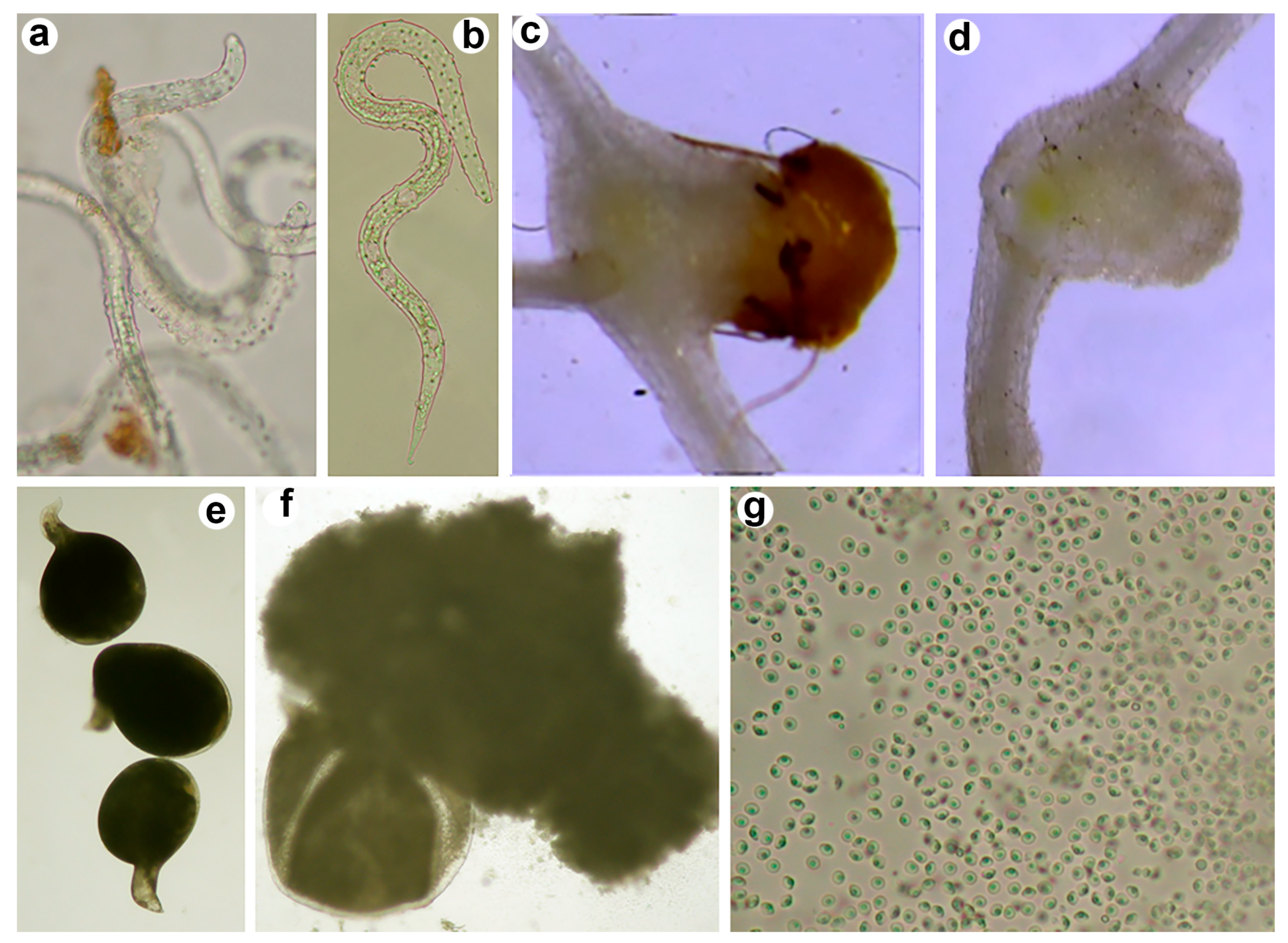
Pasteuria penetrans (Pp) is a mycelial and endospore-forming bacterium that parasitizes root-knot nematodes (RKN, Meloidogyne spp.) [1]. Owing to its high host specificity and biocontrol potential, it has been the focus of considerable research as a biological control agent [2]. The bacterial spores attach to the cuticle of second-stage juveniles (J2s) as they move through the soil. Spore-encumbered J2s then invade the plant’s roots and develop into females, while the attached spores germinate and proliferate within their bodies. Infected females fail to lay eggs and instead become filled with bacterial spores [2] (Figure 1).
It has been reported that Pp isolates exhibit high host specificity, not only among nematode species but also among different populations within the same nematode species [3,4]. A single Pp population may contain a diversity of genotypes that vary in their spore-attachment specificity [5,6,7]. Consequently, a subpopulation within a Pp isolate that can attach to one Meloidogyne population may fail to attach to another, and repeated culturing of that isolate on different Meloidogyne hosts may lead to shifts in host specificity. Channer and Gowen [8] tested this hypothesis using M. graminicola and M. naasi, both of which were poor hosts for the South African isolate Pp3. When M. graminicola was exposed to a high concentration of spores, the isolate multiplied, and the resulting spores showed significantly greater attachment to M. naasi than the original Pp3 isolate, but not to M. graminicola. In contrast, attachment on M. incognita was significantly reduced [8].
In the present study, we tested a similar hypothesis using M. luci and M. arenaria, both of which are poor/non-hosts of the Pp3 isolate maintained on M. javanica. J2s of M. luci were exposed to a high concentration of spores, resulting in the development of a new Pp3 sub-isolate (Pp3 M. luci), which developed for three generations. This Pp3 sub-isolate was compared with the original Pp3 isolate maintained on M. javanica, to demonstrate whether its spore-attachment ability had changed. Subsequently, J2s of M. arenaria were exposed to a high spore concentration of Pp3 M. luci, generating another sub-isolate (Pp3 M. arenaria for three generations), whose attachment ability was compared similarly with the two preceding isolates (Pp3 M. javanica and Pp3 M. luci). A reverse process was then conducted. J2s of M. javanica were exposed to high spore concentrations of Pp3 M. luci and Pp3 M. arenaria, producing two additional sub-isolates (Pp3 M. javanica ex. Pp3 M. luci and Pp3 M. javanica ex. Pp3 M. arenaria, each for two generations). These new isolates of Pp3 M. javanica were compared to their respective progenitors (Pp3 M. javanica, Pp3 M. luci and Pp3 M. arenaria) to assess potential shifts in spore-attachment ability.

2. Materials and Methods

All the experiments described below were conducted in the period of 2021–2025.

2.1. Pp Isolates and Meloidogyne Populations

The Pp isolate used in this study was Pp3 from South Africa [9], obtained from the University of Reading, Reading, UK [10], where it had been maintained for several years on various populations of M. javanica and M. incognita. In order to multiply the bacterium, a suitable host plant of a Meloidogyne species (e.g., tomato) was inoculated with J2s encumbered with Pp spores. After an appropriate period for female development and egg mass formation, the plant was uprooted, and the roots were washed free of soil. The roots were thoroughly dried so that egg masses produced by uninfected females would desiccate and die. Spores within infected females remain viable for long periods in dried root tissue. A suspension of spores can be prepared by grinding the dried roots with a pestle and mortar, suspending the material in distilled water, and passing it through a 20 μm sieve to remove coarse debris [11]. Alternatively, infected females can be extracted from the fresh roots and crushed in water to release spores. The Pp3 isolate obtained from the University of Reading, UK, was further multiplied in M. javanica populations from Crete, and a spore suspension prepared from dried root material had been stored in a domestic refrigerator since 1995. This “old” Pp3 spore suspension was subsequently “renewed” on a M. javanica population from Crete, and a fresh suspension was produced, by crushing infected females [12].
This renewed suspension was used to encumber J2s of M. javanica, M. incognita, M. hapla, M. luci and M. arenaria in 5.5 cm Petri dishes, containing 50,000 spores. For M. luci and M. arenaria, a much higher spore density (almost 1,000,000 spores) was used because attachment was minimal or absent. All Meloidogyne populations originated from Greece, had been previously identified using molecular or/and biochemical methods, and had been maintained in pots planted with tomatoes for several years. Spore-encumbered J2s were used to inoculate tomato plants (cv. ACE) grown in small pots filled with a commercial soil substrate. Plants were maintained in a growth room, at approximately 24–26 °C with a 16 h photoperiod, for 60 days. Afterward, plants were uprooted, roots were washed thoroughly, and females without egg masses were selected and extracted under a dissecting microscope. The females were crushed to release spores, resulting in four Pp3 isolates: Pp3 M. javanica 1st, Pp3 M. incognita, Pp3 M. hapla and Pp3 M. luci 1st [12]. Despite the high spore concentration used, attachment to M. arenaria J2s remained nearly zero, no infections were observed, and a Pp3 M. arenaria isolate could not be established. Spore density for each isolate was estimated using a hemocytometer (Fuchs Rosenthal, Weber Scientific International, Stoke-on-Trent/London, UK), under a light microscope (Olympus BX41, Olympus Optical Co. (EUROPA) GMBH, Hamburg, Germany).

2.2. Molecular Identification of Meloidogyne Populations

All nematode populations were re-identified at the beginning of the experiments to confirm their original identity. J2s of M. javanica, M. incognita and M. arenaria were identified using a multiplex PCR assay [13] with species-specific primers [13,14]. Diagnostic bands were obtained for each species using specific sets of primers in the same PCR reaction: Far/Rar for M. arenaria, Mi2F4/Mi1R1 for M. incognita and Fjav/Rjav for M. javanica. The multiplex PCR cycling conditions were 95 °C for 15 min, 40 cycles at 94 °C for 30 s, 57 °C for 1 min, and 68 °C for 2 min, with a final extension cycle of 68 °C for 9 min. Reaction volumes were adapted to 20 μL for each reaction, and primer concentrations were as described in Kiewnick et al. [13]. In contrast, molecular identification of M. hapla and M. luci J2s was performed by amplifying and sequencing the cytochrome oxidase subunit II (COII) region of mtDNA using primers C2F3 and 1108 [15]. The resulting sequences were subjected to BLAST 2.16.00 searches in GenBank and showed 99.9% identity with previously deposited sequences. These molecular analyses, including the multiplex PCR and COII sequencing, confirmed the identity of all populations and were consistent with the diagnostic descriptions of M. javanica, M. incognita, M. arenaria, M. hapla, and M. luci [16], thereby corroborating earlier identifications.

2.3. Molecular Identification of Pp3 Endospores

For genomic DNA extraction from Pp3 endospores, adult females (50 days after inoculation) from the Pp3 M. javanica 3rd and Pp3 M. luci 3rd were transferred to 0.2 μL thin-walled PCR tubes using a needle, crushed with a pipette tip, and mixed with 5 μL microLYSIS®-PLUS buffer (Microzone, Haywards Heath, UK). Samples were then placed in a thermocycler and subjected to the following temperature conditions: 65 °C for 15 min; 96 °C for 2 min; 65 °C for 4 min; 96 °C for 1 min; 65 °C for 1 min; and 96 °C for 30 s. Two microliters from the resulting lysate were used to amplify the 16S from P. penetrans using 16S rRNA gene-specific primers 39F (GCGGCGTGCCTAATACA [17]) and 1166R (CGCCGGCTGTCTCTCCAA [18]). DNA was amplified using HotStarTaq Master Mix (Solis BioDyne, Tartu, Estonia) according to the manufacturer’s instructions, under the following temperature conditions: 95 °C for 15 min followed by 35 cycles of 94 °C for 30 s, 50 °C for 45 s, 72 °C for 1 min and finally one cycle of 72 °C for 7min. The resulting products were purified and run on a DNA multicapillary sequencer (Model 3130XL genetic analyser; Applied Biosystems, Foster City, CA, USA), using the BigDye Terminator Sequencing Kit v.3.1 (Applied Biosystems, Foster City, CA, USA), at the Stab Vida sequencing facilities (Caparica, Portugal). Amplification of the 16S rRNA gene fragment was performed following the conditions described by Anderson et al. [19].

2.4. Attachment Tests of Four Pp3 Isolates on Five Meloidogyne Species

Freshly hatched J2s (0–4 days old) of each of the five Meloidogyne species (M. javanica, M. incognita, M. hapla, M. luci and M. arenaria) were obtained from eggs extracted according to Hussey and Barker [20] and incubated in dishes. Approximately 100 J2s were transferred to 3.5 cm diameter Petri dishes containing suspensions of 10,000 spores per dish, from each of the four Pp3 isolates (Pp3 M. javanica 1st, Pp3 M. incognita, Pp3 M. hapla and Pp3 M. luci 1st) in a total volume of 3 mL. After 24 h of incubation, in the spore suspension at approximately 25 °C, the number of spores attached to the cuticle of 10 randomly selected J2s was assessed using an inverted microscope at 200× magnification. Each treatment was replicated in four Petri dishes. Spore attachment and data analysis were conducted separately for each Meloidogyne species (Table 1). The attachment of Pp3 M. luci 1st spores was evaluated again on the four Meloidogyne species (excluding M. arenaria) as previously described (Table 2).

2.5. Development of Pp3 M. javanica 3rd and Pp3 M. luci 3rd Isolates

J2s of M. javanica carrying spores of Pp3 M. javanica 1st and J2s of M. luci carrying spores of Pp3 M. luci 1st were inoculated onto tomato plants as previously described. Two new Pp3 sub-isolates, designated as Pp3 M. javanica 2nd and Pp3 M. luci 2nd, were obtained by crushing spore-infected females. The same procedure was repeated using the newly produced spores for attachment, and two additional sub-isolates of Pp3, designated as Pp3 M. javanica 3rd and Pp3 M. luci 3rd, were generated in the same manner.

2.6. Development of Pp3 M. arenaria 3rd Isolate

As previously noted, selection of Pp3 on M. arenaria was not possible. Therefore, J2s were exposed to a high concentration of spore suspension (approximately 1,000,000 spores) of Pp3 M. luci 3rd and subsequently inoculated onto tomato plants. Infected females were isolated from the roots, crushed, and used to obtain the Pp3 M. arenaria 1st isolate. The same procedure was repeated twice, each time using the newly produced spores for attachment, resulting in the development of the Pp3 M. arenaria 2nd and Pp3 M. arenaria 3rd sub-isolates.

2.7. Reverse Process for Development of Pp3 M. javanica 2nd (Ex. Pp3 M. luci) and Pp3 M. javanica 2nd (Ex. Pp3 M. arenaria) Isolates

Juveniles of M. javanica were exposed to a high spore density (approximately 1,000,000 spores) of Pp3 M. arenaria 3rd and Pp3 M. luci 3rd. The spore-encumbered J2s were then used to inoculate tomato plants. Infected females were isolated from the roots, crushed, and two new Pp3 sub-isolates were obtained. The procedure was repeated using the newly produced spores, resulting in the generation of Pp3 M. javanica 2nd (ex. Pp3 M. luci) and Pp3 M. javanica 2nd (ex. Pp3 M. arenaria).

2.8. Attachment Tests of Pp3 M. javanica, Pp3 M. luci, Pp3 M. arenaria, Pp3 M. javanica (Ex. Pp3 M. luci) and Pp3 M. javanica (Ex. Pp3 M. arenaria) Isolates on Three Meloidogyne Species

Several attachment tests were conducted in 3.5 cm Petri dishes, using the method described previously.
(a)
The attachment ability of the Pp3 M. javanica 2nd and Pp3 M. luci 2nd isolates was evaluated on M. javanica and M. luci at two spore densities, 10,000 and 100,000 spores per dish (Table 3).
(b)
To determine whether the attachment ability of these Pp3 isolates followed a similar pattern when tested on other populations of the same nematode species, an additional population of each Meloidogyne species designated as M. javanica (other) and M. luci (other) was included in a separate experiment. These “other” populations originated from different regions of Greece but were maintained in pot cultures, similarly to the “initial” populations used throughout this study. Attachment tests were performed at a density of 40,000 spores per dish (Table 4).
(c)
The attachment ability of Pp3 M. luci 3rd, Pp3 M. javanica 3rd and Pp3 M. arenaria 2nd was assessed on M. luci, M. javanica and M. arenaria on three separate occasions, using spore concentrations of 20,000, 40,000 and 80,000 spores per dish (Table 5).
(d)
The same Pp3 isolates were then tested at 80,000 spores per dish on M. incognita and M. hapla, two species not involved in the Pp3 selection process (Table 6).
(e)
The attachment ability of Pp3 M. luci 3rd, Pp3 M. javanica 3rd and Pp3 M. arenaria 3rd was evaluated on M. luci, M. javanica and M. arenaria on two separate occasions at spore densities of 40,000 and 80,000 spores per dish (Table 7).
(f)
Finally, attachment tests were conducted twice using Pp3 M. javanica 2nd (ex. Pp3 M. luci) and Pp3 M. javanica 2nd (ex. Pp3 M. arenaria) at a density of 50,000 spores per dish (Table 8).

2.9. Data Analysis

All results were analyzed, using a one-way ANOVA, and treatment means were compared with the t test (Least Significant Difference, LSD), at the 5% significance level. The one-way ANOVA was used to compare the attachment ability of Pp isolates, exclusively within a nematode species (per column). The coefficient of variation was checked, and in the cases the values were higher than 30, analysis was performed in log(x + 1) values. Data for each variable are in columns as the means of four replicates. Means within a column not sharing a common letter are significantly different (p ≤ 0.05). Statistical analyses were performed using SAS University Edition 9.4 (SAS Institute Inc., Cary, NC, USA).

3. Results

3.1. Molecular Identification of Meloidogyne Species and Pp3 Isolates

All re-identifications performed to confirm the original identification of M. javanica, M. incognita, M. arenaria and M. luci were consistent. Likewise, the PCR amplicons from the 16S rRNA gene were successfully obtained from the Pp3 M. javanica 3rd and the Pp3 M. luci 3rd isolates, and the resulting sequences showed 100% similarity both among the 16S rRNA sequences from each line and with Pp sequences deposited in NCBI (HQ849356, KT923065).

3.2. Attachment Tests of Four Pp3 Isolates on Five Meloidogyne Species

On the J2s of M. javanica, a similar number of spores attached from the three Pp3 isolates produced on M. javanica, M. incognita and M. hapla. On the J2s of M. incognita, spore attachment was similar for the Pp3 isolates produced on M. incognita and M. hapla, but lower for the isolate produced on M. javanica. The number of spores attached to the J2s of M. hapla was comparable among Pp3 isolates produced on M. hapla, M. javanica and M. incognita. The Pp3 isolate produced on M. luci showed almost no attachment to M. javanica, M. incognita and M. hapla, but attached readily to the J2s of M. luci. The remaining three Pp3 isolates attached at very low levels, almost zero, to the J2s of M. luci. Furthermore, the only Pp3 isolate that attached on M. arenaria, although at the low rate of approximately one spore per J2, was the Pp3 isolate produced on M. luci (Table 1). The shift in specificity of the Pp3 isolate produced on M. luci was further confirmed: attachment to M. javanica, M. incognita and M. hapla remained almost zero, whereas an average of 5.5 spores per J2 attached to M. luci (Table 2).

3.3. Attachment Tests of Pp3 M. javanica, Pp3 M. luci, Pp3 M. arenaria, Pp3 M. javanica 2nd (Ex. Pp3 M. luci) and Pp3 M. javanica 2nd (Ex. Pp3 M. arenaria) Isolates on Three Meloidogyne Species

(a)
The “shift” in host specificity of Pp3 produced on either M. javanica or M. luci for a second generation was evident at the concentration of 10,000 spores per dish. Spores of Pp3 M. javanica 2nd did not attach on M. luci, whereas spores of Pp3 M. luci 2nd showed only minimal attachment to M. javanica. At the higher concentration of 100,000 spores per dish, spores of Pp3 M. javanica 2nd exhibited minimal attachment to M. luci, while spores of Pp3 M. luci 2nd attached to M. javanica at a level significantly lower than that of Pp3 M. javanica 2nd (Table 3).
(b)
The same trend was observed with J2s of two additional populations of M. javanica and M. luci. Spores of Pp3 M. javanica 2nd attached only at minimal levels to M. luci, at the concentration of 40,000 spores per dish. Likewise, the attachment of spores of Pp3 M. luci 2nd to J2s of M. javanica was significantly lower than that of Pp3 M. javanica 2nd (Table 4).
(c)
The change in host specificity of Pp3 became more pronounced, after its culture for three generations on M. javanica and M. luci and for two generations on M. arenaria. The Pp3 M. javanica 3rd isolate did not attach to M. luci or M. arenaria. The Pp3 M. luci 3rd isolate attached at minimal or zero levels on M. javanica but readily to M. luci and M. arenaria. Similarly, the Pp3 M. arenaria 2nd isolate attached at minimal or zero levels to M. javanica but readily to M. luci and M. arenaria (Table 5).
(d)
The attachment ability of the three previously mentioned Pp3 isolates was evaluated on M. incognita and M. hapla, two species not involved in the selection process. While Pp3 M. javanica 3rd attached readily to both M. incognita and M. hapla, the Pp3 M. luci 3rd and Pp3 M. arenaria 2nd isolates showed minimal spore attachment to both nematode species (Table 6).
(e)
The change in host specificity of Pp3 was further confirmed after its culture for three generations on M. javanica, M. luci and M. arenaria. The Pp3 M. javanica 3rd isolate showed only minimal attachment to M. luci and M. arenaria at both 40,000 and 80,000 spores per dish. In contrast, the Pp3 M. luci 3rd and Pp3 M. arenaria 3rd isolates attached at minimal levels to M. javanica but readily to M. luci and M. arenaria (Table 7).
(f)
The Pp3 M. javanica 3rd, Pp3 M. javanica 2nd (ex. Pp3 M. luci) and Pp3 M. javanica 2nd (ex. Pp3 M. arenaria) isolates attached to J2s of M. javanica at similar rates. The Pp3 M. javanica 2nd (ex. Pp3 M. luci) isolate showed zero attachment to M. luci, and the Pp3 M. javanica 2nd (ex. Pp3 M. arenaria) isolate showed zero attachment to M. arenaria. In contrast, the Pp3 M. arenaria 3rd and Pp3 M. luci 3rd isolates attached readily to M. arenaria and M. luci, respectively (Table 8).

4. Discussion

Meloidogyne luci was described only twelve years ago [21], and to our knowledge, no published reports exist regarding its interaction with Pasteuria penetrans.
The Pp3 isolate used in this study had been cultured for several years on populations of M. javanica and M. incognita from various regions of the world, at the University of Reading, UK, and subsequently on M. javanica populations from Crete. Neither M. arenaria, M. hapla nor M. luci (a species unknown at that time) had ever been used for its multiplication. When tested against these non-cultured hosts, at moderate spore concentrations (10,000 spores/mL), Pp3 showed differential attachment patterns: it attached readily to M. hapla but showed poor or no attachment to M. luci and M. arenaria populations from Greece.
To investigate whether host specificity could be experimentally shifted, we conducted sequential selection experiments. When M. luci J2s were exposed to high spore concentrations (1,000,000 spores/mL), low levels of attachment and infection occurred. Spores from these infected females were then used to encumber J2s of M. luci, and this process was repeated twice more, resulting in a Pp3 isolate selectively adapted to M. luci, designated as Pp3 M. luci 3rd. This isolate lost its ability to attach to J2s of M. javanica. Interestingly, spores of Pp3 M. luci 3rd isolate, when applied at high concentrations, attached to J2s of M. arenaria. Following the same selection procedure, a Pp3 isolate adapted to M. arenaria was produced after two and three generations, designated Pp3 M. arenaria 2nd and Pp3 M. arenaria 3rd. Both Pp3 M. luci 3rd and Pp3 M. arenaria 2nd isolates behaved similarly, attaching readily to M. luci and M. arenaria but not to M. javanica, M. incognita and M. hapla. Later, when Pp3 M. arenaria 3rd isolated was produced, the experiment was repeated, and both Pp3 M. luci 3rd and Pp3 M. arenaria 3rd again showed the same pattern: strong attachment to M. luci and M. arenaria, but not to M. javanica.
Host specificity shift proved to be reversible. When the adapted Pp3 M. arenaria 3rd and Pp3 M. luci 3rd isolates were subjected to repeat selection on M. javanica at high spore concentrations, we obtained two new isolates, Pp3 M. javanica 2nd (ex. Pp3 M. arenaria 3rd) and Pp3 M. javanica 2nd (ex. Pp3 M. luci 3rd). Both isolates, regained the ability to attach readily to M. javanica but lost their ability to attach to M. arenaria and M. luci.
These results demonstrate that Pasteuria penetrans host specificity is plastic and subject to rapid experimental selection-driven changes in attachment patterns but with clear fitness trade-offs: adaptation to one host group (M. luci /M. arenaria) was accompanied by loss of attachment to another host group (M. javanica/M. incognita/M. hapla). A similar observation was reported 34 years earlier using the same Pp3 isolate, in which host specificity shifted in favor of M. naasi, accompanied by a fitness cost on M. incognita [8]. The altered host specificity, favoring M. luci and M. arenaria, later shifted again toward M. javanica, with a corresponding fitness cost toward M. arenaria and M. luci. However, genetic mechanisms beyond it were not investigated.
Differences in Pp3 attachment to Meloidogyne spp. may be a consequence of co-evolved, highly specific interactions between spore surface molecules and J2 surface-coat components, modulated by physical and biochemical differences among Meloidogyne species. Fatty acid and retinol-binding proteins present in the J2 cuticle, as well as hydrophobicity of the J2 epicuticle, have been shown to influence Pasteuria penetrans endospore adhesion to the nematode surface [22]. The rapid and reversible changes in host specificity detected in our selection experiments suggest that the Pp3 population contains substantial pre-existing variation upon which selection can act. Although we did not characterize this variation at the molecular level, previous studies indicate that Pasteuria isolates often harbor multiple genotypes that differ in attachment efficiency, infection success, and host range [23,24]. It is therefore plausible that the adaptation we observed reflects shifts in the relative frequencies of these genotypes, with those better suited to the host species used during each selection cycle becoming more prevalent. In addition, phenotypic plasticity in attachment traits, previously noted as a potential contributor to variation in host compatibility [25], may help explain the speed and reversibility of the response, enabling sub-populations to adjust their compatibility with different hosts without requiring fixed genetic change. Together, these considerations provide a mechanistic context for the observed host specificity shifts and underscore the potential for rapid phenotypic shifts under selection, within Pasteuria populations.
Pp3 exhibited different attachment percentages to J2s of M. javanica, M. incognita, M. arenaria, M. hapla, and M. luci because each species possesses a distinct surface-coat “signature,” including differences in carbohydrate and glycoprotein composition, surface charge, and turnover dynamics. The Pp3 isolate is likely adapted to only a subset of these signatures. Consequently, M. luci and M. arenaria may have a more divergent surface-coat profile, and the Pp3 isolate may therefore be poorly adapted, to attach efficiently to these species.


Author Contributions

Conceptualization, E.A.T., C.C.-N., A.G.-V., R.S.-G., J.E.P.-R., P.C. and A.A.-Y.; methodology, E.A.T., C.C.-N., A.G.-V., R.S.-G., J.E.P.-R., P.C. and A.A.-Y.; software, E.N.; validation, E.A.T., C.C.-N., A.G.-V., R.S.-G., E.N., J.E.P.-R., P.C. and A.A.-Y.; investigation, E.A.T., C.C.-N., A.G.-V., R.S.-G., E.N., J.E.P.-R., P.C. and A.A.-Y.; resources, E.A.T., C.C.-N., A.G.-V., R.S.-G., J.E.P.-R., P.C. and A.A.-Y.; data curation, E.A.T., E.N. and P.C.; writing—original draft preparation, E.A.T., J.E.P.-R., P.C. and A.A.-Y.; writing—review and editing, E.A.T., C.C.-N., A.G.-V., R.S.-G., E.N., J.E.P.-R., P.C. and A.A.-Y.; visualization, E.A.T.; supervision, E.A.T., J.E.P.-R. and P.C. All authors have read and agreed to the published version of the manuscript.

Funding

This research received no external funding.

Data Availability Statement

The raw data supporting the conclusions of this article can be made available by the first and seventh authors on request.

Acknowledgments

Emmanuel (Manolis) Tzortzakakis dedicates this paper to two pioneer nematologists and inspirators of nematode biological control: Simon Gowen (his PhD supervisor in the period of 1990–1993) and Brian Kerry (passed away in 2011). Manolis’ dedication consists of a minimal expression of his deep gratitude, not only for their encouragement and support in “building” his nematology career but also for their unlimited and constant friendship. A. Archidona-Yuste is funded by the Ramón y Cajal program (RYC2021-031108-I), funded by MCIN/AEI/https://doi.org/10.13039/501100011033 and UE “Next Generation EU/PRTR”.

Conflicts of Interest

The authors declare no conflicts of interest. The funders had no role in the design of this study; in the collection, analyses, or interpretation of data; in the writing of the manuscript; or in the decision to publish the results.

Abbreviations

The following abbreviations are used in this manuscript:
PpPasteuria penetrans
RKNroot-knot nematode
J2second-stage juvenile
LSDLeast Significant Difference

References

  1. Sayre, R.M.; Starr, M.P. Pasteuria penetrans (ex Thorne, 1940) nom. rev., comb. n., sp. n., a mycelial and endospore-forming bacterium parasitic in plant-parasitic nematodes. Proc. Helminthol. Soc. Wash. 1985, 52, 149–165. [Google Scholar]
  2. Chen, Z.X.; Dickson, D.W. Review of Pasteuria penetrans: Biology, ecology and biological control potential. J. Nematol. 1998, 30, 313–340. [Google Scholar] [PubMed]
  3. Stirling, G.R. Host specificity of Pasteuria penetrans within the genus Meloidogyne. Nematologica 1985, 31, 203–209. [Google Scholar] [CrossRef]
  4. Davies, K.G.; Kerry, B.R.; Flynn, C.A. Observations on the pathogenicity of Pasteuria penetrans, a parasite of root-knot nematodes. Ann. Appl. Biol. 1988, 112, 491–501. [Google Scholar] [CrossRef]
  5. Davies, K.G.; Redden, M.; Pearson, T.K. Endospore heterogeneity in Pasteuria penetrans related to adhesion to plant-parasitic nematodes. Lett. Appl. Microbiol. 1994, 19, 370–373. [Google Scholar] [CrossRef]
  6. Timper, P. Population dynamics of Meloidogyne arenaria and Pasteuria penetrans in a long term crop rotation study. J. Nematol. 2009, 41, 291–299. [Google Scholar] [PubMed]
  7. Joseph, S.; Schmidt, L.M.; Danquah, W.B.; Timper, P.; Mekete, T. Genotyping of single spore isolates of a Pasteuria penetrans population occurring in Florida using SNP—Based markers. J. Appl. Microbiol. 2017, 122, 389–401. [Google Scholar] [CrossRef]
  8. Channer, A.G.D.R.; Gowen, S.R. Selection for increased host resistance and increased pathogen specificity in the MeloidogynePasteuria penetrans interaction. Fund. Appl. Nematol. 1992, 15, 331–339. [Google Scholar]
  9. Spaull, V.W. Bacillus penetrans in South African plant-parasitic nematodes. Nematologica 1981, 27, 244–245. [Google Scholar] [CrossRef]
  10. Tzortzakakis, E.A.; Channer, A.G.D.E.R.; Gowen, S.R.; Ahmed, R. Studies on the potential use of Pasteuria penetrans as a biocontrol agent of root-knot nematodes (Meloidogyne spp.). Plant Pathol. 1997, 46, 44–55. [Google Scholar] [CrossRef]
  11. Stirling, G.R.; Wachtel, M.F. Mass production of Bacillus penetrans for the biological control of root-knot nematodes. Nematologica 1980, 26, 308–312. [Google Scholar] [CrossRef]
  12. Tzortzakakis, E.A. The effect on spore viability of storing the nematode parasite Pasteuria penetrans in either dried root material or water suspension. Russ. J. Nematol. 2022, 30, 19–20. [Google Scholar]
  13. Kiewnick, S.; Wolf, S.; Willareth, M.; Frey, J.E. Identification of the tropical root-knot nematode species Meloidogyne incognita, M. javanica and M. arenaria using a multiplex PCR assay. Nematology 2013, 15, 891–894. [Google Scholar] [CrossRef]
  14. Zijlstra, C.; Donkers-Venne, D.T.H.M.; Fargette, M. Identification of Meloidogyne incognita, M. javanica and M. arenaria using sequence characterized amplified region (SCAR) based PCR assays. Nematology 2000, 2, 847–853. [Google Scholar]
  15. Powers, T.O.; Harris, T.S. A polymerase chain reaction method for identification of five major Meloidogyne species. J. Nematol. 1993, 25, 1–6. [Google Scholar] [PubMed]
  16. Subbotin, S.A.; Palomares-Rius, J.E.; Castillo, P. Systematics of root-knot nematodes (Nematoda: Meloidogynidae). In Nematology Monographs and Perspectives; Hunt, D.J., Perry, R.N., Eds.; Brill: Leiden, The Netherlands, 2021; Volume 14, p. 847. [Google Scholar] [CrossRef]
  17. Atibalentja, N.; Noel, G.R.; Domier, L.L. Phylogenetic position of the North American isolate of Pasteuria that parasitizes the soybean cyst nematode, Heterodera glycines, as inferred from 16S rDNA sequence analysis. Int. J. Syst. Evol. Microbiol. 2000, 50, 605–613. [Google Scholar] [CrossRef]
  18. Duan, Y.P.; Castro, H.F.; Hewlett, T.E.; White, J.H.; Ogram, A.V. Detection and characterization of Pasteuria 16S rRNA gene sequences from nematodes and soils. Int. J. Syst. Evol. Microbiol. 2003, 53, 105–112. [Google Scholar] [CrossRef][Green Version]
  19. Anderson, J.M.; PReston, J.F.; Dickson, D.W.; Hewlett, T.E.; Williams, N.H.; Maruniak, J.E. Phylogenetic analysis of Pasteuria penetrans by 16S rRNA gene cloning and sequencing. J. Nematol. 1999, 31, 319–325. [Google Scholar] [PubMed]
  20. Hussey, R.S.; Barker, K.R. A comparison of methods of collecting inocula for Meloidogyne spp., including a new technique. Plant Dis. Rep. 1973, 57, 1025–1028. [Google Scholar]
  21. Carneiro, R.M.D.G.; Correa, V.R.; Almeida, M.R.A.; Gomes, A.C.M.M.; Mohammad Deimi, A.; Castagnone-Sereno, P.; Karssen, G. Meloidogyne luci n. sp. (Nematoda: Meloidogynidae), a root-knot nematode parasitizing different crops in Brazil, Chile and Iran. Nematology 2014, 16, 289–301. [Google Scholar] [CrossRef]
  22. Davies, K.G.; Mohan, S.; Phani, V.; Srivastava, A. Exploring the mechanisms of host-specificity of a hyperparasitic bacterium (Pasteuria spp.) with potential to control tropical root-knot nematodes (Meloidogyne spp.): Insights from Caenorhabditis elegans. Front. Cell. Infect. Microbiol. 2023, 13, 1296293. [Google Scholar] [CrossRef] [PubMed]
  23. Preston, J.F.; Dickson, D.W.; Maruniak, J.E.; Nong, G.; Brito, J.A.; Schmidt, L.M.; Giblin-Davis, R.M. Pasteuria spp.: Systematics and Phylogeny of These Bacterial Parasites of Phytopathogenic Nematodes. J. Nematol. 2003, 35, 198–207. [Google Scholar] [PubMed]
  24. Davies, K.G. Understanding the interaction between an obligate hyperparasitic bacterium, Pasteuria penetrans and its obligate plant parasitic nematode host, Meloidogyne spp. Adv. Parasitol. 2009, 68, 211–245. [Google Scholar] [CrossRef] [PubMed]
  25. Timper, P.; Davies, K. Biotic interactions. In Nematode Behaviour; Gaugler, R., Bilgrami, A.L., Eds.; CABI: Wallingford, UK, 2004; pp. 277–307. [Google Scholar] [CrossRef]
Figure 1. (a,b) Second-stage juveniles of Meloidogyne javanica heavily encumbered with spores of Pasteuria penetrans (Pp3); (c) a root gall with a female of Meloidogyne javanica with the egg mass; (d) a root gall with a female of M. javanica without egg mass due to Pp3 infection; (e) females of M. javanica infected by Pp3; (f) single female of M. javanica releasing spores of Pp3 after being crushed; (g) released free spores of Pp3.
Agriculture 16 00823 g001
Table 1. Average number of spores attached per second-stage juvenile of Meloidogyne species exposed to Pasteuria penetrans (Pp3) isolates of the same origin, each produced on the respective Meloidogyne species for one generation 1.
Meloidogyne Species
Pasteuria penetrans IsolateM. javanicaM. incognitaM. haplaM. luciM. arenaria
Pp3 produced on M. javanica 1st 1.98 a2.73 b7.20 b0.15 b0.05 b
Pp3 produced on M. incognita3.40 a4.10 a10.15 a0.10 b0.00 b
Pp3 produced on M. hapla2.83 a4.63 a7.70 ab0.08 b0.08 b
Pp3 produced on M. luci 1st 0.05 b0.08 c0.00 c4.75 a1.00 a
LSD 5%(0.16)1.152.76(0.75)(0.13)
1 Spore density was 10,000 per dish. 100 J2s per dish. Each mean represents the average of four replicate Petri dishes. For each Petri dish, 10 s stage juveniles were observed. Means within each column followed by the same letter are not significantly different according to the LSD test (p ≤ 0.05). For M. javanica, M. luci and M. arenaria analysis on log(x + 1) transformed data (LSD values in parentheses), non-transformed means are presented.
Table 2. Average number of spores attached per second-stage juvenile of Meloidogyne species exposed to Pasteuria penetrans (Pp3) produced on M. luci for one generation 1.
Meloidogyne SpeciesPp3 Produced on M. luci 1st
M. javanica0.00 b
M. incognita0.18 b
M. hapla0.03 b
M. luci5.55 a
LSD 5%(0.10)
1 Spore density was 10,000 per dish. 100 J2s per dish. Each mean represents the average of four replicate Petri dishes. For each Petri dish, 10 s stage juveniles were observed. Means within each column followed by the same letter are not significantly different according to the LSD test (p ≤ 0.05). For analysis on log(x + 1) transformed data (LSD values in parentheses), non-transformed means are presented.
Table 3. Average number of spores attached per second-stage juvenile of Meloidogyne javanica and M. luci exposed to Pasteuria penetrans (Pp3) isolates that had been produced on the respective nematode species for two generations 1.
Pasteuria penetrans IsolateM. javanicaM. luci
Pp3 M. javanica 2nd (10,000 spores/dish)5.48 b0.00 c
Pp3 M. luci 2nd (10,000 spores/dish)0.35 c3.95 b
Pp3 M. javanica 2nd (100,000 spores/dish)28.88 a0.50 c
Pp3 M. luci 2nd (100,000 spores/dish)6.73 b14.08 a
LSD 5%4.121.60
1 100 J2s per dish. Each mean represents the average of four replicate Petri dishes. For each Petri dish, 10 s stage juveniles were observed. Means within each column followed by the same letter are not significantly different according to the LSD test (p ≤ 0.05).
Table 4. Average number of spores attached per second-stage juvenile of two populations of Meloidogyne javanica and M. luci, exposed to Pasteuria penetrans (Pp3) isolates that had been produced on the respective nematode species for two generations 1.
Pasteuria penetrans IsolateM. javanica (Initial) M. javanica (Other)M. luci (Initial)M. luci (Other)
Pp3 M. javanica 2nd25.85 a33.50 a0.28 b0.08 b
Pp3 M. luci 2nd5.60 b8.30 b6.70 a2.40 a
LSD 5%7.448.151.45(0.09)
1 Spore density was 40,000 per dish. 100 J2s per dish. Each mean represents the average of four replicate Petri dishes. For each Petri dish, 10 s stage juveniles were observed. M. javanica and M. luci “initial” refer to the same populations previously tested, whereas M. javanica and M. luci “other” refer to different populations from those initial ones. Means within each column followed by the same letter are not significantly different according to the LSD test (p ≤ 0.05). For M. luci (other) analysis on log(x + 1) transformed data (LSD values in parentheses), non-transformed means are presented.
Table 5. Average number of spores attached per second-stage juvenile of Meloidogyne arenaria, M. luci and M. javanica, exposed to Pasteuria penetrans (Pp3) isolates that had been produced on the respective nematode species for two or three generations 1.
20,000 Spores of Pp3 per Dish
Meloidogyne Species
Pasteuria penetrans IsolateM. arenariaM. luciM. javanica
Pp3 M. arenaria 2nd5.98 a2.05 a0.03 b
Pp3 M. luci 3rd3.38 b2.58 a0.10 b
Pp3 M. javanica 3rd0.15 c0.03 b4.78 a
LSD 5%(0.12)0.71(0.09)
40,000 Spores of Pp3 per Dish
Pp3 M. arenaria 2nd12.48 a10.05 b1.23 b
Pp3 M. luci 3rd12.90 a11.88 a1.08 b
Pp3 M. javanica 3rd0.25 b0.00 c25.63 a
LSD 5%2.991.711.88
80,000 Spores of Pp3 per Dish
Pp3 M. arenaria 2nd20.78 a14.55 a0.13 b
Pp3 M. luci 3rd19.40 a17.45 a0.13 b
Pp3 M. javanica 3rd0.20 b0.40 b17.03 a
LSD 5%5.094.361.27
1 100 J2s per dish. Each mean represents the average of four replicate Petri dishes. For each Petri dish, 10 s stage juveniles were observed. Means within each column followed by the same letter are not significantly different according to the LSD test (p ≤ 0.05). For M. arenaria and M. javanica analysis on log(x + 1) transformed data (LSD values in parentheses), non-transformed means are presented.
Table 6. Average number of spores attached per second-stage juvenile of Meloidogyne incognita and M. hapla exposed to Pasteuria penetrans (Pp3) isolates, which had been produced on M. arenaria, M. luci and M. javanica for two or three generations 1.
Pasteuria penetrans IsolateM. incognitaM. hapla
Pp3 M. arenaria 2nd0.20 b0.23 b
Pp3 M. luci 3rd0.70 b0.20 b
Pp3 M. javanica 3rd15.35 a14.60 a
LSD 5%1.301.39
1 Spore density was 80,000 spores per dish. 100 J2s per dish. Each mean represents the average of four replicate Petri dishes. For each Petri dish, 10 s stage juveniles were observed. Means within each column followed by the same letter are not significantly different according to the LSD test (p ≤ 0.05).
Table 7. Average number of spores attached per second-stage juvenile of Meloidogyne arenaria, M. luci and M. javanica exposed to Pasteuria penetrans (Pp3) isolates that had been produced on the respective nematode species for three generations 1.
40,000 Spores of Pp3 per Dish
Meloidogyne Species
Pasteuria penetrans IsolateM. arenariaM. luciM. javanica
Pp3 M. arenaria 3rd2.38 b3.13 b0.75 b
Pp3 M. luci 3rd4.00 a4.05 a0.48 b
Pp3 M. javanica 3rd0.15 c0.23 c30.50 a
LSD 5%0.880.765.11
80,000 Spores of Pp3 per Dish
Pp3 M. arenaria 3rd29.85 a22.03 a0.33 b
Pp3 M. luci 3rd24.05 a18.58 b0.85 b
Pp3 M. javanica 3rd0.30 b0.65 c54.20 a
LSD 5%6.751.493.06
1 100 J2s per dish. Each mean represents the average of four replicate Petri dishes. For each Petri dish, 10 s stage juveniles were observed. Means within each column followed by the same letter are not significantly different according to the LSD test (p ≤ 0.05).
Table 8. Average number of spores attached per second-stage juvenile of Meloidogyne arenaria, M. luci and M. javanica exposed to Pasteuria penetrans isolates Pp3 M. arenaria 3rd and Pp3 M. luci 3rd, which had subsequently been produced on M. javanica for two generations 1.
Experiment 1
Meloidogyne Species
Pasteuria penetrans IsolateM. arenariaM. luciM. javanica
Pp3 M. arenaria 3rd5.55 a--
Pp3 M. javanica 2nd (ex. Pp3 M. arenaria 3rd)0.03 b-20.35 a
Pp3 M. luci 3rd-3.50 a-
Pp3 M. javanica 2nd (ex. Pp3 M. luci 3rd)-0.03 b20.45 a
Pp3 M. javanica 3rd0.03 b0.00 b24.05 a
LSD 5%(0.01)(0.01)8.77
Experiment 2
Pp3 M. arenaria 3rd3.68 a--
Pp3 M. javanica 2nd (ex. Pp3 M. arenaria 3rd)0.00 b-9.58 a
Pp3 M. luci 3rd-3.93 a-
Pp3 M. javanica 2nd (ex. Pp3 M. luci 3rd)-0.05 b12.53 a
Pp3 M. javanica 3rd0.03 b0.03 b10.60 a
LSD 5%0.39(002)3.65
1 Spore density was 50,000 per dish. 100 J2s per dish. Each mean represents the average of four replicate Petri dishes. For each Petri dish, 10 s stage juveniles were observed. Means within each column followed by the same letter are not significantly different according to the LSD test (p ≤ 0.05). For M. arenaria in experiment 1 and for M. luci in both experiments, for analysis on log(x + 1) transformed data (LSD values in parentheses), non-transformed means are presented.
Disclaimer/Publisher’s Note: The statements, opinions and data contained in all publications are solely those of the individual author(s) and contributor(s) and not of MDPI and/or the editor(s). MDPI and/or the editor(s) disclaim responsibility for any injury to people or property resulting from any ideas, methods, instructions or products referred to in the content.