Article

Diverse Manures Shape Heavy Metal Accumulation and Microbial Communities in Long-Term Continuous Maize Cropping


1
College of Land and Environment, Shenyang Agricultural University, No. 120 Dongling Road Shenhe District, Shenyang 110866, China
2
Institute of Environment and Sustainable Development in Agriculture, Chinese Academy of Agricultural Sciences/Key Laboratory of Agricultural Environment, Ministry of Agriculture and Rural Affairs, Beijing 100081, China
3
Jilin Academy of Agricultural Sciences/Key Laboratory of Black Soil Conservation and Utilization, Ministry of Agriculture and Rural Affairs, Changchun 130033, China
*
Authors to whom correspondence should be addressed.
Agriculture 2026, 16(7), 814; https://doi.org/10.3390/agriculture16070814

Submission received: 28 February 2026 / Revised: 2 April 2026 / Accepted: 3 April 2026 / Published: 7 April 2026
(This article belongs to the Section Agricultural Soils)

Abstract

Livestock manure amendment improves soil fertility and promotes carbon sequestration, but long-term application leads to heavy metal (HM) accumulation with unknown ecological consequences. Based on a 13-year field experiment in a continuous maize cropping system, we compared chemical fertilizer (NPK) with four organic amendments (cattle, pig, chicken manure, and compost) applied on an isocarbon basis. Organic amendments significantly increased total organic carbon (TOC) by 15.8–24.3% and available phosphorus (AP) by 1.9- to 6-fold relative to NPK. Compost achieved the highest maize yield. However, pig and chicken manure led to substantial accumulation of Cu and Zn due to high background levels. Despite this, grain HM concentrations remained below safety thresholds, indicating no immediate food chain risk. Metagenomic analysis revealed that HM stress acted as a deterministic filter on the soil microbiome. Cattle manure fostered the most complex co-occurrence network (average degree: 2.70), while pig manure reduced network complexity and increased modularity (>0.92), reflecting a shift toward fragmented, survival-oriented interactions. This structural reorganization was coupled with functional shifts, including enrichment of stress-tolerant taxa (Chitinophagales, Nitrosotalea) and detoxification pathways. We recommend prioritizing cattle manure or compost over raw pig and poultry manure to balance fertility, productivity, and ecological safety in black soil regions.

1. Introduction

The rapid advancement of China’s agricultural economy in recent years, coupled with an escalating demand for meat products, has catalyzed the expansion of the livestock and poultry sectors. This intensification has resulted in the generation of approximately 3.8 billion tons of livestock and poultry manure annually in China [1]. Rich in essential nutrients such as nitrogen (N), phosphorus (P), potassium (K), and organic carbon (OC), manure is a valuable resource for bolstering soil fertility and sustaining crop productivity. Consequently, the application of manure as an organic fertilizer has become a prevalent agricultural practice [2,3]. Heavy metals (HMs) enter agroecosystems through various anthropogenic pathways, including the long-term application of phosphate fertilizers, atmospheric deposition, irrigation water, and pesticide residues [4]. However, among these diverse inputs, livestock manure has garnered particular attention. While atmospheric deposition or irrigation water may dominate heavy metal inputs in heavily industrialized areas, in typical intensive agricultural regions, manure often constitutes a primary and rapidly accumulating source of HMs, posing unique ecological risks to soil-crop systems [5,6]. In the context of enhancing soil fertility and ensuring food security, it is crucial to systematically assess the effects of long-term animal manure application on soil heavy metal accumulation and microbial communities.
Substantial research indicates that continuous, large-scale manure application results in significant accumulation of HMs in soils [7,8,9]. However, most studies have focused primarily on changes in total heavy metal content in soil following manure application. Moreover, systematic assessments regarding the bioavailable fractions of heavy metals and associated crop accumulation risks are generally lacking. Assessing HMs risk in agroecosystems requires distinguishing between total concentrations and their bioavailability and mobility, as ecological effects and plant uptake are governed by reactive or labile pools rather than the total reservoir [10,11]. Metal bioavailability is stringently regulated by soil physicochemical attributes, including pH, cation exchange capacity (CEC), soil organic matter (SOM), redox status, and the surface reactivity of minerals [12]. Thus, identical total concentrations can pose vastly different risks depending on edaphic conditions and seasonal dynamics [13]. The application of animal manure can also alter soil conditions, such as organic matter content and pH, thereby affecting the environmental risks posed by heavy metals [14].
Manure amendments profoundly restructure soil microbial communities and their interaction networks, which in turn modulate heavy metal cycling through specific microbial-mediated processes. These processes include immobilization mechanisms, such as biosorption to cell walls and bioprecipitation as sulfides or phosphates, as well as mobilization mechanisms, including siderophore-mediated solubilization and reductive dissolution [15,16]. In addition, manure management shapes soil biodiversity and ecosystem functions, with outcomes contingent upon manure provenance, stabilization degree (composting), and local edaphic conditions [17]. Studies further demonstrate that the distinct quality of fresh versus composted manure differentially regulates microbiome assembly and nutrient release, thereby altering the soil chemical environment governing metal reactivity [18]. Although organic amendments typically enhance microbial biomass and diversity, chronic HMs loading can exert significant selective pressure, driving the reorganization of community composition towards metal-tolerant taxa and altering assembly mechanisms [19].
This study utilized a 13-year long-term field experiment under traditional continuous maize monoculture in northeast China to evaluate the ecological impacts of HMs in soil following manure application. We hypothesized that long-term manure application unequivocally increases total soil heavy metal accumulation, while the concurrent input of organic matter exerts a dual and dynamic effect: it temporarily immobilizes metals through solid-phase complexation, yet simultaneously risks mobilizing specific elements via dissolved organic carbon (DOC) ligands and long-term OM decomposition. These coupled dynamic processes collectively drive shifts in soil microbial community structure and function. The specific objectives were to: (i) assess changes in bioavailable heavy metal pools and their accumulation risks in maize tissues; and (ii) examine how heavy metal stress influences the structural complexity and functional potential of soil microbial communities. This study provides new insights into balancing soil fertility improvement with environmental risk management in traditional agricultural systems.

2. Materials and Methods

2.1. Soil and Site Description

A long-term field trial was established in 2011 in Gongzhuling City (124°48′34″ E and 43°30′23″ N), Jilin Province, China. This region features a temperate continental monsoon climate, characterized by an average annual temperature of 4.5 °C, mean annual precipitation of 595 mm, annual average sunshine duration of 2743 h, and annual effective accumulated temperature (above 10 °C) of 2980 °C, alongside a frost-free period of 144 days. The experimental soil is a typical black soil (Phaeozem in WRB classification) developed from Quaternary loess-like sediments. According to the USDA Soil Taxonomy, it is classified as a Mollisol with a clay loam texture (39.5% sand, 24.5% silt, 36.0% clay). The experimental soil (0–20 cm) had a pH of 6.2, containing 28.54 g kg−1 organic matter (OM), 1.56 g kg−1 total nitrogen (TN), 0.54 g kg−1 total phosphorus (TP), and 18.00 g kg−1 total potassium (TK). Prior to the initiation of the long-term experiment in 2011, the baseline background concentrations of heavy metals in the topsoil were determined as follows: Cr (67.3 mg kg−1), Zn (75.8 mg kg−1), Pb (39.3 mg kg−1), Cu (20.1 mg kg−1), As (18.1 mg kg−1), and Cd (0.16 mg kg−1).

2.2. Experimental Design

The experimental design encompassed six treatments, namely: no fertilizer application (CK), chemical fertilizer alone (NPK), chemical fertilizer combined with cattle manure (NPKN), chemical fertilizer combined with compost (NPKD), chemical fertilizer combined with chicken manure (NPKJ), and chemical fertilizer combined with pig manure (NPKZ). All treatments were arranged in a randomized complete block design with three replications, and each experimental plot had a fixed area of 104 m2. For each treatment, the annual application rates of chemical fertilizers were standardized at 200 kg N ha−1, 90 kg P2O5 ha−1, and 75 kg K2O ha−1. The specific mineral fertilizers applied included urea (containing 46% N), calcium superphosphate (containing 12% P2O5), and potassium chloride (containing 60% K2O). Specifically, all phosphorus and potassium fertilizers, together with 40% of the nitrogen fertilizer, were applied as basal fertilizer prior to sowing. The remaining 60% of nitrogen fertilizer was top-dressed at the corn jointing stage to match the nutrient demand of crops. Different organic materials were applied at an equivalent carbon input level, with an average annual carbon input of 3200 kg C ha−1 to eliminate the confounding effect of carbon input differences on experimental results. The corn variety used in this continuous cropping system was Xianyu 335. Corn was sown using a precision seeder with a row spacing of 60 cm and a plant density of approximately 65,000 plants per hectare. Each experimental plot had a fixed area of 104 m2. A continuous corn monoculture system was maintained for the entire 13-year duration of the experiment, with corn being sown each consecutive season without any crop rotation. Throughout the growing seasons, routine agronomical management practices, including irrigation, weed control, and pesticide applications, were conducted in strict accordance with local conventional corn production standards to ensure optimal and uniform crop growth across all plots. The compost used in this study was prepared by mixing corn stover and pig manure at a fresh weight ratio of 4:1. All raw manures were collected from local livestock farms and subjected to a standardized high-temperature aerobic composting process for approximately 45 to 60 days during the summer to ensure they were fully fermented and stabilized. To guarantee full maturity, eliminate potential pathogens, and comply with agricultural safety standards, the compost piles were turned regularly and maintained a thermophilic phase (>50 °C) for at least 7 to 10 days. which was then uniformly spread over the soil surface after the autumn harvest and subsequently incorporated into the 0–20 cm soil layer via rotary tillage. The nutritional characteristics and heavy metal background values of the tested organic fertilizers are presented in Tables S1 and S2.

2.3. Soil Samples Collection and Analysis

During the corn harvest season in 2024, soil samples were collected from the 0–20 cm topsoil layer of each experimental plot. A stratified random sampling method was employed using a soil probe to collect soil from five random locations within each plot. Visible stones, plant residues, and organic debris were carefully removed using sterile forceps. Subsequently, the composite sample was divided into four aliquots: one was oven-dried at 105 °C to determine soil water content; the second was air-dried and sieved through a 2 mm mesh for physicochemical analysis; the third was stored at 4 °C for the extracellular enzyme activities (analyzed within one month); and the final portion was stored at −80 °C for DNA extraction and microbial community sequencing.
Soil pH was determined using a pH meter (Mettler Toledo, Zurich, Switzerland) in a 1:2.5 (w:v) soil-water suspension. Soil bulk density (SBD) was measured using the cutting ring method. Total organic carbon (TOC) was determined by the potassium dichromate oxidation-external heating method [20]. Total nitrogen (TN) was analyzed using the semi-micro Kjeldahl method [21]. Alkali-hydrolyzable nitrogen (AN) was determined by the alkaline hydrolysis diffusion method [22]. Available phosphorus (AP) was extracted with 0.5 M NaHCO3 (pH 8.5) and measured using the molybdenum-antimony anti-spectrophotometry method [23]. Available potassium (AK) was extracted with 1.0 M NH4OAc (pH 7.0) and determined by flame photometry [24]. For the determination of total heavy metals (Cr, Cu, Zn, Cd, Pb), soil samples were digested with a mixture of HNO3-HF-HClO4 (5:1:1, v:v:v) in a microwave digestion system [25], and the concentrations were determined by Inductively Coupled Plasma Mass Spectrometry (ICP-MS, Agilent 7700, Santa Clara, CA, USA). Total Arsenic (As) was determined by Atomic Fluorescence Spectrometry (AFS) after digesting the soil with aqua regia (HNO3:HCl = 1:3) [26]. Soil available heavy metals (Cr, Cu, Zn, As, Cd, Pb) were extracted using the DTPA-TEA-CaCl2 method [27], and the concentrations in the filtrate were analyzed by ICP-MS.
At the harvest stage, corn yield was measured by harvesting all ears from the central two rows of each plot, and the grains were air-dried to a constant weight to calculate the yield. Unlike soil samples that require strong acids to destroy silicate mineral lattices, plant tissues are primarily composed of organic matter. Therefore, a microwave-assisted digestion using HNO3 and H2O2 was employed, which is highly efficient for completely oxidizing the organic matrix. For heavy metal analysis, corn grain samples were washed thoroughly with deionized water, oven-dried at 105 °C for 30 min, and then dried at 75 °C to a constant weight. The dried samples were ground into fine powder, and approximately 0.5 g of the plant powder was digested with a mixture of HNO3 and H2O2 (4:1, v:v) in a microwave digestion system to determine the concentrations of Cr, Cu, Zn, As, Cd, and Pb using ICP-MS [28].

2.4. Soil DNA Extraction and Metagenomic Sequencing of Microbial Communities

Soil DNA was extracted from each sample (0.5 g soil) using the E.Z.N.A.® Soil DNA Kit (Omega Bio-tek, Norcross, GA, USA), with quality assessed by 1% agarose gel electrophoresis and concentration/purity determined via NanoDrop2000 (Thermo Scientific, Waltham, MA, USA). A total of 0.2 μg DNA per sample was used as input material for the DNA library preparations. Initially, the genomic DNA sample was fragmented by sonication to reach a size of 350 bp. Next, the DNA fragments underwent end polishing, A-tailing, and ligation with the full-length adapter for sequencing, followed by PCR amplification. The PCR products were then purified using the AMPure XP system (Beverly, MA, USA). Subsequently, the library quality was assessed on the Agilent 5400 system (Agilent, Santa Clara, CA, USA) and quantified using QPCR (1.5 nM). After conducting library quality control, the different libraries were pooled based on their effective concentration and the desired data amount. The 5′-end of each library was phosphorylated and cyclized. Then, loop amplification was performed to generate DNA nanoballs. Finally, these DNA nanoballs were loaded into a flow cell with DNBSEQ-T7 for sequencing. The data were analyzed on the free online platform of Majorbio Cloud Platform (www.majorbio.com). The original files obtained from DNBSEQ-T7 platform are transformed into short reads (Raw data) by base calling and these short reads are recorded in Fastq format [29], which contains sequence information and corresponding sequencing quality information. Using BWA software (v0.7.9a; http://bio-bwa.sourceforge.net (accessed on 8 August 2025)) to eliminate contaminated reads. Soil metagenomic data analysis was performed using MEGAHIT (version 1.1.2; https://github.com/voutcn/megahit (accessed on 8 August 2025)). Contigs with a length ≥ 300 bp were selected as the final assembling result, and then the contigs were used for further gene prediction and annotation.

2.5. Statistical Analysis

Statistical analyses were performed using SPSS 25.0 and R software (v3.6.2). Prior to the analysis of variance, the normal distribution of the data and the homogeneity of variances were verified using the Shapiro–Wilk test and Levene’s test, respectively. Subsequently, one-way analysis of variance (ANOVA) followed by Duncan’s multiple range test was used to determine significant differences (p < 0.05) in soil physicochemical properties, heavy metal concentrations, and alpha-diversity indices among different treatments. Beta-diversity was visualized using Principal Coordinate Analysis (PCoA) based on Bray–Curtis dissimilarity matrices. Group differences were tested using Analysis of Similarities (ANOSIM) with 999 permutations. To strictly account for potential spatial autocorrelation inherent in plot-level field data, the permutations were constrained within the experimental blocks (strata = block) corresponding to our randomized complete block design. To identify the key environmental drivers of microbial community structure, Redundancy Analysis (RDA) was performed using the “vegan” package in R, and its significance was tested via permutation tests (999 permutations). The relationships between soil environmental factors (based on Euclidean distance) and the microbial community (based on Bray–Curtis distance) were further evaluated using Mantel tests (999 permutations) and visualized with correlation heatmaps. Spearman’s rank correlation analysis was conducted to examine the associations between dominant microbial genera and environmental variables. To control for false positives during multiple comparisons, particularly for the high-throughput microbiome data analyses, the obtained p-values were adjusted using the Benjamini–Hochberg False Discovery Rate (FDR) method.

3. Results

3.1. Corn Yield and Heavy Metal Accumulation in Corn Grains After Long-Term Fertilization

Fertilization regimes significantly influenced crop productivity (Table 1). The unfertilized control (CK) recorded the lowest corn yield of 6.91 t ha−1 (Table 1). Application of chemical fertilizer (NPK) significantly boosted the yield to 11.98 t ha−1. Notably, the compost treatment (NPKD) achieved the highest yield of 13.02 t ha−1, which was significantly higher than that of the NPK treatment (Table 1). Yields in other manure treatments (NPKN, NPKJ, NPKZ) ranged from 12.24 to 12.31 t ha−1, showing no significant difference from either the NPK or NPKD treatments (Table 1). Regarding heavy metal accumulation in corn grains, significant differences were observed among treatments (Table 1). The highest concentrations of Cu (2.64 mg kg−1) and Zn (36.02 mg kg−1) in corn grains were found in the chicken manure treatment (NPKJ). Meanwhile, the cattle manure treatment (NPKN) resulted in the highest concentrations of total Cr (0.44 mg kg−1) and Pb (0.093 mg kg−1) in grains. The application of chemical fertilizer alone (NPK) led to the highest As accumulation (0.041 mg kg−1) in grains. Despite these statistical variations, the concentrations of toxic metals (As, Cd, Pb) in all treatments remained well below the maximum permissible limits for corn grain, indicating that the observed soil accumulation has not yet translated into an immediate health risk via the food chain.

3.2. Soil Properties and Heavy Metal Accumulation After Long-Term Fertilization

Long-term fertilization regimes significantly altered soil physicochemical properties. Compared with the CK treatment, which had a pH of 6.1, the application of chemical fertilizer alone (NPK) caused significant acidification, lowering the soil pH to 5.3 (Table 2). However, co-application of organic amendments (NPKN, NPKD, NPKJ, and NPKZ) effectively buffered this effect, maintaining soil pH between 5.7 and 5.8 (Table 2). Among the treatments, the compost application (NPKD) significantly reduced the soil bulk density to 1.0 g cm−3, which was notably lower than the 1.3 g cm−3 observed in the NPK treatment (Table 2). Comparatively, all organic amendment treatments significantly elevated soil TOC, TN, and available nutrient levels compared to the CK and NPK treatments (Table 2). Specifically, the compost treatment (NPKD) achieved the highest TOC and TN contents of 18.9 g kg−1 and 1.7 g kg−1, respectively. Distinct manure types drove specific nutrient accumulation patterns; for instance, the pig manure treatment (NPKZ) exhibited the highest available phosphorus (AP) concentration of 148.3 mg kg−1, while the chicken manure treatment (NPKJ) resulted in a drastic increase in available potassium (AK) to 526.3 mg kg−1, a value approximately 2.9 times higher than that of the CK treatment (Table 2).
Regarding heavy metals, with the exception of As, the accumulation patterns of the other heavy metals (Cd, Cu, Zn, and Pb) in the soil closely mirrored their respective background concentrations in the applied organic materials. (Table S2). Driven by the high background levels of Cu (330 mg kg−1) and Zn (1072 mg kg−1) in raw pig manure, the NPKZ treatment showed the highest soil total Cu and Zn concentrations of 53.0 mg kg−1 and 209.5 mg kg−1, respectively (Table 2). In contrast, heavy metal levels in the cattle manure (NPKN) and compost (NPKD) treatments were relatively lower, with total Cu concentrations showing no significant difference from the NPK treatment. The bioavailability of heavy metals also varied markedly among treatments. The concentrations of available Cu and Zn peaked in the NPKZ treatment, reaching 13.85 mg kg−1 and 48.42 mg kg−1, respectively (Table 2). Interestingly, the chicken manure treatment (NPKJ) significantly reduced available As to 0.22 mg kg−1, whereas the compost treatment (NPKD) increased the concentrations of available Cd to 0.12 mg kg−1 and available Pb to 3.93 mg kg−1 (Table 2).
To accurately assess the accumulation effects, we compared the soil heavy metal concentrations measured in 2024 with the initial background values from 2019 (Figure S1). A striking contrast was observed for Cu and Zn, specifically in the pig and chicken manure treatments. In the NPKZ treatment, total Zn increased from 91.2 mg kg−1 in 2011 to 209.5 mg kg−1 in 2024, representing a net increase of 118.3 mg kg−1 over the five years. Similarly, total Cu (53.0 mg kg−1) in NPKZ nearly doubled compared to the initial background values (30 mg kg−1). The NPKJ treatment also exhibited significant Zn buildup relative to the initial. In strong contrast, the cattle manure (NPKN) and compost (NPKD) treatments showed negligible changes in metal levels compared to their initial values, highlighting their superior ecological safety.

3.3. Microbial Community Structure in Soils After Long-Term Fertilization

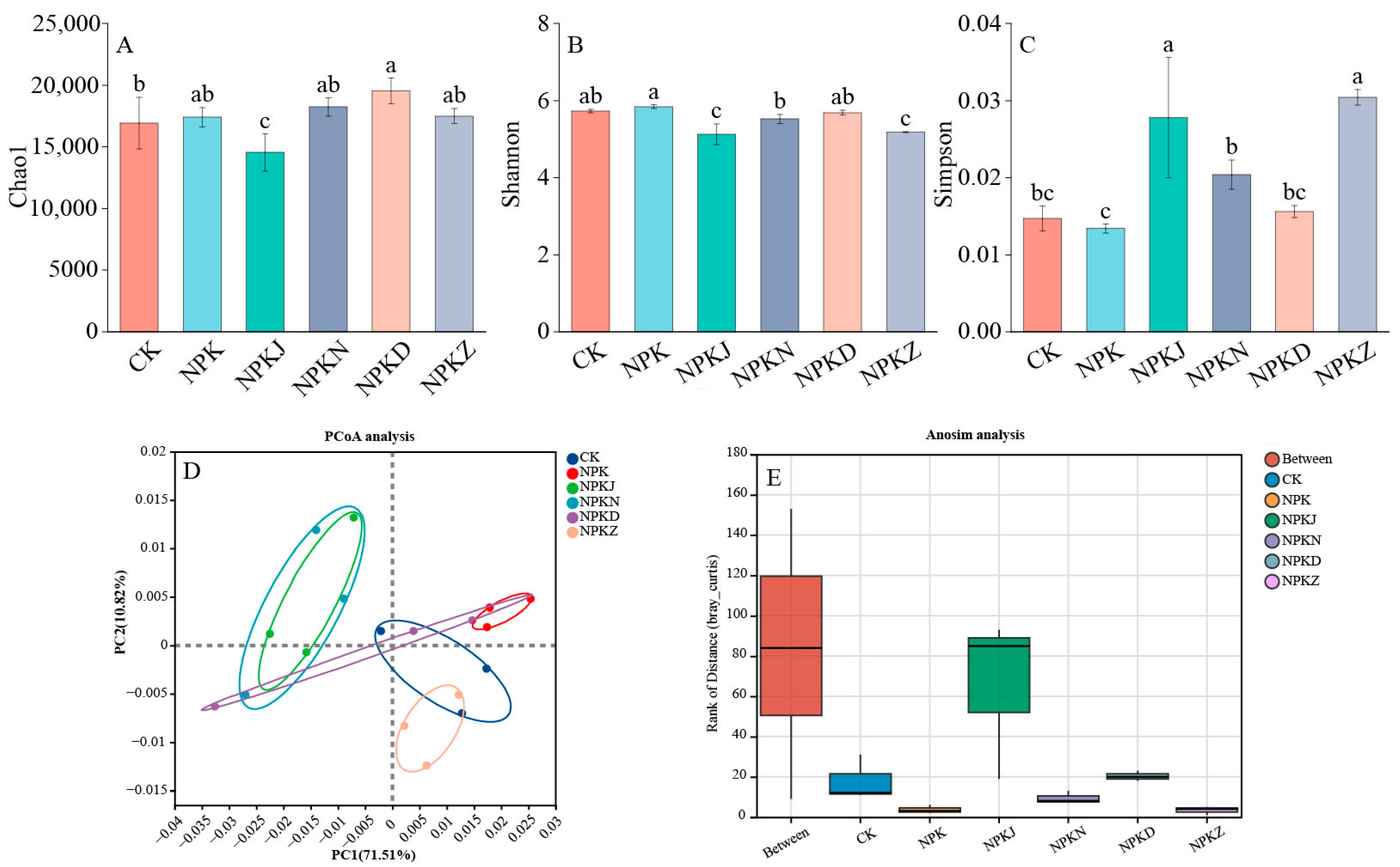
High-throughput sequencing revealed that long-term fertilization significantly shifted soil microbial diversity and structure. The alpha-diversity indices (Chao1, Shannon, and Simpson) varied significantly among treatments (Figure 1A–C). Generally, organic amendments increased microbial richness; however, in the NPKZ treatment, the diversity indices did not reach the highest levels, potentially due to heavy metal stress. Principal Coordinate Analysis (PCoA) (Figure 1D) demonstrated a clear separation in microbial community structure among treatments. The ANOSIM analysis further confirmed significant differences in community composition (Figure 1E), indicating that fertilization regimes were the primary drivers of community succession.
Heatmap analysis displayed the relative abundance of multi-kingdom microbial communities (bacteria, fungi, archaea, and viruses) across different treatments (Figure S2). For the bacterial community (Figure S2A), organic amendments significantly shifted the community towards copiotrophs. Notably, Candidatus sulfotelmatobacter was markedly enriched in the pig (NPKZ) manure treatment. In the fungal community (Figure S2B), arbuscular mycorrhizal fungi (AMF), such as Funneliformis geosporum, were abundant in CK and NPK soils but suppressed in manure-amended soils, while saprotrophs like Fusarium oxysporum were enriched in organic treatments. The archaeal community (Figure S2C) showed that Nitrososphaera dominated in inorganic treatments, whereas Candidatus nitrosotalea was specifically enriched in the NPKZ treatment. Similarly, the viral community (Figure S2D) showed enrichment of specific phages (e.g., Caudoviricetes) in manure-amended soils.
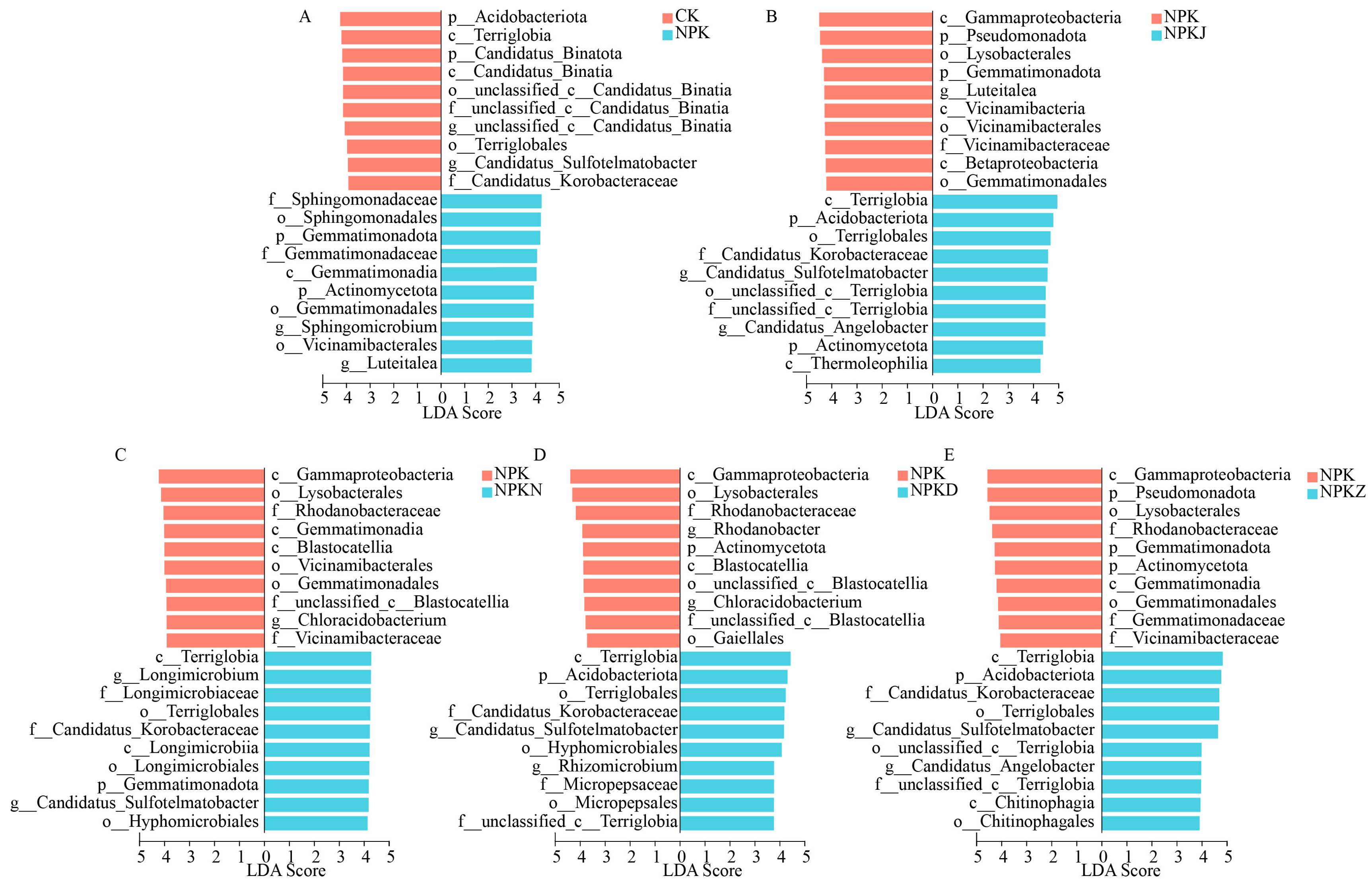
To further identify the specific taxa responsible for the observed community differentiation, LEfSe analysis was performed (Figure 2). Compared to the unfertilized control (CK), the application of chemical fertilizers (NPK) significantly altered the community composition by enriching taxa belonging to p__Gemmatimonadota (including c__Gemmatimonadia), p__Actinomycetota, and f__Sphingomonadaceae, while suppressing p__Acidobacteriota and c__Terriglobia (Figure 2A). This shift suggests a transition towards copiotrophic communities driven by inorganic nutrient inputs. However, the addition of organic manures partially reversed this trend or introduced new specific taxa compared to NPK alone. Across all manure-amended treatments (NPKN, NPKD, NPKJ, and NPKZ), we consistently observed the re-enrichment of c__Terriglobia and p__Acidobacteriota (Figure 2B–E), indicating that organic matter input favors these specific bacterial guilds. Crucially, distinct manure types selected for unique biomarkers, reflecting the influence of manure substrate quality and potentially heavy metal stress. The cattle manure treatment (NPKN) was specifically enriched with g__Longimicrobium and o__Hyphomicrobiales (Figure 2C), whereas the compost treatment (NPKD) favored g__Rhizomicrobium (Figure 2D). Notably, in the pig manure treatment (NPKZ), which contained higher heavy metal loads, o__Chitinophagales and c__Chitinophagia were identified as the key biomarkers (Figure 2E). In contrast, the NPK treatment consistently maintained higher relative abundances of c__Gammaproteobacteria (p-Pseudomonadota) and o__Lysobacterales compared to the manure treatments. These differentially abundant taxa highlight the strong selective pressure exerted by different fertilization regimes on soil microbial assembly.

3.4. Microbial Co-Occurrence Networks and Functional Profiles

To unravel the microbial interactions and functional potentials under different fertilization regimes, we integrated co-occurrence network analysis with KEGG-based functional prediction. The topological properties revealed that long-term fertilization profoundly altered the complexity and stability of the soil microbiome. The application of cattle manure (NPKN) resulted in the most complex network structure, exhibiting the highest number of edges and average degree (Figure S3E). However, treatments with higher heavy metal inputs (NPKZ and NPKJ) exhibited lower network complexity compared to the NPK treatment (Figure S3D,F). Furthermore, the high modularity (>0.92) in NPKJ and NPKZ networks suggests that microbial communities under heavy metal stress tend to form more fragmented functional modules to cope with environmental disturbances.
The functional potential of soil microbial communities was predicted using PICRUSt2 based on the KEGG database. While “Metabolism” was the dominant functional category across all samples (Figure S4A), organic amendments—especially those with heavy metals—drove a shift towards defense and detoxification. Specifically, compared to NPK, the pig manure treatment (NPKZ) showed significant enrichment in pathways for “Degradation of aromatic compounds”, “Nitrotoluene degradation”, and “Nonribosomal peptide structures” (Figure S4F). In contrast, the NPK treatment consistently favored pathways related to resource acquisition and motility, such as “Flagellar assembly” and “ABC transporters” (Figure S4E,F).

3.5. Linkages Between Soil Properties and Microbial Communities

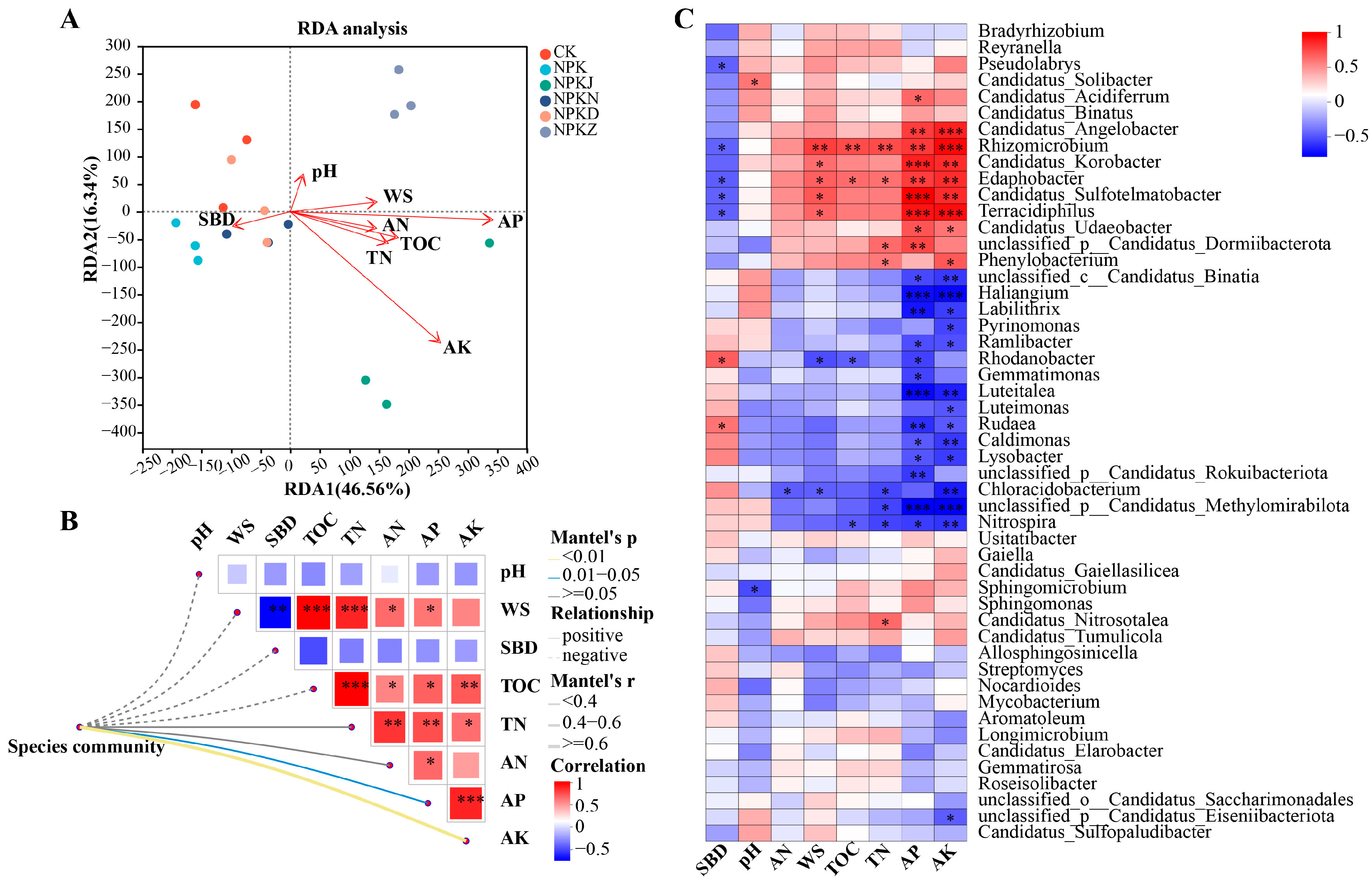
Redundancy Analysis (RDA) showed that soil physicochemical properties were key factors driving changes in microbial community structure (Figure 3A). The vectors for pH, TOC, AN, and available nutrients (AP, AK) were strongly associated with the distribution of manure-treated samples (Figure 3A). The Mantel test further verified the correlations between environmental factors and microbial communities (Figure 3B). The results showed that soil water content (WS), TOC, TN, AP, and AK were all significantly positively correlated with microbial community structure (Mantel’s p < 0.05) (Figure 3B). Notably, TOC and TN exhibited the strongest correlations, indicated by the thickest and darkest connecting lines (Figure 3B). Additionally, the Spearman correlation heatmap illustrated specific relationships between dominant microbial genera and environmental factors (Figure 3C). Rhizomicrobium showed a highly significant positive correlation (p < 0.001) with TOC, TN, AP, and AK, while Candidatus_Solibacter was negatively correlated with pH and nutrient contents (Figure 3C).

4. Discussion

4.1. Long-Term Application of Manure Fertilizer Improves Corn Yield and Soil Properties

Fertilization regimes markedly influenced maize productivity, with compost-amended treatment (NPKD) achieving the highest grain yield, significantly exceeding that of chemical fertilizer alone (NPK) (Table 1). Other manure treatments exhibited yields comparable to both NPK and NPKD, underscoring the agronomic efficacy of organic amendments in sustaining high productivity under continuous maize monoculture [30]. Regarding heavy metal accumulation in grains, distinct patterns emerged across manure types: chicken manure (NPKJ) resulted in the highest Cu, Zn, and Cd concentrations, while cattle manure (NPKN) elevated Cr and Pb levels (Table 1). Despite these treatment-specific increases, concentrations of toxic metals (As, Cd, Pb) remained well below national safety thresholds, indicating no immediate health risk via grain consumption. It is noteworthy that after 13 years of continuous cropping, the distinct accumulation patterns of heavy metals in the soil closely mirrored the heavy metal profiles of the respective manure inputs. Specifically, the significant enrichment of Cu and Zn in the pig and chicken manure treatments, especially when compared to the contemporaneously measured unfertilized control (CK) and NPK treatments (Table 2), strongly indicates a treatment-driven cumulative effect. By using the continuous CK as a benchmark for natural geochemical variation and site heterogeneity, these distinct source-to-sink correlations robustly confirm that continuous manure application is the primary driver of heavy metal accumulation in this agroecosystem. Furthermore, it is worth noting that maize generally exhibits much lower trace metal accumulation capacities compared to leafy vegetables. From a nutritional perspective, since Cu and Zn are essential micronutrients, their moderate enrichment in maize grains under long-term manure application can actually be highly beneficial in fulfilling the dietary requirements for both human and animal consumption [31,32]. For instance, practical nutrient budgeting in dairy farming often reveals that maize silage requires external Cu and Zn supplementation to meet the physiological demands of the cattle. Therefore, the moderate natural enrichment of these elements in manure-amended maize could directly reduce the need for such feed additives. Nonetheless, the continuous introduction of heavy metals through long-term manure application underscores the need for vigilant monitoring to prevent future soil accumulation and potential trophic transfer [33].
Conventionally, the application of organic fertilizers is believed to increase soil pH [34]. In our study, compared with the CK treatment, soil pH significantly decreased under both the NPK and organic-inorganic combined treatments, with the most substantial reduction observed in the NPK treatment (Table 2). This phenomenon may be explained by the fact that while the continuous application of chemical nitrogen fertilizers (NPK) drives severe soil acidification primarily through nitrification processes [35,36], the application of organic manure effectively mitigates this severe pH drop. This mitigation occurs because organic manures are generally alkaline and rich in basic cations (Ca2+ and Mg2+), which can directly neutralize the protons generated during nitrification [37]. Furthermore, the substantial input of organic matter significantly enhances the overall pH buffering capacity of the soil, thereby increasing its resistance to acidification. The application of livestock manure typically significantly improves soil fertility. Research indicates that manure application can effectively increase soil organic matter (SOM) content and enhance carbon sequestration. Additionally, beyond merely acting as a direct carbon source, the applied organic matter fundamentally serves as a functional driver: it provides diverse energy substrates that stimulate specific microbial populations, and introduces active functional groups that enhance soil buffering capacity and heavy metal complexation [38]. Simultaneously increase the content of nutrients such as nitrogen, phosphorus, and potassium in the soil [39]. In our study, all manure-amended treatments (NPKN, NPKD, NPKJ, and NPKZ) significantly elevated soil TOC, TN, and available nutrients (AP, AK) compared to the NPK treatment (Table 2). This improvement is primarily attributed to the direct input of organic carbon and the stimulation of microbial activity, which enhances nutrient mineralization and retention [19].

4.2. Long-Term Application of Manure Fertilizer Increases Heavy Metals Accumulation in Soils

Numerous studies have demonstrated that manure application significantly increases the accumulation of Cu, Zn, Cd, and Pb in the soil. In our study, based on the annual application rates and the background heavy metal concentrations of the raw manure, the estimated cumulative inputs over 13 years are approximately 64 kg ha−1 for Cu and 209 kg ha−1 for Zn. The long-term application of pig manure significantly increased the concentrations of Cu and Zn in the soil (Table 2), a finding consistent with Zhen et al. [40]. Indeed, livestock and poultry manure have been identified as the primary contributor of Cu to agricultural soils in China, accounting for up to 76% of the total input, while its contribution to Zn reaches 46% [41]. Commercial feeds and additives are frequently supplemented with Cu and Zn to achieve optimal growth rates and antimicrobial properties, although they may also contain non-essential elements such as Cd [42]. However, livestock typically assimilate less than 5% of dietary Cu and Zn, with the remainder being excreted via urine and feces [43]. Consequently, high-dose supplementation coupled with low assimilation efficiency is likely the primary reason for the excessive trace metals found in livestock manure.
The availability of heavy metals in soil is primarily controlled by their total concentration. In our study, the application of pig manure significantly increased the levels of available Cu and available Zn in the soil (Table 2), which agreed with the findings of Wu et al. [9]. Furthermore, we found that the application of chicken manure significantly reduced the concentration of available As in the soil, whereas compost application increased the levels of available Cd and Pb. On the one hand, the high input of exogenous calcium and alkalinity from chicken manure shifted the arsenic retention mechanism from surface adsorption (susceptible to P competition) to precipitation control (forming stable Ca-As minerals), thereby overriding the mobilization risk [44,45,46]. On the other hand, the abundant fulvic-like fractions in compost DOM formed stable, soluble organo-metallic complexes with Cd and Pb, effectively lowering the free ion activity in solution and promoting metal desorption from soil mineral surfaces [47,48]. The availability of heavy metals in soil also largely determines the risk of crop uptake [49,50]. This is consistent with the results of our study. This indicates that the content of plant-available heavy metals in the soil is a key indicator for assessing the risk of grain contamination.

4.3. Long-Term Manure Application Modulates Microbial Communities Through Nutrient Supply and Heavy Metal Constraints

Long-term organic fertilization significantly enhanced soil microbial α-diversity and abundance compared to unfertilized and sole chemical fertilizer treatments (Figure 1). This increase is attributed to organic matter inputs that provide additional ecological niches and nutrient sources [51,52]. Chemical fertilizers alone often lower soil pH and suppress diversity [53], whereas organic amendments buffer acidification and raise pH, favoring broader microbial communities [51]. In contrast, the pig manure treatment (NPKZ) did not achieve peak diversity, likely due to its higher heavy metal content imposing stronger selective pressure and reducing sensitive taxa [54]. Regarding community composition, organic fertilization enriched copiotrophic phyla such as Proteobacteria and Actinobacteria [55]. Actinobacteria, known for heavy metal tolerance and organic matter decomposition, were particularly enriched in cow manure and compost treatments [56]. However, their relative abundance was still depleted in the NPKZ treatment, primarily because these heterotrophic saprophytes are highly sensitive to the severe carbon limitation and extreme acidification present in the NPKZ soil. At the genus level, beneficial taxa including Massilia, Bacillus, Lysobacter, and the ammonia-oxidizing Nitrosospira increased under organic fertilization, correlating with higher soil organic matter and improved nitrogen cycling [57,58]. Network analysis further revealed that cow manure (NPKN) supported highly connected microbial communities (Figure S3), while pig and chicken manure treatments exhibited reduced edges, lower average degree, and high modularity (>0.92). This network simplification reflects heavy metal stress that disrupts cooperative microbial structures, consistent with previous findings on contamination-induced network fragmentation [51,53,54].
Soil properties particularly pH, available phosphorus (AP), available potassium (AK), total organic carbon (TOC), and total nitrogen (TN) exerted strong influences on microbial community structure. Redundancy analysis revealed that these variables were closely associated with bacterial community variation (Figure 3A), consistent with previous findings [59]. Mantel tests further confirmed that TN was significantly positively correlated with microbial community characteristics, whereas bulk density showed a negative correlation [60] (Figure 3B). These results indicate that nutrient availability and pH shape community composition by modulating metabolic conditions [61]. Spearman correlation analysis identified distinct response patterns among microbial taxa (Figure 3C). Actinobacteriota abundance was negatively correlated with soil organic carbon, while Methylomirabilota showed positive correlation with pH, reflecting contrasting habitat preferences [62]. Such patterns align with copiotrophic–oligotrophic strategies: copiotrophs proliferate under nutrient-rich conditions, whereas oligotrophs dominate in nutrient-depleted or extreme pH environments [52]. Acidobacteriota, a well-established acidophilic phylum, exhibited negative correlations with pH and nitrogen content, while Actinobacteriota was positively associated with TOC and pH [63]. Collectively, these shifts in community structure represent adaptive responses to environmental filtering, where high organic matter and moderate pH favor decomposers and rhizobacteria, while stress-tolerant taxa prevail under nutrient limitation or extreme pH [64].

5. Conclusions

In continuous maize systems, the choice of manure source critically governs the trade-off between soil fertility improvement and heavy metal risks. While compost achieved the highest yield (reaching 13.02 t ha−1), the long-term application of raw pig and chicken manures induced significant Cu and Zn accumulation in the soil, with concentrations reaching 53.0 and 209.5 mg kg−1 under pig manure, and 32.7 and 145.6 mg kg−1 under chicken manure, respectively. Although grain metal concentrations currently remain within safety limits, this continuous input poses a cumulative risk. Furthermore, heavy metal stress acted as a strong environmental filter on the soil microbiome, significantly reducing network complexity and increasing modularity, accompanied by functional shifts from cellular motility toward detoxification and stress tolerance. Based on our observed 13-year trends, cattle manure and compost present lower heavy metal accumulation risks compared to raw swine or poultry manure while maintaining comparable agricultural productivity. Where the latter are used, rigorous monitoring of soil heavy metal thresholds is imperative to prevent future crop uptake risks. Looking forward, establishing definitive agronomic guidelines will require rigorous quantitative threshold analyses and dynamic risk modeling. Furthermore, further research should prioritize tracking the long-term migration of these metals across the soil–plant–groundwater continuum and unraveling the in situ molecular mechanisms of their complexation with diverse organic phases.

Supplementary Materials

The following supporting information can be downloaded at: https://www.mdpi.com/article/10.3390/agriculture16070814/s1, Figure S1: Comparison of soil total heavy metal concentrations between 2019 and 2024 of the experiment under different fertilization regimes; Figure S2: Heatmap analysis of the microbial community composition across different fertilization treatments; Figure S3: Co-occurrence network analysis revealing the interaction patterns and topological structures of soil microbial communities under different fertilization regimes; Figure S4: Predicted functional profiles of soil microbial communities based on the KEGG pathway database; Table S1: Nutrient properties of tested organic materials; Table S2: Background levels of heavy metals in manure.

Author Contributions

Conceptualization, Z.G., G.L. and S.S.; methodology, Z.G., H.Z., G.L. and S.S.; field work, Z.G.; formal analysis, Z.G. and H.Z.; data curation, H.C. and Y.L.; writing—original draft preparation, Z.G. and H.Z.; writing—review and editing, G.L. and S.S.; project administration and funding acquisition, H.C., G.L. and S.S. All authors have read and agreed to the published version of the manuscript.

Funding

This work was supported by the National Key Research and Development Program of China (2023YFD1501305), the Science and Technology Development Planning Project of Jilin Province (20250601036RC), and the Agricultural Science and Technology Innovation Program of Jilin Province (CXGC2024ZD016).

Data Availability Statement

The original contributions presented in this study are included in the article. Further inquiries can be directed to the corresponding authors.

Acknowledgments

The authors would like to thank Yanju Chai and Jingyuan Pan for their help in the experiment.

Conflicts of Interest

The authors declare no conflict of interest.

References

  1. Ministry of Agriculture and Rural Affairs of the People’s Republic of China (MARA). The Action Plan for Resource Utilization of Livestock and Poultry Waste (2017–2020); MARA: Beijing, China, 2017. Available online: http://www.moa.gov.cn/ (accessed on 31 March 2026).
  2. Yan, B.; Shi, W.; Yan, J.; Chun, K. Spatial distribution of livestock and poultry farm based on livestock manure nitrogen load on farmland and suitability evaluation. Comput. Electron. Agric. 2017, 139, 180–186. [Google Scholar] [CrossRef]
  3. Zhang, J.; Li, J.; Tomberlin, J.; Xiao, X.; Rehman, K.; Cai, M.; Zheng, L.; Yu, Z. Erratum: Black soldier fly: A new vista for livestock and poultry manure management. J. Integr. Agric. 2023, 22, 1. [Google Scholar] [CrossRef]
  4. Luo, L.; Ma, Y.; Zhang, S.; Wei, D.; Zhu, Y.-G. An inventory of trace element inputs to agricultural soils in China. J. Environ. Manag. 2009, 90, 2524–2530. [Google Scholar] [CrossRef] [PubMed]
  5. Provolo, G.; Manuli, G.; Finzi, A.; Lucchini, G.; Riva, E.; Sacchi, G. Effect of pig and cattle slurry application on heavy metal composition of maize grown on different soils. Sustainability 2018, 10, 2684. [Google Scholar] [CrossRef]
  6. Segat, J.; Baretta, D.; Oliveira Filho, L.; Sousa, J.; Klauberg Filho, O. Disentangling the effects of the aqueous matrix on the potential toxicity of liquid pig manure in sub-tropical soils under semi-field conditions. Ecotoxicol. Environ. Saf. 2019, 168, 457–465. [Google Scholar] [CrossRef]
  7. Hussain, B.; Li, J.; Ma, Y.; Chen, Y.; Wu, C.; Ullah, A.; Tahir, N. A field evidence of Cd, Zn and Cu accumulation in soil and rice grains after long-term (27 years) application of swine and green manures in a paddy soil. Sustainability 2021, 13, 2404. [Google Scholar] [CrossRef]
  8. Sun, W.; Ye, J.; Lin, H.; Yu, Q.; Wang, Q.; Chen, Z.; Ma, J. Dynamic characteristics of heavy metal accumulation in agricultural soils after continuous organic fertilizer application: Field-scale monitoring. Chemosphere 2023, 335, 139051. [Google Scholar] [CrossRef]
  9. Wu, P.; Guo, Z.; Hua, K.; Wang, D. Long-term application of organic amendments changes heavy metals accumulation in wheat grains by affecting soil chemical properties and wheat yields. J. Soils Sediments 2023, 23, 2136–2147. [Google Scholar] [CrossRef]
  10. Shi, J.; Zhao, D.; Ren, F.; Huang, L. Spatiotemporal variation of soil heavy metals in China: The pollution status and risk assessment. Sci. Total Environ. 2023, 871, 161768. [Google Scholar] [CrossRef]
  11. Jahandari, A.; Abbasnejad, B. Environmental pollution status and health risk assessment of selective heavy metal(oid)s in Iran’s agricultural soils: A review. J. Geochem. Explor. 2024, 256, 107330. [Google Scholar] [CrossRef]
  12. Violante, A.; Cozzolino, V.; Perelomov, L.; Caporale, A.; Pigna, M. Mobility and bioavailability of heavy metals and metalloids in soil environments. J. Soil Sci. Plant Nutr. 2010, 10, 268–292. [Google Scholar] [CrossRef]
  13. Wang, Y.; Zhang, Z.; Li, Y.; Liang, C.; Huang, H.; Wang, S. Available heavy metals concentrations in agricultural soils: Relationship with soil properties and total heavy metals concentrations in different industries. J. Hazard. Mater. 2024, 471, 134410. [Google Scholar] [CrossRef] [PubMed]
  14. Nicolás, C.; Hernández, T.; García, C. Organic amendments as strategy to increase organic matter in particle-size fractions of a semi-arid soil. Appl. Soil Ecol. 2012, 57, 50–58. [Google Scholar] [CrossRef]
  15. Zhao, S.; Schmidt, S.; Gao, H.; Li, T.; Chen, X.; Hou, Y.; Chadwick, D.; Tian, J.; Dou, Z.; Zhang, W.; et al. A precision compost strategy aligning composts and application methods with target crops and growth environments can increase global food production. Nat. Food 2022, 3, 741–752. [Google Scholar] [CrossRef] [PubMed]
  16. Alsherif, E.; Almaghrabi, O.; Elazzazy, A.; Abdel-Mawgoud, M.; Beemster, G.; AbdElgawad, H. Carbon nanoparticles improve the effect of compost and arbuscular mycorrhizal fungi in drought-stressed corn cultivation. Plant Physiol. Biochem. 2023, 194, 29–40. [Google Scholar] [CrossRef]
  17. Köninger, J.; Lugato, E.; Panagos, P.; Kochupillai, M.; Orgiazzi, A.; Briones, M. Manure management and soil biodiversity: Towards more sustainable food systems in the EU. Agric. Syst. 2021, 194, 103251. [Google Scholar] [CrossRef]
  18. Ouyang, Y.; Reeve, J.; Norton, J. The quality of organic amendments affects soil microbiome and nitrogen-cycling bacteria in an organic farming system. Front. Soil Sci. 2022, 2, 869136. [Google Scholar] [CrossRef]
  19. Wu, S.; Li, K.; Diao, T.; Sun, Y.; Sun, T.; Wang, C. Influence of continuous fertilization on heavy metals accumulation and microorganism communities in greenhouse soils under 22 years of long-term manure organic fertilizer experiment. Sci. Total Environ. 2025, 959, 178294. [Google Scholar] [CrossRef]
  20. Fan, T.; Zhang, Y.; Wang, X.; Zhao, Y.; Shi, A.; Zhang, X. Application of various high-density organic materials in soil promotes germination and increases nutrient content of wheat. Environ. Technol. Innov. 2023, 32, 103298. [Google Scholar] [CrossRef]
  21. Yang, W.; Wang, Z.; Guo, S.; Yang, M.; Zhao, L.; Zhao, H.; Jia, H.; Xu, W. Evaluation of soil fertility quality under biochar combined with nitrogen in an irrigated wheat field in Northern Xinjiang, China. Agronomy 2023, 13, 2518. [Google Scholar] [CrossRef]
  22. Cornfield, A. Ammonia released on treating soils with N sodium hydroxide as a possible means of predicting the nitrogen-supplying power of soils. Nature 1960, 187, 260–261. [Google Scholar] [CrossRef]
  23. Murphy, J.; Riley, J. A modified single solution method for the determination of phosphate in natural waters. Anal. Chim. Acta 1962, 27, 31–36. [Google Scholar] [CrossRef]
  24. Helmke, P.; Sparks, D. Lithium, Sodium, Potassium, Rubidium, and Cesium; Wiley: Madison, WI, USA, 2008; pp. 551–574. [Google Scholar]
  25. Chen, H.; Teng, Y.; Lu, S.; Wang, Y.; Wang, J. Contamination features and health risk of soil heavy metals in China. Sci. Total Environ. 2015, 512–513, 143–153. [Google Scholar] [CrossRef] [PubMed]
  26. Schneider, M.; Cadorim, H.; Welz, B.; Carasek, E.; Feldman, J. Determination of arsenic in agricultural soil samples using hydride generation atomic fluorescence spectrometry and direct solid sample analysis. Talanta 2018, 188, 722–728. [Google Scholar] [CrossRef]
  27. Balabanova, B.; Stafilov, T.; Bačeva, K. Bioavailability and bioaccumulation of essential and toxic metals in food plants grown on contaminated soils. J. Environ. Health Sci. Eng. 2015, 13, 2. [Google Scholar] [CrossRef]
  28. Zheljazkov, V.D.; Nielsen, N.E. Effect of heavy metals on peppermint and cornmint. Plant Soil 1996, 178, 59–66. [Google Scholar] [CrossRef]
  29. Chen, S.; Zhou, Y.; Chen, Y.; Gu, J. fastp: An ultra-fast all-in-one FASTQ preprocessor. Bioinformatics 2018, 34, 884–890. [Google Scholar] [CrossRef]
  30. Zhang, H.; Xu, M.; Zhang, F. Long-term effects of manure application on grain yield under different cropping systems and ecological conditions in China. J. Agric. Sci. 2016, 147, 31–42. [Google Scholar] [CrossRef]
  31. White, P.J.; Broadley, M.R. Biofortification of crops with seven mineral elements often lacking in human diets—Iron, zinc, copper, calcium, magnesium, selenium and iodine. New Phytol. 2009, 182, 49–84. [Google Scholar] [CrossRef]
  32. Roohani, N.; Hurrell, R.; Kelishadi, R.; Schulin, R. Zinc and its importance for human health: An integrative review. J. Res. Med. Sci. 2013, 18, 144–157. [Google Scholar]
  33. He, Z.; Yang, X.; Stoffella, P. Trace elements in agroecosystems and impacts on the environment. J. Trace Elem. Med. Biol. 2015, 19, 125–140. [Google Scholar] [CrossRef] [PubMed]
  34. Zheng, X.; Wei, L.; Lv, W.; Zhang, H.; Zhang, Y.; Zhang, H.; Zhang, H.; Zhu, Z.; Ge, T.; Zhang, W. Long-term bioorganic and organic fertilization improved soil quality and multifunctionality under continuous cropping in watermelon. Agric. Ecosyst. Environ. 2024, 359, 108721. [Google Scholar] [CrossRef]
  35. Xu, D.; Ros, G.H.; Zhu, Q.; Zhang, F.; de Vries, W. Spatial optimization of manure and fertilizer application strategies to minimize nutrient surpluses and acidification rates in croplands of a typical Chinese county. J. Clean. Prod. 2025, 503, 145401. [Google Scholar] [CrossRef]
  36. Yu, Y.; Hu, Y.; Wang, H.; Liu, Y.; Xu, X.; Liu, L.; Zhang, Y.; Wu, C.; Hu, D.; Zhang, L. Legume-gramineous green manures mitigate soil acidification and enhance carbon sequestration via increased enzymatic activities in intensive agroecosystems. Agric. Ecosyst. Environ. 2026, 397, 110080. [Google Scholar] [CrossRef]
  37. Cai, Z.; Wang, B.; Xu, M.; Zhang, H.; He, X.; Zhang, L.; Gao, S. Intensified soil acidification from chemical N fertilization and prevention by manure in an 18-year field experiment in the red soil of southern China. J. Soils Sediments 2015, 15, 260–270. [Google Scholar] [CrossRef]
  38. Zhang, K.; Du, L.; Du, H.; Shen, S. Application of livestock and poultry waste to agricultural land: A review. J. Agro-Environ. Sci. 2021, 40, 2472–2481. [Google Scholar]
  39. Ferreira, P.; Ceretta, C.A.; Lourenzi, C.; De Conti, L.; Marchezan, C.; Girotto, E.; Tiecher, T.; Palermo, N.; Parent, L.-É.; Brunetto, G. Long-term effects of animal manures on nutrient recovery and soil quality in acid typic hapludalf under no-till conditions. Agronomy 2022, 12, 243. [Google Scholar] [CrossRef]
  40. Zhen, H.; Jia, L.; Huang, C.; Qiao, Y.; Li, J.; Li, H.; Chen, Q.; Wan, Y. Long-term effects of intensive application of manure on heavy metal pollution risk in protected-field vegetable production. Environ. Pollut. 2020, 263, 114552. [Google Scholar] [CrossRef]
  41. Peng, H.; Chen, Y.; Weng, L.; Ma, J.; Ma, Y.; Li, Y.; Islam, M. Comparisons of heavy metal input inventory in agricultural soils in North and South China: A review. Sci. Total Environ. 2019, 660, 776–786. [Google Scholar] [CrossRef]
  42. Qian, X.; Wang, Z.; Shen, G.; Chen, X.; Tang, Z.; Guo, C.; Gu, H.; Fu, K. Heavy metals accumulation in soil after 4 years of continuous land application of swine manure: A field-scale monitoring and modeling estimation. Chemosphere 2018, 210, 1029–1034. [Google Scholar] [CrossRef]
  43. Liu, B.; Xiong, P.; Chen, N.; He, J.; Lin, G.; Xue, Y.; Li, W.; Yu, D. Effects of replacing of inorganic trace minerals by organically bound trace minerals on growth performance, tissue mineral status, and fecal mineral excretion in commercial grower-finisher pigs. Biol. Trace Element Res. 2016, 173, 316–324. [Google Scholar] [CrossRef] [PubMed]
  44. Dungkaew, W.; Haller, K.; Flood, A.; Scamehorn, J. Arsenic removal by precipitation with calcium phosphate hydroxyapatite. Adv. Mater. Res. 2012, 506, 413–416. [Google Scholar] [CrossRef]
  45. Zama, E.; Li, G.; Tang, Y.; Reid, B.; Ngwabie, N.; Sun, G. The removal of arsenic from solution through biochar-enhanced precipitation of calcium-arsenic derivatives. Environ. Pollut. 2022, 292, 118241. [Google Scholar] [CrossRef] [PubMed]
  46. Zhang, X.; Liu, T.; Zhang, J.; Zhu, L. Potential mechanism of long-term immobilization of pb/cd by layered double hydroxide doped chicken-manure biochar. Int. J. Environ. Res. Public Health 2023, 20, 867. [Google Scholar] [CrossRef]
  47. Zhu, Y.; Guan, Q.; Kong, L.; Yang, R.; Wang, W.; Jin, Y.; Liu, X.; Qu, J. Overlooked mechanism of Pb immobilization on montmorillonite mediated by dissolved organic matter in manure compost. Environ. Pollut. 2023, 316, 120706. [Google Scholar] [CrossRef]
  48. Wiersma, W.; Favaro, A.; Comans, R.; Pulleman, M.; Groenenberg, J. A mechanistic understanding of the effect of lime and compost on soil cadmium availability in cacao farms. ACS Agric. Sci. Technol. 2025, 5, 2459–2469. [Google Scholar] [CrossRef]
  49. Fan, Z.; Ji, H.; Yang, F.; Wu, Q.; Zhang, W. Accumulation characteristics of Cd and Pb in rice grains under different soil types and their environmental safety critical values. Ecol. Environ. Sci. 2010, 19, 792–797. [Google Scholar]
  50. Wu, R.; Liu, S.; Sun, H.; Du, Y.; Ma, L. Effects of long-term chemical fertilizer application with different organic fertilizers on accumulation of heavy metals in soil and maize. J. Plant Nutr. Fertil. 2020, 26, 2010–2019. [Google Scholar]
  51. Liu, W.; Yang, Z.; Ye, Q.; Peng, Z.; Zhu, S.; Chen, H.; Liu, D.; Li, Y.; Deng, L.; Shu, X.; et al. Positive effects of organic amendments on soil microbes and their functionality in agro-ecosystems. Plants 2023, 12, 3790. [Google Scholar] [CrossRef]
  52. Wen, L.; Luo, H.; Li, C.; Cheng, K.; Shi, L.; Liu, L.; Wang, K.; Tang, H. Substituting chemical by organic fertilizer improves soil quality, regulates the soil microbiota and increases yields in Camellia oleifera. Microorganisms 2025, 13, 2509. [Google Scholar] [CrossRef]
  53. Wu, L.; Jiang, Y.; Zhao, F.; He, X.; Liu, H.; Yu, K. Increased organic fertilizer application and reduced chemical fertilizer application affect the soil properties and bacterial communities of grape rhizosphere soil. Sci. Rep. 2020, 10, 9568. [Google Scholar] [CrossRef] [PubMed]
  54. Li, M.; Liu, J.; Cao, D.; Chen, X.; Shi, J.; Hu, W.; Xiao, C.; Fang, Y. Heavy metal pollution simplifies microbial networks and enhances modularity during tailings primary succession: Divergent assembly dynamics for bacterial and fungal communities. Front. Microbiol. 2025, 16, 1566627. [Google Scholar] [CrossRef] [PubMed]
  55. Xiao, X.; Li, J.; Lyu, J.; Feng, Z.; Zhang, G.; Yang, H.; Gao, C.; Jin, L.; Yu, J. Chemical fertilizer reduction combined with bio-organic fertilizers increases cauliflower yield via regulation of soil biochemical properties and bacterial communities in Northwest China. Front. Microbiol. 2022, 13, 922149. [Google Scholar] [CrossRef] [PubMed]
  56. Baldi, E.; Marcolini, G.; Quartieri, M.; Sorrenti, G.; Muzzi, E.; Toselli, M. Organic fertilization in nectarine (Prunus persica var. nucipersica) orchard combines nutrient management and pollution impact. Nutr. Cycl. Agroecosyst. 2016, 105, 39–50. [Google Scholar] [CrossRef]
  57. Zhang, Y.; Li, Q.; Chen, Y.; Dai, Q.; Hu, J. Dynamic change in enzyme activity and bacterial community with long-term rice cultivation in Mudflats. Curr. Microbiol. 2019, 76, 361–369. [Google Scholar] [CrossRef]
  58. Rampelotto, P.; de Siqueira Ferreira, A.; Barboza, A.; Roesch, L. Changes in diversity, abundance, and structure of soil bacterial communities in Brazilian Savanna under different land use systems. Microb. Ecol. 2013, 66, 593–607. [Google Scholar] [CrossRef]
  59. Yang, B.; Feng, W.; Zhou, W.; He, K.; Yang, Z. Association between soil physicochemical properties and bacterial community structure in diverse forest ecosystems. Microorganisms 2024, 12, 728. [Google Scholar] [CrossRef]
  60. Liu, M.; Sui, X.; Hu, Y.; Feng, F. Microbial community structure and the relationship with soil carbon and nitrogen in an original Korean pine forest of Changbai Mountain, China. BMC Microbiol. 2019, 19, 218. [Google Scholar] [CrossRef]
  61. Dong, W.; Zhang, X.; Dai, X.; Fu, X.; Yang, F.; Liu, X.; Sun, X.; Wen, X.; Schaeffer, S. Changes in soil microbial community composition in response to fertilization of paddy soils in subtropical China. Appl. Soil Ecol. 2014, 84, 140–147. [Google Scholar] [CrossRef]
  62. Ahmed, I.; Mengistie, H.; Godbold, D.; Sandén, H. Soil moisture integrates the influence of land-use and season on soil microbial community composition in the Ethiopian highlands. Appl. Soil Ecol. 2019, 135, 85–90. [Google Scholar] [CrossRef]
  63. Qiu, Z.; Shi, C.; Zhao, M.; Wang, K.; Zhang, M.; Wang, T.; Shi, F. Improving effects of afforestation with different forest types on soil nutrients and bacterial community in Barren Hills of North China. Sustainability 2022, 14, 1202. [Google Scholar] [CrossRef]
  64. Wang, L.; Wang, J.; Tang, Z.; Wang, J.; Zhang, Y. Long-term organic fertilization reshapes the communities of bacteria and fungi and enhances the activities of C-and P-cycling enzymes in calcareous alluvial soil. Appl. Soil Ecol. 2024, 194, 105204. [Google Scholar] [CrossRef]
Figure 1. Diversity and structural composition of soil microbial communities under different fertilization regimes. Alpha diversity indices including (A) Chao1 richness estimator, (B) Shannon diversity index, and (C) Simpson index. Different lowercase letters above the bars indicate significant differences between treatments. (D) Principal Coordinate Analysis (PCoA) based on Bray–Curtis distance metrics. The percentages on the axes indicate the proportion of variation explained by each principal coordinate (PC1 and PC2). (E) Analysis of Similarities (ANOSIM) boxplot showing the rank of distances within and between groups based on Bray–Curtis dissimilarity. CK: control (no fertilization); NPK: chemical fertilizer alone; NPKJ: NPK + chicken manure; NPKN: NPK + cattle manure; NPKD: NPK + compost; NPKZ: NPK + pig manure.
Agriculture 16 00814 g001
Figure 2. Lefse analysis identifying differentially abundant taxa within soil microbial communities under different fertilization regimes. (AE) Histograms of the Linear Discriminant Analysis (LDA) scores for bacterial taxa (from phylum to genus levels) that were significantly differentiated between treatments. Pairwise comparisons were performed between: (A) CK and NPK; (B) NPK and NPKJ; (C) NPK and NPKN; (D) NPK and NPKD; and (E) NPK and NPKZ. The length of the bar represents the effect size (LDA score), and the color indicates the treatment group in which the taxon is significantly enriched. CK: control (no fertilization); NPK: chemical fertilizer alone; NPKN: NPK + cattle manure; NPKD: NPK + compost; NPKJ: NPK + chicken manure; NPKZ: NPK + pig manure.
Agriculture 16 00814 g002
Figure 3. Relationships between soil physicochemical properties and microbial community structure. (A) Redundancy analysis (RDA) ordination diagram displaying the associations between soil environmental variables and microbial community composition across different treatments. The angles between arrows and axes indicate the correlation magnitude. (B) Mantel test analysis coupled with a pairwise correlation heatmap of environmental factors. The color gradient in the triangular heatmap indicates Pearson correlation coefficients between environmental variables. (C) Heatmap of Spearman’s rank correlation coefficients between dominant bacterial genera and soil environmental factors. The color scale indicates the correlation coefficient, with red representing positive correlations and blue representing negative correlations. Asterisks indicate statistical significance (* p < 0.05, ** p < 0.01, *** p < 0.001). SBD: soil bulk density; WS: soil water content; TOC: total organic carbon; TN: total nitrogen; AN: alkali-hydrolyzable nitrogen; AP: available phosphorus; AK: available potassium. CK: control (no fertilization); NPK: chemical fertilizer alone; NPKJ: NPK + chicken manure; NPKN: NPK + cattle manure; NPKD: NPK + compost; NPKZ: NPK + pig manure.
Agriculture 16 00814 g003
Table 1. Corn yields and heavy metal accumulations of corn grain.
TreatmentCKNPKNPKJNPKNNPKDNPKZ
Corn yield (t ha−1)6.91 ± 0.43 c11.98 ± 0.31 b12.30 ± 1.65 ab12.31 ± 0.29 ab13.02 ± 0.50 a12.24 ± 0.31 ab
Total Cr (mg kg−1)0.36 ± 0.05 bc0.40 ± 0.06 ab0.42 ± 0.06 ab0.44 ± 0.06 a0.34 ± 0.07 c0.30 ± 0.05 c
Total Cu (mg kg−1)1.53 ± 0.43 b2.00 ± 0.58 ab2.64 ± 0.69 a2.17 ± 0.67 ab2.62 ± 0.56 a2.20 ± 0.78 ab
Total Zn (mg kg−1)27.19 ± 2.11 c28.14 ± 3.12 c36.02 ± 3.35 a30.27 ± 3.76 bc30.76 ± 1.47 bc34.13 ± 4.16 ab
Total As (mg kg−1)0.020 ± 0.002 b0.041 ± 0.01 a0.020 ± 0.01 b0.017 ± 0.001 b0.017 ± 0.003 b0.017 ± 0.002 b
Total Cd (mg kg−1)0.010 ± 0.001 b0.011 ± 0.002 b0.013 ± 0.001 b0.006 ± 0.001 b0.012 ± 0.001 b0.08 ± 0.021 a
Total Pb (mg kg−1)0.060 ± 0.01 b0.077 ± 0.01 ab0.080 ± 0.021 ab0.093 ± 0.02 a0.076 ± 0.024 ab0.060 ± 0.015 b
Note: CK: control (no fertilization); NPK: chemical fertilizer alone; NPKJ: NPK + chicken manure; NPKN: NPK + cattle manure; NPKD: NPK + compost; NPKZ: NPK + pig manure. (ANOVA, Duncan’s test; the letters indicate p < 0.05; n = 3).
Table 2. Basic physicochemical properties and heavy metal accumulations of soil samples.
TreatmentCKNPKNPKJNPKNNPKDNPKZ
pH6.1 ± 0.1 a5.3 ± 0.3 b5.8 ± 0.2 ab5.7 ± 0.2 ab5.7 ± 0.1 ab5.7 ± 0.4 b
Bulk density (g cm−3)1.2 ± 0.0 a1.3 ± 0.1 a1.2 ± 0.1 ab1.2 ± 0.0 ab1.0 ± 0.1 b1.2 ± 0.1 ab
TOC (g kg−1)14.4 ± 0.7 c15.2 ± 0.7 c17.6 ± 0.2 b18.1 ± 0.4 ab18.9 ± 0.8 a18.0 ± 0.8 ab
TN (g kg−1)1.2 ± 0.0 b1.4 ± 0.1 b1.7 ± 0.1 a1.7 ± 0.0 a1.7 ± 0.0 a1.7 ± 0.2 a
AN (mg kg−1)130.4 ± 10.1 a138.1 ± 18.9 a163.2 ± 27.0 a153.0 ± 5.6 a159.6 ± 6.1 a170.8 ± 40.4 a
AP (mg kg−1)6.6 ± 0.9 f24.6 ± 1.5 e122.5 ± 4.7 b66.2 ± 5.8 c47.8 ± 6.3 d148.3 ± 8.8 a
AK (mg kg−1)182.7 ± 15.0 c194.7 ± 40.5 c526.3 ± 128.9 a239.0 ± 29.5 bc247.0 ± 28.2 bc313.0 ± 80.6 b
Total Cr (mg kg−1)75.12 ± 4.26 bc76.82 ± 5.91 bc79.45 ± 4.50 a70.04 ± 0.60 c78.45 ± 9.65 ab71.73 ± 4.76 c
Total Cu (mg kg−1)23.2 ± 0.3 d25.0 ± 1.5 d32.7 ± 0.3 b27.1 ± 3.4 c26.7 ± 1.8 c53.0 ± 10.6 a
Total Zn (mg kg−1)80.6 ± 2.2 d84.7 ± 4.8 d145.6 ± 6.5 b89.7 ± 3.4 d103.2 ± 17.1 c209.5 ± 42.6 a
Total As (mg kg−1)20.5 ± 0.8 a22.0 ± 0.9 a21.1 ± 2.0 a21.3 ± 1.2 a20.6 ± 1.5 a21.1 ± 2.0 a
Total Cd (mg kg−1)0.2 ± 0.0 c0.2 ± 0.0 bc0.3 ± 0.1 a0.2 ± 0.0 c0.2 ± 0.0 ab0.2 ± 0.0 ab
Total Pb (mg kg−1)43.5 ± 0.6 b48.4 ± 2.6 a43.9 ± 2.1 b43.2 ± 1.8 b44.2 ± 2.3 b43.7 ± 3.3 b
Available Cr (mg kg−1)0.005 ± 0.00 c0.005 ± 0.00 d0.007 ± 0.00 a0.006 ± 0.00 b0.005 ± 0.00 c0.006 ± 0.00 b
Available Cu (mg kg−1)3.18 ± 0.15 d2.99 ± 0.11 d5.61 ± 0.14 a3.61 ± 0.12 c3.95 ± 0.07 c13.85 ± 2.56 b
Available Zn (mg kg−1)1.73 ± 0.25 d1.93 ± 0.14 d18.88 ± 0.18 a4.95 ± 0.33 c5.36 ± 1.19 c48.42 ± 16.94 b
Available As (mg kg−1)0.51 ± 0.014 a0.48 ± 0.031 b0.22 ± 0.007 d0.46 ± 0.021 b0.43 ± 0.077 c0.25 ± 0.073 e
Available Cd (mg kg−1)0.08 ± 0.00 b0.07 ± 0.00 c0.06 ± 0.00 d0.08 ± 0.00 b0.12 ± 0.02 a0.07 ± 0.00 c
Available Pb (mg kg−1)3.51 ± 0.22 b2.90 ± 0.14 c2.23 ± 0.02 d2.94 ± 0.19 c3.93 ± 0.39 a1.98 ± 0.22 e
Note: CK: control (no fertilization); NPK: chemical fertilizer alone; NPKJ: NPK + chicken manure; NPKN: NPK + cattle manure; NPKD: NPK + compost; NPKZ: NPK + pig manure. (ANOVA, Duncan’s test; the letters indicate p < 0.05; n = 3).
Disclaimer/Publisher’s Note: The statements, opinions and data contained in all publications are solely those of the individual author(s) and contributor(s) and not of MDPI and/or the editor(s). MDPI and/or the editor(s) disclaim responsibility for any injury to people or property resulting from any ideas, methods, instructions or products referred to in the content.