Article

LA-YOLO: Robust Tea-Shoot Detection Under Dynamic Illumination via Input Illumination Stabilization and Discriminative Feature Learning

Mechanical Engineering, Jiangsu University of Science and Technology, Zhenjiang 212003, China
*
Author to whom correspondence should be addressed.
Agriculture 2026, 16(7), 809; https://doi.org/10.3390/agriculture16070809
Submission received: 24 February 2026 / Revised: 25 March 2026 / Accepted: 2 April 2026 / Published: 4 April 2026

Abstract

Accurate tea-shoot detection in real tea gardens is essential for intelligent harvesting, yet dynamic illumination (low light, strong light, and shadows) can cause brightness/contrast fluctuations and feature distribution shifts, degrading detection stability and localization accuracy. This paper proposes LA-YOLO, a dynamic-light tea-shoot detector based on YOLOv11. First, we construct a dynamic-light benchmark dataset and a difficulty-stratified evaluation protocol with four single-light subsets (A–D) and a mixed-light subset (E). Second, we design LA-CSNorm, an input-side brightness-adaptive preprocessing module that applies gated enhancement to dark samples followed by channel-selective normalization to reduce illumination-induced drift. Third, we propose RECA, a residual efficient channel-attention module to enhance discriminative channels and improve localization stability. Ablation studies show that LA-CSNorm and RECA provide complementary gains, and their combination improves the YOLOv11 baseline to 0.831 mAP@0.5 and 0.621 mAP@0.5:0.95, with only 0.01 M additional parameters. On the mixed-light subset E, LA-YOLO achieves 0.816 mAP@0.5 and 0.613 mAP@0.5:0.95, and consistently outperforms mainstream YOLO variants (e.g., YOLOv11m) under dynamic lighting conditions. These results demonstrate that LA-YOLO offers a robust and deployment-friendly solution for tea-shoot detection in complex natural illumination.

1. Introduction

Tea is a major economic crop worldwide. High-quality tea depends on harvesting tender shoots, which directly determine harvesting efficiency and picking quality and, in turn, affect yield and market value [1,2]. Traditional harvesting relies heavily on manual labor, which is labor-intensive, time-consuming, and costly. It is also difficult to meet the demands of large-scale production [3,4]. Mechanized harvesting improves efficiency to some extent, but most machines cannot achieve high-precision positioning or reliably distinguish tea shoots from background leaves. This often causes missed picks or incorrect harvesting, which limits the further promotion and application of intelligent tea-picking systems [5,6,7].
In computer vision and agricultural intelligence, deep-learning-based object detection has become the mainstream approach for tea sprout recognition [8]. Many studies have improved detection under small-target and complex-background conditions by enhancing the detection backbone, introducing attention mechanisms, and adopting multi-scale feature fusion strategies [9,10]. For instance, Xie [11] proposed Tea-YOLOv8s, which incorporates DCNv2 deformable convolution and a Global Attention Mechanism (GAM) to strengthen tea-bud feature extraction in complex backgrounds, thereby improving detection accuracy. Huang [12] developed a lightweight YOLOv5-based method that integrates modules such as EfficientNetV2 and Ghost convolution to reduce model complexity while improving accuracy, providing a technical basis for deployment on mobile and edge devices. In addition, attention mechanisms and multi-layer feature fusion methods, including MERCA (Multi-scale Edge-Refinement Context Aggregator) and BiFPN (Bidirectional Feature Pyramid Network), have been used to enhance multi-scale feature representation [13,14] and improve the detection of small tea buds.
Although the above studies have achieved high recognition accuracy under static or relatively ideal acquisition conditions, real tea-garden scenes involve dynamic lighting changes. Factors such as low morning sunlight, increasing illumination, local occlusion by branches and leaves, and moving cloud shadows can introduce strong non-stationary disturbances in image brightness, contrast, and local feature responses [15,16,17]. This can cause a feature-distribution shift between training and deployment, thereby degrading detector stability and localization accuracy. Most existing work mainly relies on data augmentation or attention modules as back-end remedies, but it lacks systematic input-side brightness normalization designs and dedicated benchmark datasets under dynamic lighting.
To address illumination variations, recent studies have explored two routes: image enhancement preprocessing, such as EnlightenGAN [18] and Zero-DCE [19], and domain adaptation or illumination-invariant feature learning. However, the former may distort tea-shoot color and edge details, while the latter often incurs extra computational overhead and requires domain-specific adaptation, limiting practical deployment in agricultural scenarios. The challenge of detecting tea shoots under dynamic illumination shares conceptual parallels with glass surface detection, where visual blurriness and transparency complicate object recognition [20]. Just as glass detection requires handling visual ambiguities caused by reflections and transparency, tea-shoot detection must contend with illumination-induced variations that can obscure or distort target features. In contrast, this paper proposes a lightweight dual-side design for tea-shoot detection. On the input side, LA-CSNorm selectively enhances dark samples without affecting well-lit ones; on the feature side, RECA recalibrates discriminative channels with a residual mechanism to improve localization stability under complex lighting. This design achieves robust illumination adaptation with only a marginal increase in model complexity. As a result, model generalization in low-light, strong-light, and shadow conditions is still difficult to quantify and evaluate.
To address these challenges, this study proposes LA-YOLO, a high-precision framework for tea-bud detection under dynamic lighting. The main contributions are as follows:
(1)
We propose a detection-and-evaluation paradigm for tea shoots under dynamic lighting disturbances and construct a corresponding benchmark dataset.
Most existing tea-shoot detection studies rely on static and relatively ideal lighting data and lack a systematic evaluation under real lighting disturbances. To better match practical application scenarios, we built a tea-shoot detection dataset collected under dynamic lighting conditions. The dataset covers typical disturbances, including low light, strong light, and shadow. In addition, through difficulty stratification and the design of mixed-light subsets, it explicitly reflects the distribution shift between the training and validation stages, providing a more realistic benchmark for robustness evaluation and comparative analysis under complex lighting conditions.
(2)
LA-CSNorm: an illumination-adaptive input preprocessing module is proposed to mitigate feature statistical drift caused by lighting variation.
To address brightness-distribution drift and reduced contrast under changing illumination, we introduce a brightness-aware LA-CSNorm module at the input stage. It combines an illumination-adaptive mechanism with channel-wise normalization to alleviate the lighting-induced distortion of feature statistics at the source. This strategy does not require additional supervised information and does not noticeably increase computational cost, providing a more stable input distribution for subsequent feature-extraction networks to learn discriminative features under complex lighting conditions.
(3)
RECA: a residual-form efficient channel attention module is proposed to strengthen discriminative channel responses and improve localization stability at the feature level.
To enhance the model’s ability to represent key structural features under complex lighting and background interference, we design RECA, a residual efficient channel-attention module. By coupling residual connections with a channel-recalibration mechanism, RECA learns channels that are closely related to target localization while preserving the original semantic information. The module can improve localization accuracy and detection robustness under challenging lighting conditions, and it can be seamlessly integrated into mainstream object detection frameworks.
The remainder of this paper is organized as follows. Section 2 reviews related work, Section 3 presents the proposed method, Section 4 reports the experimental results, and Section 5 concludes the paper and outlines future work.

2. Related Works

In recent years, deep learning has driven rapid progress in object detection, providing important technical support for crop-target recognition in complex agricultural scenarios. Mainstream detectors can be broadly grouped into two categories: two-stage and single-stage methods. Two-stage detectors, represented by the Faster R-CNN family [21], achieve high accuracy by generating candidate regions and then performing refined classification and regression. However, their inference speed is relatively slow, and their computational complexity is high, which makes them difficult to deploy in real-time agricultural applications. In contrast, single-stage detectors such as YOLO [22,23,24,25,26,27,28,29], SSD [30], and RetinaNet [31] are widely adopted for real-time detection because of their end-to-end design and efficient inference.
The YOLO family has continued to evolve toward a better trade-off between detection accuracy and efficiency [32]. YOLOv3, proposed by Redmon et al. [33], established the foundation for modern single-stage detection. Later, YOLOv5 [22] and YOLOX [34] further improved performance through network-structure refinements and optimized training strategies. More recent versions, including YOLOv8 [25], YOLOv11 [28], YOLOv12 [29], and YOLOv13 [35], have introduced decoupled detection heads, anchor-free designs, and more stable training paradigms, achieving notable gains on general object-detection benchmarks. Beyond tea-shoot detection, recent studies on YOLOv11 have explored general improvements such as incremental learning for adapting to new data distributions and attention mechanisms for enhancing feature discriminability [36]. These methods aim to improve detection robustness under changing conditions. Building on YOLOv11, our LA-YOLO adapts these ideas to dynamic illumination by combining input-side normalization with a residual attention module for illumination-robust tea-shoot detection.
Meanwhile, transformer-based detectors such as DETR [37] and RT-DETR [38] have been explored to strengthen long-range dependency modeling via global representations. However, in small-target and dense-object settings, their convergence speed and computational overhead remain key constraints for agricultural applications. Overall, CNN-based YOLO models are still the mainstream choice for agricultural target detection—especially tea-sprout detection—because they offer strong overall advantages in real-time performance, deployment friendliness, and detection accuracy.
In recent years, several studies have built on the YOLO family to address the small target size, similar morphology, and complex backgrounds of tea shoots [39,40,41]. Mun et al. [42] proposed a YOLOv5-based tea-bud detector and introduced CBAM (Convolutional Block Attention Module) into the backbone to strengthen the representation of key regional features, thereby improving detection accuracy in complex scenes. Zhu L. et al. [43] developed a lightweight YOLOv5-based model and incorporated BiFPN in the neck for multi-scale feature fusion to enhance sensitivity to small bud-tip targets. Their method performs well on a standard test set, but accuracy still drops noticeably in low-light and shadow conditions. Zhao B. et al. [44] proposed an improved YOLOv8 framework for tea-garden scenarios by adding an Atrous Spatial Pyramid Pooling (ASPP) module to enhance multi-scale context modeling and combine it with an improved IoU loss to boost localization accuracy. Although the method shows advantages for detecting multi-scale buds and young leaves, its dataset mainly comes from a single lighting condition, and dynamic-light robustness is not systematically evaluated. Overall, existing tea-bud detection research focuses mainly on multi-scale modeling, attention mechanisms, and occlusion handling, while most approaches implicitly assume a relatively stable illumination distribution in the input images and lack systematic modeling and evaluation of real tea-garden lighting variations, such as low light, strong light, and shadows.
Lighting variation is a major source of interference in outdoor vision tasks [45]. To reduce the performance degradation caused by inconsistent illumination, existing studies have explored solutions from data augmentation, feature normalization, and attention mechanisms. Mumuni et al. [46] introduced a brightness-transformation-based augmentation strategy for agricultural vision tasks to improve model generalization under different lighting conditions; however, augmentation alone is often insufficient to fundamentally address the drift of feature statistics induced by illumination changes. Li et al. [47] proposed an illumination-aware feature normalization method that applies conditional normalization at the feature level, achieving promising results in road and remote-sensing scenes, but its design depends on mid- and high-level features and can be sensitive to illumination distortions already present in the input images. Mao et al. [48] incorporated channel attention into object detection to suppress channels dominated by highlight and shadow noise, improving detection stability. Overall, most light-robust detection research emphasizes feature-layer modeling or data augmentation, while relatively few studies systematically address illumination-induced distribution shifts through a collaborative design that combines input-side preprocessing with feature modeling.
In summary, tea-bud detection studies have made progress in multi-scale feature extraction, attention mechanisms, and occlusion modeling. However, several limitations remain. First, most methods are developed and validated under relatively stable lighting conditions, and they lack systematic modeling and an evaluation paradigm for dynamic lighting disturbances. Second, existing improvements mainly focus on feature-level modules, while illumination-induced distribution shifts at the input stage receive limited attention. Third, light-robustness evaluation is often conducted on a single test set, which makes it difficult to reflect the true performance degradation of detectors in complex natural environments. To address these issues, we propose LA-YOLO, a YOLOv11-based method for tea-bud detection.

3. Materials and Methods

3.1. Overall Model Structure of LA-YOLO

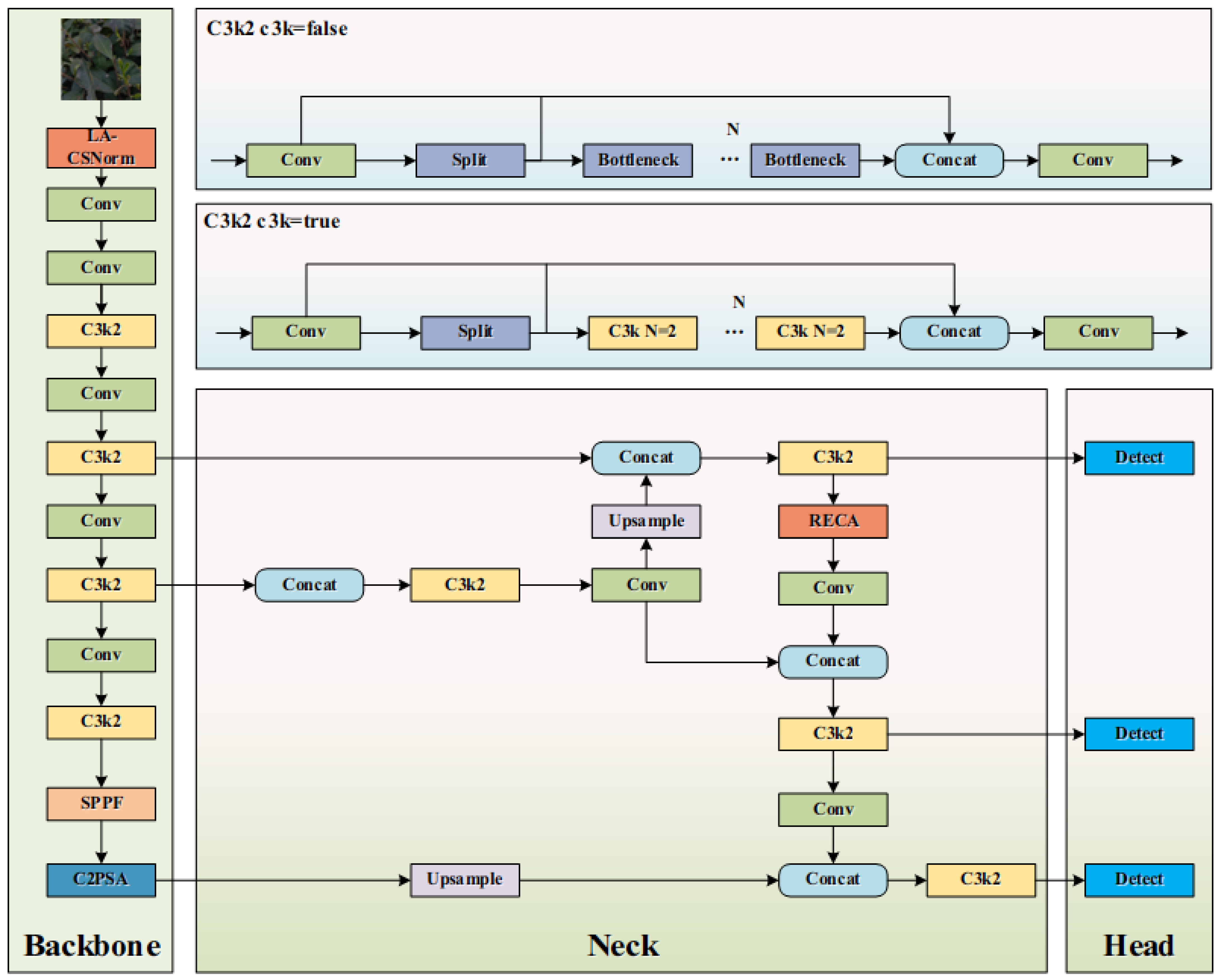
The overall architecture of LA-YOLO is shown in Figure 1. The network consists of three main components: the input-side brightness-adaptive preprocessing module LA-CSNorm, the backbone feature extraction network, and the neck (feature fusion) network with the detection head [49]. The proposed LA-CSNorm module includes a brightness-adaptive pre-enhancement block (LAP) and a channel-selective normalization block (CSNorm) [50]. It aims to recover the brightness and contrast of tea shoots under low-light and local shadow conditions, thereby improving subsequent feature responses. The backbone preserves the original multi-scale convolution and SPPF/C2PSA design of YOLOv11, balancing fine details and high-level semantics while strengthening contextual awareness for small targets. The neck adopts a top-down and bottom-up PAN structure to fuse multi-scale features. In addition, the proposed efficient channel-attention module RECA is embedded in the high-resolution small-scale branch (P3), where it amplifies channels that are beneficial for tea-bud discrimination through a residual, scaled channel weight-adaptive mechanism, improving the robustness of localization and classification. The detection head then decodes the fused features to predict the category and location of tea shoots. Finally, comparative experiments on our self-built tea-bud dataset are conducted to validate the effectiveness and robustness of the proposed LA-CSNorm and RECA strategies under complex dynamic lighting conditions.

3.2. LA-CSNorm Module

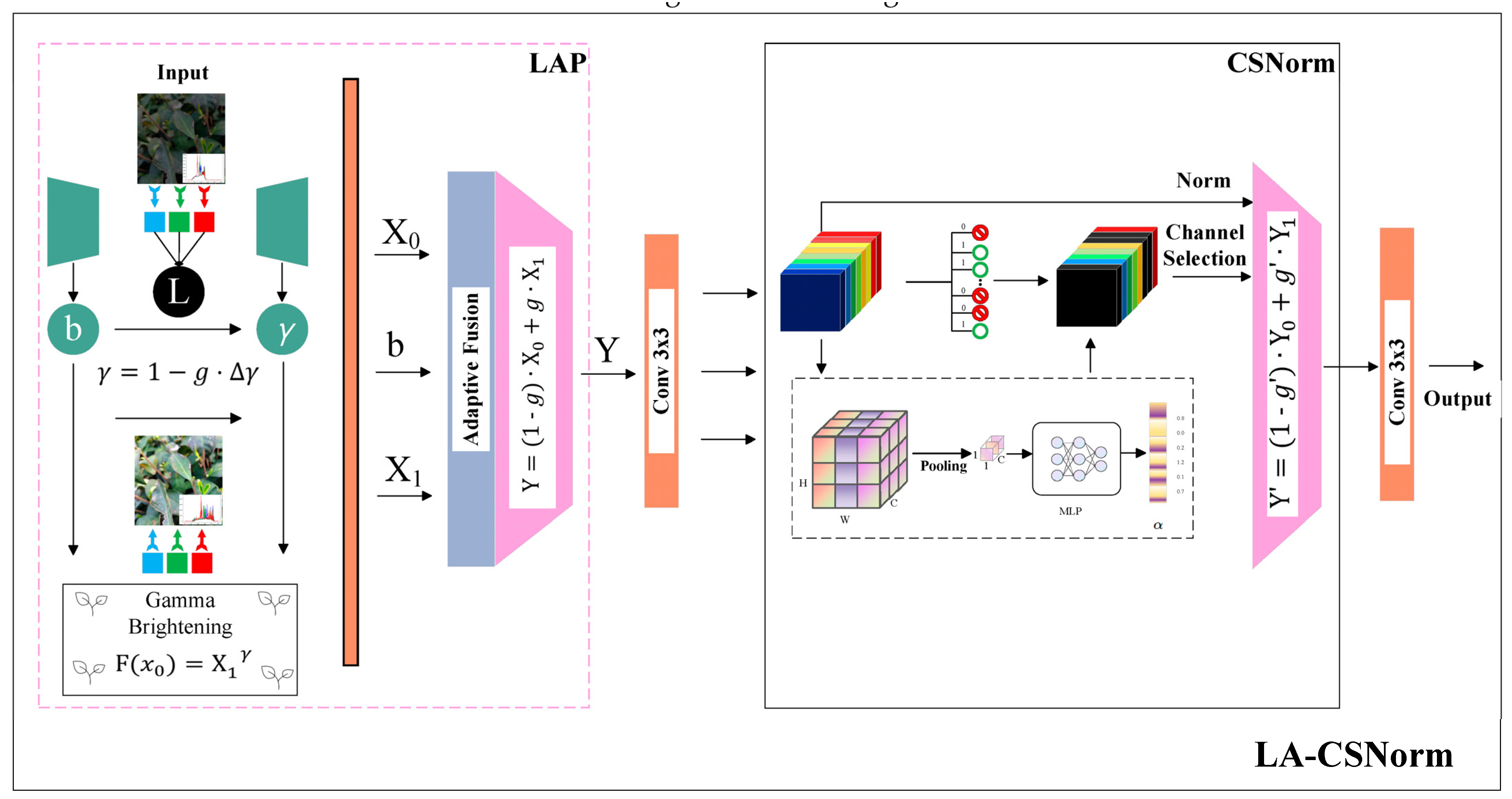
To address the large fluctuations in tea-shoot image quality and the tendency of feature distributions to drift under complex lighting, we design a brightness-adaptive input preprocessing module, termed LA-CSNorm, as illustrated in Figure 2. To examine the suitability of the CSNorm module for tea-bud detection, we evaluate it in four typical scenarios: normal light, low light, strong light, and local shadow. The results indicate that performance degradation is most pronounced under low-light conditions.
In low light, the overall luminance decreases, contrast is compressed, and the noise ratio increases. These effects reduce the reliability of the channel statistics used by CSNorm, which in turn biases the estimation of channel-selection weights and weakens the ability of normalization and reweighting to suppress illumination-induced distribution differences. Based on this observation, we introduce a brightness-adaptive pre-enhancement module (LAP) before CSNorm. Using a soft-gating strategy based on global luminance estimation, LAP applies controllable brightness correction and detail-preserving processing only to low-brightness samples. This improves input discriminability and stabilizes subsequent channel statistics, while avoiding disturbance to samples captured under normal lighting, thereby providing a more reliable basis for CSNorm-based channel selection and normalization.

3.2.1. CSNorm Module

CSNorm [50] was originally proposed to mitigate inconsistent feature distributions under varying illumination conditions. Its key idea is to introduce learnable channel-selection factors along the channel dimension, enabling adaptive feature normalization and reweighting, as shown in Figure 2. Specifically, CSNorm obtains a channel-selection vector g by computing the global statistics of the input features and then using it to linearly recompose the normalized features. In general, the process can be written as:
Y = ( 1 g ) · Y 0 + g · Y 1
where Y 1 denotes the input features, Y 0 is the normalized output, and g [ 0 ,   1 ] is the channel-selection weight. The operator indicates channel-wise multiplication.
The channel-selection weight g in Equation (1) is generated by the gate module:
α = C o n v 2 d ( R e L U ( C o n v 2 d ( A v g P o o l ( x ) ) ) )
g = α 2 α 2 + ϵ , ϵ = 10 8
This formulation follows the original CSNorm [50] and ensures the weight lies in [ 0 ,   1 ] .
Under normal illumination or mild lighting variations, CSNorm can effectively suppress channel-distribution drift and improve model stability. However, our experiments on the tea-bud dataset across four scenarios (normal light, strong light, low light, and local shadow) show that the original CSNorm suffers a clear accuracy drop under low-light conditions. The main reasons are as follows:
(1)
Low-light images have reduced overall brightness, which significantly weakens the color and texture contrast between tea shoots and background leaves.
(2)
CSNorm relies on input feature statistics for channel selection; when the signal-to-noise ratio is low, these statistics become unstable and cannot provide reliable support for subsequent feature extraction.
(3)
CSNorm does not modify the brightness structure of the input, and therefore has limited ability to recover information in dark regions.
These observations indicate that feature-level normalization and reweighting alone are insufficient to handle the combined challenges of low brightness, low contrast, and local shadow in low-light tea-shoot images.

3.2.2. LAP Module

To compensate for the limitations of CSNorm under low-light conditions, we prepend the proposed brightness-adaptive preprocessing module LAP, as shown in Figure 2. LAP is designed to be activated only when the input is sufficiently dark, while preserving as much raw detail as possible, thereby avoiding unnecessary distribution disturbances for samples captured under normal lighting.
The LAP module contains several learnable parameters initialized as: dark_thresh = 0.2357, ramp_width = 0.05, max_gamma_boost = 0.40 and blend _ gain = 0.0 . All these parameters are global scalars shared across all samples and are learnable during training to adapt to the data distribution. During training, the global luminance L is computed from the input image but detached from the computation graph, so gradients only propagate through the gating signal g back to these parameters, avoiding unstable updates from the luminance estimation branch. The gate is clamped to [0, 1], and blend _ gain is passed through a sigmoid, which naturally bounds the blending ratio and prevents saturation; no additional regularization is applied.
First, the input RGB image X R B × 3 × H × W is mapped to a physically meaningful luminance space. The luminance map is computed as a linear combination of the RGB channels according to the ITU-R BT.709 standard [51], which approximates human perceptual sensitivity to different color channels and is widely used in modern imaging systems:
L ( x , y ) = 0.2126 R + 0.7152 G + 0.0722 B
The global average of the spatial dimension is taken to obtain the global brightness scalar of the image:
l = 1 H W x , y L ( x , y )
where l ∈ [0, 1] represents the overall brightness level of the current sample, and the brightness vector is selectively separated from the computation graph in the back propagation to stabilize the training.
g = l · σ ( b )
where σ ( ) denotes the Sigmoid function and b is a learnable parameter. A learnable upper bound is introduced via the Sigmoid activation, which softens the maximum enhancement strength and prevents overexposure under extremely low illumination.
As noise in low-light images can be easily amplified by nonlinear operations, LAP first applies mild smoothing to the input:
X s = A v g P o o l 3 × 3 ( X )
Gamma correction is then used to increase brightness:
X γ = X s γ
γ = 1 g · γ
where Δ γ is the maximum gamma adjustment. This setting ensures γ < 1 , so the operation performs brightening rather than darkening.
Finally, a gate-controlled fusion is used to obtain the output:
Y = ( 1 g ) · X 0 + g · X 1
This design ensures that LAP only performs a slight enhancement on sufficiently dark inputs, so that the brightness and local contrast of tea shoots are improved while the original texture and structural details are preserved as much as possible.
By introducing LAP, the channel statistics used by CSNorm are computed from a feature space with more stable brightness and more reasonable contrast, which improves the reliability of channel-selection weights. Overall, LA-CSNorm follows a brightness-first, normalization-next strategy to enhance signal quality at the input stage, enabling the backbone to better capture edges, veins, and local texture variations in tea shoots.

3.3. RECA Module

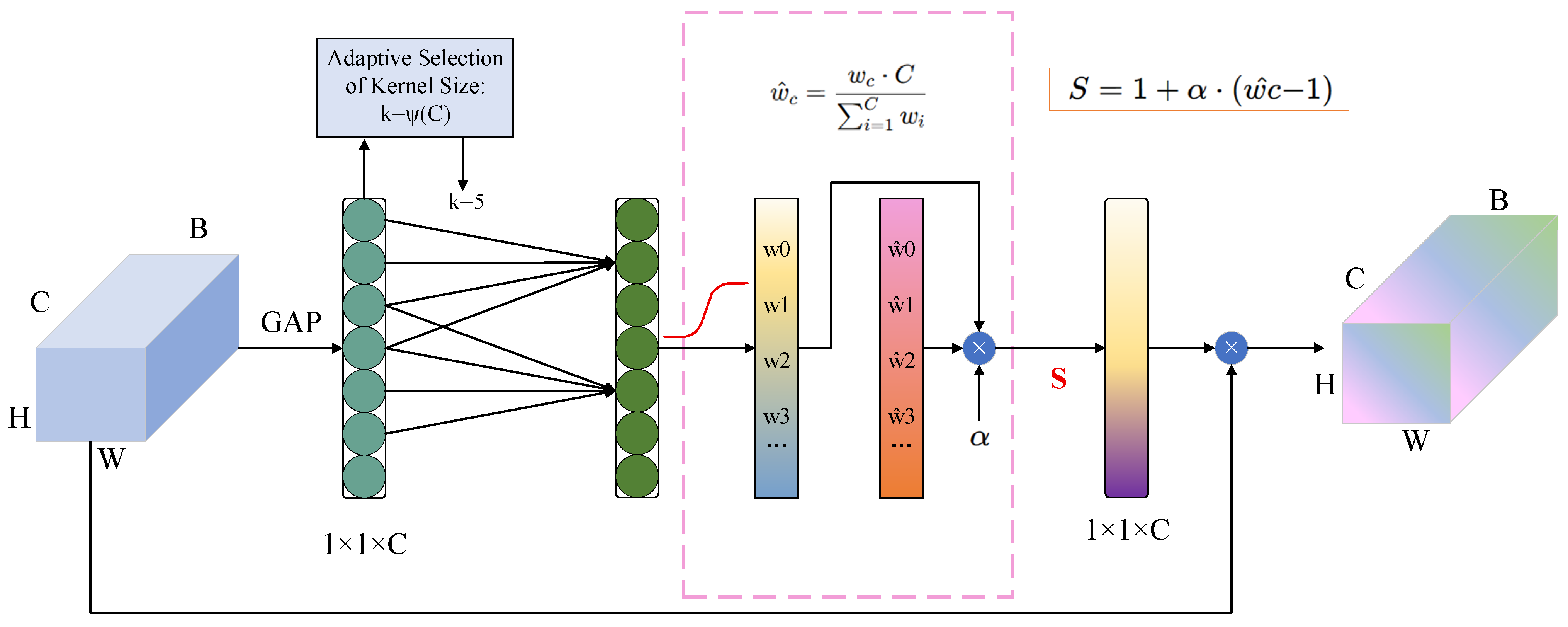
In dynamic lighting scenes, tea shoots often exhibit color and texture patterns that are highly similar to surrounding leaves, and discrimination may rely on a small set of channels that are sensitive to illumination changes [52]. To strengthen the ability of the neck feature-fusion stage to select and re-scale these key channels, we introduce an efficient channel-attention module, termed RECA, as shown in Figure 3. RECA is derived from ECA [53]. It preserves ECA’s advantages of avoiding dimensionality reduction and maintaining low computational cost, while further incorporating a residual scaling mechanism to make channel re-scaling more stable and robust, thereby reducing the risk of over-amplifying or over-suppressing feature channels under complex lighting.
Given an input feature map X R B × C × H × W , RECA first compresses the spatial dimension via global average pooling (GAP) to obtain a channel-wise global descriptor:
z = G A P ( X ) R B × C × 1 × 1
By computing the mean response of each channel over the entire feature map, this operation provides a compact descriptor that reflects the contribution of each channel to the overall semantics of the current target. Unlike conventional SE modules that use fully connected layers to model channel relationships, RECA (following ECA) treats the channel dimension as a one-dimensional signal and models local cross-channel interactions using a 1D convolution. In this way, dependencies are built only among neighboring channels, enabling effective channel-correlation modeling with very low computational overhead:
u = C o n v 1 D k ( z )
The 1D convolution kernel size k is adaptively determined by the channel number C , so the receptive range of local channel interactions can be adjusted with feature dimensionality. This improves the effectiveness of channel recalibration without introducing a noticeable increase in parameters.
To convert the convolution output into channel-attention weights, RECA applies a Sigmoid activation to u , producing a normalized channel-weight vector:
w ^ = σ ( u )
The weights are further normalized to maintain overall scale stability:
w ^ c = w c · C i = 1 C w i
Instead of directly using w ^ c to reweight the features, RECA introduces a controllable residual scaling factor α to form the final channel-scaling factor:
s = 1 + α ( w ^ c 1 )
where α is a fixed hyperparameter set to 0.3 based on preliminary experiments on the validation set. This value balances the emphasis on discriminative channels against over-amplification under unstable illumination, improving stability during both training and inference. When α = 0 , the module degenerates to an identity mapping; when α = 1 , the full channel-attention weights are applied. This residual scaling mechanism helps suppress channel-weight fluctuations caused by drastic illumination changes, while still emphasizing discriminative channels (e.g., channels that respond strongly to tea-bud color and shoot edges), thereby improving stability during both training and inference. The use of attention mechanisms for robust feature selection has parallels to human interaction recognition, where Extended Kalman Filters have been employed to maintain robust performance despite temporal variations and noise [54]. Similarly, RECA’s residual channel attention mechanism helps maintain stable feature responses across varying illumination conditions, analogous to how Kalman filtering maintains state estimation stability across noisy observations.
Finally, RECA applies the scaling factor s to the input feature map in a channel-wise manner:
Y = W · s
In this way, the module adaptively strengthens channels that are relevant to tea-bud targets and suppresses redundant responses introduced by background leaves, shadows, or highlights, without changing the spatial resolution of the features.

4. Results

4.1. Datasets and Evaluation Metrics

In real tea-garden harvesting, illumination varies substantially over time, ranging from low light in the early morning to strong direct sunlight at noon, as well as local shadows caused by clouds and branches. These variations directly affect imaging quality and the identifiability of tea shoots in captured images [55,56]. However, most public or commonly used tea-bud detection datasets are collected under relatively ideal sunny conditions with a simple illumination distribution, which makes it difficult to reflect how lighting changes influence model robustness in complex natural environments [57]. Therefore, this study constructs a tea-bud detection dataset under dynamic lighting conditions. We further introduce a hierarchical difficulty design in dataset splitting and augmentation to enable a more systematic evaluation of robustness under complex illumination.
The Longjing tea-shoot images used in this work were collected from representative standardized tea-garden regions in China, including Nanjing and Yangzhou. Data collection spans from early March to late May 2025, covering the key growth period from bud emergence to intensive picking, and thus better capturing target morphological variations in real production settings.
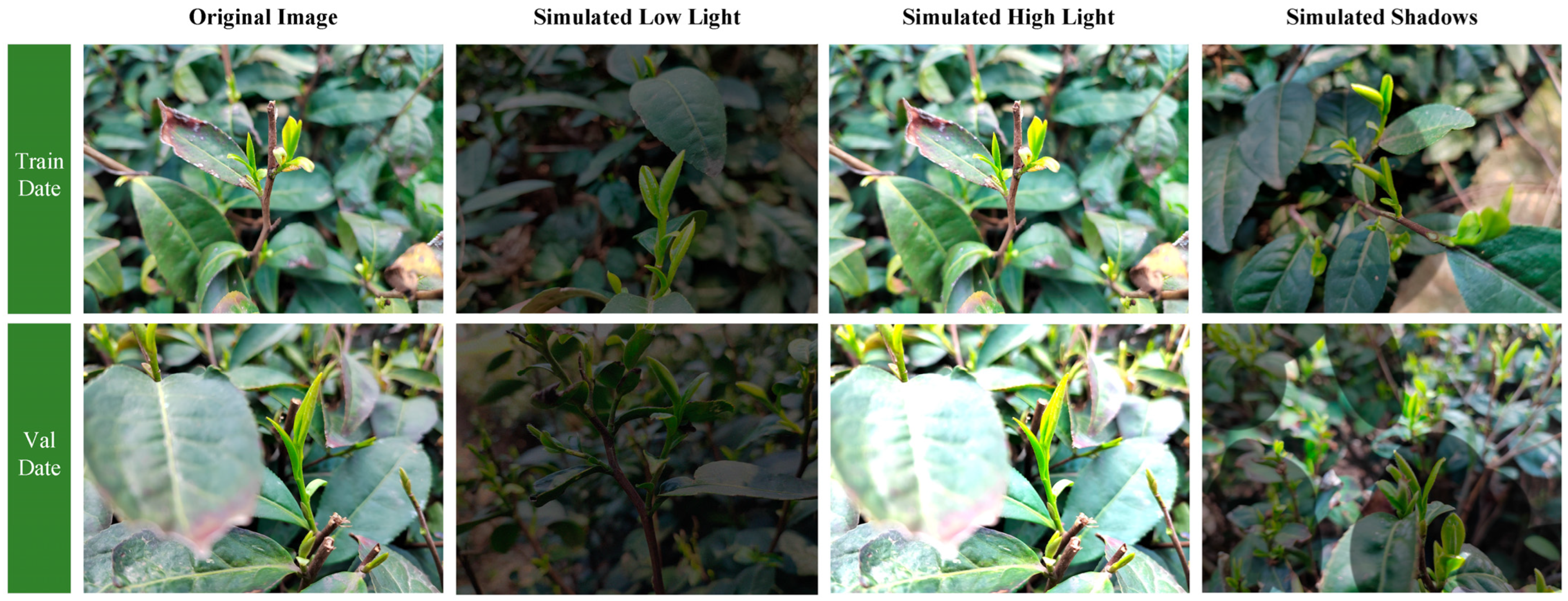
To realistically simulate the dynamic illumination variations in tea-garden operations from early morning to noon, we construct a dedicated dataset that includes typical lighting disturbances (low light, strong light, and shadow) and a difficulty-stratified evaluation protocol, based on normal-light tea-shoot images collected in the field. As shown in Figure 4, the training-set augmentation is designed to broaden the illumination distribution and improve the sufficiency of model learning. Starting from the original images, we generate low-light, strong-light and shadow samples with the following parameter ranges:
Low-light: brightness factor [ 0.3 , 0.6 ] ; Gaussian noise σ [ 5 , 15 ] ; with 50% probability a 3 × 3 Gaussian blur is applied.
Strong-light: linear gain [ 1.1 , 1.4 ] .
Shadow: 3–6 elliptical blobs (radius ~1/5 to 1/2 of image size), Gaussian blur kernel size [ 91 , 151 ] , blending alpha [ 0.3 , 0.6 ] .
The augmentation strength is constrained to a perceptible yet structurally non-destructive range, so the model can learn illumination-induced distribution changes while preserving target geometry and texture. The final training set contains 2640 images, covering normal light, low light, strong light, and large-shadow scenarios, which provides adequate support for learning illumination-related characteristics.
To test model performance under more extreme conditions, the validation set is generated with stronger lighting disturbances than the training set. Specifically:
Subset B (Low-light): brightness factor 0.35–0.55, Gaussian noise σ = 10–18.
Subset C (Strong-light): linear gain 1.3–1.45.
Subset D (Shadow): 8–12 small blobs, Gaussian blur kernel size 51, blending alpha 0.4–0.6.
The above parameter ranges were determined through preliminary experiments to balance illumination diversity and structural fidelity. Low-light brightness factors and gain ranges were selected to preserve edge contrast and avoid the complete loss of texture details. For shadow synthesis, large Gaussian blur kernels ensure smooth transitions between shadow and illuminated regions, preventing unnatural hard boundaries that do not appear in real tea-garden scenes. All augmented samples were visually inspected to confirm that tea-shoot shapes, edges, and annotation consistency were maintained. Representative examples are shown in Figure 4 and Figure 5, where augmented images remain visually plausible and structurally consistent with their original counterparts.
This intentional mismatch ensures the rigorous evaluation of model generalization under dynamic illumination. Low-light samples are rendered with lower brightness and higher noise, strong-light samples allow localized overexposure, and shadow samples adopt fragmented occlusions with clearer edges to mimic complex patchy shadows under the canopy. The validation set follows a difficulty-stratified design and includes five subsets: 330 images each for the normal-light subset A, low-light disturbance for subset B, strong-light disturbance for subset C, and shadow disturbance for subset D, as well as 660 images for the mixed-disturbance subset E (including augmented samples from A–D). The training set contains 2640 images with a total of 28,734 manually annotated tea-shoot instances. The validation subsets (A–E) collectively comprise 1980 images with 21,492 annotated instances.
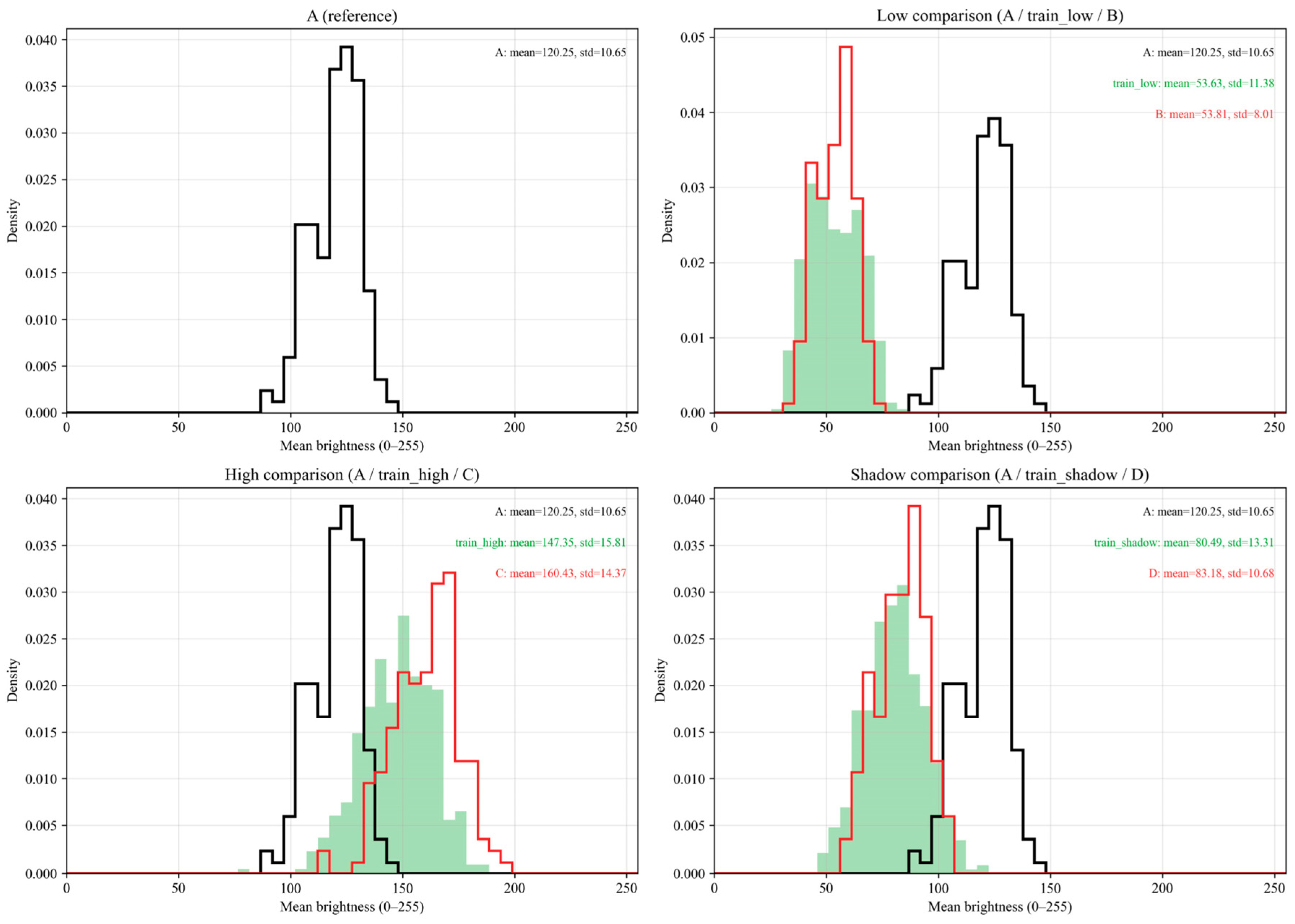
As shown in Figure 5, the luminance histogram analysis is reported only for the training set (normal, low light, strong light, and shadow) and for validation subsets A–D. Subset E is excluded from the statistics because of its mixed characteristics. Based on the histogram quantification and the mean brightness values in Table 1, we obtain the lighting-specific statistics for both the training and validation sets.
Based on the above analysis, it can be seen that there is a significant shift in the average brightness distribution of the training set and the validation set under similar enhancement. The overall design of the validation set is more difficult to identify, and more extreme parameters than the training set are often used in the same category, such as lower low light brightness, higher bright light gain, more fragmented shadows with stronger edges, etc., so that the generalization of the model under extreme light disturbance conditions can be evaluated more rigorously.
To evaluate an object detection model, multiple aspects should be considered, including detection accuracy, inference speed, computational efficiency, and model complexity. In this study, we assess the proposed method using mean average precision (mAP), the number of parameters, FLOPs, and frames per second (FPS) as evaluation metrics. The mAP is computed as follows (Equation (17)):
m A P = i = 1 N 0 1 p R d R N × 100 %

4.2. Experimental Environment and Training Parameter Settings

To ensure an objective comparison of algorithm performance, the training settings are strictly standardized, and the experimental environment is summarized in Table 2. All input images are resized to 640 × 640 pixels, and the model scale is set to m. We adopt stochastic gradient descent (SGD) as the optimizer, with an initial learning rate of 0.01 and a cyclic learning rate of 0.01, and train the model for a total of 450 epochs.

4.3. Ablation Experiment

To further quantify the contribution of each proposed strategy, we introduce the LA-CSNorm module and the RECA module into YOLOv11, using YOLOv11 trained on the illumination-enhanced tea-bud dataset as the baseline. The corresponding ablation results are reported in Table 3. As this work targets accurate tea-shoot detection under complex, dynamic lighting in real tea-garden environments, a single metric is insufficient to fully reflect model behavior across different illumination conditions. Therefore, we adopt a multi-subset evaluation protocol in the ablation study, as summarized in Table 4. Specifically, performance is evaluated on five validation subsets—normal-light A, low-light disturbance B, strong-light disturbance C, shadow disturbance D, and mixed-light E—to verify the adaptability and robustness of each module under diverse lighting scenarios.
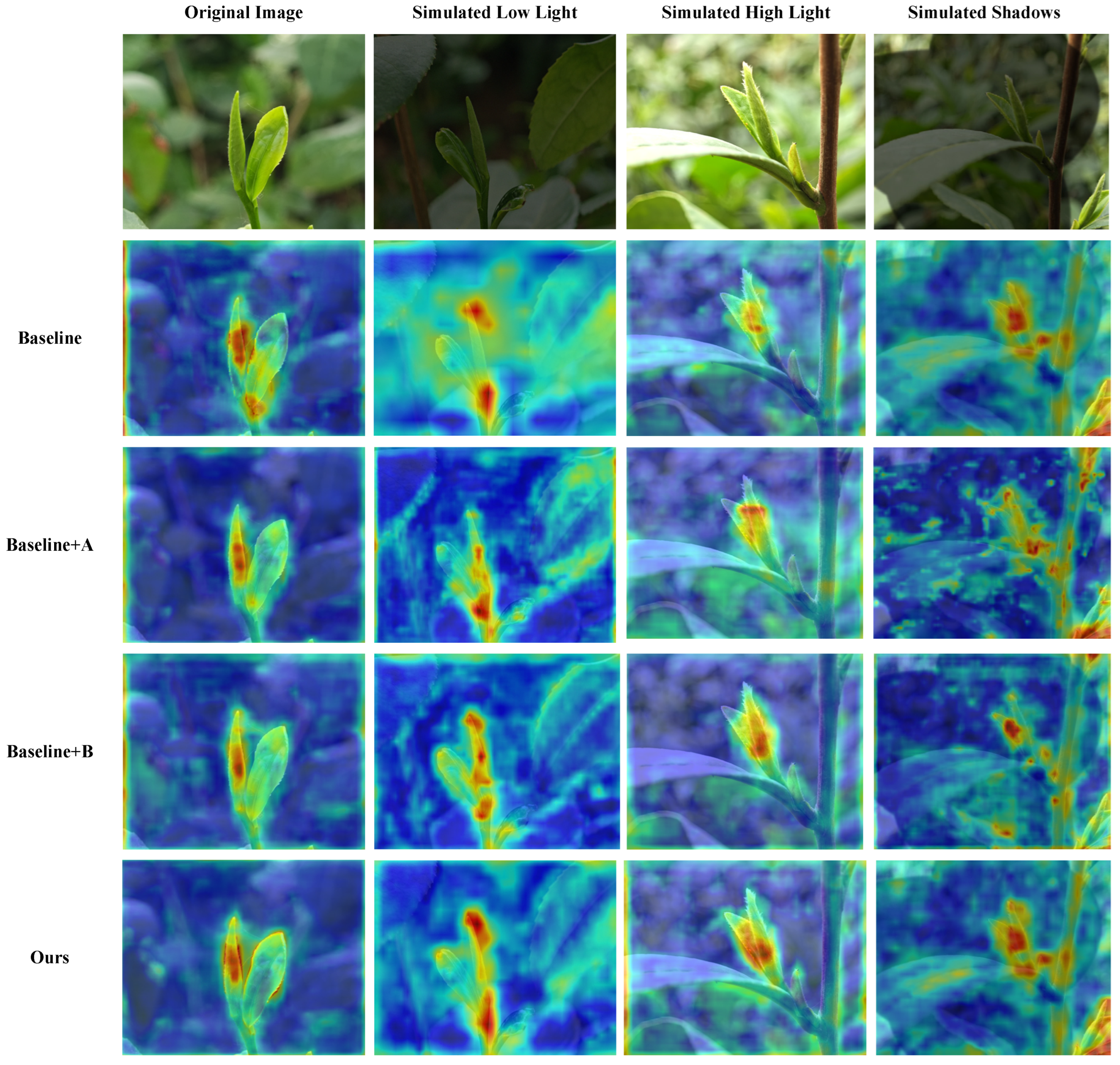
As shown in Table 3, both LA-CSNorm and RECA improve detection performance with negligible parameter increase. Adding LA-CSNorm alone improves mAP@0.5 and mAP@0.5:0.95 by 0.7% and 0.7%, respectively, by reducing illumination-induced feature drift at the input stage. The heatmaps in Figure 6 show stronger responses on tea buds in low-light and shadow conditions, with suppressed background activations.
Introducing RECA alone improves mAP@0.5 by 0.4% and mAP@0.5:0.95 by 1.5%. The larger gain on mAP@0.5:0.95 indicates better localization stability. The heatmaps further show clearer and more continuous responses around bud tips and leaf edges. When both modules are combined, LA-YOLO achieves the best performance, with mAP@0.5 and mAP@0.5:0.95 reaching 0.831 and 0.621, improving by 1.6% and 3.1% over the baseline, with only 0.01 M additional parameters.
Table 4 presents the results on different subsets (A–E). On the low-light subset B, LA-CSNorm provides the largest improvement (1.0% in mAP@0.5) by reducing noise and stabilizing features. On the strong-light subset C and shadow subset D, RECA shows greater benefits, improving mAP@0.5:0.95 by 2.5% and 2.0%, respectively. This is because RECA suppresses irrelevant responses from overexposed and occluded regions and focuses on structural features. When combined, LA-YOLO performs best across all subsets, with the largest gain on the mixed-light subset E (3.7% in mAP@0.5:0.95).
Overall, LA-CSNorm and RECA are complementary. LA-CSNorm reduces input-level illumination variation, while RECA enhances important channel responses. Their combination improves both accuracy and robustness without increasing model complexity.

4.4. Comparative Experiments

To comprehensively evaluate the proposed method in the dynamic lighting conditions of real tea plantations, we compare it with several mainstream object detectors, including the single-stage SSD [30]; YOLOv5m [22], YOLOv6m [23], YOLOv8m [11], YOLOv9m [26], YOLOv10m [27], YOLOv11m [28], and YOLOv12m [29]; as well as the Transformer-based RT-DETR [38]. All models are trained using the same training set and evaluated on the same validation set to ensure a fair comparison, and the results are summarized in Table 5 Considering the substantial illumination variations in practical tea-garden operations, we use the mixed-light validation subset E as the primary benchmark. This subset includes diverse scenarios—normal light, low light, strong light, and shadow—and is intended to reflect overall detection performance in real deployment environments.
As reported in Table 5, we evaluate LA-YOLO against mainstream YOLO variants as well as SSD and RT-DETR on the mixed-light validation subset E. The results show that LA-YOLO achieves the best tea-bud detection accuracy under dynamic lighting. It not only performs better under the looser IoU criterion, but also maintains clear advantages under the stricter localization metric.
Specifically, compared with YOLOv8m, YOLOv11m, and YOLOv12m, LA-YOLO improves mAP@0.5 by 1.8%, 1.7%, and 2.3%, respectively, and improves mAP@0.5:0.95 by 3.9%, 3.7%, and 2.7%. Compared with earlier YOLOv5m–YOLOv7m models and the lightweight YOLOv10m, LA-YOLO shows a more substantial performance gain, with the largest improvements reaching 6.6% on mAP@0.5 and 10.1% on mAP@0.5:0.95. In addition, relative to SSD-ResNet50 and RT-DETR, LA-YOLO achieves more than 7.5% and 11.5% gains in mAP@0.5:0.95, respectively, indicating stronger feature modeling and target localization capability under complex illumination conditions.
To further evaluate model generalization under individual lighting conditions, Table 6 compares the detection performance of several representative detectors on the four validation subsets A–D. As shown in Table 6, the proposed LA-YOLO achieves the best results across all lighting conditions, indicating a strong robustness to different illumination disturbances. Specifically, under the normal-light subset A, LA-YOLO improves mAP@0.5:0.95 by about 3.0% compared with YOLOv8m and YOLOv11m. More importantly, in challenging scenarios—including low light (B), strong light (C), and shadow (D)—LA-YOLO consistently outperforms CNN-based detectors by 2.7–3.4% in mAP@0.5:0.95, further validating its robustness to extreme lighting variations. In contrast, RT-DETR shows a clear performance gap across all subsets, especially under low-light and shadow conditions, suggesting limited adaptability to illumination-induced feature distribution shifts.
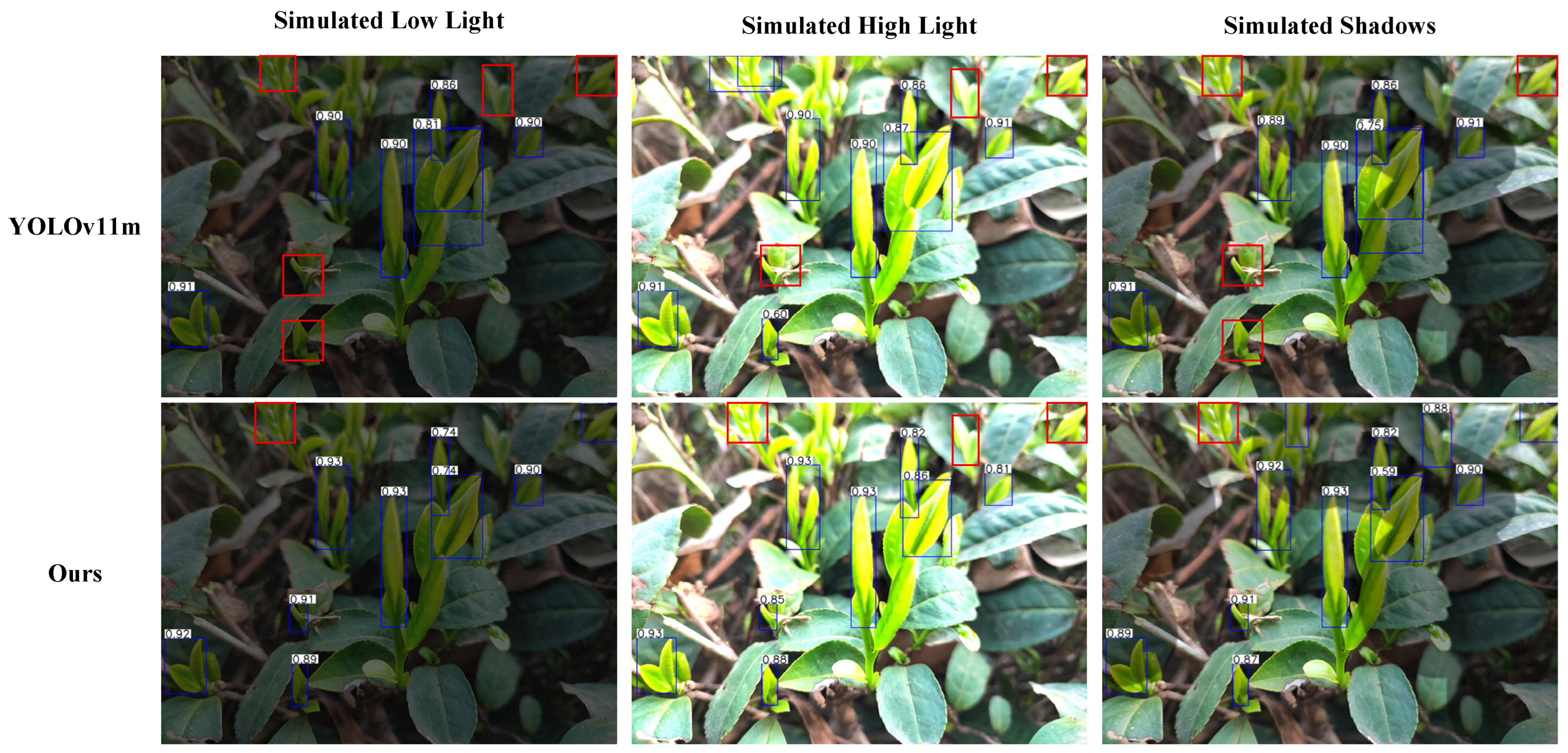
Figure 7 presents qualitative results under complex lighting. Compared with YOLOv11m, LA-YOLO produces fewer missed detections and more accurate localization, particularly in low-light and shadow scenes, which is consistent with the quantitative results in Table 5 and Table 6. Overall, these results demonstrate that LA-YOLO achieves the best performance on the mixed-illumination benchmark while improving robustness and generalization across diverse lighting conditions, without sacrificing real-time inference capability.
The challenge of maintaining detection performance across varying illumination conditions is analogous to landslide detection across different terrains and seasons, where transfer learning and graph neural networks have been employed to handle distribution shifts [58]. LA-YOLO’s illumination-adaptive preprocessing similarly addresses distribution shifts caused by lighting variation, suggesting that the approach could be combined with transfer learning strategies to further improve generalization across different tea gardens or growing seasons.

5. Discussion

Most existing studies on tea-shoot detection have been conducted under static or relatively ideal image acquisition conditions, while the impact of dynamic illumination variation on detection stability in real tea-garden operations has rarely been investigated in a systematic manner [15,16,17]. To address illumination disturbances such as low light, strong light, and shadows, previous studies have mainly relied on image enhancement preprocessing, such as EnlightenGAN [18] and Zero-DCE [19], or on domain adaptation and illumination-invariant feature learning. However, image enhancement methods may distort the color and edge details of tea shoots, which are critical for precise localization, whereas domain-adaptive methods usually introduce additional computational overhead and often require domain-specific adaptation, thereby limiting their practicality in agricultural deployment scenarios [4,6]. In contrast, the proposed LA-YOLO improves illumination robustness within the detection pipeline itself through lightweight input stabilization and feature recalibration, without introducing a separate enhancement network or domain transfer stage.
At the input level, the LA-CSNorm module mitigates the instability of feature statistics caused by brightness drift, particularly under low-light conditions, through the cascaded design of luminance-adaptive pre-enhancement (LAP) and channel-selective normalization (CSNorm). When used independently, LA-CSNorm improves both mAP@0.5 and mAP@0.5:0.95 by 0.7% and achieves a further 1.0% gain in mAP@0.5 on the low-light subset B (Table 3 and Table 4). This result suggests that stabilizing low-level luminance-related feature distributions is especially beneficial when the visual contrast of tea shoots is weakened by insufficient illumination. In addition, the heatmap visualizations show that LA-CSNorm produces more concentrated responses on tea-shoot regions while suppressing irrelevant background activation, indicating an improved foreground–background separation under adverse lighting.
On the feature side, the proposed RECA module extends ECA [53] by introducing a residual scaling mechanism to strengthen discriminative channel responses during feature fusion. When applied alone, RECA improves mAP@0.5:0.95 by 1.5%, which is substantially larger than its 0.4% gain in mAP@0.5, indicating that its main contribution lies in improving localization quality rather than only coarse detection accuracy. This effect is particularly evident under strong-light and shadow conditions, where mAP@0.5:0.95 increases by 2.5% and 2.0%, respectively (Table 4). A plausible explanation is that strong light and shadows mainly induce local, non-uniform feature disturbances, and channel recalibration on the small-target branch helps emphasize informative responses while suppressing illumination-sensitive fluctuations. The residual factor α = 0.3 provides a suitable trade-off between enhancing discriminative channels and avoiding the excessive amplification of unstable responses.
When the two modules are combined, LA-YOLO achieves the best overall performance, with mAP@0.5 and mAP@0.5:0.95 reaching 0.831 and 0.621, respectively, representing improvements of 1.6% and 3.1% over the baseline with only 0.01M additional parameters (Table 3). These results indicate that the two modules are complementary: LA-CSNorm mainly stabilizes illumination-sensitive input statistics, whereas RECA further enhances discriminative feature fusion and localization precision under local illumination disturbances. Their combination therefore improves robustness from both the input and representation perspectives.
In practical applications, LA-CSNorm adds very low computational cost (0.01 M parameters) and is suitable for edge deployment. RECA provides significant improvements under strong light and shadow, indicating that channel recalibration on the small-target branch during feature fusion is an effective means to handle local illumination disturbances. Limitations include: under extremely low light (luminance < 30/255), pre-enhancement may amplify noise; the dataset does not fully cover spatiotemporal illumination variations in real tea gardens (e.g., moving cloud shadows, inter-leaf reflections); and the work focuses only on 2D detection, lacking the 3D spatial information required for harvesting [55,56].
Future work can combine disparity-based segmentation [59] or light-field stereo matching [60] to achieve 2D detection and 3D localization; introduce temporal information from video streams to exploit inter-frame illumination consistency; perform model compression for edge devices; and integrate the illumination-adaptive detector with intensity-assisted SLAM [61] for autonomous harvesting in complex tea garden environments. The difficulty-stratified dynamic illumination dataset constructed in this study can also be extended to other illumination-sensitive crop detection tasks.

6. Conclusions

This study proposes LA-YOLO, a detector for tea shoots under dynamic lighting conditions. Built on YOLOv11, the method is improved from two complementary perspectives. First, an input-side brightness-adaptive module, LA-CSNorm, is introduced to alleviate brightness-distribution shifts under low-light conditions. Second, the residual channel-attention module RECA is incorporated to enhance discriminative feature responses at the feature level, thereby improving the detection of small and low-contrast tea buds in complex illumination environments.
Extensive ablation and comparative experiments validate both the accuracy and robustness of the proposed method. The ablation results show that LA-CSNorm and RECA are complementary under different lighting conditions: introducing either module alone yields stable gains on specific lighting subsets, while combining both achieves the best overall performance. Compared with the baseline, LA-YOLO improves mAP@0.5 and mAP@0.5:0.95 by 1.6% and 3.1%, respectively. On the mixed-light validation subset E, which better reflects real deployment scenarios, LA-YOLO achieves mAP@0.5 = 0.816 and mAP@0.5:0.95 = 0.613, corresponding to gains of 1.7% and 3.7%. It also exhibits smaller performance drops on challenging subsets such as low light, strong light, and shadow, demonstrating strong adaptability to dynamic illumination disturbances.
In addition, we construct a tea-shoot detection dataset for dynamic lighting scenarios. The training set is systematically expanded using physically consistent simulations of low light, strong light, and shadow. The validation set is intentionally designed as difficulty-stratified subsets and a mixed subset, enabling a more rigorous evaluation of lighting robustness. Luminance histogram analysis and qualitative examples further confirm the distribution differences between the training and validation sets, providing a more realistic benchmark for robustness assessment. Future work will focus on practical deployment requirements, including model optimization under edge-device constraints, leveraging temporal information in video sequences to improve detection stability, and further improving reliability under extremely low-light conditions. In addition, while the proposed LA-YOLO focuses on robust 2D detection under dynamic illumination, practical harvesting robots require 3D spatial information for precise picking. Disparity-based segmentation methods have demonstrated effectiveness in object localization by leveraging stereo information [59]. Future work could extend LA-YOLO to incorporate disparity estimation or stereo matching techniques to enable simultaneous detection and the 3D positioning of tea shoots, providing richer spatial cues for robotic harvesting systems. Moreover, tea garden scenes frequently exhibit occlusion from overlapping leaves and branches, as well as sensor noise that can degrade detection performance. Occlusion and noise-aware frameworks have demonstrated robust disparity estimation under challenging conditions [60]. The RECA attention module in LA-YOLO partially addresses feature suppression, but future iterations could incorporate explicit occlusion modeling to further improve detection of partially visible tea shoots. While this work focuses on vision-based detection, multimodal approaches combining cameras with depth sensors have shown promise in complex scenarios [61]. For tea harvesting robots, fusion of RGB images with LiDAR or depth camera data could provide complementary illumination-invariant spatial information, potentially further improving detection robustness under extreme lighting conditions where visual features alone may be degraded. Additionally, autonomous harvesting requires not only robust detection but also accurate robot localization and mapping. Intensity-assisted SLAM systems have demonstrated robust performance in degenerated environments by leveraging additional sensor modalities [61]. Integrating LA-YOLO’s illumination-robust detections with SLAM frameworks could enable more reliable navigation and harvesting in complex tea garden environments where lighting conditions vary dramatically throughout the day.
Overall, LA-YOLO substantially improves detection accuracy and lighting robustness for tea-shoot detection in complex illumination while keeping the computational overhead nearly unchanged. Moreover, the proposed difficulty-stratified dataset offers a practical path and a solid foundation for reliable agricultural-vision deployment in real production environments.

Author Contributions

M.L.: Conceptualization, methodology, writing—review and editing; F.L.: project administration, supervision; J.C.: formal analysis, validation. All authors have read and agreed to the published version of the manuscript.

Funding

This research received no external funding.

Data Availability Statement

The data presented in this study are available on request from the corresponding author due to the privacy policy of the organization.

Conflicts of Interest

The authors declare no conflicts of interest.

References

  1. Yu, T.; Chen, J.; Gui, Z.; Jia, J.; Li, Y.; Yu, C.; Wu, C. Multi-Scale Cross-Domain Augmentation of Tea Datasets via Enhanced Cycle Adversarial Networks. Agriculture 2025, 15, 1739. [Google Scholar] [CrossRef]
  2. Xia, E.-H.; Tong, W.; Wu, Q.; Wei, S.; Zhao, J.; Zhang, Z.-Z.; Wei, C.-L.; Wan, X.-C. Tea Plant Genomics: Achievements, Challenges and Perspectives. Hortic. Res. 2020, 7, 7. [Google Scholar] [CrossRef]
  3. Zhang, Z.; Lu, Y.; Yang, M.; Wang, G.; Zhao, Y.; Hu, Y. Optimal Training Strategy for High-Performance Detection Model of Multi-Cultivar Tea Shoots Based on Deep Learning Methods. Sci. Hortic. 2024, 328, 112949. [Google Scholar] [CrossRef]
  4. Ye, R.; Shao, G.; Yang, Z.; Sun, Y.; Gao, Q.; Li, T. Detection Model of Tea Disease Severity under Low Light Intensity Based on YOLOv8 and EnlightenGAN. Plants 2024, 13, 1377. [Google Scholar] [CrossRef] [PubMed]
  5. Yu, R.; Xie, Y.; Li, Q.; Guo, Z.; Dai, Y.; Fang, Z.; Li, J. Development and Experiment of Adaptive Oolong Tea Harvesting Robot Based on Visual Localization. Agriculture 2024, 14, 2213. [Google Scholar] [CrossRef]
  6. Yang, Z.; Feng, H.; Ruan, Y.; Weng, X. Tea Tree Pest Detection Algorithm Based on Improved Yolov7-Tiny. Agriculture 2023, 13, 1031. [Google Scholar] [CrossRef]
  7. Pan, C.-J.; Yang, X.-L.; Chen, L. Tea Plant: A Millennia-Old Cash Crop for a Healthy and Happy Life Worldwide. In The Tea Plant Genome; Springer: Singapore, 2024; pp. 1–12. [Google Scholar]
  8. Gong, J.; Chen, G.; Deng, Y.; Li, C.; Fang, K. Non-Destructive Detection of Tea Polyphenols in Fu Brick Tea Based on Hyperspectral Imaging and Improved PKO-SVR Method. Agriculture 2024, 14, 1701. [Google Scholar] [CrossRef]
  9. Xu, W.; Cui, C.; Ji, Y.; Li, X.; Li, S. YOLOv8-MPEB Small Target Detection Algorithm Based on UAV Images. Heliyon 2024, 10, e29501. [Google Scholar] [CrossRef]
  10. Zhao, S.; Chen, J.; Ma, L. Subtle-YOLOv8: A Detection Algorithm for Tiny and Complex Targets in UAV Aerial Imagery. Signal Image Video Process. 2024, 18, 8949–8964. [Google Scholar] [CrossRef]
  11. Xie, S.; Sun, H. Tea-YOLOv8s: A Tea Bud Detection Model Based on Deep Learning and Computer Vision. Sensors 2023, 23, 6576. [Google Scholar] [CrossRef]
  12. Huang, P.; Zhao, Z.; Li, R. YOLO-QCK: An Efficient and Lightweight Small Object Detection Model Based on YOLOv5. Model. Simul. 2024, 13, 3889–3898. [Google Scholar] [CrossRef]
  13. Zhu, Y.; Wang, Y.; Liu, D. MERCA: A Multi-Objective Optimization Traffic Light Control Model. In Proceedings of the 2024 5th International Conference on Artificial Intelligence and Computer Engineering (ICAICE); IEEE: New York, NY, USA, 2024; pp. 999–1006. [Google Scholar]
  14. Tan, M.; Pang, R.; Le, Q.V. EfficientDet: Scalable and Efficient Object Detection. In Proceedings of the IEEE/CVF Conference on Computer Vision and Pattern Recognition (CVPR); IEEE: New York, NY, USA, 2020. [Google Scholar]
  15. Zhang, Z.; Lu, Y.; Peng, Y.; Yang, M.; Hu, Y. A Lightweight and High-Performance YOLOv5-Based Model for Tea Shoot Detection in Field Conditions. Agronomy 2025, 15, 1122. [Google Scholar] [CrossRef]
  16. Li, S.; Zhang, Z.; Li, S. GLS-YOLO: A Lightweight Tea Bud Detection Model in Complex Scenarios. Agronomy 2024, 14, 2939. [Google Scholar] [CrossRef]
  17. Chen, Y.; Guo, Y.; Li, J.; Zhou, B.; Chen, J.; Zhang, M.; Cui, Y.; Tang, J. RT-DETR-Tea: A Multi-Species Tea Bud Detection Model for Unstructured Environments. Agriculture 2024, 14, 2256. [Google Scholar] [CrossRef]
  18. Jiang, Y.; Gong, X.; Liu, D.; Cheng, Y.; Fang, C.; Shen, X.; Yang, J.; Zhou, P.; Wang, Z. EnlightenGAN: Deep Light Enhancement without Paired Supervision. IEEE Trans. Image Process. 2021, 30, 2340–2349. [Google Scholar] [CrossRef]
  19. Guo, C.; Li, C.; Guo, J.; Loy, C.C.; Hou, J.; Kwong, S.; Cong, R. Zero-Reference Deep Curve Estimation for Low-Light Image Enhancement. In Proceedings of the IEEE/CVF Conference on Computer Vision and Pattern Recognition; IEEE: New York, NY, USA, 2020. [Google Scholar]
  20. Qi, F.; Tan, X.; Zhang, Z.; Chen, M.; Xie, Y.; Ma, L. Glass Makes Blurs: Learning the Visual Blurriness for Glass Surface Detection. IEEE Trans. Industr. Inform. 2024, 20, 6631–6641. [Google Scholar] [CrossRef]
  21. Girshick, R. Fast R-CNN. In Proceedings of the 2015 IEEE International Conference on Computer Vision (ICCV); IEEE: New York, NY, USA, 2015; pp. 1440–1448. [Google Scholar]
  22. Khanam, R.; Hussain, M. What Is YOLOv5: A Deep Look into the Internal Features of the Popular Object Detector. arXiv 2024, arXiv:2407.20892. [Google Scholar] [CrossRef]
  23. Li, C.; Li, L.; Jiang, H.; Weng, K.; Geng, Y.; Li, L.; Ke, Z.; Li, Q.; Cheng, M.; Nie, W.; et al. YOLOv6: A Single-Stage Object Detection Framework for Industrial Applications. arXiv 2022, arXiv:2209.02976. [Google Scholar] [CrossRef]
  24. Wang, C.-Y.; Bochkovskiy, A.; Liao, H.-Y.M. YOLOv7: Trainable Bag-of-Freebies Sets New State-of-the-Art for Real-Time Object Detectors. In Proceedings of the IEEE/CVF Conference on Computer Vision And Pattern Recognition; IEEE: New York, NY, USA, 2022. [Google Scholar]
  25. Yang, Q.; Gu, J.; Xiong, T.; Wang, Q.; Huang, J.; Xi, Y.; Shen, Z. RFA-YOLOv8: A Robust Tea Bud Detection Model with Adaptive Illumination Enhancement for Complex Orchard Environments. Agriculture 2025, 15, 1982. [Google Scholar] [CrossRef]
  26. Wang, C.-Y.; Yeh, I.-H.; Liao, H.-Y.M. YOLOv9: Learning What You Want to Learn Using Programmable Gradient Information. In European Conference on Computer Vision; Springer: Cham, Switzerland, 2024. [Google Scholar]
  27. Wang, A.; Chen, H.; Liu, L.; Chen, K.; Lin, Z.; Han, J.; Ding, G. YOLOv10: Real-Time End-to-End Object Detection. Adv. Neural Inf. Process. Syst. 2024, 37, 107984–108011. [Google Scholar]
  28. Khanam, R.; Hussain, M. YOLOv11: An Overview of the Key Architectural Enhancements. arXiv 2024, arXiv:2410.17725. [Google Scholar] [CrossRef]
  29. Tian, Y.; Ye, Q.; Doermann, D. YOLOv12: Attention-Centric Real-Time Object Detectors. arXiv 2025, arXiv:2502.12524. [Google Scholar]
  30. Liu, W.; Anguelov, D.; Erhan, D.; Szegedy, C.; Reed, S.; Fu, C.-Y.; Berg, A.C. SSD: Single Shot MultiBox Detector. In European Conference on Computer Vision; Springer: Cham, Switzerland, 2016; pp. 21–37. [Google Scholar]
  31. Lin, T.-Y.; Goyal, P.; Girshick, R.; He, K.; Dollár, P. Focal Loss for Dense Object Detection. In Proceedings of the IEEE International Conference on Computer Vision; IEEE: New York, NY, USA, 2018. [Google Scholar]
  32. Tian, Y.; Xu, W.; Yang, B.; Yang, X.; Guo, H.; Wang, G.; Yu, H. Development and Evolution of YOLO in Object Detection: A Survey. Neurocomputing 2026, 669, 132436. [Google Scholar] [CrossRef]
  33. Redmon, J.; Farhadi, A. YOLOv3: An Incremental Improvement. arXiv 2018, arXiv:1804.02767. [Google Scholar] [CrossRef]
  34. Ge, Z.; Liu, S.; Wang, F.; Li, Z.; Sun, J. YOLOX: Exceeding YOLO Series in 2021. arXiv 2021, arXiv:2107.08430. [Google Scholar] [CrossRef]
  35. Lei, M.; Li, S.; Wu, Y.; Hu, H.; Zhou, Y.; Zheng, X.; Ding, G.; Du, S.; Wu, Z.; Gao, Y. YOLOv13: Real-Time Object Detection with Hypergraph-Enhanced Adaptive Visual Perception. arXiv 2025, arXiv:2506.17733. [Google Scholar]
  36. Cardellicchio, A.; Renò, V.; Cellini, F.; Summerer, S.; Petrozza, A.; Milella, A. Incremental Learning with Domain Adaption for Tomato Plant Phenotyping. Smart Agric. Technol. 2025, 12, 101324. [Google Scholar] [CrossRef]
  37. Carion, N.; Massa, F.; Synnaeve, G.; Usunier, N.; Kirillov, A.; Zagoruyko, S. End-to-End Object Detection with Transformers. In European Conference on Computer Vision; Springer: Cham, Switzerland, 2020. [Google Scholar]
  38. Zhao, Y.; Lv, W.; Xu, S.; Wei, J.; Wang, G.; Dang, Q.; Liu, Y.; Chen, J. DETRs Beat YOLOs on Real-Time Object Detection. In Proceedings of the 2024 IEEE/CVF Conference on Computer Vision and Pattern Recognition (CVPR); IEEE: New York, NY, USA, 2024; pp. 16965–16974. [Google Scholar]
  39. Wang, M.; Li, Y.; Meng, H.; Chen, Z.; Gui, Z.; Li, Y.; Dong, C. Small Target Tea Bud Detection Based on Improved YOLOv5 in Complex Background. Front. Plant Sci. 2024, 15, 1393138. [Google Scholar] [CrossRef]
  40. Zhou, C.; Zhu, Y.; Zhang, J.; Ding, Z.; Jiang, W.; Zhang, K. The Tea Buds Detection and Yield Estimation Method Based on Optimized YOLOv8. Sci. Hortic. 2024, 338, 113730. [Google Scholar] [CrossRef]
  41. Li, G.; Lu, J.; Zhang, D.; Guo, Z. Research on Tea Buds Detection Based on Optimized YOLOv5s. IET Image Process. 2025, 19, e13319. [Google Scholar] [CrossRef]
  42. Mun, J.; Kim, J.; Do, Y.; Kim, H.; Lee, C.; Jeong, J. Design and Implementation of Defect Detection System Based on YOLOv5-CBAM for Lead Tabs in Secondary Battery Manufacturing. Processes 2023, 11, 2751. [Google Scholar] [CrossRef]
  43. Zhu, L.; Zhang, Z.; Lin, G.; Chen, P.; Li, X.; Zhang, S. Detection and Localization of Tea Bud Based on Improved YOLOv5s and 3D Point Cloud Processing. Agronomy 2023, 13, 2412. [Google Scholar] [CrossRef]
  44. Zhao, B.; Zhang, Q.; Liu, Y.; Cui, Y.; Zhou, B. Detection Method for Rice Seedling Planting Conditions Based on Image Processing and an Improved YOLOv8n Model. Appl. Sci. 2024, 14, 2575. [Google Scholar] [CrossRef]
  45. Bellia, L.; Błaszczak, U.; Diglio, F.; Fragliasso, F. Light-Environment Interactions and Integrative Lighting Design: Connecting Visual, Non-Visual and Energy Requirements in a Case Study Experiment. Build. Environ. 2024, 253, 111323. [Google Scholar] [CrossRef]
  46. Mumuni, A.; Mumuni, F. Data Augmentation: A Comprehensive Survey of Modern Approaches. Array 2022, 16, 100258. [Google Scholar] [CrossRef]
  47. Li, M.; Zhang, H.; Cai, K.; Pedrycz, W.; Miao, D.; Gao, Y. IFA: Illumination-Aware Feature Aggregation Model for Salient Object Detection. Pattern Recognit. 2026, 171, 112118. [Google Scholar] [CrossRef]
  48. Mao, G.; Liao, G.; Zhu, H.; Sun, B. Multibranch Attention Mechanism Based on Channel and Spatial Attention Fusion. Mathematics 2022, 10, 4150. [Google Scholar] [CrossRef]
  49. Rasheed, A.F.; Zarkoosh, M. YOLOv11 Optimization for Efficient Resource Utilization. J. Supercomput. 2025, 81, 1085. [Google Scholar] [CrossRef]
  50. Yao, M.; Huang, J.; Jin, X.; Xu, R.; Zhou, S.; Zhou, M.; Xiong, Z. Generalized Lightness Adaptation with Channel Selective Normalization. In Proceedings of the IEEE/CVF International Conference on Computer Vision; IEEE: New York, NY, USA, 2023. [Google Scholar]
  51. ITU-R BT.709-6; Parameter Values for the HDTV Standards for Production and International Programme Exchange. International Telecommunication Union (ITU): Geneva, Switzerland, 2015.
  52. Meng, J.; Kang, F.; Wang, Y.; Tong, S.; Zhang, C.; Chen, C. Tea Buds Detection in Complex Background Based on Improved YOLOv7. IEEE Access 2023, 11, 88295–88304. [Google Scholar] [CrossRef]
  53. Wang, Q.; Wu, B.; Zhu, P.; Li, P.; Zuo, W.; Hu, Q. ECA-Net: Efficient Channel Attention for Deep Convolutional Neural Networks. In Proceedings of the IEEE/CVF Conference on Computer Vision and Pattern Recognition; IEEE: New York, NY, USA, 2020. [Google Scholar]
  54. Bukht, T.F.N.; Alazeb, A.; Mudawi, N.A.; Alabdullah, B.; Alnowaiser, K.; Jalal, A.; Liu, H. Robust Human Interaction Recognition Using Extended Kalman Filter. Comput. Mater. Contin. 2024, 81, 2987–3002. [Google Scholar] [CrossRef]
  55. Chen, Z.; Chen, J.; Li, Y.; Gui, Z.; Yu, T. Tea Bud Detection and 3D Pose Estimation in the Field with a Depth Camera Based on Improved YOLOv5 and the Optimal Pose-Vertices Search Method. Agriculture 2023, 13, 1405. [Google Scholar] [CrossRef]
  56. Dong, S.; Liu, G.; Li, X.; Yi, W.; Wang, P. Ordinary Tea Shoot Detection under Different Lighting Conditions. In Proceedings of the 2024 International Conference on Image Processing, Computer Vision and Machine Learning (ICICML); IEEE: New York, NY, USA, 2024; pp. 1382–1385. [Google Scholar]
  57. Wang, J.; Li, M.; Han, C.; Guo, X. YOLOv8-RCAA: A Lightweight and High-Performance Network for Tea Leaf Disease Detection. Agriculture 2024, 14, 1240. [Google Scholar] [CrossRef]
  58. Luo, W.; Qiu, H.; Wei, Y.; Huangfu, W.; Yang, D. A Proposed Method for Landslide Detection Based on Transfer Learning and Graph Neural Network. Geosci. Front. 2025, 16, 102171. [Google Scholar] [CrossRef]
  59. Li, S.; Chen, J.; Peng, W.; Shi, X.; Bu, W. A Vehicle Detection Method Based on Disparity Segmentation. Multimed. Tools Appl. 2023, 82, 19643–19655. [Google Scholar] [CrossRef]
  60. Yang, D.; Cui, Z.; Sheng, H.; Chen, R.; Cong, R.; Wang, S.; Xiong, Z. An Occlusion and Noise-Aware Stereo Framework Based on Light Field Imaging for Robust Disparity Estimation. IEEE Trans. Comput. 2024, 73, 764–777. [Google Scholar] [CrossRef]
  61. Sun, T.; Guo, R.; Chen, G.; Wang, H.; Li, E.; Zhang, W. RID-LIO: Robust and Accurate Intensity-Assisted LiDAR-Based SLAM for Degenerated Environments. Meas. Sci. Technol. 2025, 36, 036313. [Google Scholar] [CrossRef]
Figure 1. Schematic diagram of the improved LA-YOLO network architecture.
Agriculture 16 00809 g001
Figure 2. Architecture of the proposed LA-CSNorm preprocess module. The module consists of a luminance-adaptive preprocessing (LAP) branch and a channel selection normalization (CSNorm) branch, enabling robust feature normalization under varying illumination conditions.
Agriculture 16 00809 g002
Figure 3. The RECA module follows a process of global channel statistics—local cross-channel interaction—channel recalibration with residual constraints.
Agriculture 16 00809 g003
Figure 4. To visually illustrate the effects of lighting perturbation, the illustration provides a comparison of images of each enhancement type in the training and validation sets (original image/simulated low light/simulated strong light/simulated shadow).
Agriculture 16 00809 g004
Figure 5. The low-light images in the verification set show a significant loss of detail visibility; the bright light group contains more obvious highlight clipping; and the shadow group exhibits more fragmented light spots and complex projections.
Agriculture 16 00809 g005
Figure 6. Heatmap comparison of ablation experiments. Rows from top to bottom correspond to baseline, +LA-CSNorm, +RECA, and LA-YOLO (Ours). The baseline exhibits scattered activation across background leaves. With LA-CSNorm, activation becomes more concentrated on tea-shoot regions under low-light and shadow conditions, with suppressed background responses. With RECA, responses around bud tips and leaf edges become clearer and more continuous. The combined model (LA-YOLO) shows the most focused activation on discriminative structures, indicating improved localization stability.
Agriculture 16 00809 g006
Figure 7. Qualitative detection results under challenging illumination. Each column shows a different lighting condition: low light (left), strong light (middle), and shadow (right). The top row shows YOLOv11m results, and the bottom row shows LA-YOLO results. Red boxes indicate missed detections, while blue boxes indicate normal identifications. Compared with YOLOv11m, LA-YOLO produces fewer missed detections and more accurate localization, especially in low-light and shadow scenes, consistent with the quantitative results in Table 5 and Table 6.
Agriculture 16 00809 g007
Table 1. Average brightness statistics of training and validation sets under different lighting conditions (0–255).
Data DivisionLighting ConditionsNumber of SamplesMean Average BrightnessStandard Deviation
Validation set ANormal light330120.2510.65
Training setLow light-53.6311.38
Validation set BLow light33053.818.01
Training setHigh light-147.3515.81
Validation set CHigh light330160.4314.37
Training setShadows-80.4913.31
Validation set DShadows33083.1810.68
Note: Average brightness is the average of the pixel brightness (0–255) of each image and then averaged over the dataset; standard deviation reflects the dispersion of brightness distribution in the dataset. The training set is generated from normal lighting samples through low light, strong light, and shadow enhancement (a total of 2640 images), and the validation sets A–D each contain 330 images.
Table 2. Experimental environment and configuration.
Experimental Environment Model/Parameter
CPU device12th Gen Intel(R) Core(TM) i5-12600KF (3.70 GHz)
GPU deviceNVIDIA RTX 3080 10G
operating systemWindows X64
CUDA VersionCUDA 12.0
programming languagePython 3.8.19
Deep Learning FrameworkPytorch 2.4.0
IDEPyCharm Community Edition 2024.2.0.1
Table 3. Results of the ablation experiment.
MethodLA-CSNormRECAmAP@0.5mAP@0.5:0.95Params (M)FLOPs (G)
Baseline××0.8150.5920.0567.6
+LA-CSNorm×0.8220.59720.0669.74
+RECA×0.8190.61420.0568.19
Ours0.8310.62120.0669.74
Table 4. Ablation Contrast on Different Illumination Subsets.
MethodA (Normal)B (Low)C (High)D (Shadow)E (Mixed)
Baseline0.815/0.590.802/0.5810.807/0.5810.802/0.5810.799/0.576
+LA-CSNorm0.822/0.5970.812/0.5840.817/0.590.819/0.5880.813/0.583
+RECA0.819/0.6140.806/0.6020.816/0.6060.812/0.6010.809/0.6
Ours0.831/0.6210.82/0.6080.821/0.6150.825/0.6160.816/0.613
Table 5. Comparison on the Mixed Illumination Validation Set (E).
MethodmAP@0.5mAP@0.5:0.95Params (M)FLOPs (G)FPS
YOLOv5m0.7780.556256484.0
YOLOv6m0.750.51262161.173.5
YOLOv8m0.7980.57425.878.785.5
YOLOv9m0.7890.5672076.578.1
YOLOv10m0.7780.56615.358.990.1
YOLOv11n0.7740.5222.56.391.7
YOLOv11s0.7820.5529.421.391.7
YOLOv11m0.7990.5762067.682.0
YOLOv11L0.7820.5325.286.676.3
YOLOv12m0.7930.58620.167.179.4
SSD-resnet500.7410.48324.487.755.6
RT-DETR0.7430.49841.4125.265.8
Ours0.8160.61320.0669.7482.0
Table 6. Robustness comparison across different illumination conditions.
MethodABCD
YOLOv8m0.812/0.5910.803/0.5790.8/0.5780.806/0.583
RT-DETR0.756/0.510.751/0.5040.744/0.5020.746/0.5
YOLOv11m0.815/0.590.802/0.5810.807/0.5810.802/0.581
Ours0.831/0.6210.82/0.6080.821/0.6150.825/0.616
Disclaimer/Publisher’s Note: The statements, opinions and data contained in all publications are solely those of the individual author(s) and contributor(s) and not of MDPI and/or the editor(s). MDPI and/or the editor(s) disclaim responsibility for any injury to people or property resulting from any ideas, methods, instructions or products referred to in the content.