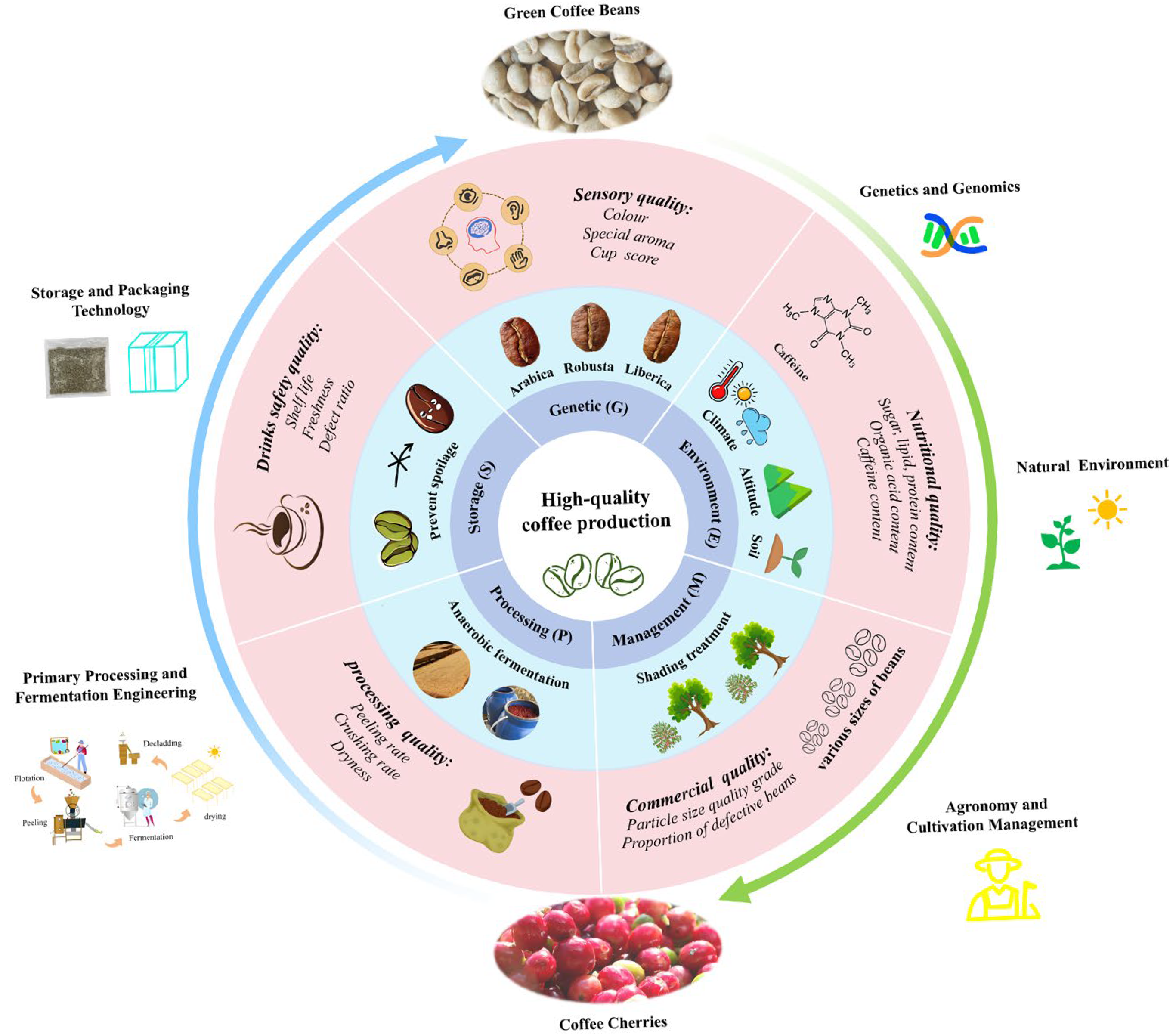
From Germplasm to Cup: A Comprehensive Review of the Genetic, Environmental, and Postharvest Determinants of Coffee Quality and Their Interactions
 ,
, 
Abstract
1. Introduction
2. Genetic Mechanisms Regulating Coffee Bean Quality
2.1. The Role of Genomic Structure in Determining Coffee Bean Quality
2.2. Genetic Regulation of Key Quality-Related Compounds
2.2.1. Caffeine Biosynthesis
2.2.2. Lipid Biosynthesis
2.2.3. Molecular Networks Governing Chlorogenic Acid Synthesis
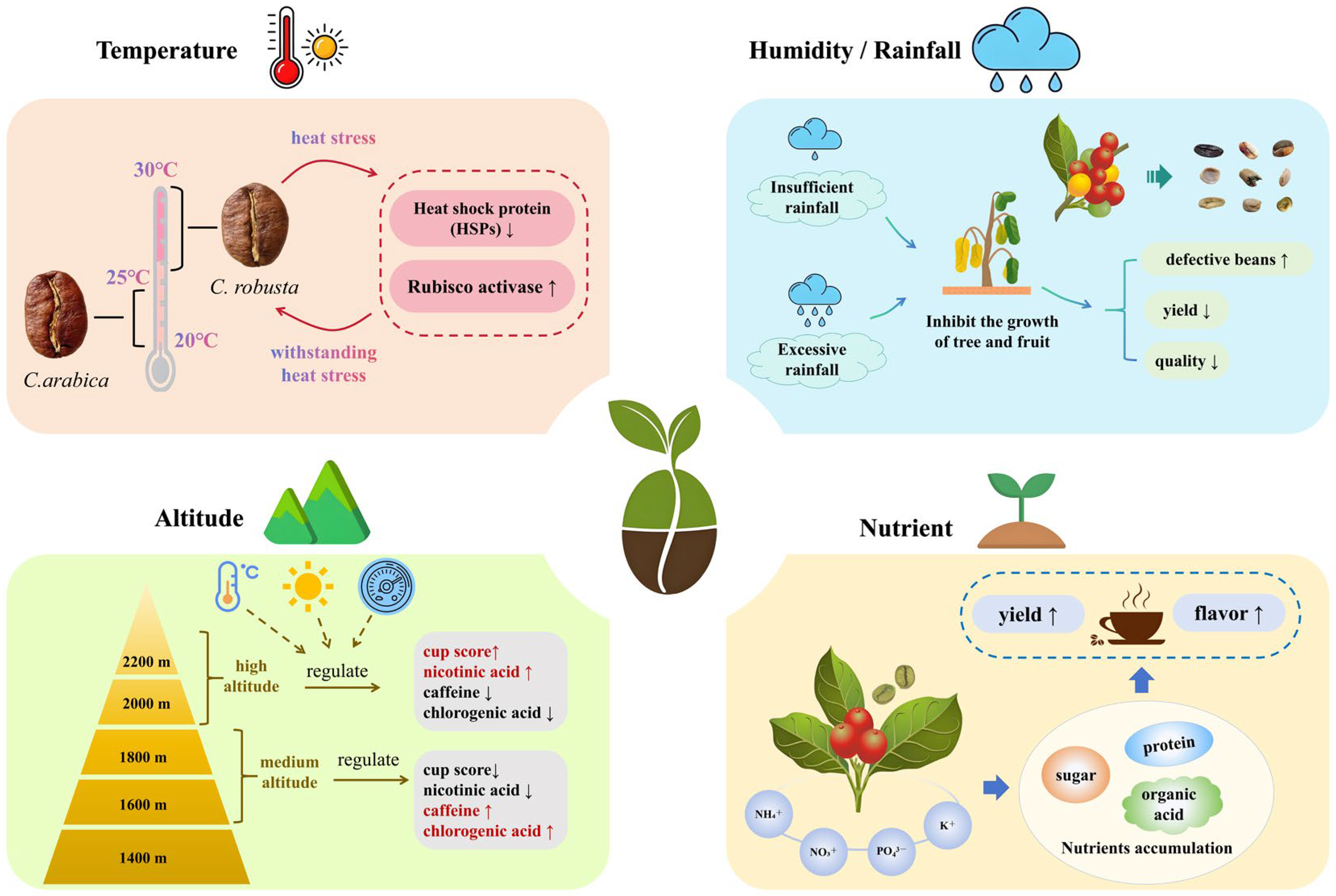
3. Ecological and Environmental Regulatory Network
3.1. Impact of Temperature
3.2. Impact of Humidity and Rainfall
3.3. Effect of Altitude
3.4. Nutrient Regulation and Its Role in Coffee Bean Development
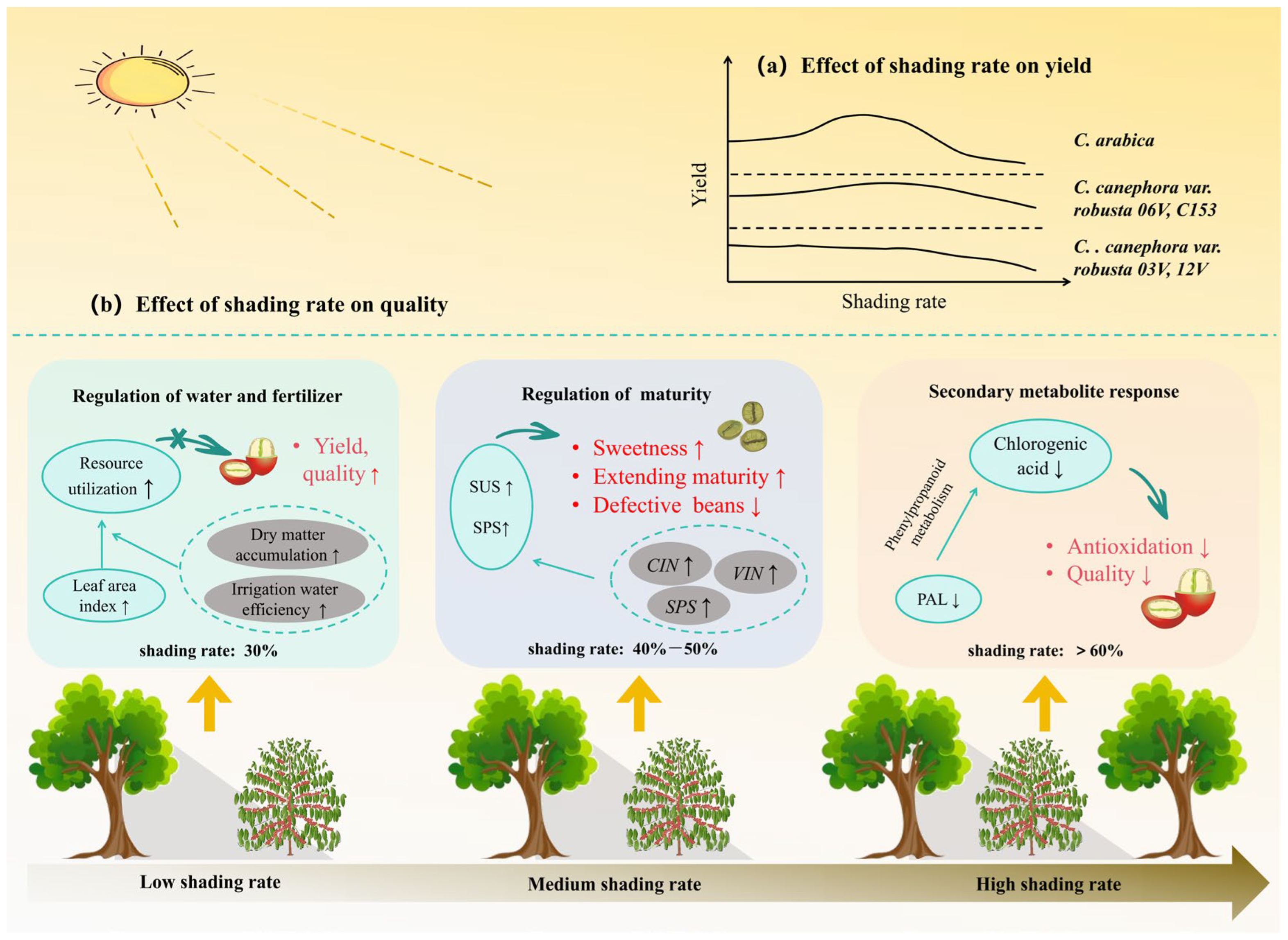
4. Multidimensional Impacts of Shading Systems
5. Postharvest Handling and Processing
5.1. The Impact of Primary Processing on Coffee Flavor
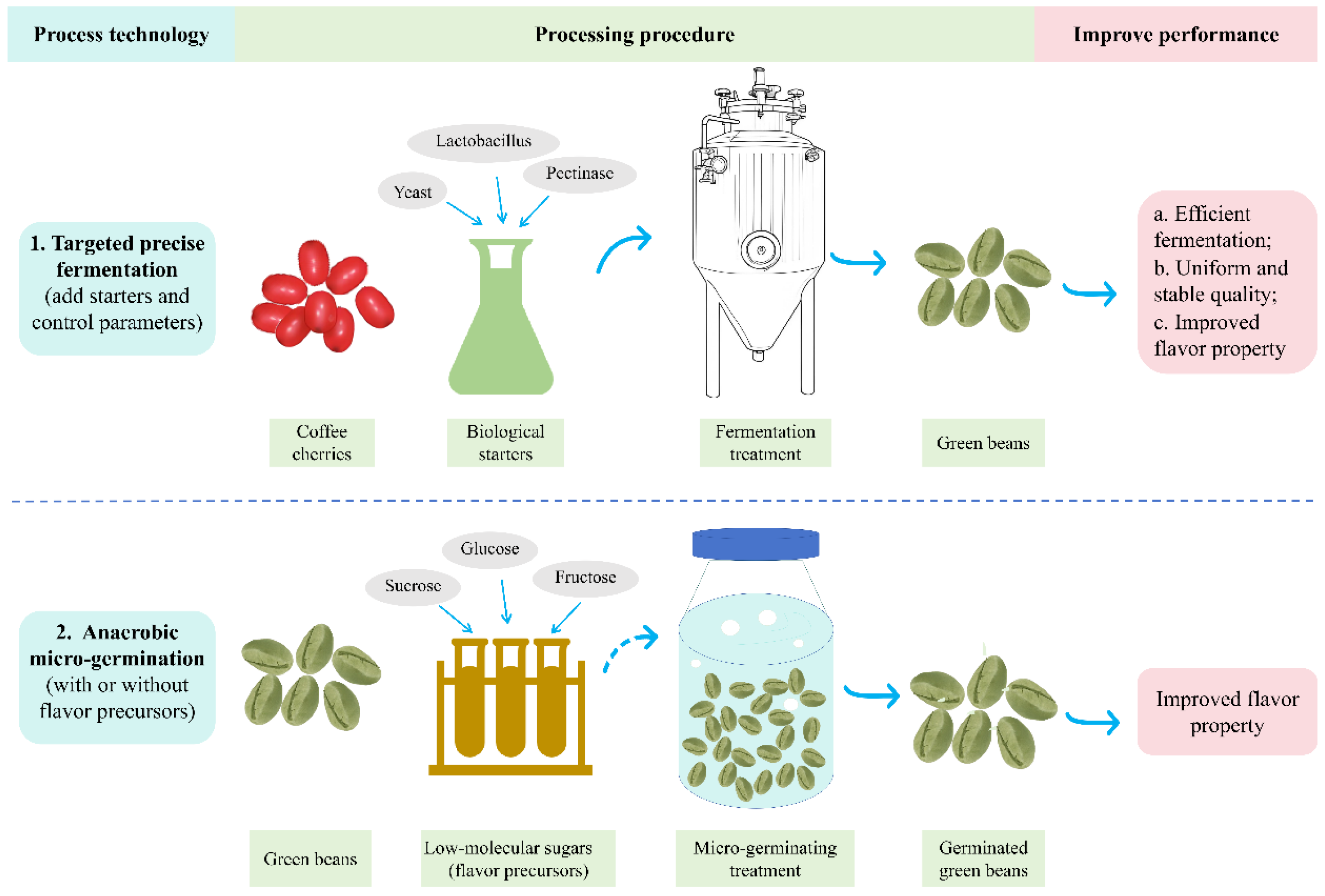
5.2. Advances in Fermentation Technologies to Improve Coffee Flavor
6. Green Coffee Bean Storage
6.1. Factors Affecting Coffee Bean Quality During Storage
6.2. Innovative Strategies for Preserving Coffee Quality During Storage
7. Conclusions
Author Contributions
Funding
Institutional Review Board Statement
Data Availability Statement
Conflicts of Interest
References
- Barreto Peixoto, J.A.; Silva, J.F.; Oliveira, M.B.P.P.; Alves, R.C. Sustainability issues along the coffee chain: From the field to the cup. Compr. Rev. Food Sci. Food Saf. 2023, 22, 287–332. [Google Scholar] [CrossRef] [PubMed]
- Wilson, A.P.; Wilson, N.L.W. The economics of quality in the specialty coffee industry: Insights from the Cup of Excellence auction programs. Agric. Econ. 2014, 45, 91–105. [Google Scholar] [CrossRef]
- Belchior, V.; Botelho, B.G.; Franca, A.S. Comparison of Spectroscopy-Based Methods and Chemometrics to Confirm Classification of Specialty Coffees. Foods 2022, 11, 1655. [Google Scholar] [CrossRef]
- Wienhold, K.; Roberts, P.W. Is the rising tide of specialty coffee lifting all boats? World Dev. 2025, 195, 107103. [Google Scholar] [CrossRef]
- Zhang, Y.; Fu, J.; Zhou, Q.; Li, F.; Shen, Y.; Ye, Z.; Tang, D.; Chi, N.; Li, L.; Ma, S.; et al. Metabolite profiling and transcriptome analysis revealed the conserved transcriptional regulation mechanism of caffeine biosynthesis in tea and coffee plants. J. Agric. Food Chem. 2022, 70, 3239–3251. [Google Scholar] [CrossRef]
- Cassamo, C.T.; Mangueze, A.V.J.; Leitão, A.E.; Pais, I.P.; Moreira, R.; Campa, C.; Chiulele, R.; Reis, F.O.; Marques, I.; Scotti-Campos, P.; et al. Shade and Altitude Implications on the Physical and Chemical Attributes of Green Coffee Beans from Gorongosa Mountain, Mozambique. Agronomy 2022, 12, 2540. [Google Scholar] [CrossRef]
- Yan, H.; Pei, X.; Zhang, H.; Li, X.; Zhang, X.; Zhao, M.; Chiang, V.L.; Sederoff, R.R.; Zhao, X. MYB-Mediated Regulation of Anthocyanin Biosynthesis. Int. J. Mol. Sci. 2021, 22, 3103. [Google Scholar] [CrossRef]
- Sun, C.; Wang, C.; Zhang, W.; Liu, S.; Wang, W.; Yu, X.; Song, T.; Yu, M.; Yu, W.; Qu, S. The R2R3-type MYB transcription factor MdMYB90-like is responsible for the enhanced skin color of an apple bud sport mutant. Hortic. Res. 2021, 8, 156. [Google Scholar] [CrossRef]
- Zhang, S.J.; De Bruyn, F.; Pothakos, V.; Contreras, G.F.; Cai, Z.; Moccand, C.; Weckx, S.; De Vuyst, L. Influence of Various Processing Parameters on the Microbial Community Dynamics, Metabolomic Profiles, and Cup Quality During Wet Coffee Processing. Front. Microbiol. 2019, 10, 2621. [Google Scholar] [CrossRef]
- Koutouleas, A.; Sarzynski, T.; Bordeaux, M.; Bosselmann, A.S.; Campa, C.; Etienne, H.; Turreira-García, N.; Rigal, C.; Vaast, P.; Ramalho, J.C.; et al. Shaded-coffee: A nature-based strategy for coffee production under climate change? A review. Front. Sustain. Food Syst. 2022, 6, 877476. [Google Scholar] [CrossRef]
- Torrez, V.; Benavides-Frias, C.; Jacobi, J.; Speranza, C.I. Ecological quality as a coffee quality enhancer. A review. Agron. Sustain. Dev. 2023, 43, 19. [Google Scholar] [CrossRef] [PubMed]
- Zhang, L.; Cao, S.; Li, J.; Wang, G. Effects of Drying Methods on the Volatile Compounds of Alliummongolicum Regel. Foods 2022, 11, 2080. [Google Scholar] [CrossRef] [PubMed]
- Merot-L’Anthoene, V.; Tournebize, R.; Darracq, O.; Rattina, V.; Lepelley, M.; Bellanger, L.; Tranchant-Dubreuil, C.; Coulée, M.; Pégard, M.; Metairon, S.; et al. Development and evaluation of a genome-wide Coffee 8.5K SNP array and its application for high-density genetic mapping and for investigating the origin of Coffea arabica L. Plant Biotechnol. J. 2019, 17, 1418–1430. [Google Scholar] [CrossRef]
- Scalabrin, S.; Magris, G.; Liva, M.; Vitulo, N.; Vidotto, M.; Scaglione, D.; Del Terra, L.; Ruosi, M.R.; Navarini, L.; Pellegrino, G.; et al. A chromosome-scale assembly reveals chromosomal aberrations and exchanges generating genetic diversity in Coffea arabica germplasm. Nat. Commun. 2024, 15, 463. [Google Scholar] [CrossRef]
- Salojärvi, J.; Rambani, A.; Yu, Z.; Guyot, R.; Strickler, S.; Lepelley, M.; Wang, C.; Rajaraman, S.; Rastas, P.; Zheng, C.; et al. The genome and population genomics of allopolyploid Coffea arabica reveal the diversification history of modern coffee cultivars. Nat. Genet. 2024, 56, 721–731. [Google Scholar] [CrossRef] [PubMed]
- Leal, J.L.; Milesi, P.; Hodková, E.; Zhou, Q.; James, J.; Eklund, D.M.; Pyhäjärvi, T.; Salojärvi, J.; Lascoux, M. Complex Polyploids: Origins, Genomic Composition, and Role of Introgressed Alleles. Syst. Biol. 2024, 73, 392–418. [Google Scholar] [CrossRef]
- Vidal, R.O.; Mondego, J.M.C.; Pot, D.; Ambrósio, A.B.; Andrade, A.C.; Pereira, L.F.P.; Colombo, C.A.; Vieira, L.G.E.; Carazzolle, M.F.; Pereira, G.A.G. A high-throughput data mining of single nucleotide polymorphisms in Coffea species expressed sequence tags suggests differential homeologous gene expression in the allotetraploid Coffea arabica. Plant Physiol. 2010, 154, 1053–1066. [Google Scholar] [CrossRef]
- Yisak, H.; Redi-Abshiro, M.; Chandravanshi, B.S. Selective determination of caffeine and trigonelline in aqueous extract of green coffee beans by FT-MIR-ATR spectroscopy. Vib. Spectrosc. 2018, 97, 33–38. [Google Scholar] [CrossRef]
- Dussert, S.; Stavrinides, A.K.; Serret, J.; Vaissayre, V.; Combes, M.-C.; Morcillo, F.; Lefort, E.; Rialle, S.; Etienne, H.; Lashermes, P.; et al. Gene coexpression network analysis of galactomannan biosynthesis and endosperm maturation in species of the genus Coffea. Plant Physiol. Biochem. 2025, 229, 110771. [Google Scholar] [CrossRef]
- Combes, M.-C.; Joët, T.; Stavrinides, A.K.; Lashermes, P. New cup out of old coffee: Contribution of parental gene expression legacy to phenotypic novelty in coffee beans of the allopolyploid Coffea arabica L. Ann. Bot. 2023, 131, 157–170. [Google Scholar] [CrossRef]
- Perrois, C.; Strickler, S.R.; Mathieu, G.; Lepelley, M.; Bedon, L.; Michaux, S.; Husson, J.; Mueller, L.; Privat, I. Differential regulation of caffeine metabolism in Coffea arabica (Arabica) and Coffea canephora (Robusta). Planta 2015, 241, 179–191. [Google Scholar] [CrossRef]
- Fabella-Garcia, J.M.A.; Kretzschmar, T.; Patel, P.; Liu, L. From green bean to brewed coffee: A Lipidomic perspective on coffee lipid composition. Food Chem. 2025, 496, 146606. [Google Scholar] [CrossRef]
- Ollennu-Chuasam, P.; Ahmed, H.; Koistinen, V.; Hanhineva, K.; Linderborg, K.M.; Suomela, J.-P. Lipophilic and Hydrophilic Metabolites as Descriptors of Different Coffee Beverages. J. Agric. Food Chem. 2024, 72, 16461–16474. [Google Scholar] [CrossRef]
- Cheng, B.; Furtado, A.; Henry, R.J. The coffee bean transcriptome explains the accumulation of the major bean components through ripening. Sci. Rep. 2018, 8, 11414. [Google Scholar] [CrossRef]
- Ivamoto, S.T.; Sakuray, L.M.; Ferreira, L.P.; Kitzberger, C.S.; Scholz, M.B.; Pot, D.; Leroy, T.; Vieira, L.G.; Domingues, D.S.; Pereira, L.F. Diterpenes biochemical profile and transcriptional analysis of cytochrome P450s genes in leaves, roots, flowers, and during Coffea arabica L. fruit development. Plant Physiol. Biochem. 2017, 111, 340–347. [Google Scholar] [CrossRef]
- Sant’Ana, G.C.; Pereira, L.F.P.; Pot, D.; Ivamoto, S.T.; Domingues, D.S.; Ferreira, R.V.; Pagiatto, N.F.; da Silva, B.S.R.; Nogueira, L.M.; Kitzberger, C.S.G.; et al. Genome-wide association study reveals candidate genes influencing lipids and diterpenes contents in Coffea arabica L. Sci. Rep. 2018, 8, 465. [Google Scholar] [CrossRef]
- Muniz, H.V.L.; Ariyoshi, C.; Ferreira, R.V.; Felicio, M.S.; Pereira, L.F.P. A new set of quantitative trait loci linked to lipid content in Coffea arabica. Crop Breed. Appl. Biotechnol. 2024, 24, e478824212. [Google Scholar] [CrossRef]
- Murai, T.; Matsuda, S. The Chemopreventive Effects of Chlorogenic Acids, Phenolic Compounds in Coffee, against Inflammation, Cancer, and Neurological Diseases. Molecules 2023, 28, 2381. [Google Scholar] [CrossRef] [PubMed]
- Sagu, S.T.; Ulbrich, N.; Morche, J.R.; Nichani, K.; Özpinar, H.; Schwarz, S.; Henze, A.; Rohn, S.; Rawel, H.M. Formation of cysteine adducts with chlorogenic acid in coffee beans. Foods 2024, 13, 1660. [Google Scholar] [CrossRef]
- Yeager, S.E.; Batali, M.E.; Guinard, J.-X.; Ristenpart, W.D. Acids in coffee: A review of sensory measurements and meta-analysis of chemical composition. Crit. Rev. Food Sci. Nutr. 2023, 63, 1010–1036. [Google Scholar] [CrossRef] [PubMed]
- Lemos, M.F.; de Andrade Salustriano, N.; de Souza Costa, M.M.; Lirio, K.; da Fonseca, A.F.A.; Pacheco, H.P.; Endringer, D.C.; Fronza, M.; Scherer, R. Chlorogenic acid and caffeine contents and anti-inflammatory and antioxidant activities of green beans of conilon and arabica coffees harvested with different degrees of maturation. J. Saudi Chem. Soc. 2022, 26, 101467. [Google Scholar] [CrossRef]
- Clifford, M.N.; Jaganath, I.B.; Ludwig, I.A.; Crozier, A. Chlorogenic acids and the acyl-quinic acids: Discovery, biosynthesis, bioavailability and bioactivity. Nat. Prod. Rep. 2017, 34, 1391–1421. [Google Scholar] [CrossRef]
- Wang, L.; Pan, X.; Jiang, L.; Chu, Y.; Gao, S.; Jiang, X.; Zhang, Y.; Chen, Y.; Luo, S.; Peng, C. The Biological Activity Mechanism of Chlorogenic Acid and Its Applications in Food Industry: A Review. Front. Nutr. 2022, 9, 943911. [Google Scholar] [CrossRef]
- Mondego, J.M.; Vidal, R.O.; Carazzolle, M.F.; Tokuda, E.K.; Parizzi, L.P.; Costa, G.G.; Pereira, L.F.; Andrade, A.C.; Colombo, C.A.; Vieira, L.G.; et al. An EST-based analysis identifies new genes and reveals distinctive gene expression features of Coffea arabica and Coffea canephora. BMC Plant Biol. 2011, 11, 30. [Google Scholar] [CrossRef] [PubMed]
- Mannino, G.; Kunz, R.; Maffei, M.E. Discrimination of Green Coffee (Coffea arabica and Coffea canephora) of Different Geographical Origin Based on Antioxidant Activity, High-Throughput Metabolomics, and DNA RFLP Fingerprinting. Antioxidants 2023, 12, 1135. [Google Scholar] [CrossRef] [PubMed]
- Bertrand, C.; Noirot, M.; Doulbeau, S.; de Kochko, A.; Hamon, S.; Campa, C. Chlorogenic acid content swap during fruit maturation in Coffea pseudozanguebariae: Qualitative comparison with leaves. Plant Sci. 2003, 165, 1355–1361. [Google Scholar] [CrossRef]
- Joët, T.; Salmona, J.; Laffargue, A.; Descroix, F.; Dussert, S. Use of the growing environment as a source of variation to identify the quantitative trait transcripts and modules of co-expressed genes that determine chlorogenic acid accumulation. Plant Cell Environ. 2010, 33, 1220–1233. [Google Scholar] [CrossRef] [PubMed]
- Denoeud, F.; Carretero-Paulet, L.; Dereeper, A.; Droc, G.; Guyot, R.; Pietrella, M.; Zheng, C.; Alberti, A.; Anthony, F.; Aprea, G.; et al. The coffee genome provides insight into the convergent evolution of caffeine biosynthesis. Science 2014, 345, 1181–1184. [Google Scholar] [CrossRef]
- Cheng, B.; Smyth, H.E.; Furtado, A.; Henry, R.J. Slower development of lower canopy beans produces better coffee. J. Exp. Bot. 2020, 71, 4201–4214. [Google Scholar] [CrossRef]
- Carvalho, F.M.; Alves, E.A.; Artêncio, M.M.; Cassago, A.L.L.; Pereira, L.L. Development of a flavour wheel for Coffea canephora using rate-all-that-apply. Sci. Rep. 2025, 15, 16643. [Google Scholar] [CrossRef]
- Zaman, S.; Shan, Z. Literature Review of Proteomics Approach Associated with Coffee. Foods 2024, 13, 1670. [Google Scholar] [CrossRef]
- Rodrigues, A.P.; Pais, I.P.; Leitão, A.E.; Dubberstein, D.; Lidon, F.C.; Marques, I.; Semedo, J.N.; Rakocevic, M.; Scotti-Campos, P.; Campostrini, E.; et al. Uncovering the wide protective responses in Coffea spp. leaves to single and superimposed exposure of warming and severe water deficit. Plant Sci. 2024, 14, 1320552. [Google Scholar] [CrossRef]
- de Oliveira, K.K.P.; de Oliveira, R.R.; Chalfun-Junior, A. Small RNAs: Promising Molecules to Tackle Climate Change Impacts in Coffee Production. Plants 2023, 12, 3531. [Google Scholar] [CrossRef] [PubMed]
- Marques, I.; Fernandes, I.; Paulo, O.S.; Batista, D.; Lidon, F.C.; Rodrigues, A.P.; Partelli, F.L.; DaMatta, F.M.; Ribeiro-Barros, A.I.; Ramalho, J.C. Transcriptomic Analyses Reveal That Coffea arabica and Coffea canephora Have More Complex Responses under Combined Heat and Drought than under Individual Stressors. Int. J. Mol. Sci. 2024, 25, 7995. [Google Scholar] [CrossRef] [PubMed]
- Ramalho, J.C.; Pais, I.P.; Leitão, A.E.; Guerra, M.; Reboredo, F.H.; Máguas, C.M.; Carvalho, M.L.; Scotti-Campos, P.; Ribeiro-Barros, A.I.; Lidon, F.J.C.; et al. Can Elevated Air [CO(2)] Conditions Mitigate the Predicted Warming Impact on the Quality of Coffee Bean? Front. Plant Sci. 2018, 9, 287. [Google Scholar] [CrossRef]
- Marques, I.; Fernandes, I.; Paulo, O.S.; Lidon, F.C.; DaMatta, F.M.; Ramalho, J.C.; Ribeiro-Barros, A.I. A Transcriptomic Approach to Understanding the Combined Impacts of Supra-Optimal Temperatures and CO2 Revealed Different Responses in the Polyploid Coffea arabica and Its Diploid Progenitor C. canephora. Int. J. Mol. Sci. 2021, 22, 3125. [Google Scholar] [CrossRef]
- Tapaça, I.d.P.E.; Mavuque, L.; Corti, R.; Pedrazzani, S.; Maquia, I.S.A.; Tongai, C.; Partelli, F.L.; Ramalho, J.C.; Marques, I.; Ribeiro-Barros, A.I. Genomic Evaluation of Coffea arabica and Its Wild Relative Coffea racemosa in Mozambique: Settling Resilience Keys for the Coffee Crop in the Context of Climate Change. Plants 2023, 12, 2044. [Google Scholar] [CrossRef]
- Bourgine, B.; Guihur, A. Heat Shock Signaling in Land Plants: From Plasma Membrane Sensing to the Transcription of Small Heat Shock Proteins. Front. Plant Sci. 2021, 12, 710801. [Google Scholar] [CrossRef]
- Hayes, S.; Schachtschabel, J.; Mishkind, M.; Munnik, T.; Arisz, S.A. Hot topic: Thermosensing in plants. Plant Cell Environ. 2021, 44, 2018–2033. [Google Scholar] [CrossRef]
- de Oliveira, R.R.; Ribeiro, T.H.C.; Cardon, C.H.; Fedenia, L.; Maia, V.A.; Barbosa, B.C.F.; Caldeira, C.F.; Klein, P.E.; Chalfun-Junior, A. Elevated Temperatures Impose Transcriptional Constraints and Elicit Intraspecific Differences Between Coffee Genotypes. Front. Plant Sci. 2020, 11, 1113. [Google Scholar] [CrossRef]
- Bertrand, B.; Boulanger, R.; Dussert, S.; Ribeyre, F.; Berthiot, L.; Descroix, F.; Joët, T. Climatic factors directly impact the volatile organic compound fingerprint in green Arabica coffee bean as well as coffee beverage quality. Food Chem. 2012, 135, 2575–2583. [Google Scholar] [CrossRef]
- Joët, T.; Laffargue, A.; Descroix, F.; Doulbeau, S.; Bertrand, B.; de Kochko, A.; Dussert, S. Influence of environmental factors, wet processing and their interactions on the biochemical composition of green Arabica coffee beans. Food Chem. 2010, 118, 693–701. [Google Scholar] [CrossRef]
- Campuzano-Duque, L.F.; Herrera, J.C.; Ged, C.; Blair, M.W. Bases for the establishment of robusta coffee (Coffea canephora) as a new crop for Colombia. Agronomy 2021, 11, 2550. [Google Scholar] [CrossRef]
- dos Santos, C.S.; de Freitas, A.F.; da Silva, G.H.B.; Carvalho, M.A.d.F.; Santos, M.d.O.; Carvalho, G.R.; Silva, V.A. Adaptations to the drought season and impacts on the yield of ‘Híbrido de Timor’ coffee tree in the Minas Gerais State Cerrado (Brazilian Savanna). Pesqui. Agropecuária Trop. 2022, 52, e72448. [Google Scholar] [CrossRef]
- Richardson, D.; Kath, J.; Byrareddy, V.M.; Monselesan, D.P.; Risbey, J.S.; Squire, D.T.; Tozer, C.R. Synchronous climate hazards pose an increasing challenge to global coffee production. PLoS Clim. 2023, 2, e0000134. [Google Scholar] [CrossRef]
- Kath, J.; Craparo, A.; Fong, Y.; Byrareddy, V.; Davis, A.P.; King, R.; Nguyen-Huy, T.; van Asten, P.J.A.; Marcussen, T.; Mushtaq, S.; et al. Vapour pressure deficit determines critical thresholds for global coffee production under climate change. Nat. Food 2022, 3, 871–880. [Google Scholar] [CrossRef] [PubMed]
- Kath, J.; Byrareddy, V.M.; Mushtaq, S.; Craparo, A.; Porcel, M. Temperature and rainfall impacts on robusta coffee bean characteristics. Clim. Risk Manag. 2021, 32, 100281. [Google Scholar] [CrossRef]
- Patil, S.; Devasia, J.; Daniel, G.; Rao, N.S.P. Influence of elevation and rainfall on leaf growth, bean characteristics and yield components of arabica and robusta coffee under changing climatic conditions in Karnataka state, India. J. Plant. Crops 2022, 50, 78–84. [Google Scholar] [CrossRef]
- Maneerat, E.; Saensano, C.; Chiarawipa, R.; Wongvarodom, V.; Teerawattanapong, P.; Rueangkhanab, M. Impact of Seasonal Weather Variations on Physical Attributes of Robusta Coffee Beans. Indian J. Agric. Res. 2024, 58, 1259–1265. [Google Scholar] [CrossRef]
- Williams, S.D.; Barkla, B.J.; Rose, T.J.; Liu, L. Does Coffee Have Terroir and How Should It Be Assessed? Foods 2022, 11, 1907. [Google Scholar] [CrossRef]
- León-Burgos, A.F.; Unigarro, C.A.; Balaguera-López, H.E. Soil Waterlogging Conditions Affect Growth, Water Status, and Chlorophyll “a” Fluorescence in Coffee Plants (Coffea arabica L.). Agronomy 2022, 12, 1270. [Google Scholar] [CrossRef]
- Lozano-Elena, F.; Fàbregas, N.; Coleto-Alcudia, V.; Caño-Delgado, A.I. Analysis of metabolic dynamics during drought stress in Arabidopsis plants. Sci. Data 2022, 9, 90. [Google Scholar] [CrossRef]
- Chekol, H.; Warkineh, B.; Shimber, T.; Mierek-Adamska, A.; Dąbrowska, G.B.; Degu, A. Drought Stress Responses in Arabica Coffee Genotypes: Physiological and Metabolic Insights. Plants 2024, 13, 828. [Google Scholar] [CrossRef] [PubMed]
- Agwanda, C.O.; Baradat, P.; Eskes, A.B.; Cilas, C.; Charrier, A. Selection for bean and liquor qualities within related hybrids of Arabica coffee in multilocal field trials. Euphytica 2003, 131, 1–14. [Google Scholar] [CrossRef]
- Decazy, F.; Avelino, J.; Guyot, B.; Perriot, J.; Pineda, C.; Cilas, C. Quality of Different Honduran Coffees in Relation to Several Environments. J. Food Sci. 2003, 68, 2356–2361. [Google Scholar] [CrossRef]
- Piato, K.; Lefort, F.; Subía, C.; Caicedo, C.; Calderón, D.; Pico, J.; Norgrove, L. Effects of shade trees on robusta coffee growth, yield and quality. A meta-analysis. Agron. Sustain. Dev. 2020, 40, 38. [Google Scholar] [CrossRef]
- Tolessa, K.; D’HEer, J.; Duchateau, L.; Boeckx, P. Influence of growing altitude, shade and harvest period on quality and biochemical composition of Ethiopian specialty coffee. J. Sci. Food Agric. 2017, 97, 2849–2857. [Google Scholar] [CrossRef]
- Worku, M.; de Meulenaer, B.; Duchateau, L.; Boeckx, P. Effect of altitude on biochemical composition and quality of green arabica coffee beans can be affected by shade and postharvest processing method. Food Res. Int. 2018, 105, 278–285. [Google Scholar] [CrossRef]
- Avelino, J.; Barboza, B.; Araya, J.C.; Fonseca, C.; Davrieux, F.; Guyot, B.; Cilas, C. Effects of slope exposure, altitude and yield on coffee quality in two altitude terroirs of Costa Rica, Orosi and Santa María de Dota. J. Sci. Food Agric. 2005, 85, 1869–1876. [Google Scholar] [CrossRef]
- Girma, B. Simultaneous determination of some biochemical contents of coffee Arabica (Coffea arabica L.) varieties and correlation with organoleptic cup quality in contrasting altitudes in southwest Ethiopia. Food Sci. Qual. Manag. 2020, 93, 22–33. [Google Scholar] [CrossRef]
- Ahmed, S.; Brinkley, S.; Smith, E.; Sela, A.; Theisen, M.; Thibodeau, C.; Warne, T.; Anderson, E.; Van Dusen, N.; Giuliano, P.; et al. Climate Change and Coffee Quality: Systematic Review on the Effects of Environmental and Management Variation on Secondary Metabolites and Sensory Attributes of Coffea arabica and Coffea canephora. Front. Plant Sci. 2021, 12, 708013. [Google Scholar] [CrossRef]
- Getachew, M.; Tolassa, K.; De Frenne, P.; Verheyen, K.; Tack, A.J.; Hylander, K.; Ayalew, B.; Boeckx, P. The relationship between elevation, soil temperatures, soil chemical characteristics, and green coffee bean quality and biochemistry in southwest Ethiopia. Agron. Sustain. Dev. 2022, 42, 61. [Google Scholar] [CrossRef]
- de León-Solis, C.; Casasola, V.; Monterroso, T. Metabolomics as a tool for geographic origin assessment of roasted and green coffee beans. Heliyon 2023, 9, e21402. [Google Scholar] [CrossRef]
- Diego, E.R.; Flavio, M.B.; Marcelo, A.C.; Mariele, V.B.P.; Vany, P.F.; Helena, M.R.A.; Jose, H.d.S.T. Interaction of genotype, environment and processing in the chemical composition expression and sensorial quality of Arabica coffee. Afr. J. Agric. Res. 2016, 11, 2412–2422. [Google Scholar] [CrossRef]
- Soares Ferreira, D.; Eduardo da Silva Oliveira, M.; Rodrigues Ribeiro, W.; Altoé Filete, C.; Toledo Castanheira, D.; Cesar Pereira Rocha, B.; Polonini Moreli, A.; Catarina da Silva Oliveira, E.; Carvalho Guarçoni, R.; Partelli, F.L.; et al. Association of Altitude and Solar Radiation to Understand Coffee Quality. Agronomy 2022, 12, 1885. [Google Scholar] [CrossRef]
- Li, R.; Cheng, J.; Liu, X.; Wang, Z.; Li, H.; Guo, J.; Wang, H.; Cui, N.; Zhao, L. Optimizing drip fertigation at different periods to improve yield, volatile compounds and cup quality of Arabica coffee. Front. Plant Sci. 2023, 14, 1148616. [Google Scholar] [CrossRef] [PubMed]
- Salamanca-Jimenez, A.; Doane, T.A.; Horwath, W.R. Nitrogen Use Efficiency of Coffee at the Vegetative Stage as Influenced by Fertilizer Application Method. Front. Plant Sci. 2017, 8, 223. [Google Scholar] [CrossRef]
- Bruno, I.P.; Unkovich, M.J.; Bortolotto, R.P.; Bacchi, O.O.; Dourado-Neto, D.; Reichardt, K. Fertilizer nitrogen in fertigated coffee crop: Absorption changes in plant compartments over time. Field Crops Res. 2011, 124, 369–377. [Google Scholar] [CrossRef]
- Cannavo, P.; Harmand, J.-M.; Zeller, B.; Vaast, P.; Ramírez, J.E.; Dambrine, E. Low nitrogen use efficiency and high nitrate leaching in a highly fertilized Coffea arabica–Inga densiflora agroforestry system: A 15N labeled fertilizer study. Nutr. Cycl. Agroecosystems 2013, 95, 377–394. [Google Scholar] [CrossRef]
- Sadeghian-Khalajabadi, S.; Acuña-Zornosa, J.-R.; Salazar-Gutiérrez, L.-F.; Rey-Sandoval, J.-C. Determinants of nitrogen use efficiency in coffee crops. A review. Rev. Cienc. Agrícolas 2022, 39, 198–219. [Google Scholar] [CrossRef]
- Ramirez-Builes, V.H.; Küsters, J.; Thiele, E.; Lopez-Ruiz, J.C. Physiological and Agronomical Response of Coffee to Different Nitrogen Forms with and without Water Stress. Plants 2024, 13, 1387. [Google Scholar] [CrossRef] [PubMed]
- Vinecky, F.; Davrieux, F.; Mera, A.C.; Alves, G.S.C.; Lavagnini, G.; Leroy, T.; Bonnot, F.; Rocha, O.C.; Bartholo, G.F.; Guerra, A.F.; et al. Controlled irrigation and nitrogen, phosphorous and potassium fertilization affect the biochemical composition and quality of Arabica coffee beans. J. Agric. Sci. 2017, 155, 902–918. [Google Scholar] [CrossRef]
- Nascimento, M.O.; Celestino, S.M.C.; Veiga, A.D.; de Jesus, B.D.A.; Oliveira, L.d.L.d. Quality of Arabica coffee grown in Brazilian Savannah and impact of potassium sources. Food Res. Int. 2024, 188, 114500. [Google Scholar] [CrossRef]
- Oliveira, L.d.L.d.; Nascimento, M.O.; Celestino, S.M.C. Integrating optimized descriptive profile, consumer acceptance, and textual analysis to assess coffee beverage quality: Exploring potassium fertilization in Brazil’s Central Plateau. Food Res. Int. 2025, 212, 116525. [Google Scholar] [CrossRef]
- Valadares, S.V.; Neves, J.C.L.; Novais, R.F.; Rosa, G.N.G.P.; Martinez, H.E.P.; V. Alvarez, V.H. Yield gains of coffee plants from phosphorus Fertilization may not be generalized for high density planting. Rev. Bras. Ciência Solo 2014, 38, 905. [Google Scholar] [CrossRef][Green Version]
- Cassiolato, A.M. Chemical and biological properties of phosphorus-fertilized soil under legume and grass cover (Cerrado Region, Brazil). Rev. Bras. Ciência Solo 2013, 37, 1492. [Google Scholar] [CrossRef]
- dos Santos, M.M.; da Silva, C.A.; Oza, E.F.; Gontijo, I.; Amaral, J.F.T.D.; Partelli, F.L. Concentration of Nutrients in Leaves, Flowers, and Fruits of Genotypes of Coffea canephora. Plants 2021, 10, 2661. [Google Scholar] [CrossRef]
- Rodrigues, M.J.L.; da Silva, C.A.; Braun, H.; Partelli, F.L. Nutritional Balance and Genetic Diversity of Coffea canephora Genotypes. Plants 2023, 12, 1451. [Google Scholar] [CrossRef]
- de Sousa, G.F.; Silva, M.A.; de Carvalho, M.R.; de Morais, E.G.; Benevenute, P.A.N.; Van Opbergen, G.A.Z.; Van Opbergen, G.G.A.Z.; Guilherme, L.R.G. Foliar Selenium Application to Reduce the Induced-Drought Stress Effects in Coffee Seedlings: Induced Priming or Alleviation Effect? Plants 2023, 12, 3026. [Google Scholar] [CrossRef]
- Geromel, C.; Ferreira, L.P.; Davrieux, F.; Guyot, B.; Ribeyre, F.; Scholz, M.B.d.S.; Pereira, L.F.P.; Vaast, P.; Pot, D.; Leroy, T.; et al. Effects of shade on the development and sugar metabolism of coffee (Coffea arabica L.) fruits. Plant Physiol. Biochem. 2008, 46, 569–579. [Google Scholar] [CrossRef]
- Bosselmann, A.S.; Dons, K.; Oberthur, T.; Olsen, C.S.; Ræbild, A.; Usma, H. The influence of shade trees on coffee quality in small holder coffee agroforestry systems in Southern Colombia. Agric. Ecosyst. Environ. 2009, 129, 253–260. [Google Scholar] [CrossRef]
- Haggar, J.; Casanoves, F.; Cerda, R.; Cerretelli, S.; Gonzalez-Mollinedo, S.; Lanza, G.; Lopez, E.; Leiva, B.; Ospina, A. Shade and agronomic intensification in coffee agroforestry systems: Trade-off or synergy? Front. Sustain. Food Syst. 2021, 5, 645958. [Google Scholar] [CrossRef]
- Avelino, J.; Vílchez, S.; Segura-Escobar, M.; Brenes-Loaiza, M.; Filho, E.d.M.V.; Casanoves, F. Shade tree Chloroleucon eurycyclum promotes coffee leaf rust by reducing uredospore wash-off by rain. Crop Prot. 2020, 129, 105038. [Google Scholar] [CrossRef]
- Hao, K.; Liu, X.; Wang, X.; Fei, L.; Liu, L.; Jie, F.; Li, Y.; Yang, Q.; Shan, Y. Optimizing Shade Cultivation Method and Irrigation Amount to Improve Photosynthetic Characteristics, Bean Yield, and Quality of Coffee in a Subtropical Monsoon Climate. Front. Plant Sci. 2022, 13, 848524. [Google Scholar] [CrossRef] [PubMed]
- Martins, S.C.V.; Araújo, W.L.; Tohge, T.; Fernie, A.R.; DaMatta, F.M. In high-light-acclimated coffee plants the metabolic machinery is adjusted to avoid oxidative stress rather than to benefit from extra light enhancement in photosynthetic yield. PLoS ONE 2014, 9, e94862. [Google Scholar] [CrossRef] [PubMed]
- Campa, C.; Urban, L.; Mondolot, L.; Fabre, D.; Roques, S.; Lizzi, Y.; Aarrouf, J.; Doulbeau, S.; Breitler, J.-C.; Letrez, C.; et al. Juvenile Coffee Leaves Acclimated to Low Light Are Unable to Cope with a Moderate Light Increase. Front. Plant Sci. 2017, 8, 1126. [Google Scholar] [CrossRef]
- Sarzynski, T.; Bertrand, B.; Rigal, C.; Marraccini, P.; Vaast, P.; Georget, F.; Campa, C.; Abdallah, C.; Nguyen, C.T.Q.; Nguyen, H.P.; et al. Genetic-environment interactions and climatic variables effect on bean physical characteristics and chemical composition of Coffea arabica. J. Sci. Food Agric. 2023, 103, 4692–4703. [Google Scholar] [CrossRef]
- Venancio, L.P.; Amaral, J.F.T.D.; Cavatte, P.C.; Vargas, C.T.; Dos Reis, E.F.; Dias, J.R. Vegetative growth and yield of robusta coffee genotypes cultivated under different shading levels. Biosci. J. 2019, 35, 1490–1503. [Google Scholar] [CrossRef]
- Hameed, A.; Hussain, S.A.; Ijaz, M.U.; Ullah, S.; Pasha, I.; Suleria, H.A.R. Farm to consumer: Factors affecting the organoleptic characteristics of coffee. II: Postharvest processing factors. Compr. Rev. Food Sci. Food Saf. 2018, 17, 1184–1237. [Google Scholar] [CrossRef]
- Freitas, V.V.; Borges, L.L.R.; Vidigal, M.C.T.R.; dos Santos, M.H.; Stringheta, P.C. Coffee: A comprehensive overview of origin, market, and the quality process. Trends Food Sci. Technol. 2024, 146, 104411. [Google Scholar] [CrossRef]
- Bastian, F.; Hutabarat, O.S.; Dirpan, A.; Nainu, F.; Harapan, H.; Bin Emran, T.; Simal-Gandara, J. From Plantation to Cup: Changes in Bioactive Compounds during Coffee Processing. Foods 2021, 10, 2827. [Google Scholar] [CrossRef]
- Munyendo, L.M.; Njoroge, D.M.; Owaga, E.E.; Mugendi, B. Coffee phytochemicals and post-harvest handling—A complex and delicate balance. J. Food Compos. Anal. 2021, 102, 103995. [Google Scholar] [CrossRef]
- Hall, R.D.; Trevisan, F.; de Vos, R.C. Coffee berry and green bean chemistry—Opportunities for improving cup quality and crop circularity. Food Res. Int. 2022, 151, 110825. [Google Scholar] [CrossRef] [PubMed]
- Febrianto, N.A.; Zhu, F. Coffee bean processing: Emerging methods and their effects on chemical, biological and sensory properties. Food Chem. 2023, 412, 135489. [Google Scholar] [CrossRef] [PubMed]
- Pereira, G.V.d.M.; Neto, D.P.d.C.; Júnior, A.I.M.; Vásquez, Z.S.; Medeiros, A.B.; Vandenberghe, L.P.; Soccol, C.R. Exploring the impacts of postharvest processing on the aroma formation of coffee beans—A review. Food Chem. 2019, 272, 441–452. [Google Scholar] [CrossRef]
- Bi, X.; Yu, H.; Hu, F.; Fu, X.; Li, Y.; Li, Y.; Yang, Y.; Liu, D.; Li, G.; Shi, R.; et al. A Systematic Analysis of the Correlation between Flavor Active Differential Metabolites and Multiple Bean Ripening Stages of Coffea arabica L. Molecules 2023, 29, 180. [Google Scholar] [CrossRef] [PubMed]
- Wang, H.; Wang, Y.; Li, Y.; Zhao, W.; Pang, J.; Liang, W. Accumulation of flavor precursors and markers belonging to different primary processing Coffea arabica beans. Food Chem. 2025, 495, 146610. [Google Scholar] [CrossRef]
- Kim, J.S.; Pak, J.; Choi, J.; Park, S.E.; Bae, S.; Cho, H.; Kwak, S.; Son, H.S. Factors influencing metabolite profiles in global Arabica green coffee beans: Impact of continent, altitude, post-harvest processing, and variety. Food Res. Int. 2025, 208, 116187. [Google Scholar] [CrossRef]
- Zhai, H.; Dong, W.; Fu, X.; Li, G.; Hu, F. Integration of widely targeted metabolomics and the e-tongue reveals the chemical variation and taste quality of Yunnan Arabica coffee prepared using different primary processing methods. Food Chem. X 2024, 22, 101286. [Google Scholar] [CrossRef]
- Wang, Y.; Wang, X.; Du, P.; Liu, X.; He, S.; Li, L.; Liu, X.; Chen, Z. Lipidomic profiling provides insights on Arabica coffee flavor diversity in different postharvest processing methods. Curr. Res. Food Sci. 2025, 10, 101108. [Google Scholar] [CrossRef]
- Santanatoglia, A.; Caprioli, G.; Ricciutelli, M.; Vittori, S.; Angeloni, S. Quantification of two derivatives of malic acid first-time discovered in coffee: Influence of postharvest processing method. Food Chem. 2024, 460, 140644. [Google Scholar] [CrossRef] [PubMed]
- Ferreira, L.J.C.; Gomes, M.d.S.; de Oliveira, L.M.; Santos, L.D. Coffee fermentation process: A review. Food Res. Int. 2023, 169, 112793. [Google Scholar] [CrossRef]
- Madrid-Restrepo, M.A.; León-Inga, A.M.; Peñuela-Martínez, A.E.; Cala, M.P.; Reyes, A. Metagenomic, metabolomic, and sensorial characteristics of fermented Coffea arabica L. var. Castillo beans inoculated with microbial starter cultures. mSystems 2026, 11, e0136425. [Google Scholar] [CrossRef]
- Silva, L.C.F.; Pereira, P.V.R.; da Cruz, M.A.D.; Costa, G.X.R.; Rocha, R.A.R.; Bertarini, P.L.L.; Amaral, L.R.D.; Gomes, M.S.; Santos, L.D. Enhancing Sensory Quality of Coffee: The Impact of Fermentation Techniques on Coffea arabica cv. Catiguá MG2. Foods 2024, 13, 653. [Google Scholar] [CrossRef]
- Elhalis, H.; Cox, J.; Frank, D.; Zhao, J. The role of wet fermentation in enhancing coffee flavor, aroma and sensory quality. Eur. Food Res. Technol. 2021, 247, 485–498. [Google Scholar] [CrossRef]
- Bressani, A.P.P.; Batista, N.N.; Ferreira, G.; Martinez, S.J.; Simão, J.B.P.; Dias, D.R.; Schwan, R.F. Characterization of bioactive, chemical, and sensory compounds from fermented coffees with different yeasts species. Food Res. Int. 2021, 150, 110755. [Google Scholar] [CrossRef]
- Elhalis, H.; Cox, J.; Frank, D.; Zhao, J. Microbiological and biochemical performances of six yeast species as potential starter cultures for wet fermentation of coffee beans. LWT 2021, 137, 110430. [Google Scholar] [CrossRef]
- Ribeiro, L.S.; Miguel, M.G.d.C.P.; Martinez, S.J.; Bressani, A.P.P.; Evangelista, S.R.; e Batista, C.F.S.; Schwan, R.F. The use of mesophilic and lactic acid bacteria strains as starter cultures for improvement of coffee beans wet fermentation. World J. Microbiol. Biotechnol. 2020, 36, 186. [Google Scholar] [CrossRef] [PubMed]
- Ngamnok, T.; Nimlamool, W.; Amador-Noguez, D.; Palaga, T.; Meerak, J. Efficiency of Lactiplantibacillus plantarum JT-PN39 and Paenibacillus motobuensis JT-A29 for Fermented Coffee Applications and Fermented Coffee Characteristics. Foods 2023, 12, 2894. [Google Scholar] [CrossRef]
- Revelo-Romo, D.M.; Gutiérrez, N.H.H.; Troya, A.H.; Amaya-Gómez, C.V.; Flórez-Martínez, D.H.; Overmann, J.; Torres, M.F.V.; Barrios, A.F.G. Omics approaches to explore the coffee fermentation microecosystem and its effects on cup quality. Food Res. Int. 2025, 206, 116035. [Google Scholar] [CrossRef]
- Oumer, O.J.; Abate, D. Characterization of Pectinase from Bacillus subtilis Strain Btk 27 and Its Potential Application in Removal of Mucilage from Coffee Beans. Enzym. Res. 2017, 2017, 7686904. [Google Scholar] [CrossRef]
- Murthy, P.S.; Basavaraj, K.; Kusumoto, K.I. Modulation of coffee flavor precursors by Aspergillus oryzae serine carboxypeptidases. LWT 2019, 113, 108312. [Google Scholar] [CrossRef]
- Martinez, S.J.; Rabelo, M.H.S.; Bressani, A.P.P.; Da Mota, M.C.B.; Borém, F.M.; Schwan, R.F. Novel stainless steel tanks enhances coffee fermentation quality. Food Res. Int. 2021, 139, 109921. [Google Scholar] [CrossRef]
- de Carvalho Neto, D.P.; de Melo Pereira, G.V.; Finco, A.M.O.; Letti, L.A.J.; da Silva, B.J.G.; Vandenberghe, L.P.S.; Soccol, C.R. Efficient coffee beans mucilage layer removal using lactic acid fermentation in a stirred-tank bioreactor: Kinetic, metabolic and sensorial studies. Food Biosci. 2018, 26, 80–87. [Google Scholar] [CrossRef]
- Wang, Y.; Wang, X.; Hu, G.; Al-Romaima, A.; Peng, X.; Li, J.; Bai, X.; Li, Z.; Qiu, M. Anaerobic germination of green coffee beans: A novel strategy to improve the quality of commercial Arabica coffee. Curr. Res. Food Sci. 2023, 6, 100461. [Google Scholar] [CrossRef] [PubMed]
- Wang, Y.; Wang, X.; Quan, C.; Al-Romaima, A.; Hu, G.; Peng, X.; Qiu, M. Optimizing commercial Arabica coffee quality by integrating flavor precursors with anaerobic germination strategy. Food Chem. X 2024, 23, 101684. [Google Scholar] [CrossRef]
- Moon, S.A.; Wongsakul, S.; Kitazawa, H.; Saengrayap, R. Lipid Oxidation Changes of Arabica Green Coffee Beans during Accelerated Storage with Different Packaging Types. Foods 2022, 11, 3040. [Google Scholar] [CrossRef]
- Borém, F.M.; Ribeiro, F.C.; Figueiredo, L.P.; Giomo, G.S.; Siqueira, V.C.; Dias, C.A. Sensory analysis and fatty acid profile of specialty coffees stored in different packages. J. Food Sci. Technol. 2019, 56, 4101–4109. [Google Scholar] [CrossRef]
- Cong, S.; Dong, W.; Zhao, J.; Hu, R.; Long, Y.; Chi, X. Characterization of the Lipid Oxidation Process of Robusta Green Coffee Beans and Shelf Life Prediction during Accelerated Storage. Molecules 2020, 25, 1157. [Google Scholar] [CrossRef] [PubMed]
- Alabdalall, A.H. Gas chromatography-mass spectrometry analysis of fatty acids in healthy and Aspergillus niger MH078571.1-infected Arabica coffee beans. PLoS ONE 2024, 19, e0293369. [Google Scholar] [CrossRef]
- Ben Miri, Y.; Nouasri, A.; Benabdallah, A.; Benslama, A.; Tacer-Caba, Z.; Laassami, A.; Djenane, D.; Simal-Gandara, J. Antifungal effects of selected menthol and eugenol in vapors on green coffee beans during long-term storage. Heliyon 2023, 9, e18138. [Google Scholar] [CrossRef] [PubMed]
- Iversen, L.J.L.; Rovina, K.; Vonnie, J.M.; Matanjun, P.; Erna, K.H.; Aqilah, N.M.N.; Felicia, W.X.L.; Funk, A.A. The Emergence of Edible and Food-Application Coatings for Food Packaging: A Review. Molecules 2022, 27, 5604. [Google Scholar] [CrossRef]
- Moon, S.A.; Wongsakul, S.; Kitazawa, H.; Kittiwachana, S.; Saengrayap, R. Application of ATR-FTIR for Green Arabica Bean Shelf-Life Determination in Accelerated Storage. Foods 2024, 13, 2331. [Google Scholar] [CrossRef]
- Pazmiño-Arteaga, J.; Gallardo, C.; González-Rodríguez, T.; Winkler, R. Loss of Sensory Cup Quality: Physiological and Chemical Changes during Green Coffee Storage. Plant Foods Hum. Nutr. 2022, 77, 1–11. [Google Scholar] [CrossRef]
- Al Attiya, W.; Hassan, Z.U.; Al-Thani, R.; Jaoua, S. Prevalence of toxigenic fungi and mycotoxins in Arabic coffee (Coffea arabica): Protective role of traditional coffee roasting, brewing and bacterial volatiles. PLoS ONE 2021, 16, e0259302. [Google Scholar] [CrossRef]
- Bessaire, T.; Perrin, I.; Tarres, A.; Bebius, A.; Reding, F.; Theurillat, V. Mycotoxins in green coffee: Occurrence and risk assessment. Food Control 2019, 96, 59–67. [Google Scholar] [CrossRef]
- López-Rodríguez, C.; Verheecke-Vaessen, C.; Strub, C.; Fontana, A.; Schorr-Galindo, S.; Medina, A. Reduction in ochratoxin A occurrence in coffee: From good practices to biocontrol agents. J. Fungi 2024, 10, 590. [Google Scholar] [CrossRef]
- Codex Alimentarius Commission. Code of practice for the prevention and reduction of ochratoxin A contamination in coffee. In Codex Alimentarius; CAC/RCP 69-2009; FAO: Rome, Italy; WHO: Geneva, Switzerland, 2009; pp. 1–17. [Google Scholar]
- de Abreu, D.J.M.; Lorenço, M.S.; Machado, G.G.L.; Silva, J.M.; de Azevedo, E.C.; Carvalho, E.E.N. Influence of Drying Methods on the Post-Harvest Quality of Coffee: Effects on Physicochemical, Sensory, and Microbiological Composition. Foods 2025, 14, 1463. [Google Scholar] [CrossRef] [PubMed]
- Tripetch, P.; Borompichaichartkul, C. Effect of packaging materials and storage time on changes of colour, phenolic content, chlorogenic acid and antioxidant activity in arabica green coffee beans (Coffea arabica L. cv. Catimor). J. Stored Prod. Res. 2019, 84, 101510. [Google Scholar] [CrossRef]
- Zarebska, M.; Stanek, N.; Barabosz, K.; Jaszkiewicz, A.; Kulesza, R.; Matejuk, R.; Andrzejewski, D.; Biłos, Ł.; Porada, A. Comparison of chemical compounds and their influence on the taste of coffee depending on green beans storage conditions. Sci. Rep. 2022, 12, 2674. [Google Scholar] [CrossRef]
- Abreu, G.F.; Borém, F.M.; Oliveira, L.F.C.; Almeida, M.R.; Alves, A.P.C. Raman spectroscopy: A new strategy for monitoring the quality of green coffee beans during storage. Food Chem. 2019, 287, 241–248. [Google Scholar] [CrossRef] [PubMed]
- Murmu, S.B.; Nayak, L.K.; Lakshmanan, A.; Baite, H.; Nayak, D.; Biswas, P. Improved food storage in jute packaging: An assessment of the current uses, constraints, and functional enhancements of jute bags and the potential of nonconventional jute-based paper packaging. J. Food Sci. Technol. 2025, 62, 1199–1212. [Google Scholar] [CrossRef] [PubMed]
- Ferreira, L.F.; Figueiredo, L.P.; Martins, M.A.; Luvizaro, L.B.; de Blara, B.R.B.; de Oliveira, C.R.; Júnior, M.G.; Tonoli, G.H.; Dias, M.V. Active coatings of thermoplastic starch and chitosan with alpha-tocopherol/bentonite for special green coffee beans. Int. J. Biol. Macromol. 2021, 170, 810–819. [Google Scholar] [CrossRef]
- Ribeiro, F.C.; Borém, F.M.; Giomo, G.S.; De Lima, R.R.; Malta, M.R.; Figueiredo, L.P. Storage of green coffee in hermetic packaging injected with CO2. J. Stored Prod. Res. 2011, 47, 341–348. [Google Scholar] [CrossRef]
- Arango, F.O.D.; Mejía, L.F.; Agatón, L. Evaluation of high barrier film for storage of coffee modified atmospheres. Vitae 2016, 23, S304–S309. [Google Scholar]
- Lopez-Garcia, R.C.; Mallmann, C.A.; Pineiro, M. Design and implementation of an integrated management system for ochratoxin A in the coffee production chain. Food Addit. Contam. Part A 2008, 25, 231–240. [Google Scholar] [CrossRef]
- Vieira, T.; Cunha, S.; Casal, S. Mycotoxins in coffee. In Coffee in Health and Disease Prevention; Academic Press: San Diego, CA, USA, 2015; pp. 225–233. [Google Scholar] [CrossRef]
- Commission, E. Commission Regulation (EC) 2023/915 of 25 April 2023 on maximum levels for certain contaminants in food and repealing regulation (EC) No 1881/2006. J. Eur. Union 2023, 119, 103–157. [Google Scholar]
- Moez, E.; Noel, D.; Brice, S.; Benjamin, G.; Pascaline, A.; Didier, M. Aptamer assisted ultrafiltration cleanup with high performance liquid chromatography-fluorescence detector for the determination of OTA in green coffee. Food Chem. 2020, 310, 125851. [Google Scholar] [CrossRef]
- Campone, L.; Piccinelli, A.L.; Celano, R.; Pagano, I.; Russo, M.; Rastrelli, L. Rapid and automated on-line solid phase extraction HPLC–MS/MS with peak focusing for the determination of ochratoxin A in wine samples. Food Chem. 2018, 244, 128–135. [Google Scholar] [CrossRef]
- Alhamoud, Y.; Yang, D.; Kenston, S.S.F.; Liu, G.; Liu, L.; Zhou, H.; Ahmed, F.; Zhao, J. Advances in biosensors for the detection of ochratoxin A: Bio-receptors, nanomaterials, and their applications. Biosens. Bioelectron. 2019, 141, 111418. [Google Scholar] [CrossRef] [PubMed]
- Wu, S.W.; Tai, W.H.; Hsieh, C.Y.; Liu, B.H.; Yu, F.Y. Novel bispecific monoclonal antibody-based dual-analyte immunochromatographic strip for the detection of aflatoxin B1 and ochratoxin A in cereal samples. Food Chem. 2025, 487, 144762. [Google Scholar] [CrossRef]
- Chen, G.; Chen, X.; Xu, G.; Wei, X.; Lin, X.; Su, Y.; Xiong, Y.; Huang, X. Ultrabright orange-yellow aggregation-induced emission nanoparticles for highly sensitive immunochromatographic quantification of ochratoxin A in corn. Food Chem. 2023, 412, 135580. [Google Scholar] [CrossRef] [PubMed]
- Argoubi, W.; Algethami, F.K.; Raouafi, N. Enhanced sensitivity in electrochemical detection of ochratoxin A within food samples using ferrocene- and aptamer-tethered gold nanoparticles on disposable electrodes. RSC Adv. 2024, 14, 8007–8015. [Google Scholar] [CrossRef] [PubMed]
- Ferreira, L.F.; de Abreu, G.F.; Lago, A.M.T.; Figueiredo, L.P.; Borém, F.M.; Martins, M.A.; Borges, S.V.; Dias, M.V. Development and application of biopolymer coatings to specialty green coffee beans: Influence on water content, color and sensory quality. LWT 2018, 96, 274–280. [Google Scholar] [CrossRef]
- Lee, H.; Ryu, J.-H.; Kim, H. Antimicrobial activity of gaseous chlorine dioxide against Aspergillus flavus on green coffee beans. Food Microbiol. 2020, 86, 103308. [Google Scholar] [CrossRef] [PubMed]
- Lee, H.; Kim, N.; Ryu, J.-H.; Kim, H. Inactivation of Aspergillus flavus on green coffee beans by treatments with organic acid vapor. Food Control 2024, 160, 110322. [Google Scholar] [CrossRef]
- Rojas-Pablo, M.; Toledo-Hernández, E.; Rodríguez-Barrera, M.A.; Toribio-Jiménez, J.; Torreblanca-Ramírez, C.; Rosas-Guerrero, V.M.; Salgado-Souto, S.A.; Álvarez-Fitz, P.; Bolaños-Dircio, A.; Romero-Ramírez, Y. Bacillus licheniformis M2-7 Decreases Ochratoxin A Concentrations in Coffee Beans During Storage. Curr. Microbiol. 2024, 81, 62. [Google Scholar] [CrossRef]
- Rodríguez, C.L.; Strub, C.; Fontana, A.; Verheecke-Vaessen, C.; Durand, N.; Beugré, C.; Guehi, T.; Medina, A.; Schorr-Galindo, S. Biocontrol activities of yeasts or lactic acid bacteria isolated from Robusta coffee against Aspergillus carbonarius growth and ochratoxin A production in vitro. Int. J. Food Microbiol. 2024, 415, 110638. [Google Scholar] [CrossRef]
- Matias, G.C.; Borém, F.M.; Alves, A.P.C.; Haeberlin, L.; DOS Santos, C.M.; DE Andrade, E.T. Impact of initial sensory quality of specialty natural coffee during storage. An. Acad. Bras. Cienc. 2025, 97, e20241042. [Google Scholar] [CrossRef]
- Tolessa, K.; Rademaker, M.; De Baets, B.; Boeckx, P. Prediction of specialty coffee cup quality based on near infrared spectra of green coffee beans. Talanta 2016, 150, 367–374. [Google Scholar] [CrossRef]
- Borém, F.M.; de Abreu, G.F.; Ferreira, A.G.; Santos, M.d.S.; Alves, T.d.C.; Alves, A.P.d.C. 1 H NMR spectroscopy applied to identify chemical aging markers in green coffee (Coffea arabica L.). Food Chem. 2023, 405, 134667. [Google Scholar] [CrossRef] [PubMed]
- So, Y.; Lin, P.; Ho, L.; Lee, K.; Lin, C.; Wang, L.; Liou, B.; Ho, J.A. Interaction statistical analysis of instrumental and sensory data for Ethiopian Yirgacheffe coffee: Unveiling quality control metrics and optimal storage conditions. J. Food Sci. 2025, 90, e70275. [Google Scholar] [CrossRef] [PubMed]



| Types of Technique | New Techniques/ Materials | Technical Features | Type of Coffee Beans | Beneficial Effects | References |
|---|---|---|---|---|---|
| Packaging | High density polyethylene (HDPE) bag | Excellent barrier properties to gas and water vapor | GCBs (Coffea arabica L. cv. Catimor) | Preserved the moisture content (7.83–10.28%), colour and chlorogenic acid in beans up to 1 year of storage. | [140] |
| Packaging | Hermetic/GrainPro® bag | Low air permeability | GCBs (Caffea arabica L.) | Delayed oxidation and maintained bean quality under accelerated storage, aw of beans ranged from 0.53 to 0.47. | [127] |
| Packaging | Plastic packages combined artificial atmosphere | High-barrier property | Special GCBs (Coffea arabica L.) | Low values of fat acidity and free fatty acids. Maintained water content between 9.87% and 10.30%, and high cup scores (80–84 points, special grade) after 12 storage months | [128] |
| Coating | Modified cassava starch coatings | High resistance to moisture, uniform adhesion and odorless | GCBs (Coffea arabica L.) | Retained the original physical characteristics (color and moisture) of the bean and beverage sensory. | [156] |
| Coating | Active coatings of chitosan with α-tocopherol | Good adherence and hydrophobic character | Special GCBs (Coffea arabica) | Protected coated beans from compression of atmospheric water vapor during storage. | [144] |
| Sterilizing | ClO2 gas treatment | Efficient inactivationbut present safety risks residual chlorine | GCBs (Coffea arabica L.) | Completely inactivated Aspergillus flavus and prevented its growth on beans within 12 days of storage. | [157] |
| Sterilizing | Menthol and eugenol in vapor treatment | Great antifungal activity | GCBs (Coffea arabica L.) | Protected beans from Aspergillus parasiticus contamination (above protection level of 62.50% and 73.21%)) during 12-month storage. | [131] |
| Sterilizing | Formic acid vapor treatment | Effective disinfectant | GCBs (Coffea arabica L.) | Prevented growth of mold during storage, with the spores count being below the detection limit (1.7 log cfu/5 beans). Minorly impacted the color and pH of GCBs. | [158] |
| Sterilizing | Bacillus licheniformis M2-7 | Effective disinfectant | Coffee beans (Coffea arabica L.) | Effectively inhibited fungal growth rates from 67.8% to 95.5% and reduced OTA concentration from 24.35 to 5.52 µg/kg. | [159] |
| Sterilizing | Yeasts (Rhodosporidiobolus ruineniae and Meyerozyma caribbica) | Potential biocontrol agents | Robusta coffee (Coffea canephora) cherries | Reduced Aspergillus carbonarius growth and OTA production by 85% and 90%. | [160] |
Disclaimer/Publisher’s Note: The statements, opinions and data contained in all publications are solely those of the individual author(s) and contributor(s) and not of MDPI and/or the editor(s). MDPI and/or the editor(s) disclaim responsibility for any injury to people or property resulting from any ideas, methods, instructions or products referred to in the content. |
© 2026 by the authors. Licensee MDPI, Basel, Switzerland. This article is an open access article distributed under the terms and conditions of the Creative Commons Attribution (CC BY) license.
Share and Cite
Yang, G.-B.; Cen, Q.-J.; Bin, Z.-J.; Lu, Z.-Z.; Qin, J.-F.; Rasheed, U.; Chen, G.-L. From Germplasm to Cup: A Comprehensive Review of the Genetic, Environmental, and Postharvest Determinants of Coffee Quality and Their Interactions. Agriculture 2026, 16, 739. https://doi.org/10.3390/agriculture16070739
Yang G-B, Cen Q-J, Bin Z-J, Lu Z-Z, Qin J-F, Rasheed U, Chen G-L. From Germplasm to Cup: A Comprehensive Review of the Genetic, Environmental, and Postharvest Determinants of Coffee Quality and Their Interactions. Agriculture. 2026; 16(7):739. https://doi.org/10.3390/agriculture16070739
Chicago/Turabian StyleYang, Gui-Bing, Qing-Jing Cen, Zhen-Jun Bin, Zu-Zheng Lu, Jian-Feng Qin, Usman Rasheed, and Gan-Lin Chen. 2026. "From Germplasm to Cup: A Comprehensive Review of the Genetic, Environmental, and Postharvest Determinants of Coffee Quality and Their Interactions" Agriculture 16, no. 7: 739. https://doi.org/10.3390/agriculture16070739
APA StyleYang, G.-B., Cen, Q.-J., Bin, Z.-J., Lu, Z.-Z., Qin, J.-F., Rasheed, U., & Chen, G.-L. (2026). From Germplasm to Cup: A Comprehensive Review of the Genetic, Environmental, and Postharvest Determinants of Coffee Quality and Their Interactions. Agriculture, 16(7), 739. https://doi.org/10.3390/agriculture16070739