Determinants of On-Farm Diversification Strategies: A Case Study of Smallholder Farmers in Mpumalanga Province, South Africa

 , , and
Abstract
1. Introduction
1.1. Problem Statement
1.2. Aim of the Study
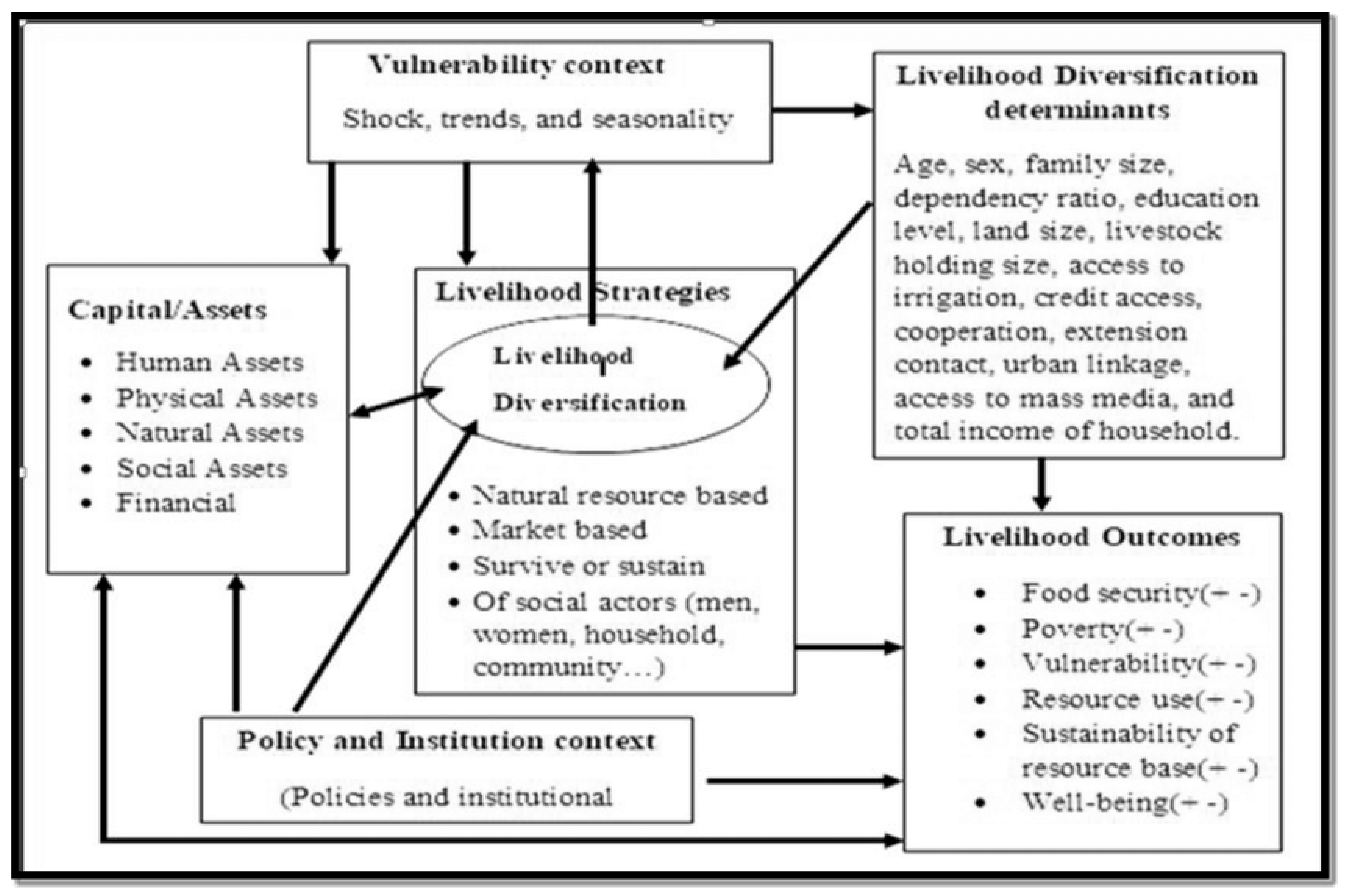
2. Theoretical Framework
3. Methodology
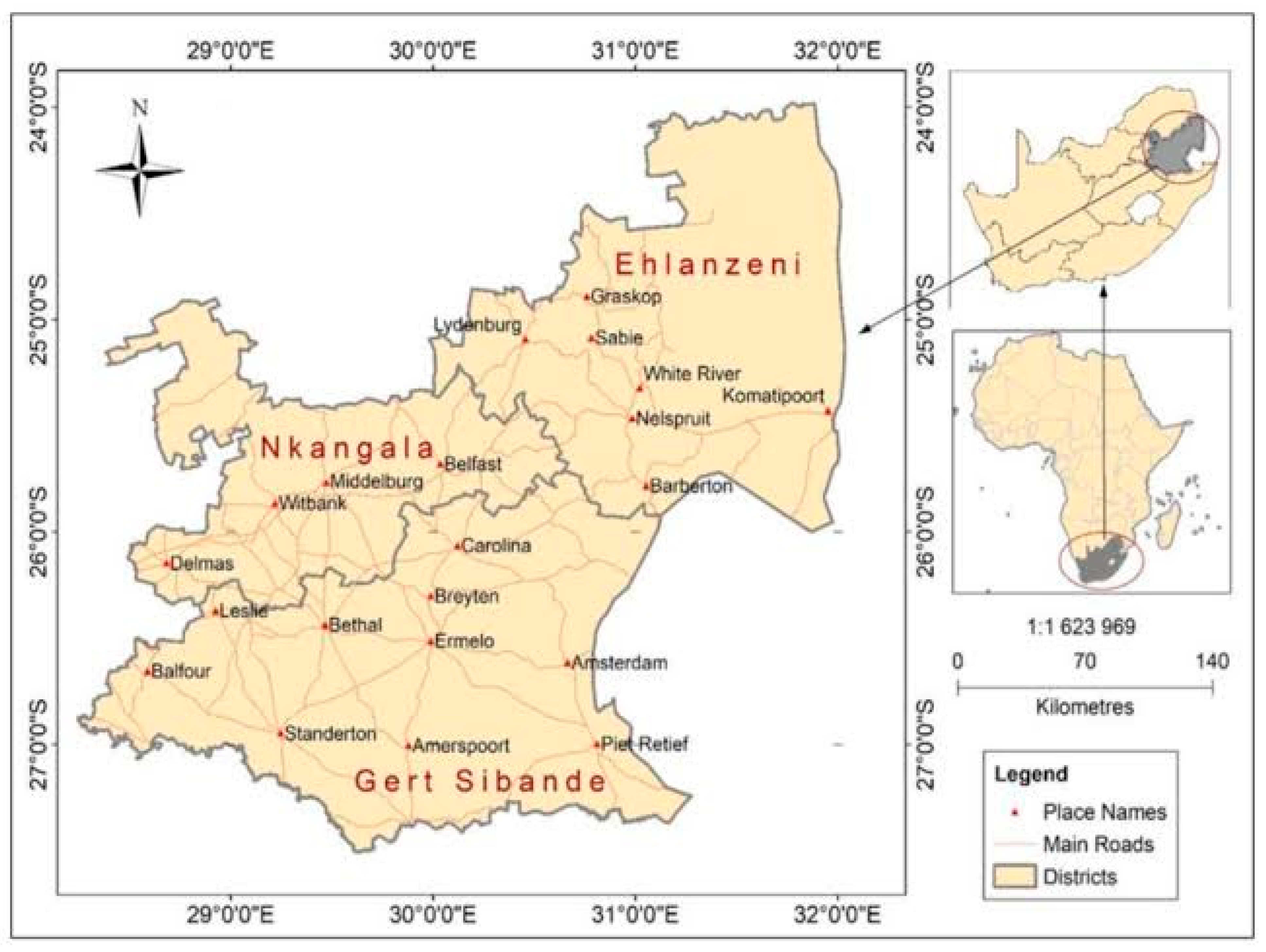
3.1. Description of the Study Site
3.2. Sample Method and Size for the Study
3.3. Methods of Data Collection
3.4. Methods of Data Analysis
- Y = smallholder farmers’ choice to diversify or not to diversify on-farm activities, with smallholder farmers having diversified on-farm activities = 1, and 0 otherwise.
- X1–X9 represent the predictor variables, which have been demarcated as follows:
- X1 = age (years lived by the farmer).
- X2 = gender (farmer being male = 0, and female = 1).
- X3 = marital status (the state of farmers being married or not married: 0 = married, 1 = single, 2 = divorced, 3 = widowed, and 4 = engaged).
- X4 = level of education (educational attainment status of the farmer: 0 = no school, 1 = adult school, 2 = primary school, 3 = secondary school, and 4 = tertiary education).
- X5 = farmland size (number of hectares of land owned by the farmer).
- X6 = farming experience (number of years in farming operations).
- X7 = secondary source of income (having other means of income generation except for farming).
- X8 = number of farm assistants (the farm workforce in headcount).
- X9 = diversification awareness (the awareness of diversification of on-farm activities).
- ꞵ0 represents the constant.
- β1–β9 represent the standardized regression coefficients.
- µ represents the error term.
4. Results and Discussion
4.1. Demographic Characteristics of the Smallholder Farmers in the Study Area
4.2. The Smallholder Farmers’ Affirmation of On-Farm Diversification in Mpumalanga Province
4.3. Type of Farming Activities Among Smallholder Farmers in Mpumalanga Province
4.4. The Purpose of On-Farm Diversification Among Smallholder Farmers
4.5. Determinants of Implementing On-Farm Diversification Strategies Among Smallholder Farmers in the Study Area
4.6. The Model Diagnostic Testing
4.7. Implications for Climate-Smart Farming and Structured Market Access Pathways
5. Conclusions and Recommendations
Author Contributions
Funding
Institutional Review Board Statement
Data Availability Statement
Acknowledgments
Conflicts of Interest
Abbreviations
| MPDEDT | Mpumalanga Provincial Department of Economic Development and Tourism |
| RED | Rural Economic Development |
| FAO | Food and Agriculture Organization |
| SMME | Small, Medium and Micro-Enterprises |
| SHIs | Self-Help Initiatives |
| DARDLEA | Department of Agriculture, Rural Development, Land and Environmental Affairs |
| CSAIs | Climate-Smart Agriculture Initiatives |
| CA | Conservation Agriculture |
| DA | Digital Agriculture |
| IKSA | Indigenous Knowledge Systems Approach |
| SLA | Sustainable Livelihood Approach |
References
- Musumba, M.; Palm, C.A.; Komarek, A.M.; Mutuo, P.K.; Kaya, B. Household livelihood diversification in rural Africa. Agric. Econ. 2022, 53, 555–569. [Google Scholar] [CrossRef] [Scilit]
- Ferreira, G.A.; Talora, D.C.; Sole, M.; Cervantes-López, M.J.; Heming, N.M. Global impacts of climate change on amphibians distribution: A life-history and biogeographic-based approach. Front. Ecol. Evol. 2022, 10, 987237. [Google Scholar] [CrossRef] [Scilit]
- Awiti, H.A.; Gido, E.O.; Obare, G.A. Smallholder farmers climate-smart crop diversification cost structure: Empirical evidence from western Kenya. Front. Sustain. Food Syst. 2022, 6, 842987. [Google Scholar] [CrossRef] [Scilit]
- Sithole, M.Z.; Agholor, A.I.; Morepje, M.T.; Msweli, N.S.; Thabane, V.N.; Ndlovu, S.M.; Mgwenya, L.I. Smallholder transition to agripreneurship: The role of agricultural extension education. Int. J. Sci. Res. 2024, 80, 78–102. [Google Scholar] [CrossRef] [Scilit]
- Grilli, G.; Pagliacci, F.; Gatto, P. Determinants of agricultural diversification: What really matters? A review. J. Rural Stud. 2024, 110, 103365. [Google Scholar] [CrossRef] [Scilit]
- Bahta, Y.T.; Nyaki, S.A. Livelihood vulnerability from drought among smallholder livestock farmers in South Africa. Hydrology 2024, 11, 137. [Google Scholar] [CrossRef] [Scilit]
- Mishi, S.; Sikhunyana, Z.; Ngonyama, N.; Sibanda, K. Livelihood strategies and diversification amongst the poor: Evidence from South African household surveys. J. Transdiscipl. Res. S. Afr. 2020, 16, a726. [Google Scholar] [CrossRef] [Scilit]
- Vercillo, S.; Sano, Y.; Frayne, B. Gender disparities in rural livelihood diversification and household food insecurity in northern Ghana. Afr. Geogr. Rev. 2026, 45, 22–36. [Google Scholar] [CrossRef] [Scilit]
- Emeru, G.M.; Fikire, A.H.; Beza, Z.B. Determinants of urban households’ livelihood diversification strategies in North Shewa Zone, Ethiopia. Cogent Econ. Financ. 2022, 10, 2093431. [Google Scholar] [CrossRef] [Scilit]
- Workie, D.M. Livelihood diversification strategies and determinants by smallholder farmers in the highland areas of North Shewa Ethiopia. J. Agribus. Rural Dev. 2023, 68, 217–228. [Google Scholar] [CrossRef] [Scilit]
- Nyathi, D. Motives and constraints of rural livelihoods diversification in dry-land agrarian settings of Matabeleland, Zimbabwe. J. Asian Afr. Stud. 2025, 60, 4403–4421. [Google Scholar] [CrossRef] [Scilit]
- Amghani, M.S.; Sabouri, M.S.; Baghernejad, J.; Norozi, A. Factors affecting the livelihood sustainability of smallholder farmers in Iran. Environ. Sustain. Indic. 2025, 26, 100601. [Google Scholar] [CrossRef] [Scilit]
- Pareek, A.; Dhankher, O.P.; Foyer, C.H. Mitigating the impact of climate change on plant productivity and ecosystem sustainability. J. Exp. Bot. 2020, 71, 451–456. [Google Scholar] [CrossRef] [Scilit]
- Sithole, M.Z.; Agholor, A.I. Assessing the adoption of conservation agriculture towards climate change adaptation: A case of Nkomazi, Mpumalanga Province. Proc. Int. Conf. Agric. 2021, 6, 68–80. [Google Scholar] [CrossRef] [Scilit]
- Ndlovu, S.M.; Agholor, A.I.; Sithole, M.Z. Embracing water-smart agriculture for optimal agricultural production in selected areas of Bushbuckridge, South Africa. Proc. Int. Conf. Agric. 2021, 6, 20–32. [Google Scholar] [CrossRef] [Scilit]
- Morepje, M.T.; Agholor, A.I.; Sithole, M.Z.; Mgwenya, L.I.; Msweli, N.S.; Thabane, V.N. An analysis of the acceptance of water management systems among smallholder farmers in Numbi, Mpumalanga Province, South Africa. Sustainability 2024, 16, 1952. [Google Scholar] [CrossRef] [Scilit]
- Chingombe, W.; Musarandega, H. From the Cyclone Idai disaster to the COVID-19 pandemic: An account of inadvertent social capital enhancement in Eastern Chimanimani, Zimbabwe. Jàmbá J. Disaster Risk Stud. 2021, 13, 1068. [Google Scholar] [CrossRef] [Scilit]
- Ahmed, M.; Muhammad, A.; Shakeel, A.; Muhammad. Global agricultural production: Resilience to climate change. In Global Agricultural Production; Springer International Publishing: Cham, Switzerland, 2022; pp. 31–72. [Google Scholar] [CrossRef] [Scilit]
- Nkosi, C.S.; Olorunfemi, O.D.; Khwidzhili, H. Data on climate change effect and use of adaptation strategies among smallholder maize farmers: Evidence from a microlevel survey in Ehlanzeni District, South Africa. Data Brief 2023, 48, 109106. [Google Scholar] [CrossRef] [Scilit]
- Sithole, M.Z.; Morepje, M.T.; Mokoena, T.I. Unpacking water scarcity adaptation strategies for sustainable food production systems in Sub-Saharan Africa. Sustainability 2025, 17, 10627. [Google Scholar] [CrossRef] [Scilit]
- Kimengsi, J.N.; Mukong, A.K.; Balgah, R.A. Livelihood diversification and household well-being: Insights and policy implications for forest-based communities in Cameroon. Soc. Nat. Resour. 2020, 33, 876–895. [Google Scholar] [CrossRef] [Scilit]
- Chambers, R.; Conway, G. Sustainable Rural Livelihoods: Practical Concepts for the 21st Century; The Institute of Development Studies and Partner Organisations: Brighton, UK, 1992; Available online: https://hdl.handle.net/20.500.12413/775 (accessed on 16 March 2026).
- Chambers, R. Rural Development: Putting the Last First; Routledge: Abingdon, UK; New York, NY, USA, 2013. First published 1983 by Pearson Education Limited; Available online: https://api.taylorfrancis.com/content/books/mono/download?identifierName=doi&identifierValue=10.4324/9781315835815&type=googlepdf (accessed on 16 March 2026).
- Khatiwada, S.P.; Deng, W.; Paudel, B.; Khatiwada, J.R.; Zhang, J.; Su, Y. Household livelihood strategies and implication for poverty reduction in rural areas of Central Nepal. Sustainability 2017, 9, 612. [Google Scholar] [CrossRef] [Scilit]
- Odoh, N.E.; Nwibo, S.U.; Eze, A.V.; Igberi, C.O. Farm and non-farm income diversification activities among rural households in southeast, Nigeria. J. Agric. Ext. 2019, 23, 113–121. [Google Scholar] [CrossRef] [Scilit]
- Caulfield, M.E.; Hammond, J.; Fonte, S.J.; Florido, M.A.; Fuentes, W.; Meza, K.; Navarette, I.; Vanek, S.J.; van Wijk, M. Unpicking the inter-relationships between off-farm livelihood diversification, household characteristics, and farm management in the rural Andes. Front. Sustain. Food Syst. 2021, 5, 724492. [Google Scholar] [CrossRef] [Scilit]
- De la O Campos, A.P.; Admasu, Y.; Covarrubias, K.A.; Davis, B.; Diaz, A.M. Economic Transformation and Diversification Towards Off-Farm Income in Rural and Urban Areas—A Global Update with a Focus on Sub-Saharan Africa; FAO: Rome, Italy, 2023; 64p, Available online: https://ageconsearch.umn.edu/record/366848 (accessed on 16 March 2026). [CrossRef]
- Statistics South Africa. National Poverty Lines: Statistical Release; Statistics South Africa: Pretoria, South Africa, 2024. Available online: https://www.statssa.gov.za/publications/P03101/P031012024.pdf (accessed on 16 March 2026).
- Faluyi, O.T.; Olutola, A.A. Poverty in South Africa: Drivers of perpetuation. Afr. J. Inter/Multidiscip. Stud. 2024, 6, 1–13. [Google Scholar] [CrossRef] [Scilit]
- Mpumalanga Department of Economic Development and Tourism (MDEDT). Socio-Economic Review and Outlook of Mpumalanga: Annual Report; MDEDT: Mbombela, South Africa, 2025. Available online: https://dedtkm.mpg.gov.za/images/km/economic_profiles/SERO_Mar_2022_Final.pdf (accessed on 16 March 2026).
- DARDLEA. Mpumalanga Department of Agriculture, Rural Development, Land and Environmental Affairs Annual Report (2022/3); DARDLEA: Ehlanzeni, South Africa, 2023. Available online: https://dardlea.mpg.gov.za (accessed on 16 March 2026).
- Sapkota, B.D. Sustainable livelihoods approach: Alternative to rural development. Triyuga Acad. J. 2021, 2, 39–45. [Google Scholar] [CrossRef] [Scilit]
- Gebru, G.W.; Ichoku, H.E.; Phil-Eze, P.O. Determinants of livelihood diversification strategies in Eastern Tigray Region of Ethiopia. Agric. Food Secur. 2018, 7, 62. [Google Scholar] [CrossRef] [Scilit]
- Natarajan, N.; Newsham, A.; Rigg, J.; Suhardiman, D. A sustainable livelihoods framework for the 21st century. World Dev. 2022, 155, 105898. [Google Scholar] [CrossRef] [Scilit]
- Ayana, G.F.; Megento, T.L.; Kussa, F.G. The extent of livelihood diversification on the determinants of livelihood diversification in Assosa Wereda, Western Ethiopia. GeoJournal 2022, 87, 2525–2549. [Google Scholar] [CrossRef] [Scilit]
- Hegazi, F.; Seyuba, K. Gender, livelihood diversification and food security: Insights from rural communities in Zambia. J. Rural Stud. 2024, 109, 103321. [Google Scholar] [CrossRef] [Scilit]
- Mudzielwana, R.V.A.; Mafongoya, P.; Mudhara, M. An analysis of livelihood-diversification strategies among farmworker households: A case study of the Tshiombo irrigation scheme, Vhembe district, South Africa. Agriculture 2022, 12, 1866. [Google Scholar] [CrossRef] [Scilit]
- Uddin, M.E.; Pervez, A.K.; Gao, Q. Effect of voluntary cooperativisation on livelihood capital of smallholder dairy farmers in the southwest of Bangladesh. GeoJournal 2022, 87, 111–130. [Google Scholar] [CrossRef] [Scilit]
- Maps of World. Mpumalanga Province Map and Information. Available online: https://www.mapsofworld.com/south-africa/provinces/mpumalanga.html (accessed on 16 March 2026).
- Mishra, S.B.; Alok, S. Handbook of Research Methodology; Educreation Publishing: New Delhi, India, 2022; Available online: https://kangkholidblog.wordpress.com/wp-content/uploads/2021/10/bookresearchmethodology.pdf (accessed on 16 March 2026).
- Pandey, V.C.; Pandey, D.N.; Singh, N. Sustainable phytoremediation based on naturally colonizing and economically valuable plants. J. Clean. Prod. 2015, 86, 37–39. [Google Scholar] [CrossRef] [Scilit]
- Boakye, L.G.; Osei, C.K.; Annor, S.Y. On-farm diversification strategies and improved welfare of the immiserated rural smallholder farmer: Fallacy or realism? Cogent Soc. Sci. 2021, 7, 1865609. [Google Scholar] [CrossRef] [Scilit]
- Sithole, A.; Olorunfemi, O.D. The adoption of sustainable farming practices by smallholder crop farmers: Micro-level evidence from North-Eastern South Africa. Agriculture 2024, 14, 2370. [Google Scholar] [CrossRef] [Scilit]
- Zondo, W.N.S.; Ndoro, J.T. Evaluating the influence of socioeconomic factors on smallholder farmer’s social media adoption in the Nkomazi Local Municipality, Mpumalanga Province. S. Afr. J. Agric. Ext. 2024, 52, 20–47. [Google Scholar] [CrossRef] [Scilit]
- Dedieu, B.; Hostiou, N.; Kuzo, J.; Mercandalli, S.; Aymen, F.; Alary, V.; Haule, Y.; Raharimalala, S.; Belières, J.-F.; Dembele, C.; et al. Family farming through the lens of work organization: Illustrations from Africa. Cah. Agric. 2025, 34, 34. [Google Scholar] [CrossRef] [Scilit]
- Morepje, M.T.; Sithole, M.Z.; Msweli, N.S.; Agholor, A.I. The influence of e-commerce platforms on sustainable agriculture practices among smallholder farmers in Sub-Saharan Africa. Sustainability 2024, 16, 6496. [Google Scholar] [CrossRef] [Scilit]
- Olorunfemi, O.D.; Mamiane, T.A.; Matiwane, M.B. Investigating access and use of digital tools for agriculture among rural farmers: A case study of Nkomazi Municipality, South Africa. Open Agric. 2024, 9, 20220380. [Google Scholar] [CrossRef] [Scilit]
- Nyamayevu, D.; Nyagumbo, I.; Chiduwa, M.; Liang, W.; Li, R. Understanding crop diversification among smallholder farmers: Socioeconomic insights from central Malawi. Sustainability 2024, 16, 9078. [Google Scholar] [CrossRef] [Scilit]
- Franke, A.C.; van den Brand, G.J.; Vanlauwe, B.; Giller, K.E. Sustainable intensification through rotations with grain legumes in Sub-Saharan Africa: A review. Agric. Ecosyst. Environ. 2018, 261, 172–185. [Google Scholar] [CrossRef] [Scilit]
- Yang, H.; Zhang, W.; Li, L. Intercropping: Feed more people and build more sustainable agroecosystems. Engineering 2021, 8, 373–386. [Google Scholar] [CrossRef] [Scilit]
- Lukhele, J.C.; Tsvakirai, C.Z.; Tshehla, M. Determining the drivers and deterrents of climate-smart crop adoption: The case of cassava in Mpumalanga Province, South Africa. J. Agribus. Rural Dev. 2023, 70, 391–400. [Google Scholar] [CrossRef] [Scilit]
- Mthombeni, V.T.; Khwidzhili, R.H.; Zwane, E.; Mmbengwa, V.M. Assessment of small-scale farmers’ perceptions towards the sustainability of soybean production in Nkangala District Municipality of the Mpumalanga Province. S. Afr. J. Agric. Ext. 2024, 52, 166–184. [Google Scholar] [CrossRef] [Scilit]
- Wang, M.; Wan, D.; Xie, X.; Bai, Z.; Wang, R.; Zhang, X.; Gao, Y.Z.; Tan, Z.; Yin, Y. Crop–livestock integration: Implications for food security, resource efficiency and greenhouse gas mitigation. Innov. Life 2024, 2, 100103. [Google Scholar] [CrossRef] [Scilit]
- Zadgaonkar, L.A.; Darwai, V.; Mandavgane, S.A. The circular agricultural system is more sustainable: Emergy analysis. Clean Technol. Environ. Policy 2022, 24, 1301–1315. [Google Scholar] [CrossRef] [Scilit]
- Chamkhi, I.; Cheto, S.; Geistlinger, J.; Zeroual, Y.; Kouisni, L.; Bargaz, A.; Ghoulam, C. Legume-based intercropping systems promote beneficial rhizobacterial community and crop yield under stressing conditions. Ind. Crops Prod. 2022, 183, 114958. [Google Scholar] [CrossRef] [Scilit]
- Palsaniya, D.R.; Kumar, S.; Das, M.M.; Kumar, T.K.; Kumar, S.; Chaudhary, M.; Chand, K.; Rai, S.K.; Ahmed, A.; Sahay, C.S.; et al. Integrated multi-enterprise agricultural system for sustaining livelihood, energy use and resource recycling: A case study from semi-arid tropics of central India. Agrofor. Syst. 2021, 95, 1619–1634. [Google Scholar] [CrossRef] [Scilit]
- Jonas, N.; Christian, M.; Ntombela, S.; Letsoalo, S. Empowering South African smallholder farmers: Integrating climate resilience into credit assessment. Sustainability 2025, 17, 261. [Google Scholar] [CrossRef] [Scilit]
- Vilakazi, B.; Odindo, A.O.; Phophi, M.M.; Mafongoya, P.L. Socioeconomic factors influencing crop diversification among smallholder farmers in Bergville, South Africa. Agriculture 2025, 15, 914. [Google Scholar] [CrossRef] [Scilit]
- Tacconi, F.; Waha, K.; Ojeda, J.J.; Leith, P. Drivers and constraints of on-farm diversity: A review. Agron. Sustain. Dev. 2022, 42, 2. [Google Scholar] [CrossRef] [Scilit]
- Mahedi, M.; Pervez, A.K.M.K.; Rahman, S.M.; Sheikh, M.M.; Shaili, S.J. Emerging trends in livelihood diversification in rural communities: A bibliometric and systematic review. Asian J. Agric. Ext. Econ. Sociol. 2025, 43, 162–177. [Google Scholar] [CrossRef] [Scilit]
- Lucantoni, D.; Domarle, J. Unlocking food security and livelihoods: The transformative power of agroecology among vulnerable smallholder farmers in Kembata Tembaro, Ethiopia. Agroecol. Sustain. Food Syst. 2023, 47, 1341–1371. [Google Scholar] [CrossRef] [Scilit]
- Galanakis, C.M. The future of food. Foods 2024, 13, 506. [Google Scholar] [CrossRef] [Scilit]
- Mihrete, T.B.; Mihretu, F.B. Crop diversification for ensuring sustainable agriculture, risk management and food security. Glob. Chall. 2025, 9, 2400267. [Google Scholar] [CrossRef] [Scilit] [PubMed]
- Sinyolo, S.; Murendo, C.; Nyamwanza, A.M.; Sinyolo, S.A.; Ndinda, C.; Nwosu, C.O. Farm production diversification and dietary diversity among subsistence farming households: Panel data evidence from South Africa. Sustainability 2021, 13, 10325. [Google Scholar] [CrossRef] [Scilit]
- Chmieliński, P.; Pawłowska, A.; Bocian, M. On-farm or off-farm? Diversification processes in the livelihood strategies of farming families in Poland. Soc. Sci. Humanit. Open 2023, 8, 100575. [Google Scholar] [CrossRef] [Scilit]
- Carrer, M.J.; de Souza Filho, H.M.; Vinholis, M.D.M.B.; Mozambani, C.I. Precision agriculture adoption and technical efficiency: An analysis of sugarcane farms in Brazil. Technol. Forecast. Soc. Change 2022, 177, 121510. [Google Scholar] [CrossRef] [Scilit]
- Kurdyś-Kujawska, A.; Strzelecka, A.; Zawadzka, D. The impact of crop diversification on the economic efficiency of small farms in Poland. Agriculture 2021, 11, 250. [Google Scholar] [CrossRef] [Scilit]
- Abera, A.; Yirgu, T.; Uncha, A. Determinants of rural livelihood diversification strategies among Chewaka resettlers’ communities of southwestern Ethiopia. Agric. Food Secur. 2021, 10, 30. [Google Scholar] [CrossRef] [Scilit]
- Ragasa, C.; Mzungu, D.; Kalagho, K.; Kazembe, C. Impact of interactive radio programming on agricultural technology adoption and crop diversification in Malawi. J. Dev. Eff. 2021, 13, 204–223. [Google Scholar] [CrossRef] [Scilit]
- Lokier, J.; Morris, W.; Thomas, D. Farm shop diversification: Producer motivations and consumer attitudes. Int. J. Entrep. Innov. 2021, 22, 215–228. [Google Scholar] [CrossRef] [Scilit]
- McCullagh, P.; Nelder, J.A. Generalized Linear Models, 2nd ed.; Chapman and Hall: London, UK, 1989. [Google Scholar]
- Cohen, J. Statistical Power Analysis for the Behavioural Sciences; Routledge: London, UK, 1988. [Google Scholar]
- Falk, R.F.; Miller, N.B. A Primer for Soft Modeling; University of Akron Press: Akron, OH, USA, 1992. [Google Scholar]
- Clark, V.R.; Burrows, J.E.; Turpin, B.C.; Balkwill, K.; Lötter, M.; Siebert, S.J. The Limpopo–Mpumalanga–Eswatini escarpment—Extraordinary endemic plant richness and extinction risk in a summer rainfall montane region of southern Africa. Front. Ecol. Evol. 2022, 10, 765854. [Google Scholar] [CrossRef] [Scilit]
- Mendi, G.; Matiwane, M. Determinants of the barriers preventing smallholder farmers from adopting conservation agriculture in Hazyview, Mpumalanga, South Africa. S. Afr. J. Agric. Ext. 2025, 53, 20–38. [Google Scholar] [CrossRef] [Scilit]
- VijayKumar, R.; Tiwari, P.; Daniel, S.; Kumar, K.R.; Mishra, I.; Ks, A.; Shah, D. Agroforestry systems: A pathway to resilient and productive landscapes. Int. J. Environ. Clim. Change 2024, 14, 177–193. [Google Scholar] [CrossRef] [Scilit]
- Mohammadi, A.; Najafabadi, M.O.; Poursaeed, A. The impacts of livelihood capitals on improving sustainable livelihood in rural communities with a rural cooperative approach. Agric. Mark. Commer. 2021, 5, 20–31. [Google Scholar]
- Qange, S.; Mdoda, L.; Mditshwa, A. Exploring the relationship between agribusiness investments and postharvest losses among smallholder vegetable farmers in the eThekwini Municipality. Front. Sustain. Food Syst. 2024, 8, 1420460. [Google Scholar] [CrossRef] [Scilit]



| Variable | Description | Unit of Measurement | Sign Expected |
|---|---|---|---|
| Age (AGE) | Number of years lived by an individual smallholder farmer | Number in years | - |
| Gender (GENDER) | The state of being male or female among smallholder farmers | 0 = male 1 = female | + |
| Marital status (MARITS) | The state of being married or not married among smallholder farmers | 0 = married 1 = single 2 = divorced 3 = widowed 4 = engaged | - |
| Level of education (EDUC) | The level of educational attainment among smallholder farmers | 0 = no school 1 = adult school 2 = primary school 3 = secondary school 4 = tertiary education | + |
| Farmland size (FLSZ) | The number of hectares own/utilized by individual smallholder farmers | 0 = less than 1 hectare 1 = 1 to 5 hectares 2 = 6 to 10 hectares 3 = 11 to 15 hectares 4 = 16 to 20 hectares 5 = above 20 hectares | + |
| Farming experience (FMEXP) | Number of years in farming operations among smallholder farmers | 0 = 1 to 5 years 1 = 6 to 10 years 2 = 11 to 20 years 3 = 21 to 35 years 4 = more than 35 years | + |
| Secondary source of income (SSICME) | Means of income except for main income stream (farming) | 0 = farming only 1 = employed 2 = self-employed 3 = social grant 4 = pension 5 = remittances | |
| Number of farm assistants | The farm workforce recorded as assistants rather than labourers among smallholder farmers | 0 = none 1 = 1 to 3 assistants 2 = 4 to 7 assistants 3 = above 7 assistants | + |
| Household size | Number of persons per household among smallholder farmers | 0 = 1–3 members 1 = 4–7 members 2 = 8–12 members 3 = more than 12 members | - |
| Diversification awareness | A state of being aware of diversification of farming activities among smallholder farmers | 0 = yes 1 = no | + |
| Variable | Categories | Percentages (%) |
|---|---|---|
| Gender | Male | 48.2% |
| Female | 51.8% | |
| Age | 18–35 years | 20.2% |
| 36–60 years | 59.1% | |
| Above 60 years | 20.7% | |
| Marital Status | Married | 29.7% |
| Single | 53.1% | |
| Divorced | 4.9% | |
| Widow | 10.1% | |
| Widower | 2.2% | |
| Level of Education | No formal school | 11.0% |
| Adult education | 20.4% | |
| Primary education | 9.5% | |
| Secondary education | 49.0% | |
| Tertiary education | 10.1% | |
| Household Size | 1–3 members | 18.7% |
| 4–7 members | 64.3% | |
| 8–12 members | 14.8% | |
| More than 12 members | 2.2% | |
| Secondary Source of Income | Only farming as main source of income | 36.1% |
| Employed | 15.1% | |
| Self-employed | 18.9% | |
| Social grant | 12.0% | |
| Pension | 14.8% | |
| Remittances | 3.0% | |
| Farming Experience | Less than 5 years | 27.1% |
| 5–10 years | 36.1% | |
| 11–20 years | 21.3% | |
| 21–35 years | 11.8% | |
| More than 35 years | 3.7% | |
| Farmland Size | Less than 1 ha | 18.9% |
| 1–5 ha | 54.4% | |
| 6–10 ha | 14.2% | |
| 11–15 ha | 10.1% | |
| 16–20 ha | 1.5% | |
| More than 20 ha | 0.9% | |
| Main Water Source | Borehole | 11.0% |
| River | 32.5% | |
| Dam | 38.3% | |
| Rainwater | 7.3% | |
| Other | 11.0% |
| Frequency | Percent (%) | |
|---|---|---|
| YES | 390 | 83.9 |
| NO | 75 | 16.1 |
| Total | 465 | 100.0 |
| Variable | Frequency | Percent (%) |
|---|---|---|
| Mixed farming | 236 | 50.8 |
| Crop production | 67 | 14.4 |
| Animal production | 30 | 6.5 |
| Sole cropping | 20 | 4.3 |
| Mixed cropping | 111 | 23.9 |
| Horticulture | 1 | 0.2 |
| Total | 465 | 100 |
| Variable | Frequency | Percent (%) |
|---|---|---|
| Enhance farm income | 144 | 31.0 |
| Climate change adaptation | 32 | 6.9 |
| Improve food security | 51 | 11.0 |
| Sustainable food production | 50 | 10.8 |
| Escape poverty | 86 | 18.5 |
| Weed management | 2 | 0.4 |
| Pests and disease control | 22 | 4.7 |
| Soil health management | 15 | 3.2 |
| Insure against failure | 1 | 0.2 |
| Other | 62 | 13.3 |
| Total | 465 | 100 |
| Parameter Estimates | ||||||||
|---|---|---|---|---|---|---|---|---|
| The Smallholder Farmers’ Choice to Diversify On-Farm Activities | Β | Std. Error | Wald | df | Sig. | Exp (β) | 95% Confidence Interval for Exp (β) | |
| Lower Bound | Upper Bound | |||||||
| Intercept | 4.062 | 1.063 | 14.594 | 1 | <0.001 | |||
| Gender | −0.243 | 0.229 | 1.126 | 1 | 0.289 | 0.784 | 0.500 | 1.229 |
| Age | −0.335 | 0.228 | 2.151 | 1 | 0.142 | 0.715 | 0.457 | 1.119 |
| Marital status | −0.115 | 0.119 | 0.937 | 1 | 0.333 | 0.891 | 0.706 | 1.125 |
| Level of education | −0.533 | 0.115 | 21.585 | 1 | 0.001 * | 0.587 | 0.469 | 0.735 |
| Household size | −0.015 | 0.179 | 0.007 | 1 | 0.933 | 0.985 | 0.694 | 1.398 |
| Secondary source of income | −0.174 | 0.092 | 3.623 | 1 | 0.057 * | 0.840 | 0.702 | 1.005 |
| Farming experience | −0.017 | 0.126 | 0.017 | 1 | 0.895 | 0.984 | 0.769 | 1.259 |
| Farmland size | 0.328 | 0.143 | 5.238 | 1 | 0.022 * | 1.388 | 1.048 | 1.839 |
| Number of farm assistants | 0.354 | 0.147 | 5.808 | 1 | 0.016 * | 1.425 | 1.068 | 1.901 |
| Diversification awareness | −1.218 | 0.415 | 8.604 | 1 | 0.003 * | 0.296 | 0.131 | 0.668 |
| Statistic | Value | p-Value |
|---|---|---|
| Goodness-of-fit (Pearson) | χ2 = 428.895 | 0.020 |
| Goodness-of-fit (deviance) | χ2 = 506.073 | <0.001 |
| Cox and Snell R2 | 0.138 | - |
| Nagelkerke R2 | 0.188 | - |
| McFeddan R2 | 0.112 | - |
Disclaimer/Publisher’s Note: The statements, opinions and data contained in all publications are solely those of the individual author(s) and contributor(s) and not of MDPI and/or the editor(s). MDPI and/or the editor(s) disclaim responsibility for any injury to people or property resulting from any ideas, methods, instructions or products referred to in the content. |
© 2026 by the authors. Licensee MDPI, Basel, Switzerland. This article is an open access article distributed under the terms and conditions of the Creative Commons Attribution (CC BY) license.
Share and Cite
Sithole, M.Z.; Agholor, A.I.; Olorunfemi, O.D.; Kutu, F.R.; Morepje, M.T. Determinants of On-Farm Diversification Strategies: A Case Study of Smallholder Farmers in Mpumalanga Province, South Africa. Agriculture 2026, 16, 719. https://doi.org/10.3390/agriculture16070719
Sithole MZ, Agholor AI, Olorunfemi OD, Kutu FR, Morepje MT. Determinants of On-Farm Diversification Strategies: A Case Study of Smallholder Farmers in Mpumalanga Province, South Africa. Agriculture. 2026; 16(7):719. https://doi.org/10.3390/agriculture16070719
Chicago/Turabian StyleSithole, Moses Zakhele, Azikiwe Isaac Agholor, Oluwasogo David Olorunfemi, Funso Raphael Kutu, and Mishal Trevor Morepje. 2026. "Determinants of On-Farm Diversification Strategies: A Case Study of Smallholder Farmers in Mpumalanga Province, South Africa" Agriculture 16, no. 7: 719. https://doi.org/10.3390/agriculture16070719
APA StyleSithole, M. Z., Agholor, A. I., Olorunfemi, O. D., Kutu, F. R., & Morepje, M. T. (2026). Determinants of On-Farm Diversification Strategies: A Case Study of Smallholder Farmers in Mpumalanga Province, South Africa. Agriculture, 16(7), 719. https://doi.org/10.3390/agriculture16070719