Article

Hotspots of Cropland Abandonment in the Rural Eastern Cape: Disentangling Socio-Economic and Climate Drivers Among Farming Households in the Former Homelands of Transkei


1
School of Agricultural Sciences, Mbombela Campus, University of Mpumalanga, Mbombela 1200, South Africa
2
Economic Analysis Unit, Agricultural Research Council—Central Office, 1134 Park Street, Hatfield, Pretoria 0001, South Africa
3
School of Development Studies, Mbombela Campus, University of Mpumalanga, Mbombela 1200, South Africa
*
Author to whom correspondence should be addressed.
Agriculture 2026, 16(7), 718; https://doi.org/10.3390/agriculture16070718 (registering DOI)
Submission received: 20 February 2026 / Revised: 17 March 2026 / Accepted: 19 March 2026 / Published: 24 March 2026

Abstract

Smallholder farming remains a critical livelihood source for rural communities in South Africa, particularly in the Eastern Cape Province. However, cropland abandonment has become an escalating concern, undermining food security, household incomes, and the long-term sustainability of agricultural systems. This study assessed the socio-economic and climate-related factors influencing cropland abandonment in the former homelands of Transkei. A mixed-methods approach was used, combining a quantitative survey, a qualitative focus group discussion, and a key informant interview. Data were analysed using descriptive statistics, a double-hurdle model, and thematic analysis. The descriptive results revealed that the average respondent was 57 years, with a predominantly male majority (57.47%), a primary education (40.27%), and a mean average household size of 5.4. About 51.58% of household heads were married and 48.42% were single, with a mean household income of R63 155 (3680.26 USD). The econometric results from the first hurdle model indicated that education level, farming experience, rainfall variability, access to irrigation, and off-farm income significantly influenced the decision to abandon cropland. The second hurdle model demonstrated that the extent of cropland abandonment was shaped by labour availability, access to credit, rainfall patterns, cooperative membership, and farming experience. The study concluded that cropland abandonment in the former Transkei was influenced by different factors. Therefore, the study would recommend targeted policy interventions that strengthen human capital, improve access to agricultural support services, and promote youth participation and collective farming structures to revitalise smallholder agriculture and enhance rural food security.

1. Introduction

Rural areas in South Africa account for approximately 13%of the national land surface and are home to a disproportionate share of the country’s poor and unemployed population, particularly within the former homeland regions [1,2]. These areas were historically configured under colonial and apartheid regimes to function as labour reserves, with limited economic infrastructure and constrained opportunities for productive investment. Despite the formal end of apartheid in 1994, these structural legacies persist, and rural livelihoods in the former homelands remain characterised by high unemployment, chronic poverty, and food insecurity [2,3]. The Eastern Cape Province, particularly the former Transkei region, exemplifies these enduring development challenges.
Within this context, smallholder agriculture has historically played a critical role in supporting rural livelihoods by supplementing household food consumption, smoothing income, and reducing vulnerability to market shocks. Although landholdings in the former homelands are generally small and resource constrained, farming continues to contribute meaningfully to food security and welfare. Empirical evidence from the rural Eastern Cape shows that farming households experience lower levels of hunger and food poverty than non-farming households, underscoring the protective role of self-sufficiency in marginalised rural economies [4]. Recent household-level studies further indicate that farming households in the former homelands spend less on purchased food than their non-farming counterparts, strengthening the argument for renewed support to smallholder agriculture in these areas [5].
However, despite the recognised livelihood importance of smallholder farming, there is growing evidence that many rural households have reduced or ceased cultivation of their arable fields. Land and cropland abandonment have become increasingly visible features of rural landscapes in the Eastern Cape, with significant implications for food security, rural employment, and the sustainability of agricultural systems. Cropland abandonment refers to agricultural land that remains uncultivated for extended periods without clear intention to resume production, resulting in lost productive value and declining agricultural resilience [6].
Globally, farmland abandonment has become a widespread land-use transition driven by demographic change, structural economic shifts, and environmental pressures. A comprehensive global review highlights that farmland abandonment can represent both a threat and an opportunity for biodiversity conservation depending on local ecological and socio-economic conditions [7]. While abandoned land may allow natural vegetation recovery in some contexts, other studies show that the ecological recovery process is often slow and incomplete. For example, long-term experimental evidence demonstrates that biodiversity and ecosystem productivity deficits can persist for more than a century after agricultural land abandonment [8]. These findings suggest that cropland abandonment can have long-lasting ecological and socio-economic consequences.
In addition to ecological considerations, environmental degradation and pollution have also been identified as important drivers of farmland abandonment. Environmental stressors, such as soil contamination, declining soil fertility, and land degradation, can reduce agricultural productivity and increase the likelihood that farmers withdraw land from cultivation [9]. Such environmental pressures may interact with broader socio-economic constraints, particularly in marginal agricultural regions.
The literature identifies multiple, often interrelated drivers of cropland abandonment, including labour shortages, ageing farming populations, declining returns to agriculture, rising input costs, institutional constraints, and climate variability [10,11]. At the same time, livelihood studies in the former homelands highlight a long-term shift away from agriculture toward social grants, remittances, and off-farm income sources, reshaping household production strategies and weakening incentives to maintain cultivation [12].
Evidence from South Africa suggests that dependence on social protection programmes may influence household engagement in farming activities [13]. Studies from KwaZulu-Natal have indicated that while social grants play an essential role in reducing rural poverty, high levels of grant dependency may reduce incentives for some households to participate actively in agricultural production when farming returns are low or uncertain [14,15]. These findings highlight the complex interactions between social protection systems and rural livelihood strategies in shaping land-use decisions.
Despite this growing body of work, an important gap remains in disentangling the relative influence of socio-economic versus climate-related factors in shaping cropland abandonment decisions among smallholder farmers in the former homelands. While climate change and rainfall variability are often cited as key drivers, empirical household-level evidence remains mixed, and there is limited quantitative work that jointly examines abandonment decisions and the extent of land withdrawn from cultivation. Moreover, few studies explicitly link cropland abandonment to food production outcomes at the household level in the rural Eastern Cape.
Against this background, this study examines cropland abandonment among smallholder farming households in two local municipalities in the former Transkei region of the Eastern Cape, South Africa. Specifically, the study addresses two key questions: first, what is the extent of food production among rural households in the study area; and second, what socio-economic and climate-related factors influence both the decision to abandon cropland and the proportion of land abandoned. By employing a mixed-methods approach and a double-hurdle modelling framework, the study contributes to the literature by providing nuanced empirical evidence on the drivers of cropland abandonment and their implications for rural livelihoods and food security in South Africa’s former homelands.

2. Conceptual Framework

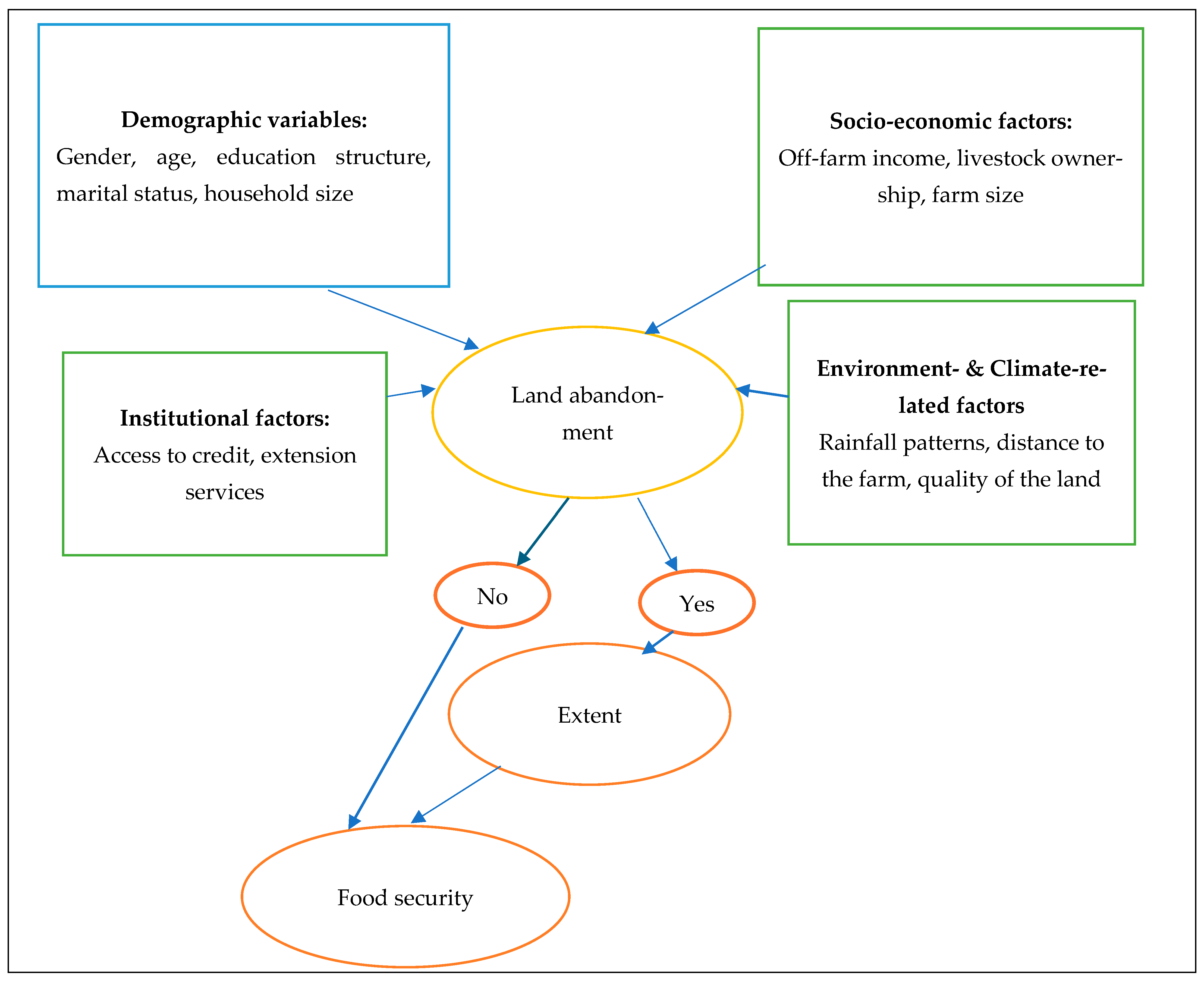
Food insecurity at the rural household level is influenced by a number of issues including land abandonment. Figure 1 presents the interacting factors. The land abandonment outcomes were measured on a social aspect, using income and food security. The framework illustrates that cropland abandonment arises from constraints in key livelihood capitals, including demographic variables, socio-economic factors, institutional factors, and environment- and climate-related factors. Demographic variables such as gender, age, education structure, and marital status can reduce the capacity to maintain active cultivation. Institutional factors such as the lack of access to credit, access to extension services, and not being part of cooperatives can constrain farmers’ ability to sustain agricultural activities. Environment- and climate-related factors such as rainfall patterns, distance to the farm, and quality of the land can reduce land productivity and discourage cultivation.
Under these conditions, cropland abandonment emerges as a livelihood adaptation strategy where households shift toward alternative income sources, such as social grants, migration, or formal employment. However, this transition reduces household food production, increases dependence on purchased food, and heightens vulnerability to food insecurity. The framework therefore highlights a cyclical relationship in which declining livelihood assets contribute to cropland abandonment, and abandonment, in turn, weakens household food security and resilience. Strengthening access to livelihood assets, particularly financial services, extension support, and agricultural infrastructure, is thus essential to reduce cropland abandonment and promote sustainable food systems.
Empirical evidence from both the global South and global North contexts supports the link between cropland abandonment and livelihood food insecurity. Studies from South Africa have shown that declining engagement in crop production is closely associated with increased reliance on purchased food and social grants, which exposes rural households to food price violation and income shocks [2,4,10]. Similar patterns have been observed elsewhere, where land abandonment is often driven by labour constraints such as the ageing population of farmers and a lack of institutional support [16].
Cropland abandonment has significant implications for food availability through several pathways. Empirical studies have shown that abandonment reduces the space under cultivation leading the lowering of food production and food availability from household to regional levels. For smallholder farmers, cropland constitutes a critical livelihood; therefore, abandonment affects household income and a rural family’s ability to fend for themselves, overall contributing to food insecurity [17]. Lastly, cropland abandonment often reflects deeper socio-economic changes not limited to migration and climate change [18,19,20].

3. Materials and Methods

3.1. Research Design and Rationale

This study adopted a mixed-methods research design, specifically employing a sequential explanatory mixed-methods approach as outlined by reference [21]. The sequential explanatory design has been characterised by the collection and analysis of quantitative data followed by qualitative data to explain or elaborate on quantitative results [22]. The rationale for using this design was that the quantitative data provided measurable trends and patterns, while the qualitative data offered detailed insights into participants’ experiences, perceptions, and interpretations of those trends [21]. This method was suitable for complex social and environmental issues, such as land abandonment, which required both contextual understanding and statistical evidence. The mixed-method approach in this study unfolded in three phases: Firstly, a pre-survey was undertaken to gain insights into the study characteristics in relation to land abandonment. Secondly, semi-structured interviews were conducted to explore household perceptions, consequences, and adaptation strategies. Thirdly, a focus group discussion (FGD) was conducted to further explore the results obtained from the survey [21]. These distinct and interconnected phases have been explained in detail below.
Firstly, a pre-survey was conducted to obtain baseline quantitative data and to gain preliminary insights into the characteristics of land abandonment within the study area. The purpose of the survey was to determine the demographics, prevalence, and trends related to land abandonment. The surveys were useful for collecting standardised information from a relatively large population, enabling generalisation and statistical analysis [23]. By highlighting significant themes and issues that needed further investigation, the pre-survey’s findings informed the development of subsequent qualitative research tools. Secondly, semi-structured interviews were conducted to explore household perceptions, experiences, and responses to land abandonment. Semi-structured interviews were selected because they offered flexibility, allowing participants to express their views in detail while maintaining a focus on predetermined research objectives [24]. This phase sought to explore the socio-economic and environmental consequences of land abandonment, as well as household adaptation and coping strategies. The qualitative data from the interviews provided a deeper understanding of the lived experiences of community members, which could not be captured by quantitative data alone. Thirdly, to further examine and validate the results from the survey and interviews, a focus group discussion (FGD) was held. The FGDs facilitated interactive discussions among participants, allowing researchers to capture shared experiences, collective perspectives, and community-level interpretations of land abandonment [25]. By comparing the group responses with the findings from individual interviews, focus group discussions (FGDs) enabled data triangulation, thereby improving the study’s credibility and reliability.

3.2. Description of the Research Sites

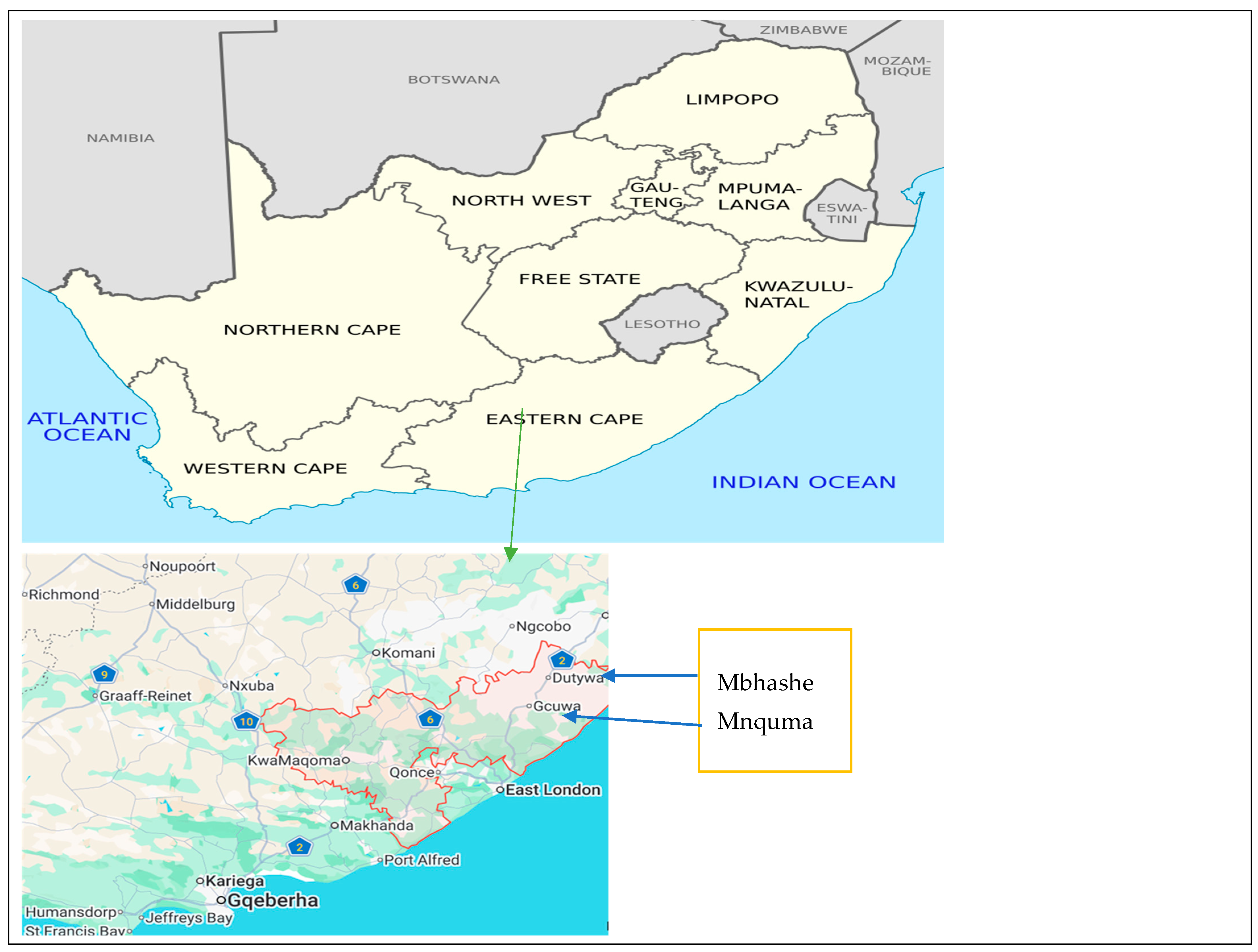
Figure 2 illustrates that the study was conducted in the Eastern Cape Province of South Africa, one of the country’s nine provinces and among the poorest in terms of income and development indicators. The province is predominantly rural, with agriculture serving as a primary source of livelihood for a large proportion of households. Despite its agricultural potential, the province has continued to experience high levels of poverty, unemployment, and land underutilization. Specifically, the research focused on Mbashe and Mnquma as two local municipalities within the larger Amathole District: Municipality (see Figure 2) These municipalities have shared several characteristics, including a strong dependence on subsistence and smallholder agriculture, similar agroecological conditions, and comparable socio-economic challenges. The areas have been characterised by mixed farming systems, mainly involving maize, vegetables, and livestock production; however, a considerable portion of cropland has been left fallow or abandoned over the years.

3.3. Sampling Procedure and Sample Size

The target population for this study comprised farming households engaged in crop production within the local municipalities of Mbhashe and Mnquma in the Eastern Cape Province. These households formed the sampling frame as they represented the primary agricultural decision-makers and land users in the area. A multi-stage sampling technique was employed to ensure that all the farming households were represented. In the first stage, the Mbhashe and Mnquma municipalities were purposively selected because of their strong agricultural orientation. In the second stage, several villages were randomly selected from each city using village lists obtained from local agricultural offices. In the final stage, individual farming households were randomly selected from these villages using simple random sampling. A total of 221 farming households were surveyed. This sample size was considered adequate for statistical analysis and for capturing the variation in household socio-economic characteristics and farming practices across the study area.
The intended sample size was determined by using reference [26], and the equation is specified as follows:
n =   Z 2 p q e 2 =   1.96 2 0.5 ( 0.5 ) ( 0.066 ) 2 = 221
where n is the sample size; z is 1.96 to achieve the 95% level of confidence; p is the proximate proportion of denotes the estimated proportion of smallholder crop farmers (50% as a rule of thumb); and e is the tolerant marginal error defined as 0.06.

3.4. Data Collection Process and Sources

A mixed-methods research approach was used to collect both primary and secondary data. Primary data from 221 farming households was collected through a semi-structured questionnaire and face-to-face interviews by a team of three (3) trained enumerators between May and July 2025. The survey questionnaire was developed in English and administered in IsiXhosa (the local language), and included a broad array of information encompassing demographic, socio-economic, farm, and institutional characteristics that may influence cropland abandonment. The survey collection tool was administered to 10 respondents prior to the actual data collection to assess its validity and reliability. Furthermore, secondary data were collected from published and unpublished reports, government documents, peer-reviewed journals, and books.
Key informant interviews (KIIs) were also carried out with the elderly people within the communities to solicit their perceptions and coping strategies emanating from land abandonment. A semi-structured interview guide was used to collect the information from 10 purposively selected informants. Each interview lasted for about 30–45 min, allowing for a detailed exploration without overwhelming participants. Moreover, focus group discussions (FGDs) were conducted with an aim to delve deeper into the qualitative information regarding cropland abandonment perceptions, consequences, and adaptation strategies by farming households over a period of time in the area. The FGDs consisted of about 5–8 participants who were the representatives of farmers in both study areas. These were moderated by the research team’s leader (the first author of this paper) and supported by the other research team members (the coauthors). The FGDs lasted around an hour. Moreover, onsite observations were also conducted. Using a structured checklist, the research team evaluated the fields, farming infrastructure, and agricultural activities in the area. Photographs of the setting, with prior consent from the relevant stakeholders, were also taken.
The study received an ethical clearance from the University of Mpumalanga research ethics committee with reference number: UMP/CHRISTIAN/FANS/2025/01. In addition, permission letters were obtained from the municipal offices of the two municipalities. This study was conducted following the ethical principles of the Declaration of Helsinki and the Belmont Report. Prior to data collection, written informed consent was obtained from each participant.

3.5. Analytical Framework

3.5.1. Quantitative Data

Following the collection of primary data from smallholder farmers, the information was coded, cleaned, and organised into a Microsoft Excel version 365 spreadsheet. Subsequently, the coded data was imported from MS Excel spreadsheet to STATA version 13 for analysis.
This study employed descriptive statistics to analyse the demographics and socio-economic characteristics of the sampled farming households. The study made use of frequencies, means, and standard deviations to summarise the statistics.
Cropland abandonment was modelled using a double-hurdle framework to account for the sequential nature of abandonment decisions. In the first hurdle, a probit model was estimated to analyse the factors influencing the likelihood of cropland abandonment. The probit model on cropland abandonment is specified as follows:
CLA = 1 if CLA > 0  and CLA = 0     if     CLA < 0
C L A ( 1 , 0 ) = β 0 + β 1 X 1 + β 2 X 2 + . β n X n + ϑ i
where C L A ( 1 , 0 ) is a dichotomous variable which assumes a value of 1 and 0; β 0 is a constant; β 1 n are the parameters to be estimated; X 1 n is the vector of explanatory variables; and ϑ i is the error term.
In the second hurdle, an ordered probit model was applied to examine the determinants of the extent of abandonment, which were conditional on having abandoned cropland. The extent of abandonment was measured as partial (50%) or complete (100%) abandonment. The equation on the extent of cropland abandonment is specified as:
C L A i =   α 0 +   α 1 X 1 +   ε i
where C L A i denotes the extent of abandonment; X i is the vector of explanatory variables; α 1 is the parameter to be estimated; and ε i is the error term.
Therefore, the first hurdle (probit) model was used to identify the socio-economic, institutional, and environmental factors that influence the decision to abandon croplands, as stated as follows:
C L A ( 1 , 0 ) =   β 0 + β 1 A g e + β 2 G e n d e r + β 3 E d u c a t i o n + β 4 H H S i z e + β 5 O f f f a r m I n c o m e + β 6 A g r i S u p p                   + β 7 G r M e m b + β 8 E x t S e r + β 9 C r e d U p + β 10 F a m E x p + β 11 R a i n f a l l   + β 12 L a n T e n                     + β 13 I R R + β 14 L i v e O w n +   ϑ i
The second hurdle (ordered probit) model for determining the extent of land abandonment is specified as follows:
C L A i =   α 0 +   α 1 A g e + α 2 G e n d e r + α 3 E d u c a t i o n + α 4 H H S i z e + α 5 O f f f a r m I n c o m e + α 6 A g r i S u p p                             + α 7 G r M e m b + α 8 E x t S e r + α 9 C r e d U p + α 10 F a m E x p + α 11 R a i n f a l l   + α 12 L a n T e n                               +   α 13 I R R +   α 14 L i v e O w n   +   ε i
This approach allowed the drivers of abandonment participation and the differences in their intensity, avoiding restrictive assumptions associated with continuous outcome models. Table 1 summarises the explanatory variables collected from the study area that were employed in the double-hurdle estimation. It is worth noting that some of the explanatory variables considered in the model, specifically off-farm income, access to credit, and cooperative membership, may potentially exhibit endogeneity and may act both as determinants and outcomes of land abandonment decisions. For instance, households that abandoned agricultural production may have subsequently pursued off-farm employment, introducing the possibility of a reverse causality. In this study, the main objective was to examine the socio-economic factors associated with land abandonment rather than to establish causal links. Consequently, the estimated coefficients were interpreted as indicative of the direction and strength of statistical associations between explanatory variables and the likelihood of land abandonment.
The double-hurdle model assumed that the decision to abandon cropland (first hurdle) and the extent of abandonment (second hurdle) were determined by two separate processes. Following the conventional double-hurdle framework, the error terms of the two equations were assumed to be independent.

3.5.2. Qualitative Data

Supplementing the quantitative data, qualitative data were obtained through focus group discussions (FDGs), key informant interviews (KIIs), and field observations. These methods enabled the researchers to obtain in-depth insights into participants’ perceptions, contextual realities, and lived experiences related to the socio-economic and climate-related factors influencing cropland abandonment in the former homelands of Transkei. The use of multiple qualitative data sources facilitated a more comprehensive understanding of the research problem by capturing diverse perspectives and allowing for cross-validation of emerging findings. The qualitative data were analysed using inductive thematic analysis, which is a data-driven approach that can allow themes to emerge organically from the dataset rather than being imposed by pre-existing theoretical frameworks. Inductive thematic analysis can be particularly useful in exploratory research as it can enable the identification of underlying patterns, relationships, and meanings embedded within participants’ narratives, as seen in reference [27]. According to reference [28], thematic analysis is a systematic process that involves identifying, analysing, and reporting recurring patterns of meaning across qualitative datasets in relation to specific research questions. This analytical approach offered flexibility, allowing it to be effectively integrated within mixed-method research designs, whether sequential or concurrent [29].
The qualitative analysis followed a rigorous multi-step process to ensure methodological transparency and trustworthiness. First, all audio recordings from the FGDs and KIIs, together with detailed field observation notes, were transcribed verbatim to preserve the authenticity and richness of participants’ responses. The transcripts were then carefully reviewed and cross-checked against the original recordings to ensure accuracy and completeness. This process minimised transcription errors and safeguarded data integrity. Following transcription, the researchers repeatedly read and engaged with the data to achieve familiarisation and immersion. To enhance analytical rigour, the coding process was conducted iteratively. Initial codes were generated inductively by identifying meaningful units of text that reflected participants’ significant ideas, experiences, or viewpoints. These codes were then systematically grouped into broader categories based on conceptual similarities and relationships. Through an iterative process of comparison and refinement, these categories were further developed into coherent themes that captured the core patterns emerging from the dataset. Throughout the coding process, the researchers continuously revisited the original transcripts to ensure that the themes remained grounded in participants’ narratives and accurately reflected the data. Moreover, to enhance the credibility, reliability, and confirmability of the qualitative findings, methodological triangulation was employed by comparing and integrating data obtained from the FGDs, KIIs, and field observations. This triangulation strengthened the validity of the results by ensuring consistency across multiple data sources and reducing potential researcher bias. Furthermore, verbatim direct quotes from participants, which were representative in nature, were carefully selected to describe and contextualise qualitative findings. The inclusion of direct quotations ensured that participants’ voices remained central to the interpretation of the results while enhancing the transparency and authenticity of the analysis.

4. Results and Discussion

4.1. Demographics and Socio-Economic Characteristics of Crop Farmers

Table 2 shows the demographics and socio-economic characteristics of farming households in the study area. As the results have shown, a total of 221 smallholder crop farmers participated in the study. The descriptive results revealed that respondents were middle aged, with an average age of 57 years. This meant that the farmers in the study area were still energetic and more experienced; as such, they would be expected to work the land [30]. The majority of respondents were male (57.47%), and had aleast a primary education (40.27%). This suggested that the smallholder farmers in this area were partly educated and may be able to adopt more advanced production methods, improve mechanisation, and implement intensive land management practices, all of which could expand agricultural production [31,32]. A typical smallholder farmer in the study area had a household with five individuals and an average dependency ratio of five. These numbers suggested that there was available manpower to assist with farm work. The average farm size under production was two hectares, suggesting that these smallholder farmers were currently farming for their livelihoods, but if given the resources, they would expand for commercial purposes. These farmers had access to extension services (68.3%), while a very few (26%) of them were members of an agricultural cooperative. As 51.58% of household heads were married while 48.42% were single, the mean average household income was R63 155 (3680.26 USD). This could be an indication that some households were not solely dependent on crop farming; that is, some of them may supplement their income with livestock sales and off-farm income. Purely agricultural households typically had lower per capita incomes compared to households with non-agricultural activities [33].

4.2. The Extent of Food Production and Perceptions on Land Abandonment by Smallholder Crop Farmers

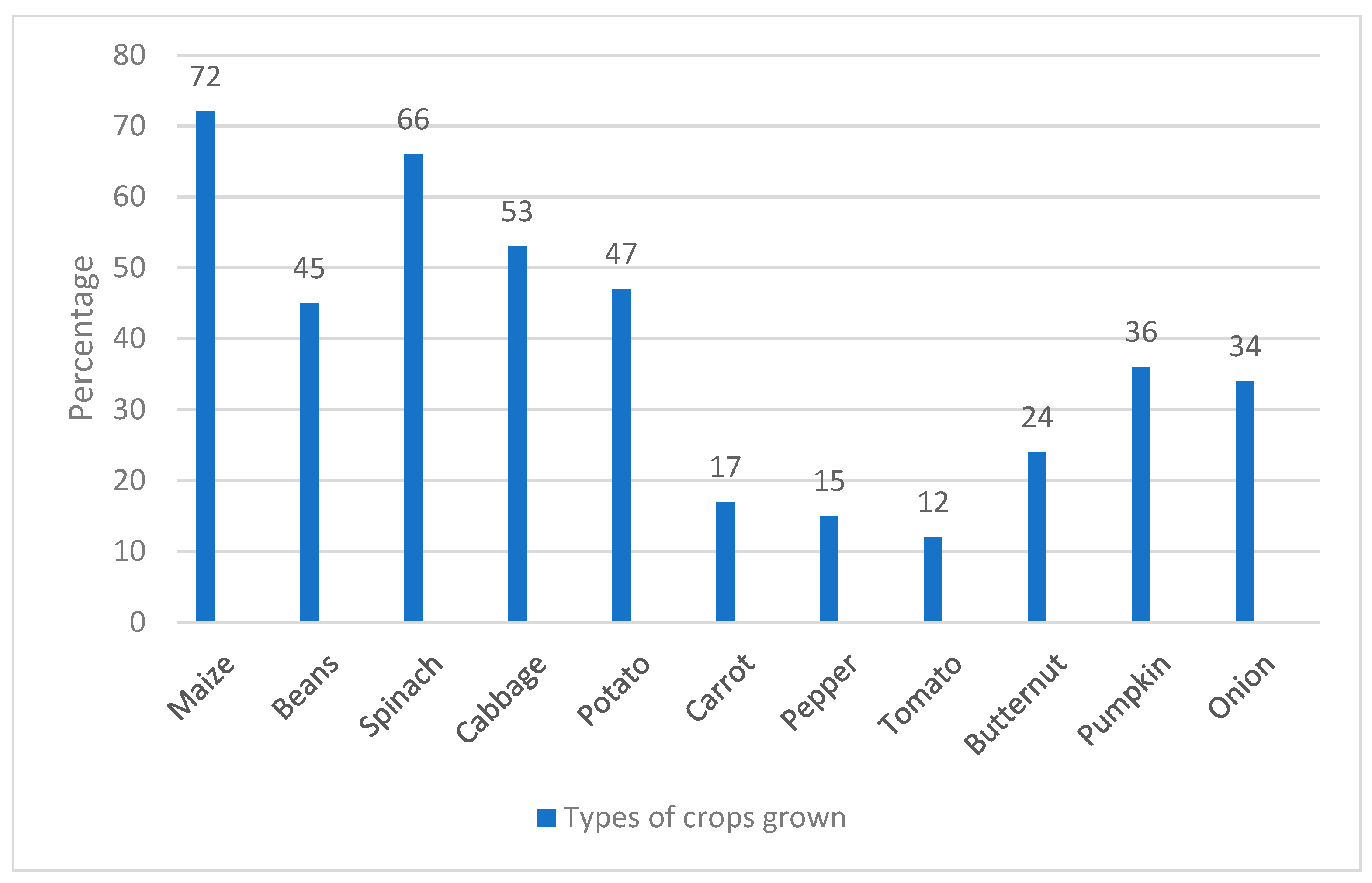
Figure 3 shows the types of crops grown by the smallholders in the study area. The findings revealed that maize (72%) was the most widely grown crop, followed by spinach (66%), cabbages (53%), potatoes (47%), and beans (45%). Other crops grown in smaller proportions included pumpkins (36%), onions (34%), butternuts (24%), carrots (17%), peppers (15%), and tomatoes (12%). These statistics indicated that crop production in the study area was dominated by staple and vegetable crops, reflecting a strong orientation toward subsistence food production and household-level consumption rather than commercial farming.
The dominance of maize highlighted its role as a staple food crop and an essential component of food security in rural South Africa. Maize has been widely cultivated due to its adaptability to local climatic conditions, its role as a dietary staple, and its relatively low input requirements [34,35]. In many rural households, maize has formed the foundation of daily meals, either as maize meal or porridge, and its cultivation has significantly contributed to reducing dependency on purchased food. This pattern aligned with findings by reference [36], who noted that smallholder farmers in the Eastern Cape continued to prioritise maize due to its cultural, economic, and food security significance.
The high prevalence of spinach (66%) and cabbage (53%) production underscored the importance of leafy vegetables in improving dietary diversity and household nutrition. These vegetables have been essential sources of vitamins and minerals and can be harvested multiple times within a season, providing a continuous food supply [34]. Households often consumed these vegetables directly and with any surplus sold locally, indicating that horticultural production has played a dual role in nutrition and income generation. Similarly, potatoes (47%) and beans (45%) have been important components of the local diet, providing carbohydrates and proteins, respectively, and thereby contributing to balanced household nutrition [37]. Figure 3 shows that crops such as pumpkins (36%), onions (34%), butternuts (24%), and tomatoes (12%) have mainly been produced for domestic use and local market exchange. These crops can diversify household diets and support year-round food availability, especially when combined with home garden production. The inclusion of these crops in smallholder systems aligned with the findings by reference [38], who argued that crop diversification was a key resilience strategy among rural households to buffer against climatic variability and market fluctuations. However, the lower production levels of carrots (17%), peppers (15%), and tomatoes (12%) may reflect challenges such as limited access to irrigation, high input costs, and pest management constraints, which are common barriers in small-scale vegetable farming [39].

4.3. Patterns and Reasons for Land Abandonment in the Rural Eastern Cape

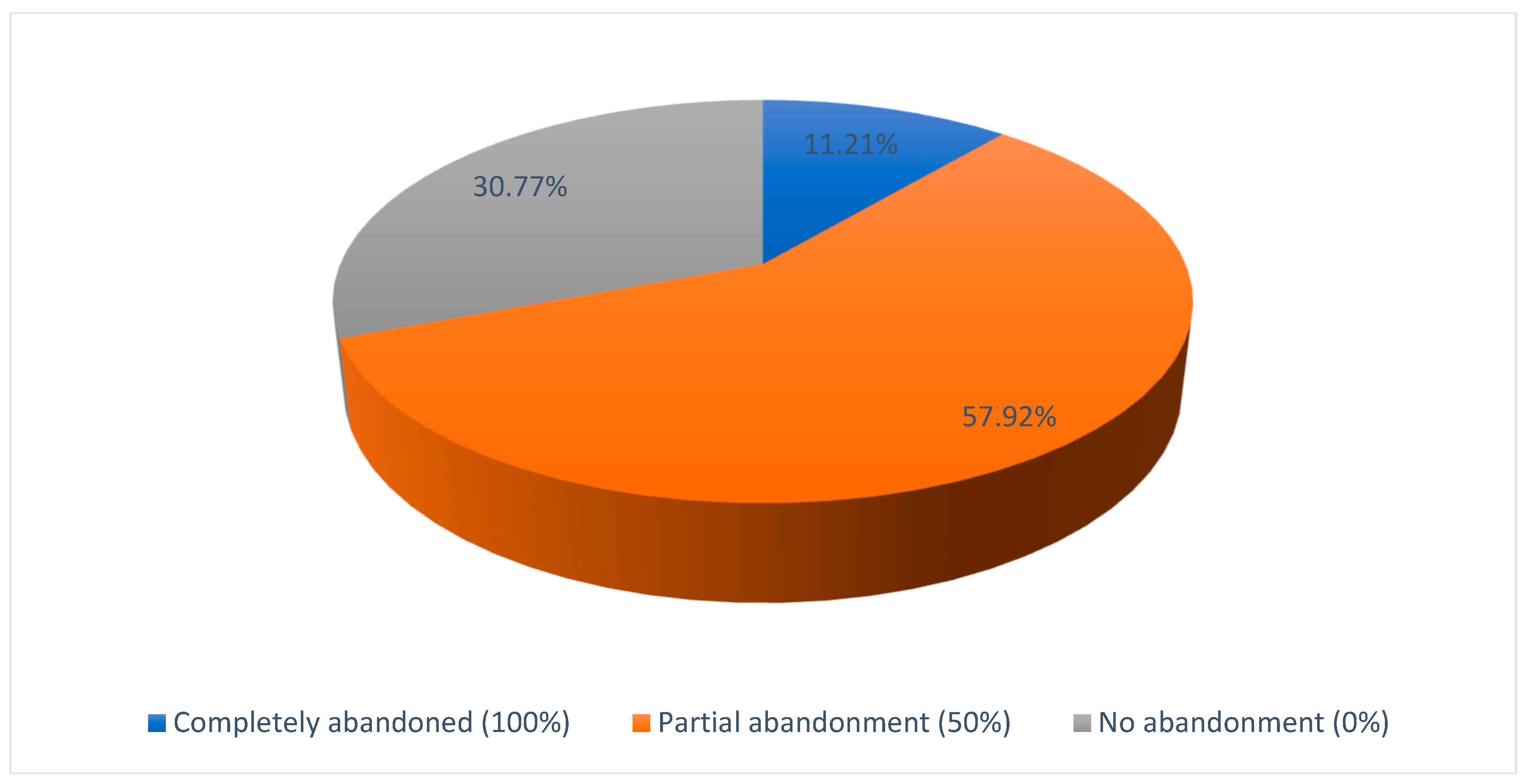
The findings presented in Figure 4 indicate that only a small proportion (30.77%) of farming households in the rural Eastern Cape have continued to utilise their croplands at full capacity, while a substantial majority (69.23%) have abandoned cropland to varying degrees. Among those who have abandoned cropland, 57.92% reported partial abandonment, whereas 11.21% indicated complete cessation of crop production. These results have revealed a continuum of agricultural engagement, ranging from full-scale cultivation to partial or complete withdrawal from cropping activities.
The high prevalence of partial abandonment (57.92%) could suggest that many households have been experiencing increasing difficulty in sustaining full-scale crop production. This trend was likely driven by a combination of economic, environmental, and institutional constraints. Similar patterns have been documented elsewhere in the Eastern Cape, where households have reduced the size of land under cultivation as a coping strategy in response to rising input costs, water scarcity, and declining soil fertility [17,35]. This form of “partial farming” represents an adaptive response that has enabled households to retain some level of food production while reducing exposure to production risks, labour demands, and financial costs [40].
In contrast, the 30.77% of respondents who reported full utilisation of their croplands were likely households with relatively better access to productive resources, including labour, credit, mechanisation, and agricultural extension services, or those with a stronger farming motivation and resilience. The evidence from previous studies has suggested that continued full engagement in crop cultivation has often been associated with higher farming experience, participation in farming cooperatives or community-based networks, and improved access to agricultural support services [37,39]. These households tended to exhibit greater adaptive capacity and a stronger commitment to agriculture as a primary livelihood strategy.
Complete cropland abandonment was reported by 11.21% of respondents. Among these households, approximately 33.48% cited increasingly unpredictable rainfall patterns over the past decade, which undermined their ability to plan planting seasons and achieve reliable yields. In addition to climatic factors, other key reasons for complete abandonment included high production costs, limited access to financial resources, and declining economic returns from crop farming, which reduced incentives to continue cultivation. Together, these factors have highlighted the growing vulnerability of smallholder farming systems in the rural Eastern Cape and underscored the complex interplay between climatic uncertainty and socio-economic constraints in driving cropland abandonment.
As explained by one of the key informants:
10 years ago, rainfall used to come early and would allow us to plant maize and beans before November but nowadays, we are not sure and sometimes we plant in the following year—January
(Aged farmer, Sirhosheni village, May 2025)
Another influential informant added:
We are given seeds and fertiliser, but after harvest, there’s nowhere to sell. So people lose interest, and the fields go back to bush
(Cooperative leader, Zintukwini location, May 2025)
Lack of resources is one of the reasons for cropland abandonment. In addition to this, there has been a series of drought which made people lose cattle that were used for drought power
(Agricultural extension officer, Mnquma, June 2025)
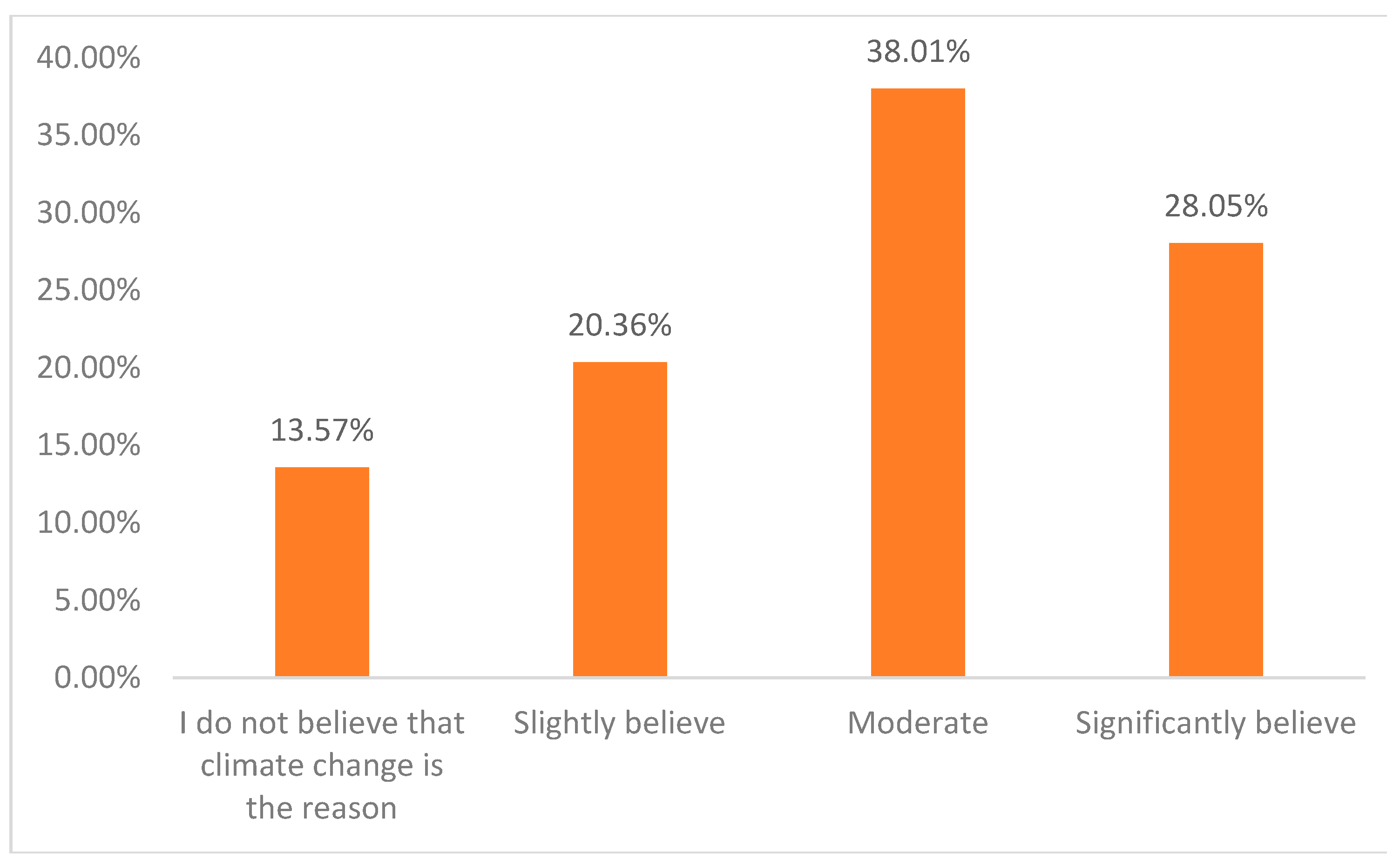
A Likert scale was used to check the perceptions of farmers regarding the extent to which climate change influenced land abandonment. Figure 4 below shows the responses.

4.4. Factors Influencing Cropland Abandonment

The study used a double-hurdle model to estimate the factors influencing cropland abandonment and the proportion of land abandoned. In the first hurdle, a probit model was estimated to elicit the factors influencing cropland abandonment by farming households in the study area. A total of 14 demographic, socio-economic, and environmental factors were fitted in the model and tested for their significance at 1%, 5%, and 10% significance levels. These variables were: gender, age, level of education, household size, membership in a cooperative, farming experience, land tenure system, access to credit, frequency of extension visits, rainfall patterns, access to irrigation, livestock ownership, off-farm income, and agricultural input support. Table 3 summarises the results of the two models, where Model 1 presents the results of the probit model and indicates that its predictive power was high (Chi-square value = 36.81; p < 0.01, Log likelihood = −59.566615 and Prob > Chi2 = 0.0013. The value of Pseudo R2 (0.536), suggesting that the model provided a reasonable goodness of fit to the data relative to the baseline model. Moreover, the variance inflation factors were computed for all variables, and all showed no signs of multicollinearity as they were well below the standard threshold. The vce robust option was also used to ensure the stable estimation of coefficients. Of the 14 variables fitted, six variables were found to have influenced cropland abandonment significantly. These variables included level of education, farming experience, access to credit, rainfall patterns, access to irrigation, and off-farm income. Figure 5 shows farmers’ perception of the extent to which climate change-related factors influenced cropland abandonment. The results in Figure 5 show that most (38.01%) farmers were not sure whether cropland in this area is influenced by climate variations. About (28.05%) related cropland abandonment with climate change, while a small proportion (13.57%) strongly believed that climate change has not influenced cropland abandonment.
Level of education: Contrary to a prior expectation of the study, the coefficient for the level of education (0.3169156) had a positive influence on cropland abandonment at a 10% level of significance with a p-value of 0.090. This positive coefficient marked a positive relationship between the level of education and cropland abandonment. These results suggested that educated farmers were more likely to abandon croplands. This could imply that the educated farmers were involved in other income-generating activities and required small portions of land for farming. In reality, educated farmers were more likely to adopt improved farming practices and diversify income with agriculture. This finding was in line with reference [41], who found that off-farm employment was strongly linked to cropland abandonment, as educated farmers were more likely to access non-agricultural jobs. Moreover, this was supported by reference [16] who found that off-farm work induced farmland abandonment in China, especially among households with higher education levels.
Farming experience: As expected, the coefficient (−0.0337282) for the variable crop farming experience had a negative influence on land abandonment at a 5% level of significance with a p-value of 0.053. This negative relationship suggested that experienced farmers were less likely to fully abandon croplands due to the accumulated skills and adaptive capacity. In other words, experienced farmers had acquired more skills and knowledge on crop production activities in previous years and were able to adapt with the rainfall patterns. This finding was supported by reference [17] who reported that experience built resilience and discouraged abandonment in South Africa.
Access to credit: The coefficient (−0.7694171) for the variable regarding the access to credit or loans had a negative relationship with cropland abandonment at a 10% level of significance with a p-value of 0.082. This negative relationship suggested that farmers with access to credit were less likely to abandon land—in other words, credit relaxed liquidity constraints and enabled continued cultivation. This finding was consistent with reference [17], who observed that the lack of financial resources was a key driver of abandonment in South African communal lands, while reference [16] found that credit access in rural China reduced land abandonment by easing liquidity constraints. There was also similar evidence from East Africa, as reference [42] highlighted the role of financial support in enabling farmers to invest in inputs, adapt to climatic variability, and avoid abandoning land.
Rainfall patterns: This variable captured farmers’ perceptions of changes in rainfall patterns over previous years. Respondents were asked to indicate whether they observed increases, decreases, or greater unpredictability in rainfall. While this measure does not reflect objective meteorological records, perception-based indicators have been commonly used in smallholder agricultural studies, as farmers’ management decisions, including cropland abandonment, were often shaped by perceived climate variability. As expected, the coefficient (0.2490097) for the variable of rainfall variability had a positive relationship with cropland abandonment at a 10% level of significance with a p-value of 0.057. This positive relationship suggested that climate stress reduced yields, which in turn increased the risk of abandoning land. This finding was consistent with reference [17], who reported that drought and rainfall variability were strong drivers of abandonment in South African communal lands. Reference [43] similarly found that climate variability strongly influenced changes in land use. Comparable evidence from Mediterranean Europe underscored that rainfall stress was a universal driver of cropland abandonment, particularly in marginal farming systems [44].
Access to irrigation: The coefficient (−0.7911604) for the variable regarding the access to irrigation facilities had a negative relationship with cropland abandonment at a 10% level of significance with a p-value of 0.076. This negative relationship suggested that farmers with smart irrigation facilities were less likely to abandon croplands due to a reduced reliance on unreliable rainfall—irrigation could buffer climate shocks and reduce the likelihood of land abandonment. This finding was consistent with reference [43], who found that irrigation facilities in South Africa lowered vulnerability to rainfall variability. Similar evidence from Mediterranean Europe was reported by reference [44], highlighting that irrigation can be a critical adaptation strategy, enabling farmers to sustain cultivation and avoid abandoning land under climate stress.
Off-farm income: As anticipated in this study, the coefficient (0.000067) for the variable regarding off-farm income had a negative relationship with cropland abandonment at a 1% significant level with a p-value of 0.006. This positive relationship showed that farmers’ engagement in non-agricultural activities reduced the dependency on agriculture, which ultimately encouraged land abandonment. This finding was consistent with reference [16], who found similar patterns among households with higher education and income. Reference [17] reported comparable evidence in South African communal lands, where non-agricultural engagement reduced cultivation, while reference [44] highlighted off-farm income as a major driver of abandonment in Mediterranean Europe. Collectively, these studies have confirmed that diversification into non-agricultural livelihoods, while economically beneficial, often accelerated cropland abandonment.

4.5. Factors Influencing the Extent of Cropland Abandonment by Farmers

In the second hurdle, we employed an ordered probit model to assess the factors influencing the proportion or the extent of cropland abandonment by farming households. The proportion of land abandoned was categorised into two levels of 1 (100% abandonment) and 2 (50% abandonment). Table 3 shows the ordered probit results. A total of 14 demographic, socio-economic, and environmental factors were fitted in the model and tested for their significance at 1%, 5%, and 10% significance levels. These variables included gender, age, level of education, household size, membership in a cooperative, farming experience, land tenure system, access to credit, frequency of extension visits, rainfall patterns, access to irrigation, livestock ownership, off-farm income, and agricultural input support. In Table 3, Model 2 presents the results of the ordered probit model and indicates that the predictive power of the model was high (Chi-square value = 72.96; p < 0.01, Log likelihood = −171.45084, 59.566615 and Prob > Chi2 = 0.0000. The value of Pseudo R2 = 0.492), implying that the 14 explanatory variables fitted captured 49% of possible extent of cropland abandonment. Of the 14 variables fitted in the ordered regression, six variables were found to have influenced the extent of cropland abandonment at different levels. These variables included household size, access to credit, farming experience, cooperative membership, rainfall patterns, and off-farm income.
Household size/Labour availability: Differing from the prior expectations of this study, the variable household size had a positive influence on the proportion of land abandoned at a 10% significant level, with a p-value of 0.061 This negative relationship implied that the larger the household size, the higher the chances of higher abandonment. This meant that households were reallocating labour to off-farm employment and migration, reducing the labour available for farming. Reference [45] found similar patterns in rural China, where larger households often had more members engaged in non-agricultural work, leading to abandonment. Reference [17] reported comparable evidence in South African communal lands, noting that household labour availability did not necessarily translate into cultivation. References [16,44] further highlighted that demographic shifts and education within larger households can encourage exit strategies. These studies could collectively suggest that household size can accelerate cropland abandonment under certain socio-economic conditions rather than ensure labour for farming.
Access to credit: The coefficient (0.5421011) for the variable regarding access to credit or loans had a positive relationship with the extent of cropland abandonment at a 5% level of significance with a p-value of 0.045. This finding was consistent with reference [45], who observed that credit facilitated migration and off-farm employment in rural China, and reference [16] reported that households used credit to diversify income away from farming, leading to abandonment of marginal land. Reference [17] found similar results where financial resources in South Africa sometimes encouraged farmers to exit agriculture. Reference [44] also highlighted the dual role of credit in either sustaining or facilitating abandonment.
Farming experience: The coefficient (0.0157839) for the variable of crop farming experience had a positive influence on the extent of cropland abandonment at a 5% level of significance with a p-value of 0.053. This positive relationship suggested that experienced farmers were more likely to fully abandon croplands due to the ageing labour workforce and their declining capacity, as well as an accumulated awareness of poor returns from marginal lands. References [17,46] observed similar patterns in South African communal lands, where long-term farmers abandoned fields due to climate stress and a lack of institutional support. Reference [45] noted that older farmers in China often left cropland uncultivated when household labour migrated, while reference [44] highlighted that experienced farmers in Mediterranean Europe strategically abandoned unproductive land.
Cooperative membership: As expected, the coefficient (−0.7933432) for membership in farmer organisations had a negative relationship with the extent of land abandonment at a 1% significant level with a p-value of 0.001. This negative relationship showed that collective support reduced the severity of abandonment. This finding was consistent with reference [17], who highlighted the role of farmer organisations in sustaining cultivation in South African communal lands. Reference [47] further demonstrated that cooperatives in Tshwane strengthened local economic development by pooling resources and reducing vulnerability. Similar evidence from Mediterranean Europe underscored that farmer organisations can provide social capital, shared resources, and resilience against climate and market shocks, thereby discouraging land abandonment [44].
Rainfall patterns: This variable captured farmers’ perceptions of changes in rainfall patterns over the past years. As opposed to prior expectations, the coefficient (−0.233786) for the variable regarding rainfall variability had negative relationship with the extent of cropland abandonment at a 10% level of significance with a p-value of 0.010. This may reflect risk-spreading strategies, adoption of drought-tolerant crops, or reliance on institutional support. Reference [44] observed similar adaptive responses in Mediterranean Europe, where irrigation and diversification reduced abandonment during drought. Reference [17] reported that South African farmers maintained multiple plots as a hedge against rainfall variability, while reference [45] noted that households in rural China sometimes intensified cultivation in response to climate stress.
Off-farm income: The coefficient (−0.0000489) for off-farm income showed a negative association with the extent of cropland abandonment at a 5% level with a p-value of 0.005. This negative association implied that farming households with higher off-farm income were less likely to progress from partial to full abandonment due to the fact that additional income may ease liquidity constraints and enable farmers to retain most of their lands. Reference [45] noted similar dynamics in rural China, where off-farm income sometimes sustained cultivation despite migration pressures. Reference [17] observed that diversified households in South Africa were more able to maintain cultivation, while reference [44] highlighted that off-farm income in Mediterranean Europe reduced abandonment in marginal lands.

4.6. Interaction Effects Among Key Determinants of Cropland Abandonment

While the double-hurdle model identified several significant determinants in cropland abandonment, the results also suggested that these factors did not operate in isolation. Rather, cropland abandonment emerged from the interaction of socio-economic, institutional, and climatic conditions that jointly shaped household land-use decisions.
First, education and off-farm income interacted in shaping the decision to abandon cropland. The positive association between education and abandonment in the first hurdle model became more understandable when considered alongside the significant role of off-farm income. Higher levels of education often increased access to employment opportunities outside agriculture, thereby encouraging livelihood diversification. As a result, educated farmers may allocate less time and labour to crop production, thereby increasing the likelihood of abandoning cropland. Similar interaction dynamics between education, off-farm employment, and land abandonment have been documented in rural China and other developing regions where improved education expanded non-agricultural opportunities for rural households [48,49].
Second, rainfall variability interacted with the access to irrigation in influencing land-use decisions. Rainfall variability significantly increased the probability of cropland abandonment, while access to irrigation reduced it. This suggested that irrigation infrastructure acted as an adaptive mechanism that moderated the negative effects of climatic uncertainty. Farmers without irrigation remained highly vulnerable to rainfall shocks and were therefore more likely to abandon cultivation, whereas those with irrigation facilities could buffer climatic risks and maintain production. Previous studies similarly highlighted that irrigation reduced climate-induced land abandonment by stabilising agricultural production systems [50,51].
Third, credit access interacted with cooperative memberships in shaping the extent of cropland abandonment. Although access to credit was associated with the extent of abandonment in the ordered probit model, cooperative membership significantly reduced the likelihood of large-scale abandonment. This indicated that institutional support structures moderated the influence of financial resources on land-use outcomes. Farmers who were members of cooperatives were more likely to access collective marketing channels, shared labour, and technical advice, which may have enabled them to utilise credit for productive agricultural investment rather than exiting farming. In contrast, individual farmers may use financial resources to diversify away from agriculture.
Fourth, farming experience interacted with household labour availability in determining the proportion of land abandoned. While farming experience generally discouraged the initial decision to abandon cropland, the results indicated that experienced farmers may still abandon larger portions of land when household labour became constrained. This was particularly relevant in rural areas, where younger household members migrated to urban centres for employment, leaving older, more experienced farmers with limited labour to cultivate large fields. Under such circumstances, households may strategically abandon marginal plots while maintaining smaller areas for subsistence production.

5. Conclusions and Policy Implications

5.1. Conclusions

This study examined the extent and determinants of cropland abandonment in rural areas of the Eastern Cape Province, South Africa, with a particular focus on household, institutional, and climatic factors influencing land-use decisions. Cropland abandonment in the study area has presented a serious development challenge, as it can undermine local food production systems and exacerbate existing food insecurity in predominantly rural farming communities.
The findings revealed a high prevalence of cropland abandonment, with nearly nine out of ten farming households having abandoned portions of their arable land. Notably, more than half of these households had abandoned approximately 50% of their cropland, while nearly a third had completely withdrawn from crop production. This pattern reflected a gradual but substantial shift away from farming, rather than isolated or temporary land-use adjustments.
Empirical results from the first hurdle model indicated that education level, farming experience, rainfall variability, access to irrigation, and off-farm income significantly influenced the decision to abandon cropland. These results suggested that cropland abandonment was driven by both capacity-related factors (such as skills and experience) and structural constraints (including climate variability and limited irrigation infrastructure). The significance of off-farm income further highlighted the role of livelihood diversification, where households increasingly prioritised non-farm activities when agriculture became less viable.
The second hurdle model demonstrated that the extent of cropland abandonment was shaped by labour availability, access to credit, rainfall patterns, cooperative membership, and farming experience. This finding underscored that while some factors influenced the initial decision to abandon land, a different set of institutional and resource-related constraints determined how much land was ultimately left uncultivated. In particular, limited access to labour and finance constrained continuing cultivation, while cooperative membership emerged as a protective factor against large-scale abandonment.

5.2. Policy Implications

Based on the findings, the study would recommend that strengthening farmer education through agricultural extension programmes is critical in addressing cropland abandonment in the study area. The findings showed that the education level and farming experience significantly influenced both the decision to abandon cropland and the extent of abandonment. Therefore, enhancing extension support can equip smallholder farmers with practical skills in sustainable land management, climate-resilient cropping practices, and efficient input use. In addition, the promotion of farmer cooperatives should be prioritised as a strategy for reducing the extent of cropland abandonment. Cooperative membership was found to have significantly influenced land-use outcomes by improving access to labour, credit, and shared resources. Therefore, strengthening existing cooperatives and supporting the formation of new ones can foster collective action, improve market participation, and enhance farmers’ bargaining power. Government and development agencies should therefore provide institutional and technical support to cooperatives, including governance training and the facilitation of linkages with input suppliers and produce markets. Another important point was that expanding access to financial services tailored to the needs of smallholder farmers was essential. Many farmers in communal areas remained excluded by the formal credit institutions due to the lack of collateral and high perception of risk. Policymakers and financial institutions should design flexible credit instruments, such as seasonal loans, input financing, and group-based lending schemes, that can align with smallholder production cycles and climatic uncertainties. An improved access to finance would enable farmers to invest in inputs and labour, thereby sustaining crop production. Moreover, strengthening investment in irrigation infrastructure and improved water rights should be a key policy priority. Reliance on rain-fed agriculture has exposed smallholder farmers to climate shocks, increasing the likelihood of land withdrawal during periods of no rain. Public investment in small-scale and community-managed irrigation schemes, as well as the rehabilitation of existing but dilapidated infrastructure, can stabilise production and enhance resilience. Such interventions could be particularly important in communal farming systems where individual irrigation investment capacity is limited. Lastly, promoting youth inclusion in agriculture is vital for reversing long-term cropland abandonment trends. The study’s findings on labour availability suggested that ageing farming populations and declining youth participation contributed to reduced cultivation. Targeted youth-focused programmes that can provide agricultural skills training, access to land, start-up finance, and agribusiness incubation opportunities could revitalise rural farming systems. Encouraging youth engagement in agriculture would not only address labour constraints but also support innovation and long-term sustainability in smallholder production systems.

5.3. Limitations

Although the study covered the objectives, it had some limitations. Firstly, the geographic scope of the research was limited to the Eastern Cape Province, particularly within the context of the former homeland areas. This may limit the generalisation of the conclusions.
We should acknowledge that categorising abandonment extent as 50% or 100% was coarse and that using continuous measures would have enhanced precision and interpretability. Moreover, there was a possibility of endogeneity among some explanatory variables considered in the model, particularly off-farm income, credit access, and cooperative membership. These variables may be jointly determined with land abandonment decisions, leading to a reverse causality. As a result, the econometric approaches employed and the estimated coefficients may not have fully captured the true causal effect of these variables on land abandonment, and directionality may not be easily detected. Moreover, the lack of suitable instruments limited the ability to implement such rigorous methods for isolating the true causal relationships. Therefore, the findings should be interpreted as indicative associations rather than causal effects.

Author Contributions

Conceptualisation, M.C., Z.M., L.M. and S.Z.; Methodology, S.M. (Siyasanga Mgoduka), S.Z. and M.C.; Software, S.M. (Sukoluhle Mazwane); Validation, M.C.; Analysis, M.C. and S.M. (Sukoluhle Mazwane); Review and editing, M.C., S.Z. and S.M. (Siyasanga Mgoduka); Funding acquisition, M.C. and S.Z. All authors have read and agreed to the published version of the manuscript.

Funding

We express our gratitude to the National Research Foundation (NRF), for providing financial support for this project under the Thuthuka Project No. TTK23041392782, titled “Abandonment of arable crop lands and government efforts to revamp arable crop lands for food security in rural communities in the Eastern Cape”. The authors would also like to thank the National Research Foundation (NRF), KIC240814259081 for financial assistance at different stages of the project.

Institutional Review Board Statement

The study obtained ethical clearance from the University of Mpumalanga, and the protocol reference number is UMP/CHRISTIAN/FANS/2025/01. The ethics were obtained on the 31 March 2025.

Informed Consent Statement

Informed consent was obtained from all subjects involved in the study.

Data Availability Statement

The data used in this study form part of an ongoing research project and are not yet publicly available due to ethical and project-related restrictions. The dataset contains sensitive socio-economic information collected from human participants, and public sharing is restricted to protect participant confidentiality and to comply with the approved research ethics protocol. The data may be made available from the corresponding author upon reasonable request and subject to approval by the project team and relevant ethics committee.

Conflicts of Interest

The authors declare no conflicts of interest. The funders had no role in the design of the study; in the collection, analyses, or interpretation of data; in the writing of the manuscript; or in the decision to publish the results.

References

  1. Sihlobo, W.; Kirsten, J. Agriculture in South Africa. In The Oxford Handbook of the South African Economy; Oxford University Press: Oxford, UK, 2021; pp. 194–216. [Google Scholar] [CrossRef]
  2. Fransman, T.; Yu, D. Multidimensional poverty in South Africa in 2001–16. Dev. S. Afr. 2019, 36, 50–79. [Google Scholar] [CrossRef]
  3. Kwenda, P.; Ntuli, M.; Mudiriza, G. Exploring unemployment differentials between former and non-former homeland areas in South Africa: A decomposition approach. Dev. S. Afr. 2023, 40, 166–190. [Google Scholar] [CrossRef]
  4. Rogan, M. Food poverty, hunger and household production in rural Eastern Cape households. Dev. S. Afr. 2018, 35, 90–104. [Google Scholar] [CrossRef]
  5. Zantsi, S.; Bester, B.J. Dynamism in rural households’ income sources, food preference, daily activities and investment strategies: Insights from Ndabakazi villages in Butterworth, Eastern Cape, South Africa. S. Afr. Rev. Sociol. 2021, 51, 42–60. [Google Scholar] [CrossRef]
  6. Shi, T.C.; Li, X.B. Farmland abandonment in Europe and its enlightenment to China. Geogr. Geo-Inf. Sci. 2013, 29, 101–103. (In Chinese) [Google Scholar]
  7. Queiroz, C.; Beilin, R.; Folke, C.; Lindborg, R. Farmland abandonment: Threat or opportunity for biodiversity conservation? Front. Ecol. Environ. 2014, 12, 288–296. [Google Scholar] [CrossRef]
  8. Isbell, F.; Tilman, D.; Reich, P.B.; Clark, A.T. Deficits of biodiversity and productivity linger a century after agricultural abandonment. Nat. Ecol. Evol. 2019, 3, 1533–1538. [Google Scholar] [CrossRef]
  9. Chen, H.; Shen, Q.; Zang, D.; Li, H.; Sow, Y. Study on the impact of environmental pollution on farmland abandonment. Environ. Sci. Pollut. Res. 2022, 29, 1458–1469. [Google Scholar] [CrossRef]
  10. Pokwana, S.; Shackleton, C.M. Arable land abandonment and land use/land cover change in southeastern South Africa. Land 2025, 14, 2156. [Google Scholar] [CrossRef]
  11. Kakembo, V. The loss of agricultural and ecological resilience in abandoned lands of the Eastern Cape Province, South Africa. In Agriculture and Ecosystem Resilience in Sub Saharan Africa; Springer: Berlin/Heidelberg, Germany, 2019; pp. 1–20. [Google Scholar] [CrossRef]
  12. Muchabveyo, B.; Magaiza, G.; Dube, J. Livelihood transitions in selected former homelands of South Africa: A thirty-year systematic literature review. Dev. S. Afr. 2025, 42, 609–629. [Google Scholar] [CrossRef]
  13. Zantsi, S.; Xaba, M.B. ‘Back to the fields’: The implementation and impact of government efforts to revive field cultivation in Ndabakazi in the Eastern Cape, South Africa. J. S. Afr. Stud. 2025, 51, 7–24. [Google Scholar] [CrossRef]
  14. Sinyolo, S.; Mudhara, M.; Wale, E. To what extent does dependence on social grants affect smallholder farmers’ incentives to farm? Evidence from KwaZulu-Natal, South Africa. Afr. J. Agric. Resour. Econ. 2016, 11, 154–165. [Google Scholar]
  15. Sinyolo, S.; Mudhara, M.; Wale, E. Assessing the impact of social grant-dependency on participation of KwaZulu-Natal rural households in farming. J. Agric. Rural. Dev. Trop. Subtrop. 2017, 118, 233–244. [Google Scholar]
  16. Zheng, L. Does off-farm work induce farmland abandonment? Evidence from China. China Agric. Econ. Rev. 2024, 16, 664–682. [Google Scholar] [CrossRef]
  17. Blair, D.; Shackleton, C.M.; Mograbi, P.J. Cropland abandonment in South African smallholder communal lands: Land cover change (1950–2010) and farmer perceptions of contributing factors. Land 2018, 7, 121. [Google Scholar] [CrossRef]
  18. Estel, S.; Kuemmerle, T.; Alcántara, C.; Levers, C.; Prishchepov, A.V.; Hostert, P. Mapping farmland abandonment and recultivation across Europe using MODIS NDVI time series. Remote Sens. Environ. 2015, 163, 312–325. [Google Scholar] [CrossRef]
  19. Kuemmerle, T.; Hostert, P.; Radeloff, V.C.; Perzanowski, K.; Kruhlov, I. Cross-border comparison of post-socialist farmland abandonment in the Carpathians. Ecol. Appl. 2008, 18, 545–560. [Google Scholar] [CrossRef]
  20. Müller, D.; Kuemmerle, T.; Rusu, M.; Griffiths, P. Lost in transition: Determinants of post-socialist cropland abandonment in Eastern Europe. J. Land Use Sci. 2009, 4, 109–129. [Google Scholar] [CrossRef]
  21. Creswell, J.W.; Plano Clark, V.L. Designing and Conducting Mixed Methods Research, 3rd ed.; Sage Publications: Thousand Oaks, CA, USA, 2018. [Google Scholar]
  22. Ivankova, N.V.; Creswell, J.W.; Stick, S.L. Using Mixed-Methods Sequential Explanatory Design: From Theory to Practice. Field Methods 2006, 18, 3–20. [Google Scholar] [CrossRef]
  23. Bryman, A. Social Research Methods, 5th ed.; Oxford University Press: Oxford, UK, 2016. [Google Scholar]
  24. Kallio, H.; Pietilä, A.M.; Johnson, M.; Kangasniemi, M. Systematic Methodological Review: Developing a Framework for a Qualitative Semi-Structured Interview Guide. J. Adv. Nurs. 2016, 72, 2954–2965. [Google Scholar] [PubMed]
  25. Krueger, R.A.; Casey, M.A. Focus Groups: A Practical Guide for Applied Research, 5th ed.; Sage Publications: Thousand Oaks, CA, USA, 2015. [Google Scholar]
  26. Kothari, C.R. Research Methodology: Methods and Techniques, 2nd ed.; New Age International Publishers: New Delhi, India, 2004. [Google Scholar]
  27. Gray, D.E. Doing Research in the Real World, 5th ed.; Sage Publications: London, UK, 2021. [Google Scholar]
  28. Clarke, V.; Braun, V. Thematic analysis. J. Posit. Psychol. 2017, 12, 297–298. [Google Scholar] [CrossRef]
  29. Trahan, A.; Stewart, D. Toward a Pragmatic Approach to Mixed Methods Research. J. Mix. Methods Res. 2013, 7, 206–218. [Google Scholar]
  30. Lee, J.; Oh, Y.-G.; Yoo, S.-H.; Suh, K. Vulnerability assessment of rural aging communities for abandoned farmlands in South Korea. Land Use Policy 2021, 108, 105544. [Google Scholar] [CrossRef]
  31. Jamshidi, O.; Asadi, A.; Kalantari, K.; Azadi, H.; Scheffran, J. Vulnerability to climate change of smallholder farmers in Hamadan Province, Iran. Clim. Risk Manag. 2019, 23, 146–159. [Google Scholar] [CrossRef]
  32. Muringai, R.T.; Naidoo, D.; Mafongoya, P.; Lottering, S. The impacts of climate change on the livelihood and food security of small-scale fishers in Lake Kariba, Zimbabwe. J. Asian Afr. Stud. 2020, 55, 298–313. [Google Scholar]
  33. Li, L.; Luo, X.; Liu, Y.; Liu, Y.; Liu, X. The impact of location of labor migration on rural households’ income: Evidence from Jiangxi Province, China. Agriculture 2024, 14, 1458. [Google Scholar] [CrossRef]
  34. Fanzo, J.; Covic, N.; Dobermann, A.; Henson, S.; Herrero, M.; Pingali, P.; Staal, S. A research vision for food systems in the 2020s: Defying the status quo. Glob. Food Secur. 2020, 26, 100397. [Google Scholar] [CrossRef]
  35. Dube, B.; Moyo, N. COVID-19 Pandemic and The Precarity of Life: Rethinking a Pedagogy of Compassion so That the People of This Earth May Live. J. Educ. Teach. Learn. 2021, 6, 146–153. [Google Scholar] [CrossRef]
  36. Pokwana, S.; Shackleton, C.M. Complex and interactive drivers of arable field abandonment in villages of the Eastern Cape and KwaZulu-Natal, South Africa. Land Use Policy 2025, 158, 107736. [Google Scholar] [CrossRef]
  37. Makate, C.; Makate, M.; Mango, N.; Siziba, S. Increasing resilience of smallholder farmers to climate change through multiple adoption of proven climate-smart agriculture innovations. Lessons from Southern Africa. J. Environ. Manag. 2019, 231, 858–868. [Google Scholar] [CrossRef] [PubMed]
  38. Aliber, M.; Hall, R. Support for Smallholder Farmers in South Africa: Challenges of Scale and Strategy. Dev. S. Afr. 2012, 29, 548–562. [Google Scholar] [CrossRef]
  39. Gwiriri, L.C.; Bennett, J.; Mapiye, C.; Burbi, S. Emerging from below? Understanding the livelihood trajectories of smallholder livestock farmers in Eastern Cape Province, South Africa. Land 2021, 10, 226. [Google Scholar] [CrossRef]
  40. Mulaudzi, F. Smallholder Farming, Livelihood Adaptation and Agrarian Change in Rural South Africa. Ph.D. Thesis, University of the Witwatersrand, Johannesburg, South Africa, 2017. [Google Scholar]
  41. Deng, X.; Xu, D.; Zeng, M.; Qi, Y. Landslides and Cropland Abandonment in China’s Mountainous Areas: Spatial Distribution, Empirical Analysis and Policy Implications. Sustainability 2018, 10, 3909. [Google Scholar] [CrossRef]
  42. Twumasi, M.; Jiang, Y.; Osei Danquah, F.; Chandio, A.A.; Agbenyo, W. The role of savings mobilization on access to credit: A case study of smallholder farmers in Ghana. Agric. Financ. Rev. 2020, 80, 275–290. [Google Scholar] [CrossRef]
  43. Mogonong, B.P.; Twine, W.; Feig, G.T.; Van der Merwe, H.; Fisher, J.T. Influences of Climate Variability on Land Use and Land Cover Change in Rural South Africa. Remote Sens. 2024, 16, 1200. [Google Scholar] [CrossRef]
  44. Lasanta, T.; Arnáez, J.; Pascual, N.; Ruiz-Flaño, P.; Errea, M.P.; Lana-Renault, N. Space–time process and drivers of land abandonment in Europe. Catena 2017, 149, 810–823. [Google Scholar] [CrossRef]
  45. Xu, D.; Deng, X.; Huang, K.; Liu, Y.; Yong, Z.; Liu, S. Relationships between labor migration and cropland abandonment in rural China from the perspective of village types. Land Use Policy 2019, 88, 104164. [Google Scholar] [CrossRef]
  46. Mograbi, P.J. Spatio-Temporal Dynamics of Woody Vegetation Structure in a Human-Modified South African Savanna. Ph.D. Thesis, University of the Witwatersrand, Johannesburg, South Africa, 2016. [Google Scholar]
  47. Shava, E.; Hofisi, C. Cooperatives as strategies of local economic development in the City of Tshwane. J. Contemp. Manag. 2019, 16, 23–42. [Google Scholar] [CrossRef]
  48. Zhang, Y.; Li, X.; Song, W.; Liu, Y. Land abandonment under rural restructuring in China explained from a cost–benefit perspective. J. Rural Stud. 2016, 47, 524–532. [Google Scholar] [CrossRef]
  49. Gidi, L.S.; Mdoda, L.; Ncoyini-Manciya, Z.; Mdiya, L. Climate Change and Small-Scale Agriculture in the Eastern Cape Province: Investigating the Nexus of Awareness, Adaptation, and Food Security. Sustainability 2024, 16, 9986. [Google Scholar] [CrossRef]
  50. van Vliet, J.; de Groot, H.L.F.; Rietveld, P.; Verburg, P.H. Manifestations and underlying drivers of agricultural land use change in Europe. Land Use Policy 2015, 133, 24–36. [Google Scholar] [CrossRef]
  51. Li, S.; Li, X.; Xin, L.; Tan, H.; Wang, X.; Wang, R.; Jiang, M.; Wang, Y. Extent and distribution of cropland abandonment in Chinese mountainous areas. Resour. Sci. 2017, 39, 1801–1811. [Google Scholar] [CrossRef]
Figure 1. Conceptual framework linking cropland abandonment and food security. Source: Author compiled.
Agriculture 16 00718 g001
Figure 2. Maps of the study areas. Source: Author compiled.
Agriculture 16 00718 g002
Figure 3. Types of crops grown by households in the Eastern Cape in 2025. Source: Primary Data output from STATA.
Agriculture 16 00718 g003
Figure 4. Abandonment of croplands in rural villages of the Eastern Cape. Source: Primary Data output from STATA.
Agriculture 16 00718 g004
Figure 5. The extent to which climate change influences the abandonment of croplands in rural villages of the Eastern Cape. Source: Primary Data output from STATA.
Agriculture 16 00718 g005
Table 1. Explanatory variables used in the double-hurdle model.
Variable NameType of MeasurementPrior Expectations
Abandonment of landDependent variable (probit model) (Yes = 1; No = 0) (Dummy)Abandonment
Proportion of land abandonment1 = partial abandonment (50%)
2 = complete abandonment (100%
(Ordinal)
Extent
Gender of household headFarmer’s sex (female = 0; male = 1) (Dummy)++
Age of a farmerActual number in years (Continuous)++
EducationLevel of education (Categorial)
Household size/labour availabilityTotal number of individuals living in a unit (Continuous)
Farming experienceNumber of years in farming (Continuous)+/−+/−
Land tenureType of land ownership (Categorical)++
Access to credit/loanIf a farmer has access or not (Yes = 1; No = 0) (Dummy)+
Frequency of extension visitsMeasures how often farmers receive visits from extension officers (Continuous)+
Cooperative membershipMembership in a cooperative (Dummy) (Yes = 1; No = 0)
Rainfall patternsFarmer’s perception on the frequency of rain in the past 10 years (1 = no change; 2 = slightly; 3 = moderate; 4 = highly unpredictable) (Categorical)++
Access to irrigationAccess (Dummy) (Yes = 1; No = 0)+
Livestock ownershipHow many livestock do you keep today (Continuous)
Off-farm incomeIncome derived from off-farm sources (Continuous)++
Agricultural supportReceived any support from government (Yes/No) (Dummy)
Note. +/− represents the direction of influence (either positive or negative). Source: Author, 2025.
Table 2. Socio-economic and demographic profile of sampled farming households.
Variables Mbhashe (119)Mnquma (102)Total
FrequencyPercentFrequencyPercentn%
GenderF3941.495558.519442.5
M8062.994737.0112757.4
Access to extensionYes9965.565234.4415168.3
No2028.575071.537031.6
Membership in a cooperative.Yes2950.882849.125725.7
No9054.887445.1216474.2
Land tenureCommunal6554.627068.6313561.0
PTO3630.252625.496228.0
Borrowed1815.1365.882410.8
VariablesMbhashe (119)Mnquma (102)Total
MeanSDMeanSDMeanSD
Age of farmers61.8413.6651.8315.3557.2215.2
Dependency ratio5.621.464.982.425.321.98
Household size5.751.5752.455.402.06
Arable land size1.972.992.732.912.332.97
Farming experience33.0812.6416.0613.4225.4715.3
Total household income83,08340,33139,90660,91263,15555,147
Table 3. Double-hurdle model estimates of cropland abandonment and extent.
VariableModel 1 = Probit
(Decision to Abandon)
Model 2 = Ordered Probit
(Proportion of Abandoned)
CoefSE
(P > |z|)
CoefSE
(P > |z|)
Gender of HH0.25493140.2834327
(0.368)
0.26300620.1736918
(0.130)
Age of a farmer0.01281070.0139493
(0.358)
−0.00129670.0089677
(0.885)
Education level0.31691560.1868399
(0.090 *)
−0.04961550.1159453
(0.669)
Household size/labour availability−0.05145650.0721696
(0.476)
0.08151790.043526
(0.061 **)
Farming experience−0.03372820.0174438
(0.053 **)
0.01578390.009565
(0.099 *)
Land tenure system−0.12304590.2069601
(0.552)
−0.14801130.1267737
(0.243)
Access to credit/loan−0.76941710.4426122
(0.082 *)
0.54210110.2702235
(0.045 **)
Frequency of extension visits0.23763790.4491703
(0.597)
−0.25170840.2540535
(0.322)
Cooperative membership0.44156530.3656987
(0.227)
−0.79334320.248394
(0.001 ***)
Rainfall patterns0.24900970.1306514
(0.057 *)
−0.2337860.0910579
(0.010 **)
Access to irrigation−0.79116040.4466153
(0.076 *)
0.41138130.2766017
(0.137)
Livestock ownership0.53470760.3574733
(0.135)
−0.1170130.2207307
(0.596)
Off-farm income0.0000670.0000243
(0.006 **)
−0.00004890.0000174
(0.005 **)
Agricultural support−0.03359760.3843601
(0.930)
0.1608910.2468199
(0.514)
Model summary
Number of observations221221
LR Chi236.8972.96
Pseudo R20.5360.492
Log likelihood−59.566615−171.45084
Note. *, **, *** represent significance levels at 10%, 5%, and 1%, respectively.
Disclaimer/Publisher’s Note: The statements, opinions and data contained in all publications are solely those of the individual author(s) and contributor(s) and not of MDPI and/or the editor(s). MDPI and/or the editor(s) disclaim responsibility for any injury to people or property resulting from any ideas, methods, instructions or products referred to in the content.