Article

Dust Deposition on Solar Greenhouse Films: Mechanisms, Simulations, and Tomato Physiological Responses
1
College of Horticulture and Forestry Science, Tarim University, Alar 843300, China
2
Institute of Environment and Sustainable Development in Agriculture, Chinese Academy of Agriculture Sciences, Beijing 100081, China
3
Xinjiang Production & Construction Corps Key Laboratory of Protected Agriculture, Alar 843300, China
*
Authors to whom correspondence should be addressed.
Agriculture 2026, 16(6), 660; https://doi.org/10.3390/agriculture16060660
Submission received: 4 February 2026 / Revised: 6 March 2026 / Accepted: 10 March 2026 / Published: 14 March 2026

Abstract

In desert regions, frequent aeolian dust events lead to rapid dust accumulation on greenhouse films, critically compromising light transmittance and inhibiting crop growth. To address this challenge, this study integrated Computational Fluid Dynamics–Discrete Phase Model (CFD-DPM) simulations with field experiments to conduct a comprehensive investigation spanning from microscopic deposition mechanisms to macroscopic physiological responses. Particle characterization revealed a distinct aerodynamic sorting effect, wherein fine particles (<65 μm) preferentially adhered to film surfaces driven by airflow, contrasting sharply with the gravitational settling of coarse ground particles. Numerical simulations further confirmed that as wind speeds increased from 2 to 7 m/s, dust deposition rates exhibited a significant exponential reduction, with accumulation predominantly concentrated in the windward and wake zones. The dust layer covering the film induced a substantial reduction in the indoor daily light integral (DLI), which leads to influence tomato growth that stunted plant height and suppressed the net photosynthetic rate. Physiologically, antioxidant enzyme activities exhibited an initial surge followed by a decline, reflecting photosynthetic constraints and oxidative stress. Consequently, a high-frequency cleaning interval of 7–14 days is recommended to significantly enhance photosynthetic capacity and stress resilience.

1. Introduction

In the context of escalating global environmental crises, sandstorms—as a predominant natural hazard—have exerted increasingly profound negative impacts on ecological security. These events not only accelerate soil nutrient depletion and land desertification but also pose an existential threat to ecosystem integrity and regional biodiversity [1]. Within the agricultural sector, aeolian sand encroachment frequently leads to extensive crop damage, resulting in substantial yield reductions or even total harvest failure. The subsequent production fluctuations often deliver a severe blow to regional economic stability [2]. Leveraging abundant solar radiation and competitive land costs, solar greenhouses have been extensively deployed across desert and Gobi regions [3]. Nevertheless, the challenges posed by these specific geographical environments remain significant. Frequent sandstorms facilitate rapid dust accumulation on the surface of greenhouse films [4,5], thereby compromising their optical transmittance [6]. In arid and windy locales, the intense dust deposition of the film surfaces leads to severe short-term performance fluctuations and a reduction in interior light intensity [7]. Furthermore, to maintain stable hydrothermal conditions, these facilities often operate in semi-enclosed or poorly ventilated modes. Such restricted air exchange further exacerbates the settlement and buildup of suspended particles on the film surfaces [8]. Analogous issues are prevalent in the desert greenhouses of Middle Eastern nations, such as Saudi Arabia [9].
Analyses via X-ray diffraction (XRD) and X-ray fluorescence (XRF) have confirmed that the physicochemical properties of dust play a decisive role in modulating crop stress responses. While the mineralogical composition of dust particles fundamentally depends on their parental rock material, geochemical characterizations of sediments across northern Chinese deserts indicate that the dust matrix primarily comprises SiO2, Al2O3, and Fe2O3 [10]. Research demonstrates that the mineralogical composition and surface characteristics significantly govern the interaction between particles and surfaces; specifically, high-surface-energy desert particles are highly prone to adhere to the smooth, often electrostatic polymer interfaces of greenhouse films, leading to a substantial decline in optical efficiency [11]. Concurrently, fine-grained particles with high porosity and silicate richness intensify radiative scattering and absorption. Such alterations in the radiative transfer mechanism exacerbate the loss of optical integrity in tandem with cumulative dust deposition [12]. To elucidate these intricate deposition mechanisms, numerical simulation has emerged as a robust tool for analyzing the transport and settlement of dust particles. In recent years, the synergistic application of Computational Fluid Dynamics (CFD) and the Discrete Phase Model (DPM) has become increasingly prevalent, enabling the quantitative characterization of multi-scale airflow distributions, particle trajectories, and surface-particle interactions [13,14]. Particularly under turbulent conditions, the DPM approach demonstrates exceptional fidelity in modeling particle transport and fluid-solid coupling [15,16]. However, accurately capturing the adhesion mechanism of dust on solar greenhouse films remains a challenge that is rarely addressed in current modeling frameworks.
From the perspective of optical properties, dust accumulation significantly attenuates the transparency of greenhouse covering materials. Continuous monitoring under rainless conditions has revealed that film transmittance can drop by up to 38%, directly compromising the photosynthetic efficiency of light-sensitive crops such as tomatoes [17]. Research confirms that dust deposition exerts a substantial inhibitory effect on plant photosynthetic processes [18]. Particles settling on leaf surfaces act as both an optical barrier that impairs light penetration and photon capture efficiency, and a physical obstruction that clogs stomata and hinders gas exchange, thereby suppressing the photosynthetic rate across multiple dimensions [19,20,21]. Despite the well-documented negative impacts of dust on crop growth, no previous study has systematically integrated dynamic dust evolution, compositional analysis, engineering modeling, and in vivo plant physiological responses to establish a complete mechanistic pathway from aeolian deposition to crop damage.
To address this critical gap, this study aimed to: (1) discern the discrepancies in particle size, chemical constituents, and mineralogical profiles between film-borne dust and surface soil to unearth the underlying aerodynamic sorting mechanisms during transport; (2) resolve the dynamic deposition patterns and spatial distributions of aeolian particles on greenhouse claddings across diverse wind scenarios using a coupled CFD-DPM; and (3) quantitatively evaluate how film fouling impairs the internal light environment and subsequent tomato physiological development. By bridging these multi-faceted insights, this work serves to offer critical scientific support for refining dust mitigation and maintenance protocols in modern facility agriculture.

2. Materials and Methods

2.1. Dust Collection and Physicochemical Profiling

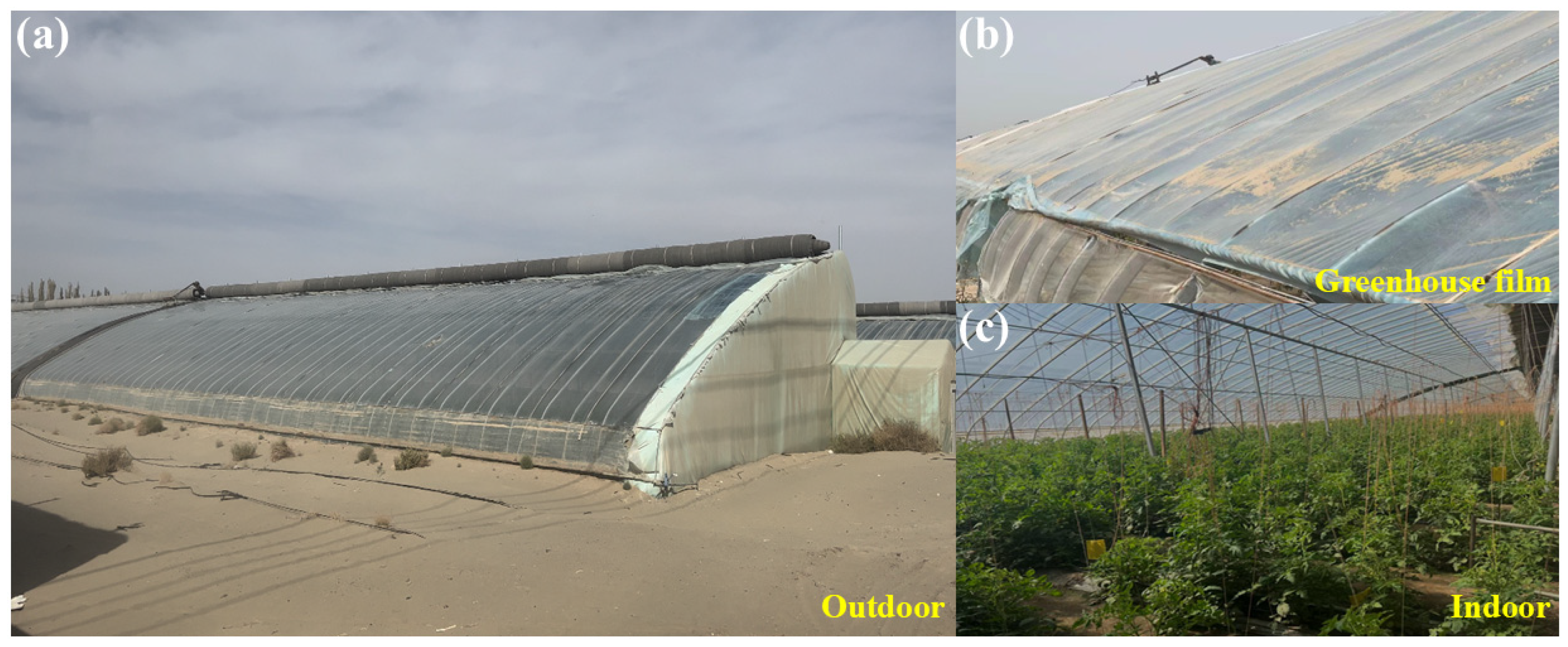
The field experiment was conducted at a facility agriculture demonstration base in Hotan County, Xinjiang (37°30′34″ N, 79°44′10″ E). The primary specimens consisted of dust particles naturally deposited on solar greenhouse films and those collected from the adjacent ground. The visual representation of film fouling under typical arid and windy conditions, along with its detrimental impact on the interior light environment, is illustrated in Figure 1.
The dust on the greenhouse cladding was treated as natural sediment. To ensure the acquisition of representative samples while preserving the structural integrity of the plastic film, a high-flexibility silicone scraper was employed for the gentle removal of accumulated particles. To account for spatial variability and ensure an adequate quantity of particles, representative composite dust samples were collected from a standardized 2 m × 2 m quadrant on the greenhouse film, along with ground samples. These samples were obtained after the natural accumulation period from August to November 2024. This large-scale composite sampling strategy smooths out local micro-heterogeneity and aligns with the methodology established in previous research [22]. The harvested particulates were meticulously transferred into clean, medical-grade polyethylene self-sealing bags to eliminate the risk of sample loss or cross-contamination.
To prevent moisture absorption or any alteration in the physicochemical properties of the dust, the collected samples were immediately transported to a controlled laboratory environment. The specimens were hermetically stored under standardized conditions, with the temperature maintained at 20–22 °C and the relative humidity stabilized at 45% ± 5%. These rigorous storage protocols were implemented to ensure the consistency and reliability of subsequent analytical results.
To comprehensively resolve the physicochemical attributes of the collected dust, a multi-dimensional characterization framework was established. Specifically, a laser particle size analyzer was employed to accurately determine the radial distribution of the particulates, and the Two-sample Kolmogorov–Smirnov (K-S) test was utilized to evaluate the statistical significance of differences in their cumulative size distributions. Concurrently, the mineralogical phases were identified and quantified using X-ray diffraction (XRD) coupled with specialized phase-analysis software. At the elemental level, the chemical composition was ascertained via X-ray fluorescence (XRF) spectroscopy, while the microscopic morphology of individual particles was elucidated through scanning electron microscopy (SEM). A detailed summary of the specific analytical tasks and their corresponding instrumental parameters is provided in Table 1.
Given the inherent randomness and environmental sensitivity associated with natural dust sampling, this experimental design draws on the methodology established in prior literature [22]. By integrating multiple physicochemical and morphological indicators, thereby mitigating the limitations of any single analytical approach.

2.2. CFD-DPM Simulation Settings

2.2.1. Physical Model

To investigate the dust accumulation dynamics on greenhouse film surfaces under wind-sand conditions, this study established a three-dimensional geometric model and computational domain for a single greenhouse. To enhance computational efficiency while preserving simulation accuracy, the prototype greenhouse was geometrically scaled at a 1:10 ratio in accordance with fluid mechanics similarity criteria [23]. This scaled modeling approach has been demonstrated to be highly reliable through wind tunnel experiments and CFD simulations in agricultural facility research [24]. The scaling process enabled further refinement of the local mesh near the film surface, thereby allowing more accurate capture of the transport trajectories and deposition patterns of dust particles within the complex flow field [25].
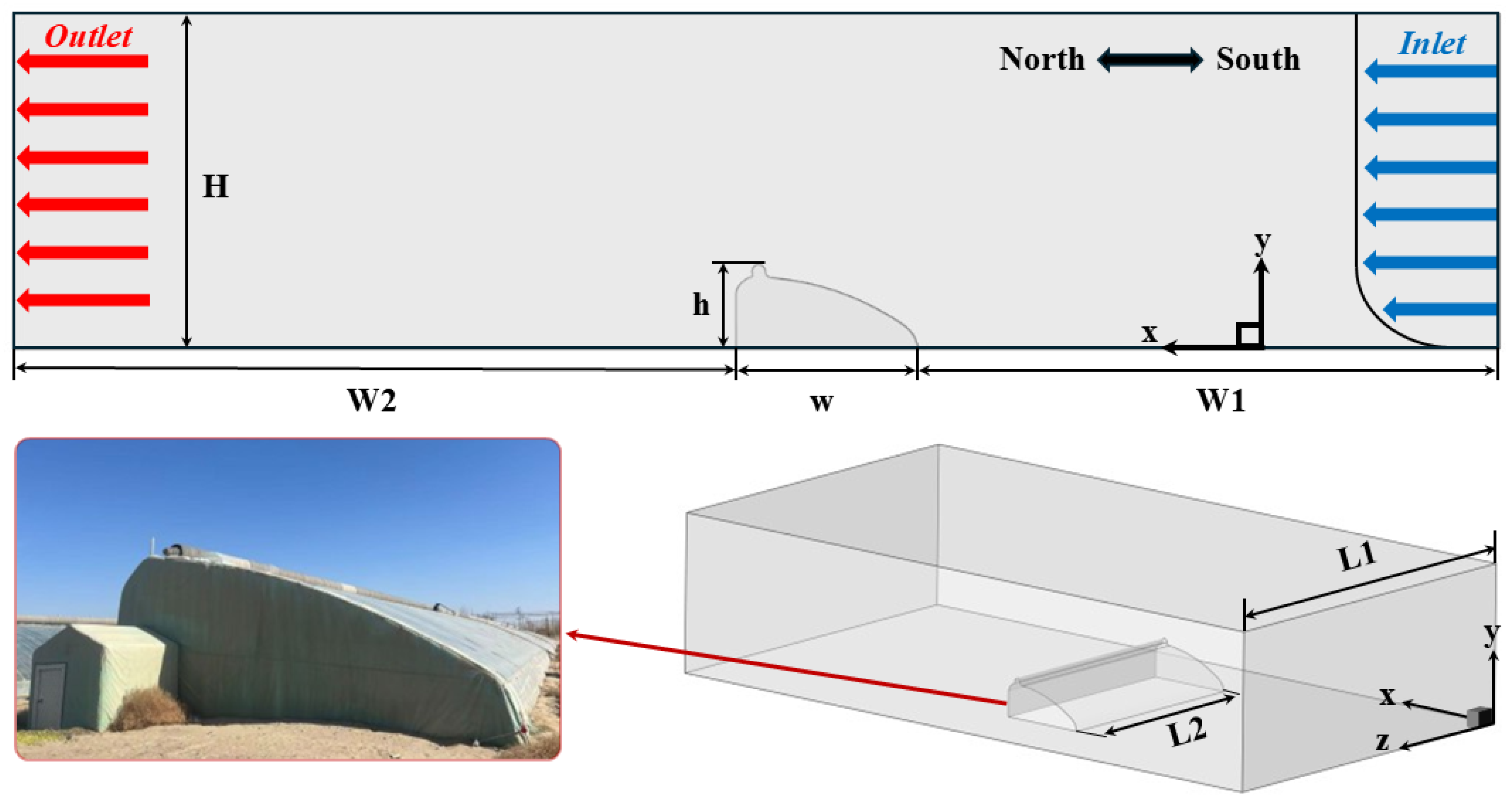
The computational domain was defined as a rectangular volume (29,200 mm × 12,600 mm × 12,600 mm), with its structural parameters illustrated in Figure 2. To ensure fully developed flow before entering the core region and to minimize the influence of outlet backflow, the inlet (W1) and outlet (W2) sections were set to lengths of 7000 mm and 20,800 mm, respectively. This boundary configuration effectively eliminated interference from the domain boundaries on the near-wall flow field.
A scaled greenhouse model with a height of 650 mm, a span of 1400 mm, and a ridge length of 3500 mm was positioned at the center of the computational domain. To optimize computational efficiency while maintaining aerodynamic fidelity, the model retained the primary greenhouse while omitting non-essential internal auxiliary components. This simplification effectively reduced the mesh count while preserving the external geometric features and aerodynamic effects, with a focus on simulating the dust sedimentation process on the film surface. The dust deposition analysis area was defined as the top film surface of the greenhouse, which served as the target for particle capture and deposition statistics during post-processing.
In addition, the blocking rate (BR) of the model was calculated according to the formula [26]:
BR   =   A model A domain   =   h L 2 H L 1     1.43 %
In the formula, Adomain and Amodel are defined as the cross-sectional area of the computational domain inlet and the windward projected area of the greenhouse model, respectively, where h and L2 represent the height and span of the greenhouse model, and H and L1 represent the height and width of the computational domain inlet. This blockage ratio is significantly lower than the conventional 3% threshold limit for numerical simulations, strongly validating the scientific rationale behind the computational domain boundary setup. This low-blockage-ratio design effectively avoids potential influences of wall confinement effects on airflow patterns, ensuring that the simulated dust distribution patterns are highly reliable and informative.

2.2.2. Meshing

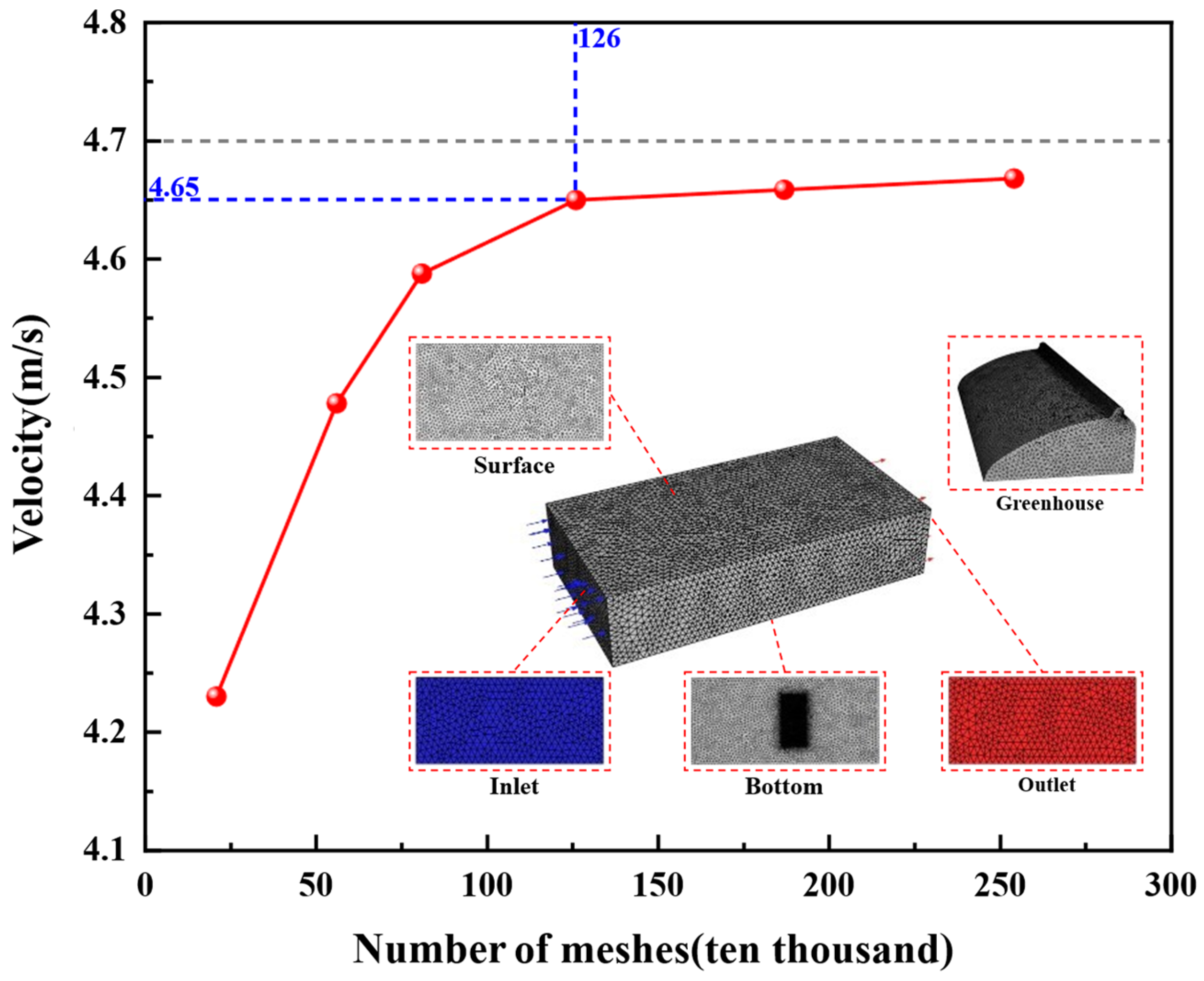
To ensure the convergence stability and accuracy of numerical calculations, the computational domain was discretized into meshes in this study. As shown in Figure 3, unstructured meshes with strong adaptability were adopted for the main greenhouse body and the flow field area. To accurately resolve the velocity gradient fluctuations and dust deposition details on the windward surface, the top of the membrane, and the leeward wake zone, local mesh refinement was performed on the surface of the greenhouse film and its surrounding areas.
Before the simulation, the optimal mesh was determined through mesh independence verification. Taking the inlet velocity of 5 m/s as the benchmark case, the calculation accuracy was evaluated by monitoring the variation in the flow field velocity at characteristic positions with the mesh density. The test results show that when the total number of meshes increases from 0.4 million to 1.26 million, the characteristic velocity presents a significant convergence trend. When the mesh scale further expands to more than 2 million, the deviation of velocity fluctuation has been reduced to within 0.5%. Based on the comprehensive consideration of calculation accuracy and efficiency, this study finally determined to use a mesh scheme of approximately 1.26 million elements to carry out subsequent research.

2.2.3. Airflow and Dust Movement Model

In this numerical framework, the airflow is treated as a continuous medium, while the sand particles are defined as a sparsely distributed discrete phase. Considering the prohibitive computational overhead associated with Direct Numerical Simulation (DNS) for large-scale greenhouse geometries, alongside the stringent mesh sensitivity of Large Eddy Simulation (LES), the Reynolds-Averaged Navier–Stokes (RANS) equations were employed to characterize the mean flow field.
The continuous phase satisfies the mass and momentum conservation equations of incompressible fluids:
  ×   u   =   0
u t + ( u   ×   ) u   = 1 ρ p   +   ν 2 u     ×   u u ¯
In the formula, u denotes the fluid velocity vector, p is the static pressure, ρ is the air density, v is the kinematic viscosity, and u u ¯ represents the Reynolds stress tensor component. To close the system of equations, the SST k-ω model is adopted for the turbulent part to balance the flow characteristics of both the near-wall region and the free shear layer. The transport equations for its turbulent kinetic energy k and specific dissipation rate ω are, respectively, as follows:
( ρ k ) t   +   ( ρ k u i ) x i = x j ( μ   +   σ k μ t ) k x j   +   G k Y k
( ρ ω ) t + ( ρ ω u i ) x i = x j ( μ + σ ω μ t ) ω x j + G ω Y ω + D ω
where G k and G ω are the production terms of turbulent kinetic energy and specific dissipation rate, respectively, μ t is the turbulent viscosity, and σ k , σ ω are empirical constants.
Dust particles are mainly affected by resistance, gravity, and buoyancy in the external wind and sand flow of the greenhouse, with a small amount of fine particles also affected by lift and Brownian diffusion. The equation of motion can be expressed as:
m p d u p dt = F D ( u u p )   +   m p g   +   F L   +   F B
where v p is the particle velocity, m p   is the particle mass, u is the local gas velocity, g is the gravitational acceleration, FD is the aerodynamic drag force, and FL and FB are the lift force and Brownian force, respectively.
In the calculation process, the Discrete Random Walk (DRW) is adopted to simulate the influence of turbulent fluctuations on particle motion. When particles interact with the surface of greenhouse film, if their normal velocity is lower than the critical value, it is judged as sedimentation; If it exceeds this value, a rebound may occur. This study only considers the sedimentation process for simplified calculations and does not take into account the resuspension effect.

2.2.4. Boundary Conditions and Numerical Settings

In this study, CFD numerical simulation method was adopted to analyze the deposition law of dust on the surface of greenhouse film. The three-dimensional steady Reynolds time-averaged equation of incompressible fluid is used for the continuous phase, and the SST k-ω turbulence model is selected to describe the turbulence characteristics of the flow field. This model has high accuracy in predicting flow separation and near-wall flow. The Discrete Phase Model (DPM) is adopted to track the trajectory of particles, following the Euler–Lagrange method. Air is treated as a continuous phase, and sand particles are treated as sparsely distributed discrete phases, ignoring particle interactions and volume fraction effects.
The particle motion satisfies the following dynamic equation:
d u p dt   =   F D   +   F g   +   F p
where FD is the drag force, Fg is the gravity and buoyancy, and Fp is the pressure gradient force. In practical calculations, the particles are mainly subjected to resistance and gravity, while other small forces are ignored.
The resistance term is expressed as:
F D   =   18 μ ρ p d p 2 C D R e p ( u u p )
where μ is the dynamic viscosity of air, ρ p is the particle density, d p is the particle diameter, u and u p are the air velocity and particle velocity, respectively, CD is the drag coefficient, and R e p is the particle Reynolds number.
In this study, four inflow wind speeds of 2 m/s, 3.5 m/s, 5 m/s, and 7 m/s were selected as the simulation conditions. The wind direction was explicitly set as a due south wind, directly impacting the curved film surface of the solar greenhouse. The wind speed range was determined based on meteorological data from the Hetian region of Xinjiang over the past decade. The average annual wind speed in this area is approximately 3.2 m/s, with the dominant wind speeds concentrated between 2 m/s and 6 m/s. Within this range, 3–5 m/s is the most common, while 7 m/s represents short-term strong winds or sandstorms. Furthermore, previous research has indicated that 2 m/s is the threshold for the initiation of dust particles, 3.5–5 m/s corresponds to the typical transport stage, and 7 m/s can reflect the deposition characteristics under strong wind disturbances [27].
To ensure that the numerical simulation faithfully reproduces the dynamic characteristics of the measured dust source, key physical parameters were extracted from the particle size distribution and chemical composition analysis results shown in (detailed in Section 3.1) and used as initial boundary conditions for the CFD-DPM. By converting the measured physicochemical characteristics into model input parameters, a high degree of consistency in transport behavior was maximally ensured between the simulated particles and natural dust. The specific configurations of the relevant simulation parameters are detailed in Table 2.
During the numerical solution procedure, the pressure-velocity coupling was resolved using the SIMPLE algorithm, while spatial discretization was executed via a second-order upwind scheme to enhance the fidelity of the convective terms. The computation followed a steady-state iterative approach for time advancement. Regarding the discrete phase, particles were introduced into the computational domain through a surface-uniform injection method. Informed by the field measurements of dust accumulation on greenhouse films detailed in Section 3.1, where the volume median diameter (Dv50) of the film-borne dust was determined to be 52.4 μm (as measured by laser diffraction analysis), the particle diameter in the DPM was calibrated to a representative value of 50 μm. This parameterization ensures that the numerical simulation accurately replicates the aerodynamic characteristics and transport mechanisms of the primary deposition particles observed under actual environmental conditions.
The particle mass flow rate at the inlet was set to 0.25 kg/s to ensure statistical stability for deposition analysis while maintaining an extremely low discrete phase volume fraction substantially below 10%, thus satisfying the prerequisite for the one-way coupling assumption [28]. The particle density was specified as 2650 kg/m3, corresponding to the standard density of quartz (SiO2), which was confirmed by our XRD analysis as the predominant mineral phase in the collected dust. Furthermore, the simulation time was set to 20 s of physical time, which is sufficient for the airflow field to fully develop and for the particles to complete their transport and steady deposition processes across the computational domain.

2.2.5. Numerical Simulation Assumptions

The simulations were implemented based on the following assumptions:
(1)
The flow field influences particle trajectories, but particle feedback on air and particle-particle collisions are ignored.
(2)
Dust particles are treated as idealized spheres with constant density and no fragmentation.
(3)
The greenhouse roof is a “trap” boundary; particles deposit upon initial contact without bouncing or resuspension.
(4)
Particles are uniformly distributed at the inlet with initial velocities matching the local air phase.
(5)
Adhesion and electrostatic forces are neglected due to the arid environment, focusing solely on aerodynamic drag.

2.2.6. Numerical Model Validation

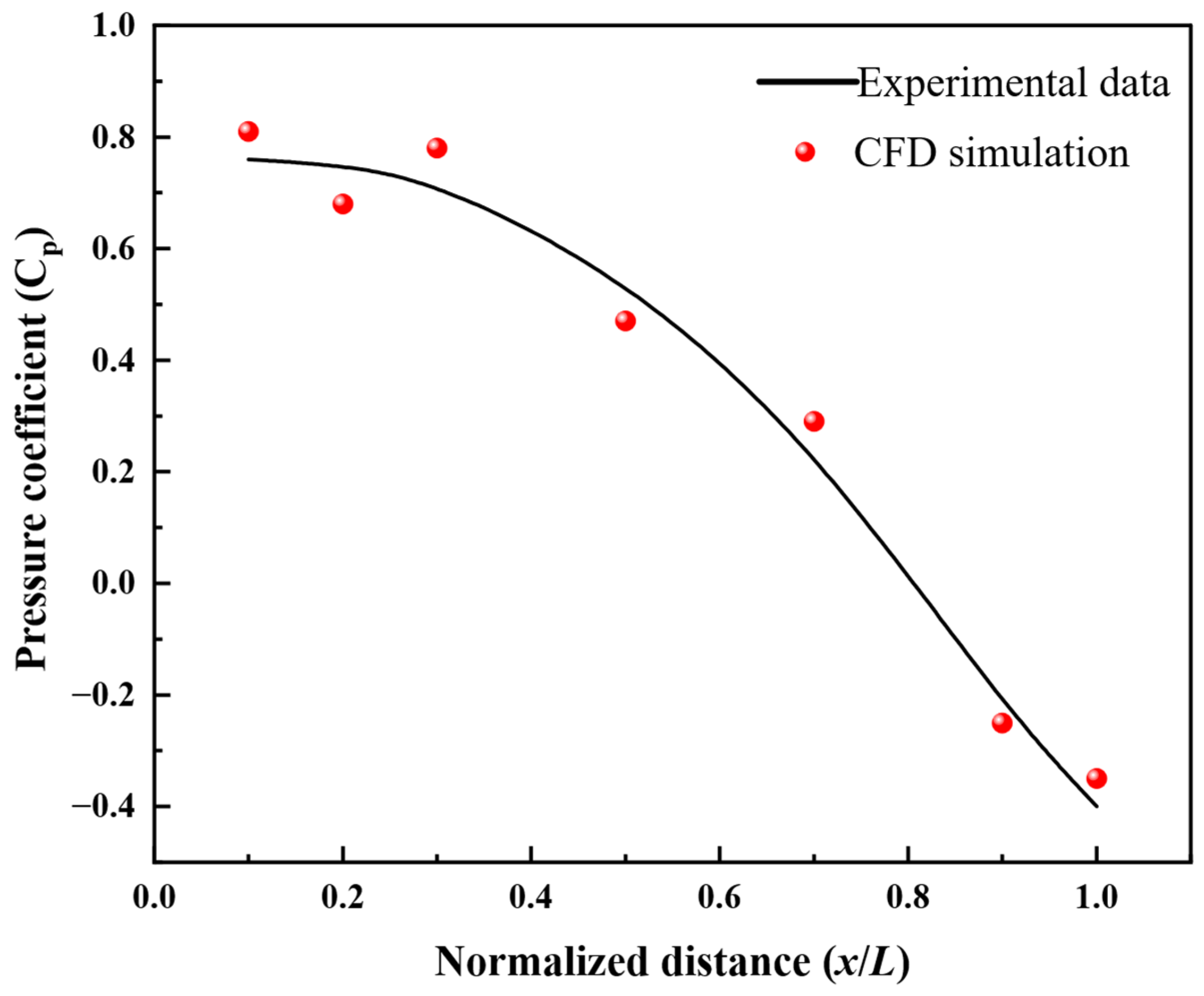
To ensure the reliability of the numerical model, the predicted pressure coefficient (Cp) on the roof surface was validated against the experimental database established by Tominaga [29].
As illustrated in Figure 4, the simulation results show a consistent trend with the experimental data along the normalized distance. Although minor discrepancies of approximately 10–15% occur near the ridge separation zone, these are within the acceptable range for steady Reynolds-averaged Navier–Stokes (RANS) simulations, as reported in the reference study. These differences are primarily attributed to the inherent limitations of RANS models in reproducing large-scale transient fluctuations caused by vortex shedding.
Overall, the validation demonstrates that the current computational fluid dynamics (CFD) setup is capable of accurately predicting wind-induced pressure fields, providing a solid foundation for subsequent dust deposition analysis.

2.3. Tomato Growth Experiment

The experiment was conducted from August to November 2024 in a solar greenhouse at the facility agriculture base in Hetian County, Xinjiang. The tomato cultivar ‘Dingxin 10’ was selected as the experimental material.
The experiment used a randomized block design, and data collection was conducted using a stratified random sampling method. For each treatment, 5 rows of plants were randomly selected, and 3 plants were randomly chosen from each row, with three replicates. The total sample size for each treatment was 45 plants. The plot spacing was 1.2 m, with a plant row spacing of 0.23 m and a row-to-row spacing of 1.2 m, resulting in a planting density of approximately 37,500 plants ha−1. All plots were independently planted and managed under consistent cultivation conditions. Tomato seedlings were transplanted on August 20, and treatments were applied after plant establishment.
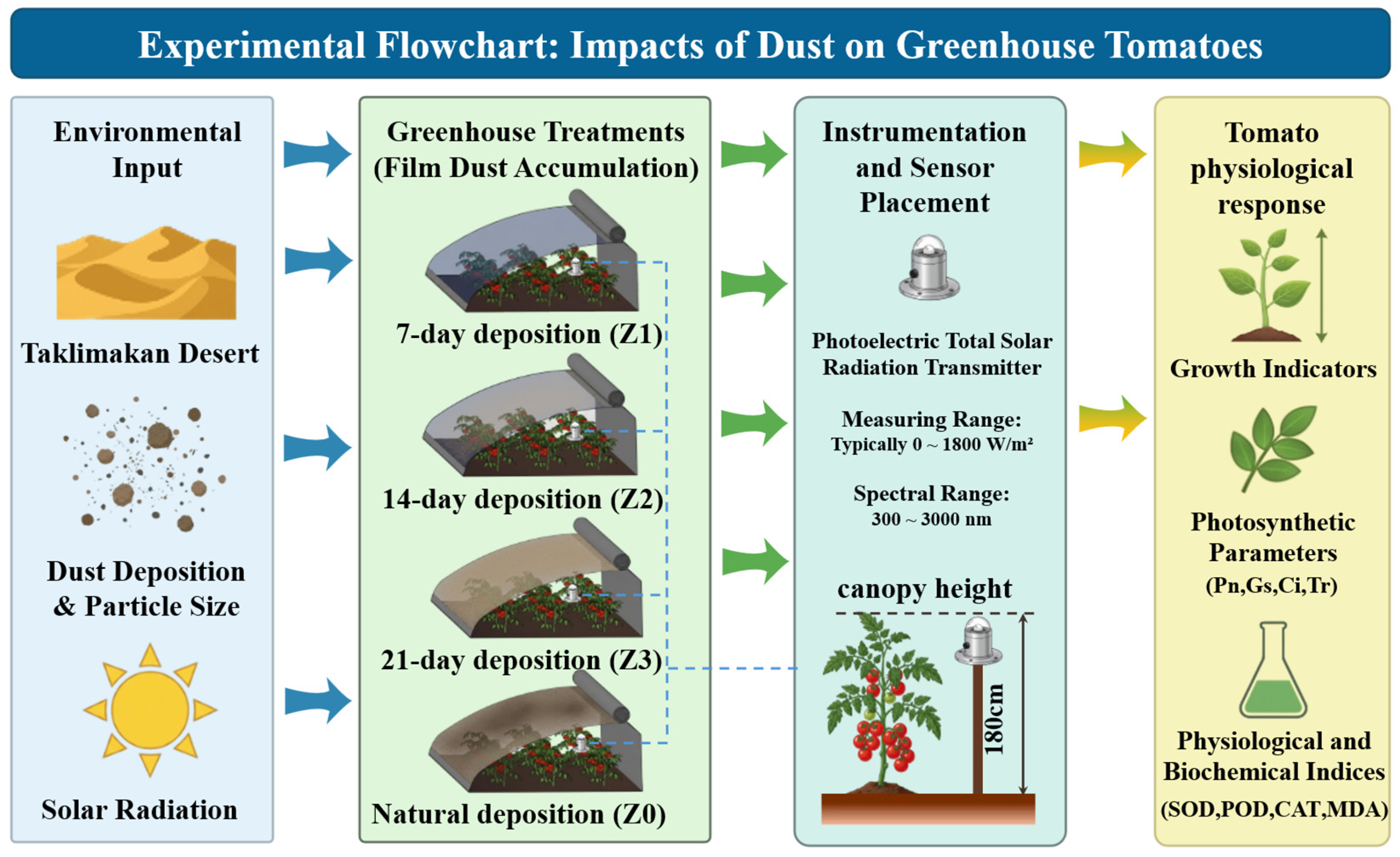
As illustrated in Figure 5, to investigate the effects of dust deposition over different periods on tomato growth in the greenhouse, four treatments were established: dust removal from the greenhouse film at 7 days (Z1), 14 days (Z2), and 21 days (Z3) after transplanting, with no dust removal serving as the control group (Z0).
To continuously monitor the internal light environment, three photoelectric total solar radiation transmitters were deployed in each treatment plot. These sensors were horizontally spaced at 5 m intervals and vertically positioned at a fixed height of 1.8 m to prevent shading from the growing plants and ensure accurate measurement of the incoming DLI.
The physiological and biochemical parameters were systematically quantified. Growth indicators, including plant height, stem diameter, and leaf area, were measured using a standard tape measure and a vernier caliper. Photosynthetic parameters were measured using a portable photosynthesis system (LI-6400XT) on fully expanded functional leaves at the same canopy level. These parameters include net photosynthetic rate (Pn), stomatal conductance (Gs), intercellular CO2 concentration (Ci), and transpiration rate (Tr). For biochemical assays, fresh leaf samples were collected. Superoxide dismutase (SOD) activity was measured using the nitroblue tetrazolium colorimetric method [30], peroxidase (POD) activity was determined using the guaiacol colorimetric method [31], catalase (CAT) activity was assessed by UV absorption [32], and malondialdehyde (MDA) content was quantified using the thiobarbituric acid colorimetric method [33].
The data were processed using Microsoft Excel (v.2021, Microsoft Corp., Redmond, WA, USA) and DPS software (v.9.50, Hangzhou RuiFeng Information Technology Co., Ltd., Hangzhou, China). One-way analysis of variance (ANOVA) was used to determine the significant differences between treatments. The charts were generated using Origin 2022.

3. Results

3.1. Analysis of Dust Characteristics on Greenhouse Film and Ground Surfaces

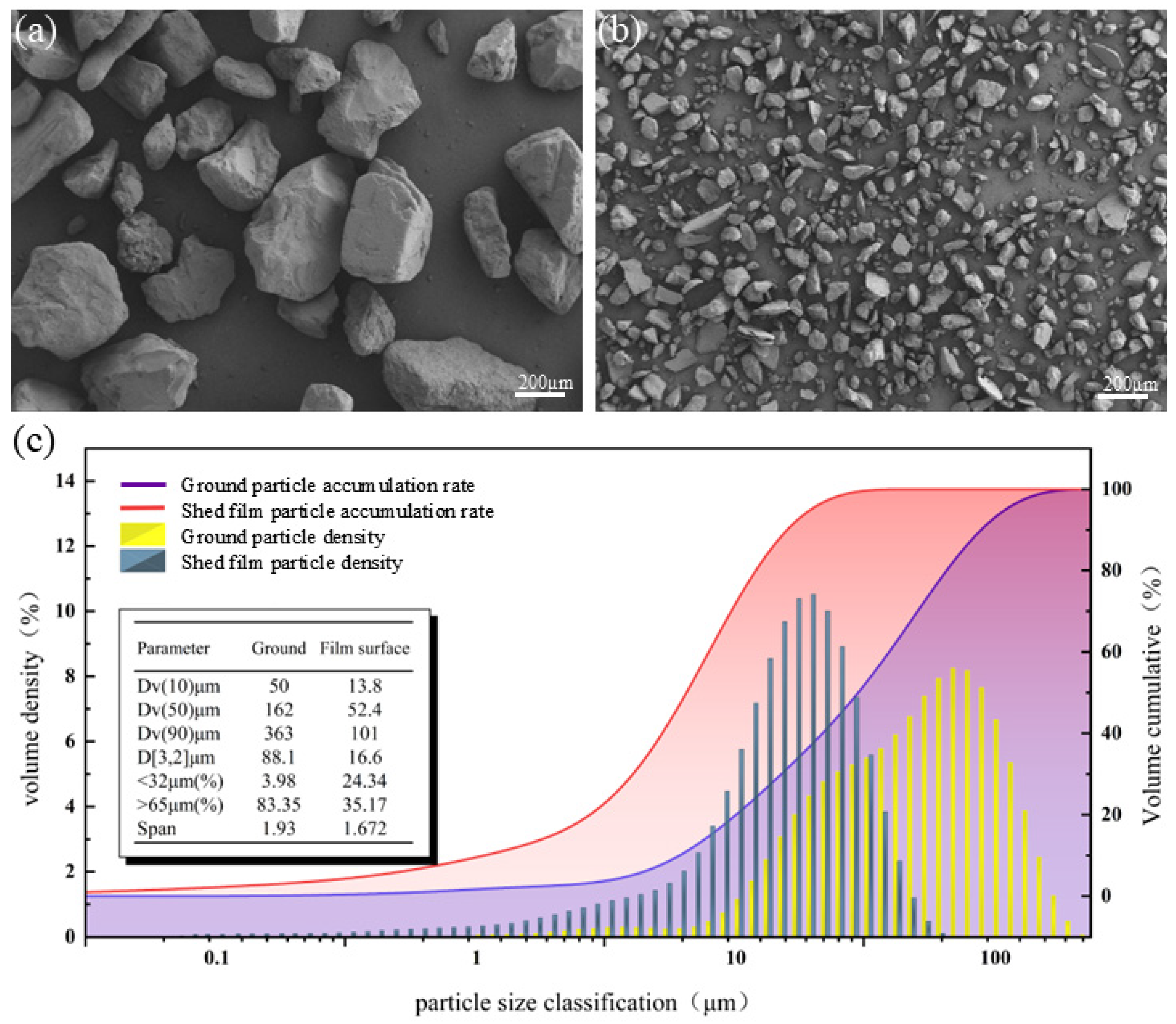
Comparative SEM analysis (Figure 6a,b) unveils stark contrasts between ground-level dust and film-borne particulates in terms of morphology, spatial distribution, and interfacial behavior. At 50× magnification, ground dust is predominantly composed of heterogeneous aggregates, representing a stochastic mechanical mixture of coarse and fine fractions. In contrast, dust on the greenhouse film exhibits superior dispersity and establishes a stable adhesion interface with the polymer substrate. Morphological evaluation reveals that ground particles retain the angular facets characteristic of primary aeolian minerals, whereas film-surface particles are predominantly platy or flattened. This divergence underscores distinct depositional mechanisms: while ground dust originates from gravitational settling of wind-eroded material, film-borne particles likely serve as carriers for agro-pollutants. These contaminants, mediated by electrostatic forces, become embedded within the micro-cracks of the film surface. The formation of this persistent fouling layer not only impairs light transmission but also acts as a catalyst, potentially accelerating the photo-oxidative aging of the greenhouse cladding.
Laser diffraction analysis (Figure 6c) elucidates a pronounced granulometric fractionation between ground-level dust and film-borne particulates. A Two-sample Kolmogorov–Smirnov (K-S) test performed on the cumulative size distributions confirmed that this difference is statistically significant (p < 0.01). Ground specimens are characterized by a coarser texture, with median and volume-mean diameters significantly exceeding those of film-surface samples.
The reduced span (1.672) and uniformity coefficient (0.501) for the film-borne dust indicate a more constrained and centralized size distribution. These findings underscore an aerodynamic sorting mechanism during dust transport: fine particulates, possessing superior buoyancy and prolonged suspension times, are preferentially transported and deposited onto the greenhouse cladding, while coarser, high-momentum particles remain localized near the ground. This preferential accumulation of fine dust has critical implications for the greenhouse microclimate, as the high specific surface area and scattering efficiency of fine particles significantly compromise light transmittance and catalyze the photo-degradation of the covering materials.
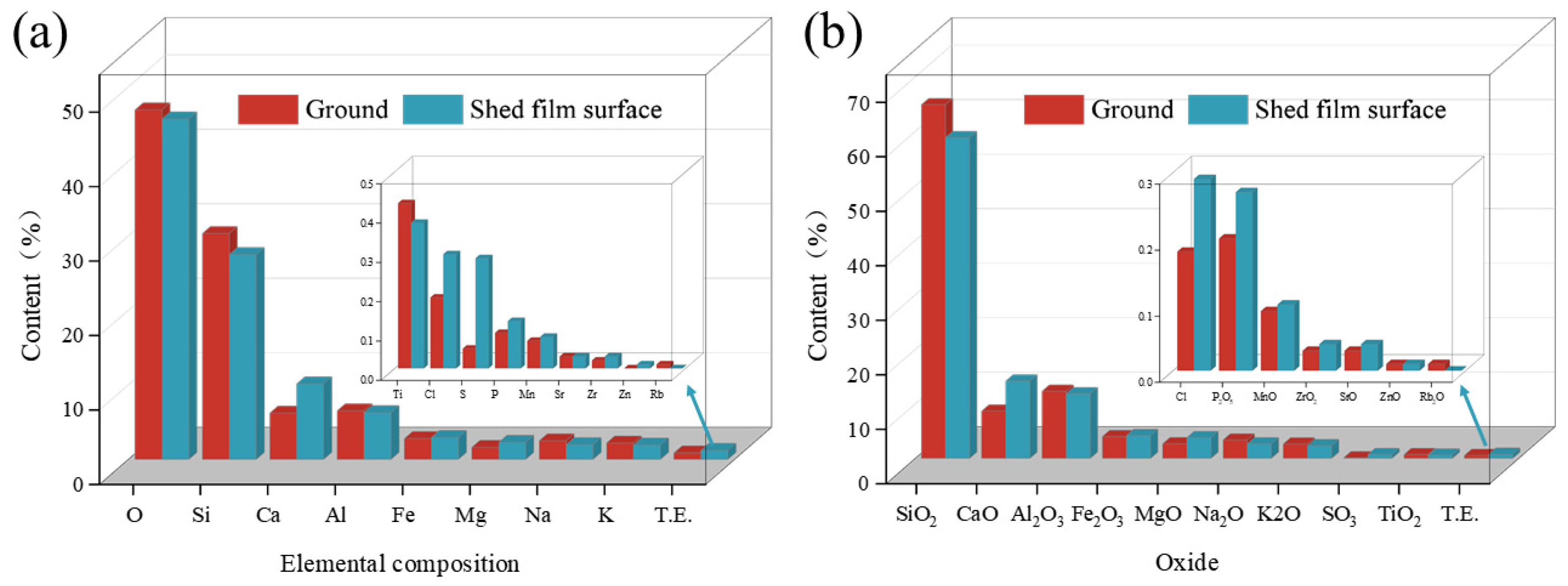
Chemical profiling of the dust particles (Figure 7) reveals a pronounced spatial heterogeneity between ground-level sediments and film-borne particulates. Ground samples are characterized by a dominant crustal signature, with SiO2 concentrations reaching 64.9%, significantly surpassing the 58.8% observed on the greenhouse cladding. These ground-level specimens are further enriched in silicate minerals, likely originating from primary lithogenic weathering or natural aeolian processes.
Conversely, the dust fouling on the greenhouse film exhibits a substantial enrichment of calcium and salts, with CaO levels escalating to 14.2% compared to the 8.7% in ground samples. A parallel increasing trend is also evident for MgO, SO3 and Cl in the film-surface specimens. From an elemental perspective, while Si and O remain more abundant in ground samples, their concentrations diminish to 27.5% and 45.7%, respectively, on the greenhouse film. Meanwhile, Ca, Mg and S show marked elevations. The data from both locations revealed the spatial differentiation pattern of dust particles, ground samples were closer to natural geological sources, mainly composed of aluminosilicates, while the surface of the greenhouse film showed significant enrichment of calcium and salts.
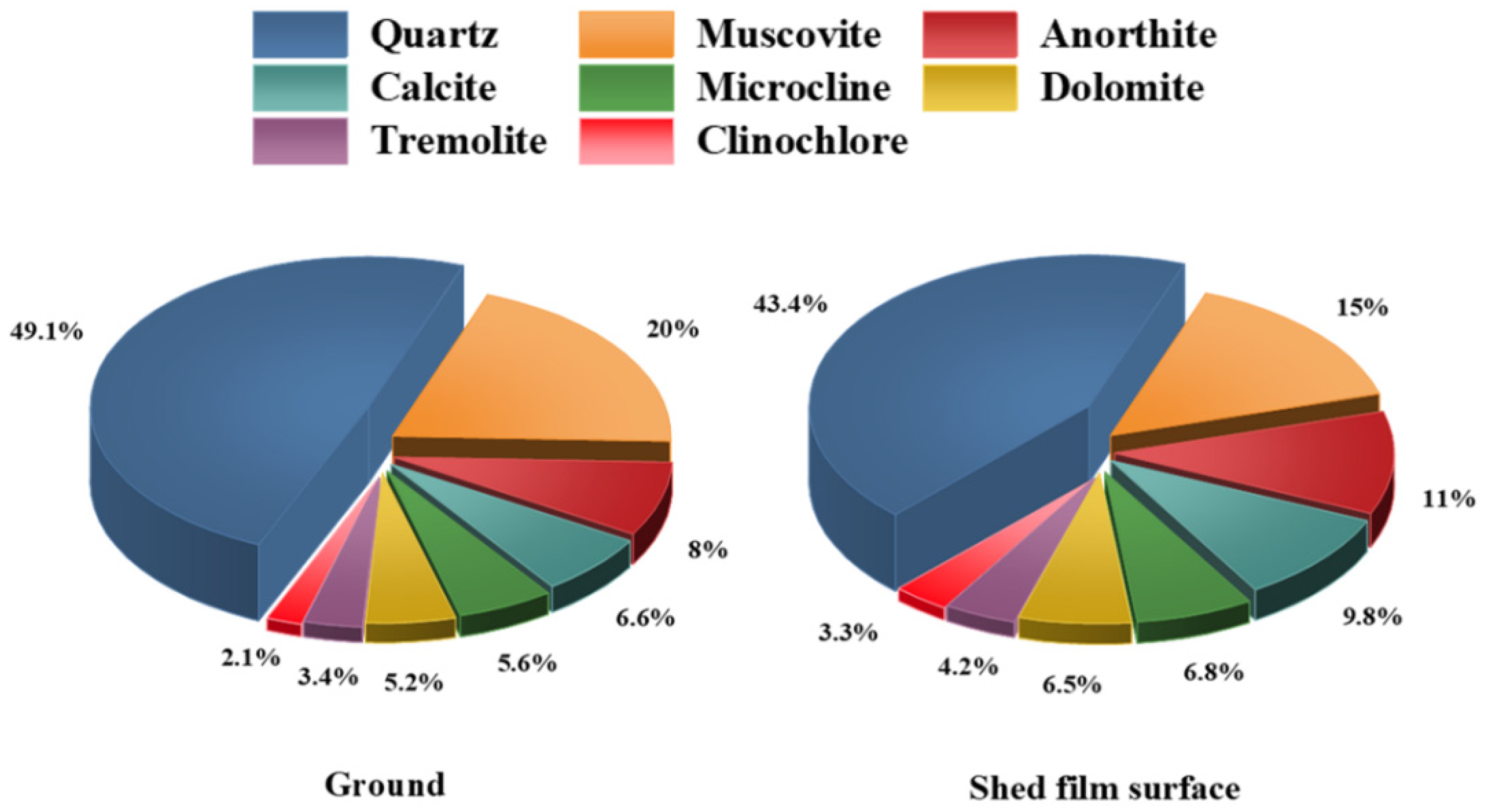
X-ray diffraction (XRD) analysis and quantitative mineralogical assessment were conducted on dust particles from the two sources (Figure 8), revealing distinct spatial differentiation in mineral composition. Although both are structurally dominated by typical silicate minerals such as quartz, plagioclase, and chlorite, variations in key component concentrations indicate physical sorting effects during dust transport. The data show that quartz is significantly more enriched in ground dust than in film-surface dust. This is primarily attributed to the higher density of quartz, which promotes gravitational settling near the surface when aerodynamic forces weaken. In contrast, lower-density carbonate minerals such as calcite and dolomite exhibit stronger vertical transport ability, leading to their selective enrichment on the greenhouse film surface. Furthermore, muscovite, owing to its platy morphology and relatively low apparent density, possesses greater suspension stability in airflow, favoring accumulation at elevated greenhouse locations. Additionally, pyrite and potassium salts present in ground samples are completely absent in film-surface samples, suggesting that soluble or unstable minerals may undergo dissolution or oxidative decomposition during transport.
The migration of dust from the ground to the greenhouse film surface is accompanied by significant mineral dynamic sorting. Research shows that carbonate and mica minerals, owing to their lower apparent density and unique geometric morphology, exhibit stronger vertical transport capability, leading to differential enrichment on the greenhouse film surface. In contrast, high-density or chemically unstable mineral components tend to settle locally or undergo phase transformation during transport. This spatial differentiation in mineral composition not only reveals the physical mechanisms of particle migration at the microscopic level but also provides a mineralogical basis for understanding the photothermal characteristics and aging behavior induced by surface deposits on greenhouse films. In particular, the accumulation of mica and carbonate particles may significantly accelerate the degradation of covering material performance through enhanced light scattering and potential interfacial chemical reactions.
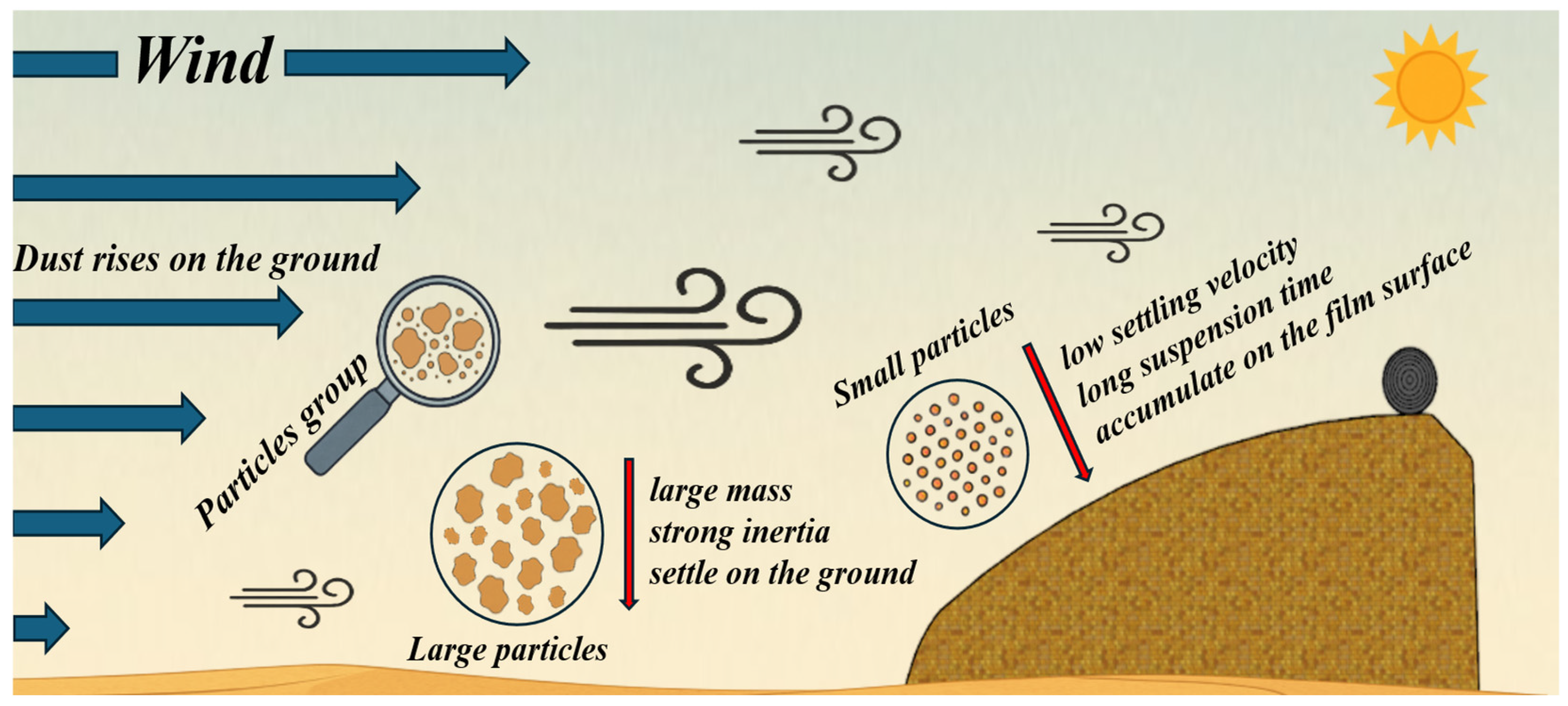
The differentiation in dust characteristics between the ground and film surfaces is driven by multi-scale physical factors. According to aeolian dynamics, the aerodynamic equivalent diameter and density of particles are key parameters determining their transport behavior. As shown in Figure 9, fine particles (<65 μm), due to their low settling velocity and long suspension time, are more likely to migrate upward with airflow and accumulate on elevated structures. In contrast, coarse particles, with their larger mass and stronger inertia, tend to settle rapidly near the surface, resulting in the absolute dominance of coarse fractions in ground samples.

3.2. Simulation Result Analysis

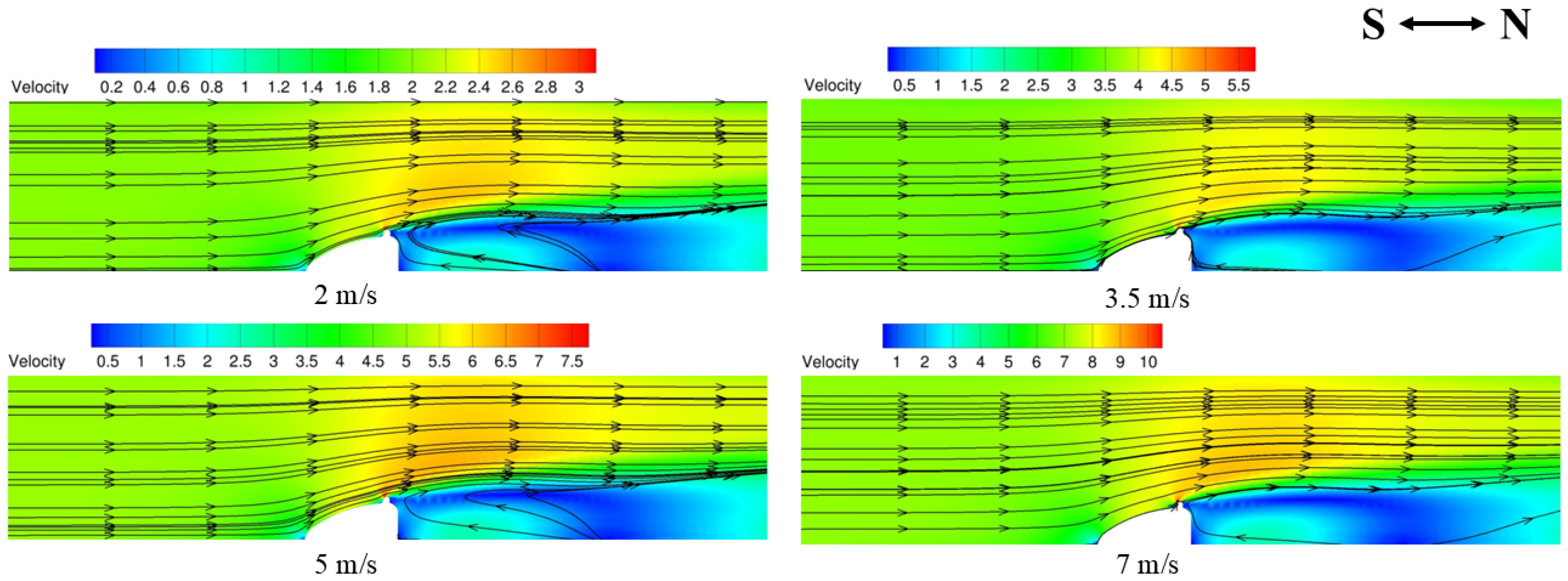
The numerical simulation results (Figure 10) clearly reveal the evolution of the flow field around the greenhouse with increasing inflow wind speeds (2–7 m/s). Under low-speed conditions (2 m/s), the flow exhibits typical laminar characteristics, with smooth streamlines and only minor dynamic pressure loss on the windward side. As the wind speed increases to 3.5 m/s, the obstruction effect of the greenhouse geometry on the airflow becomes more pronounced, leading to significant streamline contraction and local acceleration above the roof ridge. Concurrently, initial flow separation and wake vortices begin to develop on the leeward side. When the wind speed further rises to 5 m/s, the velocity gradient over the greenhouse roof steepens considerably, forming an extensive high-speed shear layer. At this stage, a large low-pressure reattachment zone and a reverse flow region emerge on the leeward side. These areas, characterized by relatively low energy dissipation, become high-probability regions for the retention and deposition of suspended particles. Under the extreme condition of 7 m/s, although the intense scouring effect at the greenhouse roof inhibits particle adhesion, the complex vortex structures in the wake are pushed further downstream. This results in a shift in dust accumulation toward the base of the windward side and deeper into the leeward region.
The stagnation zone near the base of the windward side and the recirculating vortex region on the leeward side provide a key hydrodynamic explanation for the enrichment of fine particles observed in Section 3.1. These low-kinetic-energy regions reduce the probability of particle rebound after collision with the film surface, thereby preferentially capturing and retaining ultrafine particles with high specific surface areas. In summary, the enhanced turbulent fluctuations induced by increasing wind speed intensify the unsteady nature of the flow field. While the high-speed zone at the roof exerts a self-cleaning effect, the windward side and wake vortex regions serve as the core dust accumulation units responsible for the attenuation of film light transmittance.
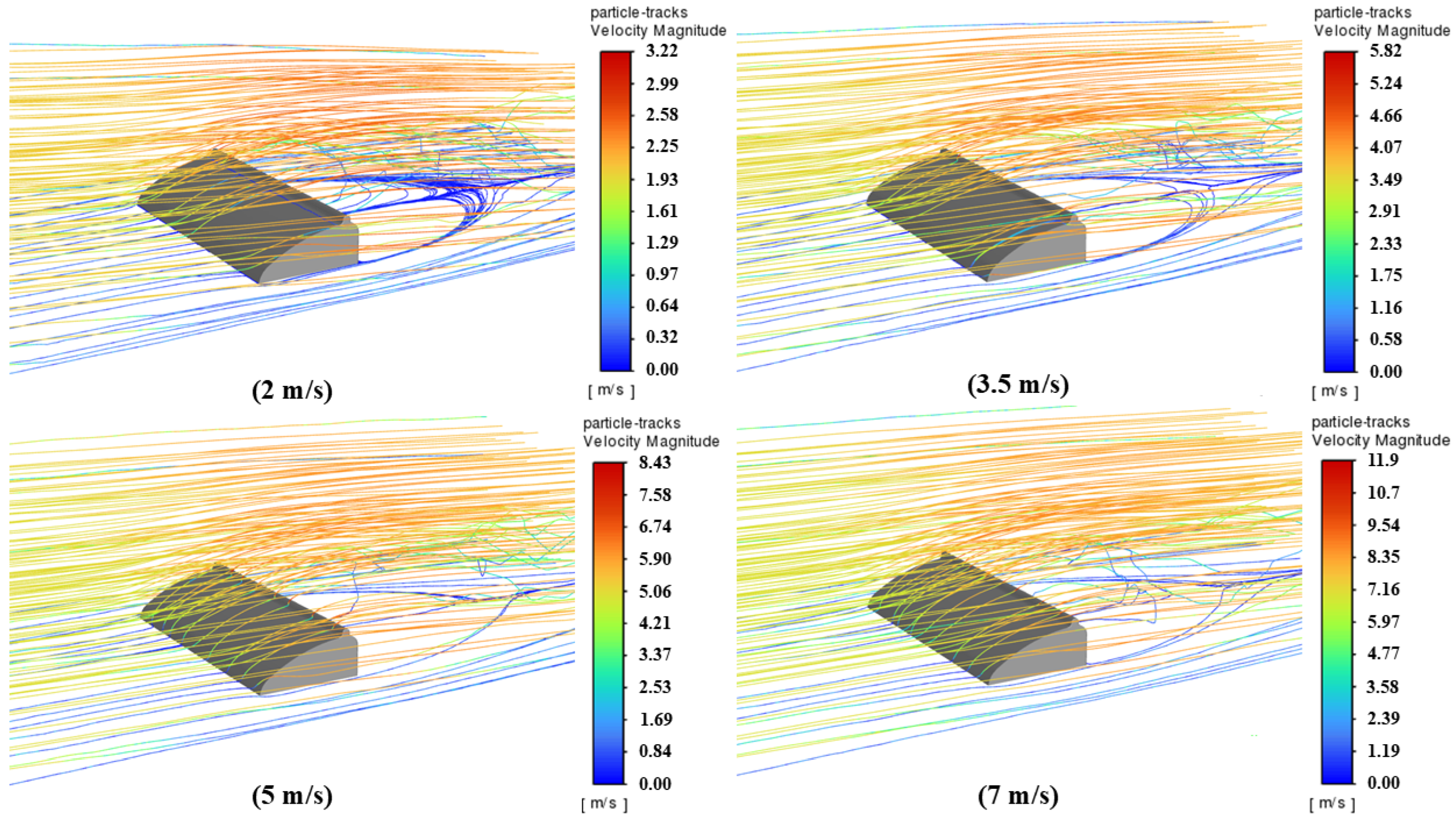
The particle trajectories captured by the numerical simulation (Figure 11) clearly demonstrate the transport patterns of the dust. At a low-wind-speed condition (2 m/s), the particle dynamic behavior is governed by gravity, manifested as quasi-static migration along smooth streamlines, with dust tending to undergo early deposition on the windward slope. When the wind speed increases to 3.5 m/s, influenced by the greenhouse geometry, the airflow undergoes localized acceleration at the ridge, leading to trajectory bifurcation and kinetic energy loss of the particles in the deceleration zone on the leeward side. At the characteristic wind speed of 5 m/s, the vortex structure in the wake region is fully developed, and the particle trajectories exhibit distinct nonlinear circulation. This vortex retention effect confirms that the rear edge of the greenhouse film is a highly sensitive area for aerodynamic energy dissipation and mechanical particle settlement. Under the high-wind-speed condition of 7 m/s, the transport capacity of the airflow becomes dominant. The high-kinetic-energy flow field endows the particles with stronger followability, enabling them to bypass the shear layer at the top of the greenhouse, which results in a decrease in the overall deposition probability; only a very small number of particles are captured by the residual leeward recirculation zone. In summary, the evolution of wind speed reshapes the particle distribution around the greenhouse. With the increase in turbulence intensity, the particle migration distance extends significantly, and the core deposition zone shifts toward the windward base and deep into the leeward side.
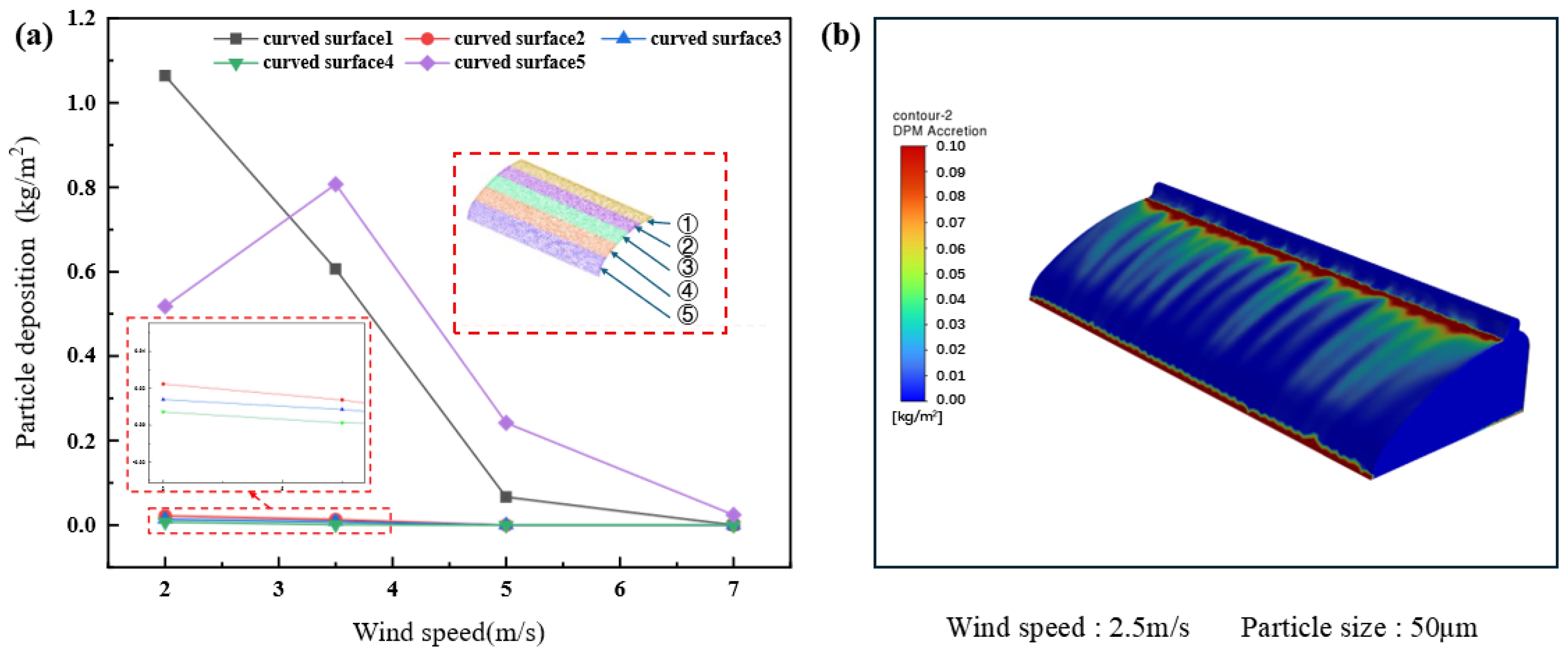
To resolve the dust accumulation characteristics on the greenhouse film surface, this study partitioned the film into five consecutive statistical units (Surface 1–Surface 5) along the airflow direction. This approach aims to quantitatively evaluate the dynamic differences in particle entrapment, deposition, and distribution patterns across regions with varying curvatures.
The simulation results (Figure 12) demonstrate that the dust accumulation on the film exhibits significant non-linear characteristics as wind speed evolves. Under low-wind-speed conditions, the windward base (Surface 1) displays the highest deposition flux, followed by the leeward edge (Surface 5). This phenomenon confirms that in a low-kinetic-energy flow field, particle attachment is primarily governed by gravitational settling and direct interception on the windward face. When the wind speed increases to 3.5 m/s, the deposition distribution undergoes a transition; dust accumulation on the windward side begins to decline due to the scouring effect, while the local dust load on Surface 5 experiences a counter-trend growth due to the entrapment effects of wake recirculation and low-velocity vortices. Within the high-wind-speed range of 5–7 m/s, as the carrying capacity of the airflow significantly strengthens, the total deposition rate across the entire film shows a distinct exponential decay trend, and the discrepancies in dust accumulation among the statistical units subsequently converge. In summary, the peaks of dust accumulation on the greenhouse film are primarily localized at the curved transition regions of the windward and leeward sides, while the central span remains relatively clean.

3.3. Impact of Dust Deposition on Greenhouse Film Surface Towards Tomato Growth

The aforementioned simulation results demonstrate that dust deposition on the greenhouse film surface exhibits distinct non-uniform distribution characteristics, which diminishes solar radiation transmittance and alters the light environment for the plants. To explore the practical effects of dust deposition on crop photosynthesis and growth development, this chapter focuses on the tomato as the research subject. Through the establishment of varied depositional conditions and the comparative analysis of physiological indicators and growth parameters, a quantitative evaluation of the impact of dust coverage on tomato growth was conducted.
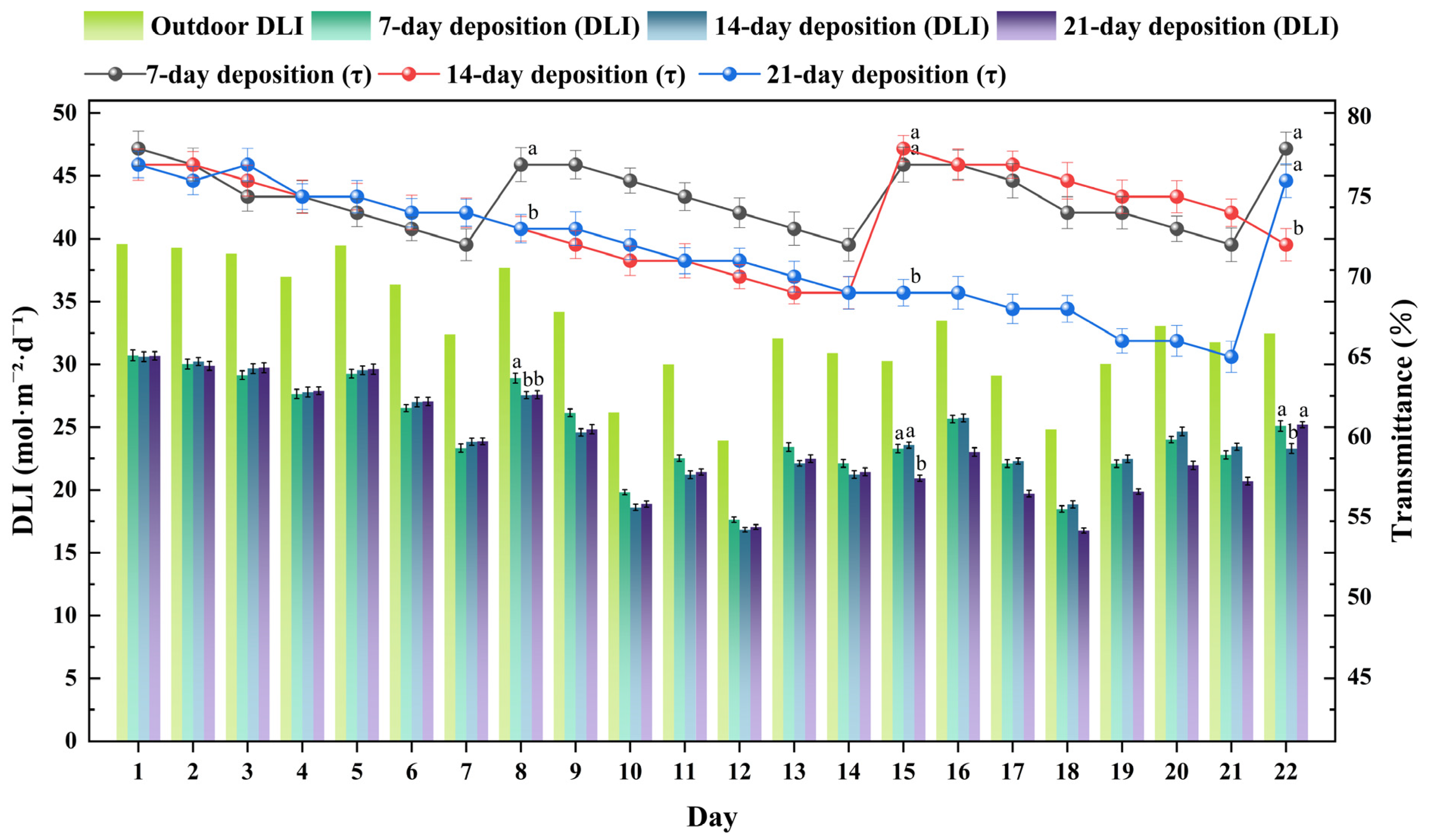
Figure 13 illustrates the critical role of regular dust removal in maintaining the stability of the greenhouse light environment. During the 21-day monitoring period, the uncleaned control group exhibited a continuous decline in DLI and light transmittance. By day 21, the light transmittance of the uncleaned group had dropped to 65%, which was 9.7% lower than the 72% light transmittance of the 7-day cleaning group (p < 0.05). With dust removal, the light environment was significantly restored. Statistical comparisons at key time points following the cleaning cycle, including days 8, 15, and 21, revealed that the DLI and transmittance in the 7-day and 14-day cleaning groups were significantly higher than in the 21-day group (p < 0.05). Although the 14-day cleaning frequency showed some light attenuation fluctuations in the later stages, its overall radiation environment was still significantly better than that of the long-term uncleaned group. For example, on day 15, the 14-day group had a 13.0% higher transmittance (78%) compared to the 21-day group (69%), which was statistically significant (p < 0.05). In contrast, the optical performance of the 21-day cleaning group sharply declined at the end of the cycle, indicating that the dust had evolved from a dispersed distribution into a continuous thin layer of deposition. In conclusion, reducing the cleaning cycle significantly reduces the risk of light attenuation caused by dust accumulation, ensuring the effective supply of radiation flux in the greenhouse.
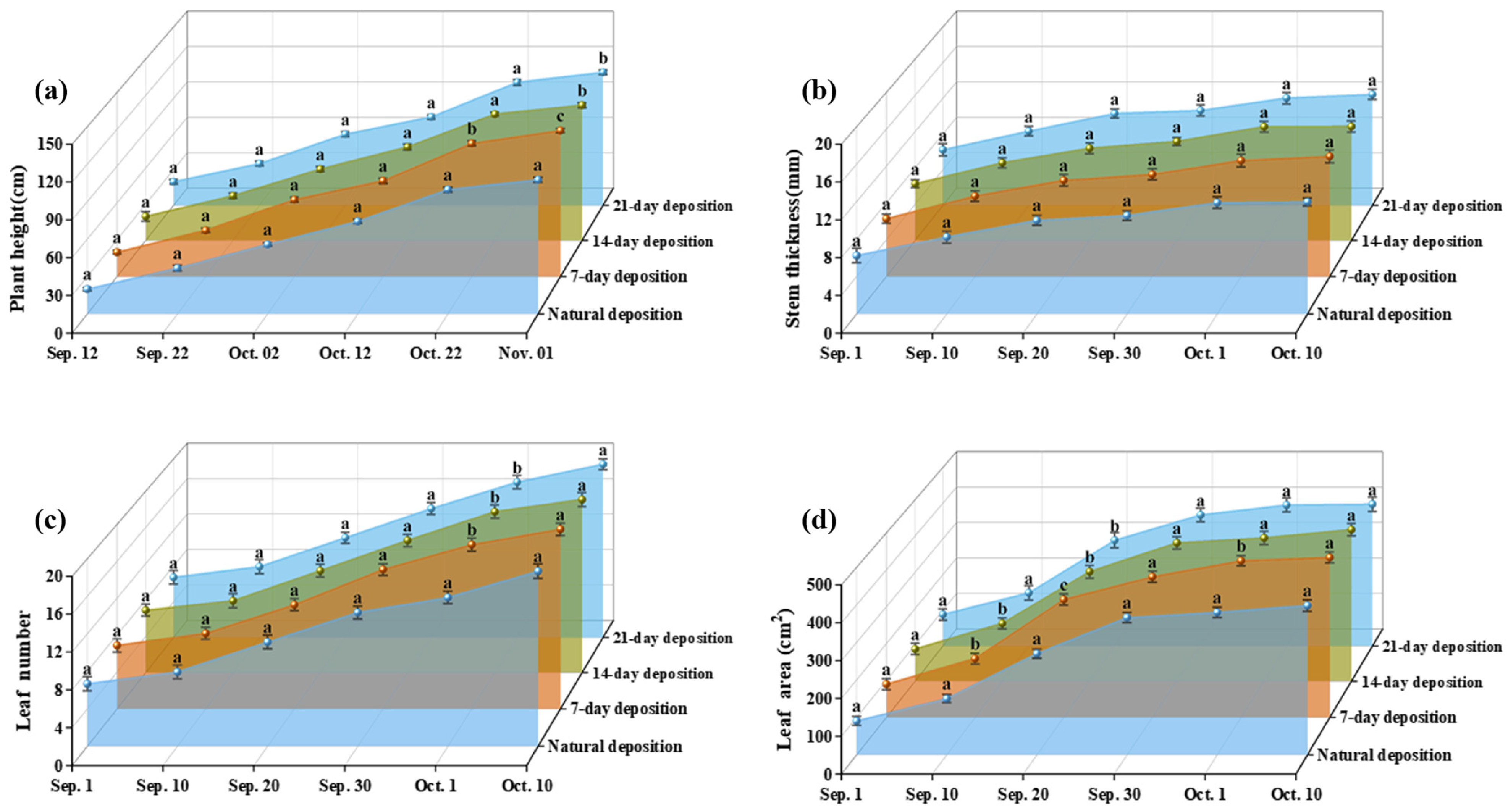
As shown in Figure 14, compared to the long-term naturally accumulated dust control group, regular cleaning of the greenhouse film significantly promoted the growth of tomato plants, with this effect showing a clear positive correlation with cleaning frequency. At the end of the experiment, the high-frequency dust removal treatment exhibited significant statistical advantages in key morphological indicators such as plant height, with a notable 10.7% increase in plant height compared to the naturally accumulated dust group (p < 0.05). While the cleaning groups had higher absolute leaf area at the end of the cycle, the most significant growth advantage was observed during the vigorous expansion phase. For example, on October 1st, the 7-day cleaning group showed a significant 11.7% increase in leaf area compared to the control group (p < 0.05) and maintained a higher growth slope, visually demonstrating the cumulative effect of the improved light environment. The 14-day treatment performed steadily in supporting plant expansion, while the 21-day cleaning treatment showed relatively limited improvement.
The results indicate that stem diameter and leaf number responded relatively consistently to the improved light environment, with no significant statistical differences between treatments throughout the monitoring period (p > 0.05). This phenomenon is consistent with the resource allocation strategy of plants: during the initial stages of light environment improvement, tomatoes prioritize the allocation of photosynthetic assimilates to canopy expansion to maximize their light interception capacity. Overall, dust removal effectively mitigates light attenuation caused by dust accumulation and reshapes the plant’s growth trajectory, making it more inclined toward structural expansion. Based on the principle of maximizing growth benefits, a 7 to 14-day cleaning window can be identified as the optimal dust removal period for greenhouse management in this arid, windy region.
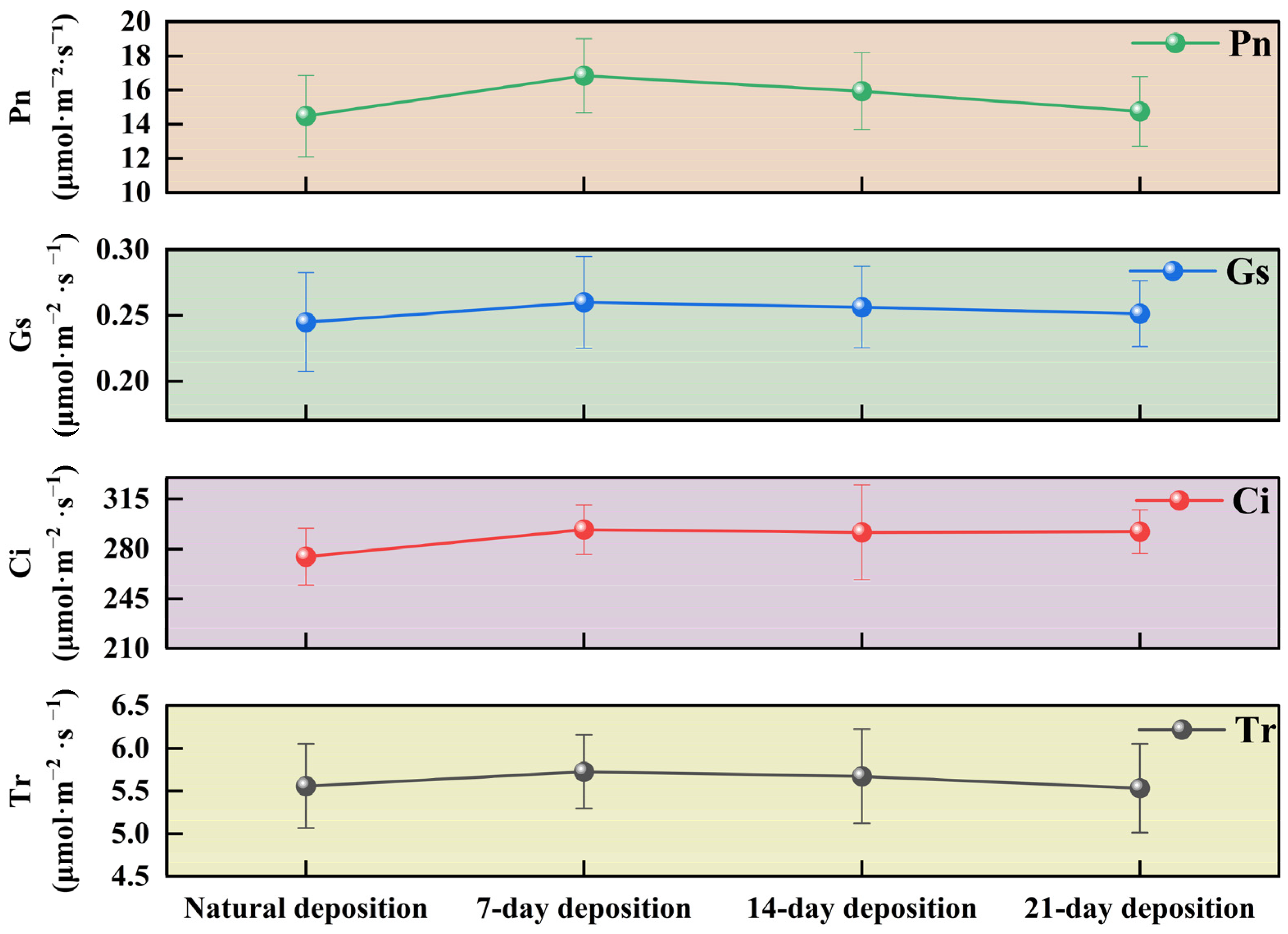
The measurement results of tomato photosynthetic characteristics (Figure 15) revealed the regulatory mechanism of dust cleaning frequency on plant photosynthesis. The data show that the net photosynthetic rate (Pn) is the most sensitive parameter to improvements in light conditions. Compared to the uncleaned control group, the 7-day and 14-day cleaning treatments significantly increased the net photosynthetic rate by 16.3% and 10.1%, respectively (p < 0.05). Additionally, the difference in Pn between Z1 and Z2 was not significant (p > 0.05), but both were significantly higher than Z0 and Z3 (p < 0.05). This indicates that controlling the dust cleaning cycle within 14 days can effectively eliminate the light deficit caused by dust accumulation, thereby maintaining high photosynthetic efficiency.
Regarding gas exchange parameters, the fluctuations in stomatal conductance (Gs) between treatments were relatively small. Although Z1, Z2, and Z3 were slightly higher than Z0, reflecting the positive impact of improved light conditions on maintaining stomatal openness, this was not the dominant factor. Further analysis of intercellular carbon dioxide concentration (Ci) showed no significant differences among the groups (p > 0.05). This key evidence rules out stomatal limitation as the primary cause of variation in photosynthesis, suggesting that the increase in Pn is more likely due to enhanced biochemical reaction rates in mesophyll cells or increased activity of the photosynthetic reaction centers.
Furthermore, the transpiration rate (Tr) was highly consistent across all treatment groups (p > 0.05), indicating that adjusting the cleaning frequency did not disrupt the plant’s original water metabolism balance. In conclusion, moderate to high-frequency cleaning of greenhouse films can enhance tomato photosynthesis without increasing the risk of water loss, thus providing a favorable physiological foundation for plant growth and yield formation.
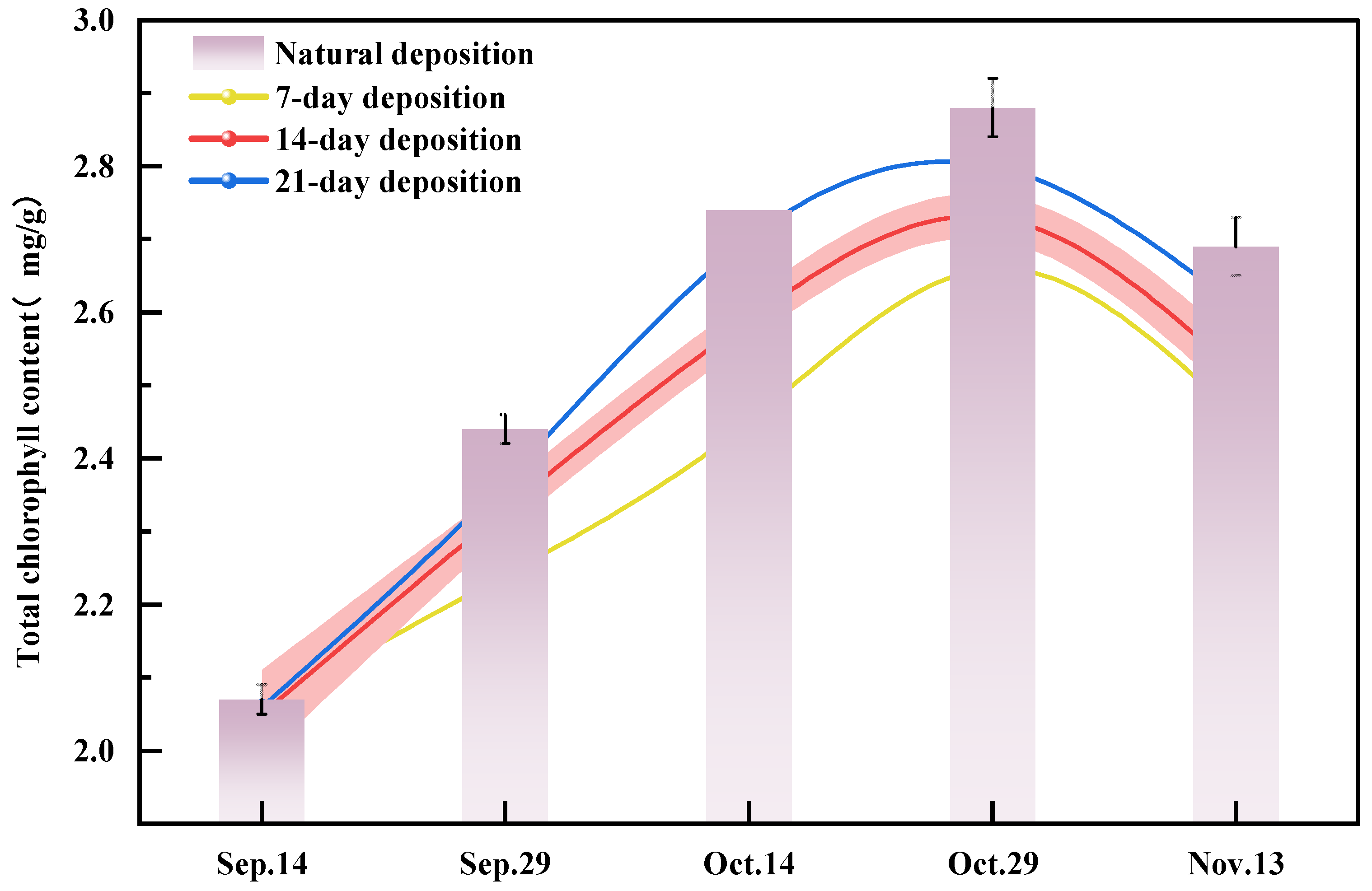
The chlorophyll content of tomato leaves is illustrated in Figure 16. Throughout the entire growth cycle, the chlorophyll content across all treatment groups followed a consistent “increase-then-decrease” pattern, stabilizing at a relatively high level by late October. This suggests that seasonal environmental changes are the common driver behind chlorophyll fluctuations. However, the regulatory effects of different dust removal frequencies on chlorophyll accumulation exhibited a trend diametrically opposed to that of the growth indicators. Data showed that the control group without dust removal consistently maintained the highest chlorophyll content throughout the observation period. To further quantify this relationship, a linear regression analysis was performed on the data from the peak stage. The results revealed a highly significant positive correlation between the dust cleaning interval (days) and total chlorophyll content (y = 0.0097x + 2.593, R2 = 0.998, p < 0.01). This statistical evidence confirms that as the frequency of dust removal increased, the chlorophyll content per unit leaf area demonstrated a declining trend; the high-frequency dust removal groups exhibited lower chlorophyll levels, while the moderate-to-low frequency treatments remained at an intermediate level.
This inverse response where chlorophyll decreases as light intensity increases reveals the physiological adaptation of tomatoes to fluctuations in the light environment. Under the low-light stress induced by the absence of cleaning or low-frequency cleaning, tomato leaves compensate for the deficit in photon flux by increasing the chlorophyll content per unit area to maximize light capture efficiency. Conversely, under the ample light provided by high-frequency cleaning, plants do not need to maintain high concentrations of pigment investment; instead, they shift toward optimizing individual leaf area or structural growth to enhance overall productivity. These results indicate that variations in the frequency of greenhouse film dust removal significantly influence the accumulation of chlorophyll in tomato leaves. High-frequency cleaning does not increase chlorophyll content per unit leaf area, whereas chlorophyll levels remain relatively high under conditions of no cleaning or low-frequency cleaning.
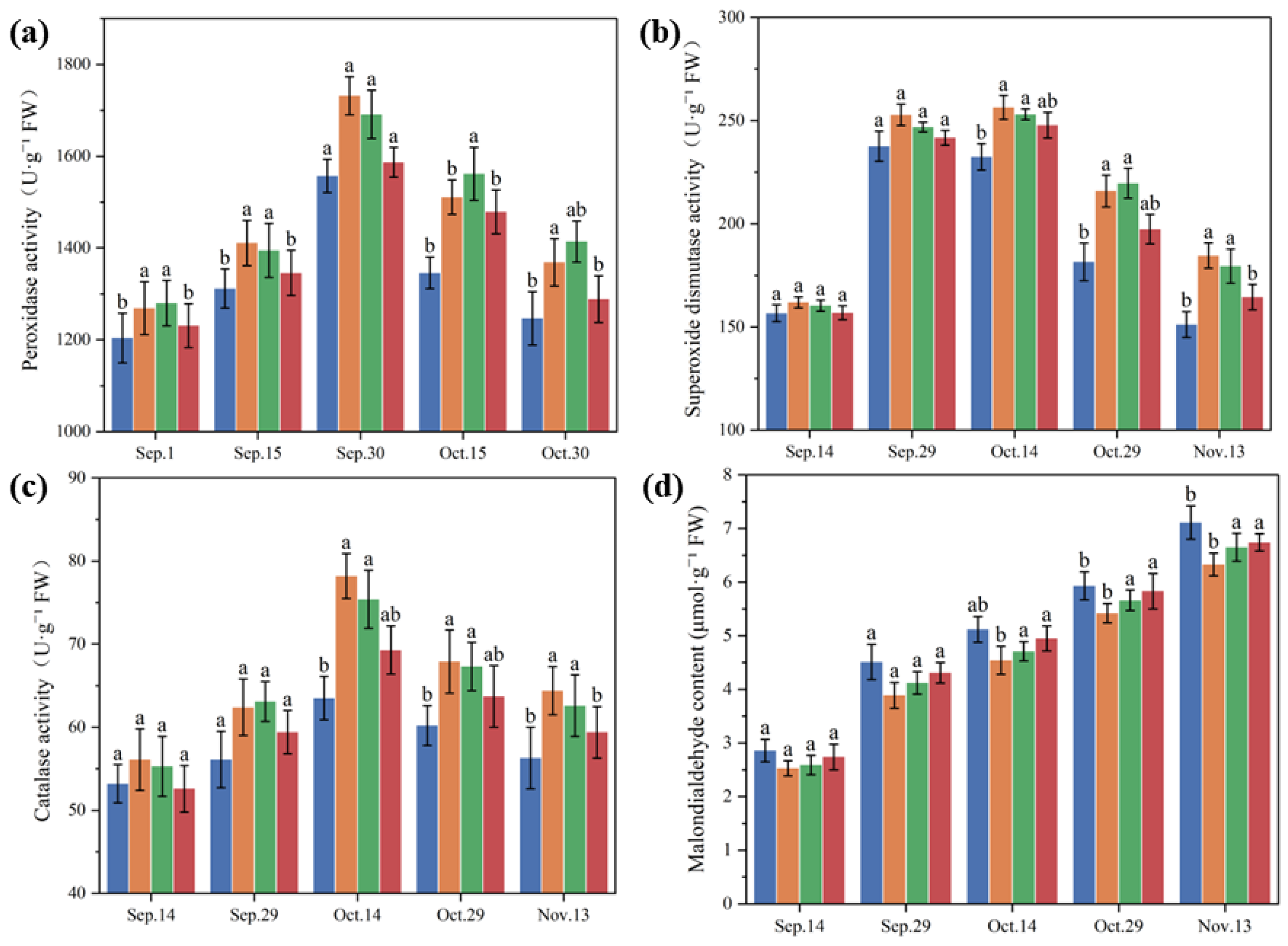
The antioxidant characteristics and cell membrane stability of tomato leaves are illustrated in Figure 17. The results indicate that greenhouse film dust removal, by altering the indoor light environment, regulated the activities of peroxidase (POD), superoxide dismutase (SOD), and catalase (CAT), as well as the accumulation levels of malondialdehyde (MDA) in the leaves. POD activity reached a staged peak in late September. The results show that the POD activity in the dust removal treatment groups was superior to that of the uncleaned control group, with high-frequency dust removal consistently maintaining high levels. SOD activity rose sharply in mid-September and then declined slowly, showing significant differences between groups; the Z1 and Z2 treatment groups exhibited stronger superoxide radical scavenging capacity, while the Z0 group remained in a state of functional inhibition for a long period. The evolutionary trend of CAT activity was similar to that of POD, with the peak appearing in late September, and the performance of Z1 and Z2 was significantly better than that of Z0. In sharp contrast to the trend of enhanced enzyme activity, the MDA content, which reflects the degree of membrane lipid peroxidation, continued to increase over the growth period. The data indicate that the Z0 group, due to being in a physiological adversity of long-term light deficiency, maintained the highest concentration throughout, implying damage to the cell membranes. Conversely, the Z1 and Z2 treatments effectively delayed the accumulation process of MDA by optimizing the light environment.
In summary, the fluctuations in POD, SOD, and CAT activities were significantly negatively correlated with MDA content. This demonstrates that moderately high-frequency cleaning of the greenhouse film can significantly inhibit membrane lipid peroxidation by strengthening the antioxidant defense system of the plants, thereby maintaining the physiological integrity of the cell membranes.

4. Discussion

4.1. Deposition Mechanisms and Spatial Patterns

This study systematically reveals the dust deposition patterns on greenhouse film surfaces and their impact on tomato physiological characteristics through a combined approach of CFD-DPM numerical simulation and field experiments. The simulation results indicate that the geometric structure of the greenhouse induces typical airflow disturbances: low-speed accumulation and flow separation occur on the windward side, flow acceleration is present at the top, and wake and vortex regions develop on the leeward side. Consequently, dust deposition is primarily concentrated in the windward and wake regions, with relatively less deposition at the top. This observed spatial heterogeneity is highly consistent with the findings of Mashanyare et al. [34] in Zimbabwean greenhouses, where particulate accumulation was shown to severely impair covering transmittance and attenuate internal energy flux, though such effects are substantially reversible via cleaning interventions.

4.2. Physicochemical Differentiation of Dust

Further empirical evidence from Sangpradit [35] revealed that after six months of exposure, dust fouling on plastic film claddings can plummet transmittance to merely 36–50% of its baseline. Moreover, subsequent investigations [36] have elucidated that the synergy between dust contamination and condensate droplets drives the accelerated optical degradation of cladding materials; this necessitates the synchronization of dust-mitigation and drainage-discharge strategies during structural design and maintenance. Crucially, greenhouse architecture drives particle size fractionation. As evidenced by the empirical data in Section 3.1, dust particles on the film are significantly finer than those on the ground. These fine particles, selectively captured by the airflow, possess a higher light-blocking capacity than coarse particles, which explains the marked decline in light transmittance.

4.3. Plant Physiological Responses and Adaptations

At the crop level, the dust layer changes the distribution of canopy light field by enhancing scattering and occlusion, thereby affecting the coupling of photosynthesis and antioxidant metabolism. The observed decrease in net photosynthetic rate, reduction in SOD, POD, and CAT activities, and increase in MDA are consistent with the typical response of plants under dust deposition. Independent studies have shown that dust deposition can significantly reduce photosynthetic yield and pigment content, exhibiting regular fluctuations in different seasons [20,37]. After dust particles enter or cover the leaf surface, they can cause damage to the ultrastructure of chloroplasts and pigment degradation, which is reflected as limited photosynthesis and intensified oxidative stress [38]. It is this rapid light attenuation—governed by aerodynamic mechanisms—that forces tomato plants below their light compensation point around Day 14, triggering a stress response in the antioxidant enzyme system.

4.4. Management Implications for Greenhouse Production

Regarding the efficacy of maintenance technologies, research indicated that the deployment of rooftop cleaning systems can restore transmittance from approximately 49% to 69%, thereby validating the operational necessity and economic dividends of periodic dust removal [39]. These external benchmarks align closely with the “7–14 day optimal cleaning window” identified in our field trials, underscoring that institutionalized cleaning frequencies are pivotal management instruments for sustaining DLI. To evaluate the generalizability, environmental conditions at this site were compared with those at other major dust source regions. According to Kang et al. [40], dust emission fluxes in the Taklamakan and Gobi deserts exhibit a high degree of consistency, suggesting that the dynamics observed here are representative of the entire arid belt [41].

4.5. Limitations and Future Research Directions

While this study systematically elucidates the mechanisms of dust deposition and its physiological impacts on tomatoes, several limitations should be acknowledged. First, the field experiments were conducted during a specific season in the Taklamakan Desert. Given that dust concentration and physicochemical properties vary across different arid belts, the broader applicability of the 14-day cleaning threshold requires further validation across diverse climatic zones. Second, the CFD-DPM simulation primarily focused on external aerodynamic behaviors under steady-state conditions. Importantly, the current numerical model simplified particle-wall interactions; future iterations must incorporate more complex adhesion and bounce dynamics to enhance predictive accuracy. Third, this study evaluated a specific conventional greenhouse cladding material. In reality, the thermal characteristics of the selected cladding material, particularly under the influence of severe external and internal temperature gradients in desert environments, play a crucial role in condensation and subsequent dust adherence. This material-specific temperature dependency represents a limitation in the current scope. Fourth, this research solely investigated the response of tomatoes; however, different crop species may exhibit varying stress tolerance mechanisms. Furthermore, regarding physiological assessments, this study primarily evaluated total chlorophyll content to characterize shade-adaptive responses. However, as different pigments exhibit distinct absorption maxima under altered light spectra, the lack of quantification for the specific ratio of chlorophyll a to chlorophyll b, as well as accessory pigments like carotenoids, limits the depth of our photosynthetic efficiency analysis. This represents a methodological limitation in the current scope.
Future research should address these gaps by evaluating diverse cladding materials under varying thermal conditions and integrating transient boundary conditions with advanced particle-adhesion models into the CFD framework.

5. Conclusions

This study systematically reveals the deposition patterns of dust on greenhouse film surfaces and their impact on tomato growth through a combined approach of numerical simulation and field experiments. The main conclusions are as follows:
CFD-DPM simulation results indicate that the greenhouse significantly disturbs incoming airflow, leading to flow deceleration on the windward side and the formation of accelerated swirling flow at the top. Large-scale wake and vortex structures develop in the leeward region, resulting in dust deposition being primarily concentrated in the windward and wake regions, with relatively less deposition at the top.
The effects of particle size and wind speed show that small particles, due to their longer suspension time, are more likely to accumulate on the greenhouse film surface. Under high-wind-speed conditions, particle deposition decreases as the mainstream flow carries particles away, while under low wind speed conditions, adhesion and deposition on the greenhouse film surface are enhanced.
Field experimental results demonstrate that dust accumulation significantly reduces greenhouse light transmittance, leading to a decline in net photosynthetic rate. Concurrently, the activities of antioxidant enzymes such as SOD, POD, and CAT decrease, while MDA content increases, exhibiting typical photosynthetic limitation and oxidative stress effects. Furthermore, different dust removal frequencies have significant impacts on crop growth and physiological metabolism. Dust removal every 7–14 days maintains a higher photosynthetic rate, enhances antioxidant defense capacity, and reduces membrane lipid peroxidation levels. Therefore, this interval represents the optimal dust removal cycle for greenhouse films.

Author Contributions

H.L.: Formal analysis, Experiment, Data Curation, Visualization, Writing—Original Draft, Software. G.W.: Conceptualization, Investigation, Funding acquisition, Writing—Review and Editing. Y.L.: Project administration, Resources, Writing-Review & Editing, Supervision. Y.W.: Validation. All authors have read and agreed to the published version of the manuscript.

Funding

This work was supported by the National Key Research and Development Program of China (2024YFD2001000); the Central Guidance for Local Science and Technology Development Fund (ZYYD2025QY15); the Central Public-interest Scientific Institution Basal Research Fund (BSRF202508); the Belt and Road Initiative (CAASTIP-2025-09); and the Key Research and Development Program of Xinjiang Uygur Autonomous Region (2023B02020).

Data Availability Statement

The data will be made available on request.

Conflicts of Interest

The authors declare that they have no known competing financial interest or personal relationships that could have appeared to influence the work reported in this paper.

Abbreviations

The following abbreviations are used in this manuscript:
CFDcomputational fluid dynamics
DPMdiscrete phase model
DEM discrete element method
DNS direct numerical simulation
LES large eddy simulation
RANS Reynolds-averaged Navier–Stokes
SST k-ω shear stress transport k–omega
DRWdiscrete random walk
T.E.Total Trace Elements
Pnnet photosynthetic rate
Gsstomatal conductance
Ciintercellular CO2 concentration
Trtranspiration rate
SODsuperoxide dismutase
PODperoxidase
CATcatalase
MDAmalondialdehyde

References

  1. Middleton, N.J. Desert Dust Hazards: A Global Review. Aeolian Res. 2017, 24, 53–63. [Google Scholar] [CrossRef]
  2. Ahmadzai, H.; Malhotra, A.; Tutundjian, S. Assessing the Impact of Sand and Dust Storm on Agriculture: Empirical Evidence from Mongolia. PLoS ONE 2023, 18, e0269271. [Google Scholar] [CrossRef]
  3. Zhang, X.; Xie, J.; Ma, N.; Chang, Y.; Zhang, J.; Li, J. Cost-Effective Thermal Mass Walls for Solar Greenhouses in Gobi Desert Regions. Agriculture 2025, 15, 1618. [Google Scholar] [CrossRef]
  4. Wu, C.; Lin, Z.; Shao, Y.; Liu, X.; Li, Y. Drivers of Recent Decline in Dust Activity over East Asia. Nat. Commun. 2022, 13, 7105. [Google Scholar] [CrossRef] [PubMed]
  5. Aishajiang, A.; Xu, Z.; Xu, H.; Muhetaer, W.; Maimaitiaili, M. Analysis of the Origin and Meteorological Characteristics of Dust-Storm in Hetian Oasis Based on a Trajectory Model Approach. J. Environ. Eng. Technol. 2022, 12, 1007–1014. [Google Scholar] [CrossRef]
  6. Seo, Y.-J.; Hong, E.; Lee, J.-H.; Jeong, Y.-J.; Seo, B.-H.; Jun, S.; Lee, S.-J.; Choi, W. Comparative Study of Coating Agents for Prevention of Fine-Dust-Induced Light Transmittance Reduction in Greenhouse Covering Materials. J. Agric. Eng. 2022, 53, 1334. [Google Scholar] [CrossRef]
  7. Al-Helal, I.; Picuno, P.; Alsadon, A.A.; Ibrahim, A.; Shady, M.; Abdel-Ghany, A.M. Effect of Shape, Orientation and Aging of a Plastic Greenhouse Cover on the Degradation Rate of the Optical Properties in Arid Climates. Appl. Sci. 2022, 12, 2709. [Google Scholar] [CrossRef]
  8. Lee, J.; Hong, E.; Lee, S.; Jeong, Y.; Seo, B.; Seo, Y.; Kim, D.; Kwon, H.; Choi, W. Experimental Study for the Reproduction of Particulate Matter Deposition on Greenhouse Plastic Films. Biosyst. Eng. 2022, 223, 189–205. [Google Scholar] [CrossRef]
  9. Al-Helal, I.M.; Alhamdan, A.M. Effect of Arid Environment on Radiative Properties of Greenhouse Polyethylene Cover. Sol. Energy 2009, 83, 790–798. [Google Scholar] [CrossRef]
  10. Zhao, W.; Liu, L.; Chen, J.; Ji, J. Geochemical Characterization of Major Elements in Desert Sediments and Implications for the Chinese Loess Source. Sci. China Earth Sci. 2019, 62, 1428–1440. [Google Scholar] [CrossRef]
  11. El Baraka, A.; En-nadir, R.; Basyooni-M. Kabatas, M.A.; Jorio, A.; Khaldoun, A. Soiling, Adhesion, and Surface Characterization of Concentrated Solar Power Reflectors: Insights and Challenges in the MENA Region. Sustainability 2024, 16, 6257. [Google Scholar] [CrossRef]
  12. Ysard, N.; Jones, A.P.; Demyk, K.; Boutéraon, T.; Koehler, M. The Optical Properties of Dust: The Effects of Composition, Size, and Structure. Astron. Astrophys. 2018, 617, A124. [Google Scholar] [CrossRef]
  13. Chen, L.; Yuan, K.; Qian, F.; Zheng, Z.; Lu, J.; Han, Y. Numerical Investigation of Non-spherical Particle Deposition Charac-teristics on Filter Media Using CFD-DPM/DEM. Build. Simul. 2023, 16, 1331–1343. [Google Scholar] [CrossRef]
  14. Stone, L.; Hastie, D.; Zigan, S. Using a Coupled CFD-DPM Approach to Predict Particle Deposition in the Horizontal Chamber. Adv. Powder Technol. 2019, 30, 869–878. [Google Scholar] [CrossRef]
  15. Dagher, M.M.; Kandil, A. Computational Prediction of Dust Deposition on Solar Panels. Environ. Sci. Pollut. Res. 2023, 30, 12545–12557. [Google Scholar] [CrossRef]
  16. Lu, H.; Lu, L.; Wang, Y. Numerical Investigation of Dust Pollution on a Solar Photovoltaic (PV) System Mounted on an Isolated Building. Appl. Energy 2016, 180, 27–36. [Google Scholar] [CrossRef]
  17. Mayhoub, M.S.; Elqattan, A.A.; Algendy, A.S. Experimental Investigation of Dust Accumulation Effect on the Performance of Tubular Daylight Guidance Systems. Renew. Energy 2021, 169, 726–737. [Google Scholar] [CrossRef]
  18. Darley, E.F.; Dugger, W.M.; Mudd, J.B.; Ordin, L.; Taylor, O.C.; Stephens, E.R. Plant Damage by Pollution Derived from Au-tomobiles. Arch. Environ. Health Int. J. 1963, 6, 761–770. [Google Scholar] [CrossRef]
  19. Yang, H.; Wei, L.; Ye, X.; Liu, G.; Yang, X.; Huang, Z. Effects of Coal Dust Deposition on Seedling Growth of Hedysarum laeve Maxim., a Dominant Plant Species on Ordos Plateau. Acta Ecol. Sin. 2016, 36, 2858–2865. [Google Scholar] [CrossRef]
  20. Lin, W.; Yu, X.; Xu, D.; Sun, T.; Sun, Y. Effect of Dust Deposition on Chlorophyll Concentration Estimation in Urban Plants from Reflectance and Vegetation Indexes. Remote Sens. 2021, 13, 3570. [Google Scholar] [CrossRef]
  21. Bierza, K.; Bierza, W. The Effect of Industrial and Urban Dust Pollution on the Ecophysiology and Leaf Element Concentration of Tilia cordata Mill. Environ. Sci. Pollut. Res. 2024, 31, 58413–58429. [Google Scholar] [CrossRef]
  22. Javed, W.; Wubulikasimu, Y.; Figgis, B.; Guo, B. Characterization of Dust Accumulated on Photovoltaic Panels in Doha, Qatar. Sol. Energy 2017, 142, 123–135. [Google Scholar] [CrossRef]
  23. Bournet, P.E.; Boulard, T. Effect of ventilator configuration on the distributed climate of greenhouses: A review of experi-mental and CFD studies. Comput. Electron. Agric. 2010, 74, 195–220. [Google Scholar] [CrossRef]
  24. Kwon, K.-S.; Kim, D.-S.; Kim, R.-W.; Ha, T.-H.; Nam, S.-W.; Son, J.-E. Evaluation of wind pressure coefficients of single-span greenhouses built on reclaimed coastal land using a large-sized wind tunnel. Biosyst. Eng. 2016, 141, 58–81. [Google Scholar] [CrossRef]
  25. Lu, H.; Zhang, L.-Z. Influences of dust deposition on ground-mounted solar photovoltaic arrays: A CFD simulation study. Renew. Energy 2019, 131, 1060–1070. [Google Scholar] [CrossRef]
  26. Wang, L.; Shi, F.; Wang, Z.; Liang, S. Blockage Effects in Wind Tunnel Tests for Tall Buildings with Surrounding Buildings. Appl. Sci. 2022, 12, 7087. [Google Scholar] [CrossRef]
  27. Kok, J.F.; Parteli, E.J.R.; Michaels, T.I.; Bou Karam, D. The Physics of Wind-blown Sand and Dust. Rep. Prog. Phys. 2012, 75, 106901. [Google Scholar] [CrossRef]
  28. Yang, H.; Wang, H. Numerical simulation of the dust particles deposition on solar photovoltaic panels and its effect on power generation efficiency. Renew. Energy 2022, 201, 1111–1126. [Google Scholar] [CrossRef]
  29. Tominaga, Y.; Akabayashi, S.; Chacko, C.; Kitahara, T.; Arinami, Y. Airflow Around Isolated Gable-roof Buildings with Dif-ferent Roof Pitches: Wind Tunnel Experiments and CFD Simulations. Build. Environ. 2015, 84, 204–213. [Google Scholar] [CrossRef]
  30. Beauchamp, C.; Fridovich, I. Superoxide Dismutase: Improved Assays and an Assay Applicable to Acrylamide Gels. Anal. Biochem. 1971, 44, 276–287. [Google Scholar] [CrossRef]
  31. Chance, B.; Maehly, A.C. Assay of Catalases and Peroxidases. Methods Enzymol. 1955, 2, 764–775. [Google Scholar] [CrossRef]
  32. Aebi, H. Catalase in vitro. Methods Enzymol. 1984, 105, 121–126. [Google Scholar] [CrossRef] [PubMed]
  33. Heath, R.L.; Packer, L. Photoperoxidation in Isolated Chloroplasts: I. Kinetics and Stoichiometry of Fatty Acid Peroxidation. Arch. Biochem. Biophys. 1968, 125, 189–198. [Google Scholar] [CrossRef] [PubMed]
  34. Mashonjowa, E.; Ronsse, F.; Mhizha, T.; Milford, J.; Lemeur, R.; Pieters, J. The Effects of Whitening and Dust Accumulation on the Microclimate and Canopy Behaviour of Rose Plants (Rosa hybrida) in a Greenhouse in Zimbabwe. Sol. Energy 2010, 84, 10–23. [Google Scholar] [CrossRef]
  35. Sangpradit, K. Study of the Solar Transmissivity of Plastic Cladding Materials and Influence of Dust and Dirt on Greenhouse Cultivations. Energy Procedia 2014, 56, 566–573. [Google Scholar] [CrossRef]
  36. He, M.; Sun, D.; Wen, P.; Sun, Y.; Li, T.; Li, Y.; Liu, X. Environmental Control for Chinese Solar Greenhouses: A Review. Renew. Sustain. Energy Rev. 2025, 218, 115796. [Google Scholar] [CrossRef]
  37. Meravi, N.; Singh, P.K.; Prajapati, S.K. Seasonal Variation of Dust Deposition on Plant Leaves and Its Impact on Various Photochemical Yields of Plants. Environ. Chall. 2021, 4, 100166. [Google Scholar] [CrossRef]
  38. Soheili, F.; Woodward, S.; Abdul-Hamid, H.; Naji, H.R. The Effect of Dust Deposition on the Morphology and Physiology of Tree Foliage. Water Air Soil Pollut. 2023, 234, 339. [Google Scholar] [CrossRef]
  39. Amin, A.; Wang, X.; Zhao, L.; Shi, Y.; Ren, X.; Okasha, M.; Hassanien, R. Design and Fabrication of a Device for Cleaning Greenhouse Roofs. Heliyon 2025, 11, e41991. [Google Scholar] [CrossRef]
  40. Kang, L.; Huang, J.; Chen, S.; Wang, T. Emission, Transport, and Radiative Effects of Mineral Dust from the Taklimakan and Gobi Deserts. Atmos. Chem. Phys. 2017, 17, 2401–2421. [Google Scholar] [CrossRef]
  41. Filonchyk, M.; Peterson, M.P.; Zhang, L. An Analysis of Air Pollution Associated with the 2023 Sand and Dust Storms over China. Geosci. Front. 2024, 15, 101762. [Google Scholar] [CrossRef]
Figure 1. Surface dust accumulation on solar greenhouse films in arid and windy regions. (a) Exterior view of the solar greenhouse facade; (b) Localized characteristics of dust deposition on the film surface; (c) Interior lighting conditions under dust-fouling environments.
Agriculture 16 00660 g001
Figure 2. Schematic of the computational domain and the greenhouse model. (H: height of the computational domain; h: height of the greenhouse; W1: upstream windward distance; W2: downstream leeward distance; w: span of the greenhouse; L1: length of the computational domain; L2: length of the greenhouse).
Agriculture 16 00660 g002
Figure 3. Mesh generation and grid independence verification. (The grey dashed line indicates the asymptotic value; and the blue dashed lines mark the selected mesh density).
Agriculture 16 00660 g003
Figure 4. Validation of numerical model.
Agriculture 16 00660 g004
Figure 5. Experimental flowchart of the impacts of dust deposition on greenhouse tomatoes.
Agriculture 16 00660 g005
Figure 6. Comparison of dust particles from the ground and greenhouse film surface. (a) SEM image of ground dust particles; (b) SEM image of dust particles deposited on the film surface; (c) Particle size distribution and volume density of ground dust and film surface dust.
Agriculture 16 00660 g006
Figure 7. Chemical composition differences between ground dust and dust deposited on the greenhouse film surface. (a) Elemental composition; (b) Oxide composition.
Agriculture 16 00660 g007
Figure 8. Differences in mineral composition between ground dust and dust deposited on the greenhouse film surface.
Agriculture 16 00660 g008
Figure 9. Schematic diagram of the transport and deposition of dust particles with different particle sizes.
Agriculture 16 00660 g009
Figure 10. Airflow velocity distribution around the greenhouse under different inlet wind speeds.
Agriculture 16 00660 g010
Figure 11. Particle trajectory distributions around the greenhouse under different inlet wind speeds.
Agriculture 16 00660 g011
Figure 12. Particle deposition across curved regions of the greenhouse film under different inlet wind speeds. (a) Deposition amounts on surfaces 1–5 as a function of wind speed; (b) Deposition contour on the film surface under a representative condition. Note: The simulation data represent deterministic results derived from transient numerical solutions.
Agriculture 16 00660 g012
Figure 13. 21-day changes in daily light integral (DLI) and light transmittance under different cleaning intervals. The different lowercase letters (a, b) above the bars indicate significant differences at the p < 0.05 level.
Agriculture 16 00660 g013
Figure 14. Differences in tomato growth parameters under different light conditions. (a) Plant height; (b) Stem thickness; (c) Number of leaves; (d) Leaf area. The different lowercase letters (a–c) indicate significant differences among treatments (p < 0.05).
Agriculture 16 00660 g014
Figure 15. Differences in photosynthetic parameters of tomatoes under different light conditions. (Pn: Net photosynthetic rate; Gs: Stomatal conductance; Ci: Intercellular CO2 concentration; Tr: Transpiration rate).
Agriculture 16 00660 g015
Figure 16. Differences in chlorophyll indices of tomatoes under different light conditions.
Agriculture 16 00660 g016
Figure 17. Differences in antioxidant enzyme activities and malondialdehyde (MDA) content in tomatoes under different light conditions. (a) Peroxidase (POD) activity; (b) Superoxide dismutase (SOD) activity; (c) Catalase (CAT) activity; (d) Malondialdehyde (MDA) content. The different lowercase letters (a, b) indicate significant differences among treatments (p < 0.05).
Agriculture 16 00660 g017
Table 1. Testing items and corresponding instruments for dust samples.
Testing IndexInstrumentKey Parameters
Particle size distribution (Laser PSD)Mastersizer 3000, Malvern Panalytical, Malvern, UKMeasurement range: 0.01–3500 μm; Dispersion method: Dry dispersion
Particle morphology (SEM–EDS)Gemini SEM 300, Carl Zeiss AG, Oberkochen, GermanyAccelerating voltage: 3 kV; Detector: SE2; Sample preparation: Gold-sputtered
XRD qualitative and quantitative analysisSmartLab, Rigaku Corp., Tokyo, JapanX-ray source: Cu Kα (40 kV, 40 mA); Scan mode: Continuous scanning; Scan range: 5–80°; Data were analyzed using PDXL v.2.8 (Rigaku Corp., Tokyo, Japan)
XRF elemental composition analysisAxios, Malvern Panalytical, Almelo, The NetherlandsSample preparation: Pressed powder
Table 2. Boundary condition settings.
NameParameters
Inletvelocity-inlet
OutletPressure outlet
Gravity−9.81 m/s2 in the Y-direction
Mass Flow0.25 kg/s
Particle density2650 kg/m3
Wall conditionGreenhouse film surface (Trap), Computational domain boundary (Escape)
Air density1.225 kg/m3
Particle diameter50 μm
Simulation Time20 s
Disclaimer/Publisher’s Note: The statements, opinions and data contained in all publications are solely those of the individual author(s) and contributor(s) and not of MDPI and/or the editor(s). MDPI and/or the editor(s) disclaim responsibility for any injury to people or property resulting from any ideas, methods, instructions or products referred to in the content.