Article

Static Ditching Performance Analysis and Experiment of Horizontal Ditching Device for Salix Psammophila Sand Barriers

1
College of Mechanical and Electrical Engineering, Inner Mongolia Agricultural University, Hohhot 010000, China
2
Institute of Grassland Research, Chinese Academy of Agricultural Sciences, Hohhot 010000, China
3
MENGCAO Ecological Environment (Group) Co., Ltd., Hohhot 010000, China
4
National Technology Innovation Center for Prataculture, Hohhot 010000, China
*
Author to whom correspondence should be addressed.
Agriculture 2026, 16(5), 617; https://doi.org/10.3390/agriculture16050617
Submission received: 7 February 2026 / Revised: 6 March 2026 / Accepted: 6 March 2026 / Published: 7 March 2026
(This article belongs to the Topic Ecological Protection and Modern Agricultural Development)

Abstract

To address the complex dynamic mechanisms and lack of static operation data in trench-digging for transverse planting of Salix psammophila sand barriers, a transverse trench-digging device was designed. Based on the discrete element method, the Hertz–Mindlin with JKR Cohesion model was used to simulate sandy soil. The Box–Behnken experiment was adopted to optimize the single auger structure with helix angle and soil-cutting angle as factors and trench depth and working torque as indices, yielding the optimal parameters of 30° soil-cutting angle and 20.37° helix angle (5.52 cm trench depth, 2.6 N·m maximum torque). The optimized auger was integrated into the device, and a further Box–Behnken experiment was conducted under a 20 cm fixed descending depth of the lifting platform. With auger rotation speed, shaft spacing and lifting speed as factors, and trench depth, soil compaction and Salix psammophila insertion depth as indices, the optimal operating parameters were determined as 257.25 r/min, 7 cm and 9 cm/s, corresponding to 6.7 cm trench depth, 33.37 kPa soil compaction and 14.87 cm insertion depth. This study clarifies the effects of auger and operation parameters on trench-digging quality, provides a basis for the design and parameter matching of dynamic continuous operation equipment, and offers a reference for the R&D of mechanized transverse planting equipment for Salix psammophila sand barriers, which is of practical value for reducing sand control costs and improving efficiency.

1. Introduction

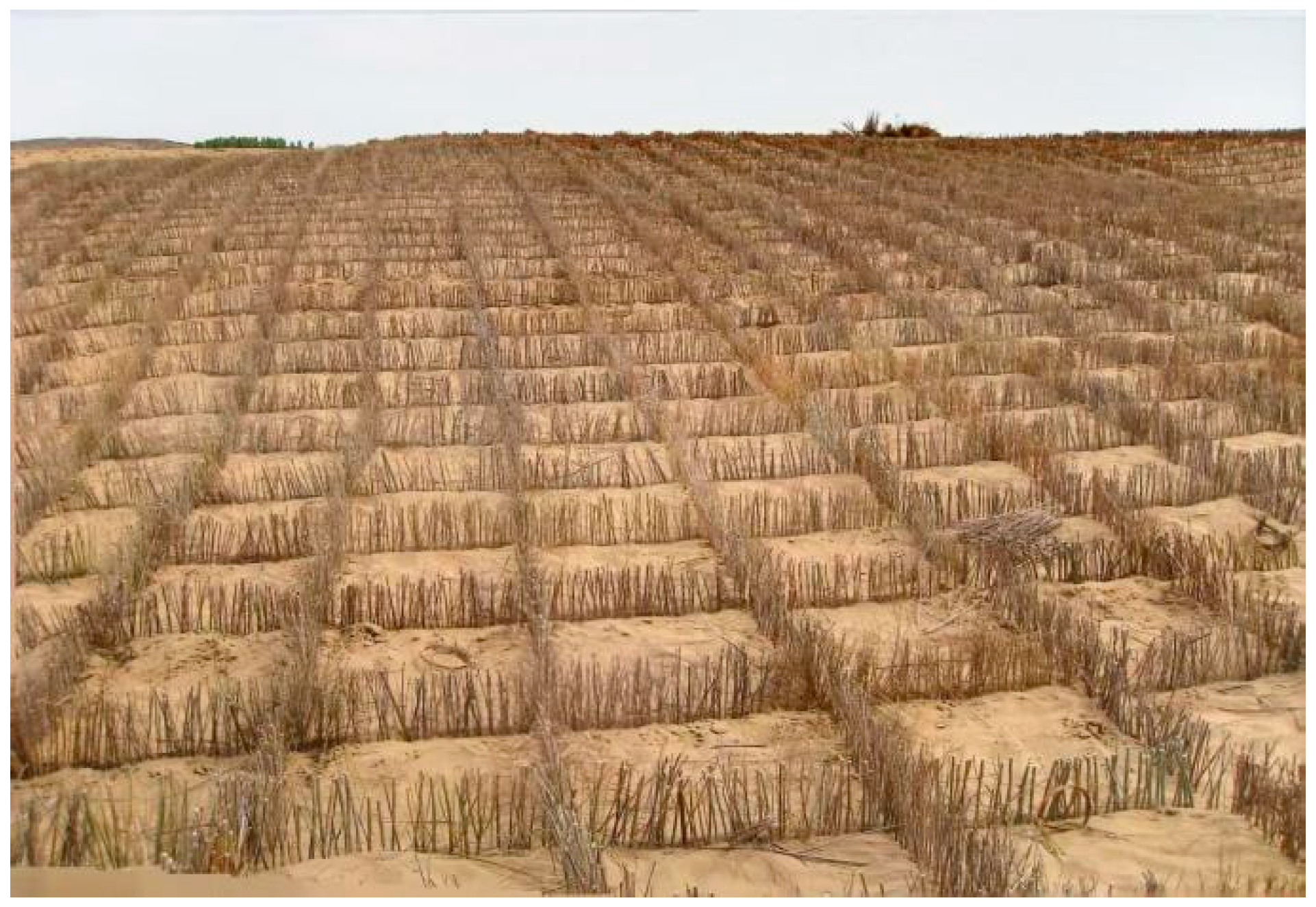
Due to the highly variable climate and human-induced damage to the natural environment, soil desertification has become an extremely severe issue. According to the “Main Results and Analysis of the 6th National Desertification and Sandification Survey”, the area of desertified land in China reaches 2.573713 million km2, with sandy land covering 1.687823 million km2. Xinjiang, Inner Mongolia, Tibet, Gansu, and Qinghai rank among the top five provinces (autonomous regions) in terms of desertified land area [1]. In recent years, China has accumulated extensive experience in desertification control, and sand-fixing barrier materials have evolved from initial straw-based materials (e.g., wheat straw and rice straw) to a diverse range of options [2]. Among these, Salix psammophila sand barriers stand out as a reliable windbreak and sand-fixing solution, achieving the dual goals of engineering-based and biological desertification control simultaneously [3]. As a key measure for windbreak and sand fixation [4,5,6,7,8], Salix psammophila sand barriers have the characteristics of drought tolerance, cold resistance, sand burial resistance and strong sprouting ability, serving as an excellent native tree species for windbreak and sand fixation. The planting of Salix psammophila sand barriers shall meet the following agronomic requirements [9]: the branches of Salix psammophila shall be 50 cm in length with a burial depth of 20–30 cm and 20–30 cm left above the ground; the sand barriers shall be arranged in a grid pattern with a spacing of 1–2 m, as shown in Figure 1 below.
Its planting process consists of two operational steps: longitudinal and transverse planting. At present, mechanized continuous operation has been realized for longitudinal planting. Inner Mongolia Hongchang Machinery Manufacturing Co., Ltd. [10] has developed a traction-type Salix psammophila mat-shaped sand barrier paving machine, which achieves continuous paving of longitudinal sand barriers. Mengcao Ecological Environment (Group) Co., Ltd. [11] has developed automated degradable nylon net sand barrier equipment combined with mechanical Salix psammophila sand barrier paving equipment, which has greatly reduced labor costs and improved operation quality. However, research on transverse planting remains scarce due to its operational direction being perpendicular to the forward direction of machinery. Li Yuejuan [12] designed a transverse pneumatic grass-pressing mechanism, used ADAMS to determine the optimal design for different cylinder installation positions, and obtained the final optimized design scheme of the pneumatic grass-inserting mechanism through horizontal comparison. Si Kai [13] designed a cycloidal stepping transverse grass-pressing mechanism, completed the simulation coordination analysis of the hydraulic motor and hydraulic cylinder of the transverse grass-inserting mechanism with the help of ADAMS, and realized the rotation and expansion of the grass-pressing knife. Tang Weiguo [14] designed a multi-link stepping parallel transverse grass-pressing mechanism, and based on ADAMS co-simulation, completed the design of the structure of each actuator and the supporting hydraulic circuit in the transverse grass-inserting system. The above studies rely on the intermittent operation mode of “stopping—ditching—planting” [15], which is inefficient and has become a bottleneck restricting the large-scale advancement of sandy land management. Conventional operations still mainly rely on manual single cutting and inserting, with the maximum planting area per person per day being only 1 mu, leading to extremely low efficiency. To overcome this efficiency bottleneck and realize non-stop transverse planting, the core is to develop a transverse trenching adaptive to the dynamic traveling conditions of the machine. The device is required to quickly and stably form planting trenches in the direction perpendicular to the forward movement while the unit is continuously advancing. However, the firmness of sandy soil increases significantly with the increase in penetration depth, and sandy soil also exhibits strong flowability and high backflow rate. These characteristics lead to two core problems for the transverse trenching device during dynamic operation: first, the cutting resistance shows a nonlinear variation with operating depth [16,17]; second, the formed trenches are prone to secondary backfilling caused by rapid sand backflow [18], which greatly weakens the operation quality and efficiency. Therefore, deeply exploring the internal relationship between the operation process of the transverse trenching device and the sand backflow characteristics has become the key to improving the working performance of the device.
To systematically solve the above problems, this study first started under static working conditions. A static test bench of the transverse trenching device was established to simulate the vertical soil-inserting operation at a fixed point, thereby clarifying the mechanical mechanism of the interaction between the trenching device and sandy soil. On this basis, the evaluation indices were selected according to the agronomic requirements of Salix psammophila sand barriers and related literature. Trenching depth directly affects the insertion depth and survival rate of Salix psammophila cuttings, so it is a key parameter for device design. Working torque reflects the energy consumption and load characteristics during trenching, which has been adopted as an important evaluation index by Li et al. [17] in their study on the spiral digging device. Soil compaction affects the insertion difficulty of Salix psammophila cuttings, and excessively high soil compaction will lead to insertion failure. The insertion depth of Salix psammophila [9] directly determines the windbreak and sand-fixation effect of sand barriers. Based on the above analysis, this study selected trenching depth and working torque as indices in the spiral structure optimization stage, and trenching depth, soil compaction, and Salix psammophila insertion depth as indices in the field test stage, so as to comprehensively evaluate the working performance of the transverse trenching device.

2. Materials and Methods

2.1. Design and Analysis

2.1.1. Structure and Principle of the Horizontal Ditching Device

Structural Design of the Horizontal Ditching Device
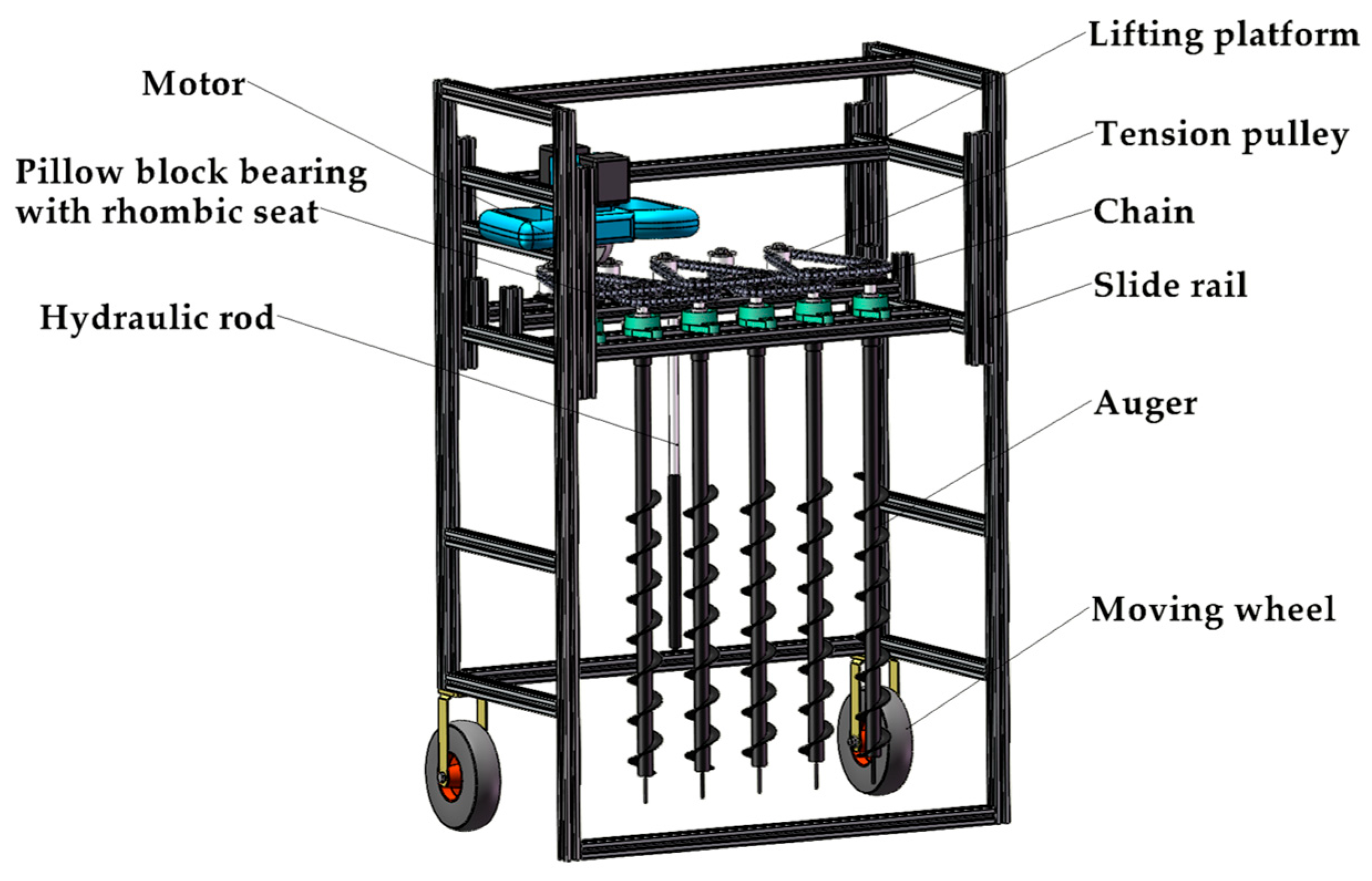
The overall structure of the designed horizontal ditching device is shown in Figure 2, mainly consisting of a helical device, a lifting platform, and a traveling device. The helical device is composed of augers and pillow block bearings with rhombic seats. The lifting platform mainly includes a motor, tension pulleys, chains, and slide rails. The traveling device is primarily made up of moving wheels. The main technical parameters of the horizontal ditching device are listed in Table 1.
Working Principle
During the operation of the transverse ditching device, the power output by the DC motor is transmitted to each auger through a sprocket drive system. Since the reference circle diameters of the sprockets equipped on each auger are consistent, the rotational speed and direction of each auger remain synchronized during rotation. After the augers enter a stable rotating state, the lifting platform is manually controlled to descend. Under the dual effects of the guide limit of the slide rail and the damping buffer of the hydraulic rod, the lifting platform achieves stable downward movement. When the augers come into contact with sandy soil, the spiral soil-entry bits and end-face cutting blades cut the underlying sandy soil and discharge it upward along the spiral blades. After the augers complete the ditching operation at the preset depth, the operator releases the control of the lifting platform, and the lifting platform rises slowly under the action of the hydraulic rod, thus completing the entire ditching action.

2.1.2. Design and Analysis of Key Components

Design of the Auger Device
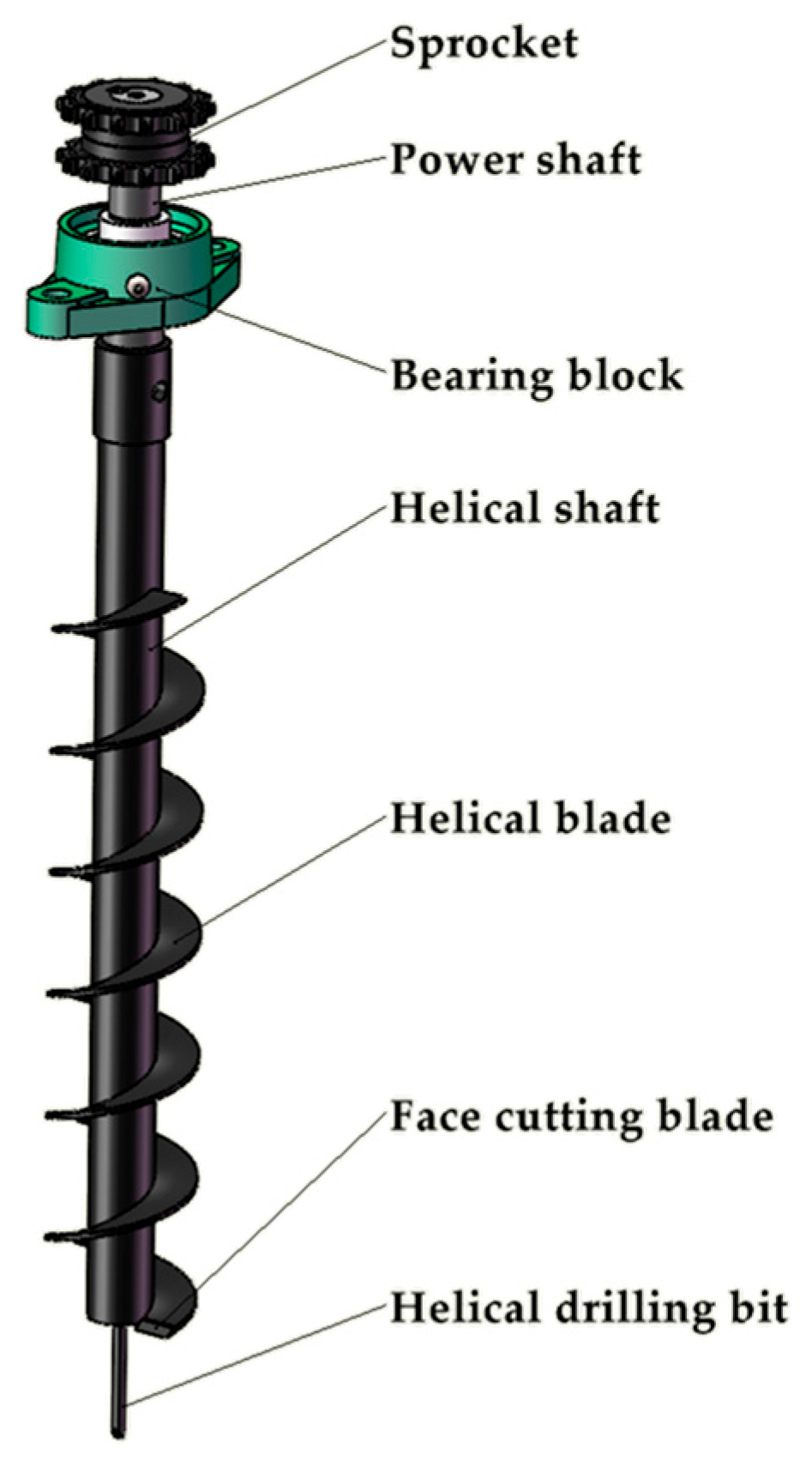
The auger device mainly consists of a spiral soil-entry bit, end-face cutting blades, spiral blades, a spiral shaft, sprockets, bearing housings, a power shaft, etc., as shown in Figure 3. Considering the harshness of the desert working environment, the auger tip, front-end cutting blades, and spiral blades are made of 65Mn steel and subjected to overall quenching treatment, so that their surface hardness reaches HRC45–50 to improve wear resistance and bending strength. During ditching operation, the spiral soil-entry bit first comes into contact with sandy soil; as the bit drills downward, it cuts the sandy soil in the central part of the trench, and then the end-face cutting blades simultaneously cut the surrounding sandy soil. The cut soil is lifted to the surface by the rotary conveying action of the spiral blades [19].
According to the planting requirements for Salix psammophila sand barriers, the length of dead Salix psammophila is 50 cm, with a diameter of 2–3 cm. The burial depth of Salix psammophila is 20–30 cm, and 20–30 cm remains above the ground. Therefore, the auger length in this design is 80 cm, and the height of the spiral blade is 50 cm. To prevent the thrown sandy soil from being too close to both sides of the trench after ditching, and considering the extremely high fluidity of sand, it is necessary to ensure that the ditching width is greater than the diameter of Salix psammophila to meet the planting requirements. Therefore, this study adopts a structural design with a spiral blade diameter of 6 cm. To realize the transformation of transverse Salix psammophila sand barriers from the intermittent “stop–trench–cutting” mode to a continuous operation mode, the single trenching time is required to be ≤5 s, which lays a foundation for the subsequent realization of continuous dynamic operation.
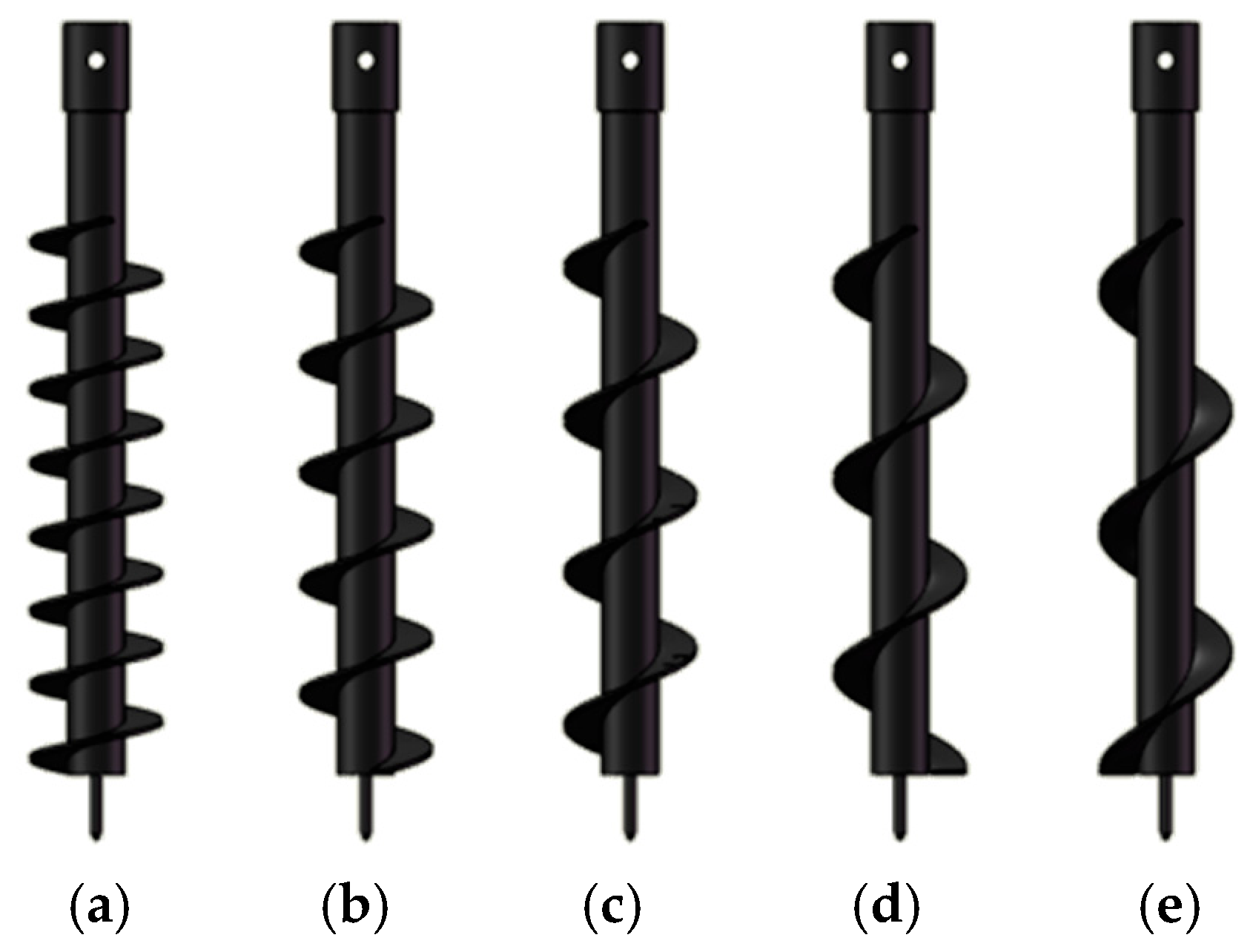
The spiral blade is the most important component of the auger structure [20,21]. The helix angle is defined as the angle between the linearized spiral cutting edge of the blade and the axis of the cutter [22]. The helix angle of the spiral blade exhibits an obvious nonlinear distribution: it decreases with the increase in the outer diameter of the blade, while reaching the maximum value in the root region near the auger shaft. Figure 4 shows augers with different helix angles. The helix angle is a key structural parameter of the auger, which directly determines the soil cutting and discharging efficiency of the drilling tool. In this study, five auger tools with different helix angles (10°, 15°, 20°, 25°, 30°) were designed. Except for the helix angle, all other structural parameters of each drilling tool remained consistent to ensure a single variable in the single-factor test.
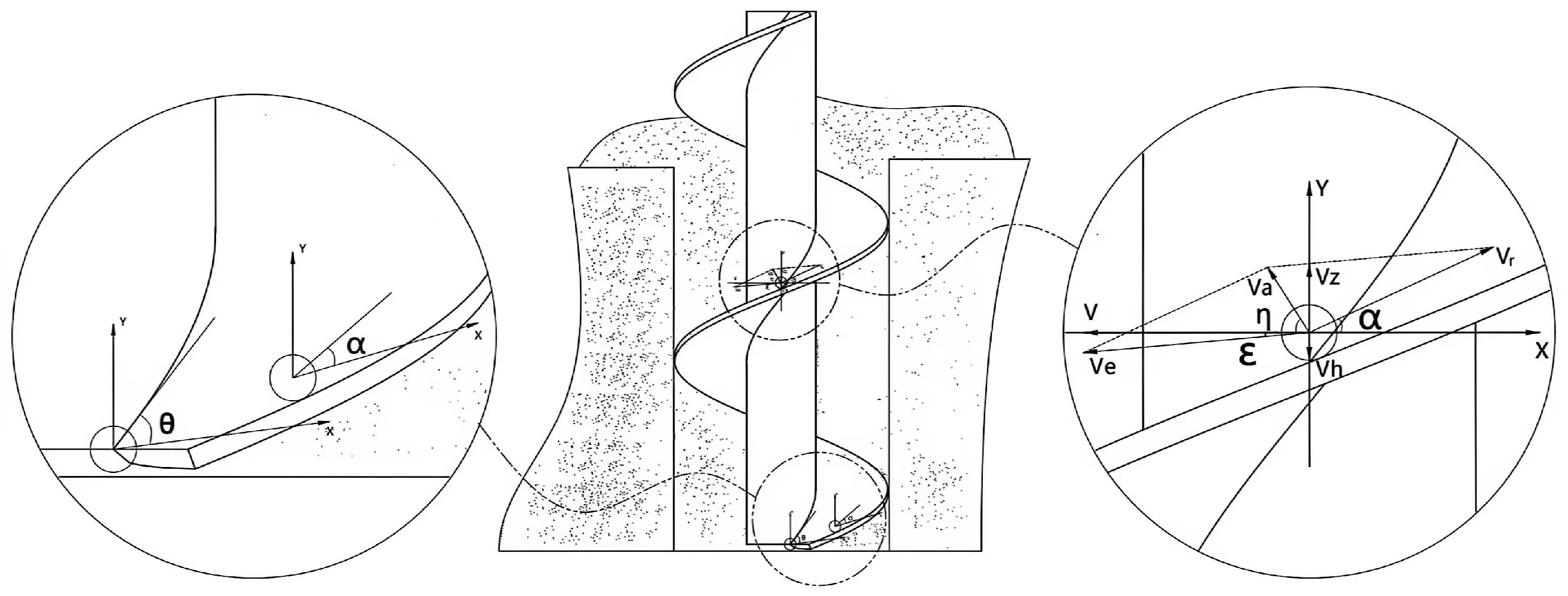
The spiral blade exhibits a parametric distribution characteristic: the helix angle at the outer edge of the spiral blade is θ, and the helix angle at the root near the auger shaft is α, as shown in Figure 5. To ensure the consistency and accuracy of subsequent theoretical calculations and EDEM simulation analysis, and to avoid calculation errors caused by non-uniform parameter distribution, this study selected the helix angle α at the outer diameter of the spiral blade and the nominal soil-cutting clearance angle δ of the blade as the core research parameters to carry out structural design and performance optimization.
To clarify the operating mechanism of the auger in the transverse ditching device, characteristic points during the working process of the spiral blade were selected for velocity characteristic analysis. Under operating conditions, the spiral blade performs clockwise circular motion around its own axis at a constant angular velocity ω, while simultaneously translating downward at a feed velocity Vh in the vertical direction. A sand particle P in contact with the spiral blade is selected, and its absolute velocity Va is obtained by the vector composition of the relative velocity Vr and the convected velocity Ve [23]. The convected velocity Ve is the vector superposition of the circumferential velocity V of the spiral blade and the vertically downward feed velocity Vh, as shown in Figure 5. The upward vertical velocity Vz of the sand particle is the vertical component of the absolute velocity Va, whose magnitude and direction directly reflect the vertical throwing effect of the auger on the sand particles.
From the above analysis, it can be seen that the direction of the relative velocity of sand particle P is upward along the spiral blade. The formula for the velocity of sand particle P is as follows:
V e = V + V h
V a = V e + V r
To ensure that the auger can convey soil smoothly [24], the rotational speed n of the auger bit must be greater than the critical rotational speed nk for soil clogging, and its formula is as follows:
n k = 30 π g tan ( α + β ) ( 1 tan η tan α ) 2 r   f
where r is the radius of the auger (mm); f is the internal friction coefficient of soil; β is the friction angle between soil and steel (°); α is the lift angle of the auger (°); η is the angle between the particle velocity at the auger radius and the horizontal plane (°).
Torque Analysis of the Auger Device
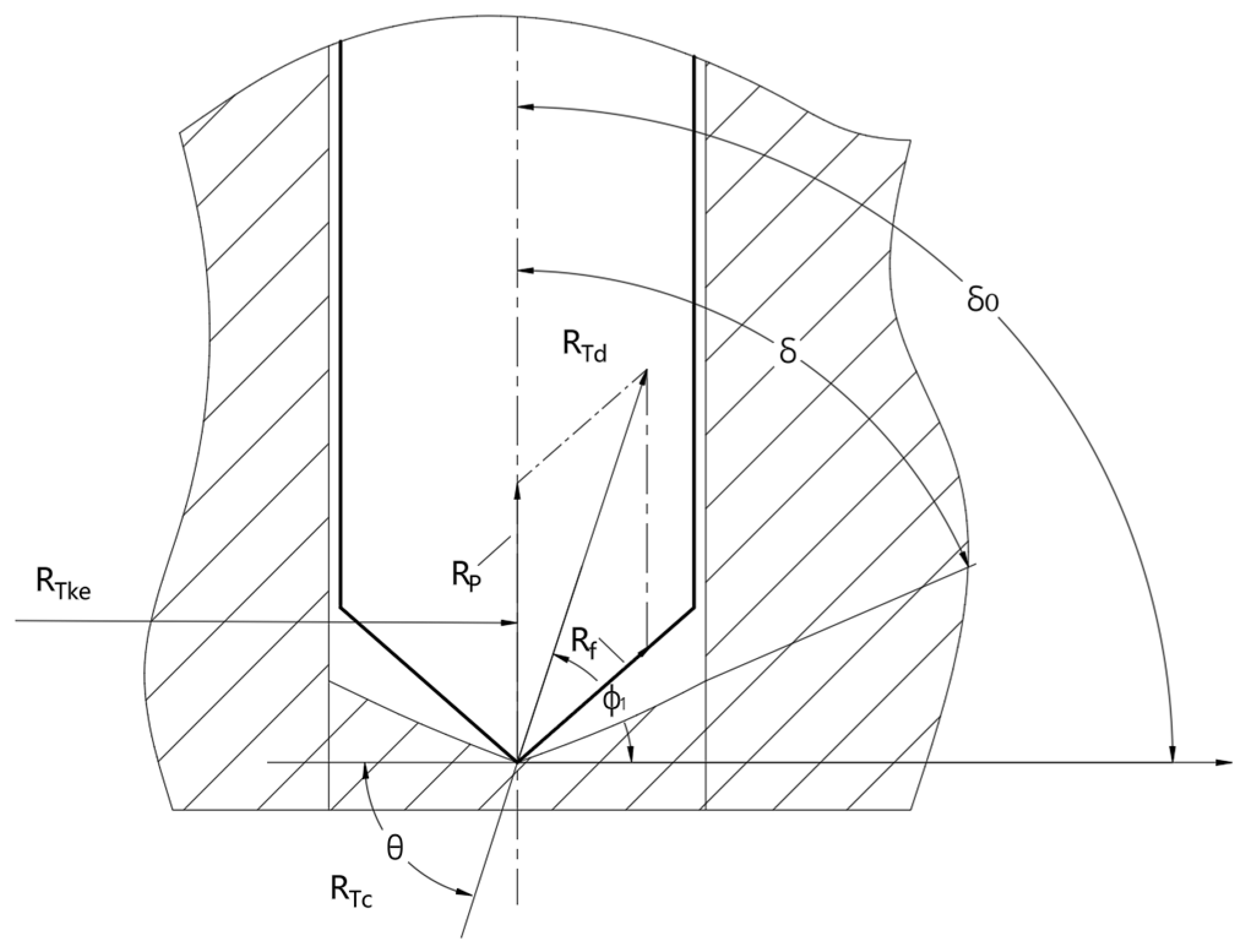
When the auger device performs ditching, the end-face cutting blades, as the core cutting components, perform periodic cutting motion with the rotation of the auger, periodically shearing, compressing, and destroying the structure of the sandy soil. Subsequently, the cut sandy soil slides upward along the surface of the spiral blades under the action of friction, with an angular velocity less than the rotational angular velocity of the auger bit and is finally thrown to the surroundings of the ditch under centrifugal force. The torque required by the auger during rotation consists of the torque of the spiral soil-entry bit, the torque of the end-face cutting blades, and the torque of the spiral blades. In this design, the diameter of the spiral soil-entry bit is 5 mm. Its core function is to open a stable working channel for the subsequent ditching components and prevent the ditching device from deviating due to uneven force when entering the soil. The force on the spiral soil-entry bit [25,26] is shown in Figure 6 below.
M T = s cos τ · k ( t ) · cos ϕ 1 · t g τ · h 1 2 + q ( t ) · cos θ · t g τ · h 1 2 + ρ π r 4 h 1 5 ω
where s is the feed rate of the bit (m/r); k(t) is the soil deformation resistance coefficient function; Φ1 is the angle between the tip deformation resistance and the horizontal plane (°); τ is half the cone angle of the bit (°); q(t) is the soil resistance proportional coefficient function; h1 is the height of the bit tip (mm); θ is the angle between the soil cutting force and the horizontal plane (°); ω is the rotational angular velocity of the bit (rad/s).
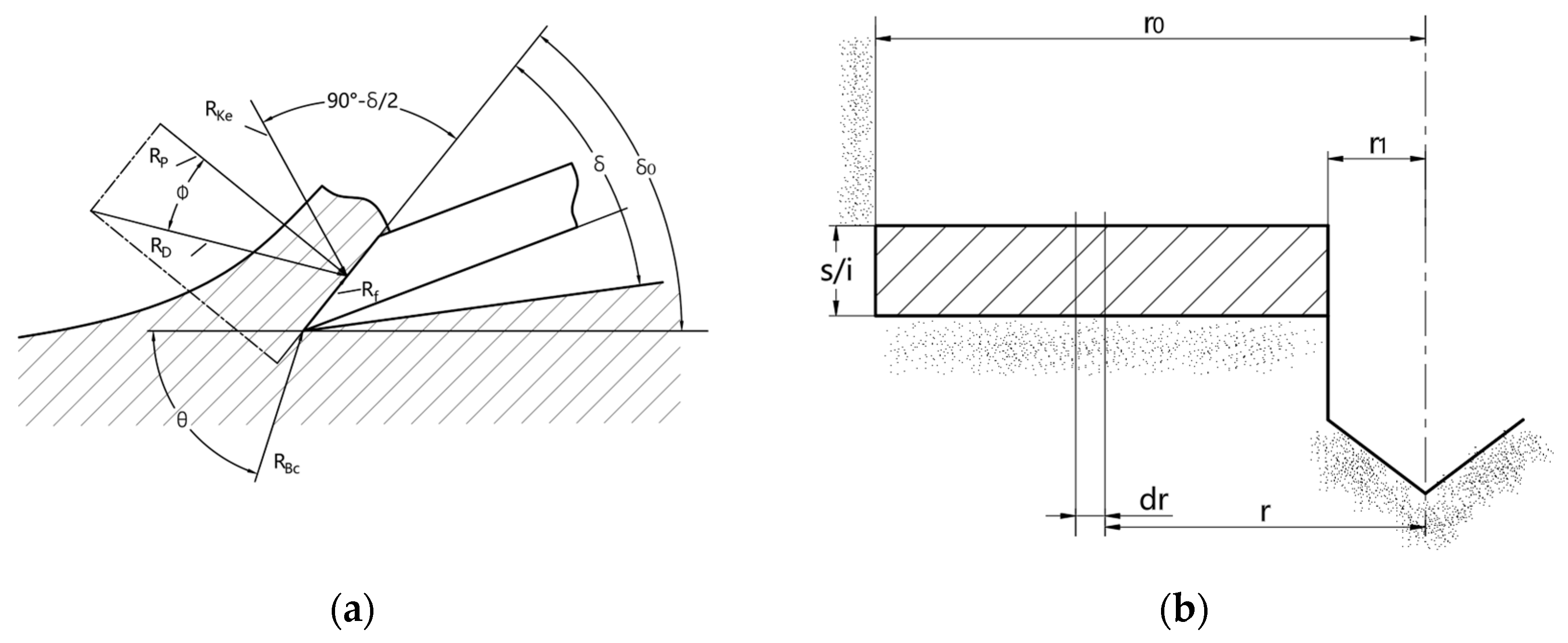
The soil-entry resistance on the end-face cutting blade is composed of the projections of the soil deformation resistance and the blade cutting resistance on the vertical axis [27,28]. The resistance during the operation of the end-face cutting blade is shown in Figure 7, where Figure 7a shows the resistance acting on the blade, and Figure 7b shows the torque generated by the blade cutting soil. The formulas for the cutting resistance Rblade and the torque Mblade of the end-face cutting blade [26,29] are as follows:
R b l a d e = q ( t ) · sin θ k ( t ) · s i cos ( δ 0 + β ) ( r 0 r 1 )
M b l a d e = 1 2 i · q ( t ) cos θ + k ( t ) · s · sin ( δ 0 + β ) ( r 0 2 r 1 2 )
where δ0 is the nominal soil-cutting rake angle of the blade (°); r0 is the turning radius of the end-face cutting blade (mm); r1 is the bit tip radius (mm); i is the number of spiral blades.
The formula for the torque required for soil lifting by the blade Mlift [27,28] is as follows:
M l i f t = i · H ( t ) · γ ρ · sin 2 ( λ + ϕ 1 ) cos η 30 f · r 0 2 · t g α · cos α · cos 2 ( α + ϕ 1 + η ) 3 ( r 0 5 r 2 5 ) 5 r 2 ( r 0 3 r 2 3 )
r 2 = r 0 2 8 π · g · r 0 4 f · K ( t ) · t g ε · cos ( α + ϕ 1 + η ) · ( t g α + t g η ) i · sin ( α + ϕ 1 ) · ( t g ε + t g η )
where K(t) is the soil bulkiness coefficient function; H(t) is the drilling depth function; α is the helix angle (°); ε is the angle between the soil convected velocity and the horizontal plane (°); η is the angle between the soil absolute velocity and the horizontal plane (°); f is the internal friction coefficient of soil; r2 is the inner radius of soil flow (mm); γρ is the soil bulk density (kg/m3).
Therefore, the torque M of a single auger in the spiral ditching device during ditching is M = MT + Mb + Mlift.
Design of Lifting Platform
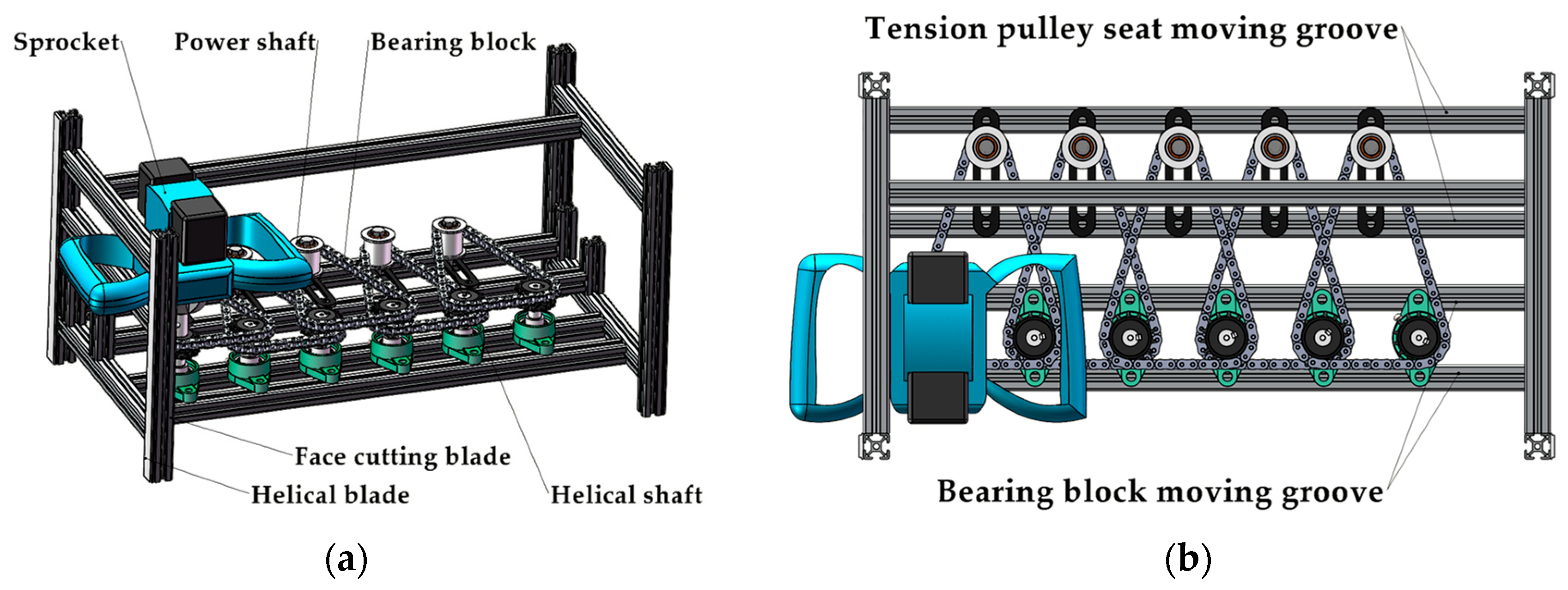
The lifting platform is mainly composed of a motor, a tension pulley, a chain, aluminum profiles and slide rails. To achieve flexible adjustment of the spacing between different spiral shafts and support the subsequent experimental research on transverse ditching performance, components such as the tension pulley and sprocket were designed in this study. The tension pulley adopts a multi-directional adjustable structure, which can flexibly realize the horizontal position adjustment in the left-right direction and the distance adjustment in the front-back direction; the bearing seat of the spiral shaft is designed to be adjustable in the left-right position. During the adjustment process, first loosen the fixing bolts of the bearing seat and the tension pulley seat, move them along the preset track to the position corresponding to the target shaft spacing and fasten them, then fine-tune the left-right and front-back positions of the tension pulley to optimize the meshing between the sprocket and the chain. This method can adjust the spacing between spiral shafts to the preset distance, and at the same time ensure that the chain maintains a reasonable tension at all times, effectively avoiding the slipping problem caused by chain slack during operation, thus ensuring the stability of the transmission system of the spiral ditching device and the efficiency of ditching operation. A schematic diagram of the lifting platform is shown in Figure 8 below.The main technical parameters of the lifting platform are shown in Table 2.

3. Results and Discussion

3.1. Simulation Test of the Auger

3.1.1. Establishment of Sandy Soil Particle Model

Table 3 lists the core parameters of sandy soil particles in the discrete element simulation. Based on the actual morphological characteristics of desert sandy soil particles reported in the literature [30,31,32], three non-spherical particle types, namely spherical, elongated, and angular particles, were designed in this study. The actual particle composition of sandy soil was simulated through different combinations, breaking through the limitation of using single spherical particles in traditional discrete element simulations and improving the authenticity of the simulation. The spherical particles were single spheres with a radius of 2.5 mm, while both elongated and angular particles were composed of standard spheres with a radius of 2 mm. This particle size range is highly consistent with the actual particle size distribution of desert surface sand [33]. The coordinate positions of the three particle types were designed to ensure the rationality of particle morphology: elongated particles were distributed linearly along the X-axis, and triangular particles were arranged in a triangular array, which can effectively simulate the interaction between sandy soil particles.

3.1.2. Discrete Element Simulation Model

The establishment of the simulation model can simulate the movement process of the auger under different parameters. By analyzing the effects of the cutting angle of the end cutting blade and the helix angle parameters on ditching performance, the interaction law between the parameters is explored, providing a basis for setting actual operating parameters.
Through moisture content measurements of desert soil, it was found that the moisture content increases with depth. To ensure that the established simulation model can realistically reflect the actual conditions of desert sandy soil, the rational selection of a soil discrete element contact model is crucial. In this study, the Hertz–Mindlin with JKR Cohesion contact model was adopted as the contact model between sandy soil particles [34,35]. Based on elasticity theory, the JKR model describes inter-particle forces using surface energy, which can fully account for various complex conditions during particle motion. This makes the movement of sand particles during auger rotation more consistent with the real state and accurately reflects the ditching performance of the transverse ditching device.
After measuring the moisture content of desert sandy soil at different depths, this study selected particles with three specific moisture contents to establish the soil bin model. The moisture contents of the model from the upper layer to the lower layer are 1%, 3%, and 5%, respectively. Each moisture content corresponds to three different shapes of sandy soil particles: spherical, elongated, and prismatic, with mass fractions of 0.5, 0.2, and 0.3, respectively. The relevant parameters of the soil discrete element model [33,36,37,38,39,40] are listed in Table 4. According to the difference in moisture content at different depths of desert sand, differentiated parameters were designed for the upper, middle and lower sand layers. With the increase in sand depth, the moisture content increases accordingly. The density of sand particles increases from 1650 kg/m3 to 1779 kg/m3, the shear modulus increases from 1.15 × 10⁷ Pa to 2.7 × 10⁸ Pa, and the JKR surface energy increases from 0.004 to 0.124. This variation is highly consistent with the actual characteristics of desert sand, i.e., higher moisture content, greater compaction and stronger cohesion in deeper layers.
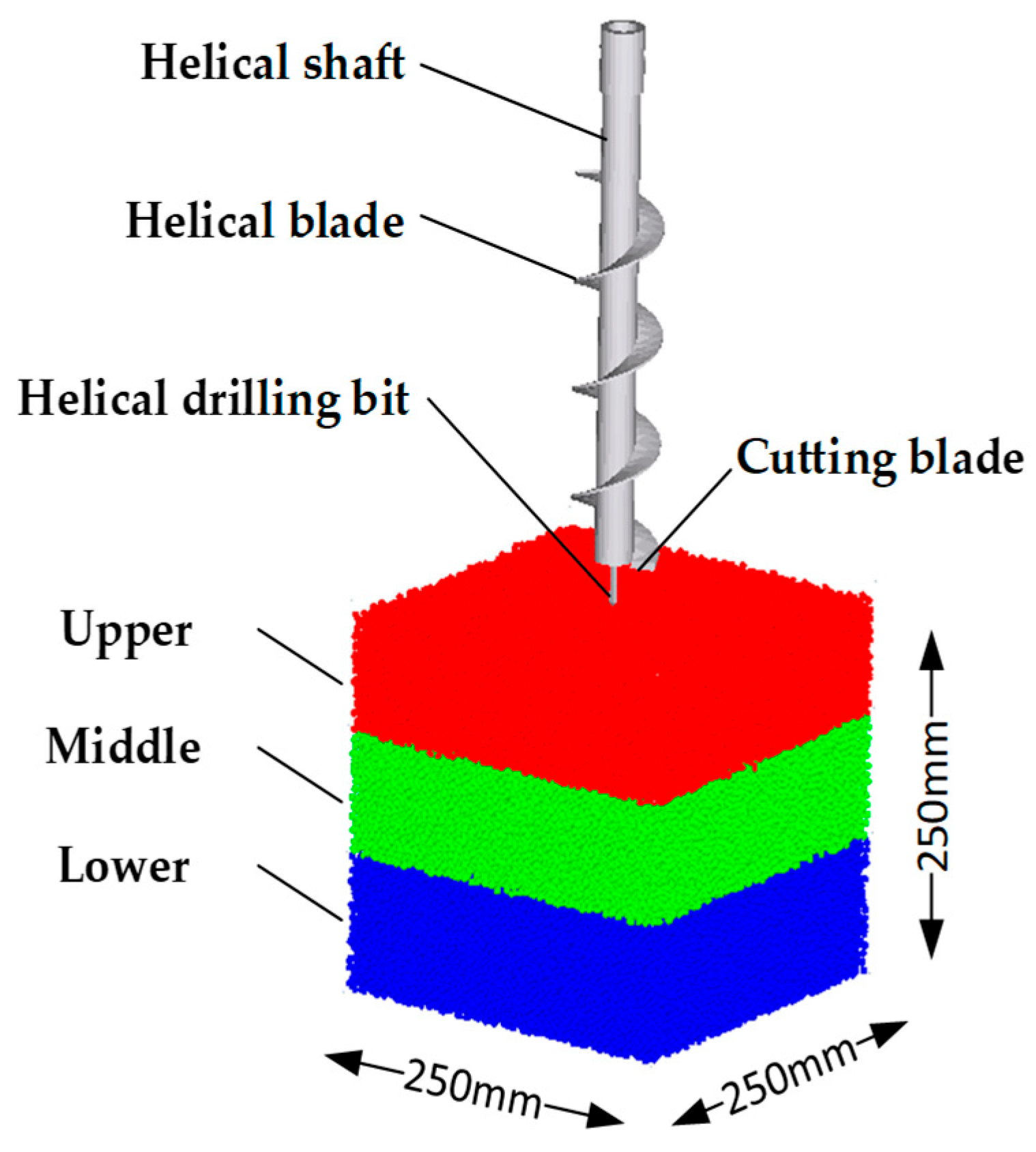
According to the burial depth requirement of 20–30 cm for Salix psammophila sand barriers, a virtual soil bin with dimensions of 250 mm × 250 mm × 250 mm was established in the model. The soil bin was divided into three layers: an upper sandy soil layer with a thickness of 80 mm, a middle layer of 80 mm, and a lower layer of 90 mm. After parameter configuration, three virtual planes were generated. The lower-layer sandy soil particles were first created via the EDEM dynamic particle factory, followed by the middle and upper layers. For each layer, three types of sandy soil particles were simultaneously generated according to the preset mass fraction ratio, with a particle generation duration of 1 s for each single layer. Upon completion of all sandy soil particle simulation, the particles were compacted and then bonding bonds were generated for the compacted sandy soil. A simplified 3D model of the transverse ditching device, constructed using SolidWorks 2024, was imported into EDEM, as shown in Figure 9 below.
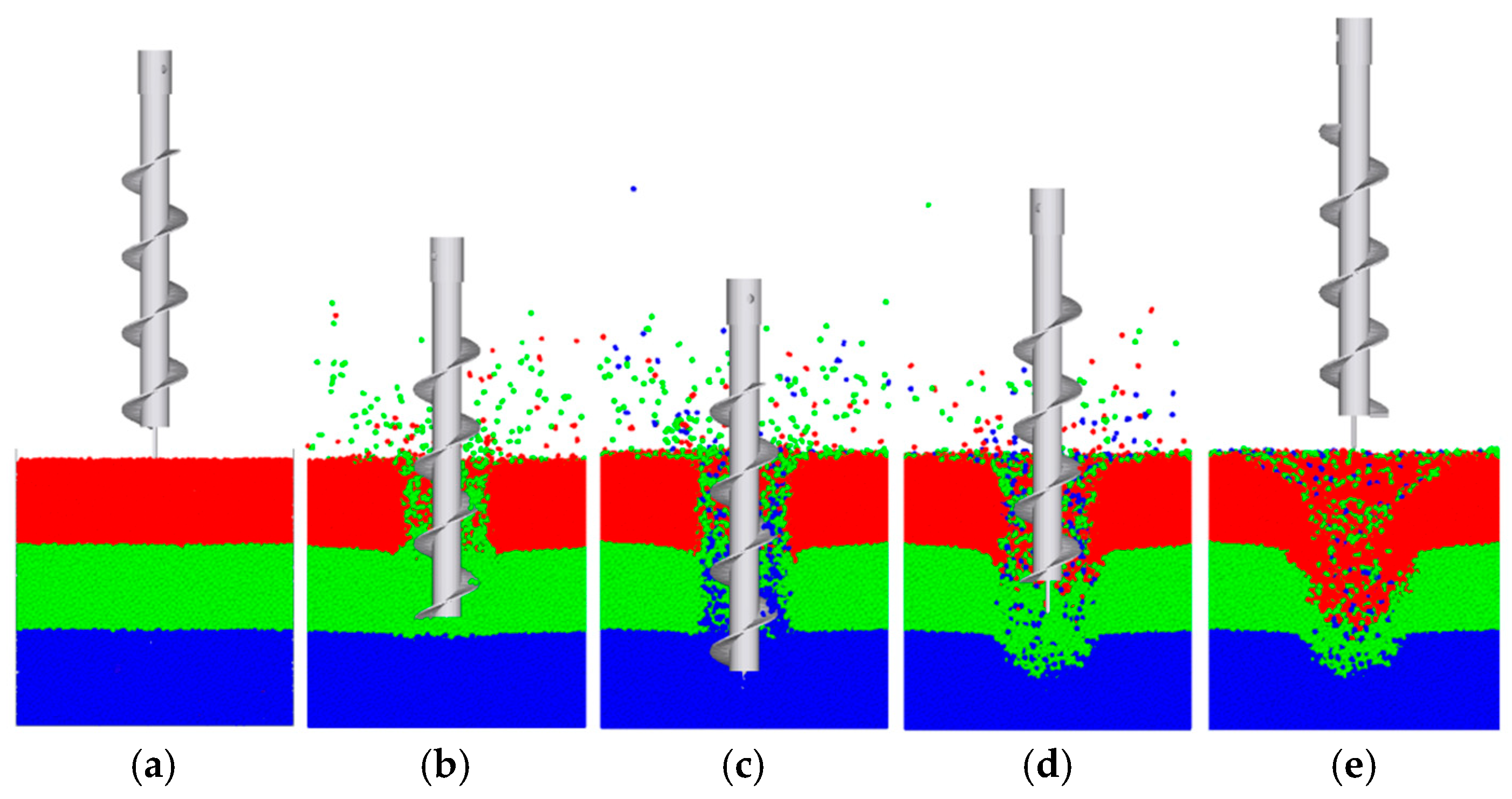
To shorten the simulation time, a single auger was used to simulate the ditching process. The initial position of the auger was 10 mm above the sand surface, with a preset downward drilling depth of 230 mm (including a 30 mm auger tip length). The downward feed speed and return speed were set to 0.1 m/s and 0.2 m/s, respectively, and the auger rotational speed was 230 r/min, as shown in Figure 10. It can be observed from the figure that during operation, the auger performs both rotational and downward feeding motions simultaneously. At time t1, the auger begins to contact the sand surface. From t2 to t3, the auger continues to feed downward until it reaches the preset ditching depth at t3. During this period, sand from different depths is driven upward by the auger flight and finally transported to the surface. The stage from t4 to t5 represents the return stroke of the auger. At t4, sand flowing back from the side of the ditch wall can be seen being lifted to the ground again via the auger flight. By t5, the auger is fully reset, completing one working cycle.
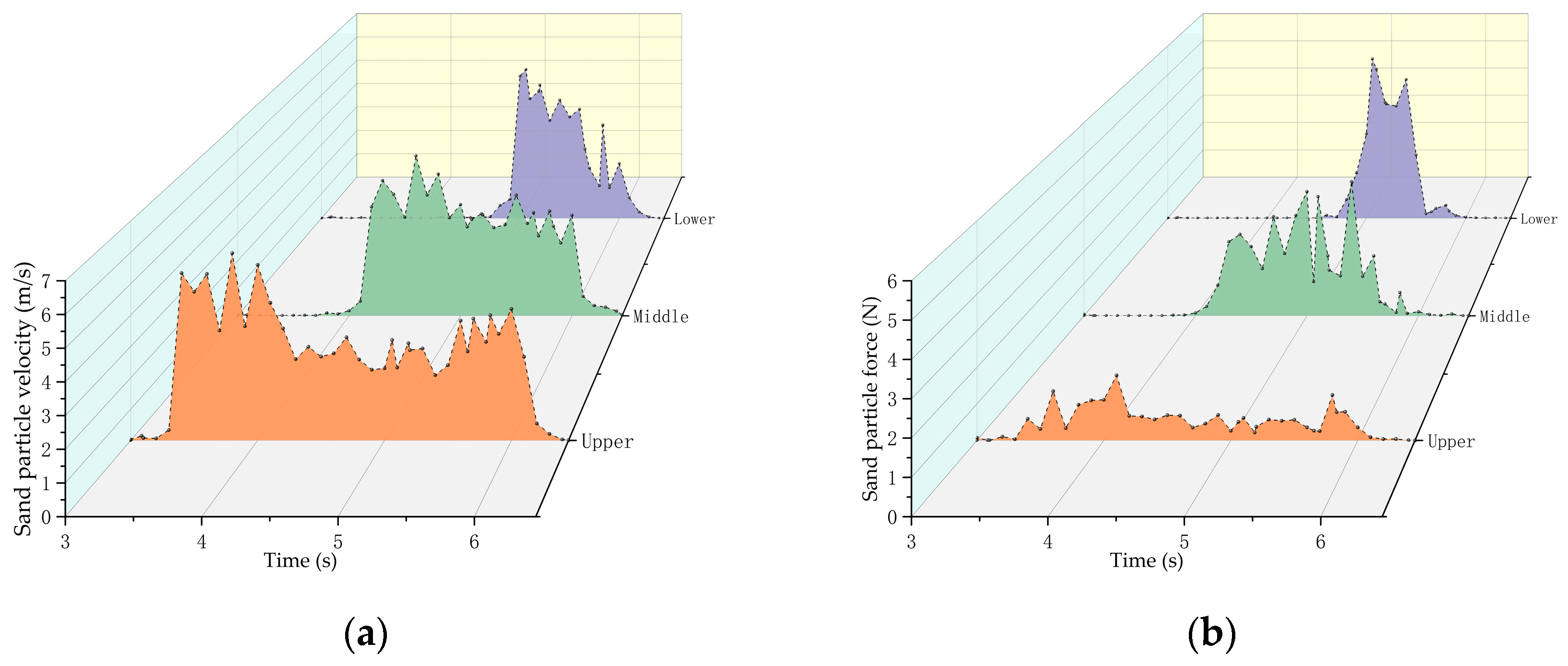
To investigate the dynamic characteristics and mechanical response of sand layers at different depths during ditching, this paper analyzed the temporal variations in velocity and force for the upper, middle, and lower sand layers throughout the operation. The results are shown in Figure 11. During the 3–4 s interval, the auger performed ditching in the upper sand layer. Under the cutting and disturbance of the auger, both the velocity and force of the upper sand exhibited a significant upward trend. In the 4–5 s interval, the auger advanced into the middle sand layer. At this stage, the velocity and force of both the upper and middle sand entered a dynamically stable range. Meanwhile, as the upper sand was no longer under direct auger action, its velocity and force showed a slow decrease compared with the previous stage. After 5 s, the auger operated on the lower sand layer, with its disturbance zone covering the entire sand profile. During auger lifting, the disturbance intensity of sand at different depths exhibited a gradient distribution: upper layer > middle layer > lower layer. Correspondingly, the soil lifting volume also showed that the upper sand was significantly higher than that of the middle and lower layers.
In the discrete element model of this study, the upper, middle, and lower sand layers were assumed to be homogeneous, which is a simplification adopted to improve modeling and computational efficiency. To evaluate the influence of intra-layer parameter inhomogeneity on the simulation results, a parametric sensitivity analysis was conducted in this study using the JKR surface energy of the three sand layers as the key parameter. A fluctuation range of ±20% based on the baseline values was set to investigate its effects on trenching depth and working torque, as shown in Table 5. The results showed that when the JKR surface energy varied within ±20%, the trenching depth ranged from 4.9 to 5.6 cm with a maximum variation of 5.7%, and the working torque ranged from 2.3 to 2.71 N·m with a maximum variation of 8.4%. All the above deviations were less than 10%, which is within the acceptable engineering error range for discrete element simulations of agricultural machinery. Among them, the variation in JKR surface energy in the middle sand layer had the most significant effect on working torque, with a maximum deviation of 8.4%. This can be attributed to the fact that the middle layer is the main cutting zone of the auger, and its cohesion characteristics directly determine the cutting resistance. Nevertheless, the deviation was still within the allowable range. Therefore, for the purpose of this study, the three-layer homogeneous model can be used as an effective and reliable simplified modeling method.

3.1.3. Simulation Single-Factor Experiments

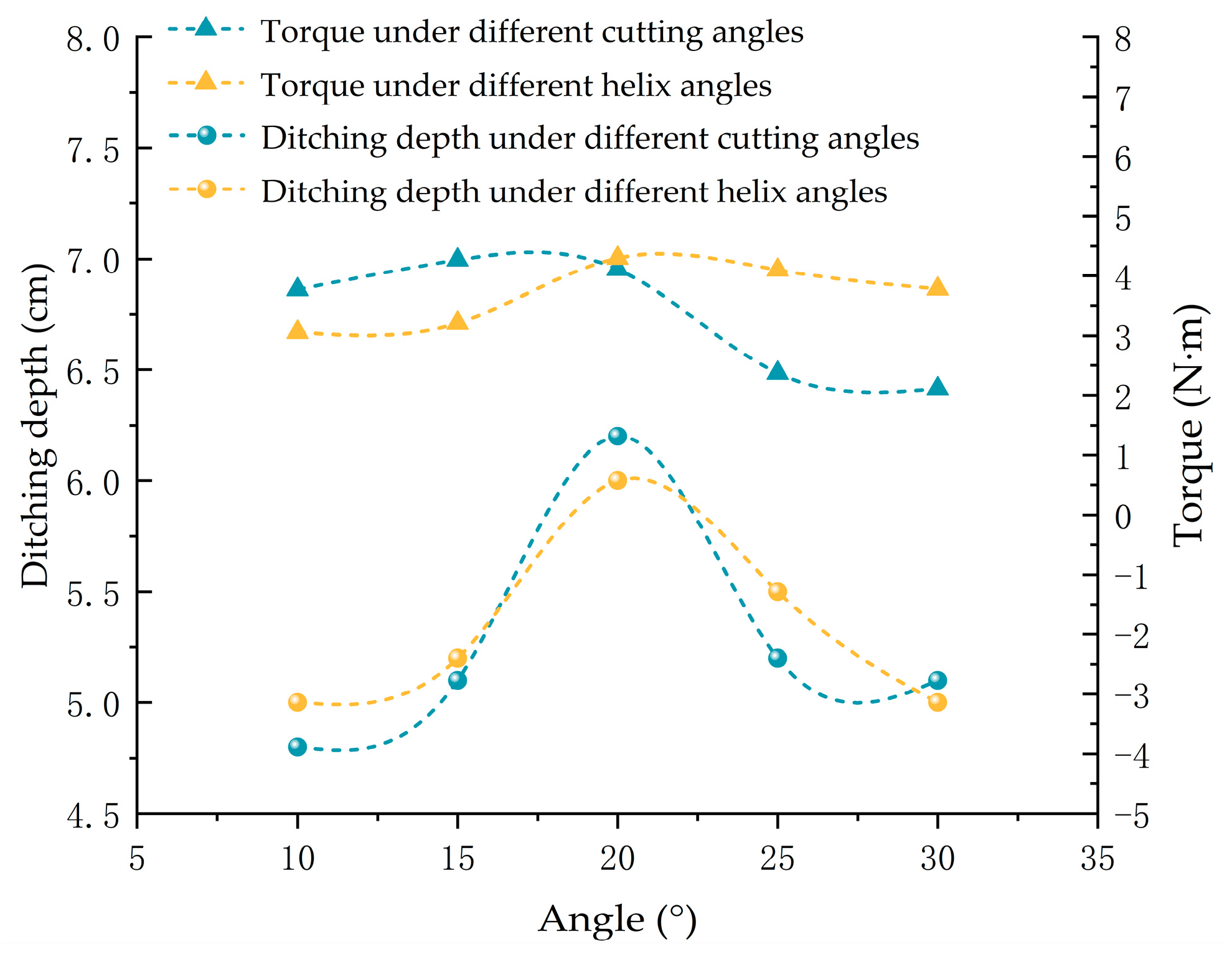
To determine the factor levels and value ranges for the parameter optimization test of the helical cutter, this study took ditching depth and maximum torque during auger operation as test indicators. The helix angle and the cutting angle of the end-face cutting blade were selected as test variables to carry out single-factor experiments, aiming to explore the influence law of each factor on the test indicators. According to the technical specifications in the Agricultural Machinery Design Manual, five levels were set for each factor: helix angles of 10°, 15°, 20°, 25°, and 30°, and cutting angles of 10°, 15°, 20°, 25°, and 30°. A multi-level single-factor experiment was designed accordingly. Meanwhile, the helix angle and cutting angle were fixed at 20°, the auger rotational speed was set to 230 r/min, and the auger descending speed was set to 10 cm/s. Each test level was repeated three times. For the measurement of ditching depth, during the EDEM post-processing stage, the model was first processed using the clipping command. Clipping was performed at 15 mm forward and backward from the central vertical plane, respectively. The ditching depth was then measured from the clipped view, which was taken as the actual ditching depth of the auger. Regarding the acquisition of the maximum auger torque, this paper used the torque measurement tool in the EDEM post-processing module to record the maximum torque value during the entire working cycle. The test results are shown in Figure 12.
It can be seen from Figure 12 that the ditching depth generally shows a trend of first increasing and then decreasing with the increase in the cutting angle and helix angle. The torque exhibits a trend of stable fluctuation in the early stage and gradual decrease in the later stage with the increase in the cutting angle and increases slowly at first and then tends to be stable with the increase in the helix angle. The maximum ditching depth occurs when both the cutting angle and helix angle are 20°, while the minimum corresponds to the parameter combination of a cutting angle of 10° and a helix angle of 30°. The maximum torque appears under the conditions of a cutting angle of 15° and a helix angle of 20°, and the minimum torque occurs when the cutting angle and helix angle are 30° and 10°, respectively. Therefore, the ranges of the cutting angle and helix angle for the optimized orthogonal test of the auger are determined to be 20–30° and 15–25°, respectively.

3.1.4. Orthogonal Test for Auger Parameter Optimization

Based on the single-factor experiments, a two-factor, three-level orthogonal experiment was designed with the cutting angle and helix angle as the experimental factors, and the ditching depth and torque as the experimental indicators, to explore the optimal structural combination of the auger. Design-Expert 13 was used to process and analyze the test results. Each group of experiments was repeated three times, and the test results are shown in Table 6.
The regression models for all test indicators were highly significant (p < 0.01), and the p-values of the lack-of-fit terms were not significant, indicating that the regression models had a high goodness of fit. The regression equations between each test indicator and the factors are as follows:
Y 1 = 10.57 0.607 x 1 + 0.102 x 2 + 0.01 x 1 x 2 + 0.008 x 1 2 0.006 x 2 2
Y 2 = 34.35 1.67 x 1 1.17 x 2 + 0.02 x 1 x 2 + 0.02 x 1 2 + 0.02 x 2 2
With the objectives of maximizing Y1 and minimizing Y2, the optimization was performed using the optimization function in Design-Expert 13 software. The objective function is defined as:
max Y 1 ( x 1 , x 2 ) min Y 2 ( x 1 , x 2 ) s . t . 20 ° x 1 30 ° 15 ° x 2 25 °
where x1 is the soil-cutting angle and x2 is the helix angle. The optimal parameter combination was obtained as follows: a soil-cutting angle of 30° and a helix angle of 20.37°, corresponding to a ditching depth of 5.52 cm and a torque of 2.6 N·m.
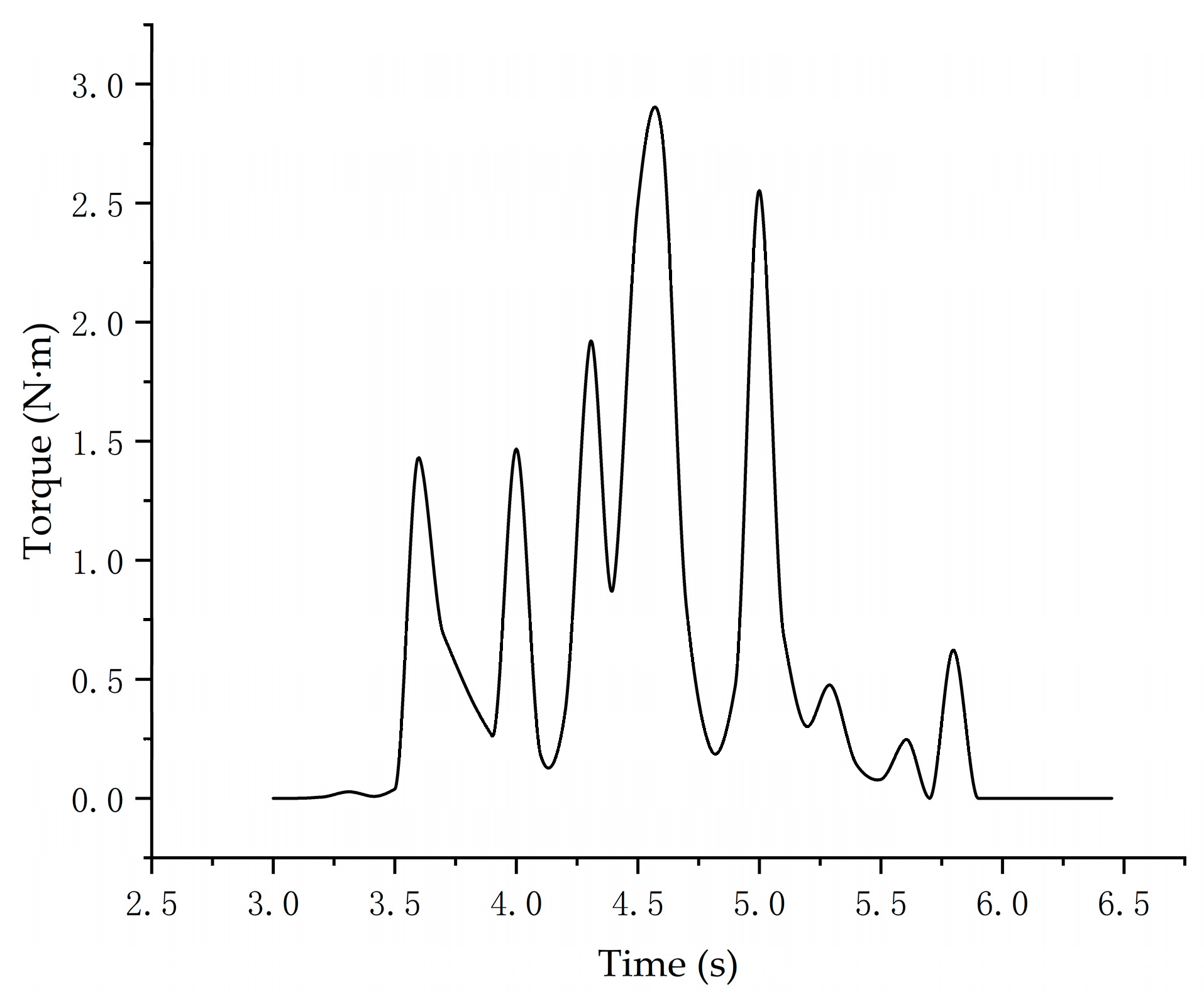
The optimized auger structural parameters were selected for simulation verification tests, with an auger rotational speed of 230 r/min, a descending speed of 0.1 m/s, and a return speed of 0.2 m/s. Torque analysis is shown in Figure 13. Simulation tests showed that the ditching depth was 5.7 cm and the maximum torque was 2.78 N·m. Compared with the predicted values of the regression model, the relative errors were 3.1% and 6.5%, respectively, which verified the accuracy of the regression model.


3.2. Field Test of the Horizontal Ditching Device

According to the optimal parameter combination obtained from the orthogonal optimization in Section 3.1.4, the parameter scheme with a cutting angle of 30° and a helix angle of 20.37° was selected for the fabrication of the auger structural components. The fabricated auger was then assembled to the operating end of the lifting platform of the horizontal ditching device.

3.2.1. Test Design

The Box–Behnken test method was adopted to design a three-factor, three-level orthogonal test, aiming to explore the optimal operating parameter combination of the horizontal ditching device during the ditching process. The auger rotational speed, auger shaft spacing, and lifting platform descending speed were selected as the test factors, and the ditching depth, soil compaction, and wicker pressing depth were taken as the test indicators. To determine the value range of each factor, a steepest ascent test was carried out, and its test design and results are shown in Table 7.
As shown in the table, the maximum ditching depth occurs within Test 2 to Test 4. Therefore, the selected parameter ranges are as follows: auger rotational speed of 170–290 r/min, auger shaft spacing of 7–11 cm, and lifting platform descending speed of 5–15 cm/s.

3.2.2. Test Methods and Evaluation Indicators

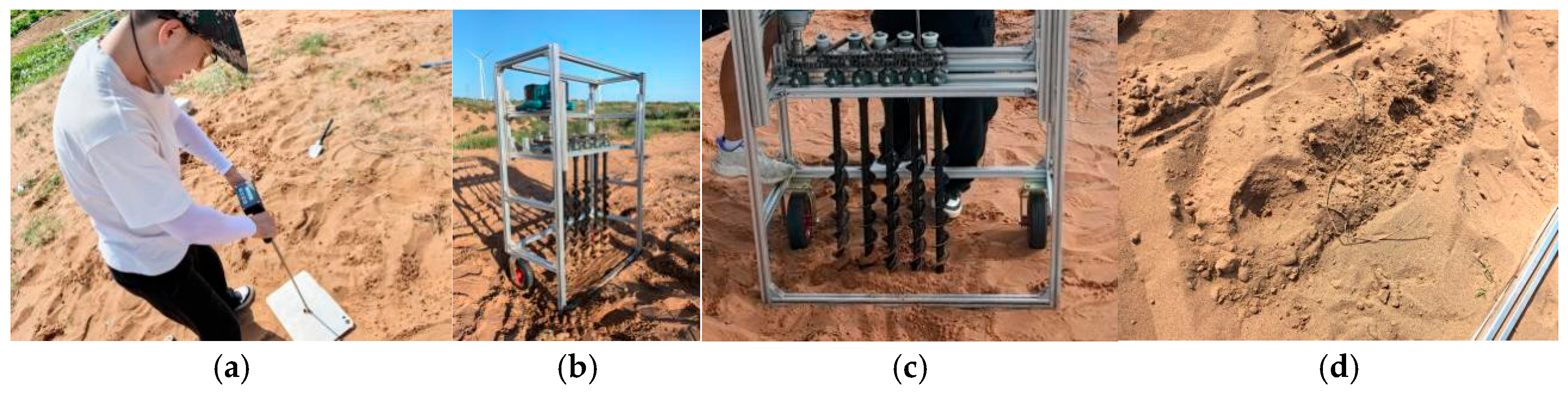
A transverse ditching device composed of five single augers was adopted for ditching operations, as shown in Figure 14b. The experiment was conducted in a desert site in Zhassak Town, Ordos City in August 2025. The test equipment included a transverse ditching device, LD-WSY soil environment detector, SC900 digital soil compaction meter, tape measure (1 m), straightedge, etc. The test conditions are presented in Table 8.
The test procedure is as follows: First, the auger spacing is manually adjusted to the preset value, and then the motor is started. The lifting platform moves down smoothly under the combined action of the slide rail guide limit and the hydraulic rod damping buffer. After the auger completes the ditching operation at the preset depth (20 cm), the operator releases the control of the lifting platform, and the lifting platform slowly rises back under the reset force of the hydraulic rod, thus completing a single ditching operation cycle. Figure 14d shows the forming effect of the device after ditching. To ensure the reliability of the test data, the above test procedure is repeated 5 times.
Combined with the agronomic requirements of Salix psammophila sand barriers, in accordance with the technical regulations LY/T 2986-2018 [9] Technical Specification for Sand Barrier Establishment in Mobile Sandy Land, and based on practical experience, ditching depth, soil compaction, and wicker pressing depth were selected as the test indicators.
Ditching depth was measured using the multi-point tape measure method. After the ditching operation was completed, a tape measure was used to measure the depth from each measuring point to the trench bottom plane perpendicularly. After eliminating outliers from the measured data, the arithmetic mean of the remaining valid data was calculated and taken as the final depth result of the ditching operation.
The measurement method of soil compaction is consistent with the principle of ditching depth measurement. After the ditching operation is completed, multiple characteristic measuring points are uniformly arranged along the longitudinal direction of the trench. A soil compaction meter is used to vertically measure the soil layers at depths of 5 cm, 10 cm, 15 cm, and 20 cm from the ground surface at each measuring point. The valid measurement data from all points are summarized, and the arithmetic mean is calculated. The result is the final representative value of soil compaction for the trench, as shown in the following formula:
S = 1 3 n i = 1 n ( S i , 5 + S i , 10 + S i , 15 + S i , 20 )
where S is the final representative value of soil compaction (kPa), n is the number of measuring points, and Si,5 is the measured soil compaction value at the 5 cm depth of the i-th measuring point (kPa).
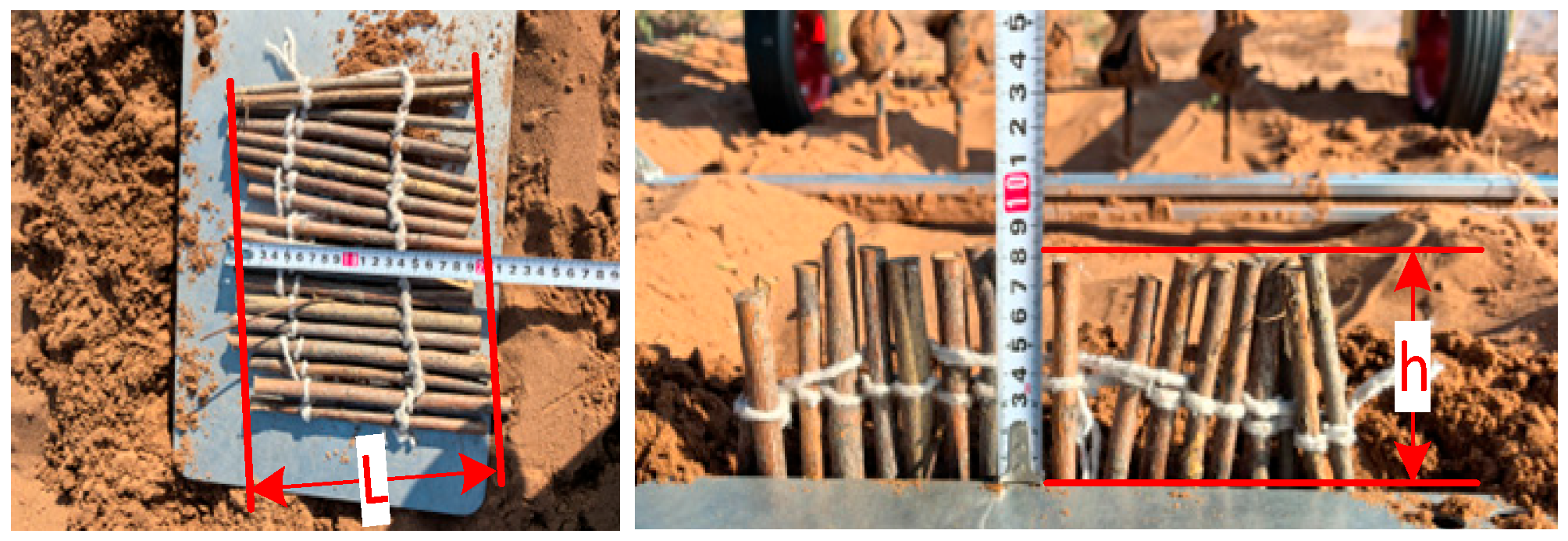
In accordance with the standardized planting requirements of Salix psammophila sand barriers, this study adopted the Salix psammophila mat weaving and planting method to improve the efficiency of sand barrier planting operations. The specific procedures are as follows: Salix psammophila branches with a length of 20 cm were selected and woven into a mat-like structure, and the Salix psammophila mats were manually inserted vertically into the transverse trenches pre-excavated by the horizontal ditching device. After the insertion operation was completed, a tape measure was used to determine the length of the Salix psammophila mats exposed above the ground surface, and the insertion depth into the soil was calculated based on the total length of the mats, as shown in Figure 15. All willow insertion operations were performed by the same experienced experimenter to avoid systematic errors caused by differences in operating habits among different personnel:
H = L h
where H is the insertion depth of the Salix psammophila mat into the sandy soil (cm), L is the total length of the Salix psammophila mat (cm), and h is the length of the Salix psammophila mat exposed above the ground surface (cm).

3.2.3. Test Results

Design-Expert 13 was used to perform multiple regression fitting analysis on the test results. Quadratic polynomial regression models of ditching depth, soil compaction, and wicker pressing depth with respect to the three independent variables were established, respectively, as shown in Table 9.
The results of the analysis of variance (ANOVA) are shown in Table 10. According to the ANOVA results, the regression models for ditching depth, soil compaction, and wicker pressing depth were all highly significant (p < 0.01), and the lack-of-fit terms were not significant (p > 0.05), indicating a good fit between the regression equations and the experimental data. For the ditching depth regression model, x2, x1x3, and x12 were highly significant, x3 and x32 were significant, and the others were not significant. For the soil compaction regression model, x1, x2, x3, x12, and x22 were highly significant, x2x3 was significant, and the others were not significant. For the wicker pressing depth regression model, x2, x1x2, x12, and x32 were highly significant, x1, x3, and x2x3 were significant, and the others were not significant. After removing the non-significant factors from the regression equations, the regression equations for Y1, Y2, and Y3 are as follows:
Y 1 = 9.84 0.30 x 2 + 0.42 x 3 0.002 x 1 x 3 0.00028 x 1 2 0.02 x 3 2
Y 2 = 280 0.77 x 1 37.37 x 2 1.59 x 3 + 0.18 x 2 x 3 + 0.0013 x 1 2 + 2.43 x 2 2
Y 3 = 5.90 + 0.18 x 1 + 0.22 x 2 + 0.37 x 3 0.005 x 1 x 2 + 0.038 x 2 x 3 0.000262 x 1 2 0.029 x 3 2
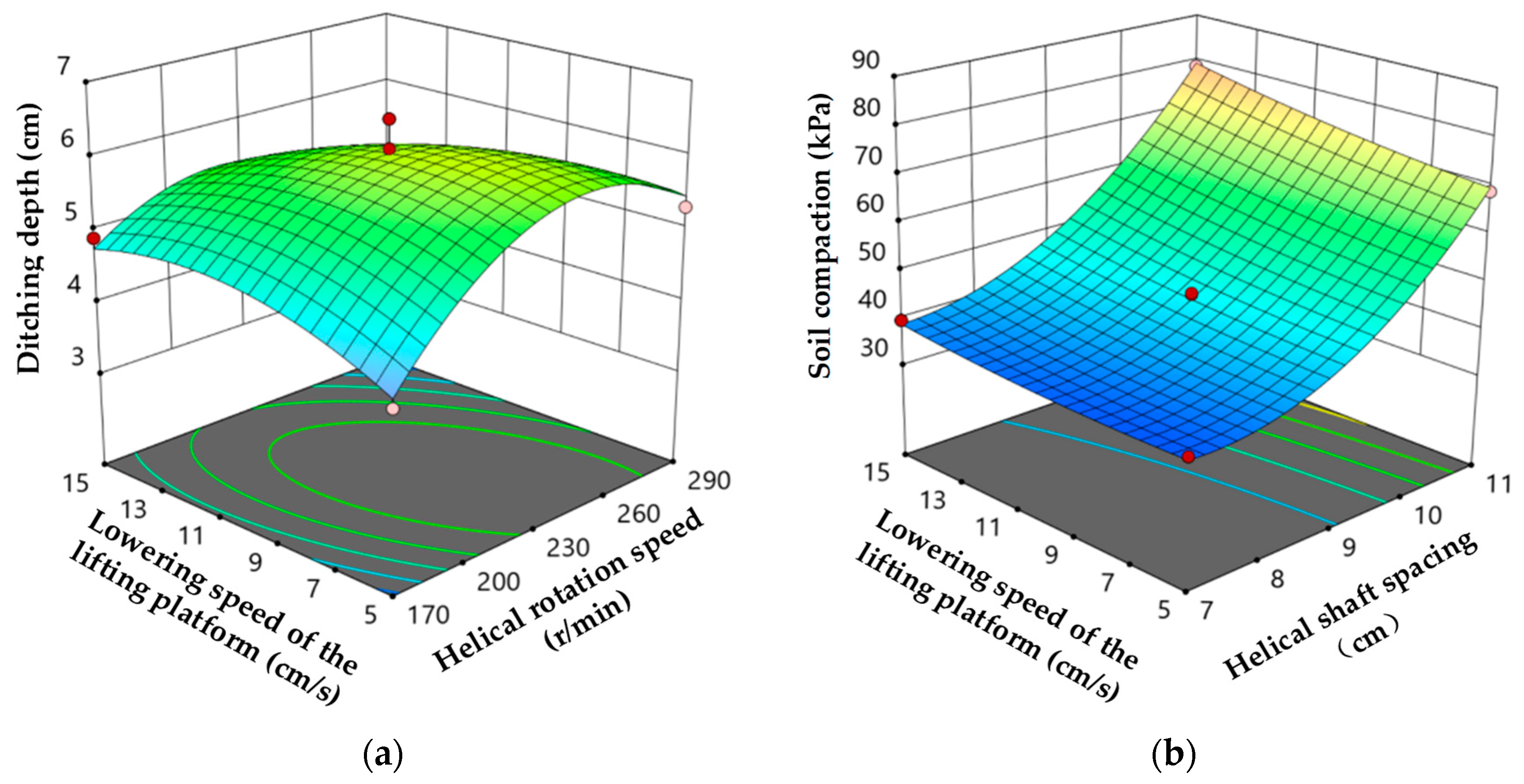
The interaction between auger rotational speed and lifting platform descending speed on ditching depth is shown in Figure 16a. The ditching depth first increases and then decreases with the increase in both factors. At a low auger speed, increasing the speed improves the cutting frequency and fragmentation degree of the auger blade to soil, promoting sand discharge and thus increasing the ditching depth. When the speed exceeds the critical value, aggravated friction loss and increased soil particle splashing lead to a decline in ditching depth. At a slow platform descending speed, the auger bit has sufficient time for soil cutting and discharge, resulting in an increase in ditching depth. When the descending speed exceeds the bit’s cutting and soil-discharging capacity, soil accumulates and compacts at the ditch bottom, hindering further bit penetration and reducing the ditching depth.
The interaction between auger shaft spacing and lifting platform descending speed on soil compaction is shown in Figure 16b, and the soil compaction increases with the increase in both factors. When the auger shaft spacing is small, the soil disturbance areas of adjacent bits overlap, resulting in loose sand structure and low soil compaction; as the spacing increases, the disturbance areas separate, and the undisturbed soil retains its original dense state, leading to an increase in soil compaction. When the auger shaft spacing is fixed, an increase in the descending speed of the lifting platform increases the downward displacement of the bit per unit time, making it impossible for sand to be fully discharged in time, which is subjected to compression and shear effects, and the soil compaction at the ditch bottom and side walls is improved. Therefore, the soil compaction increases with the increase in the descending speed.
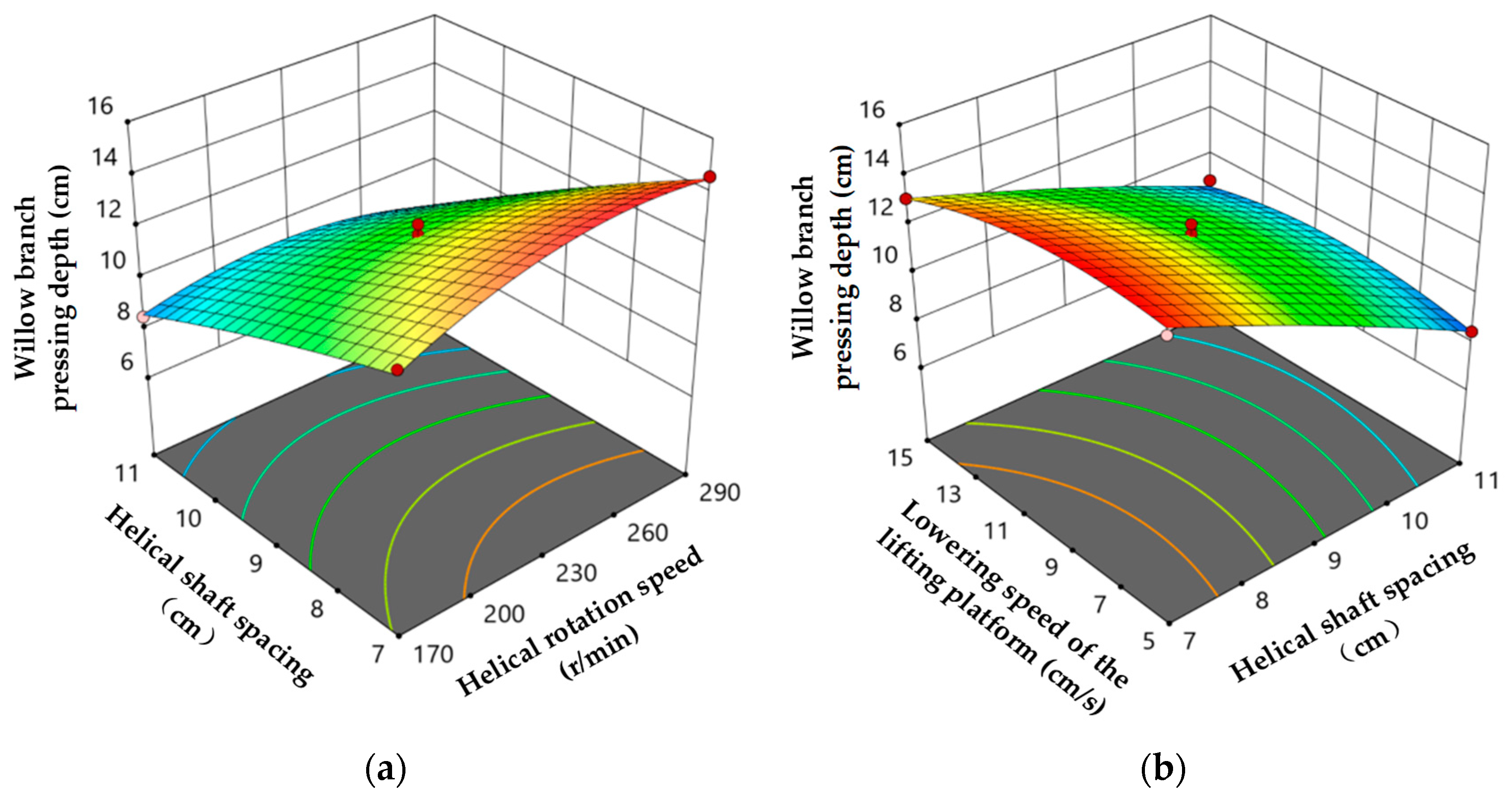
As shown in Figure 17a,b, the wicker pressing depth first increases and then decreases with the increase in auger rotational speed and lifting platform descending speed and decreases significantly with the increase in auger shaft spacing. This is because the wicker pressing depth is directly related to the ditching depth. An increase in auger shaft spacing widens the undisturbed soil between the two augers, which retains its original compactness and strength, thus significantly increasing the resistance to wicker insertion and resulting in a remarkable reduction in pressing depth. At low speeds, a moderate increase in descending speed facilitates sufficient soil cutting by the auger bit, forming an effective ditching depth and creating more space for wicker insertion, thereby slightly increasing the pressing depth. However, when the speed exceeds the critical value, excessive descent causes the bit to compress the soil, compacting the ditch bottom and increasing soil compaction, which in turn significantly raises the resistance to wicker insertion and reduces the wicker pressing depth.
To obtain the optimal levels of the experimental factors, an optimization solution was performed with the objectives of maximizing the ditching depth, minimizing the soil compaction, and maximizing the wicker pressing depth. The optimization objective function is:
max Y 1 ( x 1 , x 2 , x 3 ) min Y 2 ( x 1 , x 2 , x 3 ) max Y 3 ( x 1 , x 2 , x 3 ) s . t . 170   r / min x 1 290   r / min 7   cm x 2 11   cm 5   cm / s x 3 15   cm / s
The optimization results show that the operating performance of the transverse ditching device is optimal when the auger speed is 257.25 r/min, the auger shaft spacing is 7 cm, and the lowering speed of the lifting platform is 9 cm/s. Under these conditions, the ditching depth is 6.7 cm, the soil firmness is 33.37 kPa, and the willow burial depth is 14.87 cm. To verify the reliability of the optimization results, three repeated bench tests were carried out under the optimized parameters. The average measured values are as follows: ditching depth 6.5 cm, soil firmness 34.5 kPa, and willow burial depth 13.8 cm. The test results are basically consistent with the predicted values. The deviation between them is mainly caused by the spatial heterogeneity of field soil, random errors from manual operation, and the accuracy limitation of measuring instruments. Comprehensive analysis shows that the optimization results obtained by the quadratic orthogonal rotary regression combination test are accurate and reliable.

3.3. Summary of Results

(1)
Optimization Results of Structural Parameters of Single Auger: When the cutting angle is 30° and the helix angle is 20.37°, the trench depth is 5.52 cm and the maximum torque is 2.6 N·m. Simulation verification shows that the relative errors of trench depth and torque are 3.1% and 6.5%, respectively, which verifies the accuracy of the regression model.
(2)
Optimization Results of Operating Parameters of the Whole Machine: When the auger speed is 257.25 r/min, the shaft spacing is 7 cm, and the lowering speed is 9 cm/s, the trench depth is 6.7 cm, the soil firmness is 33.37 kPa, and the insertion depth of Salix psammophila is 14.87 cm.
(3)
Interaction Between Sandy Soil and Auger: There are significant gradient differences in particle movement and stress characteristics of sandy soil at different depths. The disturbance intensity of sandy soil caused by auger operation follows the order: upper layer > middle layer > lower layer. The trench depth first increases and then decreases with the increase in auger speed and lowering speed. Soil firmness increases with the increase in shaft spacing and lowering speed. The insertion depth of Salix psammophila is positively correlated with trench depth and decreases significantly with the increase in shaft spacing.

4. Discussion

Compared with existing studies on spiral ditching equipment, traditional ditching devices are mostly applied to fertilization in farmland and orchards. The soil used in such operations has higher moisture content and cohesion, and the optimal helix angle is usually between 25° and 30°. In this study, considering the typical characteristics of desert sandy soil, such as high flowability, low compaction, and easy backfilling, the optimal helix angle was determined to be 20.37°. This parameter can effectively improve the biting capacity between the auger and sandy soil, reduce particle slippage on the spiral blades, and enhance soil discharge efficiency, providing key data support for the structural design of ditching equipment dedicated to desertification control. Meanwhile, this study realized the coupled optimization of the auger structural parameters and the whole-machine operating parameters, breaking through the limitation of single-dimensional optimization in previous research. In the field of Salix psammophila sand barrier planting machinery, existing equipment and studies mostly focus on the longitudinal planting mode, while research on transverse planting is relatively insufficient. Traditional hydraulic direct-cutting ditching machines suffer from large volume and weight, poor adaptability to desert terrain, high operating downforce, and significant power consumption. The multi-auger cooperative ditching method adopted in this study can significantly reduce the operating downforce and energy consumption, making it more suitable for desert working conditions. This study has achieved innovations in three aspects: the design theory of ditching devices, the mechanism of multi-auger cooperative operation, and the optimization method of operating parameters. An interaction model between the helix angle and cutting angle under desert sandy soil conditions was established, the influence mechanism of shaft spacing on the soil disturbance range and firmness was revealed, and the effects of auger speed, shaft spacing, lowering speed, and their interactions on ditching quality were clarified. A multi-index comprehensive evaluation and optimization system was constructed, providing a theoretical basis for the mechanized planting of transverse Salix psammophila sand barriers. The results are of great scientific significance for promoting the mechanization and large-scale development of desertification control.

5. Conclusions

(1)
A transverse ditching device was designed, which is equipped with five augers with a diameter of 60 mm. The rotational speed and direction of each auger are synchronized through sprocket transmission. The lifting platform moves down stably under the guidance of slide rails and the buffering effect of hydraulic rods, and the ditching depth can be flexibly adjusted within the range of 0–50 mm, which meets the shallow trench operation requirements for Salix psammophila sand barrier laying.
(2)
The reasonable ranges of the auger helix angle and the soil-cutting angle of the end-face cutting blade were determined through simulation optimization. The final optimized parameters were a soil-cutting angle of 30° and a helix angle of 20.37°, under which the ditching depth reached 5.52 cm and the torque was 2.6 N·m. The simulation verification test results showed that the relative errors of the measured ditching depth and torque compared with the predicted values of the regression model were 3.1% and 6.5%, respectively.
(3)
The simulation-optimized auger was fabricated and assembled on the lifting platform of the transverse ditching device for field experiments. The results showed that the device achieved optimal performance at an auger rotational speed of 257.25 r/min, an auger shaft spacing of 7 cm, and a lifting platform descending speed of 9 cm/s. Under these conditions, the ditching depth reached 6.7 cm, the soil compaction was 33.37 kPa, and the wicker pressing depth was 14.87 cm.
(4)
In this study, a systematic analysis was conducted on key indicators including ditching depth, soil firmness, and willow burial depth using a self-built static test bench with a fixed lowering depth of 20 cm. However, limited by the static test conditions, the effects of dynamic travel parameters, wind-sand environment, operating efficiency, and energy consumption on ditching performance were not considered. Future research will be carried out in two aspects: first, taking the target willow burial depth of 20 cm as the operating index, further optimization of the corresponding optimal lowering depth can improve planting performance; second, developing a dynamic test platform capable of simulating continuous forward operation, and conducting the optimization and verification of dynamic operating parameters. Focusing on investigating the effects of dynamic parameters such as travel speed and drill bit motion trajectory on ditching quality, soil throwing and backfilling dynamic processes, can provide comprehensive technical support for the real realization of continuous, efficient and high-quality mechanized laying of horizontal sand barriers.
(5)
The optimal structural parameters of the auger and the matching rules of the whole-machine operating parameters determined in this study can provide a reference for the design and production of related equipment, helping enterprises reduce tests, shorten R&D cycles, and lower costs. The designed horizontal ditching device features a simple structure and is compatible with existing small-powered equipment for sandy land, which can reduce user costs and promote the large-scale application of mechanized planting of Salix psammophila sand barriers, providing technical and equipment support for ecological restoration in desertified areas of Northwest and North China.

Author Contributions

Conceptualization, F.L., Q.W., Y.M., Y.Z. and F.Z.; methodology, F.Z., F.L., X.Z., H.B. and W.D.; software, F.Z.; validation, F.Z., R.G. and H.J.; formal analysis, F.Z., R.G. and H.J.; investigation, Q.W., Y.M. and Y.Z.; data curation, F.Z.; writing—original draft preparation, F.Z.; writing—review and editing, F.Z., F.L., X.Z., H.B. and W.D.; supervision, Q.W., Y.M. and Y.Z.; funding acquisition, F.L., Q.W., Y.M. and Y.Z. All authors have read and agreed to the published version of the manuscript.

Funding

This research was funded by the National Technology Innovation Center for Prataculture Special fund for innovation platform construction (CCPTZX2024GJ14) and Inner Mongolia Autonomous Region Association for Science and Technology Project (QTBS2514).

Institutional Review Board Statement

Not applicable.

Data Availability Statement

The original contributions presented in this study are included in the article. Further inquiries can be directed to the corresponding author.

Conflicts of Interest

Author Yunong Ma was employed by the company MENGCAO Ecological Environment (Group) Co., Ltd. The remaining authors declare that the research was conducted in the absence of any commercial or financial relationships that could be construed as potential conflicts of interest. The authors declare that this study received funding from Yunong Ma. The funder had the following involvement with the study: Conceptualization, Funding acquisition, Investigation, Supervision.

References

  1. Zan, G.; Wang, C.; Li, F.; Liu, Z.; Sun, T. Main results and analysis of the 6th National Desertification and Sandification Survey. For. Resour. Manag. 2023, 1, 1–7. [Google Scholar] [CrossRef]
  2. Li, H.; Hasi, E. A review of research on sand-fixing effects and ecological effects of mechanical sand barriers. J. Beijing Norm. Univ. (Nat. Sci.) 2020, 56, 63–67. [Google Scholar]
  3. Gao, Y.; Qiu, G.; Ding, G.; Qing, S.; Yu, Y.; Hu, C.; Liu, Y.; Hu, B.; Wang, Y.; Wang, J. Windbreak and sand-fixing benefits of Salix psammophila sand barriers. J. Desert Res. 2004, 24, 365–370. [Google Scholar]
  4. Yu, W.; Sun, B.; Zhang, P.; Qi, Y.; Xu, X.; Ma, X.; Zhen, X. Research status and prospects of mechanical equipment for straw checkerboard sand barriers in China. For. Mach. Woodwork. Equip. 2023, 51, 9–15+20. [Google Scholar]
  5. Wang, Z.; Zheng, X. A simple model for the dimensional analysis of straw checkerboard sand barriers. J. Desert Res. 2002, 22, 28–31. [Google Scholar]
  6. Hu, Y.; Sun, B.; Qi, Y.; Zhang, P.; Xu, X.; Ma, X.; Chen, S. Development status and prospects of straw checkerboard sand barrier laying machinery. For. Mach. Woodwork. Equip. 2024, 52, 15–19+24. [Google Scholar]
  7. Pecenka, R.; Hoffmann, T. Harvest technology for short rotation coppices and costs of harvest, transport and storage. Agron. Res. 2015, 13, 361–371. [Google Scholar]
  8. Verwijst, T.; Lundkvist, A.; Edelfeldt, S.; Albertsson, J. Development of sustainable willow short rotation forestry in northern Europe. In Biomass Now–Sustainable Growth and Use; IntechOpen: London, UK, 2013; pp. 479–502. [Google Scholar] [CrossRef]
  9. National Technical Committee for Sandification Control Standardization of China (SAC/TC 365). LY/T 2986-2018; Technology Regulations of Setting Sand-Barrier on Shifting Sandy Land. China Standards Press: Beijing, China, 2018.
  10. National Forestry and Grassland Administration Harbin Forestry Machinery Research Institute; Ordos Forestry and Grassland Research Institute; Inner Mongolia Hongchang Machinery Manufacturing Co., Ltd. A trailed Salix Cheilophila Curtain-Type Sand Barrier Laying Machine and Laying Method. CN202411427161.9, 26 November 2024. [Google Scholar]
  11. Mengcao Ecological Environment (Group) Co., Ltd. An Automated Degradable Nylon Net Sand Barrier Combined with a Mechanical Salix Psammophila Sand Barrier Laying Machine. CN202511203181.2, 28 November 2024. [Google Scholar]
  12. Li, Y. Dynamic Simulation Analysis of a Transverse Pneumatic Grass-Inserting Mechanism for a Straw Checkerboard Paving Robot. Ph.D. Thesis, Northeast Forestry University, Harbin, China, 2005. [Google Scholar]
  13. Si, K. Design and Research of the Transverse Paving System for a Three-Dimensional Sand-Fixing Vehicle. Ph.D. Thesis, Beijing Forestry University, Beijing, China, 2011. [Google Scholar]
  14. Tang, W. Research on Multi-Link Stepping Parallel Transverse Grass-Inserting System. Ph.D. Thesis, Beijing Forestry University, Beijing, China, 2017. [Google Scholar]
  15. Ordos Forestry and Grassland Research Institute; National Forestry and Grassland Administration Harbin Forestry Machinery Research Institute; Inner Mongolia Hongchang Machinery Manufacturing Co., Ltd. A Self-Propelled Transverse Salix Psammophila Sand Barrier Laying Machine. CN202510527895.2, 13 June 2025. [Google Scholar]
  16. Yin, D.; Wang, X.; Su, L. Design and experiment of a spiral digger based on northern cold-region frozen soil. J. Agric. Mech. Res. 2025, 47, 157–164+172. [Google Scholar]
  17. Li, Y.; Xu, C.; Lu, Y.; Zhao, D. Finite element analysis and experiments on the drill bit of an earth auger. J. Beijing For. Univ. 2013, 35, 112–117. [Google Scholar]
  18. Ba, L.; Wu, H.; Zhang, Q.; Feng, Z.; Lian, M. Effects of auger parameters on soil excavation and discharge efficiency. Agric. Eng. 2022, 12, 103–108. [Google Scholar]
  19. Chen, P.; Su, J.; Xu, J.; Liu, M. Design and experiments of a vertical spiral ditching and fertilizing machine for hilly orchards. Trans. Chin. Soc. Agric. Mach. 2024, 55, 223–233+274. [Google Scholar]
  20. Ernst, H.; Haggerty, W.A. The spiral point drill—A new concept in drill point geometry. Trans. Am. Soc. Mech. Eng. 1958, 80, 1059–1070. [Google Scholar] [CrossRef]
  21. Ibarra, S.Y.; McKyes, E.; Broughton, R.S. A model of stress distribution and cracking in cohesive soils produced by simple tillage implements. J. Terramech. 2005, 42, 115–139. [Google Scholar] [CrossRef]
  22. Li, Y.; Zhang, G.; Zhang, Z.; Zhang, Y.; Hu, T.; Cao, Q. Development of segmented spiral tillage tools for low-power small vertical-axis subsoiler. Trans. Chin. Soc. Agric. Eng. 2019, 35, 72–80. [Google Scholar]
  23. Xue, Z. Design and Optimization of Working Parts of Vertical Spiral Ditching Machine. Ph.D. Thesis, Northwest A&F University, Xianyang, China, 2011. [Google Scholar]
  24. Ma, L.; Liang, Y.; Huang, X.; Zong, W.; Zhan, G. Development of automatic lifting digging device based on three-star gear reversing principle. Trans. Chin. Soc. Agric. Eng. 2018, 34, 46–51. [Google Scholar]
  25. Zhuo, F.; Cheng, X.; Du, S.; Sun, M. Development of silvicultural hydraulic digging machine. J. Nanjing For. Univ. (Nat. Sci. Ed.) 1983, 7, 75–82. [Google Scholar]
  26. Meng, Q. Research on Mathematical Description and Simulation of Dynamic Process of Auger Bit for Deep-Planting Digging Machine. Ph.D. Thesis, Northeast Forestry University, Harbin, China, 2007. [Google Scholar]
  27. Jin, C.; Wu, C.; Yang, Q.; Wang, Y.; Zhu, J. Development of earth augers and their application in stony mountain regions. For. Mach. Woodwork. Equip. 2021, 49, 21–28. [Google Scholar]
  28. Ma, Y. Study on pit-shaping control of tree-planting augers and calculation method of digging resistance. J. Dyn. Control 2007, 5, 267–270. [Google Scholar]
  29. Mao, Y.; Wang, N.; Bao, J.; Li, C. Determination of main technical parameters of the 3WS-5 hand-held earth auger. J. Beijing For. Univ. 1991, 291–298. [Google Scholar] [CrossRef]
  30. Bharadwaj, R.; Ketterhagen, W.R.; Hancock, B.C. Discrete element simulation study of a Freeman powder rheometer. Chem. Eng. Sci. 2010, 65, 5747–5756. [Google Scholar] [CrossRef]
  31. Wang, J.; Wang, Q.; Tang, H.; Zhou, W.; Duo, T.; Zhao, Y. Design and Experiment of Rice Straw Deep-burying and Whole-straw Returning Device. Trans. Chin. Soc. Agric. Mach. 2015, 46, 112–117. [Google Scholar]
  32. Barrios, G.K.P.; de Carvalho, R.M.; Kwade, A.; Tavares, L.M. Contact parameter estimation for DEM simulation of iron ore pellet handling. Powder Technol. 2013, 248, 84–93. [Google Scholar] [CrossRef]
  33. Zhang, R.; Han, D.; Ji, Q.; He, Y.; Li, J. Research on Calibration Method of Sand Parameters in Discrete Element Simulation. Trans. Chin. Soc. Agric. Mach. 2017, 48, 49–56. [Google Scholar]
  34. Han, W.; Wang, S.; Zhang, Q.; Tian, Y. Discrete element parameter calibration of micron-scale particles based on JKR contact model. China Powder Sci. Technol. 2021, 27, 60–69. [Google Scholar]
  35. Chen, S.; Jiang, L.; Lin, X.; Tang, X.; Liu, X.; Zhang, L. Calibration Experiment of Contact Parameters for Flour Particles Based on Discrete Element Method. Trans. Chin. Soc. Agric. Eng. 2024, 40, 69–76. [Google Scholar]
  36. Han, D.; Hu, J.; Liu, H.; Ren, L.; Zhou, M.; Yang, Q.; Li, B.; Chen, X. Parameter Calibration and Experiment of Discrete Element Contact Model for Water-Containing Sandy Soil Particles. Trans. Chin. Soc. Agric. Eng. 2025, 41, 70–78. [Google Scholar]
  37. Yang, S.; Zheng, M.; Wu, W.; Zhao, C. Calibration of Physical Property Parameters for Aeolian Sand Particles Based on Discrete Element Method. J. Shijiazhuang Tiedao Univ. (Nat. Sci. Ed.) 2021, 34, 49–57. [Google Scholar]
  38. Asaf, Z.; Rubinstein, D.; Shmulevich, I. Determination of discrete element model parameters required for soil tillage. Soil Tillage Res. 2007, 92, 227–242. [Google Scholar] [CrossRef]
  39. Budynas, R.G.; Nisbett, J.K. Shigley’s Mechanical Engineering Design; McGraw-Hill: New York, NY, USA, 2011. [Google Scholar]
  40. Shi, L.; Wu, J.; Zhao, W.; Sun, W.; Zhang, F.; Sun, B. Establishment and Parameter Verification of Uniaxial Compression Model for Farmland Soil Based on Discrete Element Method. J. China Agric. Univ. 2015, 20, 174–182. [Google Scholar]
Figure 1. Field view of Salix psammophila sand barriers.
Agriculture 16 00617 g001
Figure 2. Schematic diagram of the transverse trenching device test bench.
Agriculture 16 00617 g002
Figure 3. Schematic diagram of the helical device.
Agriculture 16 00617 g003
Figure 4. Helical drills with different helix angles: (a) Helix angle 10°; (b) Helix angle 15°; (c) Helix angle 20°; (d) Helix angle 25°; (e) Helix angle 30°.
Agriculture 16 00617 g004
Figure 5. Schematic diagram of the sand particle movement process.
Agriculture 16 00617 g005
Figure 6. Force diagram of the drill bit tip.
Agriculture 16 00617 g006
Figure 7. Schematic diagram of the face cutting blade: (a) Resistance on the Blade; (b) Torque Generated by the Blade.
Agriculture 16 00617 g007
Figure 8. Schematic diagram of the lifting platform: (a) Oblique View of the Lifting Platform; (b) Top View of the Lifting Platform.
Agriculture 16 00617 g008
Figure 9. Simulation model of the transverse trenching device.
Agriculture 16 00617 g009
Figure 10. Cross-sectional views of sand states at different times in the simulation model: (a) t1 = 3 s; (b) t2 = 4.8 s; (c) t3 = 5.3 s; (d) t4 = 5.6 s; (e) t5 = 6.45 s.
Agriculture 16 00617 g010
Figure 11. The velocity-force variation law of sand particles at different depths: (a) Analysis of Sand Particle Velocity; (b) Analysis of Forces on Sand Particles.
Agriculture 16 00617 g011
Figure 12. Results of single-factor experiments.
Agriculture 16 00617 g012
Figure 13. Torque analysis diagram of the helical drill.
Agriculture 16 00617 g013
Figure 14. Experimental process: (a) soil compaction measurement; (b) physical drawing of the horizontal ditching device; (c) ditching process; (d) t = ditching effect.
Agriculture 16 00617 g014
Figure 15. Schematic diagram and insertion depth diagram of the Salix psammophila curtain.
Agriculture 16 00617 g015
Figure 16. Response surfaces showing the effects of interaction terms on trenching depth and soil compaction: (a) Q = f(x1,x3); (b) Q = f(x2,x3).
Agriculture 16 00617 g016
Figure 17. Response Surface of Interactive Effects on Wicker Pressing Depth: (a) Q = f(x1,x2); (b) Q = f(x2,x3).
Agriculture 16 00617 g017
Table 1. Main technical parameters of the transverse trenching device.
ParameterValue
Overall machine dimensions (m × m × m)0.45 × 0.87 × 1.3
Auger diameter (m)0.06
Auger length (m)0.8
Maximum lowering height of the lifting platform (m)0.5
Rated power of the motor (Kw)1.2
Motor torque (N·m)1200
No-load speed of the motor (r/min)600~1800
Lithium battery voltage (V)42
Table 2. Main technical parameters of the lifting platform.
ParameterValue
Bearing housing modelUCFL204
Sprocket model08B-2
Sprocket diameter (m)0.06
Chain model08B
Number of sprocket teeth14
Number of chains5
Chain length0.58
Table 3. Parameters of sand particles.
Types of Sandy Soil ParticlesCombination MethodSingle Particle Radius (mm)Coordinate Position (mm)
XYZ
SphericalSingle Sphere2.5000
ElongatedStandard Linear Double Sphere2100
2−100
PrismaticStandard Triangular Triple Sphere21.500.45
2−1.500.45
200−1
Table 4. Main parameters of the discrete element model for sand.
ParametersValue
Poisson’s Ratio of Sandy Soil Particles0.3
Density of Sandy Soil Particles (kg/m3)1613
Shear Modulus of Sandy Soil Particles (Pa)1.15 × 10⁷
Restitution Coefficient between Sandy Soil Particles0.41
Static Friction Coefficient between Sandy Soil Particles0.23
Dynamic Friction Coefficient between Sandy Soil Particles0.115
Restitution Coefficient between Sandy Soil and Auger0.478
Static Friction Coefficient between Sandy Soil and Auger0.59
Dynamic Friction Coefficient between Sandy Soil and Auger0.28
Poisson’s Ratio of Auger0.3
Shear Modulus of Auger (Pa)7 × 10⁷
Density of Auger (kg/m3)7800
Poisson’s Ratio of Upper Sandy Soil0.35
Density of Upper Sandy Soil (kg/m3)1650
Shear Modulus of Upper Sandy Soil (Pa)1.15 × 10⁷
JKR Surface Energy of Upper Sandy Soil0.004
Poisson’s Ratio of Middle Sandy Soil0.35
Density of Middle Sandy Soil (kg/m3)1699
Shear Modulus of Middle Sandy Soil (Pa)2.82 × 10⁸
JKR Surface Energy of Middle Sandy Soil0.024
Poisson’s Ratio of Lower Sandy Soil0.35
Density of Lower Sandy Soil (kg/m3)1779
Shear Modulus of Lower Sandy Soil (Pa)2.7 × 10⁸
JKR Surface Energy of Lower Sandy Soil0.124
Table 5. Parameter Settings for Sensitivity Analysis of JKR Surface Energy in Different Soil Layers.
Variation RangeUpper JKRMiddle JKRLower JKRDitching Depth (cm)Depth Deviation (%)Torque Y2 (N·m)Torque Deviation (%)
Baseline0.0040.0240.1245.202.50
Upper +20%0.00480.0240.1245.43.82.64
Upper −20%0.00320.0240.1245.11.92.356
Middle +20%0.0040.02880.1245.67.62.687.2
Middle −20%0.0040.01920.1244.95.72.44
Lower +20%0.0040.0240.14885.55.72.718.4
Lower −20%0.0040.0240.09925.31.92.38
Table 6. Box–Behnken experimental scheme and results.
No.FactorDitching Depth Y1 (cm)Torque Y2 (N·m)
Cutting Angle x1 (°)Helix Angle x2 (°)
120154.83.3
230154.61.63
320255.44.3
430256.24.7
520205.84.2
630205.32.3
725154.52.3
825255.94.11
925205.12.4
1025205.22.3
1125205.02.1
1225205.32.7
1325205.42.5
Table 7. Experimental design and results of the steepest ascent method.
Test No.FactorDitching Depth (cm)
Auger Rotational Speed (r/min)Auger Shaft Spacing (cm)Lifting Platform Descending Speed (cm/s)
111013202.1
217010155.2
32307106.3
4290755.8
Table 8. Sand parameters at different depths.
Distance from the Ground Surface (cm)Moisture Content (%)Soil Compaction (kPa)
51%27 kPa
105%110 kPa
158%555 kPa
2010%986 kPa
Table 9. Experimental design and results.
No.FactorDitching Depth Y1 (cm)Soil Compaction Y2 (kPa)Wicker Pressing Depth Y3 (cm)
Auger Rotational Speed x1 (r/min)Auger Shaft Spacing x2 (cm)Lifting Platform Descending Speed x3 (cm/s)
11707105.648.212.8
22907105.832.514.6
317011104.085.69.5
429011104.372.37.2
5170954.155.810.2
6290955.340.211.5
71709154.962.49.8
82909154.145.610.1
9230757.036.814.2
102301154.868.98.5
112307155.739.513.1
1223011154.678.68.9
132309105.746.211.8
142309105.943.812.1
152309106.045.111.9
162309106.546.512.5
172309106.144.212
Table 10. Analysis of variance for regression models.
SourceDitching DepthSoil CompactionWicker Pressing Depth
Sum of SquaresDegrees of FreedomF-Valuep-ValueSum of SquaresF-Valuep-ValueSum of SquaresF-Valuep-Value
Model12.44918.980.0004 **3843.01257.30<0.0001 **65.1382.43<0.0001 **
x10.1011.390.2768471.24283.96<0.0001 **0.980011.160.0124 *
x25.12170.34<0.0001 **2752.821658.75<0.0001 **54.60621.98<0.0001 **
x30.4516.200.0416 *74.4244.840.0003 **0.78138.900.0204 *
x1x20.002510.030.85821.440.86770.38261.4416.400.0049 **
x1x31.00113.740.0076 **0.36000.21690.65550.25002.850.1354
x2x30.3014.160.080912.257.380.0299 *0.56256.410.0392 *
x124.38160.190.0001 **95.8057.730.0001 **3.7442.610.0003 **
x220.0410.520.4934397.80239.70<0.0001 **0.11811.350.2841
x320.74110.200.0152 *4.822.900.13212.1724.690.0016 **
Residual0.517 11.62 0.6145
Lack of Fit0.1630.600.6500 ns5.971.410.3635 ns0.32251.470.3488 ns
Pure Error0.354 5.65 0.2920
Cor Total12.9416 3854.62 65.74
Note: “**” denotes a highly significant difference (p < 0.01); “*” denotes a significant difference (p < 0.05); “ns” denotes no significant difference.
Disclaimer/Publisher’s Note: The statements, opinions and data contained in all publications are solely those of the individual author(s) and contributor(s) and not of MDPI and/or the editor(s). MDPI and/or the editor(s) disclaim responsibility for any injury to people or property resulting from any ideas, methods, instructions or products referred to in the content.