Article

Divergent Rumen Metabolic Profiles Underlying Breed-Specific Variations in Slaughter Performance and Visceral Organ Development in Beef Cattle


College of Animal Science, Shanxi Agricultural University, Jinzhong 030801, China
*
Author to whom correspondence should be addressed.
Agriculture 2026, 16(5), 598; https://doi.org/10.3390/agriculture16050598
Submission received: 15 January 2026 / Revised: 28 February 2026 / Accepted: 28 February 2026 / Published: 5 March 2026
(This article belongs to the Section Farm Animal Production)

Abstract

Slaughter performance is a critical economic trait that varies across breeds, yet the rumen metabolic mechanisms driving these phenotypic differences remain unclear. The study involved 30 healthy 12-month-old beef cattle, with 10 animals from each of the three breeds: Chinese Simmental (ST), Taihang Yun (TY), and Charolais (CL). The cattle were randomly assigned into three groups using a completely randomized design, and the average initial body weight was 549.78 ± 59.45 kg. A 130-day feeding trial (10-day pre-feeding period, 120-day main trial period) was conducted. By comparing the slaughter performance, relative organ weight, and rumen fluid metabolomic profiles, the study investigated breed-specific differences in meat quality and potential underlying metabolic patterns. The results showed that CL exhibited a superior carcass yield, with a significantly higher dressing percentage (62.38%, p = 0.013) and net meat percentage (56.54%, p = 0.028) than ST and TY, and a significantly lower backfat thickness (p = 0.006); ST had the highest proportion of premium cuts, relative to carcass weight (72.97%, p = 0.014), with prominent economic value, while TY had significantly higher weights of visceral organs, such as liver, kidney, small intestine and omasum, than CL (p < 0.05). Metabolomic analysis revealed that CL and ST had elevated levels of purine metabolism, nucleotide synthesis and cofactor biosynthesis compared to TY. In conclusion, CL and ST possess advantages in carcass yield supported by upregulated anabolic metabolism in the rumen, whereas TY prioritizes visceral organ development. These findings provide valuable insights into the physiological and metabolic divergences regulating the slaughter performance and regional adaptability across cattle breeds.

1. Introduction

Beef plays a significant part in global meat consumption [1] and serves as a vital source of protein, trace elements, and amino acids [2]. As consumer demand for high-quality protein rises, the optimization of beef production systems has become a priority [3,4]. The production efficiency of beef cattle is influenced by many factors, including environmental conditions, nutritional management, and genetics [5]. Among these, breed is a primary determinant of slaughter performance and terminal market value [6,7]. Therefore, identifying breeds with superior adaptability and production potential is crucial for the sustainable development of the beef industry [8,9]; developing breeding programs to meet the growing demand for beef and enhance energy efficiency is an urgent priority [10,11].
Although China possesses rich germplasm resources with 55 identified indigenous cattle breeds [12], these breeds generally exhibit a smaller body size, slower growth rates, and lower slaughter yields compared to commercial lines [13]. Consequently, crossbreeding indigenous cattle with specialized commercial breeds has been widely adopted to upgrade local herds [14,15]. Thus, exploiting heterosis to enhance the growth performance is considered an effective strategy for the genetic improvement of beef cattle populations [16]. In recent decades, researchers have focused on selecting early maturing cattle breeds and performing interbred crosses to improve carcass growth performance [17]. Simmental cattle (ST) and Charolais cattle (CL) are among the most widely distributed beef breeds globally. Excellent foreign breeds of cattle have been introduced to China since the 1960s [18]. The ST, a dual-purpose breed, is characterized by rapid growth and strong adaptability [19], while the CL is renowned for its high weight gain rates and large body size [20]. Furthermore, the CL breed is widely favored for its rapid growth, high meat yield and ability to thrive on coarse feed [3,21]. Comparative studies indicate that CL exhibit superior carcass characteristics and meat yield performance compared with other cultivated beef cattle breeds such as Simmental and Angus [19,22]. In addition, CL exhibit exceptional growth performance that is comparable to other specialized beef breeds, particularly in intensive systems [23]. The Taihang Yun cattle (TY) is a specialized beef breed developed in Shanxi Province, China, derived from crossbreeding Jinnan cattle with Simmental and Hereford strains. Although TY exhibits rapid growth and high feed conversion efficiency, comparative data regarding the slaughter performance of TY remains insufficient.
The rumen microbiome and its metabolome are pivotal in ruminant digestion, influencing the feed efficiency, nutrient absorption, and overall growth performance, which in turn affect slaughter traits such as carcass weight and yield [24]. For instance, rumen metabolites including branched-chain amino acids (e.g., valine, leucine, isoleucine) and volatile fatty acids have been associated with enhanced muscle protein synthesis and energy metabolism in beef cattle, leading to improved liveweight gain and carcass quality [25]. Studies on crossbred steers have shown that variations in rumen metabolic profiles, such as those involving linoleic acid derivatives and glycerophospholipids, correlate with differences in body weight and feed conversion ratios, underscoring the role of metabolomics in elucidating breed-specific production advantages [26]. However, the underlying mechanisms linking breed-specific rumen metabolic profiles to slaughter performance remain largely unexplored.
Therefore, this study aimed to evaluate the slaughter performance and relative organ weights of CL, ST, and TY, while concurrently utilizing non-targeted rumen metabolomics to elucidate the underlying metabolic mechanisms and breed-specific metabolic signatures associated with these production traits. We hypothesized that the divergence in slaughter performance among these breeds is driven by distinct rumen metabolic signatures, particularly through specific pathways governing nutrient absorption and energy partitioning.

2. Materials and Methods

2.1. Ethics Statement

This study was approved by the Shanxi Agricultural University Laboratory Animal Ethics Committee (Approval No.: SXAU-EAW-2024B.QU.004026288). All experimental animals, design, and management were conducted in compliance with the “Animal Research: Reporting of In Vivo Experiments” (ARRIVE) guidelines (https://arriveguidelines.org). All efforts were made to minimize animal suffering, including the use of humane endpoints and standardized housing conditions. Animal experiments were conducted from July to November 2023 at Lvhe Ecological Animal Husbandry Development Co., Ltd. in Heshun County, Jinzhong City, China.

2.2. Experimental Design and Feeding Management

Thirty healthy, aged 12-month-old beef cattle were utilized in the present experiment, with initial body weights of 552.36 ± 48.92 kg for Chinese Simmental (ST), 545.62 ± 65.38 kg for Taihang Yun (TY), and 551.36 ± 58.15 kg for Charolais (CL) (n = 10 per breed). Using a completely randomized design, the cattle were randomly assigned to three groups, based on breed. The experiment lasted for 130 d, consisting of a 10 d adaptation period and 120 d with a finishing period. The adaptation phase was designed for acclimation to both the housing facilities and the experimental diets. During this period, all cattle were offered the same finishing ration as the formal trial (Table 1) on an ad libitum basis to ensure physiological and behavioral stabilization prior to data collection. Prior to the experiment, all animals received a broad-spectrum anthelmintic treatment to ensure they were free from parasites. Furthermore, the animal pens were thoroughly sanitized with a 2% glutaraldehyde solution to reduce microbial contamination. Fecal matter was removed from the pens daily throughout the study to maintain a hygienic environment and mitigate potential health risks to the animals. All group diets were formulated according to the Feeding Standard of Beef Cattle (NY/T 815-2004) [27] and presented in Table 1.
Prior to the experiment, all animals were housed in individual stalls and underwent routine deworming. The TMR was offered twice daily at 08:00 and 16:00 in equal portions to ensure ad libitum access to feed and water. The feed offered was adjusted daily to allow for approximately 5% to 10% refusals. All experimental cattle in this study were from the same breeding base, adopted the same basic feeding and management mode before the start of the experiment, and were assigned to each group by a completely randomized design. There were no significant differences in initial body condition, health status and age (p > 0.05), which excluded the confounding effect of animal pre-existing conditions on the experimental results, ensured that the experimental treatment (breed) was the only variable, and improved the credibility and repeatability of the study results.

2.3. Sample Collection and Chemical Analyses

2.3.1. Slaughtering Methods

On day 130 of the trial, all animals were subjected to a 24 h fasting period and were weighed prior to slaughter to determine their final live weight. Subsequently, following the slaughter procedures established by Galvani et al. [29], throughout the slaughter process, strict adherence to cattle welfare standards was maintained [30]. Immediately post-mortem, the hot carcass weight was recorded, and carcass morphometric traits, including carcass length, depth, and backfat thickness, were measured. The weight of the external offal (head, feet, and hide) were also recorded. To determine the visceral organ weight and relative organ weight at slaughter, the heart, liver, spleen, lungs, and kidneys were separated and weighed individually. Additionally, the compartments of the gastrointestinal tract (reticulum, omasum, abomasum, small intestine, and large intestine) were separated, stripped of mesenteric fat, emptied of digesta, rinsed with physiological saline, and weighed to determine their absolute mass.
Following slaughter, carcasses were chilled at 4 °C for 24 h. The cold carcass weight was then recorded. The left half-carcass of each animal was fabricated into primal and sub-primal cuts in accordance with the Beef Carcass and Cuts Standard (GB/T 27643-2011) [28]. These cuts were subsequently classified into three quality grades: high-grade cuts (comprising chuck eye, eye round, striploin, and tenderloin), premium cuts (comprising knuckle, rump, silverside, topside, shank, and chuck tender), and standard cuts (comprising flank, brisket, neck, and shin). Any remaining meat trimmings were categorized as “other cuts.” Finally, the dressing percentage, net meat percentage, and meat-to-bone ratio were calculated based on the recorded carcass and bone weights.

2.3.2. Calculation Methods for Slaughter Performance and Organ Indicators

The slaughter performance and organ index indicators are calculated as follows.
Carcass weight (kg): The weight of the bovine remaining after slaughter and bleeding, with the following parts removed: skin, head, hooves (including joints and bones below the carpal bones), tail (including the tailbone connection), internal organs (excluding kidneys and perirenal fat), reproductive organs, and abdominal fat.
Slaughter yield (%): (carcass weight/live weight) × 100.
Net meat weight (kg): The weight of the carcass after deboning, including the kidneys and the fat surrounding them.
Carcass bone weight (kg): The weight of the bones remaining after removing the meat from the carcass.
Net meat yield (%): (net meat weight/pre-slaughter live weight) × 100.
Backfat thickness (cm): Measure the thickness of subcutaneous fat at the 12th to 13th intercostal space using a vernier caliper (Shanghai Tool Factory Co., Ltd., Shanghai, China), excluding the skin.
Meat-to-bone ratio = net meat weight/bone weight.
Proportion of gastric retention = weight of each gastric compartment/total weight of the whole stomach × 100%.
Reticulo-rumen index = reticulo-rumen weight/pre-slaughter live weight × 100%.
Omasum index = omasum weight/pre-slaughter live weight × 100%.
Abomasum index = abomasum weight/pre-slaughter live weight × 100%.
Gastrointestinal index = total gastrointestinal weight/pre-slaughter live weight × 100%.
Relative organ weight = calculated as total organ weight/pre-slaughter live weight × 100%.

2.3.3. Non-Targeted Metabolomics of Rumen Fluid

Rumen fluid was collected from six experimental cattle of all groups within 30 min after slaughter. The contents of the rumen ventral sac were collected, homogenized and filtered through four layers of gauze. Then, the rumen fluid was immediately aliquoted into 1.5 mL cryotubes, quickly frozen in liquid nitrogen for 15 min, and then transferred to a −80 °C ultra-low temperature refrigerator (Haier Biomedical Co., Ltd., Qingdao, China) for further metabolomic analysis. The metabolomic profiling of rumen fluid was performed by Majorbio Bio-Pharm Technology Co., Ltd. (Shanghai, China). Briefly, 100 µL of rumen fluid was mixed with 400 µL of extraction solvent (acetonitrile:methanol = 1:1, v/v) containing internal standards (L-2-chlorophenylalanine, 0.02 mg/mL). The mixture was vortexed for 30 s, sonicated at 5 °C (40 kHz) for 30 min and incubated at −20 °C for 30 min to precipitate proteins. Following centrifugation at 13,000× g for 15 min at 4 °C, the supernatant was evaporated to dryness under a stream of nitrogen and reconstituted in 100 µL of acetonitrile:water (1:1, v/v). The reconstituted solution was sonicated and centrifuged again under the same conditions, and the supernatant was transferred to vials for LC-MS analysis. Chromatographic separation was achieved on an HSS T3 column (100 mm × 2.1 mm, 1.8 µm) maintained at 40 °C. The mobile phases consisted of 0.1% formic acid in water:acetonitrile (95:5, v/v; Phase A) and 0.1% formic acid in acetonitrile:isopropanol:water (47.5:47.5:5, v/v/v; Phase B), delivered at a flow rate of 0.40 mL/min. Mass spectrometry data were acquired in both positive and negative ionization modes scanning from m/z 70 to 1050, with ion source voltages set at 3500 V (+) and −3000 V (−).

2.3.4. Metabolome Sequencing Data Processing and Analysis

Raw data were processed using Progenesis QI software (Version 2.0, Waters Corporation, Milford, MA, USA) for baseline filtering, peak alignment, and integration. Metabolite identification was performed by matching MS and MS/MS spectra against the HMDB and METLIN databases. The resulting data matrix was uploaded to the Majorbio Cloud Platform for statistical analysis. Preprocessing included the removal of variables with missing values in >20% of samples (80% rule) and imputation of the remaining missing values using minimum detection limits. Data were normalized by sum normalization and log10-transformed. Variables with a relative standard deviation (RSD) > 30% in quality control (QC) samples were excluded to ensure data quality. Rumen fluid metabolites were identified by the Human Metabolome Database (HMDB) [31]. The final dataset containing information such as peak number, sample name, and normalized peak area was imported into the SIMCA 16.0.2 software package (Sartorius Stedim Data Analytics AB, Umea, Sweden) for multivariate analysis [32]. Significantly changed metabolites (SCMs) were identified based on variable importance (VIP) scores > 1 and p-values < 0.05 from the orthogonal projections to the latent structures–discriminate analysis (OPLS-DA) model [33]. The metabolic pathway enrichment of SCMs was performed using the Kyoto Encyclopedia of Genes and Genomes (KEGG) (http://www.genome.jp/kegg/ accessed on 16 May 2024) and MetaboAnalyst (http://www.metaboanalyst.ca/ accessed on 17 May 2024), elucidating pathways related to the experimental conditions.

2.4. Data Analysis

Data regarding the slaughter performance, relative organ weight, and carcass traits were analyzed using the general linear model procedure of SAS (Version 9.4, SAS Institute Inc., Cary, NC, USA). The normality of residual distributions was assessed using the UNIVARIATE program in SAS software, with both the NORMAL and PLOT options enabled. Meanwhile, the homogeneity of variances was verified through Levene’s test. The statistical model used was as follows:
Y i j = μ + B i + e i j
Y i j is the dependent variable, μ is the general average, B i is the fixed effect of breed (Charolais, Chinese Simmental, Taihang Yun); and e i j is the experimental error.
The differences among the treatments were compared using a multiple comparison test, following the Tukey method. p ≤ 0.05 indicated a significant difference and 0.05 < p ≤ 0.10 indicated a tendency.

3. Results

3.1. Slaughter Performance

In this study, the average pre-slaughter weights at 16 months of age (12 months of age + 4 months of finishing) for the three breeds were 618.83 kg for Simmental cattle, 655.00 kg for Taihang Yun cattle, and 635.00 kg for Charolais cattle. This weight range aligns with the physiological growth norms for the finishing beef cattle of these three breeds, which is consistent with the inherent growth characteristics of each breed.
The pre-slaughter live weight, hot carcass weight, net meat weight and carcass length did not differ among breeds (p > 0.05, Table 2). Charolais cattle showed a significantly higher dressing percentage (p = 0.013) and net meat percentage than ST and TY, alongside reduced backfat thickness (p = 0.028). In terms of bone content, ST presented a significantly higher bone weight than the other two breeds (p < 0.01). Moreover, ST and TY displayed greater backfat thickness than CL (p = 0.006).

3.2. Cut Weight

The weights of the tenderloin, striploin, eye round, round, rump, top sirloin, bottom sirloin, plate, chuck, brisket, flank, chuck flap, shoulder, and total premium cuts did not differ among the three breeds (p > 0.05, Table 3). In contrast, CL exhibited significantly higher weights for the neck meat compared to ST and (p = 0.018). ST cattle possessed a significantly higher proportion of premium cuts relative to the carcass weight compared to the other breeds (p = 0.014). However, the proportion of high-grade cuts was significantly greater in CL than in ST and TY (p = 0.007).

3.3. Organ and Tissue Weight

The weights and relative organ weight did not differ among the breeds (p > 0.05, Table 4). However, significant variations were observed in the weight and relative weight of the liver and kidney among the breeds. TY exhibited a significantly higher liver weight (p = 0.044) and liver index (p = 0.034) compared to CL. Furthermore, both ST and TY possessed significantly greater kidney weights (p = 0.001) and kidney indices (p = 0.011) than CL.
The live weights and proportional contributions of the large intestine, omasum, reticulum, and total gastrointestinal tract did not differ among the breeds (p > 0.05, Table 5). However, breed-specific differences were identified in tissue masses. TY possessed a significantly heavier small intestine compared to CL (p = 0.036). Moreover, the Omasum weight in TY was significantly greater than that in both ST and CL (p = 0.036). The weights of the head, hide, and hooves did not differ among the breeds (p > 0.05, Table 6).

3.4. Rumen Metabolomics

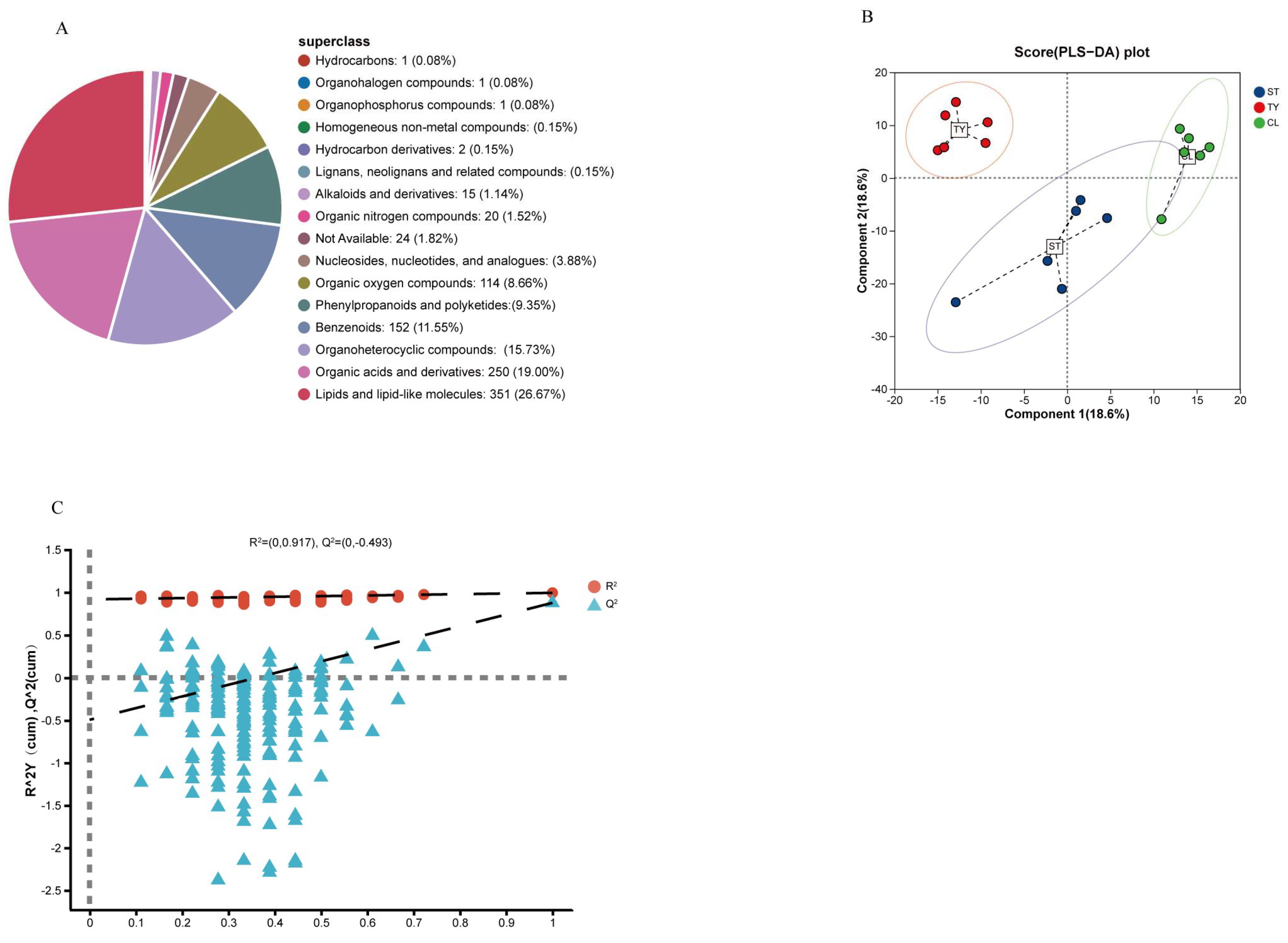
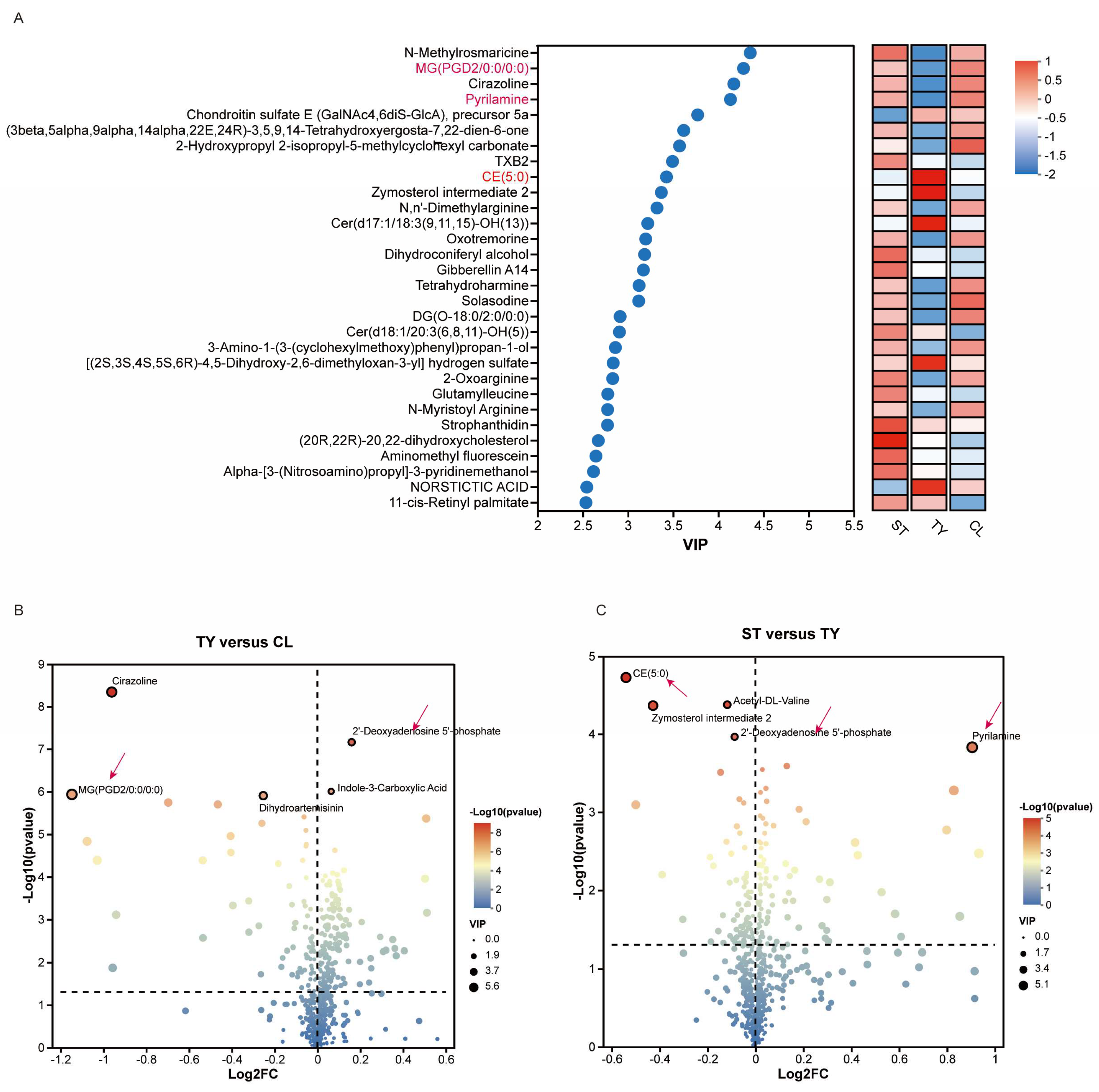
A total of 1414 metabolites were identified across both ionization modes, primarily belonging to lipids and lipid-like molecules and organic acids and derivatives (Figure 1A). To evaluate the metabolic divergences between the indigenous and introduced breeds, OPLS-DA models were constructed for pairwise comparisons. The score plots demonstrated clear spatial separation between ST vs. TY and CL vs. TY (Figure 1B), with 200-repetition permutation tests confirming the absence of overfitting (Figure 1C). Based on the integration of OPLS-DA VIP values (VIP > 1) and volcano plots, we identified 249 significantly changed metabolites (SCMs) between ST and TY (122 metabolites with higher abundance and 127 metabolites with lower abundance in ST) and 337 SCMs between CL and TY (126 metabolites with higher abundance and 211 metabolites with lower abundance in CL). Notably, the top 30 VIP-ranked metabolites, including N-methylrosmaricine, MG(PGD2/0:0/0:0), pyrilamine, and cirazoline, consistently exhibited lower relative abundances in the TY group. However, the relative abundance of CE(5:0) was higher in the TY group (Figure 2A–C).
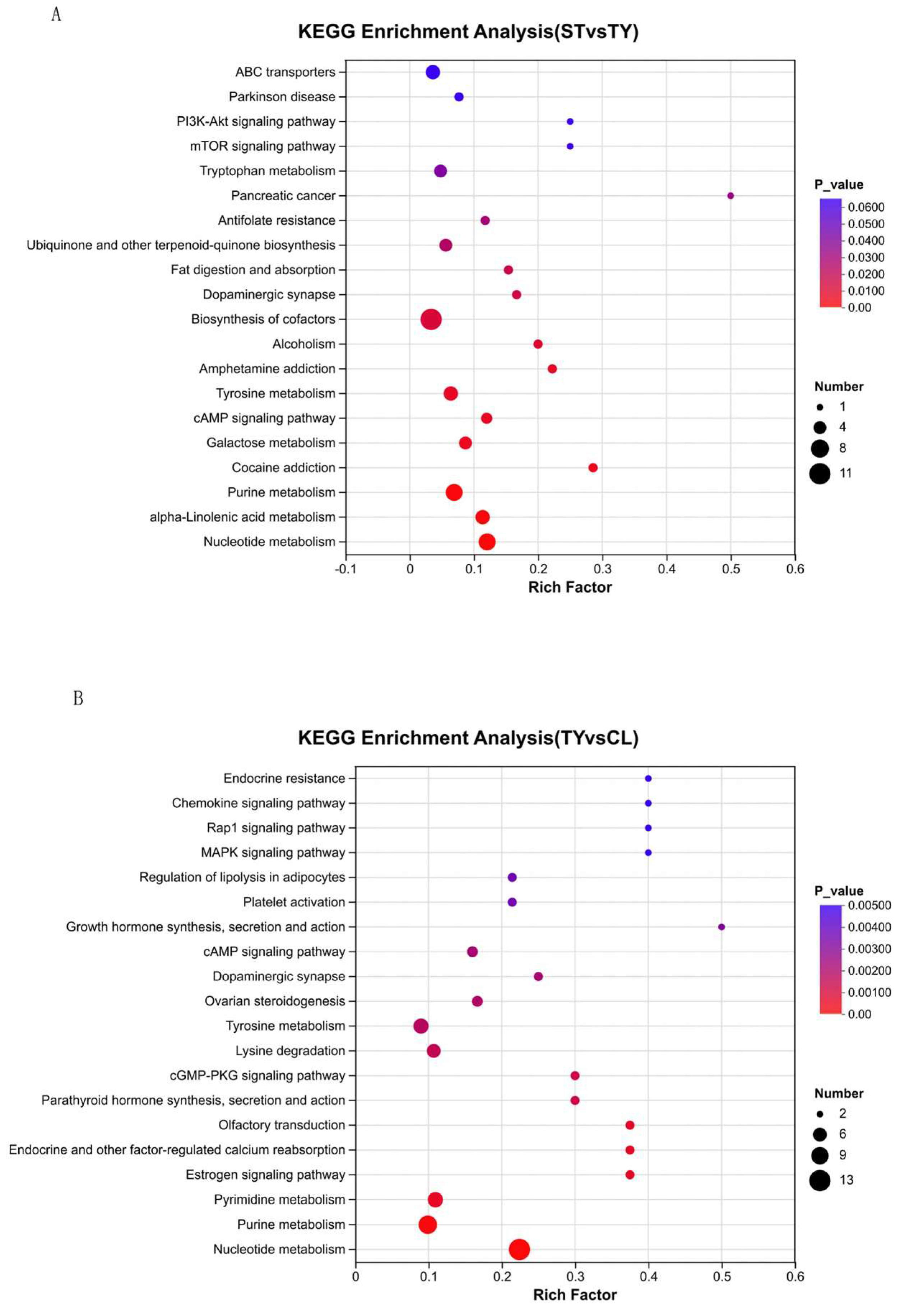
KEGG enrichment analysis was employed to elucidate the functional implications of these SCMs (Figure 3). The differentially abundant metabolites were significantly enriched in pathways that were critical for nutrition and energy metabolism, specifically galactose metabolism, fat digestion and absorption, and purine metabolism. Furthermore, significant alterations were identified in amino acid metabolism (tyrosine and tryptophan metabolism) and the biosynthesis of cofactors. The enrichment of pathways such as ABC transporters and dopaminergic synapse further highlights breed-specific variations in nutrient transport and physiological regulation. Collectively, these findings indicate that the observed variations in slaughter performance and organ development among these breeds are driven by distinct rumen metabolic patterns, where CL and ST exhibit more active anabolic pathways related to growth, while TY maintains a metabolic profile that is potentially aligned with regional adaptability and lower metabolic intensity.

4. Discussion

4.1. Breed-Specific Divergence in Slaughter Performance and Carcass Commercial Value

Slaughter performance serves as a primary indicator of animal production efficiency and economic value [22,34]. Moreover, slaughter performance is influenced by factors such as breed, age, sex, feeding level, and environmental conditions [35]. When feeding management conditions are consistent and the nutritional concentration of the diet meets the growth and development requirements of livestock, genetic factors are a key determinant of beef cattle production performance [36,37]. In the current study, CL exhibited significantly lower backfat thickness than the other breeds, suggesting a higher lean meat yield and reduced adipose deposition. These results align with the previous study, which found that backfat thickness is negatively correlated with the lean meat percentage [38]. While no significant difference was observed in the final pre-slaughter live weight among the three breeds, their body compositions exhibited distinct phenotypic divergence. Specifically, Charolais cattle displayed significantly lower backfat thickness and a higher muscle-to-bone ratio compared to Simmental cattle, indicating a nutrient partitioning strategy that preferentially favors myogenesis over adipogenesis and skeletal growth. Conversely, Simmental cattle showed the highest bone mass, yet maintained a high proportion of premium cuts, suggesting a robust skeletal framework supporting substantial muscle deposition. This uniformity in final live weight serves as a standardized baseline, effectively eliminating body size as a confounding factor and demonstrating that the observed variations in tissue accretion are driven by breed-specific genetic programs and metabolic priorities. This result indicated that CL cattle prioritize nutrient partitioning toward muscle accretion. However, the commercial value of a carcass is also dictated by the yield of premium cuts [39]. Genetic foundation is a key factor influencing the production of high-quality beef [36,40]. Interestingly, ST demonstrated a significantly higher proportion of premium cuts (72.97%) relative to carcass weight compared to TY (67.81%) and CL (69.07%). This confirms the superior genetic merit of Simmental cattle for producing high-value primal sections, such as the chuck, striploin, and tenderloin. While CL produced the highest proportion of high-grade cuts (15.08%), the overall economic utilization value was highest in ST due to its superior premium cut yield. This suggests that while CL is optimized for total lean output, ST excels in the distribution of high-value retail segments.

4.2. Visceral Organ Development and Physiological Adaptation

The weights and development of visceral organs reflect the metabolic demands and physiological status of ruminants [37]. Research has found that the development of ruminant internal organs directly impacts livestock weight gain, feed intake, and digestive capacity [41]. A noteworthy observation in this study was the significantly higher liver and kidney mass in TY compared to CL. The liver is considered the largest detoxification organ in animals [42] and a key metabolic organ for energy and lipid conversion [43,44], and its development is closely related to the maintenance of bodily homeostasis [45]. Regulating fat metabolism in the animal body can help to reduce fatty liver deposits and metabolic burden, promote healthy liver development, and thereby improve liver function indicators [46]. The heavier hepatic mass in TY likely supports a more active metabolic system, which is required for its specific growth and protein turnover rates. Furthermore, the concurrently larger kidneys suggest an enhanced capacity for nitrogenous waste clearance [47], which is a physiological adaptation to its unique metabolic intensity. This visceral-heavy strategy extends to the digestive tract. TY exhibited a significantly heavier small intestine and omasum compared to CL and ST. As the small intestine is the primary site for the absorption of proteins and carbohydrates, its increased mass provides a larger absorptive surface area, potentially enhancing the nutrient utilization efficiency. It simultaneously protects the organism from harmful compounds within the intestinal lumen [48,49]. Similarly, the development of the rumen is influenced by age, feed composition, and feed nutritional components [50]. The heavier omasum suggests a more robust capacity for regulating the digesta flow and fluid absorption. Research indicates that improvements in volatile fatty acids within the rumen positively impact its growth and development [51,52]. Moreover, these results indicate that the enhanced digestive architecture in TY, characterized by higher small intestinal and omasal weights, likely facilitates nutrient extraction via an increased absorptive surface area—a potential adaptation to local feed resources [53]. However, this physiological advantage is offset by the substantial metabolic cost of maintaining a larger gastrointestinal mass [54]. Given that visceral tissues exhibit a high metabolic turnover, this “visceral-heavy” strategy in TY prioritizes nutrient partitioning toward organ maintenance over muscle accretion [55]. Consequently, this trade-off between nutrient extraction efficiency and maintenance energy requirements partially accounts for the lower carcass yields observed in the indigenous TY breed compared to the introduced counterparts.

4.3. Rumen Metabolomic Signatures: Mechanisms Driving Anabolic Divergence

The integration of rumen metabolomics provides a molecular lens to elucidate the mechanisms driving the observed phenotypic variations [56,57]. Our results showed that the abundance of metabolites related to purine and pyrimidine metabolism in the rumen fluid of CL and ST was significantly higher. It is important to note that these purine metabolites are primarily products of the microbial degradation and turnover of nucleic acids, rather than a direct reflection of the host’s systemic metabolism [58]. However, in ruminant physiology, the concentration of these derivatives serves as a reliable proxy for MCP synthesis and microbial anabolic intensity [59]. In the present experiment, the elevated levels of adenosine, inosine, and hypoxanthine in CL and ST cattle suggest a more dynamic microbial nitrogen flux and enhanced microbial biomass production [60,61]. This accelerated microbial turnover likely leads to a greater flow of high-quality microbial protein to the small intestine, providing the essential amino acid precursors required for muscle protein synthesis and rapid tissue accretion [62]. Consequently, these rumen metabolic signatures are intrinsically associated with the superior growth rates and hot carcass weights that characterize the anabolic divergence of these breeds. In contrast, the lower accumulation of these precursors in TY reflects a more conservative metabolic strategy, potentially prioritizing maintenance and energy efficiency over rapid tissue deposition [63,64].

5. Conclusions

In conclusion, this study demonstrates that there are significant breed-specific differences in the slaughter performance and visceral organ weight of beef cattle, and these differences are closely associated with the breed-specific characteristics of rumen metabolic profiles. The differentially abundant metabolites in pathways such as purine metabolism and nucleotide synthesis in the rumen provide important metabolic clues for analyzing breed-specific production performance. CL and ST exhibit superior carcass yield and premium cut proportions, respectively, supported by upregulated anabolic pathways in the rumen, such as purine and nucleotide metabolism. In contrast, TY tend to develop visceral organs and adaptive changes in rumen morphology, and their conservative metabolic profile is more conducive to internal environmental homeostasis and environmental adaptability. However, the high mass of visceral organs also brings higher maintenance energy consumption, leading to a trade-off in nutrient allocation between growth and visceral maintenance; thus, its growth rate and carcass meat yield are lower than those of introduced breeds. These findings provide valuable insights into the molecular mechanisms regulating production efficiency across diverse cattle breeds and offer a scientific basis for optimizing breed selection and regional breeding strategies in the beef industry.

Author Contributions

Y.Z. (Yuanqing Zhang) developed the concept, designed and supervised the research and revised the manuscript; C.Z. conducted the animal experiment and collected samples; C.Z. analyzed the samples, carried out statistical analysis and drafted the manuscript; Z.Y., Z.R., Y.L. (Yongchen Liu), N.Z., Y.Z. (Yupeng Zhang), Z.Z. and Y.M. assisted with the data analysis and revised the manuscript. S.Z., D.Z., B.L., S.W., J.C., Y.Z. (Yawei Zhang) and Y.L. (Yanjie Liu) assisted with the chemical analysis of samples. All authors have read and agreed to the published version of the manuscript.

Funding

This research was supported by the Shanxi Provincial Major Special Science and Technology Project funded by the Shanxi Provincial Department of Science and Technology (Project No.: 202201140601026) and the 2024 Shanxi Provincial Postgraduate Practice and Innovation Project funded by the Shanxi Provincial Department of Education (Project No.: 2024SJ138).

Data Availability Statement

The datasets used and analyzed during the current study are available from the corresponding author upon reasonable request.

Acknowledgments

The authors express their gratitude to fellow students in the laboratory for their assistance.

Conflicts of Interest

The authors declare that they have no conflicts of interest.

References

  1. Zhuang, Z.; Xu, L.; Yang, J.; Gao, H.; Zhang, L.; Gao, X.; Li, J.; Zhu, B. Weighted single-step genome-wide association study for growth traits in Chinese Simmental beef cattle. Genes 2020, 11, 189. [Google Scholar] [CrossRef]
  2. Wu, G. 136 Beef as a Functional Food for Improving Human Nutrition and Health. J. Anim. Sci. 2021, 99, 70–71. [Google Scholar] [CrossRef]
  3. Zambarda, R.V.; Liliane, C.; Costa, J.A.N.; Sarzi, B.D.S.; Fernandes, R.P.; Rodrigues, H.S.D.; Alexander, J.B.; João, R. Body mass index at calving on performance and efficiency of Charolais cow herds. Trop. Anim. Health Prod. 2022, 54, 168. [Google Scholar] [CrossRef]
  4. Wanapat, M.; Cherdthong, A.; Phesatcha, K.; Kang, S. Dietary sources and their effects on animal production and environmental sustainability. Anim. Nutr. 2015, 1, 96–103. [Google Scholar] [CrossRef]
  5. Winton, T.S.; Nicodemus, M.C.; Harvey, K.M. Stressors Inherent to Beef Cattle Management in the United States of America and the Resulting Impacts on Production Sustainability: A Review. Ruminants 2024, 4, 227–240. [Google Scholar] [CrossRef]
  6. Rodrigues, S.; Cadavez, V.; Teixeira, A. Breed and maturity effects on Churra Galega Bragançana and Suffolk lamb carcass characteristics: Killing-out proportion and composition. Meat Sci. 2006, 72, 288–293. [Google Scholar] [CrossRef]
  7. Graham, J.G.; Quinn, H.; Davies, B.L.; Griffith, G.R. Economics of alternative growth path, time of calving and breed type combinations across southern Australian beef cattle environments: Grass finishing at the Victorian experimental site. AgEcon Search. 2009, 6, 17–26. [Google Scholar] [CrossRef]
  8. Chen, Q.; Huang, B.; Zhan, J.; Wang, J.; Qu, K.; Zhang, F.; Shen, J.; Jia, P.; Ning, Q.; Zhang, J.; et al. Whole- genome analisys identify loci and selective signals associated with body size in cattle. J. Anim. Sci. 2020, 98, skaa068. [Google Scholar] [CrossRef]
  9. McIntosh, M.M.; Spiegal, S.A.; Mcintosh, S.Z.; Sanchez, C.J.; Estell, E.R.; Steele, M.C.; Elias, H.E.; Bailey, W.D.; Brown, R.J.; Cibils, F.A. Matching beef cattle breeds to the environment for desired outcomes in a changing climate: A systematic review. J. Arid Environ. 2023, 211, 104905. [Google Scholar] [CrossRef]
  10. Carvalho, R.M.S.; Boari, C.A.; Villela, S.D.J.; Pires, A.V.; Mourthé, M.H.F.; Oliveira, F.R.; Dumont, M.A.; Gontijo, R.P.; Lobo, A.R., Jr.; Martins, P.G.M.A. Differences between sexes, muscles and aging times on the quality of meat from Wagyu Angus cattle finished in feedlot. Anim. Prod. Sci. 2016, 58, 350–357. [Google Scholar] [CrossRef]
  11. Terry, S.A.; Basarab, J.A.; Guan, L.L.; McAllister, T.A. Strategies to improve the efficiency of beef cattle production. Can. J. Anim. Sci. 2020, 100, 1–19. [Google Scholar] [CrossRef]
  12. Zhang, W.; Gao, X.; Zhang, Y.; Zhao, Y.; Zhang, J.; Jia, Y.; Zhu, B.; Xu, L.; Zhang, L.; Gao, H.; et al. Genome-wide assessment of genetic diversity and population structure insights into admixture and introgression in Chinese indigenous cattle. BMC Genet. 2018, 19, 114. [Google Scholar] [CrossRef] [PubMed]
  13. Qiu, X.; Qin, X.; Chen, L.; Chen, Z.; Hao, R.; Zhang, S.; Yang, S.; Wang, L.; Cui, Y.; Li, Y.; et al. Serum Biochemical Parameters, Rumen Fermentation, and Rumen Bacterial Communities Are Partly Driven by the Breed and Sex of Cattle When Fed High-Grain Diet. Microorganisms 2022, 10, 323. [Google Scholar] [CrossRef]
  14. Vanvanhossou, S.F.U.; Yin, T.; Gorjanc, G.; König, S. Evaluation of crossbreeding strategies for improved adaptation and productivity in African smallholder cattle farms. Genet. Sel. Evol. 2025, 57, 6. [Google Scholar] [CrossRef]
  15. Wang, Y.; Segelke, D.; Emmerling, R.; Bennewitz, J.; Wellmann, R. Long-Term Impact of Optimum Contribution Selection Strategies on Local Livestock Breeds with Historical Introgression Using the Example of German Angler Cattle. G3 Genes Genomes Genet. 2017, 7, 4009–4018. [Google Scholar] [CrossRef][Green Version]
  16. Thomas, S.H. Achieving hybrid vigor through crossbreeding, composites. Farm Industry News, 8 November 2022. [Google Scholar]
  17. Pereira, A.S.C.; Baldi, F.; Sainz, R.D.; Utembergue, B.L.; Chiaia, H.L.J.; Magnabosco, C.U.; Manicardi, F.R.; Araujo, F.R.C.; Guedes, C.F.; Margarido, R.C.; et al. Growth performance, and carcass and meat quality traits in progeny of poll Nellore, Angus and Brahman sires under tropical conditions. Anim. Prod. Sci. 2015, 55, 1295–1302. [Google Scholar] [CrossRef]
  18. Randhawa, I.A.; Khatkar, M.S.; Thomson, P.C.; Raadsma, H.W. A Meta-assembly of selection signatures in cattle. PLoS ONE 2016, 11, e0153013. [Google Scholar] [CrossRef]
  19. Wang, Y.; Wang, Z.; Hu, R.; Peng, Q.; Xue, B.; Wang, L. Comparison of carcass 11characteristics and meat quality between Simmental crossbred cattle, cattle-yaks and Xuanhan yellow cattle. J. Sci. Food Agric. 2021, 101, 3927–3932. [Google Scholar] [CrossRef] [PubMed]
  20. Liu, T.; Wu, J.-P.; Lei, Z.-M.; Zhang, M.; Gong, X.; Cheng, S.; Ling, Y.; Wang, J. Fatty Acid Profile of Muscles from Crossbred Angus-Simmental, Wagyu-Simmental, and Chinese Simmental Cattles. Food Sci. Anim. Resour. 2020, 40, 563–577. [Google Scholar] [CrossRef]
  21. Ellies-Oury, M.P.; Insausti, K.; Papillon, S.; Albechaalany, J.; Cantalapiedra-Hijar, G. Effect of residual feed intake on meat quality in fattening Charolais bulls fed two contrasting diets. Meat Sci. 2024, 214, 109536. [Google Scholar] [CrossRef] [PubMed]
  22. Ünal, N.; Polat, M.; Yakan, A. Investigation of Fattening Performance, Slaughter, Carcass, and Some Meat Quality Characteristics of Imported Simmental, Charolaise, and Belgian Blue × Holstein F1 Bulls. Vet. Med. Sci. 2025, 11, e70219. [Google Scholar] [CrossRef]
  23. Joner, G.; Alves Filho, D.C.; Brondani, I.L.; Adams, S.M.; De Moura, A.F.; Cardoso, G.S.; Cattelam, P.M.M. Effect of pre-and postpartum body development on the rebreeding of first-calf heifers. Int. J. Agric. Nat. Resour. 2019, 46, 243–252. [Google Scholar] [CrossRef]
  24. Zhang, Y.; Zhang, X.; Cao, D.; Yang, J.; Mao, H.; Sun, L.; Wang, C. Integrated multi-omics reveals the relationship between growth performance, rumen microbes and metabolic status of Hu sheep with different residual feed intakes. Anim Nutr. 2024, 18, 284–295. [Google Scholar] [CrossRef] [PubMed] [PubMed Central]
  25. De Oliveira, P.S.N.; Coutinho, L.L.; Tizioto, P.C.; Cesar, A.S.M.; de Oliveira, G.B.; Diniz, W.J.D.S.; De Lima, A.O.; Reecy, J.M.; Mourão, G.B.; Zerlotini, A.; et al. An integrative transcriptome analysis indicates regulatory mRNA-miRNA networks for residual feed intake in Nelore cattle. Sci. Rep. 2018, 8, 17072. [Google Scholar] [CrossRef] [PubMed] [PubMed Central]
  26. Zhao, W.; Ma, L.; Xue, L.; Jiang, Q.; Feng, Y.; Wang, S.; Tian, J.; Tian, X.; Gu, Y.; Zhang, J. The rumen microbiome and its metabolome together with the host metabolome regulate the growth performance of crossbred cattle. BMC Genom. 2025, 26, 278. [Google Scholar] [CrossRef] [PubMed] [PubMed Central]
  27. NY/T 815-2004; Agricultural Industry Standard of the People’s Republic of China—Beef Cattle Feeding Standard. China Agriculture Press: Beijing, China, 2004.
  28. GB/T 27643—2011; General Administration of Quality Supervision, Inspection and Quarantine of the People’s Republic of China—Beef Carcasses and Fresh Meat Cutting. China Standards Press: Beijing, China, 2012.
  29. Galvanidb, D.B.; Pirescc, C.C.; Kozloskigv, G.V.; Wommer, T.P. Protein requirements of Texel crossbred lambs. Small Rumin. Res. 2009, 81, 55–62. [Google Scholar] [CrossRef]
  30. EFSA Panel on Animal Health and Welfare (AHAW); Nielsen, S.S.; Alvarez, J.; Bicout, D.J.; Calistri, P.; Depner, K.; Drewe, J.A.; Garin-Bastuji, B.; Gonzales Rojas, J.L.; Schmidt, C.G.; et al. Welfare of cattle at slaughter. EFSA J. 2020, 18, e06275. [Google Scholar] [CrossRef]
  31. Wishart, D.S.; Guo, A.; Oler, E.; Wang, F.; Anjum, A.; Peters, H.; Dizon, R.; Sayeeda, Z.; Tian, S.; Lee, B.L.; et al. HMDB 5.0: The Human Metabolome Database for 2022. Nucleic Acids Res. 2022, 50, D622–D631. [Google Scholar] [CrossRef] [PubMed] [PubMed Central]
  32. Zhang, M.; Li, D.; Yang, X.; Wei, F.; Wen, Q.; Feng, Y.; Jin, X.; Liu, D.; Guo, Y.; Hu, Y. Integrated multi-omics reveals the roles of cecal microbiota and its derived bacterial consortium in promoting chicken growth. mSystems 2023, 8, e0084423. [Google Scholar] [CrossRef] [PubMed] [PubMed Central]
  33. Xia, X.; Li, X.; Xie, F.; Yuan, G.; Cheng, D.; Peng, C. Non-targeted metabonomic analysis of plasma in patients with atherosclerosis by liquid chromatography-mass spectrometry. Ann. Transl. Med. 2022, 10, 133. [Google Scholar] [CrossRef] [PubMed] [PubMed Central]
  34. Belhaj, K.; Mansouri, F.; Tikent, A.; Taaifi, Y.; Boukharta, M.; Serghini, C.H.; Elamrani, A. Effect of age and breed on carcass and meat quality characteristics of Beni-Guil and Ouled-Djellal sheep breeds. Sci. World J. 2021, 24, 5536793. [Google Scholar]
  35. Jeon, S.; Lee, M.; Seo, J.; Kim, J.; Kam, D.; Seo, S. High-level dietary crude protein decreased backfat thickness and increased carcass yield score in finishing Hanwoo beef cattle (Bos taurus coreanae). J. Anim. Sci. Technol. 2021, 63, 1064–1075. [Google Scholar] [CrossRef]
  36. Mwangi, F.W.; Charmley, E.; Gardiner, C.P.; Malau-Aduli, B.S.; Kinobe, R.T.; Malau-Aduli, A.E.O. Diet and genetics influence beef cattle performance and meat quality characteristics. Foods 2019, 8, 648. [Google Scholar] [CrossRef]
  37. Zhaimysheva, S.S.; Kosilov, V.I.; Miroshnikov, S.A.; Duskaev, G.K.; Nurzhanov, B.S. Genetic and Physiological Aspects of Bulls of Dual-Purpose and Beef Breeds and Their Crossbreeds. IOP Conf. Ser. Earth Environ. Sci. 2020, 421, 022028. [Google Scholar]
  38. Hoa, V.-B.; Seo, H.-W.; Seong, P.-N.; Cho, S.-H.; Kang, S.-M.; Kim, Y.-S.; Moon, S.-S.; Choi, Y.-M.; Kim, J.-H.; Seol, K.-H. Back-fat thickness as a primary index reflecting the yield and overall acceptance of pork meat. Anim. Sci. J. = Nihon Chikusan Gakkaiho 2021, 92, e13515. [Google Scholar] [CrossRef]
  39. Pabiou, T.; Fikse, W.F.; Nsholm, A.; Cromie, A.R.; Drennan, M.J.; Keane, M.G.; Berry, D.P. Genetic parameters for carcass cut weight in Irish beef cattle. J. Anim. Sci. 2009, 87, 3865–3876. [Google Scholar] [CrossRef]
  40. Thomas, J. Divers, Relevant Equine Renal Anatomy, Physiology, and Mechanisms of Acute Kidney Injury: A Review. Vet. Clin. N. Am. Equine Pract. 2022, 38, 1–12. [Google Scholar] [CrossRef]
  41. Li, X.; Wu, J.; Zhuang, Z.; Ye, Y.; Zhou, Y.; Qiu, Y.; Ruan, D.; Wang, S.; Yang, J.; Wu, Z.; et al. Integrated Single-Trait and Multi-Trait GWASs Reveal the Genetic Architecture of Internal Organ Weight in Pigs. Animals 2023, 13, 808. [Google Scholar] [CrossRef]
  42. Pogorzelska-Przybyłek, P.; Nogalski, Z.; Sobczuk-Szul, M.; Momot, M. The effect of gender status on the growth performance, carcass and meat quality traits of young crossbred Holstein-Friesian × Limousin cattle. Anim. Biosci. 2021, 34, 914–921. [Google Scholar] [PubMed]
  43. Perry, R.J.; Camporéz, J.-P.G.; Kursawe, R.; Titchenell, P.M.; Zhang, D.; Preey, C.J.; Jurczak, M.J.; Abudukadier, A.; Han, M.-S.; Zhang, X.-M.; et al. Hepatic acetyl CoA links adipose tissue inflammation to hepatic insulin resistance and type 2 diabetes. Cell 2015, 160, 745–758. [Google Scholar] [CrossRef]
  44. Baquerre, C.; Montillet, G.; Pain, B. Liver organoids in domestic animals: An expected promise for metabolic studies. Vet. Res. 2021, 52, 47. [Google Scholar] [CrossRef] [PubMed] [PubMed Central]
  45. Jia, H.; Dong, N. Effects of bile acid metabolism on intestinal health of livestock and poultry. J. Anim. Physiol. Anim. Nutr. 2024, 108, 1258–1269. [Google Scholar] [CrossRef] [PubMed]
  46. Michalopoulos, G.K. Hepatostat: Liver regeneration and normal liver tissue maintenance. Hepatology 2017, 65, 1384–1392. [Google Scholar] [CrossRef]
  47. An, R.-B.; Sohn, D.-H.; Jeong, G.-S.; Kim, Y.-C. In vitro hepatoprotective compounds from Suaeda glauca. Arch. Pharmacal Res. 2008, 31, 594–597. [Google Scholar] [CrossRef] [PubMed]
  48. Chalvon-Demersay, T.; Luise, D.; Le Floc’h, N.; Tesseraud, S.; Lambert, W.; Bosi, P.; Trevisi, P.; Beaumont, M.; Corrent, E. Functional amino acids in pigs and chickens: Implications for gut health. Front. Vet. Sci. 2021, 8, 663727. [Google Scholar] [CrossRef]
  49. Schmöcker, C.; Weylandt, K.H.; Kahlke, L.; Wang, J.; Lobeck, H.; Tiegs, G.; Berg, T.; Kang, J.X. Omega-3 fatty acids alleviate chemically induced acute hepatitis by suppression of cytokines. Hepatology 2007, 45, 864–869. [Google Scholar] [CrossRef]
  50. Flatt, W.P.; Warner, R.G.; Loosli, J.K. Influence of Purified Materials on the Development of the Ruminant Stomach. J. Dairy Sci. 1958, 41, 1593–1600. [Google Scholar] [CrossRef]
  51. Muthubharathi, B.C.; Gowripriyaa, T.; Balamurugan, K. Metabolomics: Small molecules that matter more. Mol. Omics 2021, 17, 210–229. [Google Scholar] [CrossRef] [PubMed]
  52. Kim, S.J.; Song, H.E.; Lee, H.Y.; Yoo, H.Y. Mass spectrometry-based metabolomics in translational research. Adv. Exp. Med. Biol. 2021, 1310, 509–531. [Google Scholar]
  53. Zhang, X.; Zhong, R.; Wu, J.; Tan, Z.; Jiao, J. Dietary selection of distinct gastrointestinal microorganisms drives fiber utilization dynamics in goats. Microbiome 2025, 13, 118. [Google Scholar] [CrossRef]
  54. Wang, J.; Song, L.; Du, H.; Shi, Y.; Zhang, S.; Sun, Q.; Gao, W.; Han, F.; Li, X.; Gao, S. Comprehensive multi-omics integration analysis identifies the functional association between linoleic acid and meat quality variation among different cattle breeds. Food Chem. 2026, 506, 148224. [Google Scholar] [CrossRef]
  55. Wu, H.; Mu, C.; Li, X.; Fan, W.; Shen, L.; Zhu, W. Breed-Driven Microbiome Heterogeneity Regulates Intestinal Stem Cell Proliferation via Lactobacillus-Lactate-GPR81 Signaling. Adv. Sci. 2024, 11, e2400058. [Google Scholar] [CrossRef] [PubMed]
  56. Tian, R.; Yang, C.; Chai, S.; Guo, H.; Seim, I.; Yang, G. Evolutionary impacts of purine metabolism genes on mammalian oxidative stress adaptation. Zool. Res. 2022, 43, 241–254. [Google Scholar] [CrossRef]
  57. Li, Y.; Mao, K.; Zang, Y.; Lu, G.; Qiu, Q.; Ouyang, K.; Zhao, X.; Song, X.; Xu, L.; Liang, H.; et al. Revealing the developmental characterization of rumen microbiome and its host in newly received cattle during receiving period contributes to formulating precise nutritional strategies. Microbiome 2023, 11, 238. [Google Scholar] [CrossRef]
  58. Stentoft, C.; Røjen, B.A.; Jensen, S.K.; Kristensen, N.B.; Vestergaard, M.; Larsen, M. Absorption and intermediary metabolism of purines and pyrimidines in lactating dairy cows. Br. J. Nutr. 2015, 113, 560–573. [Google Scholar] [CrossRef] [PubMed]
  59. Carro, M.D.; Cantalapiedra-Hijar, G.; Ranilla, M.J.; Molina-Alcaide, E. Urinary excretion of purine derivatives, microbial protein synthesis, nitrogen use, and ruminal fermentation in sheep and goats fed diets of different quality. J. Anim. Sci. 2012, 90, 3963–3972. [Google Scholar] [CrossRef] [PubMed]
  60. Saeed, O.A.; Sazili, A.Q.; Akit, H.; Alimon, A.R.; Samsudin, A.A.B. Effect of corn supplementation on purine derivatives and rumen fermentation in sheep fed PKC and urea-treated rice straw. Trop. Anim. Health Prod. 2018, 50, 1859–1864. [Google Scholar] [CrossRef] [PubMed] [PubMed Central]
  61. Giagnoni, G.; Weisbjerg, M.R.; Errico, M.; Lapris, M.; Poulsen, N.A.; Thomsen, J.P.S.; Gallo, A.; Rocchetti, G. Relationship between pyrimidines, purines, and fatty acids in milk of dairy cows fed distinct carbohydrate types: A metabolomic approach. JDS Commun. 2024, 6, 24–28. [Google Scholar] [CrossRef] [PubMed] [PubMed Central]
  62. Millen, D.D.; Virgínio, G.F., Jr.; Alves, F.F.; Schwab, C.G.; Calsamiglia, S. Influence of Dietary and Ruminal Factors on Microbial and Non-Microbial Nitrogen Flows to the Small Intestine in Lactating Dairy Cows: A Meta-Analysis. Dairy 2025, 6, 66. [Google Scholar] [CrossRef]
  63. Ali-Sisto, T.; Tolmunen, T.; Toffol, E.; Viinamäki, H.; Mäntyselkä, P.; Valkonen-Korhonen, M.; Honkalampi, K.; Ruusunen, A.; Velagapudi, V.; Lehto, S.M. Purine metabolism is dysregulated in patients with major depressive disorder. Psychoneuroendocrinology 2016, 70, 25–32. [Google Scholar] [CrossRef]
  64. Eugenio, L.L.; Victor, Z.; Gert, B.; Michael, I. At the Crossroad of Nucleotide Dynamics and Protein Synthesis in Bacteria. Microbiol. Mol. Biol. Rev. MMBR 2023, 87, e0004422. [Google Scholar]
Figure 1. Metabolomic analysis results of rumen fluid from different beef cattle breeds. (A) The pie chart displays the relative abundance distribution of different hyperclasses across samples. (B) Principal component analysis (PCA) plot shows the clustering of rumen fluid samples from different beef cattle breeds, where ST, TY, and CL represent three distinct breeds. (C) Scatter plot displays the correlation between R2Y and R2X, where R2Y and R2X represent the model’s explanatory power for Y-axis and X-axis variables, respectively, and Q2 indicates the model’s predictive capability.
Agriculture 16 00598 g001
Figure 2. VIP values and volcano plot analysis of differentially expressed metabolites in rumen fluid across beef cattle breeds. (A) Bar chart displays differentially expressed metabolites with VIP values > 1, where VIP measures a metabolite’s contribution to the model. (B) Volcano plot displays differentially expressed metabolites between TY and CL breeds. The x-axis represents Log2FC (log-transformed fold change), the y-axis represents −Log10 (p-value), and color intensity indicates the VIP value magnitude. The horizontal dashed line represents the p-value cutoff, the vertical dashed lines represent the log2 fold change thresholds (C) Volcano plot displays differentially expressed metabolites between ST and TY breeds. The x-axis represents Log2FC, the y-axis represents −Log10 (p-value), and color intensity indicates VIP value magnitude.
Agriculture 16 00598 g002
Figure 3. KEGG metabolic pathway enrichment analysis bubble plot: The horizontal axis represents the enrichment factor, the vertical axis denotes pathway names, bubble size indicates the number of differentially expressed metabolites within that pathway, and bubble color transitions from red to blue reflecting decreasing p-values for enrichment significance. (A) shows KEGG metabolic pathways that are significantly enriched by differential metabolites between the ST and TY groups and (B) shows KEGG metabolic pathways significantly enriched by differential metabolites between the TY and CL groups from beef cattle of varying quality. Higher values indicate greater pathway enrichment or metabolic activity within the corresponding group. The data presented originate from non-targeted LC-MS/MS metabolomics analysis and were obtained through multivariate statistical analysis and pathway enrichment analysis.
Agriculture 16 00598 g003
Table 1. Nutrient levels of base rations (%DM).
IngredientsContentNutrient Levels (2)Content
Corn28.10Ash4.61
Soybean meal5.00NDF35.65
Cotton meal3.70ADF19.22
Soya bean skin3.20CP10.49
Nacl0.42EE1.84
NaHCO30.43Ca0.54
Premix (1)2.15P0.35
Dry straw13.00NEmf/(MJ/kg)5.49
Whole-plant corn silage44.00
Total100.00
(1) One kilogram of the premix contained the following: VA 500,000 IU, VD 150,000 IU, VE 2400 IU, Fe 500 mg, Cu 1000 mg, Zn 2400 mg, Mn 1500 mg, Se 45 mg, and Co 15 mg. The composition of the premix was verified by laboratory detection, and the deviation between the actual content of each nutrient and the labeled value was ≤5%, which was in line with the Quality Standard for Feed Additives (GB 7291-2017). (2) NEmf was calculated according to the Feeding Standard of Beef Cattle (NY/T 815-2004) [28], while the others were measured values.
Table 2. Comparison of slaughter performance of different breeds of beef cattle.
ItemsChinese Simmental CattleTaihang Yun CattleCharolais CattleSEMp-Value
Live weight/kg618.83655.00635.008.1220.281
Carcass weight kg366.00386.83389.406.6840.359
Dressing percentage/%59.20 b59.41 b62.38 a0.5980.013
Lean meat weight/kg321.00351.50353.296.9230.117
Lean meat percentage/%52.82 b53.64 b56.54 a0.6810.028
Bone weight/kg37.00 a25.33 b26.81 b1.6510.0005
Meat bone ratio/%8.70 b13.95 a13.21 a0.7210.0001
Torso length/cm204.75198.00203.201.6160.288
Backfat thickness/cm1.92 a1.93 a1.42 b0.0900.006
a and b represent different groups. There was a significant difference in the different letters between groups (p < 0.05). The same letters between groups showed no significant differences (p > 0.05).
Table 3. Comparison of meat weights of parts of beef cattle of different breeds.
ItemsChinese Simmental CattleTaihang Yun CattleCharolais CattleSEMp-Value
Tenderlion/kg7.426.656.750.2070.337
Striplion/kg11.1110.9711.100.3400.987
Ribey/kg13.0311.8314.120.5130.186
High rib/kg22.74 b22.33 b26.79 a0.8590.023
Top side/kg22.1423.9222.350.5620.470
Kunckle/kg14.2115.3515.400.3160.278
Rump/kg12.8314.5714.150.3900.250
Outside flat/kg15.7017.1316.380.4730.587
Eyeround/kg7.146.676.710.2650.794
Sinew/kg7.558.387.820.2460.489
Pre-tendon/kg11.4110.6010.770.2800.570
Shank/kg10.6612.2211.580.2900.130
Abdominal meat/kg38.5839.6339.081.1750.957
Chuck tender/kg4.324.184.250.1160.923
Neck meat/kg24.96 b28.60 ab32.45 a1.2420.018
Shoulder meat/kg16.2217.6718.550.5900.289
Human chest/kg32.6332.6330.620.8280.531
Total weight of quality meat blocks/kg267.04262.47268.934.7220.877
Quality meat blocks as a percentage of carcass weight/%72.97 a67.81 b69.07 b0.7860.014
Gross weight of high-grade cuts of meat/kg53.4051.7858.761.5710.132
Percentage of carcass weight of high-grade meat blocks/%13.80 b13.42 b15.08 a0.2810.007
a and b represent different groups. There was a significant difference in the different letters between groups (p < 0.05). The same letters between groups showed no significant differences (p > 0.05).
Table 4. Comparison of visceral organ weights and proportion of pre-slaughter live weight in different breeds of beef cattle.
ItemsChinese Simmental CattleTaihang Yun CattleCharolais CattleSEMp-Value
Heart
Weight/kg2.542.282.170.0730.074
Cardiac Index/%0.390.350.340.1180.217
Liver
Weight/kg7.85 ab8.57 a7.21 b0.2300.044
Liver Function Tests%1.20 ab1.31 a1.09 b0.0350.034
Spleen
Weight/kg1.522.301.580.1870.313
Spleen Index/%0.170.370.270.0370.146
Lung
Weight/kg3.773.553.690.1100.798
Lung Index/%0.560.540.580.0100.239
Kidney
Weight/kg1.39 a1.30 a1.02 b0.0570.001
Kidney Index/%0.21 a0.20 a0.16 b0.0090.011
Total Organ Weight/kg14.7315.3313.610.3690.191
Organ Index/%2.252.422.160.0610.345
a and b represent different groups. There was a significant difference in the different letters between groups (p < 0.05). The same letters between groups showed no significant differences (p > 0.05).
Table 5. Comparison of gastrointestinal weights and percentage of live weight at slaughter in different breeds of beef cattle.
ItemsChinese Simmental CattleTaihang Yun CattleCharolais CattleSEMp-Value
Large intestine
Weight/kg4.514.374.140.1000.295
Colon index/%0.690.670.650.0210.711
Small intestine
Weight/kg6.79 ab7.17 a6.63 b0.0890.036
Small intestine index/%1.041.101.040.0260.722
Reticulo-rumen
Weight/kg13.4912.5211.800.3260.067
Proportion of gastric retention/%50.4648.3347.350.7950.266
Gastric tumor index/%2.061.911.840.0430.069
Omasum
Weight/kg8.90 b9.35 a8.85 b0.0870.036
Proportion of gastric retention/%33.3934.4235.620.6650.431
Cervical index/%1.371.361.360.0470.996
Abomasum
Weight/kg4.314.474.510.1120.773
Proportion of gastric retention/%16.1517.2617.030.3120.319
Wrinkled stomach index/%0.660.680.710.0240.693
Total gastrointestinal weight/kg26.7125.8824.620.4080.087
Gastrointestinal index/%4.093.963.830.0940.581
a and b represent different groups. There was a significant difference in the different letters between groups (p < 0.05). The same letters between groups showed no significant differences (p > 0.05).
Table 6. Comparison of other non-carcass tissue and organ weights and proportion of live weight at slaughter in different breeds of beef cattle.
ItemsChinese Simmental CattleTaihang Yun CattleCharolais CattleSEMp-Value
Top-heavy/kg31.1533.8731.820.5620.176
Proportion of antemortem Live weight/%4.775.175.010.0990.320
Tare weight/kg49.7549.8747.250.8010.319
Proportion of antemortem Live weight/%7.617.617.440.1220.830
Hoof weight/kg13.9314.2212.980.2570.102
Proportion of antemortem Live weight/%2.142.182.050.0590.692
Disclaimer/Publisher’s Note: The statements, opinions and data contained in all publications are solely those of the individual author(s) and contributor(s) and not of MDPI and/or the editor(s). MDPI and/or the editor(s) disclaim responsibility for any injury to people or property resulting from any ideas, methods, instructions or products referred to in the content.