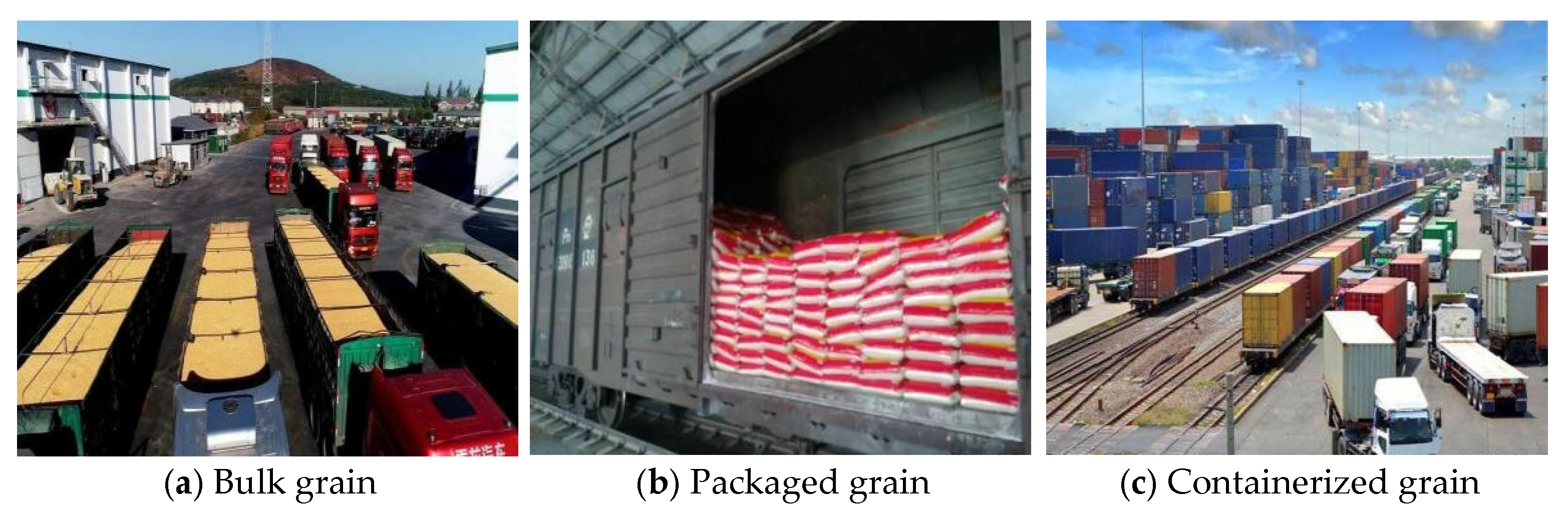
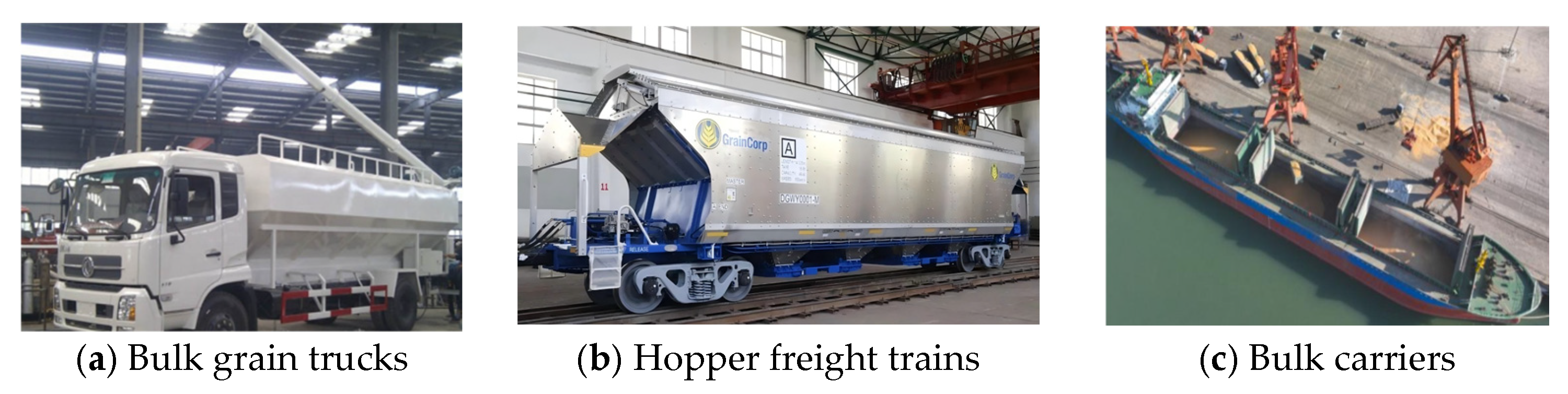
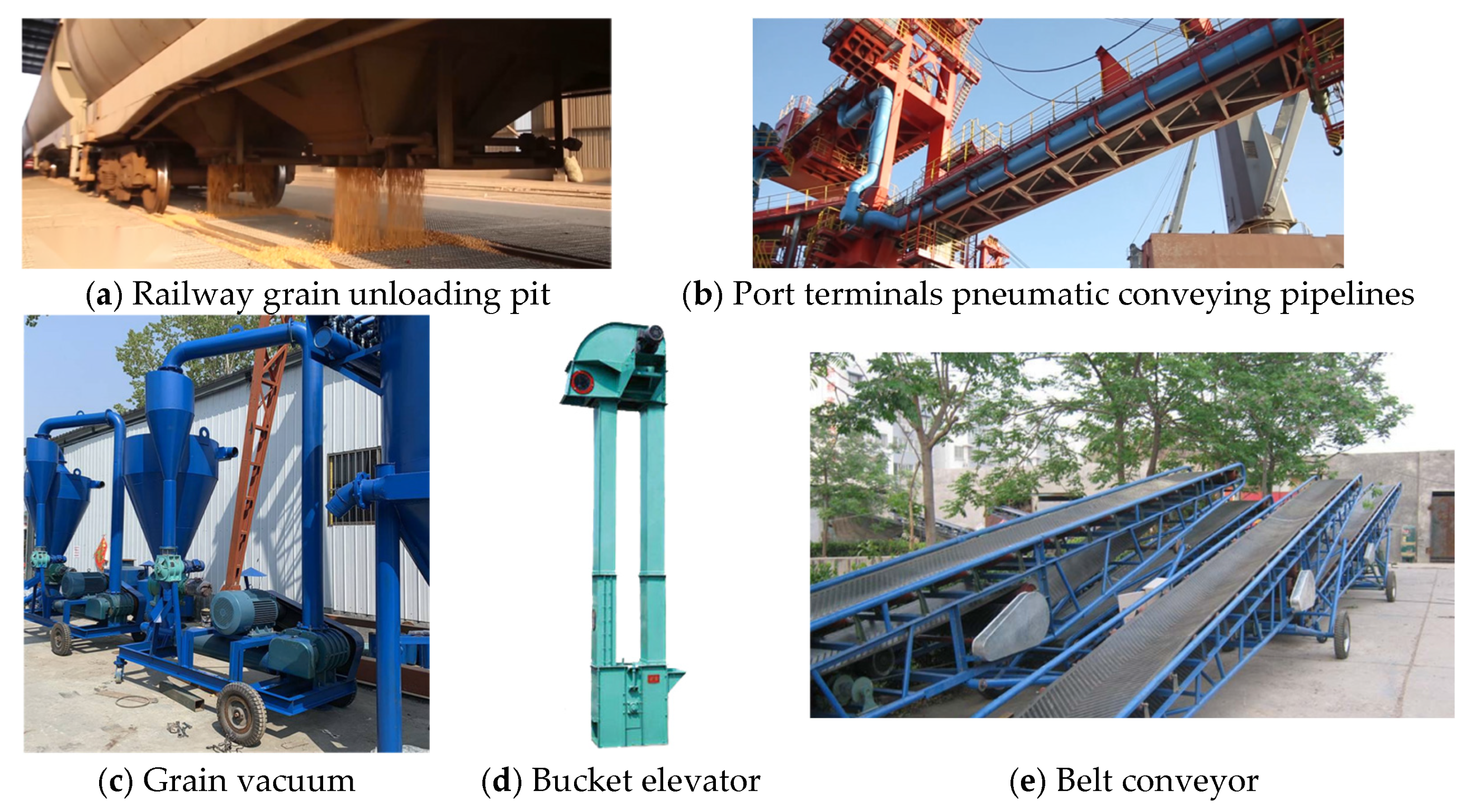
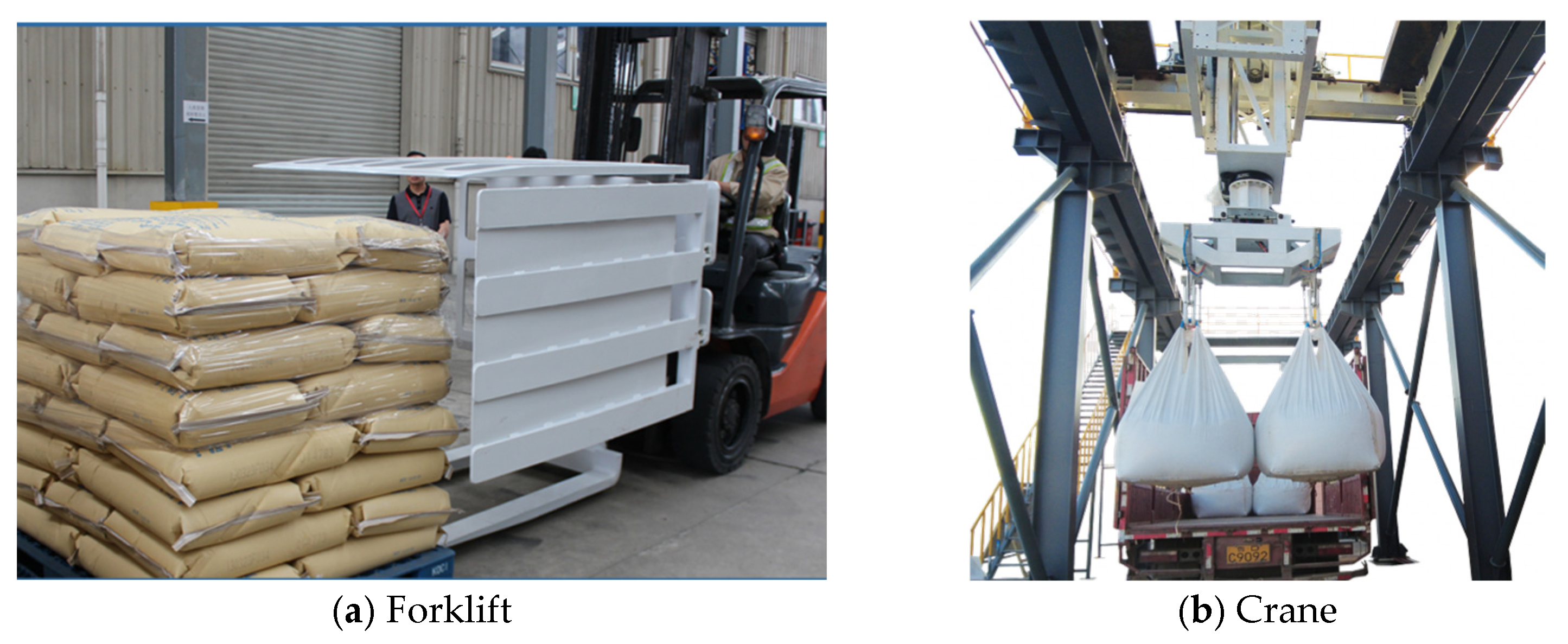
As a nationally strategic commodity, grain logistics is characterized by high complexity and has traditionally relied on single-mode transport, resulting in relatively limited holistic research on grain multimodal transport systems. However, with the rapid development of containerized freight transport, cold-chain logistics, and bulk industrial goods transport, substantial theoretical advances and practical experience have been accumulated in these fields, particularly with respect to multimodal hub network design and coordinated route optimization. Therefore, established theoretical frameworks, optimization algorithms, and representative case studies from these domains can be leveraged to inform the development and improvement of grain multimodal transport systems.
4.1. Research Status on Hub Location Optimization
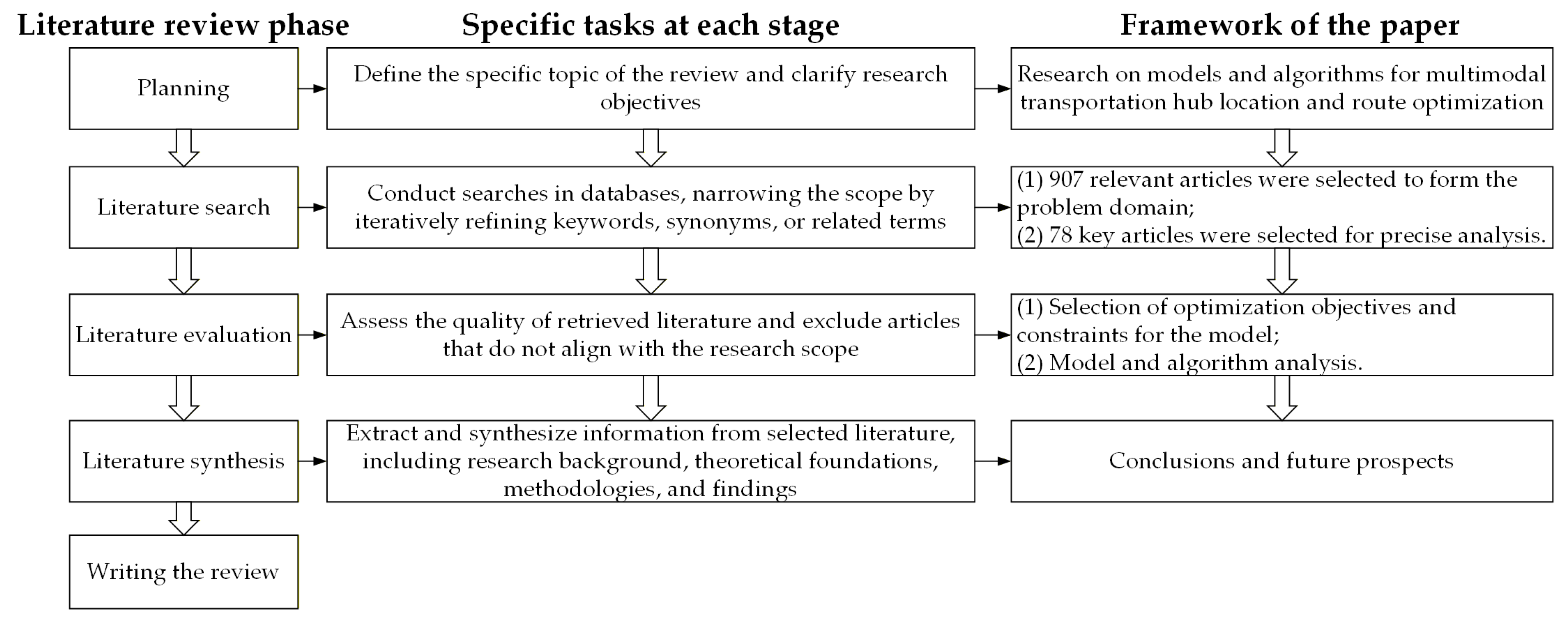
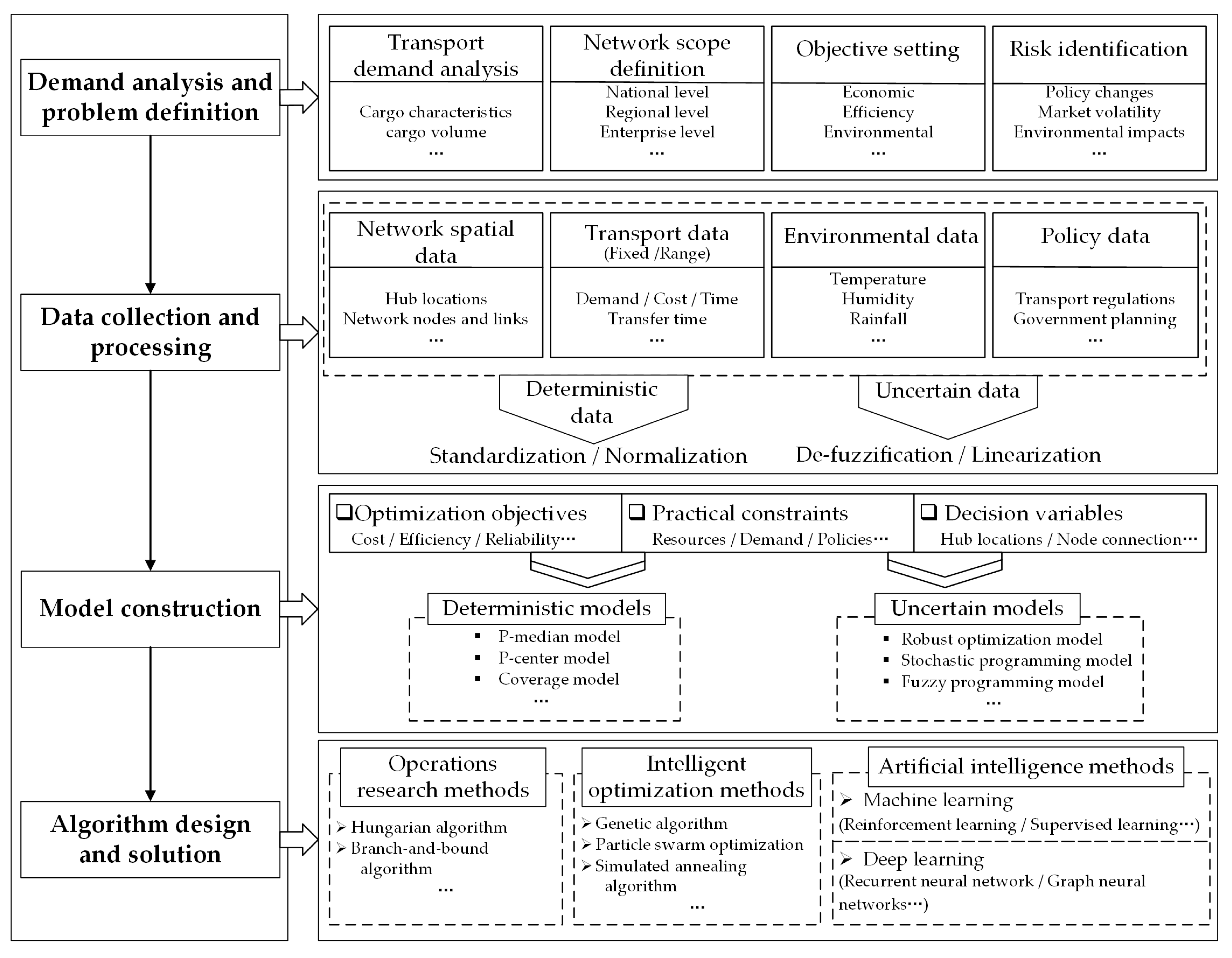
The optimization of hub locations in multimodal transport systems typically follows a structured technical route, as illustrated in
Figure 11. The process commences with an analysis of real-world transport system requirements and problem definition, including the identification of candidate hub locations, network nodes, and relevant operational constraints. Subsequently, data on transport distances, cost, demand patterns, and hub capacities are collected to inform mathematical model formulation. Based on the operating environment—whether deterministic or uncertain—appropriate optimization models are constructed with clearly defined objectives (e.g., minimizing total cost, carbon emissions, or transport time) and constraints (e.g., capacity limits, service coverage, or time windows). These models are then solved using suitable optimization algorithms (e.g., genetic algorithm, particle swarm optimization, or their hybrid variants). The obtained hub location schemes are finally validated through case studies or comparative analyses to assess their feasibility and performance under practical conditions.
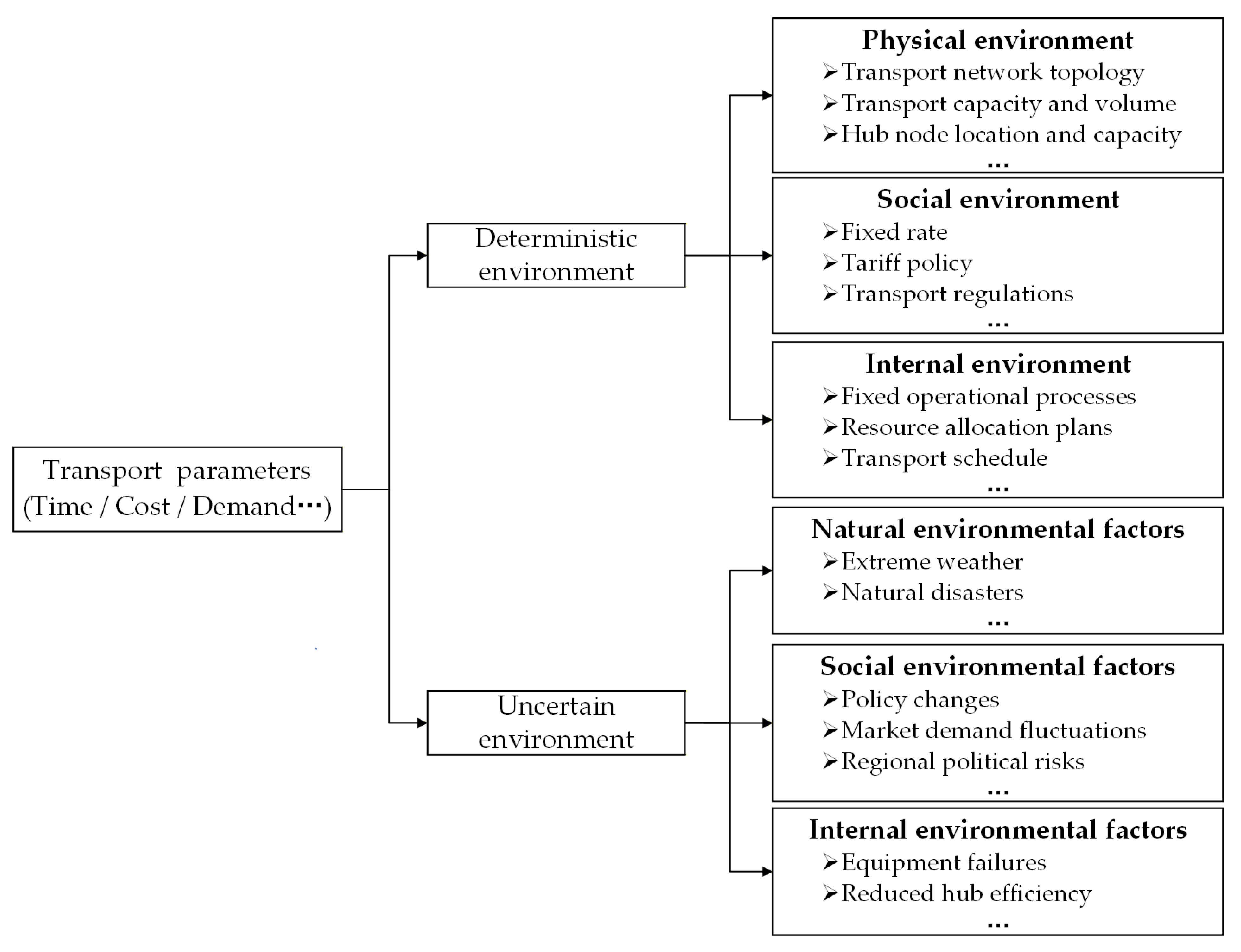
The hub location problem is a typical NP-hard problem. Mathematical models for hub location can generally be classified into two categories: deterministic models and uncertain models. Among deterministic approaches, classical foundational models include the
p-median [
25],
p-center [
26], and coverage models [
27]. Building upon these basic formulations, numerous studies have extended deterministic models to simultaneously balance multiple objectives [
28], such as total system cost, transport time, and environmental impact, while incorporating constraints related to hub capacity, service coverage, and network structure [
29]. These enhanced models are commonly solved with traditional operations research techniques or intelligent optimization algorithms. In the context of uncertain models, commonly adopted approaches include robust optimization, stochastic programming, and fuzzy mathematical models, which are effective for quantitatively representing ambiguous parameters. Moreover, motivated by the need for real-time adaptation under uncertainty, recent studies increasingly employ advanced artificial intelligence algorithms, particularly deep reinforcement learning, in conjunction with conventional intelligent optimization methods for hub location models.
With the rapid growth of the global economy, human society is facing increasingly severe environmental pollution challenges. Transport, as one of the major sources of global carbon emissions, has therefore attracted extensive scholarly attention. In deterministic multimodal transport studies, researchers have incorporated carbon emissions either as cost components or constraints. For example, in the field of grain logistics, Han et al. set out to decrease carbon emissions while enhancing grain transport efficiency and reducing logistics cost [
30]. Guided by three core premises—transport cost fluctuated with distance and speed, carbon emissions were determined exclusively by freight volume and distance, and hub transshipment-related emissions and cost were insignificant—they constructed a mixed-integer linear programming (MILP) model targeting the minimization of total cost, including carbon emission cost. It is worth noting that in this model, the regional food self-sufficiency rate is determined by the per capita food consumption and regional population, which accurately captures the core characteristic of food as a necessity of life requiring a balance between supply and demand. Through field investigations across 25 provincial capitals, they collected data on actual transport distances, shipping prices, and carbon emission factors, subsequently identifying five grain supply points, nine candidate hub locations, and 11 grain demand points as the research objects. An improved genetic algorithm (GA) was deployed to obtain the optimal solution, i.e., grain was transported from Changchun to Nanning via hub nodes in Shijiazhuang, Nanjing, Changsha, and Nanchang. This optimization yielded a 13.87% reduction in transport cost, a 10.23% drop in carbon emissions, and a 9.66% improvement in average hub transfer efficiency. Comparative analyses with the traditional GA and particle swarm optimization (PSO) algorithm further verified the proposed algorithm’s superiority and applicability, ultimately striking a balance between economic efficiency and environmental protection in China’s grain transport network, but there are still some shortcomings, including overly idealized model assumptions and a static treatment of the carbon tax mechanism. Rodrigues et al. tackled the issues of high cost, grain losses, and excessive carbon emissions in Brazil’s soybean transport system [
31]. Under the assumptions that carbon emissions are correlated solely with road transport distance and hub construction cost is contingent on hub capacity, they put forward an MILP model to minimize the total system cost. One of the most notable highlights of this model lies in its refined characterization of the nonlinear relationship between terminal construction cost and storage capacity, which is grounded in Brazilian national standards and actual market data. This approach offers greater practical relevance compared to the assumption of fixed construction cost commonly adopted in existing studies. Leveraging real-world data encompassing the locations of 141 Brazilian cities and intercity road distances, the team designed five transport mode-mix scenarios with varying modal shares under fixed emission coefficients, which were solved using a specialized solver. The outcomes highlighted that carbon emissions could be drastically curbed while keeping construction cost in check. Notably, adjusting the environmental weight parameter enabled emission reductions of over 20%, with a maximum reduction reaching 63.9%. These insights clearly illustrate the trade-off between construction cost and carbon emissions, providing valuable strategies for the sustainable development of Brazil’s soybean transport network. However, the drawback is that the analysis was conducted on data from only a single year, and it only used road transport distances to represent environmental cost, completely ignoring the carbon emissions from rail and water transport. The studies by Han et al. and Rodrigues et al. provide direct solutions for the field of low-carbon multimodal transport of grains. In addition, research on multimodal transport of other goods cannot be directly applied to grain multimodal transport systems due to the neglect of grain characteristics, but it still holds some reference value. For example, Li & Wang centered their research on the environmental predicaments confronting global transport systems [
32]. With the presuppositions that network nodes (primary hubs, secondary hubs, and demand points) were predefined and only selected demand nodes qualify as candidate secondary hubs, they proposed a mixed-integer nonlinear programming (MINLP) model aiming to minimize both total transport time and total cost—including carbon emission cost associated with both transport and handling processes. Drawing on real logistics data from China’s Ningbo Port network, such as demand volumes, distances, speeds, and carbon tax policies, an adaptive genetic algorithm (AGA) was implemented under fixed emission coefficients. The addition of two secondary hubs to the existing network resulted in a 41.46% increase in cargo handling capacity, a 2.2% decrease in total transport time, and a 2.35% reduction in total cost. Furthermore, the study revealed that higher carbon tax rates incentivize greater reliance on rail transport, which in turn demands additional secondary hubs to disperse freight flows and lower average transport emissions. These findings confirmed that the proposed model adopted a strict three-tier network structure comprising “primary hubs, secondary hubs, and demand points”. However, direct application of this model to grain logistics would require all grain flows to pass through secondary hubs, potentially leading to reduced transport efficiency, increased losses, and higher cost, which deviates considerably from actual operational practices. Multiple transport modes, including direct shipment and cross-level transport, should be permitted to coexist within the network design. To support China’s “dual-carbon” goals and promote green multimodal transport, Xi et al. proceeded with the assumptions that hub-related carbon emissions were dependent on freight throughput and transport cost bore a linear relationship with shipment volume, thereby proposing an MINLP model focused on total cost minimization [
33]. Based on China’s logistics hub planning framework, Nanjing, Xuzhou, Hefei, Zhengzhou, and Wuhan were selected as candidate hubs. Under real-world transport distances, timeframes, and given emission coefficients, goods were shipped from a Beijing-based factory to customer-specified destinations. Employing an iterative method, the Nanjing freight center, with the lowest total cost, was selected as the optimal hub. The results underscored that hub-based transshipment shortened transport distances and durations, boosted transport efficiency, cut carbon emissions, increased container utilization, and reduced overall cost, thus realizing both low-carbon transport and economies of scale. Yin et al. addressed the irrational transport structure between ports and inland regions, which leads to high carbon emissions and resource waste [
34]. Operating under the premises that transport cost was linearly related to distance, each shipment underwent at most one transshipment, and transshipment emissions were embedded within unit transport emission parameters. They also developed an MILP model targeting the minimization of transport cost, carbon emissions, and travel time. Utilizing data from China’s railway network and the China Transport Yearbook, they designated Shanghai Port and Ningbo-Zhoushan Port as main hubs, with Urumqi, Chengdu, and seven other cities as origin points, and Wuhan, Zhengzhou, and Changsha as transit nodes to design a case study network. By combining the non-dominated sorting genetic algorithm II (NSGA-II) with the ideal point method, a Pareto solution set was generated. The optimized transport network outperformed traditional approaches in terms of carbon emissions, cost, and time, validating the model’s effectiveness and supporting the achievement of China’s “dual-carbon” goals. Although Xi et al. and Yin et al. did not directly study grain logistics, their intermodal hub location models and solution algorithms provide a valuable framework for designing grain logistics networks. In practical applications, targeted modifications to cost components, constraints, and time dimensions in accordance with the specific characteristics of grain logistics can yield a hub location model well-suited to this domain. This not only helps reduce grain logistics cost but also enables green grain transport within the context of “dual carbon” goals.
In addition to carbon emissions, the strong seasonality of grain transport results in massive, time-sensitive freight surges during harvest periods, placing heavy pressure on key hubs, including ports, rail freight stations, and inland terminals. Consequently, some scholars have incorporated hub congestion resistance into deterministic multimodal transport planning. In the context of air transport network design, Cagri et al. operated under the presuppositions that congestion cost emerged when hub capacity exceeded preset thresholds, such cost was contingent on traffic volume, and non-hub nodes may be allocated to multiple hubs [
35]. They developed a MINLP model targeting overall cost minimization, with congestion cost incorporated as penalty terms. The model incorporated a congestion cost function, which enables the quantification of grain spoilage losses as an economic cost within grain logistics systems. The proposed algorithm was applied to the Australian Post dataset, which included instances with 40, 50, 100, and 200 nodes, alongside specified congestion and scale economy coefficients. Deploying an improved PSO algorithm, the findings revealed that the proposed approach outperformed both CPLEX and Benders decomposition—efficiently resolving nonlinear, large-scale problems within feasible timeframes while effectively regulating hub load conditions. Wang et al. turned their attention to cross-border, multi-layer multimodal hub location issues [
36]. With the suppositions of a three-layer network structure (demand nodes, dry ports, and cross-border inland ports/seaports), multi-level hub capacities, and congestion cost linked to flow-to-capacity ratios, they formulated a MILP model aimed at minimizing total cost. Drawing on real-world data spanning China’s logistics hub planning, customs import-export statistics, and transport distances, 18 sets of instances with varying node sizes and capacity levels were randomly generated within a cross-border international logistics network encompassing 83 nodes. The hybrid adaptive variable neighborhood search (HAVNS) algorithm stably delivered optimal solutions for instances of any scale, striking the best balance between economies of scale and congestion mitigation. Correspondingly, the multi-allocation and multi-capacity level selection strategy employed in this study aligns well with the practical demands of grain distribution, which necessitate multi-warehouse coordination and flexible resource allocation. Hu et al. probed into the high cost and port congestion plaguing China-Europe Railway Express operations [
37]. Given that only one transport mode can be selected for an origin city to a central hub, transport arcs featured unlimited capacity, and hub handling and border clearance capacities were constrained, they constructed an integer linear programming (ILP) model to minimize comprehensive cost. This time-value cost model offers a valuable reference for grain logistics by converting grain shelf life and storage cost into a time-based penalty function. Within the framework of the 2020 China-Europe Transport Network, Chongqing, Chengdu, and Xi’an were designated as candidate hubs, with 25 cities handling over 100 freight trains daily identified as cargo sources. Real-world data—including freight volumes, transport distances, and port congestion durations—was gleaned from these urban areas, supplemented by assigned cargo value and time cost coefficients. Furthermore, an improved GA was employed to consistently derive optimal location schemes across all scenarios. Notably, even amid severe congestion, the system achieved a 22.3% decrease in overall cost, underscoring remarkable cost efficiency and robust performance. Zhao et al. pinpointed route overlap, inefficient resource allocation, and low railway capacity utilization between the China-Europe Railway Express and the New Western Land–Sea Corridor—issues that lead to excessive congestion at certain hubs [
38]. Based on the assumptions that each shipment underwent no more than one transshipment, hubs had capacity limits, and delay penalties applied when waiting times exceeded expectations, they put forward a MILP model focusing on total cost minimization. Leveraging publicly available transport cost and emission data, as well as freight demand forecasts derived from historical trade statistics, a total of 37 hub cities were selected through a three-stage screening process employing a multi-criteria evaluation system to construct a comprehensive corridor network. It is worth noting that, due to the distinct regional characteristics of major grain-producing areas, processing areas, and consumption areas, the multi-criteria evaluation system applied in these regions can serve as a valuable reference for selecting candidate hubs in grain logistics networks. The results identified six hubs boasting high resilience and processing efficiency, while verifying that the integrated corridor achieved significant cost and carbon emission reductions compared to single-corridor operations—thereby enhancing overall congestion resistance. Tong et al. focused on congestion stemming from limited loading and unloading efficiency at hubs in emergency road-rail multimodal transport [
39]. Noting that existing studies predominantly relied on capacity planning or route selection while overlooking transshipment sequencing, they adopted the suppositions that transport arcs and hubs remained continuously available, non-parallel transshipment applied to the same shipment, and transshipment sequences were adjustable. They established a MINLP model to minimize task completion time, which was transformed into a two-stage hybrid flow-shop scheduling problem. A recursive waiting-time calculation method was subsequently introduced to replace traditional queueing theory. Utilizing a Chinese road-rail network comprising 20 origins, 10 upstream hubs, four downstream hubs, and one destination, experiments employing a GA across 22 instances demonstrated that optimizing transshipment sequences could shorten completion time by up to 33.68 h (approximately 4.2%). Even with fixed hub capacities and routes, operational efficiency saw substantial improvement. In food emergency logistics (such as disaster relief food and reserve food transport), due to the extremely high demand for timeliness, node congestion is a common bottleneck. Therefore, the idea of transfer sequence optimization proposed by Tong et al. can serve as a valuable reference for optimizing the scheduling sequence of grain flows among granaries, ports, and processing plants.
In summary, deterministic models are generally characterized by clear structures and relatively mature solution methods, and they can provide decision-makers with baseline hub location solutions under idealized conditions. However, grain supply chains are inherently subject to multiple sources of uncertainty, and neglecting these factors may lead to theoretically optimal solutions performing poorly in practice. To enhance the robustness of hub location systems across a range of plausible scenarios, an increasing number of studies in recent years have incorporated uncertainty in key parameters, with demand uncertainty being the most extensively investigated. Merakli & Yaman tackled demand uncertainty stemming from seasonal fluctuations in grain production and economic volatility [
40]. To minimize total transport cost amid worst-case demand fluctuations, they worked under the assumptions of unlimited hub capacities and multiple allocation mechanisms, and constructed a MILP model grounded in the min-max robust optimization principle to characterize uncertain demand. If this model incorporates constraints on grain storage capacity and time windows, it can effectively capture the seasonal fluctuations and demand uncertainties inherent in grain logistics, such as variations in grain production and consumption. The model was solved and validated via Benders decomposition (BD) across three datasets with varying scales and demand levels. The findings revealed that modest adjustments to the hub network could effectively mitigate demand volatility and cut total cost by up to 4.11%, underscoring the model’s efficiency in large-scale robust hub location problems. Han et al. explored demand uncertainty in hazardous materials shipping, which is a factor influenced by economic conditions, policy shifts, and market competition [
41]. On the premise that demand could be represented as a linear combination of mean values and random variables, and that risk was calculated based on accident probability and exposed population, they proposed a MINLP model incorporating detour strategies to minimize total risk and cost. Detour strategies can be adapted into multi-path selection mechanisms, which can also be applied in grain logistics to circumvent congestion and mitigate losses (e.g., in high-temperature regions). Robust optimization was employed to capture demand uncertainty, and the final solution was derived with a commercial solver—leveraging public datasets with given parameters such as transport cost, accident probabilities, and impact radii—within a case network encompassing 15 cities in China’s Yangtze River Delta region. The results highlighted that the proposed strategy, under identical cost constraints, yielded lower risks and more stable hub location schemes. Furthermore, amid high uncertainty, the system tended to select additional hub nodes to cope with fluctuations, providing a decision-making framework for multimodal hazardous materials transport network design that balanced risk and cost while accounting for uncertainty. Zhang et al. delved into dual uncertainties in demand and transport cost, noting that classical hub location problems often assume fully connected hub networks, single transport modes, and overlook time constraints [
42]. Based on unlimited hub capacity, at most one hub link per origin-destination pair, and uncertain parameters following known probability distributions, they established a two-stage stochastic programming model to minimize total cost. Utilizing transport network datasets from Turkey (81 nodes) and Australia (100–200 nodes), the model was solved with an accelerated BD algorithm. The outcomes verified that the proposed algorithm efficiently identified optimal hub locations and significantly outperformed commercial solvers for large-scale instances. Additionally, transport cost uncertainty was found to exert a greater impact on network design than demand uncertainty, and higher uncertainty levels may alter optimal hub configurations. Zhang et al. further incorporated a two-stage robust optimization framework into the aforementioned BD algorithm to address demand uncertainty in urban agglomeration freight systems caused by seasonality and high variability [
43]. Assuming that unrestricted hub and route capacities, demand uncertainty following interval or normal distributions, and budget constraints to regulate uncertainty ranges, they proposed a mixed-integer programming model. The model was extended by adopting multiple state-dependent budgeted uncertainty sets to better capture demand variability under different conditions. Leveraging standard datasets from the United States (25 nodes), Turkey (81 nodes), Australia (200 nodes), and a real-world case involving a 29-node urban agglomeration in the Beijing-Tianjin-Hebei region of China, the model was solved via an improved BD algorithm. The results produced reasonable multimodal hub network structures while effectively reducing cost and achieving a balanced trade-off between risk and conservatism. The two improved BD algorithms proposed by Zhang et al. demonstrate strong effectiveness in handling large-scale, multi-scenario, and multi-modal problems with more than 200 nodes, and have emerged as one of the more prominent algorithms in the multimodal transport field in recent years. This provides robust algorithmic support for grain multimodal transport systems. Alireza & Pardis studied hub location and allocation within a multimodal, multi-product logistics network with uncertain demand, focusing on a three-tier hub hierarchy comprising central air hubs, air hubs, and ground hubs [
44]. Working under the presuppositions that demand was denoted by triangular intuitionistic fuzzy numbers, hubs had capacity constraints, delivery time limited apply, and multiple transport modes (trucks and aircraft) were available, they formulated a MILP model to minimize total cost. Since this model accommodates multi-product, multi-modal hierarchical hub location under fuzzy demand, it can not only capture fluctuations in grain production but also generate tailored location plans for different grain categories within grain logistics systems. With the Australian postal dataset with 25 city nodes and given parameters such as transport speed and handling time, the model was solved through commercial solvers for small instances and a GA for large-scale cases. The outcomes confirmed efficient solution performance under complex conditions, providing a comprehensive and realistic framework for logistics network design amid uncertainty. Jiang et al. explored the design of a multimodal logistics network amid demand uncertainty, with dual objectives of improving underutilized routes and meeting carbon emission reduction targets [
45]. It is worth noting here that the study’s goal of improving the efficiency of underutilized transport routes can effectively address the problem of hub congestion caused by the seasonal nature of grain. On the assumption that the network comprised external hubs, logistics parks, and demand nodes—with logistics parks serving solely local transshipment needs and carbon emissions proportional to transport mode and distance—they proposed a bilevel MILP model that minimizes total cost while maximizing low-carbon route flow, integrating robust optimization to represent demand fluctuations. Based on the real data from China’s Changsha-Zhuzhou-Xiangtan urban agglomeration (35 nodes, 864 paths, and 56 origin-destination pairs), the findings revealed that the robust solutions leaned toward conservatism, could withstand larger demand fluctuations, and increased the share of low-carbon routes—thus achieving emission reduction goals and maintaining system robustness.
Some scholars have also explored the issues of multimodal transport hub disruptions caused by environmental factors. Maiyar & Thakkar focused on hub disruptions in grain multimodal transport systems [
46]. Under the assumptions of deterministic grain demand, the presence of emergency hubs resilient to disruptions, and at least one warehouse per region, they introduced binary decision variables to characterize hub disruption states, and constructed a multi-period MINLP model targeting total cost minimization. Leveraging real-world transport cost, carbon tax prices, and demand data from southern India, the model was solved via a differential evolution PSO algorithm across small, medium, and large-scale instances. The findings indicated that single-hub disruptions drove up total cost by an average of 14%, while multi-hub disruptions could push cost as high as 40%—providing quantitative decision support for the utilization of emergency hubs during disruption events. The most significant highlight of Maiyar & Thakkar’s work lies in the integration of traditional economic cost with environmental cost (carbon emission taxes) and social cost (accidents and congestion) within a unified mathematical optimization framework. This is crucial for policymakers to comprehensively evaluate the impacts of food transport. Furthermore, the model specifically addresses potential failures at hubs in multimodal transport by introducing the concept of emergency hubs, thereby directly responding to real-world threats to food security posed by natural disasters or infrastructure disruptions and enhancing the robustness of planning solutions. The sole limitation is that the model does not account for the perishability of food. Prolonged transport and storage can lead to food loss and quality deterioration, which has not been quantified. Additionally, although Vishal et al. did not specialize in grain logistics, their in-depth research on facility disruptions in multimodal transport systems triggered by environmental incidents such as hurricanes offers valuable insights for enhancing the resilience of grain logistics networks [
47]. In a novel approach, they incorporated direct truck transport with unlimited capacity as a backup solution. With the presupposition that hurricane intensity dictated disruption duration, hurricane paths determined affected facilities, and intensity and path were mutually independent, they established a two-stage stochastic programming model that aims to minimize long-term total cost. Drawing on historical hurricane and freight data from South Carolina, scenario probabilities were derived via k-means clustering. And, the model was resolved through a level decomposition (LD) method to optimize freight flows under diverse disruption scenarios. The outcomes revealed that as disruption probability and intensity increase, fewer disrupted terminals remain operational. Notably, the model could substantially reduce long-term cost under conditions of high disruption severity and elevated direct transport cost. Accordingly, making targeted modifications to the study by Vishal et al. (e.g., treating supplier facilities as grain warehouses, and considering IMT throughput capacity as the loading and unloading capacity of port terminals) can yield reliable solutions for hub location planning in grain multimodal transport systems operating within hurricane-prone environments.
Beyond the common uncertainties associated with demand and hub operations, uncertainties related to temporal and cost dimensions were also involved in some work. Khomenko et al. probed into congestion and delays at transshipment points in international multimodal grain supply chains, which were stemmed from uncertain operational processing times [
48]. Operating under the simplification of neglecting human factor impacts and excluding hub/transport link throughput, they modeled processing times via triangular distributions and developed an agent-based discrete-event simulation model. Leveraging real transport network data from Ukraine, they carried out simulations under varying annual freight volumes and fleet loading coefficients. The findings revealed that the vehicle loading amount reached an optimal level across all schemes—ensuring minimal land transport time—while further showing that simply expanding the transport fleet size failed to shorten average delivery time. Instead, this approach prolonged goods vehicle waiting times and correspondingly extended the vehicle turnover cycle. The core contribution of Khomenko et al.’s study lies in its detailed simulation model that faithfully replicates the entire grain multimodal transport chain from production sites to export ports, quantitatively revealing the direct causal relationship between transport vehicle fleet size and excess cargo accumulation at transfer points. However, the study assumes unlimited throughput capacity at transfer points and along transport routes in its model—a condition that is hardly realistic in practice, particularly during peak grain harvest periods, representing a critical limitation of the system. Shang et al. explored uncertainties in hub construction cost and transport times within a three-tier multimodal freight hub network comprising airport hubs, ground hubs, and demand nodes [
49]. With the assumptions of unrestricted hub and aircraft capacities, fixed quantities of candidate hubs and flight links, and symmetric travel-time data, they formulated a stochastic mixed-integer programming model to minimize the expected total construction cost. For normally distributed uncertainties, the model was converted into a deterministic MILP using the central limit theorem. Based on datasets from the United States (25 cities) and Turkey (81 cities), the model was solved via a memetic algorithm (MA) combined with Monte Carlo simulation. The outcomes verified that the proposed approach delivered superior solution quality and computational efficiency compared with the traditional GA, providing effective decision support for freight enterprises operating amid uncertainty. Due to the high cost structure of air transport, its application in grain logistics is largely restricted to emergency relief scenarios. Although the study by Shang et al. diverges somewhat from the core focus of this article, their ideas and algorithms for hierarchical network modeling can be directly adapted to the construction of grain logistics networks.
Table 3 compares and summarizes the current research on the optimization of transport hub location selection.
Current studies on multimodal hub location have developed mathematically well-structured and logically rigorous models, and their solution approaches have become increasingly diversified. However, most of these models have been proven to be NP-hard. As networks scale and complex constraints, such as time windows and capacity limitations, are incorporated, improving algorithmic efficiency remains a persistent technical challenge. Moreover, hub location models that ignore uncertainty may yield solutions that perform poorly in real-world applications, even if they are computationally efficient. Consequently, the explicit modeling of uncertainty has become particularly critical and represents a key frontier and research hotspot in the field. Future research should expand beyond single-objective optimization and fixed-parameter assumptions by integrating machine learning and deep learning techniques to develop hub location systems with real-time monitoring and intelligent decision-making capabilities.
4.2. Research Status on Transport Route Optimization
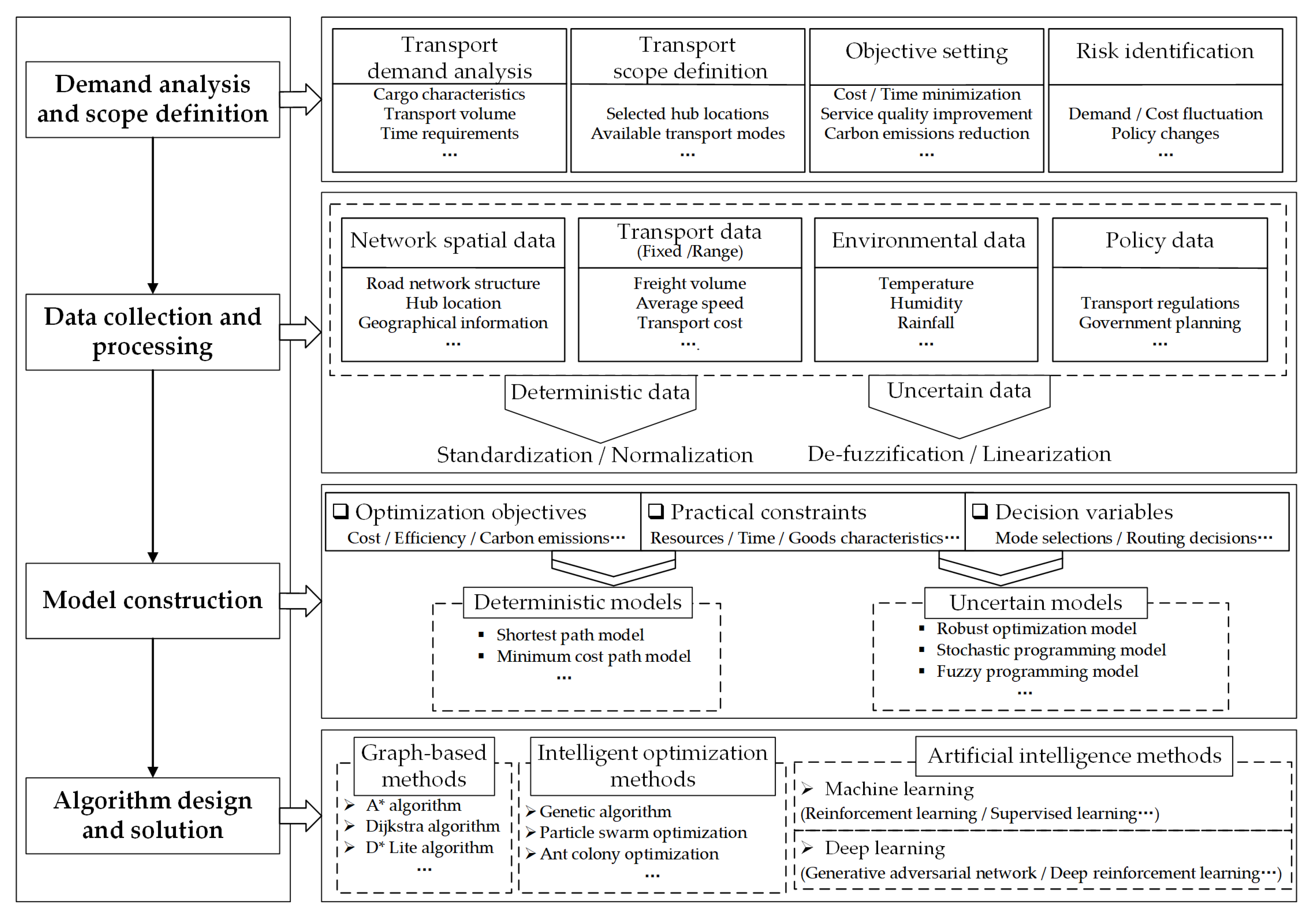
The essence of transport route optimization lies in intelligently determining transport modes and routing decisions for each segment while satisfying spatiotemporal constraints. Research in this area typically begins with an analysis of real-world transport demands and the definition of the transport scope. Subsequently, information such as network topology and geographical characteristics is collected within the established transport network to provide a foundation for constructing the mathematical model. After defining optimization objectives and constraints, deterministic or stochastic route decision models are developed based on the transport system’s operating environment. These models are solved and validated using optimization algorithms, ultimately yielding optimal combinations of transport modes and routing schemes, as shown in
Figure 12.
Due to the close interconnection and synergy between transport route optimization and hub location optimization, the models and methodological choices in these two areas exhibit a high degree of consistency. Traditional multimodal transport route optimization studies primarily focus on deterministic models, in which all parameters (e.g., transport time, cost, and demand) are known and fixed. These models are typically framed within single-objective or multi-objective optimization approaches, aiming to minimize path length or transport cost, and solutions are often derived using graph search methods or intelligent optimization algorithms. However, in recent years, some studies have addressed the challenges posed by complex and dynamic transport environments by proposing corresponding uncertain models, which are solved using intelligent optimization algorithms or emerging artificial intelligence algorithms.
From the perspective of operators, research on multimodal transport route optimization primarily aims to assist enterprises in reducing transport cost throughout the multimodal process. Therefore, the most commonly adopted optimization objective is transport-related cost. Sun et al. addressed the problem of green multimodal route planning under common assumptions such as indivisible cargo and mode changes occurring only at nodes [
50]. They developed a MINLP model targeting total cost minimization, encompassing transport cost, fuel consumption expenses, and carbon emission cost. Drawing on diverse practical transport data, including distances, speeds, freight rates, energy consumption coefficients, and carbon emission coefficients, they deployed a hybrid sand cat swarm optimization (SCSO) algorithm to identify the optimal low-comprehensive-cost path within a multimodal transport network encompassing 27 urban nodes in East China. Compared with the multi-verse optimization (MVO) algorithm, ant lion optimizer (ALO), and grey wolf optimizer (GWO), the proposed SCSO exhibited higher convergence precision and swifter convergence rate, alongside lower average cost and standard deviations. Their multi-strategy hybrid SCSO algorithm exhibits strong global search capabilities, making it particularly suitable for solving complex grain logistics network optimization problems. In studies on multimodal route selection for general cargo, additional constraints are often incorporated to better reflect real-world conditions. For instance, Cheng & Jin innovatively incorporated the effects of road congestion on transport time and system-level carbon emissions as explicit constraints in an integer programming model focused on total cost minimization [
51]. Leveraging cost and congestion coefficients derived from field investigations and existing research, they solved the model using an improved GA across both randomly generated instances of different scales and a real multimodal network in southern China. This approach alleviated the convergence instability typically seen in traditional GA under sparse network connectivity, while quantifying congestion-driven increases in travel time and emissions. By avoiding congestion, it facilitated time-feasible routing solutions. Peng et al. integrated both time-window constraints and transport mode timetables into an integer programming model minimizing total cost [
52]. Based on distance data extracted from Solomon benchmark instances, along with given unit transport cost, transshipment cost, and departure schedules, they applied an improved ant colony optimization (ACO) algorithm to a 100-node multimodal network. The results showed that the proposed algorithm outperformed the traditional ant colony algorithm (by 5.2%) and GA (by 5.5%) in solution quality. Moreover, its stability edge grew more prominent as network scale increased, proving its efficiency and reliability in pinpointing low-cost routes under complex temporal constraints. The models proposed by the aforementioned three studies [
50,
51,
52] all assume indivisible cargo volumes, thereby overlooking the operational flexibility of transporting bulk goods in batches and combining different transport modes. This assumption precludes the models from capturing the economies of scale inherent in grain multimodal transport. Additionally, Sun et al. concentrated on route planning for hazardous materials in road-rail multimodal networks [
53]. They established a MINLP model that concurrently minimizes total cost and societal risk, integrating constraints related to railway schedules, environmental risk, and multiple hazardous material flows. Leveraging a liquefied chlorine transport network in China’s Beijing–Tianjin–Hebei region—comprising 45 nodes, 132 arcs, and 25 hazardous material flows—the model was resolved via a branch-and-bound (B&B) algorithm. The findings indicated that optimal solutions were achievable within a reasonable computation timeframe, and appropriate relaxation of risk constraints enabled concurrent reductions in both cost and risk. This supports trade-offs between economic efficiency and safety in hazardous materials transport. Grain transport relies heavily on railways, necessitating careful consideration of railway schedules. The model proposed by Sun et al. comprehensively incorporates railway schedule constraints, including departure times, arrival times, and loading/unloading time windows, while simultaneously accounting for the flexibility of road transport. This approach yields a spatiotemporal service network that closely mirrors real-world operations, providing an exemplary demonstration of how to accurately integrate railway schedules and operational time windows into grain multimodal transport optimization models.
In practical multimodal transport operations, the heterogeneous requirements of multiple stakeholders, such as operators and shippers, must be considered simultaneously. Consequently, optimization objectives have increasingly evolved toward multi-objective formulations. Ge presented a relatively foundational yet clearly structured applied study examining multimodal transport route selection for bulk cargo [
54]. Prior to developing complex models for grain multimodal route selection, the framework presented in this work can serve as a useful reference for rapidly constructing a simplified prototype to validate the effectiveness of core logical structures and algorithms. On the premise that transshipment cost and time penalties exist across different transport modes, they formulated an ILP model targeting the minimization of total transport cost and time. Utilizing publicly available pricing data for waterway, railway, and road transport and transshipment services, a case study was designed to simulate the transport of a 250-ton cargo shipment from Osaka, Japan, to Chengdu, China. An improved ACO algorithm with rapid convergence was deployed to determine the optimal route and mode combination. The results demonstrated that the proposed method closely approached the global optimal solution, enabling all performance indicators of the selected routes to reach near-optimal levels. Xu et al. addressed the limitation of existing studies that predominantly focus on single-objective optimization and fail to coordinate the consideration of cost, time, and carbon emissions [
55]. Working under the simplification that cargo could be transshipped immediately upon node arrival and mode switching was restricted to intermediate nodes (with a maximum of one switch allowed), they constructed an integer programming model targeting the minimization of total cost, total transport time, and total carbon emissions. Drawing on publicly available distance, cost, and speed data, coupled with the carbon trading policy simulator, the model was applied to a 10-node transport network. The carbon trading policy simulator can be directly employed as an analytical tool to simulate changes in total logistics cost, carbon emissions, and transport modal shares (i.e., the proportions of road, rail, and water transport) under varying carbon quota and carbon price scenarios. This provides valuable decision-making support for governmental formulation of carbon reduction policies in food transport. Moreover, an improved ACO algorithm was deployed to solve the model, delivering an optimal solution that cut cost by 21.28%, shortened time by 57.97%, and reduced carbon emissions by 51.64% compared with unimodal transport—effectively demonstrating multi-objective coordination in multimodal systems. Jiang et al. explored low-carbon scheduling in container multimodal transport systems [
56]. Based on the assumptions that transport demand and time-window parameters were known and stable, and carbon tax policies translated carbon emissions into economic cost affecting mode selection, they established a MILP model aimed at minimizing total cost, total transport time, and total carbon emissions. Leveraging given parameters such as transport distances, speeds, emission factors, and mode-switching time/cost, and based on a 35-node multimodal network constructed with reference to existing research, the model was solved by an improved hybrid gray wolf-Harris hawks optimization (GWHHO) algorithm. With its superior performance in benchmark tests, this algorithm is capable of solving large-scale, complex grain logistics network optimization problems. Its robust global exploration and local exploitation capabilities are expected to yield transport solutions that outperform those generated by traditional algorithms. The outcomes revealed that the proposed algorithm surpassed comparison approaches (GWO and HHO) in convergence accuracy and stability, while achieving approximately 11.8% in total cost reduction and 18.7% in carbon emission reduction—striking a balance between economic efficiency, environmental performance, and time efficiency in low-carbon logistics. Zheng et al. focused on multimodal route selection for cold-chain food transport [
57]. Operating under the presuppositions that transport temperature remains constant, food quality degrades exponentially over time, and carbon emissions are tied exclusively to refrigeration processes, they established an integer nonlinear programming (INLP) model with dual objectives: total cost and customer satisfaction. The customer satisfaction was further decomposed into time satisfaction and food freshness satisfaction. This framework can be directly applied to grain transport by converting service levels and cargo quality into explicit optimization objectives, thereby offering greater practical insight than approaches that simply minimize cost. Utilizing transport and transshipment parameters from China’s highway mileage tables, railway service platforms, and China Southern Airlines, the model was applied to a transport network encompassing 10 major hub cities in China, and an improved PSO algorithm was employed to identify the optimal route that concurrently minimized cost and maximized customer satisfaction. Compared with unimodal road transport, the proposed multimodal solution reduced cost by 8% and carbon emissions by 2%, providing theoretical support for green, efficient, and customer-centric cold-chain logistics systems. Shao et al. shifted the optimization focus from a purely operator-centric cost minimization perspective to a customer-oriented approach, translating diversified customer needs into four optimization objectives: cost, timeliness, reliability, and flexibility [
58]. Notably, reliability and flexibility can be integrated into grain multimodal transport optimization models, thereby generating service solutions that better align with shipper requirements. Assuming unlimited network capacity, fixed departure times, service time windows for scheduled transport services, and storage cost incurred due to excessive waiting, they proposed a MINLP model. Using transport data from international freight companies and logistics information platforms, the model was applied to a ship-material transport network from Genoa, Italy, to Shanghai, China, comprising 19 nodes and 312 transport service links. The non-dominated sorting genetic algorithm III (NSGA-III) was employed to generate optimal solutions tailored to the preferences of five different cargo demand scenarios. The outcome verified that the proposed framework captured the decision-makers’ true preferences through human–computer interaction and successfully coordinated four heterogeneous and partially conflicting objectives, thereby enhancing the scientific rigor of decision-making in multimodal transport services. Grain multimodal transport entails multiple conflicting objectives, including economic efficiency, timeliness, carbon emissions, grain loss, and social risks. The interactive optimization framework proposed by Shao et al. offers a feasible methodological approach for addressing such high-dimensional multi-objective decision-making challenges.
Moreover, when transport systems operate in uncertain environments, key parameters of transport systems, such as time, capacity, and demand, often fluctuate in response to external conditions, triggering a cascade of issues including schedule delays, dispatching inaccuracies, and service-level degradation. Over the past decades, extensive efforts have been devoted to transport path optimization under single-parameter uncertainty, yielding substantial progress in modeling techniques, risk assessment, and localized optimization strategies. Matsiuk et al. explored the stochastic characteristics of critical technical operations in grain multimodal transport systems, as well as time uncertainty induced by node delays [
59]. Under the assumption that technical operations throughout the transport process could be modeled as stochastic processes, they constructed an agent-based simulation model. The advantage of this model lies in the precise accounting of carbon emissions. Its agent-based simulation framework can be directly adopted to build simulation models for grain multimodal transport, enabling accurate calculation of unit carbon emissions under different transport arrangements and providing a methodological basis for national-level carbon accounting. Leveraging historical grain export data from Ukraine’s Ministry of Agrarian Policy from 2022 to 2023, alongside given carbon emission coefficients and transport-mode parameters, a case study was designed to simulate the transport of 10 million tons of grain from multiple central Ukrainian production regions to the Mykolaiv commercial port. Discrete-event simulation outcomes revealed that cargo dwelling times across subsystems followed a normal distribution, indicating strong system robustness. The study further quantified multimodal transport’s significant carbon-reduction advantage, achieving approximately 92% fewer emissions than unimodal road transport. By explicitly accounting for randomness and system interactions, the model provided decision-makers with quantitative guidance for low-carbon transport planning. Ma et al. tackled uncertainty related to transshipment operation times and refrigeration interruption durations for perishable goods [
60]. Operating under the supposition that temperature was uniformly distributed within refrigerated containers, they developed a robust optimization framework to characterize uncertainty, coupled with a nonlinear mixed-integer programming model targeting the minimization of both transport cost and cargo quality loss. Based on temperature and quality degradation parameters from apple cold-chain studies and publicly available transport data, they established a network case involving apple imports from the Port of Antwerp to Lanzhou, China (22 nodes and 63 transport segments). Then, an NSGA-II algorithm was deployed to solve the model. Sensitivity analysis indicated that even brief refrigeration interruptions (7% of total transport time) could lead to up to 40% quality loss, suggesting that single-node dwelling time should not exceed 11% of total transport time as an optimal control threshold. Correspondingly, this framework provided decision support for a trade-off among cost efficiency, quality preservation, and robustness in cold-chain logistics. Ma et al. not only modeled triple-mixed uncertainties, but also refined the cargo loss model. Therefore, for grains with specific quality requirements, this cargo loss model and uncertainty handling method can be directly applied to select a route that ensures quality even under the risk of refrigeration interruption for such high-value grains. Gao focused on the real-time responsiveness challenge in multimodal path optimization for bulk cargo within complex dynamic networks, a graph convolutional deep Q-network (GCDQN) algorithm was developed [
61]. This algorithm can be directly integrated into a grain multimodal transport decision system. For orders requiring quick response rapid response within large-scale, complex grain multimodal transport networks, it offers significant computational advantages. Once the algorithm model is trained, it can generate the optimal route in milliseconds, achieving truly real-time decision-making. With the assumptions of no external disturbances (e.g., weather), unlimited node and path capacities, and exclusive consideration of time cost for transshipment, he formulated a mixed-integer programming (MIP) model to minimize total transport cost and time. Uncertainty in delivery time windows and transport delays was characterized via trapezoidal fuzzy numbers and normal distributions, respectively. In a rail-road multimodal network comprising 13 nodes in Northeast China, solutions are derived based on distance data from the China Transport Yearbook and compared with conventional deep reinforcement learning methods. The findings verified faster convergence and superior solution quality, achieving an 18.46% reduction in transport cost with less than a 6 h increase in total transport time. Moreover, the proposed approach exhibited strong robustness and real-time performance under time-window and stochastic delay uncertainty, with route generation completed in just 0.026s. Zhou et al. investigated fuzzy uncertainty associated with freight demand in multimodal transport systems, providing a solution approach for handling fluctuations in grain demand during the harvest season [
62]. Working under the simplification that cargo damage cost and transfer waiting times could be neglected, they adopted triangular fuzzy numbers to model demand uncertainty, integrating this into an integer programming (IP) model that minimized total transport cost and carbon emissions. A multi-form competitive swarm optimization (MCSO) algorithm was applied to networks with 20, 50, and 100 nodes, utilizing publicly available data on inter-node distances, transport and transshipment capacities, and time windows. The outcomes showed that all solutions satisfied hard time-window constraints and outperformed five benchmark algorithms in terms of hypervolume. Furthermore, the algorithm demonstrated stable performance across different network scales, generating Pareto frontiers with favorable convergence and distribution properties—thus providing reliable routing alternatives under multi-objective trade-offs. Building upon Zhou et al.’s research on demand uncertainty, Chen et al. investigated low-carbon routing decisions in multimodal transport systems involving goods with heterogeneous value and time-sensitivity attributes (e.g., industrial components, precious metals, fresh produce, and bioproducts) [
63]. With the suppositions of no cargo damage, sufficient node and link capacities, no repeated transport over the same node or link, and the availability of road, rail, and waterway modes, demand uncertainty was characterized via triangular fuzzy numbers. Time-window uncertainty was modeled through a combination of hard and soft time windows to reflect differentiated cargo requirements. They proposed a MINLP model targeting total cost minimization, which was solved by a catastrophe-adaptive genetic algorithm (CAGA) integrated with Monte Carlo sampling. Based on public policy parameters and transport data, a multimodal network with five transshipment nodes was constructed to transport four cargo types. The findings revealed faster convergence, stronger global search capability, and significantly reduced computation time compared with traditional algorithms. Additionally, low-value, time-insensitive goods tended to favor rail-water multimodal transport due to economic and environmental considerations, whereas high-value, time-sensitive goods preferred road transport. It can thus be seen that differentiated grain logistics services can also be applied in grain multimodal transport. Grain can be divided into low-value, low-urgency types (e.g., feed grain, industrial grain) and high-value, high-urgency types (e.g., emergency grain, high-quality table grain). For different categories of grain, tailored transport strategies can be automatically matched to achieve refined and efficient operations. Ge & Sun studied multimodal path optimization under uncertain network capacity while simultaneously considering pickup and delivery time windows [
64]. This methodological approach enables precise management of grain storage and retrieval timing, thereby minimizing grain loss in transit as much as possible. Under the premises that pickup times could not precede lower time-window bounds, delivery times could not exceed upper bounds, and capacity uncertainty could be characterized by LR triangular fuzzy numbers, they formulated a fuzzy MILP model to minimize total transport cost. Transport cost, time, and distance parameters were adopted from prior studies, while capacity means were derived from historical data. A B&B algorithm was used to solve the model on a Chinese multimodal network with 35 nodes and 136 arcs. The outcomes confirmed that the model effectively identified cost-minimizing paths and optimal pickup times, while the designed pickup-delivery time windows ensured on-time delivery and balanced transport and inventory cost—providing flexible and reliable routing strategies under uncertainty.
However, real-world transport systems are typically influenced by multiple interacting factors, and considering only a single source of uncertainty is insufficient to capture system complexity and operational risk. Consequently, recent studies have increasingly focused on multi-source uncertainty, aiming to develop integrated modeling frameworks that explicitly account for interactions and coupling effects among different uncertainty sources, thereby enhancing the robustness and adaptability of routing decisions in complex environments. Sun et al. tackled multi-source uncertainty in grain transport [
65]. This study represents one of the few efforts that directly presents a comprehensive design for grain multimodal transport, while simultaneously accounting for two carbon reduction policies, multi-source uncertainty, and cargo loss rates. Its limitations lie in the fact that the model does not incorporate integrated optimization of multiple orders, and the exact algorithm employed, while capable of obtaining globally optimal solutions, is not applicable to large-scale networks. They adopted trapezoidal fuzzy numbers to build a fuzzy programming model, which was integrated with a MINLP model targeting total cost minimization. Based on a 35-node transport network from prior studies, grain transport parameters reflecting Chinese practical scenarios, and given carbon tax and carbon trading prices, a two-stage linearization approach was applied to ensure model solvability and global optimality. Sensitivity analysis indicated that carbon trading policies offered greater advantages when pursuing high reliability and low waste, and adjusting confidence levels and waste thresholds enabled a balanced trade-off among cost, reliability, and environmental performance. Liu explored time-varying multimodal transport networks characterized by uncertainties in transport speeds, carbon emission fluctuations, time-window constraints, and cargo damage risk [
66]. This time-varying network constitutes the core contribution of the study. Rather than assuming constant vehicle speeds, it accounts for temporal speed variations in road transport attributable to traffic accidents, congestion, and other factors, and incorporates these dynamics into the model. In grain multimodal transport, the “first mile” and “last mile” road transports are similarly subject to rural road congestion and heavy traffic conditions. Therefore, the time-varying network model proposed in this study can be referenced to generate more accurate time estimates for these critical segments. With the supposition that transport speed was influenced by external factors such as congestion, accidents, and weather—while capacity constraints are neglected—and carbon emissions were modeled as proportional to travel time yet affected by speed, he dynamically characterized segment speeds and accumulated them over time to reflect changing traffic conditions. This method belongs to the time-dependent network (TDN) model. And a MINLP model minimizing total cost was subsequently developed. Leveraging transport parameters from literature and field surveys, three cold-chain transport tasks departing from Shanghai were designed within a 27-city Yangtze River Delta network, resolved via an improved queen-bee evolutionary genetic algorithm (QBEGA). The results demonstrated strong search capability and stability in dynamic environments, outperforming traditional algorithms in convergence speed and cost optimization. However, total cost under the dynamic model increased by 11.07% compared with the static model, underscoring the notable impact of time-varying factors on transport cost. Li et al. focused on green multimodal path optimization under soft time-window constraints, incorporating uncertainties in both capacity and carbon-emission factors [
67]. Operating under the presumptions of fixed departure times, deterministic destination time windows, triangular fuzzy representations for capacity and emission-factor uncertainty, and deterministic unit carbon cost, they formulated a fuzzy MILP model to minimize total transport cost. Utilizing transport cost, speed, and distance parameters from existing literature, alongside given cargo volumes, time windows, and emission factors, the model was solved via a B&B algorithm on a 35-node Chinese multimodal network. The results verified the rapid identification of optimal paths under dual uncertainty. The model and algorithm proposed by Li et al. have high suitability for grain multimodal transport systems with the triple objectives of economy, environmental sustainability, and reliability, and can provide grain logistics decision-makers with clear trade-off solutions among the three objectives. Additionally, Ren et al. probed into multimodal path selection under triple uncertainty (encompassing demand, transport time, and carbon trading prices) [
68]. Under the premise of no extreme disruptive events, with uncertainty regulated via box uncertainty sets and uncertainty budgets, and fixed emission factors for each transport mode, they proposed a hybrid robust–stochastic optimization framework and formulated a MILP model targeting total cost minimization. For channels importing grain from overseas, uncertainties persist in shipping times, port arrival demand, and international carbon tax policies. This robust optimization framework can be perfectly applied to such contexts, allowing the adjustment of uncertainty budgets to evaluate the optimal channel choices and cost ranges under different risk preferences. Drawing on transport and time-window parameters from literature and surveys, the model was solved on a 17-node multimodal network using a hybrid genetic algorithm-simulated annealing (GASA) approach. The outcomes revealed that the proposed method was capable of generating adaptive routing solutions across different uncertainty levels, outperforming single algorithms in both average cost and solution stability. This bridged a key gap in existing research, which has largely focused on single or dual uncertainty sources.
Table 4 compares and summarizes the current research on multimodal transport route optimization.
Existing theoretical models for multimodal transport path optimization are relatively mature, and algorithmic tools have been continuously refined, enabling operators to obtain efficient and feasible decision support under deterministic conditions. Although some studies have sought to enhance model flexibility and dynamic adaptability in response to complex and volatile transport environments, the representation of multidimensional uncertainty remains insufficient. This limitation is particularly evident in the transport of bulk commodities like grain, where demand fluctuations are pronounced, and transport networks evolve continuously, rendering static model assumptions inadequate for fully capturing real-world operational conditions. Future research should further integrate big data, artificial intelligence, and digital twin technologies to explore robust optimization and adaptive strategies under uncertainty, thereby providing sustainable and resilient routing solutions capable of responding to unexpected disruptions and seasonal risk variations.



 ,
,