Article

Efficient Determination of β-Agonists in Environmental Water and Animal-Derived Matrices by NH2-UiO-66 Based d-SPE Coupled with UPLC-MS/MS: Performance, Mechanism and Application

1
State Key Laboratory of Veterinary Public Health and Safety, Department of Veterinary Pharmacology and Toxicology, College of Veterinary Medicine, China Agricultural University, Beijing 100193, China
2
Shandong Provincial Key Laboratory of Poultry Diseases Diagnosis and Immunology, Poultry Institute, Shandong Academy of Agricultural Sciences, Jinan 250023, China
3
Department of Chemistry, Waterloo Institute for Nanotechnology, University of Waterloo, Waterloo, ON N2L 3G1, Canada
4
Technology Innovation Center of Mass Spectrometry for State Market Regulation, Center for Advanced Measurement Science, National Institute of Metrology, Beijing 100029, China
*
Authors to whom correspondence should be addressed.
Agriculture 2026, 16(5), 519; https://doi.org/10.3390/agriculture16050519
Submission received: 26 January 2026 / Revised: 13 February 2026 / Accepted: 24 February 2026 / Published: 26 February 2026
(This article belongs to the Special Issue Antibiotic Detection in Animal-Derived Agricultural Products)

Abstract

β-agonists are prohibited antibiotics that have raised concerns due to their illegal use in the livestock industry, posing potential toxicity risks to human health. For ultra-performance liquid chromatography–tandem mass spectrometry (UPLC-MS/MS) analysis of β-agonists, effective sample pretreatment is a crucial and challenging process that dictates the overall reliability and sensitivity of the method. Thus, this study developed a reliable method utilizing dispersive solid-phase extraction (d-SPE) with NH2-UiO-66 as a superior adsorbent, coupled with UPLC-MS/MS, to extract and quantify β-agonists in environmental water, swine urine, and milk. The synthesized NH2-UiO-66 exhibited outstanding adsorption capacities (146.06–358.00 mg/g) towards the target analytes. The optimized method demonstrated excellent performance: low matrix effects (−13.09–15.31%), wide linearity (0.1–50 μg/L), low limits of detection (0.04–0.09 μg/L), and satisfactory recoveries (81.48–106.67%) with good precision (intra-day RSDs 1.51–6.24%; inter-day RSDs 2.06–10.96%). Adsorption mechanism studies revealed that the extraction process, which followed the Langmuir isotherm and pseudo-second-order kinetic models, was driven primarily by electrostatic interactions, π-π stacking, and hydrogen bonding. Moreover, the material could be reused up to 10 times, with satisfactory recoveries of 81.30% to 116.10%. The proposed NH2-UiO-66-d-SPE-UPLC-MS/MS protocol is generic and provides a robust and practical solution for monitoring trace β-agonists in animal-derived foods and environmental samples, ensuring food safety and environmental health.

1. Introduction

β-agonists are a class of synthetic compounds based on the phenylethanolamine structure, clinically employed for the treatment of bronchial asthma in both humans and livestock [1]. However, owing to their ability to promote protein synthesis, enhance muscle growth, and reduce adipose tissue deposition, β-agonists are frequently illicitly incorporated into livestock and poultry feeds to increase lean meat yield [2]. Consequently, the misuse of these compounds leads to the contamination of environmental water, livestock waste, and animal-derived foods with β-agonist residues, raising serious concerns for public health and environmental stability [3]. Furthermore, the abuse of β-agonists presents substantial hazards to human health, not only causing immediate adverse effects such as palpitations, tremors, metabolic disturbances, and cardiac arrhythmias, but also potentially increasing the risk of cardiovascular diseases through chronic exposure [4,5]. Simultaneously, the presence of the analytes in aquatic environments enables their entry into food chains through ecological cycles, thereby amplifying potential harm to both environmental and human health [6]. The use of β-agonists in animal husbandry has been banned by regulatory authorities in various regions, including the European Union (EU) [7], China [8], and Russia [9]. In contrast, the United States restricts β-agonists use to only ractopamine and zilpaterol, with MRLs for ractopamine ranging from 30 μg/kg in beef to 450 μg/kg in turkey liver across different tissues and zilpaterol limited to 10–12 μg/kg in beef and cattle liver [10]. Japan only authorizes the use of ractopamine in swine and cattle, with MRLs aligned to Codex Alimentarius Commission (CAC) standards: 10 μg/kg in muscle and fat, 40 μg/kg in liver, and 90 μg/kg in kidney [11,12]. In this study, ractopamine (RCT), penbutolol (PBT), cimaterol (CMT), salbutamol (SLB), clenbuterol (CLB), tulobuterol (TBT), clorprenaline (CLP), terbutaline (TEB), and fenoterol (FET) were selected as target analytes to develop and validate a sample pretreatment method for the determination of their residues in different matrices. Consequently, the development of robust and efficient quantitative methods for monitoring β-agonists residues is imperative to ensure food safety and environmental health.
The complexity of biological matrices, such as those found in urine and milk, arises from the presence of numerous interfering components, including proteins, lipids, pigments, salts, and endogenous metabolites, that considerably complicate the detection of trace residues such as veterinary drugs, pesticides, and environmental contaminants [13]. These matrix components can induce significant matrix effects, manifesting as the suppression or enhancement of instrumental signals, thereby leading to deviations in quantitative analysis [14]. Consequently, the development of efficient sample pretreatment procedures is imperative to mitigate these effects and ensure analytical accuracy and sensitivity. Liquid–liquid extraction (LLE) [15], solid-phase extraction (SPE) [16], and the QuEChERS (quick, easy, cheap, effective, rugged, and safe) approach [17] are among the most widely used sample preparation techniques. Among these, SPE demonstrates relatively high extraction efficiency and reduced solvent consumption. However, when processing large volumes of complex samples, its operational procedures, including column conditioning, sample loading, and elution, are labor-intensive and time-consuming [18]. In contrast, dispersive solid-phase extraction (d-SPE) simplifies the process by dispersing adsorbent material directly into the sample solution, thereby greatly increasing the contact area between the adsorbent and targets [19]. This method enhances extraction efficiency, accelerates the adsorption equilibrium, and substantially reduces processing time. The principal advantages of d-SPE include operational simplicity, shortened pretreatment duration, and compatibility with high-throughput analysis [20]. The performance of d-SPE critically depends on the adsorbent material, which directly influences the accuracy and sensitivity of the analytical method [20]. Conventional adsorbents, such as C18 [21], PSA [22], graphene [23], and multi-walled carbon nanotubes [24], are often limited by low adsorption capacity and notable competitive adsorption in complex sample matrices.
Metal–Organic Frameworks (MOFs) have attracted considerable attention as ideal candidates for d-SPE adsorbents, owing to their ultra-high specific surface area, tunable pore size, high porosity, abundant active sites, and excellent chemical stability [25]. Due to their exceptional stability and superior adsorption performance, Zr-MOFs, such as UiO-66 [26], MOF-808 [27], and PCN-224 [28], have been widely utilized as efficient adsorbents in d-SPE for the adsorption of diverse hazardous pollutants (PFASs, endocrine-disrupting compounds, and sulfonamides) from complex sample matrices. Other MOFs, such as BUT-19 [29] and Cu-MOF [30], have been used for the adsorption of 1–2 types of β-agonists from water. Among these MOFs, UiO-66, as a representative of Zr-MOF, has been utilized for the adsorption of clenbuterol [31] or sulfonamides [32,33] from water and milk. UiO-66, a representative zirconium-based MOF, demonstrates exceptional thermal, chemical, and mechanical stability, attributable to its zirconium oxocluster core structure, which preserves structural integrity in the presence of organic solvents, aqueous media, and acidic conditions [34]. However, the highly ordered nature of its ideal architecture results in densely packed organic linkers around each zirconium cluster, partially occluding metal sites and restricting molecular access to active centers [35]. To mitigate this limitation, the functionalization of UiO-66 has been employed as a critical modification strategy. The introduction of polar functional groups such as -NO2 [36], -NH2 [37], and -OH [38] enhances the chemical reactivity of the pore surfaces and improves accessibility for adsorbents. Among these, NH2-UiO-66 retains the robust stability of the parent framework while markedly increasing pore polarity and basicity, owing to the electron-donating character and weak basicity of the amine group [39]. This promotes the highly efficient adsorption of β-agonists through synergistic mechanisms. The amine group in NH2-UiO-66 facilitates strong hydrogen bonding with hydroxyl and amine groups of the targets [40]. Furthermore, the electron-donating nature of the material enhances the electron density of the benzene ring ligand, thereby reinforcing π-π stacking interactions, and its protonation behavior allows for pH-dependent control over reversible adsorption–desorption cycles [41]. Consequently, NH2-UiO-66 exhibits high adsorption capacity, exceptional selectivity, and facile regenerability, making it an ideal adsorbent material for sample pretreatment techniques.
This study first establishes a method based on NH2-UiO-66-d-SPE coupled with UPLC-MS/MS for the purification and enrichment of trace β-agonists in complex matrices, including water, swine urine, and milk. The rationally designed amino-functionalized MOF adsorbent contributed to a robust d-SPE procedure, demonstrating efficient adsorption–desorption dynamics, excellent reusability, and significant reduction in matrix effects. The adsorption mechanisms were elucidated through FTIR and XPS characterization in conjunction with adsorption isotherms, kinetics, and thermodynamic analyses, providing a theoretical foundation for the interactions between NH2-UiO-66 and β-agonists.

2. Materials and Methods

2.1. Materials

All chemical reagents and characterization of the materials are described in Supplementary Materials Texts S1 and S2.

2.2. Preparation and Characterization of NH2-UiO-66

NH2-UiO-66 was synthesized following a previously reported method, with slight modifications [39]. Details of the synthetic procedures are provided in the Supporting Materials (Text S3).

2.3. Adsorption Methods

To elucidate the adsorption mechanism between NH2-UiO-66 and β-agonists, both experimental investigations and molecular simulations were carried out. The adsorption characteristics were evaluated through isotherm, kinetic, and thermodynamic studies. Furthermore, Monte Carlo (MC) simulations were conducted to elucidate the molecular-level interactions between β-agonists and the adsorbent. Detailed simulation procedures are provided in Text S4.

2.3.1. Adsorption Isotherm

All adsorption experiments were performed at 25 °C by vortexing the sorbent with mixed standard solutions of β-agonists until equilibrium was reached. The supernatant was then collected, filtered through a 0.2 μm wwPTFE syringe filter, and transferred into sample vials for UPLC-MS/MS analysis. For the adsorption isotherm studies, 1 mg of adsorbent was mixed with β-agonist solutions at concentrations varying between 10 and 150 μg/mL in methanol, then vortexed for 24 h. The adsorption behavior of NH2-UiO-66 toward β-agonists was described utilizing the Langmuir and Freundlich isotherm models. The adsorption capacity was calculated according to Equations (1) and (2):
q e = k l q m c e 1 + k l c e
q e = k f c e 1 / n
where ce (μg/mL) is the equilibrium concentration of β-agonists, qe (mg/g) and qm (mg/g) represent equilibrium and maximum adsorption capacity of NH2-UiO-66, and kl (L/mg) and kf (mg/g) are the adsorption constants for the Langmuir and Freundlich models, respectively.

2.3.2. Adsorption Kinetics

Adsorption kinetic studies were performed by mixing 1 mg of sorbent with β-agonists solutions under identical conditions over time intervals ranging from 5 to 240 min. The pseudo-first-order and pseudo-second-order models were employed to evaluate the kinetic data, expressed as follows:
l n ( q e q t ) = l n q e k 1 t
t q t = 1 k 2 q e 2 + t q e
where qt (mg/g) and qe (mg/g) are the adsorption amount at a predetermined time and at equilibrium, respectively, while k1 (min−1) and k2 (min−1) are the rate constants of the pseudo-first-order and second-order kinetics, respectively.

2.3.3. Adsorption Thermodynamics

The influence of temperature on adsorption performance was evaluated at 298.15 K, 308.15 K, and 318.15 K to determine the corresponding thermodynamic parameters. The following equations were used to calculate the thermodynamic properties:
l n K d = S R + H R T
K d = q e c e
G = R T L n K d
where Kd represents the equilibrium adsorption constant, R is the gas constant (8.314 J/(mol·K)), T is the temperature (K), ΔS refers to change in entropy (J/(mol·K)), ΔH refers to the change in enthalpy (kJ/mol), and ΔG refers to the change in free energy (kJ/mol).

2.4. Pre-Treatment Method with NH2-UiO-66

The blank environmental water was obtained from the National Institute of Metrology (Beijing, China), while the blank swine urine and milk samples were provided by the National Reference Laboratory for Veterinary Drug Residues (Beijing, China). The d-SPE procedure was carried out as follows: 1 mL of environmental water, swine urine, or milk was transferred into a 15 mL centrifuge tube. Then, 0.50 g Na2SO4 and 2 mL of acetonitrile containing 0.1% formic acid were added. The mixture was vortex-mixed vigorously for 10 min to extract the analytes, followed by centrifugation at 10,000 rpm for 10 min. The organic phase layer was transferred to a 15 mL centrifuge tube, and the pH was adjusted to 8.0 using 0.01 M HCl or NaOH solutions. Subsequently, 10 mg of NH2-UiO-66 was added to adsorb the analytes over 10 min. The targets were then eluted with 5 mL of methanol containing 0.5% formic acid under vortexing for 15 min. The eluate was evaporated to dryness under a nitrogen stream at 35 °C. The residue was redissolved in 1 mL of acetonitrile–water (96:4, v/v) containing 0.1% formic acid, and filtered through a 0.2 μm wwPTFE membrane filter prior to UPLC-MS/MS analysis.

2.5. UPLC-MS/MS Analysis

UPLC-MS/MS analysis was conducted at the Technology Innovation Center of Mass Spectrometry for State Market Regulation, Center for Advanced Measurement Science, National Institute of Metrology (Beijing, China). Quantitative analysis of β-agonists in complex matrices was performed using an ExionAD™ liquid chromatography system coupled with an AB Sciex 6500+ Triple Quadrupole-Linear Ion Trap mass spectrometer (AB Sciex, Framingham, MA, USA) equipped with an electrospray ionization (ESI) source. Chromatographic separation was achieved using a Kinetex® C18 column (50 mm × 2.1 mm, 2.6 μm; Phenomenex, Torrance, CA, USA) maintained at 30 °C. The mobile phase consisted of (A) 0.1% formic acid in water and (B) 0.1% formic acid in acetonitrile, delivered at a flow rate of 0.35 mL/min. The injection volume was 1 μL. The gradient elution program was set as follows: mobile phase B was initially held at 4% for 2 min, increased to 60% over 10 min, then returned to 4% within 0.1 min, and finally held at 4% for an additional 2 min to re-equilibrate the column. Mass spectrometric detection was conducted in positive ionization mode with multiple reaction monitoring (MRM). The ion spray voltage was maintained at 5.5 kV and the source temperature was set to 550 °C. Gas parameters were set as follows: curtain gas at 35 psi, collision gas (CAD) at medium, ion source gas 1 at 55 psi, and ion source gas 2 at 60 psi. Optimized MS parameters for β-agonists are listed in Table S1.

2.6. Method Validation

In this study, the performance of NH2-UiO-66-based d-SPE coupled with the UPLC-MS/MS method was evaluated in terms of matrix effect (ME), limit of detection (LOD), limit of quantification (LOQ), linearity, accuracy, and precision, strictly in accordance with the guidelines of EC 2021/808/EU [42].

3. Results and Discussions

3.1. Characterization of NH2-UiO-66

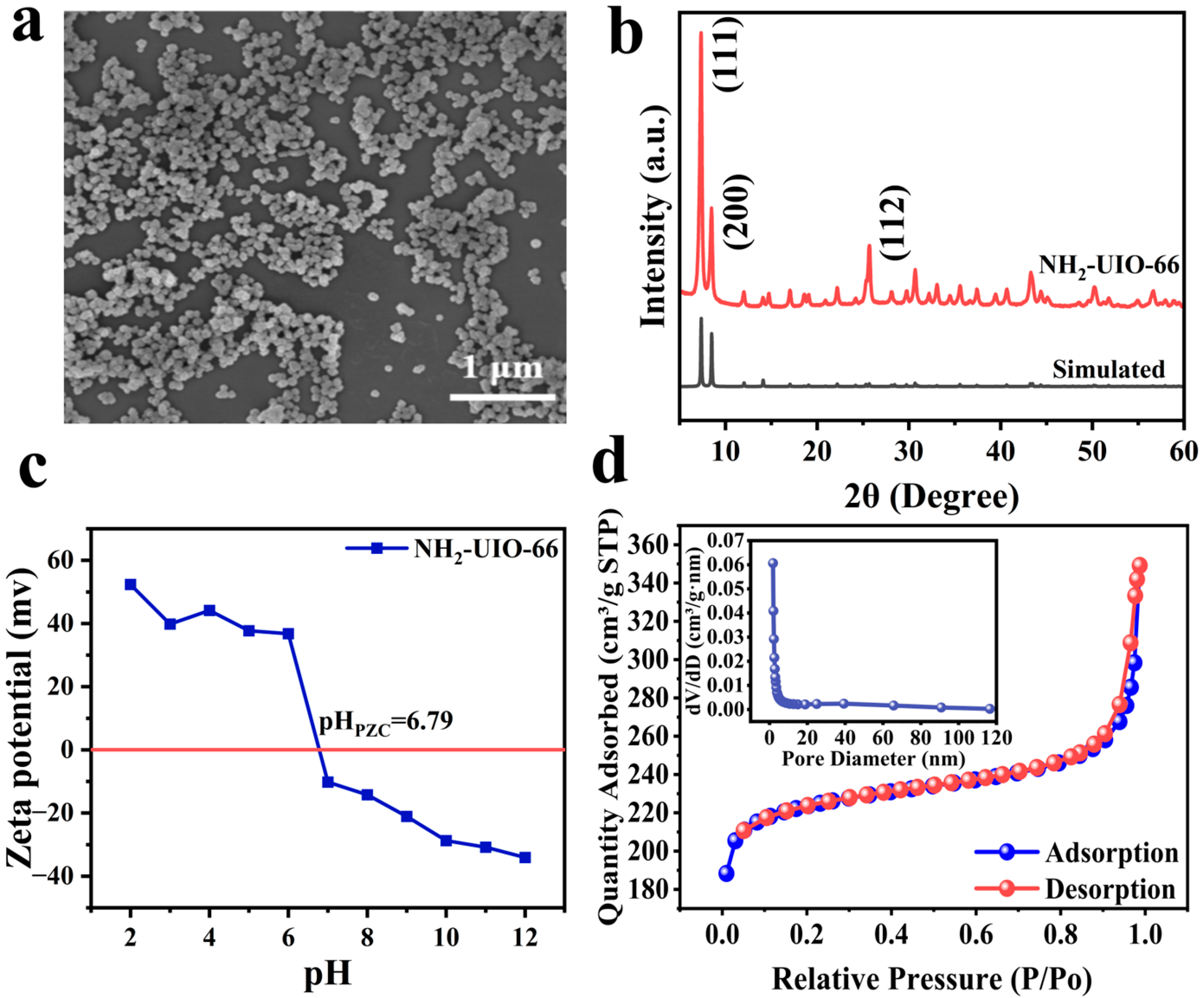
The SEM image revealed a predominantly octahedral morphology with good dispersion and a uniform particle size in the range of 50–60 nm (Figure 1a). The XRD patterns exhibited characteristic peaks at 7.4°, 8.5°, and 25.7°, corresponding to the (111), (200), and (112) crystal planes, respectively (Figure 1b). These diffraction peaks are in excellent agreement with the simulated XRD pattern based on theoretical calculations. The zeta potential of NH2-UiO-66 was measured across a pH range of 2 to 12 (Figure 1c). The results indicated a decreasing trend in zeta potential with increasing pH, and the isoelectric point was determined to be 6.79. The material exhibited a positive surface charge below pH 6.79 and a negative charge above this value. N2 adsorption–desorption isotherms (Figure 1d) displayed a rapid rise at low relative pressures and were classified as Type I, which confirmed the microporous structure of the material. A distinct hysteresis loop was observed at higher relative pressures, indicating the coexistence of mesopores. This hierarchical pore structure, comprising both micropores and mesopores, is visually confirmed by the structural models in Figure S2a–d. The specific surface area was calculated to be 686.27 m2/g, with a predominant pore size distribution centered at 8.23 nm. Overall, these comprehensive characterization results confirmed the successful synthesis of NH2-UiO-66 and provided a solid foundation for further investigation into its adsorption and desorption behavior.

3.2. Adsorption Properties and Mechanism

3.2.1. Adsorption Isotherms

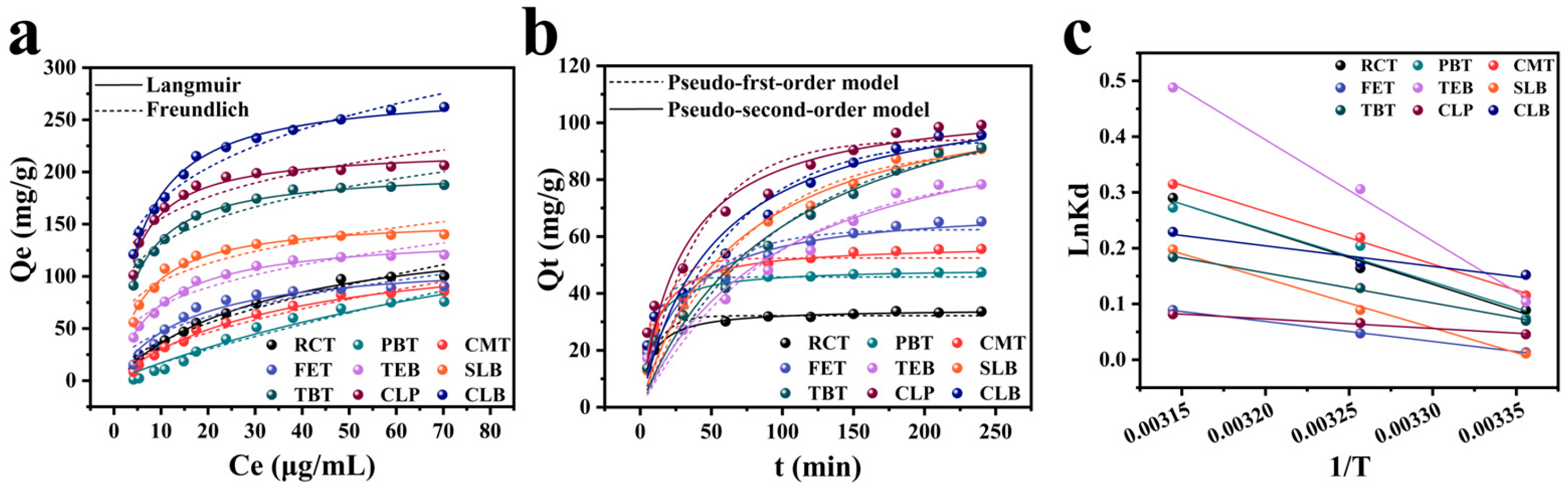
The Langmuir model (R2 = 0.9509–0.9955) provided a better fit than the Freundlich model (R2 = 0.8148–0.9752) for describing the adsorption of β-agonists on NH2-UiO-66 (Figure 2a and Table S2), indicating a predominantly monolayer adsorption mechanism. Based on the Langmuir model, the maximum adsorption capacities (qm) were calculated as follows: 148.38 mg/g for RCT, 238.42 mg/g for PBT, 146.06 mg/g for CMT, 193.44 mg/g for SLB, 358.00 mg/g for CLB, 244.06 mg/g for TBT, 250.51 mg/g for CLP, 167.36 mg/g for TEB, and 204.16 mg/g for FET.

3.2.2. Adsorption Kinetics

The adsorption kinetics of β-agonists onto NH2-UiO-66 were systematically investigated. The experimental kinetic data were fitted using pseudo-first-order and pseudo-second-order models (Figure 2b and Table S3). The R2 for the pseudo-second-order model ranged from 0.9104 to 0.9969, significantly higher than those for the pseudo-first-order model (R2 = 0.8763–0.9478). Furthermore, the predictive capability of the pseudo-second-order model for the equilibrium adsorption capacity (qt, cal) was superior to that of the pseudo-first-order model. These findings indicate that the adsorption process was best described by the pseudo-second-order kinetics, suggesting a mechanism predominantly governed by chemical adsorption.

3.2.3. Adsorption Thermodynamics

To investigate the adsorption thermodynamics, experiments were conducted at 298.15, 308.15, and 318.15 K. The thermodynamic parameters, Gibbs free energy change (ΔG, kJ/mol), enthalpy change (ΔH, kJ/mol), and entropy change (ΔS, J/mol·K) were employed to assess the spontaneity, endothermic or exothermic behavior, and changes in molecular randomness during adsorption. As summarized in Figure 2c and Table S4, the negative values of ΔG became more negative with increasing temperature, indicating that the adsorption of β-agonists onto NH2-UiO-66 was spontaneous and increasingly favorable at higher temperatures. The positive ΔH values (1.42–15.10 kJ/mol) suggested an endothermic adsorption process, while the positive ΔS values reflected an increase in randomness at the solid–liquid interface. In summary, the adsorption of β-agonists onto NH2-UiO-66 was spontaneous, endothermic, and accompanied by an increase in entropy.

3.2.4. Adsorption Mechanism

To gain deeper insight into the adsorption mechanism between the NH2-UiO-66 and β-agonists, the interactions were systematically investigated using FTIR, XPS, zeta potential measurements, and molecular simulations. The results indicated that the adsorption primarily involved electrostatic attraction, hydrogen bonding, and π-π stacking.
β-agonists are alkaline compounds featuring a phenethylamine backbone [43]. As shown in Figure S1, their pKa values ranged from 8.50 to 13.90. When the pH exceeds the pKa value, the amine group undergoes deprotonation and becomes neutral. Conversely, at a pH below pKa, the molecules remain protonated and cationic. As shown in Figure 1c, the point of zero charge (pHpzc) of NH2-UiO-66 was determined to be 6.79. When the solution pH > 6.79, the adsorbent surface becomes negatively charged, facilitating the electrostatic adsorption of positively charged β-agonists. These findings confirm that electrostatic interaction is a major driving force in the adsorption process.
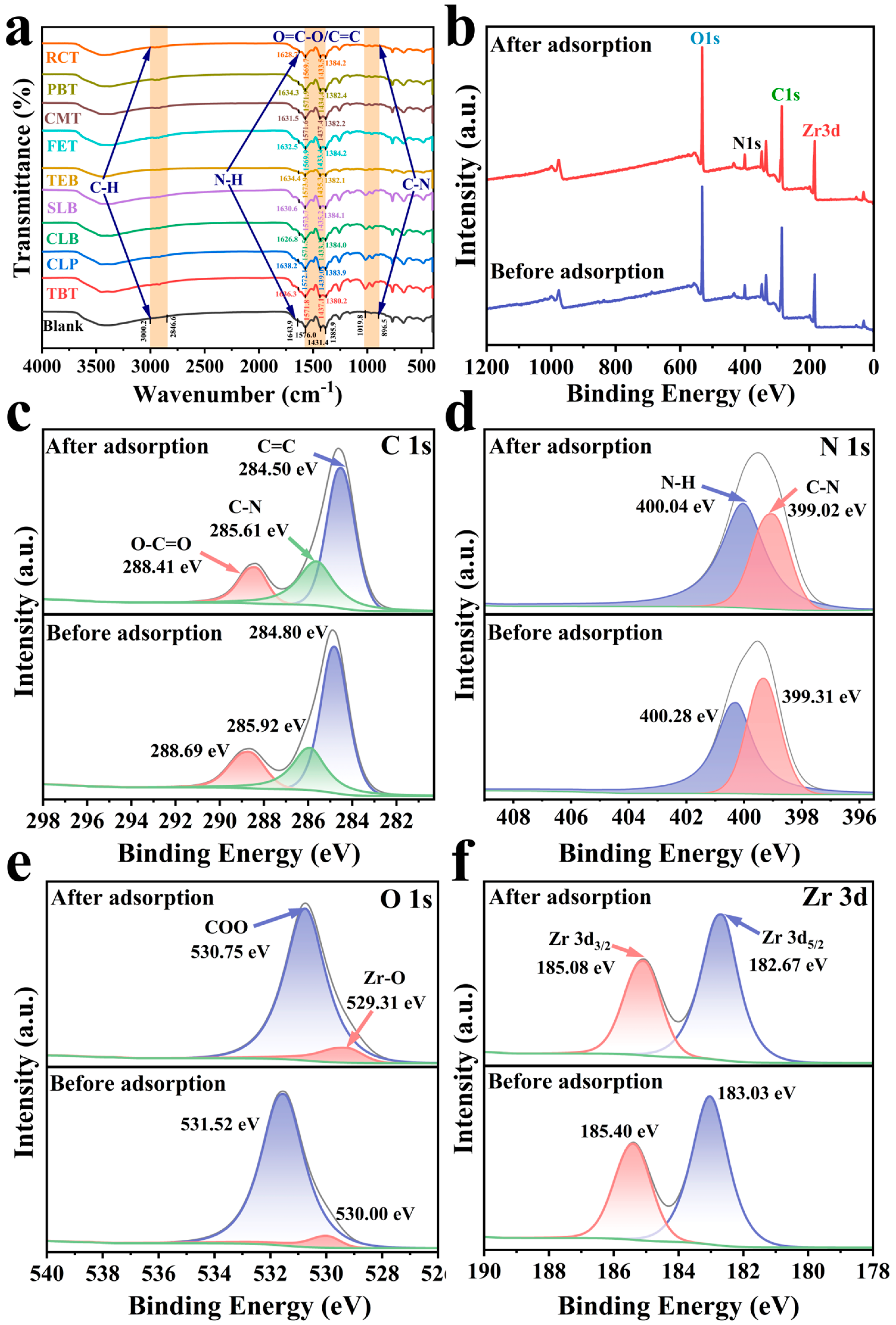
The adsorption mechanism of NH2-UiO-66 onto β-agonists was first characterized by FTIR and XPS. As illustrated in Figure 3a, the peak of C-H bonds was observed in the range of 2846.60–3000.20 cm−1, indicating the successful adsorption of β-agonists on NH2-UiO-66. A red shift in the -NH stretching vibration peaks from 1643.9 cm−1 to the range of 1636.30–1626.80 cm−1 suggests the involvement of hydrogen bonds [44]. Furthermore, the asymmetric stretching vibration peaks of the O=C=O groups in the organic ligand exhibited a blue shift from 1576.00 cm−1 to values ranging between 1569.70 cm−1 and 1573.90 cm−1 across β-agonists. Similarly, the symmetric stretching vibration peaks blue-shifted from 1385.90 cm−1 to values between 1380.20 cm−1 and 1384.20 cm−1. These shifts provide further evidence of the formation of hydrogen bonds [45]. Additionally, the C-N stretching vibrations between 1019.80 cm−1 and 896.50 cm−1 showed splitting after the adsorption. The characteristic vibrational peaks of the benzene rings also blue-shifted from 1431.40 cm−1 to values in the range of 1433.30–1439.00 cm−1, indicating that π-π stacking interactions may exist between the benzene rings of the organic ligand and those in the β-agonists [46].
XPS analysis was further employed to elucidate the adsorption mechanism. The XPS whole spectrum (Figure 3b) showed no significant changes before and after adsorption, suggesting that the crystallinity of NH2-UiO-66 was maintained [28]. The C 1s spectrum (Figure 3c) displayed peaks at 284.80 eV (C=C), 285.92 eV (C-N), and 288.69 eV (O-C=O) [47]. After adsorption, the C-N and O-C=O peaks shifted to 285.61 eV and 288.41 eV, respectively [48]. Meanwhile, the N 1s peaks (Figure 3d) shifted from 399.31 and 400.28 eV to 399.02 and 400.04 eV, respectively [49,50]. Furthermore, the O-C=O and Zr-O bonds in the O 1s spectrum were shifted from 531.52 and 530.0 eV to 530.75 and 529.31 eV, respectively (Figure 3e). Additionally, the Zr 3d peaks shifted from 185.40 and 183.03 eV to 185.08 and 182.67 eV after adsorption (Figure 3f).
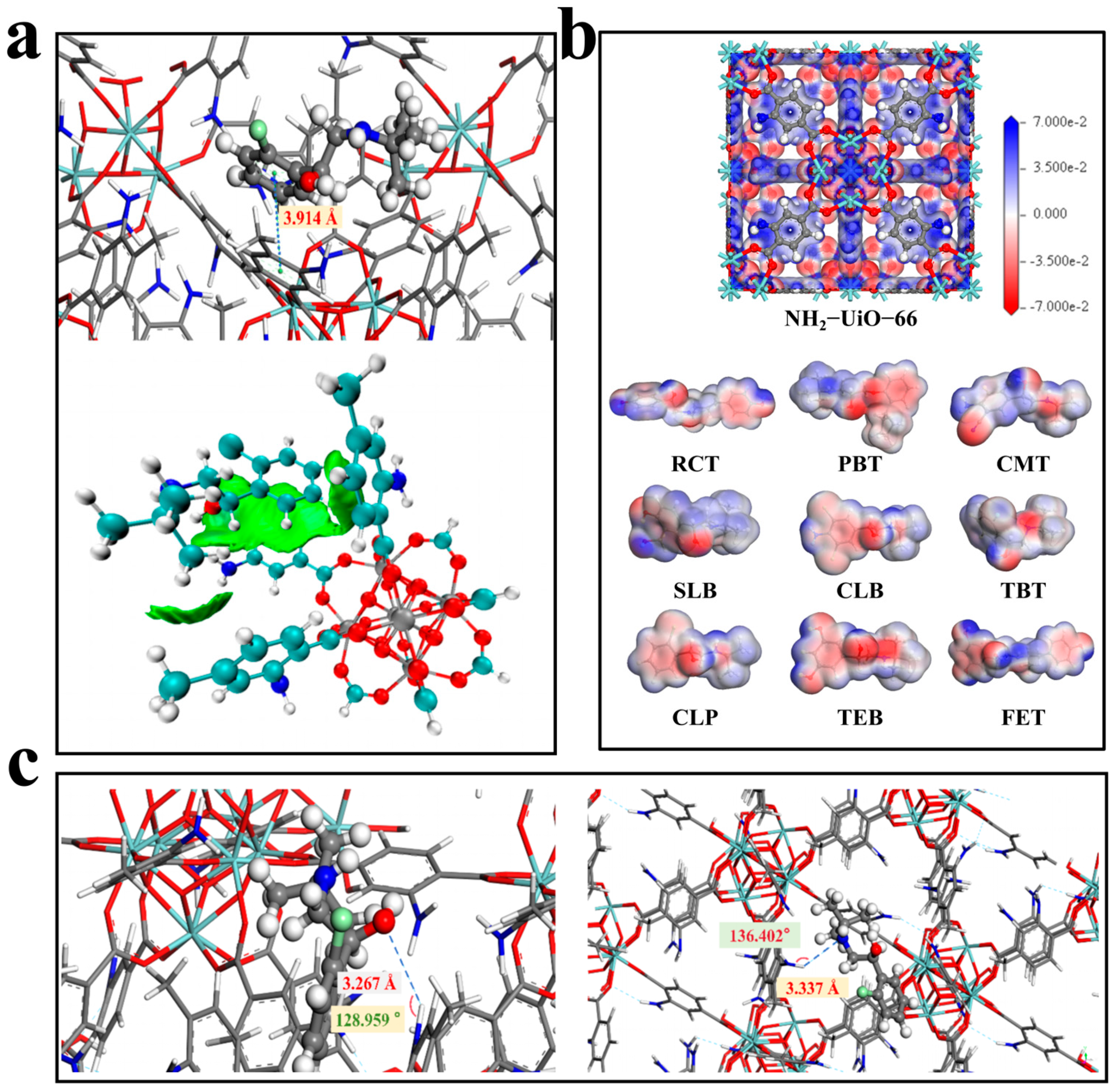
Density functional theory (DFT) and Monte Carlo simulations were used to explore the interactions at the molecular level [51]. The adsorption mechanism was found to involve multiple contributions. Firstly, π-π stacking was confirmed by the centroid distance of 3.91 Å between the benzene rings of tulobuterol and the NH2-BDC ligand (Figure 4a) [52]. Secondly, electrostatic potential analysis (Figure 4b) revealed that the positive charges of β-agonists are mainly concentrated on amino or hydroxyl groups, suggesting the possibility of electrostatic interactions with the adsorbent. Thirdly, hydrogen bonding interactions were identified, as shown in Figure 4c, with the formation of N-H···O (bond length 3.27 Å, bond angle 128.96°) and N-H···N bonds (bond length 3.34 Å, bond angle 136.40°). These interactions are attributed to the vibrational characteristics of the O-C=O and -NH2 groups in the framework. In summary, the adsorption of β-agonists onto NH2-UiO-66 was governed primarily by a combination of π-π stacking, electrostatic interactions, and hydrogen bonding (see the Supplementary Materials for detailed simulation methods).

3.3. Optimization of NH2-UiO-66 Pre-Treatment Method

3.3.1. Optimization of Adsorption Conditions

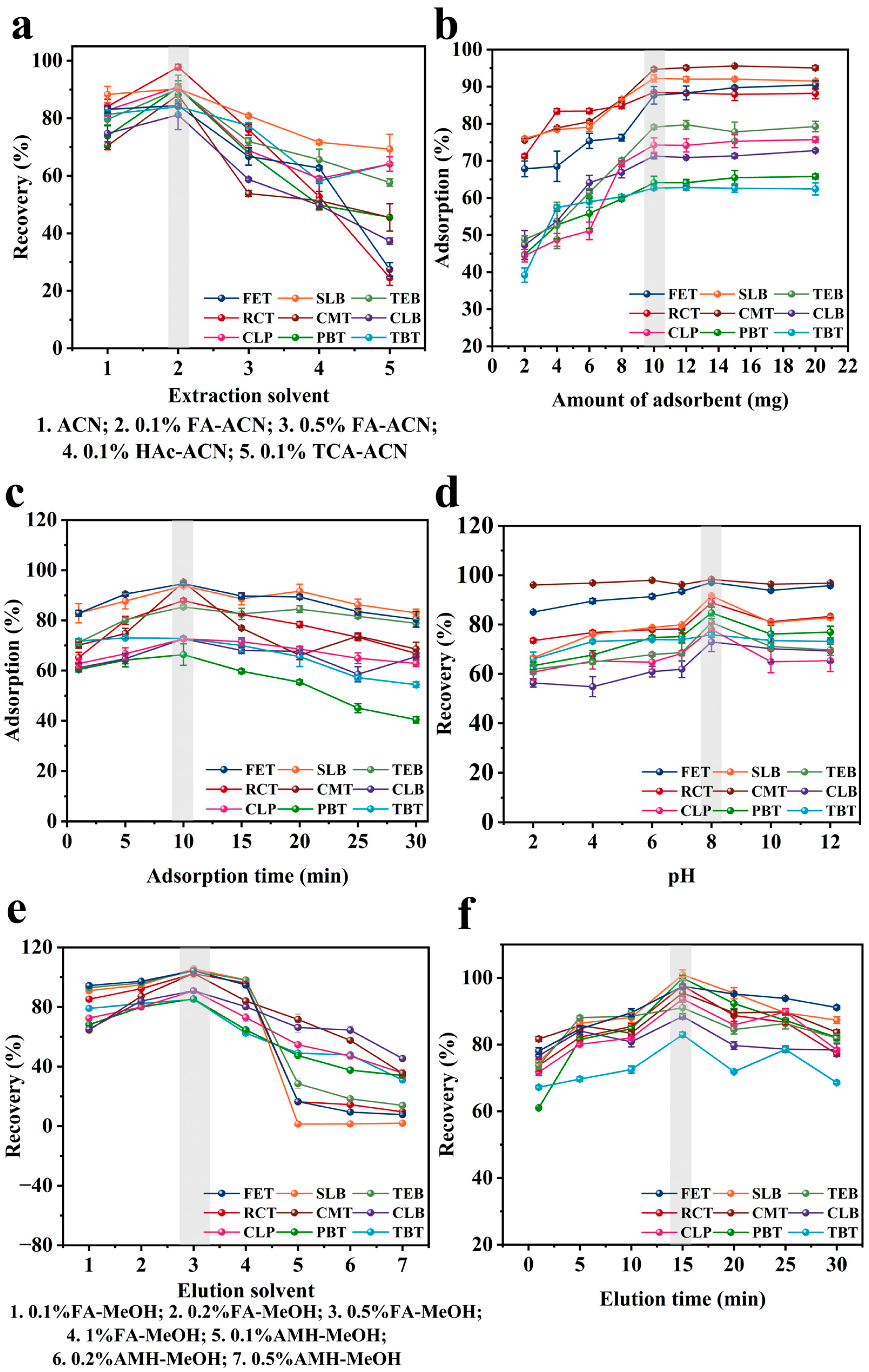
To optimize the NH2-UiO-66-d-SPE method for extracting, purifying, and preconcentrating β-agonists, key parameters were systematically evaluated. These encompassed sample pretreatment conditions (extraction solvent); adsorption parameters (adsorbent dosage and time); elution parameters (eluent, method, volume, and time); and concentration factors (nitrogen evaporation temperature). The extraction conditions were systematically optimized to achieve maximum efficiency. As shown in Figure 5a, acetonitrile with 0.1% formic acid was chosen as the extraction solvent for its optimal protonation of β-agonists. Furthermore, the influence of adsorbent dosage, adsorption time, and the enrichment efficiency of β-agonists was evaluated. The adsorption capacity was enhanced progressively with increasing adsorbent dosage up to 10 mg (Figure 5b), beyond which it plateaued or declined. This is likely due to the aggregation of adsorbent particles at higher dosages, which reduces the accessibility of their effective surface area and active sites [27]. Consequently, 10 mg was selected. Similarly, adsorption efficiency reached a maximum at 10 min and decreased upon extension to 30 min (Figure 5c), indicating 10 min as the optimal contact time. The pH of the sample solution plays a critical role in the extraction efficiency by influencing the surface charge of the adsorbent and the ionic state of the target analytes. In this study, the effect of pH (ranging from 2 to 12) on the extraction recovery of β-agonists was evaluated. As shown in Figure 5d, the highest recoveries were achieved at pH 8. This can be attributed to the fact that, under this condition, β-agonists predominantly exist as cations, while the surface of NH2-UiO-66 is negatively charged, facilitating electrostatic attraction between the adsorbent and analytes. In contrast, at pH values greater than 8, both NH2-UiO-66 and β-agonists are negatively charged, leading to electrostatic repulsion and a consequent decrease in extraction efficiency. Therefore, pH 8 was selected as the optimal acidity–alkalinity condition. The optimal conditions determined above show a synergistic effect on the adsorption efficiency.

3.3.2. Optimization of Desorption Conditions

Desorption plays a key role in the d-SPE procedure, and the selection of an efficient elution solvent is essential to achieve rapid and complete elution of β-agonists from NH2-UiO-66. In this study, a variety of elution solvents were systematically evaluated, including ethanol (EtOH), ACN, acetone (ACE), isopropanol (IPA), ethyl acetate (EtOAc), n-Hexane, and methanol (MeOH), as well as methanol containing different concentrations of formic acid (0.1%, 0.2%, 0.5%, 1%) or ammonia (0.1%, 0.2%, 0.5%). As illustrated in Figure 5e and Figure S3a, methanol with 0.5% formic acid demonstrated the highest elution efficiency. This performance can be attributed to two main factors: the high polarity of methanol, which promotes analyte dissolution and desorption [17], and the protonation environment provided by formic acid, which effectively disrupts hydrogen bonding and electrostatic interactions between the adsorbent and β-agonists, thereby facilitating efficient elution. Based on these results, 0.5% formic acid in methanol was selected as the optimal elution solvent.
Moreover, elution conditions, including method, volume, and time, were optimized to maximize desorption efficiency. As shown in Figure S3b, vortex-assisted elution yielded the highest recovery, owing to its ability to provide continuous and uniform mass transfer, facilitating thorough dispersion of the adsorbent particles [14]. Desorption time was also identified as a critical parameter influencing the desorption efficiency of the method. Evaluation over a period of 1 to 30 min revealed that desorption efficiency increased up to 15 min, beyond which it declined, likely due to re-adsorption of the target analytes onto the sorbent surface (Figure 5f). Consequently, the optimal desorption time was determined to be 15 min. Furthermore, the effect of eluent volume was examined over the range of 1–10 mL. As illustrated in Figure S3c, the recoveries increased with volume up to 5 mL, beyond which no significant improvement was observed. Thus, 5 mL was established as the optimal elution volume. Nitrogen evaporation temperature plays a critical role in the concentration process, directly influencing the recovery and accuracy of the analytical method [17]. Optimization of this parameter is essential for enhancing desorption performance. As shown in Figure S3d, temperatures ranging from 25 to 50 °C were evaluated. The highest recovery of analytes was obtained at 35 °C, which was consequently selected as the best nitrogen evaporation temperature. The above optimal conditions acted synergistically to enhance the desorption of the target analytes from the adsorbent.

3.4. Method Validation

3.4.1. Matrix Effect

LC-MS/MS is widely regarded as the gold standard for detecting trace veterinary drug residues in animal-derived foods, owing to its high selectivity, sensitivity, and precision [53]. During the desorption of β-agonists from NH2-UiO-66 using elution solvents, endogenous compounds from complex sample matrices may be co-eluted, potentially introducing matrix effects. The matrix effects can interfere with ionization efficiency, alter signal response stability, and elevate background noise, ultimately compromising the sensitivity and accuracy of LC-MS/MS quantification [54]. As shown in Table 1, the matrix effects for the nine β-agonists in environmental water, swine urine, and milk ranged from −13.09% to 15.31%, which could be indicated as weak matrix effects [55].

3.4.2. Linearity, LOD, and LOQ

Matrix-matched calibration curves were prepared by fortifying blank samples with β-agonists standards at various concentrations. As summarized in Table 1, the method exhibited excellent linearity across the range of 0.1–50 μg/L in environmental water, swine urine, and milk, with coefficients of determination (R2) ranging from 0.9978 to 0.9999 (Figures S4–S6). Sensitivity was assessed through the LOD and LOQ, defined as signal-to-noise ratios (S/N) of 3 and 10, respectively [11]. The calculated LODs and LOQs for the β-agonists ranged from 0.04 to 0.09 μg/L and 0.12 to 0.27 μg/L, respectively, confirming the high sensitivity and reliable linearity of the method. Detailed linear equations, R2 values, LOD, and LOQ are provided in Table 1. Representative MRM chromatograms of the 5 ppb β-agonists in MRM in water, swine urine, and milk are presented in Figure S7a–c in the Supplementary Materials.

3.4.3. Accuracy and Precision

The accuracy and precision of the developed method were assessed using blank matrix samples spiked with β-agonists at high, medium, and low concentrations. The recoveries of β-agonists ranged from 81.48% to 106.67% in water, swine urine, and milk at spiking levels from the LOQ to 10 μg/L (Table 2). The intra-day and inter-day precision, calculated as relative standard deviation (RSD), ranged from 1.51% to 6.24% and from 2.06% to 10.96%, respectively. All values were below 20%, meeting the acceptance criteria stipulated in EC regulation [42].

3.4.4. Reusability

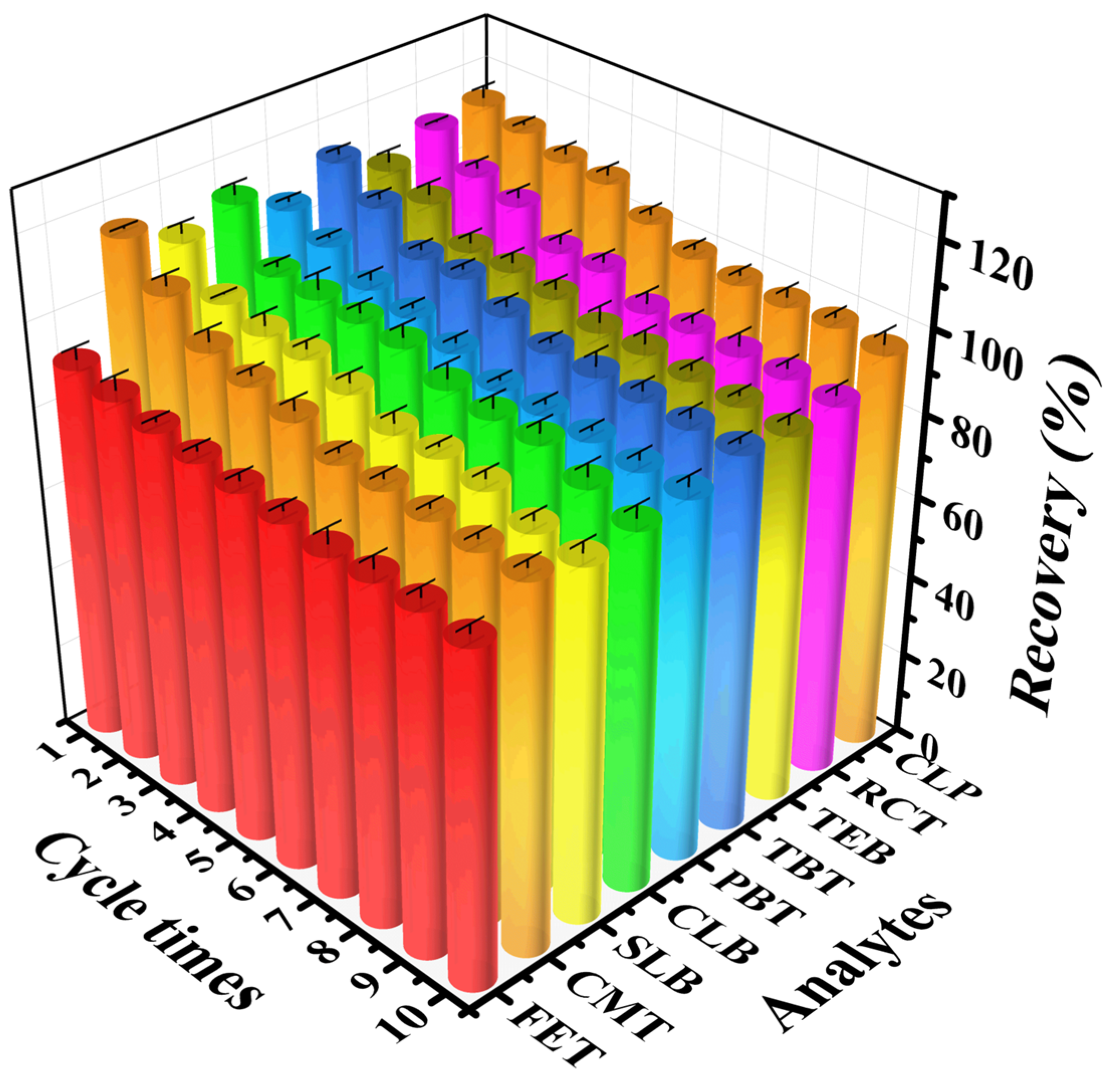
Reusability is a key factor in assessing the practical applicability of adsorbent materials, as it significantly influences operational costs and sustainability [56]. The reusability of NH2-UiO-66 for β-agonists adsorption was evaluated over 10 consecutive adsorption–desorption cycles. As shown in Figure 6, the recoveries remained above 80% even after 10 cycles, demonstrating robust reusability and operational stability. As shown in Figure S8, NH2-UiO-66 maintained good crystallinity after repeated use. However, a gradual decline in performance may occur with further use beyond 10 cycles. These results demonstrate the exceptional recyclability of NH2-UiO-66, highlighting its strong potential for practical application in monitoring β-agonists in real samples.

3.4.5. Comparison with Other Methods

In this study, NH2-UiO-66 was employed as a d-SPE adsorbent coupled with the UPLC-MS/MS method for the quantitative determination of multiple β-agonists in various sample matrices. As summarized in Table 3, the proposed method was compared with previously reported approaches. The current methodology demonstrated higher sensitivity and precision than the PFSPE-UPLC-MS/MS method developed by Chu et al. [57] and the MSPE-UPLC-Q-TOF-MS method described by Zhang et al. [58]. Moreover, both precision and recovery were markedly improved compared to those achieved by Wu et al. [59] using SPE-UPLC-HRMS for β-agonist detection in milk. Compared with other sorbents, covalent organic frameworks (COFs) in MSPE [60], μ-d-SPE [61], and conventional SPE [62] coupled with LC-MS/MS, the present method also exhibited superior precision. Overall, the developed method offered high sensitivity, excellent precision, and reliable accuracy, proving to be a robust and effective pretreatment strategy for monitoring β-agonists in animal-derived foods and environmental samples.

3.5. Real Sample Analysis

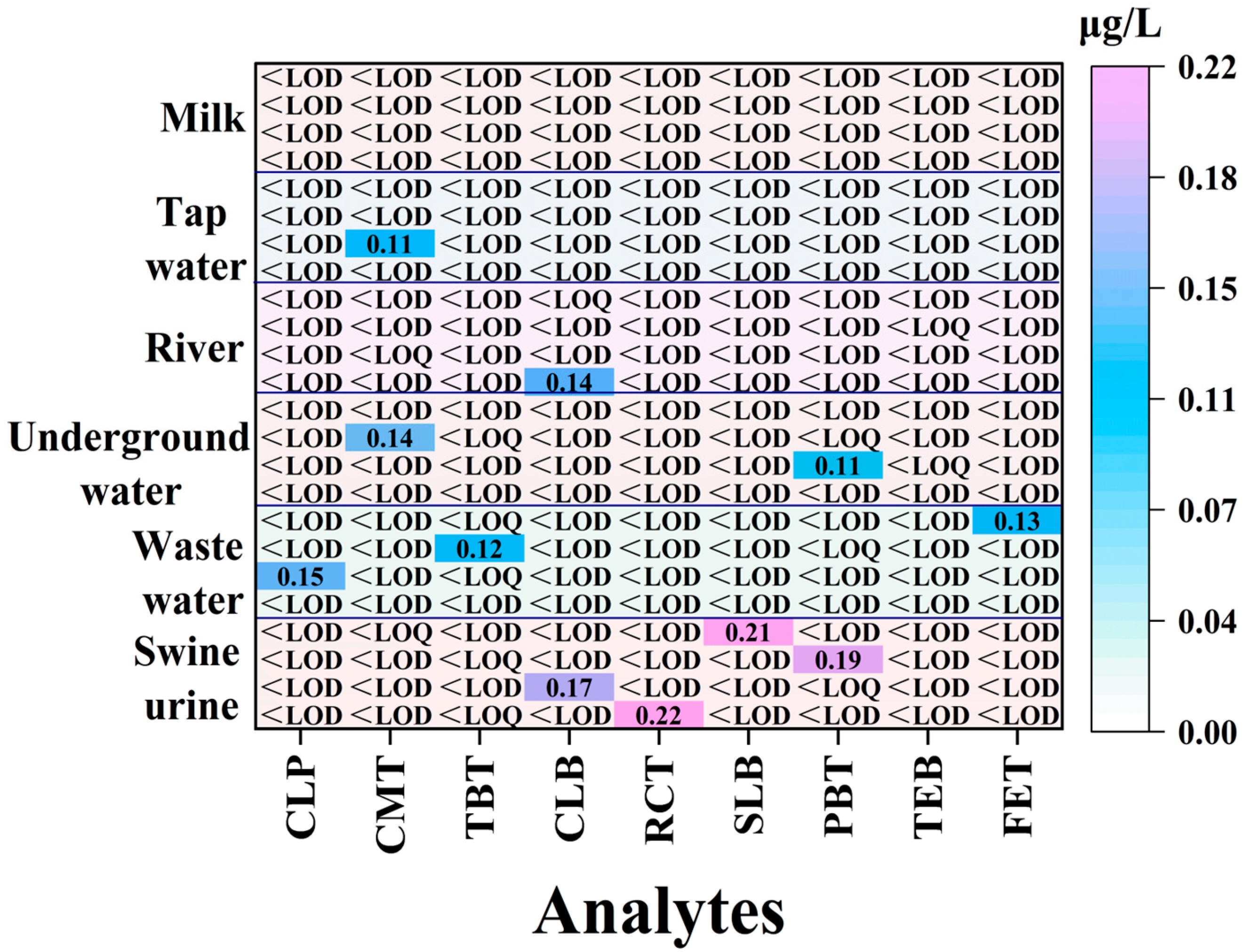
To evaluate the practical applicability of the developed method, real samples, including wastewater, groundwater, river water, tap water, swine urine, and milk, were analyzed. As shown in Figure 7, clenbuterol, ractopamine, salbutamol, and penbutolol were detected in swine urine at concentrations of 0.17, 0.22, 0.21, and 0.19 μg/L, respectively. Clorprenaline, tulobuterol, and fenoterol were detected in the wastewater samples at measured concentrations of 0.15, 0.12, and 0.13 μg/L, respectively. In groundwater, cimaterol and penbutolol were detected at concentrations of 0.14 and 0.11 μg/L. Clenbuterol was detected in river water at a concentration of 0.14 μg/L; cimaterol was found in tap water at 0.11 μg/L. No target β-agonists were detected in milk samples above the method’s detection limits. These results confirmed that the proposed method was accurate, reliable, and effectively applicable for monitoring trace levels of β-agonists in complex environments and animal-derived foods.

4. Conclusions

This study developed a highly sensitive and reliable method for the multi-residue determination of β-agonists in environmental water, swine urine, and milk by integrating NH2-UiO-66-d-SPE with UPLC-MS/MS. The NH2-UiO-66 material was chosen as the adsorbent owing to its outstanding chemical stability and reusability. The proposed method demonstrated high sensitivity, along with satisfactory accuracy and precision. Adsorption studies indicated that the process followed the Langmuir isotherm and pseudo-second-order kinetics, with thermodynamics results confirming its spontaneous and endothermic nature. Monte Carlo simulations further suggested that the adsorption mechanism involves hydrogen bonding, π-π interactions, and electrostatic attractions. In addition, this is the first study to employ NH2-UiO-66 as a d-SPE sorbent coupled with UPLC-MS/MS for multi-residue analysis of β-agonists across diverse sample matrices. This study not only offers a robust analytical tool for monitoring veterinary drug residues in food and environmental samples but also provides fundamental mechanistic insights into the adsorption behavior of β-agonists on NH2-UiO-66, highlighting its potential commercial application and broad prospects in food and environmental safety monitoring.

Supplementary Materials

The following supporting information can be downloaded at https://www.mdpi.com/article/10.3390/agriculture16050519/s1: Figure S1: The pKa value of β-agonists; Figure S2: The structural schematic diagram of NH2-UiO-66 (a); pore channel visualization of (b); mesopores in A-face (c); micropores in B-face (d) (the black and white stand for the MOF framework and the pores, respectively; red dots represent the analytes); Figure S3: (a) Optimization of elution solvent; (b) elution method; (c) elution volume; (d) nitrogen blowing temperature; Figure S4: Quantitative linear range of β-agonists in water with UPLC-MS/MS method; Figure S5: Quantitative linear range of β-agonists in swine urine with UPLC-MS/MS method; Figure S6: Quantitative linear range of β-agonists in milk with UPLC-MS/MS method; Figure S7: Extracted chromatograms of 5 ppb β-agonists in MRM in (a) water, (b) swine urine, and (c) milk; Figure S8: XRD spectra of NH2-UiO-66 after repeated use.
Table S1: Mass spectrometry conditions for nine β-agonists tested; Table S2: Adsorption isotherms parameters obtained from the Langmuir and Freundlich models; Table S3: The pseudo-first-order and pseudo-second-order models parameters for β-agonists; Table S4: Thermodynamic parameters of β-agonists on NH2-UiO-66 [39,64,65,66,67,68,69].

Author Contributions

Conceptualization, C.L., J.X., and H.J.; methodology, C.L. and S.W.; software, Y.X.; validation, C.L. and Z.L.; investigation, S.W. and B.S.; formal analysis, C.L., Z.L., and Q.R.; resources, J.X. and H.J.; data curation, C.L. and Y.X.; writing—original draft preparation, C.L.; writing—review and editing, Y.X., S.W., and H.J.; supervision, J.R. and Z.F.; visualization, C.L.; funding acquisition, J.X. and H.J. All authors have read and agreed to the published version of the manuscript.

Funding

This research was financially supported by the National Key Research and Development Program of China (2022YFF0607900).

Informed Consent Statement

Not applicable.

Data Availability Statement

All data related to the research are presented in the article.

Conflicts of Interest

The authors declare no conflicts of interest.

References

  1. Gu, X.; Wang, K.; Tian, S.; Shao, X.; Li, J.; Deng, A. A SERS/Electrochemical Dual-Signal Readout Immunosensor Using Highly-Ordered Au/Ag Bimetallic Cavity Array as the Substrate for Simultaneous Detection of Three β-Adrenergic Agonists. Talanta 2023, 254, 124159. [Google Scholar] [CrossRef]
  2. Pratiwi, R.; Ramadhanti, S.P.; Amatulloh, A.; Megantara, S.; Subra, L. Recent Advances in the Determination of Veterinary Drug Residues in Food. Foods 2023, 12, 3422. [Google Scholar] [CrossRef]
  3. Armaya’u, U.; Ariffin, M.M.; Loh, S.H.; Mohd Khalik, W.M.A.W.; Yusoff, H.M. β-Agonist in the Environmental Waters: A Review on Threats and Determination Methods. Green Chem. Lett. Rev. 2022, 15, 233–252. [Google Scholar] [CrossRef]
  4. Centner, T.J.; Alvey, J.C.; Stelzleni, A.M. Beta Agonists in Livestock Feed: Status, Health Concerns, and International Trade. J. Anim. Sci. 2014, 92, 4234–4240. [Google Scholar] [CrossRef] [PubMed]
  5. Zuo, P.; Zhang, Y.; Liu, J.; Ye, B.-C. Determination of β-Adrenergic Agonists by Hapten Microarray. Talanta 2010, 82, 61–66. [Google Scholar] [CrossRef] [PubMed]
  6. Zhong, Y.; Hou, C.; Gao, X.; Wang, M.; Yao, Y.; Chen, M.; Di, B.; Su, M. Application of Wastewater-Based Epidemiology to Estimate the Usage of Beta-Agonists in 31 Cities in China. Sci. Total Environ. 2023, 894, 164956. [Google Scholar] [CrossRef] [PubMed]
  7. Silano, M.; Silano, V. Food and Feed Chemical Contaminants in the European Union: Regulatory, Scientific, and Technical Issues Concerning Chemical Contaminants Occurrence, Risk Assessment, and Risk Management in the European Union. Crit. Rev. Food Sci. Nutr. 2017, 57, 2162–2217. [Google Scholar] [CrossRef]
  8. The Ministry of Agriculture. Maximum Residue Limits of Veterinary Drugs in Animal Food; Announcement No. 235; The Ministry of Agriculture: Beijing, China, 2002.
  9. Niño, A.M.M.; Granja, R.H.M.M.; Wanschel, A.C.B.A.; Salerno, A.G. The Challenges of Ractopamine Use in Meat Production for Export to European Union and Russia. Food Control 2017, 72, 289–292. [Google Scholar] [CrossRef]
  10. United States Code of Federal Regulations. Title 21, Chapter 1, Subchapter E, Animal Drugs, Feeds, and Related Products, Part 556. In Tolerance for Residues of New Animal Drugs in Food; United States Code of Federal Regulations: Washington, DC, USA, 2023. [Google Scholar]
  11. Zhang, W.; Wang, P.; Su, X. Current Advancement in Analysis of β-Agonists. TrAC Trends Anal. Chem. 2016, 85, 1–16. [Google Scholar] [CrossRef]
  12. Sung, I.K.; Park, S.J.; Kang, K.; Kim, M.Y.; Cho, S. Development and Application of a Method for Rapid and Simultaneous Determination of Three β-Agonists (Clenbuterol, Ractopamine, and Zilpaterol) Using Liquid Chromatography-Tandem Mass Spectrometry. Korean J. Food Sci. Anim. Resour. 2015, 35, 121–129. [Google Scholar] [CrossRef]
  13. Foroutan, A.; Guo, A.C.; Vazquez-Fresno, R.; Lipfert, M.; Zhang, L.; Zheng, J.; Badran, H.; Budinski, Z.; Mandal, R.; Ametaj, B.N.; et al. Chemical Composition of Commercial Cow’s Milk. J. Agric. Food Chem. 2019, 67, 4897–4914. [Google Scholar] [CrossRef]
  14. Williams, M.L.; Olomukoro, A.A.; Emmons, R.V.; Godage, N.H.; Gionfriddo, E. Matrix Effects Demystified: Strategies for Resolving Challenges in Analytical Separations of Complex Samples. J. Sep. Sci. 2023, 46, 2300571. [Google Scholar] [CrossRef] [PubMed]
  15. Khatibi, S.A.; Hamidi, S.; Siahi-Shadbad, M.R. Application of Liquid-Liquid Extraction for the Determination of Antibiotics in the Foodstuff: Recent Trends and Developments. Crit. Rev. Anal. Chem. 2022, 52, 327–342. [Google Scholar] [CrossRef] [PubMed]
  16. Khatibi, S.A.; Hamidi, S.; Siahi-Shadbad, M.R. Current Trends in Sample Preparation by Solid-Phase Extraction Techniques for the Determination of Antibiotic Residues in Foodstuffs: A Review. Crit. Rev. Food Sci. Nutr. 2021, 61, 3361–3382. [Google Scholar] [CrossRef] [PubMed]
  17. Elattar, R.H.; Kamal El-Deen, A. Porous Material-Based QuEChERS: Exploring New Horizons in Sample Preparation. TrAC Trends Anal. Chem. 2024, 172, 117571. [Google Scholar] [CrossRef]
  18. Islas, G.; Ibarra, I.S.; Hernandez, P.; Miranda, J.M.; Cepeda, A. Dispersive Solid Phase Extraction for the Analysis of Veterinary Drugs Applied to Food Samples: A Review. Int. J. Anal. Chem. 2017, 2017, 8215271. [Google Scholar] [CrossRef]
  19. Lin, S.; Zhao, Z.; Lv, Y.; Shen, S.; Liang, S. Recent Advances in Porous Organic Frameworks for Sample Pretreatment of Pesticide and Veterinary Drug Residues: A Review. Analyst 2021, 146, 7394–7417. [Google Scholar] [CrossRef]
  20. Zheng, J.; Kuang, Y.; Zhou, S.; Gong, X.; Ouyang, G. Latest Improvements and Expanding Applications of Solid-Phase Microextraction. Anal. Chem. 2023, 95, 218–237. [Google Scholar] [CrossRef]
  21. Georgakopoulos, P.; Zachari, R.; Mataragas, M.; Athanasopoulos, P.; Drosinos, E.H.; Skandamis, P.N. Optimisation of Octadecyl (C18) Sorbent Amount in QuEChERS Analytical Method for the Accurate Organophosphorus Pesticide Residues Determination in Low-Fatty Baby Foods with Response Surface Methodology. Food Chem. 2011, 128, 536–542. [Google Scholar] [CrossRef]
  22. Rejczak, T.; Tuzimski, T. QuEChERS-Based Extraction with Dispersive Solid Phase Extraction Clean-up Using PSA and ZrO2-Based Sorbents for Determination of Pesticides in Bovine Milk Samples by HPLC-DAD. Food Chem. 2017, 217, 225–233. [Google Scholar] [CrossRef]
  23. Bekele, H.; Megersa, N. Green Analytical Method Based on Salt Assisted Graphene Oxide Dispersive Solid Phase Extraction of Symmetrical Triazine Herbicides in Environmental Water Samples for Liquid Chromatographic Determination. Int. J. Environ. Anal. Chem. 2024, 104, 7029–7045. [Google Scholar] [CrossRef]
  24. Arain, M.B.; Soylak, M. Synthesis of Magnetic Multi-Walled Carbon Nanotubes with Layered Double Hydroxide (M-MWCNTs@MnAl-LDH) Nanocomposite as an Adsorbent for Lead Extraction. Food Chem. 2025, 463, 141311. [Google Scholar] [CrossRef]
  25. Wang, Z.; Huang, Y.; Yang, J.; Li, Y.; Zhuang, Q.; Gu, J. The Water-Based Synthesis of Chemically Stable Zr-Based MOFs Using Pyridine-Containing Ligands and Their Exceptionally High Adsorption Capacity for Iodine. Dalton Trans. 2017, 46, 7412–7420. [Google Scholar] [CrossRef] [PubMed]
  26. Hua, L.; Solomon, M.B.; D’Alessandro, D.M.; Donald, W.A. Dual-Functional Metal-Organic Frameworks for Adsorptive Removal and Ultra-Trace Quantitation of 50 per- and Polyfluoroalkyl Substances in Water. J. Hazard. Mater. 2025, 494, 138679. [Google Scholar] [CrossRef] [PubMed]
  27. Han, L.; Liu, X.; Zhang, X.; Li, M.; Li, D.; Qin, P.; Tian, S.; Lu, M.; Cai, Z. Preparation of Multivariate Zirconia Metal-Organic Frameworks for Highly Efficient Adsorption of Endocrine Disrupting Compounds. J. Hazard. Mater. 2022, 424, 127559. [Google Scholar] [CrossRef] [PubMed]
  28. Gao, Y.; Tian, X.; Wang, Y.; Zhu, J.; Lou, X.; Qin, M.; Lu, M.; Cai, Z. Zr-Based Multivariate Metal-Organic Framework for Rapid Extraction of Sulfonamide Antibiotics from Water and Food Samples. J. Hazard. Mater. 2024, 476, 135019. [Google Scholar] [CrossRef]
  29. Lv, J.; Chen, Q.; Liu, J.-H.; Yang, H.-S.; Wang, P.; Yu, J.; Xie, Y.; Wu, Y.-F.; Li, J.-R. Effective Removal of Clenbuterol and Ractopamine from Water with a Stable Al(III)-Based Metal–Organic Framework. Inorg. Chem. 2021, 60, 1814–1822. [Google Scholar] [CrossRef]
  30. Armaya’u, U.; Ariffin, M.M.; Loh, S.H.; Wan Mohd Khalik, W.M.A.; Badar, N.; Elong, K.; Yusoff, H.M. Enhanced Removal of Salbutamol in Water Solution Using Cu-Based Magnetic Designed Metal–Organic Frameworks: Kinetics and Isothermal Models and Statistical Analysis. Arab. J. Sci. Eng. 2024, 49, 439–458. [Google Scholar] [CrossRef]
  31. Yang, H.; Wang, B.; Cheng, J.; Wang, R.; Zhang, S.; Dong, S.; Wei, S.; Wang, P.; Li, J.-R. Determination and Removal of Clenbuterol with a Stable Fluorescent Zirconium(IV)-Based Metal Organic Framework. Microchim. Acta 2019, 186, 454. [Google Scholar] [CrossRef]
  32. Wang, S.; Wang, Z.; Zhang, L.; Xu, Y.; Xiong, J.; Zhang, H.; He, Z.; Zheng, Y.; Jiang, H.; Shen, J. Adsorption and Convenient ELISA Detection of Sulfamethazine in Milk Based on MOFs Pretreatment. Food Chem. 2022, 374, 131712. [Google Scholar] [CrossRef]
  33. Wang, S.; Zhang, L.; Yang, H.; Li, C.; Wang, Z.; Xiong, J.; Xv, Y.; Wang, Z.; Shen, J.; Jiang, H. The Effects of UiO-66 Ultrafine Particles on the Rapid Detection of Sulfonamides in Milk: Adsorption Performance and Mechanism. Food Chem. 2023, 417, 135878. [Google Scholar] [CrossRef]
  34. Feng, Y.; Chen, Q.; Jiang, M.; Yao, J. Tailoring the Properties of UiO-66 through Defect Engineering: A Review. Ind. Eng. Chem. Res. 2019, 58, 17646–17659. [Google Scholar] [CrossRef]
  35. Molavi, H.; Eskandari, A.; Shojaei, A.; Mousavi, S.A. Enhancing CO2/N2 Adsorption Selectivity via Post-Synthetic Modification of NH2-UiO-66(Zr). Microporous Mesoporous Mater. 2018, 257, 193–201. [Google Scholar] [CrossRef]
  36. Wu, H.; Qin, Y.; Xiao, Y.; Chen, J.; Ye, R.; Guo, R.; Yao, Y. Boosting Activity and Selectivity of UiO-66 through Acidity/Alkalinity Functionalization in Dimethyl Carbonate Catalysis. Small 2023, 19, 2208238. [Google Scholar] [CrossRef] [PubMed]
  37. Frysali, M.G.; Klontzas, E.; Tylianakis, E.; Froudakis, G.E. Tuning the Interaction Strength and the Adsorption of CO2 in Metal Organic Frameworks by Functionalization of the Organic Linkers. Microporous Mesoporous Mater. 2016, 227, 144–151. [Google Scholar] [CrossRef]
  38. Cheng, J.; Fei, L.; Zhou, X.; Lu, B.; Zhang, Z.; Chen, L.; Ji, G. Hydrogen Adsorption Performance of UiO-66 Functionalized by -OH, -NH2 and -NO2 Groups: GCMC Simulation and Experimental Investigation. Mater. Today Commun. 2025, 45, 112123. [Google Scholar] [CrossRef]
  39. Kandiah, M.; Nilsen, M.H.; Usseglio, S.; Jakobsen, S.; Olsbye, U.; Tilset, M.; Larabi, C.; Quadrelli, E.A.; Bonino, F.; Lillerud, K.P. Synthesis and Stability of Tagged UiO-66 Zr-MOFs. Chem. Mater. 2010, 22, 6632–6640. [Google Scholar] [CrossRef]
  40. Wang, S.; Fan, S.; Fang, Z.; Hu, Y.; Dong, M.; Peng, X. NH2 -UiO-66 Metal–Organic Framework Nanoparticles for Hydroxide Ion Conductive Photoswitches. ACS Appl. Nano Mater. 2021, 4, 8352–8359. [Google Scholar] [CrossRef]
  41. Zango, Z.U.; Sambudi, N.S.; Jumbri, K.; Abu Bakar, N.H.H.; Abdullah, N.A.F.; Negim, E.-S.M.; Saad, B. Experimental and Molecular Docking Model Studies for the Adsorption of Polycyclic Aromatic Hydrocarbons onto UiO-66(Zr) and NH2-UiO-66(Zr) Metal-Organic Frameworks. Chem. Eng. Sci. 2020, 220, 115608. [Google Scholar] [CrossRef]
  42. EC (European Commission). Commission Implementing Regulation (EU) 2021/808 of 22 March 2021 on the performance of analytical methods for residues of pharmacologically active substances used in food-producing animals and on the Interpretation of results as well as on the methods to be used for sampling and repealing decisions 2002/657/EC and 98/179/EC. Off. J. Eur. Union 2021, 180, 84–109. [Google Scholar]
  43. Liang, J.; Liu, Z.; Fang, Y.; Shen, X.; Xu, Z.; Lei, H.; Huang, X.; Li, X. Two Kinds of Lateral Flow Immunoassays Based on Multifunctional Magnetic Prussian Blue Nanoenzyme and Colloidal Gold for the Detection of 38 β-Agonists in Swine Urine and Pork. Food Chem. 2023, 417, 135897. [Google Scholar] [CrossRef]
  44. Ghasempour, H.; Habibi, B.; Soleimani Abhari, P. Mechanically Synthesized Zirconium-Based MOFs for Adsorptive Removal of Nerve Agent Simulants. J. Appl. Mat. Sci. 2025, 1, 210132. [Google Scholar] [CrossRef]
  45. Wang, Y.; He, T.; Lv, S.; Yang, J.; Cui, S. Co-Doped NH2-UiO-66 for Fast and Effective Adsorption of Oxytetracycline: Kinetics, Thermodynamics and Mechanism. J. Solid State Chem. 2025, 341, 125067. [Google Scholar] [CrossRef]
  46. Dedecker, K.; Drobek, M.; Julbe, A. Effect of Ligand Aromaticity on Cyclohexane and Benzene Sorption in IRMOFs: A Computational Study. J. Phys. Chem. B 2023, 127, 11091–11099. [Google Scholar] [CrossRef] [PubMed]
  47. Su, Q.; Li, J.; Wang, B.; Li, Y.; Hou, L. Direct Z-Scheme Bi2MoO6/UiO-66-NH2 Heterojunctions for Enhanced Photocatalytic Degradation of Ofloxacin and Ciprofloxacin under Visible Light. Appl. Catal. B Environ. 2022, 318, 121820. [Google Scholar] [CrossRef]
  48. Chen, C.; Chen, D.; Xie, S.; Quan, H.; Luo, X.; Guo, L. Adsorption Behaviors of Organic Micropollutants on Zirconium Metal–Organic Framework UiO-66: Analysis of Surface Interactions. ACS Appl. Mater. Interfaces 2017, 9, 41043–41054. [Google Scholar] [CrossRef]
  49. Yang, P.; Jiang, S.; Wu, Z.; Pan, D.; Lan, H. Core-Shell MIL-53(Al)–NH2@UiO-66 Coated Solid-Phase Microextraction Arrow for the Selective Enrichment of Nine Alkylphenols in Milk. Microchem. J. 2024, 207, 111874. [Google Scholar] [CrossRef]
  50. Wei, X.; Wang, C.-C.; Li, Y.; Wang, P.; Wei, Q. The Z-Scheme NH2-UiO-66/PTCDA Composite for Enhanced Photocatalytic Cr(VI) Reduction under Low-Power LED Visible Light. Chemosphere 2021, 280, 130734. [Google Scholar] [CrossRef]
  51. Srivastava, S.; Shet, S.P.; Shanmuga Priya, S.; Sudhakar, K.; Tahir, M. Molecular Simulation of Copper Based Metal-Organic Framework (Cu-MOF) for Hydrogen Adsorption. Int. J. Hydrog. Energy 2022, 47, 15820–15831. [Google Scholar] [CrossRef]
  52. Li, R.; Wang, S.-H.; Liu, Z.-F.; Chen, X.-X.; Xiao, Y.; Zheng, F.-K.; Guo, G.-C. An Azole-Based Metal–Organic Framework toward Direct White-Light Emissions by the Synergism of Ligand-Centered Charge Transfer and Interligand π–π Interactions. Cryst. Growth Des. 2016, 16, 3969–3975. [Google Scholar] [CrossRef]
  53. Han, F.; Chen, Q.; Yang, G.; Zhai, W.; Kouadio Fodjo, E.; Tian, L.; Yu, H.; Shi, Y.; Kong, C. Determination of 18 β-Agonists in Aquatic Products Using High-Performance Liquid Chromatography Tandem Mass Spectrometry. ACS Food Sci. Technol. 2022, 2, 337–346. [Google Scholar] [CrossRef]
  54. Khaled, O.; Ryad, L.; Gad, N. Quick and High-Throughput Quantification of β-Agonist Residues in Bovine Liver, Meat, Milk, Kidney, Poultry, and Egg Using Dispersive Solid Phase Extraction. J. Chromatogr. B 2024, 1242, 124207. [Google Scholar] [CrossRef] [PubMed]
  55. Xiao, Z.; Wang, J.; Cao, Y.; Yao, T.; Wang, S.; Liu, J.; Suo, D.; Tian, J.; Jia, Z.; Li, Y.; et al. Quick and High-Throughput Quantification of 22 β-Agonists Residues in Animal-Derived Foods Using Enzymatic Probe Sonication. Food Chem. 2023, 408, 135262. [Google Scholar] [CrossRef] [PubMed]
  56. Liang, Y.; Zhang, Q.; Li, S.; Fei, J.; Zhou, J.; Shan, S.; Li, Z.; Li, H.; Chen, S. Highly Efficient Removal of Quinolones by Using the Easily Reusable MOF Derived-Carbon. J. Hazard. Mater. 2022, 423, 127181. [Google Scholar] [CrossRef]
  57. Chu, L.; Zheng, S.; Qu, B.; Geng, S.; Kang, X. Detection of β-Agonists in Pork Tissue with Novel Electrospun Nanofibers-Based Solid-Phase Extraction Followed Ultra-High Performance Liquid Chromatography/Tandem Mass Spectrometry. Food Chem. 2017, 227, 315–321. [Google Scholar] [CrossRef]
  58. Zhang, X.; Wen, J.; Lian, L.; Ma, X.; Wang, X.; Lou, D. Synthesis of 3D Magnetic Porous Carbon Derived from a Metal–Organic Framework for the Extraction of Clenbuterol and Ractopamine from Mutton Samples. Analyst 2020, 145, 5011–5018. [Google Scholar] [CrossRef]
  59. Wu, C.; Ning, X.; Chen, X.; Ma, J.; Zhao, Q.; Zhao, L.; Zhu, G.; Shi, S. Multi-Functional Porous Organic Polymers for Highly-Efficient Solid-Phase Extraction of β-Agonists and β-Blockers in Milk. RSC Adv. 2021, 11, 28925–28933. [Google Scholar] [CrossRef]
  60. Hu, K.; Shi, Y.; Zhu, W.; Cai, J.; Zhao, W.; Zeng, H.; Zhang, Z.; Zhang, S. Facile Synthesis of Magnetic Sulfonated Covalent Organic Framework Composites for Simultaneous Dispersive Solid-Phase Extraction and Determination of β-Agonists and Fluoroquinolones in Food Samples. Food Chem. 2021, 339, 128079. [Google Scholar] [CrossRef]
  61. Hsieh, Y.-H.; Jung, W.-T.; Lee, H.-L. Novel Vinylene-Based Covalent Organic Framework as a Promising Adsorbent for the Rapid Extraction of Beta-Agonists in Meat Samples. Anal. Chim. Acta 2023, 1272, 341492. [Google Scholar] [CrossRef]
  62. Xu, G.; Liu, C.; Yang, C.; Zhang, H.; Hou, C.; Peng, L.; Wang, L.; Zhao, R.-S. Hydroxylated Hierarchical Flower-like COF for Solid-Phase Extraction of Adrenergic Receptor Agonists in Milk. Microchim. Acta 2024, 191, 297. [Google Scholar] [CrossRef]
  63. State Administration for Market Regulation. Determination of β-Agonists Residues in Foodstuff of Animal Origin-Liquid Chromatography with Tandem-Mass Spectrometric Method; State Administration for Market Regulation: Beijing, China, 2008.
  64. Perdew, J.P.; Burke, K.; Ernzerhof, M. Generalized Gradient Approximation Made Simple. Phys. Rev. Lett. 1996, 77, 3865–3868. [Google Scholar] [CrossRef]
  65. Delley, B. Hardness Conserving Semilocal Pseudopotentials. Phys. Rev. B 2002, 66, 155125. [Google Scholar] [CrossRef]
  66. Delley, B. An All-Electron Numerical Method for Solving the Local Density Functional for Polyatomic Molecules. J. Chem. Phys. 1990, 92, 508–517. [Google Scholar] [CrossRef]
  67. Delley, B. From Molecules to Solids with the DMol3 Approach. J. Chem. Phys. 2000, 113, 7756–7764. [Google Scholar] [CrossRef]
  68. Lu, T.; Chen, F. Multiwfn: A Multifunctional Wavefunction Analyzer. J. Comput. Chem. 2012, 33, 580–592. [Google Scholar] [CrossRef]
  69. Lu, T. A Comprehensive Electron Wavefunction Analysis Toolbox for Chemists, Multiwfn. J. Chem. Phys. 2024, 161, 082503. [Google Scholar] [CrossRef]
Figure 1. Synthesis and characterization of NH2-UiO-66. (a) SEM image. (b) XRD spectra. (c) Zeta potential. (d) N2 adsorption–desorption isotherm.
Agriculture 16 00519 g001
Figure 2. (a) Adsorption isotherm: Langmuir model and Freundlich model; (b) adsorption kinetics: pseudo-first-order kinetic model and pseudo-second-order kinetic model; (c) adsorption thermodynamics.
Agriculture 16 00519 g002
Figure 3. (a) FTIR spectra before and after adsorption. (b) XPS whole spectra before and after adsorption. (cf) The fine adsorption spectra of C 1 s, N 1 s, O 1 s, and Zr 3d before and after adsorption.
Agriculture 16 00519 g003
Figure 4. Molecular simulation diagram of β-agonists. (a) π-π interactions between TBT molecules and NH2-UiO-66. (b) Electrostatic potential energy diagram of NH2-UiO-66 and β-agonists. (c) Hydrogen bonding relationship between NH2-UiO-66 crystals and TBT molecules.
Agriculture 16 00519 g004
Figure 5. (a) Optimization of extraction solvent; (b) adsorbent amount; (c) adsorption time; (d) solution pH; (e) elution solvent; (f) elution time.
Agriculture 16 00519 g005
Figure 6. The reusability of NH2-UiO-66 as sorbent.
Agriculture 16 00519 g006
Figure 7. The detection of β-agonists in different sample matrices using NH2-UiO-66-d-SPE-UPLC-MS/MS method.
Agriculture 16 00519 g007
Table 1. Analytical performances of the d-SPE-UPLC-MS/MS method for analysis of β-agonists by using NH2-UiO-66 as sorbent.
AnalyteCalibration Range
(μg/L)
WaterSwine UrineMilk
LODs (μg/L)LOQs (μg/L)R2Matrix Effect (%)LODs (μg/L)LOQs (μg/L)R2Matrix Effect (%)LODs (μg/L)LOQs (μg/L)R2Matrix Effect (%)
RCT0.1–500.080.250.999710.970.060.180.99965.480.080.220.999215.31
PBT0.1–500.070.210.99996.640.080.240.9991−2.620.090.260.9991−9.36
CMT0.1–500.090.270.9997−8.260.070.210.9990−3.160.090.250.9995−3.49
SLB0.1–500.050.150.999810.20.050.150.9978−13.090.070.230.9990−2.97
CLB0.1–500.090.270.99986.40.090.270.9988−4.210.060.190.999710.79
TBT0.1–500.040.120.99992.990.070.220.9996−3.220.060.180.9996−1.49
CLP0.1–500.050.150.99991.990.080.250.99936.580.070.220.9994−2.7
TEB0.1–500.090.270.9992−5.050.060.190.9990−7.750.080.230.99904.31
FET0.1–500.060.180.9997−3.840.070.230.9996−8.530.090.270.9984−9.64
Table 2. The results for analysis of water, swine urine, and milk samples with developed d-SPE-UPLC-MS/MS method by using NH2-UiO-66 as sorbent (n = 3).
AnalyteSpiked Level (μg/L)WaterSwine UrineMilk
Recovery
(%)
Intra-Day RSD (%)Inter-Day RSD (%)Recovery
(%)
Intra-Day RSD (%)Inter-Day RSD (%)Recovery
(%)
Intra-Day RSD (%)Inter-Day RSD (%)
RCTLOQ89.542.217.8189.413.306.5498.702.034.02
598.025.065.98103.071.593.45102.221.892.76
1099.134.375.2094.332.314.14104.001.522.06
PBTLOQ97.775.647.1187.772.777.1499.183.046.99
598.562.025.32100.121.882.9291.872.785.81
10106.523.414.6198.404.046.8894.003.285.45
CMTLOQ99.035.938.9387.913.425.2696.163.536.21
599.064.355.46101.622.113.8987.055.365.13
1099.202.735.9487.142.486.7694.671.524.95
SLBLOQ93.882.536.1085.831.643.1997.075.028.75
5100.895.366.35102.722.956.2798.402.647.25
1086.322.136.5596.213.214.0699.674.139.02
CLBLOQ100.963.035.2188.142.815.48103.065.8010.12
596.954.988.72103.554.137.2198.533.848.81
10101.332.445.3795.182.263.6697.134.327.70
TBTLOQ94.946.248.3381.481.513.3392.224.645.78
598.685.056.5782.023.278.5193.104.378.55
10101.082.766.4585.792.097.79106.675.419.85
CLPLOQ92.633.737.7388.872.654.7989.334.296.82
598.243.305.8796.103.635.05103.732.526.52
1099.181.906.7688.192.365.9495.933.507.40
TEBLOQ97.255.079.9187.794.264.8595.402.099.71
588.683.346.52102.51.824.1891.554.178.96
1087.973.015.67104.24.648.7295.433.578.32
FETLOQ92.244.146.4894.133.275.4592.915.8710.96
591.192.368.0298.584.886.8193.872.694.93
10102.204.186.2893.292.756.6588.572.455.65
Table 3. Comparison of sample pretreatment methods for β-agonists with different nanomaterials.
MaterialsMatrix SampleLOD (μg/kg or μg/L)LOQ (μg/kg or μg/L)Intra-Day RSD (%)Inter-Day RSD (%)Recovery (%)
PS-PCE composite nanofibers [57]Pork0.10–0.200.30–0.601.50–10.504.70–11.8079.30–110.10
MPCK [58]Mutton0.13–0.150.39–0.453.31–8.89Not reported95.64–114.65
PPOP [59]Milk0.02–0.100.05–0.25<12.20<11.7062.40–119.40
TFP-DABA MNS [60]Milk, porkNot
reported
0.10–0.203.80–6.104.50–6.8095.80–105.20
V-COF-1 [61]Pork0.01–0.100.04–0.32Not reportedNot reported82.20–116.00
TAPA-TFPB-OH-COF [62]Milk0.01–0.110.03–0.362.90–4.902.00–9.5080.00–98.60
Oasis MCX [63]Pork, pork liver0.50Not
reported
<30.00<30.00Not
report
NH2-UiO-66Water, swine urine, milk0.04–0.090.12–0.271.51–6.242.06–10.9681.48–106.67
Disclaimer/Publisher’s Note: The statements, opinions and data contained in all publications are solely those of the individual author(s) and contributor(s) and not of MDPI and/or the editor(s). MDPI and/or the editor(s) disclaim responsibility for any injury to people or property resulting from any ideas, methods, instructions or products referred to in the content.