Article

How the Digital Economy Reduces Agricultural Carbon Emissions: Mechanisms, Threshold Effects, and Policy Implications


1
Faculty of Management, University of Technology Malaysia, Johor Bahru 81310, Malaysia
2
Yanshan College, Shandong University of Finance and Economics, Jinan 250202, China
3
The Center for Economic Research, Shandong University, Jinan 250001, China
4
Faculty of Economics, Chiang Mai University, Chiang Mai 50200, Thailand
5
School of Economics, Shandong University of Finance and Economics, Jinan 250014, China
*
Author to whom correspondence should be addressed.
Agriculture 2026, 16(4), 478; https://doi.org/10.3390/agriculture16040478
Submission received: 14 December 2025 / Revised: 6 February 2026 / Accepted: 17 February 2026 / Published: 20 February 2026

Abstract

The problem of agricultural environmental pollution is increasingly serious, and carbon emissions have become an important form of pollution that must be controlled. This study aims to explore the impact mechanism and heterogeneity of the digital economy on China’s agricultural carbon emission intensity. Based on the panel data of 30 provinces in China from 2012 to 2022, an empirical analysis was conducted using two-way fixed effect models, moderating effect models, and panel threshold models, revealing that the development of the digital economy is significantly and negatively associated with agricultural carbon emission intensity. However, the emission reduction effect is restricted by a complex moderation and threshold framework. Specifically, the improvement of human capital may lead to a decreasing trend in the emission reduction effect of the digital economy, implying the existence of a potential “efficiency rebound” effect. The regional innovation environment can significantly enhance the emission reduction effect of the digital economy, and this effect is most significant when there is both high human capital and a superior innovation environment. In addition, the emission reduction effect of the digital economy exhibits threshold characteristics and is optimal when agricultural technology progress reaches an intermediate level; an institutional environment can play an effective role at the intermediate level, but its independent emission reduction effect tends to be saturated under a highly perfect institutional environment. These findings provide new evidence for understanding the complex relationship between the digital economy and agricultural carbon emissions and provide a theoretical basis and practical guidance for the formulation of differentiated agricultural low-carbon development policies.

1. Introduction

China’s agricultural sector faces the dual challenge of maintaining productivity while curbing its environmental footprint. After decades of yield-centered policies, carbon emissions from agriculture have been on the rise, and agricultural carbon emissions already account for approximately 17% of total carbon emissions [1]. The overuse of chemical inputs and inefficient farming practices in the traditional model have led to an increasing carbon footprint [2,3]. Consequently, the Chinese government is focusing on promoting environmentally friendly and low-carbon agricultural development. The 14th Five-Year Plan for the Green Development of National Agriculture emphasizes the establishment of an environmentally friendly, low-carbon, and sustainable agricultural system, as highlighted by Stern and Xie [4]. Similarly, in 2022, the 20th National Congress of the Communist Party of China (CPC) reiterated the importance of ecological protection and urged all sectors, including agriculture, to transition to green, low-carbon development [5]. These political guidelines welcome carbon emissions by 2030 and highlight China’s commitment to nutrition security and climate goals, in line with the national goal of the double carbon target for reaching carbon neutrality by 2060.
In addition to environmental efforts, China’s digital economy is rapidly emerging and is seen as a catalyst for green transformation [6]. In other words, China’s digital economy, which rose to a total of CNY 50.2 trillion (which is approximately 41.5% of its GDP) in 2022, has proven to be a key driver of future economic growth [7]. Notably, digitalization has begun to permeate rural areas and agriculture, and the convergence of information technology with agriculture (e.g., Internet, big data, and artificial intelligence) revolutionizes traditional methods of production [8]. Digital tools enable precision agriculture—farmers can use sensors, drones, and big data analytics to optimize their use, improve energy efficiency, and reduce waste. Such intelligent data-controlled management helps moderate the overuse of fertilizers, pesticides, and other top-class products, reducing agricultural companies’ greenhouse gas emissions [9]. China has recognized this possibility and launched an initiative to promote digital infrastructure and services for rural areas; it aims to use digitalization for environmentally friendly development using innovative technologies such as e-commerce, intelligent agriculture, and remote sensing to advance the low-carbon transformation of the rural economy [10].
In this context, the intersection of the digital economy and agricultural carbon reduction has become a prominent research area. The problem is not only technical but also socio-economic. A “digital gap” has been observed between urban and rural China, specifically in terms of digital records (Internet penetration of 66.5% in rural areas in 2023 compared to 83.3% in urban areas) [11]. This gap suggests that the unused potential of a digital rural economy contributes to emission reductions [2]. When used properly, accelerated digital transformation in rural areas may open up new possibilities for emission reductions through better resource management, information exchange, and the spread of smart climate innovations [12]. However, the main problem remains unaddressed. Accordingly, we address three econometric questions at the province–year level in China: (RQ1) What is the average within-province effect of an increase in rural digital economy intensity (treatment) on agricultural carbon emission intensity (outcome), conditional on covariates and province and year fixed effects (estimand)? (RQ2) Does this effect vary nonlinearly across development regimes defined by agricultural technological progress and the institutional environment? (RQ3) Do human capital and the regional innovation environment systematically moderate this relationship? To answer these questions, we constructed a balanced provincial panel (2011–2022) and built two-way fixed effect models, moderating effect specifications with interaction terms, and Hansen-type panel threshold regressions to identify regime-dependent effects.
Many researchers agree that digitalization is a double-edged sword for sustainable development. Moreover, the digital economy has been argued to contribute to greener growth by improving resource efficiency and enabling cleaner technology [13]. Empirical evidence from various contexts supports this optimistic view. For example, a study conducted in developed countries found that high Internet penetration is associated with a decrease in carbon emissions, as digital connections optimize energy consumption in sectors such as transportation and electricity. Salahuddin et al. [14] showed that increased use of the internet has led to countries developing the OECD, and Haseeb et al. showed how a company’s carbon dioxide emissions also contributed to this development [15]; Shobande [16] obtained similar results in other regions. The fundamental idea is that digital technology simplifies production processes, reduces transaction costs, and encourages innovations that all help save resources and reduce emissions [17]. Meanwhile, some researchers warn that digitalization can enhance energy consumption and emissions. Increased ICT infrastructure and data centers can lead to increased carbon emissions when power requirements increase and the energy supply is carbon-intensive; increasing e-commerce and device use can lead to increased carbon emissions. For example, Hamdi et al. [18] and Salahuddin and Alam [19] argue that the explosion of Internet services can increase electricity consumption and overall general emissions and compensate for some environmental benefits. With this backup effect, the net effect of the digital economy on carbon emissions must be nonlinear. In fact, recent studies have identified indications of an inverse U-shaped relationship in which digital development initially coincides with increased emissions, but beyond certain points, digitization leads to reduced emissions. For example, X.Q. Chen et al. [20] and Yang et al. [21] analyzed the relationship between China’s transportation sector and the digital industry and documented the turning points that will positively affect the carbon effect of digital growth shifts. These mixed results show that the environmental impact of the digital economy is complex and depends on complementary factors, such as energy structure, regulatory policies, and technology adoption.
Several recent studies on China provide evidence that growth in the rural digital economy is linked to reducing agricultural carbon emissions. For example, Jin et al. [2] developed a constructed indicator of the digital rural economy of Chinese provinces and found that higher levels of digital development are associated with lower agricultural carbon strength. Similarly, Wang et al. [22] reported a significant decline in agricultural carbon emissions across the country due to the rapid development of the digital economy. These effects are achieved through a series of channels. The digital economy has increased scale efficiency by promoting agricultural technology innovations (e.g., big data-controlled agriculture and precision fertilizer applications), tightening supply chains and agricultural management, and improving farmers’ access to green finance and information. All of these factors contribute to reducing emissions per unit of agricultural performance. However, the impact of rural digitization may be inconsistent across contexts. Carbon reduction effects appear to be more pronounced in certain regions and under certain developmental conditions [23]. For example, the negative impact on the emissions of the digital economy in rural areas was shown to be the strongest in states with high technology investment and more pronounced in central and eastern China than in western China [24]. This indicates that local contexts, such as the availability of technology and capital or regional economic development, can affect translation into digital equipment emission reductions.
Although the literature has identified an average negative relationship between digitalization and carbon emissions, two implicit assumptions have been mainly relied on, which deserve careful study: (1) Linear hypothesis: Most studies estimate a single average effect of digitization on emissions, implicitly assuming that the marginal impact is constant at all levels of digitization and background conditions. However, this assumption is problematic in theory. Digital technology is a general-purpose technology (GPT), and its productivity improvement mainly depends on the supplementary investment in human capital, organizational restructuring, and innovation ecosystem [25,26]. In the agricultural sector, precision agricultural tools and digital platforms can reduce emissions only when farmers are sufficiently skilled to use them and when the regional innovation environment promotes the diffusion of green technology. Otherwise, digitalization may lead to a scale expansion (rebound effect) without a corresponding efficiency improvement, resulting in increased emissions. This theoretical heterogeneity urges us to analyze how human capital and regional innovation capability affect the emission reduction effect of the digital economy. (2) Monotonicity assumption: Existing studies have also implicitly assumed that the relationship between digitization and emissions is monotonous, either uniformly positive or negative. However, the theory of economic development shows that the environmental results of each development stage often follow a non-monotonic model, such as the environmental Kuznets curve [27]. In the context of rural digitalization, we assume there is a “pollution trap” mechanism: with progress in agricultural technology or at a low level of institutional support, digital tools are not fully utilized; at an intermediate level, digitalization has rapidly expanded the scale, but there is no full integration of green technologies, leading to an increase in emissions; only at a high level can the deep integration of digital and green technologies reduce emissions. This theoretical non-monotonicity inspires our threshold regression analysis, which determines the institutional dependence effect that will be masked by linear norms.
Based on the background presented above, we empirically examine how rural digital economy development is associated with agricultural carbon emission intensity, paying particular attention to heterogeneity, mechanisms, and threshold-dependent regimes. Specifically, this paper can be divided into three sections. First, we build a theoretical framework and analyze the mechanism of the impact of the rural digital economy on agricultural carbon emissions. The key point is that digital technology can reduce agricultural carbon emissions by optimizing resource allocation, improving production efficiency, and promoting green transformation. Second, we introduce moderating variables to investigate the synergistic effects between human capital and innovation environment and reveal the heterogeneity of the digital economy’s emission reduction effect under different factors. Third, the threshold effect model is used to identify the nonlinear characteristics of the impact of the rural digital economy on agricultural carbon emissions and explore whether a “threshold effect” occurs during digital economy development, as well as to determine the change law of the emission reduction effect across different development stages. This study provides an empirical basis for understanding the green transformation of digital economy-enabled agriculture and a reference for formulating different rural digital policies.

2. Theoretical Mechanism Analysis

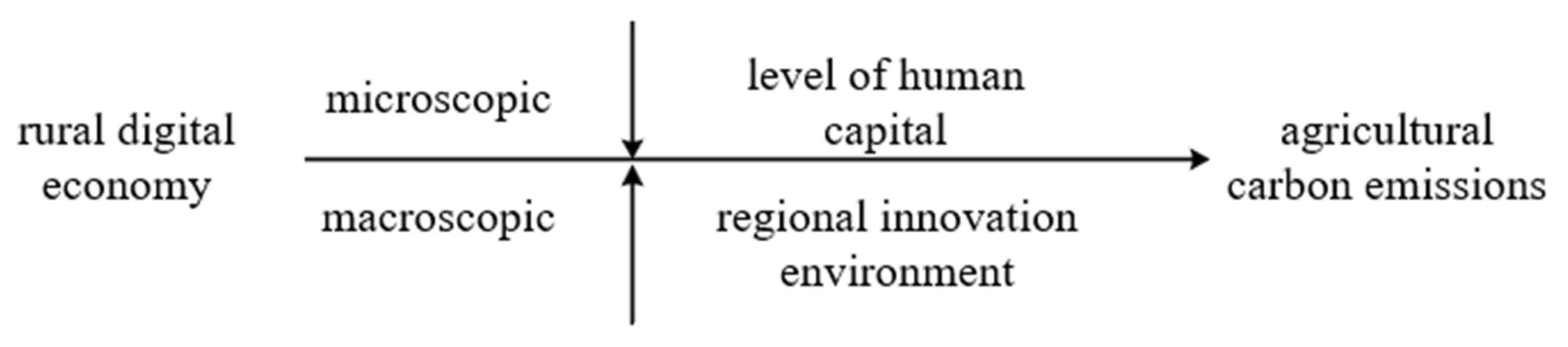
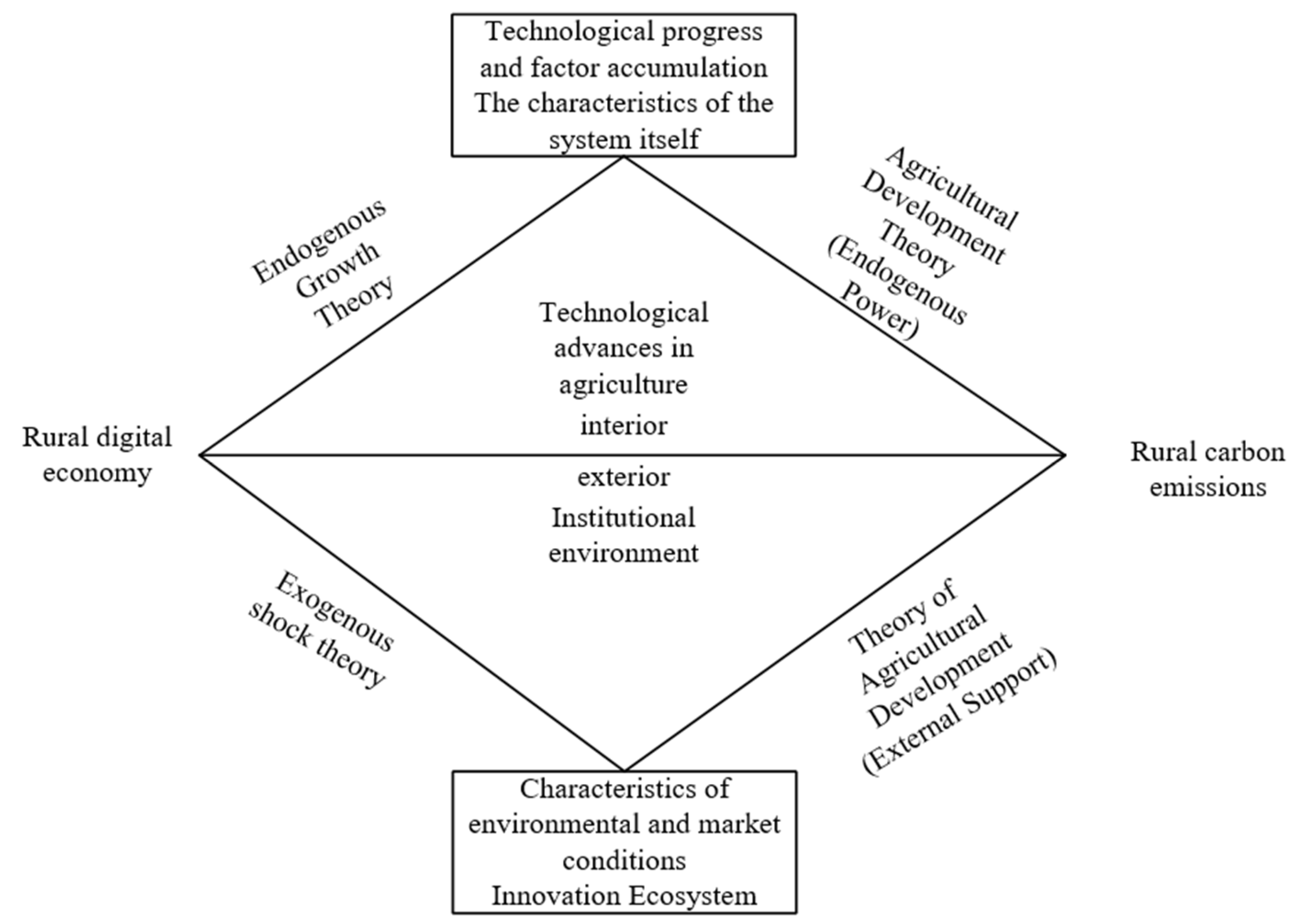
The digital economy has been broadcast to rural areas, gradually playing a role in the transformation of agriculture toward low-carbon systems. This role is not only linear but also regulated by a variety of factors, reflecting complex nonlinear characteristics [6]. In order to clearly present this mechanism, in this paper, the framework of the regulatory and threshold mechanisms is constructed from a micro–macro-perspective and an internal–external perspective, respectively (see Figure 1 and Figure 2). This article examines how a digital rural economy affects agricultural carbon emissions and provides relevant research hypotheses.
First, the digital rural economy significantly reduces agricultural carbon emissions through precise production and management [28]. In particular, the use efficiency of agricultural inputs has become popular and has been greatly improved due to the promotion of digital low-carbon agricultural technologies such as precision fertilizer applications, water-saving irrigation, and pest and disease monitoring. According to the Ministry of Agriculture and Rural Development (MARD), the use of precision agricultural technologies can reduce the amounts of chemical fertilizers and pesticides by about 20% or 15% (2023 map), significantly reducing carbon emissions in agricultural production. Additionally, the digital economy can optimize supply chains through e-commerce platforms and reduce carbon emissions from transportation and storage [29]. Therefore, Hypothesis 1 (H1) is proposed as follows: The development of the digital economy could potentially reduce agricultural carbon emissions effectively through the development of the rural economy.
At the micro-level, the level of education and digital literacy of the farmer determines the degree of digital technology adoption. In areas with high human capital levels, farmers can learn quickly, effectively use digital equipment, and reduce agricultural carbon emissions more strongly [30]. At the macro-level, regions with high-regional-innovation environments, such as those with a high number of patent applications and other innovation indicators, tend to apply and promote digital technology. Therefore, Hypothesis 2 (H2) is proposed: Human capital and the local innovation environment play a moderating role between the digital economy and agricultural carbon emissions.
Further, based on the environmental Kuznets curve (EKC) theory [27], within the research framework of the digital economy’s impact mechanism on agricultural carbon emissions, agricultural technological advancement potentially exhibits a significant threshold effect (threshold effects are shown in Figure 2). At the initial stage of technological progress, farmers may expand their production scale and instead increase resource inputs, causing an increase in carbon emissions in the short term, as technology and digital facilities are not yet fully integrated. However, as technology continues to improve and eventually exceeds a certain threshold, technology and digital tools become deeply integrated, and the scale effect is transformed into an efficiency effect, resulting in a sustained decline in carbon emissions [30]. According to the data of the National Bureau of Statistics, the R&D investment in agricultural technology has increased significantly in recent years (18.5% year-on-year in 2021), which indicates that China’s agricultural technology is gradually approaching this tipping point.
Therefore, Hypothesis 3a (H3a) is proposed: In the process of the rural digital economy affecting agricultural carbon emissions, there is a critical threshold role for agricultural technological progress. Only when the regional agricultural technology reaches a certain level can the emission reduction effect of the rural digital economy be significantly realized.
Finally, following the theory of institutional change [31], the institutional environment may significantly affect the role of the digital economy on agricultural carbon emissions (the threshold mechanism is shown in Figure 2). Regions with a perfect institutional environment have strong policy support and a sound regulatory system, which contribute to the rapid implementation and diffusion of digital technology and the realization of agricultural green transformation [32]. By contrast, in regions with poor institutional environments, the development of the digital economy is limited, and effectively promoting agricultural carbon emission reduction is difficult. Taking the carbon emissions trading policy as an example, the successful experience of the EU carbon market policy in agriculture shows that institutional factors are crucial to carbon emission reduction [33].
Accordingly, we propose Hypothesis 3b: Through the relationship between the rural digital economy and agricultural carbon emissions, the institutional environment exhibits a clear threshold characteristic. Specifically, the emission reduction function of the rural digital economy can only be fully released when the quality of regional institutions exceeds a specific threshold.
To ensure that our mechanism hypotheses are empirically testable and falsifiable, we specify below the conceptual measurement strategy, theoretical predictions, falsification criteria, and robustness checks for each proposed channel (see Table 1). The variables and their uses are detailed in Section 3.

3. Methodology

This section provides a detailed description of the data sources, variable selection, and their measurement methods. First, the data sources are explained; second, all variables involved in this study are described and defined, including explanatory, core explanatory, moderating, and threshold variables; finally, the descriptive data and correlation analysis results are demonstrated.

3.1. Data Collection and Sample

In this study, balanced panel data from 2012 to 2022 were used, collected across 30 provinces in China (except Tibet): Beijing, Tianjin, Hebei, Shanxi, Inner Mongolia, Liaoning, Jilin, Heilongjiang, Shanghai, Jiangsu, Zhejiang, Anhui, Fujian, Jiangxi, Shandong, Henan, Hubei, Hunan, Guangdong, Guangxi, Hainan, Chongqing, Sichuan, Guizhou, Yunnan, Shaanxi, Gansu, Qinghai, Ningxia, and Xinjiang. This comprehensive dataset enabled us to study how rural digitalization affects agricultural emissions in different regions of China. We collected information from multiple sources to ensure robust measurement of all variables. In order to measure rural digital finance activities, we used the digital finance inclusiveness index issued by Peking University, which reflects the breadth and depth of digital financial instruments adopted by rural communities. Other socio-economic and agricultural indicators were adopted from official statistical publications, including the China Statistical Yearbook, China Rural Statistical Yearbook, China Fixed Asset Investment Yearbook, and provincial statistical yearbook. These sources provide basic data on agricultural output, carbon emissions, mechanization level, and labor force composition. Our dataset exhibits very limited missingness (<2% of observations). Following previous studies on Chinese agricultural and climate data, linear interpolation was applied to fill short-term missing values in the time series [34,35,36].

3.2. Variable Description

  • Explanatory variable
Agricultural carbon emission intensity: We use the carbon emissions per unit of agricultural output to quantify the impact of the agricultural environment. This variable is calculated as the ratio between the total agricultural carbon emissions (bad output) and the comprehensive output value (ideal output) of the agriculture, forestry, animal husbandry, and fishery sectors. Note that agricultural carbon emission intensity, as the ratio of total carbon emissions to agricultural output value, is essentially an outcome index. Changes in this indicator may result from a variety of factors, including a reduction in actual carbon emissions, an increase in agricultural output value, the adjustment of industrial structure, or price fluctuations. Therefore, the empirical results of this study reflect the statistical correlation between the rural digital economy and agricultural carbon emission intensity, rather than a single emission reduction mechanism. Future studies can further decompose the sources of agricultural carbon emission intensity changes to identify more accurate emission reduction paths.
Agricultural carbon emissions in this study were estimated using the emission factor method recommended by the IPCC Guidelines for National Greenhouse Gas Inventories (IPCC, 2006) [37]. This approach has been widely applied in national and subnational agricultural emission accounting studies [38,39,40,41]. The basic calculation formula is
C E i t = n T n , i t × σ n
where C E i t denotes total agricultural carbon emissions for the province i in year t (in carbon equivalent, kg C or tons C); T n , i t , the activity level of the emission source n ; and σ n , the corresponding emission factor. All greenhouse gases (CH4, N2O) are converted to carbon equivalent using the following conversion coefficients: 1 ton CH4 = 6.82 tons C and 1 ton N2O = 81.27 tons C. Further details on emission factors and calculation procedures are provided in Appendix A.
2.
Primary Independent Variable
Rural digital economy: This comprehensive index of the rural digital economy considers three dimensions: digital economic foundation, rural digital infrastructure, and rural digital industry integration. Table 2 presents the specific indicators comprising this index. Note that these dimensions have different connotations and mechanisms in concept. First, digital infrastructure refers to Internet access, mobile communication network coverage, and informatization hardware facilities in rural areas, which constitute the material basis for the development of the rural digital economy [42,43]. Second, digital finance refers to the financial services provided by digital technology, including mobile payment, online credit, and digital insurance. It provides financial support and risk protection for agricultural production and operation [44,45]. Third, digital agriculture application refers to the direct application of Internet of Things, big data, artificial intelligence, and other technologies to the agricultural production process to achieve, for example, precision fertilization, intelligent irrigation, and pest monitoring [46]. The rural digital economy index constructed in this paper comprehensively covers the above three dimensions to comprehensively reflect the multidimensional effects of digital economy development.
Within this framework, most variables are positive indicators, with the exception of rural households’ Engel coefficient (representing digital product consumption levels), which functions as a negative indicator. Given the temporal and multi-regional nature of our analysis, we applied the entropy method to determine appropriate indicator weights, resulting in a composite rural digital economy development index for each province throughout the study period. In addition, the rural digital economy index is a comprehensive proxy variable, covering multiple dimensions such as digital infrastructure, digital economic foundation, and industrial digital integration. To some extent, the index reflects the overall development level and digital readiness of the region, rather than the effect of isolated digital technology. Some components of the index may have a jointly decisive relationship with agricultural productivity and environmental performance, so there may be residual endogenous problems. Therefore, the system GMM was used to alleviate endogeneity.
3.
Moderator variables
Human capital: The effectiveness of the digital economy in reducing agricultural emissions depends significantly on farmers’ technological adaptability and learning capabilities. Regions with higher rural human capital likely experience faster digital technology adoption and more efficient implementation of emission-reducing practices. To measure this factor, we use the average educational attainment (years of schooling) of the rural workforce in each province, with data obtained from established human capital databases.
Regional Innovation Environment: The innovation ecosystem surrounding agricultural areas influences how effectively digital technologies translate into environmental improvements. To capture this dimension, we employ patents per capita as a proxy measure for regional innovation capacity and technological dynamism.
4.
Threshold variables
Agricultural technological progress: The relationship between the digital economy and agricultural emissions may vary depending on the level of existing technological progress. In agricultural areas with technological progress, digital tools can be more rapidly integrated and effectively used, which may improve the results of emission reduction. By contrast, regions with limited agricultural technology may face barriers to digital adoption that limit environmental benefits. Agricultural science and technology investment represent agricultural technology progress.
Institutional environment: The institutional framework, comprising policies, regulations, and market conditions, can promote or hinder the environmental benefits of the digital economy. Regions with supportive institutional arrangements may accelerate digital adoption and more effectively implement emission reduction practices, while regions with poor institutional conditions may see limited environmental improvement in the case of digital expansion. The institutional environment is represented by energy conservation and environmental protection expenditure/total regional fiscal expenditure.
5.
Control variables
Agricultural development level (ADL): This indicator reflects the economic progress of the agricultural sector and is calculated according to the agricultural added value of each worker in the primary industry. With 2005 as the base year, inflation adjustments were made to the value of all currencies. Research shows that areas with a strong agricultural economy are more likely to adopt low-carbon farming methods [47]. Therefore, we expect a positive correlation with agricultural carbon emission intensity.
Agricultural mechanization (machinery): We quantify the adoption of technical equipment based on the availability of mechanical power for each agricultural worker. Enhanced mechanization usually leads to more effective resource allocation and improved farming methods, thereby reducing the agricultural carbon emission intensity in agricultural production [48]. It is expected to be positively correlated with agricultural carbon emission intensity.
Sector composition (AIS): This variable reflects the distribution of agricultural subsectors and is expressed as the comprehensive output of crop cultivation and livestock production relative to the total agricultural output (including forestry and fishery). As planting and animal husbandry produce a large amount of agricultural emissions, changes in their proportions will significantly affect the carbon emission results. We expect a negative correlation with agricultural carbon emission intensity.
Public agricultural support (AFI): This refers to the proportion of government expenditure allocated to agricultural projects in total financial expenditure. Government financial support often promotes an increase in farmers’ income and the adoption of cleaner production methods. We expect this variable to have a positive impact on agricultural carbon emission intensity.
Urban development (UR): This is measured by the percentage of the population living in urban areas. Urbanization has a competitive impact on agricultural emissions—the aging of the labor force in rural areas may increase dependence on chemical inputs and also improve consumption patterns and environmental awareness. Therefore, the impact direction is still ambiguous in theory.
Production concentration (AIT): The location quotient method is used to evaluate industrial clusters. As agricultural activities become more concentrated geographically, efficiency advantages usually arise through knowledge sharing and resource optimization. These economies of scale usually support the EF advantage of emission reduction, indicating a positive correlation with agricultural carbon emission intensity.

3.3. Descriptive Statistics

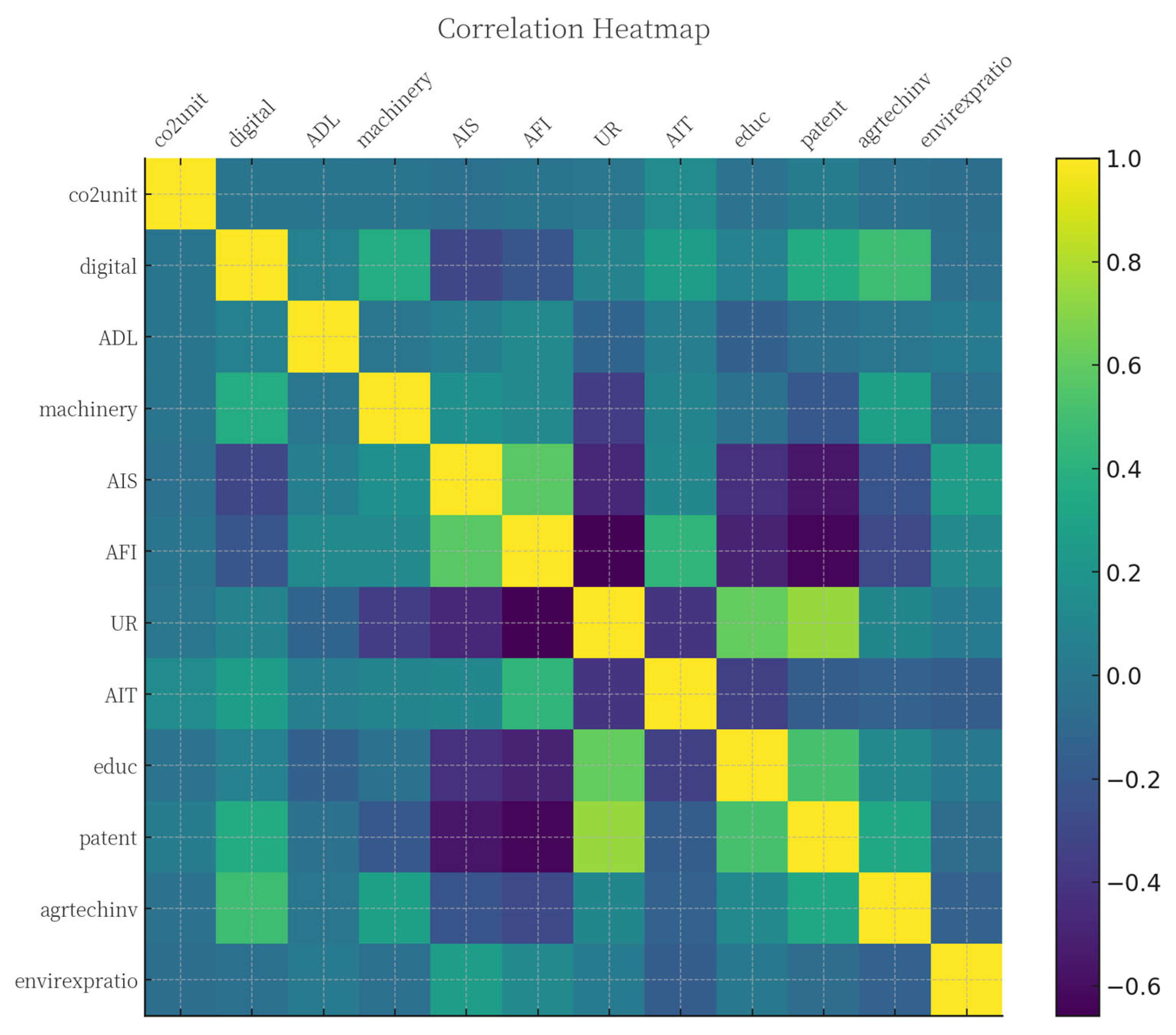
Table 3 summarizes statistics of our dataset, which comprises 330 provincial-year observations. The data reveal substantial variability across regions. The agricultural carbon emission intensity (co2unit) averages 1.5598 but exhibits remarkable dispersion with a standard deviation of 9.0051 and a range spanning from 0.4235 to 164.5199. This wide distribution highlights significant regional disparities in agricultural environmental performance. Our primary independent variable measuring rural digital economy development (digital) shows an average value of 0.1686 with a standard deviation of 0.1089. The minimum and maximum values (0.0254 and 0.7796, respectively) demonstrate considerable regional variation in digital advancement throughout China’s agricultural areas. Particularly noteworthy is the pronounced heterogeneity in agricultural modernization indicators. Agricultural technology investment (agrtechinv) exhibits a standard deviation of 283.5302, while machinery availability per worker (machinery) shows even greater variation with a standard deviation of 2927.486. These statistics underscore the uneven technological transformation across China’s agricultural regions. Figure 3 visualizes variable correlations, revealing a negative association between digital economy development and agricultural carbon emission intensity. This preliminary relationship supports our hypothesis that digital advancement contributes to agricultural emission reductions. Additionally, the interaction patterns between human capital (educ), innovation environment (patent), and digital economy variables provide valuable insights that inform our subsequent econometric analysis.

3.4. Model Construction

This section discusses the construction of several econometric models used to investigate the impact mechanism of the rural digital economy on agricultural carbon emission intensity, including the benchmark regression, moderating effect, and threshold effect models.
  • Basic regression model
A two-wayed fixed effect model was constructed to test how the rural digital economy impacts agricultural carbon emission intensity. The model is given as follows:
l o g ( c o 2 u n i t i t ) = β 0 + β 1 d i g i t a l i t + β 2 A D L i t + β 3 l o g ( m a c h i n e r y ) i t + β 4 A I S i t + β 5 A F I i t + β 6 U R i t + β 7 A I T i t + β 8 l o g ( p a t e n t ) i t + β 9 E d u c i t + μ i + η t + ε i t
where log(co2unit) is the explanatory variable indicating the log form of agricultural carbon emissions per unit of output value in agriculture; digital, the composite index of the rural digital economy; ADL, the degree of agricultural economic development; log(machinery), the log form of per capita power of agricultural machinery; AIS, the internal industrial structure of agriculture; AFI, the agricultural financial investment; UR, the urbanization rate; AIT, industrial agglomeration; log(patent), the logarithmic form of the number of patents per capita; Educ, the level of human capital; μ i and η t , individual and time effects, respectively; and ε i t , a random disturbance term. The model was estimated using Pooled OLS, fixed effects, random effects, GMM, and dynamic GMM, which is conducive to ensuring the robustness of the results.
2.
Moderated effect models
Three moderating effect models were used to investigate the moderating roles of human capital and the regional innovation environment in the digital rural economy’s influence on agricultural carbon emission intensity. The models are given below:
(1)
The moderator for human capital can be modeled as
l o g ( c o 2 u n i t i t ) = β 0 + β 1 d i g i t a l i t + β 2 E d u c i t + β 3 ( d i g i t a l i t E d u c i t ) + δ c o n t r o l i t + μ i + η t + ε i t
l o g ( c o 2 u n i t i t ) = β 0 + β 1 d i g i t a l i t + β 2 E d u c i t + β 3 d i g i t a l i t ( E d u c i t E d u c q i t ) + δ c o n t r o l i t + μ i + η t + ε i t
where q represents the value of the education level at the q% quartile, taking values of 10%, 25%, 50%, 75%, and 90%; β 3 represents the moderating effect of human capital, and the coefficient of β 1 varies with the level of human capital in Equation (3).
(2)
The moderator for a regional innovation environment can be modeled as follows:
l o g ( c o 2 u n i t i t ) = β 0 + β 1 d i g i t a l i t + β 2 l o g ( p a t e n t ) i t + β 3 ( d i g i t a l i t log ( p a t e n t ) i t ) + δ c o n t r o l i t + μ i + η t + ε i t
l o g ( c o 2 u n i t i t ) = β 0 + β 1 d i g i t a l i t + β 2 l o g ( p a t e n t ) i t + β 3 d i g i t a l i t ( log ( p a t e n t ) i t log ( p a t e n t ) q i t ) + δ c o n t r o l i t + μ i + η t + ε i t
In a similar manner to the moderating effect model of human capital, the impact of the rural digital economy on agricultural carbon emission intensity is also moderated by the regional innovation environment, i.e., β 1 varies under different conditions of the regional innovation environment.
(3)
The co-moderation model can be expressed as
l o g ( c o 2 u n i t i t ) = β 0 + β 1 d i g i t a l i t + β 2 E d u c i t + β 3 l o g ( p a t e n t ) i t + β 4 ( d i g i t a l i t log ( p a t e n t ) i t E d u c i t ) + δ c o n t r o l i t + μ i + η t + ε i t
l o g ( c o 2 u n i t i t ) = β 0 + β 1 d i g i t a l i t + β 2 E d u c i t + β 3 l o g ( p a t e n t ) i t + β 4 ( d i g i t a l i t ( log ( p a t e n t ) i t log ( p a t e n t ) q i t ) ( E d u c i t E d u c q i t ) ) + δ c o n t r o l i t + μ i + η t + ε i t
where β 4 represents the synergistic moderating effect of human capital and regional innovation environment. The effects of the rural digital economy on agricultural carbon emission intensity are shifted along with the synergistic moderating effects of human capital and regional innovation environments.
3.
Threshold effect model
Agricultural technological progress and the institutional environment play a nonlinear role in the process of the digital rural economy, affecting agricultural carbon emission intensity, respectively. This study designed and constructed single- and double-threshold effect modeling systems to reveal the transformation characteristics among variables through these models.
(1)
Threshold model of agricultural technological progress:
l o g ( c o 2 u n i t i t ) = β 0 + β 1 d i g i t a l i t I ( a g r t e c h i n v < q ) + β 2 d i g i t a l i t I ( a g r t e c h i n v q ) + δ c o n t r o l i t + μ i + η t + ε i t
l o g ( c o 2 u n i t i t ) = β 0 + β 1 d i g i t a l i t I ( a g r t e c h i n v < q 1 ) + β 2 d i g i t a l i t I ( q 1 a g r t e c h i n v < q 2 ) + β 3 d i g i t a l i t I ( a g r t e c h i n v q 2 ) + δ c o n t r o l i t + μ i + η t + ε i t
(2)
Institutional environment threshold model:
l o g ( c o 2 u n i t i t ) = β 0 + β 1 d i g i t a l i t I ( e n v i r e x p r a t i o < q ) + β 2 d i g i t a l i t I ( e n v i r e x p r a t i o q ) + δ c o n t r o l i t + μ i + η t + ε i t
l o g ( c o 2 u n i t i t ) = β 0 + β 1 d i g i t a l i t I ( e n v i r e x p r a t i o < q 1 ) + β 2 d i g i t a l i t I ( q 1 e n v i r e x p r a t i o < q 2 ) + β 3 d i g i t a l i t I ( e n v i r e x p r a t i o q 2 ) + δ c o n t r o l i t + μ i + η t + ε i t
where q 1 and q 2 denote the thresholds to be estimated at different levels, and I(•) is an indicator function.

4. Empirical Results

4.1. Baseline Regression Results

Table 4 shows the benchmark regression results of the impact of the rural digital economy on agricultural carbon emissions, covering three models: pooled OLS, two-way fixed effect, and random effect. The three models consistently found that the rural digital economy had a significant negative impact on agricultural carbon emission intensity, which strongly supported hypothesis 1. Specifically, the coefficients of the digital economy are negative and have statistical significance at different significance levels. In terms of model selection, by comparing the adjusted R2 and Hausman test results, the two-way fixed effect model performed best, with the highest adjusted R2 of 0.5742. Therefore, in this study, the results of the two-way fixed effect model can more accurately capture the impact of the rural digital economy on agricultural carbon emissions.
Table 5 shows the robustness results of the System GMM Estimation and the placebo test. In the System GMM model, the lag coefficient of agricultural carbon emissions is 0.786 and highly significant, which confirms that agricultural carbon emissions have a significant path dependence. The coefficient of digital rural economy is −0.108, which is significant at the 10% level and verifies its negative effect on agricultural carbon emissions. To ensure the validity of GMM estimation, the p value of the Sargan test is 0.744, which is far greater than the standard of 0.10. This indicates that the instrumental variables are effective and there is no over-identification problem. The p value of the AR (1) test is 0.046, which rejects the hypothesis of no first-order autocorrelation, while the p value of the AR (2) test is 0.264, which does not reject the hypothesis of no second-order autocorrelation, which meets the requirement that there should be no second-order sequence correlation in the residual of the System GMM model, ensuring the consistency of the estimation results. The placebo test showed that the variable indicating the future digital rural economy (Digital lead 1) was not significant, while the current digital rural economy was significant, excluding reverse causality, and further supported that the negative impact of the digital economy on agricultural carbon emissions had a real causal relationship, rather than a false correlation, thus improving the reliability of the causal inference of the core explanatory variable.

4.2. Results of Moderating Effects

Table 6 reports the estimation results of the moderating effect models for human capital, regional innovation environment, and their synergistic effect on the impact of the digital rural economy on agricultural carbon emissions. The interaction terms are all significant at least at the 5% level, which implies that these moderating variables play an important moderating role. First, the moderating effect model of human capital has a coefficient, 1.3724 (p < 0.05), for the interaction term, which implies that human capital, while promoting emission reduction in its own right, shows a more complex performance in enhancing the emission reduction effect of the digital economy. This may be due to highly educated farmers being more adept at using digital technologies to improve yields, but at the same time, they may adopt other approaches to maximize returns, which partially offsets the abatement effect of digital technologies. Second, the moderating effect model of regional innovation environment shows a coefficient,−0.2409 (p < 0.01), for the digital economy and interaction term, which indicates that a good innovation environment can significantly strengthen the abatement effect of the digital economy. This may be due to regions with a strong innovation atmosphere being more likely to promote the integration of digital technology and green production methods, forming a synergistic emission reduction effect. Finally, the coefficient of the three interaction terms in the double moderated effect model is −0.0555 (p < 0.01), revealing a complex moderating mechanism: when high human capital is combined with a good innovation environment, synergistic effects are generated, further enhancing the emission reduction effect of the digital economy. This finding suggests that upgrading the education level in rural areas and simultaneously improving the regional innovation environment is key to fully realizing the abatement potential of the digital economy.
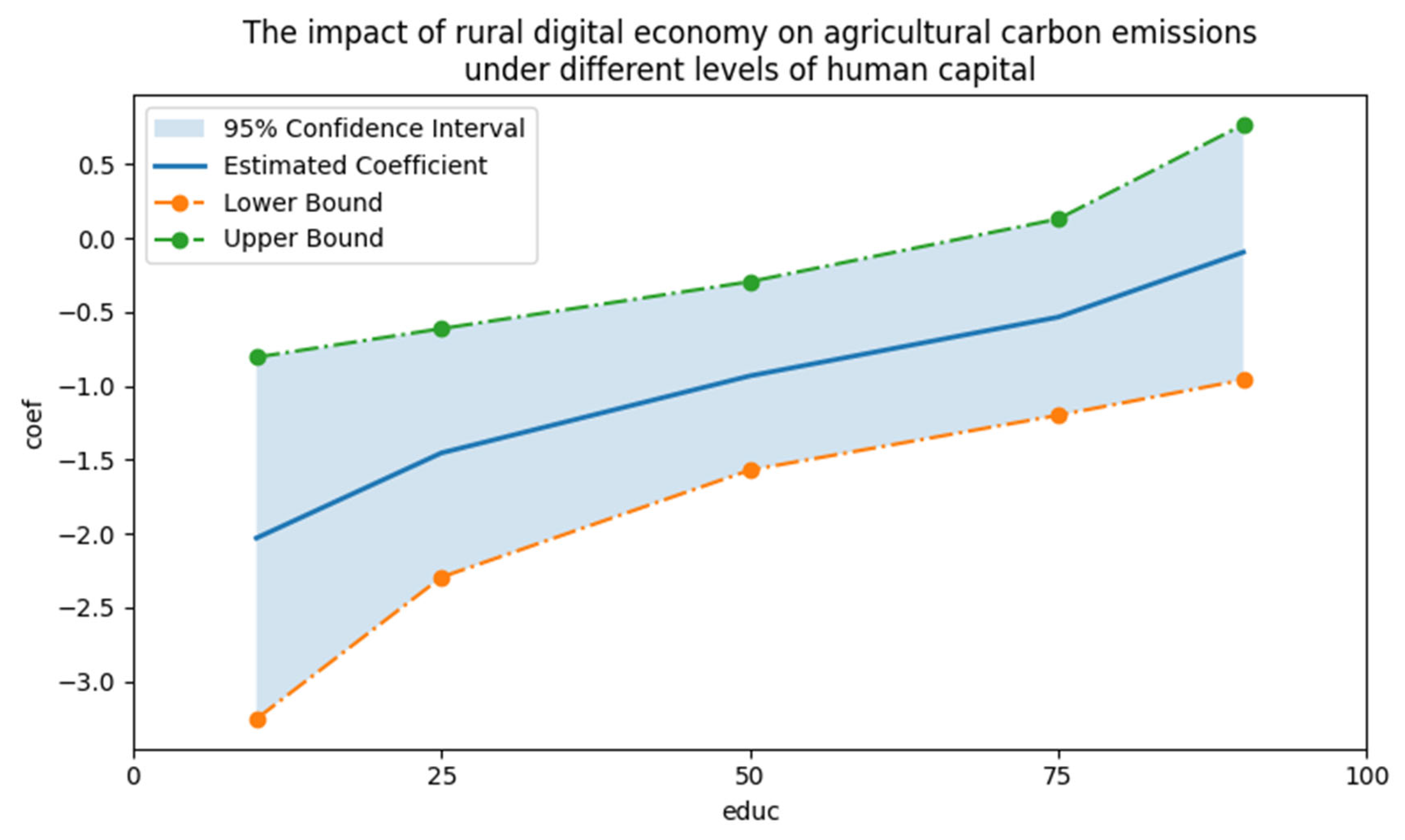
Based on the estimation results of the moderating effect model, we further analyzed the impact of the rural digital economy on agricultural carbon emission intensity under different human capital levels, as shown in Figure 4. In this study, when the education level is in the 10%, 25%, 50%, 75%, and 90% quartiles, the negative impact of the digital economy on carbon emissions shows a decreasing trend; i.e., the inhibitory effect decreases with the increase in education level. This phenomenon may be due to the nonlinear relationship between human capital and the application of digital technology—at a low education level, there is a significant bottleneck in farmers’ acceptance of digital tools, at which point, the marginal abatement effect of the digital economy is most pronounced. Once the education level reaches a certain threshold, the application of technology is gradually popularized, and the abatement potential tends to be saturated. Note that high-education areas are often accompanied by upgrades in the agricultural industry structure, and the carbon emission characteristics of some cash crop cultivation and animal husbandry may partially offset the emission reduction effect of digital technology. In addition, higher education levels may encourage farmers to expand their production scale, resulting in a rebound effect of “efficiency improvement–scale expansion”. This finding suggests that amplifying the emission reduction effect of the digital economy is difficult by relying solely on human capital accumulation. Thus, it is necessary to support the adoption of carbon footprint monitoring systems in later stages of technology promotion, as well as shift the focus of digital technology application to high-value-added low-carbon industries through policy guidance to realize the synergistic enhancement of the emission reduction effect and economic benefits.
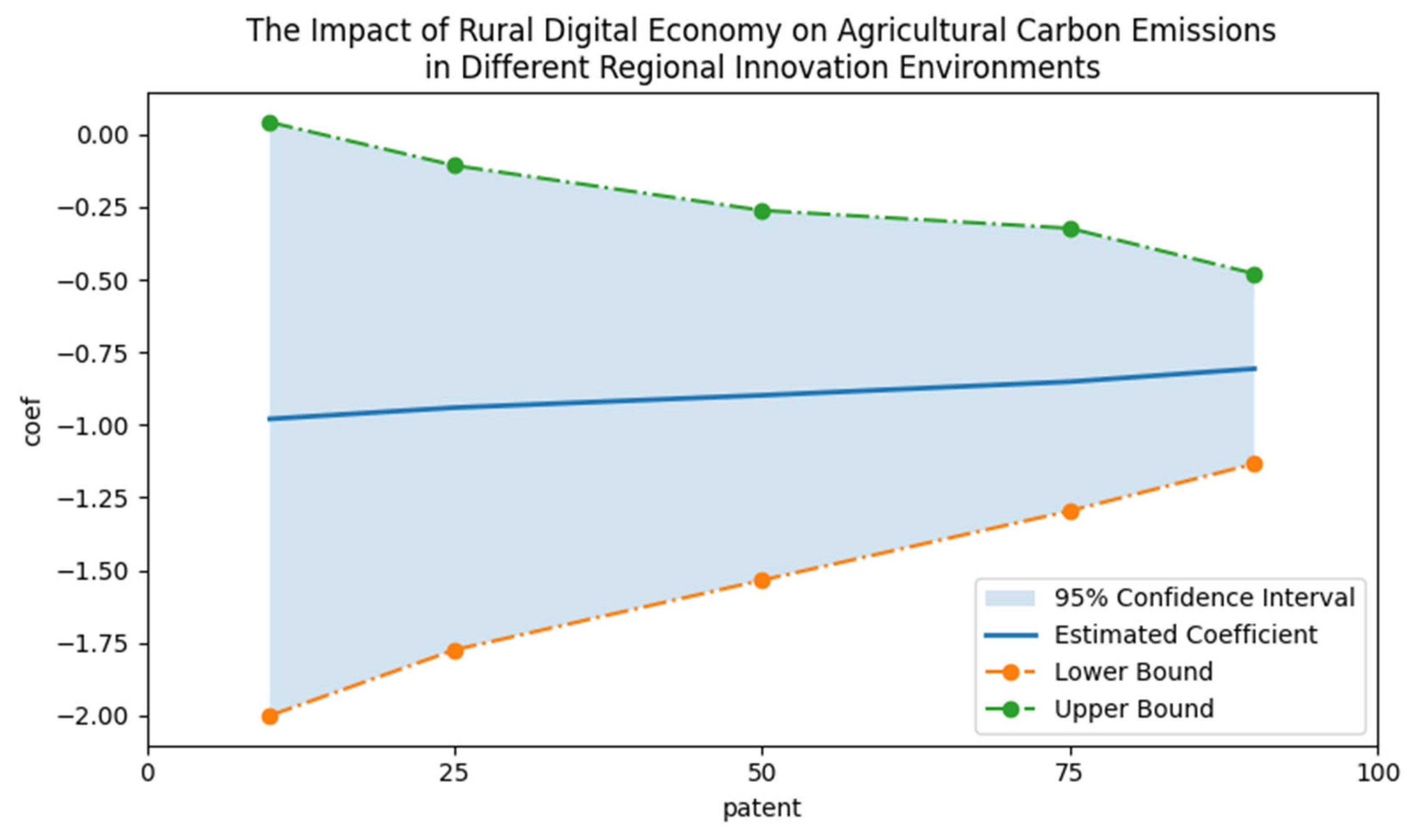
We further analyzed the impact of the rural digital economy on agricultural carbon emission intensity under different regional innovation environments, as shown in Figure 5. The negative impact of the rural digital economy on agricultural carbon emission intensity becomes smaller as the regional innovation environment improves, but the magnitude of this change is much smaller than the moderating effect of education level. This phenomenon may be due to the following: although the regional innovation environment provides the necessary external conditions for the application of digital technology, its influence path is relatively indirect, and it needs to realize the carbon emission reduction effect through intermediary links, such as through the allocation of innovation resources, diffusion of knowledge, and transformation of technology. The improvement of the innovation environment may have facilitated the clustering of high-tech industries, but these technologies may not be directly aimed at reducing agricultural emissions, and need to be adapted before they can be effectively applied to agricultural production practices. This suggests that it is difficult to fully exploit the mitigation potential of the digital economy by merely improving the regional innovation environment and that it is necessary to focus on the precise allocation of innovation resources, particularly to strengthen R&D and promotion of targeted technologies for the characteristics of agricultural production.
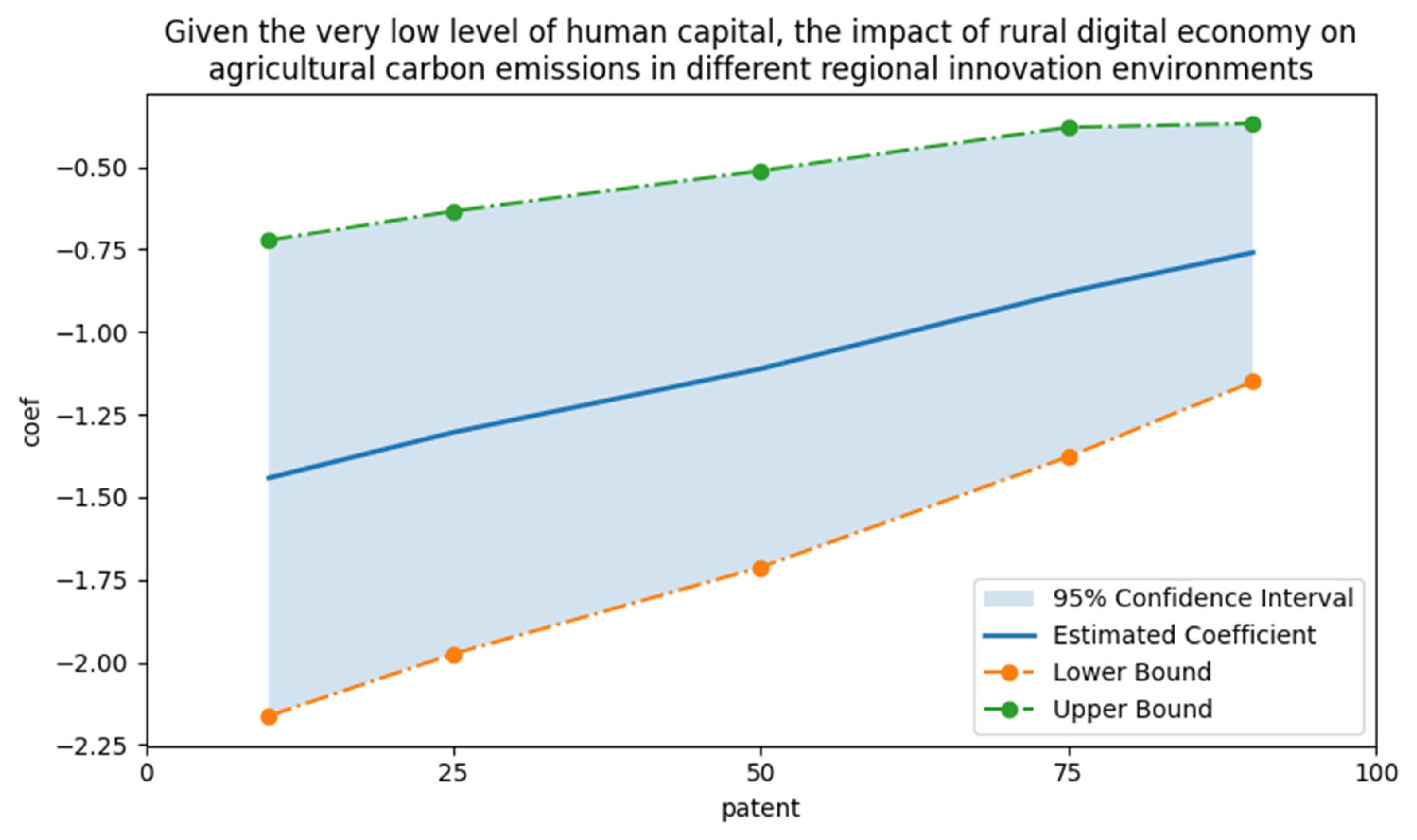
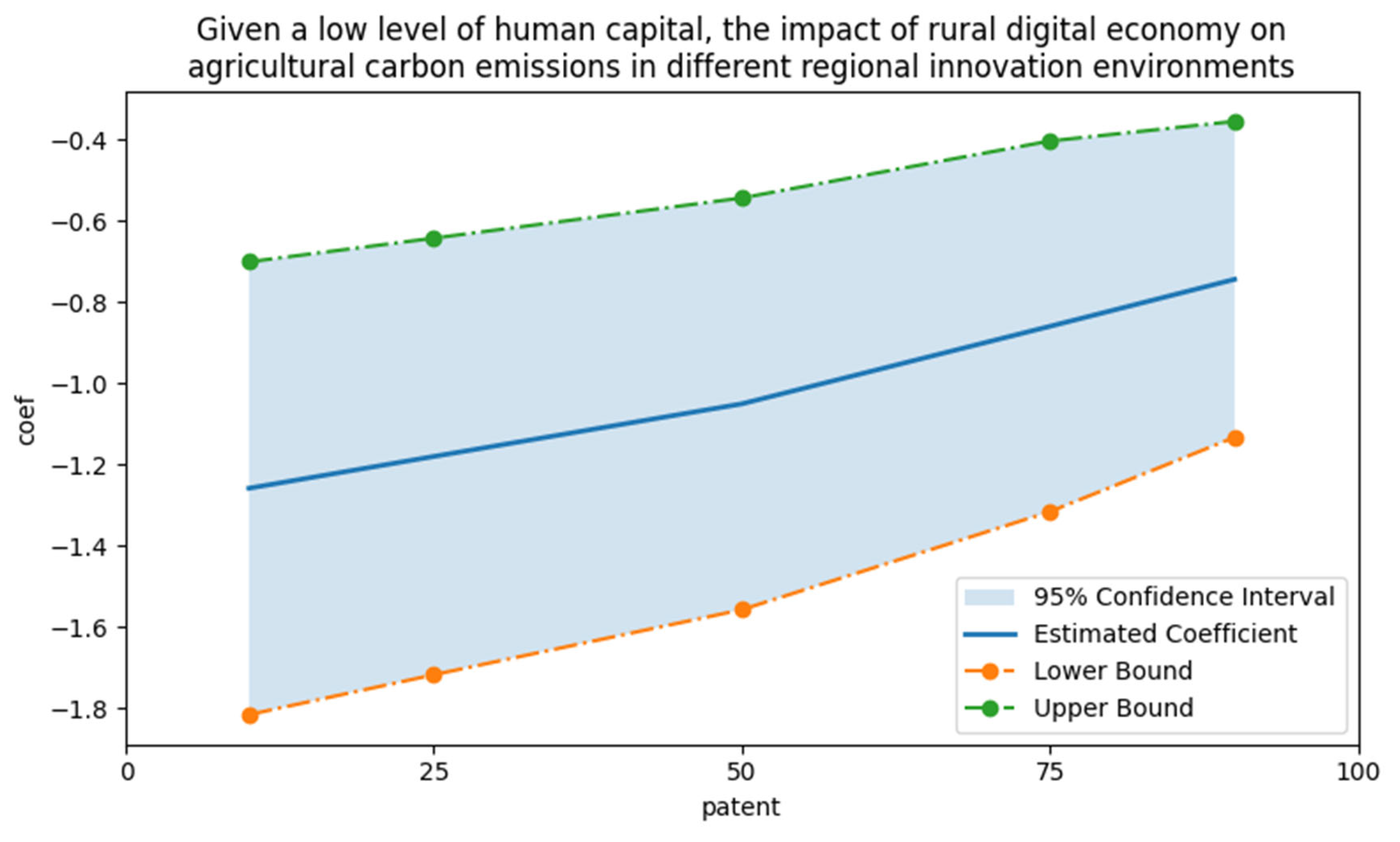
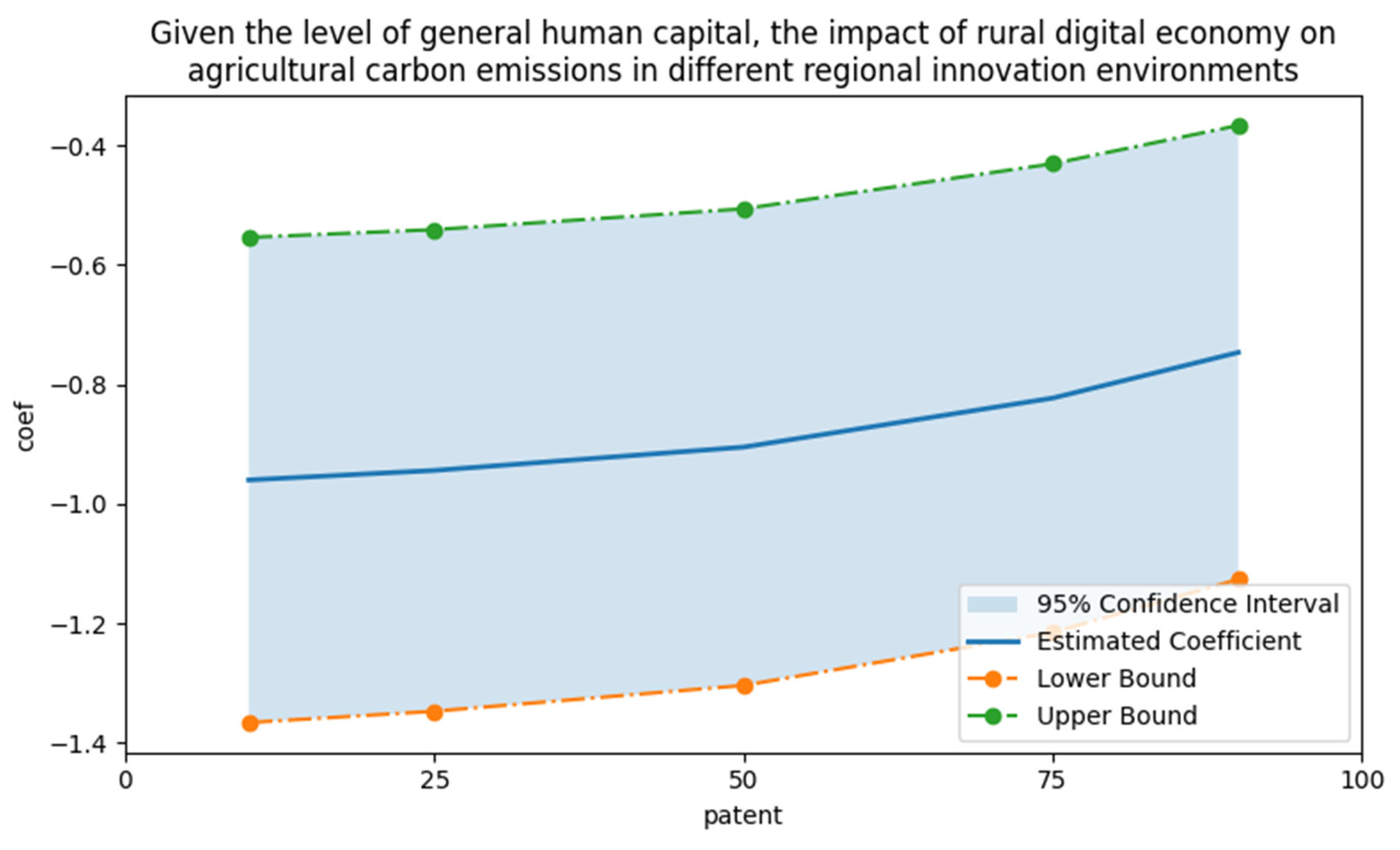
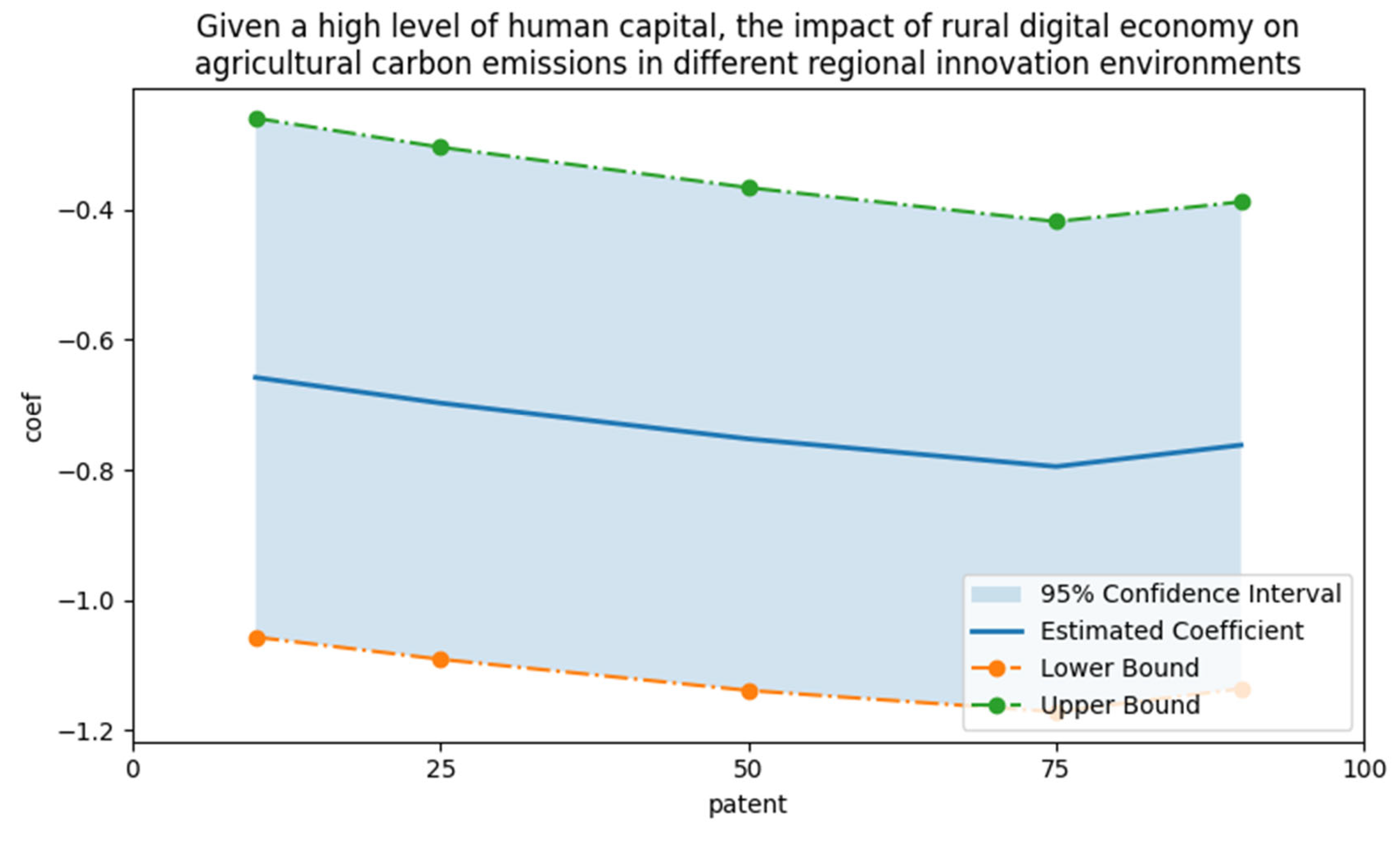
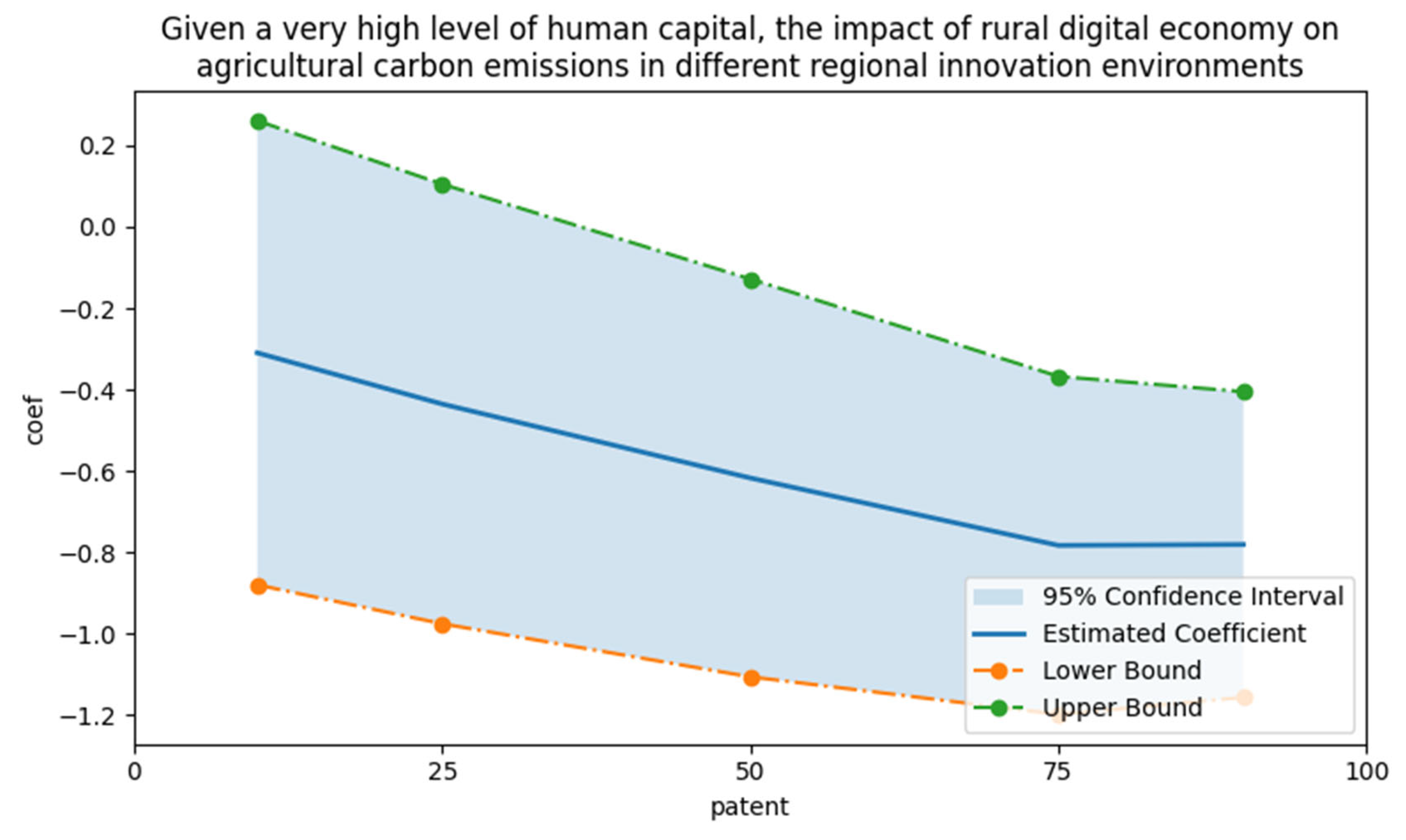
Figure 6, Figure 7, Figure 8, Figure 9 and Figure 10 show how the regional innovation environment moderates the impact of the rural digital economy on agricultural carbon emission intensity at different levels of human capital. In this set of graphs, the horizontal axis indicates the value of the regional innovation environment in each quartile, the vertical axis reflects the coefficient of the impact of the digital economy on agricultural carbon emissions, and the upper and lower boundaries indicate the 95% confidence intervals. At very low levels of human capital (Figure 6), improvements in the regional innovation environment play a very limited role in enhancing the mitigation effect of the digital economy. The relatively flat change in the curves and the wide confidence intervals indicate a high degree of uncertainty in the results. This may be due to the insufficient human capital becoming a key bottleneck, and even if the innovation environment improves, farmers lack the basic skills to effectively apply digital technologies, resulting in failure to fully achieve the mitigation potential of the digital economy. As the level of human capital improves from low and average levels (Figure 7 and Figure 8), the moderating effect of the regional innovation environment begins to emerge. The negative impact of the digital economy on agricultural carbon emission intensity gradually increases as the innovation environment improves, and the slope of the curve becomes more pronounced. This suggests that farmers with intermediate levels of education already have basic digital skills and, with the support of a good innovation environment, are able to use digital tools more effectively in production decisions. The moderating effect of the regional innovation environment is most significant when human capital reaches high and very high levels (Figure 9 and Figure 10). The steep slopes of the curves and the significantly narrower confidence intervals reflect a substantial increase in the stability and reliability of the results. More educated farmers are able to not only skillfully apply digital technology but also optimize and innovate the application of technology based on the resources and opportunities provided by the innovation environment, forming a synergistic effect between human capital and the innovation environment and achieving the optimal effect of digital technology in agricultural emission reduction. This series of graphs reveals an important finding: the impact of the digital economy on agricultural carbon emission intensity does not depend on a single factor but results from the joint action of human capital and the regional innovation environment. The emission reduction effect of digital technology is most significant under the dual conditions of high human capital and a favorable innovation environment. This finding has important policy implications: in promoting the digital transformation of rural areas, cultivating human capital and building an innovation environment should be regarded as key tasks to be synergistically promoted in order to fully realize the potential of the digital economy in reducing agricultural emissions.

4.3. Results of Threshold Effects

Table 7 compares threshold models based on information criteria. For the two threshold variables of institutional environment and agricultural technology progress, the three settings of no threshold, single threshold, and double threshold were compared. The results show that the double-threshold model was the best for both: ΔAIC and ΔBIC were 0 at the double threshold, and the AIC/BIC of other settings was higher. Table 8 shows the F-test results of the threshold model. The comparison between the institutional environment and the three groups of agricultural technology progress, such as “no comparison single”, “single comparison double”, “no comparison double”, is significant (p < 0.001), indicating that there is a significant threshold effect and the double-threshold model is better than the single-threshold and no-threshold models. The conclusions drawn from the two tables are consistent, supporting the nonlinear and double-threshold mechanism of the digital rural economy on agricultural carbon emissions.
Table 9 presents the threshold effects of institutional environment and agricultural technology progress on the emission reduction effect of the rural digital economy with a double-threshold model. When the threshold of enviroxpration is low, the emission reduction effect of the rural digital economy is small and not significant. In the medium- and high-threshold states, the negative effect of the digital economy on agricultural carbon emissions is statistically significant, with values of −1.147 and −0.881, respectively. This indicates that with the institutional environment entering a higher level, the emission reduction effect of the digital economy is obvious, but the intensity is different. When agrtechinv is the threshold, the low-level interval coefficient is −0.245, which is not significant. The coefficients in the middle- and high-threshold states are significant, with values of −2.203 and −0.867, respectively, and the emission reduction effect of the middle-threshold state is the strongest. These results are consistent with H3a and H3b, indicating that the institutional environment and agricultural technology progress can indeed amplify the role of the digital economy in emission reduction; however, the intensity of the effect is affected by the threshold level and shows regionality.
Table 10 shows the results of the robustness test of the threshold effect in an institutional environment. In view of the possible endogeneity of the initial institutional environmental proxy variable (the proportion of environmental expenditure), this study used the number of environmental punishment cases (log (cases)), environmental pollution control investment (log (gov INV)), and proportion of environmental expenditure lagging behind the first period (envirexpratio (t−1)) as alternative threshold variables to verify the nonlinear characteristics of the impact of the rural digital economy on agricultural carbon emissions and the reliability of its mechanism. According to the adjusted R2 values (0.7620, 0.7660, and 0.7643, respectively), the double-threshold model showed better fitting under all alternative variables, which confirms that the impact of the rural digital economy on agricultural carbon emissions has significant nonlinear threshold characteristics.
Specifically, the results show that when the number of environmental punishment cases is taken as the threshold variable, the negative impact of the rural digital economy on agricultural carbon emissions is significant in all threshold ranges (respectively, −0.6129, −0.4723, and −0.243), but its emission reduction intensity gradually weakens with the increase in environmental punishment. Similarly, when the investment in environmental pollution control is taken as the threshold variable, the emission reduction effect of the digital economy also shows a weakening trend (from −1.3718 and −0.6595 to −0.3741, both significant), indicating that the marginal emission reduction contribution of the digital economy may decrease after the investment in environmental governance reaches a high level. Most importantly, when the proportion of environmental expenditure lagging behind the first period is taken as the threshold, the digital economy shows a significant negative impact on agricultural carbon emissions at the low and medium levels of institutional expenditure (respectively, −0.7938 and −0.2846), but in the high-threshold range (with a coefficient of 0.1035), its impact becomes insignificant. This means that with the continuous improvement of the institutional environment and the increase in environmental expenditure, the emission reduction effect independently driven by the digital economy gradually declines, and even its net emission reduction effect is no longer significant under the support of high-level institutions. These robustness test results consistently show that the institutional environment has significant nonlinear regulatory and threshold characteristic effects on the emission reduction effect of the rural digital economy. Even though the specific change mode of emission reduction intensity may vary depending on proxy variables, the existence of the threshold effect and its impact on the direction and range of the emission reduction potential of the digital economy are robust.

4.4. Discussion

This study found that the rural digital economy has a significant negative impact on agricultural carbon emission intensity, but the relationship is not purely linear. Combined with the mechanism analysis of this study, digitalization can reduce carbon emissions per unit output by improving precision production, optimizing the input and output structure, and improving the connection between the supply chain of agricultural products and the market. This is consistent with the optimistic conclusions of some studies [20,21], but also inconsistent with earlier concerns that the popularization of information and communication technology may increase energy consumption and emissions [49,50]. In the rural provincial panel used in this paper, we further reveal the nonlinear characteristics of the digital effect, which is consistent with the idea of the Environmental Kuznets curve (EKC): in the early stage of development, the digital emission reduction effect may be subject to technological integration and supporting conditions, resulting in “dislocation” or short-term emission increase; with the progress of technology, improvement of the institutional environment, and promotion of human capital, the emission reduction effect has gradually emerged and strengthened [4,51,52].
The results of the threshold analysis provide a more detailed evolution path. The effect of digitalization on emission reduction is weak in the low-threshold range (when the level of agricultural technology investment or institutional environment is low). At a medium-threshold range and above, the emission reduction effect is significantly enhanced, and the amplification effect occurs when the human capital and regional innovation environment are good. This is consistent with research on the factors and conditions of digitalization and the support of innovation ecology in the literature [53,54], and confirms the governance logic of “digitalization is a tool and green technological transformation is a goal.” However, in the absence of deep green technology integration and institutional incentives, digital expansion may lead to a scale effect rather than efficiency improvement, thus increasing emissions in the short term [55,56]. The idea of a “pollution trap” suggests that policy design should be coordinated with green technology, education and training, and institutional arrangements. In short, our discussion emphasizes that the emission reduction potential of the digital economy is not realized spontaneously, but through the joint effect of human capital, the innovation environment, and technological progress.

5. Conclusions and Policy Implications

5.1. Conclusions

This study explores the impact mechanism, moderating effect, and threshold characteristics of the digital economy on China’s agricultural carbon emission intensity and provides new empirical evidence for understanding the role of the digital economy in the context of agricultural green transformation. By constructing balanced provincial panel data and using two-way fixed effect, moderating effect, and panel threshold regression models, we reveal the multidimensional complexity of the digital economy in promoting agricultural carbon emission reduction. The results not only confirm the overall emission reduction effect of the digital economy but also reveal the differential moderating role of human capital and the regional innovation environment in this process, as well as the nonlinear threshold characteristics brought about through agricultural technology progress and the institutional environment. These findings provide key theoretical support for optimizing the development path of digital agriculture and formulating targeted policies to achieve low-carbon agricultural development.
The main findings of this study are summarized as follows: (1) Significant emission reduction effect of digital economy: The development of China’s rural digital economy is significantly negatively related to the intensity of agricultural carbon emissions. This direct effect provides a strong environmental benefit for the wide application of digital technology in the field of agriculture. (2) Complex regulation of human capital and innovation environment: Human capital (education level) has a nonlinear regulating effect on the emission reduction effect of the digital economy; that is, with the improvement of education level, the emission reduction effect of the digital economy may decline due to the “efficiency rebound effect.” The regional innovation environment can significantly enhance the emission reduction potential of the digital economy. In particular, the emission reduction effect of the digital economy is optimized through the synergy of high human capital and a superior innovation environment. (3) The threshold characteristics of technological progress and the institutional environment: The impact of the digital economy on agricultural carbon emissions is restricted by the dual threshold of agricultural technological progress and the institutional environment. When agricultural technology progress reaches an intermediate level, the emission reduction effect of the digital economy is the most prominent. However, while the institutional environment can effectively play a role in emission reduction through the digital economy at this level, in a highly perfect institutional environment, the independent emission reduction contribution of the digital economy tends to be saturated or not significant.
The marginal contributions of this study are threefold: (1) This study deepens our understanding of the emission reduction mechanism of the digital economy. Based on existing research generally focusing on the linear relationship between the digital economy and carbon emissions, this study is the first to reveal the nonlinear characteristics and complex heterogeneity of the impact of the digital economy on agricultural carbon emissions by introducing regulatory variables and threshold variables. In particular, our findings regarding the reverse regulation of human capital and the high-level saturation effect of the institutional environment greatly enrich our theoretical understanding. (2) This study provides a refined basis for policy-making. Based on the different mechanisms of human capital, regional innovation environment, agricultural technology progress, and the institutional environment in emission reduction in the digital economy, this study provides more refined, context-dependent policy recommendations rather than “one size fits all” universal measures, which helps improve the pertinence and effectiveness of policies. (3) This study broadens the vision of agricultural carbon emissions research by incorporating multi-dimensional elements such as the digital economy, human capital, the innovation environment, technological progress, and the institutional environment into a unified analysis framework and constructing a moderation and threshold mechanism combining “micro–macro” and “internal–external” perspectives. In doing so, it provides a more comprehensive perspective and analysis paradigm for the study of influencing factors of agricultural carbon emissions.
The empirical findings of this paper are mainly based on the statistical correlation of provincial panel data in China. Due to the proxy variable nature of the rural digital economy index, the above conclusion should be understood as conditional correlation, rather than strict causal identification results.

5.2. Policy Implications

Based on the above empirical findings, this study puts forward the following policy recommendations in order to fully realize the key role of the digital economy in promoting agricultural low-carbon transformation.
First, strengthening the construction and promotion of rural digital infrastructure should be prioritized, supplemented by precision agricultural technology training. In view of the significant negative impact of the digital economy on agricultural carbon emissions, the government should continue to increase investment in digital infrastructure in rural areas (such as broadband and 5 g network coverage) to ensure the inclusiveness of digital technology. At the same time, considering the complex regulatory effect of human capital, policy-makers should not only seek to improve the overall education level of farmers but also focus on providing customized digital agricultural technology application training to farmers with different educational backgrounds. For example, basic guidance on the operation of smart devices and the use of digital platforms should be provided to farmers with low education levels to ensure that they can cross the digital divide. For farmers with higher education levels, we should guide them toward applying digital technology to agricultural production links with high added value and low carbon emissions, thus strengthening the promotion of carbon footprint monitoring system, so as to avoid the “efficiency rebound effect” caused by scale expansion.
Secondly, a collaborative innovation ecosystem should be built to promote the deep integration of digital technology and green agriculture. The regional innovation environment has a significant strengthening effect on the emission reduction effect of the digital economy, especially when combined with high human capital. Therefore, a policy should be proposed to create an open and active agricultural innovation ecosystem and encourage cooperation between scientific research institutions, digital technology enterprises, and agricultural production entities. Specific measures include setting up a special fund to support the research and development of green technology in digital agriculture, building a regional digital agriculture innovation center, and building an information-sharing platform to promote the transformation of green technology achievements. At the same time, policies should guide innovative resources towards low-carbon fields such as precision agriculture, smart animal husbandry, and circular agriculture to ensure that innovation not only serves efficiency improvement but also directly addresses the goal of carbon emission reduction to create a collaborative emission reduction effect driven by digital technology.
Furthermore, multi-phase and targeted agricultural technology progress strategies and institutional environment optimization measures should be implemented. The threshold effect of agricultural technology progress and institutional environment demonstrates the difficulty of working with the “one size fits all” policy. For areas where agricultural technology development is in the initial stage, the government should focus on providing basic technical support through demonstrations to help them cross the initial threshold of digital technology application. At an intermediate technology level, advanced digital agricultural technology should be promoted further to maximize its emission reduction potential. In terms of the institutional environment, for regions with relatively weak institutional construction, it is urgent to improve environmental protection laws and regulations, improve market incentive mechanisms (such as the carbon sink trading market), and provide a basic guarantee for the digital economy to play its role in emission reduction. For regions with a highly improved institutional environment, policy focus should turn to how to change the digital economy from independent emission reduction to the auxiliary optimization and systematic improvement of emission reduction efficiency through refined management and guidance, such as by supporting policy effect assessments through big data analysis or promoting the integration of more green certification and traceability systems on digital platforms.
Finally, cross-regional collaboration and policy coordination should be strengthened to address the digital divide and regional development imbalance. In view of the significant differences in the development of the digital economy, human capital accumulation, innovation ability, and institutional environment among China’s provinces, regional heterogeneity should be fully considered in policy-making. We plan to encourage the eastern coastal regions, among others, which have a rapidly developing digital economy and strong innovation ability, to export digital agricultural technology and management experience and talents to the central and western regions. Moreover, an inter-regional carbon emission trading mechanism should be established and routinely improved, and the sharing and transformation of emission reduction achievements realized through digital technology should be promoted to an even wider range. In addition, a policy should be put forward regarding the equity in the development of the agricultural digital economy to ensure that vulnerable groups in rural areas can also benefit from the green transformation brought about by digital technology and to avoid aggravating the imbalance of regional development due to the digital divide.
It needs to be emphasized that the emission reduction effect of the rural digital economy is not realized automatically, but depends on the synergistic role of a series of complementary factors. The moderating effect analysis of this paper shows that the accumulation of human capital and the optimization of the innovation environment are important prerequisites for the digital economy to play a role in reducing emissions. Threshold effect analysis further reveals that when agricultural technology progress and institutional quality are at a low level, the development of the digital economy may temporarily exacerbate carbon emissions. Therefore, while promoting rural digital construction, policy makers should simultaneously strengthen rural education and training, improve the innovation support system, enhance the level of agricultural technology and improve the institutional environment. It is difficult to achieve the expected emission reduction target by simply expanding the digital infrastructure and ignoring the construction of supporting factors.
Despite our meaningful findings, this study also has some limitations. First of all, regarding the construction of digital economy development indicators, although a multi-dimensional comprehensive index was adopted, the indicators used may not fully capture all the subtle impacts of the digital economy. Future research can try to introduce more detailed micro-data or more advanced index construction methods. Secondly, this study is mainly based on provincial panel data analysis and failed to explore the heterogeneity at the city and county level, as well as the micro-mechanisms of specific cases. Future research could consider using smaller-scale data, combined with case analysis, to more comprehensively understand the role of the digital economy in agricultural carbon emission reduction. Finally, this study did not explore other possible environmental impacts (such as electronic waste and data centers’ energy consumption) in the emission reduction on the digital economy. Future research can expand this to provide a more comprehensive assessment.

Author Contributions

Conceptualization, H.L.; methodology, J.L. and P.M.; software, H.L. and J.L.; validation, P.M.; formal analysis, P.M.; investigation, K.L.; resources, K.L.; data curation, H.L. and K.L.; writing—original draft preparation, H.L.; writing—review and editing, P.M.; visualization, K.L.; supervision, P.M. and J.L.; funding acquisition, P.M. All authors have read and agreed to the published version of the manuscript.

Funding

This research received no external funding.

Institutional Review Board Statement

Not applicable.

Data Availability Statement

The data presented in this study are available upon request from the corresponding author.

Acknowledgments

This work was supported by the Faculty of Economics and the Centre of Excellence in Econometrics at Chiang Mai University, Thailand.

Conflicts of Interest

The authors declare no conflicts of interest.

Appendix A

Our emission inventory covers four major categories of agricultural carbon sources and their corresponding emission factors, as shown in Table A1, Table A2, Table A3, Table A4 and Table A5.
Table A1. Emission sources and boundaries.
CategoryEmission Sources Included
Agricultural Energy UseElectricity, raw coal, gasoline, diesel
Agricultural Material InputsChemical fertilizers, pesticides, agricultural films, irrigation, tillage
Crop CultivationN2O emissions from cropland soils, CH4 emissions from rice paddies
Livestock ProductionCH4 from enteric fermentation and manure management, N2O from manure management (pigs, cattle, sheep, poultry)
Table A2. Agricultural energy use: carbon sources and emission factors.
Carbon SourceEmission FactorUnitReference
Electricity0.856kgC/kWh[57]
Raw coal1.9003kgC/kg[37]
Gasoline2.9251kgC/kg[37]
Diesel0.5927kgC/kg[37]
Table A3. Agricultural material inputs: carbon sources and emission factors.
Carbon SourceEmission FactorUnitReference
Chemical fertilizers0.8956kgC/kg[40]
Pesticides4.9341kgC/kg[40]
Agricultural films5.18kgC/kg[40]
Irrigation20.476kgC/hm2[58]
Tillage3.126kgC/hm2[58]
Table A4. Crop cultivation: N2O emission factors by crop type.
Crop TypeN2O Emission FactorUnitReference
Corn (Maize)2.532kgC/hm2[59]
Soybean2.290kgC/hm2 [59]
Vegetables4.944kgC/hm2 [59]
Rice0.240kgC/hm2 [59]
Winter wheat1.750kgC/hm2 [59]
Spring wheat0.400kgC/hm2 [59]
Table A5. Livestock production: CH4 and N2O emission factors by animal type.
Livestock TypeCH4-Enteric FermentationCH4-Manure ManagementN2O-Manure ManagementUnitReference
Pigs6.8227.2843.04kgC/head·year[37]
Cattle368.2864.79192.44kgC/head·year[60]
Sheep34.11.0926.8kgC/head·year [60]
Poultry00.141.62kgC/head·year[60]

References

  1. Yu, Z.; Jiang, S.; Cheshmehzangi, A.; Liu, Y.; Deng, X. Agricultural restructuring for reducing carbon emissions from residents’ dietary consumption in China. J. Clean. Prod. 2023, 387, 135948. [Google Scholar] [CrossRef]
  2. Jin, M.; Feng, Y.; Wang, S.; Chen, N.; Cao, F. Can the development of the rural digital economy reduce agricultural carbon emissions? A spatiotemporal empirical study based on China’s provinces. Sci. Total Environ. 2024, 939, 17343. [Google Scholar] [CrossRef] [PubMed]
  3. Chen, Z.W.; Tang, C.; Liu, B.; Liu, P.; Zhang, X.Y. Can socialized services reduce agricultural carbon emissions in the context of appropriate scale land management? Front. Environ. Sci. 2022, 2022, 1039760. [Google Scholar] [CrossRef]
  4. Stern, N.; Xie, C. China’s new growth story: Linking the 14th Five-Year Plan with the 2060 carbon neutrality pledge. J. Chin. Econ. Bus. Stud. 2023, 21, 5–25. [Google Scholar] [CrossRef]
  5. Guo, S.; Guo, H. Development of Ecological Low-Carbon Agriculture with Chinese Characteristics in the New Era: Features, Practical Issues, and Pathways. Sustainability 2024, 16, 7844. [Google Scholar] [CrossRef]
  6. Wang, B.; Wang, J. China’s green digital era: How does digital economy enable green economic growth? Innov. Green Dev. 2025, 4, 100204. [Google Scholar] [CrossRef]
  7. Chong, T.T.L.; Wang, S.; Zhang, C. Understanding the digital economy in China: Characteristics, challenges, and prospects. Econ. Political Stud. 2023, 11, 419–440. [Google Scholar] [CrossRef]
  8. Shaikh, T.A.; Rasool, T.; Lone, F.R. Towards leveraging the role of machine learning and artificial intelligence in precision agriculture and smart farming. Comput. Electron. Agric. 2022, 198, 107119. [Google Scholar] [CrossRef]
  9. Wang, Y.; Zhang, L.; Yan, J.; Cheng, S.; Liu, J.; Zhong, M. How the “Village Merger and Resettlement” Policy Reshapes Agricultural Carbon Emissions: An Analysis of Effects and Mechanisms from Chinese Rural Practices. Agriculture 2025, 15, 451. [Google Scholar] [CrossRef]
  10. Zhang, J.; Zhang, W. Harnessing Digital Technologies for Rural Industrial Integration: A Pathway to Sustainable Growth. Systems 2024, 12, 564. [Google Scholar] [CrossRef]
  11. Yang, X. Frequency of internet use, economic income, and health of the population—Comparative analysis of urban and rural areas based on Chinese General Social Survey. Front. Public Health 2024, 12, 1475493. [Google Scholar] [CrossRef]
  12. Gómez-Carmona, O.; Buján-Carballal, D.; Casado-Mansilla, D.; López-de-Ipiña, D.; Cano-Benito, J.; Cimmino, A.; Poveda-Villalón, M.; García-Castro, R.; Almela-Miralles, J.; Apostolidis, D.; et al. Mind the gap: The AURORAL ecosystem for the digital transformation of smart communities and rural areas. Technol. Soc. 2023, 74, 102304. [Google Scholar] [CrossRef]
  13. Xiao, Y.; Wu, S.; Liu, Z.Q.; Lin, H.J. Digital economy and green development: Empirical evidence from China’s cities. Front. Environ. Sci. 2023, 11, 1124680. [Google Scholar] [CrossRef]
  14. Salahuddin, M.; Alam, K.; Ozturk, I. The effects of Internet usage and economic growth on CO2 emissions in OECD countries: A panel investigation. Renew. Sustain. Energy Rev. 2016, 62, 1226–1235. [Google Scholar] [CrossRef]
  15. Haseeb, A.; Xia, E.J.; Saud, S.; Ahmad, A.; Khurshid, H. Does information and communication technologies improve environmental quality in the era of globalization? An empirical analysis. Environ. Sci. Pollut. Res. 2019, 26, 8594–8608. [Google Scholar] [CrossRef]
  16. Shobande, O.A. Decomposing the persistent and transitory effect of information and communication technology on environmental impacts assessment in Africa: Evidence from Mundlak speciffcation. Sustainability 2021, 13, 4683. [Google Scholar] [CrossRef]
  17. Pradhan, R.P.; Arvin, M.B.; Norman, N.R. The dynamics of information and communications technologies infrastructure, economic growth, and financial development: Evidence from Asian countries. Technol. Soc. 2015, 42, 135–149. [Google Scholar] [CrossRef]
  18. Hamdi, H.; Sbia, R.; Shahbaz, M. The nexus between electricity consumption and economic growth in Bahrain. Econ. Model. 2014, 38, 227–237. [Google Scholar] [CrossRef]
  19. Salahuddin, M.; Alam, K. Internet usage, electricity consumption and economic growth in Australia: A time series evidence. Telemat. Inform. 2015, 32, 862–878. [Google Scholar] [CrossRef]
  20. Chen, X.Q.; Mao, S.Y.; Lyu, S.Q.; Fang, Z. A study on the non–linear impact of digital technology innovation on carbon emissions in the transportation industry. Int. J. Environ. Res. Public Health 2022, 19, 12432. [Google Scholar] [CrossRef]
  21. Yang, Z.; Gao, W.J.; Han, Q.; Qi, L.Y.; Cui, Y.J.; Chen, Y.Q. Digitalization and carbon emissions: How does digital city construction affect China’s carbon emission reduction? Sustain. Cities Soc. 2022, 87, 104201. [Google Scholar] [CrossRef]
  22. Wang, Z.; Zhang, J.; He, Y.; Liu, H. A study on the potential of digital economy in reducing agricultural carbon emissions. Heliyon 2024, 10, e31941. [Google Scholar] [CrossRef] [PubMed]
  23. Liu, J.; Yu, Q.; Chen, Y.; Liu, J. The impact of digital technology development on carbon emissions: A spatial effect analysis for China. Resour. Conserv. Recycl. 2022, 185, 106445. [Google Scholar] [CrossRef]
  24. Zhang, H.; Guo, K.; Liu, Z.; Ji, Z.; Yu, J. How has the rural digital economy influenced agricultural carbon emissions? Agricultural green technology change as a mediated variable. Front. Environ. Sci. 2024, 12, 1372500. [Google Scholar] [CrossRef]
  25. Bresnahan, T.F.; Trajtenberg, M. General Purpose Technologies “Engines of Growth”? J. Econom. 1995, 65, 83–108. [Google Scholar] [CrossRef]
  26. Brynjolfsson, E.; Hitt, L.M. Beyond Computation: Information Technology, Organizational Transformation and Business Performance. J. Econ. Perspect. 2000, 14, 23–48. [Google Scholar] [CrossRef]
  27. Grossman, G.M.; Krueger, A.B. Economic growth and the environment. Q. J. Econ. 1995, 110, 353–377. [Google Scholar] [CrossRef]
  28. Liu, J.; Li, F. Rural revitalization driven by digital infrastructure: Mechanisms and empirical verification. J. Digit. Econ. 2024, 3, 103–116. [Google Scholar] [CrossRef]
  29. Nie, S.; Cao, X.; Li, Z.; Liu, M.; Zhang, Y. Supply chain digitization in the net-zero era: The impact of digital technology, renewable energy, and infrastructure. Energy Econ. 2025, 144, 108403. [Google Scholar] [CrossRef]
  30. Li, J.; Sheng, X.; Zhang, S.; Wang, Y. Research on the Impact of the Digital Economy and Technological Innovation on Agricultural Carbon Emissions. Land 2024, 13, 821. [Google Scholar] [CrossRef]
  31. North, D.C. Institutions, Institutional Change and Economic Performance; Cambridge University: Cambridge, UK, 2012. [Google Scholar]
  32. Du, Y.Y.; Liu, H.B.; Huang, H.; Li, X.H. The carbon emission reduction effect of agricultural policy: Evidence from China. J. Clean. Prod. 2023, 406, 137005. [Google Scholar] [CrossRef]
  33. Solazzo, R.; Donati, M.; Tomasi, L.; Arffni, F. How effective is greening policy in reducing GHG emissions from agriculture? Evidence from Italy. Sci. Total Environ. 2016, 573, 1115–1124. [Google Scholar] [CrossRef] [PubMed]
  34. Hou, D.; Chen, J.; Dong, J.; Ji, C.; Feng, J.; Du, G.; Yang, L. A 30-m annual paddy rice dataset in Northeastern China during period 2000–2023. Sci. Data 2025, 12, 1355. [Google Scholar] [CrossRef] [PubMed]
  35. Zhang, J.; Liu, B.; Ren, S.; Han, W.; Ding, Y.; Peng, S. A 4 km daily gridded meteorological dataset for China from 2000 to 2020. Sci. Data 2024, 11, 1230. [Google Scholar] [CrossRef]
  36. Choudhary, K.; Shi, W.; Boori, M.; Corgne, S. Agriculture Phenology Monitoring Using NDVI Time Series Based on Remote Sensing Satellites: A Case Study of Guangdong, China. Opt. Mem. Neural Netw. 2019, 28, 204–214. [Google Scholar] [CrossRef]
  37. Intergovernmental Panel on Climate Change. 2006 IPCC Guidelines for National Greenhouse Gas Inventories: Volume 2—Energy; Institute for Global Environmental Strategies: Hayama, Japan, 2006; Available online: https://www.ipcc-nggip.iges.or.jp/public/2006gl/vol2.html (accessed on 21 August 2023).
  38. Tubiello, F.N.; Salvatore, M.; Rossi, S.; Ferrara, A.; Fitton, N.; Smith, P. The FAOSTAT database of greenhouse gas emissions from agriculture. Environ. Res. Lett. 2013, 8, 015009. [Google Scholar] [CrossRef]
  39. Caro, D.; Davis, S.J.; Bastianoni, S.; Caldeira, K. Global and regional trends in greenhouse gas emissions from livestock. Clim. Change 2014, 126, 203–216. [Google Scholar] [CrossRef]
  40. Li, B.; Zhang, J.B.; Li, H.P. Spatiotemporal characteristics and influencing factors of China’s agricultural carbon emissions. China Popul. Resour. Environ. 2011, 21, 80–86. [Google Scholar]
  41. Tian, Y.; Yin, M.H. Re-estimation of agricultural carbon emissions in China: Current status, dynamic evolution and spatial spillover effects. Chin. Rural Econ. 2022, 03, 104–127. [Google Scholar]
  42. Li, L.; Xu, W. Digital rural construction and its role in rural-urban integration: Evidence from E-commerce demonstration counties in the Yangtze River Delta. J. Nat. Resour. 2025, 40, 2786–2807. [Google Scholar] [CrossRef]
  43. Salemink, K.; Strijker, D.; Bosworth, G. Rural development in the digital age: A systematic literature review on unequal ICT availability, adoption, and use in rural areas. J. Rural Stud. 2017, 54, 360–371. [Google Scholar] [CrossRef]
  44. Li, W.; Lin, G.; Dou, Q.; Chandio, A.; Larik, S.; Liu, Y. Can Digital Finance Promote Rice Production? Evidence from Sichuan Province, China. Agriculture 2024, 14, 965. [Google Scholar] [CrossRef]
  45. Su, L.; Peng, Y.; Kong, R.; Chen, Q. Impact of E-Commerce Adoption on Farmers’ Participation in the Digital Financial Market: Evidence from Rural China. J. Theor. Appl. Electron. Commer. Res. 2021, 16, 1434–1457. [Google Scholar] [CrossRef]
  46. Fuentes-Peñailillo, F.; Gutter, K.; Vega, R.; Silva, G. Transformative Technologies in Digital Agriculture: Leveraging Internet of Things, Remote Sensing, and Artificial Intelligence for Smart Crop Management. J. Sens. Actuator Netw. 2024, 13, 39. [Google Scholar] [CrossRef]
  47. Shi, R.; Shen, Y.; Du, R.; Yao, L.; Zhao, M. The impact of agricultural productive service on agricultural carbon efficiency—From urbanization development heterogeneity. Sci. Total Environ. 2024, 906, 167604. [Google Scholar] [CrossRef]
  48. Han, Y.; Tan, Q.; Zhang, T.; Wang, S.; Zhang, T.; Zhan, S. Development of an assessment-based planting structure optimization model for mitigating agricultural greenhouse gas emissions. J. Environ. Manag. 2024, 349, 119322. [Google Scholar] [CrossRef]
  49. Hasni, R. Structural change and CO2 emissions: Does information and communication technology matter in BRICS countries? Environ. Prog. Sustain. Energy 2025, 44, e14610. [Google Scholar] [CrossRef]
  50. Sarfraz, M.; Naseem, S.; Mohsin, M. Assessing the nexus of gross national expenditure, energy consumption, and information & communications technology toward the sustainable environment: Evidence from advanced economies. Sustain. Dev. 2023, 31, 2826–2835. [Google Scholar] [CrossRef]
  51. Hou, J.; Li, W.; Zhang, X. Research on the impacts of digital economy on carbon emission efficiency at China’s City level. PLoS ONE 2024, 19, e0308001. [Google Scholar] [CrossRef]
  52. Liu, C.; Shi, X.; Li, C. Digital Technology, Factor Allocation and Environmental Efficiency of Dairy Farms in China: Based on Carbon Emission Constraint Perspective. Sustainability 2023, 15, 15455. [Google Scholar] [CrossRef]
  53. Helpman, E. (Ed.) General Purpose Technologies and Economic Growth; MIT Press: Cambridge, MA, USA, 1998. [Google Scholar]
  54. Brynjolfsson, E.; Hitt, L.M. Computing productivity: Firm-level evidence. Rev. Econ. Stud. 2003, 85, 793–808. [Google Scholar]
  55. Yu, Z.; Liu, Y.; Yan, T.; Zhang, M. Carbon emission efficiency in the age of digital economy: New insights on green technology progress and industrial structure distortion. Bus. Strategy Environ. 2024, 33, 4039–4057. [Google Scholar] [CrossRef]
  56. Abdallah, M.; Helmy, O.; Ibrahiem, D. The Effect of Digitalization on Energy Trilemma in the MENA region. J. Ecohumanism 2025, 3, 11837. [Google Scholar] [CrossRef]
  57. National Development and Reform Commission of China. Guidelines for the Preparation of Provincial Greenhouse Gas Inventories (Trial Version); China Environmental Science Press: Beijing, China, 2011. (In Chinese) [Google Scholar]
  58. Li, K.; Shi, L.; Zhang, H. The Impact of the Development of New Agricultural Management Entities on Agricultural Carbon Emission Intensity in China: “Carbon Reduction Effect” or “Carbon Increase Effect”. Agric. Technol. Econ. 2024, 51–73. [Google Scholar] [CrossRef]
  59. Min, J.S.; Hu, H. Measurement of greenhouse gas emissions from agricultural production in China. China Popul. Resour. Environ. 2012, 22, 21–27. [Google Scholar]
  60. Hu, X.; Wang, J. Estimation of livestock greenhouse gases discharge in China. Trans. Chin. Soc. Agric. Eng. 2010, 26(10), 247–252. [Google Scholar] [CrossRef]
Figure 1. Moderating mechanism.
Agriculture 16 00478 g001
Figure 2. Threshold mechanism.
Agriculture 16 00478 g002
Figure 3. Correlation heatmap.
Agriculture 16 00478 g003
Figure 4. Mechanisms of the digital rural economy on agricultural carbon emission intensity at different levels of human capital.
Agriculture 16 00478 g004
Figure 5. Pathways of the digital rural economy on agricultural carbon emission intensity from the perspective of regional innovation ecosystem differences.
Agriculture 16 00478 g005
Figure 6. The impact of the rural digital economy on agricultural carbon emission intensity in different regional innovation environments, given very low levels of human capital.
Agriculture 16 00478 g006
Figure 7. The impact of the rural digital economy on agricultural carbon emission intensity in different regional innovation environments, given lower levels of human capital.
Agriculture 16 00478 g007
Figure 8. The impact of the rural digital economy on agricultural carbon emission intensity in different regional innovation environments, given general human capital levels.
Agriculture 16 00478 g008
Figure 9. The impact of the rural digital economy on agricultural carbon emission intensity in different regional innovation environments, given higher levels of human capital.
Agriculture 16 00478 g009
Figure 10. The impact of the rural digital economy on agricultural carbon emission intensity in different regional innovation environments, given a very high level of human capital.
Agriculture 16 00478 g010
Table 1. Falsifiable mechanism framework.
MechanismHypothesisConceptual MeasureExpected SignFalsification CriteriaRobustness Checks
Direct effectH1: Digital economy reduces agricultural carbon emissions through precision productionRural digital economy intensity (composite index)Negative (−)If coefficient is positive or insignificant across all specifications, H1 is rejected(1) GMM estimation; (2) outcome replaced with total CO2 emissions
Moderating mechanism (micro)H2a: Human capital moderates the emission reduction effectInteraction: rural digital economy × human capital (education level)Positive (+) if rebound effect dominates; negative (−) if learning effect dominatesIf interaction term is insignificant across education quantiles, H2a is rejected(1) Quantile-specific marginal effects; (2) three-way interaction with innovation environment
Moderating mechanism (micro)H2b: Regional innovation environment moderates the emission-reduction effectInteraction: rural digital economy × regional innovation capacityNegative (−) (innovation amplifies green technology diffusion)If interaction term is positive or insignificant, H2b is rejected(1) Three-way interaction: digital economy × innovation × human capital ); (2) quantile-specific analysis
Threshold mechanism (macro)H3a: Agricultural technological progress exhibits double-threshold effectsThreshold variable: agricultural technology investment; treatment: rural digital economyNon-monotonic: Regime 1 (low tech): +/insig; Regime 2 (medium tech): + (pollution trap); Regime 3 (high tech): −/insigIf threshold values are insignificant (bootstrap p > 0.10) or regime coefficients do not follow predicted pattern, H3a is rejected(1) Different outlier treatment (1% vs. 5% winsorization); (2) outcome replaced with total CO2 emissions
Threshold mechanism (macro)H3b: The institutional environment exhibits double-threshold effectsThreshold variable: energy conservation fiscal share; treatment: rural digital economyNon-monotonic: Regime 1: +/insig; Regime 2: +; Regime 3: −/insigIf threshold structure collapses to linear or regime coefficients are unstable, H3b is rejected(1) Different outlier treatment (1% vs. 5% winsorization); (2) outcome replaced with total CO2 emissions
Table 2. Indicator system for evaluating the development level of the rural digital economy.
Primary IndicatorSecondary IndicatorIndicator Measurement
Digital Economy InfrastructureRural Internet Penetration Rate (AIA)Number of rural broadband access users (10,000 households)
Rural Smartphone Penetration Rate (AMP)Average number of mobile phones owned per 100 rural households
Broadcasting and Television Network Coverage Rate (ART)Cable broadcasting and television household penetration rate (%)
Rural Digital InfrastructureAgricultural Meteorological Observation Stations (ABSs)Number of agricultural meteorological observation stations (units)
Agricultural Production Investment (API)Fixed asset investment in the primary industry (excluding households) (10,000 yuan)
Agricultural IoT and Information Technology Applications (APOS)Number of postal agency points in rural areas (units)
Agricultural Rural Digital Bases (ADBs)Number of “Taobao villages” in each province (units)
Rural Digital IndustryDigital Product and Service Consumption Level (AEC)Engel coefficient of rural households (%)
Rural Online Payment Quantity and Scale (ANP)Digital inclusive finance index
Table 3. Data descriptive and statistics.
VariableObs.MeanStd. Dev.Min.Max.
co2unit3301.55989.00510.4235164.5199
digital3300.16860.10900.02550.7796
adl33011.817514.4216−26.8626121.9232
machinery3303464.17302927.486094.000013353.0000
ais3300.81260.11420.53821.0659
afi3300.11420.03390.04030.2038
ur33060.748211.724336.300089.6000
ait3301.10500.62410.06504.3905
educ3307.81000.61335.84769.9150
patent3300.00150.00170.00010.0093
agrtechinv330177.6131283.53020.79721432.2010
envirexprao3300.02910.00950.01070.0681
Table 4. Benchmark regression results.
VariablesPooled OLSFixed EffectsRandom Effects
C0.2095 *
(0.1079)
2.6483
(1.6445)
1.9226
(1.7477)
Digital−1.1180 *
(0.6400)
−0.7945 **
(0.3208)
−0.7102 *
(0.3653)
ADL −0.0016
(0.0014)
−0.0017 ***
(0.0006)
LOG (MACHINERY) 0.2011
(0.1358)
−0.0654
(0.0452)
AIS 0.3187
(0.5113)
0.5324
(0.3165)
AFI −0.2722
(1.6203)
0.9293
(1.1202)
UR −0.0295 **
(0.0124)
−0.0162
(0.0096)
AIT −0.3504 ***
(0.1252)
−0.2614 ***
(0.0404)
LOG(PATENT) 0.1714 *
(0.0936)
−0.0785
(0.0884)
EDUC −0.1111
(0.1029)
−0.1104 *
(0.0620)
Individual effectsYes Yes Yes
Period effectsYes Yes Yes
R-squared0.61070.63630.2856
Adjusted R20.55690.57420.2655
Note: *, **, and *** indicate significance at levels of 10%, 5%, and 1%, respectively. All standard errors are robust standard errors.
Table 5. Estimated results of the system GMM, Placebo test and Winsorizing robustness.
System GMMPlacebo Winsorize 1%Winsorize 2%
lag(logco2unit, 1)0.786 ***
(0.097)
Digital −0.108 *
(0.061)
−0.893 *
(0.481)
−0.328 ***
(0.116)
−0.372 ***
(0.125)
Digital lead 1 −0.495
(0.386)
Control variablesYes YesYesYes
Individual effectYes YesYesYes
Time effectYes YesYesYes
Sargan test
(p value)
7.646 (0.744)
AR(1) (p value)−1.991 ** (0.046)
AR(2) (p value)−1.116 (0.264)
Wald test for coefficients876.672 ***
Wald test for time dummies211.173 ***
R2 0.6260.1720.176
Adj R2 0.5540.0300.035
Note: *, ** and *** represent the 10%, 5% and 1% significance level, respectively.
Table 6. Estimated results of moderating effects.
Variables Human Capital ModeratorInnovation Environment ModeratorTwo Moderators
C3.2465 *
(1.6523)
1.5244 ***
(0.4253)
2.1858 ***
(0.4433)
Digital −11.7203 **
(4.7334)
−1.4116 ***
(0.4910)
−2.5662 ***
(0.5352)
DIGITAL * EDUC1.3724 **
(0.5932)
DIGITAL * LOG(PATENT) −0.2409 ***
(0.0810)
DIGITAL * LOG(PATENT) * EDUC −0.0555 ***
(0.0112)
Control YesYes Yes
Individual effectsYesYes Yes
Period effectsYesYes Yes
R-squared0.64310.95500.9579
Adjusted R20.58070.94900.9522
Note: *, ** and *** represent the 10%, 5% and 1% significance level, respectively.
Table 7. Threshold model selection based on information criteria.
ModelSSEKAICBICΔAICΔBIC
envirexpratio
No Threshold23.65319−831.756−759.57350.35142.752
Single Threshold22.79520−841.942−765.96040.16536.366
Double Threshold20.06121−882.107−802.32600
argtechinv
No Threshold23.65319−831.756−759.57332.81825.220
Single Threshold22.84020−841.298−765.31623.27619.477
Double Threshold21.15621−864.574−784.79300
Table 8. F-test results for model selection.
Threshold VarTestF StatDF1DF2p ValueSignificant
EnvirexpratioNo vs. Single11.66091310<0.001***
EnvirexpratioSingle vs. Double42.11521309<0.001***
EnvirexpratioNo vs. Double27.66132309<0.001***
AgrtechinvNo vs. Single11.034213100.001***
AgrtechinvSingle vs. Double24.59761309<0.001***
AgrtechinvNo vs. Double18.23592309<0.001***
Note: *** represents the significance level at 1%.
Table 9. Estimated results of single- and double-threshold models.
Threshold VarModelRegimeCoefficientS.ET valuep Value
EnvirexpratioSingle Thresholddigital ( q   γ )0.0710.4330.1650.869
EnvirexpratioSingle Thresholddigital ( q   >   γ )−1.0000.319−3.1350.002
envirexpratioDouble Thresholddigital ( q   γ 1 )0.0020.4360.0050.996
envirexpratioDouble Thresholddigital ( γ 1   <   q   γ 2 )−1.1470.343−3.3470.001
envirexpratioDouble Thresholddigital ( q   >   γ 2 )−0.8810.335−2.6360.009
agrtechinvSingle Thresholddigital ( q   γ )0.4550.5300.8590.391
agrtechinvSingle Thresholddigital ( q   >   γ )−0.9040.317−2.8480.005
agrtechinvDouble Thresholddigital ( q   γ 1 )−0.2450.547−0.4470.655
agrtechinvDouble Thresholddigital ( γ 1   <   q   γ 2 )−2.2030.455−4.8470
agrtechinvDouble Thresholddigital ( q   >   γ 2 )−0.8670.310−2.8010.0055
Table 10. Estimation results of the threshold effect model: replacing three threshold variables.
VariableLog(Cases)Log(Gov Inv)Envirexpratio (t−1)
SingleDoubleSingleDoubleSingleDouble
Panel A: Regime Effects
Digital (low regime)−0.4363 ***
(0.1449)
−0.6129 ***
(0.1761)
−0.6326 ***
(0.1819)
−1.3718 ***
(0.3283)
−0.7985 ***
(0.2373)
−0.7938 ***
(0.2341)
Digital (middle regime)--−0.4723 ***
(0.1457)
--−0.6595 ***
(0.1797)
--−0.2846 **
(0.1310)
Digital (high regime)−0.1907
(0.1332)
−0.2432 *
(0.1360)
−0.3132 **
(0.1336)
−0.3741 ***
(0.1337)
−0.2667 **
(0.1326)
0.1035
(0.1908)
Panel B: Thresholds
γ 1 ^ 9.8808
[0.0000, 10.0188]
8.08432.0486
[0.1341, 3.3291]
0.73830.0176
[0.0173, 0.0510]
0.0176
γ 2 ^ --9.8808--2.0486--0.0483
Control variablesYesYesYesYesYesYes
Individual effectsYesYesYesYesYesYes
Time effectsYesYesYesYesYesYes
R20.80180.80450.80150.80780.80010.8063
Adj. R20.75980.76200.75950.76600.75780.7643
Notes: ***, **, *: significance at 1%, 5%, and 10% levels; standard errors in parentheses; 95% CI in brackets. In addition, by testing the non-significance of the “envirexpratio” lead term, it effectively alleviates the concern of reverse causality.
Disclaimer/Publisher’s Note: The statements, opinions and data contained in all publications are solely those of the individual author(s) and contributor(s) and not of MDPI and/or the editor(s). MDPI and/or the editor(s) disclaim responsibility for any injury to people or property resulting from any ideas, methods, instructions or products referred to in the content.