Article

Evaluating Wheat Seed Quality: Performance, Stability, and Genetic Control Across Six Greek Environments Using Multiple Selection Designs

by
Vasileios Greveniotis
1,2,*,
Elisavet Bouloumpasi
3,
Adriana Skendi
3,
Dimitrios Kantas
4 and
Constantinos G. Ipsilandis
5
1
Institute of Industrial and Forage Crops, Hellenic Agricultural Organization Demeter (ELGO-Dimitra), GR-41335 Larissa, Greece
2
Department of Agricultural Technology, Technological Educational Institute of Western Macedonia, GR-53100 Florina, Greece
3
Department of Viticulture and Oenology, Democritus University of Thrace, GR-66100 Drama, Greece
4
Department of Animal Science, Campus Gaiopolis, University of Thessaly, GR-41500 Larissa, Greece
5
Regional Administration of West Macedonia, GR-50131 Kozani, Greece
*
Author to whom correspondence should be addressed.
Agriculture 2026, 16(4), 476; https://doi.org/10.3390/agriculture16040476
Submission received: 29 January 2026 / Revised: 9 February 2026 / Accepted: 19 February 2026 / Published: 19 February 2026
(This article belongs to the Section Seed Science and Technology)

Abstract

Wheat seed quality is a key factor of end-use performance and nutritional value, yet it is strongly influenced by both genetic and environmental factors. The present study evaluated the performance, stability, and genetic control of wheat seed quality traits across six contrasting environments in Greece, focusing on genotypes derived from three selection designs (McGinnis & Shebeski, honeycomb, and gridding) and a local landrace. The measured traits included crude protein, fat, ash, starch, crude fibre, Zeleny sedimentation, carbohydrate, soluble fraction, non-starch fraction, and moisture. A combined ANOVA revealed significant effects of genotype, environment, and their interaction on all traits. Crude protein, fat, ash, and carbohydrate were predominantly governed by genotype, while starch, Zeleny sedimentation, soluble fraction, non-starch fraction, and moisture were more influenced by environmental factors, while crude fiber showed balanced genotype × environment effects. Stability analysis identified genotypes with consistent expression of key quality traits across environments, demonstrating the relevance of stability parameters for reliable selection. Correlation analysis indicated positive associations among protein, fat, Zeleny sedimentation, and crude fiber, and negative relationships with starch, carbohydrate, soluble fraction, and non-starch fraction, revealing trade-offs among wheat seed quality components. Selection method influenced trait expression, with gridding-derived lines excelling in protein and fat, McGinnis & Shebeski lines in Zeleny sedimentation and fiber, and honeycomb-derived lines in starch, carbohydrate, soluble, and non-starch fractions. Overall, the results support the use of multi-environment evaluation and stability-based selection to improve wheat seed quality in a predictable and targeted manner.

1. Introduction

Wheat (Triticum aestivum L.) is one of the most important global crops, providing a major source of nutrition and contributing approximately 20% of daily protein and energy intake worldwide [1]. Seed quality traits, such as protein content, gluten strength, and grain hardness, are critical for both nutritional value and functional performance, particularly in bread-making [2,3]. These traits are influenced by both genetic and environmental factors, with genotype × environment (G×E) interactions playing a key role in their expression across diverse conditions [4,5]. Environmental factors encompass soil composition, rainfall, temperature, and humidity [6,7], while genetic inheritance determines the potential for improvement through selection of superior genotypes [8,9,10]. Understanding inheritance patterns and genetic divergence is essential for designing effective breeding programs, and is often assessed through multivariate analyses such as principal component and cluster analysis [11,12].
Wheat landraces represent a valuable source of genetic diversity, having been cultivated for centuries under local environmental conditions [13,14,15,16]. They are often maintained by traditional farmers and display specific adaptations, including tolerance to abiotic stresses such as drought and heat [13,17]. Due to their long-term adaptation, landraces offer valuable alleles for quality traits. However, their direct use in breeding programs often requires careful selection strategies to manage environmental variability and early-generation differences.
Early-generation selection in bread wheat is often challenged by environmental variability and plant-to-plant competition, which can obscure the performance of superior individuals [18,19]. To overcome these challenges, breeders employ specialized field designs. Honeycomb layouts arrange plants in hexagonal patterns to standardize spacing and minimize soil variability [19]. Gridding methods divide the field into homogeneous blocks for safer comparisons [20], while row arrangements with control rows enhance comparability among early-generation plants [21,22]. These selection designs differ in their ability to exploit genetic variation and promote trait stability, particularly for complex quality traits influenced by G×E interactions.
Despite the recognized importance of selection design and multi-environment testing, limited information is available on how genotypes derived from different early-generation selection approaches compare in terms of seed quality performance, stability, and genetic control across contrasting environments.
The present study aimed to evaluate the performance and stability of wheat genotypes derived from three early-generation selection designs—McGinnis & Shebeski, honeycomb, and gridding—along with a local landrace, across six contrasting environments in Greece. Assessed traits included crude protein, fat, ash, starch, crude fiber, Zeleny sedimentation, carbohydrate, soluble fraction, non-starch fraction, and moisture. By combining multi-environment assessment, stability analysis, and estimation of genetic parameters, this study aims to establish a reliable framework for identifying wheat genotypes with improved and stable seed quality suitable for diverse Mediterranean environments.

2. Materials and Methods

2.1. Plant Material and Experimental Design

The study was conducted on 16 wheat genotypes, including a well-adapted local wheat landrace and genotypes selected from three different early-generation selection designs: McGinnis & Shebeski, honeycomb, and gridding. Five selections (1 to 5) of F4 progeny lines were chosen for each of the McGinnis & Shebeski (S), honeycomb (H), and gridding (G) methods. These genotypes were initially developed and evaluated by Greveniotis et al. [23], who examined the efficiency of early-generation individual selection under various experimental field designs. The local landrace, traditionally cultivated in the region of Western Macedonia, Greece, is a valuable genetic resource known for its adaptation to local environmental conditions. Detailed information on the development, evaluation, and selection strategies for these genotypes can be found in the study by Greveniotis et al. [23], which provides an in-depth analysis of the experimental methodologies employed.

2.1.1. Field Trials

The genotypes were assessed in six different environmental conditions (E1–E6), with each environment characterized by a specific combination of geographic location and growing season. These environments were as follows: E1 and E2: Technological Educational Institute (TEI) of Western Macedonia, located in Florina, Greece (40°46′ N, 21°22′ E, 705 m a.s.l.), where sowing took place in November 2010 and 2011, and harvest occurred in July 2011 and 2012, respectively; E3 and E4: Trikala (39°55′ N, 21°46′ E, 120 m a.s.l.), with sowing in November 2023 and 2024, and harvest at the end of June 2024 and 2025, respectively; E5 and E6: Kalambaka (39°42′ N, 21°37′ E, 190 m a.s.l.), with sowing in November 2023 and 2024, and harvest at the end of June 2024 and 2025, respectively. Two experimental periods were included to expand the range of environmental conditions under which genotype performance and stability could be evaluated, rather than to directly compare specific growing seasons.
For each environment, trials were arranged in a randomized complete block design (RCB), with each plot consisting of 7 rows, 4 m long, spaced 25 cm apart (resulting in 350 plants per square meter). Four replicates were included in the design to ensure reliability and account for field variability. This experimental setup provided a comprehensive basis for evaluating the performance and stability of the genotypes under different environmental conditions.

2.1.2. Soil Characteristics

The soils of the experimental sites varied across the six environments. In Florina (2010–2012), the soil was sandy loam (61% sand, 28% silt, 11% clay), with N–NO3 ranging from 15.3 to 17.1 mg kg−1, P–Olsen from 28.5 to 30.2 mg kg−1, K from 241 to 252 mg kg−1, organic matter content between 1.33 and 1.43%, and CaCO3 ranging from 1.64 to 1.76%. In Trikala (2023–2025), the soil was loam (40% sand, 33% silt, 27% clay), with N–NO3 values of 5.7–6.8 mg kg−1, P–Olsen 14.4–15.6 mg kg−1, K 175–186 mg kg−1, organic matter 1.8–1.9%, and CaCO3 8.48–8.59%. In Kalambaka (2023–2025), the soil was classified as silty clay (2% sand, 49% silt, 49% clay), with N–NO3 levels of 10.5–10.6 mg kg−1, P–Olsen 10.2–10.4 mg kg−1, K 121.6–124.2 mg kg−1, organic matter 2.08–2.09%, and CaCO3 ranging from 4.52 to 4.63%.

2.1.3. Crop Management

Standard agronomic practices were followed for crop management throughout the study. Basal fertilization was applied prior to planting using a compound fertilizer, with a base application of 500 kg ha−1 of 20–10–0 (N–P–K) fertilizer incorporated into the soil to support initial growth. During the tillering phase (BBCH 21–29, according to Lancashire et al. [24]), an additional 250 kg ha−1 of ammonium nitrate was applied to promote further development.
Weed and pest control treatments were applied consistently across all experimental plots to maintain uniform conditions and avoid external factors affecting crop performance. Weed control was performed exclusively by manual removal, and no herbicides were applied, while no chemical pest or disease control was required during the growing seasons.

2.1.4. Climatic Data

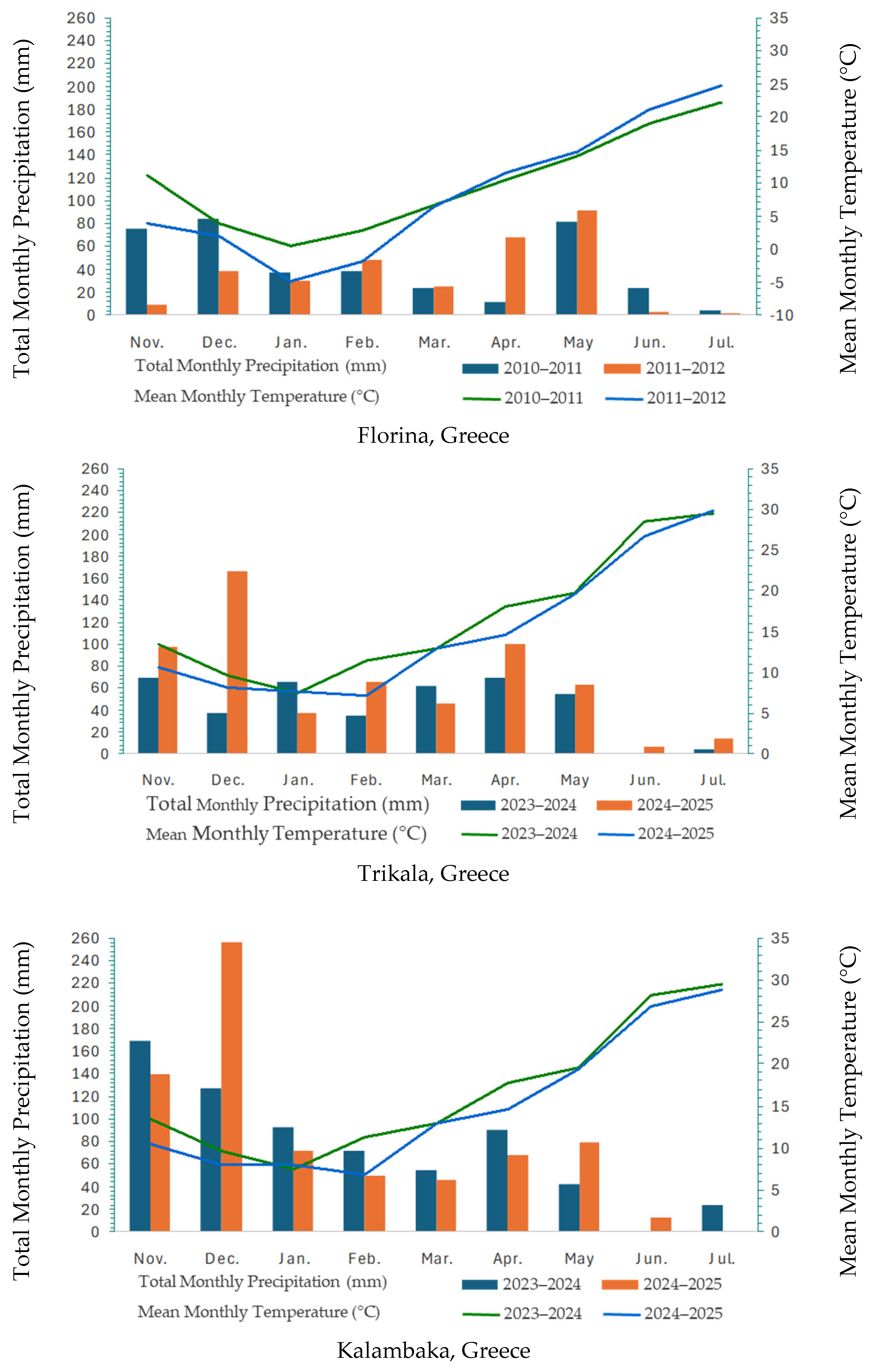
Monthly average temperature (°C) and total precipitation (mm) were recorded for all six environments, as shown in Figure 1. Seasonal and spatial variations in temperature and rainfall were observed among locations and growing seasons.

2.2. Sample Collection and Grain Quality Analysis

Grain samples were collected from each plot after harvest, cleaned, and analyzed in triplicate following the standardized methods as per AACC guidelines [25]. The crude protein content (%) was determined by measuring total nitrogen using the Kjeldahl method (AACC Method 46-12.01) [25], with a nitrogen-to-protein conversion factor of 5.7. Crude fat (%) was quantified via Soxhlet extraction with petroleum ether (AACC Method 30-25.01) [25]. The ash content (%) was determined by dry ashing the samples at 550 °C to a constant weight (AACC Method 08-01.01) [25]. Moisture content (%) was assessed by oven-drying the grain (AACC Method 44-15.02) [25].
Total starch content (%) was measured enzymatically using the Megazyme Amyloglucosidase/α-Amylase assay kit (Neogen, Wicklow, Ireland) (AACC Method 76-13.01) [25]. Crude fiber content (%) was determined according to AACC Method 32-10.01 [25]. Gluten strength was assessed using the Zeleny sedimentation test (AACC Method 56-61.02) [25], which evaluates the quality and functionality of the gluten network.
Carbohydrate Content Estimation in Wheat Samples:
The carbohydrate content of the wheat samples was estimated using the difference method. In this approach, the percentages of moisture, crude protein, ash, and crude fat were subtracted from 100 to obtain the total carbohydrate content. The formula used is:
Carbohydrate (%) = 100 − [moisture + crude protein + ash + crude fat]
To determine the soluble carbohydrate fraction, the values for starch and crude fiber were subtracted from the total carbohydrate:
Soluble fraction (%) = Carbohydrate − [starch + crude fiber]
The soluble fraction primarily includes soluble fibers, sugars, and other minor compounds, such as organic acids and certain phenolic compounds, which may also be extracted during analysis.
Finally, the non-starch fraction was calculated by subtracting the starch content from the total carbohydrate:
Non-starch fraction (%) = Carbohydrate − starch

2.3. Statistical Analysis

All statistical analyses were conducted to assess the variability, stability, and relationships among the grain quality traits measured in this study. A combined analysis of variance (ANOVA) was performed for each trait, with the genetic material treated as a fixed factor [26], using IBM SPSS version 31 (IBM Corp., Armonk, NY, USA). Mean separation was performed using Duncan’s multiple range test at a significance level of 0.05, with MSTAT-C software, version 2.10 (Michigan State University, v.2.10, USA). To evaluate the correlations between traits, Pearson’s correlation coefficients were calculated and visualized using JMP 18 (Statistical Discovery LLC, Cary, NC, USA). Principal Component Analysis (PCA) was applied to identify patterns of covariation among the quality traits, also using JMP 18.
Trait stability across different environments and years was quantified using the Stability Index (SI), as described by Fasoula [27], where
S I = ( x ¯ / s ) 2
with x ¯ representing the mean value of the trait and S its standard deviation.
Variance components were estimated from the ANOVA mean squares, following the methodology outlined by McIntosh [28], and were used to calculate broad-sense heritability (H2), based on the formulas provided by Johnson et al. [29] and Hanson et al. [30]:
H 2 = σ g 2 σ g 2 + σ g x e 2 e + σ r e 2 r x e
The genotypic coefficient of variation (GCV) and phenotypic coefficient of variation (PCV) were calculated according to Singh and Chaudhary [31] to evaluate the relative contributions of genetic and environmental factors to the observed variability. The following formulas were used:
G C V % = σ g 2 x ¯ × 100
P C V % = σ p 2 x ¯ × 100
These calculations incorporated various parameters, including genotypic variance, phenotypic variance, genotype × environment interaction variance, residual error variance, number of replications, number of environments, and overall mean, represented by σ g 2 , σ p 2 , σ g x e 2 , σ r e 2 , r, e, and x ¯ , respectively.

3. Results

The present study evaluated the performance and stability of selected wheat genotypes derived from three early-generation selection designs (McGinnis & Shebeski, honeycomb, and gridding), and a local landrace, across six distinct environments in Greece. The assessed traits included crude protein, fat, ash, starch, crude fibre, Zeleny sedimentation, carbohydrate, soluble fraction, non-starch fraction, and moisture.
Overall, the results revealed significant variation among genotypes, environments, and their interactions, providing a solid basis for evaluating genetic control, environmental influence, and trait stability in wheat seed quality.

3.1. Analysis of Variance (ANOVA) for Wheat Seed Traits

The combined analysis of variance (ANOVA) showed that genotype, environment, and their interaction significantly affected all evaluated wheat seed quality traits (Table 1). Genotypic effects were highly significant (p ≤ 0.001) for crude protein, fat, ash, starch, crude fiber, Zeleny sedimentation, carbohydrate, soluble fraction, non-starch fraction, and moisture. Environmental effects were also highly significant (p ≤ 0.001) for all traits. The genotype × environment interaction was significant (p ≤ 0.01 or p ≤ 0.001) for all evaluated traits, indicating differences in genotype performance across environments.
For crude protein, fat, ash, and carbohydrate, the mean squares associated with genotype were higher than those associated with environment, whereas for starch, Zeleny sedimentation, soluble fraction, non-starch fraction, and moisture, the mean squares for environment exceeded those for genotype.

3.2. Stability Analysis of Wheat Seed Traits

The stability of wheat seed traits across six environments was evaluated using the Stability Index (SI) (Table 2 and Table 3). Variation in SI values was observed among genotypes and traits, indicating differences in the consistency of trait expression across environments.
For crude protein, the highest SI values were observed in S1 (9136), followed by G5 (8328), G4 (8229), S5 (7862), and S3 (7619), whereas the local landrace showed the lowest stability (3570). Fat was most stable in gridding lines, particularly G5 (2600) and G4 (2204), with H4 (1664) among honeycomb lines showing moderate stability; McGinnis & Shebeski lines ranged from 1030 to 1053, and the local landrace was lowest (968). These results indicate that stability patterns varied among selection designs for this trait.
Starch was moderately stable in S and H lines (14,905–16,826), whereas G4 (14,786) and the local landrace (13,136) displayed lower stability. Ash peaked in H4 (10,458) and S3 (9238), with the local landrace again the least stable (6472). Crude fiber showed higher stability in S1 (3495) and G3 (2675), while the local landrace was lowest (2052). Zeleny sedimentation was most stable in G5 (5207), H2 (5234), and S5 (5058), with the local landrace at 3356.
Carbohydrate SI was highest in G2 (37,193), S4 (34,664), G3 (32,957), and S2 (31,744), while the local landrace scored 9852. The non-starch fraction was relatively stable in H2 (382) and other S, H, and G lines with SI above 300, whereas the local landrace had 194. The soluble fraction showed the highest stability in H2 (277), followed by G2 (271), S4 (252), and H1 (239), while the local landrace had the lowest SI value (103). Moisture stability was generally high among selected genotypes (873–987), with the local landrace at 812.
Across environments, E3 and E5 provided the most stable conditions for protein accumulation (SI = 584 and 553, respectively), whereas E6 exhibited the lowest stability for multiple traits, including starch (7546), Zeleny sedimentation (1970), and crude protein (457), reflecting higher environmental variability (Table 3). The remaining environments (E1, E2, and E4) showed intermediate SI values across most traits.
These findings indicate that genotypes, environments, and selection designs differ substantially in how consistently wheat seed quality traits are expressed across environments.

3.3. Genetic Parameters of Wheat Seed Traits

The genetic parameters of the evaluated wheat seed traits are presented in Table 4. Substantial genotypic variance was observed for all traits, indicating the presence of considerable genetic diversity among the evaluated genotypes.
Broad-sense heritability (H2) values were extremely high for all traits, ranging from 98.18% for Zeleny sedimentation to 99.93% for crude fiber, demonstrating that the majority of the phenotypic variation was attributable to genetic factors rather than environmental noise.
The genotypic coefficient of variation (GCV) and phenotypic coefficient of variation (PCV) differed among traits, reflecting differences in genetic variability and selection potential. Traits such as crude protein content (GCV = 4.55%, PCV = 4.56%), fat content (GCV = 8.34%, PCV = 8.35%), soluble fraction (GCV = 6.90%, PCV = 6.93%), and non-starch fraction (GCV = 5.15%, PCV = 5.18%) exhibited moderate to high GCV values combined with very high heritability, indicating that genetic improvement through selection is feasible for these traits.
In contrast, starch content (GCV = 0.32%, PCV = 0.33%) and carbohydrate content (GCV = 0.75%, PCV = 0.76%) displayed low genotypic variability despite high heritability, suggesting that these traits are genetically stable but offer limited scope for further genetic differentiation among the evaluated genotypes. Crude fiber (GCV = 3.47%, H2 = 99.93%) and moisture content (GCV = 3.02%, H2 = 99.62%) showed moderate genetic variability with extremely high heritability, further confirming the strong genetic control of these traits across environments.
These results indicate that the genetic parameter estimates provide a quantitative description of trait inheritance patterns and highlight marked differences among wheat seed quality traits in terms of genetic variability and potential response to selection.

3.4. Mean Comparisons of Wheat Seed Traits

Mean differences among the 16 evaluated wheat genotypes were assessed using Duncan’s multiple range test at p ≤ 0.05, and statistically significant differences were detected for all evaluated seed quality traits (Table 5).
Crude protein content ranged from 11.01% in the local landrace to 12.97% in the gridding line G5, with intermediate values observed among the remaining genotypes. Fat content varied between 2.025% (H1) and 2.705% (G3), while ash content ranged from 1.416% (G5) to 1.704% (H3). Starch content showed a narrower range, from 61.59% in the local landrace to 62.23% in H1.
Crude fiber content differed significantly among genotypes, with values ranging from 2.541% (H4) to 2.878% (S4). Zeleny sedimentation values varied between 32.22 mL (H3) and 34.50 mL (S3). Carbohydrate content ranged from 72.02% (G5) to 74.22% (H1).
The soluble fraction showed substantial variation, with the lowest value observed in G5 (7.234%) and the highest in H2 (9.374%), while the non-starch fraction ranged from 9.935% (G5) to 12.02% (H2). Moisture content varied from 10.33% (G2) to 11.57% (local landrace).
In summary, the mean comparison analysis demonstrates clear and statistically supported quantitative differences among genotypes for all evaluated seed quality traits, as reflected by Duncan’s grouping, without implying functional or agronomic interpretation beyond the observed mean separation.

3.5. Correlation Analysis of Wheat Seed Traits

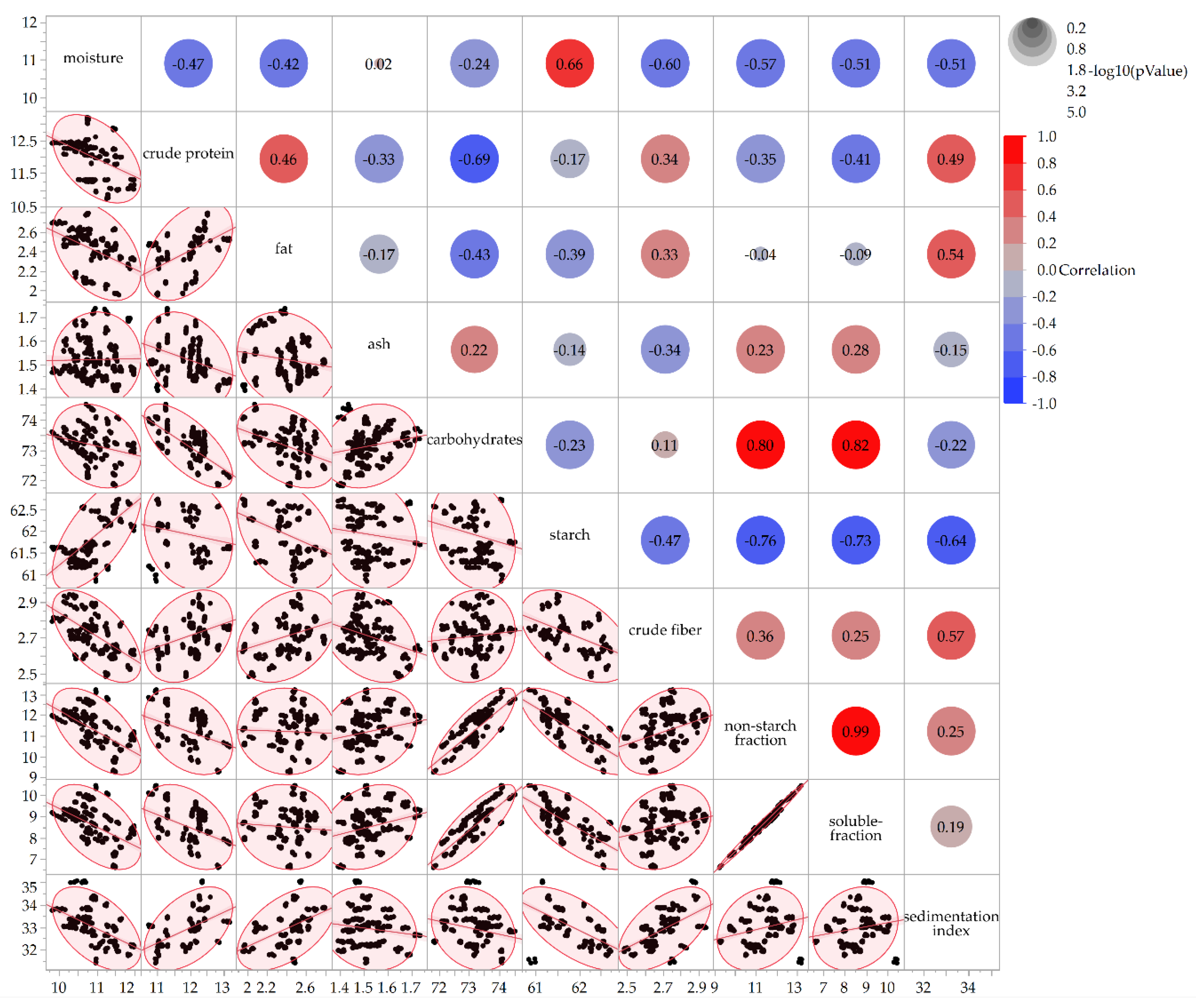
Pearson correlation coefficients among the evaluated wheat seed traits are presented in Figure 2. Several statistically significant associations (p < 0.01) were observed.
Crude protein content exhibited positive correlations with fat content (r = 0.46) and Zeleny sedimentation (r = 0.49), indicating that genotypes with higher protein tended to also show higher fat content and stronger gluten-related characteristics. In contrast, crude protein was negatively correlated with carbohydrate content (r = −0.69) and showed a weaker but significant negative correlation with starch content (r = −0.17).
Fat content was positively correlated with Zeleny sedimentation (r = 0.54) and crude fibre (r = 0.33), while negatively correlated with starch (r = −0.39) and carbohydrate content (r = −0.43). Starch content exhibited strong negative correlations with the non-starch fraction (r = −0.76) and a moderate negative correlation with Zeleny sedimentation (r = −0.64).
The soluble fraction showed a very strong positive correlation with the non-starch fraction (r = 0.99) and a strong positive correlation with carbohydrate content (r = 0.82). Moisture content was negatively correlated with crude protein (r = −0.47), fat (r = −0.42), crude fibre (r = −0.60), non-starch fraction (r = −0.57), and soluble fraction (r = −0.51), while positively correlated with starch (r = 0.66).
Collectively, the correlation matrix reveals a wide range of positive and negative associations among wheat seed quality traits, providing quantitative insight into how traits covary within the evaluated genotypes.

3.6. Exploratory Analysis

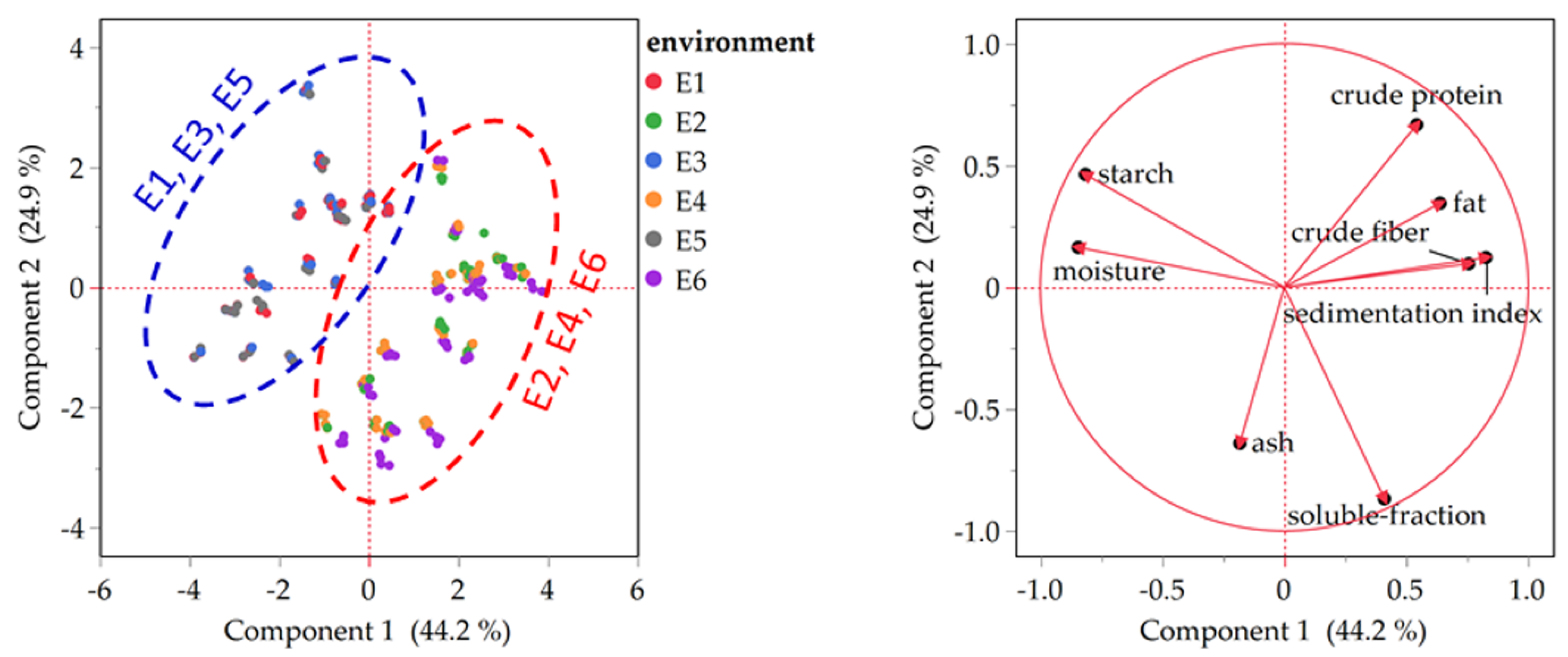
Principal Component Analysis (PCA) was performed to explore multivariate relationships among wheat seed quality traits and to summarize patterns of variation across the six environments (E1–E6). The first two principal components accounted for 69.1% of the total variation, with PC1 explaining 44.2% and PC2 explaining 24.9% (Figure 3).
The loading plot indicated that fat content, crude fibre, Zeleny sedimentation index, starch content, and moisture content contributed most strongly to variation along PC1. Fat content, crude fibre, and Zeleny sedimentation showed positive loadings on PC1, whereas starch and moisture exhibited negative loadings.
Variation along PC2 was mainly associated with crude protein content, which showed positive loadings, while ash content and the soluble carbohydrate fraction were negatively associated with this component.
The score plot revealed a clear separation of environments along PC1. Environments E1, E3, and E5 were positioned on the negative side of PC1, while E2, E4, and E6 clustered on the positive side, indicating differentiation among environments with respect to the evaluated quality traits.
Taken together, the PCA highlights patterns of association among wheat seed quality traits and demonstrates that both trait loadings and environmental positioning contribute to the observed multivariate structure.

4. Discussion

Plant breeders focus on selecting the most effective methods to drive genetic improvement. In this study, we assessed the performance and stability of wheat seed quality traits across multiple environments, focusing on genotypes derived from three selection designs and a local landrace. Significant genotype, environment, and genotype × environment (G×E) interactions were observed for all traits, confirming that both genetic background and environmental conditions contributed to the observed phenotypic variation. Traits such as crude protein, fat, ash, and carbohydrate were predominantly controlled by genotype, exhibiting high heritability and potential for selection. Significant genotypic variation supports the quantitative inheritance, in line with earlier reports on genetic variability in wheat populations [19,32]. Wheat landraces have also been shown to maintain high protein content and other quality traits, despite lower yields, underscoring their importance for improving seed quality [17].
Recent genomic studies have identified significant variation in grain protein content, with key candidate genes and markers that improve wheat nutritional quality [33]. Tian et al. [34] reported 97 SNPs linked to protein quality traits, while Kiseleva et al. [35] highlighted loci associated with protein and gluten content, suggesting shared genetic factors between winter and spring wheat. These findings support the strong genetic determination of protein-related traits observed in the present study. In contrast, other wheat quality characteristics, such as Zeleny sedimentation, starch, soluble fraction, non-starch fraction, and moisture, were primarily influenced by environmental factors. Crude fiber exhibited balanced genotype × environment effects, reflecting moderate stability across locations and seasons. These observations are consistent with previous studies on bread wheat, which demonstrated that G×E interactions significantly influence protein content, Zeleny sedimentation, and other quality traits [4,5,36,37,38,39]. Therefore, multi-environment evaluation is essential to ensure reliable selection of genotypes with stable quality expression.
To explore multivariate relationships among wheat quality traits and environmental effects, Principal Component Analysis (PCA) was performed. The first two components explained 69.1% of total variation: PC1 was mainly associated with fat, crude fiber, and sedimentation index, while PC2 was driven by crude protein and ash/soluble carbohydrates. This multivariate structure highlights the complex interrelationships among quality traits and their combined response to environmental variability. Similar PCA-based approaches have been successfully applied in wheat to assess genetic diversity and trait contribution [11,12], supporting the usefulness of PCA for identifying trait groupings relevant to breeding program planning.
Stability analysis demonstrated that certain genotypes maintained consistent expression of key quality traits across environments, particularly protein and fat, whereas traits such as Zeleny sedimentation, starch, and carbohydrate showed greater environmental sensitivity. These findings are consistent with studies by Greveniotis et al. [40,41,42], who reported high stability and heritability for qualitative traits such as protein, ash, and fiber across diverse environments. The present results confirm that combining high mean performance with stability is critical for predictable quality outcomes under variable growing conditions. Traits such as protein and fat exhibited both high broad-sense heritability and high stability indices, indicating strong potential for reliable genetic improvement. This supports the concept that stability represents a quantitative and selection-relevant trait, rather than merely a secondary attribute of performance. In contrast, traits with strong quantitative inheritance and high environmental responsiveness, such as yield, often display lower stability indices, as previously noted by Fasoulas [19]. Furthermore, these results support indirect selection via stable, highly correlated traits, as suggested by Greveniotis et al. [43,44,45], who proposed replacing unstable traits with more heritable ones to improve selection programs. These findings reinforce the importance of integrating stability parameters into multi-trait breeding strategies, particularly when quality improvement is targeted alongside agronomic performance.
Genetic parameter analysis revealed strong genetic control over key traits, such as protein, fat, and crude fiber, indicating high potential for selective breeding. Zeleny sedimentation and non-starch fraction also exhibited high broad-sense heritability, although with lower genotypic coefficients of variation, suggesting that while these traits are largely genetically controlled, their scope for improvement through selection may be more limited. The observed genetic parameters suggest that additive genetic effects play a major role in protein and fat accumulation, consistent with previous reports [46,47]. Yannam et al. [48] identified major QTLs associated with key quality traits, further supporting the feasibility of targeted selection. However, the expression of these traits remains influenced by environmental conditions, emphasizing the need for evaluation across contrasting environments.
Correlation analysis revealed positive associations among protein, fat, and crude fiber, and negative correlations between protein or fat and starch, carbohydrate, soluble fraction, and non-starch fraction. These relationships indicate potential trade-offs among major grain components, highlighting the need for balanced breeding strategies that account for trade-offs among key wheat seed components. Such interrelationships are crucial when selecting genotypes for multiple traits simultaneously. Similar negative correlations between grain protein and starch content have been reported by Muqaddasi et al. [49], while positive associations between protein and gluten-related traits were observed by Desheva and Deshev [50]. Although correlation analysis provides useful insights for indirect selection, additional analytical approaches such as path analysis would be required to clarify direct and indirect trait effects [51].
Mean comparisons revealed clear differences among selection methods. Gridding-derived lines generally exhibited higher protein and fat, McGinnis & Shebeski lines showed superior performance in Zeleny sedimentation and crude fiber with moderate stability, while honeycomb-derived lines were characterized by higher starch, carbohydrate, soluble fraction, and non-starch fraction. These results indicate that different selection designs may favor distinct quality profiles, suggesting that breeding method choice can be aligned with specific end-use quality objectives.
Overall, the combined use of multi-environment evaluation, stability analysis, genetic parameter estimation, and comparative assessment of selection methods provides a robust framework for wheat quality improvement. By identifying traits predominantly controlled by genotype and those more responsive to environmental variation, breeders can optimize selection strategies to enhance wheat seed quality while maintaining stability across diverse growing conditions.

5. Conclusions

The present study demonstrates that wheat seed quality is determined by the combined effects of genetic background and environmental conditions. Protein, fat, ash, and carbohydrate were predominantly controlled by genotype, whereas starch, Zeleny sedimentation, soluble fraction, non-starch fraction, and moisture were more strongly influenced by environmental variation, while crude fiber showed balanced genotype × environment effects. Multi-environment evaluation and stability analysis identified genotypes with consistent expression of key quality traits across contrasting conditions, indicating that stability should be considered an essential selection criterion alongside mean performance.
Correlation analysis revealed trade-offs among major grain components, highlighting the need for balanced breeding strategies when improving multiple quality traits simultaneously. The choice of selection method significantly affected trait expression: gridding-derived lines were superior for protein and fat, McGinnis & Shebeski lines for Zeleny sedimentation and crude fiber, and honeycomb-derived lines for starch, carbohydrate, soluble, and non-starch fractions.
These findings provide practical guidance for breeders by identifying traits with high heritability and stable expression across environments, supporting more predictable genetic improvement of wheat seed quality under Mediterranean conditions. Future breeding efforts may benefit from integrating stability parameters and selection-design-specific advantages into quality-focused breeding programs.

Author Contributions

Conceptualization, V.G.; methodology, V.G.; investigation, V.G., C.G.I., E.B. and D.K.; statistical analysis, A.S. and V.G., writing—original draft preparation, V.G., E.B. and C.G.I.; writing—review and editing, V.G., E.B. and A.S.; visualization, A.S. and V.G.; supervision, V.G.; project administration, V.G. All authors have read and agreed to the published version of the manuscript.

Funding

This research received no external funding.

Institutional Review Board Statement

Not applicable.

Data Availability Statement

The original contributions presented in this study are included in the article. Further inquiries can be directed to the corresponding author.

Acknowledgments

The authors thank the late St. Zotis for his help with the experiment and for providing the farm at the Technological Educational Institute of Western Macedonia, Florina, Greece.

Conflicts of Interest

The authors declare no conflicts of interest.

References

  1. Ulukan, H. Wheat Production Trends and Research Priorities: A Global Perspective. In Advances in Wheat Breeding; Springer Nature: Singapore, 2024; pp. 1–22. [Google Scholar]
  2. Filip, E.; Woronko, K.; Stępień, E.; Czarniecka, N. An Overview of Factors Affecting the Functional Quality of Common Wheat (Triticum aestivum L.). Int. J. Mol. Sci. 2023, 24, 7524. [Google Scholar] [CrossRef] [PubMed]
  3. Khalid, A.; Hameed, A.; Tahir, M.F. Wheat Quality: A Review on Chemical Composition, Nutritional Attributes, Grain Anatomy, Types, Classification, and Function of Seed Storage Proteins in Bread Making Quality. Front. Nutr. 2023, 10, 1053196. [Google Scholar] [CrossRef] [PubMed]
  4. Öztürk, I. Genotype and environment effect on yield and quality parameters and stability in bread wheat (Triticum aestivum L.) cultivars under rainfed conditions. Tekirdag Ziraat Fak. Der. 2024, 21, 324–334. [Google Scholar] [CrossRef]
  5. Kedir, A.; Letta, T. Genotype by Environmental Interaction on Grain Quality of Bread Wheat (Triticum aestivum L.) Genotypes at Southern Ethiopia. Int. J. Genet. Genom. 2022, 10, 7–11. [Google Scholar] [CrossRef]
  6. Iqbal, Z.; Pasha, I.; Abrar, M.; Masih, S.; Hanif, M.S. Physico-chemical, functional and rheological properties of wheat varieties. J. Agric. Res. 2015, 53, 253–267. [Google Scholar]
  7. Ashraf, M. Stress-induced changes in wheat grain composition and quality. Crit. Rev. Food Sci. Nutr. 2014, 54, 1576–1583. [Google Scholar] [CrossRef]
  8. Ali, N.; Iqbal, M.; Ahmed, I.; Asif, M. Genetic variation at loci controlling quality traits in spring wheat. Pak. J. Agric. Sci. 2013, 50, 637–647. [Google Scholar]
  9. Minhas, N.M.; Ajmal, S.; Ahmed, Z.I.; Munir, M. Genetic analysis for grain quality traits in Pakistani wheat varieties. Pak. J. Bot. 2014, 46, 1409–1413. [Google Scholar]
  10. Hussain, M.; Khan, A.S.; Khaliq, I.; Maqsood, M. Correlation Studies of Some Qualitative and Quantitative Traits with Grain Yield in Spring Wheat across Two Environments. Pak. J. Agric. Sci. 2012, 49, 1–4. [Google Scholar]
  11. Baranwal, D.; Mishra, V.; Teejveer, S. Genetic diversity based on cluster and principal component analyses for yield and its contributing characters in wheat (Triticum aestivum L.). Madras Agric. J. 2013, 100, 320–323. [Google Scholar] [CrossRef]
  12. Hussain, S.B.; Wahid, M.A.; Zubair, M.; Babar, M.; Wahid, K. Assessment of germplasm using multivariate analysis for grain yield and quality traits in spring wheat. Pak. J. Bot. 2014, 46, 989–994. [Google Scholar]
  13. Lopes, M.S.; El-Basyoni, I.; Baenziger, P.S.; Singh, S.; Royo, C.; Ozbek, K.; Aktas, H.; Ozer, E.; Ozdemir, F.; Manickavelu, A.; et al. Exploiting Genetic Diversity from Landraces in Wheat Breeding for Adaptation to Climate Change. J. Exp. Bot. 2015, 66, 3477–3486. [Google Scholar] [CrossRef] [PubMed]
  14. Dwivedi, S.L.; Ceccarelli, S.; Blair, M.W.; Upadhyaya, H.D.; Are, A.K.; Ortiz, R. Landrace germplasm for improving yield and abiotic stress adaptation. Trends Plant Sci. 2016, 21, 31–42. [Google Scholar] [CrossRef] [PubMed]
  15. Jaradat, A. Wheat Landraces: Genetic Resources for Sustenance and Sustainability. USDA-ARS 2011. pp. 1–20. Available online: https://www.ars.usda.gov/ARSUserFiles/50600000/products-wheat/AAJ-Wheat%20Landraces.pdf (accessed on 22 January 2026).
  16. Jaradat, A.A. Wheat landraces: A mini review. Emir. J. Food Agric. 2013, 25, 20–29. [Google Scholar] [CrossRef]
  17. Dotlačil, L.; Hermuth, J.; Stehno, Z.; Dvořáček, V.; Bradová, J.; Leišová, L. How Can Wheat Landraces Contribute to Present Breeding. Czech J. Genet. Plant Breed. 2010, 46, S70–S74. [Google Scholar] [CrossRef]
  18. Stratilakis, S.N.; Goulas, C.K. Yield performance at three nitrogen rates of a set of honeycomb vs. traditional pedigree selected bread wheat varieties. Eur. J. Agron. 2003, 19, 65–76. [Google Scholar] [CrossRef]
  19. Fasoulas, A.C. The Honeycomb Methodology of Plant Breeding; Department of Genetics and Plant Breeding, Aristotle University of Thessaloniki: Thessaloniki, Greece, 1988; p. 168. [Google Scholar]
  20. Gardner, C.O. An evaluation of effects of mass selection and seed irradiation with thermal neutrons on yield of corn. Crop Sci. 1961, 1, 241–245. [Google Scholar] [CrossRef]
  21. Shebeski, L.H. Wheat and breeding. In Proceedings of the Centennial Wheat Symposium; Nielyen, K.F., Ed.; Modern Press: Saskatoon, SK, Canada, 1967; pp. 249–272. [Google Scholar]
  22. McGinnis, R.C.; Shebeski, L.H. The reliability of single plant selection for yield in F2. In Proceedings of the Third International Wheat Genetics Symposium; Finlay, K.W., Shepherd, K.W., Eds.; Australian Academy of Science: Canberra, Australia, 1968; pp. 410–415. [Google Scholar]
  23. Greveniotis, V.; Sioki, E.; Ipsilandis, C.G. Preliminary comparisons of early generation individual selection efficiency of a local wheat landrace under different experimental field designs. Chilean J. Agric. Res. 2019, 79, 210–222. [Google Scholar] [CrossRef]
  24. Lancashire, P.D.; Bleiholder, H.; van den Boom, T.; Langelüddeke, P.; Stauss, R.; Weber, E.; Witzenberger, A. A Uniform Decimal Code for Growth Stages of Crops and Weeds. Ann. Appl. Biol. 1991, 119, 561–601. [Google Scholar] [CrossRef]
  25. Association of Official Analytical Chemists (AOAC). Official Methods of Analysis, 18th ed.; AOAC International: Gaithersburg, MD, USA, 2005. [Google Scholar]
  26. Steel, R.G.D.; Torrie, H.; Dickey, D.A. Principles and Procedures of Statistics. A Biometrical Approach, 3rd ed.; McGraw-Hill: New York, NY, USA, 1997; p. 666. [Google Scholar]
  27. Fasoula, V.A. Prognostic Breeding: A new paradigm for crop improvement. Plant Breed. Rev. 2013, 37, 297–347. [Google Scholar]
  28. McIntosh, M.S. Analysis of Combined Experiments. Agron. J. 1983, 75, 153–155. [Google Scholar] [CrossRef]
  29. Johnson, H.W.; Robinson, H.E.; Comstock, R.E. Estimate of genetic and environmental variability in soybean. Agron. J. 1955, 47, 314–318. [Google Scholar] [CrossRef]
  30. Hanson, G.; Robinson, H.F.; Comstock, R.E. Biometrical studies on yield in segregating population of Korean Lespedeza. Agron. J. 1956, 48, 268–274. [Google Scholar] [CrossRef]
  31. Singh, R.K.; Chaudhary, B.D. Biometrical Methods in Quantitative Genetic Analysis; Kalyani Publishers: New Delhi, India, 1977; p. 304. [Google Scholar]
  32. Moghaddam, M.; Ehdaie, B.; Waines, J.G. Genetic variation and interrelationships of agronomic characters in landraces of bread wheat from southeastern Iran. Euphytica 1997, 95, 361–369. [Google Scholar] [CrossRef]
  33. Kartseva, T.; Alqudah, A.M.; Aleksandrov, V.; Alomari, D.Z.; Doneva, D.; Arif, M.A.R.; Börner, A.; Misheva, S. Nutritional Genomic Approach for Improving Grain Protein Content in Wheat. Foods 2023, 12, 1399. [Google Scholar] [CrossRef]
  34. Tian, Y.; Liu, P.; Kong, D.; Nie, Y.; Xu, H.; Han, X. Genome-Wide Association Analysis and KASP Markers Development for Protein Quality Traits in Winter Wheat. BMC Plant Biol. 2025, 25, 149. [Google Scholar] [CrossRef]
  35. Kiseleva, A.A.; Fedyaeva, A.V.; Leonova, I.N.; Salina, E.A. Genetic Control of Grain Protein and Gluten Content: Winter vs. Spring Wheat. Int. J. Mol. Sci. 2025, 26, 11159. [Google Scholar] [CrossRef]
  36. Desheva, G. Effects of genotype, environment and their interaction on quality characteristics of winter bread wheat. J. Basic Appl. Res. 2016, 2, 363–372. [Google Scholar]
  37. Aktaş, B.; Gökdere, H.İ. Evaluation of grain yield, and quality characteristics of some bread wheat cultivars in different agro-ecological regions of Türkiye. Heliyon 2025, 11, e41547. [Google Scholar] [CrossRef]
  38. Mut, Z.; Aydin, N.; Bayramoglu, H.O.; Ozcan, H. Stability of Some Quality Traits in Bread Wheat (Triticum aestivum) Genotypes. J. Environ. Biol. 2010, 31, 489–495. [Google Scholar]
  39. Mladenov, V.; Banjac, B.; Krishna, A.; Milošević, M. Relation of grain protein content and some agronomic traits in European cultivars of winter wheat. Cereal Res. Comm. 2011, 40, 532–541. [Google Scholar] [CrossRef]
  40. Greveniotis, V.; Bouloumpasi, E.; Zotis, S.; Korkovelos, A.; Kantas, D.; Ipsilandis, C.G. Genotype-by-Environment Interaction Analysis for Quantity and Quality Traits in Faba Beans Using AMMI, GGE Models, and Stability Indices. Plants 2023, 12, 3769. [Google Scholar] [CrossRef] [PubMed]
  41. Greveniotis, V.; Bouloumpasi, E.; Zotis, S.; Korkovelos, A.; Kantas, D.; Ipsilandis, C.G. A Comparative Study on Stability of Seed Characteristics in Vetch and Pea Cultivations. Agriculture 2023, 13, 1092. [Google Scholar] [CrossRef]
  42. Greveniotis, V.; Bouloumpasi, E.; Zotis, S.; Korkovelos, A.; Kantas, D.; Ipsilandis, C.G. Stability Dynamics of Main Qualitative Traits in Maize Cultivations across Diverse Environments regarding Soil Characteristics and Climate. Agriculture 2023, 13, 1033. [Google Scholar] [CrossRef]
  43. Greveniotis, V.; Bouloumpasi, E.; Skendi, A.; Korkovelos, A.; Kantas, D.; Ipsilandis, C.G. Evaluation and Stability of Red and White Trifolium Species for Nutritional Quality in a Mediterranean Environment. Agriculture 2025, 15, 391. [Google Scholar] [CrossRef]
  44. Greveniotis, V.; Bouloumpasi, E.; Skendi, A.; Ipsilandis, C.G. Fiber Quality and Stability of Partially Interspecific Cotton Lines Under Irrigation and Nitrogen Environments. Appl. Sci. 2025, 15, 9684. [Google Scholar] [CrossRef]
  45. Greveniotis, V.; Sioki, E.; Ipsilandis, C.G. Estimations of fiber trait stability and type of inheritance in cotton. Czech J. Genet. Plant Breed. 2018, 54, 190–192. [Google Scholar] [CrossRef]
  46. Yazici, E.; Bilgin, O. Heritability estimates for milling quality associations of bread wheat in the Northwest Turkey. Int. J. Agron. 2019, 2, 17–22. [Google Scholar] [CrossRef]
  47. Aydin, N.; Mut, Z.; Şeyh, B. Estimation of broad-sense heritability for grain yield and some agronomic and quality traits of bread wheat (Triticum aestivum L.). J. Food Agric. Environ. 2010, 8, 419–421. [Google Scholar]
  48. Yannam, V.R.R.; Lopes, M.; Guzman, C.; Soriano, J.M. Uncovering the genetic basis for quality traits in the Mediterranean old wheat germplasm and phenotypic and genomic prediction assessment by cross-validation test. Front. Plant Sci. 2023, 4, 1127357. [Google Scholar] [CrossRef]
  49. Muqaddasi, Q.H.; Brassac, J.; Ebmeyer, E.; Kollers, S.; Korzun, V.; Argiller, O.; Stiewe, G.; Plieske, J.; Ganal, M.W.; Rode, M. Prospects of GWAS and predictive breeding for European winter wheat’s grain protein content, grain starch content, and grain hardness. Sci. Rep. 2020, 10, 12541. [Google Scholar] [CrossRef]
  50. Desheva, G.; Deshev, M. Correlation and Regression Relationships between Main Grain Quality Characteristics in Bread Winter Wheat. Agric. Conspec. Sci. 2022, 87, 135–143. [Google Scholar]
  51. Drikvand, R.; Bihamta, M.R.; Najafian, G.; Ebrahimi, A. Kernel quality association and path analysis in bread wheat. Int. J. Biol. 2013, 5, 73–79. [Google Scholar] [CrossRef][Green Version]
Figure 1. Monthly average temperature (°C) and total precipitation (mm) recorded during the wheat growing seasons at the experimental sites: Florina (2010–2011, 2011–2012), Trikala (2023–2024, 2024–2025), and Kalambaka (2023–2024, 2024–2025).
Agriculture 16 00476 g001
Figure 2. Correlation matrix showing relationships among wheat quality traits. The upper triangle displays the correlation coefficients, while the lower triangle shows scatterplots with black dots, with fitted regression lines and 95% confidence ellipses (pink areas), highlighting patterns and clustering among the data points.
Agriculture 16 00476 g002
Figure 3. Principal component analysis (PCA) of 16 wheat genotypes across six environments for seed quality traits. PC1 (44.2%) is driven by fat, crude fiber, and sedimentation index, while PC2 (24.9%) reflects crude protein and ash/soluble carbohydrates. The biplot shows genotypic clustering, indicating that genetic differences mainly drive variation, with environmental effects secondary.
Agriculture 16 00476 g003
Table 1. Results of the combined analysis of variance (ANOVA) for wheat seed quality traits, including crude protein, fat, starch, ash, crude fibre, carbohydrate, soluble fraction, non-starch fraction, and moisture (all expressed as %), and Zeleny sedimentation (mL). Mean squares (m.s.) are reported for genotype (G), environment (E), and genotype × environment interaction (G×E), along with their corresponding levels of statistical significance.
Source of
Variation
Crude
Protein
Fat Ash Starch Crude Fibre Zeleny SedimentationCarbohydrateSoluble
Fraction
Non-Starch Fraction Moisture
m.s.m.s.m.s.m.s.m.s.m.sm.s.m.s.m.s.m.s.
Environment (E)1.085 ***0.342 ***0.014 ***18.020 ***0.213 ***15.608 ***1.775 ***25.818 ***30.717 ***9.312 ***
REPS/Environments0.0004 ns0.0002 *0.00009 ns0.0005 ns0.00004 ns0.001 ns0.002 ns0.002 ns0.002 ns0.001 ns
Genotype (G)7.103 ***0.964 ***0.162 ***0.972 ***0.212 ***8.809 ***7.349 ***8.327 ***8.072 ***2.660 ***
Environment ×
Genotype (E × G)
0.029 ***0.001 ***0.0001 ***0.003 ***0.0001 **0.108 ***0.041 ***0.052 ***0.053 ***0.007 ***
Error0.00040.00010.000070.00040.000080.0010.0020.0020.0020.001
Probability levels: * p ≤ 0.05; ** p ≤ 0.01; *** p ≤ 0.001; ns—not significant.
Table 2. Stability Index (SI) values for wheat seed traits, including crude protein, fat, starch, ash, crude fibre, carbohydrate, soluble fraction, non-starch fraction, and moisture (all in %), and Zeleny sedimentation (mL). Genotypes with higher SI values are considered more stable across environmental conditions.
GenotypesCrude
Protein
Fat Ash Starch Crude Fiber Zeleny
Sedimentation
CarbohydrateSoluble Fraction Non-Starch Fraction Moisture
S191361053764015,6233495462924,315214316933
S271441002816515,7203273567031,744234348873
S376191030923815,8402523439124,813233343938
S468431080914116,6702653505734,664252373987
S578621034878814,9052143505825,315178266929
H174961146837815,4442311523421,283239333986
H270491088832915,9102510364026,699277382976
H370051320847916,8262188520415,564216307939
H46427166410,45814,9362386446724,654234327993
H57273120910,19915,9042365414923,522213310980
G148591008899516,0872489469228,301218328981
G270511104785516,6752309485537,193271388963
G373641103805416,2742675546732,957190290935
G482292204843514,7862423424319,030193284928
G583282600889415,7212274520716,320140221933
Local landrace3570968647213,136205233569852103184812
Table 3. Stability Index (SI) values for wheat seed traits, including crude protein, fat, starch, ash, crude fibre, carbohydrate, soluble fraction, non-starch fraction, and moisture (all in %), and Zeleny sedimentation (mL). Higher SI values indicate greater stability of each trait across different environments.
EnvironmentsCrude
Protein
Fat Ash Starch Crude Fiber Zeleny
Sedimentation
CarbohydrateSoluble
Fraction
Non-Starch Fraction Moisture
E153015035110,217842325818,1671963561110
E24611453579797862317018,0252414301078
E358415235510,650848329418,9482123831146
E442914535210,188892318717,4892314081094
E555315235410,655845329218,8622053741143
E64571543587546888197015,5231923361169
Table 4. Genetic parameter estimates for wheat seed traits, including crude protein, fat, starch, ash, crude fibre, carbohydrate, soluble fraction, non-starch fraction, and moisture (all in %), and Zeleny sedimentation (mL). The table presents mean values, genotypic variance ( σ g 2 ), phenotypic variance ( σ p 2 ), broad-sense heritability (H2, %), genotypic coefficient of variation (GCV, %), phenotypic coefficient of variation (PCV, %), standard deviation (SD), minimum (min), and maximum (max) values for each trait.
TraitsMin.Max.MeanSD σ g 2 σ p 2 GCV (%)PCV (%)H2 (%)
Crude protein 10.73513.18611.9380.5460.29480.29664.54764.561599.39
Fat 1.9522.7942.4000.2060.04010.04028.34498.351299.85
Ash 1.3911.7351.5210.0810.00670.00685.40015.403299.89
Starch 60.83462.74261.9230.5240.04040.04060.32450.325299.56
Crude fiber 2.4822.9422.7080.1060.00880.00893.46913.470399.93
Zeleny sedimentation 31.41635.05232.9360.7560.36250.36931.82811.845098.18
Carbohydrate 71.81874.51773.1360.5660.30450.30620.75450.756699.44
Soluble fraction 6.58510.4668.5050.8220.34480.34706.90396.925699.38
Non-starch fraction 9.2413.2211.2140.8540.33410.33745.15495.180199.03
Moisture 9.82411.99411.0040.4780.11050.11103.02133.027099.62
Table 5. Duncan’s multiple range test was performed to compare mean differences among the 16 wheat genotypes for all evaluated seed traits, including crude protein, fat, starch, ash, crude fibre, carbohydrate, soluble fraction, non-starch fraction, and moisture (all in %), and Zeleny sedimentation (mL).
GenotypesCrude
Protein
Content (%)
Fat
Content
(%)
Ash
Content
(%)
Starch
Content
(%)
Crude Fiber
Content
(%)
Zeleny
Sedimentation
(mL)
Carbohydrate Content
(%)
Soluble
Fraction
(%)
Non-Starch Fraction
(%)
Moisture Content
(%)
S112.13 g2.414 h1.531 g61.83 h2.659 j32.71 h73.18 h 8.686 f 11.35 f10.75 j
S211.94 j2.390 j1.569 e61.99 f2.849 b32.61 j73.59 c 8.753 e 11.60 d10.51 l
S312.22 e2.468 f1.458 j61.63 l2.817 d34.50 a72.94 i 8.491 i 11.31 g10.91 h
S412.12 h2.457 g1.471 i61.99 f2.878 a32.56 k73.26 g 8.397 j 11.28 h10.70 k
S512.14 f2.460 g1.581 d62.05 e2.689 h33.33 d72.58 l 7.840 l 10.53 m11.15 e
H111.13 m2.025 m1.418 k62.23 a2.689 h32.39 m74.22 a 9.304 b 11.99 b11.21 d
H211.17 l2.497 d1.589 c61.69 k2.647 k32.90 e73.71 b 9.374 a 12.02 a11.03 g
H311.17 l2.311 k1.704 a62.18 b2.587 m32.22 o73.32 f 8.549 g11.14 j11.50 b
H412.01 i2.088 l1.657 b61.78 i2.541 n32.49 l73.32 f 8.994 d 11.54 e10.93 h
H511.91 k2.026 m1.540 f62.13 c2.708 f32.68 i73.36 e 8.523 h 11.23 i11.16 e
G112.14 f2.411 h1.494 h61.77 j2.828 c33.83 b72.67 k 8.076 k 10.90 l11.28 c
G212.28 d2.618 b1.457 j62.08 d2.749 e33.32 d73.32 f 8.487 i 11.24 i10.33 m
G312.37 b2.705 a1.498 h61.96 g2.640 l33.43 c72.32 m7.715 m 10.36 n11.11 f
G412.30 c2.577 c1.455 j61.78 i2.677 i32.85 f72.85 j 8.391 j 11.07 k10.82 i
G512.97 a2.477 e1.416 k62.09 d2.701 g32.82 g72.02 n 7.234 n 9.935 o11.12 f
Local landrace11.01 n2.397 i1.493 h61.59 m2.678 i32.36 n73.53 d 9.269 c 11.95 c11.57 a
Different letters indicate statistically significant differences at p ≤ 0.05.
Disclaimer/Publisher’s Note: The statements, opinions and data contained in all publications are solely those of the individual author(s) and contributor(s) and not of MDPI and/or the editor(s). MDPI and/or the editor(s) disclaim responsibility for any injury to people or property resulting from any ideas, methods, instructions or products referred to in the content.