Article

Physical Properties and Experimental Study of Cotton Stalks from Typical Arid Regions of Southern Xinjiang Based on DEM


1
College of Mechanical and Electrical Engineering, Tarim University, Alar 843300, China
2
Modern Agricultural Engineering Key Laboratory, Universities of Education Department of Xinjiang Uygur Autonomous Region, Alar 843300, China
3
Xinjiang Production and Construction Corps (XPCC) Key Laboratory of Utilization and Equipment of Special Agricultural and Forestry Products in Southern Xinjiang, Alar 843300, China
*
Author to whom correspondence should be addressed.
Agriculture 2026, 16(4), 427; https://doi.org/10.3390/agriculture16040427
Submission received: 16 January 2026 / Revised: 5 February 2026 / Accepted: 9 February 2026 / Published: 13 February 2026
(This article belongs to the Section Agricultural Technology)

Abstract

Using the discrete element method to simulate the interaction between cotton stalks and machinery is an effective approach for analyzing the cotton stalk defibration mechanism and optimizing the structural parameters of cotton stalk defibration equipment. To further improve the accuracy of studies on the interaction between cotton stalk defibration devices and cotton stalks, cotton stalks from typical arid regions in southern Xinjiang were selected as the research object, and a discrete element parameter calibration study was conducted based on the discrete element method. Considering the differences in cotton stalk diameters, two discrete element models of cotton stalks with diameters of 8.5 mm and 10.5 mm were established. Plackett–Burman screening tests and Box–Behnken tests were employed to calibrate and optimize the discrete element contact parameters for cotton stalk models with different diameters. Optimization was carried out using the load responses obtained from mechanical tests of cotton stalks as the target values, and the optimal parameter combinations of the cotton stalk discrete element models were determined. Finally, the calibrated parameters were validated through tensile tests, uniaxial compression tests, and bending tests of cotton stalks. The simulation results show that the relative errors between the simulated and measured maximum loads for the 8.5 mm- and 10.5 mm-diameter cotton stalk models were 1.21% and 0.08%, respectively, indicating good agreement. These results verify the accuracy and reliability of the established cotton stalk discrete element models and provide data support and a theoretical basis for numerical simulation of the defibration process of cotton stalks with different diameters and for the structural optimization of cotton stalk defibration devices.

1. Introduction

Cotton is a globally significant economic crop. China, the world’s largest cotton producer, yielded 5.618 million tons in 2023. Cotton stalks constitute a substantial biomass resource post-harvest [1,2], with waste generation estimated at 2.9–3.8 times commercial cotton yield by weight [3]. Among them, Xinjiang is the main cotton-producing region in China, and the southern Xinjiang region, benefiting from its unique natural advantages, has developed a cotton cultivation pattern characterized by high yield and superior fiber quality. However, current practices in China predominantly involve field residue retention, causing resource wastage and soil pathogen proliferation. A primary cause is the underutilization of cotton stalk resources. Cotton stalks can be processed into particleboards, fiberboards, and corrugated boards [4,5,6]. Reconstituted boards require defibered stalks with axially intact yet laterally loose and interwoven structures. In-depth research on the biomechanical properties of cotton stalks and their defibration mechanisms is imperative for advancing the design of cotton stalk defibration devices.
The biomechanical properties of plant stalks involve applying continuum mechanics concepts and Newtonian principles to analyze macroscopic mechanical behaviors [7], which are pivotal for crop yield enhancement, agricultural machinery development, and biomass utilization [8]. Stalk mechanical properties correlate with moisture content, sampling position, and diameter [9,10]. Additionally, stalks exhibit distinct mechanical behaviors under compressive, tensile, and bending loads [11]. Therefore, investigating the biomechanical properties of cotton stalks is essential for analyzing their defibration and fragmentation mechanisms.
Damage characterization of lignocellulosic materials has been investigated mainly via physical experiments, statistical analysis, and numerical simulation [10]. Physical experiments (often supported by statistical analysis) provide reliable macroscopic strength and deformation responses; however, they may not explicitly resolve transient multi-contact dynamics, intermittent detachment, and discrete fracture-like events during tool–stalk engagement, which motivates the use of computational modeling to probe underlying mechanisms. Among numerical approaches, finite element method (FEM) models can effectively represent the overall mechanical response and macroscopic deformation of wood and other lignocellulosic materials [12,13]. In contrast, discrete element method (DEM) models are advantageous for explicitly resolving contact interactions and representing fragmentation processes from a micro-scale perspective [11,14]. Based on this comparative assessment, DEM is adopted in this study to capture multi-contact interactions and to enable calibration against multiple mechanical tests. The Discrete Element Method (DEM) is a powerful tool for visualizing interactions between agricultural machinery and stalks, enabling microscopic analysis of mechanical forces and kinematic behavior [15,16,17,18]. DEM has been extensively employed to develop numerical models of stalks and seeds [19,20,21]. Mechanical modeling has been widely applied to corn stalks [22], wheat straw [23], and banana stalks [8]. Liao et al. [24] developed DEM simulations for forage rape harvesting in isotropic models. The authors focused on chopping and conveying processes with bending deformation analysis. Wang et al. [25] established a DEM model for citrus stalks. The authors conducted bending-shear tests, providing insights into robotic end-effector optimization. Zeng et al. [26] integrated physical tests, virtual simulations, and machine learning to calibrate corn stalk parameters and clarify damage mechanisms during grinding. Fang et al. [27] developed quadratic polynomial models in EDEM to predict restitution coefficients for corn stalk particle motion analysis. Pu et al. [28] simulated ramie stalk decortication via ANSYS/LS-DYNA. The authors provided technical guidance for automated decorticator development. Xue et al. [29] constructed a 3D finite element model of rice seedlings with heterogeneous material distribution to assess mechanical damage quantitatively. DEM has been widely applied to model crop stalk mechanical behavior and tool–stalk interactions; however, DEM studies specifically targeting cotton stalks from typical arid regions in southern Xinjiang remain limited. Moreover, many existing stalk models simplify stalk geometry and do not explicitly account for diameter variability and section-dependent deformation, which may affect predicted mechanical performance.
The abovementioned investigations demonstrated DEM’s efficacy in analyzing stalk deformation, failure patterns, and micromechanics through integrated computational–physical approaches. Numerical simulations provide efficient, reliable, and repeatable results compared to physical measurements. Simulations overcome the limitations of experimental conditions, providing a comprehensive visualization of stress distribution and motion patterns during cotton stalk defibration or fragmentation. Hence, numerical simulations reduce research and development costs, shortening the development cycle of defibration equipment. However, research on cotton stalk simulations remains scarce. Moreover, no integrated model to date explicitly characterizes the dynamic interactions between cotton stalks and defibration mechanisms.
In this study, cotton stalks from typical arid regions in southern Xinjiang were selected as the research object. The discrete element method was employed to conduct parameter calibration of the cotton stalks, using Plackett–Burman (PB) screening tests and Box–Behnken (BB) tests to calibrate and optimize the discrete element parameters. After verifying the maximum forming loads obtained from uniaxial closed compression tests and bending tests, a discrete element model of the cotton stalks was finally established, providing valuable data references for the design and optimization of cotton stalk defibration devices.

2. Materials and Methods

2.1. Experimental Materials and Equipment

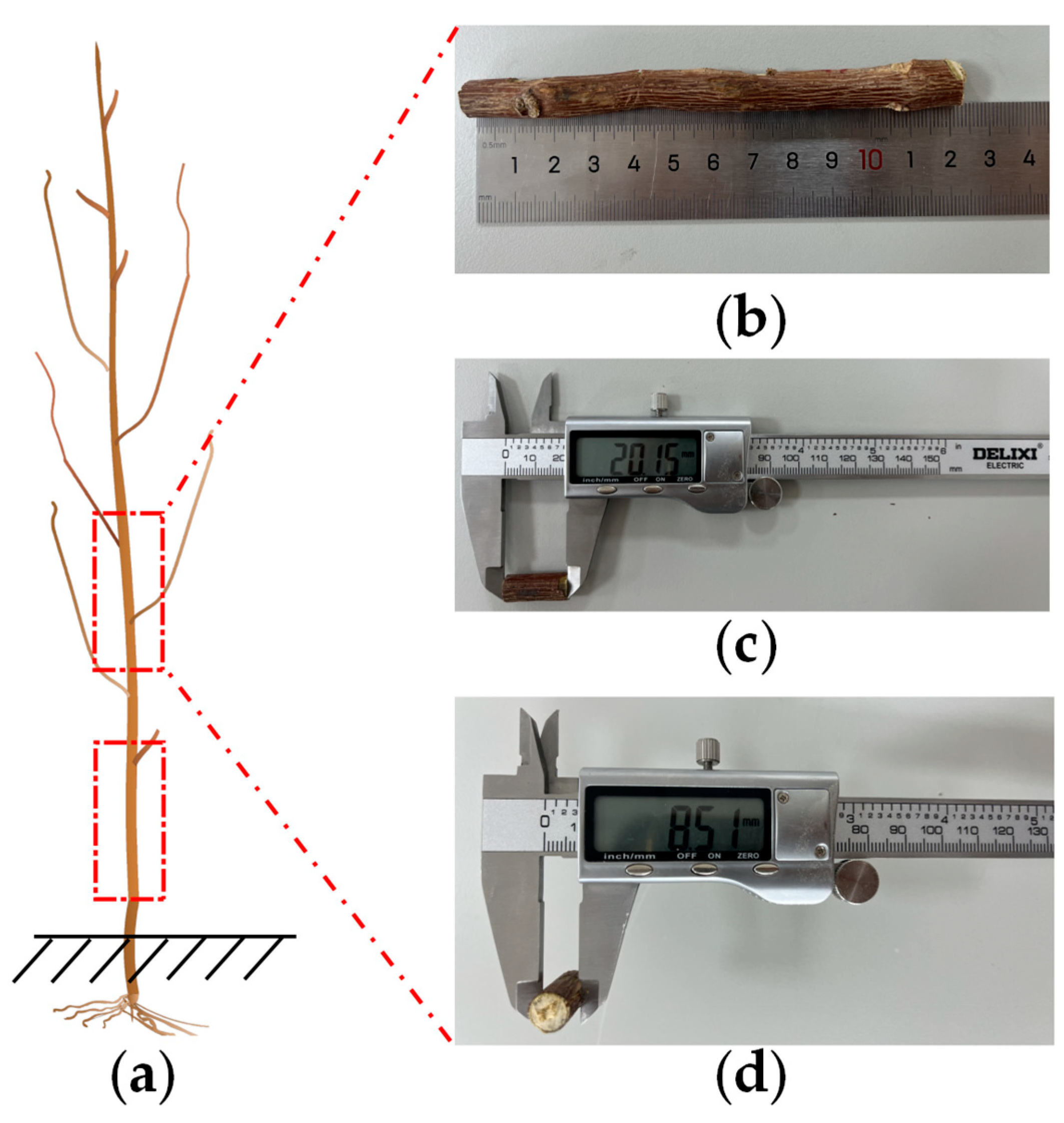
Cotton stalks were sampled from mechanically harvested fields in Xinjiang, China, using a “one-film six-row” planting pattern. The cultivar Xinluzhong 70 (Xinjiang Tarim River Seed Industry Co., Ltd., Alar, Xinjiang, China) was selected. Specimens were selected based on unbranched basal ends, straightness, damage, and uniform diameter variation. After excavation, cotton stalks were trimmed to a length of 160 mm from the soil level. Immediately after sampling, the stalks were sealed with plastic film to minimize moisture loss and transported to the laboratory for testing. All subsequent mechanical tests were performed in the as-sampled (post-harvest) condition, without intentional drying or re-wetting. Moisture content measurements showed that the specimens had a moisture content of 52.5–58.3% (wet basis). During specimen preparation, the samples remained sealed except during cutting, measurement, and mechanical testing. Existing studies indicate that cotton stalks exhibit systematic geometric and mechanical heterogeneity along the stem (base–middle–top), with compressive force generally decreasing from the base to the top [10]. Therefore, we selected two representative diameter groups (8.5 mm and 10.5 mm) to capture typical size variability. The sample processing is displayed in Figure 1.

2.2. Mechanical Properties of Cotton Stalks

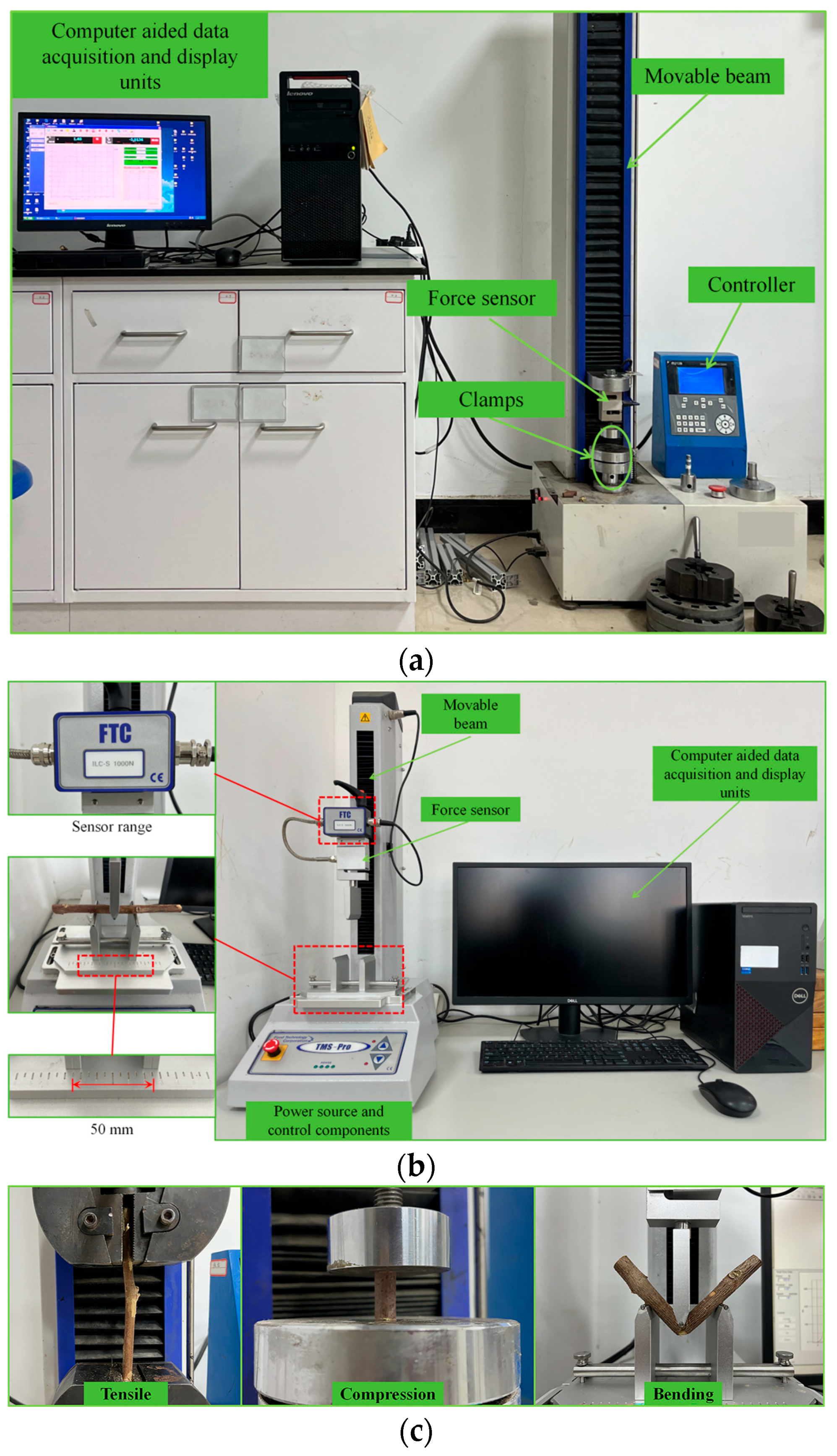
Physical tests were used to obtain and analyze the biomechanical properties of cotton stalks, which were categorized into D8.5 and D10.5 groups based on diameter. Tensile and compressive tests on cotton stalks were conducted using a universal testing machine (WD-D3, ± 0.5% speed accuracy, and ±0.5% force accuracy; Shanghai Zhuoji Instrument Co., Ltd., Shanghai, China.) (Figure 2a,c). Bending tests on cotton stalks were conducted using a texture analyzer (TMS-PRO, ±0.1% speed accuracy, and 0.01 g of minimum detectable force; Food Technology Corporation, Sterling, Virginia, USA) (Figure 2b,c).

2.2.1. Cotton Stalk Tensile Test

The sample length for the tensile test was set at 130 mm, and sample diameters were separated into two groups: the D8.5 group (8.33–9.88 mm) and the D10.5 group (9.99–11.52 mm). The test method referred to GB/T 1938-2009 [30,31] “Method of testing in tensile strength parallel to grain of wood” [31]. A 10 N preload was applied to ensure full contact between the indenter and the specimen.

2.2.2. Cotton Stalk Compression Test

The sample length for the compression test was set at 20 mm, and sample diameters were separated into two groups: the D8.5 group (8.36–9.26 mm) and the D10.5 group (10.00–11.21 mm). To ensure the stability of the cotton stalks during the compression process, both ends of the compressed specimens were ground level with sandpaper, and a preload of 10 N was applied.

2.2.3. Bending Test Methodology

The sample length for the bending test was set at 120 mm, and sample diameters were separated into two groups: the D8.5 group (7.57–9.92 mm) and the D10.5 group (10.13–11.58 mm). The test method referred to GB/T 1936.1-2009 [32] “Method of testing in bending strength of wood” [31]. A preload of 10 N was applied, and the span was set at 50 mm.

2.3. Discrete Element Modeling of Cotton Stalk

DEM simulations were conducted using EDEM (2022, Altair Engineering,Troy, MI, USA) on a workstation with an Intel® Xeon® w7-3465X@2.50 GHz processor and 64.0 GB of RAM. The DEM approach was based on research by Simons et al. [33] to optimize parameters for bulk particle behavior. An experimental data-driven range was determined, and an EDEM test was conducted to calibrate the parameters. Simulation–physical test response matching was achieved via iterative parameter adjustments to determine optimal DEM parameters [15].
Model dimensions were based on physical test specimens. Two nominal diameters were modeled: 8.5 mm and 10.5 mm. Standard rolling friction and Hertz–Mindlin (no-slip) models were used for particle–steel interactions, while validated bonding models were used for particle–particle interactions [25,34].
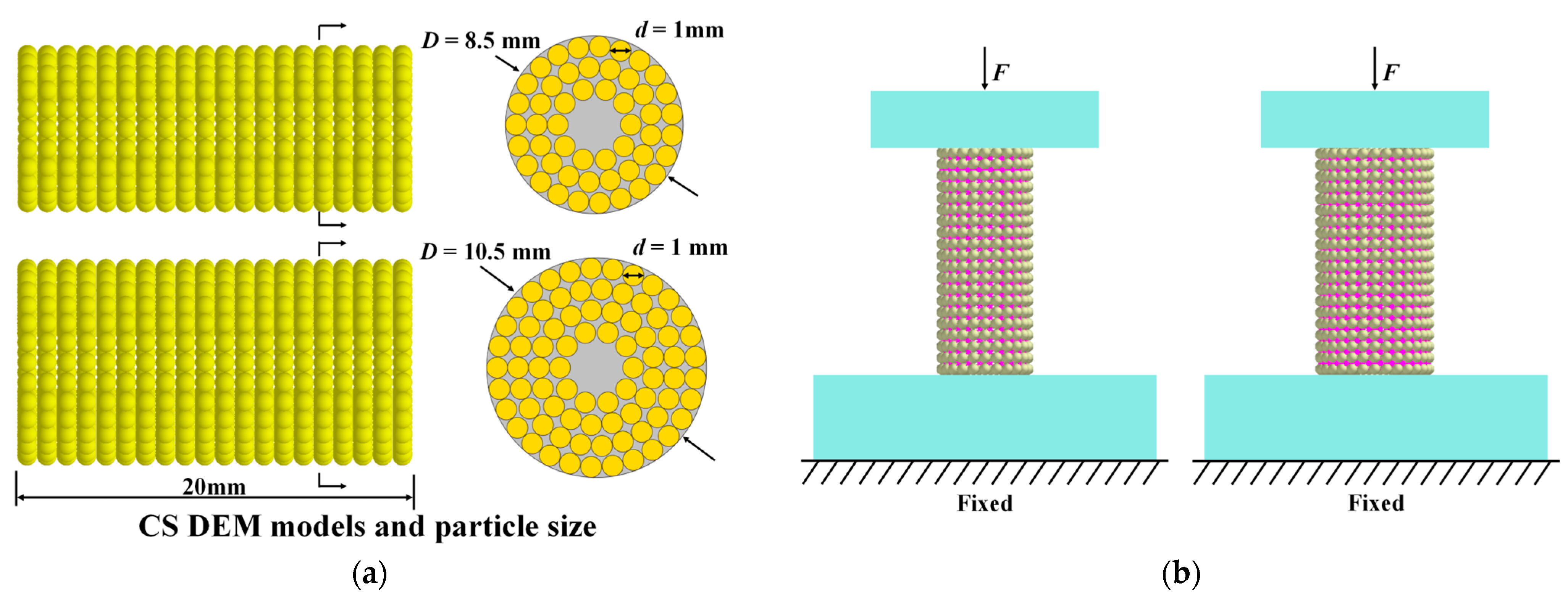
The smaller the particle radius, the closer the simulation resembles actual behavior—however, the simulation calculation time increases. A larger particle radius causes rapid strain propagation between particles; however, the accuracy is also decreased [35,36]. Particle radius directly affects simulation performance and computational time: the smaller the particle radius, the closer the simulation resembles the actual mechanical properties, but the computation time increases accordingly. A particle radius of 0.5 mm was chosen to balance accuracy and efficiency, resulting in accurate results and a suitable particle movement ratio while restricting calculation time. A total of 999 standard spherical particles (D8.5) and 1579 particles (D10.5) were generated (Figure 3a). The compression mechanism was incorporated into the cotton stalk model, yielding the compression simulation model of the cotton stalk (Figure 3b). The simulation test settings corresponded exactly to the conditions employed in the physical experiments.

2.4. Parameters of the Discrete Element Model of Cotton Stalks

2.4.1. Determining the Intrinsic Parameters

Intrinsic parameters such as density (ρ), Poisson’s ratio (μ), and shear modulus (G) must be input to construct the discrete element model of the cotton stalk. The clamps and supports in the experimental equipment were made of steel; hence, characteristic parameters of steel were adopted as intrinsic parameters for these components. The intrinsic parameters of cotton stalks were determined through experimental measurements and by referring to the research results of predecessors [7].
The shear modulus, G (Equation (2)), was obtained by measuring the elastic modulus, E (Equation (1)), through tensile tests and calculating via the derived values. The mechanical properties of the cotton stalk obtained from these tests are listed in Table 1. The relevant intrinsic material parameters are summarized in Table 2.
E = F / A L / L ,
where E is the elastic modulus (Pa), A is the effective area, F is the force (N), L is the effective length (mm), and ΔL is the change in the effective length (mm).
G = E 2 ( 1 + u ) ,
where G is the elastic modulus (Pa), and µ is the Poisson’s ratio.

2.4.2. Determination of the Range of Contact Parameters

Contact parameters encompass restitution, static friction, and rolling friction coefficients. These parameters govern interactions between cotton stalk particles and between stalk particles and steel components. Initial approximation ranges for contact and bonding parameters were established by referencing previous stalk simulation studies [15,37], as shown in Table 3. Emphasis was placed on optimizing bonding parameters to obtain the optimal combination that accurately characterizes the biomechanical properties of cotton stalk.

2.4.3. Determination of the Range of Contact Bonding Parameters

The Hertz–Mindlin model with bonding contact employs five key parameters to govern interaction forces between cotton stalk particles: normal stiffness per unit area, shear stiffness per unit area, critical normal stress, critical shear stress, and contact radius.
Parameter ranges were initially defined based on prior research achievements [24,38,39]. On the other hand, parameter levels were established through pre-experimental investigations. The values of contact and bonding parameters are detailed in Table 3.

2.5. Parameter Calibration Methodology

Mechanical properties of cotton stalk under various loading modes were tested using the experimental setup illustrated in Figure 2. The rupture force (FC) and force–deformation (F-x) curves were measured. These physical test results were benchmarks for conducting cotton stalk simulation and parameter calibration using the EDEM 2022.2 software. A compression simulation test (Figure 3) targeting FC was first implemented. Then, significant influencing factors were screened through Plackett–Burman design (P-BD) experiments. Steepest ascent tests were subsequently conducted to determine optimal ranges for these significant factors. A regression model correlating significant factors with FC was developed using the response surface methodology. The optimal parameter combination was derived through regression model solving. Finally, the calibration results were validated and refined.

2.5.1. Plackett–Burman Design (P-BD) Experiments

The eleven parameters listed in Table 3 were evaluated through P-BD experiments to identify significant factors affecting FC. Each parameter was tested at high and low levels with a central test point, resulting in 25 experimental runs. The P-BD experimental matrix (Table 4) was generated using the Design-Expert 13 software (Stat-Ease Inc., Minneapolis, MN, USA).

2.5.2. Steepest Ascent Test

Steepest ascent tests were performed on contact and bonding parameters based on P-BD results to investigate factor-level impacts on evaluation metrics and refine parameter ranges by examining their effects on Fx curves. Table 5 and Table 6 present the methodologies and results of the steepest ascent tests for the contact parameters and bond parameters, respectively. Relative error (RE) was calculated using Equation (3):
R E = F C F CA F CA × 100 %
where FCA represents the average FC value (N).

2.5.3. Box–Behnken Design Experiment

A four-factor, three-level Box–Behnken design was implemented to optimize bonding parameter combinations. The following parameter ranges were constrained based on P-BD and steepest ascent results: k b n : 5.05 × 10⁹–6.7 × 10⁹ N·m−3, k b s : 5.05 × 10⁹–6.7 × 10⁹ N·m−3, σ m a x : 3.3 × 10⁸–5 × 10⁸ Pa, and RC: 0.8–0.86 mm, with τ m a x fixed at 4.17 × 10⁸ Pa for both modes and contact parameters set to level 0. Twenty-seven experimental runs were executed, with the complete test matrix and results compiled in Table 7.

3. Results

3.1. Compression Test Analysis

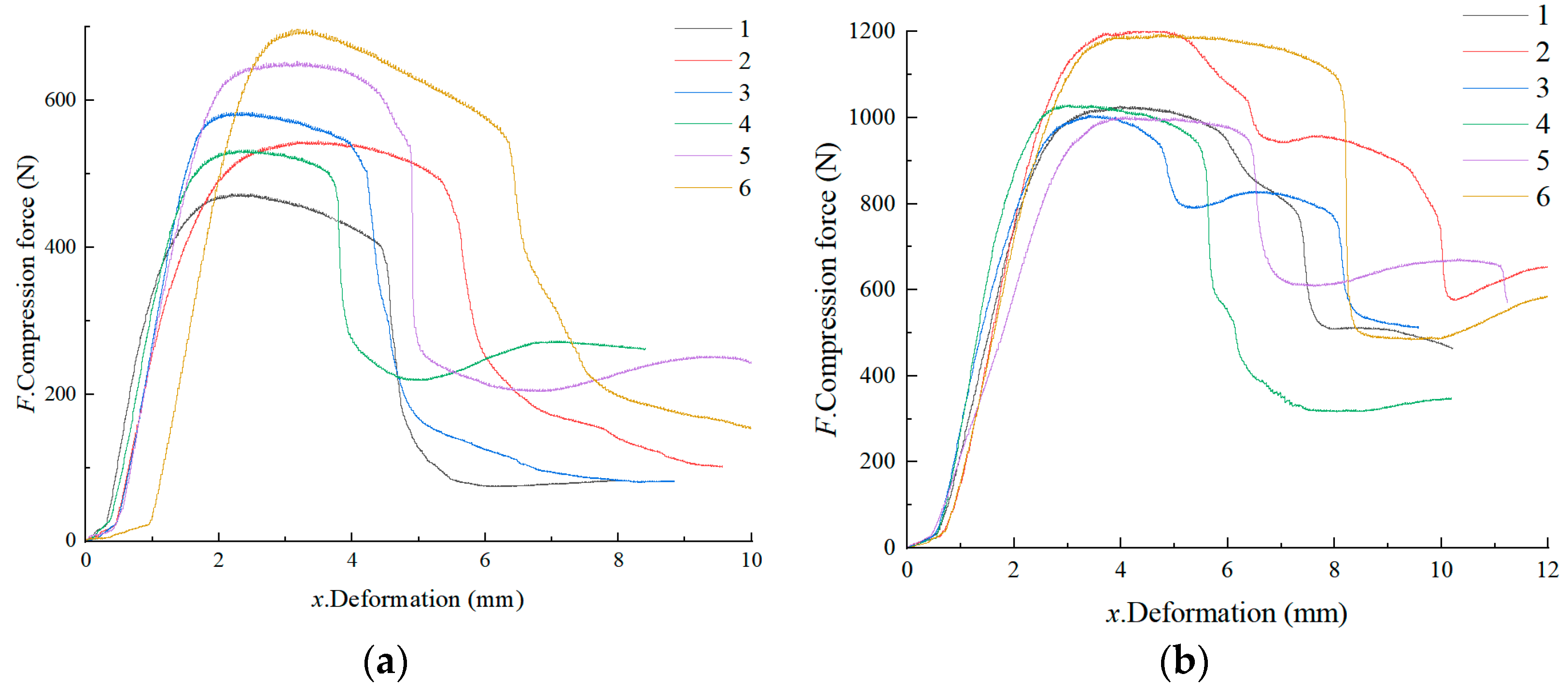
The Fx curves from axial compression tests are displayed in Figure 4, and the experimental results are shown in Table 1. Two primary failure modes were observed during axial compression: compressive failure and buckling failure [40]. The large standard deviation of the test results was attributed to the large individual differences between the samples.

3.2. Analysis of Plackett–Burman Design (P-BD) Tests

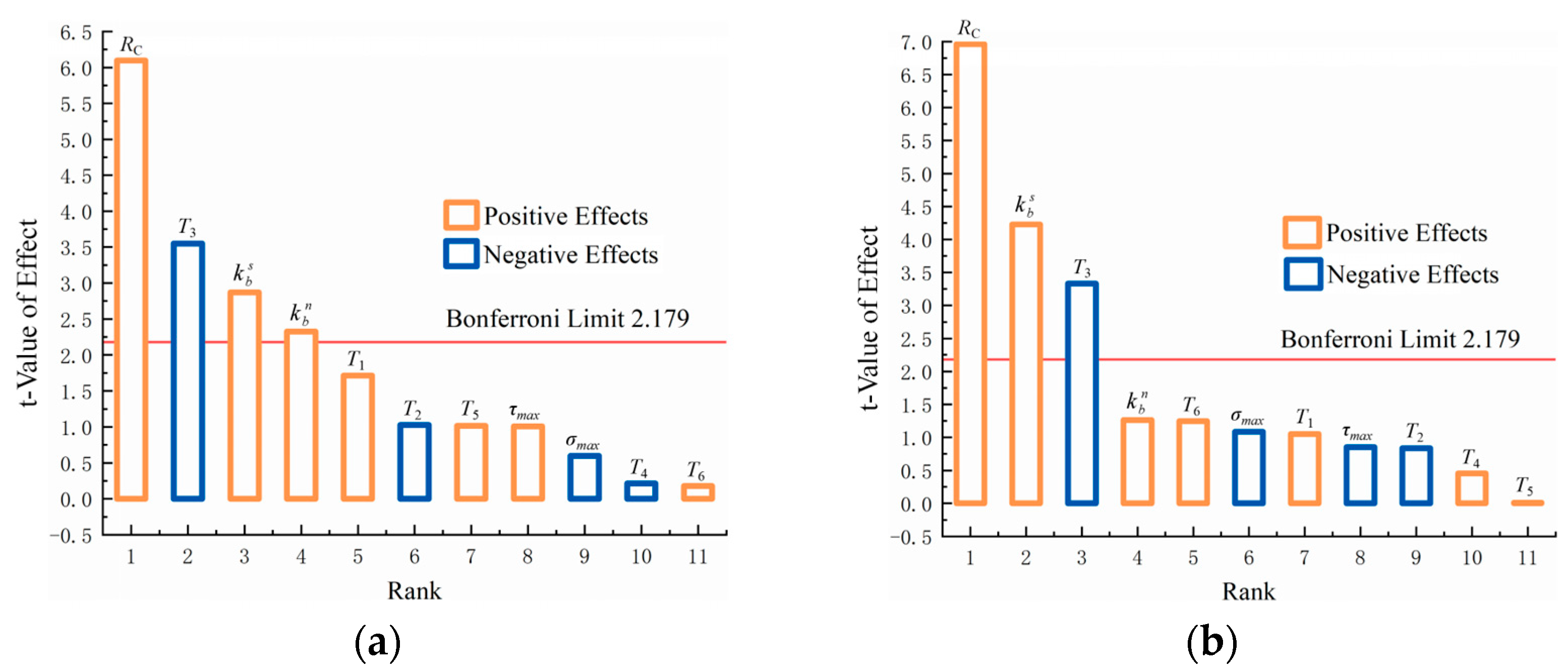
P-BD test results were analyzed using the Minitab 21 (Version 21, Minitab LLC, State College, PA, USA) software to generate a Pareto chart (Figure 5). The Bonferroni limit was applied to assess factor significance. Factor levels above the Bonferroni limit are considered significant, while factor levels below Bonferroni’s limit are considered insignificant [41]. Positive effects indicate FC increases with factor levels, whereas negative effects denote inverse relationships. According to Figure 5, significant factors for D8.5 mm stalks affecting FC in descending order are RC, T3, k b s , and k b n , with T3 exhibiting negative effects; for D10.5 mm stalks, significant factors followed the sequence RC, k b s , and T3 (also negative). Generally, bonding parameters play a major role in FC. Factors with significant effects on FC are T3, k b s , k b n , and RC, where T3 has a negative effect.
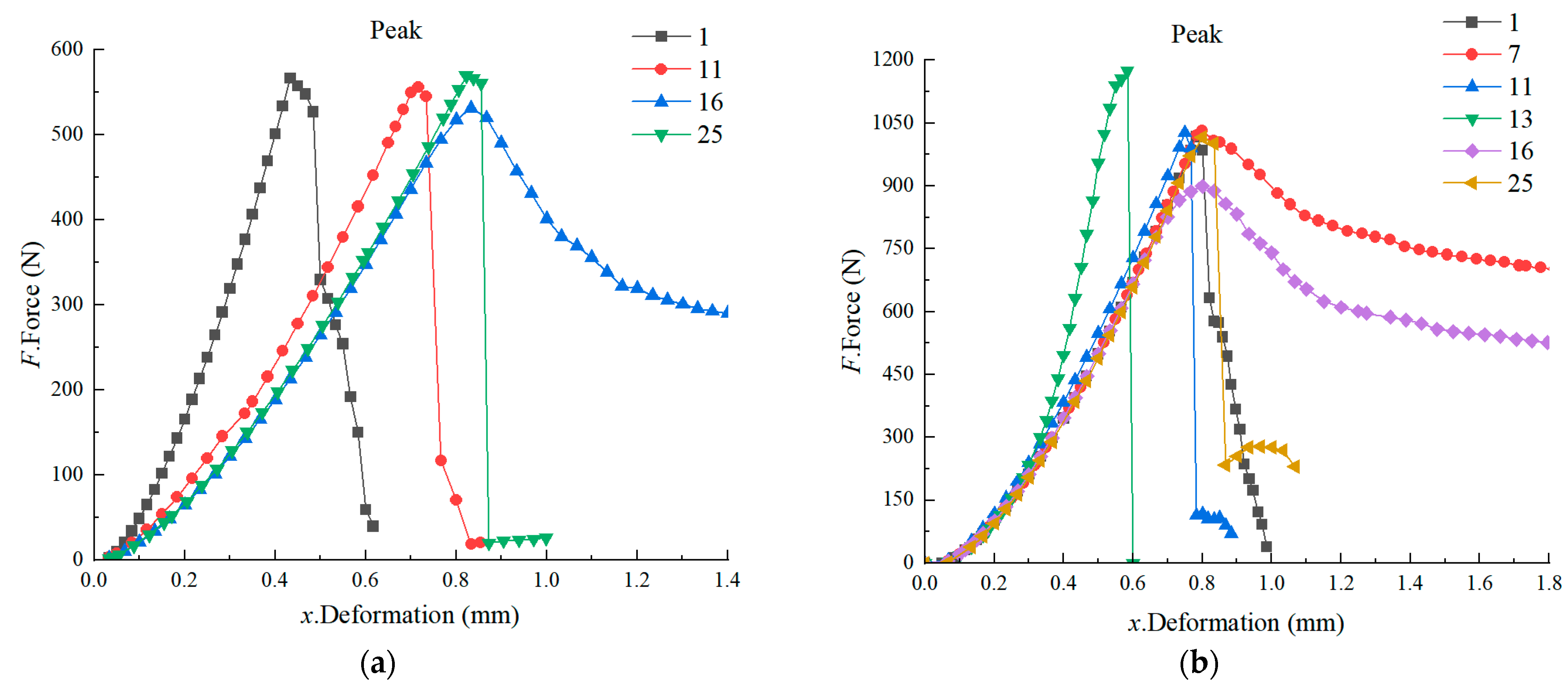
Based on the physical test results (Table 1), the results listed in Table 4 were evaluated with FC as the standard. The D8.5 groups of tests numbered 1, 11, 16, and 25 meet the requirements. The D10.5 tests numbered 1, 7, 11, 13, 16, and 25 meet the requirements. Fx curves from qualified trials were extracted via the Origin software and plotted in Figure 6. The Fx curve trend in Figure 7a was analyzed. The curves numbered 1, 11, and 25 increased first and then declined rapidly. The curve trend is inconsistent with the actual trend (Figure 4) due to the obvious decline stage. The Fx curve of No. 16 dropped slowly after reaching the wave peak. Furthermore, no sharp decline stage was observed, which was consistent with the results. Similarly, in Figure 7b, the curves numbered 1, 11, 13, and 25 increased first and then declined rapidly. The curve trend is inconsistent with the actual trend (Figure 4) due to an obvious decline stage. Fx curves of No. 7 and No. 16 declined slowly after reaching the wave peak; no drastic decline was consistent with the actual result.

3.3. Steepest Ascent Test Analysis

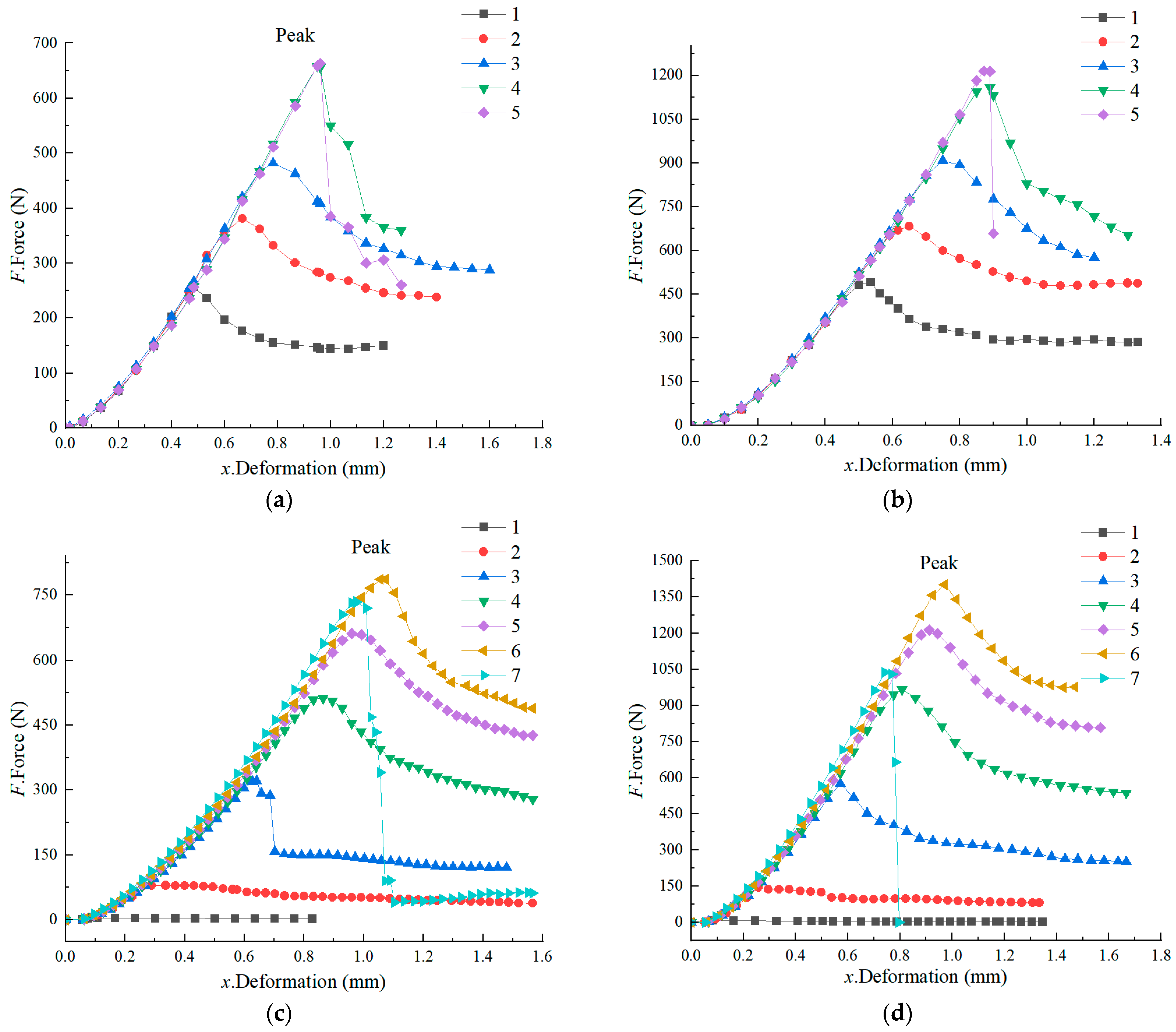
P-BD ranked factor significance on FC; however, their impacts on Fx curve morphology remained unclear. Fx curves from Table 5 and Table 6 are plotted (Figure 7) to investigate factor effects on curve characteristics. Figure 7 reveals distinct contact and bonding parameter effects on FC magnitudes and curve shapes.

3.3.1. Effect of Contact Parameters on Compressive Force

Figure 7a,b demonstrate that all curves exhibit rise–fall patterns. Tests 1–3 demonstrate gradual post-peak declines, indicating ductile failure matching physical tests. In contrast, tests 4 and 5 display a brittle failure with abrupt drops. Parameter FC increases in sequence according to the sequence number in the five curves. This effect is consistent with the significance shown in the Pareto diagram, where FC in curves 3, 4, and 5 is within the range of the physical test. Therefore, combined with the curve trend, physical test measurement range, and P-BD significance analysis, the contact parameter levels of groups with D8.5 and D10.5 were set as their default values (Table 6 NO. 3). These parameters were not further calibrated in this study. The default values are chosen as follows: T1 = 0.4, T2 = 0.4, T3 = 0.4, T4 = 0.5, T5 = 0.6, and T6 = 0.4.

3.3.2. Effect of Bonding Model Parameters on Compressive Force

Tests 4 and 5 in Table 6 produced FC within physical ranges. Their Fx curves (Figure 7c,d) showed gradual post-peak declines consistently with experiments. The difference in FC of the bonding parameter test is more significant than that of contact parameters. The results show that the bonding parameters significantly affect the trend of FC and Fx curves. According to the curve trend and physical measurement range, the intervals of each bond parameter are further determined as follows: group D8.5: k b n = 3.40 × 10⁹–5.05 × 10⁹ N∙m−3, k b s = 3.40 × 10⁹–5.05 × 10⁹ N∙m−3, σ m a x = 5 × 10⁸–6.67 × 10⁸ Pa, and RC = 0.73–0.8 mm; group D10.5: k b n = 5.05 × 10⁹–6.70 × 10⁹ N∙m−3, k b s = 5.05 × 10⁹–6.70 × 10⁹ N∙m−3, σ m a x = 3.34 × 10⁸–5 × 10⁸ Pa, and RC = 0.8–0.86 mm.

3.4. Response Surface Analysis

The Design-Expert tool was used to fit and analyze the BBD test results of the D8.5 and D10.5 groups, respectively. Interaction terms were evaluated via significance testing and model selection criteria. Terms that were statistically insignificant and did not improve predictive accuracy were removed to avoid overfitting and to retain a parsimonious model. The optimized second-order regression model of the cotton stalk and influencing factors under pressure was obtained after removing items that had no significant impact on the results (Equation (4) for D8.5 and Equation (5) for D10.5).
Variance analysis was performed on the regression model, where the model parameters were coded values (Table 8 for D8.5 and Table 9 for D10.5, coded units). Both models exhibit high significance (p < 0.0001) in describing k b n , k b s , σ m a x , and RC relationships with FC. The coefficient of variation of the optimized model was 1.29% and 6.33%, and the coefficient of determination was R2 = 0.9955 and R2 = 0.9222, respectively. The effects of each on the compression load are very significant. Hence, the two models can be used to optimize the bonding model parameters. The regression equations are expressed as follows:
F C 8.5 = 531.56 + 24.02 k b n + 74.84 k b s + 94.49 R C + 26.38 k b n k b s + 10.79 k b s R C + 11.38 ( k b n ) 2 + 11.25 ( k b S ) 2 + 24.68 ( σ m a x ) 2 9.93 ( R C ) 2 ,
F C 10.5 = 984.88 + 195.17 k b n 148.03 k b s + 64.81 R C 150.2 k b n k b s 145.65 k b s σ m a x + 94.12 k b n 2 + 124.07 k b s 2 + 93.32 ( R C ) 2 ,
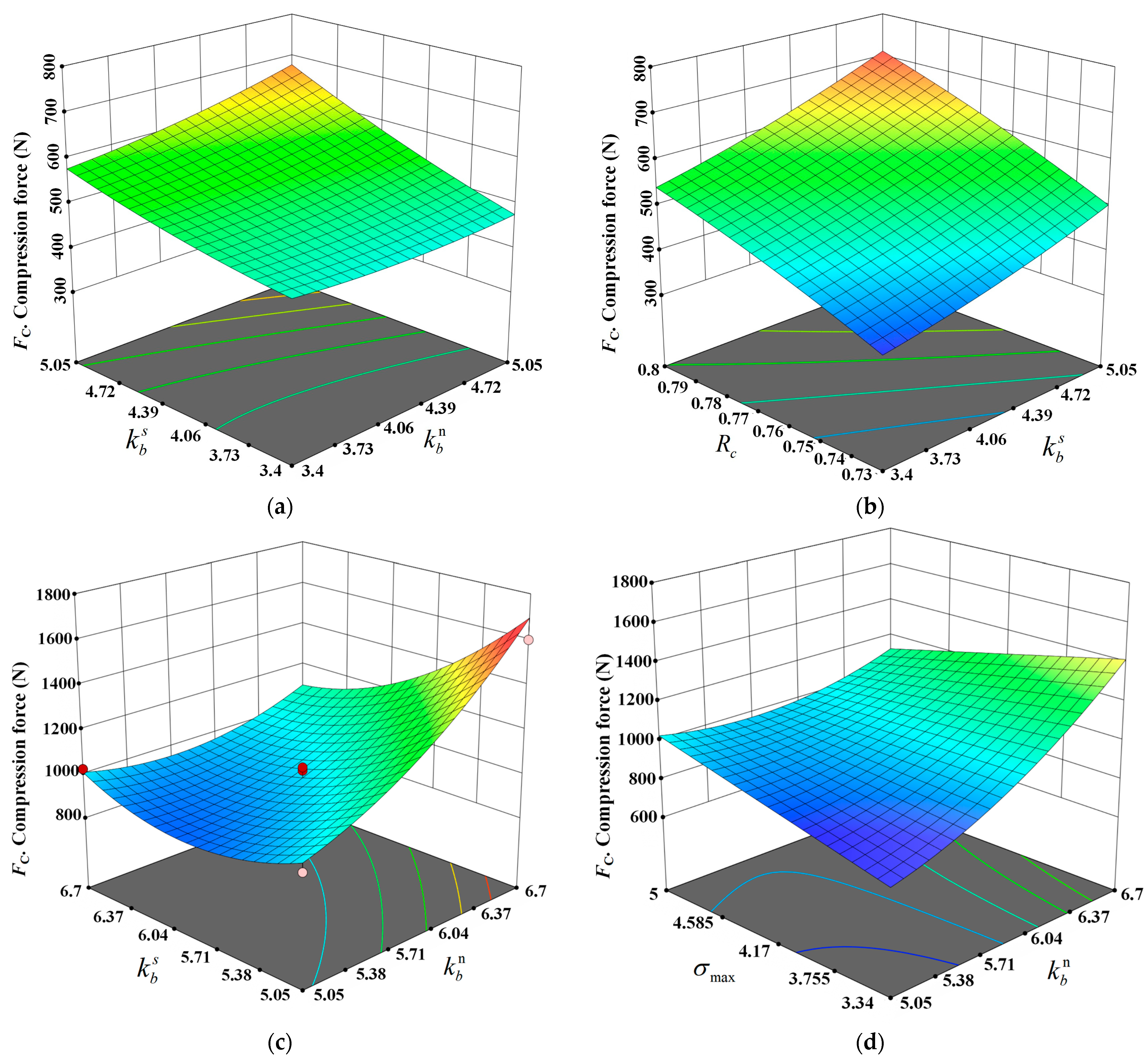
Response surfaces (Figure 8) show that FC increased with k b n (Figure 8a–c). Increasing k b n can improve the contact stress between particles, the normal stiffness of the cotton stalk model, and FC, especially in group D10.5. FC decreases first and then increases with an increase in k b s (Figure 8c). Generally, the role of k b n is the same as that of k b s , which increases the material’s ability to resist deformation in the corresponding direction [42,43]. The expansion of RC significantly increased FC. Factor importance is ranked as follows: D8.5 (RC > k b s > k b n > σ m a x ); D10.5 ( k b n > k b s > RC > σ m a x ). This observation is consistent with ANOVA.

3.5. Optimal Parameter Combination and Model Validation

3.5.1. Validation of Optimal Parameter Combinations

The regression equations (Equations (6) and (7)) were solved via Design-Expert 13 to identify optimal combinations of four parameters targeting mean FC values (580.9 N for D8.5 and 1078.6 N for D10.5). Optimal combinations are as follows: D8.5 ( k b n = 4.866 × 10⁹ N·m−3, k b s = 3.866 × 10⁹ N·m−3, σ m a x = 6.019 × 10⁸ Pa, and RC = 0.791 mm); D10.5 ( k b n = 6.65 × 10⁹ N·m−3, σ m a x =4.218 × 10⁸ Pa, and RC = 0.829 mm).
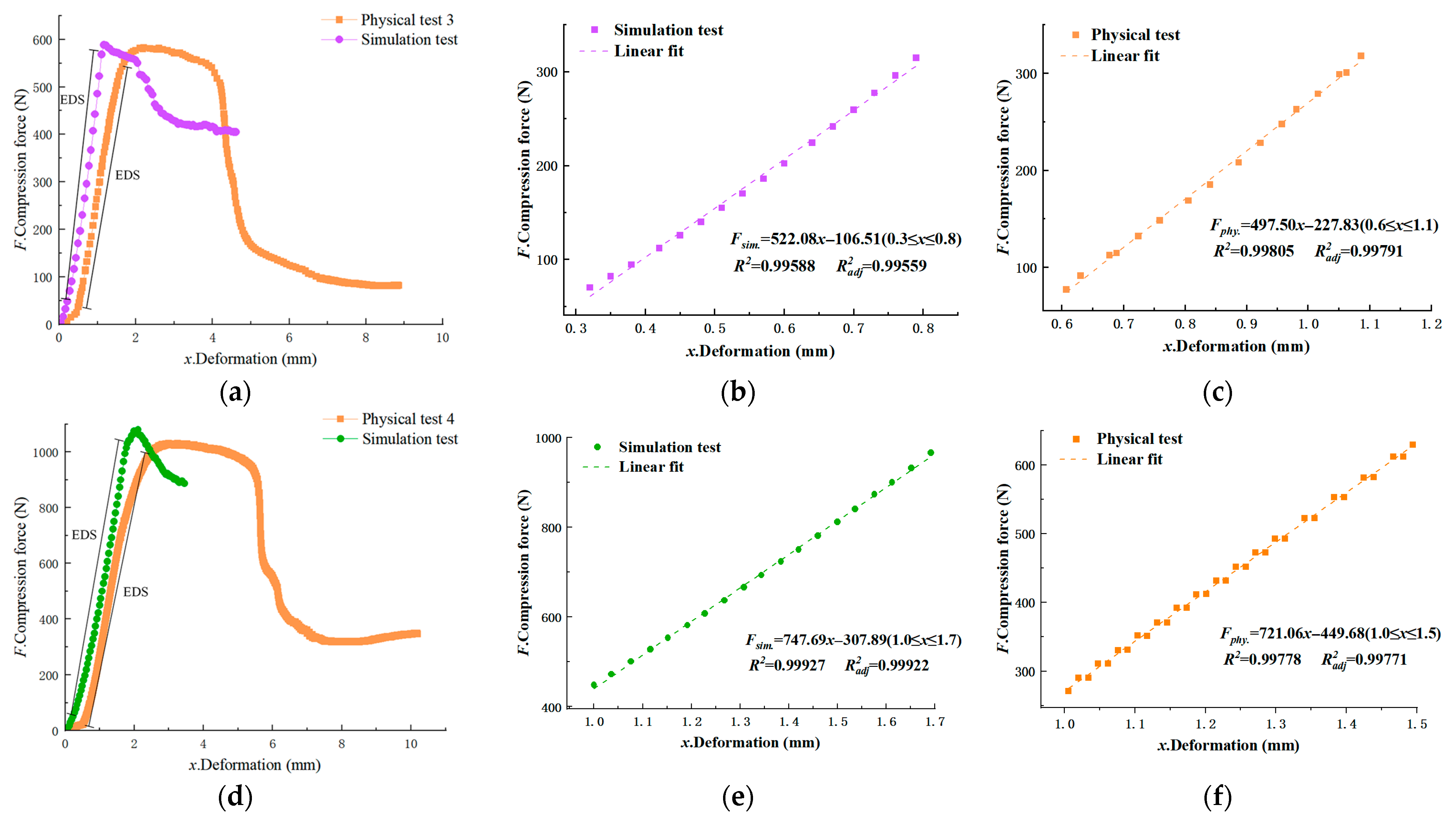
The Fx curve was extracted and shown in Figure 9. A comparison between the simulated curve and the physical test curve shows that the curve variation trend is highly consistent, indicating that the cotton stalk simulation model can reflect the law of force variation with deformation during compression. Simulated FC values (FC8.5 = 587.6 N, FC10.5 = 1079.5 N) showed minimal deviations from targets (1.21% and 0.08% errors), validating the regression models’ predictive accuracy.
The elastic deformation stage (EDS) is an important stage for investigating the mechanical properties of materials, such as elastic modulus. The simulated and the actual EDS curves were extracted, and the curve fitting equation was obtained via the Origin software, as shown in Figure 9b,c. The higher the values of R2 and R2adj, the better the equation. In the fitting equation, R2 and R2adj in D8.5 simulation tests are 0.9959 and 0.9956, respectively. On the other hand, R2 and R2adj in physical tests are 0.9981 and 0.9979, respectively. Both values are greater than 0.99, indicating that the accuracy of the two fitting equations is extremely high. The slopes of simulated and physical tests are 522.08 and 497.50, respectively, and the relative error is 4.71%.
R2 and R2adj in D10.5 simulation tests are 0.9993 and 0.9992, and R2 and R2adj in the physical tests are 0.9978 and 0.9977, respectively. Both values are greater than 0.99, indicating that the accuracy of the two fitting equations is extremely high. The slopes of simulated and physical tests are 740.69 and 721.06, respectively, and the relative error is 2.65%. These observations show that the force and deformation of the simulation results of groups D8.5 and D10.5 in the elastic deformation stage are highly consistent with the physical test results.
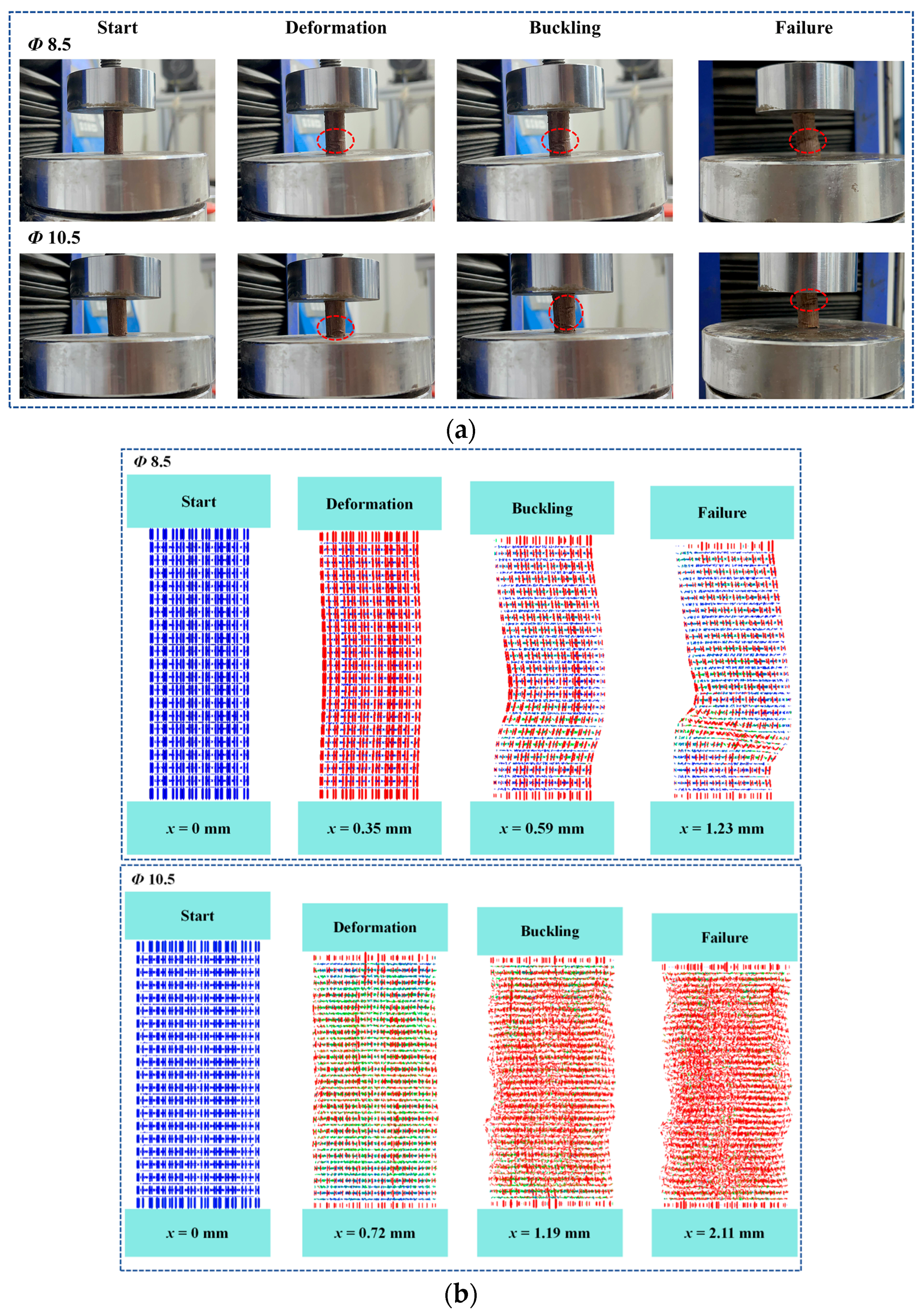
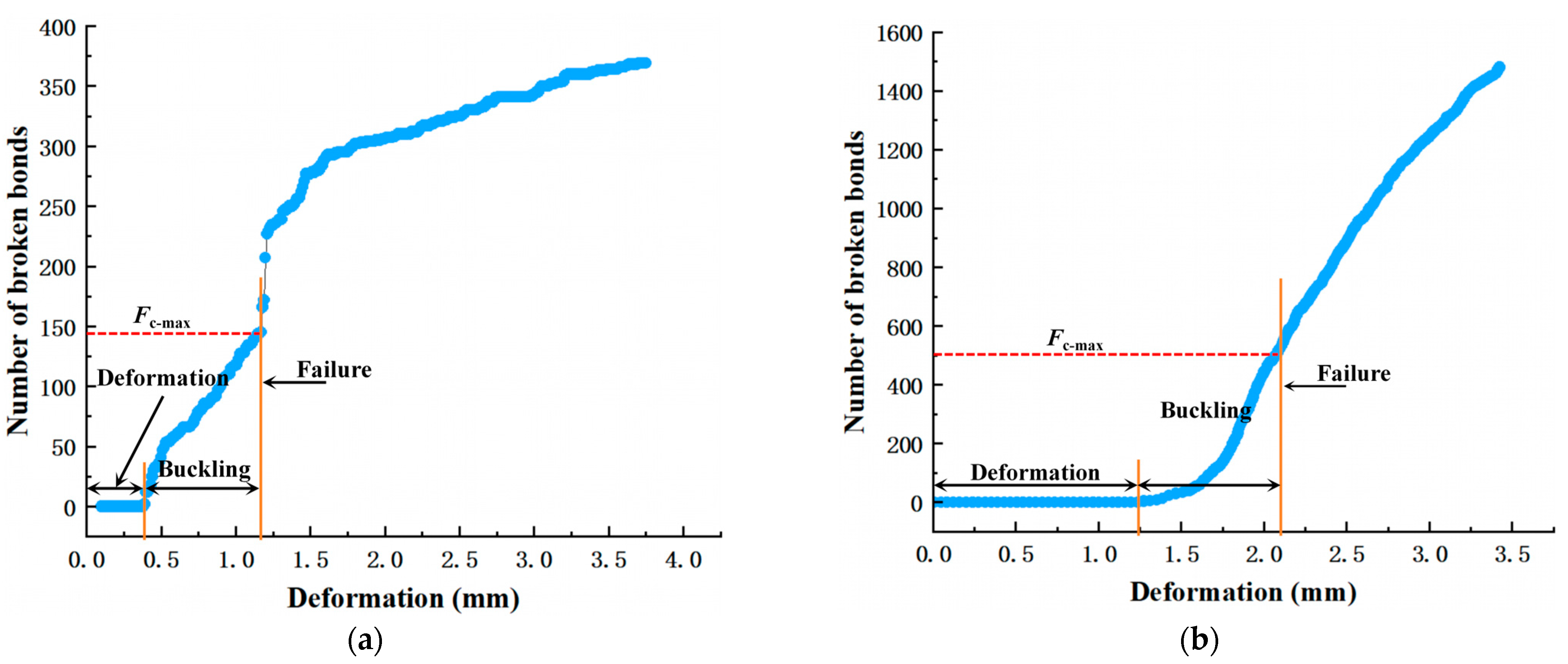
The compression damage diagram of the cotton stalk is shown in Figure 10. The compression process shows three stages as the cotton stalk changes: deformation, buckling, and failure. Simulation-compression characteristics agree with experiments. Increasing bond breakages with platen displacement are shown in Figure 11, correlating with rising rupturing forces. The number of fracture bonds in the deformation stage is relatively stable, and the compressive strength limit of the cotton stalk is not reached. The number of fracture bonds increases gradually in the buckling stage, and the cotton stalk cracks and expands. When the force on the cotton stalk reaches the maximum value, the cotton stalk fails to break. The calibration methodology was validated using integrated Fx curves, failure patterns, and bond breakage analysis. The established discrete element model can accurately characterize the biomechanical properties of cotton stalk under axial compression. The regression equation of bonding parameters and breaking force is accurate and can be used for cotton stalk model construction and parameter optimization learning.
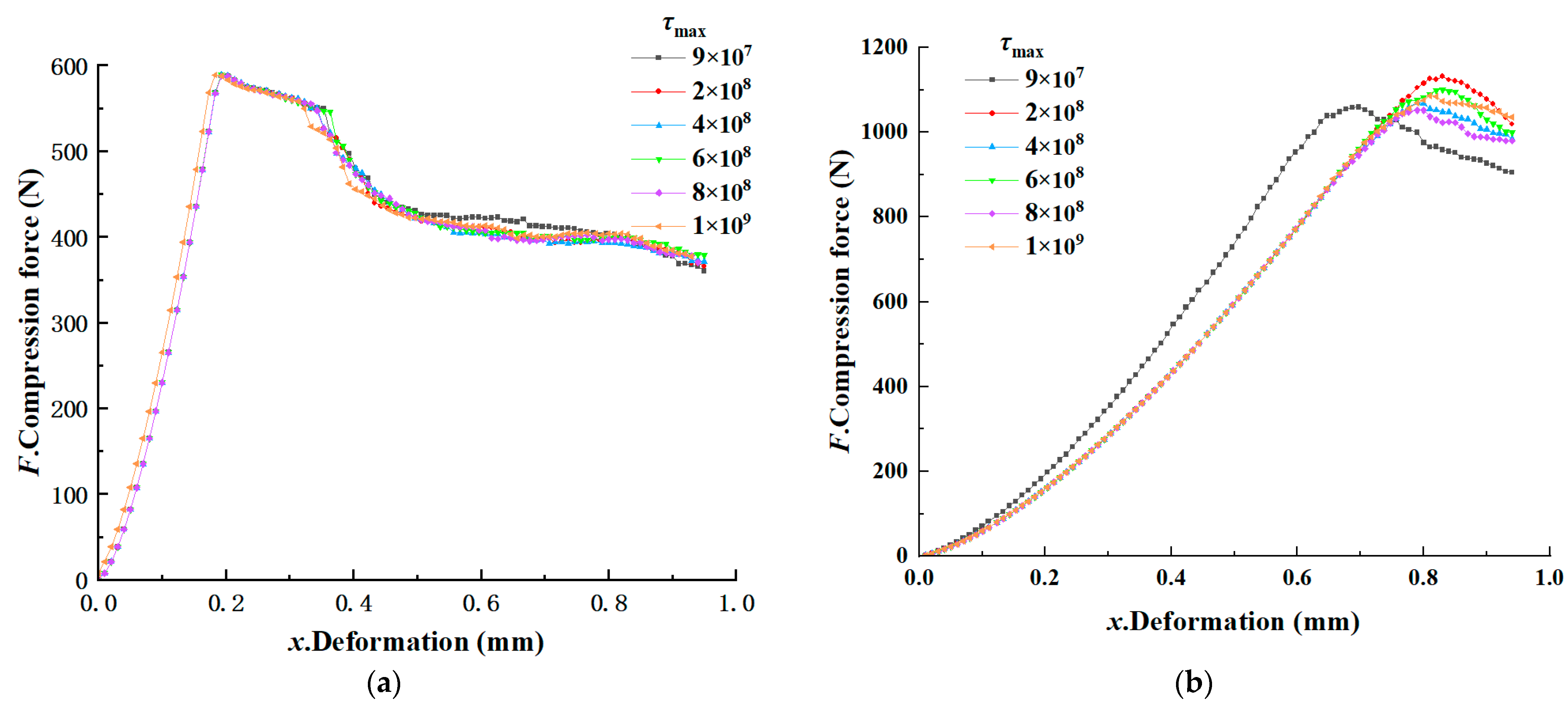
Four of the five bonding parameters were determined based on the above studies. The influence rule of the last parameter, τ m a x , on the compressive force was obtained through the single factor test, as shown in Figure 12. The results show that the critical shear stress, τ m a x , had a minor influence on the position of biological yield point and rupture point of the cotton stalk with the 8.5 and 10.5-diameter groups.

3.5.2. Bending Test Analysis and Validation

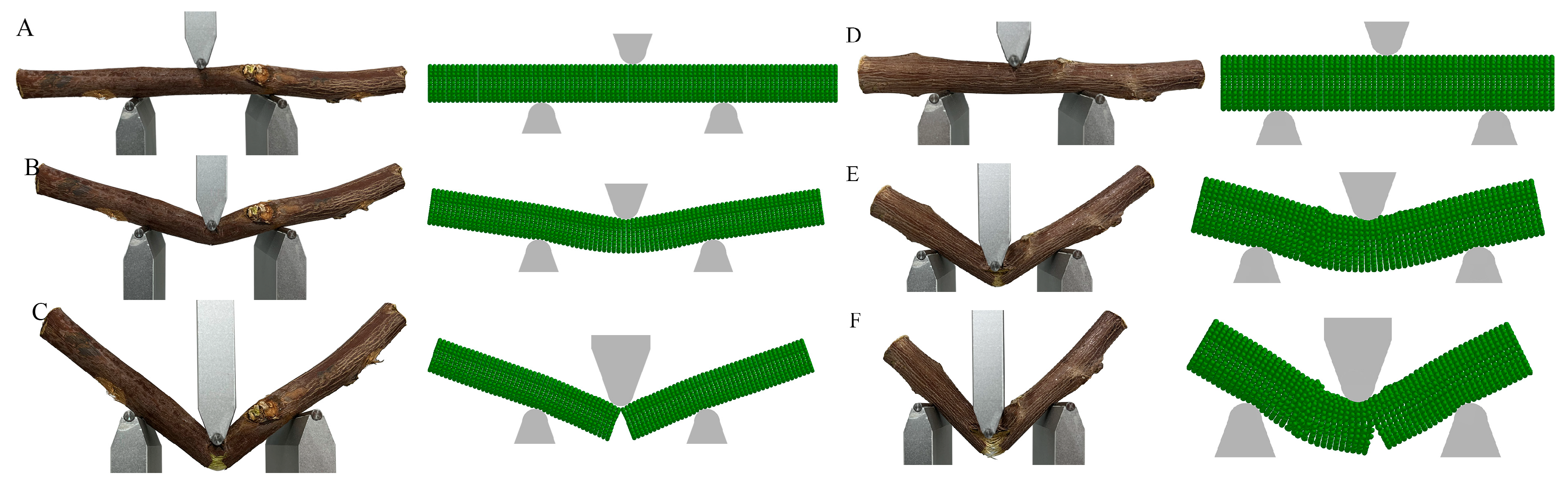
Three-point bending tests were carried out (Figure 13) to verify the certainty of the calibration results of cotton stalk parameters and the validity of the bending mechanical properties of cotton stalk. The discrete element model of the cotton stalk is constructed using the same method as the compressed cotton stalk model. Then, the three-point bending simulation test is carried out. The main damage and fracture phenomena of cotton stalk during bending were explored by recording physical tests and DEM simulation processes. The experimental results show that the main phenomena of the physical cotton stalk and DEM model are similar. According to Figure 13, the cracking characteristics of the cotton stalk are also reflected in the simulation; moreover, its cracking mode is similar to the physical test results. The results confirm the cotton stalk element model’s reliability in the discrete construction method and the precision of the optimal bond parameter combination obtained by calibration.

4. Discussion

4.1. Dominant Influence of Bonding Parameters on F C and Peak Behavior

The screening (P-BD) and steepest ascent tests consistently indicated that bonding-related parameters (e.g., k b n , k b s , σ m a x , and R C ) exerted stronger influence on F C than contact parameters under the tested conditions. Mechanistically, k b n and k b s control the normal and tangential stiffness of bonded interactions, which directly govern resistance to deformation and the stored elastic energy prior to bond failure. In contrast, within the selected default range, contact parameters primarily affect inter-particle frictional dissipation and thus showed comparatively smaller leverage on peak force. Importantly, the observed transitions between gradual and abrupt post-peak declines imply that bonding parameters also shape the failure mode manifested in the macroscopic F–x curve.

4.2. Calibration and Validation for Two Cotton Stalk Diameters

This study conducted systematic parameter calibration and validation for cotton stalks from two diameter groups (D8.5 and D10.5) under controlled axial compression, with additional verification using three-point bending. The optimal combinations of key bonding parameters and their corresponding response characteristics were determined. The resulting models were supported by multiple validation features, including close agreement in the peak compressive force ( F C ), consistency in the overall F–x curve trend and post-peak behavior, tight matching of elastic deformation stage (EDS) stiffness derived from curve fitting, and coherent evolution of bond breakage and failure processes.

4.3. Limitations and Future Work

The cotton stalk model adopted in this study is relatively simplified and does not account for the mechanical behavior of cotton stalks under different moisture contents. Although cotton stalks can be generally divided into three main parts, they were treated as an integrated whole in the present work for mechanical characterization. Future studies should aim to develop a more realistic particle-based cotton stalk model and calibrate the corresponding material parameters through dedicated experiments. Moreover, calibration and validation were conducted at a single moisture level to be consistent with the moisture condition adopted in the subsequent application scenarios, such as stalk defibration and stalk fragmentation during post-harvest residual film recovery.

5. Conclusions

In this study, a discrete element model of cotton stalks was established by calibrating the contact parameters of the cotton stalks based on tensile tests and uniaxial closed compression tests.
Experimental and numerical investigations were conducted on 8.5 mm- and 10.5 mm-diameter stalks. A DEM-based model was developed to analyze axial compression mechanics through EDEM simulations, revealing the impacts of contact and bonding parameters. Box–Behnken design (BBD) experiments were used to calibrate bonding and contact parameters, establish regression models, and link parameters to the rupture force. ANOVA was used to confirm the models’ high reliability for determining optimal parameter combinations.
Optimized bonding parameters were identified as follows: for the D8.5 model, normal stiffness = 4.866 × 10⁹ N·m−3, shear stiffness = 3.866 × 10⁹ N·m−3, critical normal stress = 6.019 × 10⁷ Pa, and contact radius = 0.791 mm; for the D10.5 model, normal stiffness = 6.648 × 10⁹ N·m−3, shear stiffness = 6.656 × 10⁹ N·m−3, critical normal stress = 4.218 × 10⁷ Pa, and contact radius = 0.829 mm.
Simulated Fx curves strongly agreed with experimental trends. Moreover, fracture patterns matched physical observations, validating the model’s accuracy. The DEM simulation results demonstrate strong agreement with physical experiments. The results of this study will contribute to the design and development of cotton stalk defibration and other processing equipment.

Author Contributions

Conceptualization, G.Z. and X.H.; methodology, G.Z., X.H. and X.W.; software, G.Z. and J.S.; validation, G.Z., X.H., X.W. and J.S.; investigation, X.H. and X.W.; resources, X.W., J.X. and L.W.; data curation, G.Z. and J.S.; writing—original draft preparation, G.Z.; writing—review and editing, G.Z., J.S., J.X. and L.W.; visualization, J.X. and L.W.; supervision, X.H. and X.W.; project administration, X.H. and X.W.; funding acquisition, X.H. and X.W. All authors have read and agreed to the published version of the manuscript.

Funding

This research was funded by National Natural Science Foundation of China, grant number 32460448; the 14th Five-Year Key Research and Development Project of the State grant number 2023YFD1701902-1; and the Key Research Project of the Corps, grant number 2024AB029.

Data Availability Statement

The original contributions presented in this study are included in the article. Further inquiries can be directed to the corresponding authors.

Conflicts of Interest

The authors declare that they have no known competing financial interests or personal relationships that could have appeared to influence the work reported in this paper.

Abbreviations

The following abbreviations are used in this manuscript:
FxForce–deformation curve
FCPeak of compression force (N)
k b n Normal stiffness per unit area (N∙m−3)
k b s Shear stiffness per unit area (N∙m−3)
σ m a x Critical normal stress (Pa)
τ m a x Critical shear stress (Pa)
RCContact Radius (mm)
µPoisson’s ratio
ρDensity (kg m−3)
EElastic modulus
GShear modulus
T1Coefficient of restitution between cotton stalk and cotton stalk
T2Coefficient of static friction between cotton stalk and cotton stalk
T3Coefficient of rolling friction between cotton stalk and cotton stalk
T4Coefficient of restitution between cotton stalk and steel
T5Coefficient of static friction between cotton stalk and steel
T6Coefficient of rolling friction between cotton stalk and steel

References

  1. Zoma, F.; Sawadogo, M. A multicriteria approach for biomass availability assessment and selection for energy production in Burkina. Heliyon 2023, 10, 20999. [Google Scholar] [CrossRef] [PubMed]
  2. Abbas, S.; Chiang Hsieh, L.-H.; Techato, K. Supply chain integrated decision model in order to synergize the energy system of textile industry from its resource waste. Energy 2021, 15, 120754. [Google Scholar] [CrossRef]
  3. Al Afif, R.; Anayah, S.S.; Pfeifer, C. Batch pyrolysis of cotton stalks for evaluation of biochar energy potential. Renew. Energy 2020, 147, 2250–2258. [Google Scholar] [CrossRef]
  4. Cai, C.; Wang, Z.; Ma, L.; Xu, Z.; Yu, J.; Li, F. Cotton stalk valorization towards bio-based materials, chemicals, and biofuels: A review. Renew. Sustain. Energy Rev. 2024, 202, 114651. [Google Scholar] [CrossRef]
  5. Nguyen, T.T.; Bailleres, H.; Redman, A.; Leggate, W.; Vandi, L.; Heitzmann, M. Homogenous particleboard made from whole cotton (Gossypium hirsutum L.) stalk agricultural waste: Optimisation of particle size and influence of cotton residue on performance. BioResources 2020, 15, 7730–7748. [Google Scholar] [CrossRef]
  6. Li, Y.; Zhu, N.; Chen, J. Straw characteristics and mechanical straw building materials: A review. J. Mater. Sci. 2023, 58, 2361–2380. [Google Scholar] [CrossRef]
  7. Zhao, W.; Chen, M.; Xie, J.; Cao, S.; Wu, A.; Wang, Z. Discrete element modeling and physical experiment research on the biomechanical properties of cotton stalk. Comput. Electron. Agric. 2023, 204, 107502. [Google Scholar] [CrossRef]
  8. Guo, J.; Karkee, M.; Yang, Z.; Fu, H. Discrete element modeling and physical experiment research on the biomechanical properties of banana bunch stalk for postharvest machine development. Comput. Electron. Agric. 2021, 188, 106308. [Google Scholar] [CrossRef]
  9. Xia, Y.; Klinger, J.; Bhattacharjee, T.; Thompson, V. The elastoplastic flexural behaviour of corn stalks. Biosyst. Eng. 2022, 216, 218–228. [Google Scholar] [CrossRef]
  10. Yang, X.; Chen, P.; Wang, X.; Liu, H.; Ding, C.; Lan, H.; Zhang, H. Development of a FDEM model for cotton stalks based on biomechanical and structural properties. Biosyst. Eng. 2025, 260, 104301. [Google Scholar] [CrossRef]
  11. Zhang, J.; Xie, J.; Du, Y.; Li, Y.; Yue, Y.; Cao, S. Discrete element modeling and experimental study of biomechanical properties of cotton stalks in machine-harvested film-stalk mixtures. Sci. Rep. 2024, 14, 12933. [Google Scholar] [CrossRef]
  12. Berg, S.; Turesson, J.; Ekevad, M.; Huber, J.A.J. Finite element analysis of bending stiffness for cross-laminated timber with varying board width. Wood Mater. Sci. Eng. 2019, 14, 392–403. [Google Scholar] [CrossRef]
  13. Zhong, W.; Zhang, Z.; Chen, X.; Wei, Q.; Chen, G.; Huang, X. Multi-scale finite element simulation on large deformation behavior of wood under axial and transverse compression conditions. Acta Mech. Sin. 2021, 37, 1136–1151. [Google Scholar] [CrossRef]
  14. Shi, N. Peeling Method of Cotton Stalk and Development of Rubbing Peeling Machine. Doctoral Dissertation, Northwest A & F University, Xi’an, China, 2023. [Google Scholar]
  15. Liu, L.; Wang, X.; Zhang, X.; Zhong, X.; Wei, Z.; Geng, Y.; Cheng, X.; Zhao, K.; Bai, M. Determination and verification of parameters for the discrete element modelling of single disc covering of flexible straw with soil. Biosyst. Eng. 2023, 233, 151–167. [Google Scholar] [CrossRef]
  16. Wang, X.; Wang, Y.; Wang, Q.; Li, X.; Liu, R.; Liu, J.; Gong, Y.; Liu, Y.; Geng, D. Vibration-Excited Combined Harvester for Dual Harvesting of Ears and Stalks: Design and Experiments. Agriculture 2026, 16, 104. [Google Scholar] [CrossRef]
  17. Hou, J.; Li, Z.; Ma, Y.; Xu, Y.; Ding, H.; Li, C.; Li, C.; Tang, Q.; Liu, M. Mechanical Properties of Corn Stalks and Behavior of Particles During Compression Process Based on Discrete Element Method. Agriculture 2025, 15, 1824. [Google Scholar] [CrossRef]
  18. Yang, Z.; Zhang, K.; Yang, J.; Yao, Y. Parameter Optimization and Experimental Study on Alfalfa Stem Flattening Process Based on DEM–MBD. Agriculture 2025, 15, 922. [Google Scholar] [CrossRef]
  19. Mei, F.; Li, B.; Xu, Z.; Li, X.; Zhu, X. An innovative approach to simulate the compression mechanics of fiber-based materials. Comput. Electron. Agric. 2025, 231, 110002. [Google Scholar] [CrossRef]
  20. Shaikh, S.A.; Li, Y.; Ma, Z.; Chandio, F.A. Discrete element method (DEM) simulation of single grouser shoe-soil interaction at varied moisture contents. Comput. Electron. Agric. 2021, 191, 106538. [Google Scholar] [CrossRef]
  21. Baidhe, E.; Clementson, C.L. A review of the application of modeling and simulation to drying systems for improved grain and seed quality. Comput. Electron. Agric. 2024, 222, 109094. [Google Scholar] [CrossRef]
  22. Zhang, T.; Zhao, M.; Liu, F.; Tian, H.; Wulan, T.; Yue, Y.; Li, D. A discrete element method model of corn stalk and its mechanical characteristic parameters. Bioresources 2020, 15, 9337–9350. [Google Scholar] [CrossRef]
  23. Shi, Y.; Jiang, Y.; Wang, X.; Nguyen, T.D.T.; Yu, H. A mechanical model of single wheat straw with failure characteristics based on discrete element method. Biosyst. Eng. 2023, 230, 1–15. [Google Scholar] [CrossRef]
  24. Liao, Y.; Liao, Q.; Zhou, Y.; Wang, Z.; Jiang, Y.; Liang, F. Parameters Calibration of Discrete Element Model of Fodder Rape Crop Harvest in Bolting Stage. Trans. Chin. Soc. Agric. Mach. 2020, 51, 73–82. [Google Scholar] [CrossRef]
  25. Wang, L.; Fan, S.; Cheng, H.; Meng, H. Calibration of contact parameters for pig manure based on EDEM. Trans. Chin. Soc. Agric. Eng. 2020, 36, 95–102. [Google Scholar] [CrossRef]
  26. Zeng, F.; Diao, H.; Liu, Y.; Ji, D.; Dou, M.; Cui, J.; Zhao, Z. Calibration and Validation of Simulation Parameters for Maize Straw Based on Discrete Element Method and Genetic Algorithm-Backpropagation. Sensors 2024, 24, 5217. [Google Scholar] [CrossRef]
  27. Fang, M.; Yu, Z.; Zhang, W.; Cao, J.; Liu, W. DEM parameter acquisition and calibration of corn stalk non-spherical particles using particle trajectory tracking. Granul. Matter 2022, 24, 110. [Google Scholar] [CrossRef]
  28. Pu, Y.; Liu, Y.; Yang, M.; Yang, S.; Shen, C.; Lv, J.; Yang, L. Design and parameter optimization of the automatic reverse pulling type shift clamping device for ramie stripping machine. Trans. Chin. Soc. Agric. Eng. 2023, 39, 44–54. [Google Scholar] [CrossRef]
  29. Xue, K.; Gao, K.; Wang, T.; Zhang, X.; Zhang, S.; Kuang, F.; Zhu, D. Biomechanical modeling of rice seedling stalk based on multi-scale structure and heterogeneous materials. Comput. Electron. Agric. 2023, 210, 107904. [Google Scholar] [CrossRef]
  30. GB/T 1938-2009; Method of Testing in Tensile Strength Parallel to Grain of Wood. Standards Press of China: Beijing, China, 2009.
  31. National Public Service Platform for Standard Information. Available online: https://openstd.samr.gov.cn/bzgk/gb/index (accessed on 5 September 2025).
  32. GB/T 1936.1-2009; Method of Testing in Bending Strength of Wood. Standards Press of China: Beijing, China, 2009.
  33. Simons, T.A.; Weiler, R.; Strege, S.; Bensmann, S.; Schilling, M.; Kwade, A. A ring shear tester as calibration experiment for DEM simulations in agitated mixers-a sensitivity study. Proc. Eng. 2015, 102, 741–748. [Google Scholar] [CrossRef]
  34. Li, S.; Huan, X.; Wang, T.; Hui, Y.; You, Y.; Wang, D. Biomechanical properties and discrete element modeling of PSR stalks during silage harvest. Comput. Electron. Agric. 2024, 2, 108644. [Google Scholar] [CrossRef]
  35. Fu, S.; Feng, X.; Lauke, B.; Mai, Y. Effects of particle size, particle/matrix interface adhesion and particle loading on mechanical properties of particulate-polymer composites. Compos. Part B Eng. 2008, 39, 933–961. [Google Scholar] [CrossRef]
  36. Sun, L.; Gibson, R.F.; Gordaninejad, F.; Suhr, J. Energy absorption capability of nanocomposites: A review. Compos. Sci. Technol. 2009, 69, 2392–2409. [Google Scholar] [CrossRef]
  37. Mao, H.; Wang, Q.; Li, Q. Modelling and simulation of the straw-grain separation process based on a discrete element model with flexible hollow cylindrical bonds. Comput. Electron. Agric. 2020, 170, 105229. [Google Scholar] [CrossRef]
  38. Wen, B.; Li, Y.; Kan, Z.; Li, J. Experimental research on the bending characteristics of glycyrrhiza glabra stems. Trans. ASABE 2020, 63, 1499–1506. [Google Scholar] [CrossRef]
  39. Jiang, P.; Li, J.; Meng, H.; Peng, X. Experimental research of bending fracture characteristics of cotton stalk. Trans. ASABE 2021, 64, 1771–1779. [Google Scholar] [CrossRef]
  40. Hong, C.; Li, H.; Xiong, Z.; Lorenzo, R.; Li, X.; Wang, Z. Axial compressive behavior of laminated bamboo lumber columns with a chamfered section. Structures 2021, 33, 678–692. [Google Scholar] [CrossRef]
  41. Wu, Z.; Wang, X.; Liu, D.; Xie, F.; Ashwehmbom, L.G.; Zhang, Z.; Tang, Q. Calibration of discrete element parameters and experimental verification for modelling subsurface soils. Biosyst. Eng. 2021, 212, 215–227. [Google Scholar] [CrossRef]
  42. Wang, Q.; Mao, H.; Li, Q. Modelling and simulation of the grain threshing process based on the discrete element method. Comput. Electron. Agric. 2020, 11, 105790. [Google Scholar] [CrossRef]
  43. Wang, Y.; Zhang, Y.; Yang, Y.; Zhao, H. Discrete element modelling of citrus fruit stalks and its verification. Biosyst. Eng. 2020, 200, 400–414. [Google Scholar] [CrossRef]
Figure 1. Cotton stalk sampling diagram. Note: (a) sampling positions; (bd) schematic diagram of the measurement setup, using a cotton stalk with a diameter of 8.5 mm as an example (authors’ own elaboration).
Agriculture 16 00427 g001
Figure 2. Experimental equipment. Note: (a) universal material testing machine; (b) texture analyzer; (c) testing mechanical properties (authors’ own elaboration).
Agriculture 16 00427 g002
Figure 3. Cotton stalk compression test model. Note: (a) DEM model of cotton stalks; (b) the simulation of cotton stalk compression tests (authors’ own elaboration). Color explanation: the yellow spheres represent the DEM particles of the cotton stalk; the magenta elements indicate the bonded interactions (bonds) between particles; the cyan blocks represent the rigid loading platens (upper and lower walls).
Agriculture 16 00427 g003
Figure 4. Physical test of axial compression. Note: (a) group D8.5 axial compression test; (b) group D10.5 axial compression test.
Agriculture 16 00427 g004
Figure 5. Pareto chart of parameters for FC. Note: (a) D8.5 FC Pareto charts; (b) D10.5 FC Pareto charts.
Agriculture 16 00427 g005
Figure 6. The Fx curve of FC-matching P-BD physical test results. Note: (a) Fx curve for group D8.5 P-BD tests; (b) Fx curve for group D10.5 P-BD tests.
Agriculture 16 00427 g006
Figure 7. Influence of different parameters on the Fx curve. Note: (a) D8.5 Fx curves with different contact parameters; (b) D10.5 F–x curves with different contact parameters; (c) D8.5 Fx curves with different bonding parameters; (d) D10.5 Fx curves with different bonding parameters.
Agriculture 16 00427 g007
Figure 8. Response surface analysis. Note: (a) group D8.5 k b n and k b s impact on FC; (b) group D8.5 RC and k b s impact on FC; (c) group D10.5 k b n and k b s impact on FC; (d) group D10.5 k b n and σ m a x impact on FC. The red dots denote the design/experimental points used to fit the response surface model, and the pink dots indicate the corresponding projected points on the reference plane(s) for visualization.
Agriculture 16 00427 g008
Figure 9. Verification of Fx curve and equation fitting in elastic deformation stage. Note: (a) group D8.5 physical test and simulation test Fx curve; (b) group D8.5 simulated test EDS curve fitting; (c) group D8.5 physical test EDS curve fitting; (d) group D10.5 physical test and simulation test F–x curve; (e) group D10.5 simulated test EDS curve fitting; (f) group D10.5 physical test EDS curve fitting.
Agriculture 16 00427 g009
Figure 10. Typical characteristics of axial compression of cotton stalk. Note: (a) physical test results of axial compression of cotton stalk; (b) simulation results of axial compression of cotton stalk. Circle explanation: Red dashed circles indicate the deformation/failure region of the cotton stalk during compression. Color explanation: Blue–green–red denotes increasing bond force magnitude (low-high) in EDEM.
Agriculture 16 00427 g010
Figure 11. Changing process of the number of broken bonds of cotton stalk. Note: (a) group D8.5; (b) group D10.5.
Agriculture 16 00427 g011
Figure 12. Different τ m a x influences on the Fx curve. Note: (a) group D8.5; (b) group D10.5.
Agriculture 16 00427 g012
Figure 13. Cotton bending simulation. Note: (AC) D8.5 group cotton bending; (DF) D10.5 group cotton bending. The brown images are photographs of the cotton stalk bending test, the green model represents the DEM simulation of the cotton stalk, and the gray parts indicate the rigid loading indenter and supports.
Agriculture 16 00427 g013
Table 1. Test results of mechanical properties of cotton stalk.
NO.Cotton Stalk PropertiesMinMaxAverageStandard Deviation
D8.5Tensile Force (N)838.521893.621333.55399.33
Compression Force (N)473.09696.88580.9082.32
Bending Force (N)194.02254.68218.2724.72
D10.5Tensile Force (N)1642.902980.982537.42553.65
Compression Force (N)728.121330.761078.694.87
Bending Force (N)258.13329.78304.1529.20
Table 2. Intrinsic parameters.
ParameterSteelCotton Stalk Diameter (mm)
8.510.5
µ0.30.4
G (Pa)7.94 × 10101.16 × 1091.57 × 109
Ρ (kg∙m−3)7900970
Table 3. Parameters required for discrete element simulation.
TypeSymbol. ParameterParameter Levels
LowMediumHigh
(−1)(0)(+1)
Contact
parameters
Cotton Stalk–Cotton StalkT1. Coefficient of restitution0.10.30.5
T2. Coefficient of static
friction
0.10.30.5
T3. Coefficient of rolling friction0.10.30.5
Cotton Stalk–SteelT4. Coefficient of restitution0.10.40.7
T5. Coefficient of static friction0.30.60.9
T6. Coefficient of rolling friction0.10.30.5
Bonding parameters k b n . Normal stiffness per unit area/(N∙m−3)1 × 1085.05 × 1091 × 1010
k b s . Shear stiffness per unit area/(N∙m−3)1 × 1085.05 × 1091 × 1010
σ m a x . Critical normal stress/(Pa)1 × 1065 × 1081 × 109
τ m a x . Critical shear stress/(Pa)1 × 1065 × 1081 × 109
RC. Contact Radius/(mm)0.60.81.0
Table 4. Design and results of P-BD.
NOT1T2T3T4T5T6 k b n k b s σ m a x τ m a x RCFC8.5/NFC10.5/N
1−111−1−111−11−11569.101017.40
2−111−11−111111401.90634.80
311−1−111−11−1111105.801995.50
4−11−111111−1−1−1332.40615.20
51−1−1−1−11−11−1−11736.301375.30
6111−1−1−1−11−11−128.70120.40
71−1−111−11−11111093.501031.10
811−11−111111−1357.90628.40
9−1−11−11−1−111−1−150.00119.30
101−111111−1−1−1−15.1011.72
111−11−1−111−1−111555.301026.70
121−11−111111−1−1297.60363.30
13−1−111−11−11111314.701173.80
14−1−1−11−11−1−111−14.399.38
15−1−111−1−111−11−1265.70330.90
1600000000000531.10899.10
17−1−1−1−1−1−1−1−1−1−1−14.874.49
181111−1−1−1−11−1128.3049.10
1911−1−1−1−11−11−1−16.5310.35
20−11−11−1−111−1−11874.801603.00
21−111111−1−1−1−1128.8049.00
2211111−1−1−1−11−14.169.36
231−1−111−1−111−11817.301512.10
24−11−1−111−1−111−14.199.37
25−1−1−1−11−11−1−111566.901016.20
Table 5. Climbing test and results of contact parameters.
NOT1T2T3T4T5T6FC8.5/NFC10.5/N
10.10.70.70.9 (0.1)0.30.1256.8 (47.36%)492.4 (44.80%)
20.250.550.550.7 (0.3)0.450.25381.1 (21.88%)687.3 (22.95%)
30.40.40.40.50.60.4482.3 (1.14%)907.7 (1.76%)
40.550.250.250.3 (0.7)0.750.55656.0 (34.46%)1157.5 (29.76%)
50.70.10.10.1 (0.9)0.90.7663.1 (35.92%)1215.1 (36.22%)
Average FC487.86892.0
Note: values in FC brackets represent RE. All bonding parameters are at the 0 level, T4 parameters used in the model of the D10.5 group are in brackets, and the remaining parameters are the same as those used in the model of the D8.5 group.
Table 6. Climbing test and results of bonding parameters.
NO k b n k b s σ m a x τ m a x RCFC8.5/NFC10.5/N
11 × 1081 × 1081 × 1091 × 106
(1 × 10⁹)
0.66.06
(98.63%)
8.67
(98.87%)
21.75 × 1091.75 × 1098.34 × 1081.68 × 108
(8.34 × 10⁸)
0.6679.7
(82.02%)
145.7
(80.97%)
33.4 × 1093.4 × 1096.67 × 1083.34 × 108
(6.67 × 10⁸)
0.73321.1
(27.57%)
576.1
(24.75%)
45.05 × 1095.05 × 1095 × 1085 × 1080.8513.1
(15.73%)
968.0
(26.44%)
56.7 × 1096.7 × 1093.34 × 1086.67 × 108
(3.34 × 10⁸)
0.86661.7
(49.25%)
1214.7
(58.66%)
67.35 × 1097.35 × 1091.68 × 1088.34 × 108
(1.68 × 10⁸)
0.93787.1
(77.53%)
1407.7 (83.87%)
71 × 10101 × 10101 × 1061 × 109
(1 × 10⁶)
1734.7
(65.72%)
1038.3 (35.62%)
Average FC443.35765.60
Note: values in FC brackets represent RE. Contact parameters are set to level 0, and the σ m a x parameter used in the D10.5 group model is in parentheses. The remaining parameters are the same as the diameter D8.5 group.
Table 7. Design and results of Box–Behnken design test.
RUN k b n k b s σ m a x RCFC8.5/NFC10.5/N
10101716.71083.3
201−10644.4985.3
3001−1451.71000.1
4−1−100363.8966.5
5100−1459.21346.5
60000568.81030.9
70−101541.31522.4
810−105961038.2
9−1001605.11012.6
1000−1−1454.4983.1
110000568.11016
12−1010538.4829.4
130000419.8937.6
141−100398.71601.9
151010599.91491.7
161001662.71534.6
17−100−1419.8946.5
180−10−1372.21255.2
1900−11630.91053.9
200−1−10560.51254.5
210011635.81088.8
220−110488.81324.6
23−1100609.71025.1
2411006701059.7
25−10−10540.2957.7
260110644.51001.6
27010−1504.4986.5
Note: for the D8.5 set, k b n and k b s : (−1) 3.40 × 10⁹, (0) 4.23 × 10⁹, and (+1) 5.05 × 10⁹; σ m a x : (−1) 6.67 × 10⁸, (0) 5.88 × 10⁸, and (+1) 5.00 × 10⁸; and RC: (−1) 0.73, (0) 0.765, and (+1) 0.8. For the D10.5 set, k b n and k b s : (−1) 5.05 × 10⁹, (0) 5.88 × 10⁹, and (+1) 6.70 × 10⁹; σ m a x : (−1) 5.00 × 10⁸, (0) 4.17 × 10⁸, and (+1)3.34 × 10⁸; and RC: (−1) 0.8, (0) 0.83, and (+1) 0.86.
Table 8. Group D8.5 ANOVA of the modified model for the Box–Behnken experimental design.
SourceMean Sum of SquaresDegree of FreedomMean SquareF-Valuep-Value
Model1.900 × 105921,109.17421.55<0.0001 **
k b n 6922.2616922.26138.24<0.0001 **
k b s 534.741534.7410.68<0.01 **
RC475.761475.769.50<0.01 **
k b n k b s 2784.7612784.7655.61<0.01 **
k b s R C 465.961465.969.31<0.01 **
k b n 2 690.621690.6213.79<0.01 **
k b S 2 675.001675.0013.48<0.01 **
( σ m a x ) 2 3229.7513229.7564.50<0.01 **
( R C ) 2 525.791525.7910.50<0.01 **
Residual851.271750.07
Cor Total1.908 × 10526
Note: ** indicates high significance at p < 0.01; adjusted determination coefficient, R2adj = 0.9932.
Table 9. Group D10.5 ANOVA of the modified model for the Box–Behnken experimental design.
SourceMean Sum of SquaresDegree of FreedomMean SquareF-Valuep-Value
Model1.079 × 10681.349 × 10526.66<0.0001 **
k b n 4.571 × 10514.571 × 10590.30<0.0001 **
k b s 2.629 × 10512.629 × 10551.94<0.0001 **
RC50,401.44150,401.449.96<0.01 **
k b n k b s 90,242.35190,242.3517.83<0.01 **
k b n σ m a x 84,860.58184,860.5816.76<0.01 **
k b n 2 53,147.08153,147.0810.50<0.01 **
k b S 2 92,346.58192,346.5818.24<0.01 **
( R C ) 2 52,256.65152,256.6510.32<0.01 **
Residual91,116.82185062.05
Cor Total1.171 × 10626
Note: ** indicates high significance at p < 0.01; adjusted determination coefficient, R2adj = 0.8876.
Disclaimer/Publisher’s Note: The statements, opinions and data contained in all publications are solely those of the individual author(s) and contributor(s) and not of MDPI and/or the editor(s). MDPI and/or the editor(s) disclaim responsibility for any injury to people or property resulting from any ideas, methods, instructions or products referred to in the content.