2.1. Structure and Working Principle of the Planting Mechanism
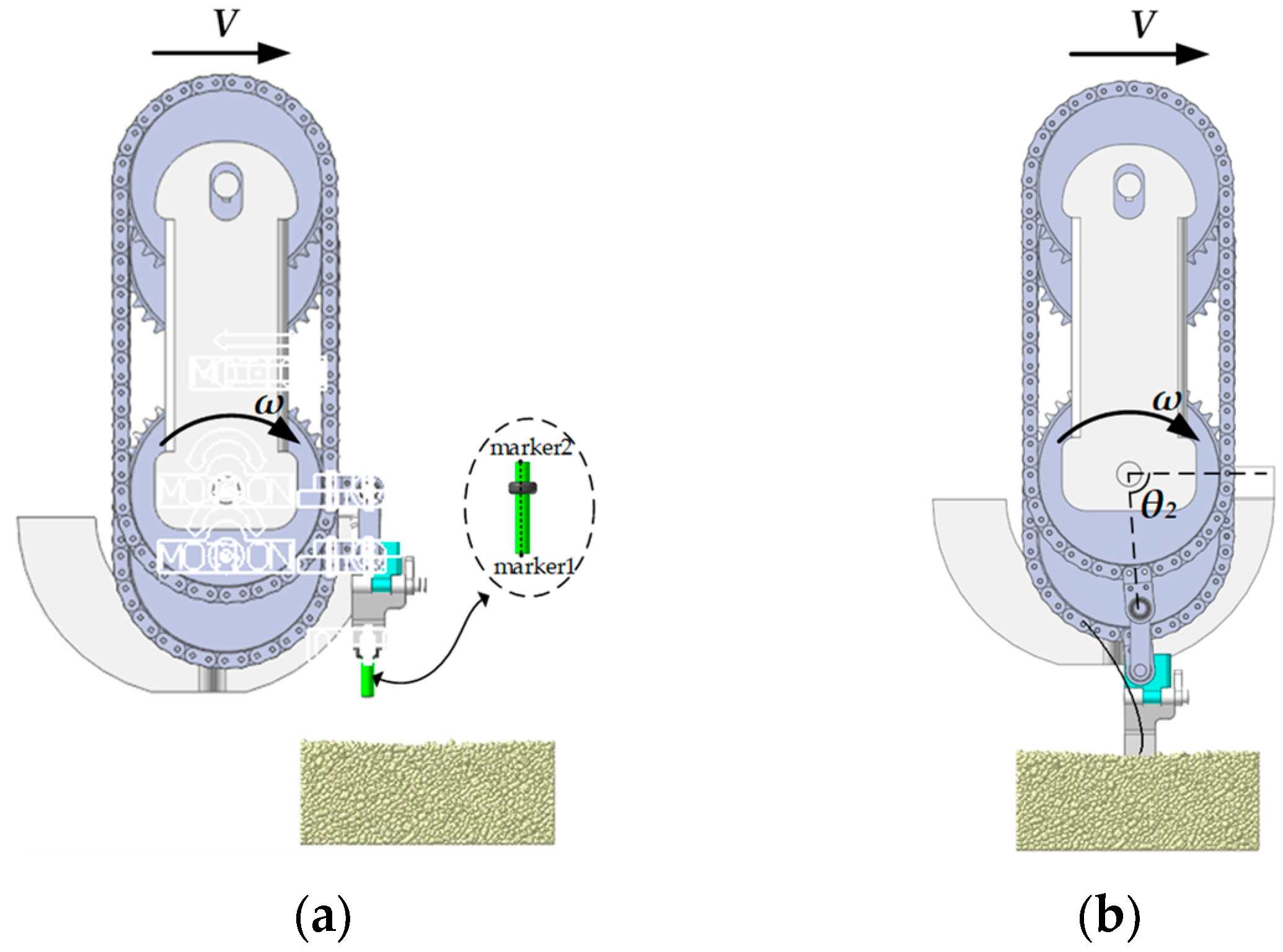
The cuttage planting mechanism for
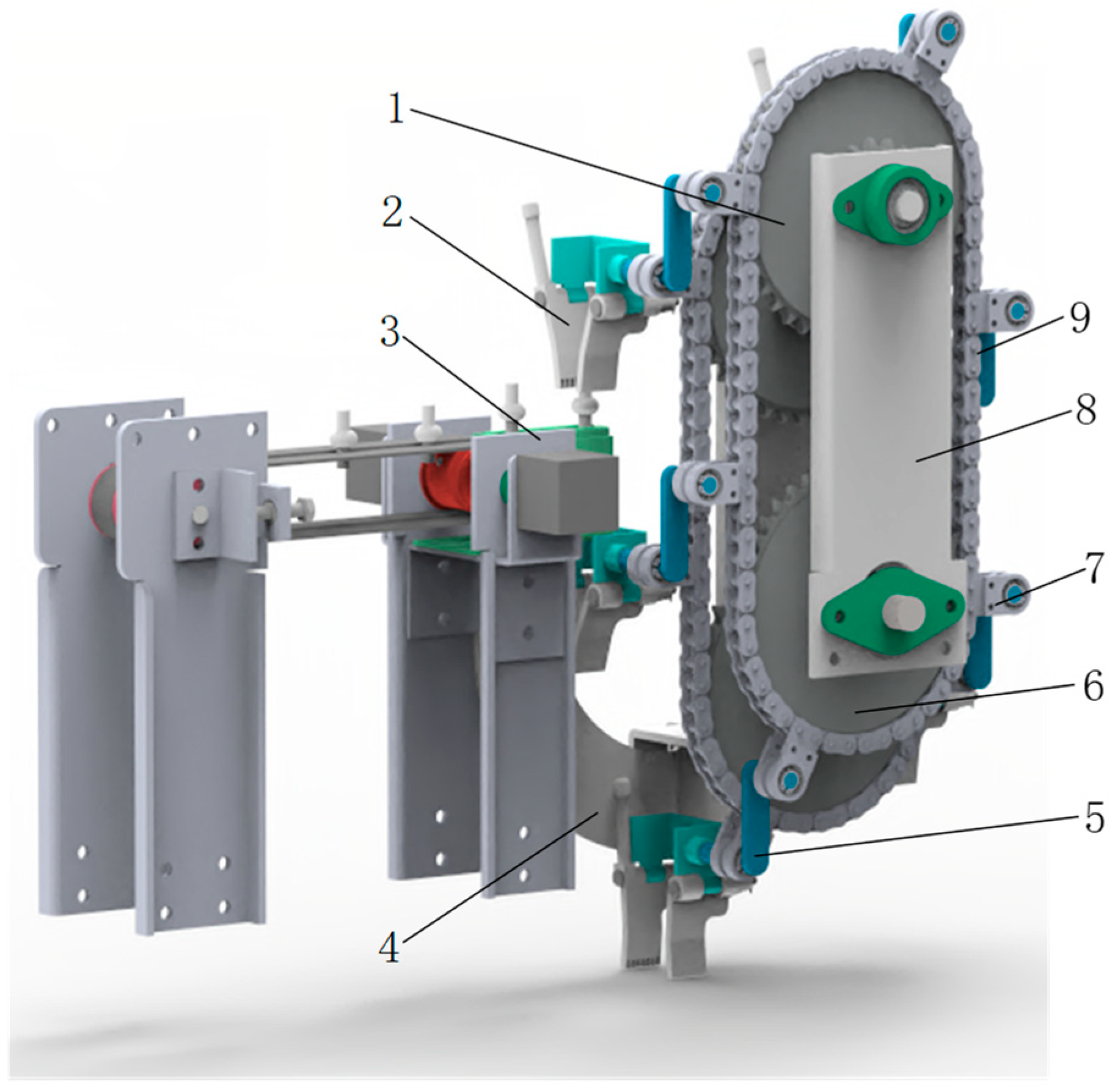
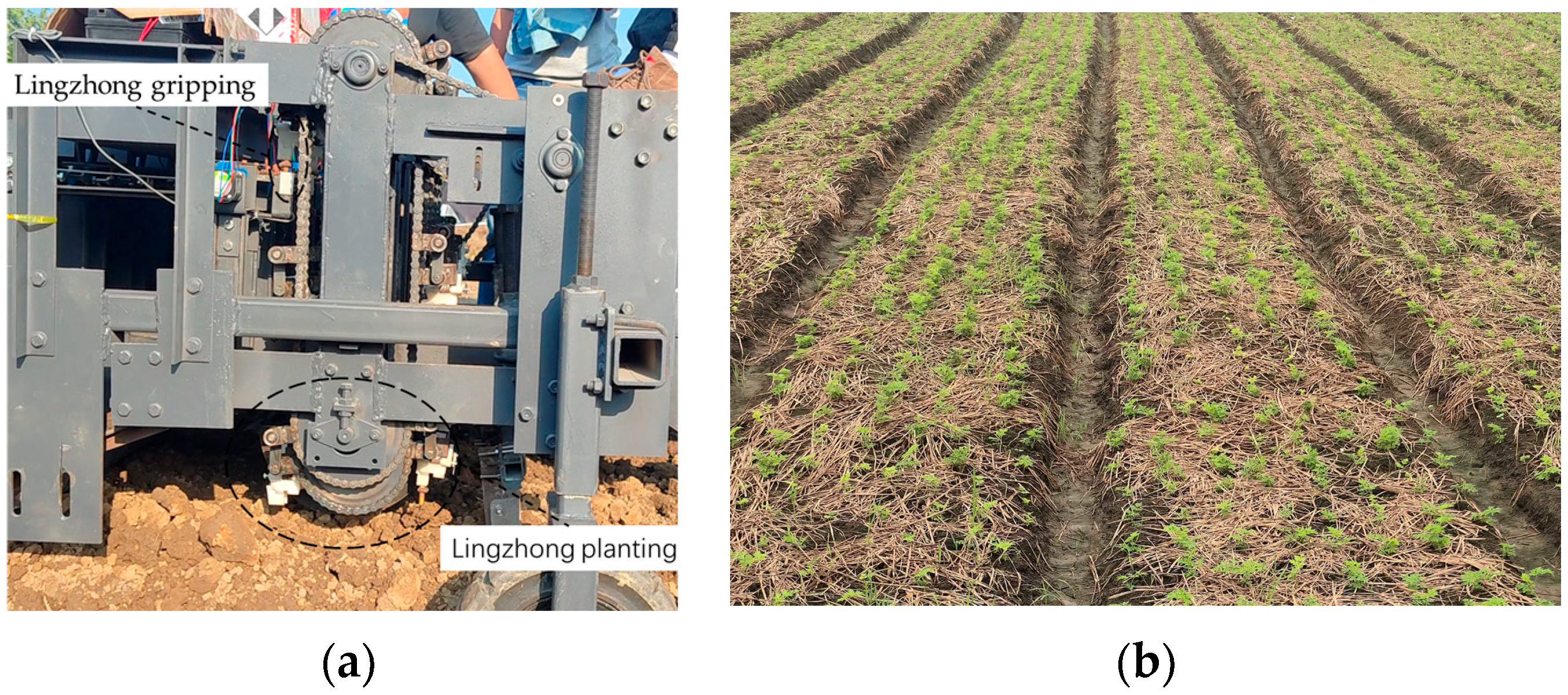
Chuanxiong seed stalks consists of driving sprocket, planter, seed preparation platform, opener, connecting rod, driven sprocket, hinged support, support frame, and chain. The connecting rod connects two chains via the hinged support, and the planter is installed at the end of the connecting rod. Multiple planters are evenly arranged along the chain assembly. Both the driving sprocket and the driven sprocket have 40 teeth and are matched with an 08A roller chain. As the driving sprocket rotates, the planters move with the chains, completing the processes of seed picking, transporting, and planting, as shown in
Figure 1.
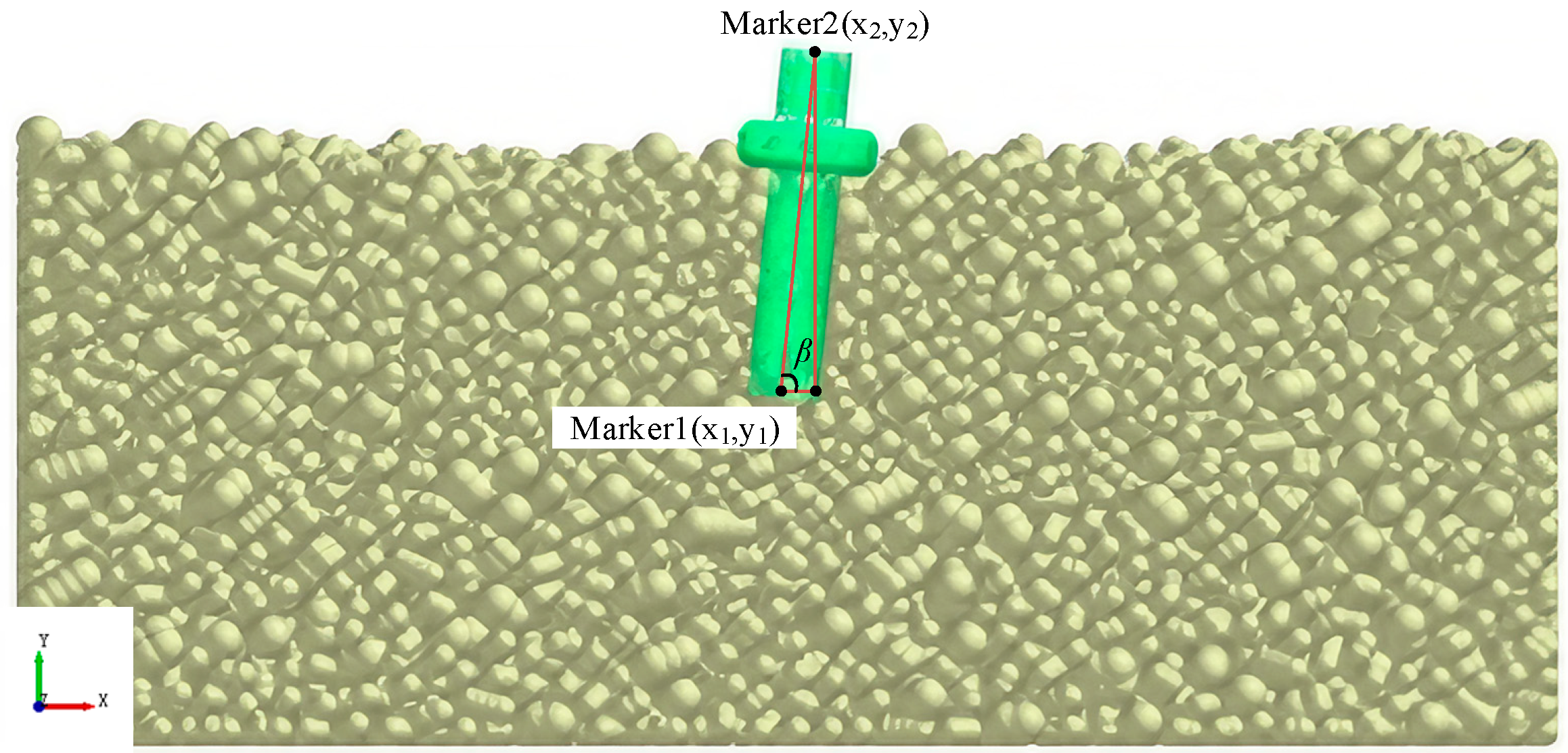
The driven sprocket and chain assembly constitute the key motion transmission components of the planting mechanism. The rotational motion of the driven sprocket directly determines the movement trajectory of the planter during the planting process. Therefore, the angular velocity and rotational radius of the driven sprocket, as well as the release position of the planter, are identified as the key technical characteristics affecting planting performance. These parameters are derived from the structural design of the prototype and provide the physical basis for the subsequent kinematic modeling and optimization.
During operation, the planter moves with the chain. Under the control of the connecting rod, the opening of planter remains vertically downward. The Chuanxiong seed stalks are placed on the seed preparation platform. As the planter passes over the seed preparation platform, it grips a Chuanxiong seed stalk. Driven by the transmission chain, the planter transports the Chuanxiong seed stalk to the planting position. The planter then inserts the Chuanxiong seed stalk into the soil. With the help of the opener, the planter releases the Chuanxiong seed stalk. After leaving the opener, the planter returns to the seed-picking position. The planting mechanism operates in a continuous cycle.
The function of the planting mechanism is to plant
Chuanxiong seed stalks into the soil under agronomic requirements. Therefore, the designed mechanism must complete a series of complex tasks, including Seed taking, conveying, planting, releasing, and returning, through a specific motion path. The detailed design requirements are as follows: (a) The mechanism must meet the agronomic requirements of Chuanxiong planting. The traditional agronomic method is insertion planting. The
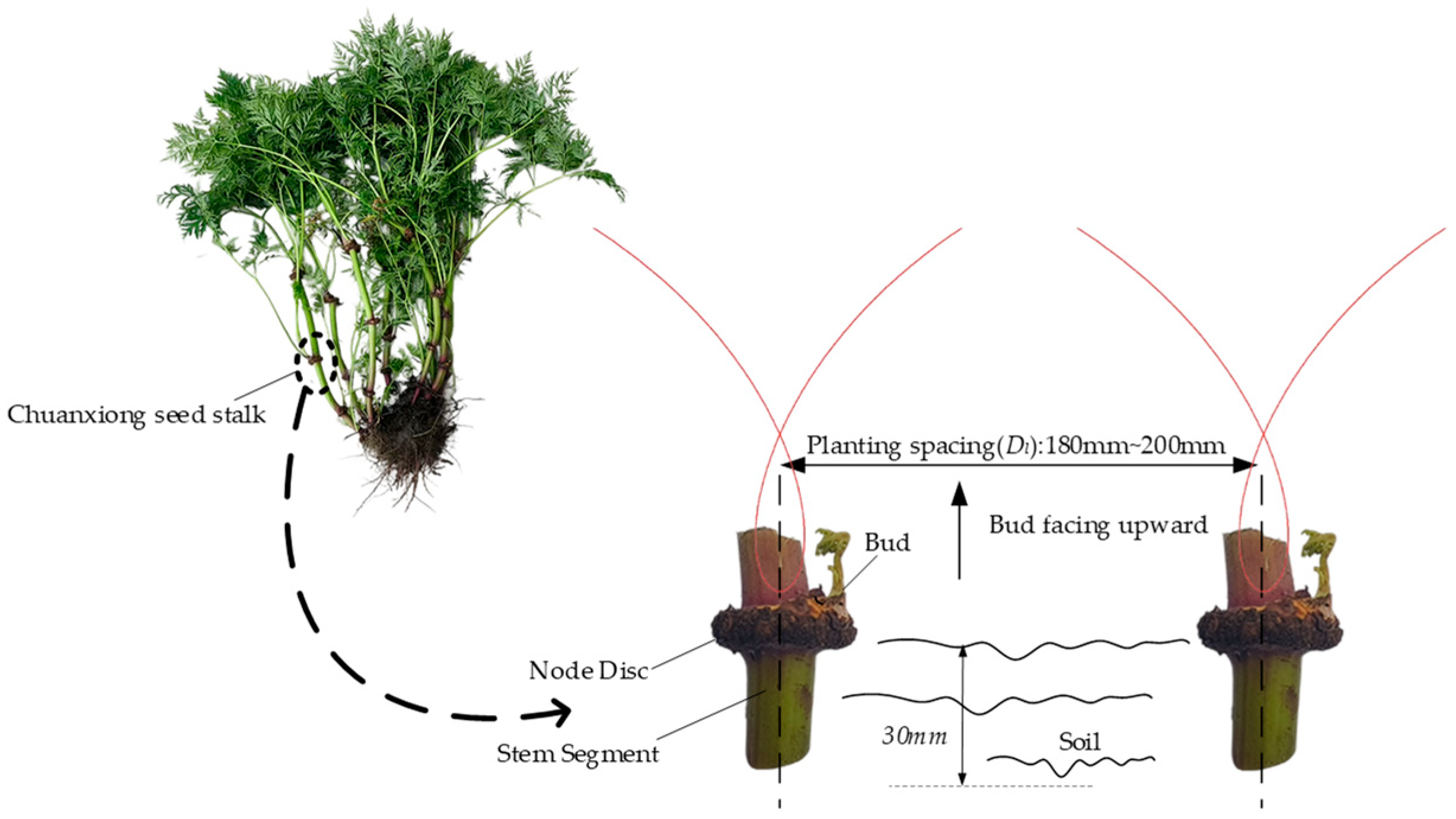
Chuanxiong seed stalk should be inserted to a depth of 30 mm, and parameters of planting density are the row spacing of 250 mm and the planting spacing of 180~200 mm. (b) The motion path of the planter must ensure planting stability. To reduce lodging after planting, the hole opening width should be minimized to keep the rhizome upright. The
Chuanxiong seed stalk should enter the soil smoothly. The desired motion path should approximate a curtate cycloid to achieve zero-speed planting [
21,
22], as shown in
Figure 2.
The Chuanxiong seed stalks are prepared by cutting off the stalks at both ends of the nodes. The stalk at the end without a bud is trimmed to approximately 30 mm. During planting, the node disc should fully contact the soil, but the soil should not completely cover the seed stalk, achieving an optimal planting depth of about 30 mm. The planting spacing is controlled at 180~200 mm, and the bud eye should face upward. The vertical orientation of the seed stalk is ensured by designing the motion trajectory of the planting mechanism and controlling the timing of seed entry and release points. The above agronomic requirements for Chuanxiong seed stalk planting will be realized through the design of the planting mechanism and optimization of key parameters.
2.2. Analysis of the Planting Trajectory
In
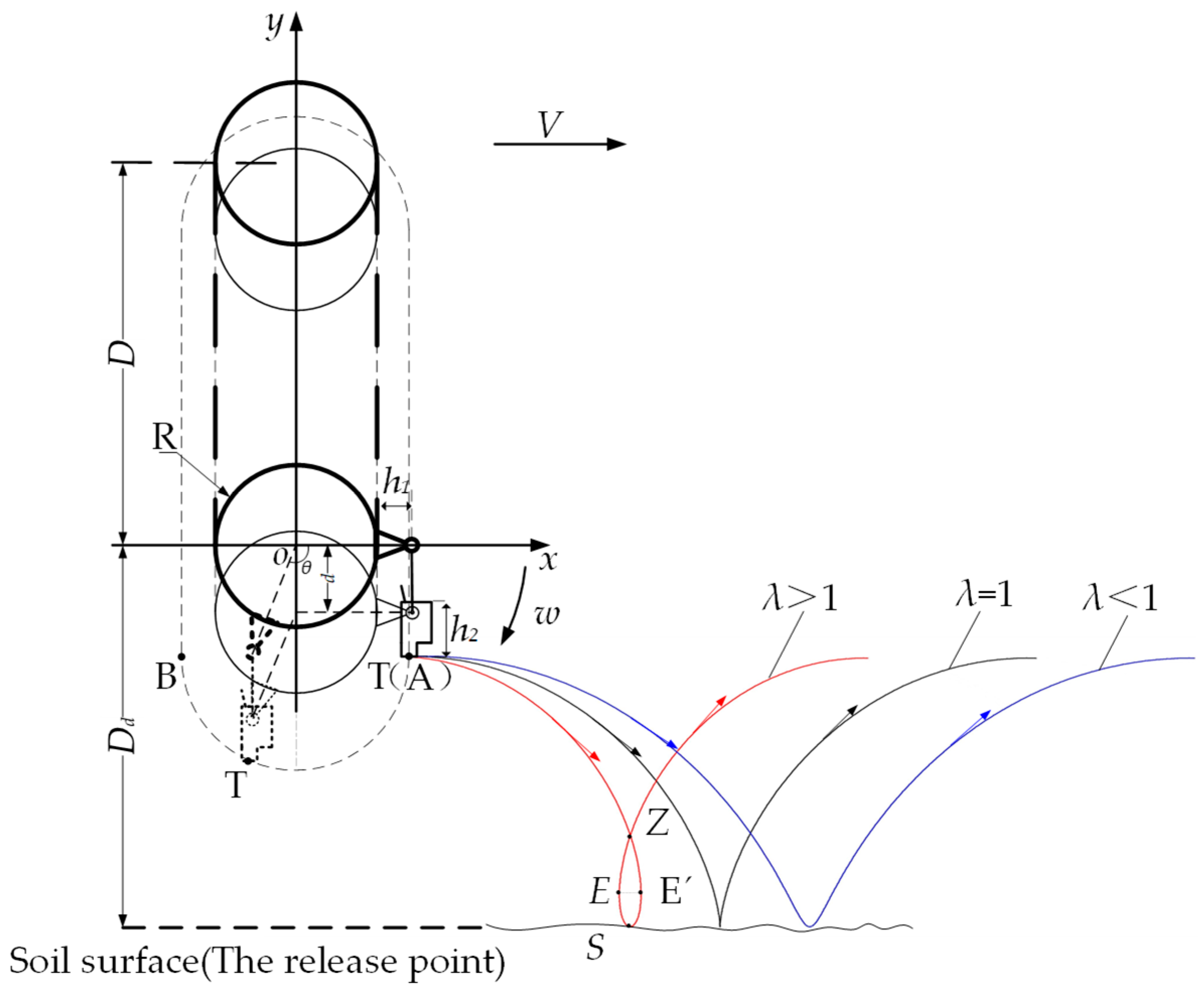
Figure 3, the motion of the planter is the combined trajectory of its movement around the transmission chain and the forward movement of the machine. The planting point Z is defined as the position of the gripping point T when the seed stalk first contacts the soil. The release point S is the position of point T when the planter reaches the lowest point of the working trajectory. To ensure smooth insertion of the
Chuanxiong seed stalk and meet the planting depth requirement while minimizing the hole width, two conditions must be satisfied. First, the absolute horizontal displacement between points Z and S should approach zero. Second, the absolute vertical displacement between points Z and S should approach the planting depth.
A Cartesian coordinate system
xOy is established for the motion of the planting mechanism, as shown in
Figure 3. The positive
x-axis is aligned with the forward direction of the machine, and the positive
y-axis points vertically upward from the ground surface. The origin
O is located at the center of the driven sprocket.
To simplify the kinematic analysis, the following assumptions were adopted:
- (1)
The chain transmission was assumed to be rigid, and the effects of chain elasticity were neglected, since the chain used in the mechanism has high stiffness.
- (2)
The hinged joints between the hinged support and the connecting rod were assembled using an interference fit between shafts and bearings; therefore, joint clearances and backlash were neglected.
- (3)
All components were considered as rigid bodies, and the motion of the planting mechanism was assumed to be planar.
- (4)
Soil reaction forces were not considered during the derivation of the gripping point trajectory. This is because the soil was sufficiently tilled to obtain a relatively uniform and leveled surface before planting, and the insertion resistance mainly affects the planting force rather than the kinematic trajectory.
During the
Chuanxiong seed stalk planting stage, the planter’s gripping point T moves along arc AB. Taking point A as the initial position and point B as the final position, the relative displacement equation of the gripping point T during this interval is expressed as:
where
x is the horizontal displacement of the gripping point T (mm);
y is the vertical displacement of the gripping point T (mm);
θ is the rotation angle of the driven sprocket relative to its initial position (rad);
V is the forward speed of the unit (mm/s);
ω is the angular velocity of the driven sprocket (rad/s);
d is the length of the connecting rod (mm);
R is the pitch circle radius of the driven sprocket (mm);
h1 is the length of the hinged support (mm);
h2 is the height of the planter (mm)
To ensure that the absolute horizontal displacement between the planting point Z and the release point S of the
Chuanxiong seed stalk approaches zero, according to Equation (1), the following Equation (2) can be obtained:
where the rotation angle of the driven sprocket at planting point Z is defined as
θ1, and that at release point S is defined as
θ2. Hereafter,
θ1 and
θ2 are referred to as the soil-entry angle and the release angle for the gripping point T, respectively.
Further simplification of Equation (2) yields:
The planting speed ratio
λ [
23] is introduced as the ratio of the linear velocity of the gripping point T to the forward speed V of the machine, as shown in Equation (4).
Using standard trigonometric identities and inequalities, the following relationships hold:
By substituting the relations in Equation (5) into Equation (4), it can be derived that satisfying the design requirement that the absolute horizontal displacement between the planting point Z and the release point S approaches zero requires λ > 1. When
λ ≤ 1, the selection of planting point Z and release point S cannot meet the condition that their absolute horizontal displacement approaches zero, as shown in
Figure 3.
Within the value ranges and relative constraints of
θ1 and
θ2 defined in Equation (5),
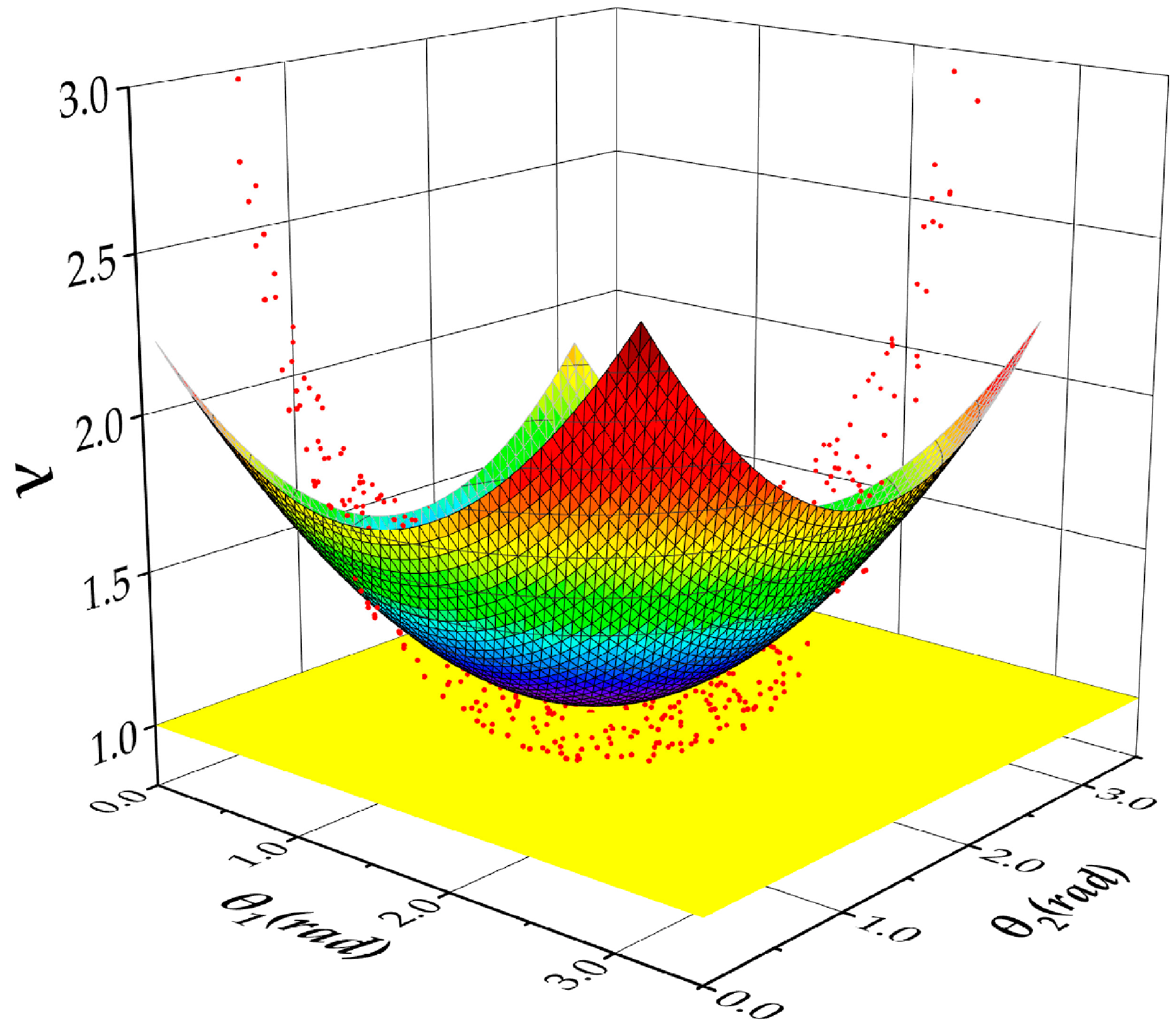
λ values were calculated using Equation (4) to form a dataset for surface fitting. These points, shown as red dots in
Figure 4, were used to generate the response surface in OriginPro 2024, which lies entirely above λ = 1, indicating that when the horizontal displacement between the planting point Z and release point S of the
Chuanxiong seed stalk approaches zero, λ must exceed 1.
There exists a relationship among the planting frequency
f (plants/min), planting spacing
Dl (as shown in
Figure 2), and the forward speed
V of the machine:
The planting spacing
Dl is:
where
N is the number of planters, and
D is the center distance of the chain assembly.
The sum of the driven sprocket radius and the length of the hinged support is defined as the driven sprocket rotation radius
Rz, as shown in Equation (8).
The distance between the center of the driven sprocket and the release point is expressed by Equation (9).
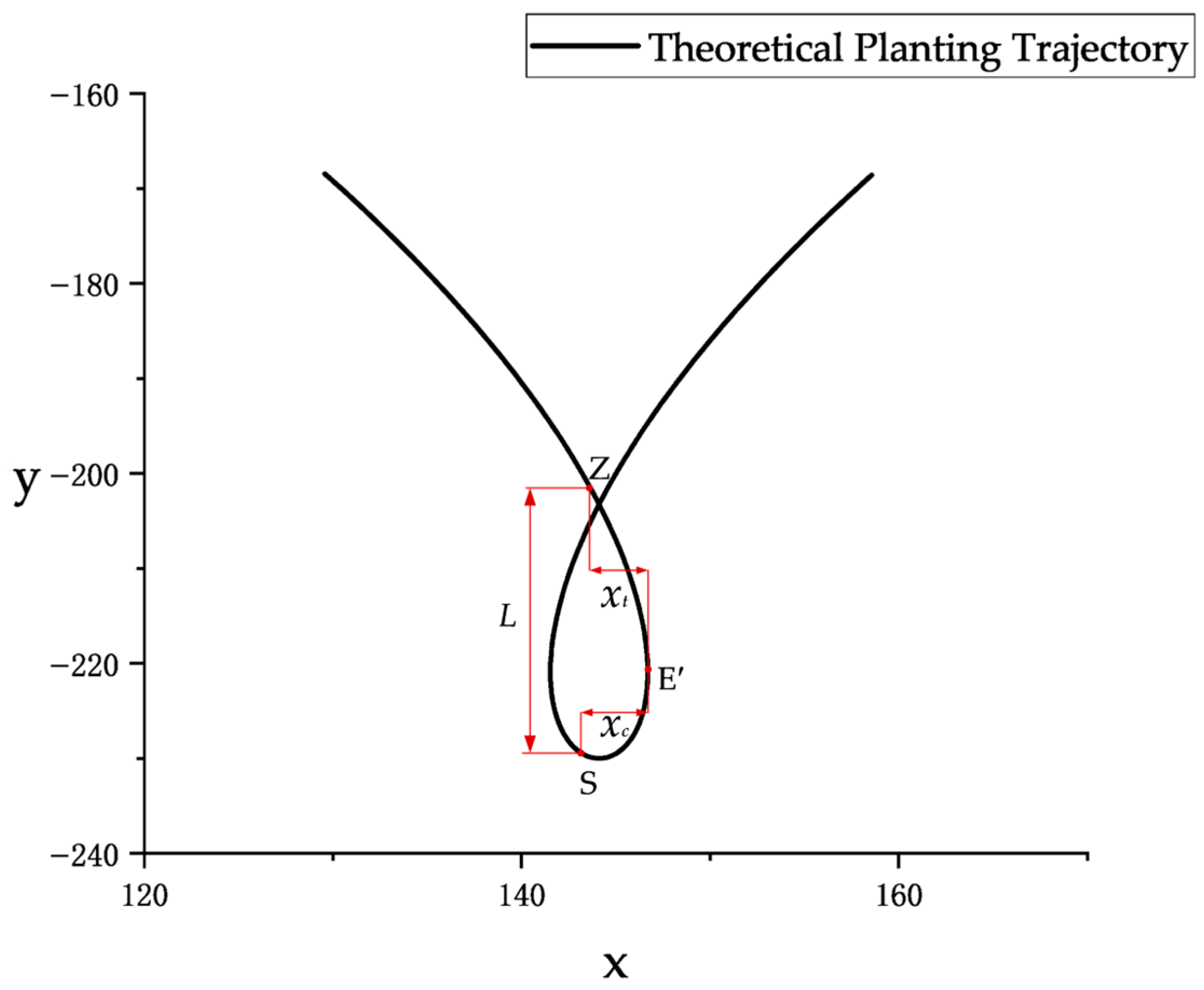
When λ > 1, the trajectory of the gripping point T intersects itself. It is a curtate cycloid. For any point located below the longest horizontal chord EE′, there exists a vertically aligned counterpart above it. This allows the planter to adjust the posture of the Chuanxiong seed stalk during planting, maintaining its uprightness.
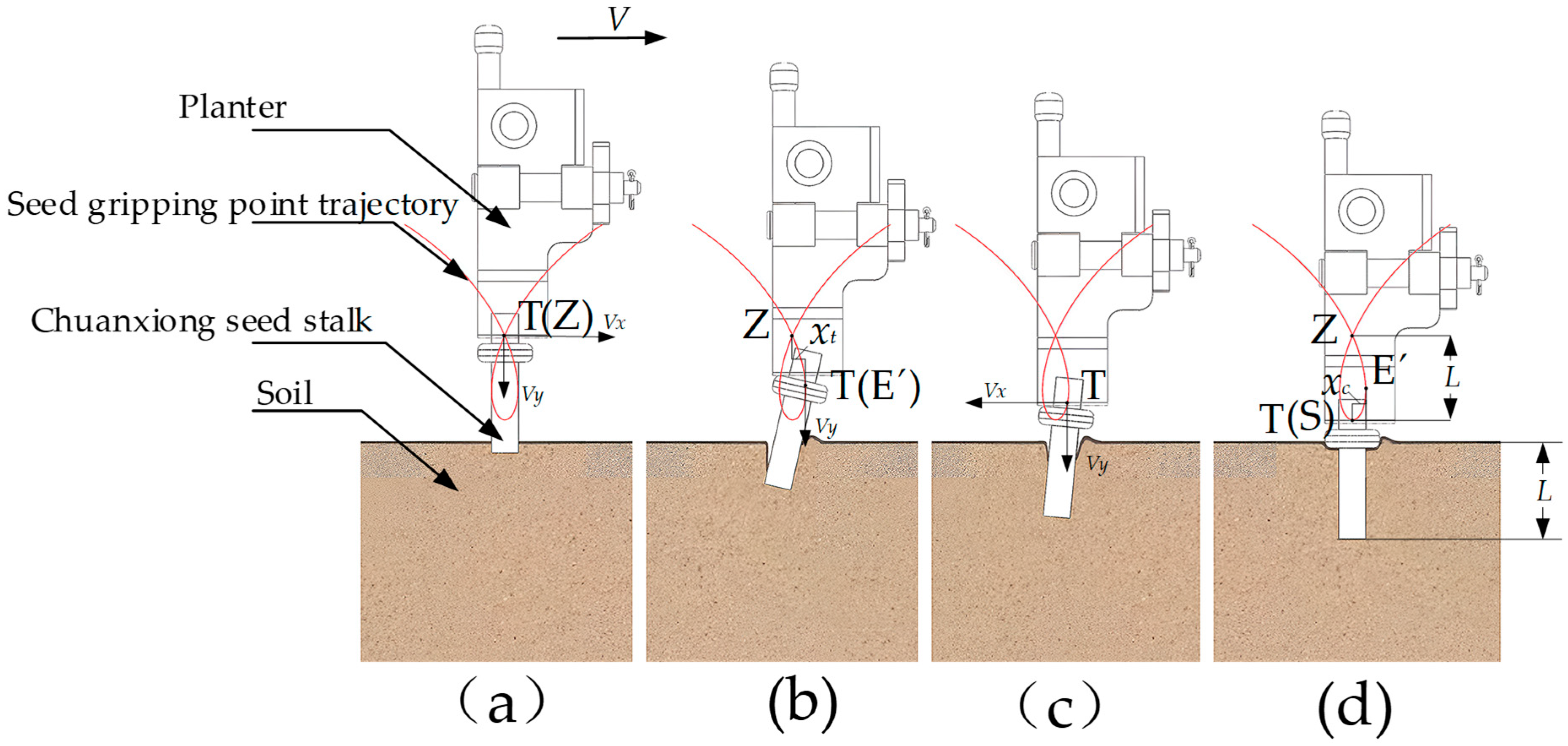
The planting process of the
Chuanxiong seed stalk is shown in
Figure 5. When the gripping point is above the longest chord EE′ of the working trajectory, it is the first stage, as shown in
Figure 5a. The gripping point T is at the planting point Z, which marks the moment the
Chuanxiong seed stalk first contacts the soil. As the machine moves forward and the planting system operates, the gripping point T moves from point Z to point E′. During this period, point T has a horizontal velocity component
Vx to the right, in the same direction as the machine’s forward speed, and a vertical velocity component
Vy downward toward the soil. The lower part of the
Chuanxiong seed stalk is compressed and penetrates into the soil, causing the surrounding soil to sink. The rightward horizontal velocity causes the seed stalk to tilt forward. The cumulative horizontal forward-tilting displacement of the
Chuanxiong seed stalk from point Z to point E′, which characterizes the horizontal soil disturbance induced during the forward-tilting stage, is defined as
xt. The
Chuanxiong seed stalks’ movement compresses the soil forwards and downwards, while the soil behind falls back and flows. The gripping point T continues moving to point E′. At position in
Figure 5b, the horizontal velocity component
Vx of the gripping point T becomes zero. Then, the gripping point T moves from point E′ to the release point S. During this period, the gripping point T has a backward horizontal velocity
Vx, opposite to the machine’s forward direction, and a downward vertical velocity
Vy. During this stage, the planter corrects the forward tilt of the
Chuanxiong seed stalk caused by the movement from point Z to point E′. The cumulative horizontal displacement of the
Chuanxiong seed stalk from point E′ to point S, which represents the horizontal soil disturbance during the posture-correction stage, is defined as
xc. At position in
Figure 5c, the posture of the
Chuanxiong seed stalk is shown. The
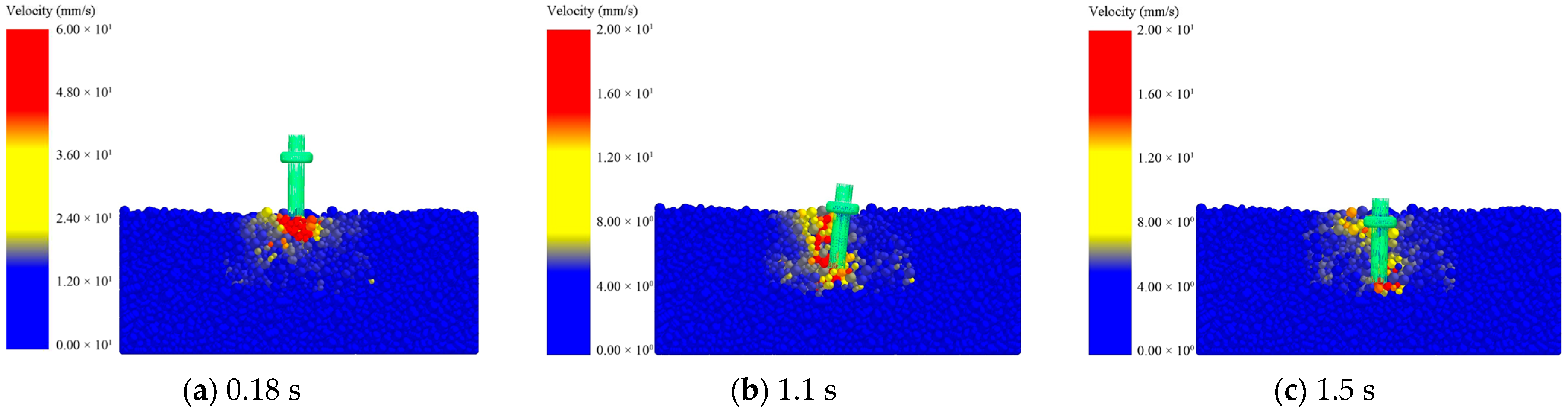
Chuanxiong seed stalk’s movement compresses the soil backwards and downwards, while the soil in front falls back and flows. Finally, the gripping point T reaches the lowest point of its trajectory—the release point S., as shown in
Figure 5d. At this moment, its vertical velocity component is zero. The rhizome node presses the soil firmly within the hole, forming a planting cavity. The planter then opens to release the seed stalk, completing the insertion and planting action. The entire planting process of the
Chuanxiong seed stalk can be divided into the stages of soil entry, forward tilt, posture correction, and release.
When the gripping point T moves to position E′ in
Figure 5b, its horizontal velocity becomes zero. Combining this condition with Equation (1) yields Equation (10):
where
θE′ is the rotation angle of the driven sprocket when the gripping point T reaches point E′.
Furthermore, the rotational angle of the driven sprocket at position E′ can be obtained, as shown in Equation (11):
By combining Equations (1) and (11), the horizontal coordinate of position E′ can be obtained, as given in Equation (12):
where
xE′ is the horizontal coordinate of the gripping point T at position E′.
When the gripping point T moves to position S in
Figure 5b, the
Chuanxiong seed stalk is released. At this moment, the rotational angle of the driven sprocket is
θ2. Combining this with Equation (1), the coordinates of the seed stalk release point S can be obtained. According to the above description of the posture-correction displacement of the seed stalk, Equation (13) is derived as follows:
where
xS is the horizontal coordinate of the gripping point T at the release point S, and
xC is the horizontal correction of the
Chuanxiong seed stalk during the posture-correction stage.
At this moment, the gripping point is close to the soil surface, and the rhizome node of the
Chuanxiong seed stalk is in full contact with the soil. According to the seed-stalk geometry shown in
Figure 2, the planting depth at this stage is 30 mm. Therefore, the relationship between the vertical coordinate of the seed-stalk release point
yS and that of the soil-entry point
yZ is given by Equation (14):
where
yZ is the vertical coordinate of the
Chuanxiong seed stalk at the soil-entry point Z, and
yS is the vertical coordinate at the release point S.
By combining
yZ with Equation (1), the rotational angle of the driven sprocket at soil entry,
θ1, can be obtained. The horizontal coordinate of the gripping point at soil entry,
xZ, can then be determined. Based on the above analysis, the forward-tilt amount of the
Chuanxiong seed stalk at soil entry can be expressed by Equation (15).
where
xZ is the horizontal coordinate of the gripping point at the soil-entry point Z, and
xt is the horizontal forward-tilt value of the
Chuanxiong seed stalk during the forward-tilt stage.
The relative position between the
Chuanxiong seed stalk and the soil surface shown in
Figure 5 indicates that the planting depth is determined by the cutting shape of the
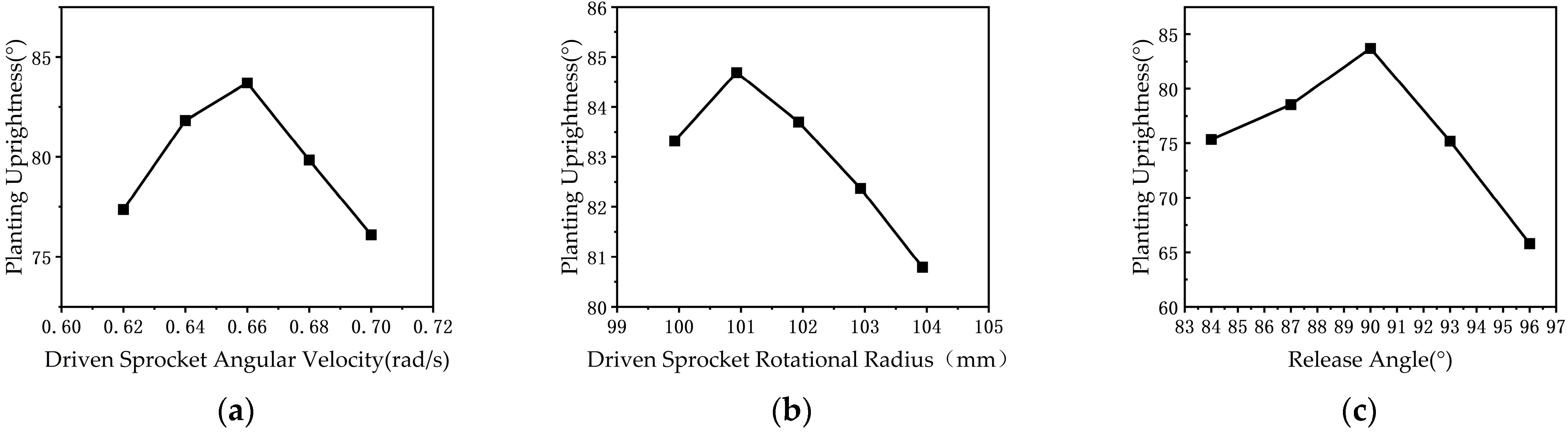
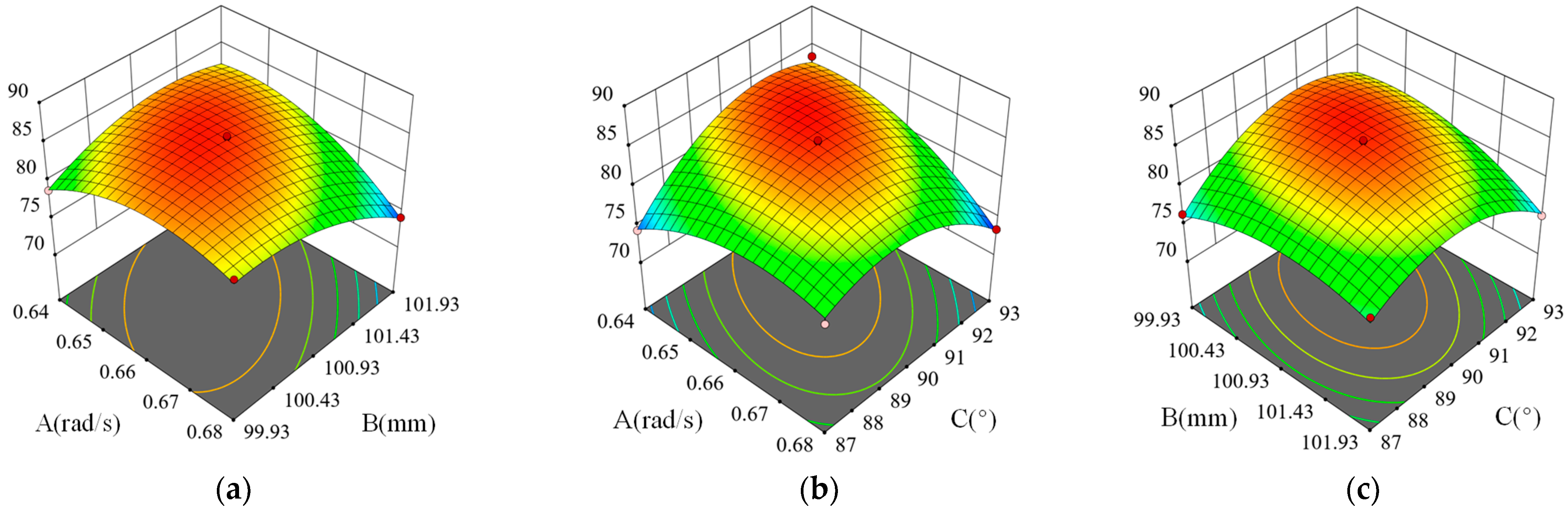
Chuanxiong seed stalk and the installation position between the planting mechanism and the ground. The shape of the planting trajectory affects the planting verticality of seed stalks. The key factor influencing the trajectory curve is the planting speed ratio
λ. As shown in Equations (4) and (8), under a fixed horizontal motion speed of the planting mechanism, the main factors affecting the trajectory curve shape are the angular velocity
ω of the driven sprocket and the rotation radius
Rz of the sprocket. By designing the angular velocity
ω and the rotation radius
Rz, the trajectory of the planting mechanism can be adjusted to improve the verticality of
Chuanxiong seed stalk planting. In addition, the timing of
Chuanxiong seed stalk release also affects the planting verticality. Since the motion of the planter is driven by the driving sprocket of the planting mechanism, the release timing can be expressed as the rotation angle
θ2 of the driven sprocket corresponding to the moment of
Chuanxiong seed stalk release. The following sections will optimize the angular velocity
ω of the driven sprocket, the rotation radius
Rz, and the release angle
θ2, ensuring compliance with the traditional agronomic requirements for planting spacing of
Chuanxiong seed stalks, while further improving the uprightness of the planted seedlings.