Article

A Crayfish Optimization Algorithm with a Random Perturbation Strategy and Removal Similarity Operation for Color Image Enhancement


College of Engineering, Northeast Agricultural University, Harbin 150030, China
*
Author to whom correspondence should be addressed.
Agriculture 2026, 16(3), 364; https://doi.org/10.3390/agriculture16030364
Submission received: 1 December 2025 / Revised: 12 January 2026 / Accepted: 2 February 2026 / Published: 3 February 2026
(This article belongs to the Section Artificial Intelligence and Digital Agriculture)

Abstract

Image enhancement can effectively improve the contrast, clarity, and information content of images, thereby improving visual quality. Image enhancement has significant application value in the process of identifying and diagnosing agricultural pests and diseases. This paper proposes a color image enhancement method based on color space transformation, converting the image from the RGB space to the HSV space, conducting targeted enhancement on the V channel, and combining adaptive brightness adjustment and Gamma correction to further improve the visual effect. To achieve better enhancement results, this paper designs a crayfish optimization algorithm with a random perturbation strategy and removal similarity operation (COA-RPRS). This algorithm achieves a dynamic balance between exploration and exploitation through an adaptive temperature calculation formula and improves the position update mechanism in the summer escape, competition, and foraging stages, significantly enhancing convergence performance. Moreover, introducing a removal similarity operation and a random perturbation strategy based on Lévy flight effectively maintains population diversity and prevents premature convergence. Experimental verification was conducted on the CEC 2017 test functions, 20 color images, and 10 images of rice pests and diseases, showing that COA-RPRS achieves superior performance compared to eight other comparison algorithms in both global optimization and color image enhancement tasks. These results suggest its potential applicability in supporting intelligent recognition and diagnostic systems for agricultural pest and disease management.

1. Introduction

Agricultural pests and diseases are one of the main factors affecting crop yield and quality, and their occurrence is widespread and complex, causing significant harm to agricultural ecosystems. In recent years, disease and pest detection based on image recognition has become a research hotspot [1]. However, due to factors such as lighting, background, and sensor performance, the collected images of pests and diseases often suffer from low contrast, high noise, and blurred details. These problems have a significant impact on the accuracy of feature extraction and recognition. Therefore, image enhancement technology [2] plays a crucial role as an important part of image processing. This technology can effectively highlight key details such as disease spots, insect bodies, and leaves by optimizing the brightness, contrast, and texture clarity of images. Therefore, researching efficient image enhancement methods for agricultural pests and diseases is of great theoretical significance and application value for accurately extracting and identifying the characteristics of pests and diseases, promoting intelligent diagnosis and precise prevention and control.
The core objective of color image enhancement is to improve the visual quality of the image, resulting in improvements in contrast, clarity, and information content. Traditional approaches to image enhancement primarily encompass methods such as histogram equalization [3], the Retinex algorithm [4], and frequency domain filtering [5], etc. These methods usually perform well in grayscale image processing but have certain limitations in color image processing. Taking histogram equalization as an example, this method improves the overall contrast of the image by adjusting the pixel distribution, which can effectively enhance the brightness hierarchy structure. However, when the RGB channels are independently processed, it is easy to disrupt the original color balance, resulting in significant color distortion. The Retinex algorithm has advantages in simulating human visual perception, capable of enhancing the consistency of brightness and color. However, its computational complexity is high, and it is prone to generating artifacts in uneven brightness or dark areas, affecting visual realism. The frequency domain filtering method enhances the overall visual effect of the image through global transformation. However, it is difficult to balance local texture and detail features with this global operation, often resulting in uneven image enhancement or information loss.
In response to the above problems, this paper adopts a color image enhancement method based on color space transformation. Specifically, the image is first converted from RGB space to HSV space, where H and S represent hue and saturation, respectively, and V represents brightness information. Since human visual perception of color primarily depends on brightness, only the V channel is enhanced while keeping H and S unchanged. This can effectively improve brightness and contrast while preserving the original color features of the image, avoiding the common color shift problem in traditional methods. In the enhancement process of the V channel, this paper combines two types of operations: adaptive brightness adjustment and Gamma correction [6]. The adaptive brightness adjustment is mainly used to improve the overall brightness distribution and make dark area details easier to distinguish; Gamma correction enhances local contrast through nonlinear mapping, yielding more natural and visually rich details. By combining the two, a good balance can be achieved between global brightness balance and local detail enhancement, improving the overall visual quality and perceptual effect of the image. In summary, this method not only achieves synchronous improvement of brightness and contrast while maintaining color authenticity but also has the advantages of flexible parameter adjustment and high computational efficiency, providing an effective way for visual information enhancement in fields such as agricultural pests and diseases, remote sensing images, and medical images.
Intelligent optimization algorithms have demonstrated good solving ability and stability performance in fields such as intelligent robots [7], image segmentation [8], vehicle path optimization [9], and job shop scheduling [10]. Based on this, scholars have gradually shifted their research focus to its application in image enhancement problems and the potential for improving algorithms. The rise of this research direction mainly stems from the limitations of traditional image enhancement methods, such as high sensitivity in parameter selection and the tendency to fall into local optima. Han et al. [11] optimized the parameters of the Whale Optimization Algorithm (WOA) and conducted enhancement experiments on four different types of grayscale images. The findings indicate that the proposed algorithm performs remarkably well in terms of both subjective visual quality and quantitative evaluation measures, confirming its efficiency and suitability for image enhancement applications. Zhang et al. [12] proposed an improved bee colony algorithm that combines the hybrid Harris Eagle algorithm with dual Gamma (IHHO-BIGA) and incomplete Beta (IHHO-NBeta) functions for low-light image enhancement. The experimental results show that the proposed method outperforms the existing technologies in both visual perception effect and image enhancement evaluation indicators and can achieve more natural brightness recovery and detail enhancement. Despite the notable advancements of these intelligent optimization algorithms in image enhancement parameter optimization, they still encounter challenges such as poor solution quality and a tendency to become trapped in local optima when facing different transformation functions and their corresponding parameters that need to be optimized.
Jia et al. [13] proposed a novel intelligent optimization algorithm known as the crayfish optimization algorithm (COA), which is inspired by the heat-avoidance, competitive, and foraging behaviors of crayfish. The emergence of COA provides new ideas and methods for addressing complex optimization problems, and since its introduction, it has garnered considerable interest within the research community. In 2024, Shikoun et al. [14] developed an enhanced version of the crayfish optimization algorithm, termed the binary crayfish optimization algorithm (BinCOA), for feature selection. BinCOA introduces a refraction opposition learning strategy and crossover strategy on the basis of standard COA to improve convergence precision. In 2024, Chauhan et al. [15] proposed a parallel structured crayfish optimization and arithmetic optimization algorithm (PSCOAAOA) for optimizing the parameters of support vector machines (SVM). Jia et al. [16] proposed a modified crayfish optimization algorithm (MCOA) in 2024, which strengthens the search efficiency and avoids local stagnation through the integration of an environmental update mechanism and a ghost adversarial learning strategy. In 2025, Lin et al. [17] proposed a multi-strategy-assisted hybrid crayfish-inspired optimization algorithm (ICOA) based on differential evolution and compared it with the original COA and several benchmark algorithms, highlighting the excellent performance of ICOA in solving complex optimization problems.
Although COA has advantages such as simplicity and ease of implementation, strong global search capability, fewer parameters, and easy parallelization, when the search space is large or the problem is complex, COA has disadvantages such as slow convergence, limited solution accuracy, parameter sensitivity, and weak exploration and exploitation ability of balanced algorithms. According to the No Free Lunch (NFL) theorem [18], no single optimization algorithm can effectively address all problem types—an algorithm that performs well on some tasks may exhibit poor performance on others. Furthermore, the effectiveness of COA in addressing color image enhancement tasks still needs to be explored. Therefore, to improve COA, it is necessary to consider how to overcome its existing problems, improve the performance and stability of COA, and enhance its performance and applicability in various optimization scenarios.
To address the above problems, this paper proposes a crayfish optimization algorithm with a random perturbation strategy and removal similarity operation (COA-RPRS) to enhance the algorithm’s overall performance. The effectiveness of COA-RPRS is investigated in solving global optimization problems (GOPs) and color image enhancement problems. Finally, COA-RPRS will be applied to enhance rice disease images in the field of agricultural production to evaluate its applicability and advantages in practical scenarios. The main contributions of this work are summarized as follows:
  • A novel calculation formula for temperature Temp and a dynamic adaptive adjustment formula for parameter C2 have been designed, overcoming the disadvantage of the C2 value being dependent on the maximum number of iterations. The temperature Temp and parameter C2 enable the algorithm to exhibit strong exploratory behavior during the initial iterations and enhanced exploitative capability in the later stages, thereby achieving a more effective balance between exploration and exploitation;
  • Modified position updating formulas are proposed for the summer retreat, foraging, and competition phases, enabling crayfish individuals to exhibit greater flexibility and randomness during cave selection, food searching, and spatial competition. The improved mechanism provides individuals with multi-directional movement and dynamic response capabilities, significantly enhancing both global search and local exploitation performance;
  • The dissimilarity operation and the optimal individual perturbation strategy based on Lévy flight have been added. Dissimilarity operations help maintain population diversity. The optimal individual perturbation strategy based on Lévy flight enables crayfish to conduct detailed searches near the optimal individual with a high probability and explore unknown areas with a low probability. This helps to improve the convergence speed of the algorithm, reduce the possibility of the algorithm falling into a local optimum, and thereby enhance the solution quality of the algorithm;
  • The performance of CEC 2017 benchmark functions and color test images was evaluated through experiments and compared with that of other intelligent optimization algorithms. It has been experimentally verified that COA-RPRS achieves markedly superior performance to comparable algorithms in addressing GOPs and color image enhancement problems;
  • The COA-RPRS method was applied to enhance rice disease images, and the results indicated that it can significantly improve visual quality and detail representation. This effectively validates the method’s efficiency and feasibility for image enhancement and highlights its potential application in the field of intelligent agricultural diagnosis.
The rest of this paper is as follows: Section 2 briefly introduces the color image enhancement problem and the literature review. Section 3 proposes the COA-RPRS algorithm. Section 4 presents the simulation results and analysis. Section 5 gives the conclusion and future work prospects.

2. Related Work

2.1. Literature Review

The essence of image enhancement lies in finding the optimal solution within a parameter space to maximize a specific visual quality evaluation function. Traditional methods mostly rely on empirical parameter adjustments, and their effectiveness is often limited due to the difficulty in achieving global optimality. In recent years, intelligent optimization algorithms, due to their strong global search capabilities, have been successfully introduced into this field, forming a new method for automatic parameter tuning.
In 2024, Ma et al. [19] proposed an improved slime mold algorithm (SSMA) integrating a hyperbolic oscillation factor and quadratic interpolation to address the problems of quality decline and poor visual effect in low-light images. This method optimizes the dynamic gray-scale curve within a non-complete beta function framework, effectively enhancing the adaptability of image enhancement. SSMA systematically introduces three improvement strategies to address the limitations of the classic slime mold algorithm, such as insufficient convergence accuracy and the tendency to get stuck in local optima. Experimental results show that the image enhancement method optimized based on SSMA can significantly improve the overall brightness of the image while better preserving the details, and its enhancement effect outperforms the existing comparison algorithms in both subjective vision and objective indicators. In 2021, Bhandari et al. [20] proposed a novel optimization histogram adjustment scheme based on the cuckoo search algorithm, aiming to achieve contrast enhancement of images while maintaining brightness. This method constructs an objective function with adjustable parameters and uses the cuckoo search algorithm to optimize and generate the target histogram. By selecting appropriately designed adjustment parameters, the range and degree of image contrast enhancement can be effectively controlled. While achieving the enhancement effect, the brightness distribution and important features of the image can be maintained. Finally, the optimized target histogram is applied to histogram equalization processing to generate the final enhanced image result. In 2017, Chen et al. [21] proposed a Gaussian mixture model (GMM)-based grayscale image enhancement algorithm based on Particle Swarm Optimization (PSO). This method first models the gray histogram of the input image using the GMM and uses the effective intersections among the Gaussian components in the model to divide the histogram into intervals. Subsequently, the gray values within each divided histogram interval are mapped to the appropriate output interval through an optimized transformation function, thereby generating the enhanced grayscale image. The transformation function is composed of the Gaussian components corresponding to the input intervals and their cumulative distribution functions, and its key parameters are adaptively determined by the PSO algorithm. Experimental results show that this method effectively improves the visual effect while maintaining the texture details of the image and is particularly suitable for the enhancement processing of natural images and images with rich details. In 2015, Jiang et al. [22] addressed the shortcomings of traditional image enhancement techniques in terms of detail preservation and histogram distribution balance by proposing a grayscale image enhancement method based on an improved bacterial foraging optimization algorithm. To overcome the limitation of the bacterial foraging algorithm in premature convergence in high-dimensional optimization, this method transformed the grayscale image enhancement problem into an incomplete Beta function optimization problem in a two-dimensional parameter space. Simulation experiments showed that the proposed method effectively enhanced image details while better maintaining the balance of the histogram distribution, making the enhanced image more natural in terms of light–dark transition and detail presentation, and achieving a better overall visual effect than existing comparison methods.
In recent years, new methods have continuously emerged in the field of intelligent optimization. In 2022, Chopra et al. [23] proposed a nature-inspired optimization algorithm known as golden jackal optimization (GJO). This algorithm simulates the intelligent behavior of the golden jackal during the cooperative hunting process and divides it into three key steps: prey searching, enclosing, and pouncing. Experimental results show that this algorithm exhibits good adaptability and solution effectiveness when dealing with complex engineering problems with unknown search spaces. In 2023, Zhao et al. [24] proposed the sea horse optimizer (SHO). The design of this algorithm was inspired by the movement, predation and breeding behaviors of sea horses in nature: in the movement mechanism, the algorithm simulates the two modes of the sea horse spiral floating and drift with ocean currents; in the predation strategy, it uses a probability model to simulate the success and failure of the sea horse hunting; particularly uniquely, the algorithm draws on the biological characteristics of male sea horse pregnancy and designs a mechanism for reproducing offspring while retaining the superior information of the parent generation, thereby effectively enhancing the population diversity. Through the depiction and integration of these intelligent behaviors using mathematical models, SHO achieved a dynamic balance between local exploitation and global exploration. In 2024, Han et al. [25] drew inspiration from the group behavior of walruses and proposed the Walrus Optimization (WO) algorithm. This algorithm simulates the various adaptive behaviors exhibited by walruses upon receiving critical environmental signals (danger signals and safety signals), including migration, reproduction, habitat selection, foraging, aggregation, and escape. By using mathematical modeling to convert these behaviors into optimization mechanisms, WO demonstrated excellent stability and outstanding performance competitiveness when dealing with high-dimensional benchmark functions and real-world engineering optimization problems. In 2025, Xiao et al. [26] drew inspiration from the group behavior of wild lemmings in nature and proposed the artificial lemming algorithm (ALA). This algorithm uses mathematical modeling to precisely simulate the four typical behavioral patterns exhibited by lemmings during their survival process: long-distance migration, digging holes, foraging, and evading predators. Specifically, the migration and excavation behaviors are designed for extensive exploration in the search space, while the foraging and avoidance behaviors focus on in-depth exploitation in the currently optimal areas. Moreover, ALA introduces an energy-decreasing mechanism, which can dynamically adjust the balance between exploration and exploitation based on the iterative process, thereby significantly enhancing the algorithm’s ability to escape from local optima and enabling it to converge more stably and efficiently to the global optimal solution. In 2025, Yang et al. [27] proposed a novel caterpillar fungus optimizer (CFO) for parameter identification in solid oxide fuel cells (SOFCs). This research combined the generalized regression neural network (GRNN) to preprocess the experimental data, effectively filtering out noise interference. The designed CFO algorithm has strong global search capabilities and overcomes the local optimum dilemma by introducing strategic operators. In the SOFC parameter identification task, this method first uses GRNN to filter out noise from the original data and then inputs the optimized data into CFO and four other comparison algorithms for parameter identification. Experimental results show that CFO demonstrates significant advantages in terms of solution accuracy and avoiding premature convergence. In 2025, Rodan et al. [28] proposed an enzyme activity optimization (EAO) algorithm that simulates the adaptive enzyme action mechanism of biological systems. This algorithm employs a novel balancing strategy, enabling dynamic adjustment between the exploration and exploitation stages, thus efficiently traversing and optimizing complex high-dimensional search spaces. EAO has been verified on various standard test sets, and the experimental results show that it significantly outperforms existing comparison algorithms in terms of convergence accuracy, solution speed, algorithm robustness, and overall performance. In 2023, Jia et al. [13] simulated the summer resort, competition and foraging behaviors of crayfish and proposed the crayfish optimization algorithm (COA). This algorithm regulates the behavioral patterns of individuals by simulating changes in water temperature and is divided into three stages: summer resort behavior, competition behavior and foraging behavior. The summer resort stage corresponds to the global exploration process of the algorithm, while the competition and foraging stages correspond to the local exploitation process. COA dynamically adjusts the conversion mechanism between exploration and exploitation through temperature parameters: when the temperature is too high, crayfish choose to enter caves for summer resort or engage in cave competition; when the temperature is suitable, individuals adopt differentiated foraging strategies based on food quantity, and their food intake is related to their food consumption. This temperature-based adaptive regulation mechanism effectively enhances the randomness and global optimization ability of the algorithm, thereby improving its comprehensive performance in complex optimization problems. In 2024, Jia et al. [16] addressed the problem that the crayfish optimization algorithm (COA) for crayfish exhibited a decline in convergence speed in the later stage of the search process and was prone to getting trapped in local optima. They proposed a modified crayfish optimization algorithm (MCOA). This algorithm is based on the survival habits of crayfish and innovatively incorporates an environmental update mechanism. By introducing water quality factors, it guides the population to migrate to more optimal adaptive areas. At the same time, MCOA integrates a learning strategy based on ghost antagonism, effectively enhancing the ability of individuals to escape from local optimal regions during the search process. Experimental verification shows that MCOA demonstrates superior comprehensive performance in solving complex space optimization problems and practical engineering applications.
Although the aforementioned intelligent optimization algorithms possess distinct advantages and the improved version of COA has performed well in general optimization tasks, their effectiveness in the specific task of color image enhancement has not been fully verified. According to the NFL theorem, any algorithm has limitations in its applicable range. COA and its variants still have room for further improvement when dealing with problems such as visual quality and detail preservation involved in image enhancement. Therefore, this paper proposes a crayfish optimization algorithm with a random perturbation strategy and removal similarity operation (COA-RPRS), aiming to enhance the performance of the algorithm in global optimization and color image enhancement problems and to verify its effectiveness through a systematic comparison with the eight advanced algorithms mentioned earlier.

2.2. Color Image Enhancement Problem

Enhancement strategy based on color space transformation: Firstly, the color image is converted from RGB space to HSV space, only the brightness channel V is enhanced, and the hue H and saturation S are kept unchanged. Subsequently, based on the image content, the enhancement parameters are dynamically adjusted in the luminance channel to achieve adaptive brightness adjustment and Gamma correction [19]. By separating luminance and color information, this method can effectively enhance brightness and details while avoiding the common color shift problem. The adaptive enhancement model on the V channel is shown in Equation (1).
V = F ( V ; α , β , γ )
where V is the original luminance channel value, V′ is the enhanced luminance value, α′ is the adaptive contrast adjustment parameter, β′ is the adaptive luminance adjustment parameter, γ is the Gamma correction parameter, and F(·) is the nonlinear enhancement mapping function.

2.2.1. Adaptive Parameter Adjustment Mechanism

First, statistical features of the original V channel are calculated, including the mean μV and standard deviation σV.
To avoid excessive stretching of low-contrast images, the contrast parameter α is adjusted as follows:
α = min α , 1 + 1 σ V × 0.5
where the value of σV ranges from 0 to 1. σV reflects the contrast level of the original image. This adjustment ensures that enhancement for low-contrast images is more gradual and natural.
Using a target brightness μt = 0.5 as the reference, the brightness parameter β is adjusted as follows:
β = β + λ μ t μ V
where λ = 0.5. This mechanism enables images under different lighting conditions to achieve appropriate brightness levels, preventing the occurrence of overly dark or overly bright regions.

2.2.2. Gamma Correction

A differentiated Gamma correction strategy is employed based on the luminance characteristics of the image.
For dark images—specifically when the average luminance is detected to be low (μV < 0.3)—an S-shaped curve mapping is applied to prevent the loss of details in dark regions:
V = V γ α s V γ α s + 1 V γ α s
where αs = 0.5. This mapping function effectively preserves details in dark areas while moderately enhancing overall brightness, thereby mitigating the black background effect.
For images with normal average luminance, linear adjustment followed by standard Gamma correction is applied:
V = V × α + β 1 γ

2.2.3. Objective Function for Image Quality Assessment

To scientifically quantify the enhancement effect of color images and provide clear optimization objectives for optimization algorithms, this study constructed a comprehensive evaluation index system consisting of contrast, information entropy, and average gradient, which was used as the evaluation criterion for image enhancement effect. Among them, contrast is mainly used to measure the degree of dispersion of the gray scale of image pixels. In general, the higher the contrast, the stronger the sense of hierarchy and visual clarity of the image. The specific calculation formula is shown in Equation (6):
C = 1 M × N i = 1 M j = 1 N I i , j μ 2
where I(i, j) is the grayscale value of the image at pixel (i, j), μ is the average grayscale of the image, and M and N are the size of the image.
Information entropy is used to reflect the uncertainty and information content of the image’s grayscale distribution. A higher entropy value indicates that the image contains more information and exhibits clearer details. Its calculation formula is shown in Equation (7).
H = k = 0 L 1 p k log 2 ( p k )
where L denotes the number of gray levels, and pk is the probability of pixels with a grayscale value of k.
Average gradient (AG) is used to measure the clarity and edge sharpness of an image. The larger the AG value, the more obvious the edge transition and the clearer the details of the image. The computational formula is presented in Equation (8).
A G = 1 ( M 1 ) ( N 1 ) i = 1 M 1 j = 1 N 1 ( Δ x 2 + Δ y 2 ) 2
where Δx = I(i + 1, j) − I(i, j), Δy = I(i, j + 1) − I(i, j).
To place the three indicators in the same dimension and map them to a unified interval [0, 1], the normalization formula for each indicator is as follows:
X i , n o r m = X i X i , m i n X i , m a x X i , m i n i = 1 , 2 , 3
where Xi represents the original value of the i-th indicator, and Xi,min, and Xi,max are the minimum and maximum values obtained by the i-th indicator in all experimental images, respectively. In this paper, the value ranges for C, H, and AG are set to [10, 150], [4, 8], and [0.05, 2], correspondingly.
After normalizing the contrast, information entropy, and average gradient, the three indicators are linearly weighted based on their weights to establish the comprehensive image quality evaluation function f(I). The calculation formula for f(I) is shown in Equation (10):
f I = ω 1 C n o r m + ω 2 H n o r m + ω 3 A G n o r m
where ω1, ω2, and ω3 are the weight parameters, respectively, and Cnorm, Hnorm, and AGnorm are the normalized contrast, information entropy, and average gradient, respectively.
To comprehensively reflect the contribution of each index to the image enhancement effect, the weight parameters are set as ω1 = 0.2, ω2 = 0.45, and ω3 = 0.35. This objective function can comprehensively measure the layering, information volume, and clarity of an image, providing a reasonable and quantifiable evaluation criterion for optimization algorithms. Therefore, the image enhancement problem can be regarded as an optimization process to maximize the objective function in the parameter space.
In summary, the enhancement method based on the V channel in the HSV space integrates adaptive brightness adjustment and Gamma correction techniques and constructs a comprehensive evaluation function based on the normalized contrast, information entropy, and average gradient. This function not only has good physical significance but can maintain the authenticity of image color in the process of enhancement, and it also can effectively improve the hierarchical representation, information carrying capacity, and detail definition of the image. Consequently, it provides reliable theoretical support and practical guidance for intelligent optimization algorithms in the parameter optimization process.

3. Proposed COA-RPRS

The standard COA does not effectively utilize the positional information of individuals in the population or the guidance provided by elite and optimal individuals. Consequently, it suffers from an imbalance between exploration and exploitation, limited population diversity, and a propensity to fall into local optima. To solve these problems, an improved COA is proposed. First, to better balance the algorithm’s ability to explore and exploit, a new calculation formula for ambient temperature, Temp, is presented. Second, to more effectively utilize the positional information of individuals and the guidance of elite or optimal individuals, modified position update equations are developed for the summer resort, foraging, and competitive behaviors. Furthermore, to better maintain population diversity, a mechanism for eliminating similar individuals is incorporated. Finally, to enable finer searches in the vicinity of the optimal individual and accelerate convergence, a perturbation strategy applied to the best individual in the population is introduced.

3.1. Improved Position Update Formula in the Summer Resort Stage

3.1.1. New Calculation Formula for Temp

The temperature in the standard COA is used to control the behavior and food intake of crayfish. The Temp value is a uniformly distributed random number among [20, 35], which cannot well balance the exploration and exploitation capabilities of COA. To overcome this limitation, a new computational formula for the ambient temperature, Temp, is designed, which is expressed as follows:
T e m p = N μ , σ 2
σ = 60 50 × t o c / M a x T
where N(μ, σ2) denotes a normally distributed random variable with mean μ and standard deviation σ, typically set as μ = 20. Here, toc denotes the elapsed time from the start of the iteration to the current point, while MaxT denotes the maximum running time.
From Equations (11) and (12), it can be seen that the standard deviation σ decreases with the increase in iteration so that the temperature range can be adjusted adaptively.
The new ambient temperature formula combines the time dependence and the randomness of the normal distribution to give the algorithm a more flexible search strategy and better balance the ability of exploration and exploitation.

3.1.2. Improve the Model in the Summer Resort Stage

When the temperature exceeds 30 °C, crayfish will choose caves to escape the summer. If the caves have been occupied, they will enter the competition stage; otherwise, they will directly escape the summer. Since whether the cave is occupied is a random event for crayfish, the standard COA simulates crayfish entering the cave directly to avoid the summer heat through rand < 0.5. However, the update formula of the summer resort stage does not consider the process of crayfish looking for caves. In fact, X L t , as the best individual in the contemporary population, may be the closest to the cave, so all individuals may approach it. For this reason, X L t and random individuals X Z 1 t and X Z 2 t are introduced. Meanwhile, in COA, the coefficient C2 ∈ [1, 2] decreases linearly during iterations, which leads to strong exploratory capability but slow convergence in the initial phase, and enhanced exploitation yet susceptibility to local optima in the later phase, with performance heavily dependent on the maximum number of iterations. To overcome these shortcomings, a new position update formula for the summer resort stage and an adaptive adjustment formula for C2 are proposed, which are expressed as follows:
X i t + 1 = X i t + C 2 × r 1 X s h a d e t X Z 1 t + C 2 × r 2 X L t X Z 2 t
C 2 = 0.5 × 1.5 + cos 0.5 × 1.01 t o c × π
X s h a d e t = r 3 × X G + 1 r 3 × X t
where X Z 1 t and X Z 2 t are two crayfish randomly selected from the t-th generation population, X L t is the optimal position of all crayfish in the t-th generation population, toc indicates the elapsed time from the beginning of the iteration to the current moment, r1 and r2 are random vectors of size 1 × D uniformly distributed within the range [0, 1], ⊙ is the multiplication of elements at the same position of the two vectors, and r3 is a uniformly distributed random number within [0, 1].
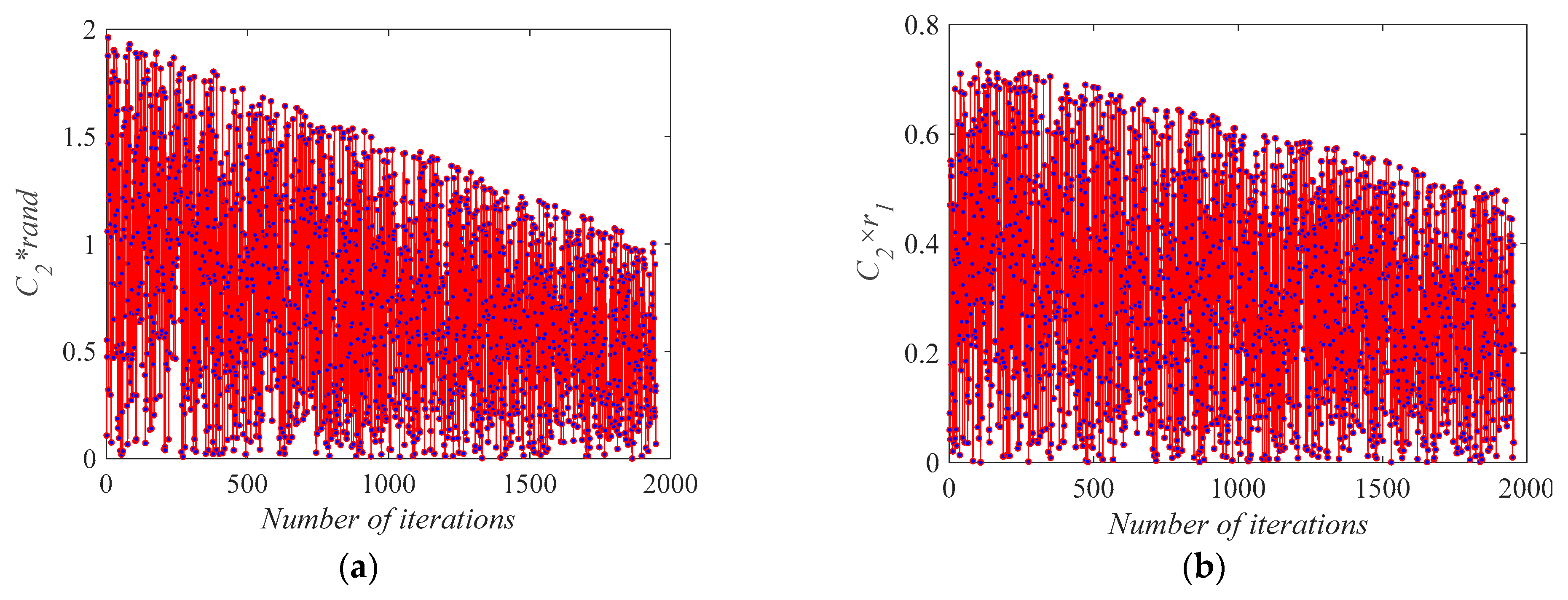
Since crayfish does not know the location of the cave, X L t may be the closest to the cave, so the term C 2 × r 2 × ( X L t X Z 2 t ) is added to Equation (13). Meanwhile, the X i t in the original update formula is replaced by the random individual X Z 1 t , thereby broadening the search space and strengthening the algorithm’s exploratory capability. Both X Z 1 t and X Z 2 t are randomly selected. From Equation (15), it can be seen that the location of the cave X s h a d e t is neither completely random nor uniquely fixed, which overcomes the shortcomings of the standard COA. To analyze the variation in C2 × rand and C2 × r1 with iteration, take r1 ∈ [0, 1] as an example, and its variation curve is shown in Figure 1.
It can be seen from Figure 1 that C2 × rand and C2 × r1 show the same trend with iteration, but C2 × rand is always too large to balance exploration and exploitation, which reduces the accuracy of the solution; while C2 × r1 decreases oscillatory with moderate amplitude as iterations progress, effectively maintaining the balance between exploration and exploitation while accelerating the convergence process.

3.2. Improved Position Update Formula in the Competition Stage

When crayfish enter the cave to escape the heat and there are already individuals in the cave, they will enter the competition stage due to the competition for the cave. The competition stage formula of the standard COA only involves one competitor, which is inconsistent with biological reality and does not make full use of position XG. Therefore, an improved position update formula in the competition stage is proposed, which is more in line with the survival law of crayfish in cave selection.
X i t + 1 = X i t + C 2 × X s h a d e t X Z 1 t + r 4 X G X Z 2 t
where XG is the optimal location of all crayfish searched so far, X L t is the optimal location of all crayfish in the t-th generation population, X Z 1 t and X Z 2 t denote two crayfish randomly chosen from the t-th generation population, r4 represents a randomly generated row vector with D elements uniformly distributed within the interval [0, 1], and ⊙ is the multiplication of the elements at the same location of the two vectors.
According to Equation (16), the new item r 4 ( X G X Z 2 t ) enables crayfish to choose either cave X s h a d e t or XG and allows multiple individuals to compete, which is more in line with biological reality.
In the competition stage, individual X i t competes with X Z 1 t and X Z 2 t and adjusts its position under the guidance of X s h a d e t and XG to move to the area conducive to survival and reproduction so as to improve the probability of producing high-quality offspring and enhance the exploitation ability.

3.3. Improved Position Update Formula in the Foraging Stage

The suitable foraging temperature for crayfish is 15 to 30 °C, and when the water temperature is lower than 30 °C, it performs foraging behavior. In order to simulate the mechanism of judging the size of food, the threshold θ = (C3 + 1)/2 is introduced. If Q > θ, the crayfish will think the food is too large and will tear it apart before eating. The position update formula is:
X i t + 1 = X i t + p × cos 2 × π × r 5 + sin 2 × π × r 6 X i , f o o d t , i 1 , 2 , , N
where p denotes the food intake of crayfish, X i , f o o d t is the food location found by the i-th crayfish at the t-th iteration, and r5 and r6 are randomly generated row vectors of dimension D, uniformly distributed within the range [0, 1].
Since X i , f o o d t is mostly near the better individuals XG and X L t , crayfish are also likely to be close to X i , f o o d t after updating according to Equation (17) so as to generate potential individuals and accelerate convergence. At the same time, the moving distance p × [ cos 2 × π × r 5 + s i n ( 2 × π × r 6 ) ] contributes to lowering the likelihood of being trapped in a local optimum.
If Qθ, the crayfish regard the food size as suitable and begin feeding. Considering that high-quality individuals may be distributed near the food source, the position update formula introduces the center position Xc of the top 50% excellent individuals of the population and random individual information:
X i t + 1   =   X i t   +   p   ×   ( r 7   <   r 8 ) ( X i , f o o d t     X s 1 t )   +   r 9 ( X c     X s 2 t ) ,   i   =   1 ,   2 ,   ,   N
X c = 1 0.5 N i = 1 0.5 N X i t
where X s 1 t and X s 2 t are two distinct crayfish randomly chosen from the population, Xc is the center position of the top 50% of crayfish of individuals, p is the food intake, and r7, r8 and r9 are randomly generated row vectors with D elements uniformly distributed in [0, 1], where r7 < r8 indicates the D-element logical row vectors taken as 0 or 1.
Equation (18) simultaneously utilizes the guidance of food location, the center of outstanding individuals, and random individuals, enabling more effective information exchange. While enhancing the convergence speed, it also strengthens the global search ability, thereby balancing exploration and exploitation.

3.4. Removal Similarity Operation

In the process of solving multi-extremum optimization problems, various intelligent optimization algorithms often encounter a common issue: as the number of iterations increases, individuals in the population tend to gradually gather near local extremum points, leading to a decline in population diversity, search stagnation, and even falling into local optima. In response to this issue, some scholars have added the removal similarity operation in intelligent optimization algorithms.
The removal similarity operation maintains the population size by identifying similar individuals in the population, retaining only one of them, and randomly generating new individuals in the search space. Specifically, if the difference in the objective function values between one individual and another approaches zero and the distance between their positions in the search space is extremely small, they can be determined as similar individuals. This operation retains one representative individual while removing other similar individuals and supplementing with randomly generated new ones to keep the population size unchanged. This mechanism helps reduce the risk of the algorithm falling into a local optimum and enhances the global exploration ability.
At present, the dissimilarity operations in the literature are mainly based on two types of criteria: one is to make judgments based on the differences in objective function values between individuals [20], and the other is to make judgments based on the spatial distances between individuals [29]. However, both of these methods have obvious limitations: (1) if the values of two objective functions are extremely close but their spatial positions are far apart, it is not reasonable to determine them as similar individuals at this time; (2) if two spatial locations are extremely close but their objective function values differ significantly, they should not be regarded as similar individuals either. It can be seen from this that relying solely on a single objective function value or spatial distance criterion is highly likely to lead to misjudgment. Therefore, to accurately identify similar individuals, two conditions, namely the difference in objective function values and spatial distance, should be comprehensively considered.
To clearly illustrate the limitations existing in the current methods for determining similar individuals, we take the hyperbolic tangent function f(x) = tanh(x) = (exex)/(ex + ex) and the exponential function f(x) = 15x as examples for analysis.
For the hyperbolic tangent function f(x) = tanh(x), when x is large, the function tends to saturate. Take x1 = 15 and x2 = 20 and calculate the absolute value of the difference between their objective function values, |f(x1) − f(x2)| = 1.9 × 10⁻¹³. If the judgment is made solely based on the differences in the objective function values, they can be regarded as similar individuals. However, in terms of spatial distance, |x1x2| = 5, the two are quite far apart and clearly are not similar individuals.
For the exponential function f(x) = 15x, take x1 = 100 and x2 = 100.0000001, and the distance between the two is |x1x2| = 10−14. At this point, if judged only by spatial distance, it can be considered that the two are similar. However, when calculating the difference between its objective function values, |f(x1) − f(x2)| = 1.1 × 10111, their function values vary greatly and obviously should not be regarded as similar individuals.
In conclusion, relying solely on a single criterion is prone to lead to misjudgment. Therefore, if two individuals x1 and x2 are similar, they should simultaneously meet two conditions: first, the difference in objective function values should be small enough, that is, |f(x1) − f(x2)| ≤ ε1; second, the spatial distance should be close enough, that is, |x1x2| ≤ ε2, where ε1 and ε2 are sufficiently small positive number thresholds.
Furthermore, let the two individuals in the D-dimensional search space be respectively Xi = (xi1, xi2, …, xiD) and Xj = (xj1, xj2, …, xjD). Calculate the objective function values f(x1) and f(x2) and the distance dij between them respectively, and determine whether they both satisfy:
Δ f i j = f X i f X j ε 1
d i j = k = 1 D x i k x j k 2 ε 2
where ε1 = 10−28 and ε2 = 10−15 are the preset small thresholds.
During the algorithm iteration process, if certain individuals simultaneously satisfy Equations (20) and (21), they are determined to be similar individuals. If the removal similarity operation is not introduced, as the iteration progresses, the population will gradually lose its diversity, and a large number of individuals will gather near a few local optimal solutions, resulting in insufficient search space coverage and premature convergence of the algorithm, which seriously restricts the global optimization performance. In addition, redundant computations of similar individuals will also reduce the efficiency of the algorithm and cause unnecessary consumption of computing resources.
For this purpose, this paper introduces a removal similarity operation mechanism. This operation effectively breaks the homogeneous structure of the population by identifying and eliminating similar individuals, significantly enhancing population diversity. Meanwhile, in order to maintain a constant population size, after eliminating similar individuals, new individuals are randomly generated in the search space according to the initialization rules for supplementation, thereby injecting new exploration potential while maintaining the population size. This mechanism not only prevents the algorithm from falling into local optima too early but also enhances the global exploration ability by continuously introducing new solutions, enabling the algorithm to search in a wider area and significantly increasing the probability of escaping local optima. Therefore, the removal similarity operation is crucial for maintaining population diversity and balancing the exploration and development capabilities of algorithms.
The pseudo-code for the removal similarity operation of the crayfish optimization algorithm can be found in Algorithm 1.
Algorithm 1: Pseudo-code of removal similarity operation
t is number of iterations
Sort the individuals in the population by fitness value from small to large
if rem(t,50) = 0
    Randomly selected integers 1 or 2
    for i = k:2:N − 1 do
         for j = i + 1:2:N do
              Calculate the distance dij between two individuals Xi and Xj according to Equation (21)
              Calculate Δfij according to Equation (20)
              if Δfijε1 and dijε2
                 Xi and Xj are similar individuals
                 Retain individuals Xi
                 Xj is regenerated according to the population initialization rules
              else
                 Xi and Xj are not similar individuals
              end if
         end for
    end for
    Calculate the fitness values of individuals in the population
    Sort individuals in ascending order based on their fitness values, update XG and X L t
end if

3.5. Optimal Individual Disturbance Strategy Based on Lévy Flight

As the iteration proceeds, individuals in the population tend to gradually gather near local extremum points, causing the algorithm to fall into local optima. It is worth noting that when crayfish are foraging or exploring their environment, they usually exhibit a behavioral pattern mainly characterized by small steps and occasionally long-distance jumps. This feature enables it to not only precisely search local areas but also to effectively explore unknown spaces, thereby enhancing foraging efficiency. This motion law is highly consistent with Lévy flight.
Among the common random perturbation strategies, the Gaussian distribution [30] and Cauchy distribution [31] are also frequently employed to enhance the exploration ability of algorithms. The perturbation step size of the Gaussian distribution is relatively concentrated, which is suitable for local fine search, but its tail decays rapidly and its ability to escape from local extremum is weak. The Cauchy distribution has a thicker tail, which is conducive to performing larger-length jumps and enhancing global exploration. However, its step size distribution is relatively unstable, which may lead to a decrease in search efficiency. Compared with the two, Lévy flight maintains a high probability of short-step local search while generating long-step jumps with a certain probability. This is more in line with the natural foraging and migration law of “short-step exploration and long-step leap” and can achieve a better balance between exploration and exploitation.
To better simulate the movement patterns of crayfish and make up for the shortcomings of the standard COA, such as the decline in population diversity and the tendency to fall into local optima due to the lack of an effective perturbation mechanism, this paper introduces an optimal individual disturbance strategy based on Lévy flight. This strategy, by applying disturbances to the current global optimal individual, can not only conduct fine searches around it, improving the convergence accuracy and speed, but also jump out of the current optimal region with a certain probability, enhancing the global exploration ability and effectively suppressing premature convergence.
Lévy flight [32] is a random walk model that conforms to the Lévy distribution proposed by the French mathematician Lévy. It is characterized by a high probability of moving in small steps and occasionally making large jumps. A short step size helps to conduct a detailed search in the current area, while an occasional large step size can step out of the current area and expand the search range. This strategy typically employs the Mantegna algorithm to generate a step size Ls that conforms to the Lévy distribution, and its calculation formula is as follows:
L s = μ v 1 / β
where the parameter values in the range of [0, 2] usually take β = 1.5, μ = N(0, σ μ 2 ), v = N(0, σ v 2 ).
The calculation formulas for σ μ 2 and σ v 2 are as follows:
σ μ = Γ 1 + β sin 0.5 π β Γ 0.5 1 + β β 2 0.5 β 1 1 / β σ v = 1
where Γ represents the Gamma function.
The optimal individual perturbation strategy based on Lévy flight is as follows:
N e w X G = X G + α × cos ( 2 π γ ) L s L , D X L , s 3 X L , s 4
where XG is the best position so far, Ls(L, D) is an L-row and D-column matrix following the Lévy distribution, XL,s3, and XL,s4 are L crayfish randomly selected, L = 50, α = 0.01, and γ is an L × D matrix evenly distributed between randomly generated [−1, 1].
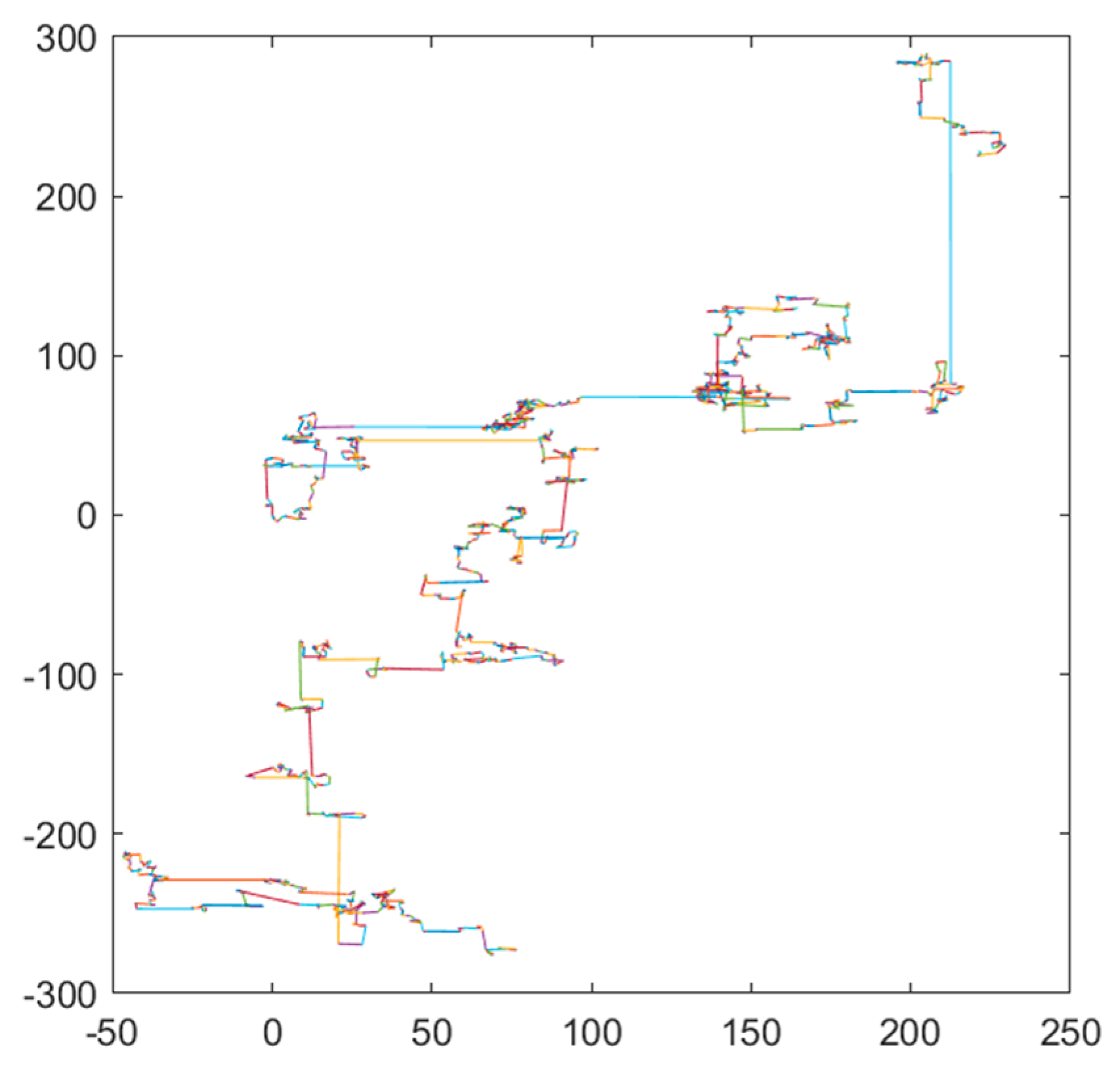
Taking a two-dimensional space as an example, using the Mantegna algorithm, the Lévy flight trajectory drawn after 1000 iterations starting from (0, 0) is shown in Figure 2.
As shown in Figure 2, Lévy flight exhibits small-step movements of a high probability and large-step jumps of a low probability, with its movement direction being random. Small-step movement has a strong local search ability, while large-step movement helps to prevent the algorithm from getting stuck in local optimal solutions and to better explore unknown search spaces. Therefore, Lévy flight can, to a certain extent, balance the exploration and exploitation capabilities of algorithms.
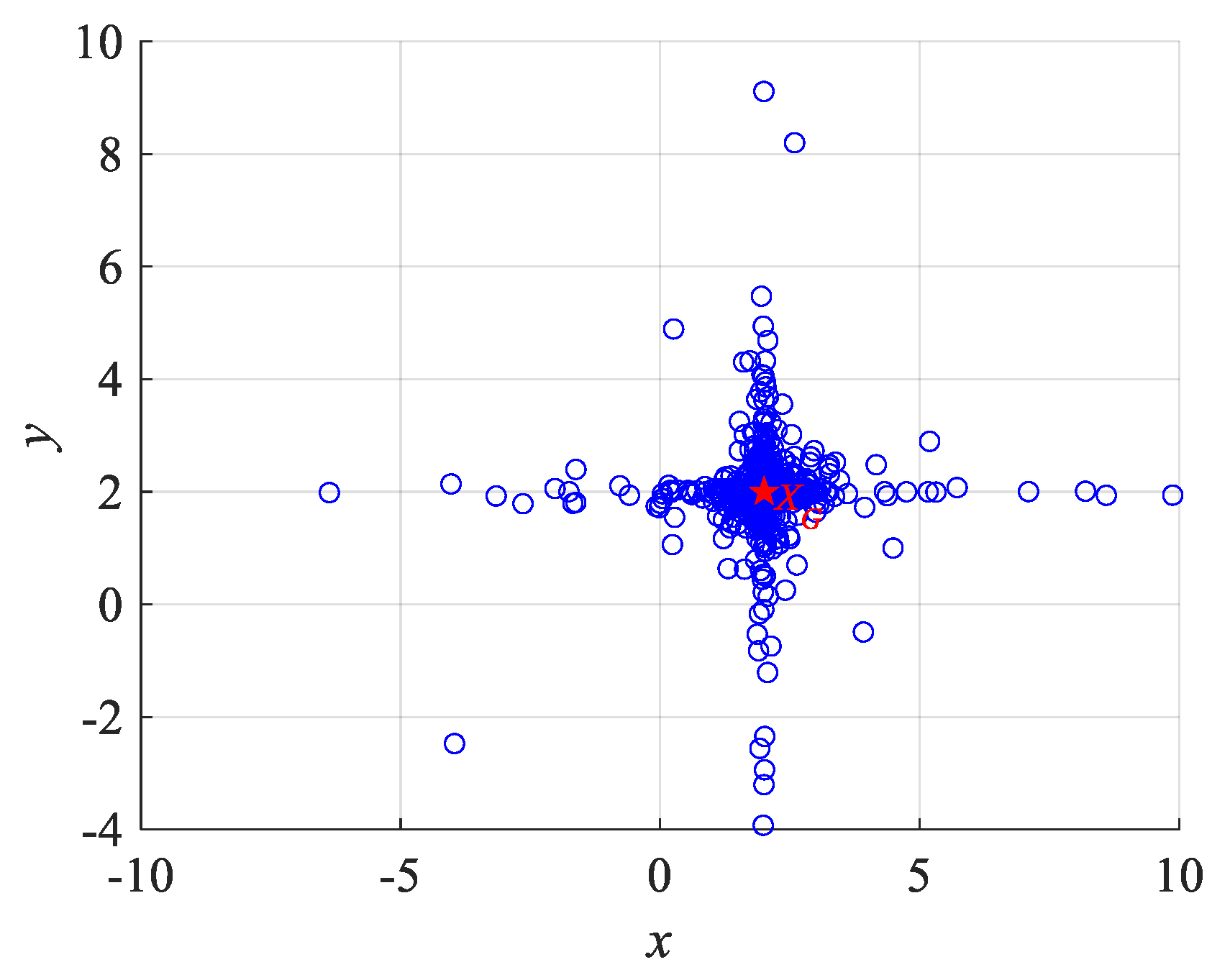
To further illustrate the disturbance effect, XG = (2, 2) is set in two-dimensional space, and XL,s3 and XL,s4 are randomly generated between [1, 3], L = 1, and according to Equations (22) and (24), 1000 offspring are generated. The distribution of the generated offspring in space is shown in Figure 3.
The red five-pointed star in Figure 3 is XG, and the blue hollow circles are the offspring produced after Lévy flight perturbation. Most of the offspring gather around XG, which is conducive to conducting a fine search around the optimal solution, thereby enhancing the exploitation capability and convergence speed of the algorithm. Meanwhile, a few offspring are distributed at more distant positions, which helps to expand the search range, enhance the global exploration ability, and reduce the risk of the algorithm falling into local optima. In conclusion, the introduction of the optimal individual disturbance strategy based on Lévy flight can not only improve the local search accuracy and convergence speed but also promote the exploration of unknown regions, enhance the global search performance, and thereby significantly suppress the premature convergence phenomenon.
The pseudo-code of the optimal individual disturbance strategy based on Lévy flight is shown in Algorithm 2.
Algorithm 2: Pseudo-code of the optimal individual perturbation strategy based on Lévy flights
t is number of iterations, L = 50, α = 0.01, Variable dimension D, the fitness value of X L t is f_ X L t , the fitness value of XG is f_XG
if rem(t,100) = 0
  Calculate the moving step size Ls of Lévy flights according to Equation (22)
  Randomly selected L individuals XL,s3 and XL,s4 from the population
  Perturb XG using Equation (24), the perturbed individual is NewXG
  Calculate the fitness values f_N of NewXG
  The minimum value of f_N is denoted as f_min, the solution corresponding to f_N is denoted as X_min
  if f_N < f_ X L t
    f_ X L t = f_N
     X L t = X_min
    if f_ X L t < f_XG
      f_XG = f_ X L t
       XG = X L t
    end if
  end if
end if

3.6. Framework of COA-RPRS

The calculation steps of COA-RPRS are as follows:
Step 1:
Initialize relevant parameters, such as population size N, maximum running time MaxT of the algorithm, variable dimension D, upper and lower limit vectors ub and lb of variable values, etc.
Step 2:
Perform population initialization.
Step 3:
Calculate the fitness values of the crayfish in the population and sort them in ascending order of fitness values. Let XG = X(1,:), and X L t = X(1,:).
Step 4:
Determine whether the iteration termination condition is met. If so, output the optimal solution and the optimal value. Otherwise, go to Step 5.
Step 5:
Calculate the temperature Temp according to Equation (11).
Step 6:
Determine whether the temperature Temp is greater than 30 °C. If so, randomly generate a random number rand. If rand < 0.5, the crayfish enter the summer resort stage and update their positions according to Equation (13). Otherwise, the crayfish will compete with each other and update their positions according to Equation (16).
Step 7:
Determine if the temperature Temp is less than or equal to 30 °C. If so, the crayfish enter the foraging stage. If Q > θ, the crayfish will tear the food into pieces and update its position according to Equation (17). If Qθ, it will directly update its position according to Equation (18).
Step 8:
Compare the fitness values of each individual before and after the update position, retain the excellent individuals, form a new population, and update XG and X L t .
Step 9:
Perform the removal similarity operation according to the algorithm.
Step 10:
Perturbate the XG using the optimal individual perturbation strategy based on Lévy flight in Section 3.5.
Step 11:
Compare the fitness values of XG before perturbation and X G after perturbation. If X G is superior to XG, then let XG = X G and X L t = X G . Return to Step 4.
The pseudocode of COA-RPRS is presented in Algorithm 3.
Algorithm 3: COA-RPRS
Input: Population size (N); Variable dimension (D); Maximum running time (MaxT);
Output: optimal value (fbest); optimal solution (xbest)
Begin
Generate an initial population randomly
Determine the fitness values of individuals to ascertain XG and X L t
Sort individuals in ascending order based on their fitness values
t = 0
while (runtime < MaxT)
  Use Equation (11) to calculate Temperature parameter (Temp)
  if (Temp > 30)
   Establish cave X s h a d e t using Equation (15)
   if (rand < 0.5)
    Crayfish engage in the summer resort stage as per Equation (13)
   else
    Crayfish vie for caves via Equation (16)
   end if
  else
   if (Q > θ)
    Crayfish forage following Equation (17)
   else
    Calculate Xc using Equation (19)
    Crayfish forage according to Equation (18)
   end if
  end if
  Removal similarity operation
  The optimal individual perturbation strategy based on Lévy flight
  t = t + 1
 end while
 Output the optimal value fbest and the optimal solution xbest
 end
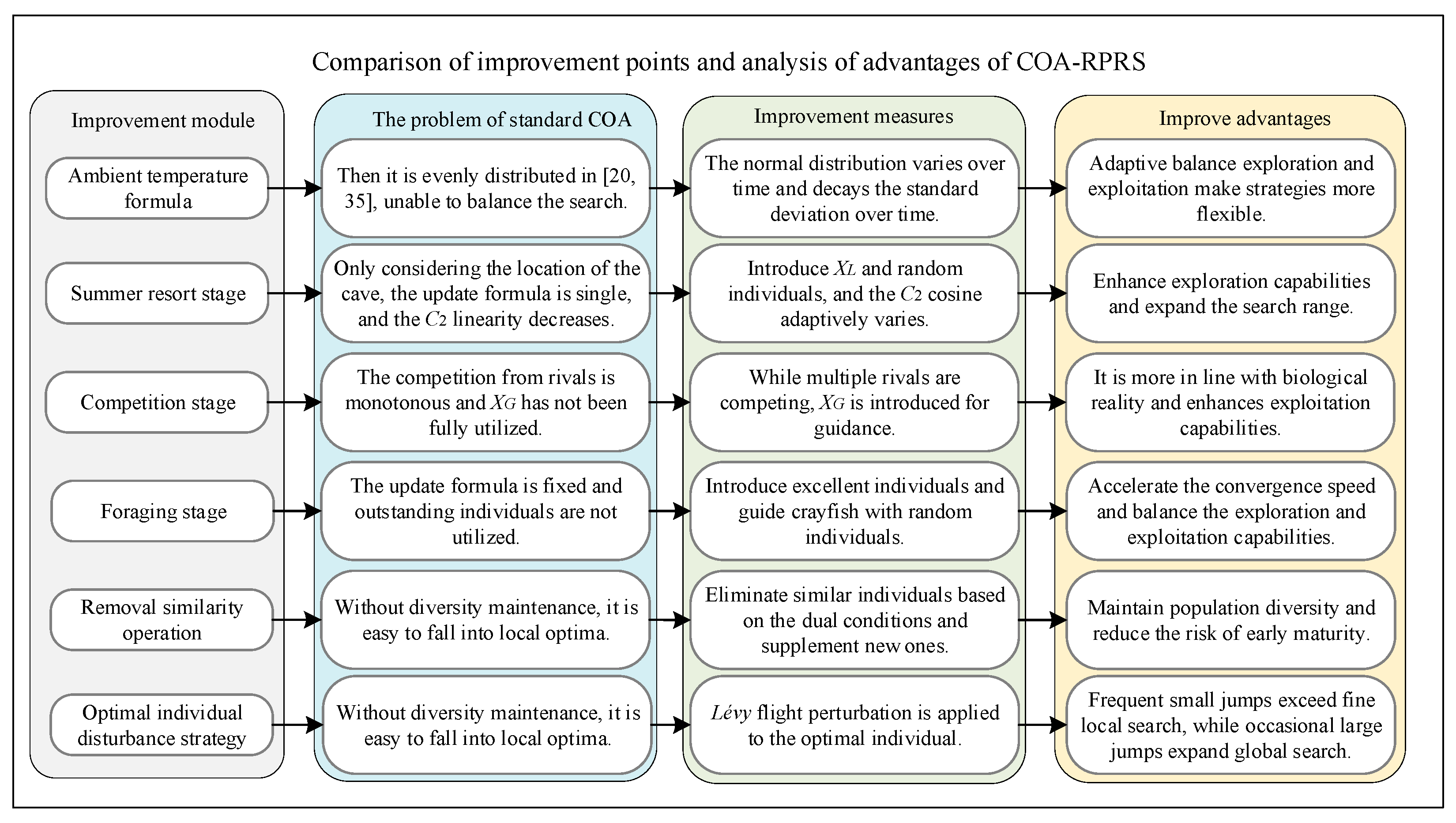
To visually present the improvement ideas of COA-RPRS, this paper makes a targeted comparison between the standard COA and COA-RPRS and elaborates in detail the improvements and advantages of COA-RPRS. Figure 4 presents the comparative analysis results of various improvement measures and advantages of COA-RPRS. After optimization, COA-RPRS demonstrates superior performance in terms of balancing exploration and exploitation capabilities as well as convergence speed.

3.7. Iteration Termination Condition

The common termination conditions for algorithm iterations include: (1) the maximum number of iterations; (2) the maximum number of evaluations of the fitness value; and (3) the maximum running time of the algorithm. If the maximum number of iterations or the maximum number of fitness evaluations is used as the termination condition, since different algorithms have differences in time and space complexity, the computing time required for each iteration is not the same. Therefore, such a setting may lead to an unfair comparison of different algorithms. To fairly compare the performance of each algorithm, this paper adopts the maximum running time as the termination condition for iterations. Once the algorithm’s running time reaches the preset upper limit, the iterations will be terminated. The advantage of this condition is that it can ensure the fairness of the evaluation process regardless of whether the algorithms being compared have the same time and space complexity.
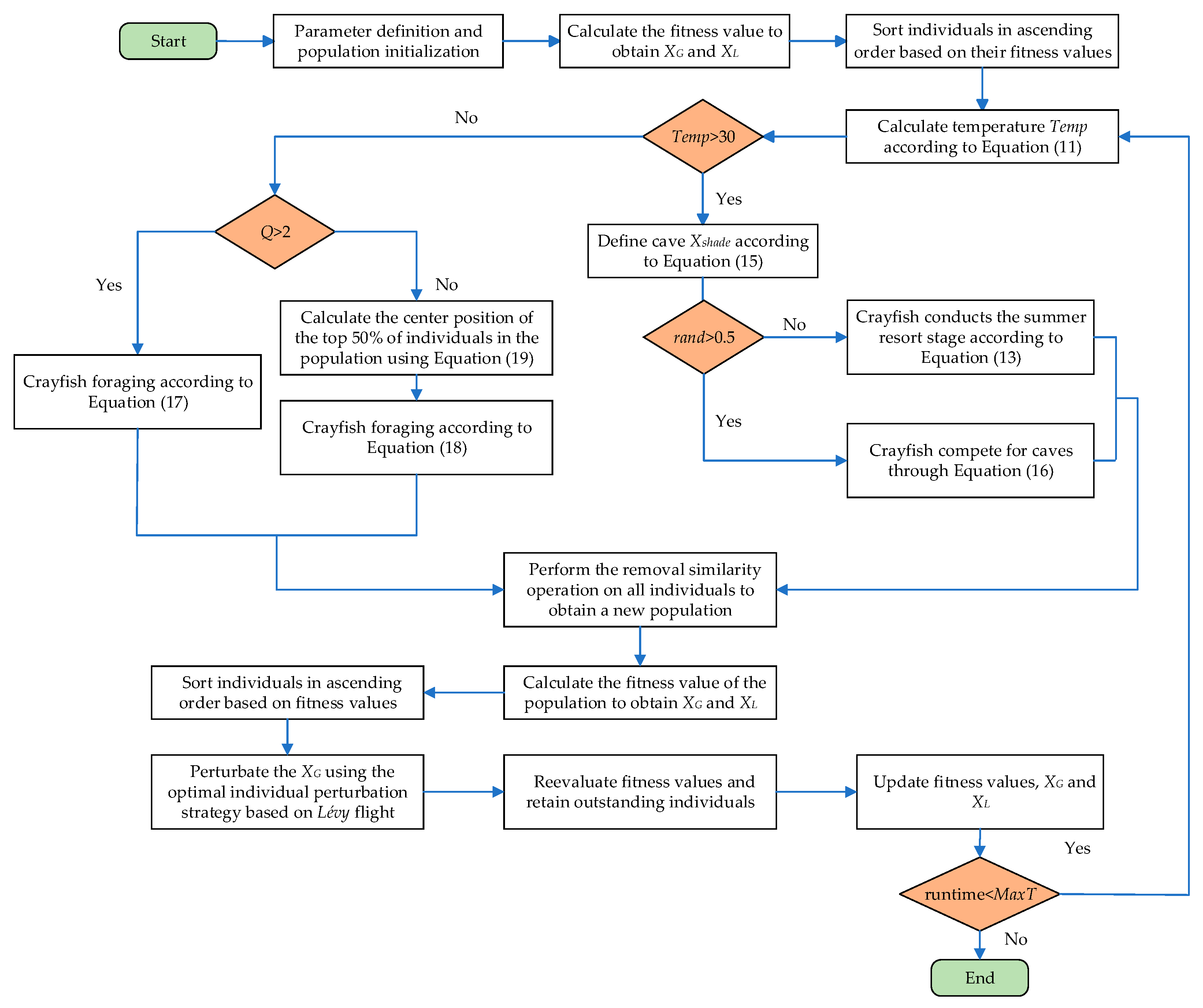
The flowchart of COA-RPRS is presented in Figure 5.

3.8. Time Complexity

The time complexity of an algorithm plays a crucial role in evaluating its performance. In practical problem-solving, algorithms with lower time complexity are usually preferred to enhance optimization efficiency. In this paper, the termination condition of the algorithm’s iteration is based on the maximum running time. For ease of comparison, we use Big O notation to present the time complexity of each iteration of COA and COA-RPRS respectively. The detailed summary is presented in Table 1, where N represents the population size and D represents the dimension of the problem.
It should be noted that in the proposed COA-RPRS, the position update within the population is based on individuals rather than variable dimensions. Therefore, the time complexity of a single position update is reduced from O(N × D) of the original COA to O(N). Despite the multiple improvements made in the search mechanism of COA-RPRS, its overall computational complexity does not increase but decreases instead. At the same time, it has achieved a significant improvement in the solution performance.

4. Experimental Results and Analysis

To validate the performance of COA-RPRS in GOPs and color image enhancement, this paper first selected the CEC 2017 benchmark function to assess the algorithm’s optimization capability. Then, COA-RPRS was applied to two sets of color images for enhancement, and multiple image quality evaluation indicators were used to conduct a comparative analysis of the enhancement effect. These experiments provide a viable image preprocessing solution for intelligent identification and diagnosis of agricultural pests and diseases. To ensure experimental fairness, all algorithms were run on the same computing platform: the operating system was Windows 10, the processor was AMD Ryzen 9 3900 12-Core with a main frequency of 3.09 GHz, the memory was 31.9 GB, and the programming environment was MATLAB (vR2019b).

4.1. Experimental Setup

4.1.1. CEC 2017 Test Functions and Datasets

The CEC 2017 benchmark suite was proposed by Wu et al. [33] in 2017 and contains 28 functions, which are widely adopted for assessing the performance and robustness of optimization algorithms. Its problem types cover equality constraints, inequality constraints, and their combinations, with high complexity and diversity. Functions are classified into unimodal, multimodal, mixed, and combined types. The dimensions of variables are positive integers, and all are minimization problems.
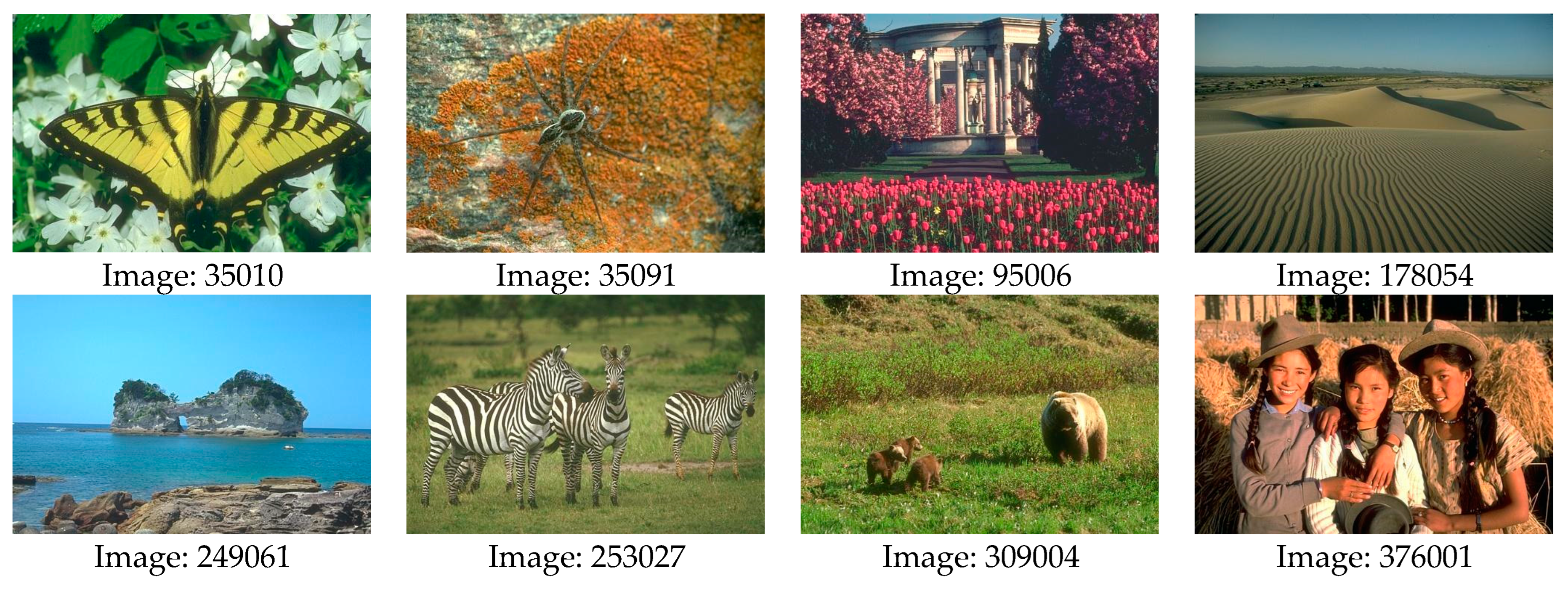
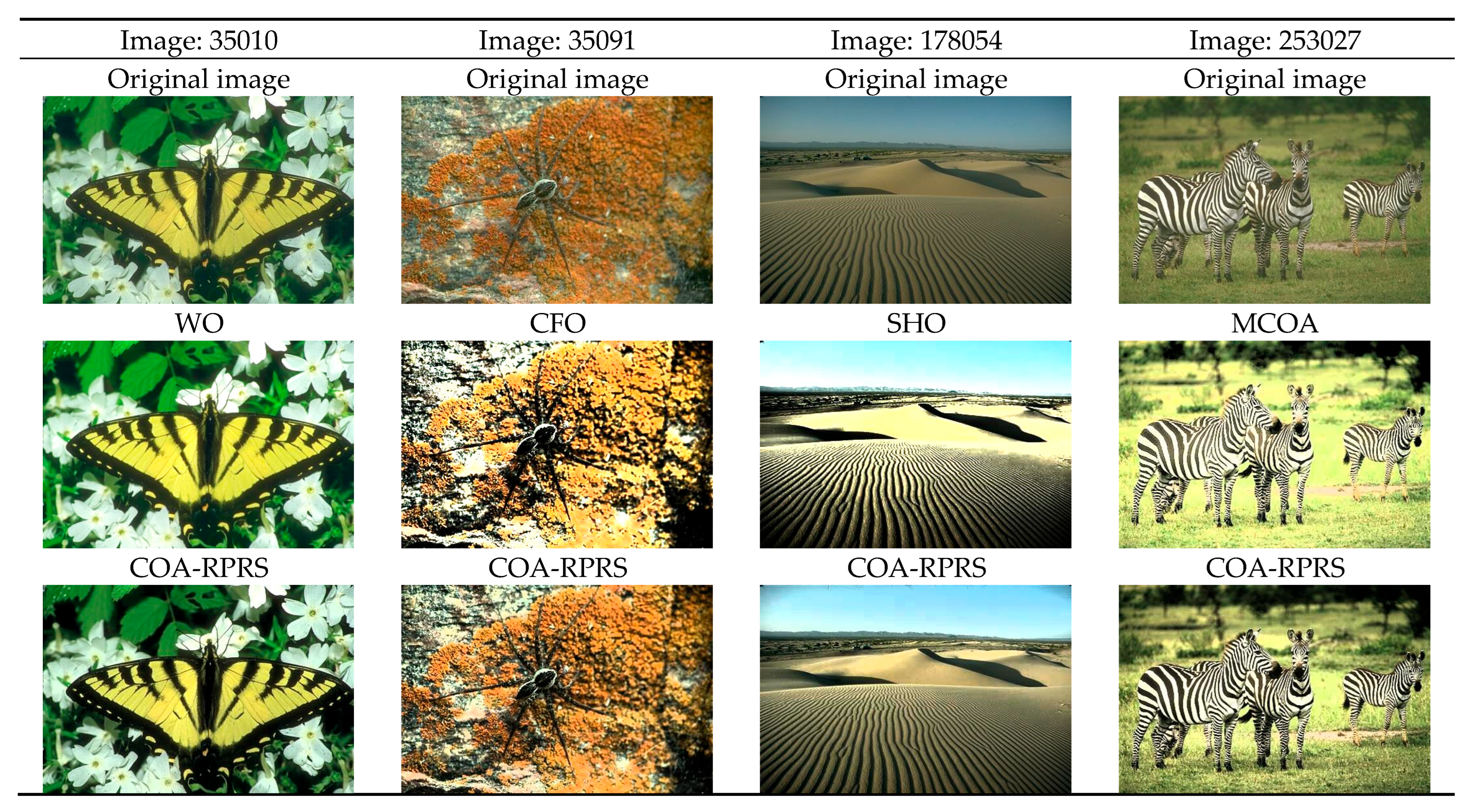
The Berkeley Segmentation Database [34] contains a total of 500 images, which are widely used in image enhancement research because of their rich categories, complex background, and multiple targets. In this paper, 20 color images were selected as verification objects, and the image numbers are 16052, 22090, 22093, 35010, 35091, 95006, 106024, 108005, 118035, 159045, 176035, 178054, 183055, 245051, 249061, 253027, 309004, 376001, 376043, and 385028, respectively. These color test images have different styles and complex backgrounds, and some of the samples are shown in Figure 6.
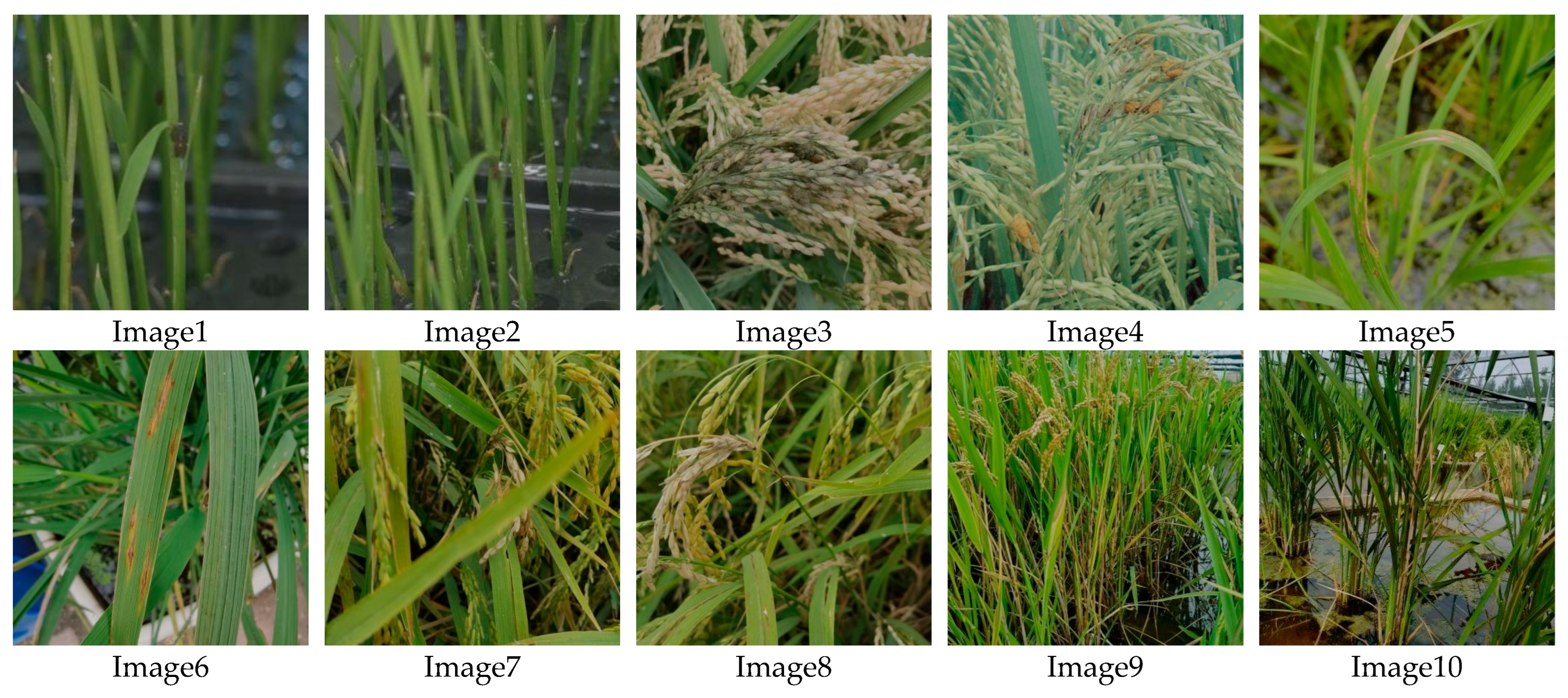
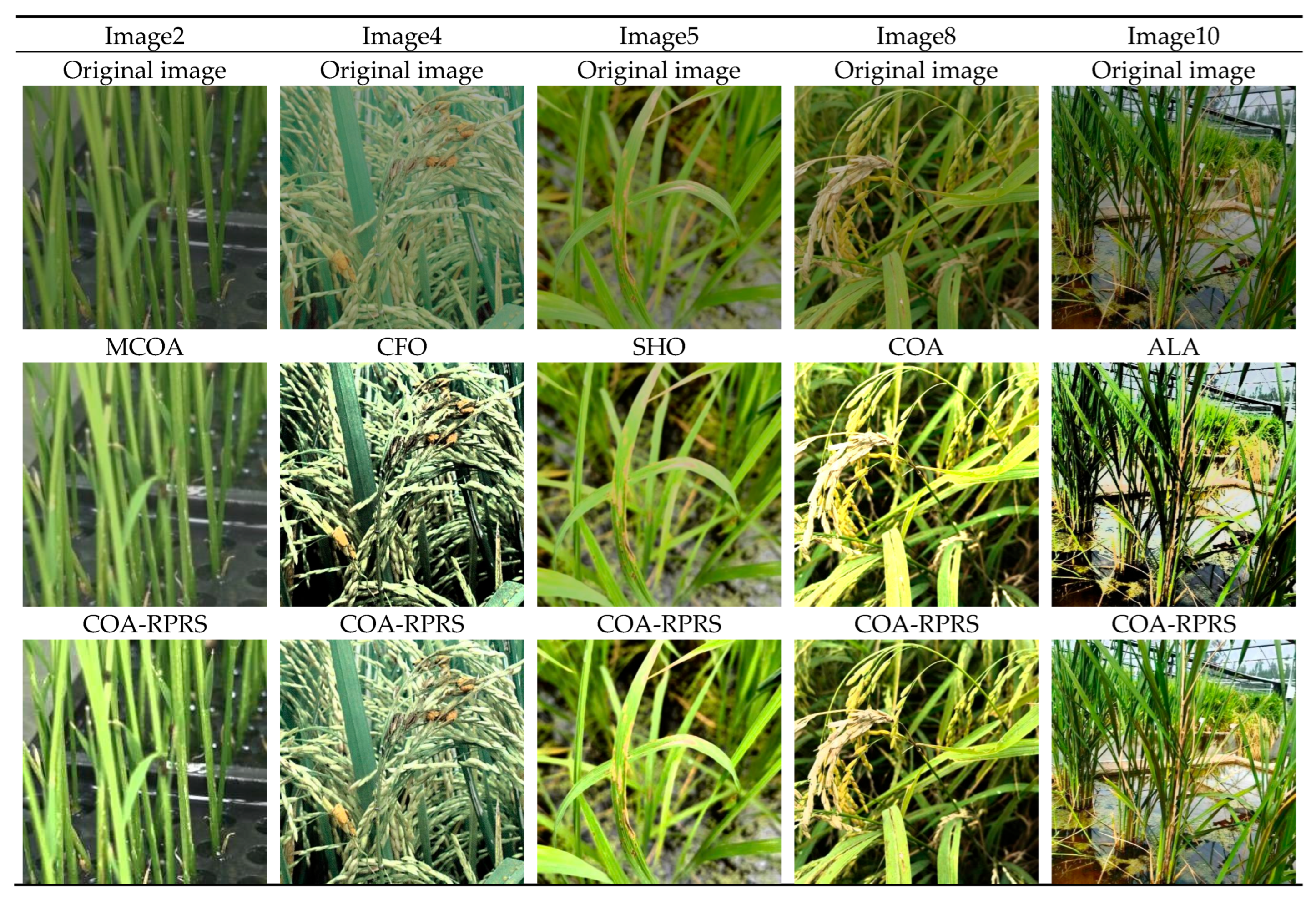
To further verify the performance of COA-RPRS in practical applications, this paper constructed an experimental dataset containing five common rice diseases, covering images of rice planthopper, rice false smut, rice blast, rice seedling blight, and rice sheath blight. The images were captured on-site in rice fields during the growing season, covering various rice diseases. For ease of expression, the color image of rice leaves is denoted as Image i (i = 1, 2, …, 10). The images of diseased leaves of the selected rice are shown in Figure 7.

4.1.2. Relevant Parameter Settings

For the CEC 2017 benchmark tests (functions C01–C28), each experiment was independently run 20 times. The parameters were configured as follows: maximum runtime MaxT = 30 s and penalty factor M = 108, and the average value of the 20 running results was recorded. Similarly, for the color image enhancement problem, each experiment was independently run 20 times as well. The termination condition of the iteration was MaxT = 30 s, and the average values of each evaluation index were calculated. The best results are highlighted in bold.
To verify the effectiveness of COA-RPRS, eight algorithms from the literature were selected for comparison: crayfish optimization algorithm (COA) [13], golden jackal optimization algorithm (GJO) [23], sea horse optimization algorithm (SHO) [24], Walster optimization algorithm (WO) [25], artificial lemming algorithm (ALA) [26], caterpillar fungus optimization algorithm (CFO) [27], enzyme action optimization algorithm (EAO) [28], and modified crayfish optimization algorithm (MCOA) [16]. The parameter settings of all eight algorithms are listed in Table 2.
To assess algorithm performance, this paper employs the mean optimal value (Mean) and standard deviation (Std) from each run as evaluation metrics. Meanwhile, the win/tie/loss (w/t/l) metric is introduced to conduct pairwise comparisons of the algorithms, where w denotes the number of test functions on which the second algorithm outperforms the first, t indicates the number of test functions where the two algorithms perform equally, and l represents the number of test functions on which the first algorithm outperforms the second. As the w/t/l metric is only suitable for pairwise algorithm comparison and cannot fully reflect the overall performance ranking among multiple algorithms, this paper further applies the Friedman ranking method [35] to compare the relative performance of the algorithms, followed by the Friedman test to determine whether significant differences exist in the overall performance across the algorithms, thereby verifying the statistical significance of the comparative results.
In the color image enhancement experiment, contrast, entropy, AG, peak signal-to-noise ratio (PSNR) [36], and structural similarity index (SSIM) [37] were selected as evaluation indicators to measure the quality of the enhanced image. In the comparative experiment, the optimal results of each algorithm were all marked in bold. Higher contrast, entropy, AG, PSNR, and SSIM values indicate better image quality, while lower values suggest relatively poorer quality.

4.2. Effectiveness Analysis of Different Improvement Strategies in COA-RPRS

To verify the advantages of different improvement strategies and their impact on the performance of COA-RPRS, an ablation experiment was conducted. The COA variants incorporating different improvement strategies were used to solve the 30-dimensional CEC2017 test functions, and the results were statistically analyzed using the Friedman test. The results are shown in Table 3, where the best values are highlighted in bold. The compared algorithm variants are as follows: (1) COA; (2) COA1 (COA + improved temperature and position update formula); (3) COA2 (COA1 + removal similarity operation); (4) COA3 (COA1 + random perturbation strategy); and (5) COA-RPRS (COA1 + removal similarity operation + random perturbation strategy).
As shown in Table 3, the w/t/l metric values of COA-RPRS compared to COA, COA1, COA2, and COA3 were 26/2/0, 22/5/1, 19/7/2, and 15/9/4, respectively. When comparing the performance of the algorithms based solely on the number of winning test functions, COA-RPRS significantly outperformed the other variants.
From the perspective of the average rank change trend, as the improvement strategies are gradually introduced, the average rank of the COA variant continuously decreased from 4.68 with the original COA to 1.68 with COA-RPRS, demonstrating the improvement in algorithm performance. Specifically, the improved temperature and position update mechanism significantly enhanced the performance of the original COA, indicating that adaptive parameter adjustment can more effectively balance global exploration and local exploitation, thereby providing more suitable optimization behaviors in different search stages. On this basis, the introduction of the removal similarity operation and the random perturbation strategy based on Lévy flight enhanced the ability of the algorithm to escape from local optimal solutions, effectively suppressed the possibility of premature convergence of the population, and strengthened the global search ability. Finally, COA-RPRS, which integrated all the improvement strategies, achieved the lowest average rank, which confirmed that the combined effect of the removal similarity operation and the random perturbation strategy could more effectively help the algorithm escape from local optimality, thereby significantly improving the overall optimization performance.
The Friedman test yielded a p-value of 2.4179 × 10⁻¹⁴, which is far below the significance level of 0.05, indicating that the performance differences among the algorithm variants are statistically significant. Further analysis confirms that COA-RPRS differs significantly from COA, COA1, COA2, and COA3.
In summary, all the introduced improvement mechanisms contribute positively to enhancing the performance of the original COA. The statistics of w/t/l and the average rank analysis results are consistent, indicating that COA-RPRS performed better than the other variants in the majority of test problems. This fully demonstrates that effectively integrating the improved temperature mechanism, position update strategy, removal similarity operation, and random perturbation strategy can significantly enhance the comprehensive optimization ability of COA.

4.3. Experimental Results and Analysis of CEC 2017

The algorithms in Table 2 were adopted to solve GOPs of CEC 2017 for 30D and 50D, with the corresponding mean and Std values recorded in Table 4 and Table 5, where the optimal values in both tables are highlighted in bold.
The results in Table 4 and Table 5 show that among the 30D test functions, COA-RPRS achieved the best performance on 10 functions, including C01, C02, C05, and C07. In addition, COA-RPRS tied for the best performance with ALA on functions C08, C10, and C11; with ALA and EAO on function C09; with COA, WO, ALA, CFO, EAO, and MCOA on functions C17 and C26; and with ALA, CFO, and EAO on function C19. The w/t/l metric values of COA-RPRS relative to COA, GJO, SHO, WO, ALA, CFO, EAO, and MCOA were 26/2/0, 28/0/0, 28/0/0, 25/2/1, 15/7/6, 23/3/2, 17/4/7, and 26/2/0, respectively. Judging solely by the number of winning test functions, COA-RPRS clearly outperformed the other compared algorithms. Among the 50D test functions, COA-RPRS performed the best on nine functions, such as C01, C02, C03, and C05. Moreover, it tied for the best with COA, WO, ALA, CFO, EAO, and MCOA on functions C17 and C26, and with ALA and CFO on function C19. The corresponding w/t/l values of COA-RPRS relative to COA, GJO, SHO, WO, ALA, CFO, EAO, and MCOA were 25/2/1, 28/0/0, 28/0/0, 25/2/1, 18/4/6, 22/1/5, 13/2/13, and 25/2/1, respectively. Based on the count of winning functions, COA-RPRS exhibits a clear advantage over all other compared algorithms except EAO, with which it performs comparably.
A comprehensive analysis shows that COA-RPRS delivers superior performance on the majority of the test functions and is capable of effectively solving both low-dimensional and medium-to-high-dimensional optimization problems.

4.3.1. Statistical Analysis

To assess the statistical significance of the results, we conducted an overall comparison using the Friedman test and then carried out a comprehensive statistical analysis.
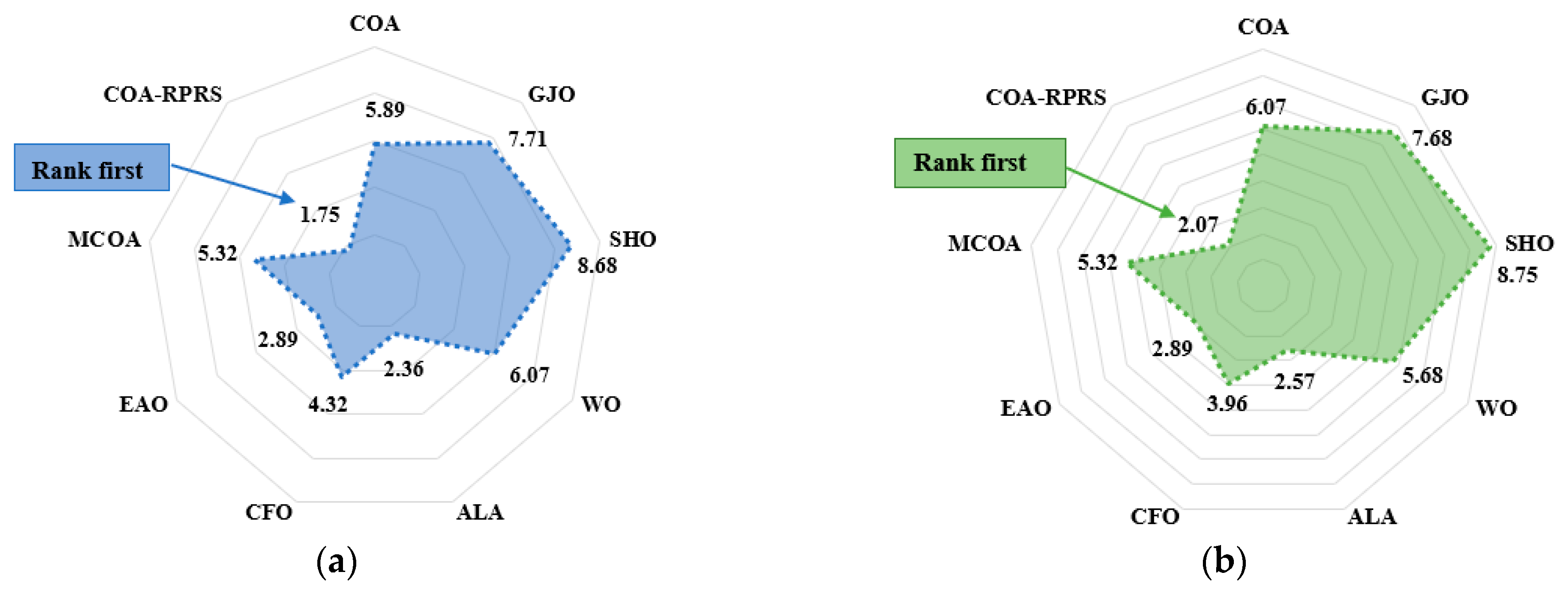
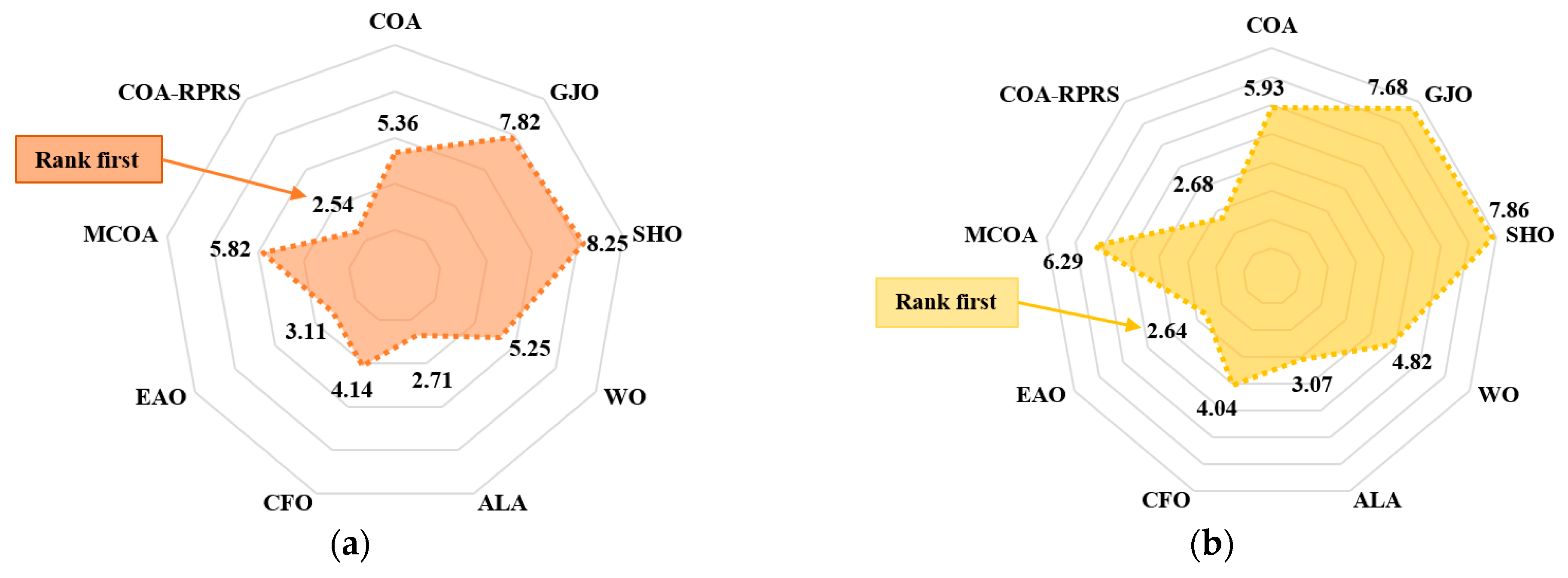
To visually demonstrate the effectiveness and universality of COA-RPRS across optimization problems of varying dimensions, Figure 8 and Figure 9 present the Friedman average rank results of COA-RPRS and multiple comparison algorithms on 30D and 50D problems in terms of mean optimal values and standard deviations. Meanwhile, Table 6 and Table 7 list the specific results of the Friedman test. Since CEC 2017 GOPs is an optimization problem with the goal of minimizing the objective function, the smaller the Friedman average rank, the better the algorithm performance.
As shown in Figure 8, the Friedman rank ranking results based on the average optimal value indicate that for the 30D and 50D problems, the average rankings of COA RPRS are 1.75 and 2.07 respectively, both ranking first. Following closely behind is ALA, with average ranks of 2.36 and 2.57, respectively. The ranking comparison clearly indicates that COA-RPRS outperforms the other comparison algorithms. In Figure 9, the Friedman rankings based on standard deviations reveal that COA-RPRS obtains an average rank of 2.54 on 30D functions, ranking first, while on 50D functions, it attains a rank of 2.68, slightly lower than the top-ranked EAO and placing second. Although COA-RPRS does not rank first in terms of standard deviation on 50D functions, its competitive performance being close to the best demonstrates relatively good robustness. In low-dimensional function tests, COA-RPRS demonstrates good robustness. When dealing with medium- and high-dimensional functions, its stability shows a slight decline compared to the low-dimensional case, yet overall, it remains at a satisfactory level. Since color image enhancement problems are inherently low-dimensional optimization problems, they are well-suited for computation using COA-RPRS, which maintains reliable stability in such problems.
As shown in Table 6 and Table 7, when the significance level is 0.05 and the number of degrees of freedom is 8, the χ2 values for the mean optimal values on 30D and 50D are 169.48 and 160.30, respectively, while theχ2 values for the standard deviations are 130.68 and 124.99, all exceeding the critical value of 15.51. This indicates that the results are statistically significant, fully demonstrating that there are significant differences in performance among the eight algorithms.
To sum up, these research results demonstrate the superior performance of COA-RPRS compared with the comparison algorithms.

4.3.2. Convergence Curve and Boxplot Analysis

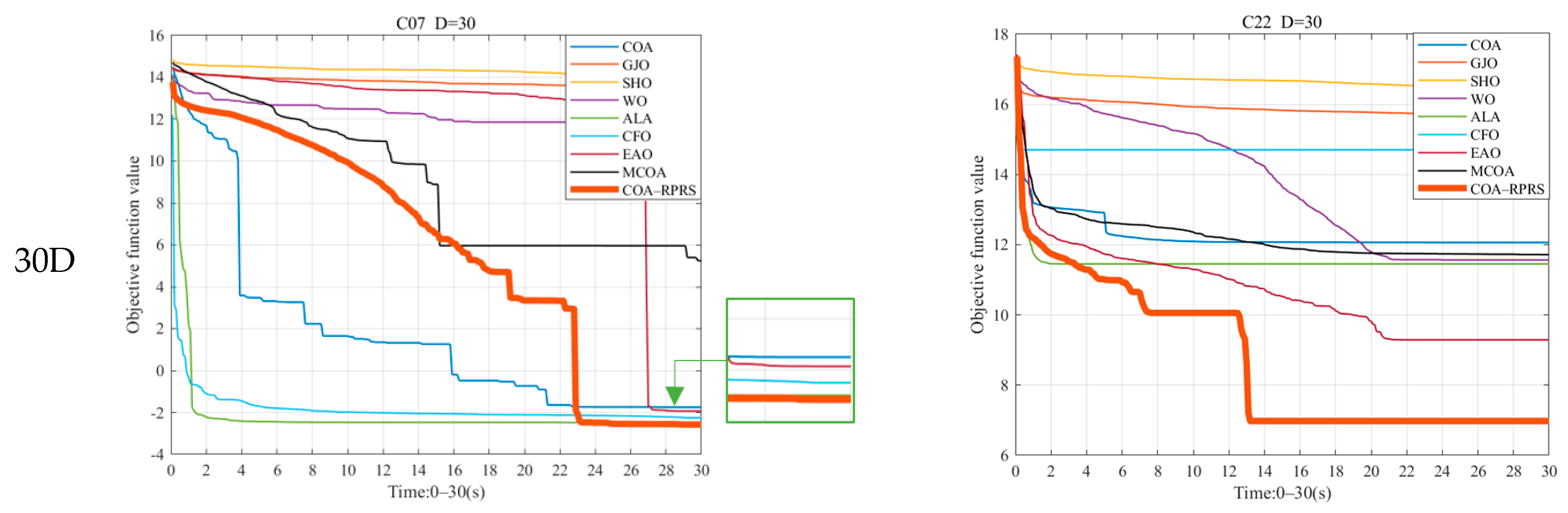
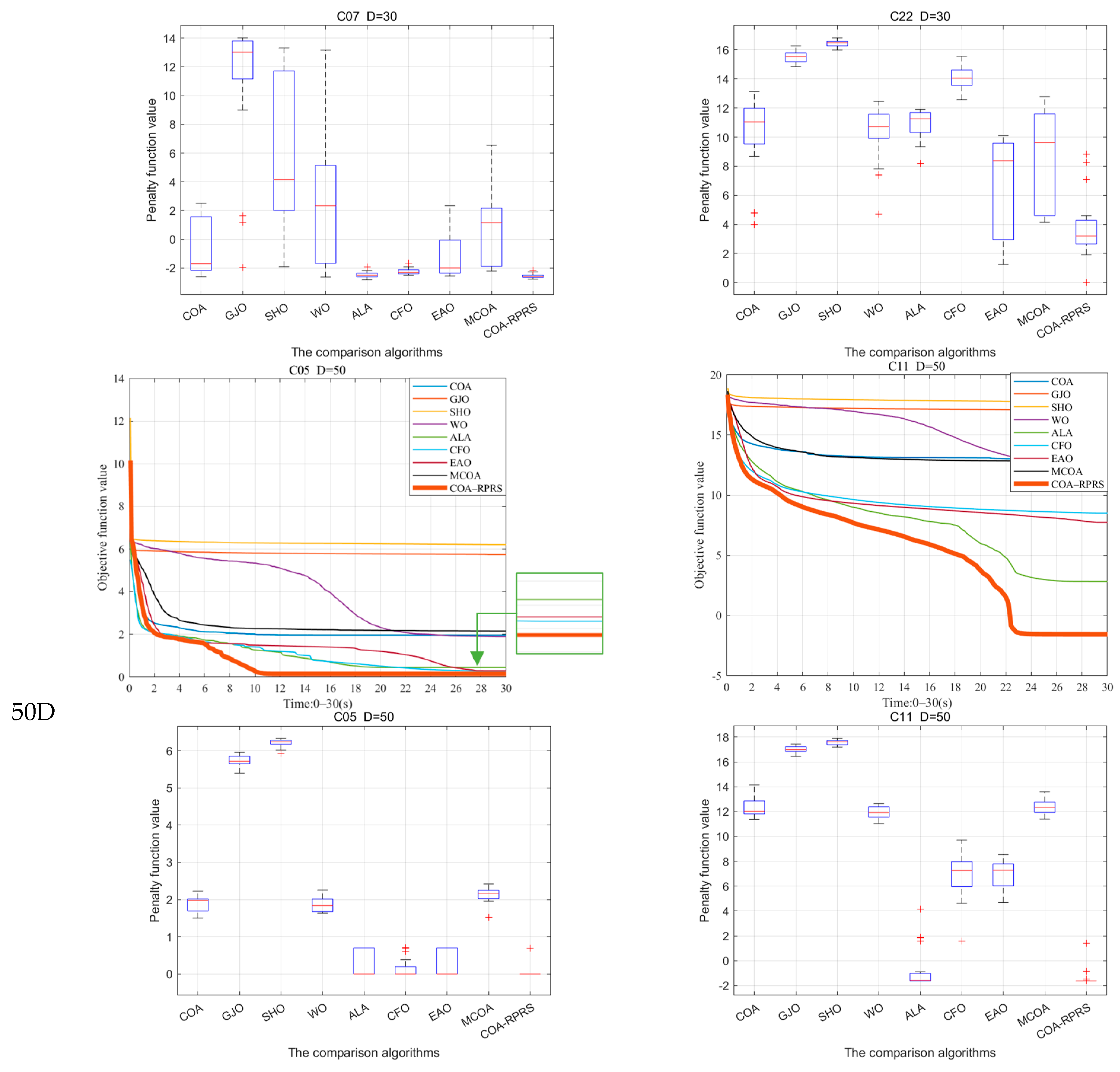
The analysis of algorithm performance can be carried out by studying the convergence curve, which demonstrates the convergence rate and accuracy. To effectively explore the convergence characteristics of COA-RPRS, Figure 10 presents the convergence curves and boxplots for some representative test functions. Among them, the horizontal axis of the convergence curve indicates the maximum running time, while the vertical axis corresponds to the average penalty function value.
As observed from the convergence curve in Figure 10, for the C07 function of 30D, although COA-RPRS converged slightly slower than COA, CFO, and ALA at the beginning, it successfully escaped the local optimum in later iterations, progressively approached a superior solution, and ultimately achieved the highest convergence accuracy. In the C22 function of 30D and the C11 function of 50D, COA-RPRS achieved rapid convergence and surpassed the other comparison algorithms in the early stage and then maintained a significant advantage since then. In the C05 function of 50D, the convergence speeds of COA, ALA, CFO, EAO, MCOA and COA-RPRS were faster at the initial stage, which were better than GJO, SHO, and WO. With the advancement of iterations, COA-RPRS further rapidly enhanced the convergence accuracy, surpassing all comparison algorithms. Although ALA, CFO, and EAO also showed relatively fast convergence speeds, their final accuracy remained inferior to that of COA-RPRS. In conclusion, COA-RPRS effectively balances exploration and exploitation throughout the optimization process, achieving both faster convergence and higher accuracy.
As shown in the boxplots in Figure 10, COA-RPRS exhibited the lowest median across all four test functions, indicating its superior convergence capability. Additionally, the distance between the upper and lower edges of the box corresponding to COA-RPRS was relatively small, suggesting that the optimal values obtained in 20 runs were relatively concentrated and had a limited fluctuation range.
In conclusion, the results in Figure 10 indicate that COA-RPRS demonstrates outstanding performance in addressing GOPs, highlighting its advantages in convergence speed and convergence accuracy.

4.4. Performance Evaluation of Color Image Enhancement

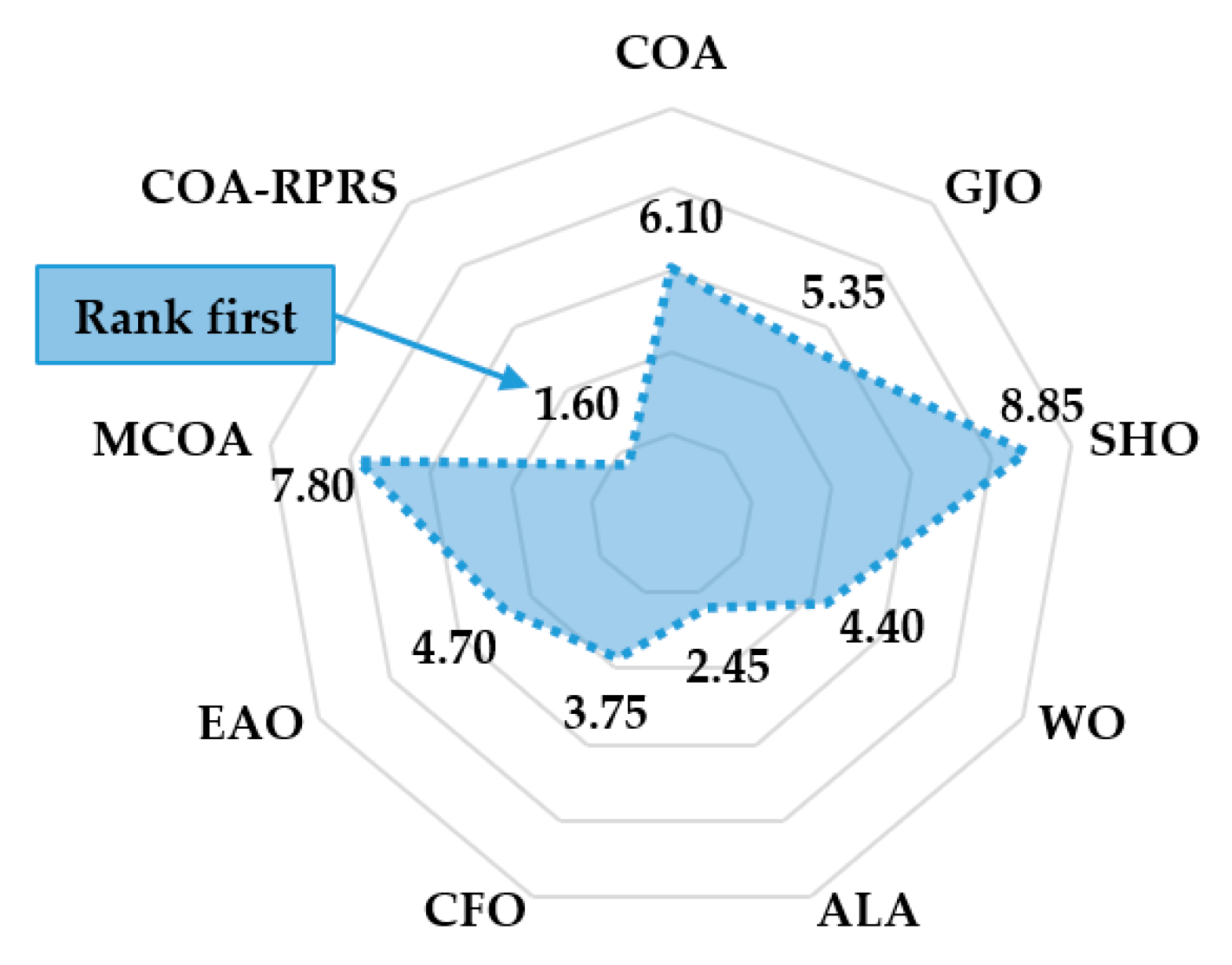
To evaluate the effectiveness and superiority of COA-RPRS, 20 color images were enhanced using COA-RPRS and eight comparison algorithms. Each algorithm was executed 20 times on the same computer for each image, and the mean and Std of the optimal value of the comprehensive image quality evaluation function f(I) obtained from the 20 iterations were statistically analyzed. The corresponding mean and Std results are summarized in Table 8, where the best values are highlighted in bold. Since image enhancement aims to maximize the objective function, a higher value indicates better algorithmic performance. The best results in the table are marked in bold. Based on these results, a statistical analysis was conducted on the data in Table 8. Figure 11 illustrates the Friedman average ranks of all algorithms, and Table 9 presents the corresponding Friedman statistics. A smaller average rank value indicates superior overall optimization performance of the algorithm.
Table 8 shows that COA-RPRS achieved the highest mean objective function value across all test images, except for images 106024 and 176035. Although COA-RPRS, COA, and GJO all reached the optimal mean value on image 22093, COA-RPRS exhibited the smallest Std on this image, further indicating its superior performance specifically on image 22093. These results demonstrate that COA-RPRS performs the best in overall performance. The Friedman average rank results shown in Figure 11 further confirm this conclusion: COA-RPRS ranks first with an average rank of 1.60, significantly outperforming other algorithms, followed by ALA with an average rank of 2.45. This fully demonstrates that COA-RPRS shows significant performance advantages in the task of color image enhancement. The Friedman statistical test results in Table 9 further support the above conclusion: under the conditions of eight degrees of freedom and a significance level of 0.05, the χ2 statistic is 117.52, far exceeding the critical value of 15.51, indicating statistically significant performance differences among the algorithms, thereby verifying the superior performance of COA-RPRS in image enhancement.
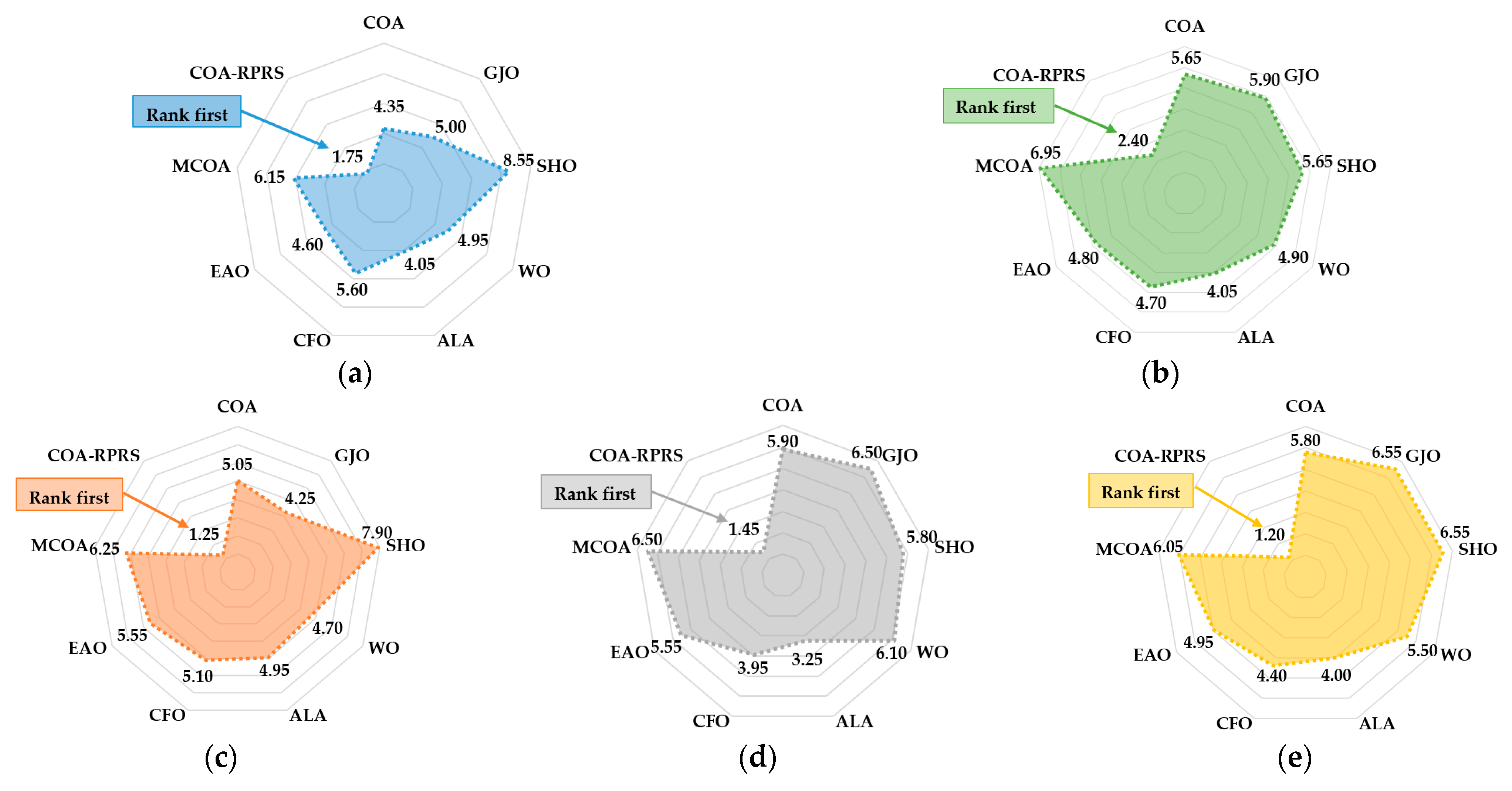
To further verify the effectiveness of the proposed enhancement algorithm from the perspective of image quality, this paper additionally selected contrast, entropy, AG, PSNR, and SSIM as auxiliary evaluation indicators. Among them, contrast reflects the overall or local luminance difference of an image, entropy measures the information richness and detail retention level of the enhanced image, AG reflects the sharpness of image details and edges, PSNR is used to evaluate the fidelity of the image, and SSIM measures the consistency of the images before and after enhancement in terms of structure. After enhancing 20 color images using nine different algorithms, the average contrast, entropy, and AG indicators are shown in Table 10; the average PSNR and SSIM indicators are shown in Table 11, with the optimal values highlighted in bold in both tables. To more intuitively compare the performance differences of each algorithm, Figure 12 shows the visualization results of the Friedman average ranking based on these five indicators.
The data in Table 10 and Table 11 indicate that although COA-RPR performs slightly below par in some individual evaluation metrics on certain images, it achieves the optimal values in most evaluation metrics. Overall, it still has certain advantages over other comparison algorithms. In practical applications, color image enhancement, as a complex multi-objective optimization problem, often needs to be weighed between the enhancement effect and image quality. Therefore, in some cases, enhanced images may perform better in certain types of indicators but fluctuate slightly in others, highlighting the necessity of multi-indicator comprehensive analysis for a comprehensive evaluation of algorithm performance.
As shown in Figure 12, the Friedman average ranking values of COA-RPRS in the five indicators of contrast, entropy, AG, PSNR and SSIM are the lowest, which are 1.75, 2.40, 1.25, 1.45 and 1.20 respectively. It ranks first among all the comparison algorithms. This result indicates that COA-RPRS exhibits relatively excellent performance in the image enhancement task. The Friedman average ranking analysis results shown in Figure 8 further verify the effectiveness of COA-RPRS in image enhancement.
Based on the above analysis, COA-RPRS can be considered an effective image enhancement approach with comprehensive performance exceeding that of other algorithms. To more intuitively demonstrate the performance advantages of COA-RPRS, Figure 13 shows the enhancement effects of several algorithms on some test images for comparison.
As shown in Figure 13, the enhanced image not only retains the original main features but also achieves significant improvement in detail presentation. The comprehensive analysis of objective evaluation indicators and subjective visual perception indicates that COA-RPRS demonstrates positive effects in enhancing image contrast, improving clarity, and enhancing detail presentation. This provides empirical evidence for the effectiveness of this method in the task of color image enhancement.

4.5. Enhancement of Rice Disease Images

To evaluate the performance of different algorithms in agricultural disease image processing, rice disease images were enhanced using COA-RPRS along with eight other comparative algorithms. Each algorithm was independently executed 20 times per image under identical computational conditions. The mean optimal value and standard deviation of the image quality evaluation function f(I), as well as other relevant metrics, were statistically analyzed. The experimental results are presented in Table 12 and Table 13, with the optimal values highlighted in bold in both tables.
As shown in Table 12, COA-RPRS achieved the highest mean value of the objective function across all rice disease images, indicating that it performs optimally among the compared algorithms. Table 13 reveals that although COA-RPR performs slightly less well in a few rice disease images in terms of evaluation indicators, it still attains optimal values in most images and maintains a relative advantage over the other algorithms. These results not only confirm the applicability of COA-RPRS in agricultural image processing but also further highlight its effectiveness in color image enhancement tasks.
Due to the considerable difficulty in the early detection of rice diseases and pests and the complex growth environment and significant background interference of rice, traditional methods are often restricted in disease identification and diagnosis. For this purpose, algorithms including COA-RPRS were applied to the enhancement processing of pest and disease images. The comparison results of some rice disease images before and after enhancement are shown in Figure 14.
As shown in Figure 14, the enhanced image presents a clearer visual representation of the leaf texture and edge structure. Compared to the original image, the recognition degree of the diseased area has improved, and the color and brightness gradation are also more distinct. This algorithm shows positive effects in improving image contrast and detail clarity, providing reference value for subsequent image-based recognition, classification, and rice pest and disease diagnosis. Overall, COA-RPRS demonstrates good performance and potential application value in the field of agricultural image enhancement.

5. Conclusions and Future Work

A crayfish optimization algorithm with a random perturbation strategy and removal similarity operation (COA-RPRS) is proposed to address the problem of color image enhancement. To overcome the limitations of the traditional COA, such as poor population diversity, susceptibility to local optima, and limited solution quality, COA-RPRS has made a series of improvements in algorithm design. First, a new calculation formula for environmental temperature, Temp, is developed to achieve a more effective balance between exploration and exploitation. Second, the parameter C2 and the cave position determination formula are refined, and novel position update equations are proposed for the summer resort, competition, and foraging stages, thereby overcoming the shortcomings of fixed cave locations, single movement directions, and insufficient individual competition mechanisms in traditional COA and significantly enhancing the search efficiency and exploration ability. Finally, to further maintain population diversity and mitigate premature convergence, COA-RPRS introduces a removal similarity operation and random perturbation strategy of the optimal individual, which significantly improves the overall performance, robustness, and adaptability of the algorithm as a whole.
To verify the superior performance of COA-RPRS, a series of experiments were designed. Firstly, its effectiveness in solving GOPs was systematically evaluated using the CEC 2017 benchmark functions. The results demonstrated that COA-RPRS exhibits exceptional capability in addressing single-objective continuous optimization problems, significantly outperforming the comparative algorithms. Subsequently, the performance of the algorithm in the image enhancement task was evaluated using 20 color images. The results showed that this method presented a positive improvement in visual effect and achieved relatively better results in several objective evaluation indicators. Finally, COA-RPRS was applied to the enhancement processing of rice pest and disease images. The results indicated that the images enhanced by COA-RPRS achieved certain improvements in clarity, contrast, and detail levels while still being able to well preserve the main features of the original images. This provides a useful preprocessing reference for the image recognition and analysis of agricultural pests and diseases.
In future work, COA-RPRS can be combined with deep learning to further improve its robustness and generalization capability and build an intelligent image enhancement framework to provide high-quality visual support for fields such as smart agriculture, medical imaging, and remote sensing processing. At the application level, COA and its improved algorithms can be extended to problems such as the traveling salesman problem, multi-level threshold image segmentation, feature selection, model parameter optimization, and multi-objective job-shop scheduling, fully leveraging their global search and local exploitation capabilities. At the theoretical level, further research can be conducted on the convergence of COA, the parameter adaptive mechanism, and the hybrid strategies with other optimization algorithms to enhance search efficiency and stability and promote the development of intelligent optimization algorithms in both theoretical research and practical applications.

Author Contributions

J.W.: conceptualization, data curation, formal analysis, investigation, methodology, resources, software, validation, visualization, software, writing—original draft, writing—review and editing. M.W.: conceptualization, data curation, formal analysis, investigation, methodology, resources, validation, visualization, software, supervision, writing—review and editing. H.S.: conceptualization, formal analysis, investigation, methodology, visualization. J.B.: formal analysis, providing images, data curation. All authors have read and agreed to the published version of the manuscript.

Funding

This research was funded by the National Social Science Fund of China, grant number 21BGL174.

Institutional Review Board Statement

Not applicable.

Data Availability Statement

The raw data supporting the conclusions of this article will be made available by the authors on request.

Conflicts of Interest

The authors declare that they have no known competing financial interests or personal relationships that could have appeared to influence the work reported in this paper.

References

  1. Xie, J.; Lu, M.; Gao, Q.; Chen, L.; Zou, Y.; Wu, J.; Li, J. Intelligent Detection and Control of Crop Pests and Diseases: Current Status and Future Prospects. Agronomy 2025, 15, 1416. [Google Scholar] [CrossRef]
  2. Zhang, Z.; Zhang, J.; Du, J.; Chen, X.; Zhang, W.; Peng, C. Frequency-Domain Collaborative Lightweight Super-Resolution for Fine Texture Enhancement in Rice Imagery. Agronomy 2025, 15, 1729. [Google Scholar] [CrossRef]
  3. Yuan, Q.; Dai, S. Adaptive histogram equalization with visual perception consistency. Inf. Sci. 2024, 668, 120525. [Google Scholar] [CrossRef]
  4. Tian, F.; Wang, M.; Liu, X. Low-Light Mine Image Enhancement Algorithm Based on Improved Retinex. Appl. Sci. 2024, 14, 2213. [Google Scholar] [CrossRef]
  5. Yuan, S.; Li, J.; Ren, L.; Chen, Z. Multi-Frequency Field Perception and Sparse Progressive Network for low-light image enhancement. J. Vis. Commun. Image Represent 2024, 100, 104133. [Google Scholar] [CrossRef]
  6. Wang, Z.; Liu, L. Infrared Image Enhancement for Power Equipment Based on Fusion Color Model Space. Infrared Technol. 2024, 46, 225–232. [Google Scholar]
  7. Wang, C.; Zhang, W.; Pan, Q.; Miao, Z.; Wang, B. Multi-pruning-robot and multi-fertilizing-drone collaborative task assignment using multi-class teaching-learning-based optimization. Appl. Soft Comput. 2025, 182, 113591. [Google Scholar] [CrossRef]
  8. Ma, J.; Hu, J. An improved particle swarm optimization for multilevel thresholding medical image segmentation. PLoS ONE 2024, 19, 12. [Google Scholar] [CrossRef]
  9. Chen, Y.; Wei, J.; Luo, T.; Zhou, J. Mcaaco: A multi-objective strategy heuristic search algorithm for solving capacitated vehicle routing problems. Complex Intell. Syst. 2025, 11, 211. [Google Scholar] [CrossRef]
  10. Momenikorbekandi, A.; Kalganova, T. Intelligent Scheduling Methods for Optimisation of Job Shop Scheduling Problems in the Manufacturing Sector: A Systematic Review. Electronics 2025, 14, 1663. [Google Scholar] [CrossRef]
  11. Han, Y.; Hu, P.; Su, Z.; Liu, L.; Panneerselvam, J. An Advanced Whale Optimization Algorithm for Grayscale Image Enhancement. Biomimetics 2024, 9, 760. [Google Scholar] [CrossRef] [PubMed]
  12. Zhang, Y.; Liu, X.; Lv, Y. A Hybrid Swarming Algorithm for Adaptive Enhancement of Low-Illumination Images. Symmetry 2024, 16, 533. [Google Scholar] [CrossRef]
  13. Jia, H.; Rao, H.; Wen, C.; Mirjalili, S. Crayfish optimization algorithm. Artif. Intell. Rev. 2023, 56, 1919–1979. [Google Scholar] [CrossRef]
  14. Shikoun, N.; Al-Eraqi, A.; Fathi, I. BinCOA: An Efficient Binary Crayfish Optimization Algorithm for Feature Selection. IEEE Access 2024, 12, 28621–28635. [Google Scholar] [CrossRef]
  15. Chauhan, S.; Vashishtha, G.; Gupta, M.; Korkmaz, M.; Demirsöz, R.; Noman, K.; Kolesnyk, V. Parallel structure of crayfish optimization with arithmetic optimization for classifying the friction behaviour of Ti-6Al-4V alloy for complex machinery applications. Knowl. Based Syst. 2024, 286, 111389. [Google Scholar] [CrossRef]
  16. Jia, H.; Zhou, X.; Zhang, J.; Abualigah, L.; Yildiz, A.; Hussien, A. Modified crayfish optimization algorithm for solving multiple engineering application problems. Artif. Intell. Rev. 2024, 57, 127. [Google Scholar] [CrossRef]
  17. Lin, W.; He, Y.; Hu, G.; Zhang, C. Multi-Strategy-Assisted Hybrid Crayfish-Inspired Optimization Algorithm for Solving Real-World Problems. Biomimetics 2025, 10, 343. [Google Scholar] [CrossRef]
  18. Wolpert, D.; Macready, W. No free lunch theorems for optimization. IEEE Trans. Evol. Comput. 2002, 1, 67–82. [Google Scholar] [CrossRef]
  19. Guo, Z.; Zheng, L.; Xu, W. BGIR: A Low-Illumination Remote Sensing Image Restoration Algorithm with ZYNQ-Based Implementation. Sensors 2025, 25, 4433. [Google Scholar] [CrossRef]
  20. Brest, J.; Maučec, M.; Bošković, B. The 100-digit challenge: Algorithm jde100. In Proceedings of the 2019 IEEE Congress on Evolutionary Computation (CEC), Wellington, New Zealand, 10–13 June 2019. [Google Scholar]
  21. Chen, H.; Qian, J.; Jiang, W.; Yang, Y.; Song, L.; Huang, X. Gaussian mixture grayscale image enhancement algorithm based on particle swarm optimization. J. Appl. Opt. 2017, 38, 592–598. [Google Scholar]
  22. Jiang, J.; Zhou, J.; Zhou, R.; Wang, J. Image enhancement method based on improved bacteria foraging optimization algorithm. Control Decis. 2015, 30, 461–466. [Google Scholar]
  23. Chopra, N.; Ansari, M. Golden jackal optimization: A novel nature-inspired optimizer for engineering applications. Expert Syst. Appl. 2022, 198, 116924. [Google Scholar] [CrossRef]
  24. Zhao, S.; Zhang, T.; Ma, S.; Wang, M. Sea-horse optimizer: A novel nature-inspired meta-heuristic for global optimization problems. Artif. Intell. 2023, 53, 11833–11860. [Google Scholar] [CrossRef]
  25. Han, M.; Du, Z.; Yuen, K.; Zhu, H.; Li, Y.; Yuan, Q. Walrus optimizer: A novel nature-inspired metaheuristic algorithm. Expert Syst. Appl. 2024, 239, 122413. [Google Scholar] [CrossRef]
  26. Xiao, Y.; Cui, H.; Khurma, R.A.; Castillo, P. Artificial lemming algorithm: A novel bionic meta-heuristic technique for solving real-world engineering optimization problems. Artif. Intell. Rev. 2025, 58, 84. [Google Scholar] [CrossRef]
  27. Yang, B.; Liang, B.; Zhou, S.; Qian, Y.; Zheng, R.; Shu, H.; Sang, Y. A novel bio-inspired caterpillar fungus (Ophiocordyceps sinensis) optimizer for SOFC parameter identification via GRNN. Renew. Energy 2025, 256, 123995. [Google Scholar] [CrossRef]
  28. Rodan, A.; Al-Tamimi, A.-K.; Al-Alnemer, L.; Mirjalili, S.; Tiňo, P. Enzyme action optimizer: A novel bio-inspired optimization algorithm. J. Supercomput. 2025, 81, 686. [Google Scholar] [CrossRef]
  29. Song, H.; Wang, J.; Song, L.; Zhang, H.; Bei, J.; Ni, J.; Ye, B. Improvement and application of hybrid real-coded genetic algorithm. Artif. Intell. 2022, 52, 17410–17448. [Google Scholar] [CrossRef]
  30. Mouret, F.; Hippert-Ferrer, A.; Pascal, F.; Tourneret, J. A Robust and Flexible EM Algorithm for Mixtures of Elliptical Distributions with Missing Data. IEEE Trans. Signal Process. 2023, 71, 1669–1682. [Google Scholar] [CrossRef]
  31. Wu, C.; Wang, S.; Cao, X. Fuzzy Clustering Algorithm Combined with Cauchy Distribution and Ant Lion Algorithm. Comput. Eng. Appl. 2023, 59, 91–98. [Google Scholar]
  32. Kamaruzaman, A.; Zain, A.; Yusuf, S.; Udin, A. Levy flight algorithm for optimization problems-a literature review. Appl. Mech. Mater. 2013, 421, 496–501. [Google Scholar] [CrossRef]
  33. Wu, G.; Mallipeddi, R.; Suganthan, P. Problem Definitions and Evaluation Criteria for the CEC 2017 Competition on Constrained Real-Parameter Optimization; Technical Report; Nanyang Technological University: Singapore, 2017. [Google Scholar]
  34. Martin, D.; Fowlkes, C.; Tal, D.; Malik, J. A database of human segmented natural images and its application to evaluating segmentation algorithms and measuring ecological statistics. In Proceedings of the Eighth IEEE International Conference on Computer Vision (ICCV 2001), Vancouver, BC, Canada, 7–14 July 2001. [Google Scholar]
  35. Wang, J.; Bei, J.; Song, H.; Zhang, H.; Zhang, P. A whale optimization algorithm with combined mutation and removing similarity for global optimization and multilevel thresholding image segmentation. Appl. Soft Comput. 2023, 137, 110130. [Google Scholar] [CrossRef]
  36. Huynh-Thu, Q.; Ghanbari, M. Scope of validity of PSNR in image/video quality assessment. Electron. Lett. 2008, 44, 800–801. [Google Scholar] [CrossRef]
  37. Wang, Z.; Bovik, A.; Sheikh, H.; Simoncelli, E. Image quality assessment: From error visibility to structural similarity. IEEE Trans. Image Process. 2004, 13, 600–612. [Google Scholar] [CrossRef] [PubMed]
Figure 1. Variation curves of (a) C2 × rand and (b) C2 × r1.
Agriculture 16 00364 g001
Figure 2. Lévy flight trajectory.
Agriculture 16 00364 g002
Figure 3. Distribution of offspring after Lévy mutation in search space.
Agriculture 16 00364 g003
Figure 4. Comparison of improvement points and advantage analysis chart of COA-RPRS.
Agriculture 16 00364 g004
Figure 5. The flowchart of COA-RPRS.
Agriculture 16 00364 g005
Figure 6. Partial color images.
Agriculture 16 00364 g006
Figure 7. Original images of diseased rice.
Agriculture 16 00364 g007
Figure 8. The Friedman average ranks of mean on (a) 30D and (b) 50D CEC 2017 GOPs.
Agriculture 16 00364 g008
Figure 9. The Friedman average ranks of Std on (a) 30D and (b) 50D CEC 2017 GOPs.
Agriculture 16 00364 g009
Figure 10. Convergence curves and boxplots of 9 algorithms on partial 30D and 50D CEC2017.
Agriculture 16 00364 g010aAgriculture 16 00364 g010b
Figure 11. Comparison of Friedman average rank values of objective functions of various algorithms.
Agriculture 16 00364 g011
Figure 12. Friedman mean ranks of evaluation indicators for the compared algorithms. (a) The mean rank of Contrast. (b) The mean rank of Entropy. (c) The mean rank of AG. (d) The mean rank of PSNR. (e) The mean rank of SSIM.
Agriculture 16 00364 g012
Figure 13. Comparison chart of the enhancement effects of some color images.
Agriculture 16 00364 g013
Figure 14. The comparison results of some rice disease images before and after enhancement.
Agriculture 16 00364 g014
Table 1. Time complexity of COA and COA-RPRS.
AlgorithmPopulation InitializationPosition UpdateLocal Search StrategyTotal Time Complexity
COAO(N)O(N × D)-O(N × D)
COA-RPRSO(N)O(N)O(N)O(N)
Table 2. Parameter settings of 9 algorithms.
AlgorithmYearsReferenceParameter
COA2023[13]C1 = 0.2, C3 = 3, μ = 25, σ = 3
GJO2022[23]c1 = 1.5
SHO2023[24]r1 = 0, r2 = 0.1, u = 0.05, v = 0.05, λ = 1.5, s = 0.01, l = 0.05
WO2024[25]p = 0.4
ALA2025[26]β = 1.5
CFO2025[27]-
EAO2025[28]EC = 0.1
MCOA2024[16]C1 = 0.2, C3 = 3, μ = 25, σ = 3, c = 2
COA-RPRS--C1 = 0.2, C3 = 3, μ = 25, σ = 3, tolx = 10−15, tolf = 1028, L = 50, α = 0.01
Table 3. The results of COA variants with different strategies on 30D CEC 2017 GOPs.
FunctionIndicatorCOACOA1COA2COA3COA-RPRS
C01Mean4.0477 × 10−27.1688 × 10−262.9898 × 10−279.7345 × 10−275.5220 × 10⁻²⁹
Std4.3221 × 10−27.0295 × 10−266.2854 × 10−279.6254 × 10−277.9722 × 10⁻²⁹
C02Mean8.6083 × 10−17.2636 × 10−293.3895 × 10−292.1457 × 10−291.7326 × 10⁻²⁹
Std2.5437 × 10+06.7944 × 10−295.7558 × 10−295.1175 × 10−294.7055 × 10⁻²⁹
C03Mean6.6062 × 10+71.1865 × 10+77.6438 × 10+65.2976 × 10+65.2176 × 10+6
Std4.8619 × 10+73.2876 × 10+73.1293 × 10+73.2394 × 10+72.2488 × 10+7
C04Mean2.4134 × 10+21.4499 × 10+21.4687 × 10+21.4030 × 10+21.3821 × 10+2
Std9.0942 × 10+11.9905 × 10+12.0420 × 10+12.0267 × 10+11.9284 × 10+1
C05Mean3.3653 × 10+17.9732 × 10−13.9866 × 10−15.9799 × 10−11.9933 × 10−1
Std2.7670 × 10+11.6361 × 10+01.2271 × 10+01.4605 × 10+08.9144 × 10⁻¹
C06Mean7.7508 × 10+82.2151 × 10+91.9227 × 10+95.6926 × 10+82.9708 × 10+8
Std3.9440 × 10+82.2288 × 10+91.8035 × 10+91.2377 × 10+98.1352 × 10+8
C07Mean−5.7190 × 10+11.7643 × 10+112.3217 × 10+11−2.4832 × 10+2−3.8065 × 10+2
Std1.9132 × 10+26.7841 × 10+108.7518 × 10+102.5485 × 10+21.2325 × 10+2
C08Mean5.8179 × 10+2−2.8398 × 10⁻⁴−2.8398 × 10⁻⁴−2.8398 × 10⁻⁴−2.8398 × 10⁻⁴
Std5.5942 × 10+22.1626 × 10−141.9937 × 10−141.9868 × 10−141.9343 × 10⁻¹⁴
C09Mean2.0088 × 10+62.8542 × 10⁻²−2.6655 × 10⁻³−2.6655 × 10⁻³−2.6655 × 10⁻³
Std8.9836 × 10+61.3956 × 10−10.0000 × 10+02.7338 × 10−162.7338 × 10⁻¹⁶
C10Mean7.3062 × 10−1−1.0284 × 10⁻⁴−1.0284 × 10⁻⁴−1.0284 × 10⁻⁴−1.0284 × 10⁻⁴
Std2.3548 × 10+01.9294 × 10−142.3007 × 10−142.0863 × 10−141.8954 × 10⁻¹⁴
C11Mean8.7633 × 10+101.7712 × 10+10−2.1343 × 10+1−2.1343 × 10+1−2.1343 × 10+1
Std1.2586 × 10+117.9210 × 10+108.1448 × 10−102.3296 × 10−102.2477 × 10⁻⁹
C12Mean1.1263 × 10+21.4833 × 10+21.4602 × 10+21.5708 × 10+11.5567 × 10+1
Std2.6466 × 10+11.4937 × 10+11.8249 × 10+11.1286 × 10+11.3224 × 10+1
C13Mean1.9081 × 10+127.0308 × 10+92.4965 × 10+93.0159 × 10+19.3272 × 10+0
Std4.1911 × 10+122.9187 × 10+106.0693 × 10+91.2346 × 10+21.3116 × 10+1
C14Mean1.9341 × 10+01.9286 × 10+01.9118 × 10+01.4607 × 10+01.4887 × 10+0
Std1.4090 × 10−11.0203 × 10−11.0026 × 10−14.3689 × 10−21.5994 × 10−1
C15Mean2.4190 × 10+11.3624 × 10+11.2469 × 10+11.3195 × 10+11.3195 × 10+1
Std9.7485 × 10+01.9379 × 10+01.8267 × 10+02.3850 × 10+02.5936 × 10+0
C16Mean1.2904 × 10+27.9796 × 10+19.2369 × 10+18.1681 × 10+18.7494 × 10+1
Std2.0220 × 10+18.3056 × 10+01.1941 × 10+19.5616 × 10+01.1811 × 10+1
C17Mean9.6100 × 10+109.6100 × 10+109.6100 × 10+109.6100 × 10+109.6100 × 10+10
Std3.9263 × 10−39.5008 × 10−31.6097 × 10−28.7292 × 10−37.5011 × 10−3
C18Mean2.8792 × 10+122.0243 × 10+103.7563 × 10+13.7179 × 10+13.6745 × 10+1
Std1.1080 × 10+139.0530 × 10+102.5268 × 10+01.1186 × 10+04.4825 × 10⁻¹
C19Mean1.8415 × 10+171.8275 × 10+171.8275 × 10+171.8275 × 10+171.8275 × 10+17
Std1.6475 × 10+141.0689 × 10+28.6863 × 10+16.5663 × 10+28.6863 × 10+1
C20Mean4.7274 × 10+03.9609 × 10+03.8617 × 10+03.3189 × 10+02.3344 × 10+0
Std9.9930 × 10−14.7992 × 10−11.0924 × 10+02.9475 × 10−12.6678 × 10−1
C21 Mean1.0347 × 10+21.7468 × 10+21.6300 × 10+21.4118 × 10+11.1613 × 10+1
Std2.7696 × 10+11.4184 × 10+11.3755 × 10+11.2089 × 10+18.4230 × 10+0
C22Mean1.1650 × 10+125.2641 × 10+102.5198 × 10+104.8837 × 10+74.4449 × 10+7
Std3.1078 × 10+129.5587 × 10+108.8030 × 10+101.6448 × 10+81.5916 × 10+8
C23 Mean2.0141 × 10+01.7434 × 10+01.8589 × 10+01.4312 × 10+01.4085 × 10+0
Std1.2002 × 10−18.9705 × 10−29.7332 × 10−21.0124 × 10−15.0724 × 10−8
C24Mean1.8692 × 10+11.3252 × 10+11.3298 × 10+11.2566 × 10+11.2566 × 10+1
Std2.1861 × 10+01.8446 × 10+01.4471 × 10+03.3957 × 10+02.0064 × 10+0
C25Mean1.6572 × 10+21.2236 × 10+21.0579 × 10+29.0870 × 10+11.0391 × 10+2
Std3.6365 × 10+11.2227 × 10+11.1987 × 10+11.4399 × 10+11.1040 × 10+1
C26Mean9.6100 × 10+109.6100 × 10+109.6100 × 10+109.6100 × 10+109.6100 × 10+10
Std1.5644 × 10−26.5466 × 10−35.5276 × 10−35.1494 × 10−32.0185 × 10−2
C27Mean4.3494 × 10+143.5702 × 10+124.9489 × 10+115.1898 × 10+104.2921 × 10+10
Std7.6471 × 10+141.5654 × 10+132.2129 × 10+121.6280 × 10+111.3213 × 10+11
C28Mean1.8453 × 10+171.8405 × 10+171.8384 × 10+171.8385 × 10+171.8387 × 10+17
Std1.1229 × 10+144.0757 × 10+143.1453 × 10+142.5280 × 10+142.5614 × 10+14
w/t/l 26/2/022/5/119/7/215/9/4
Mean rank 4.68 3.64 3.09 1.91 1.68
Final ranking 5 4 3 2 1
p-value of Friedman test 2.4179 × 10⁻¹⁴
Table 4. The results of 9 algorithms on 30D CEC 2017 GOPs.
FunctionIndicatorCOAGJOSHOWOALACFOEAOMCOACOA-RPRS
C01Mean4.0477 × 10−21.5275 × 10+42.6768 × 10+47.5863 × 10−23.4020 × 10−275.2766 × 10−275.0362 × 10−285.7802 × 10−035.5220 × 10⁻²⁹
Std4.3221 × 10−24.3716 × 10+37.5792 × 10+34.1845 × 10−21.1372 × 10−273.6668 × 10−274.8354 × 10−281.7248 × 10−27.9722 × 10−29
C02Mean8.6083 × 10−11.3131 × 10+41.8654 × 10+41.3578 × 10−11.3537 × 10−274.9094 × 10−271.1918 × 10−273.4798 × 10−31.7326 × 10−29
Std2.5437 × 10+04.3778 × 10+34.1605 × 10+37.5155 × 10−26.5970 × 10−284.4647 × 10−272.2759 × 10−278.5327 × 10+04.7055 × 10⁻²⁹
C03Mean6.6062 × 10+73.1362 × 10+77.3690 × 10+76.0696 × 10+71.7300 × 10+52.8645 × 10+62.6125 × 10+75.1757 × 10+75.2176 × 10+6
Std4.8619 × 10+74.6502 × 10+74.7055 × 10+75.0236 × 10+76.4750 × 10+42.0276 × 10+64.4045 × 10+74.6085 × 10+72.2488 × 10+7
C04Mean2.4134 × 10+22.7809 × 10+23.8096 × 10+24.1338 × 10+11.6087 × 10+23.7423 × 10+21.1196 × 10+22.0025 × 10+21.3821 × 10+2
Std9.0942 × 10+14.9870 × 10+19.2901 × 10+14.7145 × 10+12.7960 × 10+17.8540 × 10+11.9704 × 10+17.0181 × 10+11.9284 × 10+1
C05Mean3.3653 × 10+11.1836 × 10+54.5231 × 10+56.6860 × 10+11.1960 × 10+01.5946 × 10+07.9732 × 10−12.9400 × 10+11.9933 × 10⁻¹
Std2.7670 × 10+19.0106 × 10+41.9146 × 10+53.0816 × 10+11.8744 × 10+02.0038 × 10+01.6361 × 10+03.5811 × 10+18.9144 × 10⁻¹
C06Mean7.7508 × 10+81.9779 × 10+91.4569 × 10+95.7333 × 10+97.8015 × 10+35.6962 × 10+34.9603 × 10+96.1221 × 10+82.9708 × 10+8
Std3.9440 × 10+81.8759 × 10+96.7958 × 10+82.9018 × 10+92.7408 × 10+31.7740 × 10+31.7332 × 10+98.7425 × 10+78.1352 × 10+8
C07Mean−5.7190 × 10+13.1035 × 10+131.7784 × 10+127.2912 × 10+11−3.2853 × 10+2−1.8407 × 10+2−9.4919 × 10+11.7550 × 10+5−3.8065 × 10+2
Std1.9132 × 10+23.7043 × 10+134.8864 × 10+123.2607 × 10+121.5152 × 10+27.3376 × 10+11.5760 × 10+27.8425 × 10+51.2325 × 10+2
C08Mean5.8179 × 10+21.5204 × 10+163.1403 × 10+166.0350 × 10+3−2.8398 × 10−04−2.7065 × 10−04−2.6747 × 10−046.0812 × 10+2−2.8398 × 10−04
Std5.5942 × 10+27.3237 × 10+151.6867 × 10+163.9697 × 10+38.1973 × 10−141.0335 × 10−051.2889 × 10−051.4538 × 10+21.9343 × 10⁻¹⁴
C09Mean2.0088 × 10+62.7126 × 10+116.6555 × 10+134.3181 × 10+6−2.6655 × 10−33.2834 × 10−01−2.6655 × 10−31.0383 × 10+6-2.6655 × 10⁻³
Std8.9836 × 10+65.3039 × 10+111.3206 × 10+141.3295 × 10+71.1916 × 10−154.6669 × 10−011.6546 × 10−169.1154 × 10+62.7338 × 10⁻¹⁶
C10Mean7.3062 × 10−12.1093 × 10+175.4419 × 10+17−1.1788 × 10⁻⁵−1.0284 × 10⁻⁴−9.6969 × 10⁻⁵−1.0038 × 10−45.7623 × 10−1−1.0284 × 10⁻⁴
Std2.3548 × 10+01.5462 × 10+172.3668 × 10+173.7273 × 10−55.1025 × 10−144.7596 × 10−65.0373 × 10−63.1064 × 10+01.8954 × 10⁻¹⁴
C11Mean8.7633 × 10+101.5200 × 10+166.8520 × 10+162.2408 × 10+11−2.1343 × 10+1−1.8848 × 10+1−1.8819 × 10+12.0579 × 10+10−2.1343 × 10+1
Std1.2586 × 10+111.1049 × 10+165.6223 × 10+161.5723 × 10+114.0902 × 10−97.9267 × 10+05.3826 × 10+03.7522 × 10+102.2477 × 10⁻⁹
C12Mean1.1263 × 10+27.3319 × 10+156.4617 × 10+161.4495 × 10+21.4071 × 10+11.7016 × 10+12.5157 × 10+17.9205 × 10+11.5567 × 10+1
Std2.6466 × 10+16.3060 × 10+153.4402 × 10+162.6797 × 10+11.0074 × 10+19.4736 × 10+03.3824 × 10+12.4374 × 10+11.3224 × 10+1
C13Mean1.9081 × 10+128.3159 × 10+157.1757 × 10+169.2267 × 10+103.0521 × 10+92.2864 × 10+137.3542 × 10+81.6412 × 10+129.3272 × 10+0
Std4.1911 × 10+125.9669 × 10+152.8846 × 10+162.7919 × 10+111.3290 × 10+103.9537 × 10+131.6041 × 10+94.0260 × 10+121.3116 × 10+1
C14Mean1.9341 × 10+02.2475 × 10+161.3279 × 10+171.9747 × 10+01.4708 × 10+01.4911 × 10+01.4738 × 10+01.9109 × 10+01.4887 × 10+0
Std1.4090 × 10−12.1260 × 10+166.8831 × 10+167.9425 × 10−24.6875 × 10−21.9436 × 10−023.8687 × 10−021.1400 × 10−11.5994 × 10−1
C15Mean2.4190 × 10+14.2910 × 10+155.9852 × 10+161.9850 × 10+11.6493 × 10+13.3929 × 10+19.2491 × 10+01.9458 × 10+11.3195 × 10+1
Std9.7485 × 10+07.3367 × 10+154.6133 × 10+162.5657 × 10+01.9069 × 10+01.0368 × 10+11.2533 × 10+07.1014 × 10+02.5936 × 10+0
C16Mean1.2904 × 10+23.0366 × 10+155.2156 × 10+161.6199 × 10+28.9378 × 10+11.4169 × 10+24.1450 × 10+11.0511 × 10+28.7494 × 10+1
Std2.0220 × 10+12.8372 × 10+153.2846 × 10+162.2838 × 10+11.1676 × 10+12.1918 × 10+16.3954 × 10+01.8264 × 10+11.1811 × 10+1
C17Mean9.6100 × 10+105.5725 × 10+155.5395 × 10+169.6100 × 10+109.6100 × 10+109.6100 × 10+109.6100 × 10+109.6100 × 10+109.6100 × 10+10
Std3.9263 × 10−034.3026 × 10+152.6216 × 10+164.1365 × 10−36.6217 × 10−31.9945 × 10−21.0386 × 10−21.3798 × 10−27.5011 × 10−3
C18Mean2.8792 × 10+121.7272 × 10+264.9887 × 10+271.2853 × 10+133.8699 × 10+14.0625 × 10+103.6555 × 10+15.3671 × 10+113.6745 × 10+1
Std1.1080 × 10+133.0228 × 10+263.7122 × 10+272.0209 × 10+133.4786 × 10+01.2504 × 10+111.5587 × 10−11.0091 × 10+134.4825 × 10⁻¹
C19Mean1.8415 × 10+171.8449 × 10+171.8450 × 10+171.8281 × 10+171.8275 × 10+171.8275 × 10+171.8275 × 10+171.8405 × 10+171.8275 × 10+17
Std1.6475 × 10+141.3630 × 10+141.3553 × 10+141.1219 × 10+146.5663 × 10+12.0903 × 10+38.0814 × 10+21.3264 × 10+148.6863 × 10+1
C20Mean4.7274 × 10+06.1075 × 10+04.2388 × 10+07.7368 × 10+03.3467 × 10+02.6623 × 10+07.5235 × 10+04.6440 × 10+02.3344 × 10+0
Std9.9930 × 10−11.8727 × 10+05.2212 × 10−13.0890 × 10−15.6308 × 10−14.5203 × 10−13.8389 × 10−18.1640 × 10−12.6678 × 10⁻¹
C21 Mean1.0347 × 10+24.2472 × 10+153.0149 × 10+161.1802 × 10+21.1724 × 10+11.4841 × 10+12.2883 × 10+11.7244 × 10+21.1613 × 10+1
Std2.7696 × 10+12.8541 × 10+151.0795 × 10+162.7962 × 10+18.3780 × 10+01.3612 × 10+12.7787 × 10+12.2079 × 10+18.4230 × 10+0
C22Mean1.1650 × 10+124.8232 × 10+152.9469 × 10+163.9534 × 10+112.8680 × 10+115.1249 × 10+141.9524 × 10+95.1906 × 10+114.4449 × 10+7
Std3.1078 × 10+124.7374 × 10+151.4033 × 10+167.2455 × 10+112.9027 × 10+119.6824 × 10+143.2103 × 10+91.3616 × 10+121.5916 × 10+8
C23 Mean2.0141 × 10+09.9743 × 10+156.1664 × 10+161.9285 × 10+01.4376 × 10+01.4260 × 10+01.4129 × 10+02.1481 × 10+01.4085 × 10+0
Std1.2002 × 10−11.1266 × 10+163.8274 × 10+167.5174 × 10−26.8589 × 10−23.5626 × 10−21.9438 × 10−28.9902 × 10−25.0724 × 10−8
C24Mean1.8692 × 10+12.2917 × 10+152.2456 × 10+161.9123 × 10+11.5708 × 10+12.1520 × 10+11.0160 × 10+11.8448 × 10+11.2566 × 10+1
Std2.1861 × 10+04.3911 × 10+151.5344 × 10+162.2519 × 10+01.7283 × 10+03.2070 × 10+01.5754 × 10+02.0676 × 10+02.0064 × 10+0
C25Mean1.6572 × 10+27.9566 × 10+142.5292 × 10+161.6485 × 10+21.1106 × 10+21.9407 × 10+25.5835 × 10+11.5055 × 10+21.0391 × 10+2
Std3.6365 × 10+17.8163 × 10+141.3062 × 10+162.4149 × 10+11.5290 × 10+14.1364 × 10+11.2389 × 10+12.7693 × 10+11.1040 × 10+1
C26Mean9.6100 × 10+104.1037 × 10+153.1824 × 10+169.6100 × 10+109.6100 × 10+109.6100 × 10+109.6100 × 10+109.6100 × 10+109.6100 × 10+10
Std1.5644 × 10−23.4156 × 10+151.7899 × 10+163.2333 × 10−31.5854 × 10−21.7164 × 10−26.8375 × 10−32.8343 × 10−22.0185 × 10−2
C27Mean4.3494 × 10+141.2228 × 10+255.5548 × 10+261.0549 × 10+153.8114 × 10+13.2641 × 10+118.0725 × 10+101.5749 × 10+144.2921 × 10+10
Std7.6471 × 10+142.1281 × 10+255.5982 × 10+264.6087 × 10+153.0020 × 10+01.2387 × 10+122.0108 × 10+113.6041 × 10+141.3213 × 10+11
C28Mean1.8453 × 10+171.8437 × 10+171.8471 × 10+171.8425 × 10+171.8389 × 10+171.8459 × 10+171.8382 × 10+171.8450 × 10+171.8387 × 10+17
Std1.1229 × 10+141.4845 × 10+141.1216 × 10+141.6506 × 10+141.9892 × 10+141.4292 × 10+143.0202 × 10+141.0608 × 10+142.5614 × 10+14
w/t/l 26/2/028/0/028/0/025/2/115/7/623/3/217/4/726/2/0
Table 5. The results of 9 algorithms on 50D CEC 2017 GOPs.
FunctionIndicatorCOAGJOSHOWOALACFOEAOMCOACOA-RPRS
C01Mean2.5898 × 10+23.9018 × 10+46.2176 × 10+45.5351 × 10+22.4215 × 10−195.6285 × 10−189.3852 × 10−251.5983 × 10+21.8281 × 10⁻²⁶
Std3.9956 × 10+21.0373 × 10+41.4277 × 10+42.1312 × 10+23.4354 × 10−199.4905 × 10−182.0021 × 10−241.9558 × 10+26.4529 × 10⁻²⁷
C02Mean2.9313 × 10+23.6809 × 10+45.4930 × 10+47.6498 × 10+21.3427 × 10−171.1923 × 10−163.2222 × 10−201.5258 × 10+21.9077 × 10⁻²⁵
Std4.3834 × 10+27.2288 × 10+38.3351 × 10+32.5853 × 10+23.6072 × 10−172.0053 × 10−161.4380 × 10−192.9870 × 10+22.1672 × 10⁻²⁵
C03Mean7.2006 × 10+75.1362 × 10+71.0768 × 10+88.0073 × 10+78.1557 × 10+55.9451 × 10+67.5985 × 10+75.3114 × 10+76.7913 × 10+5
Std4.6391 × 10+75.0819 × 10+73.2819 × 10+63.8165 × 10+76.7201 × 10+55.5714 × 10+64.3909 × 10+73.9420 × 10+74.8636 × 10+5
C04Mean5.8125 × 10+26.0610 × 10+28.2306 × 10+21.8112 × 10+22.8825 × 10+27.9657 × 10+22.2439 × 10+25.0940 × 10+22.8179 × 10+2
Std1.0513 × 10+26.8517 × 10+18.5351 × 10+11.2111 × 10+24.5920 × 10+11.2205 × 10+22.7129 × 10+19.4670 × 10+12.2164 × 10+1
C05Mean9.0251 × 10+15.5921 × 10+51.6796 × 10+67.7727 × 10+11.7940 × 10+08.2837 × 10−11.1961 × 10+01.4743 × 10+13.9866 × 10⁻¹
Std4.2496 × 10+11.8391 × 10+53.4399 × 10+53.6679 × 10+12.0348 × 10+01.5617 × 10+01.8745 × 10+05.3209 × 10+11.2271 × 10+0
C06Mean9.2691 × 10+83.2811 × 10+91.6615 × 10+98.6493 × 10+91.6455 × 10+72.7044 × 10+78.3673 × 10+91.0163 × 10+91.5839 × 10+9
Std3.6863 × 10+82.7059 × 10+97.0235 × 10+85.3767 × 10+97.3527 × 10+75.8872 × 10+72.8783 × 10+92.5083 × 10+82.9514 × 10+9
C07Mean1.5408 × 10+64.2668 × 10+142.1362 × 10+145.6363 × 10+12−3.8204 × 10+2−2.0389 × 10+2−1.8813 × 10+21.7942 × 10+73.5681 × 10+5
Std6.8905 × 10+62.9683 × 10+141.3570 × 10+141.8118 × 10+131.5046 × 10+28.7472 × 10+11.4561 × 10+23.9841 × 10+61.5926 × 10+6
C08Mean3.8601 × 10+138.2398 × 10+161.7206 × 10+172.0890 × 10+10−1.3377 × 10−41.4777 × 10−31.9912 × 10−31.7622 × 10+13−1.3453 × 10⁻⁴
Std1.7065 × 10+142.7663 × 10+169.6625 × 10+162.0334 × 10+107.4282 × 10−76.8085 × 10−44.2129 × 10−46.5254 × 10+132.5860 × 10⁻¹³
C09Mean6.0437 × 10+68.2213 × 10+138.3740 × 10+144.0796 × 10+69.7701 × 10−21.1678 × 10+0−1.3728 × 10−33.9608 × 10+61.9628 × 10⁻¹
Std1.4761 × 10+71.0635 × 10+147.9200 × 10+141.2557 × 10+73.0699 × 10−18.6424 × 10−19.4712 × 10−41.2194 × 10+74.0694 × 10⁻¹
C10Mean1.2271 × 10+91.5743 × 10+183.2833 × 10+184.2703 × 10+2−4.8235 × 10−55.4320 × 10−45.7058 × 10−41.9325 × 10+8−4.8266 × 10⁻⁵
Std3.8266 × 10+96.7473 × 10+178.4377 × 10+175.5056 × 10+23.8894 × 10−81.8096 × 10−41.1033 × 10−41.0927 × 10+93.6366 × 10⁻¹³
C11Mean1.5057 × 10+131.1817 × 10+174.1025 × 10+171.4229 × 10+126.6903 × 10+23.6282 × 10+85.4713 × 10+76.0842 × 10+12−3.5058 × 10+1
Std3.5260 × 10+137.0892 × 10+161.9137 × 10+171.3055 × 10+123.0773 × 10+31.1509 × 10+98.8745 × 10+79.5398 × 10+121.6074 × 10+1
C12Mean1.9384 × 10+27.1625 × 10+163.2697 × 10+172.9479 × 10+22.2602 × 10+11.7806 × 10+11.0025 × 10+11.7201 × 10+21.4118 × 10+1
Std4.0659 × 10+13.3919 × 10+161.1966 × 10+173.3576 × 10+12.3216 × 10+11.1075 × 10+18.7209 × 10+01.9763 × 10+11.2089 × 10+1
C13Mean1.1725 × 10+148.9010 × 10+163.6857 × 10+171.3895 × 10+121.4283 × 10+111.5899 × 10+145.7324 × 10+101.1660 × 10+147.2730 × 10+11
Std1.9751 × 10+143.5463 × 10+161.0990 × 10+172.2485 × 10+122.1293 × 10+111.4820 × 10+148.8048 × 10+101.5286 × 10+141.6132 × 10+12
C14Mean1.5565 × 10+01.2393 × 10+176.3746 × 10+171.6302 × 10+01.2105 × 10+01.1446 × 10+01.1524 × 10+01.3771 × 10+01.1367 × 10+0
Std7.2761 × 10−26.3994 × 10+161.7832 × 10+173.8158 × 10−26.2738 × 10−21.9223 × 10−21.0211 × 10−91.1334 × 10−22.4680 × 10−2
C15Mean4.4139 × 10+14.9415 × 10+163.1029 × 10+172.2904 × 10+12.0420 × 10+14.6653 × 10+11.4608 × 10+13.0630 × 10+11.8692 × 10+1
Std1.5595 × 10+13.0432 × 10+161.1127 × 10+172.7289 × 10+02.4705 × 10+01.2184 × 10+19.6696 × 10−11.0835 × 10+12.4120 × 10+0
C16Mean2.4187 × 10+24.9376 × 10+163.1918 × 10+173.2689 × 10+22.2816 × 10+22.3562 × 10+21.5717 × 10+22.4153 × 10+22.2156 × 10+2
Std2.8396 × 10+12.9903 × 10+169.8193 × 10+162.2469 × 10+12.1795 × 10+13.5653 × 10+11.5805 × 10+12.3295 × 10+12.2811 × 10+1
C17Mean2.6010 × 10+118.2990 × 10+163.6525 × 10+172.6010 × 10+112.6010 × 10+112.6010 × 10+112.6010 × 10+112.6010 × 10+112.6010 × 10+11
Std9.7185 × 10−14.8431 × 10+167.2449 × 10+161.6314 × 10−35.1286 × 10−33.1169 × 10−21.6785 × 10−38.3759 × 10−11.7946 × 10−3
C18Mean7.4237 × 10+116.2467 × 10+274.2459 × 10+281.3118 × 10+123.7769 × 10+16.0632 × 10+103.7594 × 10+16.0421 × 10+114.0807 × 10+10
Std1.4472 × 10+123.5929 × 10+271.6519 × 10+284.8986 × 10+123.7548 × 10+01.4808 × 10+111.9598 × 10+01.2158 × 10+121.2561 × 10+11
C19Mean5.2606 × 10+175.2709 × 10+175.2716 × 10+175.2248 × 10+175.2175 × 10+175.2175 × 10+175.2181 × 10+175.2591 × 10+175.2175 × 10+17
Std4.6565 × 10+143.1938 × 10+142.1901 × 10+144.7606 × 10+141.0889 × 10+22.8625 × 10+41.1859 × 10+143.5223 × 10+149.3405 × 10+2
C20Mean9.0291 × 10+01.1032 × 10+19.9837 × 10+01.5236 × 10+16.6934 × 10+04.3597 × 10+01.5255 × 10+18.1300 × 10+04.8812 × 10+0
Std2.3807 × 10+03.6916 × 10+09.6878 × 10−15.6568 × 10−11.3706 × 10+06.1903 × 10−17.9673 × 10−12.2703 × 10+02.3437 × 10+0
C21Mean2.1617 × 10+24.2166 × 10+162.6729 × 10+172.3280 × 10+21.9966 × 10+11.6746 × 10+11.1182 × 10+12.0829 × 10+29.6697 × 10+0
Std4.5995 × 10+12.1244 × 10+169.2744 × 10+162.3971 × 10+11.5015 × 10+16.5737 × 10+05.4830 × 10+04.4189 × 10+15.4902 × 10+0
C22Mean1.7845 × 10+145.4177 × 10+162.3851 × 10+179.3968 × 10+127.0160 × 10+122.9559 × 10+154.4472 × 10+101.3335 × 10+145.6145 × 10+11
Std6.3315 × 10+142.2275 × 10+167.6380 × 10+167.6445 × 10+123.9745 × 10+122.2041 × 10+159.8644 × 10+105.9322 × 10+145.6499 × 10+11
C23Mean1.6024 × 10+09.1766 × 10+164.8169 × 10+171.5335 × 10+01.1305 × 10+01.1033 × 10+01.1000 × 10+01.6000 × 10+01.1001 × 10+0
Std6.3947 × 10−25.8353 × 10+161.5029 × 10+175.8769 × 10−23.1798 × 10−21.1694 × 10−21.7883 × 10−55.4663 × 10−24.3882 × 10−4
C24Mean2.3248 × 10+13.0098 × 10+162.1539 × 10+172.1677 × 10+11.9007 × 10+12.4661 × 10+11.4608 × 10+12.3089 × 10+11.7122 × 10+1
Std2.9321 × 10+01.3738 × 10+165.6452 × 10+162.3410 × 10+01.7946 × 10+03.2070 × 10+09.6695 × 10−12.8992 × 10+01.4770 × 10+0
C25Mean3.2578 × 10+23.5696 × 10+162.0084 × 10+173.2374 × 10+22.4732 × 10+23.4078 × 10+21.8080 × 10+23.1171 × 10+22.4253 × 10+2
Std3.0645 × 10+11.7477 × 10+166.0550 × 10+162.6345 × 10+12.3429 × 10+17.6003 × 10+11.2162 × 10+12.3130 × 10+12.1298 × 10+1
C26Mean2.6010 × 10+114.3944 × 10+162.4801 × 10+172.6010 × 10+112.6010 × 10+112.6010 × 10+112.6010 × 10+112.6010 × 10+112.6010 × 10+11
Std1.3001 × 10−31.6852 × 10+166.6215 × 10+169.5837 × 10−45.1099 × 10−33.8665 × 10−32.6801 × 10−13.4035 × 10−21.6684 × 10−3
C27Mean9.1930 × 10+185.7328 × 10+268.1930 × 10+276.6418 × 10+123.7096 × 10+19.1194 × 10+101.7705 × 10+128.2786 × 10+163.7707 × 10+1
Std2.8395 × 10+195.9022 × 10+264.7084 × 10+272.8859 × 10+131.2467 × 10+02.5133 × 10+117.0635 × 10+121.5859 × 10+173.3286 × 10+0
C28Mean5.2721 × 10+175.2690 × 10+175.2762 × 10+175.2658 × 10+175.2635 × 10+175.2740 × 10+175.2586 × 10+175.2712 × 10+175.2588 × 10+17
Std2.2573 × 10+143.0658 × 10+142.0628 × 10+143.4741 × 10+144.3502 × 10+142.9792 × 10+145.2951 × 10+143.8382 × 10+144.9938 × 10+14
w/t/l 25/2/128/0/028/0/025/2/118/4/622/1/513/2/1325/2/1
Table 6. The statistical results of the Friedman test for 30D and 50D CEC 2017 GOPs.
DimensionSignificance LevelFreedom Degreeχ2 χ α [ m 1 ] 2 p-ValueNull HypothesisAlternative Hypothesis
D = 30α = 0.058169.4815.511.6606 × 10−32rejectaccept
D = 50α = 0.058160.3015.511.3874 × 10−30rejectaccept
Table 7. The Std results of the Friedman test for 30D and 50D CEC 2017 GOPs.
DimensionSignificance LevelFreedom Degreeχ2 χ α [ m 1 ] 2 p-ValueNull HypothesisAlternative Hypothesis
D = 30α = 0.058130.6815.512.0486 × 10−24rejectaccept
D = 50α = 0.058124.9915.513.0836 × 10−23rejectaccept
Table 8. Mean and Std of various algorithms for color image enhancement.
ImagesIndicatorCOAGJOSHOWOALACFOEAOMCOACOA-RPRS
16052Mean5.8295 × 10−15.8296 × 10−15.7590 × 10−15.8297 × 10−15.8298 × 10−15.8297 × 10−15.8297 × 10−15.8268 × 10−15.8588 × 10−1
Std1.2060 × 10−54.9629 × 10−62.6532 × 10−35.6932 × 10−65.9306 × 10−64.9245 × 10−63.6808 × 10−67.0133 × 10−43.1700 × 10−6
22090Mean4.9839 × 10−14.9841 × 10−14.9266 × 10−14.9849 × 10−14.9852 × 10−14.9850 × 10−14.9848 × 10−14.9624 × 10−14.9870 × 10−1
Std5.7140 × 10−35.6706 × 10−35.5374 × 10−31.0159 × 10−35.5958 × 10−35.0970 × 10−35.2105 × 10−32.5107 × 10−31.0762 × 10−4
22093Mean5.6528 × 10−15.6528 × 10−15.6351 × 10−15.6527 × 10−15.6527 × 10−15.6526 × 10−15.6526 × 10−15.6522 × 10−15.6528 × 10−1
Std1.4874 × 10−51.4936 × 10−51.8787 × 10−31.8432 × 10−57.6350 × 10−41.7626 × 10−57.0853 × 10−45.2132 × 10−51.4834 × 10−5
35010Mean5.9818 × 10−15.9818 × 10−15.9463 × 10−15.9813 × 10−15.9817 × 10−15.9815 × 10−15.9813 × 10−15.9741 × 10−15.9820 × 10−1
Std4.5235 × 10−54.5371 × 10−55.9791 × 10−36.4387 × 10−51.2410 × 10−51.4954 × 10−59.6389 × 10−61.1753 × 10−39.2660 × 10−5
35091Mean6.5715 × 10−16.5716 × 10−16.4557 × 10−16.5718 × 10−16.5719 × 10−16.5718 × 10−16.5718 × 10−16.5695 × 10−16.9623 × 10−1
Std9.6669 × 10−57.3793 × 10−51.0560 × 10−28.4346 × 10−46.6589 × 10−48.2120 × 10−42.6286 × 10−43.0129 × 10−44.0828 × 10−5
95006Mean5.9639 × 10−15.9643 × 10−15.8753 × 10−15.9650 × 10−15.9652 × 10−15.9651 × 10−15.9650 × 10−15.9592 × 10−16.6155 × 10−1
Std1.7847 × 10−41.3844 × 10−46.4589 × 10−31.9982 × 10−55.1766 × 10−32.4921 × 10−42.2820 × 10−46.4961 × 10−41.9091 × 10−5
106024Mean5.4816 × 10−15.4744 × 10−15.4270 × 10−15.4939 × 10−15.4794 × 10−15.4917 × 10−15.4945 × 10−15.4313 × 10−15.4660 × 10−1
Std1.7028 × 10−31.6739 × 10−33.3027 × 10−35.6338 × 10−42.1329 × 10−31.6334 × 10−31.0921 × 10−32.9397 × 10−32.0208 × 10−3
108005Mean6.0479 × 10−16.0479 × 10−15.9446 × 10−16.0481 × 10−16.0482 × 10−16.0481 × 10−16.0481 × 10−16.0438 × 10−16.6774 × 10−1
Std1.9380 × 10−51.7821 × 10−59.6817 × 10−31.2090 × 10−47.3111 × 10−41.2407 × 10−43.4583 × 10−49.2231 × 10−41.0866 × 10−5
118035Mean4.3126 × 10−14.3156 × 10−14.2381 × 10−14.3202 × 10−14.3172 × 10−14.3148 × 10−14.3011 × 10−14.2687 × 10−14.3261 × 10−1
Std5.4647 × 10−43.4741 × 10−48.1776 × 10−33.0429 × 10−37.9736 × 10−35.8954 × 10−41.6146 × 10−48.8540 × 10−31.2157 × 10−5
159045Mean6.2933 × 10−16.2934 × 10−16.2647 × 10−16.2947 × 10−16.2949 × 10−16.2947 × 10−16.2945 × 10−16.2930 × 10−16.2951 × 10−1
Std4.0437 × 10−47.2381 × 10−53.7573 × 10−39.4119 × 10−57.6128 × 10−59.4866 × 10−59.1808 × 10−53.4984 × 10−45.3020 × 10−5
176035Mean5.5083 × 10−15.5183 × 10−15.4800 × 10−15.5129 × 10−15.5209 × 10−15.4944 × 10−15.4212 × 10−15.4565 × 10−15.4789 × 10−1
Std2.4296 × 10−32.8478 × 10−42.5231 × 10−32.3568 × 10−31.5433 × 10−31.1048 × 10−42.0315 × 10−43.5865 × 10−32.2764 × 10−3
178054Mean5.8032 × 10−15.8046 × 10−15.7202 × 10−15.8050 × 10−15.8058 × 10−15.8054 × 10−15.8051 × 10−15.7969 × 10−16.0294 × 10−1
Std1.2348 × 10−46.5398 × 10−54.5564 × 10−36.7076 × 10−42.6048 × 10−54.2279 × 10−45.5796 × 10−41.4344 × 10−33.3495 × 10−5
183055Mean5.3712 × 10−15.3703 × 10−15.3156 × 10−15.3734 × 10−15.3826 × 10−15.3824 × 10−15.3754 × 10−15.3437 × 10−15.3916 × 10−1
Std7.1917 × 10−45.8483 × 10−44.7105 × 10−34.8355 × 10−44.5863 × 10−43.3903 × 10−43.1164 × 10−44.1873 × 10−31.0015 × 10−4
245051Mean5.6259 × 10−15.6280 × 10−15.5848 × 10−15.6314 × 10−15.6312 × 10−15.6293 × 10−15.6228 × 10−15.5925 × 10−15.6366 × 10−1
Std2.6137 × 10−35.5843 × 10−33.8474 × 10−33.0683 × 10−32.4940 × 10−32.7423 × 10−38.9850 × 10−33.9961 × 10−32.4697 × 10−3
249061Mean4.9916 × 10−14.9918 × 10−14.9392 × 10−14.9922 × 10−14.9925 × 10−14.9924 × 10−14.9923 × 10−14.9905 × 10−15.0522 × 10−1
Std5.0598 × 10−55.4029 × 10−54.1043 × 10−35.2091 × 10−51.3355 × 10−42.4339 × 10−48.7990 × 10−51.9922 × 10−44.1491 × 10−5
253027Mean6.3189 × 10−16.3191 × 10−16.2104 × 10−16.3194 × 10−16.3196 × 10−16.3194 × 10−16.3194 × 10−16.3085 × 10−16.7397 × 10−1
Std3.7618 × 10−52.6232 × 10−57.9468 × 10−31.3943 × 10−53.0903 × 10−61.1508 × 10−57.6650 × 10−62.9298 × 10−31.4766 × 10−4
309004Mean7.0639 × 10−17.0641 × 10−16.9629 × 10−17.0642 × 10−17.0643 × 10−17.0643 × 10−17.0642 × 10−17.0617 × 10−17.4113 × 10−1
Std2.7822 × 10−47.0552 × 10−56.6386 × 10−33.2823 × 10−47.4613 × 10−42.3300 × 10−42.6184 × 10−43.8112 × 10−46.4443 × 10−5
376001Mean5.9414 × 10−15.9412 × 10−15.9411 × 10−15.9412 × 10−15.9452 × 10−15.9421 × 10−15.9440 × 10−15.9431 × 10−15.9499 × 10−1
Std7.3590 × 10−56.3670 × 10−58.5510 × 10−47.5023 × 10−53.9262 × 10−53.8578 × 10−56.7920 × 10−51.3347 × 10−31.3962 × 10−5
376043Mean6.5277 × 10−16.5279 × 10−16.3770 × 10−16.5283 × 10−16.5284 × 10−16.5283 × 10−16.5283 × 10−16.5212 × 10−16.8608 × 10−1
Std3.0606 × 10−52.3041 × 10−51.7040 × 10−21.4190 × 10−52.1910 × 10−52.8183 × 10−56.4089 × 10−51.7129 × 10−31.3106 × 10−5
385028Mean5.9866 × 10−15.9880 × 10−15.9205 × 10−15.9885 × 10−15.9904 × 10−15.9891 × 10−15.9890 × 10−15.9818 × 10−16.2425 × 10−1
Std5.0667 × 10−46.4353 × 10−46.3041 × 10−37.1022 × 10−46.6825 × 10−41.2522 × 10−39.1084 × 10−44.8461 × 10−44.6656 × 10−4
Table 9. Friedman statistical results of color image enhancement.
Significance LevelFreedom Degreeχ2 χ α [ m 1 ] 2 p-ValueNull HypothesisAlternative Hypothesis
α = 0.058117.5215.511.0772 × 10−21rejectaccept
Table 10. Average contrast, entropy and AG values obtained by different algorithms.
ImagesIndicatorCOAGJOSHOWOALACFOEAOMCOACOA-RPRS
16052Contrast76.2445 76.2431 71.3486 76.2464 76.2440 76.2437 76.2428 76.1519 82.0204
Entropy7.5514 7.5514 7.5646 7.5516 7.5521 7.5519 7.5515 7.5507 7.5662
AG0.4694 0.4695 0.4420 0.4694 0.4693 0.4691 0.4695 0.4691 0.5032
22090Contrast73.5029 73.5534 70.4250 73.4942 73.5413 73.5511 73.4632 73.5447 73.5545
Entropy7.2827 7.28297.2825 7.2826 7.2827 7.2827 7.2828 7.2824 7.2829
AG0.2452 0.2452 0.2488 0.2451 0.2452 0.2452 0.2452 0.2451 0.2496
22093Contrast94.1578 94.1547 92.6881 94.1699 94.3348 94.2797 94.3072 94.1214 94.7144
Entropy7.3055 7.3051 7.33817.3051 7.3042 7.3033 7.3036 7.3060 7.2862
AG0.4577 0.4580 0.4392 0.4580 0.4580 0.4579 0.4580 0.4574 0.4652
35010Contrast84.9606 84.9065 83.6293 84.996784.9278 84.9435 84.9439 84.1132 84.8741
Entropy7.7645 7.7615 7.7569 7.7611 7.7615 7.7618 7.7613 7.7547 7.7622
AG0.4257 0.4262 0.4221 0.4257 0.4261 0.4261 0.4260 0.4262 0.4263
35091Contrast66.8530 66.8530 64.5503 66.8527 66.8527 66.8521 66.8526 66.8390 83.4523
Entropy7.7662 7.7663 7.7666 7.7656 7.7656 7.7657 7.7656 7.7657 7.7667
AG0.8192 0.8191 0.7932 0.8191 0.8191 0.8191 0.8191 0.8191 0.9831
95006Contrast67.1942 67.1476 65.4416 67.2435 67.2754 67.2078 67.2197 67.1012 86.7448
Entropy7.5509 7.5522 7.5261 7.5510 7.5517 7.5506 7.5514 7.5491 7.6306
AG0.6919 0.6917 0.6720 0.6921 0.6922 0.6919 0.6920 0.6911 0.8470
106024Contrast84.4377 84.0011 83.7591 83.0608 84.8845 84.1228 85.0813 83.9554 85.1542
Entropy7.7499 7.7464 7.7009 7.78107.7633 7.7396 7.7615 7.7148 7.6983
AG0.1612 0.16290.16290.1596 0.16290.1609 0.1560 0.1590 0.1621
108005Contrast67.7700 67.7571 66.2314 67.7674 67.7662 67.7406 67.7657 67.6680 91.3869
Entropy7.5968 7.5969 7.5715 7.5970 7.5973 7.5971 7.5970 7.5978 7.5999
AG0.6364 0.6364 0.6132 0.6364 0.6364 0.6364 0.6364 0.6357 0.8632
118035Contrast98.1159 98.3023 91.6011 98.1139 98.2625 98.368498.3637 97.5438 97.0047
Entropy6.4328 6.4324 6.4553 6.4539 6.4549 6.4534 6.4463 6.4156 6.4555
AG0.2159 0.2159 0.2056 0.2159 0.2158 0.2160 0.2159 0.2157 0.2161
159045Contrast82.8788 82.9028 78.4853 82.8100 82.8634 82.9429 82.9446 82.7208 83.0013
Entropy7.6905 7.6904 7.75587.6906 7.6904 7.6906 7.6904 7.6906 7.6908
AG0.6615 0.6617 0.6412 0.6613 0.6614 0.6617 0.6618 0.6609 0.6622
176035Contrast81.5920 81.6545 81.2161 81.6020 81.4185 81.2059 81.3228 82.4908 82.8000
Entropy7.5828 7.5844 7.5838 7.6767 7.5836 7.6868 7.68917.5859 7.5865
AG0.2470 0.2448 0.2559 0.2471 0.2467 0.2460 0.2462 0.2467 0.2616
178054Contrast71.9936 71.9514 69.3792 71.9404 72.0684 72.0137 72.0266 71.8040 89.9501
Entropy7.4458 7.4457 7.4467 7.4459 7.4469 7.4471 7.4469 7.4439 7.4475
AG0.4106 0.4118 0.3844 0.4120 0.4084 0.4096 0.4095 0.4098 0.6071
183055Contrast71.4449 71.0571 65.1755 71.5838 72.0114 70.1908 70.0796 70.1473 73.4488
Entropy7.5054 7.5037 7.5053 7.5054 7.5054 7.5054 7.5032 7.5043 7.5055
AG0.3180 0.3171 0.2994 0.3185 0.3196 0.3149 0.3145 0.3144 0.3202
245051Contrast89.9280 89.7344 88.6379 89.6916 89.9998 89.7678 89.8273 90.1601 90.8202
Entropy7.4139 7.4135 7.4135 7.4143 7.4135 7.4130 7.4135 7.4136 7.4145
AG0.3737 0.3731 0.3702 0.3734 0.3740 0.3734 0.3734 0.3743 0.3759
249061Contrast66.2517 66.2846 66.8778 66.3500 66.4607 66.3925 66.3980 66.2272 69.9506
Entropy7.2085 7.2085 7.2074 7.2085 7.2085 7.2085 7.2085 7.2075 7.2089
AG0.3439 0.3436 0.3187 0.3431 0.3422 0.3427 0.3427 0.3440 0.3757
253027Contrast70.0316 70.0338 67.9260 70.0346 70.0363 70.0309 70.0360 69.9027 87.8231
Entropy7.5874 7.5874 7.5871 7.5874 7.5874 7.5874 7.5874 7.5874 7.5886
AG0.7459 0.7459 0.7228 0.7459 0.7458 0.7459 0.7458 0.7441 0.9349
309004Contrast71.7188 71.6991 69.1418 71.6951 71.6931 71.6894 71.6933 71.7718 87.2564
Entropy7.6143 7.6144 7.6143 7.6144 7.6144 7.6144 7.6145 7.6139 7.6146
AG1.0606 1.0605 1.0240 1.0605 1.0604 1.0604 1.0604 1.0606 1.2967
376001Contrast73.2328 73.2917 72.7101 73.4396 73.2259 73.2254 73.2261 73.978973.4263
Entropy7.8062 7.8049 7.8067 7.8022 7.8070 7.8070 7.8069 7.7850 7.7998
AG0.4768 0.4770 0.4749 0.4776 0.4768 0.4768 0.4768 0.47950.4775
376043Contrast73.3230 73.3180 70.1645 73.3177 73.3177 73.3175 73.3177 73.1862 89.2610
Entropy7.6221 7.6214 7.4138 7.6243 7.6250 7.0325 7.6246 7.6002 7.6589
AG0.7621 0.7623 0.7163 0.7623 0.7623 0.7623 0.7623 0.7609 0.9441
385028Contrast78.5857 78.4427 75.8855 78.4717 78.4978 78.3307 78.5243 78.8395 93.2291
Entropy7.4587 7.4611 7.4682 7.4612 7.4633 7.2625 7.4613 7.4532 7.4725
AG0.5463 0.5467 0.5161 0.5467 0.5467 0.5468 0.5465 0.5450 0.6837
Table 11. Average PSNR and SSIM values obtained by different algorithms.
ImagesIndicatorCOAGJOSHOWOALACFOEAOMCOACOA-RPRS
16052PSNR14.3166 13.7917 13.2800 13.8257 14.4378 14.3727 14.3969 13.7758 14.4483
SSIM0.7525 0.7526 0.7437 0.7525 0.7525 0.7525 0.7526 0.7264 0.7536
22090PSNR17.0242 16.9411 16.3093 17.0187 17.0421 17.0465 16.0567 16.1555 17.0509
SSIM0.8021 0.8021 0.8022 0.8022 0.8022 0.8022 0.8018 0.8022 0.8023
22093PSNR16.2156 16.1632 17.0599 16.1734 17.0250 17.1347 17.0409 16.2578 17.1478
SSIM0.8298 0.8252 0.8295 0.8291 0.8297 0.8295 0.8290 0.8303 0.8310
35010PSNR21.7888 21.8250 21.3020 21.7618 21.7943 21.7886 21.7770 21.7380 21.8703
SSIM0.8575 0.8586 0.8673 0.8565 0.8571 0.8571 0.8564 0.8584 0.8625
35091PSNR13.0368 13.0337 13.2607 13.0272 13.3272 13.3285 13.2271 13.0527 13.4860
SSIM0.7146 0.7147 0.7247 0.7249 0.7249 0.7249 0.7249 0.7141 0.7290
95006PSNR9.9304 9.8925 10.5260 9.9694 10.7945 9.9415 9.9510 9.9050 10.8489
SSIM0.7246 0.7238 0.7478 0.7454 0.7459 0.7448 0.7450 0.7236 0.7484
106024PSNR15.9609 16.2691 16.391116.3797 15.9812 16.0116 15.9689 15.8616 15.9441
SSIM0.8021 0.8032 0.8014 0.8143 0.8142 0.8241 0.8128 0.8068 0.8150
108005PSNR11.5884 11.5771 11.5259 12.2861 12.2585 12.3563 11.5846 11.5730 12.3791
SSIM0.6555 0.6551 0.6490 0.6555 0.6554 0.6546 0.6554 0.6548 0.6594
118035PSNR14.6659 14.6296 14.4622 14.6590 14.7874 14.6086 14.6032 14.6406 14.9376
SSIM0.6981 0.6956 0.7491 0.6977 0.7108 0.7104 0.7104 0.6961 0.7125
159045PSNR14.2207 14.2287 14.3223 14.2490 14.3135 14.2848 14.2886 14.2707 14.3806
SSIM0.8349 0.8348 0.8324 0.8347 0.8350 0.8341 0.8341 0.8350 0.8369
176035PSNR22.0821 22.2250 22.2962 22.5786 22.5547 22.637022.5746 22.5767 22.5799
SSIM0.8062 0.8098 0.8020 0.8143 0.82460.8162 0.8145 0.8132 0.8199
178054PSNR10.4252 10.3875 10.1258 10.3815 10.4955 10.4558 10.4604 10.4328 10.7176
SSIM0.7575 0.7365 0.7319 0.7363 0.7493 0.7483 0.7484 0.7418 0.7582
183055PSNR13.2468 13.4737 13.7693 13.2231 13.9013 13.9015 13.8036 13.8284 13.9028
SSIM0.7212 0.7332 0.7330 0.7431 0.7422 0.7440 0.7432 0.7318 0.7445
245051PSNR14.0378 13.3166 14.0663 13.7038 14.1784 14.1702 14.1531 13.6531 14.1959
SSIM0.7603 0.7567 0.7503 0.7596 0.7626 0.7603 0.7662 0.7652 0.7666
249061PSNR16.3841 16.3717 16.0602 16.3465 16.3064 16.3309 16.3297 16.3840 16.9790
SSIM0.8327 0.8325 0.8320 0.8321 0.8314 0.8318 0.8318 0.8327 0.8388
253027PSNR13.1792 13.1873 13.4631 13.1605 13.4955 13.4289 13.4552 13.1218 13.5860
SSIM0.7474 0.7475 0.7565 0.7473 0.7568 0.7575 0.7569 0.7469 0.7591
309004PSNR13.6636 13.6804 13.4156 13.6835 13.7848 13.6868 13.6844 13.6017 13.8742
SSIM0.7259 0.7259 0.7311 0.7359 0.7459 0.7459 0.7406 0.7060 0.7488
376001PSNR22.0171 22.0427 22.0153 22.0109 22.0349 22.0046 22.0059 22.0506 22.0642
SSIM0.9432 0.9427 0.9400 0.9413 0.9435 0.9435 0.9435 0.9364 0.9459
376043PSNR13.1504 13.1399 13.2178 13.1397 13.5393 13.4395 13.1395 13.1294 13.7122
SSIM0.7877 0.7878 0.7784 0.7878 0.7978 0.7978 0.7878 0.7888 0.7991
385028PSNR13.2679 13.1849 13.2873 13.2172 13.6563 13.5662 13.2633 13.2655 13.7415
SSIM0.7412 0.7408 0.7402 0.7481 0.7582 0.7582 0.7582 0.7478 0.7592
Table 12. Average values of mean and Std of each algorithm in rice image enhancement.
ImagesIndicatorCOAGJOSHOWOALACFOEAOMCOACOA-RPRS
Image1Mean4.9009 × 10−14.9032 × 10−14.8628 × 10−14.9040 × 10−14.9042 × 10−14.9050 × 10−14.9047 × 10−14.9003 × 10−15.4650 × 10−1
Std2.3173 × 10−45.3586 × 10−42.9889 × 10−31.9558 × 10−41.5340 × 10−45.7237 × 10−46.1021 × 10−41.7887 × 10−41.4338 × 10−4
Image2Mean5.4665 × 10−15.4684 × 10−15.3751 × 10−15.4693 × 10−15.4695 × 10−15.4694 × 10−15.4695 × 10−15.4660 × 10−15.9015 × 10−1
Std7.9853 × 10−48.0552 × 10−42.3969 × 10−27.2108 × 10−43.7350 × 10−62.7095 × 10−52.9790 × 10−55.9116 × 10−44.3670 × 10−4
Image3Mean6.1341 × 10−16.1343 × 10−16.0521 × 10−16.1347 × 10−16.1348 × 10−16.1348 × 10−16.1347 × 10−16.1310 × 10−16.1972 × 10−1
Std5.8246 × 10−43.6332 × 10−47.4987 × 10−32.0154 × 10−42.4692 × 10−42.7785 × 10−46.8688 × 10−48.4784 × 10−41.9400 × 10−4
Image4Mean5.9869 × 10−15.9872 × 10−15.8721 × 10−15.9874 × 10−15.9875 × 10−15.9875 × 10−15.9874 × 10−15.9802 × 10−16.5469 × 10−1
Std3.5687 × 10−57.8237 × 10−51.0208 × 10−27.8043 × 10−52.0161 × 10−53.8967 × 10−67.0037 × 10−51.1519 × 10−33.1879 × 10−5
Image5Mean5.5037 × 10−15.5037 × 10−15.4081 × 10−15.5041 × 10−15.5044 × 10−15.5042 × 10−15.5042 × 10−15.5003 × 10−15.8338 × 10−1
Std4.5281 × 10−52.2217 × 10−48.8309 × 10−37.9578 × 10−56.8546 × 10−56.1344 × 10−51.1783 × 10−46.8488 × 10−43.9093 × 10−5
Image6Mean5.9348 × 10−15.9347 × 10−15.8021 × 10−15.9356 × 10−15.9357 × 10−15.9357 × 10−15.9356 × 10−15.9323 × 10−16.2558 × 10−1
Std6.3290 × 10−43.6310 × 10−48.1972 × 10−32.5290 × 10−46.6766 × 10−43.9374 × 10−47.2456 × 10−44.1975 × 10−41.1909 × 10−4
Image7Mean6.0433 × 10−16.0436 × 10−15.9555 × 10−16.0440 × 10−16.0442 × 10−16.0439 × 10−16.0441 × 10−16.0360 × 10−16.0613 × 10−1
Std6.8477 × 10−43.3595 × 10−46.4262 × 10−32.1332 × 10−49.4810 × 10−51.9207 × 10−48.3664 × 10−41.5456 × 10−35.2888 × 10−5
Image8Mean6.0494 × 10−16.0496 × 10−15.9712 × 10−16.0498 × 10−16.0500 × 10−16.0499 × 10−16.0499 × 10−16.0473 × 10−16.0724 × 10−1
Std8.4766 × 10−52.9832 × 10−48.7334 × 10−37.7990 × 10−56.2761 × 10−56.2732 × 10−55.9313 × 10−52.3759 × 10−45.8942 × 10−5
Image9Mean6.8037 × 10−16.8037 × 10−16.7059 × 10−16.8039 × 10−16.8040 × 10−16.8039 × 10−16.8039 × 10−16.7715 × 10−16.8827 × 10−1
Std1.3245 × 10−51.1927 × 10−55.7120 × 10−38.4874 × 10−56.9952 × 10−52.3250 × 10−47.3644 × 10−51.1579 × 10−26.3100 × 10−5
Image10Mean6.6874 × 10−16.6875 × 10−16.5934 × 10−16.6876 × 10−16.6877 × 10−16.6877 × 10−16.6877 × 10−16.6813 × 10−16.7881 × 10−1
Std1.8093 × 10−41.0958 × 10−41.1349 × 10−21.8852 × 10−41.0473 × 10−41.7955 × 10−41.0408 × 10−42.0732 × 10−37.8905 × 10−5
Table 13. Average values of evaluation metrics of each algorithm in rice image enhancement.
ImagesIndicatorCOAGJOSHOWOALACFOEAOMCOACOA-RPRS
Image1Contrast59.7053 59.7097 58.4300 59.7064 59.6996 59.6829 59.6871 59.6859 86.5803
Entropy7.2188 7.2210 7.2130 7.2214 7.2214 7.2233 7.2225 7.2183 7.2702
AG0.3047 0.3046 0.2973 0.3048 0.3049 0.3043 0.3047 0.3048 0.4348
PSNR10.1979 10.2137 10.2387 10.1954 10.1909 10.2547 10.1689 10.1128 10.2587
SSIM0.5191 0.52040.5226 0.5182 0.5185 0.5219 0.5188 0.5166 0.5191
Image2Contrast77.9160 77.8849 77.8496 77.9216 78.9092 78.9066 77.9089 77.9525 81.8068
Entropy7.4861 7.4887 7.4548 7.4884 7.4890 7.4890 7.4890 7.4847 7.4950
AG0.5426 0.5424 0.5278 0.5427 0.5626 0.5626 0.5626 0.5430 0.5753
PSNR12.0698 12.1209 12.2019 12.1677 12.0856 12.0871 12.0856 12.0144 12.2024
SSIM0.5941 0.5909 0.6014 0.5994 0.5992 0.6000 0.5999 0.5978 0.6021
Image3Contrast79.4086 79.3753 79.4992 79.3659 84.3664 83.3329 84.3489 83.3239 86.9822
Entropy7.6414 7.6423 7.6553 7.6427 7.6429 7.6436 7.6431 7.6406 7.6597
AG0.5313 0.5311 0.5080 0.5311 0.5711 0.5709 0.5710 0.5308 0.5910
PSNR12.4491 12.4724 13.0487 12.7790 12.4781 12.4837 12.4840 12.4698 13.1136
SSIM0.6482 0.6481 0.6518 0.6481 0.6572 0.6485 0.6483 0.6485 0.6580
Image4Contrast81.7721 81.7820 78.8598 81.7871 81.8392 81.7909 81.8015 81.7372 85.3361
Entropy7.7016 7.7016 7.7105 7.70177.7008 7.70177.7015 7.6975 7.6169
AG0.7907 0.7908 0.7632 0.7908 0.8110 0.8108 0.7908 0.7898 0.8287
PSNR12.9475 12.9464 12.7988 12.9515 12.9109 12.9517 12.9475 12.9144 12.9559
SSIM0.5344 0.5343 0.5359 0.5343 0.5374 0.5343 0.5342 0.5345 0.5376
Image5Contrast71.4564 72.4723 68.7115 72.4225 73.4017 73.4344 73.4070 71.5349 79.8037
Entropy7.7195 7.7192 7.7187 7.7204 7.7210 7.7202 7.7207 7.7153 7.7391
AG0.3128 0.3129 0.3007 0.3127 0.3727 0.3728 0.3627 0.3129 0.3990
PSNR13.2903 13.2711 13.2742 13.4309 13.3558 13.3151 13.3494 13.1153 13.4318
SSIM0.6575 0.6573 0.6714 0.6580 0.6683 0.6678 0.6682 0.6556 0.6727
Image6Contrast76.0293 76.0496 72.9504 76.0111 76.0026 76.0008 76.0020 75.9838 81.7169
Entropy7.8132 7.8138 7.8044 7.8132 7.8134 7.8135 7.8136 7.8017 7.8146
AG0.5547 0.5547 0.5327 0.5547 0.5547 0.5547 0.5547 0.5544 0.5624
PSNR13.1186 13.1000 13.2564 13.2364 13.2442 13.1445 13.1441 13.1400 13.3612
SSIM0.6246 0.6243 0.6307 0.6249 0.6350 0.6250 0.6250 0.6249 0.6400
Image7Contrast77.2129 77.2210 72.4298 77.2617 77.3223 77.1859 77.3225 77.0166 80.5921
Entropy7.7268 7.7269 7.7443 7.7659 7.7573 7.7378 7.7256 7.7247 7.7744
AG0.4834 0.4835 0.4916 0.4836 0.4838 0.4834 0.4838 0.4823 0.4988
PSNR14.1620 14.1596 14.1702 14.1408 14.1125 14.1735 14.1123 14.1289 14.2141
SSIM0.7723 0.7723 0.7761 0.7722 0.7761 0.7764 0.7761 0.7744 0.7794
Image8Contrast75.2207 75.1800 71.2478 75.1595 75.1320 75.1369 75.1376 75.1961 80.4793
Entropy7.7472 7.7480 7.7561 7.7485 7.7490 7.7489 7.7489 7.7461 7.7569
AG0.4992 0.4899 0.4692 0.4983 0.4978 0.4979 0.4898 0.4896 0.5127
PSNR14.1195 14.1426 14.1229 14.2540 14.2689 14.1657 14.1660 14.1021 14.2915
SSIM0.7679 0.7678 0.7678 0.7678 0.7687 0.7687 0.7687 0.7686 0.7689
Image9Contrast76.4560 76.4417 72.7256 78.4680 79.4791 79.4782 78.4775 76.1115 82.7848
Entropy7.7873 7.7876 7.7910 7.79737.7972 7.7972 7.7971 7.7825 7.7922
AG0.8989 0.8989 0.8963 0.9089 0.9190 0.9190 0.9190 0.9030 0.9259
PSNR13.3174 13.3288 13.8675 13.3087 13.3003 13.3005 13.3013 13.1731 13.8703
SSIM0.7388 0.7389 0.7449 0.7386 0.7465 0.7465 0.7451 0.7446 0.7476
Image10Contrast75.3139 75.3125 72.2999 79.3255 82.2652 77.2868 77.2825 75.1548 83.1686
Entropy7.7150 7.7150 7.7155 7.7150 7.7152 7.7137 7.7151 7.7149 7.7181
AG0.8427 0.8427 0.8514 0.8428 0.8421 0.8424 0.8423 0.8411 0.9186
PSNR13.4294 13.4335 13.4605 13.5127 13.4718 13.4716 13.4812 13.3130 13.5089
SSIM0.7520 0.7423 0.7386 0.7427 0.7512 0.7512 0.7514 0.7435 0.7520
Disclaimer/Publisher’s Note: The statements, opinions and data contained in all publications are solely those of the individual author(s) and contributor(s) and not of MDPI and/or the editor(s). MDPI and/or the editor(s) disclaim responsibility for any injury to people or property resulting from any ideas, methods, instructions or products referred to in the content.