Article

Region-Based Hyperspectral Imaging and Lightweight CNN Model for Nondestructive Prediction of Soluble Solid Content in Strawberries

1
Interdisciplinary Program in Smart Agriculture, Kangwon National University, Chuncheon 24341, Republic of Korea
2
Frusen Co., Ltd., Yongin 17142, Republic of Korea
3
Department of Biosystems Engineering, College of Agriculture and Life Sciences, Kangwon National University, Chuncheon 24341, Republic of Korea
*
Author to whom correspondence should be addressed.
Agriculture 2026, 16(3), 321; https://doi.org/10.3390/agriculture16030321
Submission received: 17 November 2025 / Revised: 31 December 2025 / Accepted: 15 January 2026 / Published: 28 January 2026
(This article belongs to the Section Agricultural Product Quality and Safety)

Abstract

Soluble solid content (SSC) is a key indicator of strawberry quality. Conventional SSC measurement methods are destructive and impractical for large-scale applications. Therefore, this study developed a region-based hyperspectral imaging (HSI) and lightweight one-dimensional convolutional neural network (1D CNN) framework for nondestructive SSC prediction in strawberries. To evaluate spatial effects on predictive accuracy, the fruit surface was segmented into five groups (G1–G5). Three spectral preprocessing methods were applied with partial least squares regression and five convolutional neural network (CNN) architectures, including a simplified VGG-CNN. Larger regions generally improved prediction performance; however, the 50% region (G2) and 75% region (G3) achieved comparable performance to the full region, reducing data requirements. The simplified VGG-CNN model with SNV outperformed other models, exhibiting high accuracy with reduced computational cost, supporting its potential integration into portable and real-time sensing systems. The proposed approach can contribute to improved postharvest quality control and enhanced consumer confidence in strawberry products.

1. Introduction

Strawberries are widely cultivated worldwide and are one of the most popular fruits among consumers. They are rich in various nutritional components, including sugars, vitamins, minerals, and bioactive compounds such as anthocyanins, making them beneficial for promoting human health and preventing disease [1]. Strawberry quality is typically evaluated based on several physicochemical factors, including soluble solid content (SSC), titratable acidity (TA) [2], and firmness. Among these, SSC is considered the most important quality indicator for determining taste, maturity, and harvest timing [3]. Furthermore, Korean consumers regard SSC as a critical criterion when selecting strawberries.
Conventional SSC measurement methods have primarily involved destructive techniques such as high-performance liquid chromatography, gas chromatography, and refractive-index-based sugar content meters. However, these approaches are unsuitable for large-scale sorting processes because they not only destroy samples but also require significant time and labor for analysis. Consequently, near-infrared [1] spectroscopy and hyperspectral imaging (HSI) technologies have recently attracted attention as nondestructive analytical tools for evaluating food quality and shelf life [4,5,6]. In particular, HSI, which combines spectroscopic and image processing technologies, can acquire both spectral and spatial information about the internal and external quality of food, making it highly applicable for fruit quality assessment [2].
Several studies have demonstrated the feasibility of rapid, nondestructive quality evaluation by predicting quality factors such as strawberry SSC using deep learning-based artificial neural networks in the visible–NIR and short-wave infrared wavelength ranges [7]. In regression models developed to predict quality factors, including SSC, pH, and vitamin C in strawberries, partial least squares regression (PLSR) models exhibited the best predictive performance for SSC [3]. A PLSR model designed to visualize the spatial distribution of sugar content in white strawberry flesh achieved a performance with R p 2 of 0.841 and root mean square error of prediction (RMSEP) of 0.576 [8]. Additionally, the performance of a PLSR model based on the NIR range for predicting SSC and pH in cherry tomatoes reported, with an R p 2 of 0.84 and RMSEP of 0.56 [9]. Furthermore, when comparing one-dimensional (1D) and three-dimensional (3D) convolutional neural network (CNN) models for strawberry sugar content prediction, the 1D CNN showed superior performance with smaller sample sizes [10].
Recent research has also focused extensively on SSC prediction for fruit maturity analysis. In studies combining HSI with machine learning to predict quality factors in mangoes and strawberries, Random Forest [11] models showed the highest performance for strawberry SSC prediction with R 2 of 0.857 and mean squared error of 0.13 [12]. Research applying PLSR models to predict sugar content in goji berries achieved R p 2 of 0.94 and RMSEP of 0.70 [13]. In studies developing machine learning models to predict SSC across four maturity stages of strawberries, support vector machine (SVM) models achieved an R 2 of 0.89 and root mean square error (RMSE) of 0.72 [14]. Research on quality-factor-based models to predict the storage life of jujubes showed sugar content prediction results with R v 2 values of 0.837 and of 0.806 and root mean square error of validation (RMSEV) values of 0.810 and 1.304 for medium-ripe conditions and fully ripe conditions, respectively [15]. Additionally, machine learning models using the HSI have been developed to predict sugar content and classify ripeness in postharvest stored kiwifruit, with SVM models achieving an RMSEP of 0.890 and classification accuracy of 92.381% [16]. Research has also been conducted integrating HSI, organic analysis, and machine learning to predict the maturity of Seolhyang strawberries [17].
Sugar content in strawberries is not uniformly distributed but varies spatially within the flesh. A previous study divided strawberries into three equal sections and analyzed correlations with phosphorus content, confirming the existence of regional differences in sugar content that were closely related to phosphorus content [18]. These spatial patterns reflect the underlying sugar accumulation dynamics during fruit development, in which changes in sucrose content are closely associated with fruit growth and regulated by sucrose transporters such as FaSUT1 [19]. Metabolomic analyses further indicate that the strawberry receptacle undergoes marked increases in major soluble sugars (sucrose, glucose, and fructose) during maturation, whereas achenes exhibit contrasting metabolic trajectories [20]. Such spatial variations in sugar distribution can be attributed to the fruit’s vascular architecture, as vascular bundles transport nutrients acropetally from the pith toward the achenes and surrounding receptacle cells [21], thereby establishing differential accumulation patterns across fruit regions. However, most existing nondestructive sugar content prediction studies have not accounted for such differences and have used the average sugar content of the entire flesh. Moreover, spectral data obtained using NIR spectroscopy typically represent average values across the whole fruit, which may obscure region-specific spectral information. On the other hand, since pixel-level spectral data are susceptible to noise, spatial averaging can improve the accuracy of SSC prediction. Furthermore, region-based analysis allows for the capture of localized spectral features that represent the actual sugar distribution of the fruit more accurately than a single whole-fruit average. While some studies have targeted the edge regions of strawberries for specific purposes owing to presumed SSC variations, these regions, which exhibit the least variation in SSC during growth, have limited utility as representative indicators of overall fruit quality [22]. This highlights the lack of standardized criteria for selecting representative regions in applications such as nondestructive sorting equipment or portable sugar content measurement devices.
Therefore, this study aimed to develop and validate a region-based hyperspectral imaging and deep learning framework for the nondestructive prediction of SSC in strawberries. The strawberry surface was segmented into five concentric regions (G1–G5) to systematically assess the effect of spatial variability on model performance. To achieve this, both machine learning (PLSR) and deep learning architectures, including a simplified and lightweight VGG-CNN, were designed and compared with established CNNs to evaluate both accuracy and computational efficiency. The ultimate goal is to deliver a practical solution that enhances prediction performance while supporting real-time applications in postharvest quality control, high-throughput sorting, and portable sensing systems.

2. Materials and Method

2.1. Strawberry Samples

Strawberry samples of the Seolhyang cultivar (Fragaria × ananassa Duch., Seolhyang) were used in this study. The fruits were harvested in March 2024 from Nonsan City, Chungcheongnam-do Province, South Korea. Seolhyang is the most widely cultivated strawberry variety in South Korea, accounting for over 83% of the total farming area [23]. This strawberry variety is preferred by Korean consumers owing to its high sweetness and low acidity.
A total of 208 strawberries, ranging in maturity from moderately ripe to fully ripe stages, were selected for the experiment. All samples were analyzed one day postharvest, and only visually normal fruits without external defects were selected for the study. During hyperspectral data acquisition, each strawberry was positioned such that the axis connecting the calyx and the fruit tip was oriented horizontally to the ground. The average fruit height, measured from this reference position, was approximately 35 mm.

2.2. HSI System

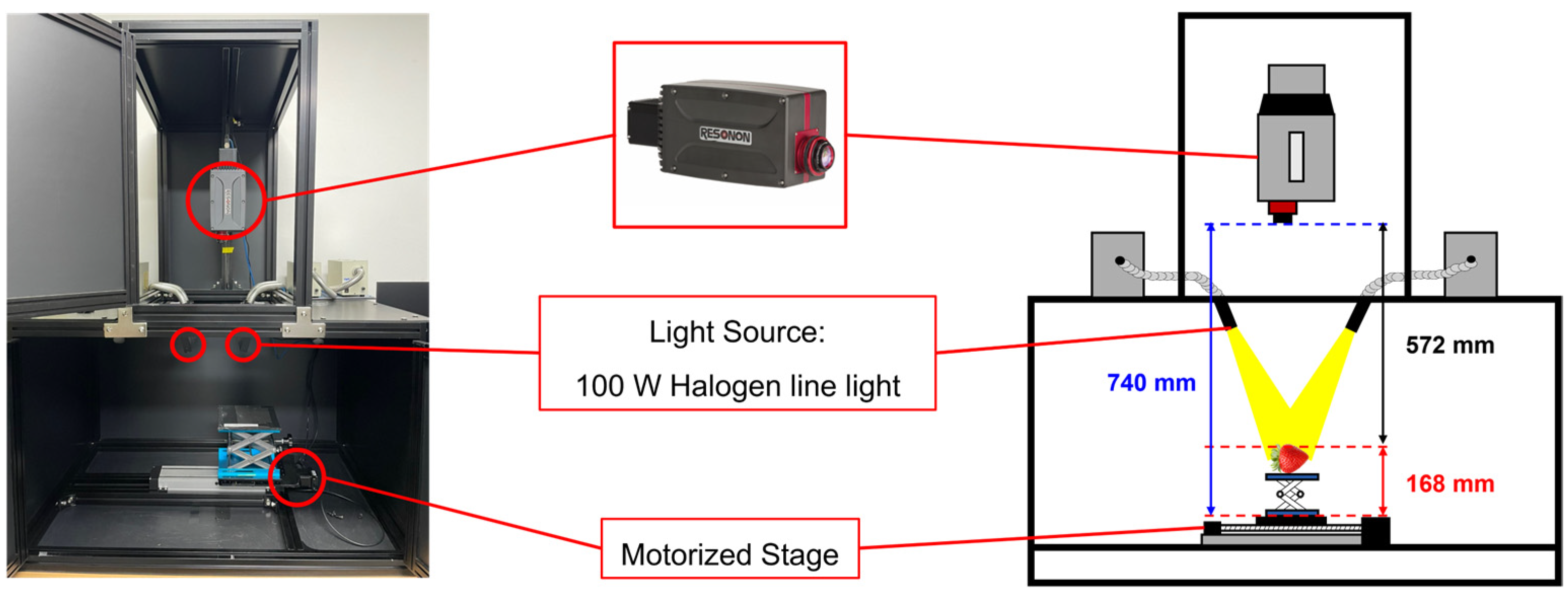
The HSI system consisted of an HSI camera (Pika IR+, Resonon Inc., Bozeman, MT, USA) and a stepping motor (PK264–03A-P1, Oriental Motor, Tokyo, Japan), as shown in Figure 1. A pair of 100 W tungsten–halogen lamps was used as the illumination source. The system operated in the NIR wavelength range of 900–1700 nm. Further, 328 bands of a total of 336 spectral bands were retained after excluding noisy or saturated wavelengths. The spatial resolution of the imaging system was 640 pixels per line.

2.3. HSI Conditions and Parameters

Hyperspectral data were acquired by arranging the strawberry samples in a 4 × 4 grid on a single plate. Both the top and bottom surfaces of each sample were measured using a line-scan method. The distance between the hyperspectral camera and the samples was set at 572 mm, measured from the top point of the samples placed on the motorized stage. The key imaging parameters are listed in Table 1.

2.4. Measurement of SSC

To analyze the regional SSC characteristics of strawberries, 15 Seolhyang samples with minimal size variation were selected. After the calyx was removed from each strawberry, the flesh was sectioned using circular templates based on predefined regions, and SSC was measured separately for each region.
To develop SSC prediction models, hyperspectral images were first acquired, followed by SSC measurements. Each whole strawberry was juiced, and the resulting liquid was analyzed using a digital refractometer (PAL-3, Atago Co., Tokyo, Japan). SSC values were expressed in °Brix.

2.5. HSI Data Preparation and Preprocessing

2.5.1. HSI Spectrum Correction and Extraction

The acquired HSI data were spectrally corrected using white and dark references to remove instrument noise and compensate for the nonuniform intensity of line illumination. The white reference was obtained using white Teflon with 99.9% reflectance (Labsphere, North Sutton, NH, USA). For the dark reference, data were collected by covering the hyperspectral camera lens to eliminate light exposure. The corrected reflectance spectra were calculated using Equation (1) [24].
I λ = I s λ I d λ I w λ I d λ ,
where I λ represents the corrected relative hyperspectral image at wavelength λ ; I s λ is the sample hyperspectral image; I w λ is the white reference image; and I d λ is the dark reference image.
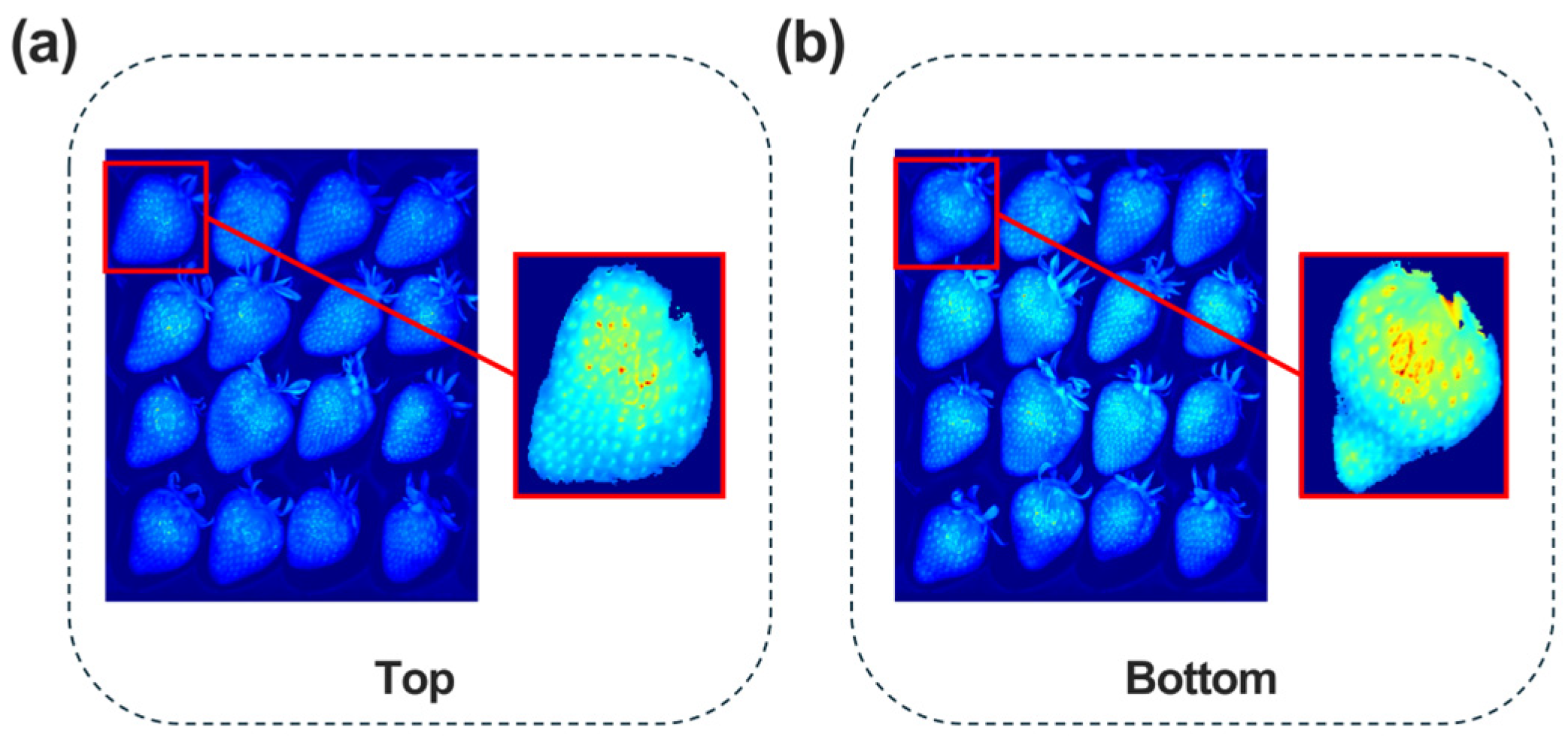
As shown in Figure 2, HSI data acquired from 13 plates were segmented to isolate each individual strawberry sample and extract their respective regions of interest (ROIs). After removing spectral noise, a total of 291 bands were used for analysis. A threshold value of 0.12 was applied to the 1052 nm band image to isolate the strawberry flesh and eliminate the calyx. A total of 416 individual ROI datasets were obtained by extracting data from both the top and bottom surfaces of the fruit.

2.5.2. Regional Segmentation

To analyze internal spatial variation, each extracted ROI was segmented into multiple regions.
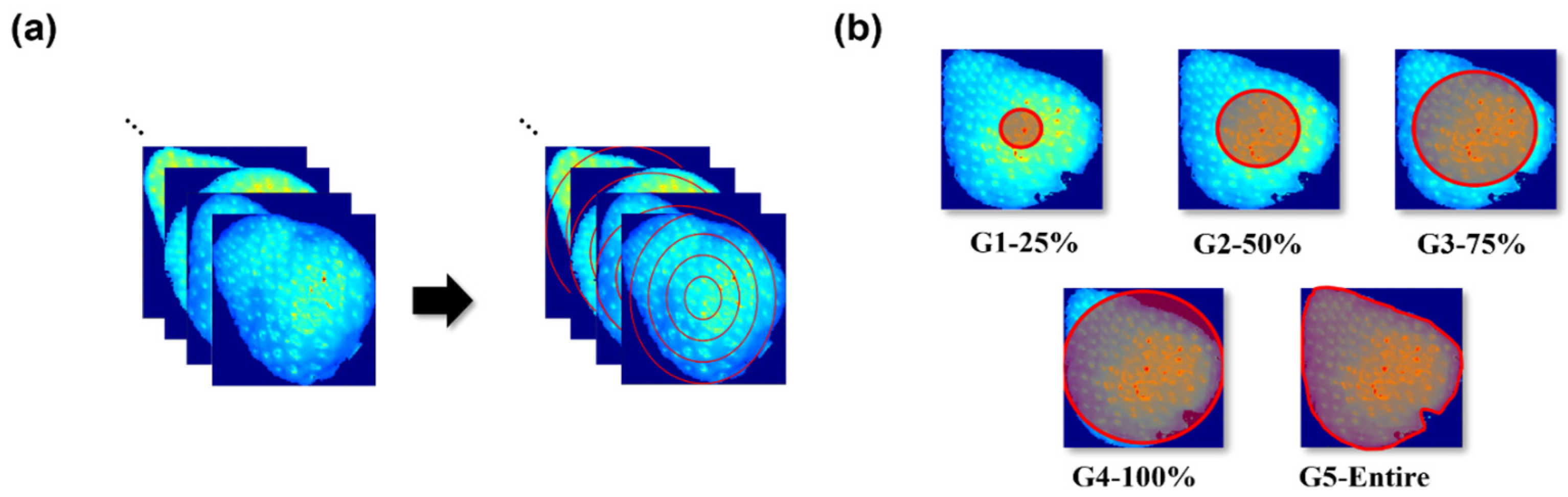
As shown in Figure 3a, each ROI was cropped to include only the area containing strawberry tissue, centered on the region with valid spectral information. Subsequently, circular analysis regions were generated based on the center of the cropped ROI, with five concentric circular regions defined by increasing the radius in steps. This approach enabled the consistent extraction of region-based data, accommodating geometric variation among samples.
As shown in Figure 3b, the five defined analysis groups (G1–G5) represent the areas with 25%, 50%, 75%, and 100% radii from the center, and the full strawberry area, respectively. The entire region group (G5) includes all pixels within the strawberry boundary, excluding the background. This multiscale segmentation enables detailed analysis of spectral variation across regions and assessment of how spatial features affect SSC prediction accuracy.

2.5.3. One-Dimensional Data Conversion and Augmentation

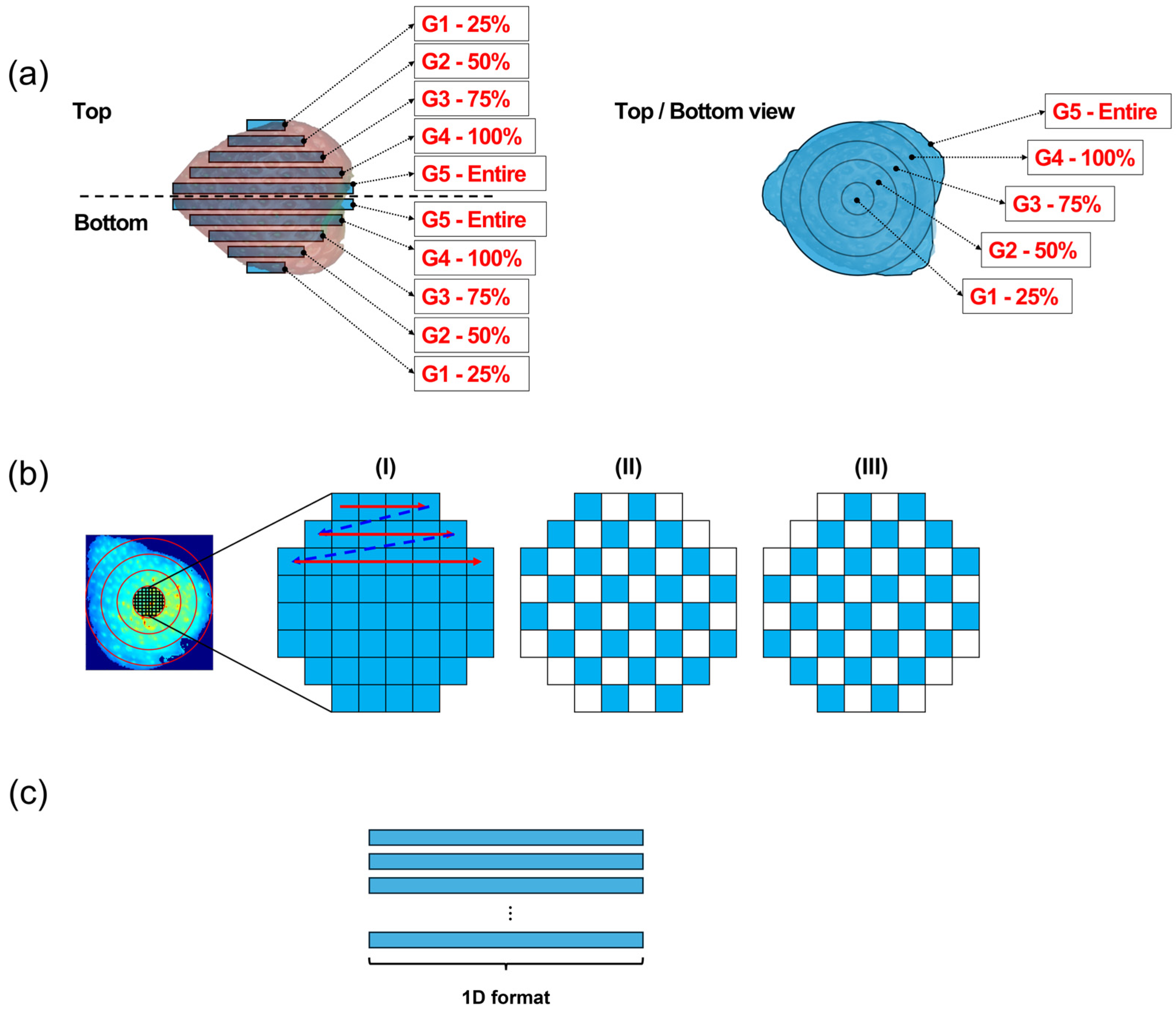
Following regional segmentation, spectral data from all pixels within each group were averaged to convert the data into a 1D spectral vector. Because SSC measurement provides only a single reference value per fruit, region-averaged 1D spectra were used as the primary inputs for model development, enabling subsequent application of the trained models to spatial SSC mapping. Each group was generated separately for each region and then converted into the 1D format. The conversion process is shown in Figure 4. Figure 4a shows the classification of the top and bottom surfaces of the strawberry samples into groups G1–G5. Figure 4b shows the process of pixel indexing within each region in three configurations: full pixel data (I), odd-indexed pixels (II), and even-indexed pixels (III). The pixel indexing follows a typical raster scan pattern, starting from the top-left corner and proceeding row by row. Based on this indexing scheme, independent datasets were created by separating odd- and even-indexed pixels. To mitigate potential data imbalance across SSC ranges, this indexing strategy was employed for dataset augmentation, helping the model to learn a more robust and representative distribution of spectral features.
Figure 4c shows the final step in which each of the independently constructed pixel groups is averaged to produce a single 1D spectral vector per group. Consequently, a total of 1248 1D spectral datasets were obtained for each group, derived from 208 samples (top and bottom surfaces) across three pixel sampling strategies. The number of data entries per group is listed in Table 2.

2.5.4. Spectral Preprocessing Techniques

Spectral preprocessing was applied to reduce noise and correct for light scattering in the hyperspectral data. In this study, three preprocessing techniques were used: mean normalization, standard normal variate (SNV), and the first derivative method [25]. The window size for the first derivative was set to 5, based on parameter optimization aimed at balancing noise reduction and signal preservation [26,27]. Mean normalization was used to minimize spectral variability across the dataset [28], while SNV was used to correct for scattering effects by scaling each spectrum to a standardized form relative to the dataset mean [29].

2.6. Development and Evaluation of SSC Prediction Models

2.6.1. Dataset Partitioning and Validation Strategy

Based on the preprocessed 1D spectral data and augmented datasets prepared in Section 2.5, predictive models were developed to estimate strawberry SSC. For the PLSR model, the entire dataset was partitioned into a calibration/cross-validation set and an independent prediction set in a 9:1 ratio, consisting of 1124 and 124 samples, respectively. To enhance generalization performance, 90% of the dataset was subjected to 20-fold cross-validation, while the remaining 10% was reserved as an independent prediction set. For the 1D CNN model, the entire dataset was partitioned into training, validation, and prediction sets in a 7:2:1 ratio, comprising 874, 250, and 124 samples, respectively. To prevent data leakage, the splitting process was performed at the individual sample level, ensuring that the prediction set remained entirely independent and did not overlap with the training data. This distribution was chosen to balance model robustness and evaluation accuracy. Importantly, an identical 10% subset of the data was reserved as the prediction set for both CNN and PLSR, allowing for a direct comparison of their predictive capabilities.

2.6.2. PLSR Model Development

Both partial least squares regression (PLSR), as a machine learning approach, and a 1D convolutional neural network (1D CNN), as a deep learning method, were applied to predict the SSC of strawberries.
PLSR constructs a latent variable linear regression model that maximizes the covariance between the latent variables by projecting both the independent variable X and the dependent variable Y into a new latent space. Owing to these characteristics, PLSR is widely utilized in HSI analysis for extracting and summarizing spectral information and addressing multicollinearity issues [30,31].
In this study, SSC prediction models were developed for five groups (G1–G5) using the average spectral data of strawberry samples as the independent variable X and the actual SSC values as the dependent variable Y.

2.6.3. One-Dimensional CNN Model Development

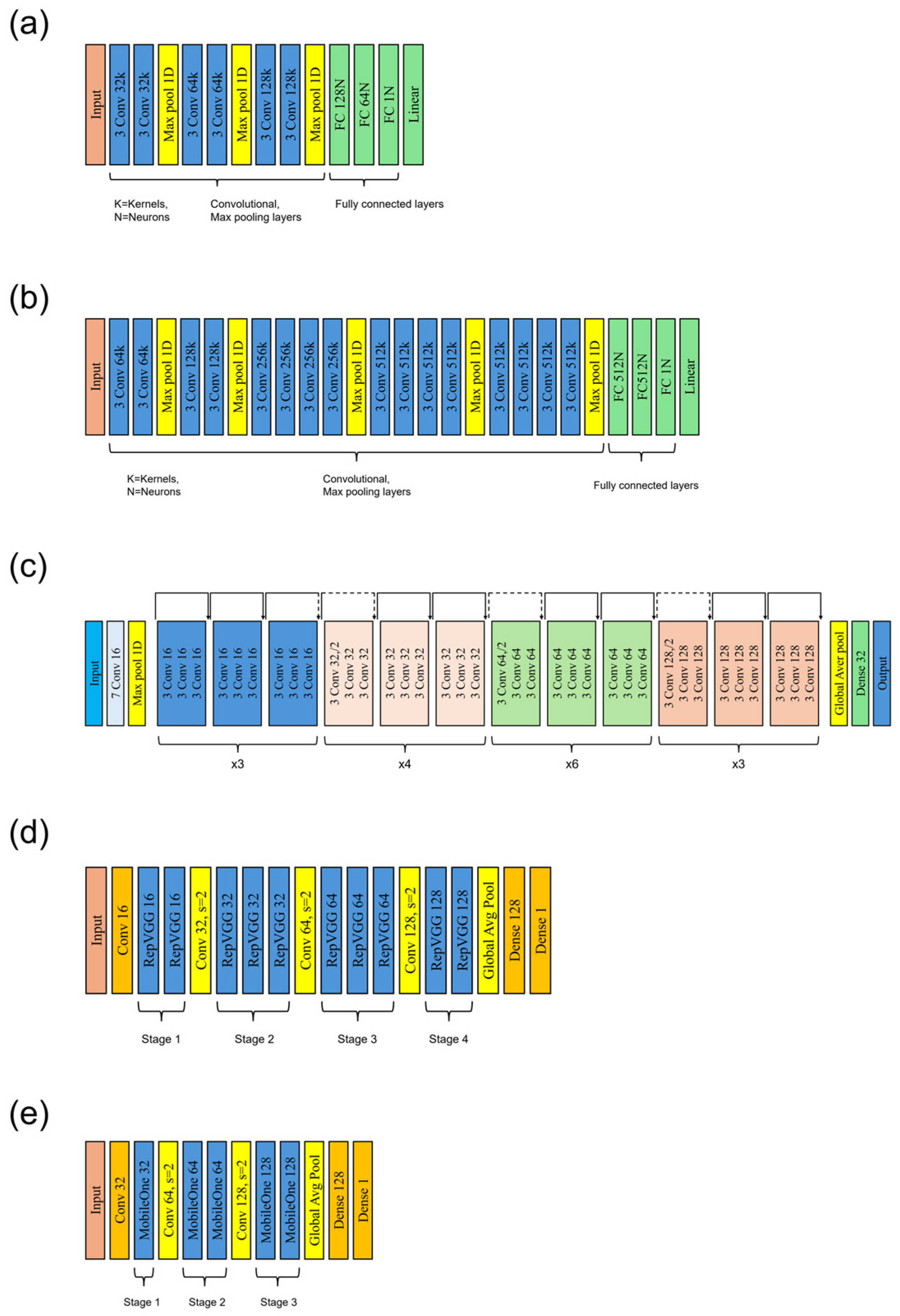
A 1D CNN was developed to enable deep learning-based SSC prediction. Five 1D CNN architectures were applied and compared in this study: VGGNet and ResNet, which have been widely used in previous research; recently developed models such as MobileOne and RepVGG; and a simplified VGG model derived from existing architectures.
VGGNet features a simple architecture with successively stacked convolution layers, while ResNet introduces residual blocks, enabling deeper network structures and increased complexity compared to VGGNet [32,33]. Specifically, VGG19 and ResNet34 were used in this study. MobileOne and RepVGG are CNN architectures optimized for fast inference by employing reparameterization techniques: MobileOne uses multiple branches during training, while RepVGG converts the model into a structure with fewer branches during inference [34,35].
Because hyperspectral data consist of continuous numerical values along the wavelength axis and exhibit specific absorption and reflection characteristics across different wavelength ranges [36], conventional two-dimensional CNN architectures were adapted to fit the 1D spectral structure. Considering these spectral characteristics, a simplified VGG model was constructed using a simple CNN architecture to effectively extract localized wavelength features and improve learning efficiency. The structures of the five 1D CNN models used in this study are shown in Figure 5.
Similarly to the PLSR model, SSC prediction models for each group (G1–G5) were developed using average spectral values as the independent variable X and actual SSC measurements as the dependent variable Y. ReLU was used as the default activation function across all models, while SiLU was adopted as the first activation function in each stage of the VGG19 architecture. The number of training epochs was set to 200, and the Adam optimizer was used for all model-training procedures.

2.6.4. Performance Evaluation of PLSR and 1D CNN Models

Model performance was evaluated for each of the five regionally segmented datasets using the optimal configuration for PLSR and 1D CNN models. The evaluation metrics included the coefficient of determination for calibration ( R c 2 ), which assesses the linear fit between measured and predicted SSC values, the coefficient of determination for validation ( R v 2 ), the coefficient of determination for prediction samples ( R p 2 ), and the root mean square errors for calibration (RMSEC), validation (RMSEV), and prediction (RMSEP). These metrics are defined by Equations (2)–(7).
R c 2 = 1 λ = 1 n y λ y λ ^ 2 λ = 1 n y λ y ¯ 2 ,
R v 2 = 1 λ = 1 n y λ y λ ^ 2 λ = 1 n y λ y ¯ 2 ,
R p 2 = 1 λ = 1 n y λ y λ ^ 2 λ = 1 n y λ y ¯ 2 ,
R M S E C = 1 n λ = 1 n y λ y λ ^ 2 ,
R M S E V = 1 n λ = 1 n y λ y λ ^ 2 ,
R M S E P = 1 n λ = 1 n y λ y λ ^ 2 ,
where y λ denotes the actual SSC value for the λ th sample, y λ ^ is the predicted value for that sample, y ¯ is the mean of the actual SSC values, and n is the total number of samples.
Additionally, partial least squares (PLS) images were generated using regression coefficients derived from the PLSR models. These images enabled visualization of SSC distribution across the entire fruit surface and facilitated the analysis of spatial trends in regional prediction accuracy. The equation for generating the PLS images is given in Equation (8) [37].
P L S   I m a g e = λ = 1 n I λ R λ + C ,
where I λ is the λ th spectral image, R λ is the corresponding regression coefficient from the PLSR model, and C is a model-specific constant.
Spectral extraction and hyperspectral image data analysis were conducted using MATLAB R2024b (MathWorks, Natick, MA, USA). Spectral preprocessing and PLSR model development were performed in Unscrambler ver. 9.7 (CAMO Software, Oslo, Norway). The development and evaluation of the 1D CNN models were carried out in Python ver. 3.8.8 using Visual Studio Code ver 1.106.3 (Microsoft, Redmond, WA, USA) with an NVIDIA GeForce RTX 3050 GPU.

2.7. Workflow of Research

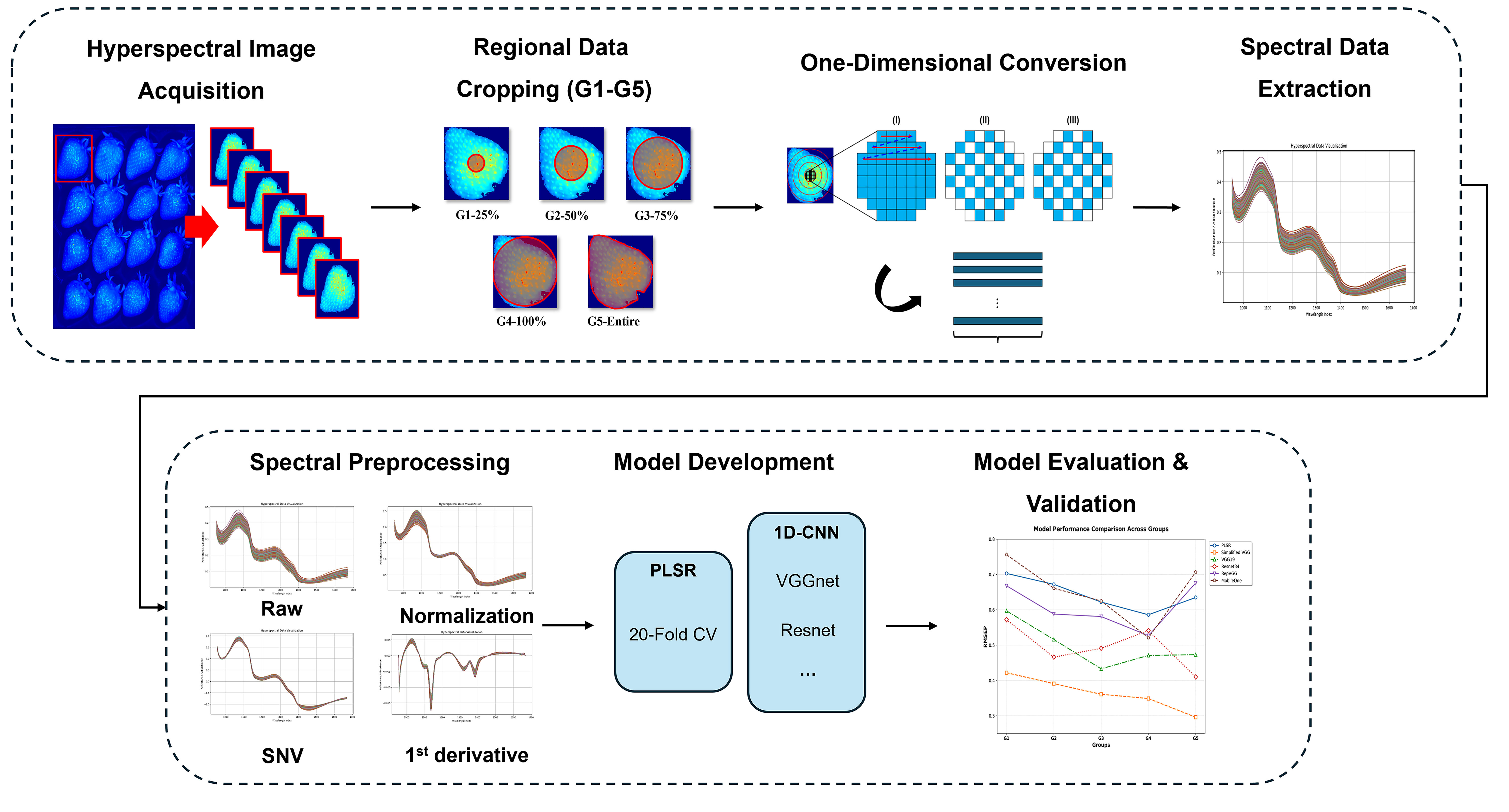
This study proposed region-based SSC prediction models using NIR HSI combined with machine learning and deep learning techniques. The complete research workflow is shown in Figure 6 and consists of the following steps: cropping of individual hyperspectral image data, region-specific segmentation (G1–G5), 1D data conversion, spectral data extraction, spectral preprocessing, model development, and model performance evaluation.

3. Results

3.1. Regional SSC Distribution Analysis

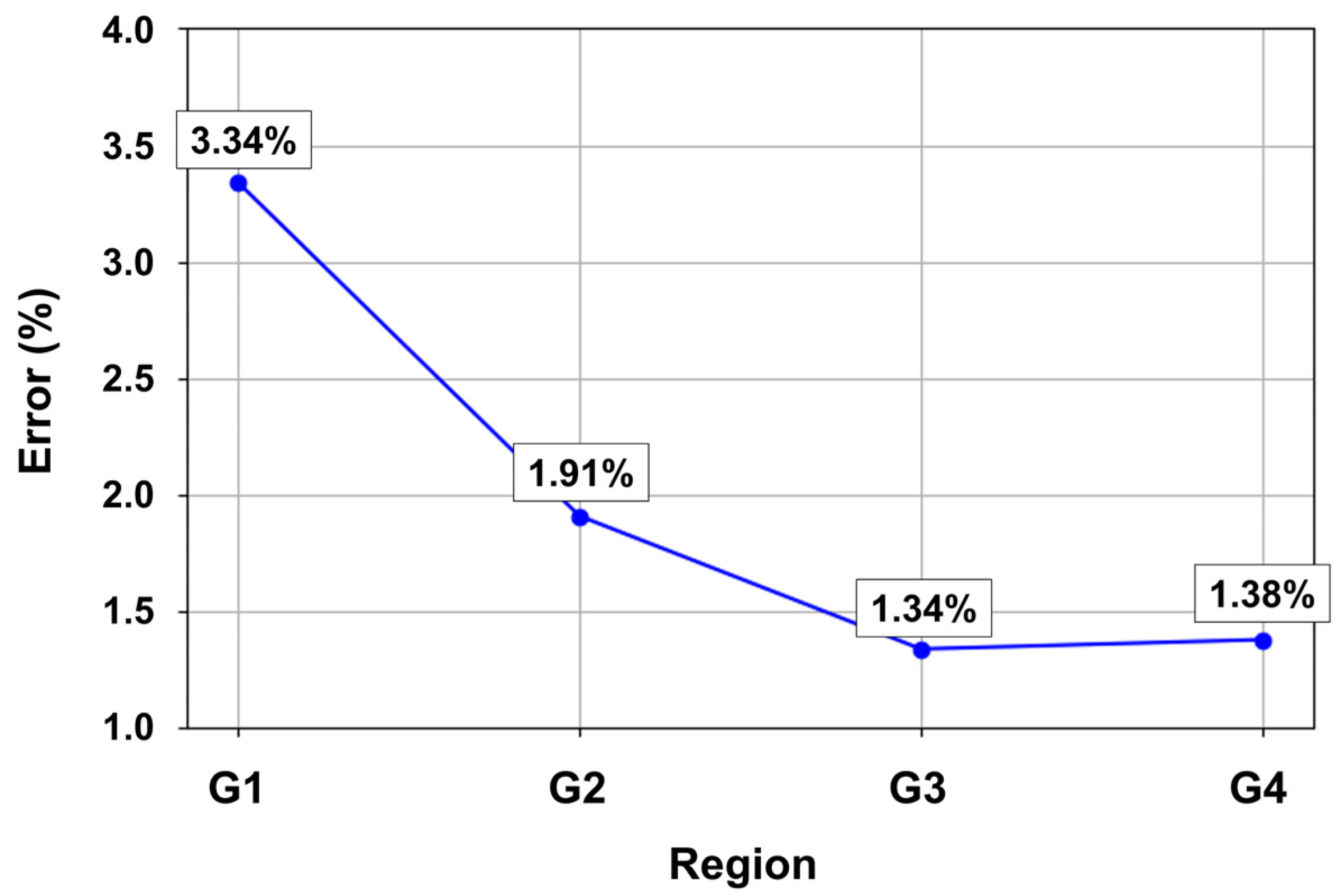
The regional distribution of SSC in strawberries was analyzed to assess variability across five defined regions. The analysis was performed on 15 representative samples selected from the total dataset to minimize variation in size and maturity. Figure 7 presents the error rates of SSC measurements for each region (G1–G4) relative to the entire flesh (G5), following actual SSC measurements.
The results indicate that G1 exhibited an error rate of 3.34% compared to G5, while G2, G3, and G4 showed lower error rates of 1.91%, 1.34%, and 1.38%, respectively. These findings suggest that SSC measurements from specific regions may serve as reliable indicators of the entire fruit’s sugar content. However, overly limited regions such as G1 may compromise estimation accuracy due to increased local variation.

3.2. SSC Distribution of Strawberry Samples

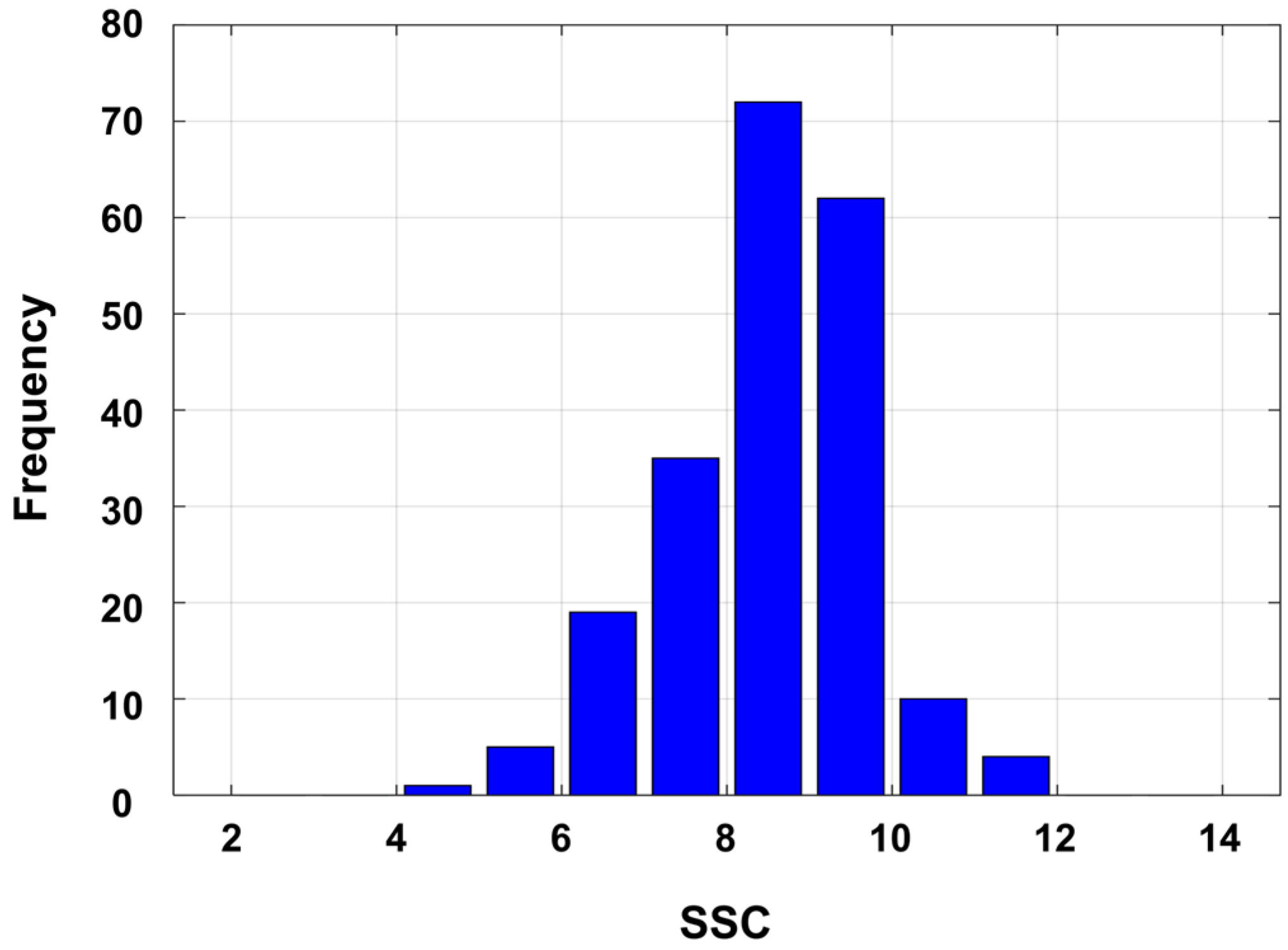
To support SSC prediction model development, the SSC of 208 Seolhyang cultivar strawberry samples was analyzed. The SSC values ranged from 4.8 to 11.9 °Brix. Figure 8 shows the frequency distribution of SSC values across different concentration intervals using bar graphs.
As presented in Table 3, most samples were concentrated within the 6–10 °Brix range, with a mean SSC value of 8.48 °Brix. This is consistent with or marginally higher than the average SSC for Seolhyang strawberries harvested in March (8.6 °Brix) and for fully ripe strawberries (10.13 °Brix) reported in previous studies. The difference may be attributed to variations in sample size [38,39].

3.3. Pixel-Based Group Characteristics and Estimated Diameter Calculation

Table 4 presents the average number of pixels and relative pixel ratios, and estimated diameters for each region group, based on the top and bottom surfaces of the fruit. When the full pixel count was set to 100%, groups G1–G4 accounted for 4.49%, 17.95%, 40.39%, and 71.71% of the total pixels, respectively.
The actual diameters of the circular regions were calculated using the distance from the hyperspectral camera to the strawberry surface (D = 572 mm), the horizontal field of view (θ = 22°), and pixel dimensions (640 horizontal, 680 vertical). Pixel-to-length conversion (mm/pixel) was applied, and the actual diameter was calculated using the circular area formula. The resulting diameters for G1–G4 were 9.76, 19.52, 29.28, and 39.00 mm, respectively. Group G5 was excluded from this calculation, as it includes noncircular and irregular boundary data.

3.4. Strawberry Spectral Characteristics

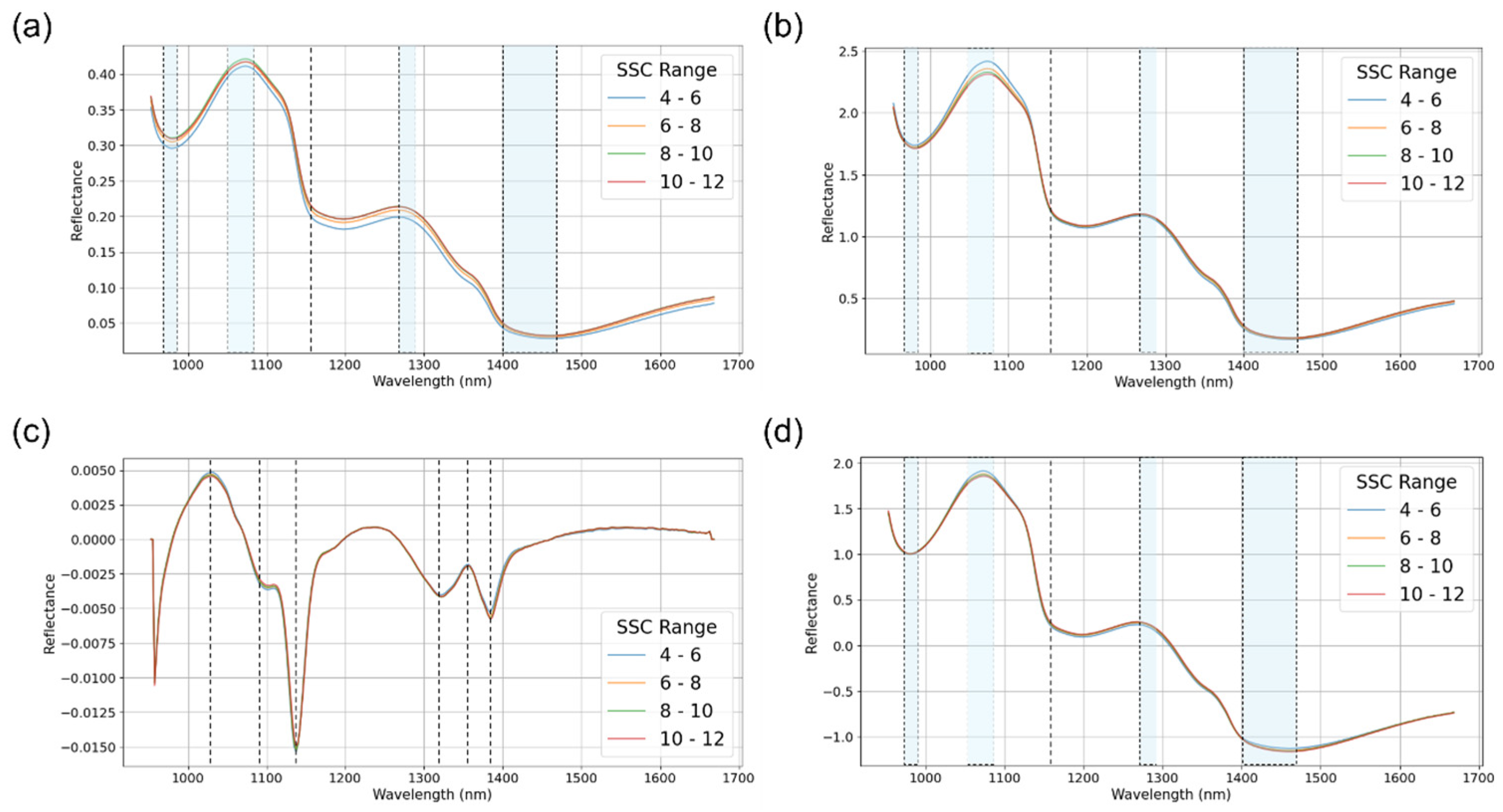
Figure 9 shows the average spectra extracted from 416 hyperspectral images, corresponding to the top and bottom surfaces of 208 strawberry samples. The spectral data span from 952 to 1669 nm in the NIR range and include raw data as well as three types of preprocessed data: mean normalization, first-order derivative, and SNV.
In first-order derivative-preprocessed spectra, peaks emerged at wavelengths corresponding to the maximum rate of reflectance change. When samples were categorized into four SSC groups, those with lower SSC levels generally exhibited lower reflectance. Notably, the 1050–1080 nm region showed distinct differences in reflectance between SSC groups, with higher SSC samples displaying increased intensity.
The spectral characteristics for each major wavelength region are determined by specific chemical bond overtones. The 960–980 nm region is associated with water-related absorption bands, primarily attributed to the second overtones of O–H and N–H bonds, as well as the third overtones of C–H bonds [7]. The 1050–1080 nm region is a particularly strong absorption band, associated with C–H and O–H bond vibrations originating from water, sucrose, and cellulose. Among these, sucrose is directly related to SSC, making this region critical for quality evaluation in fruits [40].
Additional notable peaks include the 1160 nm, which corresponds to carbohydrate [41], and the 1270–1290 nm region, representing the second overtone of C–H stretching associated with anthocyanins [41]. The 1338 nm band is attributed to C–H stretching bonds [38]. Finally, the 1400–1470 nm region represents a peak from water-related O-H stretching first overtones [42,43].

3.5. Spectral Characteristics of Regional Segmentation

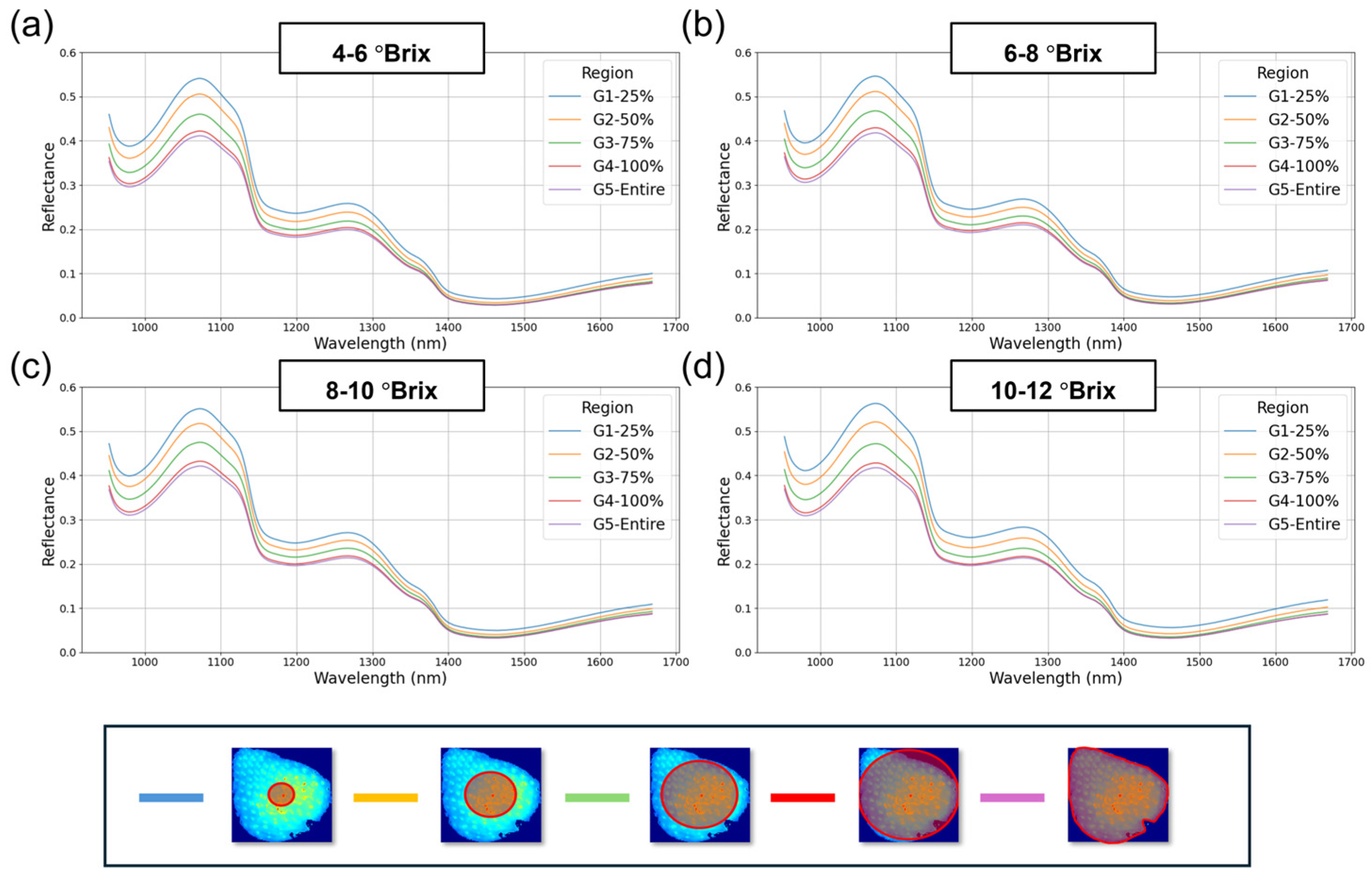
Figure 10 presents the average spectra of strawberry samples across four SSC ranges (4–6, 6–8, 8–10, 10–12 °Brix) and five regional groups (G1–G5). As the regional group expanded from G1 to G5, incorporating more peripheral pixels, the overall reflectance intensity exhibited a minor decrease.

3.6. Results of Model Development

3.6.1. Results of PLSR Model

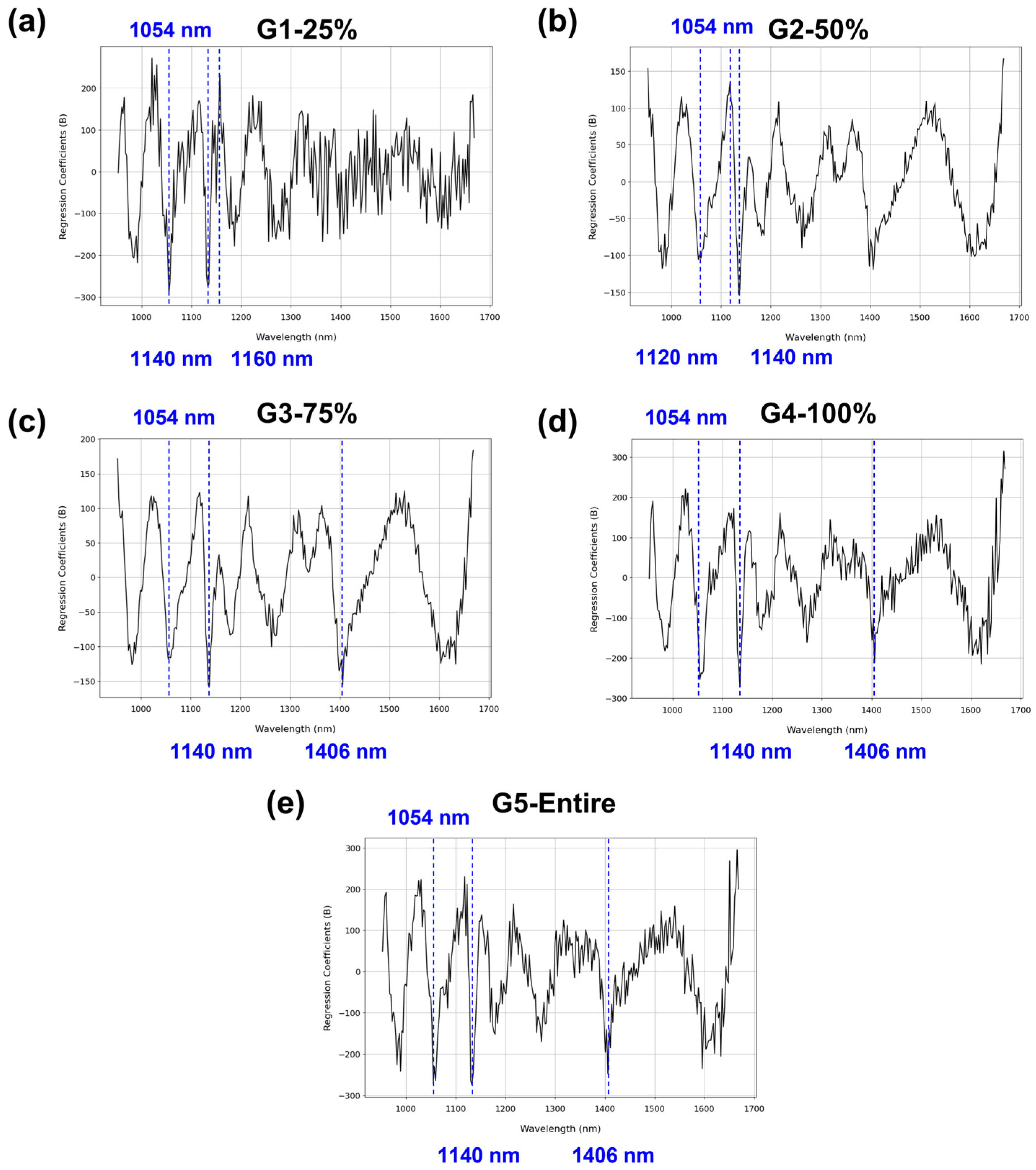
PLSR models were developed using data from each regional group (G1–G5) to predict the SSC of strawberry flesh. In this study, model performance was compared using raw spectral data and three preprocessing techniques: mean normalization, first-order derivative, and SNV. Positive or negative regression coefficients indicate the wavelength bands that have a significant influence on the PLSR model. Notably, several bands corresponding to these coefficients aligned with known absorption features related to SSC [44]. Regression coefficient peaks were observed in three key wavelength regions (approximately 1050, 1150, and 1400 nm) among the total of 291 spectral bands (Figure 11a–e). These regions are associated with carbohydrates and SSC. These regions are associated with carbohydrates and SSC.
Group G1 exhibited considerable noise because of insufficient data, while model stability improved from G2 onward. G3 exhibited a notably stable regression coefficient pattern. G4 and G5 exhibited increased regression coefficient values but also showed increased noise at both spectral ends. Although the major peaks related to sugar content, carbohydrates, and moisture were consistently present across all groups, G2 and G3 produced relatively stable curves. These results suggest that using the entire region (G5) does not necessarily yield the most accurate or stable prediction and that certain regions may be more optimal for SSC estimation.
This trend is attributed to the curvature of the strawberry surface, where height differences increase with distance from the center [45]. Despite these variations, the overall spectral patterns remained consistent across regional groups. Notably, the 900–1300 nm range showed pronounced intensity differences, indicating that these regional spectral features can be a key input variable for designing region-specific SSC prediction models.
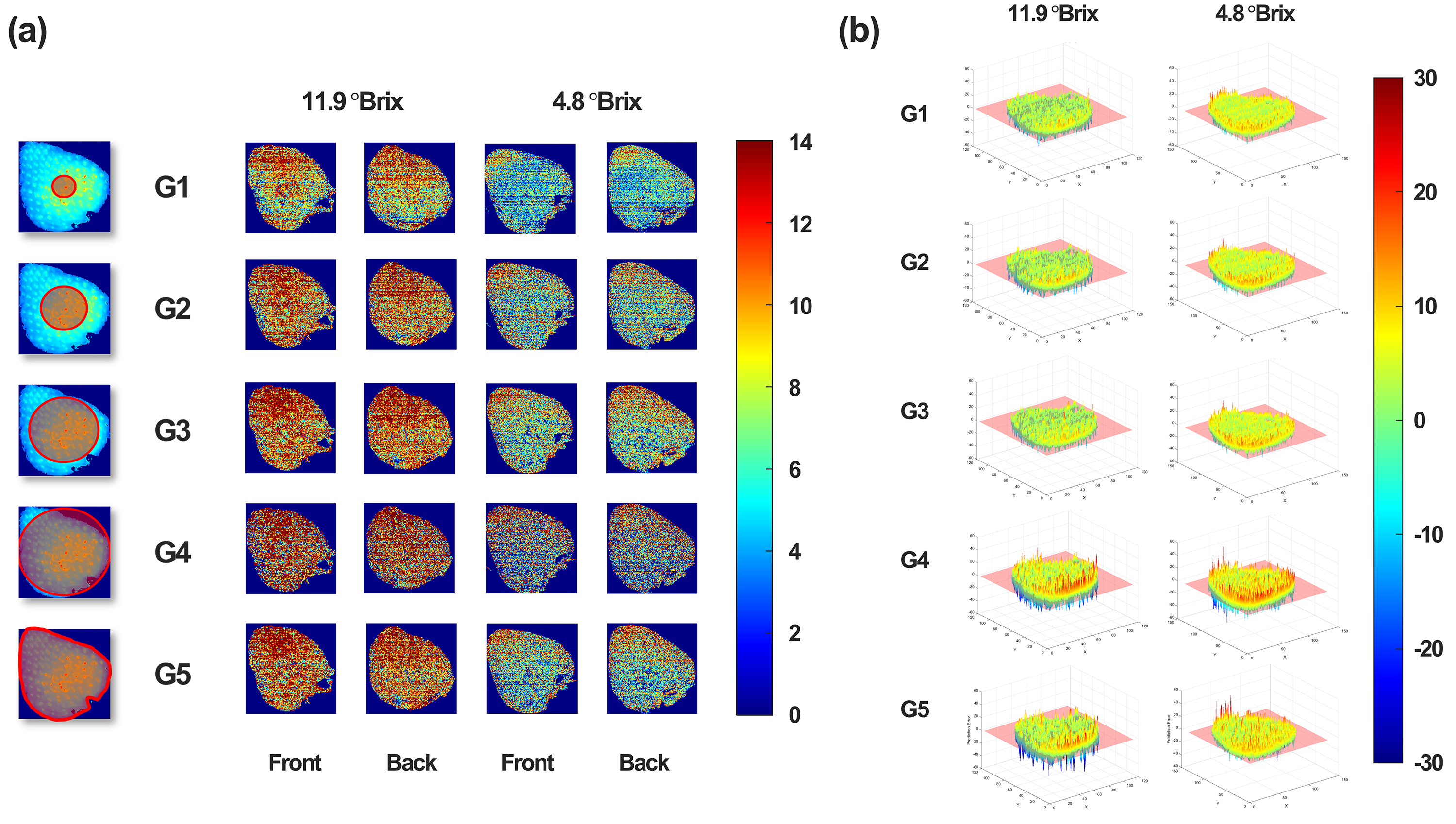
PLS images were generated using regression coefficients, as shown in Figure 12. In Figure 12a, PLS images with mean normalization applied are presented for both the top and bottom surfaces of the strawberries with the highest (11.9 °Brix) and lowest (4.8 °Brix) SSC values. In all cases, the PLS images predicted higher sugar concentrations in the peripheral regions, supporting prior findings that SSC tends to be higher at the apex than at the peduncle of the strawberry [8,46].
Figure 12b shows the error maps, visualizing the spatial distribution of prediction errors based on actual SSC values. The red XY plane denotes the actual SSC reference plane. Errors increased with distance from the strawberry’s center, likely owing to the curvature of the fruit surface, which affects light reflectance and absorption.
Table 5 presents the optimal PLSR models for each region, based on performance indicators. For G1, the best model was achieved using raw data, with an RMSEP of 0.646. For G2 and G3, the SNV preprocessing yielded the lowest RMSEPs of 0.635 and 0.590, respectively, demonstrating superior predictive performance. G4 showed the best performance with mean normalization, achieving an RMSEP of 0.602. For G5, the optimal model used the SNV, with an RMSEP of 0.657. As the region expanded from G1 to G3, RMSEP values showed a gradual decline from 0.646 to 0.590, indicating improved predictive performance. However, for the models utilizing broader spatial regions (G4 and G5), the RMSEP values increased to 0.602 and 0.657, respectively, indicating a degradation in predictive performance. These results demonstrate that targeted spectral regions, rather than the entire strawberry, can yield sufficiently accurate SSC predictions, and that larger datasets do not necessarily improve performance.

3.6.2. Results of 1D CNN Model

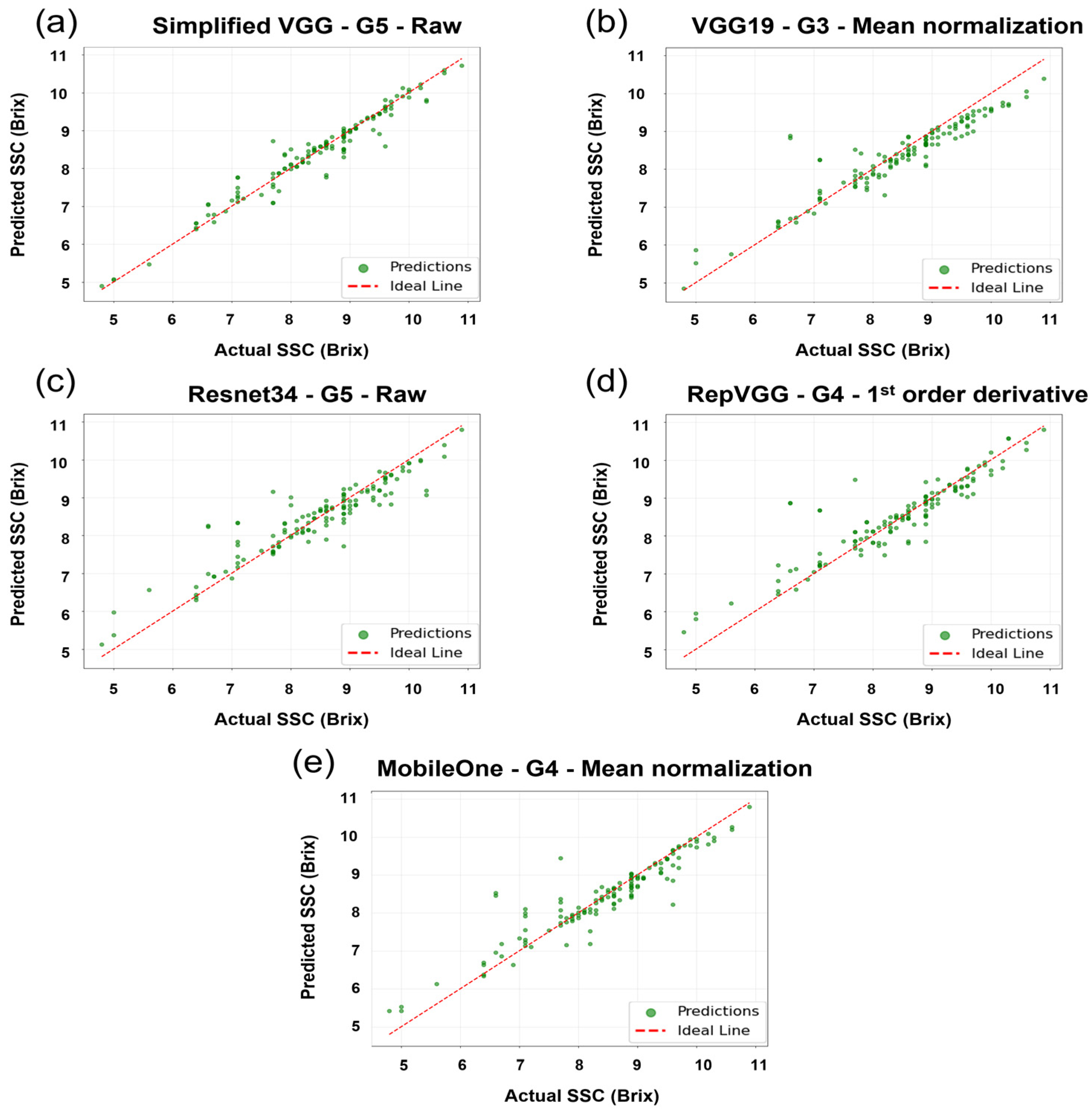
Figure 13 shows the regression results of the five developed 1D CNN models. The same training, testing, and prediction datasets were used for all models, and model performance was evaluated based on prediction error (RMSEP). RMSE is expressed in actual units (°Brix), providing intuitive interpretation and directly representing the difference between predicted and measured values. As such, it is a useful metric for assessing model performance [9,47].
In general, models trained on broader regions and featuring simpler architectures produced predictions that more closely aligned with the ideal reference line. Table 6 summarizes the training and prediction performance of the five 1D CNN models across region groups G1–G5. The simplified VGG model achieved the highest overall performance, with an RMSEP of 0.296 using G5 data. Its predictive accuracy across all region groups ranged from 0.296 to 0.442. Additionally, while SNV preprocessing yielded the best results for G1–G4, raw data performed optimally for G5.
For the VGG19 model, the best performance was achieved using G3 data, with an RMSEP of 0.433. Its performance across the five regions ranged from 0.433 to 0.597. Regarding preprocessing, mean normalization produced the best results in G1, G3, and G4; first-order derivative preprocessing was optimal for G2; and raw data was most effective for G5.
The ResNet34 model achieved its best performance with G5 data (RMSEP = 0.410), and its regional performance ranged from 0.410 to 0.572. SNV preprocessing was optimal for G1 and G2, mean normalization for G3, and raw data for G4 and G5. For comparison, a previous study using a 1D ResNet model on a relatively small dataset reported an RMSEP of 0.971 [10].
For the RepVGG model, the highest performance was observed in G4 (RMSEP = 0.527), with the overall performance range spanning from 0.527 to 0.668. The best preprocessing methods were mean normalization for G1, SNV for G2 and G5, and first-order derivative for G3 and G4. The MobileOne model showed the highest accuracy in G4 (RMSEP = 0.448), with a performance range of 0.448 to 0.786. Notably, mean normalization preprocessing consistently yielded the best results across all regions for this model. G5 consistently yielded the best performance in the simplified VGG and ResNet34 models, while G3 was most effective for VGG19. For RepVGG and MobileOne, G4 provided the highest accuracy. These findings suggest that spectral feature extraction is influenced by region-specific characteristics.
Furthermore, the results highlight the superior performance of the simplified VGG model, which had the highest accuracy across all groups despite its lightweight architecture. The consistency of this result suggests that simpler CNN structures may be more effective for processing 1D spectral data than more complex architectures [48]. In the regionally trained simplified VGG models, SNV preprocessing contributed significantly to performance enhancement. This finding aligns with earlier studies that demonstrated the effectiveness of SNV preprocessing in nondestructive, spectrum-based SSC prediction [8,49].
To quantitatively evaluate the lightweight characteristics of the developed models, the number of trainable parameters was compared as a metric of model complexity (Table 6). Although the simplified VGG model and advanced architectures like RepVGG and MobileOne had comparable parameter counts, the simplified VGG exhibited superior predictive accuracy and stability. This indicates that for 1D spectral data—which have lower dimensionality compared to 2D images—a plain, sequential architecture is more effective than complex structural re-parameterization [50]. Furthermore, the architecture simplicity of the 1D-CNN can reduce memory-access overhead and improve computational efficiency during the inference phase, making it the most suitable architecture for high-speed, real-time strawberry sorting systems [51,52].

3.6.3. Performance Evaluation of the Developed Models

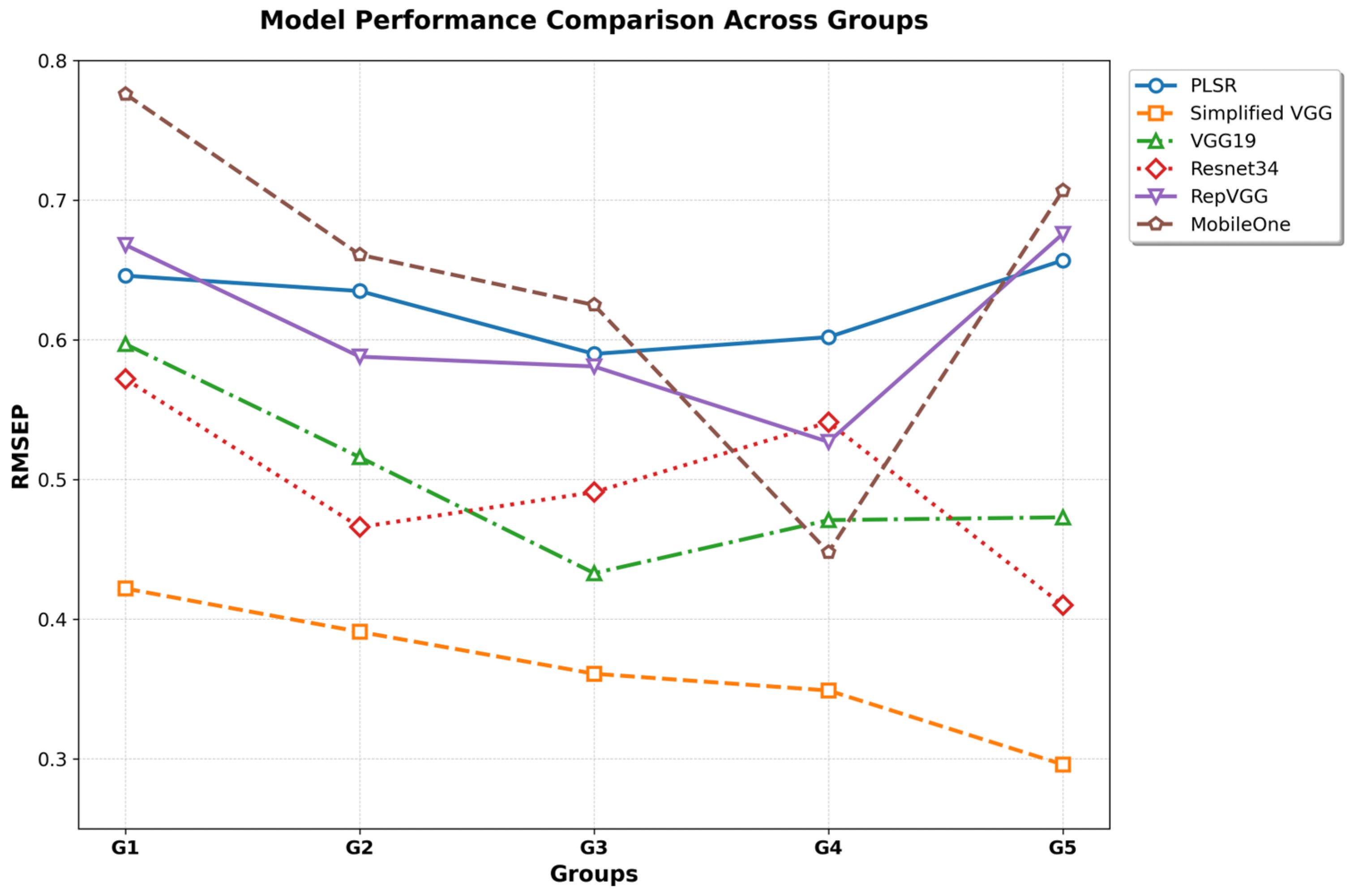
Figure 14 compares the RMSEP values, representing prediction errors, for each region (G1–G5), based on the best-performing models from both PLSR and the five 1D CNN models. Overall, both PLSR and 1D CNN models exhibited a general trend of decreasing RMSEP as the spectral region expanded, indicating that the use of broader spectral information improves prediction accuracy.
However, all models showed relatively high RMSEP in G1, which is attributed to limited training data owing to spatial constraints. Although model performance generally improved with region size, G5 produced mixed results depending on the model. In the PLSR model, performance improved steadily from G1 to G3, reaching an RMSEP of 0.590, but declined to 0.657 in G5, which may be attributed to increased surface-induced noise affecting prediction accuracy.
The simplified VGG model demonstrated consistent improvement as the region expanded, achieving the best overall performance with an RMSEP of 0.296 in G5. This suggests that its simple architecture facilitated stable feature extraction and reduced overfitting. The ResNet34 model exhibited the most irregular performance trend, with its best result (RMSEP = 0.410) also achieved in G5.
The RepVGG and MobileOne models showed similar patterns; both achieved their highest accuracy in G4 (RMSEP = 0.527 and 0.448, respectively) but experienced substantial degradation in G5 (RMSEP = 0.707 and 0.676, respectively). While structural reparameterization techniques in both models were effective in G1–G4, the learned features may not have generalized well in G5 because of increased complexity or overfitting.
G1 and G2 exhibited relatively low model performance due to limitations in spatial information; however, they demonstrated potential for utilization when considering spectral stability and practical measurement requirements. G3 and G4 provided spectrally stable regions and were optimized for most models. Notably, G4 emerged as the best region for the PLSR, RepVGG, and MobileOne models, even if its absolute performance values were not the highest. In G5, the simplified VGG and ResNet34 models maintained strong performance, suggesting that these architectures are particularly suited for modeling broader and more complex spectral inputs.

3.6.4. Region-Based Model Applicability Evaluation

In South Korea, the industrial standard for nondestructive strawberry SSC sorting systems specifies a prediction error threshold of a standard error of prediction 0.7 [53]. For this study, a more conservative threshold of RMSEP 0.6 was adopted to evaluate practical applicability.
Most of the models developed in this study satisfied this threshold. Notably, the simplified VGG model achieved strong performance across all regions, with RMSEP values below 0.6 from G1 to G5. Although G5-based models showed the highest prediction accuracy, G2 (RMSEP = 0.391) and G3 (RMSEP = 0.361) emerged as a practical alternative from an efficiency perspective, especially for applications involving partial region scanning. This finding is particularly relevant when considering the average size of Seolhyang strawberries, which typically range from 40 to 50 mm in length. The G2 and G3 regions, which are circular areas with a diameter of approximately 20–35 mm, provided sufficient spatial coverage for accurate SSC prediction (Table 7).
Moreover, when error rates were calculated for regional SSC relative to the whole fruit, G2 and G3 demonstrated remarkably low deviation at just 1.91% and 1.34%, significantly below the 2% threshold, indicating exceptional regional representation accuracy. This indicates that G2 represents the minimum viable diameter with minimal variation in SSC prediction, making it a strong candidate for application in real-time, nondestructive sorting systems and portable SSC measurement devices.

4. Discussion

Despite the promising outcomes, several limitations remain. First, the study was conducted using a single strawberry cultivar (Seolhyang) harvested under specific seasonal and regional conditions. Strawberry fruit quality is influenced by both genetic and environmental factors. Large-scale genetic studies have demonstrated substantial SSC variation across cultivars, with some varieties exhibiting significantly different sugar accumulation patterns due to differences in sucrose transporters and metabolic pathways [54]. Furthermore, environmental conditions such as temperature and harvest season can significantly affect fruit SSC and other quality attributes [55,56], with winter and spring harvest conditions can result in marked differences in soluble solids content due to variations in temperature and solar radiation.
Additional validation across diverse cultivars, maturity stages, and growing environments is required to confirm the generalizability of the proposed framework. However, the core value of this study lies not in the specific trained model optimized for a single cultivar, but rather in the methodological validity of the region-based framework that systematically segments spatial variability and identifies data-optimal regions. This framework can serve as a standardized guideline for recalibrating predictive models to accommodate the unique characteristics of different cultivars or various cultivation environments. Second, the experiments were performed under controlled laboratory settings; future work should evaluate system robustness under variable illumination and environmental conditions representative of industrial sorting lines and in-field applications. In particular, the random orientation of strawberries during high-speed transport on actual sorting lines may compromise data consistency. Furthermore, factors such as surface moisture, bruising, and calyx residues could introduce significant noise into the spectral data. The data acquisition and processing times reported in this study must also be further optimized to meet the high throughput requirements demanded by industrial workflows. Third, while the lightweight CNN improved computational efficiency, further optimization at the hardware level (e.g., GPU acceleration or embedded system integration) is necessary for full deployment in portable devices. Aligning the current data processing speed with the high throughput requirements of industrial sorting lines is a critical step in transitioning laboratory models to field applications. Enhancing this real-time processing capability will significantly improve the agricultural practicality and on-site feasibility of the proposed system.
Accordingly, future research will focus on extending this region-based framework to other fruit species and advancing it into a multi-parameter quality assessment system (e.g., TA, firmness) to better reflect consumer perceptions. Efforts will also be directed toward ensuring system robustness against sample orientation and surface noise (moisture, bruising) on industrial lines. Furthermore, hardware-level optimization will be pursued to meet industrial throughput requirements, transforming the proposed methodology into a practical, on-site solution for the fresh produce supply chain.

5. Conclusions

This study developed a region-based hyperspectral imaging framework combined with lightweight deep learning models for nondestructive SSC prediction in strawberries. The PLSR model showed a general trend of improved prediction accuracy and reduced prediction error. G3 yielded the best performance, while partial regions also provided representative SSC information.
Among the deep learning models, the simplified VGG architecture consistently achieved superior performance across all spectral regions. For G1–G4, the application of SNV preprocessing led to optimal performance. When using datasets from all five groups (G1–G5), the RMSEP values remained below 0.5, confirming the feasibility for nondestructive quality prediction. Localized regional data at the G2–G3 level (50–75% of fruit area) achieved sufficient accuracy to represent overall SSC, highlighting advantages for sensor miniaturization and real-time measurement.
These results provide valuable insights into the design of practical sensing systems for quality control in strawberries and can be extended to other fresh produce. By enabling nondestructive and efficient SSC prediction, the proposed method can support improved postharvest handling, more reliable quality grading, and enhanced consumer satisfaction.
Overall, the region-based spectral analysis framework established in this study provides a robust foundation for designing cost-effective and lightweight sensors through data optimization. This approach holds significant implications as it reduces implementation costs and promotes the broader adoption of nondestructive quality assessment technologies, including small- and medium-sized farms and packing facilities. However, the present study is limited to a single strawberry cultivar. Additional validation is required to ensure generalizability across diverse cultivars, maturity stages, and storage conditions. Future research will focus on extending model applicability across various growth conditions and varieties, while also integrating 3D correction algorithms to address the effects of surface curvature and sample geometry.


Author Contributions

S.-W.C.: Conceptualization, Data Curation, Investigation, Methodology, Writing—Original Draft. H.-G.L.: Conceptualization, Data Curation, Investigation. J.-E.L.: Conceptualization, Data Curation, Investigation. W.-H.Y.: Data Curation, Investigation. I.G.H.: Conceptualization, Resources. C.M.: Conceptualization, Funding Acquisition, Methodology, Project Administration, Writing—Review and Editing. All authors have read and agreed to the published version of the manuscript.

Funding

This research was funded by the Korea Institute of Planning and Evaluation for Technology in Food, Agriculture, Forestry and Fisheries, project number 3220525-5, and the Innovative Human Resource Development for Local Intellectualization program through the Institute of Information & Communications Technology Planning & Evaluation (IITP) grant funded by the Korean government (MSIT), grant number IITP-2026-RS-2023-00260267.

Institutional Review Board Statement

Not applicable.

Data Availability Statement

The datasets presented in this article are not readily available because the data are part of an ongoing study. Requests to access the datasets should be directed to corresponding author.

Conflicts of Interest

Author In Geun Hwang was employed by the company Frusen Co., Ltd. The remaining authors declare that the research was conducted in the absence of any commercial or financial relationships that could be construed as a potential conflict of interest.

Abbreviations

The following abbreviations are used in this manuscript:
SSCSoluble solid content
HSIHyperspectral imaging
PLSRPartial least squares regression
RMSEPRoot mean square error of prediction
SVMSupport vector machine
RMSERoot mean square error
ROIsRegions of interest
SNVStandard normal variate
PLSPartial least squares

References

  1. Giampieri, F.; Forbes-Hernandez, T.Y.; Gasparrini, M.; Alvarez-Suarez, J.M.; Afrin, S.; Bompadre, S.; Quiles, J.L.; Mezzetti, B.; Battino, M. Strawberry as a health promoter: An evidence based review. Food Funct. 2015, 6, 1386–1398. [Google Scholar] [CrossRef]
  2. Dung, C.D.; Trueman, S.J.; Wallace, H.M.; Farrar, M.B.; Gama, T.; Tahmasbian, I.; Bai, S.H. Hyperspectral imaging for estimating leaf, flower, and fruit macronutrient concentrations and predicting strawberry yields. Environ. Sci. Pollut. Res. 2023, 30, 114166–114182. [Google Scholar] [CrossRef]
  3. Weng, S.; Yu, S.; Guo, B.; Tang, P.; Liang, D. Non-destructive detection of strawberry quality using multi-features of hyperspectral imaging and multivariate methods. Sensors 2020, 20, 3074. [Google Scholar] [CrossRef]
  4. Amodio, M.L.; Ceglie, F.; Chaudhry, M.M.A.; Piazzolla, F.; Colelli, G. Potential of NIR spectroscopy for predicting internal quality and discriminating among strawberry fruits from different production systems. Postharvest Biol. Technol. 2017, 125, 112–121. [Google Scholar] [CrossRef]
  5. Zhang, P.; Ji, H.; Wang, H.; Liu, Y.; Zhang, X.; Ren, C. Quantitative evaluation of impact damage to apples using NIR hyperspectral imaging. Int. J. Food Prop. 2021, 24, 457–470. [Google Scholar] [CrossRef]
  6. Liu, Y.; Zhou, S.; Wu, H.; Han, W.; Li, C.; Chen, H. Joint optimization of autoencoder and Self-Supervised Classifier: Anomaly detection of strawberries using hyperspectral imaging. Comput. Electron. Agric. 2022, 198, 107007. [Google Scholar] [CrossRef]
  7. Amoriello, T.; Ciorba, R.; Ruggiero, G.; Amoriello, M.; Ciccoritti, R. A performance evaluation of two hyperspectral imaging systems for the prediction of strawberries’ pomological traits. Sensors 2023, 24, 174. [Google Scholar] [CrossRef]
  8. Seki, H.; Ma, T.; Murakami, H.; Tsuchikawa, S.; Inagaki, T. Visualization of sugar content distribution of white strawberry by near-infrared hyperspectral imaging. Foods 2023, 12, 931. [Google Scholar] [CrossRef]
  9. Qi, H.; Li, H.; Chen, L.; Chen, F.; Luo, J.; Zhang, C. Hyperspectral imaging using a convolutional neural network with transformer for the soluble solid content and pH prediction of cherry tomatoes. Foods 2024, 13, 251. [Google Scholar] [CrossRef]
  10. Su, Z.; Zhang, C.; Yan, T.; Zhu, J.; Zeng, Y.; Lu, X.; Gao, P.; Feng, L.; He, L.; Fan, L. Application of hyperspectral imaging for maturity and soluble solids content determination of strawberry with deep learning approaches. Front. Plant Sci. 2021, 12, 736334. [Google Scholar] [CrossRef] [PubMed]
  11. Ali, F.; Razzaq, A.; Tariq, W.; Hameed, A.; Rehman, A.; Razzaq, K.; Sarfraz, S.; Rajput, N.A.; Zaki, H.E.; Shahid, M.S. Spectral Intelligence: AI-Driven Hyperspectral Imaging for Agricultural and Ecosystem Applications. Agronomy 2024, 14, 2260. [Google Scholar] [CrossRef]
  12. Elsayed, S.; Gala, H.; Abd El-baki, M.S.; Maher, M.; Elbeltagi, A.; Salem, A.; Elwakeel, A.E.; Elsherbiny, O.; Abd El-Fattah, N.G. Hyperspectral technology and machine learning models to estimate the fruit quality parameters of mango and strawberry crops. PLoS ONE 2025, 20, e0313397. [Google Scholar] [CrossRef]
  13. Fatchurrahman, D.; Nosrati, M.; Amodio, M.L.; Chaudhry, M.M.A.; de Chiara, M.L.V.; Mastrandrea, L.; Colelli, G. Comparison performance of visible-nir and near-infrared hyperspectral imaging for prediction of nutritional quality of goji berry (Lycium barbarum L.). Foods 2021, 10, 1676. [Google Scholar] [CrossRef]
  14. Fan, L.; Yu, J.; Zhang, P.; Xie, M. Prediction of Strawberry Quality during Maturity Based on Hyperspectral Technology. Agronomy 2024, 14, 1450. [Google Scholar] [CrossRef]
  15. Shao, Y.; Ji, S.; Xuan, G.; Wang, K.; Xu, L.; Shao, J. Soluble solids content monitoring and shelf life analysis of winter jujube at different maturity stages by Vis-NIR hyperspectral imaging. Postharvest Biol. Technol. 2024, 210, 112773. [Google Scholar] [CrossRef]
  16. Lee, J.-E.; Kim, M.-J.; Lee, B.-Y.; Hwan, L.J.; Yang, H.-E.; Kim, M.S.; Hwang, I.G.; Jeong, C.S.; Mo, C. Evaluating ripeness in post-harvest stored kiwifruit using VIS-NIR hyperspectral imaging. Postharvest Biol. Technol. 2025, 225, 113496. [Google Scholar] [CrossRef]
  17. Lee, S.-D.; Gil, C.-S.; Lee, J.-H.; Jeong, H.-B.; Kim, J.-H.; Jang, Y.-A.; Kim, D.-Y.; Lee, W.-M.; Moon, J.-H. Internal quality prediction technology for ‘Sulhyang’strawberry fruit using organic analysis and hyperspectral imaging. Spectrochim. Acta Part A Mol. Biomol. Spectrosc. 2024, 323, 124912. [Google Scholar] [CrossRef]
  18. Cao, F.; Guan, C.; Dai, H.; Li, X.; Zhang, Z. Soluble solids content is positively correlated with phosphorus content in ripening strawberry fruits. Sci. Hortic. 2015, 195, 183–187. [Google Scholar] [CrossRef]
  19. Jia, H.; Wang, Y.; Sun, M.; Li, B.; Han, Y.; Zhao, Y.; Li, X.; Ding, N.; Li, C.; Ji, W. Sucrose functions as a signal involved in the regulation of strawberry fruit development and ripening. New Phytol. 2013, 198, 453–465. [Google Scholar] [CrossRef]
  20. Fait, A.; Hanhineva, K.; Beleggia, R.; Dai, N.; Rogachev, I.; Nikiforova, V.J.; Fernie, A.R.; Aharoni, A. Reconfiguration of the achene and receptacle metabolic networks during strawberry fruit development. Plant Physiol. 2008, 148, 730–750. [Google Scholar] [CrossRef]
  21. Aharoni, A.; Keizer, L.C.; Van Den Broeck, H.C.; Blanco-Portales, R.; Munoz-Blanco, J.; Bois, G.; Smit, P.; De Vos, R.C.; O’Connell, A.P. Novel insight into vascular, stress, and auxin-dependent and-independent gene expression programs in strawberry, a non-climacteric fruit. Plant Physiol. 2002, 129, 1019–1031. [Google Scholar] [CrossRef]
  22. Guo, Z.; Zhai, L.; Zou, Y.; Sun, C.; Jayan, H.; El-Seedi, H.R.; Jiang, S.; Cai, J.; Zou, X. Comparative study of Vis/NIR reflectance and transmittance method for on-line detection of strawberry SSC. Comput. Electron. Agric. 2024, 218, 108744. [Google Scholar] [CrossRef]
  23. Jun, H.; Jung, H.; Imai, K. Gas exchange characteristics of a leading cultivar of Korean strawberry (Fragaria × ananassa, ‘Sulhyang’). Sci. Hortic. 2017, 221, 10–15. [Google Scholar] [CrossRef]
  24. Kim, M.S.; Chen, Y.; Mehl, P. Hyperspectral reflectance and fluorescence imaging system for food quality and safety. Trans. ASAE 2001, 44, 721. [Google Scholar] [CrossRef]
  25. Savitzky, A.; Golay, M.J. Smoothing and differentiation of data by simplified least squares procedures. Anal. Chem. 1964, 36, 1627–1639. [Google Scholar] [CrossRef]
  26. Zimmermann, B.; Kohler, A. Optimizing Savitzky–Golay parameters for improving spectral resolution and quantification in infrared spectroscopy. Appl. Spectrosc. 2013, 67, 892–902. [Google Scholar] [CrossRef]
  27. Gutiérrez, S.; Fernández-Novales, J.; Diago, M.P.; Tardaguila, J. On-the-go hyperspectral imaging under field conditions and machine learning for the classification of grapevine varieties. Front. Plant Sci. 2018, 9, 1102. [Google Scholar] [CrossRef] [PubMed]
  28. Zhang, C.; Zhou, L.; Zhao, Y.; Zhu, S.; Liu, F.; He, Y. Noise reduction in the spectral domain of hyperspectral images using denoising autoencoder methods. Chemom. Intell. Lab. Syst. 2020, 203, 104063. [Google Scholar] [CrossRef]
  29. Zhang, L.; Rao, Z.; Ji, H. NIR hyperspectral imaging technology combined with multivariate methods to study the residues of different concentrations of omethoate on wheat grain surface. Sensors 2019, 19, 3147. [Google Scholar] [CrossRef] [PubMed]
  30. Lorente, D.; Aleixos, N.; Gómez-Sanchis, J.; Cubero, S.; García-Navarrete, O.L.; Blasco, J. Recent advances and applications of hyperspectral imaging for fruit and vegetable quality assessment. Food Bioprocess. Technol. 2012, 5, 1121–1142. [Google Scholar] [CrossRef]
  31. Chu, X.; Miao, P.; Zhang, K.; Wei, H.; Fu, H.; Liu, H.; Jiang, H.; Ma, Z. Green Banana maturity classification and quality evaluation using hyperspectral imaging. Agriculture 2022, 12, 530. [Google Scholar] [CrossRef]
  32. Simonyan, K.; Zisserman, A. Very Deep Convolutional Networks for Large-Scale Image Recognition. arXiv 2014, arXiv:1409.1556. [Google Scholar] [CrossRef]
  33. He, K.; Zhang, X.; Ren, S.; Sun, J. Deep residual learning for image recognition. In Proceedings of the IEEE Conference on Computer Vision and Pattern Recognition; IEEE: Piscataway, NJ, USA, 2016; pp. 770–778. [Google Scholar]
  34. Ding, X.; Zhang, X.; Ma, N.; Han, J.; Ding, G.; Sun, J. Repvgg: Making vgg-style convnets great again. In Proceedings of the IEEE/CVF Conference on Computer Vision and Pattern Recognition; IEEE: Piscataway, NJ, USA, 2021; pp. 13733–13742. [Google Scholar]
  35. Vasu, P.K.A.; Gabriel, J.; Zhu, J.; Tuzel, O.; Ranjan, A. Mobileone: An improved one millisecond mobile backbone. In Proceedings of the IEEE/CVF Conference on Computer Vision and Pattern Recognition; IEEE: Piscataway, NJ, USA, 2023; pp. 7907–7917. [Google Scholar]
  36. Van Der Meer, F. Analysis of spectral absorption features in hyperspectral imagery. Int. J. Appl. Earth Obs. Geoinf. 2004, 5, 55–68. [Google Scholar] [CrossRef]
  37. Mo, C.; Kim, G.; Yang, J. Original Article Journal of Biosystems Engineering: Detecting Drought Stress in Soybean Plants Using Hyperspectral Fluorescence Imaging. Biosyst. Eng. 2015, 40, 335–344. [Google Scholar] [CrossRef]
  38. Hwang, H.; Kim, Y.-J.; Shin, Y. Influence of ripening stage and cultivar on physicochemical properties, sugar and organic acid profiles, and antioxidant compositions of strawberries. Food Sci. Biotechnol. 2019, 28, 1659–1667. [Google Scholar] [CrossRef]
  39. Hong, S.J.; Eum, H.L. Determination of the harvest date and ripening phase of ’Seolhyang’ strawberry. J. Bio-Environ. Control. 2020, 29, 62–72. [Google Scholar] [CrossRef]
  40. Sun, M.; Zhang, D.; Liu, L.; Wang, Z. How to predict the sugariness and hardness of melons: A near-infrared hyperspectral imaging method. Food Chem. 2017, 218, 413–421. [Google Scholar] [CrossRef] [PubMed]
  41. Siedliska, A.; Baranowski, P.; Zubik, M.; Mazurek, W.; Sosnowska, B. Detection of fungal infections in strawberry fruit by VNIR/SWIR hyperspectral imaging. Postharvest Biol. Technol. 2018, 139, 115–126. [Google Scholar] [CrossRef]
  42. Manley, M. Near-infrared spectroscopy and hyperspectral imaging: Non-destructive analysis of biological materials. Chem. Soc. Rev. 2014, 43, 8200–8214. [Google Scholar] [CrossRef] [PubMed]
  43. Wilson, R.H.; Nadeau, K.P.; Jaworski, F.B.; Tromberg, B.J.; Durkin, A.J. Review of short-wave infrared spectroscopy and imaging methods for biological tissue characterization. J. Biomed. Opt. 2015, 20, 030901. [Google Scholar] [CrossRef]
  44. Lim, J.; Kim, G.; Mo, C.; Kim, M.S.; Chao, K.; Qin, J.; Fu, X.; Baek, I.; Cho, B.-K. Detection of melamine in milk powders using near-infrared hyperspectral imaging combined with regression coefficient of partial least square regression model. Talanta 2016, 151, 183–191. [Google Scholar] [CrossRef]
  45. Lu, Y.; Huang, Y.; Lu, R. Innovative hyperspectral imaging-based techniques for quality evaluation of fruits and vegetables: A review. Appl. Sci. 2017, 7, 189. [Google Scholar] [CrossRef]
  46. Ikegaya, A.; Toyoizumi, T.; Ohba, S.; Nakajima, T.; Kawata, T.; Ito, S.; Arai, E. Effects of distribution of sugars and organic acids on the taste of strawberries. Food Sci. Nutr. 2019, 7, 2419–2426. [Google Scholar] [CrossRef]
  47. Ahmed, M.T.; Monjur, O.; Khaliduzzaman, A.; Kamruzzaman, M. A comprehensive review of deep learning-based hyperspectral image reconstruction for agri-food quality appraisal. Artif. Intell. Rev. 2025, 58, 96. [Google Scholar] [CrossRef]
  48. Arshad, T.; Zhang, J.; Ullah, I. A hybrid convolution transformer for hyperspectral image classification. Eur. J. Remote Sens. 2024, 57, 2330979. [Google Scholar] [CrossRef]
  49. Li, P.; Li, S.; Du, G.; Jiang, L.; Liu, X.; Ding, S.; Shan, Y. A simple and nondestructive approach for the analysis of soluble solid content in citrus by using portable visible to near-infrared spectroscopy. Food Sci. Nutr. 2020, 8, 2543–2552. [Google Scholar] [CrossRef]
  50. Shen, Z.; Viscarra Rossel, R. Automated spectroscopic modelling with optimised convolutional neural networks. Sci. Rep. 2021, 11, 208. [Google Scholar] [CrossRef]
  51. Yu, H.; Zhang, D.; Yang, Y.; Chen, S.; Li, Z. Design of lightweight on-chip one-dimensional convolutional neural network accelerators for edge-end chips. Microelectron. J. 2025, 157, 106570. [Google Scholar] [CrossRef]
  52. Kiranyaz, S.; Avci, O.; Abdeljaber, O.; Ince, T.; Gabbouj, M.; Inman, D.J. 1D convolutional neural networks and applications: A survey. Mech. Syst. Signal Process. 2021, 151, 107398. [Google Scholar] [CrossRef]
  53. Ministry of Agriculture, Food and Rural Affairs. Criteria for Testing and Evaluation of Agricultural Machinery (Public Notice No. 2023-01); Ministry of Agriculture, Food and Rural Affairs: Sejong, Republic of Korea, 2023.
  54. Fan, Z.; Verma, S.; Lee, H.; Jang, Y.J.; Wang, Y.; Lee, S.; Whitaker, V.M. Strawberry soluble solids QTL with inverse effects on yield. Hortic. Res. 2024, 11, uhad271. [Google Scholar] [CrossRef] [PubMed]
  55. Agüero, J.J.; Salazar, S.M.; Kirschbaum, D.S.; Jerez, E.F. Factors affecting fruit quality in strawberries grown in a subtropical environment. Int. J. Fruit. Sci. 2015, 15, 223–234. [Google Scholar] [CrossRef]
  56. Agehara, S.; Nunes, M.C.d.N. Season and nitrogen fertilization effects on yield and physicochemical attributes of strawberry under subtropical climate conditions. Agronomy 2021, 11, 1391. [Google Scholar] [CrossRef]
Figure 1. Configuration of the HSI system used in this study.
Agriculture 16 00321 g001
Figure 2. Image segmentation and ROI extraction: (a) Top surface; (b) Bottom surface of individual strawberries from HSI data.
Agriculture 16 00321 g002
Figure 3. Regional segmentation approach: (a) Application of concentric division method from ROI centroid for each hyperspectral dataset; (b) Five region groups (G1–G5) defined by radius ratio. Red circles denote segmentation boundaries.
Agriculture 16 00321 g003
Figure 4. Workflow for converting hyperspectral images to 1D data format: (a) region classification into G1–G5 groups based on radial range, (b) data collection according to pixel index types (all, odd, even), and (c) averaging pixel-level spectra to generate 1D spectral vectors. Red circles: ROI boundary; blue rectangles: sampling points; grid: pixel arrangement.
Agriculture 16 00321 g004
Figure 5. Architectural overview of the five 1D CNN models: (a) simplified VGG, (b) VGG19, (c) ResNet34, (d) RepVGG, and (e) MobileOne.
Agriculture 16 00321 g005
Figure 6. Comprehensive workflow for HSI-based strawberry SSC prediction, from image acquisition through regional analysis to model development and performance evaluation.
Agriculture 16 00321 g006
Figure 7. SSC measurement error rate for each region (G1–G4) relative to entire flesh (G5).
Agriculture 16 00321 g007
Figure 8. Frequency distribution of SSC values in strawberry samples.
Agriculture 16 00321 g008
Figure 9. Mean spectra of strawberry samples across different SSC ranges: (a) raw spectra, (b) mean normalized, (c) first-order derivative, and (d) SNV preprocessed spectra.
Agriculture 16 00321 g009
Figure 10. Mean spectra of strawberry samples across five region groups (G1–G5) for different SSC ranges: (a) 4–6 °Brix, (b) 6–8 °Brix, (c) 8–10 °Brix, and (d) 10–12 °Brix.
Agriculture 16 00321 g010
Figure 11. Regression coefficients of PLSR model for different regional groups: (a) G1, (b) G2, (c) G3, (d) G4, and (e) G5. Peaks indicate wavelengths correlated with SSC.
Agriculture 16 00321 g011
Figure 12. (a) PLS images for samples with the highest (11.9 °Brix) and lowest (4.8 °Brix) SSC values. (b) Error maps showing spatial prediction deviation relative to actual SSC.
Agriculture 16 00321 g012
Figure 13. Optimal predictive outcomes for 1D CNN models: (a) simplified VGG-G5 [5], (b) VGG19-G3 (mean normalization), (c) ResNet34-G5 [5], (d) RepVGG-G4 (first-order derivative), and (e) MobileOne-G4 (mean normalization).
Agriculture 16 00321 g013
Figure 14. Comparison of RMSEP values from the best-performing PLSR and 1D CNN models across five regional groups (G1–G5).
Agriculture 16 00321 g014
Table 1. Hyperspectral imaging system parameters and acquisition settings.
ComponentsValues
Exposure time45 ms
Step number680
Measurement time30.6 s
Line scan speed3.1 mm/s
Total distance94.86 mm
Distance/Step0.14 mm/step
Width for line251 mm
Pixel resolution0.39 mm
Table 2. Number of 1D spectral datasets generated per group (G1–G5).
GroupG1G2G3G4G5
Data number12481248124812481248
Table 3. Descriptive statistics of SSC distribution.
Range of Brix (°)4–66–88–1010–12
Number of samples65413414
Table 4. Average number of pixels, relative pixel ratio, and diameter for each region group (G1–G5).
GroupG1G2G3G4G5
Pixel number62424965616997013,903
Ratio (%)4.4917.9540.3971.71100
Diameter (mm)9.7619.5229.2839.00-
Table 5. Optimal PLSR model performance metrics by region and preprocessing method.
Optimal Rating123
Evaluation Values R 2 RMSE R 2 RMSE R 2 RMSE
G1PreprocessingRaw1st order derivativeSNV
Train0.7240.6310.6990.6590.6920.652
Test0.6720.6880.6420.7190.6660.708
Prediction0.7910.6460.7790.6520.7680.666
LV151113
G2PreprocessingSNVMean normalizationRaw
Train0.7180.6370.7430.6080.6900.667
Test0.6950.6630.7080.6490.6780.682
Prediction0.7880.6350.8040.6400.7800.664
LV121411
G3PreprocessingSNV1st order derivativeMean normalization
Train0.7470.6090.7830.5570.7380.620
Test0.7310.6280.7450.6040.7230.639
Prediction0.8150.5900.8060.6230.7930.637
LV121312
G4PreprocessingMean normalizationSNV1st order derivative
Train0.7870.5520.7460.6020.7830.557
Test0.7580.5880.7300.6210.7440.604
Prediction0.8060.6020.7620.6600.7900.611
LV151213
G5PreprocessingSNVMean normalization1st order derivative
Train0.7500.6000.7460.6050.7330.620
Test0.7310.6230.7310.6230.7160.640
Prediction0.7810.6570.7670.6940.7510.698
LV121210
Table 6. Optimal 1D CNN model performance metrics by region and preprocessing method.
ModelSimplified VGGVGG19Resnet34RepVGGMobileOne
Parameters694,0492,523,9371,874,977856,369765,209
Evaluation Values R 2 RMSE R 2 RMSE R 2 RMSE R 2 RMSE R 2 RMSE
G1PreprocessingSNVMean normalizationSNVMean normalizationMean normalization
Train0.9840.1550.9950.0850.9520.2620.9730.1970.9620.234
Test0.8810.4100.7740.5870.7050.6430.7010.6480.4750.858
Prediction0.8580.4420.7420.5970.7610.5720.6740.6680.5490.786
G2PreprocessingSNV1st order derivativeSNVSNVMean normalization
Train0.9850.1470.9950.2550.9880.1290.9710.2050.9740.193
Test0.8810.4080.7860.5450.8490.4610.7680.5700.7320.614
Prediction0.8830.3910.8060.5160.8420.4660.7480.5880.6810.661
G3PreprocessingSNVMean normalizationMean normalization1st order derivativeMean normalization
Train0.9840.1520.9330.3100.9560.2510.9760.1850.9930.104
Test0.9310.3120.8570.4480.8370.4790.7860.5480.7520.590
Prediction0.9050.3610.8630.4330.8240.4910.7540.5810.7150.625
G4PreprocessingSNVMean normalizationRaw1st order derivativeMean normalization
Train0.9810.1650.9420.2890.9590.2410.9820.1590.9780.176
Test0.9250.3250.8200.5030.8160.5080.7980.5330.7830.552
Prediction0.9110.3490.8380.4710.7860.5410.7970.5270.8540.448
G5PreprocessingRawRawRawSNVMean normalization
Train0.9860.1440.8530.4610.9820.1600.9550.2560.9500.269
Test0.9090.3570.6980.6520.8840.4030.7280.6180.7060.642
Prediction0.9360.2960.8370.4730.8770.4100.6660.6760.6350.707
Table 7. Comparison of regional model performance.
ModelRegion GroupCompliant Regions
G1G2G3G4G5
PLSR0.646 *0.6350.5900.6020.657 *G3
Simplified VGG0.4220.3910.3610.3490.296G1–G5
VGG190.5970.5160.4330.4710.473G1–G5
Resnet340.5720.4660.4910.5410.410G1–G5
RepVGG0.668 *0.5880.5810.5270.676 *G2–G4
MobileOne0.756 *0.661 *0.625 *0.4480.707 *G4
* Regions exceeding conservative threshold (RMSEP ≤ 0.6).
Disclaimer/Publisher’s Note: The statements, opinions and data contained in all publications are solely those of the individual author(s) and contributor(s) and not of MDPI and/or the editor(s). MDPI and/or the editor(s) disclaim responsibility for any injury to people or property resulting from any ideas, methods, instructions or products referred to in the content.