Article

Screening and Optimization of Key Regulatory Factors for Juice Sac Lignification Control in Meizhou Pomelo with Complementary Metabolomic Mechanism Analysis

1
Meizhou Academy of Agriculture and Forestry Sciences, Meizhou 514071, China
2
Guangdong Provincial Key Laboratory for Crop Germplasm Resources Preservation and Utilization, Agro-Biological Gene Research Center, Guangdong Academy of Agricultural Sciences, Guangzhou 510640, China
3
College of Horticulture and Landscape Architecture, Zhongkai University of Agriculture and Engineering, Guangzhou 510550, China
*
Authors to whom correspondence should be addressed.
Agriculture 2026, 16(3), 320; https://doi.org/10.3390/agriculture16030320 (registering DOI)
Submission received: 3 December 2025 / Revised: 12 January 2026 / Accepted: 23 January 2026 / Published: 28 January 2026
(This article belongs to the Section Agricultural Product Quality and Safety)

Abstract

Postharvest lignification of juice sacs in Meizhou pomelo is a major physiological disorder that compromises fruit quality and limits sustainable industry development. Through a comprehensive three-year field study, we investigated the effects of key factors—soil organic matter, storage temperature, and tree age—on fruit lignification, and evaluated the efficacy of ten plant growth regulators (PGRs) and their combinations in mitigating granulation. Our results demonstrated that soil rich in organic matter and exchangeable calcium significantly reduced the granulation index. Constant storage at 15 °C effectively suppressed weight loss and lignification compared to fluctuating ambient temperatures. Among the tested PGRs, 28-Homobrassinolide (28-homo-BR), 28-Epihomobrassinolide (28-epi-BR), 24-Epibrassinolide (24-epi-BR), and 14-Hydroxybrassinosteroid (14-hydro-BR) exhibited the most pronounced effects in alleviating granulation. Two superior PGR combinations were subsequently identified, which functioned by synergistically downregulating the activities of key phenylpropanoid pathway enzymes—phenylalanine ammonia-lyase, 4-coumarate: CoA ligase, cinnamyl alcohol dehydrogenase, and peroxidase. This downregulation likely contributed to reduced lignin biosynthesis and accumulation. Metabolomic profiling further revealed an accumulation of phenylpropanoid precursors, including ferulic acid and p-coumaric acid, in lignified juice sacs, indicating that the overactivation of this pathway is a key metabolic feature associated with lignification. This finding provides critical evidence for the potential mechanism whereby PGRs suppress lignification, thus offering both mechanistic insights and practical strategies for controlling lignification in pomelo and other citrus fruits.

1. Introduction

Pomelo (Citrus grandis) is one of the most economically significant citrus fruits worldwide [1]. China in particular stands as the world‘s largest producer and consumer of this nutritionally important fruit [2]. Meizhou, China, is globally recognized as the “Hometown of Golden Pomelo”, renowned for its abundant production of pomelo varieties such as “Shatian pomelo” and “Honey pomelo”. Currently, the quality instability caused by lignification during storage has become a major constraint to the sustainable development of the local pomelo industry [3]. Pomelo lignification is fundamentally characterized by the lignification of juice sacs, a severe physiological disorder occurring during harvest and postharvest storage [4]. This phenomenon is prevalent in almost all citrus species, particularly in pomelos. It manifests as hardening of the peel, dehydration of the pulp, reduced sweetness and acidity, abnormal enlargement of juice sacs, and their subsequent lignification and hardening [5,6]. Consequently, fruit quality deteriorates rapidly, resulting in an almost complete loss of edible quality, along with significant and complex alterations in juice sac morphology, the activity of key enzymes involved in lignin biosynthesis, and related gene expression [7]. Excessive lignin deposition in juice sacs is closely associated with storage conditions and physiological disorders in the fruit [8]. Therefore, regulating the metabolic balance of pomelo during production and storage to reduce lignification represents a critical approach to maintaining fruit quality [9]. In the Meizhou region, fruit development of “Sanhong honey pomelo” from flowering to commercial maturity typically requires approximately 180–200 days. Key stages include early expansion in June, mid-expansion in July and August, and maturation in September [10]. Selecting the appropriate timing for intervention is critical for influencing fruit development.
Currently, there is no mature technology capable of completely resolving granulation domestically or internationally [11]. However, considerable exploratory efforts have been made, and several measures that effectively alleviate juice sac granulation have been explored. For instance, in rootstock selection, the use of sour pomelo as a rootstock can reduce the degree of granulation in “Guanxi pomelo” [12,13]. Soil condition critically affects fruit yield and quality by directly influencing mineral element and nutrient uptake [14]. Soil health issues resulting from low organic matter content pose a major challenge to fruit cultivation [15]. Implementing agricultural practices such as increasing organic fertilizers, enhancing soil organic matter, emphasizing calcium fertilizers or lime, and reducing copper-based pesticides can mitigate fruit granulation [16,17,18]. Additionally, reducing irrigation volume or frequency, employing cross-pollination, decreasing fruit load, controlling individual fruit weight, and harvesting at appropriate times can all contribute to lowering the granulation index of pomelo fruit to some extent [19,20]. Studies have revealed a significant positive correlation between nitrate (NO3−) concentration and lignin content, indicating that nitrogen fertilization may influence juice sac granulation by modulating the expression of pomelo laccase genes (CgLACs), thereby regulating fruit lignification [5]. Postharvest application of methyl jasmonate (MeJA) has been shown to effectively inhibit lignification in pear fruit under low-temperature conditions, likely by suppressing the expression of genes encoding key enzymes involved in lignin polymerization [21]. This highlights the role of exogenous hormones in regulating physiological traits of pear fruit during postharvest storage [22]. Tree age influences the accumulation of organic compounds in fruit. Studies indicate that 35-year-old citrus trees produce fruit of superior quality compared to 6-year-old trees [23]. Meena et al. reported that mango fruits from 18-year-old trees contained significantly higher levels of total soluble solids and total sugar content than those from 8-year-old trees [24]. Storage conditions represent one of the critical factors influencing fruit lignification. Jiao found that low temperature (2 ± 1 °C) activated the expression of genes associated with lignin synthesis, such as cinnamyl alcohol dehydrogenase (CAD), peroxidase (POD), and laccase (LAC), leading to increased lignification in sweet cherries [25]. Conversely, in water bamboo stored at 2 °C, the expression of lignin-related genes was suppressed, resulting in reduced activity of lignin synthesis-related enzymes [26]. These findings underscore the variability and importance of temperature in the postharvest storage of different fruit species.
Plant growth regulators (PGRs) are a class of synthetic organic compounds that function similarly to natural plant hormones [27]. Their low application concentrations and high biological activity make them widely used for increasing crop yield, improving quality, and enhancing stress resistance [28,29,30]. In recent years, there has been growing interest in the scientific application of PGRs to reduce fruit lignification, with significant progress being made. Studies have shown that auxin mediates pear fruit lignification and the biosynthesis of stone cells through the PbrARF13-PbrNSC-PbrMYB132 cascade [31]. Laxogenin C is a natural spirostanol and plant hormone that exhibits growth-regulating effects like those of brassinosteroids. It can modulate the expression of 2-hydroxycinnamic acid and L-phenylalanine, thereby interfering with phenylalanine metabolism and phenylpropanoid biosynthesis, which in turn affects lignin synthesis [32]. Auxin regulates a wide range of core physiological processes in plants as a key phytohormone [33]. Previous studies have demonstrated that exogenous application of 200 μM indole-3-acetic acid (IAA) significantly reduces the stone cell content in pear fruits, which constitutes the primary component of stone cells [34]. Zavala et al. evaluated the effects of three hormones —IAA, naphtylphtalamic acid (NPA), and p-iodobenzoic acid (p-IBA) on lignification in sweet cherry, observing that both NPA and p-IBA reduced lignin deposition [35]. Exogenous IAA upregulated the transcription of six candidate Aux/IAA genes involved in pomegranate seed coat development. The biological function of the candidate gene PgIAA9A was investigated via ectopic expression in Arabidopsis thaliana, showing that its overexpression reduced lignin content in the stems, leaves, and seeds of transgenic plants [36]. By comparing hormonal profiles during the development of soft- and hard-seeded pomegranates, Li et al. identified IAA, cytokinins (CTKs), abscisic acid (ABA), gibberellin A1 (GA1), and salicylic acid (SA) as key phytohormones in seed lignin formation, revealing their collective role in determining seed hardness [37]. These findings provide direct evidence for the targeted modulation of fruit lignification-related quality traits through exogenous hormone application.
Although pre- and post-harvest management practices have demonstrated a critical regulatory role in fruit quality, systematic evaluation of multi-factor interactions under actual field conditions remains limited. Moreover, incomplete evidence at the metabolomic level has hindered the development of precise, efficient, and coordinated control strategies. Through a three-year field experiment, this study systematically investigated the effects of key cultivation factors—including orchard location, postharvest storage temperature, and tree age—on pomelo lignification across the entire cultivation-to-storage continuum. By integrating phenotypic screening, enzyme activity monitoring, and metabolomic analysis, we not only identified a synergistic PGR combination, clarified the prominent regulatory effects of brassinosterol and auxin regulators on fruit lignification, but also revealed its potential to inhibit critical steps of the phenylpropanoid pathway at the metabolite level. These findings provide novel theoretical and practical foundations for developing targeted and efficient lignification control strategies.

2. Materials and Methods

2.1. Determination of Soil Organic Matter and Exchangeable Calcium Contents

Two orchards were selected from Meixian District (Orchard 1) and Wuhua County (Orchard 2), Meizhou City, Guangdong Province, China. The soil type of these orchards was red soil, and the pomelo variety planted was Citrus maxima “Sanhong honey pomelo”. All “Sanhong honey pomelos” in the two orchards had been cultivated for 30 years. Orchard management followed the “Meizhou Honey Pomelo Cultivation Technical Standard “(T/DBMY 002-2021) [38]. Base fertilization primarily utilized organic fertilizer, with NPK compound fertilizer applied in mid-to-late March, early May, and mid-July each year. Drip irrigation was used in both orchards, with irrigation frequency and volume adjusted according to local precipitation patterns in Meizhou. The orchard was maintained under clean cultivation, with regular removal of weeds from both the tree basins and inter-row spaces. Due to their geographical proximity and shared regional climate, the two sites showed negligible differences in temperature, humidity, and sunlight duration. A plum-blossom soil sampling method was adopted for soil collection. With a central tree as the pivot, five additional trees were selected around the orchard periphery, resulting in six sampling points per orchard. At each tree, soil was collected from 0–20 cm depth at five positions 1.0 m away from the trunk. Soils from the same tree were combined into one composite sample. After removing stones and plant residues, samples were air-dried, ground, and sieved for subsequent analysis [39]. The content of soil organic matter (SOM) was determined by the potassium dichromate volumetric method [40]. The exchangeable calcium (CaEx) content in soil was determined using a novAA350 flame atomic absorption spectrophotometer (Analytik Jena, Jena, Germany). Measurements were performed at the calcium absorption line of 422.7 nm with deuterium lamp background correction and air–acetylene oxidizing flame atomization. The detection limit was set at 0.05 mg L−1. At the fruit ripening stage, fruit samples were collected from the two orchards and stored in a constant-temperature warehouse at 15 °C. On day 60 after harvest, five trees with similar growth vigor were selected from each orchard using the quincunx sampling method. Ten fruits were randomly collected from each tree for analysis of the juice sac granulation index.

2.2. Effect of Storage Temperature on Lignification of Pomelo Fruit

Mature pomelo fruits were harvested at the physiological maturity stage from an orchard. Fruits selected for the experiment were uniform in size, free from mechanical damage, and showed no signs of disease or pest infestation. Fruits were collected following the method described in Section 2.1. A total of 50 fruits were stored individually in plastic fresh-keeping bags under ambient laboratory conditions, with the temperature ranging from 17 °C to 30 °C and relative humidity (RH) between 65% and 75%. Another batch of 50 fruits, prepared identically, was stored in a controlled climate chamber at a constant 15 °C and 70–75% RH. Sixty days later, samples of the two treatments were collected to detect the fruit weight loss rate and juice cell index. The detailed method for evaluating juice sac granulation in pomelo is described in Section 2.5.

2.3. Effect of Tree Age on Pomelo Lignification

Adjacent orchards with comparable cultivation and light conditions were selected, featuring trees aged 30 years and 8 years, respectively. SOM and CaEx contents in the 0–20 cm layer were determined according to the method described in Section 2.1. Fruits were harvested at commercial maturity, cleaned, individually bagged in plastic fresh-keeping bags, and stored in a constant-temperature chamber at 15 °C. On the 60th day after harvest, 50 fruits from each group were randomly selected for the analysis of juice sac granulation. The detailed method is described in Section 2.5.

2.4. Effects of Plant Growth Regulators on Lignification in Pomelo Fruits

Field experiments were conducted in a pomelo orchard located in Meixian District. The tested cultivar was “Sanhong honey pomelo”. In the 2021 trial, 7-year-old trees were used; for the 2022 trial, the same orchard location and cultivar were maintained to ensure consistency in environmental conditions. The first experiment comprised ten single-agent treatments with the following active ingredient concentrations: propionyl brassinolide (pro-BR): 0.01 mg/L, 28-homobrassinolide (28-homo-BR): 0.04 mg/L, 28-epihomobrassinolide (28-epi-BR): 0.02 mg/L, 24-epibrassinolide (24-epi-BR): 0.04 mg/L, 14-hydroxybrassinosteroid (14-hydro-BR): 0.0375 mg/L, indole-3-butyric acid (IBA): 25 mg/L, gibberellic acid (GA4): 20 mg/L, 6-benzylaminopurine (6-BA): 40 mg/L, S-abscisic acid (ABA): 2.5 mg/L, triacontanol (TRIA): 0.5 mg/L. All PGR solutions contained 0.5% (v/v) Tween-80 as a surfactant to enhance solution retention on the fruit surface. The blank control (CK) group was sprayed solely with a 0.5% Tween-80 solution. A completely randomized design was employed with five replications, each consisting of a single tree. Ten fruits were randomly selected from each tree and averaged. Based on preliminary trials, developing “Sanhong honey pomelo” were sprayed with the corresponding solutions on 10 July and 31 July 2021, corresponding to 120 and 141 days after flowering, respectively. The concentrations of plant growth regulators used in this study were calculated based on the publicly registered recommended application rates from the Institute for the Control of Agrochemicals, Ministry of Agriculture and Rural Affairs of China. The solution was sprayed evenly until runoff, with the applied volume typically ranging from 2 to 5 L. Immediately after each application, the fruits were covered with bags. At 60 days after the second treatment (29 September 2021), fruits were harvested. From each replicate tree, five fruits of uniform size and shape were randomly sampled from the east, west, south, north, and center positions of the canopy. After bag removal, the fruits were transported to the laboratory and stored in a constant-temperature chamber at 15 °C for 60 days. Subsequently, the individual fruit weight per replication was determined using an electronic balance with a precision of 0.01 g. Ascorbic acid (VC) content was measured by the 2,6-dichlorophenolindophenol titration method. The granulation index of juice sacs was assessed to evaluate the effects of the plant growth regulators on juice sac granulation.
The 2022 trial was conducted in the same orchard and using the same cultivar as in 2021, aiming to evaluate the effects of eight combination treatments on juice sac granulation in pomelo. The tested combinations and their respective concentrations of active ingredients were as follows: 28-epi-BR (0.0167 mg/L) + GA4 (3.3167 mg/L), 28-epi-BR (0.002 mg/L) + 6-BA (4.998 mg/L), 28-homo-BR (0.025 mg/L) + 6-BA (24.975 mg/L), 28-homo-BR (0.008 mg/L) + IBA (19.992 mg/L), 24-epi-BR (0.0333 mg/L) + GA4 (13.3000 mg/L), 24-epi-BR (0.0333 mg/L) + 6-BA (3.3000 mg/L), 24-epi-BR (0.0025 mg/L) + ABA (0.2475 mg/L), 14-hydro-BR (0.0067 mg/L) + IBA (8.3267 mg/L). The concentration of the combined formulation was determined through scientific evaluation by our research team, based on the efficacy of individual agents, practical experience, and formulation compatibility. The first application was performed on 13 July 2022 (125 days after full bloom), followed by a second application on 2 August 2022 (145 days after full bloom). Fruits were harvested at maturity 60 days after the second application (1 October 2022) and transported to the laboratory. Subsequently, they were stored in a constant-temperature chamber at 15 °C for 60 days. After this storage period, fruit weight, VC content, and the extent of juice sac granulation were determined using the same methodologies described for the 2021 experiment.

2.5. Evaluation Method for Granulation Index of Pomelo Juice Sacs

With the extension of storage time, pomelo fruits gradually dehydrate and granulate. The degree of granulation formation was evaluated according to the method of Chen et al. with slight modifications [41]. The fruit exocarp was removed, and the segments were separated. After carefully peeling off the segment membrane, the granulation status of each segment was examined. For each fruit, more than ten segments were evaluated and rated based on the extent of granulation area according to a five-grade scale: Grade 0: No granulation; juice sacs are soft and elastic; Grade 1: Granulation area < 1/3 of the segment length; Grade 2: Granulation area ≥ 1/3 but <1/2 of the segment length; Grade 3: Granulation area ≥ 1/2 but <2/3 of the segment length; Grade 4: Granulation area ≥ 2/3 of the segment length. All assessments were conducted under a double-blind design, with three observers blinded to the fruit source and storage treatment. Each observer evaluated all samples independently, and their records were subsequently compared. Any samples with discrepant ratings were re-evaluated to reach a consensus.
Granulation   index   ( % ) = g r a n u l a t i o n   l e v e l × n u m b e r   o f   f r u i t   i n   e a c h   l e v e l h i g h e s t   g r a n u l a t i o n   l e v e l × n u m b e r   o f   t o t a l   f r u i t × 100

2.6. Determination of Lignin Content and Biosynthesis-Related Enzyme Activities in Juice Sacs

Following the identification of optimized PGR combinations, their effects on the activities of key enzymes involved in lignin biosynthesis in pomelo juice sacs were further investigated. The tested PGR combinations and their active ingredient concentrations (in mg/L) were as follows: 28-epi-BR (0.002) + 6-BA (4.998) and 28-homo-BR (0.008) + IBA (19.992). Additionally, four single-agent treatments were included: 28-epi-BR (0.02), 28-homo-BR (0.04), 6-BA (40), and IBA (25), as detailed in Section 2.4.
The experiment was conducted in the same orchard and using the same pomelo cultivar as in the 2021 and 2022 trials, utilizing 30-year-old trees. The first PGR application was performed on 8 July 2023 (123 days after full bloom), followed by a second application on 28 July 2023 (143 days after full bloom). Fruits were harvested at maturity 60 days after the second application (26 September 2023) and transported to the laboratory. On the harvest day, fruits from each treatment group were peeled, and the segments were collected. From these, 100 g of fresh sample was allocated for assaying the activities of enzymes involved in lignin biosynthesis. Another 100 g fresh sample was dried in an oven at 60 °C until a constant weight was achieved for lignin content determination. Each treatment was conducted with five biological replicates, ten fruits were randomly selected from each tree and averaged. Lignin content in the juice sacs was quantified according to the acetyl bromide method [6]. Phenylalanine ammonia-lyase (PAL) activity was determined using the method described by Zimmermann et al. [42]. 4-Coumarate: CoA ligase (4CL) activity was assayed based on the procedures outlined by Yun et al. [43]. Cinnamyl alcohol dehydrogenase (CAD) activity was measured colorimetrically according to the methods of dos Santos et al. [44]. Peroxidase (POD) activity was determined using the guaiacol method [45].

2.7. Metabolome Sequencing of Lignification in Pomelo Fruits

Thirty-year-old “Sanhong honey pomelo” trees were selected. Fruits were harvested at commercial maturity and transported to the laboratory. After cleaning, the fruits were individually packaged in plastic fresh-keeping bags and stored in a constant-temperature chamber at 15 °C. On the 60th day postharvest, ten fruits exhibiting juice sac granulation and ten non-granulated fruits were sampled from each group, mixed and divided into three equal portions, respectively. Pulp tissue was collected from each fruit for subsequent metabolomic analysis.
For metabolite analysis, freshly collected samples were immediately snap-frozen in liquid nitrogen, transported to the laboratory, and then ground into fine powder. A total of 100 mg of the resulting powder was accurately weighed and mixed with 1 mL of a 70% (v/v) methanol aqueous solution. The mixture was vortexed for 1 min and subjected to ultrasonication for 30 min to ensure complete dissolution. It was then stored overnight at 4 °C. Then the extract was centrifuged at 12,000× g rpm for 10 min, and the supernatant was passed through a 0.22 μm membrane filter into an LC vial for analysis. Liquid chromatography was performed on an Acquity UPLC C18 column (2.1 mm × 50 mm, 1.7 μm) (Waters, Milford, MA, USA). The mobile phase consisted of (A) 5 mmol/L ammonium acetate in water and (B) acetonitrile. The gradient elution program was set as follows: 0 min, 95% A/5% B; 22 min, 5% A/95% B; 27.1 min, 95% A/5% B. The flow rate was maintained at 0.3 mL/min with an injection volume of 2 μL. Mass spectrometric detection was carried out using an electrospray ionization (ESI) source. The key parameters were set as follows: ion spray voltage, +3400 V (positive) and −3200 V (negative); sheath gas flow, 320 psi; auxiliary gas flow, 40 psi; and capillary temperature, 350 °C. Equal volumes of extract from all test samples (6 samples total, with 3 biological replicates per treatment) were pooled to generate quality control (QC) samples for evaluating the reproducibility of mass spectrometry results (Supplementary Materials). The QC samples were interspersed throughout the analytical sequence, and the QC-Based RT Correction function in Compound Discoverer (CD) 3.1 software was used to correct chromatographic retention times and mass spectral signal intensities, thereby eliminating systematic errors caused by instrumental drift. Raw data were processed using CD 3.1 software with the following parameters: retention time tolerance of 0.2 min and mass tolerance of 5 ppm for peak alignment across samples. Peak extraction and integration were performed with a mass tolerance of 5 ppm, signal intensity tolerance of 30%, and a minimum signal-to-noise ratio (S/N) of 3. Reproducibility was assessed by calculating the relative standard deviation (RSD) of peak areas for detectable metabolites in all QC samples. Data quality was considered acceptable when >80% of metabolites in the QC samples exhibited an RSD < 30%.
Metabolite identification was performed using the SCIEX OS high-resolution mass spectrometry platform under a multi-tiered strategy. For compounds available in our in-house standard library, initial annotation was based on a combination of accurate mass, retention time, and isotopic distribution patterns. Confirmation was subsequently achieved by direct comparison of their experimental MS/MS spectra with those of the authentic standards. For metabolites without available standards, identification was conducted by matching their MS/MS fragmentation patterns against the SCIEX high-resolution MS/MS spectral library. For certain unknown metabolites that exhibited diagnostic fragment ions, their molecular formulas were first predicted using the Formular Finder function. Structural elucidation was then pursued by interpreting the fragmentation pathways via the Fragment Pane tool. Furthermore, to ensure comprehensive metabolite coverage, our analysis integrated data processed through metabolomics platforms such as Msdial and GNPS. Candidate identities were cross-referenced against public databases including Massbank, NIST, HMDB, and ChemSpider, as well as relevant literature reports.

2.8. Data Analysis

Data preprocessing was performed using Excel 2021 (Microsoft, Redmond, WA, USA), One-Way ANOVA was conducted using SPSS 26.0 (IBM, Armonk, NY, USA), and graphs were plotted using Origin 2023b (OriginLab, Northampton, MA, USA) and GraphPad Prism 10.0 (GraphPad Software, Inc., San Diego, CA, USA).

3. Results and Discussion

3.1. Effects of Soil Properties on Pomelo Fruit Lignification

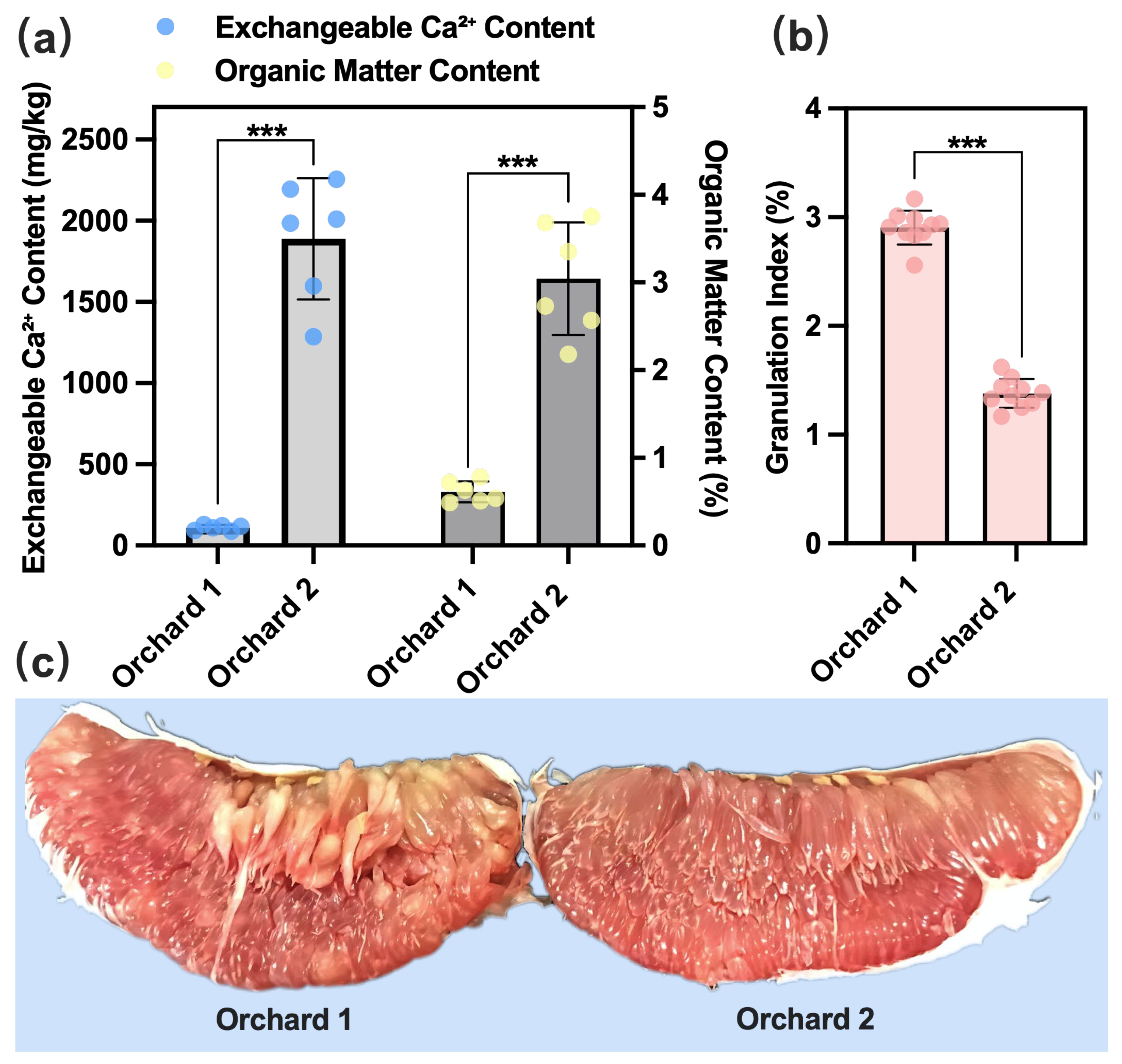
Soil plays a crucial role in regulating nutrient availability, water retention capacity, aeration and other aspects, soil physicochemical properties are critical determinants of fruit tree growth and fruit quality [46]. These properties directly govern the root system’s nutrient uptake efficiency and concurrently influence the structural integrity and physiological-metabolic activity of fruit cells [47]. This study characterized the soil physicochemical properties and the extent of juice sac granulation in pomelo fruits from two orchards (Orchard 1 and Orchard 2). As illustrated in Figure 1a, the soil in Orchard 2 exhibited significantly higher levels of CaEx (1888.42 mg/kg) and organic matter (3.04%) compared to Orchard 1 (110.13 mg/kg and 0.61%, respectively), with the differences being statistically highly significant (p < 0.001). Correspondingly, the results in Figure 1b revealed that the granulation index was significantly higher in Orchard 1 (2.90%) than in Orchard 2 (1.38%). These findings indicate a significant negative correlation between higher soil organic matter/CaEx content and the severity of juice sac granulation. We speculate that soil organic matter may mitigate granulation by improving soil physicochemical properties and enhancing root nutrient uptake, while CaEx likely contributes by maintaining cell wall structural integrity and regulating physiological metabolism [48,49]. Simultaneously, SOM content was positively correlated with the level of CaEx. The decomposition of organic matter releases nutrients into the soil solution, rendering them bioavailable for plant assimilation [50]. This improved nutrient accessibility promotes enhanced uptake efficiency, which may eventually lead to an increase in both yield and quality [51]. However, in actual field trials, this association may be co-influenced by other unquantified agricultural management factors. Thus, a direct causal relationship still requires further validation under more controlled conditions. Collectively, these results provide a theoretical foundation for mitigating juice sac granulation and improving fruit quality through targeted soil management practices.

3.2. Influence of Postharvest Storage Temperature on Lignification of Pomelo Fruits

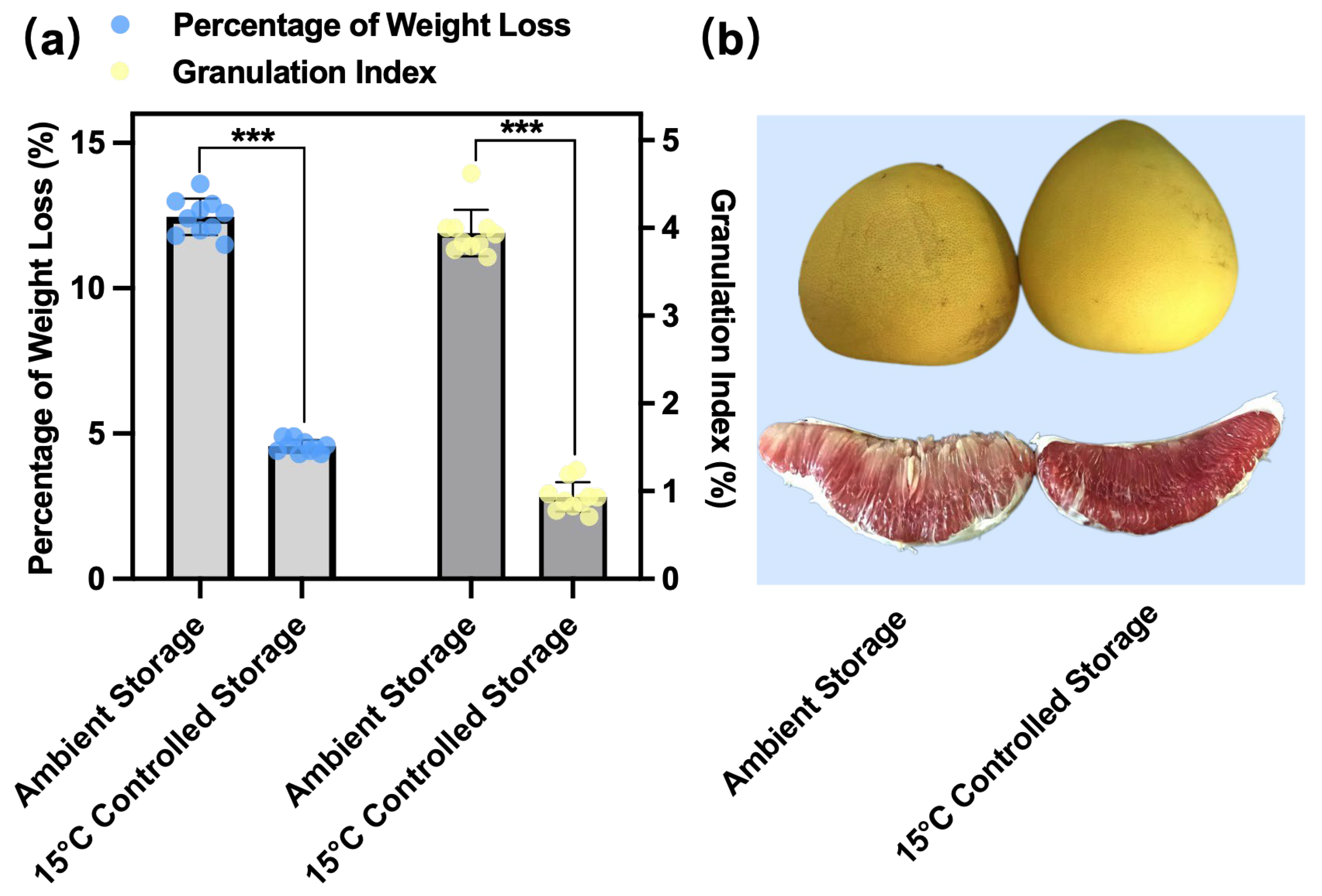
Storage temperature plays a critical role in determining the timing and quality of fruit ripening [52]. Low temperature storage induces peel browning, loss of aromatic volatiles, water-soaked tissues, and loss of ripening capacity in bananas [53,54]. Storage at ambient temperature (20 °C) or higher results in rapid deterioration and decay of fruit during postharvest storage [55]. Understanding the physiological behavior of fruits during prolonged storage at different temperatures is critical for consumers, food processors, and farmers to minimize postharvest losses [56]. This study determines the optimal storage temperature through an analysis of the fruit’s physiological traits to mitigate postharvest losses and maintain quality. As shown in Figure 2a, pomelo fruits stored at ambient temperature exhibited significantly higher weight loss (12.46%) and juice sac granulation index (3.94%) compared to those stored under controlled 15 °C conditions (4.56% and 0.94%, respectively), with the differences being statistically highly significant. Our results highlight the dual characteristics of storage temperature: both the level and its stability. The room temperature treatment represented an unstable high-temperature condition mimicking the natural environment, whereas the 15 °C treatment provided a stable low-temperature condition under artificial control. A constant storage environment likely mitigates metabolic disorders at their source, thereby helping to maintain the integrity of the intracellular membrane system and the homeostasis of metabolic enzyme activity [57,58]. In this study, the elevated weight loss under ambient storage reflects excessive water loss, which disrupts cellular osmotic potential. According to previous research, such physiological stress is often a precursor to the activation of the phenylpropanoid pathway, potentially involving enzymes like PAL and POD that lead to lignin deposition [59,60]. In contrast, storage at 15 °C effectively suppressed excessive water loss, thereby maintaining cellular stability and potentially delaying the physiological triggers associated with juice sac lignification. These findings provide a solid theoretical and practical foundation for employing temperature management as a postharvest strategy to delay lignification and maintain fruit quality in pomelo.

3.3. The Influence of Tree Age on the Lignification of Pomelo Fruits

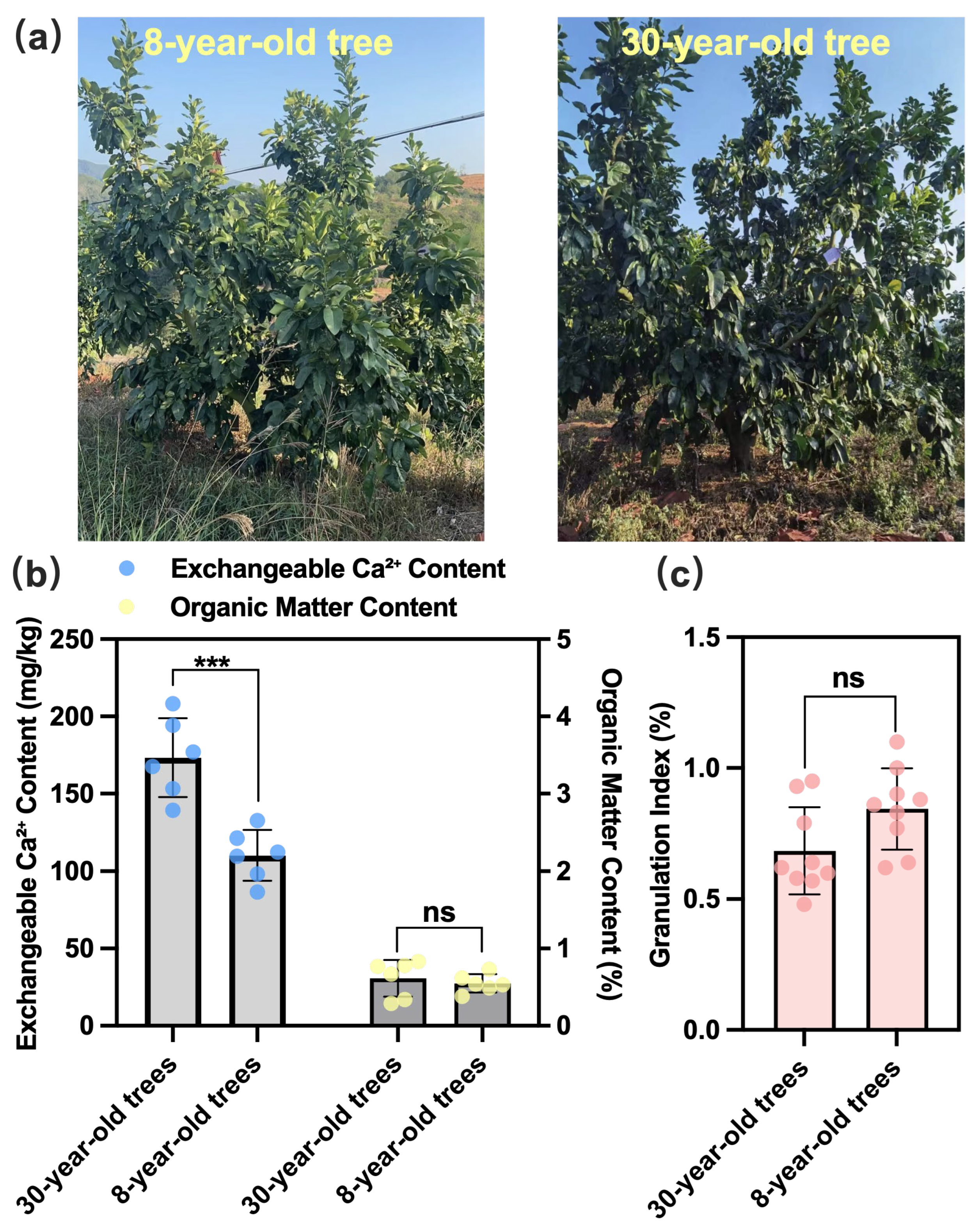
The pre-harvest accumulation of sufficient organic substances in fruit tissues is a prerequisite for ensuring an optimal postharvest storage life [23]. Factors influencing the accumulation of these organic compounds—including carbohydrates, proteins, lipids, and organic acids—are diverse, encompassing growth regulators, cultivation practices, fertilizer application, tree age, and fruit size [24,61,62]. A growing body of evidence indicates that the extent of postharvest lignification in pomelo fruit is critically influenced by a suite of pre-harvest physiological conditions of the mother tree, with the intensity of this disorder being largely predetermined by the tree’s metabolic status, hormonal balance, and the expression of genes encoding key enzymes within the lignin biosynthesis pathway [63,64]. This study investigated the impact of tree age on pomelo lignification by analyzing two key aspects: soil physicochemical properties and the typical lignification phenotype of juice sac granulation. As shown in Figure 3b, the soil under 30-year-old trees exhibited a significantly higher CaEx content (63.13 mg/kg) than that under 8-year-old trees. In contrast, soil organic matter content showed no significant difference between the two age groups, remaining at a relatively low level in both. Correspondingly, the results in Figure 3c demonstrated no significant difference in the juice sac granulation index between fruits from 8-year-old and 30-year-old trees. Nevertheless, fruits from 30-year-old trees exhibited a lower trend in juice sac granulation. Exchangeable soil Ca2+ is a key factor suppressing this disorder. The higher level of CaEx in the 30-year-old tree soil aligns with its observed reduced granulation, consistent with the known role of Ca2+ in directly regulating cell wall stability [65]. Adequate Ca2+ is absorbed by the tree and transported to the fruit, where it binds with pectin to form calcium pectate, thereby enhancing cell wall rigidity and suppressing aberrant lignin deposition [47,66]. While organic matter generally improves soil fertility and Ca2+ availability, its content did not differ significantly between the two groups in this study. The 8-year-old trees, although in a vigorous growth phase, may experience a relative Ca2+ deficit in fruits due to their immature root systems and nutrient allocation priorities favoring vegetative growth, potentially triggering granulation [67]. Although 30-year-old trees were grown in soil with higher CaEx, the juice sac granulation index did not show a statistically significant difference compared to 8-year-old trees. The observed lower trend in granulation in older trees may be related to their more established root systems, which potentially influences nutrient acquisition [68]. However, as fruit calcium levels were not directly measured, this link remains a subject for further investigation. This lack of significance suggests that tree age may be a contributing rather than a primary determinant of lignification under the conditions of this study. The lack of statistical significance between the two groups may be attributed to similar orchard conditions, management practices, and environmental factors, underscoring that physiological traits like fruit lignification are regulated by multiple determinants.

3.4. The Influence of PGRs on the Lignification of Pomelo Fruits

PGRs modulate numerous metabolic processes in plants [69]. When applied at balanced rates, they can inhibit, promote, or otherwise alter physiological processes, thereby regulating plant growth, yield, and fruit quality parameters, these physiological responses often result in produce that is more commercially acceptable [70,71]. This study investigated the regulatory effects of different PGR treatments on pomelo lignification by measuring fresh fruit weight, VC content, and the juice sac granulation index. Fresh fruit weight reflects the intensity of fruit growth and development, with a higher weight typically associated with robust cellular metabolic activity.
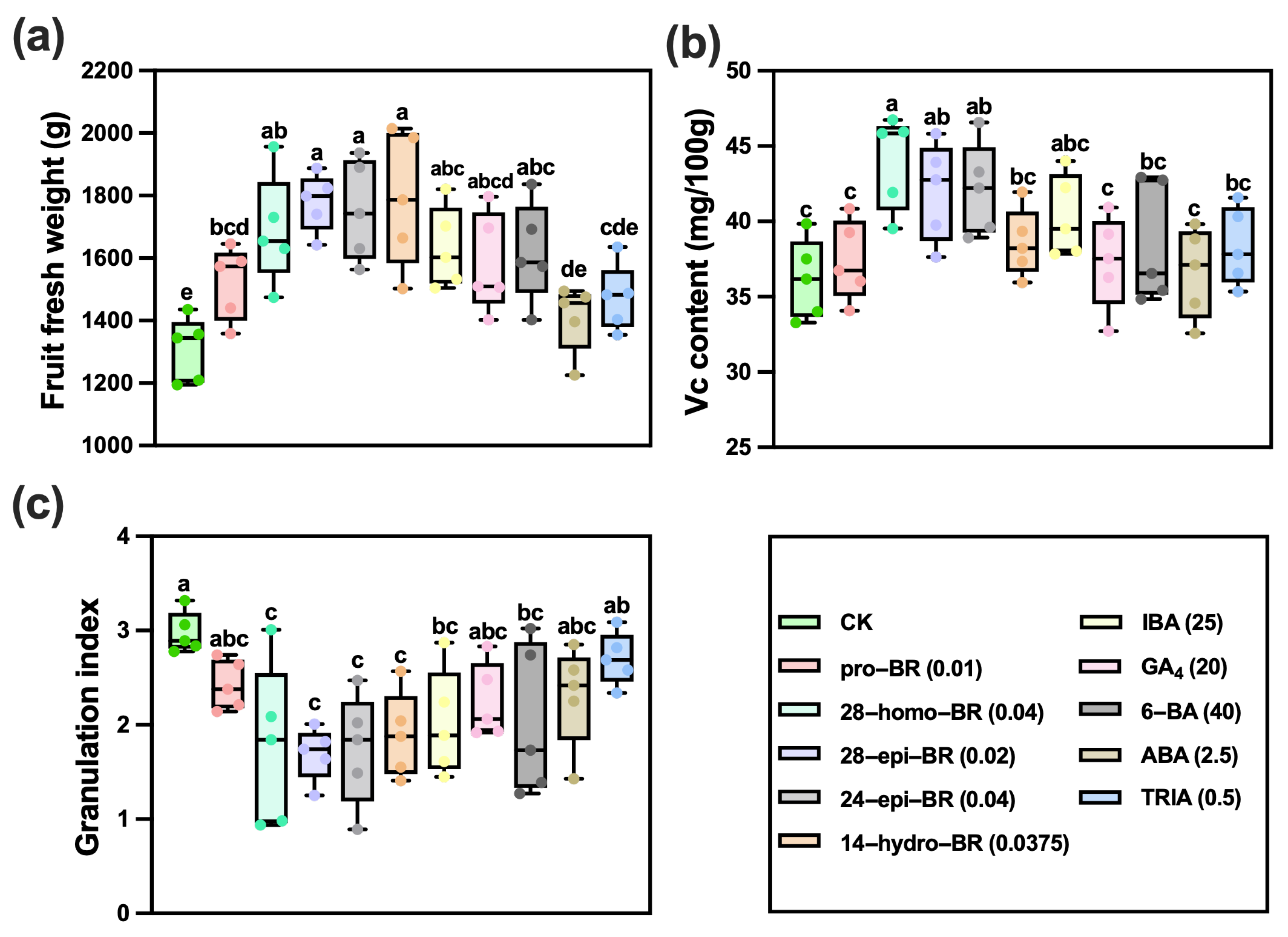
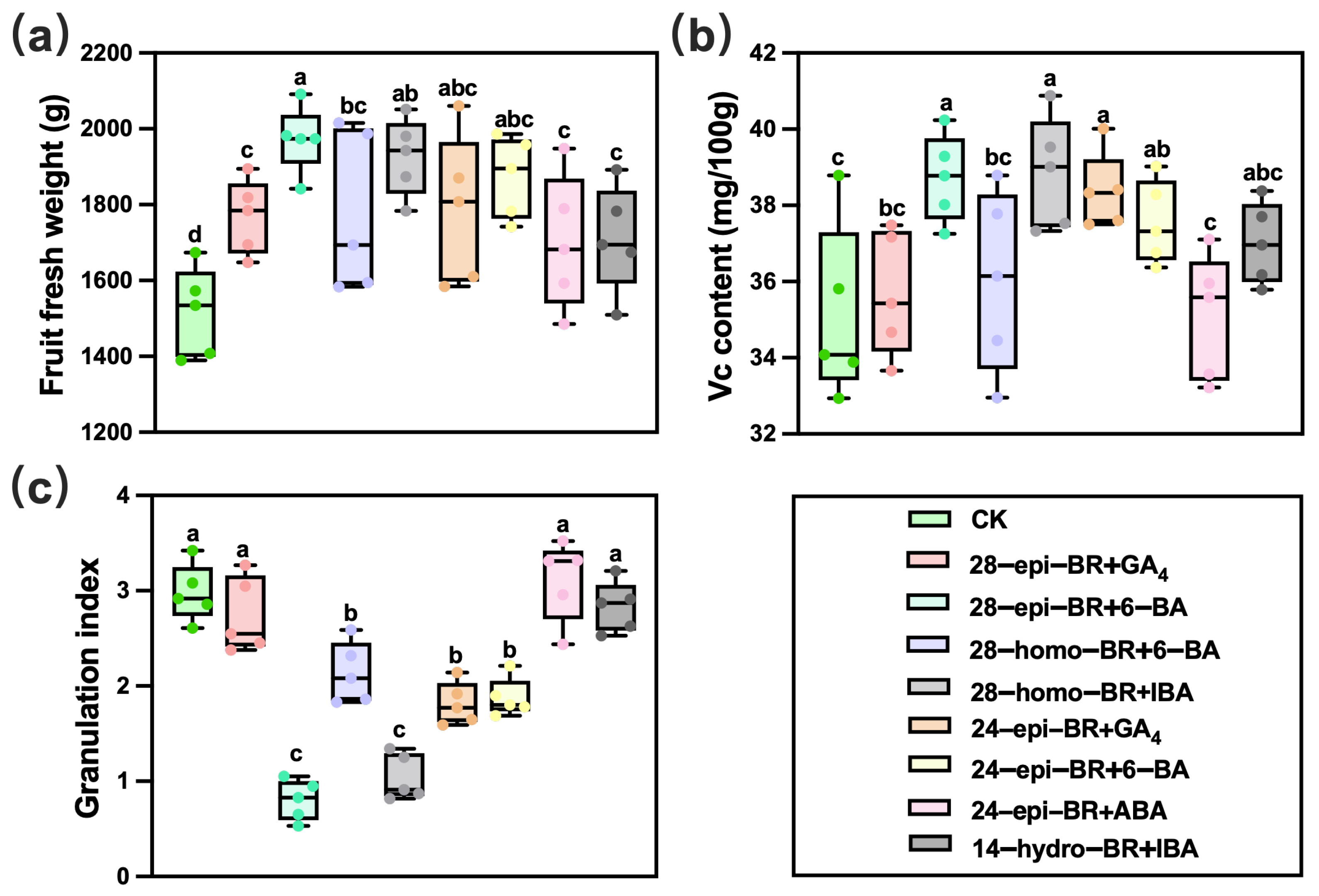
The application of different plant growth regulators revealed significant variations in their efficacy on maintaining the fresh weight of postharvest pummelo fruit (Figure 4a). Brassinosteroids (BRs) demonstrated the most pronounced growth-promoting effect. Fruits treated with pro-BR (0.01), 28-homo-BR (0.04), 28-epi-BR (0.02), 24-epi-BR (0.04), and 14-hydro-BR (0.0375) all exhibited significantly higher fresh weight compared to the control, with 14-hydro-BR yielding the highest value. This superior performance likely originates from the ability of BRs to activate signaling pathways for cell elongation and division, thereby promoting the allocation of photosynthetic assimilates to the fruit and simultaneously enhancing cell wall extensibility to accommodate volume expansion [72,73]. However, variations exist among PGRs of the same type. These differences may be attributed to their distinct molecular structures, which can result in different receptor binding affinities and inconsistent biological activities at application concentrations. Furthermore, IBA (25 mg/L), GA4 (20 mg/L), and 6-BA (40 mg/L) also demonstrated significant efficacy. These three regulators promote fruit fresh weight through distinct yet complementary physiological mechanisms: IBA primarily enhances cell elongation, whereas 6-BA stimulates cell division, collectively increasing the sink capacity; simultaneously, GA4 improves photosynthetic assimilate utilization efficiency [74,75,76]. The interconnected plant hormone network likely enables functional complementarity and signaling synergy, thereby optimizing the allocation and utilization of photosynthetic products and ultimately producing comparable promotive effects on pomelo fresh weight [77]. In contrast, ABA and TRIA showed a trend toward increased fresh weight, but the differences did not reach statistical significance compared with the control group. This discrepancy may be attributed to their specific mechanisms of action and the applied concentrations [78]. Given that ROS metabolism is closely linked to lignin biosynthesis, differences in VC content may directly influence the extent of juice sac lignification [79]. Figure 4b shows that the 28-homo-BR treatment yielded the highest VC content, followed by 24-epi-BR and 28-epi-BR. While no significant difference was observed among these three treatments, their VC levels were all markedly higher than those in the control group. However, other treatments showed an increasing trend but had no significant difference from the control group. Figure 4c illustrates the direct regulatory effect of PGRs on pomelo lignification. The results indicate that nearly all treatment groups exhibited a declining trend in the juice sac granulation index. All tested BRs demonstrated significant granulation-suppressing effects except pro-BR. Research indicates that BRs are implicated not only in fruit ripening processes but also in the preservation of storage quality [80,81]. In addition, IBA also demonstrated an excellent inhibitory effect. Although the other treatments did not show statistically significant differences, they still effectively reduced the granulation index compared to the control group. This suggests that PGRs can influence the juice sac lignification process through multiple pathways, primarily by modulating fruit growth status and antioxidant metabolism. By integrating the three evaluated metrics, 28-homo-BR, 28-epi-BR, 24-epi-BR and 14-hydro-BR were identified as the most effective treatments.
To identify the optimal PGR combinations that simultaneously improve fruit yield, nutritional quality, and suppression of juice vesicle lignification in pomelo, this study formulated combinations from the ten individual PGRs previously screened for lignification inhibition. Then, we evaluated fresh fruit weight, VC content, and the vesicle lignification index under various PGR mixture treatments. As illustrated in Figure 5a, all treatments significantly increased the fresh weight of pomelo fruits compared to individual PGR applications, indicating that combined PGR treatments effectively promote fruit growth. Figure 5b presents the results of VC content, which exhibited a trend consistent with fresh weight across treatment groups. However, only the combinations of 28-epi-BR + 6-BA, 28-homo-BR + IBA, 24-epi-BR + GA4, and 24-epi-BR + 6-BA showed statistically significant differences compared to the control. The juice vesicle lignification index is shown in Figure 5c. Significant reductions in lignification were observed in response to 28-epi-BR + 6-BA, 28-homo-BR + 6-BA, 28-homo-BR + IBA, and 24-epi-BR + GA4. Distinct synergistic effects among PGR combinations on pomelo fruit regulation were observed, characterized by differential outcomes in “yield–nutrition–quality” dimensions. The combination of 28-epi-BR + 6-BA and 28-homo-BR + IBA exhibited dual advantages in both fresh fruit weight and VC content, along with a significant reduction in the lignification index, representing the optimal formulation for coordinated improvement in yield, nutrition, and quality, suggesting that it can slow the specific process of juice sac lignification while maintaining the overall physiological condition of the fruit. The combinations 24-epi-BR + GA4 and 24-epi-BR + 6-BA significantly boosted fresh weight and VC content although they offered limited suppression of granulation. These differential effects can be attributed to the functional specificity of PGRs. BR components, such as 28-epi-BR and 28-homo-BR, synchronously influence fruit growth and quality formation by modulating cell division and antioxidant metabolism [82,83]. In comparison, GA4 and IBA indirectly regulate the lignification process by altering resource allocation between growth and secondary metabolism [84,85].
From the perspective of multi-trait coordinated improvement, this study provides a combinatorial strategy using exogenous PGRs for quality regulation in pomelo. This approach not only avoids the deterioration of non-target traits often caused by single-trait optimization but also offers technical support for meeting diversified industry demands, including yield increase, nutritional retention, and quality enhancement. Based on comprehensive performance in fresh fruit weight, VC content, and vesicle lignification index, two optimal PGR combinations were identified: 28-epi-BR + 6-BA and 28-homo-BR + IBA.

3.5. The Regulatory Effect of PGRs on the Lignin Quality and Enzyme Activities of Pomelo Fruits

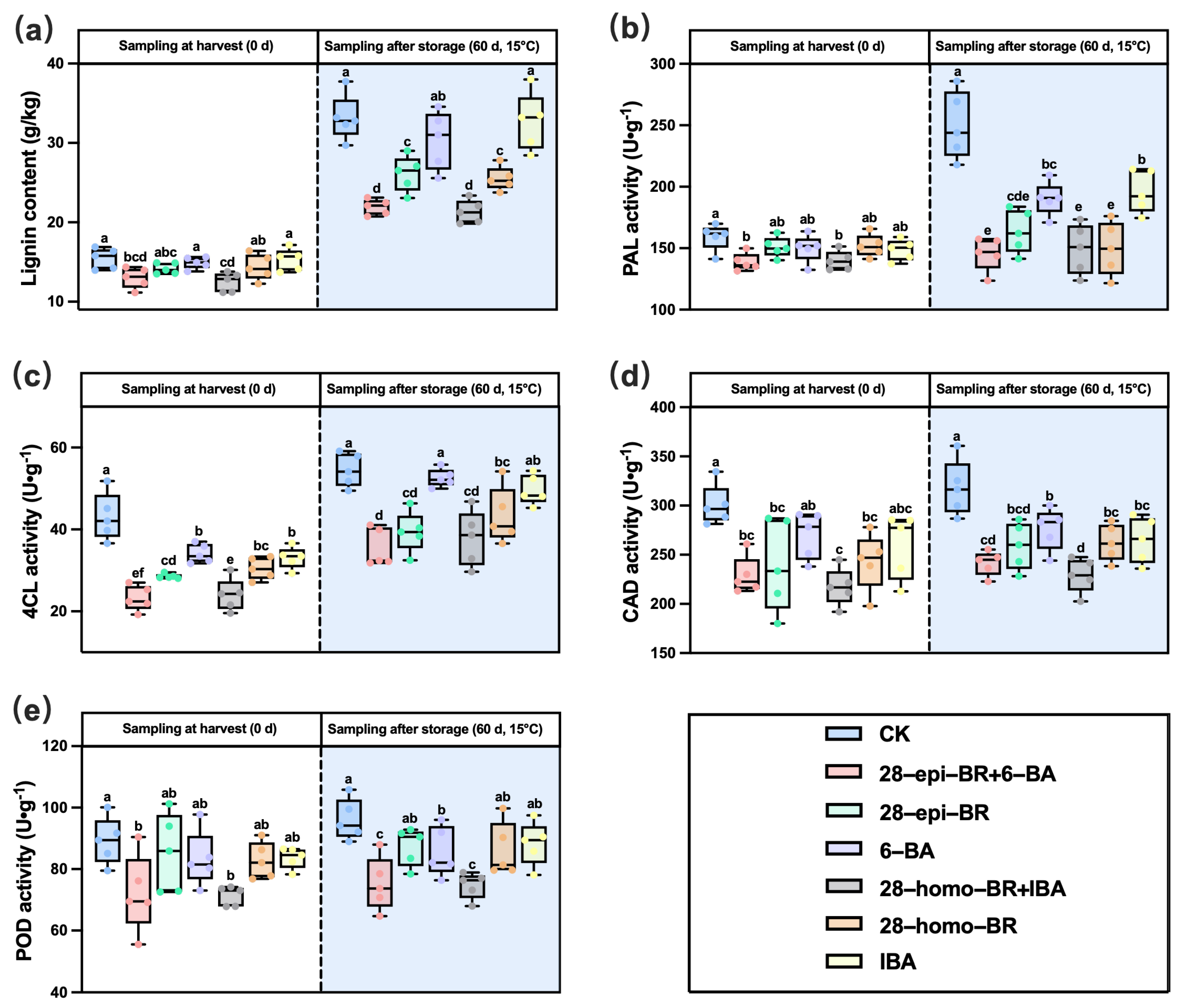
PGRs can modulate lignin biosynthesis, a key process associated with fruit postharvest quality disorders [86]. To elucidate the physiological mechanism by which the pre-screened optimal PGR mixtures suppress juice vesicle granulation in pomelo, this study determined the lignin content and the activities of key phenylpropanoid pathway enzymes (PAL, 4CL, CAD, POD) in fruits at harvest and after 60 days of storage at 15 °C (Figure 6). On day 0 postharvest, the combined treatments of 28-epi-BR with 6-BA and 28-homo-BR with IBA significantly reduced lignin content in pomelo fruit while no notable differences were observed with their corresponding individual applications. Moreover, early application of PGRs proved effective in preventing basal lignin accumulation at harvest. After 60 days of storage at 15 °C, lignin content increased across all groups. However, mixtures groups exhibited significantly lower lignin content compared to the control and their corresponding individual PGR treatments. This demonstrates a synergistic advantage of the PGR mixtures in early prevention and direct inhibition of abnormal lignin accumulation, with effects significantly superior to those of single PGRs. These results are consistent with the previously observed vesicle granulation index, confirming that the mixtures effectively alleviated granulation by inhibiting excessive lignin deposition.
PAL, the rate-limiting enzyme of the phenylpropanoid pathway, directly determines the synthesis efficiency of lignin precursors [87,88]. The 28-epi-BR + 6-BA and 28-homo-BR + IBA treatments showed significantly reduced enzyme activities compared to CK at harvest (Figure 6b). After 60 days of storage, both combinations maintained strong suppression of enzymatic activity furthermore their PAL levels were inferior to those observed in the single PGR treatments. These findings suggest that the PGR mixtures likely reduce carbon flux into the phenylpropanoid pathway by suppressing PAL activity, thereby blocking the synthesis of lignin precursors at the metabolic origin.
4CL, a key enzyme bridging aromatic ring activation and side-chain extension in the phenylpropanoid pathway, is closely associated with the metabolic efficiency of lignin precursors [89,90]. At day 0, 4CL activity in the CK was relatively high, while it was significantly inhibited after PGRs treatment. After storage, 4CL activity increased markedly in the CK, whereas all PGR mixture treatments showed a declining trend compared to both CK and single PGR treatments. This confirms that the PGR mixtures exert a dual-phase (pre- and post-harvest) inhibitory effect on upstream phenylpropanoid enzymes, effectively limiting the flow of lignin precursors into subsequent metabolic steps.
CAD, which catalyzes the conversion of cinnamyl aldehydes to cinnamyl alcohols, is a key rate-limiting enzyme in lignin monomer biosynthesis [91,92]. A consistent trend in 4CL activity was observed across all treatments at harvest (Figure 6d) with the two combination treatments showing significantly reduced CAD activity. Although minor increases occurred after storage the combination treatments consistently maintained lower CAD activity than their single PGR counterparts at both sampling times. It indicated that the PGR combinations also exert inhibitory effects during the lignin monomer synthesis stage, thereby synergistically blocking the lignin biosynthesis pathway at multiple metabolic nodes.
POD catalyzes the oxidative cross-linking of lignin monomers and is critical for lignin polymerization [93]. At harvest the CK treatment exhibited high POD activity while the 28-epi-BR + 6-BA and 28-homo-BR + IBA combinations showed significantly lower levels indicating a strong potential for lignin suppression. The enzyme activity in these combination treatments was lower than in their corresponding single-agent groups underscoring the complementary effect of combining functionally distinct hormones. After storage POD activity increased slightly across all treatments compared to harvest levels yet the combinations maintained their superior performance. This indicates that the PGR mixtures durably suppress POD activity both before and after harvest, thereby reducing the final polymerization step of lignin. Together, these results demonstrate that the PGR mixtures effectively suppressed the activities of key enzymes involved in multiple stages of the lignin biosynthetic pathway, including precursor synthesis (PAL, 4CL), monomer formation (CAD), and polymerization (POD). While this indicates a broad enzymatic regulation, further studies are needed to elucidate the underlying transcriptional and signaling mechanisms.

3.6. Analysis of Metabolites Associated with Pomelo Lignification

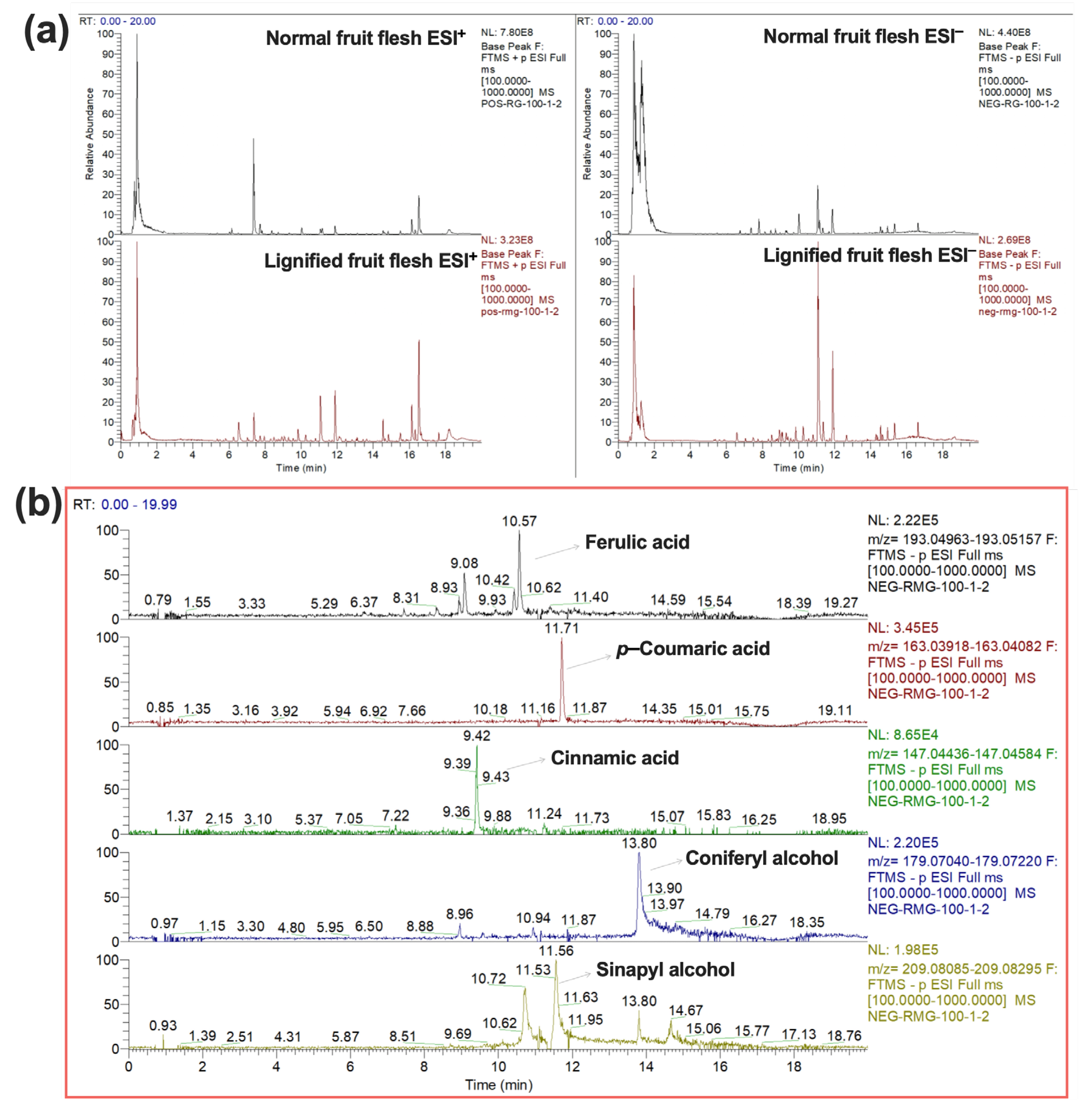
Fruit growth and development, quality traits, and nutritional characteristics are closely related to metabolic components [94]. Sugars, organic acids, amino acids, lipids, volatile compounds, and other substances determine the fruit’s taste, flavor, color, texture, and so on [95]. A comprehensive metabolomic analysis was conducted on pomelo samples. This profiling was performed to establish a foundation for identifying key metabolic markers or genes closely associated with pomelo lignification. Utilizing a mass spectrometry-based platform, we established a quality assessment system for Meizhou pomelos. The metabolite composition of a fruit is a direct manifestation of its growth, development, quality formation, and physiological responses. To elucidate the key metabolites associated with flesh lignification in pomelo and identify the primary compounds contributing to juice sac granulation, we conducted a comparative metabolomic analysis of normal and lignified fruit tissues. This study focused on screening for differentially accumulated compounds specifically related to lignin biosynthesis. Total Ion Chromatogram (TIC) analysis revealed distinct metabolic landscapes between the two sample types (Figure 7a). Compared to normal flesh, the lignified tissue exhibited more abundant and diverse metabolite peaks in both ESI+ and ESI- modes, indicating that the lignification process is accompanied by extensive metabolic reprogramming. Subsequent metabolomic screening identified five key metabolites that were differentially accumulated in lignified flesh, with their Extracted Ion Chromatograms (EICs) displayed in Figure 7b. These metabolites—ferulic acid, p-coumaric acid, cinnamic acid, coniferyl alcohol, and sinapyl alcohol—are all critical intermediates of the phenylpropanoid pathway, which is the core biosynthetic route for lignin monomers [96,97]. The enhanced accumulation of these precursors in lignified flesh suggests an upregulated flux through the phenylpropanoid pathway, thereby supplying the substrate pool for excessive lignin deposition and ultimately leading to the lignified phenotype. Our findings demonstrate that flesh lignification in pomelo is associated with a significant shift in metabolic profiles, particularly the activation of the lignin precursor biosynthestic pathway. The differential accumulation of phenylpropanoid-derived metabolites establishes a mechanistic link between metabolic reprogramming and the over-accumulation of lignin.
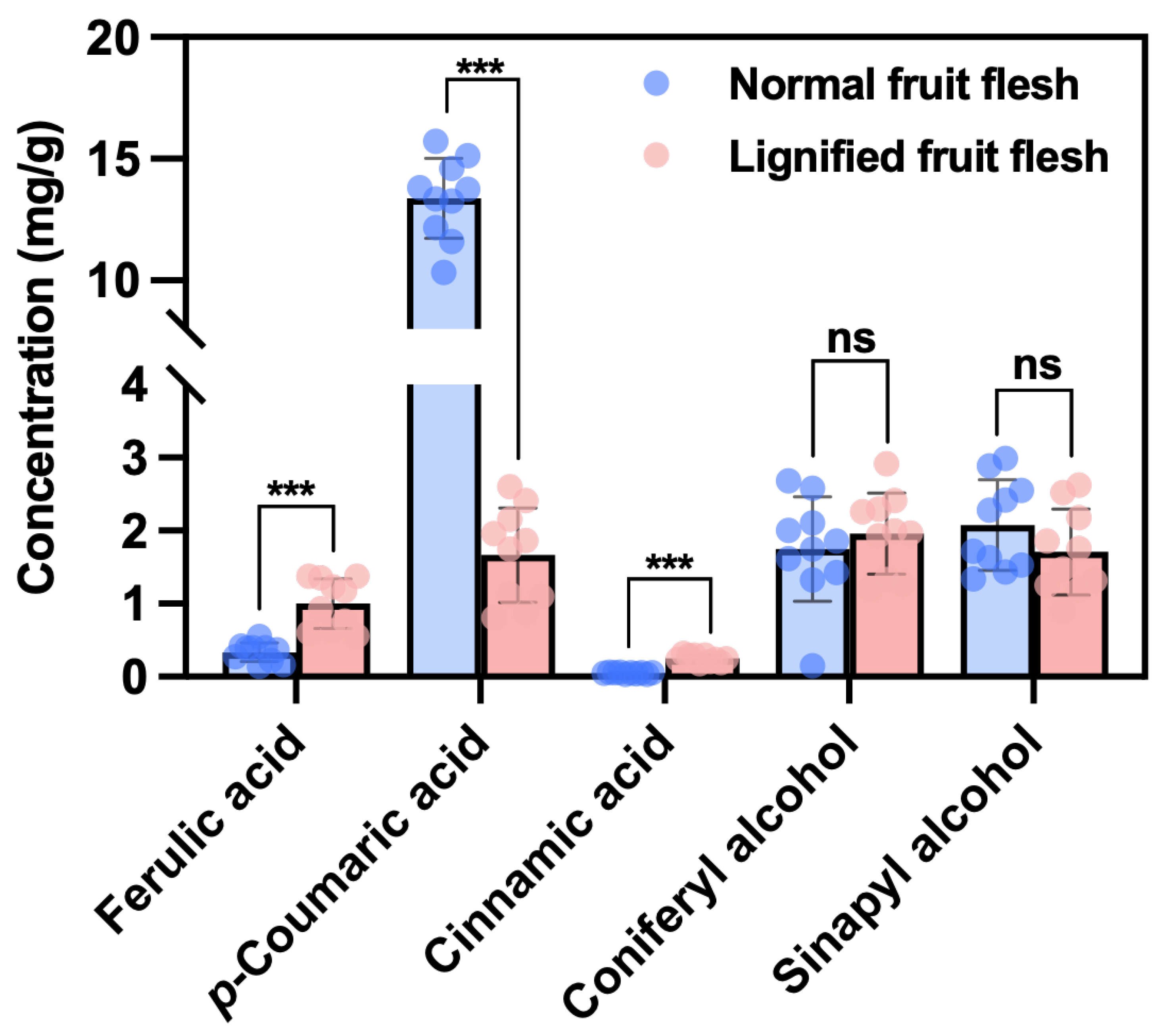
Metabolomic analysis identified a series of compounds with significantly altered accumulation. To elucidate the direct drivers underlying aberrant lignin deposition, we focused on the phenylpropanoid biosynthesis pathway, which supplies the key precursors for lignin monomers [98]. Among all differential metabolites in this pathway, ferulic acid, p-coumaric acid, cinnamic acid, coniferyl alcohol, and sinapyl alcohol were selected for detailed follow-up analysis. These metabolites not only represent highly altered nodes within the pathway but also serve as direct precursors for G- and S-type lignin monomers [99]. Their accumulation levels thus most directly reflect the flux and intensity of lignin biosynthesis. A quantitative analysis was performed on the five identified differential metabolites (Figure 8). The contents of ferulic acid, p-coumaric acid, and cinnamic acid were significantly higher in lignified flesh compared to normal flesh. Notably, p-coumaric acid exhibited the most pronounced difference, with its concentration in lignified flesh being approximately four times that in normal flesh. In contrast, no significant differences were observed in the levels of coniferyl alcohol and sinapyl alcohol between normal and lignified tissues. During the process of juice sac granulation, the biosynthesis of upstream phenylpropanoid pathway intermediates—ferulic acid, p-coumaric acid, and cinnamic acid—was markedly activated [100,101]. Their substantial accumulation provides abundant precursors for lignin monomer synthesis, thereby driving the occurrence of juice sac lignification. The absence of significant differences in the downstream monomers, coniferyl alcohol and sinapyl alcohol, may be attributed to the sufficient supply of upstream precursors already meeting the demand for lignin polymerization, or alternatively, to the diversion of their metabolic flux into other branching pathways. The precise regulatory mechanisms underlying this phenomenon require further investigation.

4. Conclusions

Our study provides a systematic, multi-level understanding of the physiological and metabolic basis of juice sac lignification in Meizhou pomelo and establishes a practical mitigation strategy through targeted application of PGRs. We first identified key internal and external factors regulating juice sac lignification. A significant negative correlation was observed between soil organic matter/exchangeable calcium and the granulation index, confirming the essential role of preharvest mineral nutrition in prolonging fruit storage life. This finding highlights that soil management not only supports yield but also critically enhances fruit physiological resilience and storage tolerance. Furthermore, storage experiments demonstrated that a constant low temperature of 15 °C significantly reduced the granulation index compared to fluctuating temperature and humidity conditions. This indicates that maintaining a stable storage temperature of 15 °C contributed to a reduction in the granulation index and slowed down excessive weight loss, thereby helping to mitigate the indicators of postharvest lignification in pomelo fruit.
Through systematic screening of 10 PGRs, we then clarified their regulatory effects. BRs and auxins showed notable advantages in maintaining fresh weight and ascorbic acid content while significantly reducing the degree of juice sac granulation during storage. To enhance the regulatory efficacy, we further investigated PGR mixtures and monitored dynamic changes in lignin content and key lignin biosynthesis-related enzyme activities. Two optimal PGR combinations—28-epi-BR + 6-BA, and 28-homo-BR + IBA—were identified, all of which outperformed single PGR treatments. These results strongly support the importance of hormonal synergy in suppressing lignification.
Moreover, metabolomic analysis confirmed the significant accumulation of ferulic acid, p-coumaric acid, and cinnamic acid in lignified juice sac tissues. These compounds serve as specific biomarkers indicating the overactivation of the phenylpropanoid pathway, providing critical metabolic evidence for further elucidating the regulatory mechanisms of lignification.

Supplementary Materials

The following supporting information can be downloaded at: https://www.mdpi.com/article/10.3390/agriculture16030320/s1, list of all metabolome compounds in normal pomelo and lignified pomelo pulp.

Author Contributions

Conceptualization, R.L. and S.Z.; methodology, R.L. and B.D.; software, R.L. and W.H.; validation, R.L., W.Z. and W.H.; formal analysis, R.L., W.H. and W.Z.; investigation, R.L., Z.L. and K.L.; resources, S.Z.; data curation, R.L., Z.L. and K.L.; writing—original draft preparation, R.L.; writing—review and editing, B.D. and S.Z.; visualization, R.L., Z.L. and K.L.; supervision, B.D. and S.Z.; project administration, B.D.; funding acquisition, B.D. All authors have read and agreed to the published version of the manuscript.

Funding

This research was funded by the science and technology program of Meizhou city (No. 2025A03012001) and the 2025 special fund for science and technology innovation strategy (agricultural research main force development) (No. 2025-Joint-Construction-03).

Institutional Review Board Statement

Not applicable.

Data Availability Statement

The original contributions presented in the study are included in the article, further inquiries can be directed to the corresponding author.

Conflicts of Interest

The authors declare no conflicts of interest.

References

  1. Chen, J.; Luo, W.; Cheng, L.; Wu, J.; Yu, Y.; Li, L.; Xu, Y. Influence of cultivar and turbidity on physicochemical properties, functional characteristics and volatile flavor substances of pomelo juices. Foods 2023, 12, 1028. [Google Scholar] [CrossRef]
  2. Guan, X.; Wan, H.; He, Z.; Liu, Z.; Jiang, R.; Ou, Y.; Chen, Y.; Gu, H.; Zhou, Z. Pomelo-Net: A lightweight semantic segmentation model for key elements segmentation in honey pomelo orchard for automated navigation. Comput. Electron. Agr. 2025, 229, 109760. [Google Scholar] [CrossRef]
  3. Yang, J.; Duan, M.; Zhang, B.; Shi, W.; Yan, S.; Li, X.; Long, C.; Liu, H.; Guo, L.; Zhang, H.; et al. Metabolome and transcriptome analyses reveal that pollination with ‘Guanxi’ honey pomelo pollen alleviates the postharvest fruit granulation of ‘crystal’ honey pomelo. Postharvest Biol. Technol. 2025, 230, 113831. [Google Scholar] [CrossRef]
  4. Liu, J.; Zhou, X.; Chen, D.; Guo, J.; Chen, K.; Ye, C.; Liu, C. 1H NMR-Based metabolic profiling to follow changes in pomelo cultivars during postharvest senescence. Foods 2023, 12, 2001. [Google Scholar] [CrossRef] [PubMed]
  5. Lai, C.; Zhou, H.; Liao, H. Nitrate modulates fruit lignification by regulating CgLAC3 expression in pomelo. Int. J. Mol. Sci. 2025, 26, 4158. [Google Scholar] [CrossRef]
  6. Liu, L.; Chen, Y.; Wu, W.; Chen, Q.; Tian, Z.; Huang, J.; Ren, H.; Zhang, J.; Du, X.; Zhuang, M.; et al. A multilevel investigation to reveal the regulatory mechanism of lignin accumulation in juice sac granulation of pomelo. BMC Plant Biol. 2024, 24, 390. [Google Scholar] [CrossRef]
  7. Zhou, X.; Xiong, X.; Lu, F.; Shi, W.; Zhou, Y.; Lai, N.; Chen, L.-S.; Huang, Z.-R. Excessive copper induces lignin biosynthesis in the leaves and roots of two citrus species: Physiological, metabolomic and anatomical aspects. Ecotox. Environ. Safe. 2025, 289, 117692. [Google Scholar] [CrossRef]
  8. Li, X.; Wang, N.; She, W.; Guo, Z.; Pan, H.; Yu, Y.; Ye, J.; Pan, D.; Pan, T. Identification and functional analysis of the CgNAC043 gene involved in lignin synthesis from citrusgrandis “San Hong”. Plants 2022, 11, 403. [Google Scholar] [CrossRef]
  9. Hou, Y.; Zhao, L.; Xie, B.; Hu, S.; Zheng, Y.; Jin, P. EjCaM7 and EjCAMTA3 synergistically alleviate chilling-induced lignification in loquat fruit by repressing the expression of lignin biosynthesis genes. Postharvest Biol. Tec. 2022, 192, 112010. [Google Scholar] [CrossRef]
  10. Su, D.; Jiang, Y.; Song, B.; Wu, Z.; Yan, X.; He, Z.; Ye, D.; Ou, J.; Zeng, Y.; Wu, L. Reduced fertilization and magnesium supplementation: Modulating fruit quality in honey pomelo (Citrus maxima (Burm.) Merr.). Plants 2024, 13, 2757. [Google Scholar] [CrossRef]
  11. Li, Q.; Yao, S.; Deng, L.; Zeng, K. Changes in biochemical properties and pectin nanostructures of juice sacs during the granulation process of pomelo fruit (Citrus grandis). Food Chem. 2022, 376, 131876. [Google Scholar] [CrossRef] [PubMed]
  12. Yang, C.; Yang, C.; Li, H.; Jiang, C. Transcriptomic analysis reveals the impact of interstock on vesicle granulation in ‘Hainan Qingyou’ pomelo (Citrus maxima) fruit. Horticulturae 2025, 11, 1230. [Google Scholar] [CrossRef]
  13. Sharma, R.R.; Saxena, S.K. Rootstocks influence granulation in Kinnow mandarin (Citrusnobilis × C.deliciosa). Sci. Hortic. 2004, 101, 235–242. [Google Scholar] [CrossRef]
  14. Nandita, K.; Kundu, M.; Nahakpam, S.; Rakshit, R. Micronutrients spray to combat granulation and improve fruit quality of sweet orange Citrus sinensis (L.) Osbeck cv. Mosambi under nontraditional citrus growing track. J. Plant Nutr. 2023, 46, 4207–4223. [Google Scholar] [CrossRef]
  15. Iqbal, J.; Kiran, S.; Hussain, S.; Iqbal, R.; Ghafoor, U.; Younis, U.; Zarei, T.; Naz, M.; Germi, S.; Danish, S.; et al. Acidified biochar confers improvement in quality and yield attributes of sufaid chaunsa mango in saline soil. Horticulturae 2021, 7, 418. [Google Scholar] [CrossRef]
  16. Hanafi, H.; Shokouhian, A.A.; Derafshi, M.; Hemati, A.; Astatkie, T.; Asgari Lajayer, B. Evaluation of the effect of lignin, calcium nitrate and sulfate of potash on the quantitative and qualitative characteristics of apple. Appl. Fr. Sci. 2024, 66, 2113–2121. [Google Scholar] [CrossRef]
  17. Çoban, G.A.; Aras, S. Effects of ascorbic and oxalic acids on cucumber seedling growth and quality under mildly limey soil conditions. Gesunde Pflanz. 2023, 75, 1925–1932. [Google Scholar] [CrossRef]
  18. Ren, Q.-Q.; Huang, Z.-R.; Huang, W.-L.; Huang, W.-T.; Chen, H.-H.; Yang, L.-T.; Ye, X.; Chen, L.-S. Physiological and molecular adaptations of Citrus grandis roots to long-term copper excess revealed by physiology, metabolome and transcriptome. Environ. Exp. Bot. 2022, 203, 105049. [Google Scholar] [CrossRef]
  19. Deng, Z.; Ma, G.; Zhang, L.; Kurata, D.; Ikeya, M.; Keawmanee, N.; Nonaka, K.; Takishita, F.; Kato, M. Characterization of granulation in citrus “Harumi” fruit during postharvest storage. Postharvest Biol. Tec. 2024, 210, 112770. [Google Scholar] [CrossRef]
  20. Hofman, H.J.; Toegel, H.; Parfitt, S.C.; Smith, M.W. Reduced irrigation in high rainfall years and winter application of nitrogen reduce granulation in Imperial mandarin (Citrus reticulata cv. Imperial). Crop Pasture Sci. 2024, 75, CP24019. [Google Scholar] [CrossRef]
  21. Hong, P.; Zhang, J.; Shi, D.; Yang, C.; Zeng, M.; Li, X.; Zhou, K.; Xi, W. Postharvest application of methyl jasmonate alleviates lignin accumulation in stone cells of pear fruit during low-temperature storage. Postharvest Biol. Tec. 2024, 209, 112692. [Google Scholar] [CrossRef]
  22. Wang, Y.; Zhang, M.; Bao, L.; Long, J.; Cui, X.; Zheng, Z.; Zhao, X.; Huang, Y.; Jiao, F.; Su, C.; et al. Metabolomic and transcriptomic analysis of flavonoids biosynthesis mechanisms in mulberry fruit (Hongguo 2) under exogenous hormone treatments. Plant Physiol. Bioch. 2024, 212, 108773. [Google Scholar] [CrossRef] [PubMed]
  23. Khalid, S.; Malik, A.U.; Khan, A.S.; Khan, M.N.; Ullah, M.I.; Abbas, T.; Khalid, M.S. Tree age and fruit size in relation to postharvest respiration and quality changes in ‘Kinnow’ mandarin fruit under ambient storage. Sci. Hortic. 2017, 220, 183–192. [Google Scholar] [CrossRef]
  24. Meena, N.; Asrey, R. Tree age affects physicochemical, functional quality and storability of Amrapali mango (Mangifera indica L.) fruits. J. Sci. Food Agric. 2018, 98, 3255–3262. [Google Scholar] [CrossRef]
  25. Jiao, Y.; Zhu, X.; Tian, C.; Shi, X.; Gong, H.; Sun, S.; Li, J.; Zhang, A. Low temperature induces lignification in sweet cherry by modulating lignin synthesis-related genes. Postharvest Biol. Tec. 2026, 231, 113944. [Google Scholar] [CrossRef]
  26. Yang, B.; Fang, X.; Han, Y.; Liu, R.; Chen, H.; Gao, H. Analysis of lignin metabolism in water bamboo shoots during storage. Postharvest Biol. Tec. 2022, 192, 111989. [Google Scholar] [CrossRef]
  27. Zhang, H.; Sun, X.; Dai, M. Improving crop drought resistance with plant growth regulators and rhizobacteria: Mechanisms, applications, and perspectives. Plant Commun. 2022, 3, 100228. [Google Scholar] [CrossRef]
  28. Zhang, C.; Zhou, J.; Na, M.; Xu, S.; Li, X.; Zhou, S. Enhancement of cadmium uptake in Cinnamomum camphora seedlings through the regulation of physiological resistance by three exogenous plant growth regulators. Environ. Technol. Inno. 2025, 38, 104098. [Google Scholar] [CrossRef]
  29. Ranjbar, A.; Moradinezhad, F.; Panahi, B. Roles of micronutrients and plant growth regulators on abiotic stresses management of pistachio trees: A review. J. Plant Growth Regul. 2025, 44, 4931–4959. [Google Scholar] [CrossRef]
  30. Shafi, Z.; Shahid, M.; Ilyas, T.; Pandey, V.K.; Aijaz, S.A.; Singh, R.; Sahu, P.K. Unveiling the plant growth regulators crosstalk in agricultural crop response to salinity-stress: A concise review. Physiol. Plant. 2025, 177, e70402. [Google Scholar] [CrossRef]
  31. Xu, S.; Sun, M.; Yao, J.-L.; Liu, X.; Xue, Y.; Yang, G.; Zhu, R.; Jiang, W.; Wang, R.; Xue, C.; et al. Auxin inhibits lignin and cellulose biosynthesis in stone cells of pear fruit via the PbrARF13-PbrNSC-PbrMYB132 transcriptional regulatory cascade. Plant Biotechnol. J. 2023, 21, 1408–1425. [Google Scholar] [CrossRef] [PubMed]
  32. Deng, Y.; Wang, J.; Zhang, A.; Zhu, Z.; Ren, S.; Zhang, C.; Zhang, Q. Metabolomics mechanism and lignin response to laxogenin C, a natural regulator of plants growth. Int. J. Mol. Sci. 2022, 23, 2990. [Google Scholar] [CrossRef]
  33. Pattison, R.J.; Csukasi, F.; Catalá, C. Mechanisms regulating auxin action during fruit development. Physiol. Plant. 2014, 151, 62–72. [Google Scholar] [CrossRef]
  34. Wang, Y.; Wang, Q.; Zhang, F.; Han, C.; Li, W.; Ren, M.; Wang, Y.; Qi, K.; Xie, Z.; Zhang, S.; et al. PbARF19-mediated auxin signaling regulates lignification in pear fruit stone cells. Plant Sci. 2024, 344, 112103. [Google Scholar] [CrossRef]
  35. Zavala, M.; Menares, M.; Acevedo, O.; Melo, M.; Nuñez, C.; Arancibia, C.; Pedreschi, R.; Donoso, J.M.; Meisel, L.A.; Maldonado, J.E.; et al. PavSPL expression dynamics in fruits and seeds and in relation to endocarp lignification status during the transition from development to ripening in sweet cherry. Horticulturae 2025, 11, 706. [Google Scholar] [CrossRef]
  36. Liu, X.; Li, J.; Cao, Z.; Li, G.; Yu, Q.; Li, M.; Xu, Y.; Zhang, H.; Qin, G. Pomegranate Aux/IAA9A gene offers new insights into seed development and tissue lignification. Sci. Hortic. 2025, 341, 113979. [Google Scholar] [CrossRef]
  37. Li, H.; Chen, L.; Liu, R.; Lu, Z. Role of endogenous hormones on seed hardness in pomegranate fruit development. Horticulturae 2025, 11, 38. [Google Scholar] [CrossRef]
  38. T/DBMY 002-2021; Technical Code for the Cultivation of Meizhou Pomelo. Meizhou Municipal Bureau of Agriculture and Rural Affairs: Meizhou, China, 2021.
  39. Li, S.; Lin, D.; Huo, L.; Wu, B.; Sun, L.; An, Y.; Xia, Y. Critical factors and cost estimation for the immobilization of cadmium-contaminated paddy fields for rice safety. J. Soils Sediments. 2025, 25, 2995–3007. [Google Scholar] [CrossRef]
  40. Wang, S.; Li, W.; Ding, C.; Zhang, J.; Zhang, N.; Li, Y.; Gao, B.; Wang, B.; Wang, X. Biochar-supported zero-valent iron enhanced arsenic immobilization in a paddy soil: The role of soil organic matter. Biochar 2024, 6, 26. [Google Scholar] [CrossRef]
  41. Chen, C.; Nie, Z.; Wan, C.; Gan, Z.; Chen, J. Suppression on postharvest juice sac granulation and cell wall modification by chitosan treatment in harvested pummelo (Citrus grandis L. Osbeck) stored at room temperature. Food Chem. 2021, 336, 127636. [Google Scholar] [CrossRef]
  42. Zimmermann, A.; Hahlbrock, K. Light-induced changes of enzyme activities in parsley cell suspension cultures. Arch. Biochem. Biophys. 1975, 166, 54–62. [Google Scholar] [CrossRef]
  43. Yun, M.; Chen, W.; Deng, F.; Yogo, Y. Differential properties of 4-coumarate: CoA ligase related to growth suppression by chalcone in maize and rice. Plant Growth Regul. 2005, 46, 169–176. [Google Scholar] [CrossRef]
  44. dos Santos, W.; Ferrarese, M.; Ferrarese, O. High performance liquid chromatography method for the determination of cinnamyl alcohol dehydrogenase activity in soybean roots. Plant Physiol. Biochem. 2006, 44, 511–515. [Google Scholar] [CrossRef]
  45. Zhao, Y.; Li, Y.; Gao, X. A new method for accurate determination of peroxidase activity based on fluorescence decrease of guaiacol. Chin. J. Anal. Chem. 2015, 43, 1040–1046. [Google Scholar]
  46. Wu, L.; Qin, M.; Muneer, M.A.; Bao, J.; Chen, X.; Yang, Y.; Huang, J.; Zhang, S.; Su, D.; Yan, X. Soil pH and organic matter: Key edaphic factors in sustaining optimum yield and quality of pomelo fruit. Sci. Hortic. 2024, 337, 113524. [Google Scholar] [CrossRef]
  47. Yan, S.; Gao, Y.; Tian, M.; Tian, Y.; Li, J. Comprehensive evaluation of effects of various carbon-rich amendments on tomato production under continuous saline water irrigation: Overall soil quality, plant nutrient uptake, crop yields and fruit quality. Agr. Water Manag. 2021, 255, 106995. [Google Scholar] [CrossRef]
  48. Li, Y.; Han, M.-Q.; Lin, F.; Ten, Y.; Lin, J.; Zhu, D.-H.; Guo, P.; Weng, Y.-B.; Chen, L.-S. Soil chemical properties, ‘Guanximiyou’ pummelo leaf mineral nutrient status and fruit quality in the southern region of Fujian province, China. J. Soil Sci. Plant Nut. 2015, 15, 615–628. [Google Scholar] [CrossRef]
  49. Dang, L.V.; Quyen, N.K.; Ngoc, N.P.; Ly, L.M.; Thao, P.T.P.; Hung, N.N. Combining organic and foliar fertilization to enhance soil fertility and mitigate physiological disorders of durian (Durio zibethinus Murr.) fruit in the tropics. Plants 2025, 14, 1185. [Google Scholar] [CrossRef] [PubMed]
  50. Janke, R.R.; Menezes-Blackburn, D.; Al Hamdi, A.; Rehman, A. Organic management and intercropping of fruit perennials increase soil microbial diversity and activity in arid zone orchard cropping systems. Sustainability 2024, 16, 9391. [Google Scholar] [CrossRef]
  51. Wu, Y.; Si, W.; Yan, S.; Wu, L.; Zhao, W.; Zhang, J.; Zhang, F.; Fan, J. Water consumption, soil nitrate-nitrogen residue and fruit yield of drip-irrigated greenhouse tomato under various irrigation levels and fertilization practices. Agr. Water Manage. 2023, 277, 108092. [Google Scholar] [CrossRef]
  52. Kamble, V.; Narayana, C.K.; Karunakaran, G.; Rao, D.V.S.; Sriram, S.; Laxman, R.H. Influence of different storage temperature on physiology, quality, antioxidant activity and shelf life of avocado fruits (Persea americana Mill.). Acta Physiol. Plant. 2025, 47, 25. [Google Scholar] [CrossRef]
  53. Zhang, S.; Shan, Y.; Li, Y.; He, J.; Jiang, Y. Hydrogen peroxide receptors regulate chilling injury of banana fruit during low-temperature storage. Postharvest Biol. Tec. 2024, 214, 112985. [Google Scholar] [CrossRef]
  54. Park, H.; Eo, H.J.; Kim, C.-W.; Stewart, J.E.; Lee, U.; Lee, J. Physiological disorders in cold-stored ‘Autumn Sense’ hardy kiwifruit depend on the storage temperature and the modulation of targeted metabolites. Food Chem. 2024, 460, 140730. [Google Scholar] [CrossRef] [PubMed]
  55. Feng, Q.; Wang, Z.; Xiong, W.; Kong, W.; Huang, M.; Xi, W.; Zhou, K. The effect of postharvest storage temperatures on fruit flavor constituents in ‘Wushancuili’ plum. Horticulturae 2024, 10, 414. [Google Scholar] [CrossRef]
  56. Abeysuriya, H.I.; Bulugahapitiya, V.P.; Jayatissa, L.P. Variation of vitamin C content and antioxidant capacities during the post-harvest storage of fresh fruits under different temperatures. J. Stored Prod. Res. 2024, 109, 102426. [Google Scholar] [CrossRef]
  57. Hong, K.; Xu, H.; Wang, J.; Zhang, L.; Hu, H.; Jia, Z.; Gu, H.; He, Q.; Gong, D. Quality changes and internal browning developments of summer pineapple fruit during storage at different temperatures. Sci. Hortic. 2013, 151, 68–74. [Google Scholar] [CrossRef]
  58. Liu, H.; Lv, Z.; Yang, W.; Li, A.; Liu, J.; Zhang, Q.; Jiao, Z. Virtual cold chain method to evaluate the effect of rising temperature on the quality evolution of peach fruit. Foods 2023, 12, 2403. [Google Scholar] [CrossRef]
  59. Zhao, H.; Meng, S.; Fu, M.; Chen, Q. Near-freezing temperature storage improves peach fruit chilling tolerance by regulating the antioxidant and proline metabolism. Horticulturae 2024, 10, 337. [Google Scholar] [CrossRef]
  60. Li, X.; Huang, H.; Zhang, L.; Zhao, L. Effect of postharvest storage temperature and duration on tomato fruit quality. Foods 2025, 14, 1002. [Google Scholar] [CrossRef] [PubMed]
  61. Stanley, J. Factors affecting fruit set and fruit quality along branch units of different apricot cultivars. N. Zeal. J. Crop Hort. 2016, 44, 171–191. [Google Scholar] [CrossRef]
  62. Rutkowski, K.; Łysiak, G.P. Weather conditions, orchard age and nitrogen fertilization influences yield and quality of ‘Łutówka’ sour cherry fruit. Agriculture 2022, 12, 2008. [Google Scholar] [CrossRef]
  63. Khalid, S.; Malik, A.U.; Khan, A.S.; Shahid, M.; Shafique, M. Tree age, fruit size and storage conditions affect levels of ascorbic acid, total phenolic concentrations and total antioxidant activity of ‘Kinnow’ mandarin juice. J. Sci. Food Agr. 2016, 96, 1319–1325. [Google Scholar] [CrossRef]
  64. Nayak, S.L.; Sethi, S.; Paul, V.; Singh, B.; Kumar Dubey, A. Citrus granulation: An unsolved disorder with physiological intricacies. Appl. Fr. Sci. 2025, 67, 235. [Google Scholar] [CrossRef]
  65. Hirzel, J. Can the firmness, weight, and size of blueberry fruit be enhanced through the application of low amounts of calcium to the soil? Plants 2024, 13, 1. [Google Scholar] [CrossRef]
  66. Galizzi, F.A.; Felker, P.; González, C.; Gardiner, D. Correlations between soil and cladode nutrient concentrations and fruit yield and quality in cactus pears, Opuntia ficus indica in a traditional farm setting in Argentina. J. Arid Environ. 2004, 59, 115–132. [Google Scholar] [CrossRef]
  67. Lyu, T.; Wang, Y.; Luo, A.; Li, Y.; Peng, S.; Cai, H.; Zeng, H.; Wang, Z. Effects of climate, plant height, and evolutionary age on geographical patterns of fruit type. Front. Plant Sci. 2021, 12, 604272. [Google Scholar] [CrossRef]
  68. Rojas-Barros, P.; Bryla, D.R.; Orr, S.T.; Hardigan, M.; Maupin, B.; DeVetter, L.W. Fruit calcium is influenced by soil and physiological factors but not by fertilizer applications in floricane-fruiting red raspberry. HortScience 2025, 60, 1836–1841. [Google Scholar] [CrossRef]
  69. Liu, D.; Jiang, N.; Yuan, Y.; Liu, H.; Ju, Y.; Sun, W.; Jia, W.; Fang, Y.; Zhao, D.; Mao, J.; et al. Comprehensive analysis of transcriptomics and metabolomics provides insights into the mechanism by plant growth regulators affect the quality of jujube (Ziziphus jujuba Mill.) fruit. PLoS ONE 2024, 19, e0305185. [Google Scholar] [CrossRef] [PubMed]
  70. Singh, L.; Sadawarti, R.K.; Singh, S.K.; Shaifali; Mirza, A.A. Efficacy of plant growth regulators for the modulation in the productivity of strawberries (Fragaria x ananassa Duchesne). J. Plant Growth Regul. 2025, 44, 1072–1086. [Google Scholar] [CrossRef]
  71. Chawla, R.; Guleria, T.; Thakur, A. Role of plant growth regulators in fruit crop production: A comprehensive review. Appl. Fr. Sci. 2025, 67, 294. [Google Scholar] [CrossRef]
  72. Wang, Y.; Ma, B.; Li, Y.; Wu, D.; Du, B.; Wang, H.; Yang, P.; Ren, D.; Wang, X.; Huang, J. The plant growth regulator 14-OH BR can minimize the application content of CPPU in kiwifruit (Actinidia chinensis) ‘Donghong’ and increase postharvest time without sacrificing the yield. Processes 2022, 10, 2345. [Google Scholar] [CrossRef]
  73. Bai, C.; Zheng, Y.; Watkins, C.B.; Fu, A.; Ma, L.; Gao, H.; Yuan, S.; Zheng, S.; Gao, L.; Wang, Q.; et al. Revealing the specific regulations of brassinolide on tomato fruit chilling injury by integrated multi-omics. Front. Nutr. 2021, 8, 769715. [Google Scholar] [CrossRef] [PubMed]
  74. Li, X.; Zhu, L.; Wang, H.; Zhou, X.; Wang, M.; Li, L.; Liu, F.; Sun, J.; Xiao, G. Peptide hormone-mediated regulation of plant development and environmental adaptability. Adv. Sci. 2025, 12, e06590. [Google Scholar] [CrossRef]
  75. Zhang, Y.; Berman, A.; Shani, E. Plant hormone transport and localization: Signaling molecules on the move. Annu. Rev. Plant Biol. 2023, 74, 453–479. [Google Scholar] [CrossRef] [PubMed]
  76. Tian, H.; Xu, L.; Li, X.; Zhang, Y. Salicylic acid: The roles in plant immunity and crosstalk with other hormones. J. Integr. Plant Biol. 2025, 67, 773–785. [Google Scholar] [CrossRef]
  77. Ritonga, F.N.; Zhou, D.; Zhang, Y.; Song, R.; Li, C.; Li, J.; Gao, J. The roles of gibberellins in regulating leaf development. Plants 2023, 12, 1243. [Google Scholar] [CrossRef]
  78. Huang, M.; Lai, C.; Liang, Y.; Xiong, Q.; Chen, C.; Ju, Z.; Jiang, Y.; Zhang, J. Improving the functional components and biological activities of navel orange juice through fermentation with an autochthonous strain Lactiplantibacillus paraplantarum M23. Food Bioprod. Process. 2025, 149, 249–260. [Google Scholar] [CrossRef]
  79. Tan, G.-F.; Zhao, Q.; Wang, F.; Li, S.-Y.; Liu, Z.-Y.; Zhang, X.-Q.; Zhong, X.-L.; Zhu, S.-H.; Lei, X.-J.; Han, Z.-M.; et al. Mechanistic insights into nutrient profiles, cellulose, and hemicellulose dynamics in red and green Toona sinensis buds during cold storage. Front. Plant Sci. 2025, 16, 1518924. [Google Scholar] [CrossRef] [PubMed]
  80. Li, A.; Wu, X.; Huang, Y.; Pan, X.; Yao, K.; Liu, Z.; Wang, C.; Liao, W. The involvement of brassinolides in fruit ripening: Crosstalk with plant growth regulators and transcription factors. Food Qual. Saf. 2023, 8, fyad071. [Google Scholar] [CrossRef]
  81. Zhao, M.; Li, J.; Shi, X.; Sanaullah Malik, M.; Quan, Y.; Guo, D.; Wang, L.; Wang, S. Effects of exogenous plant regulators on growth and development of “Kyoho” grape under salt alkali stress. Front. Plant Sci. 2023, 14, 1274684. [Google Scholar] [CrossRef]
  82. He, S.; Xia, X.; Yang, J.; Xin, J.; Chen, S.; Jia, C. Overexpression of AtBES1D in tomato enhances BR response and accelerates fruit ripening. J. Plant Physiol. 2025, 312, 154563. [Google Scholar] [CrossRef]
  83. Hassan, A.H.; Mansour, N.; Samaan, M.S.F.; Nasser, M.A. Improving naomi mango trees capability to withstand salt stress using some plant growth regulators. J. Soil Sci. Plant Nut. 2025, 25, 7152–7169. [Google Scholar] [CrossRef]
  84. Zhang, C.; Whiting, M. Plant growth regulators improve sweet cherry fruit quality without reducing endocarp growth. Sci. Hortic. 2013, 150, 73–79. [Google Scholar] [CrossRef]
  85. Domingues Neto, F.J.; Pimentel Junior, A.; Putti, F.F.; Rodrigues, J.D.; Ono, E.O.; Tecchio, M.A.; Leonel, S.; Silva, M.d.S. Effect of plant growth regulators on germination and deedling growth of Passiflora alata and Passiflora edulis. Horticulturae 2024, 10, 1087. [Google Scholar] [CrossRef]
  86. Bons, H.K.; Kaur, M. Role of plant growth regulators in improving fruit set, quality and yield of fruit crops: A review. J. Hortic. Sci. Biotech. 2020, 95, 137–146. [Google Scholar] [CrossRef]
  87. Nasiri, S.; Rezaei, M.; Mojerlou, S. Impacts of preharvest treatment with salicylic acid and melatonin in suppressing gray mold (Botrytis cinerea Pers.) in Bell Pepper. J. Crop Health 2024, 76, 981–994. [Google Scholar] [CrossRef]
  88. Kim, D.S.; Hwang, B.K. An important role of the pepper phenylalanine ammonia-lyase gene (PAL1) in salicylic acid-dependent signalling of the defence response to microbial pathogens. J. Exp. Bot. 2014, 65, 2295–2306. [Google Scholar] [CrossRef] [PubMed]
  89. Cao, Y.; Chen, Y.; Zhang, L.; Cai, Y. Two monolignoid biosynthetic genes 4-coumarate:coenzyme A ligase (4CL) and p-coumaric acid 3-hdroxylase (C3H) involved in lignin accumulation in pear fruits. Physiol. Mol. Biol. Plants 2023, 29, 791–798. [Google Scholar] [CrossRef]
  90. Wang, J.; Cai, J.; Zhao, J.; Guo, Z.; Pan, T.; Yu, Y.; She, W. Enzyme activities in the lignin metabolism of Chinese olive (Canarium album) with different flesh characteristics. Horticulturae 2022, 8, 408. [Google Scholar] [CrossRef]
  91. Yang, S.; Qin, Y.; Gao, J.; Zhang, G.; Peng, L.; Li, Y.; Zhang, X.; Zhang, M.; Chen, Y. Lignin: The primary component responsible for endocarp sclerosis in the development of Cornus officinalis fruit. BMC Plant Biol. 2025, 25, 1375. [Google Scholar] [CrossRef]
  92. Cheng, X.; Li, M.; Li, D.; Zhang, J.; Jin, Q.; Sheng, L.; Cai, Y.; Lin, Y. Characterization and analysis of CCR and CAD gene families at the whole-genome level for lignin synthesis of stone cells in pear (Pyrus bretschneideri) fruit. Biol. Open 2017, 6, 1602–1613. [Google Scholar] [CrossRef]
  93. Shan, L.L.; Li, X.; Wang, P.; Cai, C.; Zhang, B.; Sun, C.D.; Zhang, W.S.; Xu, C.J.; Ferguson, I.; Chen, K.S. Characterization of cDNAs associated with lignification and their expression profiles in loquat fruit with different lignin accumulation. Planta 2008, 227, 1243–1254. [Google Scholar] [CrossRef]
  94. Shen, X.; Liu, Y.; Zeng, Y.; Zhao, Y.; Bao, Y.; Shao, X.; Wu, Z.; Zheng, Y.; Jin, P. Hydrogen sulfide attenuates chilling injury in loquat fruit by alleviating oxidative stress and maintaining cell membrane integrity. Food Chem. 2025, 463, 141094. [Google Scholar] [CrossRef]
  95. Li, Z.; Huang, J.; Wang, L.; Li, D.; Chen, Y.; Xu, Y.; Li, L.; Xiao, H.; Luo, Z. Novel insight into the role of sulfur dioxide in fruits and vegetables: Chemical interactions, biological activity, metabolism, applications, and safety. Crit. Rev. Food Sci. Nutr. 2024, 64, 8741–8765. [Google Scholar] [CrossRef]
  96. Wang, B.; Li, Z.; Han, Z.; Xue, S.; Bi, Y.; Prusky, D. Effects of nitric oxide treatment on lignin biosynthesis and texture properties at wound sites of muskmelons. Food Chem. 2021, 362, 130193. [Google Scholar] [CrossRef]
  97. Li, Z.; Xu, X.; Xue, S.; Gong, D.; Wang, B.; Zheng, X.; Xie, P.; Bi, Y.; Prusky, D. Preharvest multiple sprays with chitosan promotes the synthesis and deposition of lignin at wounds of harvested muskmelons. Int. J. Biol. Macromol. 2022, 206, 167–174. [Google Scholar] [CrossRef]
  98. Chen, O.; Deng, L.; Ruan, C.; Yi, L.; Zeng, K. Pichia galeiformis induces resistance in postharvest citrus by activating the phenylpropanoid biosynthesis pathway. J. Agric. Food. Chem. 2021, 69, 2619–2631. [Google Scholar] [CrossRef] [PubMed]
  99. Liu, Y.; Ge, Y.; Bi, Y.; Li, C.; Deng, H.; Dong, B. Effect of postharvest acibenzolar-S-methyl dipping on phenylpropanoid pathway metabolism in muskmelon (Cucumis melo L.) fruits. Sci. Hortic. 2014, 168, 113–119. [Google Scholar] [CrossRef]
  100. An, Y.-M.; Zhu, Q.; Lv, H.-Q.; Zhang, X.-N.; Huang, F.; Guo, Y.-K.; Cao, C.-J.; Liu, H.; Li, Y.; Xu, L.-Z. Genomic basis of metabolome-mediated cultivar-specific flavor formation in juice sacs of the pomelo (Citrus grandis (L.) Osbeck) cultivars Shatian and Guanxi honey. LWT 2024, 191, 115606. [Google Scholar] [CrossRef]
  101. Li, X.; Huang, H.; Rizwan, H.M.; Wang, N.; Jiang, J.; She, W.; Zheng, G.; Pan, H.; Guo, Z.; Pan, D.; et al. Transcriptome analysis reveals candidate lignin-related genes and transcription factors during fruit development in pomelo (Citrus maxima). Genes 2022, 13, 845. [Google Scholar] [CrossRef] [PubMed]
Figure 1. The influence of soil properties on the granulation of pomelo juice. (a) Organic matter and exchangeable calcium content in orchard soil, orchard 1 is located in Wuhua County, and orchard 2 is in Meixian District; (b) Granulation index of pomelo juice; (c) The pulp of pomelos from different orchards. “***” indicates an extremely significant difference (p < 0.001). Bars represent the mean ± SD. Individual points show biological replicates.
Agriculture 16 00320 g001
Figure 2. The influence of preservation temperature on the granulation of pomelo juice. (a) Pomelo fruit weight loss rate and juice sac granulation index; (b) The morphology of pomelo fruits at different storage temperatures. “***” indicates an extremely significant difference (p < 0.001). Bars represent the mean ± SD. Individual points show biological replicates.
Agriculture 16 00320 g002
Figure 3. The influence of tree age on the granulation index of pomelo juice. (a) The growth conditions of 8-year-old and 30-year-old pomelo trees; (b) Soil exchangeable calcium and organic matter content; (c) Granulation index of pomelo trees. “***” indicates an extremely significant difference (p < 0.001), “ns” indicates no significant difference. Bars represent the mean ± SD. Individual points show biological replicates.
Agriculture 16 00320 g003
Figure 4. The influence of single plant growth regulators on fruit quality. (a) The fresh weight of pomelo fruits; (b) The VC content of pomelo fruits; (c) Granulation index of pomelo trees. Different lowercase letters above the bars indicate significant differences at p < 0.05. Same lowercase letters indicate no significant difference. Bars represent the mean ± SD. Individual points show biological replicates.
Agriculture 16 00320 g004
Figure 5. The influence of compound plant growth regulators on fruit quality. (a) The fresh weight of pomelo fruits; (b) The VC content of pomelo fruits; (c) Granulation index of pomelo trees. Different lowercase letters above the bars indicate significant differences at p < 0.05. Same lowercase letters indicate no significant difference. Bars represent the mean ± SD. Individual points show biological replicates.
Agriculture 16 00320 g005
Figure 6. The influence of PGRs combination on the lignin content and enzyme activity of pomelo fruit. (a) The lignin content of pomelo fruits; (b) The PAL activity of pomelo fruits; (c) The 4CL activity of pomelo fruits; (d) The CAD activity of pomelo fruits; (e) The POD activity of pomelo fruits. Different lowercase letters above the bars indicate significant differences at p < 0.05. Same lowercase letters indicate no significant difference. Bars represent the mean ± SD. Individual points show biological replicates.
Agriculture 16 00320 g006
Figure 7. Metabolomic analysis of normal and lignified pomelo flesh and screening of lignin metabolism-related compounds. (a) Comparison of metabolic fingerprints between normal and lignified pomelo fruit flesh in ESI+ and ESI modes; (b) Extracted ion chromatograms of key lignin precursor metabolites differentially accumulated in lignified flesh.
Agriculture 16 00320 g007
Figure 8. Quantitative differences in metabolites between normal and lignified pulp. “***” indicates an extremely significant difference (p < 0.001), “ns” indicates no significant difference. Bars represent the mean ± SD. Individual points show biological replicates.
Agriculture 16 00320 g008
Disclaimer/Publisher’s Note: The statements, opinions and data contained in all publications are solely those of the individual author(s) and contributor(s) and not of MDPI and/or the editor(s). MDPI and/or the editor(s) disclaim responsibility for any injury to people or property resulting from any ideas, methods, instructions or products referred to in the content.