Article

A Five-Year Field Investigation of Conservation Tillage on Soil Hydrothermal Regimes and Crop Yield Stability in Semi-Arid Agroecosystems


1
Chifeng Academy of Agricultural and Animal Husbandry Sciences, Chifeng 024031, China
2
Anhui Province Key Laboratory of Nutrient Cycling and Arable Land Conservation, Institute of Soil and Fertilizer, Anhui Academy of Agricultural Sciences, Hefei 230031, China
3
Fuyang Field Observation and Research Station of Soil Quality, Ministry of Agriculture and Rural Affairs, Hefei 230031, China
4
School of Water Conservancy and Civil Engineering, Northeast Agricultural University, Harbin 150030, China
*
Author to whom correspondence should be addressed.
Agriculture 2026, 16(3), 312; https://doi.org/10.3390/agriculture16030312
Submission received: 29 December 2025 / Revised: 23 January 2026 / Accepted: 26 January 2026 / Published: 27 January 2026

Abstract

The sustainable management of Northern China’s vulnerable agro-pastoral ecotone requires a clearer understanding of how tillage systems affect crop productivity through local soil-climate interactions. Therefore, this study was conducted to quantify and compare the long term effects of different tillage practices on soil hydrothermal regimes, resource use efficiency, and maize yield stability in a semi-arid agroecosystem. A long term five-year field experiment with maize was conducted in this ecotone to assess three tillage methods: no tillage (NT), deep ploughing (DP), and conventional rotary tillage (RT). Seasonal monitoring included soil moisture, temperature, bulk density, and straw cover. Analyses focused on soil water use efficiency (WUE), the production efficiency per soil thermal unit (PEsoil), and pathways affecting theoretical calculated yield. Results show that relative to RT and DP, NT consistently elevated soil water content within the 0–30 cm profile during the growing season, with the most marked increases from pre-sowing to the V12 stage. This water-conserving effect was stronger in wet years, highlighting the role of precipitation in NT’s performance. DP also retained more soil water than RT, particularly in deeper layers, though its effect was less pronounced than NT’s. Regarding temperature, NT lowered the daily mean soil temperature and accumulated growing degree days (GDD) in early growth phases, a result of residue cover buffering thermal changes. Despite reduced heat accumulation, NT achieved the greatest efficiencies for both heat and water use (PEsoil and WUE), showing increases of 62.03% and 16.64% over RT, respectively, without yield penalty. Key mechanisms include permanent straw mulch under NT, which curtails evaporation, promotes water infiltration, and stabilizes soil structure, thereby modulating hydrothermal dynamics. Structural equation modeling indicated that soil water content, ear number per hectare, and hundred-kernel weight directly and positively determined final yield. Tillage methods exerted indirect effects on yield by modifying soil physical traits and microclimatic conditions. In this semi-arid setting, both NT and DP outperformed RT in conserving soil water, moderating soil temperature, and boosting resource use efficiency. These practices present viable strategies for strengthening crop resilience and sustaining productivity amid climatic variability.

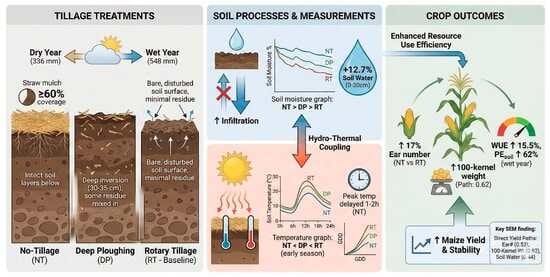
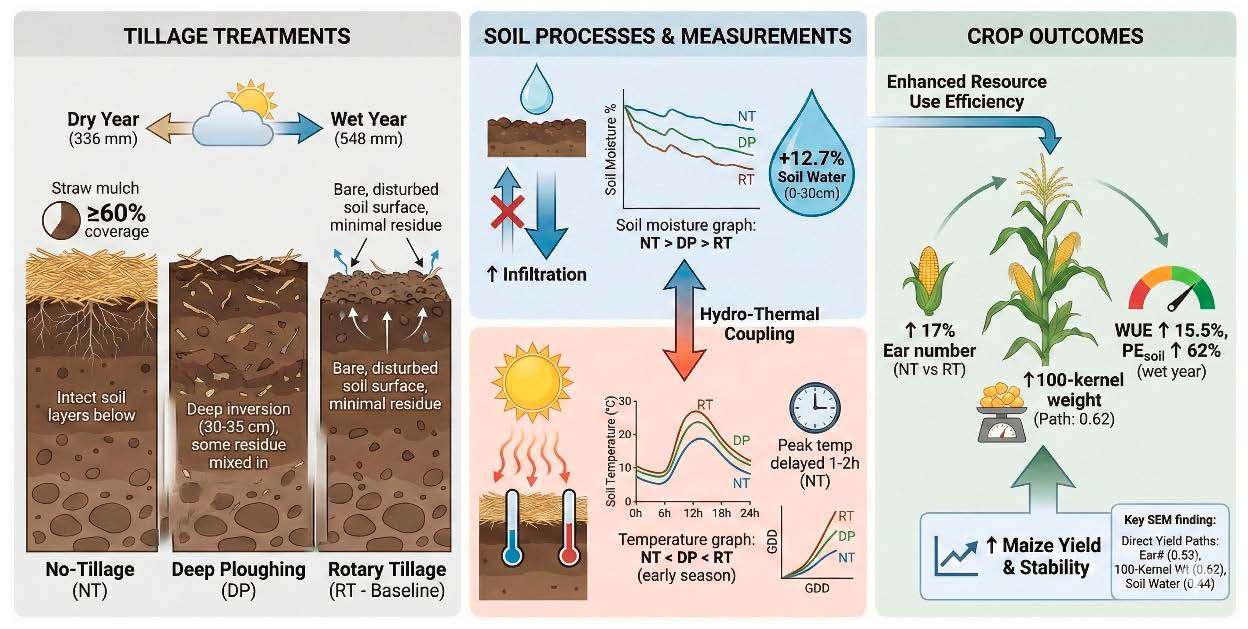
Graphical Abstract

1. Introduction

Northern China’s agro-pastoral transition zone is a critical area for grain supply and ecological stability, where resource limitations and ecosystem vulnerability are growing concerns [1]. This region exhibits a typical semi-arid climate, with annual precipitation ranging from 300 to 500 mm and a marked trend of declining rainfall and rising temperature [2,3]. The distinctive topography and geomorphology render it prone to erosion by wind and water, creating a tightly coupled and sensitive climate–vegetation–soil system [4]. Research indicates that over the past few decades, there has been a widespread decline in soil organic carbon content in farmland across northern China, with decreases exceeding 50% in some areas, posing a potential threat to China’s food security [5].
No tillage (NT), synonymous with zero tillage or direct seeding with straw mulch, ranks among the most widely adopted conservation practices. A substantial body of research confirms that NT delivers multiple ecological advantages through specific pathways such as maintaining permanent residue cover, minimizing soil disturbance, and enhancing soil structure and organic carbon sequestration [6,7,8]. NT systems are fundamentally characterized by permanent residue cover and minimal soil disturbance, which have been proven to enhance soil organic carbon (SOC) sequestration and stabilization while effectively conserving soil water content [9,10,11]. A comprehensive meta-analysis revealed that long term NT implementation can significantly increase SOC stocks in the plow layer [6]. Moreover, the protective mulch layer lessens erosion from wind and water [12,13]; research on China’s Mongolian Plateau notes that conservation tillage cuts wind erosion by 74.8% relative to conventional methods [14]. Importantly, NT improves water use efficiency (WUE) through enhanced soil structure and reduced non-productive evaporation, a particularly crucial advantage in arid and semi-arid regions [15,16]. However, the yield benefits of conservation tillage with cover crops show considerable regional differences, with clear advantages only apparent in particular ecological contexts [17,18,19]. This spatial dependency is corroborated by recent global meta-analyses, which highlight that NT’s impact on yield is highly variable and context-specific, often influenced by climate, soil texture, and agronomic management practices [20,21]. This underscores the spatial dependency characteristic of no-till technology efficacy, as its outcomes are co-determined by local environmental factors (e.g., soil type, climate) and management details. These complex interactions mean that extending NT technology within northern China’s agro-pastoral ecotone requires careful attention to local conditions. For instance, its efficacy in increasing soil water storage and yield stability can be significantly higher in semi-arid zones with loamy soils typical of parts of Inner Mongolia compared to more humid or sandy regions within the same ecotone [2]. Targeted studies are needed to define the suitability of NT and explain its mechanistic links to yield formation. Targeted studies are needed to define the suitability of NT and explain its mechanistic links to yield formation.
Tillage practices can shape soil health and crop performance by modifying soil water and thermal conditions [21,22]. Deep ploughing (DP) can counteract soil compaction and improve water retention by enlarging pore space [23]. However, long term DP may degrade soil structure and deplete nutrients, ultimately reducing SOC and yield [24]. For instance, Chen et al. indicate that integrating straw return with DP can effectively mitigate these adverse effects, maintaining soil structural stability while improving SOC sequestration and crop productivity [25]. It is worth noting that previous studies on how maize straw incorporation affects soil hydrothermal conditions have mostly relied on conventional measurement techniques. These approaches are often cumbersome and, crucially, unable to capture continuous dynamic data, especially for key thermal metrics such as soil temperature growing degree days (soil GDD). Therefore, they fall short of providing a holistic assessment of how different straw management methods regulate soil temperature.
Based on the five-year field investigation, we hypothesize that long term conservation tillage, particularly no tillage with straw retention, enhances maize yield stability in the semi-arid agro-pastoral ecotone by optimizing the coupled soil hydrothermal regime. Specifically, we propose that no tillage (NT) and deep ploughing (DP) will (1) significantly increase soil water content and water use efficiency relative to conventional rotary tillage, with NT benefits amplified under higher precipitation; (2) moderate soil temperature fluctuations and reduce early-season heat accumulation, yet improve thermal-use efficiency; and (3) consequently enhance yield primarily through improved soil moisture and its positive effects on yield components, ear number, and hundred-kernel weight, rather than through direct thermal effects.
The primary objectives of this study are to: (1) examine how different tillage methods regulate key soil physicochemical properties related to yield; (2) elucidate the mechanisms by which tillage practices influence soil hydrothermal dynamics, and quantify their impact on WUE and growing degree day (GDD) production efficiency; and (3) identify the principal factors driving crop yield formation in this region. By thoroughly evaluating the ecological adaptability of various tillage practices, this research seeks to inform sustainable agricultural land-use strategies.

2. Materials and Methods

2.1. Experimental Site

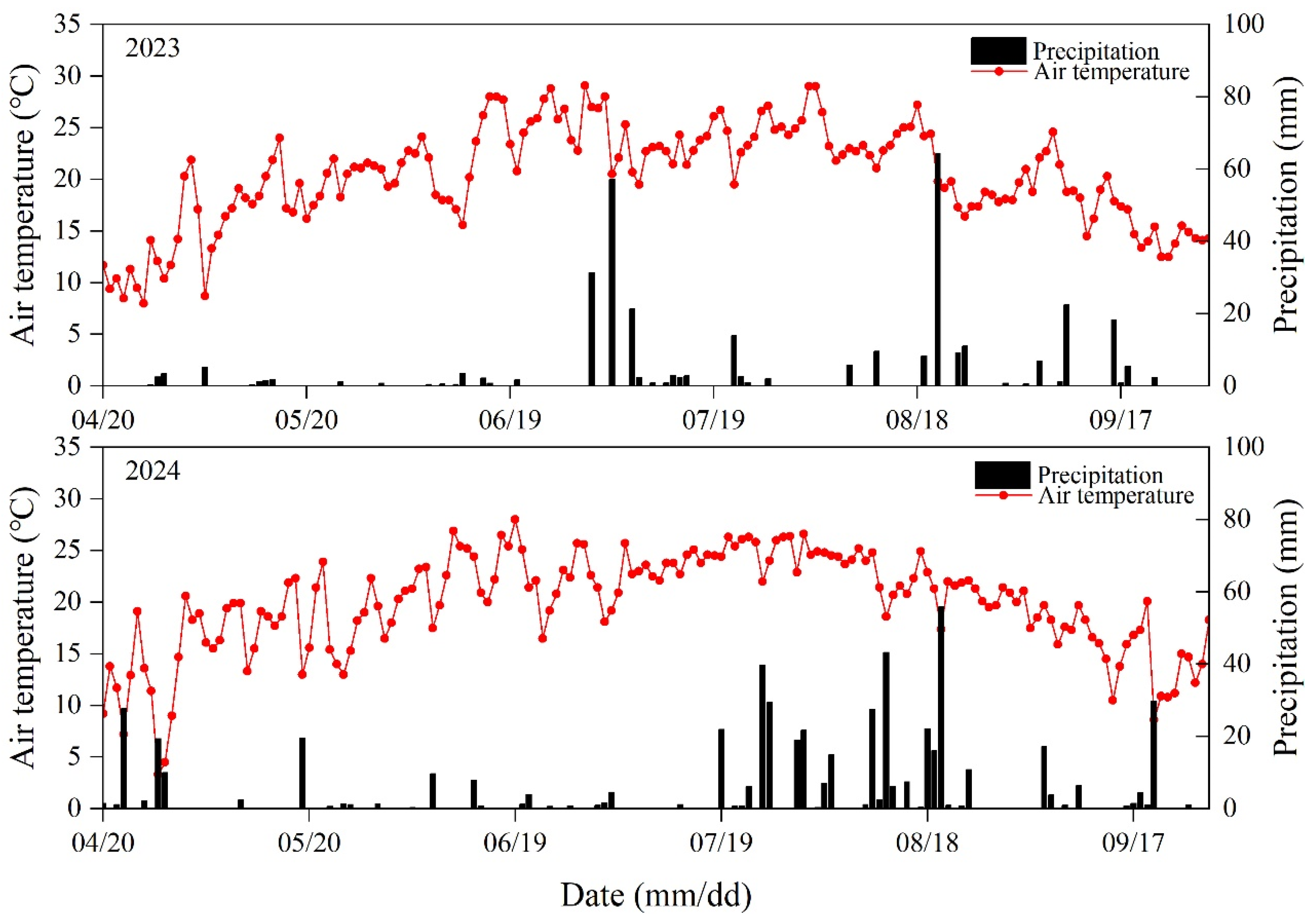
This long term experimental field trial took place from 2020 to 2024 at the Conservation Tillage Experimental Base (41°51′28″ N, 119°6′31″ E; elevation 546.7 m) of the Chifeng Institute of Agriculture and Animal Husbandry Sciences in Inner Mongolia, China. The site is located within the semi-arid agro-pastoral ecotone of northern China. The regional climate is characterized by a mean annual temperature of 17.4 °C during the maize growing season (April to September). Across the five experimental years, growing-season precipitation exhibited high interannual variability, ranging from 336.1 mm (2023, a drier year) to 547.5 mm (2024, a wetter year), against a long term mean precipitation of 408 mm (Figure 1). The experimental soil is derived from loess or loess-like parent material and is classified as brown soil according to the Chinese Soil Classification System, with a loam texture. Prior to the establishment of the experiment in 2014, the 0–20 cm soil layer had a bulk density of 1.29 g cm−3 and a pH (soil:water = 1:2.5) of 8.1. Particle-size distribution comprised 44.3% sand (2000–50 μm), 45.3% silt (50–2 μm), and 10.4% clay (<2 μm). Soil organic carbon content was 7.9 g kg−1, while available nitrogen, phosphorus, and potassium contents were 55.8, 15.7, and 82.3 mg kg−1, respectively.

2.2. Experimental Design

Treatments began in autumn 2020 after maize harvest and were maintained consistently on the same plots each year without rotation. Three tillage practices were compared: no tillage (NT), rotary tillage (RT), and deep ploughing (DP). Detailed descriptions of the corresponding field management measures for each treatment are provided in Table 1. A randomized complete block design was used with three replicates. Maize (Zea mays L., cv. ‘Dika 159’) was sown around May 10 and harvested on October 1 annually at a density of 82,500 plants ha−1. The seeds were supplied by Inner Mongolia Lihe Agricultural Science and Technology Development Co., Ltd. Individual plots measured 9.6 m × 80 m. A uniform basal fertilizer application provided 150 kg N ha−1, 90 kg P2O5 ha−1, and 60 kg K2O ha−1 in each year. All subsequent field operations were consistent across plots.

2.3. Sampling and Measurement

Multi-depth soil monitoring systems (ST100, Beijing Jingwei IoT Technology Co., Ltd., in Huairou District, Yanxi Street, Beijing, China) were installed in each plot to automatically record volumetric water content (VWC) and temperature at 10, 20, and 30 cm depths. Data were logged at 30-min intervals from late April to October. The average for these three layers represented the 0–30 cm profile. Air temperature was recorded by the systems, and precipitation data came from a nearby weather station.
The soil temperature growing degree days (GDDsoil) was calculated using the following equation [26]:
G D D s o i l = 0 n T m a x + T m i n 2 T base
where GDDsoil represents the soil temperature growing degree days (°C d); T m a x is the daily average maximum temperature (°C); T m i n is the daily average minimum temperature (°C); T base is the minimum temperature threshold required for maize growth and development (°C), this study uses 10 °C; n denotes the number of days in the maize growth period (d).
Straw cover was measured using the rope transect method. A 50-m-long rope with markings at 0.5-m intervals (totaling 100 markings) was laid diagonally across the plot. The presence or absence of straw under each marking point was recorded. The straw coverage rate was calculated as: Straw coverage rate = Number of markings with straw⁄100 × 100%. After harvest, before sowing, and after sowing, five replicate measurements were conducted for each treatment. Undisturbed soil cores were collected from the 0–20 cm, 20–40 cm, and 40–60 cm soil layers in each plot after maize harvesting and prior to sowing in each year, time points chosen to assess tillage effects on soil physical properties without disrupting crop growth or confounding measurements with transient in-season hydrological dynamics. The samples were subsequently oven-dried at 105 °C to determine soil bulk density and soil water content, which were then used to calculate soil water stock (SWS). SWS (mm) = soil layer thickness (mm) × bulk density (g cm−3) × gravimetric soil water content (%).
The integrated efficiency of water and heat resource utilization was quantified through two critical components: GDDsoil production efficiency (PEsoil) and water use efficiency (WUE), calculated as follows [27].
P E s o i l = Y G D D
W U E = Y E T
E T = Δ S W S + P + I + U D R
Δ S W S = ρ i × θ i × h i
where Y is the maize theoretical calculated yield (kg·ha−1), ET is soil water evaporation (mm), Δ S W S is the difference in soil water stock between pre-sowing and post-harvest (mm), P is effective precipitation during the maize growing season (mm), I is the irrigation amount applied during the growth period (mm). U (groundwater recharge), D (deep percolation), and R (surface runoff) are all set to 0 in this study. θ i , ρ i , h i correspond the soil water content (%), soil bulk density (g·cm−3) and thickness (cm) of the i layer, respectively.
In addition, the temperature sensitivity of soil processes was quantified using the β coefficient, which was obtained by fitting paired observations of air temperature (Ta) and soil temperature (Ts) using the least squares method. The calculation is given as [28]:
ß = i = 1 n   ( T a ( i ) T a ) · ( T s ( i ) T s ) n i = 1   ( T a ( i ) T a ) 2
where n is the total number of observations, Ta(i) and Ts(i) are the air and soil temperature for the i-th observation, respectively, and Ta and Ts are the mean air and soil temperature across all observations, respectively.
At harvest, plants from the central area of each plot (10 m × 1.2 m; two rows) were harvested to determine crop yield, which was adjusted to a standard moisture content of 14%. The number of ears per hectare was calculated based on the total ear count within the harvested area and converted to a per-hectare basis. The number of kernels per ear was determined by counting kernels from a representative subsample of ears collected from each plot. Hundred-kernel weight was measured by weighing 100 randomly selected kernels from each plot after drying to 14% moisture content.

2.4. Data Analysis

Data processing and figure generation were performed using Microsoft Excel 2019 and Origin 2019b. Analysis of variance (ANOVA) was performed with SPSS software (version 22.0), employing the least significant difference (LSD) test at a significance level of p < 0.05.

3. Results

3.1. Effects of Different Tillage Practices on Soil Water Content and Soil Temperature at Different Growth Stages of Maize

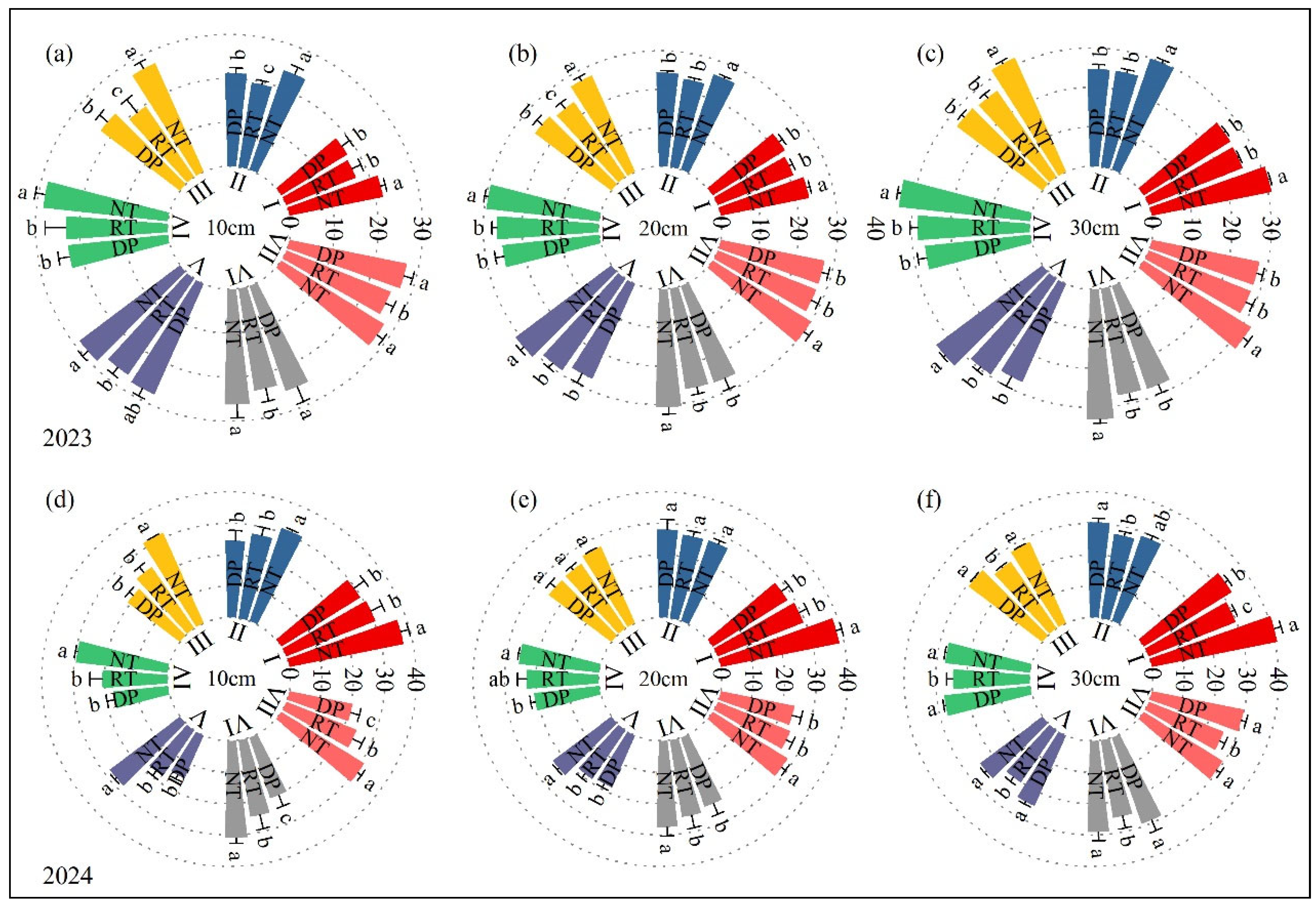
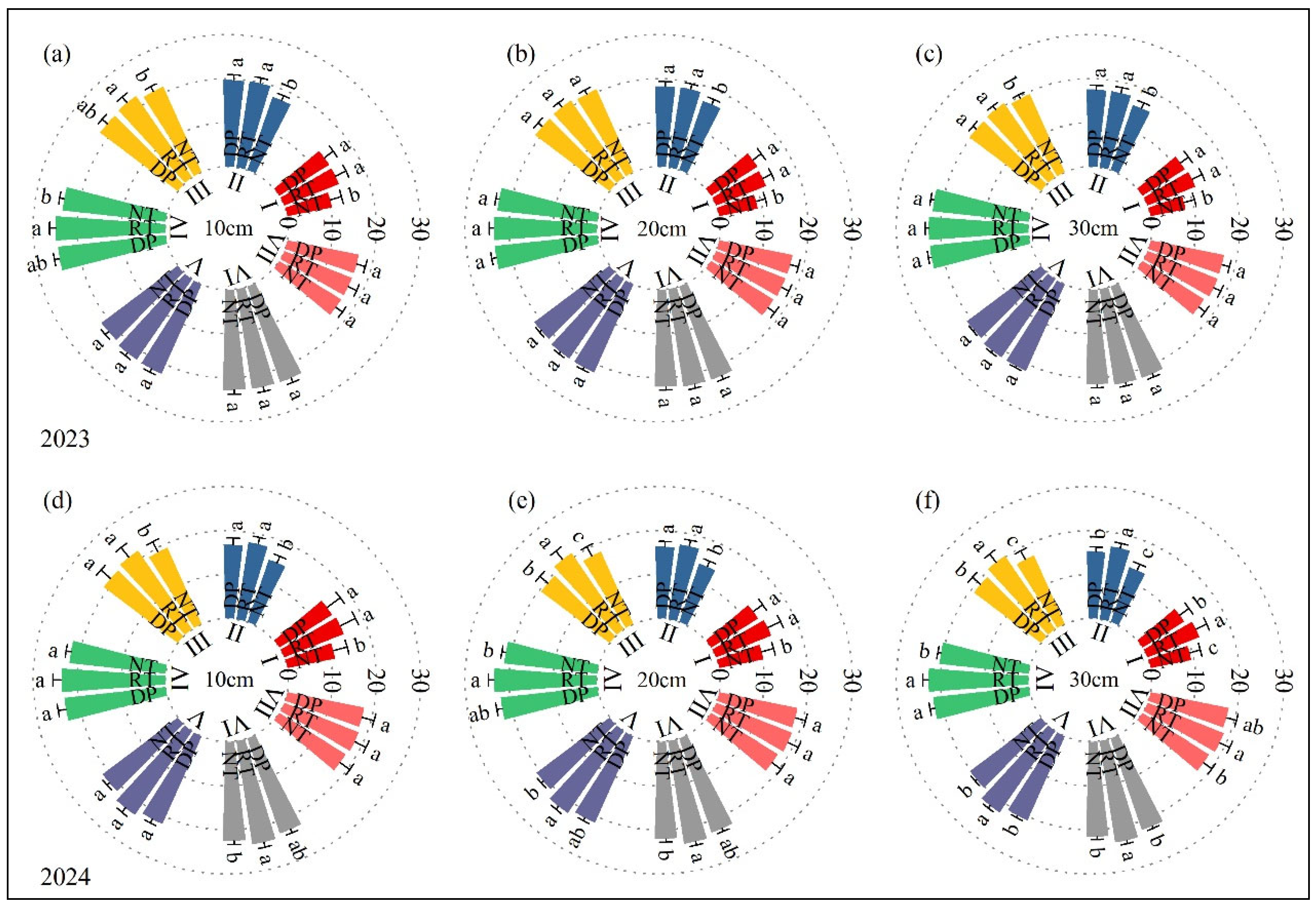
Analysis of soil moisture data revealed distinct patterns among tillage treatments over the maize growing season (Figure 2). Relative to RT and DP, the daily average soil water content of 10 cm, 20 cm, and 30 cm generally increased significantly under NT practices, particularly in the PS to V12 stage. For example, in 2023, soil water content was notably higher in PS to V12 stage, averaging (21.74%, 23.40%, and 30.90%), (23.96%, 26.23%, and 29.87%), (27.09%, 27.45%, and 31.69%) and (28.44%, 29.46%, and 33.43%) in the 10 cm, 20 cm, and 30 cm soil layers, respectively, compared to RT and DP (Figure 2a–c). Similarly, trends were observed in 2024 as well (Figure 2d–f). Notably, during the early crop growth stage (VE–V6), the soil water content under DP was slightly higher than that under RT, with this difference being more pronounced in deeper soil layers (≥20 cm; p < 0.05). In 2023, DP increased soil water content by 4.90% relative to RT at 20 cm depth (Figure 2b). More substantially, 2024 measurements revealed a 13.87% increase under DP at 30 cm depth compared to RT (Figure 2f).
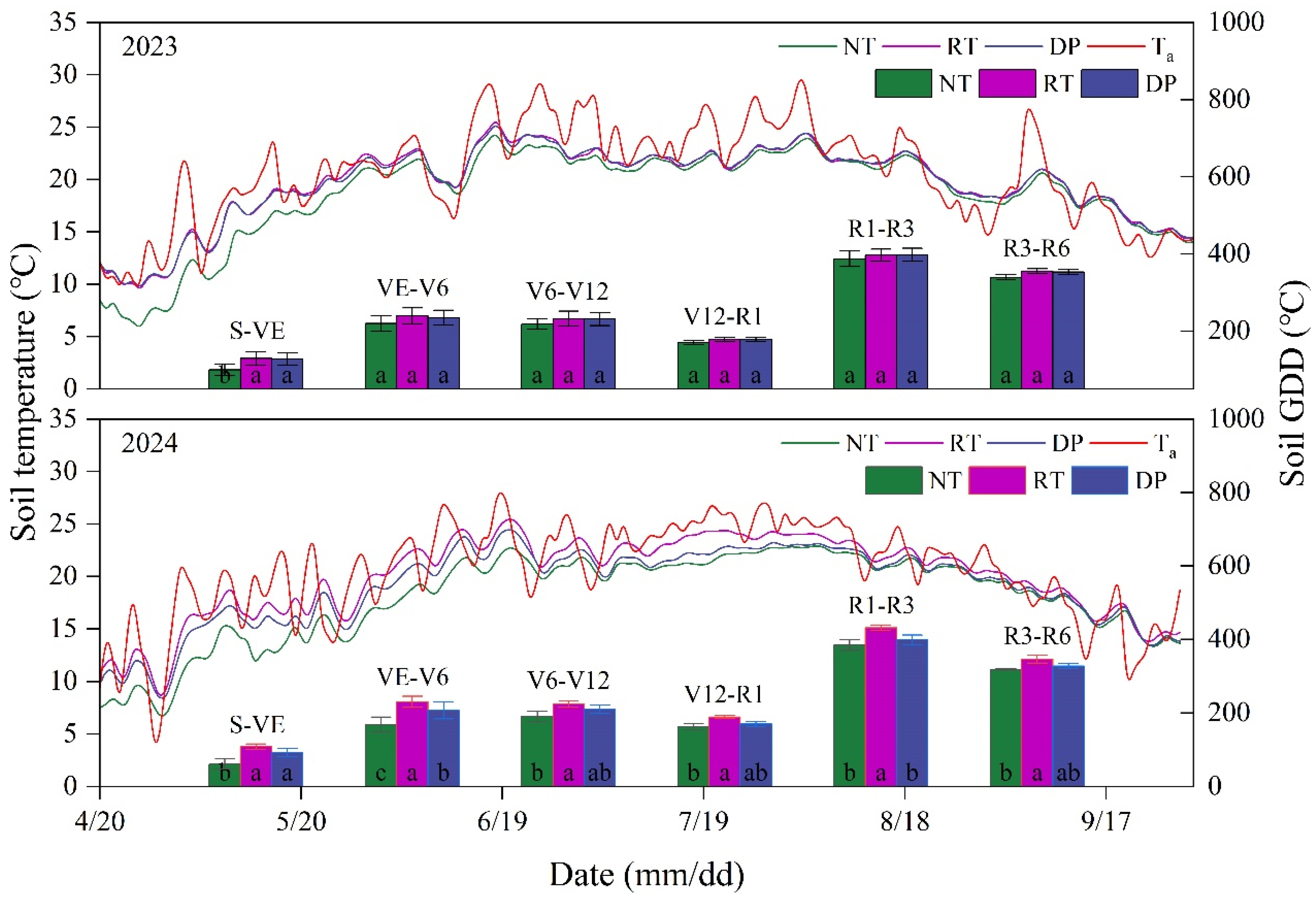
The daily mean soil temperatures during different growth stages of maize are shown in Figure 3. In 2023, significant differences in soil temperature were observed among different soil layers from pre-sowing to the V12 stage (PS–V12). In contrast, these differences persisted until the R3 stage in 2024. For both years, the variations in soil temperature among different tillage practices were most pronounced during the pre-sowing to emergence period (S-VE), with the differences gradually diminishing as the growth stages progressed. For example, in 2023’s PS stage, compared with NT, RT and DP practices increased soil temperature at 10, 20, and 30 cm depths by (3.03 °C, 3.27 °C, and 3.58 °C) and (3.01 °C, 3.50 °C, and 3.20 °C), respectively. However, by the VE stage, the warming effects of RT and DP practices were significantly reduced, with temperature increases decreasing to (2.18 °C, 1.79 °C, and 1.87 °C) and (2.03 °C, 1.61 °C, and 1.85 °C) at the corresponding soil depths, respectively.
Interannual variation in treatment effects was documented: in 2023, statistically significant temperature differentials (p < 0.05) among tillage practices persisted from pre-sowing (PS) through the V12 stage, whereas in the higher precipitation year of 2024, these significant differences extended through the milk stage (R3) (Figure 3). The maximum thermal divergence between tillage systems occurred during the sowing-to-emergence (S-VE) interval. At the pre-sowing stage in 2023, soil temperature under rotary tillage (RT) exceeded that under no tillage (NT) by +3.03 °C at 10 cm depth, +3.27 °C at 20 cm, and +3.58 °C at 30 cm. Deep ploughing (DP) produced a comparable warming effect, with temperature elevations of +3.01 °C, +3.50 °C, and +3.20 °C at the respective depths relative to NT. A progressive attenuation of this tillage-induced warming was observed with canopy development. By the emergence (VE) stage, the RT advantage over NT had declined to +2.18 °C (10 cm), +1.79 °C (20 cm), and +1.87 °C (30 cm), representing reductions of 28.1%, 45.3%, and 47.8% from PS-stage differentials. Similarly, the DP warming effect diminished to +2.03 °C (10 cm), +1.61 °C (20 cm), and +1.85 °C (30 cm), corresponding to reductions of 32.6%, 54.0%, and 42.2%. The rate of differential attenuation exhibited depth dependency, with the greatest proportional reduction occurring at intermediate (20 cm) depths. Thermal convergence between treatments followed a negative exponential pattern (R2 = 0.94), indicating that tillage-mediated temperature effects are primarily an early-season phenomenon in this cropping system.

3.2. Effects of Different Tillage Practices on Hydrothermal Dynamics in Topsoil

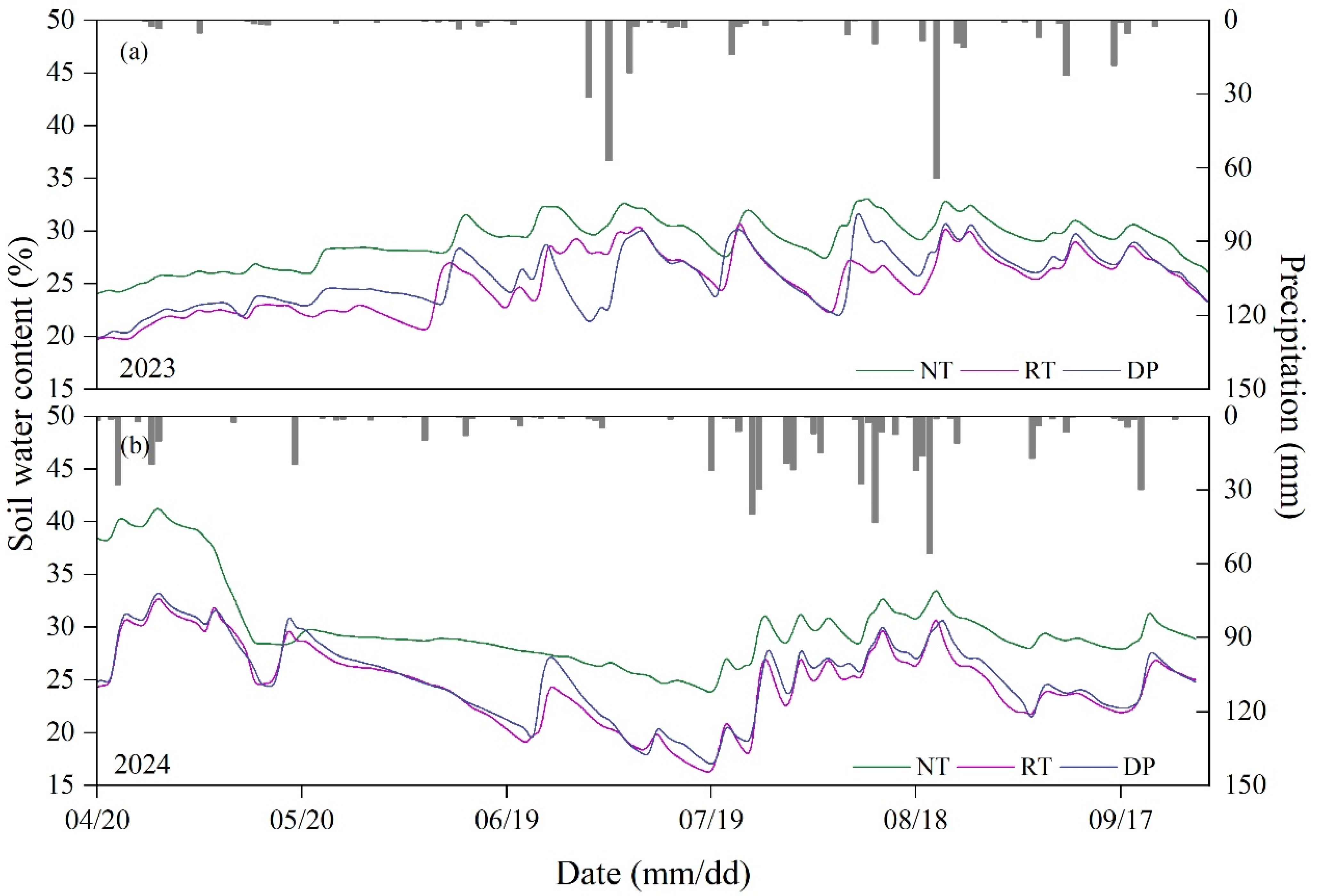
Integrated soil water storage (SWS) within the 0–30 cm profile demonstrated a consistent positive response to discrete precipitation events across all tillage treatments during both the pre-sowing fallow period and the subsequent growing season (Figure 4). Statistical comparison of treatment means confirmed that no tillage (NT) significantly enhanced the 0–30 cm SWS relative to both rotary tillage (RT) and deep ploughing (DP), with a mean treatment effect (MTE) of +12.7% (p < 0.05). The efficacy of NT for moisture conservation exhibited significant interannual variability, strongly correlated with total seasonal precipitation (r = 0.89, p < 0.01). During the higher precipitation year of 2024 (547.5 mm), the NT system improved 0–30 cm SWS by an average of 18.3% over RT, compared to a 7.1% improvement during the drier 2023 season (336.1 mm). This precipitation-dependent enhancement was most pronounced in the pre-sowing reservoir: NT pre-sowing SWS in 2024 measured 145.6 mm, exceeding the 2023 value of 95.3 mm by 52.8% (p < 0.05). This quantifies the system’s capacity to accumulate and retain off-season precipitation. A secondary treatment effect was observed between the tilled systems. DP maintained a consistent SWS advantage over RT throughout the monitoring period, averaging 5.2% higher soil moisture. However, this DP-RT differential was significantly smaller than the NT-RT differential (F = 8.34, p < 0.05), confirming the superior integrative water retention of the undisturbed NT system. The DP advantage showed less interannual variation (±1.3%) compared to the NT system, indicating a more stable but limited moisture conservation effect.
The thermal regime within the plow layer (0–30 cm) exhibited a unimodal seasonal trajectory across all tillage treatments, with soil temperature (Tsoil) increasing to a maximum in mid-to-late July before declining thereafter, correlating strongly with ambient air temperature (r = 0.94, p < 0.01) as shown in Figure 5. During the early vegetative growth stages (PS to V6), Tsoil under no tillage (NT) was significantly depressed relative to rotary tillage (RT) and deep ploughing (DP). The mean temperature differential (ΔT) between NT and RT during this period was −2.4 °C (p < 0.05). Treatment-induced thermal differences demonstrated temporal convergence, reaching a minimum ΔT during the peak thermal period (Day of Year 200–210). At this peak, Tsoil under RT exceeded DP by +0.9 °C and NT by +2.1 °C on average across both years. This contrast was amplified in the wetter 2024 season, where the RT-NT differential reached a maximum of +3.23 °C (p < 0.01). Post-peak, all treatments exhibited synchronous cooling, with inter-treatment ΔT diminishing to ≤0.5 °C by physiological maturity (R6). Cumulative thermal time, expressed as soil growing degree days (GDDsoil, base 10 °C), quantified the integrated treatment effects. Tillage practices exerted their strongest influence on GDDsoil accumulation prior to the V6 stage. During this early phase, GDDsoil under NT was reduced by 23.8% on average (range: 13.4–32.2%) compared to RT. DP showed a more moderate reduction, lowering GDDsoil by 6.8% on average (range: 1.7–11.9%) relative to RT. This early-season thermal divergence attenuated progressively. By the V12 stage, the GDDsoil deficit under NT had narrowed to 8.7% of the RT accumulation. At crop maturity, final GDDsoil totals showed no statistically significant difference among treatments (p > 0.05), with variation ≤3.5%.

3.3. Effects of Different Tillage Practices on the Diurnal Dynamics of Soil Temperature from Pre-Owing to Emergence

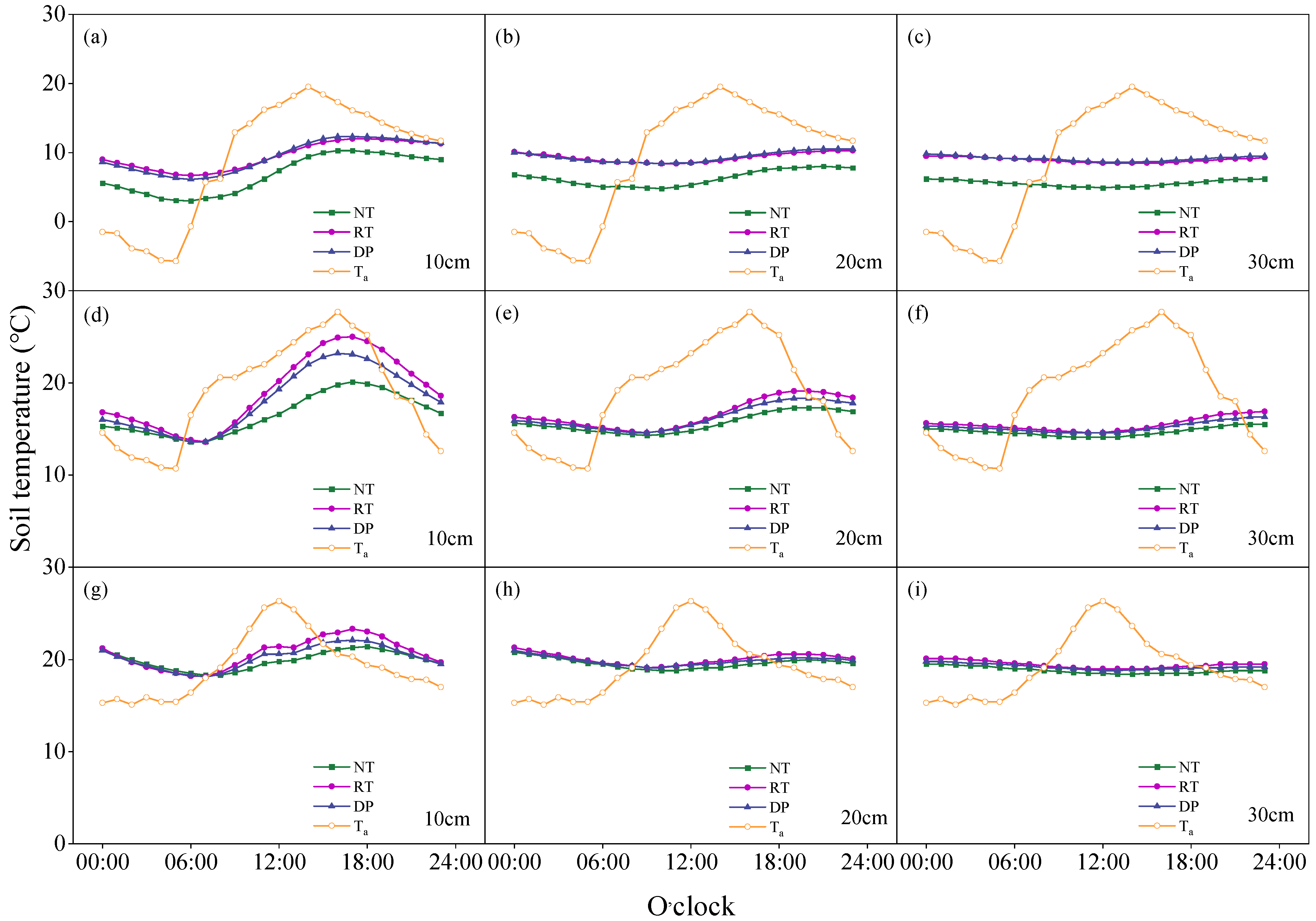
Diurnal soil temperature (Ts) variation was primarily driven by air temperature (Ta) but modulated significantly by tillage method and measurement depth (Figure 6). For the 2023 pre-sowing to emergence period, linear regression showed Ts at 10 cm depth responded to Ta with a sensitivity coefficient (β) of 0.78 °Cs/°Ca. This sensitivity attenuated with depth: β decreased to 0.52 at 20 cm and 0.31 at 30 cm. Concurrently, the amplitude of diurnal Ts fluctuation decreased by 62% from the 10 cm to the 30 cm depth, confirming a pronounced soil thermal damping effect. The minimum Ts at 10 cm across all treatments occurred consistently between 05:00–07:00 Local Time. At this pre-dawn minimum, NT and DP systems were cooler than RT. Quantitatively, during pre-sowing, NT and DP Ts were depressed by 3.7 °C and 0.6 °C, respectively, relative to RT. During sowing, the depressions were 0.3 °C and 0.2 °C, and by seedling emergence, the differences were negligible (−0.3 °C and −0.1 °C). Post-sunrise warming followed a treatment-specific pattern. While all Ts curves increased with Ta, the time of maximum temperature (Tmax) differed. RT and DP reached Tmax at 15:23 ± 32 min and 15:41 ± 28 min (mean ± SD), respectively. In contrast, NT Tmax was significantly delayed to 16:48 ± 18 min, representing a lag of 1.4–2.0 h (p < 0.01). The diurnal thermal divergence (ΔTs) between treatments increased linearly with daytime Ta, expanding at a rate of 0.12 °C per °C increase in Ta (R2 = 0.86). Temporal stability of the Tmax timing also varied. The coefficient of variation (CV) for Tmax occurrence was 3.5% for RT, indicating notable day-to-day fluctuation, compared to only 1.8% for NT, demonstrating greater temporal consistency albeit with a systematic phase delay.

3.4. Factors Influencing Soil Hydrothermal Dynamics Under Different Tillage Practices

To elucidate the causal mechanisms underlying observed differences in soil hydrothermal regimes, key surface and structural parameters were quantified, including straw coverage rate (SCR), soil bulk density (BD), and calculated porosity (Table 2). Post-harvest SCR measurements showed no significant inter-treatment differences (p > 0.05), with all treatments achieving >93% coverage. However, temporal analysis revealed pronounced spatiotemporal heterogeneity. From the pre-sowing period through harvest, mean SCR under no tillage (NT) was maintained at 74.2%, significantly exceeding the 0% coverage under deep ploughing (DP) and rotary tillage (RT) during this interval (p < 0.01). This represents a 100% preservation of surface residue during the critical fallow and early-growth periods under NT, versus complete removal under tilled systems. NT induced significant changes to near-surface soil physical structure. In the 0–20 cm layer, NT increased BD by a mean of 16.4% relative to tilled treatments across both years. Specifically, BD under NT measured 1.46 g cm−3 in 2023, constituting a +15.87% and +13.18% increase over RT (1.26 g cm−3) and DP (1.29 g cm−3), respectively. In 2024, NT BD was 1.51 g cm−3, representing increases of +17.05% and +18.90% over RT and DP. Correspondingly, calculated porosity in the 0–20 cm layer under NT was reduced by an average of 7.8 and 8.4 percentage points compared to RT and DP (p < 0.05). This structural modification was confined to the surface horizon. The observed increase in soil bulk density in the 0–20 cm layer under NT relative to tilled treatments is a typical consequence of reduced mechanical disturbance. Without periodic tillage, soil consolidates under natural settling, root growth, and wetting-drying cycles, leading to a denser, more stable structure. This consolidation is often accompanied by enhanced formation of bio-pores and stable aggregates, which can improve water infiltration and retention despite the higher bulk density. Importantly, the increase under NT (to 1.46–1.51 g cm−3) remained within the optimal range for root growth in loamy soils and did not impair soil hydrological function—as evidenced by the higher soil water content and water-use efficiency under NT. Statistical analysis confirmed no significant differences (p > 0.05) in BD or porosity among treatments at the 20–40 cm and 40–60 cm depths. The coefficient of variation (CV) for BD within the NT profile was 2.1%, compared to 0.8% for RT and 0.9% for DP, indicating greater vertical stratification under the undisturbed system. Linear regression identified SCR as a primary predictor for early-season soil water content (R2 = 0.71, p < 0.01), while surface BD (0–20 cm) showed a strong negative correlation with both diurnal soil temperature amplitude (R2 = 0.82, p < 0.01) and early-season soil heat flux (R2 = 0.67, p < 0.05).

3.5. Soil GDD Production Efficiency (PEsoil) and Water Use Efficiency (WUE) Under Different Tillage Practices

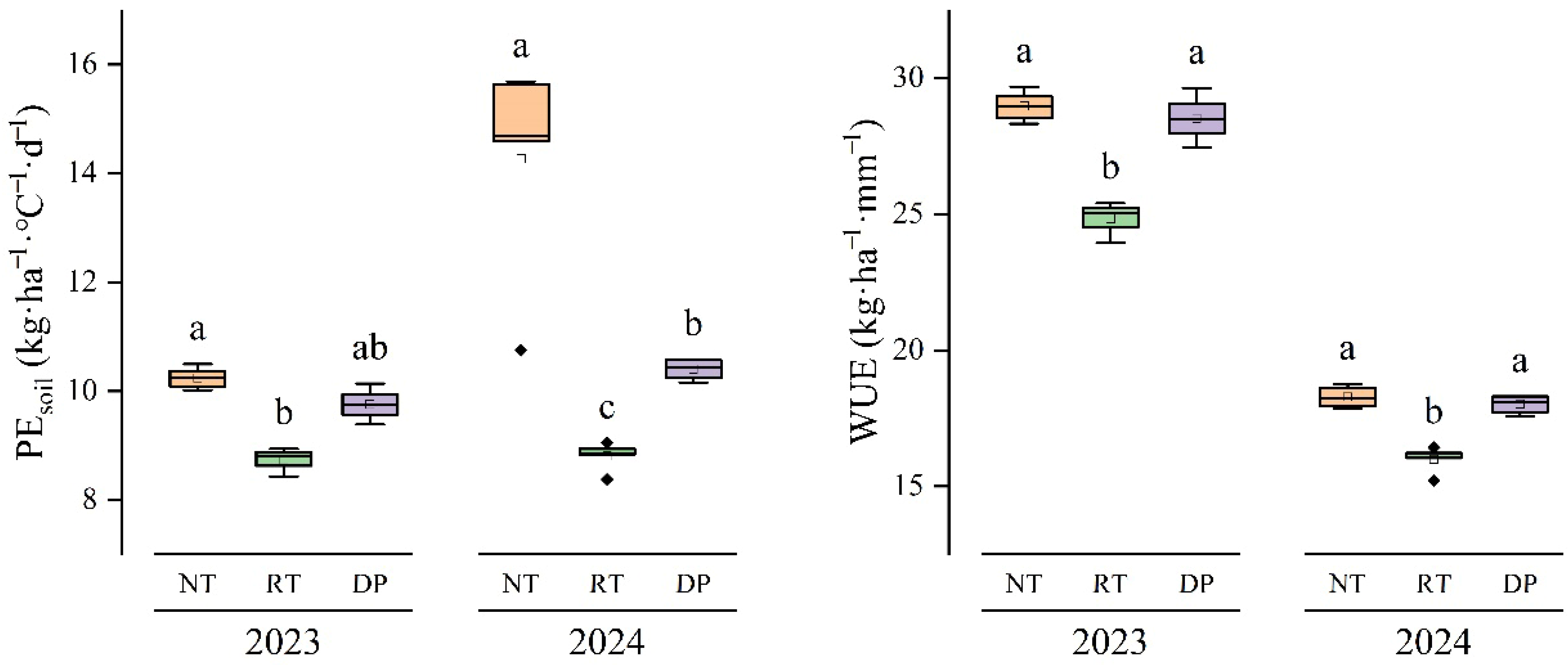
Statistical analysis of resource use efficiency metrics over the 2023–2024 period confirmed significant enhancements under conservation tillage systems relative to conventional rotary tillage (RT) (Figure 7). Both the soil growing degree day production efficiency (PEsoil) and water use efficiency (WUE) showed marked improvement under no tillage (NT) and deep ploughing (DP). For PEsoil (kg ha−1 °C−1 d−1), NT increased mean efficiency by 17.19% in 2023 and 62.03% in 2024 compared to RT. DP showed more moderate but consistent gains, improving PEsoil by 11.62% in 2023 and 18.12% in 2024. Interannual variation was notable for NT, with the wetter 2024 season producing a 3.6-fold greater relative improvement over RT compared to 2023. The absolute PEsoil values for NT reached 4.82 kg ha−1 °C−1 d−1 in 2024, representing a +1.85 kg ha−1 °C−1 d−1 increment over RT. WUE (kg ha−1 mm−1) exhibited a similar pattern with lower interannual variability. NT improved WUE by 16.64% in 2023 and 14.34% in 2024 relative to RT. DP showed parallel improvements of 14.83% and 12.68% for the respective years. In absolute terms, NT achieved a mean WUE of 22.4 kg ha−1 mm−1 across both seasons, compared to 19.4 kg ha−1 mm−1 for RT—a net gain of 3.0 kg ha−1 mm−1. Treatment effects on both efficiency metrics were statistically significant (p < 0.05) in both experimental years. Efficiency gains under DP remained stable between years (coefficient of variation = 11.2% for PEsoil, 7.8% for WUE), while NT showed greater responsiveness to annual conditions (CV = 58.9% for PEsoil, 7.5% for WUE). The PEsoil/WUE ratio increased by 0.4% under NT and decreased by 1.2% under DP relative to RT, indicating differential resource optimization strategies between conservation tillage systems.

3.6. Maize Grain Yield and Direct and Indirect Effects Under Different Tillage Practices

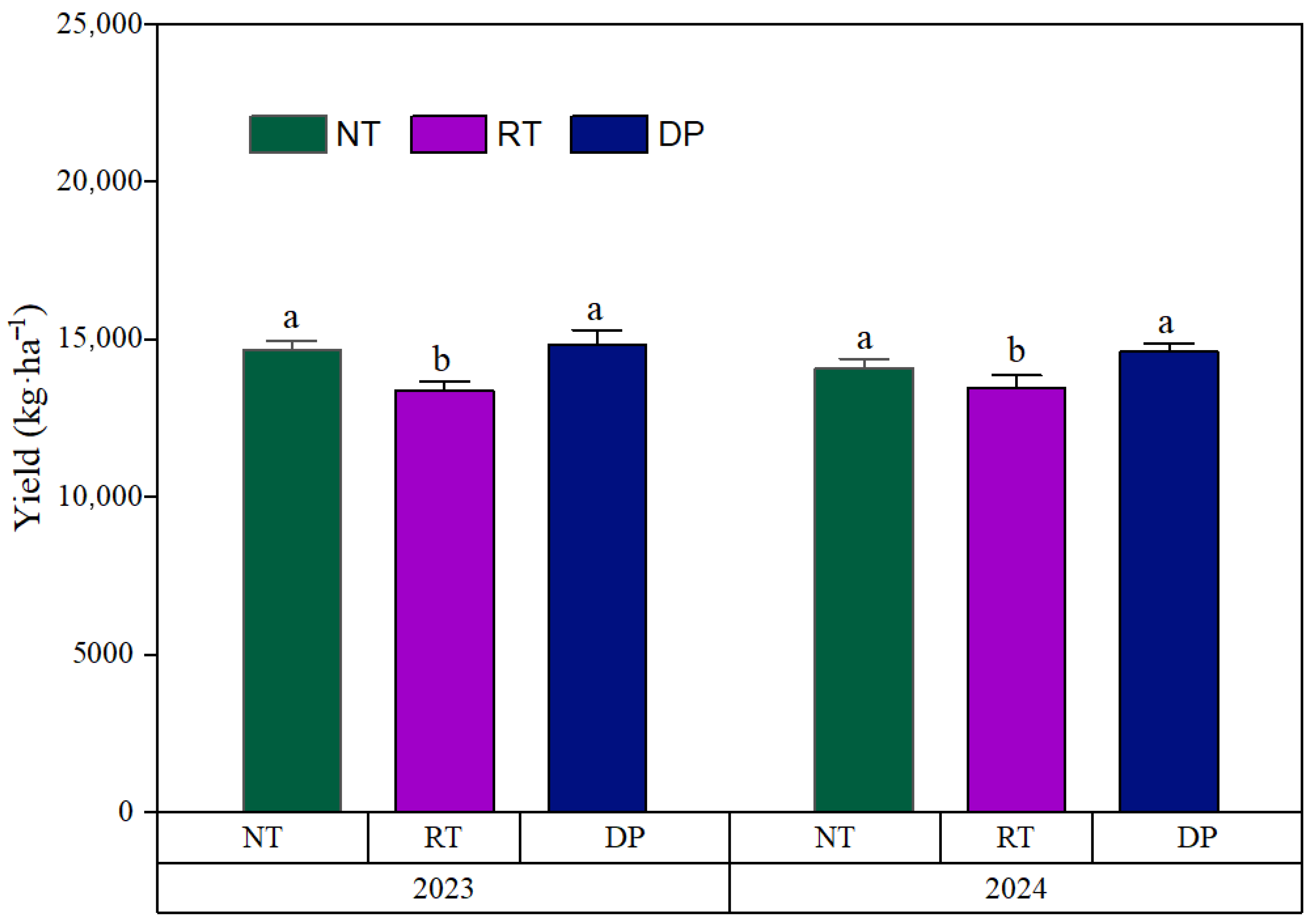
Maize grain yield during the 2023 and 2024 growing seasons revealed significant effects of tillage (Figure 8). Both NT and DP consistently outperformed conventional RT, with DP showing the highest overall mean yield across both years (14,843.1 kg ha−1), followed by NT (14,400.0 kg ha−1) and RT (13,632.6 kg ha−1), representing yield advantages of 3.1% for DP over NT, 8.9% for DP over RT, and 5.6% for NT over RT (p < 0.05).
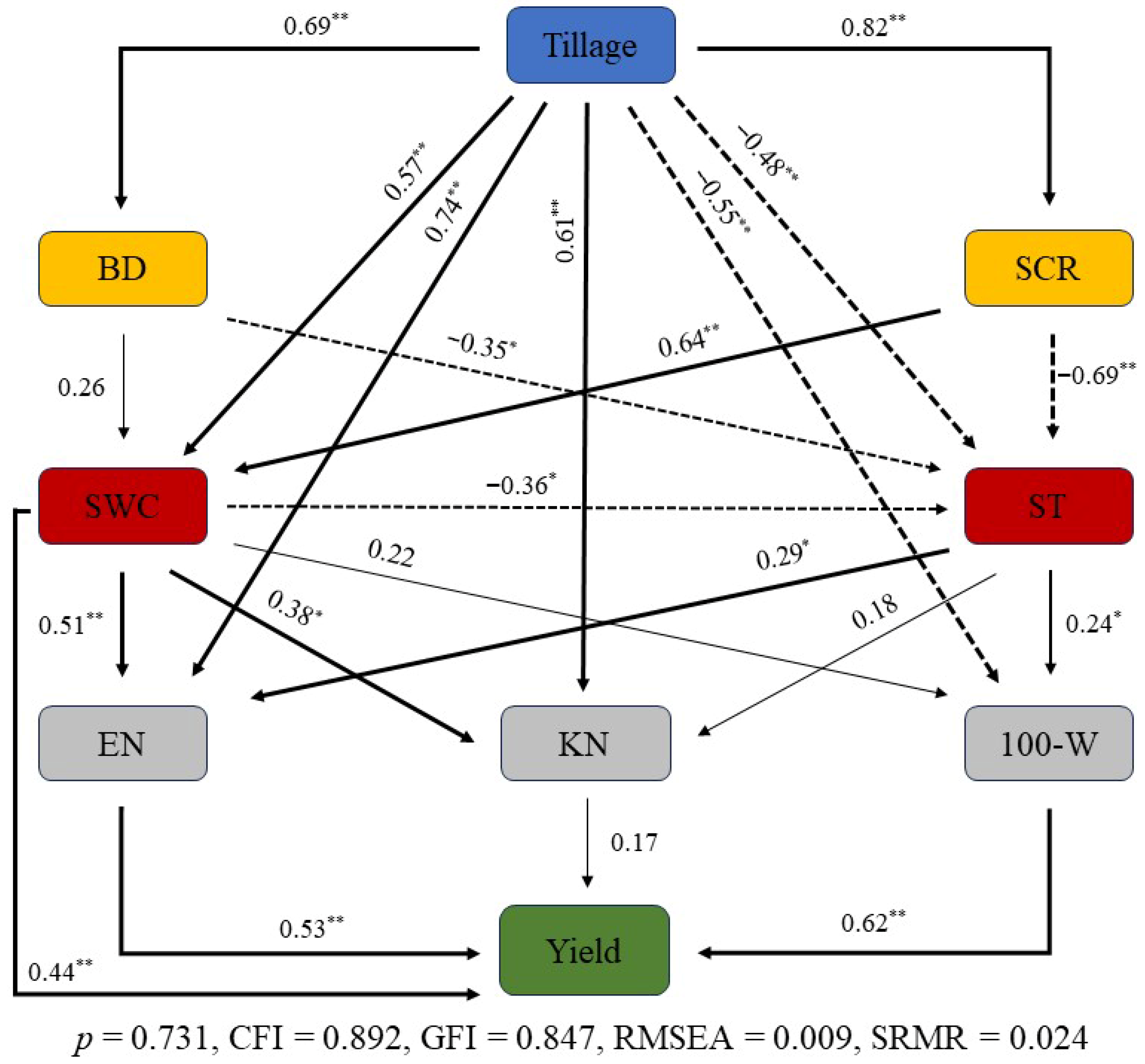
Structural equation modelling (SEM; Figure 9) revealed that tillage influenced yield primarily through indirect pathways rather than direct effects. Key determinants included straw coverage rate (SCR), soil bulk density (BD), soil water content (SWC), soil temperature (ST), ear number per hectare (EN), kernel number per ear (KN), and 100-kernel weight (100 W) (p < 0.05). Among these, EN, 100 W, and SWC exerted the strongest direct positive effects on yield (standardized path coefficients: 0.53, 0.62, and 0.44, respectively). Tillage improved maize productivity mainly by modifying soil hydrothermal conditions (SWC, ST) and surface residue and soil structure (SCR, BD), which in turn enhanced yield components such as EN, KN, and 100 W (p < 0.01).
These results indicate that the superior performance of NT and DP is attributable to improved soil water retention, moderated temperature, maintained surface residue, and optimized soil structure, highlighting the importance of integrating soil physical and hydrothermal management in conservation tillage to maximize maize yield under semi-arid northern China conditions.

4. Discussion

4.1. Impacts of Tillage Practices on Soil Water Content and WUE

A primary benefit of no tillage is the conservation of soil water, which provides a significant physiological advantage for crops growing in water-scarce conditions [29].
Tillage physically alters soil structure, directly controlling how water is stored, moves, and is held in the soil profile [21,30]. Extensive field evidence demonstrates that in arid and semi-arid regions, reduced- or no tillage systems retain more plant-available water than conventional inversion tillage [10,15,16]. Consistent with this established understanding, our results confirm that NT and DP significantly enhanced profile soil water storage (0–30 cm) and systemic WUE. The mechanistic advantage of NT can be attributed to a dual effect: (i) reduced soil disruption preserves macropore continuity, promoting water infiltration; and (ii) sustained residue cover acts as a physical barrier, suppressing soil surface evaporation [30,31].
A critical insight from our analysis is the precipitation-dependent nature of NT’s hydrological regulation. The system showed its highest water retention efficacy in the higher-rainfall season, yet delivered peak water use efficiency under drier conditions. This pattern confirms that the magnitude of NT’s hydrological benefits is intrinsically linked to annual precipitation patterns [32], emphasizing the role of rainfall patterns as a primary regulator of conservation tillage performance. DP, despite involving greater soil disturbance, also improved water retention relative to RT, primarily through the creation of a deeper, loosened soil profile that enhances precipitation infiltration and temporarily increases water storage capacity in the subsoil. However, this benefit may be transient if not coupled with surface residue cover, as the disturbed surface remains vulnerable to sealing and evaporation, explaining why DP’s water-conserving effect was consistently weaker than NT’s in this study.
In precipitation-dependent systems, NT disproportionately increased water content in the surface horizon (0–10 cm) compared to deeper strata (>20 cm). This stratification is largely attributable to the evaporative barrier effect of surface residues [33]. In parallel, long term NT cultivation enhances microbial biomass and activity, driving the synthesis of glomalin and other cementing agents that facilitate macro-aggregation. This improved soil structure subsequently enhances infiltration rates and increases the physical sequestration of organic carbon within the topsoil [34]. A key finding was that NT consistently maintained higher soil water reserves prior to sowing, effectively acting as a “soil reservoir” that stores off-season rainfall, a critical factor for yield stability. Notably, NT maintained elevated soil water storage prior to sowing, demonstrating its capacity to function as a “soil reservoir” by accumulating off-season precipitation. Our data show that in the wetter year (2024), NT’s pre-sowing soil water storage (145.6 mm) was 52.8% higher than in the drier year (2023), and this enhanced early-season water availability was positively correlated with key yield determinants, specifically, higher ear number per hectare and hundred-kernel weight—as identified in our structural equation model (Figure 8). This reservoir effect is a key mechanism underpinning NT’s yield-enhancing potential in this semi-arid environment. Although DP enhanced infiltration and curtailed runoff, the absence of surface residue cover resulted in greater evaporation. This rendered DP less effective than NT at conserving water overall, especially during low-rainfall periods early in the season [35], and reduced runoff losses during peak rainfall [36]; its lack of surface cover resulted in higher evaporative losses, rendering its overall water retention inferior to NT, particularly during early growth stages characterized by low precipitation.

4.2. Impacts of Tillage Practices on Soil Temperature and PEsoil

In northern China’s cropping systems, active management of soil thermal regimes remains an agronomic priority [37]. While solar radiation constitutes the primary energy input, residue mulches alter soil thermal dynamics by modulating energy exchange between the soil and atmosphere [38,39]. Our data confirm that NT significantly reduced both mean daily soil temperature and accumulated growing degree days (GDDsoil) during early maize development (pre-sowing through the V6 stage), consistent with majority reports from semi-arid regions [23]. However, certain studies document a dual “warming-cooling” dichotomy associated with straw incorporation [39,40]. This apparent contradiction is resolved by considering temporal context: mulches inhibit radiative heat loss, producing a net warming effect during cool periods (e.g., pre-sowing and early spring), while increased soil moisture, reduced conductive heat transfer, and enhanced latent heat dissipation collectively produce a cooling effect during warm periods (e.g., mid-season from V12 onward). This duality is most evident in double-cropping systems where seasonal thermal contrasts are pronounced [41,42]. In our single-cropping system under NT, the dominant observed effect was a cooling during the early vegetative stages, with thermal convergence occurring by the reproductive phase (R1 onward).
GDDsoil serves as a critical bio-meteorological index for evaluating crop developmental phenology. Researchers frequently employ ≥ 10 °C accumulated temperature metrics to assess varietal adaptation to thermal environments [43]. In tillage studies, GDDsoil (base 10 °C), is particularly informative because it directly quantifies the thermal energy actually available at the seed and root zone, integrating the modifying effects of residue cover and soil moisture, factors that air-temperature-based GDDsoil cannot capture. This threshold (10 °C) aligns with the minimum temperature required for maize germination and root activity, making GDDsoil a more precise agronomic indicator of how tillage practices alter the crop’s microclimatic growing conditions. Our investigation reveals that NT reduced GDDsoil accumulation during early growth phases, with this suppression persisting throughout the entire season in wetter years. Despite this thermal deficit, NT achieved the highest production efficiency per thermal unit (PEsoil) without compromising final yield. This counterintuitive result suggests compensatory mechanisms, likely involving improved soil hydraulic properties and enhanced nutrient availability from long term straw incorporation, which mitigate potential negative impacts of reduced thermal time on crop growth [34,44].

4.3. Potential Mechanisms of Conservation Tillage Practices on Soil Hydro-Thermal Conditions and Crop Theoretical Calculated Yield

Soil water content and temperature constitute master variables controlling maize phenology and productivity, with tillage practices modulating their dynamics through alterations in surface conditions and soil structure [31]. Our results demonstrate that within shallow soil layers, RT exhibited the strongest coupling with air temperature, followed by DP, with NT showing the weakest coupling. This decoupling under conservation tillage operates through two synergistic mechanisms: (1) surface residue attenuates incident solar radiation, reduces soil heat flux, and diminishes turbulent heat exchange, thereby buffering thermal fluctuations [39,45]; (2) reduced mechanical disturbance preserves soil structural integrity, promotes macro-pore continuity, and enhances organic matter accumulation, collectively improving rainfall infiltration, water retention capacity, and carbon sequestration potential [30,34]. While residue can suppress evaporative cooling during the daytime by reducing wind speed and vapor exchange, the dominant net effect of NT in this semi-arid system, especially during the early season, was a reduction in mean soil temperature, primarily due to higher albedo, greater latent heat consumption from increased soil moisture, and reduced conductive heat transfer into the soil profile. Additionally, conservation tillage maintained >60% straw coverage throughout the growing season. By increasing surface albedo and reducing near-surface wind speed, it created a distinct microclimate that decreased net radiation and soil heat exchange while minimizing non-productive water loss, thereby synergistically stabilizing soil hydro-thermal regimes [46]. Regarding diurnal thermal patterns, the minimum temperature across all treatments occurred between 05:00 and 07:00, while maxima occurred after 14:00. However, NT exhibited a pronounced phase delay in peak temperature occurrence, indicating that thermal dynamics are further modulated by mulch architecture and quantity [47].
Structural equation modeling (SEM) elucidated theoretical calculated yield formation pathways under conservation tillage (Figure 9). The model identified straw coverage rate, soil bulk density, soil water content, soil temperature, ear number, kernels per ear, and 100-kernel weight as significant direct or indirect yield determinants (p < 0.05). Among these, ear number, 100-kernel weight, and soil water content exerted significant direct positive effects on yield (standardized path coefficients: 0.53, 0.62, and 0.44 **, respectively). Tillage practices indirectly influenced the theoretically calculated yield by regulating soil temperature and water content and by modifying straw coverage and bulk density. Furthermore, tillage significantly affected yield components, including ear number, kernels per ear, and 100-kernel weight (p < 0.01).

4.4. Residue Management in the Semi-Arid Agro-Pastoral Ecotone of Northern China

While this study demonstrates clear benefits of NT with straw retention in the semi-arid agro-pastoral ecotone of northern China, the transferability of these results to other semi-arid regions depends significantly on local soil conditions. The positive hydrothermal effects and yield stability observed here are most directly applicable to regions with medium-textured soils (e.g., loams, silt loams) similar to those of our experimental site (sandy loam). In coarser-textured sandy soils, the water-holding capacity is lower, which may diminish NT’s absolute water conservation benefit, though its relative advantage over conventional tillage may remain. In finer-textured clay soils, reduced infiltration under NT could potentially limit its effectiveness in high-intensity rainfall events. Therefore, while the principles of conservation tillage are broadly relevant, optimal implementation requires adaptation to local soil textures and hydrological characteristics [48,49,50,51,52]. In semi-arid systems, NT with complete straw retention enhances water conservation throughout the growth cycle, supporting robust plant development and yield enhancement [16]. Conversely, in humid regions, dense mulch layers can induce soil waterlogging and suboptimal soil temperatures, potentially inhibiting root function and early seedling vigor [23]. In this study, no yield penalty was observed under high residue coverage even during wetter years, likely because annual precipitation (555 mm) remained below thresholds typical of humid climates, though early-season soil cooling was still evident.
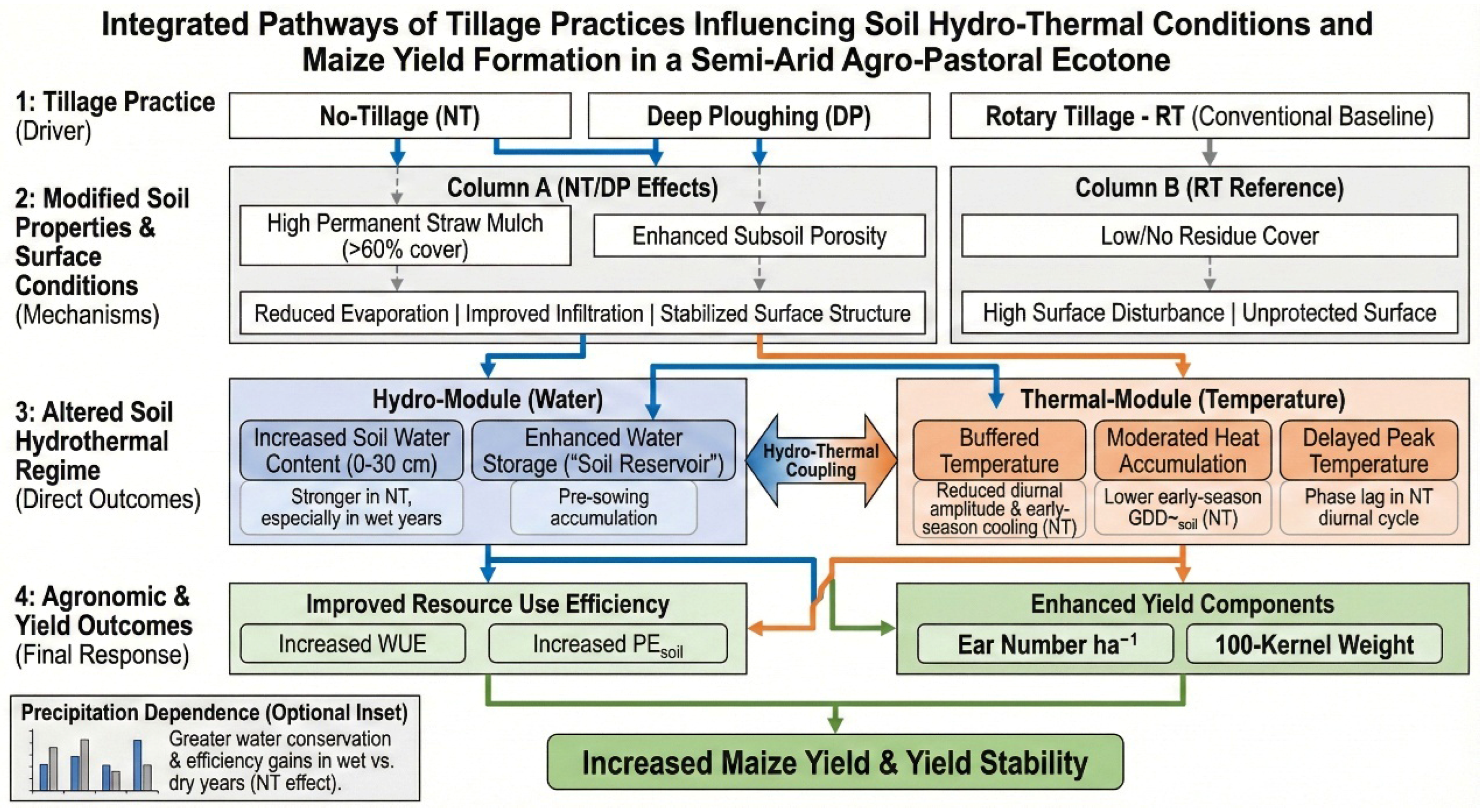
Turmel et al. [29] propose maintaining surface residue coverage between 30% and 75%, with precise optimization required according to local soil-climate conditions. Based on our five-year data in this semi-arid loam soil, a residue coverage rate of approximately 70–80% from pre-sowing through the growing season consistently optimized soil water storage, moderated soil temperature, and supported high resource-use efficiency (WUE, PE-soil) without compromising maize yield. Consequently, within the semi-arid agro-pastoral ecotone of northern China, further research must focus on optimizing in-situ straw retention rates to maximize benefits while mitigating potential adverse effects associated with excessive coverage. Future investigations should specifically examine how alternative mulching configurations (e.g., strip vs. uniform coverage, standing residue) and differential coverage percentages influence crop ontogeny and yield architecture. NT with continuous straw mulch creates a synergistic mechanism that stabilizes the soil-plant-atmosphere continuum (Figure 10). The permanent residue layer (>60% coverage) directly suppresses evaporative water loss, attenuates solar radiation to buffer temperature extremes, and enhances infiltration by protecting soil structure. This surface moderation reduces early-season soil heat accumulation and delays diurnal temperature peaks, while simultaneously increasing profile water storage through improved porosity and aggregation. The resulting optimized hydro-thermal coupling elevates both water- and heat-use efficiencies (WUE, PEsoil), which in turn enhances key physiological yield determinants, particularly ear number and kernel weight, thereby producing higher and more climate-resilient maize yields. Crucially, NT’s water-conserving capacity exhibits precipitation-dependent amplification, demonstrating greater efficacy during wetter growing seasons.

5. Conclusions

Based on the comprehensive findings of this five-year field study in the semi-arid agro-pastoral ecotone, the results provide robust and detailed validation of our initial hypothesis that long term conservation tillage, particularly no tillage (NT) with straw retention, enhances maize yield stability by systematically improving the coupled soil hydrothermal regime, which in turn optimizes resource-use efficiency. Each component of the proposed mechanistic framework was empirically confirmed. First, our data substantiate (Hydro-Regulation): both NT and deep ploughing (DP) significantly elevated soil water content within the 0–30 cm profile and improved systemic water use efficiency (WUE) compared to conventional rotary tillage (RT). Crucially, NT’s performance demonstrated the hypothesized precipitation dependence; it increased profile water storage by 52.8% in a wet year (2024) while achieving superior WUE (+16.6%) in a drier year (2023), confirming that its hydrological benefits are modulated by interannual rainfall variability. Second, (Thermal-Regulation) was confirmed: NT’s permanent straw mulch reduced early-season soil temperature by up to 3.6 °C and lowered accumulated growing degree days (GDDsoil) by 23.8% before the V6 stage. However, contrary to a simple negative effect, this thermal buffering translated into the highest production efficiency per unit of thermal time (PEsoil), which increased by 62.0% in a wet year, demonstrating that improved water status and soil structure under NT compensate for and optimize the use of available heat. Finally, (Yield Pathway) was strongly supported by structural equation modeling: maize yield was most directly and positively influenced by soil water content (path coefficient: 0.44) and its resultant effects on yield components, ear number (0.53), and hundred-kernel weight (0.62). Tillage practices, especially NT, exerted significant indirect effects on yield by durably altering surface conditions (increasing straw cover and bulk density), which stabilized the root-zone microclimate and enhanced the soil’s water-holding capacity. Therefore, this study conclusively demonstrates that NT with permanent straw mulch is the optimal management strategy, as it effectively couples soil water and temperature dynamics, conserving moisture, buffering thermal extremes, and elevating both water and heat use efficiencies, thereby strengthening crop resilience and ensuring more stable productivity under the variable climatic conditions characteristic of this vulnerable ecotone, precisely as hypothesized. While these findings are robust for the studied sandy loam soil and maize system, their transferability to other soil types and crops requires further validation. Future research should prioritize optimizing residue management strategies for local conditions and evaluating the long term economic and environmental trade-offs of adopting conservation tillage at scale.

Author Contributions

F.J.: Methodology, Investigation, Writing—original draft. H.Z.: Methodology, Investigation, Writing—original draft. J.X.: Methodology, Review. C.H.: Experimentation, Investigation, Data curation. W.Z.: Methodology, Review. Y.Z.: Investigation, Formal analysis. L.Z.: Software, Formal analysis. Z.D.: Experimentation, Review. L.B.: Investigation, Review. Y.Y.: Investigation, Formal analysis. Y.C.: Investigation, Formal analysis, Data curation. Q.L.: Investigation, Formal analysis, Data curation. F.M.: Conceptualization, Review, Project administration. All authors have read and agreed to the published version of the manuscript.

Funding

This research was funded by Central Guiding Local Science and Technology Development Fund Project (2024ZY0033), Natural Science Foundation of Inner Mongolia Autonomous Region of China (2025MS03085), Earmarked Fund for China Agriculture Research System (CARS-02-57), and the National Natural Science Foundation of China (42507429).

Data Availability Statement

The original contributions presented in this study are included in the article. Further inquiries can be directed to the corresponding author.

Conflicts of Interest

The authors declare that they have no known competing financial interests or personal relationships that could have appeared to influence the work reported in this paper.

References

  1. Ding, Y.; Xu, R.; Wang, R.; Zhang, S.; Ding, H.; Liu, W. Can grain production be synergistic with socioeconomic development?—Empirical evidence from the agro-pastoral ecotone in North China. Ecol. Indic. 2023, 156, 111191. [Google Scholar] [CrossRef]
  2. Wang, J.; Brown, D.G.; Agrawal, A. Climate adaptation, local institutions, and rural livelihoods: A comparative study of herder communities in Mongolia and Inner Mongolia, China. Glob. Environ. Change 2013, 23, 1673–1683. [Google Scholar] [CrossRef]
  3. Shi, W.; Liu, Y.; Shi, X. Contributions of climate change to the boundary shifts in the farming-pastoral ecotone in northern China since 1970. Agric. Syst. 2018, 161, 16–27. [Google Scholar] [CrossRef]
  4. Jiang, H.; Guo, C.; Li, X.; Zhang, W.; Du, P.; Guo, Q.; Wang, Y.; Wang, J. Assessing the contribution of wind and water erosion in the agro-pastoral ecotone of northern China with 137Cs tracer technology. Sci. Rep. 2025, 15, 14699. [Google Scholar] [CrossRef] [PubMed]
  5. Liu, H.; Wan, W.; Zheng, M.; Li, J.; Liu, S.; Lv, W.; Zhou, Y.; Liu, Z. Study on climate suitability for maize and technical implementation strategies under conservation tillage in northeast China. Soil Tillage Res. 2025, 249, 106473. [Google Scholar] [CrossRef]
  6. He, C.; Niu, J.; Xu, C.; Han, S.; Bai, W.; Song, Q.; Dang, Y.P.; Zhang, H. Effect of conservation tillage on crop yield and soil organic carbon in northeast China: A meta-analysis. Soil Use Manag. 2022, 38, 1146–1161. [Google Scholar] [CrossRef]
  7. Hashimi, R.; Kaneko, N.; Komatsuzaki, M. Impact of no-tillage on soil quality and crop yield in Asia: A meta-analysis. Land Degrad. Dev. 2023, 34, 1004–1018. [Google Scholar] [CrossRef]
  8. Adil, M.; Lu, S.; Yao, Z.; Zhang, C.; Lu, H.; Bashir, S.; Maitah, M.; Gul, I.; Razzaq, S.; Qiu, L. No-tillage enhances soil water storage, grain yield and water use efficiency in dryland wheat (Triticum aestivum) and maize (Zea mays) cropping systems: A global meta-analysis. Funct. Plant Biol. 2024, 51, FP23267. [Google Scholar] [CrossRef]
  9. Ussiri, D.A.N.; Lal, R. Long-term tillage effects on soil carbon storage and carbon dioxide emissions in continuous corn cropping system from an alfisol in Ohio. Soil Tillage Res. 2009, 104, 39–47. [Google Scholar] [CrossRef]
  10. Zhang, S.; Chen, X.; Jia, S.; Liang, A.; Zhang, X.; Yang, X.; Wei, S.; Sun, B.; Huang, D.; Zhou, G. The potential mechanism of long-term conservation tillage effects on maize yield in the black soil of northeast China. Soil Tillage Res. 2015, 154, 84–90. [Google Scholar] [CrossRef]
  11. Cai, A.; Han, T.; Ren, T.; Sanderman, J.; Rui, Y.; Wang, B.; Smith, P.; Xu, M.; Li, Y. Declines in soil carbon storage under no tillage can be alleviated in the long run. Geoderma 2022, 425, 116028. [Google Scholar] [CrossRef]
  12. Seitz, S.; Goebes, P.; Puerta, V.L.; Pereira, E.I.P.; Wittwer, R.; Six, J.; van der Heijden, M.G.A.; Scholten, T. Conservation tillage and organic farming reduce soil erosion. Agron. Sustain. Dev. 2018, 39, 4. [Google Scholar] [CrossRef]
  13. Carretta, L.; Tarolli, P.; Cardinali, A.; Nasta, P.; Romano, N.; Masin, R. Evaluation of runoff and soil erosion under conventional tillage and no-till management: A case study in northeast Italy. Catena 2021, 197, 104972. [Google Scholar] [CrossRef]
  14. Tong, X.; Hao, B.; Chen, Z.; Liu, H. Wind erosion resistance effect of conservation tillage: The case of chestnut soil in Mongolian Plateau. Rev. Ciênc. Agron. 2023, 54, e20228408. [Google Scholar] [CrossRef]
  15. Wang, Y.; Zhang, Y.; Zhou, S.; Wang, Z. Meta-analysis of no-tillage effect on wheat and maize water use efficiency in China. Sci. Total Environ. 2018, 635, 1372–1382. [Google Scholar] [CrossRef] [PubMed]
  16. Jaswal, R.; Sandal, S.K. Effect of conservation tillage and irrigation on soil water content, shoot-root growth parameters and yield in maize (Zea mays)-wheat (Triticum aestivum) cropping sequence. J. Soil Sci. Plant Nutr. 2024, 24, 7965–7979. [Google Scholar] [CrossRef]
  17. Han, Q.; Siddique, K.H.M.; Li, F. Adoption of conservation tillage on the semi-arid Loess Plateau of Northwest China. Sustainability 2018, 10, 2621. [Google Scholar] [CrossRef]
  18. Wang, J.; Ghimire, R.; Fu, X.; Sainju, U.M.; Liu, W. Straw mulching increases precipitation storage rather than water use efficiency and dryland winter wheat yield. Agric. Water Manag. 2018, 206, 95–101. [Google Scholar] [CrossRef]
  19. Wang, S.; Wang, H.; Hafeez, M.B.; Zhang, Q.; Yu, Q.; Wang, R.; Wang, X.; Li, J. No-tillage and subsoiling increased maize yields and soil water storage under varied rainfall distribution: A 9-year site-specific study in a semi-arid environment. Field Crops Res. 2020, 255, 107867. [Google Scholar] [CrossRef]
  20. Pittelkow, C.M.; Liang, X.; Linquist, B.A.; van Groenigen, K.J.; Lee, J.; Lundy, M.E.; van Gestel, N.; Six, J.; Venterea, R.T.; van Kessel, C. Productivity limits and potentials of the principles of conservation agriculture. Nature 2015, 517, 365–368. [Google Scholar]
  21. Burgos Hernández, T.D.; Slater, B.K.; Tirado Corbalá, R.; Shaffer, J.M. Assessment of long-term tillage practices on physical properties of two Ohio soils. Soil Tillage Res. 2019, 186, 270–279. [Google Scholar] [CrossRef]
  22. Li, R.; Zheng, J.; Xie, R.; Ming, B.; Peng, X.; Luo, Y.; Zheng, H.; Sui, P.; Wang, K.; Hou, P.; et al. Potential mechanisms of maize yield reduction under short-term no-tillage combined with residue coverage in the semi-humid region of northeast China. Soil Tillage Res. 2022, 217, 105289. [Google Scholar] [CrossRef]
  23. Lipiec, J.; Kuś, J.; Słowińska-Jurkiewicz, A.; Nosalewicz, A. Soil porosity and water infiltration as influenced by tillage methods. Soil Tillage Res. 2006, 89, 210–220. [Google Scholar] [CrossRef]
  24. Liang, A.Z.; Yang, X.M.; Zhang, X.P.; Chen, X.W.; McLaughlin, N.B.; Wei, S.C.; Zhang, Y.; Jia, S.X.; Zhang, S.X. Changes in soil organic carbon stocks under 10-year conservation tillage on a black soil in northeast China. J. Agric. Sci. 2016, 154, 1425–1436. [Google Scholar] [CrossRef]
  25. Chen, J.; Zheng, M.; Pang, D.; Yin, Y.; Han, M.; Li, Y.; Luo, Y.; Xu, X.; Li, Y.; Wang, Z. Straw return and appropriate tillage method improve grain yield and nitrogen efficiency of winter wheat. J. Integr. Agric. 2017, 16, 1708–1719. [Google Scholar] [CrossRef]
  26. Swan, J.B.; Schneider, E.C.; Moncrief, J.F.; Paulson, W.H.; Peterson, A.E. Estimating corn growth, yield, and grain moisture from air growing degree days and residue cover. Agron. J. 1987, 79, 53–60. [Google Scholar] [CrossRef]
  27. Wu, F.; Qiu, Y.; Huang, W.; Guo, S.; Han, Y.; Wang, G.; Li, X.; Lei, Y.; Yang, B.; Xiong, S.; et al. Water and heat resource utilization of cotton under different cropping patterns and their effects on crop biomass and yield formation. Agric. For. Meteorol. 2022, 323, 109091. [Google Scholar] [CrossRef]
  28. Qiao, Y.; Wang, G.; Hagan, D.F.T.; Lim Kam Sian, K.T.C.; Chen, L.; Aalto, J.; Li, S.; Zou, X.; Lu, J. Contrasting sensitivity of air temperature trends to surface soil temperature trends between climate models and reanalyses. NPJ Clim. Atmos. Sci. 2024, 7, 43. [Google Scholar] [CrossRef]
  29. Turmel, M.-S.; Speratti, A.; Baudron, F.; Verhulst, N.; Govaerts, B. Crop residue management and soil health: A systems analysis. Agric. Syst. 2015, 134, 6–16. [Google Scholar] [CrossRef]
  30. Li, Y.; Li, Z.; Cui, S.; Jagadamma, S.; Zhang, Q. Residue retention and minimum tillage improve physical environment of the soil in croplands: A global meta-analysis. Soil Tillage Res. 2019, 194, 104292. [Google Scholar] [CrossRef]
  31. Dai, Z.; Hu, J.; Fan, J.; Fu, W.; Wang, H.; Hao, M. No-tillage with mulching improves maize yield in dryland farming through regulating soil temperature, water and nitrate-N. Agric. Ecosyst. Environ. 2021, 309, 107288. [Google Scholar] [CrossRef]
  32. Vital, S.; Geza, M.; Xu, S.; Sexton, P.; Graham, C. Assessment and HYDRUS (2D/3D) simulation of soil moisture dynamics under contrasting tillage management in rainfed cropping systems. Vadose Zone J. 2025, 24, e70028. [Google Scholar] [CrossRef]
  33. Chen, C.; Noori, H. Time-to-value, customer learning, and the development of breakthrough products. Int. J. Prod. Dev. 2005, 1, 261–279. [Google Scholar] [CrossRef]
  34. Kan, Z.-R.; Liu, W.-X.; Liu, W.-S.; Lal, R.; Dang, Y.P.; Zhao, X.; Zhang, H.-L. Mechanisms of soil organic carbon stability and its response to no-till: A global synthesis and perspective. Glob. Change Biol. 2022, 28, 693–710. [Google Scholar] [CrossRef]
  35. Liu, S.; Zhang, X.-Y.; Kravchenko, Y.; Iqbal, M.A. Maize (Zea mays L.) yield and soil properties as affected by no tillage in the black soils of China. Acta Agric. Scand. B Soil Plant Sci. 2015, 65, 554–565. [Google Scholar]
  36. Xu, X.; Zheng, F.; Wilson, G.V.; He, C.; Lu, J.; Bian, F. Comparison of runoff and soil loss in different tillage systems in the mollisol region of northeast China. Soil Tillage Res. 2018, 177, 1–11. [Google Scholar] [CrossRef]
  37. Wang, H.; Zhang, X.; Zhang, G.; Yu, X.; Hou, H.; Fang, Y.; Ma, Y.; Lei, K. Mulching coordinated the seasonal soil hydrothermal relationships and promoted maize productivity in a semi-arid rainfed area on the Loess Plateau. Agric. Water Manag. 2022, 263, 107448. [Google Scholar] [CrossRef]
  38. Sauer, T.J.; Hatfield, J.L.; Prueger, J.H.; Norman, J.M. Surface energy balance of a corn residue-covered field. Agric. For. Meteorol. 1998, 89, 155–168. [Google Scholar] [CrossRef]
  39. Shen, Y.; McLaughlin, N.; Zhang, X.; Xu, M.; Liang, A. Effect of tillage and crop residue on soil temperature following planting for a black soil in northeast China. Sci. Rep. 2018, 8, 4500. [Google Scholar] [CrossRef]
  40. Wagner, S.; Cattle, S.R.; Scholten, T. Soil-aggregate formation as influenced by clay content and organic-matter amendment. J. Plant Nutr. Soil Sci. 2007, 170, 173–180. [Google Scholar] [CrossRef]
  41. Hu, Y.; Ma, P.; Zhang, B.; Hill, R.L.; Wu, S.; Dong, Q.; Chen, G. Exploring optimal soil mulching for the wheat-maize cropping system in sub-humid drought-prone regions in China. Agric. Water Manag. 2019, 219, 59–71. [Google Scholar] [CrossRef]
  42. Zhang, S.; Lövdahl, L.; Grip, H.; Tong, Y.; Yang, X.; Wang, Q. Effects of mulching and catch cropping on soil temperature, soil moisture and wheat yield on the Loess Plateau of China. Soil Tillage Res. 2009, 102, 78–86. [Google Scholar] [CrossRef]
  43. Li, C.; Wen, X.; Wan, X.; Liu, Y.; Han, J.; Liao, Y.; Wu, W. Towards the highly effective use of precipitation by ridge-furrow with plastic film mulching instead of relying on irrigation resources in a dry semi-humid area. Field Crops Res. 2016, 188, 62–73. [Google Scholar] [CrossRef]
  44. Stone, P.J.; Sorensen, I.B.; Jamieson, P.D. Effect of soil temperature on phenology, canopy development, biomass and yield of maize in a cool-temperate climate. Field Crops Res. 1999, 63, 169–178. [Google Scholar] [CrossRef]
  45. Jiang, F.; Peng, X.; Yao, S.; Islam, M.U.; Zhang, Z.; Chen, B.; Wang, Y.; Wang, N.; Qi, H.; Wang, Z.; et al. A six-site field study on assessing the suitability of conservation and conventional tillage in the black soil region, northeast China. Soil Tillage Res. 2025, 248, 106379. [Google Scholar] [CrossRef]
  46. Li, R.; Hou, X.; Jia, Z.; Han, Q.; Ren, X.; Yang, B. Effects on soil temperature, moisture, and maize yield of cultivation with ridge and furrow mulching in the rainfed area of the Loess Plateau, China. Agric. Water Manag. 2013, 116, 101–109. [Google Scholar] [CrossRef]
  47. Jiang, F.; Xue, X.; Zhang, L.; Zuo, Y.; Zhang, H.; Zheng, W.; Bian, L.; Hu, L.; Hao, C.; Du, J.; et al. Soil wind erosion, nutrients, and crop yield response to conservation tillage in north China: A field study in a semi-arid and wind erosion region after 9 years. Field Crops Res. 2024, 316, 109508. [Google Scholar] [CrossRef]
  48. Chen, S.Y.; Zhang, X.Y.; Pei, D.; Sun, H.Y.; Chen, S.L. Effects of straw mulching on soil temperature, evaporation and yield of winter wheat: Field experiments on the North China Plain. Ann. Appl. Biol. 2007, 150, 261–268. [Google Scholar] [CrossRef]
  49. Wang, X.B.; Cai, D.X.; Hoogmoed, W.B.; Oenema, O.; Perdok, U.D. Developments in conservation tillage in rainfed regions of north China. Soil Tillage Res. 2007, 93, 239–250. [Google Scholar] [CrossRef]
  50. O’Brien, P.L.; Daigh, A.L.M. Tillage practices alter the surface energy balance—A review. Soil Tillage Res. 2019, 195, 104354. [Google Scholar] [CrossRef]
  51. Cao, Q.; Li, G.; Yang, F.; Kong, F.; Cui, Z.; Jiang, X.; Lu, Y.; Zhang, E. Eleven-year mulching and tillage practices alter the soil quality and bacterial community composition in northeast China. Arch. Agron. Soil Sci. 2022, 68, 1274–1289. [Google Scholar] [CrossRef]
  52. Yin, T.; Yao, Z.; Yan, C.; Liu, Q.; Ding, X.; He, W. Maize yield reduction is more strongly related to soil moisture fluctuation than soil temperature change under biodegradable film vs plastic film mulching in a semi-arid region of northern China. Agric. Water Manag. 2023, 287, 108351. [Google Scholar] [CrossRef]
Figure 1. Daily precipitation and average air temperature from 2023 to 2024.
Agriculture 16 00312 g001
Figure 2. Daily average soil water content at different growth stages under different tillage practices from 2023 (ac) and 2024 (df). Note: I: Pre-sowing (PS); II: Sowing–Seedling emergence stage (S–VE); III: Seedling emergence stage–Sixth leaf collar stage (VE–V6); IV: Sixth leaf collar stage–Twelfth leaf collar stage (V6–V12); V: Twelfth leaf collar stage–Silking stage (V12–R1); VI: Silking stage–Milking stage (R1–R3); VII: Milking stage–Maturity stage (R3–R6). NT—no tillage, RT—rotary tillage, DP—deep ploughing. Different lowercase letters above bars within the same growth stage indicate statistically significant differences among treatments at p < 0.05 according to Fisher’s LSD test.
Agriculture 16 00312 g002
Figure 3. Daily average soil temperature at different growth stages under different tillage practices from 2023 (ac) and 2024 (df). Note: I: Pre-sowing (PS); II: Sowing–Seedling emergence stage (S–VE); III: Seedling emergence stage–Sixth leaf collar stage (VE–V6); IV: Sixth leaf collar stage–Twelfth leaf collar stage (V6–V12); V: Twelfth leaf collar stage–Silking stage (V12–R1); VI: Silking stage–Milking stage (R1–R3); VII: Milking stage–Maturity stage (R3–R6). NT—no tillage, RT—rotary tillage, DP—deep ploughing. Different lowercase letters above bars within the same growth stage indicate statistically significant differences among treatments at p < 0.05 according to Fisher’s LSD test.
Agriculture 16 00312 g003
Figure 4. Dynamic changes of daily average soil water content under different practices from 2023 (a) and 2024 (b). Note: NT—no tillage, RT—rotary tillage, DP—deep ploughing.
Agriculture 16 00312 g004
Figure 5. Dynamic changes of daily mean soil temperature and GDDsoil under different practices from 2023 and 2024. Note: S–VE, sowing to seedling emergence; VE–V6, emergence to sixth leaf collar stage; V6–V12, sixth to twelfth leaf collar stage; V12–R1, twelfth leaf collar to silking; R1–R3, silking to milking; R3–R6, milking to physiological maturity. NT—no tillage, RT—rotary tillage, DP—deep ploughing. Different lowercase letters indicate statistically significant differences among treatments at p < 0.05.
Agriculture 16 00312 g005
Figure 6. Diurnal dynamic of soil temperature from sowing to emergence of maize under different practices. Note: (ac) were before sowing, (df) were after sowing, (gi) were after emergence. NT—no tillage, RT—rotary tillage, DP—deep ploughing.
Agriculture 16 00312 g006
Figure 7. PEsoil and WUE under different tillage practices. Note: NT—no tillage, RT—rotary tillage, DP—deep ploughing. Different lowercase letters indicate statistically significant differences among treatments at p < 0.05.
Agriculture 16 00312 g007
Figure 8. Maize grain yield under different tillage in 2023 and 2024. Note: NT—no tillage, RT:—rotary tillage, DP—deep ploughing. Different lowercase letters indicate statistically significant differences among treatments at p < 0.05.
Agriculture 16 00312 g008
Figure 9. Structural equation model of conservation tillage on maize yield. Note: Tillage: tillage treatments; BD: soil bulk density; SCR: straw coverage rate; SWC: soil water content; ST: soil temperature; EN: ear number per hectare; KN: Kernal number per ear; 100 W: 100 kernels weight; Yield: gain yield. ** indicates p < 0.01; * indicates p < 0.05.
Agriculture 16 00312 g009
Figure 10. Schematic representation of the mechanisms through which conservation tillage practices regulate soil hydrothermal conditions and influence maize yield.
Agriculture 16 00312 g010
Table 1. Experimental design and field management.
TreatmentTillage Practices
NTPost-harvest stubble (>30 cm height) was maintained through winter. Before sowing, straw was shredded (<10 cm) with a straw returning machine and uniformly mulched. A no-till seeder then integrated straw alignment, seeding, fertilizing, and compaction in one operation.
RTA conventional tillage method practiced by local farmers, involved straw removal followed by twice rotary tillage passes at 10–15 cm depth, in contrast to NT that retained straw cover.
DPA conventional intensive tillage, involved shredding of straw using a straw returning machine (<10 cm), followed by moldboard plowing (30–35 cm depth) and twice rotary tillage (10–12 cm depth), in contrast to RT where straw was removed.
Table 2. Difference of straw coverage rate, soil water content, and soil porosity under treatments.
YearTreatmentStraw Coverage Rate (%)Soil Bulk Density (g·cm−3)Soil Porosity (%)
Pre-SowingAfter SowingPost-Harvest0–20 cm20–40 cm40–60 cm0–20 cm20–40 cm40–60 cm
2023NT78.6a62.8a94.3a1.46a1.49a1.52a42.97b41.8a40.63a
RT0.0b0.0b93.1a1.26b1.50a1.49a50.78a41.41a41.8a
DP0.0b0.0b94.7a1.29b1.48a1.48a49.48a42.19a42.19a
ANOVA
(F value)
3413.24 **2008.75 **0.61 ns83.78 **0.38 ns2.79 ns83.78 **0.38 ns2.79 ns
2024NT81.5a62.4a96.1a1.51a1.49a1.56a41.02b41.8a39.06a
RT0.0b0.0b95.7a1.29b1.53a1.52a49.61a40.23a40.63a
DP0.0b0.0b94.5a1.27b1.50a1.53a50.39a41.41a40.23a
ANOVA
(F value)
7435.35 **6383.21 **2.75 ns145.09 **3.55 ns2.29 ns145.09 **3.55 ns2.29 ns
Note: NT—no tillage, RT—rotary tillage, DP—deep ploughing. ** indicates p < 0.01; ns indicates not significant. Different lowercase letters indicate statistically significant differences among treatments at p < 0.05.
Disclaimer/Publisher’s Note: The statements, opinions and data contained in all publications are solely those of the individual author(s) and contributor(s) and not of MDPI and/or the editor(s). MDPI and/or the editor(s) disclaim responsibility for any injury to people or property resulting from any ideas, methods, instructions or products referred to in the content.