Article

Shifting from Seed Maize to Grain Maize Changes Carbon Budget Under Mulched Irrigation Conditions


1
College of Resources and Environment, Henan Agricultural University, Zhengzhou 450046, China
2
Henan Engineering Research Center of Land Consolidation and Ecological Restoration, Zhengzhou 450046, China
3
Center for Agricultural Water Research in China, China Agricultural University, Beijing 100083, China
4
International Institute for Earth System Science, Nanjing University, Nanjing 210023, China
5
National Field Scientific Observation and Research Station on Efficient Water Use of Oasis Agriculture in Wuwei of Gansu Province, Wuwei 733009, China
*
Author to whom correspondence should be addressed.
Agriculture 2026, 16(3), 313; https://doi.org/10.3390/agriculture16030313
Submission received: 23 December 2025 / Revised: 19 January 2026 / Accepted: 23 January 2026 / Published: 27 January 2026
(This article belongs to the Section Ecosystem, Environment and Climate Change in Agriculture)

Abstract

To ensure food security, integrated mulching and irrigation practices are widely used in arid maize fields. Mitigating climate change is vital for sustainable agricultural development. Yet, few studies have examined how different mulching and irrigation methods affect farmland carbon fluxes, particularly with maize variety shifts under policy guidance. In this study, we conducted experimental observations over five growing seasons using eddy covariance systems in maize fields (including seed maize fields and grain maize fields), where drip irrigation under plastic mulch (DM) and border irrigation under plastic mulch (BM) were employed in Northwest China. Results revealed that the multi-year mean gross primary productivity (GPP), net ecosystem productivity (NEP), and ecosystem respiration (ER) in maize fields under DM were 16.70%, 15.63% and 17.52% higher than those under BM, respectively. The changes in cumulative GPP, cumulative NEP and cumulative ER caused by the alteration of maize varieties were 7.64, 13.34 and 4.20 times, respectively, compared to the changes caused by the irrigation method. After mechanical harvesting, net biome productivity (NBP) was negative in seed maize fields but positive in grain maize fields. However, after the straws were returned to the fields, the NBP of both types of maize fields became positive. Interestingly, the carbon fluxes of seed maize and grain maize, respectively, exhibit strong dependence on soil temperature and leaf area index. Our study will provide important insights for the green and sustainable development of agriculture and the advancement of ecosystem models.

1. Introduction

Against the backdrop of intensifying global warming, advancing climate governance and achieving carbon neutrality have become critical strategies for national sustainable development. Terrestrial ecosystems play a critical role in the global carbon cycle, with their carbon sink function holding significant importance for climate regulation [1,2]. These ecosystems can act as either carbon sources or sinks, and their net balance is influenced by factors such as radiation, temperature, and soil moisture, which in turn regulate associated biological processes [1,3]. The key drivers of carbon fluxes may also vary across different vegetation types and climatic regimes [4]. Arid regions have taken up more than 40% of the global land area [5]. Although high-productivity lands such as tropical forests contribute most to total carbon sequestration, their seasonal and interannual variability is primarily regulated by the carbon cycle dynamics of arid ecosystems [6]. Farmland ecosystems represent the most dynamic carbon pools [7], with CO2 exchange playing a pivotal role in the terrestrial carbon cycle [8]. Therefore, analyzing the variations in carbon fluxes and their influencing factors within farmland ecosystems in arid regions is significant for formulating strategies to tackle global climate change [7].
Compared to other ecosystems, the carbon cycle in arid farmland ecosystems is influenced not only by natural climatic factors but also, and more substantially, by anthropogenic management activities [3]. This dual influence poses a major challenge for accurate quantification and mechanistic understanding of these systems. The widespread adoption of eddy covariance (EC) technology has enabled continuous, in situ observation and accurate quantification of farmland carbon fluxes, along with their driving factors [9,10]. Research indicates that the process of farmland carbon exchange is co-regulated by meteorological conditions and human management, exhibiting significant spatiotemporal heterogeneity [2,9]. Under rainfed and irrigated conditions, the patterns of carbon flux variation during the crop growing seasons differ, thus resulting in variations in cumulative carbon flux over the entire growth period [11,12]. In arid regions, the introduction of irrigation water can significantly alter soil moisture conditions, thereby stimulating root-zone respiration and even crop growth, thereby affecting carbon fluxes across the entire ecosystem [2].
As a key measure for water conservation and yield enhancement [13], plastic mulch exerts a double-edged effect on the carbon cycle: on the one hand, it increases soil temperature, accelerates the decomposition of soil organic matters, alter soil structure, and further promote soil carbon emissions [14]; on the other hand, it can also stimulate crop growth and increase the amount of photosynthetic assimilation, potentially turning farmland ecosystems into significant carbon sinks [15]. Moreover, the color of plastic mulch also influences soil CO2 concentration; for instance, soil CO2 levels are generally lower under black mulch than under clear mulch [13]. Different crop varieties exhibit varying adaptations to the environment, and their growing conditions directly impact the intensity of photosynthesis and autotrophic respiration, ultimately altering the carbon source and carbon sink capacities of farmland [10]. Although crops absorb carbon dioxide from the air through photosynthesis, significant carbon losses still occur when they are harvested [12]. Therefore, in addition to meteorological conditions, differences in farmland management practices, crop varieties, and harvesting methods also jointly shape ecosystem carbon flux patterns, which may be a key reason for the inconsistencies observed in current related research [3,10].
The Shiyang River Basin in Northwest China possesses abundant solar radiation and thermal resources that are ideal for maize cultivation. As a result, Northwest China becomes one of the main regions for irrigated maize production. To increase crop yields and alleviate water scarcity in arid regions, mulching irrigation has been widely promoted and applied in maize production. Drip irrigation under plastic mulch (DM) and border irrigation under plastic mulch (BM) are two typical management practices for maize fields in the region [16]. By altering soil hydrothermal distribution and crop growth through different water delivery patterns, they further increase the complexity of carbon flux variations in maize fields.
Furthermore, the local government, in an effort to optimize the agricultural planting structure, guided and encouraged a large-scale transformation of the seed maize fields into grain maize fields in 2019. Different maize varieties may exhibit intrinsic differences in growth performance during phenological stages, yet their impact on carbon fluxes in farmland ecosystems remains unclear. The carbon flux in maize fields is influenced by a combination of multiple environmental and biological factors, which are in turn affected by management strategies and maize types. Unfortunately, this phenomenon has not aroused sufficient attention, resulting in a relative scarcity of studies on the differences in farmland carbon flux under various mulching irrigation methods and different maize types.
To address this, a five-year field observation using the EC system was conducted in the arid region of Northwest China, focusing on seed maize and grain maize fields under the DM and BM methods, with the aim to: (1) characterize the temporal variation of carbon fluxes in maize fields under different management practices and maize types, (2) quantitatively disentangle the contributions of environmental and biological factors on the seasonal variation of carbon fluxes in maize fields, and (3) estimate the carbon budget of maize fields under different harvest conditions. The research findings will provide a scientific basis for understanding changes in farmland carbon fluxes in arid regions, deepen insights into the key factors driving the carbon cycle, and inform the formulation of farmland management strategies in these regions.

2. Materials and Methods

2.1. Experimental Site Description

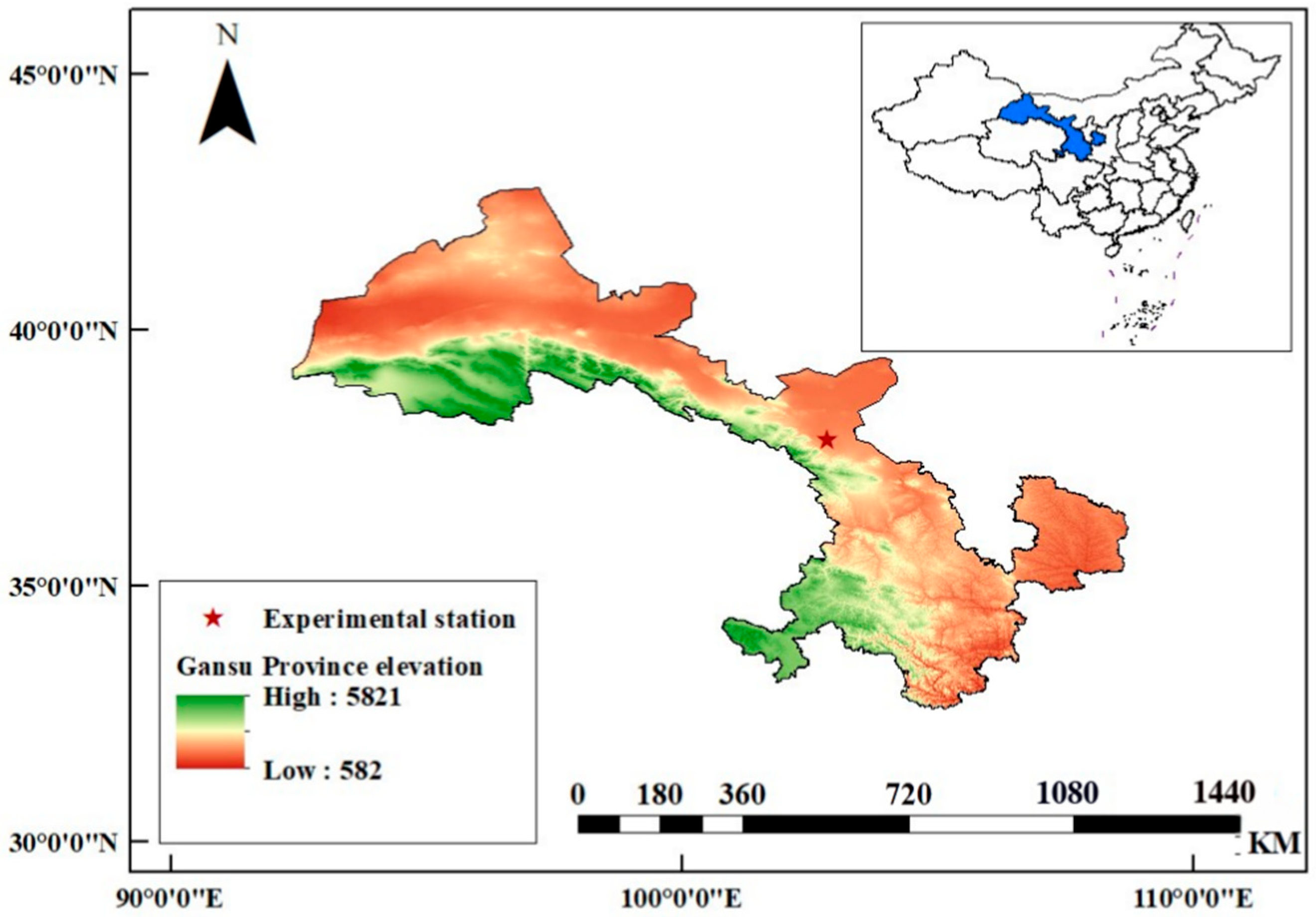
The study area is located at the National Field Scientific Observation and Research Station on Efficient Water Use of Oasis Agriculture (37°52′ N, 102°50′ E, 1581 m) in Wuwei City, Gansu Province, Northwest China (Figure 1). Situated on the edge of the Tengger Desert with the Qilian Mountains to the south, it possesses a relatively flat terrain and fertile land, while suffering arid conditions due to scant rainfall. The mean annual precipitation is 164.4 mm, while the mean annual pan evaporation reaches as high as 2000 mm. The groundwater table can be found at depths exceeding 40 m.
This study concentrates on maize fields under DM and BM. The soil texture at the two experimental sites was mainly sandy loam. The mean dry bulk density, and soil organic carbon content at a depth of 0–100 cm were 1.54 g cm−3, and 6.54 mg g−1 under DM, and 1.52 g cm−3, and 4.08 mg g−1 under BM. Specifically, the fields were used for seed maize production in 2016 and 2018, and for grain maize production from 2019 to 2021. The experimental field under the DM method had an observation area of 400 m × 200 m from 2016 to 2021. The experimental field under the BM method had an observation area of 400 m × 200 m in 2016 and 2019–2021, and an observation area of 500 m × 250 m in 2018. During the seed maize season, the planting mode was “one mulch and four rows”, while in the grain maize season, it was “one mulch and three rows”. Under the DM method, the experimental field used two rows of single-wing maze drip irrigation tapes under one mulch, with the specifications of the drip irrigation tapes being a flow rate of 3.2 L h−1, a pipe diameter of 27 mm, a wall thickness of 0.19 mm, and a drip head spacing of 300 mm. The management practices applied were consistent with those of local farmers. Mechanized tools were used for sowing, mulching, and harvesting.
The watering method of DM was characterized by small amounts with high frequency, while that of BM was characterized by large amounts with low frequency. The mean irrigation frequency of DM over the years was 8 times, which was twice as high as that of BM. The mean irrigation amount for BM over the years was 520 mm, approximately 15% higher than that for DM. The irrigation frequency each year was adjusted appropriately based on the precipitation conditions. Moreover, irrigation water was applied as a point source directly to the root zone under DM (via emitters), but as a surface source that spreads and infiltrates across the field under BM. In the experimental field, all the maize plants were planted in an east-west direction. Transparent plastic film with a thickness of 8 μm was used, with shortwave transmittance, reflectance and refractive index being 0.85, 0.10 and 0.05, respectively. For a more detailed description of the experimental fields, please refer to Wang et al. [17] and Wang, Li, Wu, Zhang, Guo, Huang, and Yang [16].

2.2. Experimental Measurements and Basic Data

2.2.1. Measurement of Carbon Flux and Environmental Factors

The eddy covariance (EC) method is a direct method for determining carbon flux based on the principles of micro-meteorology. It is applicable to almost all terrestrial ecosystems and is recognized worldwide as the standard method for measuring carbon flux [18,19]. The EC system allows continuous, non-destructive measurement of carbon fluxes at the ecosystem scale, making it suitable for assessing the impacts of farmland management on carbon cycling [16]. When using the Flux-Source Area Model to analyze the contribution of source areas of the fluxes in the covered maize fields in the observation area, we found that 90% of the flux information came from within a 125-m range on the windward side. Therefore, the conditions of the observation area in this study meet the requirements for the wind-wave zone when using the EC system for flux observation [15]. Therefore, in order to better analyze the carbon fluxes in maize fields and their influencing factors, we installed an EC system in the maize fields that applied DM and BM, respectively.
The EC system can continuously monitor parameters such as carbon flux, surface canopy temperature (Tc), radiation, wind speed (Ws), air temperature (Ta), relative humidity (RH), vapor pressure deficit (VPD), soil water content (SWC), and soil temperature (Ts). The observation depths for SWC were 20 cm, 40 cm, 60 cm, 80 cm, and 100 cm, while the observation depths for Ts were 20 cm, 40 cm, 60 cm, and 80 cm. In this study, the SWC and Ts mentioned refer to the mean values of the soil layers with depths ranging from 0–100 cm and 0–80 cm, respectively. The specific observation variables, instruments, and manufacturers are listed in Table 1. The data sensors were all connected to a data logger (Campbell Scientific, Inc., Logan, UT, USA) to record and store the data in real-time. The sampling frequency of the system is 10 Hz, and data is output every 30 min. The more detailed correction, quality control, and interpolation of the EC data are described in Wang et al. [20] and Wang et al. [21].
Net ecosystem exchange (NEE) is a crucial parameter quantifying the net CO2 exchange between the ecosystem and the atmosphere. In the EC system, a negative NEE (typically representing a downward flux) indicates that the ecosystem absorbs CO2 from the atmosphere, acting as a carbon sink. Conversely, a positive NEE (an upward flux) denotes that the ecosystem releases CO2 to the atmosphere, acting as a carbon source. In this study, the relationship NEP = −NEE is applied to derive net ecosystem productivity (NEP), transforming the flux direction into a more intuitive concept of net carbon accumulation (NEP > 0) or net loss (NEP < 0). Thus, NEE serves as the fundamental variable linking the observational data (from the EC system) to the core components of the ecosystem carbon budget. The EC system provides instantaneous measurements of NEE in units of μmol CO2 m−2 s−1. For analysis and comparison, these were converted to daily cumulative values expressed on a carbon mass basis (g C m−2 d−1). The conversion is performed as follows:
N E E g   C   m 2 = N E E μ m o l   C O 2   m 2 s 1 × 12 g   C   m o l 1 × 86400 × 10 6
Gross primary production (GPP) is the sum of ecosystem respiration (ER) and NEP. During the night, the amount of CO2 assimilated by maize is zero, meaning GPP is zero, where ER is equal to NEP. The nighttime ER obtained is used to fit a respiration model, to obtain daytime ER and subsequently to calculate daytime GPP. In this study, the Van ’t Hoff model [22] was applied to obtain daytime ER. The specific calculation formula is as follows:
E R = E R r e f × e x p B T c T r e f
where E R r e f   (g C m−2) is the reference E R   (g C m−2) at 10 °C, B is the regression parameter, T c (°C) is the surface canopy temperature and T r e f is the reference surface temperature at 10 °C. The values of   E R r e f and B are obtained using the short-term temperature-dependent method [23]. Specific steps can be found in our previous study [16].
Net radiation (Rn) and albedo are calculated based on the upward and downward shortwave and longwave radiation fluxes measured by radiation sensors. The specific calculation formulas are as follows:
R n = D S R U S R + D L R U L R
A l b e d o = U S R D S R
R n S = D S R U S R = D S R × 1 A l b e d o
R n L = D L R U L R
where D S R (W m−2) is the solar shortwave radiation, U S R (W m−2) is the shortwave radiation reflected by the surface, D L R (W m−2) is the longwave radiation from the sky, U L R (W m−2) is the longwave radiation emitted by the ground, A l b e d o (W m−2) is the shortwave albedo of the surface, R n S (W m−2) is the net shortwave radiation, and R n L (W m−2) is the net longwave radiation.

2.2.2. Measurement of Biological Factors

During the entire growth period of maize, growth data from 8 representative maize plants in each test field were manually measured every 7 to 10 days. Starting from the three-leaf stage, a meter stick was used to measure the canopy height (Hc, m) of the maize, and the length and width of each leaf. The calculation formula for leaf area index (LAI) is as follows [24]:
L A I = 0.74 × i = 1 n L i × W i D × S
where 0.74 is an empirical coefficient, L i (m) is the length of each leaf, W i (m) is the width of each leaf, and D (m) and S (m) are the plant spacing and row spacing, respectively.
Canopy conductance (gc) affects the outward diffusion of water vapor and the exchange of CO2 into and out of plants, serving as an important indicator of stomatal regulation at the ecosystem scale. To further compare and analyze the growth characteristics of maize, this study calculated and analyzed the gc throughout the entire growth period of the maize. The specific calculation formula is as follows:
g c = γ L E r a Δ R n G + ρ C p V P D r a L E Δ + γ
r a = ln z d H c d ln z d z 0 k 2 u
where γ is the psychrometric constant (kPa °C–1), L E (W m−2) is the latent heat flux, r a (s m−1) is the aerodynamic resistance, Δ is the slope of the curve between temperature and saturation vapor pressure (kPa °C–1), G is the soil heat flux (W m−2), ρ (kg m−3) is the air density, C p (J kg−1 °C−1) is the specific heat of dry air at constant pressure, k is the Kármán constant, z (m) is the reference height, d (m) is the displacement height, u is the horizontal wind speed at the reference height (m s−1), and z 0 (m) is the momentum roughness length, and H c (m) is the canopy height.
During the maize harvest, a random sampling method was employed. Three representative sample plots with uniform maize growth were selected in each experimental field. Then, 10 plants were randomly chosen in the center of each sample plot to measure the biomass of roots, stems, leaves, grains, and cobs.

2.2.3. Estimation of Carbon Balance Parameters

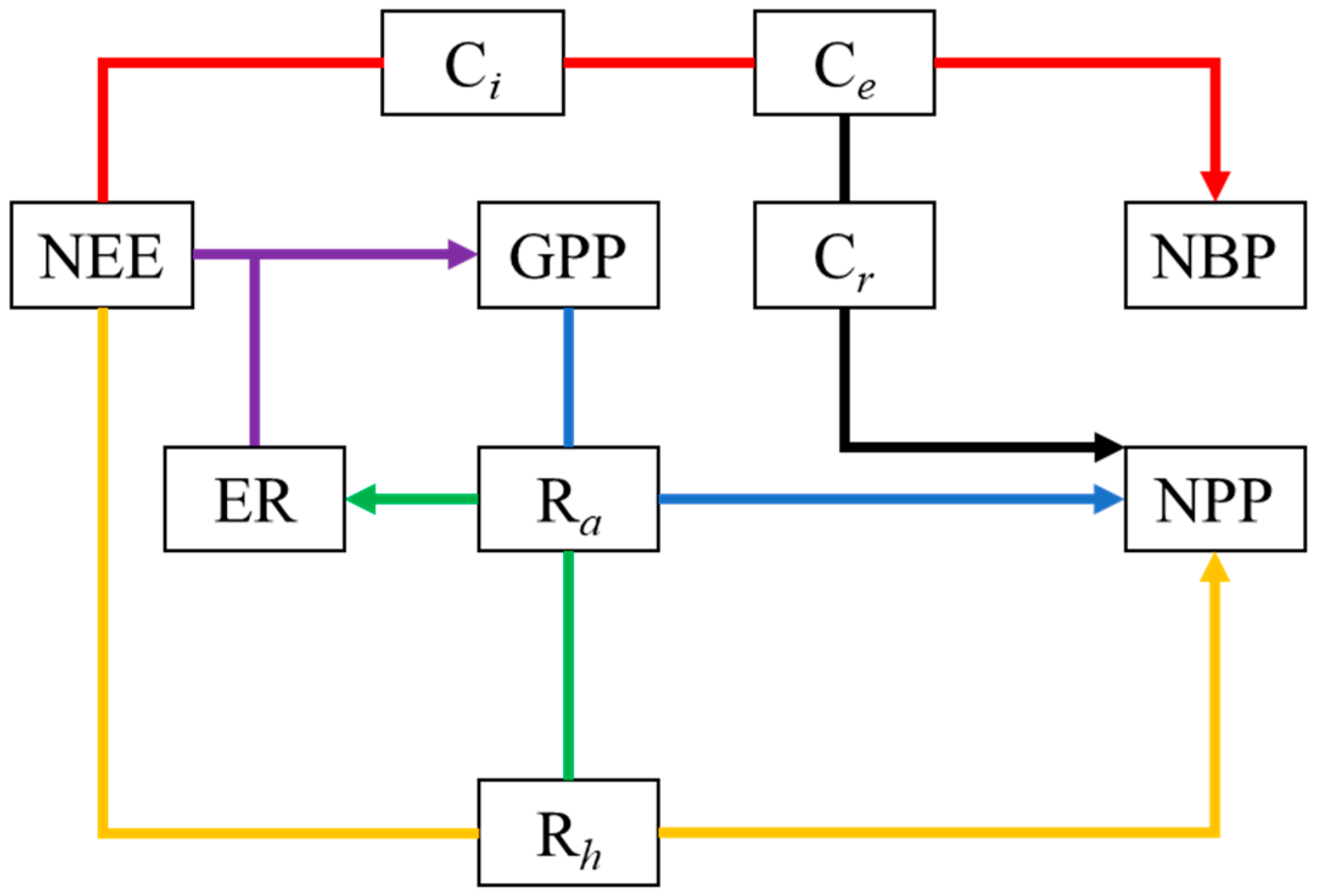
There are two scenarios for harvesting as follows: (1) directly harvesting mature crops using machines, and (2) returning straws to the field after harvesting. Different harvesting scenarios cause differences in the carbon budget of farmland. This study estimated the carbon balance components of maize fields, including net primary productivity (NPP), autotrophic respiration (Ra), heterotrophic respiration (Rh), and net biome productivity (NBP), based on carbon flux data obtained throughout the entire growth cycle of the maize fields through using the EC system, sampling data of maize biomass at harvest, and employing relatively mature empirical calculation formulas. A schematic diagram illustrating the relationships among the various components is shown in Figure 2.
NPP is defined as the amount of photosynthetically fixed carbon that can be utilized by the first heterotrophic level in an ecosystem, and is identified as the tenth planetary boundary for human survival [25]. NPP can be estimated using the biomass of various plant organs at harvest [26], and it is the accumulation of exported carbon (Ce) and residual carbon (Cr).
In an ideal state, the calculation formula for Ce is as follows:
C e = D r × a 1 + D s × a 2 + D l × a 3 + D g × a 4 + D c × a 5
where D r , D s , D l , D g , and D c are the biomass of roots, stems, leaves, grains, and cobs at maize harvest, respectively, while a 1 , a 2 , a 3 , a 4 , and a 5 are the carbon conversion coefficients for the corresponding biomass parts, with values of 0.316, 0.452, 0.452, 0.447, and 0.468, respectively [27,28].
In practice, maize does not always survive fully, so we introduce the parameter b1 to describe the actual carbon output of the maize field. Meanwhile, during manual sampling, the litter in the maize field is not completely removed, and the biomass of the litter (NPPlitter) accounts for 5% of the biomass of the maize plants [28]. The calculation formula for NPP is as follows:
N P P = b 1 × D r × a 1 + D s × a 2 + D l × a 3 + D g × a 4 + D c × a 5 × 10⁵ %
NPP represents the portion of organic carbon fixed by vegetation after deducting the carbon consumed through its own respiration, reflecting the efficiency of plants in fixing and converting photosynthetic products. Based on the measurements of GPP, ER, and NEP, the individual components of ecosystem respiration in a maize field can be derived. The calculation formulas are as follows:
E R = R a + R h
N P P = G P P R a = R h + N E P
When harvesting is conducted using machines, the roots of the maize are all left in the field, and a certain proportion of the leaves and stalks are also lost and not completely removed. Therefore, in this study, the loss rate b2 needs to be considered, and the calculation formula for Ce is:
C e = b 1 × b 2 × D s × a 2 + D l × a 3 + D g × a 4 + D c × a 5
Returning straws to the field can retain a large amount of carbon, which is of great significance for reducing carbon emissions from farmland [29]. When straws are returned to the field after harvesting, the calculation formula for Ce is:
C e = b 1 × D g × a 4 + D c × a 5
NBP is the remainder of NEP after subtracting the non-biotic respiratory consumption caused by various natural and anthropogenic disturbances. It is not a specific physiological process, but rather a concept of carbon sources and sinks that results from the responses of photosynthesis and respiration to environmental changes. The calculation formula for NBP is as follows:
N B P = C i + N E P C e
where C i   represents the input carbon amount, which in this study is considered to be the carbon input from fertilizers and seeds [29], and C e represents the exported carbon amount.

2.3. Statistical Analysis

In this study, the Partial Least Squares method was invoked using the “PLS” package in R (4.4.1, R Core Team (2024), R Foundation for Statistical Computing, Vienna, Austria) to quantify the impact of environmental and biological factors on carbon flux. Partial Least Squares is a novel multivariate statistical data analysis method that places minimal demand on measurement scales, sample sizes, and residual distributions. It is well-suited for handling complex data issues, such as small datasets, missing values, and multicollinearity. Through integrating the advantages of principal component analysis, correlation analysis, and multiple linear regression analysis, it allows for dimensionality reduction of correlated or even collinear variables, and establishes a linear regression relationship between the feature vectors of the independent and dependent variables after obtaining orthogonal feature variables. This makes the regression coefficients of each independent variable easier to interpret, making it easier to understand the relationships between variables.

3. Results

3.1. Seasonal and Inter-Annual Variations in Carbon Flux

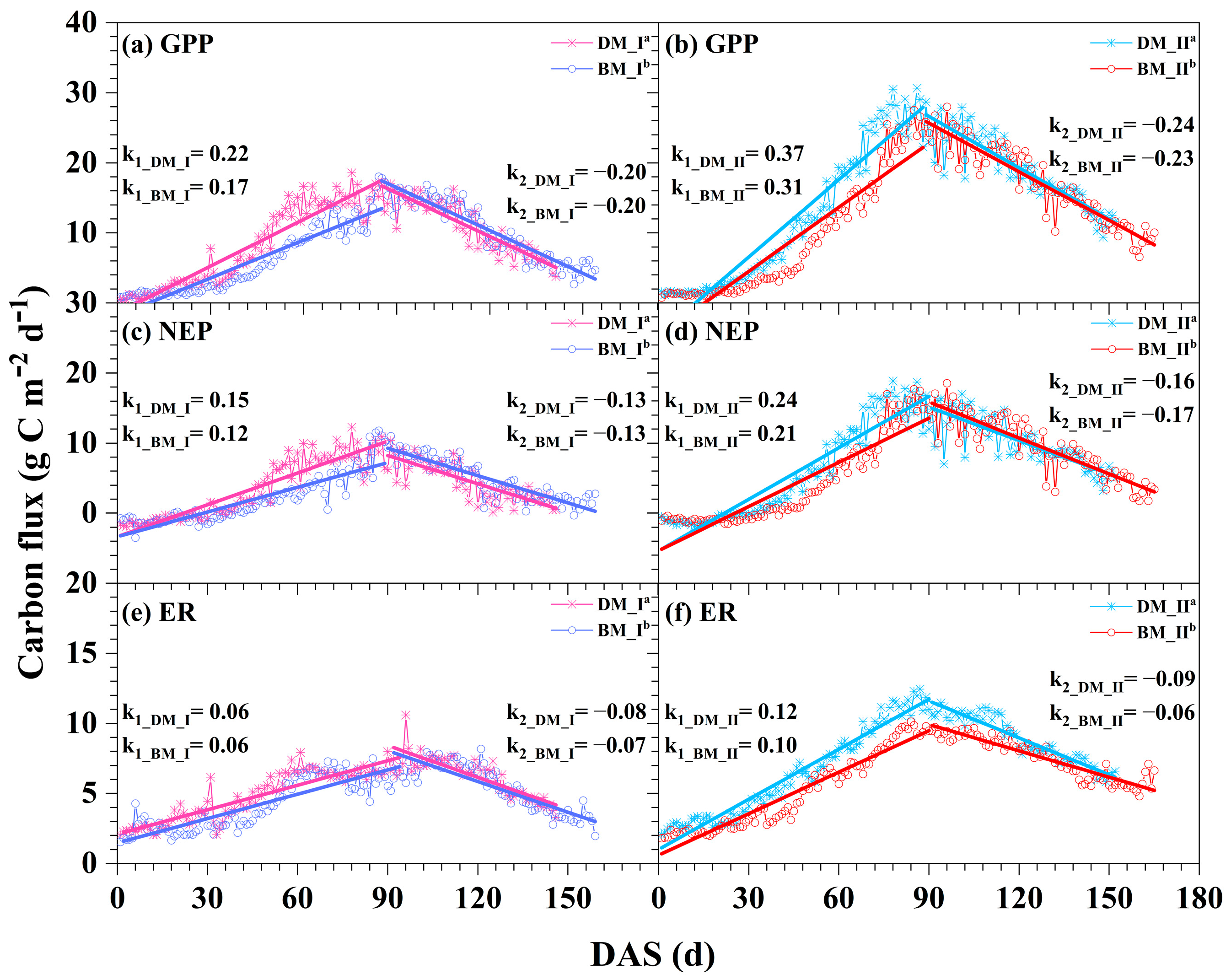
The seasonal variations of GPP, NEP, and ER during the maize growing season under two irrigation methods are shown in Figure 3. As the maize grows, its photosynthesis and respiration show a trend of first increasing and then decreasing. During the first phase, the rates of increase (k1) in both GPP and NEP in the maize field under DM were higher than those under BM, with a mean increase rate of 22.01%, while during the second phase, no significant difference in the rate of change of carbon flux (k2) was found between DM and BM. The occurrence frequency of the maximum values of various fluxes in grain maize was almost the same as that in seed maize, while the maximum values of GPP, NEP, and ER in grain maize were all higher than those in seed maize. Under the two irrigation methods, the carbon fluxes of maize under DM during the vigorous growth stage (30–90 days) were significantly higher than those under BM. We analyzed the daily-scale GPP, NEP, and ER throughout the entire growing season under the two irrigation methods for both seed maize (I) and grain maize (II). The results revealed significant differences (p < 0.05) in the corresponding carbon flux components between the two irrigation methods for both maize types.
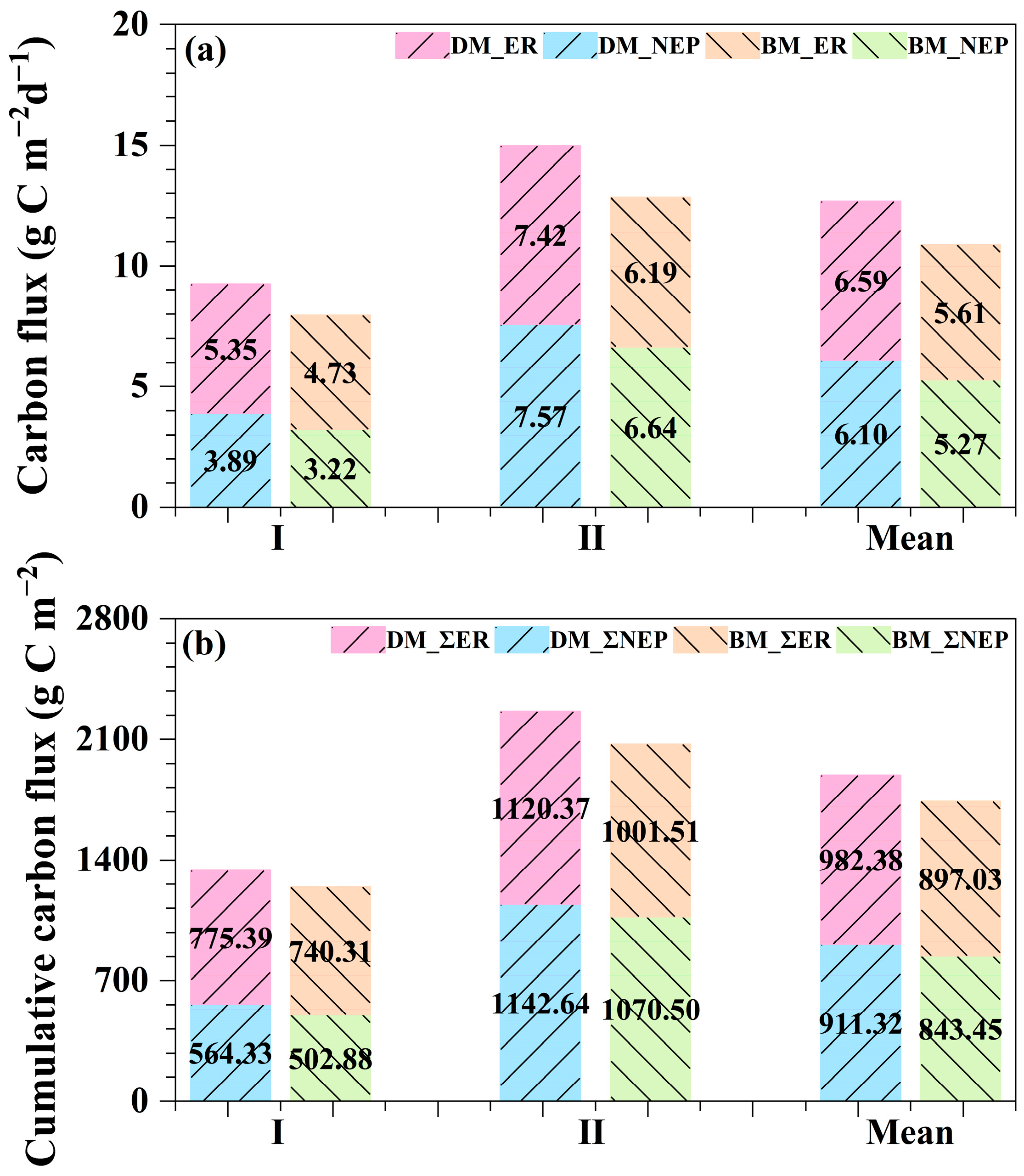
The mean values and accumulations of carbon fluxes in seed maize fields and grain maize fields under DM and BM are shown in Figure 4. The mean GPP, NEP, and ER over the entire growing season were 9.24 g C m−2 d−1, 3.89 g C m−2 d−1, and 5.35 g C m−2 d−1, respectively, for seed maize under DM, compared to 14.99 g C m−2 d−1, 7.57 g C m−2 d−1, and 7.42 g C m−2 d−1 for grain maize under DM. For the BM method, the corresponding values were 7.95 g C m−2 d−1, 3.22 g C m−2 d−1, and 4.73 g C m−2 d−1 for seed maize, and 12.83 g C m−2 d−1, 6.64 g C m−2 d−1, and 6.19 g C m−2 d−1 for grain maize. The multi-year mean GPP, NEP, ER, ΣGPP (cumulative GPP), ΣNEP (cumulative NEP), and ΣER (cumulative ER) in the maize field under the DM were 16.70%, 15.63%, 17.52%, 8.89%, 8.05%, and 9.51% higher than those in the maize field under BM, respectively, while the multi-year mean GPP, NEP, ER, ΣGPP, ΣNEP, and ΣER in grain maize (II) fields were 61.93%, 99.82%, 35.00%, 67.95%, 107.38%, and 39.99% higher than those in seed maize (I) fields, respectively.

3.2. Impact of Environmental and Biological Factors on Carbon Flux

Differences in underlying surface conditions between DM and BM methods can significantly affect the microclimate of farmland and, in turn, have an important impact on the growth of maize. The multi-year mean values and inter-annual standard deviations (STDEV) of environmental factors (Rn, Albedo, Ws, Ta, RH, VPD, SWC, and Ts) and biological factors (LAI, Hc, gc, and Tc) during the growing season in the seed maize under DM (DM_I), grain maize under DM (DM_II), seed maize under BM (BM_I), and grain maize under BM (BM_II) are shown in Table 2. No significant differences (p > 0.05) were found in the daily values of Rn, Albedo, Ws, and Ta over the entire growing season between the DM_I and BM_I. Meanwhile, the daily Albedo and Tc showed no significant differences (p > 0.05) between the DM_II and BM_II. The multi-year mean values of Rn, Ta, RH, SWC, LAI, gc, and Tc for the maize field under the DM method were higher than those under the BM method, while the multi-year mean values of Rn, Albedo, LAI, Hc, and gc for the grain maize field were higher than those for the seed maize field.
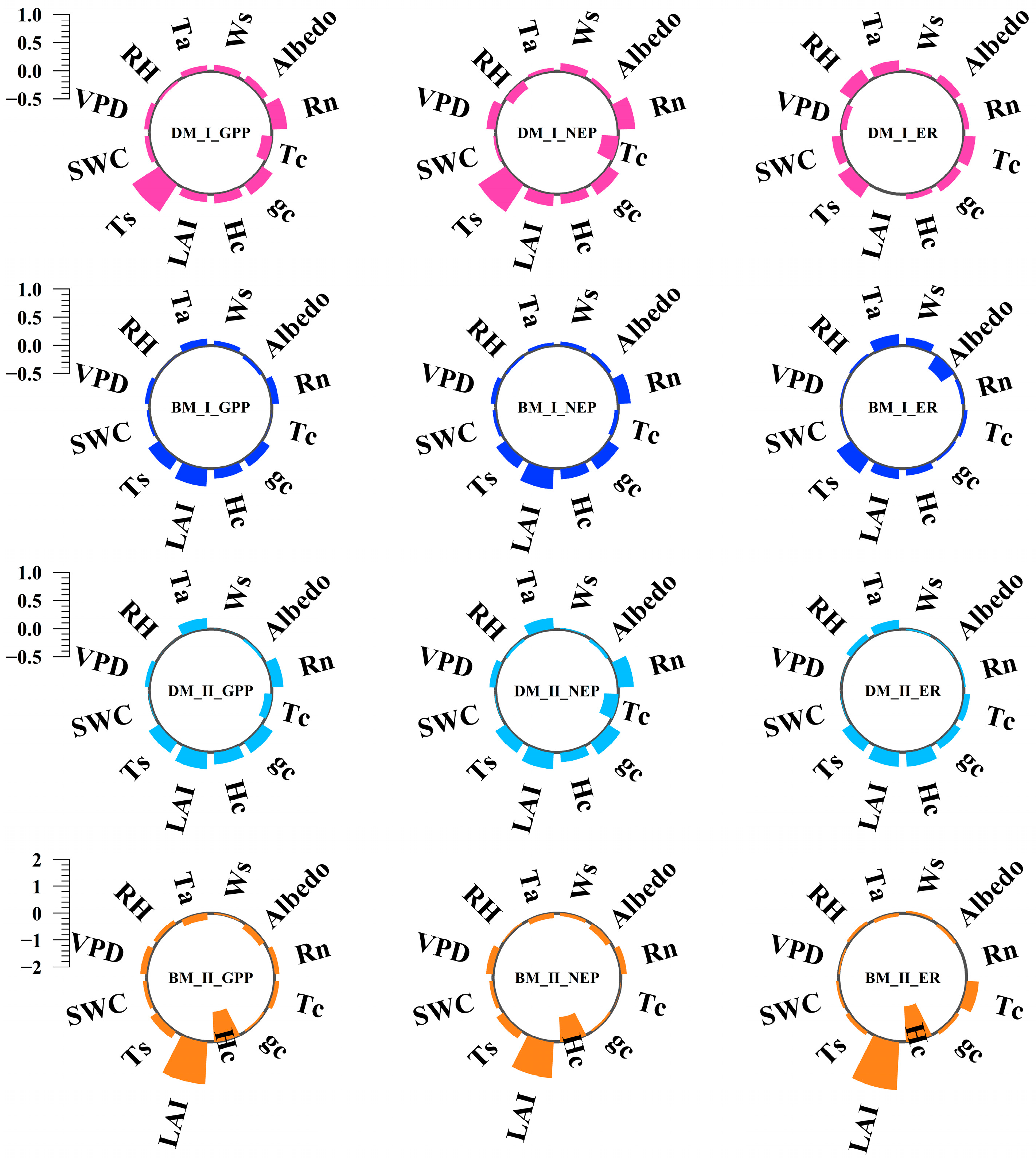
To quantify the impact of various environmental and biological factors on carbon flux, Partial Least Squares method was introduced to separate the relative contributions of Rn, Albedo, Ws, Ta, RH, VPD, SWC, Ts, LAI, Hc, gc, and Tc to the carbon flux of two maize varieties under the two irrigation methods, with the results shown in Figure 5. Environmental and biological factors have unstable contributions to the carbon flux in seed maize fields under the two irrigation methods. Among them, Ts (0.57), Ts (0.58), Ts (0.28), LAI (0.31), LAI (0.36), and Ts (0.30) made the greatest relative contribution to DM_I_GPP, DM_I_NEP, DM_I_ER, BM_I_GPP, BM_I_NEP, and BM_I_ER, respectively. During the growing season of grain maize fields, LAI had the greatest relative contribution to DM_II_GPP, DM_II_NEP, DM_II_ER, BM_II_GPP, BM_II_NEP, and BM_II_ER. However, the factors do not always promote the carbon flux in maize fields. For example, Tc had the greatest inhibitory effect in DM_I_GPP, DM_I_NEP, BM_I_NEP, DM_II_GPP, and DM_II_NEP, while Hc caused the greatest inhibitory effect in BM_II_GPP, BM_II_NEP, and BM_II_ER.

3.3. Estimation of Carbon Budget

The estimated results for NPP, Ce, and Cr in seed maize fields and grain maize fields under DM and BM methods are shown in Table 3. Under both seed maize (I) and grain maize (II) cultivation, the NPP showed significant differences (p < 0.05) between the DM and BM methods. Regarding the Ce, significant differences (p < 0.05) were found between DM and BM under both harvest scenarios (grain-only harvest and straw return), regardless of maize type. However, the Cr did not differ significantly (p > 0.05) between the two irrigation methods under either scenario. Under the DM method, the multi-year mean NPP of maize fields was 5.35% higher than that under the BM method. When crops were harvested mechanically, the Ce in maize fields under the DM method was 6.69% higher than that under the BM method, while this figure was 10.07% if straw is returned to the field after harvesting. Similarly, in the case of mechanical harvesting, the Cr of seed maize under the DM method was slightly higher than that under the BM method, but the Cr of grain maize under the DM method was lower than that under the BM method; however, when straws were returned to the field, the results were reversed.
The estimated values of Ra, Rh and NBP for seed maize fields and grain maize fields under the two methods are shown in Table 4. During the cultivation periods of both seed maize (I) and grain maize (II), Ra, Rh, and NBP all showed significant differences (p < 0.05) between the DM and BM methods. The Ra in maize fields under the DM method was 14.86% higher than that under the BM method, while the Rh was 4.43% lower. The multi-year mean value of Ra/ER in maize fields under the DM method was 75.80%, higher than that under the BM method (72.27%). With mechanical harvesting, the NBP of seed maize fields under both methods was negative, indicating they were carbon sources, whereas the NBP of grain maize fields was positive, indicating they were carbon sinks. At this time, the multi-year mean NBP under the DM method was 15.87% weaker than that under the BM method. With straws returned to the field, both seed maize and grain maize fields under the two methods became carbon sinks, and the carbon sequestration capacity of grain maize fields was greater than that of seed maize fields. At this time, the multi-year mean NBP of maize fields under the DM method was 3.47% higher than that under the BM method.

4. Discussion

4.1. The Carbon Flux in Maize Fields Exhibits a Strong Dependence on Ts and LAI

By conducting an influence decomposition of various environmental factors (Tc, Rn, Albedo, Ws, Ta, RH, VPD, SWC, and Ts) and biological factors (LAI, Hc, and gc) on the carbon flux of seed maize and grain maize, we have found that the carbon flux of both seed maize and grain maize fields has a strong dependence on Ts and LAI (Figure 5). These two factors act as integrative indicators of management (mulching, irrigation) and crop type effects. The mean Ts and LAI of maize fields under DM are higher than those under BM (Table 2), which lays a strong foundation for higher GPP and NEP under DM.
Furthermore, temperatures are relatively low during the early growth stage of maize. Besides, there is a large diurnal temperature variation in the Northwest region of China. Mulching effectively raises Ts [30], ensuring robust maize seedling emergence and promoting vigorous root system development. This will directly influence root autotrophic metabolism and the microbial decomposition of soil organic matter, thereby regulating both Ra and Rh [14,31]. Previous studies have indicated that Ts plays a significant role in carbon flux in maize fields in this region [16]. Meanwhile, Xing et al. [32] pointed out that Ts is the dominant factor influencing carbon flux in alpine meadows. When planting maize in relatively cold regions, Ts is crucial for the absorption and emission of carbon flux, which also serves as an important reference for other thermophilic crops.
Leaves serve as crucial carriers of stomata and are closely related to carbon flux. The LAI serves as a key indicator of crop canopy development and physiological function, with its dynamic variations directly linked to and regulating carbon flux processes in farmland ecosystems [33]. Grain maize has a growth advantage over seed maize, with an average LAI 7.75% higher than the latter. Furthermore, in grain maize, LAI surpasses Ts as the most influential factor affecting carbon flux, creating conditions for grain maize to obtain higher GPP, NEP, ER, ΣGPP, ΣNEP, and ΣER than seed maize. Many previous studies have confirmed the significant impact of the LAI on carbon flux [8,33].
Previous studies have demonstrated that LAI and SWC are the most important factors influencing GPP, NEP, and ER in summer maize fields on the Guanzhong Plain of China [34]. Assimilating data using SWC and LAI in combination with a farmland hydrological coupling model can effectively improve the simulation accuracy of water and carbon fluxes in farmland ecosystem models [35]. In natural ecosystems of arid regions, SWC is a key limiting factor for carbon flux [36]. However, in the mulched and irrigated farmland in this study, SWC is relatively abundant, thus having a minor impact on carbon flux. This study highlights that Ts and LAI are the most influential factors in the carbon fluxes of seed maize and grain maize, respectively, which provides important implications for further improving the ecosystem model and increasing the simulation accuracy of the key processes of the carbon cycle in farmland in the arid regions in the future.

4.2. Differences in Carbon Balance Components Under Changing Irrigation Methods and Different Maize Varieties

The differences in GPP and NEP between DM and BM in maize fields during the growing season were primarily observed in the first stage. This indicates that DM at this stage could provide a more suitable growth environment to accelerate maize growth. Through this study, we found that the changes in ΣGPP, ΣNEP and ΣER caused by the alteration of maize varieties were 7.64, 13.34, and 4.20 times, respectively, compared to the changes caused by the irrigation method (Figure 4). Using the maize sowing area data from the National Bureau of Statistics of China from 2016 to 2021 for conversion [37], when the maize variety changed from seed maize to grain maize in Gansu Province, the ΣGPP, ΣNEP and ΣER in the maize fields increased by 8.99 × 10⁹ kg C, 5.87 × 10⁹ kg C and 3.11 × 10⁹ kg C, respectively. In contrast, the change from BM to DM only resulted in increases of 1.59 × 10⁹ kg C, 6.96 × 10⁹ kg C, and 8.75 × 10⁹ kg C, respectively.
This underscores that crop variety selection, which is frequently influenced by policy and market dynamics, can be a more effective lever for modifying regional agroecosystem carbon cycling than farmland management technology alone [38]. Different maize varieties correspond to distinct genotypes, and modern breeding techniques are translating this genetic potential into tangible carbon-sequestration benefits by regulating key physiological processes involved in carbon and nitrogen allocation [39]. The varietal effect does not act in isolation but ultimately influences the carbon budget through complex “genotype × environment” interactions [40].
Changes in irrigation methods can affect carbon flux emissions from farmland. The DM system enhanced photosynthetic assimilation, ecosystem respiration, and net carbon sequestration compared to BM in our study. Drip irrigation can significantly enhance photosynthesis and promote carbon dioxide fixation [41]. In their research conducted at the Shuguang experimental station in Inner Mongolia, China, Wei et al. [42] found that the maize field ecosystem acts as a carbon sink throughout the year and that, compared to flood irrigation, drip irrigation reduces CO2 emissions from agricultural fields during the maize growing season. Meanwhile, the cumulative NEP of farmland on an annual scale will be lower than that during the growing season [43].
Additionally, compared to flood irrigation, drip irrigation results in higher daily-scale soil CO2 emissions [41]. After applying plastic mulch, the farmland experienced changes in the soil environment and increased input of crop litter and residues, which resulted in an increase in the storage of organic carbon in the soil [44]. Additionally, there is a significant increase in the aboveground NPP of the crops [44]. The GPP and NPP in this study are significantly higher than those of the cotton fields under DM in the oasis of the Kaidu-Kongqi River Basin in Northwestern China [45].
The biomass remaining in farmland after crop harvest may be an important factor affecting carbon balance [38]. The study by Peng, Ma, Cai and Wang [34] indicated that if both carbon input from seeds and yield at harvest are taken into account, the maize cultivation system acts as a net carbon source. After mechanical harvesting in this study, a large amount of biomass was removed. The carbon sequestration capacity of farmland (which even exhibited characteristics of a carbon source) was significantly lower than that of farmland after straw returning. This confirms that straw returning is an effective way to reduce carbon losses and enhance the carbon sequestration capacity of farmland [29,46]. After straw returning measures, more carbon sequestration can be achieved, thereby reducing CO2 emissions [47]. The study by Liu et al. [48] indicated that, after straw returning, farmland can achieve a new carbon balance on average within 12 years. Therefore, after long-term straw returning, the soil carbon storage capacity may decrease.

4.3. Limitations and Implications

The field maize exhibits a higher carbon sequestration capacity than seed maize in this study, suggesting that, while ensuring stable production of seed maize, we may consider moderately expanding field maize cultivation to enhance carbon sequestration in agricultural ecosystems. Furthermore, straw returning, as an effective means, has been confirmed by multiple studies to significantly increase farmland carbon sequestration and improve soil organic carbon storage [6,49]. Therefore, in policy formulation and farmland management practices, priority should be given to optimizing crop variety selection and vigorously promoting straw return measures, so as to effectively enhance the carbon sink capacity of agricultural ecosystems while reducing net carbon emissions [47,50].
This study has confirmed that farmland carbon flux could respond to changes in environmental and biological factors. In agricultural production, in addition to mulching and irrigation, other management practices, such as tillage methods, crop varieties, and planting densities, also influence environmental and biological factors in farmland [51,52]. Yet, the soil carbon pool may even influence plant growth by shaping the microbial community structure [53]. Hence, this underscores the need to comprehensively consider the synergistic effects of multiple management practices, environmental, and biological factors when formulating farmland management strategies to achieve optimal management of the carbon cycle [54].
The implementation of farmland management practices such as irrigation is accompanied by substantial energy consumption and carbon emissions [55]. Assessing the carbon footprint of crops throughout their life cycle is crucial for a comprehensive understanding of carbon cycling in farmland [56,57]. Against the backdrop of climate change, the accumulation and decomposition of soil organic carbon, and the stability of soil carbon pools would impact the carbon cycle [58]. Meanwhile, the soil respiration during the non-growing season of crops [59] and the contribution of litterfall to the increase in soil organic matter should not be overlooked [60]. Therefore, it is recommended to conduct continuous monitoring of farmland throughout the year for an extended period in the future, along with assessing the carbon footprint of crops across their life cycles, to more accurately evaluate the characteristics and trends of carbon cycling within agricultural ecosystems.

5. Conclusions

This study compared carbon flux dynamics in seed and grain maize fields under DM and BM in an arid region of Northwest China. Key findings are:
(1)
The DM system enhanced photosynthetic assimilation, ecosystem respiration, and net carbon sequestration compared to BM. Over the entire growth period, ΣGPP, ΣNEP, and ΣER under DM were 8.89%, 8.05%, and 9.51% higher than under BM, respectively.
(2)
Shifting from seed maize to grain maize had a substantially greater impact on carbon fluxes than changing the irrigation method. The increases in ΣGPP, ΣNEP, and ΣER due to maize variety change were 7.64, 13.34, and 4.20 times larger, respectively, than those induced by switching from BM to DM.
(3)
Straw return is a decisive practice for securing a positive carbon balance. With mechanical harvesting alone, seed maize fields acted as net carbon sources, while grain maize fields were weak sinks. However, when straw was returned to the field, both systems became significant carbon sinks, with grain maize exhibiting stronger sequestration capacity.
(4)
The dominant controlling factors of carbon flux differed between maize types. Ts was the key regulator for seed maize, whereas LAI was the primary driver for grain maize.
These results underscore that optimizing crop variety and implementing straw return are more effective than improving the irrigation method for enhancing the carbon sequestration function of maize fields in arid Northwest China. Future research should integrate year-round carbon flux monitoring and life-cycle carbon footprint assessment to better inform sustainable farmland management under climate change.

Author Contributions

Conceptualization, C.W.; methodology, C.W.; data curation, C.W. and Y.W.; writing—original draft preparation, C.W. and Y.W.; writing—review and editing, X.S., D.L., M.W., and S.L.; visualization, S.L.; supervision, S.L. All authors have read and agreed to the published version of the manuscript.

Funding

This work was supported by the National Natural Science Foundation of China (52379052), the Henan Province Science and Technology Research Projects (252102110225), the Hebei Provincial Water Resources Science and Technology Planning Project (2022-39), the Key R&D Project of Wuwei City (WW25A01RYFT002, WW2202YFN003), and the Tianjin Key Laboratory of Rail Transit Navigation Positioning and Spatio-temporal Big Data Technology under Grant (TKL2024B12).

Data Availability Statement

The data presented in this study are available on request from the corresponding author. The data are not publicly available due to ongoing research.

Conflicts of Interest

The authors declare no conflicts of interest.

References

  1. Wieckowski, A.; Vestin, P.; Ardö, J.; Roupsard, O.; Ndiaye, O.; Ba, S.; Delon, C.; Serça, D.; Tagesson, T. Contrasting roles of ground, trees, ponds and grazing in carbon dioxide, methane and nitrous oxide fluxes of an African semi-arid savanna. Agric. Ecosyst. Environ. 2026, 399, 110199. [Google Scholar] [CrossRef]
  2. Gui, L.; Jian, S.; Gao, J.; Zhang, Y.; Zhang, X. Factors affecting carbon fluxes in a winter wheat-summer maize rotation farmland ecosystem and their response to short-cycle weather perturbations. J. Environ. Manag. 2026, 398, 128476. [Google Scholar] [CrossRef]
  3. Tao, F.; Li, Y.; Chen, Y.; Yin, L.; Zhang, S. Daily, seasonal and inter-annual variations in CO2 fluxes and carbon budget in a winter-wheat and summer-maize rotation system in the North China Plain. Agric. For. Meteorol. 2022, 324, 109098. [Google Scholar] [CrossRef]
  4. Wang, T.; Fu, Z.; Makowski, D.; Liang, G.; Jin, H.; Zhang, F. Seasonal divergence in the sensitivity of carbon and water fluxes to climate variability in terrestrial ecosystems. Agric. For. Meteorol. 2026, 376, 110916. [Google Scholar] [CrossRef]
  5. Prăvălie, R. Drylands extent and environmental issues. A global approach. Earth-Sci. Rev. 2016, 161, 259–278. [Google Scholar] [CrossRef]
  6. Ahlström, A.; Raupach, M.R.; Schurgers, G.; Smith, B.; Arneth, A.; Jung, M.; Reichstein, M.; Canadell, J.G.; Friedlingstein, P.; Jain, A.K.; et al. The dominant role of semi-arid ecosystems in the trend and variability of the land CO2 sink. Science 2015, 348, 895–899. [Google Scholar] [CrossRef]
  7. Li, M.; Peng, J.; Lu, Z.; Zhu, P. Research progress on carbon sources and sinks of farmland ecosystems. Resour. Environ. Sustain. 2023, 11, 100099. [Google Scholar] [CrossRef]
  8. Yue, Z.; Li, Z.; Yu, G.; Chen, Z.; Shi, P.; Qiao, Y.; Du, K.; Tian, C.; Zhao, F.; Leng, P.; et al. Seasonal variations and driving mechanisms of CO2 fluxes over a winter-wheat and summer-maize rotation cropland in the North China plain. Agric. For. Meteorol. 2023, 342, 109699. [Google Scholar] [CrossRef]
  9. Peng, X.; Wang, Y.; Ma, J.; Liu, X.; Gu, X.; Cai, H. Seasonal variation and controlling factors of carbon balance over dry semi-humid cropland in Guanzhong Plain. Eur. J. Agron. 2023, 149, 126912. [Google Scholar] [CrossRef]
  10. Ono, K.; Ikawa, H.; Miyata, A. Multi-year water and carbon flux contrasts between high-yielding and conventional rice cultivars. Agric. For. Meteorol. 2026, 378, 110983. [Google Scholar] [CrossRef]
  11. Blaise, D.; Desouza, N.D.; Singh, A. Satellite-based measurements of temporal and spatial variations in C fluxes of irrigated and rainfed cotton grown in India. Remote Sens. Appl. Soc. Environ. 2024, 36, 101365. [Google Scholar] [CrossRef]
  12. Wagle, P.; Zhou, Y.; Northup, B.K.; Moffet, C.; Gunter, S.A. Carbon dioxide fluxes over irrigated and rainfed alfalfa in the Southern Great Plains, USA. Eur. J. Agron. 2024, 159, 127265. [Google Scholar] [CrossRef]
  13. Yang, K.; Wang, F.; Zhao, J.; Shock, C.C.; Zhang, Y.; Feng, S.; Hou, X.; Han, J.; Wu, X. Soil temperature and aeration modification using black plastic mulch to improve potato yield and water use efficiency. Field Crops Res. 2026, 338, 110317. [Google Scholar] [CrossRef]
  14. Liu, X.; Wang, D.; Bazhabaike, M.; Zhou, M.; Yin, T. Biodegradable Film Mulching Increases Soil Respiration: A Two-Year Field Comparison with Polyethylene Film Mulching in a Semi-Arid Region of Northern China. Agronomy 2025, 15, 2631. [Google Scholar] [CrossRef]
  15. Guo, H.; Wang, X.; Wang, Y.; Li, S. Effect of mulched drip irrigation on crop biomass and carbon fluxes in maize field. Agric. Water Manag. 2024, 303, 109016. [Google Scholar] [CrossRef]
  16. Wang, C.; Li, S.; Wu, M.; Zhang, W.; Guo, Z.; Huang, S.; Yang, D. Co-regulation of temperature and moisture in the irrigated agricultural ecosystem productivity. Agric. Water Manag. 2023, 275, 108016. [Google Scholar] [CrossRef]
  17. Wang, C.; Li, S.; Wu, M.; Wang, X.; Wang, S.; Guo, Z.; Huang, S.; Yang, H.; Gao, L. High efficiency and low greenhouse gas emissions intensity of maize in drip irrigation under mulch system. Agric. Ecosyst. Environ. 2023, 346, 108344. [Google Scholar] [CrossRef]
  18. Liu, S.; Feng, Z.; Fang, S.; Liu, G.; Yuan, X.; Shang, B.; Xu, Y.; Fu, H.; Jin, Z.; Chen, Z.; et al. Assessing the Accuracy of Eddy-Covariance Measurement at Different Source Emission Scenarios. J. Geophys. Res. Atmos. 2024, 129, e2023JD040701. [Google Scholar] [CrossRef]
  19. Virkkala, A.M.; Natali, S.M.; Rogers, B.M.; Watts, J.D.; Savage, K.; Connon, S.J.; Mauritz, M.; Schuur, E.A.G.; Peter, D.; Minions, C.; et al. The ABCflux database: Arctic–boreal CO2 flux observations and ancillary information aggregated to monthly time steps across terrestrial ecosystems. Earth Syst. Sci. Data 2022, 14, 179–208. [Google Scholar] [CrossRef]
  20. Wang, C.; Li, S.; Wu, M.; Jansson, P.-E.; Zhang, W.; He, H.; Xing, X.; Yang, D.; Huang, S.; Kang, D.; et al. Modelling water and energy fluxes with an explicit representation of irrigation under mulch in a maize field. Agric. For. Meteorol. 2022, 326, 109145. [Google Scholar] [CrossRef]
  21. Wang, C.; Li, S.; Wu, M.; Zhang, W.; He, H.; Yang, D.; Huang, S.; Guo, Z.; Xing, X. Water use efficiency control for a maize field under mulched drip irrigation. Sci. Total Environ. 2023, 857, 159457. [Google Scholar] [CrossRef] [PubMed]
  22. Collatz, G.J.; Ball, J.T.; Grivet, C.; Berry, J.A. Physiological and environmental regulation of stomatal conductance, photosynthesis and transpiration: A model that includes a laminar boundary layer. Agric. For. Meteorol. 1991, 54, 107–136. [Google Scholar] [CrossRef]
  23. Reichstein, M.; Falge, E.; Baldocchi, D.; Papale, D.; Aubinet, M.; Berbigier, P.; Bernhofer, C.; Buchmann, N.; Gilmanov, T.; Granier, A.; et al. On the separation of net ecosystem exchange into assimilation and ecosystem respiration: Review and improved algorithm. Glob. Change Biol. 2005, 11, 1424–1439. [Google Scholar] [CrossRef]
  24. McKee, G.W. A Coefficient for Computing Leaf Area in Hybrid Corn. Agron. J. 1964, 56, 240–241. [Google Scholar] [CrossRef]
  25. Running, S.W. A Measurable Planetary Boundary for the Biosphere. Science 2012, 337, 1458–1459. [Google Scholar] [CrossRef]
  26. Liu, Z.; Wang, B.; Li, Z.; Huang, F.; Zhao, C.; Zhang, P.; Jia, Z. Plastic film mulch combined with adding biochar improved soil carbon budget, carbon footprint, and maize yield in a rainfed region. Field Crops Res. 2022, 284, 108574. [Google Scholar] [CrossRef]
  27. Jans, W.W.P.; Jacobs, C.M.J.; Kruijt, B.; Elbers, J.A.; Barendse, S.; Moors, E.J. Carbon exchange of a maize (Zea mays L.) crop: Influence of phenology. Agric. Ecosyst. Environ. 2010, 139, 316–324. [Google Scholar] [CrossRef]
  28. Yang, B.; Xiong, Z.; Wang, J.; Xu, X.; Huang, Q.; Shen, Q. Mitigating net global warming potential and greenhouse gas intensities by substituting chemical nitrogen fertilizers with organic fertilization strategies in rice–wheat annual rotation systems in China: A 3-year field experiment. Ecol. Eng. 2015, 81, 289–297. [Google Scholar] [CrossRef]
  29. Gao, X.; Gu, F.; Hao, W.; Mei, X.; Li, H.; Gong, D.; Mao, L.; Zhang, Z. Carbon budget of a rainfed spring maize cropland with straw returning on the Loess Plateau, China. Sci. Total Environ. 2017, 586, 1193–1203. [Google Scholar] [CrossRef]
  30. Zhao, Y.; Xu, Z.; Mao, X.; Li, S.; Qi, X.; Che, J. Influence of film color, mulching ratio and soil–mulch contact degree on heat transfer in Northwest China. Agric. For. Meteorol. 2024, 357, 110208. [Google Scholar] [CrossRef]
  31. Yan, Y.; Zhou, L.; Zhou, G.; Wang, Y.; Song, J.; Zhang, S.; Zhou, M. Extreme temperature events reduced carbon uptake of a boreal forest ecosystem in Northeast China: Evidence from an 11-year eddy covariance observation. Front. Plant Sci. 2023, 14, 1119670. [Google Scholar] [CrossRef]
  32. Xing, Y.; Wang, P.; Zhang, D.; Sun, H.; Li, S. Convergent control of soil temperature on seasonal carbon flux in Tibetan alpine meadows: An in-situ monitoring study. Ecol. Indic. 2023, 156, 111116. [Google Scholar] [CrossRef]
  33. Czubaszek, R.; Wysocka-Czubaszek, A. Temporal Dynamics of CO2 Fluxes Measured with Eddy Covariance System in Maize, Winter Oilseed Rape and Winter Wheat Fields. Atmosphere 2023, 14, 372. [Google Scholar] [CrossRef]
  34. Peng, X.; Ma, J.; Cai, H.; Wang, Y. Carbon balance and controlling factors in a summer maize agroecosystem in the Guanzhong Plain, China. J. Sci. Food Agric. 2023, 103, 1761–1774. [Google Scholar] [CrossRef]
  35. Wang, W.; Rong, Y.; Zhang, C.; Wang, C.; Huo, Z. Data assimilation of soil moisture and leaf area index effectively improves the simulation accuracy of water and carbon fluxes in coupled farmland hydrological model. Agric. Water Manag. 2024, 291, 108646. [Google Scholar] [CrossRef]
  36. Liu, H.; Liu, Y.; Chen, Y.; Fan, M.; Chen, Y.; Gang, C.; You, Y.; Wang, Z. Dynamics of global dryland vegetation were more sensitive to soil moisture: Evidence from multiple vegetation indices. Agric. For. Meteorol. 2023, 331, 109327. [Google Scholar] [CrossRef]
  37. Wang, C.; Li, S.; Kang, S.; Du, T.; Huang, S.; Yang, H.; Wang, X.; Cui, Y.; Wu, M. Evapotranspiration and potential water saving effect evaluation of mulched maize fields in China. J. Hydrol. 2024, 630, 130658. [Google Scholar] [CrossRef]
  38. Ispas, G.-M.; Coca, O.; Stefan, G. Agricultural Policies, Crop Type, Tillage Systems and Fertilization as Drivers of Soil Carbon Sequestration in Romania. Agriculture 2026, 16, 12. [Google Scholar] [CrossRef]
  39. Palmero, F.; Fernandez, J.A.; Habben, J.E.; Schussler, J.R.; Weers, B.; Bing, J.; Hefley, T.; Prasad, P.V.V.; Ciampitti, I.A. DP202216 maize hybrids shift upper limit of C and N partitioning to grain. Front. Plant Sci. 2025, 16, 1459126. [Google Scholar] [CrossRef] [PubMed]
  40. Yue, H.; das Graças Dias, K.O.; Zhu, J.; Bu, J.; Wei, J.; Liu, P.; Yang, H.; Jiang, X. Deciphering the role of genotype-by-environment interaction in summer maize hybrids based on multiple traits using envirotyping techniques and genotype by yield × trait approaches. Field Crops Res. 2025, 326, 109875. [Google Scholar] [CrossRef]
  41. Li, C.; Han, W.; Peng, M. Effects of drip and flood irrigation on carbon dioxide exchange and crop growth in the maize ecosystem in the Hetao Irrigation District, China. J. Arid Land 2024, 16, 282–297. [Google Scholar] [CrossRef]
  42. Wei, C.; Ren, S.; Yang, P.; Wang, Y.; He, X.; Xu, Z.; Wei, R.; Wang, S.; Chi, Y.; Zhang, M. Effects of irrigation methods and salinity on CO2 emissions from farmland soil during growth and fallow periods. Sci. Total Environ. 2021, 752, 141639. [Google Scholar] [CrossRef] [PubMed]
  43. Bai, J.; Wang, J.; Chen, X.; Luo, G.; Shi, H.; Li, L.; Li, J. Seasonal and inter-annual variations in carbon fluxes and evapotranspiration over cotton field under drip irrigation with plastic mulch in an arid region of Northwest China. J. Arid Land 2015, 7, 272–284. [Google Scholar] [CrossRef]
  44. Mo, F.; Yu, K.-L.; Crowther, T.W.; Wang, J.-Y.; Zhao, H.; Xiong, Y.-C.; Liao, Y.-C. How plastic mulching affects net primary productivity, soil C fluxes and organic carbon balance in dry agroecosystems in China. J. Clean. Prod. 2020, 263, 121470. [Google Scholar] [CrossRef]
  45. Ming, G.; Hu, H.; Tian, F.; Khan, M.Y.A.; Zhang, Q. Carbon budget for a plastic-film mulched and drip-irrigated cotton field in an oasis of Northwest China. Agric. For. Meteorol. 2021, 306, 108447. [Google Scholar] [CrossRef]
  46. Meng, X.; Meng, F.; Chen, P.; Hou, D.; Zheng, E.; Xu, T. A meta-analysis of conservation tillage management effects on soil organic carbon sequestration and soil greenhouse gas flux. Sci. Total Environ. 2024, 954, 176315. [Google Scholar] [CrossRef]
  47. Francaviglia, R.; Almagro, M.; Vicente-Vicente, J.L. Conservation Agriculture and Soil Organic Carbon: Principles, Processes, Practices and Policy Options. Soil Syst. 2023, 7, 17. [Google Scholar] [CrossRef]
  48. Liu, C.; Lu, M.; Cui, J.; Li, B.; Fang, C. Effects of straw carbon input on carbon dynamics in agricultural soils: A meta-analysis. Glob. Change Biol. 2014, 20, 1366–1381. [Google Scholar] [CrossRef]
  49. Berhane, M.; Xu, M.; Liang, Z.; Shi, J.; Wei, G.; Tian, X. Effects of long-term straw return on soil organic carbon storage and sequestration rate in North China upland crops: A meta-analysis. Glob. Change Biol. 2020, 26, 2686–2701. [Google Scholar] [CrossRef]
  50. Xing, Y.; Wang, X. Impact of Agricultural Activities on Climate Change: A Review of Greenhouse Gas Emission Patterns in Field Crop Systems. Plants 2024, 13, 2285. [Google Scholar] [CrossRef]
  51. Liu, Z.; Cao, S.; Sun, Z.; Wang, H.; Qu, S.; Lei, N.; He, J.; Dong, Q. Tillage effects on soil properties and crop yield after land reclamation. Sci. Rep. 2021, 11, 4611. [Google Scholar] [CrossRef] [PubMed]
  52. Young, M.D.; Ros, G.H.; de Vries, W. Impacts of agronomic measures on crop, soil, and environmental indicators: A review and synthesis of meta-analysis. Agric. Ecosyst. Environ. 2021, 319, 107551. [Google Scholar] [CrossRef]
  53. Yan, S.; Liu, G. Effect of increasing soil carbon content on tobacco aroma and soil microorganisms. Phytochem. Lett. 2020, 36, 42–48. [Google Scholar] [CrossRef]
  54. Liu, X.; Wang, S.; Zhuang, Q.; Jin, X.; Bian, Z.; Zhou, M.; Meng, Z.; Han, C.; Guo, X.; Jin, W.; et al. A Review on Carbon Source and Sink in Arable Land Ecosystems. Land 2022, 11, 580. [Google Scholar] [CrossRef]
  55. Qin, J.; Duan, W.; Zou, S.; Chen, Y.; Huang, W.; Rosa, L. Global energy use and carbon emissions from irrigated agriculture. Nat. Commun. 2024, 15, 3084. [Google Scholar] [CrossRef] [PubMed]
  56. Alhashim, R.; Deepa, R.; Anandhi, A. Environmental Impact Assessment of Agricultural Production Using LCA: A Review. Climate 2021, 9, 164. [Google Scholar] [CrossRef]
  57. Song, J.; Liu, Y.; Zhuang, M.; Gu, W.; Cui, Z.; Pang, M.; Yang, Y. Estimating crop carbon footprint and associated uncertainty at prefecture-level city scale in China. Resour. Conserv. Recycl. 2023, 199, 107263. [Google Scholar] [CrossRef]
  58. Soong, J.L.; Castanha, C.; Hicks Pries, C.E.; Ofiti, N.; Porras, R.C.; Riley, W.J.; Schmidt, M.W.I.; Torn, M.S. Five years of whole-soil warming led to loss of subsoil carbon stocks and increased CO2 efflux. Sci. Adv. 2021, 7, eabd1343. [Google Scholar] [CrossRef]
  59. Ni, H.; Hu, H.; Zohner, C.M.; Huang, W.; Chen, J.; Sun, Y.; Ding, J.; Zhou, J.; Yan, X.; Zhang, J.; et al. Effects of winter soil warming on crop biomass carbon loss from organic matter degradation. Nat. Commun. 2024, 15, 8847. [Google Scholar] [CrossRef]
  60. Feng, C.; Wang, Z.; Ma, Y.; Fu, S.; Chen, H.Y.H. Increased litterfall contributes to carbon and nitrogen accumulation following cessation of anthropogenic disturbances in degraded forests. For. Ecol. Manag. 2019, 432, 832–839. [Google Scholar] [CrossRef]
Figure 1. The location of the experiment site. The figure on the upper right shows the location of the experiment site, Gansu Province (the blue area), in China.
Agriculture 16 00313 g001
Figure 2. The relationship among various components of the maize carbon budget. Ci, Ce, and Cr represent the input carbon amount, the exported carbon amount, and the residual carbon amount, respectively.
Agriculture 16 00313 g002
Figure 3. Seasonal variations of carbon flux in maize fields under two irrigation methods. (a,b) show the changes of GPP of the seed maize and the grain maize over the days after sowing (DAS), respectively; (c,d) show the changes of NEP of the seed maize and the grain maize over the DAS, respectively; (e,f) show the changes of ER of the seed maize and the grain maize over the DAS, respectively. k1 and k2 represent the slope of carbon flux change in the increasing stage and in the decreasing stage, respectively. I and II denote the growing season of the seed maize and the grain maize, respectively. For example, DM_I and DM_ II represent the seed maize and the grain maize under the DM method, respectively. The “a” and “b” in the legend indicate that there is a significant difference (p < 0.05) between the two maize planting scenarios.
Agriculture 16 00313 g003
Figure 4. Mean and cumulative carbon flux in maize fields under two irrigation methods. (a) Represents the average values of daily-scale GPP, NEP and ER for both the seed maize and the grain maize under the two irrigation methods. (b) Represents the cumulative values of GPP, NEP and ER for both the seed maize and the grain maize throughout the entire growth period. I and II denote the growing season of the seed maize and the grain maize, respectively. Mean indicates the average value of carbon fluxes obtained from the five-year maize experiments conducted in the DM and the BM, respectively.
Agriculture 16 00313 g004
Figure 5. Quantification of the impact of various environmental and biological factors on carbon flux based on the Partial Least Squares method. I and II denote the seed maize and the grain maize, respectively.
Agriculture 16 00313 g005
Table 1. Observation variables, instruments, and manufacturers.
NumberObservation VariablesInstrumentsManufacturers
1Three-dimensional wind speed3D ultrasonic anemometer (CSAT3)Campbell Scientific, Inc., Logan, UT, USA
2Water and carbon densityOpen-path infrared gas analyzer (EC150)Campbell Scientific, Inc., Logan, UT, USA
3Vapor pressure deficitAir temperature and humidity sensor (HMP155A)Vaisala, Vantaa, Uusimaa, Finland
4Surface canopy temperatureInfrared temperature sensor (SI-111)Campbell Scientific, Inc., Logan, UT, USA
5RadiationRadiation sensor (CNR4)Kipp & Zonen, Delft, South Holland, The Netherlands
6Soil temperatureSoil temperature sensor (109L)Campbell Scientific, Inc., Logan, Utah, USA
7Soil heat fluxSoil heat flux sensor (HFP01)Hukseflux, Delft, South Holland, The Netherlands
8Soil water contentSoil water sensor (CS616)Campbell Scientific, Inc., Logan, UT, USA
Table 2. Environmental and biological factors during the growing season of seed maize and grain maize under two irrigation methods.
FactorsUnitDM_IBM_IDM_IIBM_II
MeanSTDEVMeanSTDEVMeanSTDEVMeanSTDEV
RnW m−2134.01 a54.84127.52 a53.05141.92 a51.12133.33 b49.73
Albedo0.19 a0.030.18 a0.040.20 a0.030.20 a0.04
Wsm s−11.71 a0.801.59 a0.801.53 a0.841.70 b1.05
Ta°C19.93 a3.9319.68 a3.6619.11 a3.6118.51 b3.91
RH%46.86 a18.6237.45 b16.6742.81 a17.1235.36 b16.74
VPDkpa1.32 a0.561.54 b0.511.41 a0.491.50 b0.49
SWCcm3 cm−30.30 a0.010.27 b0.030.34 a0.020.25 b0.03
Ts°C19.74 a2.6118.82 b3.0318.15 a2.2819.08 b2.85
LAI3.26 a2.682.55 b2.203.30 a2.472.96 b2.41
Hcm1.13 a0.791.10 b0.781.93 a1.341.76 b1.29
gcmm s−13.55 a1.952.56 b1.823.79 a2.162.96 b2.06
Tc°C19.97 a3.5919.23 b3.6518.78 a3.0518.44 a3.26
I and II denote the seed maize and the grain maize, respectively. The a and b in the upper right corner of the table indicate that there is a significant difference (p < 0.05) in the corresponding parameters between DM and BM in this grouping situation. The a and a in the upper right corner of the table indicate that there is no significant difference (p > 0.05) in the corresponding parameters between DM and BM in this grouping situation.
Table 3. Net primary productivity (NPP), carbon export (Ce), and carbon residue (Cr) in seed maize fields and grain maize fields under DM and BM.
GroupIrrigation MethodsNPPMachine HarvestingStraw Return to the Field
CeCrCeCr
g C m−2g C m−2g C m−2
IDM948.24 a773.80 a174.45 a490.59 a457.66 a
BM901.97 b727.65 b174.32 a470.84 b431.12 a
IIDM1282.86 a1092.33 a190.53 a735.89 a546.97 a
BM1216.54 b1017.07 b199.47 a651.46 b565.08 a
MeanDM1149.01 a961.58 a187.43 a637.56 a502.31 a
BM1090.71 b901.30 b189.41 a579.22 b498.10 a
I and II denote the seed maize and the grain maize, respectively. Mean refers to the calculated mean value obtained by combining the corresponding parameter values of the seed maize and the grain maize. The a and b in the upper right corner of the table indicate that there is a significant difference (p < 0.05) in the corresponding parameters between DM and BM in this grouping situation. The a and a in the upper right corner of the table indicate that there is no significant difference (p > 0.05) in the corresponding parameters between DM and BM in this grouping situation.
Table 4. Autotrophic respiration (Ra), heterotrophic respiration (Rh), and net biosphere productivity (NBP) in seed maize fields and grain maize fields under DM and BM.
GroupIrrigation MethodsRaRhRa/ERMachine HarvestingStraw Return to the Field
NBP
g C m−2%g C m−2
IDM391.48 a383.91 a50.49 a−199.47 a83.74a
BM338.92 b401.38 b45.78 b−214.78 b42.03 b
IIDM980.15 a140.22 a87.48 a60.31 a416.75 a
BM854.59 b146.92 b85.33 b63.42 b429.03 b
MeanDM744.68 a237.70 a75.80 a−40.26 a283.75 a
BM648.32 b248.71 b72.27 b−47.86 b274.23 b
I and II denote the seed maize and the grain maize, respectively. Mean refers to the calculated mean value obtained by combining the corresponding parameter values of the seed maize and the grain maize. The a and b in the upper right corner of the table indicate that there is a significant difference (p < 0.05) in the corresponding parameters between DM and BM in this grouping situation. The a anda in the upper right corner of the table indicate that there is no significant difference (p > 0.05) in the corresponding parameters between DM and BM in this grouping situation.
Disclaimer/Publisher’s Note: The statements, opinions and data contained in all publications are solely those of the individual author(s) and contributor(s) and not of MDPI and/or the editor(s). MDPI and/or the editor(s) disclaim responsibility for any injury to people or property resulting from any ideas, methods, instructions or products referred to in the content.