Article

Determinants of Hybrid Banana Adoption and Intensity Among Smallholder Farmers in Uganda: A Censored Regression Analysis


1
National Crops Resources Research Institute (NaCRRI), National Agricultural Research Organization (NARO), Kampala P.O. Box 7084, Uganda
2
National Agricultural Research Laboratories (NARL), National Agricultural Research Organization (NARO), Kampala P.O. Box 7065, Uganda
3
Department of Agribusiness and Natural Resource Economics, Makerere University, Kampala P.O. Box 7062, Uganda
*
Author to whom correspondence should be addressed.
Agriculture 2026, 16(3), 289; https://doi.org/10.3390/agriculture16030289
Submission received: 31 October 2025 / Revised: 8 December 2025 / Accepted: 9 December 2025 / Published: 23 January 2026
(This article belongs to the Section Agricultural Economics, Policies and Rural Management)

Abstract

Bananas underpin Uganda’s food security and rural economy, but productivity is declining due to emerging pests, diseases, and declining soil fertility. To address these challenges, hybrid stress-tolerant banana varieties (HBVs) have been developed and released, but their adoption remains uneven across the country. This study analyzes the spatial distribution and determinants of HBV adoption and intensity in Uganda, providing new insights to inform scaling strategies. A cross-sectional survey of 624 banana-farming households was conducted across 24 districts in both traditional and non-traditional banana-growing regions. Data were analyzed using descriptive statistics and a Tobit regression model to capture both the binary decision to adopt and the intensity of adoption, measured as the number of HBV mats planted. Results showed significant regional variation; adoption was highest in Northern Uganda (73.9%) and lowest in Central and Southwestern regions (≈24%). Education and land size positively influenced adoption, while reliance on planting materials from fellow farmers consistently reduced adoption intensity across all regions. Gender and household structure also shaped adoption patterns, with male and married farmers more likely to plant larger areas of HBVs. The findings highlight the need for regionally tailored interventions, including strengthening formal seed systems, enhancing farmer knowledge, and addressing gender gaps in technology access. Strengthening institutional seed channels and extension support can accelerate HBV scaling and contribute to resilient banana production in Uganda.

1. Introduction

Attainment of food security remains a challenge in Sub-Saharan Africa (SSA), partly due to low agricultural productivity and rapidly increasing population [1]. With the region’s population projected to double by 2050, food production must increase by 70–100% on existing farmland to meet growing demand [2,3,4]. Technological improvements, particularly improved crop varieties resilient to biotic and abiotic stresses, offer opportunities for improving productivity [5].
In Uganda, bananas (Musa spp.) are a cornerstone of the country’s food system, rural economy, and cultural identity [6]. The country is the largest producer and consumer of bananas in Africa, accounting for about 8% of total global production [6].Approximately 75% of Ugandan farmers grow bananas, in a total area accounting for about 36% of the total arable land in the country, making it the most widely cultivated crop in the country [6,7]. Bananas, locally referred to as ‘matooke’ are a staple food consumed daily by over 10 million Ugandans [8]. Bananas are produced all year round, offering a significant income generation advantage over traditional cash crops for many smallholder farmers. Household surveys also indicate that areas where banana production is the main activity never experience famine and are relatively stable in terms of household income [8].
Despite the crop’s importance, banana productivity has been declining over time with a reduction in plantation life, bunch sizes, and fewer harvesting cycles. Decline in the productivity is attributed to; low soil fertility, pests and diseases, most notably Banana Xanthomonas Wilt (BXW), and socio-economic constraints (such as high costs of production and stiff competition for labour with other enterprises) [9,10]. These challenges pose a threat to the livelihood of banana farmers who grow the crop primarily as a subsistence food crop, but have a marketable surplus sold in local markets.
In response, the government of Uganda, through the National Agricultural Research Organisation (NARO), in collaboration with the International Institute of Tropical Agriculture (IITA) and other partners, initiated a banana breeding programme in 1994 [11,12]. The crop has since received varying research and development efforts in a bid to avert the declining production levels. To date, 12 hybrid banana varieties (HBVs) have been imported/developed and released, with improved resistance to stresses and increased yield potential [13].
However, these technologies generate impact only when widely adopted. Despite the research and extension efforts to popularize these hybrids in Uganda, adoption rates of HBVs remain modest and uneven across the diverse agro-ecological zones. While previous empirical studies exist on different uptake and aspects of HBVs, including agronomy and management [14,15], farmer and consumer preference [16,17,18], and breeding and evaluation process scrutiny [19,20,21], a critical gap exists: the lack of systematic documentation of the spatial distribution of HBVs and the determinants of their adoption and spread.
This gap is significant because Uganda’s nine agro-ecological zones—six of which are major banana producers-exhibit vast differences in environmental suitability, socio-economic contexts, and farming systems [22]. Production environments and varietal distribution are shaped by a complex interplay of these factors, and no study has systematically documented the nationwide distribution of HBVs or analyzed the region-specific drivers and intensity of their adoption. This gap is particularly critical in the context of growing scholarly emphasis on the spatial heterogeneity of technology adoption. Recent literature underscores that adoption is not merely a function of individual farmer characteristics but is profoundly shaped by complex, place-based interactions between biophysical environments, market structures, and institutional arrangements. Furthermore, the structure and efficiency of seed systems are increasingly recognized as a critical bottleneck or catalyst for the scaling of improved crop varieties, often outweighing the influence of varietal performance alone. Our study directly addresses these themes by providing a spatially explicit analysis that models the role of formal versus informal seed channels. Our study, therefore, aims to analyze the spatial distribution of the banana hybrid varieties and the determinants of their adoption in Uganda. We move beyond a simple binary (adopt/not adopt) to capture adoption intensity (measured by the number of mats planted), offering a nuanced understanding of scaling challenges.
A number of initiatives, such as those supported by the Alliance for a Green Revolution in Africa (AGRA) and later the Agricultural Biotechnology Support Project II (ABSPII) initiative between 2011 and 2016, were implemented countrywide to disseminate hybrid banana varieties (HBVs) to farmers. Key among the varieties were the KABANA (Kawanda Banana) and NAROBAN (NARO Banana) Hybrids (NAROBAN 1 to NAROBAN 4 released in 2017, and NAROBAN 5 and NAROBAN 6 released in 2018 and 2025, respectively). The KABANAs (e.g., KABANA 1, 2, 3, 4, 6, 7) primarily originated from hybrids developed by the Fundacion Hondurena de Investigacion Agricola (FHIA). They are often characterized by their strong resistance to Black Sigatoka and tolerance to weevils, and some, like FHIA-17 (KABANA 3), are dessert (eaten as ripe sweet bananas) or beer (used for making juice or brewing) types. In contrast, the NAROBAN series (e.g., NAROBAN 1–6) were developed and released later by the National Agricultural Research Organization (NARO) of Uganda in collaboration with the International Institute of Tropical Agriculture (IITA). These are primarily high-yielding cooking bananas (Matooke types) with enhanced resistance to major threats like Banana Xanthomonas Wilt (BXW), nematodes, and weevils. These KABANA and NAROBAN varieties constitute the core HBVs considered in this study. During the implementation of these initiatives, each beneficiary household was initially given 60 banana plantlets, of which 30 were hybrid varieties. It was expected that, as time went on, based on hybrid performance, the household would expand the number of mats grown, give out some suckers to other banana farmers for free, and/or sell some to the farmers as a way of scaling up the adoption of hybrid banana varieties. A comprehensive nationwide survey was also timely to consolidate the impact of these various initiatives and clarify the current status of hybrid banana dissemination across the country.
This study provides the first nationwide, spatially explicit assessment of the distribution and adoption intensity of HBVs across Uganda. By integrating regional, institutional, and household-level factors, we identify how seed systems, agro-ecological contexts, and socio-economic characteristics jointly shape adoption patterns. These insights offer evidence-based guidance for designing region-specific scaling strategies.
The rest of the paper is organized as follows. In Section 2, we discuss the empirical framework. We briefly explain our strategy in estimating the determinants of adoption of HBVs. In Section 3, we describe the data and the relevant descriptive statistics. This is followed by a presentation and discussion of results in Section 4, as well as a summary and concluding remarks.

2. Materials and Methods

2.1. Study Area

This study was conducted in traditional and non-traditional banana-growing areas in Uganda. This distinction is rooted in historical, agro-ecological, and socio-political factors. Traditional banana-growing regions (Western, Southwestern, Central, and Eastern Uganda) are characterized by bimodal rainfall patterns, higher and more reliable precipitation, and fertile soils, which are highly suitable for perennial banana cultivation. Over centuries, this has led to the development of deep-rooted culinary preferences for indigenous varieties (Matooke), making bananas a staple food and a cornerstone of the local economy and identity [7,23]. Various interventions have also been implemented in these regions to address challenges that affect banana productivity and production. In contrast, non-traditional banana growing areas (Northern and North Western Uganda) are predominantly semi-arid savannahs with unimodal, less predictable rainfall and a history of pastoralism and annual crop cultivation (e.g., millet, sorghum, cassava). In these regions, banana was introduced through government and development partner interventions as a food security crop to complement the annual crops since it is produced all year round. Furthermore, these regions experienced prolonged civil unrest, which disrupted agricultural systems and displaced populations. This fundamental difference in historical context, agro-ecology, the purpose of cultivation, and intervention is a key potential determinant of the spatial variation in adoption patterns we seek to explain.

2.2. Study Design and Sample Selection

The study employed a quantitative research design, and data were obtained through a cross-sectional survey conducted in November and December 2024. A cross-sectional design was selected as it is the most efficient and appropriate method for capturing a snapshot of adoption status and its determinants across a large, geographically dispersed sample at a specific point in time. This is particularly effective for comparing different groups of farmers (adopters versus non-adopters) across different regions, which is essential for analyzing spatial patterns that are the central focus of this study. Unlike a longitudinal study, this approach provides timely data on the current state of adoption, which is crucial for informing immediate policy and scaling strategies.
A multi-stage stratified random sampling technique was used to ensure representation of the spatial heterogeneity in agro-ecological and production conditions. Five regions were purposively selected: four traditional (Central, Eastern, Western, Southwestern) and one non-traditional (a combined stratum of Northern and North Western Uganda due to similar intervention histories). From each of the regions, three districts classified as high banana-producing and three regarded as low-producing districts were randomly selected for the study, resulting in 30 districts. Due to logistical and accessibility constraints during the fieldwork period, complete data was successfully collected from 24 of these districts. To ensure the selection of study sites was grounded in local agricultural expertise, District agricultural officers (DAOs) were enlisted to identify key banana-growing sub-counties per district. DAOs were chosen for this role due to their comprehensive, on-the-ground knowledge of cropping patterns and agricultural productivity within their jurisdictions. The primary criteria provided for the selection were that the sub-counties should be:
  • Recognized as significant zones for banana cultivation (either for high production or as areas with active farmer engagement in banana farming).
  • Accessible for the field team to ensure data collection could be completed safely and efficiently.
A full list of the selected districts and their corresponding sub-counties is provided in Supplementary Table S1.
Within these sub-counties, banana-farming households were randomly selected for interviews. In total, 624 respondents distributed across 24 districts in the six regions were interviewed face-to-face in the local language (and only for the literate respondents, upon indicating preference, English was used) by specifically trained enumerators.

2.3. Theoretical Framework

For smallholder farmers in Uganda (comprising over 65% of the total population), production and consumption decisions are non-separable; that is, production decisions are affected by consumption decisions. Therefore, we analyze the adoption of hybrid varieties within the theory of agricultural household models, where production and consumption decisions are interlinked [24,25]. Farmers evaluate new technologies like HBVs by weighing potential yield gains and marketability against risks such as market acceptance, seed availability, and the costs of acquiring new knowledge. In situations with imperfect markets, the adoption of new technologies is constrained by farmers’ access to credit, information, and reliable input–output markets [26]. However, to move beyond a generic model and explicitly account for the spatial heterogeneity central to our study, we integrate this foundation with insights from the literature on technology adoption, seed systems, and risk.
When introduced to new technologies such as HBVs, farmers make a two-stage decision: first, whether to adopt (a binary choice), and second, conditional on adoption, how many mats to plant (a continuous decision on intensity), given differing resources, education, purpose, and utility preferences. We posit that a farmer’s decision to adopt HBVs, and the intensity of that adoption, is not made in isolation. It is the outcome of a complex interplay between three overarching factors, the salience of which varies spatially:
  • The Institutional Context: Seed Systems and Information Channels. The structure of the seed system is a primary determinant of adoption. Formal systems (e.g., government programs, certified nurseries) typically bundle new technologies with quality assurance, information, and a sufficient volume of planting material, facilitating larger-scale, commercial plantings. In contrast, informal seed networks (fellow farmers), while vital for initial dissemination, are often associated with small quantities, high phytosanitary risks, and a lack of technical knowledge, constraining adoption intensity [9,27]. The relative strength and reach of these formal and informal channels vary significantly by region, shaped by historical intervention patterns.
  • The Socio-Economic Context: Risk, Resources, and Household Characteristics. Farmers evaluate HBVs by weighing potential yield gains against multifaceted risks [26]. These risks are perceived differently across socio-economic strata and regions. In traditional banana-growing areas, the risk of consumer rejection of new tastes poses a significant barrier [17,28], while in new areas, agronomic inexperience may be the primary concern. Resource endowments (land, labor, capital) directly enable or constrain the ability to bear these risks and invest in a new perennial crop [22,26]. Additionally, household risk-management behavior and the degree to which families can smooth consumption further influence adoption decisions, as poorer households tend to exhibit higher vulnerability to shocks [29]. Furthermore, characteristics like gender, education, and marital status shape access to resources, information, and risk tolerance [30,31], creating distinct adoption profiles within and between regions.
  • The Regional Context: Agro-Ecology, History, and Market Integration. This is the layer that generates spatial heterogeneity. Uganda’s agro-ecological zones present vastly different biophysical potentials and constraints for banana cultivation [22]. More fundamentally, a region’s history dictates its “banana culture.” Traditional regions have deep-seated culinary preferences and established farming practices for indigenous varieties [23], creating a higher barrier for new technologies. Non-traditional regions, where bananas were introduced as a food security crop, lack these entrenched traditions, potentially lowering adoption barriers but also lacking the inherent knowledge base. Finally, varying degrees of market access and commercial opportunity create different incentive structures for investing in HBVs [32].
These three contextual layers interact to shape adoption (Figure 1). For instance, a farmer’s risk perception (Socio-Economic layer) is influenced by consumer preferences in their region (Regional layer) and is mitigated or exacerbated by the quality of information available through seed systems (Institutional layer). The outcome of these interactions is the observed spatial mosaic of adoption decisions and intensity.
Qualitative response models such as Probit, Logit, and linear probability models are the most feasible when analyzing the first stage [33]. However, the biggest shortcoming of these models is that they do not measure the intensity of technology adoption (the second stage). A farmer planting 5 mats and a farmer planting 500 mats would both be classified simply as “adopters,” masking critical variation. A standard OLS regression on all observations would be biased due to the mass of zeros (non-adopters). Therefore, to simultaneously model the probability of adoption and the scale of adoption (number of mats planted), we employ a Tobit regression model [34,35,36].
The Tobit model is a standard approach [34,35] for analyzing censored data where the desired outcome (the latent variable, representing adoption level) is only observed when it is positive. A key feature of the Tobit model is its assumption that a single data-generating process and the same set of coefficients (α) determine both the probability of adoption and the intensity of adoption. This specification is theoretically parsimonious if one believes the factors influencing the decision to try a new technology are the same as those influencing the decision to scale it up. The text acknowledges that other models, such as the Double-Hurdle or Heckman selection model, relax this single-process assumption.
We selected the Tobit model for three main reasons:
  • Theoretical Plausibility: For a perennial crop like bananas, the initial planting decision is a significant commitment. The factors that prompt a farmer to plant the first mat (e.g., access to planting material) are logically the same factors that would encourage them to plant more, making the Tobit model’s single-process assumption a coherent fit for this joint decision.
  • Model Parsimony and Focus: The primary goal is to identify the determinants of adoption levels (intensity) across space. The Tobit model provides a direct and parsimonious estimate of the marginal effects on this variable of interest for policy.
  • Specification Testing: A Likelihood Ratio (LR) test was performed, comparing the Tobit model to a two-part alternative (Probit for adoption and Truncated regression for intensity). The results failed to reject the null hypothesis that the Tobit specification is appropriate, thereby supporting its selection.
The Tobit model allows for the simultaneous estimation of the probability of adoption (crossing the non-adopter threshold) and the intensity of adoption (the number of mats, conditional on being an adopter). Explanatory variables in the model serve as proxies for constructs defined in the conceptual framework (see Table 1 for definitions).
A plant mat is the whole set of banana plants emerging from the initial plant.
The dependent variable is the number of HBV mats, and this is censored with a lower limit of zero and an upper limit that is continuous, depending on the number of HBV mats planted on the farmers’ farm. According to Greene [37], a generalized two-tailed Tobit model is specified as:
y i * = α X i +   ε i
y i   = y i *   i f   y i * > 0 0   i f   y i * 0
where if y i * is a latent variable (unobserved for values smaller than zero) representing the desired level of adoption of HBVs, y i   is the observed number of HBV mats, X i is the vector of explanatory variables that influence adoption of HBVs, and α is a vector of coefficients to be estimated, ε i is a vector of independently normally distributed error terms with zero mean and constant variance σ 2 , and i   =   1 ,   2 ,   n (n is the number of observations or farmers).
We estimate this model both for the pooled national sample and, crucially, disaggregated by region. This disaggregation is the core of our analysis, allowing us to test our central proposition that the influence of specific factors (e.g., seed source, gender, land size) on adoption intensity is not constant but is conditioned by the regional context.

3. Descriptive Characteristics of Banana Farmers

Table 1 presents a detailed summary of the socio-economic and demographic characteristics of respondents disaggregated by region. The results reveal significant spatial heterogeneity, which provides essential context for interpreting the adoption patterns discussed later.
The average age of banana farmers was 47 years, with the oldest farmers concentrated in Western Uganda (≈50 years) and the youngest in the Northern region (42.5 years). This may reflect different life-cycle stages and potential differences in risk aversion towards new technologies. On average, respondents had completed 8.4 years of schooling, with farmers in the Central and Northern regions being the most educated (over 9 years). This human capital endowment is a potential enabler for understanding and adopting new agricultural technologies.
Household size averaged 6.7 members, with Eastern Uganda having the largest families (7.7 members) and Central Uganda the smallest (6.1 members). The number of members above 18 years, a proxy for labor availability, followed a similar pattern, being highest in the East (4.05). This is a critical factor for banana cultivation, which is labor-intensive.
Land ownership showed the most striking regional disparities. The average landholding was 5.24 acres, though with substantial regional variation, from 3.06 acres in the East to 8.51 acres in the South West. Despite these differences in total land, the area specifically allocated to bananas was highly variable. Farmers in the South West dedicated the largest average area to bananas (4.19 acres), aligning with its status as a traditional growing region, while farmers in the North West and East dedicated less than an acre. This underscores a fundamental difference in the importance of bananas within the farming system. The average experience in banana farming was 14 years, but again with clear regional paths: over 22 years in the South West versus less than 5 years in the North, clearly distinguishing traditional from new-entry regions. Marital status also exhibited regional patterns. The vast majority of household heads were married (80.5%), with rates exceeding 85% in the Eastern, North West, and Northern regions. It is noteworthy that the sample from the North West reported no divorced individuals, which may reflect specific cultural norms or social structures within the sampled communities in that region. Conversely, the Central region had the highest proportions of single (13.9%) and widowed (13.2%) household heads. Notably, agriculture was the dominant source of income for 94% of households, exceeding 95% in the Eastern, South Western, and Western regions. Other sources like formal employment or trading were more common in the Northern and North Western regions, though still at low levels. The primary purpose for growing bananas also varied spatially. In traditional food-basket regions like the Central, Eastern, South Western, and Western, bananas were grown primarily for food (over 49%) or for a combination of food and income. In contrast, in the Northern region, a striking 79.6% of farmers grew bananas mainly for income, highlighting its role as a cash crop in this non-traditional area (Table 2).

4. Results and Discussion

4.1. Spatial Patterns of Hybrid Banana Adoption

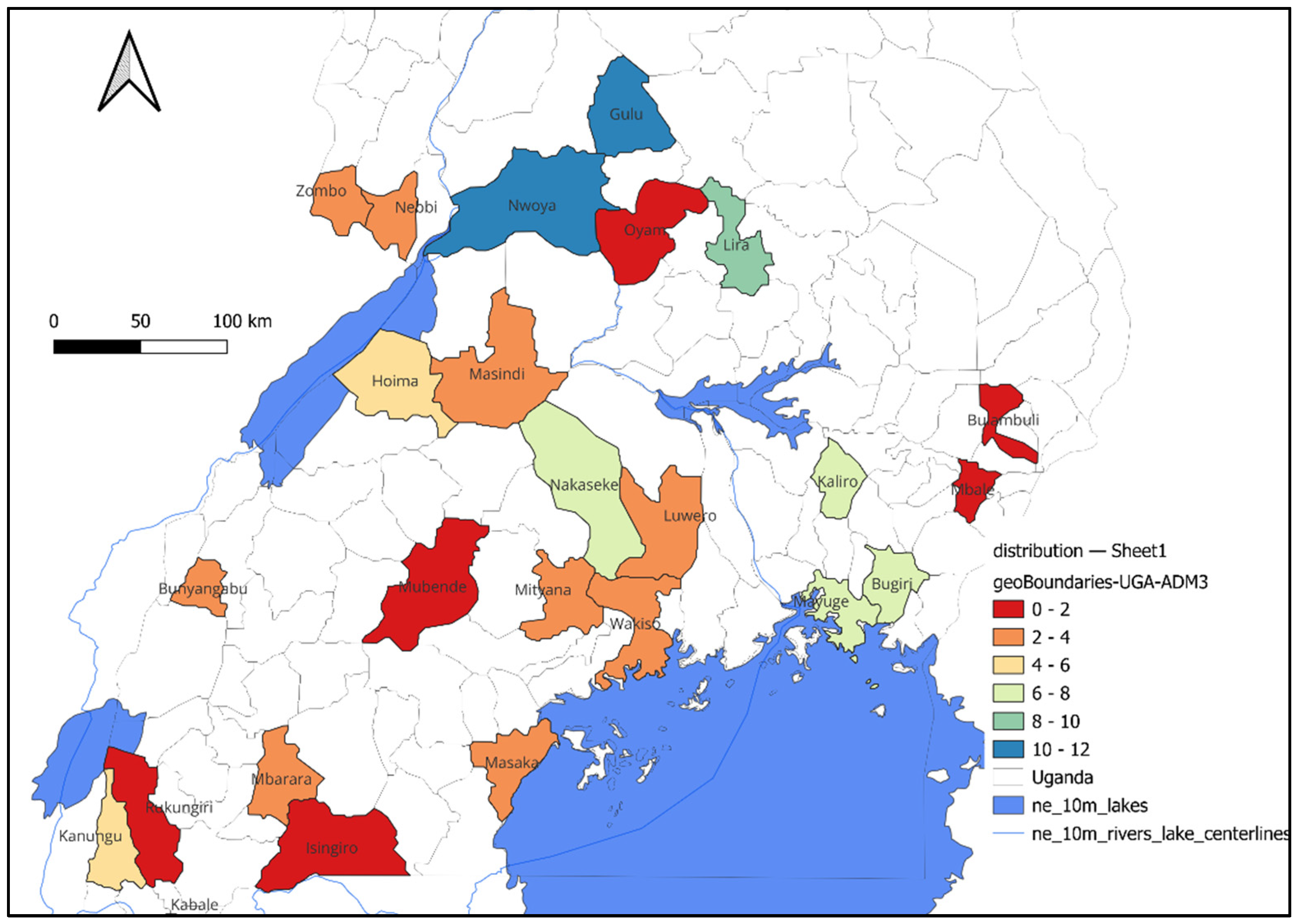
Table 3 presents the results of spatial heterogeneity in the adoption of hybrid banana varieties (HBVs). The adoption rate (percentage of farmers growing any HBV) was highest in the Northern region (73.86%) and lowest in the Central (23.61%) and South Western (24.11%) regions. Adoption intensity (number of mats planted) also differed regionally, as shown in Table 3. Farmers in the Northern region planted an average of 137 hybrid mats, followed by the North West (110.38). Farmers in the South Western and Western regions planted the fewest hybrid mats, averaging 81.25 and 43.35 mats per household, respectively. A similar pattern was observed for the average acreage devoted to hybrid bananas. These differences likely reflect variation in land access, markets, and extension services. The spatial distribution of HBV adoption across the surveyed districts is visualized in Figure 1. The map clearly shows that adoption is not uniform but forms distinct clusters, with a high concentration of adopting households in the Northern region and more sporadic, isolated adoption in the Central and Southwestern zones. This visual pattern underscores the significant spatial heterogeneity that is a central finding of this study.
Beyond hybrid bananas, descriptive statistics demonstrate that households continue to maintain a diverse banana portfolio. Indigenous cooking bananas remain dominant nationally (87.7%), especially in traditional zones where culinary preferences strongly influence crop choices. Beer bananas were concentrated in Southwestern (18.8% of households), while Bogoya was common in Western (32.9%) and Sukali Ndizi was frequent in Western and Southwestern (22.7% and 12.5%, respectively). The coexistence of HBVs with local varieties suggests that farmers integrate new materials cautiously while maintaining varieties that fulfil established household food and market roles. This aligns with observations in adoption literature showing that farmers often adopt improved varieties incrementally, especially when varietal traits diverge from long-standing preferences [27].

4.2. Determinants of Adoption Intensity of HBVs: Results of Tobit Regression

To analyze the factors influencing the intensity of HBV adoption, a Tobit regression model was employed, accounting for the left-censored nature of the dependent variable (number of mats, censored at zero). The model was estimated for the pooled national sample and disaggregated by region to capture spatial heterogeneity. The results are presented in Table 4.
The result indicates that regional differences remain significant even after controlling for household characteristics. The Northern region dummy remained positive and significant, indicating that higher adoption intensity in this region cannot be explained solely by socio-economic factors. Rather, contextual factors such as targeted past interventions and the positioning of bananas as an emerging cash crop appear influential. Results also indicate that male farmers are more likely to plant more hybrid banana mats.
Seed source was the strongest and most consistent determinant. Relying on fellow farmers for planting materials was negatively and significantly associated with the number of HBV mats across all regions. This finding underscores seed system constraints more than farmer reluctance. Small numbers of suckers exchanged informally and uncertainties around phytosanitary quality likely discourage farmers from expanding hybrid plots. Similar patterns have been documented in banana and vegetatively propagated crops where informal seed channels dominate [27].
Beyond the general constraint, the drivers of adoption intensity displayed distinct regional patterns. In the central region, younger farmers and those growing bananas in monocrop systems planted more HBVs. This suggests that HBVs are perceived as more suitable for specialized, market-oriented production rather than integrated systems. In the Eastern region, land devoted to bananas was the key predictor, indicating that resource endowments shape intensity rather than demographic characteristics. The North Western region told a story of human capital, where education and male headship were positively associated with intensity, reflecting the importance of information access and management skills in newer banana-growing zones. In the Northern region, marital status (a proxy for household labor availability) significantly increased adoption intensity, reflecting the labor requirements of establishing HBV plots. However, this estimate should be interpreted with caution due to limited representation of unmarried farmers in the sample (<20%), resulting in reduced statistical power to detect precise effects. Consequently, the large standard error reflects considerable uncertainty around this point estimate.
These regional patterns partially align with previous empirical studies on banana technology uptake in Uganda, which similarly identify consumer preference, land constraints, and information access as major drivers of varietal choice [17,27,28]. However, our findings differ from earlier localized studies by demonstrating that seed system structure, particularly reliance on informal sources has a consistently strong and negative effect nationwide, underscoring an institutional constraint not fully emphasized in prior research.
Overall, these patterns are consistent with established adoption theory: resource access, information quality, and risk perceptions strongly shape decisions concerning perennial crop investment.

4.3. Discussion

The markedly higher adoption rate (73.9%t) and intensity observed in the Northern region reflect the legacy of targeted development partner interventions (such as AGRA and ABSPII), which promoted bananas as a food security and commercial crop in this non-traditional growing area. This high uptake, where bananas are grown primarily for income (79.6% of farmers), suggests a lower barrier to adoption, likely because farmers and consumers in these new entry regions lack the deeply entrenched cultural preferences for indigenous varieties that characterize the traditional banana growing areas. This finding aligns with technology adoption literature, which suggests that in “new entry” agricultural systems without entrenched crop traditions, the barriers to adopting improved varieties are often lower, as farmers are not constrained by strong consumer preferences or habitual practices [38]. The positive effect of being married and, in some regions, male on adoption intensity likely proxies for greater access to household labor and capital, respectively, which are crucial for establishing and maintaining new, labor-intensive perennial crops like bananas. The younger farmer demographic in the North (42.5 years) compared to the South West (49.88 years) may further indicate a greater openness to adopting new, profitable technologies. However, the consistently negative effect of informal seed sourcing highlights a systemic bottleneck. Informal networks (free transfer or informal exchange of planting material), while essential for early dissemination, do not support large-scale adoption due to small quantities exchanged and potential disease risks. This reflects findings from studies on vegetatively propagated crops where clean planting material and market-based seed channels are critical for scaling [27]. The widespread diffusion supported by development partner interventions is yet to transition fully to a sustainable, commercial model.
In stark contrast, the traditional banana-growing regions (central, southwestern, western Uganda) exhibited markedly lower adoption rates (as low as 23.61% in Central). These low adoption rates are primarily attributed to the powerful social and economic constraints present in established systems, such as a strong consumer preference for the taste and cooking qualities of the indigenous banana varieties [28], and producer risk aversion. For farmers in these regions, bananas are a primary subsistence and cash crop; switching to a new variety on a large scale represents a significant economic and culinary risk.Our finding here is consistent with a wider body of literature demonstrating that in staple crop systems, risk perception and consumer acceptability often outweigh technical performance in determining the adoption ceiling.
The findings in the central region are particularly illustrative: the negative relationship of intercropping suggests that HBVs are perceived as or are more successful as a semi-commercial monocrop, requiring dedicated management that differs from traditional mixed cropping systems [39]. The positive association of banana specialization (land-to-bananas) and the negative relationship of age (that is, adoption by younger farmers) further support this interpretation. Younger, more market-oriented farmers with a significant investment in bananas are the most likely early adopters, seeing HBVs as a potential pathway to intensification and higher income, rather than a direct substitute for traditional Matooke and Sukali ndizi for home consumption [26,32].
The results from the North Western region highlight the importance of human capital and market demand and opportunities in newer agricultural frontiers. The strong positive relationship of male-headed households and education suggests that in areas where traditional banana knowledge is limited, the capacity to acquire new information, manage a novel crop, and potentially access market linkages becomes paramount [40]. This finding indicates a potential for gendered adoption gaps in regions where agriculture is undergoing transition, as men often have greater access to resources, information, and extension services [30,31,41,42,43,44]. In Eastern Uganda, farmers with larger farms plant more HBVs. A plausible interpretation is that larger farms (absolute land size) have the scale and capital to invest in hybrids. Additionally, banana is a perennial crop that hold up land for some time. Farmers with adequate land can afford to devote land for banana growing on a large scale, while farmers who concentrate a high share of a small farm on bananas may be resource-constrained smallholders who cannot expand hybrid plantings despite allocating much of their land to bananas [22]. This interpretation mirrors adoption literature showing that farm size and capital access often interact with risk preferences to shape the intensity (not just the binary decision) of adoption [26].
The most consistent finding across all regions and models is the strong negative association between sourcing suckers from fellow farmers and the intensity of HBV adoption. This presents a critical paradox: while informal seed networks are undoubtedly vital for initial dissemination and ensuring access, particularly in remote areas [27], they ultimately act as a constraint on scaling. This can be explained by several mechanisms. Informal transfers often involve a small number of suckers, typically given as gifts, which may be insufficient to establish a commercially viable plot. More importantly, these channels carry a high risk of disseminating diseased planting material, particularly for soil-borne pests and pathogens like nematodes and weevils, which can discourage farmers from making significant investments in land and labor [9]. Furthermore, informal exchanges usually occur without the technical knowledge and agronomic support that often accompany formal seed sources, leaving farmers to manage new varieties with uncertain practices. This finding underscores that improving seed system efficiency is not merely about increasing the volume of suckers in circulation but about enhancing their quality, phytosanitary status, and the information bundled with them. Our results strongly argue that strengthening formal and quasi-formal seed systems through NARO, private multipliers, and development programs to deliver affordable, certified clean planting material is the most important leverage point for accelerating HBV adoption at scale across Uganda. This paradox reinforces findings from studies across Africa, where informal seed networks are crucial for initial dissemination but are also consistently linked to limited adoption scale and phytosanitary risks, thereby acting as a bottleneck to scaling [45,46,47].

5. Conclusions and Recommendations

Our findings demonstrate that HBV adoption in Uganda is shaped by a complex intersection of seed system structures, regional histories, and household characteristics. Rather than reiterating the study’s novelty, here we synthesize the key empirical insights and their implications for scaling efforts. Based on the strong, negative association between informal seed sourcing and adoption intensity, the primary policy lever is the development of a decentralized, quality-assured system for producing and distributing certified clean planting material. This involves significantly scaling up the capacity of National Agricultural Research Laboratories (NARL) and National Crops Resources Research Institute (NaCRRI) to produce pre-basic and basic seeds. Subsequently, the government should consider incentivizing and building the capacity of private sector actors (nurseries) and organized farmer groups to become multipliers and distributors of quality-assured planting material, thereby reducing dependence on the high-risk, low-volume informal system.
For areas with high adoption but lower intensity than what is ideal, such as the Northern region, the study recommends a targeted shift in policy focus from promoting adoption to supporting intensification and commercialization. Interventions should include advanced agronomic training on soil fertility management and control of emerging pests for hybrids, and facilitating stronger market linkages that directly translate increased production into higher farmer income, thereby creating a pull factor for scaling production. This is empirically supported by the strong income orientation of banana cultivation in this region. In traditional banana growing areas (central, southwestern, and western regions), we recommend designing interventions that address consumer preference and perceived agronomic risk, which are the primary barriers to adoption. This should include culinary demonstration plots and campaigns in local markets to build consumer acceptance for new hybrids, as well as developing varieties that incorporate culinary and cooking traits similar to preferred indigenous varieties.
Regarding gender, our regression analysis indicates a statistically significant positive correlation between being a male farmer and the intensity of HBV adoption in the pooled model and specific regions (e.g., Eastern, North West). We acknowledge that because we only used a gender dummy variable and did not conduct a gender-disaggregated analysis of factors like access to extension, labor, or trait preferences, we cannot extrapolate substantial conclusions regarding the causes of this gender gap or recommend specific gender-responsive extension or variety development interventions. The statistical result strictly demonstrates that, all else being equal, male farmers are able to command more resources to invest in a larger area of hybrid bananas. The observed positive coefficient for male farmers may reflect pre-existing inequalities in access to land, capital, and market linkages, which are known to disproportionately favor men in agricultural economies [30,31,41,42,43,44]. To move beyond this descriptive finding, future research is critically needed to conduct a gender-disaggregated analysis. Given a statistically significant positive coefficient for male farmers, which suggests a resource constraint barrier for female farmers, the Ministry of Agriculture, Animal Industry and Fisheries (MAAIF) and partner programs should focus on addressing demonstrated resource disparities. Specifically, programs should ensure equitable access to formal planting material and associated credit for female farmers, which is a direct policy implication of the Tobit model result. We caution against making broader recommendations on extension access or trait preferences, as these were not empirically analyzed in a disaggregated manner by this study.
These policy recommendations directly address the original research gap identified in this study, specifically the lack of spatially differentiated evidence on the drivers of HBV adoption, and provide targeted avenues for strengthening scaling efforts across Uganda’s diverse regions.

Novelty, Limitations, and Avenues for Future Research

This study provides empirical evidence that HBV adoption and intensity in Uganda are spatially heterogeneous processes, shaped decisively by regional contexts, including historical intervention pathways and the structure of seed systems, rather than by household-level factors in isolation. While prior research has effectively documented farmer preferences and agronomic performance of hybrids [7,16,17,18,23], our analysis advances the literature by quantitatively demonstrating how these regional and institutional layers condition the influence of common determinants, such as education, gender, and land size, on both the likelihood and the scale of adoption.
A key limitation is the reliance on cross-sectional data, which prohibits the establishment of causal links or a dynamic analysis of the adoption process over time. Furthermore, the analysis of gender was limited to a simple dummy variable, preventing a deeper understanding of gender-specific barriers to resource access and trait preferences. Finally, the study relied on farmer recall for acreage and mat numbers, which may introduce measurement error.
To address these limitations and build on our findings, we recommend the following avenues for future research: (i) a gender-disaggregated double-hurdle model to separately analyze the factors influencing the decision to adopt (first hurdle) versus the intensity of adoption (second hurdle) for male and female farmers; (ii) longitudinal studies to track the sustainability of HBV plantings and the transition from informal to formal seed sourcing; and (iii) comparative analysis of specific hybrid traits (e.g., taste, cooking time, bunch size) that may explain the low adoption rates observed in traditional banana-growing regions.

Supplementary Materials

The following supporting information can be downloaded at: https://www.mdpi.com/article/10.3390/agriculture16030289/s1, Table S1: Distribution of respondents.

Author Contributions

Conceptualization, I.B., A.K.K., C.N., S.K., A.W., E.B., A.O., R.T., G.A. and A.B.; Methodology, I.B., A.K.K., C.N., S.K., A.W., E.B., H.M., A.O., R.T. and A.B.; Software, I.B., A.K.K. and A.O.; Validation, I.B., A.K.K., C.N., S.K., A.W., E.B., H.M., A.O., R.T., G.A. and A.B.; Formal analysis, I.B., A.K.K. and A.O.; Investigation, I.B., A.K.K., C.N., S.K. and A.W.; Resources, R.T., G.A. and A.B.; Data curation, I.B., A.K.K., C.N., S.K., H.M. and A.O.; Writing—original draft, I.B., A.K.K., C.N., S.K., A.W., E.B., H.M., A.O., R.T., G.A. and A.B.; Writing—review & editing, I.B., A.K.K., C.N., S.K., A.W., E.B., H.M., A.O., R.T., G.A. and A.B.; Visualization, I.B., A.K.K., C.N., S.K., A.W., E.B., H.M., A.O., R.T., G.A. and A.B.; Supervision, Alex Barekye; Project administration, G.A. and A.B.; Funding acquisition, G.A. All authors have read and agreed to the published version of the manuscript.

Funding

This research was supported by the Scaling Breeding Operations (SBO-Ug) project in Uganda, with funding from the Bill & Melinda Gates Foundation. The funders had no role in the design of the study, data collection, analysis, or interpretation, or in the decision to publish the results.

Institutional Review Board Statement

The study was conducted in accordance with the Declaration of Helsinki, and National Agricultural Research Organisation requirements.

Informed Consent Statement

The participants provided their written informed consent to participate in this study. Clinical trial number: not applicable.

Data Availability Statement

The raw data supporting the conclusions of this article will be made available by the authors on request.

Acknowledgments

This work was supported by the Bill & Melinda Gates Foundation through the Scaling Breeding Operations (SBO-Ug) project in Uganda. Under the grant conditions of the Foundation, a Creative Commons Attribution 4.0 Generic License has already been assigned to the Author Accepted Manuscript version that might arise from this submission. The authors gratefully acknowledge funding support from the Bill & Melinda Gates Foundation (BMGF). We also thank the district agricultural officers, enumerators, and farming households whose participation made this study possible. Special appreciation is extended to the National Banana Research Programme (NBRP) of the National Agricultural Research Organisation (NARO), as well as collaborating institutions, for their valuable technical guidance. We further acknowledge NARO for facilitating the article processing charge (APC) for publishing this manuscript.

Conflicts of Interest

The authors declare no conflicts of interest.

References

  1. FAO. The State of Food Security and Nutrition in the World 2023; Food and Agriculture Organization of the United Nations: Rome, Italy, 2023. [Google Scholar] [CrossRef] [Scilit]
  2. Edgerton, M.D. Increasing crop productivity to meet global needs for feed, food, and fuel. Plant Physiol. 2009, 149, 7–13. [Google Scholar] [CrossRef] [Scilit]
  3. Asenso-Okyere, K.; Jemaneh, S. Increasing Agricultural Productivity and Enhancing Food Security in Africa: New Challenges and Opportunities; International Food Policy Research Institute (IFPRI): Washington, DC, USA, 2012. [Google Scholar] [CrossRef] [Scilit]
  4. van Ittersum, M.K.; van Bussel, L.G.; Wolf, J.; Grassini, P.; van Wart, J.; Guilpart, N.; Claessens, L.; de Groot, H.; Wiebe, K.; Mason-D’Croz, D.; et al. Can sub-Saharan Africa feed itself? Proc. Natl. Acad. Sci. USA 2016, 113, 14964–14969. [Google Scholar] [CrossRef] [Scilit]
  5. Tittonell, P.; Giller, K.E. When yield gaps are poverty traps: The paradigm of ecological intensification in African smallholder agriculture. Field Crops Res. 2013, 143, 76–90. [Google Scholar] [CrossRef] [Scilit]
  6. FAOSTAT. Uganda Banana Production Statistics 2021–2023. Food and Agriculture Organization. 2025. Available online: http://www.fao.org/faostat (accessed on 15 July 2025).
  7. Akankwasa, K.; Marimo, P.; Tumuhimbise, R.; Asasira, M.; Khakasa, E.; Mpirirwe, I.; Kleih, U.; Forsythe, L.; Fliedel, G.; Dufour, D.; et al. The East African highland cooking bananas ‘Matooke’ preferences of farmers and traders: Implications for variety development. Int. J. Food Sci. Technol. 2021, 56, 1124–1134. [Google Scholar] [CrossRef] [Scilit]
  8. UBOS. Uganda National Household Survey 2019/2020: Agricultural Module. Uganda Bureau of Statistics. 2020. Available online: https://www.ubos.org/wp-content/uploads/publications/09_2021Uganda-National-Survey-Report-2019-2020.pdf (accessed on 17 July 2025).
  9. Kubiriba, J.; Tushemereirwe, W.K. Approaches for the control of banana Xanthomonas wilt in East and Central Africa. Afr. J. Plant Sci. 2014, 8, 398–404. [Google Scholar] [CrossRef] [Scilit]
  10. Pagnani, T.; Gotor, E.; Kikulwe, E.; Caracciolo, F. Livelihood assets ‘influence on Ugandan farmers’ control practices for Banana Xanthomonas Wilt (BXW). Agric. Food Econ. 2021, 9, 25. [Google Scholar] [CrossRef] [Scilit]
  11. Tushemereirwe, W.K.; Kubiriba, J. Banana cultivation in Africa Laboratories, Uganda. In Achieving Sustainable Cultivation of Bananas; Burleigh Dodds Science Publishing: Cambridge, UK, 2018; pp. 53–84. Available online: https://www.taylorfrancis.com/chapters/edit/10.1201/9781351114622-8/banana-cultivation-africa-laboratories-uganda-tushemereirwe-kubiriba-national-agricultural-research (accessed on 25 July 2025).
  12. Sanya, L.N.; Ssali, R.T.; Namuddu, M.G.; Kyotalimye, M.; Marimo, P.; Mayanja, S. Why gender matters in breeding: Lessons from cooking bananas in Uganda. Sustainability 2023, 15, 7024. [Google Scholar] [CrossRef] [Scilit]
  13. IITA. IITA and NARO Release Improved Matooke Banana Variety in Uganda. International Institute of Tropical Agriculture. 2025. Available online: https://www.iita.org/news-item/iita-and-naro-release-narita-17-a-matooke-banana-variety-in-uganda/ (accessed on 12 August 2025).
  14. Karamura, D.; Mgenzi, B.; Karamura, E.; Sharrock, S. Exploiting indigenous knowledge for the management and maintenance of Musa biodiversity on farm. Afr. Crop Sci. J. 2004, 12, 67–74. [Google Scholar] [CrossRef] [Scilit]
  15. Biruma, M.; Pillay, M.; Tripathi, L.; Blomme, G.; Abele, S.; Mwangi, M.; Bandyopadhyay, R.; Muchunguzi, P.; Kassim, S.; Nyine, M.; et al. Banana Xanthomonas wilt: A review of the disease, management strategies and future research directions. Afr. J. Biotechnol. 2007, 6, 953–962. [Google Scholar]
  16. Akankwasa, K.; Ortmann, G.F.; Wale, E.; Tushemereirwe, W.K. Farmers’ choice among recently developed hybrid banana varieties in Uganda: A multinomial logit analysis. Agrekon 2013, 52, 25–51. [Google Scholar] [CrossRef] [Scilit]
  17. Akankwasa, K.; Ortmann, G.F.; Wale, E.Z. Evaluating Farmers’and Consumers’ Acceptance of New Cooking Banana Hybrids in Uganda: Micro-Economic Analysis and Policy Implications. 2014. Available online: http://hdl.handle.net/10413/12845 (accessed on 12 September 2025).
  18. Sanya, L.N.; Sseguya, H.; Kyazze, F.B.; Diiro, G.M.; Nakazi, F. The role of variety attributes in the uptake of new hybrid bananas among smallholder rural farmers in central Uganda. Agric. Food Secur. 2020, 9, 1. [Google Scholar] [CrossRef] [Scilit]
  19. Ssebuliba, R.; Talengera, D.; Makumbi, D.; Tenkouano, A.; Rubaihayo, P.; Magambo, M. Reproductive efficiency and breeding potential of East African Highland (Musa AAA-EA) bananas. Field Crops Res. 2006, 95, 250–255. [Google Scholar] [CrossRef] [Scilit]
  20. Nasirumbi Sanya, L.; Birungi Kyazze, F.; Sseguya, H.; Kibwika, P.; Baguma, Y. Complexity of agricultural technology development processes: Implications for uptake of new hybrid banana varieties in Central Uganda. Cogent Food Agric. 2017, 3, 1419789. [Google Scholar] [CrossRef] [Scilit]
  21. Tumuhimbise, R.; Barekye, A.; Kubiriba, J.; Akankwasa, K.; Arinaitwe, I.K.; Karamura, D.; Tushemereirwe, W.K. New high-yield cooking banana cultivars with multiple resistances to pests and diseases (‘NAROBan1′, ‘NAROBan2′, ‘NAROBan3′, and ‘NAROBan4′) released in Uganda. HortScience 2018, 53, 1387–1389. [Google Scholar] [CrossRef] [Scilit]
  22. Van Asten, P.J.; Wairegi, L.W.I.; Mukasa, D.; Uringi, N.O. Agronomic and economic benefits of coffee–banana intercropping in Uganda’s smallholder farming systems. Agric. Syst. 2011, 104, 326–334. [Google Scholar] [CrossRef] [Scilit]
  23. Kikulwe, E.M.; Birol, E.; Wesseler, J.; Falck-Zepeda, J.A. Latent Class Approach to Investigating Farmer Demand for Banana Breeding Traits in Uganda. Agric. Econ. 2011, 42, 707–718. [Google Scholar] [CrossRef] [Scilit]
  24. Singh, I.; Squire, L.; Strauss, J. Agricultural Household Models: Extensions, Applications and Policy; World Bank: Washington, DC, USA, 1986; Available online: http://documents.worldbank.org/curated/en/621291468739297175 (accessed on 18 September 2025).
  25. Sadoulet, E.; Janvry, A.D.; Wehrheim, P. Quantitative development policy analysis. Z. Fur Auslandische Landwirtsch. 1996, 35, 295–298. Available online: https://www.academia.edu/69086486/Quantitative_Development_Policy_Analysis (accessed on 26 September 2025).
  26. Feder, G.; Just, R.E.; Zilberman, D. Adoption of agricultural innovations in developing countries: A survey. Econ. Dev. Cult. Change 1985, 33, 255–298. [Google Scholar] [CrossRef] [Scilit]
  27. McGuire, S.; Sperling, L. Seed systems smallholder farmers use. Food Secur. 2016, 8, 179–195. [Google Scholar] [CrossRef] [Scilit]
  28. Kikulwe, E.M.; Okurut, S.; Ajambo, S.; Nowakunda, K.; Stoian, D.; Naziri, D. Postharvest losses and their determinants: A challenge to creating a sustainable cooking banana value chain in Uganda. Sustainability 2018, 10, 2381. [Google Scholar] [CrossRef] [Scilit]
  29. Alderman, H.; Paxson, C.H. Do the poor insure? A synthesis of the literature on risk and consumption in developing countries. In Economics in a Changing World; Volume 4: Development, Trade and the Environment; Palgrave Macmillan London: London, UK, 1994; pp. 48–78. [Google Scholar] [CrossRef] [Scilit]
  30. Doss, C.R. Designing agricultural technology for African women farmers: Lessons from 25 years of experience. World Dev. 2001, 29, 2075–2092. [Google Scholar] [CrossRef] [Scilit]
  31. Doss, C.R. Analyzing technology adoption using microstudies: Limitations, challenges, and opportunities for improvement. Agric. Econ. 2006, 34, 207–219. [Google Scholar] [CrossRef] [Scilit]
  32. Conley, T.G.; Udry, C.R. Learning about a new technology: Pineapple in Ghana. Am. Econ. Rev. 2010, 100, 35–69. [Google Scholar] [CrossRef] [Scilit]
  33. Wooldridge, J.M. Introductory Econometrics a Modern Approach; South-Western Cengage Learning: Mason, OH, USA, 2019. [Google Scholar]
  34. Tobin, J. Estimation of relationships for limited dependent variables. Econom. J. Econom. Soc. 1958, 26, 24–36. [Google Scholar] [CrossRef] [Scilit]
  35. Cragg, J.G. Some statistical models for limited dependent variables with application to the demand for durable goods. Econometrica 1971, 39, 829–844. [Google Scholar] [CrossRef] [Scilit]
  36. McDonald, J.F.; Moffitt, R.A. The uses of Tobit analysis. Rev. Econ. Stat. 1980, 62, 318–321. [Google Scholar] [CrossRef] [Scilit]
  37. Greene, W.H. Econometric Analysis, 8th ed.; Pearson: London, UK, 2018. [Google Scholar]
  38. Dawson, N.; Martin, A.; Sikor, T. Green revolution in sub-Saharan Africa: Implications of imposed innovation for the wellbeing of rural smallholders. World Dev. 2016, 78, 204–218. [Google Scholar] [CrossRef] [Scilit]
  39. Kabunga, N.S.; Dubois, T.; Qaim, M. Impact of tissue culture banana technology on farm household income and food security in Kenya. Food Policy 2014, 45, 25–34. [Google Scholar] [CrossRef] [Scilit]
  40. Weir, S.; Knight, J. Externality effects of education: Dynamics of the adoption and diffusion of an innovation in rural Ethiopia. Econ. Dev. Cult. Change 2004, 53, 93–113. [Google Scholar] [CrossRef] [Scilit]
  41. Anderson, J.R.; Feder, G. Agricultural extension: Good intentions and hard realities. World Bank Res. Obs. 2004, 19, 41–60. [Google Scholar] [CrossRef] [Scilit]
  42. Quisumbing, A.R.; Pandolfelli, L. Promising approaches to address the needs of poor female farmers: Resources, constraints, and interventions. World Dev. 2010, 38, 581–592. [Google Scholar] [CrossRef] [Scilit]
  43. Ndiritu, S.W.; Kassie, M.; Shiferaw, B. Are there systematic gender differences in the adoption of sustainable agricultural intensification practices? Evidence from Kenya. Food Policy 2014, 49, 117–127. [Google Scholar] [CrossRef] [Scilit]
  44. Theis, S.; Lefore, N.; Meinzen-Dick, R.; Bryan, E. What happens after technology adoption? Gendered aspects of small-scale irrigation technologies in Ethiopia, Ghana, and Tanzania. Agric. Hum. Values 2018, 35, 671–684. [Google Scholar] [CrossRef] [Scilit]
  45. Sperling, L.; Gallagher, P.; McGuire, S.; March, J.; Templer, N. Informal seed traders: The backbone of seed business and African smallholder seed supply. Sustainability 2020, 12, 7074. [Google Scholar] [CrossRef] [Scilit]
  46. Nduwimana, I.; Sylla, S.; Xing, Y.; Simbare, A.; Niyongere, C.; Garrett, K.A.; Bonaventure Omondi, A. Banana seed exchange networks in Burundi–Linking formal and informal systems. Outlook Agric. 2022, 51, 334–348. [Google Scholar] [CrossRef] [Scilit]
  47. Muricho, G.; Gichuru, L.; Akpo, E.; Templer, N.; Puozaa, D.K.; Gitonga, Z.; Melesse, M.; Mwenda, E.; Mchau, D.; Binagwa, P.; et al. Navigating Formal, Informal, and Integrated Seed Systems: Drivers of Choice by Sorghum Grain Producers in Tanzania and Implications for Seed Access. Food Energy Secur. 2025, 14, e70148. [Google Scholar] [CrossRef] [Scilit]
Figure 1. Spatial distribution of HBVs in the study districts of Uganda (Map created by authors using QGIS software and survey data).
Agriculture 16 00289 g001
Table 1. Definition and measurement of variables used in the Tobit regression model.
Variable NameDescription & MeasurementTypeExpected Sign
Dependent Variable
Number of HBV MatsTotal number of hybrid banana mats planted by the householdContinuous
Independent Variables
Sex 1 if respondent is male; 0 if femaleBinary+
AgeAge of the respondent (years)Continuous+/−
Years of SchoolingYears of formal education of the respondentContinuous+
Household SizeTotal number of household membersContinuous+
Marital Status1 if respondent is married; 0 otherwiseDummy+
Land SizeTotal land owned by household (acres)Continuous+
Land for BananasTotal land allocated to bananas (acres)Continuous+
Years Planting BananasFarming experience of respondent with bananas (years)Continuous+
Purpose for Sale1 if main purpose for growing bananas is sale; 0 if for foodBinary+
Region1 if household is in Northern region; 0 otherwiseDummy+
Intercrop1 if bananas are grown as an intercrop; 0 if monocropBinary
Seed from Fellow Farmers1 if primary seed source is fellow farmers; 0 otherwiseBinary
Table 2. Socio-economic characteristics of banana farmers.
Variable Pooled (n = 624)Central (n = 144)Eastern (n = 147)North West (n = 57)Northern (n = 88)South Western (n = 112)Western (n = 76)
Age (years)47.13
(14.63)
46.05
(14.10)
48.31
(12.77)
44.70
(14.35)
42.5
(14.07)
49.88
(15.64)
50
(16.74)
Years of schooling (years)8.38
(4.25)
9.53
(3.88)
7.33
(4.36)
8.95
(4.55)
9.28
(3.84)
8.18
(4.61)
7.07
(3.58)
Household size 6.69
(3.26)
6.09
(3.15)
7.70
(3.19)
6.25
(2.92)
6.80
(2.88)
6.56
(3.03)
6.28
(4.12)
Household members above 18 years 3.45
(2.31)
2.98
(1.85)
4.05
(2.53)
3.37
(1.87)
3.49
(1.78)
3.51
(2.32)
3.07
(3.14)
Total size of land (acres)5.24
(11.80)
4.40
(9.79)
3.06
(4.31)
4.39
(6.63)
6.65
(14.26)
8.51
(19.80)
5.22
(7.65)
Land under bananas (acres)1.61
(3.63)
1.32
(1.03)
0.79
(0.64)
0.72
(0.61)
1.00
(0.89)
4.19
(7.84)
1.32
(1.32)
Land under other enterprises (acres)3.41
(10.04)
2.74
(9.12)
2.06
(3.86)
3.55
(6.37)
5.46
(13.83)
4.06
(15.07)
3.89
(7.18)
Years of banana production 14.26
(12.79)
14.63
(10.85)
14.65
(12.94)
8.70
(6.91)
4.82
(5.27)
22.46
(15.20)
15.81
(12.95)
Marital status Percentage of farmers
Divorced3.374.865.440.001.141.793.95
Married80.4568.0685.0389.4787.5082.1477.63
Single6.8913.890.007.027.955.367.89
Widowed9.2913.199.523.513.4110.7110.53
Main source of income Percentage of farmers
Farming94.0794.4495.2487.7289.7798.2194.74
Formal employment 1.920.001.367.023.410.892.63
Informal employment (specify)2.082.783.401.752.270.001.32
Trading1.922.780.003.514.550.891.32
Main purpose of growing bananasPercentage of farmers
Food44.8949.6653.7422.8112.5053.9859.21
Income51.9249.6645.5859.6579.5545.1340.79
Both income and food 2.720.000.0017.547.950.000.00
Others (prestige, passion)0.480.690.680.000.000.880.00
Note: Standard deviation in parentheses.
Table 3. Banana production characteristics by region and type.
Variable Pooled (n = 625) Central (n = 144) Eastern (n = 147) North West (n = 57) Northern (n = 88) South Western (112) Western (n = 76)
Type of banana grown. Percentage of farmers
Indigenous cooking bananas87.6698.6196.6080.7042.0596.4394.74
Hybrid bananas33.1723.6130.6122.8173.8624.1130.26
Beer varieties 6.252.084.760.000.0018.7510.53
Plantain5.294.862.040.005.688.9310.53
Bogoya17.799.0321.771.7513.6425.0032.89
Sukali Ndizi10.8710.815.600.0016.3312.5022.67
Acreage under bananas
Beer varieties0.50
(0.80)
0.11
(0.13)
0.10
(0.12)
NANA0.66
(0.95)
0.54
(0.69)
Bogoya0.23
(0.29)
0.16
(0.21)
0.23
(0.40)
0.250.35
(0.14)
0.19
(0.17)
0.27
(0.27)
Bogoya and Sukali Ndiizi intercrop0.36
(0.42)
0.23
(0.15)
0.22
(0.35)
NA0.50
(0.38)
0.28
(0.22)
2.00
Hybrid bananas0.70
(2.02)
0.86
(2.59)
0.44
(0.36)
0.45
(0.29)
1.00
(2.83)
0.73
(1.59)
0.27
(0.52)
Indigenous cooking bananas2.82
(30.18)
6.14
(58.65)
0.65
(0.53)
0.65
(0.50)
0.80
(0.98)
4.03
(7.86)
1.08
(0.97)
Plantain0.30
(0.44)
0.35
(0.73)
0.03
(0.03)
NA0.56
(0.44)
0.27
(0.34)
0.21
(0.24)
Sukali ndizi0.29
(0.32)
0.10
(0.10)
0.33
(0.39)
NA0.67
(0.32)
0.24
(0.25)
0.26
(0.32)
Number of mats of banana types
Beer varieties198.63
(382.40)
23.33
(11.55)
29.00
(44.88)
NANA240.14
(448.36)
282.63
(382.15)
Bogoya40.27
(71.93)
46.80
(85.66)
29.75
(40.05)
50.0072.80
(60.13)
24.72
(25.66)
53.92
(111.16)
Bogoya and Sukali Ndiizi intercrop55.43
(68.41)
69.75
(62.75)
15.86
(15.55)
0.0072.43
(48.97)
67.86
(111.61)
12.00
Hybrid bananas101.28
(146.79)
125.18
(209.13)
66.95
(88.08)
110.38
(120.02)
137.40
(142.35)
81.25
(173.62)
43.35
(86.93)
Indigenous cooking bananas776.67
(3,793.36)
453.27
(576.00)
163.56
(139.98)
160.28
(164.17)
124.44
(149.99)
2,714.35
(8,221.30)
420.03
(459.53)
Plantain57.53
(122.97)
96.57
(179.38)
8.33
(2.89)
NA128.60
(209.05)
20.78
(14.96)
38.75
(76.48)
Sukali ndizi52.31
(87.30)
21.17
(21.20)
33.20
(23.05)
NA121.25
(65.07)
79.22
(158.89)
33.24
(69.90)
Note: Standard deviation in parentheses. “NA” indicates that a particular banana type was not present in the sampled households of that region, and therefore no data was collected. “0.00” indicates that the banana type was present, but the average acreage or number of mats was zero for the farmers who reported growing it in the sample.
Table 4. Determinants of adoption intensity of hybrid varieties—Tobit regression.
Number of Hybrid MatsPooled (n = 624)Central (n = 144)Eastern (n = 147)North West (n = 57)Northern (n = 88)South Western (n = 112)Western (n = 76)
Sex (1= Male)45.47 **
(20.97)
−10.50
(58.38)
45.69 **
(22.50)
198.45 **
(84.24)
2.07
(59.48)
101.43
(77.84)
−30.80
(26.66)
Age of Farmer0.97
(0.78)
−8.43 ***
(2.96)
1.07
(0.97)
0.99
(1.97)
2.79
(2.41)
0.60
(2.60)
1.04
(1.00)
Years of schooling −0.23
(2.40)
5.74
(7.03)
−4.08 *
(2.42)
15.63 **
(6.38)
−4.72
(6.54)
−5.68
(8.89)
1.11
(4.59)
Household size −3.02
(3.15)
−3.66
(9.03)
0.25
(3.64)
−12.28
(7.43)
−8.60
(9.37)
3.18
(10.77)
−6.38
(6.06)
Marital status (1= Married) 35.44
(28.45)
41.21
(66.56)
−5.60
(38.88)
549.13
(20025.15)
161.65 **
(78.88)
−43.66
(102.62)
−3.36
(29.88)
Land size 0.01
(0.82)
1.47
(2.70)
1.47
(1.93)
3.15
(2.80)
−0.09
(1.76)
0.07
(2.67)
−1.08
(1.87)
Land for bananas−1.22
(3.22)
6.98
(31.87)
37.43 **
(17.94)
1.10
(46.65)
13.45
(33.36)
−1.47
(6.58)
−1.19
(9.02)
Years of planting bananas−0.83
(1.00)
8.49 **
(3.40)
−2.86 **
(1.18)
8.27 *
(4.22)
−8.91
(5.47)
0.18
(2.97)
1.85
(1.28)
Purpose for growing bananas (1=Sale)18.92
(20.44)
24.01
(57.07)
4.80
(23.00)
93.08
(55.78)
17.30
(59.13)
74.90
(69.79)
−30.55
(24.66)
Region (1=North)65.47 **
(28.12)
000000
Method of growing bananas (1=Intercrop)−20.31
(19.81)
−121.66 **
(54.98)
−33.63
(22.46)
−17.11
(56.51)
−26.96
(51.41)
73.05
(66.97)
−35.53
(25.57)
Seed source (1=Fellow farmers)−245.81 ***
(24.52)
−354.72 ***
(69.14)
−99.15 ***
(30.38)
−152.39 **
(69.76)
−305.97 ***
(65.20)
−381.17 ***
(83.12)
−166.61 ***
(33.89)
Constant−58.58
(54.51)
305.92 *
(171.56)
−24.22
(74.41)
−903.55
(20,025.66)
−22.99
(127.99)
−14.28
(160.96)
32.37
(80.37)
Var (e)33,335.28
(4029.33)
39,386.02
(10,836.20)
8379.72
(2265.21)
10,124.54
(4479.57)
33,312.09
(7839.32)
35,188.87
(12,346.60)
7271.63
(2259.81)
Note: Standard errors in parentheses.*** p < 0.01, ** p < 0.05, * p < 0.1.
Disclaimer/Publisher’s Note: The statements, opinions and data contained in all publications are solely those of the individual author(s) and contributor(s) and not of MDPI and/or the editor(s). MDPI and/or the editor(s) disclaim responsibility for any injury to people or property resulting from any ideas, methods, instructions or products referred to in the content.