Article

Design and Experimentation of High-Throughput Granular Fertilizer Detection and Real-Time Precision Regulation System


1
College of Mechanical and Electrical Engineering, Henan Agricultural University, Zhengzhou 450003, China
2
College of Information and Management Science, Henan Agricultural University, Zhengzhou 450003, China
3
College of Mechanical and Electronic Engineering, Northwest Agriculture and Forestry University, Yangling 712100, China
*
Author to whom correspondence should be addressed.
Agriculture 2026, 16(3), 290; https://doi.org/10.3390/agriculture16030290
Submission received: 5 December 2025 / Revised: 23 December 2025 / Accepted: 12 January 2026 / Published: 23 January 2026

Abstract

To address the challenge of imprecise detection and control of fertilizer application rates caused by high granular flow during fertilization operations, a parallel diversion detection method with real-time application rate regulation is proposed. The mechanism of uniform distribution of discrete particles formed by high-throughput aggregated granular fertilizer was elucidated. Key components including the uniform fertilizer tube, sensor detection structure, six-channel diversion cone disc, and fertilizer convergence tube underwent parametric design, culminating in the innovative development of a six-channel parallel diversion detection device. A multi-channel parallel signal detection method was studied, and a synchronous multi-channel signal acquisition system was designed. Through calibration tests, relationship models were established between the measured flow rate of granular fertilizer and voltage, as well as between the actual flow rate and the rotational speed of the fertilizer discharge shaft. A fuzzy PID control model was constructed in MATLAB2023/Simulink. Using overshoot, response time, and stability as evaluation metrics, the control performance of traditional PID and fuzzy PID was compared and analyzed. To validate the control system’s precision, device performance tests were conducted. Results demonstrated that fuzzy PID control reduced the time required to reach steady state by 66.87% compared to traditional PID, while overshoot decreased from 7.38 g·s−1 to 1.49 g·s−1. Divergence uniformity tests revealed that at particle generation rates of 10, 20, 30, and 40 g·s−1, the coefficient of variation for channel divergence consistency gradually increased with rising tilt angles. During field operations at 0–5.0° tilt, the coefficient of variation for channel divergence consistency remained below 7.72%. Bench tests revealed that the fuzzy PID control system achieved an average accuracy improvement of 3.64% compared to traditional PID control, with a maximum response time of 0.9 s. Field trials demonstrated detection accuracy no less than 92.64% at normal field operation speeds of 3.0–6.0 km·h−1. This system enables real-time, precise detection of fertilizer application rates and closed-loop regulation.

1. Introduction

Precision fertilization technology, which applies fertilizer according to the type and amount required by the target crop, is one of the effective ways to address the issues of unreasonable fertilizer input, low average fertilizer utilization rate, and agricultural ecological environmental pollution. Therefore, the urgent technical bottleneck in precision fertilization is how to accurately detect the flow rate of granular fertilizer in real time and apply it precisely as needed, ultimately achieving a uniform and consistent flow of fertilizer granules. Numerous scholars have conducted extensive research on this topic. In terms of fertility detection, the existing methods mainly include efficient point cloud volume conversion algorithm detection, dielectric sensor detection, variable light distance fertilization amount detection, etc., but they have the following limitations: the overall volume of fertilizer is easily affected by field environment interference, leading to a decrease in volume detection accuracy; sensors are prone to failure under extreme vibration conditions; and the mutual obstruction between granular fertilizers affects the accuracy of light detection. Zhao et al. [1] designed a fertilizer application detection system based on point cloud data and volume conversion algorithms; however, there is a certain delay in fat content detection. Ku mahala et al. [2] developed a parallel plate capacitor, which can deduce the mass flow rate variation law by fitting the relationship between material mass and sensor signal output. However, the measurement results are influenced by two factors: the material compaction force between the plates and the moisture content. Yongqian Ding et al. [3] based on the dynamic weighing principle, by detecting changes in the amount of fertilizer in the fertilizer tank can calculate the discharge volume of granular fertilizer. However, the applicability of this method in addressing uneven surfaces in conservation tillage still needs further improvement. Liwei Yang et al. [4] proposed a preprocessing algorithm based on microwave sensors to collect the flow rate signal of granular fertilizers in precision agriculture, which is difficult to accurately measure.
Zegang Shen et al. [5] proposed a collaborative adaptive fish swarm particle filtering algorithm to address the issues of signal interference and errors in the collection process of fertilizer discharge signals in the granular fertilizer mass flow measurement system. This algorithm effectively solves the problems of signal interference and errors in granular fertilizer mass flow measurement, but its adaptability to environmental temperature changes needs to be improved. Lixin Zhao et al. [6] designed a variable light-distance fertilizer application detection system, but the problem of mutual obstruction between particles affects the detection accuracy. Chunbao Xu et al. [7] designed a thin-film light refraction type particle flow multi-channel parallel detection device based on the principles of convex lens refraction and non-contact photoelectric sensing and conducted experiments on it.
In terms of real-time and precise regulation of fertilizer application rates, Jiqin Zhang et al. [8] proposed centrifugal variable spraying technology and strip sowing variable spraying technology to address the issue of incomplete dosage control technology for granular fertilizer application. John Deere has developed the RELATIVE FLOWTM blockage monitoring system, which enables full-process blockage monitoring from the fertilizer tank to the opener, intelligently adjusting the fertilization rate [9]. Two scholars, Umeda and Lina from Japan [10], have developed a variable-rate fertilization machine for rice based on fertilization prescription maps. Maleki et al. [11] from Belgium determined the response time measurement of soil sensors, thereby enhancing the fertilization accuracy of variable-rate fertilizers. JiCheng Zhang et al. [12] adopted an incremental PID closed-loop control algorithm for regulating the fertilization motor, which improved the rapid automatic proportioning and real-time mixing accuracy of three fertilizers: nitrogen, phosphorus, and potassium. Xu Ma et al. [13] designed an online detection system and intelligent regulation system for fertilizer application based on piezoelectric sensors, which is suitable for slow and low-flux fertilization operations. Hui Wang et al. [14] proposed a segmented PID control method based on fertilizer flow feedback to achieve accurate control of fertilizer flow. Man Chen et al. [15] studied a real-time variable topdressing amount adjustment algorithm based on fuzzy PID control, which regulates the dual variables of the fertilizer feeder’s speed and opening.
Research on fertilizer discharge detection and regulation technology, both domestically and internationally, primarily focuses on aspects such as emptying of fertilizer bins, blockages in fertilizer pipes, and the inversion of fertilizer discharge rate based on the rotational speed of the fertilizer discharge device, which indirectly reflects the field operation status of fertilization machinery. However, there is a relative lack of research on real-time detection of high-throughput granular fertilizer and how to precisely regulate and control the amount of fertilizer discharged in a closed-loop manner.
In response to the problems of insufficient real-time detection accuracy, poor uniformity of fertilizer discharge, and imperfect closed-loop control systems in existing variable fertilization technologies, this paper proposes a parallel detection method for high-throughput granular fertilizers based on the two core objectives of “high-throughput granular fertilizer detection” and “real-time precision regulation”, explores the impact of the shunt structure of the fertilizer quantity detection device on the shunting effect, and develops a multi-channel signal synchronous acquisition system based on PVDF sensors. We explore the relationship between the height of fertilizer application and the intensity of piezoelectric signals and complete the development of a high-frequency fertilizer application detection system. A fuzzy PID closed-loop control method based on fertilizer quantity information feedback is proposed, integrating machine operation speed, operation parameters, and fertilizer flow information. This method clarifies the precise intelligent regulation strategy for fertilizer quantity under complex spatiotemporal pattern data integration, achieving real-time precise detection and closed-loop regulation of fertilizer quantity. We also provide theoretical support and innovative practical technologies for precision variable-rate fertilization and granular fertilizer detection.

2. Materials and Methods

2.1. Overall Structural Design and Working Principle

2.1.1. Overall Structure

The structure of the granular fertilizer shunt parallel diversion device is shown in Figure 1, which mainly consists of a fertilizer homogenizing device, a shunt device, and a detection device. The precise control system for granular fertilizer mainly consists of a human–computer interaction module, a stepper motor, a stepper motor driver, a 24 V lithium battery, a fertilizer amount detection device, an amplification module, STM32F103cet6, an LM2596S step-down module, an encoder, a PVDF sensor, and a data acquisition module. The human–machine interaction module can display the flow rate and operating speed of granular fertilizer and enable the setting of parameters such as fertilizer application rate per acre and operating width. The encoder output shaft is connected to the ground wheel drive shaft, allowing real-time acquisition of the implement operating speed and transmission to the controller. The AD7606 data acquisition module collects the voltage signals collected by the PVDF sensor and transmits them to the controller. The controller processes the signals and displays them through the human–computer interaction module.

2.1.2. Working Principle

First, input the target fertilization amount, working width, and number of working rows for the plot in the human–machine interaction module. Then, the encoder speed measurement module installed on the transmission shaft of the implement’s ground wheel acquires the real-time traveling speed of the implement. During operation, the high-throughput fertilizer particles discharged from the fertilizer distributor flow through the uniform fertilizer device and fall into the diversion structure; under the action of the diversion structure, the flow is evenly divided into six low-pass fertilizer granule streams; the streams of fertilizer particles after being diverted are independent of each other, the fertilizer particles falling from the diverging port land on the piezoelectric film that is tilted downward, and after colliding with it, it flows out from the sensor device’s manifold. Meanwhile, the data acquisition module transmits the six-channel signals it has collected to the controller. The controller sets the target fertilization amount forward speed of machinery and tools, information such as the number of rows of homework and the flow rate of real-time granular fertilizer are used as input variables for the control system; based on the control strategy of the control system, the control quantity of the current fertilizer discharge motor speed is derived. And utilize the fuzzy PID algorithm to enable the fertilizer control system to output corresponding PWM signals; the PWM signal controls the motor through the motor driver to adjust its speed in real time, achieving precise control over fertilization operations.

2.2. Key Component Design

2.2.1. Uniform Fertilizer Distribution Device

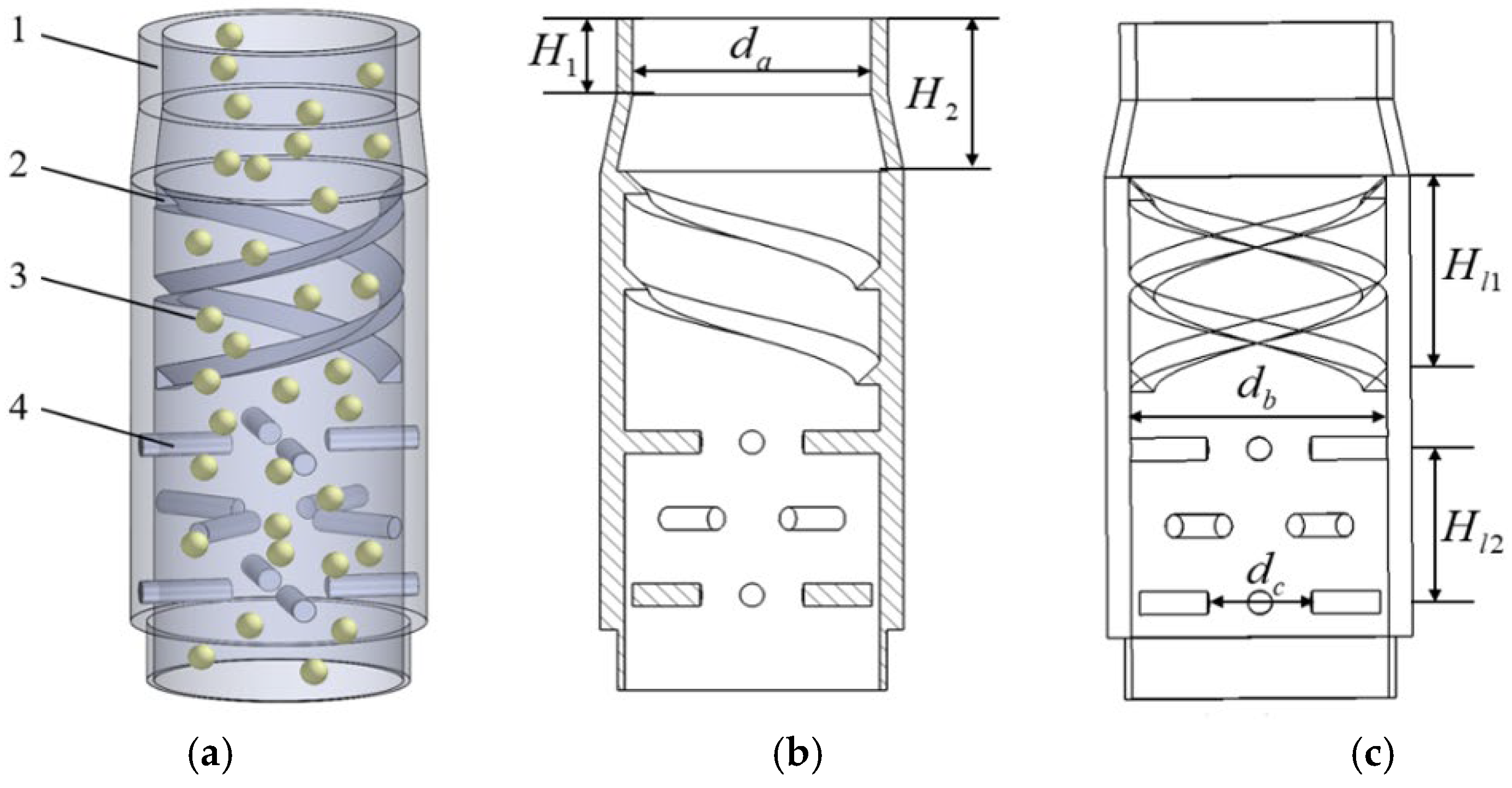
To ensure uniformity of flow distribution [16], a fertilizer distribution device was designed, as shown in Figure 2. It mainly consists of a fertilizer management interface, a double-helix uniform fertilizer baffle ring, a uniform fertilizer baffle rod, and connecting holes. To ensure the continuous and stable descent of granular fertilizer along the flow direction, the inlet of the uniform fertilizer pipe is connected to the end of the fertilizer discharge pipe and is coaxial with the latter. At the same time, the inner wall of the uniform fertilization tube is designed with a double-helix uniform fertilization baffle ring with an equal height and length of spiral lines, and the starting and ending positions of the double-helix baffle ring are 180° apart. On each layer, set up uniform fertilizer distribution rods with equal length and shaft diameter, and no crossing in the middle. According to the preliminary experimental results, the number of uniform fertilizer distribution rods on each layer is 4. During operation, the granular fertilizer is evenly distributed to the pipe orifice of the diverging structure under the influence of gravity, baffle rings, and baffle bars within the uniform fertilization pipe.
Based on the size of the fertilizer discharge pipe, the outer diameter of the fertilizer receiving pipe of the uniform fertilization device is determined to be 34 mm, the wall thickness is 2 mm (with an inner diameter da of 30 mm), and the height of the fertilizer pipe connection H1 is 10 mm. In practical operations, most of the granular fertilizer falls along the axis, thus determining an outer diameter da of 36 mm and a wall thickness of 2 mm (with an inner diameter of 32 mm). To ensure that granular fertilizer gathers towards the center without affecting its circulation, the cross-section of the double-helix retaining ring is an isosceles right triangle with a side length of 2 mm, and the pitch of the helical line Hl1 is 25 mm, and the number of spiral coils is one. To ensure the smooth flow of granular fertilizer through the uniform fertilizer pipe, according to the principle of circulation, the relationship between the inner diameter of the uniform fertilizer pipe and the diameter of the inscribed circle of the uniform fertilizer rod is as follows:
π d b 2 2 4 × d b d c 2 × d g π d a 2 2
In Formula (1), dg is the diameter of the gear lever, mm.
The diameter of the baffle rod affects the circulation of granular fertilizer and the collision effect of particles. The larger the diameter of the baffle rod for uniform fertilization, the better the fertilization effect and the higher the structural strength, but an excessively large diameter of the baffle rod affects the passage ability. Set the maximum diameter dg of the uniform fertilizer gear lever to 3 mm, and substitute it into Formula (1) to calculate dc = 13.74 mm. If the diameter of the inscribed circle of the uniform fertilizer rod is too small, it will increase the friction between the granular fertilizers inside the tube, affecting the circulation and uniform distribution of the granular fertilizers. Considering factors such as processing errors, the diameter of the inscribed circle of the uniform fertilizer rod is determined to be dc = 15 mm.

2.2.2. Design of Diversion Structure

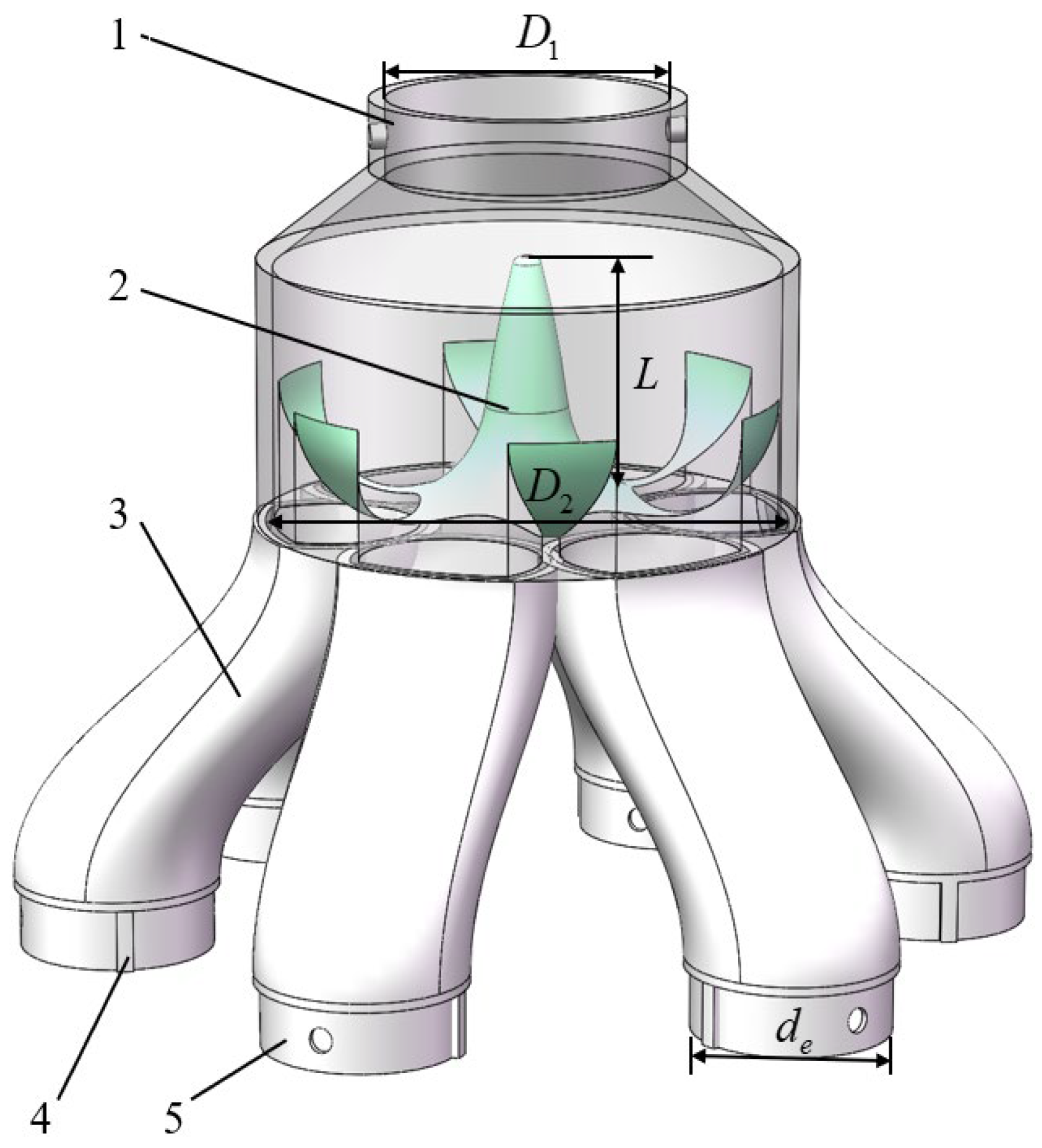
To facilitate detection and improve detection accuracy, it is required that the granular fertilizer can quickly pass through each shunt tube, and the number of granular fertilizers passing through each tube should not vary significantly. With the goal of uniform shunting and rapid passage, the shunting structure parameters are designed as shown in Figure 3. The granular fertilizer shunting structure mainly consists of fertilizer inlet a, a conical shunting disk, shunt tubes, a limiting structure, and fertilizer outlet a. During operation, the granular fertilizer enters the shunting structure through fertilizer inlet a, falls onto the surface of the conical shunting disk, and falls along its surface, being uniformly shunted into the shunt tubes. The random dispersion and uniform shunting of granular fertilizer can reduce the impact of the machine’s tilting condition in the field on the shunting uniformity of the detection device.
The main parameter of the diverging structure includes the inlet of fertilizer a, diameter D1, number of shunt tubes Ns, inner diameter of the diversion tubes de, cone disk height L, and cone disk diameter D2 of the conical disk. To ensure the stability of the flow divider, diameter D1 of the inlet pipe should be consistent with that of the even fertilizer device, set at 32 mm. The fertilizer demand of crops and the operating speed of machinery directly affect the fertilizer discharge frequency, which in turn determines the structural form and size of the flow divider. During the fertilization process, the relationship between the fertilizer discharge rate of the fertilizer distributor and the number of flow divider channels is as follows:
q ut = v B Q 36 n r
f = 1000 q ut m g
N s f f max
In formula, qut is the fertilizer discharge rate per unit time, g·s−1; v is the operating speed of the seeder, km·h−1; B is the operating width, m; Q is the agronomy required fertilizer application rate, kg·hm−2; nr is the number of rows operated by the seeder; mg is the mass of 1000 granular fertilizer grains, g; N is the number of diverging channels; f is the total fertilizer discharge frequency, Hz; fmax is the effective detection frequency of the detection device, Hz.
According to the agronomic requirements for soybean fertilization in the Huang-Huai-Hai region, the fertilization rate for soybeans is 225 kg·hm−2; based on the calculation using the fertilization and seeding machine with a working width of 1.2 m, a total of 3 fertilization rows, and a machine operating speed of 2.0~5.0 km·h−1, the soybean fertilizer discharge rate can be calculated as 5.0~12.5 g·s−1 according to the formula, with the maximum value taken as 12.5 g·s−1. After measurement, the weight of 1000 grains of Stanley compound fertilizer are 48.7 g. Substituting this value into the formula, we obtain the total fertilizer discharge frequency f of 257 Hz. Considering the detection performance of the selected piezoelectric sensor [17], taking fmax as 45 Hz, substituting the formula, we can obtain the number of branch pipes, Ns, as 5.7, the diversion device is determined to be in the form of six diversion branches.
In accordance with the design requirements for the diverging structure, considering factors such as the characteristics and movement patterns of granular fertilizer materials, the sum of the areas of the six diverging tube orifices should be equal to the inlet cross-sectional area. Therefore, inner diameter de of the diverging tube should satisfy the following conditions:
D 1 2 2 π = 6 d e 2 2 π
In Formula (5), de is the inner diameter of the shunt tube, mm.
Substitute the known parameters into Equation (5) to calculate the inner diameter of the shunt tube as 13.1 mm. Considering the overall structure of the shunt cone disk and its threaded connection with the spiral tube, the inner diameter of the shunt tube is determined as de = 15 mm.

2.2.3. Sensing Device

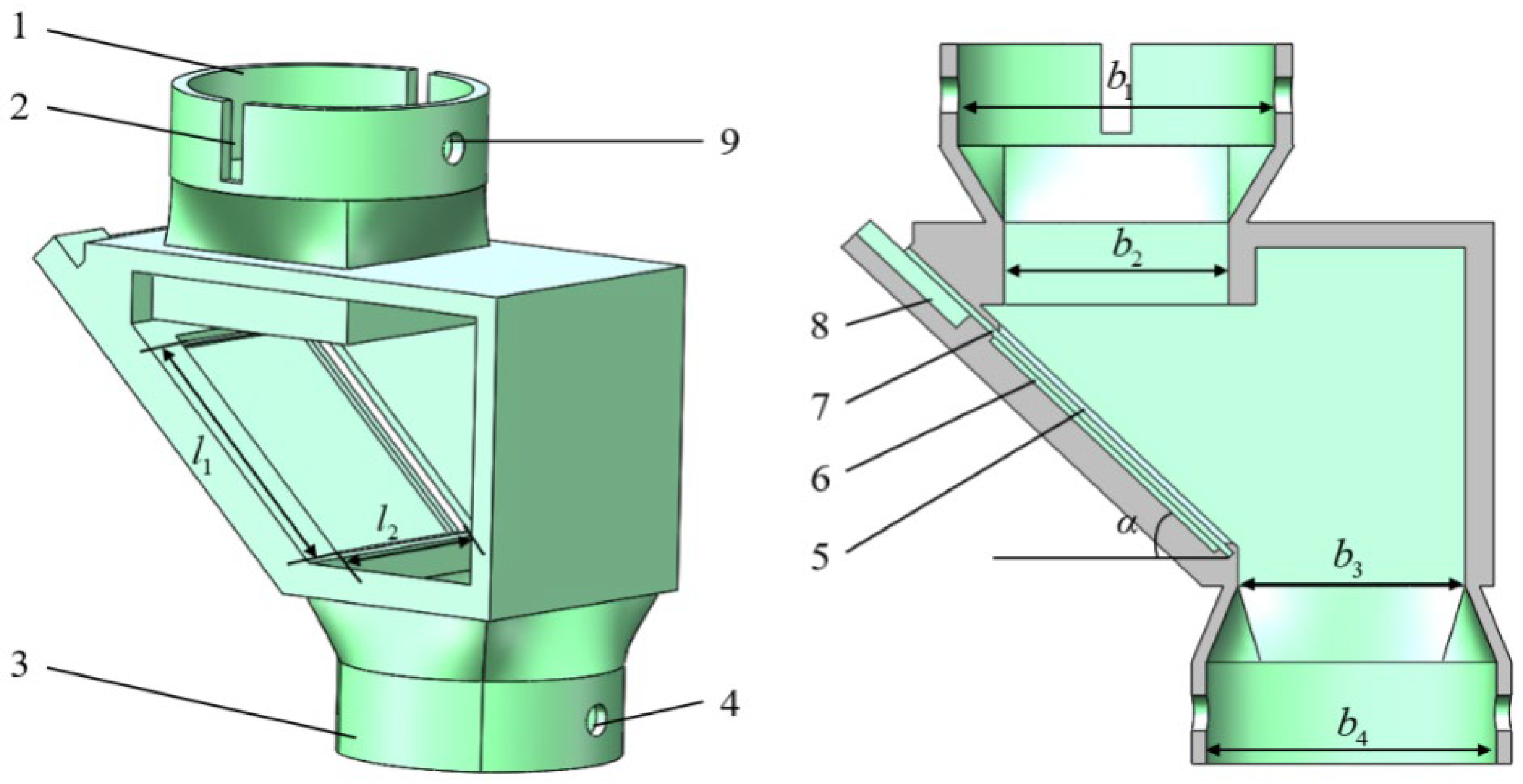
After preliminary experiments comparing and analyzing the signals from collisions between granular fertilizer and various piezoelectric films, the LDTO-028K piezoelectric film from MEAS Corporation was ultimately selected as the piezoelectric sensing element. This component is manufactured by Precision Electronics, a company headquarters in Hampton, VA, USA. It has a thickness of 0.2 mm and a minimum sensing force of 0.01 N. During operation, the sensing device is installed below fertilizer outlet a of the diverging structure. The granular fertilizer sensing device mainly consists of fertilizer inlet b, a limit slot, a collision chamber, fertilizer outlet b, and a connecting hole, as shown in Figure 4.
To reduce the free oscillation of the piezoelectric film caused by the collision of granular fertilizer with the film, a sinking groove substrate–piezoelectric film structure was designed. A rectangular sinking groove, consistent with the effective sensing area of the piezoelectric film (11 mm × 16 mm), was cut below the sensor, with a depth of 0.5 mm. Considering the thickness of the piezoelectric sensor, the sensor card slot was designed to be 0.8 mm deep. To avoid blockage of granular fertilizer in the collision chamber, the depth of the collision chamber was set to 0.5 mm. To ensure that the falling granular fertilizer can effectively collide with the piezoelectric film, the inclination angle α of the piezoelectric film is constrained by the requirement that the granular fertilizer must collide within the effective sensing area of the piezoelectric film, α should not be too large; to avoid secondary or even multiple collisions between granular fertilizer and piezoelectric film, theoretically, α is within the range of 0–90.0°. When inclination angle α of the piezoelectric sensor is too small, it may cause secondary or multiple collisions between the granular fertilizer and the piezoelectric sensor and even lead to the accumulation and blockage of granular fertilizer in the sensing device. When inclination angle α of the piezoelectric sensor is too large, the projection area of the effective sensing area of the piezoelectric sensor on the horizontal plane decreases. Considering the selected size of the piezoelectric sensor, inclination angle α of the piezoelectric sensor should be taken as the minimum value within a reasonable range; therefore, select α is 45°.

2.2.4. Flow Detection Calibration Test

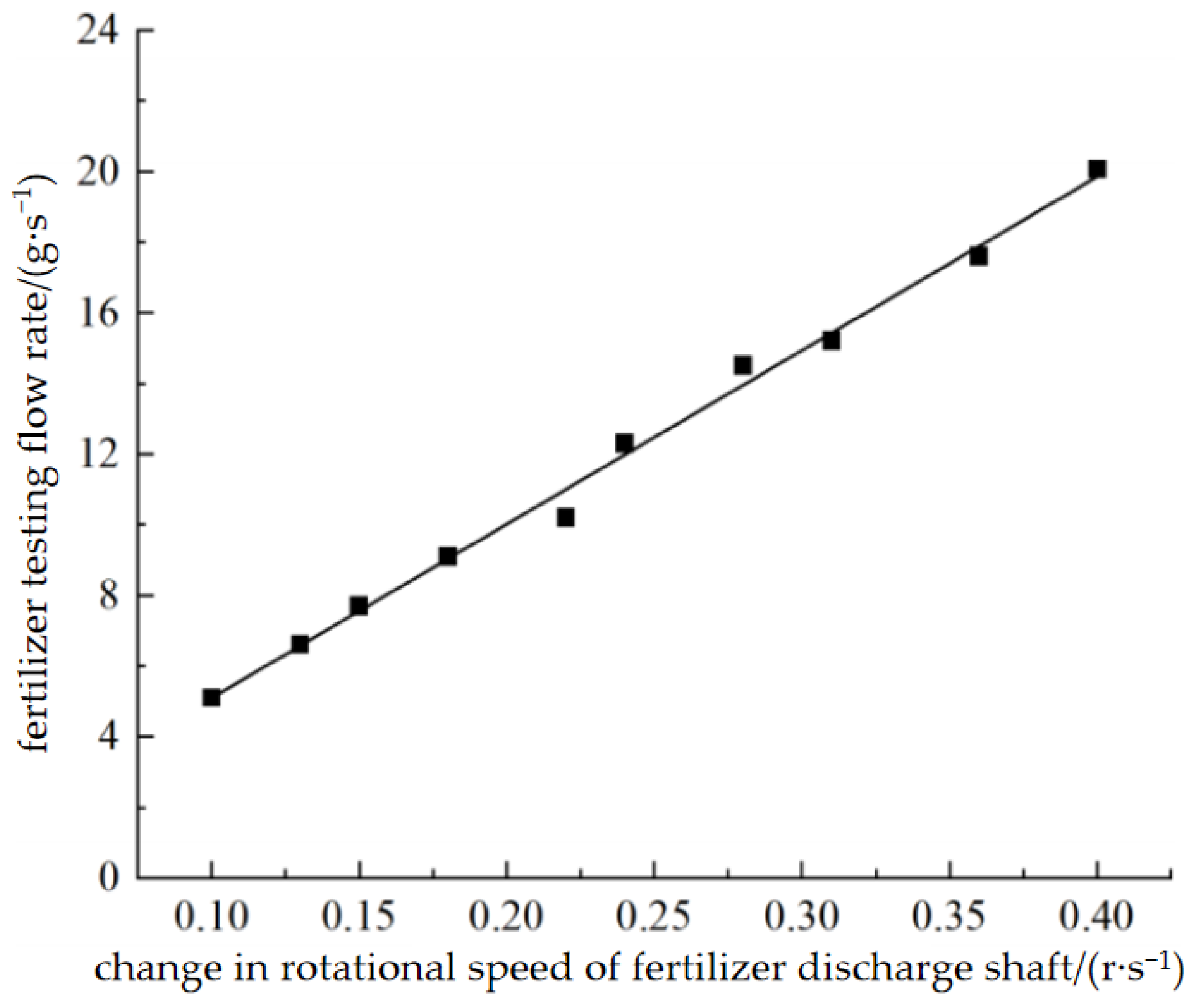
According to Section 2.2, when the operating speed of the machinery is between 2 and 5 km·h−1, the maximum fertilizer discharge rate is 12.5 g·s−1. Stanley compound fertilizer was selected as the material for this experiment. Under 10 different rotational speeds of the fertilizer discharge device, the fertilizer discharge time was timed using the timer of the STM32, with each discharge lasting for 20 s. After each test, the actual fertilizer discharge mass was measured using an electronic scale. Each set of experiments was conducted three times. The calibration test data were processed using Origin 2023 software, and the model of the relationship between the actual fertilizer flow rate and the rotational speed of the fertilizer discharge device was obtained as follows:
q p = 49.193 n p + 0.177
In Formula (6), np is the rotational speed of the fertilizer dispenser, r·s−1; and qp is the actual flow rate of fertilizer, g·s−1.
As can be seen from Figure 5, the actual flow rate of fertilizer increases with the increase in the rotational speed of the fertilizer discharge device, and there is a linear relationship between the fertilizer flow rate and the rotational speed of the fertilizer discharge device. Upon inspection, the coefficient of determination R2 of the fitted equation is 0.994, indicating a significant linear relationship. Therefore, the system can utilize the relationship model for regulating the actual flow rate of fertilizer.

2.2.5. Testing Process

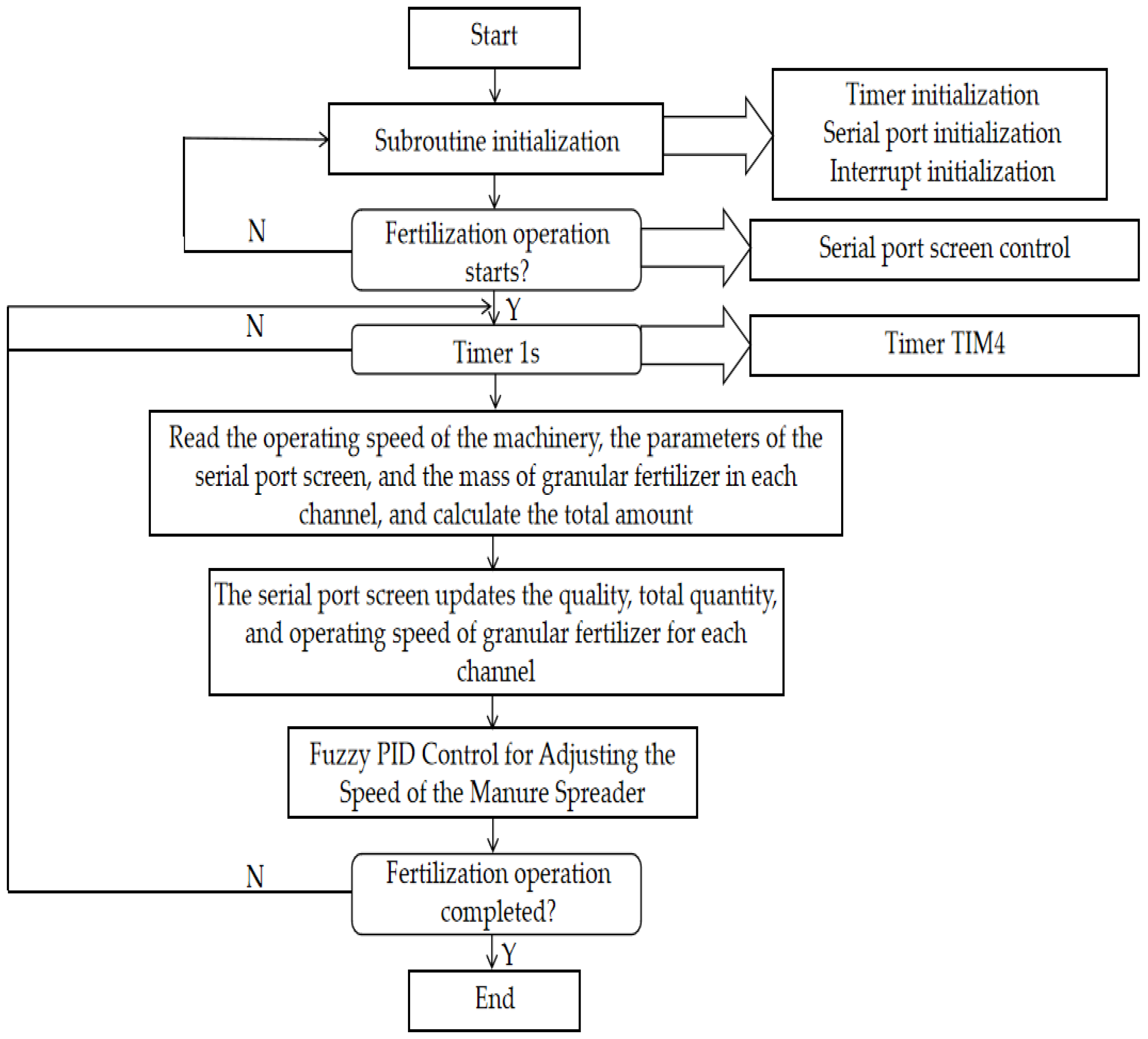
The control process of the precision fertilization control system is shown in Figure 6. Before operation, the precision fertilization control system is initialized first. When fertilizer particles collide with the PVDF piezoelectric sensor, voltage signals are generated. The original signals are processed through filtering, amplification, comparison, and other methods to be converted into digital interrupt signals. The timer TIM4 is used to achieve timing acquisition of operation speed and fertilizer quantity information, with a timing time of 1 s. The timer TIM3 uses encoder mode to convert the rotation speed of the ground wheel into electrical signals. The STM32 converts the collected digital fertilizer quantity signals into fertilizer flow rates for each channel, and converts the electrical signals collected in encoder mode of the timer TIM3 into implement speed information, which is displayed on the LCD screen. The STM32 converts the input parameter information and implements operation speed into real-time flow rate information and combines it with the collected fertilizer flow rate information as the input for the fuzzy PID algorithm. The fuzzy PID algorithm is used to perform real-time self-tuning of the fertilizer discharge motor speed.

2.3. Fuzzy PID Control

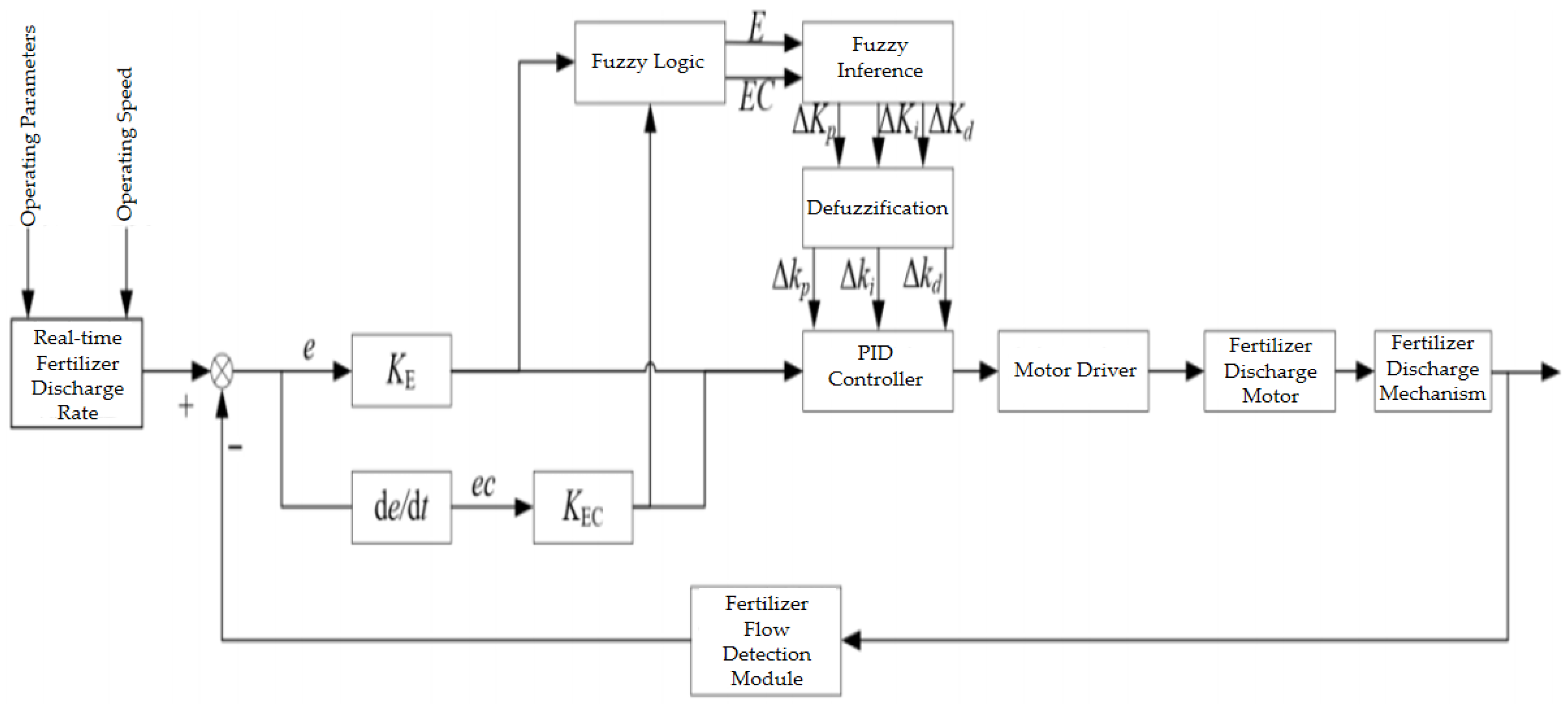
Addressing the issue of insufficient system adaptability caused by fixed parameters in traditional PID controllers, a fuzzy inference mechanism is adopted to implement a real-time online optimization strategy for PID parameters [18], as shown in Figure 7. When the system is operating, the fertilizer flow detection unit inputs the real-time fertilizer discharge rate as a feedback signal c to the controller. Based on the externally input operational parameters (number of rows, fertilizer application rate, operational width) and the real-time detected operational speed, calculate the real-time target fertilization rate r. By constructing a dual-parameter feedback mechanism for the error quantity e (e = rc) and its rate of change ec (ec = de/dt), a closed-loop control system is formed, where the error characteristics are pattern recognized through a fuzzy rule base, and the PID parameter combination is dynamically adjusted, thereby achieving precise control over nonlinear time-varying systems.
Fuzzy controller is a control system based on fuzzy logic theory, mainly composed of three core modules: fuzzification, fuzzy inference, and deblurring. The fuzzification module converts actual measurement values into fuzzy language variable values and generates fuzzy sets through methods such as input point membership degree 1 method, graded fuzzy set method, or membership degree value method to achieve fuzzy mapping of accurate values. The fuzzy reasoning module performs logical reasoning based on a preset fuzzy rule library, using NB (Negative Big), NM (Negative Medium), NS (Negative Small), ZO (Zero), PS (Positive Small), PM (Positive Medium), PB (Positive Big) Seven level fuzzy word sets to describe input–output relationships. The selection of the number of word sets directly affects the control accuracy. More words can refine the control rules and improve the system’s response precision, while fewer words can simplify the model but reduce the control accuracy. The deblurring module converts the fuzzy inference results in precise control output, completing closed-loop control.

2.3.1. Modeling of Precision Fertilization Control System

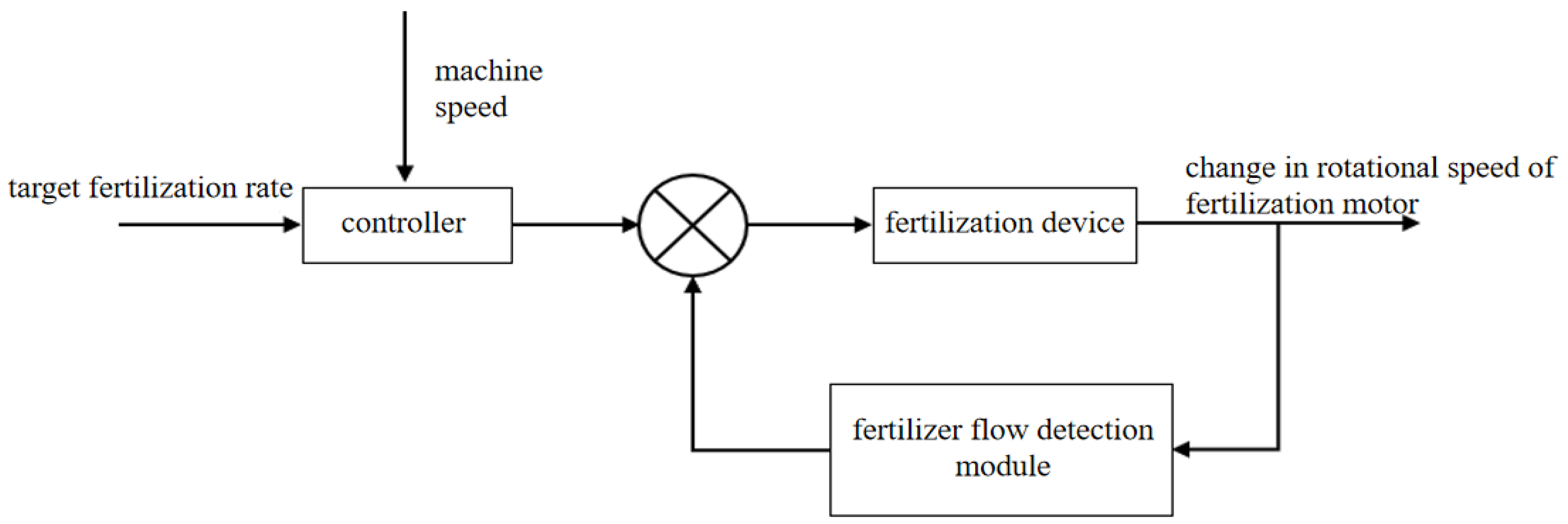
The control model of the fertilizer precision control system takes the fertilization parameters inputted by the human–computer interaction module and the real-time machine operation speed collected by the encoder as inputs. The controller transmits the processed signals to the fertilizer discharge stepper motor, which changes its speed to control the fertilizer discharge amount. The fertilizer flow rate is the final output of the control system. The fertilizer flow detection module consists of a shunt parallel detection device, a piezoelectric sensor, and a data acquisition module, detects the real-time flow of fertilizer and transmits the fertilizer flow information to the controller. The controller performs closed-loop negative feedback control, as shown in Figure 8.
Based on the input–output relationship of the control system block diagram, the input–output relationship of the system is obtained as follows:
q 0 = v A Q 36 N 1
In Formula (7), A is the operating width, m; and N1 is the number of rows operated by the seeder.
As can be seen from Figure 8, the real-time flow rate of granular fertilizer collected by the fertilizer flow detection module serves as the input signal for the control system’s feedback mechanism. The feedback signal received by the controller is an analog signal. The controller compares the real-time target fertilization amount with the feedback signal, ultimately achieving negative feedback control of the control system. The feedback function in the control model can be expressed as
H s = v s q 0 s = 36 N 1 A Q
In Formula (8), s is the complex variable after the Laplace transform of the transfer function; and H is the negative feedback loop of the transfer function.
The fertilization motor adopts an 86BYG250-150 two-phase hybrid stepping motor. The motor is manufactured by NiMotion Company, whose headquarters is located in Beijing, China. The mathematical modeling of the stepping motor requires the construction of voltage balance equations, motor torque balance equations, and motor rotation equations [19]; after operational transformation, the transfer function of the stepper motor is
G 1 s = L N r I 2 2 J s 2 + B J s + L N r I 2 2 J
In Formula (9), G1(s) is the transfer function of the stepper motor; L is the self-inductance of the phase winding of a stepper motor, H; Nr is the number of teeth; I represents the rated current, A; J is rotational inertia of the rotating shaft of a stepper motor, kg·cm−2; and B is the motor viscous damping coefficient, 0.08.
The transmission of parameters such as stepper motor drivers and transmission mechanisms is less affected by electrical interference during the operation of the action mechanism, and the operating characteristics remain stable and unchanged, thus they can all be regarded as proportional elements. Calculations show that the stepper motor driver transmits a constant value G2(s) = 10. Through the calibration experiment of actual fertilizer flow rate in Section 2.4, a linear relationship was observed between the rotational speed of the system’s fertilizer discharge shaft and the fertilizer flow rate, with the relationship expressed as
G 3 s = q 0 s θ s = K q
In Formula (10), G3(s) is the fertilizer discharge axis transfer function; θ(s) is the Laplace transform function of the rotational speed of the fertilizer discharge shaft; q0(s) is the Laplace transform function of the fertilizer flow rate; and Kq is the conversion coefficient between the rotational speed of the fertilizer discharge shaft and the fertilizer flow rate. The transfer function G(s) of the fertilization mechanism is
G s = G 1 s G 2 s G 3 s
In Formula (7), N1 is 3; A is 1.2 m; and Q is taken as 225 kg·hm−2. In Formula (10), Kq is taken as 49.19.
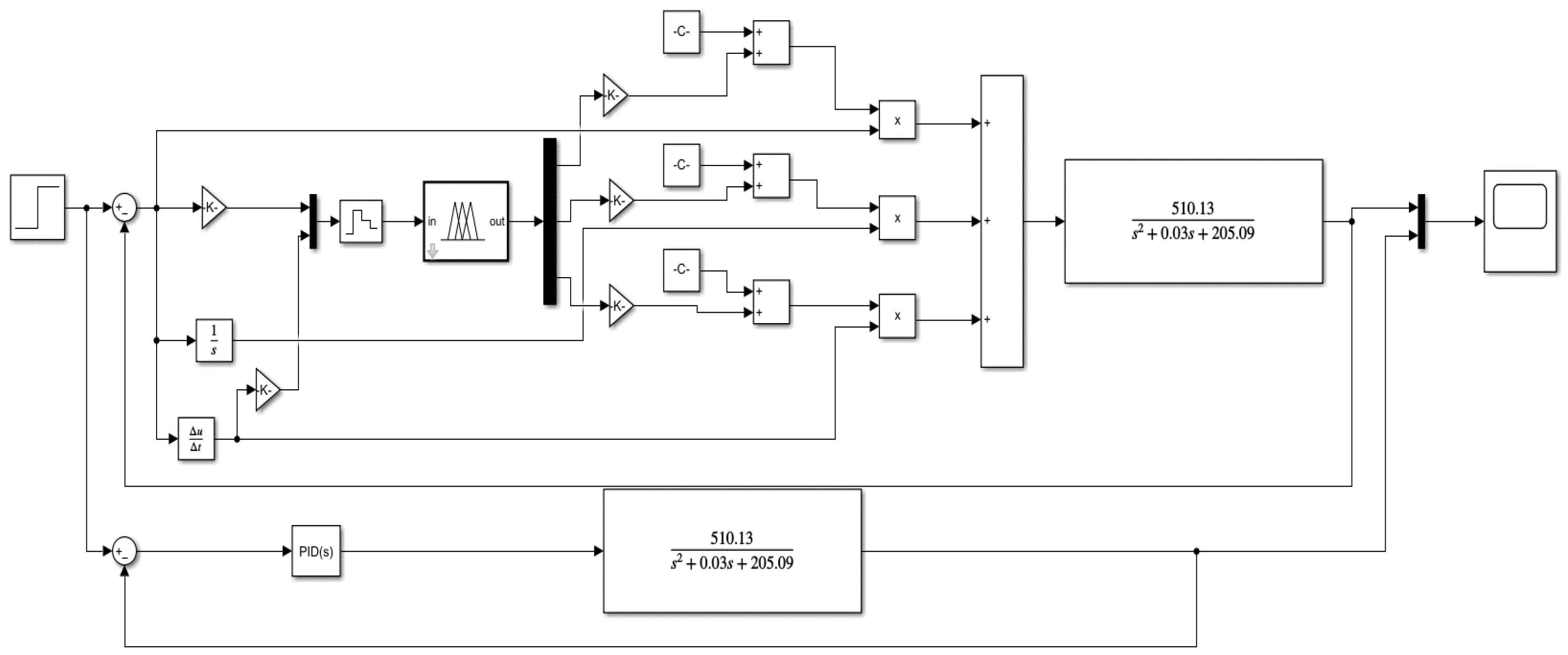
According to Figure 9 and Formulas (7)–(11), the closed-loop feedback control transfer function Gz(s) of the precision fertilization control system is expressed as
G z s = G s 1 + G s H s = 510.13 s 2 + 0.03 s + 205.09

2.3.2. Fuzzy Controller Design

To facilitate engineering implementation, triangular membership functions are commonly adopted in practical applications [20]. Based on the characteristics of fertilization rate required by agronomy and actual operating conditions, the feasible ranges for fertilizer application rate errors e and ec are set to [−30 g·s−1, 30 g·s−1] and [−15 g·s−1, 15 g·s−1], respectively. Other defined variables and their values are shown in Table 1. According to the PID parameter adjustment principles and the actual adjustment process and experience of the fertilizer discharge device, fuzzy control rules are established, as shown in Table 2.
Sensitivity analysis of fuzzy PID parameters:
  • When the system exhibits significant deviation, prioritize the application of a reinforced proportional-derivative control strategy. At this stage, increase the proportional gain ∆Kp to accelerate error elimination while reducing the derivative gain ∆Kd to prevent overshoot. Typically, set the integral gain ∆Ki to zero to avoid integral saturation. This configuration balances response speed and stability requirements.
  • When the deviation converges to a smaller range, the proportional gain ∆Kp and integral gain ∆Ki should be increased simultaneously. This strategy maintains the system’s ability to adjust for deviations while enhancing steady-state accuracy through integral action. Care must be taken to avoid oscillations or reduced stability caused by excessively large parameters.
  • If the deviation and its rate of change share the same sign, particularly when approaching the target value, the proportional control component and integral action exhibit an inverse relationship. By suppressing the integral accumulation effect, overshoot and accompanying periodic oscillations can be effectively avoided, thereby achieving a smooth convergence process.
  • When the absolute value of deviation change rate is large, ∆Kp should be appropriately reduced to minimize sudden increases in control output, while simultaneously increasing ∆Ki to enhance cumulative compensation for dynamic error. This balances system disturbance rejection with control robustness.

2.3.3. Fuzzy PID Control Simulation

To verify the effectiveness of the control system, a numerical simulation model of the control system was constructed using the MATLAB/Simulink platform to compare and analyze the control performance of fuzzy PID and traditional PID. A fuzzy inference system with two inputs and three outputs was created in the MATLAB Fuzzy Logic Toolbox, defining the domain range and membership functions of the input and output variables. Forty-nine fuzzy conditional statements based on expert experience were imported through the rule editor to complete the construction of the fuzzy rule base. The fuzzy PID controller module and the mathematical model of the control system were integrated into Simulink, with a step signal as the system input. A traditional PID control comparison model was also established simultaneously to ensure that both had the same initial conditions, as shown in Figure 9. Through simulation analysis, the PID parameters of the controlled object were tuned, and the system response speed and overshoot were observed.
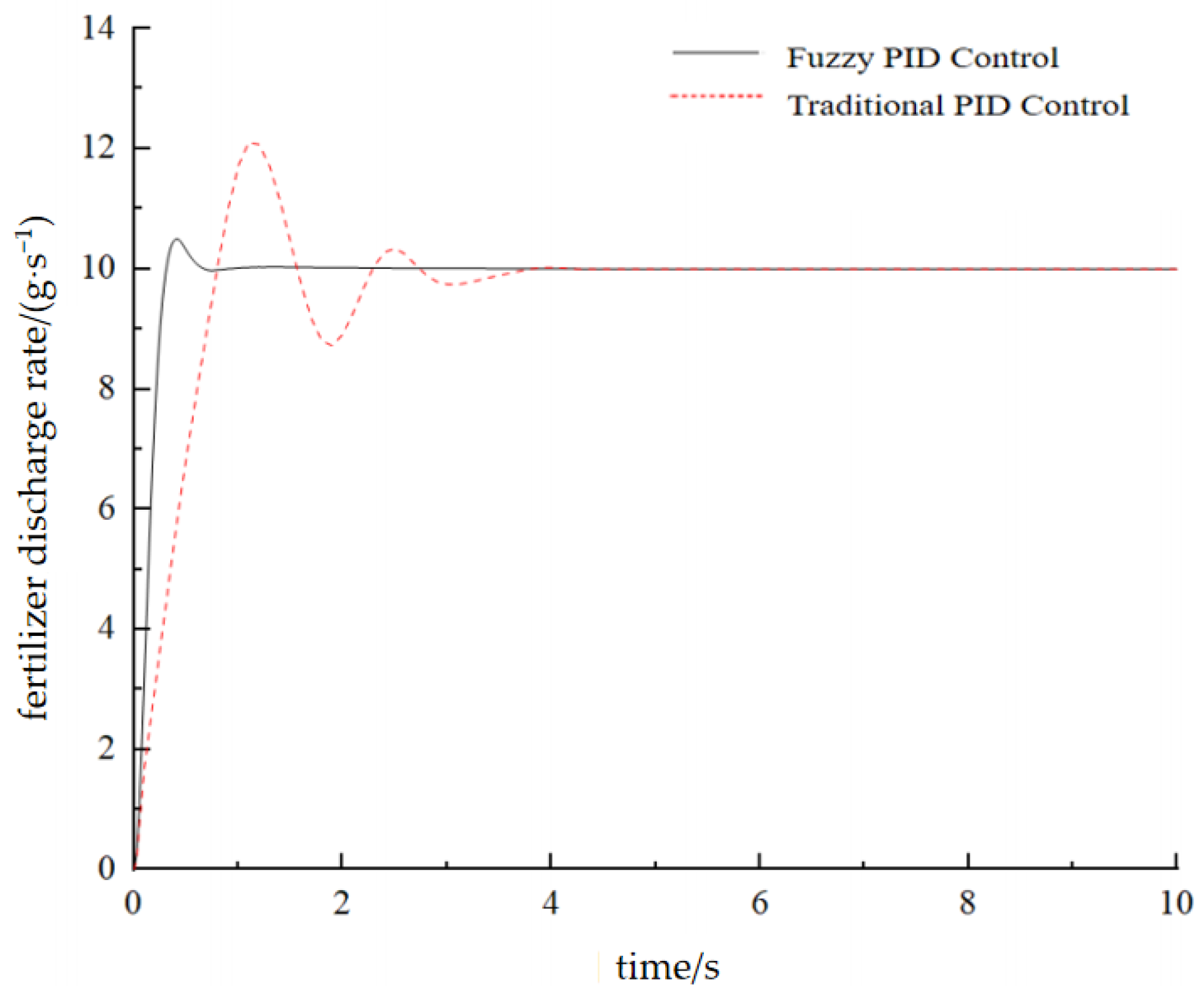
The system simulation duration is 10 s. When the fertilizer discharge rate is adjusted from 0 to 10 g·s−1, the simulation curve is shown in Figure 10. The traditional PID control reaches steady state at 3.86 s, with a maximum overshoot of 2.1 g·s−1. The fuzzy PID control reaches steady state at 1.15 s, with a system overshoot of 0.5 g·s−1. Compared with traditional PID control, the system’s rise time is reduced by 68.75%, the time required for the system to reach steady state is reduced by 70.21%, and the system has a shorter response time and stronger stability.
The advantage of fuzzy PID in maintaining consistency under high-throughput operating conditions lies in its adaptive physical mechanism. Fuzzy PID fuzzifiers input variables (such as e, ec) through a fuzzy rule library, and dynamically adjusts PID parameters (such as ∆Kp, ∆Kd, ∆Ki) based on expert experience or adaptive algorithms to achieve nonlinear mapping; the fuzzy inference mechanism of fuzzy PID smooths the error signal through the membership function, reducing the impact of measurement noise on the control output.

2.3.4. System Control Principle

During operation, the system is first initialized, which involves initializing the timer, serial port, external interruption and SPI bus. Then set the target plot fertilization rate, number of working rows, and working width. The target fertilization amount, number of working rows, and working width of the plot are set on the human–computer interaction interface. Timer TIM3 uses encoder mode to convert the rotation speed of the ground wheel into an electrical signal, and the STM32 converts the electrical signal into implement speed information. Encoder speed measurement is acquired via ports PA6 and PA7 from channels CH1 and CH2 of timer TIM3; channel CH1 of TIM1 transmits PWM waves to drive the stepper motor. Timer TIM4 is used to achieve timed acquisition of working speed and fertilization amount information. The STM32 converts the digital signals collected by the data acquisition module into actual flow values, calculates the real-time target fertilization amount based on the working parameters set on the human–computer interaction interface and the implement traveling speed, calculates the fertilization amount error by comparing the target value with the actual value, obtains the error change rate through differential operation, and forms a dual-input fuzzy PID. Based on fuzzy control rules, the PID parameters are tuned online, and the fertilization motor speed is dynamically adjusted through outputting PWM signals, achieving closed-loop control of fertilizer flow.

2.4. Simulation Analysis of Shunt Distribution Uniformity

2.4.1. Shunt Distribution Uniformity Simulation Test

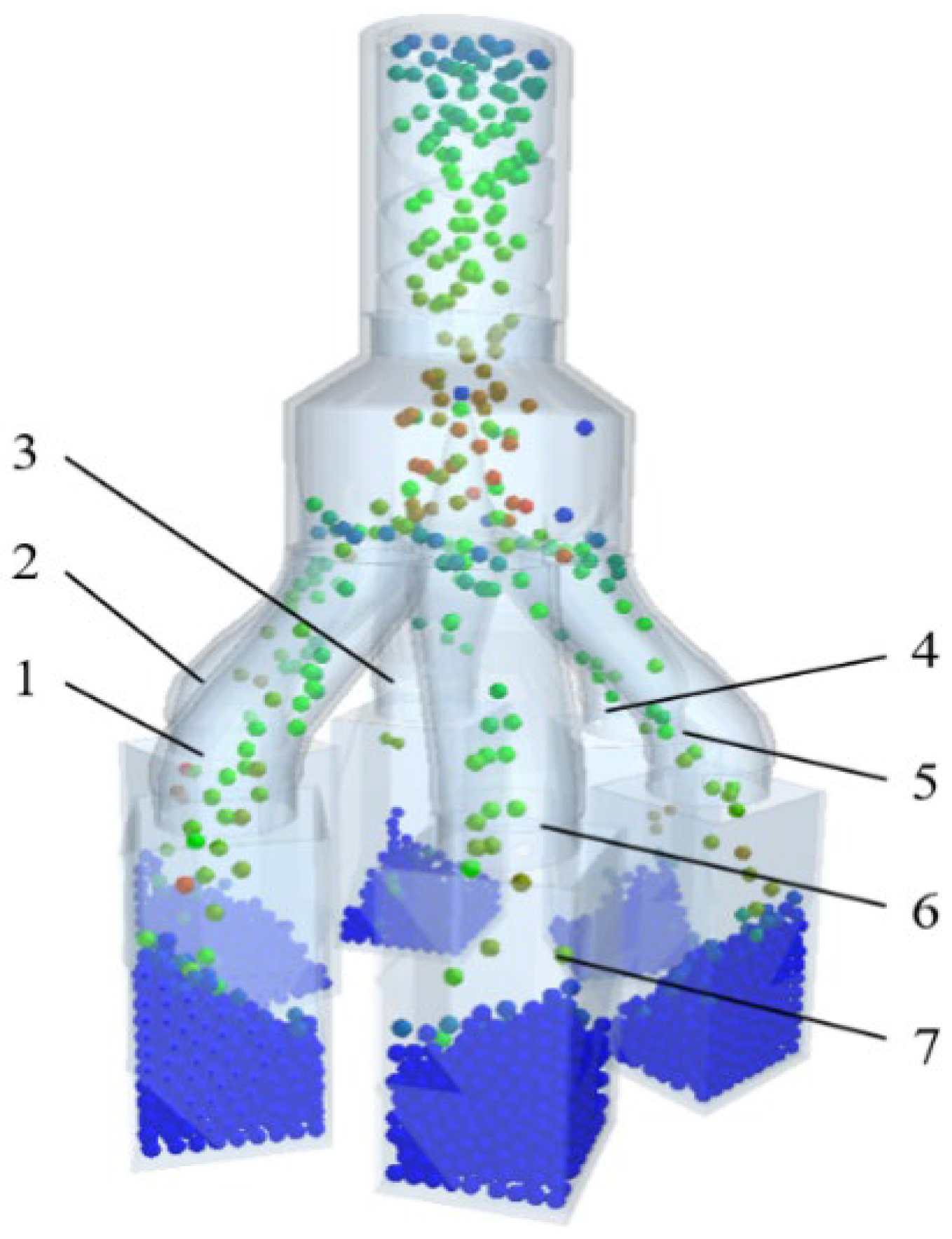
In the simulation, the granular fertilizer is simplified as a hard sphere model, with a diameter of 2 mm, Poisson’s ratio of 0.25, shear modulus of 1.1 × 10⁸ Pa and density of 845.61 kg·m−3. The contact model is set to the Hertz–Mindlin non-sliding contact model. To facilitate the simulation analysis, the diverted granular fertilizer is collected in six rectangular empty slots. Figure 11 shows the simulation model of the diverting structure.

2.4.2. Test Method

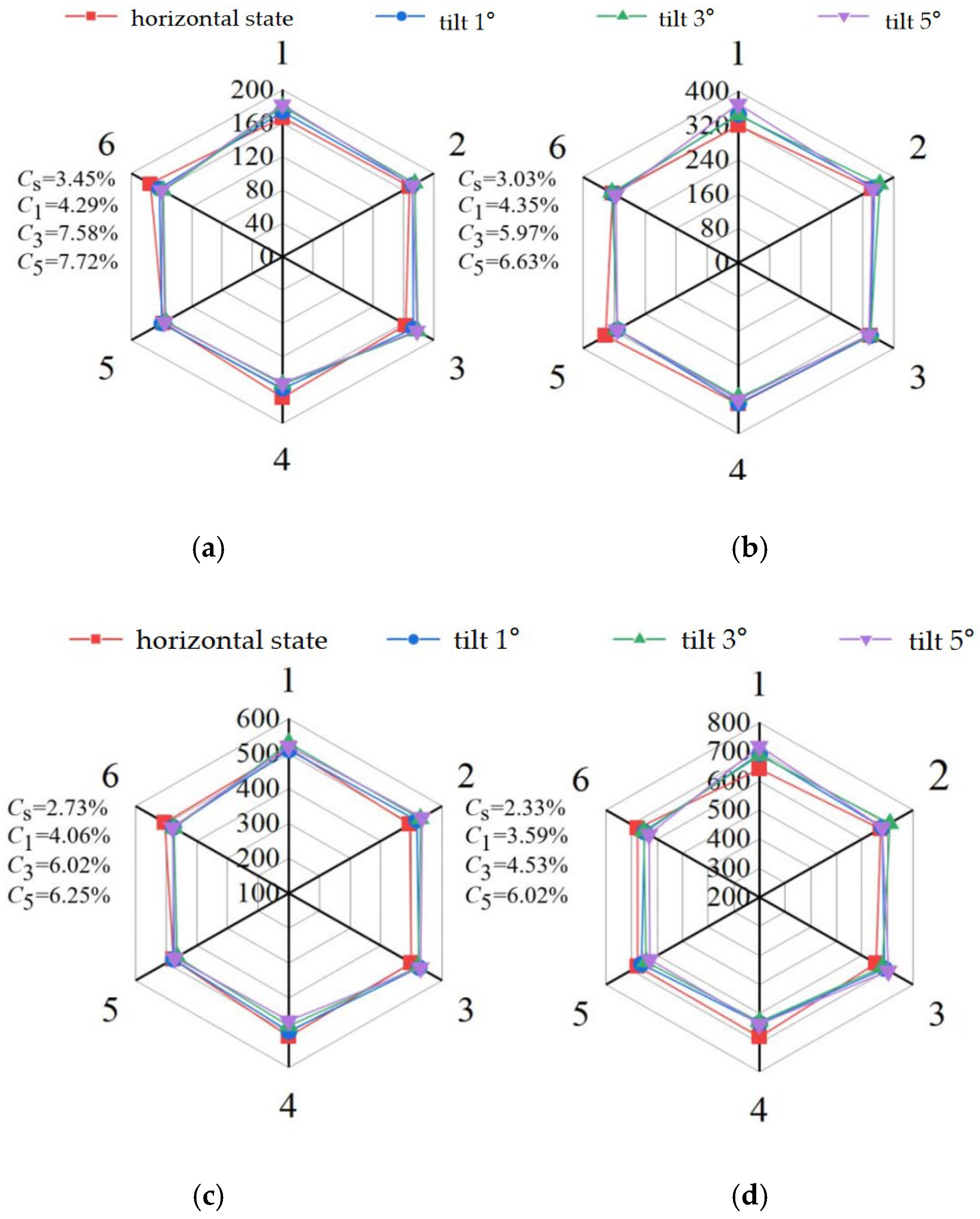
According to Section 2.2, the maximum fertilizer discharge frequency is approximately 257 Hz. Since the inclination angle of the fertilizer applicator during field operations generally does not exceed 5°, EDEM simulation tests were conducted for the particle factory to generate particles at speeds of 100, 200, 300, and 400 particles per second under inclined conditions of 1°, 3°, and 5°. Each simulation was performed three times, and the average value was taken. During the simulation tests, the particle generation time was set to 10 s, and the total simulation time was 15 s. The initial velocity of the granular fertilizer generated in the particle factory was set to vx = 0.5 m·s−1, vy = 0.5 m·s−1, and vz = 0.5 m·s−1, so that the granular fertilizer falls along the inner wall of the fertilizer distributor device. The number of granular fertilizers in the fertilizer receiving box was counted through the EDEM post-processing module. By processing the simulation data, the consistency variation coefficient of the fertilizer discharge amount from the shunt branch pipe under different inclination angles was obtained. The smaller the variation coefficient, the better the shunt uniformity. A radar chart was drawn using Origin 2023 software, as shown in Figure 12.

3. Results

3.1. Simulation Analysis of Flow Distribution Uniformity Test

According to Figure 12, when the fertilizer flow rate is the same, the coefficient of variation in the flow consistency among the branch pipes of the flow divider gradually increases with the increase in the inclination angle of the flow divider; at the same inclination angle, the coefficient of variation in the flow consistency among the branch pipes of the flow divider gradually decreases with the increase in the fertilizer flow rate; when the fertilizer flow rate is relatively low, the quantity of granular fertilizer in the branch pipes above the horizontal plane is significantly greater than that in the branch pipes below the horizontal plane, and the difference in the quantity of granular fertilizer between the two gradually decreases with the increase in the fertilizer flow rate. When the granular fertilizer generation rate is 100 grains·s−1 and the inclination angle is 5°, the coefficient of variation in the flow consistency among the branch pipes of the flow divider is 7.72%, indicating that the flow divider can maintain good flow distribution performance even when the fertilizer flow rate is low and the inclination angle is large.

3.2. Rack and Field Tests

3.2.1. Shunt Distribution Uniformity Bench Test

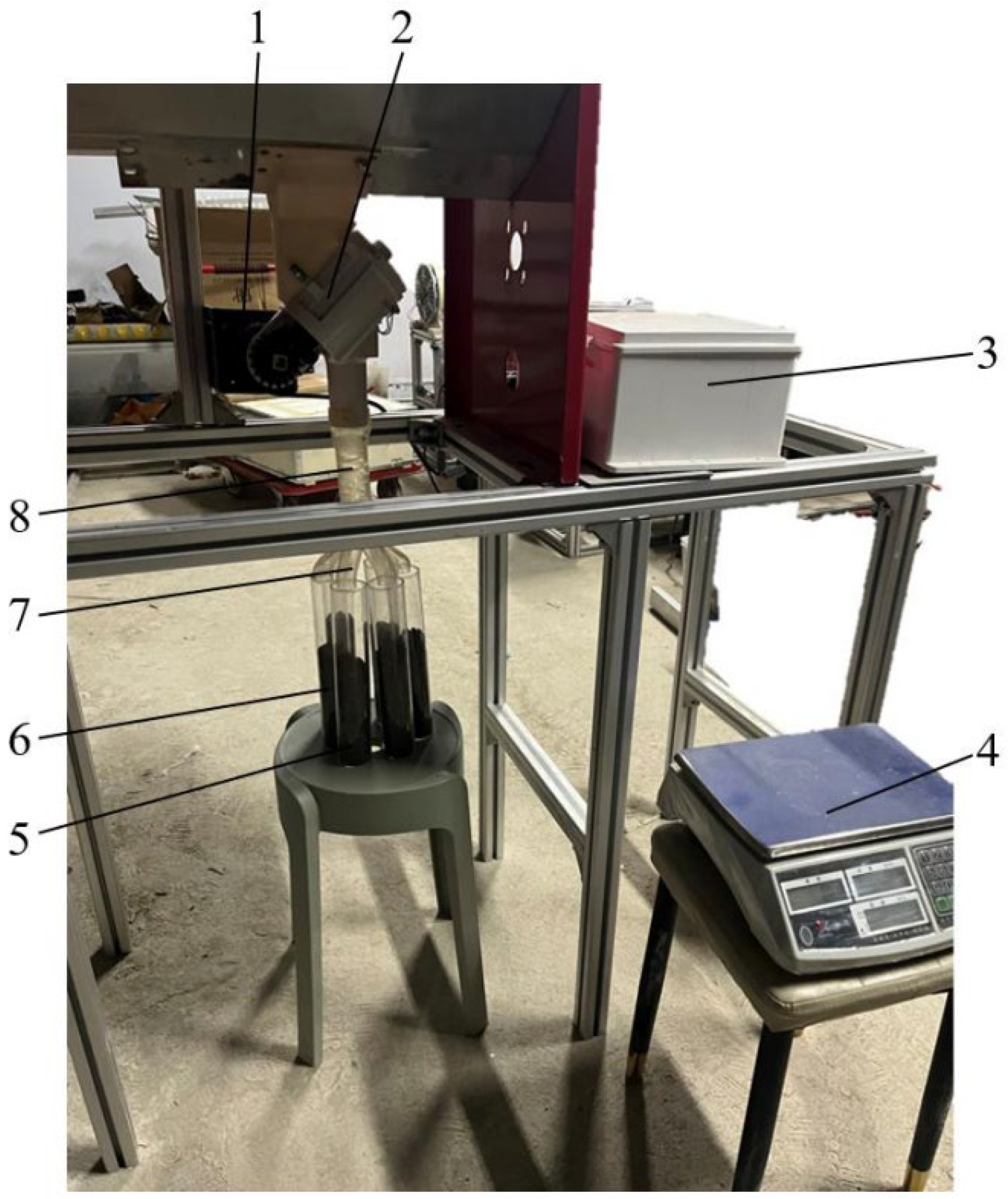
To verify the feasibility of the uniform fertilizer device and the shunt divider design, a bench test for flow uniformity was conducted. The main equipment used in the test included an inclined staggered fertilizer feeder, a uniform fertilizer device, a shunt divider, a fertilizer receiving bucket, an electronic scale, an angle measuring instrument, a stepper motor, a control box, etc. The test bench is shown in Figure 13.
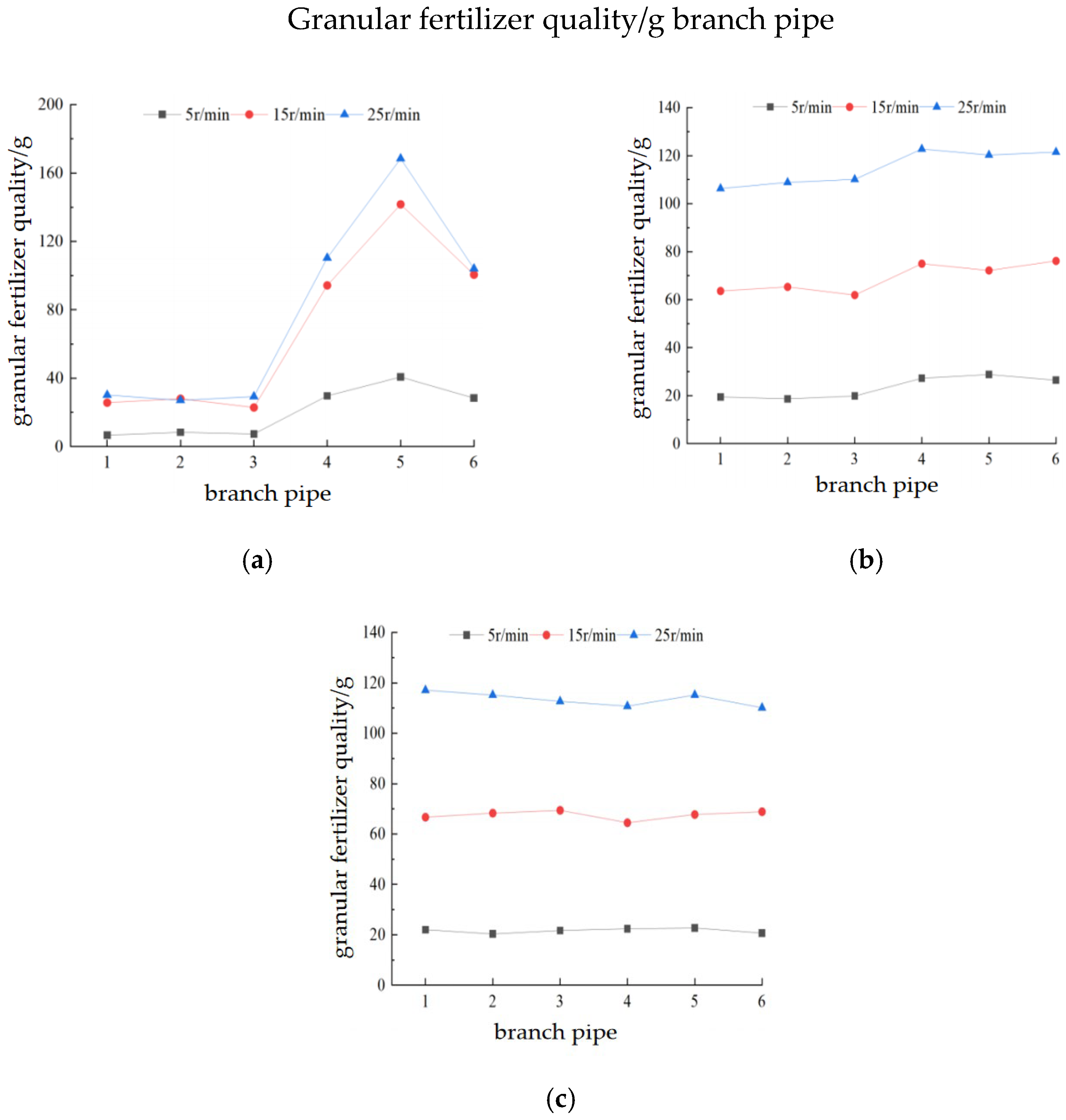
Stanley compound fertilizer was selected as the material for this bench test, and the fertilizer particles were dry and non-caking. Its average diameter is 2 mm, with a bulk density of 1000 kg·m−3, low moisture content, and low hygroscopicity. Before the test, an angle measuring instrument was used to measure whether the flow divider was horizontal. The uniformity test of the fertilizer discharge was conducted at fertilizer discharge speeds of 5, 15, and 25 r·min−1 for the uniform fertilizer device and flow divider. The test was divided into three scenarios: without a uniform fertilizer device, without a uniform fertilizer retaining ring, and with a uniform fertilizer retaining ring. When there was no uniform fertilizer retaining ring, the uniform fertilizer device only had a uniform fertilizer retaining rod; when there was a uniform fertilizer retaining ring, the uniform fertilizer device included both the uniform fertilizer retaining ring and the retaining rod. During the test, when there was a uniform fertilizer device, the upper end of the uniform fertilizer device was connected to the fertilizer outlet of the fertilizer discharge device, and the lower end was connected to the fertilizer inlet a of the flow divider; when there was no uniform fertilizer device, the upper end of the flow divider was directly connected to the fertilizer outlet of the fertilizer discharge device. Each test was conducted three times, and the results were averaged. Each test lasted for 30 s, and after each test, the granular fertilizer in six receiving buckets was weighed. The test results are shown in Figure 14.
From Figure 14, when there is no fertilizer uniform device, there is a significant difference in the mass of granular fertilizer among the six diverging branch pipes. Among them, the mass of granular fertilizer in branch pipes 1, 2, and 3 is relatively small, while that in branch pipes 4, 5, and 6 is relatively large. When there is no fertilizer uniform retaining ring, the uniformity of flow is improved, but there is still a certain difference in the mass of granular fertilizer among the six diverging branch pipes. When there is a fertilizer uniform retaining ring, the uniformity of flow in each diverging branch pipe is better; at the same time, the coefficient of variation in flow consistency at different rotational speeds is calculated. The coefficients of variation in flow uniformity from low to high rotational speeds of the fertilizer feeder are 4.37%, 2.64%, and 2.43%, respectively, indicating that the flow uniformity gradually increases with the increase in rotational speed. The fertilizer uniform device and the diverging device meet the operational requirements of the system.

3.2.2. Performance Test of Response Time to Changes in Fertilizer Discharge Quantity

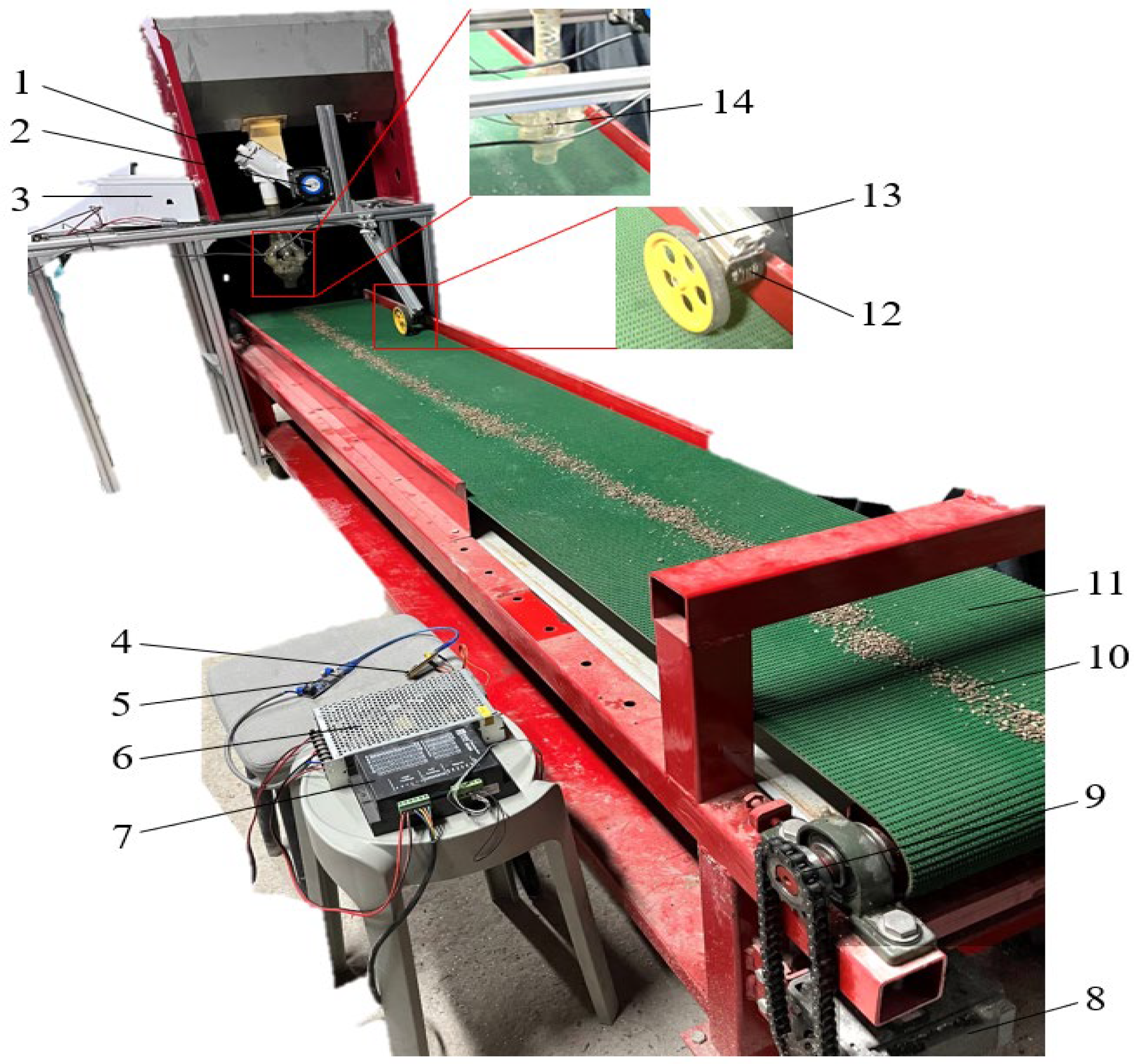
The response time to changes in fertilizer discharge quantity is a key factor affecting the effectiveness of variable-rate fertilization operations. Due to the difficulty of measuring this indicator in field experiments, a simulated process was conducted on a test bench as shown in Figure 15. The test bench was constructed from a fertilizer box, conveyor belt, etc. The surface of the conveyor belt was made of hard rubber to prevent fertilizer particles from bouncing and shifting. The height of the fertilizer box frame was adjusted so that the fertilizer discharge opening was 0.1 mm away from the conveyor belt. The STM32 controller adjusted the speed of the conveyor belt motor, the human–machine interface set the fertilizer amount, and the encoder and friction wheel measured the conveyor belt speed. Conveyor belt parameters are as follows: width 0.4 m and total length 3.0 m.
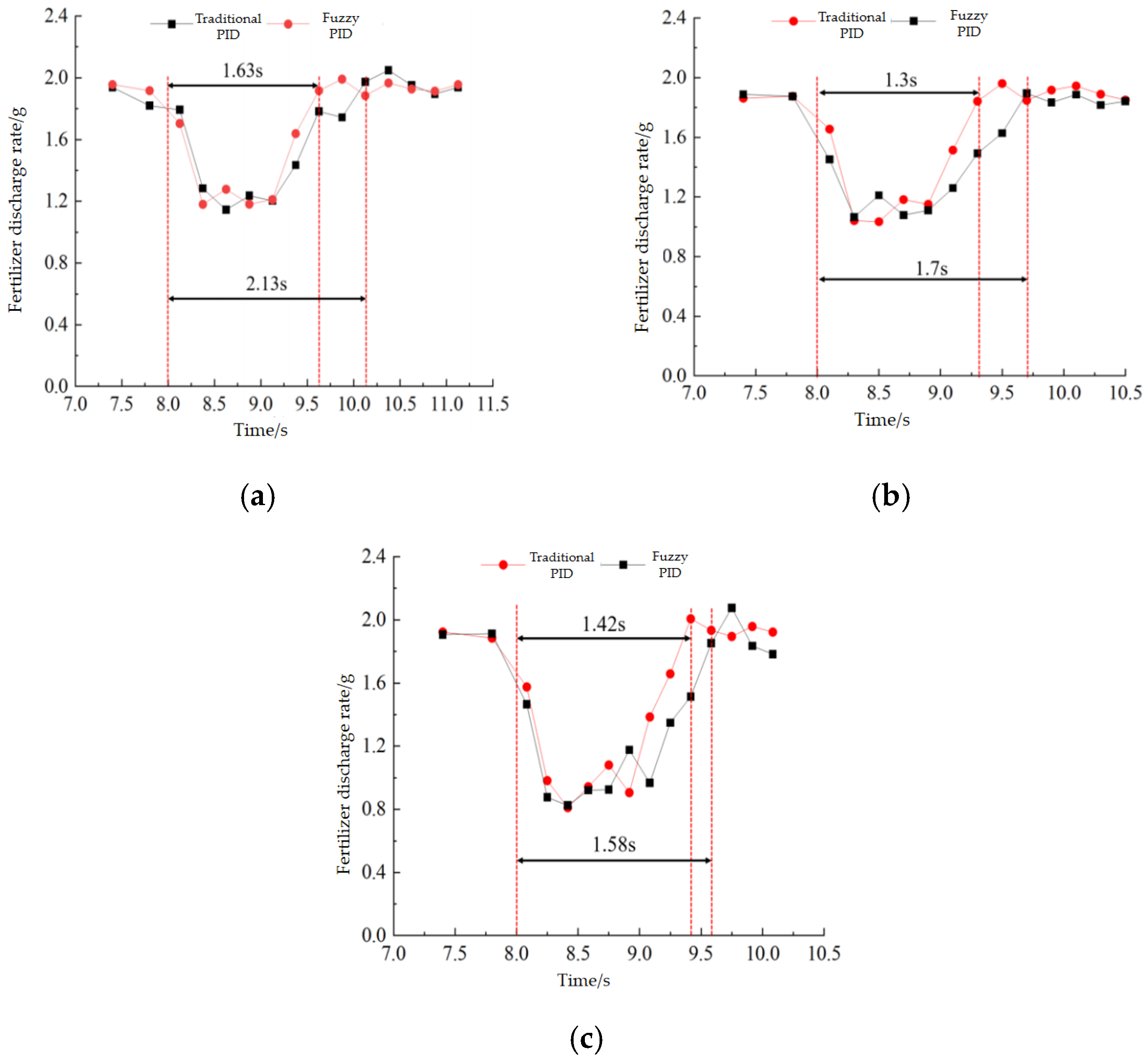
Using the fertilizer discharge response time test platform, the response times of traditional PID and fuzzy PID control to changes in fertilizer discharge were tested separately. The human–computer interaction interface was set with the same operational parameters as in the field experiment, including three rows of operations, a width of 1.2 m, and a target fertilizer application rate of 225 kg·hm−2. Considering the operational performance of the conveyor belt, tests were conducted on the response time to changes in fertilizer discharge at operating speeds ranging from 1.8 km·h−1 to 2.88, 3.6, and 4.32 km·h−1. To eliminate errors caused by manual adjustment of the conveyor belt stepper motor speed, the STM32 program algorithm was set to maintain a conveyor belt speed of 1.8 km·h−1 for the first 8 s and then we changed the speed to 8 s. The granular fertilizer after 7 s was used as the test data. After the fertilization was completed, the fertilizer discharge amount within a range of 3.0 m on the conveyor belt at intervals of 0.2 m was recorded, and the respective fertilizer amounts and time points were noted to obtain the results of fertilizer discharge variation with response time, as shown in Figure 16.
The experimental results indicate that when the operating speed varies from 1.8 km·h−1 to 2.88, 3.6, and 4.32 km·h−1, the maximum response time of fuzzy PID control is 1.63 s, and the average response time is 1.45 s; the maximum response time of traditional PID control is 2.13 s, and the average response time is 1.80 s. The fuzzy PID control has an average reduction of 19.44% in response time compared to traditional PID control, indicating that the fuzzy PID control has a shorter response time for fertilizer dispensing.

3.2.3. Fertilizer Discharge Quantity Control Accuracy Test

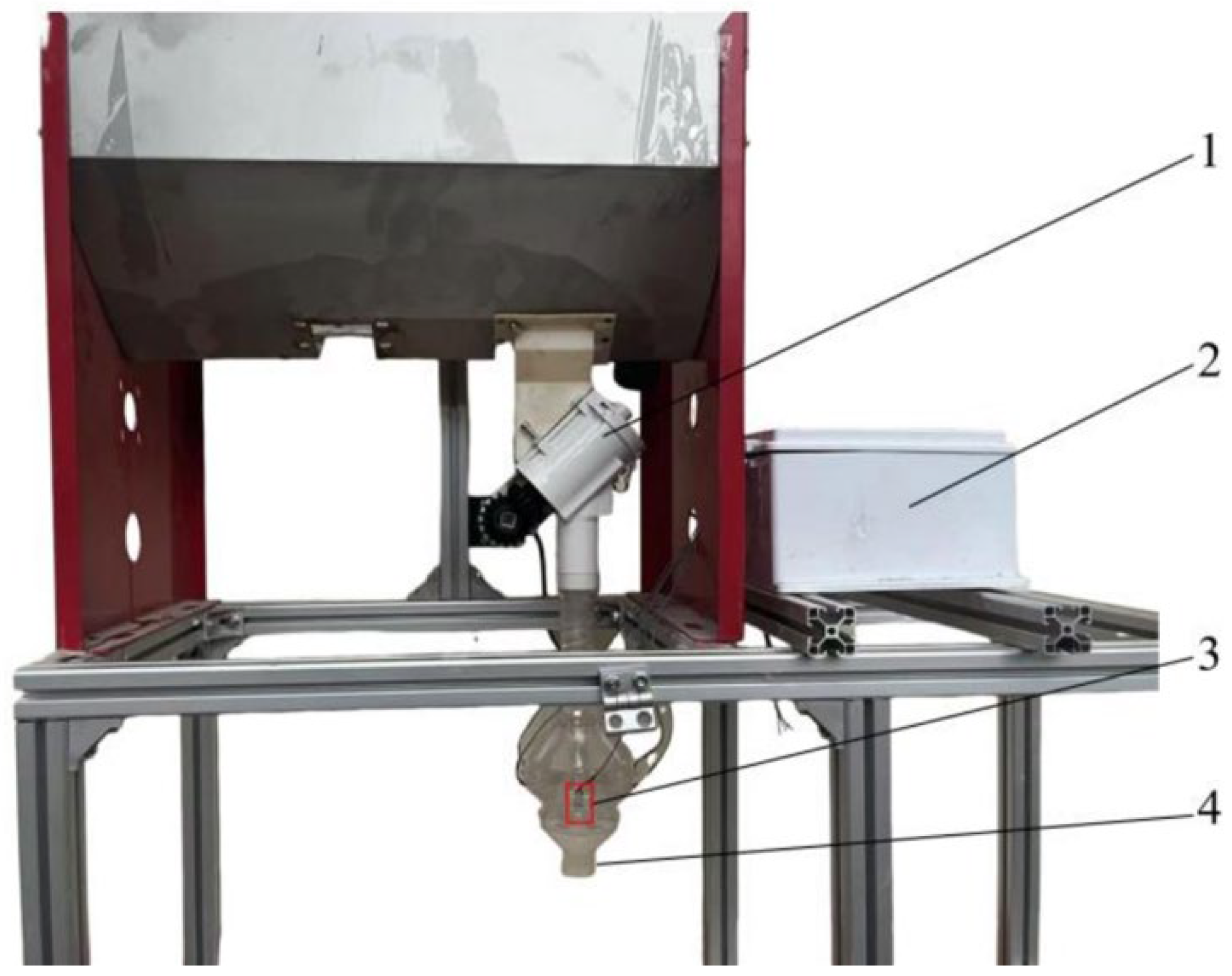
To verify the control accuracy of the system’s fertilizer discharge volume, a test was conducted on the fertilization test bench. The main equipment used in the test included a fertilizer discharge device, flow divider, fertilizer uniform device, sensing device, fertilizer collection pipe, fertilizer receiving bucket, fertilizer discharge stepper motor, electronic scale, STM32, etc. The test bench is shown in Figure 17. Before the test, the same operating parameters as those used in the field test were set on the human–computer interaction interface, with three operating rows, a width of 1.2 m, and a target fertilization amount of 225 kg·hm−2 for the plot. Since this test was a stationary bench test, it was not possible to obtain the operating speed in real time. Therefore, four operating speeds were set in the control program, namely 2, 3, 4, and 5 km·h−1. Traditional PID and fuzzy PID control were tested three times at each operating speed, with a total fertilizer discharge time of 20 s.
After each experiment, the granular fertilizer in the fertilizer bucket was weighed using an electronic scale. The average of the weighing values from the three experiments was recorded as the actual fertilizer discharge amount. The fertilizer discharge rate per unit time, qut, can be calculated using Formula (2), and the target fertilizer discharge amount is
M 1 = 20 q ut
In Formula (13), M1 is the target fertilizer application rate, g.
The formula for calculating the control accuracy of fertilizer dispensing quantity is
W 1 = 1 M 1 M 2 M 1 × 100 %
In Formula (14), M2 is actual fertilizer discharge, g; and W1 is the dispensing control accuracy, %.
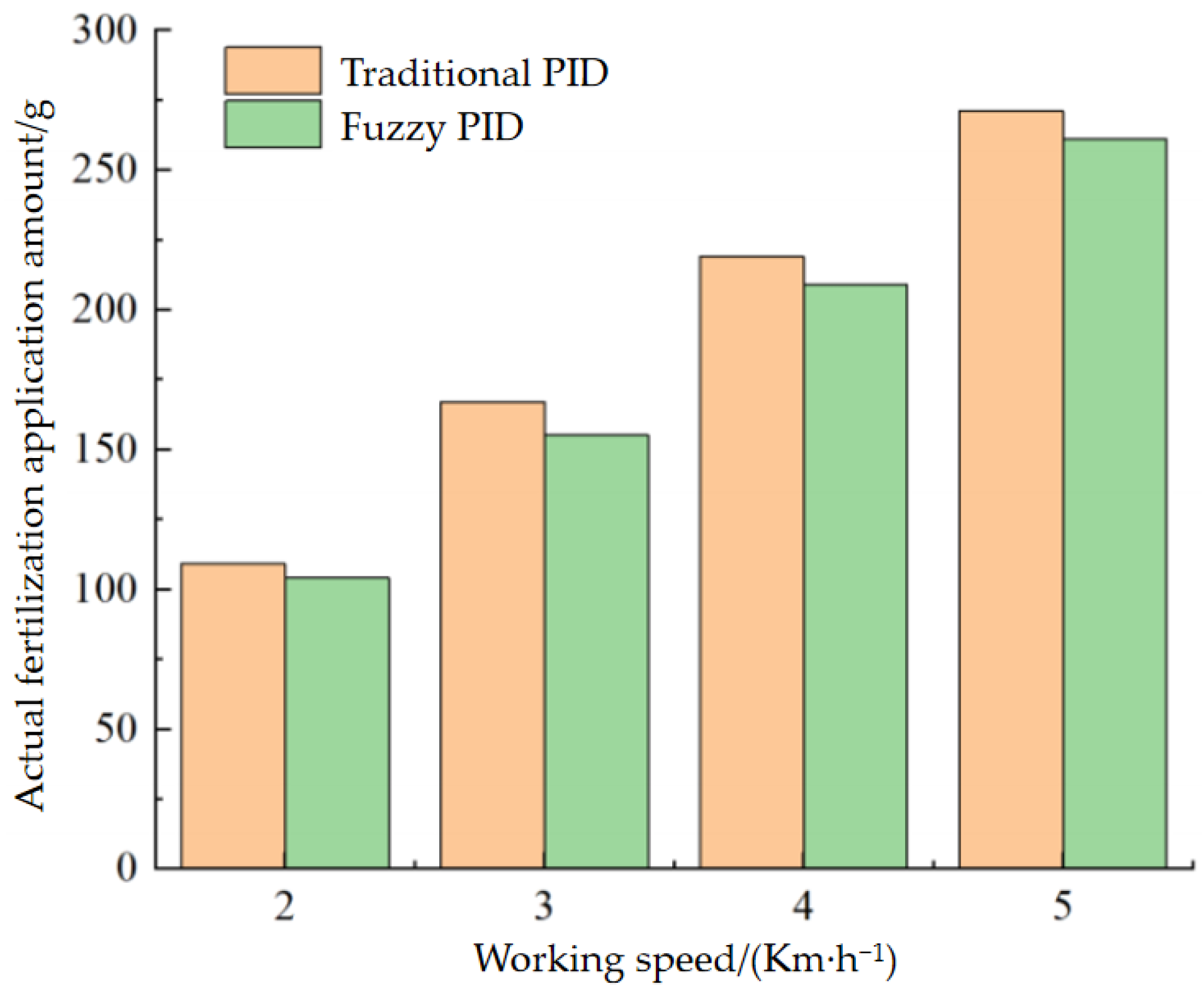
As can be seen from Figure 18, under different operating speeds, the fertilizer discharge amount controlled by fuzzy PID control is closer to the target fertilizer discharge amount than that controlled by traditional PID control. According to Formula (12), the maximum control accuracy of the fertilizer discharge amount controlled by traditional PID control is 91.60%, with an average of 90.44%. The minimum control accuracy of the fertilizer discharge amount controlled by fuzzy PID control is 95.50%, with an average of 95.94%. Compared to traditional PID control, fuzzy PID control improves the control accuracy of the fertilizer discharge amount by an average of 5.50%. Therefore, the control accuracy of the fertilizer discharge amount controlled by fuzzy PID is better.

3.2.4. Field Experiment

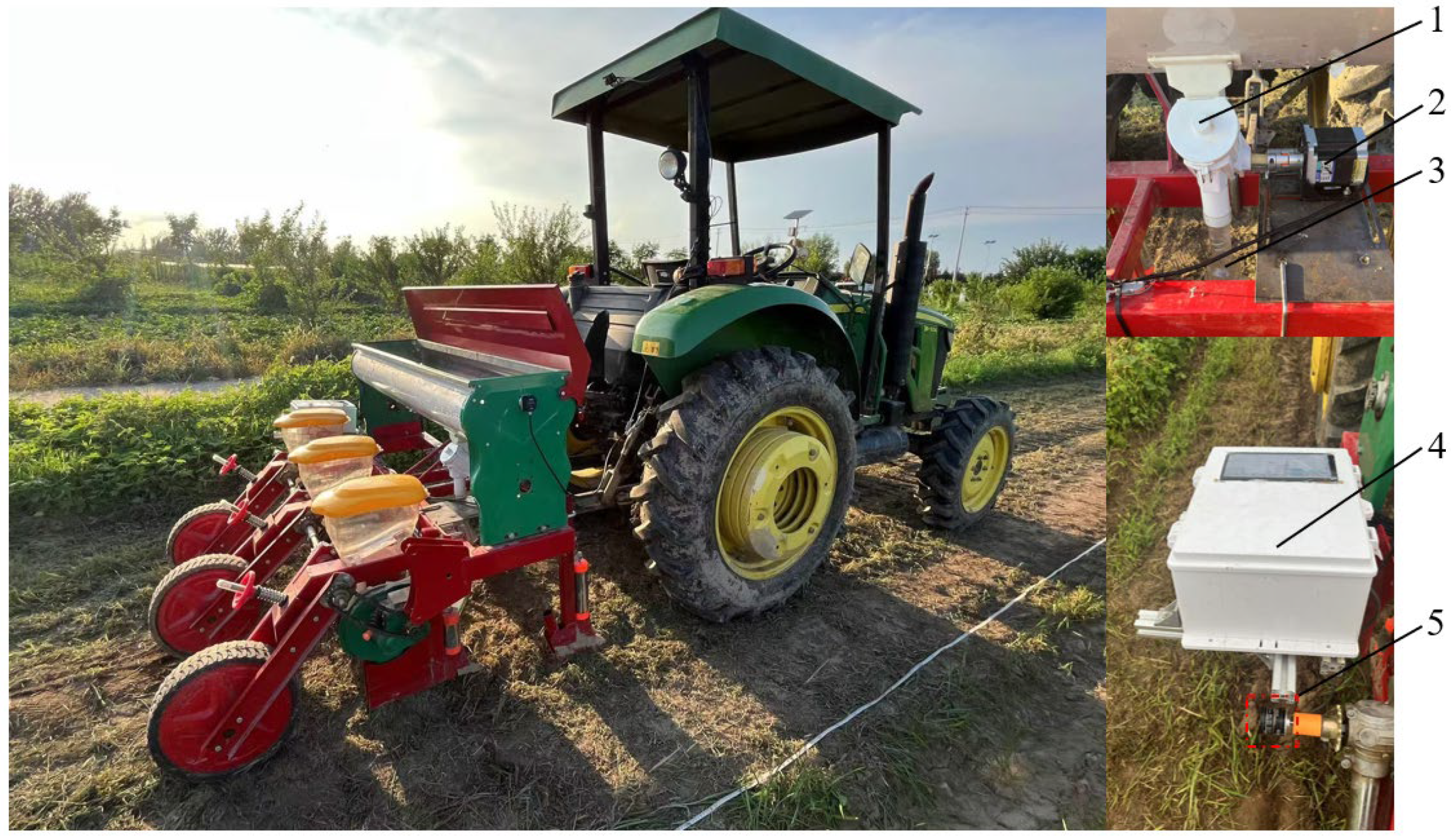
Field experiments were conducted on 25–26 July 2024, in the experimental field of the Changyuan Branch of the Henan Academy of Agricultural Sciences. The experimental plot measured 120 m in length and 20 m in width. The experimental equipment utilized was a fertilization and seeding machine jointly developed by Henan Agricultural University and Henan Nongyouwang Agricultural Equipment Technology limited company (Henan, China), as depicted in Figure 19. Prior to the experiment, a fertilizer receiving bag was placed beneath the fertilizer outlet of the fertilizer collection pipe to facilitate the measurement of fertilizer discharge volume.
Stanley compound fertilizer was selected as the material for field experiments. Before the experiment, the fertilizer was loaded into a fertilizer box. The target fertilization amount for the plot was set at 225 kg·hm−1, the width of the machinery was set at 1.2 m, and the number of working rows was set at 3. The fertilization and seeding machine were driven at speeds of 2, 3, 4, and 5 km·h−1 for 60 s, respectively. After each experiment, the mass of fertilizer in the receiving bag was weighed using an electronic scale to obtain the actual fertilizer discharge amount. Three experiments were conducted at each speed, and the control accuracy of the fertilizer discharge amount was calculated according to Formula (12).

3.2.5. Test Results and Analysis

The test results are presented in Table 3. The minimum and average control accuracy of the fuzzy PID control for fertilizer applications is 95.04% and 95.53%, respectively. For the traditional PID control, the maximum and average control accuracy for fertilizer applications is 91.66% and 89.70%, respectively. When the operating speed is 2, 3, 4, and 5 km·h−1, the average control accuracy of the fuzzy PID control is 96.22%, 95.13%, 95.42%, and 95.36%, respectively, meeting the requirements of GB/T 35487-2017. When the operating speed is 2, 3, 4, and 5 km·h−1, the average control accuracy of the traditional PID control is 90.31%, 89.30%, 88.94%, and 90.24%, respectively. When the homework speed is 2 km·h−1, the average control accuracy of fuzzy PID control is 5.91% higher than that of traditional PID control.; when the homework speed is 3 km·h−1, the average control accuracy of fuzzy PID control is 5.83% higher than that of traditional PID control; when the homework speed is 4 km·h−1, the average control accuracy of fuzzy PID control is 6.48% higher than that of traditional PID control; when the homework speed is 5 km·h−1, the average control accuracy of fuzzy PID control is 5.12% higher than that of traditional PID control. The control accuracy of the fuzzy PID control for fertilizer application at each vehicle speed is higher than that of the traditional PID control, indicating that the system can achieve precise variable fertilization. Due to the influence of vibration and other working conditions in the field on piezoelectric sensors, the control accuracy of the system for fertilizer application under field conditions is slightly lower than that under the conditions of the fertilization test bench.

4. Current System Restrictions and Latest Developments

4.1. Current System Restrictions

  • The current system has been optimized for specific fertilizer particle characteristics. In the future, it is necessary to establish a more universal particle physical parameter database, develop adaptive detection algorithms and control models, and improve the compatibility of the system with different shapes, densities, and humidity of granular fertilizers.
  • Under extreme high humidity conditions close to 100% RH, PVDF sensors may experience performance degradation due to excessive adsorption of water vapor. Water vapor may condense on the surface or inside of the sensor, affecting its piezoelectric effect or conductivity, resulting in inaccurate or ineffective measurements; under extreme low humidity conditions close to 0% RH, PVDF sensors may not generate sufficient electrical signals due to a lack of sufficient interaction between water vapor molecules and sensitive materials. This may result in weak or unstable sensor output signals, thereby affecting their measurement accuracy. Try to avoid these two situations as much as possible when working.
  • Mechanical vibration during high-speed field operations can easily cause sensor signal fluctuations and component fatigue. In the future, a multi-level damping structure can be designed to optimize the mechanical stability of the device, while exploring real-time filtering algorithms for vibration noise to further improve detection accuracy and control robustness.

4.2. Latest Developments

  • Multi-channel parallel detection: Blue Rainbow Optoelectronics uses a rotating matrix design with 12 independent optical detection channels to shorten the detection time of N, P, and K for eight soil samples to within 1 h, with a sensitivity of red light ≥ 4.5 × 10⁻⁵. Compared to reference [1], the delay is smaller.
  • Precision Rotating Colorimetric Cell: Yuntang Technology employs a precision rotating multi-channel colorimetric cell structure integrated with a constant-temperature control module. This design eliminates variations in light source intensity and thermal drift effects between channels, achieving absorbance measurement drift of <0.003 over one hour with error stability maintained at ≤1%. Compared to reference [6], it offers higher detection accuracy.

5. Conclusions

  • A high-throughput parallel detection method for granular fertilizer diversion has been proposed. Parametric designs have been carried out for key components such as the uniform fertilizer tube, sensing detection structure, six-channel diversion cone disk, and converging fertilizer tube, and an innovative six-channel parallel detection device has been designed. Research has been conducted on the performance of diversion uniformity. When the generation speed of granular fertilizer is between 100 and 400 particles per second, the coefficient of variation in the diversion consistency in each diversion branch tube of the tilted diversion device gradually decreases with increasing generation speed. Under normal field operation at a tilt angle of 0° to 5°, the coefficient of variation in the diversion consistency in each diversion branch tube does not exceed 7.72%. A multi-channel signal synchronous acquisition system has been designed, and relationship models between the detection flow rate and voltage of granular fertilizer, as well as between the actual flow rate of granular fertilizer and the rotational speed of the fertilizer discharge shaft, have been established through calibration experiments.
  • A real-time precision regulation system control model for fertilizer quantity was established, utilizing fuzzy rules to dynamically adjust the parameters of the PID controller. A fuzzy PID control simulation model was created using MATLAB’s Simulink simulation module to analyze the PID parameters of the controlled object and study the system’s response speed and overshoot. The control effects of fuzzy PID and traditional PID algorithms were compared. The results showed that fuzzy PID control reduced the time required to reach steady state by 66.87% compared to traditional PID, and the overshoot decreased from 7.38 g·s−1 to 1.49 g·s−1.
  • Bench tests and field trials were conducted. The results of the bench tests showed that the average response time for fertilizer discharge rate changes under fuzzy PID control was 1.45 s, with an average reduction of 19.44% compared to traditional PID control. The minimum and average control accuracy of fertilizer discharge rate under fuzzy PID control was 95.50% and 95.94%, respectively, representing an average improvement of 5.50% over traditional PID control. Under different test conditions, both the response time for fertilizer discharge rate changes and the control accuracy of fertilizer discharge rate under fuzzy PID control were superior to those under traditional PID control. In field trials, when the operating speed was 2, 3, 4, and 5 km·h−1, the control accuracy of fertilizer discharge rate under the fuzzy PID control system reached 96.22%, 95.13%, 95.42%, and 95.36%, respectively, with an average of 95.53%.

Author Contributions

Conceptualization, L.D. and F.W.; methodology, L.D. and F.W.; software, F.W. and Y.Y.; validation, Y.D., F.W.; formal analysis, Y.L. and K.W.; investigation, Y.D. and B.L.; resources, L.D.; data curation, Y.D.; writing—original draft preparation, F.W.; writing—review and editing, F.W. and Y.D.; supervision, L.D.; project administration, L.D.; funding acquisition, L.D. All authors have read and agreed to the published version of the manuscript.

Funding

This research was funded by the National Key Research and Development Program (2022YFD2300904), Modern Agricultural Industry Technology System Project of the Chinese Academy of Agricultural Sciences (CARS-04), and Henan Provincial Science and Technology Key Project (252102111171).

Institutional Review Board Statement

Not applicable.

Data Availability Statement

The original contributions presented in this study are included in the article material. Further inquiries can be directed to the corresponding author.

Acknowledgments

The authors would like to express their sincere gratitude to their colleges and laboratories and to the reviewers who provided helpful suggestions for this manuscript.

Conflicts of Interest

The authors declare no conflicts of interest.

References

  1. Zhao, J.; Wang, X.; Tian, H. A fertilizer discharge detection system based on point cloud data and an efficient volume conversion algorithm. Comput. Electron. Agric. 2021, 185, 106131. [Google Scholar] [CrossRef]
  2. Kumhála, F.; Kvíz, Z.; Kmoch, J.; Prošek, V. Dynamic laboratory measurement with dielectric sensor for forage mass flow determination. Res. Agric. Eng. 2007, 184, 945–954. [Google Scholar] [CrossRef]
  3. Yang, L.; Zhang, Y.; Zhan, Z.; Jin, Z.; Peng, Y.; Zhu, Y. Research on Microwave Signal Measurement of Particle Fertilizer Flow Rate Based on Variational Mode Decomposition Combined with Wavelet Analysis. Trans. Chin. Soc. Agric. Mach. 2025, 56, 623–633. [Google Scholar] [CrossRef]
  4. Zhou, L.; Ma, M.; Yuan, Y. Design and experiment of fertilizer application amount detection system based on capacitive method. J. Agric. Mach. 2025, 56, 623–633. [Google Scholar] [CrossRef]
  5. Shen, Z.; Han, J.; Niu, Z. Collection and Experimental Study of Millimeter Wave Radar Particle Fertilizer Discharge Signal Based on CAFA-PF. China Agric. Sci. Technol. Guide 2025, 21, 1–13. [Google Scholar] [CrossRef]
  6. Zhao, L.; Zhang, Z.; Wang, C. Design of a monitoring system for wheat precision sowing and fertilizing integrated machine based on variable-range photoelectric sensor. J. Agric. Eng. 2018, 34, 27–34. [Google Scholar] [CrossRef]
  7. Xu, C.; Liu, J.; Su, Q. Design and experiment of a thin-film light refracting multi-channel parallel detection device for wheat seed flow. J. Agric. Eng. 2022, 38, 81–91. [Google Scholar] [CrossRef]
  8. Zhang, J.; Liu, G.; Zhang, D. Research status and prospects of variable application control technology for solid granular fertilizer. Jiangsu Agric. Sci. 2022, 50, 69–77. [Google Scholar] [CrossRef]
  9. John Deere. RelativeFlowTM Jam Monitoring. Available online: www.deere.com/en/seeding-equipment/ (accessed on 11 January 2026).
  10. Iida, M.; Umeda, M.; Radite, P.A.S. Variable rate fertilizer applicator for paddy field. In Proceedings of the Annual International Meeting of the American Society of Agricultural Engineers, Sacramento, CA, USA, 30 July–1 August 2001. [Google Scholar] [CrossRef]
  11. Maleki, M.R.; Ramon, H.; De Baerdemaeker, J. A study on the time response of a soil sensor. based variable rate granular fertilizer applicator. Biosyst. Eng. 2008, 100, 160–166. [Google Scholar] [CrossRef]
  12. Zhang, J.; Yan, S.; Ji, W. Research on Precise Application Control System for Multiple Solid Fertilizers Based on Incremental PID Algorithm. Trans. Chin. Soc. Agric. Mach. 2021, 52, 99–106. [Google Scholar] [CrossRef]
  13. Ma, X.; Zhao, X.; Liu, S. Design and experiment of variable-rate fertilization device for solid granular fertilizer on high-speed rice transplanter. Trans. Chin. Soc. Agric. Mach. 2023, 54, 99–110. [Google Scholar] [CrossRef]
  14. Wang, H.; Liu, Y.; Zhou, L. Design and experiment of a segmented PID control system for fertilizer flow rate of a fertilizer and seeding machine. Trans. Chin. Soc. Agric. Mach. 2023, 54, 32–40+94. [Google Scholar] [CrossRef]
  15. Chen, M.; Lu, W.; Wang, X. Design and experiment of optimal control system for variable topdressing of winter wheat based on fuzzy PID. Trans. Chin. Soc. Agric. Mach. 2016, 47, 71–76. [Google Scholar] [CrossRef]
  16. Zhang, K. Research on the Vibration Characteristics of a Small-Sized Fertilizer Seed and Its Impact on Fertilizer Discharge Performance. Ph.D. Thesis, Guizhou University, Guiyang, China, 2022. [Google Scholar]
  17. Ding, Y.; Yang, J.; Zhu, K. Design and experiment of seed flow sensing device for precision seed metering device of rapeseed. J. Agric. Eng. 2017, 33, 29–36. [Google Scholar] [CrossRef]
  18. Liu, W.; Luo, X.; Zeng, S. Performance test and analysis of adaptive contour-following cutting platform for ratooning rice based on fuzzy PID control. J. Agric. Eng. 2022, 38, 1–9. [Google Scholar] [CrossRef]
  19. Xu, Y.; Lu, J. Fuzzy PID simulation analysis of stepper motor drive system. J. Mech. Des. Manuf. 2014, 12, 23–25+29. [Google Scholar] [CrossRef]
  20. Yao, Y.; Chen, X.; Ji, C. Design and experiment of single-unit driver for precision corn seeder based on fuzzy PID control. J. Agric. Eng. 2022, 38, 12–21. [Google Scholar] [CrossRef]
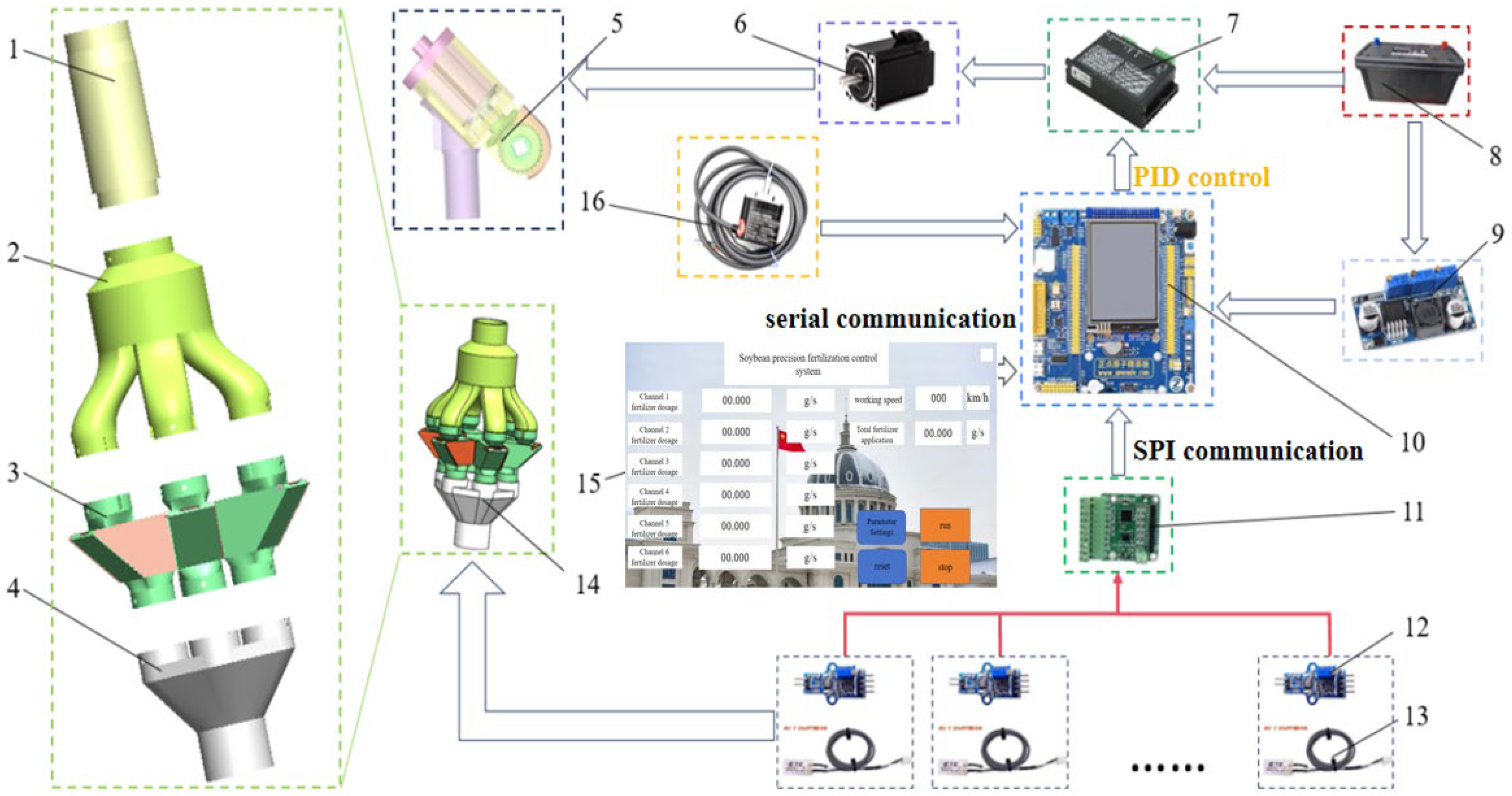
Figure 1. Schematic diagram of the parallel detection structure for granular fertilizer diversion. 1. Uniform fertilizer distribution device; 2. diversion structure; 3. sensing device; 4. manifold; 5. fertilizer distributor; 6. stepper motor; 7. motor driver; 8. 24 V power supply; 9. step-down module; 10. STM32 controller; 11. data acquisition module; 12. amplification module; 13. PVDF piezoelectric sensor; 14. fertilizer amount detection device; 15. human–computer interaction module; 16. encoder. Note: The ellipsis in the figure indicates that there are three identical devices at this location.
Agriculture 16 00290 g001
Figure 2. Uniform fertilization device structure. (a) Working diagram. (b) Internal cross-sectional view. (c) Internal perspective. 1. Fertilizer pipe interface; 2. double helix uniform fertilization retaining ring; 3. uniform fertilizer gear lever; 4. connection hole. Note: The light-yellow spheres in the picture represent granular fertilizer.
Agriculture 16 00290 g002
Figure 3. Schematic diagram of shunt structure. 1. Fertilizer inlet a; 2. conical flow divider disk; 3. diversion tube; 4. limit stop structure; 5. fertilizer outlet a.
Agriculture 16 00290 g003
Figure 4. Schematic diagram of shunt structure. 1. Fertilizer inlet b; 2. limit stop slot; 3. fertilizer outlet b; 4. connection hole; 5. collision chamber; 6. rectangular recess; 7. sensor slot; 8. cable duct. 9. connection hole.
Agriculture 16 00290 g004
Figure 5. Change curve between the actual flow rate of fertilizer and the speed of fertilizer dispenser.
Agriculture 16 00290 g005
Figure 6. Detection flowchart.
Agriculture 16 00290 g006
Figure 7. Block diagram of fuzzy PID control system. Note: e is the deviation between the targeted fertilization amount and the real-time fertilization amount, g·s−1; ec is the rate of change in the deviation value, g·s−1·s−1; KE and KEC are the quantization factors for e and ec; E and EC are linguistic variables of e and ec in the fuzzy universal; ΔKp, ΔKi and ΔKd represent the linguistic variable values of the gain correction parameters obtained through fuzzy inference ; Δkp, Δki and Δkd represent the actual values of the gain correction parameters obtained after blur removal.
Agriculture 16 00290 g007
Figure 8. Fertilizer flow control system block diagram. Notes: In the figure, the circle symbol represents the fertilizer feeding stepper motor.
Agriculture 16 00290 g008
Figure 9. Traditional PID and fuzzy PID simulation models.
Agriculture 16 00290 g009
Figure 10. Simulation results of conventional PID and fuzzy PID applied fertilizer control.
Agriculture 16 00290 g010
Figure 11. Shunt structure simulation model. 1–6. Diversion tube; 7. granular fertilizer hard ball model. Notes: All colored balls are uniformly labeled as granular fertilizer, solely for the convenience of observation.
Agriculture 16 00290 g011
Figure 12. Results of diversion uniformity test. (a) 100 grains·s−1. (b) 200 grains·s−1. (c) 300 grains·s−1. (d) 400 grains·s−1. Note: The six corner markers represent six diverging branch pipes. CS denotes the consistency variation coefficient of each channel in the horizontal state, C1 is the consistency variation coefficient of each channel at a tilt of 1°, C3 signifies the consistency variation coefficient of each channel at a tilt of 3°, and C5 indicates the consistency variation coefficient of each channel at a tilt of 5°. Among them, channels 1, 2, and 3 are channels below the original horizontal plane, while channels 4, 5, and 6 are channels above the original horizontal plane. The tilt angle refers to the angle between the lower end surface of the detection device and the horizontal plane. The numerical values in each circle represent the actual mass of granular fertilizer in each channel.
Agriculture 16 00290 g012
Figure 13. Shunt uniformity test bench. 1. Stepper motor; 2. oblique-type staggered tooth fertilizer distributor; 3. control box; 4. electronic scale; 5. fertilizer bucket; 6. granular fertilizer; 7. diversion device; 8. uniform fertilizer distribution device.
Agriculture 16 00290 g013
Figure 14. Results of shunt uniformity test. (a) Non-uniform fertilizer application device; (b) non-uniform fertilizer distribution ring; (c) equipped with a uniform fertilizer distribution ring.
Agriculture 16 00290 g014
Figure 15. Response time performance test bench for fertilizer discharge variation. 1. Oblique-type staggered tooth fertilizer distributor; 2. fertilizer discharge motor; 3. control box; 4. STM32controller; 5. step-down module; 6. switching power supply; 7. motor driver; 8. conveyor belt motor; 9. chain; 10. granular fertilizer; 11. conveyor belt; 12. speed measuring encoder; 13. friction wheel; 14. shunt parallel detection device.
Agriculture 16 00290 g015
Figure 16. Results of response time test for fertilizer discharge variation. (a) 2.88 km·h−1; (b) 3.6 km·h−1; (c) 4.32 km·h−1. Notes: In the figure, the seconds are marked between the two dashed lines, representing the response time.
Agriculture 16 00290 g016
Figure 17. Fertilizer control precision test bench. 1. Fertilizer distributor; 2. control box; 3. PVDF piezoelectric sensor; 4. fertilizer quantity detection device.
Agriculture 16 00290 g017
Figure 18. Test result of control precision of fertilizer amount.
Agriculture 16 00290 g018
Figure 19. Field fertilizer rate precision control system experiment. 1. MASCHIO fertilizer distributor; 2. stepper motor; 3. fertilizer quantity detection device;4. control box; 5. encoder.
Agriculture 16 00290 g019
Table 1. Fuzzy PID algorithm parameter setting.
Input and Output VariableseeckPkikd
language variableEECKPKiKd
Basic Domain[−30, 30][−15, 15][−1, 1][−0.5, 0.5][−2, 2]
fuzzy subset[NB NM NS ZE PS PM PB]
fuzzy universe[−3, 3][−1.5, 1.5][−3, 3][−1.5, 1.5][−6, 6]
quantitative factor0.10.1333
Table 2. Fuzzy rule table.
Parameterece
NBNMNSZOPSPMPB
KPNBPBPBPMPMPSZOZ0
NMPBPBPMPSPSZONS
NSPMPMPMPSZONSNS
ZOPMPMPSZONSNMNM
PSPSPSZONSNMNMNM
PMPSZONSNMNMNMNB
PBZOZONMNMNBNBNB
KiNBNBNBNMNMNSZOZO
NMNBNBNMNSNSZOZO
NSNBNMNSNSZ0PSPS
ZONMNMNSZ0PSPMPM
PSNMNSZOPSPSPMPB
PMZOZOPSPSPMPBPB
PBZOZOPSPMPMPBPB
KdNBPSNSNBNBNBNMPS
NMPSNSNBNMNMNSZO
NSZONSNMNMNSNSZO
ZOZONSNSNSNSNMZO
PSZOZOZOZOZZOZO
PMPBNSPSPSPSPSPB
PBPBPMPMPMPSPSPB
Table 3. Field experiment of the precision fertilizer control system.
Working Speed/(km·h−1)Target Fertilizer Discharge Rate/(g)System TypeActual Fertilizer Discharge/(g)Fertilizer Application Rate Control Accuracy/(%)
2300Traditional PID266.2988.76%
328.4390.52%
274.9791.66%
Fuzzy PID312.8195.73%
310.0396.66%
288.8596.28%
3450Traditional PID496.5789.65%
411.6591.48%
509.4886.78%
Fuzzy PID472.3095.04%
471.5295.22%
428.0995.13%
4600Traditional PID658.3090.28%
652.4691.26%
688.3685.27%
Fuzzy PID571.8995.32%
625.7495.71%
628.6695.22%
5750Traditional PID834.3488.75%
818.2590.90%
683.0491.07%
Fuzzy PID785.6595.25%
781.7395.77%
786.9595.07%
Disclaimer/Publisher’s Note: The statements, opinions and data contained in all publications are solely those of the individual author(s) and contributor(s) and not of MDPI and/or the editor(s). MDPI and/or the editor(s) disclaim responsibility for any injury to people or property resulting from any ideas, methods, instructions or products referred to in the content.