Determinants of Hybrid Banana Adoption and Intensity Among Smallholder Farmers in Uganda: A Censored Regression Analysis

 , , , , and
Abstract
1. Introduction
2. Materials and Methods
2.1. Study Area
2.2. Study Design and Sample Selection
- Recognized as significant zones for banana cultivation (either for high production or as areas with active farmer engagement in banana farming).
- Accessible for the field team to ensure data collection could be completed safely and efficiently.
2.3. Theoretical Framework
- The Institutional Context: Seed Systems and Information Channels. The structure of the seed system is a primary determinant of adoption. Formal systems (e.g., government programs, certified nurseries) typically bundle new technologies with quality assurance, information, and a sufficient volume of planting material, facilitating larger-scale, commercial plantings. In contrast, informal seed networks (fellow farmers), while vital for initial dissemination, are often associated with small quantities, high phytosanitary risks, and a lack of technical knowledge, constraining adoption intensity [9,27]. The relative strength and reach of these formal and informal channels vary significantly by region, shaped by historical intervention patterns.
- The Socio-Economic Context: Risk, Resources, and Household Characteristics. Farmers evaluate HBVs by weighing potential yield gains against multifaceted risks [26]. These risks are perceived differently across socio-economic strata and regions. In traditional banana-growing areas, the risk of consumer rejection of new tastes poses a significant barrier [17,28], while in new areas, agronomic inexperience may be the primary concern. Resource endowments (land, labor, capital) directly enable or constrain the ability to bear these risks and invest in a new perennial crop [22,26]. Additionally, household risk-management behavior and the degree to which families can smooth consumption further influence adoption decisions, as poorer households tend to exhibit higher vulnerability to shocks [29]. Furthermore, characteristics like gender, education, and marital status shape access to resources, information, and risk tolerance [30,31], creating distinct adoption profiles within and between regions.
- The Regional Context: Agro-Ecology, History, and Market Integration. This is the layer that generates spatial heterogeneity. Uganda’s agro-ecological zones present vastly different biophysical potentials and constraints for banana cultivation [22]. More fundamentally, a region’s history dictates its “banana culture.” Traditional regions have deep-seated culinary preferences and established farming practices for indigenous varieties [23], creating a higher barrier for new technologies. Non-traditional regions, where bananas were introduced as a food security crop, lack these entrenched traditions, potentially lowering adoption barriers but also lacking the inherent knowledge base. Finally, varying degrees of market access and commercial opportunity create different incentive structures for investing in HBVs [32].
- Theoretical Plausibility: For a perennial crop like bananas, the initial planting decision is a significant commitment. The factors that prompt a farmer to plant the first mat (e.g., access to planting material) are logically the same factors that would encourage them to plant more, making the Tobit model’s single-process assumption a coherent fit for this joint decision.
- Model Parsimony and Focus: The primary goal is to identify the determinants of adoption levels (intensity) across space. The Tobit model provides a direct and parsimonious estimate of the marginal effects on this variable of interest for policy.
- Specification Testing: A Likelihood Ratio (LR) test was performed, comparing the Tobit model to a two-part alternative (Probit for adoption and Truncated regression for intensity). The results failed to reject the null hypothesis that the Tobit specification is appropriate, thereby supporting its selection.
3. Descriptive Characteristics of Banana Farmers
4. Results and Discussion
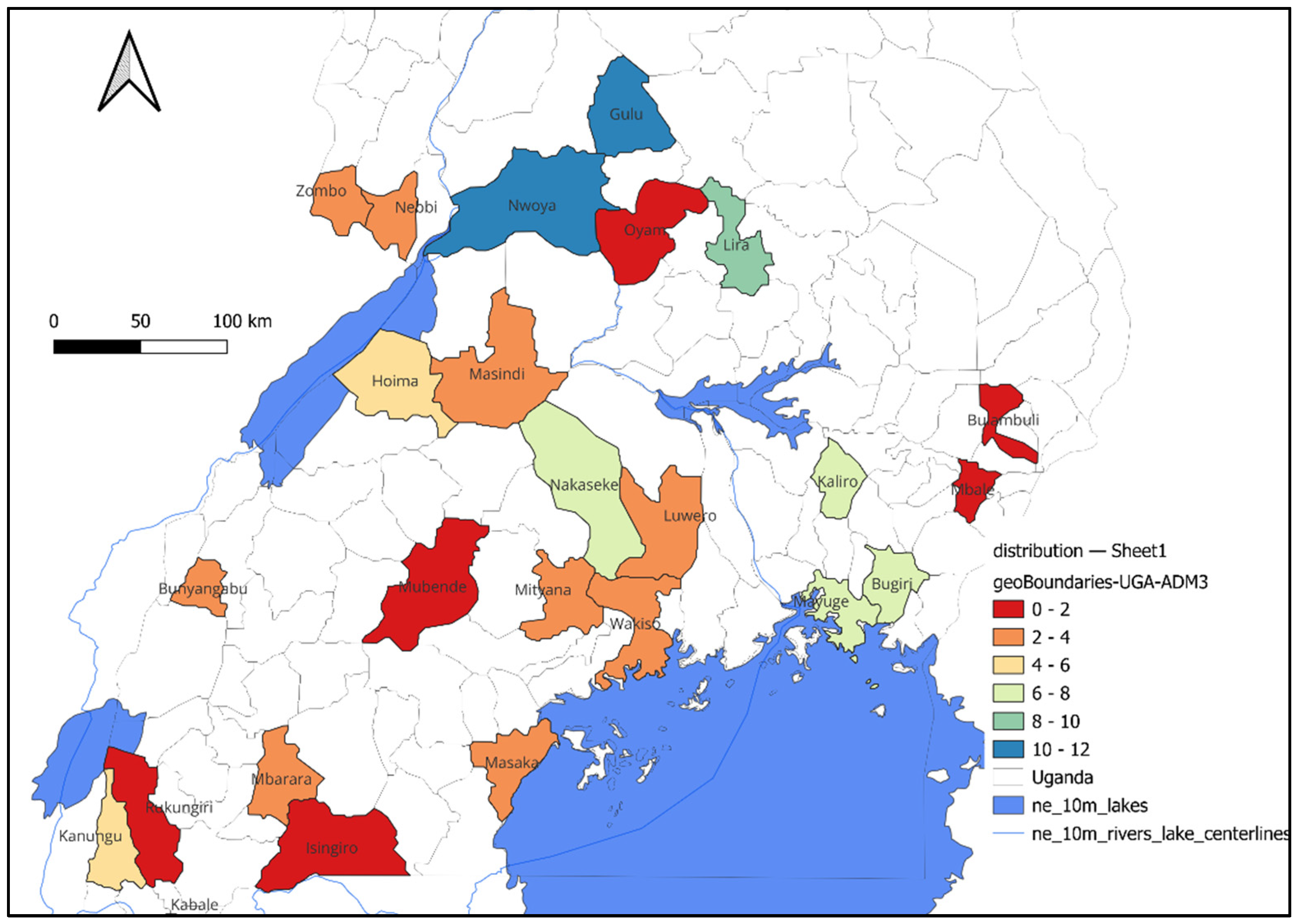
4.1. Spatial Patterns of Hybrid Banana Adoption
4.2. Determinants of Adoption Intensity of HBVs: Results of Tobit Regression
4.3. Discussion
5. Conclusions and Recommendations
Novelty, Limitations, and Avenues for Future Research
Supplementary Materials
Author Contributions
Funding
Institutional Review Board Statement
Informed Consent Statement
Data Availability Statement
Acknowledgments
Conflicts of Interest
References
- FAO. The State of Food Security and Nutrition in the World 2023; Food and Agriculture Organization of the United Nations: Rome, Italy, 2023. [Google Scholar] [CrossRef] [Scilit]
- Edgerton, M.D. Increasing crop productivity to meet global needs for feed, food, and fuel. Plant Physiol. 2009, 149, 7–13. [Google Scholar] [CrossRef] [Scilit]
- Asenso-Okyere, K.; Jemaneh, S. Increasing Agricultural Productivity and Enhancing Food Security in Africa: New Challenges and Opportunities; International Food Policy Research Institute (IFPRI): Washington, DC, USA, 2012. [Google Scholar] [CrossRef] [Scilit]
- van Ittersum, M.K.; van Bussel, L.G.; Wolf, J.; Grassini, P.; van Wart, J.; Guilpart, N.; Claessens, L.; de Groot, H.; Wiebe, K.; Mason-D’Croz, D.; et al. Can sub-Saharan Africa feed itself? Proc. Natl. Acad. Sci. USA 2016, 113, 14964–14969. [Google Scholar] [CrossRef] [Scilit]
- Tittonell, P.; Giller, K.E. When yield gaps are poverty traps: The paradigm of ecological intensification in African smallholder agriculture. Field Crops Res. 2013, 143, 76–90. [Google Scholar] [CrossRef] [Scilit]
- FAOSTAT. Uganda Banana Production Statistics 2021–2023. Food and Agriculture Organization. 2025. Available online: http://www.fao.org/faostat (accessed on 15 July 2025).
- Akankwasa, K.; Marimo, P.; Tumuhimbise, R.; Asasira, M.; Khakasa, E.; Mpirirwe, I.; Kleih, U.; Forsythe, L.; Fliedel, G.; Dufour, D.; et al. The East African highland cooking bananas ‘Matooke’ preferences of farmers and traders: Implications for variety development. Int. J. Food Sci. Technol. 2021, 56, 1124–1134. [Google Scholar] [CrossRef] [Scilit]
- UBOS. Uganda National Household Survey 2019/2020: Agricultural Module. Uganda Bureau of Statistics. 2020. Available online: https://www.ubos.org/wp-content/uploads/publications/09_2021Uganda-National-Survey-Report-2019-2020.pdf (accessed on 17 July 2025).
- Kubiriba, J.; Tushemereirwe, W.K. Approaches for the control of banana Xanthomonas wilt in East and Central Africa. Afr. J. Plant Sci. 2014, 8, 398–404. [Google Scholar] [CrossRef] [Scilit]
- Pagnani, T.; Gotor, E.; Kikulwe, E.; Caracciolo, F. Livelihood assets ‘influence on Ugandan farmers’ control practices for Banana Xanthomonas Wilt (BXW). Agric. Food Econ. 2021, 9, 25. [Google Scholar] [CrossRef] [Scilit]
- Tushemereirwe, W.K.; Kubiriba, J. Banana cultivation in Africa Laboratories, Uganda. In Achieving Sustainable Cultivation of Bananas; Burleigh Dodds Science Publishing: Cambridge, UK, 2018; pp. 53–84. Available online: https://www.taylorfrancis.com/chapters/edit/10.1201/9781351114622-8/banana-cultivation-africa-laboratories-uganda-tushemereirwe-kubiriba-national-agricultural-research (accessed on 25 July 2025).
- Sanya, L.N.; Ssali, R.T.; Namuddu, M.G.; Kyotalimye, M.; Marimo, P.; Mayanja, S. Why gender matters in breeding: Lessons from cooking bananas in Uganda. Sustainability 2023, 15, 7024. [Google Scholar] [CrossRef] [Scilit]
- IITA. IITA and NARO Release Improved Matooke Banana Variety in Uganda. International Institute of Tropical Agriculture. 2025. Available online: https://www.iita.org/news-item/iita-and-naro-release-narita-17-a-matooke-banana-variety-in-uganda/ (accessed on 12 August 2025).
- Karamura, D.; Mgenzi, B.; Karamura, E.; Sharrock, S. Exploiting indigenous knowledge for the management and maintenance of Musa biodiversity on farm. Afr. Crop Sci. J. 2004, 12, 67–74. [Google Scholar] [CrossRef] [Scilit]
- Biruma, M.; Pillay, M.; Tripathi, L.; Blomme, G.; Abele, S.; Mwangi, M.; Bandyopadhyay, R.; Muchunguzi, P.; Kassim, S.; Nyine, M.; et al. Banana Xanthomonas wilt: A review of the disease, management strategies and future research directions. Afr. J. Biotechnol. 2007, 6, 953–962. [Google Scholar]
- Akankwasa, K.; Ortmann, G.F.; Wale, E.; Tushemereirwe, W.K. Farmers’ choice among recently developed hybrid banana varieties in Uganda: A multinomial logit analysis. Agrekon 2013, 52, 25–51. [Google Scholar] [CrossRef] [Scilit]
- Akankwasa, K.; Ortmann, G.F.; Wale, E.Z. Evaluating Farmers’and Consumers’ Acceptance of New Cooking Banana Hybrids in Uganda: Micro-Economic Analysis and Policy Implications. 2014. Available online: http://hdl.handle.net/10413/12845 (accessed on 12 September 2025).
- Sanya, L.N.; Sseguya, H.; Kyazze, F.B.; Diiro, G.M.; Nakazi, F. The role of variety attributes in the uptake of new hybrid bananas among smallholder rural farmers in central Uganda. Agric. Food Secur. 2020, 9, 1. [Google Scholar] [CrossRef] [Scilit]
- Ssebuliba, R.; Talengera, D.; Makumbi, D.; Tenkouano, A.; Rubaihayo, P.; Magambo, M. Reproductive efficiency and breeding potential of East African Highland (Musa AAA-EA) bananas. Field Crops Res. 2006, 95, 250–255. [Google Scholar] [CrossRef] [Scilit]
- Nasirumbi Sanya, L.; Birungi Kyazze, F.; Sseguya, H.; Kibwika, P.; Baguma, Y. Complexity of agricultural technology development processes: Implications for uptake of new hybrid banana varieties in Central Uganda. Cogent Food Agric. 2017, 3, 1419789. [Google Scholar] [CrossRef] [Scilit]
- Tumuhimbise, R.; Barekye, A.; Kubiriba, J.; Akankwasa, K.; Arinaitwe, I.K.; Karamura, D.; Tushemereirwe, W.K. New high-yield cooking banana cultivars with multiple resistances to pests and diseases (‘NAROBan1′, ‘NAROBan2′, ‘NAROBan3′, and ‘NAROBan4′) released in Uganda. HortScience 2018, 53, 1387–1389. [Google Scholar] [CrossRef] [Scilit]
- Van Asten, P.J.; Wairegi, L.W.I.; Mukasa, D.; Uringi, N.O. Agronomic and economic benefits of coffee–banana intercropping in Uganda’s smallholder farming systems. Agric. Syst. 2011, 104, 326–334. [Google Scholar] [CrossRef] [Scilit]
- Kikulwe, E.M.; Birol, E.; Wesseler, J.; Falck-Zepeda, J.A. Latent Class Approach to Investigating Farmer Demand for Banana Breeding Traits in Uganda. Agric. Econ. 2011, 42, 707–718. [Google Scholar] [CrossRef] [Scilit]
- Singh, I.; Squire, L.; Strauss, J. Agricultural Household Models: Extensions, Applications and Policy; World Bank: Washington, DC, USA, 1986; Available online: http://documents.worldbank.org/curated/en/621291468739297175 (accessed on 18 September 2025).
- Sadoulet, E.; Janvry, A.D.; Wehrheim, P. Quantitative development policy analysis. Z. Fur Auslandische Landwirtsch. 1996, 35, 295–298. Available online: https://www.academia.edu/69086486/Quantitative_Development_Policy_Analysis (accessed on 26 September 2025).
- Feder, G.; Just, R.E.; Zilberman, D. Adoption of agricultural innovations in developing countries: A survey. Econ. Dev. Cult. Change 1985, 33, 255–298. [Google Scholar] [CrossRef] [Scilit]
- McGuire, S.; Sperling, L. Seed systems smallholder farmers use. Food Secur. 2016, 8, 179–195. [Google Scholar] [CrossRef] [Scilit]
- Kikulwe, E.M.; Okurut, S.; Ajambo, S.; Nowakunda, K.; Stoian, D.; Naziri, D. Postharvest losses and their determinants: A challenge to creating a sustainable cooking banana value chain in Uganda. Sustainability 2018, 10, 2381. [Google Scholar] [CrossRef] [Scilit]
- Alderman, H.; Paxson, C.H. Do the poor insure? A synthesis of the literature on risk and consumption in developing countries. In Economics in a Changing World; Volume 4: Development, Trade and the Environment; Palgrave Macmillan London: London, UK, 1994; pp. 48–78. [Google Scholar] [CrossRef] [Scilit]
- Doss, C.R. Designing agricultural technology for African women farmers: Lessons from 25 years of experience. World Dev. 2001, 29, 2075–2092. [Google Scholar] [CrossRef] [Scilit]
- Doss, C.R. Analyzing technology adoption using microstudies: Limitations, challenges, and opportunities for improvement. Agric. Econ. 2006, 34, 207–219. [Google Scholar] [CrossRef] [Scilit]
- Conley, T.G.; Udry, C.R. Learning about a new technology: Pineapple in Ghana. Am. Econ. Rev. 2010, 100, 35–69. [Google Scholar] [CrossRef] [Scilit]
- Wooldridge, J.M. Introductory Econometrics a Modern Approach; South-Western Cengage Learning: Mason, OH, USA, 2019. [Google Scholar]
- Tobin, J. Estimation of relationships for limited dependent variables. Econom. J. Econom. Soc. 1958, 26, 24–36. [Google Scholar] [CrossRef] [Scilit]
- Cragg, J.G. Some statistical models for limited dependent variables with application to the demand for durable goods. Econometrica 1971, 39, 829–844. [Google Scholar] [CrossRef] [Scilit]
- McDonald, J.F.; Moffitt, R.A. The uses of Tobit analysis. Rev. Econ. Stat. 1980, 62, 318–321. [Google Scholar] [CrossRef] [Scilit]
- Greene, W.H. Econometric Analysis, 8th ed.; Pearson: London, UK, 2018. [Google Scholar]
- Dawson, N.; Martin, A.; Sikor, T. Green revolution in sub-Saharan Africa: Implications of imposed innovation for the wellbeing of rural smallholders. World Dev. 2016, 78, 204–218. [Google Scholar] [CrossRef] [Scilit]
- Kabunga, N.S.; Dubois, T.; Qaim, M. Impact of tissue culture banana technology on farm household income and food security in Kenya. Food Policy 2014, 45, 25–34. [Google Scholar] [CrossRef] [Scilit]
- Weir, S.; Knight, J. Externality effects of education: Dynamics of the adoption and diffusion of an innovation in rural Ethiopia. Econ. Dev. Cult. Change 2004, 53, 93–113. [Google Scholar] [CrossRef] [Scilit]
- Anderson, J.R.; Feder, G. Agricultural extension: Good intentions and hard realities. World Bank Res. Obs. 2004, 19, 41–60. [Google Scholar] [CrossRef] [Scilit]
- Quisumbing, A.R.; Pandolfelli, L. Promising approaches to address the needs of poor female farmers: Resources, constraints, and interventions. World Dev. 2010, 38, 581–592. [Google Scholar] [CrossRef] [Scilit]
- Ndiritu, S.W.; Kassie, M.; Shiferaw, B. Are there systematic gender differences in the adoption of sustainable agricultural intensification practices? Evidence from Kenya. Food Policy 2014, 49, 117–127. [Google Scholar] [CrossRef] [Scilit]
- Theis, S.; Lefore, N.; Meinzen-Dick, R.; Bryan, E. What happens after technology adoption? Gendered aspects of small-scale irrigation technologies in Ethiopia, Ghana, and Tanzania. Agric. Hum. Values 2018, 35, 671–684. [Google Scholar] [CrossRef] [Scilit]
- Sperling, L.; Gallagher, P.; McGuire, S.; March, J.; Templer, N. Informal seed traders: The backbone of seed business and African smallholder seed supply. Sustainability 2020, 12, 7074. [Google Scholar] [CrossRef] [Scilit]
- Nduwimana, I.; Sylla, S.; Xing, Y.; Simbare, A.; Niyongere, C.; Garrett, K.A.; Bonaventure Omondi, A. Banana seed exchange networks in Burundi–Linking formal and informal systems. Outlook Agric. 2022, 51, 334–348. [Google Scholar] [CrossRef] [Scilit]
- Muricho, G.; Gichuru, L.; Akpo, E.; Templer, N.; Puozaa, D.K.; Gitonga, Z.; Melesse, M.; Mwenda, E.; Mchau, D.; Binagwa, P.; et al. Navigating Formal, Informal, and Integrated Seed Systems: Drivers of Choice by Sorghum Grain Producers in Tanzania and Implications for Seed Access. Food Energy Secur. 2025, 14, e70148. [Google Scholar] [CrossRef] [Scilit]


| Variable Name | Description & Measurement | Type | Expected Sign |
|---|---|---|---|
| Dependent Variable | |||
| Number of HBV Mats | Total number of hybrid banana mats planted by the household | Continuous | |
| Independent Variables | |||
| Sex | 1 if respondent is male; 0 if female | Binary | + |
| Age | Age of the respondent (years) | Continuous | +/− |
| Years of Schooling | Years of formal education of the respondent | Continuous | + |
| Household Size | Total number of household members | Continuous | + |
| Marital Status | 1 if respondent is married; 0 otherwise | Dummy | + |
| Land Size | Total land owned by household (acres) | Continuous | + |
| Land for Bananas | Total land allocated to bananas (acres) | Continuous | + |
| Years Planting Bananas | Farming experience of respondent with bananas (years) | Continuous | + |
| Purpose for Sale | 1 if main purpose for growing bananas is sale; 0 if for food | Binary | + |
| Region | 1 if household is in Northern region; 0 otherwise | Dummy | + |
| Intercrop | 1 if bananas are grown as an intercrop; 0 if monocrop | Binary | − |
| Seed from Fellow Farmers | 1 if primary seed source is fellow farmers; 0 otherwise | Binary | − |
| Variable | Pooled (n = 624) | Central (n = 144) | Eastern (n = 147) | North West (n = 57) | Northern (n = 88) | South Western (n = 112) | Western (n = 76) |
|---|---|---|---|---|---|---|---|
| Age (years) | 47.13 (14.63) | 46.05 (14.10) | 48.31 (12.77) | 44.70 (14.35) | 42.5 (14.07) | 49.88 (15.64) | 50 (16.74) |
| Years of schooling (years) | 8.38 (4.25) | 9.53 (3.88) | 7.33 (4.36) | 8.95 (4.55) | 9.28 (3.84) | 8.18 (4.61) | 7.07 (3.58) |
| Household size | 6.69 (3.26) | 6.09 (3.15) | 7.70 (3.19) | 6.25 (2.92) | 6.80 (2.88) | 6.56 (3.03) | 6.28 (4.12) |
| Household members above 18 years | 3.45 (2.31) | 2.98 (1.85) | 4.05 (2.53) | 3.37 (1.87) | 3.49 (1.78) | 3.51 (2.32) | 3.07 (3.14) |
| Total size of land (acres) | 5.24 (11.80) | 4.40 (9.79) | 3.06 (4.31) | 4.39 (6.63) | 6.65 (14.26) | 8.51 (19.80) | 5.22 (7.65) |
| Land under bananas (acres) | 1.61 (3.63) | 1.32 (1.03) | 0.79 (0.64) | 0.72 (0.61) | 1.00 (0.89) | 4.19 (7.84) | 1.32 (1.32) |
| Land under other enterprises (acres) | 3.41 (10.04) | 2.74 (9.12) | 2.06 (3.86) | 3.55 (6.37) | 5.46 (13.83) | 4.06 (15.07) | 3.89 (7.18) |
| Years of banana production | 14.26 (12.79) | 14.63 (10.85) | 14.65 (12.94) | 8.70 (6.91) | 4.82 (5.27) | 22.46 (15.20) | 15.81 (12.95) |
| Marital status | Percentage of farmers | ||||||
| Divorced | 3.37 | 4.86 | 5.44 | 0.00 | 1.14 | 1.79 | 3.95 |
| Married | 80.45 | 68.06 | 85.03 | 89.47 | 87.50 | 82.14 | 77.63 |
| Single | 6.89 | 13.89 | 0.00 | 7.02 | 7.95 | 5.36 | 7.89 |
| Widowed | 9.29 | 13.19 | 9.52 | 3.51 | 3.41 | 10.71 | 10.53 |
| Main source of income | Percentage of farmers | ||||||
| Farming | 94.07 | 94.44 | 95.24 | 87.72 | 89.77 | 98.21 | 94.74 |
| Formal employment | 1.92 | 0.00 | 1.36 | 7.02 | 3.41 | 0.89 | 2.63 |
| Informal employment (specify) | 2.08 | 2.78 | 3.40 | 1.75 | 2.27 | 0.00 | 1.32 |
| Trading | 1.92 | 2.78 | 0.00 | 3.51 | 4.55 | 0.89 | 1.32 |
| Main purpose of growing bananas | Percentage of farmers | ||||||
| Food | 44.89 | 49.66 | 53.74 | 22.81 | 12.50 | 53.98 | 59.21 |
| Income | 51.92 | 49.66 | 45.58 | 59.65 | 79.55 | 45.13 | 40.79 |
| Both income and food | 2.72 | 0.00 | 0.00 | 17.54 | 7.95 | 0.00 | 0.00 |
| Others (prestige, passion) | 0.48 | 0.69 | 0.68 | 0.00 | 0.00 | 0.88 | 0.00 |
| Variable | Pooled (n = 625) | Central (n = 144) | Eastern (n = 147) | North West (n = 57) | Northern (n = 88) | South Western (112) | Western (n = 76) |
|---|---|---|---|---|---|---|---|
| Type of banana grown. | Percentage of farmers | ||||||
| Indigenous cooking bananas | 87.66 | 98.61 | 96.60 | 80.70 | 42.05 | 96.43 | 94.74 |
| Hybrid bananas | 33.17 | 23.61 | 30.61 | 22.81 | 73.86 | 24.11 | 30.26 |
| Beer varieties | 6.25 | 2.08 | 4.76 | 0.00 | 0.00 | 18.75 | 10.53 |
| Plantain | 5.29 | 4.86 | 2.04 | 0.00 | 5.68 | 8.93 | 10.53 |
| Bogoya | 17.79 | 9.03 | 21.77 | 1.75 | 13.64 | 25.00 | 32.89 |
| Sukali Ndizi | 10.87 | 10.81 | 5.60 | 0.00 | 16.33 | 12.50 | 22.67 |
| Acreage under bananas | |||||||
| Beer varieties | 0.50 (0.80) | 0.11 (0.13) | 0.10 (0.12) | NA | NA | 0.66 (0.95) | 0.54 (0.69) |
| Bogoya | 0.23 (0.29) | 0.16 (0.21) | 0.23 (0.40) | 0.25 | 0.35 (0.14) | 0.19 (0.17) | 0.27 (0.27) |
| Bogoya and Sukali Ndiizi intercrop | 0.36 (0.42) | 0.23 (0.15) | 0.22 (0.35) | NA | 0.50 (0.38) | 0.28 (0.22) | 2.00 |
| Hybrid bananas | 0.70 (2.02) | 0.86 (2.59) | 0.44 (0.36) | 0.45 (0.29) | 1.00 (2.83) | 0.73 (1.59) | 0.27 (0.52) |
| Indigenous cooking bananas | 2.82 (30.18) | 6.14 (58.65) | 0.65 (0.53) | 0.65 (0.50) | 0.80 (0.98) | 4.03 (7.86) | 1.08 (0.97) |
| Plantain | 0.30 (0.44) | 0.35 (0.73) | 0.03 (0.03) | NA | 0.56 (0.44) | 0.27 (0.34) | 0.21 (0.24) |
| Sukali ndizi | 0.29 (0.32) | 0.10 (0.10) | 0.33 (0.39) | NA | 0.67 (0.32) | 0.24 (0.25) | 0.26 (0.32) |
| Number of mats of banana types | |||||||
| Beer varieties | 198.63 (382.40) | 23.33 (11.55) | 29.00 (44.88) | NA | NA | 240.14 (448.36) | 282.63 (382.15) |
| Bogoya | 40.27 (71.93) | 46.80 (85.66) | 29.75 (40.05) | 50.00 | 72.80 (60.13) | 24.72 (25.66) | 53.92 (111.16) |
| Bogoya and Sukali Ndiizi intercrop | 55.43 (68.41) | 69.75 (62.75) | 15.86 (15.55) | 0.00 | 72.43 (48.97) | 67.86 (111.61) | 12.00 |
| Hybrid bananas | 101.28 (146.79) | 125.18 (209.13) | 66.95 (88.08) | 110.38 (120.02) | 137.40 (142.35) | 81.25 (173.62) | 43.35 (86.93) |
| Indigenous cooking bananas | 776.67 (3,793.36) | 453.27 (576.00) | 163.56 (139.98) | 160.28 (164.17) | 124.44 (149.99) | 2,714.35 (8,221.30) | 420.03 (459.53) |
| Plantain | 57.53 (122.97) | 96.57 (179.38) | 8.33 (2.89) | NA | 128.60 (209.05) | 20.78 (14.96) | 38.75 (76.48) |
| Sukali ndizi | 52.31 (87.30) | 21.17 (21.20) | 33.20 (23.05) | NA | 121.25 (65.07) | 79.22 (158.89) | 33.24 (69.90) |
| Number of Hybrid Mats | Pooled (n = 624) | Central (n = 144) | Eastern (n = 147) | North West (n = 57) | Northern (n = 88) | South Western (n = 112) | Western (n = 76) |
|---|---|---|---|---|---|---|---|
| Sex (1= Male) | 45.47 ** (20.97) | −10.50 (58.38) | 45.69 ** (22.50) | 198.45 ** (84.24) | 2.07 (59.48) | 101.43 (77.84) | −30.80 (26.66) |
| Age of Farmer | 0.97 (0.78) | −8.43 *** (2.96) | 1.07 (0.97) | 0.99 (1.97) | 2.79 (2.41) | 0.60 (2.60) | 1.04 (1.00) |
| Years of schooling | −0.23 (2.40) | 5.74 (7.03) | −4.08 * (2.42) | 15.63 ** (6.38) | −4.72 (6.54) | −5.68 (8.89) | 1.11 (4.59) |
| Household size | −3.02 (3.15) | −3.66 (9.03) | 0.25 (3.64) | −12.28 (7.43) | −8.60 (9.37) | 3.18 (10.77) | −6.38 (6.06) |
| Marital status (1= Married) | 35.44 (28.45) | 41.21 (66.56) | −5.60 (38.88) | 549.13 (20025.15) | 161.65 ** (78.88) | −43.66 (102.62) | −3.36 (29.88) |
| Land size | 0.01 (0.82) | 1.47 (2.70) | 1.47 (1.93) | 3.15 (2.80) | −0.09 (1.76) | 0.07 (2.67) | −1.08 (1.87) |
| Land for bananas | −1.22 (3.22) | 6.98 (31.87) | 37.43 ** (17.94) | 1.10 (46.65) | 13.45 (33.36) | −1.47 (6.58) | −1.19 (9.02) |
| Years of planting bananas | −0.83 (1.00) | 8.49 ** (3.40) | −2.86 ** (1.18) | 8.27 * (4.22) | −8.91 (5.47) | 0.18 (2.97) | 1.85 (1.28) |
| Purpose for growing bananas (1=Sale) | 18.92 (20.44) | 24.01 (57.07) | 4.80 (23.00) | 93.08 (55.78) | 17.30 (59.13) | 74.90 (69.79) | −30.55 (24.66) |
| Region (1=North) | 65.47 ** (28.12) | 0 | 0 | 0 | 0 | 0 | 0 |
| Method of growing bananas (1=Intercrop) | −20.31 (19.81) | −121.66 ** (54.98) | −33.63 (22.46) | −17.11 (56.51) | −26.96 (51.41) | 73.05 (66.97) | −35.53 (25.57) |
| Seed source (1=Fellow farmers) | −245.81 *** (24.52) | −354.72 *** (69.14) | −99.15 *** (30.38) | −152.39 ** (69.76) | −305.97 *** (65.20) | −381.17 *** (83.12) | −166.61 *** (33.89) |
| Constant | −58.58 (54.51) | 305.92 * (171.56) | −24.22 (74.41) | −903.55 (20,025.66) | −22.99 (127.99) | −14.28 (160.96) | 32.37 (80.37) |
| Var (e) | 33,335.28 (4029.33) | 39,386.02 (10,836.20) | 8379.72 (2265.21) | 10,124.54 (4479.57) | 33,312.09 (7839.32) | 35,188.87 (12,346.60) | 7271.63 (2259.81) |
Disclaimer/Publisher’s Note: The statements, opinions and data contained in all publications are solely those of the individual author(s) and contributor(s) and not of MDPI and/or the editor(s). MDPI and/or the editor(s) disclaim responsibility for any injury to people or property resulting from any ideas, methods, instructions or products referred to in the content. |
© 2026 by the authors. Licensee MDPI, Basel, Switzerland. This article is an open access article distributed under the terms and conditions of the Creative Commons Attribution (CC BY) license.
Share and Cite
Bayiyana, I.; Kasharu, A.K.; Namuyimbwa, C.; Kiconco, S.; Waniale, A.; Bakaze, E.; Mwaka, H.; Oloo, A.; Tumuhimbise, R.; Asea, G.; et al. Determinants of Hybrid Banana Adoption and Intensity Among Smallholder Farmers in Uganda: A Censored Regression Analysis. Agriculture 2026, 16, 289. https://doi.org/10.3390/agriculture16030289
Bayiyana I, Kasharu AK, Namuyimbwa C, Kiconco S, Waniale A, Bakaze E, Mwaka H, Oloo A, Tumuhimbise R, Asea G, et al. Determinants of Hybrid Banana Adoption and Intensity Among Smallholder Farmers in Uganda: A Censored Regression Analysis. Agriculture. 2026; 16(3):289. https://doi.org/10.3390/agriculture16030289
Chicago/Turabian StyleBayiyana, Irene, Apollo Katwijukye Kasharu, Catherine Namuyimbwa, Stella Kiconco, Allan Waniale, Elyeza Bakaze, Henry Mwaka, Augustine Oloo, Robooni Tumuhimbise, Godfrey Asea, and et al. 2026. "Determinants of Hybrid Banana Adoption and Intensity Among Smallholder Farmers in Uganda: A Censored Regression Analysis" Agriculture 16, no. 3: 289. https://doi.org/10.3390/agriculture16030289
APA StyleBayiyana, I., Kasharu, A. K., Namuyimbwa, C., Kiconco, S., Waniale, A., Bakaze, E., Mwaka, H., Oloo, A., Tumuhimbise, R., Asea, G., & Barekye, A. (2026). Determinants of Hybrid Banana Adoption and Intensity Among Smallholder Farmers in Uganda: A Censored Regression Analysis. Agriculture, 16(3), 289. https://doi.org/10.3390/agriculture16030289