Article

Rotational Tillage and Nitrogen Rate Affect Maize Yield Through Regulations on Deep Root Morphology and Physiology

1
College of Land and Environment, Shenyang Agricultural University, Shenyang 110866, China
2
Liaoning Province Farmland Quality Monitoring and Protection Center, Shenyang 110866, China
3
Institute of Applied Ecology, Chinese Academy of Sciences, Shenyang 110016, China
4
Liaoning Agricultural Development Center, Shenyang 110034, China
*
Author to whom correspondence should be addressed.
Agriculture 2026, 16(2), 187; https://doi.org/10.3390/agriculture16020187
Submission received: 26 October 2025 / Revised: 17 December 2025 / Accepted: 20 December 2025 / Published: 12 January 2026
(This article belongs to the Section Agricultural Soils)

Abstract

In the maize systems of Liaonan, China, soil compaction and inefficient nitrogen use are key constraints to sustainable productivity. To enhance nitrogen (N) use efficiency and sustainable productivity in the maize systems of Liaonan, China, a field split-plot trial was conducted from 2018 to 2022 to investigate the synergistic effects of rotational tillage and N rates on root physiology and yield. Three straw return practices were tested as follows: NT (1 year no-tillage + 1 year subsoiling), PT (continuous subsoiling), and RT (continuous rotary tillage), each under three nitrogen levels: 150 (N150), 210 (N210), and 240 kg ha−1 (N240). Root length density (RLD) and root surface area density (RSD) were monitored in situ, while root protein content, cellulose/lignin composition, root activity, and photosynthesis were analyzed at the tasseling (VT) and milk stage (R3). The results showed that NT-N210 treatment maximized deep root (30–50 cm) growth, increasing RLD by 54.5% compared to PT-N150 and RSD by 62.0% compared to RT-N150. NT was also associated with a stronger protein-associated FTIR signal and greater lignin accumulation, collectively correlating with delayed senescence. Photosynthesis and yield were strongly correlated with deep RLD (*r* = 0.82, p < 0.01). NT-N210 achieved the highest yield (12,896 kg ha−1, 38.0% higher than PT-N150) with 12.5% less N than conventional practice. These findings indicate that combining the NT rotation with moderate N (210 kg ha−1) optimizes deep root functionality and delays senescence. This improvement was correlated with shifts in protein-associated FTIR signals and cell wall composition (e.g., lignin accumulation), which collectively contributed to significantly improved resource use efficiency and yield. Therefore, adopting a biennial no-tillage/subsoiling rotation combined with moderate nitrogen application (210 kg ha−1) is recommended as an effective strategy to alleviate soil compaction, enhance deep root growth, delay senescence, and achieve high maize yield with improved nitrogen use efficiency in similar agricultural systems.

1. Introduction

Straw returning is a key practice for sustaining soil fertility and crop productivity in agricultural systems [1]. As widely implemented in northern China, predominant straw return methods include no-tillage mulching, rotary tillage, and subsoiling, each distinctly impacting soil and crop growth. No-tillage improves surface soil organic matter and aggregate stability but can increase soil bulk density and penetration resistance, potentially affecting crop establishment [2]. In contrast, long-term rotary tillage often leads to a shallow plow layer and a compacted hardpan, restricting deep root growth and promoting premature plant senescence [3,4]. Subsoiling can break this plow pan, reduce soil density, and improve the structure of the 20–40 cm layer, thereby facilitating deeper root proliferation [1,5].
Closely linked to tillage practice, the management of nitrogen fertilizer is equally critical under straw incorporation. Appropriate N application not only promotes straw decomposition but also mitigates early-stage N competition between soil microorganisms and crops [6]. Studies show that while increased N application can enhance nutrient uptake and dry matter accumulation, excessive N leads to diminished returns and environmental risks. For instance, Bai et al. reported that corn yield did not increase beyond 225 kg N ha−1 in northern Liaoning [7]. Therefore, optimizing the synergy between straw return methods and N rates is essential for achieving high maize yields and green agricultural development.
Soil tillage and N availability profoundly influence root system dynamics, which in turn governs above-ground growth and yield formation [2]. Improvements in root traits during the reproductive stage are crucial for nutrient uptake and help delay leaf senescence [8,9]. The minirhizotron technique enables non-destructive, in situ monitoring of root growth dynamics [10,11]. Jiang et al. demonstrated that straw returning methods significantly influence root distribution and dry matter accumulation at the silking stage, thereby affecting yield [12]. Furthermore, while long-term no-tillage may hinder root growth, short-term tillage rotations can improve root biomass and nutrient acquisition [13,14]. Nitrogen application significantly modulates root growth, improving the root dry matter, internal structure, and nutrient absorption capacity [15].
Recent research has further highlighted the interactive effects of integrated tillage and N management. For example, studies in Northeast China have demonstrated that combining straw incorporation with optimized, rather than maximal, N rates is sufficient to maximize maize yield while improving nitrogen use efficiency and reducing environmental impacts [16,17,18]. Collectively, these studies underscore that integrated management is key to sustainable intensification.
Despite these advances, a critical gap remains. The potential of a biennial no-tillage/subsoiling rotation to alleviate soil compaction and delay root senescence, compared to continuous tillage practices, is underexplored. Furthermore, comprehensive in situ studies linking root dynamics across soil depths to physiological senescence markers are needed.
To address this, our study employed minirhizotron technology for non-destructive, depth-stratified monitoring of maize root morphology, linking these dynamics to key physiological traits. We hypothesized that (1) different straw return methods and N rates would interactively affect root morphology, structure, physiological traits, photosynthesis, and grain yield across soil layers; and (2) root growth, particularly in deeper soil layers, would be positively correlated with photosynthetic performance and yield. This research aims to provide a viable strategy for mitigating soil compaction constraints and enhancing maize productivity through integrated tillage and nitrogen management.

2. Materials and Methods

2.1. Experimental Site

A field-based fixed-site experiment on maize straw incorporation was initiated in May 2018 at the Haicheng Research and Teaching Base of Shenyang Agricultural University, located in Gengzhuang Town, Haicheng City, Anshan, Liaoning Province (40°48′ N, 122°37′ E). The region experiences a warm temperate continental monsoon climate, with an annual accumulated temperature ≥ 10 °C of approximately 3488 °C, mean annual precipitation of 677 mm, and an average annual air temperature of 11.7 °C. The soil is classified as Eutric Cambisol, with an average plow layer thickness of 15 cm. Prior to the experiment, the field had been managed under conventional rotary tillage without straw incorporation, with a tillage depth of about 15 cm. The basic physicochemical properties of the 0–20 cm soil layer were as follows: total N 0.89 g kg−1 (determined by the Kjeldahl method), available N 129.6 mg kg−1 (determined by alkali hydrolysis diffusion method), available phosphorus 25.96 mg kg−1 (extracted by 0.5 M NaHCO3 and determined colorimetrically), available potassium 117.94 mg kg−1 (extracted by 1 M CH3COONH4 and determined by flame photometry), pH 5.35 (measured in a 1:2.5 soil:water suspension), and bulk density 1.53 g cm−3 (determined by the core method) [19].

2.2. Experimental Design

The experiment was arranged in a split-plot design with three main plot treatments (straw incorporation practices) and three sub-plot treatments (N application rates). The main plots consisted of the following straw management methods: NT (no-tillage/subsoiling–rotary tillage rotation): This was a biennial rotation system. All straw was chopped to approximately 10 cm lengths and evenly spread on the soil surface after autumn harvest. In the no-tillage year, the field received no further treatment until sowing and fertilization with a no-till planter the following spring. In the subsoiling–rotary tillage year (e.g., the data collection year 2022), subsoiling was performed to a depth of 30–35 cm in spring before sowing, immediately followed by rotary tillage for seedbed preparation, and then sowing with a no-till planter. PT (continuous subsoiling–rotary tillage): The practice was identical to the subsoiling–rotary tillage phase of the NT treatment (as described above), applied continuously every year. RT (continuous rotary tillage): After autumn straw chopping and spreading, the soil was tilled only with a rotary tiller (to a depth of 15–20 cm, without prior subsoiling) before sowing each spring to incorporate the straw, followed by harrowing and sowing with a no-till planter. The rotation cycles for the NT treatment were synchronized across all three field replicates from the experiment’s initiation in 2018. Consequently, in 2022, all NT plots were uniformly in the subsoiling–rotary tillage phase of the cycle. The sub-plots included three N application levels: 150 kg N ha−1 (N150), 210 kg N ha−1 (N210), and 240 kg N ha−1 (N240). The sub-plot treatments were randomly arranged, resulting in a total of nine treatment combinations: NT-N150, NT-N210, NT-N240, PT-N150, PT-N210, PT-N240, RT-N150, RT-N210, and RT-N240.
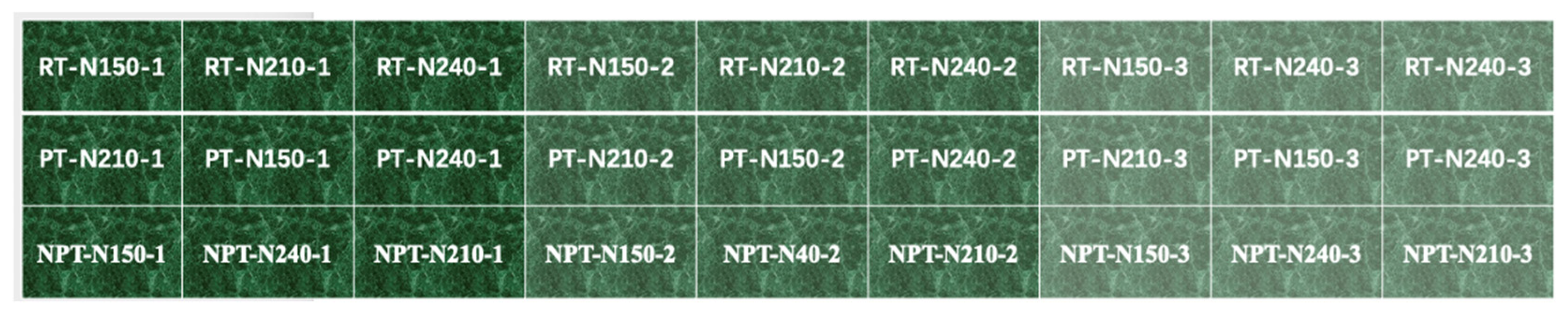
The experiment followed a randomized complete block design with three replications per treatment combination (yielding 27 experimental plots in total; see field layout in Figure 1). Each plot measured 10 m in length and 6.84 m in width, containing 12 rows. Maize (Zhengdan 958) was used as the test crop, with a planting density of 67,500 plants per hectare. The same amounts of phosphorus and potassium fertilizers were applied across all treatments: 74 kg P2O5 ha−1 and 89 kg K2O ha−1. N was supplied as urea, phosphorus as superphosphate, and potassium as potassium chloride.

2.3. The Collection and Determination of Root Images

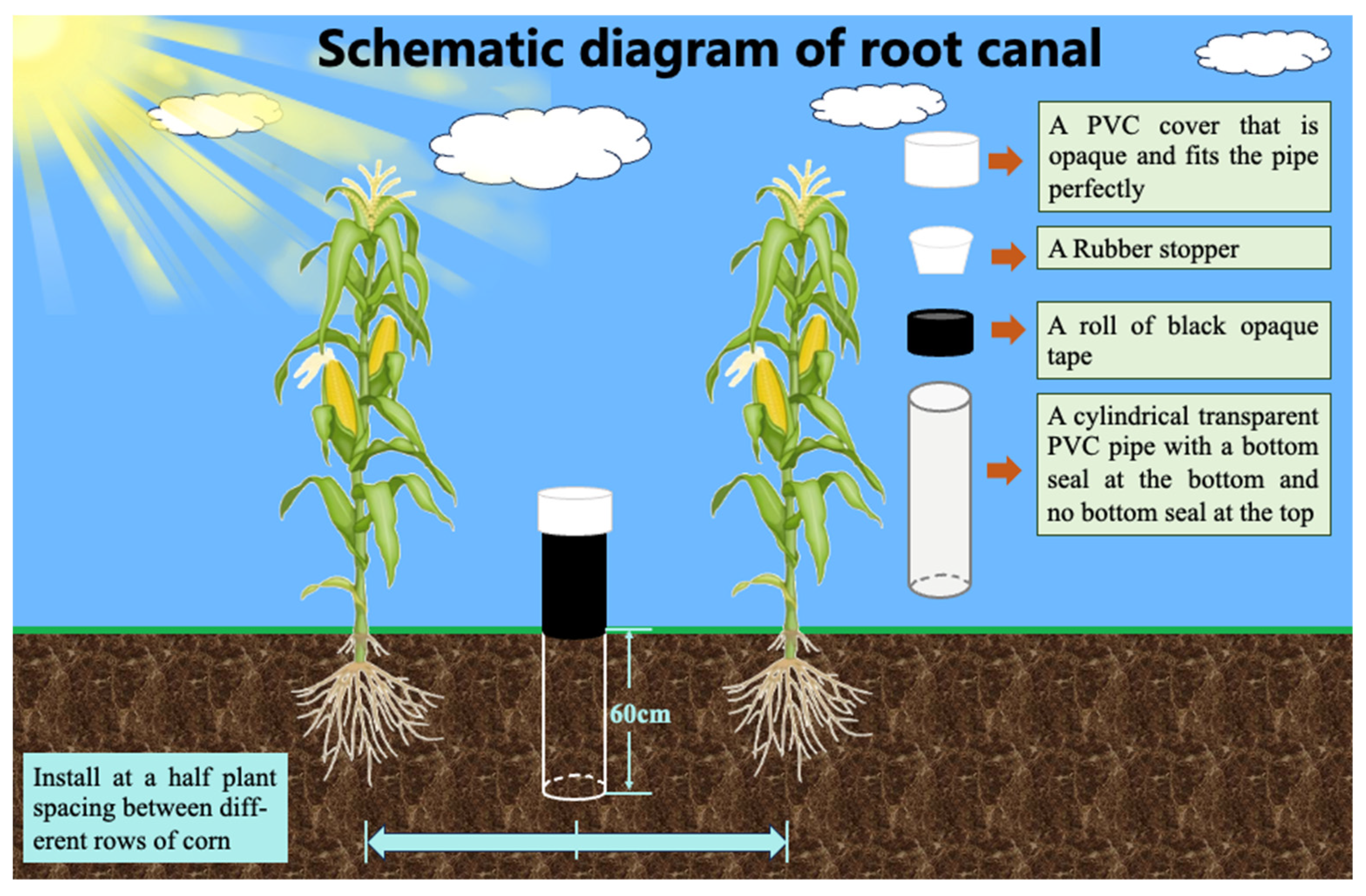
Maize root images were obtained by scanning the CI-600 root monitoring system (CID Bio-Science, Camas, WA, USA). The specific operation steps were as follows: Three corn plants were randomly selected before the seedling stage, and three root canals were embedded into each plant to monitor root growth and development. One root canal was installed in the row 20 cm away from each other on both sides of the plant, and another one was installed at 1/2 plant distance (refer to Figure 2 for the installation diagram of the root canal). The root canal was 1 m long, 8.0 cm in diameter, and transparent PVC pipe with one end opening. The unopened end of the root canal was inserted to a depth of 50 cm in the soil, leaving 50 cm above the ground. The open end of the root canal exposed to the ground was blocked with a rubber plug and then covered with a plastic sheet to prevent rain from entering. During the measurement, the plastic sheet and the rubber plug were removed, and the scanner was put into the root canal along the wall of the root canal; the part above the ground should be wrapped with black opaque tape to prevent sunlight from entering and affecting the root growth; the gap between the pipe wall and the soil should be filled in with excavated soil as tightly as possible [20].
Images of corn roots were collected at three different soil depths (0–10 cm, 10–30 cm, and 30–50 cm) during the corn tasseling stage (VT) and milk stage (R3) in 2022. Make sure that the inner wall of the root canal is clean and free of water before scanning each time. Connect the scanner with a computer-driven by the scanner installed. The scanner does not leave the calibration tube and is turned on; firstly, the scanner was calibrated, and after calibration, the scanning head was sent down with a pull rod for scanning, and the corn root images (21.6 × 19.6 cm) within 2 mm around the tube wall in different soil layers and different growth periods were obtained. After all the images were scanned, the images were brought back to the laboratory, and then the root length and average root diameter were obtained by WinRHIZO-Tron 2016 software (Regent Instrument Company, Québec, QC, Canada), and the RLD and root surface area density were further calculated.
The root length density (RLD) and root surface area density (RSD) are calculated as follows [21]:
RLD = L/V
RSD = 2Πr L/V
In the formula,
L is the root length (cm); V is the volume of the soil sample (cm3); r is the mean radius of the root. The soil sample volume in this experiment is the scanned root image range, 21.6 cm (length) × 19.6 cm (width) × 0.2 cm (depth).

2.4. Collection and Determination of Root System Samples

Three plants were randomly selected from each plot during the maize tasseling stage (VT) and milk stage (R3). The above-ground part was removed before the root samples were collected, and then the soil cube (20 cm long × 20 cm wide × 20 cm deep) was dug out and brought back to the laboratory in an ice box, and then the soil block was put into a 100-mesh nylon bag. The root activity was determined using the mixed root samples from the entire 0–20 cm soil layer. This sampling depth was strategically selected because the topsoil (0–20 cm) is well-established as the zone of the highest root density and physiological activity in cereal crops. The literature indicates that the topsoil can account for 65% to 74% of the total root biomass in annual and perennial plants [22]. Consequently, it serves as a sensitive, standard, and representative indicator for comparative studies on root physiology. While we acknowledge that a deeper profile would be ideal, practical constraints during the sampling period further necessitated a focused protocol. The non-destructive minirhizotron data (0–50 cm) provide the complementary deep root morphological context for these physiological measurements. After rinsing with tap water, all visible roots were manually picked out, and the water attached to the roots was sucked up with filter paper. Part of the roots was used for the determination of root vitality; the other part was defoliated at 105 °C for 30 min, dried to constant weight at 60 °C, the dry weight of the roots was measured, and then crushed for the determination of root cellulose, hemicellulose, lignin, and infrared spectrum [20]. The TTC (2,3,5-Triphenyltetrazolium chloride) colorimetric method was used to determine root activity [13]. The cellulose, hemicellulose, and lignin were determined by the SLQ-6A semi-automatic crude fiber analyzer (Shanghai Fiber Inspection Instrument Co., LTD., Shanghai, China) Van Soest method [23]. A Fourier transform infrared (FTIR) spectrometer was used to determine the transmittance at characteristic peaks associated with proteins. It should be noted that FTIR provides qualitative and semi-quantitative information on functional groups; changes in transmittance reflect relative differences in the vibrational energy levels of specific chemical bonds within the samples, not absolute protein content [24]. A Fourier infrared spectrometer (Nicolet IS 50, Thermo Fisher Scientific, Waltham, MA, USA) was used to determine the transmittance of characteristic peaks of root proteins. FTIR spectroscopy was performed using a Nicolet IS 50 spectrometer (Thermo Fisher, USA) to analyze root protein composition. Oven-dried root powder was mixed with spectroscopic-grade KBr (1:100, w/w) and pressed into pellets. Spectra were acquired in the range of 4000–400 cm−1 with a resolution of 4 cm−1 and 32 scans per sample. The transmittance values at characteristic protein absorption peaks (Amide I at ~1631 cm−1 and -CH2- bending at ~1382 cm−1) were recorded for semi-quantitative comparison [24].

2.5. Photosynthesis and Yield

Clear and cloudless weather from 9:00–11:00 a.m. was selected during the maize tasseling stage (VT) and milk stage (R3) periods: The portable photosynthetic system instrument (Li-6400XT, LI-COR Biosciences, Lincoln, NE, USA) was used to determine the net photosynthetic rate (Pn), stomata conductivity (Gs), intercellular CO2 concentration (Ci), and transpiration rate (Tr). Three plants with representative growth were selected from each plot, and inverted three-leaf leaves (usually completely exposed to the outside) were measured 3 times and the average value was taken for each leaf.
In the physiological maturity (R6), to determine yield, the side rows of each plot were first removed to avoid border effects. Plants were then harvested from a central area of 15 m2 within each plot. The number of plants and panicles were counted, and the total panicle weight was measured. Grain moisture content was determined using a grain moisture analyzer. The grain was subsequently dried to a constant weight at a low temperature for accurate yield calculation when the initial moisture content exceeded 20%, the seed test was carried out in the laboratory, and the yield components such as the panicle number, kernel number per spike, and 100-kernel weight were measured. The seed test data were combined with the yield measurement data in the field, and the grain yield was calculated according to the grain water content of 14%.

2.6. Statistical Analysis

Microsoft Office Excel 2021 and SPSS 23.0 were used for data collation, calculation, and significance difference analysis (ANOVA and Duncan multiple range test, p < 0.05 and p < 0.01). Pearson correlation analysis was used to analyze the relationship among parameters. Thermo Scientific OMNIC (v9.2) software was used to analyze the infrared spectrum, and Origin 2021 was used for plotting.

3. Results

3.1. Root Morphological Characteristics

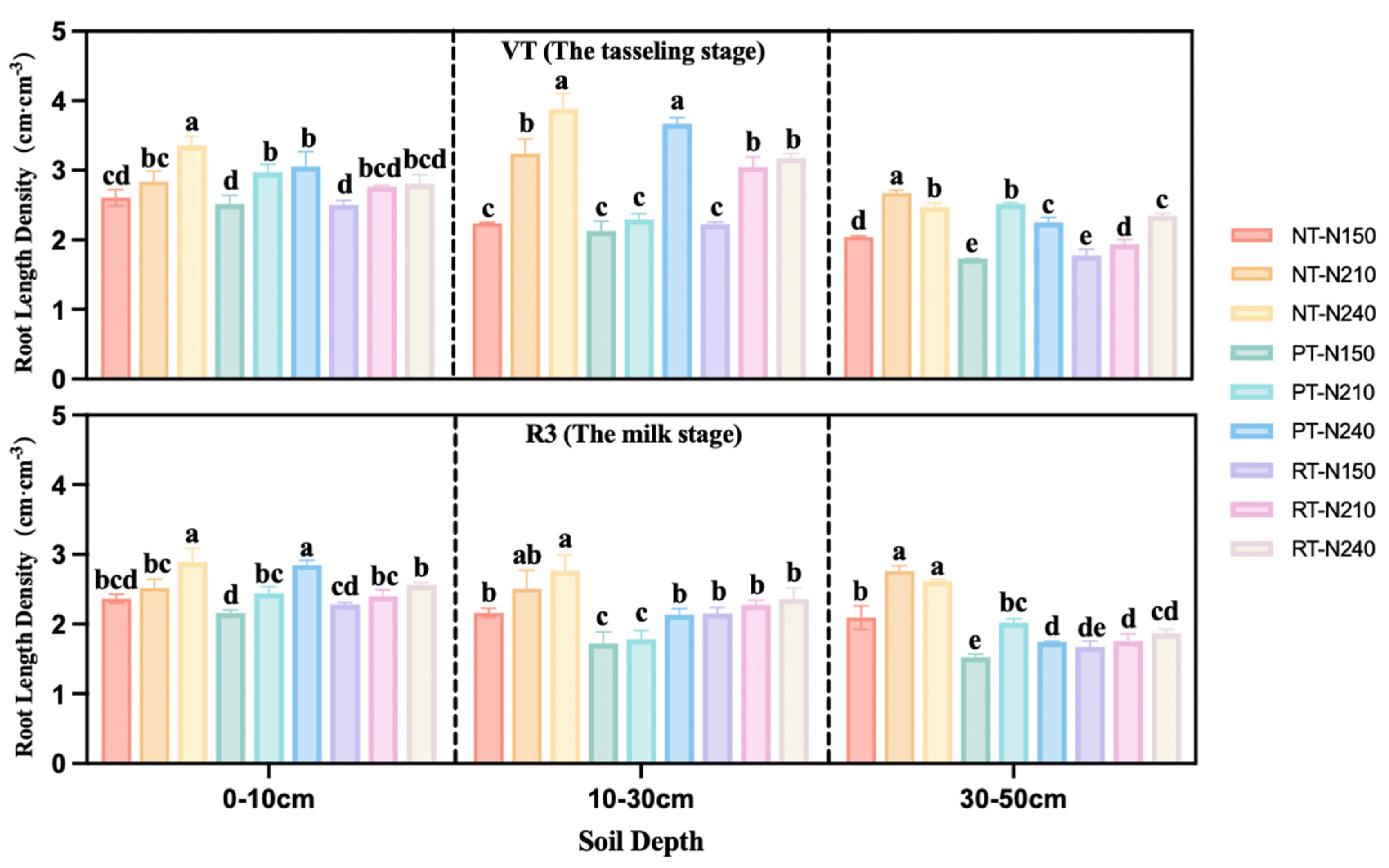
As shown in Figure 3, the root length density (RLD) generally declined from the tasseling stage (VT) to the milk stage (R3), a trend influenced by the tillage practice, N rate, and soil depth. Across both stages, the N application rate exerted a greater influence on the RLD than the tillage method. In the 0–30 cm layer, the RLD consistently increased with higher N rates. Within the deeper 30–50 cm layer, a distinct tillage-by-N interaction was observed as follows: under no-tillage/subsoiling rotation (NT) and continuous subsoiling (PT), the RLD peaked at the N210 level, whereas under continuous rotary tillage (RT), the high N rate (N240) yielded a significantly higher RLD than the low and medium N rates (p < 0.05). The effect of tillage was most pronounced in this deep soil layer. Overall, the NT practice mitigated the RLD decline from VT to R3, suggesting delayed subsoil root senescence. This was best exemplified by the NT-N210 treatment. At VT, its RLD in the 30–50 cm layer was the highest among all treatments, being 54.5% greater (p < 0.05) than that of PT-N150, an advantage that became even more pronounced by the R3 stage.
The vertical distribution of the RLD also varied. At VT, the RLD under N150 (all tillage) and PT-N210 decreased with the soil depth, while under other N210/N240 treatments, it first increased and then decreased. At R3, all treatments except PT-N210 showed a decreasing trend with depth. When comparing tillage methods at the same N rate, NT generally resulted in a higher RLD than PT and RT, especially in the 30–50 cm layer. At tasseling, the NT RLD was 21.6% to 63.6% higher than PT and 18.3% to 62.9% higher than RT (p < 0.05) in this layer. At the milk stage, it remained 54.5–60.3% higher than PT and 42.8–48.0% higher than RT (p < 0.05). The response to the N rate differed by tillage: under RT, the RLD in all layers increased with the N rate; under NT and PT, it increased in the 0–30 cm layer but peaked at N210 in the 30–50 cm layer.
At the tasseling stage, the NT-N240 treatment achieved the highest RLD in both the 0–10 cm (3.36 cm cm−3) and 10–30 cm layers, values that were significantly greater than all other treatments (p < 0.05). In the 30–50 cm layer, the NT-N210 treatment had the highest RLD, representing a significant 54.5% increase (p < 0.05) over the minimum value observed in PT-N150.
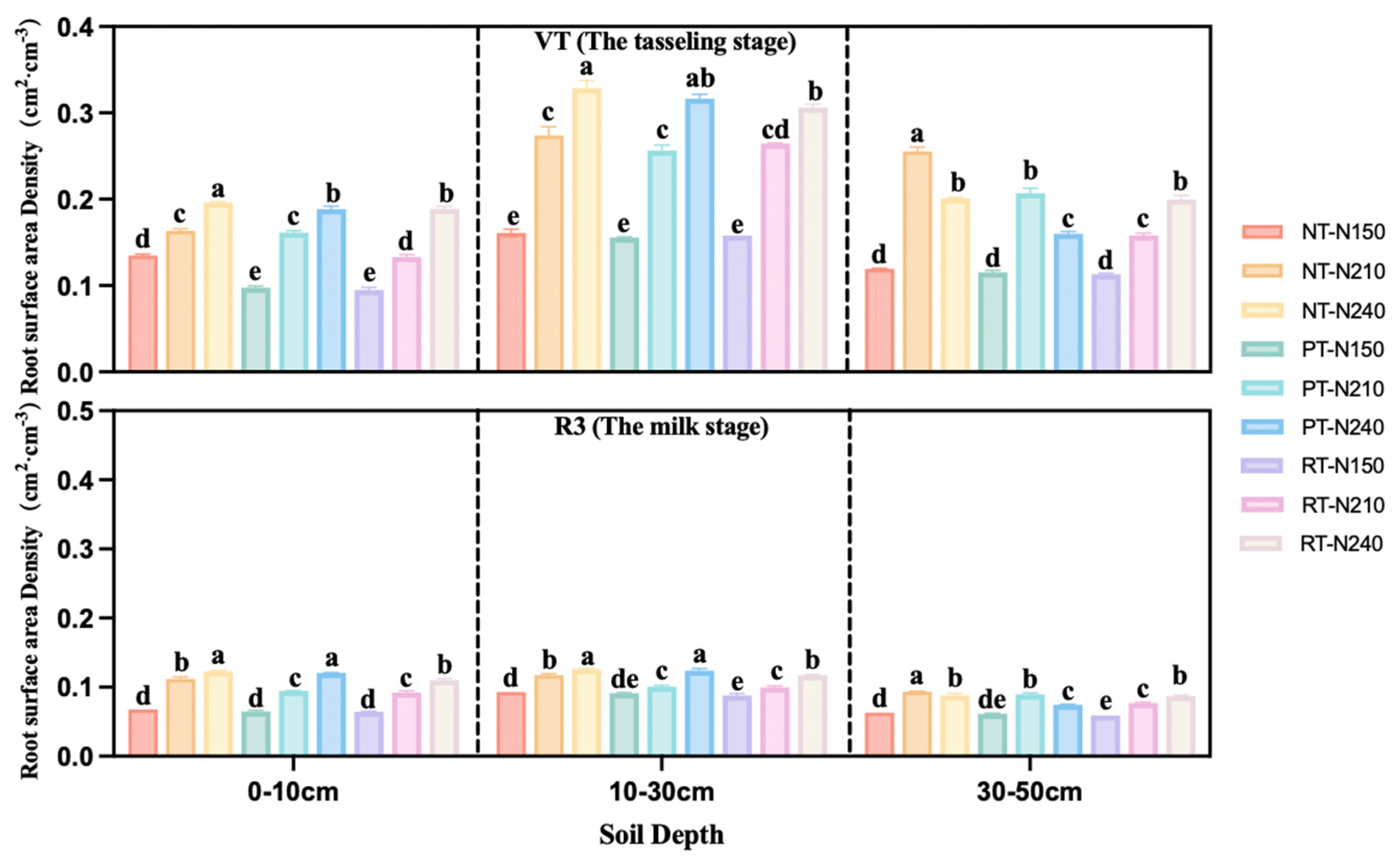
The root surface area density (RSD) showed a consistent decline from the tasseling (VT) to the milk stage (R3) across treatments, exhibiting a characteristic “first increase then decrease” pattern with the soil depth (Figure 4). The tillage practice significantly influenced the RSD, and this influence interacted with the nitrogen (N) application rate. Under the same N rate, the no-tillage/subsoiling rotation (NT) consistently resulted in a higher RSD than continuous subsoiling (PT) or rotary tillage (RT), with the advantage being most pronounced in the subsoil (30–50 cm). For instance, under N210, the RSD in the 30–50 cm layer under NT was 23.5% and 62.0% higher than under PT and RT, respectively. The nitrogen application level also markedly affected the RSD, but the response pattern differed among tillage systems. Under RT, the RSD increased progressively with the N rate in all soil layers. In contrast, under NT and PT, the RSD in the 0–30 cm layer increased with the N rate, whereas in the 30–50 cm layer, it followed a “first increase then decrease” trend, peaking at the N210 level. The NT-N210 treatment proved most effective in maintaining a larger root surface area, particularly in deep soil. At the tasseling stage, the RSD for NT-N210 in the 30–50 cm layer was 127.2% higher than the minimum value observed in RT-N150. This advantage remained substantial at the milk stage, where it was still 58.0% higher, indicating a positive role in sustaining the root absorption capacity during the late growth period.

3.2. Root Activity and Root Structure Characteristics

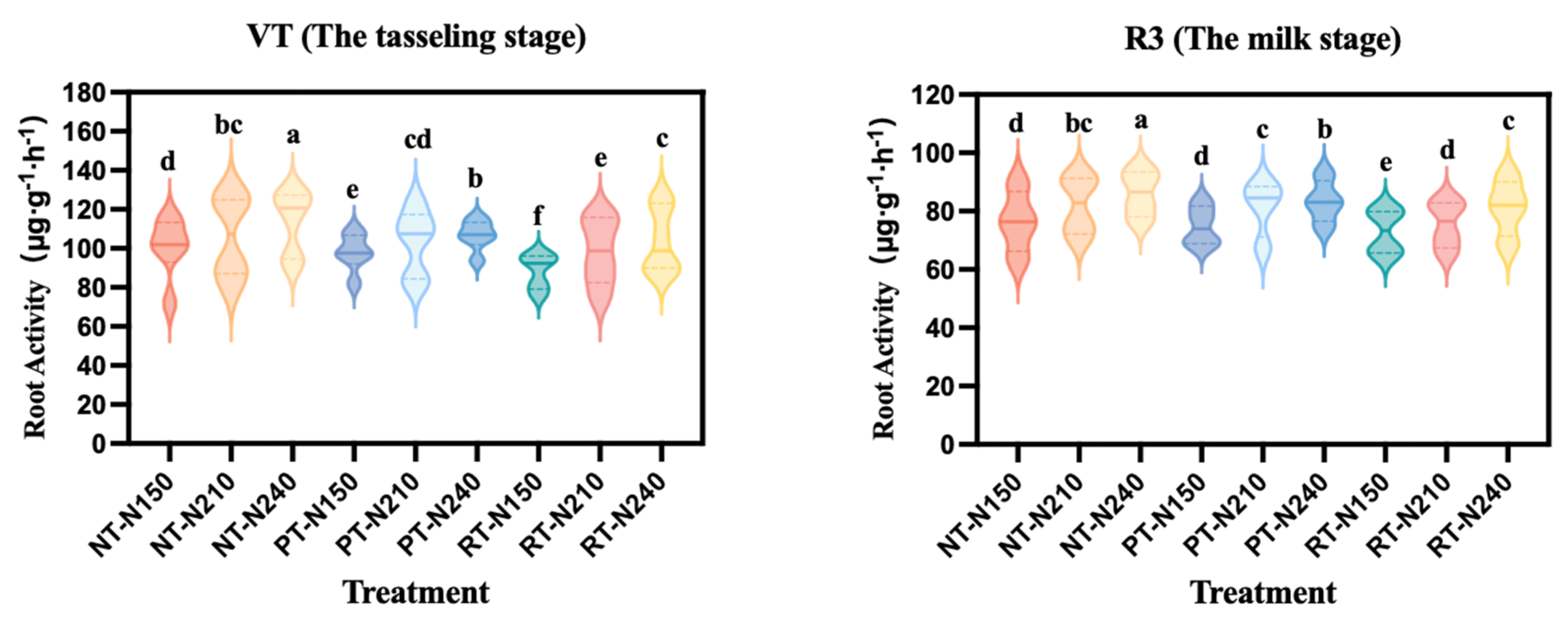
As shown in Figure 5, the root activity in the 0–20 cm soil layer exhibited a significant decline from the tasseling (VT) to the milk stage (R3). The tillage practice significantly affected the root activity, with the no-tillage/subsoiling rotation (NT) consistently resulting in higher values than continuous subsoiling (PT) or rotary tillage (RT) under the same nitrogen (N) rate. At the tasseling stage, this advantage of NT was significant under the N150 and N240 conditions. However, under N210, the root activities of NT and PT were statistically similar, yet both were significantly higher than those of RT (p < 0.05). Root activity increased with higher N application rates across all tillage methods. At the milk stage, the NT-N240 treatment maintained the highest root activity, which was significantly greater than all other treatments (p < 0.05). In conclusion, the NT-N240 combination was most conducive to preserving root activity in the topsoil and delaying functional decline during the later growth stage.
As shown in Table 1, the transmittance at the protein-associated wavenumbers (1631 and 1382 cm−1) was consistently lower at the tasseling stage (VT) than at the milk stage (R3), indicating a gradual decrease in the protein-associated FTIR signal over time. The tillage practice significantly influenced this signal, with the no-tillage/subsoiling rotation (NT) consistently yielding lower transmittance (i.e., a stronger signal) than continuous subsoiling (PT) or rotary tillage (RT) under the same nitrogen rate, especially at VT. Furthermore, transmittance at these peaks decreased with the increasing N application rate. Among treatments, NT combined with higher N rates produced the strongest protein-associated signals. At VT, the transmittance values for NT-N210 and NT-N240 at 1631 cm−1 were significantly lower than those of other treatments, reaching 65.15% and 64.78%, respectively. Similarly, at 1382 cm−1, NT-N240 showed the lowest transmittance (64.76%), which was significantly lower than all other treatments.
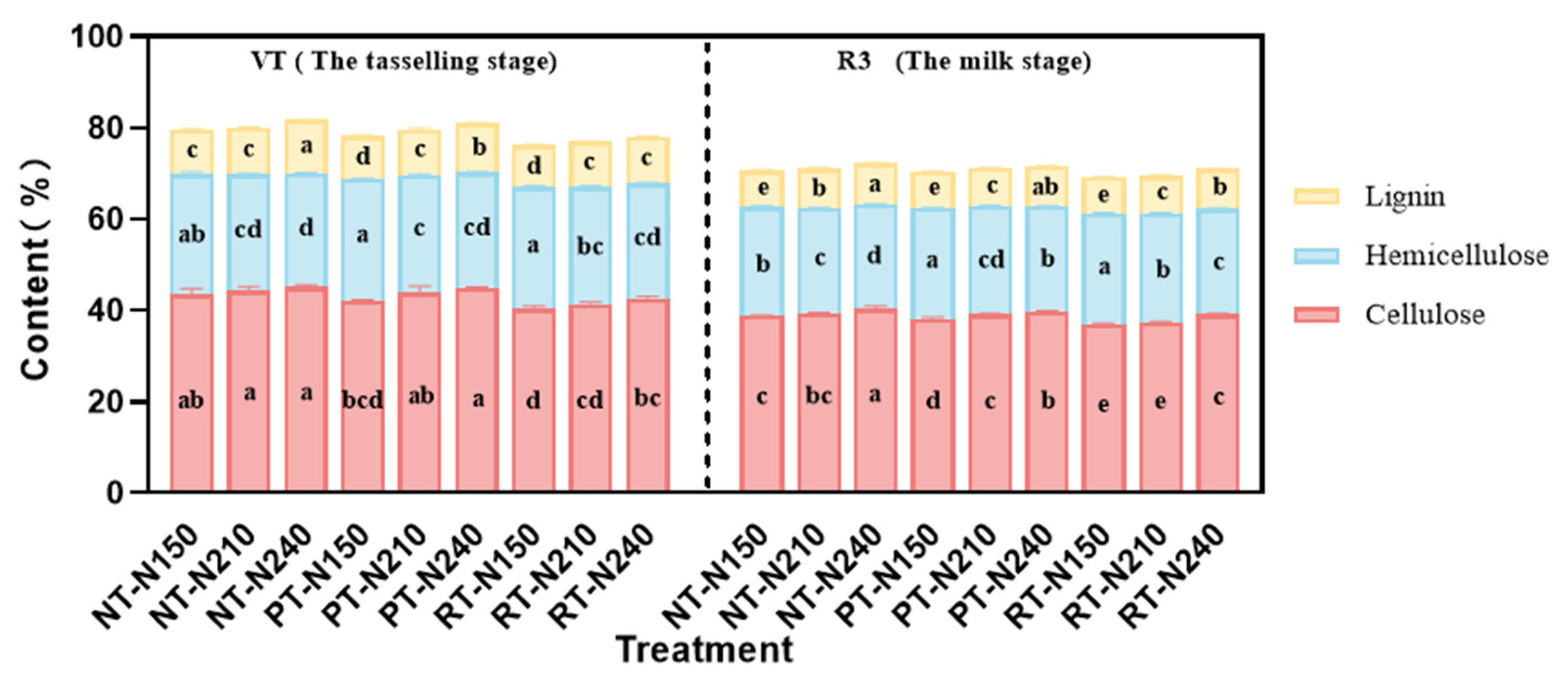
As shown in Figure 6, the contents of cellulose, hemicellulose, and lignin in maize roots decreased progressively from the tasseling (VT) to the milk stage (R3). The cellulose content was significantly influenced by the tillage and nitrogen (N) management. At the same N level, the no-tillage/subsoiling rotation (NT) resulted in a higher cellulose content than continuous rotary tillage (RT), with increases ranging from 6.2% to 7.8% at VT and 3.3% to 5.9% at R3 (p < 0.05). The cellulose content also increased with higher N rates. Although differences among treatments were relatively small at VT, they became more distinct by R3. Under each tillage method, the cellulose content under N240 was significantly higher than under N150 and N210 (p < 0.05). Notably, the NT-N240 treatment achieved the highest cellulose content, which was 9.2% higher than the lowest value observed in RT-N150. The lignin content followed a trend similar to that of cellulose. Under the N240 condition at VT, the lignin content differed significantly among the three tillage methods (p < 0.05). Specifically, the lignin content under NT-N240 was 10.2% higher than under PT-N240 and 15.0% higher than under RT-N240.

3.3. Root Weight and Photosynthetic Characteristics

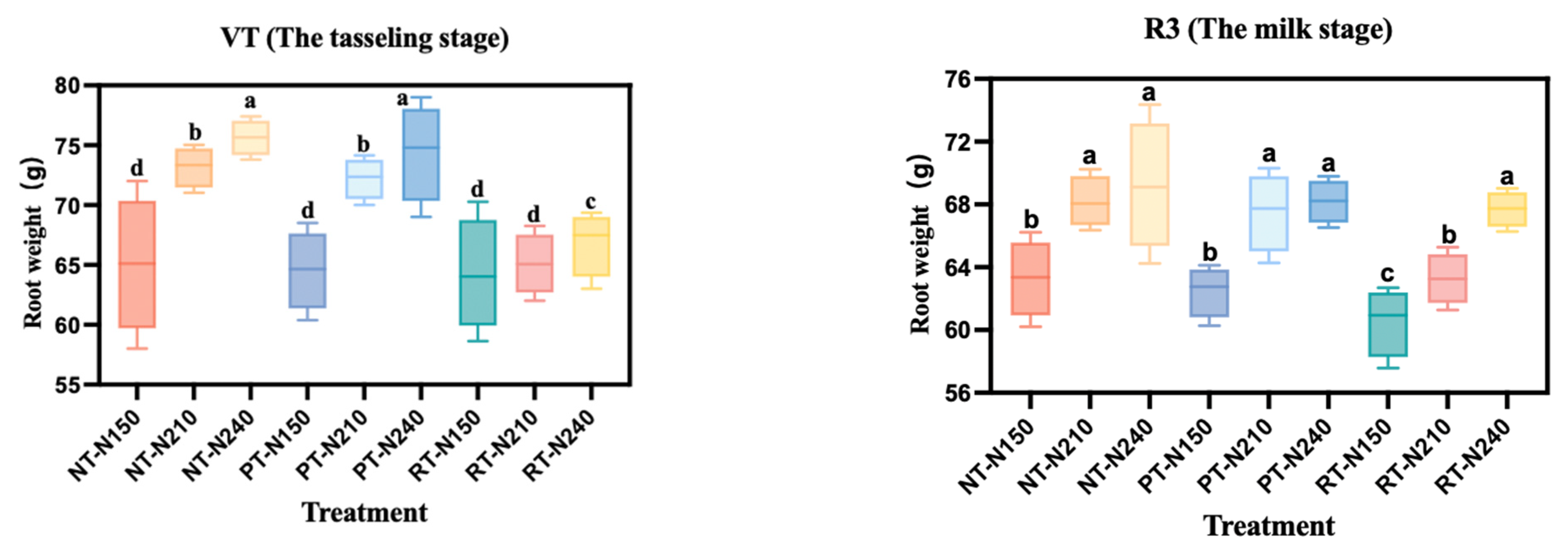
As shown in Figure 7, the root dry weight in the 0–20 cm soil layer significantly decreased from the tasseling (VT) to the milk stage (R3). Under the same nitrogen (N) rate, no significant difference in the root dry weight was observed between the no-tillage/subsoiling rotation (NT) and continuous subsoiling (PT). However, under the N210 and N240 conditions, both NT and PT resulted in a significantly higher root dry weight than continuous rotary tillage (RT), with increases of 12.1–12.7% for NT and 10.8–11.2% for PT (p < 0.05). The root dry weight increased with higher N application rates. Under all tillage methods, the N240 treatment yielded a significantly higher root dry weight than N150 at VT, with increases of 16.2% for NT, 15.7% for PT, and 5.4% for RT (p < 0.05). At the milk stage (R3), the root dry weight under NT and PT remained significantly higher than under RT under the N150 and N210 conditions (p < 0.05). Although no significant difference was observed among tillage methods under N240 at R3, the NT-N240 treatment still achieved the highest value, which was 13.4% greater than the minimum observed in RT-N150.
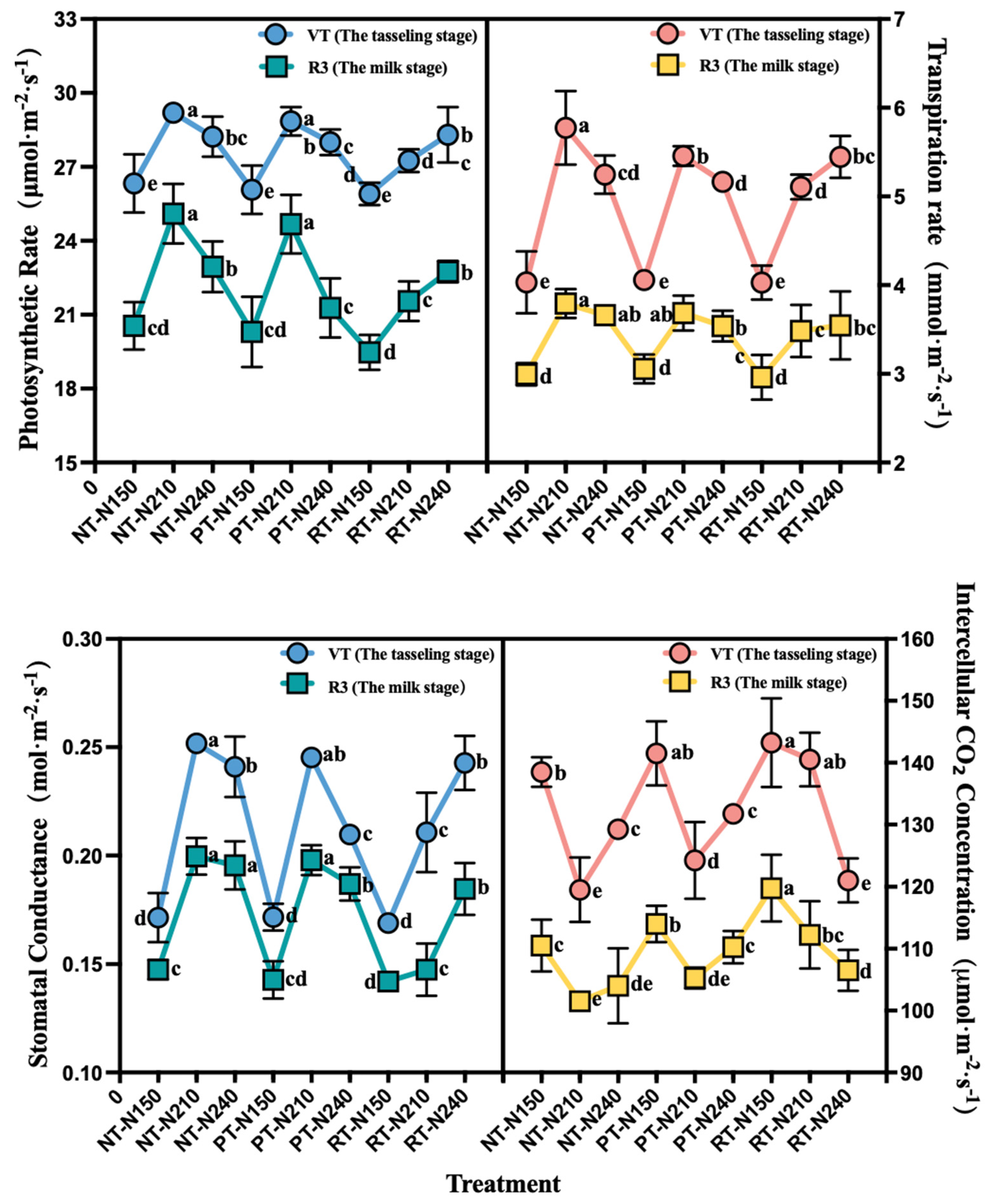
As shown in Figure 8, the photosynthetic rate (Pn), stomatal conductance (Gs), transpiration rate (Tr), and intercellular CO2 concentration (Ci) of maize leaves all exhibited a progressive decline from the tasseling (VT) to the milk stage (R3). The stomatal conductance and transpiration rate showed positive correlations with the photosynthetic rate, whereas the intercellular CO2 concentration displayed an opposite trend. The photosynthetic rate was significantly influenced by tillage and nitrogen (N) management. Under N210 fertilization, both the no-tillage/subsoiling rotation (NT) and continuous subsoiling (PT) resulted in significantly higher photosynthetic rates than continuous rotary tillage (RT) (p < 0.05), with NT consistently outperforming PT at both growth stages. The response of the photosynthetic rate to the N rate differed by tillage: under NT and PT, it showed a “first increase then decrease” pattern with increasing N application, peaking at N210; in contrast, under RT, it increased progressively across all N rates. The stomatal conductance and transpiration rate followed trends similar to the photosynthetic rate. Notably, at the tasseling stage, the transpiration rate under the NT-N210 treatment was significantly higher than that of all other treatments (p < 0.05).

3.4. Yield and Yield Component Factors

As shown in Table 2, the maize yield was significantly influenced by the tillage practice and nitrogen (N) application rate. Under the N150 and N210 conditions, the yield under the no-tillage/subsoiling rotation (NT) was significantly higher than under continuous subsoiling (PT) or rotary tillage (RT) (p < 0.05). The response of the yield to the N rate differed by tillage system: under both NT and PT, the yield exhibited a “first increase then decrease” trend with increasing N, peaking at N210; whereas under RT, the yield increased progressively across N rates. The highest yield of 12,896.1 kg ha−1 was achieved under the NT-N210 treatment, which was 38.0% higher than that of PT-N150 (p < 0.05). The 100-grain weight followed a pattern similar to the yield. The NT-N210 treatment resulted in the highest 100-grain weight, which was significantly greater than all other treatments (p < 0.05) and represented a 26.1% increase over the minimum value observed in RT-N150. The nitrogen application rate had a significant effect on the kernel number per ear (p < 0.05). In contrast, neither the tillage practice nor the interaction between the tillage and N rate significantly affected this yield component.

3.5. Correlation Analysis

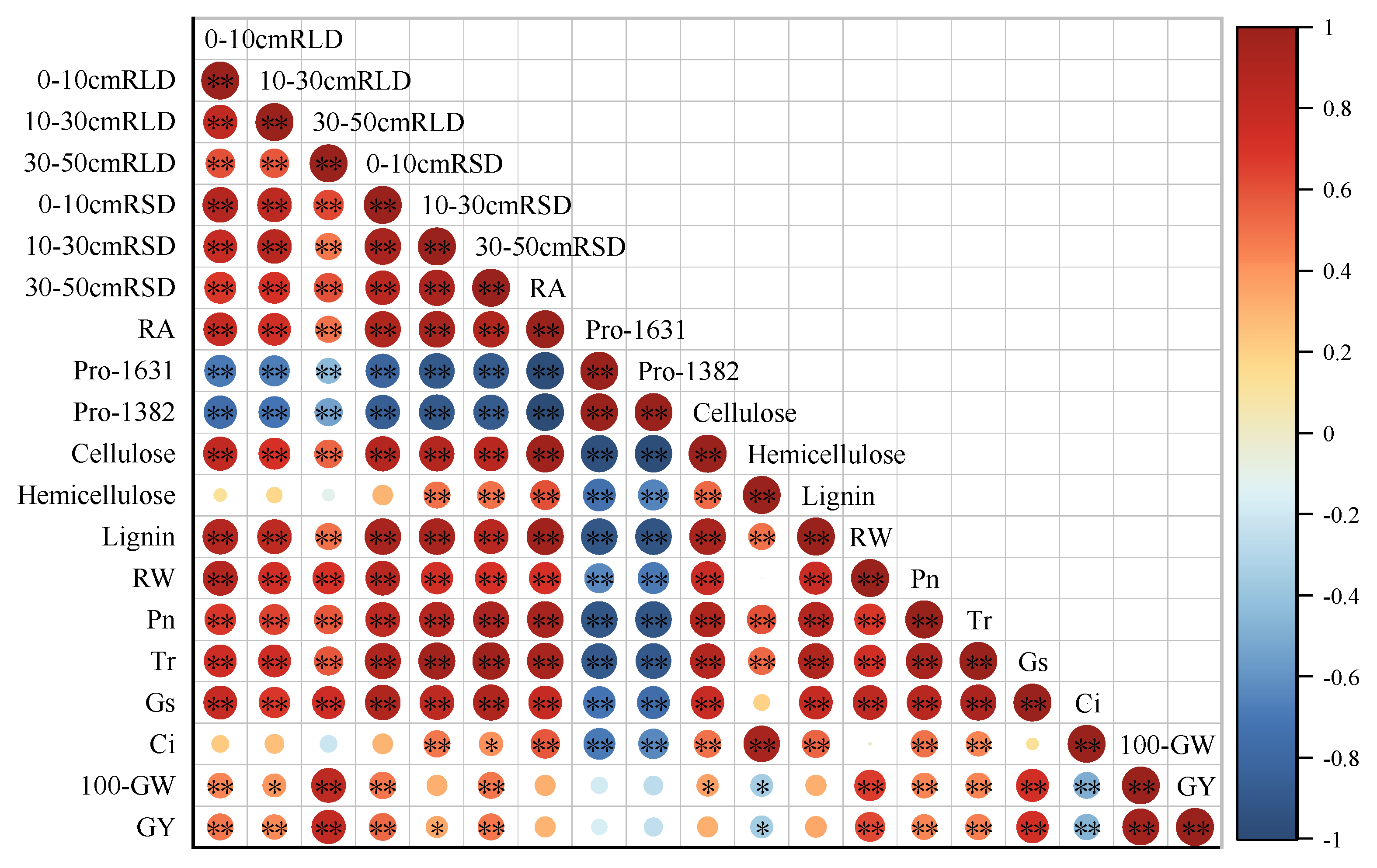
As shown in Figure 9, the maize yield showed significant positive correlations with the root length density (RLD), root surface area density (RSD), root dry weight, and photosynthetic parameters in the 0–50 cm soil layer. Both the RLD and RSD were positively correlated with the root activity, cellulose and lignin content, root dry weight, photosynthetic characteristics, and 100-grain weight. The transmittance at protein-associated FTIR peaks (1631 and 1382 cm−1) was negatively correlated with the strength of the protein signal. Root activity was positively linked to this protein-associated signal, as well as to the cellulose, hemicellulose, and lignin content, root dry weight, and photosynthetic performance. Furthermore, the root dry weight was positively correlated with the cellulose and lignin content, photosynthetic traits, and 100-grain weight.

4. Discussion

4.1. Effects of Straw Returning Mode and N Application Amount on Root Morphological Characteristics of Maize

Under N210 and N240 N application, the RLD of corn roots first increased and then decreased with the deepening of the soil depth, except for the PT-N210 treatment, which showed a decreasing trend with the deepening of the soil depth, which was the same as that under the N150 condition, and the RLD size in the 10–30 cm and 30–50 cm soil layers was similar. This may be because long-term PT return increases the porosity and reduces the penetration resistance of deep soil. Under heavy rainfall, this can result in N leaching to deep layers, while simultaneously reducing the physical impedance for root growth, both of which promote the proliferation of roots into deep soil under PT [25]. Maize reproductive growth and vegetative growth took place at the same time in the tasseling stage, which was the key period for yield formation. In this study, the RLD and RSD of maize at the tasseling stage (VT) and milk stage (R3) were measured. The results showed that compared with PT and RT, the NT returning mode promoted root growth in all soil layers, significantly increased root RLD and RSD in deep soil, effectively delayed the decrease in RLD in deep soil during the milk stage (R3), and increased nutrient uptake by maize from deep soil (p < 0.05). This is consistent with previous studies. Zhu et al. found that compared with continuous rotary tillage, rotating tillage treatment with sub-tillage and no-tillage could significantly improve the root distribution in 20–40 cm soil layers at the flowering and maturity stages of winter wheat [26]. This may be because NT return tillage increased the content of soil water stable aggregates and organic matter [27], broke the plow layer formed by long-term RT return tillage, and reduced the soil bulk density and penetration resistance. This mechanistic interpretation is strongly supported by Mu et al., who demonstrated that deep tillage with straw incorporation lowered the soil bulk density and created a more favorable physical environment for root growth, leading to deeper root proliferation and a higher crop yield [5,14]. However, it is important to critically note that while PT can similarly improve deep soil structure, its continuous application may lead to negative effects such as increased fuel consumption, higher operational costs, and elevated soil respiration rates, which can reduce the soil carbon and N sequestration capacity [28]. The N fertilizer application rate was the main factor affecting the growth and survival rate of wheat roots [10]. The RLD and the size of the root surface area are the key factors in determining N uptake for grain protein synthesis in maize at the silking stage [29]. This study showed that in the 0–30 cm soil layer, both the RLD and RSD increased significantly with the increase in the N application rate (p < 0.05), while in the 30–50 cm soil layer, the RLD and RSD of NT and PT returned to the field increased first and then decreased with the increase in the N application rate. Some studies have shown that deep loosening and proper N fertilizer application can improve the growth of deep roots and slow down the senescence of deep roots [30]. Similarly, some studies have shown that under the condition of straw returning to the field, moderate N deficiency can significantly improve the RLD in deep soil and the root proportion in deep soil (below 40 cm) [31]. This may be because adequate N fertilizer application enables the roots to absorb enough N in the upper soil, while under the condition of proper N reduction, the roots need to explore deeper soil to absorb nutrients to supply crop growth [4]. Furthermore, the concept that root systems adapt their architecture to optimize nutrient foraging under limited N conditions is a well-established principle, as evidenced by steeper root growth angles in maize under low N stress [4]. However, under the condition of RT returning, the RLD and RSD in the 30–50 cm soil layer did not decrease with the increase in the N application rate, which may be because the presence of the plow layer reduced the N content in the deep soil and hindered the growth of roots into the deep soil.

4.2. Effects of Straw Returning Mode and N Application Amount on Physiological and Structural Characteristics of Maize Root System

The results showed that the root activity and the protein-associated FTIR signal decreased gradually from the tasseling stage (VT) to the milk stage (R3), and the root activity and the strength of the protein-associated FTIR signal in the upper soil (0–20 cm) could be significantly increased by the NT returning method (p < 0.05). Both Wang et al. and Zhang et al. have shown that increasing N fertilizer or improving soil fertility can promote the improvement in crop root vitality [32,33]; increasing the N application rate significantly enhanced both the root vitality and protein content (p < 0.05). Notably, the NT-N240 treatment maintained the highest root activity at both the VT and R3 stages, indicating that this combination effectively improved and preserved physiological function in the upper soil layers, thereby delaying root senescence. This pattern of declining root activity during the reproductive phase has been consistently observed using non-destructive in situ monitoring techniques, such as the root electrical capacitance method [34]. This delay could be attributed to the fact that straw incorporation, combined with appropriate N fertilizer, promotes soil organic carbon accumulation and improves the microbial community composition, thereby exerting a positive effect on root physiological function [35]. Furthermore, the development of the root exodermis—a variable apoplastic barrier—may also contribute to the maintenance of root activity under stress conditions. Hose et al. [36] demonstrated that the exodermis can adapt its chemical composition in response to environmental cues, thereby regulating water and solute transport. Under NT returning with optimized N, enhanced exodermal barrier formation may reduce water loss and retain phytohormones like ABA within the root, thus delaying root senescence and supporting prolonged physiological function [36]. The NT system may modulate the timing and intensity of this competition compared to other methods. However, we note that FTIR provides semi-quantitative data; the absolute protein content was not quantified, and the microbial community composition was not measured. Therefore, the proposed link between management practices and root physiology remains inferential within our dataset. It is also important to consider the early-stage dynamics of straw incorporation. The high C/N ratio of straw can initially stimulate the microbial immobilization of soil mineral N, creating a temporary competition for N between soil microorganisms and crop roots [37]. Cellulose, hemicelluloses, and lignin are the main components of the cell wall, and cell wall biosynthesis is involved in the process of cell division, elongation, and differentiation, thus affecting root elongation, and the amount of N application has a significant impact on cell wall composition [38,39]. The results of this study also showed a significant positive correlation between the RLD and the contents of cellulose and lignin, suggesting that root morphological development may be linked to the biosynthesis of these structural compounds. This is consistent with the role of cellulose and lignin in reinforcing root cell walls, including those of the exodermis. Hose et al. (2001) [36] highlighted that lignin and suberin in the exodermis not only provide mechanical strength but also modulate apoplastic transport. The increased deposition of these compounds under higher N availability may enhance the barrier properties of the exodermis, thereby improving the water and nutrient retention capacity—a feature that could synergize with the observed improvements in the RLD and root dry weight under NT-N240 [36]. This correlation suggests that root morphological development may be linked to the biosynthesis of these structural compounds, the contents of which were significantly increased with the increase in the N application rate (p < 0.05). The changing trend of the root dry weight was similar to that of cellulose and lignin because the root dry weight was significantly positively correlated with the cellulose and lignin contents in roots. In the upper soil, the root dry weight did not differ significantly between the NT and PT methods. However, the root dry weight under both NT and PT was significantly higher than under the RT method (p < 0.05; Figure 7). This demonstrates that subsoiling-based straw return (NT and PT) promoted root growth and significantly increased root biomass compared to conventional rotary tillage (RT), a result supported by Zhang et al. [40]. This coordinated improvement in root and shoot growth under optimized management has been previously reported, where enhanced root growth supported greater biomass and grain yield [14], a synergy that our results strongly corroborate. This improvement in above-ground growth is consistent with our observation that deep loosening-based straw return (NT/PT) significantly enhanced the photosynthetic rate, stomatal conductance, and transpiration rate (Figure 8). The increased photosynthetic activity likely supported greater dry matter accumulation. Research indicates that when the leaves of corn start to age, the root system has already severely aged, and leaf aging might be caused by root aging [41]. The duration of leaf photosynthesis is the key to delaying leaf senescence, and the photosynthetic rate after the silking stage has a more significant effect on the yield [42]. In this study, under subsoiling with straw return, the application of appropriate N fertilizer improved the photosynthetic rate of maize at the tasseling (VT) and milk (R3) stages. This improvement was correlated with a delay in leaf senescence, and the effect was more significant under no-till (NT) straw return conditions.

4.3. Effect of Root Growth on Yield of Maize

In this experiment, root morphological, physiological, and structural indexes in 0–50 cm soil were measured at the maize tasseling stage (VT) and milk stage (R3). The results showed that the RLD, RSD, RW, and photosynthetic characteristics were significantly positively correlated with the maize yield (p < 0.05), among which the root RLD in the 30–50 cm soil layer showed the strongest correlation with the yield. The variation trend of the yield was consistent with that of the RLD, RSD, and photosynthetic rate of the 30–50 cm soil layer. The corn yield under the NT returning mode was significantly higher than that under other returning modes and showed a trend of first increasing and then decreasing with the increase in the N application rate (p < 0.05). For instance, Sui et al. (2020) [16] directly demonstrated in Northeast China that tillage with straw incorporation and a medium N rate was sufficient to maximize the maize yield, with no significant further improvement at higher N rates, a finding that our results strongly corroborate. This yield plateau can be explained by the concept of optimal resource allocation, where the root system itself constitutes a significant sink for photoassimilates and nutrients. Beyond the optimal root size achieved under N210, further investment in root growth under a higher N supply (e.g., N240) may divert carbon and resources away from grain filling, thereby limiting additional yield gains [43]. This is because the NT-N210 treatment significantly promoted the increase in the RLD and RSD of roots in deep soil, increased the contact area between roots and soil, and improved the ability of roots to absorb nutrients, so that crops could maintain a higher photosynthetic rate, especially in the late growth period (p < 0.05). This finding resonates with the root ideotype concept where “steep, cheap, and deep” root systems are theorized to enhance soil resource acquisition [44]. Our results provide empirical support for the agronomic value of deeper root systems in this region. Thus, nutrient uptake and accumulation in the aboveground biomass were enhanced, providing favorable conditions for grain enrichment. In this study, the RLD, RSD, and RW also had a significant impact on the 100-grain weight. Root growth in the 30–50 cm soil layer was significantly correlated with the 100-grain weight, thereby influencing the corn yield (p < 0.05). Chen et al. also showed that the increase in various root morphological indexes improved the plant’s ability to absorb soil nutrients and the amount of nutrients accumulated, which significantly increased the 100-grain weight of corn [3]. In conclusion, the application of the NT returning method with appropriate N fertilizer (N210) is conducive to promoting root growth in deep soil, thus promoting crop production and achieving a high yield.

5. Conclusions

This study demonstrates that in the maize cropping systems of Liaonan, China, an integrated practice of no-tillage/subsoiling rotation (NT) with a moderate nitrogen application rate of 210 kg ha−1 (N210) synergistically optimizes the root system, delays senescence, and achieves a high yield with improved efficiency.
Compared with continuous subsoiling (PT) or continuous rotary tillage (RT), the NT-N210 treatment significantly promoted root growth in the deep soil layer (30–50 cm), as indicated by the increased root length density (RLD) and root surface area density (RSD). It also delayed root and leaf senescence during the grain-filling period, evidenced by higher root activity, stronger protein-associated FTIR signals, and greater lignin accumulation. These improvements supported enhanced leaf photosynthetic performance, ultimately leading to the highest grain yield (12,896 kg ha−1) under NT-N210, while reducing nitrogen input by 12.5% compared to the conventional high rate (N240).
Therefore, adopting the NT practice combined with a reduced N rate (210 kg N ha−1) is recommended as an effective agronomic strategy to coordinately enhance maize productivity and nitrogen use efficiency in similar systems. Future research should validate the long-term benefits and broader adaptability of this integrated management approach.

Author Contributions

B.Z.: Experiment, date plotting, conceptualization, writing—original draft. X.W.: Sampling, experiment, data organization. A.L.: Supervision and project administration. X.G., Y.F., N.L. and Y.W.: Writing—review. X.Z.: Resources, funding acquisition, supervision, writing—review. All authors have read and agreed to the published version of the manuscript.

Funding

This work was supported by the National Key R&D Program of China (2024YFD1501700).

Data Availability Statement

The raw data supporting the conclusions of this article will be made available by the authors on request.

Acknowledgments

We sincerely thank all the members of the Plant Nutrition and Fertilization Technical Team for their enthusiastic help and the availability of laboratory conditions.

Conflicts of Interest

The authors declare that they have no known competing financial interests or personal relationships that could have appeared to influence the work reported in this paper.

References

  1. Qin, H.-L.; Gao, F.; Ma, Y.; Ma, L.; Yin, C.M.; Chen, Z.; Chen, C. Effects of subsoiling on soil moisture after two years of no-tillage. Sci. Agric. Sin. 2008, 7, 78–85. [Google Scholar]
  2. Chen, Y.L.; Palta, J.; Clements, J.; Buirchell, B.; Siddique, K.H.; Rengel, Z. Root architecture alteration of narrow-leafed lupin and wheat in response to soil compaction. Field Crops Res. 2014, 165, 61–70. [Google Scholar] [CrossRef]
  3. Chen, Y.B.; Yang, Q.; Wang, J.J.; Miao, Z.Y.; Zhao, W.L.; Jia, X.C.; Dong, P.F.; Wang, Q. Effects of intercropping of maize varieties with different root configurations on root distribution, nutrient accumulation, and yield. J. Nucl. Agric. 2023, 37, 594–605. Available online: https://www.hnxb.org.cn/CN/10.11869/j.issn.1000-8551.2023.03.0594 (accessed on 19 December 2025).
  4. Trachsel, S.; Kaeppler, S.M.; Brown, K.M.; Lynch, J.P. Maize root growth angles become steeper under low N conditions. Field Crops Res. 2013, 140, 18–31. [Google Scholar] [CrossRef]
  5. Mu, X.Y.; Zhao, Y.L.; Liu, K.; Ji, B.Y.; Guo, H.B.; Xue, Z.W.; Li, C.H. Responses of soil properties, root growth, and crop yield to tillage and crop residue management in a wheat-maize cropping system on the North China Plain. Eur. J. Agron. 2016, 78, 32–43. [Google Scholar] [CrossRef]
  6. Wang, C.X.; Song, C.Y.; Zhu, K.L.; Liu, Y.T.; Song, X.Y.; Li, J. Effects of straw returning combined with N fertilizer on yield and photosynthetic characteristics of maize. J. Northwest Agric. Sci. 2022, 31, 1415–1421. [Google Scholar]
  7. Bai, W.; An, J.W.; Zhang, L.Z.; Pang, H.C.; Sun, Z.X.; Niu, S.W.; Cai, Q. Straw returning to the field combined with N fertilizer to improve soil physicochemical properties and increase spring maize yield. Trans. CSAE 2017, 33, 168–176. [Google Scholar]
  8. Jia, Q.; Chen, K.; Chen, Y.; Ali, S.; Sohail, A.; Fahad, S. Mulch-covered ridges affect the grain yield of maize by regulating root growth and root-bleeding sap under simulated rainfall conditions. Soil Tillage Res. 2018, 175, 101–111. [Google Scholar] [CrossRef]
  9. Xu, C.; Li, X.; Liu, X.L.; Qian, L.; Jiang, Y.; Wang, H.J.; Zhang, L.H.; Bian, S.F. Effects of different drip irrigation methods on root damage flow and photosynthetic characteristics of maize. J. Nucl. Agric. 2023, 37, 2042–2051. [Google Scholar]
  10. Herrera, J.M.; Noulas, C.; Feil, B.; Stamp, P.; Liedgens, M. Nitrogen and genotype effects on root growth and root survivorship of spring wheat. J. Plant Nutr. Soil Sci. 2013, 176, 561–571. [Google Scholar] [CrossRef]
  11. Huai, S.C.; Liu, L.L.; Ru, J.R.; Yan, Z.H.; Wang, J.Y.; Wang, S.C.; Xing, T.T.; Wu, H.L.; Lu, C.A.; Sun, J.Y. Effect of increasing application of organic fertilizer on improving physical properties of black soil and promoting root growth of maize. Soil Fertil. China 2020, 147, 40–46. [Google Scholar]
  12. Jiang, Y.; Wang, Z.Y.; Lian, H.L.; Wang, M.J.; Sun, Y.H.; Tian, P.; Sui, P.X.; Ma, Z.Q.; Wang, Y.Y.; Meng, G.X.; et al. Effects of tillage and straw returning methods on root characteristics and yield of spring maize in Northeast China at the silk-spinning stage. Sci. Agric. Sin. 2020, 53, 3071–3082. [Google Scholar] [CrossRef]
  13. Bian, D.H.; Jia, G.P.; Cai, L.J.; Ma, Z.Y.; Eneji, A.E.; Cui, Y.H. Effects of tillage practices on root characteristics and root lodging resistance of maize. Field Crops Res. 2016, 185, 89–96. [Google Scholar] [CrossRef]
  14. Guan, D.H.; Al-Kaisi, M.M.; Zhang, Y.S.; Duan, L.S.; Tan, W.M.; Zhang, M.C.; Li, Z.H. Tillage practices affect biomass and grain yield by regulating root growth, root-bleeding sap, and nutrient uptake in summer maize. Field Crops Res. 2014, 157, 89–97. [Google Scholar] [CrossRef]
  15. Zou, Q. Plant Physiology and Biochemistry Laboratory Manual; China Agriculture Press: Beijing, China, 1995. [Google Scholar]
  16. Sui, P.; Tian, P.; Lian, H.; Wang, Z.; Ma, Z.; Qi, H.; Mei, N.; Sun, Y.; Wang, Y.; Su, Y.; et al. Straw incorporation management affects maize grain yield through regulating N uptake, water use efficiency, and root distribution. Agronomy 2020, 10, 324. [Google Scholar] [CrossRef]
  17. Song, F.; Liu, M.; Zhang, Z.; Qi, Z.; Li, T.; Du, S.; Li, A.; Liu, J. No-tillage with straw mulching increased maize yield and N fertilizer recovery rate in northeast China. Agric. Water Manag. 2024, 292, 108687. [Google Scholar] [CrossRef]
  18. Wang, J.; Han, Y.; Zhou, C.; Xu, T.; Qu, Z.; Ma, B.; Yuan, M.; Wang, L.; Liu, Y.; Li, Q.; et al. Effects of depth of straw returning on maize yield potential and greenhouse gas emissions. Front. Plant Sci. 2024, 15, 1344647. [Google Scholar] [CrossRef] [PubMed]
  19. Bao, S.D. Soil and Agricultural Chemistry Analysis, 3rd ed.; China Agriculture Press: Beijing, China, 2000. (In Chinese) [Google Scholar]
  20. Su, H.Q. The Effects of Long-Term Fertilization on Soil Structure, Corn Root Distribution and Nutrient Absorption. Master’s Thesis, Shenyang Agricultural University, Shenyang, China, 2017. [Google Scholar]
  21. Wu, G.; Ling, J.; Liu, Z.-X.; Xu, Y.P.; Chen, X.-M.; Wen, Y.; Zhou, S.-L. Soil warming and straw return impacts on winter wheat phenology, photosynthesis, root growth, and grain yield in the North China Plain. Field Crops Res. 2022, 283, 108545. [Google Scholar] [CrossRef]
  22. Mattila, T.J.; Hkkinen, L. Exploring the effects of soil structure, nutrients, and farm management on crop root biomass and depth distribution. Field Crops Res. 2025, 327, 109909. [Google Scholar] [CrossRef]
  23. Van Soest, P.J.; Robertson, J.B.; Lewis, B.A. Methods for dietary fiber, neutral detergent fiber, and nonstarch polysaccharides in relation to animal nutrition. J. Dairy Sci. 1991, 74, 3583–3597. [Google Scholar] [CrossRef]
  24. Wang, X.L. Fourier Transform Infrared Spectroscopy Study of Rice and Millet. Ph.D. Thesis, Yunnan Normal University, Kunming, China, 2014. [Google Scholar]
  25. Chen, X.; Zhang, J.; Chen, Y.; Li, Q.; Chen, F.; Yuan, L.; Mi, G. Changes in root size and distribution in relation to nitrogen accumulation during maize breeding in China. Plant Soil 2014, 374, 121–130. [Google Scholar] [CrossRef]
  26. Zhu, F.H.; Wang, Y.Q.; Shi, Z.L.; Zhang, R.X.; Wang, T.C. Effects of rotating tillage on soil physical properties and root growth of winter wheat in double-cropping area of Guanzhong. Acta Ecol. Sin. 2015, 35, 7454–7463. [Google Scholar]
  27. Hou, X.Q.; Li, R.; Jia, Z.K.; Han, Q.F.; Wang, W.; Yang, B.P. Effects of rotational tillage practices on soil properties, winter wheat yields, and water-use efficiency in semi-arid areas of north-west China. Field Crops Res. 2012, 129, 7–13. [Google Scholar] [CrossRef]
  28. Zhang, J.L.; Zhang, J.L.; Zhao, X.J.; Liao, Y.C.; Jing, X.L.; Xue, Q. Soil CO2 emission and its relationship with soil water and heat in dry maize field under different tillage methods. Agric. Res. Arid. Areas 2018, 36, 88–93. [Google Scholar]
  29. Mu, X.H.; Chen, F.J.; Wu, Q.P.; Chen, Q.W.; Wang, J.F.; Yuan, L.X.; Mi, G.H. Genetic improvement of root growth increases maize yield via enhanced post-silking N uptake. Eur. J. Agron. 2015, 63, 55–61. [Google Scholar] [CrossRef]
  30. Yu, X.F.; Gao, J.L.; Ye, J.; Wang, Z.G.; Sun, J.Y.; Hu, S.P.; Sun, Z.J. Effects of deep pine and N fertilizer application on root growth, yield, and N use efficiency of ultra-high yield spring maize. Maize Sci. 2013, 21, 114–119. [Google Scholar]
  31. Xu, X.; Pang, D.W.; Chen, J.; Luo, Y.L.; Zheng, M.J.; Yin, Y.P.; Li, Y.X.; Li, Y.; Wang, Z.L. Straw return accompanies with low N moderately promoted deep root. Field Crops Res. 2018, 221, 71–80. [Google Scholar] [CrossRef]
  32. Wang, Y.; Yu, Z.; Li, X.; Yu, S. Effects of soil fertility and nitrogen application rate on root nitrogen assimilation and grain protein content in wheat. Plant Nutr. Fertil. Sci. 2003, 9, 39–44. [Google Scholar]
  33. Zhang, Y.Q. Effects of Different N Fertilizer Treatments on Main Physiological Characteristics and Yield of Maize Root System. Mater’s Thesis, Jilin Agricultural University, Jilin, China, 2012. [Google Scholar]
  34. Cseresnyés, I.; Szitár, K.; Rajkai, K.; Füzy, A.; Mikó, P.; Kovács, R.; Takács, T. Application of Electrical Capacitance Method for Prediction of Plant Root Mass and Activity in Field-Grown Crops. Front. Plant Sci. 2018, 9, 93. [Google Scholar] [CrossRef]
  35. Li, R.C.; Gao, Y.X.; Chen, Q.; Li, Z.L.; Gao, F.; Meng, Q.M.; Li, T.G.; Liu, A.R.; Wang, Q.; Wu, L.; et al. Blended controlled-release N fertilizer with straw returning improved soil N availability, soil microbial community, and root morphology of wheat. Soil Tillage Res. 2021, 212, 105045. [Google Scholar] [CrossRef]
  36. Hose, E.; Clarkson, D.T.; Steudle, E.; Schreiber, L.; Hartung, W. The exodermis: A variable apoplasic barrier. J. Exp. Bot. 2001, 52, 2245–2264. [Google Scholar] [CrossRef]
  37. Li, X.G.; Jia, B.; Lv, J.T.; Ma, Q.J.; Kuzyakov, Y.; Li, F.M. N fertilization decreases the decomposition of soil organic matter and plant residues in planted soils. Soil Biol. Biochem. 2017, 112, 47–55. [Google Scholar] [CrossRef]
  38. Tian, H.; Song, H.X.; Wu, X.W.; Zhang, Z.H. Changes of root elongation and cell wall components in rapeseed under low N conditions. J. Hunan Agric. Univ. (Nat. Sci. Ed.) 2022, 48, 386–393. [Google Scholar]
  39. Allison, G.G.; Morris, C.; Lister, S.J.; Barraclough, T.; Yates, N.; Shield, I.; Donnison, I.S. Effect of N fertilizer application on cell wall composition in switchgrass and reed canary grass. Biomass Bioenergy 2012, 40, 19–26. [Google Scholar] [CrossRef]
  40. Zhang, L. Effects of Subsoiling and Fertilizer Cultivation on Soil Water Retention Capacity and Maize Growth in Dry Farmland. Ph.D. Thesis, China Agricultural University, Beijing, China, 2014. [Google Scholar]
  41. Sun, G.; Zhang, X.; Li, Z.Z.; Liu, G.R.; Xie, J.S. Effects of different hormones on senescence characteristics of sword leaf and root system of early rice. J. Jiangxi Agric. Sci. 2009, 21, 11–14. [Google Scholar]
  42. Gupta, R.; Singh, M.; Khan, B.R. Photosynthetic electron transport rate and root dynamics of finger millet in response to. Plant Signal. Behav. 2022, 17, 2146373. [Google Scholar] [CrossRef] [PubMed]
  43. Wu, R.; Li, Y.N. Effects of water and nitrogen coupling on root distribution, root-shoot ratio, and yield of winter wheat. J. South. Agric. 2013, 44, 963–967. [Google Scholar]
  44. Lynch, J.P. Steep, cheap and deep: An ideotype to optimize water and N acquisition by maize root systems. Ann. Bot. 2013, 112, 347–357. [Google Scholar] [CrossRef]
Figure 1. Experimental treatment diagram. NPT: 1 year no-tillage with mulch and green manure + 1 year deep ploughing with mixed straw and green manure; PT: continuous deep loosening and crushing with green manure; RT: continuous rotary tillage and crushing with green manure; N150: 150 kg N ha−1; N210: 210 kg N ha−1; N240: 240 kg N ha−1; 1, 2, 3: treatment replication numbers, each treatment has three replications to avoid randomness and errors in the data. All treatment data are the average of these three sets of data.
Agriculture 16 00187 g001
Figure 2. Diagram of root canal placement.
Agriculture 16 00187 g002
Figure 3. The effects of different return-to-field patterns and different N application rates on the RLD of corn. NT: 1 year no-tillage with mulch and green manure + 1 year deep ploughing with mixed straw and green manure; PT: continuous deep loosening and crushing with green manure; RT: continuous rotary tillage and crushing with green manure; N150: 150 kg N ha−1; N210: 210 kg N ha−1; N240: 240 kg N ha−1. Different lowercase letters in the figure indicate significant differences among treatments according to Duncan’s multiple range test (p < 0.05, n = 3).
Agriculture 16 00187 g003
Figure 4. The effects of different return-to-field patterns and different N application rates on the surface area density of corn roots. NT: 1 year no-tillage with mulch and green manure + 1 year deep ploughing with mixed straw and green manure; PT: continuous deep loosening and crushing with green manure; RT: continuous rotary tillage and crushing with green manure; N150: 150 kg N ha−1; N210: 210 kg N ha−1; N240: 240 kg N ha−1. Different lowercase letters in the figure indicate significant differences among treatments according to Duncan’s multiple range test (p < 0.05, n = 3).
Agriculture 16 00187 g004
Figure 5. The effects of different return modes and different N application rates on the root activity of corn. NT: 1 year no-tillage with mulch and green manure + 1 year deep ploughing with mixed straw and green manure; PT: continuous deep loosening and crushing with green manure; RT: continuous rotary tillage and crushing with green manure; N150: 150 kg N ha−1; N210: 210 kg N ha−1; N240: 240 kg N ha−1. Different lowercase letters in the figure indicate significant differences among treatments according to Duncan’s multiple range test (p < 0.05, n = 3). Root activity was measured using mixed root samples collected from the 0–20 cm soil layer.
Agriculture 16 00187 g005
Figure 6. The effects of different return-to-field modes and different N application rates on the contents of cellulose, hemicellulose, and lignin in maize roots. NT: 1 year no-tillage with mulch and green manure + 1 year deep ploughing with mixed straw and green manure; PT: continuous deep loosening and crushing with green manure; RT: continuous rotary tillage and crushing with green manure; N150: 150 kg N ha−1; N210: 210 kg N ha−1; N240: 240 kg N ha−1. Different lowercase letters in the figure indicate significant differences among treatments according to Duncan’s multiple range test (p < 0.05, n = 3).
Agriculture 16 00187 g006
Figure 7. The effects of different return-to-field patterns and different N application rates on the dry weight of corn roots. NT: 1 year no-tillage with mulch and green manure + 1 year deep ploughing with mixed straw and green manure; PT: continuous deep loosening and crushing with green manure; RT: continuous rotary tillage and crushing with green manure; N150: 150 kg N ha−1; N210: 210 kg N ha−1; N240: 240 kg N ha−1. Different lowercase letters in the figure indicate significant differences among treatments according to Duncan’s multiple range test (p < 0.05, n = 3).
Agriculture 16 00187 g007
Figure 8. The effects of different return-to-field modes and different N application rates on the photosynthetic rate (Pn), transpiration rate (Tr), stomatal conductance (Gs), and intercellular CO2 concentration (Ci) of corn. NT: 1 year no-tillage with mulch and green manure + 1 year deep ploughing with mixed straw and green manure; PT: continuous deep loosening and crushing with green manure; RT: continuous rotary tillage and crushing with green manure; N150: 150 kg N ha−1; N210: 210 kg N ha−1; N240: 240 kg N ha−1. Different lowercase letters in the figure indicate significant differences among treatments according to Duncan’s multiple range test (p < 0.05, n = 3).
Agriculture 16 00187 g008
Figure 9. Pearson correlation analysis indicated the relationships among root morphology characteristics, root structure characteristics, root weight, root activity, photosynthetic characteristics, 100-grain weight, and yield. RLD: root length density; RSD: root surface area density; RA: root activity; Pro-1631 and Pro-1382: The characteristic peaks of proteins at the wave number of 1631 cm−1 and 1382 cm−1 correspond to the transmittance; RW: dry root weight; Pn: photosynthetic rate; Tr: transpiration rate; Gs: stomatal conductance; Ci: intercellular CO2 concentration; 100-GW: 100-grain weight; GY: yield. The significance level is marked by an asterisk, the size of the circle indicates the size of the numerical value of the phase relationship, and red and blue indicate the positive and negative relationship, respectively. p values < 0.01, and 0.05 are indicated by asterisks as “**”, and “*”, respectively.
Agriculture 16 00187 g009
Table 1. Relative transmittance at wavenumbers associated with protein functional groups in the infrared spectrum of maize roots under different straw returning methods and N application amounts was the amido i band. 1650–1540 cm−1 was the amido ii band; 1382 cm−1 has the wave number -CH2-.
TreatmentVTR3
1631 cm−11382 cm−11631 cm−11382 cm−1
NT-N15066.82 +/− 0.36 cd66.45 +/− 0.05 c75.82 +/− 0.37 c72.15 +/− 0.40 c
NT-N21065.15 +/− 0.05 f65.77 +/− 0.44 cd74.53 +/− 0.09 d71.03 +/− 0.03 d
NT-N24064.78 +/− 0.21 f64.76 +/− 0.16 e74.06 +/− 0.02 d70.54 +/− 0.40 d
PT-N15068.26 +/− 0.07 b67.99 +/− 0.12 b76.37 +/− 0.53 bc73.28 +/− 0.32 b
PT-N21066.48 +/− 0.09 d66.28 +/− 0.55 c75.73 +/− 0.53 c72.14 +/− 0.16 c
PT-N24065.79 +/− 0.10 e65.53 +/− 0.30 d74.60 +/− 0.36 d71.63 +/− 0.07 c
RT-N15069.10 +/− 0.31 a68.82 +/− 0.34 a77.43 +/− 0.59 a73.84 +/− 0.20 a
RT-N21068.89 +/− 0.06 a68.19 +/− 0.25 ab76.98 +/− 0.10 ab73.21 +/− 0.02 b
RT-N24067.02 +/− 0.00 c67.50 +/− 0.14 b76.35 +/− 0.40 bc72.84 +/− 0.00 b
Tillage (T)************
N fertilizer (N)************
T × N**nsnsns
Note: NT: 1 year no-tillage with mulch and green manure + 1 year deep ploughing with mixed straw and green manure; PT: continuous deep loosening and crushing with green manure; RT: continuous rotary tillage and crushing with green manure; N150: 150 kg N ha−1; N210: 210 kg N ha−1; N240: 240 kg N ha−1. Different lowercase letters within a column indicate significant differences among treatments according to Duncan’s multiple range test (p < 0.05, n = 3). ns indicates no significant difference, * indicates p < 0.05, ** indicates p < 0.01, *** indicates p < 0.001.
Table 2. Corn yield and its constituent factors under different straw returning methods and N application rates.
TreatmentEar Number
(ha)
Kernel Number (Per)100-Kernel Weight
(g)
Yield
(kg ha−1)
NT-N15051,040 a707 d29.4 cd10,574.5 c
NT-N21050,556 a738 a35.5 a12,896.1 a
NT-N24050,374 a726 b32.7 b11,908.8 b
PT-N15049,375 a718 c28.6 d9347.9 d
PT-N21049,806 a735 a33.3 b12,065.6 b
PT-N24049,216 a726 b30.4 c10,690.7 c
RT-N15049,237 a702 d28.2 d9723.7 d
RT-N21050,982 a716 c29.5 cd10,934.8 c
RT-N24050,941 a731 ab32.9 b12,107.8 b
Tillage (T)ns*******
N fertilizer (N)ns*********
T × Nns*******
Note: NT: 1 year no-tillage with mulch and green manure + 1 year deep ploughing with mixed straw and green manure; PT: continuous deep loosening and crushing with green manure; RT: continuous rotary tillage and crushing with green manure; N150: 150 kg N ha−1; N210: 210 kg N ha−1; N240: 240 kg N ha−1. Different lowercase letters within a column indicate significant differences among treatments according to Duncan’s multiple range test (p < 0.05, n = 3). ns indicates no significant difference, * indicates p < 0.05, ** indicates p < 0.01, *** indicates p < 0.001.
Disclaimer/Publisher’s Note: The statements, opinions and data contained in all publications are solely those of the individual author(s) and contributor(s) and not of MDPI and/or the editor(s). MDPI and/or the editor(s) disclaim responsibility for any injury to people or property resulting from any ideas, methods, instructions or products referred to in the content.