Article

Simulation Study on the Yield Reduction Risk of Late Sowing Winter Wheat and the Compensation Effect of Soil Moisture in the North China Plain


1
College of Agriculture and Biotechnology, Lishui University, Lishui 323000, China
2
Tianjin Climate Center, Tianjin 300074, China
3
Institute of Agricultural Information and Rural Economy, Sichuan Academy of Agricultural Sciences, Chengdu 610066, China
4
College of Land Science and Technology, China Agricultural University, Beijing 100193, China
5
College of Agriculture, Fujian Agriculture and Forestry University, Fuzhou 350002, China
6
China Meteorological Administration Training Center, Beijing 100081, China
*
Authors to whom correspondence should be addressed.
These authors contributed equally to this work.
Agriculture 2026, 16(2), 183; https://doi.org/10.3390/agriculture16020183
Submission received: 4 December 2025 / Revised: 19 December 2025 / Accepted: 9 January 2026 / Published: 11 January 2026
(This article belongs to the Section Agricultural Systems and Management)

Abstract

The North China Plain, a major grain production base in China, is facing the chronic threat of climate-change-induced delays in winter wheat sowing, with late sowing constraining yields by shortening the pre-winter growth period, and soil moisture at sowing potentially serving as a key factor to alleviate late-sowing losses. However, previous studies have mostly independently analyzed the effects of sowing time or water stress, and there is still a lack of systematic quantitative evaluation on how the interaction effects between the two determine long-term yield potential and risk. To fill this gap, this study aims to quantify, in the context of long-term climate change, the independent and interactive effects of different sowing dates and baseline soil moisture on the growth, yield, and production risk of winter wheat in the North China Plain, and to propose regionally adaptive management strategies. We selected three representative stations—Beijing (BJ), Wuqiao (WQ), and Zhengzhou (ZZ)—and, using long-term meteorological data (1981–2025) and field trial data, undertook local calibration and validation of the APSIM-Wheat model. Based on the validated model, we simulated 20 management scenarios comprising four sowing dates and five baseline soil moisture levels to examine the responses of phenology, aboveground dry matter, and yield, and further defined yield-reduction risk probability and expected yield loss indicators to assess long-term production risk. The results show that the APSIM-Wheat model can reliably simulate the winter wheat growing period (RMSE 4.6 days), yield (RMSE 727.1 kg ha−1), and soil moisture dynamics for the North China Plain. Long-term trend analysis indicates that cumulative rainfall and the number of rainy days within the conventional sowing window have risen at all three sites. Delayed sowing leads to substantial yield reductions; specifically, compared with S1, the S4 treatment yields about 6.9%, 16.2%, and 16.0% less at BJ, WQ, and ZZ, respectively. Moreover, increasing the baseline soil moisture can effectively compensate for the losses caused by late sowing, although the effect is regionally heterogeneous. In BJ and WQ, raising the baseline moisture to a high level (P85) continues to promote biomass accumulation, whereas in ZZ this promotion diminishes as growth progresses. The risk assessment indicates that increasing baseline moisture can notably reduce the probability of yield loss; for example, in BJ under S4, elevating the baseline moisture from P45 to P85 can reduce risk from 93.2% to 0%. However, in ZZ, even the optimal management (S1P85) still carries a 22.7% risk of yield reduction, and under late sowing (S4P85) the risk reaches 68.2%, suggesting that moisture management alone cannot fully overcome late-sowing constraints in this region. Optimizing baseline soil moisture management is an effective adaptive strategy to mitigate late-sowing losses in winter wheat across the North China Plain, but the optimal approach must be region-specific: for BJ and WQ, irrigation should raise baseline moisture to high levels (P75-P85); for ZZ, the key lies in ensuring baseline moisture crosses a critical threshold (P65) and should be coupled with cultivar selection and fertilizer management to stabilize yields. The study thus provides a scientific basis for regionally differentiated adaptation of winter wheat in the North China Plain to address climate change and achieve stable production gains.

1. Introduction

Food security is the cornerstone of national stability and development. As a crucial staple crop globally, the sustainable production of wheat directly affects the livelihoods and nutritional security of billions of people [1,2]. China is the world’s largest producer and consumer of wheat, and the North China Plain, as the main region for the winter wheat-summer maize double cropping system, serves as the core grain production base for the country [3,4,5]. Its wheat production condition plays an irreplaceable role in ensuring national food supply security, significantly influencing the stability and self-sufficiency of the domestic wheat market. However, climate change has caused significant alterations in regional precipitation patterns and temperature fields, profoundly impacting agricultural production in the North China Plain [6,7]. Studies indicate that the cumulative rainfall and number of rainy days during the traditional winter wheat sowing window in this region are both on the rise [8,9]. Although this is beneficial for providing moisture conditions for seed germination [8], the increasing variability in climate has also led to more frequent and intense extreme weather events such as autumn droughts, warm winters, and late spring cold snaps [10,11]. This significantly raises the uncertainty and risk in agricultural production, disrupts crop phenological rhythms, and severely impacts traditional farming schedules. Against this backdrop, late sowing has become a common and increasingly prominent phenomenon in winter wheat production in the North China Plain [12]. On one hand, to pursue higher yields, the harvesting period for preceding summer maize is delayed [13]; on the other hand, adverse weather conditions such as autumn droughts or waterlogging in the fields also force farmers to postpone sowing operations [14]. Late sowing directly results in a shortened nutritional growth period for winter wheat before winter dormancy, reducing effective accumulated temperature, which in turn weakens root development and tillering, leading to lower plant quality, reduced stress resistance, and ultimately posing a severe threat to grain yield [15,16]. Therefore, quantifying the impact of late sowing on the growth and development of winter wheat and its final yield, as well as seeking effective adaptive management measures, is a pressing scientific and practical issue in current agricultural production. Additionally, water stress remains a key limiting factor for agricultural production in the North China Plain [17]. The temporal and spatial distribution of precipitation in this region is highly uneven and often mismatches the critical water requirements of crops [18]. The soil moisture condition before sowing determines whether seeds can germinate successfully and how well seedlings grow [19], serving as the foundation for establishing a high-yield population. In the context of late sowing, the growth period before winter dormancy is compressed, meaning that seedlings rely more on soil water reserves at the time of sowing to complete their early growth and development [19]. However, under the dual pressure of changing precipitation patterns due to climate change and the normalization of late sowing, there is a lack of systematic long-term assessments on how pre-sowing soil moisture conditions dynamically change and how they interact with sowing dates to jointly influence the production potential and stability of winter wheat.
To address these challenges, quantitatively assessing the impacts of environmental factors and management measures on crop production makes process-based crop growth models an indispensable powerful tool. One of the internationally recognized leading models, the Agricultural Production Systems sIMulator (APSIM) [20], utilizes a modular open design that can comprehensively simulate the complex interactions between crop physiology, soil water and nitrogen dynamics, carbon cycling, and field management practices. The APSIM-Wheat module has shown good performance in simulating wheat phenology, biomass accumulation and distribution, yield formation, and responses to water and nitrogen stress. Initial applications and validations of this model in the North China Plain have demonstrated its potential, with multiple studies indicating its capability to simulate the growth period, biomass, and yield of winter wheat [21,22,23,24]. Currently, extensive research using crop models and field experiments has been conducted focusing on sowing dates and water management. These studies have clearly confirmed that delaying sowing significantly reduces winter wheat yield [24] and revealed its close relationship with reduced accumulated temperature before winter dormancy [24]. Additionally, numerous studies have also confirmed that irrigating during the sowing period or maintaining good soil moisture conditions positively impacts germination and promotes early growth [17,25,26], providing an important theoretical basis for understanding single-factor mechanisms. However, despite this foundation, systematic quantitative assessments of the interactions between sowing dates and baseline soil moisture remain limited. Specifically, early studies in this region based on APSIM often: (a) focused on single-factor analyses or limited combinatorial scenarios; (b) concentrated on final yield outcomes rather than the dynamic processes of crop growth; (c) assessed risks based on short-term or average conditions rather than probabilistic results derived from long-term climate data; and (d) were confined to point validation, limiting deeper insights into spatial adaptability.
To address these gaps, this study builds on previous work by explicitly designing multi-point long-term simulation experiments to quantify interaction effects. Our methodological innovations include: (1) systematically designing scenarios that combine multiple sowing dates with gradient baseline soil moisture levels; (2) extending the analysis beyond final yield to cover the dynamics of dry matter accumulation during key growth stages; (3) utilizing probabilistic risk indicators based on long-term historical climate data (such as the probability of yield reduction and expected losses); and (4) conducting multi-point comparative assessments across the North China Plain to examine the spatial heterogeneity and universality of management strategies. This research is rooted in the significant demand for food security production in the North China Plain, focusing on winter wheat under the typical winter wheat-summer maize cropping system in this region. It selects three climate and geographical representative sites: Beijing (BJ), Wuqiao in Hebei (WQ), and Zhengzhou in Henan (ZZ), integrating long-term historical meteorological data, detailed field experiment information, and the well-calibrated and validated APSIM-Wheat model to conduct a systematic study. The specific objectives include: systematically collecting field experiment data from these three locations to calibrate the variety parameters of the APSIM-Wheat model and comprehensively assess the model’s accuracy in simulating the growth period, leaf area index, above-ground biomass, yield, and soil moisture dynamics of winter wheat in the North China Plain, providing a reliable tool for subsequent long-term scenario simulations; analyzing the long-term trend of cumulative rainfall and rainy days during the conventional sowing window for winter wheat at the three sites from 1981 to 2025, clarifying the evolving characteristics of moisture conditions during sowing; evaluating the independent and interactive effects of late sowing and soil moisture levels, and simulating the impacts of different sowing dates (delayed up to 30 days from the conventional sowing date) and varying soil moisture conditions (from deficit to adequate) on dry matter accumulation during key growth stages and final yield based on long-term historical meteorological data from 1981 to 2025; quantifying production risk through defining indicators such as yield reduction probability and expected yield loss, and assessing long-term production risks under different sowing dates and soil moisture management scenarios. Ultimately, based on comparative analyses across the three sites, targeted regional adaptive management strategies will be proposed to ensure the sustainability and stability of winter wheat production in the North China Plain. The results of this study aim to provide a solid scientific basis and decision support for the region to cope with the impacts of climate change, optimize sowing dates and water management, and reduce production risks for winter wheat.

2. Materials and Methods

2.1. Study Area

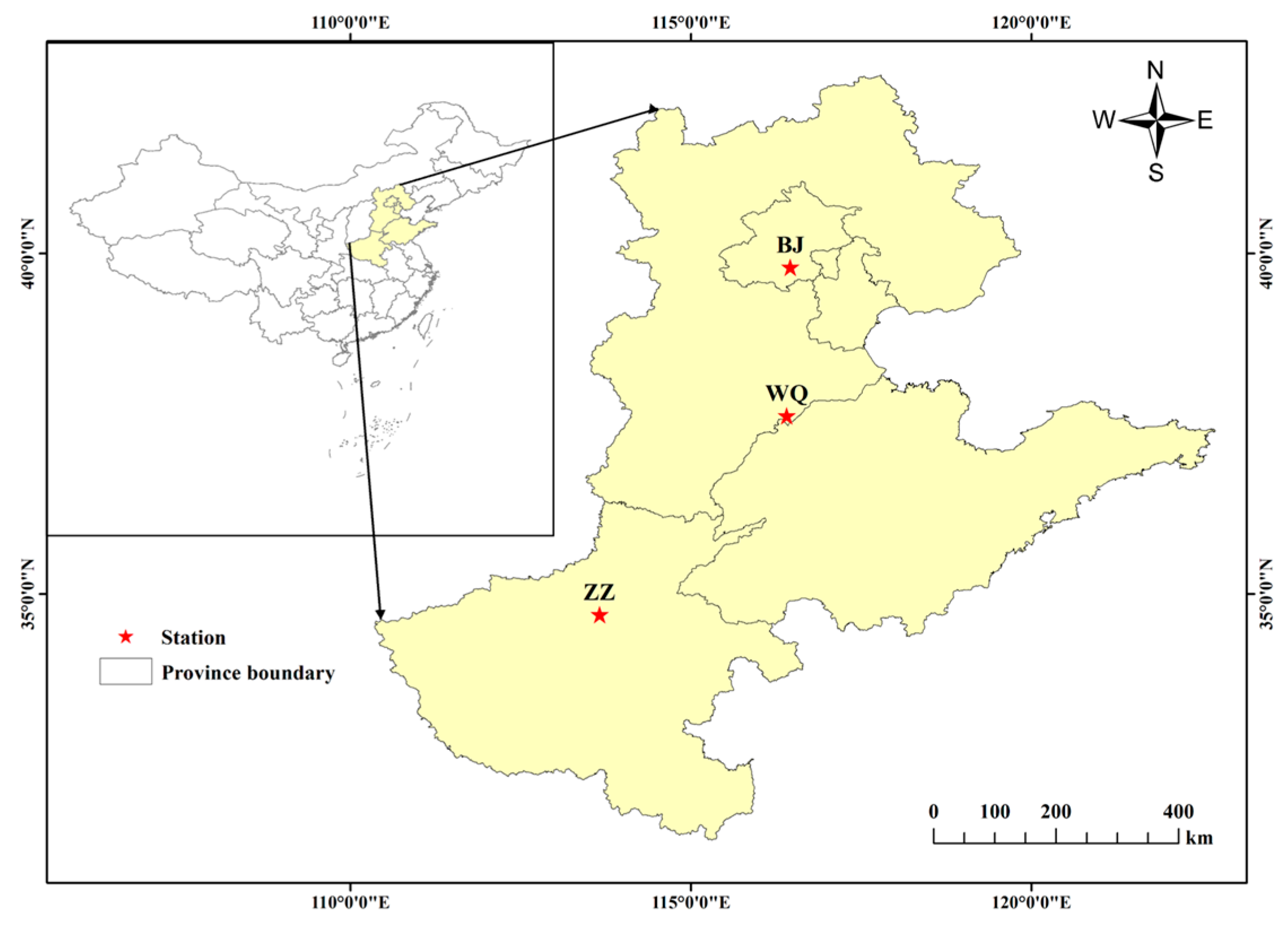
This study selects three representative experimental sites from the North China Plain based on climatic conditions, planting patterns, and geographical characteristics, as illustrated in Figure 1. This region typically employs a winter wheat-summer maize rotation system. The Shangzhuang Experimental Station is located in Xinlitun Village, Shangzhuang Town, Haidian District, Beijing (BJ, 39.80° N, 116.46° E, at an elevation of 33 m) and is characterized by a northern temperate continental monsoon climate, with an average annual temperature of 12.7 °C, annual precipitation of 540 mm, and annual radiation of 5264 MJ·m−2, with the soil type being loam. The Wuqiang Experimental Station is situated in Wuqiao County, Cangzhou City, Hebei Province (WQ, 39.80° N, 116.46° E, at an elevation of 17.1 m) and experiences a semi-humid continental monsoon climate, with an average annual temperature of 12.8 °C and an average annual precipitation of 541.9 mm, while its soil type is clay loam. The Zhengzhou Experimental Station is located in Zhengzhou City, Henan Province (ZZ, 34.70° N, 113.66° E, at an elevation of 110.4 m), characterized by a warm temperate semi-humid continental monsoon climate, with an average annual temperature of approximately 14.7 °C and annual precipitation of around 632.1 mm, with its soil type classified as fluvo-aquic. The study focuses on three widely representative main cultivated varieties of winter wheat in the North China Plain, each with different ecological characteristics: Agricultural University 211 (ND), a winter-type early-maturing variety; Jimai 22 (JM), a semi-winter type mid-maturing variety; and Zhengmai 366 (ZM), a semi-winter type early-maturing variety. The trial varieties, along with the parameter adjustment and validation indicators, along with their sources, are detailed in Table 1.

2.2. Data

The meteorological data used in this study are sourced from the China Meteorological Administration (https://www.cma.gov.cn/) (accessed on 6 November 2025) and primarily include daily maximum temperature (°C), minimum temperature (°C), average temperature (°C), sunshine hours (h), and daily precipitation (mm) for Beijing, Dezhou, and Zhengzhou from 1981 to 2025. Since the weather station in Wuqiao County was established later, the meteorological data for the nearby Dezhou City (located approximately 80 km away), which shares a similar climate profile within the same regional monsoon system, were utilized. The solar radiation in the APSIM meteorological input data is calculated from the sunshine hours using the Angstrom-Prescott equation (Equation (1)).
R s = ( a s + b s n N ) R a
where R s represents solar radiation (MJ·m−2), R a denotes astronomical radiation (MJ·m−2), N refers to the maximum possible sunshine hours (h), n indicates the actual sunshine hours (h), a s is the coefficient that represents the ratio of surface shortwave radiation to astronomical radiation on overcast days (n = 0), and b s is the coefficient that represents the ratio of surface shortwave radiation to astronomical radiation on clear days (n = N).
To evaluate the adaptability of the APSIM-Wheat model in the North China Plain, this study collected experimental data on winter wheat under various sowing dates and fertilization management strategies. The first dataset (Data I) comprises sowing date experiments conducted with the ND variety of winter wheat at the BJ experimental station from 2008 to 2010, where three sowing dates—early, middle, and late—were set for the years 2008 (8, 18, and 28 October) and 2009 (3, 13, and 23 October). Each treatment included three replicates, with a planting density of approximately 3 million plants per hectare and a row spacing of 0.25 m. For the 2008–2009 trials, irrigation was applied before winter and at the jointing stage, while for the 2009–2010 trials, irrigation occurred at the jointing and flowering stages, with each irrigation event delivering 60 mm of water. Before sowing, urea was applied at a rate of 187.5 kg·ha−1, along with 375 kg of compound fertilizer (N15:P15:K15), and an additional 150 kg of urea was used at the jointing stage. Key growth indicators such as aboveground biomass, leaf area index (LAI), and grain yield were recorded at the jointing, flowering, and maturity stages of winter wheat, and soil moisture content was measured at depths of 0–20 cm, 20–40 cm, and 40–60 cm using the drying method. The second dataset (Data II) includes nitrogen treatment data for the JM variety of winter wheat from the WQ experimental station during the 2015–2018 period, with phenological, dry matter, LAI, and yield data extracted from literature using Web Plot Digitizer software V4.8 [27]. The third dataset (Data III) consists of data for the ZM variety of winter wheat at the ZZ experimental station from 2005 to 2010, sourced from the Henan Meteorological Science Research Institute, which includes phenological and yield data. The soil physicochemical properties at each site encompass pH, organic matter content, total nitrogen content, soil bulk density (BD) at various depths, saturation moisture content (SAT), field capacity (DUL), and wilting point (LL), with soil data for the BJ and WQ stations obtained from literature and the ZZ station data provided by the Henan Meteorological Science Research Institute (Table 2) [28,29].

2.3. APSIM-Wheat Model and Parameter Calibration

This study utilizes APSIM-wheat version 7.7 (Agricultural Production Systems sIMulator), a model that has been widely applied and validated for simulating winter wheat growth in the North China Plain, indicating that the APSIM model is capable of effectively simulating the growth stages, dry matter accumulation, and yield formation processes of winter wheat in this region, along with a reliable predictive ability regarding responses to sowing dates [21,22,23,24]. The model source code, detailed documentation, and the latest version are publicly available from the official APSIM website (https://www.apsim.info) (accessed on 10 January 2025). The model features a modular structure that includes components for wheat growth, soil moisture (SoilWat), soil nitrogen (SoilN), surface organic matter (SurfaceOM), and management practices (Manager). The SoilWat module simulates soil moisture dynamics based on water balance principles, while the SoilN module describes nitrogen transformation and transport processes. The SurfaceOM module addresses the decomposition of crop residues and their effects on the soil environment, and the Manager module allows for the flexible definition of field management operations such as sowing, fertilization, and irrigation. Default values are used for key wheat growth parameters, with the radiation use efficiency (RUE) set at 1.24 g·MJ−1 PAR and the extinction coefficient set at 0.5.
To improve the simulation accuracy of the model in the North China Plain, key parameter tuning related to wheat growth and development was conducted by integrating experimental data from three sites and applying a grid search method for systematic calibration to determine the variety parameters. The model’s input data includes a meteorological database, a soil database, and management information. The meteorological data used to drive the model consists of daily historical data from 1981 to 2025 for BJ, WQ, and ZZ, including maximum temperature (°C), minimum temperature (°C), solar radiation (MJ·m2), and precipitation (mm). Soil property data for the study area provides a fundamental description of the soil environment required for wheat growth in the APSIM model, including soil nutrient and moisture parameters. Management information encompasses sowing dates, sowing density, irrigation timing, irrigation volume, fertilization timing, and fertilization amounts. For detailed data information, see Section 2.2.
Independent year data were used for model parameter calibration and validation of three representative winter wheat varieties (ND, JM, ZM). The calibration data included the phenological stages, leaf area index, biomass, yield, and soil moisture observations in the 0–60 cm layer for the three sowing time treatments at the BJ from 2008 to 2009; phenological stages, leaf area index, biomass, and yield observations under five fertilization treatments at the WQ from 2015 to 2017; and phenological stages and yield observation data from the ZZ between 2005 and 2008. The validation data comprised observational data from the BJ for three sowing time treatments in 2009 to 2010, observational data from five fertilization treatments at the WQ in 2017 to 2018, and observational data from the ZZ from 2008 to 2010. Specific data information used for calibration and validation at each site is shown in Table 1, while the calibration results for the winter wheat variety parameters are presented in Table 3.
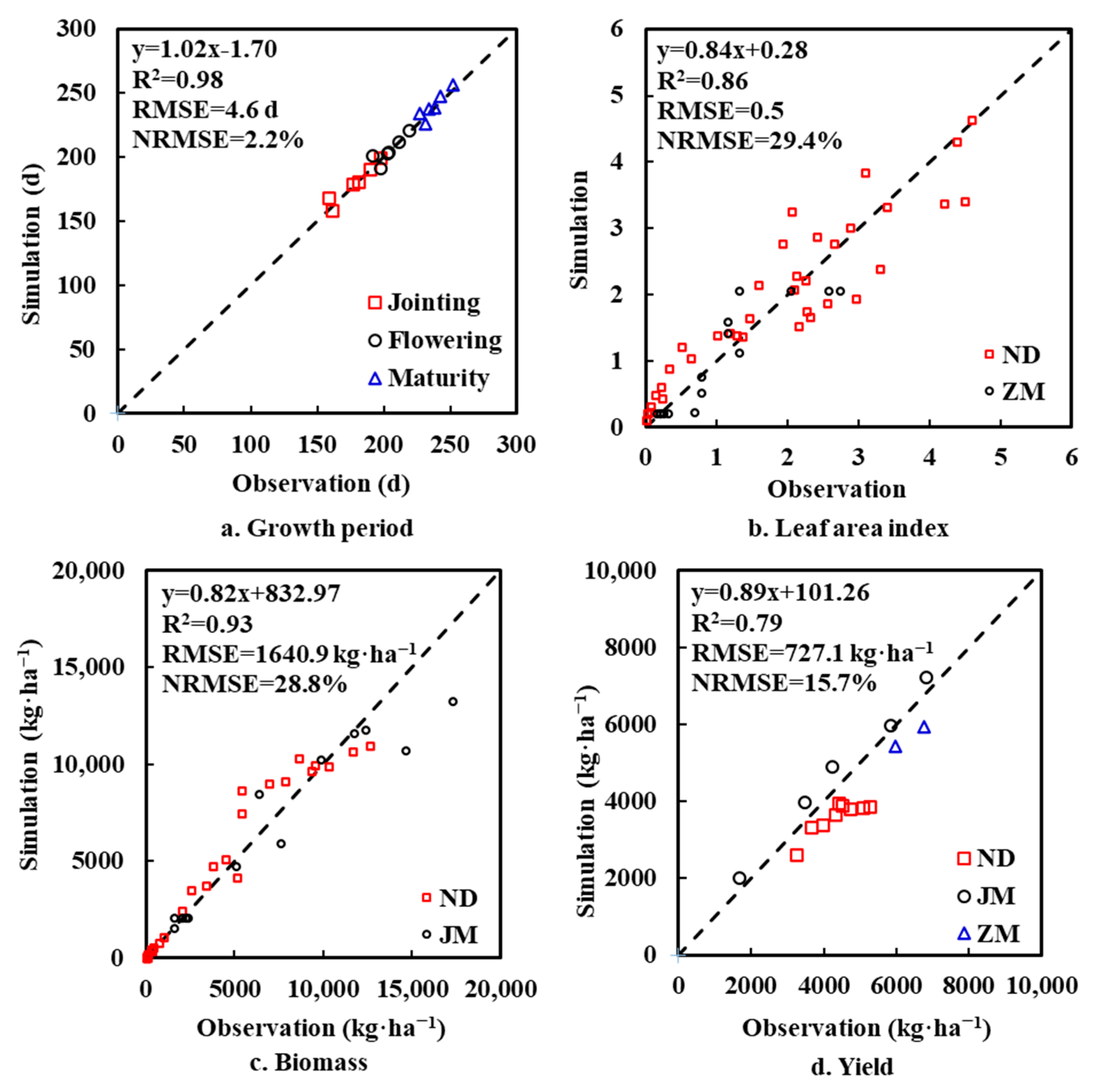
The degree of agreement between simulated and observed values is visually represented through 1:1 line plots, and statistical indicators such as root mean square error (RMSE), normalized root mean square error (NRMSE), and coefficient of determination (R2) are employed to assess the adaptability of the APSIM-Wheat model in the North China Plain [24].

2.4. Scenario Design

The validated APSIM-Wheat model was applied to three experimental sites to simulate the effects of sowing dates and soil moisture on the dry matter accumulation and yield of winter wheat at different developmental stages. All long-term (1981–2025) seeding scenario simulations are based on the same rigorously calibrated and independently validated final parameter set, and all simulations are driven by the same meteorological and soil data sources. The model was set up with four sowing date gradients, including the conventional sowing date (S1), and delays of 10 days (S2), 20 days (S3), and 30 days (S4), with the S1 sowing dates established as September 25, October 5, and October 15 for BJ, WQ, and ZZ, respectively. The soil moisture levels were determined based on the volumetric water content of the 0–100 cm soil layer at the time of sowing, ranging from deficit to sufficient moisture, and five gradients were set for relative water content (RWC) at 45% (P45%), 55% (P55%), 65% (P65%), 75% (P75%), and 85% (P85%). These moisture levels are defined as being evenly distributed throughout the 0–100 cm root zone soil profile. The model was reset at the time of sowing, and the APSIM model’s soil moisture parameter “a fraction of maximum available water (Pini)” was calculated using the physical soil moisture parameters. To fully account for the impact of climate variability, the calibrated model and localized parameters were used to simulate a total of 44 winter wheat growing seasons from 1981 to 2025. This resulted in 20 simulation scenario combinations, derived from four sowing dates and five soil moisture levels, to assess their effects on the key developmental stages of winter wheat, including the jointing, flowering, and maturity phases, as well as on dry matter accumulation and yield.
P i n i = D U L × R W C L L D U L L L
where D U L is the soil field water holding capacity, mm·mm−1; R W C stands for relative soil moisture content, mm·mm−1; L L is the soil wilting coefficient, mm·mm−1.

2.5. Production Reduction Risks

To accurately reflect the soil moisture conditions before sowing winter wheat and the climatic background during the sowing period, we defined a “sowing window”. Based on the traditional sowing practices in the North China Plain and previous studies, this research established the conventional sowing windows for BJ, WQ, and ZZ as 25 September to 15 October, 5 October to 15 October, and 10 October to 20 October each year, respectively. For each site’s sowing window, two key climatic indicators were calculated: the cumulative rainfall (mm), which represents the total precipitation from 25 September to 15 October each year, and the number of rainy days (d), defined as the total days within the window period with daily precipitation greater than 0 mm. A linear regression analysis was employed to quantify the trends in these two indicators from 1981 to 2023, with the trend slope indicating the annual change in the climatic indicators (mm·yr−1 or d·yr−1).
To assess the long-term production risks under different management scenarios, this study defined two indicators: the probability of yield reduction and the expected yield loss. The probability of yield reduction refers to the percentage of years in which the simulated yield falls below a specified reduction threshold for a particular “sowing date-soil moisture” management scenario, calculated as the number of years with yield below the threshold divided by the total number of simulated years (Equation (3)). The expected yield loss represents the difference between the multi-year average simulated yield under a specific management scenario and the average yield of the baseline scenario, reflecting the long-term expected level of loss (Equation (4)). In the main winter wheat producing area of the North China Plain, the typical soil moisture conditions before autumn sowing (from late September to mid-October) usually range from 60% to 70% of field capacity, after being replenished by rainfall during the growing season of summer maize and depleted through evapotranspiration. This level is considered sufficient to ensure successful seedling emergence and early growth of wheat, while not reaching a fully saturated state, representing the most common and attainable “moderate” or “normal” soil moisture conditions in the region. In this study, the reduction threshold was set as the average yield over 43 years under the conventional sowing date (SD1P65), and all statistical analyses and visualizations were conducted within the R programming environment.
P r i s k = N Y < Ȳ S D 1 P 65 N t o t a l × 100 %
Ȳ = Ȳ Ȳ S D 1 P 65
where P r i s k represents the probability of yield reduction; N Y < Ȳ S D 1 P 65 denotes the number of years in which the simulated yield Y falls below the reduction threshold Ȳ S D 1 P 65 ; N t o t a l refers to the total number of simulated years, which is 43; and Δ Y ¯ indicates the expected yield loss (kg·ha−1). Additionally, Y is the multi-year average yield for the target scenario (kg·ha−1), while Y ¯ S D 1 P 65 is the multi-year average yield for the baseline scenario (kg·ha−1).

3. Results

3.1. Adaptability Evaluation of APSIM-Wheat Model in North China Plain

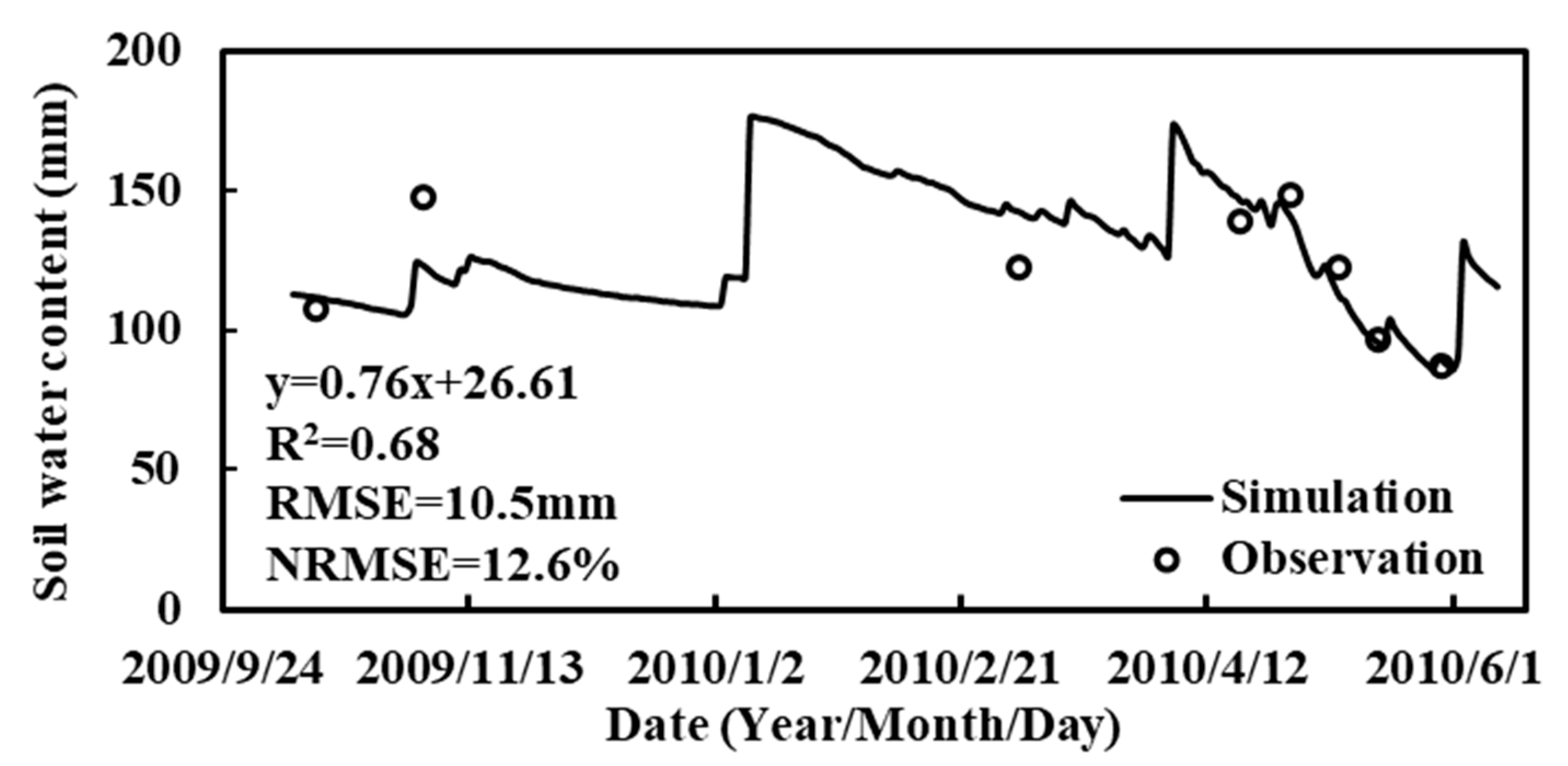
To assess the applicability of the APSIM-Wheat model in the North China Plain, this study utilized field trial data from three sites—BJ, WQ, and ZZ—to validate the model’s performance in simulating the growth period, leaf area index (LAI), aboveground biomass, grain yield, and soil moisture dynamics of winter wheat. The model demonstrated high accuracy in simulating key growth stages of winter wheat, including jointing period, joint flowering period, and maturity period (Table 4), with simulated values closely aligning with observed values, as all data points were concentrated near the 1:1 line. Statistical results indicated a root mean square error (RMSE) of 4.6 days for the growth period simulation, suggesting that the model can accurately simulate the phenological development processes under various cultivars (ND, JM, ZM) and management practices. The model’s performance in simulating LAI and aboveground biomass was generally acceptable, as it successfully reproduced the overall trend of their temporal growth, although certain stages exhibited some deviation (Figure 2b,c). The R2 for LAI simulation was 0.86, with an RMSE of 0.5; the model slightly overestimated LAI during the early growth stages and tended to underestimate it in the later stages, which may relate to the localization of the leaf area senescence parameters used in the model. The simulation of aboveground biomass was more successful than that of LAI, with an R2 of 0.93 and an RMSE of 1640.9 kg·ha−1; however, there was a slight overestimation of biomass for certain treatments during the jointing to flowering stage, potentially due to the model’s representation of local light use efficiency or nutrient stress responses. The model showed good consistency in simulating yield compared to observed yields (RMSE = 727.1 kg·ha−1, NRMSE = 15.7%) (Figure 2d), accurately capturing the yield increase trend associated with increased nitrogen application (JM) and the yield variations under different sowing date treatments (ND), indicating that the APSIM-Wheat model can effectively simulate the yield formation process of winter wheat in the North China Plain. The model’s results for soil moisture storage in the 0–60 cm soil layer are shown in Figure 3, with an R2 of 0.72 and an RMSE of 10.5 mm, demonstrating that the model can effectively characterize the seasonal dynamics of soil moisture. Overall, the APSIM-Wheat model exhibits high reliability and accuracy in simulating the growth period, yield, and soil moisture dynamics of winter wheat in the North China Plain, while its simulations of LAI and biomass dynamics are also deemed acceptable.

3.2. The Changing Trend of Climate Conditions in the Conventional Sowing Window of Winter Wheat in the North China Plain

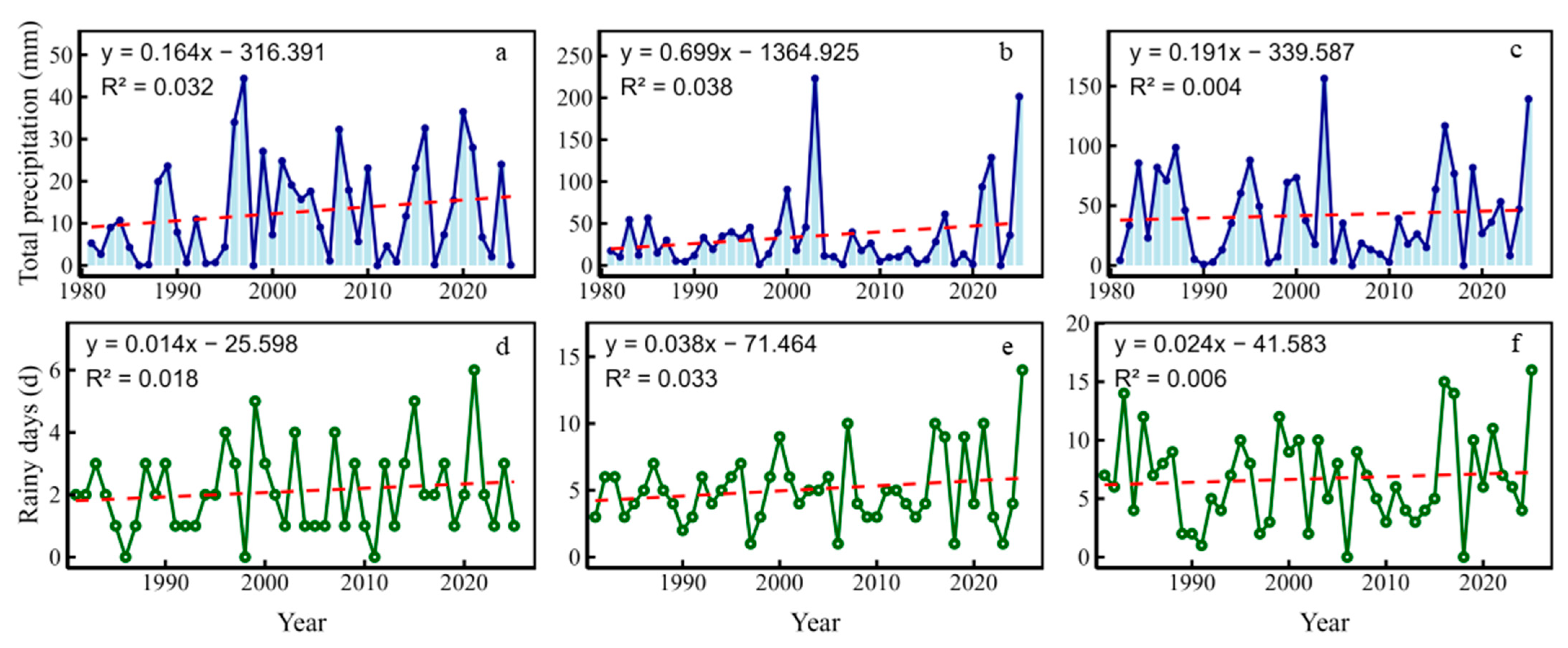
An analysis of the climate data for the conventional sowing window of winter wheat from 1981 to 2025 at three representative sites in the North China Plain (BJ, WQ, and ZZ) indicates an increasing trend in both cumulative rainfall and the number of rainy days during this period (Figure 4). Linear regression analysis of cumulative rainfall during the conventional sowing window reveals interannual growth rates of 0.164 mm·yr−1, 0.699 mm·yr−1, and 0.191 mm·yr−1 for BJ, WQ, and ZZ, respectively (Figure 4a–c), suggesting an overall improvement in moisture supply conditions for the traditional sowing period of winter wheat in the study area, with the central region (WQ) showing the most pronounced enhancement. The trend in the number of rainy days during the sowing window aligns with the increase in cumulative rainfall, as all three sites also exhibit an upward trend in the frequency of rainy days (Figure 4d–f). Specifically, the growth rates for the number of rainy days are 0.014 d·yr−1, 0.038 d·yr−1, and 0.024 d·yr−1 for BJ, WQ, and ZZ, respectively, indicating that not only is the total rainfall during the sowing period increasing, but the frequency of rainfall events is also steadily rising. The improvement in moisture conditions provides favorable support for the sowing and early growth of winter wheat.

3.3. Effects of Late Sowing on Biomass and Yield of Original Winter Wheat in Huabeiping

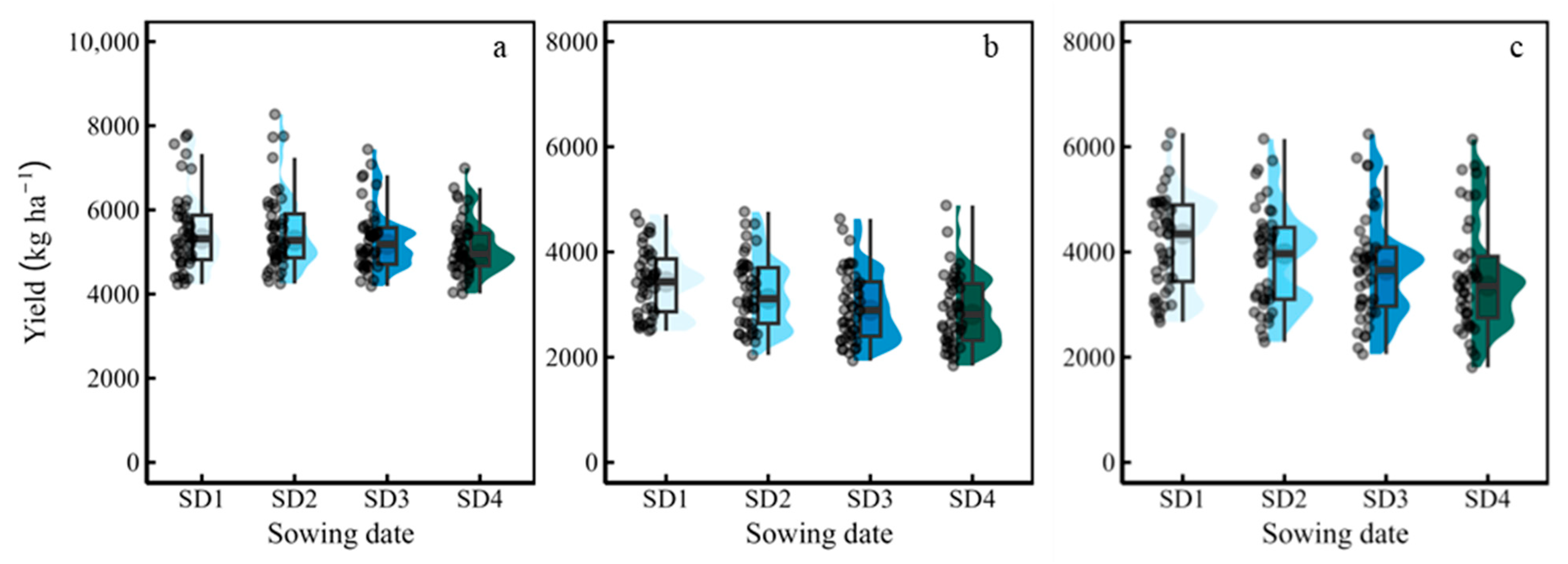
Based on long-term simulation data from 1982 to 2025, the analysis of the effects of different sowing dates on winter wheat yield at three sites in the North China Plain indicates that delayed sowing results in reduced yields (Figure 5). As the sowing date is progressively postponed from the conventional period (SD1) to SD4, winter wheat yields at the three experimental sites (BJ, WQ, and ZZ) all exhibit a downward trend. Under the SD4 treatment, the average yields at the BJ, WQ, and ZZ sites decrease by approximately 6.9%, 16.2%, and 16.0% compared to SD1, although the variability of the data points remains relatively consistent. Analysis of dry matter accumulation at different growth stages of winter wheat (Table 5) shows that delayed sowing leads to a decline in biomass during key growth periods. Specifically, compared to the conventional sowing date (SD1), the biomass at the jointing stage for the SD4 treatment (sown 30 days later) decreases by 20.4%, 17.6%, and 10.5% at BJ, WQ, and ZZ, respectively. Although the relative decline in biomass gradually lessens from the jointing stage to maturity as the growing season progresses, the losses incurred during early growth are not fully compensated by later growth. In summary, late sowing restricts the dry matter production capacity of winter wheat during the early stages (jointing stage), leading to a reduction in final grain yield, and the longer the sowing is delayed, the more severe the yield loss becomes.

3.4. Interactive Effects of Sowing Date and Soil Moisture on Biomass and Yield of Original Winter Wheat in North China

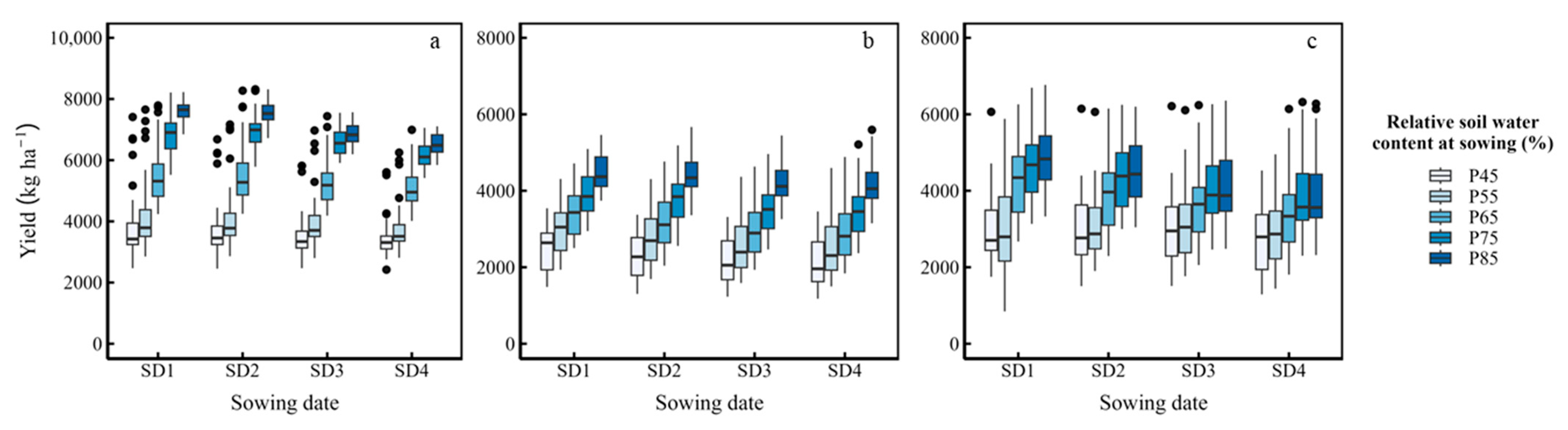
Based on long-term simulation data from 1981 to 2025, an analysis of the effects of different sowing dates and soil moisture treatments on winter wheat yield at three sites in the North China Plain indicates a declining trend in yield distribution as the sowing date is delayed from SD1 to SD4 (Figure 6). Additionally, within the same sowing date, yields significantly increase with higher soil moisture levels (from P45% to P85%). The two-way ANOVA reveals that both sowing date and soil moisture have highly significant main effects on yield (p < 0.01), although their interaction is not significant (p > 0.05). At the three experimental sites (BJ, WQ, and ZZ), yields consistently increase with higher soil moisture levels under the same sowing date, with the greatest yield increase efficiency observed at suitable soil moisture levels (P65). For example, at ZZ, increasing soil moisture levels from low (P45) to suitable (P65) results in yield increases of 60.6%, 51.7%, 37.4%, and 44.1% for sowing dates SD1, SD2, SD3, and SD4, respectively. In summary, optimizing soil moisture management can mitigate yield losses associated with late sowing. Table 6 illustrates that under late sowing conditions (SD3), increasing soil moisture levels significantly promotes biomass accumulation in winter wheat, although the effect varies markedly among sites. At BJ, biomass at the jointing stage increases by 9.3%, 22.9%, 26.1%, and 28.3% for P55, P65, P75, and P85 compared to P45, respectively. Under the P85 treatment at BJ, biomass increases by 28.3%, 38.3%, and 65.7% at the jointing, flowering, and maturity stages; similarly, at WQ under P85, the increases are 10.1%, 37.6%, and 46.0%, while at ZZ under P85, the increases are 64.2%, 47.4%, and 38.7%. These results indicate that the promoting effect of soil moisture on biomass accumulation varies regionally; in BJ and WQ, where rainfall is relatively low, the positive impact of soil moisture on biomass accumulation continues to strengthen throughout the growth period, while in ZZ, where rainfall is relatively high, this effect diminishes over the same period. Therefore, for BJ and WQ, maximizing soil moisture to the highest level (P85) under late sowing conditions yields the greatest biomass returns. In contrast, for the ZZ, management should focus on ensuring that soil moisture exceeds the critical threshold (P65).

3.5. Risk Probability and Expected Loss Assessment of Production Reduction Based on Long-Term Simulation

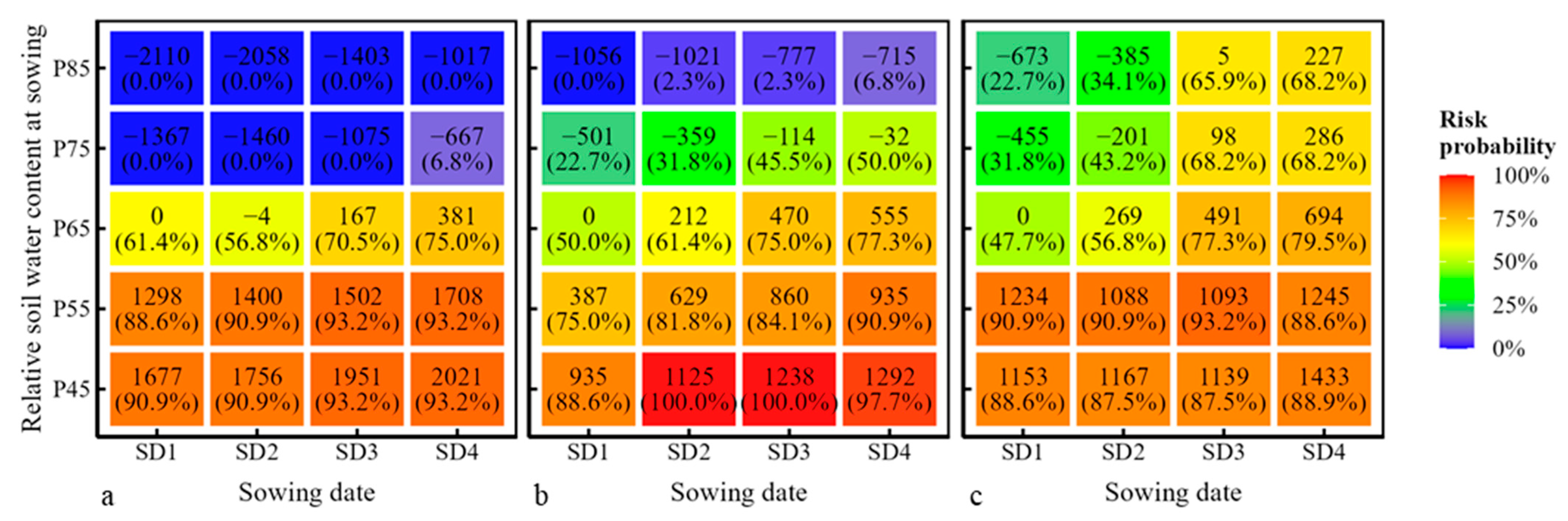
Based on the simulation data for winter wheat from 1981 to 2025, a quantitative analysis was conducted to assess production risk under different management scenarios by measuring two indicators: the probability of yield reduction and the expected yield loss. The findings indicate that raising soil moisture levels from P45 to P85 significantly reduces both risk probability and yield loss across all sites and sowing conditions (Figure 7). For instance, at BJ under the SD4 sowing date, increasing soil moisture from P45 to P85 lowers the risk probability from 93.2% to 0%, while the expected yield loss improves from a reduction of 2021 kg·ha−1 to an increase of 1017 kg·ha−1. Similarly, at WQ, the risk probability decreases from 97.7% to 6.8%, with expected yield loss shifting from 1292 kg·ha−1 to an increase of 715 kg·ha−1. However, at ZZ, even with the SD4-P85 treatment, a risk probability of 68.2% remains, indicating that solely relying on increased soil moisture is insufficient to completely overcome the yield limitations imposed by late sowing in this region. There is notable spatial heterogeneity in reduction risk probability across the three sites; BJ demonstrates the highest yield stability and lowest risk level under the same management practices, while it is also most sensitive to moisture conditions. For example, with the SD1-P85 treatment, BJ has a risk probability of 0%, whereas ZZ, under the same optimized management, still faces a 22.7% yield reduction risk. The risk characteristics at WQ fall in between these two extremes. Clear threshold effects of soil moisture are observed at each site; at BJ, increasing soil moisture to P65 keeps the risk probability for most sowing dates below 75%, whereas at WQ and ZZ, levels of P75 or even P85 are required to achieve significant risk mitigation. Particularly at ZZ, under the SD3 and SD4 sowing dates, even with soil moisture raised to P85, the risk probability remains high at 65.9% to 68.2%.

4. Discussion

4.1. Applicability and Limitations of APSIM-Wheat Model in North China Plain

The validation results of the APSIM-Wheat model at three representative sites in the North China Plain indicate that the model can reliably simulate the phenological development, yield formation, and soil moisture dynamics of winter wheat. The high accuracy in simulating the growth period (with a root mean square error (RMSE) of 2.2 days) aligns with previous research conclusions in this region [22,24], confirming the model’s robust mechanistic basis for quantifying development processes driven by photothermal effects [30,31]. The model demonstrates a good capability to capture yield (with an RMSE of 727.1 kg·ha−1), particularly in successfully reproducing yield variations induced by different nitrogen fertilizer levels and sowing date treatments, indicating its effectiveness in integrating management practices with environmental factors, making it suitable for scenario analysis and decision support. However, the model shows some bias when simulating dynamics of leaf area index and aboveground biomass, particularly overestimating early growth and underestimating late growth; this bias may be related to the parameterization of leaf aging and death processes in the model [32]. In the APSIM model, leaf aging is primarily driven by thermal-time age and nitrogen stress [21], which may not fully capture the dynamics of leaf aging exacerbated by abiotic stresses such as pests, diseases, and hot winds under field conditions in the North China Plain. Additionally, the slight overestimation of biomass from the jointing to flowering stages suggests that the model’s default radiation use efficiency or allocation coefficients may have room for adaptation under localized high-yield conditions [33]. Future research could consider incorporating soil physical properties such as bulk density and penetration resistance, along with more complex nitrogen transport processes, into the model to further enhance the accuracy of simulating biomass accumulation during the mid-growth period. Despite these minor limitations, the model’s acceptable performance in simulating soil moisture dynamics provides a key technical feasibility for assessing the interactive effects of soil moisture and sowing date.

4.2. The Physiological and Ecological Mechanisms of Late Sowing Yield Reduction and the Compensation Effect of Soil Moisture

This study found a significant increasing trend in cumulative rainfall and the number of rainy days during the conventional sowing window for winter wheat at three sites in the North China Plain from 1981 to 2025, which aligns with recent research on changes in autumn precipitation in North China [34,35]. This indicates a certain rebound in autumn precipitation due to changes in atmospheric circulation patterns and enhanced local water cycles. Traditionally, autumn drought in the North China Plain has been a major barrier to timely sowing and healthy seedling emergence for winter wheat [36,37], often necessitating reliance on irrigation to create optimal soil moisture. However, the increase in natural rainfall during the sowing period signifies a shift in natural water-heat allocation toward conditions more favorable for sowing and emergence, objectively reducing the absolute dependence on irrigation and creating favorable conditions for optimizing water resource allocation. Nonetheless, the increase in rainy days may also lead to excessive soil moisture or shorten the field operation window [14], potentially becoming one of the indirect causes of late sowing. Therefore, improvements in climatic conditions require producers to possess stronger field management and agricultural scheduling capabilities to seize the limited opportunities for suitable sowing. The long-term simulation results of this study clearly demonstrate that delayed sowing inevitably leads to a decrease in winter wheat yield in the North China Plain, with greater delays resulting in more severe yield reductions (Figure 5). This conclusion is highly consistent with numerous field trial results [13,38]. The probability of yield reduction risk assessed in this study refers to the frequency of yield falling below a specified threshold due to interannual climate variability during the growing season, given a particular sowing date and initial moisture condition. The current assessment of yield reduction risk is primarily based on the natural variability of climate between years, serving as an indicator of interannual production stability under a given long-term average climate background. Long-term climate change indirectly affects the level of the risk probability we assess by altering the fundamental statistical characteristics of these interannual climate fluctuations, as well as the background conditions of soil moisture. The underlying physiological and ecological mechanisms stem from two main aspects: first, late sowing directly shortens the effective growth season before winter, leading to insufficient accumulated temperature, which restricts tillering, root development, and carbohydrate reserves [39,40]. This is directly reflected in the significant reduction in biomass during the jointing stage by 10.5% to 20.4%. The weak structure of the pre-winter population limits its photosynthetic source and nutrient absorption capacity, making it difficult to support high yields later on. Second, late sowing postpones the wheat heading to grain-filling period, which increases the likelihood of encountering common adverse weather conditions in late spring, such as high temperatures and dry winds in the North China Plain. This accelerates the grain-filling process and leads to reduced grain weight [41]. The study systematically reveals that soil moisture management can serve as an effective compensatory strategy to mitigate yield loss due to late sowing. Although the interaction between sowing date and soil moisture was not found to be significant, its independent positive effect is highly significant. Increasing soil moisture levels under late sowing conditions significantly promotes dry matter accumulation at all growth stages (Table 6) and ultimately enhances yield (Figure 6). This is primarily because, in the context of lower temperatures and slower growth rates before winter, adequate soil moisture ensures the availability of soil water, promotes early root penetration and expansion, and enhances the seedlings’ ability to utilize deep soil moisture and nutrients [42]. Consequently, this partially compensates for the growth delays caused by insufficient accumulated temperature through water-driven nutrient adjustment and temperature regulation [43].

4.3. Partition Management Strategy Based on Site Heterogeneity and Agricultural Practice Insights

This study reveals significant spatial heterogeneity in the soil moisture compensation effect and its optimal management strategies, providing a scientific basis for formulating regionally differentiated adaptive measures. The BJ region exhibits the highest yield stability and the best response to soil moisture management, where elevating soil moisture to P65 effectively controls risk, and increasing it to P85 can almost reduce the risk of yield loss to very low levels across all sowing dates. This indicates that creating suitable sowing conditions through irrigation or moisture retention measures is an effective strategy for mitigating late sowing risks in the BJ region. The WQ region shows responses that fall between those of BJ and ZZ, requiring higher soil moisture (P75–P85) to alleviate risk. Moreover, the positive effect of soil moisture on biomass accumulation continues to strengthen throughout the growth period. This reflects that, despite increased precipitation in the WQ region, the seasonal distribution remains uneven, and wheat may face moisture stress during the later growth stages. Therefore, it is essential to focus on moisture replenishment in the mid to late growth stages while maintaining higher soil moisture levels. The ZZ region demonstrates the highest risk of yield loss and a unique response pattern to moisture management, with a risk probability of 22.7% even under optimal management conditions (SD1-P85). Additionally, the positive effect of soil moisture on biomass diminishes as the growth period progresses (Table 5), indicating that merely increasing soil moisture under late sowing conditions is insufficient to fully overcome yield limitations (with a risk probability of 68.2% under SD4-P85). This study, based on the literature, notes that the ZZ region has relatively high annual precipitation and groundwater levels [35,44]; however, it should be clarified that this inference is primarily based on general regional descriptions and does not provide direct site-scale data on groundwater levels or soil drainage characteristics within this study framework. The average annual precipitation in the ZZ region is approximately 632.1 mm, significantly higher than that in the BJ and WQ regions. Against this precipitation backdrop, artificially increasing soil moisture under late sowing conditions (such as in the SD4-P85 treatment) may lead to excessively high soil moisture during the later growth stages, potentially temporarily reducing soil aeration [45] or interacting with other limiting factors such as light, temperature, and diseases. Therefore, the management focus in this region should be on ensuring that soil moisture exceeds the critical threshold for emergence (P65), rather than blindly pursuing the highest moisture levels. Additionally, it is crucial to integrate other measures, such as selecting late-sowing tolerant early-maturing varieties and increasing fertilizer application to promote rapid establishment of the crop population [15,46,47]. From an agricultural production risk management perspective, when late sowing is unavoidable, prioritizing pre-sowing irrigation and moisture retention measures to elevate soil moisture to higher levels (P75-P85) [19,36,37] represents a low-cost, high-return risk aversion strategy that can significantly reduce the probability of yield loss and expected damages. However, in high-risk areas, policymakers and technology promotion departments should recognize that the benefits of a single moisture management strategy may diminish and advocate for a comprehensive adaptive technology system centered around “variety—sowing date—water and fertilizer.” Additionally, exploring financial tools such as agricultural insurance can help build a more resilient production system.

5. Conclusions

This study quantitatively reveals the independent impacts and compensatory relationship between late sowing and soil moisture in winter wheat production in the North China Plain through long-term scenario simulations using the APSIM-Wheat model. The main conclusions are as follows: first, the localized calibration of the APSIM-Wheat model enables reliable assessments of production potential and risks for winter wheat in the North China Plain. Second, while the moisture conditions during the sowing window for winter wheat in the North China Plain are improving, the yield reduction effects caused by late sowing remain significant and widespread. Third, optimizing soil moisture management is an effective strategy for alleviating yield losses due to late sowing, but the strength and optimal levels of this effect vary considerably across different regions. Lastly, based on risk assessments, region-specific adaptive management strategies are proposed: the BJ and WQ regions can effectively control risks by enhancing soil moisture to moderate-high levels, whereas the ZZ region requires comprehensive measures to address the challenges of maintaining high and stable yields while ensuring suitable soil moisture. Based on this spatial differentiation law, future research could expand simulations to encompass the entire North China Plain region, incorporate more climate change scenarios, and consider the potential effects of CO2 fertilization on crop physiology in order to provide more comprehensive and forward-looking decision support.

Author Contributions

Conceptualization, C.C., J.Y., Y.L., S.T., S.C., X.C., L.W. and Z.G.; Methodology, C.C., J.Y., Y.L., S.T. and L.W.; Validation, C.C., J.Y., Y.L., L.W. and Z.G.; Investigation, C.C., J.Y., Y.L., S.T., X.C., L.W. and Z.G.; Resources, C.C., J.Y., Y.L., S.T., S.C., X.C., L.W. and Z.G.; Data curation, C.C. and J.Y.; Writing—original draft, C.C. and J.Y.; Writing—review and editing, L.W. and Z.G.; Visualization, C.C. and J.Y.; Supervision, C.C. and J.Y.; Project administration, C.C., L.W. and Z.G. All authors have read and agreed to the published version of the manuscript.

Funding

This study received financial support from various sources, including Open Foundation of China Meteorological Administration Hydro-Meteorology Key Laboratory (24SWQXZ001), Open Research Fund Program of Henan Key Laboratory of Agrometeorological Ensuring and Applied Technique, CMA (AMF202505), Key Project of Zhejiang Province Agriculture, Forestry, Animal Husbandry and Fishery Vocational Education Industry Guidance Committee (WK202502), Teaching Reform Research and Course Ideological and Political Key Project of Lishui University (25JGZD07), Cross year Research Project on Rural Revitalization in Lishui City (2024), and Lishui Philosophy and Social Sciences Regular Project (LSCG2516).

Data Availability Statement

The data presented in this study are available on request from the corresponding author. The data are not publicly available because the data need to be used in future work.

Conflicts of Interest

The authors declare no conflicts of interest.

References

  1. Romanello, M.; McGushin, A.; Di Napoli, C.; Drummond, P.; Hughes, N.; Jamart, L.; Kennard, H.; Lampard, P.; Solano Rodriguez, B.; Nigel Arnell, P.; et al. The 2021 report of the Lancet Countdown on health and climate change: Code red for a healthy future. Lancet 2021, 398, 1619–1662. [Google Scholar] [CrossRef] [PubMed]
  2. Cheng, C.; Wu, L.; Yu, W.D.; Yang, F.Y.; Feng, L.P. Dynamic evaluation of winter wheat’s freezing resistance under different low-temperature periods and durations. Sci. Rep. 2025, 15, 8488. [Google Scholar] [CrossRef] [PubMed]
  3. Xiao, G.M.; Zhao, Z.C.; Liang, L.; Meng, F.Q.; Wu, W.L.; Guo, Y.B. Improving nitrogen and water use efficiency in a wheat-maize rotation system in the North China Plain using optimized farming practices. Agric. Water Manag. 2019, 212, 172–180. [Google Scholar] [CrossRef]
  4. Zhao, X.; Virk, A.L.; Ma, S.T.; Kan, Z.R.; Qi, J.Y.; Pu, C.; Yang, X.G.; Zhang, H.L. Dynamics in soil organic carbon of wheat-maize dominant cropping system in the North China Plain under tillage and residue management. J. Environ. Manag. 2020, 265, 110549. [Google Scholar] [CrossRef]
  5. Wu, L.; Yu, W.D.; Cheng, C.; Feng, L.P.; Yan, J.T.; Zheng, D.W.; Yang, F.Y. Integrative indexes reveal the tolerance of winter wheat to different overwinter freezing injury. Front. Plant Sci. 2024, 15, 1419381. [Google Scholar] [CrossRef]
  6. Hu, S.; Mo, X.G.; Lin, Z.H.; Qiu, J.X. Emergy assessment of a wheat-maize rotation system with different water assignments in the north China plain. Environ. Manag. 2010, 46, 643–657. [Google Scholar] [CrossRef]
  7. Ren, H.; Liu, M.Y.; Zhang, J.B.; Peng, L.; Liu, C.H. Effects of agronomic traits and climatic factors on yield and yield stability of summer maize (Zea mays L.) in the Huang-Huai-Hai Plain in China. Front. Plant Sci. 2022, 13, 1050064. [Google Scholar] [CrossRef]
  8. Liu, F.; Li, Z.F. Impacts of precipitation and accumulated temperature on winter wheat yield in Tianjin. Chin. J. Agrometeorol. 2010, 31, 431–435. [Google Scholar]
  9. Yang, X.; Gu, Y.L.; Hao, L.S. The features of temporal-spacial precipitation change during crop growth in Hebei province. J. Arid. Land Resour. Environ. 2012, 26, 124–129. [Google Scholar]
  10. Wang, L.; Ren, W. Drought in agriculture and climate-smart mitigation strategies. Cell Rep. Sustain. 2025, 2, 100386. [Google Scholar] [CrossRef]
  11. Wu, Y.F.; Liu, B.H.; Gong, Z.H.; Hu, X.; Ma, J.C.; Ren, D.C.; Liu, H.J.; Ni, Y.J. Predicting yield loss in winter wheat due to frost damage during stem elongation in the central area of Huang-huai plain in China. Field Crops Res. 2022, 276, 108399. [Google Scholar] [CrossRef]
  12. Zhang, Y.; Hu, Q.; He, H.Y.; Pan, X.B.; Ma, X.Q.; Huang, B.X.; Wang, J. Correspondence and shifting analysis for the winter wheat growing period before winter and solar terms in the North China Plain under climate change background. Chin. J. Agrometeorol. 2019, 40, 411–421. [Google Scholar]
  13. Sun, H.Y.; Zhang, X.Y.; Chen, S.Y.; Pei, D.; Liu, C.M. Effects of harvest and sowing time on the performance of the rotation of winter wheat-summer maize in the North China Plain. Ind. Crops Prod. 2007, 25, 239–247. [Google Scholar] [CrossRef]
  14. Zhou, B.Y.; Ma, W.; Sun, X.F.; Gao, Z.H.; Ding, Z.S.; Li, C.F.; Zhao, M. Effects of different wowing and harvest dates of winter wheat-summer maize Under double cropping system on the annual climate resource distribution and utilization. Sci. Agric. Sin. 2019, 52, 1501–1517. [Google Scholar]
  15. Shah, F.; Coulter, J.A.; Ye, C.; Wu, W. Yield penalty due to delayed sowing of winter wheat and the mitigatory role of increased seeding rate. Eur. J. Agron. 2020, 119, 126120. [Google Scholar] [CrossRef]
  16. Chen, S.; Wang, T.C.; Guan, X.K.; Zhang, X. Effect of sowing time and seeding rate on yield components and water use efficiency of winter wheat by regulating the growth redundancy and physiological traits of root and shoot. Field Crops Res. 2018, 221, 166–174. [Google Scholar]
  17. Fang, Q.; Chen, Y.; Yu, Q.; Ouyang, Z.; Li, Q.Q.; Yu, S.Z. Much improved irrigation use efficiency in an intensive wheat-maize double cropping system in the North China Plain. J. Integr. Plant Biol. 2007, 49, 1517–1526. [Google Scholar] [CrossRef]
  18. Han, Y.; Qiao, D.; Lu, H. Spatial-temporal coupling pattern between irrigation demand and soil moisture dynamics throughout wheat-maize rotation system in the North China Plain. Eur. J. Agron. 2023, 151, 126970. [Google Scholar] [CrossRef]
  19. Liu, G.S.; An, S.Q.; Lv, H.Q.; Guo, A.H. Reaearch on the effect of soil moisture before sowing on the growth and yield of winter wheat in North China. J. Appl. Meteorol. Sci. 2000, 1, 164–169. [Google Scholar]
  20. Cheng, C.; Wu, L.; Liu, H.Y.; Liang, B.Y.; Zhu, X.R.; Yang, F.Y. Divergent response of grassland aboveground net primary productivity and precipitation utilization efficiency to altered precipitation patterns by process-based model. Front. Plant Sci. 2025, 16, 1487907. [Google Scholar] [CrossRef]
  21. Tan, Y.L.; Cheng, E.H.; Feng, X.X.; Zhao, B.; Chen, J.J.; Xie, Q.Y.; Peng, H.; Li, C.J.; Lu, C.; Li, Y.; et al. Application of APSIM model in winter wheat growth monitoring. Front. Plant Sci. 2024, 15, 1500103. [Google Scholar] [CrossRef] [PubMed]
  22. Han, Y.; Wang, J.; Qiao, D. Assessing climate effects on wheat yield heterogeneity in the North China Plain and evolution from 1960 to 2020. Crop J. 2024, 12, 1791–1800. [Google Scholar] [CrossRef]
  23. Shi, X.R.; Han, B.S.; Wang, Z.Q.; Zhang, Y.L.; Li, P.; Zong, L.Z.; Zhang, D.S.; Gao, Z.Q.; Hao, X.Y. Investigation on the effects of climate change on the growth and yield of different maturity winter wheat Varieties in Northern China based on the APSIM model. Sci. Agric. Sin. 2023, 56, 3772–3787. [Google Scholar]
  24. Wang, J.; Wang, E.; Yang, X.; Zhang, F.S.; Yin, H. Increased yield potential of wheat-maize cropping system in the North China Plain by climate change adaptation. Clim. Change 2012, 113, 825–840. [Google Scholar] [CrossRef]
  25. Peng, Y.M.; Zhao, K.N.; Zhang, J.; Ren, K.M.; Zhang, J.H.; Guo, J.H.; Wang, R.R.; Xiao, H.S.; Jiang, P.P.; Xu, N.L.; et al. Subsoiling before wheat sowing enhances grain yield and water use efficiency of maize in dryland winter wheat and summer maize double cropping system under one-off irrigation practice during the wheat season. Plants 2025, 14, 738. [Google Scholar] [CrossRef]
  26. Wu, P.; Wang, Y.; Li, Y.; Yu, H.L.; Shao, J.; Zhao, Z.H.; Qiao, Y.B.; Liu, C.S.; Liu, S.M.; Gao, C.K.; et al. Optimizing irrigation strategies for sustainable crop productivity and reduced groundwater consumption in a winter wheat-maize rotation system. Environ. Manag. 2023, 348, 119469. [Google Scholar] [CrossRef]
  27. Zhu, Y.X. Influences of Different Nitrogen Application Levels on Yield and Nitrogen Use Efficiency of Wheat-Maize System in North China Plain; China Agriculture University: Beijing, China, 2019. [Google Scholar]
  28. Zhang, Y.; Feng, L.P.; Wang, E.L.; Wang, J.; Li, B.G. Evaluation of the APSlM-Wheat model in terms of different cultivars, management regimes and environmental conditions. Can. J. Plant Sci. 2012, 92, 937–949. [Google Scholar] [CrossRef][Green Version]
  29. Zhao, Z.G.; Wang, E.L.; Xue, L.H.; Wu, Y.C.; Zang, H.C.; Qin, X.; Zhang, J.T.; Wang, Z.M. Accuracy of root modelling and its impact on simulated wheat yield and carbon cycling in soil. Field Crops Res. 2014, 165, 99–110. [Google Scholar] [CrossRef]
  30. Croitoru, A.E.; Holobaca, I.H.; Lazar, C.; Moldovan, F.; Imbroane, A. Air temperature trend and the impact on winter wheat phenology in Romania. Clim. Change 2012, 111, 393–410. [Google Scholar] [CrossRef]
  31. Wang, J.; Wang, E.; Feng, L.P.; Hong, Y.; Yu, W.D. Phenological trends of winter wheat in response to varietal and temperature changes in the North China Plain. Field Crops Res. 2013, 144, 135–144. [Google Scholar] [CrossRef]
  32. Zhou, M.; Yang, J. Delaying or promoting? Manipulation of leaf senescence to improve crop yield and quality. Planta 2023, 258, 48. [Google Scholar] [CrossRef] [PubMed]
  33. Chen, X.G.; Feng, L.P.; Bai, H.Q.; Wang, C.L.; Wang, J.; Yu, W.D. Establishment of wheat model algorithms integration platform and algorithm comparison. Trans. Chin. Soc. Agric. Mach. 2022, 53, 237–249. [Google Scholar]
  34. Niu, X.; Feng, P.; Liu, D.L.; Wang, B.; Waters, C.; Zhao, N.; Ma, T.C. Deficit Irrigation at Pre-Anthesis Can Balance Wheat Yield and Water Use Efficiency under Future Climate Change in North China Plain. Biology 2022, 11, 692. [Google Scholar] [CrossRef] [PubMed]
  35. Zhang, Y.Y.; Zang, S.Y.; Shen, X.J.; Fan, G.H. Observed Changes of Rain-Season Precipitation in China from 1960 to 2018. Int. J. Environ. Res. Public Health 2021, 18, 10031. [Google Scholar] [CrossRef]
  36. Liu, Q.S.; Liu, N.; Shao, L.W.; Chen, S.Y.; Zhang, X.Y. A study on the suitable sowing date of winter wheat with limited water supply under the background of climate change. Chin. J. Eco-Agric. 2025, 33, 694–708. [Google Scholar]
  37. Chen, X.G.; Feng, L.P.; Bai, H.Q. Suitable sowing date and minimum pre-winter accumulated temperature for winter wheat in North China Plain based on WMAIP integrated model. Trans. Chin. Soc. Agric. Mach. 2024, 55, 315–325. [Google Scholar]
  38. Sun, J.W.; Zhu, Y.A.; Pang, Y.; Liu, C.X.; Sun, J.H.; Zhang, W.P.; Li, L.; Liu, Y.X. The alteration of interspecific interaction responded to various relative sowing time in wheat/maize intercropping. Front. Plant Sci. 2024, 15, 1470293. [Google Scholar] [CrossRef]
  39. Yan, J.T.; Feng, L.P.; Li, Y.; Chen, X.G.; Yu, W.D. Effects of sowing date and sowing depth on winter wheat growth before overwintering. Trans. Chin. Soc. Agric. Mach. 2022, 53, 327–335. [Google Scholar]
  40. Zhang, K.; Ma, L.Y.; Ma, L.Y. Effect of simulated drought stress on wheat seed germination under different temperature conditions. Jiangsu Agric. Sci. 2020, 48, 79–82. [Google Scholar]
  41. Wu, D.R.; Liu, Z.; Liu, Y.; Jiang, C.Y.; Xu, Y.L. Spatiotemporal distribution characteristics of dry hot windy days in North China Plain in recent 50 years. J. Nat. Disasters 2012, 21, 167–172. [Google Scholar]
  42. Shen, J.B.; Parry Martin, A.J.; White, R.P.; Dodd, I.C.; Parry, M.A.J.; Whalley, W.R. Wheat root growth responses to horizontal stratification of fertiliser in a water-limited environment. Plant Soil 2015, 386, 77–88. [Google Scholar]
  43. Yang, Y.H.; Zou, J.; Feng, B.; Hu, S.Y.; Qiao, B.W.; Huang, W.H.; Zhang, L.; Zheng, H.Y.; Harrison, M.T.; Liu, K.; et al. Long-term N fertilization increases water use and use-efficiency of winter wheat. Field Crops Res. 2025, 325, 109808. [Google Scholar] [CrossRef]
  44. Yang, W.T.; Di, L.; Bridget, R.; Burek, P.; Zhang, C.J.; Han, Z.Y.; Butler, J.J.J.; Pan, Y.; Lei, X.H.; Wada, Y. Human intervention will stabilize groundwater storage across the North China Plain. Water Resour. Res. 2022, 58, e2021WR030884. [Google Scholar] [CrossRef]
  45. Ran, X.; Qiao, S.Q.; Zhang, Y.; Gao, X.K.; Du, Y.W.; Liu, B.X.; Ma, C.M.; Mu, H.X. Study on the causes of growth differences in three conifers after the rainy season in the Xiong’an New Area. Front. Plant Sci. 2023, 14, 1176142. [Google Scholar] [CrossRef]
  46. Yang, L.; Fang, X.Y.; Zhou, J.; Zhao, J.; Hou, X.; Yang, Y.; Zang, H.; Zeng, Z. Optimal irrigation for wheat-maize rotation depending on precipitation in the North China Plain: Evidence from a four-year experiment. Agric. Water Manag. 2024, 294, 108726. [Google Scholar] [CrossRef]
  47. Xu, Y.N.; Li, J.N.; Hao, L.; Yang, S.Q.; Jiang, Q.X.; Sui, P.; Gao, W.S.; Cui, J.X.; Chen, Y.Q. The water-food-energy nexus evaluation and optimization of cropping system in the North China Plain: A case of county scale. J. Clean. Prod. 2024, 443, 141200. [Google Scholar] [CrossRef]
Figure 1. Geographical locations of three representative experimental sites, Beijing (BJ), Wuqiao (WQ), and Zhengzhou (ZZ), in the North China Plain.
Agriculture 16 00183 g001
Figure 2. Comparison between simulated and measured value of the growth and development indicators of winter wheat, which (a) represents growth period, (b) represents LAI, (c) represents biomass and (d) represents yield.
Agriculture 16 00183 g002
Figure 3. Comparison between simulated and measured value of soil water content.
Agriculture 16 00183 g003
Figure 4. Accumulate rainfall and rainfall days during the conventional sowing window, which the red dashed line represents the trend line. Where (a) represents the total precipitation of BJ, (b) represents the total precipitation of WQ, (c) represents the total precipitation of ZZ, (d) represents the number of rainy days in BJ, (e) represents the number of rainy days in WQ, and (f) represents the number of rainy days in ZZ.
Agriculture 16 00183 g004
Figure 5. Effect of sowing date on simulated yield of winter wheat, which (a) represents BJ region, (b) represents WQ region and (c) represents ZZ region. The box whiskers show the maximum and minimum values. The upper and lower box edges of boxes show the 75th and 25th percentiles, respectively. The interior horizontal bar shows the median. The outer violin shape illustrates the full probability density of the data, smoothed by a kernel function. The scattered points represent individual data points. The darker the color and the later the sowing date.
Agriculture 16 00183 g005
Figure 6. Effect of interaction of sowing day and soil moisture conditions on simulated yield of winter wheat, which (a) represents BJ region, (b) represents WQ region and (c) represents ZZ region. The box whiskers show the maxi-mum and minimum values. The upper and lower box edges of boxes show the 75th and 25th percentiles, respectively. The interior horizontal bar shows the median. The scattered points beyond the whiskers represent discrete data points outside this range.
Agriculture 16 00183 g006
Figure 7. Risk assessment of winter wheat yield reduction under various sowing dates and soil moisture conditions, which (a) represents BJ region, (b) represents WQ region and (c) represents ZZ region. The colors indicate risk probability, with values representing both the risk probability (%) and expected yield loss (kg ha−1), and a negative value for expected yield loss indicates an increase in yield.
Agriculture 16 00183 g007
Table 1. The basic information of three representative experimental sites.
CategoryBJWQZZ
Experimental varietyNDJMZM
Experimental treatmentSowing periodFertilizationRoutine
Calibration period2008–20092015–20172005–2008
Validation period2009–20102017–20182008–2010
Observational metrics for model calibrationPhenology (jointing, flowering and maturity period)
Leaf area index
Biomass and yield
soil water content
Phenology (jointing, flowering and maturity period)
leaf area index
Biomass and yield
Phenology (jointing, flowering and maturity period)
Yield
Data SourceField ExperimentsLiterature [27]Agro-meteorological Experiment Station
Table 2. Physical parameters of soil profile at the experimental field for APSIM model.
Station NameSoil Layer Depth (cm)DUL (mm·mm−1)SAT (mm·mm−1)BD (g·cm−3)LL (mm·mm−1)
BJ0~200.320.441.440.11
20~600.340.431.440.14
60~1000.350.441.490.16
WQ0~200.320.411.340.10
20~600.340.421.400.12
60~1000.340.421.460.13
ZZ0~200.270.441.440.11
20~600.270.431.490.14
60~1000.270.441.440.16
Table 3. Parameters of the APSIM model for different winter wheat.
ParametersNDJMZM
vern_sens443
photop_sens133.8
tt_end_of_juvenile450450410
tt_floral_initiation370490460
tt_start_grain_fill660510570
potential_grain_filling_rate0.0020.0020.002
grains_per_gram_stem262926
Table 4. Comparison and validation of observed and simulated values for growth and development of winter wheat.
ItemUnitCultivarsNαβR2RMSENRMSE (%)
Jointing perioddND, JM, and ZM60.9314.650.924.12.3
Flowering perioddND, JM, and ZM60.9217.600.924.72.3
Maturity perioddND, JM, and ZM61.11−23.820.854.92.0
LAIND360.810.410.850.528.0
JM150.860.090.820.433.7
Biomasskg·ha−1ND281.00334.730.941037.725.7
JM150.951081.560.952389.326.2
Yieldkg·ha−1ND90.571103.980.75850.319.5
JM50.98.500.960.99447.010.1
ZM20.671446.59——689.7210.83
Table 5. Percentage reduction in winter wheat biomass across different growth stages under delayed sowing dates compared to the conventional sowing date (SD1).
TreatmentBJWQZZ
JointingAnthesisMaturityJointingAnthesisMaturityJointingAnthesisMaturity
SD24.9%3.1%1.1%3.5%3.0%3.9%3.2%3.0%2.0%
SD312.2%7.2%4.8%8.6%7.3%6.9%7.1%4.5%3.7%
SD420.4%12.5%6.5%17.6%13.8%12.6%10.5%6.6%6.4%
Table 6. Percentage increase in winter wheat biomass across different growth stages under improved soil moisture conditions compared to the low soil moisture levels (P45), using SD3 as an example.
TreatmentBJWQZZ
JointingAnthesisMaturityJointingAnthesisMaturityJointingAnthesisMaturity
P559.3%10.5%10.5%4.9%9.6%10.7%−14.2%−0.8%−0.7%
P6522.9%25.5%32.1%6.5%17.0%19.7%59.3%37.6%28.4%
P7526.1%33.9%52.0%8.4%26.8%32.3%65.1%46.3%37.3%
P8528.3%38.3%65.7%10.1%37.6%46.0%64.2%47.4%38.7%
Disclaimer/Publisher’s Note: The statements, opinions and data contained in all publications are solely those of the individual author(s) and contributor(s) and not of MDPI and/or the editor(s). MDPI and/or the editor(s) disclaim responsibility for any injury to people or property resulting from any ideas, methods, instructions or products referred to in the content.