Article

The Evolutionary Trends, Regional Differences, and Influencing Factors of Agricultural Green Total Factor Productivity in the Beijing–Tianjin–Hebei Region

1
College of Resources and Environment, Shandong Agricultural University, Tai’an 271018, China
2
Institute of Data Science and Agricultural Economics, Beijing Academy of Agriculture and Forestry Sciences, Beijing 100097, China
3
College of Information Science and Engineering, Shandong Agricultural University, Tai’an 271018, China
*
Authors to whom correspondence should be addressed.
Agriculture 2026, 16(2), 171; https://doi.org/10.3390/agriculture16020171
Submission received: 2 December 2025 / Revised: 3 January 2026 / Accepted: 6 January 2026 / Published: 9 January 2026

Abstract

Enhancing agricultural green total factor productivity (AGTFP) under ecological and environmental constraints is essential for advancing green agricultural development in the Beijing–Tianjin–Hebei (BTH) region. Using panel data from 13 prefecture-level cities from 2001 to 2022, this study applies a super-efficiency EBM model incorporating undesirable outputs together with the Malmquist–Luenberger index to measure AGTFP. Global and local Moran’s I indices as well as the spatial Durbin model are then employed to examine the temporal evolution, spatial disparities, and spatial interaction effects of AGTFP during 2001–2022. The findings indicate that: (1) From 2001 to 2022, the AGTFP in the BTH region grew at an average annual rate of 7.7%. This trend reflects a growth pattern primarily driven by green technological progress in agriculture, while substantial disparities in AGTFP persist across different subregions. (2) the global Moran’s I values show frequent shifts between positive and negative spatial autocorrelation, suggesting that a stable and effective regional coordination mechanism for green agricultural development has yet to be formed; (3) the determinants of AGTFP exhibit pronounced spatiotemporal heterogeneity, and the fundamental drivers of the region’s green agricultural transition increasingly rely on endogenous growth generated by technological innovation and rural human capital; (4) policy recommendations include strengthening benefit-sharing and policy coordination mechanisms, promoting cross-regional cooperation in agricultural science and technology, and implementing differentiated industrial layouts to support green agricultural development in the BTH region. These results provide valuable insights for promoting coordinated and sustainable green agricultural development across regions.

1. Introduction

With the growing frequency of energy crises and the worsening problem of environmental pollution, the negative externalities associated with the traditional economic growth model have become increasingly evident [1]. Against this backdrop, academic attention has gradually shifted from a sole focus on economic expansion to a broader framework that integrates sustainability and ecological constraints. Under the dual pressures of resource scarcity and environmental limitations in the new development stage, green development has emerged as a key driver of high-quality agricultural growth [2,3]. Within this context, the theoretical framework of green total factor productivity (GTFP), constructed from a resource–environment perspective, has gained wide acceptance in the research community. As one of the oldest sectors supporting human civilization, agriculture has long played a fundamental role in economic development. Agricultural green total factor productivity (AGTFP) is widely regarded as a core indicator of high-quality agricultural development. Its connotation reflects both the marginal output gains driven by technological progress and the efficiency improvements resulting from optimized allocation of agricultural resources. Moreover, AGTFP incorporates the constraints imposed by ecological and environmental factors, making it an essential measure for evaluating the sustainability of agricultural development [4,5]. Compared with the traditional framework of agricultural total factor productivity, the advantage of AGTFP lies in its explicit integration of resource and environmental considerations [6]. By emphasizing ecological constraints alongside economic performance, AGTFP aligns more closely with the intrinsic logic of high-quality agricultural development [7]. Consequently, research on AGTFP has become a focal topic across the fields of agricultural economics and rural development.
At present, research on the measurement of AGTFP has developed a relatively complete system of input–output indicators. For input variables, most studies incorporate key production factors such as land use, labor, machinery, chemical fertilizer application, and pesticide use [8,9,10]. Output indicators are generally divided into desirable and undesirable outputs. Desirable outputs typically reflect the economic performance of agricultural production [11], and are commonly measured using total agricultural output or agricultural value added. Undesirable outputs mainly capture agricultural non-point source pollution and agricultural carbon emissions [12]. Methods for estimating AGTFP can be broadly categorized into parametric and non-parametric approaches. Parametric analysis primarily relies on the stochastic frontier analysis (SFA) framework, which extends deterministic production functions by incorporating composite error terms. For example, Quan et al. constructed a translog stochastic frontier model using national panel data on agricultural inputs and outputs from 1978 to 2007 to analyze the growth characteristics of total factor productivity (TFP) in China’s agricultural sector [13]. Their decomposition of TFP into technological progress and changes in technical efficiency provided a methodological foundation for subsequent parametric assessments of AGTFP. Similarly, Cui et al. integrated environmental pollution, environmental regulation, and agricultural production inputs into an SFA framework to evaluate green agricultural development in major grain-producing areas and identify the key determinants shaping AGTFP and its growth dynamics [14]. Non-parametric methods are mainly represented by data envelopment analysis (DEA), which does not require a pre-specified production function and constructs the production frontier through linear programming. This approach is particularly suitable for real-world agricultural systems that generate undesirable outputs. Chambers, Chung, and Färe introduced the directional distance function (DDF), which overcomes the rigidity of traditional radial measures and enables simultaneous expansion of desirable outputs and contraction of undesirable outputs according to a specified direction vector, aligning well with the logic of green agricultural production efficiency measurement [15]. Based on the DDF framework, Chung, Färe, and Grosskopf proposed the Malmquist–Luenberger (ML) index, which allows for intertemporal measurement of AGTFP under environmental constraints and decomposes it into changes in technical efficiency and technological progress, thereby addressing the limitation of traditional productivity indices that neglect environmental costs [16]. Tone later introduced the non-radial, non-angular slack-based measure (SBM) model, which effectively handles undesirable outputs while mitigating biases associated with directional distance functions [17]. To address the limitations of the traditional ML index related to nonlinearity and lack of circularity, Oh developed the global Malmquist–Luenberger (GML) index, which enhances the reliability of productivity comparisons across different periods [18]. Regarding the determinants of AGTFP, Wang et al. employed panel fixed effects and spatial Durbin models using data from 30 Chinese provinces between 2009 and 2020 to examine the influence of agricultural credit input on AGTFP and its spatial spillover effects [19]. Based on Chinese provincial panel data, Sun employs a partially linear functional-coefficient panel model to investigate the indirect impact of environmental regulation on AGTFP via the transmission mechanism of promoting agricultural green technology innovation [20]. Utilizing panel data from 30 Chinese provinces, Wang et al. employed a Slacks-Based Measure model incorporating undesirable carbon emissions to measure provincial AGTFP. Based on a VAR framework, they further applied the Autoregressive Distributed Lag model and impulse response functions to empirically analyze the direct impacts and joint effects of operation scale and financial support on AGTFP [21]. Nihal et al. employed a pairwise Granger causality testing approach to identify causal relationships among agricultural insurance, air pollution, and AGTFP across states [22]. Additionally, Yu et al. used a difference-in-differences framework to examine the quasi-natural experiment of China’s carbon trading policy and found that carbon trading significantly enhances AGTFP, primarily by stimulating green technological innovation in agriculture [23].
China’s extensive agricultural development pattern has not yet undergone a fundamental transformation, and issues such as large-scale but low-quality production remain prominent. To facilitate the transition from traditional to modern agriculture, it is essential to cultivate new, high-quality productive forces in the agricultural sector and to place the improvement of total factor productivity at the center of this process. AGTFP incorporates resource consumption and environmental pollution as undesirable outputs, shifting the focus from one-sided pursuit of higher yields to a balanced emphasis on quality improvement, efficiency enhancement, and environmental compatibility. Enhancing AGTFP is therefore a driving force for achieving the synergy between agricultural growth and ecological protection, and it is also a practical requirement for addressing the challenges of sustainable agricultural development. Located in the core area of the Bohai Rim, the Beijing–Tianjin–Hebei (BTH) region benefits from favorable geographical conditions, strong scientific and technological resources, and a large consumer market, placing it among the leading regions in China in terms of agricultural modernization. However, it is also one of the areas facing the most acute resource and environmental pressures. The Beijing–Tianjin–Hebei Coordinated Development Plan for Ecological and Environmental Protection highlights increasingly severe problems such as water scarcity and environmental pollution. The long-term excessive use of chemical fertilizers has exacerbated agricultural non-point source pollution, while differences in resource endowment, technological capacity, and economic development across the region have resulted in imbalanced factor allocation and insufficient coordination in green development. A systematic investigation of the evolutionary dynamics, regional disparities, and determinants of AGTFP in the BTH region is therefore of significant theoretical and practical importance for alleviating regional resource–environment constraints and promoting coordinated high-quality agricultural development. Based on the analysis above, this study utilizes panel data from 13 prefecture-level cities in the BTH region spanning 2001 to 2022. By incorporating agricultural carbon emissions as an undesirable output, the study measures AGTFP through a combined approach of the Super-Efficiency EBM Model and the Malmquist–Luenberger Index. Furthermore, by employing Spatial Autocorrelation and the Spatial Durbin Model, the research explores its evolutionary trends, regional differences, and the influencing factors of spatial synergy effects from a dual spatio-temporal perspective. The findings provide a scientific basis for precisely addressing regional resource and environmental constraints, formulating differentiated collaborative policies, and promoting high-quality integrated development of regional agriculture.

2. Materials and Methods

2.1. Study Area

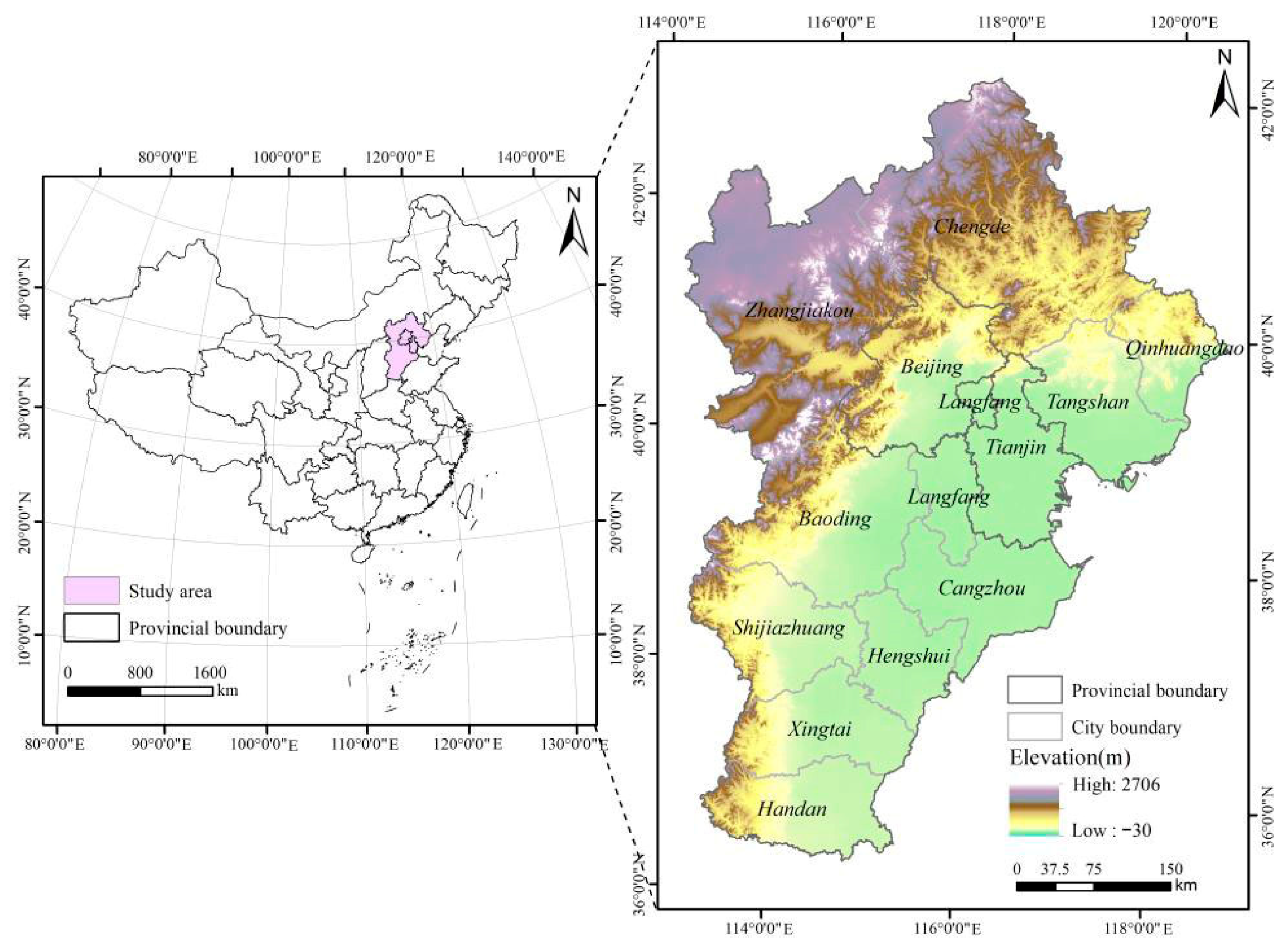
The Beijing–Tianjin–Hebei region (36°05′–42°40′ N, 113°27′–119°50′ E) lies in the northern part of China’s North China Plain. It encompasses Beijing Municipality, Tianjin Municipality, and 11 prefecture-level cities under Hebei Province, covering a total area of approximately 216,000 km2. As one of China’s most densely populated regions in terms of politics, economy, science and technology, it also serves as a vital agricultural supply base for northern China (Figure 1). The region features a warm temperate semi-humid continental monsoon climate with distinct seasons. Its topography slopes from northwest to southeast, forming a spatial pattern of “ecological conservation–agricultural production.” With accelerating economic development and urbanization, the region faces growing rigid demand for agricultural products. However, issues such as declining farmland quality, intensifying non-point source pollution, and rising agricultural carbon emissions have become increasingly severe. These challenges not only strain regional resources and the environment but also pose significant obstacles to sustainable agricultural development. Therefore, investigating the evolutionary patterns, regional disparities, and determinants of AGTFP in this region not only helps alleviate regional resource and environmental pressures and promote the green transformation of the regional economy, but also holds great strategic significance for ensuring national food security and achieving sustainable regional development.

2.2. Data Sources

This study employs a purposive sampling method for selecting research units. Given the complexity and regional heterogeneity of agricultural green development in the BTH region, we purposefully defined the research population as the 13 core prefecture-level cities covered by the “Guidelines for Coordinated Development of the Beijing–Tianjin–Hebei Region” [24] (including Beijing, Tianjin, and 11 prefecture-level cities under Hebei Province). This selection ensures the integrity of administrative planning and policy implementation units. The full inclusion strategy effectively avoids sampling bias and is conducive to scientifically identifying the spatial interaction patterns and agricultural heterogeneity characteristics within the region.
Regarding the time dimension, the research period spans from 2001 to 2022. The determination of the start and end points is based on two considerations: first, statistical continuity and comparability. 2001 marked China’s accession to the World Trade Organization (WTO) and the beginning of the 10th Five-Year Plan, during which China’s agricultural statistical system became more standardized, and the topic of agricultural green development began to emerge. Starting from this point ensures the continuity and comparability of the basic data. Second, the depth of policy coverage and research depth. The 22-year period not only allows for a complete portrayal of the transformation of agricultural green technologies and production methods but also fully covers the entire process of the Beijing–Tianjin–Hebei coordinated development strategy, from early explorations (such as early environmental cooperation) to its comprehensive deepening as a national strategy (marked by the issuance of the “Guidelines for Coordinated Development of the Beijing–Tianjin–Hebei Region” in 2015), providing sufficient time depth to explore the dynamic evolution of spatial synergy effects.
The data used in this study primarily comes from sources such as the “China Statistical Yearbook,” the “China City Statistical Yearbook,” the “Statistical Bulletin of the National Economic and Social Development of the People’s Republic of China,” and local statistical yearbooks. Additional data is supplemented by publicly available information from official websites of the National Bureau of Statistics, the Ministry of Agriculture and Rural Affairs, and local governments. Key parameters used to calculate agricultural carbon emissions (such as emission coefficients for diesel fuel in agricultural machinery, fertilizers, tillage, and irrigation) are sourced from internationally authoritative institutions like the IPCC and Oak Ridge National Laboratory to ensure the scientific and comparable nature of the calculation methods.

2.3. Research Methods

2.3.1. Measurement of Agricultural Green Total Factor Productivity

Indicator Selection
This study employs panel data from prefecture-level cities in the BTH region spanning 2001 to 2022. Indicators are selected from two dimensions—input and output indicators required for measuring AGTFP and the measurement indicator system is established by drawing on existing relevant studies [25,26] (Table 1). Building on traditional measurement models, this study develops a method for calculating AGTFP that incorporates agricultural carbon emissions as an undesirable output. From the perspective of the measurement framework, AGTFP integrates agricultural pollution into the analytical framework, conducting a comprehensive evaluation of the relationships between various input factors (e.g., labor, land, capital) in agricultural production, desirable outputs (agricultural economic growth), and undesirable outputs (agricultural environmental pollution, specifically agricultural carbon emissions in this study).
Measurement of Agricultural Carbon Emissions: Agricultural production, while generating economic values such as agricultural output, is also a significant source of non-point pollution, solid waste, and greenhouse gas emissions. To accurately assess the true environmental costs associated with agricultural production, this study incorporates undesirable outputs into the analytical framework. Since carbon dioxide is the primary greenhouse gas, and agricultural activities are a major source of its emissions, agricultural carbon emissions are treated as undesirable outputs in this study. Currently, the BTH region is facing dual pressures of water resource scarcity and non-point source pollution. Reducing chemical inputs in crop production and improving resource efficiency have become the most pressing issues in the region’s green agriculture policies. To ensure the comparability and continuity of the panel data spanning over two decades, this study focuses on crop production, which possesses the most robust data foundation and clearly defined accounting boundaries. The total agricultural carbon emissions (C) calculation method and the carbon emission coefficients draw upon the widely referenced methodologies established by Li Bo et al. and Min Jisheng et al. [27,28]. The calculation formula is as follows:
C = E i × δ
In the formula, C represents the total agricultural carbon emissions; Ei denotes the consumption of the i-th type of energy in agricultural production, and δ is the carbon emission coefficient for a particular energy type. The specific agricultural emission coefficients are shown in the table below (Table 2).
Super-Efficiency EBM Model
To avoid the biases introduced by radial and directional choices in traditional DEA models, this study adopts the super-efficiency EBM model proposed by Tone, which is non-directional, variable in scale returns, and considers undesirable outputs [29]. The model is applied using the MAX DEA software (Version 8, Ultra edition) to measure the static green production efficiency of agriculture in the BTH region. This model combines the advantages of dimensionless processing and super-efficiency analysis, effectively identifying efficient decision-making units located above the production frontier.
Malmquist–Luenberger Index
The super-efficiency EBM model can only measure static efficiency from a specific viewpoint, and it does not fully reflect the dynamic evolution of AGTFP. To address this limitation, this study adopts the methodology of Chung et al. (1997) [16] to decompose AGTFP into Agricultural Green Technical Efficiency Change (AGTEC) and Agricultural Green Technological Progress (AGTC), as follows:
M x t , y t , b t , x t + 1 , y t + 1 , b t + 1 = D t x t + 1 , y t + 1 , b t + 1 D t x t , y t , b t × D t + 1 x t + 1 , y t + 1 , b t + 1 D t + 1 x t , y t , b t   = D t + 1 x t + 1 , y t + 1 , b t + 1 D t x t , y t , b t × D t x t + 1 , y t + 1 , b t + 1 D t x t , y t , b t × D t + 1 x t + 1 , y t + 1 , b t + 1 D t + 1 x t , y t , b t   = A G T E C × A G T C
In the formula, xt and yt represent the input and output levels of agriculture in the BTH region at time t, while bt and bt+1 denotes undesirable output at time t and t + 1 (in this study, agricultural carbon emissions in the BTH region, calculated from Table 1). When the calculated result is greater than 1, it indicates an increase in AGTFP from time t to t + 1 in the BTH region; conversely, a result less than 1 indicates a decrease in AGTFP. In Equation (2), AGTEC represents the change in green technical efficiency from time t to t + 1, and AGTC denotes the change in green technological progress in agriculture from time t to t + 1.

2.3.2. Spatial Autocorrelation

To investigate the spatial correlation characteristics of AGTFP in the BTH region, this study employs the spatial autocorrelation analysis method from spatial econometrics. Within the BTH urban agglomeration, distinct spatial interaction features exist based on geographic proximity, economic connectivity, and policy coordination. AGTFP is not only constrained by local resource endowments and technological capabilities but may also exert cross-regional influence through mechanisms such as factor mobility, knowledge spillovers, and the diffusion of environmental regulations. Spatial autocorrelation analysis serves as a vital tool for identifying correlations or heterogeneity in regional agricultural green development. By identifying the spatial agglomeration patterns of AGTFP (e.g., high–high and low–low clusters), it provides a scientific basis for differentiated ecological compensation, targeted technology promotion, and joint inter-regional environmental governance within the framework of regional coordinated development [30]. Given the uneven distribution of resource and environmental carrying pressures and the significant disparities in green development levels across the BTH region, scientifically determining its spatial association patterns using Moran’s I index constitutes a critical analytical foundation for transitioning agricultural green collaboration among the three areas from an administrative-driven approach to one driven by endogenous mechanisms. Therefore, this study conducts a spatial autocorrelation analysis on the AGTFP of the 13 cities in the BTH region based on Moran’s I index. As this study utilizes panel data spanning 2001–2022, to fully capture the dynamic evolution of the spatial correlation patterns of AGTFP, both the Global and Local Moran’s I indices are calculated based on year-specific cross-sectional data. Specifically, for each year (t), The AGTFP values of the 13 BTH cities for that year are used as the observation sample. First, the Global Moran’s I for that year is calculated to assess the overall spatial agglomeration or dispersion pattern. Subsequently, the Local Moran’s I is applied to identify specific local spatial association types (e.g., H-H, L-L) for key years. This approach enables the observation of temporal fluctuations in the spatial dependence of AGTFP over the 22-year period, thereby allowing for a more effective linkage between changes in spatial patterns and the phased advancement of regional coordinated development policies. The calculation formulas are as follows:
GM I = n i = 1 n j = 1 n w i j ( x i     x ¯ ) ( x j     x ¯ ) i = 1 n j = 1 n w i j ( x i     x ¯ ) 2
LM I = n ( x i x ¯ ) j = 1 n w i j ( x j x ¯ ) i = 1 n ( x i x ¯ ) 2
In the formulas, GMI represents the Global Moran’s I, LMI denotes the Local Moran’s I, n indicates the number of spatial units, xi and xj are the AGTFP values of spatial unit i and j, respectively, x ¯ is the mean AGTFP value across all spatial units, and wij stands for the spatial weight matrix. This study employs a row-standardized Rook contiguity matrix based on geographic proximity. Specifically, if two spatial units share a common border (i.e., are geographically adjacent), their spatial weight wij is set to 1; otherwise, it is set to 0. To mitigate homogeneity bias, the spatial weight matrix is row-standardized so that the sum of weights in each row equals 1.

2.3.3. Model Construction for the Influencing Factors of Agricultural Green Total Factor Productivity

Construction of the Indicator System for Influencing Factors
Based on the principle of data availability and building upon existing literature [31], this study selects six indicators across multiple dimensions, including the socio-economic environment and technological innovation levels. The objective is to deeply investigate the spatio-temporal heterogeneity of their impacts on AGTFP in the BTH region. The specific definitions and theoretical foundations of these indicators are as follows:
Industrial Structure (Jd). Due to statistical constraints at the prefecture level, this variable is proxied by the proportion of primary industry value-added to regional GDP. Structural optimization drives the reallocation of production factors toward high-efficiency and low-emission sectors. Notably, although the primary sector encompasses agriculture, forestry, animal husbandry, and fishery, the gross output value and agricultural carbon emissions in the BTH region are predominantly attributed to crop production and animal husbandry. Forestry and aquaculture account for a minimal share. Consequently, this indicator provides adequate representation of the region’s agricultural economic profile.
Technological Innovation (rd), measured by the total internal expenditure on Research and Development (R&D). Given that the conversion of R&D investment into economic benefits requires a period of accumulation—typically manifesting as a time-lag effect of 1 to 3 years—this study adopts a one-year lagged value for technological input. To mitigate scale bias and heteroscedasticity arising from disparities in city sizes, a logarithmic transformation is applied to this variable during the empirical process. This approach aims to examine the elastic impact of the region’s overall green innovation capacity on AGTFP.
Economic Development Level (rjgdp). Captured by per capita GDP, this indicator objectively reflects the region’s economic strength in supporting agricultural green transition and environmental governance.
Government Support (cz). Measured by the total fiscal expenditure on agriculture. Fiscal intervention can significantly lower the cost barriers and risk thresholds for farmers to adopt green agricultural technologies. For consistency in the empirical analysis, this variable is also logarithmically transformed to eliminate the scale bias associated with absolute values, thereby accurately capturing the dynamic effects of policy inputs.
Urban–Rural Income Gap (citync). Calculated as the ratio of urban per capita disposable income to that of rural residents. This dimensionless ratio reflects the unbalanced allocation of production factors between urban and rural areas and the potential drivers of factor mobility.
Rural Human Capital (Ed). Proxied by the average years of schooling for rural residents. This indicator is derived from a weighted average of various educational attainment levels, aimed at capturing the qualitative characteristics rather than the quantitative scale of the labor force. Due to the absence of long-term, specific educational statistics for “agricultural practitioners” at the prefecture level, rural educational attainment is employed as an alternative indicator for the quality of the latent agricultural labor pool, ensuring both scientific rigor and data availability.
The indicator system for the influencing factors constructed in this study is summarized in Table 3.
Spatial Econometric Model Specification
The spatial correlation of AGTFP in the BTH region is not only reflected at the geographic adjacency level but is also driven by factors such as economic development level and spatial distance. It may produce interactive effects through spillover effects of production factors, such as technology, capital, and labor, or through regional competition relationships. Due to the existence of spatial lag effects, traditional econometric models are unable to accurately reflect the marginal impact of explanatory variables on the dependent variable. Therefore, this study adopts the Spatial Durbin Model (SDM), with the Spatial Autoregressive Model (SAR) and the Spatial Error Model (SEM) as comparative references. The model is used to systematically estimate the direct, indirect, and total effects of each explanatory variable. The specific model specification is as follows:
SDM :   l n A G T F P i t + 1 A G T F P i t = β l n A G T F P i t + ρ j = 1 n W i j l n A G T F P i t + 1 A G T F P i t + γ l n X i t + 1 +                             ϑ j = 1 n W i j l n A G T F P i t + δ j = 1 n W i j l n X i t + 1 + μ i + v t + ε i t
SAR : l n A G T F P i t + 1 A G T F P i t = β l n A G T F P i t + ρ j = 1 n W i j l n A G T F P i t + 1 A G T F P i t + γ l n X i t + 1 + μ i + v t + ε i t
SEM : l n A G T F P i t + 1 A G T F P i t = β l n A G T F P i t + γ l n X i t + 1 + μ i + v t + ε i t
In the formula, i represents the 13 cities within the BTH region, and t represents the year. X refers to the explanatory variables, which are factors that influence AGTFP under spatial effects. β and δ represent the spatial lag coefficients of the dependent variable (BTH AGTFP) and the explanatory variables (a series of factors influencing AGTFP), respectively. The parameter vector γ represents the impact of each explanatory variable (factors affecting AGTFP) on the dependent variable (BTH AGTFP). ρ j = 1 n W i j l n A G T F P i t + 1 A G T F P i t indicates the interaction effect between adjacent spatial units of BTH AGTFP. Wij is the spatial weight matrix; ε i t is the spatial error term; v t represents the time effect; and μ i represents the individual effect.
Model Testing, Effect Decomposition, and Sample Periodization
(1) Multicollinearity Test: Based on the principle of indicator independence, this study uses the Variance Inflation Factor (VIF) method to test for multicollinearity among the explanatory variables. The results show (Table 4) that the VIF values of the indicators range from 1.49 to 9.55, with an average value of 5.00, all of which are less than 10. This indicates that there is no severe multicollinearity between the indicators, and they can be directly used for model regression.
(2) Model Specification Test: Following the testing steps outlined by Elhorst, the first step is to determine whether the model includes spatial lag terms. The results show that the LM test for the spatial and time mixed fixed effects model is significant at the 1% level, while the null hypothesis cannot be rejected in the regressions with only spatial fixed effects or time fixed effects. This indicates that the model should account for both spatial and time effects simultaneously. Further validation through the LR test confirms significance at the 1% level, and the spatial Durbin model (SDM) with bidirectional fixed effects is ultimately selected for regression analysis.
(3) Explanation of Spatial Effect Decomposition: Since the Spatial Durbin Model (SDM) includes both the spatial lag term of the dependent variable and the independent variables, its regression coefficients are influenced by the spatial feedback mechanism and cannot be directly used to measure the marginal effect of the explanatory variables on the explained variable. To accurately reveal the net impact of various influencing factors on the AGTFP in both the local and surrounding areas, this study adopts the partial differential method proposed by LeSage and Pace (2009) to decompose the estimated model coefficients [32], obtaining the direct effect, indirect effect (i.e., spatial spillover effect), and total effect. Specifically, this method involves solving the partial derivative matrix of AGTFP with respect to all explanatory variables. The average of the diagonal elements of this matrix is taken as the direct effect, which measures the impact of changes in local explanatory variables on local AGTFP (including feedback effects). The average of the row sums of the off-diagonal elements of this matrix is taken as the indirect effect, which measures the average impact of changes in local explanatory variables on AGTFP in other regions. The total effect is the sum of the two, representing the comprehensive impact of the factor on the entire regional system.
(4) Sample Segmentation: To evaluate the effectiveness of agricultural green coordinated development in the BTH region after the implementation of the “Guidelines for Coordinated Development of the Beijing–Tianjin–Hebei Region”, the study divides the sample period based on the plan’s implementation. The two stages are from 2001 to 2015 and from 2015 to 2022, and a comparative analysis is conducted using data from the full period of 2001 to 2022.

2.4. Statistical and Analytical Software

To ensure scientific rigor and reproducibility, the following software suites were employed for data processing, modeling and visualization. Data preprocessing and storage were conducted using Microsoft Excel 2021 (Microsoft Corp., Redmond, WA, USA). Agricultural green total-factor productivity was estimated with the super-efficiency epsilon-based measure (EBM) model and the Malmquist–Luenberger index, implemented in MaxDEA 8 Ultra (MaxDEA Software Ltd., Beijing, China). Spatial autocorrelation analyses were performed in GeoDa 1.20 (Center for Spatial Data Science, University of Chicago, Chicago, IL, USA). Spatial-econometric regressions—specifically the spatial Durbin model—and related diagnostic tests were carried out using Stata 18.0 (StataCorp LLC, College Station, TX, USA). Geospatial mapping and pattern analysis were conducted in ArcGIS 10.6 (Environmental Systems Research Institute, Inc., Redlands, CA, USA), and high-resolution statistical graphics were generated with OriginPro 2024 (OriginLab Corp., Northampton, MA, USA).

3. Results

3.1. Agricultural Green Total Factor Productivity Measurement and Comparative Analysis in the Beijing–Tianjin–Hebei Region

3.1.1. Measurement of Agricultural Green Total Factor Productivity in the Beijing–Tianjin–Hebei Region

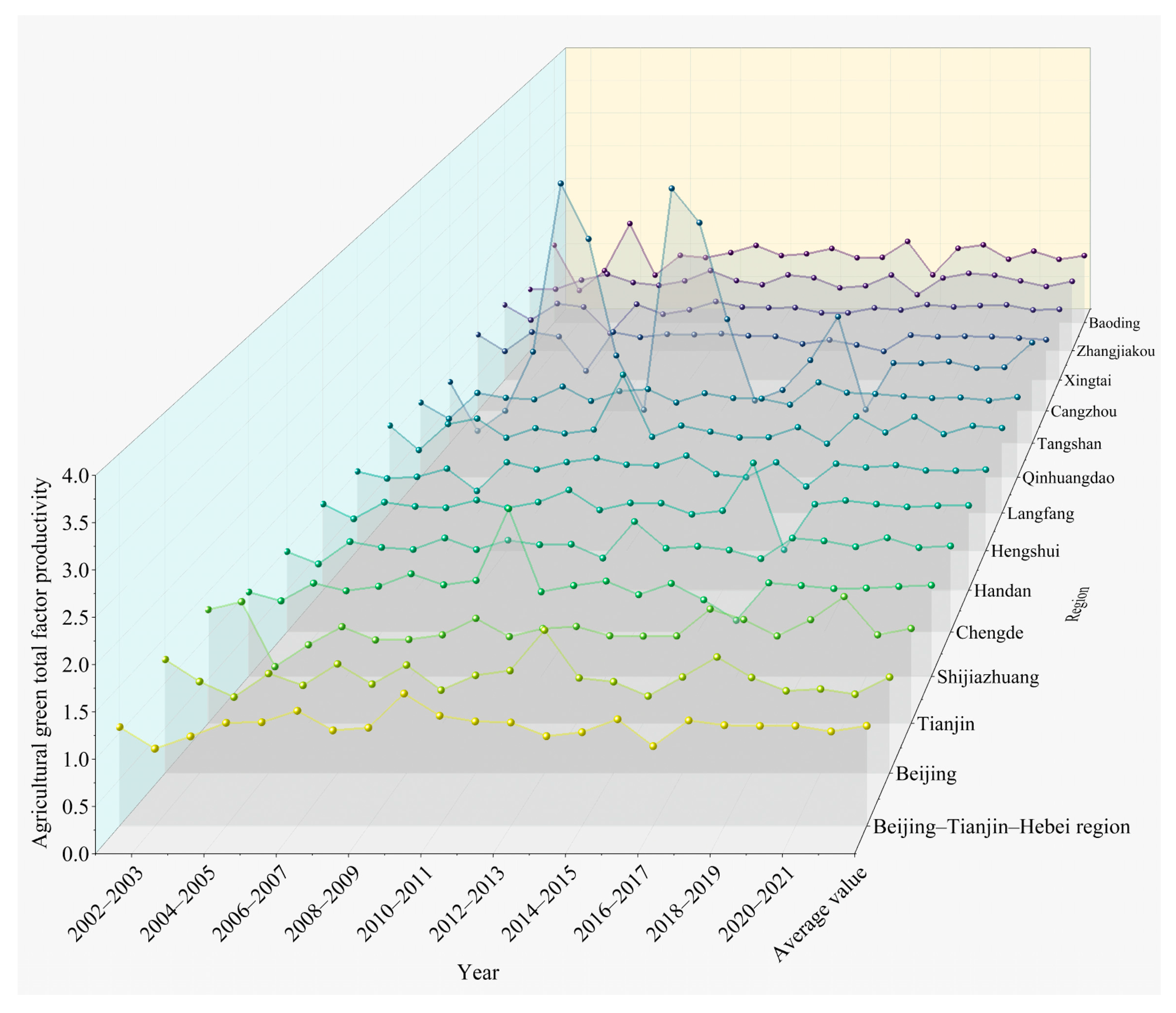
Figure 2 shows the temporal dynamics and spatial heterogeneity characteristics of AGTFP for the 13 municipal districts in the BTH region from 2001 to 2022. The selected 13 districts, ranging from core cities to resource-based areas and ecological conservation zones, fully reflect the multi-dimensional characteristics of agricultural green development in the region. Overall, the average AGTFP for the BTH region during the study period was 1.077 (greater than 1), indicating a state of net efficiency improvement with an annual growth rate of 7.7%. This suggests the successful implementation of the agricultural ecological environment coordination and protection mechanism in the region. The temporal changes exhibit a three-phase pattern highly coupled with the regional coordinated development policy process: (1) 2001–2014: Volatility Dominated Phase. During this period, the AGTFP fluctuated significantly, as seen in the waterfall chart, without forming a sustained growth trend. This volatility stemmed from the fact that agricultural green coordination in the BTH region had not yet risen to the national strategic level. The three regions developed independently, with inconsistent environmental standards and a lack of regional ecological co-governance policies. The cross-regional diffusion of agricultural green technologies was limited, leading to prominent temporal fluctuations in productivity. (2) From 2015 to 2017, the region entered a phase of transitional growing pains and the initial effects of policy implementation. After the elevation of the Beijing–Tianjin–Hebei coordinated development strategy to a national level in 2014, agricultural green coordination entered the institutionalization phase, with joint construction and shared ecological environment among the three regions. However, the waterfall chart shows a phase of decline in AGTFP during 2015–2016. This fluctuation reflects the growing pains associated with strengthened environmental regulations, as high-water-consumption and high-pollution agricultural sectors (such as large-scale livestock farming) were gradually phased out. Although this led to a short-term decline in production efficiency, it laid the foundation for long-term green transformation. During this period, the decentralization of non-capital functions from Beijing also facilitated the diffusion of modern factors, such as technology and branding, to Tianjin and Hebei, with the policy effects of regional collaborative governance beginning to emerge. (3) 2018–2022: Steady Improvement Phase. In this phase, the AGTFP trajectory in the waterfall chart entered a continuous upward channel and remained above 1, with significantly reduced fluctuations. This characteristic indicates that the effects of ecological environment co-governance policies were gradually being released. The innovation of agricultural green technologies and the efficiency of cross-regional diffusion improved significantly, strengthening the stability and sustainability of agricultural green production in the BTH region.
The regional line clusters in the waterfall chart also reveal significant regional differences in AGTFP. This pattern of differences aligns with the characteristics of the cities selected through purposive sampling in this study, which have different functional roles: Core cities like Beijing and Tianjin show relatively high and stable AGTFP trajectories. These regions, supported by dense technological resources, ample financial backing, and policy advantages, are at the forefront in fields such as agricultural green technology research and development, and organic ecological agriculture promotion. The AGTFP trajectory in Cangzhou is relatively low, constrained by resource limitations and economic development levels, leading to a slower agricultural green transformation process. The ecological conservation areas in northern Hebei (Chengde, Zhangjiakou) show moderate AGTFP growth. Despite rich ecological resources, agricultural development is limited by climate conditions and ecological function positioning (such as Zhangjiakou’s role as a water source conservation area for the capital, which restricts agricultural development). The growth rate is relatively slow. Although the Beijing–Zhangjiakou paired assistance has made targeted efforts in ecological protection and technological collaboration, the AGTFP in these areas remains slightly below the regional average. This confirms the effectiveness of the sample selection in capturing the gradient differences and diversity within the BTH region.

3.1.2. Decomposition and Comparison of Agricultural Green Total Factor Productivity in the Beijing–Tianjin–Hebei Region

Furthermore, the AGTFP of the BTH region is decomposed into AGTEC and AGTC. Typically, AGTEC reflects improvements or changes in management practices, decision-making processes, and management systems, while AGTC represents the degree of innovation in green production technologies. This includes both independent innovation and the imitation or introduction of technologies, encompassing new products, new production methods, and so on.
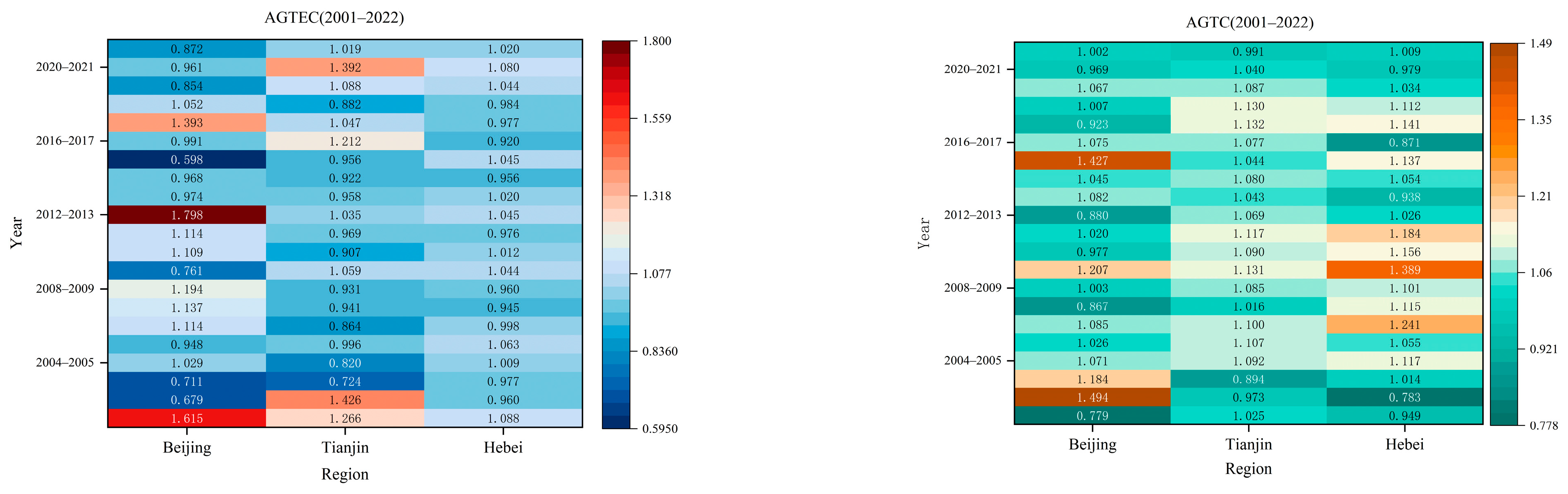
The results (Figure 3) show that, between 2001 and 2022, the average AGTEC for Beijing, Tianjin, and Hebei were 1.042, 1.020, and 1.006, respectively, while the average AGTC were 1.057, 1.063, and 1.067. AGTC was notably higher than AGTEC across all three regions, becoming the main driver for agricultural green development in the BTH region. This suggests a growth model driven by agricultural green technologies, indicating that the entire region has been effectively developing in terms of coordinated agricultural green technological innovation and application.
From a regional perspective, the growth of AGTFP in Beijing primarily relies on a significant improvement in agricultural green technical efficiency change (AGTEC). However, the annual fluctuations are large, suggesting that the improvement in technical efficiency in Beijing may be highly dependent on policy interventions, project-driven initiatives, or resource inputs, which makes it relatively unstable. Particularly in 2017, when the General Office of the Central Committee of the Communist Party of China and the General Office of the State Council issued the “Opinions on Innovation Mechanisms to Promote Agricultural Green Development,” Beijing responded actively by implementing a series of measures to promote agricultural green development, such as deep plowing and land preparation with agricultural machinery, and a complete ban on straw burning. These efforts yielded significant results, indicating a growth model driven by green efficiency. In Tianjin, AGTFP growth is almost entirely driven by AGTC, while AGTEC mostly deteriorated. This suggests that Tianjin continues to face challenges in transforming existing green technologies into actual productivity, possibly due to issues such as inefficient management, insufficient institutional incentives, or inappropriate resource allocation. Similarly to Tianjin, AGTFP growth in Hebei is primarily dependent on AGTC, indicating significant achievements in the promotion and application of agricultural green technologies. However, AGTEC showed little variation, fluctuating slightly around 1.006, reflecting that, as a traditional agricultural province, Hebei may experience slower improvements in green technology efficiency due to factors such as operational scale, production methods, and farmer acceptance.

3.2. Spatial Coordination Analysis of Agricultural Green Development in the Beijing–Tianjin–Hebei Region

3.2.1. Global Spatial Autocorrelation of Agricultural Green Total Factor Productivity in the Beijing–Tianjin–Hebei Region

To clarify the spatial correlation characteristics of AGTFP in the BTH region, this study uses the global Moran’s I index to measure the global spatial autocorrelation level of AGTFP from 2001 to 2022 (Table 5). The results show that from 2001 to 2022, the global spatial aggregation characteristics of BTH AGTFP were generally weak. In most years, the Moran’s I index exhibited positive and negative fluctuations, but the p-values were all greater than 0.1, indicating that the spatial distribution of AGTFP during these years was random, with no significant clustering or dispersion across regions. Only a few years showed marginally significant or significant spatial correlation: 2005–2006 (Moran’s I = 0.021, P = 0.069) and 2017–2018 (Moran’s I = 0.147, P = 0.089) showed marginally significant positive spatial autocorrelation, indicating an initial emergence of interregional AGTFP linkage. 2007–2008 (Moran’s I = −0.268, P = 0.098) and 2016–2017 (Moran’s I = −0.337, P = 0.080) showed marginally significant negative spatial autocorrelation, reflecting weak dispersed characteristics where high AGTFP regions were adjacent to low AGTFP regions. 2013–2014 was the only year to exhibit significant spatial correlation (Moran’s I = −0.373, P = 0.013), showing significant negative spatial autocorrelation, indicating prominent spatial differences in AGTFP, with high AGTFP regions being adjacent to low AGTFP regions.

3.2.2. Local Spatial Autocorrelation of Agricultural Green Total Factor Productivity in the Beijing–Tianjin–Hebei Region

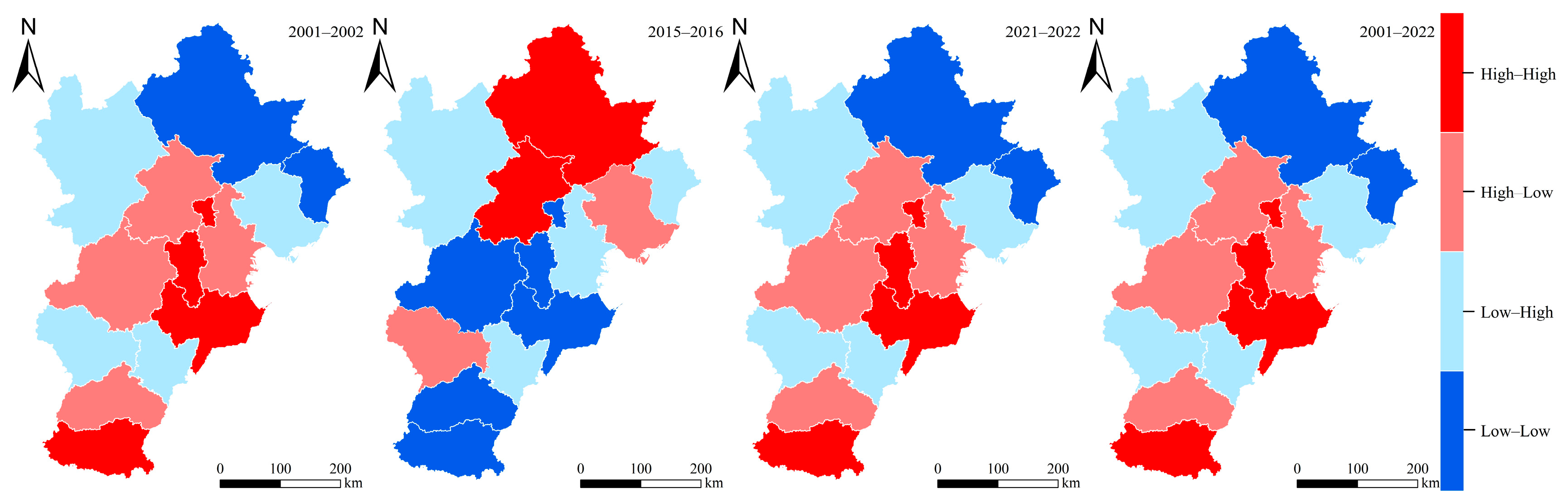
Based on the implementation of the “Guidelines for Coordinated Development of the Beijing–Tianjin–Hebei Region” in 2015, this paper further analyzes the partial spatial correlation characteristics of the AGTFP in the 13 districts of BTH during 2001–2002, 2015–2016, 2021–2022, and across 2001–2022. The regions are divided into four categories based on spatial clustering: High–High Cluster (H-H type), Low–High Cluster (L-H type), High–Low Cluster (H-L type), and Low–Low Cluster (L-L type) (Figure 4).
Beijing’s spatial correlation type changed from the H-L type (high-productivity units surrounded by low-productivity units) in 2001–2002 to the H-H type (high-productivity units surrounded by high-productivity units) in 2015–2016. By 2021–2022, it reverted to the H-L type. This evolution trajectory reflects a dynamic clustering characteristic of Beijing’s AGTFP, moving from “high–low to high–high to high–low.” The decline in AGTFP levels in the surrounding regions is the core spatial correlation mechanism driving this transformation.
In 2001–2002, H-H clusters were distributed in Cangzhou, Handan, and Langfang. These areas had a relatively high AGTFP and generated positive spatial spillovers to the surrounding areas. In 2015–2016, driven by the policy effects of the coordinated development strategy of Beijing–Tianjin–Hebei, Beijing and Chengde were included in the H-H cluster, reflecting the early implementation results of ecological protection and agricultural green transformation policies. By 2021–2022, the H-H clusters expanded to include Cangzhou, Handan, Hengshui, and Qinhuangdao, indicating the further expansion of the spatial diffusion of agricultural green technologies.

3.3. Analysis of the Influencing Factors of Agricultural Green Total Factor Productivity in the Beijing–Tianjin–Hebei Region

Based on the regression results of the bidirectional fixed effects spatial Durbin model (Table 6), and combining data from the entire period (2001–2022) and from the segmented periods (2001–2015, 2015–2022), this analysis explores the impact mechanisms and spatial-temporal heterogeneity of various factors on AGTFP in the BTH region from three dimensions: direct effects, indirect effects, and total effects.
The impact of industrial structure on AGTFP in the BTH region underwent a fundamental shift around 2015. Specifically, between 2001 and 2015, the direct effect of industrial structure adjustment was significantly positive at the 5% level, indicating that the increase in the proportion of the primary industry during this period led to a significant local improvement in AGTFP. However, the indirect effect was not significant, reflecting insufficient regional coordination. In contrast, from 2015 to 2022, the direct effect of industrial structure shifted to a significantly negative value. A possible explanation for this is that after the implementation of the “Coordinated Development Plan,” the industrial structure in the BTH region was optimized and upgraded, with the share of the primary industry decreasing, which weakened its contribution to AGTFP. This aligns with the general pattern of economic development and industrial upgrading, suggesting a need to shift agricultural production from a “structural scale effect” to a “structural upgrade effect,” which requires further optimization of regional industrial division.
Between 2001 and 2015, the impact of R&D funding was not significant, possibly due to the constraints of government fiscal expenditure and the long-standing contradictions in agricultural vulnerability. Compared to other industries, agricultural R&D investment was relatively low, and as agricultural technology developed, farmers began to use large amounts of fertilizers and pesticides to prevent crop losses due to pests and diseases, which inevitably suppressed the improvement of AGTFP. By 2015–2022, the direct effect of R&D funding intensity became significantly positive, indicating that after the initial accumulation, technological innovation achievements began to be widely applied in local agricultural production. The introduction of green technologies, smart equipment, and management models effectively enhanced resource utilization efficiency and environmental friendliness. However, the indirect effect of R&D funding remained significantly negative over these 20 years, suggesting that the agricultural knowledge spillover effect within the BTH region was not yet evident. Innovation investments have not yet been converted into practical benefits, possibly due to technological barriers or insufficient regional innovation collaboration. Strengthening the regional collaborative innovation system will be necessary in the future.
Economic development level is the only indicator that has shown a significant positive effect on both the direct and indirect impacts on AGTFP across all periods. This indicates that economic development is the most reliable driving force for overall regional agricultural green development. It confirms the applicability of the Environmental Kuznets Curve in the agricultural sector, where improvements in economic levels provide the necessary financial, technological, and market demand support for agricultural green transformation. However, the overall indirect effect from 2001 to 2022 was significantly negative, suggesting the presence of a siphoning or competitive effect. That is, the rapid economic development in one area may initially attract green production factors from neighboring regions, thereby temporarily suppressing the AGTFP in nearby areas.
Government support had a significant direct and indirect effect on AGTFP between 2015 and 2022, but with opposite directions, which requires special attention. This could indicate that agricultural fiscal subsidies may have been misallocated or structurally biased, such as excessive subsidies directed toward traditional chemical agriculture or a failure to effectively incentivize green behaviors. Additionally, due to policy implementation inefficiencies, this may have increased the institutional costs for production entities. However, the positive spatial spillover effect suggests that, in recent years, an increase in fiscal support for agriculture may have contributed positively to the coordinated agricultural green development in the BTH region through resource coordination, stabilization of regional agricultural product markets, and improvement of cross-border infrastructure.
The impact of the rural–urban income gap was primarily positive in terms of spatial spillover effects. Between 2015 and 2022, both the indirect and total effects were significantly positive, likely because the growing rural–urban income gap accelerated the transfer of rural labor, creating conditions for land circulation and large-scale, intensive green management. After the implementation of the “Coordinated Development Plan” in 2015, the region promoted urban–rural integration, facilitating labor mobility and technological diffusion. This created strong market demand for high-quality green agricultural products in neighboring areas and incentivized rural labor to use resources more effectively and adopt new green production technologies in order to earn higher incomes, thereby forming a regional synergy to enhance green efficiency.
Throughout the entire sample period, the impact of rural human capital on all effects of AGTFP was not significant. However, after 2015, the direct and total effects of human capital on AGTFP became significantly positive, while the indirect effect was not significant. This suggests that more educated farmers can understand and adopt complex green technologies, such as water-saving, fertilizer-saving, and ecological agriculture, more quickly, which benefits local AGTFP. However, due to the still-immature mechanisms for talent mobility, knowledge sharing, and technological adaptation at the regional level, the benefits have not yet been effectively extended to surrounding areas.

4. Discussion

4.1. Interpreting the Growth Pattern of Agricultural Green Total Factor Productivity

This study finds that between 2001 and 2022, AGTFP in the BTH region showed an overall upward trend, with an average annual growth rate of 7.7%. This growth was primarily driven by green technological progress rather than improvements in technical efficiency. This pattern aligns with findings from studies in the Yangtze River Delta region, reflecting the national emphasis on green technology research and development. However, compared to studies conducted at the national or provincial levels, the BTH region exhibited more significant temporal volatility and clearer stage-wise evolution. The severe fluctuations observed before 2015, followed by a period of transition and stabilization, suggest that productivity dynamics in metropolitan areas are more sensitive to institutional restructuring and regulatory tightening. In this sense, the short-term decline in AGTFP following the upgrading of the BTH coordinated development strategy should not be interpreted as a policy failure. Instead, it reflects the transformation costs associated with stricter environmental regulations and industrial restructuring, a phenomenon also documented in studies on environmental regulation and green productivity in other rapidly urbanizing regions. More importantly, the continued dominance of technological progress over efficiency changes indicates a structural imbalance in the innovation–diffusion chain. While the BTH region has been successful in generating or introducing green agricultural technologies, its capacity to diffuse, adapt, and internalize these technologies within heterogeneous local production systems remains limited. This helps explain why cities like Beijing, with strong infrastructure and policy resources, show high but unstable efficiency improvements, seemingly reliant on project-based or policy-driven interventions rather than endogenous, market-driven efficiency gains. These findings align with recent international evidence, which indicates that the productivity returns from green innovation depend critically on local absorptive capacity, organizational structure, and technology extension systems, rather than solely on innovation inputs.

4.2. The Limits of Spatial Coordination and Spillover Effects

One of the key contributions of this study is its explicit examination of the spatial dimension of AGTFP within a major urban agglomeration. Contrary to the expectation that geographically proximate regions would naturally converge toward a coordinated development trajectory, the results show that AGTFP in the BTH region has not exhibited stable or sustained positive spatial autocorrelation. Instead, the global Moran’s I index fluctuated between positive and negative values, and local spatial association patterns changed over time, indicating an unstable and fragmented spatial structure. This pattern contrasts with findings from more integrated regions, such as the Yangtze River Delta, where sustained positive spatial dependence in green productivity has been recorded. This difference highlights that spatial proximity alone is insufficient to guarantee effective spillover effects. In the BTH context, the strong capabilities of core cities may simultaneously generate potential knowledge spillovers and induce a “siphoning effect,” wherein high-quality labor, capital, and innovation resources are drawn away from surrounding areas. Thus, the net spatial outcome depends on institutional arrangements governing resource mobility, interregional collaboration, and benefit-sharing. The Spatial Durbin Model further corroborates this interpretation, showing that R&D investment has a significantly positive local effect, yet its indirect effect remains persistently negative. This suggests that technological knowledge and innovation inputs have not effectively been transformed into regional public goods. Instead, the benefits of innovation have remained localized, exacerbating spatial inequality in green productivity. This finding adds a new perspective to the existing literature, indicating that negative or insignificant spillover effects do not necessarily imply a lack of innovation, but rather reflect deficiencies in cross-regional transmission mechanisms.

4.3. Heterogeneous Drivers and Structural Transformation in Green Development

The temporal heterogeneity identified in the drivers of AGTFP reflects a deeper structural transformation in the forces driving agricultural green development. The reversal of the industrial structure effect after 2015 indicates that expanding the share of primary industry is no longer a viable pathway for improving green productivity. Instead, further gains increasingly depend on internal upgrades within agriculture, including value chain integration, quality differentiation, and service-oriented transformation. This result aligns with recent viewpoints suggesting that in developed or rapidly urbanizing regions, improvements in green productivity rely less on the reallocation of factors across sectors and more on efficiency and innovation within sectors. Similarly, the growing importance of rural human capital in the later period underscores the role of farmers’ skills, education, and learning capacity in mediating the effectiveness of green technologies. However, the lack of significant spillover effects from human capital suggests that knowledge remains “sticky” spatially, constrained by limited interregional mobility and weak cooperative networks. This finding resonates with international studies emphasizing that unless supported by deliberate institutional arrangements, human capital externalities are highly localized. The complexity of the role of government support further illustrates the distinction between scale and structure in policy interventions. The coexistence of negative direct effects and positive indirect effects implies that while traditional subsidy schemes may distort local production incentives, government spending targeted at regional infrastructure, ecological compensation, or market integration can generate broader spatial benefits. This highlights the importance of shifting from quantity-oriented fiscal support to performance-based and coordination-oriented policy tools.

4.4. Policy Implications in the Context of Regional Coordination Strategies

To improve AGTFP in the BTH region and shift agricultural development from extensive intervention to a more refined system of regulation, future policies should focus on the following four key areas: First, innovation in regional collaborative governance mechanisms and the strengthening of policy coordination and interest alignment. The study indicates that agricultural green development in the BTH region suffers from the “island effect,” with insufficient spatial coordination. Therefore, administrative boundaries and parochialism must be overcome by adopting a regional eco-governance framework based on holistic benefits. The three governments must collaborate to develop differentiated agricultural green development models, based on their comparative advantages, avoiding disorderly competition and industrial homogeneity. Second, enhancing cross-regional scientific cooperation and diffusion to stimulate new green innovation. Green agricultural technology is the core driver, but the current spillover effects are limited. It is recommended to optimize the structure of R&D investment, establish cross-jurisdictional joint research funds, and prioritize supporting green technologies that meet the common needs of the region. Additionally, an integrated technology diffusion network should be established, with cross-regional demonstration parks in eco-sensitive areas and technology “lowlands” to stimulate knowledge flow across regions. To address the issue of human capital spillovers not being significant, cross-regional technology promotion and talent exchange mechanisms should be strengthened. Through technical training and extension services, green production knowledge should be disseminated and adapted to local conditions, transforming Beijing’s technological advantages into regional agricultural green development momentum. Third, implementing differentiated industrial layouts to guide structural optimization and efficiency improvements. Coordinated green development in the BTH region requires institutional, technical, and management innovations that promote the integration of agricultural resources and full industrial chain development. The region should create scaled agricultural economic sectors with unique characteristics, forming cluster advantages, while ensuring food security. Hebei, as the central area of BTH, should focus on developing efficient, ecological, and branded agriculture, actively receiving urban agricultural expansions and promoting the integration of primary, secondary, and tertiary industries. Although there is no absolute convergence in AGTFP across the three regions, geographical proximity provides the conditions for technological diffusion. Efforts should be made to strengthen cross-regional technical exchange and accelerate the diffusion of advanced technologies from leading areas to lagging ones. Fourth, smoothing the flow of factors across regions to promote urban–rural integration. The study found that reasonable income gaps between urban and rural areas, resulting in the reallocation of production factors, have a positive spatial spillover effect on AGTFP. Policies should not simply pursue the reduction in numerical gaps but focus on facilitating the flow of factors resulting from such gaps. To this end, agricultural product circulation, market information, and quality supervision systems should be improved to establish a unified regional market. Green financial policies should be innovated to guide social capital into ecological agriculture and smart agriculture through interest subsidies and risk compensation. Rural land system reforms should be deepened, and a cross-regional rural property rights transaction platform should be jointly established to reduce institutional transaction costs and promote the efficient flow and optimal allocation of talent, technology, capital, and information across urban–rural and regional areas, providing sustained momentum for the green transformation of agriculture.

4.5. Research Limitations and Future Directions

Despite the systematic exploration of the AGTFP measurement methods, spatiotemporal evolution analysis, and identification of influencing factors, this study inevitably faces several limitations that need to be addressed in future research. First, there is incompleteness in the selection of input indicators. The study primarily includes key flow capital and some fixed capital indicators, such as agricultural machinery, effective irrigation area, and fertilizer and pesticide usage. However, other important capital inputs, such as facility agriculture infrastructure, agricultural informatization, and digitalization, were not included due to the difficulty in obtaining long-term, continuous city-level data. This simplification of input dimensions may introduce biases in the representation of the real agricultural input structure, affecting the absolute measurement of AGTFP. Second, the labor input indicator does not reflect the differences in labor intensity and working hours. The use of “agricultural employment” as an indicator did not account for the differences between full-time and part-time farmers, especially in regions with small-scale farming like BTH, where agriculture is often part-time. This could lead to an overestimation of labor input, introducing measurement bias in efficiency calculation. Third, the land input indicator does not fully capture the structure and heterogeneity of agricultural land quality. The study uses “total sown area of crops,” but this neglects permanent grassland and pastures, which are inconsistent with the expected output indicator of total agricultural output value. Finally, the boundary for calculating undesirable outputs (agricultural carbon emissions) needs to be expanded. The study used coefficients from Li Bo et al. and Min Jisheng et al., which cover major carbon sources such as agricultural machinery diesel, fertilizers, pesticides, agricultural films, plowing, and irrigation [27,28]. However, this framework does not include all greenhouse gas emissions from agricultural activities, such as methane emissions from rice paddies and methane and nitrous oxide emissions from livestock digestion and manure management. Future research can incorporate more comprehensive and standardized emission data, such as those from the FAOSTAT “Agricultural Food Systems Greenhouse Gas Emissions” database.
Based on the study design and empirical results, future research can further deepen in several directions. First, in terms of indicator systems, future studies can expand on the multi-dimensional nature of agricultural green inputs and outputs. With the acceleration of agricultural modernization and digitalization, the traditional indicator system focusing on land, labor, and chemical inputs is insufficient to fully reflect the structural transformation of agricultural production methods. Future studies can gradually incorporate new production factors such as digital agriculture, smart equipment, biotechnology, and agricultural service outsourcing while further distinguishing between economic output, ecological output, and social benefits in the output dimension. Second, in terms of environmental constraints, future research can move from a single emission indicator to a multi-dimensional assessment of environmental constraints. Given the current “dual carbon” goals, agricultural green development faces multiple environmental pressures, including non-point source pollution, water resource consumption, and biodiversity protection. Future research can incorporate multiple environmental constraints into the undesirable output indicator to more comprehensively assess the environmental performance of agricultural green development. Third, in terms of causal inference and policy effects, future studies should further strengthen causal inference and dynamic analysis. This study mainly uses correlational analysis, but future studies can use quasi-natural experiment methods, such as difference-in-differences, regression discontinuity, or synthetic control methods, to systematically evaluate the causal effects of agricultural green policies, regional coordination strategies, or environmental regulations on AGTFP. Additionally, dynamic spatial models or mediation effect models can be introduced to delve deeper into the mechanisms of technology diffusion, factor flow, and institutional coordination in the regional agricultural green transformation.

Author Contributions

Conceptualization, J.Z. and A.W.; methodology, W.L.; software, W.L. and Z.X.; validation, W.L.; formal analysis, W.L.; investigation, J.Z., D.Z. and H.W.; resources, J.Z. and A.W.; data curation, W.L., J.Z. and A.W.; writing—original draft, W.L. and J.Z.; writing—review and editing, W.L. and H.W.; visualization, W.L., H.W. and Z.X.; supervision, J.Z. and A.W.; project administration, J.Z. and A.W.; funding acquisition, J.Z. and A.W. All authors have read and agreed to the published version of the manuscript.

Funding

This research was supported by the Project of Beijing Research Center on Xi Jinping Thought on Socialism with Chinese Characteristics for a New Era: “Research on Multi dimensional Synergistic Mechanism Between Value Realizing of Ecological Products and Rural Revitalization in Beijing” (23LLGLC051).

Data Availability Statement

The original contributions presented in this study are included in the article material. Further inquiries can be directed to the corresponding authors.

Conflicts of Interest

The authors declare no conflicts of interest.

References

  1. Yang, X.; Feng, Z.; Chen, Y.; Xu, X. A Comparative Analysis of the Levels and Drivers of Regional Coordinated Development in the Yangtze River Economic Belt and Yellow River Basin, China. Heliyon 2024, 10, e26513. [Google Scholar] [CrossRef]
  2. Cheng, S.; Qu, G. Research on the Effect of Digital Economy on Carbon Emissions under the Background of “Double Carbon”. Int. J. Environ. Res. Public Health 2023, 20, 4931. [Google Scholar] [CrossRef]
  3. Li, J.; Tang, D.; Tenkorang, A.P.; Shi, Z. Research on Environmental Regulation and Green Total Factor Productivity in Yangtze River Delta: From the Perspective of Financial Development. Int. J. Environ. Res. Public Health 2021, 18, 12453. [Google Scholar] [CrossRef]
  4. Qin, S.; Han, Z.; Chen, H.; Wang, H.; Guo, C. High-Quality Development of Chinese Agriculture under Factor Misallocation. Int. J. Environ. Res. Public Health 2022, 19, 9804. [Google Scholar] [CrossRef]
  5. Zhu, L.; Shi, R.; Mi, L.; Liu, P.; Wang, G. Spatial Distribution and Convergence of Agricultural Green Total Factor Productivity in China. Int. J. Environ. Res. Public Health 2022, 19, 8786. [Google Scholar] [CrossRef]
  6. Wei, J.; Zhang, X. The Role of Big Data in Promoting Green Development: Based on the Quasi-Natural Experiment of the Big Data Experimental Zone. Int. J. Environ. Res. Public Health 2023, 20, 4097. [Google Scholar] [CrossRef] [PubMed]
  7. Huang, Y.; Chen, Z.; Li, H.; Yin, S. The Impact of Digital Economy on Green Total Factor Productivity Considering the Labor-Technology-Pollution Factors. Sci. Rep. 2023, 13, 22902. [Google Scholar] [CrossRef] [PubMed]
  8. Guo, Z.; Zhang, X. Carbon Reduction Effect of Agricultural Green Production Technology: A New Evidence from China. Sci. Total Environ. 2023, 874, 162483. [Google Scholar] [CrossRef] [PubMed]
  9. Lu, S.; Zhuang, J.; Sun, Z.; Huang, M. How Can Rural Digitalization Improve Agricultural Green Total Factor Productivity: Empirical Evidence from Counties in China. Heliyon 2024, 10, e35296. [Google Scholar] [CrossRef]
  10. Xu, X.; Huang, X.; Huang, J.; Gao, X.; Chen, L. Spatial-Temporal Characteristics of Agriculture Green Total Factor Productivity in China, 1998–2016: Based on More Sophisticated Calculations of Carbon Emissions. Int. J. Environ. Res. Public Health 2019, 16, 3932. [Google Scholar] [CrossRef]
  11. Cao, T.; Xie, N.; Hanim, W.; Qin, Y. Digital-Green Synergistic Transition, Fiscal Decentralization and Regional Green Total Factor Productivity in Agriculture. J. Environ. Manag. 2025, 385, 125382. [Google Scholar] [CrossRef]
  12. Li, L.; Han, J.; Zhu, Y. Does Farmland Inflow Improve the Green Total Factor Productivity of Farmers in China? An Empirical Analysis Based on a Propensity Score Matching Method. Heliyon 2023, 9, e13750. [Google Scholar] [CrossRef] [PubMed]
  13. Quan, J.Z. Empirical analysis of China’s agricultural total factor productivity growth: 1978–2007—Based on the stochastic frontier analysis (SFA) method. China Rural Econ. 2009, 15, 36–47. [Google Scholar] [CrossRef]
  14. Cui, N.B.; Sheng, S.Y. Influencing factors, quality measurement, and dynamic analysis of agricultural green development in major grain-producing areas—Based on the perspective of green total factor productivity. J. Agric. Resour. Environ. 2022, 39, 621–630. [Google Scholar] [CrossRef]
  15. Chambers, R.G.; Chung, Y.; Färe, R. Benefit and Distance Functions. J. Econ. Theory 1996, 70, 407–419. [Google Scholar] [CrossRef]
  16. Chung, Y.H.; Färe, R.; Grosskopf, S. Productivity and Undesirable Outputs: A Directional Distance Function Approach. J. Environ. Manag. 1997, 51, 229–240. [Google Scholar] [CrossRef]
  17. Tone, K. A Slacks-Based Measure of Efficiency in Data Envelopment Analysis. Eur. J. Oper. Res. 2001, 130, 498–509. [Google Scholar] [CrossRef]
  18. Oh, D. A Global Malmquist-Luenberger Productivity Index. J. Prod. Anal. 2010, 34, 183–197. [Google Scholar] [CrossRef]
  19. Wang, F.; Du, L.; Tian, M. Does Agricultural Credit Input Promote Agricultural Green Total Factor Productivity? Evidence from Spatial Panel Data of 30 Provinces in China. Int. J. Environ. Res. Public Health 2023, 20, 529. [Google Scholar] [CrossRef]
  20. Sun, Y. Environmental Regulation, Agricultural Green Technology Innovation, and Agricultural Green Total Factor Productivity. Front. Environ. Sci. 2022, 10, 955954. [Google Scholar] [CrossRef]
  21. Wang, L.; Tang, J.; Tang, M.; Su, M.; Guo, L. Scale of Operation, Financial Support, and Agricultural Green Total Factor Productivity: Evidence from China. Int. J. Environ. Res. Public Health 2022, 19, 9043. [Google Scholar] [CrossRef]
  22. Ahmed, N.; Hamid, Z.; Mahboob, F.; Rehman, K.U.; Ali, M.S.e.; Senkus, P.; Wysokińska-Senkus, A.; Siemiński, P.; Skrzypek, A. Causal Linkage among Agricultural Insurance, Air Pollution, and Agricultural Green Total Factor Productivity in United States: Pairwise Granger Causality Approach. Agriculture 2022, 12, 1320. [Google Scholar] [CrossRef]
  23. Yu, D.; Liu, L.; Gao, S.; Yuan, S.; Shen, Q.; Chen, H. Impact of Carbon Trading on Agricultural Green Total Factor Productivity in China. J. Clean. Prod. 2022, 367, 132789. [Google Scholar] [CrossRef]
  24. Xinhua News Agency. Political Bureau meeting reviews and approves “Outline of the Beijing-Tianjin-Hebei Coordinated Development Plan” [News release]. Xinhua News Agency, 30 April 2015. Available online: https://www.xinhuanet.com/politics/2015-04/30/c_1115147507.htm (accessed on 4 January 2026).
  25. Fang, L.; Hu, R.; Mao, H.; Chen, S. How Crop Insurance Influences Agricultural Green Total Factor Productivity: Evidence from Chinese Farmers. J. Clean. Prod. 2021, 321, 128977. [Google Scholar] [CrossRef]
  26. Huang, X.; Feng, C.; Qin, J.; Wang, X.; Zhang, T. Measuring China’s Agricultural Green Total Factor Productivity and Its Drivers during 1998–2019. Sci. Total Environ. 2022, 829, 154477. [Google Scholar] [CrossRef]
  27. Li, B.; Zhang, J.B.; Li, H.P. Spatial-temporal characteristics and factor decomposition of agricultural carbon emissions in China. China Popul. Resour. Environ. 2011, 21, 80–86. [Google Scholar]
  28. Min, J.S.; Hu, H. Estimation of greenhouse gas emissions from agricultural production in China. China Popul. Resour. Environ. 2012, 22, 21–27. [Google Scholar]
  29. Tone, K.; Tsutsui, M. An Epsilon-Based Measure of Efficiency in DEA—A Third Pole of Technical Efficiency. Eur. J. Oper. Res. 2010, 207, 1554–1563. [Google Scholar] [CrossRef]
  30. Bao, H.; Liu, X.; Xu, X.; Shan, L.; Ma, Y.; Qu, X.; He, X. Spatial-Temporal Evolution and Convergence Analysis of Agricultural Green Total Factor Productivity—Evidence from the Yangtze River Delta Region of China. PLoS ONE 2023, 18, e0271642. [Google Scholar] [CrossRef] [PubMed]
  31. Lu, D.; Zhang, X.; Yang, D.; Zhang, S. What Affects Agricultural Green Total Factor Productivity in China? A Configurational Perspective Based on Dynamic Fuzzy-Set Qualitative Comparative Analysis. Agriculture 2025, 15, 136. [Google Scholar] [CrossRef]
  32. LeSage, J.; Pace, R.K. Introduction to Spatial Econometrics; Chapman and Hall/CRC: New York, NY, USA, 2009. [Google Scholar]
Figure 1. Location of study area.
Agriculture 16 00171 g001
Figure 2. AGTFP in the BTHi Region (2001–2022). Note: The raw data for various items in Tangshan City’s statistical yearbook exhibit significant fluctuations. To preserve data authenticity, no adjustments were made to the original raw data—this led to substantial fluctuations in the measured AGTFP results for Tangshan City.
Agriculture 16 00171 g002
Figure 3. Decomposition of AGTFP in the BTH Region from 2001 to 2022.
Agriculture 16 00171 g003
Figure 4. Spatial Association Patterns of AGTFP in the BTH Region from 2001 to 2022.
Agriculture 16 00171 g004
Table 1. Input–Output Indicator System for Agricultural Green Total Factor Productivity (AGTFP).
Indicator ClassificationItemized IndicatorIndicator DescriptionUnit
Input indicatorLand inputTotal sown area of cropsthousand hectares
Labor inputNumber of persons engaged in agriculture10 thousand persons
Machinery inputTotal power of agricultural machinery10 thousand kilowatts
Irrigation inputEffectively irrigated areathousand hectares
Pesticide inputPesticide usagetons
Fertilizer inputFertilizer application 10 thousand tons
Output indicatorDesirable outputGross agricultural output valuebillion yuan
Undesirable outputAgricultural carbon emissions10 thousand tons
Table 2. Carbon Emission Items and Coefficients for Agricultural Production.
Source of CarbonCarbon Emission CoefficientUnit
Agricultural machinery diesel consumption0.5927kg/kg
Chemical Fertilizer Consumption0.8965kg/kg
Agricultural Pesticide Consumption4.9341kg/kg
Agricultural Plastic Film Residue5.1800kg/kg
Plowing312.6000kg/km2
Agricultural irrigation25.0000kg/km2
Note: Based on Li Bo, the thermal power coefficient for Gaocheng in 2023 is 66.3%, so the coefficient multiplier is 0.663 [27].
Table 3. Indicator System of Influencing Factors of AGTFP and Descriptive Statistical Analysis of Variables in the Beijing–Tianjin–Hebei (BTH) Region.
Variable NameSymbolVariable DescriptionUnitObservationsMeanStd. Dev.MinMax
Industrial structureJdShare of primary industry value-added in regional GDP%2860.1166 0.0542 0.0027 0.2360
Technological InnovationRdTotal internal R&D expenditure (one-year lagged)billion yuan286274.0764 753.4764 0.6784 4203.1400
Economic development levelRjgdpPer capita GDP10 thousand yuan/person28639,340.4211 30,689.9901 5143.1900 190,313.0000
Government supportCzTotal fiscal expenditure on agriculturebillion yuan286700.5753 1302.9085 18.6405 7471.4300
Urban–Rural Income GapCityncRatio of urban to rural per capita disposable income-2862.6799 0.5067 1.7568 5.6469
Rural Human CapitalEdAverage years of schooling for rural residentsyears2868.6276 1.0082 7.0243 12.0830
Table 4. Results of the Multicollinearity Test.
IndicatorJdRdRgdpCzCityncEdMean
VIF4.369.554.675.261.494.665.00
1/VIF0.22920.10470.21420.19010.67100.2145-
Table 5. Results of the Global Moran’s I Test for AGTFP in the BTH Region (2001–2022).
YearMoran’s IStandard DeviationZ-Valuep-Value
2001–2002−0.0510.1810.1770.430
2002–2003−0.2130.157−0.8280.204
2003–2004−0.0650.1720.1040.459
2004–2005−0.0980.157−0.0940.462
2005–20060.0210.0701.4840.069
2006–2007−0.0460.0600.6350.263
2007–2008−0.2680.143−1.2940.098
2008–2009−0.1570.089−0.8260.204
2009–2010−0.1950.120−0.9270.177
2010–2011−0.0950.040−0.3010.382
2011–2012−0.2240.152−0.9290.176
2012–2013−0.2240.152−0.9290.176
2013–2014−0.373 0.130−2.2340.013
2014–2015−0.1630.164−0.4890.312
2015–2016−0.1290.170−0.2660.395
2016–2017−0.3370.180−1.4080.080
2017–20180.1470.1711.3460.089
2018–20190.0260.1750.6250.266
2019–2020−0.2260.172−0.8270.204
2020–2021−0.1490.108−0.6070.272
2021–2022−0.0830.1660.0040.498
Table 6. Estimated Results of the Spatial Durbin Model for AGTFP in the BTH Region.
Variable2001–20222001–20152015–2022
Direct EffectIndirect EffectTotal EffectDirect EffectIndirect EffectTotal EffectDirect EffectIndirect EffectTotal Effect
Jd3.064 **−4.274−1.2106.756 **−5.7880.969−2.017 **0.843−1.174
(1.85)(−1.44)(−0.49)(2.33)(−0.93)(0.18)(−2.17)(0.54)(−0.71)
Rd0.089−0.242 **−0.1530.112−0.221−0.1090.129 ***−0.152−0.023
(1.62)(−2.09)(−1.42)(1.38)(−1.29)(−0.65)(3.50)(−1.47)(−0.23)
Rjgdp1.150 ***−0.382 *0.768 ***1.449 ***−0.3741.074 ***0.375 ***−0.1700.205 *
(5.79)(−1.77)(4.15)(4.80)(−0.92)(3.23)(2.58)(−1.27)(1.79)
Cz−0.351 ***0.3650.014−0.2400.3410.101−0.554 ***0.503 ***−0.051
(−2.62)(1.16)(0.05)(−1.22)(0.73)(0.23)(−6.12)(−2.79)(−0.37)
Citync−0.165 *0.0279−0.137−0.115−0.010−0.1250.0170.213 **0.230 **
(−1.79)(0.25)(−1.22)(−0.84)(−0.06)(−0.82)(0.25)(2.44)(2.42)
Ed−0.0930.09830.001−0.1860.024−0.1620.165 ***0.0680.233 **
(−1.14)(0.58)(0.03)(−1.57)(0.09)(−0.53)(3.18)(0.68)(2.13)
N273 182 104
Note: *, **, and *** denote significance at the 10%, 5%, and 1% levels, respectively. Z-values are reported in parentheses.
Disclaimer/Publisher’s Note: The statements, opinions and data contained in all publications are solely those of the individual author(s) and contributor(s) and not of MDPI and/or the editor(s). MDPI and/or the editor(s) disclaim responsibility for any injury to people or property resulting from any ideas, methods, instructions or products referred to in the content.