1. Introduction
Soil salinization and secondary salinization in intensively managed production systems are major constraints on vegetable productivity. Salt exposure lowers external water potential and can be followed by ionic imbalance, oxidative stress, metabolic disturbance, and inhibition of photosynthesis [
1,
2,
3]. Welsh onion (
Allium fistulosum L.) is an economically important leafy and condiment vegetable in East Asia, and its marketable biomass depends strongly on sustained leaf photosynthetic activity. Studies in Welsh onion have shown that photosynthetic performance, electron transport, and chloroplast structure are highly responsive to cultivation conditions [
4,
5,
6]. Related Allium crops are salt-sensitive: onion growth, water relations, ion homeostasis, and antioxidant responses change substantially with salinity level and genotype [
7,
8,
9]. FAO guidance classifies onion as salt-sensitive, with a soil-salinity threshold near 1.2 dS m
−1 for the onset of yield reduction, while irrigation-water salinity values associated with 0%, 10%, and 25% yield loss are approximately 0.8, 1.2, and 1.8 dS m
−1, respectively [
10]. Field work with brackish irrigation water further shows that onion establishment and yield depend strongly on both salinity intensity and the timing of saline water application [
11]. These observations underscore the need to distinguish realistic progressive salinity from deliberately imposed acute-shock experiments.
Plant biostimulants are increasingly evaluated as agronomic tools for sustaining crop performance under abiotic stress, but their efficacy depends on product composition, crop genotype, dose, application route, and timing. LEAFENERGY
® (LE; IBIDEN Co., Ltd., Ogaki, Gifu, Japan) is a proprietary commercial biostimulant. According to the manufacturer, its active components are naturally derived rare fatty acids produced from plant oils; the manufacturer also reports <0.1% N, <0.1% P, and <0.1% K, while the identities and relative proportions of the individual rare fatty acids are not publicly disclosed [
12]. In garlic, seed-clove priming with the same formulation altered photosynthetic energy fluxes and several physiological and postharvest traits under salinity [
13]. A separate greenhouse tomato study reported increases in photosynthetic rate and stomatal conductance after foliar application of LE [
14]. These prior studies differ from the present experiment in crop species, application route, dose context, and stress regime. In particular, there is little information on whether foliar application before an abrupt salt event differs from application at the moment the event begins in Welsh onion.
Fast chlorophyll a fluorescence provides a suitable framework for resolving very early photochemical responses because the OJIP transient and derived JIP-test parameters capture complementary aspects of PSII reaction-center status, acceptor-side electron transfer, and energy fluxes [
15,
16,
17,
18,
19,
20,
21,
22]. The present study focused on Fv/Fm and PIABS for time-resolved screening and on VJ, M0, ψ0, φE0, ABS/RC, and DI0/RC at the 4 h response window because these variables jointly describe maximum PSII efficiency, integrated performance, excitation pressure, downstream electron-transfer probability, and energy fluxes per active reaction center. This combination addresses a specific knowledge gap: whether the timing of LE foliar application changes the magnitude or timing of early PSII responses after abrupt NaCl exposure, rather than merely whether LE alters a single endpoint.
Membrane-lipid unsaturation and lipid remodeling are relevant biological background because they can influence photosynthetic stress responses [
23,
24,
25,
26,
27]. However, LE is a proprietary mixture, and the present experiment did not measure leaf or thylakoid fatty-acid composition, membrane-lipid remodeling, lipid peroxidation, reactive oxygen species, antioxidant activity, thylakoid structure, or non-photochemical quenching. Accordingly, lipid-mediated stabilization is considered only a hypothesis consistent with the broader literature, not an experimentally demonstrated mode of action of LE in this study.
A single-step addition of a high NaCl concentration represents an acute salt shock rather than progressive salinity acclimation; gradual and single-step salt application can elicit physiologically distinct responses [
28]. Accordingly, this study used a controlled acute-shock model to compare two LE foliar application schedules in Welsh onion: preventive application 24 h before the NaCl shock (T1) and concurrent application at shock onset (T2). Repeated OJIP measurements over 47 h were combined with baseline-relative statistical analysis and end-point leaf relative water content (RWC). The objectives were to (i) identify the early temporal window of PSII perturbation after abrupt NaCl exposure, (ii) determine whether preventive and concurrent LE applications produce different magnitudes or timing of PSII responses, and (iii) describe the 47 h leaf-water-status endpoint without inferring unmeasured osmotic or ionic acclimation. We hypothesized that the two application schedules could differ in the magnitude and/or timing of their early PSII responses.
2. Materials and Methods
2.1. Plant Material and Growth Conditions
The experiment was conducted from October to December 2025 under controlled plant-factory conditions, with the acute NaCl-shock experiment initiated on 4 December 2025. Seeds of Welsh onion (Allium fistulosum L. ‘Kujo’; commercial name, ‘Mannou Negi’) were obtained from Atariya Farm Co., Ltd. (Chiba, Japan). Seeds were soaked in sterile distilled water at 25 °C for 12 h and then exposed to 40 °C water for 15 min as a pre-germination conditioning step used in the experiment to promote uniform germination. The exact germination duration was not separately recorded; germinated seeds were transferred upon radicle emergence (26 October 2025) to 2.3 × 2.3 × 2.5 cm polyurethane sponge cubes for hydroponic cultivation. Thus, seedlings were approximately 39 d from radicle emergence to treatment initiation. Air temperature was maintained at 23 °C, relative humidity at 65–75%, and the photoperiod was set to 14 h light/10 h dark using light-emitting diode (LED) lamps (GreenPower Production module, DR/W/FR, NL, Philips Co., Ltd., Piła, Poland). The photosynthetic photon flux density (PPFD) was initially maintained at 150 ± 10 μmol m−2 s−1 and was subsequently increased to 200 ± 10 μmol m−2 s−1 as the seedlings developed. The exact day-by-day transition schedule and spectral output of the lED fixtures were not separately archived. Plants received a nutrient solution based on the OAT Agrio commercial hydroponic formulation (OAT Agrio Co., Ltd., Tokyo, Japan). The manufacturer-declared composition of the fertilizer formulation was N 21%, P2O5 8%, K2O 27%, MgO 4%, CaO 23%, Fe 0.18%, Cu 0.002%, Zn 0.006%, Mo 0.002%, MnO 0.1%, and B2O3 0.1%. Before treatment, the nutrient solution was adjusted to EC 1.0 mS cm−1 and pH 6.5; EC and PH were not continuously logged during the subsequent 47 h observation period. Healthy, uniform seedlings approximately 20 cm tall with 3–4 true leaves were transferred individually to open plastic vessels, each containing 50 mL of fresh nutrient solution and a polyurethane sponge supporting the plant. Each vessel held one plant and an independent nutrient solution; plants did not share a common reservoir. The vessels remained open to ambient air; no forced-aeration or recirculation system was documented in the experimental record.
2.2. Experimental Design and Treatments
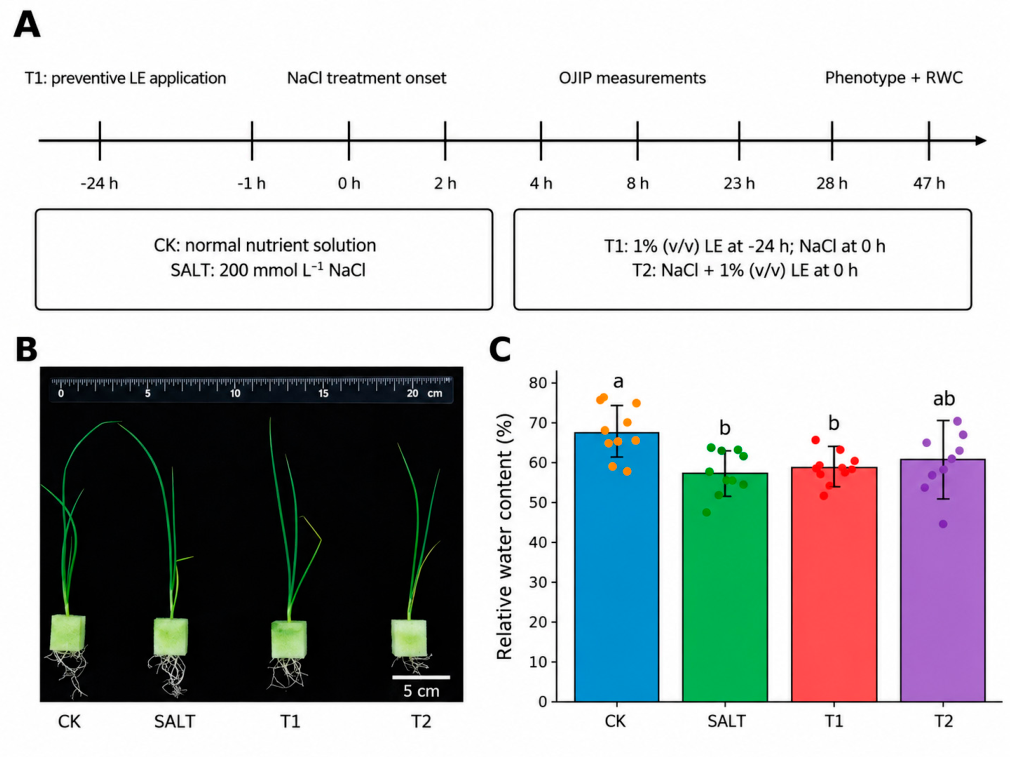
The experiment comprised four treatment groups (CK, SALT, T1, and T2), with 10 plants per treatment. The experiment was planned with 10 independent plant/vessel units per treatment so that the same individuals could be measured nondestructively at seven fluorescence time points within the available controlled-environment setup. Each plant/vessel constituted one plant-level biological replicate and experimental unit. The 10 vessels within each treatment were labeled 1–10. The four treatment groups occupied separate areas of the same controlled-environment plant-factory rack system, and vessels were randomly arranged within each designated treatment area. No formal blocking factor was used. The experiment was conducted as a single experimental run; consequently, independent spatial replication across treatment areas and independent run-level replication were not available, and this limitation is considered when interpreting generalizability. LEAFENERGY® (LE; IBIDEN Co., Ltd., Ogaki, Gifu, Japan) is a proprietary commercial biostimulant. According to the manufacturer, its active components are naturally derived rare fatty acids produced from plant oils; N, P, and K are each reported at <0.1%, whereas the identities and relative proportions of the individual rare fatty acids are not publicly disclosed [
12]. Le was prepared as a 1% (
v/v) working solution. At 0 h, the original nutrient solution was completely removed and replaced with freshly prepared treatment solution. CK received fresh nutrient solution without added NaCl, whereas SALT, T1, and T2 received fresh nutrient solution containing a nominal final NaCl concentration of 200 mmol L
−1 (pproximately 11.7 g L
−1). The nominal concentration was defined during solution preparation and was not independently re-verified by chemical analysis after replacement. No further complete solution replacement was performed during the subsequent 47 h observation period. T1 plants were foliar-sprayed with 1% (
v/v) LE 24 h Before the NaCl Shock, Whereas T2 Plants Received the 1% (
v/v) LE foliar spray at 0 h concurrently with replacement by the NaCl-containing nutrient solution. The same hand sprayer was used for all foliar applications and was actuated 2–3 times per plant until the foliage was uniformly wetted; the exact delivered volume per actuation and nozzle specifications were not recorded. Ck and salt plants received deionized-water foliar sprays at the corresponding treatment times using the same handling procedure, providing vehicle/handling controls for foliar application. Operations at 0 h were synchronized at approximately 11:00, and the T1 spray was applied approximately 24 h earlier at the same clock time. The 200 mmol L
−1 NaCl treatment was intentionally imposed in a single step to create a severe acute salt-shock model for resolving short-term photochemical responses; it was not intended to simulate progressive salinity accumulation under field irrigation [
10,
11,
28]. The design permitted direct t1–T2 comparisons and treatment × time testing in the repeated-measures analysis described below. The experiment evaluates the commercial formulation as a whole and does not attribute the response to any single fatty-acid component.
2.3. Fast Chlorophyll Fluorescence and Jip-Test Analysis
Fast chlorophyll fluorescence was measured in situ on fully expanded leaves of the same plants using a FluorPen FP 110 fluorometer (Photon Systems Instruments, Drásov, Czech Republic). Leaves were dark-adapted for 30 min before each measurement. OJIP transients were recorded 1 h before NaCl addition (−1 h) and at 2, 4, 8, 23, 28, and 47 h after treatment. The extracted parameters included Fv/Fm, PIABS, VJ, VI, M0, ψ0, φE0, ABS/RC, TR0/RC, ET0/RC, and DI0/RC. JIP-test definitions and interpretation followed Strasser et al. [
21] and Stirbet and Govindjee [
22]. VJ and VI represent relative variable fluorescence at the J and I steps, respectively; M0 represents the initial normalized slope of the fluorescence rise; ψ0 and φE0 describe the probability and quantum yield of electron transport beyond QA
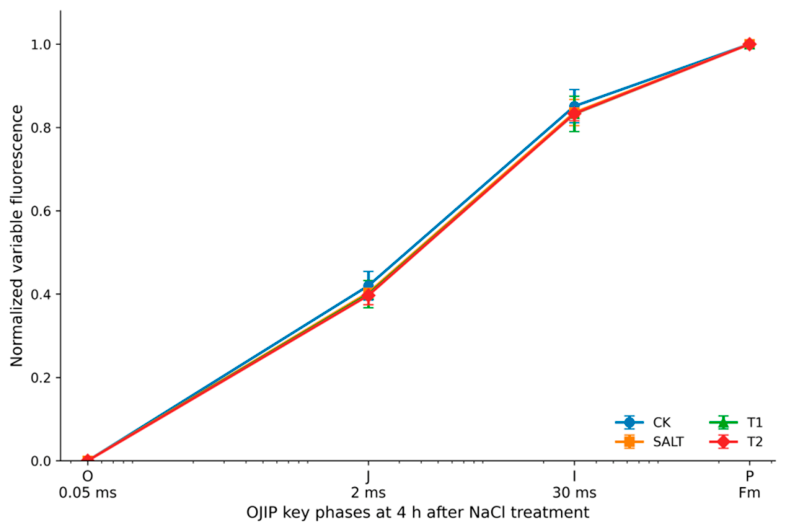
−; and ABS/RC and DI0/RC represent absorption and dissipated energy flux per active PSII reaction center. For the normalized O–J–I–P key-phase display, variable fluorescence was expressed as Vt = (Ft − Fo)/(Fm − Fo), with O fixed at 0 and P at 1.
2.4. Leaf Relative Water Content
Leaf relative water content (RWC) was measured after the final fluorescence assessment at 47 h using the approach of Barrs and Weatherley [
29]. Fresh weight (FW) was recorded immediately after sampling. Leaf Tissue was then hydrated in distilled water in darkness for 3–4 h to obtain turgid weight (TW), followed by drying at 80 °C for 72 h to constant dry weight (DW). RWC was calculated as RWC (%) = (FW − DW)/(TW − DW) × 100.
2.5. Data Quality Control and Statistical Analysis
Instrument-exported fluorescence records were used as the statistical source. Raw OJIP signals and derived parameters were inspected before inferential analysis. Before the final inferential reanalysis, a conservative quality-control rule was locked: a technical signal failure required both Fm < 500 instrument units and Fv/Fm < 0.20, together with concurrent abnormalities across multiple derived fluorescence parameters. Only two records met this rule: CK plant 2 at −1 h (Fm = 412, Fv/Fm = 0.053) and SALT plant 5 at 47 h (Fm = 495, Fv/Fm = 0.176); both were excluded as technical failures. Of 280 scheduled fluorescence observations (4 treatments × 10 plants × 7 time points), two observations were missing at 2 h (CK plants 3 and 9) and were not imputed. Thus, 276 raw fluorescence observations remained after missing records and technical-failure exclusions. Because CK plant 2 lacked a valid −1 h baseline, its post-shock records could not enter individual baseline-relative analyses; the resulting baseline-relative repeated-measures dataset contained 231 post-shock observations. One PIABS value in T1 plant 5 at 47 h (24.16) was flagged as an extreme high value by the Tukey outer-fence criterion (>Q3 + 3 × IQR; upper outer fence = 7.69) but had an adequate raw OJIP signal and was therefore retained in the primary analysis. Sensitivity analyses were performed with and without this observation and on raw and logarithmic scales. The complete sample flow, affected observations, and exclusion rationale are reported in
Supplementary Table S1, and the PIABS sensitivity analysis is reported in
Supplementary Table S2. Because the same plants were measured repeatedly, Gaussian generalized estimating equations (GEEs) were fitted with plant identity as the clustering unit, an exchangeable working correlation structure, and robust sandwich standard errors. Treatment, time, and treatment × time were included as categorical predictors. No block term was included because no formal blocking factor existed. The exchangeable structure was selected as a parsimonious representation of within-plant dependence across repeated observations; sensitivity models using independence and first-order autoregressive [AR(1)] working correlations produced the same substantive conclusions, with all 11 core treatment × time interactions remaining significant and the key 4 h contrast conclusions unchanged (
Supplementary Table S3). To reduce the influence of between-plant baseline heterogeneity, Fv/Fm was analyzed as current value minus the individual −1 h baseline, whereas strictly positive JIP-test variables were analyzed as ln(current/baseline); PIABS was modeled primarily on the log scale because of right-skew and the retained high-value observation. No zero or negative values entered the logarithmic transformations after quality control. Pre-specified contrasts were CK vs. SALT, T1 vs. SALT, T2 vs. SALT, and T1 vs. T2. For each parameter and each pre-specified contrast,
p values across the six post-shock time points were adjusted by the Holm procedure; adjustment was therefore performed separately for each parameter × contrast family rather than across all parameters simultaneously. RWC was evaluated by Welch one-way ANOVA followed by pairwise Welch t-tests with Holm adjustment. RWC showed no evidence of marked non-normality within treatments (Shapiro–Wilk
p ≥ 0.282) or strong variance heterogeneity (Brown–Forsythe/median-centered Levene
p = 0.119). Statistical significance was defined at
p < 0.05. Fv/Fm and RWC are presented as means ± SD, whereas baseline-relative positive JIP-test variables are presented as geometric means with 95% confidence intervals. Analyses were performed in Python 3.13.5 using statsmodels 0.14.6 and SciPy 1.17.0.
4. Discussion
4.1. Acute NaCl Shock Rapidly Disturbs PSII Electron Transport
The mode of salt imposition is central to interpreting the present experiment. A single-step addition of 200 mmol L
−1 NaCl to seedlings previously maintained under low-salinity nutrient solution represents an abrupt osmotic challenge and is more appropriately described as acute salt shock than as progressive salinity acclimation [
28]. This distinction is agronomically important because onion is salt-sensitive [
10], and field studies with brackish irrigation demonstrate that both salinity level and timing of saline water exposure strongly influence establishment and yield [
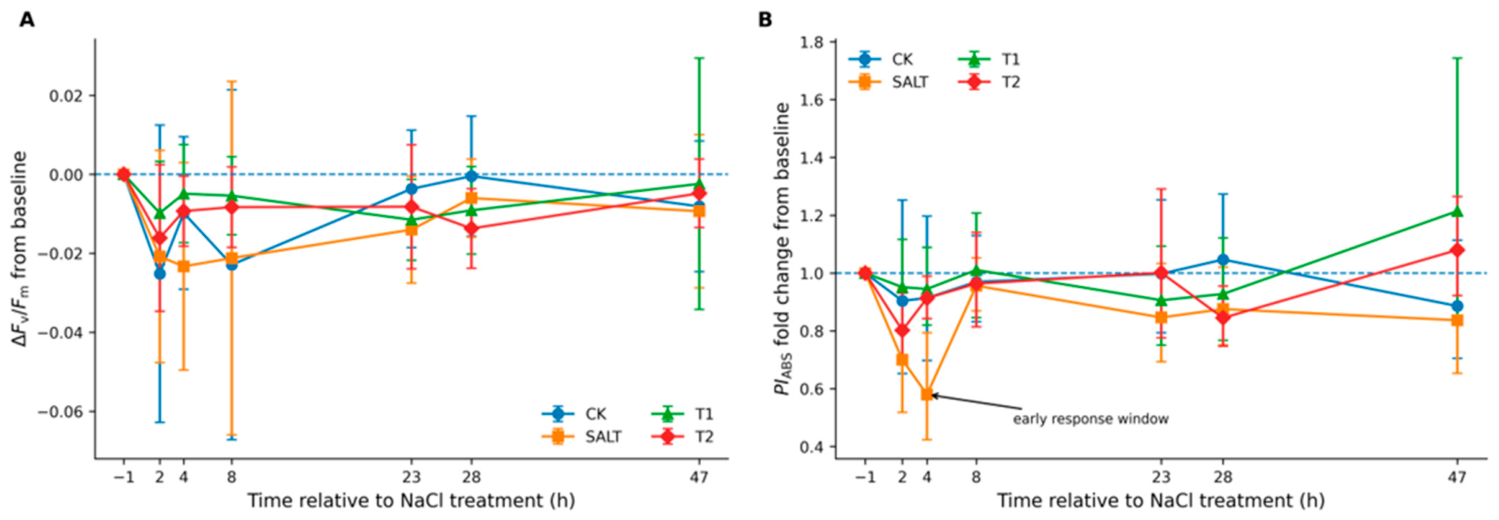
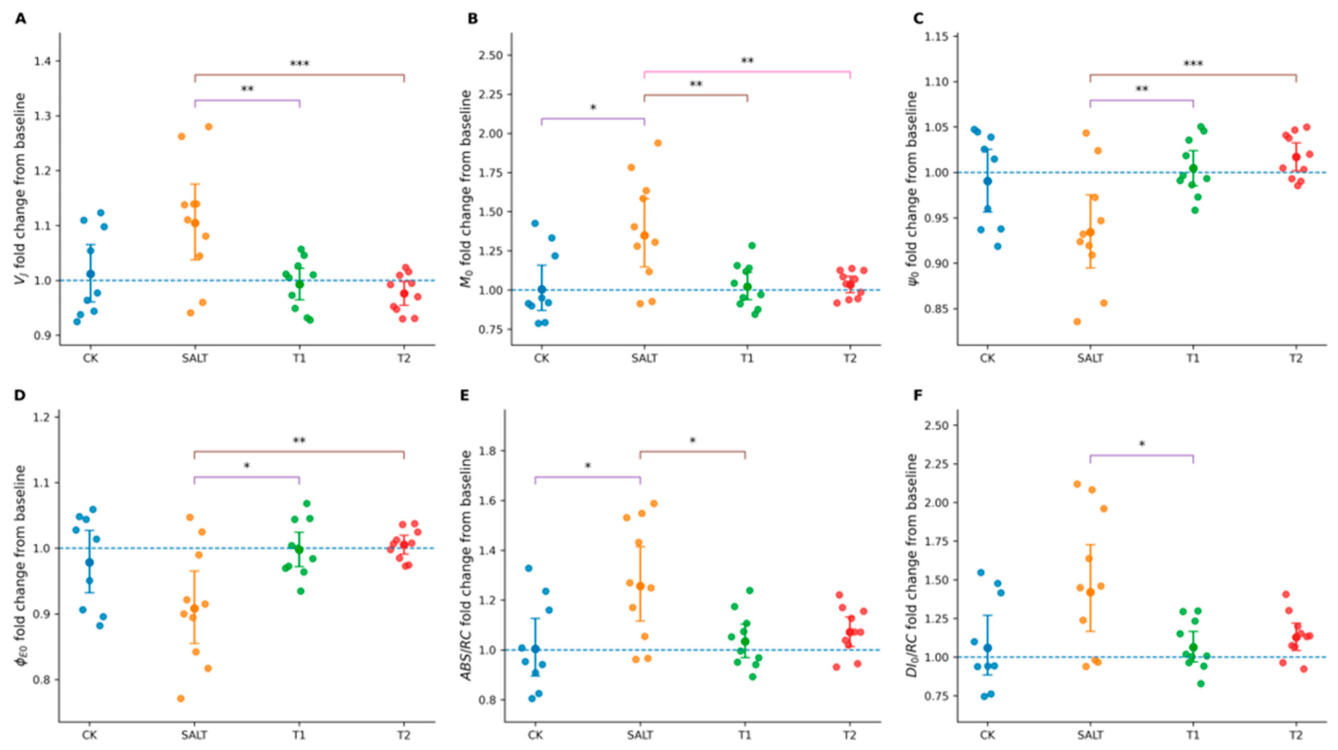
11]. The present experiment therefore should not be interpreted as a simulation of conventional saline irrigation or gradual root-zone salt accumulation. Instead, it was designed as a controlled short-term shock model to resolve very early PSII responses to abrupt severe NaCl exposure. Within that model, fast chlorophyll fluorescence detected significant treatment × time interactions, with the clearest treatment separation approximately 4 h after NaCl replacement. The decline in PIABS, increase in VJ and M0, and decrease in Ψ0 and ΦE0 in salt collectively indicate early impairment of PSII reaction-center performance and electron transfer beyond QA. The concurrent increases in ABS/RC and Di0/rc are consistent with greater excitation pressure and energy dissipation per remaining active reaction center, patterns also reported in other salt-affected crops [
16,
17,
18,
19].
PIABS displayed a larger early response than Fv/Fm in this dataset. This agrees with studies in which the integrated performance index responds to stress while maximum PSII quantum yield changes only modestly [
18,
30]. However, the present experiment did not formally compare diagnostic sensitivity between PIABS and Fv/Fm. The appropriate conclusion is therefore limited to these conditions: PIABS provided clearer treatment separation during the 4 h acute-shock response window, rather than being universally superior as a stress indicator.
4.2. LE Buffered the 4 h Photochemical Disturbance Without Demonstrating a Specific Lipid Mechanism
Both preventive and concurrent LE application maintained PIABS closer to baseline and significantly moderated changes in VJ, M0, ψ0, and φE0 at 4 h. T1 additionally reduced ABS/RC and DI0/RC relative to SALT, whereas T2 showed changes in the same direction without reaching significance after multiplicity correction. These statistically supported effects indicate transient formulation-level protection of several components of PSII function during the early acute-shock response. Similar improvements in photosynthetic or physiological performance under salinity have been reported for diverse commercial biostimulants in tomato and pepper [
31,
32,
33,
34], while the same LE formulation has previously altered fluorescence-energy fluxes and other traits in salt-stressed garlic [
13]. Foliar LE has also been associated with increased photosynthetic rate and stomatal conductance in greenhouse tomato [
14]. Because crop, dose, application route, and stress regime differ among these studies, they provide context rather than direct validation of the present response.
The manufacturer describes LE as a rare-fatty-acid-based commercial biostimulant [
12]. Membrane-lipid unsaturation and lipid remodeling can contribute to photosynthetic stress responses [
23,
24,
25,
26,
27], but the present study did not measure fatty-acid profiles, lipid peroxidation, reactive oxygen species, antioxidant activity, thylakoid structure, or non-photochemical quenching. Lipid-mediated stabilization is therefore only a plausible hypothesis; confirming the mechanism of LE will require targeted biochemical and lipidomic analyses.
4.3. Preventive and Concurrent Application Produced Comparable Short-Term Effects
Preventive application at −24 h and concurrent application at 0 h produced comparable short-term PSII protection under the present acute-shock conditions. After multiplicity correction, none of the core post-shock variables showed a significant T1–T2T2 difference. This result does not define a continuous or broad agronomic application window, because only two application times, one LE concentration, one NaCl concentration, and one short observation period were tested. Intermediate pre-application intervals (e.g., −12 or −6 h), longer pre-treatment periods, repeated applications, and dose–response designs will be required to determine practical timing flexibility under production conditions.
The lack of a T1–T2 difference is nevertheless informative within the boundaries of the experiment: LE applied 24 h before the shock and LE applied at shock onset each attenuated several 4 h PSII responses relative to SALT. This should not be interpreted as evidence that the two schedules are equivalent under progressive field salinity or long-term saline irrigation. Field-oriented validation should incorporate gradual salinization, longer growth periods, repeated independent runs, multiple spatial positions, yield or biomass endpoints, and a broader range of LE doses and application intervals.
4.4. Temporal Limitation in Relating PSII Responses to Leaf Water Status
RWC was measured only at 47 h, whereas the clearest PSII treatment separation occurred at 4 h. Because these variables were not measured synchronously at matched time points, the present dataset cannot establish physiological decoupling or independence between photochemical responses and leaf water status. The supported observations are more limited: 200 mmol L−1 NaCl reduced RWC at 47 h, and neither T1 nor T2 significantly improved that endpoint relative to SALT, whereas several PSII variables differed among treatments at 4 h.
The physiological basis of the acute response also cannot be resolved from the available measurements. Leaf water potential, osmotic potential, Na+ and Cl− accumulation, K+ homeostasis, compatible solutes, stomatal conductance, and synchronized time-series RWC were not measured. Consequently, the experiment cannot distinguish immediate osmotic effects from later ionic acclimation, nor determine whether LE altered osmotic adjustment. Future work should combine time-resolved OJIP measurements with synchronized water-status, gas-exchange, ion, compatible-solute, oxidative-stress, and lipidomic measurements. The present conclusions are therefore confined to transient early PSII responses and the independent 47 h RWC endpoint.
4.5. Experimental Scope and Generalizability
Several design features define the scope of inference. The experiment was performed in one controlled-environment run, and the four treatment groups occupied separate spatial areas; therefore, plant-level replication was available within treatments, but independent replication of treatment areas across rack positions or independent experimental runs was not. The study also examined one Welsh onion cultivar, one severe NaCl shock concentration, one LE concentration, and only two application times over 47 h. These features are sufficient for describing the plant-level time-resolved response within this experimental run but limit extrapolation to field-scale salinity management. Future validation should intermix or replicate treatment areas across spatial positions, repeat the experiment in independent runs, use gradual salinization and multiple NaCl intensities, and include a broader LE dose × application-time design.
5. Conclusions
Acute single-step exposure to 200 mmol L−1 NaCl rapidly perturbed PSII function in Welsh onion, with the clearest treatment separation approximately 4 h after shock onset. Salt shock reduced PIABS, increased VJ and M0, and decreased ψ0 and φE0, consistent with impaired PSII reaction-center performance and acceptor-side electron transport. Foliar application of 1% (v/v) LE either 24 h before the NaCl shock or concurrently with shock onset significantly moderated several of these early responses. Because T1 and T2 did not differ significantly across the core post-shock variables after multiplicity correction, the data support comparable short-term effects at the two tested application times, but they do not define a broader application window. LE-mediated early PSII protection was not accompanied by a significant improvement in RWC measured at 47 h; because PSII and RWC were sampled at different times, no physiological dissociation between these processes can be inferred. The study therefore demonstrates transient attenuation of early PSII disruption during abrupt severe NaCl exposure, not improved long-term salinity acclimation or agronomic salt tolerance. Longer-term studies incorporating gradual salinization, multiple doses and application times, independent experimental runs, synchronized water-status and ion measurements, and production-scale growth or yield endpoints are required before LE can be recommended for salinity management.