Review

Migration, Implications and Reduction of Sodium Ions in Soil: A Review

1
Key Laboratory of Environmental Pollution Control and Resource Reutilization in Xinjiang, College of Ecology and Environment, Xinjiang University, Urumqi 830017, China
2
State Key Laboratory of Ecological Safety and Sustainable Development in Arid Lands, Xinjiang Institute of Ecology and Geography, Chinese Academy of Sciences, Urumqi 830011, China
3
Research Center for Ecology and Environment of Central Asia, Chinese Academy of Sciences, Urumqi 830011, China
4
Department of Soil Science, Faculty of Agriculture, University of Ruhuna, Mapalana, Kamburupitiya 81100, Sri Lanka
*
Author to whom correspondence should be addressed.
Agriculture 2026, 16(18), 2017; https://doi.org/10.3390/agriculture16182017 (registering DOI)
Submission received: 19 July 2026 / Revised: 9 September 2026 / Accepted: 12 September 2026 / Published: 20 September 2026

Abstract

Sodium ions (Na+) are typically the dominant ions in soil salts, where their excessive accumulation forms sodic saline soils with degraded structure that harms crops and soil biota. However, the adverse effects of Na+ on soil functions and microorganisms have not yet been systematically investigated, and the application of conventional and emerging remediation methods with regard to Na+ dynamics remains unclear. This review synthesizes the current knowledge on natural and anthropogenic sources, distribution, and transport of soil Na+ and critically discusses its adverse impacts on soil function and crop performance. Long-used remediation techniques and recently developed emerging methods have been compared, and their mechanisms, reported effectiveness and practical applicability have been highlighted. Our study revealed that traditional reclamation methods through agronomic practices, ion exchange amendments (e.g., Ca- or K-rich conditioners), and plant–microbial interventions can effectively reduce soil Na+ and sodicity. Emerging saline–alkali soil amelioration methods (e.g., engineered/nano amendments, electrochemical stimulation, and salt-tolerant plant–microbe consortia), especially when combined in composite strategies, can more selectively and efficiently regulate Na+ and ion transport. Moreover, durable soil Na+ reduction is most consistently associated with integrated management strategies that couple optimized irrigation, water quality, and targeted amendments. Finally, we outline research needs for mechanistic, field-scale, long-term validation of the fate of Na+ and its transport for robust assessments of safety, durability, and cost to support scalable implementation.

1. Introduction

Salt accumulation adversely affects soil structure, leading to a decline in soil quality [1,2]. Soluble salts migrate in soil solution through a variety of pathways, disrupting the dynamic equilibrium of the soil environment, destroying soil physical structure, and affecting the uptake of nutrients by plants as well as their growth and yield. Furthermore, it inhibits soil microbial activity, reduces greenhouse gas emissions, and exacerbates land desertification and biodiversity loss [3]. Consequently, soil salinization impairs soil structural stability, reduces soil fertility, degrades biodiversity [4] and is considered as a major constraint on agricultural productivity [5,6]. It is more intense in arid regions due to low precipitation, high evaporation, and extensive use of saline water for agricultural irrigation due to the shortage of freshwater resources [7]. Arid regions including hyper-arid, arid and semi-arid regions (Aridity index < 0.5) account for 46% of the total area of the world [8], and with the acceleration of climate change, the area of saline soils is progressively expanding, making soil salinization one of the global soil degradation issues [9,10]. The global area of salt-affected soils reported by FAO in 2024 has reached about 1381 million hectares, and an additional one billion hectares of land are at risk of salinization [11].
Sodium (Na) is the sixth dominant element in the earth’s crust, with an average concentration of 2.38–2.89 wt% [12]. Na+ is also one of the abundant soil cations in arid regions with the highest ability to damage soil structure [13] where its main salt contributors are NaCl, Na2SO4, NaHCO3 and Na2CO3. The excessive concentration of exchangeable Na+ relative to other soil cations such as calcium (Ca2+) and magnesium (Mg2+) leads to soil sodicity [14]. Increase in soil Na+ concentration accelerates the expansion of saline and alkaline land areas, leading to disruption of soil aggregates and structure, decrease in soil water conductivity, decline in soil organic matter content, and impairment of soil enzyme activity [15]. To a certain extent, Na+ toxicity can harm the plant root system, resulting in reduced crop yields and jeopardizing global food security [16,17,18]. Therefore, to effectively mitigate the toxicity of soil Na+, it is urgent to elucidate the sources of Na+ distribution and to summarize reasonable management measures and amelioration mechanisms in saline–alkaline lands with high Na+ concentration.
This review summarizes the natural and anthropogenic sources, distribution and transport of soil Na+ and evaluates the adverse effects of accumulated Na+ on soil physicochemical properties, microbial and enzyme activities, and plant growth and yield. This study synthesizes both the traditional remediation approaches and emerging methods and composite strategies developed in recent years emphasizing their mechanisms, performance, and field applicability. By synthesizing current knowledge on both conventional and emerging approaches, this review aims to identify practical and effective pathways to reduce soil Na+, improve quality of saline–alkaline soil quality and ultimately expand cultivable land and increase crop yields. The literature search was conducted in Web of Science, Scopus, and Google Scholar from 2003 to 2026. The search strategy combined controlled terms and free-text keywords related to soil salinization/salt stress/saline–alkaline soil, soil Na+/sodium ions, and remediation approaches including phytoremediation, biochar, soil amendment, and microbial remediation. Studies were included if they: (1) investigated Na+ distribution/behavior in saline/saline–alkaline soils and reported at least one relevant soil function outcome (e.g., soil physicochemical properties and/or microbial/plant-related indicators); (2) evaluated at least one remediation/amelioration technique aimed at mitigating salt/sodium stress.

2. Sources and Distribution of Soil Na+

2.1. Sources of Sodium Ions

2.1.1. Natural Sources

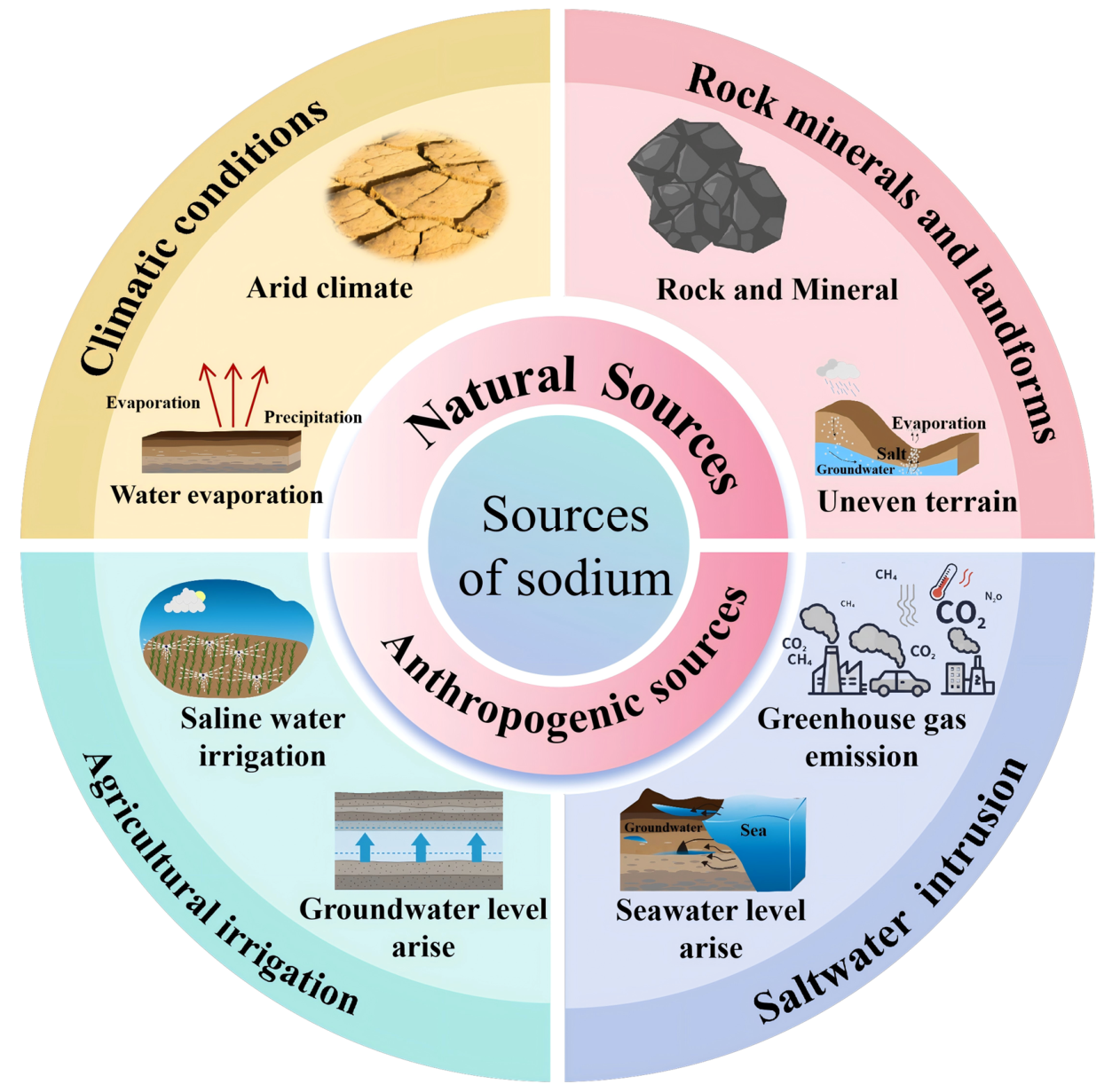
The sources of Na+ in soil mainly include natural and anthropogenic sources (Figure 1). Natural sources of Na+ include mineral weathering, seawater intrusion and atmospheric deposition [19,20]. During weathering, sodium-containing minerals (e.g., sodium carbonate) release Na+ from rocks into topsoil, where it accumulates and accelerates soil salinization [21]. The minerals contain substantial amounts of sodium in a fixed form that becomes soluble during weathering. Climate change exacerbates salinization by driving sea level rise above groundwater table, causing seawater intrusion into coastal soils. The intrusion destabilizes the coastal ecosystem and accelerates salt accumulation [22,23]. Atmospheric deposition through rainfall and wind also contributes to the accumulation of soluble minerals (including Na+) in soils, geological sediments, and groundwater [24,25]. In addition, geological structure, mineral composition and topographic features also have a significant influence on the patterns of soil salinity distribution [26].

2.1.2. Anthropogenic Sources

Anthropogenic sources of Na+ are the primary drivers of secondary soil salinization, whereby salt accumulates in previously nonsaline or low-salinity soils due to human activities [27,28]. Agricultural irrigation is the main cause of secondary salinization. In arid regions, freshwater scarcity forces reliance on saline streams, lakes and groundwater to irrigate arable lands. Since groundwater is rich in minerals and salts, its use rapidly increases the salt concentration of surface soils and exacerbates the expansion of saline soils [24,29,30]. Li et al. [30] demonstrated that, in a sandy loam soil experiment conducted from 2017 to 2019, irrigation water with a low-salt concentration (1 g/L) promoted biomass and nutrient accumulation by facilitating ion-selective uptake (preferentially K+ and Ca2+) by the root system of tomato plants (Solanum lycopersicum). However, high-salt-water irrigation (3 g/L) causes Na+ to competitively inhibit Ca2+ and K+ uptake, resulting in ion imbalance and reduced biomass production. Excessive fertilization also accelerates salinization [31]. Large-scale application of chemical fertilizers introduces diverse chemical components that disrupt soil equilibrium and react with native alkali metal ions to form new salts, thereby intensifying salinization. Industrial activities contribute through multiple pathways, including the generation of saline wastewater [32], the production of fly ash, and the release of sodium-containing aerosols and particulates into the atmosphere, which subsequently deposit onto soil [33]. What is more, mining of carbonate-rich minerals produces Na+-laden slag that degrades the surrounding environment and harms crops when deposited on the soil surface [34]. Additionally, the use of Na+-containing industrial wastewater used for irrigation or released into water bodies has adverse impacts on agricultural production and ecosystem balance. For instance, the use of textile printing wastewater with increasing Na2SO4 concentration for irrigation significantly reduces the efficiency of urea hydrolysis [35]. Increased calcium and sodium concentrations in irrigation water also increase the dosage of biochar required for soil amelioration, thereby reducing the efficiency of biochar in improving soil [36].

2.2. Environmental Distribution and Migration of Na+

Sodium ions in soil exist mainly as soluble Na+ and fixed Na+. Soluble Na+ is widely distributed in seawater, lakes, rivers, groundwater, and soil solutions, moving through the environment via water evaporation, migration, and rainfall. Upon evaporation, soluble Na+ accumulates in crystalline form on soil and mineral surfaces [33]. In addition, the distribution of soil-soluble Na+ is also influenced by topography. For instance, lowland areas typically have a higher water table and consequently higher soluble Na+ concentration. Fixed Na+ is encapsulated within rocks and minerals during formation under high-pressure conditions. These ions cannot interact with the soil environment and thus pose no adverse effects.
These two forms can interconvert under certain conditions. Soluble Na+ migrates horizontally and vertically with soil solution. Rainfall infiltration drives surface Na+ downward, while high temperature evaporation causes upward migration of Na+ from the 20–40 cm soil layer where it crystallizes at the surface. This upward movement is particularly pronounced in arid zones due to the high temperatures and evaporation rates. Furthermore, soluble Na+ competes with nutrient ions during plant root uptake, entering plants and disrupting normal nutrient acquisition and growth [37]. The exchangeable Na+ moves via cation exchange on soil particle surfaces and is therefore limited to short-range transport.

3. Effects of Sodium Ions on Soil Function

Fixed Na+, mostly present in stable minerals, shows low chemical activity and minimal reactivity with the external environment, resulting in negligible adverse effects. Therefore, unless otherwise specified, any subsequent mention of ‘sodium ions’, or Na+, refers specifically to soluble Na+, focusing on its environmental interactions and associated effects.

3.1. Effect of Sodium Ions on Soil Physicochemical Properties

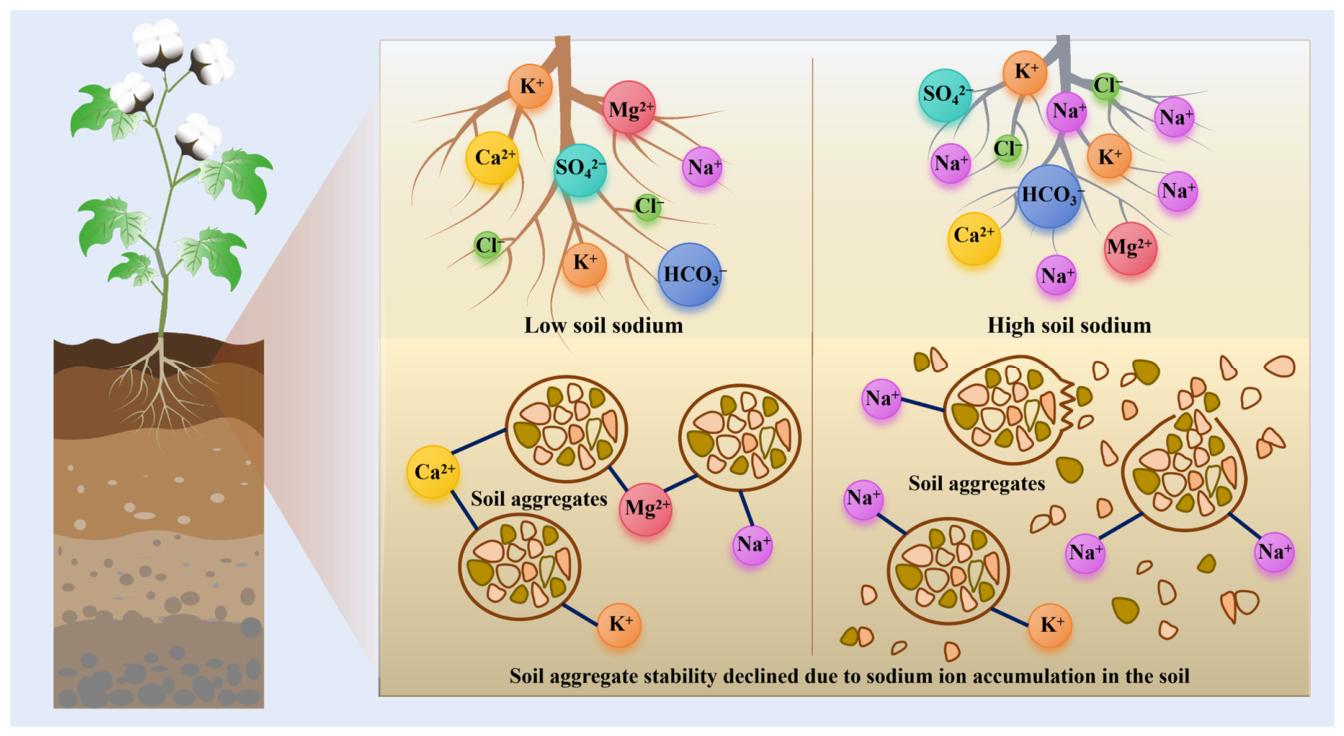
Soil Na+ concentration rapidly increases following the salt accumulation, thereby adversely affecting soil physical structure, chemical properties, and the plant root system (Figure 2). Excessive Na+ replaces Ca2+ and Mg2+ at ion exchange sites on particle surfaces, damages soil physical structure by disrupting soil aggregates [38,39], inducing soil swelling, and dispersing clay particles, which together markedly reduce the soil permeability [40,41]. Soil aggregates are fundamental to soil function, particularly in arid regions. Soil aggregates formed by the association of soil particles and organic matter create pore networks that retain water and air. They reduce runoff, alleviate drought stress and support root respiration and microbial activity. These conditions promote nutrient uptake and normal plants growth. In contrast, aggregates breakdown into fine particles (e.g., clay (<2 µm) and silt (2–50 µm)) clogs soil pores, sharply reducing water infiltration and aeration. Consequently, these conditions lead to plant root oxygen deficiency, reduced microbial activity, disrupted nutrient cycling, and severely constrained plant growth, accelerating soil degradation. Stable soil aggregates also mitigate environmental impacts by reducing the entrainment of fine particles during dust storms, thereby improving air quality and reducing risks to human respiratory health [42,43].

3.2. Effects of Sodium Ions on Plant Growth

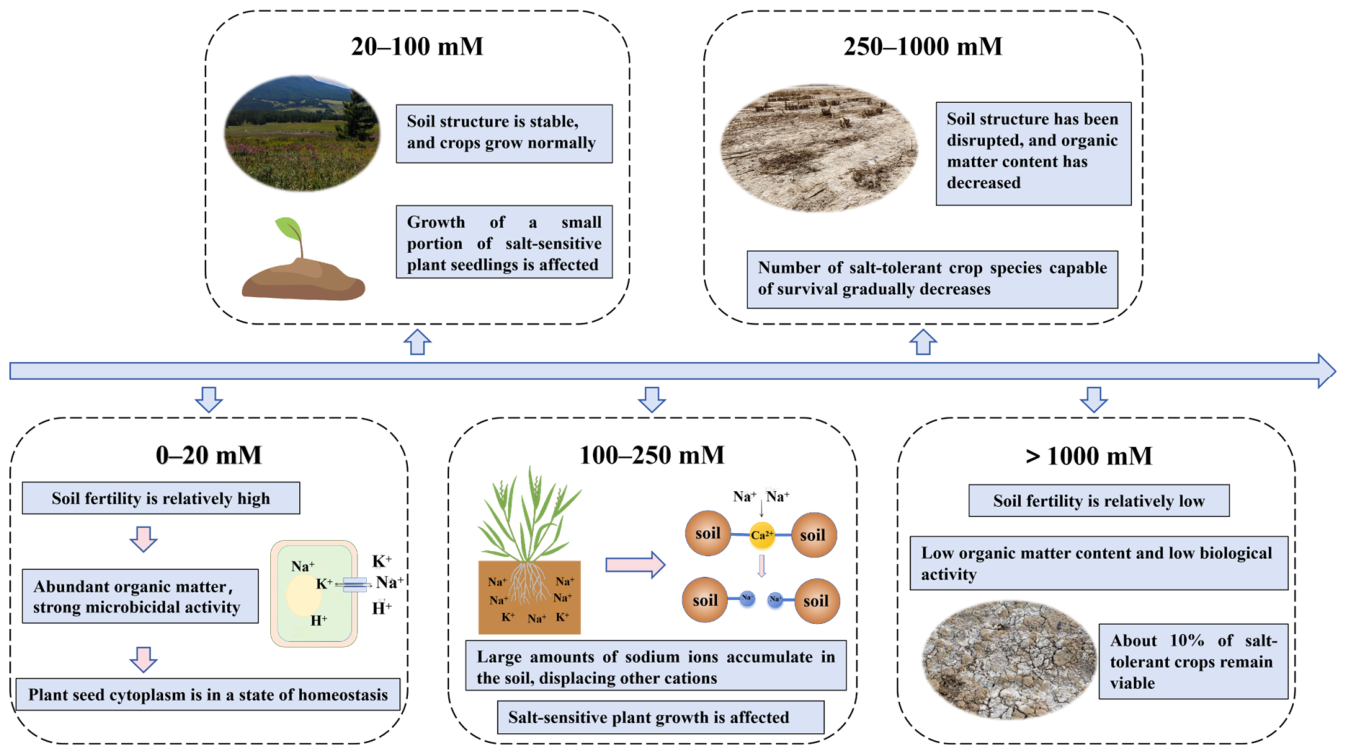
When soil Na+ concentration is excessive, Na+ accumulates in the rhizosphere and competes with essential nutrient ions during root uptake. This competition suppresses plant nutrient acquisition while promoting entry and accumulation of Na+ in plant tissues, leading to nutrient deficiency, abnormal growth and inhibited crop yield [5,44]. For instance, Osei-wusu et al. reported that NaCl concentration exceeding 30 mmol/L significantly inhibited rice growth at the seedling stage [24]. Na+ effects on soil and plants are concentration-dependent (Figure 3). In general, elevated soil Na+ tends to reduce the number of plant species capable of normal growth soil [37]. Under extreme conditions, where Na+ concentration exceeds 1 mol/L, only about 10% of salt-tolerant plants survived [37]. However, this threshold should be regarded as indicative rather than universal, since actual tolerance varies markedly with species, soil type, and experimental duration. High Na+ uptake by roots leads to excessive Na+ in cells, disrupting cellular ionic balance, reducing K+ content and altering cellular metabolism, thereby affecting plant growth and development. Excess Na+ also causes cellular injury through membrane lipid peroxidation, and an increase in cell membrane permeability [45,46]. In addition, soil salts also induce osmotic stress and stimulate the production of reactive oxygen species (ROS). ROS damage cellular structures, membranes, and proteins, disrupt the electrochemical potential of H+ and impair nutrient uptake by affecting membrane transport proteins [37]. Consequently, Na+ induces multiple physiological disorders in plants, including reduced stomatal conductance, impaired protein synthesis, and excessive ROS [10].
In addition, higher concentration of soluble salts in irrigation water can reduce the availability of essential plant nutrients and suppress microbial growth, activity, and diversity by altering plant and microbial physiology and metabolic processes [47,48]. Soil Na+ easily enters the root xylem of rice, which was toxically accumulated in the stem [25]. Moreover, soil salinization and sodification in arid zones are largely driven by Na+-rich irrigation water; therefore, reducing Na+ inputs to arable soils at the source is a key strategy for mitigating soil sodicity.

3.3. Effect of Sodium Ions on Soil Microorganisms

The soil environment is highly complex, comprising organic matter, minerals, diverse microorganisms and soil enzymes whose interactions maintain the stability and functioning of soil. Excessive soil salinity not only degrades soil structure and restricts crop growth, but also negatively affects soil microorganisms and enzyme activities [6]. Salinity impairs microbial communities mainly through increased osmotic pressure and specific ionic toxicity [49,50]. Although most microbial communities can adapt to high-salt conditions, environmental changes may also alter microbial interactions and reshape the microbial community structure [51]. Previous studies show that microbial diversity (especially bacteria) is negatively correlated with soil salinity, while the activities of key enzymes such as soil peroxidase, protease, urease, and acid phosphatase decrease with increasing soil salinity [52,53]. Moreover, high concentrations of Na+ disrupt the cellular K+/Ca2+ balance in microorganisms, indirectly contributing to nutrient deficiencies, oxidative stress, and growth inhibition of plants [54].
Soil organic and inorganic components interact with soil biota and enzymes to maintain the dynamic balance of the regional ecosystem. When soil Na+ concentration increases, this ecological balance can be disrupted. Accordingly, soil sodicity exerts a combined effect on soil physicochemical properties, soil structure, and soil biota, ultimately altering the function of the soil system. Zhao [55] reported that declining salinity in coastal wetlands promotes the accumulation of plant-derived carbon, thereby enhancing topsoil carbon storage. Accordingly, reducing soil salinity can stimulate both plant growth and microbial activity, thus enhancing soil carbon sequestration capacity.

4. Main Mechanisms for Mitigating Sodic Saline Soils

Soil salinity-induced sodicity poses a serious threat to ecosystem stability and agricultural productivity in arid regions. Excessive soluble Na+ in soils is a primary driver of salt-related degradation of soil properties and crop performance. Current approaches to ameliorate salinity and sodicity include physical, chemical, and biological strategies that primarily regulate salt transport and redistribution by modifying soil boundary conditions and interlinked soil, water, air, and biological processes [56].

4.1. Traditional Remediation Techniques

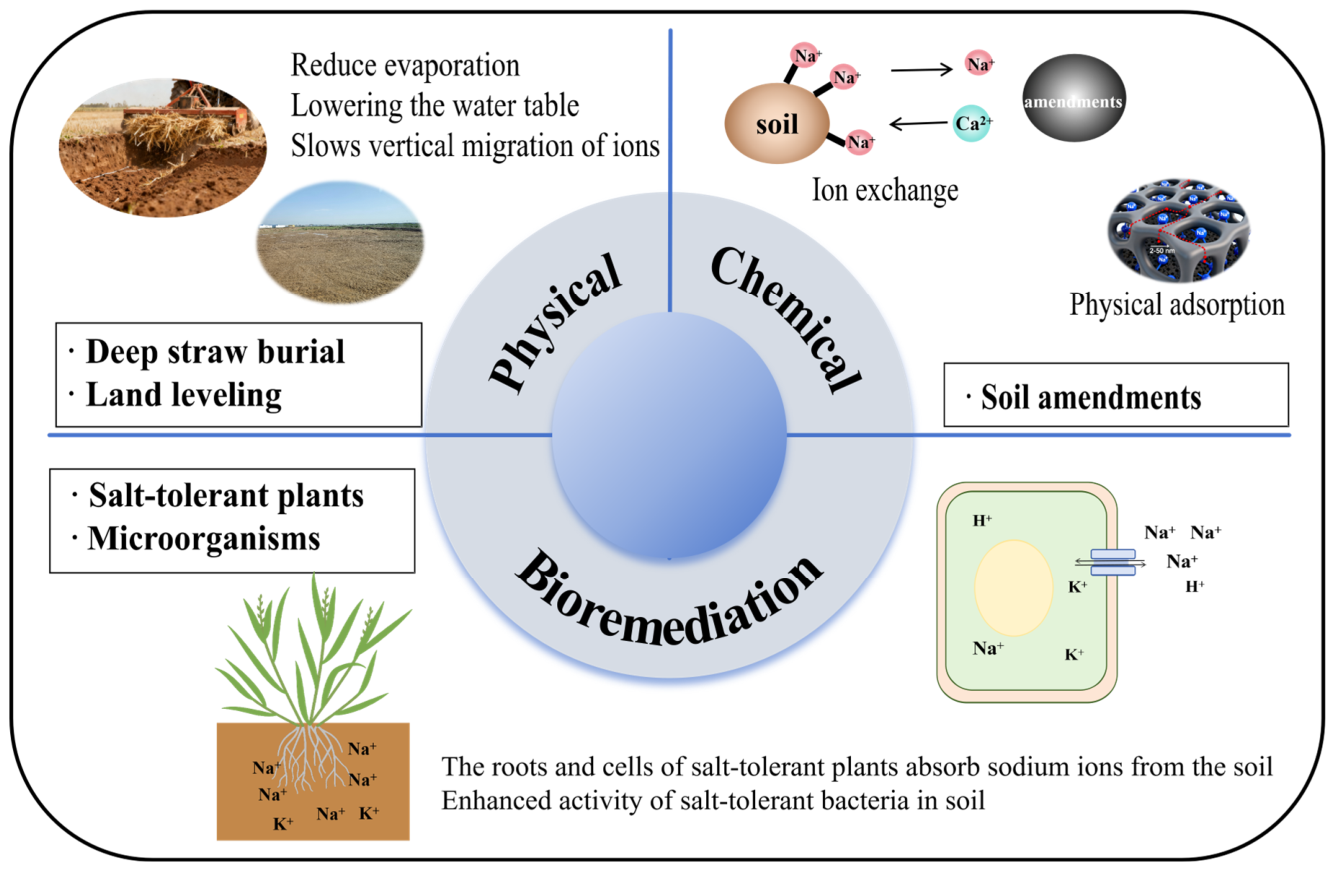
Many conventional remediation practices have been implemented in the field and have proven to be effective in alleviating soil salinization in arable lands at a local scale. These approaches mitigate salinity impacts by regulating salt transport and redistribution within the soil profile (Figure 4). The main approaches are summarized below:

4.1.1. Physical Restoration

Physical remediation primarily regulates soil water movements to redistribute Na+ either toward the soil surface for removal or to deeper layers where it is less likely to affect crop roots. Appropriate irrigation and drainage can leach salt ions from the soil profile, while tillage can dilute or reduce salt accumulation in the plow layer. Heavy irrigation is a widely used method to flush salts from the root zone, modifying soil ionic composition and ion ratios, thereby affecting physical properties, fertility and structure [57]. Physical leaching is also a commonly used technique to reduce Na+ in the surface horizon, where Na+ generally accumulates. In coastal regions, leaching is used to move Na+ to deeper soil layers that are less prone to upward transport via evaporation, thereby lowering Na+ concentration in surface soil. Nevertheless, the high demand for freshwater limits its applicability in arid regions [58], where the saline–alkaline soils are mainly distributed, creating clear geographical constraints for leaching-based remediation.
Currently, physical regulation of saline soils relies largely on cultivation practices such as deep straw burial, mulching, and land leveling. Incorporating straw layers has received considerable attention due to the broad availability and low material cost, as well as its effectiveness in alleviating soil salinity conditions, reducing CO2 emissions from deep soil, and enhancing crop yields [59,60,61]. Song et al. [62] proposed that tailoring straw return practices to local environmental conditions, together with appropriate agronomic management, can substantially improve remediation outcomes. Zhang et al. [63] reported that segmented, powdered, and granular straw mulches significantly enhance the desalination in the 0–100 cm soil layer and reduce the salt return in the 0–40 cm layer. Segmented straw was identified as an effective material for constructing straw compartments at 40–45 cm in saline soils. Brackish water membrane drip irrigation (MDI) has been widely applied in northwestern China [64]. Tan et al. [65] confirmed that in a 23-year cotton field experiment, with the increasing years of MDI use, the proportion of large aggregates (>0.25 mm) and aggregation stability initially declined at the early stage of cultivation (0–9 years) and increased over the longer term (9–23 years). It can be explained that the initial decrease was driven by mechanical tillage disruption, which undermined aggregate bonding, and the subsequent recovery was driven by long-term SOC accumulation, promoted by mulching and optimized irrigation. This resulted in the progressive salt leaching, which reduced clay dispersion and favored macro-aggregate formation. A 15-year field experiment in the North China Plain shows that soil salinity in the cotton root zone increased significantly with increases in the salinity of irrigation water [66]. It is obvious that irrigation water quality is a key driver of cropland salinization, underscoring the importance of irrigation water management and related improvement measures [67,68].
More broadly, adopting appropriate irrigation strategies and water management practices is essential to avoid accelerated salinization. Conservation agriculture systems, including zero tillage, cultivation of legumes, crop rotations, residue mulching, and subsurface drip irrigation, can alleviate soil sodicity and improve soil chemical properties, thereby enhancing the economic benefits of cropping systems [69].

4.1.2. Chemical Remediation

Since soil contains abundant ions, organic matter and minerals, ion exchange is pervasive in the soil environment. A higher K+/Na+ ratio is generally associated with improved soil structure; thus, chemical remediation commonly aims to decrease soil Na+ by applying conditioners enriched in K+ and Ca2+ to promote the Na+ exchange reactions in soil. These amendments can improve soil physicochemical properties, enhance permeability and reduce surface evaporation. Calcium-based materials (desulfurized gypsum, phosphogypsum, etc.) are one of the most common chemical conditioners [56]. Among the calcium-based materials, gypsum is a typical ameliorant as it supplies Ca2+, which can replace exchangeable Na+. Gypsum applications to saline–sodic soils can reduce soil Na+, improve soil fertility and enhance the crop yields. Flue gas desulphurized gypsum (FGD gypsum) is widely used for saline soil amelioration. Its principal component, CaSO4, provides substantial Ca2+ to exchange with Na+. It can also shift carbonate forms that are more toxic to crops to sulfate forms with comparatively lower toxicity [2]. Large areas of infertile saline–alkaline lands amended with FGD gypsum have been transformed into arable lands, supporting agricultural development and local ecosystems [70,71]. Tian et al. [72] found that the alfalfa yield on saline soil significantly increased after amendment of desulfurized steel slag (DS), which is a Ca2+-based amendment that reduces alkalinity and improves physical properties. The improved physical conditions contributed to the reduction in SAR and ESP by replacing Na+ at soil colloidal sites with Ca2+ supplied by DS.
Biochar is another ameliorant with a stable carbon structure, abundant pores and large specific surface area, produced by agricultural and livestock waste under high-temperature and anaerobic conditions. Its applications in environmental management mainly include soil improvement, climate change mitigation, and energy production [73,74,75,76]. Biochar derived from different feedstocks varies in physicochemical properties and therefore in their adsorption and amendment capabilities [77,78,79,80]. As shown, biochar amendment is effective in mitigating soil salinity by increasing soil cation exchange capacity and the concentration of soluble K+ and improving soil structure. It can also reduce the pH of saline soils and the content of exchangeable Na+ [81,82,83]. Adsorption of Na+ on biochar is one of the main pathways of its removal [80]. Ca2+ and K+ on the surface of biochar displace Na+ from the soil solution, thereby lowering soluble Na+ concentration and mitigating soil sodicity (Table 1).
In summary, due to the distinct properties of different soil amendments, their effectiveness and mechanisms for reducing Na+ vary significantly. It is essential to identify the most critical factors influencing soil Na+ and optimize these properties to improve Na+ reduction efficiency.

4.1.3. Bioremediation

Bioremediation uses salt-tolerant plants and microorganisms to reduce soil salinity, improve soil structure, and enhance soil nutrient availability through processes such as adsorption, ion uptake and transformation [84,85]. It is widely regarded as a sustainable remediation method because it offers a comparatively low cost, minimizes disruption to the ecological balance, and can improve soil health by leveraging plant-associated microbiomes to enhance crop salt tolerance and increase yields under salt stress [86,87].
Halophytic plants are frequently used for phytoremediation of saline soils. Suaeda salsa is an annual herbaceous true halophyte (Amaranthaceae), widely distributed in inland saline areas and intertidal wetlands. Its fleshy leaves can store salt, making it a key species for saline soil restoration [88]. Rabhr et al. [89] found that the specialized halophyte, Sesuvium portulacastrum L., had the potential to ameliorate experimental salinized soils by effectively reducing soil sodicity and sodium content and enhancing the capacity of biomass-driven Na+ accumulation, improving the soil quality. Alkali grass (Suaeda salsa) has also been reported to grow well in soils with a salinity level below 1% [86,90]. In addition to salt removal via plant uptake, vegetation can modify soil pore architecture and hydrologic properties. Peng et al. [91] confirmed that rice cultivation exerts a significant influence on the macro porosity of saline soils. They found that with increasing years of cultivation, the average pore diameter and the proportion of pores > 200 μm increased significantly. Zhu et al. [92] used alfalfa (Medicago sativa) cultivation to enhance aggregate stability, increase the proportion of macropores, and elevate soil microbial diversity, thereby supporting the ecological restoration of saline soils. Plant root growth can further inhibit salinization by improving pore structure and flow pathway. The root length and mean root diameter are positively correlated with total porosity, pore connectivity, number of connected pores, and saturated hydraulic conductivity and negatively correlated with bulk density [88]. Root-induced changes can promote salt leaching from the 0–20 cm soil layer and facilitate desalination in mildly to moderately saline soils, potentially even in severely saline soils.
Microbial remediation, including the use of bacteria and fungi, is also widely applied. Li et al. [93] developed a functional microbial inoculant by combining Bacillus oceanisediminis and Acinetobacter indicus. It produced an immobilizing microbial preparation using biochar as a carrier, which significantly reduces soil salinity and simultaneously improves soil nutrient status. Application of a substrate amended with a mixture of arbuscular mycorrhizal fungi and biochar for 21 days to stressed tomato plants (Solanum lycopersicum) increased tolerance to heat (42 °C for 4 h per day), salinity (100 mM NaCl), and combined salt and heat, showing increased biomass and flowering rate [94]. In addition, salt-tolerant plants can shape microbial communities by providing favorable niches for microbial growth. Salt-tolerant rice can also enrich bacterial communities such as Hydrogenophaga, Pseudomonas, and Aeromonas, as well as fungal communities such as Chaetomium, Cladosporium, and Tausonia, which may contribute to growth promotion and salt tolerance [95]. Plants can recruit key bacterial and fungal species by establishing more stable co-occurrence networks, thereby reducing the Na+/K+ ratio and increasing yields under saline conditions. Membrane transport proteins can sequester Na+ and maintain the delicate balance between Na+ and K+, which is essential for sustaining cellular homeostasis and enhancing plant health. These membrane transport proteins play an important role in regulating ion homeostasis and facilitating the uptake and partitioning of essential nutrients, thereby enhancing plant tolerance to salt stress [96].

4.2. Emerging Remediation Techniques

The abovementioned methods can effectively alleviate the adverse effects of saline sodic soils; however, some may also cause environmental risks, and their efficacy can be inconsistent. Zou et al. [97] summarized that phosphogypsum contains fluorine (0.5–2.4 wt%) and heavy metals, including Cd (0.5–8.7 mg/kg) and As (2.1–15.3 mg/kg). Therefore, beyond these conventional remediation methods, recent research has increasingly focused on the mechanisms governing saline–alkaline soil restoration. Based on the soil Na+ regulation, the existing remediation strategies and optimized ameliorants have been refined. New materials and techniques have emerged, including modified biochar, nanomaterials, and electrochemical stimulation. These advances have reduced sodicity-related constraints, improved soil structure, and enhanced soil quality.

4.2.1. Modification of Biomass and Biochar

Physical or chemical modification of soil amendments derived from natural sources can enhance the adsorption of soil Na+ and reduce sodicity-related adverse effects during remediation (Table 2). The effectiveness of biomass and biochar is not consistent across studies, and conflicting findings are evident even within similar feedstock categories. For instance, two studies using unmodified wheat straw biochar pyrolyzed at the same temperature (550 °C) reported a sixfold difference in the maximum Na+ adsorption capacity [13,81]. This discrepancy is attributable to the difference in surface structure and chemical compositions of biochar under different pyrolysis conditions. The specific surface areas of unmodified wheat straw biochar were 265 m2/g in Medynska-Juraszek et al. [13], compared to 22.4 m2/g in Hou et al. [81], consistent with their respective adsorption capacities. These discrepancies highlighted that pyrolysis temperature, activation method, and experimental soil conditions all substantially influence biochar effectiveness, complicating direct cross-study comparisons. For practitioners, this underscores that published adsorption values should not be applied prescriptively. It is most likely that modified biochars offer superior Na+ removal in severely saline–sodic soils but carry higher cost and potential pH side-effects, whereas unmodified crop-residue biochars are more appropriate for moderately saline soils where cost-effectiveness is a priority.
Studies have proved that the combination of vermicompost and FGD gypsum not only reduced Na+ migration and leaching in the 0–10 cm soil layer but also neutralized alkalinity through the reaction between Ca2+ and bicarbonate ions [71]. Gong et al. [98] found that the biochar prepared at 600 °C in a CO2 atmosphere exhibited the highest adsorption performance of nutrients (NH4+-N, NO3-N, H2PO4, HPO42− and K+). In a pot experiment under rice cultivation, Yu et al. [99] found that biochar and wood vinegar solution significantly decreased soil pH and electrical conductivity (EC). The addition of wood vinegar-modified biochar increased the abundance of nitrifying microorganisms while altering their community structure. Zhang et al. [100] also suggested that the biochar functions can be optimized through modification. They showed that magnetic biochar (biochar loaded with reduced iron) has a stronger pollutant removal capacity due to more functional groups, stronger electrostatic adsorption, and higher reduction potential.
Since individual amendments have distinct strengths and limitations, applying a single material typically improves only one aspect of soil quality. Therefore, mixtures of complementary amendments are used to achieve synergistic effects, jointly improving sodic saline soils and reducing soil Na+ and total salts. Liang et al. [83] found that the addition of biochar–compost significantly increased the underground biomass of reeds rather than sole biochar application. Xu et al. [101] conducted potting experiments using titanium gypsum–biochar composites, showing that it improved contact with soil colloids and enhanced remediation relative to a single material. The related pot experiments confirmed the significant reduction in key salinization indicators, including pH, EC, SAR and soluble Na+. Xu et al. [102] further showed that a mixture of 2.0% phosphogypsum, 2.0% humic acid, 0.25% bentonite, and 0.03% sodium carboxymethylcellulose effectively improved the physicochemical and biological properties of saline soils and promoted the growth of oil rapeseed (Brassica campestris). This mixture reduced EC by 1.51% to 33.49%, salinity by 11.40% to 35.46%, and soluble Na+ by 39.47% to 63.20%. Overall, modifying and blending soil conditioners substantially enhance Na+ reduction efficacy and offer flexibility to tailor modification methods and application ratios to site-specific needs, broadening options for saline–alkali soil remediation.

4.2.2. Engineered Novel Amendments

Novel amendments with nanoscale or engineered structures can provide more selective and efficient adsorption of cations, enabling high-performance conditioners. For example, nano-biochar has been explored for more microscopic pollution remediation. Nano-sized hybrid biochar/nanocomposites can couple the advantages of biochar with nanoparticle functionalities, greatly improving the overall performance [103]. Xu et al. [100] used guar gum, an environmentally friendly biopolymer, to improve soil dispersion. As guar gum is rich in hydroxyl groups, it can form hydrogels upon contact with water and cationic bridges with surface cations of clay particles, and these mechanisms cement soil particles and compact the soil structure. Omer et al. [104] systematically investigated the effects of four nanoprocessing schemes on faba bean plants (Vicia faba) grown in saline soil by using a split-zone design and found that the synergistic effect of nitrogen-phosphorus-potassium nanoparticles and silicon dioxide nanoparticles has potential in enhancing the growth and productivity of salt-stressed crops. These emerging materials broaden remediation options and can enhance the effectiveness of soil conditioners. However, materials specifically designed for Na+ reduction remain limited, necessitating further research to develop a low-cost, high-efficiency material tailored to Na+.

4.2.3. Electrochemical Methods

Electrochemical remediation uses an external power source to control the migration of charged species in soil, thereby mitigating the adverse effects of alkali metal cations such as Na+ in saline–alkaline soils. Building on its broader application in pollution remediation, electrical stimulation has been adopted for saline–alkaline soil treatments. Zhang et al. [105] investigated the synergistic effect of electroosmosis and calcium chloride to inhibit the deformation in sodium sulfate saline soils. Under an applied electric field, excess Na+ and SO42− migrated to the cathode and anode, respectively, and a portion was removed from the soil via electroosmotic flow. Electrochemical methods can regulate ion migration in native soils at relatively low cost, while this approach remains confined to laboratory research and is not yet widely implemented in practice.

4.2.4. Salt-Tolerant Plants and Microorganisms

Biological remediation can remove Na+ from soil by promoting uptake in plant biomass followed by harvest-based export. Research advances have developed increasing numbers of salt-tolerant plants and microbes, significantly enhancing plant survival rates in highly saline soils. Jiang et al. [106] applied magnetized ionized water and Bacillus subtilis intervention to enhance the yield of land cotton (Gossypium hirsutum L.) under film-mulched drip irrigation in saline soils in Alar, Xinjiang, northwest China. It was more effective in reducing soil pH and salt accumulation in the 0–40 cm layer, increasing the content of residual soil nutrients, and promoting cotton growth. Mechanistically, halophytes and halophilic and halotolerant plant growth-promoting bacteria enhanced plant salt-tolerance by combining ion homeostasis, osmotic protection, and phytohormone regulation. Their synergistic interactions, facilitated through root exudates, chemical signaling, and hormone regulation, are crucial for optimizing the remediation of saline soils and promoting plant growth [85].

4.2.5. Multi-Material/Method Composite Remediation

Mixing multiple materials is also a common remediation approach to enable the simultaneous improvement of multiple soil properties. It is widely used to achieve broader and synergistic remediation and to tailor-made solutions to specific soil environments for alleviating crop salt stress [107]. Zhao et al. [108] showed that applying Trichoderma viride Th4 and 1-aminocyclopropane-1-carboxylic acid altered the rhizosphere microbial community and reduced Na+ accumulation in wheat stems under saline conditions. Hafez et al. [109] demonstrated the remarkable potential of using plant-growth-promoting bacteria with selenium nanoparticles, which is an innovative and sustainable approach to remediate saline cadmium-contaminated soils while improving rice yields.
Combining multiple remediation methods is more consistent with field practice and managing salinity across different cultivation stages and can also alleviate saline–alkaline stress. Key measures include source controlling of Na+ in irrigation water to reduce salt input, applying soil conditioners with appropriate irrigation regimes to jointly enhance soil Na+ reduction. Song et al. [110] proposed that the intercropping effect depends on cultivation practices (crop type, spacing, nitrogen uptake ratio, and planting year) and environmental factors (annual temperature, annual precipitation, initial soil salinity, soil organic matter content, and initial pH). Therefore, coordinated actions, source control, plant selection, irrigation management, and application of amendments can more effectively limit Na+ input and mitigate the adverse effects of existing soil Na+.

5. Conclusions and Outlook

This review synthesizes recent advances in mitigating Na+-driven degradation in saline–alkaline soils and highlights that effective remediation is achieved by both single and multiple measures. Across studies, the most consistent improvements arise from integrated strategies that simultaneously reduce exchangeable Na+, restore soil structure and hydraulic functions, and sustain crop productivity. Traditional practices (e.g., conventional conditioners, physical restoration, chemical and biological remediation) remain foundational, while emerging approaches, such as modified and engineered amendments, electrochemical regulation of ion migration, and salt-tolerant plants and microbes, are expanding the remediation strategies and offering more targeted control of salinity stress.
Accordingly, a substantial amount of research has focused on improving sodic saline soils through multiple pathways to mitigate Na+-induced constraints. Research on reducing Na+ in saline–alkali soil remains inadequate. Firstly, effective Na+ reduction strategies suitable for arid regions with scarce freshwater resources are still insufficiently developed. Secondly, the mechanisms by which soil amendments lower Na+ concentrations and their interactions with soil organic matter and minerals require deeper and process-based investigation. Thirdly, the migration and transformation of Na+ within the soil profile under different agricultural management regimes remain poorly characterized.
Moreover, brackish water is a major potential source of irrigation water in arid regions. Therefore, future work should prioritize integrated strategies that combine water quality with optimized irrigation and drainage, appropriate crop/rotation selection, and targeted amendments to achieve durable reductions in soil Na+ and sustained productivity.

Author Contributions

Conceptualization, K.Z.; writing—original draft preparation, L.F. and K.Z.; writing—review and editing, D.A.L.L., S.Z. and J.M.; visualization, L.F. and S.Z.; supervision, K.Z. and J.M.; funding acquisition, K.Z. and J.M. All authors have read and agreed to the published version of the manuscript.

Funding

This research was funded by the Key Research and Development Program of Xinjiang Uygur Autonomous Region, grant Number 2023B02002, Natural Science Foundation of Xinjiang Uygur Autonomous Region, grant Number 2025D01C26, and Tianshan Talent Training Program, grant Number 2023TSYCCX0080.

Data Availability Statement

The raw data supporting the conclusions of this article will be made available by the authors on request.

Acknowledgments

We would like to thank the support from the Key Research and Development Program of Xinjiang Uygur Autonomous Region (2023B02002), Natural Science Foundation of Xinjiang Uygur Autonomous Region (2025D01C26), and Tianshan Talent Training Program (2023TSYCCX0080).

Conflicts of Interest

The authors declare no conflicts of interest.

Abbreviations

The following abbreviations are used in this manuscript:
DSDesulfurized Steel Slag
ECElectrical Conductivity
FGD gypsumFlue Gas Desulphurized Gypsum
MDIMembrane Drip Irrigation
ROSReactive Oxygen Species

References

  1. Sahab, S.; Suhani, I.; Srivastava, V.; Chauhan, P.S.; Singh, R.P.; Prasad, V. Potential Risk Assessment of Soil Salinity to Agroecosystem Sustainability: Current Status and Management Strategies. Sci. Total Environ. 2021, 764, 144164. [Google Scholar] [CrossRef] [Scilit] [PubMed]
  2. Zhao, Z.; Chen, J.; Peng, E.; Li, R.; Wu, D. Research Progress on Soil Salinization and Management. China Rural Water Hydropower 2023, 6, 202–208. [Google Scholar]
  3. Haj-Amor, Z.; Araya, T.; Kim, D.-G.; Bouri, S.; Lee, J.; Ghilou, W.; Yang, Y.; Kang, H.; Jhariya, M.K.; Banerjee, A.; et al. Soil Salinity and Its Associated Effects on Soil Microorganisms, Greenhouse Gas Emissions, Crop Yield, Biodiversity and Desertification: A Review. Sci. Total Environ. 2022, 843, 156946. [Google Scholar] [CrossRef] [Scilit] [PubMed]
  4. Akhtar, S.S.; Andersen, M.N.; Liu, F. Biochar Mitigates Salinity Stress in Potato. J. Agron. Crop Sci. 2015, 201, 368–378. [Google Scholar] [CrossRef] [Scilit]
  5. Zhang, W.; Wei, J.; Guo, L.; Fang, H.; Liu, X.; Liang, K.; Niu, W.; Liu, F.; Siddique, K.H.M. Effects of Two Biochar Types on Mitigating Drought and Salt Stress in Tomato Seedlings. Agronomy 2023, 13, 1039. [Google Scholar] [CrossRef] [Scilit]
  6. Gao, G.; Yan, L.; Tong, K.; Yu, H.; Lu, M.; Wang, L.; Niu, Y. The Potential and Prospects of Modified Biochar for Comprehensive Management of Salt-Affected Soils and Plants: A Critical Review. Sci. Total Environ. 2024, 912, 169618. [Google Scholar] [CrossRef] [Scilit] [PubMed]
  7. Zouari, M.; Hachicha, M.; Schnug, E. Crop Resilience in Arid Soil Systems with Brackish Water Irrigation in Tunisia. Soil Syst. 2026, 10, 9. [Google Scholar] [CrossRef] [Scilit]
  8. Sardans, J.; Morán-López, A.; Tariq, A.; Zeng, F.; Wang, R.; Peñuelas, J. Global Land Aridity Changes from 1960 to 2023. Commun. Earth Environ. 2024, 5, 776. [Google Scholar]
  9. Zhou, A.; Ding, J.; Zhao, W. Dryness Affects Trade-Offs among Soil Functions via Different Mechanisms in Semiarid and Arid Regions. CATENA 2025, 257, 109175. [Google Scholar] [CrossRef] [Scilit]
  10. Singh, G.; Mavi, M.S.; Choudhary, O.P.; Gupta, N.; Singh, Y. Rice Straw Biochar Application to Soil Irrigated with Saline Water in a Cotton-Wheat System Improves Crop Performance and Soil Functionality in North-West India. J. Environ. Manag. 2021, 295, 113277. [Google Scholar] [CrossRef] [Scilit] [PubMed]
  11. FAO. Global Status of Salt-Affected Soils—Main Report; FAO: Rome, Italy, 2024; pp. 1–240. [Google Scholar]
  12. Rudnick, R.L.; Gao, S. Composition of the Continental Crust. In Treatise on Geochemistry; Holland, H.D., Turekian, K.K., Eds.; Elsevier-Pergamon: Oxford, UK, 2003; Volume 3, pp. 1–64. [Google Scholar]
  13. Medynska-Juraszek, A.; Alvarez, M.L.; Bialowiec, A.; Jerzykiewicz, M. Characterization and Sodium Cations Sorption Capacity of Chemically Modified Biochars Produced from Agricultural and Forestry Wastes. Materials 2021, 14, 4714. [Google Scholar] [CrossRef] [Scilit] [PubMed]
  14. Pistocchi, C.; Ragaglini, G.; Colla, V.; Branca, T.A.; Tozzini, C.; Romaniello, L. Exchangeable Sodium Percentage Decrease in Saline Sodic Soil after Basic Oxygen Furnace Slag Application in a Lysimeter Trial. J. Environ. Manag. 2017, 203, 896–906. [Google Scholar] [CrossRef] [Scilit] [PubMed]
  15. Yu, J.; Chang, J.-S.; Guo, H.; Han, S.; Lee, D.-J. Sodium Ions Removal by Sulfuric Acid-Modified Biochars. Environ. Res. 2023, 235, 116592. [Google Scholar] [CrossRef] [Scilit] [PubMed]
  16. Saifullah; Dahlawi, S.; Naeem, A.; Rengel, Z.; Naidu, R. Biochar Application for the Remediation of Salt-Affected Soils: Challenges and Opportunities. Sci. Total Environ. 2018, 625, 320–335. [Google Scholar] [CrossRef] [Scilit] [PubMed]
  17. Minhas, P.S.; Ramos, T.B.; Ben-Gal, A.; Pereira, L.S. Coping with Salinity in Irrigated Agriculture: Crop Evapotranspiration and Water Management Issues. Agric. Water Manag. 2020, 227, 105832. [Google Scholar] [CrossRef] [Scilit]
  18. Wang, X.; Ding, J.; Han, L.; Tan, J.; Ge, X.; Nan, Q. Biochar Addition Reduces Salinity in Salt-Affected Soils with No Impact on Soil pH: A Meta-Analysis. Geoderma 2024, 443, 116845. [Google Scholar] [CrossRef] [Scilit]
  19. Hopmans, J.W.; Qureshi, A.S.; Kisekka, I.; Munns, R.; Grattan, S.R.; Rengasamy, P.; Ben-Gal, A.; Assouline, S.; Javaux, M.; Minhas, P.S.; et al. Critical Knowledge Gaps and Research Priorities in Global Soil Salinity. In Advances in Agronomy; Sparks, D.L., Ed.; Elsevier Academic Press Inc.: San Diego, CA, USA, 2021; Volume 169, pp. 1–191. [Google Scholar]
  20. Dong, X.; Wang, J.; Tian, L.; Lou, B.; Zhang, X.; Liu, T.; Liu, X.; Sun, H. Review of relationships between soil aggregates, microorganisms and soil organic matter in salt-affected soil. Chin. J. Eco-Agric. 2023, 31, 364–372. [Google Scholar]
  21. Thomas, S.C.; Frye, S.; Gale, N.; Garmon, M.; Launchbury, R.; Machado, N.; Melamed, S.; Murray, J.; Petroff, A.; Winsborough, C. Biochar Mitigates Negative Effects of Salt Additions on Two Herbaceous Plant Species. J. Environ. Manag. 2013, 129, 62–68. [Google Scholar] [CrossRef] [Scilit] [PubMed]
  22. de Barros, P.R.; Schulenburg, A.N.; Gedan, K.; Miller, C.; Tully, K.L. Effects of Saltwater Intrusion on Candidate Restoration Species in Coastal Agricultural Fields. Agric. Ecosyst. Environ. 2025, 392, 109757. [Google Scholar] [CrossRef] [Scilit]
  23. Vu, M.-T.; Luu, C.; Bui, D.-Q.; Vu, Q.-H.; Pham, M.-Q. Simulation of Hydrodynamic Changes and Salinity Intrusion in the Lower Vietnamese Mekong Delta under Climate Change-Induced Sea Level Rise and Upstream River Discharge. Reg. Stud. Mar. Sci. 2024, 78, 103749. [Google Scholar] [CrossRef] [Scilit]
  24. Osei-Wusu, M.O.; Adjei, R.R.; Appiah, K.S.; Ankamah-Yeboah, T.; Adusei-Fosu, K. Advanced Breeding Strategies for Combating Rice Salinity Stress in Ghana: A Critical Review and Future Perspective. Sci. Afr. 2025, 29, e02784. [Google Scholar] [CrossRef] [Scilit]
  25. Sudratt, N.; Faiyue, B. Biochar Mitigates Combined Effects of Soil Salinity and Saltwater Intrusion on Rice (Oryza Sativa L.) by Regulating Ion Uptake. Agronomy 2023, 13, 815. [Google Scholar] [CrossRef] [Scilit]
  26. Mohammed, S.; Arshad, S.; Bashir, B.; Ata, B.; Al-Dalahmeh, M.; Alsalman, A.; Ali, H.; Alhennawi, S.; Kiwan, S.; Harsanyi, E. Evaluating Machine Learning Performance in Predicting Sodium Adsorption Ratio for Sustainable Soil-Water Management in the Eastern Mediterranean. J. Environ. Manag. 2024, 370, 122640. [Google Scholar] [CrossRef] [Scilit] [PubMed]
  27. Zhou, D.; Lin, Z.; Liu, L.; Zimmermann, D. Assessing Secondary Soil Salinization Risk Based on the PSR Sustainability Framework. J. Environ. Manag. 2013, 128, 642–654. [Google Scholar] [CrossRef] [Scilit] [PubMed]
  28. Peck, A.J.; Hatton, T. Salinity and the Discharge of Salts from Catchments in Australia; Elsevier: Amsterdam, The Netherlands, 2003; Volume 272, pp. 191–202. [Google Scholar]
  29. Wang, Y.; Deng, C.; Liu, Y.; Niu, Z.; Li, Y. Identifying Change in Spatial Accumulation of Soil Salinity in an Inland River Watershed, China. Sci. Total Environ. 2018, 621, 177–185. [Google Scholar] [CrossRef] [Scilit] [PubMed]
  30. Li, J.; He, P.; Chen, J.; Hamad, A.A.A.; Dai, X.; Jin, Q.; Ding, S. Tomato Performance and Changes in Soil Chemistry in Response to Salinity and Na/Ca Ratio of Irrigation Water. Agric. Water Manag. 2023, 285, 108363. [Google Scholar] [CrossRef] [Scilit]
  31. Elmeknassi, M.; Elghali, A.; de Carvalho, H.W.P.; Laamrani, A.; Benzaazoua, M. A Review of Organic and Inorganic Amendments to Treat Saline-Sodic Soils: Emphasis on Waste Valorization for a Circular Economy Approach. Sci. Total Environ. 2024, 921, 171087. [Google Scholar] [CrossRef] [Scilit] [PubMed]
  32. Ganjegunte, G.; Ulery, A.; Niu, G.; Wu, Y. Treated Urban Wastewater Irrigation Effects on Bioenergy Sorghum Biomass, Quality, and Soil Salinity in An Arid Environment. Land Degrad. Dev. 2018, 29, 534–542. [Google Scholar] [CrossRef] [Scilit]
  33. Kuo, Y.M.; Wu, J.L.; Lin, S.L. Use a State-of-the-Art Air Pollution Control System to Lower Pollutant Emissions. Aerosol Air Qual. Res. 2020, 20, 1145–1154. [Google Scholar] [CrossRef] [Scilit]
  34. Xiong, M.; Yang, M.; Chen, Q.; Cai, T. Mechanism Studies for Adsorption and Extraction of Soluble Sodium from Bauxite Residue: Characterization, Kinetics, and Thermodynamics. J. Environ. Chem. Eng. 2022, 10, 108183. [Google Scholar] [CrossRef] [Scilit]
  35. Ghori, F.A.; Wu, Y.; Lin, X.; Yu, J.; Chen, H.; Jhatial, A.K.; Zhou, Q.; Sadannavar, M.K.; Xue, G. Impact of Sodium Dithionite Salinity Stress on Hydrolysis of Urea and Total Nitrogen Removal in Textile Printing Wastewater: Insights from Anoxic-Oxic-Anoxic Process. Process Saf. Environ. Prot. 2025, 200, 107333. [Google Scholar] [CrossRef] [Scilit]
  36. Jajarmi, Z.; Dorostkar, V.; Ghorbani, H.; Abbaspour, A. How Does Calcium and Sodium in Saline Water Affect the Potential of Different Rates and Size of Sugarcane Biochar to Soil Water Repellency Remediation? J. Environ. Manag. 2023, 344, 118548. [Google Scholar] [CrossRef] [Scilit] [PubMed]
  37. Hualpa-Ramirez, E.; Carrasco-Lozano, E.C.; Madrid-Espinoza, J.; Tejos, R.; Ruiz-Lara, S.; Stange, C.; Norambuena, L. Stress Salinity in Plants: New Strategies to Cope with in the Foreseeable Scenario. Plant Physiol. Biochem. 2024, 208, 108507. [Google Scholar] [CrossRef] [Scilit] [PubMed]
  38. Xie, W.; Chen, Q.; Wu, L.; Yang, H.; Xu, J.; Zhang, Y. Coastal Saline Soil Aggregate Formation and Salt Distribution Are Affected by Straw and Nitrogen Application: A 4-Year Field Study. Soil Tillage Res. 2020, 198, 104535. [Google Scholar] [CrossRef] [Scilit]
  39. Wei, S.; Xie, W.; Xia, J.; Liang, A. Research progress on soil aggregates and associated organic carbon in salinized soils. Chin. J. Appl. Ecol. 2021, 32, 369–376. [Google Scholar]
  40. Zhang, Y.; Yang, J.; Yao, R.; Wang, X.; Xie, W. Short-Term Effects of Biochar and Gypsum on Soil Hydraulic Properties and Sodicity in a Saline-Alkali Soil. Pedosphere 2020, 30, 694–702. [Google Scholar] [CrossRef] [Scilit]
  41. Gonzalez-Nava, V.J.; Solis-Valdez, S.; Manriquez, J.; Sepulveda-Guzman, S.; Stortini, A.M.; Bustos, E. Detection of Sodium Ion in Aqueous Soil Extract Using Prussian Blue Modified Screen-Printed Electrodes. Electrochim. Acta 2025, 513, 145564. [Google Scholar] [CrossRef] [Scilit]
  42. Cotching, W.E. Organic Matter in the Agricultural Soils of Tasmania, Australia—A Review. Geoderma 2018, 312, 170–182. [Google Scholar] [CrossRef] [Scilit]
  43. Safar, F.; Whalen, J.K. Sodium-Rich Water Containing Calcite Can Stabilize Soil Macroaggregates in Arid Regions. Soil Tillage Res. 2023, 232, 105775. [Google Scholar] [CrossRef] [Scilit]
  44. Machado, R.; Serralheiro, R. Soil Salinity: Effect on Vegetable Crop Growth. Management Practices to Prevent and Mitigate Soil Salinization. Horticulturae 2017, 3, 30. [Google Scholar] [CrossRef] [Scilit]
  45. Ran, C.; Gao, D.; Bai, T.; Geng, Y.; Shao, X.; Guo, L. Straw Return Alleviates the Negative Effects of Saline Sodic Stress on Rice by Improving Soil Chemistry and Reducing the Accumulation of Sodium Ions in Rice Leaves. Agric. Ecosyst. Environ. 2023, 342, 108253. [Google Scholar] [CrossRef] [Scilit]
  46. Jin, F.; Piao, J.; Miao, S.; Che, W.; Li, X.; Li, X.; Shiraiwa, T.; Tanaka, T.; Taniyoshi, K.; Hua, S.; et al. Long-Term Effects of Biochar One-off Application on Soil Physicochemical Properties, Salt Concentration, Nutrient Availability, Enzyme Activity, and Rice Yield of Highly Saline-Alkali Paddy Soils: Based on a 6-Year Field Experiment. Biochar 2024, 6, 40. [Google Scholar] [CrossRef] [Scilit]
  47. Yan, N.; Marschner, P. Response of Soil Respiration and Microbial Biomass to Changing EC in Saline Soils. Soil Biol. Biochem. 2013, 65, 322–328. [Google Scholar] [CrossRef] [Scilit]
  48. Mavi, M.S.; Marschner, P. Impact of Salinity on Respiration and Organic Matter Dynamics in Soils Is More Closely Related to Osmotic Potential than to Electrical Conductivity. Pedosphere 2017, 27, 949–956. [Google Scholar] [CrossRef] [Scilit]
  49. Wang, X.; Xia, X.; Riaz, M.; Babar, S.; El-Desouki, Z.; Qasim, M.; Wang, J.; Jiang, C. Biochar Amendment Modulate Microbial Community Assembly to Mitigate Saline-Alkaline Stress across Soil Depths. J. Environ. Manag. 2025, 385, 125574. [Google Scholar] [CrossRef] [Scilit] [PubMed]
  50. Rath, K.M.; Fierer, N.; Murphy, D.V.; Rousk, J. Linking Bacterial Community Composition to Soil Salinity along Environmental Gradients. ISME J. 2019, 13, 836–846. [Google Scholar] [CrossRef] [Scilit] [PubMed]
  51. Hernandez, D.J.; David, A.S.; Menges, E.S.; Searcy, C.A.; Afkhami, M.E. Environmental Stress Destabilizes Microbial Networks. ISME J. 2021, 15, 1722–1734. [Google Scholar] [CrossRef] [Scilit] [PubMed]
  52. Xie, X.; Pu, L.; Wang, Q.; Zhu, M.; Xu, Y.; Zhang, M. Response of Soil Physicochemical Properties and Enzyme Activities to Long-Term Reclamation of Coastal Saline Soil, Eastern China. Sci. Total Environ. 2017, 607, 1419–1427. [Google Scholar] [CrossRef] [Scilit] [PubMed]
  53. Yang, D.; Tang, L.; Cui, Y.; Chen, J.; Liu, L.; Guo, C. Saline-Alkali Stress Reduces Soil Bacterial Community Diversity and Soil Enzyme Activities. Ecotoxicology 2022, 31, 1356–1368. [Google Scholar] [CrossRef] [Scilit] [PubMed]
  54. Hou, R.; Li, T.; Fu, Q.; Liu, D.; Li, M.; Zhou, Z.; Yan, J.; Zhang, S. Research on the Distribution of Soil Water, Heat, Salt and Their Response Mechanisms under Freezing Conditions. Soil Tillage Res. 2020, 196, 104486. [Google Scholar] [CrossRef] [Scilit]
  55. Zhao, X.; Sun, J.; Liu, C.; Zhang, E.; Zhao, G.; Chen, Q. Mechanisms of Plant-Derived and Microbial Residue Carbon in Coastal Wetland Soils in Response to Salinity Gradients. CATENA 2025, 256, 109108. [Google Scholar] [CrossRef] [Scilit]
  56. Yang, J.; Yao, R.; Wang, X.; Xie, W.; Zhang, X.; Zhu, W.; Zhang, L.; Sun, R. Research on Salt-affected Soils in China: History, Status Quo and Prospect. Acta Pedol. Sin. 2022, 59, 10–27. [Google Scholar]
  57. Li, N.; Xi, H.; Zhou, Y.; Yu, M.; Hu, Z.; Chen, X. Drip Fertigation with Food Waste Biogas Effluent in a Humid Area Is Possible but Challenging Due to Increased Soil Soluble Sodium. Agric. Water Manag. 2023, 290, 108600. [Google Scholar] [CrossRef] [Scilit]
  58. Kuznetsov, Y.A.; Lapushkin, M.N. Electron-Stimulated Desorption of Sodium and Potassium Atoms from Oxidized Tungsten. Tech. Phys. 2019, 64, 278–281. [Google Scholar] [CrossRef] [Scilit]
  59. Li, J.; Li, J.; Feng, X.; Guo, K.; Liu, X.; Fan, F.; Liu, S.; Jia, S. Straw Incorporation: A More Effective Coastal Saline Land Reclamation Approach to Boost Sunflower Yield than Straw Mulching or Burial. Agric. Water Manag. 2024, 305, 109140. [Google Scholar] [CrossRef] [Scilit]
  60. Zhang, X.; Li, L.; Zhang, G.; Jiu, A.; Chen, C.; Zhou, J.; Li, F.-M. Straw Burial Increased Wheat Yield by Decreasing Soil Moisture Levels in a Lower Yangtze River Field. Field Crop. Res. 2025, 331, 110006. [Google Scholar] [CrossRef] [Scilit]
  61. Song, J.; Zhang, H.; Peixoto, L.; Chang, F.; Yu, R.; Wang, X.; Wang, J.; Cao, J.; Zhou, J.; Kumar, A.; et al. Burying Straw Interlayers Decreases CO2 Emissions in Deep Saline Soil. Sustain. Prod. Consum. 2023, 43, 194–203. [Google Scholar] [CrossRef] [Scilit]
  62. Song, Y.; Gao, M.; Li, Z. Impacts of Straw Return Methods on Crop Yield, Soil Organic Matter, and Salinity in Saline-Alkali Land in North China. Field Crop. Res. 2025, 322, 109752. [Google Scholar] [CrossRef] [Scilit]
  63. Zhang, H.; Lu, C.; Pang, H.; Liu, N.; Zhang, X.; Li, Y. Straw Layer Burial to Alleviate Salt Stress in Silty Loam Soils: Impacts of Straw Forms. J. Integr. Agric. 2020, 19, 265–276. [Google Scholar] [CrossRef] [Scilit]
  64. Wang, Z.; Li, Z.; Zhan, H.; Yang, S. Effect of Long-Term Saline Mulched Drip Irrigation on Soil-Groundwater Environment in Arid Northwest China. Sci. Total Environ. 2022, 820, 153222. [Google Scholar] [CrossRef] [Scilit] [PubMed]
  65. Tan, M.; Li, W.; Zong, R.; Li, X.; Han, Y.; Luo, P.; Prasad, Y.; Lin, H.; Li, H.; Wang, Z. Long-Term Mulched Drip Irrigation Enhances the Stability of Soil Aggregates by Increasing Organic Carbon Stock and Reducing Salinity. Soil Tillage Res. 2024, 240, 106069. [Google Scholar] [CrossRef] [Scilit]
  66. Zhang, J.; Wang, H.; Feng, D.; Cao, C.; Zheng, C.; Dang, H.; Li, K.; Gao, Y.; Sun, C. Evaluating the Impacts of Long-Term Saline Water Irrigation on Soil Salinity and Cotton Yield under Plastic Film Mulching: A 15-Year Field Study. Agric. Water Manag. 2024, 293, 108703. [Google Scholar] [CrossRef] [Scilit]
  67. Wu, Z.; Wang, Q. Effect on Both Soil Infiltration Characteristics and Ion Mobility Features by Mineralization Degree of Infiltration Water. J. Agric. Mach. 2010, 41, 64–69. [Google Scholar]
  68. Awan, S.; Ippolito, J.A.; Ullman, J.L.; Ansari, K.; Cui, L.; Siyal, A.A. Biochars Reduce Irrigation Water Sodium Adsorption Ratio. Biochar 2021, 3, 77–87. [Google Scholar] [CrossRef] [Scilit]
  69. Jat, H.S.; Kakraliya, M.; Mukhopadhyay, R.; Kumar, S.; Choudhary, M.; Sharma, P.C. Conservation Agriculture Works as a Catalyst for Sustainable Sodic Soil Reclamation and Enhances Crop Productivity and Input Use Efficiency: A Scientific Inquiry. J. Environ. Manag. 2024, 358, 120811. [Google Scholar] [CrossRef] [Scilit] [PubMed]
  70. Wang, S.J.; Chen, Q.; Li, Y.; Zhuo, Y.Q.; Xu, L.Z. Research on Saline-Alkali Soil Amelioration with FGD Gypsum. Resour. Conserv. Recycl. 2017, 121, 82–92. [Google Scholar] [CrossRef] [Scilit]
  71. Li, S.; Wang, C.; Huang, H.; Zhao, L.; Cao, J.; Wang, B. Vermicompost and Flue Gas Desulfurization Gypsum Addition to Saline-Alkali Soil Decreases Nitrogen Losses and Enhances Nitrogen Storage Capacity by Lowering Sodium Concentration and Alkalinity. J. Environ. Manag. 2024, 368, 122156. [Google Scholar] [CrossRef] [Scilit] [PubMed]
  72. Tian, Y.; Xia, R.; Ying, Y.; Lu, S. Desulfurization Steel Slag Improves the Saline-Sodic Soil Quality by Replacing Sodium Ions and Affecting Soil Pore Structure. J. Environ. Manag. 2023, 345, 118874. [Google Scholar] [CrossRef] [Scilit] [PubMed]
  73. Ahmad, M.; Rajapaksha, A.U.; Lim, J.E.; Zhang, M.; Bolan, N.; Mohan, D.; Vithanage, M.; Lee, S.S.; Ok, Y.S. Biochar as a Sorbent for Contaminant Management in Soil and Water: A Review. Chemosphere 2014, 99, 19–33. [Google Scholar] [CrossRef] [Scilit] [PubMed]
  74. Igalavithana, A.D.; Mandal, S.; Niazi, N.K.; Vithanage, M.; Parikh, S.J.; Mukome, F.N.D.; Rizwan, M.; Oleszczuk, P.; Al-Wabel, M.; Bolan, N.; et al. Advances and Future Directions of Biochar Characterization Methods and Applications. Crit. Rev. Environ. Sci. Technol. 2017, 47, 2275–2330. [Google Scholar] [CrossRef] [Scilit]
  75. Lu, L.; Yu, W.; Wang, Y.; Zhang, K.; Zhu, X.; Zhang, Y.; Wu, Y.; Ullah, H.; Xiao, X.; Chen, B. Application of Biochar-Based Materials in Environmental Remediation: From Multi-Level Structures to Specific Devices. Biochar 2020, 2, 1–31. [Google Scholar] [CrossRef] [Scilit]
  76. Tan, X.; Liu, Y.; Zeng, G.; Wang, X.; Hu, X.; Gu, Y.; Yang, Z. Application of Biochar for the Removal of Pollutants from Aqueous Solutions. Chemosphere 2015, 125, 70–85. [Google Scholar] [CrossRef] [Scilit] [PubMed]
  77. Binh, T.N.; Gai, D.D.; Hao, P.D.; Long, B.L. Sodium Adsorption Isotherm and Characterization of Biochars Produced from Various Agricultural Biomass Wastes. J. Clean. Prod. 2022, 346, 131250. [Google Scholar] [CrossRef] [Scilit]
  78. Ngo, D.N.G.; Chuang, X.-Y.; Huang, C.-P.; Hua, L.-C.; Huang, C. Compositional Characterization of Nine Agricultural Waste Biochars: The Relations between Alkaline Metals and Cation Exchange Capacity with Ammonium Adsorption Capability. J. Environ. Chem. Eng. 2023, 11, 110003. [Google Scholar] [CrossRef] [Scilit]
  79. Bednik, M.; Medynska-Juraszek, A.; CWielag-Piasecka, I. Effect of Six Different Feedstocks on Biochar’s Properties and Expected Stability. Agronomy 2022, 12, 1525. [Google Scholar] [CrossRef] [Scilit]
  80. Sun, S.; Deng, J.; Li, J.; Song, G.; Ye, S.; Niu, Q.; Sun, S.; Deng, J.; Li, J.; Song, G.; et al. New Contaminants in Aquaculture and Livestock Waste from Environmental Fate to Mitigation Technologies. New Contam. 2026, 2, e007. [Google Scholar] [CrossRef] [Scilit]
  81. Hou, J.; Wan, H.; Liang, K.; Cui, B.; Ma, Y.; Chen, Y.; Liu, J.; Wang, Y.; Liu, X.; Zhang, J.; et al. Biochar Amendment Combined with Partial Root-Zone Drying Irrigation Alleviates Salinity Stress and Improves Root Morphology and Water Use Efficiency in Cotton Plant. Sci. Total Environ. 2023, 904, 166978. [Google Scholar] [CrossRef] [Scilit] [PubMed]
  82. Zhou, Z.; Li, Z.; Zhang, Z.; You, L.; Xu, L.; Huang, H.; Wang, X.; Gao, Y.; Cui, X. Treatment of the Saline-Alkali Soil with Acidic Corn Stalk Biochar and Its Effect on the Sorghum Yield in Western Songnen Plain. Sci. Total Environ. 2021, 797, 149190. [Google Scholar] [CrossRef] [Scilit] [PubMed]
  83. Liang, J.-F.; Li, Q.-W.; Gao, J.-Q.; Feng, J.-G.; Zhang, X.-Y.; Hao, Y.-J.; Yu, F.-H. Biochar-Compost Addition Benefits Phragmites Australis Growth and Soil Property in Coastal Wetlands. Sci. Total Environ. 2021, 769, 145166. [Google Scholar] [CrossRef] [Scilit] [PubMed]
  84. Amini, S.; Ghadiri, H.; Chen, C.; Marschner, P. Salt-Affected Soils, Reclamation, Carbon Dynamics, and Biochar: A Review. J. Soils Sediments 2016, 16, 939–953. [Google Scholar] [CrossRef] [Scilit]
  85. Jiang, H.; Okoye, C.O.; Ezenwanne, B.C.; Wu, Y.; Jiang, J. Synergistic Potential of Halophytes and Halophilic/Halotolerant Plant Growth-Promoting Bacteria in Saline Soil Remediation: Adaptive Mechanisms, Challenges, and Sustainable Solutions. Microbiol. Res. 2025, 298, 128227. [Google Scholar] [CrossRef] [Scilit] [PubMed]
  86. Meki, K.; Liu, Q.; Wu, S.; Yuan, Y. Plant- and Microbe-Assisted Biochar Amendment Technology for Petroleum Hydrocarbon Remediation in Saline-Sodic Soils: A Review. Pedosphere 2022, 32, 211–221. [Google Scholar] [CrossRef] [Scilit]
  87. AbuQamar, S.F.; El-Saadony, M.T.; Saad, A.M.; Desoky, E.-S.M.; Elrys, A.S.; El-Mageed, T.A.A.; Semida, W.M.; Abdelkhalik, A.; Mosa, W.F.A.; Al Kafaas, S.S.; et al. Halotolerant Plant Growth-Promoting Rhizobacteria Improve Soil Fertility and Plant Salinity Tolerance for Sustainable Agriculture—A Review. Plant Stress 2024, 12, 100482. [Google Scholar] [CrossRef] [Scilit]
  88. Wang, Y.; Guo, T.; Tian, C.; Zhang, K.; Zhao, Z.; Mao, X.; Mai, W. Effects of Root Growth on Salt Leaching and Soil Structure Improvement in Saline Soils: A Case Study of Suaeda Salsa. Agric. Water Manag. 2025, 314, 109533. [Google Scholar] [CrossRef] [Scilit]
  89. Rabhi, M.; Ferchichi, S.; Jouini, J.; Hamrouni, M.H.; Koyro, H.-W.; Ranieri, A.; Abdelly, C.; Smaoui, A. Phytodesalination of a Salt-Affected Soil with the Halophyte Sesuvium Portulacastrum L. to Arrange in Advance the Requirements for the Successful Growth of a Glycophytic Crop. Bioresour. Technol. 2010, 101, 6822–6828. [Google Scholar] [CrossRef] [Scilit] [PubMed]
  90. Wang, Y.; Guo, T.; Tian, C.; Zhao, Z.; Zhang, K.; Mai, W. The curvilinear responses of biomass accumulation and root morphology to a soil salt-nitrogen environment reflect the phytodesalination capability of the euhalophyte Suaeda salsa L. Front. Plant. Sci. 2024, 15, 1424766. [Google Scholar] [CrossRef] [Scilit] [PubMed]
  91. Peng, W.; Zhu, X.; Zheng, W.; Xie, Q.; Wang, M.; Ran, E. Rice Cultivation Can Mitigate Soil Salinization and Alkalization by Modifying the Macropore Structure in Saline-Sodic Paddy Fields. Agric. Water Manag. 2025, 313, 109473. [Google Scholar] [CrossRef] [Scilit]
  92. Zhu, D.; Sun, L.; Mao, L.; Li, J.; Yan, B.; Li, B.; Li, X. Combined Effects of Cropping Alfalfa (Medicago Sativa L.) on the Soil Pore Structure, Microbial Communities and Organic Carbon Fractions in Saline Soils. Appl. Soil Ecol. 2025, 208, 105993. [Google Scholar] [CrossRef] [Scilit]
  93. Li, D.; Qi, Z.; Guo, J.; Wang, T.; Li, X.; Hou, N. Study on the Screening of High-Efficiency Salt and Alkali-Tolerant Microbial Agents and Their Roles and Mechanisms in Enhancing Saline-Alkaline Soil Remediation. J. Clean. Prod. 2025, 519, 145992. [Google Scholar] [CrossRef] [Scilit]
  94. Sousa, B.; Soares, C.; Sousa, F.; Martins, M.; Mateus, P.; Rodrigues, F.; Azenha, M.; Moutinho-Pereira, J.; Lino-Neto, T.; Fidalgo, F. Enhancing Tomato Plants’ Tolerance to Combined Heat and Salt Stress—The Role of Arbuscular Mycorrhizae and Biochar. Sci. Total Environ. 2024, 948, 174860. [Google Scholar] [CrossRef] [Scilit] [PubMed]
  95. Lei, J.; Gu, H.; Liu, Z.; Hu, X.; Yu, Z.; Guan, Q.; Jin, J.; Liu, X.; Wang, G.; Liu, J. Recruitment of Specific Rhizosphere Microorganisms in Saline-Alkali Tolerant Rice Improves Adaptation to Saline-Alkali Stress. Sci. Total Environ. 2025, 963, 178413. [Google Scholar] [CrossRef] [Scilit] [PubMed]
  96. Nidhi; Iqbal, N.; Khan, N.A. Synergistic Effects of Phytohormones and Membrane Transporters in Plant Salt Stress Mitigation. Plant Physiol. Biochem. 2025, 221, 109685. [Google Scholar] [CrossRef] [Scilit] [PubMed]
  97. Zou, H.; Chen, Z.; Jiang, J.; Zhu, F.; Yang, Z.; Zhao, W.; Liang, H.; Xue, S. Tracking the Current Situation and Key Paths of Phosphogypsum Harmlessness. J. Environ. Sci. 2026, 165, 526–544. [Google Scholar] [CrossRef] [Scilit] [PubMed]
  98. Gong, H.; Tan, Z.; Zhang, L.; Huang, Q. Preparation of Biochar with High Absorbability and Its Nutrient Adsorption-Desorption Behaviour. Sci. Total Environ. 2019, 694, 133728. [Google Scholar] [CrossRef] [Scilit] [PubMed]
  99. Yu, Z.; Wang, H.; Zhu, Y.; Zhao, H.; Xin, M.; Sun, Y. Biochar and Wood Vinegar Amendments Influence the Potential Nitrification Rate and Nitrifier Communities in High pH Sodic Saline Soils. Eur. J. Soil Biol. 2024, 122, 103658. [Google Scholar] [CrossRef] [Scilit]
  100. Zhang, Q.; Ji, L.; Gao, L.; Lv, H.; Sik-Ok, Y. Preparation of modified biochar and its application in environmental remediation. J. Agro-Environ. Sci. 2021, 40, 913–925. [Google Scholar]
  101. Xu, X.; Wang, J.; Tang, Y.; Cui, X.; Hou, D.; Jia, H.; Wang, S.; Guo, L.; Wang, J.; Lin, A. Mitigating Soil Salinity Stress with Titanium Gypsum and Biochar Composite Materials: Improvement Effects and Mechanism. Chemosphere 2023, 321, 138127. [Google Scholar] [CrossRef] [Scilit] [PubMed]
  102. Xu, X.; Guo, L.; Wang, S.; Wang, X.; Ren, M.; Zhao, P.; Huang, Z.; Jia, H.; Wang, J.; Lin, A. Effective Strategies for Reclamation of Saline-Alkali Soil and Response Mechanisms of the Soil-Plant System. Sci. Total Environ. 2023, 905, 167179. [Google Scholar] [CrossRef] [Scilit] [PubMed]
  103. Xia, C.; Liang, Y.; Li, X.; Al Garalleh, H.; Garaleh, M.; Hill, J.M.; Pugazhendhi, A. Remediation Competence of Nanoparticles Amalgamated Biochar (Nanobiochar/Nanocomposite) on Pollutants: A Review. Environ. Res. 2023, 218, 114947. [Google Scholar] [CrossRef] [Scilit] [PubMed]
  104. Omer, A.M.; Osman, M.S.; Ibrahim, S.M.; Badawy, A.A. Nanoparticle-Based Strategies for Enhancing Faba Bean (Vicia Faba L.) Growth and Stress Tolerance in Saline Soils. Biocatal. Agric. Biotechnol. 2025, 67, 103630. [Google Scholar] [CrossRef] [Scilit]
  105. Zhang, H.; Lu, S.; Tu, C.; Guo, L. Experimental Study on Synergistic Effects of Electroosmosis and CaCl2 on Inhibiting the Expansion Behaviors of Sodium Sulfate Saline Soil. Case Stud. Constr. Mater. 2025, 22, e04906. [Google Scholar] [CrossRef] [Scilit]
  106. Jiang, Z.; Wang, Q.; Ning, S.; Hu, X.; Song, Z. Enhancing Cotton (Gossypium Hirsutum L.) Productivity and Quality with Magnetized Ionized Water and Bacillus Subtilis Intervention under Film-Mulched Drip Irrigation in Saline Soil in Xinjiang. Field Crop. Res. 2024, 311, 109377. [Google Scholar] [CrossRef] [Scilit]
  107. Zhao, H.; Zhang, L.; Liu, M.; Wang, X.; Oljira, A.M. Trichoderma Combined with 1-Aminocyclopropane-1-Carboxylic Acid (ACC) Soil Amendments Modulates the Root Microbiome and Improves Wheat Growth Under Salinity Stress. Plant Stress 2025, 15, 100785. [Google Scholar] [CrossRef] [Scilit]
  108. Xu, X.; Li, J.; Wang, Q.; Chu, H.; Lei, H.; Wang, X.; Meng, L.; Ruan, Z.; Du, H. Investigation into the Mechanical Properties and Microscopic Mechanisms of Dispersive Saline Soil Improved by Environmentally Friendly Biopolymers. J. Environ. Chem. Eng. 2025, 13, 115222. [Google Scholar] [CrossRef] [Scilit]
  109. Hafez, E.M.; Gao, Y.; La, H.; Alharbi, K.; Hamada, M.M.; Omara, A.E.-D.; Alshaal, T. Enhancing Rice Productivity in Wastewater-Irrigated Saline Cd-Contaminated Soils Using Microbial-Nanoparticle Synergy. Environ. Technol. Innov. 2025, 39, 104253. [Google Scholar] [CrossRef] [Scilit]
  110. Song, Y.; Sun, J.; Li, Z. Intercropping Increases Land Use Efficiency and Reduces Soil Salinity in Salt-Affected Soils, but Has Minimal Effect on pH. Field Crop. Res. 2025, 332, 110028. [Google Scholar] [CrossRef] [Scilit]
Figure 1. Natural and anthropogenic sources of soil sodium.
Agriculture 16 02017 g001
Figure 2. Adverse effects of high-concentration sodium on plant roots and soil aggregates.
Agriculture 16 02017 g002
Figure 3. Effects of excessive sodium ions on soil and plants.
Agriculture 16 02017 g003
Figure 4. Conventional adsorption mechanism in sodic soil.
Agriculture 16 02017 g004
Table 1. Mechanisms and possible influences on the adsorption of sodium ions from sodic soils by soil amendments.
AbsorbentInfluencing FactorsAdsorption ForceReferences
Hemp biocharElectronegativity, initial sodium ion content of biocharπ-π interaction, electrostatic interaction,
pore filling
[68]
Rice straw biochar--Electrostatic adsorption, cation exchange[9]
Acidic corn stover biocharSurface acidic functional groups-HSO3 groups[15]
Rice husk biocharSurface area, porosity, surface functional groupsPhysical adsorption, ion exchange interaction[77]
MATP-40%Stable adsorbent structure, Al contentC-O bond adsorption and electrostatic adsorption[34]
Wheat straw biocharBiochar feedstock, pyrolysis temperature, oxygenated functional groupsO-H functional groups, physical adsorption, adsorption of oxygenated functional groups[81]
Table 2. Changes in maximum adsorption after modification of some soil amendments.
AmendmentTreatmentFeedstock Pyrolysis Temperature (°C)Initial Na+ Concentration (mg/L)Equilibrium Time (h)Maximum Adsorption Capacity (mg/g)References
Wheat straw biochar——550, 450, 25027.01 ± 0.224308.86[13]
Wheat straw biocharEthanol activation550, 450, 25016.02 ± 0.02242687.32 ↑[13]
Wheat straw biocharHydrochloric acid activation550, 450, 25023.24 ± 0.02241628.50 ↑[13]
Rice-husk biochar————2.28 ± 0.082433.9[77]
Corn-cob——————2445.2[15]
Corn-cobSulfuric acid modificationHeated in an oil bath for 3 h (130 °C)——24193.1 ↑[15]
Wheat straw biochar——550——2455.20[81]
Softwood biochar——550——2447.38[81]
↑ means maximum adsorption capacity is increased due to amendment addtion.
Disclaimer/Publisher’s Note: The statements, opinions and data contained in all publications are solely those of the individual author(s) and contributor(s) and not of MDPI and/or the editor(s). MDPI and/or the editor(s) disclaim responsibility for any injury to people or property resulting from any ideas, methods, instructions or products referred to in the content.