Article

PersimmonDet: A Collaborative Framework for Detecting Near-Color and Occluded Fruits in Orchards

1
Faculty of Software Technologies, Shanxi Agricultural University, Jinzhong 030800, China
2
College of Agricultural Engineering, Shanxi Agricultural University, Jinzhong 030800, China
*
Author to whom correspondence should be addressed.
Agriculture 2026, 16(18), 2010; https://doi.org/10.3390/agriculture16182010 (registering DOI)

Submission received: 9 August 2026 / Revised: 12 September 2026 / Accepted: 16 September 2026 / Published: 18 September 2026
(This article belongs to the Section Artificial Intelligence and Digital Agriculture)

Abstract

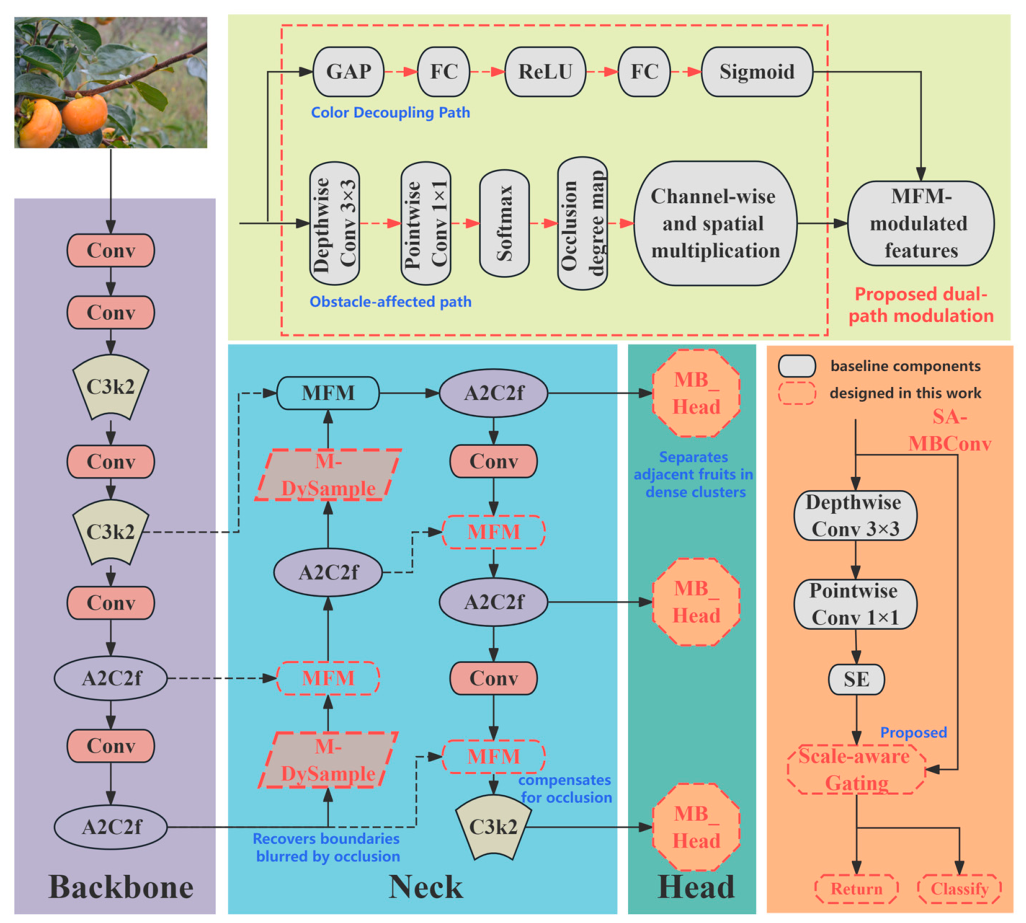
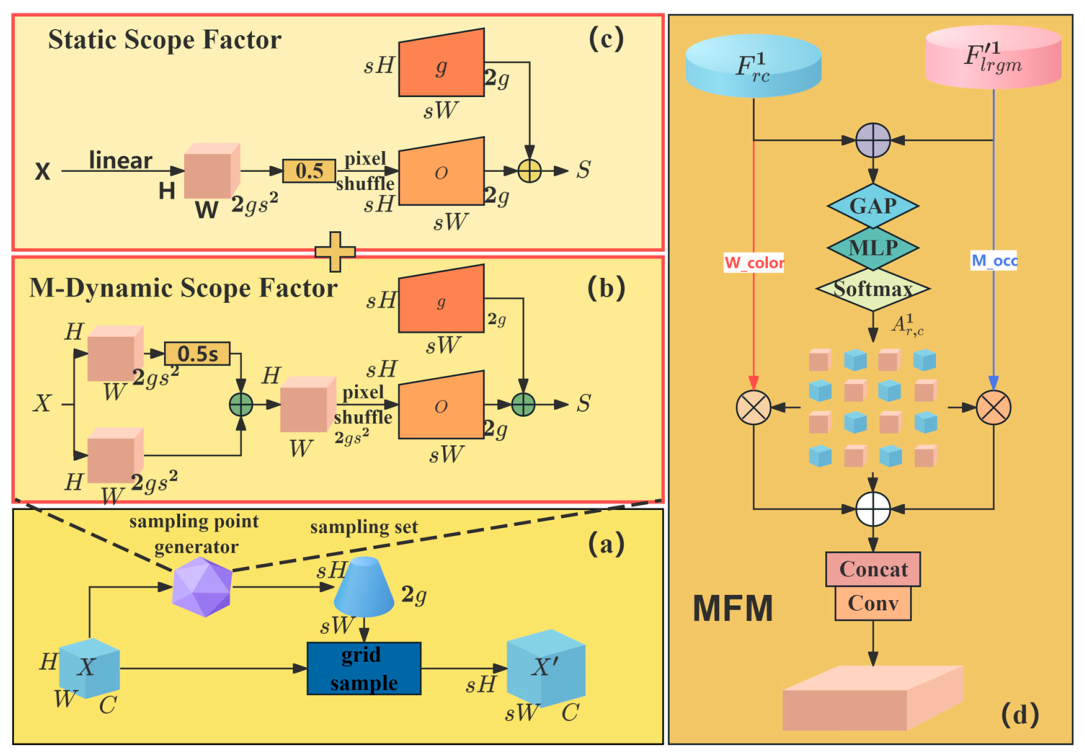
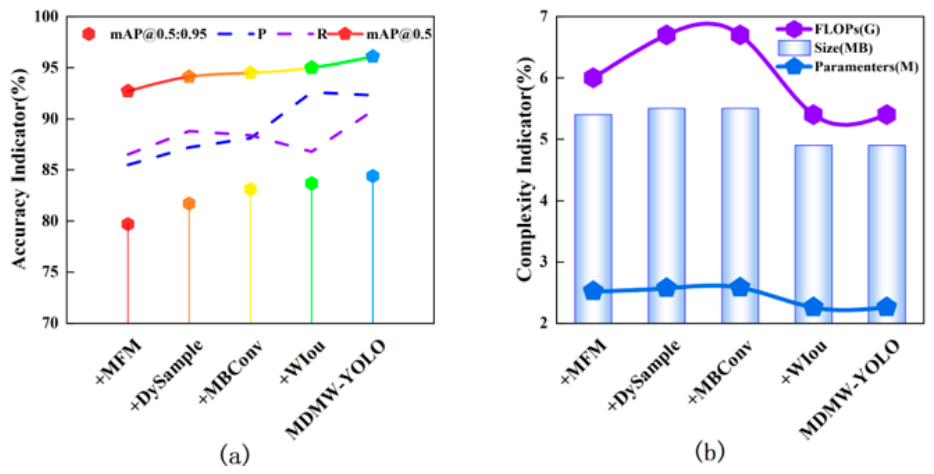
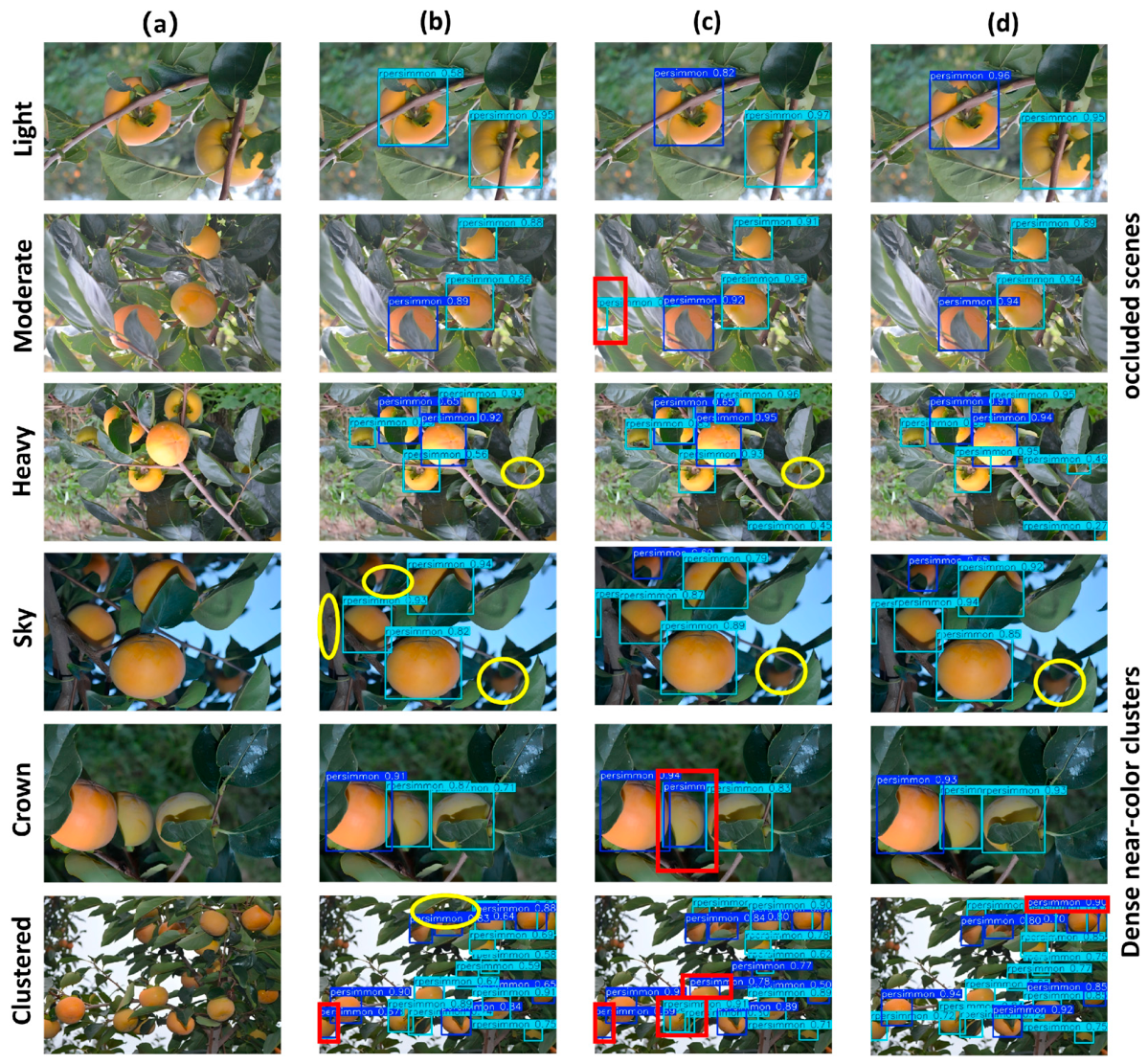
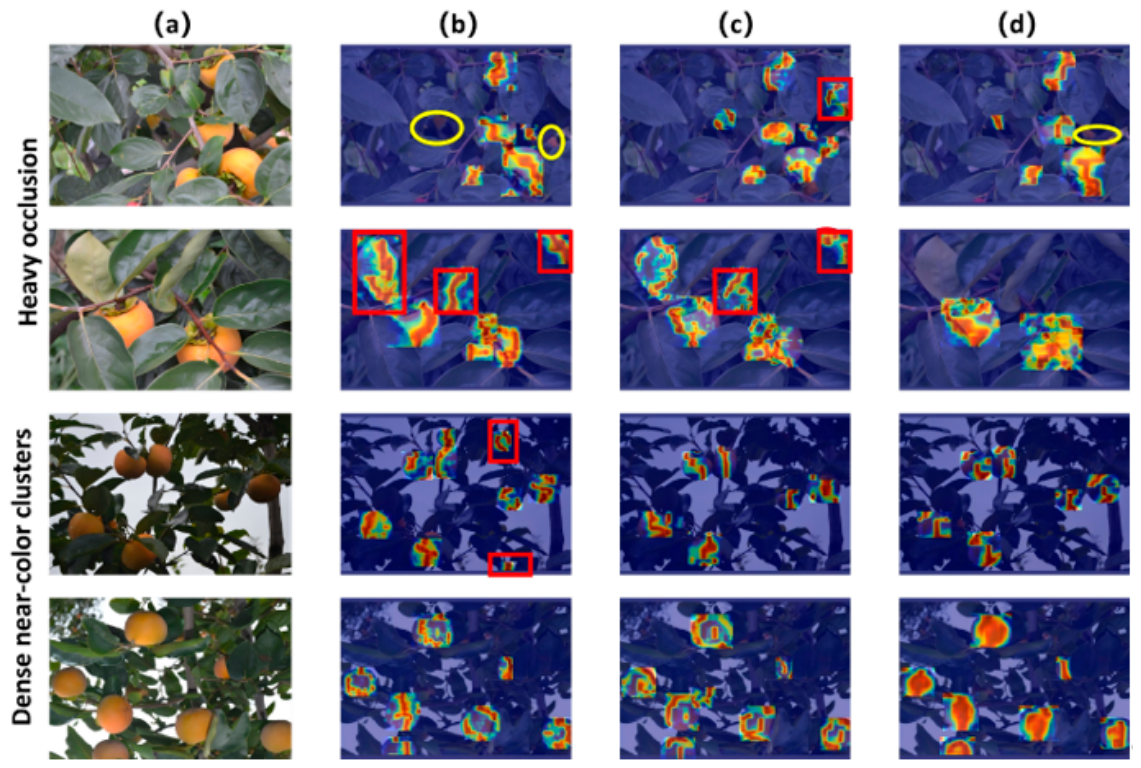
The automated detection of persimmons in orchards is hindered by two primary factors: fruits of the same cultivar possess nearly identical color, causing adjacent instances to be easily merged, and heavy occlusion by leaves and stems hides large portions of the fruit surface. These challenges often co-occur and severely degrade detection performance. To address them jointly, we propose PersimmonDet, a collaborative framework that integrates a dual-path modulation fusion module (MFM) for color–occlusion decoupling, a modulation-guided dynamic upsampling operator (M-DySample) that preserves boundaries under occlusion, a scale-aware lightweight detection head (MB_Head), and a repulsion-enhanced Wise-IoU loss. The key innovation is an implicit coordination mechanism: the loss function generates strong gradients based on difficult samples, and these gradients flow back to train the fusion and upsampling modules, forming a closed optimization loop. Experiments on a self-built persimmon dataset show that PersimmonDet achieves an mAP@0.5 of 96.13% and mAP@0.5:0.95 of 84.42%, outperforming multiple lightweight detectors. The largest gains occur based on heavily occluded and densely clustered fruits. Ablation studies reveal a clear improvement when all four components are combined, confirming their complementary contributions. The same architecture, retrained on a winter jujube dataset without modification, delivers consistent advantages, demonstrating cross-crop transferability. These results indicate that combining problem-aware modulation, boundary-preserving upsampling, and difficulty-focused training is a promising approach for robust fruit detection in orchard environments.
Keywords: selective picking; collaborative optimization; precision agriculture; near-color detection; agricultural robotics selective picking; collaborative optimization; precision agriculture; near-color detection; agricultural robotics