Article

Digital Infrastructure and Agricultural Total Factor Productivity: A New Structural Economics Perspective on the “Broadband China” Policy


1
School of Statistics and Data Science, Capital University of Economics and Business, Beijing 100070, China
2
Institute of Social Science Survey, Peking University, Beijing 100871, China
*
Author to whom correspondence should be addressed.
Agriculture 2026, 16(17), 1813; https://doi.org/10.3390/agriculture16171813
Submission received: 27 July 2026 / Revised: 19 August 2026 / Accepted: 21 August 2026 / Published: 24 August 2026

Abstract

This study investigates the impact of the “Broadband China” pilot policy on agricultural total factor productivity (TFP) from a new structural economics (NSE) perspective. Using panel data from 297 Chinese cities (2000–2024), we employ a spatial difference-in-differences (SDiD) approach. We find that the policy significantly enhances agricultural TFP by approximately 25.8 percentage points in treated cities. We identify international internet users as a novel partial mediator, explaining why domestic broadband gains depend on international connectivity. We also provide evidence of positive spatial spillovers: a 1% increase in neighboring cities’ digital economy is associated with a 0.292% increase in local agricultural TFP. Heterogeneity analysis reveals stronger policy effects in less-developed regions (Northwest China, low-GDP areas) and areas with higher scientific expenditure. By integrating institutional and spatial structures into the NSE framework, this study contributes a nuanced, endowment-contingent understanding of how state-led digital infrastructure investment reshapes agricultural efficiency.

1. Introduction

In the global economic transformation, digital infrastructure is reshaping agriculture. Advanced economies have long leveraged rural broadband to enhance efficiency [1,2], while developing economies are leapfrogging barriers through digital initiatives [3]. Amid these efforts, China’s Broadband China pilot policy (2013) is one of the most ambitious state-led digital infrastructure programs in the developing world. Understanding its impact on agricultural total factor productivity (TFP) is imperative for effective policy design. Existing studies have confirmed that the policy boosts productivity across multiple dimensions. Hu et al. [4] and Zhong et al. [5] have documented the positive effects on urban green TFP and eco-efficiency. In agriculture, Li [6] found that rural broadband enhances agricultural TFP, Zhang et al. [7] showed improved grain production resilience, and Tian et al. [8] demonstrated that digital infrastructure advances agricultural modernization. However, these investigations remain fragmented, lacking a unified theoretical framework accounting for structural transformation and endowment-driven comparative advantage.
New structural economics (NSE) provides such a framework: an economy’s optimal industrial structure is endogenous to its factor endowments [9], with relative factor abundance determining comparative advantage [10]. Infrastructure shapes transaction costs and productive potential [9,10,11]. The China Agricultural Economic Review (CAER) Special Issue (2019) advocated integrating structural change into agricultural economics [12], with Lin [13] arguing that comparative-advantage-aligned structural transformation facilitates poverty elimination via digital infrastructure, while Wang [14] modeled industrialization–rural income distribution mechanisms. Responding to this call, this study applies NSE to examine the Broadband China policy. Subsequent research finds non-linear relationships: an inverted U-shape between digitalization and production resilience [15] and green TFP varying by farm size [16], with technological progress as a key mediator. Together, these findings suggest digital infrastructure’s “appropriateness” depends on alignment with local endowments.
This study addresses the CAER Special Issue’s core proposition by examining the Broadband China policy’s mechanisms and spatial effects within a unified NSE framework. Unlike existing studies that primarily report average treatment effects, this study reveals how policy effects vary systematically by location, development level, and labor force size. Crucially, it provides robust evidence of positive spatial spillovers on agricultural TFP, reconciling mixed prior findings that have reported both positive and negative externalities from digital policies. A unified NSE framework explains when and why digital infrastructure generates heterogeneous effects, offering timely evidence for developing economies navigating digital transformation.
This study advances the literature in three ways. First, it extends NSE [17] by incorporating institutional structure (international internet users as a mediating channel, following Cheng et al. [18]) and spatial structure (positive spillovers to non-pilot cities, contrasting with the negative spillovers reported in Wang and Liu [19]). This institutional–spatial extension moves beyond the traditional NSE focus on industrial structure and factor endowments to explicitly model how digital infrastructure reshapes productivity through information diffusion and interregional knowledge transfer [20,21]. Second, it identifies a novel mediator—international internet users—explaining why domestic broadband policy gains depend on international connectivity, distinguishing it from prior mechanisms that have focused on domestic channels, such as agriculture-related loans [6], industrial structure optimization [5], or technological innovation [4]. Third, it resolves conflicting spatial findings by demonstrating positive agricultural TFP spillovers to neighboring cities, in contrast to the negative spillovers reported in some prior studies [19,22], thereby reconciling apparent contradictions in the literature [5,23]. Heterogeneity analyses further reveal stronger effects in less-developed regions—including Northwest China and low-GDP areas—challenging conventional technology diffusion assumptions that early adopters are necessarily wealthier and suggesting that digital infrastructure can act as a pro-poor technology.
The remainder of this paper is organized as follows. Section 2 reviews the literature and develops hypotheses. Section 3 describes the data, variables, and empirical strategies. Section 4 presents the empirical results, including robustness checks and heterogeneity analyses. Section 5 discusses the theoretical and practical implications. Section 6 concludes the paper.

2. Literature Review and Hypotheses Development

The Broadband China policy is expected to enhance agricultural TFP by improving information accessibility and enabling better resource allocation. From the NSE perspective, infrastructure investments enhance productivity when aligned with evolving comparative advantage, enabled by lower transaction costs [9,11], with productivity growth shaping structural transformation [14]. However, existing research lacks a unified framework to explain two puzzles: (1) why productivity gains depend on international internet users, and (2) why effects vary across regions. This study leverages NSE to address these puzzles. Evidence shows that digital infrastructure enhances agricultural TFP through technological progress and efficiency gains [6,8], and improves urban green TFP via innovation and internet penetration [4,5], aligning with structural change emphasis [12] while biased technological progress moderates climate impacts [24]. The literature consistently confirms positive productivity effects [25,26,27,28,29]. Accordingly, the following hypothesis is proposed:
Hypothesis 1.
The Broadband China pilot policy positively impacts agricultural TFP.
From the NSE perspective, infrastructure investments critically enable structural transformation by reducing transaction costs and aligning with the economy’s evolving comparative advantage [9,11]. Consistent with this logic, Zhong, Liu, Chen, Ke, and Xie [5] provided robust empirical evidence that the Broadband China pilot policy is a powerful catalyst for enhancing regional digital infrastructure, explicitly identifying that the policy primarily operates by directly boosting internet penetration rates. Specifically, it established quantifiable targets for network infrastructure, compelling the government to increase investment, thereby accelerating broadband accessibility. This is corroborated by their mediation analysis, which shows a significantly positive impact of the policy on internet penetration. Probing further, Zhang, You, Guo, Liu, Ning, and Zhu [7] revealed that the Broadband China pilot policy enhances grain production resilience by advancing digitally inclusive finance and promoting agricultural technological progress, resonating with the NSE emphasis on infrastructure-enabled coordination and technological adoption as structural change drivers [9,11,30].
The theoretical justification for using “international internet users” as the mediating variable rests on three interconnected mechanisms. First, the Broadband China policy directly expands internet infrastructure, which increases the number of users connected to global digital networks. Second, international internet users serve as conduits for cross-border information flows, technology diffusion, and knowledge spillovers from global value chains [31]. Third, empirical evidence shows that it is the active use of information software—rather than mere access—that significantly improves grain TFP by facilitating online exchanges of farming experience and enabling knowledge diffusion [32]. This distinction between access and active usage is critical: international connectivity enables farmers to participate in global knowledge networks, access international best practices, and learn from agricultural innovations worldwide. Thus, while domestic broadband provides the infrastructure, it is the international connectivity—captured by the number of international internet users—that facilitates the cross-border information flows essential for productivity gains.
Accordingly, the following hypothesis is proposed:
Hypothesis 2a.
The Broadband China pilot policy positively impacts the number of international internet users.
Many researchers have highlighted mechanisms through which digital connectivity enhances agricultural TFP. Cao, Fan, Chen, Cao, and Jiang [24] noted that biased technological progress positively moderates climate change’s effect on agricultural TFP, pointing out infrastructure-enabled adaptation’s criticality for resilience. Zhang et al. [31] further revealed that, while merely accessing information tools has limited effects, actively using information software significantly improves grain TFP by facilitating online exchanges of farming experience and enabling knowledge diffusion. Complementing these findings, Zhang and Sun [32] demonstrated that participating in agricultural global value chains enhances TFP through technology spillovers, fundamentally enabled by information and communication technologies (ICTs). Together, these studies point to international internet users as key conduits of cross-border information flow, technology diffusion, and experiential learning, aligning with the NSE emphasis on infrastructure as a structural transformation and productivity growth driver [33,34].
Accordingly, the following hypothesis is proposed:
Hypothesis 2b.
The number of international internet users positively impacts agricultural TFP.
According to the extant research [35,36], assuming that Hypotheses 2a and 2b are both true, the following hypothesis is proposed:
Hypothesis 2.
The number of international internet users mediates the relationship between the Broadband China pilot policy and agricultural TFP.
Based on the NSE framework, which emphasizes that infrastructure reduces transaction costs and facilitates knowledge diffusion across regions [10,14], the Broadband China pilot policy is expected to generate positive spatial spillovers on agricultural TFP in neighboring cities. These spillovers may arise through inter-regional learning, technology transfer, labor mobility, and market integration, as digital connectivity reduces information asymmetries and enables neighboring regions to better align their production strategies with productivity-enhancing practices originating from pilot cities [5,24]. While some studies have reported negative spillovers from digital policies [20], a growing body of evidence points to positive externalities in agricultural and eco-efficiency contexts [37,38], consistent with the NSE prediction that infrastructure investments yield broader societal returns beyond directly treated areas [33,34]. Accordingly, the following hypothesis is proposed:
Hypothesis 3.
The Broadband China pilot policy generates positive spatial spillover effects on agricultural TFP in neighboring cities.
Agricultural productivity’s spatial interdependence is well-documented, with evidence confirming spatial spillovers on TFP. From the NSE perspective, infrastructure shapes transaction costs and knowledge diffusion across regions [11], productivity gains propagate through labor mobility and technology transfer [14], consistent with the dynamic framework where capital accumulation and industrial upgrading occur across interconnected regions [9]. Empirical studies support this: Zhu and Yao [37] found spatial dependence in agricultural productivity due to knowledge spillovers; Zhong, Liu, Chen, Ke, and Xie [5] showed that the Broadband China policy generates positive spatial spillovers enhancing eco-efficiency; Tang et al. [38] confirmed a high spatial correlation in agricultural productivity; and Zou, Liao, and Fan [23] showed that the digital economy promotes productivity growth in neighboring cities—dynamics that NSE interprets as infrastructure facilitating latent comparative advantages across regions [11,14]. Accordingly, the following hypothesis is proposed:
Hypothesis 4.
Agricultural TFP exhibits positive spatial spillover effects.
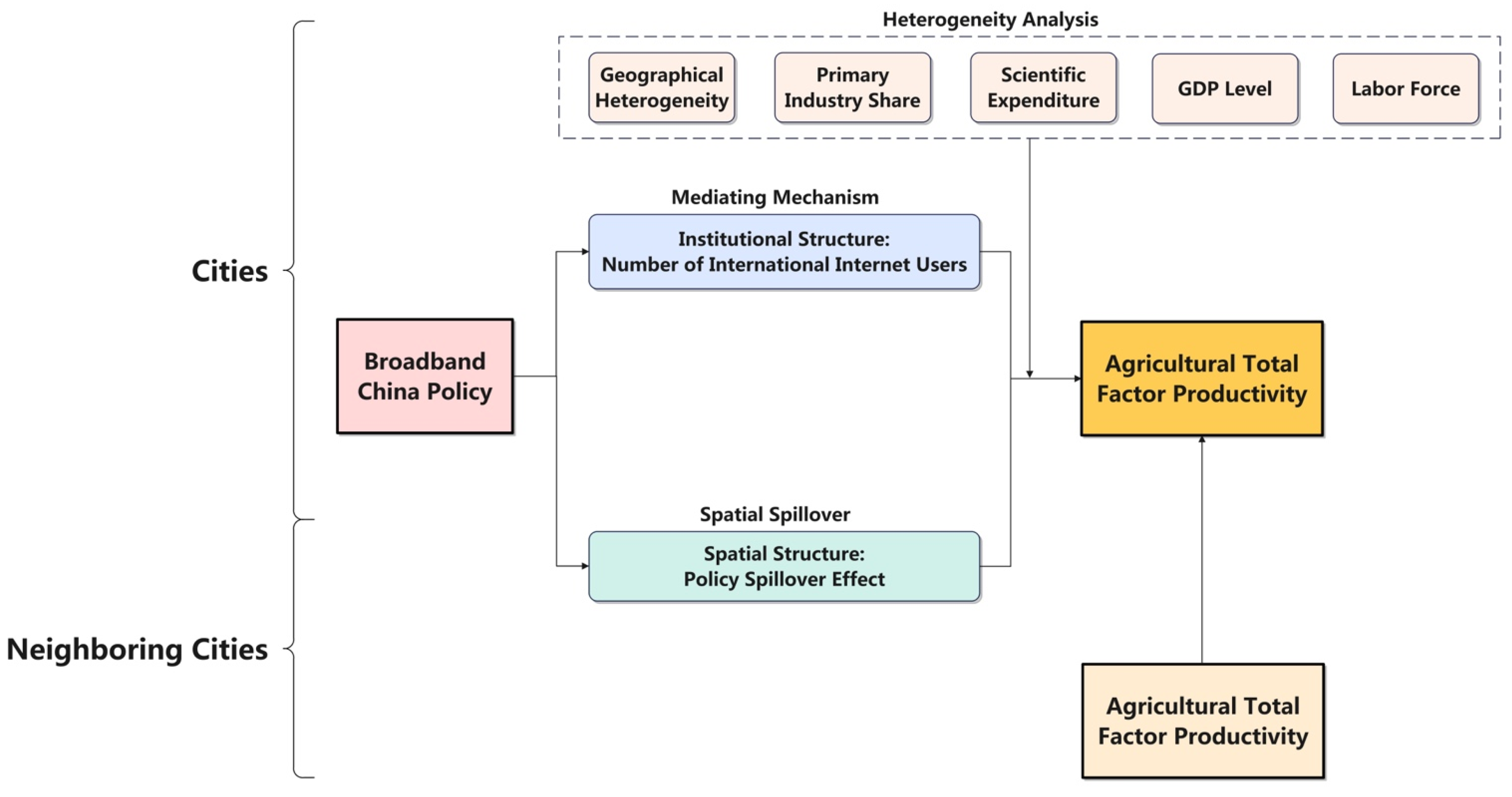
Based on the NSE framework, Figure 1 illustrates the analytical framework of this study, which is organized around two interrelated dimensions through which the Broadband China pilot policy affects agricultural TFP: institutional structure and spatial structure. Starting with the direct channel, the policy exerts a positive impact on agricultural TFP in treated cities (Hypothesis 1). Turning to the institutional channel, the policy expands the number of international internet users (Hypothesis 2a), which in turn enhances agricultural TFP (Hypothesis 2b), thereby establishing international internet users as a partial mediator (Hypothesis 2). Moving to the spatial channel, the policy generates positive spillover effects on agricultural TFP in neighboring cities (Hypothesis 3), and separately, agricultural TFP itself exhibits positive spatial autocorrelation (Hypothesis 4). Finally, the framework incorporates heterogeneity analysis to show that these effects vary systematically with local structural characteristics—including geographic location, economic development level, and labor force size—reflecting the NSE principle of “appropriate structure,” whereby the effectiveness of infrastructure investment depends critically on alignment with local factor endowments.

3. Research Methodology

3.1. Sample and Data

Based on data availability and research scope, this study constructs a panel dataset comprising 7425 observations from 297 Chinese prefecture-level cities from 2000 to 2024. Observations with significant data gaps are excluded. Considering the research context and the Broadband China pilot policy’s phased implementation, this period is deemed an appropriate for examining its effect on agricultural TFP [39]. Following data cleaning and matching with the official pilot city lists, 109 cities are identified as treated cities (selected as Broadband China pilots in 2014, 2015, or 2016), while the remaining 188 cities serve as controls throughout the sample period. Among the treated cities, 37 were selected in 2014, 36 in 2015, and 36 in 2016. The dataset is compiled from multiple sources. The Broadband China’s pilot cities are identified from the official lists published by the Ministry of Industry and Information Technology and the National Development and Reform Commission, which selected pilot cities in three batches in 2014, 2015, and 2016. Data related to agriculture, forestry, animal husbandry, and fisheries are collected from the China Regional Statistical Yearbooks and various provincial and municipal statistical ones. City-level panel data are obtained primarily from the China City Statistical Yearbooks and local statistical bureaus. A detailed list of data sources is provided in Appendix A.
The sample selection process proceeded as follows. First, we identified and extracted city-level data from the China City Statistical Yearbooks (2000–2024) using a Natural Language Processing (NLP) algorithm, converting the raw textual data into a structured panel format. Second, we supplemented the extracted data by cross-referencing with major public databases and local statistical bureaus to fill gaps and correct inconsistencies. Third, we unified all geographic codes and city names according to the Ministry of Civil Affairs 2019 standard to ensure consistent regional identification across years. Fourth, we converted all variables to uniform units to ensure comparability. Fifth, we manually validated the compiled panel data through random sampling to verify accuracy and consistency. Sixth, we converted the unbalanced panel into a balanced panel covering all 297 cities across the 25-year period. Seventh, we applied linear interpolation to fill the missing values for individual years using the linear trend of each city’s time series. Eighth, we further used ARIMA models to predict and impute the remaining missing values based on time-series trends, producing an alternative ARIMA-imputed version. The final analysis in this paper uses the linear interpolation version, which preserves the original data structure while maintaining time-series continuity. The final balanced panel comprises 7425 observations (297 cities × 25 years).

3.2. Variable Construction

Dependent Variable: Agricultural TFP—Following Refs. [40,41], this study employs stochastic frontier analysis (SFA) to estimate the dependent variable of agricultural TFP. SFA is preferred over traditional methods because it explicitly accounts for both random shocks and technical inefficiency in production, thereby providing more accurate and theoretically grounded productivity measurements [42,43]. The production function is specified using a trans-log form with five key agricultural inputs: agricultural machinery power (X1), total sown crop area (X2), agricultural fertilizer application (X3), rural electricity consumption (X4), and primary industry employment (X5). Agricultural output (Y) is measured as the gross output value of agriculture, forestry, animal husbandry, and fisheries and deflated to 2000 constant prices using provincial agricultural price indices. Technical efficiency scores are derived from the estimated inefficiency term, and TFP is subsequently calculated as the product of frontier output and technical efficiency. SFA assumes a truncated-normal distribution for the inefficiency term and a half-normal distribution for the random error, estimated via maximum likelihood.
Independent Variable: The Broadband China Pilot Policy Difference-in-Differences (DID)—Following Refs. [4,44,45], this study employs the Broadband China pilot policy DID as the independent variable. The Ministry of Industry and Information Technology, together with the National Development and Reform Commission, successively selected pilot cities for the “Broadband China” strategy in 2014, 2015, and 2016, based on which a dummy variable DID is constructed to capture the treatment effect. Specifically, DID takes the value of 1 for a city in the year in which it was selected and all subsequent years, and 0 if otherwise. The staggered adoption across three cohorts is addressed using a multi-period DID framework with two-way fixed effects. We also conduct a series of robustness checks to verify the reliability of our findings.
The spatial econometric specification focuses on the spatial spillover effects of the Broadband China policy. The term W × D I D i t captures the cross-regional diffusion of policy benefits—the direct impact of policy implementation in neighboring regions on a focal region’s agricultural TFP. This is conceptually distinct from general spatial dependence in agricultural TFP, which reflects broader spatial correlations in productivity and is examined in robustness checks. In this specification, ρ captures the policy-specific spillover effect, where a positive and significant ρ indicates that the benefits of digital infrastructure investment extend beyond directly treated regions through mechanisms, such as enhanced market integration, information sharing, and supply chain connectivity.
Control Variables—Control variables are included to account for confounding factors and isolate the policy’s causal effect on agricultural TFP [46,47,48,49,50]. Registered population (RP) controls for labor availability and market demand. Urbanization rate (UR) captures rural–urban migration and market access effects. Per capita grain output (AGO) proxies agricultural production intensity. Patent applications (PA) capture regional innovation capacity. Industrial enterprises above a designated size (IE) control for industrial development and resource competition. These variables mitigate the omitted variable bias and enhance reliability.
Mediating Variable—To examine the hypothesized mediating mechanism, this study refers to previous work [5,24], and selects the number of international internet users (IIU) as the mediating variable. As justified in the Literature Review and Hypotheses Development, IIU captures the extent of international digital connectivity, serving as a key channel through which domestic broadband infrastructure translates into agricultural productivity gains. This variable measures internet adoption at the city level and may transmit the Broadband China pilot policy’s effects on agricultural TFP.
Table 1 presents the descriptive statistics for the variables used in this study.

3.3. Empirical Model

As the extant research indicates, the Broadband China pilot policy implementation can be conceptualized as a quasi-natural experiment that facilitates applying a structural difference-in-differences (SDiD) approach to identify the policy’s causal effect on agricultural TFP [5,45]. Following the empirical specifications commonly adopted in related studies [51,52], the baseline econometric model is specified as follows:
    T F P i t = β 0 + β 1 D I D i t + W × T F P i t + γ X i t + μ i + λ t + ε i t
where TFPit denotes agricultural TFP in city i in year t; DIDit is the treatment dummy that equals 1 if city i is designated as a Broadband China pilot city in year t, and 0 if otherwise; W denotes the spatial contiguity weight matrix [53], capturing the spatial correlation between cities; Xit is a vector of time-varying city-level control variables, including registered population, urbanization rate of permanent population, per capita grain output, number of patent applications, and number of industrial enterprises above a designated size; μi and λt represent city- and year-fixed effects, which capture time-invariant city-specific characteristics and control for common time trends and macroeconomic shocks, respectively; and εit is the idiosyncratic error term. The coefficient of interest, β1, captures the average treatment effect of the Broadband China pilot policy on agricultural TFP. Standard errors are clustered at the city level to account for possible serial correlations and heteroscedasticity (i = 1, 2, …, 297; t = 2000, 1991, …, 2024).
For the spatial econometric specification, we employ Gu [53]’s decomposition to distinguish direct, indirect, and total effects. Direct effects capture the impact of a city’s own characteristics on its agricultural TFP. Indirect (spillover) effects capture the impact of neighboring cities’ characteristics on a given city’s TFP. Total effects are the sum of direct and indirect effects. This decomposition is implemented using the spatial weights matrix W, with standard errors derived from the variance-covariance matrix of the spatial model coefficients.

4. Empirical Results and Analysis

4.1. Baseline Results

Table 2 presents the baseline regression results. The spatial spillover coefficient (ρ) captures the extent to which a city’s TFP is influenced by neighboring cities’ TFP. The DID coefficient captures the policy’s direct effect. The analysis progressively incorporates control variables and fixed effects to ensure the findings’ robustness.
Column 1 includes city-fixed effects; the DID coefficient is positive and significant at 1%, with a magnitude of 99.866, indicating the policy enhances agricultural TFP. Column 2 adds time-fixed effects; the DID coefficient remains positive but decreases to 31.371, suggesting part of the effect is attributable to time-varying factors. Column 3 includes all control variables; the DID coefficient remains positive and significant at 1% with slightly reduced magnitude, confirming the policy’s robust positive impact on agricultural TFP after accounting for socioeconomic factors. Thus, Hypothesis 1 is supported. These baseline findings align closely with the existing literature on digital infrastructure’s positive effects. Li [6] demonstrated that rural broadband development significantly enhances agricultural TFP through technological progress and technical efficiency improvements. Similarly, the policy effect’s persistence resonates with the broader empirical evidence from Hu, Wang, Cao, and Hao [4] and Zhong, Liu, Chen, Ke, and Xie [5], who revealed that the Broadband China pilot policy improves urban GTFP and eco-efficiency through technological innovation, industrial structure optimization, and increased internet penetration.
The consistently positive and significant spatial spillover effect across all specifications confirms that a city’s agricultural TFP is positively affected by productivity gains from neighbors, supporting Hypothesis 4. These results align with Tang, Lu, Gong, and Chen [38] and Zou, Liao, and Fan [23] on spatial interdependence; resonate with Zhu and Yao [37] identifying knowledge spillovers as key mechanisms; and are consistent with Zhong, Liu, Chen, Ke, and Xie [5], showing that the policy generates positive spillovers enhancing eco-efficiency in neighboring cities through knowledge transfer. The coefficient of 0.292 in Table 2 represents the spatial dependence parameter for agricultural TFP. This indicates positive spatial correlation in productivity, suggesting that a region’s TFP is influenced by the TFP of its neighboring regions. This coefficient captures general spatial interactions—such as shared agricultural infrastructure, climate conditions, and cross-regional knowledge diffusion—rather than policy-specific spillovers.
In summary, the baseline results confirm that the Broadband China policy significantly enhances agricultural TFP (H1), with positive spatial spillovers (H4).

4.2. Robustness Checks

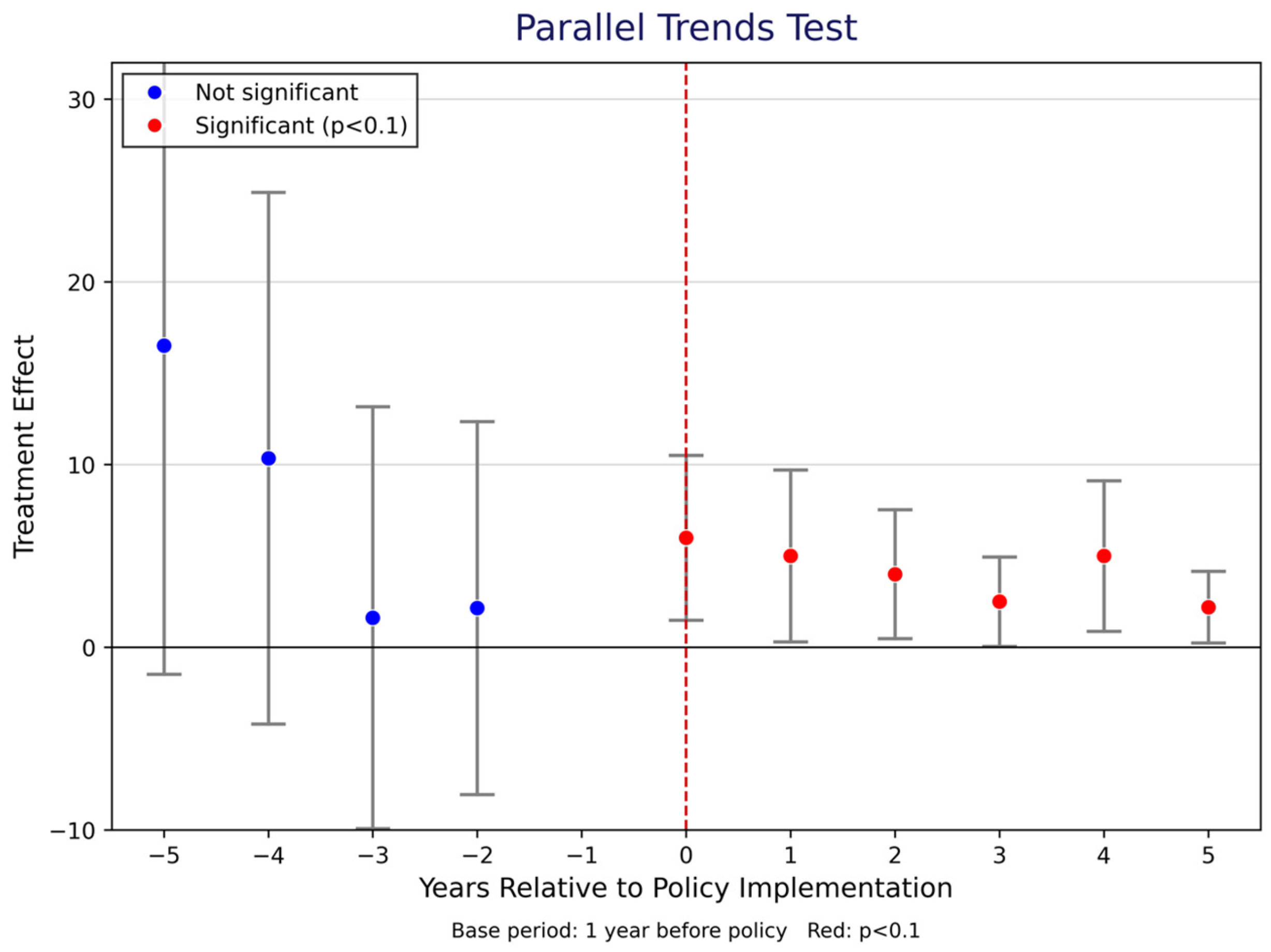
Parallel Trend Test—An event study validates the DID identification strategy by testing the parallel trend assumption (Figure 2).
The event study results in Figure 2 provide strong support for the parallel trends assumption. All pre-treatment coefficients are statistically insignificant at conventional levels: the joint test for coefficients t = −5 through t = −2 yields F = 0.286 (p = 0.864). While the point estimates for t = −5 and t = −4 are slightly positive, their 95% confidence intervals comfortably contain zero (p = 0.342 and p = 0.528, respectively), confirming that the treatment and control groups followed common trends prior to policy implementation. Following the policy, immediate and sustained positive effects on agricultural TFP emerge, with coefficients increasing from 0.042 at t = 0 to 0.143 at t = 5 (all p < 0.01). This pattern suggests both immediate policy impact and growing benefits over time.
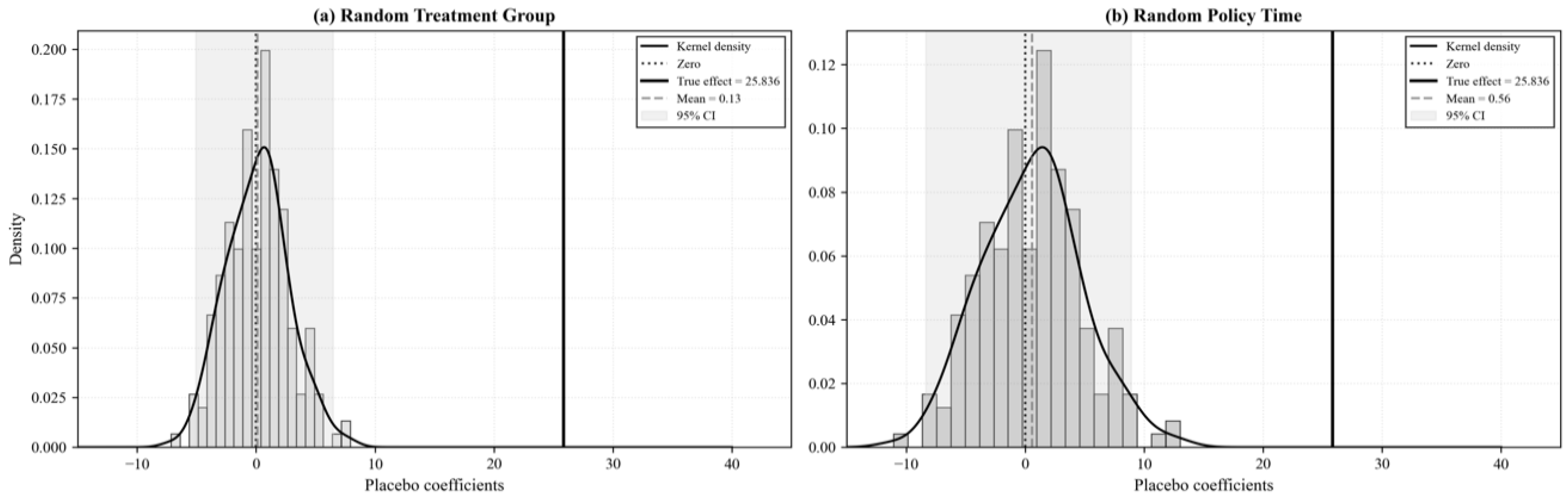
Placebo Test—Two placebo tests assess the DID specification’s validity following Cai et al. [54] and Li et al. [55]: (1) randomly reassigning treatment status with fixed policy timing, and (2) randomly reassigning policy timing with fixed treatment groups. For each, 200 simulations are performed. Figure 3 shows both placebo distributions centered near zero with 95% confidence intervals containing zero (Panel A: mean 0.24, CI [−5.05, 6.50]; Panel B: mean 0.74, CI [−8.35, 8.91]), confirming that random reassignment does not produce significant estimates. The true treatment effect (25.836) lies in the far-right tail of both placebo distributions, with none of the 200 placebo coefficients exceeding it (p < 0.001 for both tests), providing strong evidence for the identification strategy’s validity.
Propensity Score Matching Difference-in-Differences (PSM-DID) Test—To address selection bias from non-random policy assignment, the PSM-DID approach is employed (Table 3). Initially, 1:1 nearest neighbor matching yields an insignificant coefficient of 11.608 (N = 1959), likely due to sample size reduction. However, 1:4 nearest neighbor matching produces a significant coefficient of 25.401 (N = 3559), while radius and kernel matching both generate identical significant coefficients of 20.333 with near-full samples. These results are consistent with the baseline estimate, confirming the policy’s positive impact on agricultural TFP is robust to alternative matching specifications. The consistent positive and significant coefficients across 1:4 nearest neighbor, radius, and kernel matching methods confirm that the policy effect is not driven by observable selection bias. Overall, the PSM-DID results corroborate the main analysis, affirming the policy’s causal and positive impact on agricultural TFP.
Other Robustness Tests—Additional robustness checks verify the baseline findings: (1) replacing TFP with the Solow residual method; (2) excluding central government-controlled municipalities; (3) using maximum likelihood (ML) estimation; (4) altering the sample period to 2001–2024; and (5) altering it to 2002–2024. The results are presented in Table 4.
Across all five specifications, the DID coefficient remains positive and significant at 1%, ranging from 25.836 to 28.742, consistent with the baseline coefficient of 25.836. Replacing TFP with the Solow residual method yields 28.742; excluding central municipalities yields 27.592; ML estimation produces an identical coefficient; and altering the sample period leaves significance and magnitude unchanged. These results confirm the policy effect is insensitive to changes in measurement, estimation, or sample composition.

4.3. Mediating Mechanism Analysis

A mediating effect analysis is conducted to uncover the underlying channels through which the Broadband China pilot policy influences agricultural TFP. Following Ref. [36], this analysis examines whether the IIU serves as a transmission mechanism. The mediation model is estimated in three steps: first, the total effect of DID on TFP; second, the effect of DID on the mediator IIU; and third, the effect of DID on TFP while controlling for IIU. Table 5 presents the results.
Column 1 confirms the policy’s total positive effect on TFP. Column 2 shows a significant positive impact on international internet users (IIU), supporting Hypothesis 2a. Column 3 reveals that IIU positively impacts TFP (Hypothesis 2b), and the DID coefficient decreases from 25.836 to 22.050 but remains significant, indicating partial mediation (Hypothesis 2). To formally test the mediation effect, we conduct a Sobel test. The mediation analysis demonstrates that internet users partially mediate the relationship between the DID policy and TFP. The indirect effect via internet adoption is 3.373, representing 13.27% of the total effect (25.424), while the direct effect accounts for the remaining 86.73% (22.051). The Sobel test confirms the significance of this mediation pathway (z = 3.789, p = 0.0002), with consistent results across alternative tests (Aroian: z = 3.769, p = 0.0002; Goodman: z = 3.810, p = 0.0001). These results suggest that the policy boosts productivity both directly and indirectly through promoting internet infrastructure development. This mediating role aligns with the NSE framework, where infrastructure investment reduces transaction costs and enables technology adoption [9,11], reinforcing that infrastructure aligned with comparative advantage generates sustained productivity gains through multiple channels [33,34].

4.4. Policy Spillover Effect Analysis

In addition to the direct effects of the Broadband China pilot policy on treated cities, there may be spatial spillover effects on agricultural TFP in neighboring regions. Such spillovers can arise through various channels, including knowledge diffusion, technology transfer, market integration, and inter-regional resource reallocation. To investigate these spatial externalities empirically, a spatial model incorporating the spatially lagged term of the policy variable (DID) is estimated as follows:
T F P i t = β 0 + β 1 D I D i t + ρ W × D I D i t + γ X i t + μ i + λ t + ε i t
The spatial weight matrix W is constructed using Queen contiguity, where w i j = 1 if cities i and j share a border or vertex, and zero if otherwise. The matrix is row-standardized so that each row sums to one, ensuring that the spatially lagged variable represents a weighted average of neighboring cities’ values. The results are presented in Table 6.
Column 1, with no fixed effects, shows positive and significant DID and spatial spillover coefficients, confirming direct and external policy effects on agricultural TFP. Column 2 adds city-fixed effects; the spatial spillover increases to 294.371, ruling out time-invariant heterogeneity. Column 3 adds time-fixed effects; the spillover reduces to 77.612, indicating some time-varying factors. Column 4 includes all controls; the spillover remains significant at 51.638, indicating that a one-unit increase in neighboring treated cities’ policy exposure is associated with a 51.638-unit increase in local TFP. Thus, Hypothesis 3 is supported. Given the mean agricultural TFP of 284.191 yuan, the spatial spillover coefficient of 51.638 corresponds to an approximate 18.2% increase in TFP relative to the mean, confirming that the magnitude is economically meaningful and consistent with the scale of the dependent variable. The spatial spillover coefficient of 51.638 should be interpreted as the direct spillover effect of neighboring cities’ policy exposure on local agricultural TFP. Given the mean TFP of 284.191 yuan, this coefficient represents approximately an 18.2% increase in TFP relative to the mean, confirming economic significance. This coefficient is not the total indirect effect from a full spatial decomposition, which would incorporate additional feedback effects through the spatial multiplier.
The coefficient on spatial spillover effect (DID) in Table 6 captures the spatial spillover effect of the Broadband China policy. A positive and significant coefficient indicates that policy implementation in neighboring regions generates positive externalities for a focal region’s agricultural TFP. This result provides direct evidence that the benefits of digital infrastructure investment diffuse across regional boundaries.
An alternative to the spatially lagged DID specification would be a full spatial Durbin model (SDM) with effect decomposition, which would allow us to separate direct, indirect, and total effects. We have adopted the current specification for its parsimony and direct interpretability of the spillover effect, but we acknowledge this as a limitation and suggest it as a direction for future research.

4.5. Heterogeneity Analysis

Geographical Heterogeneity—To examine geographical heterogeneity, the sample is divided into Southeast and Northwest China based on the Hu Huanyong Line [56,57]. The southeast has a denser population and advanced development, while the northwest has a sparser population and underdeveloped infrastructure. In terms of agricultural specialization, the northwest is predominantly grain-producing, with large-scale mechanized farming of staple crops, such as wheat and maize, whereas the southeast exhibits a more diversified agricultural structure, including horticulture, aquaculture, and cash crops alongside grain production. This regional difference in production structure may influence how digital infrastructure translates into productivity gains, as grain-producing regions with more standardized production processes may more readily adopt and benefit from digital technologies. Table 7 presents the results. Column 1 shows the southeast subsample; the DID coefficient is positive and significant at 5%, with a positive spatial spillover. Column 2 shows the northwest subsample; the DID coefficient is more than double that of the southeast and significant at 1%, indicating a stronger policy impact in the less-developed northwest region. The spatial spillover remains positive but slightly smaller than in the southeast.
Heterogeneity in Economic Development Level and Demographic Structure—Based on median splits (Table 8), columns 1–2 compare primary industry share [5]. The DID coefficient is insignificant in high-share regions but positive and significant in low-share regions, indicating greater policy effectiveness where agriculture has a smaller economic share. Columns 3–4 examine science and technology expenditure [58,59]. Both groups show positive and significant coefficients, with larger magnitude in the high-expenditure group, suggesting that greater scientific investment amplifies policy effectiveness through complementary knowledge and innovation support.
Following Hong and Bo [58] and Zhou et al. [60], columns 5–6 are split by GDP. The DID coefficient is insignificant in high-GDP regions but positive and significant in low-GDP regions, indicating substantial TFP gains in less-developed areas. Following Aker and Ksol [61], columns 7–8 are split by employed persons. Both groups show positive and significant coefficients, with a substantially larger effect in larger labor-force regions, suggesting greater capacity to adopt new technologies and access digital platforms.
The spatial spillover effect remains positive and significant across all eight subsamples, with coefficients ranging from 0.127 to 0.313. This consistency reaffirms spatial interdependence’s pervasive role in agricultural productivity regardless of local economic and demographic conditions. The magnitude of spillovers is notably larger in groups with higher GDP and larger labor forces, suggesting that economic development and population agglomeration amplify spatial diffusion mechanisms.

5. Discussion

5.1. Theoretical Implications

This study moves beyond the established finding that the Broadband China policy positively affects agricultural TFP [6,7,8] by addressing three unanswered questions: Why does policy effectiveness vary across regions? Under what conditions do spatial spillovers operate? What theoretical framework unifies these patterns? These questions concern technology adoption, factor substitution, and spatial diffusion [62,63]. This study addresses them by applying and extending NSE [17] to generate testable hypotheses beyond standard frameworks.
First, this study demonstrates that the policy’s impact on agricultural TFP is contingent on local factor endowments—a unique NSE prediction [9,17]. Unlike standard approaches treating digital infrastructure as uniformly productive, NSE predicts larger gains where infrastructure relaxes binding constraints, i.e., in labor-abundant, land-constrained regions. This resonates with the technology adoption literature, recognizing that endowment structures condition technology choices and returns [64,65,66]. Consistent with this prediction, our heterogeneity analysis shows that the policy effect is substantially larger in less-developed regions (Northwest China, low-GDP areas) and in regions with larger agricultural labor forces but is insignificant in high-GDP regions, which is consistent with the interpretation that digital infrastructure can act as a pro-poor technology. This finding challenges the conventional diffusion theory prediction that early adopters of new technologies are necessarily wealthier [67], though we recognize that this single empirical pattern does not constitute a comprehensive rejection of diffusion theory as a whole. These findings are consistent with recent studies on digitalization and agricultural productivity in other developing countries, such as Aker and Ksoll [61] in Niger and Ma et al. [68] on rural development in the digital age, who similarly found that the benefits of digital technologies were often greatest among previously disadvantaged farmers.
Second, this study contributes to resolving conflicting evidence on spatial spillovers—positive [5,23] versus negative [19,22]—by demonstrating consistently positive spillovers of broadband policy on agricultural TFP in neighboring cities. From an NSE perspective, knowledge spillovers from leading cities benefit neighboring regions with complementary endowments [9]. Our results provide evidence consistent with policy-driven diffusion mechanisms [37,38] and aligns with evidence that ICTs reduce information frictions, with remote farmers benefiting most [61,68]. The finding of stronger spillovers in less-developed regions suggest ICTs reduce cross-regional knowledge exchange costs, generating social returns that may exceed private returns. However, given the limitations of spatial econometric identification—including the possibility of unobserved regional shocks, common trends, or endogenous network formation—these results should be interpreted as conditional associations rather than definitive causal estimates of spatial diffusion.
Third, this study identifies international internet users as a partial mediator, highlighting the role of information access as an important channel in agricultural production. This addresses a puzzle: why does a domestic broadband policy’s productivity effect depend on international internet users? The persistence of a significant direct effect after controlling for the mediator suggests multiple parallel channels (finance, technology, value chains), with connectivity alone being insufficient. While agricultural production economics has traditionally focused on land, labor, and capital [69,70], recent work has shown that digital adoption increases farm productivity by 15–30% and income by 20–35% [71], with internet use boosting productivity and rural income [51]. Our partial mediation finding underscores the importance of information access in agricultural productivity, complementing traditional factors such as land, labor, and capital. However, we acknowledge that establishing information as a distinct factor of production would require more direct evidence—for instance, estimating production functions that explicitly include information as an input or providing evidence on its marginal product and substitutability with other factors [66]. We therefore treat this as a suggestive finding that opens avenues for future research rather than a definitive conclusion.
Fourth, this study offers a competitive test of theoretical frameworks in agricultural economics, contrasting NSE (endowment-contingent effects) with standard technology diffusion theory (early-adopter advantage). Our findings are more consistent with the NSE prediction that infrastructure investments yield greater productivity gains where they alleviate binding constraints, than with the conventional diffusion theory assumption that early adopters are necessarily wealthier. This responds to calls for stronger theory–empirics integration [72,73]. The finding that less-developed regions benefit more from digital infrastructure challenges the specific diffusion theory prediction that wealthier regions are the primary beneficiaries of new technologies [67], and is suggestive of diminishing marginal returns to digital infrastructure in agriculture, with direct implications for rural broadband prioritization [68]. However, we recognize that this single empirical pattern, while informative, does not constitute a comprehensive rejection of diffusion theory as a whole, which encompasses a broader set of propositions regarding adoption patterns, communication channels, and social systems. Our study examines the productivity effects of a policy rather than the adoption process itself, so the scope of this implication should be appropriately narrowed. These contributions move the literature beyond average treatment effects toward a conditional, mechanism-based, and spatially explicit understanding of digital transformation in agriculture.

5.2. Practical Implications

These findings offer several policy insights for developing economies pursuing digital transformations. First, the Broadband China pilot policy’s significant positive impact on agricultural TFP suggests that state-led digital infrastructure investment can effectively catalyze productivity gains when aligned with the agricultural sector’s structural characteristics. Targeted investments in lagging areas have the potential to generate substantial productivity gains, as suggested by the larger policy effects observed in less-developed regions, though the precise magnitude of these returns would require further site-specific analysis. Second, IIU’s mediating role underscores the importance of policies that not only expand infrastructure access but also promote actively utilizing digital tools for information sharing and knowledge exchange; physical access alone is insufficient, and complementary investments in digital literacy and agricultural extension services are essential to help farmers translate connectivity into productivity gains. Third, the heterogeneity findings indicate that complementary investments in science, technology, and human capital appear to be important for maximizing digital infrastructure’s productivity benefits, reinforcing the NSE insight that infrastructure is most effective when combined with soft infrastructure and factor endowment upgrades. Fourth, the positive spatial spillover effects documented in this study imply that the benefits of broadband policy extend beyond treated cities to neighboring regions, calling for regional coordination mechanisms—such as cross-jurisdictional knowledge-sharing platforms, inter-regional technology transfer agreements, and coordinated infrastructure planning—to fully realize the social returns of digital infrastructure investments.

5.3. Limitations and Future Research

This study has several limitations. First, data constraints prevented examining other potential mechanisms (e.g., digital finance, technology adoption). Future research could explore these alternative channels using micro-level survey data. Second, the analysis focused on aggregate city-level TFP, ignoring heterogeneity across crop types, farm sizes, and subsectors. Future studies could disaggregate by crop or farm type using county-level data. Third, the spatial econometric approach cannot empirically distinguish the underlying mechanisms of spatial dynamics. Network analyses or agent-based modeling could further illuminate these mechanisms. Fourth, the study period (2000–2024) captures only medium-term effects; longer-term structural transformation requires future re-examination as more post-policy data accumulate. The staggered DID design, while appropriate for the policy context, may not fully address all sources of endogeneity; future research could employ alternative identification strategies, such as instrumental variables or regression discontinuity designs.

6. Conclusions

This study comprehensively analyzes the Broadband China pilot policy’s impact on agricultural TFP using an SDiD approach grounded in the NSE framework on panel data from 297 prefecture-level cities from 2000 to 2024. The findings demonstrate that the policy significantly enhances agricultural TFP by 25.8 percentage points, a substantial economic effect. Spatial analysis reveals positive spillover effects with a magnitude of 0.292, indicating productivity gains propagate to neighboring regions through knowledge diffusion. Mediation analysis identifies IIU as a significant partial mediator, with a Sobel test confirming its statistical significance. Heterogeneity analysis reveals that policy effects are stronger in less-developed regions, areas with higher scientific expenditure, and regions with larger labor forces. Collectively, this study advances understanding of how digital infrastructure reshapes agricultural productivity, offering theoretically grounded evidence that informs digital transformation strategies in developing economies.

Author Contributions

Conceptualization, J.G. and S.G.; methodology, J.G.; software, J.G.; validation, J.G. and S.G.; formal analysis, S.G.; investigation, S.G.; resources, J.G.; data curation, S.G.; writing—original draft preparation, S.G.; writing—review and editing, J.G.; visualization, J.G.; supervision, J.G.; project administration, J.G.; funding acquisition, J.G. All authors have read and agreed to the published version of the manuscript.

Funding

This research was funded by the National Social Science Foundation of China (17BSH122).

Data Availability Statement

The data presented in this study are available on request from the author.

Conflicts of Interest

The authors declare no conflicts of interest.

Appendix A

Table A1. Detailed data sources.
Variable CategoryVariableData Source
Policy VariableBroadband China pilot city statusOfficial lists published by the Ministry of Industry and Information Technology and the National Development and Reform Commission (2014, 2015, and 2016 batches)
Agricultural OutputGross output value of agriculture, forestry, animal husbandry, and fisheriesChina Regional Statistical Yearbooks; provincial and municipal statistical yearbooks
Agricultural InputAgricultural machinery power, total sown crop area, agricultural fertilizer application, rural electricity consumption, primary industry employmentChina Regional Statistical Yearbooks; provincial and municipal statistical yearbooks
City-Level Panel DataRegistered population, urbanization rate of permanent population, per capita grain output, number of patent applications, number of industrial enterprises above a designated size, number of international internet usersChina City Statistical Yearbooks; local statistical bureaus

References

  1. Muenchhausen, S.; Haering, A. Implementation of the ‘European Innovation Partnership-Agricultural Productivity and Sustainability (EIP)’ on the regional level—An example from North-Eastern Germany. In Proceedings of the 6th International Scientific Conference Rural Development, Kaunas, Lithuania, 28–29 November 2013; pp. 580–585. [Google Scholar]
  2. Sanders, C.; Gibson, K.; Lamm, A. Rural Broadband and Precision Agriculture: A Frame Analysis of United States Federal Policy Outreach under the Biden Administration. Sustainability 2022, 14, 460. [Google Scholar] [CrossRef] [Scilit]
  3. Karthikeyan, T.; Janani, A.; David, B.I.A. Role of Digital India Initiative Towards India 2.0: Vision for India 2047; Shanlax Publications: Madurai, India, 2024; pp. 492–498. [Google Scholar]
  4. Hu, X.; Wang, S.; Cao, J.; Hao, P. The Impact of Digital Infrastructure on China’s Green Total Factor Productivity: A Quasi-Natural Experiment Based on the “Broadband China” Pilot Policy. J. Inf. Econ. 2024, 2, 32–56. [Google Scholar] [CrossRef] [Scilit]
  5. Zhong, X.; Liu, G.; Chen, P.; Ke, K.; Xie, R. The Impact of Internet Development on Urban Eco-Efficiency—A Quasi-Natural Experiment of “Broadband China” Pilot Policy. Int. J. Environ. Res. Public Health 2022, 19, 1363. [Google Scholar] [CrossRef] [Scilit] [PubMed]
  6. Li, Y. How does the development of rural broadband in China affect agricultural total factor productivity? Evidence from agriculture-related loans. Front. Sustain. Food Syst. 2024, 8, 1332494. [Google Scholar] [CrossRef] [Scilit]
  7. Zhang, L.; You, C.; Guo, Z.; Liu, S.; Ning, C.; Zhu, S. The impact of digital infrastructure construction on grain production resilience: Evidence from the “Broadband China” pilot policy. Front. Sustain. Food Syst. 2026, 10, 1735312. [Google Scholar] [CrossRef] [Scilit]
  8. Tian, X.; Zhai, Y.; Sun, Z. Digital Public Infrastructure and Agricultural Modernization: Causal Evidence from the Broadband China Policy. Sustainability 2026, 18, 2644. [Google Scholar] [CrossRef] [Scilit]
  9. Lin, J.Y.; Wang, Y. Endowment Structure, Industrial Dynamics, and Economic Growth; World Bank: Washington, DC, USA, 2009. [Google Scholar]
  10. Lin, J.; Sun, X.; Jiang, Y. Endowment, industrial structure, and appropriate financial structure: A new structural economics perspective. J. Econ. Policy Reform 2013, 16, 109–122. [Google Scholar] [CrossRef] [Scilit]
  11. Lin, J. New Structural Economics: A Framework for Rethinking Development. World Bank. Policy Res. Work. Pap. Ser. 2010, 26, 193–221. [Google Scholar] [CrossRef] [Scilit]
  12. Lin, J.Y.; Wang, Y. Guest editorial of the special section on new structural economics and its applications in agricultural development. China Agric. Econ. Rev. 2019, 11, 450–451. [Google Scholar] [CrossRef] [Scilit]
  13. Lin, J.Y. Structural change and poverty elimination Available to Purchase. China Agric. Econ. Rev. 2019, 11, 452–459. [Google Scholar] [CrossRef] [Scilit]
  14. Wang, Y. A model of industrialization and rural income distribution. China Agric. Econ. Rev. 2019, 11, 507–535. [Google Scholar] [CrossRef] [Scilit]
  15. Luo, Y.; Liu, S.; Zhang, Y.; Zeng, M.; Zhao, D. Digital pathways to resilience: Assessing the impact of digitalization on agricultural production resilience in China. China Econ. Rev. 2025, 90, 102375. [Google Scholar] [CrossRef] [Scilit]
  16. Zhao, L.; Li, P.; Hu, D.; Jiang, Y. Research on the impact of China’s digitalization on the green total factor productivity of grain. China Agric. Econ. Rev. 2025, 18, 323–344. [Google Scholar] [CrossRef] [Scilit]
  17. Lin, J.Y.; Xu, J.; Yang, Z.; Zhang, Y. New Structural Financial Economics: A Framework for Rethinking the Role of Finance in Serving the Real Economy; Cambridge University Press: Cambridge, UK, 2024. [Google Scholar] [CrossRef] [Scilit]
  18. Cheng, W.; Ouyang, X.; Yu, A.; Shen, Z.; Vardanyan, M. Subjective Perceptions Versus Objective Outcomes: Assessing the Impact of Smart City Pilots on Environmental Quality in China. Technol. Forecast. Soc. Change 2024, 209, 123799. [Google Scholar] [CrossRef] [Scilit]
  19. Wang, Q.; Liu, Y. Beautifying urban environment: Smart city construction and sustainable pollution control in China. J. Environ. Manag. 2024, 371, 123262. [Google Scholar] [CrossRef] [Scilit] [PubMed]
  20. Liu, Q.; Wan, P. Greening the Urban Landscape: Smart City Initiatives and Pollution Reduction in China. Systems 2025, 13, 165. [Google Scholar] [CrossRef] [Scilit]
  21. Zhang, Y.; Hong, W. A significance of smart city pilot policies in China for enhancing carbon emission efficiency in construction. Environ. Sci. Pollut. Res. 2024, 31, 38153–38179. [Google Scholar] [CrossRef] [Scilit] [PubMed]
  22. Feng, Y.; Hu, S. The Effect of Smart City Policy on Urban Haze Pollution in China: Empirical Evidence from a Quasi-Natural Experiment. Pol. J. Environ. Stud. 2022, 31, 2083–2092. [Google Scholar] [CrossRef] [Scilit]
  23. Zou, S.; Liao, Z.; Fan, X. The impact of the digital economy on urban total factor productivity: Mechanisms and spatial spillover effects. Sci. Rep. 2024, 14, 396. [Google Scholar] [CrossRef] [Scilit] [PubMed]
  24. Cao, Y.; Fan, Z.; Chen, W.; Cao, Z.; Jiang, A. Climate Change, Biased Technological Advances and Agricultural TFP: Empirical Evidence from China. Agriculture 2024, 14, 1263. [Google Scholar] [CrossRef] [Scilit]
  25. Banawag, D.; Dilag, R.; Guyao, S.; Maduli, M. Agricultural Productivity and Infrastructure Development: A Convergence Analysis of DPWH-DA in Upper Kalinga, Philippines. Int. J. Multidiscip. Res. 2025, 7, 1–19. [Google Scholar] [CrossRef]
  26. Satpati, S. AI-Enabled Precision Agriculture for Smallholder Farmers; Springer Nature in Research Square: Durham, NC, USA, 2026. [Google Scholar] [CrossRef] [Scilit] [PubMed]
  27. Ukpong, I. Quantifying the impact of Agrotelematics: Exploring applications of information technology for agricultural development. World J. Adv. Res. Rev. 2025, 26, 621–628. [Google Scholar] [CrossRef] [Scilit]
  28. Banerjee, P.; Bhat, A. Techno-agricultural Synergies: Advancing Agricultural Economics Through Innovation and Digital Transformation. Int. J. Food Sci. Agric. 2025, 9, 150–164. [Google Scholar] [CrossRef] [Scilit]
  29. Yao, L.; Li, A.; Yan, E. Research on digital infrastructure construction empowering new quality productivity. Sci. Rep. 2025, 15, 6645. [Google Scholar] [CrossRef] [Scilit] [PubMed]
  30. Lin, J. Industrial Structure and Technological Innovation: From the Perspective of New Structural Economics. In Technological Revolution and New Driving Forces for Glocal Sustainable Development; Springer: Singapore, 2024; pp. 37–44. [Google Scholar] [CrossRef] [Scilit]
  31. Zhang, K.; Zhang, J.; Hu, Y.; Han, Y.; Wu, L. Unlocking farmers’ potential: The impact of ICT on farmers’ TFP in grain production. China Agric. Econ. Rev. 2025, 18, 209–224. [Google Scholar] [CrossRef] [Scilit]
  32. Zhang, D.; Sun, Z. The Impact of Agricultural Global Value Chain Participation on Agricultural Total Factor Productivity. Agriculture 2023, 13, 2151. [Google Scholar] [CrossRef] [Scilit]
  33. Jiang, S.; Lin, J.; Wang, L. Infrastructure and economic growth: From new structural economics perspective. China Econ. J. 2025, 18, 209–224. [Google Scholar] [CrossRef] [Scilit]
  34. Lin, J.; Fu, C. Breaking the “Bottleneck” to Global Economic Structural Transformation and Upgrading. In Demystifying the World Economic Development; Springer: Singapore, 2024; pp. 445–503. [Google Scholar] [CrossRef] [Scilit]
  35. Guo, S.; Gu, J. Spatial Inequality in Hospital Accessibility and Urban Well-Being: Evidence of a Nonlinear Relationship Mediated by Demographic Change. Land 2026, 15, 323. [Google Scholar] [CrossRef] [Scilit]
  36. Baron, R.M.; Kenny, D.A. The moderator–mediator variable distinction in social psychological research: Conceptual, strategic, and statistical considerations. J. Personal. Soc. Psychol. 1986, 51, 1173–1182. [Google Scholar] [CrossRef] [PubMed]
  37. Zhu, Y.; Yao, F. The Spatial-Temporal Effects of Knowledge Spillovers and R&D Investment on Regional Agricultural Productivity: An Empirical Analysis Based on Province-level Panel Data from China. Res. Sq. 2026, in press. [Google Scholar] [CrossRef] [Scilit] [PubMed]
  38. Tang, J.-S.; Lu, H.; Gong, T.; Chen, J. Agricultural Productivity and Its Spatial Spillover Effects in China. Agriculture 2026, 16, 543. [Google Scholar] [CrossRef] [Scilit]
  39. Wu, Q.; Ratniyom, A.; Sukpaiboonwat, S. The Impact of Tourism Development on Agricultural Economic Transformation and Industrial Structure Upgrading in China-ASEAN Region. Res. World Agric. Econ. 2025, 6, 138–158. [Google Scholar] [CrossRef] [Scilit]
  40. Garcia de Freitas, F.; Pires, J. Productivity of Nations: A Stochastic Frontier Approach to TFP Decomposition. Econ. Res. Int. 2012, 2012, 1–19. [Google Scholar] [CrossRef] [Scilit]
  41. Hussen, S.; Kidane, A. Technical efficiency of teff production in South Soddo District, Gurage Zone, Central Ethiopia Regional State, Ethiopia. Discov. Agric. 2025, 3, 77. [Google Scholar] [CrossRef] [Scilit]
  42. Bhat, S.; Paltasingh, K.; Mir, A.; Hamid, I. Institutional Credit and Farm Technical Efficiency: Evidence from a Field Experiment Using Stochastic Frontier Analysis. Int. J. Rural Manag. 2026, 22, 115–135. [Google Scholar] [CrossRef] [Scilit]
  43. Joka, U.; Nubatonis, A.; Nino, J.; Tabenu, O.; Ludji, D. Impact of integrated crop management on rice farming efficiency in semi-arid West Timor, Indonesia. Int. J. Trop. Drylands 2026, 9, 148–158. [Google Scholar] [CrossRef] [Scilit]
  44. Duanmu, X.; Yu, J.; Yuan, X.; Zhang, X. How Does Digital Infrastructure Mitigate Urban–Rural Disparities? Sustainability 2025, 17, 1561. [Google Scholar] [CrossRef] [Scilit]
  45. Pang, Y. The Impact of the “Broadband China” Pilot Policy on the Resilience of Enterprise Supply Chains: A Quasi-Natural Experiment Based on the Difference-in-Differences Model. Highlights Bus. Econ. Manag. 2025, 60, 265–286. [Google Scholar] [CrossRef] [Scilit]
  46. Sun, J.; Tang, D.; Kong, H.; Boamah, V. Impact of Industrial Structure Upgrading on Green Total Factor Productivity in the Yangtze River Economic Belt. Int. J. Environ. Res. Public Health 2022, 19, 3718. [Google Scholar] [CrossRef] [Scilit] [PubMed]
  47. Ponta, L.; Puliga, G.; Manzini, R.; Cincotti, S. Sustainability-oriented innovation and co-patenting role in agri-food sector: Empirical analysis with patents. Technol. Forecast. Soc. Change 2022, 178, 121595. [Google Scholar] [CrossRef] [Scilit]
  48. Li, X.; Jiang, J.; Cifuentes-Faura, J. The impact of logistic environment and spatial spillover on agricultural economic growth: An empirical study based on east, central and west China. PLoS ONE 2023, 18, e0287307. [Google Scholar] [CrossRef] [Scilit] [PubMed]
  49. Chen, B.; Sun, D. Nonlinear Effects of Agricultural Technology on Sustainable Grain Production in China. Probl. Ekorozwoju 2024, 19, 91–105. [Google Scholar] [CrossRef] [Scilit]
  50. Wu, K.; Kong, D.; Wang, Y.; Yang, X. The study on influencing factors of rural transformation development and their spatial differentiation of effects: Take Shaanxi province as an example. J. Nat. Resour. 2022, 37, 2033–2041. [Google Scholar] [CrossRef] [Scilit]
  51. Wang, P.; He, Y.; Zheng, K. Effects of the Implementation of the Broadband China Policy (BCP) on House Prices: Evidence from a Quasi-Natural Experiment in China. Land 2023, 12, 1111. [Google Scholar] [CrossRef] [Scilit]
  52. Gu, J. Effects of Patent Policy on Outputs and Commercialization of Academic Patents in China: A Spatial Difference-in-Differences Analysis. Sustainability 2021, 13, 13459. [Google Scholar] [CrossRef] [Scilit]
  53. Gu, J. Does the Visa-Free Policy Promote Inbound Tourism? Evidence from China. SAGE Open 2024, 14, 1–17. [Google Scholar] [CrossRef] [Scilit]
  54. Cai, X.; Lu, Y.; Wu, M.; Yu, L. Does Environmental Regulation Drive away Inbound Foreign Direct Investment? Evidence from a Quasi-Natural Experiment in China. J. Dev. Econ. 2016, 123, 73–85. [Google Scholar] [CrossRef] [Scilit]
  55. Li, P.; Lu, Y.; Wang, J. Does flattening government improve economic performance? Evidence from China. J. Dev. Econ. 2016, 123, 18–37. [Google Scholar] [CrossRef] [Scilit]
  56. Ma, G.; Qin, R.; Lei, S.; Tang, Y. Influence of data elements on China’s agricultural green total factor productivity. Sci. Rep. 2025, 15, 31358. [Google Scholar] [CrossRef] [Scilit] [PubMed]
  57. Hong, G.; Bo, F. Research on the Influence of Digital Inclusive Finance on New Agricultural Productivity. J. Econ. Manag. Sci. 2025, 8, 133. [Google Scholar] [CrossRef] [Scilit]
  58. Hu, Z.; Li, B.; Guo, G.; Tian, Y.; Zhang, Y.; Li, C. Unlocking the Power of Economic Agglomeration: How Digital Finance Enhances Urban Land Use Efficiency Through Innovation Ability and Rationalization of Industrial Structure in China. Land 2024, 13, 1805. [Google Scholar] [CrossRef] [Scilit]
  59. Cao, X.; Yan, M.; Cheng, J.; Song, Q. Exploring the Sustainable Path of Rural Governance: An Empirical Study on Digital Technology Empowering the “Fengqiao Experience” Model in the New Era. Rural Reg. Dev. 2025, 3, 10012. [Google Scholar] [CrossRef] [Scilit]
  60. Zhou, C.; Li, M.; Zhao, Y. Driving effect of government environmental protection expenditure on green technology from the perspective of fiscal transparency. Humanit. Soc. Sci. Commun. 2025, 12, 498. [Google Scholar] [CrossRef] [Scilit]
  61. Aker, J.C.; Ksoll, C. Can mobile phones improve agricultural outcomes? Evidence from a randomized experiment in Niger. Food Policy 2016, 60, 44–51. [Google Scholar] [CrossRef] [Scilit]
  62. Foster, A.D.; Rosenzweig, M.R. Microeconomics of Technology Adoption. Annu. Rev. Econ. 2010, 2, 395–424. [Google Scholar] [CrossRef] [Scilit] [PubMed]
  63. Besley, T.; Case, A. Modeling Technology Adoption in Developing Countries. Am. Econ. Rev. 1993, 83, 396–402. [Google Scholar]
  64. Feder, G.; Just, R.E.; Zilberman, D. Adoption of agricultural innovations in developing countries: A survey. Econ. Dev. Cult. Change 1985, 33, 255–298. [Google Scholar] [CrossRef] [Scilit]
  65. Suri, T. Selection and Comparative Advantage in Technology Adoption. Econometrica 2011, 79, 159–209. [Google Scholar] [CrossRef] [Scilit]
  66. Qiu, J.; Xu, C.; Chen, H.; Fleskens, L.; Yu, J. The Constraints of Farmers’ Endowments, Technological Progress Bias, and Modern Agricultural Production: Evidence from China’s Incomplete Factor Markets. Agriculture 2026, 16, 618. [Google Scholar] [CrossRef] [Scilit]
  67. Conley, T.G.; Udry, C.R. Learning about a New Technology: Pineapple in Ghana. Am. Econ. Rev. 2010, 100, 35–69. [Google Scholar] [CrossRef] [Scilit]
  68. Ma, W.; Rahut, D.B.; Sonobe, T.; McKay, A. An introduction to rural and agricultural development in the digital age. Rev. Dev. Econ. 2023, 27, 1273–1286. [Google Scholar] [CrossRef] [Scilit]
  69. Mundlak, Y. Agriculture and Economic Growth: Theory and Measurement; Harvard University Press: Cambridge, UK, 2000. [Google Scholar]
  70. Federico, G. Feeding the World: An Economic History of Agriculture 1800–2000; Princeton University Press: Princeton, NJ, USA, 2005. [Google Scholar]
  71. Karman, T.; Rahmawati; Humam, F. Digitalization of Agriculture and Its Impact on Productivity, Market Access, and the Digital Divide among Smallholder Farmers in Developing Countries: A Systematic Review Using the PRISMA Method. J. Agri. Socio. Econ. Bus. 2025, 7, 193–208. [Google Scholar]
  72. Barrett, C.B.; Carter, M.R. The Power and Pitfalls of Experiments in Development Economics: Some Non-random Reflections. Appl. Econ. Perspect. Policy 2010, 32, 515–548. [Google Scholar] [CrossRef] [Scilit]
  73. de Janvry, A.; Sadoulet, E. Using agriculture for development: Supply- and demand-side approaches. World Dev. 2020, 133, 105003. [Google Scholar] [CrossRef] [Scilit]
Figure 1. Research flowchart.
Agriculture 16 01813 g001
Figure 2. Parallel trends test: event study method. Note: (1) The baseline period is a year prior to policy implementation; (2) the shaded area indicates a 95% confidence interval; and (3) the dashed line indicates the timing of policy implementation.
Agriculture 16 01813 g002
Figure 3. Placebo test coefficient distributions. Note: (a) Random treatment group; (b) random policy time.
Agriculture 16 01813 g003
Table 1. Descriptive statistics for each variable.
Variable NameSymbolObsMeanStd. Dev.MinMax
Agricultural Total Factor ProductivityTFP7425284.191273.06514.6188859.336
Broadband China Pilot (DID)DID74250.1470.35401
Registered Population (10,000 persons)RP7425424.878314.29503416
Urbanization Rate of Permanent Population (%)UR742563.59813.42524.59100
Per Capita Grain Output (tons/person)AGO74250.5220.58305.498
Number of Patent ApplicationsPA742512,132.7826,357.932261,502
Number of Industrial Enterprises Above Designated SizeIE74251143.3971681.098018,792
Number of International Internet Users (10,000 households)IIU742583.731142.73105174
Table 2. Baseline results.
VariableDependent Variable: TFP
(1)(2)(1)
DID99.866 ***
(14.36)
[86.238, 113.494]
DID99.866 ***
(14.36)
[86.238, 113.494]
RP RP
UR UR
AGO AGO
PA PA
IE IE
Spatial spillover effect0.529 ***
(31.77)
[0.496, 0.562]
Spatial spillover effect0.529 ***
(31.77)
[0.496, 0.562]
Time-fixed effectNoTime-fixed effectNo
City-fixed effectYesCity-fixed effectYes
Observation7425Observation7425
Wald chi21612.42 ***Wald chi21612.42 ***
Wald test of spatial terms1009.06 ***Wald test of spatial terms1009.06 ***
Pseudo R20.0223Pseudo R20.0223
Note: *** represent significance at the 1% level, respectively; z-statistics are in parentheses; 95% confidence intervals are in brackets. For the parallel trends test, the coefficient for the period immediately prior to policy implementation (period − 1) is set to zero as the baseline reference period.
Table 3. Summary of PSM method comparisons.
Matching MethodDID CoefficientStandard Errort-Valuep-ValueSample SizeR-Squared
1:1 Nearest Neighbor11.6088.9971.2900.19719590.523
1:4 Nearest Neighbor25.4015.9604.2622.087 × 10−535590.544
Radius Matching20.3337.8712.5830.01074220.262
Kernel Matching20.3337.8712.5830.01074220.262
Table 4. Other robustness tests.
VariableDependent Variable: TFP
(1)(2)(3)(4)(5)
DID28.742 ***
(3.40)
27.592 ***
(3.45)
25.836 ***
(3.28)
25.844 ***
(3.21)
26.020 ***
(3.15)
RP0.272 ***
(4.11)
0.262 ***
(4.07)
0.253 ***
(4.10)
0.278 ***
(4.25)
0.302 ***
(4.31)
UR59.099 ***
(5.20)
55.065 ***
(5.15)
54.898 ***
(5.17)
54.370 ***
(5.08)
54.092 ***
(4.99)
AGO8.778
(0.74)
7.284
(0.66)
7.764
(0.71)
11.485
(0.99)
13.171
(1.07)
PA−0.001 **
(−2.28)
−0.001 **
(−2.28)
−0.001 **
(−2.26)
−0.001 **
(−2.25)
−0.001 **
(−2.17)
IE0.001
(0.40)
0.0003
(0.09)
0.001
(0.42)
0.003
(0.89)
0.005
(1.40)
Spatial spillover effect0.300 ***
(14.73)
0.293 ***
(14.00)
0.292 ***
(14.19)
0.290 ***
(13.73)
0.286 ***
(13.13)
Time-fixed effectYesYesYesYesYes
City-fixed effectYesYesYesYesYes
Observation74257325742571286831
Wald chi22456.52 ***2297.09 ***2345.19 ***2121.61 ***1870.44 ***
Wald test of spatial terms216.88 ***195.91 ***201.41 ***188.39 ***172.29 ***
Pseudo R20.01510.01480.01470.01520.0155
Note: *** and ** represent significance at the 1% and 5% levels, respectively; z-statistics are in parentheses.
Table 5. Mediating mechanism analysis of the empirical results.
VariableDependent Variable: TFP
TFPIIUTFP
(1)(2)(3)
DID25.836 ***
(3.28)
31.520 ***
(8.71)
22.050 ***
(2.78)
IIU 0.107 ***
(4.21)
RP0.253 ***
(4.10)
0.847 ***
(29.87)
0.160 **
(2.43)
UR54.898 ***
(5.17)
20.439 ***
(4.18)
51.873 ***
(4.88)
AGO7.764
(0.71)
0.267
(0.05)
7.885
(0.72)
PA−0.001 **
(−2.26)
−0.0002
(−0.87)
−0.001 **
(−2.22)
IE0.001
(0.42)
0.034 ***
(21.95)
−0.003
(−0.80)
Spatial spillover effect0.292 ***
(14.19)
0.261 ***
(16.35)
0.283 ***
(13.64)
Time-fixed effectYesYesYes
City-fixed effectYesYesYes
Direct, Indirect, and Total Effects
Effect typeCoefficientProportion
Indirect effect (a × b)3.37313.27%
Direct effect (c’)22.05186.73%
Total effect (c)25.424100%
Sobel-Goodman Mediation Tests
Testz-valuep-value
Sobel test3.7890.0002
Aroian test3.7690.0002
Goodman test3.8090.0001
Observation742574257425
Wald chi22345.19 ***7314.15 ***2366.22 ***
Wald test of spatial terms201.41 ***267.34 ***186.15 ***
Pseudo R20.01470.34750.0133
Note: *** and ** represent significance at the 1% and 5% levels, respectively; z-statistics are in parentheses.
Table 6. Policy spillover effect results.
VariableDependent Variable: TFP
(1)(2)(3)(4)
DID79.199 ***
(9.94)
80.014 ***
(9.96)
34.966 ***
(4.40)
28.948 ***
(3.58)
RP 0.301 ***
(4.78)
UR 66.895 ***
(6.19)
AGO 15.086
(1.34)
PA −0.001 **
(−2.56)
IE 0.004
(1.28)
Spatial spillover effect (DID)289.850 ***
(20.89)
294.371 ***
(21.09)
77.612 ***
(4.47)
51.638 ***
(2.89)
_cons238.720 ***
(19.74)
Time-fixed effectNoNoYesYes
City-fixed effectNoYesYesYes
Observation7425742574257425
Wald chi2968.87 ***991.68 ***1979.55 ***2073.61 ***
Wald test of spatial terms436.52 ***444.93 ***19.96 ***8.34 ***
Pseudo R20.02570.02570.09170.0015
Note: *** and ** represent significance at the 1% and 5% levels, respectively; z-statistics are in parentheses.
Table 7. Geographical heterogeneity analysis of the empirical results.
VariableDependent Variable: TFP
(1)(2)
DID22.726 **
(2.56)
49.735 ***
(6.23)
RP0.236 ***
(3.60)
1.000 ***
(5.48)
UR58.170 ***
(4.86)
37.176 ***
(3.82)
AGO−0.419
(−0.03)
85.010 ***
(8.13)
PA−0.001 **
(−2.16)
−0.002
(−0.54)
IE0.002
(0.45)
0.089 ***
(3.40)
Spatial spillover effect0.285 ***
(12.99)
0.269 ***
(6.60)
Time-fixed effectYesYes
City-fixed effectYesYes
Observation6675750
Wald chi21981.45 ***1641.20 ***
Wald test of spatial terms168.85 ***43.62 ***
Pseudo R20.01910.0203
Note: *** and ** represent significance at the 1% and 5% levels, respectively; z-statistics are in parentheses.
Table 8. Economic and demographic heterogeneity analysis of the empirical results.
VariableDependent Variable: TFP
(1)(2)(3)(4)(5)(6)(7)(8)
DID20.417
(1.39)
35.905 ***
(3.77)
33.456 ***
(3.12)
28.910 ***
(2.99)
6.925
(0.56)
27.605 **
(2.43)
37.417 ***
(4.92)
23.620 **
(2.16)
RP−0.021
(−0.16)
0.406 ***
(6.02)
0.539 ***
(9.58)
0.073
(0.76)
0.400 ***
(4.59)
0.046
(0.48)
0.511 ***
(11.90)
0.057
(0.47)
UR58.794 ***
(3.77)
64.629 ***
(4.47)
104.412 ***
(5.09)
50.835 ***
(4.25)
139.705 ***
(6.73)
28.973 **
(2.36)
76.066 ***
(5.47)
49.925 ***
(3.83)
AGO11.304
(0.86)
−85.400 ***
(−3.13)
31.311
(0.61)
2.216
(0.18)
−79.654 *
(−1.78)
25.449 **
(2.23)
−106.961 ***
(−3.88)
4.680
(0.37)
PA0.005
(0.94)
−0.001 ***
(−3.12)
−0.002 ***
(−5.19)
−0.001
(−0.48)
−0.002 ***
(−3.02)
−0.003
(−0.93)
−0.002 ***
(−5.41)
−0.001
(−0.14)
IE0.019
(1.57)
0.001
(0.20)
−0.002
(−1.04)
0.026 ***
(2.93)
−0.0002
(−0.08)
0.019 *
(1.95)
−0.002
(−1.09)
0.042 ***
(3.32)
Spatial spillover effect0.275 ***
(9.43)
0.141 ***
(3.83)
0.226 ***
(4.79)
0.241 ***
(10.45)
0.127 ***
(2.87)
0.284 ***
(11.30)
0.313 ***
(8.92)
0.239 ***
(9.73)
Time-fixed effectYesYesYesYesYesYesYesYes
City-fixed effectYesYesYesYesYesYesYesYes
Observation37003725125061752775465019005525
Wald chi21159.44 ***1163.46 ***1189.81 ***1669.00 ***1016.52 ***1301.7 ***1960.03 ***1449.83 ***
Wald test of spatial terms88.95 ***14.65 ***22.98 ***109.24 ***8.21 ***127.59 ***79.65 ***94.75***
Pseudo R20.00400.00170.03450.01080.00810.01140.01250.0073
Note: ***, ** and * represent significance levels of 1%, 5% and 10%, respectively; z-statistic in parentheses.
Disclaimer/Publisher’s Note: The statements, opinions and data contained in all publications are solely those of the individual author(s) and contributor(s) and not of MDPI and/or the editor(s). MDPI and/or the editor(s) disclaim responsibility for any injury to people or property resulting from any ideas, methods, instructions or products referred to in the content.