Article

Stand Age Reshapes Belowground–Aboveground Coordination and Forage Production in Cultivated Leymus chinensis Grasslands


1
College of Grassland, Inner Mongolia Minzu University, Tongliao 028000, China
2
National Technology Innovation Center for Prataculture, Hohhot 010010, China
*
Author to whom correspondence should be addressed.
Agriculture 2026, 16(17), 1811; https://doi.org/10.3390/agriculture16171811
Submission received: 24 July 2026 / Revised: 21 August 2026 / Accepted: 22 August 2026 / Published: 24 August 2026
(This article belongs to the Section Crop Production)

Abstract

Cultivated grasslands provide an important strategy for reducing pressure on degraded natural grasslands and increasing high-quality forage supply. However, how stand-age-related variation affects belowground–aboveground coordination and forage production in cultivated Leymus chinensis remains unclear. Here, we compared a natural L. chinensis stand (NL) with 3-, 4-, and 5-year-old cultivated ‘Zhongke No. 1’ stands by integrating plant trait measurements, biomass assessment, nutrient analysis, forage quality evaluation, correlation analysis, and structural equation modeling. (1) Compared with NL, cultivated stands generally showed greater vegetative growth and aboveground biomass, lower fiber concentrations, and higher soluble sugar concentration and relative feed value. (2) Root and aboveground traits exhibited distinct stand-age-related patterns, with the 3Y stand showing greater root exploration traits, the 4Y stand achieving the highest aboveground biomass (4.61 t/hm2), and the 5Y stand exhibiting greater root thickening and ramet density. (3) Carbon, nitrogen, and phosphorus concentrations varied among stand ages, indicating shifts in nutrient status during stand development. (4) Correlation analysis and PLS-SEM revealed that root architecture, nutrient status, and aboveground morphology were closely associated with forage yield and quality variation. These findings highlight the importance of stand-age-dependent belowground–aboveground coordination for optimizing the management and utilization of cultivated L. chinensis grasslands.

1. Introduction

Leymus chinensis, a perennial rhizomatous grass in the family Poaceae, is a major community-forming and dominant species in the grasslands of Northeast China [1,2]. Owing to its high stress tolerance and ecological adaptability [3,4], L. chinensis can survive under drought, saline–alkaline conditions, and other environmental stresses. This tolerance is partly attributable to its extensive horizontal rhizome system, which facilitates clonal expansion and contributes to soil stabilization and water conservation [5]. In addition, L. chinensis is a valuable native perennial forage species in northern China and has considerable potential to increase the supply of high-quality forage and support sustainable grassland-based livestock production [6,7]. As one of China’s major livestock-producing regions, Tongliao relies heavily on forage availability and grassland ecosystem stability, both of which are essential for sustaining regional livestock production and maintaining the ecological barrier function of its grasslands [8,9]. Therefore, elucidating the growth and developmental patterns of cultivated L. chinensis stands, as well as the mechanisms underlying forage yield and quality formation, is essential for improving productivity and promoting the sustainable management and utilization of cultivated grasslands.
L. chinensis reproduces primarily through clonal propagation via rhizome-derived tillers. This mode of expansion facilitates population regeneration, spatial occupation, and the maintenance of community stability [10,11]. Nevertheless, the regenerative capacity of L. chinensis populations varies substantially with establishment conditions and grassland management practices. In natural L. chinensis stands, persistent interspecific competition, resource limitation, and environmental stress may constrain clonal regeneration, resulting in reduced aboveground biomass and rhizome density and thereby accelerating population degradation [11]. In contrast, cultivated L. chinensis stands generally provide more favorable conditions for rhizome development, tiller production, and clonal expansion because of reduced interspecific competition, improved establishment conditions, and more intensive field management. These conditions promote population expansion and biomass accumulation as stand age increases.
Previous studies of L. chinensis have focused primarily on growth traits, mechanisms of stress tolerance, and forage quality improvement [12,13]. However, age-related changes in root architecture and their relationships with aboveground growth, biomass allocation, and forage quality have not been systematically investigated. Differences in environmental conditions, interspecific competition, and management practices between natural and cultivated grasslands may induce divergent responses in the belowground and aboveground traits of L. chinensis, thereby affecting productivity and forage quality [14]. Accordingly, elucidating the coordination among root architecture, nutrient allocation, and aboveground growth is essential for understanding how cultivated L. chinensis develops with increasing stand age and how forage yield and quality are formed.
This study compared natural L. chinensis stands with cultivated stands of different ages by systematically evaluating root, stem, and leaf traits; biomass allocation; carbon, nitrogen, and phosphorus status; and forage quality. The aim was to determine belowground–aboveground growth coordination, biomass production, and forage quality in L. chinensis varied with stand age. Correlation analysis and structural equation modeling were further used to examine the relationships among root architecture, nutrient status, plant growth, biomass production, and forage quality. These analyses clarified the developmental dynamics of cultivated L. chinensis stands with increasing stand age and provided a theoretical basis for determining appropriate utilization periods and optimizing sustainable grassland management.

2. Materials and Methods

2.1. Study Site and Experimental Design

The study was conducted in Holingola City, Inner Mongolia Autonomous Region, China (45°88′ N, 119°75′ E), at an elevation of 957 m, within a semi-arid continental climatic zone. The mean annual temperature is 1.9 °C, with recorded extremes ranging from −39.4~40.0 °C. The mean annual sunshine duration is 2686.6 h, and the frost-free period lasts approximately 98 days. The long-term mean annual precipitation is approximately 355.3 mm, with most rainfall occurring from June to August. The soil at the experimental site is classified as chestnut soil and contains 13.34 g/kg organic matter, 1.12 g/kg total nitrogen, and 0.81 g/kg total phosphorus.
A natural L. chinensis grassland and cultivated L. chinensis stands aged 3, 4, and 5 years (3Y, 4Y, and 5Y, respectively) were selected for this study. All samples were collected in 2025. The 3Y, 4Y, and 5Y stands were established in 2022, 2021, and 2020, respectively. The cultivated stands were established by drilling seeds of the L. chinensis cultivar ‘Zhongke No. 1’ at a row spacing of 15 cm, a sowing depth of 2 cm, and a seeding rate of 30 kg/ha. No supplemental irrigation and fertilization were applied during the growing season, and the cultivated stands relied entirely on natural precipitation. The experiment comprised four treatments—the natural grassland and the 3Y, 4Y, and 5Y cultivated stands; each stand-age class was represented by a single field, within which six spatially separated sampling plots were established as within-field replicates.

2.2. Sample Collection and Preparation

2.2.1. Growth Trait

Plant growth traits were measured at the grain-filling stage in 2025. Within each stand-age field, six spatially separated sampling plots were established. Ramet density: One 1 m × 1 m quadrat was randomly placed in each plot, and all living plants within the quadrat were counted. Ramet density was expressed as the number of plants per square meter. Agronomic traits: Fifty representative plants with normal and relatively uniform growth were randomly selected from each plot for morphological measurements. Plant height, stem diameter, stem node number, leaf length, leaf width, and leaf area were measured for each selected plant, and plot-level means were calculated for all traits. Plant height was measured with a measuring tape as the vertical distance from the plant base to the tip of the inflorescence. Stem diameter was measured at the basal portion of the main stem using a digital vernier caliper. Stem nodes were counted along the main stem. Leaf length was measured from the ligule to the leaf tip, whereas leaf width was measured at the widest point of the leaf blade. The area of the second fully expanded leaf below the flag leaf was measured using a leaf area meter. Aboveground biomass: All aboveground plant material within each quadrat was harvested at ground level, and its fresh mass was recorded immediately. The samples were initially heated at 105 °C for 30 min to rapidly terminate metabolic activity and were then oven-dried at 75 °C to constant mass. The final dry weight was subsequently recorded.

2.2.2. Forage Nutritional Quality

After dry matter determination, the oven-dried plant samples collected at the grain-filling stage were ground using a sample mill and passed through a 40-mesh sieve (0.45 mm aperture) for subsequent nutrient and forage quality analyses. Aboveground organic carbon (AOC) concentration was determined using the externally heated potassium dichromate oxidation method [15]. Total nitrogen (ATN) concentration was determined using the Kjeldahl method after digestion with H2SO4-H2O2 [15]. Total phosphorus (ATP) concentration was determined using the molybdenum-antimony colorimetric method [15]. Neutral detergent fiber (NDF) and acid detergent fiber (ADF) concentrations were determined according to the Van Soest detergent fiber procedure [16]. Crude protein (CP) concentration was calculated from Kjeldahl nitrogen concentration using an appropriate nitrogen-to-protein conversion factor [17]. Soluble sugar (SS) concentration was determined using the anthrone colorimetric method [18]. Relative feed value (RFV) was calculated from NDF and ADF concentrations using the following equation [17]:
RFV = [120/NDF × (88.9 − 0.779 × ADF)]/1.29.

2.2.3. Root Traits

Previous studies have shown that rhizomes of L. chinensis are predominantly distributed in the upper soil layers, generally within approximately 0–30 cm [19]. Therefore, root–soil monoliths were collected from each quadrat using a custom-made root sampler measuring 20 cm × 20 cm × 40 cm. The roots were carefully washed with clean water to remove adhering soil and other debris. After washing, the fresh root samples were first used for morphological analysis and were subsequently oven-dried at 75 °C to constant mass. Root dry mass was recorded after drying, after which the samples were ground and stored in sealed bags for subsequent chemical analyses. Fresh roots were scanned using a MICROTEK MRS-9600TFU2L scanner, and the resulting images were analyzed with WinRHIZO Pro software (Regent Instruments Inc., Quebec, QC, Canada). Total root length, root surface area, root volume, number of root tips, and mean root diameter were subsequently quantified. Root organic carbon (OC), total nitrogen (RTN), and total phosphorus (RTP) concentrations were determined using the same analytical procedures as those applied to the aboveground samples.

2.3. Statistical Analysis

All experimental data were processed and statistically analyzed using IBM SPSS Statistics 27.0 (IBM Corp., Armonk, NY, USA). Data are presented as means ± standard errors (SEs), and differences among treatments were evaluated using one-way analysis of variance (ANOVA), followed by Duncan’s multiple range test at p < 0.05. The normality of residuals and homogeneity of variance were assessed before ANOVA. Pearson’s correlation analysis was performed to evaluate pairwise relationships among the measured variables. Figures were generated using Origin 2021 (OriginLab Corp., Northampton, MA, USA). -Partial least squares structural equation modeling (PLS-SEM) was performed using the plspm package (v0.6.0), based on PLS-PM approach to evaluate the direct and indirect relationships among plant growth, forage quality, and their potential influencing factors in cultivated L. chinensis stands of different ages. Because the natural stand (NL) had no defined establishment age comparable to the cultivated stands, it was excluded from the stand-age-coded pathways in the PLS-SEM. Stand age was coded numerically only for the cultivated stands (3Y, 4Y, and 5Y).

3. Results

3.1. Effects of Stand Age on the Growth Performance of L. chinensis

3.1.1. Effects of Stand Age on Root System Traits of L. chinensis

With increasing stand age, total root length and the number of root tips in cultivated L. chinensis decreased, whereas root surface area, root volume, and mean root diameter initially decreased and subsequently increased (Table 1). The 3Y stands had the highest total root length, root surface area, and number of root tips, with corresponding values of 637.02 cm, 176.29 cm2, and 819.25. Total root length and root tip number were significantly higher than those in NL and the 5Y stand (p < 0.05). Root surface area was significantly higher than those in NL and the 4Y stand. The 5Y stands had the highest root volume and mean root diameter, with corresponding values of 14.14 cm3 and 102 mm. Both indices were significantly higher than those in NL and the 4Y stand and showed no significant difference compared with the 3Y stand (p > 0.05).

3.1.2. Effects of Stand Age on Stem Morphological Traits of L. chinensis

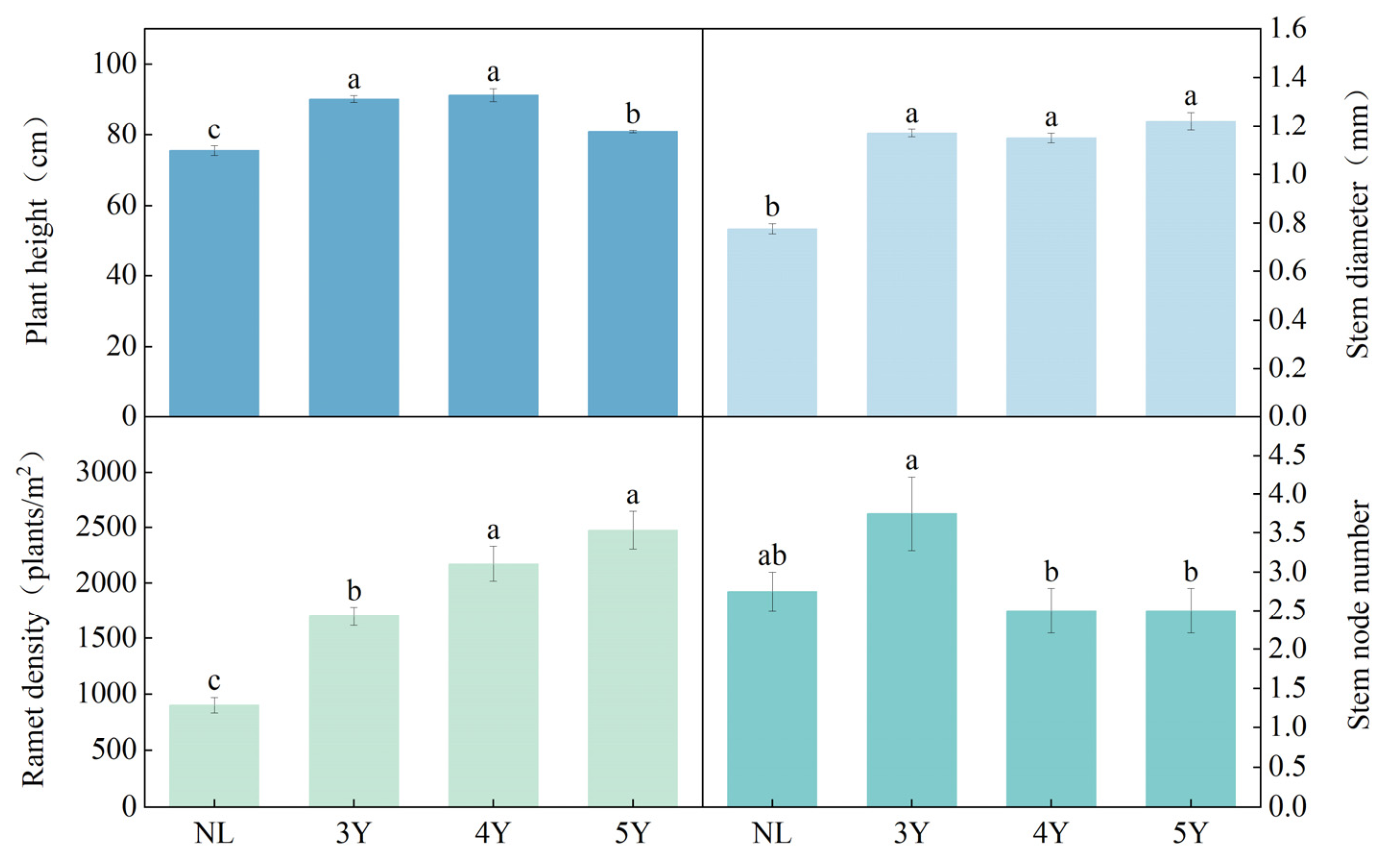
Compared with NL, cultivated L. chinensis stands generally exhibited greater plant height, stem diameter, and ramet density (p < 0.05; Figure 1). Plant height did not differ significantly between the 3Y and 4Y stands (p > 0.05) but was significantly greater in both stands than in the 5Y stand (p < 0.05). Relative to NL, plant height was 19.54%, 21.03%, and 7.13% greater in the 3Y, 4Y, and 5Y stands, respectively. Stem diameter ranged from 1.15~1.22 mm across the cultivated stands, with no significant differences among the three stand ages (p > 0.05). Ramet density was highest in the 5Y stand, reaching 2475 plants/m2. Ramet density did not differ significantly between the 4Y and 5Y stands (p > 0.05) but was significantly higher in both stands than in the 3Y stand (p < 0.05). The mean number of stem nodes was 2.75 per plant in NL and did not differ significantly overall from that in the cultivated stands (p > 0.05). The 4Y and 5Y stands each had a mean of 2.50 stem nodes per plant, which was significantly lower than the value observed in the 3Y stand (p < 0.05).

3.1.3. Effects of Stand Age on Leaf Functional Traits of L. chinensis

Leaf length, leaf width, and leaf area in NL were 15.22 cm, 3.23 mm, and 3.73 cm2, respectively, and were significantly lower than those in the cultivated L. chinensis stands (p < 0.05; Table 2). Among cultivated L. chinensis stands of different ages, leaf length ranged from 23.69~24.88 cm, with no significant differences among stand ages (p > 0.05). The 5Y stand had a leaf width of 4.17 mm and a leaf area of 7.43 cm2, both of which were significantly lower than those in the 3Y stand but did not differ significantly from those in the 4Y stand.

3.2. Effects of Stand Age on Biomass Production and Forage Quality of L. chinensis

3.2.1. Effects of Stand Age on Biomass Accumulation of L. chinensis

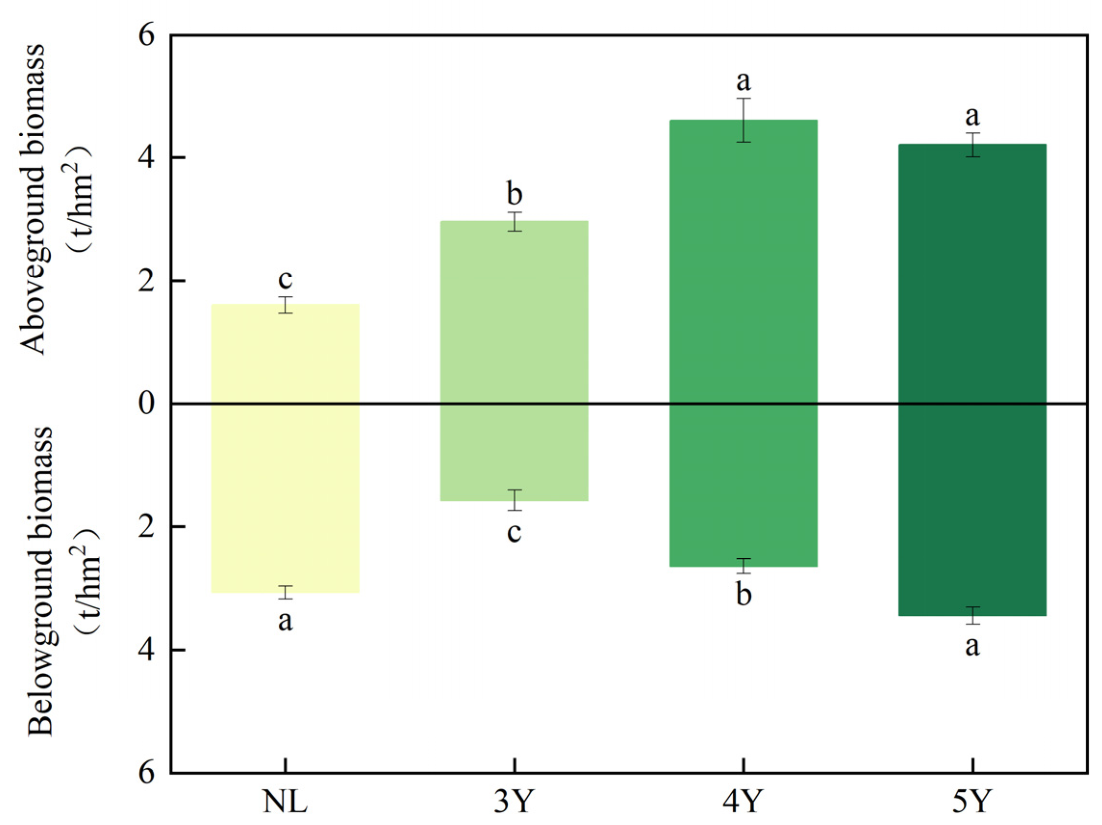
Aboveground biomass was 1.60 t/hm2 in NL and ranged from 2.96~4.61 t/hm2 across the cultivated L. chinensis stands. Aboveground biomass in all cultivated stands was significantly greater than that in NL (p < 0.05). Among the cultivated stands, aboveground biomass was significantly lower in the 3Y stand than in the 4Y and 5Y stands (p < 0.05; Figure 2).

3.2.2. Effects of Stand Age on Nutrient Concentrations of L. chinensis

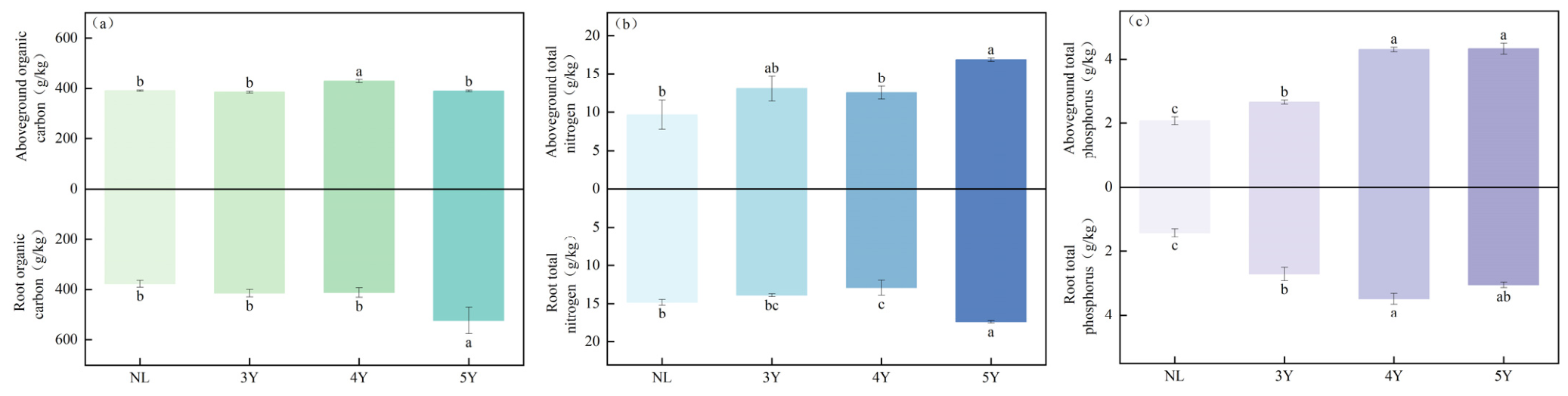
Aboveground organic carbon (AOC) concentration in cultivated L. chinensis exhibited a unimodal pattern with increasing stand age and peaked at 428.13 g/kg in the 4Y stand (Figure 3a). This value was significantly higher than those in NL and the 3Y and 5Y stands (p < 0.05; Figure 3). In contrast, root organic carbon (OC) concentration was highest in the 5Y stand, reaching 522.97 g/kg, and was significantly higher than those in NL and the 3Y and 4Y stands (p < 0.05). Total nitrogen (TN) concentrations in both aboveground tissues and roots of cultivated L. chinensis initially decreased and subsequently increased with increasing stand age (Figure 3b). The highest aboveground and root TN concentrations were observed in the 5Y stand, reaching 16.87 and 17.44 g/kg, respectively. These values were 74.64% and 17.68% higher than those in NL. Aboveground total phosphorus (TP) concentration was 2.07 g/kg in NL and was significantly lower than those in all cultivated stands (p < 0.05; Figure 3c). Among the cultivated stands, aboveground TP concentrations were 4.30 and 4.33 g/kg in the 4Y and 5Y stands, respectively, with no significant difference between them (p > 0.05). However, both values were significantly higher than that in the 3Y stand (p < 0.05). Root TP concentration peaked at 3.48 g/kg in the 4Y stand and did not differ significantly from that in the 5Y stand (p > 0.05). However, it was 145.07% and 28.41% higher than the values in NL and the 3Y stand, respectively (p < 0.05).

3.2.3. Effects of Stand Age on Forage Quality of L. chinensis

Neutral detergent fiber (NDF) and acid detergent fiber (ADF) concentrations were highest in NL, reaching 67.84% and 44.41%, respectively (Table 3). Both were significantly higher than the corresponding concentrations in all cultivated L. chinensis stands (p < 0.05). Among the cultivated stands, NDF concentration ranged from 62.72~64.65%, with no significant differences among stand ages (p > 0.05). ADF concentration was highest in the 4Y stand, at 41.07%. It was significantly higher than that in the 5Y stand (p < 0.05) but did not differ significantly from that in the 3Y stand (p > 0.05). Crude protein (CP) concentration was highest in the 5Y stand, reaching 10.54%. CP concentration in the 5Y stand did not differ significantly from that in the 3Y stand (p > 0.05) but was significantly higher than those in NL and the 4Y stand (p < 0.05). Soluble sugar (SS) concentration and relative feed value (RFV) did not differ significantly among the cultivated stands of different ages (p > 0.05). In contrast, NL had an SS concentration of 2.58% and an RFV of 74.5, both of which were significantly lower than the corresponding values in all cultivated stands (p < 0.05).

3.3. Correlation Analysis

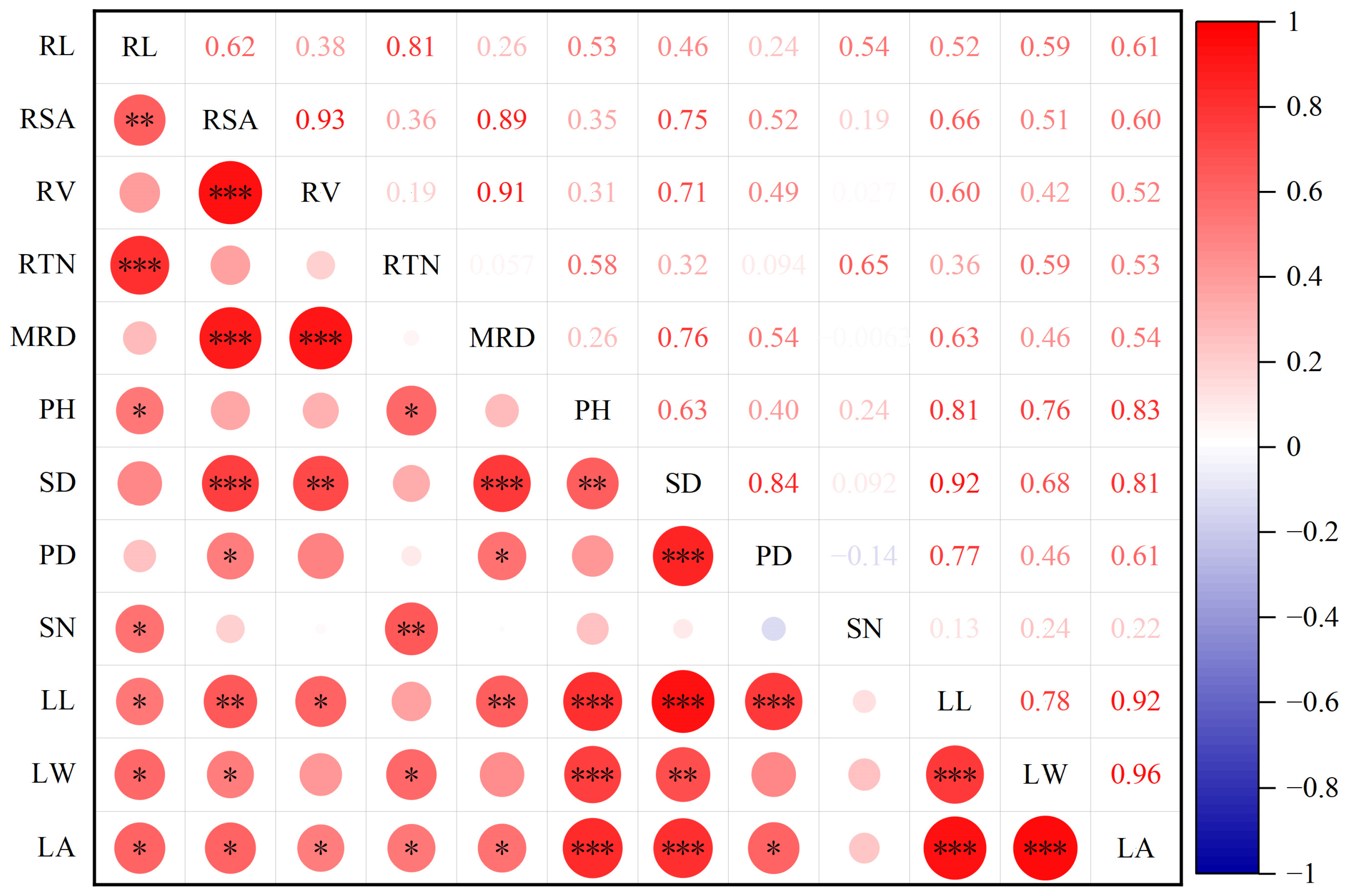
Pearson’s correlation analysis revealed generally positive relationships between root traits and aboveground morphological traits, with most correlations reaching statistical significance (p < 0.05; Figure 4). Specifically, total root length (RL), root surface area (RSA), root volume (RV), number of root tips (RTN), and mean root diameter (MRD) were positively correlated with plant height (PH), stem diameter (SD), stem node number (SN), ramet density (PD), leaf length (LL), leaf width (LW), and leaf area (LA) (p < 0.05). Significant positive correlations were also observed among plant height, stem diameter, ramet density, and leaf morphological traits (p < 0.05). In particular, plant height, stem diameter, leaf length, leaf width, and leaf area were positively correlated with one another at p < 0.01.
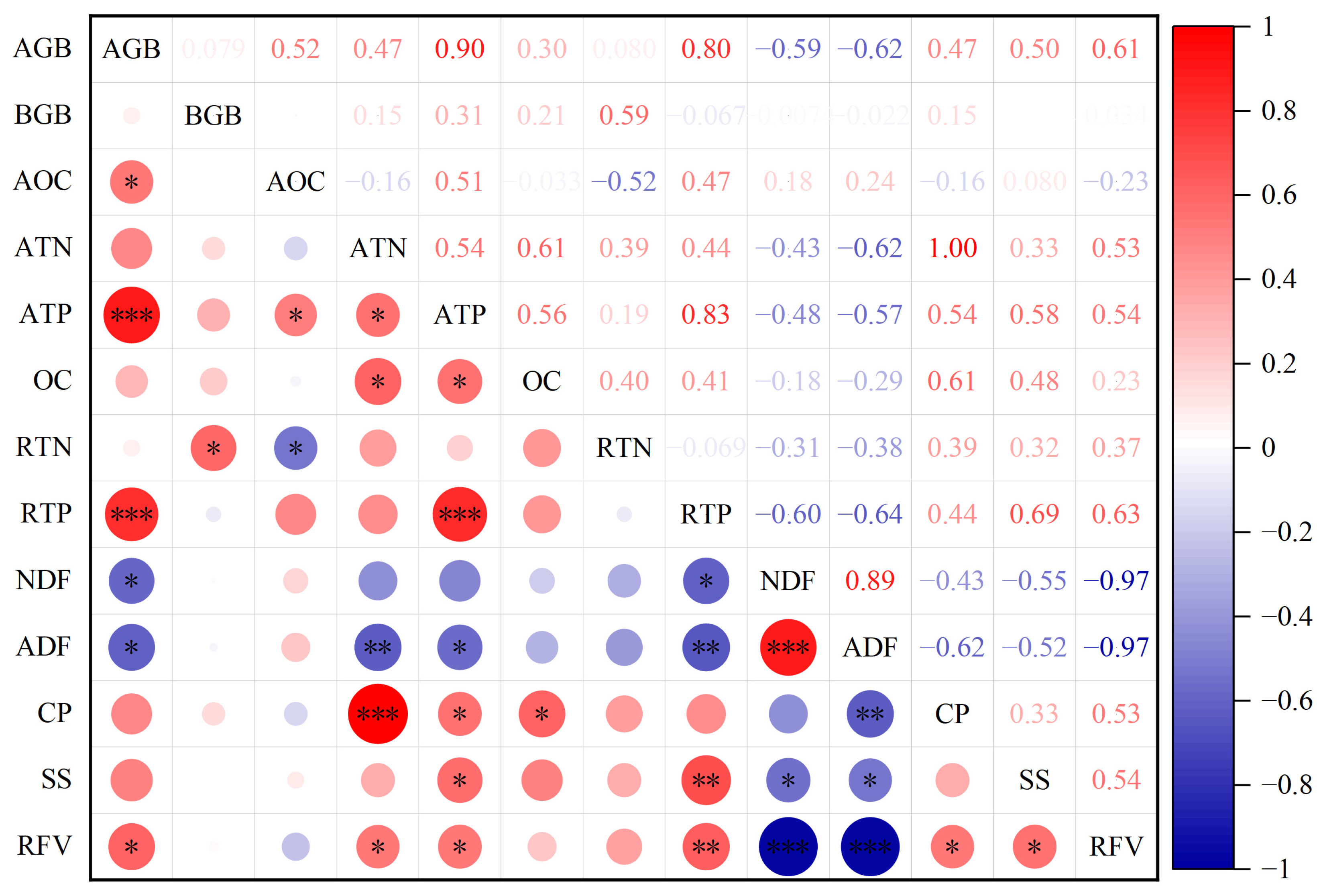
Pearson’s correlation analysis revealed significant interrelationships among biomass, nutrient concentrations, and forage quality traits of L. chinensis (p < 0.05; Figure 5). Aboveground biomass (AGB) was positively correlated with aboveground organic carbon (AOC), aboveground total phosphorus (ATP), root total phosphorus (RTP), and relative feed value (RFV), but negatively correlated with neutral detergent fiber (NDF) and acid detergent fiber (ADF) concentrations. Aboveground total nitrogen (ATN) concentration was positively correlated with crude protein (CP) concentration (p < 0.01). Root total phosphorus concentration was positively correlated with soluble sugar (SS) concentration and RFV but negatively correlated with NDF and ADF concentrations. NDF and ADF concentrations were positively correlated with each other (p < 0.01), and both were negatively correlated with CP, SS concentration, and RFV (p < 0.05). In contrast, CP, SS concentration, and RFV were positively correlated with one another (p < 0.05).

3.4. Structural Equation Modeling

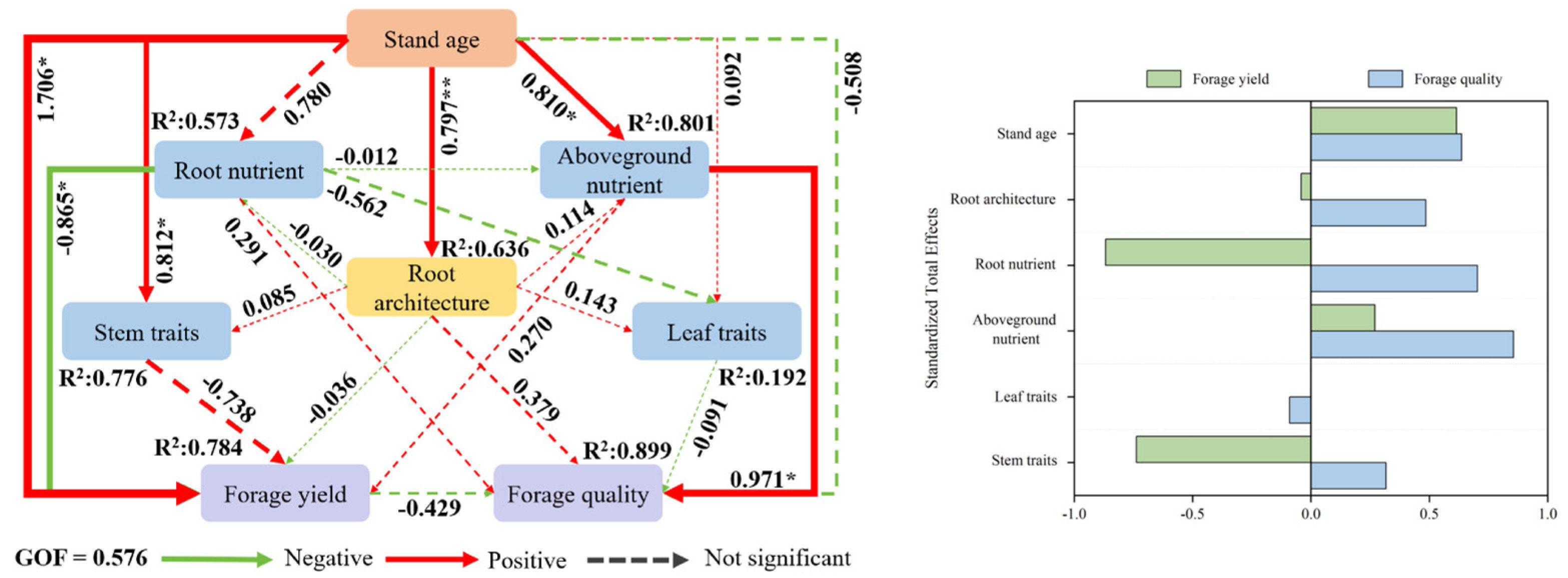
PLS-SEM was used to examine the statistical relationships among stand age, root architecture, nutrient status, morphological traits, forage yield, and forage quality within the cultivated L. chinensis stands. Stand age in the model referred specifically to the 3Y, 4Y, and 5Y cultivated stands. The final model explained 78.4% and 89.9% of the variance in forage yield and forage quality, respectively (Figure 6). The SEM integrated the hierarchical relationships among root architecture, nutrient status, and aboveground morphological traits. Stand age had positive total effects on forage yield and forage quality, with total-effect coefficients of 0.615 and 0.636, respectively. Stand age exerted significant positive effects on root architecture, aboveground nutrient status, stem morphological traits, and forage yield. Forage yield formation was mainly positively driven by aboveground nutrient status and stem morphological traits, whereas forage quality was predominantly positively regulated by root architecture, root nutrient status, and aboveground nutrient status.

4. Discussion

4.1. Effects of Stand Age on the Growth Performance of L. chinensis

4.1.1. Effects of Stand Age on Root Traits of L. chinensis

Root traits differed markedly between cultivated and natural L. chinensis stands and also showed distinct patterns across the examined stand ages. The comparatively limited variation in root architecture observed in the natural stand may reflect long-term adaptation to interspecific competition and environmental filtering, whereas cultivated stands appeared to exhibit greater root plasticity during stand development. The greater total root length and number of root tips observed in the 3Y stand suggest that, during the early stage of stand establishment, L. chinensis may enhance soil exploration through rapid root elongation and branching [20], thereby increasing its potential to acquire water and nutrients. Total root length and the number of root tips declined with increasing stand age, consistent with previous findings that several root traits decrease progressively as plants or stands mature [21]. The subsequent increases in root volume and mean root diameter may indicate a shift in root strategy from early soil exploration and resource acquisition toward greater structural maintenance and storage at later stand ages [22,23]. As stand density increases and belowground resources become more limiting, greater radial root growth may enhance mechanical support and reserve storage, thereby contributing to the persistence and vegetative renewal of perennial clonal populations [24].

4.1.2. Effects of Stand Age on Aboveground Growth Performance of L. chinensis

Stems and leaves are the principal aboveground organs involved in plant growth, light capture, photosynthetic carbon assimilation, and assimilate transport in L. chinensis. Variation in stem and leaf morphology may reflect adaptive adjustments that enhance light interception, spatial occupation, and resource use during stand development. Compared with the natural stand, cultivated L. chinensis stands exhibited greater plant height, stem diameter, leaf size, ramet density, and aboveground biomass. These differences may be associated with reduced interspecific competition, more favorable establishment conditions, and field management in cultivated stands. Previous studies have shown that, under cultivated conditions with minimal interspecific competition, the density of L. chinensis ramets can increase rapidly, indicating a strong capacity for clonal proliferation [25]. In addition, the biomass production of L. chinensis has been reported to be lower in mixed communities than in monocultures, supporting the view that interspecific competition can constrain its growth and productivity [26].
Aboveground morphological traits of L. chinensis varied markedly among stand ages, indicating distinct stand-age-related patterns. The greater plant height and leaf area observed in the 3Y and 4Y stands suggest that relatively young cultivated stands may enhance light interception through stem elongation and leaf expansion [27]. Greater leaf area may increase canopy light capture and photosynthetic capacity, thereby contributing to biomass accumulation in cultivated stands. Although stem diameter remained relatively stable among stand ages, ramet density was highest in the 5Y stand. This pattern may reflect a shift from investment in individual plant size toward the maintenance of a greater number of ramets per unit area. Previous studies have suggested that, under increasing environmental constraints or competition, L. chinensis may maintain population persistence by allocating more biomass belowground and adjusting its clonal growth architecture, rather than by increasing structural investment in stems [24]. Moreover, the lower plant height, leaf width, leaf area, and stem node number observed in the 5Y stand, together with its greater ramet density, suggest a stand-age-related trade-off between individual morphological development and ramet abundance. This apparent shift from individual growth toward greater ramet abundance is consistent with previous observations [28] and highlights the morphological plasticity and clonal growth adjustments of perennial rhizomatous grasses across stand ages.

4.2. Effects of Stand Age on Biomass Production and Forage Quality of L. chinensis

4.2.1. Effects of Stand Age on Biomass Accumulation of L. chinensis

Biomass is a direct indicator of forage yield in L. chinensis, whereas biomass allocation between aboveground and belowground organs may reflect adaptive responses to environmental conditions. The significantly lower aboveground biomass in the natural stand may be associated with stronger interspecific competition and greater resource limitation, both of which can constrain the growth of L. chinensis [26]. Among the cultivated stands, aboveground biomass was lower at 3Y than at 4Y and 5Y, whereas no marked increase was observed thereafter. This pattern suggests that relatively young stands may allocate substantial resources to aboveground growth during establishment and canopy development [29]. The relatively high aboveground biomass observed in the 4Y stand may indicate that stand structure and canopy development had become comparatively well established by this stage. Although ramet density was highest in the 5Y stand, aboveground biomass remained comparable to that in the 4Y stand. This pattern may indicate that increasing ramet density did not lead to a proportional increase in stand-level biomass, possibly because of greater intraspecific competition and reduced individual plant size [30]. The greater root volume and mean root diameter observed at later stand ages may reflect increased investment in belowground structural development and reserve storage, potentially contributing to the persistence and vegetative renewal of the clonal population [31].

4.2.2. Effects of Stand Age on Nutrient Concentrations of L. chinensis

Variation in carbon, nitrogen, and phosphorus concentrations in L. chinensis may reflect stand-age-related changes in nutrient status and resource allocation and may be associated with biomass production and allocation. The relatively high aboveground organic carbon concentration, particularly in the 4Y stand, followed by a lower value in the 5Y stand, may be associated with changes in canopy structure and carbon allocation across stand ages [32]. In contrast, root organic carbon concentration was highest in the 5Y stand, suggesting that carbon investment in belowground structural maintenance and reserve storage may become more important at later stand ages. This pattern is broadly consistent with a shift from rapid aboveground expansion toward greater structural maintenance and reserve storage under increasing stand density [30,33]. Such an adjustment may contribute to the persistence and vegetative renewal of perennial clonal populations. Nitrogen and phosphorus concentrations also varied among stand ages, although their patterns differed between elements and plant compartments. Total nitrogen concentrations in both aboveground tissues and roots initially decreased and subsequently increased with stand age, reaching their highest values in the 5Y stand. This pattern may reflect changes in nitrogen acquisition, retention, and internal allocation as stand structure and ramet density develop [2]. The higher aboveground total phosphorus concentrations in the 4Y and 5Y stands may indicate that phosphorus availability and internal allocation were important for maintaining energy metabolism and tissue renewal at later stand ages [34].

4.2.3. Effects of Stand Age on Forage Quality of L. chinensis

Variation in the forage quality of L. chinensis may reflect the combined effects of habitat conditions, stand structure, and plant nutrient status. The significantly higher neutral detergent fiber (NDF) and acid detergent fiber (ADF) concentrations in the natural stand may reflect a greater proportion of structural tissues under natural community conditions [35]. Higher concentrations of structural carbohydrates are generally associated with lower digestibility and may coincide with reduced concentrations of readily available nonstructural carbohydrates, thereby decreasing forage nutritive value [36]. In contrast, the lower NDF and ADF concentrations in cultivated L. chinensis stands indicate greater potential digestibility and, consequently, higher feeding value. Among the cultivated stands, crude protein (CP) concentration varied with stand age and was highest in the 5Y stand, although it did not differ significantly from that in the 3Y stand. This pattern was broadly consistent with variation in aboveground total nitrogen concentration, reflecting the close relationship between tissue nitrogen status and protein concentration [37]. Soluble sugar (SS) concentration and relative feed value (RFV) were also significantly lower in the natural stand than in all cultivated stands, whereas neither index differed significantly among the 3Y, 4Y, and 5Y stands. Collectively, these results indicate that cultivated stands had better forage quality than the natural stand, as characterized by lower fiber concentrations and higher SS concentration and RFV. However, stand age had relatively limited effects on SS concentration and RFV.

4.3. Correlation Analysis

Pearson’s correlation analysis revealed significant interrelationships among growth traits, nutrient status, ecological stoichiometric characteristics, and forage quality in L. chinensis. The positive correlations of total root length and root surface area with leaf length suggest coordinated variation between belowground and aboveground functional traits [38]. A more extensive root system may increase the potential for soil resource exploration, whereas greater leaf development may enhance light interception. Stem diameter was positively correlated with most morphological traits, suggesting that greater stem development was associated with larger individual plant size [39]. Aboveground total nitrogen concentration was positively correlated with crude protein concentration. However, because crude protein was calculated from Kjeldahl nitrogen concentration, this relationship was mathematically expected and should not be interpreted as independent evidence that nitrogen accumulation regulates protein synthesis. Root total phosphorus concentration was positively correlated with soluble sugar concentration, relative feed value, and aboveground biomass, but negatively correlated with neutral detergent fiber and acid detergent fiber concentrations. These correlations suggest that root phosphorus status may be associated with biomass production and forage nutritive characteristics [40,41,42]. However, they do not establish whether phosphorus directly affects carbohydrate metabolism or cell-wall formation.

4.4. Structural Equation Modeling

SEM further revealed a network of direct and indirect associations among stand age, plant traits, forage yield, and forage quality. Stand age had positive total effects on forage yield and quality, although its direct effects on these response variables were limited or non-significant. This result suggests that the observed stand-age-related variation was statistically associated with multiple indirect pathways involving plant traits and nutrient status. Rather than being associated with a single trait, variation in forage yield and quality reflected the combined contributions of root architecture, nutrient status, and aboveground morphological traits [43,44]. Root architecture may influence belowground resource exploration and may be indirectly associated with aboveground growth through its relationships with nutrient status and morphological development. Collectively, these findings indicate that belowground traits form part of the pathway network linking stand age with aboveground growth, forage yield, and quality in L. chinensis [45].
In the pathways associated with forage yield, aboveground nutrient status and stem traits had significant positive direct effects, indicating that nutrient status and stem development were important predictors of biomass production in L. chinensis [46]. Forage quality was associated with a more complex network of direct and indirect pathways. Root architecture, root nutrient and aboveground nutrient status had positive direct effects on forage quality, suggesting that nutrient status and stand structural characteristics were closely associated with variation in forage quality [47,48]. Conversely, forage yield and leaf traits had negative direct effects on forage quality. These relationships may reflect trade-offs between biomass production, vegetative growth, and forage nutritive characteristics [49]. These pathway relationships were broadly consistent with the observed variation in biomass and forage quality traits. Collectively, they suggest that forage yield and quality in cultivated L. chinensis are jointly associated with stand-age-related variation in morphological traits and nutrient status [1,50].
A limitation of this study is that the cultivated stands of different ages represented separate establishment cohorts rather than repeated observations of the same stands through time. Therefore, the observed stand-age-related differences may also have been influenced by variations in environmental conditions and management history among stands. Future studies based on long-term monitoring and replicated establishment cohorts are needed to further disentangle the effects of stand age from other sources of variation and to better clarify the temporal dynamics of cultivated L. chinensis grasslands.

5. Conclusions

This study systematically compared growth traits, biomass allocation, carbon, nitrogen, and phosphorus status, and forage quality between a natural L. chinensis stand and cultivated stands of different ages. Compared with the natural stand, the cultivated stands generally exhibited greater vegetative growth and forage yield, together with lower fiber concentrations and higher soluble sugar concentration and relative feed value. Cultivated L. chinensis stands also exhibited distinct stand-age-related patterns in root architecture, aboveground morphology, and biomass production. The 3Y stand was characterized by greater total root length, root surface area, and root tip abundance; the 4Y stand exhibited relatively strong aboveground development and high biomass production; and the 5Y stand had the greatest ramet density, root volume, mean root diameter, and root organic carbon concentration. Aboveground biomass was lower in the 3Y stand than in the 4Y and 5Y stands, whereas no significant difference was observed between the latter two. The greater root volume and mean root diameter at 5Y may indicate an increasing importance of belowground structural maintenance and reserve storage at later stand ages. Cultivated stands had lower neutral detergent fiber and acid detergent fiber concentrations and higher soluble sugar concentration and relative feed value than the natural stand, indicating greater potential digestibility and feeding value. Crude protein concentration varied among stand ages and was highest in the 5Y stand, although it did not differ significantly from that in the 3Y stand. Correlation analysis and structural equation modeling revealed interconnected pathways among root architecture, nutrient status, aboveground morphological traits, forage yield, and forage quality. These results suggest that the effects associated with stand age were transmitted primarily through indirect pathways involving coordinated variation in nutrient status and plant morphology.

Author Contributions

Conceptualization, K.G., T.L. and H.L.; methodology, J.N. and T.L.; software, J.N., R.Z. and R.M.; formal analysis, J.N. and Q.L.; investigation, J.N., T.L., R.Z. and Z.N.; resources, K.G. and J.Z.; data curation, J.N., R.M. and Q.L.; writing—original draft preparation, J.N.; writing—review and editing, K.G. and T.L.; visualization, J.N., R.Z. and S.Q.; supervision, T.L. and J.Z.; project administration, K.G. and J.Z.; funding acquisition, K.G. All authors have read and agreed to the published version of the manuscript.

Funding

This research was funded by National Technology Innovation Center for Prataculture Special fund for innovation platform construction (CCPTZX2024GJ12); Key Technology Research Special Project for the “Five Major Tasks” of Inner Mongolia Autonomous Region (NMGWDRW2504); Subject Construction Project for Quality Improvement and Cultivation of Grassland Science (2601010206); and Special Project for the Construction of Modern Agricultural and Animal Husbandry Industry Technology System in Inner Mongolia Autonomous Region.

Institutional Review Board Statement

Not applicable.

Data Availability Statement

The raw data supporting the conclusions of this article will be made available by the authors on request.

Conflicts of Interest

Jian Zhang has been involved as a consultant and expert witness in National Technology Innovation Center for Prataculture. All authors declare no conflict of interest.

Abbreviations

The following abbreviations are used in this manuscript:
NLIndicates natural L. chinensis
3YThree-year-old cultivated L. chinensis
4YFour-year-old cultivated L. chinensis
5YFive-year-old cultivated L. chinensis
RLTotal root length
RSARoot surface area
RVRoot volume
RTNNumber of root tips
MADMean root diameter
PHPlant height
SDStem diameter
PDRamet density
SNStem node number
LLLeaf length
LWLeaf width
LALeaf area
AGBAboveground biomass
BGBBelowground biomass
AOCAboveground organic carbon
ATNAboveground total nitrogen
ATPAboveground total phosphorus
OCRoot organic carbon
RTNRoot total nitrogen
RTPRoot total phosphorus
NDFNeutral detergent fiber
ADFAcid detergent fiber
CPCrude protein
SSSoluble sugar
RFVRelative feed value

References

  1. Li, H.; Hu, Y.; Liu, G.; Sheng, J.; Zhang, W.; Zhao, H.; Kang, H.; Zhou, X. Responses of Biomass Accumulation and Nutrient Utilization along a Phosphorus Supply Gradient in Leymus chinensis. Sci. Rep. 2023, 13, 5660. [Google Scholar] [CrossRef] [Scilit] [PubMed]
  2. Zheng, C.; Wang, Y.; Sun, H.; Wang, X.; Gao, Y. Effects of Clipping on Nitrogen Allocation Strategy and Compensatory Growth of Leymus chinensis under Saline-Alkali Conditions. J. Appl. Ecol. 2017, 28, 2222–2230. [Google Scholar]
  3. Yang, X.; Wang, Z.; Li, J.; Struik, P.C.; Jiang, S.; Jin, K.; Mu, H. How Do Arbuscular Mycorrhizal Fungi Enhance Drought Resistance of Leymus chinensis? BMC Plant Biol. 2025, 25, 453. [Google Scholar] [CrossRef] [Scilit] [PubMed]
  4. Li, Y.-X.; Ma, H.-Y.; Ni, H.-W.; Li, S.-Y.; Xu, L.; Sun, M.-D.; Qi, W.-W.; Zhao, D.-D. Adaptation Responses of Different Ecotypes of Leymus chinensis to Saline–Alkaline Stress. Front. Ecol. Evol. 2024, 12, 1361124. [Google Scholar] [CrossRef] [Scilit]
  5. Wang, Y.; Lin, J.; Yang, F.; Tao, S.; Yan, X.; Zhou, Z.; Zhang, Y. Arbuscular Mycorrhizal Fungi Improve the Growth and Performance in the Seedlings of Leymus chinensis under Alkali and Drought Stresses. PeerJ 2022, 10, e12890. [Google Scholar] [CrossRef] [Scilit] [PubMed]
  6. Zhao, D.; Ma, H.; Li, S.; Qi, W. Seed Germination Demonstrates Inter-Annual Variations in Alkaline Tolerance: A Case Study in Perennial Leymus chinensis. BMC Plant Biol. 2024, 24, 397. [Google Scholar] [CrossRef] [Scilit] [PubMed]
  7. Li, X.; Wang, J.; Lin, J.; Wang, Y.; Mu, C. Rhizomes Help the Forage Grass Leymus chinensis to Adapt to the Salt and Alkali Stresses. Sci. World J. 2014, 2014, 213401. [Google Scholar] [CrossRef] [Scilit] [PubMed]
  8. Yang, J. Change of Soil Microbial Biomass C, N between Longtime Free Grazing and Exclosure Pasture in Semiarid Grassland Ecosystem in Tongliao and Chifeng of Inner Mongolia. J. Bioremediation Biodegrad. 2016, 7, 1000347. [Google Scholar] [CrossRef]
  9. Zhu, W.; Gao, Y.; Song, C. Dataset of the Land Use Pattern Optimization in Horqin Sandy Land. Data Brief 2020, 33, 106335. [Google Scholar] [CrossRef] [Scilit] [PubMed]
  10. Gao, S.; Wang, J.; Knops, J.M.H.; Wang, J. Nitrogen Addition Increases Sexual Reproduction and Improves Seedling Growth in the Perennial Rhizomatous Grass Leymus chinensis. BMC Plant Biol. 2020, 20, 106. [Google Scholar] [CrossRef] [Scilit] [PubMed]
  11. Hampton, J.; Conner, A.; Boelt, B.; Chastain, T.; Rolston, P. Climate Change: Seed Production and Options for Adaptation. Agriculture 2016, 6, 33. [Google Scholar] [CrossRef] [Scilit]
  12. Wang, R.; Huang, W.; Chen, L.; Ma, L.; Guo, C.; Liu, X. Anatomical and Physiological Plasticity in Leymus chinensis (Poaceae) along Large-Scale Longitudinal Gradient in Northeast China. PLoS ONE 2011, 6, e26209. [Google Scholar] [CrossRef] [Scilit] [PubMed]
  13. An, W.; Zhao, M.; Chen, L.; Li, Q.; Yu, L.; Chen, S.; Ma, J.; Cao, X.; Zhang, S.; Chi, W.; et al. LcASR Enhances Tolerance to Abiotic Stress in Leymus chinensis and Arabidopsis thaliana by Improving Photosynthetic Performance. Plant J. 2024, 120, 2752–2769. [Google Scholar] [CrossRef] [Scilit] [PubMed]
  14. Goh, C.-H.; Veliz Vallejos, D.F.; Nicotra, A.B.; Mathesius, U. The Impact of Beneficial Plant-Associated Microbes on Plant Phenotypic Plasticity. J. Chem. Ecol. 2013, 39, 826–839. [Google Scholar] [CrossRef] [Scilit] [PubMed]
  15. Hao, F.; Li, C.; Yu, T.; An, H.; Xiong, M.; Gao, K.; Yu, J. Transforming Land Use Patterns to Improve Soil Fertility in the Horqin Sandy Land. Agronomy 2025, 15, 1486. [Google Scholar] [CrossRef] [Scilit]
  16. Sun, Z.; Wang, Z.; Zhong, Q.; Zhou, D. Seasonal Variations in Voluntary Intake and Apparent Digestibility of Forages in Goats Grazing on Introduced Leymus chinensis Pasture. Asian Australas. J. Anim. Sci. 2014, 27, 818–824. [Google Scholar] [CrossRef] [Scilit] [PubMed]
  17. Wang, Y.; Xu, C.; Gu, Q.; Shi, Y.; Chen, J.; Wu, H.; He, J.; Li, X.; Han, L.; Su, D. Partial Root-Zone Drying Subsurface Drip Irrigation Increased the Alfalfa Quality Yield but Decreased the Alfalfa Quality Content. Front. Plant Sci. 2024, 15, 1297468. [Google Scholar] [CrossRef] [Scilit] [PubMed]
  18. DuBois, M.; Gilles, K.A.; Hamilton, J.K.; Rebers, P.A.; Smith, F. Colorimetric Method for Determination of Sugars and Related Substances. Anal. Chem. 1956, 28, 350–356. [Google Scholar] [CrossRef] [Scilit]
  19. Zhou, M.; Wang, J.; Bai, W.; Zhang, Y.; Zhang, W. The Response of Root Traits to Precipitation Change of Herbaceous Species in Temperate Steppes. Funct. Ecol. 2019, 33, 2030–2041. [Google Scholar] [CrossRef] [Scilit]
  20. Liu, N.; Guo, F.; Li, B.; Jing, Z.; Bai, W.; Hou, X. Comprehensive Evaluation of Ecological Functional Traits and Screening of Key Indicators of Leymus chinensis Germplasm Resources from Northern China and Mongolia. Agronomy 2023, 13, 1880. [Google Scholar] [CrossRef] [Scilit]
  21. Ding, X.; Wang, X.; Yang, Y. Age Structure of Leymus chinensis Populations in Different Soil Substrates on the Songnen Plain. Pratacultural Sci. 2004, 21, 45–48. [Google Scholar]
  22. Xi, Q. Morphology and Cultural Properties of a Leymus chinensis Adjusting to Ground-Cover and Landscaping. Acta Agrestia Sin. 2004, 12, 332–340. [Google Scholar]
  23. Tian, X.; Yang, Y. Biomass Age Structure of Leymus chinensis Populations under Different Disturbance Conditions. Acta Prataculturae Sin. 2003, 5, 50–54. [Google Scholar]
  24. Huang, J.; Xu, P.; Yu, H.; Yuan, Z.; Li, L. Responses of Biomass, Nutrient Allocation of Leymus chinensis along N, P and Water Gradients. Pratacultural Sci. 2012, 29, 1589–1595. [Google Scholar]
  25. Yang, Y.; Zhang, B. Growth Patterns of Leymus chinensis Clones under Different Habitat Conditions in Songnen Plain of China. J. Appl. Ecol. 2006, 17, 1419–1423. [Google Scholar]
  26. Liu, G.X.; Zhang, Y.J.; Hovstad, K.A.; Mao, P.S.; Han, J.G. Competition of Leymus chinensis and Bromus inermis in Response to Gap Size and Neighbouring Root Exclusion. Grass Forage Sci. 2014, 69, 479–487. [Google Scholar] [CrossRef] [Scilit]
  27. Poorter, H.; Niklas, K.J.; Reich, P.B.; Oleksyn, J.; Poot, P.; Mommer, L. Biomass Allocation to Leaves, Stems and Roots: Meta-analyses of Interspecific Variation and Environmental Control. New Phytol. 2012, 193, 30–50. [Google Scholar] [CrossRef] [Scilit] [PubMed]
  28. Zhou, C.; Xie, N.; Rong, W.; Zhang, Z.; Lv, L.; Wang, Z. Genotypic Diversity Affects Age Structure of Tiller and Rhizome of Leymus chinensis Population, But Not Age Structure of Bud. Phyton 2023, 92, 3163–3176. [Google Scholar] [CrossRef] [Scilit]
  29. Li, Z.; Zhang, Y.; Yu, D.; Zhang, N.; Lin, J.; Zhang, J.; Tang, J.; Wang, J.; Mu, C. The Influence of Precipitation Regimes and Elevated CO2 on Photosynthesis and Biomass Accumulation and Partitioning in Seedlings of the Rhizomatous Perennial Grass Leymus chinensis. PLoS ONE 2014, 9, e103633. [Google Scholar] [CrossRef] [Scilit] [PubMed]
  30. Sun, Y.; Wang, Y.; Yan, Z.; He, L.; Ma, S.; Feng, Y.; Su, H.; Chen, G.; Feng, Y.; Ji, C.; et al. Above- and Belowground Biomass Allocation and Its Regulation by Plant Density in Six Common Grassland Species in China. J. Plant Res. 2022, 135, 41–53. [Google Scholar] [CrossRef] [Scilit] [PubMed]
  31. Wang, R.; Chen, L.; Bai, Y.; Xiao, C. Seasonal Dynamics in Resource Partitioning to Growth and Storage in Response to Drought in a Perennial Rhizomatous Grass, Leymus chinensis. J. Plant Growth Regul. 2008, 27, 39–48. [Google Scholar] [CrossRef] [Scilit]
  32. Tsai, F.-Y.; Wang, F.-B. Mathematical Analysis of a Chemostat System Modeling the Competition for Light and Inorganic Carbon with Internal Storage. Math. Biosci. Eng. 2019, 16, 205–221. [Google Scholar] [CrossRef] [Scilit] [PubMed]
  33. He, Z.; Webster, S.; He, S.Y. Growth–Defense Trade-Offs in Plants. Curr. Biol. 2022, 32, R634–R639. [Google Scholar] [CrossRef] [Scilit] [PubMed]
  34. Kavanová, M.; Lattanzi, F.A.; Grimoldi, A.A.; Schnyder, H. Phosphorus Deficiency Decreases Cell Division and Elongation in Grass Leaves. Plant Physiol. 2006, 141, 766–775. [Google Scholar] [CrossRef] [Scilit] [PubMed]
  35. Wan, D.; Wan, Y.; Wang, Y.; Yang, T.; Li, F.; Wuriliga; Ding, Y. Differential Responses of Dominant Plants to Grazing in Typical Temperate Grassland in Inner Mongolia. Agriculture 2022, 12, 1399. [Google Scholar] [CrossRef] [Scilit]
  36. Pottier, D.; Roitsch, T.; Persson, S. Cell Wall Regulation by Carbon Allocation and Sugar Signaling. Cell Surf. 2023, 9, 100096. [Google Scholar] [CrossRef] [Scilit] [PubMed]
  37. Zhang, Q.; Qi, D.; Dong, X.; Li, X.; Cheng, L.; Liu, H.; Chen, S.; Rajora, O.P.; Li, X.-Q.; Liu, G. Amino Acid Composition, Protein Content and Accurate Nitrogen-to-Protein Conversion Factor for Sheepgrass (Leymus chinensis). Botany 2020, 98, 137–146. [Google Scholar] [CrossRef] [Scilit]
  38. Yang, Y.; Shi, Y.; Wei, X.; Han, J.; Wang, J.; Mu, C.; Zhang, J. Changes in Mass Allocation Play a More Prominent Role than Morphology in Resource Acquisition of the Rhizomatous Leymus chinensis under Drought Stress. Ann. Bot. 2023, 132, 121–132. [Google Scholar] [CrossRef] [Scilit] [PubMed]
  39. Fan, Y.; Li, L.; Ma, T.; Hou, X. Melatonin Affects Leymus chinensis Aboveground Growth and Photosynthesis by Regulating Rhizome Growth. Agronomy 2024, 14, 1151. [Google Scholar] [CrossRef] [Scilit]
  40. Zhang, W.; Gong, J.; Zhang, Z.; Song, L.; Lambers, H.; Zhang, S.; Dong, J.; Dong, X.; Hu, Y. Soil Phosphorus Availability Alters the Correlations between Root Phosphorus-uptake Rates and Net Photosynthesis of Dominant C3 and C4 Species in a Typical Temperate Grassland of Northern China. New Phytol. 2023, 240, 157–172. [Google Scholar] [CrossRef] [Scilit] [PubMed]
  41. Li, Y.; Li, Q.; Guo, D.; Liang, S.; Wang, Y. Ecological Stoichiometry Homeostasis of Leymus chinensis in Degraded Grassland in Western Jilin Province, NE China. Ecol. Eng. 2016, 90, 387–391. [Google Scholar] [CrossRef] [Scilit]
  42. Jin, C.; Fang, C.; Yuan, H.; Wang, S.; Wu, Y.; Liu, X.; Zhang, Y.; Luo, J. Interaction between Carbon Metabolism and Phosphate Accumulation Is Revealed by a Mutation of a Cellulose Synthase-like Protein, CSLF6. J. Exp. Bot. 2015, 66, 2557–2567. [Google Scholar] [CrossRef] [Scilit] [PubMed]
  43. Ma, H.; Zheng, C.; Gao, Y.; Baskin, C.C.; Sun, H.; Yang, H. Moderate Clipping Stimulates Over-Compensatory Growth of Leymus chinensis under Saline-Alkali Stress through High Allocation of Biomass and Nitrogen to Shoots. Plant Growth Regul. 2020, 92, 95–106. [Google Scholar] [CrossRef] [Scilit]
  44. Zheng, Z.; Ma, P. Changes in above and Belowground Traits of a Rhizome Clonal Plant Explain Its Predominance under Nitrogen Addition. Plant Soil. 2018, 432, 415–424. [Google Scholar] [CrossRef] [Scilit]
  45. Wang, R.; Cresswell, T.; Johansen, M.P.; Harrison, J.J.; Jiang, Y.; Keitel, C.; Cavagnaro, T.R.; Dijkstra, F.A. Reallocation of Nitrogen and Phosphorus from Roots Drives Regrowth of Grasses and Sedges after Defoliation under Deficit Irrigation and Nitrogen Enrichment. J. Ecol. 2021, 109, 4071–4080. [Google Scholar] [CrossRef] [Scilit]
  46. Zhang, C.; Xin, X.; Zhang, Y.; Wang, M.; Chen, S.; Yu, T.; Li, Y.; Yang, G.; Yan, R. Response of Temperate Leymus chinensis Meadow Steppe Plant Community Composition, Biomass Allocation, and Species Diversity to Nitrogen and Phosphorus Addition. Agronomy 2023, 13, 208. [Google Scholar] [CrossRef] [Scilit]
  47. Zhang, C.; Gao, H.; Wan, W.; Li, H. Yield and Quality Improvements in Leymus chinensis Following Fertiliser Application in China: A Meta-Analysis. Crop Pasture Sci. 2022, 73, 704–715. [Google Scholar] [CrossRef] [Scilit]
  48. Springer, T.L.; Gillen, R.L. How Does Plant Population Density Affect the Yield, Quality, and Canopy of Native Bluestem (Andropogon spp.) Forage? Crop Sci. 2007, 47, 77–82. [Google Scholar] [CrossRef] [Scilit]
  49. Tahmasebi, P.; Manafian, N.; Ebrahimi, A.; Omidipour, R.; Faal, M. Managing Grazing Intensity Linked to Forage Quantity and Quality Trade-off in Semiarid Rangelands. Rangel. Ecol. Manag. 2020, 73, 53–60. [Google Scholar] [CrossRef] [Scilit]
  50. Li, X.; Liu, Z.; Ren, W.; Ding, Y.; Ji, L.; Guo, F.; Hou, X. Linking Nutrient Strategies with Plant Size along a Grazing Gradient: Evidence from Leymus chinensis in a Natural Pasture. J. Integr. Agric. 2016, 15, 1132–1144. [Google Scholar] [CrossRef] [Scilit]
Figure 1. Effects of stand age on stem morphological traits of L. chinensis. Note: Different lowercase letters indicate significant differences among stand ages (p < 0.05).
Agriculture 16 01811 g001
Figure 2. Effects of stand age on biomass accumulation of L. chinensis. Note: Different lowercase letters indicate significant differences among stand ages (p < 0.05).
Agriculture 16 01811 g002
Figure 3. Effects of stand age on nutrient concentrations of L. chinensis. (a) Organic carbon (OC) concentrations; (b) total nitrogen (TN) concentrations; (c) total phosphorus (TP) concentrations. Note: Different lowercase letters indicate significant differences among stand ages (p < 0.05).
Agriculture 16 01811 g003
Figure 4. Pearson correlation analysis between root traits and aboveground morphological traits of L. chinensis. Note: *, significant correlation at the p < 0.05 level; **, significant correlation at the p < 0.01 level; ***, significant correlation at the p < 0.001 level.
Agriculture 16 01811 g004
Figure 5. Pearson correlation analysis between yield-related traits and forage quality parameters of L. chinensis. Note: *, significant correlation at the p < 0.05 level; **, significant correlation at the p < 0.01 level; ***, significant correlation at the p < 0.001 level.
Agriculture 16 01811 g005
Figure 6. Structural equation modeling. Note: R2 represents the proportion of variance explained by the model; P, significance level. Numbers adjacent to the arrows represent standardized path coefficients. Red and green arrows denote positive and negative effects, respectively. Solid arrows indicate significant paths, whereas dashed arrows indicate non-significant paths. Arrow width is proportional to the magnitude of the path coefficient and reflects the strength of the effect. * p < 0.05, ** p < 0.01. Stand age in the PLS-SEM refers only to the cultivated stands (3Y, 4Y, and 5Y); the natural stand (NL) was not assigned.
Agriculture 16 01811 g006
Table 1. Effects of stand age on the growth performance of L. chinensis.
Total Root Length (cm)Root Surface Area (cm2)Root Volume (cm3)Number of
Root Tips
Mean Root Diameter (mm)
NL475.46 ± 37.42b104.93 ± 7.30b3.97 ± 0.30b598.00 ± 67.39b0.68 ± 0.03b
3Y637.02 ± 19.66a176.29 ± 15.69a12.49 ± 3.48a819.25 ± 43.02a0.94 ± 0.06a
4Y535.52 ± 29.52b129.87 ± 6.68b7.77 ± 0.44b674.50 ± 25.43ab0.79 ± 0.02b
5Y519.65 ± 12.50b174.49 ± 9.44a14.14 ± 1.99a601.25 ± 35.24b1.02 ± 0.06a
Note: NL indicates natural L. chinensis; 3Y, 4Y, and 5Y represent three-, four-, and five-year-old cultivated L. chinensis, respectively. These abbreviations are used throughout the following sections. Different lowercase letters indicate significant differences among stand ages (p < 0.05).
Table 2. Effects of stand age on leaf functional traits.
Leaf Length (cm)Leaf Width (mm)Leaf Area (cm2)
NL15.22 ± 0.26b3.23 ± 0.16c3.73 ± 0.15c
3Y24.27 ± 0.26a5.15 ± 0.36a9.37 ± 0.68a
4Y24.88 ± 0.74a4.75 ± 0.18ab8.85 ± 0.38a
5Y23.69 ± 0.57a4.17 ± 0.20b7.43 ± 0.51b
Note: Different lowercase letters indicate significant differences among stand ages (p < 0.05).
Table 3. Effects of stand age on forage quality of L. chinensis.
Neutral Detergent Fiber (%)Acid Detergent Fiber (%)Crude Protein (%)Soluble Sugar (%)Relative Feed Value (%)
NL67.85 ± 0.90a44.41 ± 0.59a6.04 ± 1.18b2.59 ± 0.22b74.50 ± 1.15b
3Y63.69 ± 0.38b39.97 ± 0.46bc8.17 ± 1.02ab3.65 ± 0.38a84.37 ± 0.88a
4Y64.65 ± 1.04b41.07 ± 0.80b7.82 ± 0.53b3.51 ± 0.22a81.99 ± 2.20a
5Y62.72 ± 1.08b38.48 ± 1.21c10.54 ± 0.14a4.05 ± 0.26a87.54 ± 2.79a
Note: Different lowercase letters indicate significant differences among stand ages (p < 0.05).
Disclaimer/Publisher’s Note: The statements, opinions and data contained in all publications are solely those of the individual author(s) and contributor(s) and not of MDPI and/or the editor(s). MDPI and/or the editor(s) disclaim responsibility for any injury to people or property resulting from any ideas, methods, instructions or products referred to in the content.