Consumer Attitudes and Market Acceptance of Plant-Based Milk Alternatives: A Scoping Review


Abstract
1. Introduction
2. Theoretical Background
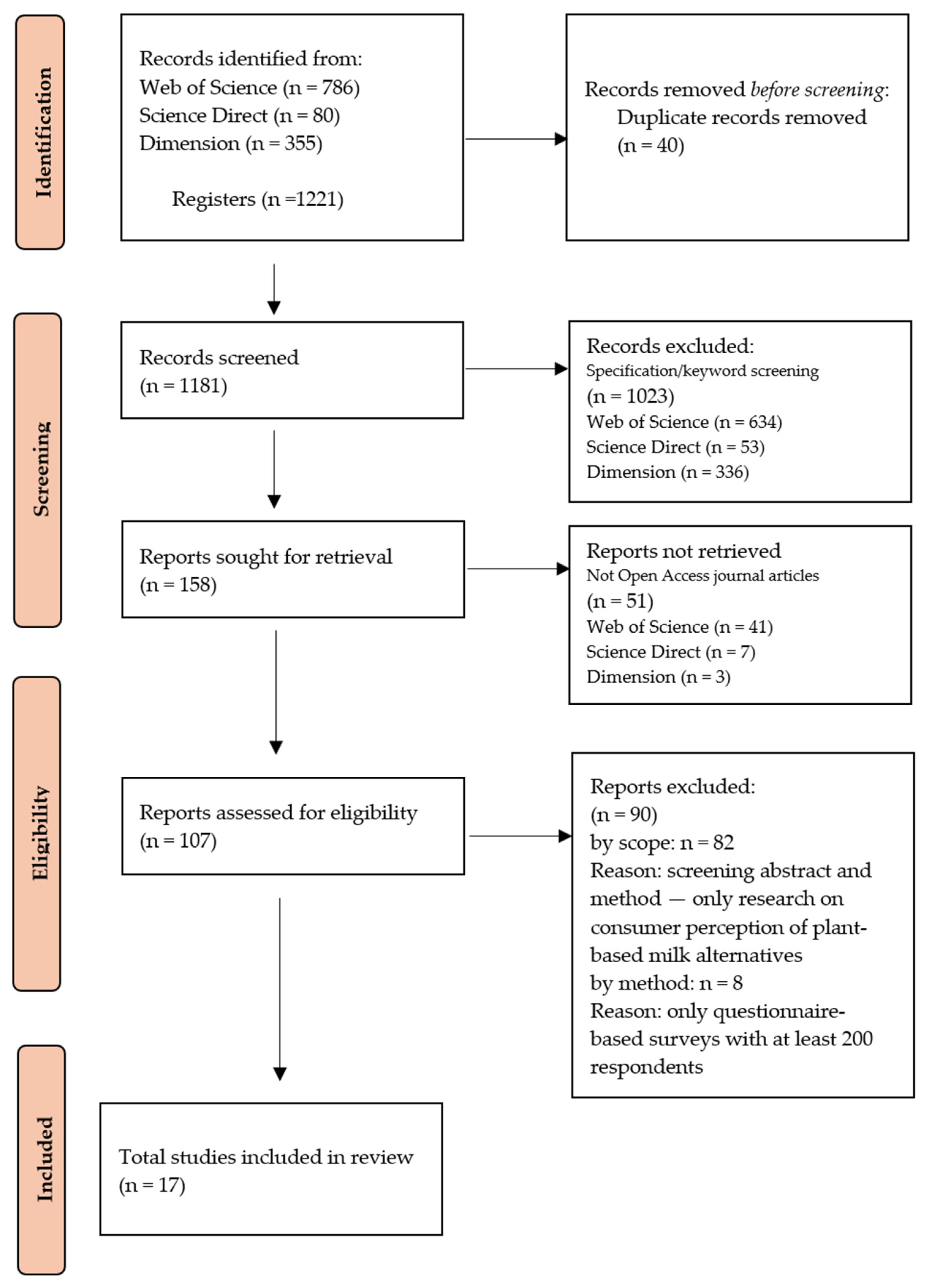
3. Materials and Methods
4. Results
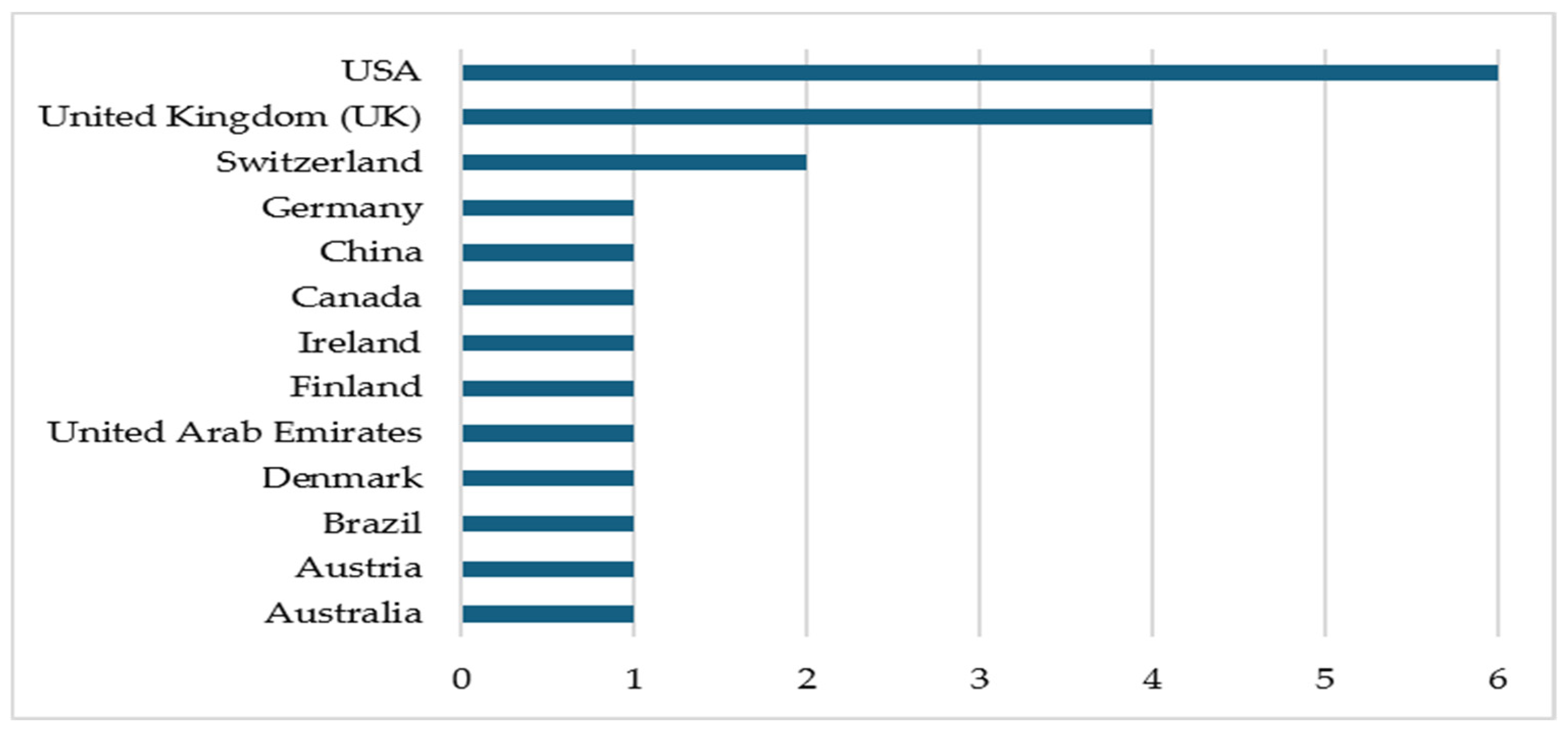
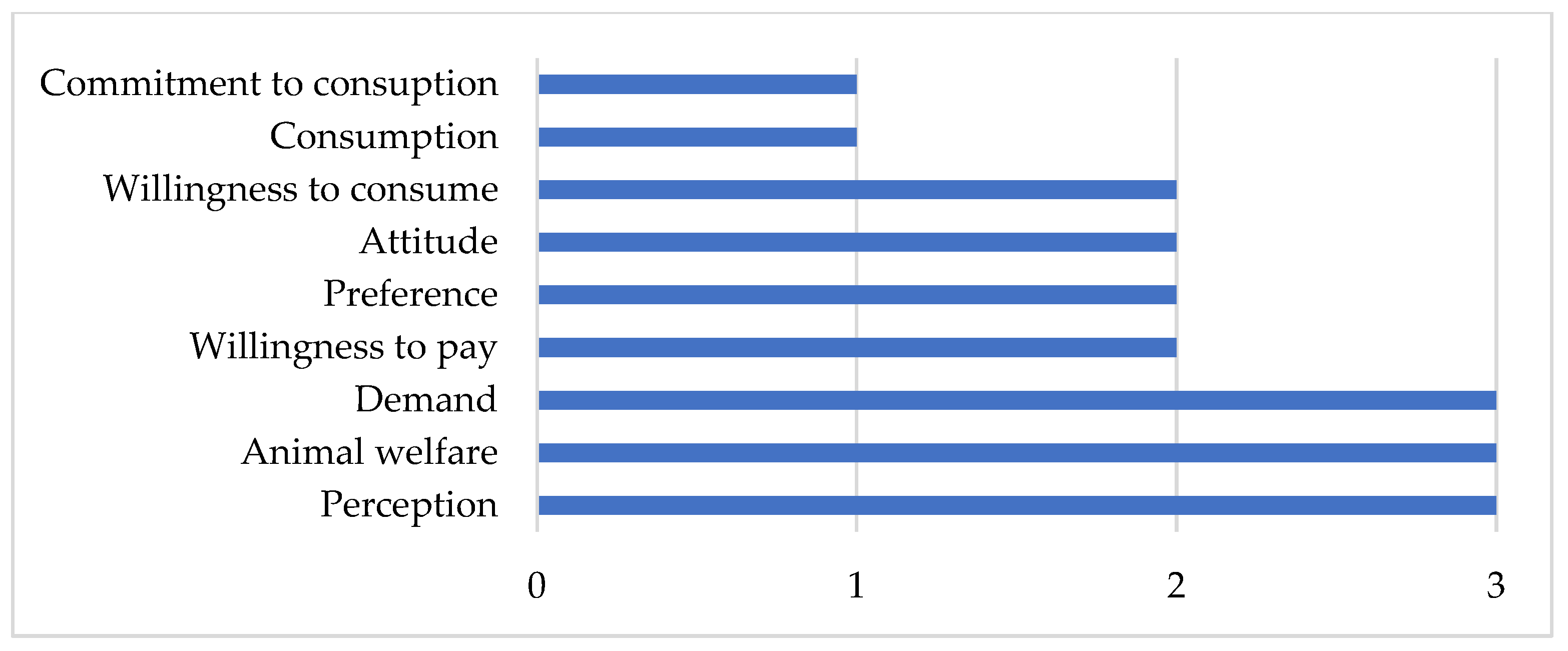
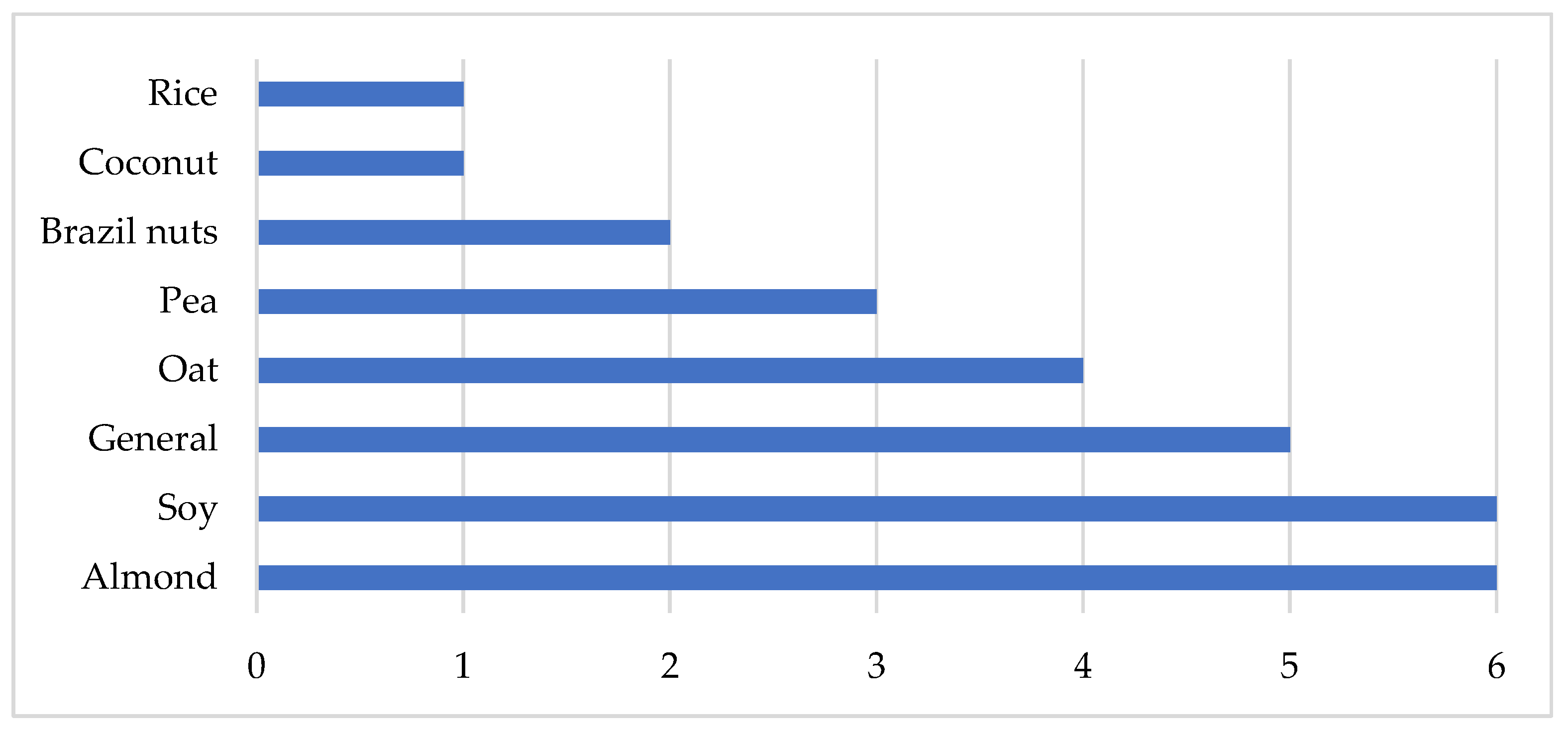
4.1. Basic Attributes of the Articles Included in the Study
4.2. Detailed, Summary Presentation of the Articles Included in the Study
4.2.1. Drivers of PBM Acceptance
4.2.2. Barriers to PBM Acceptance

5. Conclusions
5.1. Discussion of Key Findings
5.2. Conclusions, Limitations and Future Research Directions
Supplementary Materials
Author Contributions
Funding
Data Availability Statement
Acknowledgments
Conflicts of Interest
References
- Krampe, C.; Fridman, A. Oatly, a serious ‘problem’ for the dairy industry? A case study. Int. Food Agribus. Manag. Rev. 2022, 25, 157–171. [Google Scholar] [CrossRef]
- Grand View Research. Plant-Based Milk Market Size & Share Analysis—Industry Report, 2030; GVR-4-68040-343-5; Grand View Research: San Francisco, CA, USA, 2024; Available online: https://www.grandviewresearch.com/industry-analysis/plant-based-milk-market-report (accessed on 10 January 2025).
- Patil, A. Europe Plant-Based Milk Market Size & Growth Trends, 2032; PMRREP 35283; Persistence Market Research: London, UK, 2025; Available online: https://www.persistencemarketresearch.com/market-research/europe-plant-based-milk-market.asp (accessed on 15 January 2025).
- COMMISSION REGULATION (EC) No 445/2007 of 23 April 2007 Laying Down Certain Detailed Rules for the Application of Council Regulation (EC) No 2991/94 Laying Down Standards for Spreadable Fats and of Council Regulation (EEC) No 1898/87 on the Protection of Designations Used in the Marketing of Milk and Milk Products. 2007. Available online: http://data.europa.eu/eli/reg/2007/445/oj (accessed on 14 January 2025).
- Su, W.; Zhang, Y.Y.; Li, S.; Sheng, J. Consumers’ Preferences and Attitudes towards Plant-Based Milk. Foods 2024, 13, 2. [Google Scholar] [CrossRef] [PubMed]
- Madududu, P.; Jourdain, D.; Tran, D.; Degieter, M.; Karuaihe, S.; Ntuli, H.; De Steur, H. Consumers’ willingness-to-pay for dairy and plant-based milk alternatives towards sustainable dairy: A scoping review. Sustain. Prod. Consum. 2024, 51, 261–277. [Google Scholar] [CrossRef]
- Ajzen, I. The theory of planned behavior. Organ. Behav. Hum. Decis. Process. 1991, 50, 179–211. [Google Scholar] [CrossRef]
- Stern, P.C. New environmental theories: Toward a coherent theory of environmentally significant behavior. J. Soc. Issues 2000, 56, 407–424. [Google Scholar] [CrossRef]
- Schiano, A.N.; Harwood, W.S.; Gerard, P.D.; Drake, M.A. Consumer perception of the sustainability of dairy products and plant-based dairy alternatives. J. Dairy Sci. 2020, 103, 11228–11243. [Google Scholar] [CrossRef] [PubMed]
- Antunes, I.C.; Bexiga, R.; de Oliveira Pinto, C.L.; Roseiro, L.C.; Quaresma, M.A.G. Cow’s Milk in Human Nutrition and the Emergence of Plant-Based Milk Alternatives. Foods 2022, 12, 99. [Google Scholar] [CrossRef] [PubMed]
- Grant, C.A.; Hicks, A.L. Comparative Life Cycle Assessment of Milk and Plant-Based Alternatives. Environ. Eng. Sci. 2018, 35, 1235–1247. [Google Scholar] [CrossRef]
- Herrmann, C.; Rhein, S.; Sträter, K.F. Consumers’ sustainability-related perception of and willingness-to-pay for food packaging alternatives. Resour. Conserv. Recycl. 2022, 181, 106219. [Google Scholar] [CrossRef]
- Fehér, A.; Gazdecki, M.; Véha, M.; Szakály, M.; Szakály, Z. A Comprehensive Review of the Benefits of and the Barriers to the Switch to a Plant-Based Diet. Sustainability 2020, 12, 4136. [Google Scholar] [CrossRef]
- Ammann, J.-C.; Grande, A.; Inderbitzin, J.; Guggenbühl, B. Understanding Swiss consumption of plant-based alternatives to dairy products. Food Qual. Prefer. 2023, 110, 104947. [Google Scholar] [CrossRef]
- Rombach, M.; Dean, D.L.; Bitsch, V. Got Milk Alternatives? Understanding Key Factors Determining U.S. Consumers’ Willingness to Pay for Plant-Based Milk Alternatives. Foods 2023, 12, 1277. [Google Scholar] [CrossRef] [PubMed]
- Rombach, M.; Cong, L.; Dean, D.L. Leave the milk for the calf and spread the word: Exploring factors determining US consumers’ willingness to try plant-based milk alternatives and their word-of-mouth sharing about plant-based milk alternatives. Beverages 2024, 10, 27. [Google Scholar] [CrossRef]
- Tavmaşat, T.; Saraç, M.G.; Uğur, U.; Pelincan, Ö. Consumer Interest and Its Effect on Purchase Intention for Plant-Based Milk Substitutes. Akad. Gıda 2024, 22, 282–287. [Google Scholar] [CrossRef]
- Giacalone, D.; Clausen, M.P.; Jaeger, S.R. Understanding barriers to consumption of plant-based foods and beverages: Insights from sensory and consumer science. Curr. Opin. Food Sci. 2022, 48, 100919. [Google Scholar] [CrossRef]
- Mastromonaco, G.; Merlino, V.M.; Massaglia, S.; Peano, C.; Sparacino, A.; Caltagirone, C.; Borra, D.; Sottile, F. Large-Scale and Online Retailer Assortment: The Case of Plant-Based Beverages as Alternatives to Cow’s Milk. Beverages 2023, 9, 40. [Google Scholar] [CrossRef]
- Tricco, A.C.; Lillie, E.; Zarin, W.; O’Brien, K.K.; Colquhoun, H.; Levac, D.; Moher, D.; Peters, M.D.J.; Horsley, T.; Weeks, L.; et al. PRISMA Extension for Scoping Reviews (PRISMA-ScR): Checklist and explanation. Ann. Intern. Med. 2018, 169, 467–473. [Google Scholar] [CrossRef] [PubMed]
- Arksey, H.; O’Malley, L. Scoping studies: Towards a methodological framework. Int. J. Soc. Res. Methodol. 2005, 8, 19–32. [Google Scholar] [CrossRef]
- Levac, D.; Colquhoun, H.; O’Brien, K.K. Scoping studies: Advancing the methodology. Implement. Sci. 2010, 5, 69. [Google Scholar] [CrossRef] [PubMed]
- Rethlefsen, M.L.; Kirtley, S.; Waffenschmidt, S.; Ayala, A.P.; Moher, D.; Page, M.J.; Koffel, J.B. PRISMA-S Group. PRISMA-S: An extension to the PRISMA Statement for Reporting Literature Searches in Systematic Reviews. Syst. Rev. 2021, 10, 39. [Google Scholar] [CrossRef] [PubMed]
- Memon, M.A.; Ting, H.; Cheah, J.-H.; Thurasamy, R.; Chuah, F.; Cham, T.H. Sample Size for Survey Research: Review and Recommendations. J. Appl. Struct. Equ. Model. 2020, 4, 78982611. [Google Scholar] [CrossRef]
- Lim, W.M.; Kumar, S.; Pandey, N.K.; Verma, D.; Kumar, D. Evolution and trends in consumer behaviour: Insights from Journal of Consumer Behaviour. J. Consum. Behav. 2022, 22, 217–232. [Google Scholar] [CrossRef]
- Asghar, W.; Khalid, N. Sustainable nutrition—Healthy populations. Nutr. Health 2023, 29, 3–4. [Google Scholar] [CrossRef] [PubMed]
- Tulysewski, G.; Hendrie, G.A.; Baird, D.L.; Umberger, W.; Malek, L. Factors influencing consumption of animal-based dairy and plant-based milk alternatives in Australia. Sustainability 2024, 16, 7168. [Google Scholar] [CrossRef]
- Haas, R.; Schnepps, A.; Pichler, A.; Meixner, O. Cow milk versus plant-based milk substitutes: A comparison of product image and motivational structure of consumption. Sustainability 2019, 11, 5046. [Google Scholar] [CrossRef]
- Halme, M.; Pirttilae-Backman, A.M.; Pham, T. The perceived value of oat milk and the food-choice motives of young, urban people. Br. Food J. 2022, 125, 375–389. [Google Scholar] [CrossRef]
- Baptista, I.; Schifferstein, H. Milk, mylk or drink: Do packaging cues affect consumers’ understanding of plant-based products? Food Qual. Prefer. 2023, 108, 104885. [Google Scholar] [CrossRef]
- Beacom, E.; Bogue, J.; Repar, L. Market-oriented development of plant-based food and beverage products: A usage segmentation approach. J. Food Prod. Mark. 2021, 27, 204–222. [Google Scholar] [CrossRef]
- Büchs, M.; Middlemiss, L.; Mylan, J. Sustainable consumption by product substitution? an exploration of the appropriation of plant-based “mylk” in everyday life. Consum. Soc. 2023, 2, 78–101. [Google Scholar] [CrossRef]
- Esperança, V.J.d.R.; de Castro, I.P.L.; Marques, T.S.; Freitas-Silva, O. Perception, knowledge, and insights on the Brazilian consumers about nut beverages. Int. J. Food Prop. 2023, 26, 2576–2589. [Google Scholar] [CrossRef]
- Giacone, L.; Siegrist, M.; Stadelmann, A.; Hartmann, C. Consumers’ perceptions of healthiness and environmental friendliness of plant-based and dairy product concepts. Food Humanit. 2024, 2, 100288. [Google Scholar] [CrossRef]
- Halabi, N.; Hristova, V.; Vlaev, I. Milking the alternatives: Understanding coffee consumers’ preferences for non-dairy milk. Behav. Sci. 2024, 14, 569. [Google Scholar] [CrossRef] [PubMed]
- Martínez-Padilla, E.; Faber, I.; Petersen, I.L.; Vargas-Bello-Pérez, E. Perceptions toward plant-based milk alternatives among young adult consumers and non-consumers in denmark: An exploratory study. Foods 2023, 12, 385. [Google Scholar] [CrossRef] [PubMed]
- Schiano, A.N.; Nishku, S.; Racette, C.M.; Drake, M.A. Parents’ implicit perceptions of dairy milk and plant-based milk alternatives. J. Dairy Sci. 2022, 105, 4946–4960. [Google Scholar] [CrossRef] [PubMed]
- Slade, P.; Thomas, O.Z. Cheese without cows: Consumer demand for animal-free dairy cheese made from cellular agriculture in the United Kingdom. Int. Food Agribus. Manag. Rev. 2023, 26, 801–820. [Google Scholar] [CrossRef]
- Kotler, P.; Keller, K.L. Marketing Menedzsment; Akadémiai Kiadó: Budapest, Hungary, 2012. [Google Scholar]
- Hofmeister-Tóth, Á. A Fogyasztói Magatartás Alapjai; Akadémiai Kiadó: Budapest, Hungary, 2017. [Google Scholar] [CrossRef]



| Intertextual Citation Formula | Title | Country | Respondents | Number of Respondents | Analytical Method | Key Conclusions |
|---|---|---|---|---|---|---|
| [14] | Understanding Swiss consumption of plant-based alternatives to dairy products | Switzerland | Swiss consumers and non-consumers, representative sample by age, gender and language region | 1204 | Mann-Whitney U test | Consumers are generally younger, well-educated urban flexitarians, with taste, health and environmental sustainability being the most common reasons for consumption. |
| [30] | Milk, mylk or drink: Do packaging cues affect consumers’ understanding of plant-based products? | USA | US consumers and non-consumers over the age of 18. | 600 | One-way analysis of variance ANOVA | Packaging imagery influences sensory expectations and the perceived origin of the product. Compared to the term “drink,” the term “mylk” increased the willingness to try it. |
| [31] | Market-oriented Development of Plant-based Food and Beverage Products: A Usage Segmentation Approach | Ireland | People living in Ireland (86.2%), United Kingdom (14.8%), mainly women, with higher education. | 456 | Binary logistic regression, principal component analysis | Main motivations for consuming PBM: sustainability, animal welfare and health. Restraining force: lack of taste or sensitivity that triggers consumption. |
| [32] | Sustainable consumption by product substitution? An exploration of the appropriation of plant-based ‘mylk’ in everyday life | UK | A representative cross-section of the UK population. | 7370 | Multinomial logistic regression | In many cases, there is no real substitution, PBM products are consumed together with cow’s milk. Consumption is less common among people with lower income/education. Supply systems influence consumption. |
| [33] | Perception, knowledge, and insights on the Brazilian consumers about nut beverages | Brazil | The majority are 26–36 years old and over 60 years old. | 300 | Descriptive statistics and analysis of variance ANOVA. | Most commonly consumed: almond drink. Consumer acceptance is increasing, actual consumption is not, reason: high price, health concerns. |
| [34] | Consumers’ perceptions of healthiness and environmental friendliness of plant-based and dairy product concepts | Switzerland | Age and gender representative sample of the Swiss population. | 518 | Repeated measures analysis of variance (ANOVA), and principal component analysis. | Conventional dairy products are considered healthier and more environmentally friendly than PBM products, typically overestimating the healthiness of cow’s milk. |
| [28] | Cow Milk versus Plant-Based Milk Substitutes: A Comparison of Product Image and Motivational Structure of Consumption | Austria | It is representative of the Austrian population in terms of socio-demographic factors. | 1001 | t-tests and correlation analysis, increasing reliability: bootstrapping. | Traditional cow’s milk has a better product image, is healthier, and more natural. PBM products are easier to digest and have less milk sensitivity. |
| [35] | Milking the Alternatives: Understanding Coffee Consumers’ Preferences for Non-Dairy Milk | Intercontinental 19 countries | United States (23%) United Arab Emirates (22%), United Kingdom (11%), Germany (11%), Canada (9%). | 200 | Frequency analysis, multiple regression analysis. | When consumed with coffee, taste is the most important thing. Paying a premium does not affect the increasing desire to consume. Promotions for PBM products were more memorable than those for traditional milks. |
| [29] | The perceived value of oat milk and the food-choice motives of young, urban people | Finland | Aalto University students | 308 | BWS best-worst scaling, Hierarchical Bayes (HB) estimation, and Latent class analysis. | For young consumers, sustainability is more important than taste preference in PBM products. |
| [36] | Perceptions toward Plant-Based Milk Alternatives among Young Adult Consumers and Non-Consumers in Denmark: An Exploratory Study | Denmark | Danish youth aged 16–35, 171 consumers, 170 non-consumers. | 341 | Cluster analysis, Student t-test. | The most frequently consumed PBM product is oat drink. Consumers mainly get their information from packaging and social media. Attitudes about how healthy and processed a product is more important in purchasing decisions than environmental awareness. |
| [15] | “Got Milk Alternatives?” Understanding Key Factors Determining U.S. Consumers’ Willingness to Pay for Plant-Based Milk Alternatives | USA (Washington) | With consumers and interested parties, persons responsible for shopping over the age of 18. | 486 | Descriptive statistical analyses, PLS-based structural equation modelling (PLS-SEM). | Lifestyle changes have increased the retail popularity of PBM products. Animal welfare, food curiosity, and green and clean product image emerged as influencing factors. |
| [16] | Leave the Milk for the Calf and Spread the Word: Exploring Factors Determining US Consumers’ Willingness to Try Plant-Based Milk Alternatives and Their Word-of-Mouth Sharing about Plant-Based Milk Alternatives | UK | Those over 18 years old interested in plant-based milk substitutes. | 486 | External and internal model analysis. | The willingness to pay is increased and word-of-mouth information sharing is stimulated by displaying environmental awareness in the messages of PBM products. Concerns about animal welfare have a positive impact on the willingness to try. |
| [9] | Consumer perception of the sustainability of dairy products and plant-based dairy alternatives | USA (North Carolina) | Consumers and non-consumers. | 608 and 777 | Univariate and multivariate statistical methods, Kruskal-Wallis analysis of variance and mixed logit methods. | Health is a key factor in sustainability. PBM products are generally perceived by consumers as more sustainable, and labelling plays an important role in this. |
| [37] | Parents’ implicit perceptions of dairy milk and plant-based milk alternatives | USA | Parents in the United States with at least one child under 18. Also drink milk and plant-based beverages. | 331 | Analysis of variance ANOVA, binomial logistic regression. | Nearly three-quarters of parents have positive associations with cow’s milk: 85% of them drank milk as children, but only 38% encourage their children to do so. Their main objection is the hormones and antibiotics in milk. |
| [38] | Cheese without cows: Consumer demand for animal-free dairy cheese made from cellular agriculture in the United Kingdom | UK | Representative for the UK by gender and age. | 1249 | Descriptive statistics and mixed logit models. | According to his forecast, the conditional market share of “cheese products” free of animal ingredients could reach 22% if their price exceeds the price of premium conventional cheese by 25%; however, this share remains highly sensitive to price changes. |
| [5] | Consumers’ Preferences and Attitudes towards Plant-Based Milk | China | Residents of the Jing-Jin-Ji metropolitan region, Beijing, Tianjin, Hebei. | 819 | Double-bounded dichotomous choice method (DBDC). | Willingness to pay (WTP) is significantly influenced by appearance, taste, nutritional value, environmental and health awareness. The same is true for neophobic consumers. |
| [27] | Factors Influencing Consumption of Animal-Based Dairy and Plant-Based Milk Alternatives in Australia | Australia | Representative of the Australian population in terms of gender, age, education, and place of residence. | 4196 | ANOVA tests, multinomial logit regression models. | Three consumer groups can be distinguished, in increasing order of popularity: 1, exclusively plant-based milk alternatives, 2, exclusively animal-based products, and 3, mixed consumers. Age and diet strongly influence the inclusion in the groups. |
Disclaimer/Publisher’s Note: The statements, opinions and data contained in all publications are solely those of the individual author(s) and contributor(s) and not of MDPI and/or the editor(s). MDPI and/or the editor(s) disclaim responsibility for any injury to people or property resulting from any ideas, methods, instructions or products referred to in the content. |
© 2026 by the authors. Licensee MDPI, Basel, Switzerland. This article is an open access article distributed under the terms and conditions of the Creative Commons Attribution (CC BY) license.
Share and Cite
Berencsi, A.; Kiss, V.Á.; Soós, M.; Ahonen, J.J.; Fehér, A. Consumer Attitudes and Market Acceptance of Plant-Based Milk Alternatives: A Scoping Review. Agriculture 2026, 16, 1613. https://doi.org/10.3390/agriculture16151613
Berencsi A, Kiss VÁ, Soós M, Ahonen JJ, Fehér A. Consumer Attitudes and Market Acceptance of Plant-Based Milk Alternatives: A Scoping Review. Agriculture. 2026; 16(15):1613. https://doi.org/10.3390/agriculture16151613
Chicago/Turabian StyleBerencsi, Alexa, Virág Ágnes Kiss, Mihály Soós, Jarmo J. Ahonen, and András Fehér. 2026. "Consumer Attitudes and Market Acceptance of Plant-Based Milk Alternatives: A Scoping Review" Agriculture 16, no. 15: 1613. https://doi.org/10.3390/agriculture16151613
APA StyleBerencsi, A., Kiss, V. Á., Soós, M., Ahonen, J. J., & Fehér, A. (2026). Consumer Attitudes and Market Acceptance of Plant-Based Milk Alternatives: A Scoping Review. Agriculture, 16(15), 1613. https://doi.org/10.3390/agriculture16151613