
Article

Biological Strategies to Control Grapevine Downy Mildew Under High Disease Pressure Conditions

1
Department of Agricultural, Environmental and Food Sciences, University of Molise, Via De Sanctis, 86100 Campobasso, Italy
2
Institute for Sustainable Plant Protection, National Research Council (CNR), 70126 Bari, Italy
3
Department of Biological Sciences, University of Naples Federico II, Complesso Universitario di Monte Sant’Angelo, Via Cinthia, 80126 Naples, Italy
*
Authors to whom correspondence should be addressed.
Agriculture 2026, 16(14), 1491; https://doi.org/10.3390/agriculture16141491
Submission received: 29 May 2026 / Revised: 26 June 2026 / Accepted: 7 July 2026 / Published: 8 July 2026
(This article belongs to the Special Issue Application of Biological Control in Crop Protection)

Abstract

Plasmopara viticola, the causal agent of grapevine downy mildew, is one of the most important pathogens affecting vineyards worldwide. In Italy, the 2023 growing season was among the most critical in recent years, with severe downy mildew outbreaks favored by exceptionally conducive climatic conditions. Proper management minimizes yield losses and reduces reliance on synthetic and copper-based fungicides, thereby mitigating risks for the environment and consumer health. Our research aimed to develop an effective and sustainable biological control strategy based on the application of a beneficial microorganism combined with natural compounds, while reducing copper inputs. Over two years, different biological and integrated control strategies were compared with conventional programs based on synthetic anti-downy mildew fungicides. Overall, the results highlighted the importance of: (i) a preventive approach, involving early-season applications targeting primary inoculum and initial infections; and (ii) an integrated strategy, combining different anti-downy mildew formulations with multiple modes of action. Across two years of field trials, the greatest reduction in disease incidence was achieved with integrated control strategies in which the bioformulate YSY®, based on the beneficial yeast PT22AV, was applied early in the season, in combination with other commercial formulations based on copper and plant extracts.

1. Introduction

Plasmopara viticola (Berk. & Curtis) Berl. & De Toni, the causal agent of grapevine downy mildew (gDM), is one of the most destructive pathogens affecting viticulture worldwide, severely compromising both yield and economic sustainability. Introduced into Europe from North America in the late 19th century, the pathogen remains a major constraint due to the high susceptibility of Vitis vinifera cultivars, favorable environmental conditions, agronomic practices, and the emergence of fungicide-resistant strains. Without effective control, gDM can cause extensive foliar and bunch damage, leading to severe and even total yield losses.
Since the 19th century, disease management has relied on copper-based products and, from the 1960s, on synthetic fungicides with cytotropic, translaminar, or systemic activity. However, in recent decades copper accumulation in soil has raised serious ecotoxicological concerns, prompting strict EU regulations and an approximately 80% reduction in permitted copper inputs [1]. At the same time, increasing regulatory restrictions and the development of fungicide resistance have progressively reduced the availability and use of synthetic products [2]. As a consequence, winegrowers are facing a shrinking arsenal of effective control options.
This scenario underscores the urgent need for innovative and low-impact plant protection strategies [3].
Recent research has therefore focused on alternative approaches, including novel copper formulations with improved bioavailability and reduced metal input [4], bioactive natural compounds such as chitosan, laminarin, and plant or seaweed extracts [5,6,7], and beneficial microorganisms (BMs) capable of directly inhibiting the pathogen or eliciting host defense responses [8,9].
Among BMs, Bacillus spp., Lysobacter capsici, and Trichoderma spp. have shown promising activity against P. viticola [10,11,12]. Although several yeast species are well-established biocontrol agents against diverse plant pathogens, their potential against gDM remains largely unexplored [13].
In this context, the present study evaluated four integrated biological strategies for gDM control by combining products with complementary modes of action, including copper proteinate (PROTAMIN Cu 62®), seaweed-derived elicitors (Fylloton®), plant extracts (SKM 100®), and the novel bioformulate YSY® based on the beneficial yeast Papiliotrema terrestris strain PT22AV, whose biocontrol efficacy against a broad range of plant diseases has been demonstrated in previous studies [14,15,16,17,18]. YSY® has recently been developed as low-risk biological fungicide and nematicide for multiple crops and pathosystems, with registrations in the European Union and the United States of America expected by 2027.

2. Materials and Methods

2.1. Tested Products

The tested products, including biological, copper-based, and synthetic anti-downy mildew formulations, are listed in Table 1. All products were applied according to the manufacturer’s instructions, using the label-recommended rates for the control of gDM.

2.2. Determination of MIC Values and Tank-Mix Compatibility Assays

The minimum inhibitory concentration (MIC) of the selected plant protection and biostimulant products was determined on Papiliotrema terrestris strain PT22AV to evaluate product compatibility under representative field conditions. The tested products included Protamin Cu 62, Fylloton, Airone PLUS, and SKM-100. Each product was evaluated at the concentration reported in Table 1, representing the field rate, as well as at 0.5× and 1.5× the field rate, following the approach previously described by [19], with some modifications. Briefly: PT22AV was cultivated in Yeast Peptone Dextrose (YPD; 10 g L−1 yeast extract, 20 g L−1 peptone, 20 g L−1 glucose) broth for 48 h at 28 °C under agitation (180 rpm). Yeast cells were harvested by centrifugation, quantified using a hemocytometer, resuspended in fresh YPD broth, and adjusted to a final concentration of 2 × 10⁶ cells mL−1. Stock solutions of each product were prepared in YPD broth at twice the target concentration. Equal volumes of the two-fold concentrated product solutions and the yeast suspension were mixed in 96-well microplates in a final volume of 200 µL per well, resulting in the desired final test concentrations. YPD medium without any added product was used as the negative control, while YPD supplemented with 200 ppm hygromycin B was included as the positive control, due to the strong antifungal activity it exhibited against P. terrestris [17]. Microplates were incubated for 72 h at 28 °C and 180 rpm of agitation, and yeast growth was monitored spectrophotometrically at 600 nm using the Infinite M Nano+ microplate reader (Tecan Trading AG, Männedorf, Switzerland). Results were expressed as the inhibition rate relative to the negative control.

2.3. Meteorological Data, McKI Disease and Length of Vine Shoots

Meteorological data (temperature, relative humidity and rainfall), leaf wetness, shoot length, disease incidence and severity on the grape bunches and leaves were collected in 2022 and 2023 during the grapevine growing seasons, starting in the first week of May and April, respectively. Grapevine phenological development was monitored weekly throughout both growing seasons according to the Biologische Bundesanstalt, Bundessortenamt and CHemische industrie (BBCH) scale for grape [20] and related to meteorological and disease development data to assess potential correlations. Meteorological data were recorded daily and processed to obtain weekly averages of temperature and relative humidity, whereas daily leaf wetness was expressed as the average hours per day (h day−1). Mean shoot length was determined by measuring all shoots on the five central vines of each replicate across all disease management strategies, including the untreated control. To assess the physiological maturation of overwintering oospores according to the Gehmann index method [21], daily mean temperatures above 8 °C were recorded from 1 January throughout both growing seasons and cumulatively integrated to identify the time point at which the threshold of 140 degree-days was reached. Results are reported as average temperatures and cumulative temperature sums. The gDM infections were assessed on 10 grape bunches and 10 leaves per vine from the five central vines of each replicate across all tested strategies. Leaves and grape bunches were sampled from the central portion of the canopy of each vine. The disease assessments were used to calculate the disease incidence (DisInc), disease severity (DisSev) and the McKinney index (McKI) on both leaves and grape bunches. To monitor the disease progression, the indices were measured weekly starting immediately after budburst. DisInc was expressed as the percentage of bunches or leaves showing clear symptoms of gDM, and was calculated using the following formula:
DisInc = n × 100/N
where
n: number of symptomatic bunches or leaves;
N: total number of observed bunches or leaves;
DisSev on bunches and on leaves was assessed using a seven-classes empirical scale based on the percentage of infected berries (bunch DisSev) or percentage of infected leaf surfaces (leaf DisSev), as follows: 0 = no visible symptoms; 1 = 1–5%, 2 = 6–10%, 3 = 11–25%, 4 = 26–50%, 5 = 51–75% and 6 = 76–100% of the bunches or leaf surfaces displaying clear disease symptoms. To calculate the DisSev, the following formula was used:
DisSev = ∑(c × f)/n
where:
c: value class of the empirical scale;
f: frequency of the empirical scale;
n: number of symptomatic bunches or leaves.
The seven-classes empirical scale values were also used to calculate the McKI on both bunches and on leaves using the following formula:
McKI = ∑(c × f)/(N × X)
where:
c: value class of the empirical scale;
f: frequency of the empirical scale;
N: total number of observed bunches or leaves;
X: maximum class value of the empirical scale.
In both years of study, the untreated control was used as the reference for evaluating the efficacy of the different strategies in reducing disease severity.

2.4. Biological Control Strategies Against Grapevine Downy Mildew

The study was conducted during the 2022 and 2023 grape growing seasons in Southern Italy, within vineyards located in the Campania region. Field trials were carried out using 10-year-old non-irrigated vineyards of the cultivar Fiano, using the Guyot training system, 10–15 buds per vine, with planting distances of 1.0 m within the rows and 2.7 m between the rows. Vineyard management followed standard agronomic practices commonly adopted in the Campania Region.
The study focused on evaluating the effectiveness of four experimental disease management strategies for the biological control (BIO) of gDM (BIO1, BIO2, BIO3 and COMB), as compared with a conventional chemical program (CHEM) and an untreated control, as detailed in Table 2. BIO strategies were based on a copper-based formulation (Protamin Cu 62), plant-derived elicitors (Fylloton or SKM100) with or without the yeast-based bioformulation YSY®. The specific product combinations are reported in Table 2. In the COMB protocol, Airone Plus, YSY®, and the plant-based extracts SKM100 were applied in combination.
To investigate the importance of treatment timing on the control of primary infections, two distinct application timings were adopted. In 2022, treatments began immediately after the appearance of the first disease symptoms (around the second week of May), at BBCH 19–53 stage, when shoots were approximately 15–25 cm long. In contrast, in 2023, based on the observations from the previous season, applications began before the appearance of first symptoms (around the third week of April), at BBCH 11–13 stage, shortly after budburst (shoot length 5–15 cm). Treatments were applied using a conventional phytosanitary air-blast sprayer routinely used on farms, applying a spray volume equivalent to 1000 L ha−1 of the liquid mixture. The complete treatment schedule is summarized in Table 2.

2.5. Experimental Design and Statistical Analysis

The vineyard experiments were arranged according to a randomized complete block design, with three replicates (plots) for each disease control strategy. Each plot consisted of 50 vines arranged in five parallel rows of 10 vines each. Because treatments were applied using standard mechanical equipment commonly used by growers, each plot (five rows) was arranged to prevent spray drift and cross-contamination among adjacent plots receiving different treatments. Consequently, disease assessments were conducted only on vines in the central row of each replicate. All percentages of infected bunches and leaves were converted into Bliss angular values (arcsine √%) before statistical analysis. Data on the effects of the treatments on gDM disease control were processed by analysis of variance (one-way ANOVA) according to a randomized complete block design, followed by Tukey’s HSD post hoc test (p ≤ 0.05). The differences between the control strategies were considered statistically significant at p value ≤ 0.05.

3. Results

3.1. Compatibility of Papiliotrema terrestris PT22AV with Copper, and Plant-Based Products

The assays revealed that the biocontrol agent P. terrestris PT22AV was highly compatible with all tested products at both the half and full field rates. Under these conditions, yeast growth remained at least 82.6% of the untreated control. At 1.5× the field rate, Fylloton and SKM-100 had the lowest impact on yeast growth, which remained at 89.7% and 87.9% of the untreated control, respectively (Table 3). A moderate, non-significant reduction in growth was observed for Protamin Cu and Airone PLUS at the field rate, with yeast growth reaching approximately 85.3% and 82.6% of the untreated control, respectively. Increasing the concentration to 1.5× the field rate significantly reduced yeast growth to 65.1% for Protamin Cu and 72.8% for Airone PLUS. Nevertheless, none of the tested products completely inhibited PT22AV growth, and optical density values remained substantially higher than those recorded for the positive control (200 ppm Hygromycin B), which inhibited yeast growth by approximately 95.3%. Overall, these findings indicate that all four products are compatible with PT22AV under tank-mix conditions, even at concentrations exceeding the recommended field rate.

3.2. Climatic Data and Disease Incidence

Monitoring daily mean temperatures from 1 January onwards at the experimental site during both 2022 and 2023 allowed the assessment of the physiological maturation of overwintering oospores according to the Gehmann index. By summing daily mean temperatures exceeding 8 °C, the threshold of 140–160 °C required for oospore maturation was reached before budbreak in both years, indicating that primary inoculum was potentially available at the beginning of the growing season.
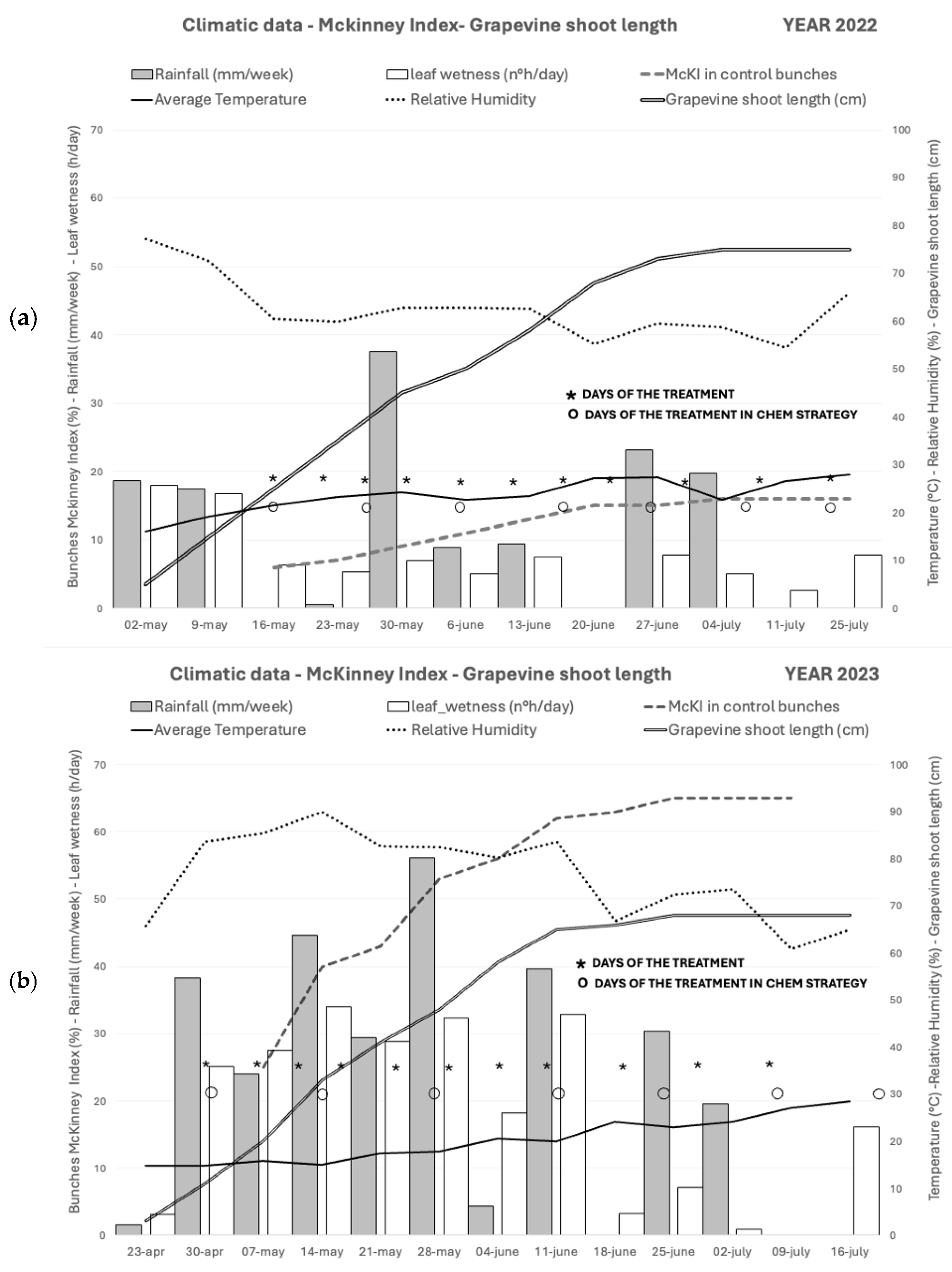
Meteorological conditions differed markedly between the two years. The 2022 season was characterized by lower rainfall, reduced leaf wetness duration, and less persistent relative humidity, resulting in conditions less conducive to gDM development (Figure 1a). In contrast, 2023 was characterized by continuous rainfall events, prolonged leaf wetness, and favorable temperatures from the end of April onwards, resulting in highly conducive conditions for disease establishment and spread (Figure 1b). As a consequence, average disease levels on grape bunches in the untreated control were much lower in 2022 (DisInc = 52.97%; McKI = 15.46%) than in 2023 (DisInc = 100.0%; McKI = 62.11%).
In 2022, because meteorological conditions remained only moderately favorable during the early part of the season, the first symptoms appeared relatively late (16 May), when shoots were already 15–25 cm long (BBCH 19–53). For this reason, treatments were initiated only after the appearance of the first visible symptoms. On leaves, DisInc values ranged from 13.3% to 52.7%, while McKI values ranged from 2.22% to 11.67%. On bunches, DisInc values ranged from 18.7% to 50.0%, whereas McKI values ranged from 3.1% to 15.6% (Table 4; Figure 1). The weekly trend of McKI in the untreated control remained relatively limited throughout the season, ranging from 6.0% to 15.6% on bunches between the first week of May and the end of June (Figure 1).
In contrast, in 2023, highly favorable meteorological conditions occurred already during the last week of April, when shoots were only 8–10 cm long. Rainfall, prolonged leaf wetness, and high humidity persisted throughout the following weeks, favoring early infections and rapid disease progression. The first symptoms appeared earlier than in 2022, when shoots were only 10–13 cm long (BBCH 11–13). Therefore, treatments were initiated preventively, before the appearance of visible symptoms, in order to protect grapevine tissues during the most susceptible phenological stages. Despite this preventive approach, disease pressure remained extremely high. On leaves, DisInc values ranged from 50.0% to 89.33%, while McKI values ranged from 10.11% to 51.44%. On bunches, DisInc values ranged from 59.33% to 100%, whereas McKI values ranged from 13.67% to 62.11% (Table 4; Figure 1). The weekly trend of McKI on bunches in the untreated control increased rapidly during the season, ranging from 23.0% to 65.0% between the first week of May and the end of June (Figure 1).

3.3. Evaluation of Biological Control Strategies for Grapevine Downy Mildew

The effectiveness of the tested disease control strategies (Table 2) against gDM was assessed over two consecutive grape growing seasons in Southern Italy (2022 and 2023) by measuring DisInc, DisSev, and the McKI both on leaves and grape bunches. Overall, disease pressure was markedly lower in 2022 than in 2023 (Figure 1 and Table 4).
As expected, the untreated control consistently exhibited the highest disease pressure in both years. In 2022, untreated plots showed 45.3% DisInc, 0.7% DisSev, and 11.67% McKI on leaves, whereas grape bunches reached 53.3%, 3.1%, and 15.6%, respectively. Among the tested strategies, BIO2 and COMB achieved the greatest disease reduction. BIO2 recorded 25.3% DisInc, 0.3% DisSev, and 4.8% McKI on leaves, and 28.7% DisInc, 0.3% DisSev, and 5.2% McKI on bunches. Similarly, COMB showed 24.0% DisInc, 0.3% DisSev, and 4.67% McKI on leaves, and 30.0% DisInc, 0.1% DisSev, and 5.5% McKI on bunches. The CHEM strategy provided the highest level of protection, with DisInc of 13.3% and 18.7%, DisSev of 0.1% and 0.6%, and McKI of 2.2% and 3.1%, on leaves and bunches, respectively. The other biological strategies (BIO1 and BIO3) were less effective, with DisInc ranging from 42.2% to 52.7% on leaves and from 46.7% to 50.0% on bunches, DisSev from 0.6% to 0.7% and 0.7%, and McKI from 10.3% to 11.2% and from 11.0% to 12.0%, respectively.
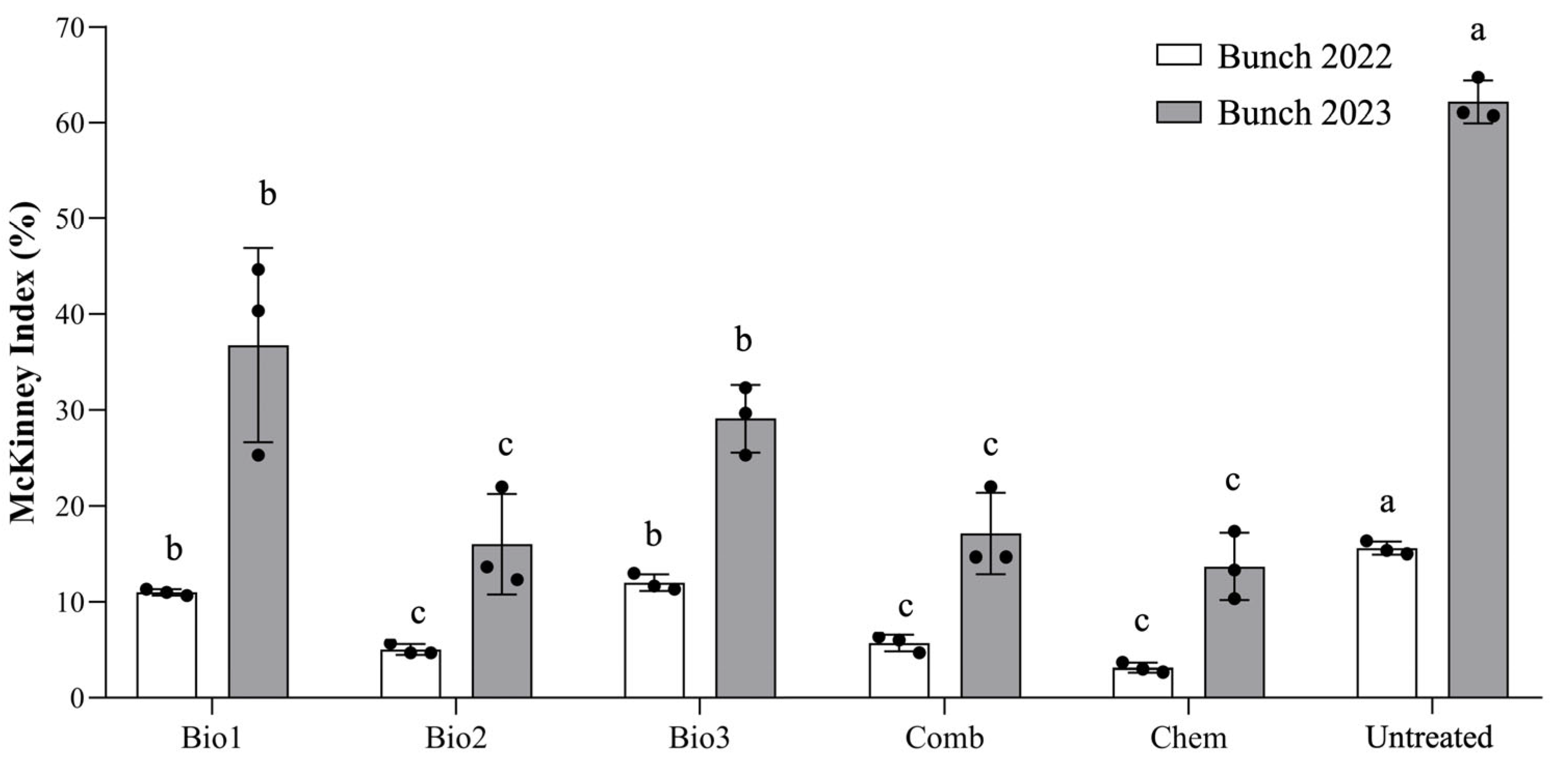
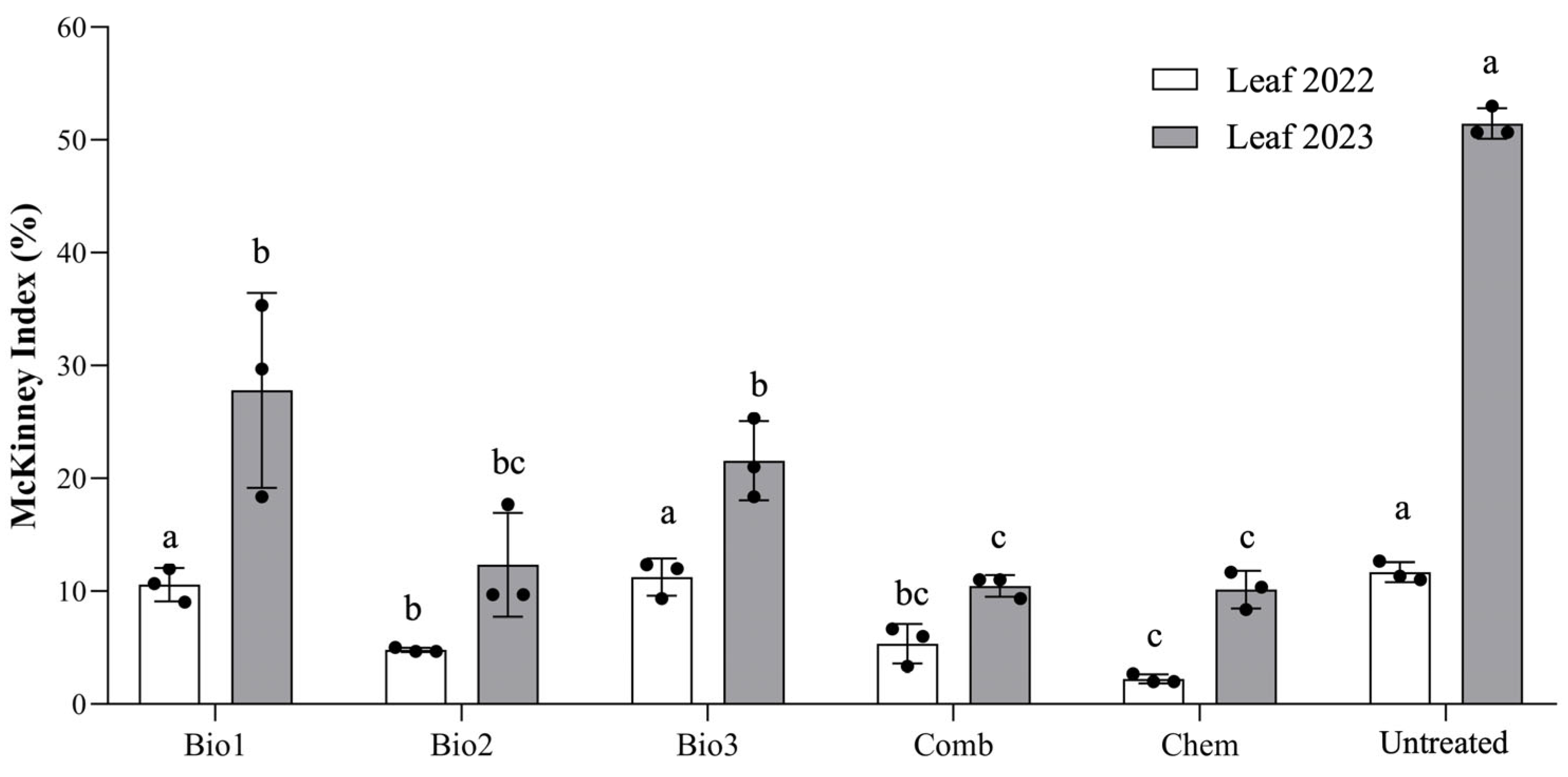
In 2023, untreated plots again showed the highest disease pressure. Leaves reached 89.3% DisInc, 3.1% DisSev, and 51.4% McKI, whereas grape bunches 100% DisInc, 3.7% DisSev, and 62.1% McKI were recorded. Among the biological strategies, BIO2 and COMB again provided the greatest disease reduction. In the case of BIO2, 57.3% DisInc, 0.7% DisSev, and 12.6% McKI on leaves, and 65.1% DisInc, 0.9% DisSev, and 16.1% McKI on bunches were recorded. Similarly, COMB showed 50.7% DisInc, 0.3% DisSev, and 10.4% McKI on leaves, and 66.7% DisInc, 1.0% DisSev, and 17.1% McKI on bunches. The CHEM strategy again provided the highest level of protection, with DisInc of 50.0% on leaves and 59.3% on bunches, DisSev of 0.61% and 0.8%, and McKI of 10.1% and 13.7% on leaves and bunches, respectively. The other biological treatments (BIO1 and BIO3) were less effective, with DisInc ranging from 73.3% to 78.6% on leaves and from 85.4% to 91.3% on bunches, DisSev from 1.3% to 1.70% and from 1.72% to 2.21%, and McKI from 21.56% to 27.9% and from 28.9% to 36.78% on leaves and bunches, respectively. The results can be seen in detail in Table 4. The disease severity of gDM on bunches, for the year 2022 and 2023, can be seen in detail in Figure 2; while the disease severity on leaves, for the two years of field trials, can be seen in Figure 3.

4. Discussion

Management of gDM has become increasingly challenging due to the progressive development of pathogen resistance to several anti-downy mildew products and the ongoing reduction in authorized fungicide active ingredients in Europe. In deeply gDM-prone areas, disease control still relies largely on synthetic anti-downy mildew and copper-based formulations. However, their ecotoxicological impact has led to increasingly restrictive regulations and reductions in maximum residue levels [22,23]. Copper products, widely used in conventional and especially organic viticulture, are non-systemic and prone to wash-off, often requiring repeated applications. Thus, their long-term use has resulted in soil Cu accumulation, with negative microbiological and physicochemical consequences [24,25,26]. Therefore, EU Regulation 2018/1981 has limited copper use to 28 kg ha−1 over 7 years (4 kg ha−1 per year).
In this scenario, a shift from pathogen-focused control to plant health-oriented management is urgently needed. Innovative bioformulations based on novel copper complexes, beneficial microorganisms (BMs), natural products, plant-derived biomolecules, and mineral-based biofertilizers have shown promising potential for managing phyllosphere and carposphere pathogens [27,28,29].
Recent research has focused on new copper-based formulations designed to enhance antimicrobial efficacy through greater penetration into pathogen and plant tissues, including copper phosphites, gluconates, lignosulfonates, and complexes with hydrolyzed proteins [30,31,32,33,34]. Such formulations, typically characterized by low copper concentrations, exhibit distinct physicochemical and biological properties. They are absorbed and translocated systemically into plant tissues, where they exert direct antimicrobial activity and activate host defense responses; furthermore, these complexes contribute to cell wall strengthening, enzyme cofactor activity, improved nutritional status, mitigation of reactive oxygen species, osmotic regulation, and modulation of hormonal signaling pathways, collectively improving plant tolerance to biotic and abiotic stresses [33,35,36,37,38,39,40]. In particular, copper phosphites have demonstrated dual functionality as both antimicrobial compounds and inducers of plant defense responses [41,42]; copper proteinates and complexes with hydrolysed proteins enhance foliar uptake and systemic mobility, facilitating delivery to target tissues; copper gluconates and lignosulfonates provide increased solubility and stability, supporting both foliar and soil applications while reducing the risk of phytotoxicity [43,44]. Notably, copper gluconate-based formulations have also been proposed as candidates for the management of grapevine esca disease [45].
With regard to natural compounds such as plant and animal-derived extracts and mineral salts, numerous studies have documented the efficacy of formulations based on chitosan, laminarin, seaweed extracts, and other botanical extracts in suppressing several plant pathogens [6,46]. Chitosan has shown consistent efficacy in reducing gDM across different varieties and environmental conditions, supporting its role as a sustainable alternative or complement to copper-based treatments [5]. Among the available natural bioformulations, those containing seaweed extracts [47], chitosan, and laminarin [6,48] have shown efficacy against gDM. These biomolecules primarily act as resistance elicitors, activating plant defense responses rather than exerting direct antimicrobial effects.
In nature, the phylloplane microbiota (consisting of bacteria, fungi, and yeasts) acts as a biological buffer against foliar pathogens through complex plant-microbe-pathogen interactions, interfering with the life cycles of pathogens, limiting their penetration into the host, through direct antagonism (parasitism, antibiosis, competition) and the induction of host resistance; in this regard, several BMs have demonstrated significant efficacy against gDM, and some bioformulations are commercially available [9,14,49,50,51,52]. Unlike many synthetic fungicides, which typically target one or a few pathogen-specific sites and are therefore prone to resistance development, BMs generally exhibit multifaceted modes of action that may reduce the risk of selecting resistant strains.
Among them, Bacillus spp. have been extensively studied for their ability to suppress gDM, mainly through the production of antimicrobial lipopeptides (e.g., fengycin and surfactin) and the activation of plant immune responses [10,53]. L. capsici, tolerant to copper and environmental stress, improves gDM control when combined with reduced copper doses and contributes to lowering soil copper accumulation [11].
Despite the availability of numerous BM- and biomolecule-based bioformulations, further information on field efficacy, optimal application timing, and integration into disease management programs is still required to ensure reliable control of P. viticola in vineyards, which is necessary considering the epidemiology and insidious infection cycle of the pathogen. Effective biocontrol depends on timely colonization of plant surfaces enabling BMs to compete with the pathogen; therefore, applications must precede P. viticola establishment and stomatal penetration. From budbreak onward, when stomata become functional, abundant inoculum combined with favorable environmental conditions (conducive temperature, rainfall, and high humidity) can lead to rapid infection, potentially resulting in severe defoliation and significant yield losses. This study reports the results of field trials conducted in vineyards in the Campania region (Southern Italy) during the 2022 and 2023 growing seasons, with the aim of identifying the most effective biological strategies for the management of gDM caused by P. viticola. The comparison between seasons enabled validation of the tested strategies under contrasting epidemiological conditions: moderate disease pressure in 2022 and exceptionally high disease pressure in 2023 due to extremely favorable environmental conditions for pathogen development. Notably, certain biological programs maintained satisfactory performance even under severe epidemic conditions, supporting their potential robustness in high-risk scenarios. Across both seasons, the BIO2 and COMB strategies consistently resulted in lower disease indices compared to BIO1 and BIO3, indicating greater reliability of these approaches under variable field conditions.
In particular, BIO2 reduced the McKI on bunches by 68% in 2022 and 74% in 2023, whereas COMB achieved reductions of 63% and 72% in 2022 and 2023, respectively, compared with the untreated control. The remaining strategies (BIO1 and BIO3) also significantly reduced disease levels relative to the control in both seasons, although their efficacy was consistently lower than that observed in the case of BIO2 and COMB.
Given the epidemiological complexity and adaptive potential of P. viticola, innovative sustainable management strategies should rely on products with multiple and complementary modes of action to limit pathogen aggressiveness and reduce the risk of resistance development to individual active ingredients. In the BIO2 and COMB strategies, each application consisted of a mixture targeting gDM that included the YSY® bioformulation based on BM PT22AV, combined with two additional bioformulations: one containing copper proteinate and one based on plant extracts.
The higher reduction in McKI observed with these two strategies was likely due to the complementary effects of the multi-component mixtures applied. These formulations combined: (i) the well-established antimicrobial activity of copper ions against plant pathogens, together with their reported role in activating host defense responses [54,55]; (ii) the multifaceted mode of action of P. terrestris as a biocontrol agent, including direct and indirect actions [14,15,17,56]; and (iii) the resistance-eliciting activity of algae and plant extracts [57,58,59].
In contrast, when Protamin Cu 62 + Fylloton and Protamin Cu 62 + SKM100, without the PT22AV based YSY® bioformulation (strategies BIO1 and BIO3), significantly lower levels of disease suppression were observed.
Interestingly, the data clearly indicate that the BM PT22AV plays a key synergistic role in BIO2 compared with the related BIO1 strategy (synergistic factor = 1.59), in which it was applied in combination with copper-based products and plant extracts, providing the greatest contribution to disease reduction among the tested bioformulations [60]. The contrasting disease pressure recorded over the two seasons further emphasized the performance of BIO2 and COMB. In 2023, when disease severity on both bunches and leaves was markedly higher than in 2022, these strategies maintained greater efficacy, supporting their reliability under elevated epidemic conditions.
Indeed, the 2023 growing season proved to have unprecedented disease dynamics for grapevine farmers due to the high gDM incidence in Italy, especially in Central–Southern regions, because of the prolonged rainfall and persistent high humidity from late March through June, conditions very conducive to P. viticola infections. These environmental factors resulted in severe epidemics, with high disease incidence on both leaves and bunches and severe yield losses in several production areas.
The extreme disease pressure recorded in 2023 provided a stringent test for the evaluated management programs tested in this study and allowed a clearer differentiation among strategies. Notably, BIO2 and COMB achieved the greatest reductions in McKI on bunches, with efficacy levels comparable to those obtained with the program based on application of conventional chemicals (CHEM). The ability of these integrated biological strategies to maintain disease control under extreme epidemic conditions supports the potential of combining BMs, natural biomolecules, and specific copper complexes as a viable component of sustainable viticulture programs, thus potentially reducing reliance on synthetic fungicides and high copper inputs.

5. Conclusions

Based on our results, the disease control levels observed during the 2023 grapevine growing season clearly showed that biological products applied alone cannot provide the same level of protection as the conventional chemical program, which remains the most reliable strategy under extremely high disease pressure. At the same time, satisfactory reductions in disease pressure were achieved by integrating different low-risk products with complementary modes of action.
In particular, the data clearly indicate that the yeast-based bioformulation YSY®, containing PT22AV, contributed substantially to disease suppression when integrated with copper-based products and plant extracts, suggesting that its greatest value lies as a partner product within multi-component anti-downy mildew programs. In addition, PT22AV may provide further advantages beyond the control of gDM, including activity against other pathogens such as Botrytis cinerea during the later grape stages, representing a potentially valuable side benefit within integrated vineyard protection programs. These findings further reinforce the importance of preventive applications initiated before the appearance of first visible symptoms and targeted to the earliest stages of pathogen establishment, an aspect that becomes even more important when the objective is to develop low-impact disease management strategies. More broadly, the results support a shift from a product-based approach to a strategy-based approach, in which the success of disease control depends on the integration of different tools capable of interfering with different biological functions of the pathosystem. Future research should therefore focus on improving the practical use of low-risk products by identifying the most effective application windows, considering both plant phenology and pathogen development, clarifying the persistence and duration of protection provided by each component, and optimizing the sequence and timing of applications under different epidemiological scenarios. Such advances will be essential to maintain high levels of disease control while progressively reducing dependence on synthetic fungicides and excessive copper inputs, thereby improving the environmental sustainability, resilience, and long-term viability of viticulture.

Author Contributions

D.P.: Conceptualization, methodology, writing, data curation, formal analysis; C.D.G.: methodology, formal analysis; S.C.: methodology, formal analysis, field trials; G.I.: methodology, formal analysis, writing—review and editing; I.M.: methodology, formal analysis, writing—review and editing; R.C.: methodology, formal analysis, writing—review and editing; G.L.: methodology, formal analysis, writing—review and editing; F.D.C.: conceptualization, methodology, formal analysis, resources, data curation, writing—original draft, supervision, project administration, funding acquisition. All authors have read and agreed to the published version of the manuscript.

Funding

This research was funded by “PSR Campania 2014–2020–MISURA 19–Sottomisura 19.2”–Tipologia di intervento 16.1.1–Azione 2, Prot. 30186 del 11.08.2021, CUP: J16B19002910009. Project title: “ZERO-RESIDUE-VINE—ZERO RESIDUE VINEYARD MANAGEMENT AND INNOVATIVE USE OF WATER RESOURCES” (VITERESZERO—GESTIONE DEI VIGNETI A RESIDUO ZERO E USO INNOVATIVO DELLE RISORSE IDRICHE).

Institutional Review Board Statement

Not applicable.

Data Availability Statement

The original contributions presented in this study are included in the article. Further inquiries can be directed to the corresponding author.

Conflicts of Interest

The authors declare no conflicts of interest.

Abbreviations

The following abbreviations are used in this manuscript:
BBCHBiologische Bundesanstalt, Bundessortenamt and CHemische industrie
BIOBiological strategy
BMBeneficial Microorganism
CHEMChemical strategy
COMBCombined strategy
DisIncDisease Incidence
DisSevDisease Severity
gDMGrape Downy mildew
McKiMcKinney index
YPDYeast Peptone Dextrose

References

  1. Tamm, L.; Thuerig, B.; Apostolov, S.; Blogg, H.; Borgo, E.; Corneo, P.E.; Fittje, S.; de Palma, M.; Donko, A.; Experton, C.; et al. Use of Copper-Based Fungicides in Organic Agriculture in Twelve European Countries. Agronomy 2022, 12, 673. [Google Scholar] [CrossRef]
  2. Silva, V.; Yang, X.; Fleskens, L.; Ritsema, C.J.; Geissen, V. Environmental and Human Health at Risk—Scenarios to Achieve the Farm to Fork 50% Pesticide Reduction Goals. Environ. Int. 2022, 165, 107296. [Google Scholar] [CrossRef] [PubMed]
  3. Nadalini, S.; Puopolo, G. Chapter 3—Biological Control of Plasmopara viticola: Where Are We Now? In Plant and Soil Microbiome; Kumar, A., Santoyo, G., Singh, J., Eds.; Academic Press: Cambridge, MA, USA, 2024; pp. 67–100. ISBN 978-0-443-15199-6. [Google Scholar]
  4. Mondello, V.; Fernandez, O.; Guise, J.-F.; Trotel-Aziz, P.; Fontaine, F. In Planta Activity of the Novel Copper Product HA + Cu(II) Based on a Biocompatible Drug Delivery System on Vine Physiology and Trials for the Control of Botryosphaeria Dieback. Front. Plant Sci. 2021, 12, 693995. [Google Scholar] [CrossRef] [PubMed]
  5. Romanazzi, G.; Piancatelli, S.; Potentini, R.; D’Ignazi, G.; Moumni, M. Applications of Chitosan Alone, Alternated or Combined with Copper for Grapevine Downy Mildew Management in Large Scale Trials. J. Clean. Prod. 2024, 451, 142131. [Google Scholar] [CrossRef]
  6. Piancatelli, S.; Moumni, M.; Makau, S.M.; Tunç, M.; Cantalamessa, G.; Davillerd, Y.; Pérez-Álvarez, E.P.; Garde-Cerdán, T.; D’Ignazi, G.; Romanazzi, G. Use of Innovative Compounds to Manage Grapevine Downy and Powdery Mildews: Results of a Three-Year Field Trial. Agronomy 2024, 14, 2840. [Google Scholar] [CrossRef]
  7. Aziz, A.; Poinssot, B.; Daire, X.; Adrian, M.; Bézier, A.; Lambert, B.; Joubert, J.-M.; Pugin, A. Laminarin Elicits Defense Responses in Grapevine and Induces Protection Against Botrytis cinerea and Plasmopara viticola. Mol. Plant-Microbe Interact. 2003, 16, 1118–1128. [Google Scholar] [CrossRef] [PubMed]
  8. Koledenkova, K.; Esmaeel, Q.; Jacquard, C.; Nowak, J.; Clément, C.; Ait Barka, E. Plasmopara viticola the Causal Agent of Downy Mildew of Grapevine: From Its Taxonomy to Disease Management. Front. Microbiol. 2022, 13, 889472. [Google Scholar] [CrossRef] [PubMed]
  9. Sun, Z.-B.; Song, H.-J.; Liu, Y.-Q.; Ren, Q.; Wang, Q.-Y.; Li, X.-F.; Pan, H.-X.; Huang, X.-Q. The Potential of Microorganisms for the Control of Grape Downy Mildew—A Review. J. Fungi 2024, 10, 702. [Google Scholar] [CrossRef]
  10. Zhang, X.; Zhou, Y.; Li, Y.; Fu, X.; Wang, Q. Screening and Characterization of Endophytic Bacillus for Biocontrol of Grapevine Downy Mildew. Crop Prot. 2017, 96, 173–179. [Google Scholar] [CrossRef]
  11. Puopolo, G.; Giovannini, O.; Pertot, I. Lysobacter capsici AZ78 Can Be Combined with Copper to Effectively Control Plasmopara viticola on Grapevine. Microbiol. Res. 2014, 169, 633–642. [Google Scholar] [CrossRef] [PubMed]
  12. Li, C.; Cao, S.; Zhao, Y.; Wang, R.; Yin, X. Integrated Transcriptomics and Metabolomics Analyses Revealed Mechanisms of Trichoderma harzianum-Induced Resistance to Downy Mildew in Grapevine. Physiol. Mol. Plant Pathol. 2025, 137, 102619. [Google Scholar] [CrossRef]
  13. Kowalska, J.; Krzymińska, J.; Tyburski, J. Yeasts as a Potential Biological Agent in Plant Disease Protection and Yield Improvement—A Short Review. Agriculture 2022, 12, 1404. [Google Scholar] [CrossRef]
  14. Palmieri, D.; Ianiri, G.; Conte, T.; Castoria, R.; Lima, G.; De Curtis, F. Influence of Biocontrol and Integrated Strategies and Treatment Timing on Plum Brown Rot Incidence and Fungicide Residues in Fruits. Agriculture 2022, 12, 1656. [Google Scholar] [CrossRef]
  15. D’Addabbo, T.; Landi, S.; Palmieri, D.; Piscitelli, L.; Caprio, E.; Esposito, V.; d’Errico, G. Potential Role of the Yeast Papiliotrema terrestris Strain PT22AV in the Management of the Root-Knot Nematode Meloidogyne incognita. Horticulturae 2024, 10, 472. [Google Scholar] [CrossRef]
  16. Ianiri, G.; Barone, G.; Palmieri, D.; Quiquero, M.; Gaeta, I.; De Curtis, F.; Castoria, R. Transcriptomic Investigation of the Interaction between a Biocontrol Yeast, Papiliotrema terrestris Strain PT22AV, and the Postharvest Fungal Pathogen Penicillium expansum on Apple. Commun. Biol. 2024, 7, 359. [Google Scholar] [CrossRef] [PubMed]
  17. Castoria, R.; Miccoli, C.; Barone, G.; Palmieri, D.; De Curtis, F.; Lima, G.; Heitman, J.; Ianiri, G. Molecular Tools for the Yeast Papiliotrema terrestris LS28 and Identification of Yap1 as a Transcription Factor Involved in Biocontrol Activity. Appl. Environ. Microbiol. 2021, 87, e02910-20. [Google Scholar] [CrossRef] [PubMed]
  18. Palmieri, D.; Ianiri, G.; Capano, V.; De Curtis, F.; Castoria, R.; Lima, G.; Roppo Valente, M.; Medrzycki, P. Bee-Friendly Approach to Strawberry Grey Mould Biocontrol with the Yeast Papiliotrema terrestris PT22AV. BioControl 2025, 70, 809–821. [Google Scholar] [CrossRef]
  19. Palmieri, D.; Ianiri, G.; Testa, B.; Guerrieri, M.C.; Conte, T.; Aiese Cigliano, R.; Del Grosso, C.; De Curtis, F.; Castoria, R.; Lima, G. A Pipeline to Predict the Biosafety Profile of Putative Biocontrol Yeasts: Papiliotrema terrestris Strain PT22AV as a Case Study. BioControl 2025, 70, 245–256. [Google Scholar] [CrossRef]
  20. Lorenz, D.H.; Eichhorn, K.W.; Bleiholder, H.; Klose, R.; Meier, U.; Weber, E. Growth Stages of the Grapevine: Phenological Growth Stages of the Grapevine (Vitis vinifera L. ssp. vinifera)—Codes and Descriptions According to the Extended BBCH Scale. Aust. J. Grape Wine Res. 1995, 1, 100–103. [Google Scholar] [CrossRef]
  21. Gehmann, K.; Staudt, G.; Grossmann, F. Der Einfluß Der Temperatur Auf Die Oosporenbildung von Plasmopara Viticola/The Influence of Temperature on Oospore Formation of Plasmopara viticola. Z. Pflanzenkrankh. Pflanzenschutz/J. Plant Dis. Prot. 1987, 94, 230–234. [Google Scholar]
  22. Roda, R.; Prats-Llinàs, M.T.; Forcadell, S.; Mazzieri, M.; Calvo-Garrido, C.; Nadal, M.; de Lamo, S.; Ferrer-Gallego, R. The Effect of Copper Reduction on the Control of Downy Mildew in Mediterranean Grapevines. Eur. J. Plant Pathol. 2024, 169, 529–542. [Google Scholar] [CrossRef]
  23. La Torre, A.; Righi, L.; Iovino, V.; Battaglia, V. Evaluation of Copper Alternative Products to Control Grape Downy Mildew in Organic Farming. J. Plant Pathol. 2019, 101, 1005–1012. [Google Scholar] [CrossRef]
  24. Ballabio, C.; Panagos, P.; Lugato, E.; Huang, J.-H.; Orgiazzi, A.; Jones, A.; Fernández-Ugalde, O.; Borrelli, P.; Montanarella, L. Copper Distribution in European Topsoils: An Assessment Based on LUCAS Soil Survey. Sci. Total Environ. 2018, 636, 282–298. [Google Scholar] [CrossRef] [PubMed]
  25. Droz, B.; Payraudeau, S.; Rodríguez Martín, J.A.; Tóth, G.; Panagos, P.; Montanarella, L.; Borrelli, P.; Imfeld, G. Copper Content and Export in European Vineyard Soils Influenced by Climate and Soil Properties. Environ. Sci. Technol. 2021, 55, 7327–7334. [Google Scholar] [CrossRef] [PubMed]
  26. Perria, R.; Ciofini, A.; Petrucci, W.A.; D’Arcangelo, M.E.M.; Valentini, P.; Storchi, P.; Carella, G.; Pacetti, A.; Mugnai, L. A Study on the Efficiency of Sustainable Wine Grape Vineyard Management Strategies. Agronomy 2022, 12, 392. [Google Scholar] [CrossRef]
  27. Piombo, E.; Sela, N.; Wisniewski, M.; Hoffmann, M.; Gullino, M.L.; Allard, M.W.; Levin, E.; Spadaro, D.; Droby, S. Genome Sequence, Assembly and Characterization of Two Metschnikowia fructicola Strains Used as Biocontrol Agents of Postharvest Diseases. Front. Microbiol. 2018, 9, 593. [Google Scholar] [CrossRef] [PubMed]
  28. Clippinger, J.I.; Dobry, E.P.; Laffan, I.; Zorbas, N.; Hed, B.; Campbell, M.A. Traditional and Emerging Approaches for Disease Management of Plasmopara viticola, Causal Agent of Downy Mildew of Grape. Agriculture 2024, 14, 406. [Google Scholar] [CrossRef]
  29. Gallardo-Camarena, M.V.; Reverchon, F.; Méndez-Bravo, A.; Torres-Acosta, M.A.; Licona-Cassani, C. Control of Avocado Anthracnose by Carposphere-Associated Kosakonia cowanii VG1 for Agricultural Applications. AMB Express 2025, 15, 88. [Google Scholar] [CrossRef] [PubMed]
  30. González-Hernández, A.I.; Llorens, E.; Agustí-Brisach, C.; Vicedo, B.; Yuste, T.; Cerveró, A.; Ledó, C.; García-Agustín, P.; Lapeña, L. Elucidating the Mechanism of Action of Copper Heptagluconate on the Plant Immune System against Pseudomonas syringae in Tomato (Solanum lycopersicum L). Pest Manag. Sci. 2018, 74, 2601–2607. [Google Scholar] [CrossRef] [PubMed]
  31. Battiston, E.; Compant, S.; Antonielli, L.; Mondello, V.; Clément, C.; Simoni, A.; Di Marco, S.; Mugnai, L.; Fontaine, F. In Planta Activity of Novel Copper(II)-Based Formulations to Inhibit the Esca-Associated Fungus Phaeoacremonium minimum in Grapevine Propagation Material. Front. Plant Sci. 2021, 12, 649694. [Google Scholar] [CrossRef] [PubMed]
  32. Battiston, E.; Antonielli, L.; Di Marco, S.; Fontaine, F.; Mugnai, L. Innovative Delivery of Cu(II) Ions by a Nanostructured Hydroxyapatite: Potential Application in Planta to Enhance the Sustainable Control of Plasmopara viticola. Phytopathology 2018, 109, 748–759. [Google Scholar] [CrossRef] [PubMed]
  33. Rouphael, Y.; Carillo, P.; Ciriello, M.; Formisano, L.; El-Nakhel, C.; Ganugi, P.; Fiorini, A.; Miras Moreno, B.; Zhang, L.; Cardarelli, M.; et al. Copper Boosts the Biostimulant Activity of a Vegetal-Derived Protein Hydrolysate in Basil: Morpho-Physiological and Metabolomics Insights. Front. Plant Sci. 2023, 14, 1235686. [Google Scholar] [CrossRef] [PubMed]
  34. Del Grosso, C.; Saponari, M.; Saldarelli, P.; Palmieri, D.; Altamura, G.; Abou Kubaa, R.; De Curtis, F.; Lima, G. Use of Commercial Fertilizers in an IPDM Protocol to Mitigate Olive Quick Decline Syndrome Caused by Xylella fastidiosa subsp. pauca in Southern Italy. Plant Dis. 2025, 109, 1657–1667. [Google Scholar] [CrossRef] [PubMed]
  35. Garbelotto, M.; Harnik, T.Y.; Schmidt, D.J. Efficacy of Phosphonic Acid, Metalaxyl-M and Copper Hydroxide against Phytophthora ramorum in Vitro and in Planta. Plant Pathol. 2009, 58, 111–119. [Google Scholar] [CrossRef]
  36. Printz, B.; Lutts, S.; Hausman, J.-F.; Sergeant, K. Copper Trafficking in Plants and Its Implication on Cell Wall Dynamics. Front. Plant Sci. 2016, 7, 601. [Google Scholar] [CrossRef] [PubMed]
  37. Lamichhane, J.R.; Osdaghi, E.; Behlau, F.; Köhl, J.; Jones, J.B.; Aubertot, J.-N. Thirteen Decades of Antimicrobial Copper Compounds Applied in Agriculture. A Review. Agron. Sustain. Dev. 2018, 38, 28. [Google Scholar] [CrossRef]
  38. Schulten, A.; Krämer, U. Interactions Between Copper Homeostasis and Metabolism in Plants BT. In Progress in Botany Vol. 79; Cánovas, F.M., Lüttge, U., Matyssek, R., Eds.; Springer International Publishing: Cham, Switzerland, 2018; pp. 111–146. ISBN 978-3-319-71413-4. [Google Scholar]
  39. López-Moral, A.; Llorens, E.; Scalschi, L.; García-Agustín, P.; Trapero, A.; Agustí-Brisach, C. Resistance Induction in Olive Tree (Olea europaea) Against Verticillium Wilt by Two Beneficial Microorganisms and a Copper Phosphite Fertilizer. Front. Plant Sci. 2022, 13, 831794. [Google Scholar] [CrossRef] [PubMed]
  40. Xue, X.; Jiang, Y.; Dai, L.; He, G.; Xu, M.; Yu, Y.; Zhang, J.; Ding, X.; Zhong, W.; Wang, J.; et al. Copper Triggers Plant Immunity: Enhancing StRVE1 Expression to Activate Salicylic Acid Accumulation by Directly Upregulating the StSID2-2 Variant. Plant Physiol. Biochem. 2025, 229, 110395. [Google Scholar] [CrossRef] [PubMed]
  41. Li, Z.; Kong, X.; Zhang, Z.; Tang, F.; Wang, M.; Zhao, Y.; Shi, F. The Functional Mechanisms of Phosphite and Its Applications in Crop Plants. Front. Plant Sci. 2025, 16, 1538596. [Google Scholar] [CrossRef] [PubMed]
  42. Attia, M.S.; Moustafa, M.H.; Hashem, A.H.; Elsayed, S.M.; Aloufi, A.S.; Abdelaleem, I.M.I.; Alshahed, K.A.; Ismail, A.S.; Ibrahim, A.M.; Abdel-Maksoud, M.A.; et al. Bioprotective Potential of Biosynthesized Copper Oxide Nanoparticles and Copper Phosphite against Alternaria-solani-Induced Leaf Spot in Pepper Plants. Antonie Leeuwenhoek 2025, 118, 141. [Google Scholar] [CrossRef] [PubMed]
  43. Adawi, A.; Jarrar, S.; Almadi, L.; Alkowni, R.; Gallo, M.; D’Onghia, A.M.; Buonaurio, R.; Famiani, F. Effectiveness of Low Copper-Containing Chemicals against Olive Leaf Spot Disease Caused by Venturia oleaginea. Agriculture 2022, 12, 326. [Google Scholar] [CrossRef]
  44. Grzanka, M.; Sobiech, Ł.; Filipczak, A.; Danielewicz, J.; Jajor, E.; Horoszkiewicz, J.; Korbas, M. The Efficacy of Plant Pathogens Control by Complexed Forms of Copper. Agriculture 2024, 14, 139. [Google Scholar] [CrossRef]
  45. Mondello, V.; Lemaître-Guillier, C.; Trotel-Aziz, P.; Gougeon, R.; Acedo, A.; Schmitt-Kopplin, P.; Adrian, M.; Pinto, C.; Fernandez, O.; Fontaine, F. Assessment of a New Copper-Based Formulation to Control Esca Disease in Field and Study of Its Impact on the Vine Microbiome, Vine Physiology and Enological Parameters of the Juice. J. Fungi 2022, 8, 151. [Google Scholar] [CrossRef]
  46. Hermann, S.; Orlik, M.; Boevink, P.; Stein, E.; Scherf, A.; Kleeberg, I.; Schmitt, A.; Schikora, A. Biocontrol of Plant Diseases Using Glycyrrhiza glabra Leaf Extract. Plant Dis. 2022, 106, 3133–3144. [Google Scholar] [CrossRef] [PubMed]
  47. Zarraonaindia, I.; Cretazzo, E.; Mena-Petite, A.; Díez-Navajas, A.M.; Pérez-López, U.; Lacuesta, M.; Pérez-Álvarez, E.P.; Puertas, B.; Fernandez-Diaz, C.; Bertazzon, N.; et al. Holistic Understanding of the Response of Grapevines to Foliar Application of Seaweed Extracts. Front. Plant Sci. 2023, 14, 1119854. [Google Scholar] [CrossRef] [PubMed]
  48. Garde-Cerdán, T.; Mancini, V.; Carrasco-Quiroz, M.; Servili, A.; Gutiérrez-Gamboa, G.; Foglia, R.; Pérez-Álvarez, E.P.; Romanazzi, G. Chitosan and Laminarin as Alternatives to Copper for Plasmopara viticola Control: Effect on Grape Amino Acid. J. Agric. Food Chem. 2017, 65, 7379–7386. [Google Scholar] [CrossRef] [PubMed]
  49. Shi, X.; Shen, H.; Wang, Y.; Yang, X.; Shi, R.; Tan, W.; Ran, L. Potential Biocontrol Microorganisms Causing Attenuated Pathogenicity in Plasmopara viticola. Phytopathology 2024, 114, 1226–1236. [Google Scholar] [CrossRef]
  50. Perazzolli, M.; Roatti, B.; Bozza, E.; Pertot, I. Trichoderma harzianum T39 Induces Resistance against Downy Mildew by Priming for Defense without Costs for Grapevine. Biol. Control 2011, 58, 74–82. [Google Scholar] [CrossRef]
  51. Prakash, R.; Shivakumar, N. Development and Evaluation of Microbial Formulations Containing Bacillus amyloliquefaciens RP4 and Streptomyces rochei RP7 for the Sustainable Management of Downy Mildew in Grapes. J. Plant Dis. Prot. 2025, 132, 146. [Google Scholar] [CrossRef]
  52. Lahlali, R.; Ezrari, S.; Radouane, N.; Kenfaoui, J.; Esmaeel, Q.; El Hamss, H.; Belabess, Z.; Barka, E.A. Biological Control of Plant Pathogens: A Global Perspective. Microorganisms 2022, 10, 596. [Google Scholar] [CrossRef] [PubMed]
  53. Li, Y.; Héloir, M.-C.; Zhang, X.; Geissler, M.; Trouvelot, S.; Jacquens, L.; Henkel, M.; Su, X.; Fang, X.; Wang, Q.; et al. Surfactin and Fengycin Contribute to the Protection of a Bacillus subtilis Strain against Grape Downy Mildew by Both Direct Effect and Defence Stimulation. Mol. Plant Pathol. 2019, 20, 1037–1050. [Google Scholar] [CrossRef] [PubMed]
  54. Liu, H.-F.; Xue, X.-J.; Yu, Y.; Xu, M.-M.; Lu, C.-C.; Meng, X.-L.; Zhang, B.-G.; Ding, X.-H.; Chu, Z.-H. Copper Ions Suppress Abscisic Acid Biosynthesis to Enhance Defence against Phytophthora infestans in Potato. Mol. Plant Pathol. 2020, 21, 636–651. [Google Scholar] [CrossRef] [PubMed]
  55. Elmer, W.H. CHAPTER 12: Copper and Plant Disease. In Mineral Nutrition and Plant Disease, 2nd ed.; General Plant Pathology; The American Phytopathological Society: St. Paul, MN, USA, 2023; pp. 297–312. ISBN 978-0-89054-679-6. [Google Scholar]
  56. Palmieri, D.; Barone, G.; Cigliano, R.A.; De Curtis, F.; Lima, G.; Castoria, R.; Ianiri, G. Complete Genome Sequence of the Biocontrol Yeast Papiliotrema terrestris Strain LS28. G3 Genes|Genomes|Genet. 2021, 11, jkab332. [Google Scholar] [CrossRef] [PubMed]
  57. Raja, B.; Vidya, R. Application of Seaweed Extracts to Mitigate Biotic and Abiotic Stresses in Plants. Physiol. Mol. Biol. Plants 2023, 29, 641–661. [Google Scholar] [CrossRef] [PubMed]
  58. Martínez-Lorente, S.E.; Martí-Guillén, J.M.; Pedreño, M.Á.; Almagro, L.; Sabater-Jara, A.B. Higher Plant-Derived Biostimulants: Mechanisms of Action and Their Role in Mitigating Plant Abiotic Stress. Antioxidants 2024, 13, 318. [Google Scholar] [CrossRef] [PubMed]
  59. Malécange, M.; Sergheraert, R.; Teulat, B.; Mounier, E.; Lothier, J.; Sakr, S. Biostimulant Properties of Protein Hydrolysates: Recent Advances and Future Challenges. Int. J. Mol. Sci. 2023, 24, 9714. [Google Scholar] [CrossRef] [PubMed]
  60. Levy, Y.; Benderly, M.; Cohen, Y.; Gisi, U.; Bassand, D. The Joint Action of Fungicides in Mixtures: Comparison of Two Methods for Synergy Calculation. EPPO Bull. 1986, 16, 651–657. [Google Scholar] [CrossRef]
Figure 1. Climatic conditions, grapevine shoot growth, and disease progression during the 2022 (a) and 2023 (b) grape growing seasons. (a) describes the evolution of disease in the untreated control during the 2022 growing season; (b) describes the evolution of the disease in the untreated control during the 2023 growing season. The weekly trend of the McKinney Index (McKI) on grape bunches in the untreated control is represented by the thick dashed line. The graph also reports rainfall as mm per week (dark bars), leaf wetness as hours per day (light bars), average temperature in °C (continuous line), relative humidity in % (dotted line), and grapevine phenological development expressed as shoot length in cm (double line). In all panels, the application dates of the biological strategies and the CHEM strategy (Almada mz + Cymbal + Medeiro+ Sercadis) are indicated by asterisks and circles, respectively.
Agriculture 16 01491 g001
Figure 2. Disease severity of grape downy mildew on bunches, expressed as McKinney Index (%), recorded in 2022 and 2023 under different treatment conditions (Bio1, Bio2, Bio3, Comb, Chem, and Untreated). Bars represent mean values ± standard deviation. Black dots correspond to the three biological replicates for each treatment. Uncommon letters above bars indicate statistically significant differences among treatments within each year according to one-way ANOVA followed by Tukey’s HSD post hoc test (p ≤ 0.05).
Agriculture 16 01491 g002
Figure 3. Disease severity of grape downy mildew on leaves expressed as McKinney Index (%), recorded in 2022 and 2023 under different treatment conditions (Bio1, Bio2, Bio3, Comb, Chem, and Untreated). Bars represent mean values ± standard deviation. Black dots correspond to the three biological replicates for each treatment (n = 3). Uncommon letters above bars indicate statistically significant differences among treatments within each year according to one-way ANOVA followed by Tukey’s HSD post hoc test (p ≤ 0.05).
Agriculture 16 01491 g003
Table 1. Commercial formulations used and application rates.
Trade FormulateSupplierActive Ingredients (Ai)Ai ConcentrationApplication Rate
YSY®AgroVentures
(Latina—Italy)
Papiliotrema terrestris
(Yeast strain PT22AV)
3 × 10⁹ CFU g−1100 g hL−1
Protamin Cu 62Biolchim
(Medicina, BO—Italy)
Protein-chelated Copper6.2%200 mL hL−1
FyllotonBiolchim
(Medicina, BO—Italy)
Seaweed extractNA *300 mL hL−1
SKM 100Bio ALT
(Cornaredo, MI—Italy)
Fabaceae plant extractsNA *300 mL hL−1
Almada mzAscenza
(Saronno, VA—Italy)
Dimetomorf + Mancozeb7.5% + 66.7%250 g hL−1
CymbalCertis Belchim
(Saronno, VA—Italy)
Cymoxanil45%25 g hL−1
MedeiroAscenza
(Saronno, VA—Italy)
Fosetyl-Al80%300 g hL−1
SercadisBASF
Cesano Maderno (MB)—Italy
Fluxapyroxad30%15 mL hL−1
Airone plusGowan Italia s.r.l.
Faenza (RA)—Italy
Copper hydroxide + Copper oxychloride14% + 14%200 mL hL−1
* Active ingredient concentration not available or not reported on the trade label.
Table 2. Scheme of grapevine downy mildew (gDM) management strategies used in two years (2022–2023) of orchard research based on key treatments carried out at crucial phenological phases (BBCH scale) for the disease cycle.
Control StrategiesTreatment and Time of Application (BBCH)
Leaf
Development
BBCH 11–19
Inflorescence Emission
BBCH 53–57
Flowering
BBCH 60–69
Fruit Development
BBCH 71–79
Ripening of Berries
BBCH 81–89
BIO 1
Protamin Cu 62 + Fylloton
3 Treatments *2 Treatments2 Treatments2 Treatments2 Treatments
BIO 2
YSY + Protamin Cu 62 +Fylloton
3 Treatments2 Treatments2 Treatments2 Treatments2 Treatments
BIO 3
Protamin Cu 62 + SKM100
3 Treatments2 Treatments2 Treatments2 Treatments2 Treatments
COMB
YSY + Airone plus +SKM100
3 Treatments2 Treatments2 Treatments2 Treatments2 Treatments
CHEM **
Almada mz + Cymbal +
Medeiro + Sercadis
2 Treatments2 Treatments2 Treatments1 Treatment
UNTREATED CONTROL3 Water2 Water2 Water2 Water2 Water
* For each control strategy, the number of treatments refers to the number of applications at the corresponding phenological stage. ** The anti-gDM products Almada MZ, Cymbal, Medeiro, and Sercadis were used in accordance with the product label and the plant protection regulations of the Campania Region.
Table 3. Compatibility of Papiliotrema terrestris PT22AV with copper- and plant-based products. The products were evaluated at 0.5×, 1× and 1.5× the recommended field rate. Hygromycin B (200 ppm) was included as a positive control. Data are expressed as growth inhibition (%) relative to the untreated control and are presented as mean ± standard deviation (SD).
PT22AV Growth Inhibition (% ± SD)
ProductField Rate
0.5×1.0×1.5×
Protamin Cu 62n.d. *14.7% ± 6.934.9% ± 4.4
Fyllotonn.d.3.4% ± 1.110.3% ± 3.2
Airone PLUSn.d.17.4% ± 3.527.2% ± 8.3
SKM-100n.d.2.8% ± 0.712.1% ± 4.8
Hygromycin B 200 ppm95.3% ± 6.3
n.d. * not detected.
Table 4. Disease incidence (DisInc), disease severity (DisSev) and McKinney Index (McKI) recorded on leaves and on grape bunches of vines managed with different disease control strategies in years 2022 and 2023.
Year 2022
Control strategyLEAVESGRAPE BUNCHES
DisInc
Mean ± SD *
DisSev
Mean ± SD *
McKI
Mean ± SD *
DisInc
Mean ± SD *
DisSev
Mean ± SD *
McKI
Mean ± SD *
BIO142.2± 7.7 a0.6±0.2 a10.3±2.9 ab46.7±12.3 a0.7±0.2 a11.0±3.1 ab
BIO225.6± 7.6 b0.3±0.1 a4.8±1.8 ab28.4±3.8 b0.3±0.1 b4.9±0.9 b
BIO352.7± 10.3 a0.7±0.2 a11.2±3.3 a50.0±11.3 a0.7±0.2 a12.0±2.8 ab
COMB24.2± 9.3 b0.37±0.1 a5.3±2.5 ab31.5±10.6 b0.3±0.1 b5.6±2.4 b
CHEM13.3± 4.9 c0.17±0.1 b2.2±0.8 b18.7±10.6 c0.2±0.1 b3.1±1.8 b
UNTREATED45.3± 6.4 a0.7±0.2 a11.7±2.6 a52.9±5.9 a0.9±0.1 a15.5±2.0 a
Year 2023
Control strategyLEAVESGRAPE BUNCHES
DisInc
Mean ± SD *
DisSev
Mean ± SD *
McKI
Mean ± SD *
DisInc
Mean ± SD *
DisSev
Mean ± SD *
McKI
Mean ± SD *
BIO178.6±11.8 ab1.7±0.5 b27.9±8.8 b91.3±13.0 ab2.2±0.8 b36.8±13.4 b
BIO257.3±13.3 bc0.7±0.3 cd12.6±4.6 c65.1±12.4 c0.9±0.3 d16.1±5.7 c
BIO373.3±13.5 b1.3±0.4 bc21.6±6.7 b85.4±10.6 b1.7±0.4 bc28.9±6.3 b
COMB50.7±11.0 c0.3±0.1 e10.4±2.1 c66.7±13.5 c1.0±0.4 cd17.1±6.1 c
CHEM50.0±14.6 c0.6±0.2 d10.1±3.2 c59.3±12.2 c0.8±0.2 d13.7±3.7 c
UNTREATED89.3±4.6 a3.1±0.3 a51.4±4.4 a100.0±0.0 a3.7±0.2 a62.1±3.4 a
* Different letters indicate statistically significant differences among treatments within each year, as determined by one-way ANOVA followed by Tukey’s HSD post hoc test (p ≤ 0.05).
Disclaimer/Publisher’s Note: The statements, opinions and data contained in all publications are solely those of the individual author(s) and contributor(s) and not of MDPI and/or the editor(s). MDPI and/or the editor(s) disclaim responsibility for any injury to people or property resulting from any ideas, methods, instructions or products referred to in the content.