Article

Fungal Microorganisms Inhabiting Pears and Their Antimicrobial Potential

by
Iglė Vepštaitė-Monstavičė
1,*,
Juliana Lukša-Žebelovič
1,2,
Ramunė Stanevičienė
1,
Živilė Strazdaitė-Žielienė
1 and
Elena Servienė
1,2
1
Laboratory of Genetics, State Scientific Research Institute Nature Research Centre, Akademijos Str. 2, LT-08412 Vilnius, Lithuania
2
Department of Chemistry and Bioengineering, Vilnius Gediminas Technical University, Saulėtekio al. 11, LT-10223 Vilnius, Lithuania
*
Author to whom correspondence should be addressed.
Agriculture 2026, 16(12), 1259; https://doi.org/10.3390/agriculture16121259

Submission received: 27 April 2026 / Revised: 1 June 2026 / Accepted: 4 June 2026 / Published: 7 June 2026
(This article belongs to the Special Issue Application of Biological Control in Crop Protection)

Abstract

Pear fruits host diverse microbial communities that influence postharvest quality, spontaneous fermentation, and susceptibility to microbial contamination. This study characterizes the fungal communities associated with naturally fallen overripe pears (Pyrus communis) using ITS2 amplicon sequencing combined with culture-dependent approaches. The fungal community exhibited low diversity and was dominated by Ascomycota (99%), primarily Saccharomycetes (91.8%), with Hanseniaspora, Aureobasidium, and Microcyclospora representing more than 90% of the total microbial community. Culture-dependent isolation confirmed Hanseniaspora uvarum as the dominant yeast species (~89%), followed by Metschnikowia spp. and Pichia spp. Pairwise co-culture assays, quantified using the Relative Interaction Index, demonstrated predominantly competitive interactions, with fast-growing H. uvarum exerting suppressive effects on slower-growing species. Among the isolated yeasts, Metschnikowia fructicola exhibited antibacterial activity against all tested bacteria Staphylococcus aureus, Listeria innocua and Salmonella typhimurium. The strongest antibacterial activity was exerted against the foodborne pathogen S. aureus. In a pear juice model system, co-cultivation with M. fructicola resulted in the elimination of S. aureus within four days, while yeast viability was maintained. These findings observe the fermentative yeasts distributed in overripe pears and demonstrate the potential of M. fructicola to inhibit bacterial growth under controlled conditions. The results provide a preliminary basis for further studies on fungal succession, yeast interactions, and the biocontrol potential of pear-associated yeasts. For broader ecological conclusions, larger-scale studies across locations, seasons, cultivars, and decay stages are required.

1. Introduction

The pear belongs to the Rosaceae family and is primarily found in temperate and subtropical climates. Pears are widely consumed fruits in the European Union and in the USA [1] and are constantly promoted in dietary guidance. Global production of temperate fruits has reached 23.7 million tons in recent years, ranking third behind grapes and apples, with China, the United States, and Italy accounting for about 75% of total production [2]. Due to their taste and nutritional benefits, pears are increasingly popular in the consumer market. Pears contain a significant amount of sugars, 10–13%, as well as various organic acids, vitamin C, flavonoid compounds such as quercetin and luteolin, polyphenol compounds including chlorogenic acid, catechin, and arbutin. These nutrients have been linked to numerous health benefits, including improved cardiovascular, digestive health, and immune function [3,4].
The fruit surface (carposphere) represents a dynamic ecological niche that supports diverse microbial communities whose composition can influence fruit quality, postharvest behavior, and susceptibility to spoilage. Yeast populations on fruit surfaces range from 104 to 106 colony-forming units per gram of product (CFU/g) depending on cultivar, geographic location, fruit development and maturity, seasonal and climatic conditions, and application of agrochemicals [3,5,6]. While the bacterial communities associated with the pear rhizosphere and tree tissues are well defined [7,8,9,10], fungal microorganisms have not been extensively studied, especially those inhabiting pear fruits. A previous study has identified the fungal microbiota of pear fruits and leaves at premature and mature stages [11], after exposure to various pest management systems [12], and during low-temperature storage [13]. However, the fungal communities associated with naturally fallen overripe pears remain poorly understood. This late-stage fruit environment represents a unique environmental niche characterized by high sugar availability, physical injury, and rapid microbial succession associated with natural decomposition. From an agricultural perspective, fallen fruits contribute to orchard microbial dynamics, affect disease development, and harbor yeasts with potential biocontrol or fermentation properties [14,15].
Fungal species inhabiting fruit surfaces are known to affect postharvest stability. Several studies have shown that epiphytic and endophytic yeasts can inhibit the growth of fungal pathogens such as Botrytis cinerea, Penicillium expansum, and Alternaria sp. by producing antifungal metabolites, volatile organic compounds (VOCs), or by competitive exclusion [16,17,18,19]. Species belonging to the genera Metschnikowia, Hanseniaspora and Pichia are frequently found on the surface of fruit and are particularly important in a biocontrol field due to their antifungal and antibacterial effects on microorganisms that harm crops [20,21,22]. Recent culture-independent studies have revealed diverse fungal assemblages on pear fruits, including Metschnikowia, Aureobasidium, Filobasidium, Botrytis, Alternaria, and Phoma [11,12,13]. Culture-dependent surveys have similarly reported Metschnikowia, Aureobasidium, Cryptococcus, Rhodotorula, Pichia, and filamentous fungi [23,24]. Both NGS and culture-based methods reveal broader microbial diversity [25].
Apart from fresh pears, the pear industry also produces canned pears, juices, jellies, jams, and other products. During postharvest handling and storage, soil particles can promote rot symptoms caused by soil-borne pathogens such as Neonectria candida, Erwinia amylovora, and Phytophthora cactorum [26,27,28]. Pears of late-ripening stages can be utilized as raw material for lactic acid production [29], fruit vinegar, or alcohol fermentation. Decaying fruits may contribute to various issues in the fermentation process, as the fermentation of pears is significantly influenced by microbial communities present on the fruit surface. These microorganisms can either enhance or degrade the quality of the final product. Understanding the interactions between different microorganisms is critical for improving the quality of pear products. While some studies have examined the microbiome of pear flowers and effects of orchard management on microbial communities [8,10,11,13], there is limited data on how these communities evolve during the postharvest phase, especially at advanced ripening stages [12,24], and how these microorganisms interact with each other.
The aim of this study was to characterize the fungal microbiota on naturally fallen overripe pears and to assess the biocontrol potential of the dominant cultivable yeasts. The objectives were: (i) to assess fungal community composition using the NGS alongside culture-dependent approaches; (ii) to evaluate yeast interactions based on a Relative Interaction Index; (iii) to assess the inhibitory activity of selected yeast isolates against representative foodborne bacteria in a pear juice model system. By focusing on a late-stage fruit environment, this exploratory work provides insight into microbial succession and interaction dynamics relevant to orchard ecology, postharvest management, and fermentation processes.

2. Materials and Methods

2.1. Fruit Sampling

Pear fruits were harvested from the ground around pear trees (Pyrus communis subsp. pyraster) growing in the old orchard located in the Vilnius region of Lithuania (GPS coordinates 54.752053, 25.284135). Pears were gathered at the late ripening phase without any visible signs of advanced decay, mold growth or extensive tissue maceration visually corresponding to approximately BBCH 89 (Biologische Bundesalstant, Bundessortenamt and CHemical industry) in September 2024 from three pear trees that were at least 30 m away. Fruits were aseptically collected into sterile plastic bags and processed in the laboratory within 3 h after harvesting. Thirty pear fruits proceeded with outwashes preparation for metagenomic analysis, and 2–3 pears were peeled for each culture-dependent analysis.

2.2. Illumina NGS Analysis

The pear fruits (about 300 g) were placed in 500 mL of sterile 0.05 M phosphate buffer pH 6.8 for 30 min at room temperature with shaking at 120 rpm. Outwashes were filtered through 420 μm filters, centrifuged at 12,000× g for 20 min, and pellets (40 mg) were applied for total DNA extraction using a Genomic DNA purification kit (Thermo Fisher Scientific Baltics, Vilnius, Lithuania) in accordance with the manufacturer’s protocol. The extracted DNA was quantified and assessed for purity using a NanoDrop 2000 spectrophotometer (Thermo Fisher Scientific, Waltham, MA, USA). For ITS2 amplicon sequencing, metagenomic DNA extracted from three independent samples were pooled and sequenced as one composite DNA sample.
High-quality DNA was sent to Macrogen Inc. (Seoul, Republic of Korea) and sequenced on the Illumina MiSeq V3 platform to generate paired-end reads (2 × 300 bp). The obtained reads were processed using Qiime2 v2018.4. Primer sequences were trimmed with Cutadapt v2.8 [30], and reads were quality-filtered using open-source software Divisive Amplicon Denoising Algorithm 2 (DADA2) [31]. Low-quality reads with an error rate higher than 2.6 were discarded. Chimeric sequences were excluded using the ‘consensus’ method. Taxonomic classification of fungal amplicon sequence variants (ASVs) was conducted using the classify-sklearn method with a custom Naïve Bayes classifier trained on the UNITE v8 dynamic reference database, which was imported and fitted using QIIME2’s feature-classifier plugin (https://onlinelibrary.wiley.com/doi/10.1111/mec.12481 (accessed on 1 December 2025)). All raw sequences are deposited in the Sequence Read Archive (SRA) database with accession number PRJNA1455531.

2.3. Cultivable Yeasts Isolation

Harvested mature fruits of pear trees were peeled, 70 mL liquid minimal dextrose medium (MD) (2% glucose, 1% (NH4)2SO4, 0.09% KH2PO4, 0.05% MgSO4, 0.023% K2HPO4, 0.01% NaCl, 0.01% CaCl2) was added to cover the 40 g fruit peels and the flask was shaken on a shaker (100 rpm/min) at room temperature of 22 °C for 24 h. The washings were serially diluted in MD medium, and 100 µL of the samples were plated on YPD agar medium (1% yeast extract, 1% peptone, 2% dextrose, 2% agar) with chloramphenicol (50 µg/mL) in triplicate and incubated at 25 °C for 2 days. Colony-forming units (CFUs) were counted, and the results were expressed as CFU/g of fruit peels. Each distinct yeast-like colony representative was selected, purified on YPD agar, and subjected to molecular identification by ITS sequencing.
To extract cultivated yeast from spontaneous fermentation, matured pear peels (30 g each) were incubated in 5% dextrose solution at room temperature (22 °C) for 15 days. Serial dilutions were prepared in Ringer solution (Merck, Kenilworth, NJ, USA), then plated onto YPD agar plates supplemented with chloramphenicol and incubated for 2 days at 25 °C. Morphologically different yeast cultures were identified using molecular biology methods.

2.4. DNA Extraction and Molecular Identification of Yeast

The DNA of cultivable yeast was extracted using the Genomic DNA purification kit (Thermo Fisher Scientific Baltics, Vilnius, Lithuania) according to the manufacturer’s instructions. For yeast identification, the region between the 18S rRNA and 28S rRNA genes was amplified using ITS1 (5′-TCCGTAGGTGAACCTGCGG-3′) and ITS4 (5′-TCCTCCGCTTATTGATATGC-3′) primers, or the D1/D2 region of 26S rDNA gene was amplified by NL1 (5′-GCATATCAATAAGCGGAGGAAAAG-3′) and NL4 (5′-GGTCCGTGTTTCAAGACGG-3′) primers. PCR products were purified using a GeneJet PCR purification kit (Thermo Fisher Scientific Baltics, Vilnius, Lithuania) according to the manufacturer’s instructions and then sequenced using the appropriate ITS1 and NL1 forward primers at the BaseClear (Leiden, Netherlands). The obtained sequences were blasted in BLASTN v.2.17.0 (https://blast.ncbi.nlm.nih.gov/Blast.cgi?PROGRAM=blastn&BLAST_SPEC=GeoBlast&PAGE_TYPE=BlastSearch (accessed on 11 December 2025)) against known sequences in the NCBI database.

2.5. Phylogenetic Analysis

Phylogenetic analysis of representatives of the genus Metschnikowia was performed using 26S rRNA gene sequences corresponding to the D1/D2 domain. For representatives of the Hanseniaspora and Pichia genera, the internal transcribed spacer (ITS) region between the 18S rRNA and 28S rRNA genes was used. Multiple sequence alignment was performed using the CLUSTAL algorithm implemented in MEGA12, version 12.0.11. Phylogenetic trees were constructed using the Maximum Likelihood method. Evolutionary distances were estimated based on the General Time-Reversible model with gamma distribution and a proportion of invariant sites (GTR + G + I). The robustness of the inferred tree topology was assessed by bootstrap analysis with 1000 replicates [32].

2.6. Analysis of Yeast Antimicrobial Activity Using Agar Diffusion Assay

To detect the killing phenotype against potentially pathogenic bacteria, such as S. aureus ATCC 29213 (Vilnius University, Lithuania), S. enterica subsp. enterica serotype Typhimurium LT2 (Vilnius Gediminas Technical University, Lithuania), and L. innocua CECT 910T (University of Lisbon, Portugal), 3 µL of overnight cultures of yeast strains were spotted on the LB-agar (2% tryptone, 2% yeast extract, 1% NaCl, 2% agar), pH 5.6, plates seeded with a lawn (2 × 10⁷ cells/plate) of the bacteria. After incubation at 37 °C for 24 h, the growth-inhibition zones around the yeast cultures were evaluated.
The killing activity of yeasts was tested against a sensitive S. cerevisiae α’1 (MATα leu2-2 (Kil-0)) strain [33], pre-seeded (2 × 10⁷ cells/plate) in methylene blue agar (MBA) (0.5% yeast extract, 0.5% peptone, 2% dextrose, 1.05% citric acid, 3.53% Na2HPO4 × 12 H2O, 2% agar, 0.002% methylene blue dye; adjusted to pH 4.8 with 75 mM phosphate-citrate buffer). S. cerevisiae M437 killer strain was used as an internal positive control. After incubating at 25 °C for 2 days, clear zones were measured.
All experiments were carried out in triplicate, and the results are shown as mean values of inhibition zone ± standard deviation (SD).

2.7. Determination of the Growth Rate of Yeasts

Overnight cultures of tested yeast strains were grown in YPD medium at 25 °C. Grown cells were diluted to 0.1 OD600 in YPD. Yeast suspensions (250 µL) were distributed into 96-well microplates and incubated at 25 °C with shaking. The OD600 values were measured once per hour using a Tecan microplate reader (Tecan Infinite M PLEX, Grödig, Austria). Growth-curve data were processed using Python 3.11 (Python Software Foundation, Wilmington, DE, USA, 2024) with the NumPy (v1.26) [34] and SciPy (v1.13) and pandas libraries [35]. For each strain the exponential (log) growth phase was automatically identified using a moving window of 5 consecutive time points. For each window, the natural logarithm of OD600 was regressed against time, and windows were accepted as exponential-phase candidates when they showed a positive slope, sufficient OD increase, and a coefficient of determination of R2 ≥ 0.95. The window with the highest combined fit quality and growth-rate score was selected for further analysis. After defining the exponential growth interval for each strain, the growth rate constant (µ, h−1) was calculated separately for each replicate well as the slope of the linear regression of ln(OD600) against time. Generation time (G, h) was calculated for each replicate as ln(2)/µ. For each yeast strain, growth rate and generation time are presented as mean ± standard deviation (SD) from three replicate measurements. The coefficient of variation (CV%) was calculated as CV% = (SD/mean) × 100. Differences in growth rates among yeast strains were evaluated using one-way analysis of variance (ANOVA). Prior to ANOVA, the normality of residuals was assessed using the Shapiro–Wilk test, and the homogeneity of variances was assessed using Levene’s test. Pairwise differences between yeast strains were evaluated using separate single-factor ANOVA comparisons. Differences were considered statistically significant at p < 0.05.

2.8. Yeast Co-Culture Assay and Calculation of Interaction Strength

Yeast interaction assays were performed by co-culturing morphologically distinct strains under controlled conditions. Overnight-grown yeast cells were washed twice with MD medium, collected by centrifugation at 8000× g for 1 min, and resuspended in MD medium to reach 1 OD600. For each pairwise combination, yeast strains were mixed in a ratio of 1:1 v/v, and the final concentration of each strain was approximately 105 cells/mL. Monocultures of each strain were prepared at the same starting cell density and used as reference controls. Mono- and co-cultures were incubated in MD medium at 25 °C with agitation at 100 rpm for 24 h. Following incubation, cultures were serially diluted and plated on YPD agar. After 48 h of incubation at 25 °C, yeast colonies were differentiated based on morphology and enumerated. All co-culture and monoculture assays were performed in triplicate. To quantify the direction and magnitude of pairwise interactions, we calculated the Relative Interaction Index (RII), an ecological metric originally proposed for quantifying interspecific interactions based on Armas et al., 2004 [36]. RII was computed separately for each strain in a pair using mean lg-transformed CFU/mL values:
R I I = N m i x N m o n o N m i x + N m o n o
where Nmono is the mean lg-transformed abundance of the given strain grown in monoculture, and Nmix is lg-transformed abundance of the same strain grown in co-culture. RII values between −0.1 and +0.1 were interpreted as weak or neutral interactions, values < −0.1 as negative interactions, and values > +0.1 as positive interactions.

2.9. Evaluation of the Effect of Yeast M. fructicola on Bacteria S. aureus in Pear Juice Model

The pears ‘Conference’ were purchased from a food store (Vilnius, Lithuania) and transferred into the laboratory. The fresh juice was squeezed from washed and crushed pears, then filtered through sterile cotton cloth, and adjusted to pH 7 using concentrated NaOH solution. Juice samples were sterilized for 10 min at 80 °C.
M. fructicola 6-20 (PZ274787) was grown overnight at 25 °C in YPD medium and S. aureus ATCC 29213—at 37 °C in liquid LB medium. Yeast cells were collected by centrifugation at 6000× g for 5 min, washed twice with 0.9% NaCl, and resuspended in 0.9% NaCl at a final concentration of 1 OD600. Yeast and bacterial cells (each 2 × 10⁷ cells/mL) were added to pear juice (final volume 10 mL). Separate yeast or bacteria samples in pear juice and 0.9% NaCl solution were used as controls. After 1, 4, and 6 days of incubation at 25 °C with 75 rpm/min agitation, samples were serially diluted with 0.9% NaCl and spread on the PCA-agar. Plates were incubated for 2 days at 30 °C. CFUs of surviving yeasts and bacteria were counted and presented as differences between the growth of single microorganisms and co-cultures. The experiment was repeated three times. The results are shown as mean log CFU/mL ± SD.

3. Results

3.1. Composition of Pear Fungal Microbiota

In this study, we analyzed fungal communities inhabiting pears using massive parallel sequencing of the ITS2 region. A total of 394,605 sequences were generated. Population diversity analysis, based on the DADA2 pipeline, removed about 25% of the reads, thus leaving 296,141 high-quality reads. In total, 79 ASVs were generated and corresponded to 4 phyla, 28 orders, and 50 families. Alpha diversity analysis revealed low community diversity, with a Shannon and Simpson index of 1.022 and 0.218, respectively, and Pielou’s evenness value of 0.162, suggesting dominance by a limited number of fungal taxa within the sample.
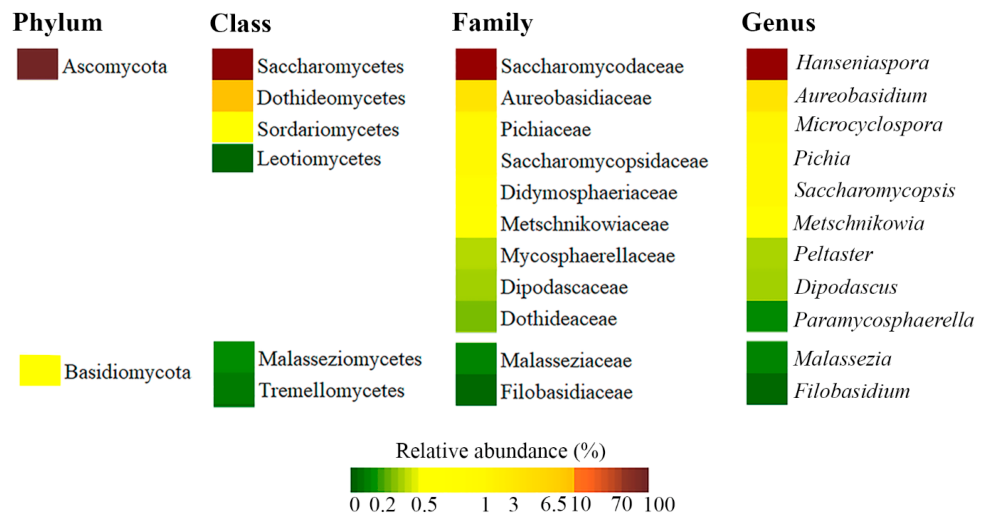
The fungal community was dominated by the phylum Ascomycota, which accounted for 99% of the total number of all sequences detected (Figure 1, Table S1). Basidiomycota contributed 0.5%, while Chytridiomycota and unclassified taxa comprised 0.01% and 0.4%, respectively. Ascomycota sequences were largely identified as members of the two classes: Saccharomycetes (91.77%) and Dothideomycetes (6.53%). Within Basidiomycota, Malasseziomycetes was the most abundant class with a relative abundance of 0.19%, followed by Tremellomycetes (0.17%). At the family level, Saccharomycodaceae were the most abundant (88.43%), followed by Aureobasidiaceae (3.18%), Pichiaceae (1.14%), Saccharomycopsidaceae (1.12%). At the genus level, the fungal microorganisms were mainly represented by the fermentative Hanseniaspora (88.43%), followed by the oxidative yeast-like Aureobasidium (3.18%). Other genera represented a limited portion of the detected fungal populations: Microcyclospora (1.38%), Pichia (1.14%), Saccharomycopsis (1.12%), Metschnikowia (0.62%), etc.

3.2. Diversity of Cultivable Yeasts Recovered on Pears

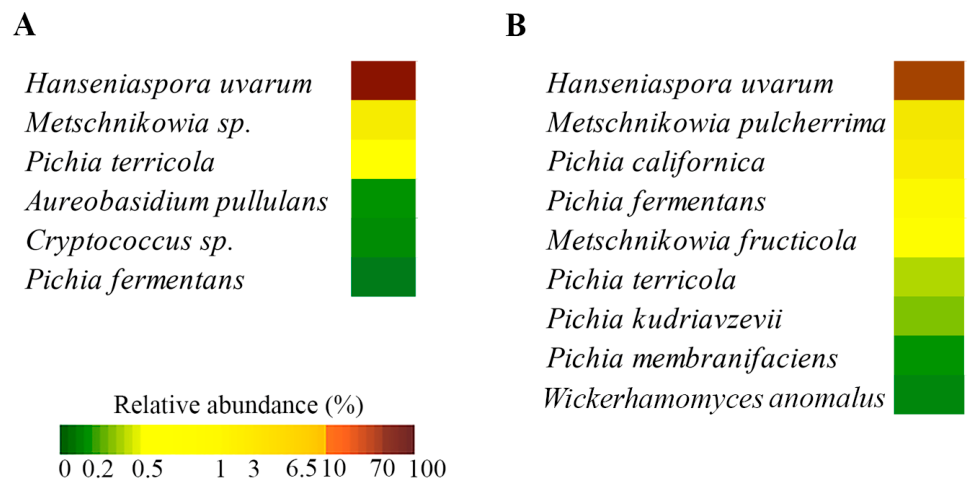
The viable yeast population in the carposphere of overripe pears was 6.25 ± 0.29 log CFU/g. Representatives of morphologically distinct colonies were selected and applied for molecular identification (Figure 2A). Based on the ITS region sequencing data, 6 yeast genera were determined. The cultivable community was dominated by H. uvarum, which accounted for 89% of the pear-inhabiting cultivable yeast population, followed by Metschnikowia sp. (9%) and P. terricola (1.2%). Aureobasidium pullulans (0.29%), Cryptococcus sp. (0.24%), and P. fermentans (0.13%) were detected in low amounts.
The application of spontaneous fermenting conditions for 15 days encouraged the growth of yeasts belonging to 3 genera: Hanseniaspora sp., Metschnikowia sp., and Pichia sp. (Figure 2B). Among them, H. uvarum and M. pulcherrima were detected as dominating species (73.07% and 11.0%, respectively), similar to those on the pear surface. The relative abundance of Pichia spp. increased to 13.83%, including P. californica, P. fermentans, P. terricola, P. kudriavzevii, P. membranifaciens, and W. anomalus. M. fructicola accounted for 2.08%, while yeasts belonging to Cryptococcus spp. and A. pullulans were not detected. The sequences of the representatives of each taxonomic unit were deposited in the National Center for Biotechnology Information (NCBI) database: H. uvarum 6-46 (PZ274839), M. fructicola 6-20 (PZ274787), M. pulcherrima 6-39 (PZ274788), Pichia fermentans 4-36.1 (PZ274840), Pichia terricola 4-4 (PZ274838), Pichia kudriavzevii 7-35 (PZ274842), Pichia membranifaciens 7-63 (PZ274843), Pichia californica 7-36 (PZ274841), and Wickerhamomyces anomalus 6-39.3 (PZ274844).
To demonstrate how identified yeast species phylogenetically correlate and correspond to their respective taxa, Maximum Likelihood trees were generated using the D1/D2 domain for Metschnikowia and the ITS region for Pichia and Hanseniaspora (Figure S1). The phylogenetic analysis yielded high bootstrap values, enabling us to identify clades that clearly correspond to the respective yeast species. M. fructicola and M. pulcherrima were shown as closely related and belonging to the same clade (Figure S1A). Based on the 28S rRNA gene sequence, the M. fructicola isolate (PZ274787) was grouped with others M. fructicola strains and showed belonging to this species. The M. pulcherrima (PZ274788) isolate was closely related to other M. pulcherrima strains. The phylogenetic tree of Pichia and Hanseniaspora formed two distinct groups (Figure S1B). P. terricola, P. membranifaciens, P. fermentans, P. californica, and P. kudriavzevii were placed in the same cluster by grouping with other sequences of particular species with a maximum support. Based on sequence similarity W. anomalus together with H. uvarum comprised second cluster forming two branches—one corresponding to W. anomalus and second—to H. uvarum. Phylogenetic analysis confirmed the taxonomic identity of the isolates in BLASTN and demonstrated that the strains used in subsequent experiments represent phylogenetically distinct yeast species associated with pear environments.

3.3. Characterization of Yeast Isolates

From spontaneous fermentation of pears, selected H. uvarum 6-46, M. pulcherrima 6-39, M. fructicola 6-20, P. fermentans 4-36.1, P. terricola 4-4, P. kudriavzevii 7-35, P. membranifaciens 7-63, P. californica 7-36, and W. anomalus 6-39.3 yeast strains were tested for killer phenotype against the sensitive S. cerevisiae α′1 strain. Among all tested isolates, only M. fructicola showed a detectable inhibition zone (1.0 ± 0.1 mm). No inhibition was observed for the remaining yeast strains under the tested conditions. The lysis zone of control S. cerevisiae M437 strain was 3.0 ± 0.1 mm.
Growth kinetics differed markedly among the tested yeasts (Table 1). Before statistical comparison, the assumptions of one-way ANOVA were evaluated. Normality of residuals and homogeneity of variances were not rejected by the Shapiro–Wilk (p = 0.082) and Levene’s (p = 0.144) tests. Separate one-way ANOVA comparisons showed that H. uvarum 6-46 and P. fermentans 4-36.1 did not differ significantly in growth rate (p = 0.108), whereas all other pairwise comparisons were significant (p < 0.01) (Table S3).
H. uvarum exhibited the highest growth rate (0.313 ± 0.009 h−1), which was approximately 2.7-fold higher than that of P. terricola (0.114 ± 0.005 h−1) and 2.1-fold higher than M. fructicola (0.147 ± 0.001 h−1) (Table 1). P. fermentans also showed relatively rapid growth (0.277 ± 0.029 h−1), comparable to H. uvarum. These differences were reflected in generation times, with H. uvarum and P. fermentans exhibiting short generation times (~2.4–2.5 h), whereas M. fructicola and P. terricola required approximately two- to threefold longer periods (4.7–6.1 h) to complete a generation.

3.4. Yeast Cohabitation

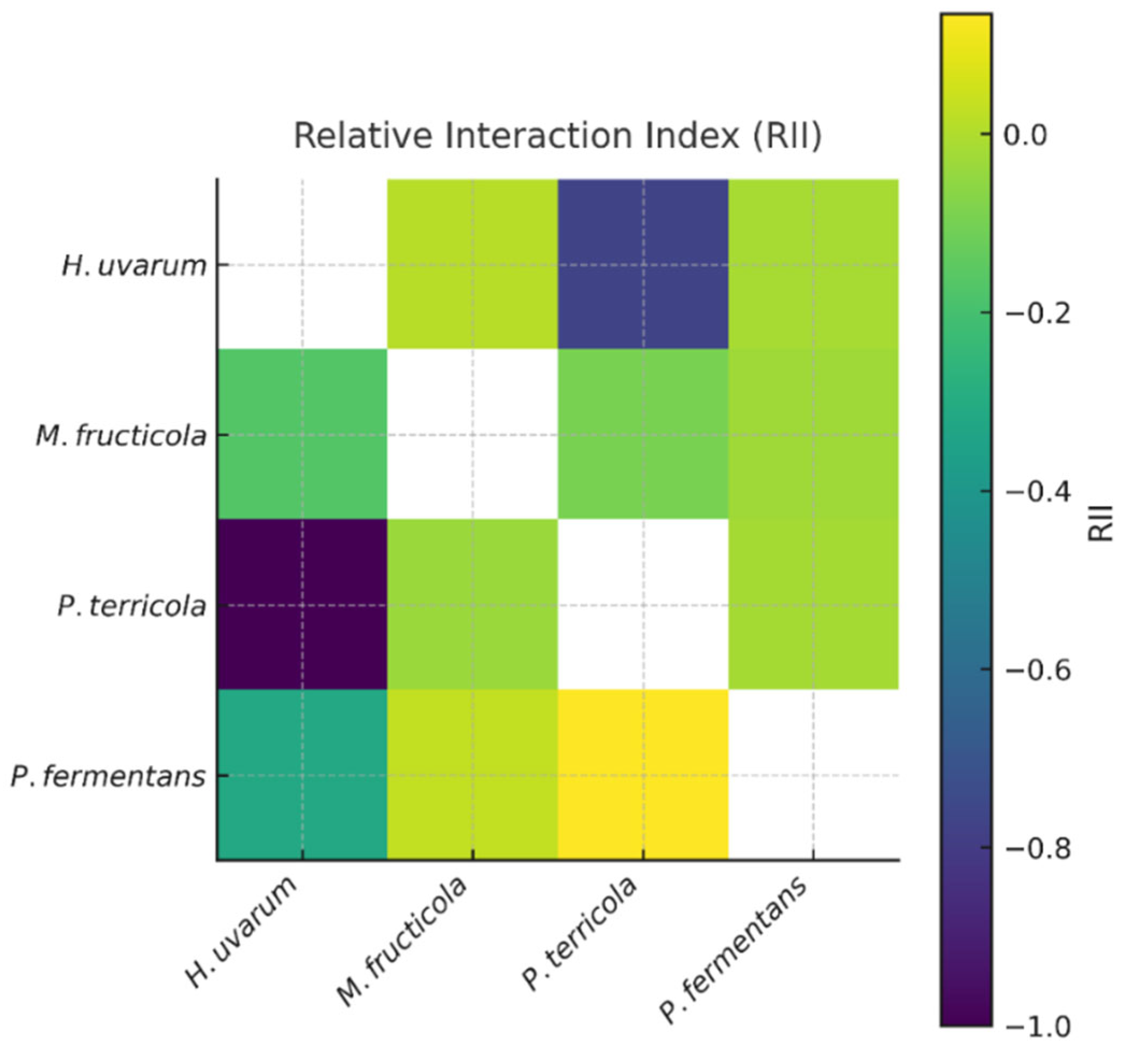
The Relative Interaction Index (RII) values, calculated from lg-transformed CFU abundances, were used to assess the nature of pairwise growth outcomes among four yeast species: H. uvarum 6-46, P. terricola 4-4, P. fermentans 4-36.1, and M. fructicola 6-20 (Figure 3, Table S2).
RII values range from −1 to +1, with values between −0.1 and +0.1 considered weak or neutral. Negative RII values indicate reduced growth or recovery in co-culture compared with monoculture, whereas positive values indicate increased growth or recovery in co-culture. The strongest negative outcome observed for P. terricola with co-culture with H. uvarum (RII = −1.000), while P. terricola also imposed a strong negative effect on H. uvarum (RII = −0.769). H. uvarum further exhibited moderate suppressive effects toward P. fermentans (RII = −0.315) and M. fructicola (RII = −0.169). In contrast, most remaining pairwise interactions were weak (RII < 0.1), indicating limited influence among these species. Positive RII values were observed for P. fermentans in co-culture with M. fructicola (RII = 0.032) and P. terricola (RII = 0.134).

3.5. Inhibition of S. aureus by M. fructicola in a Pear Juice Model System

To evaluate the biocontrol potential of yeast isolates in a food-relevant system such as pear juice, their inhibitory activity against Gram-positive (S. aureus and L. innocua) and Gram-negative (S. typhimurium) foodborne bacteria was tested. Among the tested isolates, only M. fructicola 6-20 exhibited inhibitory activity, forming clear inhibition zones. The strongest growth suppression was observed against S. aureus (3.0 ± 0.1 mm), followed by L. innocua (2.5 ± 0.1 mm) and S. typhimurium (2.4 ± 0.2 mm). Based on these observations, M. fructicola and S. aureus were selected for further co-culture analysis.
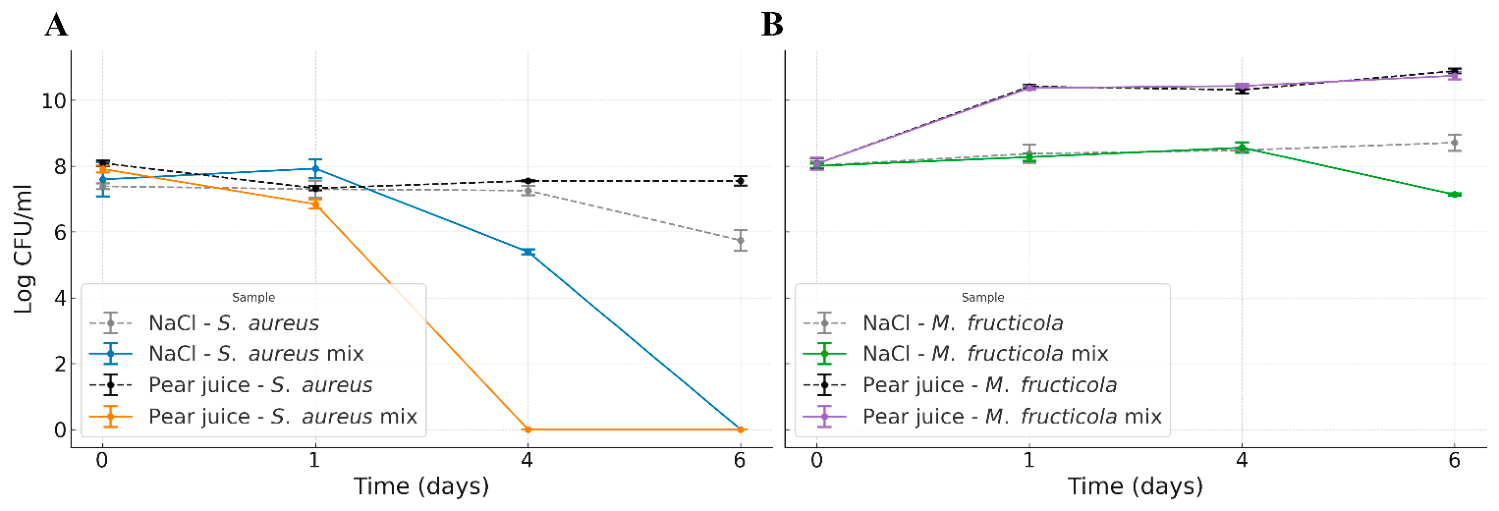
The interaction between M. fructicola and S. aureus was investigated in two systems: pear juice and 0.9% NaCl solution used as a control (Figure 4). Microbial abundance was monitored from day 0 to day 6 in monoculture and co-culture conditions.
In the NaCl solution, S. aureus levels in co-culture with M. fructicola decreased from 7.6 log CFU/mL on day 0 to approximately 5.4 log CFU/mL by day 4 and were no longer detectable by day 6 (Figure 4A). In contrast, S. aureus grown in monoculture remained stable throughout the entire incubation period. In pear juice, a more rapid decline was observed. S. aureus viability in co-culture markedly decreased after just one day, and the species became undetectable by day 4, while monoculture controls remained viable throughout.
M. fructicola remained viable under all tested conditions (Figure 4B). In NaCl, the number of cells showed a moderate increase in co-culture until day 4 (~6.5 log CFU/mL), followed by a decline to ~5.3 log CFU/mL by day 6. In pear juice, M. fructicola showed increased growth in both monoculture and co-culture, with higher final densities reached in co-culture conditions.

4. Discussion

The present study provides an integrated characterization of fungal communities inhabiting naturally overripe pears by combining ITS2-based amplicon sequencing, culture-dependent isolation, and functional interaction assays.
Reduced microbial diversity is characteristic of late-stage fruit, where high sugar availability, tissue damage, and microbial succession favor the proliferation of specific stress-adapted fungal species [13]. The fungal microbiota of overripe pears revealed that Ascomycota—particularly Saccharomycetes—overwhelmingly dominated, with H. uvarum representing nearly 90% of reads in this work. In other studies, focusing on the microbiomes of pears, Ascomycota has also been found to be the most abundant [11,13]. The prevalence of H. uvarum, sugar-fermenting yeasts, on the pear may be caused by juices diffusing from a damaged surface of mature fruit [37] and is mostly detected when fruits are in the mature phase. It has also been frequently found on the surface of different fruits such as plums, nectarines, apples, sea buckthorns, grapes, etc. [16,38,39]. Another study showed that Metschnikowia, representatives of Saccharomycetales, and Filobasidium are the predominant on development and maturation stages of pear fruits and leaves [11]. The fungal microbiota also differed depending on the storage duration of organic and conventional pears. At the beginning of storage, the genera Alternaria and Filobasidium were predominant in both types of fruit. Later, Fusarium and Starmerella dominated in organic fruit, while Meyerozyma was abundant in the conventionally grown fruit [12]. Alternaria overwhelmingly dominated on the pear samples stored at 4 °C for 4 months [13]. There is no direct evidence that pear cultivar affects the composition of the microbiota. The cultivar may affect the nutritional composition of the fruit, especially the content of polyphenols, sugars, and fiber, which may influence the diversity of microorganisms inhabiting fruit, but further research is needed to prove it [40].
For a more detailed description of the fungal composition on pears, the cultivable yeasts were also examined. We found that overripe pears contain about 6 log CFU/g of fungal microorganisms, while the amount of fungal microorganisms in pears ready for consumption ranges from 3.8 × 10⁴ to 9.5 × 10⁴ CFU/g [41]. The abundance and diversity of microorganisms may depend on the fruit ripening stage. As in fungal microbiota, H. uvarum dominated among cultivable yeasts distributed on the surface of pears. M. pulcherrima and M. fructicola species were found in smaller quantities. The taxonomic division of these yeasts was based on D1/D2 sequence differences, and a phylogenetic analysis. However, differentiation of the Metschnikowia spp. yeasts is complicated using standard barcodes due to their high intragenomic diversity. Thus, for correct identification of their taxonomic positions more complex approach, including the use of secondary barcodes (e.g., actin (ACT1), β- tubulin II (TUB2), DNA- directed RNA polymerase II largest (RPB1) and second largest (RPB2) subunits, translational elongation factor 1α (TEF1), or calmodulin (CAM)) is required [42,43,44]. M. pulcherrima and M. fructicola are the most studied representatives of the Metschnikowia genus as biocontrol agents capable of suppressing many post-harvest and plant decay diseases caused by Penicillium digitatum, P. expansum, B. cinerea, etc. [21,45,46]. Metschnikowia and Hanseniaspora play an important role in spontaneous alcoholic fermentations and in enhancing the composition and aroma of alcoholic beverages [47]. After enrichment conditions, we also identified several Pichia species. Yeast isolates from the Pichia genus can control and promote the microbial community during beverage fermentation and are related to late-maturing fruits [48,49]. Other pear studies have shown that the cultivated fungal microorganisms were identified as Fusarium sp., Trichoderma sp., Phoma sp., Aspergillus sp. [11], A. pullulans, Cryptococcus sp., Rhodotorula glutinis, Sporobolomyces sp., M. pulcherrima, Hannaella luteola, Pichia sp., S. cerevisiae [24,50], etc. Thus, the culture-dependent approach recovered only part of the fungal microorganisms detected by ITS2 amplicon sequencing. Although Hanseniaspora dominated both datasets, several taxa detected by sequencing were absent or only weakly represented among the cultivable isolates. For example, Aureobasidium was recovered only at low abundance as A. pullulans, while Microcyclospora was not recovered under the applied cultivation conditions. Other taxa detected by ITS2 amplicon sequencing, including Saccharomycopsis and filamentous fungi such as Cladosporium and Alternaria, were also absent or underrepresented among the cultivable isolates. Such differences between sequencing- and cultivation-based approaches are expected because culture-independent approach allows us to detect a broader fungal community, including taxa that may not readily grow under laboratory conditions, whereas cultivation depends on the ability of microorganisms to grow on the selected medium and under the applied incubation conditions.
Yeast compatibility is usually tested to improve the starter composition of beverages such as beer and wine. S. cerevisiae, S. bayanus, and S. pastorianus are widely used in the fermentation process [51], but also there are some other useful non-Saccharomyces yeasts such as Torulaspora delbrueckii, Zygosaccharomyces bailii, Lachancea thermotolerans, H. uvarum, P. fermentans, which improve taste and odour, and can be used in low-alcohol beverages [52]. In this work, we analyzed compatibility of selected yeasts inhabiting pears. H. uvarum grew faster than P. terricola, P. fermentans, and M. fructicola. A similar tendency was also observed when comparing the growth of H. uvarum with that of S. cerevisiae [53]. Since P. terricola grew significantly slower than H. uvarum, P. terricola was almost eliminated during coexistence. Despite slow growth, M. fructicola did not succumb to the influence of H. uvarum. This can be explained by the fact that M. fructicola can produce pulcherrimin or other bioactive compounds important for biocontrol [21]. Although growth was inhibited in most cases of our tested yeast coexistence, the pairing of P. fermentans and P. terricola stood out from the others in terms of P. terricola growth promotion.
In this work, M. fructicola has been used as a potential biocidal yeast to combat S. aureus bacteria in physiological solution and controlled pear juice model. This bacterium is an important foodborne pathogen associated with food poisoning and thus being dangerous to human health [54,55]. It has previously been established that several Metschnikowia species like M. pulcherrima, M. fructicola, M. ziziphicola, M. chrysoperlae have an antagonistic effect on S. aureus under laboratory conditions [56,57,58]. Because M. fructicola showed weaker in vitro effects against L. innocua and S. typhimurium, S. aureus was selected for further co-culture analysis. Pear juice was used as a pear-derived model system that retains soluble fruit nutrients while allowing controlled monitoring of yeast–bacterium interactions without the additional variability introduced by fruit surface heterogeneity. Thus, the inhibitory effects observed in liquid co-culture still need to be validated on intact fruit, under storage conditions, or within mixed microbial communities. M. fructicola demonstrates a strong inhibitory effect on S. aureus, depending on the growth medium and time in both NaCl solution and pear juice, while monocultures remain stable. M. fructicola maintained viability and, particularly in pear juice, exhibited enhanced growth in co-culture, suggesting a competitive advantage or adaptive response in the presence of S. aureus. The most substantial population shifts occurred at later incubation stages, especially on day 4 in pear juice and on day 6 in NaCl, highlighting the dynamic nature of the interaction and the potential of M. fructicola to outcompete or inhibit S. aureus under these conditions. M. fructicola can produce pulcherrimin, which chelates ferric iron [21]. Iron limitation may contribute to antibacterial effects because S. aureus requires iron for respiration, metabolism, and virulence regulation [59]. However, the mechanism responsible for the reduction of S. aureus in the present assay was not directly tested and requires further investigation. There are many studies on the use of M. pulcherrima as a biocontrol agent in food protection, for example, postharvest decay of citrus, grapes, mango, and other fruits [21,60,61,62]. M. fructicola is used less frequently than M. pulcherrima in biocontrol applications, but it also can prevent pathogens that emerge during harvest or reduce their prevalence [46,63,64]. Biocontrol properties of M. fructicola were demonstrated against Penicillium fungi on lemons and apples, B. cinerea on grapes, etc. [65,66,67]. M. fructicola can be applied in winemaking together with S. cerevisiae as starting fermenters to improve the aroma and bioprotection of wine [68,69]. We expanded the spectrum of research on M. fructicola in food products and demonstrated their antibacterial activity against potentially pathogenic S. aureus bacteria in pear juice. Most studies focus on Metschnikowia yeast’s ability to inhibit the growth of the molds and rots [63,70]. However, there are more yeasts with biocontrol properties, for instance, Hanseniaspora opuntiae isolated from figs is active against Penicillium expansum and Cladosporium cladosporioides [71], Pichia guilliermondii, Candida musae, Issatchenkia orientalis, Candida quercitrusa isolated from Thai fruits are antagonistic to Colletotrichum capsica [72], A. pullulans from citrus fruits is active against Aspergillus flavus, Aspergillus niger [73], etc.
Our investigation provides insight into the dynamics of yeast populations and their potential roles in fruit quality, spontaneous fermentation processes, and the progression of spoilage. These findings can contribute to a broader understanding of the complex relationships between fruit host and their resident fungal microflora, including both pathogenic and beneficial species.

5. Conclusions

This exploratory study characterized fungal microorganisms distributed in the carposphere of overripe pears. ITS2 amplicon sequencing showed a low-diversity fungal community dominated by Hanseniaspora, making up about 90% of the total yeast population, followed by Aureobasidium and Microcyclospora. H. uvarum also dominated among cultivable yeasts, with Metschnikowia sp. and Pichia sp. also becoming apparent. The coexistences and growth rates of H. uvarum, M. fructicola, P. terricola, and P. fermentans showed that the fast-growing H. uvarum suppresses slower-growing species. H. uvarum completely inhibited P. terricola and exhibited moderate suppressive effects toward P. fermentans and M. fructicola. M. fructicola demonstrated antibacterial properties against S. aureus, L. innocua and S. typhimurium in vitro. M. fructicola possessed the strongest activity toward S. aureus and was able to inhibit the growth of this pathogen in controlled pear juice conditions.

Supplementary Materials

The following supporting information can be downloaded at https://www.mdpi.com/article/10.3390/agriculture16121259/s1. Figure S1: Phylogenetic trees of Metschnikowia sp. (A), Pichia sp., Wickerhamomyces sp. and Hanseniaspora sp. (B). The yeast sequences from this study are underlined; Table S1: Yeast taxonomy abundance count of pears samples from phylum to species level, Table S2: Relative Interaction Index (RII) for each yeast strain in a pair. Table S3: Summary of normality, homogeneity of variance, and ANOVA tests for microbial strain comparisons.

Author Contributions

Conceptualization, I.V.-M., J.L.-Ž. and E.S.; methodology, I.V.-M., J.L.-Ž., R.S., Ž.S.-Ž. and E.S.; software, J.L.-Ž.; validation, I.V.-M., J.L.-Ž., R.S. and Ž.S.-Ž.; formal analysis, I.V.-M., J.L.-Ž., R.S., Ž.S.-Ž. and E.S.; investigation, I.V.-M., J.L.-Ž., R.S. and Ž.S.-Ž.; resources, E.S.; data curation, E.S.; writing—original draft preparation, I.V.-M., J.L.-Ž., Ž.S.-Ž. and E.S.; writing—review and editing, I.V.-M., J.L.-Ž., Ž.S.-Ž. and E.S.; visualization, I.V.-M., J.L.-Ž. and Ž.S.-Ž.; supervision, E.S. All authors have read and agreed to the published version of the manuscript.

Funding

This research received no external funding.

Data Availability Statement

Data supporting the conclusions of this article are included in the article. The sequences generated in the present study were submitted to the GenBank database under Accession Numbers PZ274787, PZ274788, PZ274838-PZ274844. The raw sequence data are available in the NCBI Short Read Archive (accession PRJNA1455531).

Acknowledgments

The performed studies are in frame with research networking of COST Action MiCropBiomes CA22158.

Conflicts of Interest

The authors declare no conflicts of interest.

References

  1. Yamamoto, T.; Terakami, S. Genomics of Pear and Other Rosaceae Fruit Trees. Breed. Sci. 2016, 66, 148–159. [Google Scholar] [CrossRef] [PubMed]
  2. FAOSTAT. FAOSTAT Statistical Data. Rome: Food and Agriculture Organization of the United Nations. 2020. Available online: https://www.fao.org/faostat (accessed on 12 December 2025).
  3. Reiland, H.; Slavin, J. Systematic Review of Pears and Health. Nutr. Today 2015, 50, 301–305. [Google Scholar] [CrossRef] [PubMed]
  4. Du, K.; Yuan, F.; Huo, M.; Mao, N.; Zhao, S.; Yang, X.; Sang, Y.; Tian, G. Nutrients, Bioactives, Health-Promoting Effects, and Related Products of Pears: Different Varieties, Growth Stages and Parts. J. Funct. Foods 2025, 12, 106844. [Google Scholar] [CrossRef]
  5. Vadkertiová, R.; Molnárová, J.; Vránová, D.; Sláviková, E. Yeasts and Yeast-like Organisms Associated with Fruits and Blossoms of Different Fruit Trees. Can. J. Microbiol. 2012, 58, 1344–1352. [Google Scholar] [CrossRef]
  6. Stanevičienė, R.; Lukša, J.; Strazdaitė-Žielienė, Ž.; Ravoitytė, B.; Losinska-Sičiūnienė, R.; Mozūraitis, R.; Servienė, E. Mycobiota in the Carposphere of Sour and Sweet Cherries and Antagonistic Features of Potential Biocontrol Yeasts. Microorganisms 2021, 9, 1423. [Google Scholar] [CrossRef]
  7. Martínez-Alonso, M.; Escolano, J. Diversity of the Bacterial Community in the Surface Soil of a Pear Orchard Based on 16S rRNA Gene Analysis. Int. Microbiol. 2010, 13, 123–134. [Google Scholar] [CrossRef]
  8. Zambounis, A.; Osathanunkul, M.; Madesis, P. Metagenome Data of Bacterial Diversity in Pear (Pyrus communis L.) Rhizospheres Associated with Phytophthora Infection and Amino Acid Treatment. Data Brief 2019, 26, 104396. [Google Scholar] [CrossRef]
  9. Ren, F.; Dong, W.; Yan, D.-H. Endophytic Bacterial Communities of Jingbai Pear Trees in North China Analyzed with Illumina Sequencing of 16S rDNA. Arch. Microbiol. 2019, 201, 199–208. [Google Scholar] [CrossRef]
  10. Jia, B.; Chang, X.; Fu, Y.; Heng, W.; Ye, Z.; Liu, P.; Liu, L.; Al Shoffe, Y.; Watkins, C.B.; Zhu, L. Metagenomic Analysis of Rhizosphere Microbiome Provides Insights into Occurrence of Iron Deficiency Chlorosis in Field of Asian Pears. BMC Microbiol. 2022, 22, 18. [Google Scholar] [CrossRef]
  11. Janakiev, T.; Berić, T.; Stević, T.; Stanković, S.; Bačić, J.; Majstorović, H.; Fira, D.; Dimkić, I. The Microbiome of the ‘Williams’ Pear Variety Grown in the Organic Orchard and Antifungal Activity by the Autochthonous Bacterial and Yeast Isolates. Microorganisms 2022, 10, 1282. [Google Scholar] [CrossRef] [PubMed]
  12. Gao, Q.; Zhang, Y.; Gao, C.; Li, H.; Cheng, Y.; Qian, X.; Zhang, L.; Liu, J.; Ogunyemi, S.O.; Guan, J. The Microbial Diversity in Relation to Postharvest Quality and Decay: Organic vs. Conventional Pear Fruit. Foods 2023, 12, 1980. [Google Scholar] [CrossRef] [PubMed]
  13. Hou, Y.; Zhang, X.; Gao, Z.; Chen, T.; Zhang, L. Relationships between Fungal Diversity and Fruit Quality of Yuluxiang Pear during Low Temperature Storage. Front. Microbiol. 2023, 14, 1132271. [Google Scholar] [CrossRef]
  14. Handa, A.K.; Tiznado-Hernández, M.E.; Mattoo, A.K. Fruit Development and Ripening: A Molecular Perspective. In Plant Biotechnology and Agriculture: Prospects for the 21st Century; Elsevier: Amsterdam, The Netherlands, 2011; pp. 405–424. [Google Scholar]
  15. Sarma, B.; Das, K.; Bora, S.S. Physiology of Fruit Development. Int. J. Curr. Microbiol. Appl. Sci. 2020, 9, 504–521. [Google Scholar] [CrossRef]
  16. Janisiewicz, W.J.; Jurick, W.M.; Peter, K.A.; Kurtzman, C.P.; Buyer, J.S. Yeasts Associated with Plums and Their Potential for Controlling Brown Rot after Harvest: Plum Yeasts. Yeast 2014, 31, 207–218. [Google Scholar] [CrossRef]
  17. Kheireddine, A.; Essghaier, B.; Hedi, A.; Dhieb, C.; Sadfi-Zouaoui, N. New Epiphytic Yeasts Able to Reduce Grey Mold Disease on Apples. Plant Prot. Sci. 2018, 54, 248–257. [Google Scholar] [CrossRef]
  18. Taqarort, N.; Echairi, A.; Chaussod, R.; Nouaim, R.; Boubaker, H.; Benaoumar, A.A.; Boudyach, E. Screening and Identification of Epiphytic Yeasts with Potential for Biological Control of Green Mold of Citrus Fruits. World J. Microbiol. Biotechnol. 2008, 24, 3031–3038. [Google Scholar] [CrossRef]
  19. Vepštaitė-Monstavičė, I.; Lukša-Žebelovič, J.; Apšegaitė, V.; Mozūraitis, R.; Lisicinas, R.; Stanevičienė, R.; Blažytė-Čereškienė, L.; Serva, S.; Servienė, E. Profiles of Killer Systems and Volatile Organic Compounds of Rowanberry and Rosehip-Inhabiting Yeasts Substantiate Implications for Biocontrol. Foods 2025, 14, 288. [Google Scholar] [CrossRef]
  20. Di Canito, A.; Mateo-Vargas, M.A.; Mazzieri, M.; Cantoral, J.; Foschino, R.; Cordero-Bueso, G.; Vigentini, I. The Role of Yeasts as Biocontrol Agents for Pathogenic Fungi on Postharvest Grapes: A Review. Foods 2021, 10, 1650. [Google Scholar] [CrossRef]
  21. Sipiczki, M. Metschnikowia Pulcherrima and Related Pulcherrimin-Producing Yeasts: Fuzzy Species Boundaries and Complex Antimicrobial Antagonism. Microorganisms 2020, 8, 1029. [Google Scholar] [CrossRef]
  22. Liu, H.M.; Guo, J.H.; Cheng, Y.J.; Luo, L.; Liu, P.; Wang, B.Q.; Deng, B.X.; Long, C.A. Control of Gray Mold of Grape by Hanseniaspora Uvarum and Its Effects on Postharvest Quality Parameters. Ann. Microbiol. 2010, 60, 31–35. [Google Scholar] [CrossRef]
  23. Lutz, M.C.; Lopes, C.A.; Rodriguez, M.E.; Sosa, M.C.; Sangorrín, M.P. Efficacy and putative mode of action of native and commercial antagonistic yeasts against postharvest pathogens of pear. Int. J. Food Microbiol. 2013, 164, 166–172. [Google Scholar] [CrossRef]
  24. Volschenk, Q.; du Plessis, E.M.; Duvenage, F.J.; Korsten, L. Effect of Postharvest Practices on the Culturable Filamentous Fungi and Yeast Microbiota Associated with the Pear Carpoplane. Postharvest Biol. Technol. 2016, 118, 87–95. [Google Scholar] [CrossRef]
  25. Kraková, L.; Šoltys, K.; Otlewska, A.; Pietrzak, K.; Purkrtová, S.; Savická, D.; Puškárová, A.; Bučková, M.; Szemes, T.; Budiš, J.; et al. Comparison of Methods for Identification of Microbial Communities in Book Collections: Culture-Dependent (Sequencing and MALDI-TOF MS) and Culture-Independent (Illumina MiSeq). Int. Biodeterior. Biodegrad. 2018, 131, 51–59. [Google Scholar] [CrossRef]
  26. Wenneker, M.; Pham, K.T.K.; Lemmers, M.E.C.; De Boer, F.A.; Van Leeuwen, P.J.; Hollinger, T.C.; Groenenboom-de Haas, B.H.; Köhl, J. First Report of Cadophora luteoolivacea Causing Side Rot on ‘Conference’ Pears in the Netherlands. Plant Dis. 2016, 100, 2162. [Google Scholar] [CrossRef]
  27. Santander, R.D.; Català-Senent, J.F.; Figàs-Segura, À.; Biosca, E.G. From the Roots to the Stem: Unveiling Pear Root Colonization and Infection Pathways by Erwinia Amylovora. FEMS Microbiol. Ecol. 2020, 96, fiaa210. [Google Scholar] [CrossRef]
  28. Sanchez, A.D.; Ousset, M.J.; Sosa, M.C. Biological Control of Phytophthora Collar Rot of Pear Using Regional Trichoderma Strains with Multiple Mechanisms. Biol. Control 2019, 135, 124–134. [Google Scholar] [CrossRef]
  29. Dedenaro, G.; Costa, S.; Rugiero, I.; Pedrini, P.; Tamburini, E. Valorization of Agri-Food Waste via Fermentation: Production of l-Lactic Acid as a Building Block for the Synthesis of Biopolymers. Appl. Sci. 2016, 6, 379. [Google Scholar] [CrossRef]
  30. Martin, M. Cutadapt Removes Adapter Sequences from High-Throughput Sequencing Reads. EMBnet J. 2011, 17, 10. [Google Scholar] [CrossRef]
  31. Abarenkov, K.; Henrik Nilsson, R.; Larsson, K.; Alexander, I.J.; Eberhardt, U.; Erland, S.; Høiland, K.; Kjøller, R.; Larsson, E.; Pennanen, T.; et al. The UNITE Database for Molecular Identification of Fungi—Recent Updates and Future Perspectives. New Phytol. 2010, 186, 281–285. [Google Scholar] [CrossRef] [PubMed]
  32. Hall, B.G. Building Phylogenetic Trees from Molecular Data with MEGA. Mol. Biol. Evol. 2013, 30, 1229–1235. [Google Scholar] [CrossRef]
  33. Gulbiniene, G.; Kondratiene, L.; Jokantaite, T.; Serviene, E.; Melvydas, V.; Petkuniene, G. Killer Yeast Strains in Wine Yeast Population. Food Technol. Biotechnol. 2004, 42, 159–163. [Google Scholar]
  34. Harris, C.R.; Millman, K.J.; Van Der Walt, S.J.; Gommers, R.; Virtanen, P.; Cournapeau, D.; Wieser, E.; Taylor, J.; Berg, S.; Smith, N.J.; et al. Array Programming with NumPy. Nature 2020, 585, 357–362. [Google Scholar] [CrossRef]
  35. McKinney, W. Data Structures for Statistical Computing in Python. In Proceedings of the 9th Python in Science Conference, Austin, TX, USA, 28 June–3 July 2010; pp. 56–61. [Google Scholar]
  36. Armas, C.; Ordiales, R.; Pugnaire, F.I. Measuring plant interactions: A new comparative index. Ecology 2004, 85, 2682–2686. [Google Scholar] [CrossRef]
  37. Barata, A.; Malfeito-Ferreira, M.; Loureiro, V. The Microbial Ecology of Wine Grape Berries. Int. J. Food Microbiol. 2012, 153, 243–259. [Google Scholar] [CrossRef] [PubMed]
  38. Lukša, J.; Vepštaitė-Monstavičė, I.; Yurchenko, V.; Serva, S.; Servienė, E. High Content Analysis of Sea Buckthorn, Black Chokeberry, Red and White Currants Microbiota—A Pilot Study. Food Res. Int. 2018, 111, 597–606. [Google Scholar] [CrossRef] [PubMed]
  39. Graça, A.; Santo, D.; Esteves, E.; Nunes, C.; Abadias, M.; Quintas, C. Evaluation of Microbial Quality and Yeast Diversity in Fresh-Cut Apple. Food Microbiol. 2015, 51, 179–185. [Google Scholar] [CrossRef] [PubMed]
  40. Pulela, B.L.; Maboko, M.M.; Soundy, P.; Amoo, S.O. Cultivar and Postharvest Storage Duration Influence Fruit Quality, Nutritional and Phytochemical Profiles of Soilless-Grown Cantaloupe and Honeydew Melons. Plants 2022, 11, 2136. [Google Scholar] [CrossRef]
  41. Afroz, H.; Ahmed, T.; Uddin, M.A. Microbiological Analysis and Antibacterial Activity of Pear Samples. Stamford J. Microbiol. 2016, 5, 1–4. [Google Scholar] [CrossRef]
  42. Sipiczki, M.; Czentye, K.; Kállai, Z. High Intragenomic, Intergenomic, and Phenotypic Diversity in Pulcherrimin-Producing Metschnikowia Yeasts Indicates a Special Mode of Genome Evolution. Sci. Rep. 2024, 14, 10521. [Google Scholar] [CrossRef]
  43. Sipiczki, M. Taxonomic Revision of the Pulcherrima Clade of Metschnikowia (Fungi): Merger of Species. Taxonomy 2022, 2, 107–123. [Google Scholar] [CrossRef]
  44. Sipiczki, M. When Barcoding Fails: Genome Chimerization (Admixing) and Reticulation Obscure Phylogenetic and Taxonomic Relationships. Mol. Ecol. Resour. 2022, 22, 1762–1785. [Google Scholar] [CrossRef]
  45. Freimoser, F.M.; Rueda-Mejia, M.P.; Tilocca, B.; Migheli, Q. Biocontrol Yeasts: Mechanisms and Applications. World J. Microbiol. Biotechnol. 2019, 35, 154. [Google Scholar] [CrossRef]
  46. Piombo, E.; Sela, N.; Wisniewski, M.; Hoffmann, M.; Gullino, M.L.; Allard, M.W.; Levin, E.; Spadaro, D.; Droby, S. Genome Sequence, Assembly and Characterization of Two Metschnikowia Fructicola Strains Used as Biocontrol Agents of Postharvest Diseases. Front. Microbiol. 2018, 9, 593. [Google Scholar] [CrossRef] [PubMed]
  47. Gschaedler, A. Contribution of Non-Conventional Yeasts in Alcoholic Beverages. Curr. Opin. Food Sci. 2017, 13, 73–77. [Google Scholar] [CrossRef]
  48. Zhang, H.; Wang, L.; Tan, Y.; Wang, H.; Yang, F.; Chen, L.; Hao, F.; Lv, X.; Du, H.; Xu, Y. Effect of Pichia on Shaping the Fermentation Microbial Community of Sauce-Flavor Baijiu. Int. J. Food Microbiol. 2021, 336, 108898. [Google Scholar] [CrossRef]
  49. Zhu, H.Y.; Guo, L.C.; Hu, S.; Wei, Y.H.; Hui, F.L.; Liu, X.Z.; Bai, F.Y. Pichia kurtzmaniana f.a. sp. Nov., with the Transfer of Eight Candida Species to Pichia. Int. J. Syst. Evol. Microbiol. 2024, 74, 006306. [Google Scholar] [CrossRef] [PubMed]
  50. Robiglio, A.; Sosa, M.C.; Lutz, M.C.; Lopes, C.A.; Sangorrín, M.P. Yeast Biocontrol of Fungal Spoilage of Pears Stored at Low Temperature. Int. J. Food Microbiol. 2011, 147, 211–216. [Google Scholar] [CrossRef] [PubMed]
  51. Mathias Hutzler, D.-I.; Jennifer Koob, D.-I.; Robert Riedl, D.-I.; Fritz Jacob, D.-I.; Hutzler, M.; Riedl, R.; Koob, J.; Jacob, F. Fermentation and Spoilage Yeasts and Their Relevance for the Beverage Industry—A Review. Brew. Sci. 2012, 65, 33–52. [Google Scholar]
  52. Qin, X.; Li, F.; Bo, W.; Li, W.; Dong, X. The Non-Saccharomyces Yeasts as Novel Starter Cultures to Innovate Beer Brewing. CyTA—J. Food 2025, 23, 2459819. [Google Scholar] [CrossRef]
  53. Onetto, C.A.; McCarthy, J.; Schmidt, S.A. A Rapid Growth Rate Underpins the Dominance of Hanseniaspora uvarum in Spontaneous Grape Juice Fermentations. Yeast 2025, 42, 116–125. [Google Scholar] [CrossRef]
  54. Kadariya, J.; Smith, T.C.; Thapaliya, D. Staphylococcus aureus and Staphylococcal Food-Borne Disease: An Ongoing Challenge in Public Health. BioMed Res. Int. 2014, 2014, 827965. [Google Scholar] [CrossRef]
  55. Bencardino, D.; Amagliani, G.; Brandi, G. Carriage of Staphylococcus aureus among Food Handlers: An Ongoing Challenge in Public Health. Food Control 2021, 130, 108362. [Google Scholar] [CrossRef]
  56. Agarbati, A.; Canonico, L.; Marini, E.; Zannini, E.; Ciani, M.; Comitini, F. Potential Probiotic Yeasts Sourced from Natural Environmental and Spontaneous Processed Foods. Foods 2020, 9, 287. [Google Scholar] [CrossRef]
  57. Machado, R.; Caro, A.; Hurtado-Murillo, C.M.; Gomes, J.J.; Lobo, C.J.; Zúñiga, R.N.; Machado, A.R.; Caro, C.M.; Hurtado-Murillo, J.J.; Gomes Lobo, C.J.; et al. Unconventional Yeasts Isolated from Chilean Honey: A Probiotic and Phenotypic Characterization. Foods 2024, 13, 1582. [Google Scholar] [CrossRef]
  58. Lapinskaitė, V.; Bartkutė, P.; Lukša-Žebelovič, J.; Strazdaitė-Žielienė, Ž.; Servienė, E. Diversity and Functional Potential of Yeasts Inhabiting Honey Bee Drones. Microorganisms 2025, 13, 2614. [Google Scholar] [CrossRef]
  59. Ledala, N.; Zhang, B.; Seravalli, J.; Powers, R.; Somerville, G.A. Influence of Iron and Aeration on Staphylococcus aureus Growth, Metabolism, and Transcription. J. Bacteriol. 2014, 196, 2178–2189. [Google Scholar] [CrossRef]
  60. Tian, Y.Q.; Li, W.; Jiang, Z.T.; Jing, M.M.; Shao, Y.Z. The Preservation Effect of Metschnikowia Pulcherrima Yeast on Anthracnose of Postharvest Mango Fruits and the Possible Mechanism. Food Sci. Biotechnol. 2018, 27, 95–105. [Google Scholar] [CrossRef]
  61. Kinay, P.; Yildiz, M. The Shelf Life and Effectiveness of Granular Formulations of Metschnikowia Pulcherrima and Pichia Guilliermondii Yeast Isolates That Control Postharvest Decay of Citrus Fruit. Biol. Control 2008, 45, 433–440. [Google Scholar] [CrossRef]
  62. Liu, J.; Rygała, A.; Zhang, B.; Kręgiel, D. Potential of Metschnikowia Yeasts in Green Applications: A Review. Front. Microbiol. 2025, 16, 1652494. [Google Scholar] [CrossRef]
  63. Kurtzman, C.P.; Droby, S. Metschnikowia Fructicola, a New Ascosporic Yeast with Potential for Biocontrol of Postharvest Fruit Rots. Syst. Appl. Microbiol. 2001, 24, 395–399. [Google Scholar] [CrossRef]
  64. Karabulut, O.A.; Smilanick, J.L.; Gabler, M.; Mansour, M. Near-Harvest Applications of Metschnikowia Fructicola, Ethanol, and Sodium Bicarbonate to Control Postharvest Diseases of Grape in Central California. Plant Dis. 2003, 87, 1384–1389. [Google Scholar] [CrossRef]
  65. Oztekin, S.; Karbancioglu-Guler, F. Bioprospection of Metschnikowia Sp. Isolates as Biocontrol Agents against Postharvest Fungal Decays on Lemons with Their Potential Modes of Action. Postharvest Biol. Technol. 2021, 181, 111634. [Google Scholar] [CrossRef]
  66. Oztekin, S.; Karbancioglu-Guler, F. Recruiting Grape-isolated Antagonistic Yeasts for the Sustainable Bio-management of Botrytis Cinerea on Grapes. Food Energy Secur. 2024, 13, e528. [Google Scholar] [CrossRef]
  67. Spadaro, D.; Lorè, A.; Garibaldi, A.; Gullino, M.L. A New Strain of Metschnikowia Fructicola for Postharvest Control of Penicillium Expansum and Patulin Accumulation on Four Cultivars of Apple. Postharvest Biol. Technol. 2013, 75, 1–8. [Google Scholar] [CrossRef]
  68. Boscaino, F.; Ionata, E.; La Cara, F.; Guerriero, S.; Marcolongo, L.; Sorrentino, A. Impact of Saccharomyces Cerevisiae and Metschnikowia Fructicola Autochthonous Mixed Starter on Aglianico Wine Volatile Compounds. J. Food Sci. Technol. 2019, 56, 4982–4991. [Google Scholar] [CrossRef]
  69. Haniffadli, A.; Ban, Y.; Rahmat, E.; Kang, C.H.; Kang, Y. Unforeseen Current and Future Benefits of Uncommon Yeast: The Metschnikowia Genus. Appl. Microbiol. Biotechnol. 2024, 108, 534. [Google Scholar] [CrossRef]
  70. Biasi, A.; Zhimo, V.Y.; Kumar, A.; Abdelfattah, A.; Salim, S.; Feygenberg, O.; Wisniewski, M.; Droby, S. Changes in the Fungal Community Assembly of Apple Fruit Following Postharvest Application of the Yeast Biocontrol Agent Metschnikowia Fructicola. Horticulturae 2021, 7, 360. [Google Scholar] [CrossRef]
  71. Ruiz-Moyano, S.; Martín, A.; Villalobos, M.C.; Calle, A.; Serradilla, M.J.; Córdoba, M.G.; Hernández, A. Yeasts Isolated from Figs (Ficus carica L.) as Biocontrol Agents of Postharvest Fruit Diseases. Food Microbiol. 2016, 57, 45–53. [Google Scholar] [CrossRef]
  72. Chanchaichaovivat, A.; Ruenwongsa, P.; Panijpan, B. Screening and Identification of Yeast Strains from Fruits and Vegetables: Potential for Biological Control of Postharvest Chilli Anthracnose (Colletotrichum capsici). Biol. Control 2007, 42, 326–335. [Google Scholar] [CrossRef]
  73. Sukmawati, D.; Family, N.; Hidayat, I.; Sayyed, R.; Elsayed, E.; Dailin, D.; Hanapi, S.; Wadaan, M.; Enshasy, H. Biocontrol Activity of Aureubasidium Pullulans and Candida Orthopsilosis Isolated from Tectona grandis L. Phylloplane against Aspergillus sp. in Post-Harvested Citrus Fruit. Sustainability 2021, 13, 7479. [Google Scholar] [CrossRef]
Figure 1. Fungal community distribution on pears at the phylum, class, family, and genus levels.
Agriculture 16 01259 g001
Figure 2. Viable fungal microorganisms distributed on the pear surface (A) and recovered from spontaneous fermentations of pear fruits (B). Relative abundance (%) (count within taxonomic group/total count × 100).
Agriculture 16 01259 g002
Figure 3. Heatmap of Relative Interaction Index values among the four yeast species. Negative values indicate reduced growth in co-culture compared to monoculture, while positive values represent increased growth.
Agriculture 16 01259 g003
Figure 4. Growth dynamics of S. aureus and M. fructicola in monoculture and co-culture in pear juice and NaCl solution. (A)—Growth of S. aureus. (B)—Growth of M. fructicola. “Mix” indicates the co-culture of both species. Data are shown as mean log CFU/mL ± SD (n = 3).
Agriculture 16 01259 g004
Table 1. Growth rate and generation time of yeasts. The values are means from the three measurements. Variability is shown as SD and CV%.
Yeast StrainGrowth Rate ± SD, h−1CV, %Generation Time ± SD, hCV, %
H. uvarum 6-46 0.313 ± 0.0092.882.218 ± 0.0642.89
P. terricola 4-4 0.114 ± 0.0054.556.111 ± 0.2734.47
P. fermentans 4-36.1 0.277 ± 0.029 10.402.523 ± 0.260 10.30
M. fructicola 6-20 0.147 ± 0.0010.894.706 ± 0.0420.89
Disclaimer/Publisher’s Note: The statements, opinions and data contained in all publications are solely those of the individual author(s) and contributor(s) and not of MDPI and/or the editor(s). MDPI and/or the editor(s) disclaim responsibility for any injury to people or property resulting from any ideas, methods, instructions or products referred to in the content.