Optimising Regional Land Use to Enhance Water Productivity Under Climate Uncertainty: The Role of Perennial Crops




Abstract
1. Introduction
1.1. Background
1.1.1. Crop Phenology
1.1.2. Water Regulation and Reform
… to increase productivity and efficiency of Australia’s water use, to service rural and urban communities and to ensure the health of river and groundwater systems.
1.1.3. Perennial Crop Water Needs and Deficit Irrigation
1.1.4. Economic Water Productivity
1.1.5. Optimisation of Perennial Land Use
2. Materials and Methods
- Expanding water availability data to accommodate DI (Section 2.2).
- Enhancing economic measures to more accurately represent market behaviour (demand) and supply realities (yield penalties) associated with DI. (Section 2.3).
- Modifying constraint handling to accommodate the unique biological and temporal requirements of perennial crops (Section 2.5).
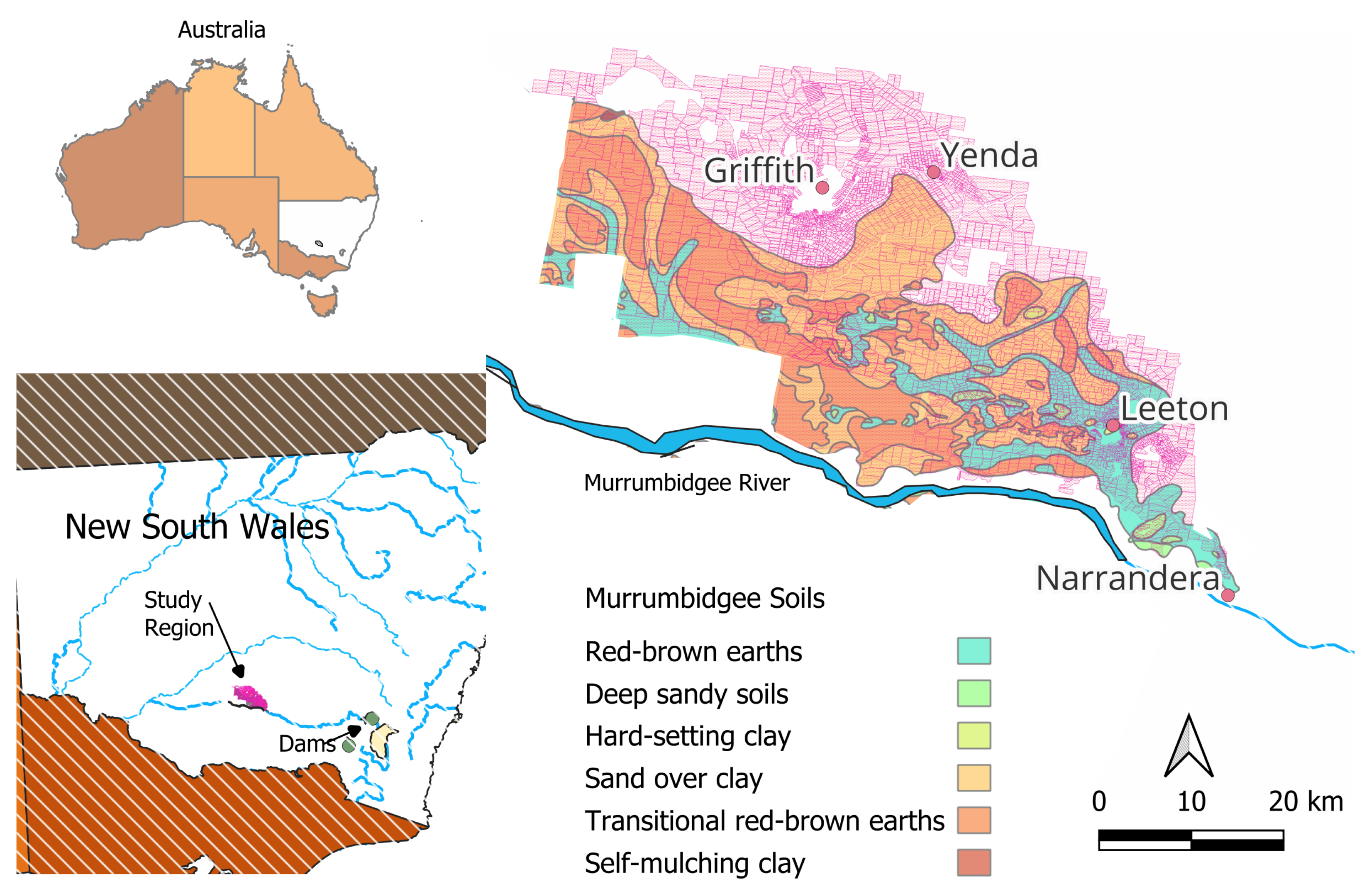
2.1. Case Study Area
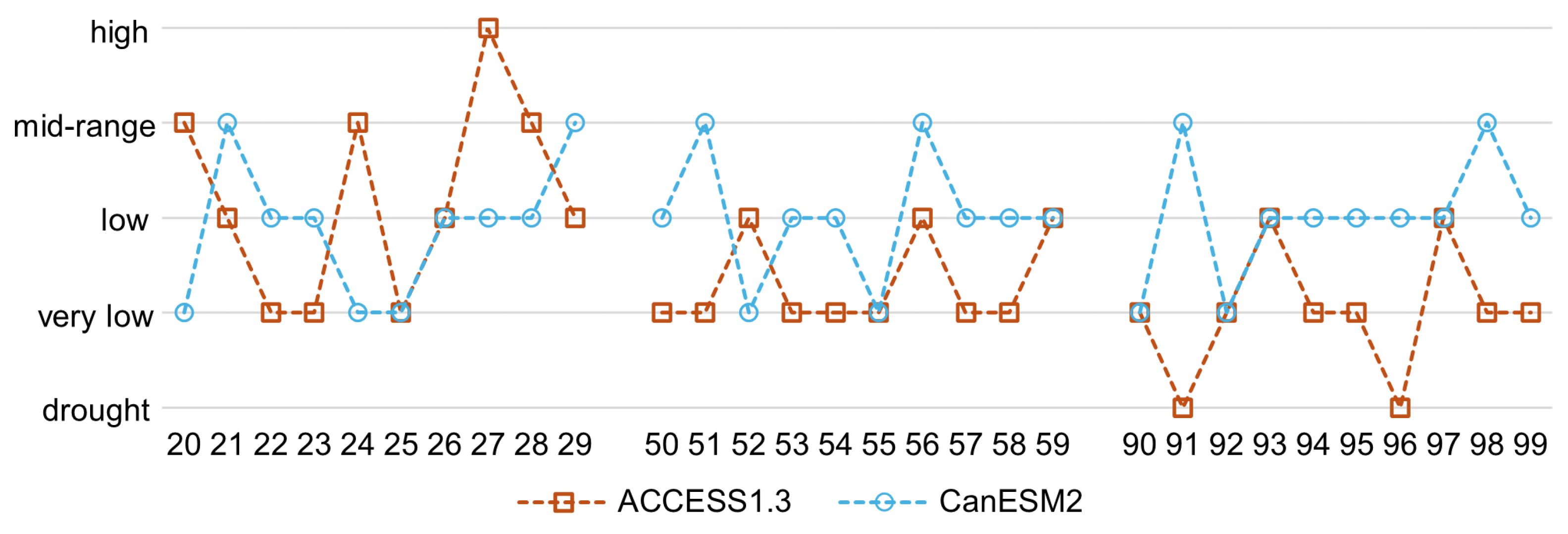
2.2. Water Usage
2.3. Economic
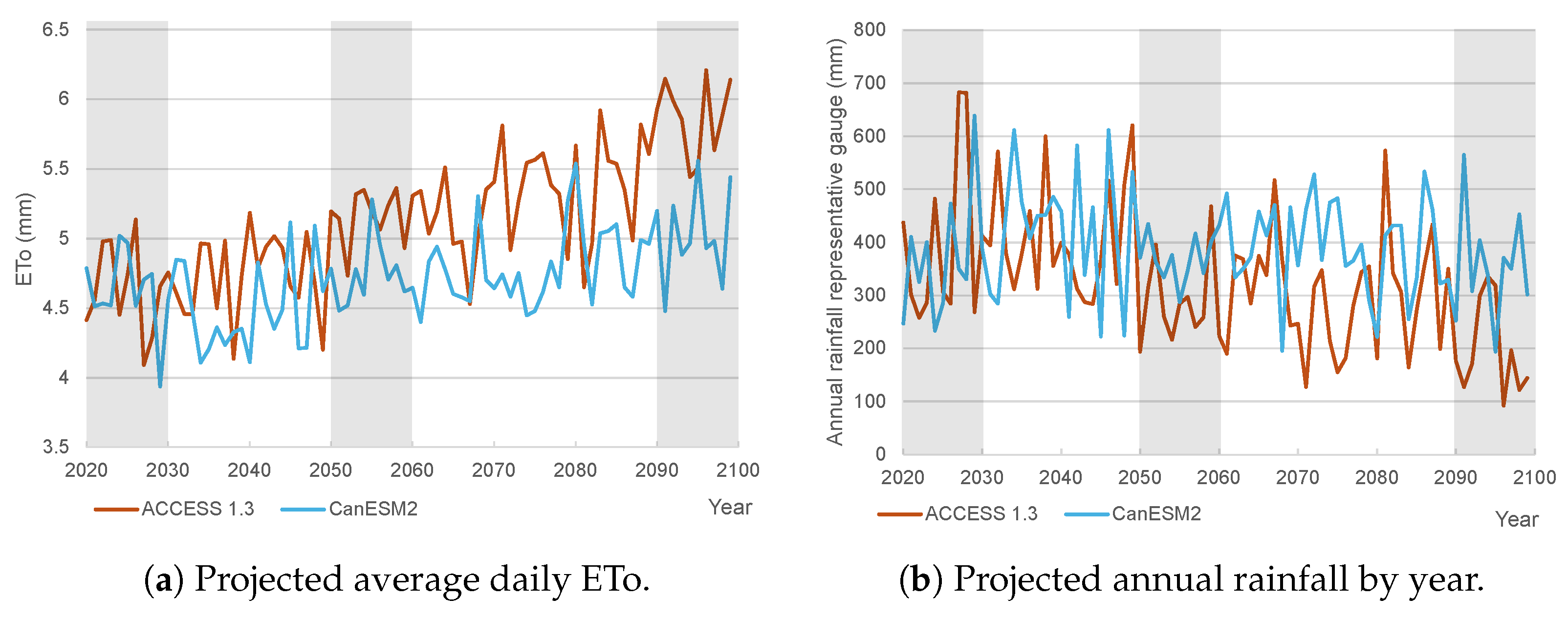
2.4. Climate’s Economic Impact
2.5. Solver Method
- LMU Compatibility: Only perennials that were well-suited to grow on a particular LMU (soil type) were considered.
- Available Water: Each perennial’s ideal monthly watering requirements were determined by considering its annual watering profile and projected climatic conditions. The target watering level for each year was determined based on the water allocation category of the year (see Table 3). The following rules were then applied:
- If the perennial’s monthly target watering could be met by projected precipitation and as-yet unallocated irrigation inflows, it remained in consideration.
- If its monthly target watering could not be met but its drought-level watering (7% from full) could be, then it remained in consideration at that lower level for that year.
- If drought-level watering for any year within the planning horizon could not be met, the crop was removed from consideration.
2.6. Experimental Design
2.7. Assumptions
3. Results
3.1. Prediction Power
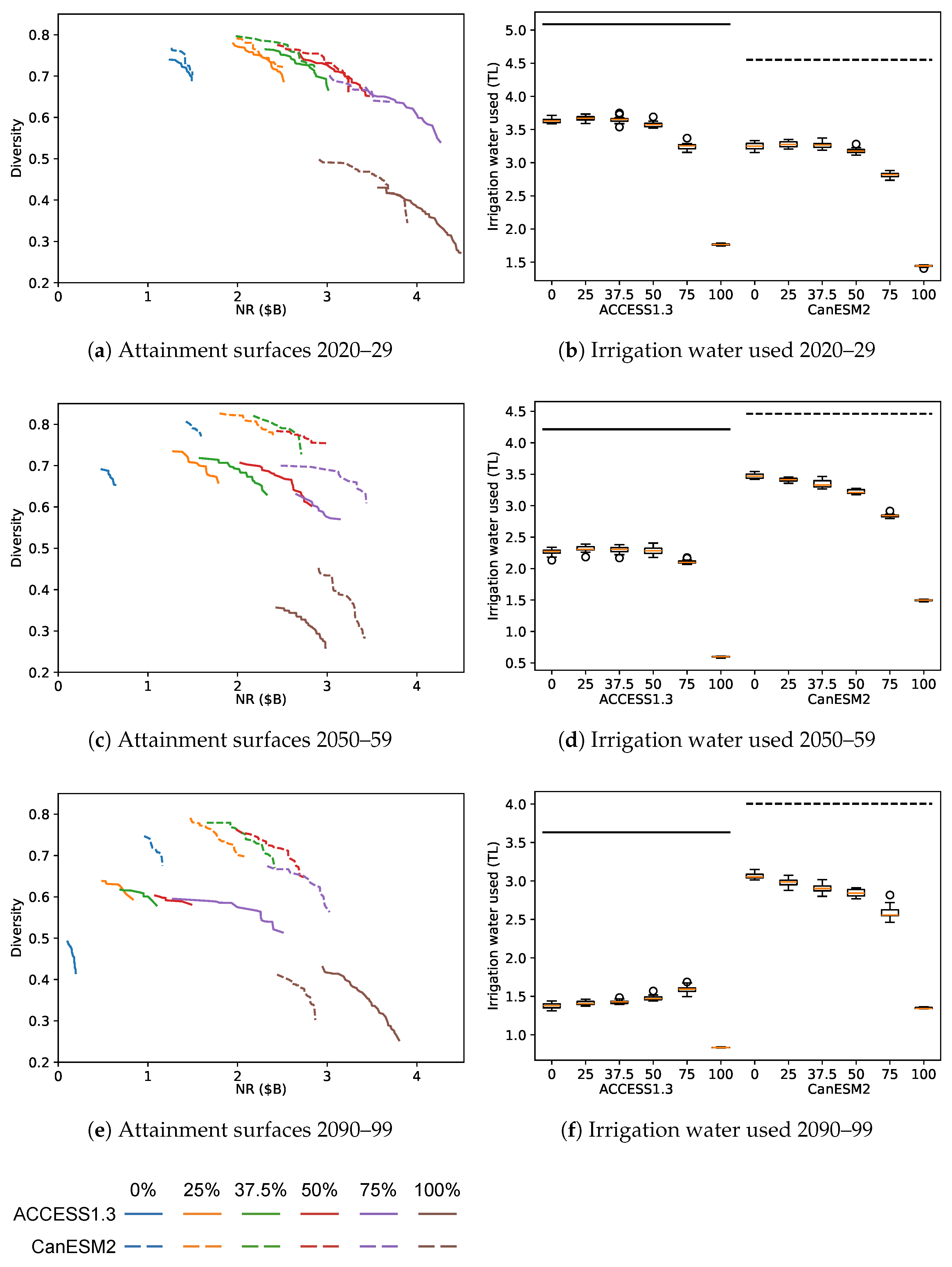
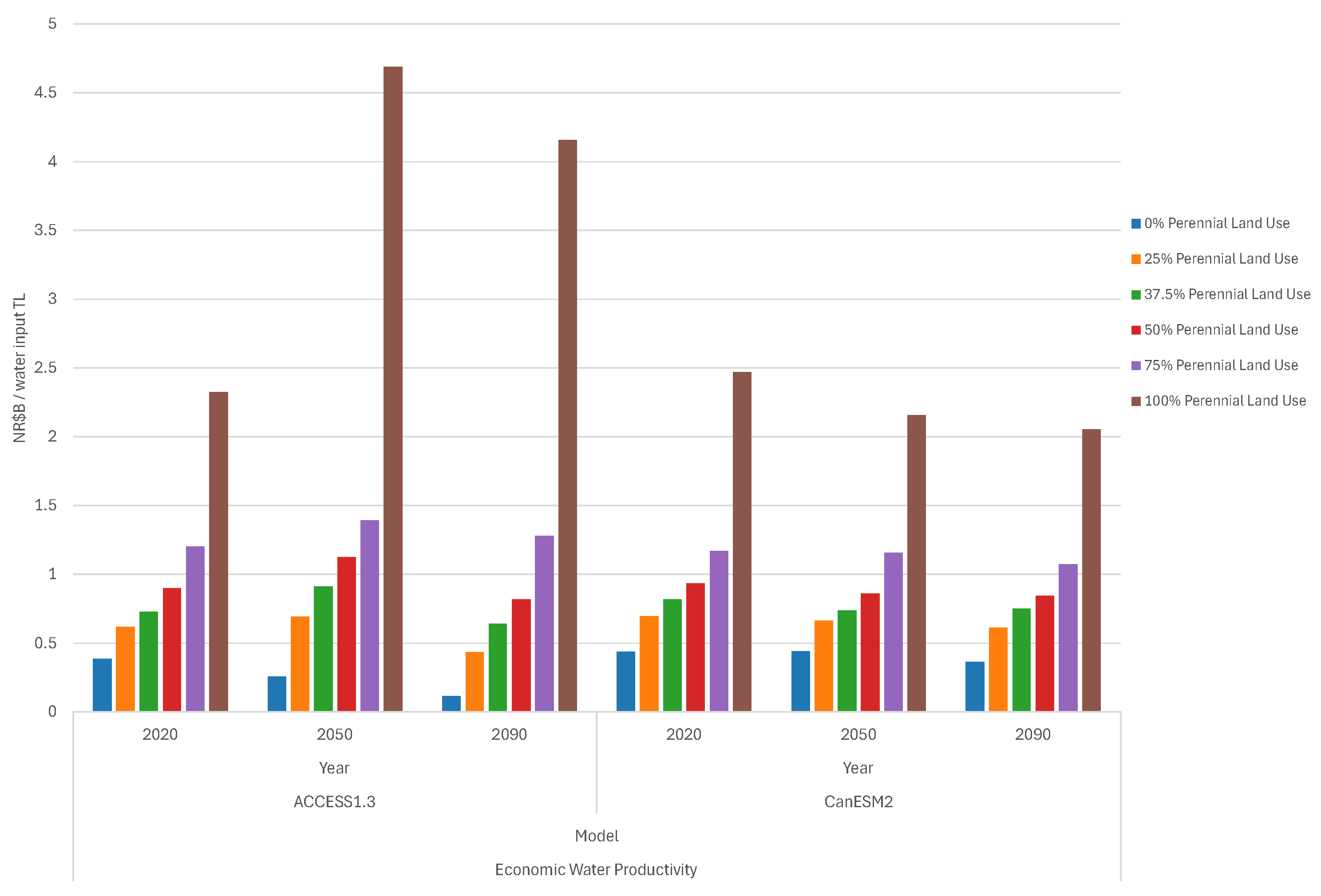
3.2. Water Productivity Response to Climate–Land Use Interactions
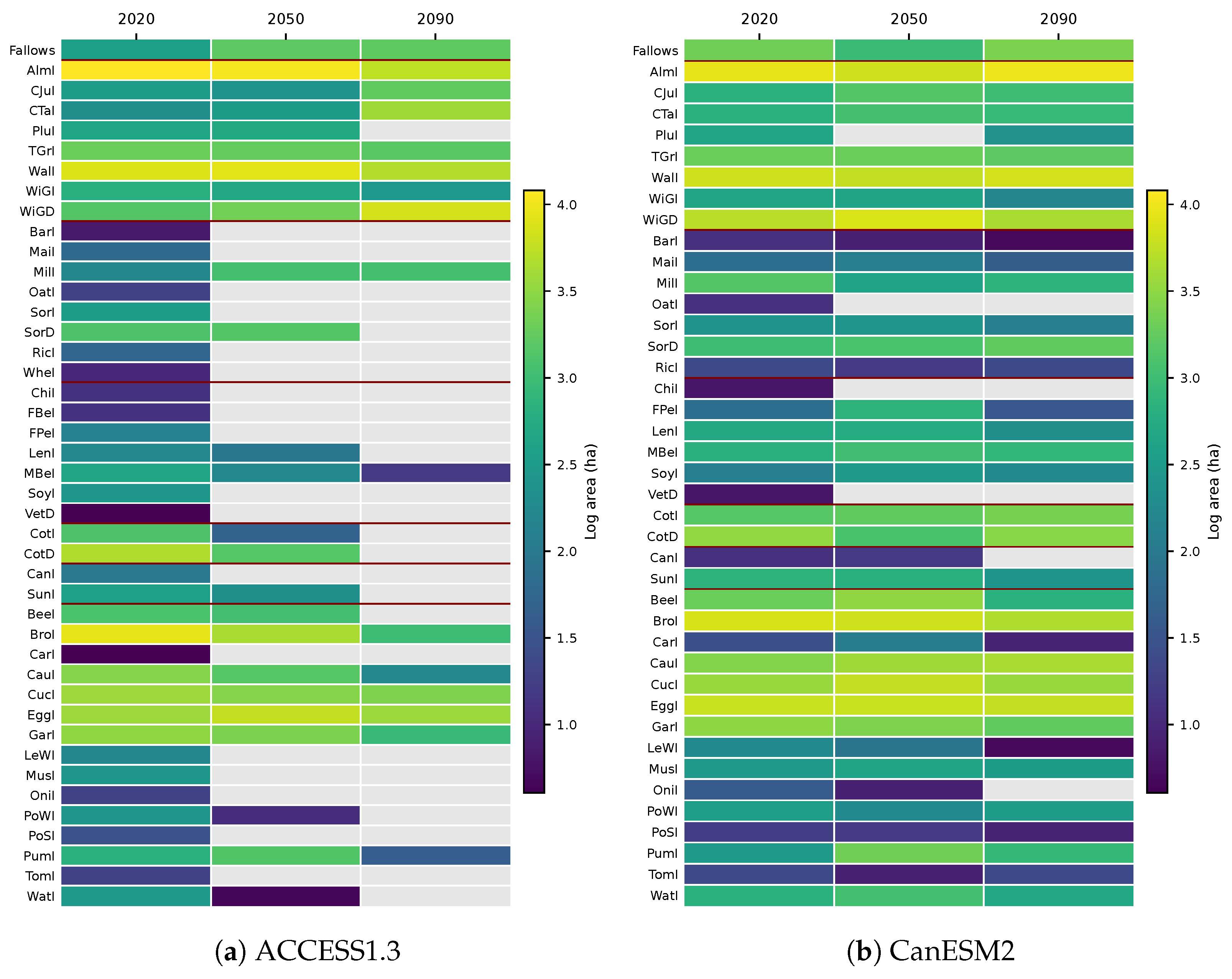
3.3. Life Cycle Land Use Apportioning
3.4. Diversity
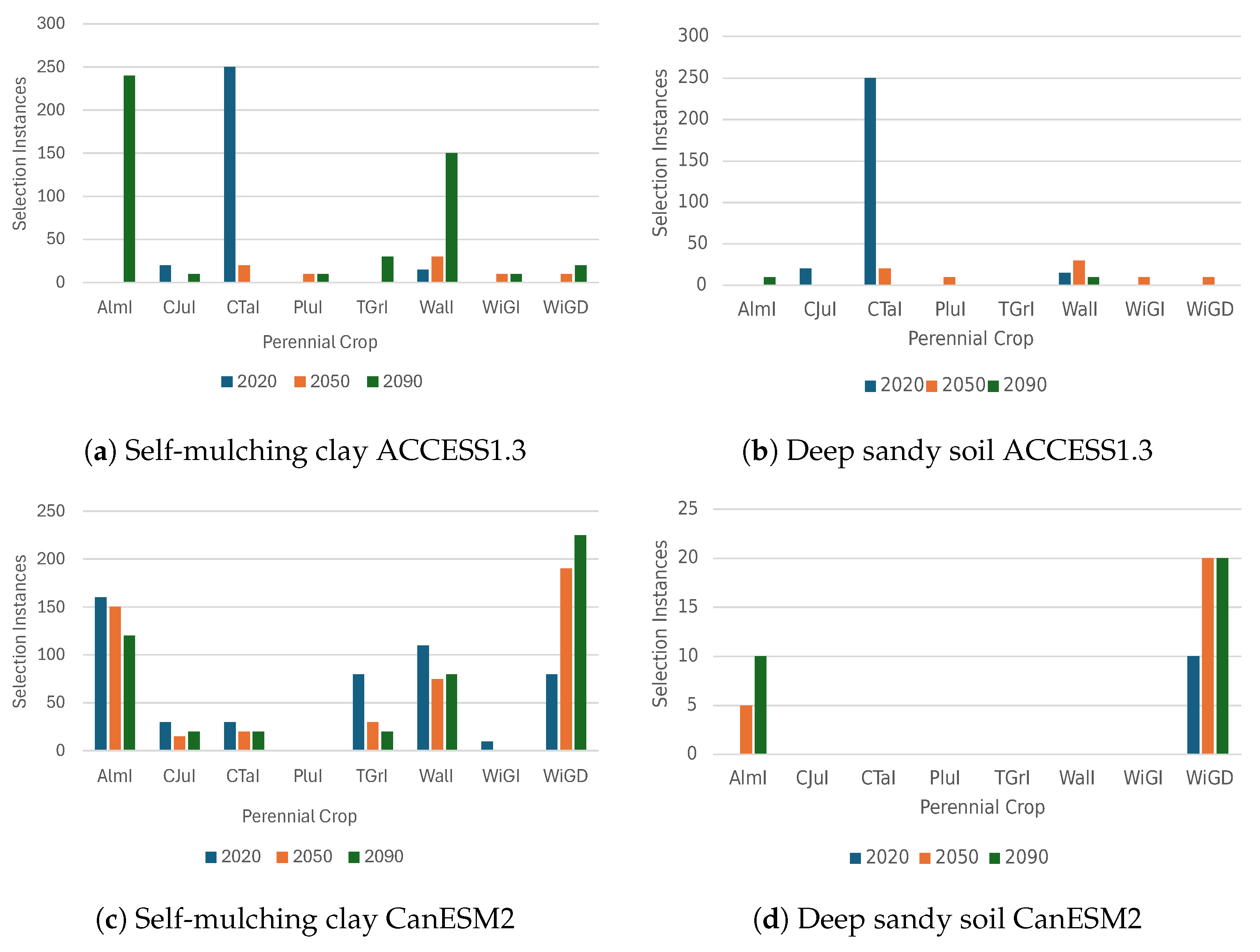
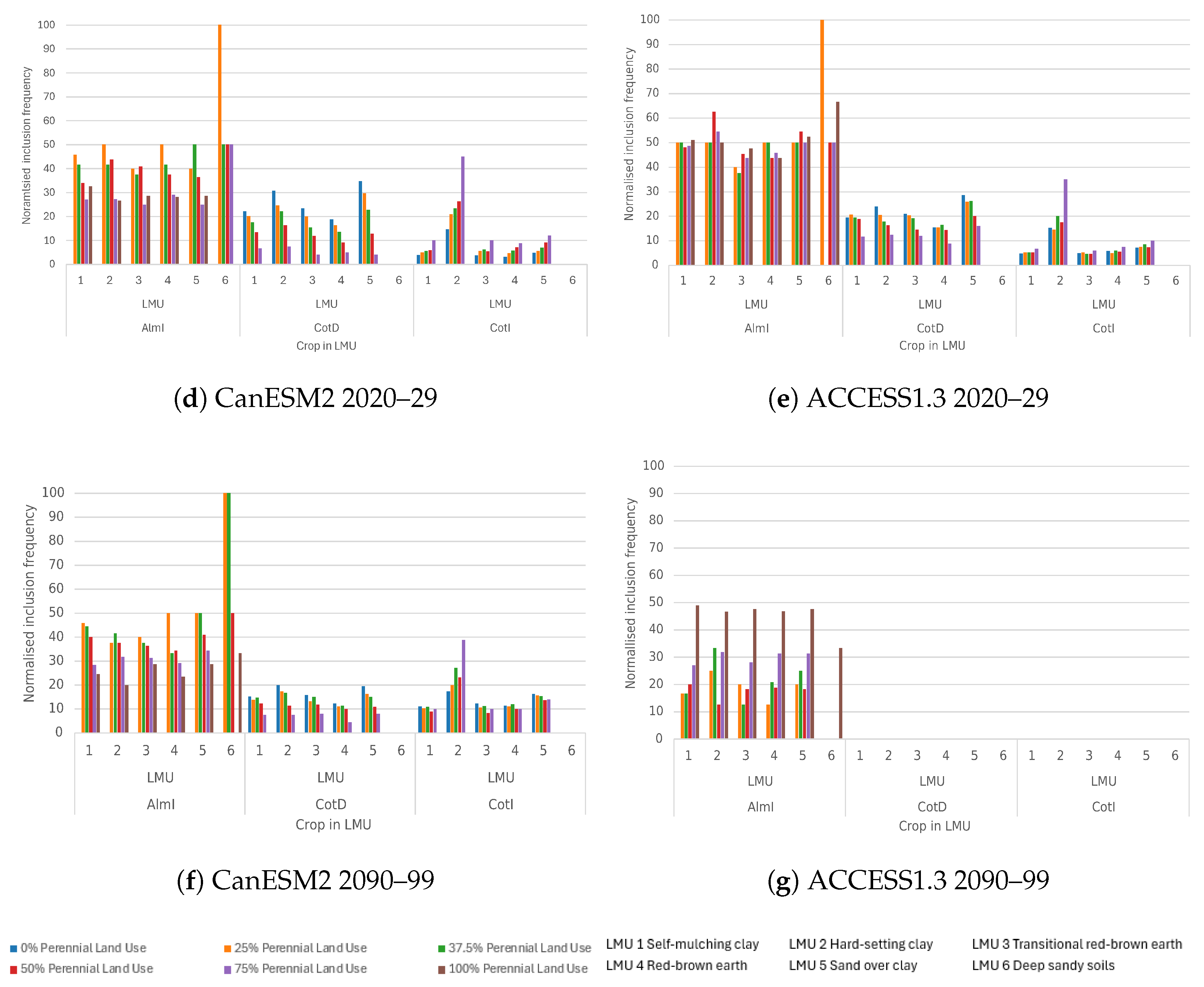
3.5. LMU-Based Assessment: Optimising Crop Choice and Production System for Enhanced Water Productivity
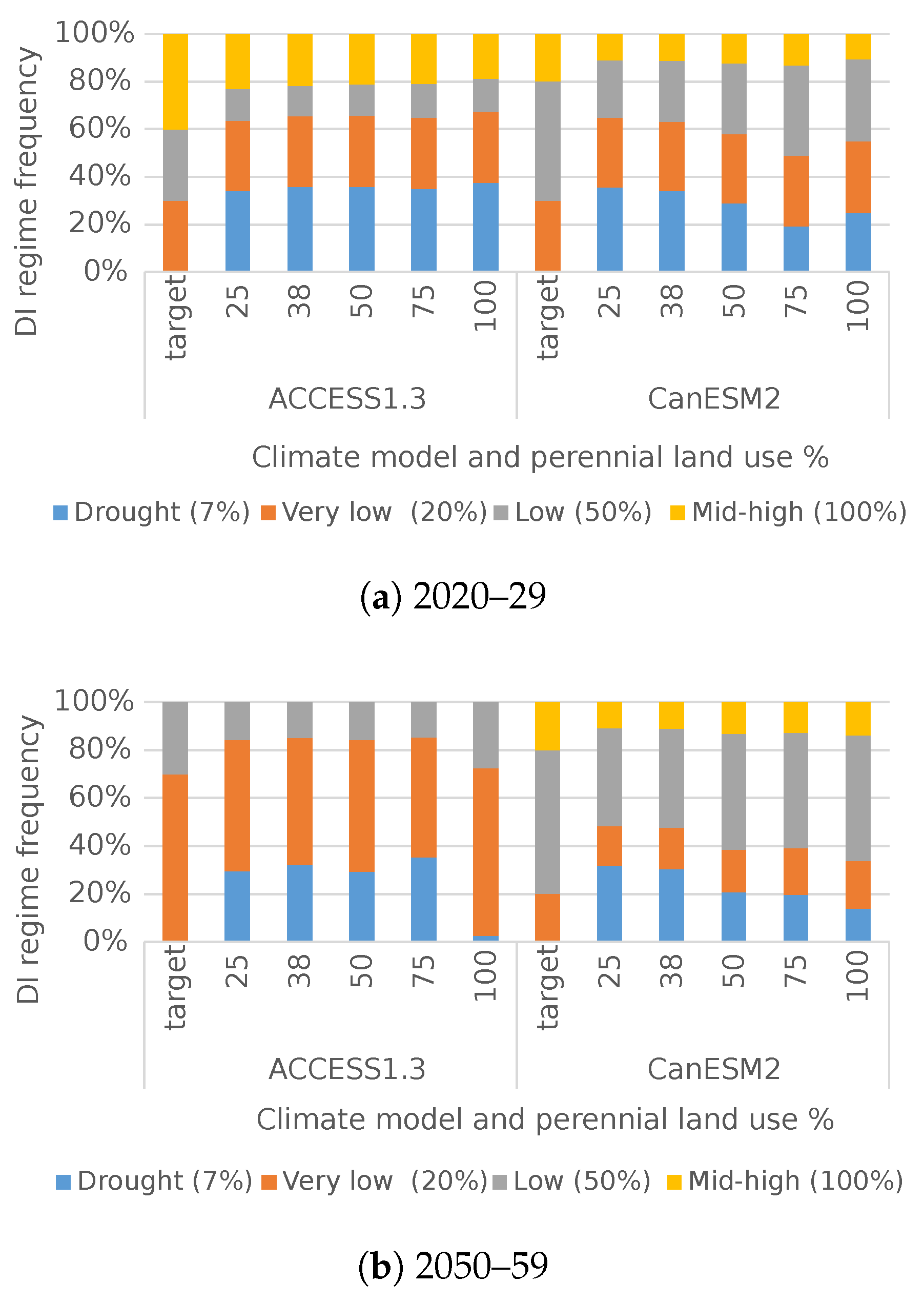
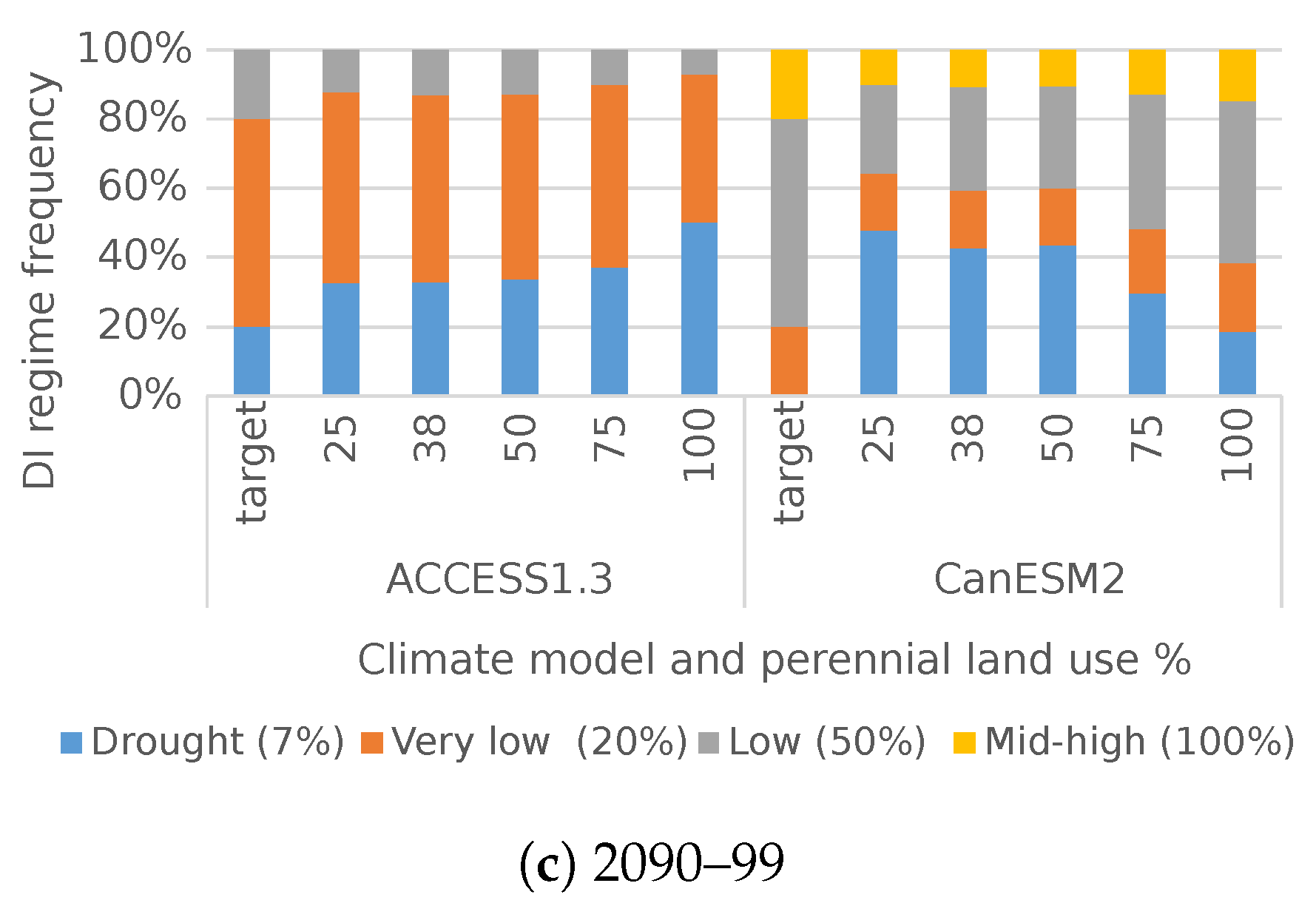
3.6. The Role of DI and Production System


4. Discussion
4.1. Economic Water Productivity
4.2. Temporal Shifts of Land Use in the Regional Landscape
4.3. Limitations and Uncertainty
5. Future Work
- Incorporation of more complex DI tactics into the model, including application to annual crops.
- While the optimisation approach is not intended to be an agricultural simulator, incorporation of a dynamic chill model would allow the model to assess perennial crops’ long-term suitability.
- Given growing interest in the production of annual crops under perennial systems [116], the inclusion of costs and lead time frames for the adoption of such systems and the change in land use would enhance the utility of the model. Capturing changes of land use in and out of perennial crops may assist industry in assessing the long-range viability of such decisions.
- Refinement of market behaviour to capture commodity-specific pricing and forecast resource costs [117], coupled with the simulation of yield potential based on future abiotic metrics, would also refine optimisation outputs.
6. Conclusions
Author Contributions
Funding
Data Availability Statement
Acknowledgments
Conflicts of Interest
Appendix A. Modelled Crops and Abbreviations Used

| Crop | Abbreviation | Crop | Abbreviation |
|---|---|---|---|
| Almonds | AlmI | Millet | MilI |
| Barley, dryland | BarD | Mung bean | MunI |
| Barley, irrigated | BarI | Muskmelon | MusI |
| Beetroot | BeeI | Oats | OatI |
| Broccoli | BroI | Onion | OniI |
| Canola, dryland | CanD | Plums | PluI |
| Canola, irrigated | CanI | Potato summer | PoSI |
| Carrots | CarI | Potato winter | PoWI |
| Cauliflower | CauI | Pumpkin | PumI |
| Chickpea, dryland | ChicD | Rice | RicI |
| Chickpea, irrigated | ChicI | Sorghum, dryland | SorD |
| Citrus—juicing | CJuI | Sorghum, irrigated | SorI |
| Citrus—table fruit | CTaI | Soybean | SoyI |
| Cotton, dryland | CotD | Sunflower | SunI |
| Cotton, irrigated | CotI | Table grapes | TGrI |
| Cucumber | CucI | Tomato | TomI |
| Eggplant | EggI | Vetch | VetD |
| Faba bean | FBeI | Walnuts | WalI |
| Fallow | Fal | Watermelon | WatI |
| Garlic | GarI | Wheat, dryland | WheD |
| Lentils | LenI | Wheat, irrigated | WheI |
| Lettuce | LetI | Wine grapes, dryland | WiGD |
| Maize | MaiI | Wine grapes, irrigated | WiGI |
References
- Alston, J.M.; Pardey, P.G. Agriculture in the global economy. J. Econ. Perspect. 2014, 28, 121–146. [Google Scholar] [CrossRef]
- FitzSimmons, M. The social and environmental relations of US agricultural regions. In Technological Change and the Rural Environment; Routledge: Abingdon, UK, 2023; pp. 8–32. [Google Scholar]
- Yaqoob, N.; Ali, S.A.; Kannaiah, D.; Khan, N.; Shabbir, M.S.; Bilal, K.; Tabash, M.I. The effects of agriculture productivity, land intensification, on sustainable economic growth: A panel analysis from Bangladesh, India, and Pakistan Economies. Environ. Sci. Pollut. Res. 2023, 30, 116440–116448. [Google Scholar]
- Zhang, Q.; Qu, Y.; Zhan, L. Great transition and new pattern: Agriculture and rural area green development and its coordinated relationship with economic growth in China. J. Environ. Manag. 2023, 344, 118563. [Google Scholar] [CrossRef]
- Champness, M.; Vial, L.; Ballester, C.; Hornbuckle, J. Evaluating the performance and opportunity cost of a smart-sensed automated irrigation system for water-saving rice cultivation in temperate Australia. Agriculture 2023, 13, 903. [Google Scholar]
- Gonçalves, B.; Pinto, T.; Aires, A.; Morais, M.C.; Bacelar, E.; Anjos, R.; Ferreira-Cardoso, J.; Oliveira, I.; Vilela, A.; Cosme, F. Composition of nuts and their potential health benefits—An overview. Foods 2023, 12, 942. [Google Scholar] [CrossRef] [PubMed]
- Alcorta, A.; Porta, A.; Tárrega, A.; Alvarez, M.D.; Vaquero, M.P. Foods for plant-based diets: Challenges and innovations. Foods 2021, 10, 293. [Google Scholar] [CrossRef] [PubMed]
- Li, S.; Kallas, Z. Meta-analysis of consumers’ willingness to pay for sustainable food products. Appetite 2021, 163, 105239. [Google Scholar] [CrossRef] [PubMed]
- Dzemydaitė, G. Agriculture’s impact for the economy: Inter-industry linkages and multiplier effects. In Proceedings of the Rural Development: Proceedings of the International Scientific Conference; Aleksandras Stulginskis University: Kauno, Lithuania, 2017; pp. 1004–1009. [Google Scholar]
- Andrade, M.A.; Barbosa, C.H.; Shah, M.A.; Ahmad, N.; Vilarinho, F.; Khwaldia, K.; Silva, A.S.; Ramos, F. Citrus By-Products: Valuable Source of Bioactive Compounds for Food Applications. Antioxidants 2023, 12, 38. [Google Scholar] [CrossRef] [PubMed]
- Kamienik, A.; Wojtyła, P.; Wargala, E.; Walasek-Janusz, M. Grape seed oil (Vitis vinifera seed oil) as a beneficial cosmetic raw material. In Wybrane Zagadnienia z Zakresu Produkcji Surowców, Żywności i Kosmetyków; Uniwersytet Przyrodniczy w Lublinie: Lublin, Poland, 2023; p. 47. [Google Scholar]
- Weller, E.; Park, B.J.; Min, S.K. Anthropogenic and natural contributions to the lengthening of the Southern Hemisphere summer season. J. Clim. 2020, 33, 10539–10553. [Google Scholar] [CrossRef]
- Ayele, G.T. Review of Climate Change Impacts on Water Quantity and Quality in the Murray–Darling Basin, Australia. Water 2024, 16, 3506. [Google Scholar] [CrossRef]
- Expósito, A.; Berbel, J. The Economics of Irrigation in Almond Orchards. Application to Southern Spain. Agronomy 2020, 10, 796. [Google Scholar] [CrossRef]
- Dennis, F. Flowering, fruit set and development under warmer conditions. In Temperate Fruit Crops in Warm Climates, 1st ed.; Springer Science & Business Media: Dordrecht, The Netherlands, 2013; pp. 101–135. [Google Scholar]
- Thomas, D. Managing Almond Production in a Variable and Changing Climate; Hort Innovation: Sydney, Australia, 2019. [Google Scholar]
- Rodriguez, D.; DeVoil, P.; Power, B.; Cox, H.; Crimp, S.; Meinke, H. The intrinsic plasticity of farm businesses and their resilience to change. An Australian example. Field Crops Res. 2011, 124, 157–170. [Google Scholar] [CrossRef]
- Basu, R.; Gallardo, R.K. Economic Issues Related to Long-Term Investment in Tree Fruits. Choices 2021, 36, 1–7. [Google Scholar]
- Goldschmidt, E.E. The evolution of fruit tree productivity: A review. Econ. Bot. 2013, 67, 51–62. [Google Scholar] [CrossRef] [PubMed]
- Campa, M.; Miranda, S.; Licciardello, C.; Lashbrooke, J.G.; Dalla Costa, L.; Guan, Q.; Spök, A.; Malnoy, M. Application of new breeding techniques in fruit trees. Plant Physiol. 2023, 194, 1304–1322. [Google Scholar] [CrossRef]
- Moldero, D.; Lopez-Bernal, A.; Testi, L.; Lorite, I.J.; Fereres, E.; Orgaz, F. Almond responses to a single season of severe irrigation water restrictions. Irrig. Sci. 2022, 40, 1–11. [Google Scholar]
- Mashabatu, M.; Motsei, N.; Jovanović, N.; Dube, T.; Mathews, U.; Nqumkana, Y. Assessing the seasonal water requirement of fully mature Japanese plum orchards: A systematic review. Appl. Sci. 2024, 14, 4097. [Google Scholar] [CrossRef]
- Abdelkader, A.; Elshorbagy, A. ACPAR: A framework for linking national water and food security management with global conditions. Adv. Water Resour. 2021, 147, 103809. [Google Scholar] [CrossRef]
- Fulton, J.; Norton, M.; Shilling, F. Water-indexed benefits and impacts of California almonds. Ecol. Indic. 2019, 96, 711–717. [Google Scholar] [CrossRef]
- Leisner, C.P. Climate change impacts on food security-focus on perennial cropping systems and nutritional value. Plant Sci. 2020, 293, 110412. [Google Scholar] [PubMed]
- Wu, W.; Tao, Z.; Chen, G.; Meng, T.; Li, Y.; Feng, H.; Si, B.; Manevski, K.; Andersen, M.N.; Siddique, K.H. Phenology determines water use strategies of three economic tree species in the semi-arid Loess Plateau of China. Agric. For. Meteorol. 2022, 312, 108716. [Google Scholar] [CrossRef]
- Randall, M.; Montgomery, J.; Lewis, A. An introduction to temporal optimisation using a water management problem. J. Comput. Sci. 2020, 42, 101108. [Google Scholar] [CrossRef]
- West, J. Multi-criteria evolutionary algorithm optimization for horticulture crop management. Agric. Syst. 2019, 173, 469–481. [Google Scholar] [CrossRef]
- Mall, N.K.; Herman, J.D. Water shortage risks from perennial crop expansion in California’s Central Valley. Environ. Res. Lett. 2019, 14, 104014. [Google Scholar] [CrossRef]
- Randall, M.; Schiller, K.; Lewis, A.; Montgomery, J.; Alam, M. A systematic review of crop planning optimisation under climate change. Water Resour. Manag. 2024, 38, 1867–1881. [Google Scholar] [CrossRef]
- Schwaab, J.; Deb, K.; Goodman, E.; Lautenbach, S.; van Strien, M.J.; Grêt-Regamey, A. Improving the performance of genetic algorithms for land-use allocation problems. Int. J. Geogr. Inf. Sci. 2018, 32, 907–930. [Google Scholar]
- Ross, C. Coordinated Development of the Australian Tree Nut Industry; Hort Innovation: Sydney, Australia, 2017. [Google Scholar]
- Zhao, B.; Wang, J.W. Perenniality: From model plants to applications in agriculture. Mol. Plant 2024, 17, 141–157. [Google Scholar] [PubMed]
- Fernandez, E.; Mojahid, H.; Fadón, E.; Rodrigo, J.; Ruiz, D.; Egea, J.A.; Ben Mimoun, M.; Kodad, O.; El Yaacoubi, A.; Ghrab, M.; et al. Climate change impacts on winter chill in Mediterranean temperate fruit orchards. Reg. Environ. Change 2023, 23, 7. [Google Scholar]
- Fernandez, E.; Whitney, C.; Cuneo, I.F.; Luedeling, E. Prospects of decreasing winter chill for deciduous fruit production in Chile throughout the 21st century. Clim. Change 2020, 159, 423–439. [Google Scholar] [CrossRef]
- Luedeling, E.; Brown, P.H. A global analysis of the comparability of winter chill models for fruit and nut trees. Int. J. Biometeorol. 2011, 55, 411–421. [Google Scholar] [PubMed]
- Speer, M.S.; Leslie, L.; MacNamara, S.; Hartigan, J. From the 1990s climate change has decreased cool season catchment precipitation reducing river heights in Australia’s southern Murray-Darling Basin. Sci. Rep. 2021, 11, 16136. [Google Scholar] [PubMed]
- Jian, S.; Wang, A.; Su, C.; Wang, K. Prediction of future spatial and temporal evolution trends of reference evapotranspiration in the Yellow River Basin, China. Remote Sens. 2022, 14, 5674. [Google Scholar] [CrossRef]
- Zhang, H.; Chapman, S.; Trancoso, R.; Eccles, R.; Syktus, J.; Toombs, N. Projections of actual and potential evapotranspiration from downscaled high-resolution CMIP6 climate simulations in Australia. EGUsphere 2025, 2025, 1–30. [Google Scholar] [CrossRef]
- Meza, F.; Darbyshire, R.; Farrell, A.; Lakso, A.; Lawson, J.; Meinke, H.; Nelson, G.; Stockle, C. Assessing temperature-based adaptation limits to climate change of temperate perennial fruit crops. Glob. Change Biol. 2023, 29, 2557–2571. [Google Scholar]
- Pantelidis, G.; Drogoudi, P. Exploitation of genotypic variation in chilling and heat requirements for flowering in Prunus armeniaca and Prunus persica (L.) Batsch cultivars. Sci. Hortic. 2023, 321, 112287. [Google Scholar] [CrossRef]
- McKay, J.M. Australian water law history: The move from introspective state sovereignty to a national interest approach and the influence of international law. In Sovereignty and International Water Law in the History of Water, Series III; Bloomsbury Publishing: London, UK, 2015; Volume 2. [Google Scholar]
- Musgrave, W. Historical Development of Water Resources in Australia. In Water Policy in Australia; Crase, L., Ed.; Taylor & Francis: Abingdon, UK, 2012. [Google Scholar]
- NSW Government. Murrumbidgee Act, 1910. 1910. Available online: http://classic.austlii.edu.au/au/legis/nsw/num_act/mia1910n42282/ (accessed on 27 February 2026).
- COAG. National Water Initiative 2004. 2004. Available online: https://www.agriculture.gov.au/sites/default/files/sitecollectiondocuments/water/Intergovernmental-Agreement-on-a-national-water-initiative.pdf (accessed on 27 February 2026).
- Australian Government. Water Act 2007. 2007. Available online: https://www.legislation.gov.au/Details/C2017C00151 (accessed on 27 February 2026).
- Australian Government. Basin Plan 2007. 2012. Available online: https://www.legislation.gov.au/Details/F2018C00451 (accessed on 27 February 2026).
- NSW Government. Water Management Act, 2000. 2023. Available online: https://legislation.nsw.gov.au/view/html/inforce/current/act-2000-092 (accessed on 27 February 2026).
- NSW Government. Water sharing plan for the Murrumbidgee regualted river water source amendment order 2022. In Water Management Act 2000; New South Wales Government: Sydney, Australia, 2022. Available online: https://legislation.nsw.gov.au/view/pdf/asmade/sl-2022-871 (accessed on 27 February 2026).
- Pollino, C.; Hart, M.; Nolan, M.; Byron, N.; March, R. Rural and regional communities of the Murray-Darling Basin. In Murray-Darling Basin, Australia, 1st ed.; Elsevier: Amsterdam, The Netherlands, 2021; pp. 21–46. [Google Scholar]
- Yang, Y.; Roderick, M.L.; Guo, H.; Miralles, D.G.; Zhang, L.; Fatichi, S.; Luo, X.; Zhang, Y.; McVicar, T.R.; Tu, Z.; et al. Evapotranspiration on a greening Earth. Nat. Rev. Earth Environ. 2023, 4, 626–641. [Google Scholar] [CrossRef]
- Menezes-Silva, P.E.; Loram-Lourenço, L.; Alves, R.D.F.B.; Sousa, L.F.; Almeida, S.E.d.S.; Farnese, F.S. Different ways to die in a changing world: Consequences of climate change for tree species performance and survival through an ecophysiological perspective. Ecol. Evol. 2019, 9, 11979–11999. [Google Scholar] [CrossRef] [PubMed]
- Goodwin, I.; Boland, A.M. Scheduling deficit irrigation of fruit trees for optimizing water use efficiency. In Deficit Irrigation Practices. Water Reports 22; Food and Agriculture Organisation of the United Nations: Rome, Italy, 2002. [Google Scholar]
- Vanella, D.; Guarrera, S.; Ferlito, F.; Longo-Minnolo, G.; Milani, M.; Pappalardo, G.; Nicolosi, E.; Giuffrida, A.G.; Torrisi, B.; Las Casas, G.; et al. Effects of organic mulching and regulated deficit irrigation on crop water status, soil and yield features in an orange orchard under Mediterranean climate. Sci. Total Environ. 2025, 958, 177528. [Google Scholar] [PubMed]
- Ma, X.; Han, F.; Wu, J.; Ma, Y.; Jacoby, P.W. Optimizing crop water productivity and altering root distribution of Chardonnay grapevine (Vitis vinifera L.) in a silt loam soil through direct root-zone deficit irrigation. Agric. Water Manag. 2023, 277, 108072. [Google Scholar]
- Sharma, V.; Choudhary, U.; Changade, N.M.; Kumar, A.; Singh, M.; Yadav, K.; Lakhawat, S. Growth and yield response of pea (Pisum sativum L.) crop to classical and regulated deficit irrigation along with nitrogen fertilization under drip irrigation. Legume Res.–Int. J. 2025, 48, 1513–1520. [Google Scholar]
- López-López, M.; Espadafor, M.; Testi, L.; Lorite, I.J.; Orgaz, F.; Fereres, E. Water requirements of mature almond trees in response to atmospheric demand. Irrig. Sci. 2018, 36, 271–280. [Google Scholar] [CrossRef]
- Kirda, C. Deficit irrigation scheduling based on plant growth stages showing water stress tolerance. Deficit Irrigation Practices, Water Reports; Food and Agricultural Organization of the United Nations: Rome, Italy, 2002; Volume 22, pp. 3–10. [Google Scholar]
- Chen, Y.; Zhang, J.H.; Chen, M.X.; Zhu, F.Y.; Song, T. Optimizing water conservation and utilization with a regulated deficit irrigation strategy in woody crops: A review. Agric. Water Manag. 2023, 289, 108523. [Google Scholar] [CrossRef]
- Gaydon, D.S.; Meinke, H.; Rodriguez, D. The best farm-level irrigation strategy changes seasonally with fluctuating water availability. Agric. Water Manag. 2012, 103, 33–42. [Google Scholar] [CrossRef]
- Champness, M.; Ballester, C.; Hornbuckle, J. Effect of soil moisture deficit on aerobic rice in temperate Australia. Agronomy 2023, 13, 168. [Google Scholar] [CrossRef]
- Shukr, H.H.; Pembleton, K.G.; Zull, A.F.; Cockfield, G.J. Impacts of effects of deficit irrigation strategy on water use efficiency and yield in cotton under different irrigation systems. Agronomy 2021, 11, 231. [Google Scholar] [CrossRef]
- Zeleke, K.; Nendel, C. Yield response and water productivity of soybean (Glycine max L.) to deficit irrigation and sowing time in south-eastern Australia. Agric. Water Manag. 2024, 296, 108815. [Google Scholar] [CrossRef]
- Zhu, J.; Parker, A.; Gou, F.; Agnew, R.; Yang, L.; Greven, M.; Raw, V.; Neal, S.; Martin, D.; Trought, M.C.; et al. Developing perennial fruit crop models in APSIM Next Generation using grapevine as an example. Silico Plants 2021, 3, diab021. [Google Scholar] [CrossRef]
- Magro, R.B.; Alves, S.A.M.; Gebler, L. Computational models in Precision Fruit Growing: Reviewing the impact of temporal variability on perennial crop yield assessment. SN Comput. Sci. 2023, 4, 554. [Google Scholar] [CrossRef]
- Sperling, O.; Gardi, I.; Ben-Gal, A.; Kamai, T. Deficit irrigation limits almond trees’ photosynthetic productivity and compromises yields. Agric. Water Manag. 2023, 289, 108562. [Google Scholar] [CrossRef]
- García-Tejero, I.F.; Lipan, L.; Gutiérrez-Gordillo, S.; Durán Zuazo, V.H.; Jančo, I.; Hernández, F.; Cárceles Rodríguez, B.; Carbonell-Barrachina, Á.A. Deficit irrigation and its implications for HydroSOStainable almond production. Agronomy 2020, 10, 1632. [Google Scholar] [CrossRef]
- Ballester, C.; Filev-Maia, R.; Hornbuckle, J. Optimizing water management in young almond orchards with heavy clay soils in southeastern Australia using proximal and remote sensors. In Proceedings of the II International Symposium on Precision Management of Orchards and Vineyards; International Society for Horticultural Science (ISHS): Leuven, Belgium, 2023; pp. 37–44. [Google Scholar]
- Khurshid, T. Improving Citrus Quality with Regulated Deficit Irrigation; Hort Innovation: Sydney, Australia, 2022. [Google Scholar]
- Song, X.; Evans, K.J. Irrigation Behaviours of Wine Grape Growers in Australia; University of Tasmania: Hobart, Australia, 2024. [Google Scholar]
- Smith, M. CROPWAT: A Computer Program for Irrigation Planning and Management; Food and Agriculture Organization: Rome, Italy, 1992. [Google Scholar]
- Rajakal, J.P.; Tan, R.R.; Andiappan, V.; Wan, Y.K.; Pang, M.M. Does age matter? A strategic planning model to optimise perennial crops based on cost and discounted carbon value. J. Clean. Prod. 2021, 318, 128526. [Google Scholar] [CrossRef]
- Abalu, G. Optimal investment decisions in perennial crop production: A dynamic linear programming approach. J. Agric. Econ. 1975, 26, 383–393. [Google Scholar] [CrossRef]
- Schiller, K.; Montgomery, J.; Randall, M.; Lewis, A.; Alam, M.S. Optimising Long-Range Agricultural Land Use Under Climate Uncertainty. Agriculture 2025, 15, 2133. [Google Scholar] [CrossRef]
- Nishant, N.; Evans, J.; Di Virgilio, G.; Downes, S.; Ji, F.; Cheung, K. Introducing NARCliM1.5: Evaluating the performance of regional climate projections for Southeast Australia for 1950–2100. Earth’s Future 2021, 9, e2020EF001833. [Google Scholar] [CrossRef]
- Kingwell, R. Managing complexity in modern farming. Aust. J. Agric. Resour. Econ. 2011, 55, 12–34. [Google Scholar] [CrossRef]
- Li, L.; Cole, S.; Rodriguez-Flores, J.M.; Hestir, E.; Fink, D.; Viers, J.H.; Medellin-Azuara, J.; Conklin, M.; Harmon, T. Synergies Between Agricultural Production and Shorebird Conservation with Climate Change in the Central Valley, California, with Optimized Water Allocation and Multi-Benefit Land Use. Glob. Change Biol. 2025, 31, e70304. [Google Scholar]
- Rhouma, A.; Seitfudem, G.; El Jeitany, J.; Pacetti, T.; Brouwer, F.; Gil, J.M. Connecting the water footprint with the water-energy-food-ecosystems nexus concept and its added value in the Mediterranean. Environ. Sustain. Indic. 2025, 26, 100640. [Google Scholar]
- Ingabire, R.; Chen, X.; Hirwa, H.; Shen, Y.J. Quantifying the coordination of the Water-Energy-Food nexus and its drivers in Africa. Energy Nexus 2026, 22, 100714. [Google Scholar]
- Peel, M.C.; Finlayson, B.L.; McMahon, T.A. Updated world map of the Koppen-Geiger climate classification. Hydrol. Earth Syst. Sci. 2007, 11, 1633–1644. [Google Scholar] [CrossRef]
- Australian Government Bureau of Meterology. Average Monthly and Annual Temperature Maps; Australian Government Bureau of Meteorology: Docklands, Australia, 2025.
- Australian Government Bureau of Meterology. Average Annual, Seasonal and Monthly Rainfall Maps; Australian Government Bureau of Meteorology: Docklands, Australia, 2025. Available online: https://www.bom.gov.au/climate/maps/averages/temperature/?maptype=mxt&period=an®ion=ns (accessed on 23 April 2021).
- Australian Government Bureau of Meterology. Average Annual, Seasonal and Monthly Rainfall Maps; Australian Government Bureau of Meteorology: Docklands, Australia, 2025. Available online: https://www.bom.gov.au/climate/maps/averages/rainfall/?period=an®ion=ns (accessed on 23 April 2021).
- Zhou, D.; Khan, S.; Abbas, A.; Rana, T.; Zhang, H.; Chen, Y. Climatic regionalization mapping of the Murrumbidgee Irrigation Area, Australia. Prog. Nat. Sci. 2009, 19, 1773–1779. [Google Scholar] [CrossRef]
- NSW State Archives. The Murrumbidgee Files. 2021. Available online: https://mhnsw.au/webinars/murrumbidgee-irrigation-area-files/ (accessed on 23 April 2021).
- Pich, G. Italian Land Settlement in the Murrumbidgee Irrigation Areas, 1915–1972. Ph.D. Thesis, The Australian National University, Canberra, Australia, 1975. [Google Scholar]
- The Lucas Group. Almonds in One Basket: Griffith Grower Consolidates Crops. 2017. Available online: https://www.lucasgroup.com.au/almonds-in-one-basket-griffith-farming-family-consolidates-crops (accessed on 30 November 2017).
- Murrumbidgee Irrigation. Annual Compliance Report. 2024. Available online: https://www.mirrigation.com.au/ArticleDocuments/242/Murrumbidgee%20Irrigation%20FY%202023-24%20Annual%20Compliance%20Report.pdf.aspx?Embed=Y (accessed on 27 February 2026).
- Parkes, H.A.; White, N.; Goodwin, L.; Treeby, J.; MurphyWhite, S. Understanding Apple and Pear Production Systems in a Changing Climate; Final Report Project AP12029; Hort Innovation: Sydney, Australia, 2017. [Google Scholar]
- Baum, S.; Haynes, M.; Van Gellecum, Y.; Han, J.H. Considering regional socio-economic outcomes in non-metropolitan Australia: A typology building approach. Pap. Reg. Sci. 2007, 86, 261–286. [Google Scholar]
- Allen, R.G.; Pereira, L.S.; Raes, D.; Smith, M. FAO Irrigation and Drainage Paper No. 56; Food and Agriculture Organization of the United Nations: Rome, Italy, 1998; Volume 56, p. e156. [Google Scholar]
- López-Urrea, R.; Oliveira, C.M.; Montoya, F.; Paredes, P.; Pereira, L.S. Single and basal crop coefficients for temperate climate fruit trees, vines and shrubs with consideration of fraction of ground cover, height, and training system. Irrig. Sci. 2024, 42, 1099–1135. [Google Scholar] [CrossRef]
- Rosenzweig, B. Almond Production Spreadsheet; Hort Innovation: Sydney, Australia, 2015. [Google Scholar]
- Durán Zuazo, V.H.; Cárceles Rodríguez, B.; Sendra, E.; Carbonell-Barrachina, Á.A.; Lipan, L.; Hernández, F.; Gálvez Ruiz, B.; García-Tejero, I.F. Yield and quality of walnuts subjected to deficit irrigation in mountainous Water-Starved environments. Plants 2025, 14, 1777. [Google Scholar] [CrossRef] [PubMed]
- Qureshi, M.E.; Hanjra, M.A.; Ward, J. Impact of water scarcity in Australia on global food security in an era of climate change. Food Policy 2013, 38, 136–145. [Google Scholar] [CrossRef]
- Tahir, K. Improving Citrus Quality with Regulated Deficit Irrigation; Technical Report; Hort Innovation: Sydney, Australia, 2022. [Google Scholar]
- CSIRO; Bureau of Meteorology. Climate Change in Australia Information for Australia’s Natural Resource Management Regions: Technical Report; Technical Report; CSIRO: Canberra, Australia; Bureau of Meteorology: Docklands, Australia, 2015.
- Kandulu, J.M.; Bryan, B.A.; King, D.; Connor, J.D. Mitigating economic risk from climate variability in rain-fed agriculture through enterprise mix diversification. Ecol. Econ. 2012, 79, 105–112. [Google Scholar] [CrossRef]
- Iheshiulo, E.M.A.; Larney, F.J.; Hernandez-Ramirez, G.; Luce, M.S.; Liu, K.; Chau, H.W. Do diversified crop rotations influence soil physical health? A meta-analysis. Soil Tillage Res. 2023, 233, 105781. [Google Scholar] [CrossRef]
- Lenné, J.; Wood, D. Crop diversity in agroecosystems for pest management and food production. Plants 2024, 13, 1164. [Google Scholar] [CrossRef] [PubMed]
- Dorigo, M.; Gambardella, L. Ant colony system: A cooperative learning approach to the traveling salesman problem. IEEE Trans. Evol. Comput. 1997, 1, 53–66. [Google Scholar] [CrossRef]
- Coello Coello, C.A.; Lamont, G.B.; Veldhuizen, D.A.V. Evolutionary Algorithms for Solving Multi-Objective Problems; Springer: Boston, MA, USA, 2007. [Google Scholar]
- Jackson, J.E. Light regimes in temperate fruit-tree orchards grown at low latitudes. In Temperate Fruit Crops in Warm Climates; Erez, A., Ed.; Springer: Dordrecht, The Netherlands, 2000; pp. 1–15. [Google Scholar]
- Erez, A.; Fishman, S.; Gat, Z.; Couvillon, G. Evaluation of winter climate for breaking bud rest using the dynamic model. In Proceedings of the International Workshop on Apple Culture in the Tropics and Subtropics 232; International Society for Horticultural Science (ISHS): Leuven, Belgium, 1987; pp. 76–89. [Google Scholar]
- Australian Government Department of Agriculture, Fisheries and Forestry. Agricultural Commodities Report; March Quarter 2026; Australian Government Department of Agriculture, Fisheries and Forestry: Canberra, Australia, 2026.
- Grant, M.O.; Ukkola, A.M.; Vogel, E.; Hobeichi, S.; Pitman, A.J.; Borowiak, A.R.; Fowler, K. Historical trends of seasonal droughts in Australia. Hydrol. Earth Syst. Sci. 2025, 29, 5555–5573. [Google Scholar] [CrossRef]
- Capra, A.; Consoli, S.; Scicolone, B. Deficit irrigation: Theory and practice. Agric. Irrig. Res. Prog. 2008, 4, 53–58. [Google Scholar]
- Hort Innovation. Australian Horticulture Statistics Handbook; All Nuts—Overview; Hort Innovation: Sydney, Australia, 2024. [Google Scholar]
- AgriFutures Australia. AgriFutures Rice Program Strategic RD&E Plan 2021–2026; AgriFutures Australia: Wagga Wagga, Australia, 2021. [Google Scholar]
- Australian Government Department of Climate Change Energy the Environment and Water. Updated Draft National Water Agreement; Australian Government Department of Climate Change Energy the Environment and Water: Canberra, Australia, 2025.
- Lin, B.B. Resilience in agriculture through crop diversification: Adaptive management for environmental change. BioScience 2011, 61, 183–193. [Google Scholar] [CrossRef]
- Aizen, M.A.; Aguiar, S.; Biesmeijer, J.C.; Garibaldi, L.A.; Inouye, D.W.; Jung, C.; Martins, D.J.; Medel, R.; Morales, C.L.; Ngo, H.; et al. Global agricultural productivity is threatened by increasing pollinator dependence without a parallel increase in crop diversification. Glob. Change Biol. 2019, 25, 3516–3527. [Google Scholar] [CrossRef]
- Aldercotte, A.H.; Simpson, D.T.; Winfree, R. Crop visitation by wild bees declines over an 8-year time series: A dramatic trend, or just dramatic between-year variation? Insect Conserv. Divers. 2022, 15, 522–533. [Google Scholar]
- Van Leeuwen, C.; Darriet, P. The impact of climate change on viticulture and wine quality. J. Wine Econ. 2016, 11, 150–167. [Google Scholar] [CrossRef]
- Matzek, V.; Wilson, K.A.; Kragt, M. Mainstreaming of ecosystem services as a rationale for ecological restoration in Australia. Ecosyst. Serv. 2019, 35, 79–86. [Google Scholar] [CrossRef]
- Chapman, E.A.; Thomsen, H.C.; Tulloch, S.; Correia, P.M.; Luo, G.; Najafi, J.; DeHaan, L.R.; Crews, T.E.; Olsson, L.; Lundquist, P.O.; et al. Perennials as future grain crops: Opportunities and challenges. Front. Plant Sci. 2022, 13, 898769. [Google Scholar] [CrossRef] [PubMed]
- Hughes, N.; Gupta, M.; Whittle, L.; Westwood, T. An Economic Model of Spatial and Temporal Water Trade in the Australian southern Murray-Darling Basin. Water Resour. Res. 2023, 59, e2022WR032559. [Google Scholar]
- CSIRO. Ag2050 Scenarios Report; Technical Report; CSIRO: Canberra, Australia, 2024. [Google Scholar]


| Soil Type | Area (ha) |
|---|---|
| Self-mulching clay | 49,000 |
| Hard-setting clay | 15,000 |
| Transitional red-brown earths | 21,000 |
| Red-brown earths | 32,000 |
| Sand-over clay | 21,000 |
| Deep sandy soils | 3,000 |
| Total | 141,000 |
| Crop | Area (ha) |
|---|---|
| Vines—Table and Wine Grapes | 15,421 |
| Citrus | 7343 |
| Nuts—Almonds and Walnuts | 8075 |
| Plums | 1002 |
| Total | 31,841 |
| Water Allocation | Market Behaviour | Target Watering | Yield Potential |
|---|---|---|---|
| Drought | 160% | 7% | 20% |
| Very low | 130% | 20% | 50% |
| Low | 110% | 50% | 80% |
| Mid-range | 100% | 100% | 100% |
| High | 80% | 100% | 100% |
| Year Period | Chill Portion |
|---|---|
| 2020–2029 | 84 |
| 2030–2049 | 74 |
| 2050–2099 | 67 |
Disclaimer/Publisher’s Note: The statements, opinions and data contained in all publications are solely those of the individual author(s) and contributor(s) and not of MDPI and/or the editor(s). MDPI and/or the editor(s) disclaim responsibility for any injury to people or property resulting from any ideas, methods, instructions or products referred to in the content. |
© 2026 by the authors. Licensee MDPI, Basel, Switzerland. This article is an open access article distributed under the terms and conditions of the Creative Commons Attribution (CC BY) license.
Share and Cite
Schiller, K.; Montgomery, J.; Randall, M.; Lewis, A. Optimising Regional Land Use to Enhance Water Productivity Under Climate Uncertainty: The Role of Perennial Crops. Agriculture 2026, 16, 1440. https://doi.org/10.3390/agriculture16131440
Schiller K, Montgomery J, Randall M, Lewis A. Optimising Regional Land Use to Enhance Water Productivity Under Climate Uncertainty: The Role of Perennial Crops. Agriculture. 2026; 16(13):1440. https://doi.org/10.3390/agriculture16131440
Chicago/Turabian StyleSchiller, Karin, James Montgomery, Marcus Randall, and Andrew Lewis. 2026. "Optimising Regional Land Use to Enhance Water Productivity Under Climate Uncertainty: The Role of Perennial Crops" Agriculture 16, no. 13: 1440. https://doi.org/10.3390/agriculture16131440
APA StyleSchiller, K., Montgomery, J., Randall, M., & Lewis, A. (2026). Optimising Regional Land Use to Enhance Water Productivity Under Climate Uncertainty: The Role of Perennial Crops. Agriculture, 16(13), 1440. https://doi.org/10.3390/agriculture16131440