Review

An Overview of Large Agricultural Models: Current Status, Applications, and Future Perspectives

1
College of Information Management, Nanjing Agricultural University, Nanjing 211800, China
2
Jiangsu Academy of Agricultural Sciences, Nanjing 210014, China
*
Author to whom correspondence should be addressed.
Agriculture 2026, 16(13), 1419; https://doi.org/10.3390/agriculture16131419
Submission received: 11 May 2026 / Revised: 16 June 2026 / Accepted: 23 June 2026 / Published: 29 June 2026
(This article belongs to the Section Artificial Intelligence and Digital Agriculture)

Abstract

With the rapid development of general artificial intelligence, large models have gradually become the key force driving the digital transformation of the field. Agriculture has distinct domain characteristics, and traditional deep learning models are difficult to meet its cross-regional and cross-task requirements. Large models specifically designed for the agricultural field can integrate multi-source data and prior knowledge to break through this bottleneck. Therefore, tracking the development trend of large agricultural models is an important prerequisite for building new, quality productive forces in smart agriculture and promoting the digital transformation of agriculture. This article conducts a literature search and review around the research on large agricultural models, following the PRISMA guidelines. It combines the keywords of large models, crops, livestock breeding, etc., and only includes journal papers from 2022 to 2026, totaling 713 articles. Then, it performs topic modeling to deeply clarify the current research and application status, and summarizes the challenges faced and makes future research prospects. Existing evidence indicates that current large agricultural models are gradually developing towards agents and embodied intelligence, and are widely applied in scenarios such as agricultural knowledge services, pest and disease diagnosis and prevention, livestock and fishery breeding, and smart agricultural machinery control. However, they still face many key challenges, and further exploration is needed in theoretical methods and practical applications. In the future, research can be further deepened and expanded in areas such as the construction of high-quality data sets, the construction of domain evaluation systems, strengthening model reliability, building multi-agent systems, and lightweight deployment of large models and embodied intelligence.

1. Introduction

Large model technology, with its powerful general intelligence and emergent capabilities, is bringing profound changes to agricultural knowledge services, production decisions, and industrial chain collaboration. However, the highly complex nature of the agricultural production environment and the multi-modal nature of data also pose challenges for the adaptation and implementation of general large models in the agricultural domain. When general large models are directly transferred to agricultural tasks, they often encounter issues such as the long-tail distribution of agricultural data, the strong coupling of multi-modal physical processes, and the strict requirements for decision safety. As a result, agricultural logic is violated and temporal-spatial dynamic reasoning fails. How to adapt and validate the large model based on the dynamic and variable conditions in the field, and thereby support agricultural decision-making, has become a key engine for promoting the digital transformation of agriculture.
In 2024, the Ministry of Agriculture and Rural Affairs of China released the National Smart Agriculture Action Plan (2024–2028) [1], clearly stating that a smart agriculture platform should be established and plans to increase the agricultural production informatization rate to over 32% by the end of 2028. This provides policy guidance for the technological research and industrial implementation of large models in the agricultural field. In 2026, the United States Department of Agriculture announced the launch of the National Agricultural Technology Experiment Field Network (NPG-Ag) of the United States Department of Agriculture to enhance farm productivity and strengthen rural economies [2]. This explains, from a policy perspective, the core bottleneck of the current implementation of agricultural technologies: a large number of AI tools lack reliability and comparability across real and variable production conditions, resulting in low farmer adoption intentions. This network attempts to establish a standardized real environment assessment system to solve this predicament. The European Union stated that it will propose a “package” of measures based on the new agricultural vision and put forward the EU Agricultural Digital Strategy to support the transformation to digital agriculture [3]. With the promotion of global policies, the digital and intelligent transformation of agriculture is accelerating. In recent years, research and release of large agricultural language models have received widespread attention, and their application in the agricultural field has also gradually deepened. In 2025, Grand View Research released “Generative AI in Agriculture Market (2025–2033)”, estimating that the global agricultural generative AI market size was USD 226.2 million in 2024 and is expected to reach USD 215.89 million by 2033, with a compound annual growth rate of 28.7% from 2025 to 2033 [4]. Farmers are increasingly using generative models, agricultural robots, and automation for livestock management. Major trends in the forecast period include growing adoption of AI-based crop and soil health assessment, expansion of data-driven farm decision-making practices, rising integration of automation in large-scale farming operations, increasing demand for real-time agricultural monitoring solutions, and greater focus on AI-supported yield enhancement techniques [5].
Benos et al. [6] conducted a comprehensive review of the application of machine learning in agriculture, finding that the artificial neural network algorithm was efficiently applied from 2018 to 2020; Condran et al. [7] also conducted a review and discovered that the application of machine learning techniques in agriculture seemed to be out of step with core machine learning research, and identified and discussed some key data issues; Attri et al. [8] found that deep learning has great potential to improve agricultural productivity and promote economic growth; Li et al. [9] focused on the adaptation of LLMs to agricultural knowledge and constructed a structured development of knowledge integration in the agricultural field; and verified the application value of LLMs in agricultural knowledge services. However, most existing reviews mainly focus on the improvement of model technologies or the attention to a single application, lacking systematic organization and analysis of large agricultural models across dimensions such as multi-modal fusion, comprehensive evaluation systems, and multi-dimensional real-scene applications. Therefore, this paper introduces recent frontier research, integrates technological progress, application status, and future trends, and systematically reviews the related concepts, characteristics, research status, key task applications, and bottlenecks in implementation of large agricultural models, focusing on specific issues such as the multi-modality of agricultural data and the evaluation benchmarks of large agricultural models, thereby providing certain theoretical guidance for the in-depth development of current large agricultural models.

2. Large Agricultural Models: Concepts, Evolution, and Domain Characteristics

2.1. Core Concept Analysis

A large model refers to a deep neural network model trained on large-scale data with a huge number of parameters [10]; a basic model is a single model trained through unsupervised learning on large-scale and diverse unlabeled data, which can be adapted to a wide range of downstream tasks through fine-tuning or prompt engineering [11]; a language model has the ability to understand and generate human language, and can predict sequential probabilities or generate new text based on specific input [12]. A visual-language model (VLM) achieves deep integration of visual information, such as images and videos, with text semantics by introducing visual encoders and cross-modal alignment mechanisms, thereby possessing multi-modal understanding capabilities such as image and text retrieval, visual question answering, and image description generation [13]. Further, multi-modal large models (MLLMs) overcome the limitations of dual modalities of vision and language, and can handle various heterogeneous information, including images, text, speech, video, thermal imaging, sensor time series, and geospatial data [14]. Multi-modal models based on Transformer encoding and decoding can also better learn the correlations between different modalities and improve understanding and discrimination capabilities [15]. In the field of artificial intelligence, an Agent refers to an autonomous entity that can perceive the environment, perform reasoning and planning, store information, and execute actions to achieve specific goals. Recent research uses large language models as the core controller to enable Agents to engage in natural language interaction, tool use, multi-step planning, etc. [16].
The development of large model technology has laid a solid technical foundation for the construction and application of large agricultural models. However, at present, there is no clear definition of large agricultural models. Some scholars have conducted related research from the perspective of agricultural intelligent question-answering systems [9,17]. Therefore, this paper attempts to define large agricultural models based on relevant research and the characteristics of large models, that is, large agricultural models refer to a type of artificial intelligence model based on the large-scale self-supervised learning paradigm and basic model architecture, using the multi-modal data specific to the agricultural field as the main training and input source, by explicitly or implicitly integrating agricultural domain knowledge, thereby possessing the ability to reason and make decisions for complex agricultural tasks, and finally being rigorously verified in typical agricultural tasks.

2.2. Evolutionary Process of Agricultural Intelligence

In the early stage of agricultural intelligence development, it mainly relied on rule-based expert systems [18]. By manually extracting the experience knowledge of agricultural experts and constructing symbolic reasoning engines, although it achieved initial success in assisting with specific pest and disease diagnosis, the cost of knowledge acquisition was high, and the rules were difficult to cover complex agricultural scenarios, making it hard to adapt to highly dynamic and complex agricultural ecological environments. With the rise of deep learning, models represented by convolutional neural networks (CNNs) and recurrent neural networks (RNNs) demonstrated effective applications in crop phenotypic recognition and yield prediction through automated feature extraction [19,20]. However, research in this stage mostly focused on single tasks and small sample patterns, and the models were often trained for specific crops or single scenarios, resulting in limitations such as poor generalization and difficulties in cross-modal alignment when facing the massive unstructured text and heterogeneous multi-modal data in the agricultural field. The emergence of pre-trained models based on the Transformer architecture has promoted the development of large agricultural models. In this stage, by introducing retrieval-augmented generation [21] and knowledge graphs [22], and by integrating external agricultural knowledge bases or structured agricultural knowledge graphs with large models, the hallucination problem of general large models in agricultural scenarios was alleviated, laying the technical foundation for the subsequent construction of agricultural vertical large models. With the rapid development of general-purpose basic models, agricultural artificial intelligence has entered a new stage centered on large models. Basic models such as the GPT, Llama, and Qwen series have acquired strong knowledge understanding, reasoning, and generation capabilities through pre-training with massive corpora, providing an important technical foundation for the development of large agricultural models. Subsequently, the introduction of visual large models and multi-modal large models has significantly improved the application efficiency of large agricultural models, shifting the models from focusing on dialogue and recognition to deeper applications. Looking at the research trends of large agricultural models, in the future, they will tend to develop into intelligent entities capable of performing perception, reasoning, decision-making and closed-loop execution [23]. They will also be able to be combined with agricultural robots and unmanned agricultural machinery, developing embodied intelligence [24,25], enabling the models to transform from the cognitive level to the action level, and truly achieve autonomous driving.

2.3. Domain Characteristics of Agriculture

Agriculture is a complex system composed of the natural environment, animal and plant activities, and socio-economic factors, featuring a wide variety of characteristics. Clarifying the characteristics of the agricultural field is the foundation for promoting the deep integration of digital technology and agriculture, and achieving the transformation from traditional agriculture to smart agriculture.
(i) Multi-source, heterogeneous, and multi-modal data [26]. Agricultural data has significant multi-source, heterogeneous, and multi-modal characteristics. It not only includes agricultural texts, but also includes pest and disease images, crop growth diagrams, remote sensing images, sensor data, and other multi-source and multi-modal data. This multi-source, heterogeneous, and multi-modal feature places higher requirements on the construction and performance capabilities of large language models. For example, to determine whether a crop is infected with a disease, it is necessary to simultaneously analyze field images and environmental sensor data. This requires large models to have perception and fusion capabilities to handle multi-source and multi-modal data, enabling better understanding and analysis of agricultural issues.
(ii) The dynamics and uncertainty of the environment [27]. Agriculture is carried out in an open, natural environment and often faces various disasters and uncertainties, including meteorological and biological factors. Moreover, agricultural production has strong periodicity and seasonality, and the growth of crops or the occurrence of pests and diseases are dynamic processes that evolve over time. This dynamism and uncertainty often require weighing multiple complex factors when making decisions.
(iii) Regional and experiential nature [28,29]. On one hand, agricultural knowledge has a strong regional attribute. Different crops often have different growth characteristics in different regions. This kind of knowledge is low-transferable, and regional adaptation may be necessary when training large language models. On the other hand, agricultural management and decision-making largely rely on human experience, and this experience contains a lot of tacit knowledge, which increases the difficulty of knowledge dissemination and application.
(iv) Multitasking [30]. Multitasking is another typical feature in the agricultural field. This multitasking is manifested in the diversity of agricultural production goals and the continuity of agricultural operations. During the agricultural production cycle, agricultural producers often need to take into account multiple goals simultaneously, such as yield, quality, cost, disaster avoidance, etc. Moreover, whether it is the growth of crops or animals, the process is not single-task-oriented but requires handling consecutive multi-tasks such as pests and diseases, irrigation, soil, fertilization, etc. Therefore, the multitasking feature in the agricultural field poses requirements for multi-task parallelism and decision-making for large agricultural models.
In summary, the multi-source, heterogeneity and multi-modality of data in the agricultural field, the dynamic and uncertain nature of the environment, the regional and experiential characteristics, as well as the multi-task nature, constitute the core connotation of agriculture as a typical complex scenario, and also impose requirements different from those of general models for the practical application of large language models.

3. Current Research Status of Large Models in the Agricultural Field

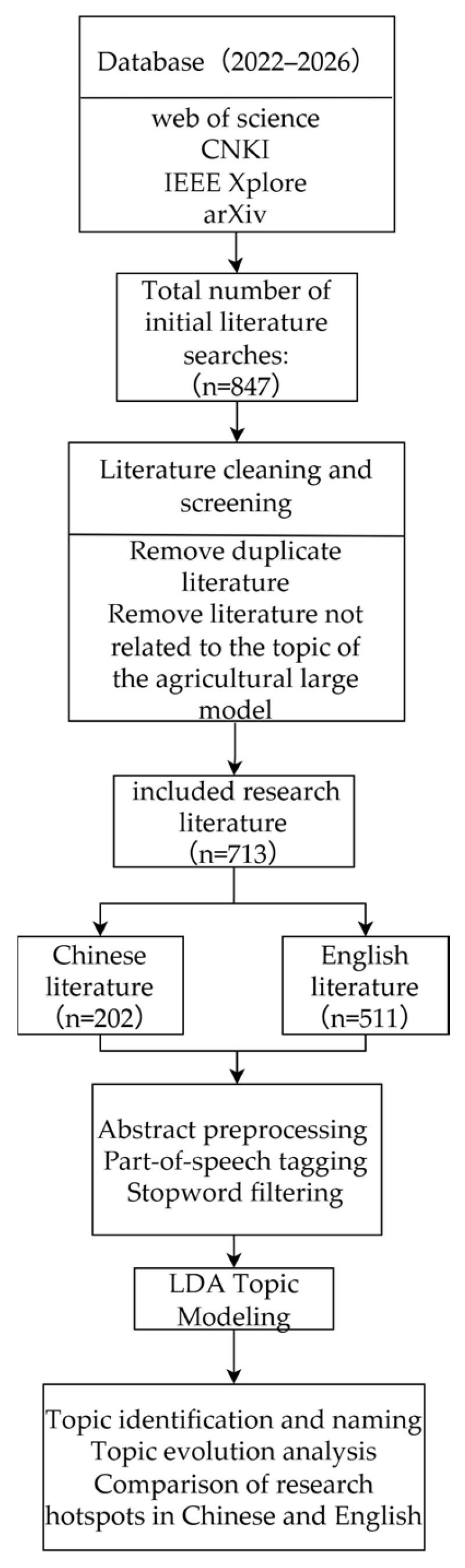
In order to better understand the current research status of large models in the agricultural field, this paper conducted a journal literature search on the Web of Science, China National Knowledge Infrastructure, IEEE Xplore and arXiv databases on 4 June 2026 following the PRISMA protocol. The PRISMA process is shown in Figure 1. The search was limited to the period from 2022 to 2026, and the search results are shown in the Table 1.
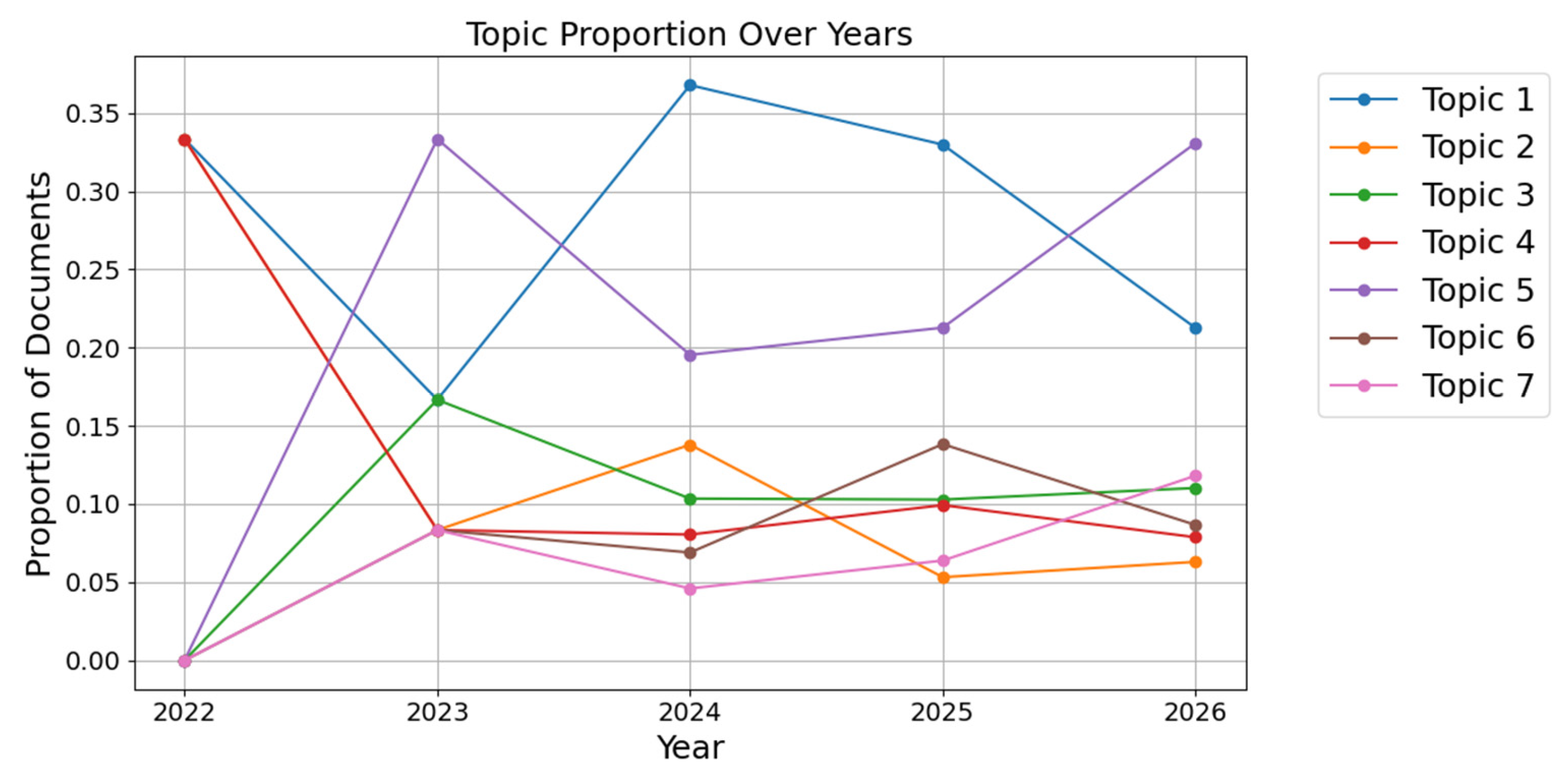
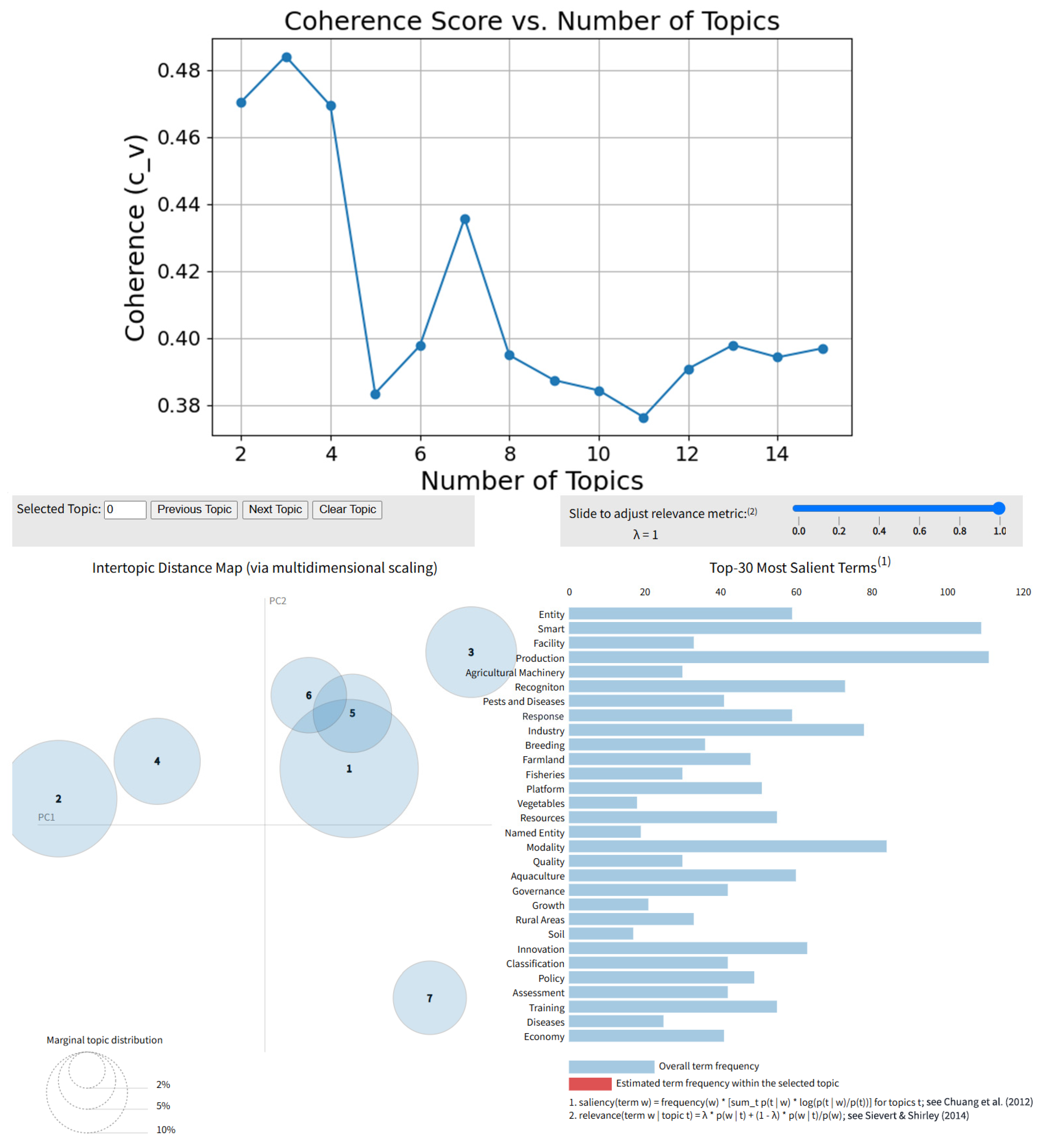
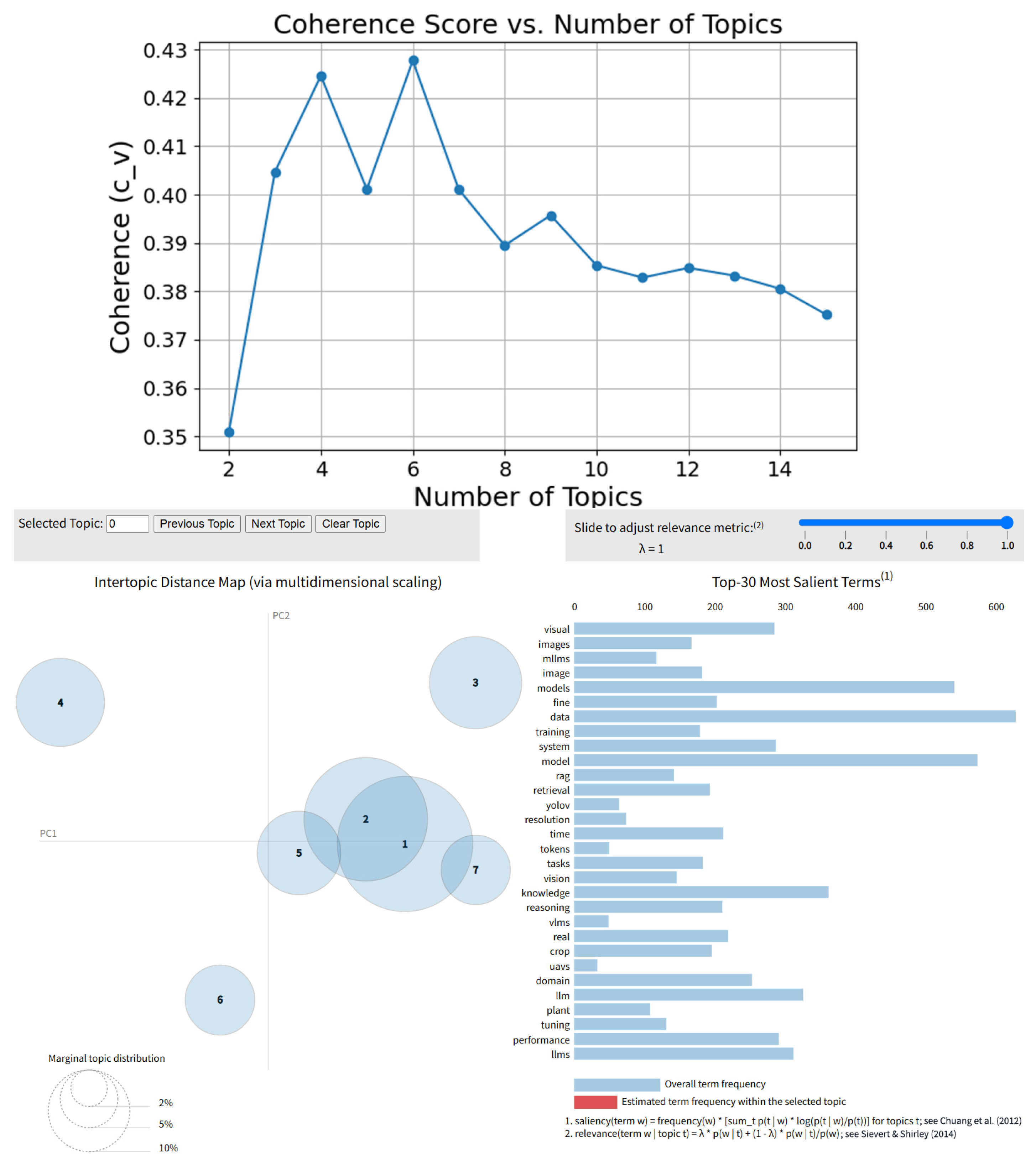
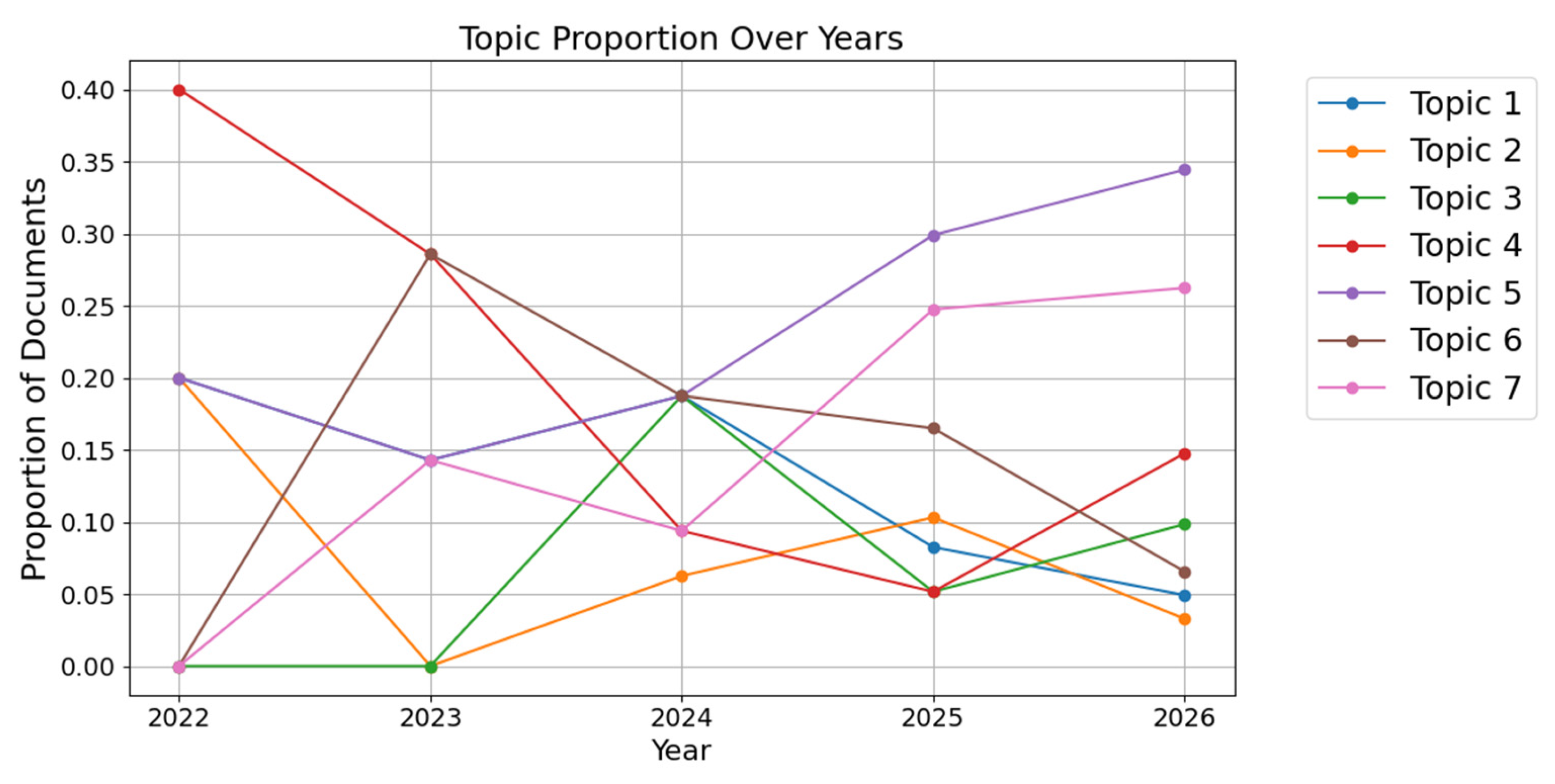
Due to the limited field information available and the fact that the abstract represents the overall expression of a document, the topic words are extracted from the abstract field and topic modeling is conducted using Python 3.12.10. Firstly, the abstract is preprocessed through tokenization, stop-word removal, etc. Considering that there are significant differences in the vocabulary system, grammatical structure, and word segmentation methods between Chinese and English abstracts, if they are directly mixed for modeling, the same semantic concept may be repeatedly represented by different language vocabularies, thereby affecting the topic identification effect. Therefore, this paper builds a separate corpus for Chinese and English documents and conducts LDA topic modeling for each. On this basis, the optimal number of topics for each corpus is determined using the Coherence Score, and the Intertopic Distance Map and topic keywords are combined for manual interpretation and naming, as shown in Figure 2 and Figure 3. Finally, the research hotspots and development trends of Chinese and English documents are compared and analyzed from the perspectives of topic proportion and topic evolution, as shown in Figure 4 and Figure 5. The number of topics for Chinese and English documents is determined to be 7 each, as shown in Table 2 and Table 3.
According to the thematic proportion chart in Figure 4 of the Chinese literature, from the perspective of the evolution of themes, research on large-scale agricultural models has followed a path of continuous deepening, from basic language processing to scenario-based intelligent decision-making. From 2022 to 2023, the research mainly focused on basic tasks such as agricultural question answering, entity recognition, and knowledge services; after 2024, directions such as smart agricultural machinery, digital agriculture, and industrial empowerment began to attract attention; from 2025 to 2026, research related to multi-modal agricultural intelligent decision-making and the integration of smart breeding industries saw a rapid growth, becoming a new research hotspot. Overall, research on large agricultural models is gradually moving from technical exploration to scenario-driven and industrial applications. Due to the relatively small sample size in 2022–2023, the proportion of early themes fluctuated greatly. The related results are mainly used to reflect the overall trend rather than to precisely compare differences across themes.
As shown in Figure 4 and Figure 5, research on large-scale agricultural models in Chinese and English exhibits distinct development characteristics. The Chinese literature mainly focuses on applications such as smart agriculture construction, agricultural production management, smart breeding, and industrial integration, demonstrating a strong practical orientation. In contrast, the English literature pays more attention to technical directions such as knowledge-enhanced large models, multi-modal large models (MLLMs), agricultural intelligent agents, and the construction of agricultural-specific large model systems, showing a clear technology-driven characteristic.

3.1. Release Status of the Large Agricultural Models

In recent years, artificial intelligence technology has made significant breakthroughs, injecting new impetus into the intelligent transformation of the agricultural sector. The multi-source, heterogeneous, and multi-modal characteristics of agricultural production data, the dynamic nature and uncertainty of the environment, as well as the regional and experiential nature, all place higher demands on the generalization ability and multi-modal integration ability of artificial intelligence models. And large language models, with their powerful emergent capabilities and general intelligence, provide a technical path for this. Therefore, research on large agricultural models worldwide has gradually accelerated, and several large models in the field have been released and applied. Some models are shown in Table 4.
The large agricultural models have seen a rapid increase in release frequency, evolving from early text-based dialogue models such as AgriLLM and Shen Nong Large Model to models with multi-modal understanding capabilities like Insect-LLaVA. The release of these models not only signifies the transformation of agricultural AI from single-task to general-purpose tasks but also demonstrates significant evolutionary characteristics in their technical paths.
Firstly, the model development features a combination of a basic framework with efficient fine-tuning [40]. The construction of large agricultural models mainly adopts two technical routes. One is to pre-train from scratch using large-scale agricultural data, and the other is to fine-tune a general base model on domain-specific data. Pre-training from scratch can fully learn agricultural domain knowledge, improving the model’s professionalism and knowledge consistency, but it requires a large amount of data, computing power, and training costs [11]. In contrast, parameter-efficient fine-tuning based on basic models such as Llama and Qwen has become the mainstream approach in current large agricultural model research. It can significantly reduce the development threshold while retaining general knowledge [41]. However, both routes have certain limitations. The zero-pre-training model may suffer from regional knowledge bias due to the coverage of the training data; the fine-tuned model is prone to overfitting or insufficient knowledge generalization due to insufficient data scale. Moreover, agricultural knowledge has strong timeliness, and the model needs to be continuously updated and evaluated to ensure its reliability in different regions and application scenarios. Therefore, achieving a balance between model professionalism, generalization ability, and knowledge update has become an important direction in large agricultural-scale model research.
Secondly, the knowledge enhancement mechanism is developing towards dynamic alignment. The early released models tended to directly train agricultural knowledge into the parameter space. Later, a retrieval-augmented generation architecture was commonly introduced by connecting to external authoritative agricultural databases, solving the contradiction between the delayed update of agricultural knowledge and the hallucination of the model [42]. Additionally, the model perception gradually evolves from single-modal interaction to multi-modal. By establishing mapping relationships among different modal data, it enables transformative applications in crop and livestock phenotypic analysis, intelligent question-answering systems, environmental monitoring and early warning, and the construction of agricultural knowledge graphs [43]. Finally, agricultural model research shows more intelligent agent characteristics. And the application scenarios have become more extensive. In the application, not only can it conduct agricultural knowledge questions and answers with the model, but in the future, the model will also be able to issue commands to the robot, thereby enabling it to autonomously call the agricultural machinery interface or sensor API [44], promoting agriculture to further develop towards autonomy and intelligence.

3.2. Datasets and Evaluation Benchmarks in the Agricultural Field

3.2.1. Agricultural Datasets

Data forms the foundation of the model. The acquisition and annotation of agricultural data are crucial for the service and application of large models [9]. Some agricultural datasets are shown in Table 5.
Most of the datasets summarized in Table 5 are publicly accessible through official repositories, project websites, or supplementary materials associated with the original publications, which facilitates model training and benchmarking. However, some datasets are released only for academic research purposes or do not explicitly provide public download links and licensing information. Therefore, researchers should carefully examine the accessibility and usage conditions of individual datasets before use.
Agricultural data exhibits typical characteristics such as multi-source, heterogeneity, and multimodality, including various data forms such as remote sensing images, sensor data, text records, and agricultural knowledge bases. Existing studies have shown that data from different sources differ significantly in terms of collection conditions, spatial resolution, time scale, and annotation standards. This heterogeneity increases the difficulty of data fusion and knowledge alignment, thereby affecting model training and decision support effectiveness [56]. Additionally, there is a widespread problem of domain shift in agricultural artificial intelligence research. For example, images in plant disease datasets such as PlantVillage are mostly collected in controlled environments, while real field scenes have complex backgrounds, lighting changes, and occlusions, resulting in a significant decline in model performance when applied across scenes [57]. Similarly, issues such as unbalanced data sources, limited regional coverage, and differences in annotation standards may introduce data bias, affecting the model’s generalization ability. Therefore, constructing high-quality agricultural datasets that cover multiple scenarios, modalities, and regions remains an important foundation for advancing the development of large agricultural models.

3.2.2. Evaluation Benchmarks

Evaluating large models is beneficial for comprehensively assessing their performance, especially in domain-specific tasks. The evaluation metrics can reflect the adaptability and functional performance of the large models in specific vertical fields. However, the existing general NLP evaluation datasets cannot measure the depth of a model’s understanding of real agricultural scenarios and tasks. Therefore, developing appropriate evaluation metrics and applicable evaluation benchmarks is crucial for the performance assessment of large agricultural models. Some existing evaluation benchmarks are shown in Table 6.
At present, the evaluation system for large agricultural models is still in the development stage. There are significant differences in the evaluation goals and evaluation indicators for different types of models. For large agricultural language models (LLMs), the evaluation focuses mainly on knowledge answering, information extraction, reasoning ability, and the degree of domain knowledge coverage. Commonly, automated indicators such as accuracy, F1 value, and BLEU are used for evaluation, which can quantify the output quality of natural language processing models [62]. For visual-language models (VLMs) and multi-modal large models (MLLMs), further attention should be paid to image understanding, visual question answering, and cross-modal reasoning capabilities, usually evaluated by combining classification accuracy, mAP, and multi-modal benchmark tests [49]. For agricultural-specific models, specific tasks such as disease and pest identification, yield prediction, and decision support need to be evaluated in a targeted manner in combination with specific application scenarios.
However, relying solely on automated metrics is insufficient to fully reflect the practical application value of large agricultural models. Research indicates that the evaluation of large models should be conducted comprehensively from multiple dimensions, such as accuracy, robustness, fairness, and calibration ability [63]. On the one hand, many agricultural issues often have multiple reasonable solutions. For instance, in cases of pest and disease control, fertilizer management, or irrigation strategies, different technical approaches can all achieve similar results. However, due to differences in expression methods, BLEU, or ROUGE scores may be low, thus failing to accurately reflect the actual quality of the answers.
On the other hand, agricultural decisions typically exhibit significant regional dependencies, and their rationality is influenced by factors such as climate, soil types, crop varieties, and planting systems. The same issue may correspond to different optimal practices in different regions. Therefore, even if the model-generated suggestions conform to local agricultural laws and regulations, they may still be underestimated by automated indicators because they differ from the standard reference answers. In recent years, the importance of manual evaluation has also been emphasized in research, including aspects such as answer quality, interpretability, and user satisfaction [64]. Additionally, model safety, hallucination (Hallucination) issues, and agricultural effectiveness have gradually become important contents in the evaluation of large agricultural models [65]. For example, although the model can generate semantically fluent answers, if its agricultural knowledge contains factual errors or does not conform to agricultural laws, it may still lead to incorrect decisions. Existing benchmarks are still fragmented, poorly standardized, or insufficient for real agricultural scenarios. Therefore, the future large agricultural model evaluation system needs to integrate automatic evaluation, expert review, and real-scenario verification in multiple ways to comprehensively measure the reliability and practical application value of the model.

4. Key Application of Large Agricultural Models

The current release of large agricultural models has provided crucial technical services for the development of the agricultural sector. By summarizing the current status of the release and application of large models in the agricultural field both domestically and internationally, it is found that the main focus is on agricultural knowledge services, diagnosis and Prevention of Plant Diseases and Pests, livestock, and aquaculture management, and smart agricultural Machinery Control.

4.1. Agricultural Knowledge Services

Agricultural knowledge Q&A is the most common application of large-scale agricultural models, profoundly changing the way agricultural producers obtain information. Agricultural knowledge services can be provided through RAG, fine-tuning, knowledge graphs, domain models, and intelligent agents. Among them, domain fine-tuning enables general models to adapt to agricultural terms and specialized Q&A tasks, but its performance is highly dependent on the quality of training data, and when knowledge updates are rapid, the knowledge in the model parameters is prone to lag. The RAG method can improve the traceability and knowledge update ability of the answers to a certain extent by introducing external knowledge bases or document retrieval mechanisms, and alleviate the hallucination problem of large models [66]. However, the effectiveness of the RAG system depends on the quality of the knowledge base, the accuracy of retrieval, and the ability to sort evidence; if the retrieved content is incomplete or outdated, inaccurate suggestions may still be generated [67]. The knowledge graph method can enhance the expression ability of agricultural concepts, entity relationships, and causal chains, which helps to improve the structured and interpretable nature of the answers [68], but the construction and maintenance costs of agricultural knowledge graphs are high, and their coverage is often limited by fields and regions. The agent model further expands the tool invocation and task planning capabilities of large models and can generate production suggestions by combining external tools such as weather, soil, and pest control monitoring, but its stability, security, and execution reliability still need to be verified in real agricultural scenarios [21]. In contrast, domain-specific models in the agricultural field may have stronger professionalism in specific crops, pests, or production stages, but they also face the problem of insufficient generalization ability across regions, crops, and scenarios [69].
In the field of agricultural knowledge services, Retrieval-Augmented Generation (RAG) has become one of the most widely used technical approaches. By integrating external knowledge bases, RAG can enhance the accuracy of model responses and the ability to update knowledge. Liu et al. [69] constructed a multi-modal agricultural question-answering system by combining the Retrieval-Augmented Generation technology to address issues such as loss of cross-modal information and lack of professional knowledge; Ravindran et al. [70] proposed the centralized agricultural knowledge base AgroLLM, which achieves agricultural knowledge services through data collection, semantic embedding generation, and RAG.
Additionally, to improve professional capabilities in specific scenarios, some studies have further developed domain-specific models for specific crops or problems. For instance, Deus et al. [71] proposed CottonBot, which integrates RAG and large language models to provide pest control, fertilization, and irrigation advice for cotton cultivation; Peng et al. [72] developed Protein Language Models (PLMs) for nucleic acid and protein sequence analysis in plant biology; Zhang et al. [73] proposed the IPM-AgriGPT model, which provides intelligent question-answering services for integrated management of agricultural pests and diseases.
Overall, different technical routes have their own advantages and limitations. The RAG method can enhance the knowledge update capability and answer traceability through external knowledge bases, but its performance depends on the quality of the knowledge base and the accuracy of the retrieval; the domain fine-tuning model is highly specialized, but the cost of knowledge update is high, and it is prone to being limited by the coverage of the training data; the knowledge graph enhancement method can improve the structuring and interpretability of knowledge representation, but the construction and maintenance costs are high; the Agent model has the ability to call tools and plan tasks, and can generate more targeted suggestions by combining weather, sensors, and production data, but its stability and security still need to be verified.
In addition, the evaluation of the agricultural knowledge service system should not only focus on the fluency of the answers, but also consider the quality of the answers, the timeliness of the information source, the traceability of knowledge, the anti-fantasy ability, and the effectiveness in agriculture. Since agricultural production decisions are strongly region-dependent, the same question may yield different answers under different climatic conditions, soil environments, and crop varieties, so the understanding, trust, and adoption of model recommendations by agricultural producers are also important issues that future research needs to address.

4.2. Diagnosis and Prevention of Plant Diseases and Pests

Diseases and pests are key factors limiting plant yield and quality, with significant harm and widespread characteristics. The decision-making for diagnosis and control needs to respond and intervene quickly. Traditional decision-making methods mostly rely on manual experience judgment, which is difficult to cope with the dynamic and variable challenges of agricultural production environments. Therefore, crop disease detection often combines the YOLO algorithm, which excels at target detection, to improve identification accuracy and efficiency. For example, Zhou et al. [74] proposed the YOLO-DP model, which can detect fifteen common rice diseases and pests under complex conditions.
The YOLO algorithm can accurately identify disease and pest images, but due to high computational load, insufficient precision in identifying minor lesions, and crop specificity, its performance in practical agricultural applications still has certain limitations [75]. Later, scholars began to explore combining the generalization ability of large models with traditional detection frameworks like YOLO to better apply them in disease and pest diagnosis. For instance, Gao et al. [76] proposed the DEMM-YOLO model, which innovatively utilized the DALL-E image generation model to synthesize images in order to enhance the generalization performance of the large model. This integration application to some extent, alleviates the data scarcity problem in disease and pest diagnosis during the application of large models, enhances the semantic understanding and context perception ability of the detection model, but in fact, it has not changed the fundamental architecture of the detection model, and most of them are still optimized for a single visual task.
With the development of visual large models and multi-modal large models, pest and disease diagnosis is shifting from single-target detection to multi-dimensional fusion diagnosis. The multi-modal architecture can integrate visual features, expert knowledge, and environmental parameters, effectively enhancing the scientific nature of diagnosis. For example, to prevent potato diseases, Zhu et al. [77] integrated the visual branch, text description branch, and image statistical feature branch, proposing a multi-modal AI model for potato disease detection, achieving a higher recognition accuracy. In pest identification, some scholars proposed the multi-modal named entity recognition model CDP-MCNER, incorporating audio modality information into the NER-CDP task [52]. Moreover, to further enhance the ability of pest and disease identification, some scholars proposed a fine-tuning framework based on generative architectures. For instance, Liu et al. [78] proposed the DurioFLUX model, using parameter-efficient fine-tuning technology, achieving high-quality image generation and sample expansion in the detection of durian leaf disease, significantly reducing the reliance on large-scale manual annotation.
Current research has extensively explored and applied in the diagnosis and control of pests and diseases. Large models not only demonstrate excellent transferability in zero-sample or few-sample recognition, but also have the possibility to conduct correlated reasoning on multi-source and multi-modal data. This indicates that the diagnosis and control of agricultural pests and diseases are shifting from recognition to cognition, laying a technical foundation for building a universal disease cognition model across regions and crops and promoting agricultural production management from reliance on experience to knowledge-based enhancement.

4.3. Livestock and Aquaculture

In the fields of animal husbandry and aquaculture, early research mainly relied on computer vision, sensor networks, and Internet of Things (IoT) technologies to achieve animal behavior monitoring, health assessment, and environmental perception. These technologies provided an important foundation for the collection and analysis of breeding data. However, most of these methods were designed for specific tasks and often lacked cross-task knowledge transfer and complex decision-making reasoning capabilities. In recent years, with the development of large language models (LLMs), visual-language models (VLMs), and multi-modal large models (MLLMs), the research focus has gradually shifted from single-task recognition to knowledge understanding, multi-modal reasoning, and intelligent decision support, thereby promoting the development of intelligent breeding systems to a higher level.
For instance, in the livestock industry, efforts have been made to explore the utilization of large language models to integrate animal behavior, environmental monitoring, production records, and expert knowledge, providing intelligent question answering and decision support services for livestock management [79]. Zhu et al. [80] pointed out that the integration of artificial intelligence with multi-dimensional phenotypic data, genomic data, and sensor data is driving the development of precision livestock farming, offering new technical paths for animal breeding, health assessment, and production management. At the same time, multi-modal large models can combine image, video, text, and sensor information to achieve complex tasks such as animal behavior recognition, disease diagnosis, and analysis of the livestock environment, thereby improving the efficiency of livestock management and the scientificity of decision-making [79].
In the field of aquaculture, large models also demonstrate significant application potential. By integrating water quality monitoring, meteorological data, farming logs, and image information, and conducting feature and behavior monitoring of fish, LLMs and MLLMs can provide disease warnings, feeding management, and farming decision-making suggestions for farmers [81,82]. Compared with traditional machine learning models, large models can handle not only heterogeneous data but can also perform reasoning and analysis by integrating domain knowledge, thereby enhancing the interpretability and generalization ability of the system. However, there are still many obstacles in practical applications. On the one hand, building a reliable intelligent aquaculture system requires the deep integration of multiple knowledge areas such as artificial intelligence and animal science; on the other hand, how to achieve the robust deployment of large models to cope with the complex environment of the farming site remains the core challenge for the future development of basic agricultural models towards large-scale industrialization.

4.4. Smart Agricultural Machinery Control

Intelligent agricultural machinery control is an important component of smart agriculture. Traditional research mainly relies on methods such as path planning, reinforcement learning, model predictive control (MPC), and computer vision [83,84], to achieve functions such as agricultural machinery navigation, obstacle avoidance, path tracking, and automatic operation. These methods have achieved good results in specific task scenarios, but they are usually designed for a single task and lack the ability to understand complex tasks and generalize across scenarios.
In recent years, large language models (LLMs), visual-language models (VLMs), and agent-based intelligent systems have provided new research ideas for agricultural machinery control. Unlike traditional control algorithms, LLMs do not directly control actuators but mainly undertake functions such as task understanding, task decomposition, planning, reasoning, and human-computer interaction. For instance, Cladera et al. [85] utilized a planning system supported by large language models to enable unmanned aerial vehicles and ground unmanned aerial vehicles to collaboratively complete tasks specified in natural language. Li Xiaoyu et al. [86] constructed a large Chinese agricultural machinery model that can provide diversified and customized services, including agricultural machinery professional knowledge questions, design and manufacturing suggestions, and field operation control. Meanwhile, VLMs can combine visual information and language instructions to achieve environmental understanding and semantic navigation, thereby enhancing the autonomous decision-making ability of agricultural robots in complex field environments [87].
Furthermore, the development of Agent technology has further promoted the evolution of agricultural machinery control from single-machine intelligence to collaborative intelligence [88]. By integrating large models, sensor data, agricultural machinery control interfaces, and external tools, Agents can dynamically plan task processes based on environmental conditions, decompose complex agricultural tasks and provide decision support, thereby enhancing agricultural knowledge services and problem-solving capabilities [21]. For example, in the smart farm scenario, Agents can comprehensively consider weather information, crop growth status, and operation plans to uniformly schedule unmanned agricultural machinery, unmanned aircraft, and sensor systems, thereby improving agricultural production efficiency.
Overall, the value of large models in agricultural machinery control mainly lies in high-level decision-making, task planning, multi-modal understanding, and human-machine interaction, while low-level motion control and real-time execution still mainly rely on traditional control algorithms. Future research needs to further explore the deep integration of large models with robot control systems, reinforcement learning, and digital twin technologies to achieve a more intelligent, autonomous, and reliable agricultural equipment control system.
In summary, the current research on large agricultural models covers scenarios such as agricultural knowledge services, diagnosis and prevention of plant diseases and pests, management of livestock and aquaculture, and control of smart agricultural machinery. Although many large agricultural models are still in the experimental stage, several systems have already been deployed in real agricultural scenarios. In China, the Shennong series developed by China Agricultural University has evolved from agricultural knowledge question answering (Shennong 1.0) to multi-modal agricultural intelligence (Shennong 2.0 and 3.0). These systems have been applied in agricultural education, crop breeding, pest management, and agricultural extension services. Shennong 3.0 further integrates large-scale agricultural knowledge resources and multi-modal interaction capabilities, demonstrating the trend toward comprehensive agricultural intelligence systems from domain-specific models. These deployment cases and applications have verified the excellent performance of large models in handling multi-dimensional agricultural data, and have also driven the further evolution of agriculture towards intelligence and refinement.
On the one hand, large language models can quickly integrate agricultural literature, policies, and experience knowledge, and can provide intelligent question answering and decision support for farmers, such as providing pest control measures and crop rotation plans. The agricultural knowledge services they provide can significantly reduce information retrieval costs and improve knowledge accessibility. At the same time, combined with multi-modal models, LLM can understand agricultural reports, remote sensing image descriptions, and drone detection records, which is conducive to converting unstructured data into structured decision-making information and improving the comprehensibility and application efficiency of agricultural data. However, on the other hand, the application of large language models in the agricultural field still has certain limitations. For example, the generated content of LLM depends on training data, and may generate incorrect or outdated agricultural suggestions, and has low applicability to specific crops or regions; LLM is difficult to directly perceive the environment and cannot automatically measure soil moisture, pest density, etc., lacking precise perception and experimental verification capabilities; and most LLMs in agriculture still lack long-term, regional, and seasonal verification data support.

5. Key Challenges and Future Prospects of Large Agricultural Models

Although large agricultural models have demonstrated strong generalization capabilities, there are still challenges in their large-scale application in complex production environments. Firstly, Agricultural data possess characteristics such as multi-source, heterogeneity, and dynamic updates. Insufficient data quality, data governance, and standardization still restrict the improvement of model performance. Meanwhile, agricultural data often involve farmers’ production records, plot information, and business data. Therefore, how to ensure privacy, security and data rights during data sharing and model training has also become an important issue. Additionally, agricultural datasets may have regional biases and imbalanced sample distributions, which affect the applicability of the model in different regions and crops. Additionally, the regional and seasonal characteristics of agricultural data also pose challenges to data standardization. Secondly, the absence of an evaluation system makes it impossible to evaluate the performance of current models accurately and effectively in specific domains. General NLP evaluation benchmarks cannot assess the complexity and rigor of models in real agricultural scenarios, and there is an urgent need to establish a deep evaluation framework specifically for the agricultural field. Thirdly, the inherent hallucinations and reliability issues of large models in agriculture cannot be ignored. Agricultural decision-making involves production safety, economic benefits, and environmental sustainability. If the model output is incorrect or deviates, it may lead to serious economic losses or even ecological risks. Furthermore, as large models gradually become involved in agricultural decision-making, excessive reliance on automated systems may undermine the professional judgment capabilities of agricultural practitioners.
Additionally, the current large agricultural model ecosystem still faces the problem of insufficient interoperability. The data sharing and collaboration capabilities between different platforms, devices, and agricultural information systems are limited. At the same time, the training and deployment of large models require high computing resources and energy consumption, and their economic costs and environmental impacts cannot be ignored. For the vast number of developing countries and small-scale farmers, model usage costs, digital infrastructure, and technological acceptance remain important factors affecting the practical application of large agricultural models. Therefore, future research not only needs to improve model performance, but also should strengthen data governance, privacy protection, intellectual property management, security and trust mechanisms, and low-cost deployment technology research to promote the sustainable, reliable, and inclusive development of large agricultural models. Finally, the issues of model deployment and response also limit the practical application of embodied intelligence. The agricultural operation environment usually faces the dilemma of scarce computing resources, and models with large parameter quantities require high computing power. How to achieve lightweight deployment of large models while ensuring the validity of model application, and realize real-time response of on-machine control, remains the core research direction of agricultural intelligence at present. Especially in the context of agricultural federated learning, agricultural data is scattered among different farms, enterprises, and research institutions. Direct sharing of raw data is often restricted by factors such as privacy protection, data ownership, and commercial interests. Federated learning provides a new solution for training large agricultural models. However, due to the obvious regional differences and non-independent and identically distributed characteristics of agricultural data, how to achieve efficient model aggregation and ensure cross-regional generalization ability remains an important issue that needs to be addressed in future research.
In conclusion, based on the summary of current research, this article provides an outlook on the future research of large models in the agricultural field, with the aim of promoting the precise matching of technological achievements and agricultural production demands, fully releasing the enabling potential of large agricultural models, and facilitating the high-quality development of modern agriculture and global food security.
Firstly, the construction of high-quality agricultural datasets. The primary bottleneck currently faced by the development of large agricultural language models is the lack of high-quality training data, which makes it difficult to support the deep understanding of agricultural domain knowledge and the cultivation of generalization ability of the large models. In the future, we should further build high-quality agricultural datasets covering multiple modalities and scenarios, strengthen data annotation and knowledge alignment, and provide a solid data foundation for the adaptation and continuous optimization of the large models in the agricultural field.
Secondly, the construction of the assessment system in the agricultural field. Currently, the assessment of large agricultural models mostly remains at the level of general ability tests or verification of single tasks, lacking professional evaluation benchmarks specific to the agricultural domain. The particularity of agricultural scenarios requires that the assessment system must cover multiple dimensions of capabilities. Therefore, it is necessary to develop multi-dimensional evaluation indicators, not only focusing on traditional metrics such as accuracy and relevance, but also incorporating practical dimensions such as interpretability, result safety, regionality, completeness, simplicity, operability, and the assessment of the rationality of model decisions in specific agricultural scenarios.
Thirdly, enhance the reliability of large agricultural models. In the future, a specialized agricultural model based on large-scale agricultural literature, expert knowledge, field observations, remote sensing data, and multi-modal agricultural records should be established. Such a model may offer deeper domain understanding, stronger agricultural reasoning capabilities, and better adaptability to agricultural decision-making tasks. And we can continue to explore ways to alleviate or reduce the hallucination problems of large agricultural language models, such as strengthening the retrieval-enhanced generation mechanism, like RAG with curated sources, traceable citations, verification by agronomic rules, confidence calibration, human-in-the-loop, and adversarial evaluation, to constrain the output range of the model and enhance its reliability. At the same time, develop explainable reasoning technologies for the agricultural field, so that the model can simultaneously output the reasoning basis and confidence assessment when generating decision recommendations, facilitating users to verify the results.
Fourth, construction of agricultural multi-agent systems. Agriculture, as a typical complex task system, traditional single models are unable to effectively handle multi-dimensional task decisions. However, multi-agent systems can respectively undertake tasks such as environmental perception, pest and disease monitoring, agricultural condition analysis, agricultural machinery scheduling, and decision support, and achieve full-process management of agricultural production through a collaborative mechanism. Future research should prioritize focusing on relatively low-risk scenarios such as pest and disease monitoring, agricultural condition diagnosis, intelligent question answering, and agricultural machinery collaborative management, and gradually advance the development of multi-agent systems towards agricultural production decision-making and autonomous operations. At the same time, it is necessary to establish an evaluation system covering indicators such as task completion rate, decision accuracy, safety, resource utilization efficiency, and user satisfaction, to provide a basis for the actual deployment of agricultural multi-agent systems.
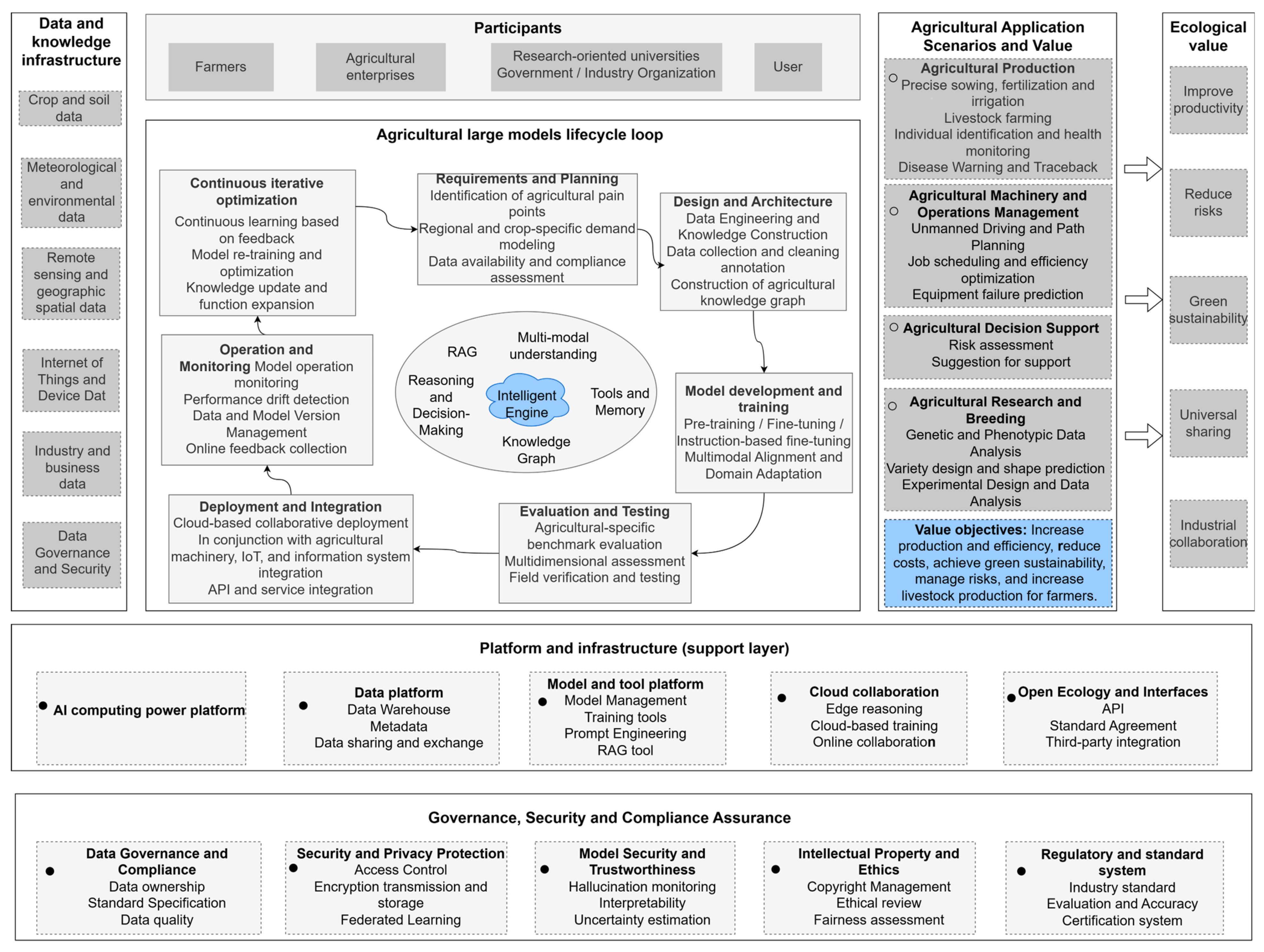
Fifth, lightweight deployment of large models and embodied intelligence. In the future, it is necessary to target real agricultural scenarios and combine environmental complexity to achieve lightweight deployment of large agricultural models and embodied intelligence, truly realizing an integrated agricultural intelligent system controlled by a smart brain. Furthermore, agricultural digital twins are expected to become an important infrastructure for future agricultural intelligence. By integrating real-time sensor data, remote sensing observations, crop growth models, and large agricultural models, digital twins can provide virtual representations of farmland, livestock systems, and agricultural machinery. The combination of digital twins and large agricultural models may enable scenario simulation, risk prediction, and decision optimization before actual field operations, thereby improving production efficiency and reducing operational risks. The ecosystem diagram for the large agricultural model is shown in Figure 6.

6. Conclusions

This article systematically reviews the development history, key technical systems, typical application scenarios, and main challenges faced by large agricultural models. Through the analysis of relevant studies at home and abroad, it is found that large agricultural models have gradually evolved from general large language model fine-tuning to specialized model systems that integrate agricultural knowledge bases, multi-modal data, and intelligent agent technologies, and have shown broad application prospects in agricultural knowledge services, pest and disease diagnosis and control, livestock and aquatic farming, and intelligent agricultural equipment, etc. At the same time, the introduction of visual-language models (VLMs), multi-modal large models (MLLMs), and retrieval-enhanced generation (RAG) technologies has further promoted the development of agricultural artificial intelligence from single-task perception to knowledge understanding, cross-modal reasoning, and intelligent decision support.
The literature analysis indicates that there are still several key deficiencies in current large-scale agricultural model research. Firstly, high-quality, multi-regional, and multi-modal agricultural data resources are relatively scarce, and the data standardization level is low, which restricts the improvement of model training and generalization capabilities. Secondly, there is still a lack of a unified and agricultural-specific evaluation system in the agricultural field, and the existing general natural language processing evaluation indicators cannot fully reflect the safety, regional adaptability, and agricultural effectiveness in agricultural scenarios. In addition, problems such as model hallucination, knowledge update lag, regional bias, and insufficient reliability verification still limit its application in real agricultural production environments.
From the perspective of research development, the future development of large agricultural models will gradually shift from the improvement of single model capabilities to the collaborative evolution of “data–model–intelligent agent–application ecosystem”. On the one hand, it is necessary to build high-quality agricultural data infrastructure and domain-specific evaluation systems to promote the development of models towards greater reliability, explainability, and credibility; on the other hand, it is necessary to strengthen the deep integration of large models with agricultural knowledge graphs, retrieval-enhanced generation, digital twins, and embodied intelligence technologies to enhance their reasoning and decision-making capabilities in complex agricultural scenarios. From the perspective of agricultural application, large agricultural models are expected to become an important hub connecting agricultural knowledge, production management, and intelligent equipment, providing agricultural producers with more accurate, timely, and personalized decision-support services. With the continuous maturity of agricultural intelligent agents, multi-modal interaction, and intelligent equipment collaboration technologies, large agricultural models will play a more important role in promoting agricultural digital transformation, improving resource utilization efficiency, and promoting agricultural sustainable development.
Therefore, in response to the problems and challenges, this article presents corresponding future prospects. Future research should focus on the construction of high-quality agricultural datasets, developing domain-specific evaluation systems, improving model reliability, building agricultural multi-agent systems, and enabling lightweight deployment and embodied intelligence to further promote the continuous development of the agricultural field towards digitalization and intelligence.

Author Contributions

Conceptualization, D.W.; methodology, R.G.; investigation, R.G.; writing—original draft preparation, R.G.; writing—review and editing, D.W., X.Z., and H.H.; visualization, R.G.; supervision, D.W.; funding acquisition, H.H. All authors have read and agreed to the published version of the manuscript.

Funding

This research was funded by the youth project of the Social Science Foundation of Jiangsu Province titled “Research on LLM-based Knowledge Extraction and Intelligent Services for Fruit and Vegetable Cultivation Techniques” (Grant No. 24TQC005).

Data Availability Statement

The original contributions presented in this study are included in the article. Further inquiries can be directed to the corresponding author.

Conflicts of Interest

The authors declare no conflicts of interest.

References

  1. Ministry of Agriculture and Rural Affairs of the People’s Republic of China. Notice of the Ministry of Agriculture and Rural Affairs on Issuing the “National Smart Agriculture Action Plan (2024–2028)”. 2024. Available online: https://www.gov.cn/zhengce/zhengceku/202410/content_6983057.htm (accessed on 5 January 2026).
  2. USDA. USDA Announces the Creation of the USDA National Proving Grounds Network to Strengthen U.S. Farm and Ranch Profitability. 2026. Available online: https://www.usda.gov/about-usda/news/press-releases/2026/04/07/usda-announces-creation-usda-national-proving-grounds-network-strengthen-us-farm-and-ranch (accessed on 14 April 2026).
  3. Zhai, Z. The New Vision for EU Agriculture Masks Underlying Divisions. Economic Daily, 3 March 2025. Available online: http://paper.ce.cn/pad/content/202503/03/content_309931.html (accessed on 6 June 2026).
  4. Generative AI in Agriculture Market|Industry Report. 2033. Available online: https://www.grandviewresearch.com/industry-analysis/generative-ai-in-agriculture-market-report (accessed on 6 June 2026).
  5. Research and Markets Ltd. Applied AI in Agriculture Market Report 2026—Research and Markets. Available online: https://www.researchandmarkets.com/reports/6035352/applied-ai-in-agriculture-market-report (accessed on 6 June 2026).
  6. Benos, L.; Tagarakis, A.C.; Dolias, G.; Berruto, R.; Kateris, D.; Bochtis, D. Machine Learning in Agriculture: A Comprehensive Updated Review. Sensors 2021, 21, 3758. [Google Scholar] [CrossRef] [Scilit] [PubMed]
  7. Condran, S.; Bewong, M.; Islam, M.Z.; Maphosa, L.; Zheng, L. Machine Learning in Precision Agriculture: A Survey on Trends, Applications and Evaluations over Two Decades. IEEE Access 2022, 10, 73786–73803. [Google Scholar] [CrossRef] [Scilit]
  8. Attri, I.; Awasthi, L.K.; Sharma, T.P.; Rathee, P. A Review of Deep Learning Techniques Used in Agriculture. Ecol. Inform. 2023, 77, 102217. [Google Scholar] [CrossRef] [Scilit]
  9. Li, H.; Wu, H.; Li, Q.; Zhao, C. A Review on Enhancing Agricultural Intelligence with Large Language Models. Artif. Intell. Agric. 2025, 15, 671–685. [Google Scholar] [CrossRef] [Scilit]
  10. Kaplan, J.; McCandlish, S.; Henighan, T.; Brown, T.B.; Chess, B.; Child, R.; Gray, S.; Radford, A.; Wu, J.; Amodei, D. Scaling Laws for Neural Language Models. arXiv 2020, arXiv:2001.08361. [Google Scholar]
  11. Bommasani, R.; Hudson, D.A.; Adeli, E.; Altman, R.; Arora, S.; von Arx, S.; Bernstein, M.S.; Bohg, J.; Bosselut, A.; Brunskill, E.; et al. On the opportunities and risks of foundation models. arXiv 2021, arXiv:2108.07258. [Google Scholar]
  12. Chang, Y.; Wang, X.; Wang, J.; Wu, Y.; Yang, L.; Zhu, K.; Chen, H.; Yi, X.; Wang, C.; Wang, Y.; et al. A Survey on Evaluation of Large Language Models. ACM Trans. Intell. Syst. Technol. 2024, 15, 1–45. [Google Scholar] [CrossRef] [Scilit]
  13. Musazade, E.; Mrisho, I.I.; Gao, J.; Feng, X. Integration of LLMs and VLMs in Plant Stress Phenotyping: From Trait Recognition to Decision Support. Plant Phenomics 2026, 8, 100161. [Google Scholar] [PubMed]
  14. Fu, S.; Yu, M.; OuYang, K.; Fan, Q.; Huang, H. MLLMs-MR: Multi-Modal Recognition Based on Multi-Modal Large Language Models. Knowl.-Based Syst. 2025, 330, 114717. [Google Scholar] [CrossRef] [Scilit]
  15. Zhao, C.Y.; Zhu, G.B.; Wang, J.Q. The Inspiration Brought by ChatGPT to LLM and the New Development Ideas of Multi-modal Large Model. Data Anal. Knowl. Discov. 2023, 7, 26–35. [Google Scholar]
  16. Xi, Z.; Chen, W.; Guo, X.; He, W.; Ding, Y.; Hong, B.; Zhang, M.; Wang, J.; Jin, S.; Zhou, E.; et al. The Rise and Potential of Large Language Model Based Agents: A Survey. Sci. China Inf. Sci. 2025, 68, 121101. [Google Scholar] [CrossRef] [Scilit]
  17. Anand, A.; Shen, J.; Cremers, A.B.; Jacobs, M. Algorithms in the Orchard: An Embedding-Based Expert Answering System for Apple Rust. Smart Agric. Technol. 2025, 12, 101069. [Google Scholar] [CrossRef] [Scilit]
  18. Lemmon, H. Comax: An Expert System for Cotton Crop Management. Science 1986, 233, 29–33. [Google Scholar] [CrossRef] [Scilit] [PubMed]
  19. Khaki, S.; Wang, L. Crop Yield Prediction Using Deep Neural Networks. Front. Plant Sci. 2019, 10, 621. [Google Scholar] [CrossRef] [Scilit] [PubMed]
  20. Mohanty, S.P.; Hughes, D.P.; Salathé, M. Using Deep Learning for Image-Based Plant Disease Detection. Front. Plant Sci. 2016, 7, 1419. [Google Scholar] [CrossRef] [Scilit] [PubMed]
  21. Yang, S.; Liu, Z.; Mayer, W. ShizishanGPT: An Agricultural Large Language Model Integrating Tools and Resources. arXiv 2024, arXiv:2409.13537. [Google Scholar]
  22. Jiang, J.; Yan, L.; Liu, J. Agricultural Large Language Model Based on Precise Knowledge Retrieval and Knowledge Collaborative Generation. Smart Agric. 2025, 7, 20. [Google Scholar]
  23. Yang, B.; Zhang, Y.; Chen, Y.; Feng, L.; Xu, X.; Aierken, N.; Li, S. AgriAgent: Contract-Driven Planning and Capability-Aware Tool Orchestration in Real-World Agriculture. arXiv 2026, arXiv:2601.08308. [Google Scholar]
  24. Wei, P.; Cao, S.; Liu, J.; Liu, Z.; Sun, W.; Kong, F. Embodied Intelligent Agricultural Robots: Key Technologies, Application Analysis, Challenges and Prospects. Smart Agric. 2025, 7, 141–158. [Google Scholar]
  25. Zhou, Y.; Wang, D.; Gong, Y.; Lei, I.M.; Zhong, J. Insect-Scale Robots with Embodied Intelligence: Challenges and Future Perspectives. eScience 2026, 6, 100549. [Google Scholar] [CrossRef] [Scilit]
  26. Yang, Z.-X.; Li, Y.; Wang, R.-F.; Hu, P.; Su, W.-H. Deep Learning in Multimodal Fusion for Sustainable Plant Care: A Comprehensive Review. Sustainability 2025, 17, 5255. [Google Scholar] [CrossRef] [Scilit]
  27. Zhang, Q.; Ou, M.; Wang, W.; Pang, Y. Study on China’s Land Problems from Land Environment. Geogr. Geo-Inf. Sci. 2004, 5, 45–49. [Google Scholar]
  28. Ma, G. An In-depth Study of the Ecological Value of Regional Differences in China’s Cereal Crops: Based on the “Grains” Section of Qing Dynasty Local Chronicles. Guizhou Soc. Sci. 2017, 330, 149–154. [Google Scholar]
  29. Xia, S.; Feng, Y. Research on the Optimization Effect of Agricultural Internet of Things Technology Application on Cultivation Costs—Taking Xiuzhou Town of Qufu City as an Example. Digit. Agric. Intell. Agric. Mach. 2026, 4, 113–116. [Google Scholar]
  30. Gao, H. AI-driven technology promotes a new trend in farmers’ training. Cunwei Zhuren (Village Committee Director) 2025, 20, 108–110. [Google Scholar]
  31. Chuang, J.; Manning, C.D.; Heer, J. Termite: Visualization Techniques for Assessing Textual Topic Models. In Proceedings of the International Working Conference on Advanced Visual Interfaces, Capri Island, Italy, 21–25 May 2012; pp. 74–77. [Google Scholar]
  32. Sievert, C.; Shirley, K. LDAvis: A Method for Visualizing and Interpreting Topics. In Proceedings of the Workshop on Interactive Language Learning, Visualization, and Interfaces, Baltimore, MD, USA, 27 June 2014; pp. 63–70. [Google Scholar]
  33. Breakthrough! Xinxing College of Electronics Has Released Shennong Large Model 1.0. Available online: https://news.cau.edu.cn/zhxwnew/2471bbc5b54b4892920a1d0cef725f38.htm (accessed on 7 June 2026).
  34. AgriLLM: Harnessing Transformers for Farmer Queries. ECHOcommunity. Available online: https://www.echocommunity.org/resources/e8be0ce6-8a34-4437-93c3-c11cd0b36d0c (accessed on 7 June 2026).
  35. China Agricultural University. The “Shen Nong Large Model 2.0” of China Agricultural University Has Been Officially Launched. Available online: https://news.cau.edu.cn/mtndnew/640547d621fa429cbaebe15c69447fda.htm (accessed on 7 June 2026).
  36. Truong, T.-D.; Nguyen, H.-Q.; Nguyen, X.-B.; Dowling, A.; Li, X.; Luu, K. Insect-Foundation: A Foundation Model and Large Multimodal Dataset for Vision-Language Insect Understanding. Int. J. Comput. Vis. 2025, 133, 7128–7153. [Google Scholar] [CrossRef] [Scilit]
  37. China Agricultural University. The “Shen Nong Large Model 3.0” of China Agricultural University Has Been Officially Launched. Available online: https://news.cau.edu.cn/mtndnew/11a011e1b64b4a7296b1b784adbfd2ed.htm (accessed on 7 June 2026).
  38. People’s Daily Online. Artificial Intelligence Models Simplify Agriculture and Enhance Efficiency. Available online: https://en.people.cn/n3/2026/0210/c90000-20424351.html (accessed on 11 June 2026).
  39. Nanjing Agricultural University. [Intersection News] Nanjing Agricultural University Has Released Its First Open-Source Agricultural Large Language Model Called “SiNong”. Available online: https://www.njau.edu.cn/2026/0114/c1108a139954/page.htm (accessed on 8 June 2026).
  40. Uluirmak, B.A.; Kurban, R. Fine Tuning DeepSeek and Llama Large Language Models with LoRA. In 2025 33rd Signal Processing and Communications Applications Conference, SIU; IEEE: New York, NY, USA, 2025; pp. 1–4. [Google Scholar] [CrossRef] [Scilit]
  41. Hu, E.J.; Shen, Y.; Wallis, P.; Allen-Zhu, Z.; Li, Y.; Wang, S.; Wang, L.; Chen, W. LoRA: Low-Rank Adaptation of Large Language Models. arXiv 2021, arXiv:2106.09685. [Google Scholar]
  42. Sasaki, Y.; Ishizuka, T.; Higuchi, K.; Yoshida, S.; Hamada, T.; Koshizuka, N. Agri-RAG: A Context-Aware Framework for Precision Agricultural Information Retrieval. In 2025 IEEE International Smart Cities Conference (ISC2); IEEE: New York, NY, USA, 2025; pp. 1–6. [Google Scholar]
  43. Liu, J.; Wang, X. Multimodal Large Models for Smart Agriculture: Frameworks and Applications. Expert Syst. Appl. 2026, 300, 130394. [Google Scholar]
  44. Park, T.; Choi, Y.; Shin, S.; Lee, K. LA-RCS: LLM-Agent-Based Robot Control System. Sens. Mater. 2025, 37, 3073. [Google Scholar]
  45. Hughes, D.P.; Salathe, M. An Open Access Repository of Images on Plant Health to Enable the Development of Mobile Disease Diagnostics. arXiv 2016, arXiv:1511.08060. [Google Scholar]
  46. Wu, X.; Zhan, C.; Lai, Y.-K.; Cheng, M.-M.; Yang, J. IP102: A Large-Scale Benchmark Dataset for Insect Pest Recognition. In 2019 IEEE/CVF Conference on Computer Vision and Pattern Recognition (CVPR); IEEE: New York, NY, USA, 2019; pp. 8779–8788. [Google Scholar]
  47. Zhong, J.; Zhang, X.; Ma, X. Global Agricultural Adaptation Case Database and Trend Analysis Based on Large Language Models. Adv. Clim. Change Res. 2025, 16, 747–761. [Google Scholar] [CrossRef] [Scilit]
  48. Pei, G.; Qian, X.; Zhou, B.; Liu, Z.; Wu, W. Research on Agricultural Disease Recognition Methods Based on Very Large Kernel Convolutional Network-RepLKNet. Sci. Rep. 2025, 15, 16843. [Google Scholar] [CrossRef] [Scilit] [PubMed]
  49. Zhou, Y.; Ryo, M. AgriBench: A Hierarchical Agriculture Benchmark for Multimodal Large Language Models. arXiv 2024, arXiv:2412.00465. [Google Scholar]
  50. Nguyen, H.-Q.; Truong, T.-D.; Nguyen, X.B.; Dowling, A.; Li, X.; Luu, K. Insect-foundation: A foundation model and large-scale 1M dataset for visual insect understanding. arXiv 2024, arXiv:2311.15206v2. [Google Scholar]
  51. Yao, X.; Hao, X.; Liu, R.; Li, L.; Guo, X. AgCNER, the First Large-Scale Chinese Named Entity Recognition Dataset for Agricultural Diseases and Pests. Sci. Data 2024, 11, 769. [Google Scholar] [PubMed]
  52. Liu, R.; Guo, X.; Zhu, H.; Wang, L. A Text-Speech Multimodal Chinese Named Entity Recognition Model for Crop Diseases and Pests. Sci. Rep. 2025, 15, 5429. [Google Scholar] [CrossRef] [Scilit] [PubMed]
  53. Pang, H.; Zhang, Y.; Cai, W.; Li, B.; Song, R. A Real-Time Object Detection Model for Orchard Pests Based on Improved YOLOv4 Algorithm. Sci. Rep. 2022, 12, 13557. [Google Scholar] [CrossRef] [Scilit] [PubMed]
  54. Zhu, J.; Zhai, R.; Ren, H.; Xie, K.; Du, A.; He, X.; Cui, C.; Wang, Y.; Ye, J.; Wang, J.; et al. Crops3D: A Diverse 3D Crop Dataset for Realistic Perception and Segmentation toward Agricultural Applications. Sci. Data 2024, 11, 1438. [Google Scholar] [CrossRef] [Scilit] [PubMed]
  55. Chong, Y.L.; Krämer, J.; Chakhvashvili, E.; Marks, E.; Esser, F.; Dreier, A.; Rosu, R.A.; Warstat, K.; Pude, R.; Behnke, S.; et al. The Multi-Sensor and Multi-Temporal Dataset of Multiple Crops for in-Field Phenotyping and Monitoring. Sci. Data 2026, 13, 17. [Google Scholar] [PubMed]
  56. Li, H.; He, X.; Wang, X.; Li, H.; Xie, S.; Wang, J. Challenging issues in empowering smart agriculture development with control science. Sci. Sin. (Informationis) 2025, 55, 3012–3038. [Google Scholar] [CrossRef] [Scilit]
  57. An, Z.; Zhang, S.; Tan, B.; Han, Z.; Li, Z.; Cao, P.; Zhang, J. CausalTune-Fish: Aquaculture disease mortality prediction framework. J. Harbin Univ. Sci. Technol. 2026, 1–11. Available online: https://link.cnki.net/urlid/23.1404.N.20260109.0844.002 (accessed on 6 June 2026).
  58. Kpodo, J.; Kordjamshidi, P.; Nejadhashemi, A.P. AgXQA: A Benchmark for Advanced Agricultural Extension Question Answering. Comput. Electron. Agric. 2024, 225, 109349. [Google Scholar] [CrossRef] [Scilit]
  59. Huang, G.; Xu, Z.; Liu, L.; Chen, J.; He, Z.; Liu, F. Evaluating and Deploying Large Vision-Language Models for Fruit Quality Assessment in Smart Agriculture Systems. Comput. Electron. Agric. 2025, 238, 110806. [Google Scholar] [CrossRef] [Scilit]
  60. Yang, B.; Zhang, Y.; Feng, L.; Chen, Y.; Zhang, J.; Xu, X.; Aierken, N.; Li, Y.; Chen, Y.; Yang, G.; et al. AgriGPT: A Large Language Model Ecosystem for Agriculture. arXiv 2025, arXiv:2508.08632. [Google Scholar]
  61. Gauba, A.; Pi, I.; Man, Y.; Pang, Z.; Adve, V.S.; Wang, Y.-X. AgMMU: A Comprehensive Agricultural Multimodal Understanding Benchmark. arXiv 2025, arXiv:2504.10568. [Google Scholar]
  62. Zhao, X.; Zhang, H.; Wang, D. Review of Large Language Model Evaluation Studies: Current Status, Applications, Challenges, and Trends. J. China Soc. Sci. Tech. Inf. 2025, 44, 1058–1074. [Google Scholar]
  63. Liang, P.; Bommasani, R.; Lee, T.; Tsipras, D.; Soylu, D.; Yasunaga, M.; Zhang, Y.; Narayanan, D.; Wu, Y.; Kumar, A.; et al. Holistic Evaluation of Language Models. arXiv 2023, arXiv:2211.09110. [Google Scholar]
  64. Kocoń, J.; Cichecki, I.; Kaszyca, O.; Kochanek, M.; Szydło, D.; Baran, J.; Bielaniewicz, J.; Gruza, M.; Janz, A.; Kanclerz, K.; et al. ChatGPT: Jack of All Trades, Master of None. Inf. Fusion. 2023, 99, 101861. [Google Scholar] [CrossRef] [Scilit]
  65. Ji, Z.; Lee, N.; Frieske, R.; Yu, T.; Su, D.; Xu, Y.; Ishii, E.; Bang, Y.J.; Madotto, A.; Fung, P. Survey of Hallucination in Natural Language Generation. ACM Comput. Surv. 2023, 55, 1–38. [Google Scholar] [CrossRef] [Scilit]
  66. Lewis, P.; Perez, E.; Piktus, A.; Petroni, F.; Karpukhin, V.; Goyal, N.; Küttler, H.; Lewis, M.; Yih, W.; Rocktäschel, T.; et al. Retrieval-Augmented Generation for Knowledge-Intensive NLP Tasks. arXiv 2021, arXiv:2005.11401v4. [Google Scholar]
  67. Bai, B.; Meng, X.; Zhao, C. Research on Sem-RAG: A Corn Planting Knowledge Question-Answering Algorithm Based on Fine-Grained Semantic Information Retrieval Enhancement. Appl. Sci. 2025, 15, 10850. [Google Scholar]
  68. Agrawal, G.; Kumarage, T.; Alghamdi, Z.; Liu, H. Can knowledge graphs reduce hallucinations in LLMs?: A survey. arXiv 2023, arXiv:2311.07914. [Google Scholar]
  69. Liu, B.; Zhang, Y.; Liu, Y.; Deng, X.; Qing, J.; Han, B.; Meng, X.; Lan, Y.; Qiu, H. An Intelligent Multi-Modal Q&A System for Agriculture Combining APGM, PBTCS, and RAG. Smart Agric. Technol. 2026, 13, 101829. [Google Scholar]
  70. Ravindran, D.J.S.; Skarga-Bandurova, I.; V, S.; Awais, M.; S, M. AgroLLM: Connecting Farmers and Agricultural Practices Through Large Language Models for Enhanced Knowledge Transfer and Practical Application. AgriEngineering 2026, 8, 38. [Google Scholar] [CrossRef] [Scilit]
  71. Kandamali, D.F.; Porter, W.M.; Porter, E.; McLemore, A.; Rains, G.C. CottonBot: An AI-Driven Cotton Farming Assistant and Irrigation Advisor Using LLM-RAG and Agentic AI Tools. Smart Agric. Technol. 2025, 12, 101640. [Google Scholar]
  72. Peng, S.; Rajjou, L. Advancing Plant Biology through Deep Learning-Powered Natural Language Processing. Plant Cell Rep. 2024, 43, 208. [Google Scholar] [CrossRef] [Scilit] [PubMed]
  73. Zhang, Y.; Fan, Q.; Chen, X.; Li, M.; Zhao, Z.; Li, F.; Guo, L. IPM-AgriGPT: A Large Language Model for Pest and Disease Management with a G-EA Framework and Agricultural Contextual Reasoning. Mathematics 2025, 13, 566. [Google Scholar]
  74. Zhou, T.; Wei, L. YOLO-DP: A Detection Model of Fifteen Common Rice Diseases and Pests. Sci. Rep. 2025, 15, 35968. [Google Scholar] [CrossRef] [Scilit] [PubMed]
  75. Gupta, C.; Gill, N.S.; Gulia, P.; Duhan, S.; Karamti, H.; Kumar, A.; Alamneh, D.A.; Safra, I. An Enhanced Deep Learning-Based Framework for Diagnosing Apple Leaf Diseases. Sci. Rep. 2025, 15, 39699. [Google Scholar] [CrossRef] [Scilit] [PubMed]
  76. Gao, L.; Ran, T.; Zou, H.; Wu, H. Cotton Leaf Disease Detection Using LLM-Synthetic Data and DEMM-YOLO Model. Agriculture 2025, 15, 1712. [Google Scholar]
  77. Zhu, H.; Shi, W.; Guo, X.; Lyu, S.; Yang, R.; Han, Z. Potato Disease Detection and Prevention Using Multimodal AI and Large Language Model. Comput. Electron. Agric. 2025, 229, 109824. [Google Scholar]
  78. Liu, W.; Mohamed, A.S.A.; Osman, M.A.; Kie, K.H.; Wong, C.J. Image Augmentation by a Vision-Language Foundation Model for Durian Leaf Disease Recognition. Vis. Comput. 2025, 41, 12889–12903. [Google Scholar] [CrossRef] [Scilit]
  79. Zhou, S.; Li, W.; Zhou, M.; Dilger, R.N.; Condotta, I.C.F.S.; Wu, Z.; Tang, X.; Wu, Y.; Wang, T.; Li, J. Foundations of Livestock Behavioral Recognition: Ethogram Analysis of Behavioral Definitions and Its Practices in Multimodal Large Language Models. Animals 2025, 15, 3030. [Google Scholar] [CrossRef] [Scilit] [PubMed]
  80. Zhu, L.; Yang, X.; Xian, Y.; Jiang, W.; Pu, X.; Wang, S.; Cheng, J.; Niu, L.; Zhao, Y.; Chen, L.; et al. Empowering Precision Livestock Farming: Artificial Intelligence Applications in Animal Genomic Breeding and Multi-Dimensional Phenotypic Measurement. Smart Agric. Technol. 2025, 12, 101655. [Google Scholar] [CrossRef] [Scilit]
  81. Antonucci, F.; Costa, C. Precision Aquaculture: A Short Review on Engineering Innovations. Aquacult. Int. 2020, 28, 41–57. [Google Scholar]
  82. Fini, C.; Amato, S.G.; Scutaru, D.; Biancardi, S.; Antonucci, F.; Violino, S.; Ortenzi, L.; Nemmi, E.N.; Mei, A.; Pallottino, F.; et al. Application of Generative Artificial Intelligence in the Aquacultural Sector. Aquacult. Eng. 2025, 111, 102568. [Google Scholar] [CrossRef] [Scilit]
  83. Zhang, C.; Jia, L.; Liu, S.; Dou, G.; Liu, Y.; Kong, B. Dynamic Job Allocation Method of Multiple Agricultural Machinery Cooperation Based on Improved Ant Colony Algorithm. Sci. Rep. 2024, 14, 22414. [Google Scholar] [CrossRef] [Scilit] [PubMed]
  84. Zhang, W.; Liu, Y.; Zhang, C.; Zhang, L.; Xia, Y. Real-time Path Planning of Greenhouse Robot Based on Directional A* Algorithm. Trans. Chin. Soc. Agric. Mach. 2017, 48, 1–7. [Google Scholar]
  85. Cladera, F.; Ravichandran, Z.; Hughes, J.; Murali, V.; Nieto-Granda, C.; Ani Hsieh, M.; Pappas, G.J.; Taylor, C.J.; Kumar, V. Air-Ground Collaboration for Language-Specified Missions in Unknown Environments. IEEE Trans. Field Rob. 2025, 2, 626–642. [Google Scholar]
  86. Li, X.; Wang, Y.; Du, Y.; Li, G.; Liu, L. Construction Method of Large Language Model for Chinese Agricultural Machinery LeiSi. Trans. Chin. Soc. Agric. Mach. 2026, 57, 387–397. [Google Scholar]
  87. Zhao, X.; Lyu, X.; Li, X. AgriVLN: Vision-and-Language Navigation for Agricultural Robots. arXiv 2025, arXiv:2508.07406. [Google Scholar]
  88. Tian, Y.; Song, W.; Fu, J.; Li, Z.; Fang, C.; Wang, L.; Hu, W.; Liu, Y. LLM-CBT: LLM-Driven Closed-Loop Behavior Tree Planning for Heterogeneous UAV-UGV Swarm Collaboration. In 2025 IEEE/RSJ International Conference on Intelligent Robots and Systems (IROS); IEEE: New York, NY, USA, 2025; pp. 3581–3586. [Google Scholar]
Figure 1. Prisma flowchart.
Agriculture 16 01419 g001
Figure 2. The coherence score and the pyLDAvis visualization diagram from the Chinese literature [31,32].
Agriculture 16 01419 g002
Figure 3. The coherence score and the pyLDAvis visualization diagram from the English literature [31,32].
Agriculture 16 01419 g003
Figure 4. Topic proportion of the Chinese literature over the years.
Agriculture 16 01419 g004
Figure 5. Topic proportion of the English literature over the years.
Agriculture 16 01419 g005
Figure 6. Large agricultural model life system.
Agriculture 16 01419 g006
Table 1. Literature search results.
DatabaseSearch ExpressionField RestrictionsNumber
Web of Science(“large language model” OR “LLM”) AND (“agriculture” OR “agricultural” OR “smart farming” OR “crop” OR “livestock” OR “aquaculture”)Web of Science Core Collection190
CNKI(主题:大模型 + 语言模型 + LLM)AND (主题:农业 + 智慧农业 + 作物 + 养殖) [(Subject: Large Models + Language Models + LLM) AND (Subject: Agriculture + Smart Agriculture + Crops + breeding))]subject218
IEEE XPLORE(“large language model” OR “LLM”) AND (“agriculture” OR “agricultural” OR “smart farming” OR “crop” OR “livestock” OR “aquaculture”)NO219
arXiv(large language model OR LLM) AND (agriculture OR agricultural OR smart farming OR crop OR livestock OR aquaculture)Abstract220
Table 2. Topic names of the Chinese literature.
Topic IDTopic Name
1Agricultural Entity Recognition and Monitoring Information Extraction
2Crop Growth Monitoring and Pest and Disease Diagnosis
3Smart Farming and Agricultural Knowledge Services
4Large agricultural Language Model and Question Answer Generation
5Multi-modal Agricultural Intelligent Decision-making
6Agricultural Industry Intelligence and Digital Empowerment
7Smart Livestock Farming and Integration with Agricultural Industry
Table 3. Topic names of the English literature.
Topic IDTopic Name
1Knowledge-enhanced LLMs and RAG
2UAVs and Agricultural Agents
3Multi-modal Large Language Models
4Multi-modal Understanding and Evaluation
5Crop Disease Detection and Agricultural Applications
6Agricultural LLM Systems and Control
7Fine-tuning and Model Optimization
Table 4. Domestic and foreign release of large agricultural models (partial).
TimeModel NamePublishing InstitutionParameter SizeComputing ResourcesBenchmarksTraining DatasetApplication FieldMain Features
December 2023Shennong Large Model 1.0 [33]China Agricultural UniversityNot reportedNot reportedNot reportedOver 10 million agricultural knowledge graphs and 50 million production dataAgricultural knowledge Q&AAgricultural knowledge Q&A large model.
June 2024AgriLLM [34]Manipal Institute of TechnologyFlan-T5 BaseNot reportedBLEU, ROUGE, Precision, Recall, Macro-F1Approximately 4 million real Indian farmer question-answer dataAgricultural knowledge Q&AAgricultural knowledge Q&A large model.
July 2024Shennong Large Model 2.0 [35]China Agricultural UniversityNot reportedNot reportedNot reportedBased on a 10 TB ultra-large-scale specialized datasetPlanting, breeding, genetics, remote sensingMulti-modal large model
February 2025Insect-LLaVA [36]University of ArkansasBased on LLaVA architecture. Vicuna 7B\Vicuna 13BNot reportedInsect VQA benchmarksMulti-modal Insect: Over 1 million high-quality insect imagesInsect identificationInsect large model.
October 2025Shennong Large Model 3.0 [37,38]China Agricultural UniversityNot reportedNot reportedNot reportedThe total data volume reaches 3 PB. It contains 10 million knowledge graph entries, 20 million annotated images and 50 million production records.It is widely applied in areas such as breeding, pest and disease controlA large agricultural model.
January 2026Si Nong Large Language Model [39]Nanjing Agricultural UniversitySinong1.0–8B\Sinong1.0–32BNot reportedNot reported40 billion + tokens of professional data in the agricultural fieldAgricultural industry-university-research servicesAgricultural domain knowledge system.
Table 5. Agricultural Datasets (Partial).
DatasetTaskModalitySpeciesRegionDataset DescriptionLimitations
PlantVillage [45]Plant Disease IdentificationImagesVarious pests and diseases.USAThe data records contain 54,309 images, including images of healthy and unhealthy leaves.Background is simple, field generalization ability is insufficient.
IP102 [46]Insect IdentificationImages102 different types of plant pests and diseases.ChinaIt contains more than 75,000 images.Imbalanced categories, some samples of poor quality.
Global agricultural adaptation case database [47]Analysis of Agricultural Adaptation MeasuresText + Geographical InformationVarious cropsWorldwideA quantitative analysis was conducted on the spatial and temporal distribution of global adaptation cases.Strong heterogeneity in data sources.
Plant disease image dataset [48]Disease ClassificationImagesVarious plantsVarious regionsIt contains 95,865 annotated images across 14 plant species and 61 disease categories, covering both healthy and diseased samples.Complex sources, incomplete and inconsistent labeling standards.
MM-LUCAS [49]Land use classificationMulti-modal understandingImages + text metadataEuropeA multi-modal agriculture dataset, that includes 1784 landscape images, segmentation masks, depth maps, and detailed annotations.Sample size is relatively small.
Insect-1M [50]Insect identification, VLM trainingImage + TextVarious InsectsGlobalIt consists of 1 million images of insects with dense identifications of taxonomy hierarchy from the abstract level of taxonomy to the detailed level of taxonomy.The long-tailed category problem is obvious.
AgCNER [51]Agricultural Named Entity RecognitionTextNon-specific speciesChinaThe named entity recognition dataset in the field of agricultural pests and diseases. It contains a total of 206,992 entities and 66,553 samples, including 13 categories.Chinese dataset, limited cross-language capability.
AgMNER [52]Multi-modal Named Entity RecognitionImage + TextCrop Diseases and PestsChinaA multi-modal dataset in the agricultural field. It contains 10 categories and 68,513 entities.Limited Number of Categories.
PestImgData [53]Identification of pests in orchardsImageFruit tree pestsChinaIt covers 7 types and 24,796 color images of orchard pests.The scene is relatively simple.
Crops3D [54]Three-dimensional crop phenotyping analysisPoint cloud8 types of cropsFrom multiple regionsThe dataset incorporates data from diverse point cloud acquisition methods, encompassing eight distinct crop types with 1230 samples.Sample size is relatively small.
MuST-C [55]Crop monitoring, remote sensing analysisSequential data from multiple sensors6 types of cropsUnited StatesMulti-Sensor, multi-Temporal, multiple Crops dataset, which contains field data from various sensors collected over a growing season, covering six crop species.Time span is only one growing season
Table 6. The evaluation benchmarks of a large model in the agricultural domain (partial).
Name of BenchmarkIntroduction
AgXQA [58]Agricultural extension problem-solving benchmark. The question-answering task is evaluated using EM and F1 scores, while the generative problem-solving task is evaluated using BLUE, ROUGE, and BERTScore; at the same time, the human evaluation metric AgEES is introduced to measure the quality, correctness, and completeness of the answers predicted or generated by the LLM.
FruitMMBench [59]A comprehensive multi-modal benchmark tailored for fruit quality assessment, comprising 5465 meticulously annotated fruit images with multi-aspect labels, including classification, quantity, maturity, surface condition, quality status, and edibility.
AgriBench [49]It proposes five levels and 17 tasks to evaluate the model’s capabilities in basic question answering and scenario analysis.
AgriBench-13k [60]It covers 13 types of agricultural-specific tasks (Using a dual evaluation strategy combining automatic metrics and LLM-based scoring. Traditional metrics such as BLEU, METEOR, and ROUGE quantify surface-level accuracy, while Qwen2.5-72B serves as an expert evaluator to score outputs across seven qualitative dimensions: Correctness, Match Ability, Fluency, Coherence, Relevance, Logical Consistency, and Completeness. Each dimension is scored from 0 (failure) to 5 (excellent), accompanied by a confidence score (0 to 1). The final LLM-Score is computed as a confidence-weighted average, improving robustness by prioritizing high-certainty judgments.)
AgMMU [61]An evaluation set of 746 multiple-choice questions (MCQs) and 746 open-ended questions (OEQs), and AgBase, a development corpus of 57,079 multi-modal facts covering five high-stakes agricultural topics: insect identification, species identification, disease categorization, symptom description, and management instruction. Benchmarking 12 leading VLMs reveals pronounced gaps in fine-grained perception and factual grounding
Disclaimer/Publisher’s Note: The statements, opinions and data contained in all publications are solely those of the individual author(s) and contributor(s) and not of MDPI and/or the editor(s). MDPI and/or the editor(s) disclaim responsibility for any injury to people or property resulting from any ideas, methods, instructions or products referred to in the content.