Review

Nutrition as the Intelligent Nexus: Integrating Precision Farming into Sustainable Ruminant Systems †

by
Luis O. Tedeschi
*,
Egleu D. M. Mendes
and
Marcia H. M. R. Fernandes
Department of Animal Science, Texas A&M University, College Station, TX 77843, USA
*
Author to whom correspondence should be addressed.
This paper is an extended version of our paper published in Tedeschi, L.O.; Mendes, E.D.M.; Fernandes, M.H.M.R. Nutrition as the Intelligent Nexus: Integrating Precision Farming into Sustainable Ruminant Systems. In Proceedings of the Animal Nutrition Conference of Canada (Nutrition as the Nexus between Crop Production and Animal Rearing), Edmonton, AB, Canada, 5–7 May 2026, pp. 131–155. Available online: https://www.anacan.org/mp-files/ancc-2026-proceedings.pdf/, accessed on 21 June 2026.
Agriculture 2026, 16(13), 1379; https://doi.org/10.3390/agriculture16131379
Submission received: 1 May 2026 / Revised: 19 June 2026 / Accepted: 22 June 2026 / Published: 24 June 2026
(This article belongs to the Section Farm Animal Production)

Abstract

Global agriculture faces a dual imperative: increase food production to meet rising demand while simultaneously reducing environmental impacts and resource inefficiencies. Addressing this challenge requires repositioning ruminant nutrition as the intelligent nexus linking crop and livestock production within Integrated Crop–Livestock Systems (ICLS). In this role, nutrition becomes central to restoring ecological, nutritional, and economic synergies that have been fragmented by decades of agricultural specialization. While ICLS provides the ecological foundation, Precision Livestock Farming delivers the technological and analytical infrastructure necessary to operationalize integration at the individual-animal level. Real-time sensing, Internet of Things platforms, and Artificial Intelligence (AI) enable dynamic monitoring of animal physiology, behavior, and environmental interactions across scales. A key advancement in this evolution is the development of Hybrid Intelligent Mechanistic Models (HIMM), which integrate biologically grounded mechanistic models with data-driven AI approaches. By combining interpretability with adaptive learning, HIMM enhances predictive accuracy, extrapolative capacity, and decision transparency, enabling the creation of digital twins that simulate biological responses before management interventions are implemented. Such architectures extend precision nutrition beyond feed efficiency and methane mitigation to include nutrient density and product quality, thereby linking different ecosystem processes directly to human dietary needs. Integrating nutrition with advanced modeling and monitoring tools can help livestock systems move beyond static “net-zero” benchmarks toward sustainable strategies that are responsive to local production contexts. In this reframed paradigm, nutrition is not merely a production input but the central analytical framework that computationally links biological mechanisms, environmental stewardship, technological innovation, and human health within sustainable ruminant systems.

1. Introduction

The livestock sector accounts for approximately 40% of global agricultural output and provides essential livelihood support to nearly 1 billion people [1,2]. However, as the world population is projected to reach 9.7 billion by 2050, agrifood systems are under immense pressure to increase output while simultaneously reducing their environmental footprint [3]. At the same time, global food insecurity is often driven less by aggregate food availability than by inequitable access, affordability, and distribution constraints that prevent adequate food from reaching vulnerable populations [4]. This challenge aligns with the concept of sustainable intensification, which seeks to increase productivity by improving resource-use efficiency while simultaneously addressing environmental, social, and economic dimensions of sustainability [5]. In low- and middle-income countries, where demand for animal-source foods is projected to grow most rapidly, meeting this demand through herd expansion rather than productivity gains risks exacerbating greenhouse gas emission intensities and resource degradation, underscoring the need for climate-smart livestock strategies centered on per-animal efficiency [6].
Historically, the modernization of agriculture led to a period of simplification and specialization, effectively decoupling crop production from animal rearing [7,8]. This separation disrupted natural biogeochemical cycles, creating a system where grain farms rely on synthetic, fossil fuel-derived fertilizers while concentrated animal operations face challenges with nutrient accumulation and waste disposal [9].
Integrated Crop–Livestock Systems (ICLS) provide a resilient alternative to specialized monocultures by capturing positive ecological interactions [9]. These systems are defined by their spatial and temporal interactions among different land-use components, aimed at achieving synergy between production and environmental quality [8]. The fundamental principle underlying ICLS is the strategic integration of crop production with livestock grazing to enhance nutrient cycling, improve soil health, and increase overall system productivity. Unlike specialized monoculture systems that have dominated modern agriculture, ICLS embraces complexity and diversity as mechanisms for achieving resilience and sustainability [10]. Historical evidence demonstrates that traditional farming communities worldwide have long practiced various forms of crop–livestock integration, recognizing the mutual benefits of combining these enterprises within the same land unit [11]. Recent systems thinking analyses of beef production have demonstrated how grazing management, manure cycling, feed efficiency, water regulation, and carbon sequestration operate as interdependent, reinforcing, and balancing feedback loops that shape ecosystem services and long-term sustainability [12].
Within this broader integrated framework, forage resources provide the biological connection between soil processes, crop rotations, and ruminant nutrition. In ICLS, legumes and grasses constitute the foundational forage components, providing essential ecosystem services while supporting animal nutrition [13]. The strategic incorporation of leguminous species into ICLS offers multiple benefits, including biological nitrogen fixation, improved soil structure, enhanced forage quality, and increased system resilience [11]. The selection of appropriate legume–grass combinations depends on multiple factors, including climate, soil type, grazing management strategy, and integration with specific crop rotations. Research has demonstrated that well-managed legume–grass pastures in ICLS can achieve herbage accumulation rates and stocking densities comparable to or exceeding those of conventionally fertilized monoculture pastures, while simultaneously improving soil organic matter and nutrient cycling [10].
Adopting ICLS involves strategically integrating grazing animals into crop rotations, facilitating nutrient cycling through manure and urine deposition, reducing reliance on synthetic fertilizers, and improving nutrient-use efficiency [10]. Grazing stimulates root exudation and enhances rhizosphere activity, promoting soil microbial diversity and nutrient availability [11]. Furthermore, maintaining permanent or semi-permanent pasture phases within ICLS contributes to soil carbon sequestration, potentially offsetting a portion of livestock-related greenhouse gas emissions [2]. From an economic perspective, ICLS has been shown to achieve greater land-use efficiency, total system productivity, and risk management, compared to specialized crops or livestock monocultures [10,11]. However, the economic benefits of ICLS may take several years to fully materialize due to its complexity in managing multiple enterprises.
The complexity of ICLS, involving multiple interacting components across temporal and spatial scales, necessitates analytical frameworks that integrate diverse information sources and project system responses to management interventions. Sustainable systems must be evaluated within clearly defined temporal and spatial boundaries, recognizing dynamic feedback interactions and resilience properties [5]. A systems-dynamics perspective further clarifies that these interactions are not linear but structured through reinforcing and balancing loops linking soil health, nutrient cycling, animal performance, and environmental externalities [12]. Recognizing these causal architectures is essential for embedding nutrition within a broader agroecosystem framework rather than treating it as an isolated production input.
Within this broader integrated framework, the path forward lies in recognizing nutrition as the nexus, the fundamental link connecting soil health, crop quality, and ruminant productivity. In this context, ruminants function as biological “upcyclers”, converting human-inedible biomass, including forage, crop residues, and food-industry by-products, into high-value, nutrient-dense protein while interacting within complex agroecosystems [5,14,15]. The modernization of this nexus is an innovation-driven transition powered by Precision Livestock Farming (PLF) and Artificial Intelligence (AI) [16].
By shifting from population-based management to management of the “smallest manageable unit”, producers can optimize nutrition at the individual-animal level [17,18]. Ruminants play a pivotal role in a circular bioeconomy by utilizing “low-opportunity-cost” biomass [14], especially in low- and middle-income countries [6]. Approximately 70% of all agricultural land is grassland suitable only for ruminant grazing [3]. These animals convert forage, crop residues, and food industry by-products that would otherwise become environmental burdens into nutrient-dense foods [14]. In fact, ruminants contribute to net global protein availability because they require only 0.6 kg of human-edible protein to produce 1.0 kg of high-quality animal protein [15].
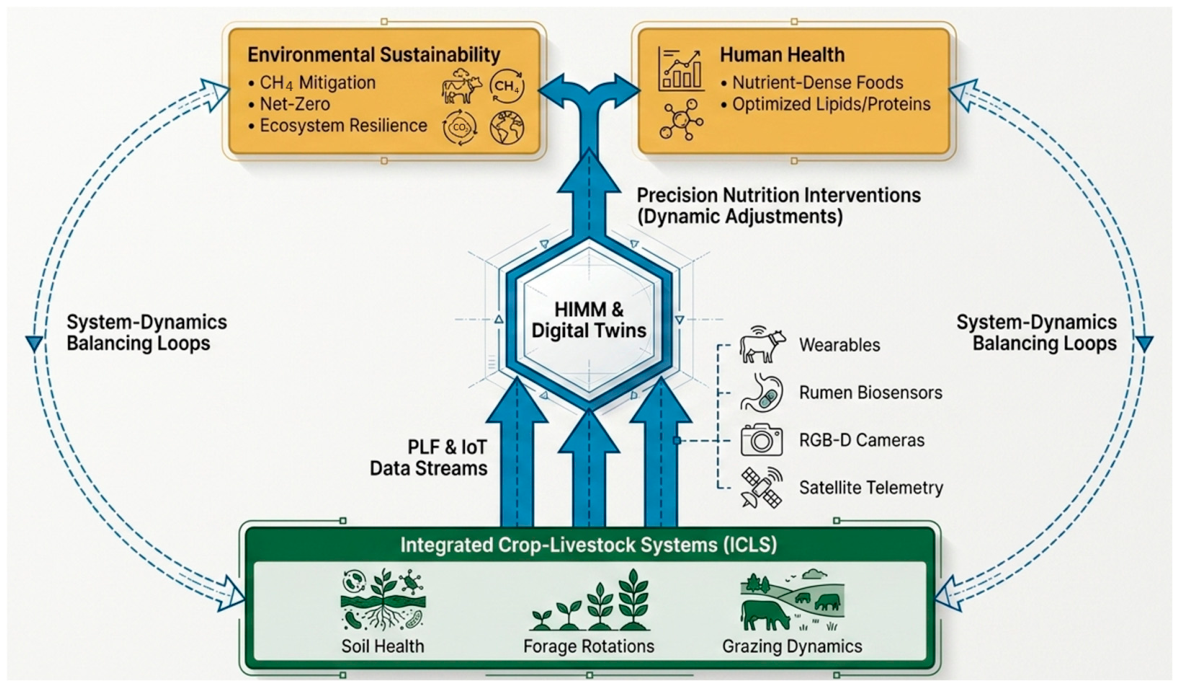
Managing integrated ruminant systems requires frameworks that can connect ecological complexity with emerging technological capabilities. To address these challenges, this manuscript is structured as a narrative conceptual review and perspective piece. It synthesizes the foundational roles of mathematical modeling and precision farming technologies in advancing ruminant nutrition as the intelligent nexus linking crops and ruminant production within ICLS. Our objective is to provide a comprehensive framework (Figure 1) for advancing ruminant systems that are simultaneously productive, resilient, and environmentally responsible, capable of contributing meaningfully to global food security while respecting differences in livestock production and regulations worldwide.
Our focus is on the theoretical pathways and architectural frameworks that link multi-disciplinary components of the livestock industry. Consequently, this review does not encompass systematic data analysis or meta-analyses of production metrics. Furthermore, while we introduce advanced frameworks such as Hybrid Intelligent Mechanistic Models (HIMM), this piece does not detail specific dietary formulation mechanisms or the algorithmic and computational specifications required for HIMM deployment. By maintaining this conceptual focus, we aim to outline the holistic operational logic necessary to transition ruminant production toward adaptive, climate-smart systems.

2. The Technological Nexus: Precision Livestock Farming

While ICLS provides the ecological framework for reintegrating crops and livestock, PLF provides the technological and analytical infrastructure to operationalize this integration at the individual-animal level. Originally conceptualized as a model-based, real-time monitoring approach for managing complex, individual, and time-varying biological systems [19,20], PLF has evolved to incorporate AI, computer vision (CV), Internet of Things (IoT)-enabled sensing, and hybrid mechanistic–data-driven decision support systems that enable adaptive, precision nutrition and health management [16].

2.1. Sensing and the Internet of Things

The technological foundation of PLF is a diverse set of sensor systems that monitor animal behavior, physiology, environmental conditions, and production parameters in real time. Modern PLF systems employ multiple sensor modalities, each offering unique capabilities for capturing specific aspects of animal status and farm conditions [16,17,21,22]. Wearable sensors, such as tri-axial accelerometers, gyroscopes, and magnetometers, enable continuous monitoring of animal activity, behavior, and location [21,22,23,24,25]. These devices are typically mounted on ear tags, collars, or leg bands, and capture fine-scale movement patterns that correlate with physiological states and activity budgets, including feeding behavior, rumination, estrus activity, and health status [17,21,24,26]. Accelerometer-based systems have demonstrated accuracy in detecting rumination and feeding behavior in feedlot cattle [24], providing early indicators of bovine respiratory disease and other health challenges [27].
Identifying deviations in baseline behavioral patterns, such as increased inactive periods, reduced feed bunk attendance, or prolonged lying bouts, provides reliable early preclinical indicators of disease, sometimes days before clinical symptoms become visually apparent to farm staff [27]. Furthermore, these continuous monitoring devices are proving instrumental in the early detection of various other health challenges, including lameness, metabolic disorders, and newborn calf diarrhea, thereby facilitating rapid, targeted interventions and improving overall animal welfare [25,27].
At the landscape level, effective monitoring of extensive grazing systems relies on multi-scale technologies. Satellite remote sensing is indispensable for monitoring vast expanses of land, estimating forage mass and quality, and providing early warnings for drought [28]. At the herd animal level, GPS-enabled collars track spatial distribution and movement patterns, informing grazing behavior, pasture utilization, and social interactions [23,29].
In confined environments, rumen biosensors provide real-time data on internal pH and temperature using potentiometric and ion-sensitive field-effect transistor technologies [16]. These tools enable early detection of subacute ruminal acidosis, allowing immediate dietary corrections, provided that temporal ruminal pH measurements are appropriately analyzed using biologically meaningful thresholds and dynamic metrics [16]. Environmental sensors monitor temperature, humidity, air quality, and pasture conditions, contextualizing animal responses and informing management decisions [22,30]. For dairy cattle, milk composition sensors in automated milking systems measure fat, protein, lactose, and somatic cell counts in real-time, detecting mastitis, metabolic disorders, and nutritional imbalances [18,31].
For CV systems, using an RGB, RGB with depth (RGB-D) sensor, and 3D imaging technologies enables non-invasive assessment of animal morphology, body condition, and behavior. These systems can automatically estimate body weight, body condition score, and carcass composition without requiring physical handling of animals [16,17,32,33]. Advanced CV applications can employ Convolutional Neural Network (CNN) and other Deep Learning (DL) architectures to classify behaviors, detect lameness, and assess welfare indicators from video data [32,34,35].
The integration of these diverse data streams through IoT platforms creates comprehensive digital representations of individual animals and herds [30,36]. Moreover, the IoT paradigm extends the capabilities of individual sensors by enabling networked communication, cloud-based data storage, and distributed computing. The IoT architecture in PLF typically comprises three layers: perception (sensors and actuators), network (communication infrastructure), and application (data processing and decision support) [16].
Wireless communication protocols, including Wi-Fi, Bluetooth, Long Range Wide Area Network, and cellular networks, facilitate data transmission from on-animal sensors and environmental monitors to centralized databases. The selection of appropriate communication technology depends on factors including data transmission requirements, power consumption constraints, communication range, and infrastructure availability [16]. Low-power wide-area network, such as Long Range Wide Area Network, offers advantages for extensive grazing systems, providing long-range connectivity with minimal power consumption [37]. Cloud computing platforms enable storage, processing, and analysis of the massive datasets generated by PLF sensor networks, providing scalability, accessibility, and computational resources that exceed the capabilities of on-farm computing infrastructure [16,38], but they require reliable, high-bandwidth internet connectivity. Edge computing can perform data processing at or near the point of data collection, complementing cloud computing by reducing latency, minimizing bandwidth requirements, and enabling real-time decision-making even when internet connectivity is limited or unavailable [39]. Edge devices can execute pre-trained machine learning (ML) models, filter and aggregate sensor data, and trigger automated responses to detected conditions without requiring continuous cloud connectivity [16].

2.2. Data Collection, Analytics, and Management

The transition toward data-driven livestock management depends on the recognition that optimal decision-making requires comprehensive, timely, and accurate information about individual animals, environmental conditions, and system performance. The growing demand for data in PLF reflects the need to optimize resource utilization, enhance animal welfare, improve product quality, demonstrate environmental stewardship, and maintain competitiveness in increasingly demanding markets [17]. Data collection in PLF encompasses both automated sensor-based approaches and traditional manual measurements, with increasing emphasis on automation to reduce labor requirements and improve data consistency. Automated systems offer advantages of continuous monitoring, objective measurements, and reduced human error, though they require initial investment and ongoing maintenance [17].
The vast data stream generated by sensor technologies requires sophisticated data analytics to extract actionable insights [40], including anomaly detection, predictive models, and time-series analysis. Anomaly detection algorithms identify deviations from normal patterns, triggering alerts for potential health problems, equipment malfunctions, or environmental stressors [22,31]. Time-series analysis techniques characterize the temporal dynamics of physiological and behavioral variables, revealing circadian rhythms, seasonal patterns, and responses to management interventions [28].
It is noteworthy, however, that developing and validating predictive models, particularly ML algorithms, requires large and diverse datasets that capture the range of biological and environmental variability present in commercial livestock systems. Larger datasets generally improve generalization and reduce overfitting [41,42], yet collecting sufficiently extensive data remains challenging, particularly for rare events such as specific diseases or extreme environmental conditions.
To address these limitations, synthetic data generation has emerged as a promising strategy for augmenting data under underrepresented conditions or for costly-to-obtain observations. A novel rank-based method was recently proposed to generate synthetic databases with correlated non-normal multivariate distributions while preserving biological plausibility and Spearman-based dependency structures [41]. This approach involves fitting empirical distributions, generating synthetic samples, preserving correlation structures, and cleaning datasets to ensure realism. Compared with copula-based alternatives, the method demonstrated improved preservation of distributional moments and inter-variable relationships. Nonetheless, synthetic data applications require rigorous validation and cautious interpretation to prevent the propagation of structural biases or the amplification of modeling artifacts [41,42].
Effective data management represents another critical challenge in PLF, encompassing data storage, quality control, security, and accessibility. The volume, velocity, and variety of PLF data necessitate robust database architectures capable of handling time-series data, spatial information, and diverse data types [16]. Relational, time-series, and NoSQL databases each offer advantages for specific PLF applications, with selection depending on query patterns, scalability requirements, and data structure [17]. Data quality control procedures are essential to ensure that sensor measurements are accurate, complete, and properly calibrated. Automated quality control algorithms can identify sensor malfunctions, missing data, and outliers that may indicate measurement errors or biologically implausible values [41]. However, distinguishing between measurement errors and genuine biological extremes requires careful consideration and domain expertise.
Data security and privacy considerations are increasingly important as PLF systems become more interconnected and data sharing becomes more common. Protecting sensitive farm data from unauthorized access while enabling appropriate sharing for research and benchmarking purposes requires careful attention to cybersecurity, access controls, and data governance policies [41].

2.3. Multiple Sites and Farm-Level Deployment

The PLF technologies must be adapted to diverse production systems, each characterized by unique management practices, environmental conditions, and operational constraints. Intensive feedlot systems, with high animal densities and controlled environments, offer relatively favorable conditions for PLF implementation, including reliable power supply, internet connectivity, and infrastructure for sensor installation. These systems have been early adopters of automated feeding systems, environmental monitoring, and individual animal tracking technologies [23].
By contrast, extensive grazing systems present distinct challenges for PLF implementation, due to large spatial scales, variable terrain, limited infrastructure, and harsh environmental conditions. These systems may derive particular benefits from precision technologies that enable monitoring of widely dispersed animals and optimization of grazing management across heterogeneous landscapes [43,44]. GPS-based tracking systems, combined with remote sensing of forage availability and quality, enable precision grazing management that matches animal nutritional requirements with spatial and temporal variation in pasture resources [16,23,26,28,29].
For ICLS, precision management approaches are required that account for its dynamic nature, including seasonal transitions between crop and livestock phases, variable stocking rates, and interactions between grazing management and subsequent crop performance [10,11]. For instance, soil moisture sensors and weather forecasting systems inform decisions about when to introduce or remove livestock from crop fields, minimizing soil compaction and maximizing forage utilization [10]. Remote sensing technologies enable monitoring of pasture biomass and quality across large areas, supporting decisions on stocking rates and supplementation strategies [28].
Overall, these production contexts show that PLF implementation must be tailored to each system’s infrastructure, spatial scale, and management objectives. This is particularly important in ICLS, where sensor-derived information on animals, forage, soil, and weather must be integrated across seasons to support timely grazing, stocking-rate, and supplementation decisions.

3. Precision Nutrition of Ruminants: The Pivotal Role of Modeling

Precision nutrition represents a shift from group-based feeding to individualized nutritional management that accounts for animal-specific requirements, preferences, and responses [18,31]. Traditional feeding systems formulate diets for average animals within groups, resulting in overfeeding of some individuals and underfeeding of others, with consequences for efficiency, health, and environmental impacts [31]. The implementation of precision feeding requires three essential components: accurate assessment of individual animal requirements, real-time monitoring of feed intake and animal status, and dynamic adjustment of nutrient supply to match changing requirements [31]. Mathematical modeling thus represents a critical tool for optimizing precision feeding systems by integrating sensor-derived data to generate real-time decision support and adaptive frameworks that project system responses to management interventions [45,46]. From a systems thinking standpoint, these nutritional decisions propagate through ecosystem-service feedback structures, influencing soil fertility, methane (CH4) emissions, water dynamics, and economic resilience [12]. Thus, precision nutrition operates not only at the animal scale but also within multi-scale agroecological loops.

3.1. Advanced Decision Support and Mathematical Modeling

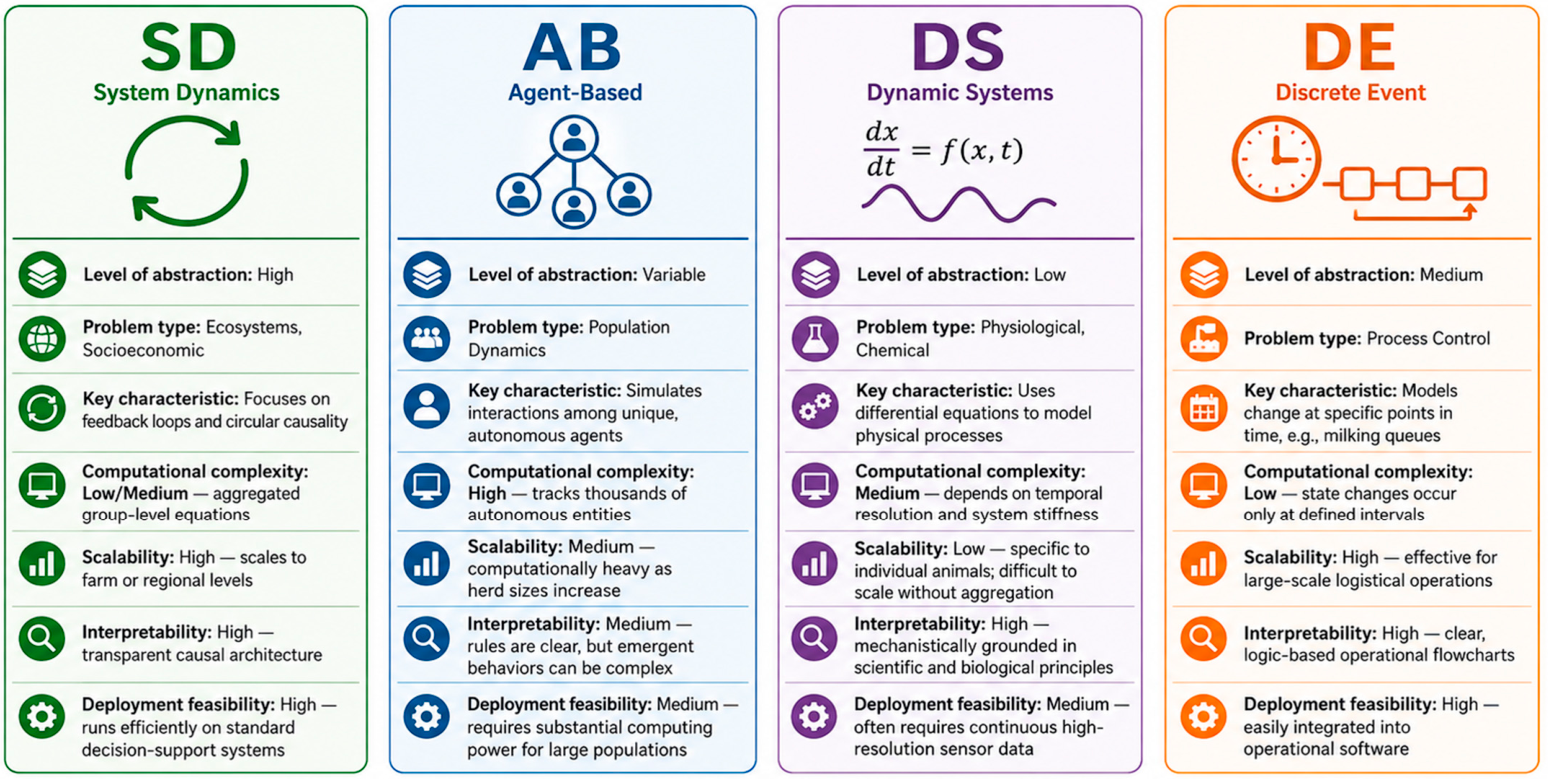
The data collected by sensors is only valuable if it is converted into actionable information through Decision Support Systems (DSS) [22,45,46]. Historically, modeling in animal science has been divided into two paradigms: 1. Mechanistic or concept-driven models that are based on established biological principles and scientific knowledge; 2. AI or data-driven models that are based on mathematical correlations within large datasets [46]. Although modeling approaches are often broadly grouped into mechanistic (concept-driven) and AI (data-driven) frameworks, mechanistic models can be implemented under different mathematical paradigms depending on the level of abstraction, aggregation, and temporal resolution required. Figure 2 shows that the prevailing paradigms include Dynamic Systems, System Dynamics, Agent-Based, and Discrete Events modeling, and summarizes their main characteristics [45,47].
These paradigms differ in how they represent system structure, causality, stochasticity, and scale. Dynamic Systems models typically use differential equations to represent physiological or biochemical processes with low abstraction and great structural detail, whereas System Dynamics models emphasize feedback loops, circular causality, and dynamic complexity at higher levels of aggregation. Agent-Based models simulate the behavior and interactions of autonomous entities, allowing emergent population-level patterns to arise from individual decision rules. Discrete-event models focus on state changes at discrete points in time, making them particularly suited for process control and operational logistics. The selection of a paradigm is therefore determined not only by the nature of the problem but also by the intended level of mechanistic resolution and decision-support application.
Mechanistic models, exemplified by systems such as the Cornell Net Carbohydrate and Protein System (CNCPS) and the Ruminant Nutrition System (RNS), are grounded in scientific understanding of biological and physical processes, providing explanatory power and the capacity to extrapolate beyond observed conditions. These models conceptualize livestock production systems as networks of interconnected processes, including feed intake, nutrient digestion and metabolism, animal growth and reproduction, and environmental interactions [46]. By explicitly representing these processes and their relationships, mechanistic models enable exploration of “what-if” scenarios and identification of leverage points for system improvement [31]. However, mechanistic models also face limitations, including complexity, data requirements for parameterization, and potential for prediction errors when model assumptions do not align with actual conditions [47]. The development and validation of mechanistic models require substantial research investments and expertise in both animal nutrition and mathematical modeling [31].
On the other hand, AI and ML approaches excel at pattern recognition, handling high-dimensional data, and generating predictions without requiring explicit specification of underlying mechanisms [46]. AI-based models learn relationships between inputs and outputs directly from data, using algorithms such as artificial neural networks, random forests, support vector machines, and DL architectures [46].
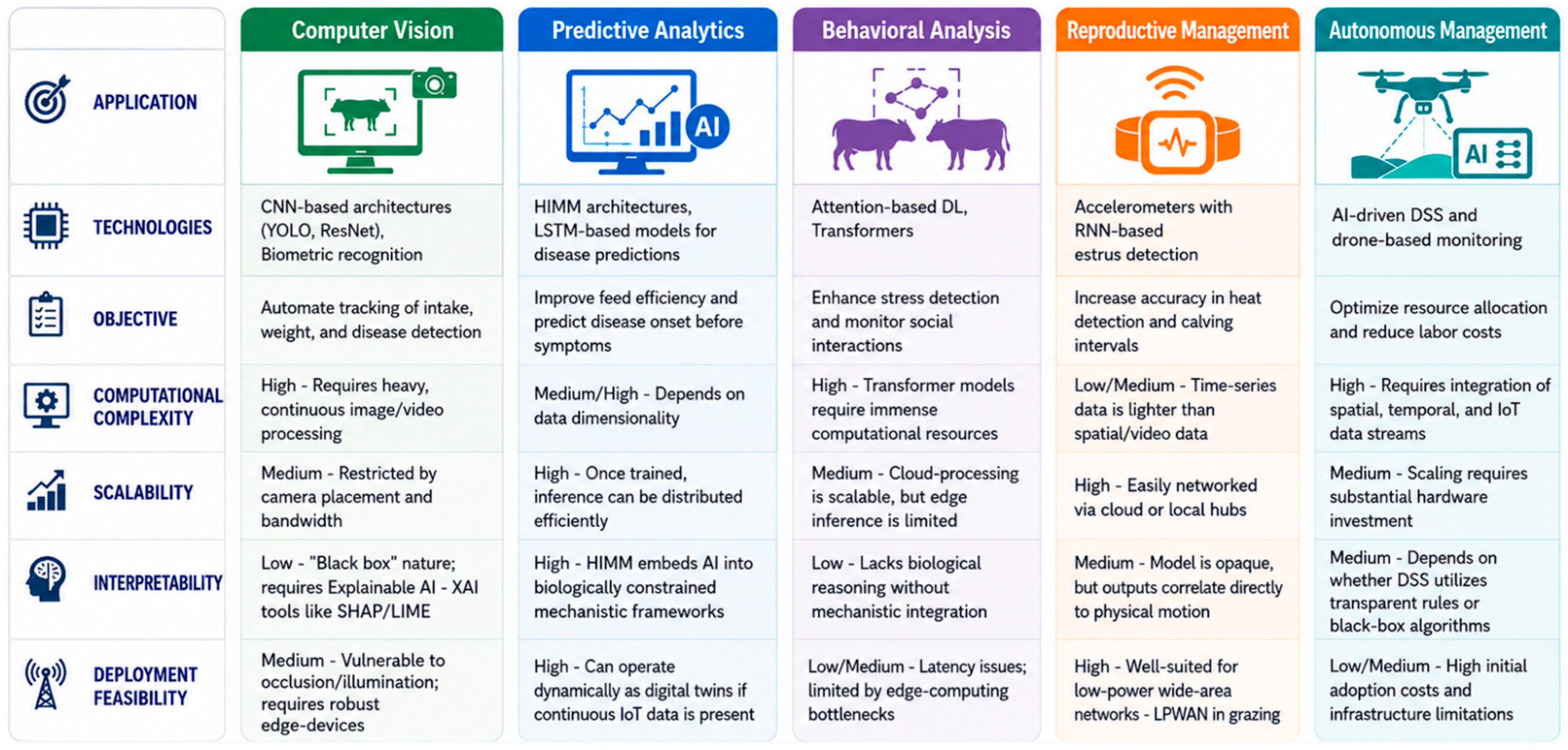
To illustrate the scope and operational trade-offs of these data-driven tools, Figure 3 categorizes current AI applications and technologies deployed in livestock production. The landscape ranges from resource-intensive applications, such as computer vision and transformer-based behavioral analysis, to lighter, highly scalable solutions, such as accelerometer-based reproductive management. While technologies that rely on spatial and video data demand heavy computational power and face deployment constraints at the edge, time-series data processed via Recurrent Neural Networks offer high deployment feasibility through low-power wide-area networks. Furthermore, the figure highlights the critical challenge of model interpretability, contrasting “black box” algorithms with frameworks designed to maintain biological transparency.
The application of AI to ruminant nutrition has expanded rapidly in recent years, with examples including the prediction of feed intake, CH4 emissions, milk production, and feed efficiency from sensor data and animal characteristics [16,48]. Deep learning approaches, particularly CNN, have shown useful performance in analyzing images for body condition scoring, behavior classification, and disease detection [16,34,35]. The CV algorithms, especially those built on CNN and broader DL architectures, now provide non-invasive tools for real-time monitoring of individual animal metrics [32,35]. For example, RGB-D camera systems can quantify dry matter intake by measuring feed mass and volume at the feeder, achieving mean absolute errors of 0.127 kg per meal, thereby enabling precise assessment of individual feed conversion efficiency [16,32]. Similarly, AI-driven extraction of morphometric features from three-dimensional images, including body volume and surface area, has been used to predict body weight and body condition score with correlation coefficients frequently exceeding 0.9. In addition, advanced object-detection algorithms, including YOLO (You Only Look Once), facilitate continuous monitoring of health and behavior by estimating respiratory rates to detect bovine respiratory disease early and identifying postural alterations indicative of laminitis [16,32].
Despite their predictive power, AI-based models generally face important limitations, including a lack of biological interpretability, potential for overfitting, sensitivity to the characteristics of the training data, and limited capacity to extrapolate beyond the range of the training data. The “black box” nature of many AI algorithms makes it difficult to understand why specific predictions are generated, limiting their utility for hypothesis generation and mechanistic understanding [45,46]. In high-stakes decision environments, reliance on opaque models without inherent interpretability may compromise scientific transparency and decision accountability [49]. These limitations become particularly acute in PLF contexts, where models must accommodate individual animal variation, dynamic environmental conditions, and real-time data streams while maintaining computational efficiency and interpretability [31,34,45], particularly when applying DL architectures for video-based livestock monitoring, including CNN, YOLO, Transformer, and Long Short-Term Memory-based architectures.
The practical deployment of AI applications in Precision Livestock Farming must overcome critical environmental and infrastructural barriers that are sensitive to real-world operating conditions. Visual monitoring systems frequently suffer from camera occlusion caused by overlapping animals, feeders, mud, and farm infrastructure (such as fences), which obscures targets and disrupts continuous tracking [32,34,50,51]. Variable lighting (such as diurnal changes and shadows), combined with different weather conditions, significantly degrades camera sensor performance and image clarity [34,50,51]. Background complexity, including unstandardized layouts and dynamic environmental features, can further disrupt object segmentation in both indoor and on-pasture systems [50,51]. The ability to transfer the model across multiple scenarios remains a fundamental obstacle; algorithms trained on specific herds often experience a shift, resulting in reduced accuracy and precision when applied across different breeds, production systems, and farm environments [25,32].
Sensor synchronization issues and missing data pose challenges for the use of multimodal AI systems. Temporal misalignments between asynchronous data streams, as well as gaps in wearable sensor data, can compromise model reliability [25,40]. Deploying these systems requires balancing infrastructure resources, computational limits, latency, and connectivity for edge deployment; local edge hardware faces strict power and memory constraints, while offloading complex processing to the cloud introduces latency and is often impractical due to unreliable broadband connectivity in rural environments [25,40].
The adoption of AI-based decision support in livestock systems depends not only on predictive accuracy but also on interpretability and user trust. Explainable AI techniques, such as Shapley Additive Explanations (SHAP), and Local Interpretable Model-Agnostic Explanations (LIME), provide transparency by identifying which factors most influenced an AI model’s prediction, helping to understand why the model made a particular decision [25]. When embedded within hybrid modeling architectures, such tools can enhance confidence in nutrition recommendations and support hypothesis generation rather than replacing biological reasoning.

3.2. Intelligence at the Nexus: Hybrid Models

A significant innovation in the nexus is the emergence of HIMM [17,46,47]. The HIMM represents a structured hybridization in which mechanistic nutritional models provide biologically grounded system architecture. At the same time, AI components extract patterns from complex, high-dimensional, and unstructured data streams such as video, audio, and continuous sensor inputs. In this framework, mechanistic structure constrains prediction within physiologically meaningful boundaries, while ML enhances adaptability and predictive resolution under dynamic conditions.
Several architectures for hybrid models have been proposed, including parallel hybridization (mechanistic and AI models operate independently and their outputs are combined), serial hybridization (output from one model serves as input to the other), and embedded hybridization (AI components are integrated within a mechanistic model structure) [40,46,47]. The selection of an appropriate hybrid architecture depends on the specific application, available data, and modeling objectives [16]. Nonetheless, the development of HIMM requires interdisciplinary collaboration among animal nutritionists, computer scientists, and engineers, combining domain expertise with advanced computational techniques [16].
To clarify the framework’s feasibility and practical application pathway, the specific model structures and operational logic of these hybridization approaches must be systematically defined. In serial, or sequential, hybridization, the operational logic follows a linear pipeline; for instance, an AI algorithm may process unstructured sensor data to predict a parameter (e.g., ruminal passage rates) that is subsequently used as direct inputs for a mechanistic model, or conversely, a mechanistic model calculates intermediate biological variables (e.g., degraded starch) that feed into an AI structure to predict outcomes like methane emissions [16,46]. In parallel hybridization, the AI (which learns from data) and mechanistic models (which apply biological rules) work side by side. Instead of working independently, they constantly communicate and double-check each other’s work until they agree on a reliable, final answer [46]. In embedded, or gray-box models, AI components are incorporated within the mechanistic model structure. Essentially, this imposes biological first principles as structural constraints within the learning algorithm. This architecture enables AI to deliver fast, real-time predictions, while the underlying biological framework ensures that the outputs are accurate and interpretable in a physiological context [16,46].
The practical implementation of these HIMM structures into commercial operations usually requires robust system pipelines to process real-time, asynchronous sensor data. First, end users require robust computer networks that connect local sensors directly to the cloud, enabling them to handle the constant stream of real-time data. Second, they will need robust ways to test these systems to ensure their predictions are not just mathematically accurate but also have biological value and can be used in the conditions of a real farm [32,46].
Kenny and collaborators [52] demonstrated parallel hybridization for pasture growth prediction by combining a mechanistic grass growth model with a neural network, while an additional screening model dynamically selected the more reliable prediction source under specific climatic conditions, particularly during out-of-distribution weather events. The authors concluded that their hybrid framework demonstrated how mechanistic models enhanced robustness under abnormal environmental conditions, whereas machine learning models improved responsiveness to short-term fluctuations and local variability. The work of Kenny and collaborators [52] exemplifies that, as PLF technologies generate increasingly rich datasets and computational capabilities advance, hybrid modeling approaches are central to operationalizing precision nutrition in data-rich PLF environments.
Beyond predictive accuracy, hybridization provides structural integration between data-driven learning and biologically grounded reasoning. AI adoption in livestock systems has been shown to depend not only on performance metrics but also on transparency, biological plausibility, and alignment with producer decision-making processes [25]. By embedding AI within mechanistic nutritional frameworks, HIMM enhances extrapolative capacity and explanatory power while preserving operational flexibility.
Despite their significant advantages, hybrid modeling architectures are not immune to structural vulnerabilities [16]. A critical risk of HIMM is the potential to inherit and compound the weaknesses of both parent frameworks [46]. If a hybrid model integrates flawed or biased mechanistic assumptions with overfitted, data-driven AI corrections, the resulting architecture may produce highly precise but biologically inaccurate predictions [32,46]. Such “compounded errors” can be particularly difficult to diagnose because the AI component may mathematically mask underlying mechanistic flaws rather than correct them [16,46]. Therefore, HIMM deployment requires continuous validation against independent datasets and rigorous sensitivity analyses to ensure that data-driven corrections do not override fundamental biological laws [16,32].
When real-time sensor streams are continuously assimilated into HIMM frameworks, the system evolves toward the creation of digital twins, which yield dynamic computational representations of individual animals that simulate physiological states, nutrient fluxes, and predicted responses to management interventions. These digital twins enable “what-if” simulations of dietary adjustments or environmental changes before physical implementation, thereby reducing biological risk and improving environmental and economic efficiency [16,32].
For instance, Rao and Neethirajan [40] discussed the evolution and implementation of digital twin technology and its transformative role in precision dairy nutrition. The authors proposed a HIMM framework for precision dairy nutrition digital twins that integrates mechanistic models with IoT sensor data, ML algorithms, and optimization routines. This architecture enables continuous updating of animal-specific model parameters based on real-time data, supporting dynamic nutritional strategies that adapt to changing physiological states, environmental conditions, and feed availability. The authors also highlighted the need to integrate biologically grounded mechanistic digestion models with explainable AI to ensure that recommendations are both accurate and trustworthy for farm managers.
To illustrate the operational logic of hybrid systems in a real-world scenario, consider how asynchronous sensor data flows into an HIMM to optimize precision grazing management. First, the model continuously ingests multimodal environmental and animal-level data: satellite remote sensing estimates the available pasture biomass and its nutritional value [28,44], while wearable GPS collars track individual animal movement and distance walked to calculate physical energy expenditure [23,44]. Simultaneously, intraruminal boluses provide real-time monitoring of rumen pH and temperature [25,44], and automated walk-over-weighing platforms record daily body weight changes [23,31,33]. Within the HIMM framework, data-driven AI algorithms process these complex, high-dimensional data streams to detect patterns, which are then integrated into a mechanistic nutritional core to evaluate the animal’s metabolic state and ensure biological response [25]. This integration leads to an automated DSS that dictates the exact type and amount of feed needed to balance the animal’s current nutrient intake and stabilize the rumen environment [23,31]. Ultimately, the hybrid model uses these inputs to simulate the consequences of the dietary intervention, forecasting the animal’s expected growth response (such as average daily gain) and predicting the resulting enteric methane emissions.
In this sense, HIMM operationalizes nutrition as the integrative intelligence layer connecting biological processes with real-time environmental and management data streams.

3.3. Applications of Precision Nutrition for Livestock CH4 Emissions

The nexus among nutrition, microbial ecology, and environmental stewardship is particularly critical when addressing CH4 emissions, which account for approximately 39% of livestock-related greenhouse gas emissions globally [1,2]. Precision nutrition management offers one of the most effective pathways to mitigate CH4 emissions by directly targeting ruminal fermentation and nutrient-use efficiency. Among the most extensively studied approaches are CH4 inhibitors, including 3-nitrooxypropanol. This synthetic compound suppresses methyl-coenzyme M reductase, the enzyme responsible for the final step of methanogenesis, yielding approximately 30% reductions in emissions under controlled conditions [2,53]. Bioactive phytochemicals, particularly red seaweeds of the genus Asparagopsis, provide another powerful intervention; their bromoform content can disrupt methanogenic pathways and has demonstrated reductions in enteric CH4 exceeding 80% in steers, although responses may vary depending on diet composition and inclusion rate [2]. Complementing these targeted additives, precision feeding strategies leverage AI-driven decision-support models to align nutrient supply precisely with animal requirements, thereby improving rumen fermentation efficiency and reducing nitrogen and phosphorus excretion. This integrated approach not only lowers CH4 intensity per unit of product but also enhances air and water quality through improved nutrient management [16].
Moreover, random forest regression, an ensemble ML method, has shown particular promise for predicting CH4 emissions from ruminants. Tedeschi [41] demonstrated that random forest models trained on synthetic data achieved high accuracy (R2 of 0.927) in predicting CH4 emissions, substantially outperforming linear regression models (R2 of 0.622). However, the study also revealed that random forest models exhibited high specificity to data distribution characteristics, with performance degrading when applied to data with distributional properties different from those of the training data [41].
Mathematical models play a critical role in predicting CH4 emissions and evaluating mitigation strategies. Mechanistic models that simulate rumen fermentation dynamics can predict CH4 production based on diet composition, feed intake, and animal characteristics, enabling researchers to evaluate dietary interventions before implementation [2]. In contrast, empirical regression equations are generally simpler to apply but often exhibit larger prediction errors due to animal-to-animal variation and environmental influences. Their accuracy may also depend on factors such as diet composition (e.g., high- or low-forage diets) and geographical location, often requiring separate equations for different production conditions [54]. Muriel and Jaramillo-Botero [55] presented a hybrid modeling framework designed to improve the accuracy of measuring enteric CH4 emissions from livestock by mechanistically linking animal physiology to sensor readings (sniffer sensor). By initializing the model with a few key physiological parameters (such as respiratory frequency and peak flow), the authors observed a significant improvement in accuracy, achieving a 9% error in mass prediction and a root-mean-square error of 0.4 mg/s when validating against field measurements.
In summary, addressing the environmental footprint of livestock requires a multifaceted approach, with precision nutrition playing a pivotal role in mitigating enteric CH4 emissions. By combining targeted dietary interventions with advanced mathematical and AI models, researchers can more accurately predict and manage these emissions. Ultimately, utilizing hybrid modeling frameworks that connect animal physiology to real-time sensor data can ensure that CH4 mitigation strategies are both biologically effective and practically measurable, leading to enhanced sustainability, improved rumen fermentation, and better overall nutrient-use efficiency.

3.4. System-Level Integration: From Farm to Landscape

The integration of mathematical models with diverse data sources enables system-level analysis and optimization that extends beyond individual animals or farms to encompass entire landscapes and production regions. This integration requires frameworks that can accommodate multiple spatial and temporal scales, diverse data types, and complex interactions among biological, environmental, and socioeconomic components [28]. System-level integration also encompasses economic and environmental dimensions, enabling evaluation of trade-offs among productivity, profitability, and sustainability objectives. Life Cycle Assessment frameworks, integrated with production models, can quantify environmental impacts across entire production chains, from feed production through animal production to product processing and distribution. These comprehensive assessments support the identification of leverage points for system improvement and inform policy decisions regarding agricultural sustainability [36].
For instance, remote sensing technologies, particularly satellite-based platforms, enable monitoring of vegetation characteristics, soil conditions, and environmental parameters across large spatial scales, providing critical information for precision management of extensive grazing systems and integrated crop–livestock operations [28,43,44]. These technologies overcome limitations of ground-based monitoring, which is labor-intensive and provides limited spatial coverage, particularly in remote or inaccessible areas [44]. The integration of satellite-derived vegetation indices with mechanistic models of animal nutrition enables spatial optimization of grazing management. By matching animal nutritional requirements with spatial and temporal patterns of forage availability and quality, precision grazing strategies can enhance animal performance while promoting sustainable use of rangeland resources [28]. These approaches are particularly valuable in heterogeneous landscapes where forage characteristics vary substantially across space [28]. Satellite-based monitoring also supports early warning systems for drought and other environmental challenges affecting livestock production. By tracking vegetation condition and soil moisture across large regions, these systems enable proactive management responses, including adjustments to stocking rates, supplementation strategies, or animal movements to areas with better forage availability [56].
The integration of satellite data with ground-based sensors and animal-monitoring systems creates comprehensive decision-support frameworks that operate across multiple scales. Satellite data can inform regional-scale decisions about stocking rates and pasture allocation, while ground-based sensors provide detailed information about specific paddocks, and on-animal sensors monitor individual animal status [43,57]. This multi-scale integration enables hierarchical decision-making that optimizes system performance from individual animals to entire landscapes.

4. Nutrition as the Translational Interface to Human Health

Beyond improving productivity and reducing environmental impacts such as methane emissions, nutrition-centered management decisions can also influence the quality of animal-derived foods and their potential benefits to human health. The nutritional profiles of animal-derived foods reflect biologically responsive systems whose fatty acid composition, micronutrient density, and protein quality are influenced by interactions among soil fertility, plant metabolism, rumen microbial ecology, and host physiology [58]. Because nutrition connects soil, plants, animals, and consumers, feeding strategies affect not only production efficiency but also the nutritional characteristics of milk and meat entering the food supply.
For example, forage-based finishing systems typically increase omega-3 fatty acids and conjugated linoleic acid relative to grain-based systems [59]. These lipid shifts have been associated with markers of more favorable cardiovascular risk profiles in humans [60], although the magnitude and consistency of health effects depend on dietary context and broader intake patterns. Within a PLF framework, continuous monitoring of intake behavior, forage quality, rumen fermentation patterns, and milk fat composition enables HIMM to simulate biohydrogenation dynamics and predict fatty acid outcomes in real time. Nutritional strategies aimed at improving conjugated linoleic acid or omega-3 content can therefore be quantified and optimized rather than merely based on retrospective observations.
Micronutrient management provides another translational example. Selenium and zinc supplementation enhance immune function in dairy cattle and increase milk mineral concentrations [61,62], with potential relevance to human antioxidant defense and thyroid metabolism [63]. Using sensor-informed digital twins, mineral intake, metabolic biomarkers, and milk mineral output can be dynamically modeled, enabling the optimization of supplementation strategies that balance animal health, nutrient enrichment, and environmental loading.
Protein quality similarly links feeding strategies to human nutrition. Animal-source proteins provide complete essential amino acid profiles and are highly digestible [1]. Precision nutrition systems that integrate intake sensors, growth modeling, and metabolic prediction can adjust amino acid supply to enhance lean tissue deposition and milk protein yield while minimizing nitrogen excretion. In this architecture, protein deposition efficiency and amino acid composition become controllable system variables within a broader sustainability framework.
Although evidence for compositional modulation is substantial, it remains fragmented across disciplines and production contexts. The Nutrition Nexus Architecture integrates PLF sensing, HIMM, and ecosystem feedback to frame nutrition as a predictive control layer within sustainable ruminant systems. Digital twins may extend this capability by simulating how dietary interventions influence rumen metabolism, tissue nutrient deposition, and the nutrient density of animal-source foods before implementation. In this architecture, livestock systems could be evaluated not only by productivity or emission intensity, but by their capacity to generate nutrient-dense foods within ecologically resilient production systems—extending the intelligent nexus from soil to animal to consumer.

5. Limitations, Challenges, and Future Steps in the Modern Nexus

Despite the tremendous potential of PLF technologies, multiple constraints limit their widespread adoption and effectiveness.
  • Connectivity and infrastructure:
Stable internet connectivity is often lacking in rural and remote areas where livestock and agricultural production systems operate, limiting the utility of cloud-based AI and real-time monitoring [16,64]. Edge computing, which processes data locally, is a promising mitigation strategy.
  • Data standardization and interoperability:
The proliferation of proprietary sensor systems from different manufacturers has created “data silos” [16]. The lack of standardized data exchange protocols prevents combining datasets for comprehensive meta-analysis and limits the scalability of AI models.
  • Data quality and generalizability:
Recent syntheses of AI in livestock systems emphasize that model performance is often constrained not only by data quantity but by data heterogeneity, labeling quality, and limited cross-farm generalizability [25]. Robust AI deployment, therefore, requires datasets that are representative across breeds, environments, and management systems, along with transparent validation protocols and interpretability tools that build user trust.
  • Long-term vs. short-term research:
The development and validation of PLF technologies and ICLS require research investments spanning multiple time scales. Short-term research, typically conducted over one to three years, can evaluate the immediate impacts of specific technologies or management practices on animal performance, resource use efficiency, and economic returns [11], but lacks the time frame to properly evaluate soil health improvements, carbon sequestration, and system resilience [10]. In contrast, long-term research programs, extending over decades, are essential for understanding cumulative impacts, detecting trends, and evaluating system stability under varying environmental conditions [11], and providing critical evidence for policy decisions and strategic planning. Nonetheless, they face challenges, including sustained funding, continuity of personnel and protocols, and maintaining relevance as technologies and production systems evolve [17]. The balance between short-term and long-term research requires careful consideration of research priorities, funding mechanisms, and institutional commitments [11].
  • Outcome assessment:
Comprehensive evaluation of PLF and ICLS requires assessment across multiple dimensions, including productivity, profitability, environmental impacts, animal welfare, and social outcomes [11]. Traditional evaluation frameworks, focused primarily on productivity and economic returns, are insufficient for assessing the full value proposition of these systems. The development of appropriate metrics and benchmarks for evaluating PLF and ICLS effectiveness remains an active area of research. Standardized protocols for measuring key outcomes, including greenhouse gas emissions, soil health indicators, and animal welfare parameters, are essential for enabling comparisons across studies and production systems [36]. However, the diversity of production contexts and objectives necessitates flexibility in evaluation approaches rather than rigid adherence to universal metrics.
  • The “expertise gap”:
There is a critical need to train a new generation of animal scientists who are competent in both biological mechanisms and data science [32]. Successful PLF implementation requires stakeholders who understand the “wisdom” in the Data-Information-Knowledge-Wisdom hierarchy, rather than simply reacting to automated alerts [46]. Traditional animal science curricula, focused primarily on biological principles and production practices, must evolve to incorporate training in sensor technologies, data science, modeling, and precision management [16]. Educational programs must address multiple audiences, including university students preparing for careers in livestock production and research, current producers seeking to adopt new technologies and practices, and technical service providers who support on-farm implementation [17]. Each audience requires tailored educational approaches that match their backgrounds, learning objectives, and practical constraints [17].
  • High adoption costs:
The high initial investment required for sensors, drones, and AI software can marginalize small-scale producers [16,64]. Although the benefits of PLF and ICLS accrue through multiple pathways (including improved productivity, enhanced resource use efficiency, reduced input costs, and risk mitigation) [10], the environmental and social outcomes are not fully captured in private economic returns, creating a divergence between private and social benefits [46]. This divergence suggests a role for public policies and incentive programs that align private incentives with social objectives. Potential policy mechanisms include payments for ecosystem services (e.g., carbon sequestration, water quality protection), cost-share programs for technology adoption, preferential market access for sustainably produced products, and technical assistance programs [11,36]. Moreover, the design of effective incentive programs requires participatory approaches that involve farmers to enhance effectiveness and ensure that incentives address real constraints and opportunities.
The adoption of AI in agriculture currently sits between the “Peak of Inflated Expectations” and the “Trough of Disillusionment” [64]. To move toward the “Plateau of Productivity,” researchers must avoid the “Shiny Object Syndrome”, focusing on flashy technology for its own sake rather than ready-to-use innovations that solve specific farm problems [46].
The integration of PLF into ICLS is not merely a technological upgrade but a fundamental shift in livestock management from reactive, population-based decisions toward proactive, individualized care [16]. This transition allows the livestock industry to move from an environmental concern to a climate-smart solution [2].

6. Conclusions

This review reframes ruminant nutrition as a system-level link among biological mechanisms, digital sensing, environmental stewardship, and food-quality outcomes targeting human health.
This systems perspective shifts ruminant production from a narrow focus on yield or emission intensity to a broader objective: optimizing nutrient density, environmental resilience, and economic viability simultaneously. Precision feeding strategies, CH4 mitigation approaches, and spatially optimized grazing management are not isolated innovations; they are interconnected levers within a biological network in which environmental management influences plant metabolism, rumen fermentation shapes nutrient partitioning, and dietary decisions determine the nutritional quality of milk and meat consumed by humans.
The integration of mechanistic understanding with explainable Artificial Intelligence enables this transition from reactive management to predictive and adaptive systems. Digital twins and hybrid models provide the computational infrastructure to simulate “what-if” scenarios across scales, allowing producers and policymakers to evaluate trade-offs among productivity, environmental impact, and nutritional quality before implementation. In this context, nutrition functions as the nexus through which sustainability, animal health, and human health converge.
Future research must prioritize interoperability, data standardization, and the democratization of precision tools to ensure accessibility across diverse production systems. Equally important is the development of interpretable-by-design modeling frameworks that maintain biological plausibility while leveraging advances in AI. The long-term viability of livestock systems will depend not on technology alone, but on the thoughtful integration of biology, computation, and stewardship within institutional and educational frameworks that support responsible adoption.
The path forward requires coordinated engagement among researchers, producers, policymakers, and educators to build resilient, climate-smart food systems capable of delivering nutrient-dense animal-source foods worldwide. By embedding intelligence within biological systems rather than imposing it externally, nutrition becomes the strategic interface linking ecosystem processes to human well-being.
In this reframed paradigm, ruminant nutrition becomes a system-level determinant of productivity, environmental integrity and food quality rather than a downstream input to livestock production.

Funding

This research received no external funding. The publisher waived the article processing charge.

Institutional Review Board Statement

Not applicable.

Data Availability Statement

All data are fully included in the article.

Acknowledgments

This review article was presented by the first author at the Animal Nutrition Conference of Canada, held on 7 May 2026, in Edmonton, Alberta, Canada [65]. The article will be published in the conference proceedings. The author gratefully acknowledges the Texas A&M University System Chancellor’s EDGES Fellowship for supporting scholarly activities related to this review. During the preparation of this manuscript, the authors used ChatGPT (model 5.5) to assist in creating Figure 1, Figure 2 and Figure 3 and the Graphical Abstract. The generative process was strictly guided by the text and data tables in this manuscript. The authors have reviewed and edited the output and take full responsibility for the content of this publication. All authors have read and agreed to the published version of the manuscript.

Conflicts of Interest

The authors declare no conflicts of interest.

Abbreviations

The following abbreviations are used in this manuscript:
AIArtificial Intelligence
CNNConvolutional Neural Networks
CVComputer Vision
DLDeep Learning
DSSDecision-Support System
GPSGlobal Positioning System
HIMMHybrid Intelligent Mechanistic Models
ICLSIntegrated Crop–Livestock Systems
IoTInternet of Things
MLMachine Learning
PLFPrecision Livestock Farming
RGBRed-Green-Blue
RGB-DRed-Green-Blue-Depth
YOLOYou Only Look Once

References

  1. Food and Agriculture Organization. Contribution of Terrestrial Animal Source Food to Healthy Diets for Improved Nutrition and Health Outcomes: An Evidence and Policy Overview on the State of Knowledge and Gaps; Food and Agriculture Organization of the United Nations: Rome, Italy, 2023; p. 296. [Google Scholar]
  2. Tedeschi, L.O.; Beauchemin, K.A. Galyean appreciation club review: A holistic perspective of the societal relevance of beef production and its impacts on climate change. J. Anim. Sci. 2023, 101, skad024. [Google Scholar] [CrossRef] [PubMed]
  3. Ominski, K.; Gunte, K.; Wittenberg, K.; Legesse, G.; Mengistu, G.; McAllister, T. The role of livestock in sustainable food production systems in Canada. Can. J. Anim. Sci. 2021, 101, 591–601. [Google Scholar] [CrossRef]
  4. Food and Agriculture Organization (FAO); International Fund for Agricultural Development (IFAD); United Nations Children’s Fund; World Food Programme (UNICEF); World Health Organization (WHO). The State of Food Security and Nutrition in the World 2025—Addressing High Food Price Inflation for Food Security and Nutrition; Food and Agriculture Organization of the United Nations (FAO-UN): Rome, Italy, 2025; p. 283. [Google Scholar]
  5. Tedeschi, L.O.; Muir, J.P.; Riley, D.G.; Fox, D.G. The role of ruminant animals in sustainable livestock intensification programs. Int. J. Sustain. Dev. World Ecol. 2015, 22, 452–465. [Google Scholar] [CrossRef]
  6. Adesogan, A.T.; Gebremikael, M.B.; Varijakshapanicker, P.; Vyas, D. Climate-smart approaches for enhancing livestock productivity, human nutrition, and livelihoods in low- and middle-income countries. Anim. Prod. Sci. 2025, 65, AN24215. [Google Scholar] [CrossRef]
  7. Godara, A.S.; Saresh, N.V.; Bijarnia, A.L.; Godara, R.S.; Kumar, D.; Meena, D.; Kumar, M. Integrating livestock with crops and forestry for sustainability. Int. J. Environ. Clim. Change 2024, 14, 83–90. [Google Scholar] [CrossRef]
  8. Lemaire, G.; Franzluebbers, A.; Carvalho, P.C.d.F.; Dedieu, B. Integrated crop–livestock systems: Strategies to achieve synergy between agricultural production and environmental quality. Agric. Ecosyst. Environ. 2014, 190, 4–8. [Google Scholar] [CrossRef]
  9. Sulc, R.M.; Franzluebbers, A.J. Exploring integrated crop–livestock systems in different ecoregions of the United States. Eur. J. Agron. 2014, 57, 21–30. [Google Scholar] [CrossRef]
  10. Farias, G.D.; Dubeux, J.C.B.; Savian, J.V.; Duarte, L.P.; Martins, A.P.; Tiecher, T.; Alves, L.A.; de Faccio Carvalho, P.C.; Bremm, C. Integrated crop-livestock system with system fertilization approach improves food production and resource-use efficiency in agricultural lands. Agron. Sustain. Dev. 2020, 40, 39. [Google Scholar] [CrossRef]
  11. Sekaran, U.; Lai, L.; Ussiri, D.A.N.; Kumar, S.; Clay, S. Role of integrated crop-livestock systems in improving agriculture production and addressing food security—A review. J. Agric. Food Res. 2021, 5, 100190. [Google Scholar] [CrossRef]
  12. Tedeschi, L.O.; Johnson, D.C.; Atzori, A.; Kaniyamattam, K.; Menendez, H.M. Applying systems thinking to sustainable beef production management: Modeling-based evidence for enhancing ecosystem services. Systems 2024, 12, 446. [Google Scholar] [CrossRef]
  13. Muir, J.P.; Pitman, W.D.; Foster, J.L. Sustainable, low-input, warm-season, grass-legume grassland mixtures: Mission (nearly) impossible? Grass Forage Sci. 2011, 66, 301–315. [Google Scholar] [CrossRef]
  14. McAllister, T.A.; Becquet, P.; Amon, B.; Leap, T.A.G.; Lee, M.R.F. Livestock—An essential component of a circular bioeconomy. Anim. Front. 2025, 15, 3–6. [Google Scholar] [CrossRef]
  15. Mottet, A.; de Haan, C.; Falcucci, A.; Tempio, G.; Opio, C.; Gerber, P. Livestock: On our plates or eating at our table? A new analysis of the feed/food debate. Glob. Food Secur. 2017, 14, 1–8. [Google Scholar] [CrossRef]
  16. Tedeschi, L.O.; Guarnido-Lopez, P.; Menendez, H.M., III; Seo, S. Advancing precision livestock farming: Integrating artificial intelligence and emerging technologies for sustainable livestock management. Anim. Biosci. 2026, 39, 250289. [Google Scholar] [CrossRef] [PubMed]
  17. Tedeschi, L.O.; Greenwood, P.L.; Halachmi, I. Advancements in sensor technology and decision support intelligent tools to assist smart livestock farming. J. Anim. Sci. 2021, 99, skab038. [Google Scholar] [CrossRef] [PubMed]
  18. Kaur, U.; Malacco, V.M.R.; Bai, H.; Price, T.P.; Datta, A.; Xin, L.; Sen, S.; Nawrocki, R.A.; Chiu, G.; Sundaram, S.; et al. Invited review: Integration of technologies and systems for precision animal agriculture—A case study on precision dairy farming. J. Anim. Sci. 2023, 101, skad206. [Google Scholar] [CrossRef] [PubMed]
  19. Berckmans, D. Automatic on-line monitoring of animals by precision livestock farming. In Proceedings of the International Society for Animal Hygiene (ISAH), Saint-Malo, France, 11–13 October 2004; pp. 27–30. [Google Scholar]
  20. Berckmans, D. General introduction to precision livestock farming. Anim. Front. 2017, 7, 6–11. [Google Scholar] [CrossRef]
  21. Zhang, M.; Wang, X.; Feng, H.; Huang, Q.; Xiao, X.; Zhang, X. Wearable Internet of Things enabled precision livestock farming in smart farms: A review of technical solutions for precise perception, biocompatibility, and sustainability monitoring. J. Clean. Prod. 2021, 312, 127712. [Google Scholar] [CrossRef]
  22. Niloofar, P.; Francis, D.P.; Lazarova-Molnar, S.; Vulpe, A.; Vochin, M.-C.; Suciu, G.; Balanescu, M.; Anestis, V.; Bartzanas, T. Data-driven decision support in livestock farming for improved animal health, welfare and greenhouse gas emissions: Overview and challenges. Comput. Electron. Agric. 2021, 190, 106406. [Google Scholar] [CrossRef]
  23. Menendez, H.M., III; Brennan, J.R.; Gaillard, C.; Ehlert, K.; Quintana, J.; Neethirajan, S.; Remus, A.; Jacobs, M.; Teixeira, I.A.M.A.; Turner, B.L.; et al. ASAS-NANP Symposium: Mathematical modeling in animal nutrition: Opportunities and challenges of confined and extensive precision livestock production. J. Anim. Sci. 2022, 100, skac160. [Google Scholar] [CrossRef] [PubMed]
  24. Watanabe, R.N.; Romanzini, E.P.; Bernardes, P.A.; Rodrigues, J.L.; Alves do Val, G.; Silva, M.M.; Fernandes, M.H.M.d.R.; Caetano, S.L.; Ramos, S.B.; Reis, R.A.; et al. Accelerometers-based position and time interval comparisons for predicting the behaviors of young bulls housed in a feedlot system. Smart Agric. Technol. 2024, 9, 100542. [Google Scholar] [CrossRef]
  25. Condotta, I.C.F.S.; Tedeschi, L.O. ASAS-NANP Symposium: Mathematical modeling in animal nutrition: Revolutionizing Animal Farming with Artificial Intelligence: Trends, Challenges, and Opportunities. J. Anim. Sci. 2026, 104, skaf441. [Google Scholar] [CrossRef] [PubMed]
  26. Aquilani, C.; Confessore, A.; Bozzi, R.; Sirtori, F.; Pugliese, C. Review: Precision Livestock Farming technologies in pasture-based livestock systems. Animal 2022, 16, 100429. [Google Scholar] [CrossRef] [PubMed]
  27. Gardaloud, N.R.; Guse, C.; Lidauer, L.; Steininger, A.; Kickinger, F.; Öhlschuster, M.; Auer, W.; Iwersen, M.; Drillich, M.; Klein-Jöbstl, D. Early detection of respiratory diseases in calves by use of an ear-attached accelerometer. Animals 2022, 12, 1093. [Google Scholar] [CrossRef] [PubMed]
  28. Fernandes, M.H.M.R.; Tedeschi, L.O. ASAS-NANP Symposium: Mathematical modeling in animal nutrition: Application of modeling innovations to support satellite remote sensing for sustainable grazing cattle management. J. Anim. Sci. 2025, 103, skaf137. [Google Scholar] [CrossRef] [PubMed]
  29. Stewart, D.G.; Mendes, E.D.M.; Batter, T.J.; Beaver, J.T.; Blum, M.E.; Cox, M.; Dykes, J.L.; Hoffman, M.G.; Piecora, K.M.; Tedeschi, L.O.; et al. The good, the bad, and the ugly: Comparison of GPS collar and solar-powered ear tag technologies for animal tracking. Smart Agric. Technol. 2026, 13, 101861. [Google Scholar] [CrossRef]
  30. Taye, T.; Vithalrao, U.S.; Borah, S.; Kumar, M.; Singh, A.K.; Mahanthesh, M.T.; Kanwar, B.P.S.; Chincholikar, M. Scientific advances in climate resilient livestock production with emphasis on sustainability: A review. J. Exp. Agric. Int. 2025, 47, 744–757. [Google Scholar] [CrossRef]
  31. González, L.A.; Kyriazakis, I.; Tedeschi, L.O. Review: Precision nutrition of ruminants: Approaches, challenges and potential gains. Animal 2018, 12, S246–S261. [Google Scholar] [CrossRef] [PubMed]
  32. Guarnido-Lopez, P.; Pi, Y.; Tao, J.; Mendes, E.D.M.; Tedeschi, L.O. Computer vision algorithms to help decision-making in cattle production. Anim. Front. 2024, 14, 11–22. [Google Scholar] [CrossRef] [PubMed]
  33. Menezes, G.L.; Seitz, A.; Casella, E.; Montes, M.E.; Negreiro, A.; Higaki, S.; Bresolin, T.; Rosa, G.J.M.; Akins, M.S.; Dórea, J.R.R. Pose estimation based on keypoints and monocular depth estimation for predicting cattle body weight and hip height. J. Anim. Sci. 2026, 104, skag051. [Google Scholar] [CrossRef] [PubMed]
  34. Raza, A.; Hanif, F.; Mohammed, H.A. Analyzing the enhancement of CNN-YOLO and transformer based architectures for real-time animal detection in complex ecological environments. Sci. Rep. 2025, 15, 39142. [Google Scholar] [CrossRef] [PubMed]
  35. Borges Oliveira, D.A.; Ribeiro Pereira, L.G.; Bresolin, T.; Pontes Ferreira, R.E.; Reboucas Dorea, J.R. A review of deep learning algorithms for computer vision systems in livestock. Livest. Sci. 2021, 253, 104700. [Google Scholar] [CrossRef]
  36. Singh, N.K.; Chandrakar, P.; Mahanthesh, M.T.; Taye, T.; Singh, I.P.; Singh, V.P.; Bara, S.; Vithalrao, U.S. Environmental impact and mitigation approaches in livestock production systems: A review. Arch. Curr. Res. Int. 2025, 25, 351–364. [Google Scholar] [CrossRef]
  37. Bartolín-Arnau, L.M.; Todoli-Ferrandis, D.; Sempere-Payá, V.; Silvestre-Blanes, J.; Santonja-Climent, S. LoRaWAN Networks for Smart Applications in Rural Settings. IETE Tech. Rev. 2023, 40, 440–452. [Google Scholar] [CrossRef]
  38. Sagar, S.; Birje, M.N. Precision agriculture using Internet of Things and cloud computing: A review. SN Comput. Sci. 2025, 6, 296. [Google Scholar] [CrossRef]
  39. Alonso, R.S.; Sittón-Candanedo, I.; García, Ó.; Prieto, J.; Rodríguez-González, S. An intelligent Edge-IoT platform for monitoring livestock and crops in a dairy farming scenario. Ad Hoc Netw. 2020, 98, 102047. [Google Scholar] [CrossRef]
  40. Rao, S.; Neethirajan, S. Computational architectures for precision dairy nutrition digital twins: A technical review and implementation framework. Sensors 2025, 25, 4899. [Google Scholar] [CrossRef] [PubMed]
  41. Tedeschi, L.O. ASAS-NANP Symposium: Mathematical modeling in animal nutrition: Synthetic Database Generation for Non-Normal Multivariate Distributions: A Rank-Based Method with Application to Ruminant Methane Emissions. J. Anim. Sci. 2025, 103, skaf136. [Google Scholar] [CrossRef] [PubMed]
  42. Tulpan, D.; Tedeschi, L.O.; Menendez, H.; Vieira, R.A.M. ASAS-NANP Symposium: Mathematical modeling in animal nutrition: Construction of supervised machine learning regression pipelines for livestock data modeling: A case study. J. Anim. Sci. 2026, 104, skaf444. [Google Scholar] [CrossRef] [PubMed]
  43. Bretas, I.L.; Dubeux, J.C.B., Jr.; Cruz, P.J.R.; Oduor, K.T.; Queiroz, L.D.; Valente, D.S.M.; Chizzotti, F.H.M. Precision livestock farming applied to grazingland monitoring and management—A review. Agron. J. 2024, 116, 1164–1186. [Google Scholar] [CrossRef]
  44. Chizzotti, M.L.; Chizzotti, F.H.M.; Assis, G.J.d.F.; Bretas, I.L. Digital Livestock Farming. In Digital Agriculture; Marçal de Queiroz, D., Valente, D.S.M., de Assis de Carvalho Pinto, F., Borém, A., Schueller, J.K., Eds.; Springer International Publishing: Cham, Switzerland, 2022; pp. 173–193. [Google Scholar]
  45. Tedeschi, L.O. ASN-ASAS Symposium: Future of Data Analytics in Nutrition: Mathematical modeling in ruminant nutrition: Approaches and paradigms, extant models, and thoughts for upcoming predictive analytics. J. Anim. Sci. 2019, 97, 1921–1944. [Google Scholar] [CrossRef] [PubMed]
  46. Tedeschi, L.O. ASAS-NANP Symposium: Mathematical modeling in animal nutrition: The progression of data analytics and artificial intelligence in support of sustainable development in animal science. J. Anim. Sci. 2022, 100, skac111. [Google Scholar] [CrossRef] [PubMed]
  47. Tedeschi, L.O. Review: The prevailing mathematical modelling classifications and paradigms to support the advancement of sustainable animal production. Animal 2023, 17, 100813. [Google Scholar] [CrossRef] [PubMed]
  48. Akintan, O.A.; Gebremedhin, K.G.; Uyeh, D.D. Linking animal feed formulation to milk quantity, quality, and animal health through data-driven decision-making. Animals 2025, 15, 162. [Google Scholar] [CrossRef] [PubMed]
  49. Rudin, C. Stop explaining black box machine learning models for high stakes decisions and use interpretable models instead. Nat. Mach. Intell. 2019, 1, 206–215. [Google Scholar] [CrossRef] [PubMed]
  50. Zhu, M.; Liu, Y.; Zhang, H.; Liu, X.; Li, Z. Depth-OC-SORT-based multi-object tracking of cattle in real-world farming scenarios. Comput. Electron. Agric. 2026, 240, 111151. [Google Scholar] [CrossRef]
  51. Li, J.; Green-Miller, A.R.; Hu, X.; Lucic, A.; Mahesh Mohan, M.R.; Dilger, R.N.; Condotta, I.C.F.S.; Aldridge, B.; Hart, J.M.; Ahuja, N. Barriers to computer vision applications in pig production facilities. Comput. Electron. Agric. 2022, 200, 107227. [Google Scholar] [CrossRef]
  52. Kenny, E.M.; Ruelle, E.; Keane, M.T.; Shalloo, L. A Hybrid Model that Combines Machine Learning and Mechanistic Models for Useful Grass Growth Prediction. Comput. Electron. Agric. 2024, 219, 108805. [Google Scholar] [CrossRef]
  53. Pepeta, B.N.; Hassen, A.; Tesfamariam, E.H. Quantifying the impact of different dietary rumen modulating strategies on enteric methane emission and productivity in ruminant livestock: A meta-analysis. Animals 2024, 14, 763. [Google Scholar] [CrossRef] [PubMed]
  54. van Lingen, H.J.; Niu, M.; Kebreab, E.; Valadares Filho, S.C.; Rooke, J.A.; Duthie, C.-A.; Schwarm, A.; Kreuzer, M.; Hynd, P.I.; Caetano, M.; et al. Prediction of enteric methane production, yield and intensity of beef cattle using an intercontinental database. Agric. Ecosyst. Environ. 2019, 283, 106575. [Google Scholar] [CrossRef]
  55. Muriel, D.F.; Jaramillo-Botero, A. A physics-based framework for accurate on-farm enteric methane sensing. ACS Agric. Sci. Technol. 2026, 6, 393–403. [Google Scholar] [CrossRef]
  56. Wardropper, C.B.; Angerer, J.P.; Burnham, M.; Fernández-Giménez, M.E.; Jansen, V.S.; Karl, J.W.; Lee, K.; Wollstein, K. Improving rangeland climate services for ranchers and pastoralists with social science. Curr. Opin. Environ. Sustain. 2021, 52, 82–91. [Google Scholar] [CrossRef]
  57. Parsons, I.L.; Brennan, J.R.; Menendez, H.M.; Moreno, E.R.V.; Huseman, A.; Dotts, H. 456 Allocating distribution of pasture utilization across the grazing landscape in grazing steers equipped with virtual fencing collars. J. Anim. Sci. 2024, 102, 319. [Google Scholar] [CrossRef]
  58. Sheffield, S.; Fiorotto, M.L.; Davis, T.A. Nutritional importance of animal-sourced foods in a healthy diet. Front. Nutr. 2024, 11, 1424912. [Google Scholar] [CrossRef] [PubMed]
  59. Daley, C.A.; Abbott, A.; Doyle, P.S.; Nader, G.A.; Larson, S. A review of fatty acid profiles and antioxidant content in grass-fed and grain-fed beef. Nutr. J. 2010, 9, 10. [Google Scholar] [CrossRef] [PubMed]
  60. Mozaffarian, D.; Wu, J.H. Omega-3 fatty acids and cardiovascular disease: Effects on risk factors, molecular pathways, and clinical events. J. Am. Coll. Cardiol. 2011, 58, 2047–2067. [Google Scholar] [CrossRef] [PubMed]
  61. Klein, G.S.; Leal, K.W.; Rodrigues, C.A.; Draszevski, T.M.R.; Brunetto, A.L.R.; Vitt, M.G.; Klein, M.S.; Cauduro, V.H.; Flores, E.M.M.; da Silva, G.B.; et al. Organic zinc and selenium supplementation of late lactation dairy cows: Effects on milk and serum minerals bioavailability, animal health and milk quality. Animals 2025, 15, 499. [Google Scholar] [CrossRef] [PubMed]
  62. Ortman, K.; Pehrson, B. Effect of selenate as a feed supplement to dairy cows in comparison to selenite and selenium yeast. J. Anim. Sci. 1999, 77, 3365–3370. [Google Scholar] [CrossRef] [PubMed]
  63. Rayman, M.P. Selenium and human health. Lancet 2012, 379, 1256–1268. [Google Scholar] [CrossRef] [PubMed]
  64. Thomasson, A.; Ampatzidis, Y.; Bhandari, M.; Ferreyra, A.; Gentimis, T.; McReynolds, E.; Murray, S.; Peterson, M.; Lopez, C.R.; Strong, R.; et al. AI in Agriculture: Opportunities, Challenges, and Recommendations; Council for Agricultural Science and Technology (CAST): Ames, IA, USA, 2025; p. 11. [Google Scholar]
  65. Tedeschi, L.O.; Mendes, E.D.M.; Fernandes, M.H.M.R. Nutrition as the Intelligent Nexus: Integrating Precision Farming into Sustainable Ruminant Systems. In Proceedings of the Animal Nutrition Conference of Canada (Nutrition as the Nexus between Crop Production and Animal Rearing), Edmonton, AB, Canada, 5–7 May 2026; pp. 131–155. Available online: https://www.anacan.org/mp-files/ancc-2026-proceedings.pdf/ (accessed on 21 June 2026).
Figure 1. Nutrition-nexus architecture linking integrated crop–livestock systems, Precision Livestock Farming, Hybrid Intelligent Mechanistic Models (HIMM), digital twins, sustainability outcomes, and human health-related food quality attributes.
Agriculture 16 01379 g001
Figure 2. Prevailing mathematical modeling paradigms in livestock science. Based on Tedeschi [45] and Tedeschi [47].
Agriculture 16 01379 g002
Figure 3. Critical Artificial Intelligence applications and technologies in modern cattle production. Based on Tedeschi, Guarnido-Lopez, Menendez III and Seo [16]. CNN: convolutional neural networks; HIMM: Hybrid Intelligent Mechanistic Models; DL: deep learning; DSS: Decision Support Systems; XAI: Explainable Artificial Intelligence.
Agriculture 16 01379 g003
Disclaimer/Publisher’s Note: The statements, opinions and data contained in all publications are solely those of the individual author(s) and contributor(s) and not of MDPI and/or the editor(s). MDPI and/or the editor(s) disclaim responsibility for any injury to people or property resulting from any ideas, methods, instructions or products referred to in the content.