Systematic Review

Sustainable and Precision Viticulture: Systematic Insights from Soil and Remote Sensing Studies

by
Ioanna Papadopoulou
1,
Christina Karampini
1,†,
Lamprini Mingou
1,†,
Alejandra Arroyo-Cerezo
1,*,
Laura Cambronero-Ruiz
2,
Lucía Moreno-Cuenca
2 and
Athanasios Kalogeras
1
1
Industrial Systems Institute, Athena Research Center, Patras Science Park, 26504 Platani, Greece
2
Departamento de Análisis Geográfico Regional y Geografía Física, Facultad de Filosofía y Letras, Campus Universitario de Cartuja, University of Granada, 18011 Granada, Spain
*
Author to whom correspondence should be addressed.
These authors contributed equally to this work.
Agriculture 2026, 16(13), 1370; https://doi.org/10.3390/agriculture16131370 (registering DOI)
Submission received: 14 May 2026 / Revised: 11 June 2026 / Accepted: 20 June 2026 / Published: 23 June 2026
(This article belongs to the Section Crop Production)

Abstract

Climate change and soil degradation pose a challenge to grape quality, motivating the development of integrated monitoring approaches combining soil analysis with remote sensing techniques. However, harmonized information addressing this multidisciplinary challenge remains scarce. Therefore, this systematic review synthesizes the scientific literature published since 2020 with the aim of (i) identifying key soil properties and techniques applied, (ii) evaluating remote sensing approaches and their integration with soil data, and (iii) highlighting knowledge gaps and challenges for sustainable precision viticulture. A search in Scopus yielded 197 full-text articles classified into three thematic groups and analyzed using a standardized extraction protocol. Our synthesis reveals that pH, electrical conductivity, soil organic matter, and cation exchange capacity are the most consistently reported physicochemical parameters across the reviewed studies, while next-generation sequencing and multi-omics approaches are increasingly adopted in microbiological research to characterize rhizosphere communities and their links to terroir expression. In remote sensing, multispectral UAV platforms and satellite missions (Sentinel-2, Landsat) combined with vegetation indices, principally NDVI, dominate the toolset for monitoring vine vigor and water status. Nevertheless, genuine integration of remote-sensing outputs with root-zone soil measurements remains uncommon, with most studies treating both data streams independently. The principal knowledge gaps identified concern the absence of standardized sustainability assessment frameworks, limited cross-terroir transferability of predictive models, and insufficient long-term multi-site datasets to underpin climate change adaptation in vineyard management.

1. Introduction

Viticulture represents one of the most important agricultural sectors with substantial economic [1] and cultural significance. In the Mediterranean, in particular, grape cultivation has shaped rural landscapes and the local economy for centuries [2]. However, recently, grape-producing areas have been gradually affected by the rising temperatures and the increased frequency of droughts, resulting in a decline of berry quality and grapevine performance [3]. Water availability and soil water retention capacity have become one of the most limiting factors for stable vineyard productivity, with many recent studies [4,5] demonstrating that changes in soil moisture can directly influence vine physiology and berry composition. At the same time, conventional and non-sustainable long-term cultivation practices have contributed to soil degradation in several vineyard areas, including nutrient imbalances, bare surfaces, reduced organic matter, and potential trace element accumulation [6].
These challenges highlight the rising need to transition to sustainable soil management [7]. Organic modifications such as seaweed and pruning residues have been shown to enhance soil fertility and support the productivity of vines [8]. Similarly, soil microbial communities respond sensitively to management practices, with organic and conventional systems exhibiting distinct biological profiles that influence vine health and resilience [9]. As it is clearly evident, traditional soil analysis (e.g., pH, total carbonates, cation exchange capacity, electrical conductivity, organic matter (OM), mineral composition) [10] remains a fundamental tool that delivers crucial insights into nutrient status, physical constraints, and environmental risks, which affect grapevine growth [11].
Over the last decade, the assessment, monitoring, and evaluation of soil properties have undergone a profound methodological transformation that goes well beyond conventional wet-chemistry laboratory protocols. Advances in proximal soil sensing—including visible-near-infrared (Vis–NIR) and mid-infrared (MIR) diffuse reflectance spectroscopy, portable X-ray fluorescence (pXRF), gamma-ray spectrometry, electromagnetic induction (EMI), electrical resistivity tomography (ERT) and ground-penetrating radar—now allow rapid, non-destructive and spatially dense characterization of soil texture, organic carbon, mineralogy, salinity, moisture and apparent electrical conductivity at field to landscape scales [12,13,14,15,16]. In parallel, the consolidation of digital soil mapping (DSMa) and pedometric frameworks, together with the routine application of machine- and deep-learning algorithms to high-dimensional sensor and covariate data, has enabled the prediction of key soil attributes with quantified uncertainty and at resolutions compatible with within-field management [17,18,19,20]. Continuous monitoring is increasingly delivered by Internet of Things (IoT) wireless sensor networks combining capacitive and time-domain reflectometry probes for soil moisture, temperature and salinity, providing the temporal resolution required to capture root-zone dynamics under climate variability [21,22]. Critically, these ground-based advances are most powerful when articulated with aerial and satellite observations [23]: proximal sensors deliver the calibration and validation data needed to upscale soil information to unmanned aerial vehicle (UAV) multispectral, hyperspectral, thermal and LiDAR payloads, and further to satellite missions such as Sentinel-1 (synthetic aperture radar for surface soil moisture and roughness), Sentinel-2 and Landsat-8/9 (multispectral mapping of bare-soil reflectance, vegetation indices and evapotranspiration), and the new generation of spaceborne imaging spectrometers (PRISMA—PRecursore IperSpettrale della Missione Applicativa, EnMAP, the forthcoming CHIME mission), which open unprecedented opportunities for mapping soil organic carbon, mineralogy and degradation indicators over large areas [24,25,26,27,28]. The integration of these proximal, aerial and satellite data streams—increasingly through data fusion, assimilation and explainable artificial intelligence approaches—has reshaped soil-property assessment from a discrete sampling activity into a continuous, multi-scale and decision-oriented information service [23,29]. This convergence provides the methodological foundation upon which precision and sustainable viticulture can be built, and motivates the systematic synthesis presented in the following sections.
Alongside these approaches, remote sensing (RS) technologies have advanced rapidly and can nowadays be used to detect spatial variability in canopy vigor, measure water stress, and assess the overall vineyard condition. In particular, high-resolution unmanned aerial vehicle (UAV) multispectral imaging has proven highly valuable for assessing fine-scale variability and supporting precision viticulture [30]. Vegetation index (VI)-based models, with the most notable NDVI (Normalized Difference Vegetation Index), further enable reliable monitoring of vine stress dynamics and contribute to improved irrigation planning [31]. When used together, soil analysis (as a ground truth validation) and RS form an integrated monitoring framework that supports evidence-based decision-making, enhances sustainability, and strengthens the capacity of viticulture to adapt to emerging environmental challenges [32].
These converging pressures—climate-driven changes in soil water availability, progressive soil degradation from intensive management, and the proliferation of sensing technologies whose combined potential is rarely evaluated—define the following three scientific problems that this review addresses: (SP1) which soil properties and analytical methods are actually deployed in contemporary vineyard research, and with what consistency across terroirs; (SP2) how remote sensing has been integrated with soil data in practice, and where this integration remains incomplete or superficial; and (SP3) what methodological and technological gaps impede the translation of multi-source monitoring data into actionable management decisions for sustainable, climate-resilient viticulture. Critically, the application of remote sensing to directly infer and validate soil properties, through proximal spectroscopy, bare-soil reflectance retrieval, and SAR-based moisture estimation, represents an emerging analytical dimension that has not yet been systematically assessed in the viticultural literature. To our knowledge, no prior systematic review has addressed these three problems jointly, which constitutes the primary rationale for this study.
This review is intended to serve vineyard scientists, soil ecologists, precision agriculture engineers, and policymakers responsible for designing monitoring and sustainability frameworks in the viticultural sector. Therefore, the main research questions (RQs) that the authors aim to answer in this paper are the following:
RQ1: Which soil properties/analysis techniques have been used to date in vineyards?
RQ2: Which remote sensing approaches are used for vineyard assessment, and how are these methods integrated with data derived from soil?
RQ3: What knowledge gaps and challenges are identified concerning sustainability, precision viticulture, and climate change adaptation in vineyard monitoring?
Based on the state of the art outlined above, we formulate the following working hypotheses: (H1) A concentrated set of physicochemical and microbiological parameters, centered on pH, SOM, CEC, and rhizosphere microbial diversity, constitutes the dominant analytical toolkit for vineyard soil research in the 2020–2025 period, but substantial between-region variation exists in parameter selection and reporting. (H2) Remote sensing integration with soil data in viticulture remains largely incomplete; most studies treat sensing outputs and soil measurements as parallel rather than co-analyzed data streams. (H3) The principal barriers to precision and sustainable viticulture are not the scarcity of individual sensing technologies but the absence of interoperable, decision-oriented frameworks that combine soil, canopy, and climate information at operational farm scales. These hypotheses structure the synthesis presented in Section 3 and Section 4 and are directly addressed in the Conclusions.

2. Methodology

This review was conducted in accordance with the Preferred Reporting Items for Systematic Reviews and Meta-Analyses guidelines (PRISMA 2020 reporting guidelines [33]; see the PRISMA 2020 Checklist in Supplementary Materials). The PRISMA statement includes a checklist of 27 items recommended for reporting in systematic reviews of the literature. Following this framework, the present section outlines all the methodological steps implemented in the study, involving screening procedures, eligibility criteria, classification, and thorough data extraction process.
Before describing the review process, it is important to clarify the rationale underlying the selected scope and search strategy. Although numerous studies have examined soil properties and, separately, the use of RS in vineyards, their combined application has rarely been addressed systematically. Most reviews tend to focus on either soil characterization or sensing technologies in isolation, neglecting their combined capacity for vineyard management. With the increasing demand for comprehensive monitoring systems that facilitate sustainable and precision viticulture, a systematic review assessing their consolidated application is highly relevant.
The year 2020 was selected as the start of the search window for three converging reasons. First, the revised PRISMA 2020 reporting guidelines, the methodological standard adopted here, were published that year [33]. Second, the Sentinel-2 constellation reached full operational capacity and commercial multispectral UAV platforms became widely accessible by 2019–2020, marking a measurable inflection in the volume and quality of high-resolution remote sensing data available for viticulture research [34]. Third, a preliminary scoping search confirmed that the density of studies combining soil and remote sensing approaches in vineyard contexts is substantially higher in the 2020–2025 period than in the preceding five years, making this a productive and focused period for analysis. We acknowledge that this temporal boundary excludes important foundational work published before 2020, which is discussed contextually where relevant. Based on these considerations, the following search queries were applied:
TITLE-ABS-KEY ((Vineyard) AND (“Soil analysis”) AND (Quality OR Product))
TITLE-ABS-KEY ((Vineyard) AND (“Soil analysis”) AND (“Remote Sensing”))
However, prior to finalizing these queries, several alternative keyword combinations were tested, including “vineyard AND (remote sensing OR precision agriculture)”, “grapevine AND soil AND monitoring”, and “viticulture AND (UAV OR multispectral OR hyperspectral)”. These broader queries yielded substantially larger result sets (about 900 records) with a higher proportion of tangentially related studies. The chosen queries, which anchor both searches on “soil analysis”, provided the best balance between precision and recall for the scope of this review.
To be included in the review, studies had to fulfill the following criteria:
  • Should be written in English, or, for articles published in other languages, must include a complete abstract and full keyword list in English sufficient to permit eligibility assessment.
  • Should be published after 2020.
  • Should be published as articles.
No restrictions were placed on study setting: both field-based experimental studies and laboratory-based analytical studies were eligible, provided they examined soil properties or remote sensing applications explicitly in vineyard contexts.
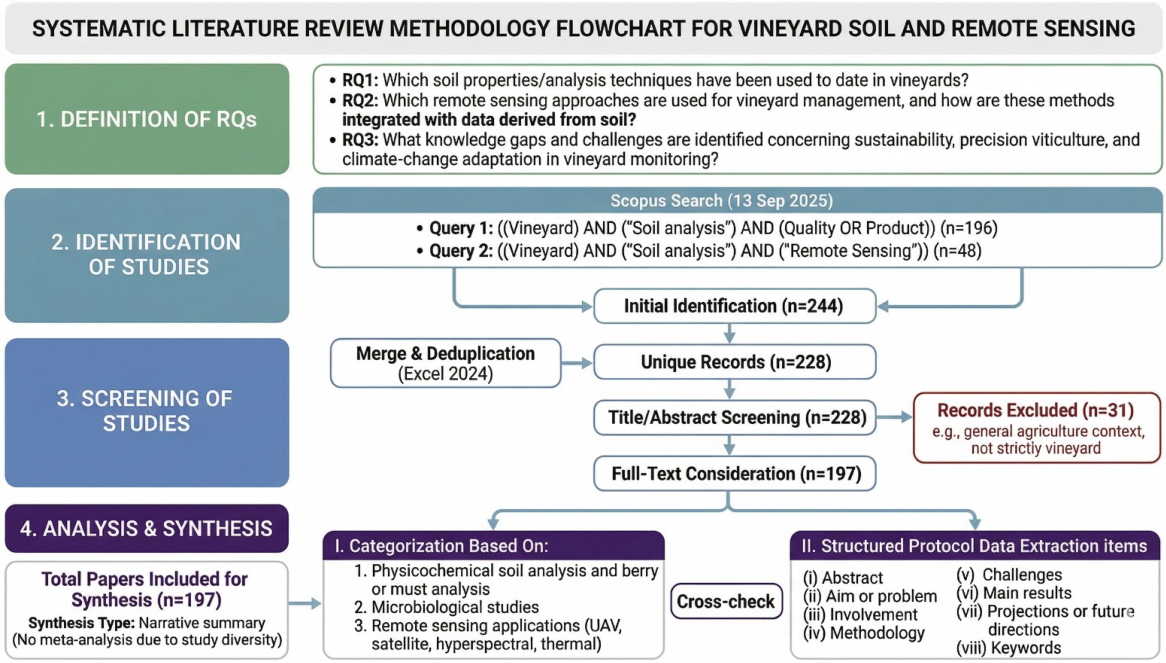
The aforementioned queries and exclusion criteria were applied in the Scopus database on 13 September 2025. The first query yielded 196 results, whereas the second one yielded 48 results. The results of both searches were exported and merged into a single Excel file (Microsoft Excel, v. 2024), which allowed for thorough identification and removal of duplicates. After removing duplicates, the remaining records, 228 in total, were distributed among the authors for preliminary screening. In this phase, titles, abstracts, and keywords were examined in order to determine whether each paper was directly related to vineyards.
Articles that addressed soil monitoring or remote sensing in a general agricultural context without explicit reference to vineyards were excluded from the primary synthesis. However, methodological approaches developed in other agricultural contexts, particularly arable croplands, are discussed in Section 4.2 where they are directly applicable to vineyard conditions (e.g., bare-soil spectral retrieval of organic carbon and texture, SAR-based soil moisture estimation, and vegetation index applications), thereby ensuring methodological completeness. At this stage, 31 studies were eliminated; thus, 197 papers were deemed relevant for full consideration. No geographical locations were excluded from our research. The methodology and elimination process are presented in Figure 1.
Studies that passed this initial relevance screening were subsequently classified into thematic categories according to their primary methodological focus. These included three major divisions:
  • Physicochemical soil analysis and berry or must analysis.
  • Microbiological studies of vineyard soils.
  • Remote sensing applications (e.g., UAV, satellite, terrestrial sensors).
Following categorization, all articles were cross-checked collectively by all authors in order to reduce selection bias and confirm consensus regarding inclusion.
Due to the considerable diversity among the studies reviewed—ranging from laboratory soil analysis, microbial community assessments, sensor-based monitoring, to computational methods—a quantitative meta-analysis could not be conducted. Consequently, the results were summarized and interpreted narratively.
Prior to this synthesis stage, in order to ensure reproducibility and consistency across the 197 included articles, which span laboratory soil chemistry, microbial ecology, UAV imagery, and satellite-based modeling, a structured data extraction protocol was developed ahead of full-text review. This protocol is the basis for identifying cross-study patterns in parameter selection, methodological choices, and knowledge gaps reported in Section 4; its uniform application is what distinguishes this systematic review from a narrative overview.
Each article was reviewed based on the following aspects: (i) abstract, (ii) aim or problem addressed, (iii) involvement of soil analysis, or remote sensing, or both, (iv) methodology applied, (v) challenges outlined by the authors, (vi) main results, (vii) projections or future directions proposed, and (viii) keywords.
These key principles ensured that all relevant methodological aspects were systematically captured and allowed reviewers to build a clear understanding of the scientific contribution of each study.
Concluding, the principal methodological limitations of this approach are: (i) restriction to the Scopus database, which may exclude relevant gray literature, dissertations, and conference proceedings; (ii) the post-2020 temporal scope, which excludes foundational earlier contributions; (iii) the vineyard-specificity of inclusion criteria, which may omit methodologically relevant work from closely related agricultural contexts; and (iv) the narrative rather than quantitative synthesis, necessitated by high heterogeneity in study designs and outcome reporting. Limitations (ii) and (iii) are discussed wherever relevant in Section 4, while future review work might deal with limitation (i). Additionally, one study that appeared in the original search results [35] was retracted on 9 June 2026, after the search date (13 September 2025) and original submission date (14 May 2026). This study has been excluded from the analysis and discussion, and its findings should not be interpreted as part of the results of this review.

3. Terroir and Geographical Distribution of Vineyard Studies

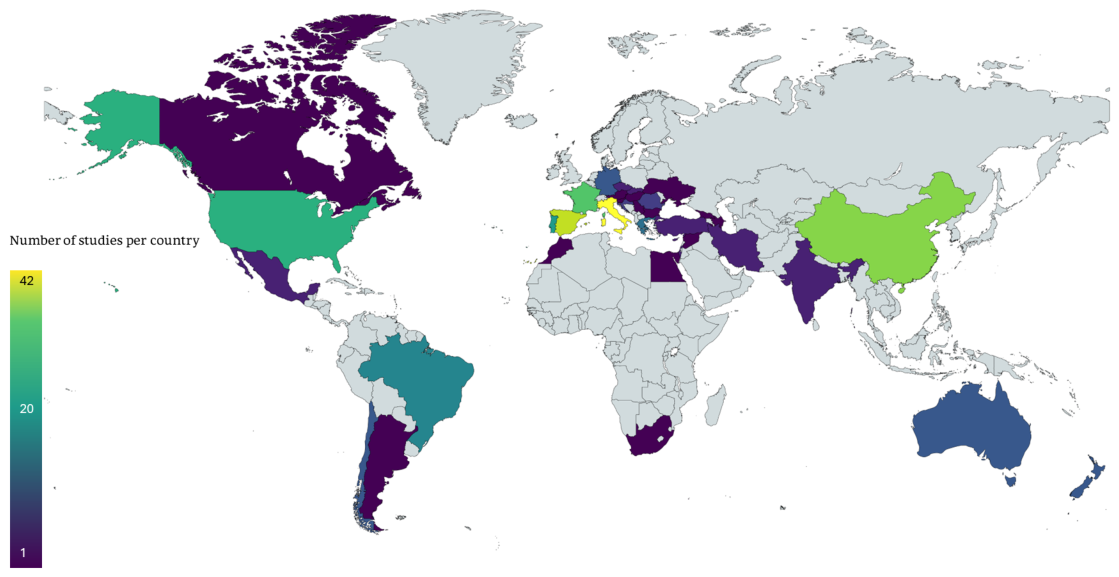
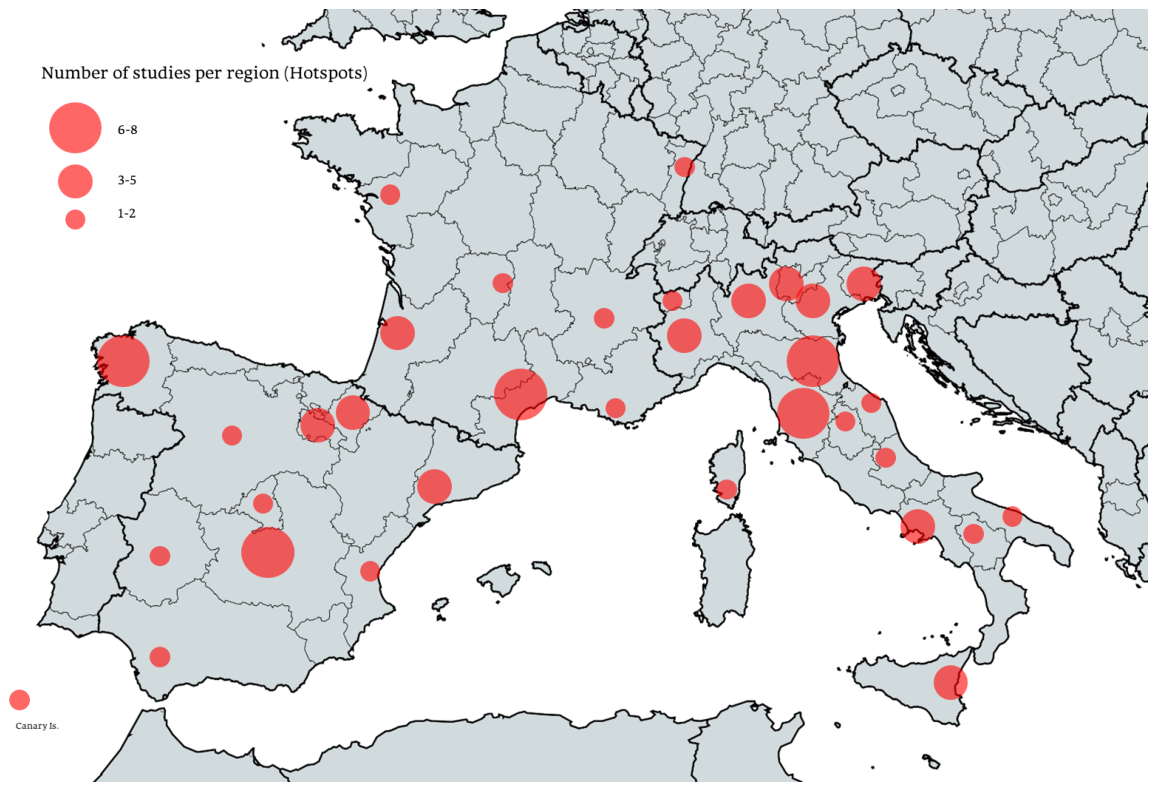
The concept of “terroir” is of particular importance in viticulture. It is a dynamic parameter of vineyard studies, defined as the joint synergy of natural factors, such as soil, terrain, climate, and human factors, including specific wine-making and harvesting practices. While terroir is most frequently analyzed through the lens of oenology, it fundamentally governs the physiological and metabolic development of the grape berry. This environmental influence determines critical quality attributes, such as berry size, skin-to-pulp ratio, and the biosynthesis of primary and secondary metabolites, that are essential not only for wine-making but also for the production of high-quality table grapes and other viticultural derivatives. All of these factors above dictate the unique profile of the grape produced in a particular area [36]. Because grapes fundamentally embody these local elements, the industry relies on this geographical identity to build regional prestige. This connection is formalized through the Protected Geographical Indication (PGI), a designation that protects a region’s reputation and allows the location’s name to serve as both a legal guarantee of origin and a primary marketing asset [37], along with the similar Protected Designation of Origin (PDO) [38,39]. Terroir analysis is therefore of great importance for the history and identity of different grapes and wines produced across various regions. To visualize this relationship between identity and place, the countries discussed in this paper, along with their frequency of mention, have been mapped in Figure 2 and its complementary Figure 3, representing the data from the three major European countries leading the research in the Mediterranean basin (Italy, Spain, France). Furthermore, the specific wine-producing regions identified through the literature are also presented in Appendix A.
Studying the concept of terroir is critical in the products obtained from the vineyards, such as wine, table grapes, and raisins, which encompasses both vineyard management and wine production [40]. Soil and climate conditions play a pivotal role in shaping the sensory attributes of a wine, its aromatic profile, and overall quality [41]. Due to its complex nature, which represents a combination of both natural and human parameters, understanding terroir can improve grapevine physiology and ultimately enhance berry or wine quality, among other products. This, in turn, informs better wine-making practices and, ultimately, shapes wine composition [42,43,44]. Even small variations in terroir within the same region can significantly influence the chemical, functional, and sensory properties of wines [45]. Furthermore, specific soil characteristics, such as texture and mineral composition, directly affect vine physiology and grape composition, ultimately influencing its quality [46]. Wine’s complex connection to climate conditions has inspired studies that specifically focus on charting the climate changes throughout the years in specific wine-making regions.
Apart from the different soil properties, another factor that can also affect the soil terroir is the different microbial communities that reside in the soil, forming another terroir, named “microbial functional terroir”. The distinct spatial distribution of these native communities, termed “microbial biogeography,” is directly responsible for the differentiation and uniqueness of regional wines [38]. Notably, the distribution of non-pathogenic fungal communities has been shown to be highly dependent on geographic distance [47]. Rosado et al. further highlight that microbial terroir influences the must and, subsequently, the wine. In their study, the use of vermicompost derived from grape marc as a fertilization treatment led to significant variations in the bacterial and fungal communities detected in the resulting wines [40].
The geographic distribution visible in Figure 2 and Figure 3 reflects a publication bias that should be explicitly acknowledged. The predominance of studies from Italy (n = 42), Spain (n = 32), China (n = 19), France (n = 15), and the USA (n = 15) corresponds to regions with well-established viticultural research infrastructure and higher rates of publication in internationally indexed databases. Sub-Saharan Africa, Central Asia, and much of South America remain significantly under-represented despite substantial viticultural activity, and the eastern European viticultural belt (Bulgaria, Romania, Slovenia, Croatia) is represented by fewer than five studies each. This geographical skew means that the methodological trends and parameter preferences described in Section 4 disproportionately reflect Mediterranean, semi-arid continental, and temperate-maritime conditions, and caution is warranted when extrapolating these findings to other climatic contexts. The distribution also directly connects to the terroir themes of this section: the dominance of Mediterranean vineyards explains the frequent reporting of calcareous soils, alkaline pH, and drought-related parameters in Section 4.1, while the high Chinese representation, predominantly from semi-arid Ningxia and Xinjiang, explains the focus on saline soils, elevated EC, and irrigation management found throughout the reviewed literature. These geographic patterns should inform the design of future multi-terroir comparative studies.
Within the countries, many more specific wine-making locations were also mentioned. These are presented in Appendix A.

4. Findings and Discussion

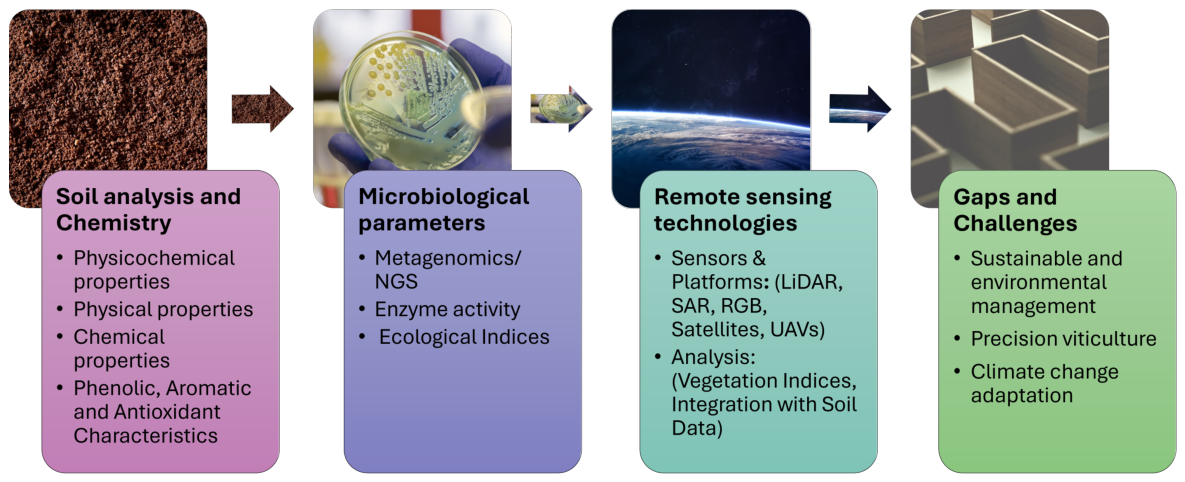
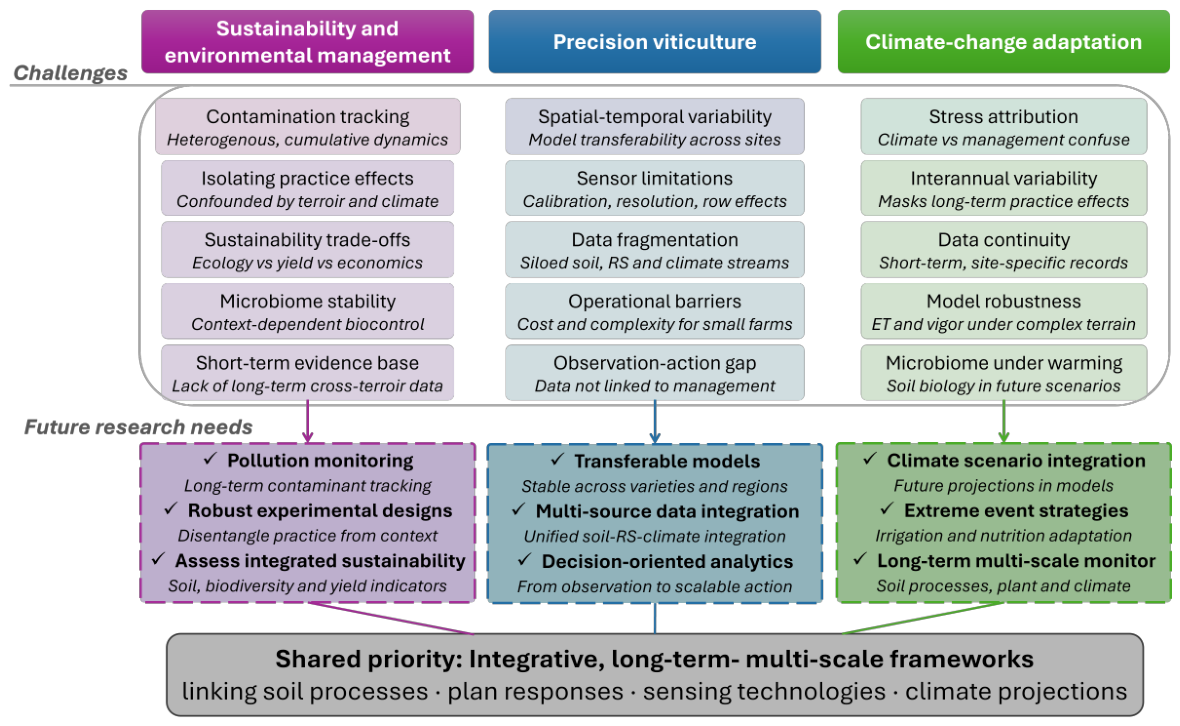
In this section, the results of our systematic review are presented. The findings are organized into subsections that explore the main thematic areas identified in the literature, including soil properties and analytical techniques in vineyards, as well as remote sensing approaches and their integration with soil data. In addition, the review addresses the challenges and knowledge gaps related to sustainability, precision viticulture, and climate change adaptation. Each subsection is further structured to highlight specific aspects reported across the reviewed studies. In Figure 4, a conceptual framework of the review is presented.

4.1. Soil Properties and Analytical Approaches in Vineyards

4.1.1. Physical Properties

It is well-known that physical soil properties affect vine vigor behavior; therefore, it is crucial that they are properly studied [48]. Soil texture can be determined by particle-size analysis using the pipette method [49] or by laser diffraction, which provides an alternative physical measurement technique [43]. Another proposed method is the Bouyoucos hydrometer method, where the density of a soil and water suspension is measured over time [50]. One of the important metrics for soil classification is the silt–clay ratio [42]. A higher silt-to-clay ratio indicates that the soil is less weathered. Soil textures around the world vary vastly, including loam [51,52], silt loam [53], silty clay [54], and loamy sand [55]. Soil bulk density ( D b ), measured in g/cm3, is usually determined in undisturbed samples. Bless et al. [49] mention a D b threshold of 1.58 g/cm3 that indicates a compact soil, and a higher value than that can restrict root penetration into the soil. A new method for measuring D b is mentioned in Zhang et al., where soil bulk density is measured by photogrammetry [54].
Soil porosity has been reported as part of the physical characterization of vineyard soils in irrigated systems. In irrigated chestnut and gray-brown soils in grape cultivation, porosity values ranging from 51% to 66% were observed across different soil horizons, with a higher porosity typically recorded in the surface layers [56]. These measurements were presented alongside bulk density and particle density to describe vertical changes in soil physical structure. However, in data-driven modeling approaches, porosity is not always included as an explicit variable. For instance, in spatial–temporal Random Forest models developed for root-zone soil moisture estimation in vineyards, bulk density was identified as one of the most influential predictors [57]. Since bulk density and porosity are inversely related, bulk density is often used as a proxy for soil structural conditions affecting water storage.
Another important physical soil property is the stability of the soil aggregates. Different aggregate sizes perform distinct functions in soil systems [58], being meso- and macro aggregates considered to have the highest agronomic value [36]. Soil aggregate stability can be determined through the fast-wetting method, with one of the key parameters being the Mean Weight Diameter (MWD). This method is ISO standardized (ISO 10930:2012 [59]) and is applicable to all soil types [49]. Bogunovic et al. [5] demonstrated that excessive tillage and plowing can decrease MWD values in vineyard soils, thereby increasing their susceptibility to rainfall-induced degradation. In addition, soil aggregation stability can be improved by placing groundcovers on vines [60].
Soil water content (SWC) and volumetric soil moisture ( θ v) are critical biophysical variables, as the yield and quality of high-value crops such as vines are closely linked to soil water availability. Their values depend on measurement depth, as well as soil and plant characteristics, including maximum root depth ( Z r m a x ) and limiting soil depth ( Z s ) [61]. Volumetric SWC can be calculated with sensors such as HydraProbe, by measuring the dielectric permittivity of the soil [62,63].
Field capacity (FC) is a key physical parameter to characterize the status of soil water and its impact on vineyard productivity. In their study on table grapes, Anastasiou et al. [64] measured FC in the laboratory (at 0.33 bar) and reported significant spatial variability within the vineyard, with values ranging from 26.8% to 41.6%, which was further used to assess its influence on yield and quality. From a management perspective, Li et al. [65] found that while organic amendments (compost) significantly increased soil nutrients and enzyme activities, they did not cause significant changes in FC or bulk density during the study period. Additionally, FC has been utilized as a static soil input parameter in the EFSOIL model to define the upper limit of soil water storage, highlighting its necessity in data-driven frameworks for estimating root-zone soil moisture dynamics [57].

4.1.2. Physicochemical Properties

The reviewed literature documents pronounced variation in vineyard physicochemical properties both between regions and under contrasting management regimes. Regarding regional patterns: Mediterranean vineyards (Italy, Spain, southern France) are predominantly characterized by neutral-to-alkaline pH (7.0–8.5), elevated CaCO 3 , and low-to-moderate SOM; Atlantic-influenced regions (Galicia, Portugal’s Douro Valley) tend toward lower pH and higher SOM; Chinese semi-arid vineyards in Ningxia and Xinjiang frequently exhibit elevated EC and alkaline pH linked to irrigation practices and loess-derived parent material; while cool-continental areas (Czech Republic, Germany’s Rhineland-Palatinate) present more heterogeneous profiles. Regarding management effects: organic amendments (compost, mulch, biochar) consistently increase SOM and pH buffering capacity across studies, though their effects on nutrient availability depend strongly on initial soil conditions and application rates. Conventional tillage and herbicide use are associated with reduced aggregate stability and microbial richness. Cover cropping produces context-dependent outcomes, generally beneficial for SOM and water retention under adequate rainfall, but potentially competitive for water and nutrients under drought stress. These cross-regional and cross-management contrasts are developed in the parameter-specific subsections below and should be explicitly addressed in future comparative research designs. The physicochemical properties of soil are fundamental in determining its fertility, structure, and capacity to support plant growth, as they directly influence the chemical reactions that occur within the soil [10,11]. A detailed evaluation of these properties is necessary to obtain information on soil quality [6] and, consequently, on the functioning of the ecosystem [8].
Soil pH affects the availability of nutrients, microbial activity, and the movement of contaminants [6,66], influencing the solubility of metal ions, thus affecting their accessibility to plants [6,67]. pH is usually measured in an aqueous solution using a 1:2.5 soil-to-water ratio and determined potentiometrically with a pH/ion meter [6,68]. Across the studies included in this review, vineyard soils generally ranged from neutral to moderately alkaline. For example, vineyards in the Kvemo Kartli region of Georgia exhibited alkaline pH values (7.5–8.3) associated with elevated Cu and Zn concentrations from repeated fungicide applications [6], while soils in the La Rioja PDO of Spain showed similarly alkaline conditions (pH 7.0–8.9), linked to high carbonate content and low OM [69]. In other regions, such as Galicia, soils tend to be acidic, which indicates a higher percentage of organic matter in the ground [70]. pH can also vastly affect the different entomopathogenic communities residing in the soil, either hindering or promoting their growth [71]. Studies have also demonstrated that an alkaline pH can be a constraint in achieving the optimal berry quality [68], which not only affects the wine product, but the table products as well.
Soil salinity, typically quantified through electrical conductivity (EC) [72,73], reflects the concentration of soluble salts such as sodium ( Na + ), chloride ( Cl ), and sulfate ( SO 4 2 ) in soil [74]. Elevated EC can restrict water uptake and disrupt nutrient balance, leading to osmotic stress in vines [72,73]. EC is commonly measured in soil–water extracts using a conductivity cell, with dilution ratios varying among studies—e.g., 1:5 [6,73], 1:10 [75] or 1:2 [76]. Under standard vineyard conditions, EC values usually range from 0.15 to 0.18 dS/m; however, they can increase considerably when vineyards are organically mulched—for example, with spent mushroom compost (SMC)—potentially leading to moderate water stress [73]. Furthermore, in China’s Ningxia, EC was identified as a significant factor influencing changes in microbial communities in vineyards of varying ages, where older EC vineyards exhibited elevated EC and decreased bacterial diversity [77]. In spite of concerns regarding salt assemblage, research on ‘Reliance’ grapes irrigated with diluted seawater indicated that while Na + , Cl , and SO 4 2 levels rose, EC remained under critical thresholds, suggesting that properly managed saline irrigation can enhance grape quality without leading to soil salinization [74].
Cation exchange capacity (CEC) is measured via atomic absorption spectroscopy (AAS), after pre-treatment with ammonium acetate [78] or barium chloride [6]. Excessive liming of acid soils can alter soil CEC and disturb nutrient balances, increasing MgCEC and CaCEC while decreasing KCEC, which could prevent potassium absorption and adversely affect grape quality [78]. Spatial analysis indicated that the variability of CEC is also correlated with apparent electrical conductivity (ECa) and topography, with regions exhibiting higher ECa showing increased OM and CEC levels [79].

4.1.3. Chemical Properties

Carbonate content ( CaCO 3 ) is another crucial parameter affecting pH buffering, nutrient accessibility, and root growth [66,69,80]. In most studies, the lime content ( CaCO 3 ) is calculated via the Scheibler calcimeter technique, [9], where soil samples are treated with hydrochloric acid (HCl), followed by the measurement of carbon dioxide ( CO 2 ) produced. High CaCO 3 concentrations, as reported in Turkey’s Kilis province, can interfere with phosphorus availability even when pH and texture are otherwise favorable [66]. Conversely, in acidic vineyard soils in Spain, applying dolomitic lime (overliming) drastically changed the macronutritional balance by enhancing magnesium and phosphorus while decreasing potassium absorption, possibly affecting the quality of grapes [78]. These findings highlight the complex role of carbonates: although they can enhance soil structure and nutrient buffering, excessive amounts or poor management can interfere with nutrient dynamics and vine performance [66,78].
Macroelements
Total Nitrogen (TN) directly reflects soil organic matter (SOM) accumulation, nutrient availability, and microbial diversity [68,81,82]. TN and its inorganic fractions, such as available nitrogen (AN), have been reported to significantly influence vine performance, berry quality, and the functional diversity of soil microbial communities [65,83,84]. Furthermore, nitrogen availability is a critical factor in the elemental composition of grape seeds, skin, and pulp, interacting with the uptake of other essential minerals [85]. Regarding analytical techniques, nitrogen content is typically determined using the Kjeldahl method for wet chemical analysis [86]. Alternatively, modern approaches utilize elemental analyzers, often paired with gas chromatography, for rapid and precise quantification [87]. For the determination of specific inorganic forms, such as nitrate ( NO 3   N) and ammonium ( NH 4   + N), ion chromatography or alkali-hydrolyzable methods are frequently employed to assess the readily AN pool [88].
Available phosphorus (AP) is a critical soil fertility indicator in vineyards, directly shaping the biological profile of the rhizosphere. While AP represents the immediate nutrient pool for vine uptake, total phosphorus (TP) serves as a marker for long-term nutrient trends and soil developmental stages [88,89]. It has been reported that AP levels are influenced by vineyard age and management practices, such as continuous cropping or organic mulching, which can lead to either depletion or enrichment of soil P pools [81,83]. Methodologically, the determination of AP is highly dependent on soil pH. It is widely accepted that the Olsen method is preferred for neutral to alkaline soils, whereas the Bray-P1 method is the standard for acidic conditions [90]. Additionally, the Machigin method is frequently employed for highly calcareous or alkaline environments to accurately assess P availability [36]. For the quantification of TP, samples are typically subjected to acid digestion followed by colorimetric analysis or Inductively Coupled Plasma Optical Emission Spectrometry (ICP-OES) to evaluate the total mineral reserves [85].
Exchangeable K is typically extracted from air-dried, sieved soil samples using extractants like Mehlich-1 and subsequently quantified via flame photometry [91]. In the vine, increased leaf K concentrations are often associated with higher TSS and must pH, which are decisive factors for wine quality [90]. However, K levels also exhibit complex effects on wine esthetics. For instance, Gonçalves et al. [42] observed that higher soil K concentrations led to decreased color intensity in wines from specific plots (e.g., Três Pontas). Additionally, K uptake is sensitive to environmental conditions, with a notable correlation between higher soil temperatures and increased K absorption [92]. Recent research by Li et al. [93] in the Helan Mountains identifies available K as one of the “key soil nutrient indicators” that influence the highest number of grape berry quality markers. Their analysis revealed a significant positive correlation between total K and both OM and available iron, suggesting a synergistic relationship between these nutrients in alkaline vineyard soils. While K is essential for berry development, its management requires precision; in high-altitude or arid regions, K fertilization must be balanced to avoid excessive must pH, which can compromise the sensory stability of the wine [91,93]. Furthermore, management practices such as organic mulching and composting have been shown to significantly enrich the exchangeable K pool, thereby supporting vine vigor and yield [81,83]. Finally, the leaching of K remains a concern in sloping vineyards, where intra-row and inter-row water movement can lead to nutrient loss, necessitating targeted fertilization strategies to maintain soil K reserves [94].
Exchangeable Cations
The predominant analytical approach to analyze elements is ICP-OES, following acid digestion [10,95]. In many premium viticultural regions, such as the Helan Mountains and the Mediterranean basin, Ca serves as the dominant cation, regulating soil pH stability and the formation of robust soil-vegetation networks [93,96]. Management practices can substantially modify cation distributions; for instance, overliming of acidic vineyard soils increases the levels of Ca 2 + and Mg 2 + while simultaneously reducing exchangeable Al 3 + , thereby mitigating aluminum toxicity and improving root growth conditions [78]. In addition, internal soil heterogeneity often leads to high variability in Na and Al levels (with coefficients of variation frequently exceeding 50 % ), reflecting localized differences in irrigation-induced salinization or parent material weathering [93,97]. From a nutritional perspective, the interaction between K and Mg is critical, as these cations often compete for uptake; an imbalance can significantly alter the sugar-to-acid ratio in the must. High soil K availability, while essential for sugar translocation, has been shown to increase must pH, which can negatively impact the anthocyanin stability and overall color intensity of red wines [42,90]. Furthermore, management practices such as organic mulching and arbuscular mycorrhizal fungi (AMF) inoculation have been found to enhance the mobilization of these cations, particularly K and Mg, within the soil profile, ensuring a more efficient nutrient partitioning into the vine’s reproductive organs even in sloping or water-stressed environments [81,98,99]. Although aluminum is primarily geogenic, it may also appear in grapes in trace concentrations through soil–plant transfer processes and can serve as a geochemical marker of vineyard origin [46].
Organic
SOM supports nutrient cycling and underpins essential soil functions [2,9,66]. It serves as a central driver in shaping soil microbial communities and enhancing the biological resilience of vineyard ecosystems [1,9]. It has been reported that SOM levels are significantly influenced by management practices, such as organic amendments and mulching, as well as by vineyard age, which modulates long-term OM buildup [8,47,100]. Regarding analytical determination, SOM is traditionally quantified via the Walkley–Black method or through wet oxidation followed by titration [50,101]. Another widely utilized approach involves the measurement of soil organic carbon (SOC), which is subsequently converted to SOM by applying the Van Bemmelen factor (1.724), based on the assumption that OM contains approximately 58% carbon [12]. More advanced techniques for assessing SOM stability and quality include Elemental Analysis (CHNS) and Dissolved Organic Matter (DOM) Optical Indices, such as the Humification Index (HIX), which provide insights into the molecular complexity and maturity of the organic fraction [77,100].
SOC and Total Organic Carbon (TOC) play a critical role in carbon sequestration and the stabilization of microbial communities [17,89]. SOC levels have been reported to be significantly influenced by management practices, such as the application of organic amendments derived from waste (e.g., compost from vine branches), which improve the enzymatic activities of the soil and promote the long-term sustainability of the viticultural terroirs [65,102]. Methodologically, SOC is traditionally measured by wet combustion [12]. More advanced analytical approaches utilize continuous flow isotope ratio mass spectrometry (CF-IRMS) to determine both SOC concentration and its isotopic signature ( δ 13 C ), providing insights into carbon source and stability [103]. For the determination of TOC, samples are typically subjected to dry combustion followed by analysis with a Total Organic Carbon analyzer [81,104].
Recent research emphasizes that the optical properties and quality of the Dissolved Organic Carbon (DOC) pool—such as humic-like and protein-like components—are often more significant than its total concentration in predicting the bio-availability of metals (e.g., copper) [105]. These components serve as essential ligands for metal complexation, influencing nutrient mobility and potential toxicity in vineyard soils. The dynamics of DOC are modulated by sustainable management, such as cover cropping and deep incorporation of amendments, which regulate DOC fluxes and stimulate soil microbial biomass [106]. Analytical assessment of DOC quality is frequently performed using Ultraviolet-Visible (UV-Vis) spectroscopy and Excitation–Emission Matrix (EEM) fluorescence spectroscopy, which allow for the calculation of optical indices (e.g., SUVA254, HIX) that describe the aromaticity and stabilization of carbon through complexation with the soil mineral matrix [107,108].
Trace Elements and Metals
Trace elements can be measured by Flame Atomic Absorption Spectrometry (FAAS) [67,68], or ICP-OES [95]. Copper (Cu) and zinc (Zn) typically exhibit the highest enrichment factors due to the historical application of fungicides and fertilizers [95,109]. Comparative studies between vineyards and adjacent forest topsoils have shown that Cu concentrations remain significantly higher in cultivated or even abandoned vineyards for decades, highlighting the persistence of this metal in the upper soil horizons (A horizon) compared to natural forest ecosystems [110]. Specifically, in sloping vineyards, these elements tend to accumulate in “low-energy” zones or footslopes due to water erosion and sediment transport, redistributing enriched topsoil particles throughout the landscape [111].
The presence of metals is often a reflection of the soil’s mineralogical nature [108,112]. For instance, elements like Cr, Ni, and Co are frequently associated with the weathering of parent rocks, while Cd and Pb are more closely linked to anthropogenic inputs [24,113]. Barium (Ba) and strontium (Sr) are particularly significant in terroir studies, as they serve as geochemical tracers that link the soil’s chemical signature to the grape’s must and wine composition [114,115]. These elements are commonly measured along with the other trace metals, following an ICP-OES method [113].
The study of Rare Earth Elements (REEs) has emerged as a powerful tool for viticultural provenance and soil characterization. The REE patterns in vineyard soils remain relatively stable during pedogenesis, providing a “geochemical fingerprint” [108]. This fingerprint allows for the differentiation of plots even within the same region, as REEs are less affected by common agricultural amendments compared to major nutrients [114,116].
Crucial to environmental risk assessment is the distinction between pseudo-total and Bioavailable Trace Elements [111]. The bioavailable fraction is significantly smaller and is heavily influenced by soil pH and the quality of DOM [105]. Innovative management practices, such as the deep incorporation of organic amendments (e.g., compost), have shown potential to influence vine vigor and grape quality (e.g., in ’Calardis Musqué’ varieties) while simultaneously mitigating environmental impacts like greenhouse gas emissions, though their effect on metal bioavailability depends on the stabilization within the soil matrix [106]. In organic vineyards, the actual ecological risk is often mitigated by the stabilization of metals or their complexation with organic ligands, which limits their toxicity to the soil microbiome [105,117].
Oxides
The mineral profile of vineyard soils reflects the composition of the parent material and the intensity of the weathering [42,108]. Among these, the active phases of free and amorphous iron and manganese oxides ( F e A , F e F , M n A ) are of particular importance for vineyard monitoring, as they regulate soil aggregate stability, nutrient adsorption, and immobilization of trace elements such as copper (Cu) [105,117]. Methodologically, these oxides are quantified using X-Ray fluorescence (XRF) or portable XRF (pXRF) for rapid elemental screening, while their crystalline mineral phases (e.g., goethite, hematite) are identified through X-Ray Diffraction (XRD) [49,108].
Phenolic, Aromatic and Antioxidant Characteristics
Berry phenolic, aromatic, and antioxidant profiles represent key quality indicators directly influenced by soil nutrient dynamics, management practices, and rootstock effects [118,119,120]. Primary indicators such as Total Phenolic Content (TPC), Total Anthocyanin Content (TAC), and Total Antioxidant Activity (TAA) are significantly influenced by the rootstock effect and soil nutrient availability [65,85,121,122]. Specific rootstocks (e.g., 1103 Paulsen) have been shown to optimize accumulation of polyphenols, anthocyanins, and tannins—determined via the Modified Harbertson Assay or HPLC-DAD—while also affecting flavonols, proanthocyanidins, and stilbenes in the resulting wine [85].
Furthermore, soil sulfur (S) availability is critical for the synthesis of secondary metabolites, directly influencing Yeast Assimilable Nitrogen (YAN) levels—measured via titration or enzymatic assays—and the formation of volatile thiols, which enhance aromatic complexity [86]. The dynamics of S in the soil interact with iron and manganese oxides [117], affecting the redox potential of the rhizosphere and the overall antioxidant capacity of the must [49,105]. Additionally, specific functional microbial groups in the soil, such as those involved in sulfur metabolism, have been linked to the final aromatic profile of the wine [84]. Building upon this biochemical foundation, specific floor management practices have been proven to directly modulate the aromatic expression. For instance, advanced volatile profiling by Valero et al. [123] demonstrated that the use of the Zulla (Hedysarum coronarium L.) cover crop significantly altered the concentration of aromatic volatiles on organically grown Syrah wines, whereas in Tian et al., the different colored gravel laid on the vineyard affected the final product: darker colored gravel produced wine of better color, whereas the light colored gravel, by reflecting more light, resulted in increased flavonols, which are a UV-protective compound [124]. These two researchers prove that agronomic interventions directly influence the typicity and aromatic quality of the final product.
The aromatic profile and typicity are further shaped by the vineyard’s spatial location and the vine’s physiological status. The concentration of volatile compounds, such as β -Damascenone and monoterpenes—determined through GC-MS or HS-SPME-GC-MS—varies according to the “meso-terroir,” defining the floral identity of specific varieties [85,125]. These chemical traits are supported by TSS—measured as °Brix via refractometry [126]—and specific acidity profiles, including titratable acidity (TA) and levels of malic and tartaric acid, which are crucial for sensory balance and potential alcohol (PA) [65].
Nutrient and water availability also play a vital role in berry development. Continuous monitoring via sensor fusion and machine learning algorithms (e.g., Boosted Regression Trees) reveals how SWC and leaf temperature influence Berry Growth and Berry Density [127]. High-resolution ICP-MS analysis of the Elemental Profile of Seeds, Pulp, and Skin (e.g., Li, Rb, Sr) serves as a marker for both ripeness and geographical traceability, effectively correlating soil mineral composition with the final product [85,86,128]. Finally, YAN levels in the must—linking the soil’s nitrogen status directly to fermentation kinetics—determine the final alcohol content and overall stability of the wine [65].
Taken together, the reviewed literature suggests a priority hierarchy for soil parameter inclusion in future vineyard monitoring programs. At a foundational tier, soil organic matter, pH, and electrical conductivity emerge as integrative indicators appearing in the highest proportion of studies and serving simultaneously as fertility, structural, and environmental-risk proxies; these should form the baseline of any standardized monitoring protocol. At a fertility-performance tier, CEC and the nutrient triad of nitrogen, phosphorus, and potassium are the parameters most consistently linked to vine vigor, berry quality, and microbial community function across diverse terroirs, making them essential for comparative and predictive studies. At an emerging-priority tier, dissolved organic carbon, and the speciation of anthropogenic trace elements (copper and zinc from fungicide application history) represent indicators of long-term soil health and environmental risk that are currently under-reported relative to their agronomic and regulatory importance. For microbiological characterization, rhizosphere 16S rRNA and ITS metabarcoding complemented by enzyme activity assays (dehydrogenase, β -glucosidase, phosphatase) provides the most informative functional picture of soil biological status and is strongly recommended for integrated protocols. Crucially, reporting standardization, including soil sampling depth, spatial design, measurement units, and analytical quality metrics, across all these parameters is a prerequisite for the cross-study comparisons and meta-analyses that the field urgently requires.

4.1.4. Microbiological Properties

Because microbial communities are highly dynamic, they are acutely sensitive to both agronomic management and environmental shifts. Strategic practices can restructure the rhizosphere to actively enhance grapevine resilience against abiotic challenges, such as drought [100,129], while disruptive interventions can induce “microbial dysbiosis”, which can negatively affect both soil health and grape quality [130,131]. Understanding these microbial dynamics is therefore essential for characterizing vineyard soils and their functional role within the terroir system. A strict distinction needs to be made between the bulk soil, which acts as a broad biological reservoir, and the rhizosphere. The rhizosphere, representing the narrow zone surrounding the root system, serves as the primary site of microbial activity and biogeochemical cycling [131]. Because root exudates selectively recruit specific microbial taxa, the composition of these localized niches is heavily influenced by the specific wine cultivar and rootstock [131,132], as well as by temporal factors such as season and the potential decline of the vineyard [133]. Therefore, understanding the role of these microbial communities as the primary inoculum for the grapevine’s aerial compartments requires sampling methodologies that explicitly account for this spatial stratification.
Biochemical Profiling and Activity Assays
Microbial Biomass Carbon (MBC) and DOC are quantified via chloroform fumigation-extraction [82,102]. To evaluate the actual metabolic execution and real-time biogeochemical cycling of these communities, vineyard soil analysis frequently incorporates targeted enzyme assays. Unlike genetic sequencing, which only reveals functional potential, enzymatic activity provides a quantitative measure of actual soil function. Key enzymes analyzed include dehydrogenase (an indicator of broad microbial oxidative activity), alongside specific hydrolytic enzymes like β -glucosidase, phosphatase, and urease, which drive carbon, phosphorus, and nitrogen mineralization, respectively [82,102]. Methodologically, these activities are efficiently quantified using standardized spectophotometric or colorimetric laboratory assays to calculate the precise rate of nutrient turnover in the vineyard [43,102].
Molecular Sequencing and Functional Microarrays
In vineyard monitoring, metabarcoding (16S rRNA for bacteria, ITS for fungi) has been widely applied to map the spatial distribution of keystone taxa across different soil niches [130,131], evaluate the influence of specific cultivars and rootstocks [132], track the presence of fermentation-driving wine yeasts versus soil-borne pathogens [134], and monitor the establishment of introduced biocontrol agents and biostimulants [71,135,136,137].
While amplicon sequencing (16s/ITS) is the standard for determining community structures, other studies, such as Mocali et al., employ functional gene microarrays such as GeoChip to directly detect metabolic genes, such as dsrA for sulfur reduction, offering a deeper insight into the functional potential of the microbiome rather than just its composition, and how it potentially affects the aromatic profiles of the produced wines [43]. Furthermore, to evaluate the comprehensive impact of soil treatments on the vineyard ecosystem, modern analysis employs multi-omics approaches. This includes coupling metagenomics with metabolomics to track chemical outputs [138], as well as employing transcriptomics (RNA-seq) to measure how soil conditioners and biostimulants directly modulate root gene expression and ripening-specific processes within the grapevine [139,140].
Quantifying Complexity: Ecological Indices
In vineyard studies, the Shannon index (H′) has been used to demonstrate that fungal diversity, rather than bacterial diversity, primarily drives overall ecosystem multifunctionality and correlates directly with final wine quality in semi-arid vineyards [141]. By linking the α -diversity to this aggregated functional score, researchers have evaluated whether specific agronomic practices genuinely improve the holistic biological performance of the vineyard terroir [141].
The Chao1 index is frequently applied to estimate the total species richness within a specific vineyard soil niche, showing dependence on the terroir, season [133], and organic management practices. Diversity indices have also been used to track microbial shifts across phenological stages under root-zone restriction [142], and to analytically quantify significant increases in soil microbial richness following the application of organic vineyard mulches [81]. By employing these metrics, researchers can effectively monitor how different vineyard management practices or edaphic factors, such as vineyard reclamation [89] or disruptive application of conventional herbicides [143], shift the “microbial equilibrium” and biological quality of the vineyard soil.
Sustainable Disease and Pest Management
While the soil reservoir is essential for vine nutrition, it is not solely beneficial. It also serves as a habitat for mycotoxigenic fungi, specifically Aspergillus and Penicillium. Managing these threats sustainably relies on leveraging “soil suppressiveness”, the innate capacity of a diverse microbial network to outcompete pathogens. To evaluate the efficacy of this natural defense, researchers utilize the molecular sequencing techniques previously discussed to monitor the “cry-for-help” hypothesis, actively tracking how grapevines under environmental stress or pathogen attack recruit specific beneficial microbiological taxa to their rhizosphere to bolster defense mechanisms [131].
Both passive agronomic practices and active biological interventions require rigorous analytical monitoring to confirm their impact on the soil microbial equilibrium. For instance, following canopy practices such as defoliation and regulated deficit irrigation, taxonomic profiling is used to verify the desired microclimatic shift towards antagonistic bacterial genera such as Streptococcus and Rhodococcus, that exhibit negative co-occurrence with bunch rot pathogens [134].
Similarly, when active biostimulants, such as AMF, are introduced to the soil, advanced sequencing and multi-omics approaches are deployed to validate their successful integration. These analytical tools allow researchers to confirm whether targeted agents like Bacillus velenzensis and Enterobacter cloacae successfully establish themselves in the soil network to suppress diseases like Gray Mold and powdery mildew [135,136,137]. Furthermore, advanced techniques such as transcriptomics are increasingly applied to monitor how the application of specific soil conditioners directly activates root defense genes against plant stress factors, providing a measurable link between soil interventions and plant health [140].

4.2. Remote Sensing Methods and Integration with Soil Data

Traditional soil analysis provides detailed information on vineyard soil properties; however, its point-based nature limits the ability to capture the spatial variability that characterizes vineyards [144]. To address this limitation, proximal soil sensing (PSS) techniques have been increasingly adopted, enabling rapid, high-resolution, and spatially continuous measurements directly in the field [145,146]. These systems are commonly implemented as on-the-go platforms mounted on agricultural machinery, allowing rapid acquisition of spatial datasets that complement traditional soil sampling approaches [146]. Common PSS approaches include ECa sensors such as an EM38-MK2 [31,60,147], DUALEM-1S [144] or Veris sensor [79], gamma-ray spectrometry [145] and Vis–NIR–SWIR spectroscopy [12,148], which enable estimation of soil properties, including texture, OM, and water content [127,145]. PSS are typically georeferenced and integrated with geographic information systems (GIS), enabling interpolation, clustering, and the delineation of management zones that link soil variability with vine performance and environmental conditions [144,149].
By providing dense field-level information, PSS serves as a link between conventional soil analysis and large-scale RS, complementing UAV and satellite observations [146]. RS enables monitoring of vineyards across different phenological stages and management conditions by capturing information from reflected or emitted electromagnetic radiation, thereby providing spatial and temporal variability assessments that cannot be achieved through traditional point-based measurements [30,32,150,151]. Several studies have shown that remotely sensed variables and vegetation indices can be linked to key agronomic indicators such as water status [31], evapotranspiration [152,153], yield and fruit composition, supporting precision viticulture strategies [154]. In this context, RS is progressively integrated with both conventional soil measurements and PSS, enabling calibration and validation of remote observations and providing a comprehensive framework for data-driven vineyard management under variable environmental conditions [155].

4.2.1. Sensors

RS applications are based on a wide range of sensing technologies that differ in spectral coverage and physical measurement principles. These sensors measure and record electromagnetic signals or other physical properties from the target environment. Optical sensors (RGB, multispectral, and hyperspectral), together with thermal, radar, and LiDAR approaches, provide complementary data for monitoring vineyard variability.
RGB Sensors
RGB sensors have been widely used in agriculture due to their simplicity, low cost, high spatial resolution, and ability to capture a detailed canopy structure using visible-spectrum imagery [53,150]. UAV-based RGB data have been successfully applied to vineyard classification and segmentation tasks through object-based image analysis and machine learning approaches, enabling the discrimination of grapevines, soil, shadows, and other vegetation elements [150]. In addition, RGB imagery has been utilized for grape cluster detection and yield estimation through photogrammetric point clouds and color-based indices, highlighting the potential of low-cost sensing solutions for precision viticulture applications [154]. Beyond canopy monitoring, RGB UAV imagery combined with decision-tree and OBIA workflows has also supported weed mapping—such as Cynodon Dactylon—enabling site-specific herbicide management [156].
Multispectral and Hyperspectral Sensors
Multispectral sensors extend conventional RGB-based analysis by incorporating additional spectral bands, particularly in the near-infrared and red-edge regions, that are more sensitive to vegetation vigor and physiological variability [157]. UAV-based multispectral imagery has enabled the calculation of vegetation indices (e.g., NDVI) [158,159], while studies have also shown that combining multispectral reflectance data with geometric canopy features and machine learning models can improve vineyard yield estimation [157]. Furthermore, multispectral indices have been associated with grape quality attributes, allowing rapid and non-destructive assessment of vineyard performance [147].
Moving a step further, hyperspectral sensors acquire data across a large number of narrow and contiguous spectral bands, enabling a more detailed characterization of canopy properties. Their increased spectral resolution allows the detection of subtle physiological variations related to chlorophyll content, nutrient status, plant stress, and canopy structure, that may not be captured by multispectral imagery [160]. In vineyard systems, hyperspectral data have been used to improve the estimation of biophysical variables, such as leaf area index (LAI), which represents a key input for evapotranspiration modeling and irrigation management [161]. The integration of detailed spectral measurements with structural information derived from UAV-based workflows has been suggested as a promising approach for improving yield-related monitoring and precision management in viticulture [154].
Thermal Sensors
Thermal RS provides spatially distinct information on land surface temperature (LST), a variable closely linked to water status and evapotranspiration dynamics [162,163]. High-resolution thermal imagery acquired from UAV platforms enables the estimation of surface energy balance components, supporting fine-scale assessment of vineyard water use and site-specific irrigation management [163]. In particular, the integration of thermal satellite data within the ALEXI/DisALEXI framework, combined with STARFM, has enabled the operational generation of high spatiotemporal resolution ETa maps (30 m, daily), successfully capturing within-field water stress variability under variable irrigation regimes [164]. Because LST constitutes a fundamental input for RS evapotranspiration models, improvements in spatial resolution—including thermal downscaling techniques—have enhanced the performance of energy balance approaches such as the Two-Source Energy Balance (TSEB) framework [162]. Nevertheless, studies applying the TSEB2T model in vineyards have shown that aggregation to coarser spatial resolutions may lead to overestimation of sensible heat flux and underestimation of latent heat flux, highlighting the importance of appropriate grid size selection in heterogeneous row-crop systems [165]. At broader spatial scales, the integration of satellite-based thermal observations with optical data has facilitated the evaluation of vine water stress through energy balance modeling and crop water stress indicators [51].
Synthetic Aperture Radar (SAR)
Unlike optical sensors, radar RS, particularly synthetic aperture radar (SAR) systems, can operate under all weather conditions and are not constrained by cloud cover, as is the case for satellite optical sensing [166]. Sentinel-1 C-band SAR data have been used to estimate surface soil moisture ( θ S S M ) in vineyards [167]. The radar signal varies according to the amount of water in the soil, allowing the retrieval of moisture conditions in the top 0–5 cm, even when vegetation is present [166,168].
In vineyards, the integration of Sentinel-1 radar data with optical Sentinel-2 imagery has improved soil moisture estimation compared with optical data alone, particularly in heterogeneous and hillside terrains where vegetation cover complicates retrieval processes [166]. Sentinel-2A and Sentinel-2B could also prove valuable in irrigation monitoring and water management, as their higher-frequency imaging ability could be employed to better monitor crop development, as highlighted by Garrido-Rubio et al. [61]. Furthermore, SAR-derived information has been fused together with thermal infrared retrievals into soil–vegetation–atmosphere transfer (SVAT) models, enabling the estimation of root-zone soil moisture within the effective vine rooting depth [167]. Such approaches have been implemented in large-scale initiatives. An example of that is the Grape Remote Sensing Atmospheric Profile and Evapotranspiration eXperiment (GRAPEX) project, which combines high-resolution RS and field observations to quantify SWC and plant water status for improved irrigation efficiency at sub-field scales [62,169].
Light Detection and Ranging (LiDAR) Sensors
Light Detection and Ranging (LiDAR) sensors enable the generation of highly accurate three-dimensional representations of terrain and vegetation structure [48]. In vineyard environments, LiDAR-derived datasets enable the extraction of terrain attributes, such as slope, curvature, and topographic wetness indices, which can be used as environmental covariates in digital soil mapping and precision viticulture applications [48]. Moreover, high-resolution LiDAR topographic data can support geospatial analyses and physical modeling of landscape processes, including runoff dynamics and soil erosion under different vineyard management practices [170]. When integrated with other RS datasets and biophysical indicators, such as vegetation indices or canopy metrics, this data contributes to improved characterization of vineyard spatial variability and management decisions [147,161], as summarized in Table 1.

4.2.2. Platforms

The main platforms used in vineyard RS applications, on which different sensors are mounted, comprise satellites and UAVs and are presented below.
Satellites
Satellites have been utilized in vineyards to observe vegetation changes and spatial differences by consistently capturing multispectral images across expansive regions [32,171]. Freely available satellite platforms, such as Landsat and Sentinel-2 [172], facilitate the retrieval of vegetation indices (VIs) and canopy-related metrics. These indicators support the assessment of vine performance by capturing spatial variability associated with soil conditions, fruit composition [32], and the mapping of management zones [79]. Moreover, optical and thermal satellite observations have been incorporated into surface energy balance models to estimate evapotranspiration and support irrigation monitoring, highlighting their relevance for assessing vineyard water stress [152,153]. Additionally, the increasing availability of Sentinel-2 imagery processed through cloud-based platforms such as Google Earth Engine (GEE) has enabled multi-temporal monitoring of inter-row vegetation cover and soil management practices at the field scale [173]. Beyond spectral monitoring, high-resolution LiDAR-derived topography combined with physical models, such as SIMWE, has been applied to evaluate runoff pathways, soil erosion risk, and the soil and water conservation effectiveness of terraced vineyards under intensifying rainfall conditions linked to climate change [170]. However, limitations regarding spatial resolution and mixed-pixel effects may affect the precise depiction of vine rows and inter-row variability [174], or even result in improper estimation of water stress [51]. To address these problems, recent research has applied VI–based evapotranspiration disaggregation models (e.g., DiSoRa and MSDF-ET) to downscale Landsat-derived ET from 30 m to 3 m resolution using high-resolution NDVI data, demonstrating the potential of spatial refinement for field-scale irrigation management in vineyards [175]. Even with these constraints, which ongoing research seeks to overcome [174], satellite-derived datasets play a key role in vineyard monitoring and are frequently integrated with higher-resolution UAVs [32] and PSS approaches [151,161].
Unmanned aerial vehicles (UAVs)
Unmanned aerial vehicles (UAVs) provide very high spatial resolution imagery that captures fine-scale variability within vineyard blocks and inter-rows. Their flexible acquisition timing enables monitoring aligned with specific phenological stages and management practices, supporting detailed observation of vine vigor and canopy development [30]. UAV-derived data have also been applied to vineyard classification, yield estimation [154], and water status monitoring [31]. Despite their advantages, UAV monitoring involves higher operational costs, flight planning, technical skills, and data processing demands [174]. The combination of UAV data with satellite observations [53] and with proximal sensing data has proven particularly beneficial for the agricultural sector in general and viticulture in particular [23].
Vegetation Indices (VIs)
VIs are utilized in RS applications as they provide simplified indicators derived from spectral reflectance that aid the interpretation of canopy responses and the monitoring of spatial variability in agricultural systems [30,176]. The characteristic spectral response of grapevine canopies—marked by chlorophyll absorption in red wavelengths and strong reflectance in the near-infrared region—allows VIs to be used as indirect indicators of vine vigor, biomass, and canopy development [30].
In precision viticulture, VIs derived from satellite or UAV multispectral imagery are widely applied to capture spatial variability within vineyards and support management decisions related to yield, irrigation, and crop quality [147]. They have been associated with several agronomic and physiological variables, including vine vigor, nutrient status, grape yield, and fruit composition, enabling non-destructive monitoring throughout the growing season. For instance, remotely sensed vegetation indices have been integrated with machine learning models to predict grape quality parameters such as TSS, highlighting the potential of spectral indicators for rapid vineyard assessment [147].
Among the vegetation indices proposed in the literature (Table 2), the NDVI remains one of the most widely used indicators for vineyard monitoring [151] due to its simplicity and strong relationship with vegetation vigor and canopy structure [38]. Previous studies have shown that satellite-derived NDVI can support the monitoring of vineyard vegetation conditions, the assessment of grape quality, the delineation of management zones, and the introduction of sampling protocols for monitoring grape ripening [38]. NDVI has also been explored in relation to vineyard yield estimation, particularly when combined with structural canopy metrics such as the vegetated fraction cover (Fc), which has been shown to improve yield prediction accuracy [157]. Moreover, soil-adjusted VIs such as the Optimized Soil Adjusted Vegetation Index (OSAVI) have been proposed to minimize soil background effects and improve the estimation of canopy vigor in sparsely vegetated areas, incorporating an adjustment factor that reduces the influence of soil reflectance [147].
The Normalized Difference Water Index (NDWI) complements NDVI by being more directly related to vegetation water content, thus providing useful information for the assessment of vine water status [151]. Furthermore, UAV multispectral imagery enables the calculation of indices such as the Normalized Difference Red Edge (NDRE) [173], the Green Normalized Difference Vegetation Index (GNDVI) and the Modified Soil Adjusted Vegetation Index (MSAVI), which have demonstrated significant correlations with vine vigor and yield variability [30]. In particular, NDVI and NDRE have shown strong relationships with agronomic indicators such as shoot pruning weight and grape yield during different phenological stages, highlighting their usefulness for monitoring spatial variability and supporting precision management practices [30].
Furthermore, time-series analysis of satellite-derived VIs enables the monitoring of seasonal canopy evolution and the identification of spatial patterns associated with environmental factors, management practices, or soil variability across vineyard landscapes [176]. In this context, Lopez-Fornieles et al. [176] proposed the use of the PARAFAC multiway analysis method applied to Sentinel-2 time-series imagery to extract spectral and temporal signatures of vineyard vegetation and soil components, demonstrating the potential of advanced analytical approaches for improving large-scale vineyard monitoring.
The integration of VIs with structural canopy metrics, advanced analytical approaches, and multi-temporal satellite observations further enhances their potential for assessing vineyard variability and supporting data-driven decision-making in vineyard management [30,147,176].

4.2.3. Integration of Remote Sensing with Soil Data

Some studies combine RS observations with detailed soil analyses in order to investigate the influence of soil physicochemical properties on vineyard variability. For example, Karn et al. examined the relationship between grapevine vigor and soil characteristics by integrating soil sampling data—including texture, pH, EC, OC, and nitrogen—with spatial information derived from aerial imagery and topographic attributes such as elevation and slope [177]. Similarly, another study combined NDVI derived from multiple RS platforms with field measurements (e.g., soil texture, yield components, grape composition data) collected across several vineyard locations. The results demonstrated that remotely sensed canopy indicators can help explain spatial patterns of fruit composition and productivity [32].
Beyond direct soil sampling, several studies have integrated spatial soil databases with GIS to analyze the distribution of soil parameters and their implications for vineyard management. For example, Vilček et al. [52] used GIS-based soil parameter datasets and land-use information to evaluate the production potential of vineyard soils. Other studies combined soil physicochemical properties with climatic and topographic indicators within GIS-based multi-criteria frameworks to assess land suitability and delineate vineyard management zones [178,179]. In parallel, RS has been incorporated into biophysical modeling frameworks to better characterize soil–plant interactions in vineyards. In this context, in the ALEXI/DisALEXI modeling framework, satellite imagery was used in order to estimate evapotranspiration and its partitioning into soil evaporation and canopy transpiration, providing spatial information on vineyard water use dynamics relevant for irrigation management [180].
However, several recent studies rely not only on laboratory soil analysis but also on PSS approaches that provide spatially continuous proxies of soil variability. Serrano et al., for instance, mapped ECa using a Veris sensor and combined these measurements with topographic data to delineate vineyard management zones, which were subsequently validated using vegetation indices such as NDVI and NDWI derived from Sentinel-2 imagery [79]. Proximal soil indicators have also been integrated with RS datasets to improve the monitoring of vine physiological conditions. The researchers combined UAV-derived vegetation indices with environmental variables, including ECa, elevation, and slope to estimate grapevine water status using machine learning models, demonstrating that the inclusion of soil- and terrain-related variables significantly improved prediction accuracy [31]. In addition, studies integrating RS with field and proximal measurements have shown that VIs can be strongly related to agronomic indicators of vineyard productivity. For example, Darra et al. reported strong correlations between vegetation indices derived from Sentinel-2 imagery and biophysical variables associated with vineyard condition and yield [151], while Ferro et al. identified significant relationships between UAV-derived indices such as NDVI and NDRE and vine vigor indicators, including shoot pruning weight [30].

4.3. Gaps and Challenges in Sustainable and Precision Viticulture

The analysis of the reviewed literature reveals that, despite significant advances in soil characterization and RS applications, knowledge gaps and methodological challenges remain. These limitations affect the ability to effectively monitor viticultural systems, assess sustainability, and support decision-making in a context of growing environmental and climate pressures. The main challenges identified can be grouped into three interrelated areas: sustainability and environmental management, precision viticulture, and adaptation to climate change. Figure 5 provides a summary of the challenges encountered and the related research needs.

4.3.1. Sustainability and Environmental Management

A central limitation in the current literature is the lack of comprehensive and operational frameworks to assess vineyard sustainability. Several studies show that environmental assessment cannot be based solely on conventional soil fertility parameters, as the sustainability of vineyards also depends on contaminant dynamics, biodiversity responses, soil biological functioning, and ecosystem services in general [11,55]. In this regard, the persistence of soil contaminants derived from agricultural inputs remains a major concern, particularly in the case of persistent organic pollutants (POPs) [181], plastic-derived residues [182], pesticides [183], or trace elements that can accumulate in soils and are difficult to track over time and space [6,113,184]. These studies suggest that contamination processes are often heterogeneous, cumulative, and difficult to capture using standard monitoring approaches, limiting the ability to assess long-term environmental risk [36,185]. This also reflects a broader limitation: current monitoring approaches are not designed to capture complex, long-term interactions between contaminants, soil biology, and ecosystem functioning.
Beyond direct environmental pressures, a second major limitation is the methodological difficulty of isolating the effects of sustainable agricultural practices from other environmental and management factors. Practices such as mulching, compost application, organic fertilizers, and soil improvement strategies are frequently presented as beneficial, but their actual outcomes often depend on local climate, water availability, soil texture, slope, and initial fertility [81,106,107,186,187]. As a result, observed benefits can vary considerably between locations and years, making it difficult to determine whether improvements are attributable to the practice itself or to contextual factors [8,73,159,164,188]. This issue is particularly relevant in vineyards, where terroir-specific interactions can obscure causal interpretation and reduce transferability across regions.
A critical but often overlooked limitation is the presence of trade-offs between environmental sustainability and production-oriented objectives. Some studies indicate that practices aimed at improving soil conservation, moisture retention, or circular use of resources may also generate unintended effects, such as increased EC, nutrient imbalances, or variable responses in grape composition and yield [10,120]. This highlights a larger tension in sustainable viticulture: environmental improvements do not automatically align with productivity, grape quality, or economic expectations at the winery level [189]. Consequently, sustainability in viticultural systems should not be treated as a one-dimensional optimization problem, but rather as a context-dependent balance between agronomic, ecological, and socioeconomic criteria [36,96].
Beyond agronomic and environmental constraints, an additional limitation to the adoption of sustainable viticulture practices lies within regulatory and institutional frameworks. In particular, the use of disease-resistant hybrid cultivars, which can significantly reduce reliance on fungicides, remains restricted in many protected designation systems due to concerns related to typicity, quality, and historical tradition. This creates a structural barrier to the implementation of low-input strategies, even when their environmental benefits are well documented. Addressing this gap requires robust and standardized analytical validation to demonstrate that alternative cultivars can meet established quality and safety standards. Advanced monitoring approaches, including detailed compositional and toxicological analyses [190], may therefore play a key role in supporting the modernization of regulatory frameworks and facilitating the transition toward more sustainable viticultural systems.
An emerging dimension of vineyard sustainability concerns the role of the soil microbiome in regulating plant health and disease suppression. While soil represents a key reservoir for vine nutrition, it can also harbor pathogenic fungi such as Aspergillus and Penicillium, posing risks to grape quality and safety. Recent research highlights the importance of functionally diverse microbial communities in enhancing soil suppressiveness and supporting plant defense mechanisms. However, the effectiveness of both natural microbiome-mediated protection and targeted biocontrol strategies (e.g., arbuscular mycorrhizal fungi, plant-growth-promoting bacteria, microbial inoculants) remains highly context-dependent and sensitive to management practices such as pesticide or herbicide application [71,135,143]. This underscores a key knowledge gap regarding the stability, resilience, and long-term performance of microbiome-based approaches under different environmental conditions.
The literature also highlights the lack of long-term data from contrasting terroirs to validate sustainable practices [140,191,192]. Although many articles report promising short-term results for sustainable inputs and practices, fewer studies validate whether these effects persist under different soil and climate conditions, over multiple growing seasons, or within the constraints of commercial vineyards [84]. This is a significant gap, as vineyard responses to soil management are highly dependent on site-specific characteristics [193]. Therefore, more long-term and comparative studies are needed to clarify the sustained effects of compost, biochar [194], mulching, and inputs related to biological control on soil fertility, biodiversity, and grapevine yield.

4.3.2. Precision Viticulture

A fundamental constraint in precision viticulture arises from the inherent spatial and temporal heterogeneity of vineyard systems. Soil properties, water availability, canopy vigor, berry composition, and yield can vary substantially over short distances and across seasons, complicating both sensor calibration and the generalization of predictive models [70,195,196,197,198,199]. This heterogeneity is not merely a source of noise; it is a fundamental characteristic of viticultural landscapes, especially on sloping terrain, terraced vineyards, or highly fragmented plots. Consequently, models that perform well on a single plot or in a single season may not remain robust under different climatic or edaphic conditions [54,200]. This intrinsic variability is not a limitation to be eliminated, but a defining feature that precision viticulture must explicitly account for.
The review also shows that many sensor-based approaches (PS and RS) continue to face significant technical limitations. Studies using UAVs, hyperspectral imagery, and other RS or PSS tools highlight issues related to shading, mixed pixels, spectral variability, changes in illumination, limited spatial resolution, and calibration instability [63,150,156,160]. These problems can reduce the reliability of maps and indices intended to support management decisions. In vineyards, these limitations are often exacerbated by row structure, canopy discontinuity, bare areas between rows, and topographic variability—factors that complicate signal interpretation [163,201]. Therefore, although RS technologies have advanced rapidly, their operational implementation still requires robust protocols for acquisition, pre-processing, and validation across sites. These limitations hinder the transferability of models and reduce confidence in cross-site applications.
Despite the increasing availability of heterogeneous datasets, only a limited number of studies have implemented true multi-source data integration frameworks. Precision viticulture generates an increasing amount of information from different domains, including soil data, RS products, plant physiological measurements, meteorological records, molecular analyses, and, at times, economic variables. However, the literature shows that these data streams are often analyzed separately rather than combined within unified decision-support systems [104]. This fragmentation limits the practical value of precision monitoring, as viticulturists ultimately need interpretable results that connect measurement with action [200,201]. The challenge is therefore not only the technical fusion of data, but also functional integration: translating heterogeneous measurements into coherent recommendations for irrigation, fertilization, canopy management, harvest zoning, or risk mitigation.
Operational complexity and cost also remain barriers, especially for small vineyards and fragmented production systems [79]. Although advanced sensing platforms offer opportunities for detailed monitoring, their implementation may require specialized knowledge, repeated calibrations, software processing, and investment in hardware that are not always feasible in practice. This raises an important sustainability-related issue, as the benefits of precision viticulture may be unevenly distributed depending on farm size, technical capacity, and institutional support. In this regard, technological sophistication does not necessarily guarantee its adoption in practice.
Ultimately, several knowledge gaps emerge from this body of work. One is the need for more robust interpolation and modeling methods that remain stable across all regions, grape varieties, and climatic conditions. Another is the limited integration of precision data with environmental and economic models, which would be necessary to support genuinely sustainable decision-making rather than purely descriptive monitoring. A third gap concerns the translation of sensor results into management recommendations. Overall, the literature suggests that the future of precision viticulture will depend less on the isolated development of new sensors and more on improving transferability, data integration, and relevance to management. The key challenge is to move from high-resolution observation to reliable, scalable, and economically viable action. Bridging this gap requires shifting from data acquisition toward decision-oriented analytics.

4.3.3. Climate Change Adaptation

Climate change adaptation emerges as both a biophysical challenge and a major source of uncertainty in vineyard monitoring. Water stress, salinity, heat, and extreme weather events increasingly affect vine yield, berry composition, and, ultimately, wine quality, although their effects are not uniform across different locations or seasons [4,202,203,204]. This variability complicates the interpretation of monitoring data, as responses observed in a single season may reflect climatic anomalies rather than stable effects of management [205,206]. This attribution problem represents a fundamental limitation for experimental design and model validation. Consequently, research on climate adaptation in viticulture must address both biophysical stress and the uncertainty it introduces into experimental inference.
A related challenge is the high interannual climate variability that interferes with the attribution of cause and effect. Several studies indicate that differences in grape composition, physiological response, or soil–plant interactions cannot be explained solely by management, as annual weather conditions often reshape the observed results [62,72]. In addition, common adaptation strategies such as cover cropping may introduce further complexity, as they can increase competition for water and nutrients under drought conditions [207]. This highlights a broader limitation in the literature: the lack of standardized and quantitative metrics to evaluate management practices under variable climatic conditions across different terroirs [180,208]. While approaches such as Life Cycle Assessment (LCA) [209,210] and newly proposed indices integrating spatial and temporal dimensions of vineyard management show promise, their applications remain limited and not yet fully operational [58,211]. As a result, comparing management strategies and disentangling their climatic versus agronomic effects remains a significant challenge. These attribution problems are particularly relevant in long-term monitoring, where climate variability can mask or amplify the effects of sustainable practices.
A critical shortcoming in the reviewed literature is that most climate change studies treat it as a monolithic pressure rather than a range of plausible futures requiring differentiated management responses. The IPCC Sixth Assessment Report (AR6) framework [212] distinguishes five shared socioeconomic pathways (SSPs) [213], ranging from aggressive mitigation (SSP1-1.9, 1.0–1.8 °C, warming by 2100 relative to 1850–1900) to high-emissions trajectories (SSP5-8.5, >4 °C). For major viticultural regions, the implications differ substantially: under SSP2-4.5, projected warming of 1.5–2.5 °C in the Mediterranean basin may shift optimal harvest windows by 10–20 days and increase peak irrigation demand by 15–30% [214], whereas SSP5-8.5 projections suggest conditions in which several current premium wine-growing areas could become climatically marginal by 2070–2100 [215]. Only a minority of the reviewed studies explicitly situate their findings within such multi-scenario frameworks; the majority discuss climate change generically or under a single historical trend. Future research should incorporate projections into vineyard management and soil process models, enabling growers and policymakers to evaluate adaptation strategies such as cultivar substitution, canopy architecture modification, or regulated deficit irrigation, against a range of warming trajectories rather than a single deterministic estimate.
The review also highlights the lack of continuous, high-resolution, long-term datasets needed to assess climate-related changes in vineyards. In many cases, studies rely on short experimental periods, isolated growing seasons, or site-specific observations that are insufficient to characterize progressive changes in temperature regimes, evapotranspiration, soil moisture dynamics, or exposure to extreme events [3,134,216,217]. Without long-term data continuity, adaptation strategies remain difficult to validate, especially in the case of nonlinear responses and threshold effects. This is a major limitation for vineyards, where responses to climate change often involve delayed effects on soil functioning, the physiology of perennial plants, and fruit quality.
Model limitations are also notable. Estimating evapotranspiration, vigor, and quality under climate stress remains difficult because viticultural systems combine complex topography, variable canopy structure, heterogeneous ground cover, and sudden extreme events [91,218]. These complexities reduce the robustness of predictive approaches and hinder the transfer of climate response models from one viticultural context to another. In this regard, adaptation involves not only identifying stress factors but also developing monitoring systems capable of representing spatial complexity at a fine scale under changing climate regimes.
Several knowledge gaps arise from these challenges. First, the integration of projected climate change into vineyard management and quality prediction models remains insufficient. Many studies assess current stress conditions, but fewer explicitly incorporate future climate scenarios into decision-making frameworks. Second, strategies are needed to adjust irrigation, nutrition, and soil management to extreme events and microclimatic variability [219], rather than to average seasonal conditions. Third, the combined effects of climate change and sustainable soil practices on soil microbiota, vine health, and long-term resilience remain poorly understood [43,81]. This last point is particularly relevant because many of the proposed adaptation measures are soil-based, but their biological and ecological consequences under warming or drought scenarios remain uncertain.
In summary, the literature shows that climate change adaptation in vineyard monitoring is limited by the interaction of stress factors, attribution difficulties, insufficient long-term datasets, and limited predictive models. Addressing these limitations requires the development of integrative frameworks that combine climate projections, soil monitoring, sensing technologies, and management experimentation to support vineyard resilience under increasingly variable environmental conditions. Priority should be given to long-term, multi-scale monitoring approaches capable of linking soil processes, plant responses, and climate dynamics within unified decision-support systems. Bridging these gaps will be essential to move from reactive to anticipatory vineyard management under climate change scenarios.
Situating this review within the broader landscape of viticultural syntheses clarifies both its scope and its distinctive contribution. Prior systematic and narrative reviews have addressed either soil characterization in vineyards [220,221], focusing variously on trace element contamination, organic matter management, microbial diversity, specific management practices, or remote sensing applications in precision viticulture [23,222,223], covering UAV-based canopy monitoring, satellite evapotranspiration estimation, or vegetation-index quality assessment. To our knowledge, no prior systematic review has examined these two domains within a single unified framework, structured around the question of whether and how they are being integrated in practice. This integration perspective has a concrete payoff: as documented in Section 4.2.3, genuine fusion of RS outputs with root-zone soil data occurs in only a minority of reviewed studies, revealing a structural gap that is invisible when each domain is surveyed independently. The most consequential methodological advances are therefore unlikely to come from incremental improvements in individual sensor technologies or soil analytical methods, but from the development of harmonized data protocols and decision-support architectures that leverage both simultaneously. Systematic reviews of this kind serve an important function by rendering such structural gaps visible and translating them into specific, actionable research priorities, which is the rationale for the integrated scope of the present work.

5. Conclusions

This systematic review addresses three research questions concerning soil properties, remote sensing approaches, and knowledge gaps in vineyard monitoring. The findings highlight that vineyard monitoring is increasingly evolving toward an integrated, multi-scale approach that combines traditional soil analysis with advanced RS technologies.
Addressing RQ1, the reviewed literature confirms that pH, electrical conductivity, soil organic matter, and cation exchange capacity are the most consistently measured parameters across viticultural regions, but this consistency obscures a critical limitation: reporting standards for depth, measurement method, and spatial sampling design are poorly harmonized across studies, making cross-site comparisons unreliable for most parameters. More concerningly, the apparent comprehensiveness of physicochemical coverage masks important gaps: dissolved organic carbon fractions, trace element speciation, and soil physical properties such as aggregate stability are measured in only a minority of studies, despite their direct relevance to long-term sustainability assessment. Microbiological characterization via next-generation sequencing has expanded rapidly post-2020, but most studies provide taxonomic snapshots rather than functional performance data, and almost none link rhizosphere dynamics to vine physiology or berry quality under the same experimental conditions. The key conclusion for RQ1 is therefore not that the relevant parameters exist and are measured, but that their measurement is fragmented, unstandardized, and rarely designed for cross-site comparability.
Addressing RQ2, remote sensing now offers a powerful toolset for mapping spatial vineyard variability, with multispectral UAV and Sentinel-2 platforms providing vegetation-index-based vigor and water-stress maps that are correlated with yield and quality in a growing number of studies. However, the integration of RS data with soil measurements, which is the central question of RQ2, remains a conspicuous weakness in the literature. Most studies treat RS outputs and soil data as parallel information streams rather than as inputs to a unified model: RS-derived indices are correlated with soil properties post hoc, but relatively few studies use soil data to parameterize or validate RS-based models, and fewer still attempt to estimate root-zone soil conditions from remote observations. As a result, RS in viticulture is largely used for canopy monitoring rather than soil monitoring, and its demonstrated capacity for spatially continuous soil property mapping, which is well established in arable contexts, remains largely unexploited in vineyards. Bridging this gap is the most important methodological challenge identified by this review.
However, with respect to RQ3, important challenges remain. These include the absence of standardized sustainability assessment frameworks, the high spatial and temporal variability of vineyard systems, limited interoperability between soil and sensing datasets, and persistent difficulties in translating complex multi-source datasets into actionable management decisions [11,201]. Furthermore, climate change introduces increasing uncertainty due to water scarcity, extreme events, and a widespread lack of long-term, high-resolution datasets, which complicates both monitoring reliability and model validation [3,4].
Looking ahead over a 5–10 year horizon, several methodological trajectories are likely to reshape the study of viticultural soils and their monitoring. In earth observation, the upcoming generation of spaceborne imaging spectrometers, including the ESA CHIME mission and NASA SBG, will for the first time deliver routinely available hyperspectral data at spatial resolutions compatible with individual vineyard blocks [224,225], opening the possibility of vineyard-scale soil organic carbon, clay mineralogy, and moisture mapping from orbit. When combined with explainable machine learning architectures, these platforms will progressively close the gap between canopy-focused RS and direct soil property estimation [31,226]. On the ground, IoT-enabled continuous soil sensor networks, integrating capacitive moisture probes, electrochemical nutrient sensors, and in-field spectrometers [21,22], will shift soil monitoring from periodic sampling campaigns toward real-time data streams compatible with automated irrigation and fertilization decisions. In soil biology, the convergence of metagenomics, metatranscriptomics, and metabolomics into standardized multi-omics pipelines will make functional characterization of rhizosphere communities a routine rather than specialist endeavor [138,139,140], enabling direct links between soil biological status and vine health at a commercial scale. Finally, vineyard digital twin frameworks, integrating satellite time-series, soil sensor networks, crop growth models, and weather forecasting, are likely to emerge as the dominant operational platform for precision viticulture decision support [227] within this period. The realization of these advances will depend critically on the harmonized reporting standards and open data-sharing protocols advocated throughout this review.
Based on these findings, we propose three priority actions: (1) developing harmonized reporting protocols for soil and remote sensing data; (2) establishing long-term observatories across contrasting terroirs; and (3) creating decision-support tools that explicitly integrate soil, sensing, and climate information at the farm scale. Overall, the literature indicates that future progress in viticulture will depend on moving from isolated data collection to integrated, data-driven frameworks that combine soil, sensing, and climate information, thereby enabling more adaptive, sustainable, and resilient vineyard management under climate change.

Supplementary Materials

The following supporting information can be downloaded at: https://www.mdpi.com/article/10.3390/agriculture16131370/s1. Table S1: PRISMA 2020 Checklist.

Author Contributions

Conceptualization, I.P. and A.K.; methodology, I.P., C.K., L.M. and A.A.-C.; validation, A.A.-C., L.C.-R. and L.M.-C.; formal analysis, I.P., C.K. and L.M.; investigation, I.P., C.K. and L.M.; resources, A.K.; data curation, I.P., C.K. and L.M.; writing—original draft preparation, I.P., C.K., L.M. and A.A.-C.; writing—review and editing, A.A.-C., L.C.-R., L.M.-C. and A.K.; visualization, I.P., C.K., L.M. and A.A.-C.; supervision, A.A.-C. and A.K.; project administration, A.A.-C. and A.K.; funding acquisition, A.K. All authors have read and agreed to the published version of the manuscript.

Funding

This research was supported by the SOSVITI project—Sustainable Soil Management Decision Support System in Viticulture, funded under the Marie Skłodowska-Curie Staff Exchanges action within Horizon Europe 2030 (Grant 101182765).

Institutional Review Board Statement

Not applicable.

Data Availability Statement

No new data were created or analyzed in this study. Data sharing is not applicable to this article.

Conflicts of Interest

The authors declare no conflicts of interest.

Abbreviations

The following abbreviations are used in this manuscript:
AASAtomic Absorption Spectroscopy
AMFArbuscular Mycorrhizal Fungi
ANAvailable Nitrogen
APAvailable Phosphorus
CECCation Exchange Capacity
CF-IRMSContinuous flow isotope ratio mass spectrometry
CHNSElemental analysis
DbSoil bulk density
DEMDigital Elevation Model
DOCDissolved Organic Carbon
DOMDissolved Organic Matter
DSMDigital Surface Model
ECElectrical Conductivity
ECaApparent electrical conductivity
EEMExcitation–Emission Matrix
EMFEcosystem Multifunctionality
FAASFlame Atomic Absorption Spectroscopy
FCField Capacity
GEEGoogle Earth Engine
GISGeographic Information System
GNDVIGreen Normalized Difference Vegetation Index
HIXHumification index
ICP-OESInductively Coupled Plasma Optical Emission Spectrometry
ITSInternal Transcribed Spacer
LAILeaf Area Index
LCALife Cycle Assessment
LSTLand surface temperature
LiDARLight Detection and Ranging
MBCMicrobial Biomass Carbon
MSAVIModified Soil Adjusted Vegetation Index
MWDMean Weight Diameter
NDRENormalized Difference Red Edge
NDVINormalized Difference Vegetation Index
NDWINormalized Difference Water Index
NGSNext-Generation Sequencing
OCOrganic Carbon
OMOrganic Matter
OSAVIOptimized Soil Adjusted Vegetation Index
PAPotential Alcohol
PDOProtected Designation of Origin
PFLAPhospholipid Fatty Acid
PGIProtected Geographical Indication
PSSProximal Soil Sensing
POPsPersistent Organic Pollutants
PTEsPotentially Toxic Elements
pXRFPortable X-Ray Fluorescence
REEsRare Earth Elements
RGBRed-Green-Blue
RSRemote Sensing
SARSynthetic Aperture Radar
SMCspent mushroom compost
SOCSoil Organic Carbon
SOMSoil Organic Matter
SWCSoil Water Content
TATitratable Acidity
TAATotal Antioxidant Activity
TACTotal Anthocyanin Content
TNTotal Nitrogen
TOCTotal Organic Carbon
TPTotal Phosphorus
TPCTotal Phenolic Content
TSSTotal Soluble Solids
UAVUnmanned Aerial Vehicle
UV-VisUltraviolet-Visible Spectroscopy
VIVegetation Index
XRDX-Ray Diffraction
XRFX-Ray Fluorescence
YANYeast Assimilable Nitrogen

Appendix A

Appendix A.1. ITALY (42)

  • Northwest (Piedmont, Lombardy)
    -
    Piedmont (Alessandria/Asti/Cuneo): (No date) [174] · 2010–2018 (Climate) [200] · (Alessandria: 2017–2019) [173]
    -
    Piedmont (Langhe and Canavese): October –December 2024 [46]
    -
    Piedmont (Alto Monferrato): (No date) [166]
    -
    Lombardy (Colli Morenici): 2018–2019 [201]
    -
    Lombardy (Franciacorta/Oltrepò/etc): 2014–2019 [187]
  • Northeast (South Tyrol, Veneto, Friuli, Emilia-Romagna)
    -
    South Tyrol (Tramin): Spring–Summer 2024 [45] · 2019 Harvest [41]
    -
    South Tyrol (Merano): 2017–2019 [103]
    -
    South Tyrol (General): 2017–2019 [203]
    -
    Emilia-Romagna (Bologna): 2019–2021 [102]
    -
    Emilia-Romagna (Piacenza/Tidone): November 2017–September 2018 [217] · 2016 [146] · (Malvicini Estate: No date) [98]
    -
    Multi-Region (Emilia-Romagna/Veneto/etc): (No date) [210]
    -
    Veneto (Valpolicella): March and July 2018 [155]
    -
    Veneto (Euganean Hills): (No date) [116]
    -
    Veneto (General): (No date) [170]
    -
    Friuli (Domanins): 2022 [186] ·  Collio: October 2020 [9]
  • Central (Tuscany, Marche, Abruzzo)
    -
    Tuscany (Chianti Classico): 2017–2020 [60] · September 2020 (Fonterutoli) [160] · Aug 2019 · (General: No date) [43,160] · (Chianti Classico: 2017–2018) [92] · (Chianti: No dates) [1,128] · (San Giusto/Montevertine: 2017–2020) [60]
    -
    Tuscany (General): (No date) [210]
    -
    Abruzzo: 2018–2021 [205]
    -
    Marche: 2021–2023 [39],
  • South (Campania, Apulia, Basilicata)
    -
    Campania (Irpinia): June–October 2022 [138]
    -
    Campania (Taurasi/Avellino): October 2020 [85] · Avellino: (No date) [166] ·  Montemarano: (No date) [166]
    -
    Campania (Paternopoli): 2015–2018 [53]
    -
    Campania (Quintodecimo): 2011–2012 [3]
    -
    Basilicata (Matera): March–April 2024 [179]
    -
    Apulia (Nardo): 2022 [139]
    -
    South Italy (General): 2021 [190]
  • Islands (Sicily and Sardinia)
    -
    Sicily (Agrigento) [187]
    -
    Sicily (Menfi): 2020–2021 [10]
    -
    Sicily (Alcamo): 2021 growing season [30]
    -
    Sardinia (Magomadas): 2020–2021 [158]
    -
    Sardinia (Camporeale): 2021-2022 [86]
    -
    Sardinia (Serdiana): 2010 [153]

Appendix A.2. SPAIN (32)

  • North (Galicia, Rioja, Navarra)
    -
    Galicia (Rías Baixas): (General: 3-year study) [95] · (General: No date) [11] · (Ribadumia) [107] · (Terras Gauda: 2018–19) [40] · (Lobeira/Monteveiga: No date) [70]
    -
    Galicia (Monterrei, Ribeiro, Ribeira Sacra, and Rías Baixas): (2023) [38]
    -
    La Rioja (Logroño): 2020–2022 [73]
    -
    La Rioja (Alta): (No date) [216]
    -
    La Rioja (Oriental/Baja): (2019) [185]
    -
    La Rioja (PDOC): (No date) [69]
    -
    Navarra (Traibuenas): 2019–2020 [154]
    -
    Navarra (Greenhouse): April–September 2023 [129]
    -
    Multi-Region Study: Navarra, Albacete, Lérida, Penedès (2022 Harvest) [202]
  • Central (Castilla-La Mancha, Madrid, Extremadura)
    -
    Castilla-La Mancha (Albacete/Barrax): March 2014–April 2018 [152] · (Fuente-Álamo: 2016–18) [219]
    -
    Castilla-La Mancha (Valdepeñas): 2022–2023 [2]
    -
    Castilla-La Mancha (Guadalajara/Mondejar): 2021 [194]
    -
    Castilla-La Mancha (Mancha Oriental): 2010–2012 [61]
    -
    Castilla-La Mancha (La Mancha): (No date) [108]
    -
    Madrid (Navas del Rey): (No date) [96]
    -
    Extremadura (Ribera del Fresno): September 2023–2024 [100]
    -
    Extremadura (General): 2007 [55]
  • East (Catalonia, Valencia)
    -
    Catalonia (Raimat): (Entry 1) with Australia [218] ·  (Entry 2) 2018 [51] ·  (Entry 3) February 2016 [156]
    -
    Catalonia (Codorniu): (No date) [189]
    -
    Valencia (Requena): (No date) [157]
  • South and Islands
    -
    Andalusia (Cádiz/Rota): January 2020–August 2021 [8]
    -
    Andalusia (Jerez): 2019–2021 [123]
    -
    Canary Islands: February and September 2020 [181]
  • Northwest (Castile and León)
    -
    Bierzo (Cacabelos): 2014–2016 [50]
    -
    Bierzo (Villafranca): 2014–2016 [78]

Appendix A.3. CHINA (19)

  • Northwest (Ningxia, Xinjiang, Shaanxi)
    -
    Ningxia (Helan Mountains): January 2019–December 2020 [196] · June 2021 [77] · 2021 growing season [68] · (Eastern Foothills: No date) [93] · (Yinchuan: No date) [124]
    -
    Ningxia (Hongsibu): September 2019 [82] · September 2020 [89] ·
    -
    Ningxia (Qingtongxia/Lilian/Moet): (3 separate entries, No dates) [88,89,140]
    -
    Ningxia (General): 2001–2020 Climate [159] · 15 vineyards (No date) [141]
    -
    Xinjiang (Turpan): May 2019 [113]
    -
    Shaanxi (Yangling): 2021–2022 [81]
  • East and North (Shandong, Beijing, Shanghai)
    -
    Shandong (Jieshi Mountain): October 2020 [115] · Oct 2021
    -
    Shandong (Tai’an): 2018 [74]
    -
    Shanghai: May/June/August 2019 [142]
    -
    Beijing (Yanqing): (No date) [83]

Appendix A.4. FRANCE (15)

  • South (Occitanie, Provence)
    -
    Montpellier (Villeneuve-lès-Maguelone): August–September 2022 [195] · Spring/Fall 2021 [207] · (16 vineyards: No date) [192]
    -
    Sérignan: 2022–2023 [49] · (No date) [49]
    -
    Languedoc-Roussillon: 2019–2020 [176] · (General: 2018–2019) [58,199] · (South of France: 2022–2023) [54]
    -
    Provence (Aix-Marseille): (No date) [17]
  • Bordeaux
    -
    Bordeaux (Graves/Haut-Médoc): March 2019 [105,133] · 2019–2020 (Greenhouse) [131] · Autumn/Spring
  • Interior (Loire, Rhône, Beaujolais)
    -
    Loire Valley (Anjou/Saumur): 2010–2013 [114]
    -
    Beaujolais (Ardière-Morcille): (No date) [188]
    -
    Multi-Region (Alsace/Rhône/Loire): 2010–2017 [211]

Appendix A.5. USA (15)

  • California
    -
    Lodi (Sierra Loma): 2013–2019 [161] · 2014–2017 [167] · (Real data: 2017) [169] · (2013–2017) [62]
    -
    Lodi (General): 2014–2016 [165] · 2017–2019 · (4 commercial: 2017–19) [32] · (sUAS) [165]
    -
    Central Valley (Fresno/Madera): May–October 2018 [164] · 2014–2016 (Galt) [162] · (Ripperdan: Growing seasons 2018–2020) [57]
    -
    Napa Valley (Oakville): 2020 [135]
    -
    Multi-Site (6 sites—Barrelli/Sierra/Rip): 2021 [169,180]
    -
    California (General): (No date) [175]
  • Other States
    -
    Texas (Terry County): 2021–2023 [177]
    -
    Washington (Prosser): (No date) [63]

Appendix A.6. PORTUGAL (11)

  • South (Alentejo)
    -
    Évora (Mitra Farm): (Entry 1) October 2022 [144] ·  (Entry 2) May 2022–April 2023 [79]
    -
    Beja: 2016–2018 [119]
  • North (Douro, Dão, Vinho Verde)
    -
    Douro (Quinta da Leda/Carvalhas): (Entry 1) October–November 2012 [71] ·  (Entry 2) No date (Leda/Carvalhais study) [148]
    -
    Multi-Region Study: Douro and Vinho Verde and Chianti (June 2018) [150]
    -
    São Lourenço basin: (No date) [7]
  • Central and Islands
    -
    Lisbon: 2022 Harvest [202] · (ISA: 2016–2018) [99]
    -
    Setúbal: 2018 [72]
    -
    Madeira: May–June 2020 [84]

Appendix A.7. BRAZIL (8)

  • South
    -
    Paraná (Rosário do Ivaí): 2016–2020 [206]
    -
    Rio Grande do Sul (Campanha Gaúcha): 2016–2019 · (Santana do Livramento: 2016–19) [197]
    -
    Rio Grande do Sul (Muitos Capões): (Before 2021) [12]
    -
    Santa Catarina (Água Doce): 2011–2014 [91]
  • Southeast and Northeast
    -
    São Paulo (Amparo/São Bento): (No date) [132]
    -
    Minas/SP (7 vineyards): 2016–2018 · [126]
    -
    São Francisco Valley: 2017 [130]
    -
    São Paulo (Seven municipalities): [42]

Appendix A.8. GREECE (6)

  • Mainland
    -
    Corinth (Peloponnese): (Entry 1) 2015–2017 [64] ·  (Entry 2) 2017 [151]
    -
    East Macedonia and Thrace: (No date) [37]
    -
    Central Macedonia (Pydna): (No date) [134]
    -
    Peloponnese (General): (No date) [117]
  • Islands
    -
    Crete (Heraklion): 2014–2015 [121]

Appendix A.9. Rest of the World

  • Americas
    -
    Argentina: Jujuy/Mendoza (2022 Harvest) [202]
    -
    Canada: Niagara Peninsula (2014–2015) [149]
    -
    Chile: Maule (2015–2018) [163] · General Gradient (September–December 2021) [48] · Limache [122] · (Various regions: September to December 2021) [198]
    -
    Mexico: Guanajuato (July–August 2023) [90]
  • Oceania
    -
    Australia: South Australia (2011–2016) [172] · (Nuriootpa: No date) [218] · Hunter Valley (2017–2020) [168] · Southeastern Australia (1912–2017) · (Loxton, McLaren Vale: 2011–2012 to 2013–2014) [204]
    -
    New Zealand: Martinborough (February–March 2023; [147] (2020–21) [31] · Marlborough (February–March 2013; [104] 2017–21) [118]
  • Europe (Other)
    -
    Austria: Styria (March–April 2017) [143]
    -
    Bulgaria: Kyustendil (2021–2024) [208]
    -
    Croatia: Dalmatia (2020–21) [125] · Podunavlje (April 2019) [5] · Zagreb [94]
    -
    Cyprus: Limassol (September–October 2020) [209] · Koilani/Kyperounda (No date) [80]
    -
    Czech Republic: South Moravia [24,112]
    -
    Germany: Rhineland-Palatinate (2019–2022) [106] · Geisenheim (June 2018) [87] · Eight vineyards in Rhineland-Palatinate (No dates) [145] · Moselle/Saar [182]
    -
    Hungary: Tokaj (March 2019) [111]
    -
    Romania: Bucharest (2019–2020) [191] · Iasi [110] · Târnave [101]
    -
    Serbia: Fruška Gora (No date) [109]
    -
    Slovakia: 1973–2018 · Forecast 2021–2024 [52]
    -
    Slovenia: Vipava Valley (2019–2020) [4]
    -
    Ukraine: Crimea (2019–2020) [36]
  • Middle East and Asia
    -
    Azerbaijan: Ganja–Kazakh (2021–2023) [56]
    -
    Georgia: Kvemo Kartli (2021–2022) [6]
    -
    India: Maharashtra (Pune) (August 2024 pub.) [137] · (Maharashtra: No date) [175]
    -
    Iran: Malayer [184] · Gonabad (No dates) [67]
    -
    Israel: Golan Heights (Dec 2021) [75] · Gilboa [127]
    -
    Syria: Al-Sweidaa (No date) [178]
    -
    Turkey: Adana (2021–2023) [193] · Kilis (2018–2019) [66]
  • Africa
    -
    Egypt: Mansoura (2020–2021) [120]
    -
    Morocco: Meknes (No date) [136]
    -
    South Africa: Western Cape (2016–2017) [183]
  • Global: Meta-analysis of 374 worldwide trials: [198]
  • No Locations provided: [44,97]

References

  1. Del Duca, S.; Mocali, S.; Vitali, F.; Fabiani, A.; Cucu, M.; Valboa, G.; d’Errico, G.; Binazzi, F.; Storchi, P.; Perria, R.; et al. Impacts of Soil Management and Sustainable Plant Protection Strategies on Soil Biodiversity in a Sangiovese Vineyard. Land 2024, 13, 599. [Google Scholar] [CrossRef]
  2. García-Navarro, F.; Jiménez-Ballesta, R.; Perales, J.; Perez, C.; Amorós, J.; Bravo, S. Sustainable Viticulture in the Valdepeñas Protected Designation of Origin: From Soil Quality to Management in Vitis vinifera. Sustainability 2023, 15, 9339. [Google Scholar] [CrossRef]
  3. Albrizio, R.; Puig-Sirera, À.; Sellami, M.; Guida, G.; Basile, A.; Bonfante, A.; Gambuti, A.; Giorio, P. Water stress, yield, and grape quality in a hilly rainfed “Aglianico” vineyard grown in two different soils along a slope. Agric. Water Manag. 2023, 279, 108183. [Google Scholar] [CrossRef]
  4. Mihelčič, A.; Vanzo, A.; Sivilotti, P.; Vrščaj, B.; Lisjak, K. An investigation of vine water status as a major factor in the quality of Merlot wine produced in terraced and non-terraced vineyards in the Vipava Valley, Slovenia. Oeno One 2023, 57, 231–246. [Google Scholar] [CrossRef]
  5. Bogunovic, I.; Telak, L.; Pereira, P. Experimental Comparison of Runoff Generation and Initial Soil Erosion Between Vineyards and Croplands of Eastern Croatia: A Case Study. Air Soil Water Res. 2020, 13, 1178622120928323. [Google Scholar] [CrossRef]
  6. Gventsadze, G.; Ghambashidze, G.; Chankseliani, Z.; Sarjveladze, I.; Blum, W. Impacts of Crop-Specific Agricultural Practices on the Accumulation of Heavy Metals in Soil in Kvemo Kartli Region (Georgia): A Preliminary Assessment. Sustainability 2024, 16, 4244. [Google Scholar] [CrossRef]
  7. Cunha, M.; Serpa, D.; Marques, J.; Keizer, J.; Abrantes, N. On sustainable improvements of agricultural practices in the Bairrada region (Portugal). Environ. Dev. Sustain. 2023, 25, 2735–2757. [Google Scholar] [CrossRef]
  8. de Sosa, L.; Navarro-Fernández, C.; Panettieri, M.; Madejón, P.; Pérez-de Mora, A.; Madejón, E. Application of seaweed and pruning residue as organic fertilizer to increase soil fertility and vine productivity. Soil Use Manag. 2023, 39, 794–804. [Google Scholar] [CrossRef]
  9. Colautti, A.; Civilini, M.; Contin, M.; Celotti, E.; Iacumin, L. Organic vs. conventional: Impact of cultivation treatments on the soil microbiota in the vineyard. Front. Microbiol. 2023, 14, 1242267. [Google Scholar] [CrossRef] [PubMed]
  10. Bambina, P.; Pollon, M.; Vitaggio, C.; Papa, G.; Conte, P.; Cinquanta, L.; Corona, O. Effect of soil type on some composition parameters of Vitis vinifera L. cv. Nero d’Avola grapes at different stages of ripening. Int. J. Food Sci. Technol. 2024, 59, 2361–2374. [Google Scholar] [CrossRef]
  11. Lago-Olveira, S.; Antelo-Lijo, P.; Durán Pereira, D.; Cancela, J.; González-García, S. Sustainable vineyard management: Assessing the environmental impact of vermicompost compared over mineral fertilizers. J. Environ. Manag. 2025, 382, 125192. [Google Scholar] [CrossRef] [PubMed]
  12. Silva-Sangoi, D.; Horst, T.; Moura-Bueno, J.; Dalmolin, R.; Sebem, E.; Gebler, L.; da Silva Santos, M. Soil organic matter and clay predictions by laboratory spectroscopy: Data spatial correlation. Geoderma Reg. 2022, 28, e00486. [Google Scholar] [CrossRef]
  13. Rossel, R.V.; Behrens, T.; Ben-Dor, E.; Brown, D.; Demattê, J.A.M.; Shepherd, K.D.; Shi, Z.; Stenberg, B.; Stevens, A.; Adamchuk, V.; et al. A global spectral library to characterize the world’s soil. Earth-Sci. Rev. 2016, 155, 198–230. [Google Scholar]
  14. Adamchuk, V.I.; Hummel, J.W.; Morgan, M.T.; Upadhyaya, S.K. On-the-go soil sensors for precision agriculture. Comput. Electron. Agric. 2004, 44, 71–91. [Google Scholar] [CrossRef]
  15. Heil, K.; Schmidhalter, U. The application of EM38: Determination of soil parameters, selection of soil sampling points and use in agriculture and archaeology. Sensors 2017, 17, 2540. [Google Scholar] [CrossRef] [PubMed]
  16. Weindorf, D.C.; Bakr, N.; Zhu, Y. Advances in portable X-ray fluorescence (PXRF) for environmental, pedological, and agronomic applications. Adv. Agron. 2014, 128, 1–45. [Google Scholar] [CrossRef]
  17. Oukhattar, M.; Gadal, S.; Robert, Y.; Saby, N.; Houmma, I.; Keller, C. Variability analysis of soil organic carbon content across land use types and its digital mapping using machine learning and deep learning algorithms. Environ. Monit. Assess. 2025, 197, 535. [Google Scholar] [CrossRef] [PubMed]
  18. Wadoux, A.M.C.; Minasny, B.; McBratney, A.B. Machine learning for digital soil mapping: Applications, challenges and suggested solutions. Earth-Sci. Rev. 2020, 210, 103359. [Google Scholar] [CrossRef]
  19. Hengl, T.; Mendes de Jesus, J.; Heuvelink, G.B.; Ruiperez Gonzalez, M.; Kilibarda, M.; Blagotić, A.; Shangguan, W.; Wright, M.N.; Geng, X.; Bauer-Marschallinger, B.; et al. SoilGrids250m: Global gridded soil information based on machine learning. PLoS ONE 2017, 12, e0169748. [Google Scholar] [PubMed]
  20. Padarian, J.; Minasny, B.; McBratney, A.B. Machine learning and soil sciences: A review aided by machine learning tools. Soil 2020, 6, 35–52. [Google Scholar] [CrossRef]
  21. Vereecken, H.; Huisman, J.; Pachepsky, Y.; Montzka, C.; Van Der Kruk, J.; Bogena, H.; Weihermüller, L.; Herbst, M.; Martinez, G.; Vanderborght, J. On the spatio-temporal dynamics of soil moisture at the field scale. J. Hydrol. 2014, 516, 76–96. [Google Scholar] [CrossRef]
  22. Bogena, H.R.; Weuthen, A.; Huisman, J.A. Recent developments in wireless soil moisture sensing to support scientific research and agricultural management. Sensors 2022, 22, 9792. [Google Scholar] [CrossRef] [PubMed]
  23. Alexopoulos, A.; Koutras, K.; Ali, S.B.; Puccio, S.; Carella, A.; Ottaviano, R.; Kalogeras, A. Complementary use of ground-based proximal sensing and airborne/spaceborne remote sensing techniques in precision agriculture: A systematic review. Agronomy 2023, 13, 1942. [Google Scholar]
  24. Agyeman, P.; Borůvka, L.; Kebonye, N.; Khosravi, V.; John, K.; Drabek, O.; Tejnecky, V. Prediction of the concentration of cadmium in agricultural soil in the Czech Republic using legacy data, preferential sampling, Sentinel-2, Landsat-8, and ensemble models. J. Environ. Manag. 2023, 330, 117194. [Google Scholar] [CrossRef] [PubMed]
  25. Chabrillat, S.; Ben-Dor, E.; Cierniewski, J.; Gomez, C.; Schmid, T.; van Wesemael, B. Imaging spectroscopy for soil mapping and monitoring. Surv. Geophys. 2019, 40, 361–399. [Google Scholar] [CrossRef]
  26. Castaldi, F.; Chabrillat, S.; Don, A.; van Wesemael, B. Soil organic carbon mapping using LUCAS topsoil database and Sentinel-2 data: An approach to reduce soil moisture and crop residue effects. Remote Sens. 2019, 11, 2121. [Google Scholar] [CrossRef]
  27. Babaeian, E.; Sadeghi, M.; Jones, S.B.; Montzka, C.; Vereecken, H.; Tuller, M. Ground, proximal, and satellite remote sensing of soil moisture. Rev. Geophys. 2019, 57, 530–616. [Google Scholar] [CrossRef]
  28. Mulder, V.; De Bruin, S.; Schaepman, M.E.; Mayr, T. The use of remote sensing in soil and terrain mapping—A review. Geoderma 2011, 162, 1–19. [Google Scholar]
  29. Khaledian, Y.; Miller, B.A. Selecting appropriate machine learning methods for digital soil mapping. Appl. Math. Model. 2020, 81, 401–418. [Google Scholar] [CrossRef]
  30. Ferro, M.; Catania, P.; Miccichè, D.; Pisciotta, A.; Vallone, M.; Orlando, S. Assessment of vineyard vigour and yield spatio-temporal variability based on UAV high resolution multispectral images. Biosyst. Eng. 2023, 231, 36–56. [Google Scholar] [CrossRef]
  31. Wei, H.E.; Grafton, M.; Bretherton, M.; Irwin, M.; Sandoval, E. Evaluation of the Use of UAV-Derived Vegetation Indices and Environmental Variables for Grapevine Water Status Monitoring Based on Machine Learning Algorithms and SHAP Analysis. Remote Sens. 2022, 14, 5918. [Google Scholar] [CrossRef]
  32. Sams, B.; Bramley, R.; Sanchez, L.; Dokoozlian, N.; Ford, C.; Pagay, V. Remote Sensing, Yield, Physical Characteristics, and Fruit Composition Variability in Cabernet Sauvignon Vineyards. Am. J. Enol. Vitic. 2022, 73, 93–105. [Google Scholar] [CrossRef]
  33. Page, M.J.; McKenzie, J.E.; Bossuyt, P.M.; Boutron, I.; Hoffmann, T.C.; Mulrow, C.D.; Shamseer, L.; Tetzlaff, J.M.; Akl, E.A.; Brennan, S.E.; et al. The PRISMA 2020 statement: An updated guideline for reporting systematic reviews. BMJ 2021, 372, n71. [Google Scholar] [CrossRef] [PubMed]
  34. Drusch, M.; Del Bello, U.; Carlier, S.; Colin, O.; Fernandez, V.; Gascon, F.; Hoersch, B.; Isola, C.; Laberinti, P.; Martimort, P.; et al. Sentinel-2: ESA’s Optical High-Resolution Mission for GMES Operational Services. Remote Sens. Environ. 2012, 120, 25–36. [Google Scholar] [CrossRef]
  35. Xue, F.; Liu, T. RETRACTED ARTICLE: DNA sequence and community structure diversity of multi-year soil fungi in Grape of Xinjiang. Sci. Rep. 2021, 11, 16367. [Google Scholar] [CrossRef] [PubMed]
  36. Lisetskii, F.; Zelenskaya, E. Ampelopedological Peculiarities of Geographical Areas of Crimea Viticulture. Eurasian Soil Sci. 2022, 55, 1813–1828. [Google Scholar] [CrossRef]
  37. Markopoulos, T. On Macedonian and thracian Greek wines. J. Eng. Sci. Technol. Rev. 2020, 13, 37–68. [Google Scholar] [CrossRef]
  38. Castrillo, D.; Blanco, P.; Vélez, S. Can Satellite Remote Sensing Assist in the Characterization of Yeasts Related to Biogeographical Origin? Sensors 2023, 23, 2059. [Google Scholar] [CrossRef] [PubMed]
  39. Perinelli, D.; Coletta, M.; Sabbatini, B.; D’Alessandro, A.; Fabiani, F.; Passacantando, A.; Bonacucina, G.; La Terza, A. A.A.A. Good Wines WANTED: Blockchain, Non-Destructive Ultrasonic Techniques and Soil Health Assessment for Wine Traceability. Sensors 2025, 25, 3567. [Google Scholar] [CrossRef] [PubMed]
  40. Rosado, D.; Ramos-Tapia, I.; Crandall, K.; Pérez-Losada, M.; Domínguez, J. Grapevine treatment with bagasse vermicompost changes the microbiome of Albariño must and wine and improves wine quality. Oeno One 2022, 56, 209–220. [Google Scholar] [CrossRef]
  41. Ferretti, C.; Febbroni, S. Terroir Traceability in Grapes, Musts and Gewürztraminer Wines from the South Tyrol Wine Region. Horticulturae 2022, 8, 586. [Google Scholar] [CrossRef]
  42. Gonçalves, M.; Brant, L.; da Mota, R.; Peregrino, I.; de Souza, C.; Regina, M.; Fruett, T.; Inda, A.; Curi, N.; de Menezes, M. Soil and climate effects on winter wine produced under the tropical environmental conditions of southeastern Brazil. Oeno One 2022, 56, 63–79. [Google Scholar] [CrossRef]
  43. Mocali, S.; Kuramae, E.; Kowalchuk, G.; Fornasier, F.; Priori, S. Microbial Functional Diversity in Vineyard Soils: Sulfur Metabolism and Links With Grapevine Plants and Wine Quality. Front. Environ. Sci. 2020, 8, 75. [Google Scholar] [CrossRef]
  44. Bonfante, A.; Brillante, L. Terroir analysis and its complexity. Oeno One 2022, 56, 375–388. [Google Scholar] [CrossRef]
  45. Duley, G.; Ferretti, C.; Morozova, K.; Longo, E.; Imperiale, S.; Ding, Y.; Poggesi, S.; Scampicchio, M.; Boselli, E. How distinctive are ‘Gewürztraminer’ vineyard terroirs in South Tyrol for wine production? A metabolomics-based approach. J. Agric. Food Res. 2024, 18, 101298. [Google Scholar] [CrossRef]
  46. Santagostini, L.; Guglielmi, V. Geological Influences on Wine Quality: Analyzing Nebbiolo Grapes from Northern Italy. Appl. Sci. 2025, 15, 258. [Google Scholar] [CrossRef]
  47. Marín, C.; Dittrich, F.; Vasar, M.; Gaínza-Cortés, F.; Silva-Flores, P.; Aguilera, P. Vineyard maturity increases arbuscular mycorrhizal and decreases plant pathogen fungal relative abundance in bulk soil across a 1,000 km Chilean gradient. Plants People Planet 2025, 7, 987–997. [Google Scholar] [CrossRef]
  48. Mashalaba, L.; Galleguillos, M.; Seguel, O.; Poblete-Olivares, J. Predicting spatial variability of selected soil properties using digital soil mapping in a rainfed vineyard of central Chile. Geoderma Reg. 2020, 22, e00289. [Google Scholar] [CrossRef]
  49. Bless, A.; Colin, F.; Crabit, A.; Follain, S. Soil Aggregate Stability in Salt-Affected Vineyards: Depth-Wise Variability Analysis. Land 2022, 11, 541. [Google Scholar] [CrossRef]
  50. Olego, M.; Quiroga, M.; Sánchez-García, M.; Cuesta, M.; Cara-Jiménez, J.; Garzón-Jimeno, J. Effects of overliming on the nutritional status of grapevines with special reference to micronutrient content. Oeno One 2021, 55, 57–73. [Google Scholar] [CrossRef]
  51. Bellvert, J.; Jofre-Ĉekalović, C.; Pelechá, A.; Mata, M.; Nieto, H. Feasibility of using the two-source energy balance model (TSEB) with Sentinel-2 and Sentinel-3 images to analyze the spatio-temporal variability of vine water status in a vineyard. Remote Sens. 2020, 12, 2299. [Google Scholar] [CrossRef]
  52. Vilček, J.; Koco, v.; Litavcová, E.; Torma, S. Characteristics of soil parameters of agricultural land use types, their location and development forecast. Land 2020, 9, 197. [Google Scholar] [CrossRef]
  53. Brook, A.; De Micco, V.; Battipaglia, G.; Erbaggio, A.; Ludeno, G.; Catapano, I.; Bonfante, A. A smart multiple spatial and temporal resolution system to support precision agriculture from satellite images: Proof of concept on Aglianico vineyard. Remote Sens. Environ. 2020, 240, 111679. [Google Scholar] [CrossRef]
  54. Zhang, Y.; Pichon, L.; Roux, S.; Pellegrino, A.; Coulouma, G.; Tisseyre, B. Retrieving Total Transpirable Soil Water in a Rainfed Vineyard Using Vine Shoot Growth, Weather, and Sentinel-2 Data. Agric. Water Manag. 2025, 318, 109760. [Google Scholar] [CrossRef]
  55. Ramírez, M.; López-Piñeiro, A.; Velázquez, R.; Muñoz, A.; Regodón, J. Analysing the vineyard soil as a natural reservoir for wine yeasts. Food Res. Int. 2020, 129, 108845. [Google Scholar] [CrossRef] [PubMed]
  56. Nasirova, A. Modern and comprehensive soil studies in grape agrocenoses in Azerbaijan. Int. J. Adv. Appl. Sci. 2024, 13, 217–224. [Google Scholar] [CrossRef]
  57. Kisekka, I.; Peddinti, S.; Kustas, W.; McElrone, A.; Bambach-Ortiz, N.; McKee, L.; Bastiaanssen, W. Spatial–temporal modeling of root zone soil moisture dynamics in a vineyard using machine learning and remote sensing. Irrig. Sci. 2022, 40, 761–777. [Google Scholar] [CrossRef]
  58. Fernández-Mena, H.; Frey, H.; Celette, F.; Garcia, L.; Barkaoui, K.; Hossard, L.; Naulleau, A.; Métral, R.; Gary, C.; Metay, A. Spatial and temporal diversity of service plant management strategies across vineyards in the south of France. Analysis through the Coverage Index. Eur. J. Agron. 2021, 123, 126191. [Google Scholar] [CrossRef]
  59. ISO 10930:2012; Soil Quality—Measurement of the Stability of Soil Aggregates Subjected to the Action of Water. ISO: Geneva, Switzerland, 2012.
  60. Raffa, D.; Antichi, D.; Carlesi, S.; Puig-Sirera, À.; Rallo, G.; Bàrberi, P. Ground vegetation covers increase grape yield and must quality in Mediterranean organic vineyards despite variable effects on vine water deficit and nitrogen status. Eur. J. Agron. 2022, 136, 126483. [Google Scholar] [CrossRef]
  61. Garrido-Rubio, J.; González-Piqueras, J.; Campos, I.; Osann, A.; González-Gómez, L.; Calera, A. Remote sensing–based soil water balance for irrigation water accounting at plot and water user association management scale. Agric. Water Manag. 2020, 238, 106236. [Google Scholar] [CrossRef]
  62. Wilson, T.; Kustas, W.; Alfieri, J.; Anderson, M.; Gao, F.; Prueger, J.; McKee, L.; Alsina, M.; Sanchez, L.; Alstad, K. Relationships between soil water content, evapotranspiration, and irrigation measurements in a California drip-irrigated Pinot noir vineyard. Agric. Water Manag. 2020, 237, 106186. [Google Scholar] [CrossRef]
  63. Kang, C.; Diverres, G.; Achyut, P.; Karkee, M.; Zhang, Q.; Keller, M. Estimating soil and grapevine water status using ground based hyperspectral imaging under diffused lighting conditions: Addressing the effect of lighting variability in vineyards. Comput. Electron. Agric. 2023, 212, 108175. [Google Scholar] [CrossRef]
  64. Anastasiou, E.; Templalexis, C.; Lentzou, D.; Biniari, K.; Xanthopoulos, G.; Fountas, S. Do soil and climatic parameters affect yield and quality on table grapes? Smart Agric. Technol. 2023, 3, 100088. [Google Scholar] [CrossRef]
  65. Li, Y.; Tu, Q.; Liu, S.; Ding, W.; Min, X.; Zhou, S.; Zhang, J.; Li, J.; Yuan, C. Effects of the combined compost of grape branches and sheep manure on a soil-microorganism-chardonnay (Vitis vinifera L.) plant ecosystem. Sci. Hortic. 2024, 336, 113430. [Google Scholar] [CrossRef]
  66. Gokcen, I.; Kuzucu, M. Soil quality and fertility in vineyards of Kilis province of Turkey, the northwest of “fertile crescent”. Emir. J. Food Agric. 2023, 35, 657–665. [Google Scholar] [CrossRef]
  67. Peirovi-Minaee, R.; Alami, A.; Esmaeili, F.; Zarei, A. Analysis of trace elements in processed products of grapes and potential health risk assessment. Environ. Sci. Pollut. Res. 2024, 31, 24051–24063. [Google Scholar] [CrossRef] [PubMed]
  68. Li, Y.; Xiao, J.; Yan, Y.; Liu, W.; Cui, P.; Xu, C.; Nan, L.; Liu, X. Multivariate Analysis and Optimization of the Relationship between Soil Nutrients and Berry Quality of Vitis vinifera cv. Cabernet Franc Vineyards in the Eastern Foothills of the Helan Mountains, China. Horticulturae 2024, 10, 61. [Google Scholar] [CrossRef]
  69. Iñigo, V.; Marín, Á.; Andrades, M.; Jiménez-Ballesta, R. Soil spatial variability in the vineyards of La Rioja PDOC (Spain). Int. J. Environ. Stud. 2022, 79, 502–512. [Google Scholar] [CrossRef]
  70. Rodríguez-Febereiro, M.; Dafonte, J.; Fandiño, M.; Cancela, J.; Rodríguez-Pérez, J. Evaluation of Spectroscopy and Methodological Pre-Treatments to Estimate Soil Nutrients in the Vineyard. Remote Sens. 2022, 14, 1326. [Google Scholar] [CrossRef]
  71. Sharma, L.; Oliveira, I.; Gonçalves, F.; Raimundo, F.; Singh, R.; Torres, L.; Marques, G. Effect of soil chemical properties on the occurrence and distribution of entomopathogenic fungi in Portuguese grapevine fields. Pathogens 2021, 10, 137. [Google Scholar] [CrossRef] [PubMed]
  72. Daccak, D.; Lidon, F.; Luís, I.; Marques, A.; Coelho, A.; Pessoa, C.; Caleiro, J.; Ramalho, J.; Leitão, A.; Silva, M.; et al. Zinc Biofortification in Vitis vinifera: Implications for Quality and Wine Production. Plants 2022, 11, 2442. [Google Scholar] [CrossRef] [PubMed]
  73. Mairata, A.; Labarga, D.; Puelles, M.; Rivacoba, L.; Portu, J.; Pou, A. Organic Mulching Versus Soil Conventional Practices in Vineyards: A Comprehensive Study on Plant Physiology, Agronomic, and Grape Quality Effects. Agronomy 2024, 14, 2404. [Google Scholar] [CrossRef]
  74. Liu, M.; Yu, M.; Yao, Y.; Zhai, H.; Tang, M.; Gao, Z.; Du, Y. Effect of Seawater Irrigation on the Sugars, Organic Acids, and Volatiles in ‘Reliance’ Grape. Horticulturae 2022, 8, 248. [Google Scholar] [CrossRef]
  75. Rotbart, N.; Doniger, T.; Applebaum, I.; Steinberger, Y. Soil Fungal Communities in the Rhizosphere of Sauvignon Blanc Grapes Subjected to Various Agricultural Management Practices. Land 2025, 14, 667. [Google Scholar] [CrossRef]
  76. Macías-Gallardo, F.; Quiñones-Muñoz, T.; Miranda-Avilés, R.; Ramírez-Santoyo, L.; Zanor, G.; Ozuna, C. Impact of Organic Agriculture on the Quality of Grapes (Syrah and Tempranillo) Harvested in Guanajuato, Mexico: Relationship Between Soil Elemental Profile and Grape Bioactive Properties. Agriculture 2025, 15, 169. [Google Scholar] [CrossRef]
  77. Wei, C.; Liu, S.; Li, Q.; He, J.; Sun, Z.; Pan, X. Diversity analysis of vineyards soil bacterial community in different planting years at eastern foot of Helan Mountain, Ningxia. Rhizosphere 2023, 25, 100650. [Google Scholar] [CrossRef]
  78. Olego, M.; Quiroga, M.; Cuesta, M.; Oliveira, P.; Garzón-Jimeno, J. Influence of overliming vineyard acid soils on the macro-nutritional status of grapevines. Span. J. Agric. Res. 2021, 19, e0903. [Google Scholar] [CrossRef]
  79. Serrano, J.; Mau, V.; Rodrigues, R.; Paixão, L.; Shahidian, S.; Marques da Silva, J.; Paniagua, L.; Moral, F. Definition and Validation of Vineyard Management Zones Based on Soil Apparent Electrical Conductivity and Altimetric Survey. Environments 2023, 10, 117. [Google Scholar] [CrossRef]
  80. Georgiadou, E.; Mina, M.; Valanides, N.; Taliadorou, A.M.; Koundouras, S.; D’Onofrio, C.; Bellincontro, A.; Mencarelli, F.; Barbayiannis, N.; Fotopoulos, V.; et al. The effect of terroir on volatilome fingerprinting and qualitative attributes of non-irrigated grapes reveals differences on glycosylated aroma compounds. J. Sci. Food Agric. 2025, 105, 507–519. [Google Scholar] [CrossRef] [PubMed]
  81. Duan, X.; Luo, T.; Ding, Y.; Han, X.; Li, H.; Wang, H. The Impact of Vineyard Mulch on Soil Quality and Biological Diversity. Agriculture 2025, 15, 927. [Google Scholar] [CrossRef]
  82. Xue, T.; Yang, F.; Li, R.; Li, Y.; Xu, G.; Zhang, L. The Impact of Viticulture on Soil Characteristics and Microbial Communities in the Ningxia Region of Northwest China. Horticulturae 2022, 8, 1097. [Google Scholar] [CrossRef]
  83. Li, Q.; Andom, O.; Li, Y.; Cheng, C.; Deng, H.; Sun, L.; Li, Z. Responses of grape yield and quality, soil physicochemical and microbial properties to different planting years. Eur. J. Soil Biol. 2023, 120, 103587. [Google Scholar] [CrossRef]
  84. Oliveira, M.; Alves, A.; Fidalgo, C.; de Freitas, J.; Pinheiro de Carvalho, M. Variations in the structure and function of the soil fungal communities in the traditional cropping systems from Madeira Island. Front. Microbiol. 2024, 15, 1426957. [Google Scholar] [CrossRef] [PubMed]
  85. Vingiani, S.; Capozzi, F.; Gambuti, A.; Ruocco, P.; Caputo, A. Elemental profile and enological characteristics of Vitis vinifera L. cv. Aglianico grapes from a quality wine terroir in southern Italy: Relationship with soil composition and chemical properties. Food Chem. 2025, 492, 145433. [Google Scholar] [CrossRef] [PubMed]
  86. Catania, P.; Ferro, M.; Orlando, S.; Vallone, M. Grapevine and cover crop spectral response to evaluate vineyard spatio-temporal variability. Sci. Hortic. 2025, 339, 113844. [Google Scholar] [CrossRef]
  87. Rosado-Porto, D.; Ratering, S.; Wohlfahrt, Y.; Schneider, B.; Glatt, A.; Schnell, S. Elevated atmospheric CO2 concentrations caused a shift of the metabolically active microbiome in vineyard soil. BMC Microbiol. 2023, 23, 46. [Google Scholar] [CrossRef] [PubMed]
  88. Song, R.; Li, Y.; Zhu, Z.; Zhang, L.; Wang, H.; Li, H. Vineyard reclamation alters soil properties and microbial community in desertified land. CATENA 2024, 246, 108399. [Google Scholar] [CrossRef]
  89. Zhang, L.; Xue, T.; Yuan, L.; Gao, F.; Hao, X.; Yang, C.; Wang, L.; Han, Y.; Li, H.; Wang, H. The effect of vineyard reclamation on soil properties and microbial communities in desertified land in Hongsibu, Ningxia. CATENA 2022, 211, 106002. [Google Scholar] [CrossRef]
  90. Macías-Gallardo, F.; Ramírez-Santoyo, L.F.; Miranda-Avilés, R.; Zanor, G.A.; Ozuna, C. Sustainable viticulture in Guanajuato (Central Mexico): Influence of agricultural management and soil composition on grape sugar and organic acid profiles. Food Humanit. 2025, 5, 100764. [Google Scholar] [CrossRef]
  91. Schmitt, D.; Comin, J.; Sete, P.; Trapp, T.; Ambrosini, V.; Brunetto, G. Yield and grape must composition in ‘Cabernet Sauvignon’ grape vine subjected to potassium fertilization in high altitude soil. Rev. Bras. Cienc. Agrar. 2020, 15, 1–7. [Google Scholar] [CrossRef]
  92. Cataldo, E.; Salvi, L.; Sbraci, S.; Storchi, P.; Mattii, G. Sustainable Viticulture: Effects of Soil Management in Vitis vinifera. Agronomy 2020, 10, 1949. [Google Scholar] [CrossRef]
  93. Li, Y.; Li, Q.; Yan, Y.; Liu, W.; Xu, C.; Wang, Y.; Nan, L.; Liu, X. Evaluation of soil nutrients and berry quality characteristics of Cabernet Gernischet (Vitis vinifera L.) vineyards in the eastern foothills of the Helan Mountains, China. Front. Plant Sci. 2024, 15, 1418197. [Google Scholar] [CrossRef] [PubMed]
  94. Filipović, L.; Krevh, V.; Chen, R.; Defterdarović, J.; Kovač, Z.; Mustać, I.; Bogunović, I.; He, H.; Baumgartl, T.; Gerke, H.; et al. Quantification of Intra- vs. Inter-Row Leaching of Major Plant Nutrients in Sloping Vineyard Soils. Water 2023, 15, 759. [Google Scholar] [CrossRef]
  95. Vázquez-Blanco, R.; González-Feijoo, R.; Campillo-Cora, C.; Fernández-Calviño, D.; Arenas-Lago, D. Risk Assessment and Limiting Soil Factors for Vine Production—Cu and Zn Contents in Vineyard Soils in Galicia (Rías Baixas D.O.). Agronomy 2023, 13, 309. [Google Scholar] [CrossRef]
  96. Martín-Sanz, J.; Valverde-Asenjo, I.; Casermeiro, M.; Molina, J.; Quintana, J. A new quality index based on soil-vegetation networks to determine the recovery of functionality in abandoned agrosystems. Ecol. Indic. 2023, 158, 111466. [Google Scholar] [CrossRef]
  97. Pellegrini, E.; Rovere, N.; Zaninotti, S.; Franco, I.; De Nobili, M.; Contin, M. Artificial neural network (ANN) modelling for the estimation of soil microbial biomass in vineyard soils. Biol. Fertil. Soils 2021, 57, 145–151. [Google Scholar] [CrossRef]
  98. Gatti, M.; Garavani, A.; Squeri, C.; Diti, I.; De Monte, A.; Scotti, C.; Poni, S. Effects of intra-vineyard variability and soil heterogeneity on vine performance, dry matter and nutrient partitioning. Precis. Agric. 2022, 23, 150–177. [Google Scholar] [CrossRef]
  99. Nogales, A.; Rottier, E.; Campos, C.; Victorino, G.; Costa, J.; Coito, J.; Pereira, H.; Viegas, W.; Lopes, C. The effects of field inoculation of arbuscular mycorrhizal fungi through rye donor plants on grapevine performance and soil properties. Agric. Ecosyst. Environ. 2021, 313, 107369. [Google Scholar] [CrossRef]
  100. Sánchez-Suárez, F.; Palenzuela, M.d.V.; Campos-Vazquez, C.; Santos-Dueñas, I.M.; Ramos-Muñoz, V.M.; Rosal, A.; Peinado, R.A. Effects of the Application of Different Types of Vermicompost Produced from Wine Industry Waste on the Vegetative and Productive Development of Grapevine in Two Irrigation Conditions. Agriculture 2025, 15, 1604. [Google Scholar] [CrossRef]
  101. Fiera, C.; Ulrich, W.; Popescu, D.; Buchholz, J.; Querner, P.; Bunea, C.I.; Strauss, P.; Bauer, T.; Kratschmer, S.; Winter, S.; et al. Tillage intensity and herbicide application influence surface-active springtail (Collembola) communities in Romanian vineyards. Agric. Ecosyst. Environ. 2020, 300, 107006. [Google Scholar] [CrossRef]
  102. Biagi, E.; Mazzon, M.; Musmeci, E.; Gioacchini, P.; Paesano, A.; Fava, F.; Ciavatta, C.; Zanaroli, G.; Marzadori, C. Waste-derived organic soil amendments for a sustainable vineyard management: Linking microbiome responses to soil biochemistry. Appl. Soil Ecol. 2025, 215, 106406. [Google Scholar] [CrossRef]
  103. Criscuoli, I.; Ventura, M.; Wiedner, K.; Glaser, B.; Panzacchi, P.; Ceccon, C.; Loesch, M.; Raifer, B.; Tonon, G. Stability of woodchips biochar and impact on soil carbon stocks: Results from a two-year field experiment. Forests 2021, 12, 1350. [Google Scholar] [CrossRef]
  104. Pilkington, L.; Kerner, W.; Bertoldi, D.; Larcher, R.; Lee, S.; Goddard, M.; Albanese, D.; Franceschi, P.; Fedrizzi, B. Integration and holistic analysis of multiple multidimensional soil data sets. Talanta 2024, 274, 125954. [Google Scholar] [CrossRef] [PubMed]
  105. Ouédraogo, F.; Cornu, J.Y.; Janot, N.; Nguyen, C.; Sourzac, M.; Parlanti, E.; Denaix, L. Do DOM optical parameters improve the prediction of copper availability in vineyard soils? Environ. Sci. Pollut. Res. 2022, 29, 29268–29284. [Google Scholar] [CrossRef]
  106. Schneider, N.; Islam, M.; Wehrle, R.; Pätzold, S.; Brüggemann, N.; Töpfer, R.; Herzog, K. Deep incorporation of organic amendments into soils of a ‘Calardis Musqué’ vineyard: Effects on greenhouse gas emissions, vine vigor, and grape quality. Front. Plant Sci. 2023, 14, 1253458. [Google Scholar] [CrossRef] [PubMed]
  107. Lago-Olveira, S.; Cancela, J.; Tubío, M.; Moreira, H.; Moreira, M.; González-García, S. Environmental benefits of ozonated water for sustainable grapevine disease control: A life cycle and carbon sequestration analysis. J. Clean. Prod. 2024, 478, 143999. [Google Scholar] [CrossRef]
  108. Jiménez-Ballesta, R.; Bravo, S.; Amorós, J.; Reyes, C.; García-Giménez, R.; Higueras, P.; García-Navarro, F. Mineralogical and geochemical nature of calcareous vineyard soils from alcubillas (La Mancha, Central Spain). Int. J. Environ. Res. Public Health 2020, 17, 6229. [Google Scholar] [CrossRef] [PubMed]
  109. Andreeva, I.; Gabechaya, V.; Morev, D.; Samardžić, M.; Galić, Z.; Yaroslavtsev, A. How Landscapes and History Shape Copper in Vineyard Soils: Example of Fruška Gora Region, Serbia. Land 2025, 14, 96. [Google Scholar] [CrossRef]
  110. Secu, C.; Lesenciuc, D. Copper concentration in the vineyard and forest topsoils. A comparative study with individual pollution indices. Environ. Sustain. Indic. 2024, 24, 100508. [Google Scholar] [CrossRef]
  111. Pham, N.; Babcsányi, I.; Farsang, A. Ecological risk and enrichment of potentially toxic elements in the soil and eroded sediment in an organic vineyard (Tokaj Nagy Hill, Hungary). Environ. Geochem. Health 2022, 44, 1893–1909. [Google Scholar] [CrossRef] [PubMed]
  112. Prokeš, L.; Hegrová, J.; Průšová, B.; Baroň, M.; Hablovičová, B.; Sochor, J.; Ličbinský, R. Impact of traffic intensity and vehicular emissions on heavy metal content in vineyard soils, grapes, and wine: A comparative study of two vineyards in South Moravia (Czech Republic). Environ. Geochem. Health 2025, 47, 216. [Google Scholar] [CrossRef] [PubMed]
  113. Turhun, M.; Eziz, M. Identification of the distribution, contamination levels, sources, and ecological risks of heavy metals in vineyard soils in the main grape production area of China. Environ. Earth Sci. 2022, 81, 40. [Google Scholar] [CrossRef]
  114. Beauchet, S.; Cariou, V.; Renaud-Gentié, C.; Meunier, M.; Siret, R.; Thiollet-Scholtus, M.; Jourjon, F. Modeling grape quality by multivariate analysis of viticulture practices, soil and climate. Oeno One 2020, 54, 601–622. [Google Scholar] [CrossRef]
  115. Chen, Z.; Wu, Y.P.; Lan, Y.B.; Cui, Y.Z.; Shi, T.H.; Hua, Y.B.; Duan, C.Q.; Pan, Q.H. Differences in Aroma Profile of Cabernet Sauvignon Grapes and Wines from Four Plots in Jieshi Mountain Region of Eastern China. Foods 2023, 12, 2668. [Google Scholar] [CrossRef] [PubMed]
  116. Marrocchino, E.; Telloli, C.; Ferroni, L.; Faccia, F.; Sansone, L.; Tassinari, R.; Vaccaro, C. Trace and ultra-trace elements as indicators of grape geographical origin: A case study in the Euganean hills (Italy). Food Humanit. 2025, 5, 100702. [Google Scholar] [CrossRef]
  117. Zafeiriou, I.; Karadendrou, K.; Ioannou, D.; Karadendrou, M.A.; Detsi, A.; Kalderis, D.; Massas, I.; Gasparatos, D. Effects of Biochars Derived from Sewage Sludge and Olive Tree Prunings on Cu Fractionation and Mobility in Vineyard Soils over Time. Land 2023, 12, 416. [Google Scholar] [CrossRef]
  118. Martin, D.; Lindsay, M.; Kilmartin, P.; Dias Araujo, L.; Rutan, T.; Yvon, M.; Stuart, L.; Grab, F.; Moore, T.; Scofield, C.; et al. Grape berry size is a key factor in determining New Zealand Pinot noir wine composition. Oeno One 2022, 56, 389–411. [Google Scholar] [CrossRef]
  119. Tomaz, A.; Martínez, J.; Pacheco, C. Effects of cover crops and irrigation on `Tempranillo’ grapevine and berry physiology: An experiment under the Mediterranean conditions of Southern Portugal. Oeno One 2021, 55, 191–208. [Google Scholar] [CrossRef]
  120. Abd El-Khalek, A.; El-Kenawy, M.; Belal, B.; Hassan, I.; Hatterman-Valenti, H.; Alam-Eldein, S. Basal defoliation, salicylic acid and cyanocobalamin to ameliorate the physiological and biochemical characteristics of flood-irrigated ‘Crimson Seedless’ grapevines in a semi-arid Mediterranean climate. Folia Hortic. 2023, 35, 307–332. [Google Scholar] [CrossRef]
  121. Hasanaliyeva, G.; Chatzidimitrou, E.; Wang, J.; Baranski, M.; Volakakis, N.; Pakos, P.; Seal, C.; Rosa, E.; Markellou, E.; Iversen, P.; et al. Effect of organic and conventional production methods on fruit yield and nutritional quality parameters in three traditional cretan grape varieties: Results from a farm survey. Foods 2021, 10, 476. [Google Scholar] [CrossRef] [PubMed]
  122. Heller-Fuenzalida, F.; Cuneo, I.; Kuhn, N.; Peña-Neira, Á.; Cáceres-Mella, A. Rootstock Effect Influences the Phenolic and Sensory Characteristics of Syrah Grapes and Wines in a Mediterranean Climate. Agronomy 2023, 13, 2530. [Google Scholar] [CrossRef]
  123. Valero, E.; Arranz, F.; Moyá, B.; Cruz, S.; Puertas, B.; Morales, M. Impact of Zulla cover crop in vineyard on the musts volatile profile of Vitis vinifera L. cv Syrah. Food Res. Int. 2022, 160, 111694. [Google Scholar] [CrossRef] [PubMed]
  124. Tian, M.B.; Ma, W.H.; Xia, N.Y.; Peng, J.; Hu, R.Q.; Duan, C.Q.; He, F. Soil variables and reflected light revealed the plasticity of grape and wine composition: Regulation of the flavoromics under inner row gravel covering. Food Chem. 2023, 414, 135659. [Google Scholar] [CrossRef] [PubMed]
  125. Žeravica, D.; Tomaz, I.; Preiner, D.; Šikuten, I.; Stupić, D.; Jeromel, A.; Maletić, E. Aromatic Profiles and Vineyard Location: Uncovering Malvasija Dubrovačka Wines. Beverages 2025, 11, 87. [Google Scholar] [CrossRef]
  126. Brant, L.; de Souza, C.; da Mota, R.; Fernandes, F.; Gonçalves, M.; de Menezes, M.; Peregrino, I.; Curi, N.; Regina, M. Macro scale analysis of syrah vineyards under winter growing cycles: Agronomical and ecophysiological responses. Sci. Agric. 2021, 78, e20200055. [Google Scholar] [CrossRef]
  127. Ohana-Levi, N.; Zachs, I.; Hagag, N.; Shemesh, L.; Netzer, Y. Grapevine stem water potential estimation based on sensor fusion. Comput. Electron. Agric. 2022, 198, 107016. [Google Scholar] [CrossRef]
  128. Nardin, R.; Tamasi, G.; Baglioni, M.; Bisozzi, F.; Consumi, M.; Costa, J.; Fattori, G.; Tozzi, C.; Riccaboni, A.; Rossi, C. Determination of Elemental Content in Vineyard Soil, Leaves, and Grapes of Sangiovese Grapes from the Chianti Region Using ICP-MS for Geographical Identification. ACS Food Sci. Technol. 2024, 4, 2585–2599. [Google Scholar] [CrossRef] [PubMed]
  129. Jáuregui, I.; Ancín, M.; García-Mina, J.; Zamarreño, A.; Iglesias-Sanchez, A.; Florez-Sarasa, I.; Aranjuelo, I. Permanent crop cover as a strategy for drought-resistant viticulture: Insights on how rhizosphere metagenomics influences leaf-level -omics for an enhanced overall plant response. Front. Plant Sci. 2025, 16, 1543171. [Google Scholar] [CrossRef] [PubMed]
  130. Dutra-Silva, L.; Pereira, G.; Batista, L.; Matteoli, F. Fungal diversity and occurrence of mycotoxin producing fungi in tropical vineyards. World J. Microbiol. Biotechnol. 2021, 37, 112. [Google Scholar] [CrossRef] [PubMed]
  131. Darriaut, R.; Antonielli, L.; Martins, G.; Ballestra, P.; Vivin, P.; Marguerit, E.; Mitter, B.; Masneuf-Pomarède, I.; Compant, S.; Ollat, N.; et al. Soil composition and rootstock genotype drive the root associated microbial communities in young grapevines. Front. Microbiol. 2022, 13, 1031064. [Google Scholar] [CrossRef] [PubMed]
  132. Rezende, G.; Rocha, F.; Funnicelli, M.; Malavazi, I.; Crauwels, S.; Brandao, M.; Cunha, A. Metabarcoding analysis reveals an interaction among distinct groups of bacteria associated with three different varietals of grapes used for wine production in Brazil. Heliyon 2024, 10, e32283. [Google Scholar] [CrossRef] [PubMed]
  133. Darriaut, R.; Tran, J.; Martins, G.; Ollat, N.; Masneuf-Pomarède, I.; Lauvergeat, V. In grapevine decline, microbiomes are affected differently in symptomatic and asymptomatic soils. Appl. Soil Ecol. 2023, 183, 104767. [Google Scholar] [CrossRef]
  134. Testempasis, S.; Papazlatani, C.; Theocharis, S.; Karas, P.; Koundouras, S.; Karpouzas, D.; Karaoglanidis, G. Vineyard practices reduce the incidence of Aspergillus spp. and alter the composition of carposphere microbiome in grapes (Vitis vinifera L.). Front. Microbiol. 2023, 14, 1257644. [Google Scholar] [CrossRef] [PubMed]
  135. Torres, N.; Yu, R.; Kaan Kurtural, S. Inoculation with mycorrhizal fungi and irrigation management shape the bacterial and fungal communities and networks in vineyard soils. Microorganisms 2021, 9, 1273. [Google Scholar] [CrossRef] [PubMed]
  136. Amarouchi, Z.; Esmaeel, Q.; Sanchez, L.; Jacquard, C.; Hafidi, M.; Vaillant-Gaveau, N.; Barka, E. Beneficial microorganisms to control the gray mold of grapevine: From screening to mechanisms. Microorganisms 2021, 9, 1386. [Google Scholar] [CrossRef] [PubMed]
  137. Malviya, D.; Thosar, R.; Kokare, N.; Pawar, S.; Singh, U.; Saha, S.; Rai, J.; Singh, H.; Somkuwar, R.; Saxena, A. A Comparative Analysis of Microbe-Based Technologies Developed at ICAR-NBAIM Against Erysiphe necator Causing Powdery Mildew Disease in Grapes (Vitis vinifera L.). Front. Microbiol. 2022, 13, 871901. [Google Scholar] [CrossRef] [PubMed]
  138. Dini, I.; d’Errico, G.; Troiano, E.; Gigliotti, C.; Vassetti, A.; Lotito, D.; Staropoli, A.; Parrella, G.; d’Errico, F.; Lorito, M.; et al. Combined Metagenomic and Metabolomic Analysis to Evaluate the Comprehensive Effects of Trichoderma and 6PP on Vineyard Ecosystems. Agriculture 2025, 15, 1441. [Google Scholar] [CrossRef]
  139. Peli, M.; Ambrosini, S.; Sorio, D.; Pasquarelli, F.; Zamboni, A.; Varanini, Z. The soil application of a plant-derived protein hydrolysate speeds up selectively the ripening-specific processes in table grape. Physiol. Plant. 2025, 177, e70033. [Google Scholar] [CrossRef] [PubMed]
  140. Jiang, P.; Wang, X.; Wang, R. Improving grape fruit quality through soil conditioner: Insights from RNA-seq analysis of Cabernet Sauvignon roots. Open Life Sci. 2024, 19, 20220864. [Google Scholar] [CrossRef] [PubMed]
  141. Duan, B.; Ren, Y.; Zhang, L.; Suzhou, C.; Chen, G.; Cui, P.; Zhangyang, Y.; Liu, W.; Merkeryan, H.; Liu, X. Fungal diversity rather than bacterial diversity drives the ecosystem multifunctionality of vineyards in a semi-arid region. Int. J. Agric. Biol. Eng. 2021, 14, 126–136. [Google Scholar] [CrossRef]
  142. Zahid, M.; Li, D.; Javed, H.; Sabir, I.; Wang, L.; Jiu, S.; Song, S.; Ma, C.; Wang, D.; Zhang, C.; et al. Comparative fungal diversity and dynamics in plant compartments at different developmental stages under root-zone restricted grapevines. BMC Microbiol. 2021, 21, 317. [Google Scholar] [CrossRef] [PubMed]
  143. Köberl, M.; Wagner, P.; Müller, H.; Matzer, R.; Unterfrauner, H.; Cernava, T.; Berg, G. Unraveling the Complexity of Soil Microbiomes in a Large-Scale Study Subjected to Different Agricultural Management in Styria. Front. Microbiol. 2020, 11, 1052. [Google Scholar] [CrossRef] [PubMed]
  144. Moral, F.; Rebollo, F.; Serrano, J. Using a Non-Contact Sensor to Delineate Management Zones in Vineyards and Validation with the Rasch Model. Sensors 2023, 23, 9183. [Google Scholar] [CrossRef] [PubMed]
  145. Wehrle, R.; Pätzold, S. Site-Independent Mapping of Clay Content in Vineyard Soils via Mobile Proximal Gamma-Ray Spectrometry and Machine Learning Calibrations. Sensors 2024, 24, 4528. [Google Scholar] [CrossRef] [PubMed]
  146. Squeri, C.; Poni, S.; Di Gennaro, S.; Matese, A.; Gatti, M. Comparison and ground truthing of different remote and proximal sensing platforms to characterize variability in a hedgerow-trained vineyard. Remote Sens. 2021, 13, 2056. [Google Scholar] [CrossRef]
  147. Lyu, H.; Grafton, M.; Ramilan, T.; Irwin, M.; Wei, H.E.; Sandoval, E. Using Remote and Proximal Sensing Data and Vine Vigor Parameters for Non-Destructive and Rapid Prediction of Grape Quality. Remote Sens. 2023, 15, 5412. [Google Scholar] [CrossRef]
  148. Machado, S.; Barreiros, L.; Graça, A.; Madeira, M.; Páscoa, R.; Segundo, M.; Lopes, J. Assessing the differences of two vineyards soils’ by NIR spectroscopy and chemometrics. Heliyon 2023, 9, e23000. [Google Scholar] [CrossRef] [PubMed]
  149. Kotsaki, E.; Reynolds, A.; Brown, R.; Jollineau, M.; Lee, H.S.; Aubie, E. Proximal sensing and relationships to soil and vine water status, yield, and berry composition in ontario vineyards. Am. J. Enol. Vitic. 2020, 71, 114–131. [Google Scholar] [CrossRef]
  150. Pádua, L.; Matese, A.; Di Gennaro, S.; Morais, R.; Peres, E.; Sousa, J. Vineyard classification using OBIA on UAV-based RGB and multispectral data: A case study in different wine regions. Comput. Electron. Agric. 2022, 196, 106905. [Google Scholar] [CrossRef]
  151. Darra, N.; Psomiadis, E.; Kasimati, A.; Anastasiou, A.; Anastasiou, E.; Fountas, S. Remote and proximal sensing-derived spectral indices and biophysical variables for spatial variation determination in vineyards. Agronomy 2021, 11, 741. [Google Scholar] [CrossRef]
  152. Sobrino, J.; Rocha, N.; Skoković, D.; Käfer, P.; López-Urrea, R.; Jiménez-Muñoz, J.; Rolim, S. Evapotranspiration estimation with the s-sebi method from landsat 8 data against lysimeter measurements at the barrax site, Spain. Remote Sens. 2021, 13, 3686. [Google Scholar] [CrossRef]
  153. Awada, H.; Di Prima, S.; Sirca, C.; Giadrossich, F.; Marras, S.; Spano, D.; Pirastru, M. A remote sensing and modeling integrated approach for constructing continuous time series of daily actual evapotranspiration. Agric. Water Manag. 2022, 260, 107320. [Google Scholar] [CrossRef]
  154. Torres-sánchez, J.; Mesas-carrascosa, F.; Santesteban, L.G.; Jiménez-brenes, F.; Oneka, O.; Villa-llop, A.; Loidi, M.; López-granados, F. Grape cluster detection using uav photogrammetric point clouds as a low-cost tool for yield forecasting in vineyards. Sensors 2021, 21, 3083. [Google Scholar] [CrossRef] [PubMed]
  155. Pijl, A.; Quarella, E.; Vogel, T.; D’Agostino, V.; Tarolli, P. Remote sensing vs. field-based monitoring of agricultural terrace degradation. Int. Soil Water Conserv. Res. 2021, 9, 1–10. [Google Scholar] [CrossRef]
  156. de Castro, A.; Peña, J.; Torres-Sánchez, J.; Jiménez-Brenes, F.; Valencia-Gredilla, F.; Recasens, J.; López-Granados, F. Mapping cynodon dactylon infesting cover crops with an automatic decision tree-OBIA procedure and UAV imagery for precision viticulture. Remote Sens. 2020, 12, 56. [Google Scholar] [CrossRef]
  157. Ballesteros, R.; Intrigliolo, D.; Ortega, J.; Ramírez-Cuesta, J.; Buesa, I.; Moreno, M. Vineyard yield estimation by combining remote sensing, computer vision and artificial neural network techniques. Precis. Agric. 2020, 21, 1242–1262. [Google Scholar] [CrossRef]
  158. Sassu, A.; Deidda, A.; Mercenaro, L.; Virgillito, B.; Gambella, F. Multisensor Analysis for Biostimulants Effect Detection in Sustainable Viticulture. Agriculture 2024, 14, 2221. [Google Scholar] [CrossRef]
  159. Bai, H.; Sun, Z.; Yao, X.; Kong, J.; Wang, Y.; Zhang, X.; Chen, W.; Fan, P.; Li, S.; Liang, Z.; et al. Viticultural Suitability Analysis Based on Multi-Source Data Highlights Climate-Change-Induced Decrease in Potential Suitable Areas: A Case Analysis in Ningxia, China. Remote Sens. 2022, 14, 3717. [Google Scholar] [CrossRef]
  160. Di Gennaro, S.; Toscano, P.; Gatti, M.; Poni, S.; Berton, A.; Matese, A. Spectral Comparison of UAV-Based Hyper and Multispectral Cameras for Precision Viticulture. Remote Sens. 2022, 14, 449. [Google Scholar] [CrossRef]
  161. Kang, Y.; Gao, F.; Anderson, M.; Kustas, W.; Nieto, H.; Knipper, K.; Yang, Y.; White, W.; Alfieri, J.; Torres-Rua, A.; et al. Evaluation of satellite Leaf Area Index in California vineyards for improving water use estimation. Irrig. Sci. 2022, 40, 531–551. [Google Scholar] [CrossRef] [PubMed]
  162. Aboutalebi, M.; Torres-Rua, A.; McKee, M.; Kustas, W.; Nieto, H.; Alsina, M.; White, A.; Prueger, J.; McKee, L.; Alfieri, J.; et al. Downscaling UAV land surface temperature using a coupled wavelet-machine learning-optimization algorithm and its impact on evapotranspiration. Irrig. Sci. 2022, 40, 553–574. [Google Scholar] [CrossRef]
  163. Ortega-Farias, S.; Esteban-Condori, W.; Riveros-Burgos, C.; Fuentes-Peñailillo, F.; Bardeen, M. Evaluation of a two-source patch model to estimate vineyard energy balance using high-resolution thermal images acquired by an unmanned aerial vehicle (UAV). Agric. For. Meteorol. 2021, 304–305, 108433. [Google Scholar] [CrossRef]
  164. Knipper, K.; Kustas, W.; Anderson, M.; Nieto, H.; Alfieri, J.; Prueger, J.; Hain, C.; Gao, F.; McKee, L.; Alsina, M.; et al. Using high-spatiotemporal thermal satellite ET retrievals to monitor water use over California vineyards of different climate, vine variety and trellis design. Agric. Water Manag. 2020, 241, 106361. [Google Scholar] [CrossRef]
  165. Nassar, A.; Torres-Rua, A.; Kustas, W.; Nieto, H.; McKee, M.; Hipps, L.; Stevens, D.; Alfieri, J.; Prueger, J.; Alsina, M.; et al. Influence of model grid size on the estimation of surface fluxes using the two source energy balance model and sUAS imagery in vineyards. Remote Sens. 2020, 12, 342. [Google Scholar] [CrossRef] [PubMed]
  166. Faridani, F.; Mataffo, A.; Corrado, G.; Dente, A.; Rossi, C.; D’Urso, G.; Basile, B. Integration of Sentinel-1 and -2 imagery through advanced cloud computing improves hillside vineyard soil moisture analysis. Agric. Water Manag. 2025, 315, 109541. [Google Scholar] [CrossRef]
  167. Lei, F.; Crow, W.; Kustas, W.; Dong, J.; Yang, Y.; Knipper, K.; Anderson, M.; Gao, F.; Notarnicola, C.; Greifeneder, F.; et al. Data assimilation of high-resolution thermal and radar remote sensing retrievals for soil moisture monitoring in a drip-irrigated vineyard. Remote Sens. Environ. 2020, 239, 111622. [Google Scholar] [CrossRef] [PubMed]
  168. Efremova, N.; Seddik, M.; Erten, E. Soil Moisture Estimation Using Sentinel-1/-2 Imagery Coupled with CycleGAN for Time-Series Gap Filing. IEEE Trans. Geosci. Remote Sens. 2022, 60, 4705111. [Google Scholar] [CrossRef]
  169. Nassar, A.; Torres-rua, A.; Kustas, W.; Alfieri, J.; Hipps, L.; Prueger, J.; Nieto, H.; Alsina, M.; White, W.; McKee, L.; et al. Assessing daily evapotranspiration methodologies from one-time-of-day suas and ec information in the grapex project. Remote Sens. 2021, 13, 2887. [Google Scholar] [CrossRef] [PubMed]
  170. Pijl, A.; Wang, W.; Straffelini, E.; Tarolli, P. Soil and water conservation in terraced and non-terraced cultivations: An extensive comparison of 50 vineyards. Land Degrad. Dev. 2022, 33, 596–610. [Google Scholar] [CrossRef]
  171. Biss, A. Impact of vineyard topography on the quality of Chablis wine. Aust. J. Grape Wine Res. 2020, 26, 247–258. [Google Scholar] [CrossRef]
  172. Bretreger, D.; Yeo, I.Y.; Hancock, G. Quantifying irrigation water use with remote sensing: Soil water deficit modelling with uncertain soil parameters. Agric. Water Manag. 2022, 260, 107299. [Google Scholar] [CrossRef]
  173. Palazzi, F.; Biddoccu, M.; Borgogno Mondino, E.; Cavallo, E. Use of Remotely Sensed Data for the Evaluation of Inter-Row Cover Intensity in Vineyards. Remote Sens. 2023, 15, 41. [Google Scholar] [CrossRef]
  174. De Petris, S.; Sarvia, F.; Parizia, F.; Ghilardi, F.; Farbo, A.; Borgogno-Mondino, E. Assessing mixed-pixels effects in vineyard mapping from Satellite: A proposal for an operational solution. Comput. Electron. Agric. 2024, 222, 109092. [Google Scholar] [CrossRef]
  175. Munusamy, S.; Rajasekaran, E.; Saraswat, D.; Kustas, W.; Bambach, N.; McElrone, A.; Castro, S.; Prueger, J.; Alfieri, J.; Alsina, M. The utility and applicability of vegetation index-based models for the spatial disaggregation of evapotranspiration. Irrig. Sci. 2025, 43, 803–818. [Google Scholar] [CrossRef]
  176. Lopez-Fornieles, E.; Brunel, G.; Devaux, N.; Roger, J.M.; Taylor, J.; Tisseyre, B. Application of Parallel Factor Analysis (PARAFAC) to the Regional Characterisation of Vineyard Blocks Using Remote Sensing Time Series. Agronomy 2022, 12, 2544. [Google Scholar] [CrossRef]
  177. Karn, R.; Hillin, D.; Helwi, P.; Scheiner, J.; Guo, W. Assessing grapevine vigor as affected by soil physicochemical properties and topographic attributes for precision vineyard management. Sci. Hortic. 2024, 328, 112857. [Google Scholar] [CrossRef]
  178. Alsafadi, K.; Mohammed, S.; Habib, H.; Kiwan, S.; Hennawi, S.; Sharaf, M. An integration of bioclimatic, soil, and topographic indicators for viticulture suitability using multi-criteria evaluation: A case study in the Western slopes of Jabal Al Arab—Syria. Geocarto Int. 2020, 35, 1466–1488. [Google Scholar] [CrossRef]
  179. D’Antonio, P.; Fiorentino, C.; AbdelRahman, M.; Sannino, M.; Scalcione, E.; Lacertosa, G.; Modugno, F.; Marsico, A.; Donvito, A.; Conceição, L.; et al. Modeling climatic, terrain and soil factors using AHP in GIS for grapevines suitability assessment. Sustain. Dev. 2025, 33, 970–991. [Google Scholar] [CrossRef]
  180. Knipper, K.; Anderson, M.; Bambach, N.; Kustas, W.; Gao, F.; Zahn, E.; Hain, C.; McElrone, A.; Belfiore, O.; Castro, S.; et al. Evaluation of Partitioned Evaporation and Transpiration Estimates within the DisALEXI Modeling Framework over Irrigated Crops in California. Remote Sens. 2023, 15, 68. [Google Scholar] [CrossRef]
  181. Acosta-Dacal, A.; Rial-Berriel, C.; Díaz-Díaz, R.; Bernal-Suárez, M.; Zumbado, M.; Henríquez-Hernández, L.; Alonso-González, P.; Parga-Dans, E.; Luzardo, O. Validation of a method scope extension for the analysis of pops in soil and verification in organic and conventional farms of the canary islands. Toxics 2021, 9, 101. [Google Scholar] [CrossRef] [PubMed]
  182. Klaus, J.; Seeger, M.; Bigalke, M.; Weber, C. Microplastics in vineyard soils: First insights from plastic-intensive viticulture systems. Sci. Total Environ. 2024, 947, 174699. [Google Scholar] [CrossRef] [PubMed]
  183. Russo, V.; Strever, A.; Ponstein, H. Exploring sustainability potentials in vineyards through LCA? Evidence from farming practices in South Africa. Int. J. Life Cycle Assess. 2021, 26, 1374–1390. [Google Scholar] [CrossRef]
  184. Amini, Z.; Hassanzadeh, N. Occurrence and Human Health Risk Assessment of Phthalic Acid Esters (PAEs) in the Soil of Malayer, Iran. Soil Sediment Contam. 2025, 34, 1558–1576. [Google Scholar] [CrossRef]
  185. Manjarres-López, D.; Andrades, M.; Sánchez-González, S.; Rodríguez-Cruz, M.; Sánchez-Martín, M.; Herrero-Hernández, E. Assessment of pesticide residues in waters and soils of a vineyard region and its temporal evolution. Environ. Pollut. 2021, 284, 117463. [Google Scholar] [CrossRef] [PubMed]
  186. Lucchetta, M.; Pii, Y.; Cagnin, A.; Lovat, L.; Romano, A.; Correddu, F.; Gaiotti, F. Controlled-release nitrogen technology as a sustainable nutrition management in lean-soil vineyards. Acta Hortic. 2024, 1387, 135–142. [Google Scholar] [CrossRef]
  187. Ghiglieno, I.; Simonetto, A.; Sperandio, G.; Ventura, M.; Gatti, F.; Donna, P.; Tonni, M.; Valenti, L.; Gilioli, G. Impact of environmental conditions and management on soil arthropod communities in vineyard ecosystems. Sustainability 2021, 13, 11999. [Google Scholar] [CrossRef]
  188. Boukra, A.; Masson, M.; Brosse, C.; Sourzac, M.; Parlanti, E.; Miège, C. Sampling terrigenous diffuse sources in watercourse: Influence of land use and hydrological conditions on dissolved organic matter characteristics. Sci. Total Environ. 2023, 872, 162104. [Google Scholar] [CrossRef] [PubMed]
  189. Granell, B.; Izquierdo-Llopart, A.; Sahuquillo, À.; López-Sánchez, J.; Saurina, J. Characterization of Musts, Wines, and Sparkling Wines Based on Their Elemental Composition Determined by ICP-OES and ICP-MS. Beverages 2022, 8, 3. [Google Scholar] [CrossRef]
  190. Roviello, V.; Caruso, U.; Dal Poggetto, G.; Naviglio, D. Hybrid grapes for a sustainable viticulture in south italy: Parentage diagram analysis and metal assessment in a homemade wine of chambourcin cultivar. Sustainability 2021, 13, 12472. [Google Scholar] [CrossRef]
  191. Marcu, I.; Drăgulinescu, A.M.; Oprea, C.; Suciu, G.; Bălăceanu, C. Predictive Analysis and Wine-Grapes Disease Risk Assessment Based on Atmospheric Parameters and Precision Agriculture Platform. Sustainability 2022, 14, 11487. [Google Scholar] [CrossRef]
  192. Bopp, M.C.; Fried, G.; Metay, A.; Bastianelli, D.; Bonnal, L.; Kazakou, E. Linkages between traits and decomposition of weed communities along a soil management and pedoclimate gradient in Mediterranean vineyards. Ann. Bot. 2022, 130, 547–560. [Google Scholar] [CrossRef] [PubMed]
  193. Tangolar, S.; Temel, N.; Torun, H.; Tangolar, S.; Karaman, Y.; Tursun, N.; Torun, A. Impact of organic and non-organic mulching on grape yield, quality and ecophysiological traits under irrigated and nonirrigated conditions. Oeno One 2025, 59, 8304. [Google Scholar] [CrossRef]
  194. Aguirre, J.; González-Egido, S.; González-Lucas, M.; González-Pernas, F. Medium-Term Effects and Economic Analysis of Biochar Application in Three Mediterranean Crops. Energies 2023, 16, 4131. [Google Scholar] [CrossRef]
  195. Gras, J.P.; Moinard, S.; Valloo, Y.; Girardot, R.; Tisseyre, B. Mapping grape production parameters with low-cost vehicle tracking devices. Precis. Agric. 2024, 25, 2703–2720. [Google Scholar] [CrossRef]
  196. Chen, R.; Zhang, X.; Yang, Y.; Yang, Y.; Wang, J.; Li, H. Analyses of Vineyard Microclimate in the Eastern Foothills of the Helan Mountains in Ningxia Region, China. Sustainability 2023, 15, 12740. [Google Scholar] [CrossRef]
  197. Tassinari, A.; Dos Santos, E.; Stefanello, L.; Vitto, B.; de Siqueira, G.; Schwalbert, R.; Ceretta, C.; Schwalbert, R.; Tiecher, T.; Ciotta, M.; et al. Establishment of Potassium Reference Values Using Bayesian Models in Grapevines. Agriculture 2022, 12, 1867. [Google Scholar] [CrossRef]
  198. Visconti, F.; Intrigliolo, D.; Mirás-Avalos, J. Effects of the Annual Nitrogen Fertilization Rate on Vine Performance and Grape Quality for Winemaking: Insights from a Meta-Analysis. Aust. J. Grape Wine Res. 2023, 2023, 7989254. [Google Scholar] [CrossRef]
  199. Fernández-Mena, H.; Guilpart, N.; Lagacherie, P.; Roux, R.; Plaige, M.; Dumont, M.; Gautier, M.; Graveline, N.; Touzard, J.M.; Hannin, H.; et al. Grapevine yield gap: Identification of environmental limitations by soil and climate zoning in the region of Languedoc-Roussillon (South of France). Oeno One 2023, 57, 360–378. [Google Scholar] [CrossRef]
  200. Ghilardi, F.; Virano, A.; Prandi, M.; Borgogno-Mondino, E. Zonation of a Viticultural Territorial Context in Piemonte (NW Italy) to Support Terroir Identification: The Role of Pedological, Topographical and Climatic Factors. Land 2023, 12, 647. [Google Scholar] [CrossRef]
  201. Casson, A.; Ortuani, B.; Giovenzana, V.; Brancadoro, L.; Corsi, S.; Gharsallah, O.; Guidetti, R.; Facchi, A. A multidisciplinary approach to assess environmental and economic impact of conventional and innovative vineyards management systems in Northern Italy. Sci. Total Environ. 2022, 838, 156181. [Google Scholar] [CrossRef] [PubMed]
  202. Deis, L.; Martínez, L.; da Costa, B.; Vilanova, M. The Influence of Climatic Conditions Associated with Altitude on the Volatile Composition of Cabernet Sauvignon Wines from Argentina, Spain and Portugal. Horticulturae 2024, 10, 870. [Google Scholar] [CrossRef]
  203. Michelini, S.; Tomada, S.; Kadison, A.; Pichler, F.; Hinz, F.; Zejfart, M.; Iannone, F.; Lazazzara, V.; Sanoll, C.; Robatscher, P.; et al. Modeling malic acid dynamics to ensure quality, aroma and freshness of Pinot blanc wines in South Tyrol (Italy). Oeno One 2021, 55, 159–179. [Google Scholar] [CrossRef]
  204. Phogat, V.; Pitt, T.; Stevens, R.; Cox, J.; Šimůnek, J.; Petrie, P. Assessing the role of rainfall redirection techniques for arresting the land degradation under drip irrigated grapevines. J. Hydrol. 2020, 587, 125000. [Google Scholar] [CrossRef]
  205. Bentivoglio, D.; Chiaraluce, G.; Finco, A. Water stress as a critical issue for Mediterranean viticulture: Economic evidence from the Montepulciano d’Abruzzo PDO grape based on a case study in central Italy. Wine Econ. Policy 2024, 13, 141–150. [Google Scholar] [CrossRef]
  206. Leles, N.; Genta, W.; Marques, V.; Tessmann, D.; Roberto, S. Management of ripe grape rot on ‘Niagara Rosada’ grapevine. Semin. Cienc. Agrar. 2022, 43, 2189–2204. [Google Scholar] [CrossRef]
  207. Genty, L.; Kazakou, E.; Metay, A.; Bastianelli, D.; Bopp, M.C.; Barkaoui, K. Promising weeds forage potential in perennial Mediterranean agroecosystems. Agric. Ecosyst. Environ. 2023, 347, 108388. [Google Scholar] [CrossRef]
  208. Krumov, S.; Krishkova, I.; Simeonov, I. Agrobiological and economic potential of wine grapevine cultivars grown in the kyustendil region, Bulgaria. J. Agric. Sci. 2025, 70, 159–172. [Google Scholar] [CrossRef]
  209. Litskas, V.; Ledo, A.; Lawrence, P.; Chrysargyris, A.; Giannopoulos, G.; Heathcote, R.; Hastings, A.; Tzortzakis, N.; Stavrinides, M. Use of Winery and Animal Waste as Fertilizers to Achieve Climate Neutrality in Non-Irrigated Viticulture. Agronomy 2022, 12, 2375. [Google Scholar] [CrossRef]
  210. D’Ammaro, D.; Capri, E.; Valentino, F.; Grillo, S.; Fiorini, E.; Lamastra, L. A multi-criteria approach to evaluate the sustainability performances of wines: The Italian red wine case study. Sci. Total Environ. 2021, 799, 149446. [Google Scholar] [CrossRef] [PubMed]
  211. Renaud-Gentié, C.; Dieu, V.; Thiollet-Scholtus, M.; Mérot, A. Addressing organic viticulture environmental burdens by better understanding interannual impact variations. Int. J. Life Cycle Assess. 2020, 25, 1307–1322. [Google Scholar] [CrossRef]
  212. Masson-Delmotte, V.; Zhai, P.; Pirani, A.; Connors, S.; Péan, C.; Berger, S.; Caud, N.; Chen, Y.; Goldfarb, L.; Gomis, M.; et al. (Eds.) Climate Change 2021: The Physical Science Basis. Contribution of Working Group I to the Sixth Assessment Report of the Intergovernmental Panel on Climate Change; Cambridge University Press: Cambridge, UK; New York, USA, 2021. [Google Scholar] [CrossRef]
  213. O’Neill, B.; Kriegler, E.; Ebi, K.; Kemp-Benedict, E.; Riahi, K.; Rothman, D.; van Ruijven, B.; van Vuuren, D.; Birkmann, J.; Kok, K.; et al. The roads ahead: Narratives for shared socioeconomic pathways describing world futures in the 21st century. Glob. Environ. Change 2017, 42, 169–180. [Google Scholar] [CrossRef]
  214. Santos, J.; Fraga, H.; Malheiro, A.; Moutinho-Pereira, J.; Dinis, L.; Correia, C.; Moriondo, M.; Leolini, L.; Dibari, C.; Costafreda-Eixarch, S.; et al. A review of the potential climate change impacts and adaptation options for European viticulture. Appl. Sci. 2020, 10, 3092. [Google Scholar] [CrossRef]
  215. Morales-Castilla, I.; García de Cortázar-Atauri, I.; Cook, B.; Lacombe, T.; Parker, A.; van Leeuwen, C.; Nicholas, K.; Wolkovich, E. Diversity buffers winegrowing regions from climate change losses. Proc. Natl. Acad. Sci. USA 2020, 117, 2864–2869. [Google Scholar] [CrossRef] [PubMed]
  216. Agraso-Otero, A.; Cancela, J.; Vilanova, M.; Ugarte Andreva, J.; Rebolledo-Leiva, R.; González-García, S. Assessing the Environmental Sustainability of Organic Wine Grape Production with Qualified Designation of Origin in La Rioja, Spain. Agriculture 2025, 15, 536. [Google Scholar] [CrossRef]
  217. Zambito Marsala, R.; Capri, E.; Russo, E.; Bisagni, M.; Colla, R.; Lucini, L.; Gallo, A.; Suciu, N. First evaluation of pesticides occurrence in groundwater of Tidone Valley, an area with intensive viticulture. Sci. Total Environ. 2020, 736, 139730. [Google Scholar] [CrossRef] [PubMed]
  218. Garcia-Tejera, O.; Bonada, M.; Petrie, P.; Nieto, H.; Bellvert, J.; Sadras, V. Viticulture adaptation to global warming: Modelling gas exchange, water status and leaf temperature to probe for practices manipulating water supply, canopy reflectance and radiation load. Agric. For. Meteorol. 2023, 331, 109351. [Google Scholar] [CrossRef]
  219. Martínez-Moreno, A.; Pérez-álvarez, E.; López-Urrea, R.; Intrigliolo, D.; González-Centeno, M.; Teissedre, P.L.; Gil-Muñoz, R. Is deficit irrigation with saline waters a viable alternative for winegrowers in semiarid areas? Oeno One 2022, 56, 101–116. [Google Scholar] [CrossRef]
  220. van Leeuwen, C.; Roby, J.P.; de Rességuier, L. Soil-related terroir factors: A review. Oeno One 2018, 52, 173–188. [Google Scholar] [CrossRef]
  221. Ferreira, C.S.; Seifollahi-Aghmiuni, S.; Destouni, G.; Ghajarnia, N.; Kalantari, Z. Soil degradation in the European Mediterranean region: Processes, status and consequences. Sci. Total Environ. 2022, 805, 150106. [Google Scholar] [CrossRef] [PubMed]
  222. Matese, A.; Di Gennaro, S.F. Technology in precision viticulture: A state of the art review. Int. J. Wine Res. 2015, 7, 69–81. [Google Scholar] [CrossRef]
  223. Anastasiou, E.; Balafoutis, A.; Fountas, S. Scoping the Field: Recent Advances in Optical Remote Sensing for Precision Viticulture. ISPRS Int. J. Geo-Inf. 2024, 13, 385. [Google Scholar] [CrossRef]
  224. Nieke, J.; Rast, M. Towards the Copernicus Hyperspectral Imaging Mission For The Environment (CHIME). In Proceedings of the IGARSS 2018—2018 IEEE International Geoscience and Remote Sensing Symposium, Valencia, Spain, 22–27 July 2018; IEEE: New York, NY, USA, 2018; pp. 157–159. [Google Scholar] [CrossRef]
  225. Cawse-Nicholson, K.; Townsend, P.A.; Schimel, D.; Assiri, A.M.; Blake, P.L.; Buongiorno, M.F.; Campbell, P.; Carmon, N.; Casey, K.A.; Correa-Pabón, R.E.; et al. NASA’s surface biology and geology designated observable: A perspective on surface imaging algorithms. Remote Sens. Environ. 2021, 257, 112349. [Google Scholar] [CrossRef]
  226. Lundberg, S.M.; Lee, S.I. A unified approach to interpreting model predictions. In Proceedings of the 31st International Conference on Neural Information Processing Systems (NIPS’17), Red Hook, NY, USA, 4–9 December 2017; Curran Associates Inc.: Nice, France, 2017; pp. 4768–4777. [Google Scholar]
  227. Pylianidis, C.; Osinga, S.; Athanasiadis, I.N. Introducing digital twins to agriculture. Comput. Electron. Agric. 2021, 184, 105942. [Google Scholar] [CrossRef]
Figure 1. Systematic literature review flowchart.
Agriculture 16 01370 g001
Figure 2. Global distribution research using soil analysis and remote sensing methodologies. National publication counts are represented by the color scale (Viridis).
Agriculture 16 01370 g002
Figure 3. Regional research hotspots of research in the primary European viticultural hubs: France, Italy, and Spain. Proportional symbols indicate the number of site-specific studies per NUTS2 region. For a detailed breakdown of these hotspots by country and specific NUTS2 region, please refer to the hierarchical map in Appendix A.
Agriculture 16 01370 g003
Figure 4. Conceptual framework of the review: Integration of soil physical, chemical, and microbiological parameters, with remote sensing technologies.
Agriculture 16 01370 g004
Figure 5. Conceptual framework summarizing the main challenges and knowledge gaps identified in vineyard monitoring across sustainability, precision viticulture, and climate change adaptation domains.
Agriculture 16 01370 g005
Table 1. Remote sensing sensors, operating principles, platforms and vineyard applications.
SensorPrinciplePlatformApplications in Vineyards
RGB Passive sensing in visible bands (RGB).UAVCanopy classification and segmentation, grape detection and yield estimation, weed mapping and site-specific management [53,150,154,156].
MultispectralReflectance in discrete bands (incl. NIR, red-edge).UAV/SatelliteVigor monitoring, yield estimation, grape quality assessment, management zone delineation [32,79,147,157,158].
HyperspectralContinuous high-resolution spectral reflectance.UAV (mainly)Detection of chlorophyll, nutrients, stress, LAI estimation, ET modeling, irrigation management, yield monitoring [154,160,161].
ThermalMeasurement of land surface temperature (LST).UAV/SatelliteWater stress detection, ET estimation, irrigation management [51,152,153,163,164].
SARActive microwave sensing based on the emitted signal and backscatter.SatelliteSurface soil moisture estimation, irrigation monitoring [62,166,167,168].
LiDARLaser pulse ranging for 3D structure.UAV/SatelliteCanopy and terrain analysis, soil mapping, erosion and runoff modeling, spatial variability assessment [48,147,170].
Table 2. Common vegetation indices, formulas, and applications in vineyard monitoring.
IndexFormulaApplications in Vineyards
NDVI N I R R e d N I R + R e d Vine vigor and canopy density monitoring, yield estimation, spatial variability assessment [30,38,147,157].
NDWI N I R S W I R N I R + S W I R Vine water status monitoring, drought stress detection [151].
NDRE N I R R e d E d g e N I R + R e d E d g e Chlorophyll content estimation, early stress detection, improved sensitivity in dense canopies [30,147].
GNDVI N I R G r e e n N I R + G r e e n Nitrogen status assessment, canopy vigor monitoring [30,147].
OSAVI N I R R e d N I R + R e d + 0.16 Reduction of soil background effects in row crops, Vegetation monitoring under low canopy cover, reduced soil influence [147].
MSAVI 2 N I R + 1 ( 2 N I R + 1 ) 2 8 ( N I R R e d ) 2 Vine vigor and spatial variability analysis, enhanced soil adjustment [30,147].
Disclaimer/Publisher’s Note: The statements, opinions and data contained in all publications are solely those of the individual author(s) and contributor(s) and not of MDPI and/or the editor(s). MDPI and/or the editor(s) disclaim responsibility for any injury to people or property resulting from any ideas, methods, instructions or products referred to in the content.