Article

Short-Term Effects of Strip Tillage on Soil Physicochemical Properties and Crop Yields in Northeast China

1
College of Geographical Sciences, Harbin Normal University, Harbin 150025, China
2
College of Resources and Environment, Jilin Agricultural University, Changchun 130061, China
*
Authors to whom correspondence should be addressed.
Agriculture 2026, 16(12), 1289; https://doi.org/10.3390/agriculture16121289
Submission received: 4 May 2026 / Revised: 30 May 2026 / Accepted: 8 June 2026 / Published: 11 June 2026
(This article belongs to the Section Agricultural Systems and Management)

Abstract

Understanding of the efficacy of short-term strip tillage (ST) is essential for its adoption in Northeast China. A two-year field experiment (2023–2024) with soybean–maize rotation was conducted using a randomized complete block design to explore the effects of short-term ST on soil physicochemical properties and crop yields compared with no-till (NT) and conventional tillage (CT). Soil samples in ST were collected from the seedbed (tilled without straw mulching, ST-IS) and between the seedbed (no-till with straw mulch, ST-BS), respectively. Results showed that in the 0–10 cm layer, soil temperature in ST-IS was 1.61–1.65 °C higher than NT, and soil moisture in ST-BS was 4.20–8.52% higher than CT. ST-IS had lower bulk density and penetration resistance than NT. Meanwhile, aggregate stability, saturated water content, and soil nutrients were greater under ST and NT than those under CT in the 0–5 cm layer. Moreover, maize yield was significantly higher under CT compared to NT, while ST maintained intermediate yields. In contrast, NT achieved the highest soybean yield. Furthermore, structural equation modeling (SEM) showed short-term tillage primarily affected crop yield by altering soil temperature and structure (not direct or nutrient-mediated effects), with a more pronounced impact on maize than soybean. Notably, the total standardized effects of soil temperature, moisture, and structure are completely opposite between soybean and maize. In conclusion, ST is an appropriate tillage practice for maize cultivation, while NT is more suitable for soybean cultivation in Northeast China.

1. Introduction

Soil health is defined by the Food and Agriculture Organization (FAO) as the capacity of soil to sustain terrestrial ecosystem productivity, biodiversity, and environmental functioning, serving as a fundamental foundation for global food security and sustainable agricultural development [1]. From the perspective of soil health defined by the FAO, favorable soil physical structure, stable aggregate formation, suitable soil hydrothermal conditions, strong water-retention capacity, and erosion resistance are core indicators of soil health. Hence, conserving and improving soil health is a prerequisite for stable and efficient agricultural production. Moreover, soil health is closely associated with multiple Sustainable Development Goals (SDGs) outlined in the 2030 UN agenda, particularly for SDG 2 (Zero Hunger) and SDG 15 (Life on Land). However, long-term conventional tillage (CT) mechanically disturbs the soil and eventually creates a compacted plow pan, which decreases soil moisture retention and exacerbates soil’s susceptibility to water and wind erosion, particularly in arid and semi-arid regions. This leads to soil healthy deterioration, presenting a serious threat to global food security [2,3,4,5].
No-till (NT), a crucial component of conservation tillage, is an effective, sustainable agricultural practice [6]. It causes only slight soil disturbance, and retains straw mulch on the surface, promoting biological activity and water retention [7,8,9]. NT improves water infiltration and soil aggregate stability and has been found to decrease surface runoff and soil loss on sloping farmland by more than 90% compared to CT [4,10]. Several studies have demonstrated that long-term NT reduced energy inputs and maintained or increased crop yields [11,12,13].
Despite these benefits, NT delays seed germination and slows early crop growth because soil temperatures are lower than in CT in cold, wet areas in spring. For instance, Chen et al. [14] observed that short-term (<5 years) NT resulted in average maize yield reductions of 28.4% and 15.7% on flat and sloping farmland, respectively, compared to CT. Moreover, short-term NT has been found to increase soil penetration resistance, thereby adversely influencing root growth [15,16,17]. These findings have limited the widespread application of NT in these regions.
Therefore, strip tillage (ST) has been used to address these problems associated with NT. ST results in two soil environments: a loosened seedbed zone (ST-IS) and a no-till zone mulched with straw (ST-BS). This method improves crop growth and mitigates soil erosion [18,19,20]. Studies have demonstrated that ST reduces soil compaction and results in 1.0–1.4 °C higher soil temperatures than NT. The seed germination rate in spring was higher in ST than in NT [21,22]. Dou et al. [23] found significantly higher crop yields in ST (3.64%) than in NT in cool regions with mean annual temperatures below 10 °C. Moreover, ST has been shown to increase soil water retention capacity and surface roughness and reduce soil erosion rates [5,24].
The Mollisol region of Northeast China is the rain-fed agricultural region and a national grain production base [14,25]. Maize and soybean are the dominant crops in this region, with critical economic and food security roles [10,14]. Long-term CT has caused soil degradation and a decrease in plow layer thickness, primarily due to soil erosion, threatening national food security [25]. Many studies have confirmed that conservation tillage promoted agricultural sustainability in this region [14,20,24,26]. ST has been recognized as a vital conservation tillage practice with notable agronomic and ecological benefits. Our previous studies have proved that long-term ST can improve soil structure and maize yield [24,27]. Nevertheless, it remains unclear whether the short-term (1–2 years) can simultaneously enhance soil conditions and yields of maize and soybean in the Mollisol region of Northeast China. These two crops exhibit different sensitivities to soil environments. More specifically, maize generally benefits from a warmer, less compacted seedbed, whereas soybean is more vulnerable to changes in soil water distribution [9,14,24]. Therefore, evaluating the responses of soybean and maize yields to short-term ST is essential for its adoption and sustainable agricultural production in Northeast China.
We established a two-year field experiment to assess the impacts of ST on soil properties and crop yields as compared to NT and CT. We hypothesized that short-term ST would exert divergent effects on yields of maize and soybean. Specifically, we predicted that ST would increase maize yield by creating a favorable seedbed zone, whereas soybean yield in ST would remain with no increase or decrease relative to NT, as soybean exhibits a higher sensitivity to soil water conditions than maize. The objectives were to (1) assess the differences in the soil hydrothermal environment and soil structure between ST-IS and ST-BS zones, and (2) to clarify the response of maize and soybean yield to short-term ST and identify the key soil factors regulating crop yields in different tillage practices.

2. Materials and Methods

2.1. Experimental Site

The experimental site was located at the Hailun Mollisol Erosion Monitoring and Research Station, Chinese Academy of Sciences (46°58′ N, 127°45′ E), in Northeast China. The experimental site is situated in a semi-humid temperate zone characterized by cold and dry winters and warm and humid summers. The mean annual temperature and precipitation from 2013 to 2022 are approximately 4.4 °C and 650 mm (nearly 75% occurring from June to August), respectively. The soils in this study site are classified as Mollisol, corresponding to black soil in the Chinese Soil Taxonomy [28] and Phaeozem in the United States Soil Taxonomy [29]. Maize and soybean are the dominant crops in this region [10,14]. Prior to this experiment, a continuous soybean–maize rotation with CT was used in this field for over 20 years. Initial soil physicochemical properties of the experiment field are presented in Table 1.

2.2. Experimental Design and Treatments

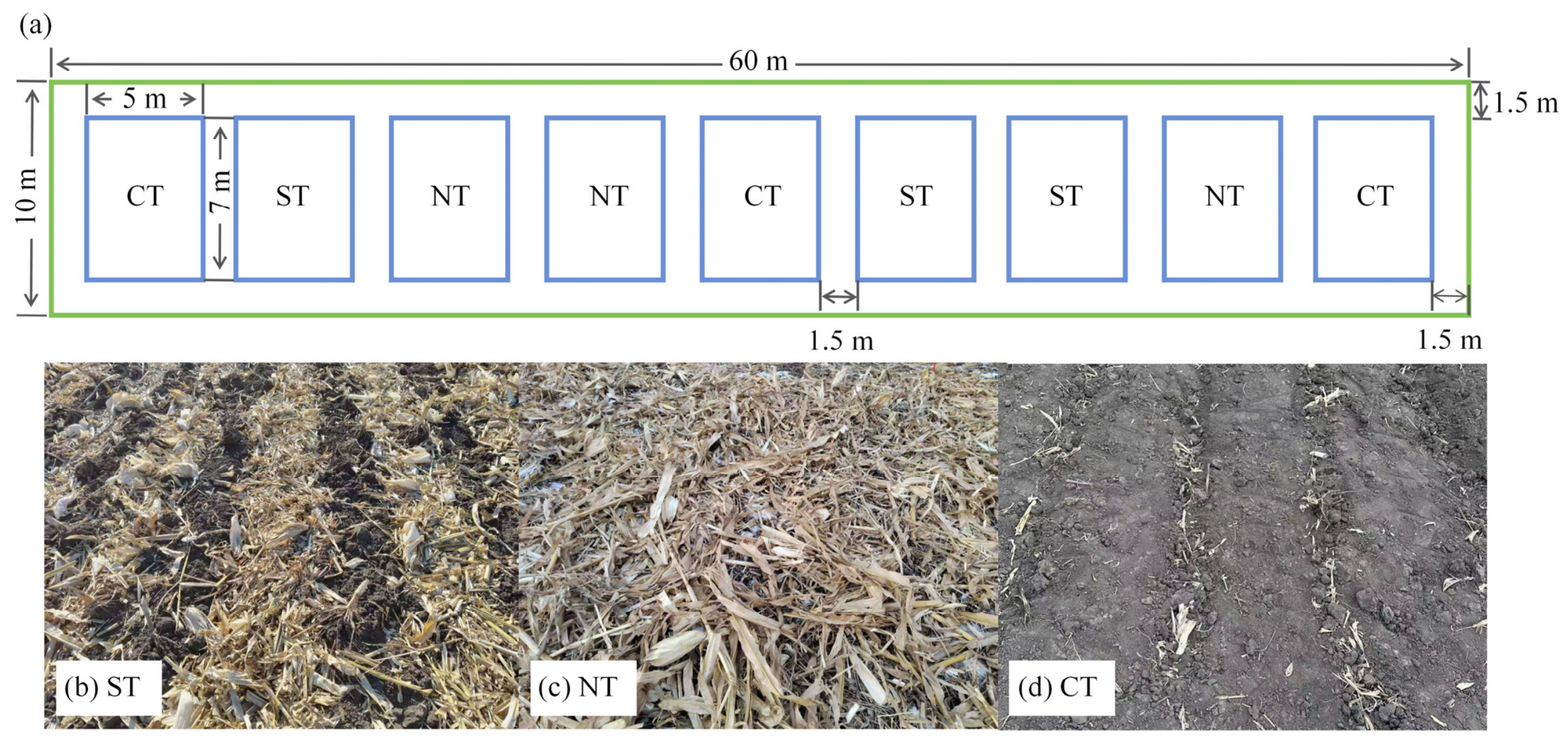
A randomized complete block design with three replications was adopted in this study. The experiment relied solely on natural rainfall, with no irrigation applied throughout the growing period. It was established in autumn 2022 after the maize harvest. The plot size was 5.0 m × 7.0 m. This study involved three tillage treatments: ST, NT, and CT (Figure 1). For ST, the ST-IS zone was manually loosened (approximately 30 cm wide and 20 cm deep) after crop harvest each year. The crushed crop residues were retained on the soil surface between the tilled strips (ST-BS). Sowing was performed manually within the ST-IS zone in spring. For NT, crop residue was left on the soil surface after harvesting. The residue biomass was approximately 8 t ha−1 for maize (440 g C kg−1, 4 g N kg−1, and 2.7 g P kg−1), and 4 t ha−1 for soybean (420 g C kg−1, 6 g N kg−1, and 3.0 g P kg−1), respectively. No soil disturbance occurred except during the sowing period. Sowing was performed manually in a narrow strip (5 cm width). For ST and NT, residues were manually ground with a straw shredder after harvest. For CT, crop residues were removed after harvest, and moldboard plowing (about 20 cm deep) was conducted for seedbed preparation and ridge formation. In the following year, seeds were planted on ridges (approximately 30 cm wide and 20 cm high), consistent with local management practices.
Soybean (Glycine max L.) and maize (Zea mays L.) were sown on 5 May in 2023 and 2024 respectively, with planting densities of 20 plants m−2 and 5.3 plants m−2. The soybean cultivar was “Dongsheng 22” (bred by the Northeast Institute of Geography and Agroecology, Chinese Academy of Sciences), and the maize cultivar was “Heyu 45” (bred by the Heilongjiang Academy of Agricultural Sciences). Fertilizer application rates were 20.23 kg N ha−1, 51.75 kg P2O5 ha−1, and 15 kg K2O ha−1 for soybean, and 138 kg N ha−1, 51.75 kg P2O5 ha−1, and 15 kg K2O ha−1 for maize. The topdressing N fertilizer rate was 138 kg ha−1 in the V6 growth stage of maize (mid-June). Weeds were controlled using the herbicide acetochlor.

2.3. Soil Sample Collection and Measurements

2.3.1. Measurements of Soil Moisture and Temperature

Soil moisture and temperature were continuously monitored at 30 min intervals across all treatments using SMEC300 sensors (WaterScout, Graton, CA, USA) installed at 5 cm, 10 cm, and 20 cm soil depths. The average soil moisture and soil temperature values during 24 h were used. In the ST treatment, soil moisture and temperature measurements were obtained in the ST-IS and ST-BS zones. Data on air temperature and precipitation were obtained from the Hailun Mollisol Erosion Monitoring and Research Station.

2.3.2. Measurements of Soil Structure and Nutrients

Soil bulk density (BD), field capacity (FC), and saturated water content (θs) were determined using a steel cylinder (5 cm diameter × 5 cm height) during the seedling stage in 2023 and 2024. Measurements were performed in triplicate at 0–5 cm, 5–10 cm, and 10–20 cm soil depth. The equations are as follows:
B D = [ m 3 m / V ]
F C = [ m 2 m 3 m 3 m ] × 100 %
θ s = [ m 1 m 3 m 3 m ] × 100 %
where m is the weight of the steel cylinder; m1 is the total weight after the cylinder and soil sample have been fully saturated by water; m2 represents the combined weight of the cylinder and the saturated soil sample following free drainage (approximately 8 h); m3 is the weight after oven-drying the cylinder and soil sample at 105 °C for at least 12 h; V is the volume of the steel cylinder (100 cm3).
Soil penetration resistance (PR) was determined by an SC900 soil penetration meter (Spectrum Technologies, Inc., IL, Illinois, USA) at soil depths of 0–5, 5–10, and 10–20 cm during the seedling stage.
Soil samples at soil depths of 0–5, 5–10, and 10–20 cm were collected by using a custom-made soil core sampler (5 cm inner diameter, 50 cm length) after harvest in 2024. A portion of the soil samples was air-dried after removing plant roots and stones to analyze soil aggregates and total soil nutrients, including total nitrogen (TN), total carbon (TC), total phosphorus (TP), and total potassium (TK). Another portion of the fresh soil samples was used to determine ammonium nitrogen (NH4+-N), nitrate nitrogen (NO3-N), available potassium (AVK), and available phosphorus (AVP).
Aggregate size fractions were determined using a high-vacuum slow-wetting method, as described by Sun et al. [30]. Soil aggregates were divided into four size classes: >2 mm, 0.25–2 mm, 0.053–0.25 mm, and <0.053 mm. The content of >0.25 mm water-stable aggregates (WR0.25) and the mean weight diameter (MWD) were calculated according to the equations as follows:
W R 0.25 = i = 1 n w i
M W D = i = 1 N x i × w i  
where xi is the mean diameter of aggregates in class i in mm; wi is the mass percentage of aggregates in class i; N is the total number of aggregate size classes; n is the number of particles in the ≥0.25 mm particle size class.
TC and TN were measured using an Elemental Analyzer (Vario TOC cube, Elementar, Langenselbold, Germany). TP was determined by the sodium hydroxide fusion–Molybdenum–antimony colorimetric method, and TK was measured by flame photometry [31]. The NH4+-N and NO3-N concentrations were determined using a 2 mol L−1 KCl solution and a SKALAR flow analyzer (Skalar Analytical B.V., Breda, The Netherlands). The AVP was measured using the molybdenum antimony colorimetric method, and AVK was determined by the ammonium acetate extraction flame photometric method [32].
For ST, soil structure and soil nutrients for the whole plot (WP) were computed as area-weighted averages, with a 1:1 area ratio (30 cm each) for the ST-IS and ST-BS zones. The results were adjusted according to the relative area contributions of the zones [33]:
W P = 1 2 S o i l   p r o p e r t i e s × I S + 1 2 S o i l   p r o p e r t i e s × B S

2.3.3. Yield Measurement

Mean emergence time (MET) and percentage of emergence (PE) were calculated according to the equations as follows [21,24,34,35]:
M E T = N 1 × T 1 + N 2 × T 2 + + N n × T n N 1 + N 2 + + N n
P E = 100 % × n / N
where MET is mean emergence time (d), PE is percentage of emergence (%), N1…n is the number of seedlings emerging since the previous count, T1…n is the number of days after sowing, n is the total number of emerged seedlings, and N is the number of sown seeds.
Maize and soybean yield in the plots were determined by manual harvesting. And the yield was recorded and adjusted to 14% moisture content.

2.4. Statistical Analysis

Statistical analyses were performed using SPSS 26.0 software (IBM Corp., Armonk, NY, USA). One-way analysis of variance (ANOVA) followed by the LSD post hoc test were applied to compare significant differences in crop yield among tillage practices at a significance level of p < 0.05. Meanwhile, two-way analysis of variance (ANOVA) was applied to analyze the interactive effects of tillage and soil depth on soil physicochemical properties. Structural equation modeling (SEM) was conducted in AMOS 22.0 to explore the direct and indirect effects of tillage practices on soil properties and crop yields within a multivariate analytical framework.

3. Results

3.1. Soil Temperature and Moisture

3.1.1. Soil Temperature

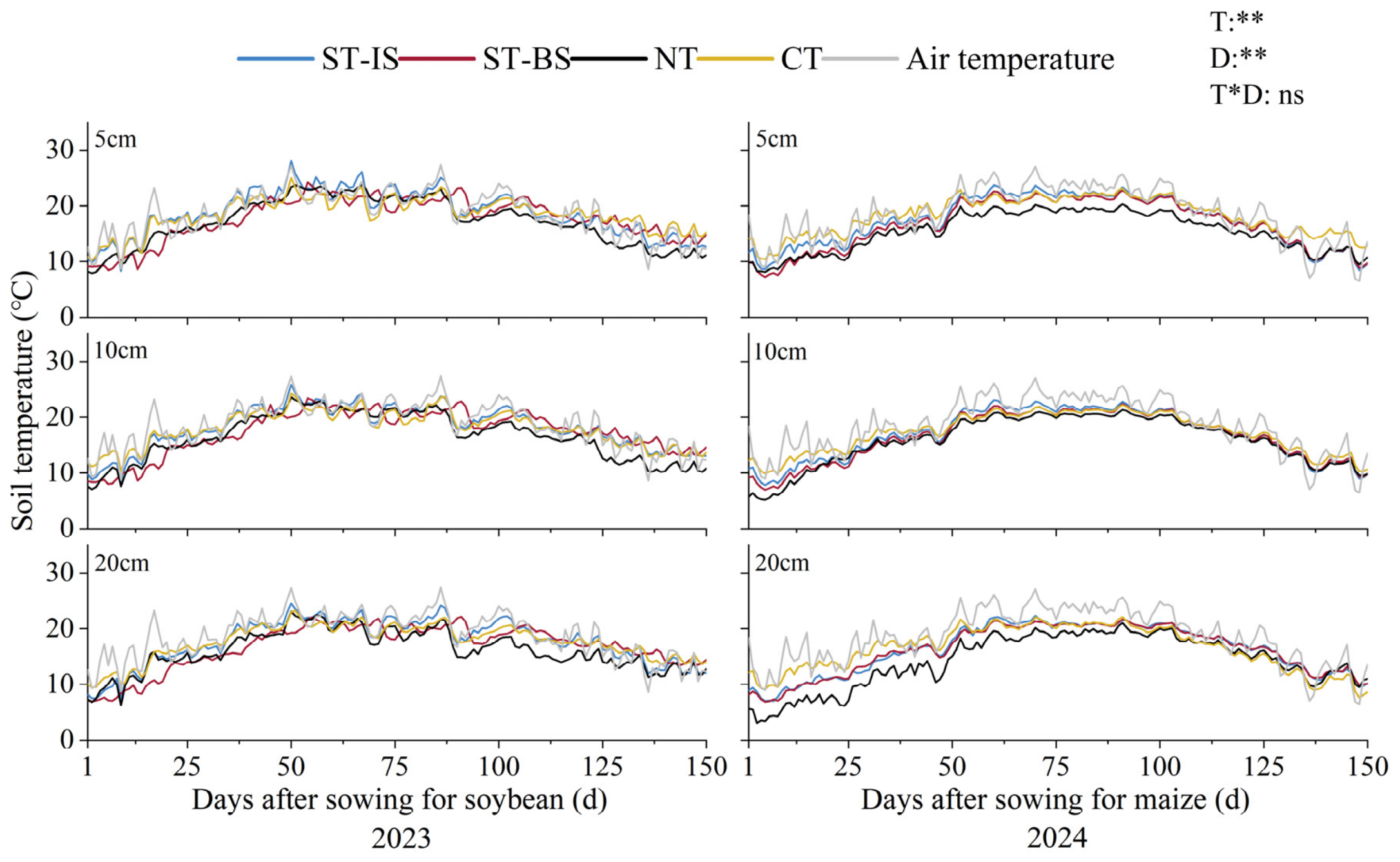
Soil temperature exhibited a positive correlation with air temperature, with a more pronounced response at 5 cm depth (Figure 2). Tillage and soil depth significantly affected soil temperature, whereas their interaction was not statistically significant. During the two-year monitoring period, the average soil temperatures were higher under ST-IS than that under NT. Soil temperature fluctuations were more pronounced in ST-IS and CT than in NT.
In 2023 and 2024, the mean soil temperature in the 0–5 cm layer under ST-IS was 1.66 °C and 1.90 °C higher than under NT, respectively. Similar results were observed at 10 cm (1.04 °C and 1.61 °C higher) and 20 cm (1.62 °C and 2.02 °C higher). Particularly during the crop seedling stage (within approximately 50 days after sowing), the soil temperature under ST-IS was 2.88 °C (in 2023) and 2.13 °C (in 2024) higher than that under NT. However, the mean soil temperature was slightly lower under ST-IS compared to CT. Furthermore, ST-BS exhibited soil temperature fluctuations similar to NT, with lower average soil temperature than ST-IS. Notably, at approximately 100 days after sowing, average soil temperature under ST-BS was 0.54 °C and 0.07 °C higher than ST-IS in 2023 and 2024, respectively. Collectively, ST created two distinct soil thermal environments relative to NT, including a warmer seedbed zone (ST-IS) that is conducive to seedling emergence.

3.1.2. Soil Moisture

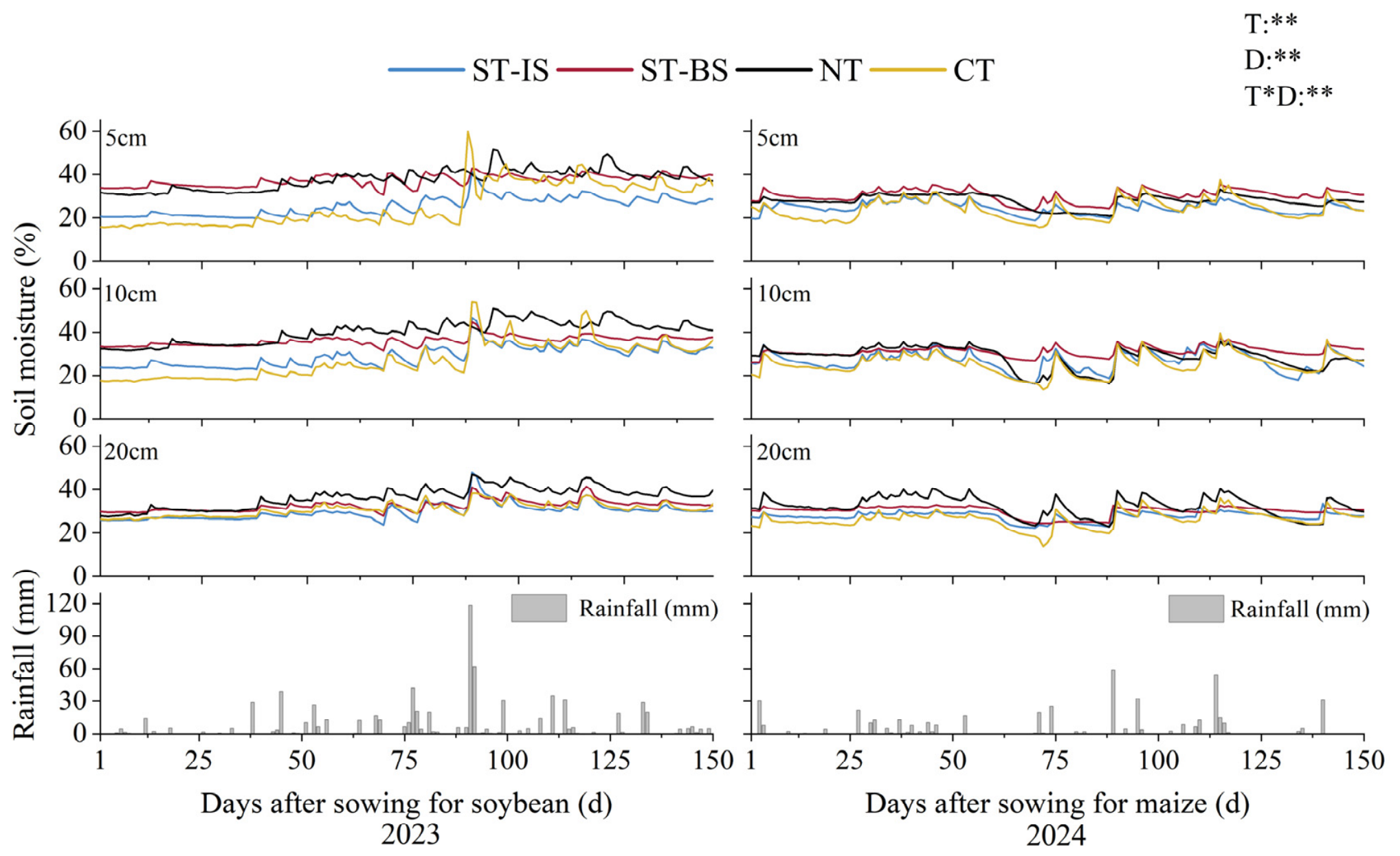
Soil moisture dynamics across all treatments were closely associated with rainfall events. Tillage practice and soil depth exhibited a significant interactive effect on soil moisture (Figure 3). During the two-year monitoring period, soil moisture under NT was consistently higher than that under ST-IS and CT. However, the soil moisture response to precipitation exhibited greater variability under ST-IS and CT. In 2023 and 2024, soil moisture at the 0–20 cm soil depth under ST-IS was 0.14% and 0.86% higher than that under CT, but 6.51% and 3.49% lower than that under NT, respectively. Moreover, average soil moisture in ST-BS was 6.18–7.25% higher than in ST-IS across both years.

3.2. Soil Structure

Tillage practices had an impact on soil structure (Table 2). BD and PR during the seedling stage were significantly lower in ST-IS than in NT at the 0–20 cm soil depth, although no significant difference was observed in the 5–10 cm layer for BD in 2023. Specifically, BD and PR at the 0–5 cm depth were 0.11 and 0.14 g cm−3 (for BD), and 0.55 and 0.49 MPa (for PR) lower in ST-IS than in NT in 2023 and 2024, respectively (p < 0.05). Moreover, CT exhibited the lowest BD and PR values. At the 0–10 cm soil depth, ST-IS exhibited greater values of WR0.25, MWD, FC, and θs than CT, but lower values than NT. Additionally, BD and PR in ST-BS were higher than in ST-IS, resulting in higher aggregate stability.

3.3. Soil Nutrients

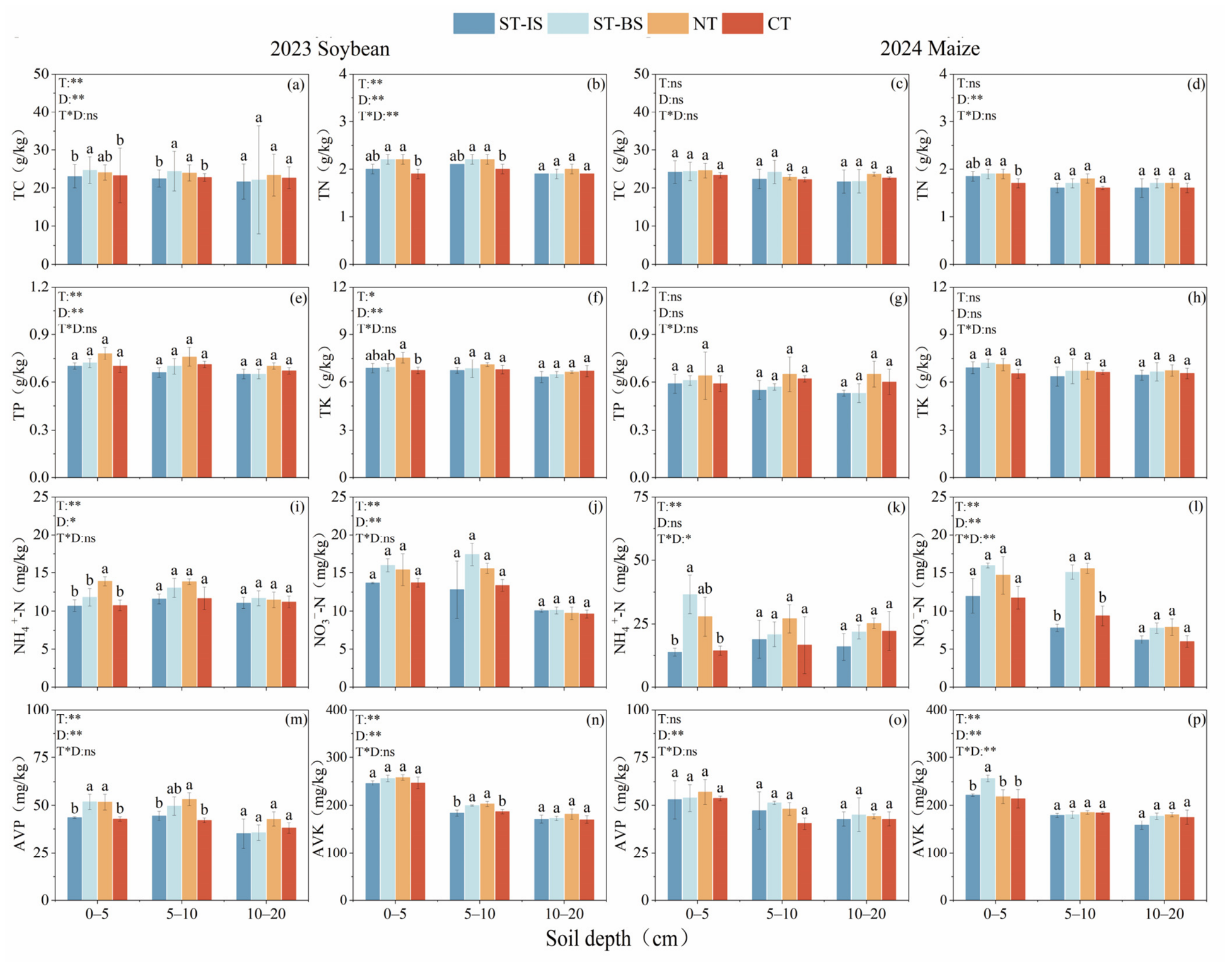
As shown in Figure 4, the tillage treatments exerted distinct effects on total soil nutrients. TC, TN, and TK contents in CT were lower than in NT and ST-BS in 2023, whereas only the TN content significantly differed between ST-BS, NT, and CT at 0–5 cm in 2024. ST-IS exhibited slightly higher total soil nutrients and soil available nutrients than CT, whereas the nutrient contents were consistently higher in ST-BS in both years. Notably, TN was, on average, 7.17% higher in 2023 and 8.59% higher in 2024 in ST-BS than in CT (p < 0.05).
At 0–5 cm soil depth, the NH4+-N content under ST-BS was 8.66% higher than under CT in 2023 (no significance), and 49.13% in 2024 (p < 0.05). A similar result was observed in the NO3-N content. The AVP content in 2023 and the AVK content in 2024 were higher in ST-BS than in CT. Similarly, total and available soil nutrients under NT were higher than those under CT. Additionally, soil nutrients declined with increasing soil depth across all tillage treatments.

3.4. Effect of Tillage Treatment on Crop Yield

As presented in Table 3, compared with NT, the METs for soybean were 0.22 days earlier under ST (no significance), and 2.43 days for maize (p < 0.05). The PE for soybean was 0.34% higher in ST than in NT (no significance), and 3.46% for maize (p < 0.05). Across all treatments, CT exhibited the earliest MET and highest PE. Maize yield under ST was 5.89% higher than that under NT (no significance), whereas soybean yield was 7.76% lower under ST than under NT (p < 0.05). The difference in soybean yield between ST and CT was negligible.

3.5. The Relationship Between Soil Properties and Crop Yield

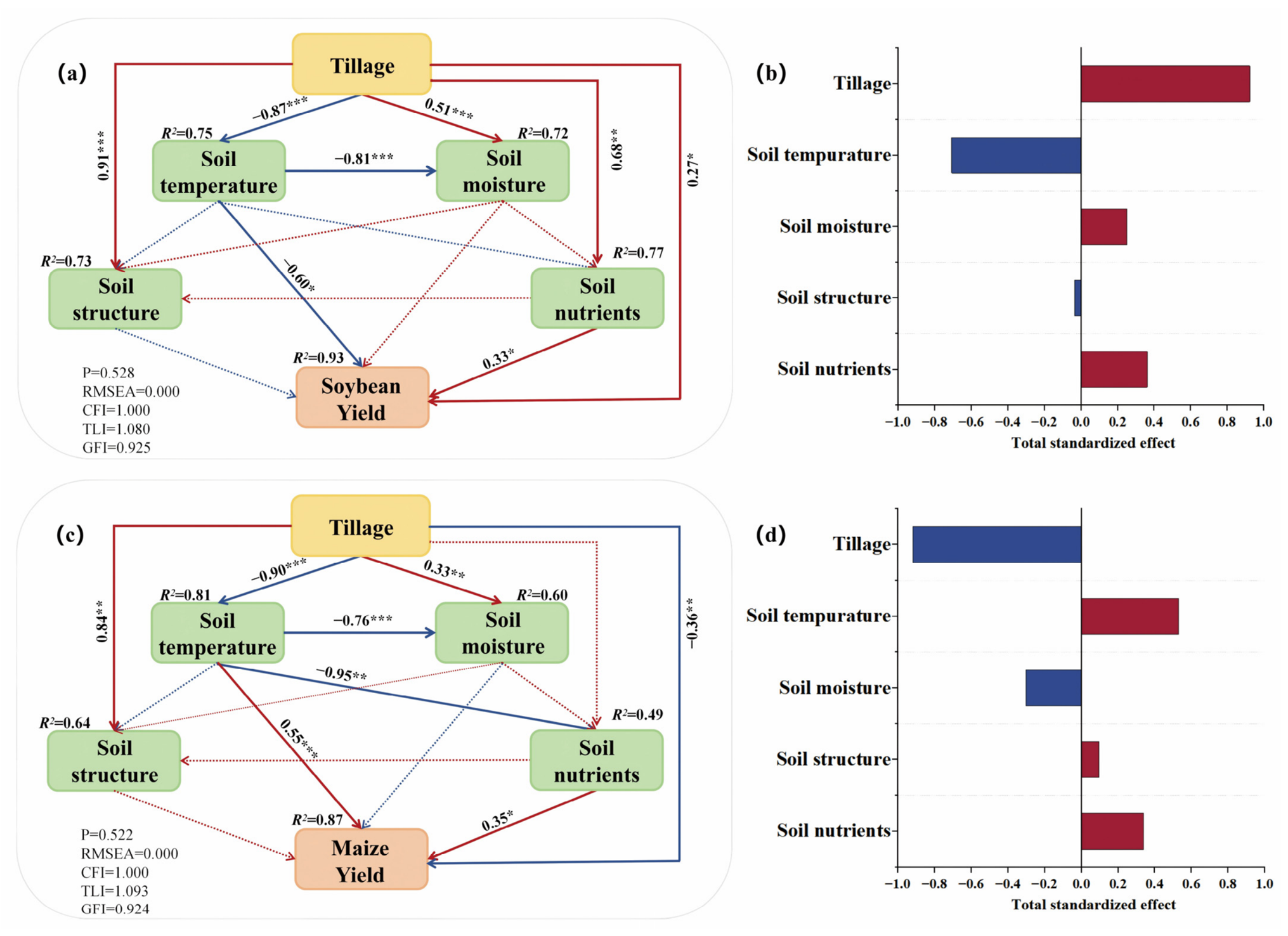
Path analysis elucidated the mechanisms by which the tillage treatment influenced soybean and maize yields via soil properties (Figure 5). The models exhibited a robust fit and high explanatory power (Soybean: R2 = 0.73, RMSEA = 0.000; Maize: R2 = 0.87, RMSEA = 0.000). Soybean yield was predominantly mediated by soil nutrients and soil moisture, which were significantly impacted by tillage treatments. Notably, soil temperature showed a direct negative effect on soybean yield, leading to a small net negative effect. In contrast, maize yield was primarily determined by soil temperature, with ST and CT treatments resulting in higher soil temperatures and maize yields. Soil structure was the next most influential factor, whereas the contributions of soil nutrients and soil moisture were smaller.
Tillage-induced increases in the soil temperature of the seedbed had the largest direct effect on maize yield. In contrast, soil moisture and soil availability nutrients were the dominant factors affecting soybean yield, whereas soil temperature had a slight inhibitory effect.

4. Discussion

4.1. Effects of Tillage on Soil Hydrothermal Environment

The tillage treatment significantly influenced soil temperature and soil moisture dynamics. In this study, tillage treatment was negatively correlated with soil temperature (Figure 2 and Figure 5). During the crop growth period, soil temperatures were higher under ST-IS and CT than under NT, with differences of 1.04–2.02 °C and 1.41–2.26 °C, respectively. These results were primarily attributed to straw mulching in the NT treatment, which impeded heat exchange between air and soil, enhancing the soil’s volumetric heat capacity [36,37]. Furthermore, straw mulching improved the soil’s water-holding capacity, thereby buffering soil temperature fluctuations by increasing evaporative cooling and soil heating capacity [38]. In contrast, no straw mulching in ST-IS and CT improved soil aeration through mechanical disturbance [13]. Tillage operations, such as plowing and rotary tillage, reduced BD and increased soil porosity, resulting in more rapid daytime warming and greater nocturnal heat loss, thereby intensifying diurnal temperature fluctuations. These observations were consistent with previous studies [22,24,39]. The tilled seedbeds without surface straw were typically warmer and drier than undisturbed and residue-covered soils, which was attributed to lower soil moisture and better air circulation [16,18,40]. We also found that soil temperature under ST-BS was slightly higher than that under ST-IS during the late crop growth stage (at approximately 100 days after sowing). This can be largely attributed to canopy closure, which intercepts direct solar radiation. As air temperatures decline in late-summer/autumn, the straw mulch in the ST-BS zone functions as a thermal insulator to conserve soil heat and reduce heat loss. In contrast, the bare soil of ST-IS dissipates heat at a much faster rate [41]. Additionally, the crop residue type and the straw quantity are critical factors for modulating soil thermal regimes, with surface soil temperature generally decreasing as the residue application rate increases [42].
The tillage treatments significantly influenced soil structure, thereby affecting soil water transport, distribution, and retention [8,43]. Our study demonstrated that soil moisture under ST in the 0–20 cm layer was higher than under CT. Notably, ST-IS exhibited marginally higher soil moisture than CT. These results indicated that ST-IS improved soil porosity, promoting the lateral redistribution of soil moisture from the ST-BS zones to the ST-IS zones, thereby improving soil water retention. Moreover, our study showed that soil moisture under NT was higher than that under CT during the crop growth season. Numerous studies have confirmed that NT with straw mulching reduced soil water evaporation and enhanced soil surface roughness, total porosity, and water infiltration rate, resulting in a higher soil moisture content [9,37,43]. Straw mulching diminishes raindrop impact, mitigates soil erosion, and improves soil’s water retention capacity [11,44,45]. Studies have shown that increasing the seedbed width in ST increases soil temperature and decreases soil moisture [20,21]. These results imply a trade-off between thermal and hydrological conditions resulting from tillage treatments and straw mulching.
Our study demonstrated that the crop residue type influenced soil water retention and thermal insulation. During the initial 20 days of the crop growing season, daily soil temperatures under NT treatment in the 0–5 cm layer ranged from 1.63 °C to 10.92 °C for soybean straw (with an average of 6.71 °C) and from 1.53 °C to 4.82 °C for maize straw (with an average of 3.19 °C). Specifically, maize straw can form a porous and fragmentation-resistant structure that provides stronger thermal buffering, effectively reducing soil water evaporation. Conversely, the rapid fragmentation and compaction of soybean straw led to soil surface sealing and lower water retention capacity, thereby resulting in higher daily soil temperature than maize straw [37,38,46].

4.2. Effects of Strip Tillage on Soil Structure

An optimal soil structure is conducive to water and nutrient uptake by crops [40,43,47]. The BD and PR were lower in ST-IS and CT than in NT, resulting in improved soil aeration (Table 3), which was consistent with earlier findings [15,16,48]. During the seedling stage, a loose seedbed was obtained by autumn rotary tillage and spring plowing in CT and ST-IS. In contrast, soil disturbance is minimal in NT, resulting in greater soil compaction than CT and ST-IS [49]. Studies have observed that short-term NT was more susceptible to soil compaction caused by machinery traffic and natural soil settlement. Moreover, short term straw mulching for NT results in insufficient organic matter accumulation, which weakens soil aggregation and pore continuity, thereby reducing soil aeration, which is unfavorable for crop root growth [50,51]. However, long-term NT promoted the accumulation of soil organic matter in the topsoil layer, improving soil structure [4,26]. Li et al. [6] found a significant increase in PR after 6–12 years of NT. Some studies have reported an increasing trend in BD and PR due to repeated tillage destroying soil aggregate structure under long-term ST and CT [2,40]. Jaskulska et al. [52] demonstrated that ST with deep loosening reduced BD and PR and improved soil microporosity.
ST-BS and NT resulted in less mechanical disruption of soil aggregates and a higher aggregate stability than CT at the 0–10 cm soil depth (Table 2). Retaining straw provides a stable carbon source for soil microorganisms (especially for fungi), increasing the WR0.25 content. It also mitigates raindrop splash erosion, enhancing the stability of soil aggregates [9,53,54]. Increased soil aggregation and stability contributed to a looser, more porous topsoil, substantially improving soil infiltration capacity and erosion resistance [6]. Conversely, long-term CT not only increases soil compaction and reduces soil aggregate stability in the furrows due to machinery traffic but also accelerates soil organic carbon mineralization, increasing soil erosion risk in the ridges [24,40].
The FC and θs are critical parameters for evaluating soil water retention. Numerous studies have demonstrated that straw mulching improves soil porosity and reduces soil evaporation, thereby increasing soil water retention and water-holding capacity [8,26,43]. Our findings confirmed that the FC and θs were higher under NT than under CT, particularly in the 0–5 cm surface layer. Short-term CT temporarily increased capillary porosity and water-holding capacity by soil loosening, whereas long-term CT decreased aggregate stability and soil nutrient levels, reducing FC and θs [55]. Initially, tillage treatments generate an abundance of non-capillary pores (macropores), resulting in a temporary increase in θs during the early crop growth stage. However, these macropores are unstable and susceptible to collapse after precipitation or irrigation, leading to a subsequent decline in θs [56]. These results demonstrated that the ST-IS zones improved the water–air relationship, and the ST-BS zones enhanced water conservation, enabling the entire topsoil layer to maintain favorable FC and θs. Thus, this integrated ST approach effectively reconciled the trade-off between soil moisture retention and aeration.

4.3. Effects of Strip Tillage on Soil Nutrients

This study demonstrated that TC, TN, TP, and TK contents were higher in NT and ST-BS than in CT (Figure 4b,d), consistent with previous findings [26,57,58]. The influence of straw mulching on soil nutrients differed across residue types (maize straw in 2023 and soybean straw in 2024) due to differences in biochemical characteristics. The higher C/N ratio of maize straw promoted microbial nitrogen immobilization, whereby soil microorganisms assimilate mineral nitrogen, reducing soil nitrogen availability. In contrast, soybean straw facilitated net N mineralization and the release of plant-available nitrogen due to a lower C/N ratio [49,59]. In addition, maize straw generally exhibited a higher release rate and cumulative amounts of P and K than soybean straw during the initial decomposition stage [60].
Due to alternating strips of tilled soil and untilled soil covered with straw, ST integrated the carbon sequestration benefits of NT with the soil mixing effect of CT. The ST-BS zones were conducive to accumulating soil nutrients. In contrast, the ST-IS zones improve seedbed aeration and accelerate crop residue decomposition and nutrient release rates [61]. Our findings indicated that total and available soil nutrient contents were higher in ST-BS than in ST-IS, whereas ST-IS exhibited higher soil nutrients than CT (Figure 4). These differences are primarily attributed to variations in soil nutrient transport [58,62]. ST treatment improved soil aeration in the ST-IS zone, which indirectly accelerates crop residue decomposition and nutrient release in the ST-BS zone, thereby increasing available nutrient supply [33,63]. Meanwhile, nutrient accumulation in the ST-BS zone can be laterally transported with soil water into the ST-IS zone due to the water potential gradient, further elevating its available nutrient contents [9,64].
Short-term NT increased soil compaction and impaired soil aeration, thereby inhibiting nitrification and reducing the potential for nitrogen leaching [6,65]. Thus, ammonium nitrogen accumulated, and mineralized nitrogen was limited during the early stage of crop growth, reducing crop nitrogen use efficiency (NUE) [66,67]. In contrast, ST has been shown to moderate nitrification and denitrification: the ST-BS zone with higher bulk density and soil moisture increases water-filled pore space and reduces soil aeration, in turn promoting denitrification; while ST-IS favors nitrification and nitrogen mineralization owing to better soil aeration [33,47]. Lateral water movement between ST-IS and ST-BS also reduces nitrate leaching, leading to lower overall losses, and improving NUE [24,62]. Hence, ST effectively maintains sufficient N availability for crop growth. Moreover, ST can promote a more homogeneous distribution of soil nutrients within the plow layer, which prevents vertical stratification commonly observed under long-term NT [68]. In addition, the influences of tillage treatments on NUE were also affected by multiple factors, including soil type, climate conditions, and cropping system [66,69].

4.4. Effects of Strip Tillage on Crop Yield

The maize and soybean yields differed across tillage treatments (Table 3, Figure 5). The tillage treatment did not significantly affect the MET and PE of soybean. Notably, soybean yield under NT was significantly greater than that under ST and CT, with no significant difference between ST and CT, whereas NT decreased maize yield. (Table 3). Structural equation modeling (SEM) further revealed a positive correlation between soil moisture and soybean yield, but a negative correlation was observed between soil moisture and maize yield (Figure 5a,c). These responses can be attributed to soybean’s greater low-temperature tolerance and broader optimal thermal range compared to maize. Consequently, the low-temperature effect in NT slightly influenced soybean emergence and early growth [14]. NT increased soil moisture and water-holding capacity, improving soybean germination and seedling establishment [9]. Tacarindua et al. [70] found that excessively high soil temperature during the seedling stage delayed soybean pod formation and grain-filling processes, which disrupted reproductive growth. Since dry matter accumulation in soybean occurs primarily from the flowering stage to the early grain-filling stage, extreme high temperatures reduce photosynthetic rates and biomass accumulation, lowering soybean yield [71]. While previous research had reported a positive correlation between soil temperature and soybean yield in warm–humid regions [72,73], our findings indicate that in this specific semi-humid temperate context, excessive heat stress had an inhibitory effect on soybean yield.
In contrast, the PE maize was significantly higher under ST than under NT, and the yield under ST was slightly higher than that under NT, with no significant difference (Table 3). This finding is primarily attributed to autumn chisel plowing and no straw mulching in ST-IS, which reduced PR and increased soil temperatures. Mean soil temperature under ST-IS was 2.12 °C higher than that under NT in the maize seedling stage (Figure 2). Meanwhile, soil temperature exhibited a significant positive effect on maize yield (Figure 5c). Previous studies have shown that lower soil temperatures reduced dry matter accumulation, inhibiting maize seed germination and early growth [24,74]. Similar results were observed in cold–wet spring regions [7,14,20]. Furthermore, other studies have indicated that ST enhanced NUE, which contributed to the higher crop yield in ST than in NT [75].
Chen et al. [14] found that maize yield was 15.7–28.4% lower in a short-term (<3 years) NT treatment than in CT in the same study area. Conversely, some studies have shown that NT improved maize yield by conserving soil moisture in the arid and semi-arid areas [39,75]. Moreover, long-term (e.g., 5–10 years) NT with straw mulching improved soil structure, soil organic matter, and soil biological activity, resulting in higher maize yields than in CT [11,12]. Furthermore, conservation tillage practices should be adapted to local climatic conditions, soil texture, and crop types. Our findings suggest that NT with straw mulching is suitable for soybean cultivation in Northeast China, whereas ST is more appropriate for maize cultivation. In other regions, integrated conservation tillage approaches, such as NT with plastic mulching, NT with periodic plowing, or deep loosening in conjunction with straw mulching, may be effective and sustainable [3,10,12].

4.5. Limitations and Future Research Directions

Although this study indicates that short-term ST can improve the seedbed environment and increase maize yield, several limitations constrain a comprehensive assessment of its overall benefits. First, soil C was quantified only as surface-layer total C, without the fractionation of the organic C fraction, limiting the inference on C stability and sequestration. Moreover, the two-year field experiment is insufficient to characterize C turnover and net balance under ST. Second, the absence of greenhouse-gas measurements limits the estimation of the C footprint and evaluation of climate impacts in terms of global warming potential. Third, the lack of soil biological properties (e.g., microbial biomass, community composition, and enzyme activities) constrains the mechanistic interpretation of how microhabitat heterogeneity regulates nutrient cycling and soil health. Fourth, soil sampling was only measured in the tillage layer (0–20 cm), which limited the assessment of effects on root distribution, subsoil water, and nutrient acquisition. Fifth, the response of runoff and soil loss to ST remains unclear in this region, limiting the assessment of its ecological benefits. In addition, no cost–return analysis is conducted for ST, which limits the assessment of its adoption feasibility and policy relevance.
In summary, future studies should prioritize the systematic monitoring and integrative assessment of ST across multiple indicators and spatial–temporal scales. Hence, based on the long-term field experiment, studies should quantitatively elucidate the effects of strip tillage on soil carbon sequestration and turnover processes, as well as greenhouse gas emission fluxes. Meanwhile, its capacity to enhance soil fertility should be systematically evaluated, and the underlying biological mechanisms should be clarified. Further work is also required to determine how long-term ST improves soil structure and the distribution of soil nutrients in deeper soil layers. On this basis, by integrating soil and water conservation effectiveness with economic cost–return analysis, an integrated ecological–economic–social evaluation framework should be established to quantitatively and comprehensively assess the applicability and scalability of ST practices in Northeast China.

5. Conclusions

This study systematically evaluated the influence of short-term ST on the soil’s hydrothermal environment, soil structure, soil nutrients, and crop yields in the Mollisol region of Northeast China. Compared to NT, ST improved PE and maize yield by promoting soil temperature and soil structure in the seedbed zones, whereas it decreased soybean yield. Meanwhile, ST resulted in higher soil moisture, soil aggregate stability, and soil nutrients than CT. However, maize and soybean yields did not differ significantly between ST and CT. Notably, SEM results revealed soil temperature, moisture, and structure exerted completely opposite effects on the two crops. This clearly demonstrates that the “one-size-fits-all” tillage strategy is unsuitable in this region. Collectively, our findings suggest that ST and NT are recommended as suitable tillage practices for maize and soybean cultivation, respectively, in the Mollisol region of Northeast China.

Author Contributions

Conceptualization, Z.R. and Q.C.; methodology, Z.R. and Q.C.; software, Z.R. and Z.L.; validation, Z.R., Q.C. and F.Y.; formal analysis, Z.R. and Z.L.; investigation, Z.R. and Q.C.; resources, Q.C.; data curation, Z.R. and Q.C.; writing—original draft preparation, Z.R.; writing—review and editing, Z.R., Z.L. and Q.C.; visualization, Z.R.; supervision, Q.C.; project administration, Q.C. and Z.L.; funding acquisition, Q.C. All authors have read and agreed to the published version of the manuscript.

Funding

This study was funded by the National Natural Science Foundation of China (42101281), and the Heilongjiang Provincial Natural Science Foundation of China (PL2025D010).

Institutional Review Board Statement

Not applicable.

Informed Consent Statement

Not applicable.

Data Availability Statement

The datasets presented in this article are not readily available because the data are part of an ongoing study. Requests to access the datasets should be directed to Zhao Li (lizhao@hrbnu.edu.cn) or Qiang Chen (chenqiang2016@hrbnu.edu.cn).

Conflicts of Interest

The authors declare no conflicts of interest.

References

  1. FAO. Towards a Definition of Soil Health; ITPS Soil Letters No. 1; FAO: Rome, Italy, 2020. [Google Scholar]
  2. Yang, Y.H.; Wu, J.C.; Zhao, S.W.; Mao, Y.P.; Zhang, J.M.; Pan, X.Y.; He, F.; van der Ploeg, M. Impact of long-term sub-soiling tillage on soil porosity and soil physical properties in the soil profile. Land Degrad. Dev. 2021, 32, 2892–2905. [Google Scholar] [CrossRef]
  3. Li, M.X.; Ali, S.; Hussain, S.A.; Khan, A.; Chen, Y. Diverse tillage practices with straw mulched management strategies to improve water use efficiency and maize productivity under a dryland farming system. Heliyon 2024, 10, e29839. [Google Scholar] [CrossRef]
  4. Zhang, Y.; Li, X.J.; Gregorich, E.G.; McLaughlin, N.B.; Zhang, X.P.; Guo, Y.F.; Liang, A.Z.; Fan, R.Q.; Sun, B.J. No-tillage with continuous maize cropping enhances soil aggregation and organic carbon storage in Northeast China. Geoderma 2018, 330, 204–211. [Google Scholar] [CrossRef]
  5. Carretta, L.; Tarolli, P.; Cardinali, A.; Nasta, P.; Romano, N.; Masin, R. Evaluation of runoff and soil erosion under conventional tillage and no-till management: A case study in northeast Italy. Catena 2021, 197, 104972. [Google Scholar] [CrossRef]
  6. Li, Y.; Li, Z.; Cui, S.; Zhang, Q.P. Trade-off between soil pH, bulk density and other soil physical properties under global no-tillage agriculture. Geoderma 2020, 361, 114099. [Google Scholar] [CrossRef]
  7. Zhang, S.X.; Chen, X.W.; Jia, S.X.; Liang, A.Z.; Zhang, X.P.; Yang, X.M.; Wei, S.C.; Sun, B.J.; Huang, D.D.; Zhou, G.Y. The potential mechanism of long-term conservation tillage effects on maize yield in the black soil of Northeast China. Soil Tillage Res. 2015, 154, 84–90. [Google Scholar] [CrossRef]
  8. Li, Y.; Li, Z.; Cui, S.; Jagadamma, S.; Zhang, Q.P. Residue retention and minimum tillage improve physical environment of the soil in croplands: A global meta-analysis. Soil Tillage Res. 2019, 194, 104292. [Google Scholar] [CrossRef]
  9. Silva, G.F.d.; Calonego, J.C.; Luperini, B.C.O.; Silveira, V.B.; Chamma, L.; Soratto, R.P.; Putti, F.F. No-Tillage System Can Improve Soybean Grain Production More Than Conventional Tillage System. Plants 2023, 12, 3762. [Google Scholar] [CrossRef] [PubMed]
  10. Chen, Q.; Zhang, J.Z.; Guo, M.M.; Zhang, X.Y.; Tian, J.Y.; Zhou, P.C.; Chen, Z.X. Comparison of the effects of five long-term land use and management practices on runoff, soil erosion, and nutrient loss under natural rainfall in the Mollisol region of Northeast China. Earth Surf. Process. Landf. 2024, 49, 1606–1620. [Google Scholar] [CrossRef]
  11. Liao, Y.; Cao, H.X.; Liu, X.; Li, H.T.; Hu, Q.Y.; Xue, W.K. By increasing infiltration and reducing evaporation, mulching can improve the soil water environment and apple yield of orchards in semiarid areas. Agric. Water Manag. 2021, 253, 106936. [Google Scholar] [CrossRef]
  12. Liu, C.Z.; Si, B.C.; Zhao, Y.; Wu, Z.M.; Lu, X.C.; Chen, X.; Han, X.Z.; Zhu, Y.C.; Zou, W.X. Drivers of soil quality and maize yield under long-term tillage and straw incorporation in Mollisols. Soil Tillage Res. 2025, 246, 106360. [Google Scholar] [CrossRef]
  13. Liu, Z.; Cao, S.L.; Sun, Z.H.; Wang, H.Y.; Qu, S.D.; Lei, N.; He, J.; Dong, Q.G. Tillage effects on soil properties and crop yield after land reclamation. Sci. Rep. 2021, 11, 4611. [Google Scholar] [CrossRef] [PubMed]
  14. Chen, Y.; Liu, S.; Li, H.; Li, X.F.; Song, C.Y.; Cruse, R.M.; Zhang, X.Y. Effects of conservation tillage on corn and soybean yield in the humid continental climate region of Northeast China. Soil Tillage Res. 2011, 115–116, 56–61. [Google Scholar] [CrossRef]
  15. Bachchan, R.K.; Satyendra, S.; Singh, V. Soil physical properties under zero and conventional tillage systems for a rice wheat cropping system. Int. J. Soil Sci. Agron. 2018, 5, 167–178. [Google Scholar]
  16. Wu, G.; Ling, J.; Zhao, D.Q.; Xu, Y.P.; Liu, Z.X.; Wen, Y.; Zhou, S.L. Deep-injected straw incorporation improves subsoil fertility and crop productivity in a wheat-maize rotation system in the North China Plain. Field Crops Res. 2022, 286, 108612. [Google Scholar] [CrossRef]
  17. Keller, T.; Bickel, S.; Or, D. The invisible subsoil compaction risk under no-till farming. Proc. Natl. Acad. Sci. USA 2025, 122, e2515473122. [Google Scholar] [CrossRef]
  18. Ren, L.D.; Nest, T.V.; Ruysschaert, G.; D’Hose, T.; Cornelis, W.M. Short-term effects of cover crops and tillage methods on soil physical properties and maize growth in a sandy loam soil. Soil Tillage Res. 2019, 192, 76–86. [Google Scholar] [CrossRef]
  19. Mikha, M.M.; Hergert, G.W.; Qiao, X.; Maharjan, B. Soil chemical properties after 12 years of tillage and crop rotation. Agron. J. 2020, 112, 4395–4406. [Google Scholar] [CrossRef]
  20. Wang, C.L.; Ai, S.Z.; Chen, Q.; Li, J.Y.; Ding, J.H.; Yang, F. Effect of strip tillage widths on soil moisture, soil temperature and soil structure in northeast China. Front. Environ. Sci. 2024, 12, 1404971. [Google Scholar] [CrossRef]
  21. Celik, A.; Altikat, S.; Way, T.R. Strip tillage width effects on sunflower seed emergence and yield. Soil Tillage Res. 2013, 131, 20–27. [Google Scholar] [CrossRef]
  22. Licht, M.A.; Al-Kaisi, M. Strip-tillage effect on seedbed soil temperature and other soil physical properties. Soil Tillage Res. 2005, 80, 233–249. [Google Scholar] [CrossRef]
  23. Dou, S.X.; Wang, Z.P.; Tong, J.C.; Shang, Z.Y.; Deng, A.X.; Song, Z.W.; Zhang, W.J. Strip tillage promotes crop yield in comparison with no tillage based on a meta-analysis. Soil Tillage Res. 2024, 240, 106085. [Google Scholar] [CrossRef]
  24. Chen, Q.; Zhang, X.Y.; Sun, L.; Ren, J.H.; Yuan, Y.R.; Zang, S.Y. Influence of Tillage on the Mollisols Physicochemical Properties, Seed Emergence and Yield of Maize in Northeast China. Agriculture 2021, 11, 939. [Google Scholar] [CrossRef]
  25. Liu, X.B.; Zhang, X.Y.; Wang, Y.X.; Sui, Y.Y.; Zhang, S.L.; Herbert, S.J.; Ding, G. Soil degradation: A problem threatening the sustainable development of agriculture in Northeast China. Plant Soil Environ. 2010, 56, 87–97. [Google Scholar] [CrossRef]
  26. Zhang, C.Y.; Li, J.Y.; Sosa, F.A.; Chen, Q.; Zhang, X.Y. Black Soil Quality After 19 Years of Continuous Conservation Tillage. Agronomy 2024, 14, 2859. [Google Scholar] [CrossRef]
  27. Han, J.Z.; Li, J.Y.; Jiang, Y.Y.; Wang, D.C.; Chen, Q.; Zhang, X.Y. Effect of Long-Term Strip Tillage on Soil Macropore Structure in Cool Black Soil Region of Northeast China. Land Degrad. Dev. 2023, 34, 484–495. [Google Scholar] [CrossRef]
  28. Xiong, Y. Chinese Soils, 2nd ed.; Science Press: Beijing, China, 1987. [Google Scholar]
  29. USDA. Soil Survey Manual No. 18, Revised ed.; US Department of Agriculture: Washington, DC, USA, 1993.
  30. Sun, T.; Chen, Q.; Chen, Y.; Cruse, R.M.; Li, X.F.; Song, C.Y.; Kravchenko, Y.S.; Zhang, X.Y. A novel soil wetting technique for measuring wet stable aggregates. Soil Tillage Res. 2014, 141, 19–24. [Google Scholar] [CrossRef]
  31. Hu, X.M.; Chen, X.Y.; Tang, Y.; Xu, Z.G.; Zeng, Y.L.; Wang, Y.H.; Zhao, Y.L.; Wu, Y.H.; Wang, G.J. Effects of g-C3N4 on bacterial community and tetracycline resistance genes in two typical sediments in tetracycline pollution remediation. Front. Microbiol. 2022, 13, 964401. [Google Scholar] [CrossRef]
  32. Zhao, G.X.; Zhang, Z.H.; Tariq, A.; Sabit, R.; Sardans, J.; Graciano, C.; Li, X.Y.; Zhu, Y.H.; Peñuelas, J.; Al-Bakre, D.A.; et al. Grazing exclusion significantly reduced soil organic carbon stocks but enhanced soil inorganic carbon stocks in desert steppe of northwest China. Ecol. Indic. 2025, 172, 113341. [Google Scholar] [CrossRef]
  33. Lowry, C.J.; Robertson, G.P.; Brainard, D.C. Strip-tillage decreases soil nitrogen availability and increases the potential for N losses in a cover cropped organic system. Agric. Ecosyst. Environ. 2021, 319, 107524. [Google Scholar] [CrossRef]
  34. Bilbro, J.D.; Wanjura, D.F. Soil crusts and cotton emergence relationships. Trans. ASAE 1982, 25, 1484–1487. [Google Scholar] [CrossRef]
  35. Karayel, D.; Ozmerzi, A. Effect of tillage methods on sowing uniformity of maize. Can. Agric. Eng. 2002, 44, 2.23–2.26. [Google Scholar]
  36. Adil, M.; Zhang, C.; Yao, Z.J.; Lu, S.Q.; Qin, Z.Y.; Wang, J.C.; Mahmood, A.; Riaz, M.W.; Lu, H.L. Interactive effects of intercropping and mulching under conservation tillage as sustainable agriculture increased cotton productivity. Front. Ecol. Evol. 2023, 10, 1092636. [Google Scholar] [CrossRef]
  37. Liang, M.D.; Chen, L.; Chen, G.Q.; Zhao, Y.R.; Liu, G.X.; Sun, E.H.; Yong, C.; Huang, H.Y.; Li, F.Y.; Qu, P. Protective effects of straw mulching on soil health and function: A review. Environ. Pollut. Bioavailab. 2025, 37, 2533900. [Google Scholar] [CrossRef]
  38. Li, F.; Zhang, G.H.; Chen, J.; Song, Y.L.; Geng, Z.G.; Li, K.F.; Siddique, K.H.M. Straw mulching for enhanced water use efficiency and economic returns from soybean fields in the Loess Plateau China. Sci. Rep. 2022, 12, 17111. [Google Scholar] [CrossRef] [PubMed]
  39. Li, R.; Hou, X.Q.; Jia, Z.K.; Han, Q.F.; Ren, X.L.; Yang, B.Q. Effects on soil temperature, moisture, and maize yield of cultivation with ridge and furrow mulching in the rainfed area of the Loess Plateau, China. Agric. Water Manag. 2013, 116, 101–109. [Google Scholar] [CrossRef]
  40. Moraes, M.T.d.; Debiasi, H.; Franchini, J.C.; Mastroberti, A.A.; Levien, R.; Leitner, D.; Schnepf, A. Soil compaction impacts soybean root growth in an Oxisol from subtropical Brazil. Soil Tillage Res. 2020, 200, 104611. [Google Scholar] [CrossRef]
  41. Huang, C.X.; Lu, J.S.; Chai, Y.W.; Zhou, M.; Li, B.Z.; Chang, L.; Jia, R.; Huang, C.X. Optimized Straw Strip Mulching Enhances Soil Water–Heat–Carbon Synergy and Stabilizes Winter Wheat Yield in Semi-Arid Regions. Agronomy 2026, 16, 859. [Google Scholar] [CrossRef]
  42. Zhao, J.L.; Lu, Y.; Tian, H.L.; Jia, H.L.; Guo, M.Z. Effects of Straw Returning and Residue Cleaner on the Soil Moisture Content, Soil Temperature, and Maize Emergence Rate in China’s Three Major Maize Producing Areas. Sustainability 2019, 11, 5796. [Google Scholar] [CrossRef]
  43. Zhou, M.; Xiao, Y.; Zhang, X.Y.; Xiao, L.L.; Ding, G.W.; Cruse, R.M.; Liu, X.B. Fifteen years of conservation tillage increases soil aggregate stability by altering the contents and chemical composition of organic carbon fractions in Mollisols. Land Degrad. Dev. 2022, 33, 2932–2944. [Google Scholar] [CrossRef]
  44. Argaman, E.; Stavi, I. Runoff Mitigation in Croplands: Evaluating the Benefits of Straw Mulching and Polyacrylamide Techniques. Agronomy 2023, 13, 1935. [Google Scholar] [CrossRef]
  45. Yang, L.Y.; Duan, J.; Peng, L.; Zhang, X.Y.; Guo, X.M.; Yang, J. Effects of Straw Mulching on Near-Surface Hydrological Process and Soil Loss in Slope Farmland of Red Soil. Water 2022, 14, 3388. [Google Scholar] [CrossRef]
  46. da Silva, F.A.M.; Pinto, H.S.; Scopel, E.; Corbeels, M.; Affholder, F. Water Fluxes in Maize, Millet and Soybean Plant-Residue Mulches Used in Direct Seeding. Pesq. Agropecu. Bras. 2006, 41, 717–724. [Google Scholar]
  47. Han, Y.L.; Guo, D.; Ma, W.; Ge, J.Z.; Li, X.L.; Mehmood, A.N.; Zhao, M.; Zhou, B.Y. Strip deep rotary tillage combined with controlled-release urea improves the grain yield and nitrogen use efficiency of maize in the North China Plain. J. Integr. Agric. 2022, 21, 2559–2576. [Google Scholar] [CrossRef]
  48. Jabro, J.; Stevens, W.; Iversen, W.; Evans, R. Technical Note: Bulk density, water content, and hydraulic properties of a sandy loam soil following conventional or strip tillage. Appl. Eng. Agric. 2011, 27, 765–768. [Google Scholar] [CrossRef]
  49. Chen, J.; Heiling, M.; Resch, C.; Mbaye, M.; Gruber, R.; Dercon, G. Does maize and legume crop residue mulch matter in soil organic carbon sequestration? Agric. Ecosyst. Environ. 2018, 265, 123–131. [Google Scholar] [CrossRef]
  50. Reichert, J.M.; da Rosa, V.T.; Vogelmann, E.S.; da Rosa, D.P.; Horn, R.; Reinert, D.J.; Sattler, A.; Denardine, J.E. Conceptual Framework for Capacity and Intensity Physical Soil Properties Affected by Short and Long-Term (14 Years) Continuous No-Tillage and Controlled Traffic. Soil Tillage Res. 2016, 158, 123–136. [Google Scholar] [CrossRef]
  51. Nunes, J.J.; Arneson, N.J.; DeWerff, R.P.; Ruark, M.; Conley, S.; Smith, D.; Werle, R. Planting into a Living Cover Crop Alters Preemergence Herbicide Dynamics and Can Reduce Soybean Yield. Weed Technol. 2023, 37, 226–235. [Google Scholar] [CrossRef]
  52. Jaskulska, I.; Romaneckas, K.; Jaskulski, D.; Gałęzewski, L.; Breza-Boruta, B.; Dębska, B.; Lemanowicz, J. Soil Properties after Eight Years of the Use of Strip-Till One-Pass Technology. Agronomy 2020, 10, 1596. [Google Scholar] [CrossRef]
  53. Hammerbeck, A.L.; Stetson, S.J.; Osborne, S.L.; Schumacher, T.E.; Pikul, J.L. Corn Residue Removal Impact on Soil Aggregates in a No-Till Corn/Soybean Rotation. Soil Sci. Soc. Am. J. 2012, 76, 1390–1398. [Google Scholar] [CrossRef]
  54. Sheehy, J.; Regina, K.; Alakukku, L.; Six, J. Impact of no-till and reduced tillage on aggregation and aggregate-associated carbon in Northern European agroecosystems. Soil Tillage Res. 2015, 150, 107–113. [Google Scholar] [CrossRef]
  55. Lal, R. Soil carbon sequestration impacts on global climate change and food security. Science 2004, 304, 1623–1627. [Google Scholar] [CrossRef]
  56. Mateo-Marín, N.; Bosch-Serra, À.D.; Molina, M.G.; Poch, R.M. Impacts of tillage and nutrient management on soil porosity trends in dryland agriculture. Eur. J. Soil Sci. 2021, 73, 2141–2153. [Google Scholar] [CrossRef]
  57. He, J.X.; Du, L.; Zhai, C.; Guan, Y.P.; Wu, S.; Zhang, Z.H.; Ogundeji, A.O.; Gu, S.Y. Influence of tillage practices on phosphorus forms in aggregates of Mollisols from northeast China. J. Sci. Food Agric. 2021, 101, 4523–4531. [Google Scholar] [CrossRef] [PubMed]
  58. Calistru, A.E.; Filipov, F.; Cara, I.G.; Cioboată, M.; Țopa, D.; Jităreanu, G. Tillage and Straw Management Practices Influences Soil Nutrient Distribution: A Case Study from North-Eastern Romania. Land 2024, 13, 625. [Google Scholar] [CrossRef]
  59. Hao, X.X.; Han, X.Z.; Wang, S.Y.; Li, L.J. Dynamics and composition of soil organic carbon in response to 15 years of straw return in a Mollisol. Soil Tillage Res. 2022, 215, 105221. [Google Scholar] [CrossRef]
  60. Dong, S.K.; Ma, Z.Z.; Wang, L.B.; Yan, C.; Liu, L.J.; Gong, Z.P.; Cui, G.W. Decomposition and Nutrient Release Characteristics of Incorporated Soybean and Maize Straw in Northeast China. Ekol. Derg. 2019, 107, 2119. [Google Scholar]
  61. Zhang, L.; Wang, J.; Fu, G.Z.; Zhao, Y.G. Rotary tillage in rotation with plowing tillage improves soil properties and crop yield in a wheat-maize cropping system. PLoS ONE 2018, 13, e0198193. [Google Scholar] [CrossRef]
  62. Li, R.; Chai, S.X.; Chai, Y.W.; Li, Y.W.; Chang, L.; Cheng, H.B. Straw strip mulching: A sustainable technology for saving water and improving efficiency in dryland winter wheat production. J. Integr. Agric. 2022, 21, 3556–3568. [Google Scholar] [CrossRef]
  63. Zhao, X.L.; Zhang, W. Improving Yield by Breaking the Seed Furrow and Covering the Soil after Sowing in Strip-Tillage Mode. Plant Soil Environ. 2025, 71, 426–440. [Google Scholar] [CrossRef]
  64. Schröder, N.; Javaux, M.; Vanderborght, J.; Steffen, B.; Vereecken, H. Effect of Root Water and Solute Uptake on Apparent Soil Dispersivity: A Simulation Study. Vadose Zone J. 2012, 11, vzj2012.0009. [Google Scholar] [CrossRef]
  65. Longepierre, M.; Feola Conz, R.; Barthel, M.; Bru, D.; Philippot, L.; Six, J.; Hartmann, M. Mixed Effects of Soil Compaction on the Nitrogen Cycle Under Pea and Wheat. Front. Microbiol. 2022, 12, 822487. [Google Scholar] [CrossRef]
  66. Yuan, L.; Chen, X.; Jia, J.C.; Chen, H.H.; Shi, Y.; Ma, J.; Liang, C.; Liu, Y.; Xie, H.T.; He, H.B.; et al. Stover mulching and inhibitor application maintain crop yield and decrease fertilizer N input and losses in no-till cropping systems in Northeast China. Agric. Ecosyst. Environ. 2021, 312, 107360. [Google Scholar] [CrossRef]
  67. Ingraffia, R.; Lo Porto, A.; Ruisi, P.; Amato, G.; Giambalvo, D.; Frenda, A.S. Conventional tillage versus no-tillage: Nitrogen use efficiency component analysis of contrasting durum wheat genotypes grown in a Mediterranean environment. Field Crops Res. 2023, 296, 108904. [Google Scholar] [CrossRef]
  68. Yang, H.K.; Li, J.G.; Wu, G.; Huang, X.L.; Fan, G.Q. Maize straw mulching with no-tillage increases fertile spike and grain yield of dryland wheat by regulating root-soil interaction and nitrogen nutrition. Soil Tillage Res. 2023, 228, 105652. [Google Scholar] [CrossRef]
  69. Badrari, H.; Ghimire, R.; Aryal, D.R.; Mesbah, A. Soil profile distribution of organic, inorganic, and labile carbon and nitrogen fractions vary in semi-arid drylands under long-term conservation tillage systems. Soil Use Manag. 2024, 40, e13129. [Google Scholar] [CrossRef]
  70. Tacarindua, C.R.P.; Shiraiwa, T.; Homma, K.; Kumagai, E.; Sameshima, R. The effects of increased temperature on crop growth and yield of soybean grown in a temperature gradient chamber. Field Crops Res. 2013, 154, 74–81. [Google Scholar] [CrossRef]
  71. Thomas, J.M.G. Elevated temperature delays onset of reproductive growth and reduces seed growth rate of soybean. J. Agron. Crop Sci. 2010, 1, 19. [Google Scholar]
  72. Lobell, D.B.; Asner, G.P. Climate and management contributions to recent trends in U.S. agricultural yields. Science 2003, 299, 1032. [Google Scholar] [CrossRef]
  73. Schlenker, W.; Roberts, M.J. Nonlinear temperature effects indicate severe damages to U.S. crop yields under climate change. Proc. Natl. Acad. Sci. USA 2009, 106, 15594–15598. [Google Scholar] [CrossRef] [PubMed]
  74. Calleja-Cabrera, J.; Boter, M.; Oñate-Sánchez, L.; Pernas, M. Root Growth Adaptation to Climate Change in Crops. Front. Plant Sci. 2020, 11, 544. [Google Scholar] [CrossRef] [PubMed]
  75. Xu, D.Y.; Ding, J.F.; Yang, D.D.; Jiang, W.Y.; Li, F.J.; Zhu, M.; Zhu, X.K.; Li, C.Y.; Guo, W.S. Strip Tillage Improves Grain Yield and Nitrogen Efficiency in Wheat under a Rice–Wheat System in China. Agronomy 2022, 12, 2698. [Google Scholar] [CrossRef]
Figure 1. Descriptions of three tillage treatments (a). Notes: (bd) represent ST, NT, and CT plots, respectively. ST, strip tillage; NT, no-till; CT, conventional tillage.
Agriculture 16 01289 g001
Figure 2. Dynamic change in soil temperature under different tillage treatments in 2023 and 2024. Notes: ST-IS, the seedbed for strip tillage; ST-BS, between the seedbeds for strip tillage; NT, no-till; CT, conventional tillage; T, tillage practices; D, soil depth. ** represent variable effect at 1% significant levels, and ns indicates no significant effect.
Agriculture 16 01289 g002
Figure 3. Dynamic change in soil moisture under different tillage treatments in 2023 and 2024. Notes: ST-IS, the seedbed for strip tillage; ST-BS, between the seedbeds for strip tillage; NT, no-till; CT, conventional tillage; T, tillage practices; D, soil depth. ** represent variable effect at 1% significant levels.
Agriculture 16 01289 g003
Figure 4. Differences in soil nutrients under different tillage treatments in 2023 (soybean) and 2024 (maize). Error bars represent standard error of mean (SEM). Different lowercase letters indicate significant differences among treatments at p < 0.05. * and ** represent variable effect at 5% and 1% significant levels, and ns indicates no significant effect. Notes: TC, total carbon (a,c); TN, total nitrogen (b,d); TP, total phosphorus (e,g); TK, total potassium (f,h); NH4+-N, ammonium nitrogen (i,k); NO3-N, nitrate nitrogen (j,l); AVP, available phosphorus (m,o); AVK, available potassium (n,p).
Agriculture 16 01289 g004
Figure 5. The structural equation model (SEM) results illustrated the potential mechanisms of the relationships between tillage treatments, soil properties, and soybean yield (a) and maize yield (c). Red arrows and blue arrows indicate positive relationships and negative relationships, respectively. Solid lines indicate significant and dashed lines indicate non-significant relationships. The numbers on the arrows represent standardized path coefficients. *, **, and *** represent p < 0.05, p < 0.01, and p < 0.001, respectively. This model was adopted to calculate the standardized total effects on soybean yield (b) and maize yield (d).
Agriculture 16 01289 g005
Table 1. The initial soil properties in the 0–20 cm soil layer.
Depth
cm
Bulk Density
g cm−3
Sandy
%
Loam
%
Clay
%
Soil Organic Carbon
g kg−1
Total Nitrogen
g kg−1
Total Phosphorus
g kg−1
0–101.2139.6325.3035.0719.691.600.68
10–201.3439.4625.3335.2120.121.680.69
Table 2. Effects of different tillage treatments on soil physical properties.
YearDepthTillageBDPRWR0.25MWDFCθs
cmg cm−3Mpa%mm%%
20230–5ST-IS1.29 b0.68 c74.45 ab1.08 ab22.44 b34.24 c
ST-BS1.31 b0.82 b76.29 a1.19 a22.09 b35.05 b
NT1.40 a1.23 a81.32 a1.41 a23.61 b39.13 a
CT1.23 b0.59 d69.01 b0.79 b19.15 a33.09 d
5–10ST-IS1.34 ab1.19 b74.62 a1.05 b19.71 a30.17 a
ST-BS1.46 a1.20 b79.36 a1.44 a20.71 b32.77 a
NT1.44 a1.32 a79.13 a1.30 ab21.07 b35.19 a
CT1.26 b0.91 c65.21 b0.75 c19.66 a28.24 a
10–20ST-IS1.32 b1.53 c79.49 a1.14 a15.56 a20.68 a
ST-BS1.50 a1.63 b77.91 a1.40 a20.70 b29.63 b
NT1.50 a1.71 a78.15 a1.32 a20.56 b28.76 b
CT1.30 b1.43 d67.62 b0.78 b15.45 a22.99 ab
Tillage (T)0.000 **0.000 **0.000 **0.000 **0.000 **0.000 **
Depth (D)0.001 **0.000 **0.523 n.s.0.732 n.s.0.000 **0.000 **
T*D0.171 n.s.0.000 **0.066 n.s.0.301 n.s.0.000 **0.336 n.s.
20240–5ST-IS1.27 b0.68 c75.87 ab1.08 b22.97 a34.30 a
ST-BS1.32 b0.75 b77.42 a1.40 a23.63 a34.66 a
NT1.41 a1.17 a74.30 ab1.42 a22.97 a38.34 a
CT1.15 c0.64 c68.58 b0.75 c18.77 a32.86 a
5–10ST-IS1.30 b1.14 b76.01 a1.08 b18.15 a28.79 a
ST-BS1.36 b1.16 b79.95 a1.22 a18.96 a32.78 a
NT1.46 a1.32 a76.13 a1.20 a19.51 a34.46 a
CT1.15 c0.94 c64.42 b0.65 c18.19 a27.65 a
10–20ST-IS1.40 a1.55 bc81.46 a1.19 a14.51 a19.72 a
ST-BS1.49 a1.60 b79.72 a1.04 b21.69 b28.91 a
NT1.47 a1.71 a75.86 a1.29 a16.64 ab23.60 a
CT1.25 b1.45 c77.97 a1.02 b14.93 a21.01 a
Tillage (T)0.005 **0.000 **0.000 **0.000 **0.051 n.s.0.273 n.s.
Depth (D)0.000 **0.000 **0.276 n.s.0.848 n.s.0.001 **0.000 **
T*D0.108 n.s.0.036 *0.059 n.s.0.823 n.s.0.249 n.s.0.341 n.s.
Notes: ST-IS, the seedbed for strip tillage; ST-BS, between the seedbeds for strip tillage; NT, no-till; CT, conventional tillage; BD, bulk density; PR, penetration resistance; WR0.25, >0.25 mm water stable aggregate size; MWD, mean weight diameter; FC, field capacity; θs, saturated water content. Different lowercase letters following data denote significant difference among tillage treatments (p ≤ 0.05). * and ** represent variable effect at 5% and 1% significant levels, and n.s. indicates no significant effect.
Table 3. Effects of different tillage treatments on crop emergence and yield.
CropYearTillageMET
(Days)
PE
(%)
Yield
(kg ha−1)
Soybean2023ST19.46 a93.22 a2283 b
NT19.68 a92.88 a2475 a
CT19.34 a94.89 a2245 b
Maize2024ST20.45 b92.99 a9884 ab
NT22.88 a89.53 b9334 b
CT19.18 c95.25 a10,044 a
Notes: ST, strip tillage; NT, no-till; CT, conventional tillage; MET, mean emergence time (days); PE, percentage of emergence (%). Both MET and PE were measured at seedling stage after sowing. Different lowercase letters following data denote significant difference among tillage treatments (p < 0.05).
Disclaimer/Publisher’s Note: The statements, opinions and data contained in all publications are solely those of the individual author(s) and contributor(s) and not of MDPI and/or the editor(s). MDPI and/or the editor(s) disclaim responsibility for any injury to people or property resulting from any ideas, methods, instructions or products referred to in the content.