Research Progress on the Application of Carbon-Based Nanomaterials in Agriculture and Their Dual Effects


Abstract
1. Introduction
2. Classification and Properties of CNMs
3. Mechanisms of Action of Carbon Nanomaterials in Plant Physiology
3.1. Mechanisms of Nutrient Uptake Promotion
3.2. Regulation of Photosynthesis
3.3. Enhancement of Antioxidant Defense and Stress Tolerance
4. Diversified Applications of CNMs in Agriculture
4.1. Plant Growth Promoters
4.2. Nano-Pesticides and Plant Protection
4.3. Nano-Fertilizers and Slow-Release Systems
4.4. Sensing and Precision Agriculture
4.5. Limitations to Large-Scale Implementation
5. Dual Effects and Toxicity Issues
5.1. Positive Effects
5.2. Negative Effects
5.3. Toxicity Mechanisms and Influencing Factors
6. Sustainable Development and Green Synthesis
6.1. Environmental and Health Risks
6.2. Green Synthesis Pathways
7. Future Perspectives
Author Contributions
Funding
Institutional Review Board Statement
Informed Consent Statement
Data Availability Statement
Acknowledgments
Conflicts of Interest
References
- Tester, M.; Langridge, P. Breeding technologies to increase crop production in a changing world. Science 2010, 327, 818–822. [Google Scholar] [CrossRef] [PubMed]
- McMenomy, T.; Mulligan, F.; Sadiddin, A.; Skøt, J.; Vaz, S. World Food and Agriculture—Statistical Yearbook 2022; Food and Agriculture Organization of the United Nations: Rome, Italy, 2022. [Google Scholar]
- Lowry, G.V.; Avellan, A.; Gilbertson, L. Opportunities and challenges for nanotechnology in the agri-tech revolution. Nat. Nanotechnol. 2019, 14, 517–522. [Google Scholar] [CrossRef] [PubMed]
- Rani, L.; Thapa, K.; Kanojia, N.; Sharma, N.; Singh, S.; Grewal, A.S.; Srivastav, A.L.; Kaushal, J. An extensive review on the consequences of chemical pesticides on human health and environment. J. Clean. Prod. 2021, 283, 124657. [Google Scholar] [CrossRef]
- Husen, A.; Siddiqi, K.S. Carbon and fullerene nanomaterials in plant system. J. Nanobiotechnol. 2014, 12, 16. [Google Scholar] [CrossRef]
- Zaytseva, O.; Neumann, G. Carbon nanomaterials: Production, impact on plant development, agricultural and environ-mental applications. Chem. Biol. Technol. Agric. 2016, 3, 17. [Google Scholar] [CrossRef]
- Sharma, P.; Pandey, V.; Sharma, M.M.M.; Patra, A.; Singh, B.; Mehta, S.; Husen, A. A Review on Biosensors and Nanosen-sors Application in Agroecosystems. Nanoscale Res. Lett. 2021, 16, 136. [Google Scholar] [CrossRef]
- Duhan, J.S.; Kumar, R.; Kumar, N.; Kaur, P.; Nehra, K.; Duhan, S. Nanotechnology: The new perspective in precision agriculture. Biotechnol. Rep. 2017, 15, 11–23. [Google Scholar] [CrossRef]
- Singh, S.; Husen, A. Role of nanomaterials in the mitigation of abiotic stress in plants. In Nanomaterials and Plant Potential; Husen, A., Iqbal, M., Eds.; Springer: Cham, Switzerland, 2019; pp. 441–471. [Google Scholar]
- Kumar, A.; Choudhary, A.; Kaur, H.; Guha, S.; Mehta, S.; Husen, A. Potential applications of engineered nanoparticles in plant disease management: A critical update. Chemosphere 2022, 295, 133798. [Google Scholar] [CrossRef]
- Usman, M.; Farooq, M.; Wakeel, A.; Nawaz, A.; Cheema, S.A.; Rehman, H.U.; Ashraf, I.; Sanaullah, M. Nanotechnology in agriculture: Current status, challenges and future opportunities. Sci. Total Environ. 2020, 721, 137778. [Google Scholar] [CrossRef]
- Quílez-Bermejo, J.; Morallón, E.; Cazorla-Amorós, D.; Celzard, A.; Fierro, V. Progress and Perspectives in the Electrochemical Synthesis of Carbon Nanomaterials. Carbon 2025, 237, 120151. [Google Scholar] [CrossRef]
- Nasir, S.; Hussein, M.Z.; Zainal, Z.; Yusof, N.A. Carbon-based nanomaterials/allotropes: A glimpse of their synthesis, properties and some applications. Materials 2018, 11, 295. [Google Scholar] [CrossRef]
- Chaachouay, N.; Zidane, L. Role of carbon nanotubes for herbicide detection and remediation. In Carbon-Based Nanomaterials: Synthesis, Agricultural, Biomedical, and Environmental Interventions; Bachheti, A., Bachheti, R.K., Husen, A., Eds.; Springer: Singapore, 2024; pp. 145–158. [Google Scholar]
- Sharma, M.M.M.; Kapoor, D.; Sharma, P.; Husen, A. Role of Carbon Nanomaterials in the Prevention of Plant Disease. In Carbon-Based Nanomaterials: Synthesis, Agricultural, Biomedical, and Environmental Interventions; Bachheti, A., Bachheti, R.K., Husen, A., Eds.; Springer: Singapore, 2024; pp. 105–121. [Google Scholar]
- Iijima, S. Helical microtubules of graphitic carbon. Nature 1991, 354, 56–58. [Google Scholar] [CrossRef]
- Safdar, M.; Kim, W.; Park, S.; Gwon, Y.; Kim, Y.-O.; Kim, J. Engineering plants with carbon nanotubes: A sustainable agriculture approach. J. Nanobiotechnol. 2022, 20, 275. [Google Scholar] [CrossRef]
- Lahiani, M.H.; Dervishi, E.; Chen, J.; Nima, Z.; Gaume, A.; Biris, A.S.; Khodakovskaya, M.V. Impact of carbon nanotube exposure to seeds of valuable crops. ACS Appl. Mater. Interfaces 2013, 5, 7965–7973. [Google Scholar] [CrossRef] [PubMed]
- Tiwari, D.K.; Dasgupta-Schubert, N.; Villaseñor Cendejas, L.M.; Villegas, J.; Carreto Montoya, L.; Borjas García, S.E. Interfacing carbon nanotubes (CNT) with plants: Enhancement of growth, water and ionic nutrient uptake in maize (Zea mays) and implications for nanoagriculture. Appl. Nanosci. 2013, 4, 577–591. [Google Scholar] [CrossRef]
- Verma, S.K.; Das, A.K.; Gantait, S.; Kumar, V.; Gurel, E. Applications of carbon nanomaterials in the plant system: A perspective view on the pros and cons. Sci. Total Environ. 2019, 667, 485–499. [Google Scholar] [CrossRef] [PubMed]
- Wang, X.; Liu, X.; Chen, J.; Han, H.; Yuan, Z. Evaluation and mechanism of antifungal effects of carbon nanomaterials in controlling plant fungal pathogen. Carbon 2014, 68, 798–806. [Google Scholar] [CrossRef]
- Sarlak, N.; Taherifar, A.; Salehi, F. Synthesis of nanopesticides by encapsulating pesticide nanoparticles using function-alized carbon nanotubes and application of new nanocomposite for plant disease treatment. J. Agric. Food Chem. 2014, 62, 4833–4838. [Google Scholar] [CrossRef]
- Zhu, L.; Chen, L.; Gu, J.; Ma, H.; Wu, H. Carbon-based nanomaterials for sustainable agriculture: Their application as light converters, nanosensors, and delivery tools. Plants 2022, 11, 511. [Google Scholar] [CrossRef] [PubMed]
- Giraldo, J.P.; Wu, H.; Newkirk, G.M.; Kruss, S. Nanobiotechnology approaches for engineering smart plant sensors. Nat. Nanotechnol. 2019, 14, 541–553. [Google Scholar] [CrossRef]
- Lew, T.T.S.; Koman, V.B.; Silmore, K.S.; Seo, J.S.; Gordiichuk, P.; Kwak, S.-Y.; Park, M.; Ang, M.C.-Y.; Khong, D.T.; Lee, M.A.; et al. Real-time detection of wound-induced H2O2 signalling waves in plants with optical nanosensors. Nat. Plants 2020, 6, 404–415. [Google Scholar] [CrossRef]
- Mukherjee, A.; Majumdar, S.; Servin, A.D.; Pagano, L.; Dhankher, O.P.; White, J.C. Carbon nanomaterials in agriculture: A critical review. Front. Plant Sci. 2016, 7, 172. [Google Scholar] [CrossRef]
- Peng, Z.; Liu, X.; Zhang, W.; Zeng, Z.; Liu, Z.; Zhang, C.; Liu, Y.; Shao, B.; Liang, Q.; Tang, W.; et al. Advances in the application, toxicity and degradation of carbon nanomaterials in environment: A review. Environ. Int. 2020, 134, 105298. [Google Scholar] [CrossRef]
- Wu, Q.; Fan, C.; Wang, H.; Han, Y.; Tai, F.; Wu, J.; Li, H.; He, R. Biphasic impacts of graphite-derived engineering carbon-based nanomaterials on plant performance: Effectiveness vs. nanotoxicity. Adv. Agrochem. 2023, 2, 113–126. [Google Scholar] [CrossRef]
- Chapman, P.M. Defining hormesis: Comments on calabtese and baldwin (2002). Hum. Exp. Toxicol. 2002, 21, 91–101. [Google Scholar] [CrossRef] [PubMed]
- Agathokleous, E.; Kitao, M.; Calabrese, E.J. Hormesis: Highly generalizable and beyond laboratory. Trends Plant Sci. 2020, 25, 1076–1086. [Google Scholar] [CrossRef] [PubMed]
- Begum, P.; Fugetsu, B. Phytotoxicity of multi-walled carbon nanotubes on red spinach (Amaranthus tricolor L.) and the role of ascorbic acid as an antioxidant. J. Hazard. Mater. 2012, 243, 212–222. [Google Scholar] [CrossRef]
- Tan, X.; Lin, C.; Fugetsu, B. Studies on toxicity of multi-walled carbon nanotubes on suspension rice cells. Carbon 2009, 47, 3479–3487. [Google Scholar] [CrossRef]
- Hatami, M. Toxicity assessment of multi-walled carbon nanotubes on Cucurbita pepo L. under well-watered and water-stressed conditions. Ecotoxicol. Environ. Saf. 2017, 142, 274–283. [Google Scholar] [CrossRef]
- Kroto, H.W.; Heath, J.R.; O’Brien, S.C.; Curl, R.F.; Smalley, R.E. C60: Buckminsterfullerene. Nature 1985, 318, 162–163. [Google Scholar] [CrossRef]
- Chaudhary, M.; Singh, P.; Singh, G.P.; Rathi, B. Structural features of carbon dots and their agricultural potential. ACS Omega 2024, 9, 4166–4185. [Google Scholar] [CrossRef]
- Zhang, M.; Wang, H.; Song, Y.; Huang, H.; Shao, M.; Liu, Y.; Li, H.; Kang, Z. Pristine carbon dots boost the growth of chlorella vulgaris by enhancing photosynthesis. ACS Appl. Bio Mater. 2018, 1, 894–902. [Google Scholar] [CrossRef]
- Eatemadi, A.; Daraee, H.; Karimkhanloo, H.; Kouhi, M.; Zarghami, N.; Akbarzadeh, A.; Abasi, M.; Hanifehpour, Y.; Joo, S.W. Carbon nanotubes: Properties, synthesis, purification, and medical applications. Nanoscale Res. Lett. 2014, 9, 393. [Google Scholar] [CrossRef]
- Hayat, T.; Ullah, S.; Khan, M.I.; Alsaedi, A. On framing potential features of SWCNTs and MWCNTs in mixed convective flow. Results Phys. 2018, 8, 357–364. [Google Scholar] [CrossRef]
- Xia, Z.H.; Guduru, P.R.; Curtin, W.A. Enhancing mechanical properties of multiwall carbon nanotubes via sp3 interwall bridging. Phys. Rev. Lett. 2007, 98, 245501. [Google Scholar] [CrossRef]
- Geim, A.K.; Novoselov, K.S. The rise of graphene. Nat. Mater. 2007, 6, 183–191. [Google Scholar] [CrossRef] [PubMed]
- Dreyer, D.R.; Park, S.; Bielawski, C.W.; Ruoff, R.S. The chemistry of graphene oxide. Chem. Soc. Rev. 2010, 39, 228–240. [Google Scholar] [CrossRef]
- Sheoran, K.; Kaur, H.; Siwal, S.S.; Saini, A.K.; Vo, D.-V.N.; Thakur, V.K. Recent advances of carbon-based nanomaterials (CBNMs) for wastewater treatment: Synthesis and application. Chemosphere 2022, 299, 134364. [Google Scholar] [CrossRef] [PubMed]
- He, M.; Zhang, S.; Zhang, J. Horizontal single-walled carbon nanotube arrays: Controlled synthesis, characterizations, and applications. Chem. Rev. 2020, 120, 12592–12684. [Google Scholar] [CrossRef] [PubMed]
- Villagarcia, H.; Dervishi, E.; de Silva, K.; Biris, A.S.; Khodakovskaya, M.V. Surface chemistry of carbon nanotubes impacts the growth and expression of water channel protein in tomato plants. Small 2012, 8, 2328–2334. [Google Scholar] [CrossRef]
- Wang, X.; Zhou, Z.; Chen, F. Surface modification of carbon nanotubes with an enhanced antifungal activity for the control of plant fungal pathogen. Materials 2017, 10, 1375. [Google Scholar] [CrossRef]
- Mondal, A.; Basu, R.; Das, S.; Nandy, P. Beneficial role of carbon nanotubes on mustard plant growth: An agricultural prospect. J. Nanopart. Res. 2011, 13, 4519–4528. [Google Scholar] [CrossRef]
- Khodakovskaya, M.V.; de Silva, K.; Biris, A.S.; Dervishi, E.; Vilagarcia, H. Carbon nanotubes induce growth enhancement of tobacco cells. ACS Nano 2012, 6, 2128–2135. [Google Scholar] [CrossRef] [PubMed]
- Joshi, A.; Kaur, S.; Singh, P.; Dharamvir, K.; Nayyar, H.; Verma, G. Tracking multi-walled carbon nanotubes inside oat (Avena sativa L.) plants and assessing their effect on growth, yield, and mammalian (human) cell viability. Appl. Nanosci. 2018, 8, 1399–1414. [Google Scholar] [CrossRef]
- Kabiri, S.; Degryse, F.; Tran, D.N.H.; Silva, R.C.; McLaughlin, M.J.; Losic, D. Graphene oxide: A new carrier for slow release of plant micronutrients. ACS Appl. Mater. Interfaces 2017, 9, 43325–43335. [Google Scholar] [CrossRef]
- Ashfaq, M.; Verma, N.; Khan, S. Carbon nanofibers as a micronutrient carrier in plants: Efficient translocation and con-trolled release of Cu nanoparticles. Environ. Sci.-Nano 2017, 4, 138–148. [Google Scholar] [CrossRef]
- Zaytseva, O.; Wang, Z.; Neumann, G. Phytotoxicity of carbon nanotubes in soybean as determined by interactions with micronutrients. J. Nanopart. Res. 2017, 19, 29. [Google Scholar] [CrossRef]
- Hu, J.; Jia, W.; Wu, X.; Zhang, H.; Wang, Y.; Liu, J.; Yang, Y.; Tao, S.; Wang, X. Carbon dots can strongly promote photo-synthesis in lettuce (Lactuca sativa L.). Environ. Sci.-Nano 2022, 9, 1530–1540. [Google Scholar] [CrossRef]
- Hu, J.; Jia, W.; Yu, X.; Yan, C.; White, J.C.; Liu, J.; Shen, G.; Tao, S.; Wang, X. Carbon dots improve the nutritional quality of coriander (Coriandrum sativum L.) by promoting photosynthesis and nutrient uptake. Environ. Sci.-Nano 2022, 9, 1651–1661. [Google Scholar] [CrossRef]
- Bityutskii, N.P.; Yakkonen, K.L.; Lukina, K.A.; Semenov, K.N.; Panova, G.G. Fullerenol can ameliorate iron deficiency in cucumber grow hydroponically. J. Plant Growth Regul. 2021, 40, 1017–1031. [Google Scholar] [CrossRef]
- Shafiq, F.; Iqbal, M.; Ali, M.; Ashraf, M.A. Seed pre-treatment with polyhydroxy fullerene nanoparticles confer salt tol-erance in wheat through upregulation of H2O2 neutralizing enzymes and phosphorus uptake. J. Soil Sci. Plant Nut. 2019, 19, 734–742. [Google Scholar] [CrossRef]
- Li, Y.; Pan, X.; Xu, X.; Wu, Y.; Zhuang, J.; Zhang, X.; Zhang, H.; Lei, B.; Hu, C.; Liu, Y. Carbon dots as light converter for plant photosynthesis: Augmenting light coverage and quantum yield effect. J. Hazard. Mater. 2021, 410, 124534. [Google Scholar] [CrossRef]
- Li, H.; Huang, J.; Liu, Y.; Lu, F.; Zhong, J.; Wang, Y.; Li, S.; Lifshitz, Y.; Lee, S.T.; Kang, Z.J. Enhanced RuBisCO activity and promoted dicotyledons growth with degradable carbon dots. Nano Res. 2019, 12, 1585–1593. [Google Scholar] [CrossRef]
- Zhang, H.; Yue, M.; Zheng, X.; Xie, C.; Zhou, H.; Li, L. Physiological effects of single- and multi-walled carbon nanotubes on rice seedlings. IEEE Trans. Nanobiosci. 2017, 16, 563–570. [Google Scholar] [CrossRef]
- Kou, E.; Yao, Y.; Yang, X.; Song, S.; Li, W.; Kang, Y.; Qu, S.; Dong, R.; Pan, X.; Li, D.; et al. Regulation mechanisms of carbon dots in the development of lettuce and tomato. ACS Sustain. Chem. Eng. 2021, 9, 944–953. [Google Scholar] [CrossRef]
- Wang, H.; Kang, Y.; Li, H.; Huang, S.; Li, W.; Zheng, M.; Huang, R.; Lei, B.; Yang, X. Salvia miltiorrhiza derived carbon dots and their heat stress tolerance of italian lettuce by promoting growth and enhancing antioxidant enzyme activity. ACS Omega 2021, 6, 32262–32269. [Google Scholar] [CrossRef]
- Wang, C.; Yang, H.; Chen, F.; Yue, L.; Wang, Z.; Xing, B. Nitrogen-doped carbon dots increased light conversion and electron supply to improve the corn photosystem and yield. Environ. Sci. Technol. 2021, 55, 12317–12325. [Google Scholar] [CrossRef]
- Li, Y.; Li, W.; Yang, X.; Kang, Y.; Zhang, H.; Liu, Y.; Lei, B. Salvia miltiorrhiza-derived carbon dots as scavengers of reactive oxygen species for reducing oxidative damage of plants. ACS Appl. Nano Mater. 2021, 4, 113–120. [Google Scholar] [CrossRef]
- Liu, Y.; Xiao, Z.; Chen, F.; Yue, L.; Zou, H.; Lyu, J.; Wang, Z. Metallic oxide nanomaterials act as antioxidant nanozymes in higher plants: Trends, meta-analysis, and prospect. Sci. Total Environ. 2021, 780, 146578. [Google Scholar] [CrossRef]
- Zhao, L.; Bai, T.; Wei, H.; Gardea-Torresdey, J.L.; Keller, A.; White, J.C. Nanobiotechnology-based strategies for en-hanced crop stress resilience. Nat. Food 2022, 3, 829–836. [Google Scholar] [CrossRef]
- Borišev, M.; Borišev, I.; Župunski, M.; Arsenov, D.; Pajević, S.; Ćurčić, Z.; Vasin, J.; Djordjevic, A. Drought impact is alle-viated in sugar beets (Beta vulgaris L.) by foliar application of fullerenol nanoparticles. PLoS ONE 2016, 11, 0166248. [Google Scholar] [CrossRef]
- Xiong, J.; Li, J.; Wang, H.; Zhang, C.; Naeem, M.S. Fullerol improves seed germination, biomass accumulation, photosynthesis and antioxidant system in Brassica napus L. under water stress. Plant Physiol. Biochem. 2018, 129, 130–140. [Google Scholar] [CrossRef]
- Shafiq, F.; Iqbal, M.; Ashraf, M.A.; Ali, M. Foliar applied fullerol differentially improves salt tolerance in wheat through ion compartmentalization, osmotic adjustments and regulation of enzymatic antioxidants. Physiol. Mol. Biol. Plants 2020, 26, 475–487. [Google Scholar] [CrossRef]
- Chen, Q.; Cao, X.; Nie, X.; Li, Y.; Liang, T.; Ci, L. Alleviation role of functional carbon nanodots for tomato growth and soil environment under drought stress. J. Hazard. Mater. 2022, 423, 127260. [Google Scholar] [CrossRef]
- Ye, Y.; Landa, E.N.; Cantu, J.M.; Hernandez-Viezcas, J.A.; Nair, A.N.; Lee, W.Y.; Sreenivasan, S.T.; Gardea-Torresdey, J.L. A double-edged effect of manganese-doped graphene quantum dots on salt-stressed Capsicum annuum L. Sci. Total Environ. 2022, 844, 157160. [Google Scholar] [CrossRef]
- Verma, S.K.; Das, A.K.; Gantait, S.; Panwar, Y.; Kumar, V.; Brestic, M. Green synthesis of carbon-based nanomaterials and their applications in various sectors: A topical review. Carbon Lett. 2022, 32, 365–393. [Google Scholar] [CrossRef]
- Haghighi, M.; Teixeira da Silva, J.A. The effect of carbon nanotubes on the seed germination and seedling growth of four vegetable species. J. Crop Sci. Biotechnol. 2014, 17, 201–208. [Google Scholar] [CrossRef]
- Yuan, H.; Hu, S.; Huang, P.; Song, H.; Wang, K.; Ruan, J.; He, R.; Cui, D. Single walled carbon nanotubes exhibit dualphase regulation to exposed arabidopsis mesophyll cells. Nanoscale Res. Lett. 2011, 6, 44. [Google Scholar] [CrossRef]
- Khodakovskaya, M.V.; Kim, B.S.; Kim, J.N.; Alimohammadi, M.; Dervishi, E.; Mustafa, T.; Cernigla, C.E. Carbon nanotubes as plant growth regulators: Effects on tomato growth, reproductive system, and soil microbial community. Small 2013, 9, 115–123. [Google Scholar] [CrossRef]
- Nair, R.; Mohamed, M.S.; Gao, W.; Maekawa, T.; Yoshida, Y.; Ajayan, P.M.; Kumar, D.S. Effect of carbon nanomaterials on the germination and growth of rice plants. J. Nanosci. Nanotechnol. 2012, 12, 2212–2220. [Google Scholar] [CrossRef]
- Lin, C.; Fugetsu, B.; Su, Y.; Watari, F. Studies on toxicity of multi-walled carbon nanotubes on Arabidopsis T87 suspension cells. J. Hazard. Mater. 2009, 170, 578–583. [Google Scholar] [CrossRef]
- Ghosh, M.; Bhadra, S.; Adegoke, A.; Bandyopadhyay, M.; Mukherjee, A. MWCNT uptake in Allium cepa root cells in-duces cytotoxic and genotoxic responses and results in DNA hyper-methylation. Mutat. Res./Fundam. Mol. Mech. Mutagen. 2015, 774, 49–58. [Google Scholar]
- Zhang, P.; Zhang, R.; Fang, X.; Song, T.; Cai, X.; Liu, H.; Du, S. Toxic effects of graphene on the growth and nutritional levels of wheat (Triticum aestivum L.): Short- and long-term exposure studies. J. Hazard. Mater. 2016, 317, 543–551. [Google Scholar] [CrossRef]
- Fugetsu, B.; Begum, P. Graphene phytotoxicity in the seedling stage of cabbage, tomato, red spinach, and lettuce. In Carbon Nanotubes—From Research to Applications; Bianco, S., Ed.; IntechOpen Access Company: Rijeka, Croatia, 2011; Chapter 10; pp. 157–178. [Google Scholar]
- Joshi, A.; Kaur, S.; Dharamvir, K.; Nayyar, H.; Verma, G. Multi-walled carbon nanotubes applied through seed-priming influence early germination, root hair, growth and yield of bread wheat (Triticum aestivum L.). J. Sci. Food Agric. 2018, 98, 3148–3160. [Google Scholar] [CrossRef]
- Joshi, A.; Sharma, L.; Kaur, S.; Dharamvir, K.; Nayyar, H.; Verma, G. Plant nanobionic effect of multi-walled carbon nanotubes on growth, anatomy, yield and grain composition of rice. BioNanoScience 2020, 10, 430–445. [Google Scholar] [CrossRef]
- Younes, N.A.; Dawood, M.F.A.; Wardany, A.A. Biosafety assessment of graphene nanosheets on leaf ultrastructure, physiological and yield traits of Capsicum annuum L. and Solanum melongena L. Chemosphere 2019, 228, 318–327. [Google Scholar] [CrossRef]
- Kole, C.; Phullara Kole, K.M.R.; Choudhary, P.; Podila, R.; Ke, P.C.; Rao, A.M.; Marcus, R.K. Nanobiotechnology can boost crop production and quality: First evidence from increased plant biomass, fruit yield and phytomedicine content in bitter melon (Momordica charantia). BMC Biotechnol. 2013, 13, 37. [Google Scholar] [CrossRef]
- Wang, H.; Zhang, M.; Song, Y.; Li, H.; Huang, H.; Shao, M.; Liu, Y.; Kang, Z. Carbon dots promote the growth and photosynthesis of mung bean sprouts. Carbon 2018, 136, 94–102. [Google Scholar] [CrossRef]
- Xu, X.; Li, W.; Hu, C.; Lei, B.; Zhang, X.; Li, Y.; Zhan, Q.; Liu, Y.; Zhuang, J. Promoting the growth of mung bean plants through uptake and light conversion of NaYF4:Yb, Er@CDs nanocomposites. ACS Sustain. Chem. Eng. 2020, 8, 9751–9762. [Google Scholar] [CrossRef]
- Wang, X.; Liu, X.; Han, H. Evaluation of antibacterial effects of carbon nanomaterials against copper-resistant Ralstonia solanacearum. Colloid. Surface. B 2013, 103, 136–142. [Google Scholar] [CrossRef]
- Chen, J.; Wang, X.; Han, H. A new function of graphene oxide emerges: Inactivating phytopathogenic bacterium Xan-thomonas oryzae pv. Oryzae. J. Nanopart. Res. 2013, 15, 1658. [Google Scholar] [CrossRef]
- Demirer, G.S.; Zhang, H.; Goh, N.S.; Pinals, R.L.; Chang, R.; Landry, M.P. Carbon nanocarriers deliver siRNA to intact plant cells for efficient gene knockdown. Sci. Adv. 2020, 6, eaaz0495. [Google Scholar] [CrossRef]
- Schwartz, S.H.; Hendrix, B.; Hoffer, P.; Sanders, R.A.; Zheng, W. Carbon dots for efficient small interfering rna delivery and gene silencing in plants. Plant Physiol. 2020, 184, 647–657. [Google Scholar] [CrossRef]
- Xing, Y.; Jiang, H.; Cai, L. Engineered nanotransporters for efficient RNAi delivery in plant protection applications. J. Integr. Plant Biol. 2025, 67, 1223–1245. [Google Scholar] [CrossRef] [PubMed]
- Chen, J.; Sun, L.; Cheng, Y.; Lu, Z.; Shao, K.; Li, T.; Hu, C.; Han, H. Graphene oxide-silver nanocomposite: Novel agricul-tural antifungal agent against fusarium graminearum for crop disease prevention. ACS Appl. Mater. Interfaces 2016, 8, 24057–24070. [Google Scholar] [CrossRef]
- Zhang, M.; Gao, B.; Chen, J.; Li, Y.; Creamer, A.E.; Chen, H. Slow-release fertilizer encapsulated by graphene oxide films. Chem. Eng. J. 2014, 255, 107–113. [Google Scholar] [CrossRef]
- Andelkovic, I.B.; Kabiri, S.; Tavakkoli, E.; Kirby, J.K.; McLaughlin, M.J.; Losic, D. Graphene oxide-Fe(III) composite con-taining phosphate—A novel slow release fertilizer for improved agriculture management. J. Clean. Prod. 2018, 185, 97–104. [Google Scholar] [CrossRef]
- Pathak, M.; Moravkova, Z.; Tatrari, G.; Bhatt, D.; Wadhwa, P.; Dhali, S.; Sahoo, N.G. Bulk scale synthesis of high-performance carbon nanomaterial from biogas plant residual waste: Tuned porosity and composition for advanced supercapacitor applications. Diam. Relat. Mater. 2024, 149, 111542. [Google Scholar] [CrossRef]
- Pandey, A.; Gurbuz, Y.; Ozguz, V.; Niazi, J.H.; Qureshi, A. Graphene-interfaced electrical biosensor for label-free and sensitive detection of foodborne pathogenic E. coli O157:H7. Biosens. Bioelectron. 2017, 91, 225–231. [Google Scholar] [CrossRef]
- Lang, T.; Xiao, M.; Cen, W. Graphene-Based Metamaterial Sensor for Pesticide Trace Detection. Biosensors 2023, 13, 560. [Google Scholar] [CrossRef]
- Wu, H.; Nissler, R.; Morris, V.; Herrmann, N.; Hu, P.; Jeon, S.J.; Kruss, S.; Giraldo, J.P. Monitoring plant health with near-infrared fluorescent H2O2 nanosensors. Nano Lett. 2020, 20, 2432–2442. [Google Scholar] [CrossRef] [PubMed]
- Tran, T.T.; Clark, K.; Ma, W.; Mulchandani, A. Detection of a secreted protein biomarker for citrus Huanglongbing using a single-walled carbon nanotubes-based chemiresistive biosensor. Biosens. Bioelectron. 2020, 147, 111766. [Google Scholar] [CrossRef]
- Liang, N.; Hu, X.; Li, W.; Mwakosya, A.W.; Guo, Z.; Xu, Y.; Huang, X.; Li, Z.; Zhang, X.; Zou, X.; et al. Fluorescence and colorimetric dual-mode sensor for visual detection of malathion in cabbage based on carbon quantum dots and gold nano-particles. Food Chem. 2021, 343, 128494. [Google Scholar] [CrossRef]
- Zhao, H.; Liu, B.; Li, Y.; Li, B.; Ma, H.; Komarneni, S. One-pot green hydrothermal synthesis of bio-derived nitro-gen-doped carbon sheets embedded with zirconia nanoparticles for electrochemical sensing of methyl parathion. Ceram. Int. 2020, 46, 19713–19722. [Google Scholar] [CrossRef]
- Li, F.; Liu, R.; Dubovyk, V.; Ran, Q.; Zhao, H.; Komarneni, S. Rapid determination of methyl parathion in vegetables us-ing electrochemical sensor fabricated from biomass-derived and β-cyclodextrin functionalized porous carbon spheres. Food Chem. 2022, 384, 132643. [Google Scholar] [CrossRef]
- Iavicoli, I.; Leso, V.; Beezhold, D.H.; Shvedova, A.A. Nanotechnology in agriculture: Opportunities, toxicological implications, and occupational risks. Toxicol. Appl. Pharmacol. 2017, 329, 96–111. [Google Scholar] [CrossRef] [PubMed]
- Wagay, J.A.; Singh, S.; Raffi, M.; Rahman, Q.I.; Husen, A. Effect of Carbon-Based Nanomaterials on Rhizosphere and Plant Functioning. In Nanomaterials and Plant Potential; Husen, A., Iqbal, M., Eds.; Springer International Publishing: Cham, Switzerland, 2019; pp. 553–575. [Google Scholar]
- Lin, D.; Xing, B. Phytotoxicity of nanoparticles: Inhibition of seed germination and root growth. Environ. Pollut. 2007, 150, 243–250. [Google Scholar] [CrossRef]
- Stampoulis, D.; Sinha, S.K.; White, J.C. Assay-Dependent Phytotoxicity of Nanoparticles to Plants. Environ. Sci. Technol. 2009, 43, 9473–9479. [Google Scholar] [CrossRef]
- Chen, M.; Zhou, S.; Zhu, Y.; Sun, Y.; Zeng, G.; Yang, C.; Xu, P.; Yan, M.; Liu, Z.; Zhang, W. Toxicity of carbon nano-materials to plants, animals and microbes: Recent progress from 2015-present. Chemosphere 2018, 206, 255–264. [Google Scholar] [CrossRef]
- Hao, Y.; Ma, C.; Zhang, Z.; Song, Y.; Cao, W.; Guo, J.; Zhou, G.; Rui, Y.; Liu, L.; Xing, B. Carbon nanomaterials alter plant physiology and soil bacterial community composition in a rice-soil-bacterial ecosystem. Environ. Pollut. 2018, 232, 123–136. [Google Scholar] [CrossRef]
- Cheng, F.; Liu, Y.F.; Lu, G.Y.; Zhang, X.K.; Xie, L.L.; Yuan, C.F.; Xu, B.B. Graphene oxide modulates root growth of Bras-sica napus L. and regulates ABA and IAA concentration. J. Plant Physiol. 2016, 193, 57–63. [Google Scholar] [CrossRef]
- Ghosh, M.; Chakraborty, A.; Bandyopadhyay, M.; Mukherjee, A. Multi-walled carbon nanotubes (MWCNT): Induction of DNA damage in plant and mammalian cells. J. Hazard. Mater. 2011, 197, 327–336. [Google Scholar] [CrossRef]
- Tripathi, D.K.; Shweta; Singh, S.; Singh, S.; Pandey, R.; Singh, V.P.; Sharma, N.C.; Prasad, S.M.; Dubey, N.K.; Chauhan, D.K. An overview on manufactured nanoparticles in plants: Uptake, translocation, accumulation and phytotoxicity. Plant Physiol. Biochem. 2017, 110, 2–12. [Google Scholar] [CrossRef] [PubMed]
- Chen, J.; Peng, H.; Wang, X.; Shao, F.; Yuan, Z.; Han, H. Graphene oxide exhibits broad-spectrum antimicrobial activity against bacterial phytopathogens and fungal conidia by intertwining and membrane perturbation. Nanoscale 2014, 6, 1879–1889. [Google Scholar] [CrossRef]
- Cañas, J.E.; Long, M.; Nations, S.; Vadan, R.; Dai, L.; Luo, M.; Ambikapathi, R.; Lee, E.H.; Olszyk, D. Effects of functionalized and non-functionalized single-walled carbon nanotubes on root elongation of select crop species. Environ. Toxicol. Chem. 2008, 27, 1922–1931. [Google Scholar] [CrossRef] [PubMed]
- Ge, Y.; Priester, J.H.; Mortimer, M.; Chang, C.H.; Ji, Z.; Schimel, J.P.; Holden, P.A. Long-term effects of multiwalled carbon nanotubes and graphene on microbial communities in dry soil. Environ. Sci. Technol. 2016, 50, 3965–3974. [Google Scholar] [CrossRef]
- Du, J.; Hu, X.; Zhou, Q. Graphene oxide regulates the bacterial community and exhibits property changes in soil. RSC Adv. 2015, 5, 27009–27017. [Google Scholar] [CrossRef]
- Tong, Z.; Bischoff, M.; Nies, L.F.; Carroll, N.J.; Applegate, B.; Turco, R.F. Influence of fullerene (C60) on soil bacterial communities: Aqueous aggregate size and solvent co-introduction effects. Sci. Rep. 2016, 6, 28069. [Google Scholar] [CrossRef] [PubMed]
- Sharon, M.; Sharon, M. Carbon Nanomaterials and their Synthesis from Plant-Derived Precursors. Synth. React. Inorg. Met.-Org. Nano-Met. Chem. 2006, 36, 265–279. [Google Scholar] [CrossRef]
- Wang, Z.; Shen, D.; Wu, C.; Gu, S. State-of-the-art on the production and application of carbon nanomaterials from biomass. Green Chem. 2018, 20, 5031–5057. [Google Scholar] [CrossRef]
- Agnol, L.D.; Neves, R.M.; Maraschin, M.; Moura, S.; Ornaghi, H.L.; Dias, F.T.G.; Bianchi, O. Green synthesis of Spirulina-based carbon dots for stimulating agricultural plant growth. Sustain. Mater. Techno. 2021, 30, e00347. [Google Scholar] [CrossRef]
- Sohrabi, Y.; Sharifi Kalyani, F.; Heydari, M.; Yazdani, M.; Omer, K.M.; Yousefi, A.R. Plant-based nano-fertilizer prepared from Paulownia tomentosa: Fabrication, characterization, and application on Ocimum basilicum. Chem. Bio. Technol. Agric. 2022, 9, 82. [Google Scholar] [CrossRef]
- Zhang, Q.; Zhang, X.; Bao, L.; Wu, Y.; Jiang, L.; Zheng, Y.; Wang, Y.; Chen, Y. The application of green-synthesis-derived carbon quantum dots to bioimaging and the analysis of mercury(II). J. Anal. Methods Chem. 2019, 2019, 8183134. [Google Scholar] [CrossRef] [PubMed]
- Sonkar, S.K.; Roy, M.; Babar, D.G.; Sarkar, S. Water soluble carbon nano-onions from wood wool as growth promoters for gram plants. Nanoscale 2012, 4, 7670–7675. [Google Scholar] [CrossRef] [PubMed]
- Khan, H.A.; Naqvi, S.R.; Mehran, M.T.; Khoja, A.H.; Khan Niazi, M.B.; Juchelkova, D.; Atabani, A. A performance evaluation study of nano-biochar as a potential slow-release nano-fertilizer from wheat straw residue for sustainable agriculture. Chemosphere 2021, 285, 131382. [Google Scholar] [CrossRef] [PubMed]
- Khovavko, A.; Strativnov, E.; Nebesnyi, A.; Filonenko, D.; Sviatenko, O.; Piatova, A.; Barabash, M. Design of Modern Equipment for Synthesis of Carbon Nanomaterials. In Carbon Nanostructured Materials: Synthesis, Characterization, and Industrial Applications; Springer: Cham, Switzerland, 2024; Chapter 2; pp. 69–96. [Google Scholar]



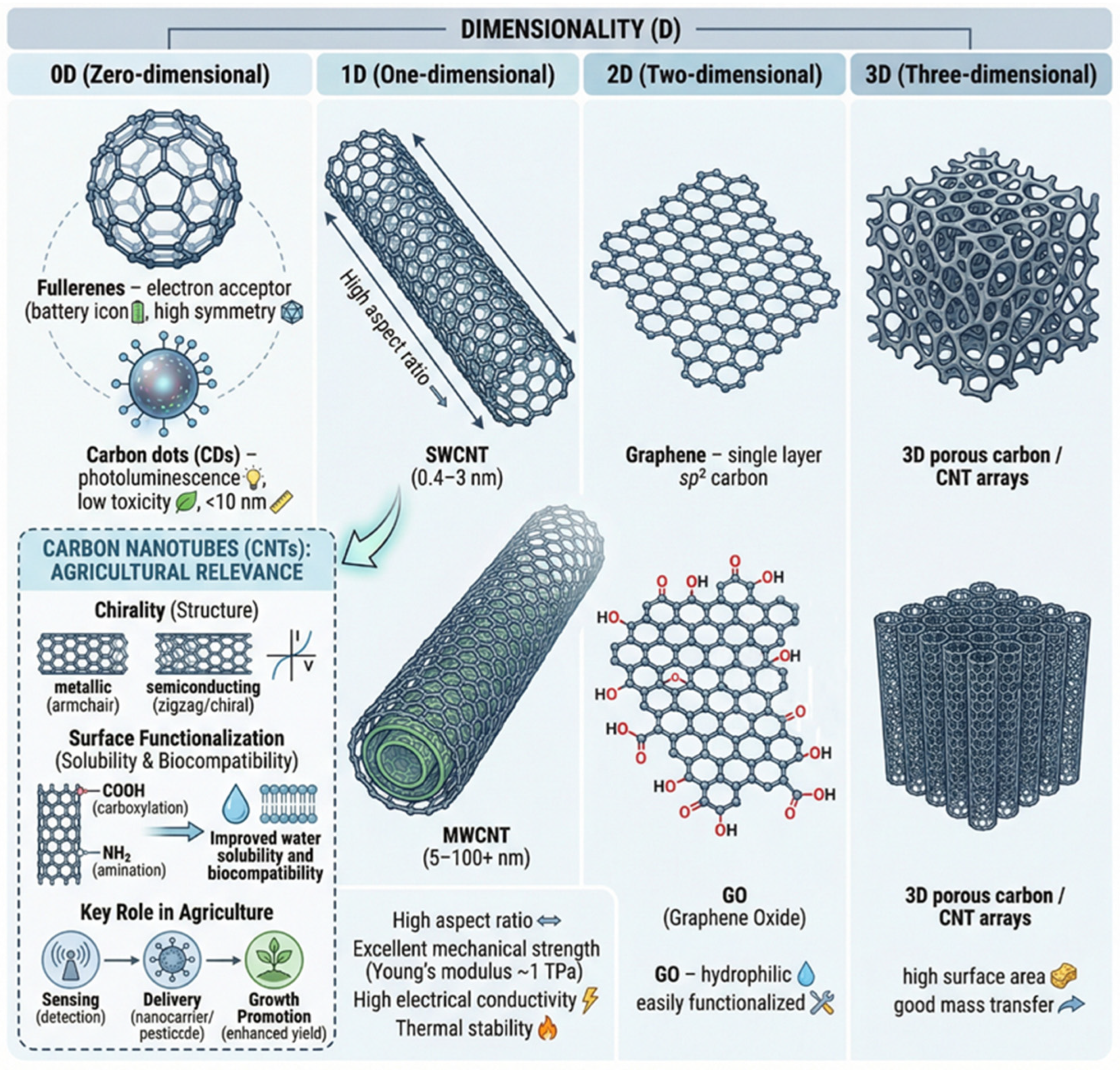
| Carbon Compound Type | Size | Chirality | Functionalization | Biological Performance /Toxicity | Bioavailability |
|---|---|---|---|---|---|
| Single-walled carbon nanotubes (SWCNTs) | 0.4–3 nm diameter; 1D tubular structure | Determines metallic or semiconducting properties | –COOH, –NH2, PEI coating | Low dose: promotes germination and root growth; high dose: oxidative stress and genotoxicity | Poor dispersibility when pristine; improved by functionalization |
| Multi-walled carbon nanotubes (MWCNTs) | 5–100 nm diameter; multi-layer tubular structure | Usually less important than in SWCNTs | –COOH, –NH2, chitosan coating, acid treatment | Low dose: improves water uptake, root growth, and yield; high dose: cytotoxicity, membrane damage, and epigenetic effects | Easily aggregates; functionalization improves dispersion and plant uptake |
| Graphene/graphene oxide (GO) | 2D sheet-like structure; graphene thickness ~0.3 nm | Not applicable | GO contains –OH, –COOH, and epoxy groups | Low dose: nutrient carrier, antimicrobial activity, slow release; high dose: root and photosynthesis inhibition | GO is more dispersible than pristine graphene |
| Fullerenes/fullerenols | 0D cage-like structure; C60 ~0.7 nm, C70 ~0.8 nm | Not applicable | Fullerenols contain multiple –OH groups | Low dose: antioxidant and stress-protective effects; high dose: possible persistence and transgenerational risks | Pristine fullerenes have low solubility; fullerenols show higher bioavailability |
| Carbon dots (CDs) | 0D quasi-spherical particles; usually <10 nm | Not applicable | –NH2, –COOH, N-doping, surface passivation | Promote photosynthesis, nutrient uptake, antioxidant defense, and sensing; generally low toxicity | High water solubility, good dispersibility, and efficient plant uptake |
| Carbon Compound Type | Conc. Range | Particle Size | Plant Species/System | Application Method | Exposure Condition | Observed Effects | Ref. |
|---|---|---|---|---|---|---|---|
| Pristine SWCNTs | 10–40 mg·L−1 | 1–2 nm diameter | Tomato (Solanum lycopersicum) | Hydroponic root exposure | 10 days | Growth promotion at 10 mg·L−1; inhibition at 40 mg·L−1 | [71] |
| PEI-coated SWCNTs | 5–50 mg·L−1 | ~1 nm diameter | Arabidopsis thaliana mesophyll cells | Foliar/direct cell exposure | Short-term | Dose-dependent gene regulation; stress, immunity, and senescence programs at higher concentrations | [72] |
| Pristine MWCNTs | 50–200 mg·L−1 | 10–30 nm diameter | Tomato (S. lycopersicum) | Seed priming; hydroponic; field trial | Germination, seedling growth, and field growth | Enhanced germination, water uptake, aquaporin gene activation; twofold increase in flowers and fruits in field trials | [73] |
| Pristine MWCNTs | 20–100 mg·kg−1 soil | 10–20 nm diameter | Rice (Oryza sativa) | Seed priming | Seedling stage | Increased root and stem length | [74] |
| Pristine MWCNTs | 100–500 mg·L−1 | ~20 nm diameter | Arabidopsis thaliana T87 suspension cells | Aqueous exposure | 7 days | Cytotoxicity and growth inhibition | [75] |
| Pristine MWCNTs | 500–2000 mg·kg−1 soil | Not specified | Onion (Allium cepa) root cells | Soil exposure | 7 days | DNA hypermethylation, cytotoxicity, and genotoxicity | [76] |
| Graphene oxide (GO), oxidized, few-layer | 500–2000 mg·kg−1 soil | Few-layer sheets | Wheat (Triticum aestivum) | Soil exposure | 30–60 days | Growth inhibition and reduced nutritional levels | [77] |
| Pristine graphene nanosheets | 100–500 mg·L−1 | Single-layer sheets | Cabbage, tomato, red spinach, lettuce | Hydroponic exposure | Seedling stage | Phytotoxicity across four species | [78] |
| Polyhydroxylated fullerenol C60(OH)x | 0.1–1 mg·L−1 | ~1 nm diameter | Wheat (T. aestivum) | Seed pretreatment; foliar application | Germination and salt stress | Enhanced salt tolerance, H2O2-scavenging enzyme activity, and P/K uptake | [67] |
| Polyhydroxylated fullerenol C60(OH)x | 0.01–10 mg·L−1 | ~1 nm diameter | Rapeseed (Brassica napus) | Hydroponic; foliar application | Water stress | Improved germination, biomass, photosynthesis, and antioxidant activity | [66] |
| N-doped carbon dots | 10–100 mg·L−1 | <10 nm diameter | Maize (Zea mays) | Foliar spray | Vegetative stage | Enhanced PSII activity and photosynthetic efficiency | [61] |
| Salvia miltiorrhiza-derived carbon dots | 5–50 mg·L−1 | <10 nm diameter | Lettuce (Lactuca sativa) | Foliar; hydroponic exposure | High-temperature stress | Increased chlorophyll content, net photosynthetic rate, and PSII quantum efficiency | [60] |
Disclaimer/Publisher’s Note: The statements, opinions and data contained in all publications are solely those of the individual author(s) and contributor(s) and not of MDPI and/or the editor(s). MDPI and/or the editor(s) disclaim responsibility for any injury to people or property resulting from any ideas, methods, instructions or products referred to in the content. |
© 2026 by the authors. Licensee MDPI, Basel, Switzerland. This article is an open access article distributed under the terms and conditions of the Creative Commons Attribution (CC BY) license.
Share and Cite
Liu, H.; Miao, G. Research Progress on the Application of Carbon-Based Nanomaterials in Agriculture and Their Dual Effects. Agriculture 2026, 16, 1280. https://doi.org/10.3390/agriculture16121280
Liu H, Miao G. Research Progress on the Application of Carbon-Based Nanomaterials in Agriculture and Their Dual Effects. Agriculture. 2026; 16(12):1280. https://doi.org/10.3390/agriculture16121280
Chicago/Turabian StyleLiu, Haitao, and Guopeng Miao. 2026. "Research Progress on the Application of Carbon-Based Nanomaterials in Agriculture and Their Dual Effects" Agriculture 16, no. 12: 1280. https://doi.org/10.3390/agriculture16121280
APA StyleLiu, H., & Miao, G. (2026). Research Progress on the Application of Carbon-Based Nanomaterials in Agriculture and Their Dual Effects. Agriculture, 16(12), 1280. https://doi.org/10.3390/agriculture16121280