Systematic Review

Advances in Artificial Intelligence-Enabled Crop Pest and Disease Detection: A Systematic Review


1
School of Agricultural Engineering, Jiangsu University, Zhenjiang 212013, China
2
School of Instrument Science and Engineering, Southeast University, Nanjing 210096, China
*
Author to whom correspondence should be addressed.
Agriculture 2026, 16(12), 1262; https://doi.org/10.3390/agriculture16121262
Submission received: 20 April 2026 / Revised: 26 May 2026 / Accepted: 5 June 2026 / Published: 7 June 2026
(This article belongs to the Section Crop Protection, Diseases, Pests and Weeds)

Abstract

The detection technology of crop diseases and pests is transitioning from single sensor monitoring to intelligent perception and multimodal fusion. This paper follows the PRISMA 2020 standard and systematically reviews the relevant core literature. This paper systematically summarizes the development history of spectral sensing technology and analyzes the physical mechanisms of hyperspectral and multispectral imaging in early identification of crop diseases. The focus is on the architectural evolution of deep learning models, including lightweight convolutional neural networks (CNNs), vision transformers (ViTs) with long-range dependency modeling capabilities, and the efficient computing state space model Mamba. In addition, the research progress of spatial spectral joint learning, heterogeneous data fusion, and vision-language models (VLMs) in improving system robustness and interpretability are introduced. By synthesizing the integrated applications of UAV remote sensing, Internet of Things (IoT) edge computing and intelligent robots in staple and cash crops, this paper summarizes the implementation of the integrated system of perception, decision-making and execution. To address the issues of insufficient cross-domain generalization ability and uneven allocation of computing resources in existing models, this paper provides perspectives on the future development of agricultural artificial intelligence (AI) towards foundation model-driven, edge-intelligent collaboration, and green sustainable direction, which can provide theoretical reference for engineering applications in the field of intelligent plant protection.

1. Introduction

Agriculture, as the cornerstone of the global economy and food supply, is facing significant challenges. Against the backdrop of sustained global population growth and intensified climate fluctuations, ensuring the safety and stability of food production has become a core issue of global concern [1]. According to statistics, crop yield losses caused by pathogen infections have posed a serious threat to global agricultural output [2]. Crop pests and diseases not only reduce the total output of agricultural products but also have a significant negative impact on the stability of the global food supply chain and the sustainable development of the economy [3]. Because disease symptoms usually manifest more prominently in the later stages of infection, traditional agricultural management models often find it difficult to effectively identify them in the early stages of disease onset, resulting in delayed prevention and control measures [4]. This limitation urgently requires the development of more efficient, accurate, and real-time automatic identification and monitoring systems in the field of agricultural research that can be applied in large-scale farmland [5]. In recent years, non-contact, non-destructive, and accurate detection technology has become a key means to address the difficulty of disease and pest identification in agricultural production processes [6].
To address the aforementioned challenges, agricultural production models are undergoing a transformation from traditional precision agriculture to a highly integrated and intelligent modern plant protection system. This shift hinges on the deep integration of artificial intelligence (AI), machine learning (ML), robotics, big data analytics, and the IoT to establish an intelligent agricultural ecosystem [7]. This emerging production model emphasizes achieving full cycle management of crop growth through interdisciplinary collaboration, such as utilizing digital twins, 6G communication, and quantum technology [8]. In this evolutionary process, sustainability has become a key driving force for agricultural development, and early disease detection can not only reduce the excessive use of pesticides, but also significantly reduce the negative impact of agricultural production on the environment [9]. At the technical implementation level, deep learning algorithms represented by CNN have shown significant potential in disease classification of various crops such as vegetables and grains due to their ability to extract complex features from massive image data [10]. The combination of visual intelligence technology and next-generation computing platforms is driving disease diagnosis from controlled laboratory environments to complex real-world agricultural scenarios [11]. The integrated application of image recognition and sensor systems driven by AI not only optimizes the response time of pest monitoring but also provides solid technical support for achieving eco-friendly vegetation protection and precise pesticide application [12].
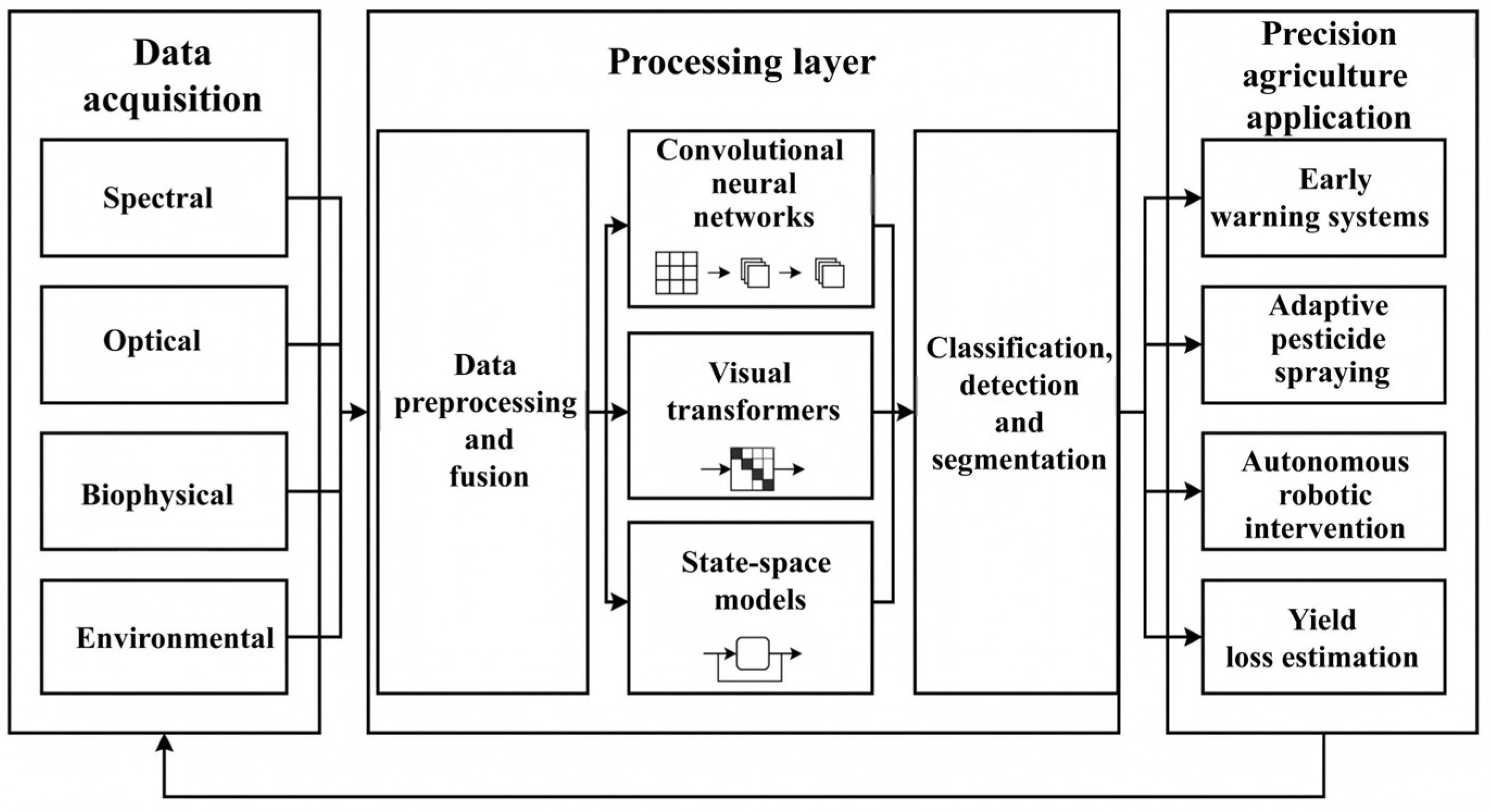
Although recent research has sorted out the application of agricultural AI, discussed the universal progress of pest and disease identification algorithms, and summarized and analyzed the macro architecture of AI in sustainable plant protection decision support systems, previous reviews have rarely involved computational efficiency architectures, such as the state space model (SSM) with linear complexity (Mamba), which is crucial for real-time monitoring on the edge side. The necessity of this review lies in the in-depth analysis of the generalization bottleneck and performance loss when transitioning from laboratory ultra-high accuracy to complex field environments. At the same time, this article systematically constructs a comprehensive evaluation framework covering spectral perception, cutting-edge model architecture, and robot closed-loop operations. As shown in Figure 1, this review aims to systematically review the latest research progress of AI in crop pest and disease detection. This paper explores in detail the application of spectral sensing technology in disease mechanism recognition, systematically analyzes the architecture evolution of deep learning models in classification and detection tasks, elaborates on the innovative path of multimodal data fusion technology, and ultimately demonstrates the integrated application effect of these technologies in typical precision agriculture scenarios.

2. Materials and Methods

2.1. Literature Search Strategy

In order to ensure the reproducibility and comprehensiveness of this systematic review, this study strictly followed the PRISMA 2020 guidelines for structured literature retrieval [13]. The search was conducted in early April 2026, targeting the most influential electronic databases in the fields of engineering and agriculture as follows: Web of Science (WoS) Core Collection and Scopus. The search period was defined as January 2016 to March 2026. The selection of this decade’s span aims to accurately capture the complete technological trajectory of agricultural AI, from the early application of deep CNN to the recent evolution of SSM and multimodal visual language models (VLMs). To ensure the recall and precision of the search, the search in this study adopts the Advanced Search mode, which limits the matching to the “Title, Abstract, Keywords” fields.
The search query used in Web of Science (WoS) was as follows:
TS = ((“Crop” OR “Plant” OR “Agricultural”) AND (“Disease” OR “Pest” OR “Pathogen” OR “Health Monitoring”) AND (“Artificial Intelligence” OR “Deep Learning” OR “Convolutional Neural Network” OR “Vision Transformer” OR “ViT” OR “State Space Model” OR “Mamba” OR “Large Language Model” OR “Attention Mechanism” OR “YOLO”) AND (“Hyperspectral” OR “Multispectral” OR “UAV” OR “Unmanned Aerial Vehicle” OR “Internet of Things” OR “IoT” OR “Multimodal Fusion” OR “Remote Sensing”)).
The search query used in Scopus was as follows:
TITLE-ABS-KEY ((“Crop” OR “Plant” OR “Agricultural”) AND (“Disease” OR “Pest” OR “Pathogen” OR “Health Monitoring”) AND (“Artificial Intelligence” OR “Deep Learning” OR “Convolutional Neural Network” OR “Vision Transformer” OR “ViT” OR “State Space Model” OR “Mamba” OR “Large Language Model” OR “Attention Mechanism” OR “YOLO”) AND (“Hyperspectral” OR “Multispectral” OR “UAV” OR “Unmanned Aerial Vehicle” OR “Internet of Things” OR “IoT” OR “Multimodal Fusion” OR “Remote Sensing”)).
To ensure the forward-looking nature of the review, this article also manually screened additional articles from mainstream journals such as Computers and Electronics in Agriculture, Frontiers in Plant Science, and Remote Sensing as supplements.

2.2. Inclusion and Exclusion Criteria

To ensure high-quality analysis, this study has established strict eligibility criteria.
Inclusion criteria (IC):
Relevance: propose, implement, or evaluate AI-driven methods specifically for detecting, classifying, or segmenting crop pests and diseases;
Sensing modalities: involves digital perception data (such as RGB, multispectral/hyperspectral, thermal imaging, etc.);
Experimental rigor: clear quantitative performance indicators (such as Accuracy, F1 score, mAP, IoU, etc.) must be provided;
Publication type: peer-reviewed journal articles and high-impact conference papers published only in English.
Exclusion criteria (EC):
Domain mismatch: such as urban forestry, weed detection in non-disease backgrounds, or pure medical imaging research;
Format restrictions: book chapters, patents, white papers, editorials, or non-peer-reviewed posters;
Technical deficiency: lack of detailed methodological description or insufficient experimental verification in research;
Redundancy: repeated studies published by the same research group (retaining only the latest and most complete versions).

2.3. Literature Screening Process and PRISMA Flowchart

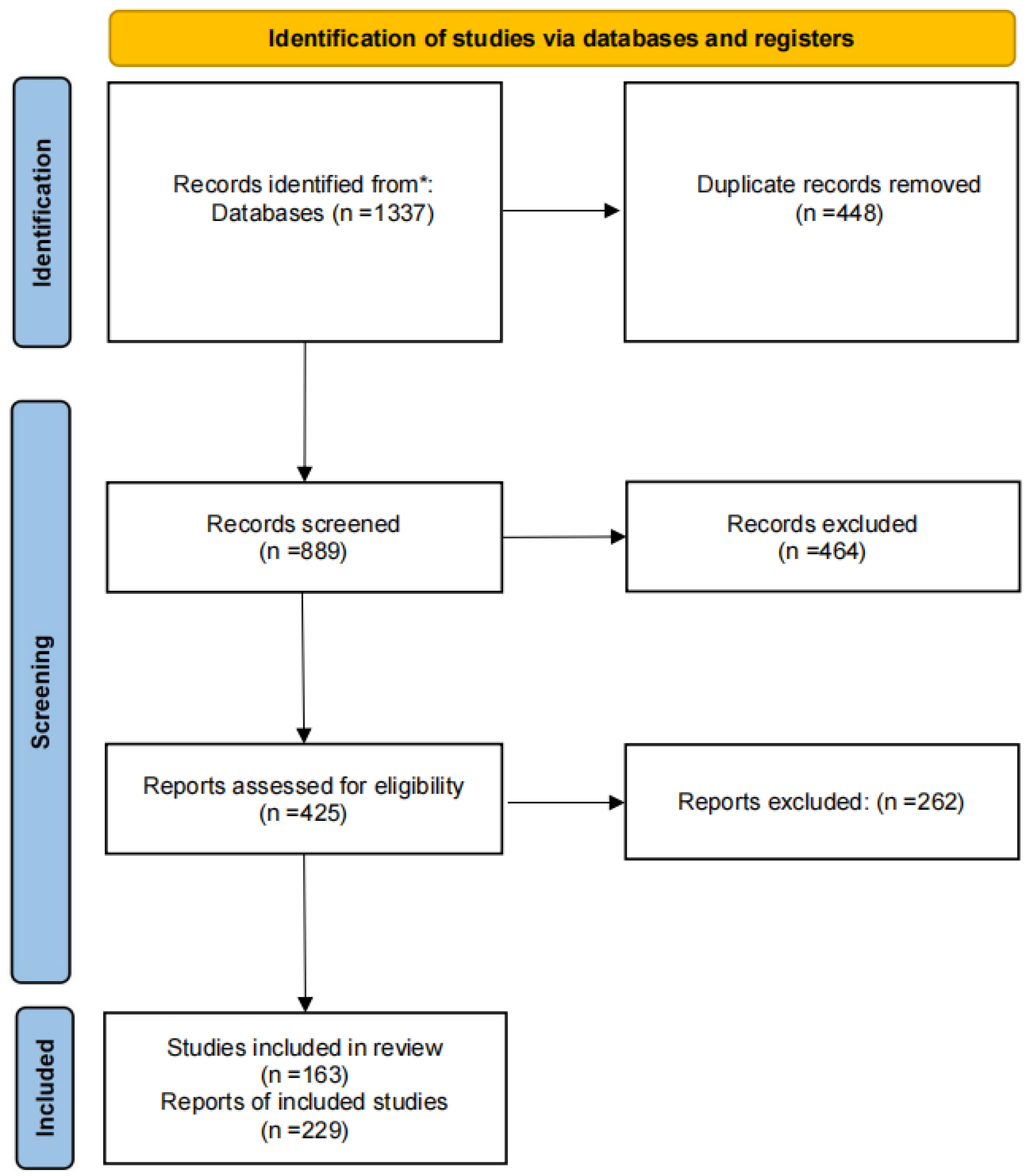
The literature screening process includes the following four stages: literature identification, initial screening of titles and abstracts, full-text screening, and final inclusion. The specific process is shown in Figure 2. A total of 1337 literature records were obtained during the initial search, including 11 supplementary searches for YOLO series agricultural pest and disease detection research in the later stage. After removing duplicates using EndNote 21 literature management software, a total of 448 duplicate articles were deleted, leaving 889 articles in the initial screening stage for titles and abstracts. To improve the reliability and consistency of literature screening, both the initial screening and full-text screening were independently completed by two researchers. For studies with disagreements between reviewers, consensus was reached through further discussion, and if necessary, a comprehensive judgment can be made based on the relevance of the research topic, the completeness of the experiment, and the effectiveness of the method.
In the process of full-text screening, this study focuses on the following four aspects.
(1) If the research is directly focused on crop pest and disease detection;
(2) Whether complete experimental verification and quantitative evaluation indicators are provided;
(3) Whether the dataset and experimental scenarios have practical agricultural application backgrounds;
(4) If the model method has clear technological innovation or engineering application value.
In addition, considering the problems of single dataset background, idealized experimental environment, and lack of complex field validation in some studies, this paper further analyzed the differences between high-precision results from public datasets and real field applications in subsequent result analysis and discussion.
After screening through titles and abstracts, a total of 425 articles entered the full-text screening stage. Further based on the inclusion and exclusion criteria, the literature that deviates from the research topic, lacks experimental information, or has redundant publications will be excluded, and a total of 163 core empirical research papers will be included for systematic analysis.
It should be noted that the total number of references in this paper is 229, which is not equivalent to the 163 core empirical studies included in the PRISMA process. Among them, 163 belong to the core research literature directly involved in the performance analysis, model comparison, and table statistics of pest and disease detection algorithms. The remaining 66 articles are mainly used to supplement the basic theories of AI, spectral sensing principles, agricultural robot system architecture, PRISMA methodology, and related background technical explanations and are therefore not included in the statistical scope of core empirical research.

2.4. Data Extraction and Overview Synthesis

To ensure the consistency and structure of the review analysis, this study established a standardized data extraction table to organize the information of the 163 core literature included in the final analysis. The content of data extraction mainly includes the following four aspects.
(1) Agricultural object information: including crop categories, types of pests and diseases, stages of disease development, and application scenarios;
(2) Algorithm model information: including CNN, YOLO, Vision Transformer, CNN Transformer hybrid architecture, SSM, etc.;
(3) Perception and dataset characteristics: including sensing modality, dataset size, data acquisition environment (laboratory or real field environment), and collection platform type;
(4) Performance and engineering indicators: including accuracy, F1 score, mAP, IoU and other precision indicators, as well as parameter quantity, FLOPs, and engineering indicators such as inference delay and feasibility of edge deployment.
In addition, in response to the problems of single background, uneven category distribution, and insufficient field generalization ability in some publicly available datasets, this paper focuses on the practical applicability and cross-scenario generalization ability of the model in complex environments during the result analysis process, rather than limiting its scope to high-precision results on publicly available datasets.

3. Spectral Sensing Technology in Crop Pest and Disease Detection

3.1. Hyperspectral Imaging Sensing

3.1.1. Spectral Response Mechanism

The core of hyperspectral detection is to capture the electromagnetic radiation differences in damaged vegetation within a specific frequency band. Multiple studies have consistently shown that the near-infrared region (NIR) and red-edge region are key windows for identifying early infections. For example, Yamada et al. evaluated the degree of damage caused by the two spotted spider mite to cotton using ground-based hyperspectral remote sensing. The study found that 31 characteristic wavelengths in the near-infrared region (817 to 941 nm) were crucial for identifying different infection levels, with the 907.69 nm band showing the strongest significance in distinguishing infected cotton leaves [14]. Mao et al. used an unmanned aerial vehicle (UAV) hyperspectral camera (400 to 1000 nm) to study the field identification of tomato spotted wilt virus (TSWV). They pointed out that the red-edge band has significant value in distinguishing healthy and diseased vegetation and proposed the RPR method to reduce the feature indicators to four key bands [15]. Wang et al. analyzed the optical characteristics of rapeseed leaves in the range of 500 to 1000 nm and found that the absorption coefficient of the leaves significantly decreased after infection by Sclerotinia sclerotiorum at 600 to 700 nm, while the reduced scattering coefficient increased throughout the entire wavelength range. Based on this, a Support Vector Machine (SVM) model was established to achieve 100% early classification accuracy under controlled experimental conditions [16]. In summary, the changes in spectral characteristics are not only a visual manifestation of disease spots, but also a comprehensive physical measure of chlorophyll degradation, water loss, and cellular structural damage.

3.1.2. UAVs and Ground Systems

In order to solve the problem of low efficiency in traditional monitoring, the current research focus has shifted from laboratory static measurement to real-time perception based on UAVs and ground-based systems. In this conversion process, how to deal with the mixed pixel problem caused by low spatial resolution of hyperspectral data has become the core challenge. Guan et al. [17] introduced superpixel unmixing technology to improve the monitoring accuracy of peanut leaf spot disease by up to 89.08%, while Feng et al. [18] verified the feasibility of UAV systems in field monitoring of rice leaf rollers by screening feature variables including the red-edge standardized vegetation index. These findings suggest that high-precision perception depends not only on spectral resolution, but also on the algorithm’s ability to resolve spatial heterogeneity.

3.1.3. Feature Extraction and Band Optimization

Faced with the high-dimensional redundancy of hyperspectral data, band optimization strategies have shifted from simple empirical selection to refined screening based on mathematical transformations and heuristic search. There are the following two mainstream paths for research on wheat diseases: the first is the feature simplification strategy—Yuan et al. proposed a simplified logic that only selected three bands of 570 nm, 680 nm, and 750 nm, and developed the Proportional Triangular Vegetation Index (RTVI), which achieved an accuracy of 83% in identifying wheat powdery mildew, stripe rust, and aphid hazards [19]. The second type is the time–frequency domain transformation path, for example, Zhuang et al. [20] systematically studied multiple types of fungal diseases in wheat leaves and found that two key features (668 nm and 894 nm) extracted based on the Continuous Wavelet Projection Algorithm (CWPA) were combined with the KNN model to achieve a recognition accuracy of 77% for various leaf diseases. In addition, Fu et al. explored the application of deep learning in seed recognition, using stacked sparse autoencoder (SSAE) combined with insect search-optimized SVM, achieving a testing accuracy of 95.81% in hyperspectral recognition of maize varieties [21]. These studies collectively reveal that feature dimensionality reduction and enhancement are a necessary path to improve the efficiency of AI diagnosis.
Although hyperspectral imaging has shown excellent depth in analyzing pathological and biochemical features, current feature band screening relies heavily on specific experimental data and lacks universal validation across regions and species. In addition, existing research generally overlooks the engineering obstacles of hyperspectral sensing systems in complex field environments due to fluctuations in light intensity, complexity of atmospheric calibration, and expensive equipment costs. This limits their practical field application scale to the high burden of hardware maintenance and data preprocessing.

3.2. Multispectral Remote Sensing

3.2.1. Satellite and UAV Platforms

The core challenge of multispectral perception lies in scale inference between different platforms. Researchers have found through comparison that higher spatial resolution is not necessarily better, but rather there exists an optimal observation scale for specific diseases. Zhao et al. compared the performance of UAVs, manned aircraft, and Sentinel-2 satellite platforms in detecting cotton root rot disease. The results showed that a 4 m resolution was the optimal spatial scale for identifying the disease, and UAV images performed better in distinguishing healthy and infected areas [22]. Fu et al. used Sentinel-2 satellite multispectral data to monitor cotton aphid damage and effectively eliminated background pixel interference through the derivative ratio spectroscopy (DRS) algorithm, resulting in a classification accuracy of 80% for the random forest model at the regional scale [23]. Alfonso et al. found a spatial correlation of 0.45 to 0.68 between the Altum PT sensor and Super Dove satellite data in ultra dense olive forest monitoring, demonstrating the feasibility of integrating multi-source images for multi-scale agricultural assessment [24].

3.2.2. Specialized Vegetation Index

The construction of vegetation indices improves the sensitivity of spectra to specific stresses. Skendzic et al. evaluated the infestation severity of winter wheat aphids and found that the improved Triangular Vegetation Index (MTVI) has a strong correlation with canopy conditions. The machine learning (ML) model trained on a full spectrum dataset achieved an F1 score of 0.98 [25]. Ren et al. proposed a new method for fusing panchromatic and multispectral images, which improved the correlation between vegetation index and cotton aphid disaster index through Gram Schmidt fusion technology. The estimation accuracy R2 obtained using the GBDT model reached 0.88 [26]. Zhu et al. studied the impact of spatial resolution on wheat scab monitoring and found that the SVR model that fused vegetation index and texture features had the best monitoring effect at a resolution of 3.47 cm, with a validation set R2 of 0.83 [27]. These findings indicate that the integrated analysis of multidimensional features is the key to overcoming the issues of intra-class spectral variability and inter-class spectral similarity.
Although multispectral technology has the advantage of large-area monitoring, there is a significant pixel mixing problem in its spatial resolution mapping between different scales. Existing models often have a high missed detection rate for small lesions at low spatial resolutions. In addition, most studies are based on aerial remote sensing under ideal meteorological conditions, without in-depth analysis of the robustness attenuation of vegetation indices to disease characteristic signals under cloudy, rainy, or extreme light differences. There is a lack of cross-scale monitoring models for stable performance evaluation in long-term agricultural production.

3.3. Other Optical Sensing Methods

3.3.1. Thermal Infrared and Near-Infrared

Thermal characteristics are commonly used to capture water stress and metabolic fluctuations in plants after damage. The current research trend is to use deep learning to enhance low-contrast thermal image features. For example, Khalil et al. introduced the AVC-GAN enhancement framework to solve the problem of low contrast in rice thermal infrared images, which improved the accuracy of downstream detection models by 3.3% to 6.2% [28]. Bhuyan et al. improved the ResNet-50 architecture by utilizing position encoding and squeeze-and-excitation (SE) blocks to enhance attention to spatial features of rice leaf lesions, achieving a classification accuracy of 99.89% [29]. Yang et al. [30] used hyperspectral imaging technology to collect spectral data of cucumber plant bug and downy mildew leaves. Through MA-IRIV-SPA secondary dimensionality reduction screening, four core feature wavelengths of 452, 513, 543, and 553 nm were identified. The proposed SVM model achieved a classification accuracy of 96.23%, providing a spectral basis for the development of lightweight intelligent plant protection sensing devices [30]. Qi et al. achieved an accuracy of 94.4% in the identification of jujube varieties using a portable near-infrared (NIR) spectrometer combined with fuzzy improved linear discriminant analysis (FiLDA) [31].

3.3.2. Polarization and Raman Spectroscopy

Polarization spectroscopy and Raman spectroscopy provide structural information that traditional reflectance spectroscopy cannot obtain for early-stage diagnosis and robustness requirements in complex backgrounds. Zhu et al. reviewed the application of polarized spectroscopy in agriculture, emphasizing its robustness in detecting crop diseases, pests, and nutrient status in complex backgrounds [32]. Zhang et al. used microfluidic chip enrichment technology combined with micro-Raman spectroscopy for fingerprint recognition of airborne fungal spores, achieving a discrimination accuracy of 94.31% through the SCARS-SVM model [33]. Zhang et al. further optimized the surface-enhanced Raman scattering (SERS) reagent and used gold-core silver-shell nanorods to detect spores. The SCARS-MLP model achieved the highest accuracy of 97.92% on the test set [34]. Lv et al. used Fourier transform infrared photoacoustic spectroscopy (FTIR-PAS) to monitor the latent period of wheat Fusarium head blight and found that the spectral similarity between different layers of leaves increased after infection. The diagnostic accuracy in the early stage and latent period of the disease reached 86.0% and 82.5%, respectively [35]; these results demonstrate that optical perception has the technical ability to provide early warning before visual symptoms appear.

3.3.3. Spore and Volatile Substance Detection

The fusion of biophysical and biochemical signals provides a basis for early warning. Yang et al. combined microscopic imaging and morphological feature extraction to identify rice blast disease and rice false smut spores using a decision tree model, with an accuracy rate of up to 94% [36]. Bonah et al. reviewed the application of electronic nose (E-nose) technology in detecting bacterial pathogens, emphasizing its superiority as a non-invasive online monitoring tool in identifying volatile organic compounds (VOCs) [37]. Wang et al. proposed a rapid detection method for tomato gray mold spores based on lens diffraction image processing. The enrichment efficiency of the microfluidic chip reached 87.52% at a flow rate of 14 mL/min [38]. Another study demonstrated the potential of multi-flow field composite microfluidic chips in capturing greenhouse disease spores, with a separation efficiency of 83.8% for cucumber downy mildew spores [39]. Xu et al. used electronic nose technology to analyze the variability of volatile organic compounds (VOCs) in citrus Huanglongbing (HLB) leaves, achieving accuracy rates of 97.79% and 96.43% in identifying HLB samples and accompanying nutritional deficiency symptoms, respectively [40].
Spectral sensing technology has evolved from the initial measurement of wideband reflectance to a precision sensing system covering multiple dimensions such as hyperspectral, multispectral, thermal infrared, and Raman spectroscopy. Existing studies indicate that different sensing methods have unique physical mechanisms in capturing crop disease and insect pest signals as follows: hyperspectral imaging can deeply explore the weak changes in vegetation physiology and biochemistry, so as to realize the mechanism recognition at the initial stage of infection. Multispectral remote sensing, with its high timeliness and low cost advantages, has become the core means of large-scale monitoring and cross scale evaluation by satellites and UAV. In addition, polarized light, fluorescence, and electronic nose technology provide key supplements for latent diagnosis that is difficult to cover with traditional detection by capturing structural changes and volatile organic compounds (VOCs) after plant damage. However, in actual precision agriculture scenarios, balancing detection accuracy, spectral resolution, and deployment costs remains a major choice for researchers. In order to visually present the application differences and performance indicators of current mainstream optical sensing technologies in crop pest and disease detection, Table 1 provides a detailed comparison of the application scenarios, key indicators, and representative research results of hyperspectral imaging (HSI), multispectral remote sensing (MS), thermal infrared, and fluorescence sensing technologies.
In summary, the various spectral sensing technologies summarized in Table 1 demonstrate a trend of evolution from single frequency band reflectance measurement to multi-dimensional biochemical sensing. However, by comparing the evaluation indicators and experimental environment of various studies horizontally, it can be found that most laboratory models achieve recognition performance of over 95.0% in a single background, but in real-world scenarios, due to lighting fluctuations, occlusion, and sensor geometric errors. High-performance spectroscopic equipment is expensive and difficult to meet the low-power and low-cost integration requirements of large-scale agricultural machinery. The existing literature mostly focuses on static identification of specific diseases, lacking long-term continuous monitoring data evaluation for different growth cycles, disease coexistence, and variable agricultural climate environments.

4. Deep Learning Model for Crop Pest and Disease Diagnosis

4.1. Classification Models Based on CNN

4.1.1. Lightweight CNN Architectures

In order to meet the deployment needs of resource-constrained devices such as agricultural IoT nodes and mobile terminals, research on pest and disease identification has gradually shifted towards CNNs in recent years. The current mainstream strategy mainly reduces the number of model parameters and computational complexity through structures such as Depthwise Separable Convolution and 1 × 1 Pointwise Convolution. Typical representatives include DLMC Net [52], DTomatoDNet [53], and PotConvNet [54]. Related studies have shown that such lightweight networks can still maintain high recognition performance in disease classification tasks, with some research reports achieving classification accuracy of 99.34% or even close to 100% [55]. At the same time, the integration of lightweight models and object detection frameworks has become a new research trend. For example, HFE Net [56] introduces PixelShuffle upsampling module and C2f FEM feature enhancement module into the YOLO backbone network, which further improves the accuracy of disease detection while maintaining high inference speed, reflecting the development direction of combining lightweight design with real-time detection.
However, a comprehensive analysis of existing research reveals that the excellent performance achieved by some lightweight models may be affected by dataset bias. Currently, a large amount of research still relies mainly on publicly available datasets such as PlantVillage (PV) for training and validation, which typically have the characteristics of a homogeneous background, uniform illumination, and minimal environmental noise. Due to the limited parameter size of lightweight models, their feature representation capability is somewhat limited compared to large deep networks. During the training process, they may learn feature information related to the background of the dataset, rather than relying solely on disease pathological features to achieve robust classification. When the model is applied to real farmland environments, it often needs to face various interference factors such as complex backgrounds, leaf occlusion, soil reflection, changes in lighting, and differences in plant morphology at different growth stages. Under these conditions, the performance of the model may decrease to varying degrees. At present, most studies still lack systematic validation across regions, seasons, and datasets, and the evaluation of the model’s field generalization ability is relatively insufficient. Therefore, how to improve the feature representation capability and cross-domain generalization capability in complex scenes while ensuring the lightweighting of the model has become an important research direction for the further development of lightweight CNN in the field of intelligent recognition of agricultural pests and diseases.

4.1.2. Enhancement of Attention Mechanism

Due to the complex background of the field environment, introducing attention mechanisms to enhance the feature expression of lesion areas and suppress background noise has become a key means to improve model robustness. At present, research mainly focuses on the joint optimization of spatial and channel dimensions. Zhang et al. [57] and Sun et al. [58] respectively used mixed channel attention (LDAMNet) and squeezed multi-layer perceptron module (SMLP ResNet) to recalibrate disease features, significantly enhancing the model’s ability to capture subtle lesions. At the same time, attention mechanisms have shown unique advantages in processing multidimensional perceptual data. The spatial spectral joint network proposed by Liu et al. [59] utilizes attention modules to extract 3D convolutional features, solving the problem of infection recognition without training data. In addition, Chandraleka et al. introduced a logic activation function to improve the fuzzy CNN (LA-MFCNN), which specifically enhances the sensitivity of early warning for sugarcane health-monitoring tasks [60]. The improved CNN proposed by Zhao et al. integrates an attention extraction module and achieves recognition performance of 96.81% and 99.24% on tomato and grape datasets, respectively [61].

4.1.3. Transfer Learning and Fine Tuning

In response to the shortage of annotated data in the agricultural field, transfer learning and self-supervised learning are evolving from simple weight initialization to cross-domain adaptation and optimization algorithm integration. In cross-dataset applications, researchers [62,63,64] have demonstrated that using large datasets such as ImageNet or PlantDoc for pre-training, followed by fine tuning for the target crop, can effectively overcome sample bias and achieve robust performance even in extremely few sample scenarios such as five-shot. Some scholars have focused more on decision transparency and hyperparameter adaptation in the transfer process. For example, Verma et al. [65] demonstrated the superiority of label smoothing techniques in transfer learning through comparison and improved the interpretability of the decision process using Grad CAM++. However, Cetiner et al. [66] achieved automatic determination of CNN hyperparameters by integrating meta heuristic optimization algorithms such as artificial bee colony (ABC), avoiding the tedious manual tuning in traditional transfer learning.

4.2. Transformer and Hybrid Deep Learning Models

4.2.1. ViT Applications

ViT architecture achieves deep perception of global image features through self-attention mechanism, breaking the receptive field limitation of traditional convolution operators. Xu et al. proposed a dual transfer learning strategy that achieved an average testing accuracy of 86.29% on multiple datasets using the ViT architecture [67]. The PlantVitGnet developed by Gupta et al. combines the advantages of ViT and GoogLeNet, achieving an accuracy of 99.20%, which is superior to a single architecture [68]. The studies by Khubaib et al. [69] and Tian et al. [70] have shown that the emergence of Swin Transformer and its embedded variants can effectively solve the problem of insufficient spatial resolution of standard ViT in processing subtle lesion features and exhibit extremely high robustness in fine classification of crops such as wheat.

4.2.2. CNN Transformer Hybrid Network

The fusion of CNN’s local feature extraction capability and Transformer’s global dependency modeling capability has become the mainstream method for improving detection accuracy. Jia et al. proposed the ConvTransNet-S hybrid architecture, which achieved an accuracy of 88.53% in complex field environments by jointly modeling local lesion features and global contextual information [71]. The Efficiency Win model designed by Sun et al. integrates EfficientNetV2 and Swin Transformer, achieving an accuracy of 99.70% in tomato disease classification [72]. The ConViTX proposed by Thakur et al. is an ultra-lightweight model with only 700,000 parameters, achieving an accuracy of 98.8% on the corn dataset [73]. Haque et al. improved the ViT network by introducing ternary multi head attention (t-MHA) and achieved an accuracy of 97.99% in rice and apple recognition tasks [74]. The ST-CFI model proposed by Yu et al. enhances the information flow of Swin Transformer through convolutional feature interaction and exhibits good generalization ability on five differently sized datasets [75]. The MetaFormer architecture proposed by Pacal et al. combines the separable self-attention mechanism and achieves an accuracy of 99.31% in olive leaf disease detection [76]. Collectively, these studies indicate that by introducing modules such as t-MHA or CFI, the hybrid model not only significantly reduces the number of parameters but also has better generalization ability in disease recognition of different crop varieties. At the same time, it solves the problems of high training costs and resource consumption of pure Transformer models.

4.2.3. Mamba and State-Space Model

Mamba is a new type of model structure with linear computational complexity and high efficiency in sequence modeling. It is gradually breaking the dominant position of Transformer applications. Its biggest advantage is balancing computational efficiency and small sample learning ability. Singaravelu et al. proposed the DCOS WOR algorithm, which combines deep convolutional pulse neural networks with whale optimization strategies, achieving a classification accuracy of 98.72% [77]. Zhang et al. introduced the VMamba backbone model into crop disease detection recognition, which reduced training time by 80% compared to Swin Transformer and performed well in small sample tasks [78]. Fu et al. proposed a detection framework based on Mamba YOLO, which improved mAP@0.5 index by 5.29% compared to YOLOv8n through dynamic upsampling and channel attention [79]. YOLO BSMamba developed by Liu et al. will be used in tomato disease detection mAP@0.5 improved to 86.7%, effectively reducing background noise interference [80]. The Mamba YOLO-ML proposed by Yuan et al. achieved a 78.2% mAP@0.5 in mulberry disease detection using Haar wavelet downsampling and SSM selection mechanism, which is superior to similar Transformer models [81].

4.3. Object Detection and Semantic Segmentation Models

4.3.1. One-Stage Detection Models: The Dominance of YOLO Series

The YOLO series, with its favorable trade-off between detection accuracy and inference speed, has become one of the most widely used object detection frameworks in the field of real-time monitoring of agricultural pests and diseases. Through a comparative analysis of research results in recent years, it can be found that the architecture evolution from YOLOv5 to YOLOv8 significantly enhances feature extraction and multi-scale object detection capabilities. For example, the YOLOv5 series models have established a relatively stable performance baseline (such as a mixed crop detection mAP of 88.1% [82]), while YOLOv8 has shown better robustness in complex lesion recognition tasks after adopting an anchor-free design and improved feature fusion mechanism. Its mAP can usually be improved to over 91% [83], and some studies have even reported a classification accuracy of 99.60% in controlled cross-validation experiments [84]. In recent years, researchers have further improved model performance by introducing attention mechanisms [85], dynamic convolution [86], explainable artificial intelligence (XAI), and other methods. For example, the lightweight CNN combined with XAI method proposed by Alpsalaz et al. [87] achieved an accuracy of 94.97% in corn disease recognition. Fragoso et al. [88] compared the performance of multiple versions of YOLOv8 to YOLOv11 in real-time monitoring of coffee leaf disease and found that YOLOv8s achieved a better balance between detection accuracy and inference speed. This indicates that the YOLO series is continuously developing towards lightweight, real-time, and interpretable directions.
However, most of the high-precision results reported in existing research are based on specific datasets or controlled experimental environments, and there is still significant uncertainty in their generalization ability in complex field scenarios. In natural farmland environments, there are common problems such as leaf occlusion, background interference, changes in lighting, and extreme lesion scale variations. However, the YOLO model is prone to losing fine-grained feature information contained in early diseases during multiple downsampling processes. Especially in the early stages of disease occurrence, when the lesion area is small and the symptoms are not obvious, the detection model often faces a high risk of missed detection. In addition, a large amount of research currently mainly uses public datasets for training and validation, lacking systematic evaluation under cross-regional, cross-seasonal, and cross-variety conditions. Therefore, how to improve the robustness of the model in complex field environments, reduce the impact of dataset bias, and enhance cross-scenario generalization ability has become an important development direction for future YOLO series agricultural disease detection research.
To solve the difficulties in extracting small-scale biological stress features and the problem of imbalanced computing resources, cutting-edge research has further emerged with YOLO-derived models for specific scenarios. Lin et al. [89] proposed a hybrid data augmentation method and an osprey search strategy, optimized hyperparameters, and increased the mAP of tomato biological stress detection by 5.05%. In terms of lightweight deployment, the PEW-YOLO proposed by Xue et al. [90] utilizes GSConv and efficient multi-scale attention mechanism (EMA) to achieve a parameter reduction of 32.2% in citrus pest and disease detection. Regarding multi-scale fusion and attention mechanisms, the MA-YOLO developed by Lu et al. [91] significantly improved the recognition of pest features through parallel dilated convolution and adaptive triple weighting system. The CRRE-YOLO proposed by Zhang et al. [92] combines efficient local attention and multi-scale convolution, surpassing mainstream models in rice pest detection with only 2.344M parameters. The YOLO-RMD architecture developed by Yin et al. [93] introduced receptive field attention convolution and achieved 98.2% mAP in rice pest monitoring.
The new YOLO-derived model exhibits stronger robustness under complex disturbances. The AHN-YOLO designed by Zhang et al. [94] effectively solves the problem of background clutter in tomato disease detection through a lightweight hybrid attention mechanism. The HSMK-YOLO proposed by Abulizi et al. [95] combines hypergraph convolution with Kolmogorov–Arnold network (KAN) and successfully captures higher-order disease correlations. Regarding cotton diseases, research by Hu et al. [96] and Zhang et al. [97] has shown that embedding medical image segmentation modules and dilated convolution can effectively overcome the problem of small target-missed detections. In addition, for corn weed detection, Peng et al. [98] and Hao et al. [99] respectively verified the excellent performance of the improved YOLOv11n on resource-limited devices by reconstructing the C3k2 module and introducing a frequency domain separation strategy. In summary, customizing a dedicated network structure for agricultural pest and disease detection, while balancing model lightweighting and real-time detection capabilities, has become a major development trend in this field.

4.3.2. Two-Stage Architecture and Multi-Phase Optimization

The single-stage detection model has insufficient recognition accuracy for small and complex targets in the field. Therefore, researchers have optimized the two-stage detection network and related algorithms by designing ultra-small target detection heads, introducing transfer learning, ensemble learning, and other methods. For example, Alhwaiti et al. found that YOLOv4 achieved an mAP@0.5 of 98% in identifying fruit diseases, significantly better than the YOLOv3 architecture [100]. The improved YOLOv8 proposed by Li et al. introduces an ultra-small object detection head (32 × 32), which increases the mAP@0.5 for strawberry disease recognition to 0.96 [101]. Ul Haq et al. achieved a tomato disease recognition rate of 95.9% under augmentation free conditions using the YOLOv12 framework [102]. The MMFN model proposed by Zhu et al. integrates transfer learning and ensemble algorithms, achieving an accuracy of 99.72% in citrus disease classification [103].

4.3.3. Semantic Segmentation and Severity Assessment

The semantic segmentation model upgrades disease research from simple classification to pixel-level quantitative evaluation, which is an important foundation for achieving precise pesticide application in farmland variables. The SSGAN semi-supervised network developed by Zhao et al. improved mIoU in tomato and apple leaf segmentation tasks with only a small amount of labeled data [104]. Rezaei et al. used automatic pixel-level annotation technology to estimate the severity of barley diseases and achieved a classification accuracy of over 82% on the coffee dataset by combining ABCD rules [105]. Karthikeyan et al. combined the enhanced fuzzy C-means algorithm with Hybrid DeepLab to increase the recognition rate of coconut tree diseases to 98.16% [106]. The RSL Linked TransNet multi-class segmentation model proposed by Dinesh et al. effectively solves the problem of lesion edge loss, with an intersection over union (IoU) of 0.9308 [107]. Wojtowicz et al. achieved a classification accuracy of 97.87% for wheat stripe rust disease by combining RGB image processing with random forest [108]. The YOMASK instance segmentation network proposed by Zhao et al. showed a segmentation accuracy of 95.41% in lettuce phenotype analysis at a speed of 103.9 FPS [109]. Wisaeng et al. integrated ResNeSt-50 and CBAM attention to DeepLabv3+ and achieved an accuracy of 98.2% in grape disease segmentation [110].
The evolution of deep learning models has profoundly changed the paradigm of crop pest and disease image processing. From initially relying on lightweight CNN for rapid deployment of field mobile devices to introducing attention mechanisms to guide models to focus on subtle features of disease spots, the robustness of AI algorithms in complex backgrounds has been improved. With the application of ViT, research has shifted towards modeling global contextual information, effectively overcoming the limitations of traditional CNN in handling long-range dependencies. Recently, Mamba and other SSMs have further improved inference efficiency through a linear complexity-computing architecture. In addition, object detection algorithms represented by the YOLO series and pixel-level semantic segmentation models have developed from qualitative classification to localization and quantitative assessment of severity. In order to systematically analyze the advantages and disadvantages of various deep learning architectures in recognition accuracy, parameter efficiency, and applicable tasks, Table 2 summarizes the performance of different architectures in various crop disease recognition tasks, aiming to provide reference for selecting optimal models for specific agricultural scenarios.

4.4. Limitations of Current Deep Learning Evaluation Paradigms

Although numerous studies have reported extremely high classification accuracies for crop disease recognition, there is a clear dataset bias in this performance. The accuracy of most reports is obtained on controlled benchmark datasets, especially PV, so caution should be exercised when evaluating practical field applicability. Currently, most high-performing models rely heavily on public benchmark datasets, particularly PV, for both training and evaluation. Although these datasets played a crucial role in the early development of AI, their images were mainly composed of detached leaves captured in controlled laboratory environments, with highly homogeneous backgrounds and the absence of complex environmental factors commonly encountered in real agricultural systems.
Such a distribution mismatch between training data and real-world conditions may cause deep learning models to suffer from shortcut learning. During the training process, the model did not truly extract pathological features such as lesion texture, color, or edge, but instead achieved classification by fitting Spurious features such as pixel bias, leaf contour, or specific lighting patterns to a single background. If these laboratory-fitted models are applied to real field environments, substantial domain shift may occur between the training and deployment environments. This offset leads to a precipitous drop in model performance, and the claimed ultra-high accuracy in many studies ultimately becomes a false prosperity that cannot be implemented in agricultural production.
Some studies adopt the method of randomly dividing the training set and the test set, without ensuring independence among plants, acquisition dates, or field locations. This may lead to data leakage between the training and testing sets, resulting in overestimation of model performance. Subsequent research should gradually establish a large-scale open agricultural benchmark dataset that includes multiple regions, years, equipment, and climate conditions, and use cross-dataset validation, OOD evaluation, and long-term field trials as important criteria for model evaluation.

5. Multimodal Fusion Method for Crop Pest and Disease Detection

5.1. Spatial–Spectral Joint Fusion

Hyperspectral imaging provides the possibility to capture the physiological metabolism and external morphological characteristics of crops by integrating continuous spectral dimensions with two-dimensional spatial dimensions. The key to improving the precision of fine recognition is to deeply explore the relationship between space and spectrum through joint learning models. For example, Shi et al. proposed an end-to-end deep learning model called CropdocNet, which models the local and global feature relationships between spectral spatial features and target categories by introducing multiple capsule layers. When processing UAV hyperspectral images for identifying potato late blight, the average accuracy of the independent dataset reached 95.75% [131]. Xiao et al. developed a pest identification network that utilizes one-dimensional convolution and attention mechanism between spectral channels to process redundant information in hyperspectral space and extracts rich spatial-spectral features through 3D convolution branches, effectively improving the recognition accuracy of common pests [132].
The research on multi-scale feature aggregation in complex field backgrounds shows a trend of shifting from single perception to semantic reasoning. Zuo et al. proposed a multi-granularity feature aggregation method that models semantic relationships through pixel-level spatial self-attention and enhances feature discriminative power through block-level channel self-attention. The method achieved a classification accuracy of 89.75% on non-laboratory datasets such as PlantDoc [133]. The attention mechanism can dynamically adjust the weights of different modal features to optimize the fusion effect. Sudhakar et al. adopted a region of interest (ROI)-based contextual attention mechanism to improve the accuracy of leaf disease segmentation by integrating position and channel attention blocks [134]. Chen et al. increased mAP to 91.4% by fusing high and low frequency feature enhancement with attention guidance [135]. These findings suggest that the deep integration of spatial and spectral dimensions is not only a superposition of data, but also a process of feature complementarity and noise suppression achieved through attention mechanisms.

5.2. Multi-Sensor Data Fusion

The fusion of remote sensing features from different platforms or sensors can effectively compensate for the lack of information dimension in a single data source, and multi-source fusion can improve the diagnostic reliability of the system under complex meteorological conditions. Zhang et al. explored a spectral, texture, and color feature fusion method based on UAV hyperspectral images. The study showed that after optimizing the feature combination using the random forest algorithm, the prediction accuracy of wheat Fusarium head blight detection reached 85% [136]. Wang et al. studied the integration of ground spectra and UAV multispectral images and improved the classification accuracy of rice leaf blast disease from 89.01% of a single source to 96.37% by fusing two scales of data sources [137]. Xu et al. used deep learning algorithms to analyze wheat leaf images and combined them with environmental sensor data such as temperature and humidity for multimodal fusion, achieving a comprehensive detection accuracy of 96.5% [138].
The deep fusion across perceptual domains provides multidimensional evidence for early disease and pest diagnosis. Lu et al. introduced a multimodal feature fusion network based on cross-attention mechanism (CAMF Net), which achieved an accuracy of 92.68% in detecting lychee downy mildew disease by integrating IoT environmental factors, ground-based hyperspectral bands, and UAV multispectral texture features [139]. The AgriFusionNet backbone network proposed by Albahli is based on EfficientNetV2-B4, integrating UAV images and IoT sensor data, achieving 94.3% accuracy while maintaining a low inference delay of 28.5 ms [140]. Introducing the time-series dimension is a key trend in capturing the dynamic patterns of diseases. Jagatesan et al. used depthwise separable convolution to extract spatial features and combined it with bidirectional recurrent units to process the temporal patterns of environmental sensors. They achieved a disease prediction accuracy of 98.87% through residual squeezed variational autoencoder [141]. The introduction of time-series data helps to capture the dynamic patterns of disease development. Wang et al. proposed a CNN-LSTM prediction method, which integrates environmental data inside and outside the greenhouse with pathogen spore count information to establish an early warning model for cucumber downy mildew, achieving a determination coefficient R2 of 0.9127 [142]. This transition from instantaneous static recognition to continuous temporal monitoring marks the further development of AI decision-making capability.

5.3. Visual Language Multimodal Fusion

LLMs have improved the interpretability and interactivity of disease recognition systems. The VLM overcomes the traditional black-box limitation of prediction without reasoning by combining image features with linguistic semantics. Karimanzira developed a tomato disease detection system that integrates ViT CGA classifier and LLM, generating context-relevant explanations and prevention suggestions through the LLM, with a classification F1 score of 94.2% [143]. Wang et al. proposed the LLMI-CDP model, which is based on VisualGLM and introduces the Q-Former framework, to align language models with image features, improving the ability to recognize agricultural pests and diseases in Chinese context [144]. Yan et al. constructed the CDIP-ChatGLM3 framework, which combines the fine-tuned ChatGLM3-6B with an efficient computer vision model to achieve dual functionality of disease recognition and precise prescription generation [145]. Zhang et al. developed CropGPT, which uses the DynamicFocus module to extract multi-level image features and provides interactive diagnostic instructions through chain-of-thought prompting. The diagnostic accuracy for 79 types of pests and diseases reached 0.931 [146]. Liu et al. used a visual language model to generate detailed textual descriptions of crop diseases and iteratively fused them with an image encoder using a cross-attention mechanism. They achieved an accuracy of 99.08% on the PV dataset with only 1.14 M parameters [147]. The AgriVLM framework proposed by Yu et al. utilizes Q-former as a bridge between image encoder and language model, and fine tunes ChatGLM through low-rank adaptation (LoRA) technology, achieving an accuracy rate of over 90% in crop disease recognition tasks [148]. Deng et al. designed the FCMNet framework, which enhances feature stability through Fourier guided attention and utilizes the CVLA module to achieve deep interaction between images and Bert embeddings, improving the recognition performance of tomato leaf diseases [149]. Knowledge graphs provide structured expert knowledge support for multimodal data. Li et al. developed the KiwiGuard diagnostic system, which utilizes Retrieval-Augmented Generation (RAG) combined with multimodal knowledge graphs to reduce the LLM hallucination rate in kiwifruit disease recognition to 8% and achieve high fact consistency with a fact consistency score of 0.86 [150]. The research content of these scholars indicates that AI will evolve from a simple classifier to an intelligent system with context-aware decision support capability.
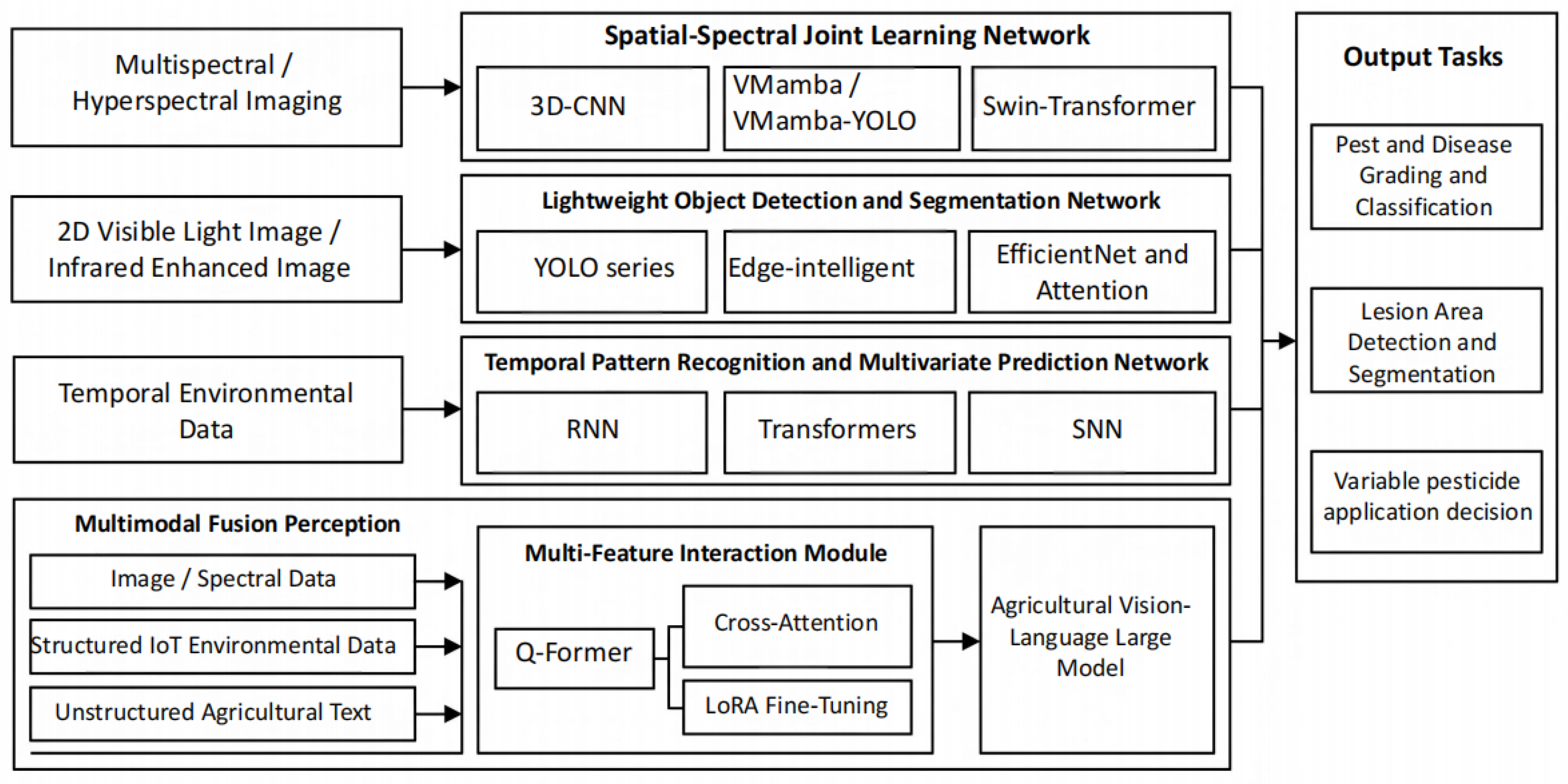
In order to clearly illustrate the coupling relationship between different perception data and deep learning models, Figure 3 shows the coupling topology between perception modalities and deep learning architectures. This figure presents the complete computational process from multi-source data input to core network processing, and then to plant protection task output. In the data input stage, the system integrates multispectral/hyperspectral, two-dimensional visible light images, temporal environmental data, and agricultural text information. At the core processing layer, the system will match different models based on data characteristics. Through structured coupling design, the processing paths of various types of data in the multi feature interaction module are clarified, and a clear algorithm framework guidance is provided for tasks such as disease and pest grading, lesion segmentation, and variable pesticide application decision-making.
Although significant progress has been made in the detection technology of single mode, there are still limitations for single data source in dealing with different objects with similar spectra or drastic illumination changes in complex field environment. The emergence of multimodal fusion technology has promoted the transition from single-source perception toward more comprehensive disease assessment. Through spatial spectral joint learning, the model can simultaneously capture the external morphology and internal physiological state of crops. The decision-level fusion of heterogeneous sensor data combines environmental IoT indicators (such as temperature and humidity) with visual features, significantly enhancing the diagnostic reliability of the model under environmental variability. Especially in recent years, the involvement of visual language large models (VLMs) and knowledge graphs has endowed recognition systems with powerful logical reasoning and expert interaction capabilities, achieving interpretable output of diagnostic results. The selection of multimodal strategies is directly related to the gain effect of the system in the practical application of precision agriculture. In order to clarify the technological advantages of different fusion paths and their degree of improvement in detection efficiency, Table 3 quantitatively compares and analyzes the application effects of fusion strategies such as spatial, spectral, environmental data, and visual language in disease and pest detection.

5.4. Practical Challenges and Deployment Limitations of Multimodal Approaches

Existing studies indicate that multimodal fusion technology has become an important development direction to improve the accuracy of crop disease and pest identification. By integrating spectral information, environmental sensor data, temporal information, and visual language knowledge, the model can obtain disease-related features from multiple dimensions, significantly improving recognition accuracy and decision reliability. Numerous studies have shown that multimodal models generally achieve high recognition accuracy on specialized test datasets. Nevertheless, impressive performance on benchmark datasets does not necessarily imply successful deployment in large-scale agricultural production environments.
Dataset bias remains a fundamental challenge in current multimodal research. Although researchers have improved the feature expression ability of the model by integrating multi-source information, the vast majority of experiments are still based on datasets with limited scale and relatively controllable collection conditions. The coverage of existing datasets in terms of crop types, disease occurrence stages, growth periods, climate conditions, and sensor configurations is still limited. The model is prone to learning statistical features in specific scenarios during the training process, rather than universal disease and pest representation rules. Consequently, the high-precision results obtained in the experimental environment may overestimate the true performance of the model in actual agricultural production.
The transferability of multimodal models between different geographical regions has not been fully explored. There are significant differences between different agricultural ecological regions in terms of climate conditions, light intensity, soil background, planting patterns, and the occurrence of pests and diseases. These differences can easily lead to severe domain shift between the training data and the actual deployment environment, resulting in a significant decrease in the recognition performance of the model in the new region. Especially in cross-season, cross-year, and cross-device application scenarios, the stability and robustness of multimodal models still need further research.
Although multi-source data fusion enriches the decision-making basis for disease diagnosis, practical deployment brings significant challenges related to data synchronization and quality control. Most studies achieve temporal synchronization and spatial registration of multi-source data through manual means. However, in real scenarios, factors such as drone flight vibration, sensor drift, lens contamination, signal loss, and network delay may all lead to data mismatch and information loss. Existing research has paid insufficient attention to issues such as data loss compensation, asynchronous collection of multi-source data, and sensor fault tolerance, resulting in fusion models established in laboratory environments being susceptible to ineffective information interference during actual deployment, thereby reducing system reliability.
The hardware cost and deployment complexity of multimodal systems are also important factors that constrain their widespread application. Hyperspectral cameras, UAV platforms, environmental sensor networks, and edge computing devices are often expensive, and require professionals to complete equipment maintenance, data calibration, and system management. For small and medium-sized farms as well as agricultural areas in developing countries, the high construction and operation costs are still difficult to bear. Especially at present, some visual language models and multimodal models still rely on high-performance GPU servers to complete inference calculations, and there is a clear contradiction between their computational resource consumption and the low-power requirements of agricultural field equipment.
Overall, current multimodal research continues to prioritize recognition accuracy, with relatively limited attention paid to system-level evaluations involving economic efficiency, scalability, and long-term operational stability. Future research should establish a unified benchmark platform covering multiple regions, seasons, sensing devices, and climate conditions. A comprehensive evaluation protocol should be adopted, including cross-dataset validation, OOD testing, and long-term on-site deployment. In addition, recognition performance should be evaluated in conjunction with hardware cost, energy consumption, and real-time responsiveness to facilitate the transition of multimodal crop disease diagnosis systems from laboratory validation to practical agricultural applications.

6. Integrated Application of AI-Driven Detection in Precision Agriculture

6.1. Application in Grain Crops

Major cereal crops, including wheat, rice, and maize, have the characteristics of wide planting area, high planting density, and large-scale monitoring requirements. In recent years, research in this area has evolved from static single-leaf identification to UAVs, mobile terminals, and multi-source remote sensing collaborative monitoring. The focus of disease recognition research has gradually shifted from improving classification accuracy under laboratory conditions to real-time monitoring and application deployment in complex field environments. However, disease monitoring in field scenes still faces a trade-off between spatial resolution and processing efficiency. For example, in the research on wheat Fusarium head blight detection based on drones, lightweight networks such as LWSDNet achieved an average accuracy of 79.8% in real-world field conditions [162]. In contrast, when using models with larger parameter scales such as GNN-CNN hybrid model [163] or VGG-16 [164], the accuracy of research reports can reach from 93% to 97%. This difference indicates that high-precision models often rely on richer feature expression capabilities, while lightweight deployment requires a balance between recognition performance and computational resources.
Further analysis of existing research reveals that over 95% of ultra-high accuracy mostly comes from static, close-up crop images. In the actual UAV monitoring process, the model also needs to face complex factors such as motion blur, lighting changes, wind-induced canopy fluctuations, and the extremely small size of lesion targets captured from aerial viewpoints. Due to the lack of sufficient temporal information modeling and cross-scale feature expression capabilities, there is still significant room for improvement in the generalization performance of existing models in complex natural environments. This is also an important reason why current field-level multi-crop disease monitoring systems are difficult to achieve stable laboratory accuracy under natural conditions [165]. In the field of rice disease monitoring, the research focus is gradually developing towards lightweight deployment, high-precision identification, and edge computing. For example, the RDRM-YOLO model proposed by Li et al. [166] had only 7.9 MB and achieved a recognition accuracy of 94.3% in complex field environments. The mobile offline recognition system developed by Yang et al. [167] can be adapted to low-power smartphones, providing a new solution for disease diagnosis in remote areas. At the same time, models based on Transformer and ConvNeXt fusion architecture [168] and EFFINCEP-NET network [169] achieved classification accuracies approaching 100%, indicating that deep feature learning has strong potential in disease recognition tasks.
The fine-grained identification of corn diseases has entered the stage of parameter optimization. The EANet model proposed by Albahli et al. achieved an overall accuracy of 99.89% in maize disease classification using spatial channel attention mechanism [170]. Liu et al. introduced the Agronomic Teacher semi-supervised architecture and improved the mAP@0.5 for maize leaf disease detection by 6.5% using limited labeled data [171]. The DSTANet lightweight network parameters introduced by Gao et al. are only 1.9 M, achieving an accuracy of 96.11% in identifying early symptoms of maize leaf spot disease and eye spot disease [172]. In response to pest damage, Bakbak et al. fused traditional manual features with deep learning features to achieve an accuracy of 92.55% in assessing the severity of cicada infestation on corn leaves [173]. Jiang et al. reported for the first time the identification of a new pathogen, Fusarium awaxy, responsible for corn ear rot in China using molecular biology combined with morphological features, providing a new pathological basis for AI recognition [174]. The research conducted by the aforementioned scholars shows that existing studies have adopted technologies such as lightweight networks, hybrid models, and multi-sensor fusion to achieve high accuracy in disease identification, pest assessment, and pollutant detection. At the same time, they have taken into account both model lightweighting and scene adaptability, providing technical support for real-time monitoring and precise prevention and control of crop diseases.

6.2. Application in Cash Crops

The identification model of pests and diseases in cash crops is more complex, and the current research trend is to use synthetic data, heuristic optimization algorithms, and distributed architecture to enhance the generalization ability and processing efficiency of the model. For example, in the dimensions of data augmentation and model optimization, Haider et al. proposed the RBNet deep architecture combined with the dragonfly optimization algorithm, which improved the recognition accuracy of cotton leaf diseases to 98.60% [175]. Gao et al. trained the DEMM-YOLO model using synthetic data generated by large language models to improve cotton disease detection mAP@0.5 reaching 96.7% [176]. In the refined monitoring of pests and diseases in tropical cash crops, the new network topology exhibits excellent feature capture capability. Pal et al. developed the PestReKNet-X architecture to address the complex disaster phenotypes of cash crops such as Cashew and Cassava. It achieved a testing accuracy of 95.09% and an average intersection over union (mIoU) of 0.9133 in mixed data monitoring of 22 types of pests and diseases, effectively overcoming the challenges of class imbalance and weak spot recognition in traditional cash crop datasets [177]. The prevention and control of potato late blight is of great significance in preventing catastrophic yield reduction. Asif et al. combined MobileNetV3 and MapReduce architecture to achieve distributed parallel processing of potato disease detection, with a testing accuracy of 96.8% [178].
The AI applications of other cash crops are showing a diversified trend. Marston et al. used linear SVM to classify spectral stress caused by soybean aphids with an accuracy of 89.4% [179]. Li et al. developed a fine-tuning framework based on the Qwen2.5-VL multimodal large model, achieving an accuracy of 93.82% in soybean disease recognition tasks [180]. In addition, for soybean and legume crops, Pan et al. designed the RFDAF Net feature decoupling network, which achieved a top-notch accuracy of 99.43% in field identification of soybean diseases [181]. The SiaRDFNet proposed by Surekha adopts twin network architecture and achieves an accuracy of 99.12% in the highly challenging non-destructive identification of crop root diseases [182]. The ConViTSE architecture developed by Kiruthika et al. showed excellent performance in identifying black bean leaf diseases, with an accuracy rate of 99.30% [183].

6.3. Application in Horticultural Crops

Horticultural crops mainly include fruit trees and greenhouse vegetables, and there are significant small-scale differences in their growth environment, as well as common problems of branch and leaf obstruction. Unlike field crops, disease recognition systems in horticultural scenarios require the use and collaboration of intelligent work robots. Multi-model integration has become the main means to improve accuracy for tomatoes and cucumbers. Scutelnic et al. proposed a multi model ensemble framework that improves the recognition rate of early tomato diseases using multispectral data without dimensionality reduction [184]. The SIS-YOLOv8 model developed by Qin et al. enhanced generalization ability through style randomization and improved accuracy by 8.2% compared to the baseline model in tomato disease detection tasks [185]. Bilal et al. introduced a fuzzy deep CNN to process fuzzy images and achieved 98% accuracy in cucumber disease classification with inference time of only 40–90 s [186].
The detection of fruit tree diseases is developing towards the universalization of multiple species. The MusD CNN model proposed by Kolukula et al. achieved an accuracy of 99.9% in apple leaf disease recognition by improving the multi-scale attention mechanism [187]. Singla et al. developed the DenseSwinGNNet framework by integrating DenseNet and Swin Transformer, which achieved an F1 score of over 99% for identifying turmeric leaf diseases [188]. The DBA ViNet hybrid model proposed by Srinivasan et al. achieved a classification accuracy of 99.51% on a dataset covering five types of fruit trees, including apples and mangoes [189]. The MMFN model proposed by Zhu et al. achieved an accuracy of 98.68% in the classification of various pests and diseases such as citrus huanglongbing using transfer learning techniques [190].
In the field of specialty crops, Krueger et al. successfully distinguished different symptoms of aphid infestation in sweet peppers using 400–2500 nm broad-spectrum hyperspectral data in a controlled environment [191]. The Efficient FBM-FRMNet framework proposed by Nasra et al. is specifically designed for lettuce disease detection, achieving an accuracy of 97.5% with an ultra-low inference delay of 23 milliseconds [192]. Lu et al. compared SVM and extreme learning machine models and achieved an accuracy of 95.77% in identifying tea white spot disease and anthracnose disease using hyperspectral information [193]. In the multidimensional perception research of facility horticultural crops, relying solely on visual modalities is susceptible to complex lighting changes and interference from hidden leaves. Zhou et al. proposed a multimodal monitoring framework for horticultural crop disasters based on a multi-parameter environmental sensor array to address this issue. This study conducted a long-term field experiment on grapes, tomatoes, and bell peppers for 18 months, and constructed a visual electrical signal multimodal dataset containing 2.6 × 10⁶ samples. The system achieved a classification accuracy of 92.1% and an AUC value of 0.957 in complex greenhouse and orchard environments [194].

6.4. UAV IoT Integrated Detection System

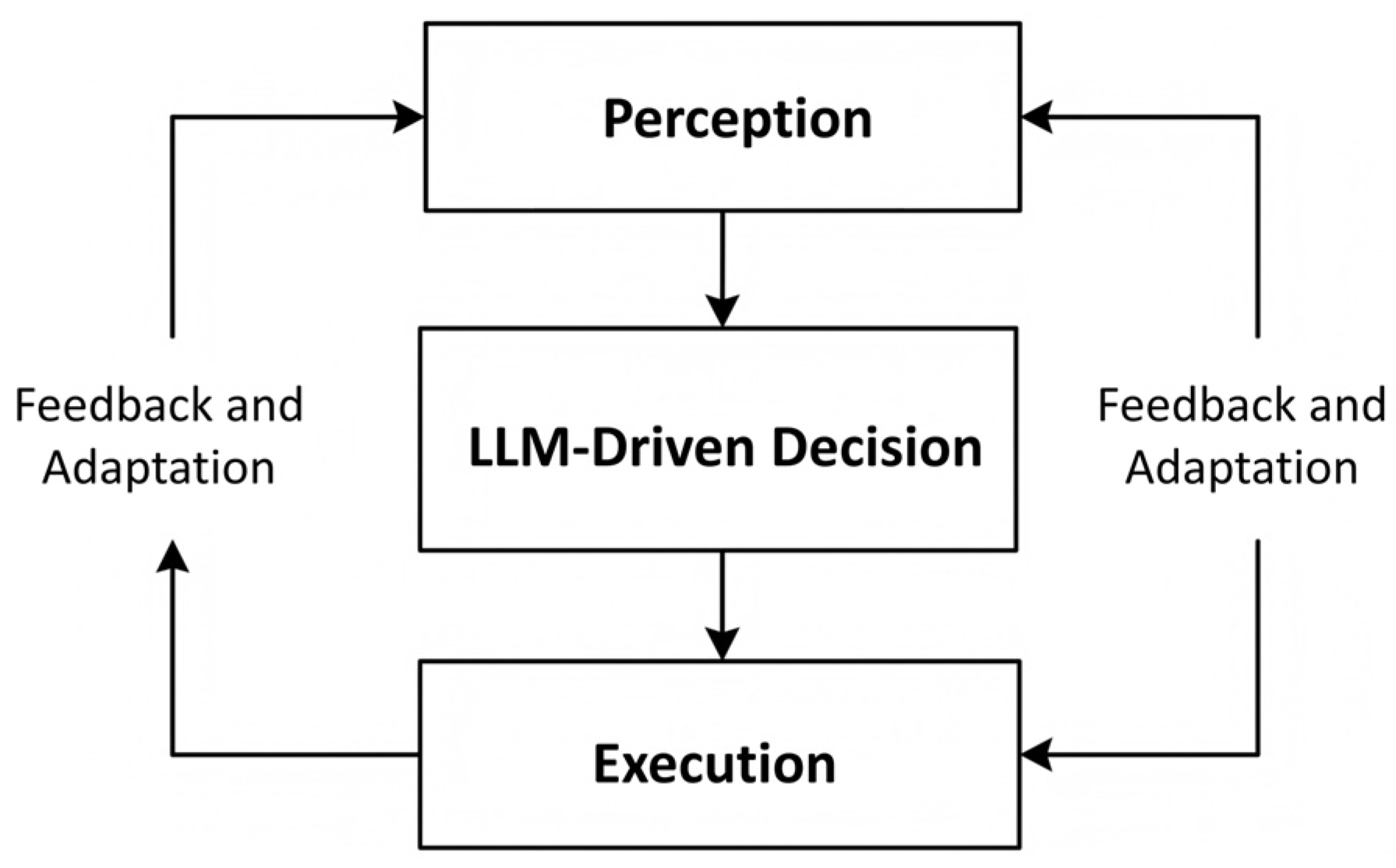
The ultimate goal of detection technology is to form a complete closed-loop system that integrates perception, decision-making, and execution. Drones are no longer just responsible for simple monitoring tasks but have developed into operational platforms that can autonomously make intelligent decisions. Amarasingam et al. compared multiple segmentation models using UAV multispectral images and found that the IoU of FCN architecture in pest patch localization reached 90% [195]. Krestenitis et al. used GAN networks to convert ordinary RGB aerial images into near-infrared representations, effectively reducing the deployment cost of multispectral hardware [196]. Xue et al. proposed an IoT mobile application based on ResNet-50 and ViT, which achieved real-time and high-precision pest identification [197]. Zhang et al. optimized the working parameters of crop protection UAV and found that flight speed and altitude have a significant impact on droplet penetration rate in wheat field spraying tasks [198]. In addition, Zhang et al. designed a hydraulic lift wind field testing platform, providing data support for optimizing the downwash airflow of UAV rotors and its impact on pesticide deposition [199].
Deploying lightweight algorithms on edge devices has become the mainstream approach for smart crop protection to address the issues of limited bandwidth and data transmission latency in agricultural environments. This approach can effectively solve the problem of difficulty in meeting real-time processing needs when using cloud computing in remote agricultural areas. In terms of hardware adaptation and optimization, Zhang et al. developed the ISMSFuse multimodal algorithm and successfully validated the feasibility of rice bacterial blight detection on the Raspberry Pi embedded terminal [200]. Zheng et al. optimized MobileNetV2 for FPGA platform, using linear buffering technology to improve memory utilization by 28.6% and recognition accuracy by 95.8% [201]. Mathew et al. deployed a model that integrates VGG19 and Transformer on NVIDIA Jetson Nano, achieving real-time mobile monitoring of grape leaf diseases [202]. In terms of privacy and security, Bachhal et al. introduced the federated learning framework and achieved a training accuracy of 99.89% for a corn disease detection model while protecting farmers’ privacy [203]. In terms of lightweight architecture, the lightweight Lo Head module proposed by Zhang et al. reduces the parameters of YOLO detector on edge devices to 2.66 M while maintaining excellent cross-crop detection generalization ability [204].
The diagnosis of crop diseases in the field is gradually shifting from experimental verification under laboratory conditions to autonomous closed-loop applications in the field. The most typical breakthrough is the autonomous robot system, which integrates high-precision navigation and real-time mapping functions. For example, Singh et al. launched the AgriScout autonomous robot system, which integrates GPS-RTK and cloud servers to create real-time maps of potato virus Y infection in the field, mAP@0.5 Reaching 85% [205]. The MAF RecNet model proposed by Yao et al. achieved 95.42% mAP@0.5 in wheat and corn recognition in southern Hebei farmland by integrating multi-scale attention mechanisms [206]. Li et al. reviewed sustainable plant protection technologies and proposed a perception decision execution closed-loop framework consisting of UAV detection, real-time pesticide mixing, and adaptive spraying, which can reduce pesticide use by 30% to 50% [207]. Goyal et al. proposed the PANet feature extraction network for intercropping systems, which achieved an accuracy of over 99.5% in identifying multiple coexisting diseases using hyperspectral images [208]. In the collaborative deployment of the IoT and Edge AI, balancing high inference efficiency and low power consumption in field terminals with limited computing resources is the core technical bottleneck of the system. Nyakuri et al. have developed a portable intelligent sensing terminal specifically optimized for IoT edge devices to address this issue. The system uses Raspberry Pi 5 as the core computing base and is equipped with Tiny LiteNet lightweight CNN customized for embedded devices. Experiments have shown that under strict conditions of maintaining an extremely compact volume of 1.2 MB and a parameter count of 1.48 M, the inference delay of the edge terminal for disaster-affected images of field crops is reduced to 80 ms, and the global accuracy is as high as 98.6% [209].
In order to visually demonstrate this approach from information collection to field mechanization response, Figure 4 constructs a schematic diagram of the perception decision execution closed-loop system. The system directly feeds the spatiotemporal data sensed by multiple sources of the IoT to the decision-making and processing center of the large model. Subsequently, after intelligent disease inference and intelligent prescription generation, real-time control instructions are issued to the variable-rate pesticide application and autonomous navigation operation robot. This end-to-end closed-loop architecture can effectively eliminate cloud communication latency and bandwidth limitations, providing an engineering reference for large-scale intelligent plant protection. Future research on AI-driven pest and disease detection should place greater emphasis on real-world field conditions and environmental variability. With the deep integration of UAVs, edge computing nodes and intelligent plant protection equipment, precision agriculture has built a closed-loop control system from space-based remote sensing monitoring to ground-based real-time operation. AI systems have been able to achieve large-scale disaster warning in grain crops such as wheat, rice, and corn. In orchards and special cash crops, autonomous robots that combine robotic arms with variable-rate spraying technology significantly reduce pesticide inputs. The edge deployment solution solves the bandwidth and latency challenges in remote agricultural areas by embedding lightweight algorithms into embedded terminals, making real-time online monitoring possible. In order to summarize the practical performance of current AI technology in different crop systems and integrated platforms, Table 4 comprehensively compares the application effects, hardware platforms, and key performance indicators of various systems in grain, horticulture, and cash crops.

7. Conclusions

This paper analyzes the application and development history of AI technology in crop pest and disease detection. Research has found that spectral sensing technologies such as hyperspectral and multispectral can capture the physiological and biochemical changes in crops after damage, laying a physical foundation for early mechanism research and large-scale field monitoring of diseases. At the same time, lightweight CNNs, ViTs, Mamba and other SSMs continue to improve, greatly enhancing feature extraction capabilities in complex environments and providing more reference for disease diagnosis results. The combination and application of various technologies have gradually transformed the management of crop pests and diseases from passive prevention and control to an active and precise intelligent prevention and control mode, providing reliable technical means for ensuring food security.
Through sorting and summarizing, this paper finds that there are still three urgent issues that need to be addressed when this technology is applied in practical fields.
(1)
Breaking through “dataset bias” and bridging the generalization gap between laboratory and field applications
One of the most important paradoxes in current agricultural AI research is that model performance on public benchmark datasets is approaching saturation, while successful on-site deployment is still limited. Many studies still heavily rely on datasets collected by laboratories such as PV, resulting in performance estimates that are too high to reflect real agricultural conditions. Future research should prioritize the construction of multimodal field datasets, including changes in lighting, canopy occlusion, complex backgrounds, and various biotic and abiotic stresses. From an algorithmic perspective, the focus should shift from maximizing fitting accuracy to enhancing robustness and generalization ability. Emerging technologies such as unsupervised domain adaptation (UDA), self-supervised learning, and federated learning provide promising avenues for utilizing large amounts of unlabeled field data and narrowing the gap between laboratory evaluation and actual deployment.
(2)
Imbalanced computing resource allocation and hardware implementation barriers
The current mainstream VLMs and Transformer architectures generally have high model complexity and require significant computational and memory resources during operation. Although some studies have attempted to deploy relevant models on embedded devices or edge computing platforms, it remains a formidable challenge to achieve an effective balance between high recognition accuracy and the low power long-term operation of agricultural plant-protection UAVs and small field operation equipment. Especially in the scenarios of continuous operation and real-time inference, the trade-off between device energy consumption constraints and model computation costs becomes increasingly acute. Therefore, future research needs to further focus on the issues of model lightweighting design and computational efficiency optimization, including improving network structure design, enhancing feature extraction efficiency, and optimizing model compression and acceleration methods, so that the model can better adapt to the actual operating environment of agricultural edge devices.
(3)
Lack of an end-to-end closed-loop system from detection to field operations
Current research is still mainly focused on the identification and detection of pests and diseases, and a complete application pipeline that can directly guide field operations has not yet been formed. Previous studies have shown that the identification of pests and diseases requires effective collaboration with the spraying decision-making system in order to achieve the practical application value of precision agricultural management. Concurrently, the disease diagnosis results that integrate multi-source perception information can be further integrated into the agricultural digital twin system, thereby achieving dynamic control and precise operation of intelligent spraying equipment. However, the complete closed loop from information perception, decision analysis to execution control still needs further improvement. This not only helps narrow the gap between laboratory research and real field applications but may also play a critical role in reducing pesticide use and improving operational efficiency.

Author Contributions

Conceptualization, Z.M. and X.W.; methodology, X.C.; software, Z.M.; validation, Z.M. and X.W.; formal analysis, X.C. and C.W.; investigation, Z.M.; resources, C.W.; data curation, Z.M.; writing—original draft preparation, Z.M.; writing—review and editing, Z.M. and C.W.; visualization, X.W.; supervision, X.W.; project administration, X.W.; funding acquisition, X.W. All authors have read and agreed to the published version of the manuscript.

Funding

This research was supported by the Ministry of Industry and Information Technology’s Residual Film Recycling Machine Project (No. zk20230359), Talent Development Fund of Shihezi University 2025—“Small Group” Aid—Xinjiang Team (No. CZ002562).

Data Availability Statement

The data presented in this study are available on request from the authors.

Conflicts of Interest

The authors declare no conflicts of interest.

References

  1. Taha, M.F.; Mao, H.; Zhang, Z.; Elmasry, G.; Awad, M.A.; Abdalla, A.; Mousa, S.; Elwakeel, A.E.; Elsherbiny, O. Emerging technologies for precision crop management towards agriculture 5.0: A comprehensive overview. Agriculture 2025, 15, 582. [Google Scholar] [CrossRef]
  2. Wan, L.; Li, H.; Li, C.; Wang, A.; Yang, Y.; Wang, P. Hyperspectral sensing of plant diseases: Principle and methods. Agronomy 2022, 12, 1451. [Google Scholar] [CrossRef]
  3. Liang, Y.; Li, Z.; Shi, J.; Zhang, N.; Qin, Z.; Du, L.; Zhai, X.; Shen, T.; Zhang, R.; Zou, X.; et al. Advances in hyperspectral imaging technology for grain quality and safety detection: A review. Foods 2025, 14, 2977. [Google Scholar] [CrossRef]
  4. Rehman, M.M.u.; Liu, J.; Nijabat, A.; Faheem, M.; Wang, W.; Zhao, S. Leveraging convolutional neural networks for disease detection in vegetables: A comprehensive review. Agronomy 2024, 14, 2231. [Google Scholar] [CrossRef]
  5. Liu, H.; Zhan, B.; Fang, R.; Zhang, Y.; Ma, Y.; Shen, Z.; Mao, Q. Recent advances in pest and disease recognition: A comprehensive review. J. Agric. Eng. 2025, 56. [Google Scholar] [CrossRef]
  6. Wang, Y.; Sun, J.; Wu, Z.; Jia, Y.; Dai, C. Application of non-destructive technology in plant disease detection. Agriculture 2025, 15, 1670. [Google Scholar] [CrossRef]
  7. Amiri, A.; Bandani, A.R. Artificial intelligence for pest identification and decision support in sustainable crop protection: A critical review. Eur. J. Agron. 2026, 176, 128040. [Google Scholar] [CrossRef]
  8. Wei, C.; Shan, Y.; Zhen, M. Deep learning-based anomaly detection for precision field crop protection. Front. Plant Sci. 2025, 16, 1576756. [Google Scholar] [CrossRef]
  9. Kohut, N.; Basystiuk, O.; Shakhovska, N.; Melnykova, N. Detecting Plant Diseases Using Machine Learning Models. Sustainability 2025, 17, 132. [Google Scholar] [CrossRef]
  10. Tamim, M.U.; Hamim, S.A.; Malik, S.; Mridha, M.F.; Mahmood, S. InsightNet: A Deep Learning Framework for Enhanced Plant Disease Detection and Explainable Insights. Plant Direct 2025, 9, e70076. [Google Scholar] [CrossRef]
  11. Batool, A.; Byun, Y.C. Revolutionizing plant disease diagnosis through vision-based intelligence and next-generation computing. Comput. Electr. Eng. 2025, 128, 110695. [Google Scholar] [CrossRef]
  12. Wu, Y.; Chen, L.; Yang, N.; Sun, Z. Research progress of deep learning-based artificial intelligence technology in pest and disease detection and control. Agriculture 2025, 15, 2077. [Google Scholar] [CrossRef]
  13. Page, M.J.; McKenzie, J.E.; Bossuyt, P.M.; Boutron, I.; Hoffmann, T.C.; Mulrow, C.D.; Shamseer, L.; Tetzlaff, J.M.; Akl, E.A.; Brennan, S.E.; et al. The PRISMA 2020 Statement: An Updated Guideline for Reporting Systematic Reviews. Int. J. Surg. 2021, 88, 105906. [Google Scholar] [CrossRef] [PubMed]
  14. Yamada, M.; Thiesen, L.V.; Iost Filho, F.H.; Yamamoto, P.T. Hyperspectral imaging and machine learning: A promising tool for the early detection of tetranychus urticae koch Infestation in cotton. Agriculture 2024, 14, 1573. [Google Scholar] [CrossRef]
  15. Mao, C.; Zhao, Y.; Wang, L.; Yang, Z.; Kou, W.; Xu, W.; Wang, H.; Zhang, X.; Lu, N.; Di, G. Machine learning-enabled UAV hyperspectral identification of tomato spotted wilt virus in tobacco. Front. Plant Sci. 2025, 16, 1728043. [Google Scholar] [CrossRef]
  16. Wang, A.; Gao, B.; Cao, H.; Wang, P.; Zhang, T.; Wei, X. Early detection of Sclerotinia sclerotiorum on oilseed rape leaves based on optical properties. Biosyst. Eng. 2022, 224, 80–91. [Google Scholar] [CrossRef]
  17. Guan, Q.; Qiao, S.; Feng, S.; Du, W. Investigation of Peanut Leaf Spot Detection Using Superpixel Unmixing Technology for Hyperspectral UAV Images. Agriculture 2025, 15, 597. [Google Scholar] [CrossRef]
  18. Feng, S.; Jiang, S.; Huang, X.; Zhang, L.; Gan, Y.; Wang, L.; Zhou, C. Detection of Rice Leaf Folder in Paddy Fields Based on Unmanned Aerial Vehicle-Based Hyperspectral Images. Agronomy 2024, 14, 2660. [Google Scholar] [CrossRef]
  19. Yuan, L.; Zhang, J.; Deng, Q.; Dong, Y.; Wang, H.; Du, X. Differentiation of Wheat Diseases and Pests Based on Hyperspectral Imaging Technology with a Few Specific Bands. Phyton-Int. J. Exp. Bot. 2023, 92, 611–628. [Google Scholar] [CrossRef]
  20. Zhuang, S.; Huang, Y.; Zhu, J.; Yang, Q.; Li, W.; Gu, Y.; Li, T.; Zheng, H.; Jiang, C.; Cheng, T.; et al. Discrimination of Multiple Foliar Diseases in Wheat Using Novel Feature Selection and Machine Learning. Remote Sens. 2025, 17, 3304. [Google Scholar] [CrossRef]
  21. Fu, L.; Sun, J.; Wang, S.; Xu, M.; Yao, K.; Cao, Y.; Tang, N. Identification of maize seed varieties based on stacked sparse autoencoder and near-infrared hyperspectral imaging technology. J. Food Process Eng. 2022, 45, e14120. [Google Scholar] [CrossRef]
  22. Zhao, H.; Yang, Y.; Yang, C.; Song, R.; Guo, W. Evaluation of spatial resolution on crop disease detection based on multiscale images and category variance ratio. Comput. Electron. Agric. 2023, 207, 107743. [Google Scholar] [CrossRef]
  23. Fu, H.; Zhao, H.; Song, R.; Yang, Y.; Li, Z.; Zhang, S. Cotton aphid infestation monitoring using Sentinel-2 MSI imagery coupled with derivative of ratio spectroscopy and random forest algorithm. Front. Plant Sci. 2022, 13, 1029529. [Google Scholar] [CrossRef]
  24. Alfonso, E.; López-Cuervo, S.; Aguirre, J.; Pérez-Martín, E.; Molina, I. Hybrid Methodological Evaluation Using UAV/Satellite Information for the Monitoring of Super-Intensive Olive Groves. Appl. Sci. 2025, 15, 11171. [Google Scholar] [CrossRef]
  25. Skendžić, S.; Novak, H.; Zovko, M.; Pajač Živković, I.; Lešić, V.; Maričević, M.; Lemić, D. Hyperspectral Canopy Reflectance and Machine Learning for Threshold-Based Classification of Aphid-Infested Winter Wheat. Remote Sens. 2025, 17, 929. [Google Scholar] [CrossRef]
  26. Ren, C.; Liu, B.; Liang, Z.; Lin, Z.; Wang, W.; Wei, X.; Li, X.; Zou, X. An Innovative Method of Monitoring Cotton Aphid Infestation Based on Data Fusion and Multi-Source Remote Sensing Using Unmanned Aerial Vehicles. Drones 2025, 9, 229. [Google Scholar] [CrossRef]
  27. Zhu, W.; Feng, Z.; Dai, S.; Zhang, P.; Wei, X. Using UAV multispectral remote sensing with appropriate spatial resolution and machine learning to monitor wheat scab. Agriculture 2022, 12, 1785. [Google Scholar] [CrossRef]
  28. Khalil, H.M.; AlQthanin, R.N.; Elbaz, M.; Loey, M. Cross-domain thermal image augmentation for agricultural disease detection: A multi-crop validated framework with adaptive connectivity and optimized loss function. Signal Image Video Process 2026, 20, 127. [Google Scholar] [CrossRef]
  29. Bhuyan, P.; Das, S.K.; Singh, P.K. Leveraging Squeeze Aggregation Excitation and Positional Encoding in ResNet-50 for Rice Leaf Disease Classification. Concurr. Comput. Pract. Exp. 2026, 38, e70620. [Google Scholar] [CrossRef]
  30. Li, Y.; Li, C.-L.; Wang, X.; Fan, P.-F.; Li, Y.-K.; Zhai, C.-Y. Identification of cucumber disease and insect pest based on hyperspectral imaging. Spectrosc. Spectr. Anal. 2024, 44, 301–309. [Google Scholar]
  31. Qi, Z.; Wu, X.; Yang, Y.; Wu, B.; Fu, H. Discrimination of the red jujube varieties using a portable NIR spectrometer and fuzzy improved linear discriminant analysis. Foods 2022, 11, 763. [Google Scholar] [CrossRef] [PubMed]
  32. Zhu, W.; Zhai, L.; Du, W.; Li, X.; Gao, Z.; Wang, H.; Li, Y. Applications of Polarization Spectroscopy in Agricultural Engineering: A Comprehensive Review. Agriculture 2025, 15, 2546. [Google Scholar] [CrossRef]
  33. Zhang, X.; Bian, F.; Wang, Y.; Hu, L.; Yang, N.; Mao, H. A method for capture and detection of crop airborne disease spores based on microfluidic chips and micro Raman spectroscopy. Foods 2022, 11, 3462. [Google Scholar] [CrossRef] [PubMed]
  34. Zhang, Y.; Guo, J.; Bian, F.; Li, Z.; Guo, C.; Zheng, J.; Zhang, X. Crop Disease Spore Detection Method Based on Au@Ag NRS. Agriculture 2025, 15, 2076. [Google Scholar] [CrossRef]
  35. Lv, G.; Li, J.; Shan, D.; Liu, F.; Mao, H.; Sun, W. Early Detection of Wheat Fusarium Head Blight During the Incubation Period Using FTIR-PAS. Agronomy 2025, 15, 2100. [Google Scholar] [CrossRef]
  36. Yang, N.; Qian, Y.; EL-Mesery, H.S.; Zhang, R.; Wang, A.; Tang, J. Rapid detection of rice disease using microscopy image identification based on the synergistic judgment of texture and shape features and decision tree–confusion matrix method. J. Sci. Food Agric. 2019, 99, 6589–6600. [Google Scholar] [CrossRef] [PubMed]
  37. Bonah, E.; Huang, X.; Aheto, J.H.; Osae, R. Application of electronic nose as a non-invasive technique for odor fingerprinting and detection of bacterial foodborne pathogens: A review. J. Food Sci. Technol. 2020, 57, 1977–1990. [Google Scholar] [CrossRef]
  38. Wang, Y.; Mao, H.; Zhang, X.; Liu, Y.; Du, X. A rapid detection method for tomato gray mold spores in greenhouse based on microfluidic chip enrichment and lens-less diffraction image processing. Foods 2021, 10, 3011. [Google Scholar] [CrossRef]
  39. Wang, Y.; Zhang, X.; Yang, N.; Ma, G.; Du, X.; Mao, H. Separation-enrichment method for airborne disease spores based on microfluidic chip. Int. J. Agric. Biol. Eng. 2021, 14, 199–205. [Google Scholar] [CrossRef]
  40. Xu, Q.; Bai, J.; Ma, L.; Li, Z.; Tan, B.; Sun, L.; Cai, J. Identification of multiple symptoms of huanglongbing by electronic nose based on the variability of volatile organic compounds. Ann. Appl. Biol. 2023, 183, 181–195. [Google Scholar] [CrossRef]
  41. Roy, S.; Hore, J.; Sen, P.; Salma, U. Hyperspectral remote sensing and its application in pest and disease management in agriculture. Indian Farmer 2023, 10, 229–232. [Google Scholar]
  42. Peng, Y.; Zhao, S.; Liu, J. Fused-deep-features based grape leaf disease diagnosis. Agronomy 2021, 11, 2234. [Google Scholar] [CrossRef]
  43. Cubero, S.; Marco-Noales, E.; Aleixos, N.; Barbé, S.; Blasco, J. Robhortic: A field robot to detect pests and diseases in horticultural crops by proximal sensing. Agriculture 2020, 10, 276. [Google Scholar] [CrossRef]
  44. Johannes, A.; Picon, A.; Alvarez-Gila, A.; Echazarra, J.; Rodriguez-Vaamonde, S.; Navajas, A.D.; Ortiz-Barredo, A. Automatic plant disease diagnosis using mobile capture devices, applied on a wheat use case. Comput. Electron. Agric. 2017, 138, 200–209. [Google Scholar] [CrossRef]
  45. Meng, R.; Lv, Z.; Yan, J.; Chen, G.; Zhao, F.; Zeng, L.; Xu, B. Development of spectral disease indices for southern corn rust detection and severity classification. Remote Sens. 2020, 12, 3233. [Google Scholar] [CrossRef]
  46. Aheto, J.H.; Huang, X.; Wang, C.; Tian, X.; Yi, R.; Yuena, W. Fabrication and evaluation of chitosan modified filter paper for chlorpyrifos detection in wheat by surface-enhanced Raman spectroscopy. J. Sci. Food Agric. 2022, 102, 7323–7330. [Google Scholar] [CrossRef] [PubMed]
  47. Wang, A.; Li, W.; Men, X.; Gao, B.; Xu, Y.; Wei, X. Vegetation detection based on spectral information and development of a low-cost vegetation sensor for selective spraying. Pest Manag. Sci. 2022, 78, 2467–2476. [Google Scholar] [CrossRef]
  48. Chang, S.; Chi, Z.; Chen, H.; Hu, T.; Gao, C.; Meng, J.; Han, L. Development of a Multiscale XGBoost-Based Model for Enhanced Detection of Potato Late Blight Using Sentinel-2, UAV, and Ground Data. IEEE Trans. Geosci. Remote Sens. 2024, 62, 4415014. [Google Scholar] [CrossRef]
  49. Yang, N.; Yuan, M.; Wang, P.; Zhang, R.; Sun, J.; Mao, H. Tea diseases detection based on fast infrared thermal image processing technology. J. Sci. Food Agric. 2019, 99, 3459–3466. [Google Scholar] [CrossRef]
  50. Jun, S.; Xin, Z.; Hanping, M.; Xiaohong, W.; Xiaodong, Z.; Hongyan, G. Identification of pesticide residue level in lettuce based on hyperspectra and chlorophyll fluorescence spectra. Int. J. Agric. Biol. Eng. 2016, 9, 231–239. [Google Scholar]
  51. Yang, N.; Yu, J.; Wang, A.; Tang, J.; Zhang, R.; Xie, L.; Shu, F.; Kwabena, O.P. A rapid rice blast detection and identification method based on crop disease spores’ diffraction fingerprint texture. J. Sci. Food Agric. 2020, 100, 3608–3621. [Google Scholar] [CrossRef]
  52. Sharma, V.; Tripathi, A.K.; Mittal, H. DLMC-Net: Deeper lightweight multi-class classification model for plant leaf disease detection. Ecol. Inform. 2023, 75, 102025. [Google Scholar] [CrossRef]
  53. Ullah, N.; Khan, J.A.; Almakdi, S.; Alshehri, M.S.; Al Qathrady, M.; Aldakheel, E.A.; Khafaga, D.S. A Lightweight Deep Learning-Based Model for Tomato Leaf Disease Classification. CMC-Comput. Mater. Contin. 2023, 77, 3969–3992. [Google Scholar] [CrossRef]
  54. Kaur, K.; Kaur, H.; Singh, M.L.; Singh, R. PotConvNet: An Automated Deep Convolutional Neural Network-Based Framework for Identification of Potato Leaf Diseases. Potato Res. 2025, 68, 3631–3666. [Google Scholar] [CrossRef]
  55. Iqbal, M.; Anwar, W.; Shafique, H.; Gilanie, G.; Rezk, A.A.; Al-Dossary, O.; El-Beltagi, H.S.; Aldaej, M.I.; Alsubaie, B.; Al-Khayri, J.M.; et al. Automated Identification of Mango Leaf Diseases Using Deep Convolutional Neural Networks. Pol. J. Environ. Stud. 2021, 30, 5669–5680. [Google Scholar] [CrossRef]
  56. Wang, T.; Xia, H.; Xie, J.; Wu, J.; Sun, Y.; Liu, J. HFE-Net: A lightweight cross-layer hybrid feature enhancement network for efficient Hemerocallis citrina leaf disease detection and generalization. Expert Syst. Appl. 2026, 297, 129550. [Google Scholar] [CrossRef]
  57. Zhang, E.; Zhang, N.; Li, F.; Lv, C. A lightweight dual-attention network for tomato leaf disease identification. Front. Plant Sci. 2024, 15, 1420584. [Google Scholar] [CrossRef]
  58. Sun, W.; Wang, R.; Gao, R.; Li, Q.; Wu, H.; Feng, L. Crop Disease Recognition Based on Visible Spectrum and Improved Attention Module. Spectrosc. Spectr. Anal. 2022, 42, 1572–1580. [Google Scholar]
  59. Liu, J.; Liu, F.; Fu, J. An Attention-Based Spatial-Spectral Joint Network for Maize Hyperspectral Images Disease Detection. Agriculture 2024, 14, 1951. [Google Scholar] [CrossRef]
  60. Chandraleka, J.; Selvaraj, P. Enhancing Precision Agriculture with a Novel AI Framework for Early Crop Health Detection. Tech. Gaz. 2025, 32, 1740–1747. [Google Scholar]
  61. Zhao, S.; Peng, Y.; Liu, J.; Wu, S. Tomato leaf disease diagnosis based on improved convolution neural network by attention module. Agriculture 2021, 11, 651. [Google Scholar] [CrossRef]
  62. Uskaner Hepsag, P. Efficient plant disease identification using few-shot learning: A transfer learning approach. Multimed. Tools Appl. 2023, 83, 58293–58308. [Google Scholar] [CrossRef]
  63. Huan, X.; Chen, B.; Zhou, H. A Unified Self-Supervised Framework for Plant Disease Detection on Laboratory and In-Field Images. Electronics 2025, 14, 3410. [Google Scholar] [CrossRef]
  64. Subhan, M.; Rana, N.; Qamar, F.; Jeribi, F.; Alhazmi, A.H.; Tahir, A.; Shahzadi, R. Crop disease detection using EfficientNetB0 deep learning approach for precision agriculture. Discov. Comput. 2026, 29, 25. [Google Scholar] [CrossRef]
  65. Verma, P.R.; Pantola, D.; Singh, N.P. Plant Disease Detection with Transfer Learning: Evaluating the Impact of Various Loss Functions and Explainable AI. J. Agric. Biol. Environ. Stat. 2025, in press. [Google Scholar] [CrossRef]
  66. Cetiner, H.; Metlek, S. ABC plus CNN-SH: Detection of peruvian coffea leaf diseases with a new hybrid classification algorithm based on ABC optimization and CNN. Comput. Electron. Agric. 2025, 239, 111114. [Google Scholar] [CrossRef]
  67. Xu, M.; Yoon, S.; Jeong, Y.; Park, D.S. Transfer learning for versatile plant disease recognition with limited data. Front. Plant Sci. 2022, 13, 1010981. [Google Scholar] [CrossRef] [PubMed]
  68. Gupta, P.; Jadon, R.S. PlantVitGnet: A Hybrid Model of Vision Transformer and GoogLeNet for Plant Disease Identification. J. Phytopathol. 2025, 173, e70041. [Google Scholar] [CrossRef]
  69. Khubabib, M.; Kehkashan, T.; Abdelhaq, M.; Khan, M.A.; Zaman, M.; Ashraf, I. Data-Efficient Wheat Disease Detection Using Shifted Window Transformer. IEEE Trans. Consum. Electron. 2025, 71, 9006–9020. [Google Scholar] [CrossRef]
  70. Tian, Y.; Zhang, J.; Zhang, Z.; Wu, J. Research on super-resolution enhancement technology using improved transformer network and 3D reconstruction of wheat grains. IEEE Access 2024, 12, 62882–62898. [Google Scholar] [CrossRef]
  71. Jia, S.; Wang, G.; Li, H.; Liu, Y.; Shi, L.; Yang, S. ConvTransNet-S: A CNN-Transformer hybrid disease recognition model for complex field environments. Plants 2025, 14, 2252. [Google Scholar] [CrossRef]
  72. Sun, Y.; Ning, L.; Zhao, B.; Yan, J. Tomato Leaf Disease Classification by Combining EfficientNetv2 and a Swin Transformer. Appl. Sci. 2024, 14, 7472. [Google Scholar] [CrossRef]
  73. Thakur, P.S.; Chaturvedi, S.; Seal, A.; Khanna, P.; Sheorey, T.; Ojha, A. An Ultra Lightweight Interpretable Convolution-Vision Transformer Fusion Model for Plant Disease Identification: ConViTX. IEEE Trans. Comput. Biol. Bioinform. 2025, 22, 310–321. [Google Scholar] [CrossRef] [PubMed]
  74. Haque, M.A.; Deb, C.K.; Gole, P.; Karmakar, S.; Dheeraj, A.; Shah, M.U.D.; Dutta, S.; Prasanna Kumar, M.K.; Marwaha, S. An enhanced vision transformer network for efficient and accurate crop disease detection. Expert Syst. Appl. 2025, 283, 127743. [Google Scholar] [CrossRef]
  75. Yu, S.; Xie, L.; Dai, L. ST-CFI: Swin Transformer with convolutional feature interactions for identifying plant diseases. Sci. Rep. 2025, 15, 25000. [Google Scholar] [CrossRef]
  76. Pacal, I.; Kilicarslan, S.; Ozdemir, B.; Deveci, M.; Kadry, S. Efficient and autonomous detection of olive leaf diseases using AI-enhanced MetaFormer. Artif. Intell. Rev. 2025, 58, 303. [Google Scholar] [CrossRef]
  77. Singaravelu, P.; Perumal, E. Innovative solutions for plant disease identification: Leveraging DCoS-WOR and spiking neural networks. Expert Syst. Appl. 2025, 282, 127399. [Google Scholar] [CrossRef]
  78. Zhang, H.; Li, S.; Xie, J.; Chen, Z.; Chen, J.; Guo, J. VMamba for plant leaf disease identification: Design and experiment. Front. Plant Sci. 2025, 16, 1515021. [Google Scholar] [CrossRef]
  79. Fu, X.; Yang, Z.; Fu, Z.; Hui, M.; Wang, H.; Gao, X.; Kun, N. Method for detection of crop pests and diseases based on Mamba. J. Electron. Imaging 2025, 34, 63026. [Google Scholar] [CrossRef]
  80. Liu, Z.; Guo, X.; Zhao, T.; Liang, S. YOLO-BSMamba: A YOLOv8s-Based Model for Tomato Leaf Disease Detection in Complex Backgrounds. Agronomy 2025, 15, 870. [Google Scholar] [CrossRef]
  81. Yuan, C.; Li, S.; Wang, K.; Liu, Q.; Li, W.; Zhao, W.; Guo, G.; Wei, L. Mamba-YOLO-ML: A State-Space Model-Based Approach for Mulberry Leaf Disease Detection. Plants 2025, 14, 2084. [Google Scholar] [CrossRef]
  82. Ali, H.; Imran, M.; Khan, S.I.; Tariq, A.; Dawood, H.; Dawood, H. YOLOv5 Revisited: A Lightweight yet Accurate Framework for Plant Disease Detection in Agricultural Applications. Appl. Fruit. Sci. 2025, 67, 438. [Google Scholar] [CrossRef]
  83. Sambana, B.; Nnadi, H.S.; Wajid, M.A.; Fidelia, N.O.; Camacho-Zuñiga, C.; Ajuzie, H.D.; Onyema, E.M. An efficient plant disease detection using transfer learning approach. Sci. Rep. 2025, 15, 19082. [Google Scholar] [CrossRef]
  84. Joshi, K.; Yadav, Y.; Hooda, S.; Nandal, R.; Singh, B.; Singh, K.; Tuteja, N.; Gill, R.; Gill, S.S. Classification of cotton leaf disease using YOLOv8 based k-fold cross validation deep learning method for precision agriculture. Sci. Rep. 2025, 15, 35602. [Google Scholar] [CrossRef]
  85. Zhang, M.; Yuan, C.; Liu, Q.; Liu, H.; Qiu, X.; Zhao, M. Detection of mulberry leaf diseases in natural environments based on improved YOLOv8. Forests 2024, 15, 1188. [Google Scholar] [CrossRef]
  86. Sun, H.; Cai, D.; Kang, D.K. SSANet-Based Lightweight and Efficient Crop Disease Detection. CMC-Comput. Mater. Contin. 2025, 85, 1675–1692. [Google Scholar] [CrossRef]
  87. Alpsalaz, F.; Özüpak, Y.; Aslan, E.; Uzel, H. Classification of maize leaf diseases with deep learning: Performance evaluation of the proposed model and use of explicable artificial intelligence. Chemom. Intell. Lab. Syst. 2025, 262, 105412. [Google Scholar] [CrossRef]
  88. Fragoso, J.; Silva, C.; Paixão, T.; Alvarez, A.B.; Castro Júnior, O.; Florez, R.; Palomino-Quispe, F.; Savian, L.G.; Trazzi, P.A. Coffee-Leaf Diseases and Pests Detection Based on YOLO Models. Appl. Sci. 2025, 15, 5040. [Google Scholar] [CrossRef]
  89. Lin, J.W.; Hu, G.; Chen, J. Mixed data augmentation and osprey search strategy for enhancing YOLO in tomato disease, pest, and weed detection. Expert Syst. Appl. 2025, 264, 125737. [Google Scholar] [CrossRef]
  90. Xue, R.Z.; Wang, L.Q. Research on Lightweight Citrus Leaf Pest and Disease Detection Based on PEW-YOLO. Processes 2025, 13, 1365. [Google Scholar] [CrossRef]
  91. Lu, Y.Z.; Liu, P.F.; Tan, C. MA-YOLO: A Pest Target Detection Algorithm with Multi-Scale Fusion and Attention Mechanism. Agronomy 2025, 15, 1549. [Google Scholar] [CrossRef]
  92. Zhang, G.Z.; Ru, Y.D. CRRE-YOLO: An Enhanced YOLOv11 Model with Efficient Local Attention and Multiscale Convolution for Rice Pest Detection. Appl. Sci. 2025, 16, 352. [Google Scholar] [CrossRef]
  93. Yin, J.D.; Zhu, J.; Chen, G.; Jiang, L.H.; Zhan, H.H.; Deng, H.D.; Long, Y.B.; Lan, Y.B.; Wu, B.F.; Xu, H.T. An Intelligent Field Monitoring System Based on Enhanced YOLO-RMD Architecture for Real-Time Rice Pest Detection and Management. Agriculture 2025, 15, 798. [Google Scholar] [CrossRef]
  94. Zhang, W.H.; Jiang, F. AHN-YOLO: A Lightweight Tomato Detection Method for Dense Small-Sized Features Based on YOLO Architecture. Horticulturae 2025, 11, 639. [Google Scholar] [CrossRef]
  95. Abulizi, A.; Ye, J.X.; Abudukelimu, H.; Zhang, G.R.; Guo, C.Q.; Zhang, Y.J.; Yao, D.F. HSMK-YOLO: Improved YOLOv11 fused with hypergraph convolutional network for tomato leaf disease detection. Appl. Soft Comput. 2026, 198, 115286. [Google Scholar] [CrossRef]
  96. Hu, F.Y.; Abula, M.; Wang, D.; Li, X.; Yan, N.; Xie, Q.; Zhang, X.D. Investigation of an Efficient Multi-Class Cotton Leaf Disease Detection Algorithm That Leverages YOLOv11. Sensors 2025, 25, 4432. [Google Scholar] [CrossRef] [PubMed]
  97. Zhang, X.C.; Li, L.; Bian, Z.H.; Dai, C.X.; Ji, Z.L.; Liu, J.Y. RDL-YOLO: A Method for the Detection of Leaf Pests and Diseases in Cotton Based on YOLOv11. Agronomy 2025, 15, 1989. [Google Scholar] [CrossRef]
  98. Peng, G.H.; Wang, K.N.; Ma, J.Q.; Cui, B.F.; Wang, D.W. AGRI-YOLO: A Lightweight Model for Corn Weed Detection with Enhanced YOLO v11n. Agriculture 2025, 15, 1971. [Google Scholar] [CrossRef]
  99. Hao, S.N.; Gao, E.J.; Ji, Z.L.; Ganchev, I. BCS_YOLO: Research on Corn Leaf Disease and Pest Detection Based on YOLOv11n. Appl. Sci. 2025, 15, 8231. [Google Scholar] [CrossRef]
  100. Alhwaiti, Y.; Khan, M.; Asim, M.; Siddiqi, M.H.; Ishaq, M.; Alruwaili, M. Leveraging YOLO deep learning models to enhance plant disease identification. Sci. Rep. 2025, 15, 7969. [Google Scholar] [CrossRef]
  101. Li, H.; Liu, J.; Han, K.; Cai, X. CAFM-Enhanced YOLOv8: A Two-Stage Optimization for Precise Strawberry Disease Detection in Complex Field Conditions. Appl. Sci. 2025, 15, 10025. [Google Scholar] [CrossRef]
  102. Haq, I.U.; Felicetti, F.; Carnì, D.L.; Lamonaca, F. A Metrologically Guided YOLOv12 Framework with Augmentation-Free Training and Two-Phase Optimization for Multiclass Tomato Leaf Disease Detection. Appl. Sci. 2026, 16, 2252. [Google Scholar] [CrossRef]
  103. Zhu, W.; Sun, J.; Wang, S.; Shen, J.; Yang, K.; Zhou, X. Identifying field crop diseases using transformer-embedded convolutional neural network. Agriculture 2022, 12, 1083. [Google Scholar] [CrossRef]
  104. Zhao, L.; Hao, J.; Li, D.; Yu, J. Semi-supervised generative adversarial network for plant leaf disease detection. Eng. Appl. Artif. Intell. 2025, 161, 112103. [Google Scholar] [CrossRef]
  105. Rezaei, M.; Diepeveen, D.; Laga, H.; Sohel, F. Automatic pixel-level annotation for plant disease severity estimation. Comput. Electron. Agric. 2026, 241, 111316. [Google Scholar] [CrossRef]
  106. Karthikeyan, N.; Priyadharsini, V.; Karthik, S. Precision Agriculture: Coconut Tree Disease Segmentation with Enhanced Fuzzy C Means and Hybrid Deep Learning Classification. Int. J. Fuzzy Syst. 2025, in press. [Google Scholar] [CrossRef]
  107. Dinesh, P.; Lakshmanan, R. Multiclass semantic segmentation for prime disease detection with sensitivity level identification in Citrus plant leaves. Sci. Rep. 2025, 15, 21208. [Google Scholar] [CrossRef]
  108. Wójtowicz, A.; Piekarczyk, J.; Wójtowicz, M.; Królewicz, S.; Świerczyńska, I.; Pieczul, K.; Jasiewicz, J.; Ceglarek, J. Integrating RGB Image Processing and Random Forest Algorithm to Estimate Stripe Rust Disease Severity in Wheat. Remote Sens. 2025, 17, 2981. [Google Scholar] [CrossRef]
  109. Zhao, Y.; Li, T.; Wen, W.; Lu, X.; Yang, S.; Fan, J.; Guo, X.; Chen, L. YOMASK: An instance segmentation method for high-throughput phenotypic platform lettuce images. Comput. Electron. Agric. 2025, 230, 109868. [Google Scholar] [CrossRef]
  110. Wisaeng, K. A hybrid deep learning framework for detecting grape leaf diseases by integrating ResNeSt-50 and CBAM attention into DeepLabv3+. Appl. Soft Comput. 2025, 185, 113871. [Google Scholar] [CrossRef]
  111. Jannat, N.; Hasan, S.M.M.; Zibran, M.F. A novel ensemble approach for crop disease detection by leveraging customized EfficientNets and interpretability. Pattern Recognit. Lett. 2025, 197, 370–377. [Google Scholar] [CrossRef]
  112. Sahu, P.; Chug, A.; Singh, A.P. Crop leaf disease detection for beans using ensembled-convolutional neural networks. Int. J. Food Eng. 2023, 19, 521–537. [Google Scholar] [CrossRef]
  113. Sofuoglu, C.I.; Birant, D. Potato Plant Leaf Disease Detection Using Deep Learning Method. J. Agric. Sci.-Tarim Bilim. Derg. 2024, 30, 153–165. [Google Scholar] [CrossRef]
  114. Wang, C.; Xia, Y.; Xia, L.; Wang, Q.; Gu, L. Dual discriminator GAN-based synthetic crop disease image generation for precise crop disease identification. Plant Methods 2025, 21, 46. [Google Scholar] [CrossRef]
  115. Zhang, W.; Sun, X.; Zhou, L.; Xie, X.; Zhao, W.; Liang, Z.; Zhuang, P. Dual-branch collaborative learning network for crop disease identification. Front. Plant Sci. 2023, 14, 1117478. [Google Scholar] [CrossRef]
  116. Zhu, D.; Tan, J.; Wu, C.; Yung, K.; Ip, A.W. Crop Disease Identification by Fusing Multiscale Convolution and Vision Transformer. Sensors 2023, 23, 6015. [Google Scholar] [CrossRef]
  117. Wang, Q.; Liu, C.; Xia, X.; Guo, Y.; Men, H. Classification and identification of crop disease based on depthwise separable group convolution and feature fusion. J. Plant Dis. Prot. 2024, 131, 601–615. [Google Scholar] [CrossRef]
  118. Jia, B.; Zeng, J.; Zheng, Z.; Ge, H.; Song, C. An interpretable crop leaf disease and pest identification model based on prototypical part network and contrastive learning. Sci. Rep. 2025, 15, 38627. [Google Scholar] [CrossRef] [PubMed]
  119. Bhukya, R.; Vuppu, S.; Harshvardhan, A.; Bukya, H.; Salendra, S. Crop Disease Detection by Deep Joint Segmentation and Hybrid Classification Model: A CAD-Based Agriculture Development System. J. Phytopathol. 2025, 173, e70003. [Google Scholar] [CrossRef]
  120. Qin, J.; Deng, L.; Li, C.; He, J.; Pen, H.; Wang, Z. CropCapsNet: Enhanced capsule network for crop disease classification. Comput. Electr. Eng. 2025, 128, 110635. [Google Scholar] [CrossRef]
  121. Wang, Y.; Chen, Y.; Wang, D. Convolution Network Enlightened Transformer for Regional Crop Disease Classification. Electronics 2022, 11, 3174. [Google Scholar] [CrossRef]
  122. Yang, M.; Seklouli, A.S.; Ren, L.; He, Y.; Yu, X.; Ouzrout, Y. A new mobile diagnosis system for estimation of crop disease severity using deep transfer learning. Crop. Prot. 2024, 184, 106776. [Google Scholar] [CrossRef]
  123. Sarkar, N.K.; Singh, M.M.; Nandi, U. A novel deep neural network model using network deconvolution with attention based activation for crop disease classification. Multimed. Tools Appl. 2024, 83, 17025–17045. [Google Scholar] [CrossRef]
  124. Mohan, M.; Anandamurugan, S. Innovative Deep Learning Framework for Accurate Plant Disease Detection and Crop Productivity Enhancement. Cogn. Comput. 2025, 17, 58. [Google Scholar] [CrossRef]
  125. Liu, J.; Liu, X.; Tao, J.; Cao, Y.; Zhou, X.; Guo, C.; Dong, C. Crop leaf disease detection with additive gated convolution and hierarchical attention fusion. Sci. Rep. 2025, 15, 41907. [Google Scholar] [CrossRef]
  126. Lee, S.H.; Jiang, Q.W.; Cheng, C.H.; Tsai, Y.S.; Huang, Y.F. Boosting Rice Disease Diagnosis: A Systematic Benchmark of Five Deep Convolutional Neural Network Models in Precision Agriculture. Agriculture 2025, 15, 2494. [Google Scholar] [CrossRef]
  127. Kendler, S.; Aharoni, R.; Young, S.; Sela, H.; Kis-Papo, T.; Fahima, T.; Fishbain, B. Detection of crop diseases using enhanced variability imagery data and convolutional neural networks. Comput. Electron. Agric. 2022, 193, 106732. [Google Scholar] [CrossRef]
  128. Reis, H.C. Advanced Tomato Disease Detection Using the Fusion of Multiple Deep-Learning and Meta-Learning Techniques. J. Crop Health 2024, 76, 1553–1567. [Google Scholar] [CrossRef]
  129. Kim, T.; Kim, H.; Baik, K.; Choi, Y. Instance-Aware Plant Disease Detection by Utilizing Saliency Map and Self-Supervised Pre-Training. Agriculture 2022, 12, 1084. [Google Scholar] [CrossRef]
  130. Lu, F.; Shangguan, H.; Yuan, Y.; Yan, Z.; Yuan, T.; Yang, Y.; Wang, H.; Xie, W.; Zhang, G.; Wang, Z.; et al. LeafConvNeXt: Enhancing plant disease classification for the future of unmanned farming. Comput. Electron. Agric. 2025, 233, 110165. [Google Scholar] [CrossRef]
  131. Shi, Y.; Han, L.; Kleerekoper, A.; Chang, S.; Hu, T. Novel CropdocNet Model for Automated Potato Late Blight Disease Detection from Unmanned Aerial Vehicle-Based Hyperspectral Imagery. Remote Sens. 2022, 14, 396. [Google Scholar] [CrossRef]
  132. Xiao, Z.; Yin, K.; Geng, L.; Wu, J.; Zhang, F.; Liu, Y. Pest identification via hyperspectral image and deep learning. Signal Image Video Process. 2022, 16, 873–880. [Google Scholar] [CrossRef]
  133. Zuo, X.; Chu, J.; Shen, J.; Sun, J. Multi-granularity feature aggregation with self-attention and spatial reasoning for fine-grained crop disease classification. Agriculture 2022, 12, 1499. [Google Scholar] [CrossRef]
  134. Sudhakar, R.; Sivaraj, R.; Vijayakumar, M. Intelligent contextual attention mechanism of region of interest based network model for leaf disease segmentation and classification. Biomed. Signal Process. Control 2025, 105, 107630. [Google Scholar] [CrossRef]
  135. Chen, T.; Jia, Z.; Wang, J.; Zhou, G.; Ouyang, P. The intelligent detection method for similar cotton diseases based on high-and low-frequency feature enhancement and attention-guided fusion. Eng. Appl. Artif. Intell. 2026, 168, 114099. [Google Scholar] [CrossRef]
  136. Zhang, H.; Huang, L.; Huang, W.; Dong, Y.; Weng, S.; Zhao, J.; Ma, H.; Liu, L. Detection of wheat Fusarium head blight using UAV-based spectral and image feature fusion. Front. Plant Sci. 2022, 13, 1004427. [Google Scholar] [CrossRef]
  137. Wang, A.; Song, Z.; Xie, Y.; Hu, J.; Zhang, L.; Zhu, Q. Detection of rice leaf SPAD and blast disease using integrated aerial and ground multiscale canopy reflectance spectroscopy. Agriculture 2024, 14, 1471. [Google Scholar] [CrossRef]
  138. Xu, S.-H.; Wang, S. An intelligent identification for pest and disease detection in wheat leaf based on environmental data using multimodal data fusion. Front. Plant Sci. 2025, 16, 1608515. [Google Scholar] [CrossRef]
  139. Lu, J.; Huang, J.; Han, X.; Wang, W.; Lan, Y.; Tong, H. Fusion of Multisensor and Multitemporal Data for Early Diagnosis of Litchi Downy Blight Disease. IEEE Sens. J. 2025, 25, 25647–25660. [Google Scholar] [CrossRef]
  140. Albahli, S. AgriFusionNet: A Lightweight Deep Learning Model for Multisource Plant Disease Diagnosis. Agriculture 2025, 15, 1523. [Google Scholar] [CrossRef]
  141. Jagadeesan, P.; Vedaraj, M. A Depthwise Squeeze-Based Residual Recurrent Autoencoder for Accurate Plant Leaf Disease Prediction Using Multimodal Data. J. Crop Health 2026, 78, 37. [Google Scholar] [CrossRef]
  142. Wang, Y.; Li, T.; Chen, T.; Zhang, X.; Taha, M.F.; Yang, N.; Mao, H.; Shi, Q. Cucumber downy mildew disease prediction using a CNN-LSTM approach. Agriculture 2024, 14, 1155. [Google Scholar] [CrossRef]
  143. Karimanzira, D. Context-Aware Tomato Leaf Disease Detection Using Deep Learning in an Operational Framework. Electronics 2025, 14, 661. [Google Scholar] [CrossRef]
  144. Wang, Y.; Wang, F.; Chen, W.; Lv, B.; Liu, M.; Kong, X.; Zhao, C.; Pan, Z. A large language model for multimodal identification of crop diseases and pests. Sci. Rep. 2025, 15, 21959. [Google Scholar] [CrossRef]
  145. Yan, C.; Liang, Z.; Cheng, H.; Li, S.; Yang, G.; Li, Z.; Yin, L.; Qu, J.; Wang, J.; Wu, G.; et al. CDIP-ChatGLM3: A dual-model approach integrating computer vision and language modeling for crop disease identification and prescription. Comput. Electron. Agric. 2025, 236, 110442. [Google Scholar] [CrossRef]
  146. Zhang, Y.; Han, Z.; Chen, J.; Xu, C.; Qin, Y.; Wang, B.; Zhang, X.; Zhang, L. CropGPT: A large multimodal model for precise and explainable diagnosis of crop pests and diseases. J. Ind. Inf. Integr. 2026, 51, 101107. [Google Scholar] [CrossRef]
  147. Liu, W.; Wu, G.; Wang, H.; Ren, F. Cross-Modal Data Fusion via Vision-Language Model for Crop Disease Recognition. Sensors 2025, 25, 4096. [Google Scholar] [CrossRef]
  148. Yu, P.; Lin, B. A Framework for Agricultural Intelligent Analysis Based on a Visual Language Large Model. Appl. Sci. 2024, 14, 8350. [Google Scholar] [CrossRef]
  149. Deng, S.; Zhu, J.; Hu, Y.; He, M.; Xia, Y. Tomato leaf disease identification framework FCMNet based on multimodal fusion. Plants 2025, 14, 2329. [Google Scholar] [CrossRef] [PubMed]
  150. Li, X.; Yang, S.; Li, S. From identification to prevention: A kiwi disease diagnosis system integrating vision and large language models. Comput. Electron. Agric. 2026, 244, 111484. [Google Scholar] [CrossRef]
  151. Islam, M.S.; Sultana, S.; Al Farid, F.; Islam, M.N.; Rashid, M.; Bari, B.S.; Hashim, N.; Husen, M.N. Multimodal Hybrid Deep Learning Approach to Detect Tomato Leaf Disease Using Attention Based Dilated Convolution Feature Extractor with Logistic Regression Classification. Sensors 2022, 22, 6079. [Google Scholar] [CrossRef]
  152. Wang, H.; He, M.; Zhu, M.; Liu, G. WCG-VMamba: A multi-modal classification model for corn disease. Comput. Electron. Agric. 2025, 230, 109835. [Google Scholar] [CrossRef]
  153. Cao, Y.; Sun, G.; Yuan, Y.; Chen, L. Small-sample cucumber disease identification based on multimodal self-supervised learning. Crop. Prot. 2025, 188, 107006. [Google Scholar] [CrossRef]
  154. Guo, G.; Zhou, F.; Wu, Q.; Zhai, D. Multi-granularity alignment for crop diseases detection. Plant Phenomics 2025, 7, 100001. [Google Scholar] [CrossRef] [PubMed]
  155. Apleni, T.; Isinkaye, F.O.; Olusanya, M.O. Ensemble-based feature fusion for accurate plant disease classification using pre-trained models. Sci. Rep. 2025, 15, 41925. [Google Scholar] [CrossRef] [PubMed]
  156. Alzahrani, A.S.; Iqbal, A.; Zafar, W.; Husnain, G. Swin-YOLO-SAM: A hybrid Transformer-based framework integrating Swin Transformer, YOLOv12, and SAM-2.1 for automated identification and segmentation of date palm leaf diseases. Front. Plant Sci. 2025, 16, 1666374. [Google Scholar] [CrossRef]
  157. Pandi, S.S.; Pounambal, M.; Jagadeesh, G.; Vellingiri, J.; Arivuselvan, K. Advancing agricultural sustainability with gradient weighted Densenet-201 model for accurate detection of plant leaf diseases. Environ. Dev. Sustain. 2025, in press. [Google Scholar] [CrossRef]
  158. Zhang, N.; Wu, H.; Zhu, H.; Deng, Y.; Han, X. Tomato Disease Classification and Identification Method Based on Multimodal Fusion Deep Learning. Agriculture 2022, 12, 2014. [Google Scholar] [CrossRef]
  159. Ahmad, N.; Qadri, S.; Akhtar, N. A multimodal fusion framework to diagnose cotton leaf curl virus using machine vision techniques. Cogent Food Agric. 2024, 10, 2339572. [Google Scholar] [CrossRef]
  160. Lv, B.; Wu, H.; Chen, W.; Chen, C.; Miao, Y.; Zhao, C. VEG-MMKG: Multimodal knowledge graph construction for vegetables based on pre-trained model extraction. Comput. Electron. Agric. 2024, 226, 109398. [Google Scholar] [CrossRef]
  161. Manoj, H.M.; Shanthi, D.L.; Lakshmi, B.N.; Archana, K.J.; Venkata Naga Jyothi, E.; Archana, K. AI-driven drone technology and computer vision for early detection of crop disease in large agricultural areas. Sci. Rep. 2025, 16, 2479. [Google Scholar] [CrossRef] [PubMed]
  162. Yin, N.; Bao, W.; Yang, R.; Wang, N.; Liu, W. LWSDNet: A Lightweight Wheat Scab Detection Network Based on UAV Remote Sensing Images. Remote Sens. 2024, 16, 2820. [Google Scholar] [CrossRef]
  163. Yadav, U.; Bondre, S. Enhancing crop health monitoring: A deep dive into GNN-integrated models for wheat disease detection. Agron. J. 2025, 117, e70148. [Google Scholar] [CrossRef]
  164. Mahmood, A.; Anwar, W.; Sattar, H.; Hassan, S.R.; Sheraz, M.; Chuah, T.C. Deep learning framework using UAV imagery for multi-disease detection in cereal crops. Sci. Rep. 2025, 16, 3339. [Google Scholar] [CrossRef]
  165. Bilal, M.; Shah, A.A.; Abbas, S.; Khan, M.A. High-performance deep learning for instant pest and disease detection in precision agriculture. Food Sci. Nutr. 2025, 13, e70963. [Google Scholar] [CrossRef]
  166. Li, P.; Zhou, J.; Sun, H.; Zeng, J. RDRM-YOLO: A High-Accuracy and Lightweight Rice Disease Detection Model for Complex Field Environments Based on Improved YOLOv5. Agriculture 2025, 15, 479. [Google Scholar] [CrossRef]
  167. Yang, N.; Chang, K.; Dong, S.; Tang, J.; Wang, A.; Huang, R.; Jia, Y. Rapid image detection and recognition of rice false smut based on mobile smart devices. Biosyst. Eng. 2022, 218, 229–244. [Google Scholar] [CrossRef]
  168. Al-Falluji, R.A.; Albahar, M.A. Enhancing green AI through explainable deep learning-based multi-model for automated rice leaf disease classification. Discov. Comput. 2025, 28, 269. [Google Scholar] [CrossRef]
  169. Dey, T.K.; Pradhan, J.; Khan, D.A. EFFINCEP-NET: A Proportional Inception-Enhanced Modified EfficientNet-B4 Architecture for Rice Leaf Disease Recognition and Classification. J. Phytopathol. 2026, 174, e70260. [Google Scholar] [CrossRef]
  170. Albahli, S.; Masood, M. Efficient attention-based CNN network (EANet) for multi-class maize crop disease classification. Front. Plant Sci. 2022, 13, 1003152. [Google Scholar] [CrossRef] [PubMed]
  171. Liu, J.; Hu, Y.; Su, Q.; Guo, J.; Chen, Z.; Liu, G. Semi-Supervised One-Stage Object Detection for Maize Leaf Disease. Agriculture 2024, 14, 1140. [Google Scholar] [CrossRef]
  172. Gao, X.; He, L.; Liu, Y.; Wu, J.; Cao, Y.; Dong, S.; Jia, Y. DSTANet: A Lightweight and High-Precision Network for Fine-Grained and Early Identification of Maize Leaf Diseases. Sensors 2025, 25, 4954. [Google Scholar] [CrossRef]
  173. Bakbak, H.E.; Balim, C.; Savran, A. A Hybrid Machine Learning Approach for Detecting and Assessing Zyginidia pullula Damage in Maize Leaves. Appl. Sci. 2025, 15, 5432. [Google Scholar] [CrossRef]
  174. Jiang, C.; Xu, J.; Shi, J.; Qiu, J. First Report of maize ear rot Caused by Fusarium awaxy in China. Plant Dis. 2025, 109, 2610. [Google Scholar] [CrossRef]
  175. Haider, I.; Khan, M.A.; Nazir, M.; Hamza, A.; Alqahtani, O.; Alouane, M.T.H.; Masood, A. Crops Leaf Disease Recognition From Digital and RS Imaging Using Fusion of Multi Self-Attention RBNet. IEEE J. Sel. Top. Appl. Earth Obs. Remote Sens. 2024, 17, 7260–7277. [Google Scholar] [CrossRef]
  176. Gao, L.; Ran, T.; Zou, H.; Wu, H. Cotton Leaf Disease Detection Using LLM-Synthetic Data and DEMM-YOLO Model. Agriculture 2025, 15, 1712. [Google Scholar] [CrossRef]
  177. Pal, C.; Chauhan, J.; Kumar, V.; Kumar Soni, V.; Karmakar, S.; Tripathi, A.; Khadka, A. PestReKNet-X: Integrating explainable artificial intelligence to enhance pest disease detection and combat crop senescence. R. Soc. Open Sci. 2025, 12, 241234. [Google Scholar] [CrossRef]
  178. Asif, M.; Abbas, T.; Iqbal, S.; Alaulamie, A.A.; Asghar, M.N.; Haro, J.M. MapReduce-based deep learning framework for potato leaf disease detection in sustainable precision agriculture. Sci. Rep. 2025, 16, 1607. [Google Scholar] [CrossRef]
  179. Marston, Z.P.D.; Cira, T.M.; Knight, J.F.; Mulla, D.; Alves, T.M.; Hodgson, E.W.; Ribeiro, A.V.; MacRae, I.V.; Koch, R.L. Linear Support Vector Machine Classification of Plant Stress From Soybean Aphid. J. Econ. Entomol. 2022, 115, 1557–1563. [Google Scholar] [CrossRef]
  180. Li, X.; Bian, W.; Yang, B.; Li, Y.; Wang, S.; Qin, N.; Ye, S.; Bao, Z.; Sun, H. Soybean Leaf Disease Recognition Methods Based on Hyperparameter Transfer and Progressive Fine-Tuning of Large Models. Agronomy 2026, 16, 218. [Google Scholar] [CrossRef]
  181. Pan, R.; Yang, Q.; Chen, Y.; Cao, J. RFDAF-Net: A novel region-specific feature decoupling and adaptive fusion network for field soybean disease identification. Front. Plant Sci. 2026, 16, 1734292. [Google Scholar] [CrossRef]
  182. Surekha, S.S. SiaRDFNet: Leveraging Siamese Architecture with ResNet-DenseNet Fusion for Accurate Root Disease Classification. J. Field Robot. 2025, 43, 1524–1548. [Google Scholar]
  183. Kiruthika, M.A.; Gladston, A.; Nehemiah, H.K. Lightweight dual-stage feature refinement for black gram leaf disease classification using ConViTSE. Sci. Rep. 2025, 15, 38941. [Google Scholar] [CrossRef]
  184. Scutelnic, D.; Daffara, C.; Muradore, R.; Weinmann, M.; Jutzi, B. Multi-model ensembles for object detection in multispectral images. Comput. Electron. Agric. 2026, 240, 111213. [Google Scholar] [CrossRef]
  185. Qin, R.; Wang, Y.; Liu, X.; Yu, H. Advancing precision agriculture with deep learning enhanced SIS-YOLOv8 for Solanaceae crop monitoring. Front. Plant Sci. 2025, 15, 1485903. [Google Scholar] [CrossRef]
  186. Bilal, A.; Khan, J.A.; Alzahrani, A.; Almohammadi, K.; Alamri, M.; Liu, X. Fuzzy deep learning architecture for cucumber plant disease detection and classification. J. Big Data 2025, 12, 117. [Google Scholar] [CrossRef]
  187. Kolukula, N.R.; Kopuri, B.; Peddireddy, V.V.R.; Shaik, N.; Chinta, V.M.K.; Meka, J.S. An Improved Adaptive Multi-Scale Attention Dung Beetle Convolution Neural Network-Based Apple Leaves Disease Detection. Int. J. Inf. Technol. Decis. Mak. 2026, 25, 191–220. [Google Scholar] [CrossRef]
  188. Singla, S.; Shandilya, G.; Altameem, A.; Pant, R.; Kumar, A.; Rehman, A.U.; Almogren, A. DenseSwinGNNNet: A Novel Deep Learning Framework for Accurate Turmeric Leaf Disease Classification. Phyton-Int. J. Exp. Bot. 2025, 94, 4021–4057. [Google Scholar] [CrossRef]
  189. Srinivasan, S.; Somasundharam, L.; Rajendran, S.; Singh, V.P.; Mathivanan, S.K.; Moorthy, U. DBA-ViNet: An effective deep learning framework for fruit disease detection and classification using explainable AI. BMC Plant Biol. 2025, 25, 965. [Google Scholar] [CrossRef]
  190. Zhu, H.; Wang, D.; Wei, Y.; Zhang, X.; Li, L. Combining transfer learning and ensemble algorithms for improved citrus leaf disease classification. Agriculture 2024, 14, 1549. [Google Scholar] [CrossRef]
  191. Krüger, M.; Zemanek, T.; Wuttke, D.; Dinkel, M.; Serfling, A.; Böckmann, E. Hyperspectral imaging for pest symptom detection in bell pepper. Plant Methods 2024, 20, 156. [Google Scholar] [CrossRef] [PubMed]
  192. Nasra, P.; Gupta, S.; Khan, M.; Singh, J.; Alabdullah, B.; Almjally, A.; Pant, R.; Kumar, N.; Bharany, S. Deep learning-based phenotyping of lettuce diseases using Efficient-FBM-FRMNet. Front. Plant Sci. 2025, 16, 1704647. [Google Scholar] [CrossRef]
  193. Lu, B.; Jun, S.; Ning, Y.; Xiaohong, W.; Xin, Z. Identification of tea white star disease and anthrax based on hyperspectral image information. J. Food Process Eng. 2021, 44, e13584. [Google Scholar] [CrossRef]
  194. Zhou, C.; Cao, Y.; Ming, B.; Luo, J.; Xu, F.; Zhang, J.; Dong, M. A multimodal deep learning framework for intelligent pest and disease monitoring in smart horticultural production systems. Horticulturae 2025, 11, 8. [Google Scholar] [CrossRef]
  195. Amarasingam, N.; Powell, K.; Sandino, J.; Bratanov, D.; Salgadoe, A.S.A.; Gonzalez, F. Mapping of insect pest infestation for precision agriculture: A UAV-based multispectral imaging and deep learning techniques. Int. J. Appl. Earth Obs. Geoinf. 2025, 137, 104413. [Google Scholar] [CrossRef]
  196. Krestenitis, M.; Ioannidis, K.; Vrochidis, S.; Kompatsiaris, I. Visual to near-infrared image translation for precision agriculture operations using GANs. Comput. Electron. Agric. 2025, 237, 110720. [Google Scholar] [CrossRef]
  197. Xue, X.; Thakur, V.; Dhumras, H.; Jhaveri, R.H.; Gadekallu, T.R. Real-Time Pest Detection Using ResNet-50 and Vision Transformer: An IoT-Enabled Mobile Application. IEEE Trans. Consum. Electron. 2025, 71, 8989–8997. [Google Scholar] [CrossRef]
  198. Zhang, S.; Qiu, B.; Xue, X.; Sun, T.; Peng, B. Parameters optimization of crop protection UAS based on the first industry standard of China. Int. J. Agric. Biol. Eng. 2020, 13, 29–35. [Google Scholar] [CrossRef]
  199. Zhang, S.; Gu, W.; Qiu, B.; Xue, X.; Zhou, L. Design and experiment of a hydraulic lifting wind field test platform for crop protection UAS. Int. J. Agric. Biol. Eng. 2021, 14, 166–174. [Google Scholar] [CrossRef]
  200. Zhang, J.; Shen, D.; Chen, D.; Ming, D.; Ren, D.; Diao, Z. ISMSFuse: Multi-modal fusing recognition algorithm for rice bacterial blight disease adaptable in edge computing scenarios. Comput. Electron. Agric. 2024, 223, 109089. [Google Scholar] [CrossRef]
  201. Zheng, J.; Lv, Z.; Li, D.; Lu, C.; Shen, Z.; Chen, H.; Huang, X.; Huang, J.; Chen, D.; Zhang, J. High-efficiency real-time rice leaf disease classification using convolutional neural network accelerator on FPGA. Measurement 2025, 256, 118122. [Google Scholar] [CrossRef]
  202. Mathew, M.P.; Elayidom, S.; Jagathy Raj, V.P.; Abubeker, K.M. Development of a handheld GPU-assisted DSC-TransNet model. Sci. Rep. 2025, 15, 3579. [Google Scholar] [CrossRef] [PubMed]
  203. Bachhal, P.; Anand, V.; Gargrish, S.; Lilhore, U.K.; Simaiya, S.; Adarbah, H.Y.; Noore, A.; Abdallah, H.A. Optimizing federated learning for maize leaf disease classification using internet of agricultural things. Clust. Comput. 2026, 29, 100. [Google Scholar] [CrossRef]
  204. Zhang, C.; Hao, X.; Liang, J.; Li, L.; Li, W. A lightweight and generalizable deep learning framework for early detection of rice leaf diseases. Sci. Rep. 2025, 15, 45098. [Google Scholar] [CrossRef]
  205. Singh, C.; Randhawa, G.S.; Farooque, A.A.; Gill, Y.S.; Fraser, A.; Kumar, L.K.M.; Barrett, R.; Al-Mughrabi, K. AgriScout: AI-powered robot for precise detection of PVY-infected potato plants. Comput. Electron. Agric. 2025, 238, 110781. [Google Scholar] [CrossRef]
  206. Yao, H.; Zhu, J.; Li, Y.; Yan, H.; Feng, W.; Niu, L.; Wu, Z. MAF-RecNet: A Lightweight Wheat and Corn Recognition Model Integrating Multiple Attention Mechanisms. Remote Sens. 2026, 18, 497. [Google Scholar] [CrossRef]
  207. Li, W.; Luo, Y.; Jiang, P.; Dong, X.; Tang, K.; Liang, Z.; Shi, Y. A sustainable crop protection through integrated technologies: UAV-based detection, real-time pesticide mixing, and adaptive spraying. Sci. Rep. 2025, 15, 35748. [Google Scholar] [CrossRef]
  208. Goyal, S.B.; Malik, V.; Rajawat, A.S.; Khan, M.; Ikram, A.; Alabdullah, B.; Almjally, A. Smart intercropping system to detect leaf disease using hyperspectral imaging and hybrid deep learning. Front. Plant Sci. 2025, 16, 1662251. [Google Scholar] [CrossRef]
  209. Nyakuri, J.P.; Nkundineza, C.; Gatera, O.; Nkurikiyeyezu, K.; Mwitende, G. AI and IoT-powered edge device optimized for crop pest and disease detection. Sci. Rep. 2025, 15, 22905. [Google Scholar] [CrossRef]
  210. Swathi Chandra, T.R.; Parthasarathy, V. Enhanced Leaf Disease Diagnosis in Black-Pepper Plants Using a Dense Back-Projection Joint Attention Network. J. Phytopathol. 2026, 174, e70223. [Google Scholar] [CrossRef]
  211. Verma, G.; Saxena, A.K.; Rai, M.; Shaheen, M.; Naaz, S. IoT integrated CNN framework for automated detection and quantification of rice and potato crop diseases. Sci. Rep. 2025, 15, 38199. [Google Scholar] [CrossRef]
  212. Kumar, B.V.; Rao, P.V.G.K. ViT-CapsNet: Implementing a smart agricultural management framework using region ViT-based residual adaptive CapsNet. Knowl.-Based Syst. 2025, 330, 114654. [Google Scholar] [CrossRef]
  213. Mullins, C.C.; Esau, T.J.; Johnstone, R.; Toombs, C.L.; Hennessy, P.J. Enhanced Image Annotation in Wild Blueberry (Vaccinium angustifolium Ait.) Fields Using Sequential Zero-Shot Detection and Segmentation Models. Sensors 2025, 25, 7325. [Google Scholar] [CrossRef] [PubMed]
  214. Parez, S.; Alghamdi, N.S.; Mahmood, T.; Ullah, W.; Khan, M.A.; Houda, T.; Dilshad, N. Towards precision agriculture: Metaheuristic model compression for enhanced pest recognition. Sci. Rep. 2025, 15, 20805. [Google Scholar] [CrossRef]
  215. Ray, R.K.; Chakravarty, S.; Dash, S.; Ghosh, A.; Mohanty, S.N.; Chirra, V.R.R.; Ayouni, S.; Khan, M.I. Precision pest management in agriculture using Inception V3 and EfficientNet B4: A deep learning approach for crop protection. Inf. Process. Agric. 2026, 13, 142–161. [Google Scholar] [CrossRef]
  216. Li, J.; Feng, Q.; Yang, J.; Zhang, J.; Yang, S. Few-shot crop disease recognition using sequence- weighted ensemble model-agnostic meta-learning. Front. Plant Sci. 2025, 16, 1615873. [Google Scholar] [CrossRef]
  217. Sangar, G.; Rajasekar, V. Optimized classification of potato leaf disease using EfficientNet-LITE and KE-SVM in diverse environments. Front. Plant Sci. 2025, 16, 1499909. [Google Scholar] [CrossRef]
  218. Mishra, U.; Pandey, A.; Logeswari, G.; Tamilarasi, K. Deep learning-based disease detection in potato and mango leaves: A comparative study of CNN, AlexNet, ResNet, and EfficientNet. Sci. Rep. 2025, 16, 2788. [Google Scholar] [CrossRef] [PubMed]
  219. Mathew, M.P.; Elayidom, S.; Jagathy Raj, V.P.; Abubeker, K.M. A depth-wise separable VGG19-capsule network for enhanced bell pepper and grape leaf disease classification with ensemble activation. Environ. Res. Commun. 2025, 7, 045020. [Google Scholar] [CrossRef]
  220. Batool, A.; Kim, J.; Byun, Y.C. A compact deep learning approach integrating depthwise convolutions and spatial attention for plant disease classification. Plant Methods 2025, 21, 48. [Google Scholar] [CrossRef] [PubMed]
  221. Catal Reis, H. CropHealthNet: Potato Disease Detection Using Depthwise Separable Convolutional Neural Networks. J. Crop Health 2026, 78, 29. [Google Scholar] [CrossRef]
  222. Khan, A.; Singh, R.; Khan, S.U.; Hussain, I. Towards smart farming: A real-time diagnosis system for strawberry foliar diseases using deep learning. BMC Plant Biol. 2025, 26, 135. [Google Scholar] [CrossRef] [PubMed]
  223. Abinaya, M.; Daniel, J.A. Deploying YOLOv8m and Deep Q-Network for Intelligent Prediction of Pests and Soil-Borne Illness in Sugarcane Fields. Int. J. Comput. Intell. Syst. 2026, 19, 3. [Google Scholar] [CrossRef]
  224. Kanaparthi, K.R.; Ilango, S.S. Deep learning framework for timely detection and classification of chili leaf diseases and pests. Sci. Rep. 2026, 16, 4360. [Google Scholar] [CrossRef]
  225. Lilhore, U.K.; Kavitha, P.; Swetha, G.; Sunder, R.; Simaiya, S.; Ghith, E.S.; Hussien, S.A. Early Detection of Potato Leaf Diseases with PotatoNet-X: A Deep Learning Model Combining ResNet, DenseNet, and Attention Mechanisms. Potato Res. 2026, 69, 45. [Google Scholar] [CrossRef]
  226. Latif, M.R.; Khan, M.A.; Javed, M.Y.; Masood, H.; Tariq, U.; Nam, Y.; Kadry, S. Cotton leaf diseases recognition using deep learning and genetic algorithm. Comput. Mater. Contin. 2021, 69, 2917. [Google Scholar] [CrossRef]
  227. Moreano, M.; Sosa, A.; Mauricio, D.; Rivera, L.; Santisteban, J. ApaltAI: A web-based diagnostic system with a sequential voting architecture for detecting anthracnose and scab in avocado fruit. Front. Plant Sci. 2026, 17, 1736123. [Google Scholar] [CrossRef]
  228. Liu, J.; Abbas, I.; Noor, R.S. Development of deep learning-based variable rate agrochemical spraying system for targeted weeds control in strawberry crop. Agronomy 2021, 11, 1480. [Google Scholar] [CrossRef]
  229. Guo, Y.; Gao, J.; Tunio, M.H.; Wang, L. Study on the identification of mildew disease of cuttings at the base of mulberry cuttings by aeroponics rapid propagation based on a BP neural network. Agronomy 2022, 13, 106. [Google Scholar] [CrossRef]
Figure 1. Comprehensive framework for crop pest and disease detection driven by AI.
Agriculture 16 01262 g001
Figure 2. PRISMA flowchart. * Databases searched include Web of Science Core Collection and Scopus.
Agriculture 16 01262 g002
Figure 3. Coupling topology of sensing modalities and deep learning architectures.
Agriculture 16 01262 g003
Figure 4. Schematic diagram of perception decision execution closed-loop system.
Agriculture 16 01262 g004
Table 1. Comparison of different spectral sensing technologies for crop pest and disease detection.
Sensor TypeTarget Crop and Disease/TaskSample Size and DatasetSettingKey Performance/IndicatorsRef.
Narrowband SpectrometerWheat and Maize (Pest/Disease)N/AFieldEcophysiological Trait Mapping[41]
RGB CameraGrape (Leaf Diseases)N/ALabF1: 0.998[42]
Custom Multi/HSICarrot (Ca. L. solanacearum)3-Year Multi-Campaign Field TrialsLab/FieldAcc: 66.4% (Lab)/59.8% (Field)[43]
RGB (Mobile)Wheat (Septoria, Rust, Tan Spot)>3500 Real-World Field ImagesFieldAUC: >0.80[44]
Portable SpectrometerMaize (Southern Corn Rust)In Situ Leaf-Level Reflectance SpectraFieldAcc: 87.0% (Detection)[45]
Raman SpectrometerWheat (Chlorpyrifos Residue)Multi-Scenario Active Sensing ArraysLabRecovery: 97.2–119.3%[46]
Blue/Red LEDsCanopy (Vegetation Detection)Multi-Platform Synchronous ImageryOutdoorAcc: 100.0%[47]
MS (Satellite/UAV)Potato (Late Blight Monitoring)Canopy Thermal Pixel Matrix ArraysSatellite/UAV/GroundAcc: 70.0%/R2: 0.74[48]
Thermal CameraTea (Disease Area Detection)Microscopic Colony Sensor DatasetFieldR2: 0.97[49]
HSI and Cary SpectrometerLettuce (Dimethoate Residue)Sample Size and DatasetLabR2: 0.987[50]
Light DiffractionRice (Rice Blast Spore)N/ALabAcc: 97.1%[51]
Table 2. Performance comparison of different deep learning models for disease recognition.
Model ArchitectureTarget Crop/DiseaseDataset and Sample SizeValidation ProtocolSettingPerformanceRef.
Ensemble CNNCorn, Potato, Wheat, Tomato4 diverse datasets Custom selection via Hamming LossLabAcc: >99.0%[111]
Ensemble CNNBean Leaf Diseases3 classes of bean images10-fold cross-validationLabAcc: 97.1%, F1: 0.97[112]
CNNPotato Leaf DiseasesReal-world datasetStandard hold-out splitLabAcc: 98.2%, F1: 0.97[113]
FHWD-GANTomato Leaf DiseasesPV dataset (10 crop diseases)Downstream classification validationLabAcc: Improved by 7.2%[114]
DBCLNet38 Disease CategoriesPV datasetRandom train/test partitionLabAcc: 99.8%, Pre: 99.9%[115]
MSCVTMulti-Disease RecognitionPV and apple leaf pathology datasetsHold-out evaluationLab/controlled orchardAcc: 99.8% (PV)/97.5%[116]
ResNet50 + AFFMGrape, Corn, TomatoPV datasetStratified random splitLabAcc: 99.5%, F1: 0.99[117]
CPNetCrop Leaf Phenotypes4 public datasetsSupervised contrastive learning splitLabEnhanced over baseline via prototypes[118]
MDJ-SegmentationApple and Corn DiseasesBenchmark90% training/10% testing ratioLabAcc: 96.50%[119]
CropCapsNetFruit Leaf DiseasesPV, Xinong apple, and FGVC8 datasetsParameter grouping test splitLab/fieldAcc: 99.9% (PV)/98.1%[120]
Conv-TransformerRegional Tomato Diseases3 regional setsGrid count validationControlled fieldAcc: 96.30%[121]
Parallel DLCrop Disease SeverityPV and AI Challenger 2018 datasetsFine-tuning domain adaptationLab (PV)/fieldAcc: 99.5% (Lab)/88.5%[122]
DNN-AReLUGrape and Tomato DiseasesPV, tomato, and grape datasets80:20 train–test splitLabAcc: >99.1%, F1: 0.99[123]
SAUKC-OCEDNPlant Leaf InfectionsAugmented/resized leaf imagesImproved kookaburra splitLabAcc: 98.00%[124]
AG-HAF (YOLO)Complex Background LesionsCrop leaf disease datasetAblation-guided bounding box splitFieldOutperformed standard YOLO frameworks[125]
DenseNet121Rice Leaf DiseasesPublic leaf dataset5-fold CV and out-of-distribution (OOD) testFieldOOD Acc: 85.0%[126]
CNN-
Transformer
Wheat, Potato, BarleyIn situ unconstrained patchesImage patch split strategyFieldAcc: 95.4%[127]
Meta-LearningTomato Leaf Blight900 test imagesVtC voting meta-classifier protocolLab5/900 errors (original); 4/900 errors (CLAHE)[128]
Unsupervised DLBRACOL and PVUnlabeled leaf datasetsSelf-supervised pre-training benchmarkUnstructured/weakly structured fieldAchieved state-of-the-art unsupervised benchmarking[129]
LeafConvNeXt52 Leaf DiseasesExtensive multi-class leaf databaseLayerCAM diagnostic validationFieldAcc: >99.0%[130]
Table 3. Comparison of different multimodal fusion strategies for pest and disease detection.
Fusion StrategyModalities CombinedDataset and ScaleValidation ProtocolPerformanceRef.
Hybrid DLImage + Synthetic (CGAN)PV; multi-classK-fold CVAcc: 96.6%[151]
WCG-VMambaImage + Text (Alignment)Maize dataset; self-built + publicHold-out splitAcc: 96.9%[152]
MMSSLImage + Text (Prompt)Cucumber (Small sample)Semi-supervised benchmarkAcc: 95.0%[153]
MGA FrameworkMulti-Granularity FeaturesPV, PVi, PDc (domain-diverse)Cross-domain OOD testingmAP: 48.3%[154]
Ensemble FusionVGG16 + ResNet50 + InceptionNew plant diseases dataset (87,867)Random splitAcc: 97.0%[155]
Swin-YOLO-SAMImage + Zero-Shot SegmentationDate palm (13,459 images)Zero-shot evaluationAcc: 98.9%[156]
GradWDN-201Image + Texture (GLCM)4 benchmark datasetsStratified CVAcc: 98.9%[157]
Multi-ResNet34Image + Environment (IoT)Tomato (6 classes)5-fold CVAcc: 98.9%[158]
Machine VisionDigital + MultispectralCotton (CLCuV dataset)K-fold CVAcc: 96.3%[159]
VEG-MMKGText + ImageVegetable entity datasetPre-trained model fine-tuningMatch Acc: 76.7%[160]
AgroVisionNetUAV Image + IoT SensorsMulti-crop field trialHold-outHigh F1 (interpretable)[161]
Table 4. Performance of AI-driven detection in various crops and agricultural systems.
Application SystemCrop/SystemHardware/PlatformSettingPerformanceRef.
DBJAN-LDD-BPPBlack PepperHigh-Performance ServerLabAcc: >99.0%[210]
IoT-CNN FrameworkRice and PotatoFPGA/MATLABEdge IoTAcc: 95.0%[211]
ViT-CapsNetSmart ManagementIoT-GatewayControlled FieldAcc: 97.83%[212]
Grounding DINO + SAM2Wild BlueberryHigh-end GPU ServerFieldmIoU: 0.905[213]
InceptionV3-CAPest RecognitionEdge DeviceLabAcc: 88.50%[214]
EfficientNet B4Pest ProtectionStandard PCFieldAcc: 82.54%[215]
SWE-MAMLSWE-MAMLPC-Based SimulationLabAcc: 75.7%[216]
EfficientNet-LITE + KE-SVMPotatoEdge-Optimized Mobile DeviceFieldAcc: 87.8%[217]
EfficientNetPotato and MangoStandard PCLabAcc: 97.8%[218]
VGG19-CapsNetBell Pepper/GrapeNVIDIA Jetson NanoControlled FieldAcc: >99.8%[219]
LWDSC-SAPVStandard PCLabAcc: 98.7%[220]
CropHealthNetPotatoEmbedded MicrocontrollerEdge/FieldAcc: 99.5%[221]
SLDI (Robotic Platform)StrawberryRobotic Arm + VisionFieldAcc: 91.1% (76.5 FPS)[222]
YOLOv8m + DQNSugarcaneAutonomous Soil Robot (ASR)FieldAcc: 98.0%[223]
Modified YOLOv8 HybridChiliEdge-Cloud IntegratedFieldmAP: 99.5%[224]
PotatoNet-XPotatoEdge Computing DeviceField-SimulatedAcc: 98.13%[225]
ResNet101 + GA + Cubic SVMCottonStandard PCLabAcc: 98.8%[226]
ApaltAIAvocadoWeb-Based PlatformField-MonitoringAcc: 99.03%[227]
VGG-16StrawberryRobotic SprayerFieldAcc: 93.0%[228]
BP Neural NetworkMulberryAeroponic Rapid PropagationGreenhouse/LabAcc: 80.0%[229]
Disclaimer/Publisher’s Note: The statements, opinions and data contained in all publications are solely those of the individual author(s) and contributor(s) and not of MDPI and/or the editor(s). MDPI and/or the editor(s) disclaim responsibility for any injury to people or property resulting from any ideas, methods, instructions or products referred to in the content.