Author Contributions
Conceptualization, Y.S. and F.M.; methodology, Y.S. and F.M.; software, Y.S., F.M., S.K., M.S., A.K., I.K., D.C., M.K., S.O., S.B., M.B., S.A. (Shahnoza Abduganiyeva) and S.A. (Sevara Alikulova); validation, Y.S. and F.M.; formal analysis, Y.S. and F.M.; investigation, Y.S. and F.M.; resources, S.K., M.S., A.K., I.K., D.C., M.K., S.O., S.B., M.B., S.A. (Shahnoza Abduganiyeva) and S.A. (Sevara Alikulova); data curation, Y.S. and F.M.; writing—original draft preparation, Y.S.; writing—review and editing, Y.S. and F.M.; visualization, Y.S. and F.M.; supervision, Y.S. and F.M.; project administration, S.K., M.S., A.K., I.K., D.C., M.K., S.O., S.B., M.B., S.A. (Shahnoza Abduganiyeva) and S.A. (Sevara Alikulova). All authors have read and agreed to the published version of the manuscript.
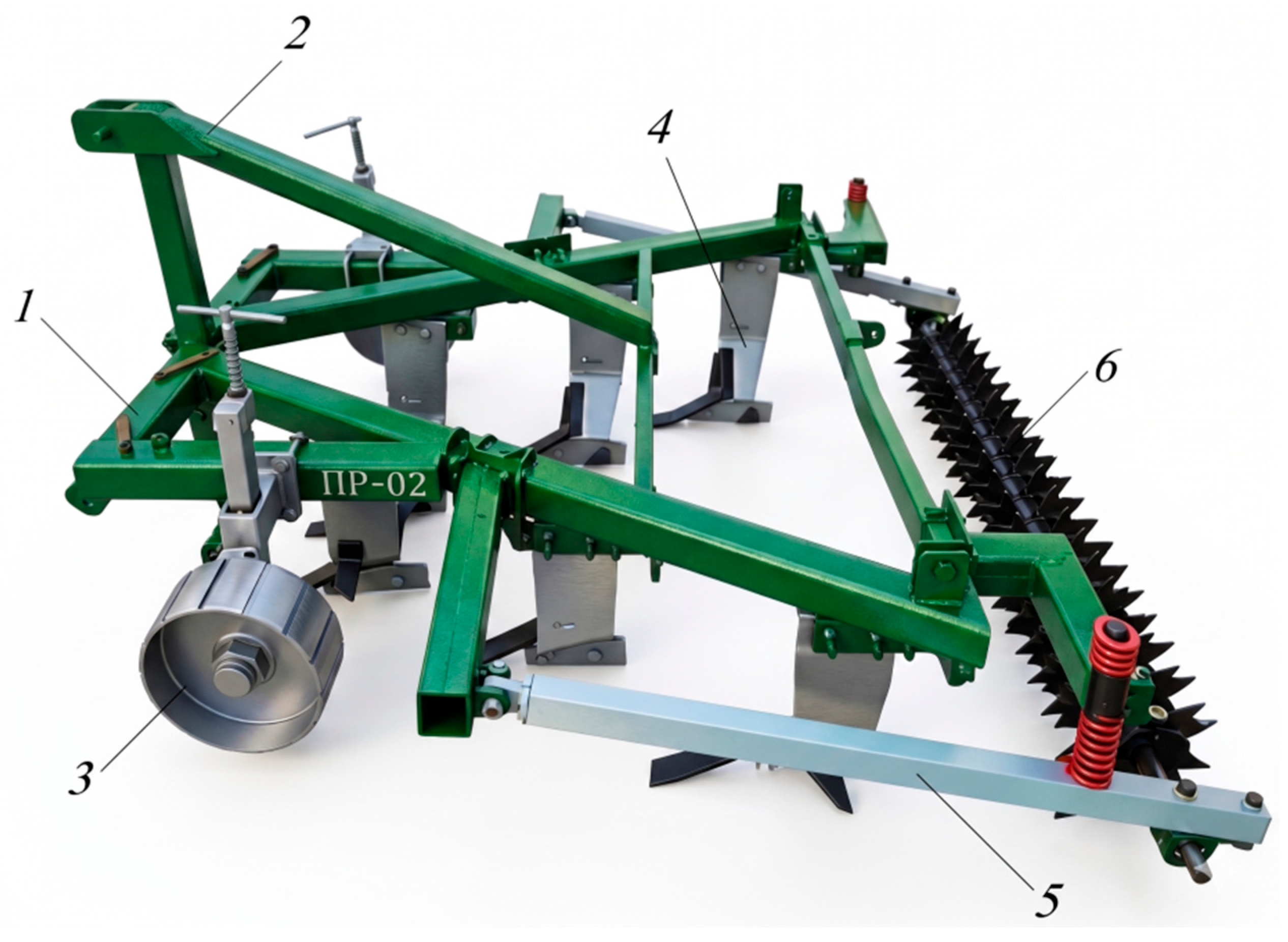
Figure 1.
Structural scheme of the chisel plow equipped with a toothed roller: (1) frame; (2) hitch system; (3) support wheels; (4) chisel tines; (5) linkage mechanism; (6) toothed roller.
Figure 1.
Structural scheme of the chisel plow equipped with a toothed roller: (1) frame; (2) hitch system; (3) support wheels; (4) chisel tines; (5) linkage mechanism; (6) toothed roller.
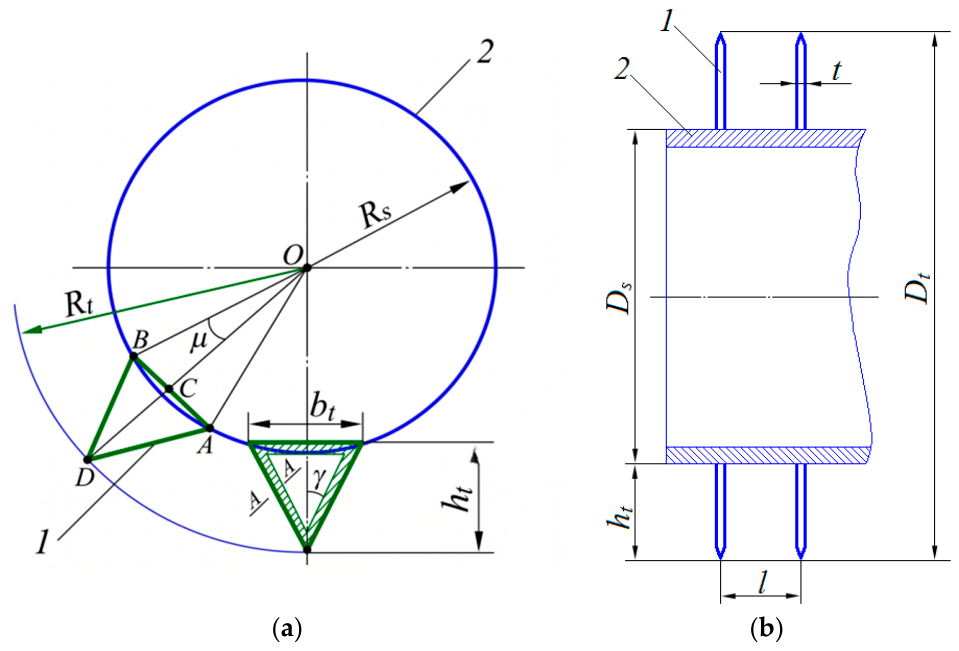
Figure 2.
Geometrical parameters of the toothed roller: (a) cross-sectional contact geometry of the tooth and roller body; (b) side view of the toothed roller showing the roller body, tooth arrangement and main dimensions. (1)—tooth; (2)—roller body.
Figure 2.
Geometrical parameters of the toothed roller: (a) cross-sectional contact geometry of the tooth and roller body; (b) side view of the toothed roller showing the roller body, tooth arrangement and main dimensions. (1)—tooth; (2)—roller body.
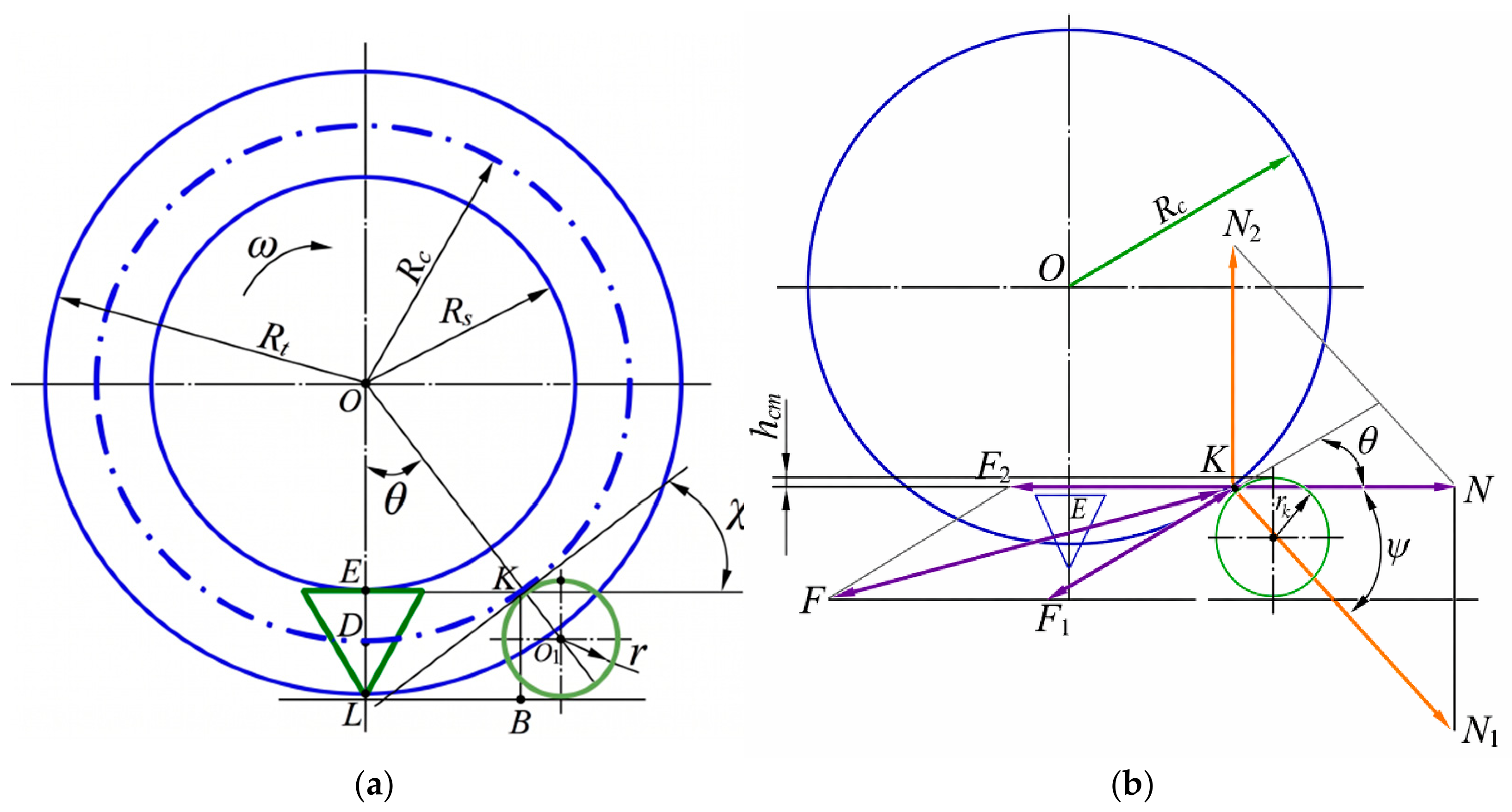
Figure 3.
Schematic representation of soil clod capture by the roller tooth: (a) kinematic scheme of clod capture, showing the roller radii, tooth position, clod radius and contact geometry; (b) force-equilibrium scheme of the soil clod in the tooth–soil contact zone, showing the normal reaction, friction force and governing geometric parameters (Rs, rk, bt, ht, γ) used in the analytical model.
Figure 3.
Schematic representation of soil clod capture by the roller tooth: (a) kinematic scheme of clod capture, showing the roller radii, tooth position, clod radius and contact geometry; (b) force-equilibrium scheme of the soil clod in the tooth–soil contact zone, showing the normal reaction, friction force and governing geometric parameters (Rs, rk, bt, ht, γ) used in the analytical model.
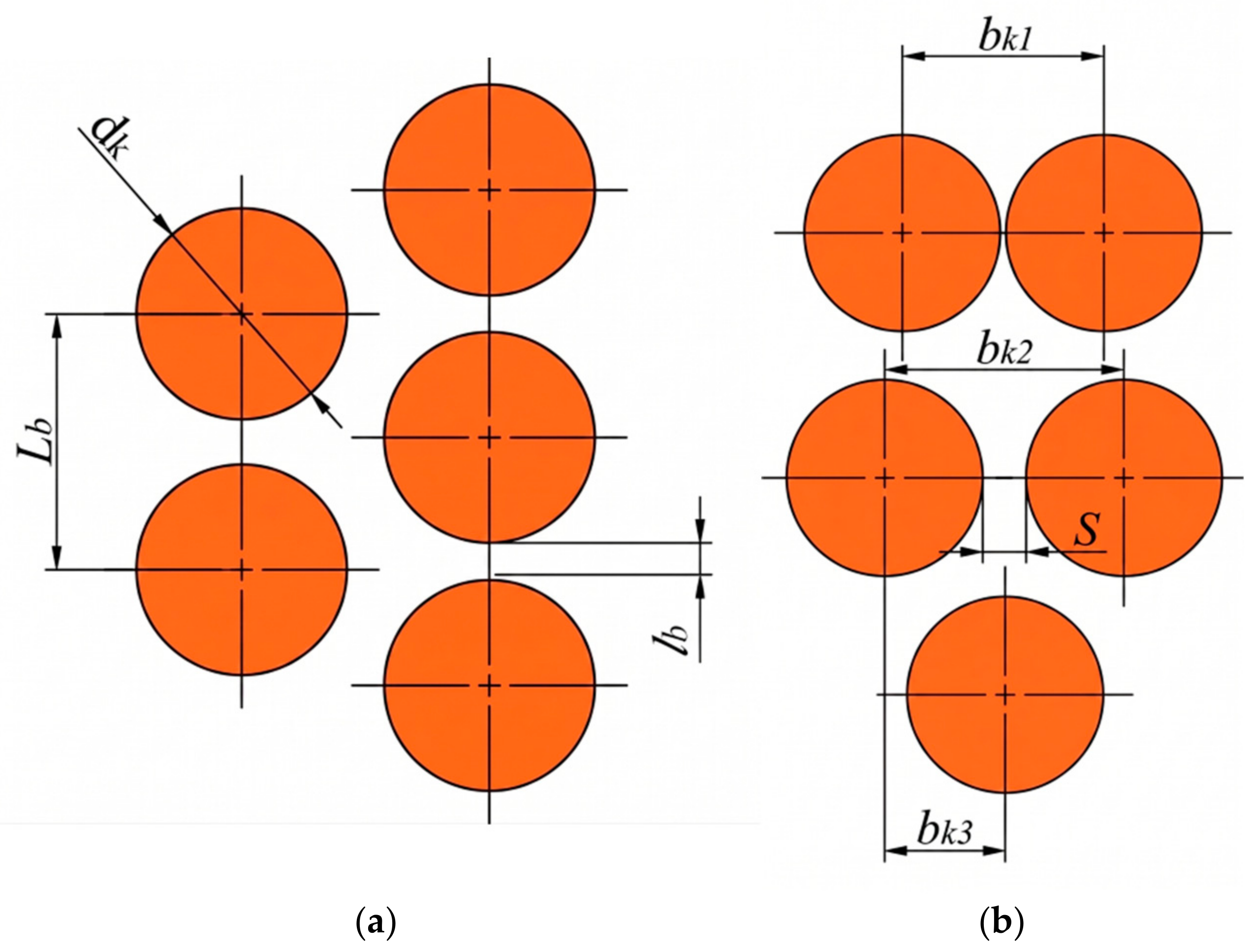
Figure 4.
Schematic representation of soil aggregate distribution relative to roller motion: (a) longitudinal arrangement of soil aggregates, showing the clod diameter (dk), the distance between clod centres (Lb) and the longitudinal spacing between aggregates (lb) used to determine the required number of teeth; (b) transverse arrangement of soil aggregates, showing contacting (bk1), separated (bk2) and staggered (bk3) configurations, as well as the gap between aggregates (S), used to determine the average transverse tooth spacing.
Figure 4.
Schematic representation of soil aggregate distribution relative to roller motion: (a) longitudinal arrangement of soil aggregates, showing the clod diameter (dk), the distance between clod centres (Lb) and the longitudinal spacing between aggregates (lb) used to determine the required number of teeth; (b) transverse arrangement of soil aggregates, showing contacting (bk1), separated (bk2) and staggered (bk3) configurations, as well as the gap between aggregates (S), used to determine the average transverse tooth spacing.
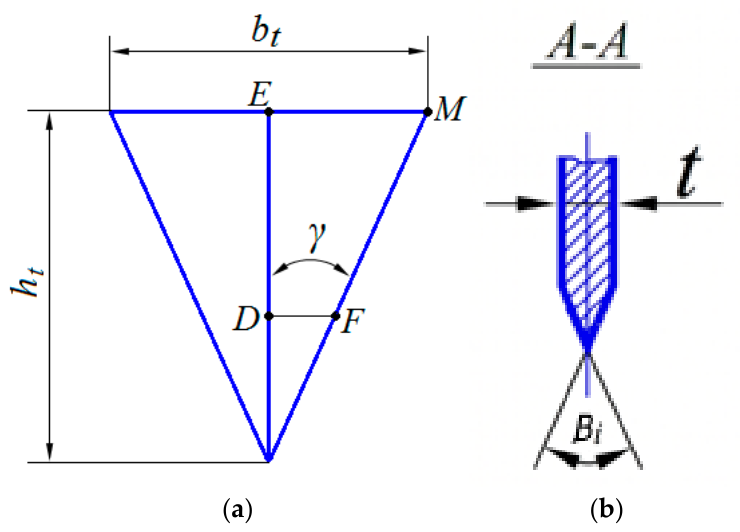
Figure 5.
Geometry of the roller tooth: (a) frontal view of the tooth profile, showing the tooth height (ht), tooth width (bt), opening angle (γ) and characteristic points D, E, F and M used in the analytical description of tooth geometry; (b) cross-section A–A of the tooth, showing the tooth thickness (t) and sharpening angle (βi) used to define the cutting-edge geometry.
Figure 5.
Geometry of the roller tooth: (a) frontal view of the tooth profile, showing the tooth height (ht), tooth width (bt), opening angle (γ) and characteristic points D, E, F and M used in the analytical description of tooth geometry; (b) cross-section A–A of the tooth, showing the tooth thickness (t) and sharpening angle (βi) used to define the cutting-edge geometry.
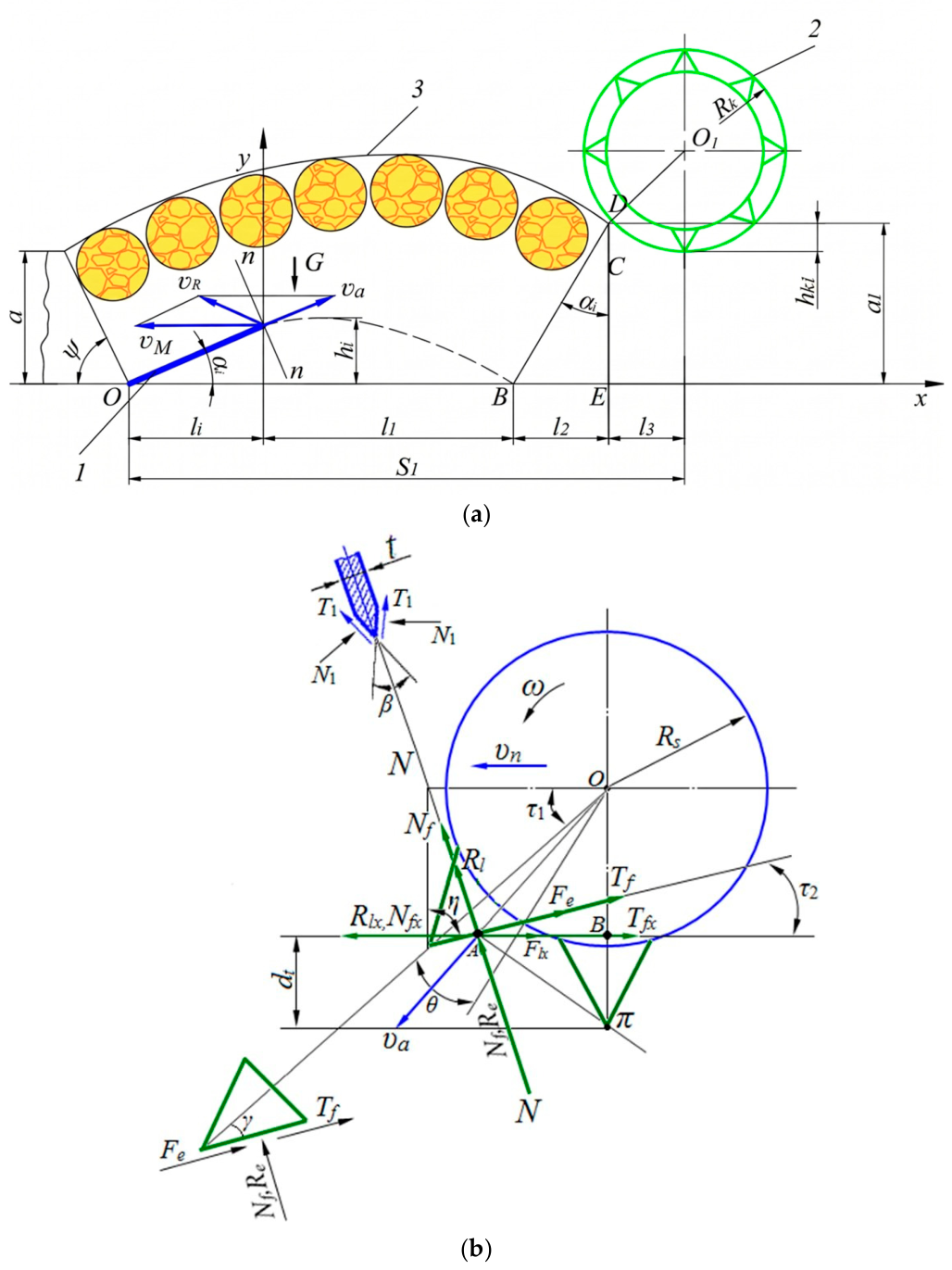
Figure 6.
Combined schematic of soil particle trajectory and force interaction with the roller tooth: (a) kinematic scheme of soil aggregate movement from the chisel tine to the toothed roller, showing the trajectory parameters li, Rt, αi, hi, h1 and S1 used to determine the longitudinal distance between the tine and the roller according to Equation (6); (b) force-interaction scheme between the roller tooth and the soil aggregate, showing the normal reaction, friction force, tooth geometry and resistance components used to formulate the draft resistance model according to Equation (7).
Figure 6.
Combined schematic of soil particle trajectory and force interaction with the roller tooth: (a) kinematic scheme of soil aggregate movement from the chisel tine to the toothed roller, showing the trajectory parameters li, Rt, αi, hi, h1 and S1 used to determine the longitudinal distance between the tine and the roller according to Equation (6); (b) force-interaction scheme between the roller tooth and the soil aggregate, showing the normal reaction, friction force, tooth geometry and resistance components used to formulate the draft resistance model according to Equation (7).
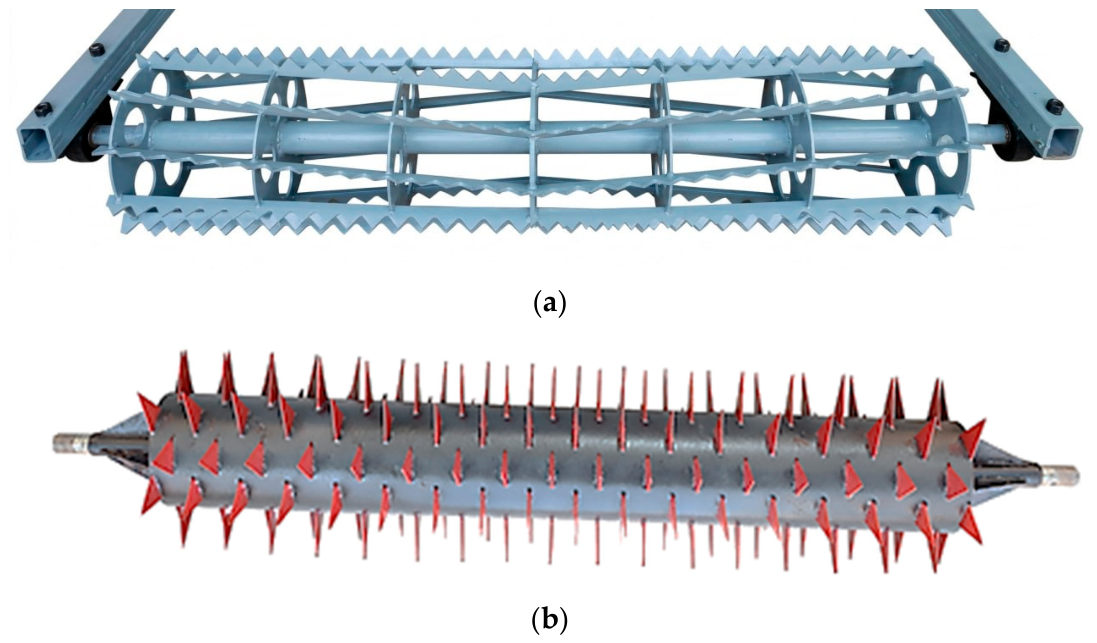
Figure 7.
Experimental rollers: (a) slat roller; (b) toothed roller.
Figure 7.
Experimental rollers: (a) slat roller; (b) toothed roller.
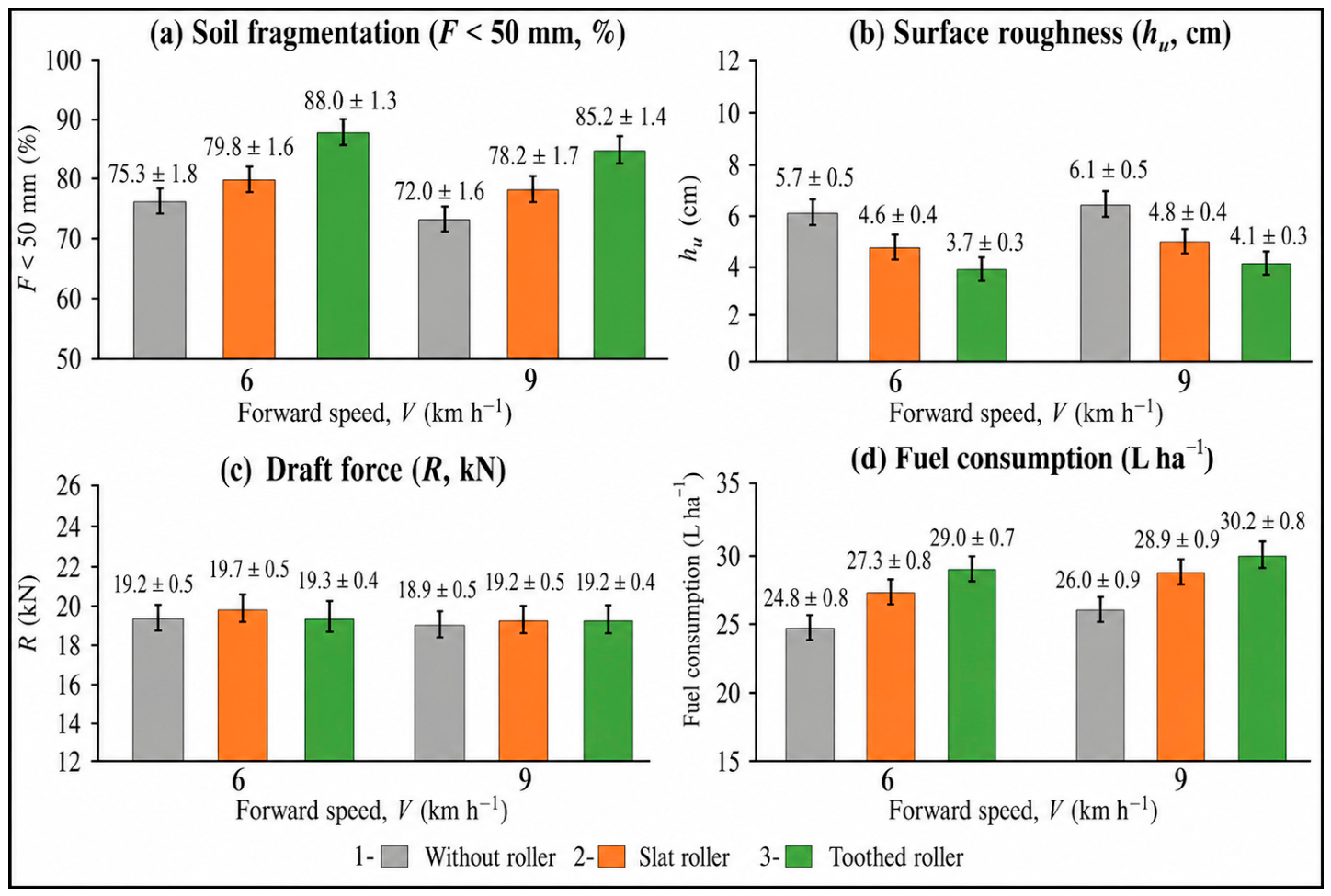
Figure 8.
Effect of roller type on (a) soil fragmentation (F < 50 mm), (b) surface roughness (hu), (c) draft force (R) and (d) fuel consumption at forward speeds of 6 and 9 km h−1. Bars 1, 2 and 3 indicate the chisel plow without a roller, with a slat roller and with the toothed roller, respectively. Error bars indicate ±SD (n = 5).
Figure 8.
Effect of roller type on (a) soil fragmentation (F < 50 mm), (b) surface roughness (hu), (c) draft force (R) and (d) fuel consumption at forward speeds of 6 and 9 km h−1. Bars 1, 2 and 3 indicate the chisel plow without a roller, with a slat roller and with the toothed roller, respectively. Error bars indicate ±SD (n = 5).
Figure 9.
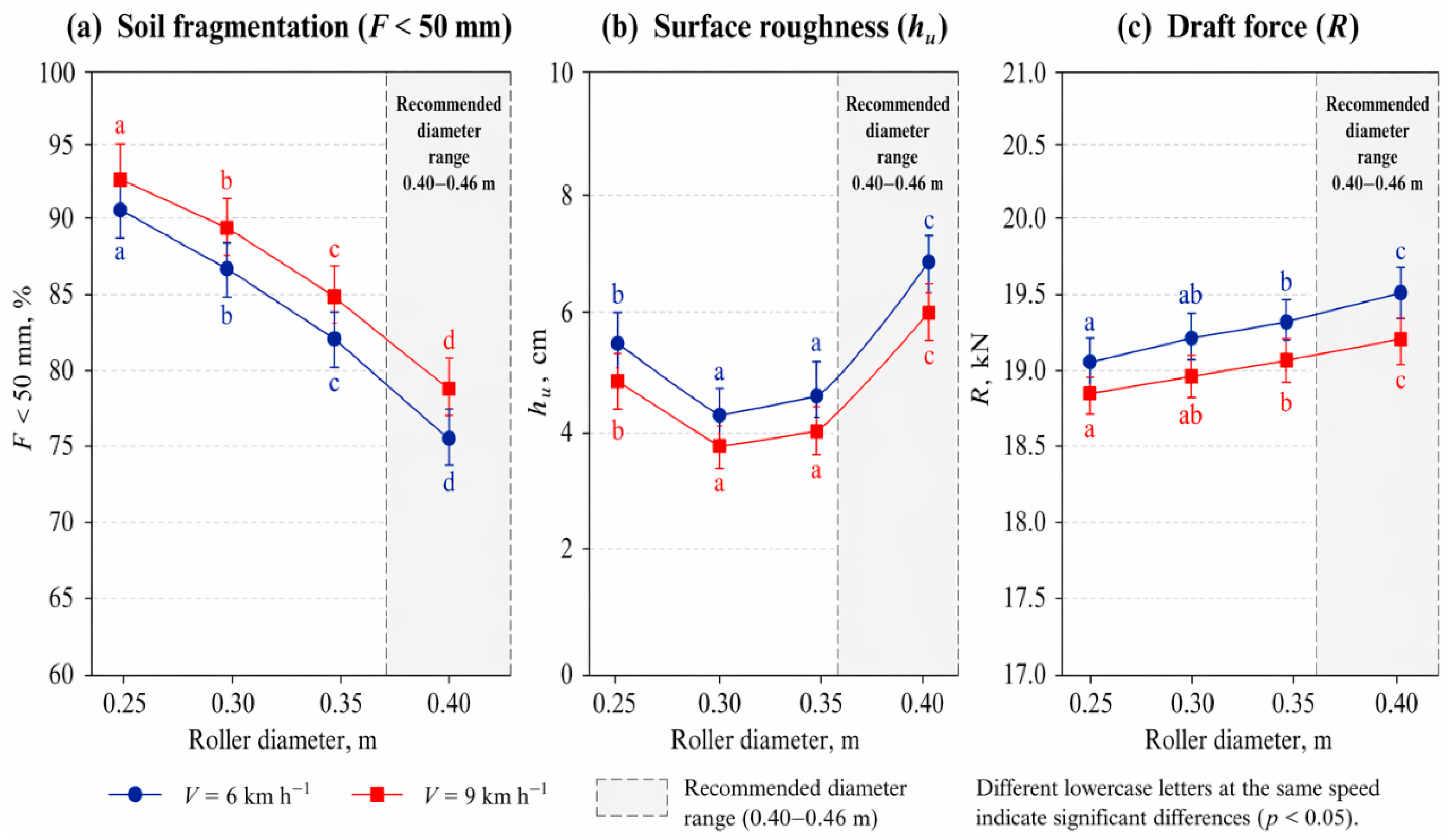
Effect of roller diameter (D) on (a) soil fragmentation (F < 50 mm), (b) surface roughness (hu) and (c) draft force (R) at forward speeds of 6 and 9 km h−1. Symbols denote mean values (n = 5), and error bars represent 95% confidence intervals.
Figure 9.
Effect of roller diameter (D) on (a) soil fragmentation (F < 50 mm), (b) surface roughness (hu) and (c) draft force (R) at forward speeds of 6 and 9 km h−1. Symbols denote mean values (n = 5), and error bars represent 95% confidence intervals.
Figure 10.
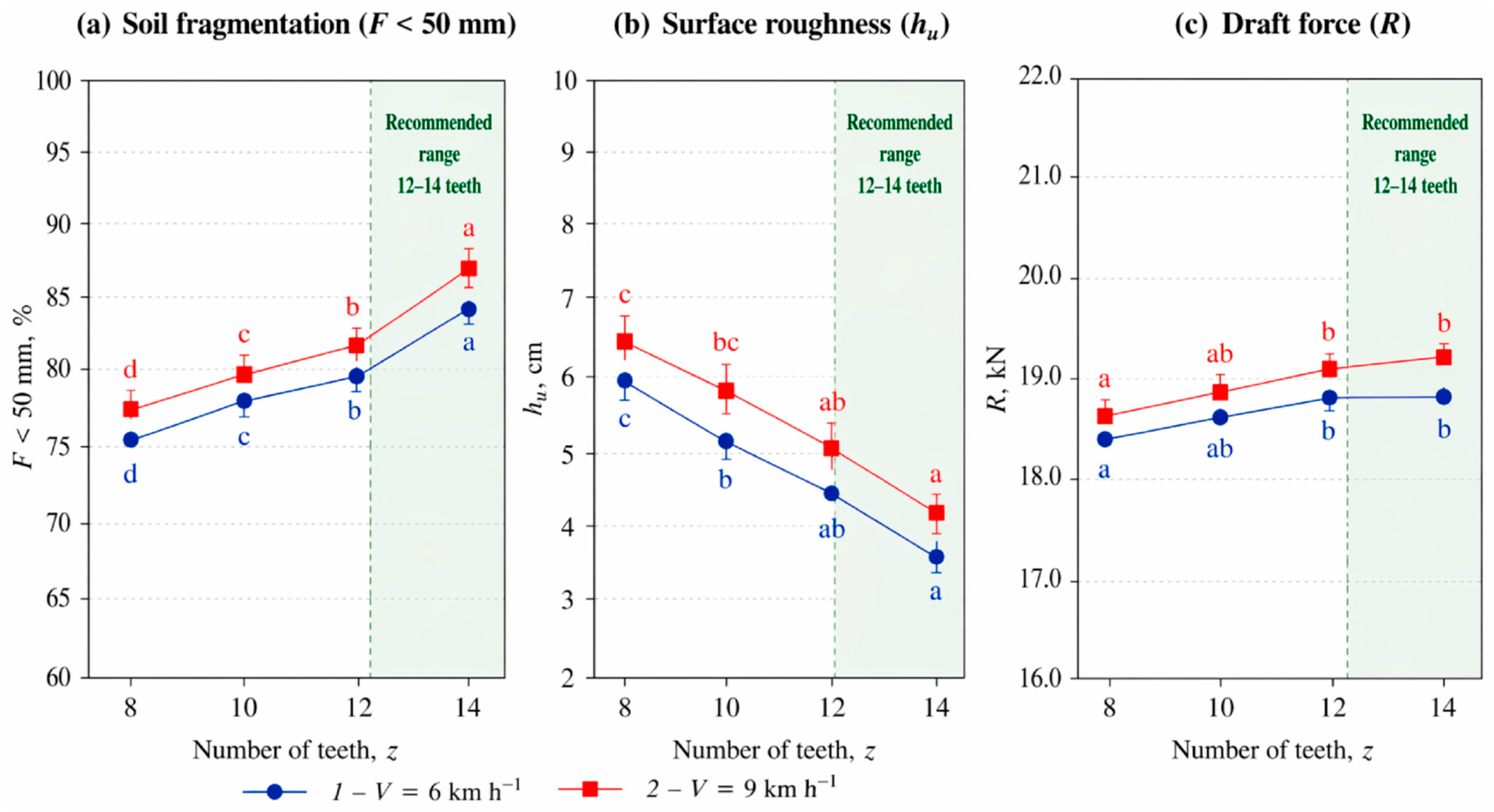
Effect of the number of teeth (z) on (a) soil fragmentation (F < 50 mm), (b) surface roughness (hu), and (c) draft force (R) at forward speeds of 6 and 9 km h−1. Lines correspond to 1—V = 6 km h−1; 2—V = 9 km h−1. Error bars represent 95% confidence intervals.
Figure 10.
Effect of the number of teeth (z) on (a) soil fragmentation (F < 50 mm), (b) surface roughness (hu), and (c) draft force (R) at forward speeds of 6 and 9 km h−1. Lines correspond to 1—V = 6 km h−1; 2—V = 9 km h−1. Error bars represent 95% confidence intervals.
Figure 11.
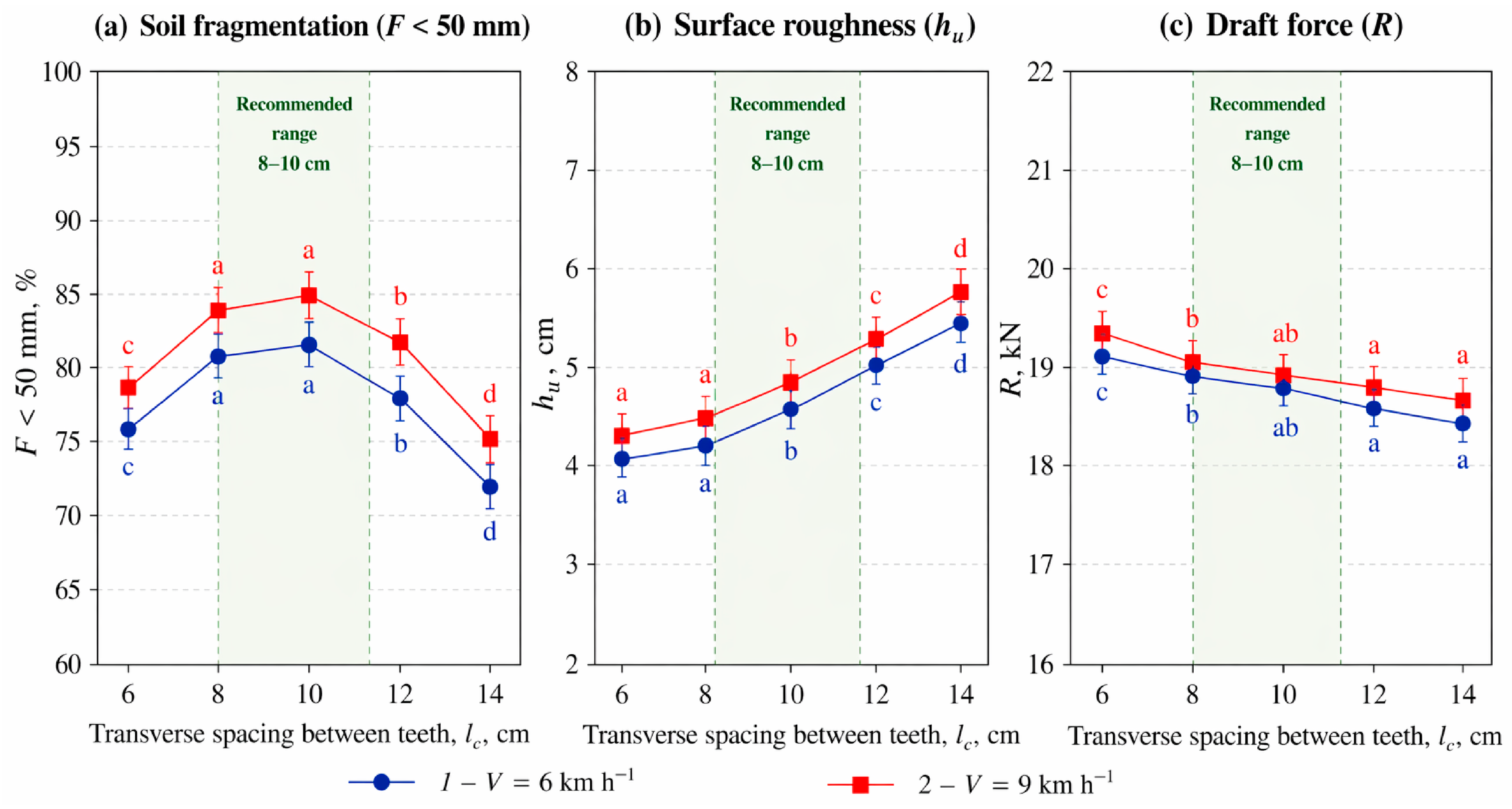
Effect of transverse spacing between teeth (lc) on (a) soil fragmentation (F < 50 mm), (b) surface roughness (hu), and (c) draft force (R) at forward speeds of 6 and 9 km h−1. Lines correspond to 1—V = 6 km h−1; 2—V = 9 km h−1. Error bars represent 95% confidence intervals. The shaded region indicates the recommended spacing range (8–10 cm).
Figure 11.
Effect of transverse spacing between teeth (lc) on (a) soil fragmentation (F < 50 mm), (b) surface roughness (hu), and (c) draft force (R) at forward speeds of 6 and 9 km h−1. Lines correspond to 1—V = 6 km h−1; 2—V = 9 km h−1. Error bars represent 95% confidence intervals. The shaded region indicates the recommended spacing range (8–10 cm).
Figure 12.
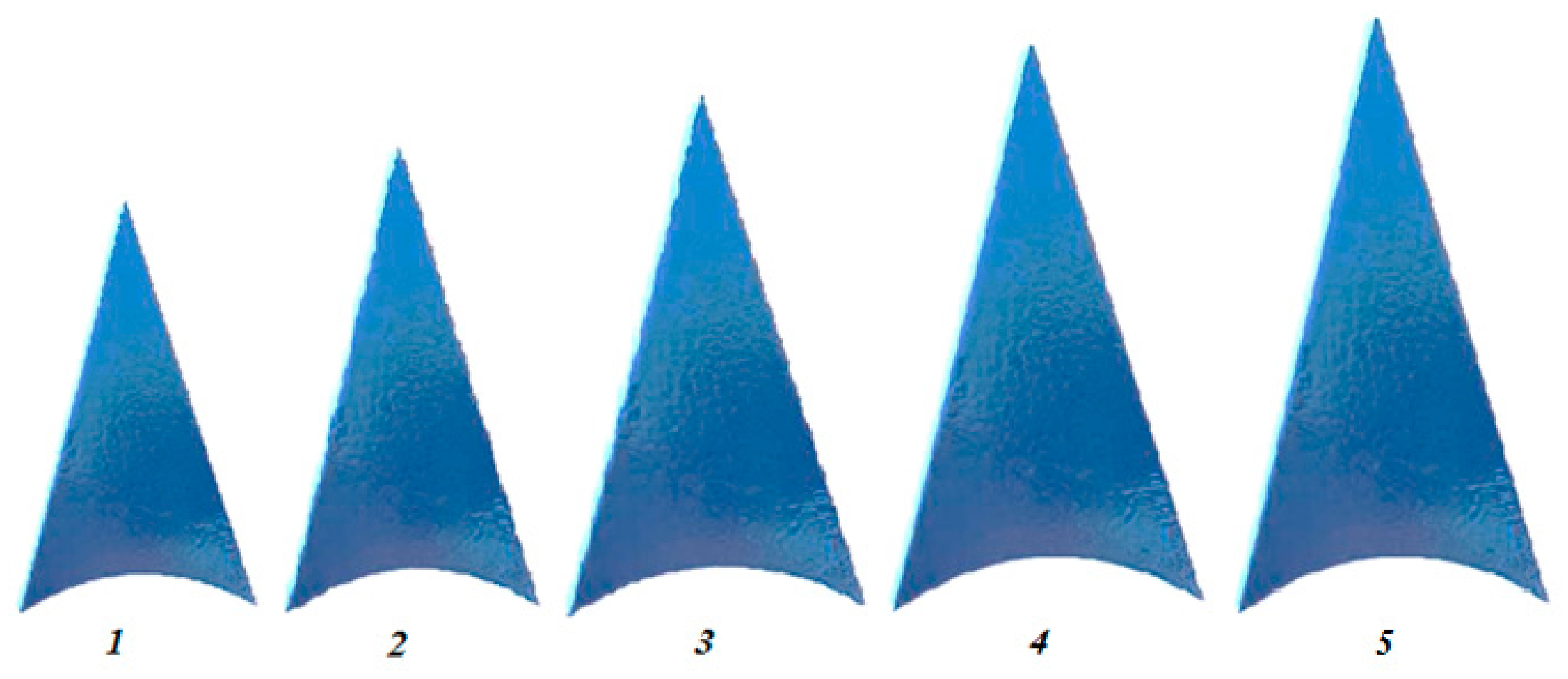
Set of roller teeth with different heights (ht) used to evaluate the effect of tooth height on soil fragmentation and surface roughness: 1—6 cm; 2—7 cm; 3—8 cm; 4—9 cm; and 5—10 cm.
Figure 12.
Set of roller teeth with different heights (ht) used to evaluate the effect of tooth height on soil fragmentation and surface roughness: 1—6 cm; 2—7 cm; 3—8 cm; 4—9 cm; and 5—10 cm.
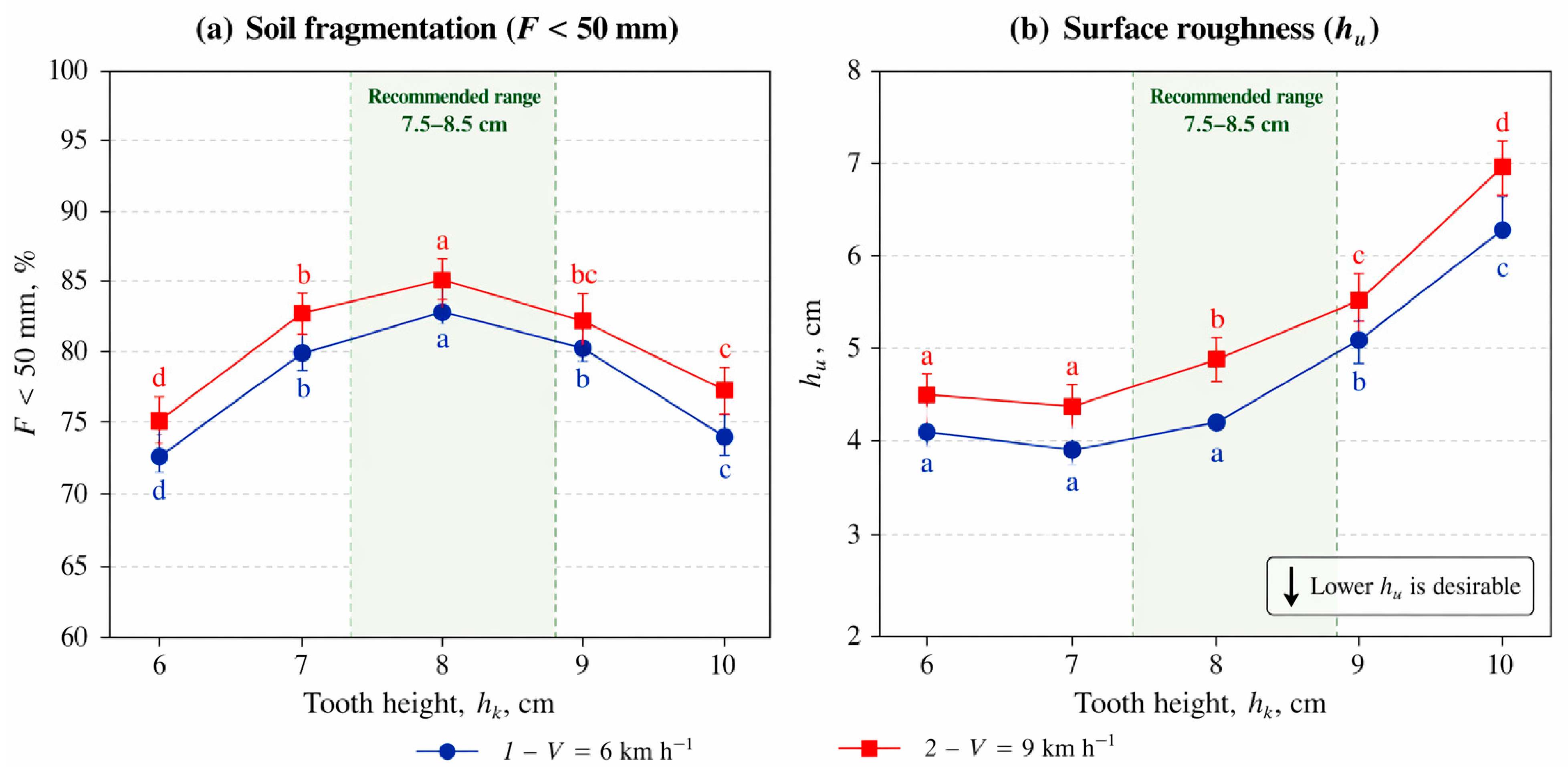
Figure 13.
Effect of tooth height (ht) on (a) soil fragmentation (F < 50 mm) and (b) surface roughness (hu) at forward speeds of 6 and 9 km h−1. Lines 1 and 2 correspond to V = 6 and 9 km h−1, respectively. Error bars indicate ±SD (n = 5). Different letters indicate significant differences at p < 0.05. The shaded area indicates the recommended tooth-height range of 7.5–8.5 cm.
Figure 13.
Effect of tooth height (ht) on (a) soil fragmentation (F < 50 mm) and (b) surface roughness (hu) at forward speeds of 6 and 9 km h−1. Lines 1 and 2 correspond to V = 6 and 9 km h−1, respectively. Error bars indicate ±SD (n = 5). Different letters indicate significant differences at p < 0.05. The shaded area indicates the recommended tooth-height range of 7.5–8.5 cm.
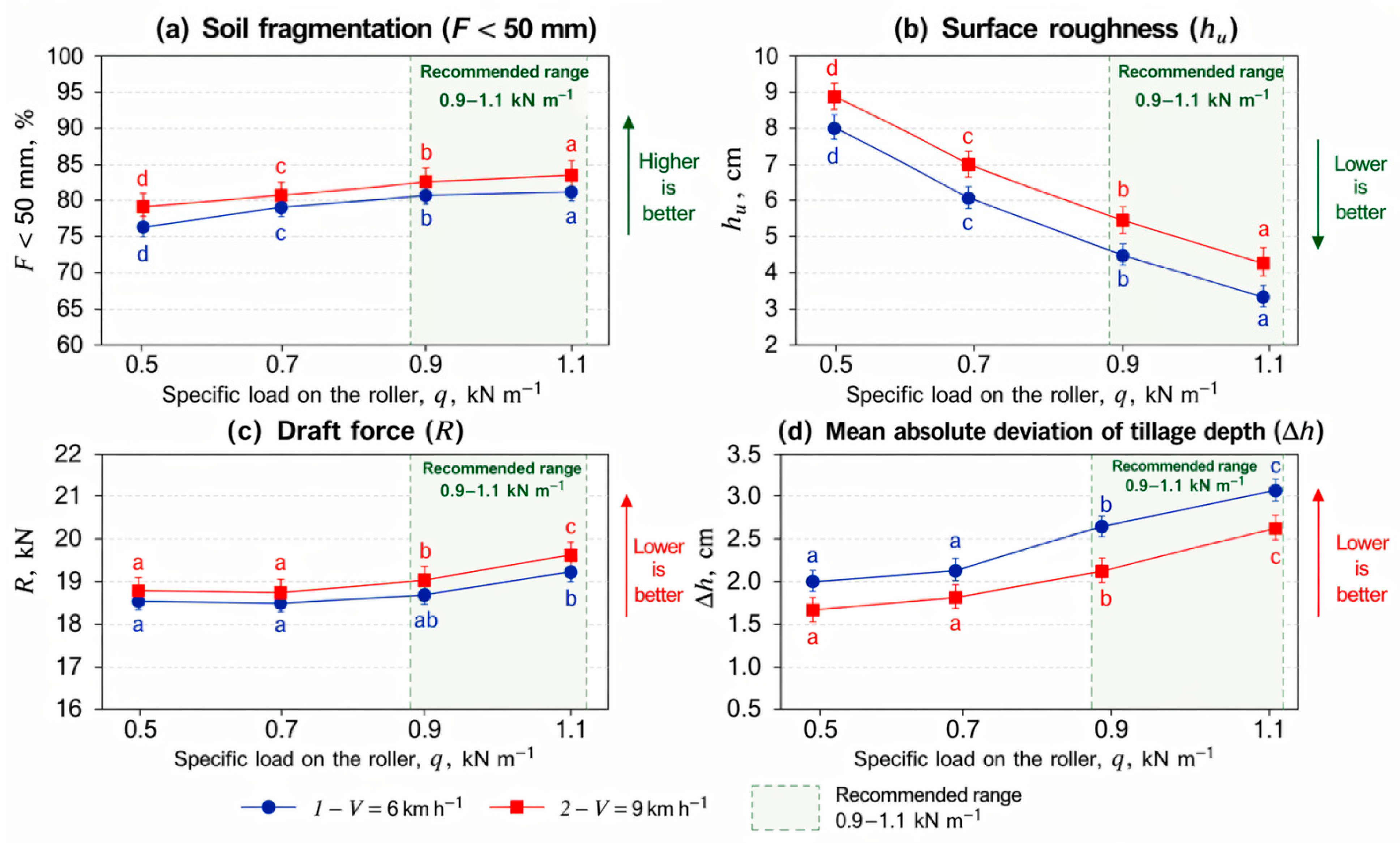
Figure 14.
Effect of specific load on the roller (q) on (a) soil fragmentation (F < 50 mm), (b) surface roughness (hu), (c) draft force (R) and (d) mean absolute deviation of tillage depth (Δh) at forward speeds of 6 and 9 km h−1. Lines 1 and 2 correspond to V = 6 and 9 km h−1, respectively. Error bars indicate ±SD (n = 5). Different letters indicate significant differences at p < 0.05. The shaded area indicates the recommended range of 0.9–1.1 kN m−1.
Figure 14.
Effect of specific load on the roller (q) on (a) soil fragmentation (F < 50 mm), (b) surface roughness (hu), (c) draft force (R) and (d) mean absolute deviation of tillage depth (Δh) at forward speeds of 6 and 9 km h−1. Lines 1 and 2 correspond to V = 6 and 9 km h−1, respectively. Error bars indicate ±SD (n = 5). Different letters indicate significant differences at p < 0.05. The shaded area indicates the recommended range of 0.9–1.1 kN m−1.
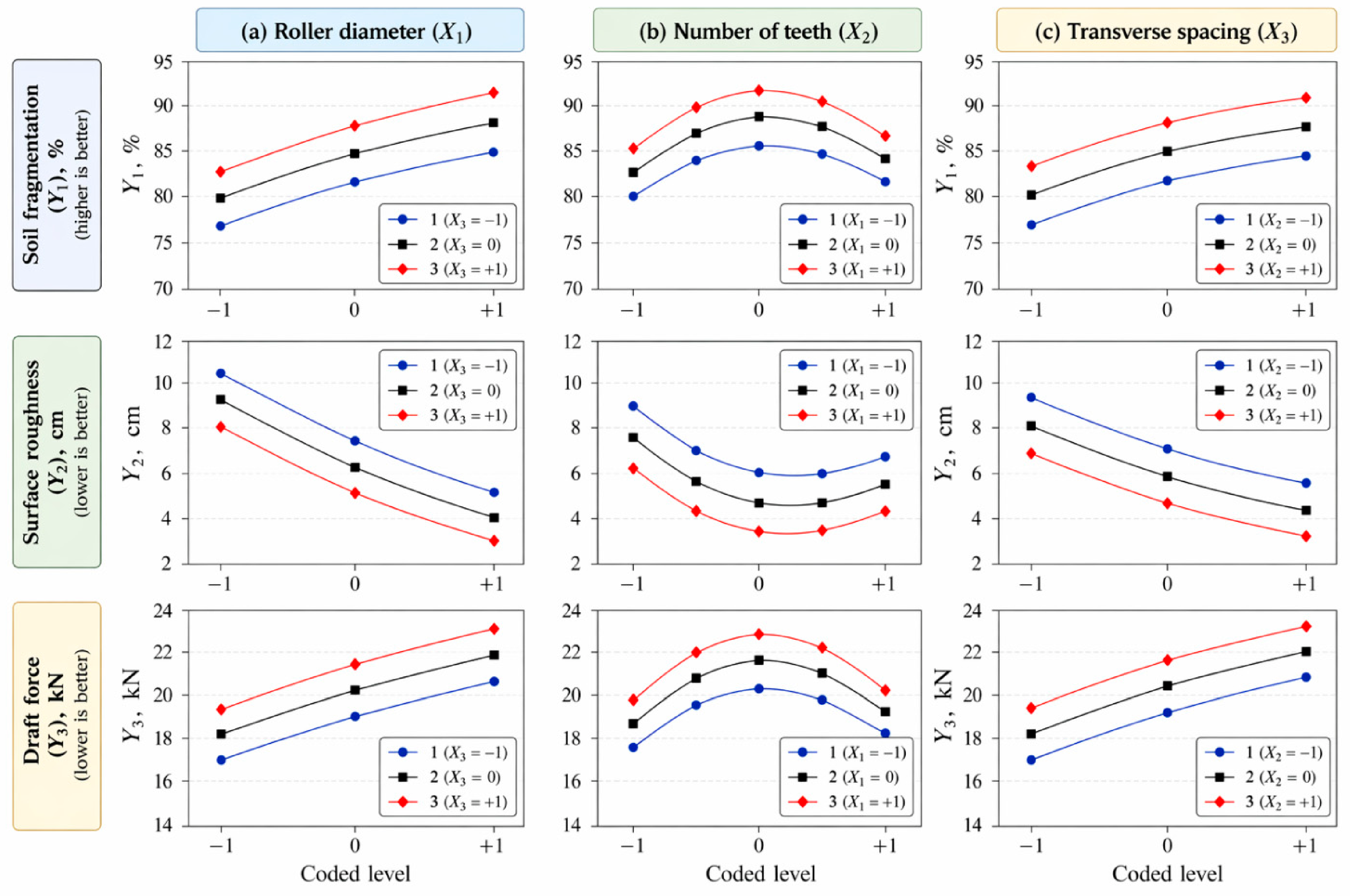
Figure 15.
Partial response plots derived from the regression models, showing the effects of coded factors on soil fragmentation (Y1), surface roughness (Y2) and draft force (Y3): (a) roller diameter (X1); (b) number of teeth (X2); and (c) transverse spacing between teeth (X3). In each column, the horizontal axis represents the coded level of the factor indicated in the column heading, while the curves show the lower (−1), central (0) and upper (+1) levels of the interacting factor indicated in the legend. The remaining factors were fixed at their central coded levels.
Figure 15.
Partial response plots derived from the regression models, showing the effects of coded factors on soil fragmentation (Y1), surface roughness (Y2) and draft force (Y3): (a) roller diameter (X1); (b) number of teeth (X2); and (c) transverse spacing between teeth (X3). In each column, the horizontal axis represents the coded level of the factor indicated in the column heading, while the curves show the lower (−1), central (0) and upper (+1) levels of the interacting factor indicated in the legend. The remaining factors were fixed at their central coded levels.
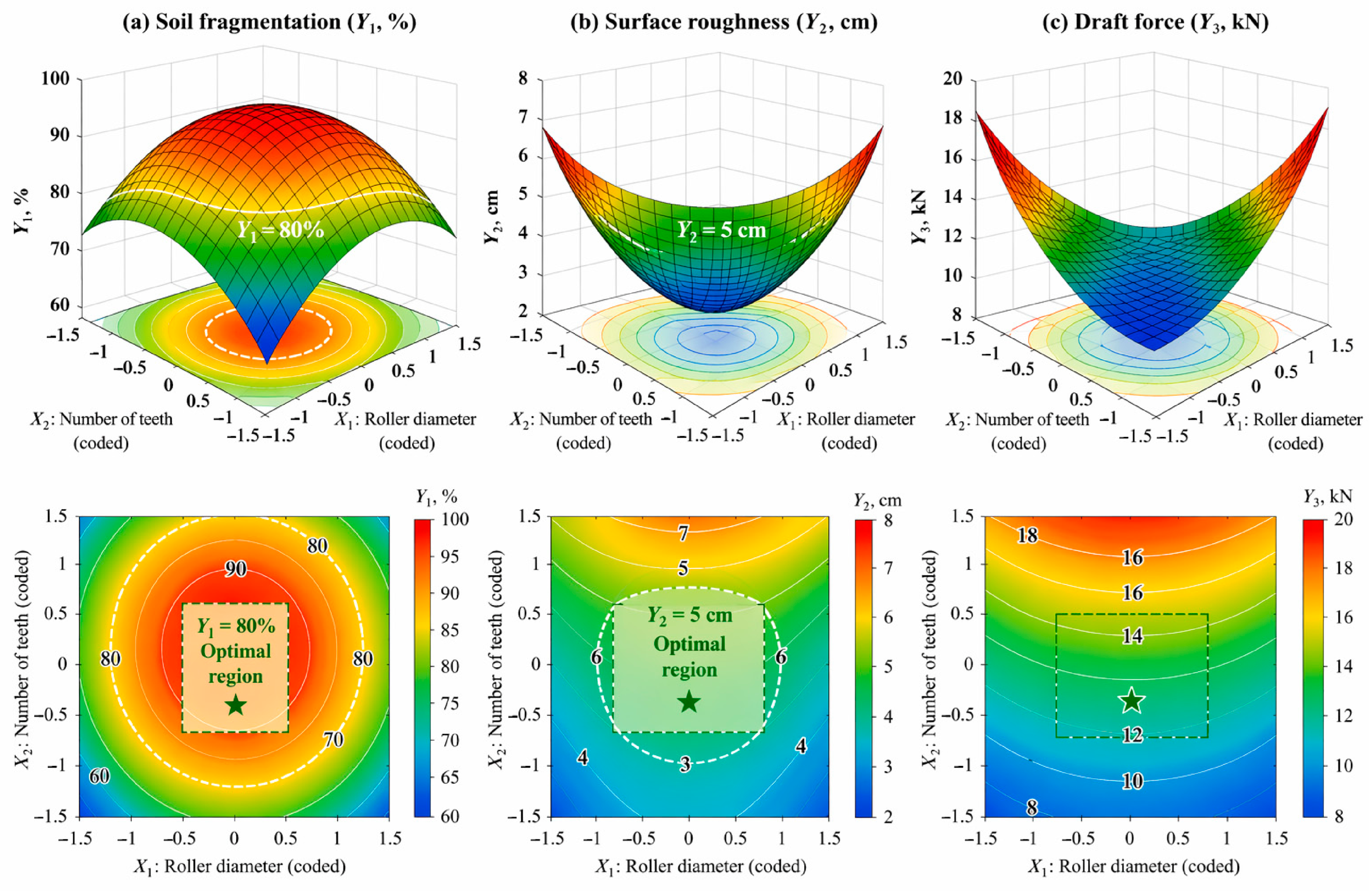
Figure 16.
Response surface and contour plots of (a) soil fragmentation (Y1), (b) surface roughness (Y2), and (c) draft force (Y3) as functions of coded factors X1 (roller diameter) and X2 (number of teeth). The remaining factors were fixed at their central levels (X3 = 0, X4 = 0). The optimal region corresponds to Y1 ≥ 80% and Y2 ≤ 5 cm. The green star indicates the selected optimal parameter combination within the rational region obtained from the response surface analysis.
Figure 16.
Response surface and contour plots of (a) soil fragmentation (Y1), (b) surface roughness (Y2), and (c) draft force (Y3) as functions of coded factors X1 (roller diameter) and X2 (number of teeth). The remaining factors were fixed at their central levels (X3 = 0, X4 = 0). The optimal region corresponds to Y1 ≥ 80% and Y2 ≤ 5 cm. The green star indicates the selected optimal parameter combination within the rational region obtained from the response surface analysis.
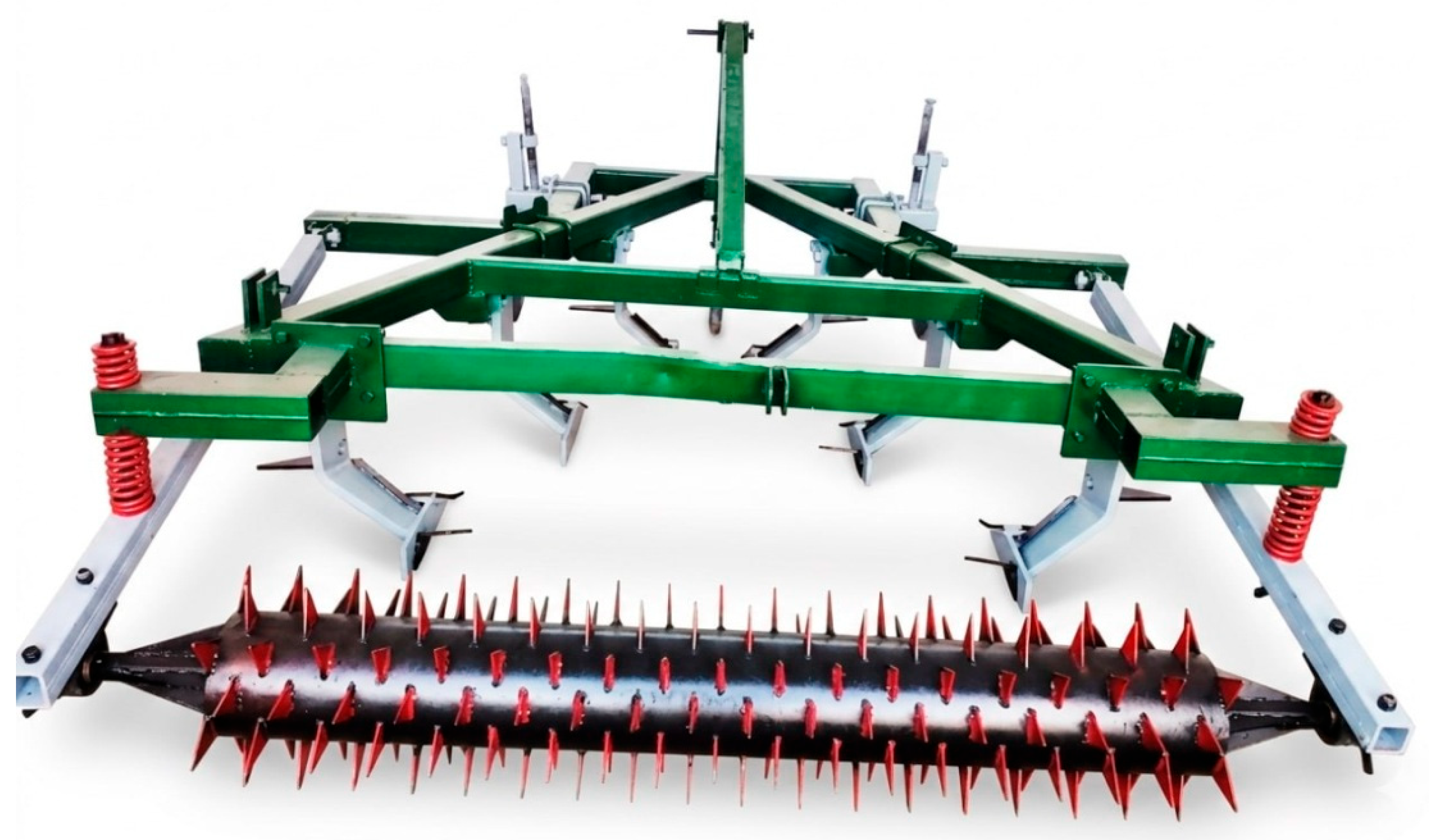
Figure 17.
General view of the developed chisel plow equipped with a passive toothed roller used for combined soil loosening, aggregate fragmentation and surface levelling under field conditions.
Figure 17.
General view of the developed chisel plow equipped with a passive toothed roller used for combined soil loosening, aggregate fragmentation and surface levelling under field conditions.
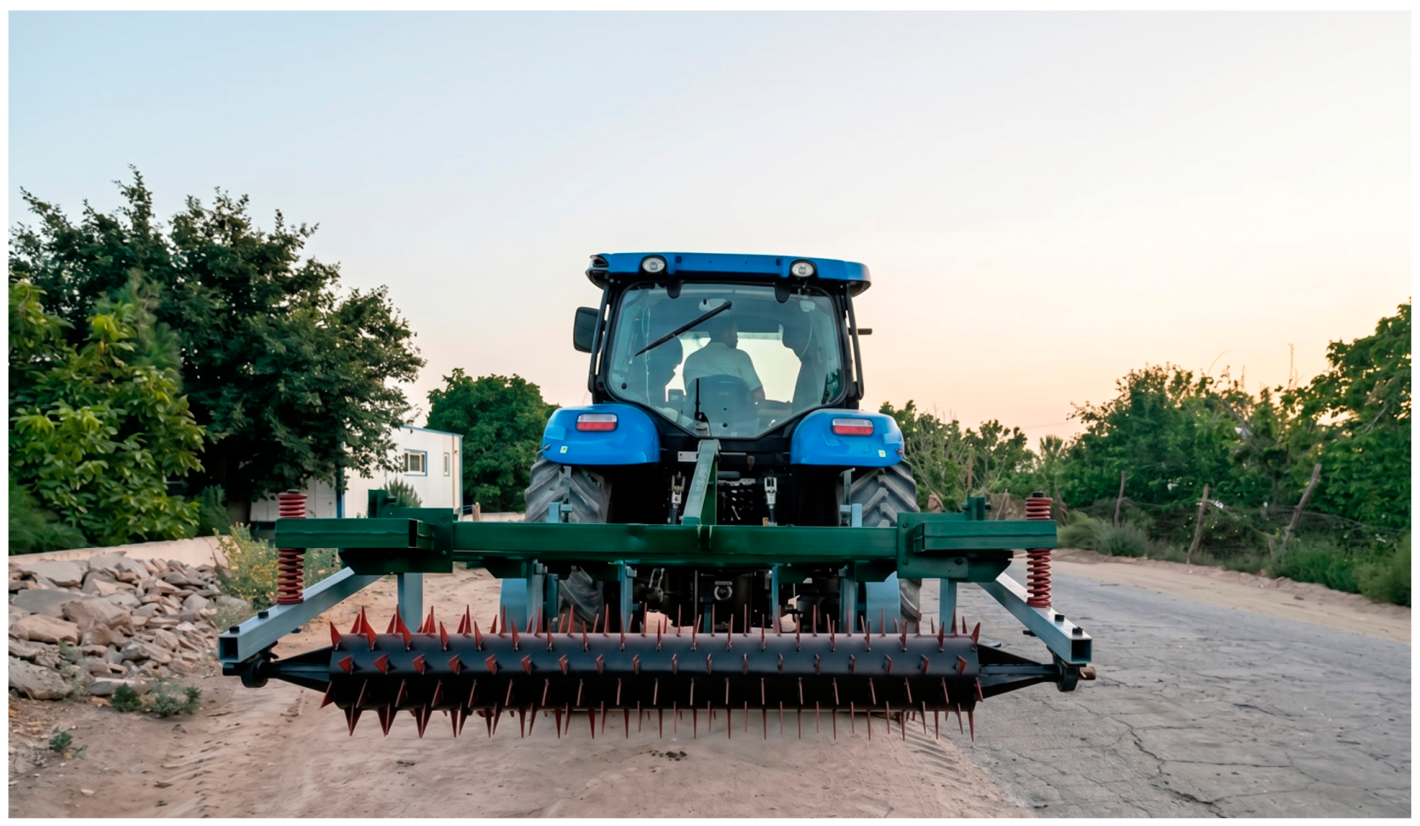
Figure 18.
Rear view of the tractor–implement unit consisting of the tractor and the developed chisel plow equipped with a passive toothed roller before field operation.
Figure 18.
Rear view of the tractor–implement unit consisting of the tractor and the developed chisel plow equipped with a passive toothed roller before field operation.
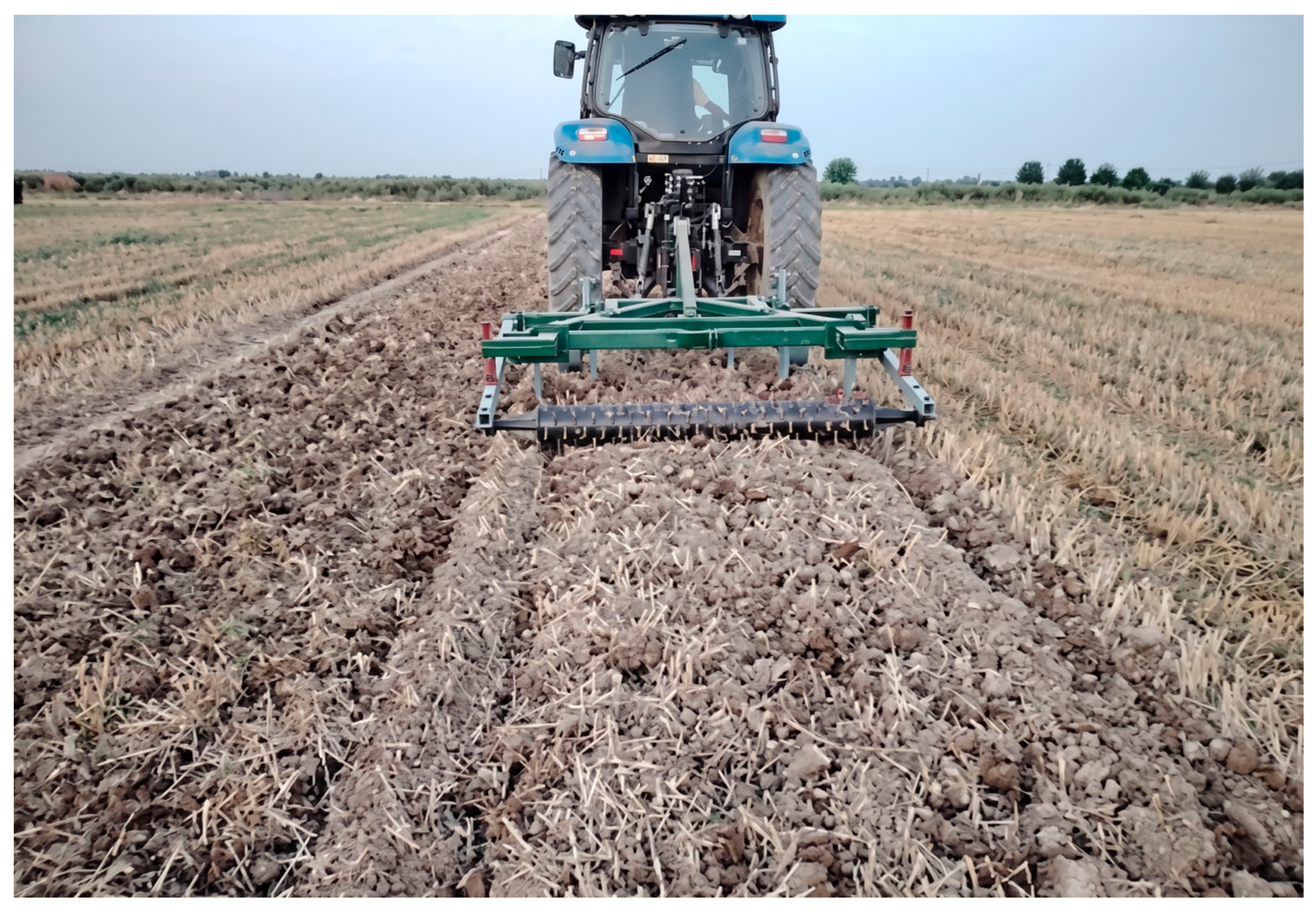
Figure 19.
Field operation of the developed chisel plow equipped with a passive toothed roller during post-harvest winter wheat stubble tillage.
Figure 19.
Field operation of the developed chisel plow equipped with a passive toothed roller during post-harvest winter wheat stubble tillage.
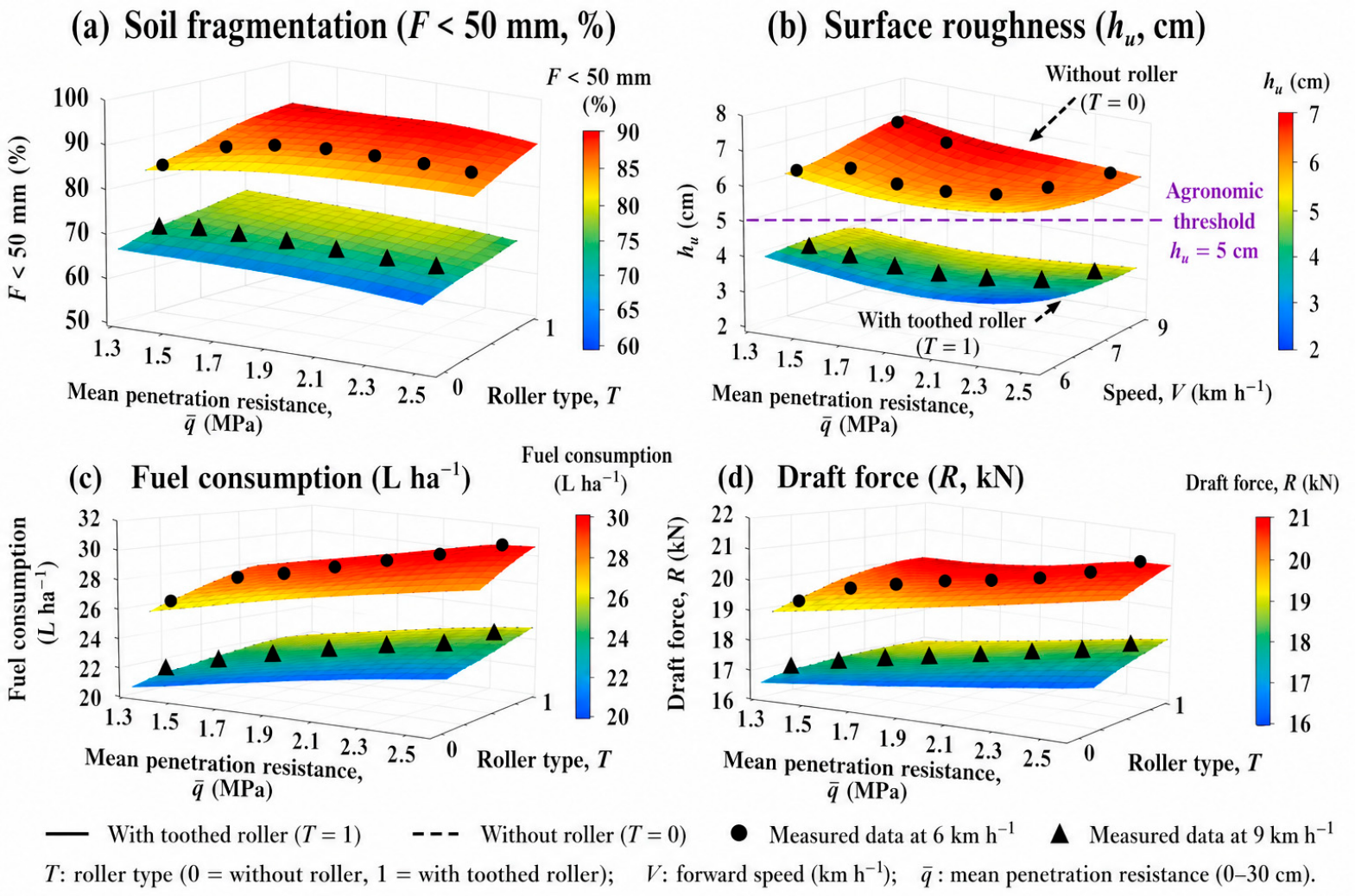
Figure 20.
Response surfaces for (a) soil fragmentation (F < 50 mm), (b) surface roughness (hu), (c) fuel consumption and (d) draft force (R) as affected by mean penetration resistance (), roller type (T) and forward speed (V).
Figure 20.
Response surfaces for (a) soil fragmentation (F < 50 mm), (b) surface roughness (hu), (c) fuel consumption and (d) draft force (R) as affected by mean penetration resistance (), roller type (T) and forward speed (V).
Figure 21.
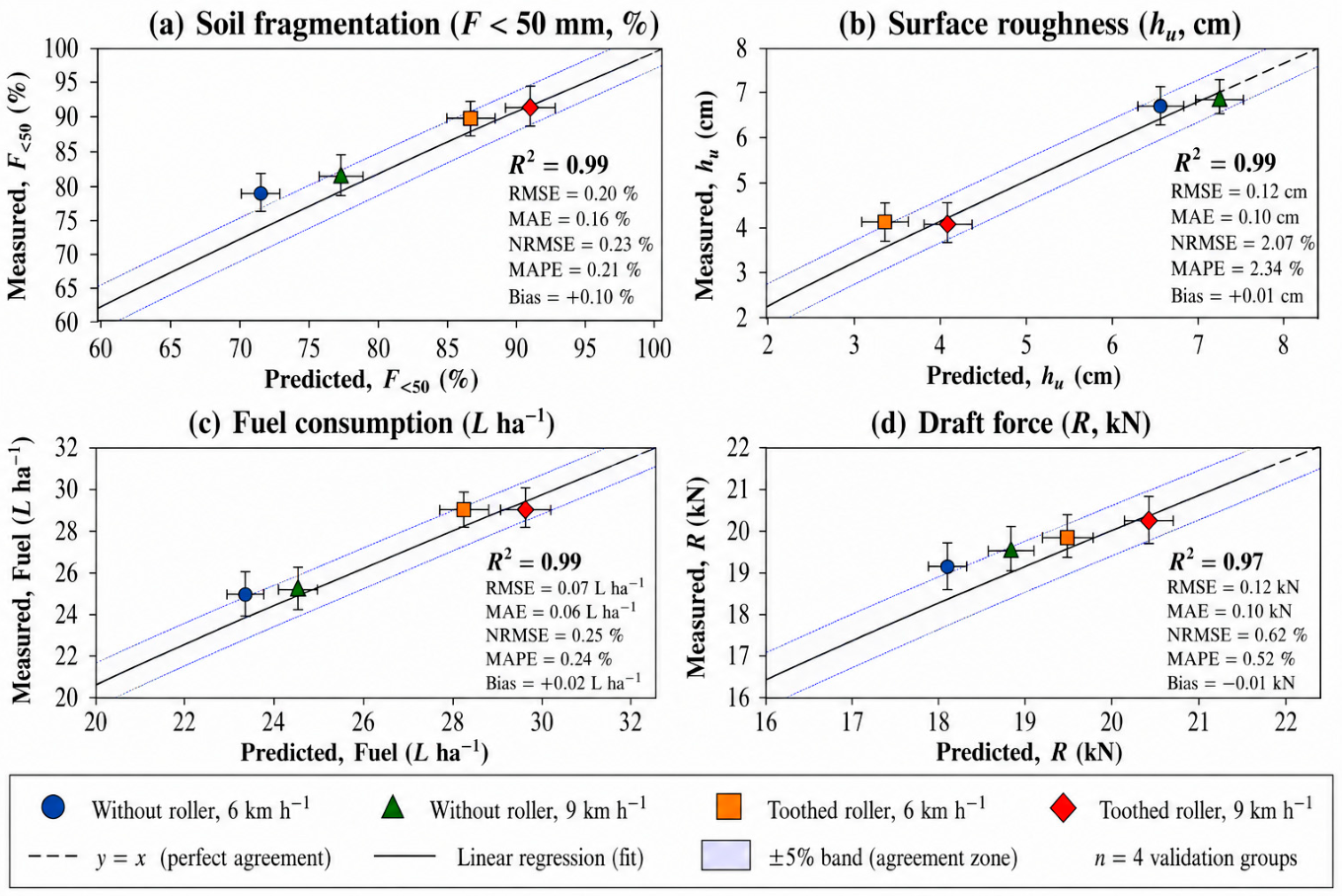
Validation of the regression models by comparison of predicted and measured values for (a) soil fragmentation (F < 50 mm), (b) surface roughness (hu), (c) fuel consumption and (d) draft force (R).
Figure 21.
Validation of the regression models by comparison of predicted and measured values for (a) soil fragmentation (F < 50 mm), (b) surface roughness (hu), (c) fuel consumption and (d) draft force (R).
Figure 22.
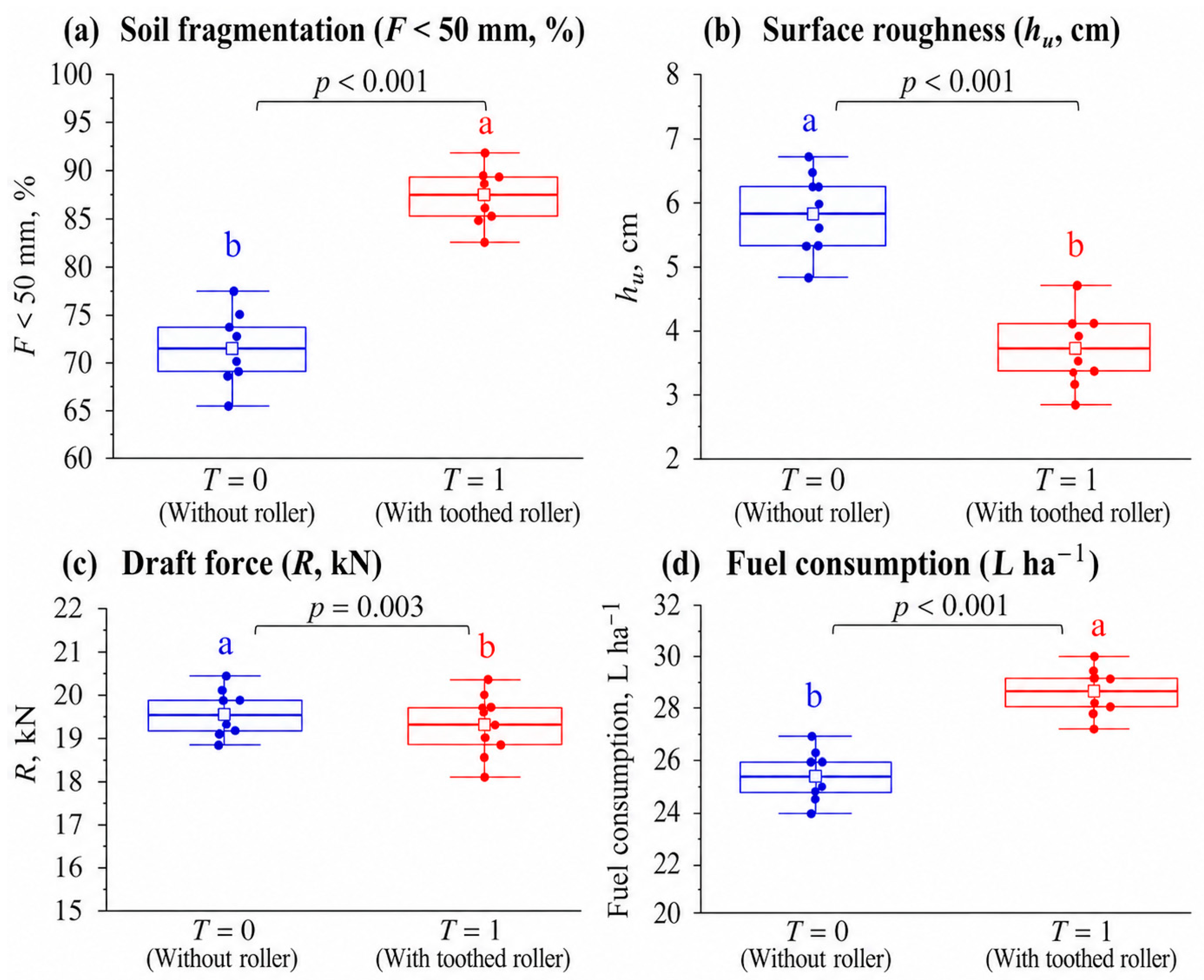
Box plots of tillage performance indicators for the chisel plow without a roller (T = 0) and with the toothed roller (T = 1): (a) soil fragmentation (F < 50 mm), (b) surface roughness (hu), (c) draft force (R) and (d) fuel consumption.
Figure 22.
Box plots of tillage performance indicators for the chisel plow without a roller (T = 0) and with the toothed roller (T = 1): (a) soil fragmentation (F < 50 mm), (b) surface roughness (hu), (c) draft force (R) and (d) fuel consumption.
Figure 23.
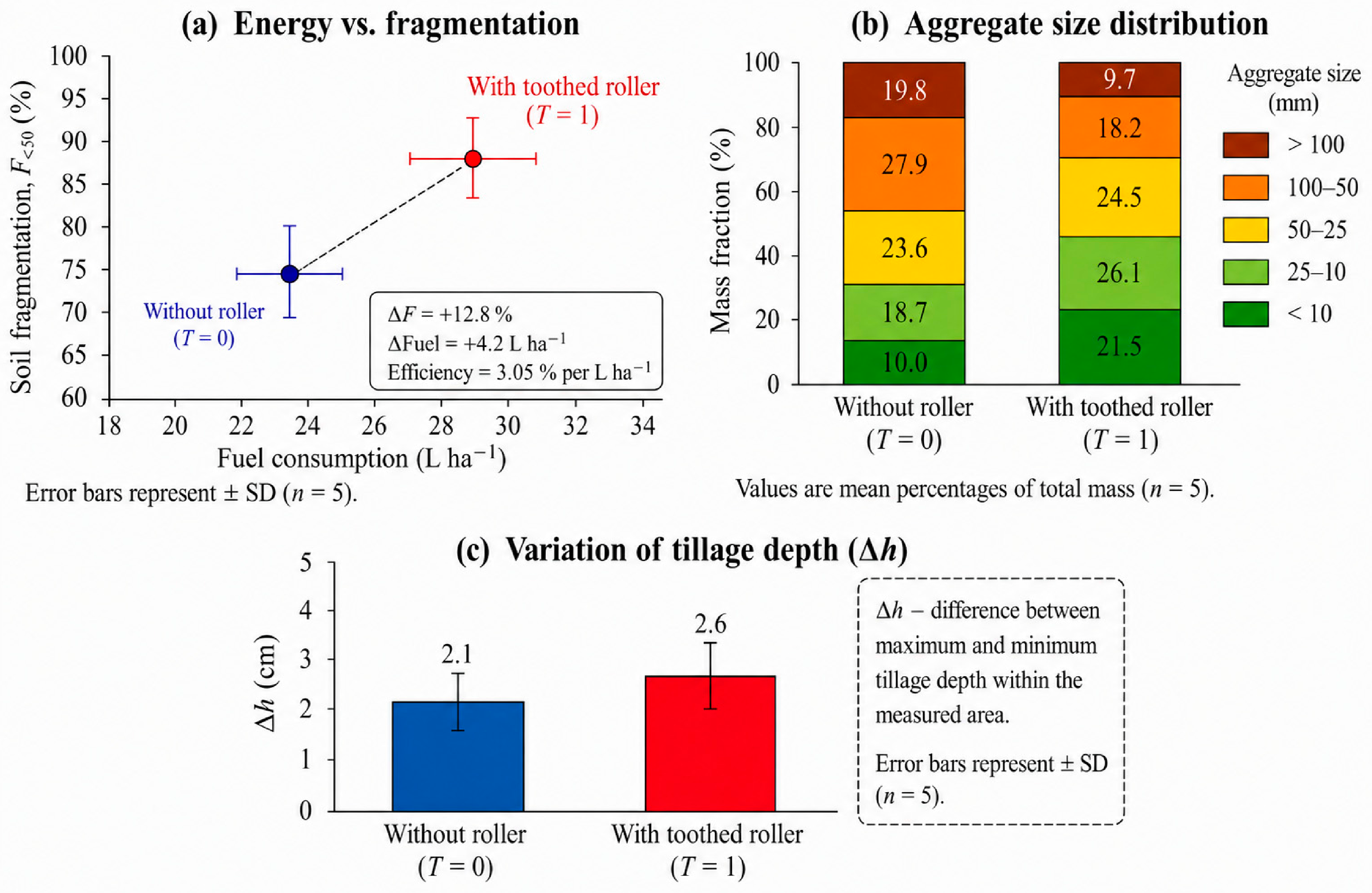
Field validation results for the chisel plow without a roller (T = 0) and with the toothed roller (T = 1): (a) relationship between fuel consumption and soil fragmentation, expressed as the proportion of aggregates smaller than 50 mm (F < 50 mm); (b) aggregate-size distribution after tillage, showing the mass fractions of aggregates in the size classes > 100, 100–50, 50–25, 25–10 and <10 mm; and (c) variation in tillage depth (Δh), calculated as the difference between the maximum and minimum tillage depth within the measured area. Error bars indicate ±SD (n = 5).
Figure 23.
Field validation results for the chisel plow without a roller (T = 0) and with the toothed roller (T = 1): (a) relationship between fuel consumption and soil fragmentation, expressed as the proportion of aggregates smaller than 50 mm (F < 50 mm); (b) aggregate-size distribution after tillage, showing the mass fractions of aggregates in the size classes > 100, 100–50, 50–25, 25–10 and <10 mm; and (c) variation in tillage depth (Δh), calculated as the difference between the maximum and minimum tillage depth within the measured area. Error bars indicate ±SD (n = 5).
Table 1.
Initial soil conditions before tillage.
Table 1.
Initial soil conditions before tillage.
| Soil Layer, cm | Moisture, % | Bulk Density, g cm−3 | Penetration Resistance, MPa |
|---|
| 0–10 | 12.6 | 1.20 | 1.32 |
| 10–20 | 14.7 | 1.29 | 2.02 |
| 20–30 | 16.3 | 1.34 | 2.41 |
Table 2.
Experimental factors, their coded symbols, units, and levels used in the multifactor experimental design.
Table 2.
Experimental factors, their coded symbols, units, and levels used in the multifactor experimental design.
| Factor | Unit | Code | Step interval, ΔX | −1 | 0 | +1 |
|---|
| Roller diameter | m | X1 | 0.125 | 0.25 | 0.375 | 0.50 |
| Number of teeth | – | X2 | 2 | 11 | 13 | 15 |
| Transverse spacing between teeth | cm | X3 | 2 | 6.5 | 8.5 | 10.5 |
| Forward speed | km h−1 | X4 | 1.5 | 6.0 | 7.5 | 9.0 |
Table 3.
Effect of roller diameter (D) on soil fragmentation, surface roughness, and draft force at different forward speeds (mean ± SD, n = 5). Different superscript letters within the same row indicate statistically significant differences between treatments at p < 0.05 according to the LSD test.
Table 3.
Effect of roller diameter (D) on soil fragmentation, surface roughness, and draft force at different forward speeds (mean ± SD, n = 5). Different superscript letters within the same row indicate statistically significant differences between treatments at p < 0.05 according to the LSD test.
| Parameter | Speed, km h−1 | 0.25 m | 0.30 m | 0.35 m | 0.40 m | LSD0.05 |
|---|
| F < 50 mm, % | 6 | 91.0 ± 1.2 a | 87.0 ± 1.0 b | 83.0 ± 0.9 c | 76.0 ± 1.1 d | 2.1 |
| 9 | 93.0 ± 1.3 a | 90.0 ± 1.1 b | 85.0 ± 1.0 c | 79.0 ± 1.2 d | 2.3 |
| hu, cm | 6 | 5.5 ± 0.3 b | 4.5 ± 0.2 a | 4.8 ± 0.2 a | 7.0 ± 0.4 c | 0.5 |
| 9 | 5.0 ± 0.2 b | 4.0 ± 0.2 a | 4.3 ± 0.2 a | 6.0 ± 0.3 c | 0.4 |
| R, kN | 6 | 19.10 ± 0.08 a | 19.28 ± 0.07 ab | 19.40 ± 0.06 b | 19.57 ± 0.09 c | 0.12 |
| 9 | 18.90 ± 0.07 a | 19.05 ± 0.06 ab | 19.17 ± 0.06 b | 19.31 ± 0.08 c | 0.11 |
Table 4.
Effect of the number of teeth (z) on soil fragmentation, surface roughness, and draft force at different forward speeds (mean ± SD, n = 5). Different superscript letters within the same row indicate statistically significant differences between treatments at p < 0.05 according to the LSD test.
Table 4.
Effect of the number of teeth (z) on soil fragmentation, surface roughness, and draft force at different forward speeds (mean ± SD, n = 5). Different superscript letters within the same row indicate statistically significant differences between treatments at p < 0.05 according to the LSD test.
| Parameter | Speed, km h−1 | 8 Teeth | 10 Teeth | 12 Teeth | 14 Teeth | LSD0.05 |
|---|
| F < 50 mm, % | 6 | 76.5 ± 1.0 d | 78.5 ± 0.9 c | 80.5 ± 0.8 b | 85.5 ± 1.0 a | 2.0 |
| 9 | 78.0 ± 1.1 d | 80.5 ± 1.0 c | 82.5 ± 0.9 b | 88.0 ± 1.1 a | 2.2 |
| hu, cm | 6 | 6.0 ± 0.3 c | 5.3 ± 0.2 b | 4.7 ± 0.2 ab | 3.7 ± 0.2 a | 0.5 |
| 9 | 6.5 ± 0.3 c | 6.0 ± 0.3 bc | 5.1 ± 0.2 b | 4.2 ± 0.2 a | 0.6 |
| R, kN | 6 | 18.50 ± 0.08 a | 18.80 ± 0.07 ab | 19.00 ± 0.06 b | 19.10 ± 0.06 b | 0.12 |
| 9 | 18.65 ± 0.07 a | 18.95 ± 0.07 ab | 19.15 ± 0.06 b | 19.25 ± 0.07 b | 0.13 |
Table 5.
Effect of transverse spacing between teeth (lc) on soil fragmentation, surface roughness, and draft force at different forward speeds (mean ± SD, n = 5). Different superscript letters within the same row indicate statistically significant differences between treatments at p < 0.05 according to the LSD test.
Table 5.
Effect of transverse spacing between teeth (lc) on soil fragmentation, surface roughness, and draft force at different forward speeds (mean ± SD, n = 5). Different superscript letters within the same row indicate statistically significant differences between treatments at p < 0.05 according to the LSD test.
| Parameter | Speed, km h−1 | 6 cm | 8 cm | 10 cm | 12 cm | 14 cm | LSD0.05 |
|---|
| F < 50 mm, % | 6 | 76.0 ± 1.0 c | 81.0 ± 0.9 a | 82.0 ± 0.9 a | 78.0 ± 1.0 b | 72.0 ± 1.1 d | 2.1 |
| 9 | 78.5 ± 1.1 c | 83.5 ± 1.0 a | 84.5 ± 1.0 a | 82.0 ± 1.1 b | 75.0 ± 1.2 d | 2.3 |
| hu, cm | 6 | 4.1 ± 0.2 a | 4.3 ± 0.2 a | 4.7 ± 0.2 b | 5.1 ± 0.3 c | 5.6 ± 0.3 d | 0.5 |
| 9 | 4.3 ± 0.2 a | 4.5 ± 0.2 a | 4.9 ± 0.2 b | 5.3 ± 0.3 c | 5.8 ± 0.3 d | 0.6 |
| R, kN | 6 | 19.20 ± 0.08 c | 19.00 ± 0.07 b | 18.90 ± 0.07 ab | 18.70 ± 0.08 a | 18.60 ± 0.08 a | 0.13 |
| 9 | 19.35 ± 0.09 c | 19.15 ± 0.07 b | 19.05 ± 0.07 ab | 18.85 ± 0.08 a | 18.72 ± 0.08 a | 0.14 |
Table 6.
Effect of tooth height (ht) on soil fragmentation and surface roughness at different forward speeds (mean ± SD, n = 5). Different superscript letters within the same row indicate statistically significant differences between treatments at p < 0.05 according to the LSD test.
Table 6.
Effect of tooth height (ht) on soil fragmentation and surface roughness at different forward speeds (mean ± SD, n = 5). Different superscript letters within the same row indicate statistically significant differences between treatments at p < 0.05 according to the LSD test.
| Parameter | Speed, km h−1 | 6 cm | 7 cm | 8 cm | 9 cm | 10 cm | LSD0.05 |
|---|
| F < 50 mm, % | 6 | 73.0 ± 1.0 d | 80.0 ± 0.9 b | 83.0 ± 0.8 a | 81.0 ± 0.9 b | 74.0 ± 1.0 c | 2.2 |
| F < 50 mm, % | 9 | 75.0 ± 1.1 d | 83.0 ± 1.0 b | 85.0 ± 0.9 a | 82.0 ± 1.0 bc | 77.0 ± 1.1 c | 2.4 |
| hu, cm | 6 | 4.10 ± 0.20 a | 3.90 ± 0.20 a | 4.20 ± 0.20 a | 5.08 ± 0.25 b | 6.20 ± 0.30 c | 0.6 |
| hu, cm | 9 | 4.50 ± 0.25 a | 4.40 ± 0.20 a | 4.90 ± 0.20 b | 5.50 ± 0.25 c | 7.00 ± 0.30 d | 0.7 |
Table 7.
Effect of specific load on the roller (q) on soil fragmentation, surface roughness, depth variability, and draft force at different forward speeds (mean ± SD, n = 5). Different superscript letters within the same row indicate statistically significant differences between treatments at p < 0.05 according to the LSD test.
Table 7.
Effect of specific load on the roller (q) on soil fragmentation, surface roughness, depth variability, and draft force at different forward speeds (mean ± SD, n = 5). Different superscript letters within the same row indicate statistically significant differences between treatments at p < 0.05 according to the LSD test.
| Parameter | Speed, km h−1 | 0.5 kN m−1 | 0.7 kN m−1 | 0.9 kN m−1 | 1.1 kN m−1 | LSD0.05 |
|---|
| F < 50 mm, % | 6 | 77.0 ± 1.0 d | 80.0 ± 0.9 c | 81.0 ± 0.8 b | 82.0 ± 0.9 a | 2.0 |
| 9 | 79.0 ± 1.1 d | 81.0 ± 1.0 c | 83.0 ± 0.9 b | 83.5 ± 1.0 a | 2.2 |
| hu, cm | 6 | 8.0 ± 0.4 d | 5.9 ± 0.3 c | 4.3 ± 0.2 b | 3.2 ± 0.2 a | 0.6 |
| 9 | 8.9 ± 0.5 d | 6.8 ± 0.3 c | 5.2 ± 0.2 b | 4.1 ± 0.2 a | 0.7 |
| Δh, cm | 6 | 2.02 ± 0.10 a | 2.10 ± 0.10 a | 2.85 ± 0.12 b | 4.20 ± 0.15 c | 0.4 |
| 9 | 1.70 ± 0.08 a | 1.80 ± 0.09 a | 2.10 ± 0.10 b | 2.80 ± 0.12 c | 0.3 |
| R, kN | 6 | 18.70 ± 0.08 a | 18.70 ± 0.07 a | 18.80 ± 0.07 ab | 19.40 ± 0.09 b | 0.13 |
| 9 | 18.90 ± 0.08 a | 18.80 ± 0.07 a | 19.10 ± 0.07 b | 19.70 ± 0.09 c | 0.14 |
Table 8.
Rational uncoded values of the toothed roller parameters determined from multifactor regression analysis at different forward speeds.
Table 8.
Rational uncoded values of the toothed roller parameters determined from multifactor regression analysis at different forward speeds.
| Forward Speed, km h−1 | Roller Diameter, m | Number of Teeth | Transverse Spacing, cm |
|---|
| 9.0 | 0.449 | 13 | 7.96 |
| 7.5 | 0.453 | 14 | 8.12 |
| 6.0 | 0.462 | 15 | 8.57 |
Table 9.
Field performance of the chisel plow with and without a toothed roller (mean ± SD, n = 5).
Table 9.
Field performance of the chisel plow with and without a toothed roller (mean ± SD, n = 5).
| Parameter | Unit | Without Roller | With Toothed Roller |
|---|
| Forward speed | km h−1 | 7.91 ± 0.20 | 7.80 ± 0.18 |
| Tillage depth | cm | 26.6 ± 1.1 | 26.1 ± 1.12 |
| Coefficient of variation of depth | % | 5.1 | 5.6 |
| Soil fragmentation (>100 mm) | % | 11.9 ± 0.8 | 0.9 ± 0.2 |
| Soil fragmentation (100–50 mm) | % | 12.0 ± 0.7 | 11.1 ± 0.6 |
| Soil fragmentation (<50 mm) | % | 76.1 ± 1.2 | 88.0 ± 1.3 |
| Surface roughness (hu) | cm | 6.8 ± 0.4 | 3.7 ± 0.3 |
| Residue retention | % | 67 ± 3 | 63 ± 2 |
| Fuel consumption | L ha−1 | 24.2 ± 0.9 | 28.4 ± 1.0 |
Table 10.
Summary of field validation results (mean ± SD, n = 5).
Table 10.
Summary of field validation results (mean ± SD, n = 5).
| Speed, km h−1 | Treatment | F < 50 mm, % | hu, cm | R, kN | Δh, cm | Fuel, L ha−1 | Residue Retention, % |
|---|
| 6 | Without roller | 76.3 ± 0.7 | 6.8 ± 0.2 | 18.7 ± 0.1 | 2.08 ± 0.08 | 24.2 ± 0.3 | 67 ± 2 |
| Toothed roller | 87.8 ± 0.7 | 3.7 ± 0.1 | 19.2 ± 0.1 | 2.54 ± 0.11 | 28.4 ± 0.4 | 63 ± 1 |
| 9 | Without roller | 78.2 ± 0.8 | 7.0 ± 0.2 | 18.9 ± 0.1 | 1.78 ± 0.08 | 24.4 ± 0.2 | 67 ± 2 |
| Toothed roller | 89.5 ± 0.7 | 3.9 ± 0.1 | 19.7 ± 0.1 | 2.14 ± 0.11 | 28.5 ± 0.4 | 63 ± 1 |
Table 11.
Comparison between predicted and observed values.
Table 11.
Comparison between predicted and observed values.
| Parameter | Predicted Range | Observed Range | Deviation, % |
|---|
| F < 50 mm | 85–91 | 87.8–89.5 | 2.3–3.8 |
| Surface roughness | 4.2–4.5 | 3.7–3.9 | 3.5–4.8 |
| Draft force | 19.2–20.1 | 19.2–19.7 | 0–3.2 |





 ,
,