Article

Soil Fragmentation, Surface Roughness and Draft Force in Chisel Tillage with a Toothed Roller: Experimental and Analytical Study

by
Yurii Syromiatnykov
1,2,*,
Farmon Mamatov
3,
Sherzod Kurbanov
3,
Makhmatmurod Shomirzaev
4,
Asroriddin Kasimov
4,
Ibrohim Khasanov
5,
Dilsabo Choriyeva
3,
Muxtor Khalilov
3,
Samar Ochilov
3,
Sunatullo Badalov
3,
Muhriddin Buriev
3,
Shahnoza Abduganiyeva
6 and
Sevara Alikulova
3,7,8
1
Institute of Soil and Plant Sciences, Latvia University of Life Sciences and Technologies, 3001 Jelgava, Latvia
2
Department of Fruit and Vegetable Growing and Viticulture, Institute of Agrobiotechnologies and Food Safety, Samarkand State University Named After Sharof Rashidov, Samarkand 140104, Uzbekistan
3
Department of Agricultural Engineering, Karshi State Technical University, Karshi 180100, Uzbekistan
4
Department of Technological Education, Termez State University, Termez 190111, Uzbekistan
5
Department of Agricultural and Water Management Techniques and Technologies, Bukhara State Technical University, Bukhara 200100, Uzbekistan
6
Department of Agricultural Techniques and Technologies, Faculty of Agricultural Mechanization, Tashkent Institute of Irrigation and Agricultural Mechanization Engineers (TIIAME), National Research University, Tashkent 100000, Uzbekistan
7
Department of Agricultural Engineering, Faculty of Mechatronics and Engineering, State Biotechnological University, 61002 Kharkiv, Ukraine
8
Department of Organic and Energy-Efficient Crop Production Technologies, Institute of Ecological Agrotechnologies, 62478 Kharkiv, Ukraine
*
Author to whom correspondence should be addressed.
Agriculture 2026, 16(12), 1260; https://doi.org/10.3390/agriculture16121260
Submission received: 7 May 2026 / Revised: 31 May 2026 / Accepted: 2 June 2026 / Published: 7 June 2026

Abstract

Efficient seedbed preparation under conservation-oriented tillage requires balanced aggregate fragmentation, surface microrelief and energy demand. This study investigated the influence of passive toothed roller parameters on soil fragmentation, surface roughness, draft force and fuel consumption during chisel tillage under medium-loam Calcisol conditions. Three configurations were compared: a chisel plow without a roller, with a slat roller and with a toothed roller. An analytical framework describing aggregate capture, tooth–soil contact frequency and resistance formation was combined with field experiments and regression-based response surface analysis. The toothed roller improved measured soil treatment indicators compared with the no-roller and slat-roller configurations due to discrete tooth–soil interaction, localized stress concentration and repeated loading of loosened aggregates. Rational parameter ranges were identified: a roller diameter of 0.45–0.46 m, 13–15 teeth, transverse spacing of 8.0–8.6 cm, a tooth height of 7.5–8.5 cm and specific load of 0.9–1.1 kN m−1. Under the selected configuration, aggregates smaller than 50 mm increased from 76.1% to 88.0%, surface roughness decreased from 6.8 to 3.7 cm and residue retention remained above 60%. Fuel consumption increased to 28.4–28.5 L ha−1, reflecting the additional energetic cost of fragmentation and levelling. The approach supports rational selection of passive toothed roller parameters under the tested conditions.

1. Introduction

Soil tillage remains one of the principal operations determining the physical condition of the arable layer. It directly affects aggregate-size distribution, porosity, water infiltration, residue retention and, ultimately, the conditions for crop establishment [1]. In conservation-oriented seedbed preparation systems, however, the objective of tillage is no longer limited to loosening the soil. The operation must also preserve structural stability, maintain a protective residue layer, reduce unnecessary soil inversion and avoid excessive energy consumption [1]. Chisel tillage is widely used as a compromise between intensive inversion tillage and reduced-tillage approaches because it loosens the soil while retaining some of the crop residues on the surface. Nevertheless, under many field conditions, chisel tools alone do not provide sufficient aggregate fragmentation or a uniformly levelled soil surface, which may reduce the uniformity of seedbed preparation and require additional passes [1].
Combined tillage implements have been developed to overcome these limitations by integrating loosening, clod fragmentation and surface levelling within a single pass [2,3,4]. Their performance depends on the interaction between tool geometry, soil mechanical properties, residue conditions, working depth, forward speed and the arrangement of secondary soil-engaging elements. Previous studies have shown that draft force, soil disturbance and aggregate breakdown are useful indicators of soil–tool interaction [5,6]. However, these indicators should not be interpreted independently. A tool configuration that improves fragmentation may also increase rolling resistance, soil deformation work or fuel consumption, while a configuration with low draft force may be insufficient for producing the desired aggregate-size distribution. Therefore, the evaluation of combined tillage implements requires simultaneous consideration of soil quality indicators and energy-related parameters.
A substantial body of research has focused on the geometry of primary tillage tools used for soil cutting, loosening and residue incorporation. The performance of chisel-type tools depends strongly on tool geometry and operating conditions, which affect soil disturbance, loosening efficiency and draft force [7,8]. Numerical studies based on finite-element and discrete-element methods have further demonstrated that relatively small changes in tool shape may alter stress distribution, soil fracture zones and traction resistance [9,10,11,12]. The configuration of chisel tools also affects soil failure patterns, disturbed cross-sectional area and residue mixing [13,14]. Rotary and spiral implements can intensify fragmentation through repeated cutting and dynamic loading [15,16,17,18,19], and optimized blades or cutting elements may improve soil mixing efficiency [20]. However, actively driven tools often require higher power input and may not always be suitable for conservation-oriented systems where moderate disturbance, residue retention and low energy demand are required.
Under these conditions, passive ground-driven devices installed downstream of primary tillage tools, particularly rollers, remain of considerable practical interest. Rollers can improve the redistribution of loosened soil, reduce surface irregularities and contribute to additional clod breakdown through rolling contact and repeated loading cycles. Previous studies have proposed various roller configurations, including two-drum and toothed rollers, and demonstrated their potential for improving soil structure and surface formation [21,22,23]. Other developments include combined loosening and levelling devices as well as region-specific tillage systems adapted for ridge formation, erosion control and post-harvest soil management [24,25,26,27,28]. However, many of these studies are mainly empirical and do not fully explain how the geometry of passive toothed rollers affects aggregate capture, contact frequency, stress concentration and resistance formation under field conditions.
Surface roughness is another important indicator of tillage quality because it affects seed placement, water redistribution, runoff formation and erosion risk. Advances in profilometry and image-based measurement techniques have made it possible to quantify soil surface microrelief with higher accuracy [29,30]. Nevertheless, surface roughness should not be considered separately from fragmentation and energy demand. Excessive fragmentation may reduce roughness but increase energy consumption, while insufficient mechanical action may preserve lower draft force but leave large clods and an uneven surface. Thus, the practical value of a tillage tool is determined not by a single response variable but by the balance between aggregate-size distribution, surface condition and energy input.
Energy demand and draft force are particularly important in the design of tillage implements because they determine the practical feasibility of soil treatment under field conditions. Draft force is affected by working depth, forward speed, soil moisture, bulk density, soil strength, residue cover and the geometry of the working bodies [5,6,7,8,9,10,11,12]. Fuel consumption is related to draft force and speed, but it is not determined by these factors alone. Under field conditions, it may also be influenced by rolling resistance, wheel slip, transient engine loading, soil redistribution work and the stability of implement motion. The relationship between energy demand and the resulting aggregate condition further confirms that energy indicators should be interpreted together with soil structural responses [31]. Tool geometry remains an important factor controlling soil disturbance and draft force, particularly when passive soil-engaging elements are used downstream of primary tillage tools [32]. For this reason, fuel consumption should be interpreted as an integrated field-energy indicator rather than as a direct measure of traction resistance alone. This distinction is especially important for roller-equipped implements, where the roller may have only a limited effect on total draft force while still increasing the total mechanical work associated with soil crumbling and surface levelling.
From a mechanistic perspective, the interaction between a toothed roller and loosened soil differs from the interaction between continuous cutting tools and undisturbed soil. A passive toothed roller has no independent drive and rotates as a result of contact with the soil. However, its teeth generate discrete loading events, localized compressive and shear stresses, and repeated contact with individual aggregates. These effects may promote aggregate breakdown even when the overall increase in draft force remains moderate. Therefore, the mechanical classification of the roller as a passive working element should be distinguished from its functional effect on the loosened soil layer. In the present study, the toothed roller is interpreted as a passive soil-engaging element that produces intensified crumbling through discrete tooth–soil interaction.
Despite the available studies on chisel tools, rollers, and combined tillage systems, the specific mechanisms governing soil interaction with passive toothed rollers remain insufficiently quantified. Most previous investigations either focus on primary cutting tools or evaluate roller performance empirically without linking roller geometry to aggregate capture, contact frequency, penetration depth and resistance formation. In particular, the combined influence of roller diameter, number of teeth, transverse tooth spacing, tooth height and operating conditions on soil fragmentation, surface roughness and draft force has not been sufficiently analysed within a unified analytical–experimental framework [21,22,23,29,30,31,32,33,34,35,36,37,38,39,40,41]. This creates a practical limitation for implement design because roller parameters are often selected empirically, without a clear link between geometry, aggregate capture, loading frequency and the resulting soil response.
The objective of this study was to determine how the geometric and operating parameters of a passive toothed roller affect soil fragmentation, surface roughness, draft force and fuel consumption during chisel tillage under medium-loam Calcisol conditions. The study combined analytical modelling of tooth–soil interaction with field experiments, regression analysis and response-surface-based optimization. The analytical component was used to describe aggregate capture, contact geometry, tooth spacing, penetration depth and resistance formation, while the experimental component was used to quantify the response of soil fragmentation, surface roughness and energy-related indicators under practical field conditions. The analytical model was not intended as an independent numerical simulation, but as a mechanistic framework for interpreting experimentally observed trends and guiding the selection of roller parameters.
The working hypothesis was that discrete interaction between roller teeth and loosened soil aggregates produces localized stress concentration and repeated loading, thereby improving fragmentation and surface levelling compared with a no-roller configuration or a conventional slat roller. At the same time, it was assumed that optimal roller design is not determined by maximum fragmentation alone, but by a compromise between aggregate breakdown, surface roughness, draft force and fuel consumption.
The novelty of this study lies in the integrated analytical–experimental parameterization of passive toothed roller geometry for chisel tillage under field conditions and within a response-surface optimization framework. Unlike purely empirical comparisons of roller configurations, the proposed approach links roller diameter, tooth number, tooth spacing and tooth height with the mechanisms of aggregate capture, discrete loading and soil resistance. Thus, the proposed framework provides a rational basis for selecting toothed roller parameters under the tested soil and operating conditions, while also indicating the limits within which the obtained relationships should be applied.

2. Materials and Methods

2.1. Experimental Setup

A chisel plow equipped with a toothed roller was developed to investigate soil fragmentation, surface formation and energy consumption during post-harvest stubble tillage under field conditions. The implement was designed to perform combined soil loosening and surface conditioning in a single pass, which is particularly relevant for conservation-oriented tillage systems where preservation of soil structure must be balanced with effective aggregate breakdown [2,3,4].
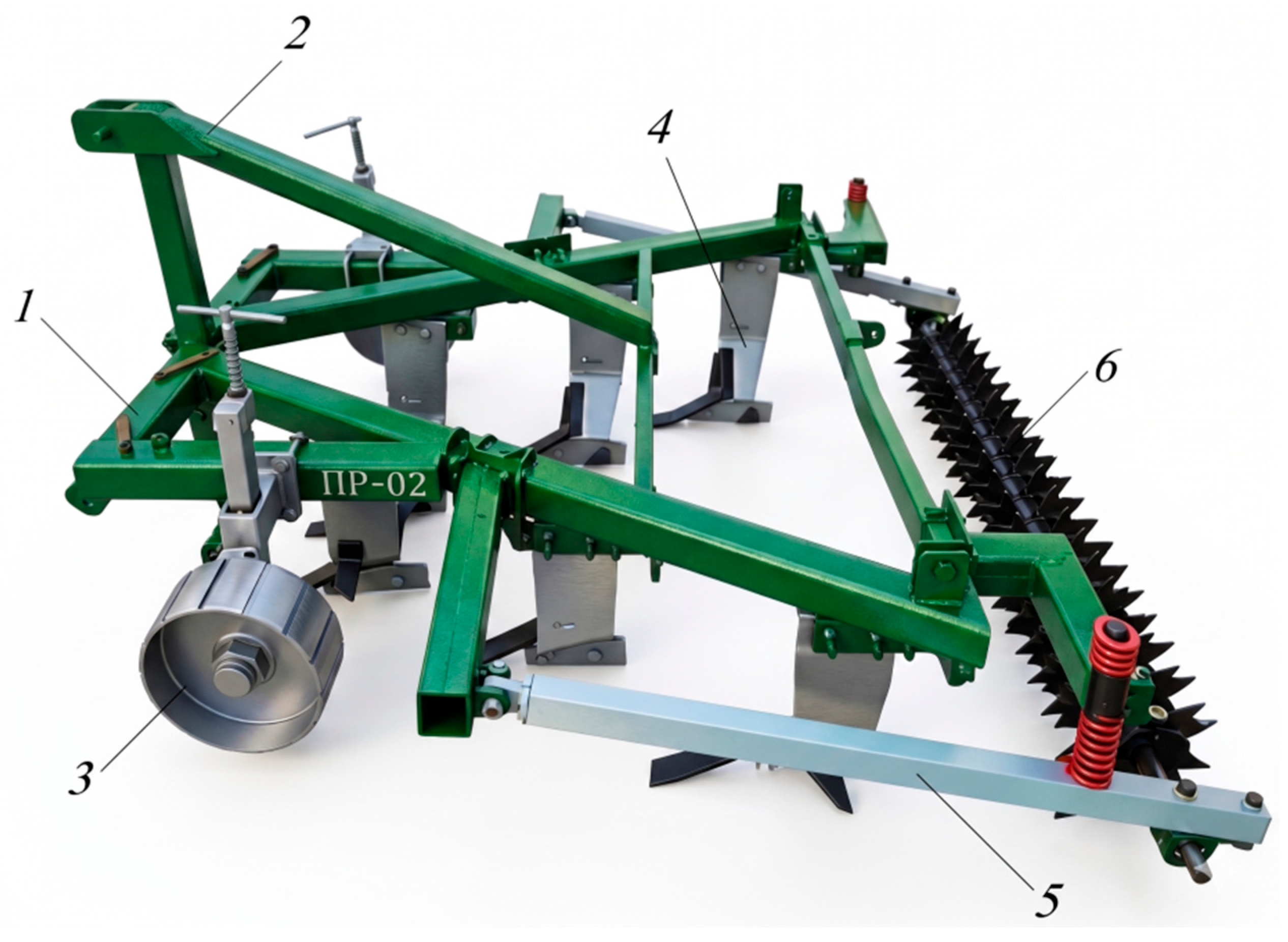
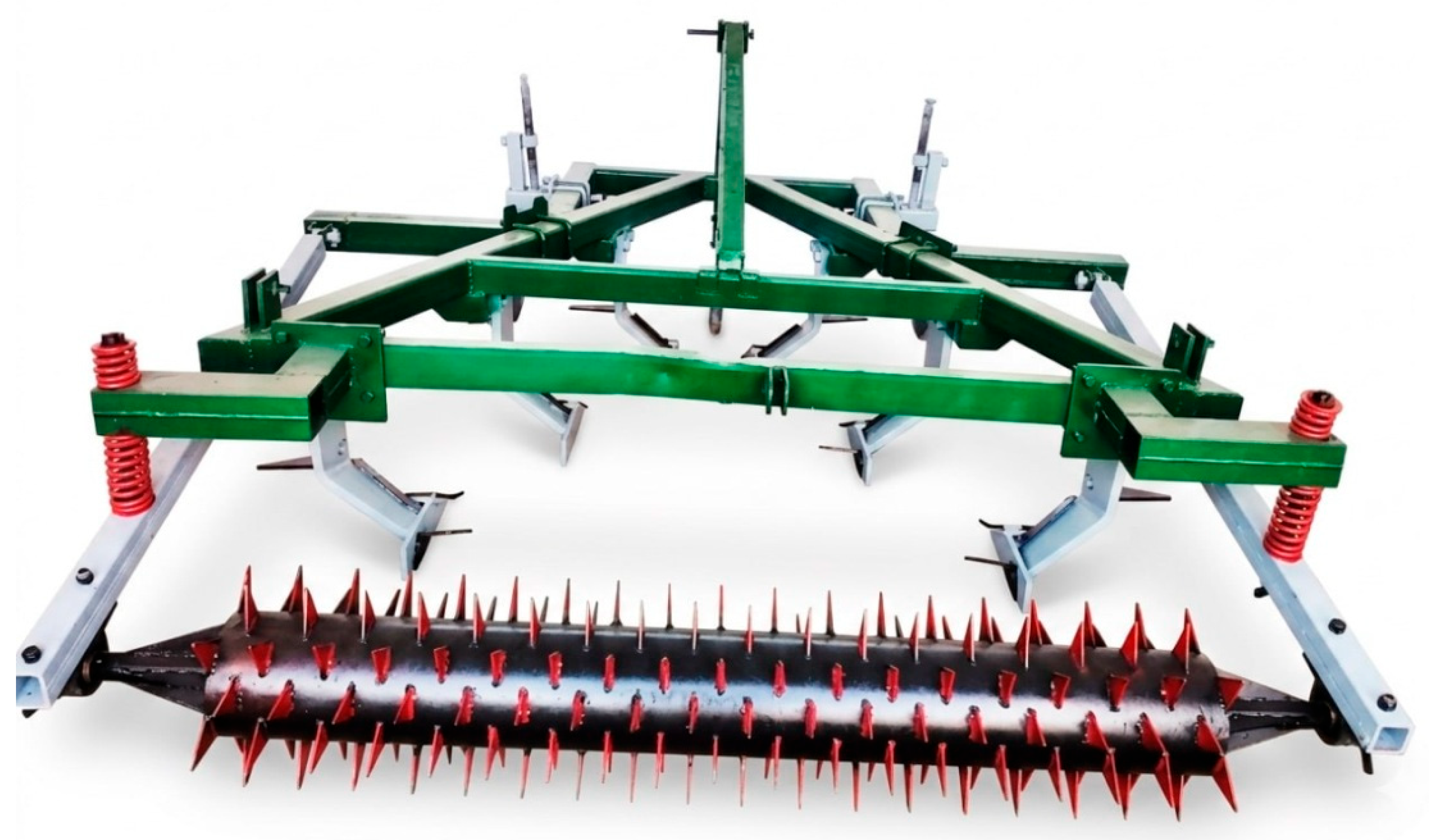
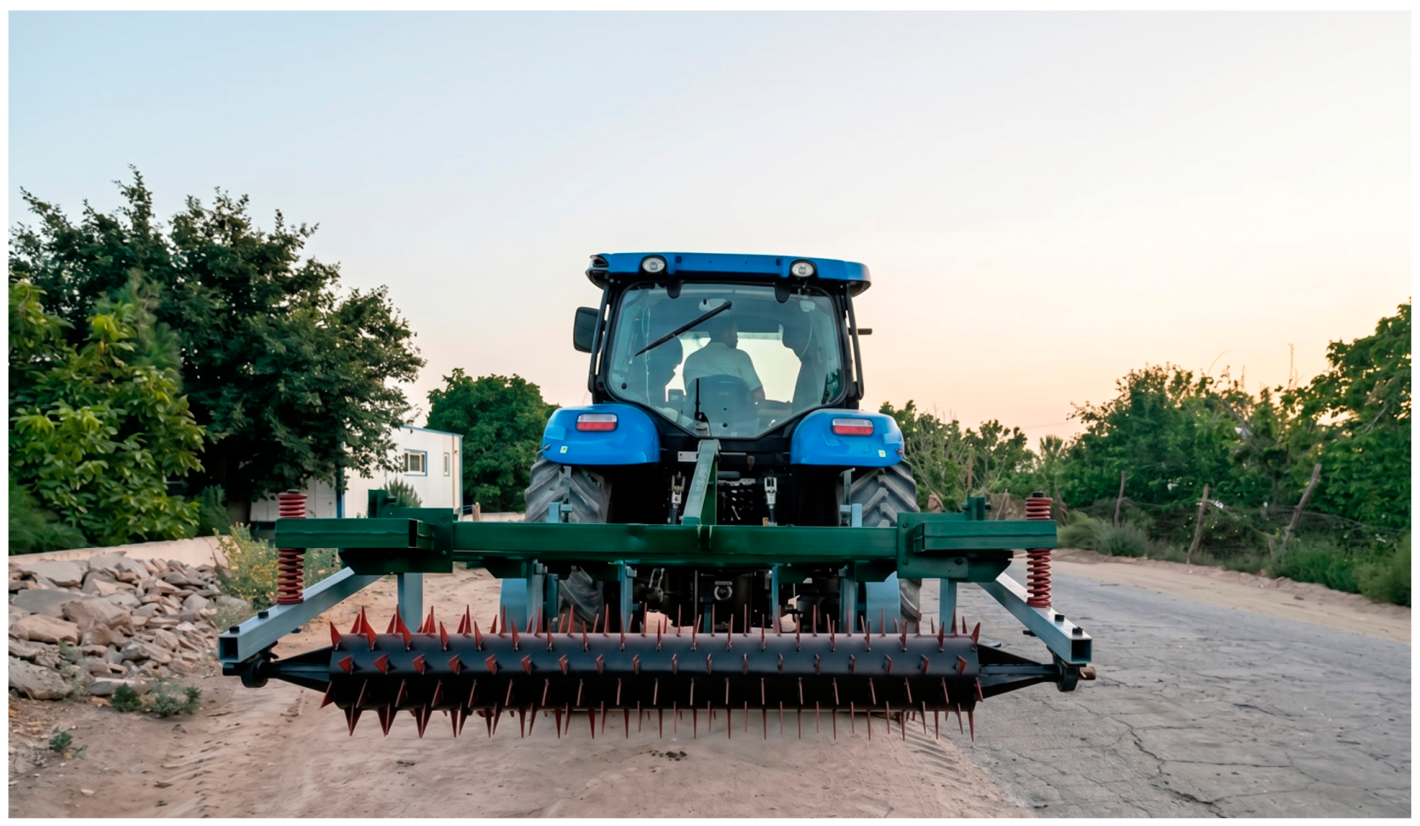
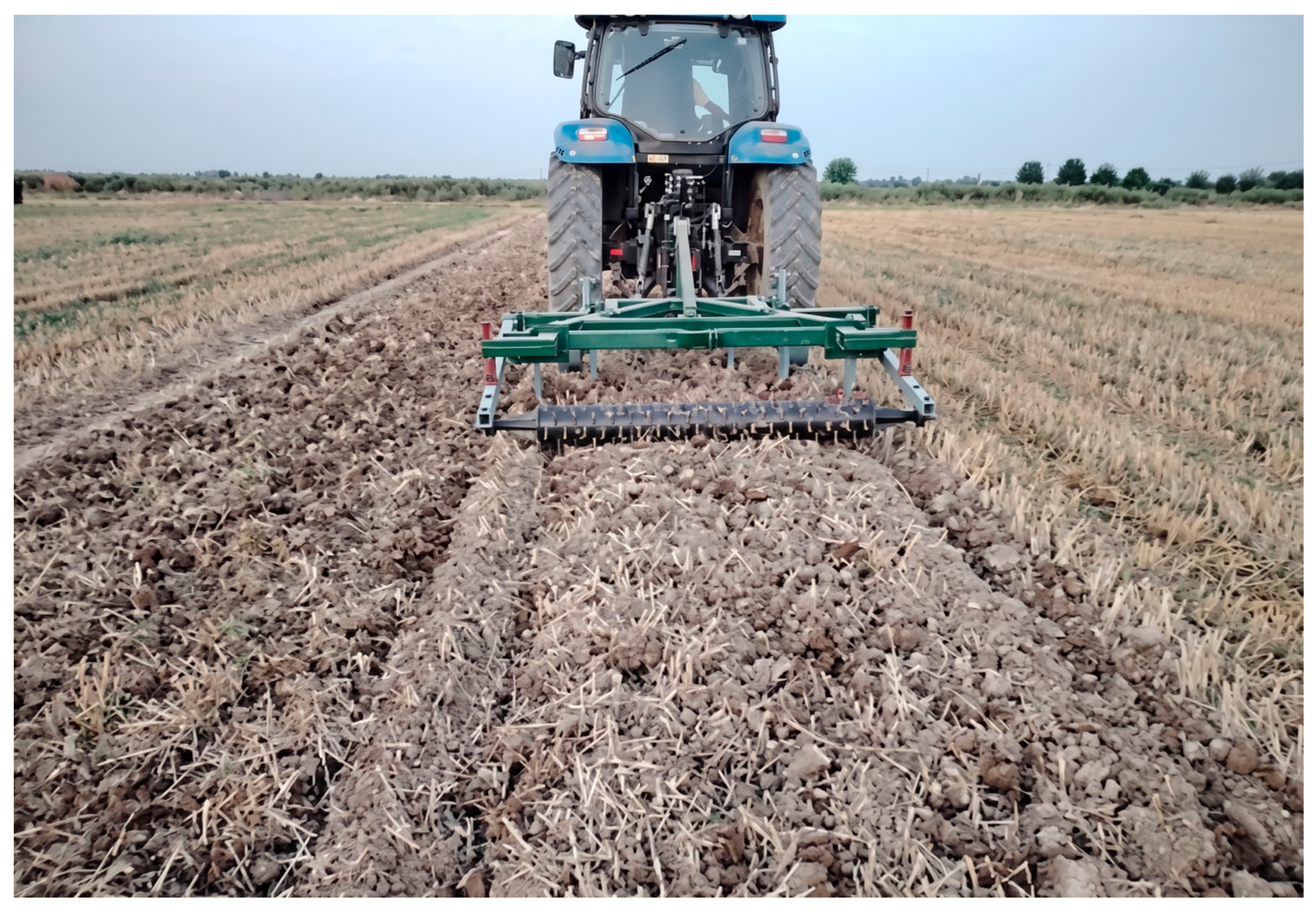
The implement consisted of a rigid frame with a three-point hitch, support wheels for depth control, stagger-mounted chisel tines fixed symmetrically on both sides of the frame, and a toothed roller attached to the rear part of the frame via a hinged linkage mechanism allowing vertical adjustment and passive adaptation to surface irregularities. The working depth was controlled by adjusting the vertical position of the support wheels, providing a stable operating range of 22–28 cm. The structural arrangement of the implement is presented in Figure 1.
The total mass of the implement was 1.35–1.45 t. The load transmitted to the toothed roller was maintained within the range of 0.9–1.1 kN m−1 of working width, ensuring continuous contact with the soil surface without excessive penetration or loss of stability. This corresponds to an average normal pressure on the soil surface in the range of 18–26 kPa, depending on the effective contact area between the roller and the soil. The applied load was selected to reproduce typical field conditions and to ensure stable soil–tool interaction during operation.
In contrast to smooth or slat rollers, which mainly redistribute and level the loosened soil layer, the toothed roller remained a passive, ground-driven working element but produced more intensive crumbling through discrete tooth engagement [21,22,23]. The term “passive” is used here in the kinematic sense: the roller had no independent drive and rotated only as a result of contact with the soil. However, the wedge-shaped teeth generated localized compressive and shear stresses at the contact points, which could intensify aggregate breakdown compared with continuous-contact rollers.
The teeth were manufactured from structural steel with increased wear resistance, with a hardness of 45–50 HRC, and had a wedge-shaped geometry with a defined sharpening angle βi. Each tooth had a trapezoidal cross-section with a sharpened leading edge, ensuring localized stress concentration at the contact point. The teeth were rigidly fixed to the cylindrical body of the roller by welding, forming a uniform circumferential arrangement during operation.
During operation, the chisel tines penetrated the soil layer, inducing loosening and partial uplift of the soil mass. The disturbed soil was transported backward along a kinematic trajectory and entered the contact zone of the passive toothed roller. The interaction between the soil and the roller was governed by the forward speed V and the angular velocity ω of the roller, which together determined the frequency of tooth–soil contacts. The average contact frequency can be expressed as ncontact = /(2π), where z is the number of teeth. Under the tested conditions, this corresponded to multiple discrete loading events per unit travel distance, ensuring repeated stress application to soil aggregates.
The kinematic interaction was additionally defined by the longitudinal distance S1 between the last tine and the roller centre, as well as by the installation angle of the tine αi. These parameters determined the phase of interaction and ensured that soil aggregates reached the roller in a loosened but not excessively dispersed state. In the present configuration, the geometric parameters of the tine arrangement and roller position were fixed during each experimental series, ensuring consistency of the experimental conditions.
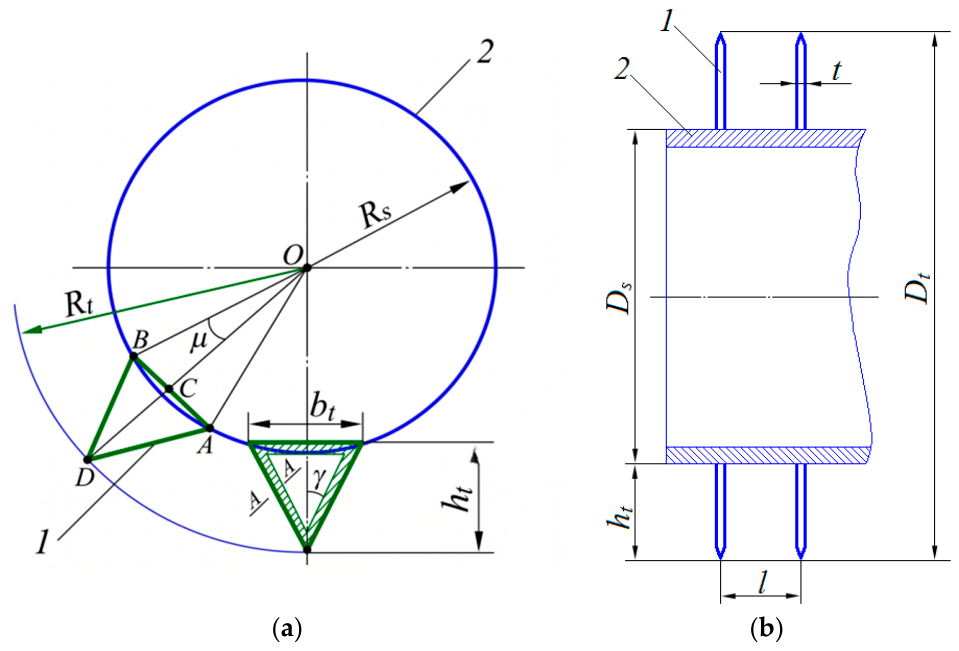
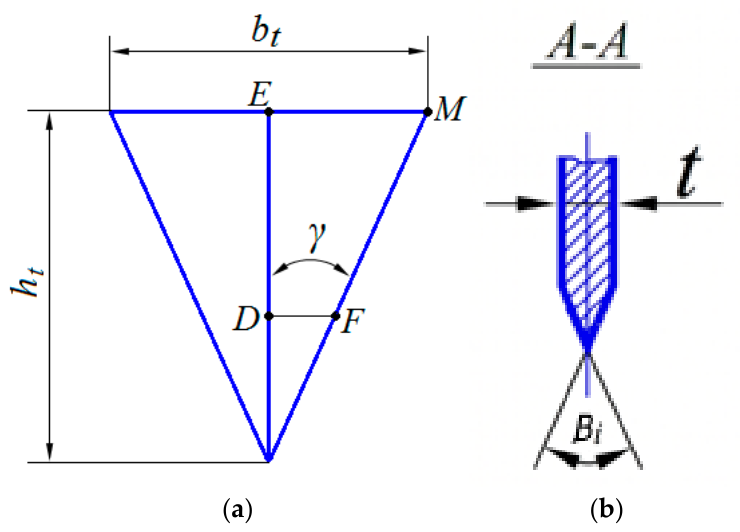
The main geometric parameters of the toothed roller included the inner diameter of the cylindrical body (Ds), the outer diameter at the tooth tips (Dt), the radii Rs and Rt, tooth height (ht), width (bt), thickness (t), transverse spacing between adjacent teeth (l), number of teeth (z), sharpening angle (βi), opening angle (γ). The contact geometry was further defined bycharacteristic points (O, A, B, C, D), as shown in Figure 2.
Field experiments were carried out using a New Holland T7060 tractor (New Holland Agriculture, CNH Industrial, Turin, Italy) with an engine power of 157 kW. The implement operated at nominal forward speeds of 6 and 9 km h−1 and a working width of 1.8 m. The actual travel speed was monitored over the accounting section during field operation, while acceleration and deceleration zones were excluded from analysis. These operating parameters ensured stable motion and representative soil–tool interaction under typical post-harvest tillage conditions.
The working depth was adjusted using the support wheels before each experimental series and checked within the accounting section after the passage of the implement. These measurements were used to verify that the compared treatments were performed under comparable depth conditions. Where minor deviations in working depth occurred, they were considered in the interpretation of draft force and fuel consumption.
The interaction between the tooth and soil is governed by the balance between normal reaction forces, friction forces and geometric constraints imposed by the tooth profile. The effectiveness of soil fragmentation depends on the ratio between applied stresses and soil strength, as well as on the penetration depth relative to the characteristic size of soil aggregates [32]. Therefore, the geometric, kinematic and loading parameters defined in this section determine the boundary conditions of the soil–tool interaction process.
The described geometric and kinematic parameters define the boundary conditions for soil–tool interaction and serve as input variables for the analytical model of clod capture, penetration and fragmentation presented in Section 2.3.

2.2. Site Conditions and Soil Characterization

Field experiments were conducted in 2025 on post-harvest winter wheat fields of “ALIBOY O‘G‘LI SAFAR BOBO” Fermer Xo‘jaligi, located in Kamashi, Kasbi District, Kashkadarya Region, Uzbekistan, within registered cadastral field contours Nos. 22 and 57, under irrigated semi-arid conditions characterized by high summer temperatures and low annual precipitation.
The soil was classified as medium loam sierozem according to the regional classification, corresponding to Calcisols in the World Reference Base (WRB) system. The soil profile exhibited moderate aggregation and a gradual increase in mechanical resistance with depth, which is typical for cultivated irrigated soils.
Prior to tillage, the field was covered with winter wheat residues forming a stubble layer on the soil surface. The residue distribution was relatively uniform across the experimental area, with an estimated residue cover of 65–75%, ensuring consistent initial surface conditions for all treatments. The average residue mass was 1.1 kg m−2, corresponding to approximately 11 t ha−1. The presence of crop residues was considered an important factor influencing soil–tool interaction, particularly in terms of surface roughness formation and energy consumption [1,31].
Soil moisture was measured immediately before tillage and sample collection in order to characterize the actual soil condition at the time of implement–soil interaction. The initial physical properties of the soil before tillage are presented in Table 1.
Soil moisture content was determined using the gravimetric method in accordance with ISO 11465 [42], with oven drying at 105 °C until constant mass. Bulk density was measured using the core sampling method following ISO 11272 [43], ensuring minimal disturbance of the soil structure. Penetration resistance was measured under field conditions using a portable electronic cone penetrometer with GPS positioning (DataField, Kyiv, Ukraine), in accordance with ASABE Standard S313.3 [44].
The experimental field was characterized by relatively homogeneous soil texture and structure within the test area. Preliminary field inspection and sampling indicated that no pronounced variability was observed in soil properties across the plots. All experimental treatments were conducted within a uniform section of the field to minimize the influence of heterogeneity on the results.
The measured parameters indicate a moderately compacted soil layer with increasing bulk density and penetration resistance with depth. Such conditions are representative of post-harvest stubble fields and provide a suitable basis for evaluating soil fragmentation, deformation processes and energy consumption during tillage operations.

2.3. Analytical Determination of Toothed Roller Parameters

The analytical model was developed to determine the rational geometric parameters of the toothed roller and to provide a physically consistent description of soil–tool interaction during tillage. The framework integrates geometric constraints, contact mechanics and soil failure conditions, thereby linking roller design parameters with soil fragmentation efficiency, surface formation and energy consumption. The model was not intended as an independent numerical simulation, but as an analytical framework for interpreting the direction of experimentally observed trends and guiding parameter selection.
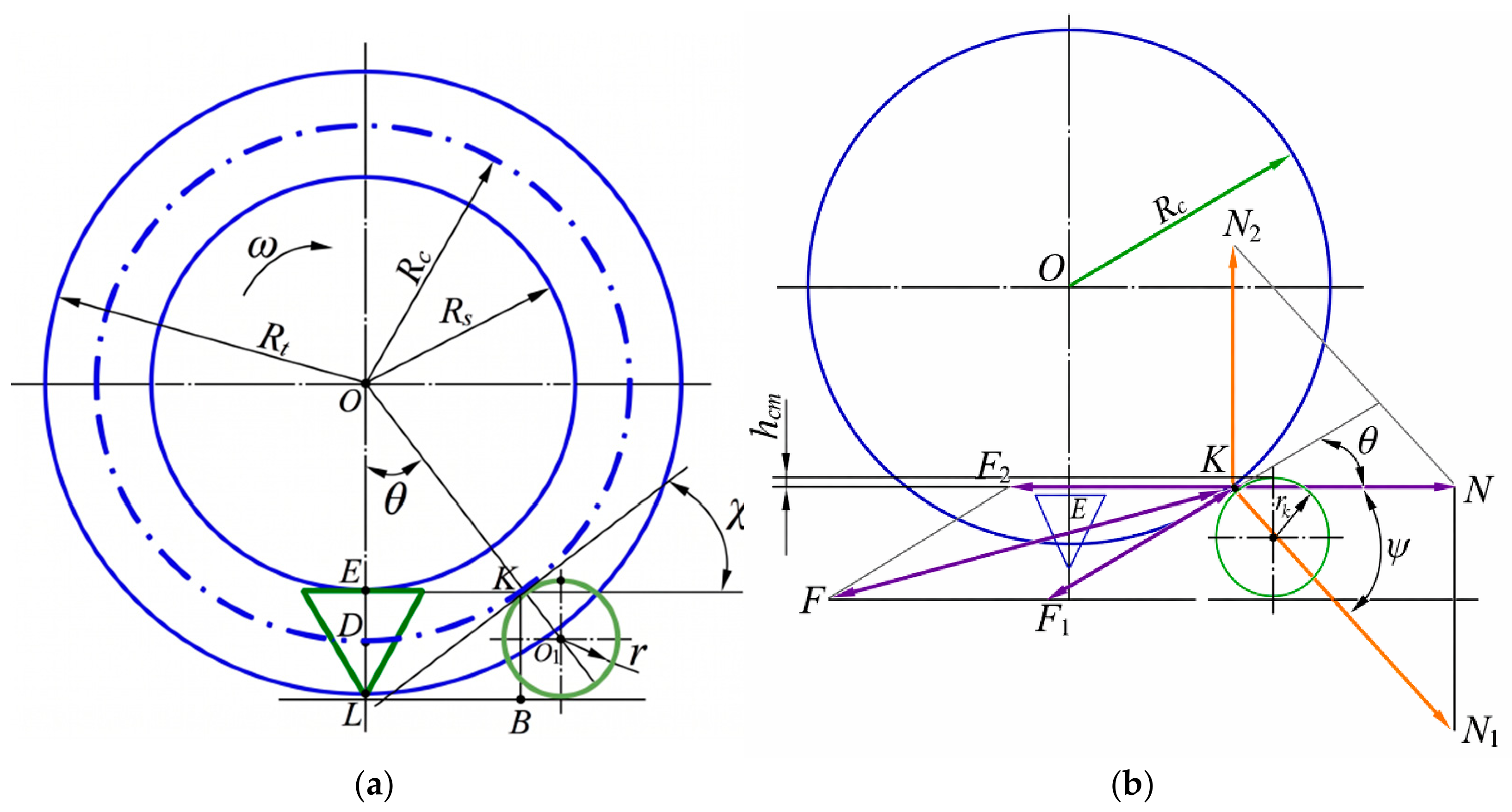
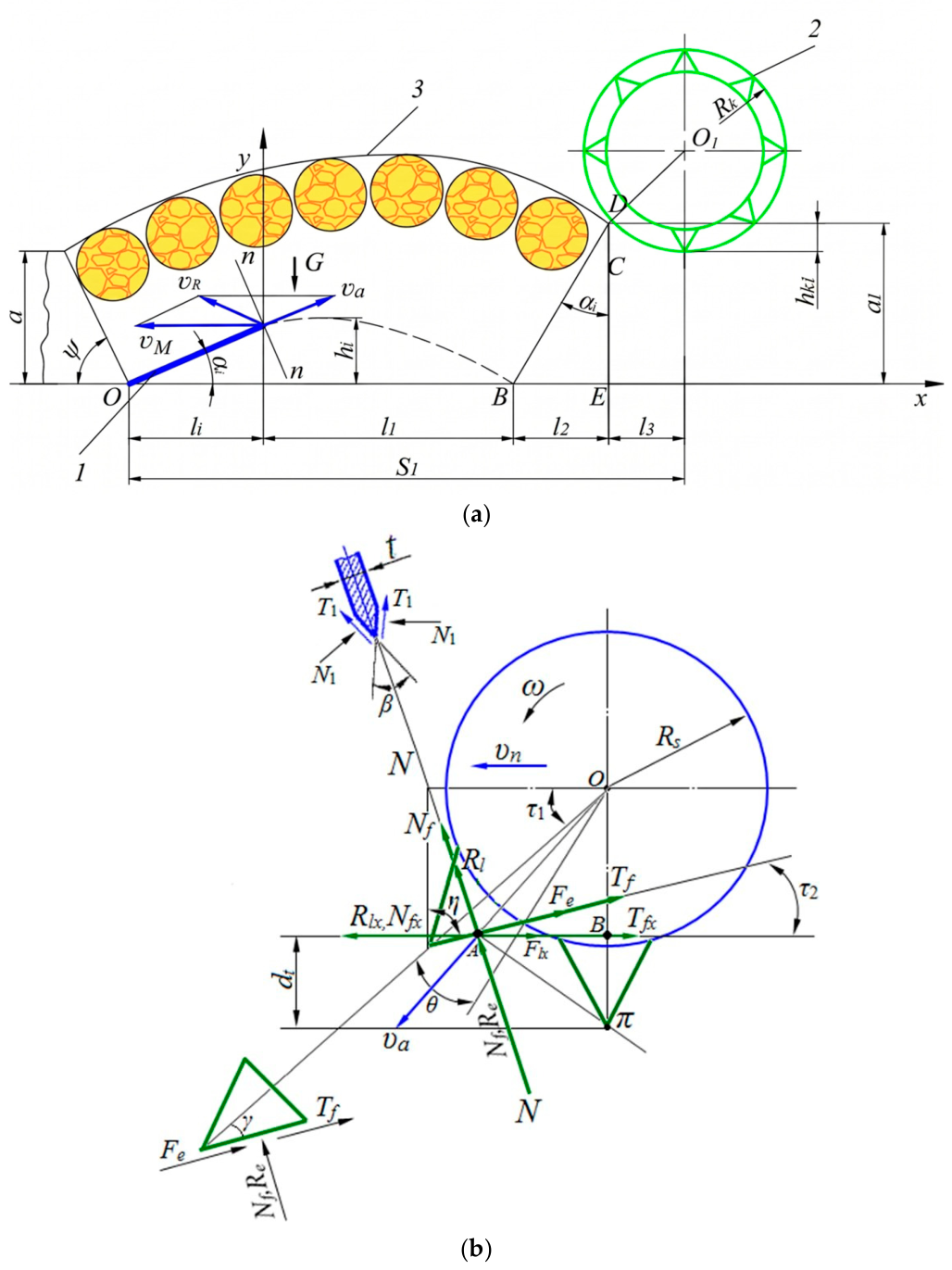
The interaction between the roller tooth and soil aggregates is illustrated in Figure 3. As shown in Figure 3, the equilibrium of forces acting on a soil clod governs its capture and subsequent loading in the contact zone.
After passage of the chisel tines, the loosened soil layer consists of aggregates characterized by an equivalent radius rk. Upon contact with the roller, individual teeth generate localized compressive and shear stresses. Soil aggregate failure is assumed to occur when the contact stress exceeds the soil strength σσo, where σ—contact stress, Pa; σo—soil failure stress, Pa [9,10,11,12,32]. This condition establishes the fundamental link between tooth loading and aggregate fragmentation.
Based on the force equilibrium shown in Figure 3, the minimum roller radius ensuring stable clod capture is determined by Equation (1):
R s = r k + r k cos φ 1 + φ 2 + 0.5 cos γ 4 h t 2 + b t 2 1 + f 1 + f 2 1 f 1 f 2 2 + 1 + f 1 + f 2 1 f 1 f 2 2 1 f 1 f 2 f 1 + f 2 2 h t 2 ,
where Rs is the roller radius, m; rk is the clod radius, m; bt is the tooth width, m; ht is the tooth height, m; f1 is the coefficient of friction between clod and roller; f2 is the coefficient of friction between clod and soil; γ is the half-angle of the tooth opening, rad; and φ1 and φ2 are the angular parameters describing the clod-capture geometry shown in Figure 3.
Equation (1) defines the geometric and frictional conditions required for reliable aggregate capture and stress concentration.
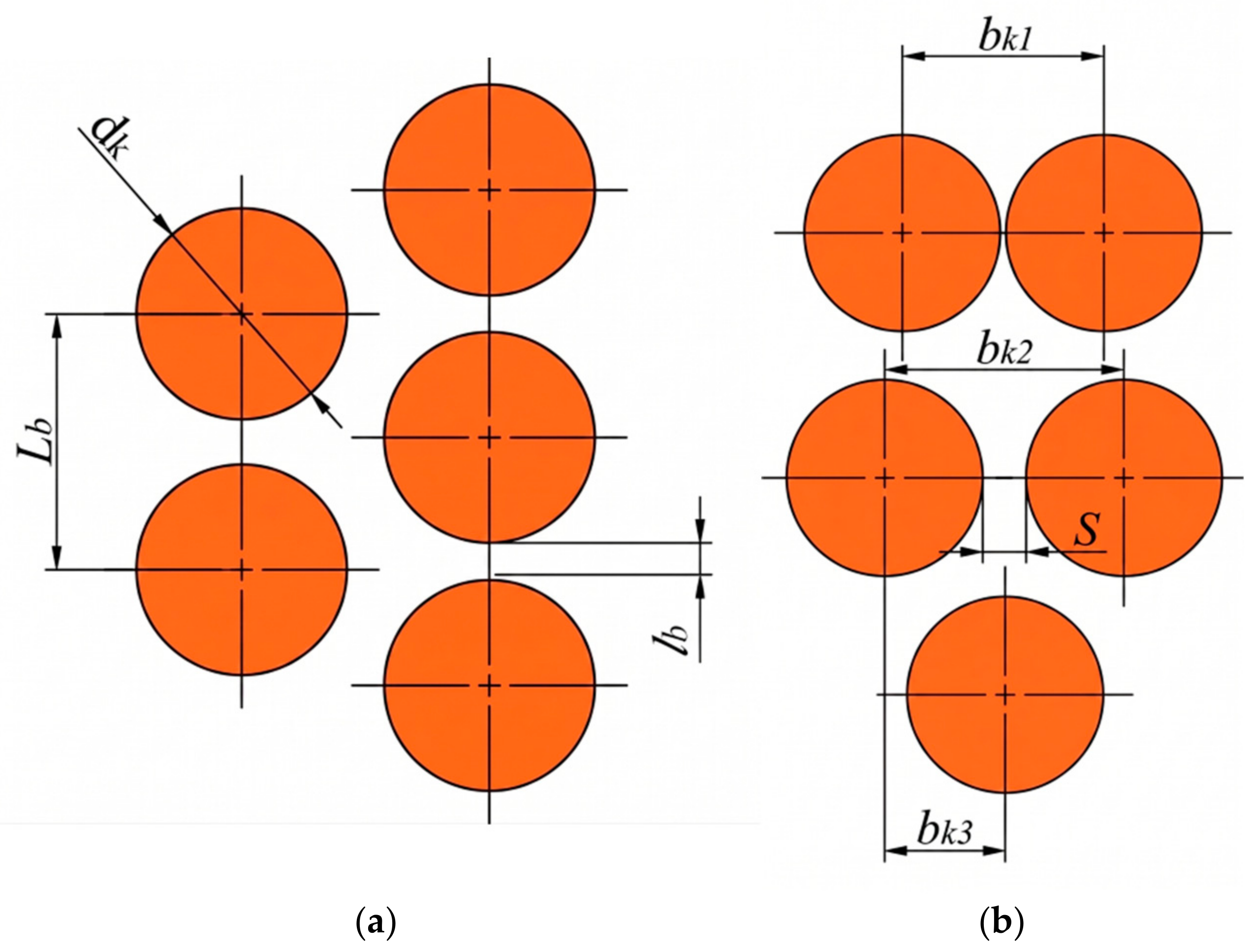
The distribution of soil aggregates relative to the roller motion is illustrated in Figure 4. The longitudinal spacing between aggregates (lb) determines the frequency of tooth interaction and is used to define the required number of teeth according to Equation (2). At the same time, the transverse distribution of aggregates is stochastic and includes contacting, separated and staggered configurations, characterized by distances bk1, bk2, bk3 and gap S. This variability is taken into account in determining the average transverse spacing between teeth in Equation (3).
The number of teeth is determined as follows:
z max = 2 π R t L b = 2 π R t 2 r k + l b ,
where z is the number of teeth; Rt is the roller radius at the tooth tip, m; Lb is the distance between clod centres, m; rk is the clod radius, m; and lb is the longitudinal spacing between aggregates, m.
The average transverse spacing between teeth is given by
l c = b k 1 + b k 2 + b k 3 3 ,
where lc is the transverse spacing between teeth, m; bk1 = 2rk corresponds to contacting aggregates; bk2 = 2rk + S corresponds to separated aggregates; bk3 = rk + 0.5S corresponds to the staggered arrangement; and S is the gap between aggregates, m.
The geometric parameters of the tooth are presented in Figure 5. The contact geometry was further defined by characteristic points (D, E, F, M) and cross-section A–A.
The tooth width is determined by
b t = 2 π R s z sin π z ,
where bt is the tooth width, m; Rs is the effective radius at the tooth base, m; and z is the number of teeth.
The tooth height is determined by
h t = 2 K d r k ,
where ht is the tooth height, m; Kd is the penetration coefficient; and rk is the clod radius, m.

Kinematic Condition of Soil Delivery

The soil particle trajectory and the forces acting on the tooth–soil system are illustrated in Figure 6.
The kinematic parameters of soil movement from the tine to the roller (li, Rt, αi, hi, h1, S1) define the conditions for proper synchronization between soil flow and roller position, which is required for effective interaction and is used in determining the longitudinal distance according to Equation (6). At the same time, the force system shown in Figure 6 includes normal reaction (N), friction force (Ff = fN), and lateral soil pressure (p), which together determine the resultant force (Rt) forming the basis of the draft resistance model in Equation (7) [9,10,11,12,32]. The longitudinal distance is determined by
S 1 = l i cos α i + tan α i + tan 2 α i + 2 g h i v M 2 cos 2 α i g v M 2 cos 2 α i + 1.12 a 1 tan α i + 2 R t h k 1 h k 1 2 ,
where S1 is the longitudinal distance, m; li is the horizontal projection of tine, m; Rt is the roller radius at tooth tip, m; αi is the installation angle, rad; hi is the tine height, m; h1 is the penetration depth, m; v M is the soil aggregate velocity after interaction with the tine, m s−1; g is gravitational acceleration, m s−2; a1 is the characteristic vertical displacement parameter of the soil trajectory shown in Figure 6, m; and hk1 is the effective contact height parameter shown in Figure 6, m.
The coefficient 1.12 was used as an empirical calibration coefficient accounting for the deviation of the real aggregate trajectory from the idealized geometric trajectory assumed in Equation (6). It should not be interpreted as a universal theoretical constant. The coefficient reflects the combined influence of soil cohesion, aggregate rotation, internal friction and partial interaction with neighbouring aggregates after passage of the chisel tine. In the present study, it was applied only within the tested range of soil moisture, working depth, forward speed and medium-loam soil conditions. For soils with substantially different texture, moisture content or aggregate stability, this coefficient should be re-estimated experimentally.
The draft resistance acting on a single tooth is given by Equation (7):
R k x = 1 2 σ 0 δ 4 h t 2 + b t 2 cos arccos R t h t R t + γ f sin arccos R t h t R t + γ p t 4 h t 2 + b t 2 cot β i 2 cos arccos R t h t R t + γ f sin arccos R t h t R t + γ 2 p h t t 2 cos β i 2 b t t cos β i 2 sin arctan 3 R t 3 R s + h t cos τ 1 3 R s + h t sin τ 1 ,
where Rkx is the draft resistance acting on a single tooth, N; σo is the soil failure stress, Pa; δ is the cutting edge thickness, m; p is the lateral soil pressure, Pa; ht is the tooth height, m; bt is the tooth width, m; Rt is the roller radius at the tooth tip, m; Rs is the roller radius at the tooth base, m; γ is the half-angle of the tooth opening, rad; βi is the sharpening angle, rad; f is the friction coefficient; t is the tooth thickness, m; and τ1 is the angular contact parameter shown in Figure 6, rad. Here, arctan denotes the inverse tangent function.
Each term in Equation (7) represents a distinct component of resistance, including cutting resistance, lateral soil pressure and frictional resistance. Since the roller was not independently driven, the calculated resistance should be interpreted as additional passive resistance associated with tooth–soil contact rather than as the resistance of an active rotary working body.
Power demand can be estimated as follows:
P = R V , where P is power consumption, W; R is draft force, N; and V is forward speed, m s−1. Thus, Equation (7) provides the analytical basis for interpreting measured draft force, whereas fuel consumption is treated as an integrated field-energy indicator influenced not only by draft force but also by rolling resistance, wheel slip, soil redistribution work and transient engine loading.
The dimensionless parameters are defined as follows: π 1 = h t r k π 2 = R t r k π 3 = σ 0 p .
These dimensionless parameters characterize penetration depth, geometric curvature and the ratio of soil strength to applied loading. They support comparison of the tested configurations within the investigated range of soil and operating conditions.
The model follows a consistent sequence: clod capture (Equation (1)), interaction frequency (Equations (2) and (3)), geometric constraints (Equations (4) and (5)), kinematic positioning (Equation (6)), force generation (Equation (7)) and the failure condition σ ≥ σ0. This structure provides a mechanistic link between design parameters and experimentally measured performance indicators.
The model is applicable to medium-textured soils under moisture conditions of 12–18% and within the operating range considered in this study. Its use in the present work was limited to explaining the direction of experimentally observed trends and guiding regression-based optimization. It should not be interpreted as a stand-alone numerical simulation or as a universal predictive model for all soil and operating conditions.

2.4. Response Variables and Measurement Procedures

The performance of the implement was evaluated using the following response variables: soil fragmentation (F < 50 mm, %), surface roughness (hu, cm), draft force (R, kN), deviation of tillage depth (Δh, cm), fuel consumption (L ha−1), residue retention (%) and aggregate-size distribution (%). These parameters were selected as indicators of tillage quality, including fragmentation, roughness, levelling and residue retention, and as energy-related indicators, including draft force and fuel consumption.
Soil fragmentation and aggregate-size distribution. Soil samples were collected from the 0–10 cm layer within the accounting section immediately after each experimental pass, with care taken to avoid secondary mechanical disturbance. Samples were air-dried at room temperature to constant mass to preserve aggregate structure. Prior to detailed fractionation, each sample was passed through a 50 mm square-opening sieve, and the mass fraction passing this sieve was used to determine soil fragmentation (F < 50 mm, %). Aggregate-size distribution within the <50 mm fraction was determined by dry sieving following established soil analysis procedures [45,46], sing test sieves compliant with ISO 3310-1 [47], and a procedure consistent with ISO 2591-1 [48]. The analysis was performed on a Retsch AS 200 Control (Retsch GmbH, Haan, Germany) using sieve sizes of 10, 5, 3, 1 and 0.25 mm. Sieving was conducted for 3 min at a controlled amplitude established during preliminary calibration to ensure repeatable separation while minimizing additional fragmentation.
The mass retained on each sieve was weighed using an analytical balance with an accuracy of ±0.001 g and expressed as a percentage of the total sample mass to obtain the aggregate-size distribution. The mean weight diameter (MWD) was calculated as MWD = Σ (xi · wi), where xi is the mean diameter between adjacent sieve sizes, calculated as xi = (dupper + dlower)/2, and wi is the corresponding mass fraction. For each treatment, five independent samples per replicate were analysed and averaged. The measurement uncertainty of mass fraction determination did not exceed ±1.5% based on repeated measurements under identical conditions, ensuring reproducible characterization of soil structural changes under tillage.
Surface roughness. Surface roughness of the treated soil layer (hu, cm) was measured using a contact profiling method based on a rigid-frame pin profilometer. The profiling frame, with a length of 1.0 m, was equipped with vertically movable pins spaced at 10 mm intervals. Measurement accuracy was verified under laboratory conditions using a laser displacement sensor (LK-G5000 series, Keyence Corporation, Osaka, Japan) based on laser triangulation. After each experimental pass, the frame was positioned perpendicular to the direction of travel to capture transverse microrelief variability, and the elevation of each pin relative to a reference horizontal line was recorded. The roughness parameter hu was calculated as the mean absolute deviation of the soil surface profile relative to the mean line, analogous to the Ra roughness parameter. Measurements were performed at five locations per plot. The measurement error of surface elevation did not exceed ±0.2 cm.
Draft force. Draft force (R, kN) was measured using a strain-gauge dynamometer installed in the tractor–implement linkage. The measurement procedure followed the general principles of ISO 789-9, adapted for field conditions. The system incorporated load cells (U2B, HBM, Darmstadt, Germany) installed in the tractor–implement coupling and operating in a Wheatstone bridge configuration. Signal acquisition was performed using a QuantumX MX840B data acquisition system (HBM, Darmstadt, Germany) at a sampling frequency of 10 Hz, which was sufficient for quasi-steady field measurements. The system was calibrated prior to each experimental series using traceable static loads. The measurement uncertainty did not exceed ±2%. The data acquisition systems for draft force and fuel consumption were synchronized to ensure temporal consistency of measurements over identical operating intervals.
Fuel consumption. Fuel consumption (L ha−1) was measured using a direct volumetric method with a calibrated DFM fuel flow meter (JV Technoton, Minsk, Belarus) installed in the engine fuel supply line. The device recorded the actual volume of fuel passing through the system, allowing continuous monitoring of instantaneous fuel flow during operation. The recorded data were integrated over the accounting distance to determine total fuel consumption. Fuel consumption per unit area was calculated based on the implement’s working width and the accounting distance. The measurement procedure was based on direct volumetric fuel-flow measurement using a calibrated flow meter in accordance with standard tractor performance testing practices. The measurement uncertainty did not exceed ±2.5%. Since the measured parameter was fuel volume, fuel consumption was expressed consistently in L ha−1 throughout the manuscript.
Deviation of tillage depth (Δh). The change in soil layer thickness (Δh, cm) was determined as the difference between the initial and final surface elevations using fixed reference markers and a rigid-frame profilometer equipped with vertically movable pins. Measurements were taken at identical points before and after tillage. For each replicate, Δh was calculated as the average of five measurement points. The measurement error did not exceed ±0.3 cm. The measured depth values were also used to verify whether differences in working depth between treatments were statistically significant.
Residue retention. Residue retention (%) was determined by the line-transect method according to NRCS guidelines. A measuring tape with a length of 10 m was placed diagonally across the plot, and the number of contact points between crop residues and the transect line was recorded at fixed intervals. Residue cover was expressed as a percentage of total observation points. Five transects were evaluated per plot. The measurement uncertainty did not exceed ±3%.
All measurements were conducted within a defined accounting section of the experimental plot with a length of 50 m. The initial acceleration zone and final deceleration zone, 10 m each, were excluded from analysis to ensure steady-state operating conditions. Thus, all recorded values corresponded exclusively to stable operation of the implement.
Each experimental condition was replicated five times (n = 5). Within each replicate, measurements and sampling were performed at five spatially distributed points, resulting in a total of 25 observations per treatment variant. This ensured adequate representation of spatial variability and statistical reliability of the dataset.

2.5. Experimental Program

The experimental study was conducted in two consecutive stages to evaluate the performance of the implement and determine the optimal design and operating parameters under field conditions.
At the first stage, comparative field experiments were carried out to assess the effect of roller configuration on soil fragmentation and surface formation. Three variants were tested: (i) chisel plow without roller, (ii) chisel plow equipped with a slat roller and (iii) chisel plow equipped with a toothed roller. All variants were tested under identical field conditions and operating regimes to ensure comparability of results. The slat roller was used as a conventional passive roller reference, while the toothed roller was used to evaluate the effect of discrete tooth–soil interaction on aggregate breakdown and surface levelling.
At the second stage, a multifactor experimental design based on second-order response surface methodology (RSM) using a Hartley central composite design was applied to investigate the influence of key parameters on tillage performance. The factors were selected based on the analytical model described in Section 2.3 and included roller diameter (X1, m), number of teeth (X2, –), transverse spacing between teeth (X3, cm) and forward speed (X4, km h−1).
Only the factor combinations included in the experimental design were physically tested. Intermediate values shown in response surfaces were obtained from regression models and should not be interpreted as separately tested roller configurations. The experimental points were obtained using roller configurations prepared according to the factor levels defined in Table 2, while the response surfaces were generated from second-order regression models based on the measured data. Thus, the response surfaces should be interpreted as interpolated regression surfaces within the tested factor range.
Forward speed was controlled by selecting the appropriate tractor gear and engine operating mode before each experimental pass. Actual travel speed was recorded over the accounting section using the measured travel distance and operating time, with steady-state movement used for analysis. The acceleration and deceleration zones were excluded. The target speed levels were therefore treated as nominal experimental levels, whereas measured speeds were used to verify the stability of field operation and to support interpretation of the response variables.
To avoid confounding the effect of forward speed with changes in tillage depth, the working depth was checked before each experimental series and re-measured after each pass within the accounting section. The support wheels were adjusted to maintain the chisel tine depth within the intended operating range. The measured depth values were used to verify whether differences between treatments were statistically significant. Where depth deviations were observed, they were explicitly considered as possible sources of variation in draft force and fuel consumption.
The experimental factors and their variation levels used in the multifactor design are summarized in Table 2.
The experimental plan followed a Hartley central composite scheme for k = 4 factors, consisting of factorial points, axial points and centre points. The total number of experimental combinations was determined as N = 2k + 2k + no, where k = 4 is the number of factors and no is the number of centre-point replicates used to estimate experimental error. In the present study, N = 16 + 8 + no runs were conducted, with no = 5, ensuring sufficient degrees of freedom for estimating second-order regression models and assessing lack of fit.
The experimental program included two separate stages. In the first stage, single-factor experiments were conducted to identify the practical response ranges of roller diameter, number of teeth, transverse tooth spacing, tooth height and specific roller load. These tests used the natural factor levels reported in Table 3, Table 4, Table 5, Table 6 and Table 7. In the second stage, a Hartley central composite design was applied using the coded factor levels shown in Table 2 for multifactor optimization. Therefore, the levels in Table 3, Table 4, Table 5, Table 6 and Table 7 should be interpreted as single-factor screening levels, whereas Table 2 defines the coded levels used for the response-surface optimization.
The experimental plots were arranged according to a randomized complete block design (RCBD) to minimize the influence of spatial variability across the field. Within each block, treatment combinations were assigned using randomization. Randomization of treatment allocation within each block was performed using a random number generator to eliminate systematic bias. Each treatment was replicated five times (n = 5).
Individual experimental plots were established within a uniform field area with consistent soil texture and structure. Each plot included a 50 m accounting section for measurements, as defined in Section 2.4, along with buffer zones for acceleration and deceleration, resulting in a total plot length of approximately 70–80 m and a width corresponding to the implement’s working width. Buffer zones between adjacent plots were provided to minimize edge effects and treatment interference. Measurements were initiated only after the implement reached steady-state operating conditions within the accounting section.
The response variables were soil fragmentation (Y1, %), surface roughness (Y2, cm), draft force (Y3, kN) and fuel consumption (Y4, L ha−1), as defined in Section 2.4. These variables were selected to represent both the quality of soil treatment and the energy efficiency of the implement. Fuel consumption was included as an auxiliary energy indicator and was interpreted together with draft force rather than as a direct equivalent of traction resistance.
The objective of the experimental program was to determine the optimal combination of design and operating parameters that maximized soil fragmentation (Y1 ≥ 80%) while minimizing surface roughness (Y2), draft force (Y3) and fuel consumption (Y4).
The obtained dataset was used for the development of second-order polynomial regression models, including interaction and quadratic terms, and for subsequent response-surface analysis and optimization, as described in Section 2.6 and Section 2.7.

2.6. Statistical Analysis

Experimental data were processed using analysis of variance (ANOVA) and regression analysis in accordance with the experimental design described in Section 2.5. The ANOVA structure corresponded to a randomized complete block design (RCBD) for the comparative stage and to a second-order response surface methodology (RSM) based on a Hartley central composite design for the multifactor stage, ensuring consistency between the statistical analysis and the experimental layout. All statistical analyses were performed at a significance level of α = 0.05.
For each treatment, mean values and standard deviations were calculated from five replicates (n = 5). Within each replicate, measurements obtained at multiple spatial points in the accounting section were averaged prior to statistical analysis to obtain a single representative value per replicate.
The significance of main effects and factor interactions was evaluated using ANOVA at a confidence level of 95% (p ≤ 0.05). When significant differences between treatments were detected, pairwise comparisons were performed using Student’s t-test. In addition, measured forward speed and tillage depth were analysed separately to verify whether the compared treatments differed significantly in operating conditions.
Prior to statistical analysis, the data were examined for compliance with ANOVA assumptions. Normality of residuals was assessed using the Shapiro–Wilk test, and homogeneity of variances was evaluated using Levene’s test. In cases where deviations from normality or homoscedasticity were detected, appropriate data transformations were considered. However, the final models were based on datasets satisfying these assumptions.
Regression analysis was performed to develop second-order polynomial models describing the relationships between the response variables and the investigated factors. The general form of the model included linear, interaction and quadratic terms. Model coefficients were estimated using the least-squares method.
The adequacy of the regression models was evaluated using the coefficient of determination (R2), Fisher’s F-test and the lack-of-fit test, which was applied using replicated centre points of the experimental design. Only statistically significant coefficients (p ≤ 0.05) were retained in the final models. When non-significant coefficients were removed, model hierarchy was preserved where required for interaction or quadratic terms.
Outliers were identified based on standardized residuals exceeding ±3 standard deviations and were examined individually. Data points were excluded only when deviations could be attributed to measurement errors or abnormal experimental conditions; otherwise, all observations were retained to preserve the integrity of the dataset.
All statistical analyses were performed using Statistica 10.0 (StatSoft Inc., Tulsa, OK, USA) and Mathcad 15 (PTC Inc., Boston, MA, USA).

2.7. Use of the Analytical Model and Link with Experimental Data

The analytical model was used to establish a mechanistic link between roller geometry, soil aggregate capture, tooth penetration, interaction frequency and resistance formation. It was not used as an independent numerical simulation and did not generate a separate set of simulated data. Instead, the model provided the physical basis for selecting the experimental factors and interpreting the direction of the observed responses.
The experimental part of the study provided measured values of soil fragmentation, surface roughness, draft force and fuel consumption for the tested configurations. The regression models developed from these data were used to quantify the relationships between the selected factors and response variables. Therefore, the analytical model and regression models served different but complementary purposes: the analytical model explained the expected physical mechanisms, whereas the regression models described the experimentally observed response surfaces.
The link between the analytical model and the experimental results was established by comparing the direction and physical meaning expected from the analytical relationships with the observed experimental trends. Roller diameter was interpreted through contact geometry and stress distribution; the number of teeth was interpreted through interaction frequency; transverse spacing was interpreted through aggregate capture probability; tooth height was interpreted through penetration depth and the volume of soil involved in each loading cycle; and draft force was interpreted through the resistance components described in Equation (7).
The response surfaces presented in Section 3 were generated from experimental data using second-order regression models. They should therefore be interpreted as regression-based approximations within the tested factor range and not as extrapolations beyond the investigated soil, moisture and operating conditions. This approach ensured that the analytical interpretation remained grounded in field measurements while avoiding unsupported claims of independent numerical simulation.

3. Results

3.1. Field Conditions

The field experiments were conducted in 2025 on post-harvest winter wheat fields located in the Kashkadarya region, Uzbekistan. The soil was classified as medium-loam sierozem according to the regional soil classification, corresponding to Calcisols in the WRB system. The groundwater table was located at a depth of 11–13 m, indicating the absence of direct capillary influence on the upper soil layers during the experimental period.
The initial field conditions were characterized by a stubble height of 18.6 cm and a crop residue mass of 1.1 kg m−2, corresponding to approximately 11 t ha−1. This residue level represents typical post-harvest surface coverage after winter wheat harvesting under the studied conditions. Soil moisture content was measured gravimetrically immediately before tillage in three layers, namely, 0–10, 10–20, and 20–30 cm, and was 12.6%, 14.7% and 16.3%, respectively.
Bulk density in the same layers was 1.20, 1.29 and 1.34 g cm−3, indicating a gradual increase with depth. Soil penetration resistance, measured using a cone penetrometer under field conditions, was 1.32, 2.02 and 2.41 MPa for the corresponding layers, reflecting increasing compaction in deeper horizons.
These soil conditions correspond to a moderately compacted arable layer with sufficient moisture for mechanical tillage and soil fragmentation. The combination of moisture content, bulk density and penetration resistance provides a representative basis for evaluating the interaction between the working elements and the soil, particularly in terms of stress transmission, aggregate breakdown and surface formation processes.
The selected field conditions are typical for post-harvest tillage in semi-arid regions. Therefore, the obtained results should be interpreted as applicable primarily to similar soil, moisture and residue conditions.

3.2. Effect of Roller Type on Soil Fragmentation, Surface Roughness and Draft Force

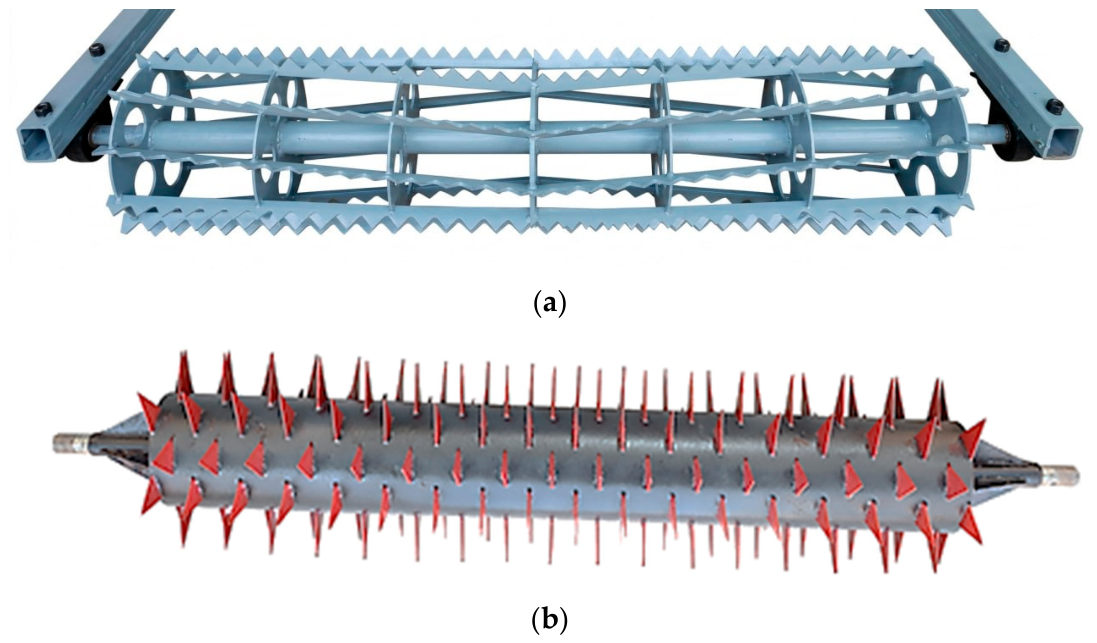
Comparative experiments were conducted using three configurations: a chisel plow without a roller, a chisel plow equipped with a slat roller and a chisel plow equipped with a toothed roller. The slat roller was used as a conventional passive roller reference, whereas the toothed roller was used to evaluate the effect of discrete tooth–soil interaction on aggregate breakdown and surface levelling. The design of the rollers used in the study is shown in Figure 7.
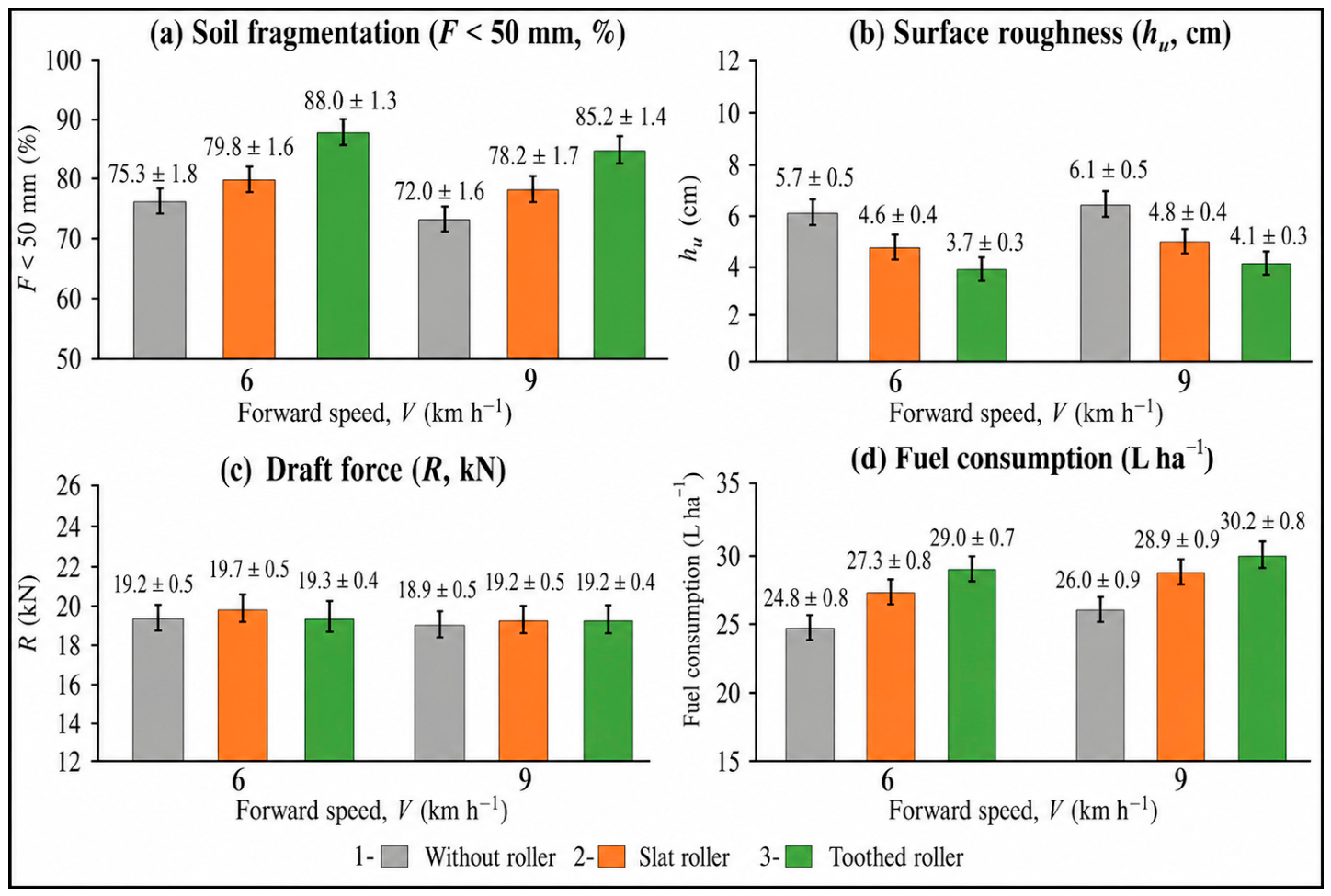
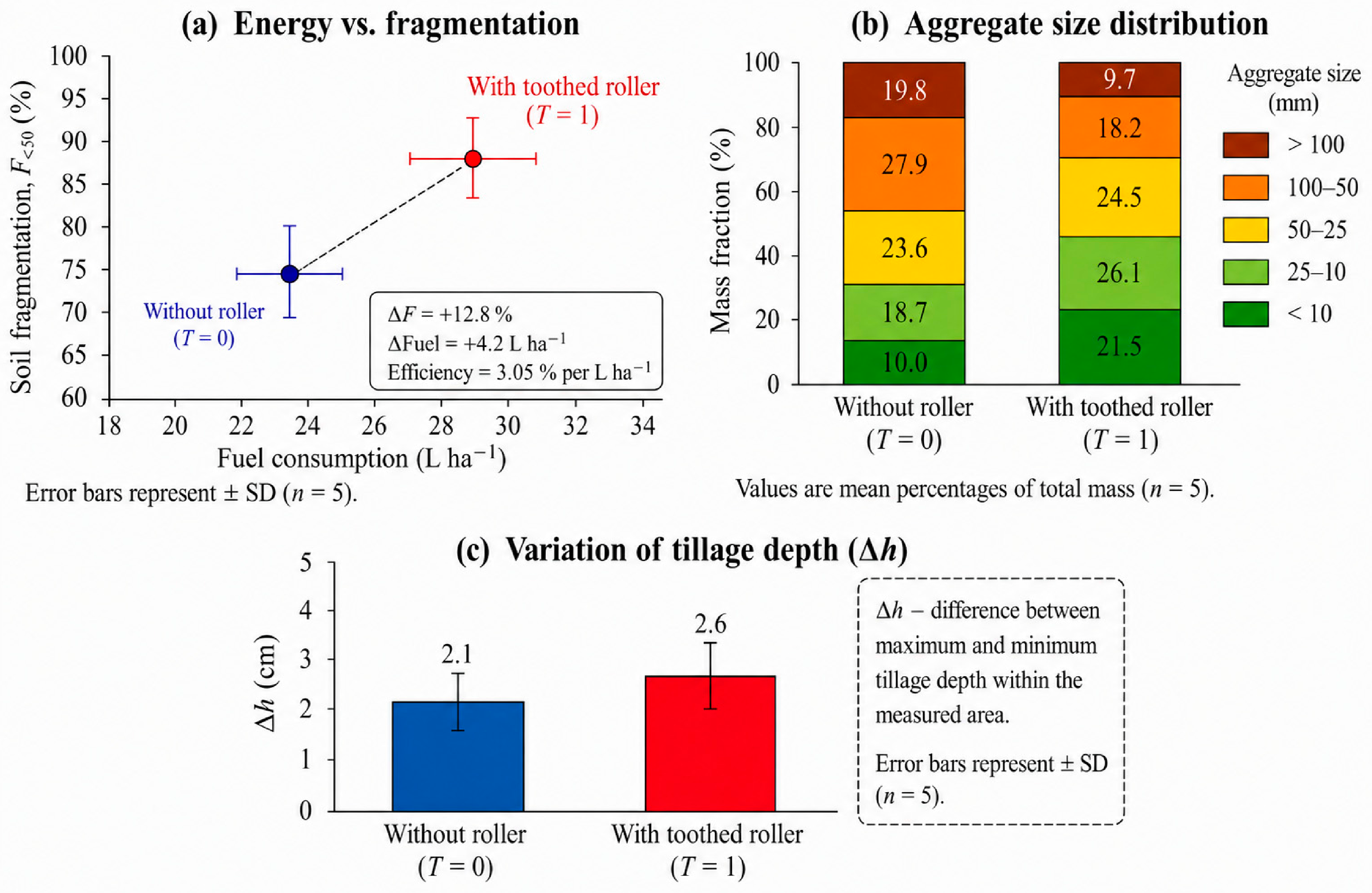
The effect of roller type on soil fragmentation, surface roughness, draft force and fuel consumption was evaluated at different forward speeds. The aim of this comparison was to determine whether the toothed roller improved soil treatment indicators without causing a disproportionate increase in traction resistance. The results are presented in Figure 8.
As shown in Figure 8, roller configuration had a pronounced effect on soil fragmentation and surface roughness. The toothed roller provided the highest proportion of aggregates smaller than 50 mm and the lowest surface roughness among the tested variants. This confirms that discrete tooth–soil contacts improved aggregate breakdown and redistribution of the loosened soil layer compared with both the no-roller configuration and the slat roller.
The direction of the roller effect was consistent at both forward speeds. At 6 and 9 km h−1, the toothed roller increased the fraction of aggregates smaller than 50 mm and reduced surface roughness relative to the other configurations. This behaviour can be attributed to localized stress concentration at the tooth–soil contact points, which promotes more intensive clod breakdown than the more uniform loading produced by the slat roller.
At the same time, the effect of roller configuration on measured draft force was comparatively small. The confidence intervals for draft force largely overlapped among the configurations, indicating that the addition of the roller did not produce a statistically strong increase in total traction resistance under the tested conditions. This result is physically reasonable because the chisel tines represented the dominant source of implement resistance, while the passive roller acted mainly on the already loosened soil layer.
Fuel consumption increased moderately for the roller-equipped variants, especially for the toothed roller. However, this increase should not be interpreted as direct evidence of a proportional increase in draft force. Under field conditions, fuel consumption is influenced not only by draft force and forward speed but also by rolling resistance, wheel slip, transient engine load, soil redistribution work and repeated local tooth penetration into loosened aggregates. Therefore, fuel consumption was treated as an auxiliary energy indicator reflecting the total energetic cost of performing additional fragmentation and surface levelling in a single pass.
Overall, the toothed roller demonstrated the most favourable combination of improved fragmentation, reduced surface roughness and acceptable energy demand under the studied conditions. For this reason, it was selected for further parametric analysis and optimization in the subsequent sections.

3.3. Effect of Roller Diameter

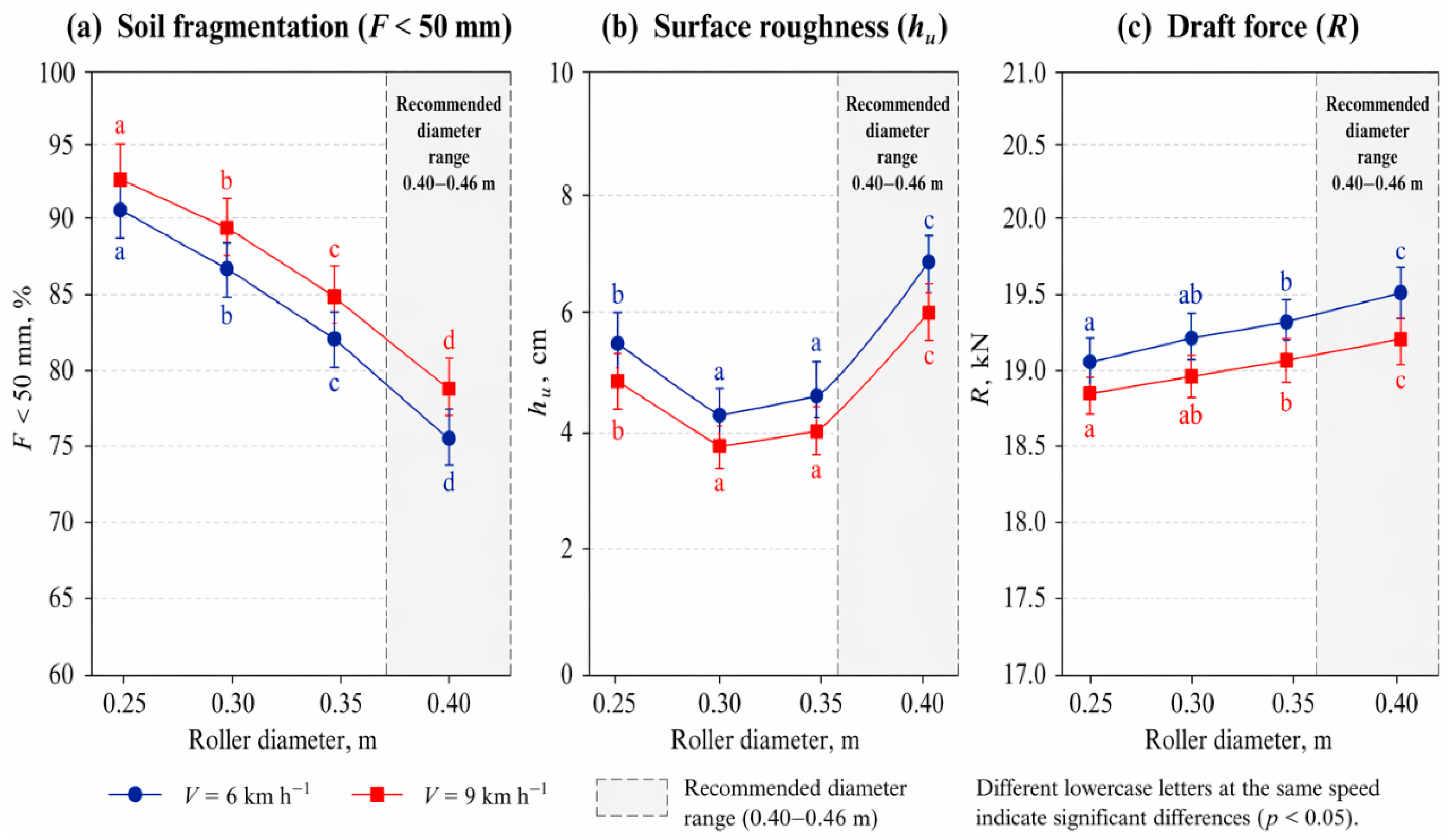
The effect of roller diameter (D) on soil treatment performance is presented in Table 3 and Figure 9. Roller diameter affects the curvature of the contact surface, tooth penetration conditions and the stability of soil flow toward the roller. Therefore, it is expected to influence fragmentation, surface roughness and draft force simultaneously.
As shown in Figure 9, increasing roller diameter from 0.25 to 0.40 m led to a decrease in soil fragmentation. This trend can be explained by a reduction in contact pressure and stress concentration at the tooth–soil interface as the radius of curvature increased.
The data in Table 3 confirm that soil fragmentation decreased from 91–93% at D = 0.25 m to 76–79% at D = 0.40 m, depending on forward speed. Surface roughness exhibited a nonlinear response: it decreased initially, indicating improved levelling, and then increased at larger diameters, probably due to insufficient penetration of the teeth into the loosened soil layer. Draft force increased slightly with increasing diameter, reflecting the growth of contact area and rolling resistance. The variability of the experimental data, expressed as SD values in Table 3, was taken into account in the regression analysis.
The relationships observed in Figure 9 were quantitatively described by polynomial regression equations obtained using the least-squares method, where x corresponds to roller diameter D (m), and y represents the response variable. The regression models were developed based on mean values (n = 5) for each experimental condition.
For surface roughness (y, cm), the dependence is given by Equations (8) and (9):
V = 6 km h−1: y = 320x2 − 198.4x + 35.13, R2 = 0.9752
V = 9 km h−1: y = 270x2 − 168.9x + 30.355, R2 = 0.9898
The positive quadratic coefficients indicate a minimum roughness at intermediate diameters, corresponding to a balance between penetration depth and soil redistribution.
For soil fragmentation (y, %), the dependence on roller diameter is described by Equations (10) and (11):
V = 6 km h−1: y = −300x2 + 97x + 85.35, R2 = 0.9663
V = 9 km h−1: y = −300x2 + 101x + 86.55, R2 = 0.9796
These equations indicate a monotonic decrease in fragmentation with increasing diameter within the investigated single-factor range, reflecting reduced stress intensity at the soil–tool interface.
For draft force (y, kN), the dependence is described by Equations (12) and (13):
V = 6 km h−1: y = 3.06x + 18.343, R2 = 0.9746
V = 9 km h−1: y = 2.70x + 18.23, R2 = 0.9684
The relatively high R2 values are likely associated with the limited number of factor levels and the use of averaged data (n = 5), which naturally reduces experimental variability and smooths random fluctuations. At the same time, the obtained equations indicate a gradual increase in draft force with increasing roller diameter, which can be explained by expansion of the contact area and corresponding growth of rolling resistance. Statistical analysis using one-way ANOVA confirmed that the effect of roller diameter on all response variables was significant at the 95% confidence level (p < 0.05). The developed models were found to be adequate according to Fisher’s criterion, and no statistically significant lack of fit was detected.
From a physical standpoint, the observed trends indicate that smaller roller diameters promote deeper penetration and higher stress concentration at the tooth–soil interface, which enhances aggregate fragmentation due to increased localized loading. In contrast, larger diameters reduce penetration depth and stress intensity, resulting in lower fragmentation efficiency. At the same time, larger diameters contribute to smoother rolling and more stable kinematic interaction with the moving soil layer.
It should be emphasized that these relationships were established under single-factor conditions and therefore reflect only the isolated influence of roller diameter within the investigated range. Under real operating conditions, multiple parameters interact simultaneously. In particular, the effect of diameter is coupled with the number of teeth, tooth spacing, forward speed and applied load, which together determine the frequency of tooth–soil interaction and the overall stress distribution within the treated layer.
When interactions between factors were taken into account, as shown in Section 3.8, the rational diameter shifted toward higher values. This occurs because a larger roller improves the kinematic stability of soil flow, reduces excessive surface roughness and ensures more consistent redistribution of loosened material. Therefore, the rational diameter in the range of 0.45–0.46 m should not be interpreted as the value maximizing soil fragmentation alone, but as a compromise solution ensuring a balanced combination of fragmentation, surface roughness and draft force under practical field conditions.

3.4. Effect of the Number of Teeth

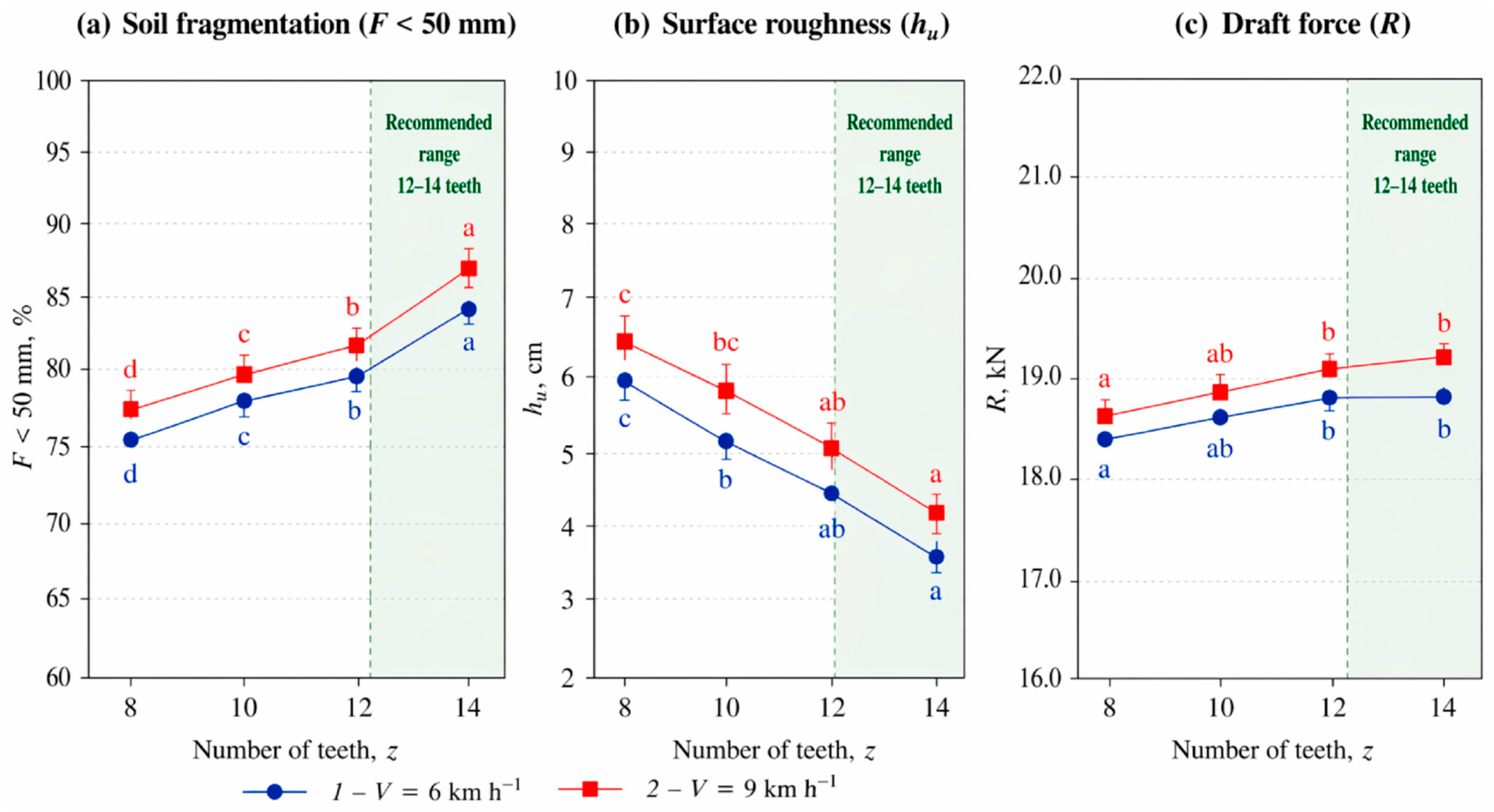
The influence of the number of teeth (z) on soil fragmentation, surface roughness and draft force is presented in Table 4 and Figure 10. The number of teeth determines the frequency of localized soil loading and therefore directly affects aggregate breakdown and surface formation.
As shown in Figure 10, increasing the number of teeth from 8 to 14 led to a systematic increase in soil fragmentation. This behaviour is associated with a higher frequency of localized stress application to soil aggregates, resulting in more intensive clod breakdown.
The data in Table 4 confirm that soil fragmentation increased from 76.5–78.0% at 8 teeth to 85.5–88.0% at 14 teeth, depending on forward speed. At the same time, surface roughness decreased with increasing number of teeth, indicating improved levelling of the soil surface due to more uniform redistribution of soil particles. Draft force increased moderately with tooth number, reflecting higher total resistance caused by intensified soil–tool interaction and increased contact frequency.
The relationships observed in Figure 10 were quantitatively described by second-order polynomial regression equations obtained using the least-squares method, where x is the number of teeth (z), and y represents the response variable. The regression models were developed based on mean values (n = 5) for each experimental condition.
For soil fragmentation (y, %), the dependence on the number of teeth is described by Equations (14) and (15):
V = 6 km h−1: y = 0.1875x2 − 2.675x + 86.05, R2 = 0.9799
V = 9 km h−1: y = 0.1875x2 − 2.525x + 86.40, R2 = 0.9853
These equations confirm the observed increase in soil fragmentation with the number of teeth within the investigated range.
For surface roughness (y, cm), the dependence is given by Equations (16) and (17):
V = 6 km h−1: y = −0.01875x2 + 0.0375x + 6.875, R2 = 0.9756
V = 9 km h−1: y = −0.025x2 + 0.16x + 6.84, R2 = 0.9774
The negative quadratic coefficients are consistent with the observed decrease in surface roughness.
For draft force (y, kN), the dependence is described by Equations (18) and (19):
V = 6 km h−1: y = −0.0125x2 + 0.375x + 16.30, R2 = 0.9674
V = 9 km h−1: y = −0.0125x2 + 0.375x + 16.45, R2 = 0.9753
These equations confirm a moderate increase in draft force with the number of teeth. Statistical analysis using one-way ANOVA confirmed that the effect of the number of teeth on all response variables was significant at the 95% confidence level (p < 0.05). The models were found to be adequate according to Fisher’s criterion, and no statistically significant lack of fit was detected.
The observed trends suggest that increasing the number of teeth enhances the interaction frequency between the tool and soil, which promotes aggregate breakdown and improves surface levelling. At the same time, a further increase in tooth density increases resistance, reflecting more intensive soil–tool interaction. Based on the combined analysis of soil fragmentation, surface roughness and draft force, the rational number of teeth was determined to be approximately 12–13 under the single-factor conditions. This range ensures effective soil fragmentation while maintaining acceptable energy demand and stable operation of the implement.

3.5. Effect of Transverse Spacing Between Teeth

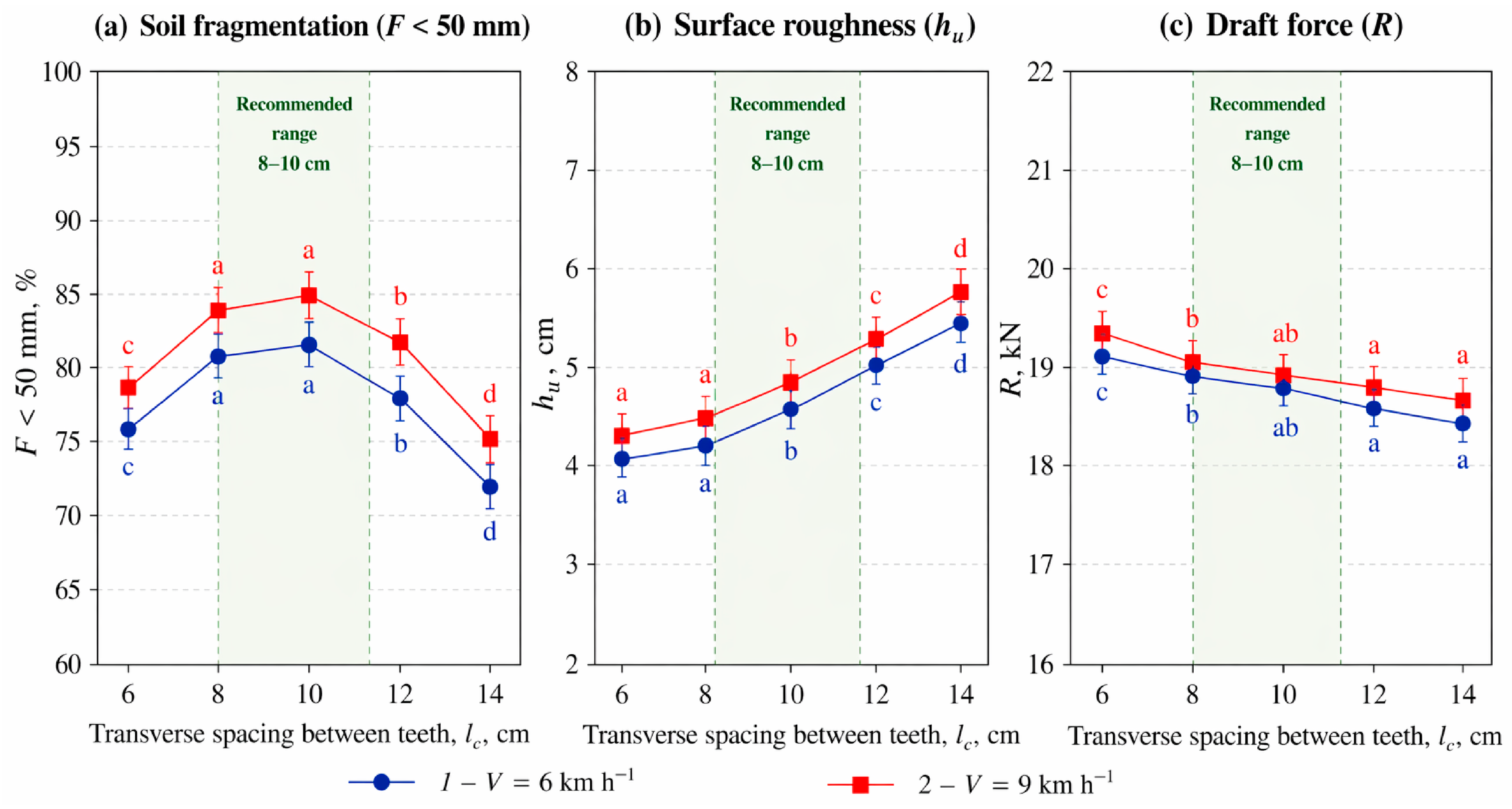
The influence of transverse spacing between teeth (lc) on soil fragmentation, surface roughness and draft force is presented in Figure 11 and Table 5. This parameter determines the lateral distribution of tooth–soil contacts and therefore affects both aggregate capture probability and soil flow between adjacent teeth.
As shown in Figure 11, soil fragmentation increased with increasing spacing up to approximately 8–10 cm, after which it decreased. This behaviour reflects a balance between two competing mechanisms. Increasing spacing reduces clogging between teeth and improves soil flow, whereas excessive spacing reduces the frequency of tooth–soil interactions and leads to incomplete clod fragmentation.
The data in Table 5 confirm that soil fragmentation reached a maximum at intermediate spacing values, while surface roughness increased with spacing. Draft force decreased slightly with increasing spacing, which can be associated with a reduction in contact density and lower resistance to soil deformation. The variability of the experimental data was taken into account in the regression analysis.
The relationships observed in Figure 11 were quantitatively described by second-order polynomial regression equations obtained using the least-squares method, where x corresponds to transverse spacing lc (cm), and y represents the response variable. The regression models were developed based on mean values (n = 5) for each experimental condition.
For soil fragmentation (y, %), the dependence on spacing is described by Equations (20) and (21):
V = 6 km h−1: y = −0.4821x2 + 9.0929x + 38.943, R2 = 0.9703
V = 9 km h−1: y = −0.4911x2 + 9.3964x + 39.7714, R2 = 0.9891
These equations confirm the existence of an optimum at intermediate spacing values.
For surface roughness (y, cm), the dependence is given by Equations (22) and (23):
V = 6 km h−1: y = 0.0107x2 − 0.0243x + 3.8457, R2 = 0.9884
V = 9 km h−1: y = 0.0107x2 − 0.0243x + 4.0457, R2 = 0.9784
The positive quadratic coefficients are consistent with the observed increase in surface roughness.
For draft force (y, kN), the dependence is described by Equations (24) and (25):
V = 6 km h−1: y = 0.0018x2 − 0.1107x + 19.794, R2 = 0.9800
V = 9 km h−1: y = 0.0007x2 − 0.0923x + 19.8697, R2 = 0.9817
These equations indicate that draft force decreased slightly with increasing transverse spacing. The effect was statistically significant at p < 0.05, and the models were adequate according to Fisher’s criterion.
The observed trends suggest a balance between interaction frequency and soil flow conditions. At small spacing, fragmentation may be enhanced locally but resistance increases; at excessive spacing, interaction frequency decreases and incomplete fragmentation becomes more likely. Based on the combined analysis of soil fragmentation, surface roughness and draft force, the rational transverse spacing between teeth was determined to be 8–10 cm under the tested conditions.

3.6. Effect of Tooth Height

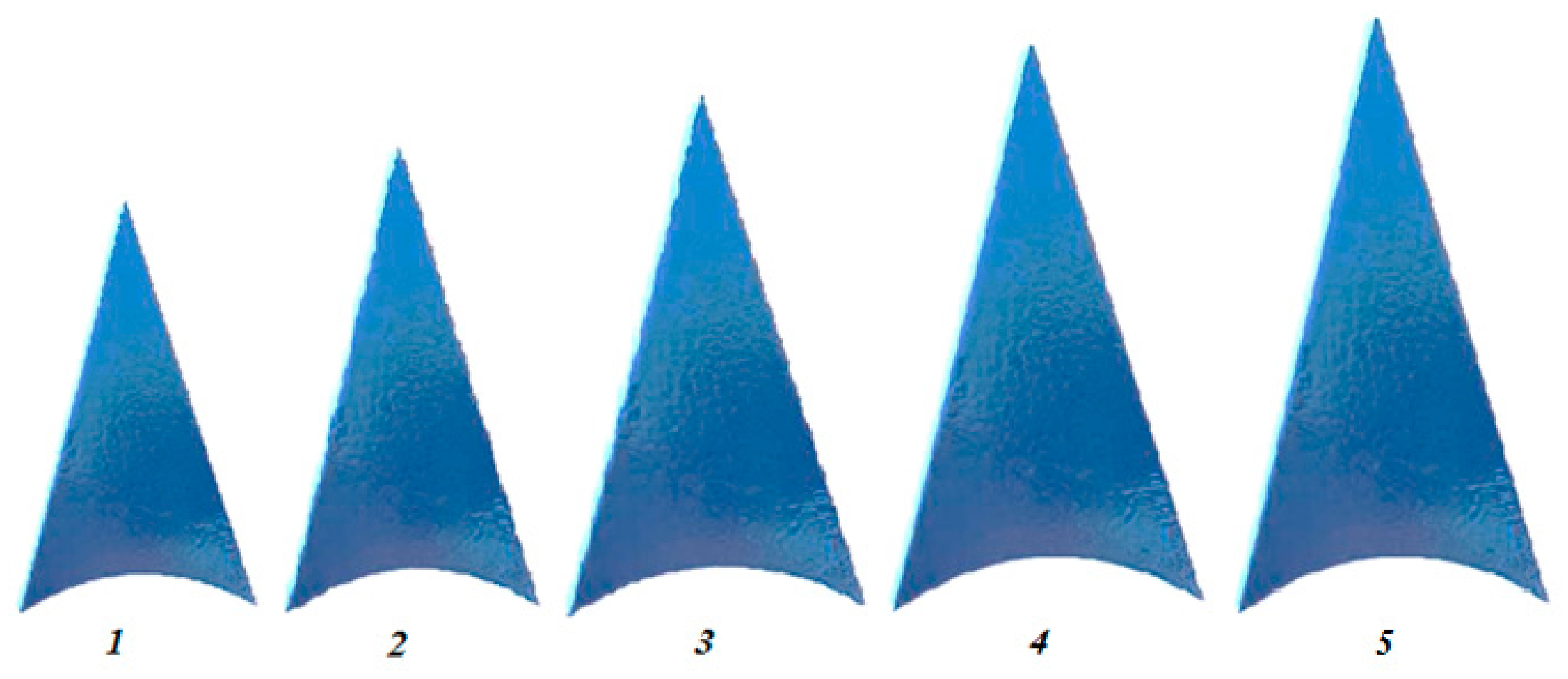
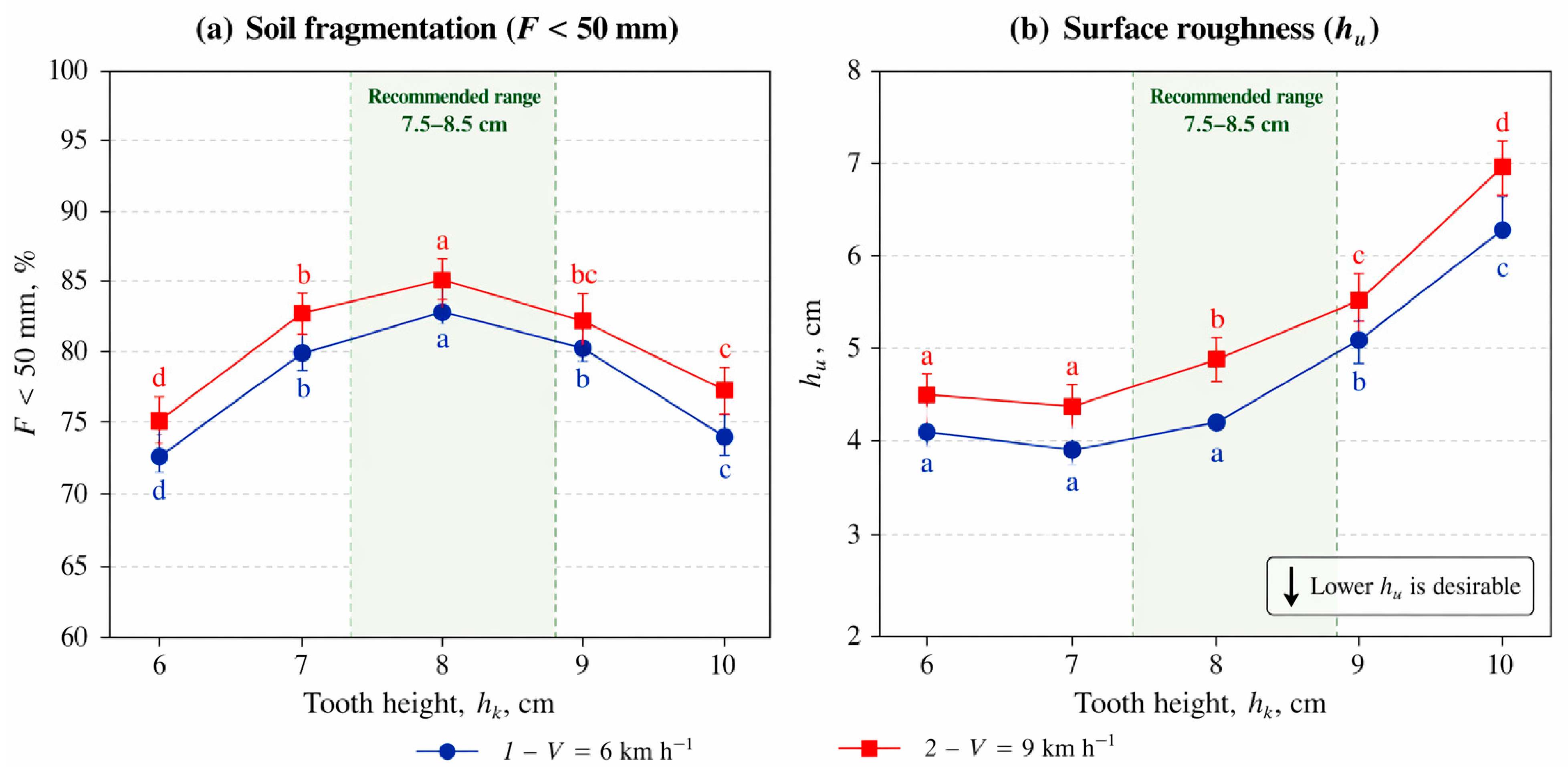
The geometry of the roller teeth with different heights used in the experiment is shown in Figure 12. The variation in tooth height (ht) defines the depth of stress penetration into the soil layer and directly influences the mechanism of soil aggregate fragmentation.
The influence of tooth height (ht) on soil fragmentation and surface roughness is presented in Table 6 and Figure 13.
As shown in Figure 13, increasing tooth height from 6 to 8 cm resulted in a pronounced increase in soil fragmentation, followed by a gradual decline at higher values. This behaviour indicates the existence of an optimal penetration depth, at which stress transfer to soil aggregates is maximized without excessive disturbance of the soil layer.
The data in Table 6 confirm that the proportion of aggregates smaller than 50 mm increased with tooth height up to 8 cm, reaching 83.0% at V = 6 km h−1 and 85.0% at V = 9 km h−1. Further increases in tooth height reduced fragmentation efficiency. Surface roughness exhibited a minimum at intermediate tooth heights and increased significantly at higher values, indicating deterioration of surface levelling due to excessive soil displacement.
The relationships observed in Figure 13 were quantitatively described by second-order polynomial regression equations obtained using the least-squares method, where x corresponds to tooth height ht (cm), and y represents the response variable. The regression models were developed based on mean values (n = 5) for each experimental condition.
For soil fragmentation (y, %), the dependence on tooth height is described by Equations (26) and (27):
V = 6 km h−1: y = −2.3571x2 + 38.014x − 70.343, R2 = 0.9885
V = 9 km h−1: y = −2.2143x2 + 35.729x − 59.286, R2 = 0.9767
These equations indicate that soil fragmentation increased with tooth height up to an optimum, after which it decreased due to excessive soil disturbance and reduced efficiency of stress concentration.
For surface roughness (y, cm), the dependence is given by Equations (28) and (29):
V = 6 km h−1: y = 0.2286x2 − 3.0971x + 14.411, R2 = 0.9747
V = 9 km h−1: y = 0.2357x2 − 3.1614x + 14.994, R2 = 0.9827
The positive quadratic coefficients are consistent with the observed minimum in surface roughness at intermediate tooth heights.
Statistical analysis using one-way ANOVA confirmed that the effect of tooth height on both soil fragmentation and surface roughness was significant at the 95% confidence level (p < 0.05). The models were found to be adequate according to Fisher’s criterion, and no statistically significant lack of fit was detected.
The observed trends suggest that at low tooth heights, limited penetration reduces the effectiveness of stress transfer to soil aggregates, resulting in lower fragmentation efficiency. At intermediate heights, favourable interaction conditions support both aggregate breakdown and surface levelling. Further increases in tooth height lead to excessive soil displacement, which negatively affects surface uniformity and process stability. The influence of tooth height should also be interpreted together with soil moisture, because moisture affects cohesion, penetration resistance, aggregate strength and the depth of stress transmission.
Based on the combined analysis of soil fragmentation and surface roughness, the rational tooth height for the studied conditions was determined to be 7.5–8.5 cm. This range ensured stable interaction between the roller and soil without excessive penetration or energy loss within the tested soil moisture range.

3.7. Effect of Specific Load on the Roller

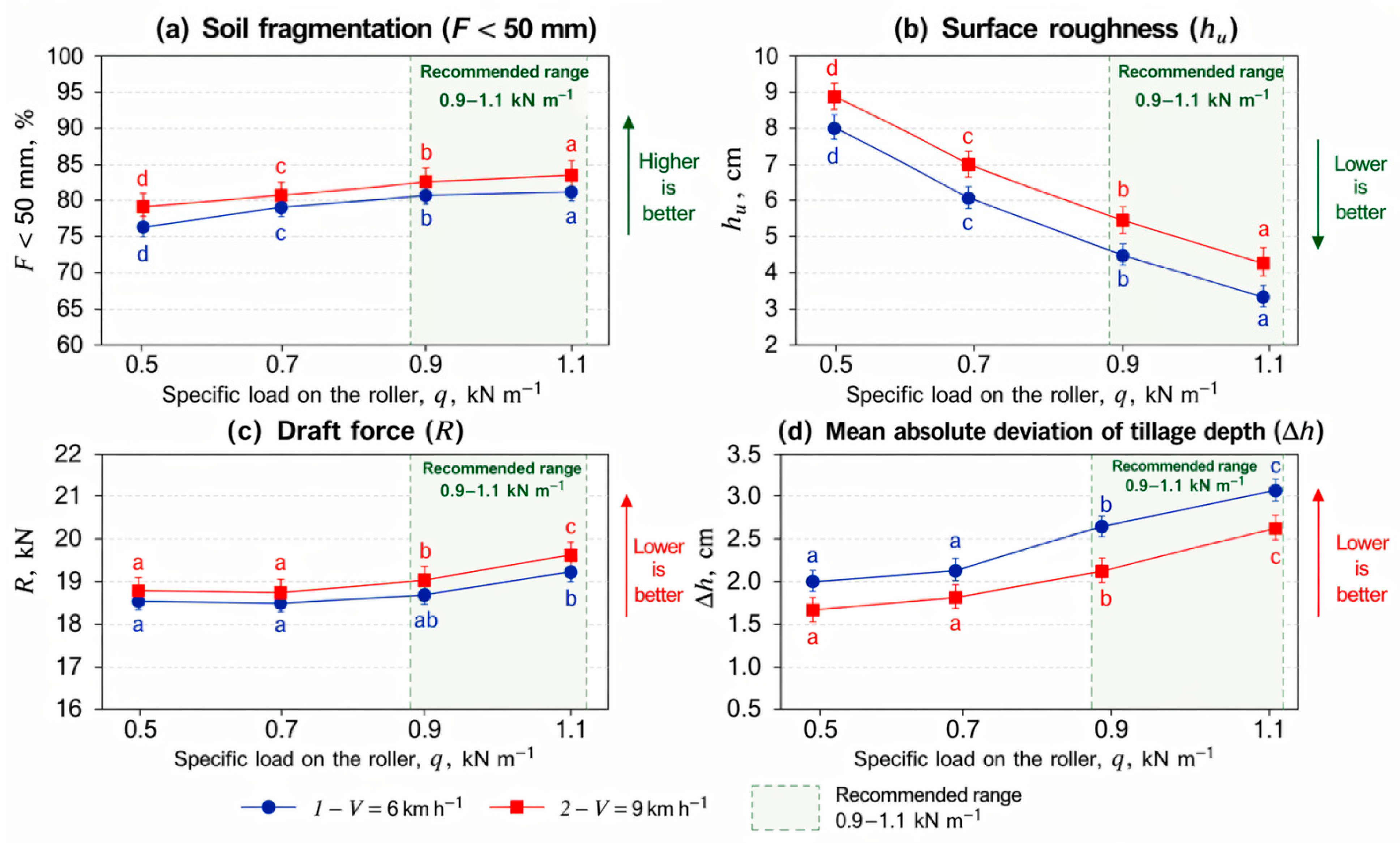
The influence of the specific load applied to the roller on soil fragmentation, surface roughness, draft force and variability of tillage depth was investigated under field conditions. Specific load determines the degree of tooth penetration and the magnitude of localized stress applied to soil aggregates. The response of the measured parameters to changes in load is presented in Figure 14 and Table 7.
As shown in Figure 14, an increase in specific load from 0.5 to 1.1 kN m−1 resulted in a systematic increase in soil fragmentation and a decrease in surface roughness. This behaviour is associated with deeper penetration of the roller teeth into the soil layer and increased localized stress acting on soil aggregates.
The data presented in Table 7 confirm that increasing specific load improved soil fragmentation while reducing surface roughness, whereas draft force and depth variability exhibited nonlinear behaviour.
The relationships shown in Figure 14 were approximated by least-squares polynomial regression equations, where x is the specific load on the roller (kN m−1), and y represents the corresponding response variable. The regression models were developed based on mean values (n = 5) for each experimental condition.
For soil fragmentation (y, %), the dependence on specific load is described by Equations (30) and (31):
V = 6 km h−1: y = −12.5x2 + 28.0x + 66.225, R2 = 0.9857
V = 9 km h−1: y = −9.375x2 + 22.75x + 69.8938, R2 = 0.9811
These equations confirm an increase in soil fragmentation with increasing load within the investigated range, with a tendency toward saturation at higher loads.
For surface roughness (y, cm), the dependence is given by Equations (32) and (33):
V = 6 km h−1: y = 6.25x2 − 18.0x + 15.4375, R2 = 0.9899
V = 9 km h−1: y = 6.25x2 − 18.0x + 16.3375, R2 = 0.9711
The positive quadratic coefficients indicate that excessive loading may lead to increased surface roughness after reaching a minimum, reflecting deterioration of surface levelling due to soil displacement and structural disturbance.
The variability of tillage depth (y, cm) is described by Equations (34) and (35):
V = 6 km h−1: y = 7.9375x2 − 9.055x + 4.5596, R2 = 0.9899
V = 9 km h−1: y = 3.75x2 − 4.20x + 2.8725, R2 = 0.9773
These relationships show that increasing load led to higher variability in tillage depth, indicating reduced stability of the working process at elevated loads.
For draft force (y, kN), the dependence is described by Equations (36) and (37):
V = 6 km h−1: y = 3.75x2 − 4.90x + 20.2325, R2 = 0.9765
V = 9 km h−1: y = 4.375x2 − 5.65x + 20.6263, R2 = 0.9890
These equations confirm the nonlinear behaviour of draft force with increasing load. Statistical analysis using one-way ANOVA confirmed that the effect of specific load on all response variables was significant at the 95% confidence level (p < 0.05). The calculated F-values exceeded the critical values, and no statistically significant lack of fit was detected.
The extrema of the quadratic functions indicate that the rational range of specific load lies within 0.9–1.1 kN m−1. At low loads, limited stress transfer resulted in insufficient fragmentation and higher surface roughness. At moderate loads, more favourable interaction conditions promoted aggregate breakdown and surface levelling. Further increases in load increased resistance and depth variability, reflecting intensified soil deformation and reduced process stability.
Based on the combined analysis of soil fragmentation, surface roughness, draft force and depth variability, the rational range of specific load on the roller was determined to be 0.9–1.1 kN m−1. This range was subsequently used in the multifactor optimization presented in Section 3.8.

3.8. Multifactor Optimization of Toothed Roller Parameters

A multifactor experiment based on a Hartley central composite design was conducted to determine the combination of toothed roller parameters ensuring high soil fragmentation while maintaining acceptable surface roughness and draft force. This experimental design enabled simultaneous consideration of quadratic effects and interactions between factors, which is essential for describing the nonlinear nature of soil–tool interaction under field conditions. The regression models were developed using coded variables defined in Table 2.
It should be emphasized that the single-factor analysis presented in Section 3.3 indicated a decrease in soil fragmentation with increasing roller diameter within the investigated range. However, this trend was obtained under fixed conditions and reflects only the isolated influence of this parameter, without accounting for interactions with other design and operational variables.
In contrast, the multifactor optimization explicitly accounts for interactions between geometric and operational parameters. Therefore, the higher rational diameter identified in the multifactor analysis should not be interpreted as the value maximizing fragmentation alone. Rather, it reflects a compromise between fragmentation, surface roughness and draft force under practical field conditions.
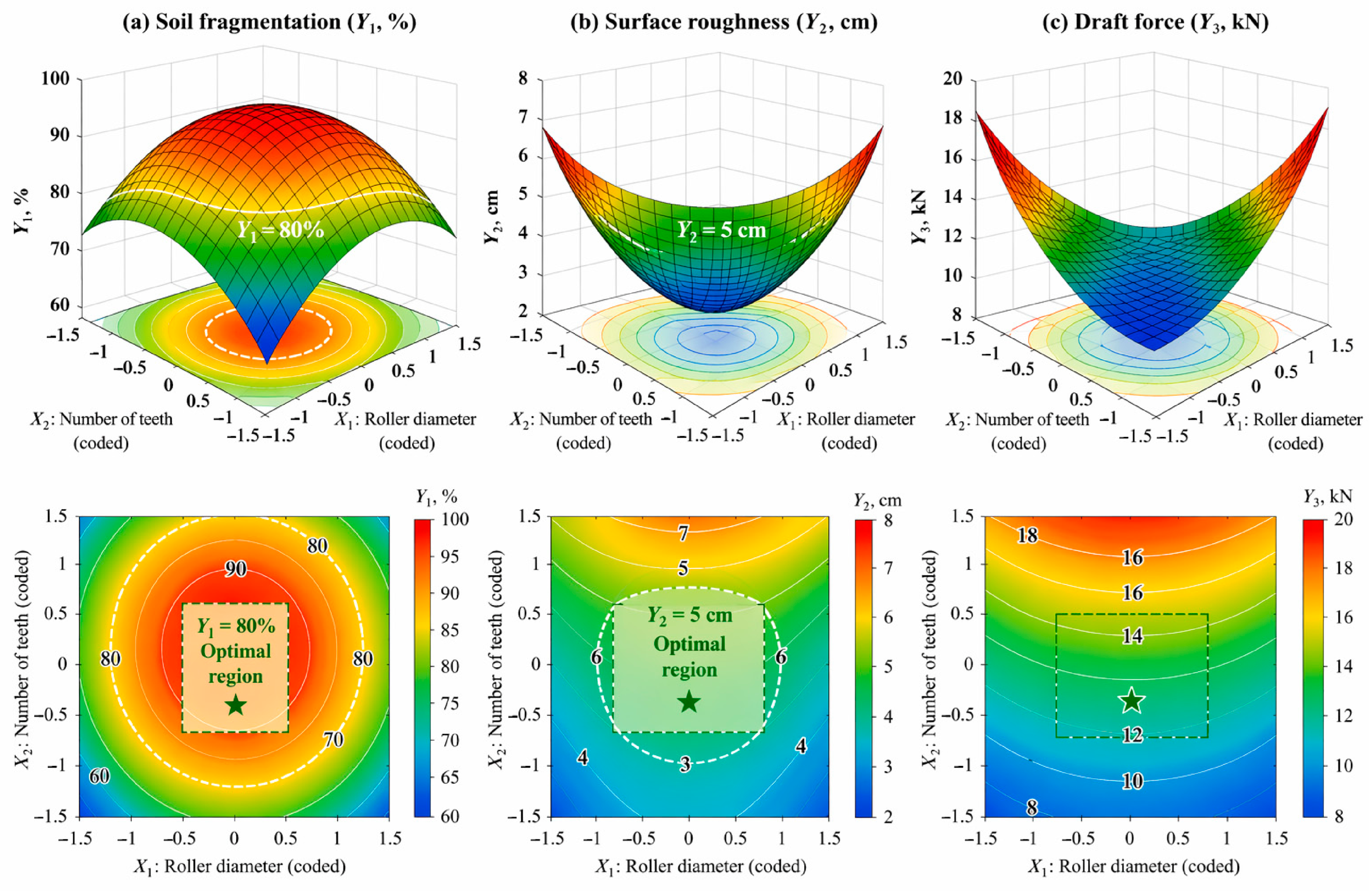
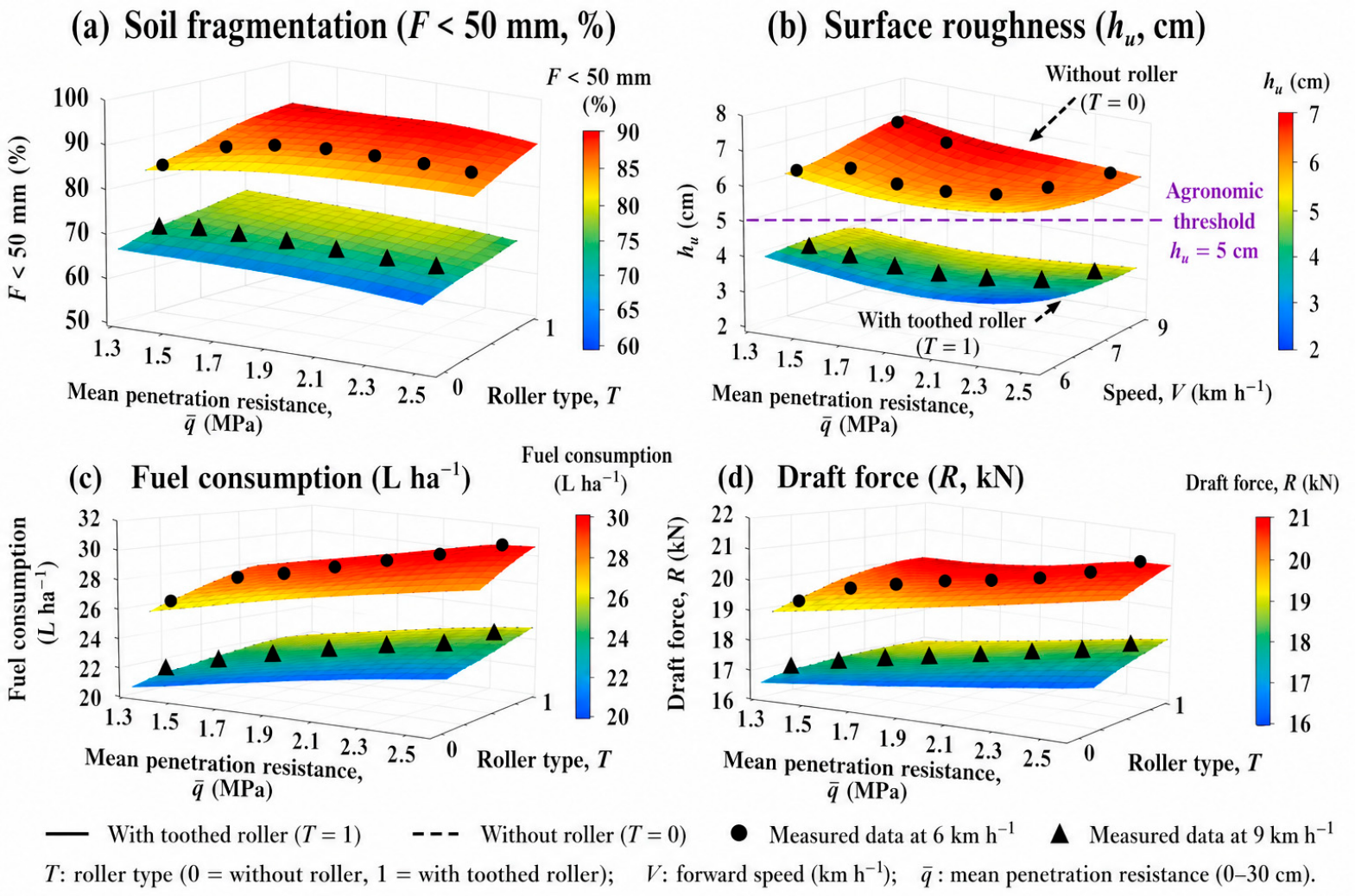
The response surfaces illustrating the effects of the main factors on soil fragmentation, surface roughness and draft force are presented in Figure 15.
As shown in Figure 15, soil fragmentation increased with decreasing roller diameter and increasing number of teeth, reaching a favourable range within intermediate factor combinations. The curvature of the response surfaces confirms the nonlinear nature of soil–tool interaction, indicating that rational operating conditions arise from a balance between stress concentration, interaction frequency and soil flow stability.
The selected variation intervals were determined based on preliminary experimental results and mechanical constraints of the implement. These ranges ensured practical feasibility and sufficient variability to identify statistically significant effects. The multifactor design was focused on the region of practical interest around the expected rational parameter range, whereas the single-factor experiment in Section 3.3 served as a preliminary assessment of the isolated diameter effect.
The response variables were described by second-order regression equations in coded factors, where X1 is roller diameter, X2 is number of teeth, X3 is transverse spacing between teeth and X4 is forward speed. The models for soil fragmentation, surface roughness and draft force are given by Equations (38)–(40), respectively.
Y 1 = 81.443 5.325 X 1 + 3.628 X 2 + 2.626 X 3 + 3.930 X 4 0.726 X 1 2 + 0.280 X 1 X 2 + 1.970 X 1 X 3 0.403 X 1 X 4 + 1.905 X 2 2 + 0.001 X 2 X 3 + 0.001 X 2 X 4 1.726 X 3 2 1.230 X 3 X 4 1.220 X 4 2
Y 2 = 4.453 + 1.056 X 1 0.777 X 2 + 0.300 X 3 0.430 X 4 + 1.019 X 1 2 0.011 X 1 X 2 + 0.024 X 1 X 3 + 0.011 X 1 X 4 0.233 X 2 2 + 0.026 X 2 X 3 0.061 X 2 X 4 + 0.040 X 3 2 0.025 X 3 X 4 + 0.170 X 4 2
Y 3 = 19.509 + 0.147 X 1 + 0.150 X 2 0.150 X 3 + 0.490 X 4 + 0.001 X 1 2 0.088 X 1 X 2 0.025 X 1 X 3 + 0.086 X 1 X 4 0.053 X 2 2 0.027 X 2 X 3 + 0.040 X 2 X 4 + 0.047 X 3 2 + 0.027 X 3 X 4 + 0.207 X 4 2
where Y1 is soil fragmentation (% of aggregates <50 mm), Y2 is surface roughness (cm), and Y3 is draft force (kN).
The adequacy of the models was evaluated using analysis of variance (ANOVA). All regression models were statistically significant at the 95% confidence level (p < 0.05), with calculated F-values exceeding the corresponding critical values. The coefficients of determination (R2) ranged from 0.96 to 0.99 depending on the response variable. Residual analysis showed no systematic patterns, supporting the use of the models within the studied factor space.
Optimization was carried out under the constraints of achieving soil fragmentation F < 50 mm ≥ 80%, surface roughness hu ≤ 5 cm and minimum draft force. The resulting rational parameter combinations at different forward speeds are presented in Table 8.
The results presented in Table 8 indicate that the rational parameter combination varied slightly with forward speed. At higher speeds, reduced interaction time between the tool and soil aggregates required adjustment of geometric parameters, particularly transverse spacing, to maintain sufficient stress concentration and fragmentation efficiency. The number of teeth is presented as integer values corresponding to practical manufacturing constraints, obtained by rounding the values derived from the regression model.
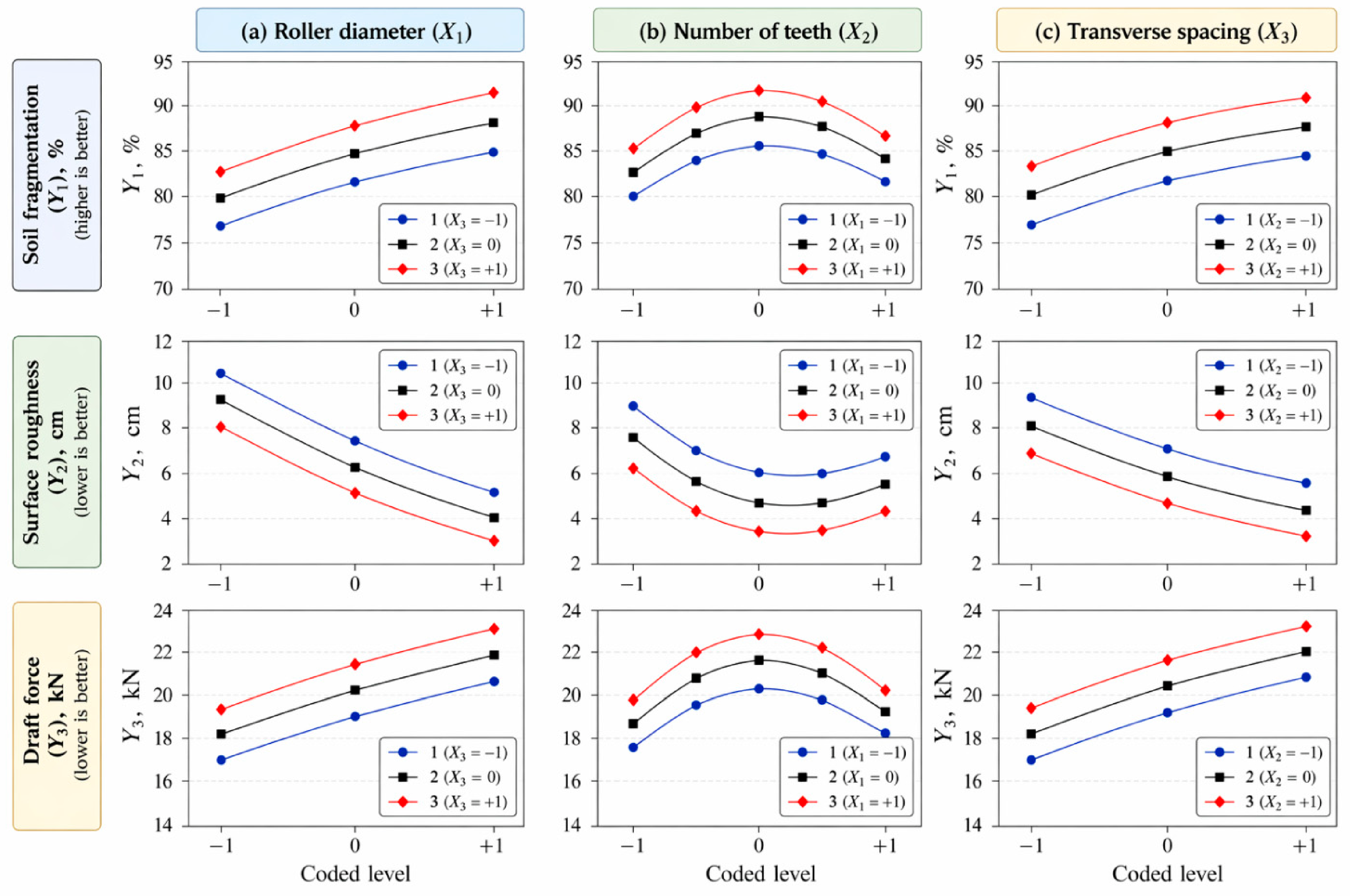
The interaction effects between the key parameters are further illustrated in Figure 16.
As shown in Figure 16, the rational region was defined by the intersection of high soil fragmentation and low surface roughness. The contour patterns indicate interaction between roller diameter and number of teeth, confirming that these parameters should be considered jointly rather than independently.
Based on the optimization results, the recommended parameter ranges are as follows: roller diameter 0.45–0.46 m, number of teeth 13–15 and transverse spacing 8.0–8.6 cm. Under these conditions, soil fragmentation reached 85–91%, surface roughness was reduced to 4.2–4.5 cm and draft force ranged from 19.2 to 20.1 kN.
The obtained models are valid within the investigated factor space defined in Table 2. The identified rational region lies near the upper boundary of the studied diameter range and reflects the combined influence of interacting parameters rather than a simple monotonic dependence on a single factor.

3.9. Field Validation of the Developed Implement

Based on the optimization results obtained in Section 3.8, a prototype chisel plow equipped with a toothed roller was manufactured and tested under field conditions. The developed implement is shown in Figure 17.
The aggregated unit with the tractor is presented in Figure 18.
The field operation of the implement is illustrated in Figure 19.
Field validation was performed using the selected toothed roller geometry (D = 0.453 m, z = 13, lc = 8.1 cm). The experiments were conducted under the soil conditions described in Section 3.1, with soil moisture of 12.6–16.3%, bulk density of 1.20–1.34 g cm−3 and penetration resistance of 1.32–2.41 MPa.
The results of field testing are presented in Table 9.
The use of the selected toothed roller improved the measured soil treatment indicators. The proportion of aggregates smaller than 50 mm increased from 76.1% to 88.0%, while the fraction larger than 100 mm decreased from 11.9% to 0.9%. Surface roughness decreased from 6.8 to 3.7 cm. These differences were statistically significant according to the independent t-test (p < 0.05).
The measured forward speeds were 7.91 ± 0.20 and 7.80 ± 0.18 km h−1 for the unit without the roller and with the toothed roller, respectively. Based on the reported mean values, standard deviations and sample size (n = 5), the difference in forward speed was not statistically significant (t ≈ 0.91, p ≈ 0.39). Similarly, tillage depth differed by 0.5 cm between treatments, and this difference was also not statistically significant (t ≈ 0.71, p ≈ 0.50). Therefore, the differences in soil fragmentation and surface roughness cannot be attributed to systematic differences in speed or tillage depth, although these operating parameters were still considered as possible sources of minor variation in draft force and fuel consumption.
A detailed statistical summary of the validation results is presented in Table 10.
The observed values were compared with the predicted ranges obtained from the regression models. The comparison is presented in Table 11.
The proportion of aggregates smaller than 50 mm is described by Equation (41):
F < 50 = 10.169 + 8.519 T + 47.977 q ¯ , R 2 = 0.986
Surface roughness is described by Equation (42):
h u = 20.737 2.556 T + 0.174 V 8.311 q ¯ , R 2 = 0.987
Fuel consumption is described by Equation (43):
F u e l = 3.760 + 3.207 T 0.160 V + 16.047 q ¯ , R 2 = 0.980
Draft force is described by Equation (44):
R = 0.876 + 0.173 T 0.449 w ¯ + 18.798 ρ ¯ , R 2 = 0.977
where T is the implement configuration (0—without roller, 1—toothed roller), V is forward speed, w is soil moisture, ρ is soil bulk density and CI is penetration resistance.
The regression coefficients were statistically significant at p < 0.05 according to Student’s t-test. Model adequacy was assessed using Fisher’s test, and no statistically significant lack of fit was detected within the tested range. These models should be interpreted as empirical regression relationships valid under the investigated soil and operating conditions.
The response surfaces derived from these models are shown in Figure 20.
Roller type was coded as T = 0 without roller and T = 1 with toothed roller. Circles and triangles represent measured data at 6 and 9 km h−1, respectively. The dashed line in panel (b) indicates the agronomic threshold hu = 5 cm.
The comparison between predicted and measured values is presented in Figure 21.
The dashed line indicates the perfect agreement line (y = x), the solid line represents the linear regression fit, and the shaded band indicates the ±5% agreement zone. Symbols denote validation groups for the tested configurations and forward speeds: blue circles—without roller at 6 km h−1; green triangles—without roller at 9 km h−1; orange squares—toothed roller at 6 km h−1; red diamonds—toothed roller at 9 km h−1. Error bars indicate the uncertainty of predicted and measured values. The validation was performed using n = 4 validation groups.
The statistical comparison of treatments is shown in Figure 22.
Boxes indicate the interquartile range, horizontal lines indicate medians, whiskers show data variability, and points represent individual observations. Different letters indicate significant differences at p < 0.05.
The relationships between fuel consumption, fragmentation and aggregate distribution are illustrated in Figure 23.
The results show that the selected toothed roller improved soil fragmentation and reduced surface roughness while maintaining residue retention above 60%. Fuel consumption increased moderately, from 24.2–24.4 L ha−1 without the roller to 28.4–28.5 L ha−1 with the toothed roller. This increase should be interpreted as the additional energetic cost of performing fragmentation and surface levelling in a single pass, rather than as direct evidence of a proportional increase in draft force.
The agreement between predicted and observed values, with deviations generally below 5%, supports the adequacy of the regression models within the tested factor range. However, this agreement should not be extrapolated beyond the studied soil type, moisture range, implement configuration or operating conditions.
Overall, the developed implement provided a favourable balance between improved soil fragmentation, reduced surface roughness and acceptable energy demand under the studied conditions. Broader validation under different soil textures, moisture levels, residue conditions and forward-speed ranges is required before extending the recommendations to other production environments.

4. Discussion

The obtained results indicate that the performance of a toothed roller in chisel tillage is governed by a coupled system of geometric, loading and kinematic parameters rather than by any single factor. This observation is important because rollers used in tillage systems are often considered mainly as passive levelling or reconsolidating devices. In the present study, the toothed roller should also be classified as a passive, ground-driven working element in the kinematic sense, because it had no independent drive and rotated only as a result of contact with the soil. However, its functional effect differed from that of a conventional slat roller because the teeth generated discrete tooth–soil contacts, localized stress concentration and repeated loading cycles in the loosened soil layer. From a mechanical standpoint, this behaviour is consistent with the analytical description of aggregate capture and interaction frequency in Equations (1) and (2), where tooth geometry and tooth number determine the probability and frequency of aggregate loading per unit distance.
The contrast between slat and toothed rollers reflects different modes of interaction with the loosened soil layer. The slat roller distributes load over a more continuous contact surface and mainly contributes to redistribution and smoothing of soil material. In contrast, the toothed roller generates localized stress peaks at individual contact points, thereby increasing the probability of aggregate failure. This transition from distributed to concentrated loading provides a mechanistic explanation for the observed increase in the fraction of aggregates smaller than 50 mm and the concurrent reduction in surface roughness. Similar tendencies have been reported for toothed and press rollers [22,23], which supports the interpretation that discrete loading can improve aggregate breakdown when the soil has already been loosened by primary tillage tools.
The influence of roller diameter illustrates the distinction between isolated single-factor effects and multifactor system-level optimization. Under single-factor conditions, smaller diameters enhanced fragmentation because the smaller radius of curvature increased penetration intensity and stress concentration at the tooth–soil interface. This trend is consistent with the contact-geometry interpretation of Equation (1). However, when parameter interactions were considered, the rational diameter shifted toward 0.45–0.46 m. This shift should not be interpreted as a contradiction, because the multifactor optimum reflects not only fragmentation intensity, but also surface roughness, soil-flow stability and draft force. Larger diameters can promote smoother kinematic interaction, reduce abrupt soil displacement and improve redistribution of loosened material, particularly when combined with appropriate tooth number, transverse spacing and forward speed. Similar interaction-driven behaviour has been reported in numerical and analytical studies of soil–tool systems, where rational configurations emerge only when several geometric and operational factors are varied simultaneously [9,10,11,12].
The number of teeth directly controls the frequency of soil loading events. Increasing the number of teeth improved fragmentation and reduced surface roughness, which is consistent with the relationship between interaction frequency and tooth density described in Equation (2). At the same time, the improvement was accompanied by a moderate increase in draft force, reflecting the cumulative effect of repeated deformation events and additional tooth–soil contacts. The rational range of 13–15 teeth therefore represents a compromise between effective aggregate breakdown and acceptable energy demand. Similar trade-offs have been reported for rotary and blade-type tillage tools, where repeated loading enhances fragmentation efficiency but also increases power requirement [15,16,17,18,19]. A specific feature of the present system is that repeated loading was achieved passively through ground-driven rolling rather than by an independently powered rotor, which is relevant for conservation-oriented tillage systems where excessive soil disturbance and energy input should be avoided.
The transverse spacing between teeth determines the balance between aggregate capture and soil-flow continuity. At small spacing, the probability of aggregate interception increases, but adjacent deformation zones may overlap and increase resistance. At excessive spacing, soil flow becomes less constrained, but a larger fraction of aggregates may pass between teeth without sufficient loading. The rational spacing of 8.0–8.6 cm therefore corresponds to a mechanical balance between interaction frequency, aggregate capture probability and free movement of loosened soil. This result suggests that tooth spacing should be selected with reference to the expected aggregate-size distribution and soil-flow conditions rather than only from purely geometric considerations. Such interpretation is consistent with the analytical concept of transverse spacing in Equation (3), where the distance between teeth is related to the spatial arrangement of soil aggregates.
Tooth height controlled the depth of stress penetration and the volume of soil involved in each loading cycle. The observed nonlinear response, with a rational range of 7.5–8.5 cm, indicates that both insufficient and excessive penetration reduce process efficiency. Shallow teeth do not transmit stress deeply enough to initiate intensive aggregate failure, whereas excessive tooth height disrupts soil flow and increases surface irregularity. This behaviour agrees with the general finding that intermediate tool geometries often provide the best compromise between soil disturbance and energy demand [13,14,20]. The effect of tooth height should also be interpreted together with soil moisture, because moisture modifies cohesion, penetration resistance, aggregate strength and the depth of stress transmission. Therefore, the identified range should be treated as valid primarily for the tested medium-loam Calcisol and moisture conditions.
The influence of specific load further confirms the role of localized stress transfer in the operation of the toothed roller. Increasing load improved fragmentation and reduced roughness by enhancing tooth penetration and contact pressure, but it also increased draft force and depth variability. From an energy perspective, the results indicate that additional energy input was associated with additional mechanical work performed on the loosened soil layer. However, this relationship should not be interpreted as strictly proportional, because fuel consumption under field conditions depends not only on draft force but also on rolling resistance, wheel slip, transient engine loading, soil redistribution and the stability of implement motion. Thus, fuel consumption is better interpreted as an integrated field-energy indicator rather than as a direct measure of traction resistance alone. This interpretation is consistent with the broader concept that tillage energy is related to the mechanical work required for soil deformation and aggregate modification [31].
The multifactor analysis demonstrates that interactions between design and operating parameters are critical for selecting rational roller geometry. The response surfaces showed that favourable performance occurred within a limited region of the factor space and could not be fully identified through single-factor analysis alone. This explains why parameter values that appear favourable under isolated conditions may shift when other factors are varied simultaneously. The agreement between predicted and observed values, with deviations generally below 5%, supports the adequacy of the regression models within the tested range. Nevertheless, these models should be regarded as empirical relationships calibrated for the investigated soil, moisture and operating conditions rather than as universal predictive equations.
Field validation supported the practical relevance of the developed approach. The selected configuration increased the proportion of aggregates smaller than 50 mm from 76.1% to 88.0% and reduced surface roughness from 6.8 to 3.7 cm while maintaining residue retention above 60%. These results indicate an improvement in the measured indicators associated with seedbed preparation, namely aggregate-size distribution and surface microrelief. The associated increase in fuel consumption should not be treated as a purely negative outcome or as direct evidence of a proportional increase in draft force. Rather, it reflects the additional energetic cost of performing aggregate breakdown and surface levelling in a single pass. This interpretation is particularly important because the measured differences in draft force were moderate, whereas the improvement in fragmentation and roughness was more pronounced.
Several limitations should be acknowledged. The experiments were conducted under a specific soil type, namely medium-loam Calcisol, and within a limited moisture range of 12–18%. The obtained relationships may therefore change under other soil textures, moisture levels, residue conditions or compaction states. Although forward speed was included in the experimental design, the tested range was limited, and broader speed intervals may reveal additional effects on soil flow, tooth penetration and energy demand. The analytical model also simplifies the structure of soil aggregates, which in reality have heterogeneous shapes, strengths and moisture-dependent mechanical properties. In addition, the study focused on immediate tillage effects, while long-term impacts on soil structure, water dynamics, crop emergence and yield were beyond the scope of the present work.
Overall, the results support the hypothesis that discrete tooth–soil interaction can improve fragmentation of a loosened soil layer through localized stress concentration and repeated loading. At the same time, they show that rational design cannot be defined by a single parameter or a single performance criterion. A toothed roller for chisel tillage should provide a balance between aggregate breakdown, surface roughness, draft force and fuel consumption. Under the investigated conditions, this balance was achieved with a roller diameter of 0.45–0.46 m, 13–15 teeth and transverse spacing of 8.0–8.6 cm. These findings provide a physically interpretable basis for selecting toothed roller parameters for conservation-oriented tillage under similar soil and operating conditions, while broader validation is required before generalizing the recommendations to other environments.

5. Conclusions

This study investigated the influence of toothed roller design parameters on soil fragmentation, surface roughness, draft force and fuel consumption during chisel tillage under medium-loam Calcisol conditions using an integrated analytical–experimental approach. The following conclusions can be drawn.
  • The toothed roller should be classified as a passive, ground-driven soil-engaging element rather than as an active working body because it had no independent drive and rotated only due to contact with the soil. Its functional effect, however, differed from that of a conventional levelling roller. Discrete tooth–soil interaction generated localized stress concentration and repeated loading of loosened aggregates, which improved aggregate fragmentation and surface formation under the tested conditions.
  • Tillage performance was controlled by the combined effect of geometric, loading and operational parameters. The single-factor analysis described local trends for individual parameters, whereas the multifactor response-surface analysis showed that rational design requires simultaneous consideration of parameter interactions. Therefore, toothed roller performance cannot be adequately evaluated using a single geometric parameter or a single response variable alone.
  • Roller diameter exhibited a dual effect. Under single-factor conditions, smaller diameters intensified local stress concentration and promoted soil fragmentation. However, when interactions with tooth number, transverse spacing, and forward speed were considered, a larger diameter of 0.45–0.46 m provided a more favourable balance between fragmentation, surface roughness and draft force. This result indicates that the rational diameter is determined by the stability of soil flow and the combined performance of the implement, rather than by maximum fragmentation alone.
  • The number of teeth, transverse spacing and tooth height jointly determined the frequency, distribution and depth of soil loading. Under the investigated conditions, the rational ranges were 13–15 teeth, transverse spacing of 8.0–8.6 cm and tooth height of 7.5–8.5 cm. These ranges provided effective aggregate capture and fragmentation while maintaining stable soil flow, acceptable surface roughness and moderate draft force.
  • The specific load applied to the roller affected both soil treatment indicators and energy demand. Increasing load improved fragmentation and reduced surface roughness by increasing tooth penetration and localized contact stress, but it also increased draft force and depth variability. The rational load range of 0.9–1.1 kN m−1 provided a practical balance between aggregate breakdown, surface levelling and process stability under the tested soil and operating conditions.
  • Field validation confirmed the practical relevance of the selected toothed roller configuration. The proportion of aggregates smaller than 50 mm increased from 76.1% to 88.0%, surface roughness decreased from 6.8 to 3.7 cm, and residue retention remained above 60%. These results indicate an improvement in the measured indicators associated with seedbed preparation, namely aggregate-size distribution and surface microrelief, while preserving a residue cover compatible with conservation-oriented tillage.
  • The increase in fuel consumption should be interpreted as the additional energetic cost of performing aggregate fragmentation and surface levelling in a single pass, rather than as direct evidence of a proportional increase in draft force. Fuel consumption under field conditions is influenced by draft force, rolling resistance, wheel slip, transient engine loading and soil redistribution work; therefore, it should be treated as an integrated field-energy indicator.
Overall, the proposed analytical–experimental framework establishes physically interpretable relationships between toothed roller geometry and soil response. This distinguishes the study from purely empirical comparisons of roller configurations and provides a basis for selecting toothed roller parameters for chisel tillage under similar soil and operating conditions.
The study was limited to medium-loam Calcisol, the investigated moisture range of approximately 12–18%, the tested residue conditions, and the selected range of forward speeds and roller geometries. Although the obtained regression models showed good agreement with field observations within the tested factor space, they should not be extrapolated to other soil textures, moisture levels, residue loads or implement configurations without additional validation. Future work should include broader forward-speed ranges, different soil types, variable moisture and residue conditions, long-term effects on soil structure and water dynamics, and agronomic validation through crop emergence and yield response.

Author Contributions

Conceptualization, Y.S. and F.M.; methodology, Y.S. and F.M.; software, Y.S., F.M., S.K., M.S., A.K., I.K., D.C., M.K., S.O., S.B., M.B., S.A. (Shahnoza Abduganiyeva) and S.A. (Sevara Alikulova); validation, Y.S. and F.M.; formal analysis, Y.S. and F.M.; investigation, Y.S. and F.M.; resources, S.K., M.S., A.K., I.K., D.C., M.K., S.O., S.B., M.B., S.A. (Shahnoza Abduganiyeva) and S.A. (Sevara Alikulova); data curation, Y.S. and F.M.; writing—original draft preparation, Y.S.; writing—review and editing, Y.S. and F.M.; visualization, Y.S. and F.M.; supervision, Y.S. and F.M.; project administration, S.K., M.S., A.K., I.K., D.C., M.K., S.O., S.B., M.B., S.A. (Shahnoza Abduganiyeva) and S.A. (Sevara Alikulova). All authors have read and agreed to the published version of the manuscript.

Funding

Latvia University of Life Sciences and Technologies: EFDS-FL1-02 (ALLEA code: 1). The project provided institutional support, but no direct financial funding was received for this research.

Data Availability Statement

The data presented in this study are available on request from the corresponding author.

Conflicts of Interest

The authors declare no conflicts of interest.

References

  1. Fanigliulo, R.; Pochi, D.; Servadio, P. Conventional and conservation seedbed preparation systems. Sustainability 2021, 13, 6506. [Google Scholar] [CrossRef]
  2. Sarkar, P. Combined tillage implements: A review. Span. J. Agric. Res. 2021, 19, e04R01. [Google Scholar] [CrossRef]
  3. Kumar, A.A.; Kumar, C.A.; Chakrapani, V.; Rajesh, D.; Rao, N. Development of multifunctional tillage implement. Curr. J. Appl. Sci. Technol. 2022, 41, 30–38. [Google Scholar] [CrossRef]
  4. Hamid, A. Is using combined tillage implements the solution? Univ. Thi-Qar J. Agric. Res. 2024, 13, 101–108. [Google Scholar] [CrossRef]
  5. Al-Neama, A.K.A.; Al-Jibouri, M.A.; Esmail, E.L. The relationship between draft force and horizontal force acting on passive tillage tool. IOP Conf. Ser. Earth Environ. Sci. 2021, 735, 012071. [Google Scholar] [CrossRef]
  6. Drwish, L.A. Modeling the effect of soil–tool interaction on draft force. Ann. Agric. Sci. 2020, 65, 32–38. [Google Scholar] [CrossRef]
  7. Çarman, K.; Marakoğlu, T.; Taner, A.; Çıtıl, E. Prediction of draft force and disturbed soil area of a chisel tine. Selcuk J. Agric. Food Sci. 2021, 35, 56–64. [Google Scholar] [CrossRef]
  8. Al-Jarrah, M.A.; Dahham, G.; Hamood, H.A. Draft force and efficiency of soil loosening for different subsoiler shanks. Mesop. J. Agric. 2025, 53, 1–15. [Google Scholar] [CrossRef]
  9. Bai, Y.; Chen, Y.; Sadek, M. Soil disturbance and draft force prediction for subsoiling tools using finite element analysis. Soil Tillage Res. 2020, 196, 104431. [Google Scholar] [CrossRef]
  10. Ucgul, M.; Saunders, C.; Fielke, J.M. Discrete element modelling of soil–tool interaction: Parameter sensitivity and validation. Soil Tillage Res. 2019, 186, 94–104. [Google Scholar] [CrossRef]
  11. Makange, N.; Ji, C.; Nyalala, I.; Sunusi, I.; Opiyo, S. Prediction of precise subsoiling using analytical methods. Sci. Rep. 2021, 11, 90682. [Google Scholar] [CrossRef]
  12. Kobets, A.; Aliiev, E.; Tesliuk, H.; Aliieva, O. Simulation of interaction of tillage tools with soil. Mach. Energy 2023, 1, 9–15. [Google Scholar] [CrossRef]
  13. Zeng, Z.; Ma, X.; Chen, Y.; Qi, L. Modelling residue incorporation of chisel plough tools. Soil Tillage Res. 2020, 197, 104505. [Google Scholar] [CrossRef]
  14. Wu, J.; Wang, X.; Chen, K. Straw–soil disturbance in winged chisel plow. INMATEH—Agric. Eng. 2025, 76, 33–42. [Google Scholar] [CrossRef]
  15. Liu, L.; Wang, X.; Zhong, X.; Zhang, X.; Geng, Y.; Zhou, H.; Chen, T. Soil blade interaction in strip-till systems. J. Agric. Eng. 2023, 54, 1546. [Google Scholar] [CrossRef]
  16. Yang, W.; Xiao, X.; Pan, R.; Guo, S.; Yang, J. Spiral cutter–soil interaction. Agriculture 2023, 13, 1850. [Google Scholar] [CrossRef]
  17. Hu, Y.; Zhou, H.; Li, J.; Zhang, Y.; Zhang, J. Tillage performance of rotary burying blade rollers. Eng. Agrícola 2025, 45, e20240156. [Google Scholar] [CrossRef]
  18. Zheng, S.; Lu, T.; Liu, J.; Tian, Y.; Han, M.; Tai, M.; Gao, S.; Liu, T.; Wang, D.; Zhao, Z. High-speed rotary tiller design. Agriculture 2025, 15, 269. [Google Scholar] [CrossRef]
  19. Zhang, T.; Tang, X.; Dai, C.; Ren, G.; Pang, Y. Soil fragmentation in rotary tillage. Sci. Rep. 2025, 15, 26096. [Google Scholar] [CrossRef]
  20. Ding, H.; Wang, Q.; Wang, M.; Zhang, C.; Lin, H.; Jin, X.; Hong, H.; Dang, F. Optimizing soil-mixing blade structure parameters. Agriculture 2025, 15, 1558. [Google Scholar] [CrossRef]
  21. Rakhimov, I.; Telichkina, N.; Batraeva, O.; Shabunin, A.; Krasnozhon, S. Parameters of a two-drum roller for tillage. IOP Conf. Ser. Mater. Sci. Eng. 2019, 582, 012027. [Google Scholar] [CrossRef]
  22. Babitsky, L.F.; Sobolevsky, I.; Ismailov, Y. Substantiation of the arrangement and parameters of toothed tillage rollers. E3S Web Conf. 2020, 224, 04028. [Google Scholar] [CrossRef]
  23. Zhao, Z.; Zhu, X.; Li, J.; Lyu, J.; Qi, Y.; Liu, J. Tooth press roller design for soil fragmentation. Agriculture 2023, 13, 1193. [Google Scholar] [CrossRef]
  24. Aldoshin, N.V.; Mamatov, F.M.; Kuznetsov, Y.A.; Kravchenko, I.N.; Kupreenko, A.I.; Ismailov, I.I.; Kalashnikova, L.V. Loosening and leveling device for preparing soil for melon crops. INMATEH—Agric. Eng. 2021, 64, 269–278. [Google Scholar] [CrossRef]
  25. Mamatov, F.; Mirzaev, B.; Toshtemirov, S.; Razzaqov, T.; Avazov, I. Study on the development of a machine to prepare the soil for cotton sowing on ridges. IOP Conf. Ser. Earth Environ. Sci. 2022, 939, 012064. [Google Scholar] [CrossRef]
  26. Mirzaev, B.; Mamatov, F.; Tursunov, O. A justification of broach-plow’s parameters of the ridge-stepped ploughing. E3S Web Conf. 2019, 97, 05035. [Google Scholar] [CrossRef]
  27. Avazov, I.; Mardonov, S. Technologies and technical means for anti-erosion differentiated soil treatment system. E3S Web Conf. 2019, 97, 05036. [Google Scholar] [CrossRef]
  28. Ergashov, G.H.; Mamatov, F.M.; Ravshanova, N.B.; Toshtemirov, S.J.; Begimkulova, M.F. Justification of the parameters of the lister body. IOP Conf. Ser. Earth Environ. Sci. 2022, 1076, 012022. [Google Scholar] [CrossRef]
  29. Azizi, A.; Abbaspour-Gilandeh, Y.; Mesri-Gundoshmian, T.; Farooque, A.; Afzaal, H. Estimation of soil surface roughness using stereo vision approach. Sensors 2021, 21, 4386. [Google Scholar] [CrossRef]
  30. Romaneckas, K.; Steponavičius, D.; Jasinskas, A.; Kazlauskas, M.; Naujokienė, V.; Bručienė, I.; Švereikaitė, A.; Šarauskis, E. Seedbed depth and soil roughness relationships. Agronomy 2022, 12, 1092. [Google Scholar] [CrossRef]
  31. Varani, M.; Mattetti, M.; Molari, G.; Biglia, A.; Comba, L. Correlation between energy demand and soil aggregates. Biosyst. Eng. 2023, 225, 54–68. [Google Scholar] [CrossRef]
  32. Shi, S.; Zhang, D.; Wang, C.; Li, Y. Effects of tillage tool geometry on soil disturbance and draft force. Soil Tillage Res. 2021, 213, 105138. [Google Scholar] [CrossRef]
  33. Semenenko, I.I.; Dzjasheev, A.M.S.; Tikhonov, E.A.; Orekhovskaya, A.A.; Mukhametshin, I.S.; Mirzoeva, M.R. Justification of the flat shaft profile using variation calculation methods. IOP Conf. Ser. Earth Environ. Sci. 2022, 981, 042047. [Google Scholar] [CrossRef]
  34. Syromyatnikov, Y.N.; Belykh, A.V.; Ivanov, A.A.; Kalimullin, M.N.; Lopareva, S.G.; Luchinovich, A.A.; Loparev, D.V. Substantiation of cultivator points form of the lowest draught for stratifier tillage machine. IOP Conf. Ser. Earth Environ. Sci. 2022, 981, 042031. [Google Scholar] [CrossRef]
  35. Sokolova, V.A.; Ivanov, A.A.; Kalimullin, M.N.; Karnaukhov, A.I.; Tikhonov, E.A.; Orekhovskaya, A.A. Justification of the shape of the tillage disk for local loosening of the soil. AIP Conf. Proc. 2022, 2767, 020015. [Google Scholar] [CrossRef]
  36. Mozgovsky, A.F.; Kalimullin, M.N.; Tikhonov, E.A.; Dzjasheev, A.M.; Orekhovskaya, A.A.; Taraban, M.V. Substantiation of flat blade parameters for soil loosening. IOP Conf. Ser. Earth Environ. Sci. 2022, 981, 042043. [Google Scholar] [CrossRef]
  37. Syromyatnikov, Y.; Semenenko, I.; Orekhovskaya, A.; Troyanovskaya, I.; Bedenko, I.; Sakhapov, R. Influence of cultivation technology on the yield of winter wheat. E3S Web Conf. 2023, 443, 02001. [Google Scholar] [CrossRef]
  38. Khramov, N.; Troyanovskaya, I.; Voinash, S.; Partko, S.; Zagidullin, R. Work quality indicators of tillage unit with flexible working body in organic farming systems. E3S Web Conf. 2023, 463, 01001. [Google Scholar] [CrossRef]
  39. Sholoiko, A. Financing losses from natural and man-made disasters by use of crowdfunding. Invest. Manag. Financ. Innov. 2017, 14, 218–225. [Google Scholar] [CrossRef][Green Version]
  40. Kairiša, D.; Valdovska, A.; Vircava, I.; Pilvere, I.; Proskina, L.; Gāliņa, D.; Gutmanis, G.; Mešķis, S. The effect of sodium humate feed additives in diets for Holstein breed heifers. Emerg. Sci. J. 2023, 7, 1395–1413. [Google Scholar] [CrossRef]
  41. Proskina, L.; Barzdina, D.; Valdovska, A.; Pilvere, I.; Vircava, I.; Cerina, S.; Meskis, S. Assessment of the inclusion of a feed additive of sodium humate derived from freshwater sapropel in diets for broiler chickens. Vet. World 2023, 16, 2029–2041. [Google Scholar] [CrossRef] [PubMed]
  42. ISO 11465:1993; Soil Quality—Determination of Dry Matter and Water Content on a Mass Basis—Gravimetric Method. International Organization for Standardization: Geneva, Switzerland, 1993.
  43. ISO 11272:2017; Soil Quality—Determination of Dry Bulk Density. International Organization for Standardization: Geneva, Switzerland, 2017.
  44. ASAE S313.3; Soil Cone Penetrometer. American Society of Agricultural and Biological Engineers: St. Joseph, MI, USA, 2004.
  45. Kemper, W.D.; Rosenau, R.C. Aggregate Stability and Size Distribution. In Methods of Soil Analysis. Part 1. Physical and Mineralogical Methods, 2nd ed.; Klute, A., Ed.; Agronomy Monograph No. 9; American Society of Agronomy: Madison, WI, USA; Soil Science Society of America: Madison, WI, USA, 1986; pp. 425–442. [Google Scholar]
  46. Veselovsky, A.; Troyanovskaya, I.; Voinash, S.; Malikov, V.; Zagidullin, R.; Sabitov, L. Features of Wear of Gears of Agricultural Machinery. Acta Technol. Agric. 2023, 26, 207–214. [Google Scholar] [CrossRef]
  47. ISO 3310-1:2016; Test Sieves—Technical Requirements and Testing—Part 1: Test Sieves of Metal Wire Cloth. International Organization for Standardization: Geneva, Switzerland, 2016.
  48. ISO 2591-1:1988; Test Sieving—Part 1: Methods Using Test Sieves of Woven Wire Cloth and Perforated Metal Plate. International Organization for Standardization: Geneva, Switzerland, 1988.
Figure 1. Structural scheme of the chisel plow equipped with a toothed roller: (1) frame; (2) hitch system; (3) support wheels; (4) chisel tines; (5) linkage mechanism; (6) toothed roller.
Agriculture 16 01260 g001
Figure 2. Geometrical parameters of the toothed roller: (a) cross-sectional contact geometry of the tooth and roller body; (b) side view of the toothed roller showing the roller body, tooth arrangement and main dimensions. (1)—tooth; (2)—roller body.
Agriculture 16 01260 g002
Figure 3. Schematic representation of soil clod capture by the roller tooth: (a) kinematic scheme of clod capture, showing the roller radii, tooth position, clod radius and contact geometry; (b) force-equilibrium scheme of the soil clod in the tooth–soil contact zone, showing the normal reaction, friction force and governing geometric parameters (Rs, rk, bt, ht, γ) used in the analytical model.
Agriculture 16 01260 g003
Figure 4. Schematic representation of soil aggregate distribution relative to roller motion: (a) longitudinal arrangement of soil aggregates, showing the clod diameter (dk), the distance between clod centres (Lb) and the longitudinal spacing between aggregates (lb) used to determine the required number of teeth; (b) transverse arrangement of soil aggregates, showing contacting (bk1), separated (bk2) and staggered (bk3) configurations, as well as the gap between aggregates (S), used to determine the average transverse tooth spacing.
Agriculture 16 01260 g004
Figure 5. Geometry of the roller tooth: (a) frontal view of the tooth profile, showing the tooth height (ht), tooth width (bt), opening angle (γ) and characteristic points D, E, F and M used in the analytical description of tooth geometry; (b) cross-section A–A of the tooth, showing the tooth thickness (t) and sharpening angle (βi) used to define the cutting-edge geometry.
Agriculture 16 01260 g005
Figure 6. Combined schematic of soil particle trajectory and force interaction with the roller tooth: (a) kinematic scheme of soil aggregate movement from the chisel tine to the toothed roller, showing the trajectory parameters li, Rt, αi, hi, h1 and S1 used to determine the longitudinal distance between the tine and the roller according to Equation (6); (b) force-interaction scheme between the roller tooth and the soil aggregate, showing the normal reaction, friction force, tooth geometry and resistance components used to formulate the draft resistance model according to Equation (7).
Agriculture 16 01260 g006
Figure 7. Experimental rollers: (a) slat roller; (b) toothed roller.
Agriculture 16 01260 g007
Figure 8. Effect of roller type on (a) soil fragmentation (F < 50 mm), (b) surface roughness (hu), (c) draft force (R) and (d) fuel consumption at forward speeds of 6 and 9 km h−1. Bars 1, 2 and 3 indicate the chisel plow without a roller, with a slat roller and with the toothed roller, respectively. Error bars indicate ±SD (n = 5).
Agriculture 16 01260 g008
Figure 9. Effect of roller diameter (D) on (a) soil fragmentation (F < 50 mm), (b) surface roughness (hu) and (c) draft force (R) at forward speeds of 6 and 9 km h−1. Symbols denote mean values (n = 5), and error bars represent 95% confidence intervals.
Agriculture 16 01260 g009
Figure 10. Effect of the number of teeth (z) on (a) soil fragmentation (F < 50 mm), (b) surface roughness (hu), and (c) draft force (R) at forward speeds of 6 and 9 km h−1. Lines correspond to 1—V = 6 km h−1; 2—V = 9 km h−1. Error bars represent 95% confidence intervals.
Agriculture 16 01260 g010
Figure 11. Effect of transverse spacing between teeth (lc) on (a) soil fragmentation (F < 50 mm), (b) surface roughness (hu), and (c) draft force (R) at forward speeds of 6 and 9 km h−1. Lines correspond to 1—V = 6 km h−1; 2—V = 9 km h−1. Error bars represent 95% confidence intervals. The shaded region indicates the recommended spacing range (8–10 cm).
Agriculture 16 01260 g011
Figure 12. Set of roller teeth with different heights (ht) used to evaluate the effect of tooth height on soil fragmentation and surface roughness: 1—6 cm; 2—7 cm; 3—8 cm; 4—9 cm; and 5—10 cm.
Agriculture 16 01260 g012
Figure 13. Effect of tooth height (ht) on (a) soil fragmentation (F < 50 mm) and (b) surface roughness (hu) at forward speeds of 6 and 9 km h−1. Lines 1 and 2 correspond to V = 6 and 9 km h−1, respectively. Error bars indicate ±SD (n = 5). Different letters indicate significant differences at p < 0.05. The shaded area indicates the recommended tooth-height range of 7.5–8.5 cm.
Agriculture 16 01260 g013
Figure 14. Effect of specific load on the roller (q) on (a) soil fragmentation (F < 50 mm), (b) surface roughness (hu), (c) draft force (R) and (d) mean absolute deviation of tillage depth (Δh) at forward speeds of 6 and 9 km h−1. Lines 1 and 2 correspond to V = 6 and 9 km h−1, respectively. Error bars indicate ±SD (n = 5). Different letters indicate significant differences at p < 0.05. The shaded area indicates the recommended range of 0.9–1.1 kN m−1.
Agriculture 16 01260 g014
Figure 15. Partial response plots derived from the regression models, showing the effects of coded factors on soil fragmentation (Y1), surface roughness (Y2) and draft force (Y3): (a) roller diameter (X1); (b) number of teeth (X2); and (c) transverse spacing between teeth (X3). In each column, the horizontal axis represents the coded level of the factor indicated in the column heading, while the curves show the lower (−1), central (0) and upper (+1) levels of the interacting factor indicated in the legend. The remaining factors were fixed at their central coded levels.
Agriculture 16 01260 g015
Figure 16. Response surface and contour plots of (a) soil fragmentation (Y1), (b) surface roughness (Y2), and (c) draft force (Y3) as functions of coded factors X1 (roller diameter) and X2 (number of teeth). The remaining factors were fixed at their central levels (X3 = 0, X4 = 0). The optimal region corresponds to Y1 ≥ 80% and Y2 ≤ 5 cm. The green star indicates the selected optimal parameter combination within the rational region obtained from the response surface analysis.
Agriculture 16 01260 g016
Figure 17. General view of the developed chisel plow equipped with a passive toothed roller used for combined soil loosening, aggregate fragmentation and surface levelling under field conditions.
Agriculture 16 01260 g017
Figure 18. Rear view of the tractor–implement unit consisting of the tractor and the developed chisel plow equipped with a passive toothed roller before field operation.
Agriculture 16 01260 g018
Figure 19. Field operation of the developed chisel plow equipped with a passive toothed roller during post-harvest winter wheat stubble tillage.
Agriculture 16 01260 g019
Figure 20. Response surfaces for (a) soil fragmentation (F < 50 mm), (b) surface roughness (hu), (c) fuel consumption and (d) draft force (R) as affected by mean penetration resistance ( q ¯ ), roller type (T) and forward speed (V).
Agriculture 16 01260 g020
Figure 21. Validation of the regression models by comparison of predicted and measured values for (a) soil fragmentation (F < 50 mm), (b) surface roughness (hu), (c) fuel consumption and (d) draft force (R).
Agriculture 16 01260 g021
Figure 22. Box plots of tillage performance indicators for the chisel plow without a roller (T = 0) and with the toothed roller (T = 1): (a) soil fragmentation (F < 50 mm), (b) surface roughness (hu), (c) draft force (R) and (d) fuel consumption.
Agriculture 16 01260 g022
Figure 23. Field validation results for the chisel plow without a roller (T = 0) and with the toothed roller (T = 1): (a) relationship between fuel consumption and soil fragmentation, expressed as the proportion of aggregates smaller than 50 mm (F < 50 mm); (b) aggregate-size distribution after tillage, showing the mass fractions of aggregates in the size classes > 100, 100–50, 50–25, 25–10 and <10 mm; and (c) variation in tillage depth (Δh), calculated as the difference between the maximum and minimum tillage depth within the measured area. Error bars indicate ±SD (n = 5).
Agriculture 16 01260 g023
Table 1. Initial soil conditions before tillage.
Soil Layer, cmMoisture, %Bulk Density, g cm−3Penetration Resistance, MPa
0–1012.61.201.32
10–2014.71.292.02
20–3016.31.342.41
Table 2. Experimental factors, their coded symbols, units, and levels used in the multifactor experimental design.
FactorUnitCodeStep interval, ΔX−10+1
Roller diametermX10.1250.250.3750.50
Number of teethX22111315
Transverse spacing between teethcmX326.58.510.5
Forward speedkm h−1X41.56.07.59.0
Table 3. Effect of roller diameter (D) on soil fragmentation, surface roughness, and draft force at different forward speeds (mean ± SD, n = 5). Different superscript letters within the same row indicate statistically significant differences between treatments at p < 0.05 according to the LSD test.
ParameterSpeed, km h−10.25 m0.30 m0.35 m0.40 mLSD0.05
F < 50 mm, %691.0 ± 1.2 a87.0 ± 1.0 b83.0 ± 0.9 c76.0 ± 1.1 d2.1
993.0 ± 1.3 a90.0 ± 1.1 b85.0 ± 1.0 c79.0 ± 1.2 d2.3
hu, cm65.5 ± 0.3 b4.5 ± 0.2 a4.8 ± 0.2 a7.0 ± 0.4 c0.5
95.0 ± 0.2 b4.0 ± 0.2 a4.3 ± 0.2 a6.0 ± 0.3 c0.4
R, kN619.10 ± 0.08 a19.28 ± 0.07 ab19.40 ± 0.06 b19.57 ± 0.09 c0.12
918.90 ± 0.07 a19.05 ± 0.06 ab19.17 ± 0.06 b19.31 ± 0.08 c0.11
Table 4. Effect of the number of teeth (z) on soil fragmentation, surface roughness, and draft force at different forward speeds (mean ± SD, n = 5). Different superscript letters within the same row indicate statistically significant differences between treatments at p < 0.05 according to the LSD test.
ParameterSpeed, km h−18 Teeth10 Teeth12 Teeth14 TeethLSD0.05
F < 50 mm, %676.5 ± 1.0 d78.5 ± 0.9 c80.5 ± 0.8 b85.5 ± 1.0 a2.0
978.0 ± 1.1 d80.5 ± 1.0 c82.5 ± 0.9 b88.0 ± 1.1 a2.2
hu, cm66.0 ± 0.3 c5.3 ± 0.2 b4.7 ± 0.2 ab3.7 ± 0.2 a0.5
96.5 ± 0.3 c6.0 ± 0.3 bc5.1 ± 0.2 b4.2 ± 0.2 a0.6
R, kN618.50 ± 0.08 a18.80 ± 0.07 ab19.00 ± 0.06 b19.10 ± 0.06 b0.12
918.65 ± 0.07 a18.95 ± 0.07 ab19.15 ± 0.06 b19.25 ± 0.07 b0.13
Table 5. Effect of transverse spacing between teeth (lc) on soil fragmentation, surface roughness, and draft force at different forward speeds (mean ± SD, n = 5). Different superscript letters within the same row indicate statistically significant differences between treatments at p < 0.05 according to the LSD test.
ParameterSpeed, km h−16 cm8 cm10 cm12 cm14 cmLSD0.05
F < 50 mm, %676.0 ± 1.0 c81.0 ± 0.9 a82.0 ± 0.9 a78.0 ± 1.0 b72.0 ± 1.1 d2.1
978.5 ± 1.1 c83.5 ± 1.0 a84.5 ± 1.0 a82.0 ± 1.1 b75.0 ± 1.2 d2.3
hu, cm64.1 ± 0.2 a4.3 ± 0.2 a4.7 ± 0.2 b5.1 ± 0.3 c5.6 ± 0.3 d0.5
94.3 ± 0.2 a4.5 ± 0.2 a4.9 ± 0.2 b5.3 ± 0.3 c5.8 ± 0.3 d0.6
R, kN619.20 ± 0.08 c19.00 ± 0.07 b18.90 ± 0.07 ab18.70 ± 0.08 a18.60 ± 0.08 a0.13
919.35 ± 0.09 c19.15 ± 0.07 b19.05 ± 0.07 ab18.85 ± 0.08 a18.72 ± 0.08 a0.14
Table 6. Effect of tooth height (ht) on soil fragmentation and surface roughness at different forward speeds (mean ± SD, n = 5). Different superscript letters within the same row indicate statistically significant differences between treatments at p < 0.05 according to the LSD test.
ParameterSpeed, km h−16 cm7 cm8 cm9 cm10 cmLSD0.05
F < 50 mm, %673.0 ± 1.0 d80.0 ± 0.9 b83.0 ± 0.8 a81.0 ± 0.9 b74.0 ± 1.0 c2.2
F < 50 mm, %975.0 ± 1.1 d83.0 ± 1.0 b85.0 ± 0.9 a82.0 ± 1.0 bc77.0 ± 1.1 c2.4
hu, cm64.10 ± 0.20 a3.90 ± 0.20 a4.20 ± 0.20 a5.08 ± 0.25 b6.20 ± 0.30 c0.6
hu, cm94.50 ± 0.25 a4.40 ± 0.20 a4.90 ± 0.20 b5.50 ± 0.25 c7.00 ± 0.30 d0.7
Table 7. Effect of specific load on the roller (q) on soil fragmentation, surface roughness, depth variability, and draft force at different forward speeds (mean ± SD, n = 5). Different superscript letters within the same row indicate statistically significant differences between treatments at p < 0.05 according to the LSD test.
ParameterSpeed, km h−10.5 kN m−10.7 kN m−10.9 kN m−11.1 kN m−1LSD0.05
F < 50 mm, %677.0 ± 1.0 d80.0 ± 0.9 c81.0 ± 0.8 b82.0 ± 0.9 a2.0
979.0 ± 1.1 d81.0 ± 1.0 c83.0 ± 0.9 b83.5 ± 1.0 a2.2
hu, cm68.0 ± 0.4 d5.9 ± 0.3 c4.3 ± 0.2 b3.2 ± 0.2 a0.6
98.9 ± 0.5 d6.8 ± 0.3 c5.2 ± 0.2 b4.1 ± 0.2 a0.7
Δh, cm62.02 ± 0.10 a2.10 ± 0.10 a2.85 ± 0.12 b4.20 ± 0.15 c0.4
91.70 ± 0.08 a1.80 ± 0.09 a2.10 ± 0.10 b2.80 ± 0.12 c0.3
R, kN618.70 ± 0.08 a18.70 ± 0.07 a18.80 ± 0.07 ab19.40 ± 0.09 b0.13
918.90 ± 0.08 a18.80 ± 0.07 a19.10 ± 0.07 b19.70 ± 0.09 c0.14
Table 8. Rational uncoded values of the toothed roller parameters determined from multifactor regression analysis at different forward speeds.
Forward Speed, km h−1Roller Diameter, mNumber of TeethTransverse Spacing, cm
9.00.449137.96
7.50.453148.12
6.00.462158.57
Table 9. Field performance of the chisel plow with and without a toothed roller (mean ± SD, n = 5).
ParameterUnitWithout RollerWith Toothed Roller
Forward speedkm h−17.91 ± 0.207.80 ± 0.18
Tillage depthcm26.6 ± 1.126.1 ± 1.12
Coefficient of variation of depth%5.15.6
Soil fragmentation (>100 mm)%11.9 ± 0.80.9 ± 0.2
Soil fragmentation (100–50 mm)%12.0 ± 0.711.1 ± 0.6
Soil fragmentation (<50 mm)%76.1 ± 1.288.0 ± 1.3
Surface roughness (hu)cm6.8 ± 0.43.7 ± 0.3
Residue retention%67 ± 363 ± 2
Fuel consumptionL ha−124.2 ± 0.928.4 ± 1.0
Table 10. Summary of field validation results (mean ± SD, n = 5).
Speed, km h−1TreatmentF < 50 mm, %hu, cmR, kNΔh, cmFuel, L ha−1Residue Retention, %
6Without roller76.3 ± 0.76.8 ± 0.218.7 ± 0.12.08 ± 0.0824.2 ± 0.367 ± 2
Toothed roller87.8 ± 0.73.7 ± 0.119.2 ± 0.12.54 ± 0.1128.4 ± 0.463 ± 1
9Without roller78.2 ± 0.87.0 ± 0.218.9 ± 0.11.78 ± 0.0824.4 ± 0.267 ± 2
Toothed roller89.5 ± 0.73.9 ± 0.119.7 ± 0.12.14 ± 0.1128.5 ± 0.463 ± 1
Table 11. Comparison between predicted and observed values.
ParameterPredicted RangeObserved RangeDeviation, %
F < 50 mm85–9187.8–89.52.3–3.8
Surface roughness4.2–4.53.7–3.93.5–4.8
Draft force19.2–20.119.2–19.70–3.2
Disclaimer/Publisher’s Note: The statements, opinions and data contained in all publications are solely those of the individual author(s) and contributor(s) and not of MDPI and/or the editor(s). MDPI and/or the editor(s) disclaim responsibility for any injury to people or property resulting from any ideas, methods, instructions or products referred to in the content.