Systematic Review

Sustainability Evolution in the Wine Industry: A Systematic Review of Environmental Practices and Marketing Dynamics


Faculty of Agriculture, “Ion Ionescu de la Brad” Iasi University of Life Sciences, Mihail Sadoveanu Alley, No. 3, 700490 Iasi, Romania
*
Author to whom correspondence should be addressed.
Agriculture 2026, 16(12), 1258; https://doi.org/10.3390/agriculture16121258
Submission received: 4 May 2026 / Revised: 1 June 2026 / Accepted: 5 June 2026 / Published: 7 June 2026

Abstract

This paper analyzes the evolution of sustainability in the wine industry, integrating environmental practices, climate change adaptation, governance mechanisms, and marketing dynamics into a unified perspective. The aim of the research is to identify the main thematic directions and innovative contributions that shape the sustainable development of the wine sector. The methodology consists of a systematic review of the literature conducted and reported in accordance with the PRISMA 2020 guidelines, based on relevant scientific studies addressing the following eight thematic dimensions: sustainable value chain and wine production, environmental practices and ecological management, climate change adaptation and viticultural resilience, governance, policies and SDG integration, wine marketing, positioning and competitiveness, consumer behavior and willingness to pay, wine tourism and regional development, and green innovation and sustainable business models. The broad thematic scope of the review was established on the basis of a preliminary scoping of the existing literature, while the specific themes and analytical patterns were derived inductively through systematic content analysis of the 175 included studies. The results highlight the predominance of the environmental dimension, particularly through the use of life-cycle assessment, climate adaptation strategies, and resource optimization. At the same time, there is a growing interest in digitalization, sustainable governance, and the consumer’s role in market orientation, while the social dimension remains insufficiently explored. The analysis reveals a transition toward integrated and systemic approaches, in which sustainability, innovation, and competitiveness are interdependent throughout the entire wine value chain. The conclusions highlight the need for an integrated approach, based on innovation, collaborative governance, and consumer orientation, to support the transition toward a sustainable model in the wine industry.

1. Introduction

The wine industry is a complex agri-food system characterized by multiple interdependencies between agricultural production, industrial processing, distribution, and consumption, which makes the integration of sustainability principles not only necessary but also difficult to implement consistently on a global scale. Thus, over the past two decades, the literature has highlighted a significant increase in interest in sustainability within the wine sector, driven both by external pressures (climate change [1], international regulations [2,3] and consumer demands [4,5,6], as well as by the need to adapt economic models to new paradigms of sustainable development [7]). This evolution is directly linked to shifts in the global governance framework, where public policies and international regulations, such as the Sustainable Development Goals (SDGs) [8] or European “Farm to Fork” strategies [9,10], have become catalysts for change in the wine industry. Studies show that these initiatives have helped redefine the concept of sustainability in viticulture, expanding it beyond the ecological dimension to an integrated approach that includes economic and social components [11,12,13]. However, one of the main challenges identified in the academic literature is the lack of a unified and operational definition of sustainability in the wine sector; as a result, the concept remains ambiguous and multidimensional [14] and is interpreted differently depending on the geographical context, the size of the operation, or the strategic orientation of firms, which creates difficulties in the development and implementation of public policies [15,16].
The wine industry has a significant impact on the environment, being associated with the intensive use of water, soil, energy, and chemical inputs, as well as with greenhouse gas emissions. In this context, policies and regulations become essential tools for reducing negative externalities and steering the sector toward more sustainable practices [17,18,19] and the adoption of appropriate regulatory frameworks can facilitate the transition to circular and resource-efficient production models. Another relevant aspect highlighted by studies is the fragmentation of the institutional and regulatory framework at the global level. In the absence of international harmonization, sustainable certification and labeling systems vary significantly across countries and regions, which can reduce market transparency and the effectiveness of regulatory mechanisms [20,21,22]. At the same time, this diversity creates opportunities for institutional innovation, through the development of certification schemes tailored to local conditions and the integration of cultural and territorial elements into sustainability strategies [23,24].
In the academic literature, several bibliometric analyses and thematic reviews have examined specific aspects of sustainability in the agri-food sector in general, and in the wine industry in particular [12,15,25,26]. Montalvo-Falcón et al. [7] conducted a bibliometric analysis of sustainability research in the wine industry using Bibliometrix® 4.0 R package software, identifying key authors and thematic trends, but without synthesizing the substantive content of the reviewed studies or integrating marketing and governance dimensions. Schäufele and Hamm [26] reviewed consumer perceptions and willingness to pay for sustainable wines, focusing exclusively on the demand side and relying on a narrative rather than a systematic protocol. Alessandri et al. [12] provided a literature review of environmental sustainability in the wine industry, but limited their scope to the ecological dimension, omitting consumer behavior, marketing dynamics, and governance mechanisms. Nave et al. [27] conducted a systematic review focused specifically on wine tourism and sustainability, without addressing the broader value chain. None of these contributions simultaneously integrates environmental practices, marketing dynamics, consumer behavior, governance mechanisms, and climate change adaptation within a unified analytical framework applied to the entire wine value chain. Furthermore, the social dimension of sustainability remains insufficiently explored across all existing reviews. The present study addresses these gaps by providing an integrated and multidimensional perspective through the systematic synthesis of 175 studies published between 2010 and 2026. The results are intended for researchers seeking to identify unexplored directions, practitioners and winery managers aiming to comparatively assess sustainable strategies, policymakers involved in designing regulatory frameworks, as well as sector stakeholders engaged in certification processes, marketing, or regional development.
Recent literature also highlights the role of corporate governance and organizational leadership in implementing sustainable policies; thus, firms’ ability to integrate environmental objectives into their strategies depends on factors such as organizational culture, management awareness, and the availability of resources for investment in green technologies [28,29]. Furthermore, the concept of “green transformational leadership” is identified as a key determinant of sustainable innovation, by stimulating employee creativity and motivation toward the development of eco-friendly solutions [20,30,31]. A central element in the analysis of governance in the wine sector is the complexity of the value chain, which involves a multitude of actors: from producers and processors to distributors, consumers, and public authorities. This complexity necessitates the development of collaborative governance models based on cooperation and coordination among the various levels of the chain, to ensure the effective implementation of sustainable policies [32,33]. At the same time, the literature highlights the interdependence between sustainability policies and market dynamics, and regulations regarding organic certification, sustainable labeling, and production standards influence consumer behavior and can generate competitive advantages for producers. In particular, integrating sustainability into marketing strategies and tourism offerings contributes to increasing the perceived value of the product and strengthening market position [34,35,36]. Studies also emphasize that sustainability should not be viewed solely as a regulatory constraint, but rather as a strategic opportunity for innovation and differentiation. In this regard, the development of green technologies, sustainable agricultural practices, and innovative business models can contribute to increasing the sector’s competitiveness and creating long-term value [37,38,39,40]. Building on these pre-identified gaps, the present study formulates the following research objectives, which guide the systematic review process without predetermining its findings.
The main objective of this study is to conduct a systematic analysis of the academic literature on sustainability in the wine industry, focusing on the identification of the main thematic directions, including sustainable value chain and wine production, environmental practices and ecological management, climate change adaptation and viticultural resilience, governance, policies and SDG integration, wine marketing, positioning and competitiveness, consumer behavior and willingness to pay, wine tourism and regional development, and green innovation and sustainable business models, as well as on evaluating the interconnections among these dimensions across the entire wine value chain.
The thematic domains enumerated above were identified through a preliminary scoping of the existing literature, which revealed that environmental practices, marketing dynamics, consumer behavior, governance, and climate adaptation represent the dominant conceptual clusters structuring academic discourse on wine industry sustainability over the past two decades. These domains delimit the broad intellectual scope of the review and inform the formulation of the research objectives, but do not predetermine its findings. The specific themes, sub-themes, and analytical patterns presented in Section 3 and Section 4 were derived inductively through systematic and iterative coding of the 175 included studies, and their internal structure reflects the conceptual organization of the literature itself rather than an externally imposed classification framework.
This study examines sustainability as it is represented and analyzed in academic publications indexed in the Web of Science and Scopus databases; therefore, the conclusions reflect the state of academic discourse rather than a direct evaluation of industry practices. Although the two spheres are closely interconnected, with academic research both responding to and influencing sectoral developments, this distinction is essential for the correct interpretation of the scope and implications of the obtained results.
The following objectives are formulated as analytical intentions guiding the systematic review process. They define the scope and focus of the inquiry without anticipating its findings:
  • To analyze the conceptual and thematic evolution of sustainability in the wine industry by identifying the main research directions, emerging trends, and thematic directions of sustainability research.
  • To examine the sustainable practices documented in the academic literature related to the wine sector across the entire value chain, from agricultural production to distribution and consumption, analyzing how these practices are framed and evaluated in the reviewed studies in relation to sectoral performance. The examination encompasses the environmental, social, and economic dimensions of sustainability, with the aim of assessing the degree to which the reviewed literature addresses each of these dimensions and the extent to which an integrated perspective grounded in the triple bottom line principle is reflected in the analyzed corpus.
  • To examine the role of wine marketing in promoting sustainability by analyzing consumer and market-oriented differentiation, positioning, and communication strategies.
  • To analyze consumer behavior and the interaction between sustainability and market demand, including perceptions, preferences, and willingness to pay for sustainable wines. Based on the synthesis of the preceding analytical dimensions, the study additionally aims to map the key research gaps and future directions emerging from the reviewed literature, with a view to informing both academic inquiry and industry practice.
Despite the progress made in the academic literature on sustainability in the wine industry, a number of significant knowledge gaps persist and were identified through a preliminary scoping of the existing literature prior to the conduct of this systematic review. First, standardized tools for assessing sustainable performance across the wine value chain remain underdeveloped, limiting the comparability of results across studies and the effectiveness of public policies [27,41,42]. Second, the social dimension of sustainability is systematically underrepresented in the existing literature relative to the environmental and economic dimensions, resulting in an incomplete operationalization of the triple bottom line framework [43,44,45]. Third, coordination between public regulatory frameworks and firms’ private sustainability strategies remains insufficient, generating a persistent gap between institutional objectives and sectoral practices [46,47,48,49]. Fourth, existing reviews of sustainability in the wine sector tend to be either thematically narrow, focusing on isolated dimensions such as life cycle assessment or willingness to pay, or methodologically limited, relying on narrative rather than systematic protocols [12,15,26,50,51,52]. These four gaps, identified on the basis of the existing literature prior to the conduct of the review, collectively justify the need for an integrated and multidimensional systematic review of sustainability in the wine industry and constitute the primary rationale for the present study.

2. Materials and Methods

2.1. Research Design and Methodological Approach

The study is based on a systematic literature review approach, with the objective of analyzing the evolution of sustainability in the wine industry; the research aims to provide a structured and coherent investigation of environmental practices and the dynamics of marketing strategies associated with this sector. The methodological design integrates qualitative content analysis of the selected studies with quantitative tools specific to bibliometric analysis, enabling a rigorous and multidimensional evaluation of the existing literature and facilitating the identification of the eight major thematic directions and emerging trends that structure the analytical framework of the review.
The analytical design of this review combines deductive and inductive elements in a sequential and complementary manner. The broad thematic domains structuring the research objectives were established deductively on the basis of a preliminary scoping of the existing literature, ensuring theoretical coherence and alignment with the dominant conceptual orientations of the field. Within these broad domains, however, the specific themes, sub-categories, and interpretive patterns were derived inductively through iterative reading and systematic coding of the full-text articles included in the final corpus. This approach is consistent with the ‘best-fit framework synthesis’ methodology, which combines an initial theoretically informed framing with an openness to emergent findings, and is considered particularly appropriate for systematic reviews in complex interdisciplinary fields [53].
This systematic review was conducted and reported in accordance with the PRISMA 2020 (Preferred Reporting Items for Systematic Reviews and Meta-Analyses) guidelines [54], used to ensure transparency, reproducibility, and methodological consistency, and the application of this framework allowed for the phased organization of the process of identifying, selecting, and including relevant works. In addition, bibliometric techniques were used to highlight the conceptual structure of the field, thematic clusters, and the relationships among the main research directions.
To ensure methodological transparency and reproducibility, this systematic review was prospectively registered in the Open Science Framework (OSF) Registry (Registration ID: https://osf.io/p3fsr; accessed on 14 March 2026, DOI: https://doi.org/10.17605/OSF.IO/CY2NK) accessed on 6 May 2026.

2.2. Data Sources and Search Strategy

Data collection was carried out using two leading scientific databases, namely Web of Science (WoS Core Collection) and Scopus. The selection of these two databases was based on three complementary considerations. First, both databases provide broad and well-documented coverage of peer-reviewed publications in the disciplinary fields most relevant to this review, including environmental sciences, agricultural sciences, business and economics, and food science and technology. Second, the combined use of Web of Science and Scopus is widely established in systematic reviews addressing interdisciplinary sustainability topics in the agri-food sector, ensuring methodological alignment with comparable studies in the field [7,55]. Third, both databases support advanced Boolean search strategies, keyword filtering, and bibliometric export functions that are necessary for the quantitative and qualitative analytical dimensions of this review.
The complete search string applied in Web of Science was: (“wine industry” OR “wine sector” OR “viticulture”) AND (“sustainability” OR “sustainable development”) AND (“marketing” OR “consumer behavior” OR “wine tourism” OR “environmental practices” OR “climate adaptation” OR “green innovation”). The same logical structure was applied in Scopus, adapted to the platform’s specific syntax requirements.
The search covered the period 2010–2026. This temporal delimitation was justified by three considerations. First, bibliometric analyses of sustainability research in the wine industry confirm that the volume of peer-reviewed publications on this topic increased substantially from 2010 onward, coinciding with the mainstreaming of sustainability frameworks in agricultural policy and the progressive adoption of the Sustainable Development Goals agenda [7,53]. Second, the period 2010–2026 encompasses the transition from predominantly environmental and compliance-oriented approaches to more integrated and strategic sustainability frameworks, making it analytically appropriate for capturing the full arc of conceptual evolution in the field. Third, restricting the search to this period ensures the thematic and methodological coherence of the corpus, avoiding the inclusion of older studies conducted in a substantially different regulatory, technological, and market context.

2.3. Study Selection Process (PRISMA)

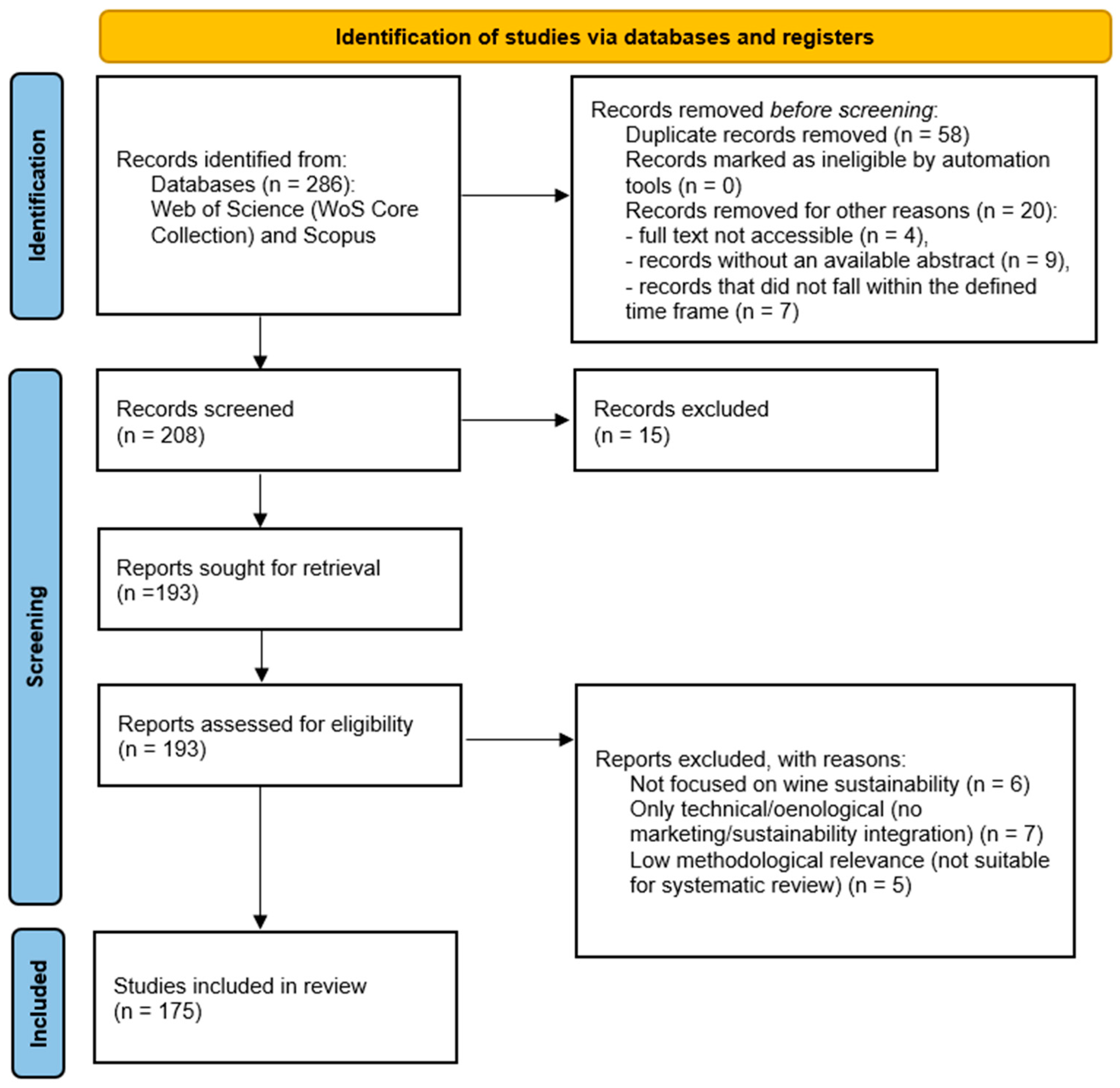
The study selection process was conducted in accordance with the PRISMA 2020 guidelines (Figure 1), ensuring a transparent, systematic, and reproducible approach. The screening and selection of studies were performed independently by two reviewers based on predefined inclusion and exclusion criteria. Any disagreements were resolved through discussion, and when necessary, a third reviewer was consulted. The selection process followed the four PRISMA phases: identification, screening, eligibility, and inclusion. During the identification phase, 286 records were retrieved exclusively from the Web of Science (WoS Core Collection) and Scopus databases. The search was confined to these two academic databases given their comprehensive and complementary coverage of peer-reviewed literature in environmental sciences, agricultural sciences, business and economics, and food science, the four primary disciplinary fields within which sustainability research in the wine industry is concentrated.
Following the full-text analysis, 18 articles were excluded for the following reasons: lack of a direct focus on sustainability in the wine industry, addressing sustainability in the broader agri-food sector without specific reference to viticulture or wine production (n = 6); an exclusively technical or oenological approach focused on production chemistry, fermentation processes, or sensory analysis, without integration of sustainability, marketing, governance, or consumer behavior dimensions (n = 7); and insufficient methodological transparency, defined as the absence of a clearly described research design, data collection procedure, or analytical framework that would allow the study’s contribution to be systematically evaluated and coded (n = 5).

2.4. Inclusion Criteria, Analysis and Methods of Interpretation

The selection of studies was conducted based on the inclusion and exclusion criteria detailed in Section 2.3, while data extraction was performed independently using a standardized data collection form. The extracted information included bibliographic details (authors, year of publication, journal), study characteristics (research focus, methodology, and geographic context), and key thematic aspects related to sustainability practices, wine marketing strategies, and consumer behavior in the wine industry.
To complement the systematic literature review, a bibliometric analysis was conducted based on data extracted from the selected studies. The bibliometric analysis focused on several analytical dimensions: Web of Science subject categories and research areas, the geographical distribution of publications, the distribution by scientific publishers, and the alignment of studies with the Sustainable Development Goals (SDGs). These dimensions were selected to provide a structured overview of the research landscape and to identify the main thematic and institutional patterns characterizing the field.
For publications indexed exclusively in Scopus, the subject classification was based on Scopus’s All Science Journal Classification (ASJC) codes, which were subsequently mapped to the equivalent Web of Science subject categories to ensure comparability across the two databases. Where a direct correspondence was not available, publications were classified based on the primary research area declared in the journal’s scope.
To highlight the relationships between key concepts in the analyzed literature, a keyword co-occurrence analysis was performed using VOSviewer software (version 1.6.20). This method enabled the identification of the conceptual structure of the field and the main thematic directions, the results of which are presented in Section 3.

3. Results

The systematic analysis of the 175 evaluated studies, published between 2010 and 2026, reveals a rich and increasingly complex body of knowledge on sustainability in the wine industry. The presented results reflect both the quantitative structure of the analyzed literature, including its geographical distribution, disciplinary orientation, and alignment with global sustainability agendas, as well as the substantial thematic content organized around eight major directions that emerged from the content analysis: (i) sustainable value chain and wine production; (ii) environmental practices and ecological management; (iii) climate change adaptation and viticultural resilience; (iv) governance, policies and SDG integration; (v) wine marketing, positioning and competitiveness; (vi) consumer behavior and willingness to pay; (vii) wine tourism and regional development; and (viii) green innovation and sustainable business models. These eight directions are presented in detail in Table 1 and developed analytically in Section 3.3 and Section 4. The term ‘inductively’ refers here to the specific thematic directions and their internal structure, which were not predetermined prior to the analysis. The broad thematic scope of the review was established during the scoping phase on the basis of the existing literature, as described in Section 2.1, while the eight specific thematic directions and their internal organization reflect the conceptual architecture of the analyzed corpus as it emerged from systematic coding. Together, these two analytical layers provide a comprehensive overview of how academic research has addressed, framed, and evolved around the topic of sustainability in the wine sector over the last two decades.

3.1. Bibliometric Overview of the Analyzed Literature

The analysis focused on the main Web of Science and Scopus categories reflecting the scientific fields in which the publications are classified, namely Environmental Sciences, Green and Sustainable Science and Technology, and Food Science and Technology, highlighting the strong orientation of research toward environmental issues and sustainable food production. Regarding the research areas, the main identified fields are Agriculture, Environmental Sciences and Ecology, and Business and Economics, emphasizing the interaction between the agricultural, ecological, and economic dimensions of sustainability in the wine sector.
The strong concentration of research output in European wine-producing countries raises important questions regarding the generalizability of the findings. Sustainability frameworks developed in European contexts, characterized by well-established regulatory infrastructures, high levels of consumer environmental awareness, and significant public investments in the green transition, may not be directly transferable to emerging wine regions in Latin America, Asia, and Africa, where socioeconomic conditions, institutional capacities, and climate profiles differ substantially. This geographical bias in the literature represents a significant structural gap that future research should address through comparative and context-sensitive approaches.
To provide a more comprehensive characterization of the analyzed corpus, the included studies were classified according to four bibliometric criteria: research approach, unit of analysis, methodological techniques employed, and thematic direction (Table 1).
Table 1 provides a comprehensive characterization of the 175 included studies across four bibliometric criteria. In terms of research approach, qualitative studies constitute the largest share of the corpus (n = 73, 41.70%), encompassing case studies, interviews, literature reviews, and content analyses, followed by quantitative studies (n = 58, 33.10%), which include surveys, hedonic pricing models, choice experiments, and econometric analyses, while mixed-methods approaches account for the remaining share (n = 44, 25.10%). Regarding the unit of analysis, firm-level studies are the most prevalent (n = 61, 34.90%), followed by consumer-level studies based on survey data (n = 45, 25.70%), value chain and sectoral analyses (n = 39, 22.30%), and regional or territorial perspectives (n = 30, 17.10%). The most frequently employed methodological techniques are case study research (n = 47, 26.90%), survey-based willingness-to-pay methods including conjoint analysis and contingent valuation (n = 41, 23.40%), and narrative or systematic literature reviews (n = 32, 18.30%), followed by Structural Equation Modeling (n = 13, 7.40%), Life Cycle Assessment (n = 12, 6.90%), bibliometric analysis (n = 8, 4.60%), and econometric modelling (n = 4, 2.30%). Notably, longitudinal study designs and field experiments are absent or marginally represented in the analyzed corpus, a structural limitation that restricts the capacity of the existing literature to establish causal relationships between sustainability practices and sectoral performance outcomes, and which represents a priority direction for future methodological development in the field. Thematically, the distribution of studies across the eight major thematic directions confirms the dominance of Consumer behavior and willingness to pay and Wine tourism and regional development as the most extensively represented directions (n = 35, 20.0% each), followed by Governance, policies and SDG integration (n = 25, 14.30%), Green innovation and sustainable business models and Environmental practices and ecological management (n = 22, 12.60% each), Sustainable value chain and Wine production (n = 18, 10.30%), Wine marketing, positioning and competitiveness (n = 12, 6.90%), and Climate change adaptation and Viticultural resilience (n = 6, 3.40%). This distribution confirms the relative underrepresentation of climate adaptation and wine marketing as standalone research thematic directions, and highlights the persistent dominance of consumer-oriented and tourism-related perspectives in the analyzed corpus.
The main methodological techniques identified in the analyzed studies include willingness-to-pay methods (conjoint analysis and contingent valuation), Life Cycle Assessment (LCA), Structural Equation Modeling (SEM), bibliometric analysis, and case study research. Thematically, the analyzed studies cluster around eight major directions that reflect the analytical dimensions of the review: (i) sustainable value chain and wine production; (ii) environmental practices and ecological management; (iii) climate change adaptation and viticultural resilience; (iv) governance, policies and SDG integration; (v) wine marketing, positioning and competitiveness; (vi) consumer behavior and willingness to pay; (vii) wine tourism and regional development; and (viii) green innovation and sustainable business models. This characterization confirms the interdisciplinary and methodologically diverse nature of the field, while also revealing a relative underrepresentation of longitudinal studies and experimental designs, which represents an important direction for future research.

3.2. Keyword Co-Occurrence Analysis and Thematic Clusters

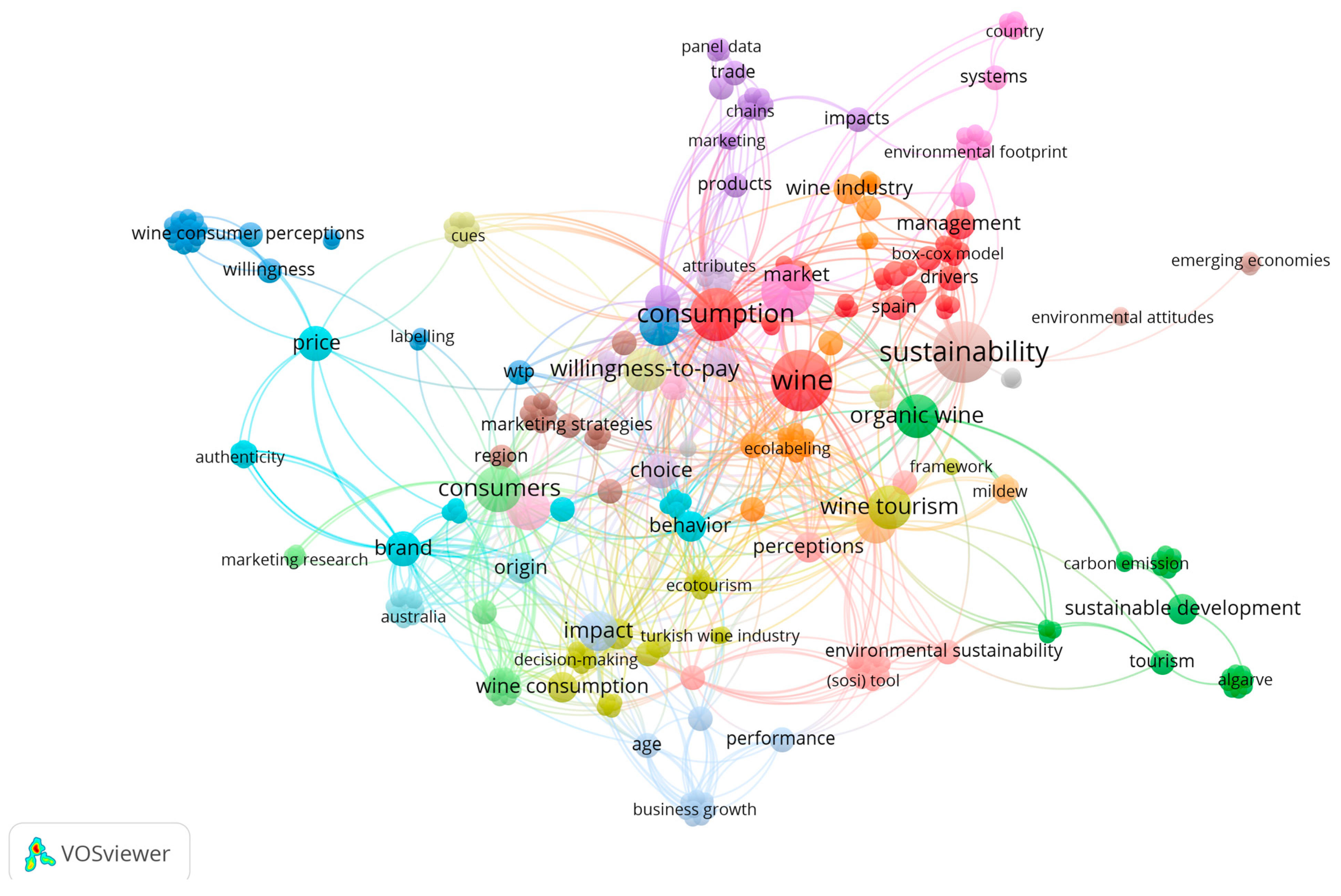
To identify the conceptual structure of the reviewed literature and the relationships between its key thematic dimensions, a keyword co-occurrence analysis was performed using VOSviewer software (version 1.6.20). The analysis was based on the keywords associated with the 175 included studies, applying a minimum co-occurrence threshold of three occurrences per keyword. The resulting network, presented in Figure 2, reveals four major thematic clusters that reflect the main research directions identified in the field.
The visualization results indicate the existence of several major thematic clusters; the first cluster is associated with sustainability and environmental management, including terms such as “sustainability,” “environmental footprint,” and “management.” A second cluster reflects consumer behavior and willingness to pay, represented by concepts such as “consumers,” “price,” “willingness-to-pay,” and “perceptions.” Another important cluster is that of wine tourism and regional development, which includes terms such as “wine tourism,” “ecotourism,” and “destination.” Additionally, a cluster dedicated to marketing and product attributes stands out, encompassing terms such as “branding,” “labeling,” “attributes,” and “marketing strategies.”

3.3. Descriptive Thematic Synthesis of the Reviewed Literature

The thematic directions presented in this section was derived through a structured content analysis of the 175 included studies, combining deductive and inductive analytical elements in a sequential manner. At the first analytical level, the broad thematic domains corresponding to the research objectives were established a priori on the basis of a preliminary scoping of the existing literature, providing a theoretically informed framework for organizing the review. At the second analytical level, the specific themes, sub-themes, and patterns presented in this section and in Table 1 were identified inductively through iterative reading and systematic coding of the full-text articles, without imposing predetermined sub-categories within the broad thematic domains. The inductively derived themes were subsequently validated against the thematic clusters identified in the keyword co-occurrence analysis presented in Section 3.2, ensuring both internal consistency and alignment with the conceptual structure of the field as reflected in the co-occurrence network.
Table 2 provides a structured overview of the major thematic directions identified through the systematic content analysis of the 175 included studies, summarizing the associated sustainability dimensions, representative studies, key findings, and identified research gaps for each direction.
The thematic synthesis presented in Table 2 reveals several structural patterns in the analyzed literature. The environmental dimension dominates across all thematic directions, while the social dimension remains systematically underrepresented. A transversal finding is the persistent gap between the adoption of sustainable practices and their effective communication to consumers and tourists, which limits their potential to generate competitive advantages. In addition, the geographical concentration of research in European wine-producing contexts raises questions regarding the transferability of the identified frameworks to emerging wine regions in Latin America, Asia, and Africa, where socioeconomic, institutional, and climatic conditions differ substantially.
Across these thematic directions, the reviewed literature reveals that sustainability in the wine industry has evolved from a marginal concept to an essential strategic pillar, integrated into all stages of the value chain, from viticulture to distribution and marketing. Studies highlight a clear transition from traditional practices to sustainable models, driven by both external pressures (climatic, legislative) and market and consumer demands [63,64,65,66,67,68].
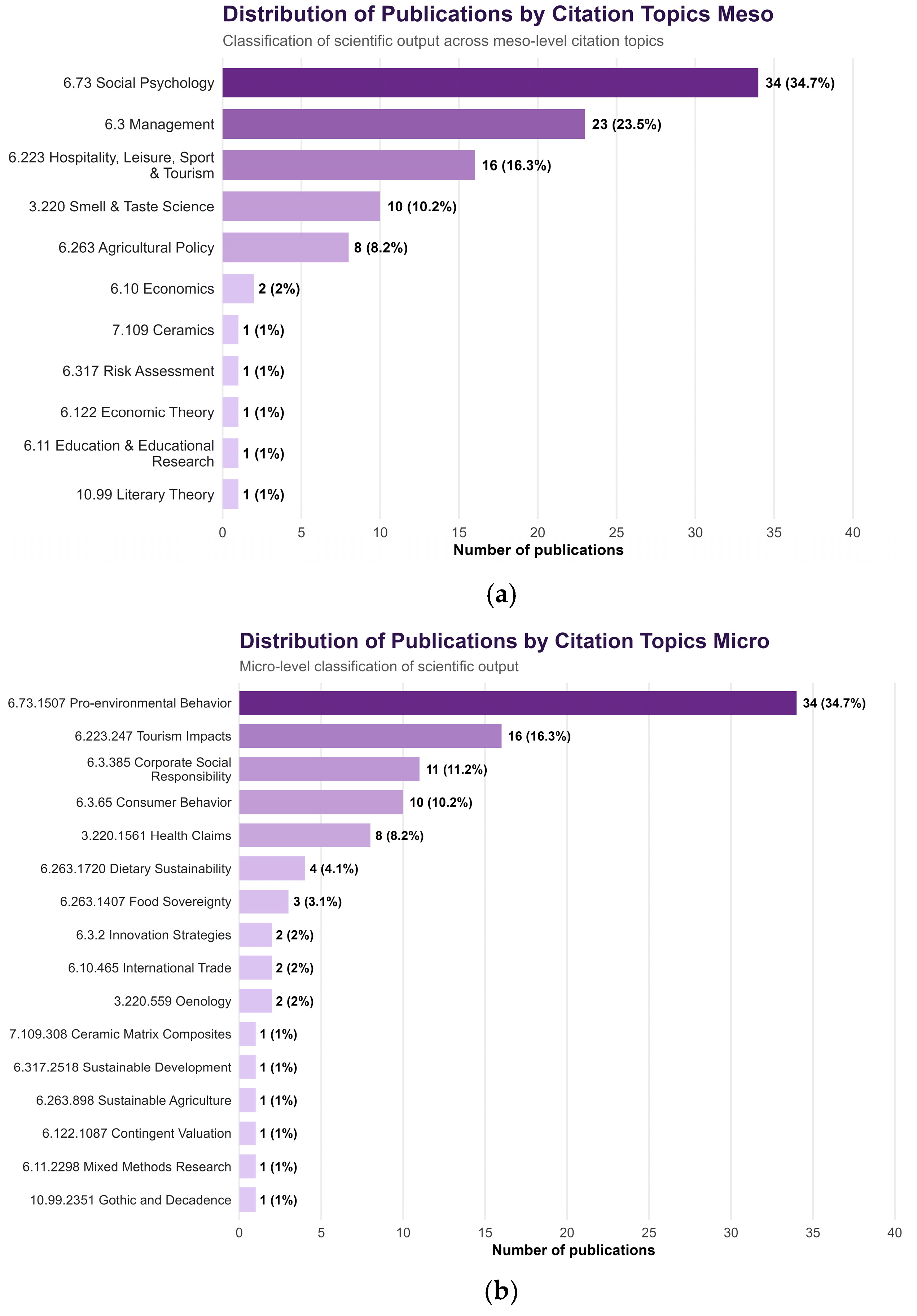
Figure 3 illustrates the thematic structure of the analyzed literature, highlighting both the general distribution across fields (meso level) and the granularity of the subthemes (micro level).
This distribution indicates that research in the field of sustainable viticulture is dominated by perspectives focused on consumer behavior, decision-making, and experience, as well as on organizational and tourism management. Fields such as Smell & Taste Science and Agricultural Policy account for a moderate share, suggesting a moderate integration of sensory and institutional dimensions into the analysis. In contrast, fields such as Economics, Educational Research, Economic Theory, Risk Assessment, and Ceramics are underrepresented, highlighting significant gaps in the in-depth economic, educational, or technological approach to wine sustainability. This polarization confirms the literature’s focus on applied and behavioral dimensions, at the expense of theoretical or engineering ones. Panel (b) provides a detailed overview of the dominant subthemes, highlighting the dominance of the “Pro-environmental Behavior” category, which confirms the strong emphasis placed on sustainable consumer behaviors. Tourism Impacts and Corporate Social Responsibility reinforce the idea that sustainability is predominantly analyzed through the lens of the interaction between tourism, social responsibility, and the consumer experience, while subthemes such as Consumer Behavior and Health Claims further underscore this market- and perception-oriented focus.
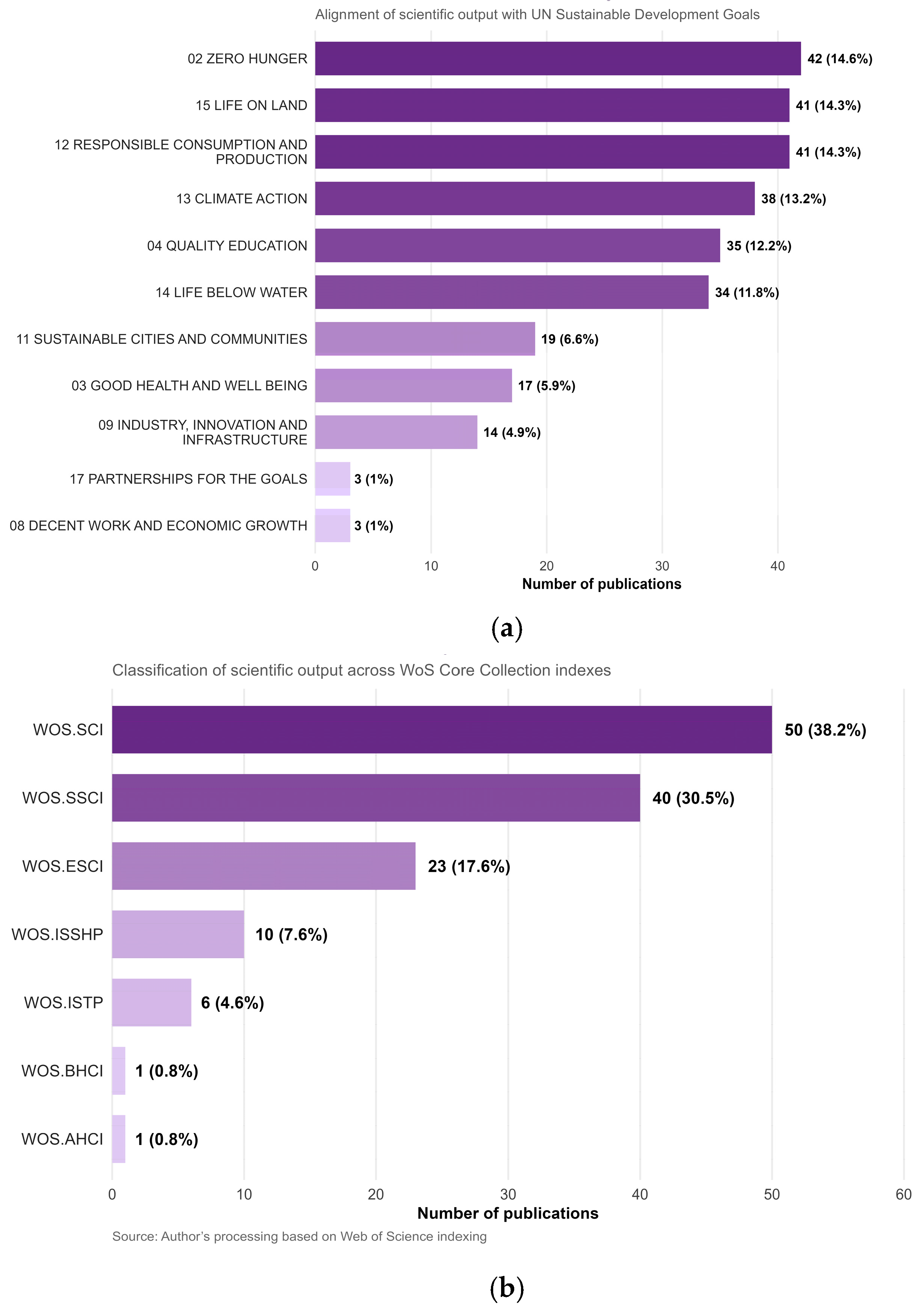
Figure 4 highlights two essential dimensions of the structure of the analyzed literature: (a) thematic orientation in relation to the Sustainable Development Goals (SDGs) and (b) the distribution of papers based on their indexing in the Web of Science databases.
In panel (a), there is a relatively balanced concentration of research around key goals, such as SDG 12 (Responsible Consumption and Production), SDG 13 (Climate Action), and SDG 15 (Life on Land), which dominate the graph’s structure. This confirms that the literature on sustainable viticulture is strongly rooted in environmental issues, particularly regarding resource management, climate impact reduction, and the protection of terrestrial ecosystems.
Panel (b) reflects the distribution of publications based on Web of Science indexing, revealing a clear dominance of the WOS.SCI and WOS.SSCI databases, which indicates that most studies are published in scientific and socio-economic journals, confirming the interdisciplinary nature of the field. The significant presence of WOS.ESCI also suggests a trend of research expanding toward emerging journals, reflecting the relatively recent development of the topic of viticultural sustainability.
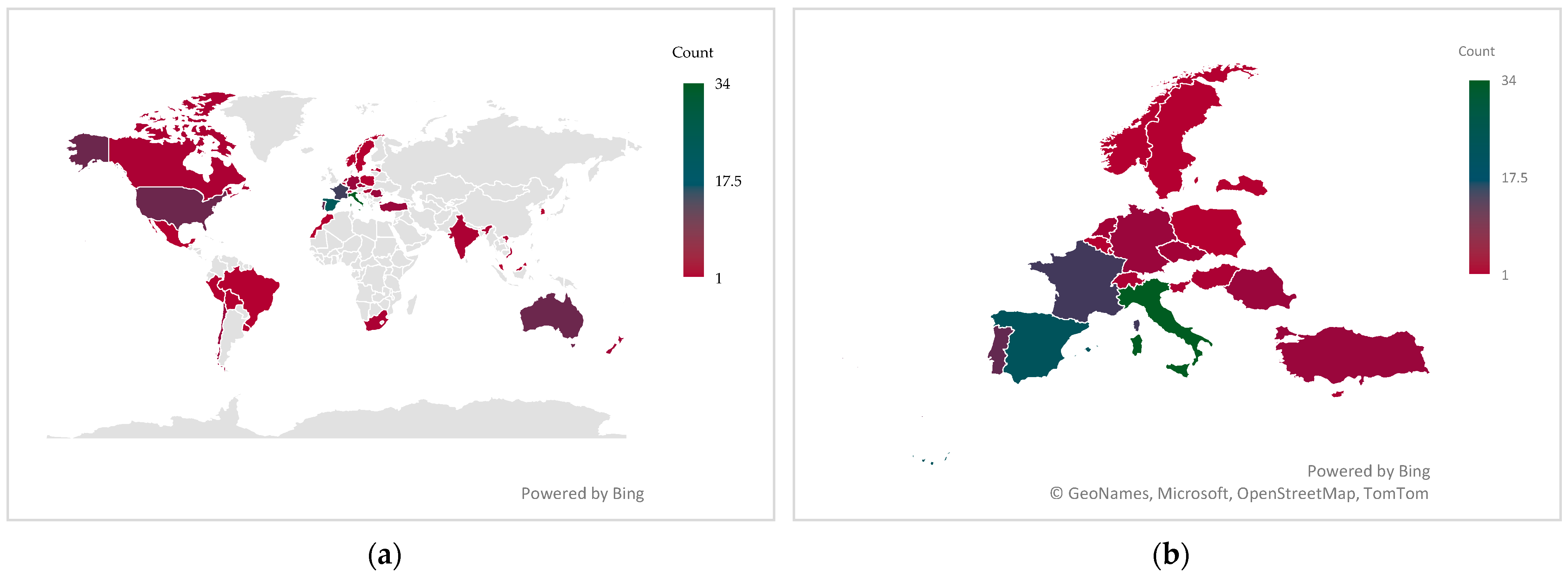
Figure 5 illustrates the geographical distribution of the analyzed scientific publications based on the institutional affiliation of the authors, as recorded in the Web of Science and Scopus databases. This indicator reflects the geographic concentration of research production capacity rather than the empirical context examined in each study; accordingly, a publication classified under a given country indicates that its authors are affiliated with institutions from that country, which does not necessarily coincide with the wine region analyzed.
The maps reveal a strong concentration of scientific output in Europe, particularly in countries with a long-standing winemaking tradition, such as Italy, France, and Spain. Italy stands out as the leading research hub, with the highest number of publications, reflecting both the economic importance of the wine sector in this country and the growing interest in integrating sustainability principles into production and management. France and Spain also show high figures, confirming their strategic role in the global wine industry. Outside Europe, the United States and Australia stand out as major players, with a significant number of publications, reflecting the development of research within the context of modern, innovation-oriented wine industries. Latin America (particularly Brazil and Chile) and Asia (India, China) make more modest but relevant contributions, indicating a geographic diversification of research and a growing interest in sustainability in emerging markets.
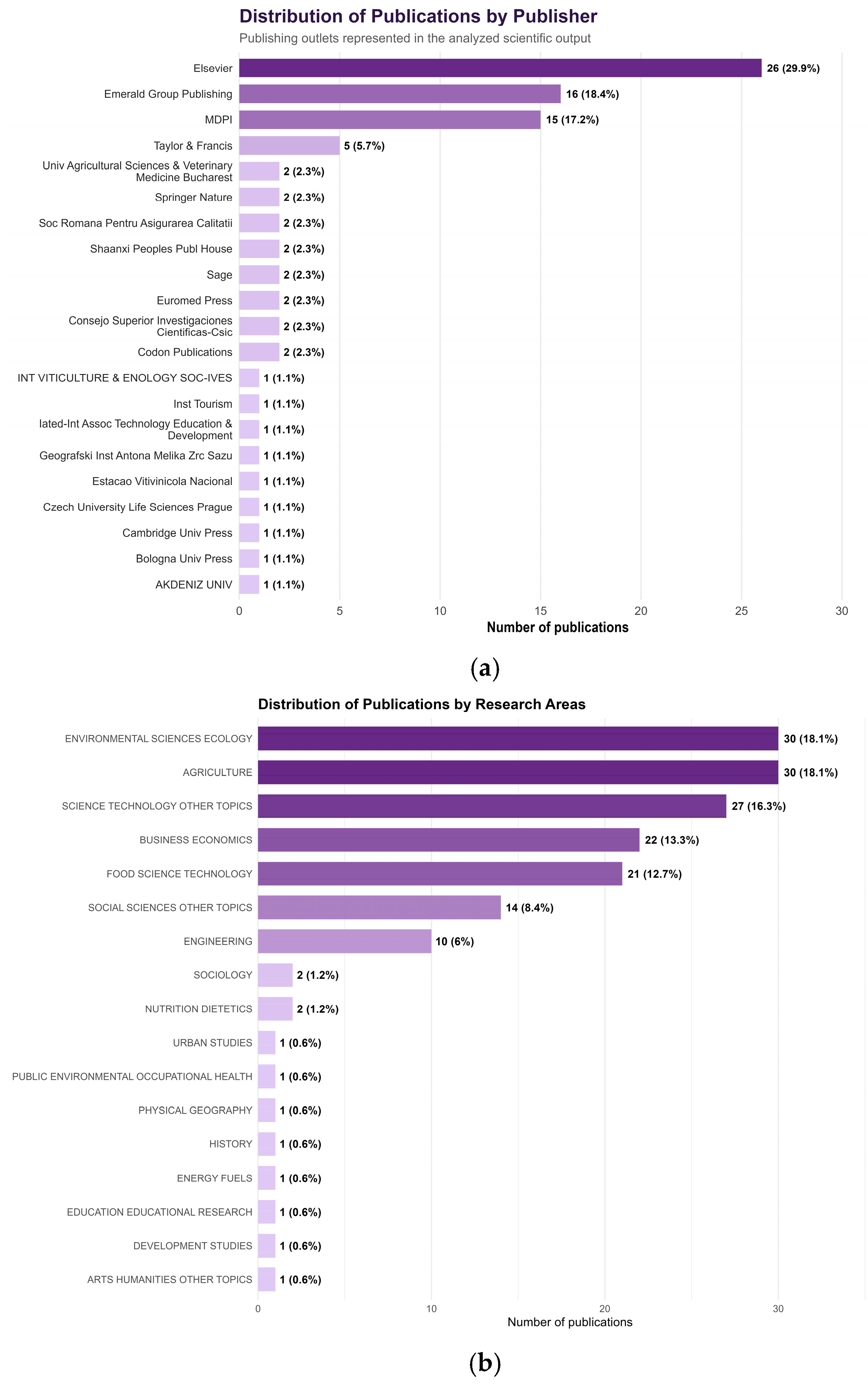
Figure 6 highlights the structure of the analyzed publications from the perspective of editorial sources and research fields, providing a clear picture of the dissemination channels and the interdisciplinary orientation of the literature on sustainability in the wine sector.
In Panel (a), there is a significant concentration of articles within major scientific publishers; Elsevier clearly dominates the distribution, with the highest number of publications, followed by Emerald, MDPI, and Taylor & Francis, reflecting the central role of these publishers in promoting international research. The consistent presence of these platforms indicates that the analyzed studies are predominantly published in journals with high visibility and significant scientific impact.
Panel (b) highlights the distribution of works across research fields, underscoring the deeply interdisciplinary nature of wine sustainability research. The dominant fields are Agriculture and Environmental Sciences, each with a high number of publications, confirming that research is anchored in the ecological and agricultural thematic directions of sustainability research; furthermore, Science & Technology and Business Economics account for a significant share, indicating the integration of technological and economic aspects into the analysis of the sector. Fields such as Food Science & Technology and Social Sciences also contribute to shaping a complex perspective on the wine value chain.
The results indicate that the environmental dimension dominates the research, focusing on reducing environmental impact through practices such as resource management, emission reduction, and the use of green technologies. Thus, the wine industry is identified as having a significant environmental impact, particularly through pesticide use, water consumption, and greenhouse gas emissions, which justifies the increased interest in implementing sustainable practices [7,25]. At the same time, the literature emphasizes that sustainability must be approached holistically, encompassing the entire supply chain, from vineyard to consumer [89,90].
A second major area highlighted relates to adaptation to climate change, which represents one of the most significant challenges facing the sector. Studies show that climate change directly affects yield, grape quality, and the geographical distribution of wine-growing regions, necessitating adaptation strategies based on climate management and agronomic innovation [64,91]. In this context, factors such as topography, microclimate, and resource management become essential for maintaining the quality and sustainability of production [89,92,93]. Third, the literature highlights the central role of sustainable viticultural practices, including organic farming and integrated vineyard management, which contribute to biodiversity conservation, reduced environmental impact, and increased resilience of agricultural systems [62,63,64,65,66,67,68,69,70,71,72,73,74,75,76,77,78,79,80,81,82,83,84,85,86,87,88,89,90,91,92,93,94]. For example, the transition to organic farming is seen as a strategic opportunity for the development of the wine sector, particularly in the context of European policies and the growing demand for sustainable product [90].
Another important finding of the analysis is the growing role of innovation and sustainable technologies, which are considered key factors for the industry’s competitiveness; thus, research shows that the adoption of green technologies, certification systems, and sustainable management strategies contributes both to reducing environmental impact and to improving economic performance [95,96,97]. Furthermore, the literature highlights a marked development in the consumer-oriented dimension, particularly regarding consumer behavior and perceptions of sustainable wines. Consumers are becoming increasingly environmentally conscious and are willing to pay a premium for sustainable products, which makes sustainability a competitive advantage and a marketing tool [53,98,99,100]. Furthermore, wine tourism is identified as an important driver of sustainability, contributing to regional development and the diversification of consumption patterns; thus, studies show that integrating tourism into the wine industry’s strategy can offset imbalances between supply and demand and stimulate local economic development [101]. Last but not least, the results indicate the existence of gaps in research, particularly regarding the integration of economic, social, and environmental dimensions into a unified framework; although the literature on sustainability in the agri-food sector is well-developed, in the wine industry it remains fragmented and insufficiently explored from a holistic perspective [12].

4. Interpretive Discussion and Conceptual Implications

The Discussion interprets and contextualizes the descriptive patterns identified in Section 3 in relation to the four research objectives established in the Introduction, developing their conceptual and practical implications beyond what the individual studies document in isolation. While Section 3.3 organized the content of the 175 included studies into eight descriptive thematic directions that reflect the structure of the analyzed corpus, the present section develops four integrative analytical axes that consolidate these directions into broader interpretive clusters, examining where the evidence converges to support robust conclusions, where it diverges or remains incomplete, and what these patterns collectively imply for theory, policy, and practice in the wine industry.
The correspondence between the four research objectives, the eight descriptive thematic directions, and the four analytical axes of the Discussion is as follows. The first analytical axis, sustainability of environmental practices and climate adaptation in viticulture, responds primarily to Objective 2 and integrates the descriptive thematic directions of Sustainable Value Chain and Wine Production, Environmental Practices and Ecological Management, Climate Change Adaptation and Viticultural Resilience, and Governance, Policies and SDG Integration. The second analytical axis, wine marketing and consumer behavior, responds to Objectives 3 and 4 and consolidates the thematic directions of Wine Marketing, Positioning and Competitiveness and Consumer Behavior and Willingness to Pay. The third analytical axis, wine tourism and regional development, responds to Objective 3 and corresponds directly to the thematic direction of Wine Tourism and Regional Development. The fourth analytical axis, green innovation and sustainable competitiveness, responds primarily to Objective 1 and Objective 2 and corresponds to the thematic direction of Green Innovation and Sustainable Business Models, extended with the cross-cutting patterns of systemic integration identified across all eight thematic directions. This mapping ensures that each analytical axis is explicitly grounded in both the descriptive evidence of the Results and the analytical objectives of the study, maintaining a transparent and traceable connection between the three structural levels of the manuscript: objectives, thematic directions, and interpretive axes.
These four discussion axes reflect a convergence between the broad thematic domains established deductively during the scoping phase of the review and the specific patterns derived inductively from the systematic coding of the 175 included studies. The deductive component refers to the broad thematic boundaries established a priori on the basis of the existing literature and reflected in the research objectives, while the inductive component refers to the specific organizational structure of the axes, the interpretive patterns identified within each axis, and the cross-cutting connections that emerged from the analytical process. This convergence between the theoretically informed framing and the inductively derived content reflects the internal coherence of the field and confirms that the dominant thematic orientations in the academic literature align with the conceptual landscape identified during the scoping phase. Where the evidence converges across studies, the conceptual and practical implications are developed; where it diverges or remains incomplete, the sources of heterogeneity are examined as indicators of unresolved scholarly tensions and priority directions for future research.

4.1. Sustainability, Environmental Practices and Climate Adaptation in Viticulture

Building on the descriptive patterns documented in Section 3.3, this axis develops the conceptual and practical implications of the evidence on environmental sustainability, climate adaptation, and governance in viticulture, examining the structural tensions and institutional gaps that the descriptive synthesis reveals.
In recent decades, the wine sector has faced increasing pressures stemming from climate change, the intensified use of natural resources, and ever-stricter requirements regarding the sustainability of agri-food production. In this context, the literature highlights a gradual transition from traditional production models toward integrated approaches focused on sustainability, resilience, and innovation across the entire wine value chain [17,102,103].
Studies show that integrating sustainability principles across the entire chain helps reduce environmental impact and boost the sector’s competitiveness [104,105], in this regard, systemic and collaborative approaches become essential, highlighting the role of stakeholders and cooperative ecosystems [57]. The second subdomain concerns environmental practices and ecological management, with an emphasis on reducing the impact on ecosystems; thus, research highlights the importance of adopting tools such as life cycle assessment (LCA), agricultural input management, and the reduction in greenhouse gas emissions [58,59]. At the same time, the use of pesticides and fertilizers poses a major challenge, necessitating solutions such as integrated pest management and sustainable fertilization [106].
Climate change is another central pillar of research, affecting grapevine phenology, the geographical distribution of vineyards, and grape quality [60,63,107], and adapting to these changes involves the use of climate models, the selection of resistant varieties, and the optimization of viticultural practices [66,68,89]. At the same time, the concept of viticultural resilience is gaining strategic importance, as it relates to the ability of agricultural systems to cope with climate variability and extreme events; thus, organic viticulture and biodiversity conservation represent emerging trends aimed at restoring ecological balance and improving product quality [108,109]. Furthermore, agroecological practices, soil management, and biodiversity protection contribute not only to environmental sustainability but also to product differentiation in the market [110]. Thus, the literature highlights the need for an integrated approach in which sustainability, climate adaptation, and innovation are linked to ensure the sustainable development of the wine sector.

4.1.1. Sustainable Value Chain and Sustainability in Wine Production

The literature highlights the fact that the sustainability of wine production is no longer analyzed exclusively at the level of viticulture, but rather as an integrated process that spans the entire value chain, from grape production to final consumption and waste management. In this regard, some studies adopt a comprehensive approach, simultaneously analyzing environmental, social, and economic dimensions, as well as the institutional framework and consumer behavior [17,102]. A major common element of this research is the approach to sustainability through the lens of the triple bottom line concept, which entails a balance between economic performance, environmental protection, and social responsibility; thus, the studies show that these dimensions are interdependent and cannot be treated separately, as decisions in one sphere generate effects on the others [55,56]. This perspective is also supported by other studies that emphasize the need for an integrated approach to sustainability in the wine sector [57,104].
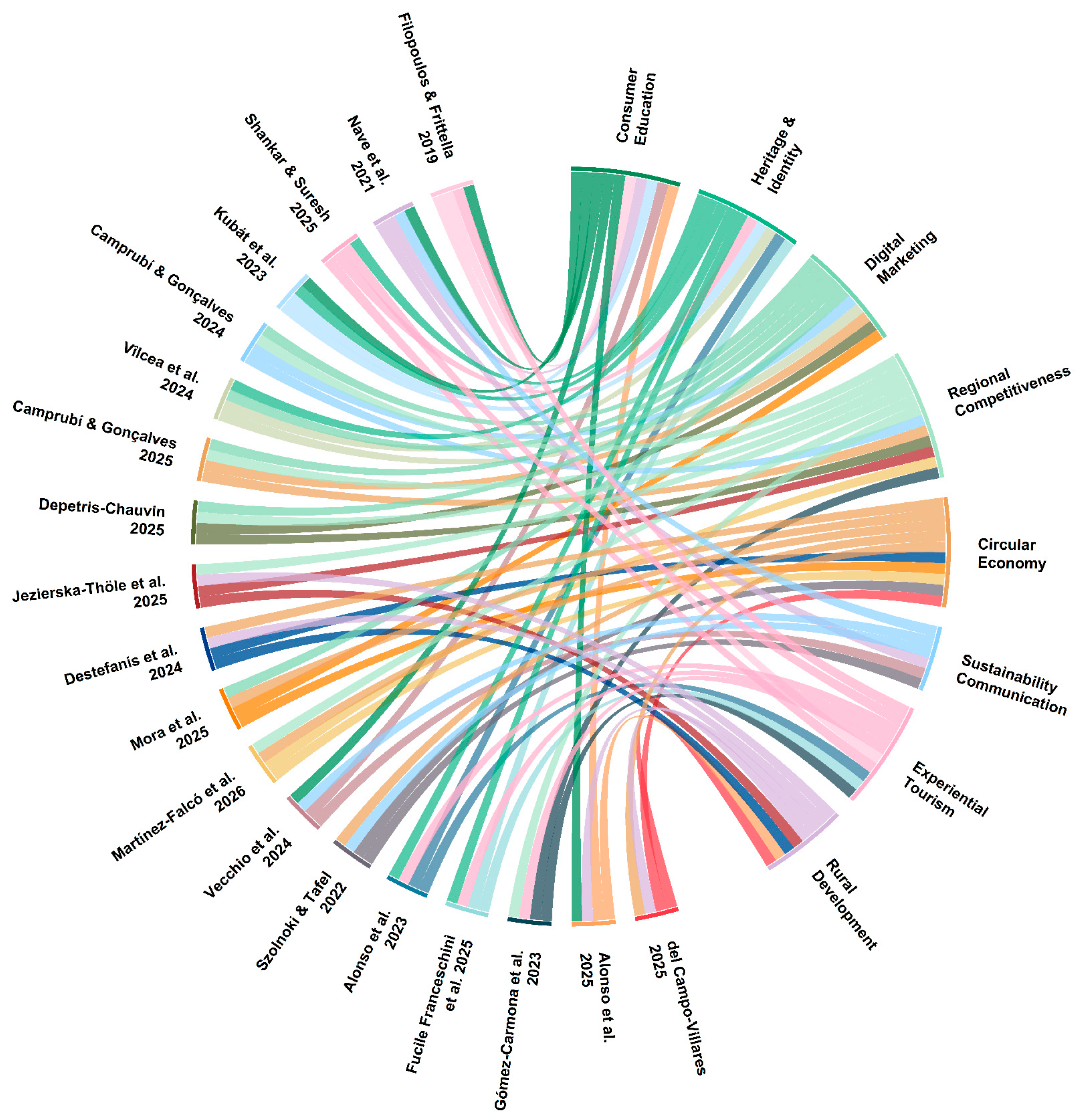
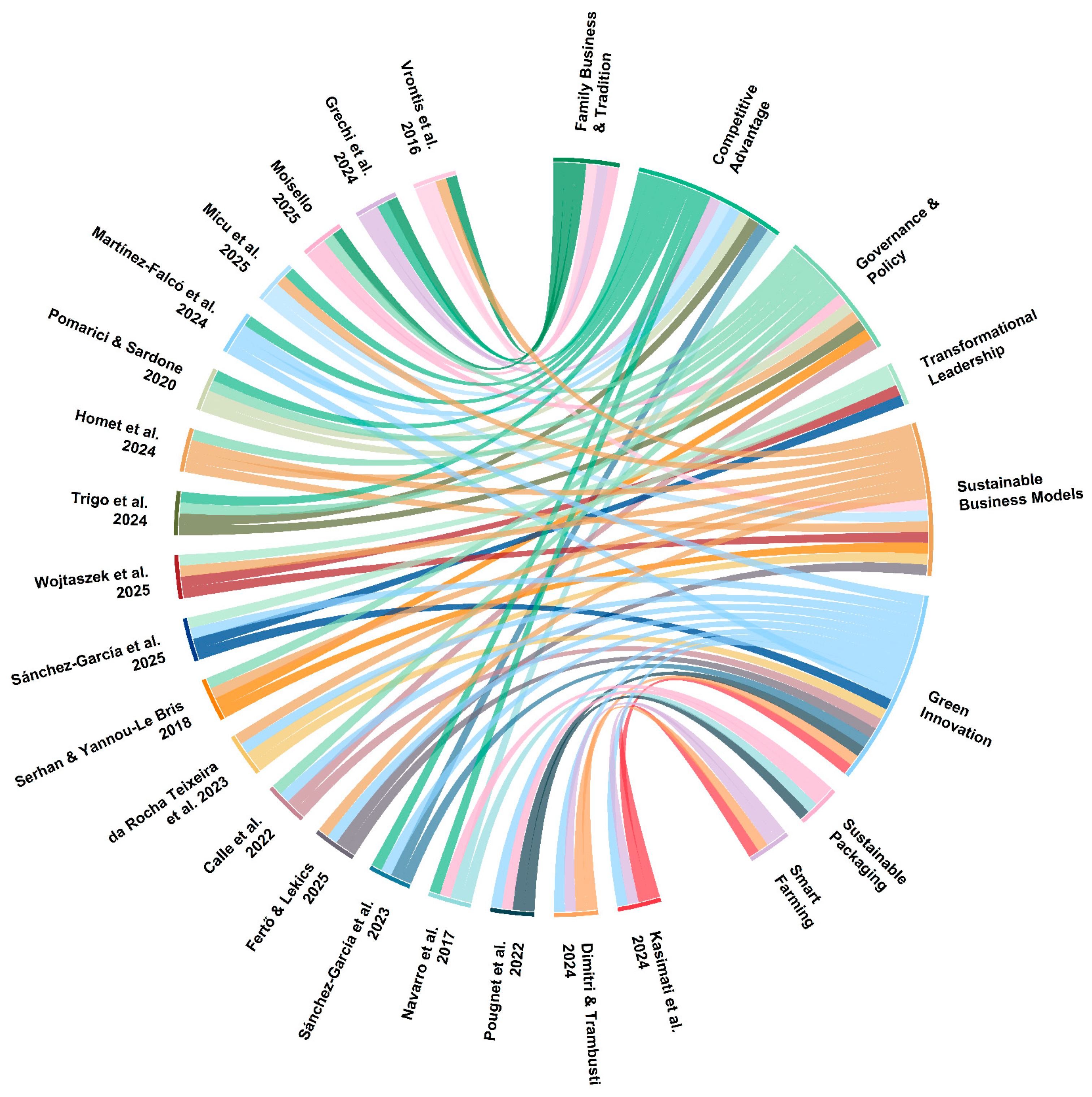
Across the four analytical axes developed in this Discussion, innovation emerges as a transversal organizing dimension that connects and conditions the other sustainability themes identified in the reviewed literature. This centrality reflects a structural pattern identified in the descriptive thematic synthesis: innovation-related concepts, including green innovation, sustainable business models, precision viticulture, digital marketing, and governance innovation, appear as cross-cutting nodes in the co-occurrence network presented in Figure 2 and are referenced across all eight descriptive thematic directions in Table 2. The thematic networks presented in Figure 7, Figure 8, Figure 9 and Figure 10 are constructed to make this structural centrality analytically explicit, positioning innovation as the integrative axis through which environmental practices, consumer behavior, wine tourism, and governance mechanisms interact and reinforce each other within the wine value chain. The decision to retain innovation as the organizing node in the visual representations reflects this empirically observed centrality rather than a theoretical preference, and is consistent with the bibliometric evidence presented in Section 3.1, which identifies Green Innovation and Sustainable Business Models as one of the eight major thematic directions of the analyzed corpus.
The thematic networks presented in Figure 7, Figure 8, Figure 9 and Figure 10 were constructed using a co-occurrence matrix derived from the systematic coding of the 175 included studies. Each node represents a thematic concept or analytical dimension identified during the coding process, while the thickness of the connecting edges reflects the frequency of co-occurrence between pairs of concepts across the included studies. Node size reflects the overall frequency of occurrence of each concept across the corpus, and the networks were visualized using the igraph package in RStudio 4.5.2, applying a force-directed layout algorithm that positions more densely connected nodes closer to the center of the diagram. The selection of concepts represented as nodes was based on their frequency of occurrence in the coding process, with a minimum threshold of five co-occurrences applied to retain only analytically meaningful connections.
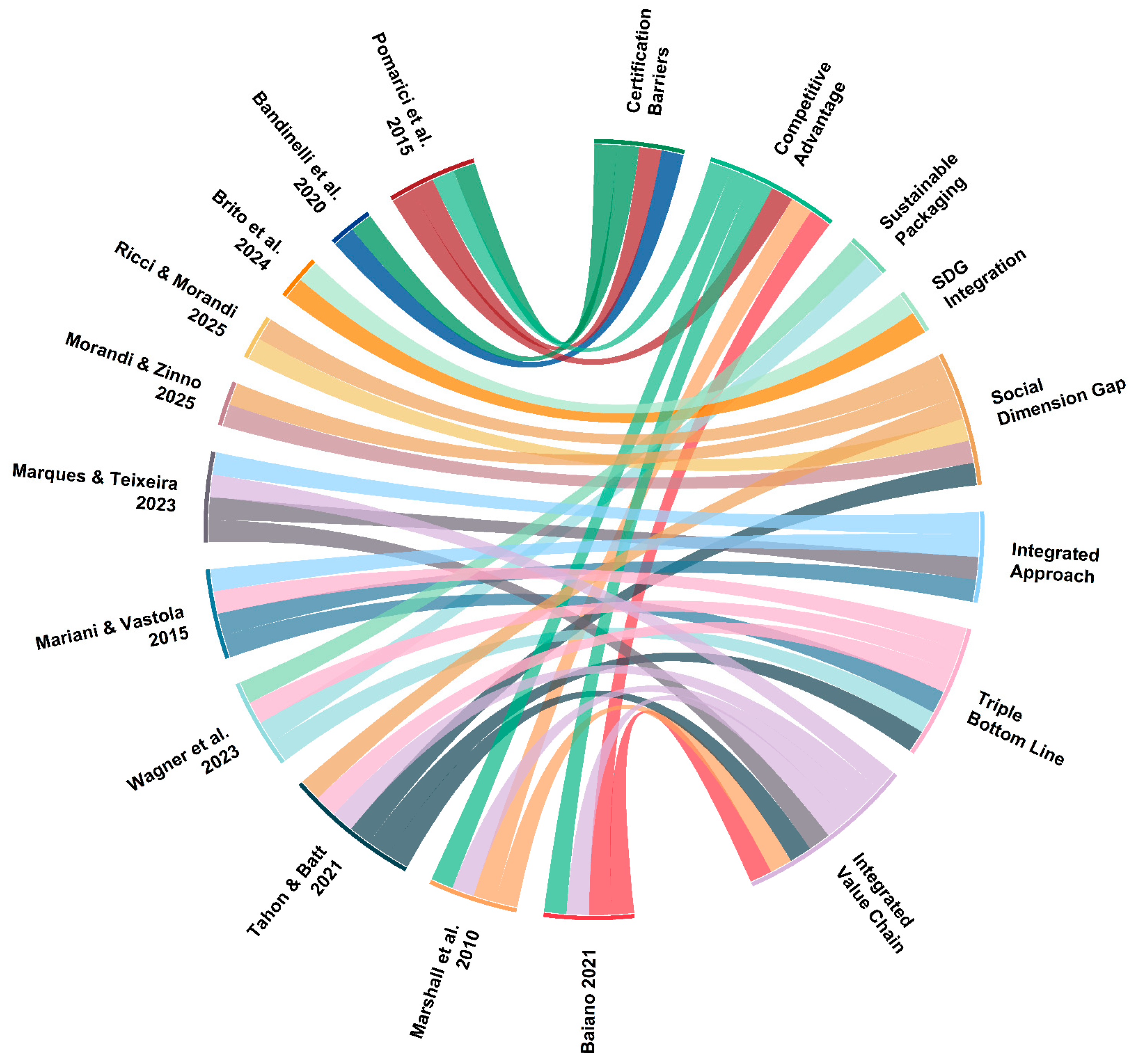
Figure 7 illustrates the thematic network of sustainability dimensions and the innovative contributions identified in the literature on the wine value chain.
The analysis of Figure 7 reveals that the integrated value chain dimension maintains the strongest co-occurrence connections, with particularly dense links to triple bottom line, competitive advantage, and integrated approach. This reflects the fact that studies addressing the wine value chain in a comprehensive manner tend to simultaneously invoke multiple sustainability frameworks, rather than focusing on isolated dimensions.
In contrast, the node representing the social dimension gap is positioned at the periphery of the network, with a smaller node size reflecting lower overall frequency of occurrence across the corpus (appearing in fewer than eight of the 175 included studies as a primary analytical focus), and with fewer and thinner connecting edges relative to the central nodes, indicating lower co-occurrence density with the other sustainability dimensions. This peripheral positioning and reduced connectivity are the visual indicators of the comparative underrepresentation of social sustainability in the analyzed literature, confirming that social sustainability is addressed more as a theoretical aspiration than as an operationalized analytical dimension in the reviewed corpus. This confirms that social sustainability is addressed in the literature more as a theoretical aspiration than as an operationalized analytical dimension. Certification barriers and sustainable packaging emerge as peripheral nodes with low co-occurrence density, suggesting that logistical and economic barriers to sustainability adoption remain under-theorized relative to their practical significance for producers.
The interpretation of these patterns reveals a structural asymmetry in the way the wine sector has conceptualized sustainability across the value chain. Studies grounded in the triple bottom line framework, such as those by Tahon and Batt [55] and Wagner et al. [56], consistently identify the interdependence of economic, environmental, and social dimensions; however, the evidence base for social sustainability remains underdeveloped compared to its ecological and economic counterparts.
This asymmetry does not merely reflect a research preference but represents, as argued by Morandi and Zinno [2] and Ricci and Morandi [38], a consequence of the sector’s institutional architecture, in which certification systems, regulatory incentives, and market signals are predominantly oriented toward environmental performance. The policy implications are significant: governance frameworks that do not explicitly reward social sustainability performance through certification criteria, procurement standards, or consumer-oriented labeling will not generate the behavioral changes necessary to close this gap. From a managerial perspective, the findings of Marques and Teixeira [57] regarding cooperative ecosystems and those of Marshall et al. [102] on stakeholder theory suggest that the most promising pathway toward integrated sustainability is not firm-level compliance, but inter-organizational coordination.
An innovative concept emerging from the literature is the expansion of the analysis from the firm to the ecosystem of actors; thus, the wine value chain is defined as a complex network of producers, suppliers, distributors, retailers, and consumers, in which sustainability depends on the degree of coordination and alignment of practices among these actors [55]. Another innovative element is the integration of the Sustainable Development Goals (SDGs) into the value chain analysis; studies show that the wine industry can contribute to achieving these goals by reducing carbon emissions, using resources efficiently, protecting biodiversity, and promoting fair working conditions [8]; thus, sustainability becomes not only an operational strategy but also a tool for aligning with the global development agenda. Furthermore, the literature highlights the importance of sustainable packaging and logistics, which are considered major sources of environmental impact; reducing packaging weight, using recyclable materials, and optimizing transportation are identified as key strategies for reducing the carbon footprint of wine [56].
From an economic and managerial perspective, sustainability is increasingly associated with competitive advantage; although sustainable wines still represent a niche market, there is growing consumer interest in organic products, and their willingness to pay a premium price creates opportunities for producers [17,102], at the same time, the lack of effective communication and high certification costs may limit the widespread adoption of sustainable practices.
The persistent underrepresentation of the social dimension across the reviewed literature warrants a more structured examination. Several interconnected factors appear to explain this gap: first, the measurement of social sustainability indicators, such as working conditions, wage equity, and community impact is inherently more complex and context-dependent than environmental metrics, which can be quantified through standardized tools such as LCA or carbon footprint calculators. Second, regulatory frameworks in the wine sector have historically prioritized environmental compliance, creating institutional incentives that channel research attention toward ecological dimensions. Third, the predominance of consumer-facing studies in the reviewed literature naturally foregrounds market-oriented dimensions at the expense of supply-side social considerations.
These findings collectively suggest that the wine value chain is undergoing a fundamental reorientation, in which sustainability is no longer a peripheral operational concern but a systemic organizing principle that conditions competitive positioning, stakeholder coordination, and long-term value creation. The persistent underrepresentation of the social dimension, however, indicates that this reorientation remains incomplete, and that the triple bottom line framework, while widely invoked is applied asymmetrically in practice, with environmental and economic considerations consistently prioritized over social ones.

4.1.2. Environmental Practices, Ecological Management, and Reducing Environmental Impact

A review of the literature highlights that environmental practices in the wine industry focus on reducing the impact on ecosystems by optimizing resource use, controlling chemical inputs, and implementing integrated environmental management systems. There is a broad consensus in the literature that the agricultural phase (viticulture) represents the main “hotspot” of environmental impact, being responsible for the majority of emissions and pressures on soil and water [48,58,59,106]. A central element identified in studies is the use of the Life Cycle Assessment methodology as a standard tool for assessing environmental impact, which allows for a comprehensive “from vineyard to consumer” analysis, highlighting the critical phases of the production process [58].
With regard to the management of agricultural inputs, the use of pesticides is identified as one of the most significant sources of negative environmental impact. Studies show that pesticides contribute to the toxicity of aquatic and terrestrial ecosystems, affecting human health and biodiversity [60,107]. In response, the literature promotes the implementation of integrated pest management, which reduces reliance on chemicals and favors biological and preventive solutions; furthermore, fertilization and soil management are identified as key determinants of environmental impact. Studies show that the intensive use of nitrogen and phosphorus contributes to eutrophication and increases the variability of ecological impacts [84,88,89,90,91,92].
Another major issue is greenhouse gas emissions, where the bottling and industrial production phases are identified as significant sources of emissions, particularly due to the use of glass and energy [61]. Furthermore, the literature highlights the role of environmental management systems and food safety standards in reducing environmental impact; these systems include performance indicators, waste management, and efficient resource use [113,156,157].
An emerging concept in recent literature is the approach to sustainability through the lens of integrated indicators, such as the Product Environmental Footprint and VIVA-type certifications, which allow for the comparative assessment of environmental performance among producers [58,61].
This pattern of evidence implies that environmental management in the wine sector has reached a degree of methodological maturity, particularly through the standardization of LCA as an assessment tool but that its practical implementation remains uneven across producers and regions. The concentration of impact at the viticultural phase suggests that upstream interventions, particularly in pesticide and fertilizer management, offer the greatest potential for systemic environmental improvement, yet these are also the areas where adoption barriers related to cost, knowledge, and regulatory enforcement are most pronounced.

4.1.3. Climate Change, Adaptation and Vineyard Resilience

The literature consistently highlights the fact that climate change is one of the most decisive factors influencing the sustainability of the wine sector. Climate plays an essential role in defining terroir, directly influencing vine growth, yield, and berry composition, and climate change disrupts these balances [63].
A major finding identified in studies is the change in grapevine phenology caused by rising average temperatures; this acceleration of biological cycles leads to early ripening and imbalances in the chemical composition of the grapes, affecting wine quality and its typical characteristics [63], at the same time, climate change influences the geographical distribution of viticulture, with projections indicating a significant reduction in areas suitable for vine cultivation under global warming scenarios [107]. Another important finding is the increased frequency of extreme weather events, such as droughts, heat waves, or sudden variations in precipitation, which affect production stability and harvest quality [68]. Furthermore, studies highlight the role of topography and microclimate in enhancing viticultural resilience; factors such as altitude, exposure, and slope influence heat accumulation and solar radiation, leading to significant differences in grape quality and vine behavior [89]. Furthermore, the literature highlights the impact of climate change on viticultural ecosystems and biodiversity; thus, the intensification of agriculture and anthropogenic pressures lead to habitat degradation and reduced ecological functionality, which affects the resilience of agricultural systems [157,158]. Last but not least, there is a discrepancy between consumer preferences and future climatic conditions; for example, rising temperatures favor the production of red wines, while demand for white wines is increasing in certain regions, which necessitates an adjustment of production strategies [107].
The convergence of results across these studies indicates that climate change represents not merely an operational risk but a structural threat to the geographic and qualitative foundations of wine production as currently practiced. Critically, the reviewed literature reveals a temporal mismatch: while climate projections extend to 2050 and beyond, the adaptation strategies documented in the literature remain predominantly short-term and reactive, suggesting an urgent need for longer-term, proactive resilience planning that integrates spatial redistribution of vineyards, varietal innovation, and consumer preference management as interconnected dimensions of a coherent adaptation strategy.

4.1.4. Policies, Regulations, SDGs and Sustainable Governance

The literature highlights the fact that sustainability in the wine sector cannot be achieved without a robust framework of governance, public policies, and regulations to coordinate the actions of the stakeholders involved. In this regard, the concept of sustainability is defined as an interaction between economic, environmental, and social dimensions, supported by institutions and regulatory mechanisms [90]. A central element is the integration of the Sustainable Development Goals (SDGs) into agricultural and wine policies; thus, the UN’s 2030 Agenda promotes goals such as sustainable agriculture (SDG 2) and responsible consumption (SDG 12), which are directly relevant to the wine sector. Studies show that these goals encourage the adoption of eco-friendly practices and reduce environmental impact [108].
In the European context, regulations on organic and sustainable agriculture play a key role; for example, EU legislation (Regulation 848/2018) [159] sets strict standards for organic production, contributing to increased transparency and strengthened consumer confidence; at the same time, certifications such as those offered by international organizations contribute to the standardization of sustainable practices and market differentiation [108]. Sustainable governance in the wine sector also involves coordination among value chain actors: producers, public authorities, consumers, and international organizations; thus, studies highlight the importance of common strategies and institutional collaboration to address global challenges, such as climate change or market volatility [90].
Globally, organizations such as the OIV provide guidelines and principles for sustainable viticulture, contributing to the harmonization of practices at the international level; in practice, these conceptual frameworks allow strategies to be adapted to regional specificities while maintaining global coherence [110], furthermore, sustainable governance involves integrating innovative technologies and precision agriculture into sectoral policies.
The findings across sections allow for the identification of a discernible temporal trajectory in how sustainability has been conceptualized and operationalized in the wine industry. Studies published prior to 2015 predominantly addressed sustainability as a set of isolated environmental practices. pesticide reduction, water management, and organic certification with limited integration across the value chain. From approximately 2015 onward, a gradual shift is observable toward more systemic and strategic framings, in which sustainability is increasingly linked to competitiveness, governance, and consumer-oriented differentiation. The period 2018–2026 is characterized by the emergence of integrated frameworks incorporating SDG alignment, digital innovation, circular economy principles, and collaborative governance models. This temporal evolution is consistent with the bibliometric trends identified in Section 3.1, where the growing presence of Business & Economics alongside Environmental Sciences in the publication landscape reflects a broadening of the conceptual scope of sustainability research in the wine sector.
These findings collectively suggest that governance in the wine sector is transitioning from a compliance-based model, in which sustainability is driven by regulatory obligation toward a mission-oriented model, in which public policies and private strategies are co-aligned around shared sustainability objectives. However, this transition remains incomplete and geographically uneven, with the most advanced governance frameworks concentrated in European wine-producing countries, leaving a significant institutional gap in emerging wine regions where regulatory infrastructure and certification systems are less developed.

4.2. Wine Marketing, Consumer Behavior and Willingness to Pay

Drawing on the descriptive synthesis of consumer behavior and marketing thematic directions presented in Section 3.3, this axis examines the interpretive implications of the documented patterns for market strategy, communication, and the design of sustainability-oriented marketing interventions in the wine sector.
The literature highlights the fact that wine marketing has undergone a significant transformation in recent decades, evolving from an approach centered on product and origin to a complex model focused on the consumer, experience, and perceived value [69,70,71,72]. This shift is driven by intensifying global competition and the diversification of consumer preferences, which necessitate the adoption of more sophisticated and adaptive marketing strategies [160,161]. In this context, wine consumer behavior becomes a central focus of analysis, influenced by a combination of economic, cultural, and psychological factors.
Studies show that the purchase decision is determined both by intrinsic attributes, such as the quality and type of wine, and by extrinsic attributes, such as price, brand, label, or region of origin [134,162], at the same time, prior experience, recommendations, and the consumer’s level of involvement play an essential role in shaping preferences [78,163,164].
An aspect that has been increasingly examined in recent literature is consumers’ willingness to pay for wine, particularly in the context of sustainability; research indicates that there is a growing trend among consumers to pay a premium price for sustainable or certified wines, but this willingness varies significantly depending on the level of information, perceptions of quality, and trust in labels and certifications [74,75]. At the same time, studies highlight a gap between attitudes favorable to sustainability and actual purchasing behavior [77,165]. In parallel, labeling, certification, and communication of sustainability are becoming important strategic tools in influencing consumer perceptions and differentiating products in the market [166,167,168], Furthermore, innovations in packaging and alternative forms of product presentation influence the assessment of wine quality and acceptability, reflecting changes in consumer behavior [169,170].
It should also be noted that a significant share of the reviewed studies assessing consumer willingness to pay rely on stated preference methods, including contingent valuation and choice experiments. While these methods are well-established in environmental economics, they are subject to well-documented limitations, including hypothetical bias, the tendency of respondents to overstate their willingness to pay in hypothetical scenarios relative to actual market behavior and social desirability bias, which may inflate reported pro-sustainability preferences. These methodological limitations partially explain the attitude–behavior gap documented in the literature and suggest that revealed preference methods and longitudinal behavioral tracking studies are needed to provide more robust estimates of actual consumer demand for sustainable wines.

4.2.1. Wine Marketing, Positioning and Competitiveness

Wine marketing has evolved significantly in recent decades, shifting from a product-centered approach to one focused on the market and the consumer; the literature indicates that this change is driven by intensifying global competition and shifts in consumer behavior [69]. A defining feature of wine marketing is the product’s complexity; wine is simultaneously a cultural, symbolic, and consumer product, which makes it difficult to standardize marketing strategies. For this reason, market differentiation, achieved through the identification and communication of distinctive product attributes becomes the foundation upon which effective positioning strategies are built, in line with classical marketing frameworks [72]. For this reason, positioning becomes essential for market differentiation [71].
Numerous studies highlight the decisive role of the region of origin in consumer perception; thus, a wine’s origin is associated with quality, authenticity, and reputation, directly influencing the purchasing decision [70,73], making branding one of the most important components of competitiveness in the sector. Building a strong brand image helps increase consumer loyalty and justifies higher prices [69].
Wine marketing relies heavily on segmentation: traditional vs. modern consumers, occasional vs. expert consumers, generational and social differences. Thus, studies show that factors such as the label, awards, region, and recommendations strongly influence choice [73], and the consumer experience becomes central: tastings, wine tourism, and storytelling, which contribute to creating added value and product differentiation [71].
This pattern of evidence implies that wine marketing is undergoing a paradigm shift from transactional to relational and experiential models, in which the creation of emotional and cultural value increasingly supplements, and in some market segments surpasses, the communication of intrinsic product attributes. For producers, this shift implies that competitive advantage in sustainability-oriented markets depends not only on the adoption of sustainable practices but on the capacity to translate those practices into meaningful, credible, and emotionally resonant narratives that connect with the values and identities of target consumer segments.

4.2.2. Consumer Preferences and Wine Attributes

The literature on wine consumer preferences highlights a clear structure of the purchasing decision centered around two major categories of attributes: intrinsic attributes (quality, taste, variety) and extrinsic attributes (price, origin, brand, label). This dichotomy is recurrent and confirmed across studies conducted in different geographical contexts [134,135,136,137,138,139,140,141,142,143,144,145,146,147,148,149,150,151,152,153,154,155,156,157,158,159,160,161,162].
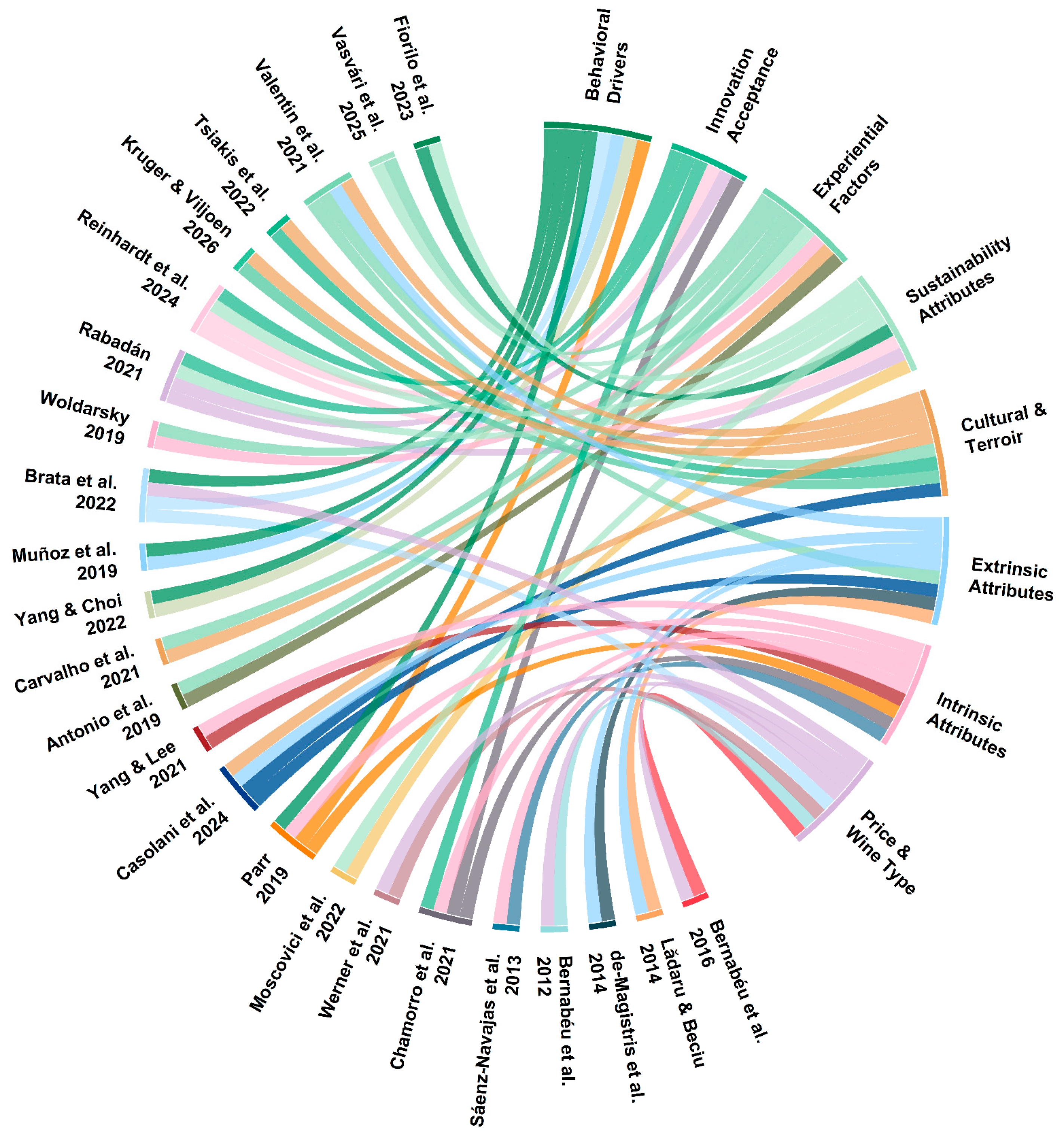
All studies indicate that price and wine type are among the strongest determinants of consumer choice [129,130,131,132,133], at the same time, the literature confirms the importance of attributes related to experience and knowledge: “food pairing” “designation of origin,” and prior experience, with a clear consensus that the consumption decision is not purely rational, but rather a mix of economic, symbolic, and experiential factors [123,124,125,126,127,128] (Figure 8).
As illustrated in Figure 8, the diagram shows that price and wine type maintain the strongest co-occurrence connections within the analyzed studies, with particularly dense links to intrinsic attributes and behavioral factors. This reflects the consistent finding in the literature that price functions not only as an economic signal but also as an indicator of quality and identity in wine purchasing decisions.
The behavioral dimension is highlighted by imperfect decision behavior and BWS and conjoint modeling, indicating the use of econometric and experimental methods for modeling preferences [120,121,122]. These approaches reflect the recognition that consumer decisions are not always rational, but are influenced by cognitive, emotional, and contextual factors. At the same time, the acceptable innovation concept and low acceptance of radical innovation suggest a tendency toward conservatism among wine consumers [118,119]. This implies the need for the gradual introduction of innovations, in line with existing market traditions and expectations.
Another important cluster is represented by the cultural dimension in marketing and origin and tradition, which highlights the role of cultural identity and terroir in influencing preferences [115,116,117]. These elements contribute to product differentiation and the reinforcement of wine’s symbolic value [113]. Furthermore, “sustainability in product design” and “sustainable attributes” reflect a growing interest in products’ ecological characteristics, indicating a shift in consumer behavior toward more responsible choices.
Extrinsic and cultural attributes, including terroir, appear as structurally interconnected dimensions, with Casolani et al. [127], Valentin et al. [115], and Tsiakis et al. [116] generating the most consistent contributions across both. This model confirms the decisive role of geographic origin and label-based signals in shaping consumer evaluations across different market contexts.
Sustainability attributes, primarily supported by Moscovici et al. [129] and Fiorilo et al. [113], emerge as a moderately connected dimension, with links to both extrinsic attributes and behavioral factors, suggesting that sustainability is not yet an autonomous purchasing driver but rather a modifier of existing extrinsic attribute evaluations. Experiential factors, anchored in the work of Antonio et al. [125], Woldarsky [120], and Carvalho et al. [124], show dense connections to behavioral and cultural-terroir dimensions, confirming that storytelling, co-creation, and sensory experience operate through cultural and identity-based mechanisms rather than purely rational decision pathways.
Innovation acceptance, represented by Rabadán [119] and Reinhardt et al. [118], appears as the most peripheral dimension in terms of co-occurrence density, primarily linked to experiential factors and sustainability attributes. This reflects the well-documented conservatism of wine consumers toward radical product innovations and the consistent need for gradual, experience-mediated introduction of new sustainability-oriented product formats.
Although traditional attributes remain dominant, the integration of sustainability and the consumer experience is redefining purchasing behavior; however, resistance to radical innovations and imperfect perceptions of quality indicate the existence of cognitive limits in the decision-making process, opening up relevant avenues for future research.
The convergence of results across these studies indicates that consumer decision-making in the wine market is structurally hybrid: simultaneously rational, symbolic, and experiential [171,172]. This complexity poses significant challenges for both producers and policymakers, as it implies that neither price signals alone nor sustainability certifications alone are sufficient to drive sustainable consumption at scale. Effective interventions must operate across multiple decision-making registers simultaneously, providing credible quality signals, reducing cognitive complexity through simplified labeling, and activating emotional and identity-based motivations through experiential and narrative marketing.

4.3. Wine Tourism, Experience and Regional Development

Building on the descriptive documentation of wine tourism studies in Section 3.3, this axis develops the interpretive framework through which wine tourism can be understood as a strategic interface between production, consumption, territorial identity, and sustainability communication.
The studies reviewed show that sustainable wine tourism can no longer be viewed merely as a complementary activity to wine sales, but rather as an integrated mechanism for regional development, cultural experience, consumer education, and the transition to a circular economy. Recent literature shifts the focus from simply visiting wineries to complex experiences, in which the landscape, local cuisine, heritage, ecological practices, and community involvement become central components of the tourist experience [138,139,140,141,142,143,144]. A key point of agreement among studies is that wine tourism is linked to rural development and maintaining the economic vitality of wine-growing regions. In the case of Galicia, wine tourism is presented as a tool for strengthening the local economy, supporting wineries, retaining the population in rural areas, and promoting natural, cultural, and gastronomic heritage [79,173]. This perspective is similar to the approach proposed by Alonso et al. [145], who argue that sustainable wine tourism must be built through connections between wine, local cuisine, territorial resources, and consumer education.
Recent literature highlights the fact that wine tourism is one of the most effective strategic tools for increasing the competitiveness of wineries and wine-growing regions [140,141,142,143,144,145,146,147,148,149,150]. It is no longer perceived merely as a secondary activity, but as a central component of marketing, diversification, and market positioning strategies, this shift from passive to experiential tourism is further analyzed in Figure 9, which maps the contribution intensity of key studies across the main sustainability and innovation dimensions of wine tourism.
As illustrated in Figure 9, experiential tourism and sustainability communication emerge as the dimensions with the highest weight in the analyzed studies as indicated by the larger node size and higher intensity scores represented in Figure 9, with Gomez-Carmona et al. [80] show that the wine tourism experience influences attitudes toward wine, the evaluation of intrinsic and extrinsic attributes, and loyalty to wines, demonstrating that tourism is becoming a relational marketing tool, not merely a recreational activity. In the same vein, Fucile Franceschini et al. [83] highlight that expert-led experiences, the aesthetics of the winery, informational sessions, and the region’s reputation influence tourists’ preferences, but these preferences differ culturally between mature and emerging markets.
The dimension of sustainability emerges in studies as a strategic condition for the differentiation of wineries and destinations, thus Szolnoki and Tafel [81] show that organic production can serve as a tourist attraction and a competitive advantage, but wineries do not always make sufficient use of organic certification in their communication with visitors. This finding is important because it indicates a gap between the existence of sustainable practices and their ability to translate into perceived value for tourists. In other words, sustainability does not automatically yield a competitive advantage; it must be explained, communicated, and integrated into the tourist experience.
Another relevant aspect is the role of young consumers in strengthening sustainable wine tourism. Vecchio et al. [82] show that involvement with wine, pro-environmental attitudes, and perceived behavioral control influence the intention of young people in Italy and France to participate in sustainable wine tourism. The study also shows that eco-friendly practices and the winery’s commitment to biodiversity can be more attractive than mere sustainability certification. Consequently, the literature on sustainable wine tourism highlights four major conceptual directions: the integration of sustainability into the tourist experience [174,175,176], the circular economy as a mechanism for territorial regeneration [79,143,177], the role of ecological practices in positioning wineries [178,179] and transforming the tourist into an active participant in the education and promotion of local heritage [136,180].
These findings collectively suggest that wine tourism has evolved into a strategic interface between production, consumption, and territorial identity, functioning simultaneously as a marketing channel, an educational platform, a regional development mechanism, and a sustainability communication tool. The critical implication is that the competitive value of wine tourism is not generated by the wine product itself but by the experiential ecosystem surrounding it, encompassing landscape, gastronomy, heritage, and community engagement and that sustainability must be actively integrated into this ecosystem rather than merely certified at the production level.

4.4. Innovation, Business Models and Sustainable Competitiveness

Drawing on the descriptive synthesis of green innovation and sustainable business model studies presented in Section 3.3, this axis examines the organizational, technological, and governance conditions under which sustainable innovation generates competitive advantage, and identifies the structural barriers that limit its diffusion across firm sizes and geographical contexts.
An analysis of the studies consistently highlights that sustainable innovation represents a strategic response to economic, social, and environmental pressures in the wine industry and wine tourism. The integration of smart farming technologies and sustainability-oriented innovations leads to quantifiable results, such as reduced pesticide use and greenhouse gas emissions, demonstrating the effectiveness of precision agriculture and digital solutions in the wine value chain [84,181].
From the perspective of process and distribution innovations, the role of alternative packaging and delivery solutions stands out, such as “keg wine” technology, which significantly reduces the environmental impact associated with traditional packaging; studies show that glass packaging has a high ecological footprint, and the adoption of innovative solutions depends on both perceived economic benefits and consumer acceptance [87,155,182]. Regarding the market and consumer behavior, research indicates a significant increase in interest in sustainable and natural wines, driven by a shift toward healthy and eco-friendly products. Consumers are increasingly evaluating products based on their impact on the environment and society, which is prompting producers to integrate sustainability into their core strategies [183].
From an organizational perspective, the development of green innovation is closely linked to transformational leadership and firms’ ability to foster employee creativity and motivation. Leaders who promote ecological values facilitate the development of innovative solutions that reduce environmental impact and improve firms’ economic performance and competitiveness [85].
At the systemic level, studies highlight the role of sustainable business models and alternative networks (organic and biodynamic), which foster collaboration among producers and generate innovation at the local level, thereby contributing to increased product value, environmental protection, and the strengthening of local identity, aspects essential for the development of wine tourism [86]. At the same time, the sustainable transformation of business models is supported by the implementation of management tools and international standards, which facilitate the integration of eco-innovation and eco-design practices. This process is dynamic and based on organizational learning, leading to a reconfiguration of how value is created in the industry [154]. These contributions are further contextualized in Figure 10, which maps the analytical weight of key studies across the main green and digital innovation dimensions identified in the reviewed literature.
As illustrated in Figure 10, smart agriculture and green innovation emerge as the dimensions with the highest weight in the analyzed studies as reflected by the dominant positioning and highest intensity values in Figure 10, with Kasimati et al. [84] and Sánchez-García et al. [85] generating the strongest contributions. This finding is consistent with the recognition in the literature that precision agriculture and sensor-based technologies represent the most mature operational frontier of sustainable innovation in the wine sector.
Sustainable business models represent the second most significant dimension, primarily anchored in the work of da Rocha Oliveira Teixeira et al. [86] and Serhan and Yannou-Le Bris [154], both of whom consider business model transformation a prerequisite for systemic rather than incremental improvements in sustainability.
Transformational leadership, supported by Sánchez-García et al. [85], generates moderate but consistent contributions, confirming that organizational culture and managerial values are as decisive as financial resources in determining the pace and depth of green innovation adoption.
Producer collaboration networks, represented by Gazzola et al. [183] and Pougnet et al. [87], appear as a structurally underweighted but strategically significant dimension, suggesting that the sector’s cooperative infrastructure, although well established in traditional wine production remains underutilized as a vehicle for green innovation diffusion.
The impact of traditional packaging, addressed by Pougnet et al. [87], highlights the persistent tension between environmental performance ambitions and the deep-rooted attachment of both consumers and producers to glass as a quality signal, a tension that neither regulatory pressure nor eco-labeling has yet resolved.
Taken together, the themes of digitalization and green innovation, can be synthesized into a coherent analytical framework thus technological adoption in the wine sector operates along three interdependent dimensions: (i) production-level innovation, encompassing precision viticulture, smart irrigation, and sensor-based pest management; (ii) value chain-level innovation, including sustainable packaging, logistics optimization, and supply chain transparency tools and (iii) market-level innovation, comprising digital marketing platforms, e-commerce channels, and AI-driven consumer segmentation. These dimensions are not independent but mutually reinforcing: production-level technologies reduce environmental impact and generate sustainability credentials that can be leveraged through market-level digital communication tools, while value chain innovations connect the two by optimizing the interface between production and consumption. The competitive advantage generated by this integrated technological ecosystem is conditioned on the availability of organizational capabilities, financial resources, and regulatory support, factors that vary significantly across firm sizes and geographical contexts.
Recent literature highlights the fact that sustainable governance in the wine industry is evolving from traditional regulatory models toward integrated approaches based on multi-stakeholder coordination and the alignment of public policies with sustainability objectives. Thus, sustainability is no longer treated exclusively as an individual responsibility of producers, but as the result of the interaction between institutions, markets, and regulatory frameworks [15,153,184].
A central element identified in the studies is the role of indicators and assessment tools in sustainability governance; the development of systems such as the Sustainable Wine Assessment Tool (SWAT) demonstrates the need to standardize indicators and integrate them into decision-making processes, given that the lack of unified frameworks limits the comparability and effectiveness of policies [88]. t the same time, European policies, such as the Common Agricultural Policy [151,152], the European Green Deal, and ESRS standards [49,58,184] create a complex regulatory framework that directly influences the strategies of wine producers. Regulations based on geographical indications (PDO/PGI) are identified as innovative governance tools capable of balancing economic growth with environmental protection and the preservation of regional identity. Studies show that these mechanisms can limit pressure on natural resources and contribute to the controlled and sustainable development of wine-growing regions [185]. At the same time, research highlights the importance of collaborative governance and network-based structures, in which cooperatives and producer organizations facilitate knowledge sharing, joint investments, and the implementation of green technologies [46,55,180].
At the conceptual level, the literature on innovation systems introduces the idea of a “normative orientation” of policies, in which governance no longer pursues only economic efficiency, but also the resolution of global problems (climate, resources, equity). The MIS (Mission-Oriented Innovation Systems) and CORIS models suggest that policies must be strategically directed toward sustainability goals [84,86,186]. Furthermore, sustainable governance is closely linked to competitiveness, as integrating sustainability into a firm’s strategy enables market differentiation and the creation of long-term value. Studies highlight that sustainability and competitive advantage are interdependent, supported by appropriate policies and dynamic organizational capabilities [150,151,152,153,154,155,156,157,158,159,160,161,162,163,164,165,166,167,168,169,170,171,172,173,174,175,176,177,178,179,180,181,182,183,184,185,186,187].
Another relevant aspect is the role of family-owned businesses and tradition in the governance of the wine sector; while they combine cultural values with modern management practices, they may face difficulties in adapting quickly to legislative changes and sustainability requirements [146,147,148]. Last but not least, studies highlight the existence of significant barriers to the implementation of sustainable policies, such as high costs, a lack of standardization, and the complexity of regulations; these limitations necessitate more coherent public policies and support mechanisms tailored to the specific characteristics of the wine sector [93,188].
From a geographical perspective, the predominance of European research contexts in the reviewed literature raises critical questions about the applicability of sustainability frameworks to emerging wine regions. In Latin American contexts, particularly Chile and Argentina sustainability challenges are compounded by water scarcity, land tenure issues, and limited access to certification infrastructure. In Asian emerging markets, notably China and India the cultural framing of sustainability differs substantially from European consumer-oriented paradigms, affecting both the adoption of sustainable practices and the communication of sustainability credentials to consumers. In African wine regions, particularly South Africa, sustainability is additionally intertwined with post-apartheid socioeconomic equity concerns that have no equivalent in European frameworks. These contextual differences suggest that sustainability models developed in European viticulture cannot be uncritically exported, but must be adapted to local institutional, climatic, and socioeconomic realities.
This pattern of evidence implies that sustainable innovation in the wine industry is most effective when it operates simultaneously across production, value chain, and market dimensions, rather than being confined to isolated technological interventions. The organizational and leadership conditions enabling green innovation, particularly transformational leadership and collaborative network structures suggest that the adoption of sustainable technologies is as much a cultural and governance challenge as a financial one, underscoring the need for policy instruments that address not only investment costs but also organizational capacity and knowledge diffusion across the sector.

5. Conclusions

The systematic analysis conducted confirms that sustainability in the wine industry has evolved significantly over the past two decades, transforming from a marginal concept, predominantly associated with environmental considerations into a multidimensional strategic pillar integrated into the operational logic of the entire wine value chain. The results highlight that environmental practices and sustainable marketing strategies do not operate in isolation but converge into a complex value-creation model, simultaneously contributing to increased competitiveness, adaptation to climate change, and the strengthening of relationships with consumers.
With regard to the first objective, the results demonstrate a gradual expansion of the theoretical framework, from one-dimensional approaches to integrated models based on the “triple bottom line” principle, while the literature highlights a significant diversification of research directions, including topics such as climate change adaptation, resource management, green innovation, sustainable governance, and consumer behavior. At the same time, bibliometric analysis confirms the interdisciplinary nature of the field, situated at the intersection of environmental sciences, agriculture, and economics. Nevertheless, the persistence of conceptual fragmentation and the lack of a standardized definition of sustainability in the wine sector represent a significant limitation, which affects the comparability of results and the effectiveness of public policies.
The second objective highlights the fact that the environmental dimension remains dominant in the literature. The practices analyzed include efficient management of water and energy resources, reduced pesticide use, the implementation of organic farming, the use of Life Cycle Assessment methodologies, and the development of sustainable packaging. The results show that these practices contribute significantly to reducing environmental impact and increasing the resilience of viticultural systems, particularly in the context of climate change; at the same time, the analysis highlights that sustainability must be addressed systemically, from agricultural production through distribution to consumption, which requires effective coordination among actors in the value chain. Beyond the gaps identified prior to the review that motivated the present study, the systematic analysis of the 175 included studies reveals additional structural gaps in the existing literature, which constitute findings of the review itself. However, the social dimension of sustainability remains underdeveloped, often being marginalized in relation to the ecological and economic components, which points to the need for more balanced and comprehensive future research.
Regarding the third objective, the study highlights a profound shift in marketing strategies, from product-centric approaches to consumer and experience-oriented models. Sustainability is becoming a tool for strategic differentiation, integrated into branding, labeling, and communication, while practices such as organic certification, sustainable labeling, and storytelling contribute to increasing the perceived value of the product and strengthening consumer loyalty. At the same time, wine tourism is emerging as a key driver of sustainable marketing, facilitating the connection between the product, the region, and the consumer experience. However, the results indicate a gap between the implementation of sustainable practices and their communication, which limits their potential for market value.
With regard to the fourth objective, the analysis of consumer behavior reveals a significant increase in interest in sustainable wines, driven by greater awareness of environmental issues and shifting social values. Consumers show a greater willingness to pay a premium price for sustainable products, but this willingness is influenced by factors such as the level of information, trust in certifications, and perceptions of quality. The study confirms the existence of an “attitude–behavior gap,” in which favorable intentions do not always translate into actual purchasing behavior. In this context, the role of communication becomes essential, and marketing strategies must be adapted to reduce this discrepancy and facilitate the adoption of sustainable products.
Sustainability and competitiveness in the wine industry are no longer opposing forces but mutually reinforcing strategic orientations. Sustainable practices are increasingly perceived not as regulatory obligations but as opportunities for innovation, differentiation, and long-term value creation. The integration of green technologies, the development of sustainable business models, and the adoption of consumer-oriented marketing strategies collectively contribute to repositioning the wine sector on more resilient and competitive foundations. At the same time, sustainable governance and coherent public policies play an indispensable role in facilitating this transition, by establishing shared standards, reducing adoption barriers, and stimulating the diffusion of innovative practices across the entire value chain.

6. Limitations and Future Research Directions

The approach adopted in this study allows for an integrated analysis of the scientific literature; however, there are inherent limitations that must be taken into account when interpreting the results. Thus, the analysis was based on scientific articles indexed in the Web of Science (WoS Core Collection) and Scopus databases. Although these sources ensure a high level of scientific rigor, it is possible that some relevant contributions from other databases or from the gray literature (institutional reports, public policy documents, or conference papers) may not be reflected in the analysis.
The exclusive inclusion of English-language publications may, to some extent, limit the overall representativeness of the results; given the importance of the wine sector in countries such as France, Italy, or Spain, some of the relevant literature published in national languages may be underrepresented, particularly regarding local practices and regional particularities.
The study selection process was conducted in accordance with the PRISMA 2020 guidelines and was based on predefined inclusion and exclusion criteria; although this approach ensures methodological consistency, it may involve a certain degree of interpretation during the study evaluation phase, which is specific to systematic reviews, especially in interdisciplinary fields. Furthermore, the analysis was predominantly qualitative and bibliometric in nature, aimed at identifying thematic trends and research directions. In this context, a detailed assessment of the methodological quality of each included study was not conducted, which may represent a limitation in the comparative evaluation of the results.
Regarding relevant directions for future research, there is a need to expand data sources by including other scientific databases, as well as gray literature, in order to obtain a more comprehensive perspective on sustainability in the wine industry. Second, comparative analyses between regions and countries are needed to highlight cultural, economic, and institutional differences in the adoption of sustainable practices; such approaches could facilitate the identification of best-practice models and the adaptation of sustainability strategies to local conditions.
A key area of research involves the development of standardized indicators for assessing sustainable performance in the wine sector; the lack of uniform tools limits the comparability of results and the effectiveness of public policies. It is also necessary to explore the social dimension of sustainability by analyzing aspects such as working conditions, the impact on local communities, and social equity within the value chain.
Regarding marketing and consumer behavior, future research should aim to bridge the gap between attitudes and behaviors by employing experimental and longitudinal methods; simultaneously, investigating the impact of digital technologies, artificial intelligence, and online platforms on perceptions and purchasing decisions represents a promising avenue for analysis.
Last but not least, future studies could explore in greater depth the relationship between sustainability and the economic performance of wine companies by using econometric models and empirical data; such an approach would allow for the quantification of the economic benefits of sustainable practices and would help strengthen the case for integrating them into business strategies.
A key finding of the research is the highlighting of the interdependence between sustainability and competitiveness; thus, sustainable practices are no longer perceived solely as obligations imposed by regulations, but as strategic opportunities for innovation and differentiation. The integration of green technologies, the development of sustainable business models, and the adoption of consumer-oriented marketing strategies contribute to long-term value creation; at the same time, sustainable governance and public policies play an essential role in facilitating the transition to responsible production models by setting standards and stimulating innovation (Table 3).

Author Contributions

Conceptualization, A.-F.J., I.P. and G.I.; methodology, A.-F.J., I.P. and G.I.; software, A.-F.J., I.P. and G.I.; validation, A.-F.J., I.P. and G.I.; formal analysis, A.-F.J., I.P. and G.I.; investigation, A.-F.J., I.P. and G.I.; resources, A.-F.J., I.P. and G.I.; data curation, A.-F.J., I.P. and G.I.; writing—original draft preparation, A.-F.J., I.P. and G.I.; writing—review and editing, A.-F.J., I.P. and G.I.; visualization, A.-F.J., I.P. and G.I.; supervision, A.-F.J., I.P. and G.I.; project administration, A.-F.J., I.P. and G.I.; funding acquisition, A.-F.J., I.P. and G.I. All authors have read and agreed to the published version of the manuscript.

Funding

This research received no external funding.

Institutional Review Board Statement

Not applicable.

Data Availability Statement

No new data were created or analyzed in this study. Data sharing is not applicable to this article.

Acknowledgments

The authors declare that no artificial intelligence tools were used in the preparation of this manuscript.

Conflicts of Interest

The authors declare no conflicts of interest.

References

  1. Florea, A.C.; Sumedrea, D.I.; Rodino, S.; Ion, M.; Dragomir, V.; Dumitru, A.-M.; Pîrcalabu, L.; Dinu, D.G. The Impact of Climate Change on Eastern European Viticulture: A Review of Smart Irrigation and Water Management Strategies. Horticulturae 2025, 11, 1282. [Google Scholar] [CrossRef]
  2. Morandi, S.; Zinno, I. Sustainable practices in the wine sector: Firm perspectives and actions. Int. J. Wine Bus. Res. 2025, 37, 640–676. [Google Scholar] [CrossRef]
  3. Calle, F.; Carrasco, I.; González-Moreno, Á.; Córcoles, C. Are Environmental Regulations to Promote Eco-Innovation in the Wine Sector Effective? A Study of Spanish Wineries. Agronomy 2022, 12, 21. [Google Scholar] [CrossRef]
  4. Rui, M.; Rosa, F.; Viberti, A.; Brun, F.; Massaglia, S.; Blanc, S. Understanding Factors Associated with Interest in Sustainability-Certified Wine among American and Italian Consumers. Foods 2024, 13, 1468. [Google Scholar] [CrossRef]
  5. Bux, C.; Lombardi, M.; Rana, R.L.; Tricase, C. Decarbonization Strategies in the Wine Supply Chain: From Environmental Mitigation Towards Integrated Sustainability Management. Environments 2026, 13, 195. [Google Scholar] [CrossRef]
  6. Rui, M.; Blanc, S.; Brun, F.; Massaglia, S. Shifting wine consumption trends (2019–2024): Market dynamics, sustainability, and consumer preferences. In Proceedings of the 46th World Congress of Vine and Wine; IVES Conference Series; IVES: Villenave d’Ornon, France, 2024; p. 46. [Google Scholar] [CrossRef]
  7. Montalvo-Falcón, J.V.; Sánchez-García, E.; Marco-Lajara, B.; Martínez-Falcó, J. Sustainability Research in the Wine Industry: A Bibliometric Approach. Agronomy 2023, 13, 871. [Google Scholar] [CrossRef]
  8. Brito, C.; Pereira, S.; Martins, S.; Monteiro, A.; Moutinho-Pereira, J.M.; Dinis, L. Strategies for achieving the sustainable development goals across the wine chain: A review. Front. Sustain. Food Syst. 2024, 8, 1437872. [Google Scholar] [CrossRef]
  9. Reinhardt, T. The farm to fork strategy and the digital transformation of the agrifood sector—An assessment from the perspective of innovation systems. Appl. Econ. Perspect. Policy 2023, 45, 819–838. [Google Scholar] [CrossRef]
  10. Ceccacci, A.; Camanzi, L.; Rota, C.; Fiorentini, R.; Malorgio, G. Enhancing wineries’ sustainability through territorial certifications: A case study in Emilia-Romagna, Italy. Int. J. Wine Bus. Res. 2025, 37, 87–112. [Google Scholar] [CrossRef]
  11. Zambon, I.; Colantoni, A.; Cecchini, M.; Mosconi, E.M. Rethinking Sustainability within the Viticulture Realities Integrating Economy, Landscape and Energy. Sustainability 2018, 10, 320. [Google Scholar] [CrossRef]
  12. Alessandri, G.; Daddi, T.; Iraldo, F. Environmental sustainability in the wine industry: A literature review. Clean. Prod. Lett. 2024, 7, 100067. [Google Scholar] [CrossRef]
  13. Rusch, A. Nature-based solutions to increase sustainability and resilience of vineyard-dominated landscapes. Basic Appl. Ecol. 2025, 82, 70–78. [Google Scholar] [CrossRef]
  14. Mainar-Toledo, M.D.; Gómez Palmero, M.; Díaz-Ramírez, M.; Mendioroz, I.; Zambrana-Vasquez, D. A Multi-Criteria Approach to Evaluate Sustainability: A Case Study of the Navarrese Wine Sector. Energies 2023, 16, 6589. [Google Scholar] [CrossRef]
  15. Santini, C.; Cavicchi, A.; Casini, L. Sustainability in the Wine Industry: Key Questions and Research Trends. Agric. Econ. 2013, 1, 9. [Google Scholar] [CrossRef]
  16. Sánchez-García, E.; Martínez-Falcó, J.; Marco-Lajara, B.; Abraham, L. Leading the way towards greener business models in the wine industry. Bus. Strateg. Environ. 2025, 34, 7878–7896. [Google Scholar] [CrossRef]
  17. Baiano, A. An Overview on Sustainability in the Wine Production Chain. Beverages 2021, 7, 15. [Google Scholar] [CrossRef]
  18. Castillo-Valero, J.S.; Carrasco, I.; Carchano, M.; Córcoles, C. What Is the Environmental Impact of Wine Entering Global Value Chains? Studying the Evolution of CO2 Emissions from the Export of Spanish Denomination of Origin Wines. Foods 2021, 10, 1664. [Google Scholar] [CrossRef]
  19. Marques, C.; Güneş, S.; Vilela, A.; Gomes, R. Life-Cycle Assessment in Agri-Food Systems and the Wine Industry—A Circular Economy Perspective. Foods 2025, 14, 1553. [Google Scholar] [CrossRef] [PubMed]
  20. Serra, M.; Antonio, N.; Henriques, C.; Afonso, C.M. Promoting Sustainability through Regional Food and Wine Pairing. Sustainability 2021, 13, 13759. [Google Scholar] [CrossRef]
  21. Wojtaszek, H.; Miciuła, I.; Kowalczyk, A.; Stefaniuk, R. Documenting the Transition: Sustainable Strategic Management and Leadership in European SMEs—A Comparative Analysis of Policy and Industry Reports. Sustainability 2025, 17, 9726. [Google Scholar] [CrossRef]
  22. Flores, S.S. What is sustainability in the wine world? A cross-country analysis of wine sustainability frameworks. J. Clean. Prod. 2018, 172, 2301–2312. [Google Scholar] [CrossRef]
  23. Di Chiara, V.; Battistella, A.; Boatto, V.; Furlan, S.; Giavi, L.; Liggieri, S.; Paiola, A.; Pomarici, E.; Stefanucci, S. Collaborative Approach for Achieving Ambitious Sustainability Goals: The Prosecco Sustainability Project. Sustainability 2024, 16, 583. [Google Scholar] [CrossRef]
  24. Camprubí, R.; Gonçalves, O. Exploring marketing strategies in wine tourism: A comparative study of Roussillon and Empordà wine regions. Int. J. Wine Bus. Res. 2025, 37, 1–26. [Google Scholar] [CrossRef]
  25. Casolani, N.; D’Eusanio, M.; Liberatore, L.; Raggi, A.; Petti, L. Life Cycle Assessment in the Wine Sector: A Review on Inventory Phase. J. Clean. Prod. 2022, 379, 134404. [Google Scholar] [CrossRef]
  26. Schäufele, I.; Hamm, U. Consumers’ Perceptions, Preferences and Willingness-to-Pay for Wine with Sustainability Characteristics: A Review. J. Clean. Prod. 2017, 147, 379–394. [Google Scholar] [CrossRef]
  27. Nave, A.; do Paço, A.; Duarte, P. A systematic literature review on sustainability in the wine tourism industry: Insights and perspectives. Int. J. Wine Bus. Res. 2021, 33, 457–480. [Google Scholar] [CrossRef]
  28. Sánchez-García, E.; Montalvo-Falcón, J.V.; Marco-Lajara, B.; Martínez-Falcó, J. Guiding organizations toward sustainable success: The strategic role of leadership in environmental corporate governance in the wine industry. Corp. Soc. Responsib. Environ. Manag. 2024, 31, 6438–6456. [Google Scholar] [CrossRef]
  29. Boeske, J. Leadership towards Sustainability: A Review of Sustainable, Sustainability, and Environmental Leadership. Sustainability 2023, 15, 12626. [Google Scholar] [CrossRef]
  30. Bodiroga, R.; Banjanin, T.; Vukojević Ateljević, D.; Kerma, S. The trends in viticulture and winemaking in the context of wine tourism development in Bosnia and Herzegovina. Acta Geogr. Slov. 2024, 64, 33–48. [Google Scholar] [CrossRef]
  31. Gaybullaev, O.; Strode, J.P. Transformational leadership and organizational sustainability performance: A systematic literature review of global evidence. Environ. Dev. Sustain. 2026. [Google Scholar] [CrossRef]
  32. Psychogiou, E.-E.; Tsoulfas, G.T. Critical Factors Affecting Trust in the Wine Supply Chain in Greece: A Grey DEMATEL Approach. Logistics 2024, 8, 24. [Google Scholar] [CrossRef]
  33. Dalla Valle, C.; Viana, J.G.A.; Dorr, A.C. The Governance of Global Value Chains from the Perspective of Economic Competence: A Literature Review. Adm. Sci. 2026, 16, 138. [Google Scholar] [CrossRef]
  34. Mian, G.; Nassivera, F.; Sillani, S.; Iseppi, L. Grapevine Resistant Cultivars: A Story Review and the Importance on the Related Wine Consumption Inclination. Sustainability 2023, 15, 390. [Google Scholar] [CrossRef]
  35. Hauck, K.; Szolnoki, G. German Consumers’ Perceptions of Organic Wine—A Qualitative Approach. Sustainability 2020, 12, 7729. [Google Scholar] [CrossRef]
  36. Vîlcea, C.; Licurici, M.; Popescu, L. The Role of Websites in Promoting Wine Tourism: An Evaluation of Romanian Wineries. Sustainability 2024, 16, 6336. [Google Scholar] [CrossRef]
  37. Savvinopoulou, M.; Mylonas, N. The Impact of Entrepreneurial Orientation, Market Orientation and Dynamic Capabilities on Firms’ Performance in Wine Tourism. Tour. Hosp. 2026, 7, 109. [Google Scholar] [CrossRef]
  38. Ricci, E.C.; Morandi, S. What strategies do wine firms adopt to integrate CSR into their activities? An analysis among Italian wineries. In Proceedings of the International Scientific Congress GreenWINE 2025; IVES Conference Series; IVES: Villenave d’Ornon, France, 2025. [Google Scholar]
  39. Abbate, S.; Centobelli, P.; Di Gregorio, M. Wine waste valorisation: Crushing the research domain. Rev. Manag. Sci. 2025, 19, 963–998. [Google Scholar] [CrossRef]
  40. Schimmenti, E.; Migliore, G.; Di Franco, C.P.; Borsellino, V. Is there sustainable entrepreneurship in the wine industry? Exploring Sicilian wineries participating in the SOStain program. Wine Econ. Policy 2016, 5, 14–23. [Google Scholar] [CrossRef]
  41. Anzivino, A.; Galli, M.; Sebastiani, R. Addressing Tensions and Paradoxes in Sustainable Wine Industry: The Case of the Association “Le Donne Del Vino”. Sustainability 2021, 13, 4157. [Google Scholar] [CrossRef]
  42. Páramo-Telle, Ó.; Vence, X. Industrial symbiosis in the wine value chain: A systematic review of research trends, barriers, and drivers. J. Ind. Ecol. 2026. [Google Scholar] [CrossRef]
  43. Ribeiro Trigo, A.F.; Marta-Costa, A.A.; Fragoso, R.M.d.S. Sustainable wine assessment tool (SWAT): A hierarchical framework to measure sustainability performance. J. Wine Res. 2025, 36, 190–215. [Google Scholar] [CrossRef]
  44. Trigo, A.; Marta-Costa, A.; Fragoso, R. Improving sustainability assessment: A context-oriented classification analysis for the wine industry. Land Use Policy 2023, 126, 106551. [Google Scholar] [CrossRef]
  45. Landoni, P.; Moratti, A. Impact Assessment in the Wine Industry: Potential and Limitations of the Social Return on Investment (SROI). Adm. Sci. 2025, 15, 346. [Google Scholar] [CrossRef]
  46. Martínez-Falcó, J.; Sánchez-García, E.; Marco-Lajara, B.; Millán-Tudela, L.A. Unraveling the relationship between ESG strategy and sustainable performance in the Spanish wine industry: A structural equation analysis. Soc. Responsib. J. 2025, 21, 962–986. [Google Scholar] [CrossRef]
  47. Ferretti, L.; Di Blasi, S.; Landers, L.; Elli, F.; O’Connor, R.; Pacini, G.C. Agroecology in wine production: Assessing the environmental, productive and social sustainability pillars of conventional, organic and biodynamic vineyard management through the AESIS framework. Ecol. Solut. Evid. 2025, 6, e70101. [Google Scholar] [CrossRef]
  48. Marques, A.; Guerra, M.; Ferreira, F.; Sousa, T.A.d.; Teixeira, C.A. Challenges of Implementing Sustainability Benchmarks in Wine Cooperative. Agronomy 2025, 15, 1408. [Google Scholar] [CrossRef]
  49. Spraul, K.; Höfert, A. Governance for Sustainability: Patterns of Regulation and Self-Regulation in the German Wine Industry. Sustainability 2021, 13, 3140. [Google Scholar] [CrossRef]
  50. Tria, E.; Di Cosola, F.; Bozzo, F.; Casieri, A.; Zeka, E.; Petrontino, A. Sustainability and Quality in Wine Pricing: Insights from the Primitivo E-Commerce Market. Sustainability 2025, 17, 8094. [Google Scholar] [CrossRef]
  51. De Steur, H.; Temmerman, H.; Gellynck, X.; Canavari, M. Drivers, adoption, and evaluation of sustainability practices in Italian wine SMEs. Bus. Strateg. Environ. 2020, 29, 744–762. [Google Scholar] [CrossRef]
  52. Baptista, A.; Fontaínhas-Fernandes, A.; Sequeira, T. A strategy for sustainability and competitiveness in wine production and tourism in Portugal’s Douro Valley. Discov. Sustain. 2025, 6, 1269. [Google Scholar] [CrossRef]
  53. Carroll, C.; Booth, A.; Cooper, K. A worked example of “best fit” framework synthesis: A systematic review of views concerning the taking of some potential chemopreventive agents. BMC Med. Res. Methodol. 2011, 11, 29. [Google Scholar] [CrossRef]
  54. Page, M.J.; McKenzie, J.E.; Bossuyt, P.M.; Boutron, I.; Hoffmann, T.C.; Mulrow, C.D.; Shamseer, L.; Tetzlaff, J.M.; Akl, E.A.; Brennan, S.E.; et al. The PRISMA 2020 statement: An updated guideline for reporting systematic reviews. BMJ 2021, 372, n71. [Google Scholar] [CrossRef]
  55. Tahon, C.; Batt, P.J. An Exploratory Study of the Sustainable Practices Used at Each Level of the Bordeaux Wine Value Chain. Sustainability 2021, 13, 9760. [Google Scholar] [CrossRef]
  56. Wagner, M.; Stanbury, P.; Dietrich, T.; Döring, J.; Ewert, J.; Foerster, C.; Freund, M.; Friedel, M.; Kammann, C.; Koch, M.; et al. Developing a Sustainability Vision for the Global Wine Industry. Sustainability 2023, 15, 10487. [Google Scholar] [CrossRef]
  57. Marques, A.; Teixeira, C.A. Vine and Wine Sustainability in a Cooperative Ecosystem—A Review. Agronomy 2023, 13, 2644. [Google Scholar] [CrossRef]
  58. Guerra, M.; Ferreira, F.; Oliveira, A.A.; Pinto, T.; Teixeira, C.A. Drivers of Environmental Sustainability in the Wine Industry: A Life Cycle Assessment Approach. Sustainability 2024, 16, 5613. [Google Scholar] [CrossRef]
  59. Vagnoni, E.; Cesaraccio, C.; Pirino, P.; Duce, P. The environmental role of small organic wineries: The case study of a multi-year assessment of a local Italian red wine. Int. J. Life Cycle Assess. 2024, 29, 469–482. [Google Scholar] [CrossRef]
  60. Giacopelli, F.; Rossi, L.; Challita, C.; Bacenetti, J. Environmental sustainability of wine sector: A focus on pesticide management. Environ. Impact Assess. Rev. 2025, 115, 108022. [Google Scholar] [CrossRef]
  61. Casolani, N.; Chiodo, E.; Liberatore, L. Continuous Improvement of VIVA-Certified Wines: Analysis and Perspective of Greenhouse Gas Emissions. Sustainability 2023, 15, 2349. [Google Scholar] [CrossRef]
  62. Beaumelle, L.; Giffard, B.; Tolle, P.; Winter, S.; Entling, M.H.; Benítez, E.; Zaller, J.G.; Auriol, A.; Bonnard, O.; Charbonnier, Y.; et al. Biodiversity conservation, ecosystem services and organic viticulture: A glass half-full. Agric. Ecosyst. Environ. 2023, 351, 108474. [Google Scholar] [CrossRef]
  63. Santos, J.A.; Fraga, H.; Malheiro, A.C.; Moutinho-Pereira, J.; Dinis, L.-T.; Correia, C.; Moriondo, M.; Leolini, L.; Dibari, C.; Costafreda-Aumedes, S.; et al. A Review of the Potential Climate Change Impacts and Adaptation Options for European Viticulture. Appl. Sci. 2020, 10, 3092. [Google Scholar] [CrossRef]
  64. Faralli, M.; Mallucci, S.; Bignardi, A.; Varner, M.; Bertamini, M. Four decades in the vineyard: The impact of climate change on grapevine phenology and wine quality in northern Italy. OENO One 2024, 58(3). [Google Scholar] [CrossRef]
  65. Vega-Bayo, A.; Mariel, P.; Meyerhoff, J.; Corsi, A.M.; Chovan, M. Climate change adaptation preferences of winemakers from the Rioja wine appellation. J. Choice Model. 2023, 48, 100434. [Google Scholar] [CrossRef]
  66. Petriashvili, A.; Mach, J.; Štěbeták, M.; Prášilová, M.; Svoboda, R.; Navrátilová, M.; Beranová, M.; Veselá, K.; Hofman, V.; Němec, O. The impact of climate change on the sustainability of wine production and the structure of its consumption in Czechia. Heliyon 2023, 9, e17882. [Google Scholar] [CrossRef]
  67. Martínez-Falcó, J.; Martínez-Falcó, J.; Marco-Lajara, B.; Sánchez-García, E.; Visser, G. Aligning the Sustainable Development Goals in the Wine Industry: A Bibliometric Analysis. Sustainability 2023, 15, 8172. [Google Scholar] [CrossRef]
  68. Ducman, A.A.; Diaconita, V.; Simonca, I.; Belciu, A.; Corbea, A.M.I. Government Oversight and Economic Impacts: Sustainability in the Vineyard and the Evolution of Wine Regulations, Trade and Production. Agronomy 2023, 13, 2991. [Google Scholar] [CrossRef]
  69. Martínez-Navarro, J.; Sellers-Rubio, R. Three decades of research on wine marketing. Heliyon 2024, 10, e30938. [Google Scholar] [CrossRef]
  70. Martínez-Falcó, J.; Sánchez-García, E.; Marco-Lajara, B.; Georgantzis, N. The interplay between competitive advantage and sustainability in the wine industry: A bibliometric and systematic review. Discov. Sustain. 2024, 5, 13. [Google Scholar] [CrossRef]
  71. Martinho, V.J.P.D. Contributions from Literature for Understanding Wine Marketing. Sustainability 2021, 13, 7468. [Google Scholar] [CrossRef]
  72. Kotler, P.; Keller, K.L. Marketing Management, 15th ed.; Pearson: Harlow, UK, 2016. [Google Scholar]
  73. Brence, I.; Ozoliņa, A. Wine market in France: Challenges for a wine producer. Proc. Econ. Sci. Rural Dev. 2019, 51, 275–283. [Google Scholar] [CrossRef]
  74. Gastaldello, G.; Bošnjak, M.; Schäufele-Elbers, I.; Schamel, G. Are consumers willing to pay more for sustainable wine? A pre-registered systematic review and meta-analysis. Food Qual. Prefer. 2025, 134, 105655. [Google Scholar] [CrossRef]
  75. Valenzuela, L.; Ortega, R.; Moscovici, D.; Gow, J.; Alonso Ugaglia, A.; Mihailescu, R. Consumer Willingness to Pay for Sustainable Wine—The Chilean Case. Sustainability 2022, 14, 10910. [Google Scholar] [CrossRef]
  76. Gow, J.; Moscovici, D.; Rana, R.; Rinaldi, A.; Ugaglia, A.A.; Valenzuela, L.; Mihailescu, R.; Haque, R. Determinants of Purchasing Sustainably Produced Wines by Italian Wine Consumers. Sustainability 2024, 16, 8283. [Google Scholar] [CrossRef]
  77. Capitello, R.; Sirieix, L. Consumers’ Perceptions of Sustainable Wine: An Exploratory Study in France and Italy. Economies 2019, 7, 33. [Google Scholar] [CrossRef]
  78. de-Magistris, T.; Gracia, A.; Albisu, L.M. Wine consumers’ preferences in Spain: An analysis using the best–worst scaling approach. Span. J. Agric. Res. 2014, 12, 529–541. [Google Scholar] [CrossRef]
  79. del Campo-Villares, J.L.; Fuentes-Fernández, R. Wine Tourism in Galicia, Sustainability, Circular Economy and Unique Experiences, the Future for the Wine Sector. Sustainability 2025, 17, 5335. [Google Scholar] [CrossRef]
  80. Gómez-Carmona, D.; Paramio, A.; Cruces-Montes, S.; Marín-Dueñas, P.P.; Aguirre Montero, A.; Romero-Moreno, A. The effect of the wine tourism experience. J. Destin. Mark. Manag. 2023, 29, 100793. [Google Scholar] [CrossRef]
  81. Szolnoki, G.; Tafel, M. Environmental Sustainability and Tourism—The Importance of Organic Wine Production for Wine Tourism in Germany. Sustainability 2022, 14, 11831. [Google Scholar] [CrossRef]
  82. Vecchio, R.; Annunziata, A.; Bouzdine-Chameeva, T. How to promote sustainable wine tourism: Insights from Italian and French young adults. Ann. Tour. Res. Empir. Insights 2024, 5, 100137. [Google Scholar] [CrossRef]
  83. Fucile Franceschini, C.; Giampietri, E.; Pomarici, E. What Defines the Perfect Wine Tourism Experience? Evidence from a Best–Worst Approach. Agriculture 2025, 15, 876. [Google Scholar] [CrossRef]
  84. Kasimati, A.; Papadopoulos, G.; Manstretta, V.; Giannakopoulou, M.; Adamides, G.; Neocleous, D.; Vassiliou, V.; Savvides, S.; Stylianou, A. Case Studies on Sustainability-Oriented Innovations and Smart Farming Technologies in the Wine Industry: A Comparative Analysis of Pilots in Cyprus and Italy. Agronomy 2024, 14, 736. [Google Scholar] [CrossRef]
  85. Sánchez-García, E.; Martínez-Falcó, J.; Alcon-Vila, A.; Marco-Lajara, B. Developing Green Innovations in the Wine Industry: An Applied Analysis. Foods 2023, 12, 1157. [Google Scholar] [CrossRef] [PubMed]
  86. da Rocha Oliveira Teixeira, R.; Arcuri, S.; Cavicchi, A.; Galli, F.; Brunori, G.; Vergamini, D. Can alternative wine networks foster sustainable business model innovation and value creation? The case of organic and biodynamic wine in Tuscany. Front. Sustain. Food Syst. 2023, 7, 1241062. [Google Scholar] [CrossRef]
  87. Pougnet, S.; Martin-Rios, C.; Pasamar, S. Keg wine technology as a service innovation for sustainability in the foodservice industry. J. Clean. Prod. 2022, 360, 132145. [Google Scholar] [CrossRef]
  88. Trigo, A.; Marta-Costa, A.; Fragoso, R. Enhancing wine industry sustainability: An empirical test of the sustainable wine assessment tool. J. Clean. Prod. 2024, 472, 143480. [Google Scholar] [CrossRef]
  89. Mania, E.; Petrella, F.; Giovannozzi, M.; Piazzi, M.; Wilson, A.; Guidoni, S. Managing Vineyard Topography and Seasonal Variability to Improve Grape Quality and Vineyard Sustainability. Agronomy 2021, 11, 1142. [Google Scholar] [CrossRef]
  90. Tancelov, L.; Dobre Gudei, C.S. Sustainable viticulture and organic farming in Romania: Challenges and opportunities for future development. Proc. Int. Conf. Bus. Excell. 2024, 18, 1592–1601. [Google Scholar] [CrossRef]
  91. Corino, L.; Calò, A. Sustainable viticulture: Current practices and future developments. Agric. Conspec. Sci. 2001, 66, 3–11. [Google Scholar]
  92. Dimitri, G.M.; Trambusti, A. Precision agriculture for wine production: A machine learning approach to link weather conditions and wine quality. Heliyon 2024, 10, e31648. [Google Scholar] [CrossRef]
  93. Lekics, V. Sustainable innovation in wine industry: A systematic review. Reg. Bus. Stud. 2021, 13, 55–73. [Google Scholar] [CrossRef]
  94. Macías-Gallardo, F.; Quiñones-Muñoz, T.A.; Miranda-Avilés, R.; Ramírez-Santoyo, L.F.; Zanor, G.A.; Ozuna, C. Impact of Organic Agriculture on the Quality of Grapes (Syrah and Tempranillo) Harvested in Guanajuato, Mexico: Relationship Between Soil Elemental Profile and Grape Bioactive Properties. Agriculture 2025, 15, 169. [Google Scholar] [CrossRef]
  95. Dobre Gudei, S.C.; Tancelov, L.; Bucea-Manea-Țoniș, R.; Manolache, D.; Ionescu, N. Sustainable Competitiveness and Applicative Comparative Analysis of Wine Production Through the Lens of Triple Bottom Line, Robotics, and Industry 5.0 Strategies. Sustainability 2025, 17, 3767. [Google Scholar] [CrossRef]
  96. Fertő, I.; Lekics, V. Eco-innovation drivers in the wine industry: Insights from Hungarian wineries. Br. Food J. 2025, 127, 4226–4246. [Google Scholar] [CrossRef]
  97. Fiore, M.; Silvestri, R.; Contò, F.; Pellegrini, G. Understanding the relationship between green approach and marketing innovations tools in the wine sector. J. Clean. Prod. 2017, 142, 4085–4091. [Google Scholar] [CrossRef]
  98. Maesano, G.; Carrà, G.; Peri, I. How do consumers perceive sustainable wine? A review. Qual.-Access Success 2019, 20, S2. [Google Scholar]
  99. Azabagaoglu, M.O.; Akyol, A.; Ozay, A. Examining the Turkish wine industry: Marketing effectiveness and recommendations for increasing its competitive performance. N. Z. J. Crop Hortic. Sci. 2006, 34, 257–268. [Google Scholar] [CrossRef]
  100. Azabagaoglu, M.O.; Akyol, A.; Ozay, A. The demand for organic wines and organic wine marketing. J. Environ. Prot. Ecol. 2007, 8, 171–178. [Google Scholar]
  101. Průša, D.; Šrédl, K.; Prášilová, M.; Žovincová, A.; Kopecká, L.; Severová, L.; Svoboda, R.; Drozdová, D.; Naveriani, L.; Němec, O.; et al. Wine Tourism and Its Role in the Transformation of Wine Production and Consumption in Czechia: A Case Study. Agriculture 2025, 15, 1882. [Google Scholar] [CrossRef]
  102. Marshall, R.S.; Akoorie, M.E.M.; Hamann, R.; Sinha, P. Environmental practices in the wine industry: An empirical application of the theory of reasoned action and stakeholder theory in the United States and New Zealand. J. World Bus. 2010, 45, 405–414. [Google Scholar] [CrossRef]
  103. Maicas, S.; Mateo, J.J. Sustainability of Wine Production. Sustainability 2020, 12, 559. [Google Scholar] [CrossRef]
  104. Mariani, A.; Vastola, A. Sustainable winegrowing: Current perspectives. Int. J. Wine Res. 2015, 7, 37–48. [Google Scholar] [CrossRef]
  105. Gilinsky, A., Jr.; Newton, S.K.; Fuentes Vega, R. Sustainability in the global wine industry: Concepts and cases. Agric. Agric. Sci. Procedia 2016, 8, 37–49. [Google Scholar] [CrossRef]
  106. Ignat, G.; Colibaba, C.; Costuleanu, C.L.; Balan, A.; Rotaru, L.; Sandu, I.C.A. Studies regarding the use of senescent viticultural material as colorants in the plastics industry. Mater. Plast. 2016, 53, 367–369. [Google Scholar]
  107. Ignat, G.; Balan, G.; Sandu, I.; Costuleanu, C.L.; Ville, S.T.S. Study of phenolic compounds in Merlot red wines obtained by different technologies. Rev. Chim. 2016, 67, 1560–1565. [Google Scholar]
  108. Masotti, P.; Zattera, A.; Malagoli, M.; Bogoni, P. Environmental Impacts of Organic and Biodynamic Wine Produced in Northeast Italy. Sustainability 2022, 14, 6281. [Google Scholar] [CrossRef]
  109. Visconti, F.; López, R.; Olego, M.Á. Special Issue: ‘Sustainable Viticulture: Soil Fertility, Plant Nutrition and Grape Quality’. Horticulturae 2025, 11, 649. [Google Scholar] [CrossRef]
  110. Rivera Chavez, Z.B.; Porcaro, A.; De Simone, M.C.; Guida, D. Improving Sustainable Viticulture in Developing Countries: A Case Study. Sustainability 2025, 17, 5338. [Google Scholar] [CrossRef]
  111. Pomarici, E.; Vecchio, R.; Mariani, A. Wineries’ Perception of Sustainability Costs and Benefits: An Exploratory Study in California. Sustainability 2015, 7, 16164–16174. [Google Scholar] [CrossRef]
  112. Bandinelli, R.; Acuti, D.; Fani, V.; Bindi, B.; Aiello, G. Environmental practices in the wine industry: An overview of the Italian market. Br. Food J. 2020, 122, 1625–1646. [Google Scholar] [CrossRef]
  113. Fiorilo, M.; Tempesta, G.; Barison, D.; Boselli, M.; Venturi, A. Wine, sustainability, and the dynamism of changing lifestyles. BIO Web Conf. 2023, 56, 03009. [Google Scholar] [CrossRef]
  114. Vasvári, M.; Oláh, N.; Kovács, T. Changes in wine tourism and the transformation of wine tourism products through the example of the Berehove district in Transcarpathia. Geo J. Tour. Geosites 2025, 60, 1338–1347. [Google Scholar] [CrossRef]
  115. Valentin, D.; Valente, C.; Ballester, J.; Symoneaux, R.; Smith, I.; Bauer, F.F.; Nieuwoudt, H. The Impact of “Wine Country of Origin” on the Perception of Wines by South African and French Wine Consumers: A Cross-Cultural Comparison. Foods 2021, 10, 1710. [Google Scholar] [CrossRef] [PubMed]
  116. Tsiakis, T.; Anagnostou, E.; Granata, G.; Manakou, V. Communicating Terroir through Wine Label Toponymy Greek Wineries Practice. Sustainability 2022, 14, 16067. [Google Scholar] [CrossRef]
  117. Kruger, M.; Viljoen, A. Blooming brilliant: Insights into wine knowledge and motivation of wine festival visitors. Int. J. Wine Bus. Res. 2026, 38, 85–113. [Google Scholar] [CrossRef]
  118. Reinhardt, T.; Ambrogio, Y.; Springer, L.; Tafel, M. Wine law, sustainable innovation and the emergence of a wine constitution. Wine Econ. Policy 2024, 13, 15–23. [Google Scholar] [CrossRef]
  119. Rabadán, A. Consumer Attitudes towards Technological Innovation in a Traditional Food Product: The Case of Wine. Foods 2021, 10, 1363. [Google Scholar] [CrossRef]
  120. Woldarsky, V. Tapping into the emotions of the wine consumer through storytelling: A case study. BIO Web Conf. 2019, 15, 03012. [Google Scholar] [CrossRef]
  121. Brata, A.M.; Chiciudean, D.I.; Brata, V.D.; Popa, D.; Chiciudean, G.O.; Muresan, I.C. Determinants of Choice and Wine Consumption Behaviour: A Comparative Analysis between Two Counties of Romania. Foods 2022, 11, 1110. [Google Scholar] [CrossRef]
  122. Muñoz, R.M.; Fernández, M.V.; Salinero, M.Y. Assessing consumer behavior in the wine industry and its consequences for wineries: A case study of a Spanish company. Front. Psychol. 2019, 10, 2491. [Google Scholar] [CrossRef]
  123. Yang, J.-I.; Choi, J. Does Knowledge of Wine Affect Consumers’ Wine Purchase Behavior in Restaurants? An Application of Extended Theory of Planned Behavior (ETPB). Beverages 2022, 8, 11. [Google Scholar] [CrossRef]
  124. Carvalho, M.; Kastenholz, E.; Carneiro, M.J. Pairing Co-Creation with Food and Wine Experiences—A Holistic Perspective of Tourist Experiences in Dão, a Portuguese Wine Region. Sustainability 2021, 13, 13416. [Google Scholar] [CrossRef]
  125. Antonio, S.; Basiricò, R.; Seccia, A. On the effects of storytelling on wine price. BIO Web Conf. 2019, 15, 03010. [Google Scholar] [CrossRef]
  126. Yang, J.; Lee, J. Consumer Perception of Red Wine by the Degree of Familiarity Using Consumer-Based Methodology. Foods 2021, 10, 749. [Google Scholar] [CrossRef]
  127. Casolani, N.; Ciccarelli, A.; Perito, M.A.; Chiodo, E. The Importance of Region of Origin in Sparkling Wines: An International Analysis of Consumers’ Perception. Sustainability 2024, 16, 390. [Google Scholar] [CrossRef]
  128. Parr, W.V. Demystifying wine tasting: Cognitive psychology’s contribution. Food Res. Int. 2019, 124, 230–233. [Google Scholar] [CrossRef]
  129. Moscovici, D.; Gow, J.; Alonso Ugaglia, A.; Rezwanul, R.; Valenzuela, L.; Mihailescu, R. Consumer preferences for organic wine—Global analysis of people and place. J. Clean. Prod. 2022, 368, 133215. [Google Scholar] [CrossRef]
  130. Werner, C.P.; Birkhaeuer, J.; Locher, C.; Gerger, H.; Heimgartner, N.; Colagiuri, B.; Gaab, J. Price information influences the subjective experience of wine: A framed field experiment. Food Qual. Prefer. 2021, 92, 104223. [Google Scholar] [CrossRef]
  131. Chamorro, A.; García-Gallego, J.M.; Trindade-Carlos, H.D.C. Study on the importance of wine bottle design on consumer choices. Br. Food J. 2021, 123, 577–593. [Google Scholar] [CrossRef]
  132. Sáenz-Navajas, M.P.; Campo, E.; Sutan, A.; Ballester, J.; Valentin, D. Perception of wine quality according to extrinsic cues: The case of Burgundy wine consumers. Food Qual. Prefer. 2013, 27, 44–53. [Google Scholar] [CrossRef]
  133. Bernabéu, R.; Díaz, M.; Olivas, R.; Olmeda, M. Consumer preferences for wine applying best-worst scaling: A Spanish case study. Br. Food J. 2012, 114, 1228–1250. [Google Scholar] [CrossRef]
  134. Lădaru, R.G.; Beciu, S. Marketing research on wine consumers preferences in Romania. Sci. Pap. Ser. Manag. Econ. Eng. Agric. Rural Dev. 2014, 14, 201–206. [Google Scholar]
  135. Bernabéu, R.; Díaz, M.; Oliveira, F. Consumer preferences for red wine in the Spanish market. Cienc. Tec. Vitivinic. 2016, 31, 88–97. [Google Scholar] [CrossRef]
  136. Filopoulos, S.; Frittella, N. Designing sustainable and responsible wine tourism experiences. BIO Web Conf. 2019, 12, 03006. [Google Scholar] [CrossRef]
  137. Shankar, N.; Suresh, S. Promoting experiences in wine tourism and hospitality: Setting a research agenda. Int. J. Wine Bus. Res. 2025, 37, 592–619. [Google Scholar] [CrossRef]
  138. Kubát, P.; Králiková, A.; Ryglová, K. Shifting the focus from mere wine (and) tourism to the wine destination and winescape concept. Deturope 2023, 15, 78–92. [Google Scholar] [CrossRef]
  139. Depetris-Chauvin, N.; Meidell, J.E. Strategic pathways to winery tourism competitiveness: How firm orientations shape digital visibility and visitor satisfaction. J. Foodserv. Bus. Res. 2025, 1–25. [Google Scholar] [CrossRef]
  140. Jezierska-Thöle, A.; Gonia, A.; Podgórski, Z.; Gwiaździńska-Goraj, M. Wine Tourism as a Tool for Sustainable Development of the Cultural Landscape—A Case Study of Douro Wine Region in Portugal. Sustainability 2025, 17, 1494. [Google Scholar] [CrossRef]
  141. Destefanis, R.; Cela, N.; Torri, L.; Fassio, F. Systemic Approach Applied to the “R” Paradigm of the Circular Economy: A Critical Reading of the Winemaking Process Through Case Studies from Northwest Italy. Sustainability 2024, 16, 8960. [Google Scholar] [CrossRef]
  142. Mora, D.; Moral-Cuadra, S.; López-Guzmán, T.; Aguilar-Rivero, M. Circular economy practices in wine tourism: Environmental policies and strategies for the development of wine routes in Spain. Int. J. Gastron. Food Sci. 2025, 39, 101122. [Google Scholar] [CrossRef]
  143. Martínez-Falcó, J.; Sánchez-García, E.; Marco-Lajara, B.; Einsle, C.; Toribio-Gómez, E. Circular economy implementation as the cornerstone of green competitive advantage in the wine industry: A PLS-SEM and IPMA analysis. Wine Econ. Policy 2026. [Google Scholar] [CrossRef]
  144. Alonso, A.D.; Bressan, A.; Kim, O.V.T.; Kok, S.K.; Atay, E. Integrating tradition and innovation within a wine tourism and hospitality experience. Int. J. Tour. Res. 2023, 25, 169–182. [Google Scholar] [CrossRef]
  145. Duarte Alonso, A.; Vu, O.T.K.; Bressan, A.; Buitrago Solis, M.A.; Roedder, F.; Carrillo, B.; Guedes, A.; Nayak, N.P.; Zifaro, M.; Borer, D.; et al. Sustainable wine and food products as precursors of sustainable wine tourism: A qualitative cross-national analysis. Curr. Issues Tour. 2025, 1–22. [Google Scholar] [CrossRef]
  146. Vrontis, D.; Bresciani, S.; Giacosa, E. Tradition and innovation in Italian wine family businesses. Br. Food J. 2016, 118, 1883–1897. [Google Scholar] [CrossRef]
  147. Grechi, D.; Pavione, E.; Gazzola, P.; Cardini, F. Tradition and Innovation in the Italian Wine Industry: The Best Practices of Casa Paladin. Sustainability 2024, 16, 2857. [Google Scholar] [CrossRef]
  148. Moisello, A.M. From heritage to sustainability: A systematic literature review of family wineries. J. Fam. Bus. Manag. 2025, 15, 1478–1503. [Google Scholar] [CrossRef]
  149. Micu, D.M.; Arghiroiu, G.A.; Micu, Ș.; Beciu, S. Competitive Advantage in the World of Wine—An Analysis of Differentiation Strategies Developed by Sectoral Brands in the Global Market. Foods 2025, 14, 1858. [Google Scholar] [CrossRef] [PubMed]
  150. Martínez-Falcó, J.; Sánchez-García, E.; Marco-Lajara, B.; Millán-Tudela, L.A. Wine tourism as a catalyst for sustainable performance: The mediating role of corporate legitimacy and green innovation. Agribusiness 2024, 40, 1–22. [Google Scholar] [CrossRef]
  151. Pomarici, E.; Sardone, R. EU wine policy in the framework of the CAP: Post-2020 challenges. Agric. Econ. 2020, 8, 17. [Google Scholar] [CrossRef]
  152. Homet, P.; Gallardo-Reina, M.Á.; Aguiar, J.F.; Liberal, I.M.; Casimiro-Soriguer, R.; Ochoa-Hueso, R. Viticulture and the European Union’s Common Agricultural Policy (CAP): Historical overview, current situation and future perspective. J. Sustain. Agric. Environ. 2024, 3, e12099. [Google Scholar] [CrossRef]
  153. Trigo, A.; Fragoso, R.; Marta-Costa, A. Sustainability awareness in the Portuguese wine industry: A grounded theory approach. Int. J. Agric. Sustain. 2022, 20, 1437–1453. [Google Scholar] [CrossRef]
  154. Serhan, H.; Yannou-Le Bris, G. Sustainability business model: A case study of the evolution of activity system by eco-design and eco-innovation practices to value wine production. In Proceedings of 6th International OFEL Conference on Governance, Management and Entrepreneurship; CIRU: Zagreb, Croatia, 2018; pp. 61–85. [Google Scholar]
  155. Navarro, A.; Puig, R.; Kılıç, E.; Penavayre, S.; Fullana-i-Palmer, P. Eco-innovation and benchmarking of carbon footprint data for vineyards and wineries in Spain and France. J. Clean. Prod. 2017, 142, 1661–1671. [Google Scholar] [CrossRef]
  156. López-Santiago, J.; Md Som, A.; Asyadi Bin Md Yusof, F.; Mazarrón, F.R.; Gómez-Villarino, M.T. Exploring Sustainability in Wineries: Evaluating Food Safety and Environmental Management Aligning with the Farm to Fork Strategy. Agriculture 2024, 14, 330. [Google Scholar] [CrossRef]
  157. Ungureanu, G.; Ignat, G.; Leonte, E.; Costuleanu, C.L.; Stanciu, N.; Sandu, I.G.; Bejinariu, C. Solid waste management on Romanian households. Rev. Chim. 2017, 68, 2941–2947. [Google Scholar] [CrossRef]
  158. Hamrita, A.; Haouala, F.; Annabi, K.; Kouki, R.; Rejili, M.; Al Mohandes Dridi, B. Evolution and transformation of vineyard landscapes and promotion of sustainable viticulture: The case of Boukornine protected area in Tunisia. Front. Environ. Sci. 2025, 13, 1614675. [Google Scholar] [CrossRef]
  159. European Parliament; Council of the European Union. Regulation (EU) 2018/848 of the European Parliament and of the Council of 30 May 2018 on Organic Production and Labelling of Organic Products and Repealing Council Regulation (EC) No 834/2007; Official Journal of the European Union; Publications Office of the European Union: Luxembourg, 2018; Available online: https://eur-lex.europa.eu/eli/reg/2018/848/oj/eng (accessed on 10 April 2026).
  160. Dudić, B.; Mittelman, A.; Gubíniová, K.; Bartáková, G.P.; Kader, S.; Zejak, D.; Spalević, V. Wine industry and wine markets: Dynamics, challenges, and implications of globalization. Agrofor Int. J. 2024, 9, 27–37. [Google Scholar] [CrossRef]
  161. Fuciu, M. New marketing tendencies in the Romanian wine industry. Stud. Bus. Econ. 2020, 15, 31–39. [Google Scholar] [CrossRef]
  162. Stanco, M.; Lerro, M.; Marotta, G. Consumers’ Preferences for Wine Attributes: A Best-Worst Scaling Analysis. Sustainability 2020, 12, 2819. [Google Scholar] [CrossRef]
  163. Kelkar, V.N.; Mallya, J.; Payini, V.; Kamath, V. Wine consumer studies: Current status and future agendas. F1000Research 2024, 13, 228. [Google Scholar] [CrossRef]
  164. Modica, F.; Sgroi, F.; Baviera-Puig, A.; Sciortino, C. Main factors influencing consumer willingness to pay for sustainable wine. Int. J. Gastron. Food Sci. 2025, 39, 101131. [Google Scholar] [CrossRef]
  165. Fabbrizzi, S.; Alampi Sottini, V.; Cipollaro, M.; Menghini, S. Sustainability and Natural Wines: An Exploratory Analysis on Consumers. Sustainability 2021, 13, 7645. [Google Scholar] [CrossRef]
  166. Rihn, A.L.; Jensen, K.L.; Hughes, D.W. Consumer Perceptions of Wine Quality Assurance Programs: An Opportunity for Emerging Wine Markets. Sustainability 2022, 14, 2340. [Google Scholar] [CrossRef]
  167. Sogari, G.; Mora, C.; Menozzi, D. Sustainable wine labeling: A framework for definition and consumers’ perception. Agric. Agric. Sci. Procedia 2016, 8, 58–64. [Google Scholar] [CrossRef]
  168. Sgroi, F.; Maenza, L.; Modica, F. Exploring consumer behavior and willingness to pay regarding sustainable wine certification. J. Agric. Food Res. 2023, 14, 100681. [Google Scholar] [CrossRef]
  169. Sáenz-Navajas, M.P.; Martínez-Rodríguez, C.; Fernández-Zurbano, P.; Valentin, D. Wine in a can: A consumer study in a traditional wine-producing region. Effect of the level of consumer involvement. OENO One 2025, 59, 8470. [Google Scholar] [CrossRef]
  170. Eisinger Balassa, B.; Koteczki, R.; Csiba-Herczeg, Á. Traditional or alternative wine packaging: A study of consumer choices and perceptions. Int. J. Urban Sci. 2025, 29, 314–331. [Google Scholar] [CrossRef]
  171. Akbayzadeh, A.; Liu, M. Savoring the vine: Exploring visitor experiences of wine harvest and tasting tours through qualitative inquiry. J. Tour. Theory Res. 2025, 11, 87–95. [Google Scholar] [CrossRef]
  172. Jovanović, R.; Almeida-García, F.; Cortés-Macías, R.; Parzych, K. Assessment of wine tourism potential in the countries of the former Yugoslavia. J. Outdoor Recreat. Tour. 2025, 49, 100863. [Google Scholar] [CrossRef]
  173. Ruiz Pulpón, Á.R.; Cañizares Ruiz, M.d.C. The European Wine Tourism Charter and Its Link with Wine Museums in Spain. Tour. Hosp. 2025, 6, 128. [Google Scholar] [CrossRef]
  174. Montella, M.M. Wine Tourism and Sustainability: A Review. Sustainability 2017, 9, 113. [Google Scholar] [CrossRef]
  175. Szolnoki, G.; Bail, S.; Tafel, M.; Feher, A.; Veith, C. A Cross-Cultural Comparison of New Implemented Sustainable Wine Tourism Strategies during the COVID-19 Crisis. Sustainability 2022, 14, 4688. [Google Scholar] [CrossRef]
  176. Bail, S.; Culmone, J.; Szolnoki, G. Conceptualizing a sustainable wine tourism ecosystem—Global perspectives. J. Foodserv. Bus. Res. 2026, 1–33. [Google Scholar] [CrossRef]
  177. Martínez-Falcó, J.; Marco-Lajara, B.; Zaragoza-Sáez, P.; Sánchez-García, E. The effect of wine tourism on the sustainable performance of Spanish wineries: A structural equation model analysis. Int. J. Wine Bus. Res. 2024, 36, 61–84. [Google Scholar] [CrossRef]
  178. Joy, A.; Yoon, S.; Grohmann, B.; LaTour, K. How winery tourism experience builds brand image and brand loyalty. Wine Bus. J. 2021, 1–18. [Google Scholar] [CrossRef]
  179. Duarte Alonso, A.; Kok, S.; O’Brien, S. Sustainable wine tourism development through the lens of dynamic capabilities and entrepreneurial action: An exploratory four-region perspective. Tour. Recreat. Res. 2020, 45, 401–419. [Google Scholar] [CrossRef]
  180. Martínez-Falcó, J.; Sánchez-García, E.; Marco-Lajara, B.; Millán-Tudela, L.A. Wine tourism as a catalyst for sustainable competitive advantage: Unraveling the role of winery image and reputation. Int. J. Wine Bus. Res. 2025, 37, 677–703. [Google Scholar] [CrossRef]
  181. Kyriakidou, A.; Kouti, D.; Karampela, S. Sustainable Wine Tourism in Greece: Preserving Tradition, Building the Future. Proceedings 2026, 134, 65. [Google Scholar] [CrossRef]
  182. Gil-Saura, I.; Ruiz-Molina, M.E.; Berenguer-Contrí, G.; Marín-García, A. Sustainability-oriented innovation in retailing. Psychol. Mark. 2024, 41, 240–253. [Google Scholar] [CrossRef]
  183. Gazzola, P.; Pavione, E.; Grechi, D.; Scavarda, F. Natural wine as an expression of sustainability: An exploratory analysis of Italy’s restaurant industry. Br. Food J. 2023, 125, 390–409. [Google Scholar] [CrossRef]
  184. Szolnoki, G. A cross-national comparison of sustainability in the wine industry. J. Clean. Prod. 2013, 53, 243–251. [Google Scholar] [CrossRef]
  185. Fino, M.A.; Garzia, C. Regulatory Innovation and Sustainable Growth Strategies in the Wine Industry: The Case of an Italian Sparkling Wine Designation of Origin. Standards 2026, 6, 7. [Google Scholar] [CrossRef]
  186. Philipps, S.; Mueller, M.; Schlaile, M.P.; Benner, M.; Elzinga, R.; Korzhenevych, A.; Negro, S.O.; Pyka, A.; Stöber, L.F.; Trippl, M.; et al. Transforming innovation systems: On missions, challenges, and dedication. Can. J. Adm. Sci. 2026, 43, e70063. [Google Scholar] [CrossRef]
  187. Rauhut Kompaniets, O. Sustainable competitive advantages for a nascent wine country: An example from southern Sweden. Compet. Rev. 2022, 32, 376–390. [Google Scholar] [CrossRef]
  188. Richter, B.; Hanf, J.H. Cooperatives in the Wine Industry: Sustainable Management Practices and Digitalisation. Sustainability 2021, 13, 5543. [Google Scholar] [CrossRef]
Figure 1. PRISMA 2020 flow diagram of the study selection process for the systematic review on sustainability and marketing in the wine industry. Source: adapted from Page MJ, et al. [54].
Agriculture 16 01258 g001
Figure 2. The co-occurrence network of keywords in research on sustainability and marketing in the wine industry. Source: made by the authors using VOSviewer 1.6.20.
Agriculture 16 01258 g002
Figure 3. Distribution of publications by subject area according to the Citation Topics classification: (a) meso level; (b) micro level. Source: made by the authors.
Agriculture 16 01258 g003
Figure 4. Distribution of publications by Sustainable Development Goals and Web of Science indexing: (a) distribution by SDG; (b) distribution by Web of Science index. Source: made by the authors.
Agriculture 16 01258 g004
Figure 5. Geographical distribution of scientific publications on sustainability in the wine sector based on the institutional affiliation of the authors: (a) globally; (b) in Europe. Source: made by the authors.
Agriculture 16 01258 g005
Figure 6. Distribution of publications by publisher and research field: (a) distribution by publisher; (b) distribution by research field. Source: made by the authors.
Agriculture 16 01258 g006
Figure 7. Thematic network of sustainability themes and innovation contributions in the wine value chain. Source: made by authors in R studio 4.5.2 based on bibliographic sources [2,8,17,38,55,56,57,102,104,111,112]. Legend: Node size reflects frequency of occurrence across the 175 included studies. Edge thickness reflects co-occurrence frequency between pairs of concepts and peripheral positioning indicates lower connectivity density relative to central nodes.
Agriculture 16 01258 g007
Figure 8. Thematic network of consumer preference dimensions and innovative contributions in the wine market. Source: made by authors in RStudio 4.5.2 based on bibliographic sources [78,113,114,115,116,117,118,119,120,121,122,123,124,125,126,127,128,129,130,131,132,133,134,135]. Legend: Node size reflects frequency of occurrence across the 175 included studies. Edge thickness reflects co-occurrence frequency between pairs of concepts and peripheral positioning indicates lower connectivity density relative to central nodes.
Agriculture 16 01258 g008
Figure 9. Contribution intensity by study across sustainability themes and innovation trends in wine tourism. Source: made by authors in RStudio 4.5.2 based on bibliographic sources [24,27,36,79,80,81,82,83,136,137,138,139,140,141,142,143,144,145]. Legend: Node size reflects frequency of occurrence across the 175 included studies. Edge thickness reflects co-occurrence frequency between pairs of concepts and peripheral positioning indicates lower connectivity density relative to central nodes.
Agriculture 16 01258 g009
Figure 10. Contribution intensity by study across green and digital innovation dimensions in the wine industry. Source: made by authors in RStudio 4.5.2 based on bibliographic sources [3,16,21,84,85,86,87,92,96,146,147,148,149,150,151,152,153,154,155]. Legend: Node size reflects frequency of occurrence across the 175 included studies. Edge thickness reflects co-occurrence frequency between pairs of concepts and peripheral positioning indicates lower connectivity density relative to central nodes.
Agriculture 16 01258 g010
Table 1. Methodological and thematic characterization of the corpus of 175 included studies.
Classification CriterionCategoryn%
Research approachQualitative7341.70
Quantitative5833.10
Mixed methods4425.10
Unit of analysisFirm/winery level6134.90
Consumer/individual level4525.70
Value chain/sectoral level3922.30
Regional/territorial level3017.10
Primary methodological techniqueCase study research4726.90
Survey and willingness-to-pay methods (conjoint analysis, contingent valuation)4123.40
Narrative and systematic literature review3218.30
Other methods (experimental, mixed modelling)1810.30
Structural Equation Modeling (SEM)137.40
Life Cycle Assessment (LCA)126.90
Bibliometric analysis84.60
Econometric analysis42.30
Primary thematic directionConsumer behavior and willingness to pay3520.00
Wine tourism and regional development3520.00
Governance, policies and SDG integration2514.30
Green innovation and sustainable business models2212.60
Environmental practices and ecological management2212.60
Sustainable value chain and wine production1810.30
Wine marketing, positioning and competitiveness126.90
Climate change adaptation and viticultural resilience63.40
Source: compiled by the authors based on the systematic analysis of the 175 included studies. Studies employing multiple methodological techniques are classified according to the primary dominant technique. Percentages are calculated from the total corpus of 175 studies.
Table 2. Thematic directions of the systematic review.
Major ThemeSustainability DimensionsRepresentative StudiesKey FindingsIdentified Gaps
Sustainable Value Chain & Wine ProductionEnvironmental, Economic, SocialBaiano 2021 [17]; Tahon & Batt 2021 [55]; Wagner et al., 2023 [56]; Morandi & Zinno 2025 [2]; Marques & Teixeira 2023 [57]Sustainability spans entire value chain from grape to consumer; triple bottom line approach dominates; social dimension systematically underexplored relative to environmental and economic componentsLack of integrated social indicators; insufficient cross-actor coordination; high certification costs limiting adoption
Environmental Practices & Ecological ManagementEnvironmentalGuerra et al., 2024 [58]; Vagnoni et al., 2024 [59]; Giacopelli et al., 2025 [60]; Casolani et al., 2023 [61]; Beaumelle et al., 2023 [62] Viticulture is the main environmental hotspot; LCA is the standard assessment tool; pesticide use and GHG emissions are the most significant impact sources; PEF and VIVA certifications emerging as integrated indicatorsLimited comparative LCA studies across regions; PEF adoption still nascent; adoption barriers related to cost and regulatory enforcement
Climate Change Adaptation & Viticultural ResilienceEnvironmental, EconomicSantos et al., 2020 [63]; Faralli et al., 2024 [64]; Vega-Bayo et al., 2023 [65]; Petriashvili et al., 2023 [66]; Florea et al., 2025 [1]Phenological shifts and early ripening documented; significant geographical redistribution of suitable vineyard areas projected; extreme weather events increasing; topography and microclimate as resilience factorsInsufficient longitudinal studies; gap between long-term climate projections and short-term reactive adaptation strategies; discrepancy between consumer preferences and climatically favored wine types
Governance, Policies & SDG IntegrationInstitutional, EnvironmentalBrito et al., 2024 [8]; Spraul & Höfert 2021 [49]; Martínez-Falcó et al., 2023 [67]; Ducman et al., 2023 [68]SDG 12, 13 and 15 dominate wine sector research; EU regulations and OIV guidelines are key governance drivers; PDO/PGI identified as innovative governance tools; governance transitioning from compliance-based to mission-oriented modelsLack of standardized performance indicators; limited coordination between public regulatory frameworks and private firm strategies; institutional gaps in emerging wine regions
Wine Marketing, Positioning & CompetitivenessEconomic, SocialMartínez-Navarro & Sellers-Rubio 2024 [69]; Martínez-Falcó et al., 2024 [70]; Martinho 2021 [71]; Kotler & Keller 2016 [72]; Brence & Ozoliņa 2019 [73]Shift from product-centered to consumer-oriented marketing; region of origin and branding decisive for competitive positioning; experiential marketing and storytelling emerging as key differentiation tools; sustainability increasingly integrated into branding strategiesLimited longitudinal studies on marketing effectiveness; insufficient evidence on how sustainability narratives translate into measurable competitive advantage
Consumer Behavior & Willingness to PayEconomic, SocialGastaldello et al., 2025 [74]; Valenzuela et al., 2022 [75]; Gow et al., 2024 [76]; Capitello & Sirieix 2019 [77]; de-Magistris et al., 2014 [78]Growing willingness to pay premium for sustainable wines; significant attitude–behavior gap documented; stated preference methods subject to hypothetical and social desirability bias; price and wine type remain strongest purchase determinantsLimited experimental and longitudinal consumer studies; overreliance on stated preference methods; insufficient revealed preference evidence on actual sustainable wine demand
Wine Tourism & Regional DevelopmentEconomic, Social, Environmentaldel Campo-Villares & Fuentes-Fernández 2025 [79]; Gómez-Carmona et al., 2023 [80]; Szolnoki & Tafel 2022 [81]; Vecchio et al., 2024 [82]; Fucile Franceschini et al., 2025 [83]Wine tourism evolved from auxiliary activity to central strategic tool; experiential tourism replacing passive winery visits; sustainability must be actively communicated to generate tourist perceived value; circular economy emerging as territorial regeneration mechanismUnderexplored circular economy models in wine tourism; limited cross-cultural comparative studies; gap between existence of sustainable practices and their communication to visitors
Green Innovation & Sustainable Business ModelsEconomic, EnvironmentalKasimati et al., 2024 [84]; Sánchez-García et al., 2023 [85]; da Rocha Oliveira Teixeira et al., 2023 [86]; Pougnet et al., 2022 [87]; Trigo et al., 2024 [88] Smart farming and precision viticulture reduce pesticide use and GHG emissions; transformational leadership drives green innovation adoption; sustainable business models generate value through organic and biodynamic networks; SWAT demonstrates need for standardized sustainability indicatorsLimited empirical evidence on economic returns of green innovation; insufficient evidence on organizational capacity barriers; lack of standardized performance frameworks limiting cross-producer comparability
Source: made by the authors.
Table 3. Future research directions in sustainability and wine industry research.
Identified GapType of GapUnanswered Research QuestionSuggested Methodological ApproachExpected Contribution
Lack of standardized sustainability definition and indicatorsTheoreticalWhat constitutes a universally applicable and operationalizable definition of sustainability in the wine sector?Systematic review combined with Delphi expert consensus methodDevelopment of a standardized sustainability assessment framework
Underexploration of the social dimensionTheoretical & EmpiricalHow do working conditions, community impact, and social equity vary across wine value chain actors and regions?Mixed-method research combining surveys and in-depth interviewsMore balanced triple bottom line assessment across the wine value chain
Attitude–behavior gap in sustainable wine consumptionEmpiricalWhat factors mediate or moderate the translation of pro-sustainability attitudes into actual purchasing behavior?Longitudinal panel studies and experimental consumer researchEvidence-based communication and marketing strategies for sustainable wines
Limited cross-regional and cross-cultural comparative studiesEmpiricalHow do cultural, economic, and institutional contexts shape the adoption of sustainable practices across wine-producing countries?Comparative international studies using standardized protocolsIdentification of best-practice models adaptable to different regional contexts
Insufficient evidence on economic returns of sustainable practicesEmpirical & MethodologicalTo what extent do sustainable practices generate measurable economic benefits for wine producers?Econometric modeling using firm-level panel dataQuantification of the business case for sustainability in the wine industry
Absence of longitudinal research on sustainability evolutionMethodologicalHow have sustainability practices and their market implications evolved over time at the firm and sector level?Longitudinal case studies and time-series bibliometric analysisDynamic understanding of sustainability transitions in the wine sector
Limited integration of digital technologies in sustainability researchTheoretical & EmpiricalHow do artificial intelligence, precision agriculture, and digital platforms reshape sustainable practices and consumer behavior in the wine industry?Mixed-method studies combining big data analysis and consumer surveysFramework for digital sustainability integration across the wine value chain
Disclaimer/Publisher’s Note: The statements, opinions and data contained in all publications are solely those of the individual author(s) and contributor(s) and not of MDPI and/or the editor(s). MDPI and/or the editor(s) disclaim responsibility for any injury to people or property resulting from any ideas, methods, instructions or products referred to in the content.